Abstract
Reliable fault diagnosis in railway operational equipment is critical to ensuring system safety, operational efficiency, and predictive maintenance. Existing methods struggle to capture the intricate interdependencies among fault causes, failure modes, and corrective actions, limiting their ability to model fault propagation effectively. To address this, we propose TH-RotatE, a novel knowledge graph (KG) embedding framework that integrates TransH’s hierarchical modeling with RotatE’s complex space transformations, while incorporating a hybrid scoring function and self-adversarial negative sampling to enhance embedding quality and fault relationship differentiation. This approach effectively captures hierarchical dependencies, cyclic patterns, and asymmetric transitions inherent in railway faults, enabling a more expressive representation of fault propagation. Furthermore, we construct the Chinese railway operational equipment fault knowledge graph (CROEFKG), a structured multi-relational repository encoding fault descriptions, causal chains, and mitigation strategies. Extensive experiments on real-world railway fault data demonstrate that TH-RotatE outperforms both traditional and advanced KG embedding models, achieving superior fault diagnosis accuracy and link prediction effectiveness. In practical applications, TH-RotatE enables timely fault diagnosis and detection of cascading failures, providing interpretable fault propagation pathways through the CROEFKG’s structured representation. These capabilities offer a scalable, knowledge-driven solution for railway systems, improving diagnostic accuracy while reducing safety risks and unplanned downtime. This work advances domain-specific KG embeddings, bridging the gap between theoretical innovation and industrial reliability.
1. Introduction
Railway transportation is a critical component of modern infrastructure, facilitating economic growth and daily mobility. However, the complexity of railway operational equipment and its multi-phase processes make it highly susceptible to failures. These faults arise due to various factors, including mechanical wear, environmental influences, and operational errors, often leading to delays, increased maintenance costs, and severe safety hazards [1]. According to railway industry reports, equipment failures contribute to over 30% of operational disruptions, emphasizing the urgent need for advanced fault diagnosis techniques [2].
Early and accurate fault diagnosis is essential for ensuring railway safety and operational efficiency. Several fault diagnosis methods for railway equipment have been proposed by researchers, including rule-based systems [3], deep learning (DL) models [4,5], and data-driven techniques [6,7]. However, these methods exhibit several critical limitations: Rule-based models rely on predefined heuristics, making them rigid and unable to adapt to unseen fault patterns. Deep learning approaches require large amounts of labeled data, which are often scarce in railway maintenance records. Traditional data-driven techniques primarily capture statistical correlations rather than causal relationships, limiting their ability to infer fault propagation and interactions.
To address these limitations, knowledge graphs (KGs) have gained traction as an effective paradigm for modeling fault knowledge in complex technical systems. KGs enable structured, semantic representation of fault entities and their relationships, facilitating reasoning and pattern discovery [8,9]. Among KG-based techniques, link prediction using KG embeddings has shown effectiveness in uncovering missing or novel relationships [10]. Translational embedding models (e.g., TransH [10], TransE [11], and RotatE [12]) are widely adopted due to their simplicity and computational efficiency. However, existing KG-based models for railway fault diagnosis suffer from two major limitations: (1) Inadequate representation of multi-relational dependencies, failing to capture the interdependence between fault causes, failure modes, and corrective actions [11]. (2) Suboptimal predictive performance in link prediction tasks, as traditional translational embedding methods struggle with the complexity and diversity of fault relationships in railway operational equipment [13].
To overcome these limitations, we propose TH-RotatE, a novel hybrid knowledge graph embedding model designed for fault diagnosis in railway operational equipment. TH-RotatE integrates relation-specific hyperplane projection (from TransH) and complex space transformations (from RotatE) to better capture diverse and interdependent fault relationships.
In addition, we construct the Chinese railway operational equipment fault knowledge graph (CROEFKG), which integrates fault descriptions, locations, causes, impacts, and corrective measures from real-world fault reports into a structured multi-relational framework. The construction process combines manual annotation, model-assisted entity and relation extraction, and graph generation using Neo4j [14], ensuring both domain fidelity and scalability.
The major contributions of this study are as follows:
- (1)
- We construct the CROEFKG, a high-quality, domain-specific railway fault knowledge graph, incorporating multidimensional semantic and structural attributes.
- (2)
- We propose TH-RotatE, a hybrid embedding framework that enhances railway fault representation by fusing hyperplane-based and rotational relational modeling.
- (3)
- We conduct comprehensive evaluations on real-world railway fault data, including diagnostic performance analysis, error analysis, and relation/entity prediction challenges, demonstrating that TH-RotatE outperforms strong KG embedding baselines in MRR, Hit@1, Hit@3, and Hit@10 metrics.
Through extensive experiments and analysis, we demonstrate the effectiveness of TH-RotatE in uncovering hidden fault relationships and supporting interpretable, proactive diagnostics. Our findings highlight the practical advantages of integrating KG embedding techniques into intelligent fault diagnosis, offering a robust, data-driven tool for enhancing railway safety, reliability, and maintenance decision-making.
2. Related Works
Railway operational equipment fault diagnosis has been a critical area of research due to its direct impact on railway safety, operational efficiency, and maintenance costs. Traditional fault diagnosis methods, often based on expert knowledge and manual analysis, have focused on extracting diagnostic features from time-series or frequency-domain data, such as vibration signals, acoustic emissions, and temperature variations [15,16,17]. Common techniques employed in these methods include statistical methods (e.g., mean and variance analysis), threshold analysis, and expert systems designed to detect anomalies and identify potential equipment faults [18].
These approaches are particularly effective for well-defined, recurrent fault patterns but often lack flexibility when applied to highly complex systems like railway operational equipment, which exhibit high variability due to diverse equipment types, changing operational conditions, and environmental factors. Moreover, traditional methods face significant limitations in real-time fault detection and prediction, as they often require extensive manual intervention and predefined thresholds, which may not account for unexpected or rare fault patterns [19]. This is problematic for railway systems, where unpredictable operational scenarios, such as weather-induced failures, can drastically impact safety. In such cases, traditional methods may fail to adapt, leading to missed or delayed diagnoses, which can result in system-wide failures or significant downtime.
With the rapid advancement of ML, intelligent fault diagnosis has gained traction as a more adaptive and scalable solution. Methods such as artificial neural networks (ANNs), support vector machines (SVMs), decision trees, and deep learning models have been employed to diagnose faults based on sensor data, historical failure records, and real-time monitoring information [20,21]. Dynamic Time Warping (DTW) has been employed to assess the similarity between test and reference signals following signal normalization for turnout fault diagnosis, achieving effective results [22]. Additionally, SVM and its enhanced variants have been applied to diagnose turnout faults, demonstrating robust performance [23]. Furthermore, a Back Propagation (BP) neural network, optimized with Adaboost, has been developed for railway fault classification [24]. Other neural networks, including Probabilistic Neural Networks (PNNs) [12] and Convolutional Neural Networks (CNNs) [25], along with various optimized neural models [26], have found wide application in railway fault diagnostics.
These intelligent methods offer advantages over traditional approaches by automating feature extraction and learning complex fault patterns from large datasets, thus improving diagnosis accuracy and timeliness. Despite their success, ML-based methods are not without challenges. One key limitation is the requirement for extensive feature engineering, where domain-specific knowledge is needed to manually select or extract relevant features. This process can be time-consuming and error-prone, particularly for railway systems with numerous interacting components and operational variables. Additionally, these methods often focus on a narrow scope of fault indicators, such as equipment wear or signal degradation, without fully capturing the multidimensional relationships that exist between faults, their underlying causes, the systems responsible, and their potential impacts on operations. As a result, ML methods can struggle to provide a holistic view of fault diagnostics, which is critical for preemptively addressing issues before they escalate into severe operational failures.
To overcome these challenges, recent research efforts have explored the integration of KG-based approaches into railway fault diagnosis. KGs have gained significant attention across multiple domains due to their ability to represent and organize complex relationships between entities and attributes in a structured, interconnected manner. This structured representation provides a means to capture both explicit and implicit relationships between different fault-related components, offering significant benefits for fault diagnosis systems [27].
In industrial applications, KGs have been leveraged in domains such as manufacturing, power grids, and aviation. For instance, in manufacturing, KGs are employed to capture the interdependencies between machinery components, allowing for more accurate predictive maintenance and fault prevention [28]. In power systems, KGs have been applied to represent and reason over faults occurring in interconnected systems, improving fault detection and prognosis [29]. Similarly, in the aviation industry, KGs have been used to track operational and maintenance histories, offering insights into equipment reliability [30].
In railway operation systems, while research on KG-based equipment fault diagnosis is still in its nascent stages, emerging studies indicate promising applications. Such techniques not only improve the depth of fault diagnosis but also pave the way for more accurate predictive maintenance and faster response times in railway operations. For example, KGs have been proposed to integrate fault records, equipment metadata, and operational logs, enabling more accurate fault diagnosis, localization, and troubleshooting in real time [31]. This offers railway operators a more dynamic and interconnected perspective on fault features, mitigating the limitations of traditional fault detection methods. However, most existing works in the railway domain focus primarily on static graph models or incorporate limited fault attributes, which do not fully capture the dynamic and evolving nature of railway operations. Railway systems often experience operational changes, equipment upgrades, and shifting environmental conditions, making fault diagnosis a moving target. Dynamic KGs, which evolve as new data are introduced, could better reflect the temporal and contextual changes within railway systems [32]. Moreover, embedding techniques for KG link prediction, such as TransH and RotatE, show potential for inferring complicated fault relationships and detailed diagnosing the current faults, further enhancing the robustness of fault diagnosis in railway operational systems.
3. Methodology
3.1. Overall Architecture
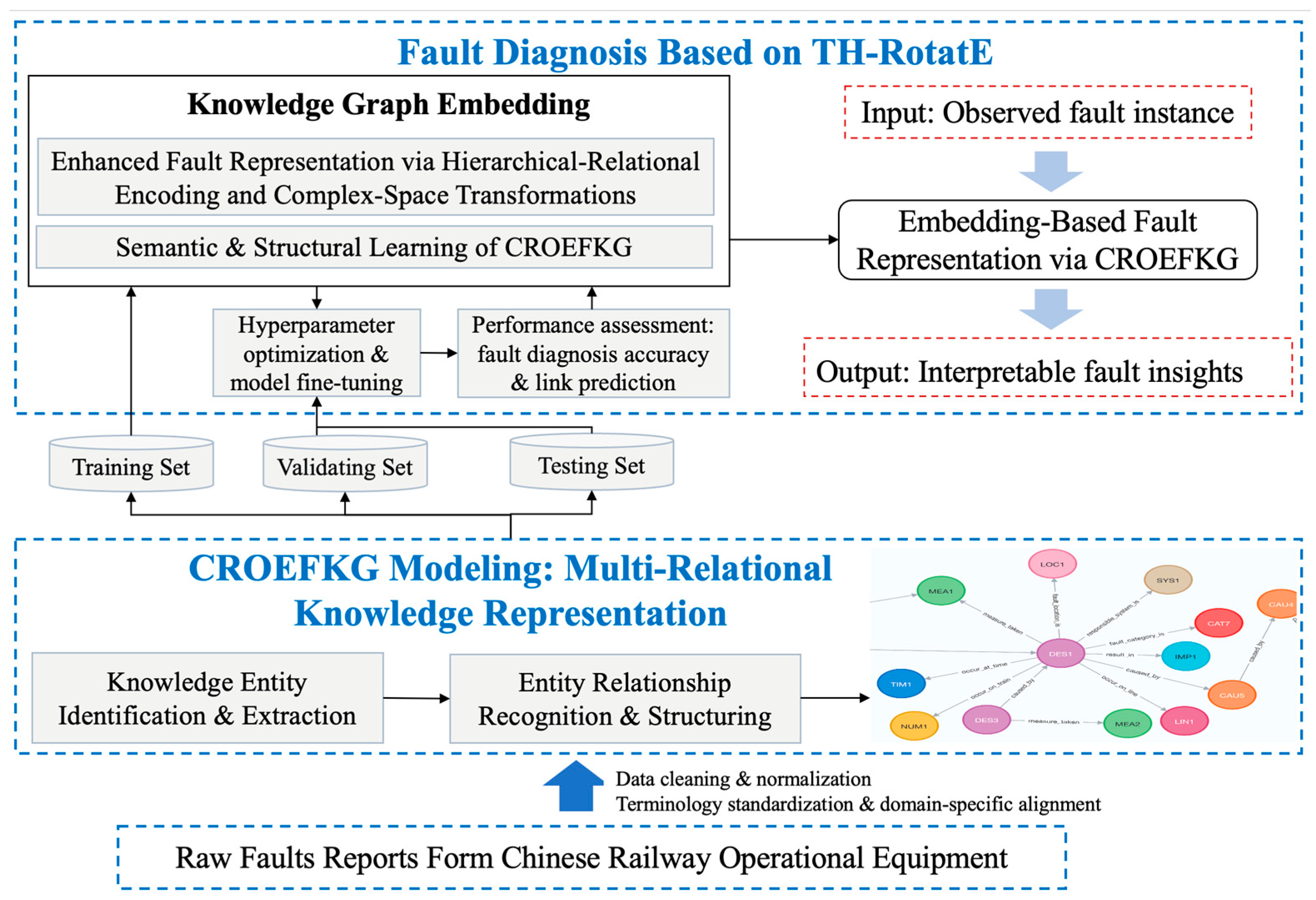
The overall architecture of the proposed KG-based fault diagnosis framework is illustrated in Figure 1. This framework is designed to systematically diagnose railway operational equipment faults by integrating historical fault reports into a structured knowledge representation and leveraging KG embedding techniques for intelligent fault analysis.
Figure 1.
Overall architecture of the KG-based fault diagnosis framework for railway operational equipment.
The framework consists of two primary components:
- (1)
- CROEFKG Modeling. Construction of a domain-specific KG that systematically organizes railway fault-related entities and relationships extracted from investigation reports.
- (2)
- KG Embedding-Based Fault Diagnosis. Utilization of TH-RotatE, an advanced KG embedding model, to enhance fault representation and improve fault diagnosis accuracy.
Through the integration of structured fault knowledge and KG-based inference, this framework enables efficient fault identification, causal analysis, and decision support for railway operational management.
The first component, CROEFKG, establishes a structured representation of railway equipment faults, incorporating key elements such as fault types, causes, impacts, corrective actions, and affected systems. By structuring historical fault records into a graph-based model, the CROEFKG provides a comprehensive and interpretable knowledge base for railway fault analysis.
The second component, TH-RotatE, enhances fault diagnosis by learning low-dimensional vector representations of fault-related entities and relationships. This model integrates TransH and RotatE principles to effectively capture both hierarchical fault dependencies and cyclic fault patterns, thereby improving the reasoning and inference capabilities of railway fault diagnosis.
The proposed framework is particularly suited for handling complex fault propagation scenarios, where failures in railway operational equipment often exhibit multi-causal relationships and cascading effects. By leveraging KG embeddings, the system can generalize from historical fault cases to diagnose new or evolving failure patterns.
3.2. CROEFKG Modeling
Railway operational equipment failures pose significant challenges to system reliability, operational safety, and efficiency. Traditional fault diagnosis methods, including rule-based systems and statistical approaches, often fail to effectively extract and structure knowledge from unstructured textual fault reports, leading to poor interpretability and suboptimal decision-making.
To address these challenges, we propose the CROEFKG, which transforms unstructured fault records into a structured, queryable graph format. Unlike general-purpose KG, the CROEFKG is domain-specific, incorporating hierarchical fault categorizations, causal dependencies, and temporal fault propagation patterns tailored to railway operational fault diagnosis.
By representing fault-related entities and their interrelationships in a graph-based format, the CROEFKG enables causal reasoning, predictive diagnostics, and intelligent failure analysis. Its construction consists of two key components:
- Knowledge-enhanced entity recognition. Extracting and categorizing fault-related entities from unstructured railway investigation reports using a hybrid domain-adaptive approach.
- Fault relationship modeling. Structuring causal, hierarchical, and spatial–temporal relationships among fault entities to support knowledge-driven fault diagnosis.
These structured representations provide a solid foundation for the TH-RotatE model, which utilizes CROEFKG embeddings to enhance fault diagnosis accuracy (further detailed in Section 3.3).
3.2.1. Identification of Knowledge Entities
Accurate entity recognition is fundamental to constructing the CROEFKG. Traditional named entity recognition (NER) models, such as BERT-BiLSTM-CRF [33], perform well in general NLP tasks but lack domain specificity and require large amounts of labeled data for fine-tuning. To enhance railway fault entity recognition, we introduce a hybrid knowledge-enhanced approach, integrating the following:
- Domain-adaptive BERT pretraining. Fine-tuning BERT on railway-specific fault reports to improve the recognition of domain-specific terminologies.
- Knowledge graph-aware NER (KG-NER). Incorporating the CROEFKG as a knowledge constraint, allowing entity extraction to be guided by existing fault categories, system hierarchies, and relational structures.
This hybrid approach significantly improves precision and recall, ensuring robust entity classification and enhancing the interpretability of fault data for railway diagnosis.
Entities in the CROEFKG are categorized into three primary groups:
- (1)
- Core Fault Entities
Fault Event (DES)—specific instances of faults recorded in operational reports.
Fault Category (CAT)—high-level fault classification based on standardized railway diagnostic criteria.
- (2)
- Key Attributes for Fault Analysis
Fault Location (LOC)—identifies the affected railway component.
Cause (CAU)—captures underlying technical or operational factors contributing to failure.
Measures (MEA)—describes actions taken to address the fault.
Responsible System (SYS)—specifies the maintenance department or system accountable.
Fault Impact (IMP)—assesses operational consequences, such as delays or system disruptions.
- (3)
- Contextual Attributes for Fault Correlation
Fault Occurrence Time (TIM)—timestamp of the reported fault.
Train Service Number (NUM)—identifies the affected train.
Railway Line Identifier (LIN)—specifies the railway line where the fault occurred.
The ten identified categories of knowledge entities are primarily derived from standardized railway accident investigation documents, such as operational equipment fault reports provided by a Chinese railway bureau. Table 1 summarizes the different categories of knowledge entities. As shown in Table 2, various types of entities can be identified based on the events described in the fault report.
Table 1.
Types of knowledge entities in the CROEFKG.
Table 2.
An example from the railway bureau illustrates a recorded fault report along with the associated knowledge entities is identified.
By structuring entities into these categories, the CROEFKG enables multidimensional fault analysis and provides a foundation for intelligent railway fault diagnosis.
3.2.2. Identification of Entity Relationships
Once the knowledge entities in the CROEFKG are identified, the subsequent task involves defining the relationships among these entities. In KG theory, such relationships are typically structured as knowledge triples [34], represented as , where and denote the head and tail entities, respectively, and represents the relational link between them. These relationships form the backbone of the KG by connecting entities. Depending on the complexity, an entity relationship can manifest in various forms, including one-to-one, one-to-many, many-to-one, many-to-many, or even multi-step paths, each providing unique contextual connections within the graph [35].
In this paper, the entity relationships within the CROEFKG encompass cause–effect relationships, inheritance relationships, and association relationships. The definitions of these relationships are informed by the practical management needs observed in railway operations, reflecting the decision-making processes and operational practices essential to ensuring the efficiency and safety of the system. The entity relationships we have defined have been reviewed by domain experts and are consistent with the domain standards [36].
These relationships are represented by nine specific keywords: caused_by, result_in, fault_category_is, responsible_system_is, measure_taken, fault_location_is, occur_at_time, occur_on_train, and occur_on_line.
- Causal Relationships. The caused_by and result_in relations capture causal links between entities. For example, as shown in Table 2, <DES1, caused_by, CAU5> and <DES1, result_in, IMP1> indicate that CAU5 caused DES1, which in turn led to IMP1. These relationships can be many-to-many or multi-step, where multiple causes lead to various effects, or form causal chains across several steps.
- Inheritance Relationships. The fault_category_is and responsible_system_is relations describe the classification of fault events. For instance, DES1 belongs to category CAT1 and is associated with system SYS1, expressed as <DES1, fault_category_is, CAT1> and <DES1, responsible_system_is, SYS1>. These are many-to-one relationships, reflecting the ability to classify a single fault event under multiple hierarchical structures.
- Corrective Action Relationships. The measure_taken relation links fault events to their corresponding corrective measures. For example, <DES1, measure_taken, MEA1> denotes that DES1 was addressed by MEA1. This many-to-one relation highlights that different faults may share similar resolution strategies.
- Location Relationships. The fault_location_is relation indicates where a fault occurred. As shown in Table 2, DES1 occurred at LOC1, expressed as <DES1, fault_location_is, LOC1>. This many-to-one relation implies that multiple faults may occur at the same location.
- Time Relationships. The occur_at_time relation links fault events to their timestamps. For instance, <DES1, occur_at_time, TIM1> records the occurrence time of DES1. This many-to-one relationship reflects that different faults may occur simultaneously.
- Train Association Relationships. The occur_on_train relation associates fault events with specific train numbers. For example, <DES1, occur_on_train, NUM1> indicates that DES1 occurred on train 2011x. This many-to-one relationship suggests that a single train may experience multiple faults.
- Railway Line Relationships. The occur_on_line relation links faults to specific railway lines. For instance, <DES1, occur_on_line, LIN1> shows that DES1 occurred on the Li-Qin Line. This many-to-one relationship reflects that a railway line may be associated with multiple fault events.
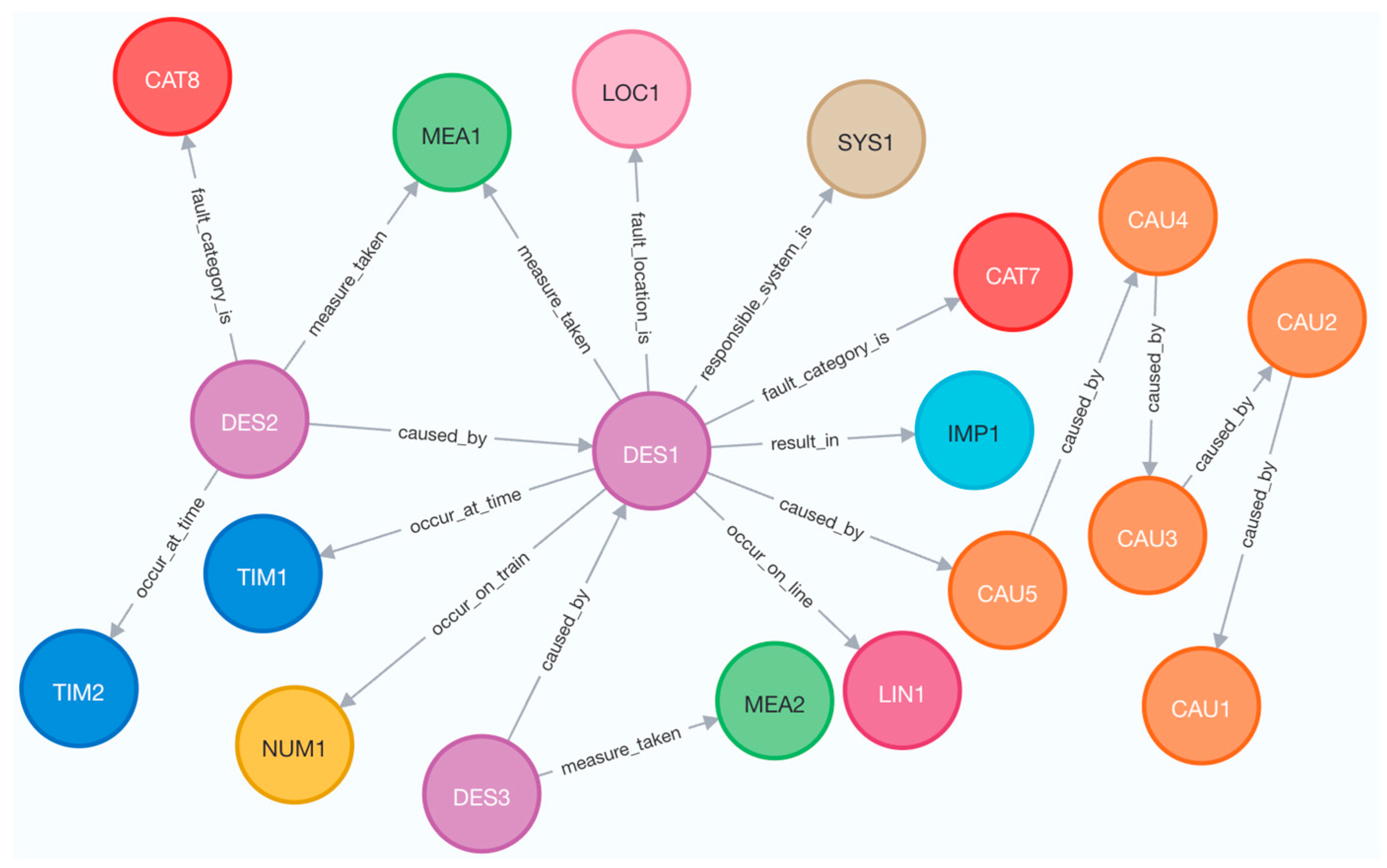
Table 3 demonstrates the relationships among entities, using the examples of knowledge entities provided in Table 2. For instance, the fault phenomenon recorded in Fault Report R20180001 triggered the fault phenomena documented in Fault Reports R20180002 and R20180003. Additionally, the fault phenomenon in Fault Report R20180001 itself was caused by a series of interconnected reasons. This indicates that, in actual railway operations, there may be chain reactions between various fault phenomena and their causes. These relationships are maintained in the Neo4j (version 5.26.0) graph database, providing a graphical depiction of the CROEFKG, illustrated in Figure 2. As demonstrated in Figure 2, these relationships in the CROEFKG highlight the complex interdependencies inherent in fault management within railway systems. This underscores the necessity of integrating and analyzing comprehensive data to support effective operational management and improve fault resolution strategies.
Table 3.
Relationships between the knowledge entities presented in Table 2.
Figure 2.
Graphical representation of the CROEFKG using Neo4j.
3.3. TH-RotatE Model for Fault Diagnosis
3.3.1. Notation and Preliminaries
To ensure clarity and consistency in the presentation of our hybrid embedding model, we define the mathematical symbols and notations used throughout this section as follows:
- (1)
- Bold lowercase letters (e.g., ) denote vector embeddings of entities and relations.
- (2)
- Italic lowercase letters (e.g., ) are used to denote symbolic identifiers or elements of triples (i.e., head, tail, relation).
- (3)
- The embedding space represents a real-valued -dimensional vector space, while denotes a complex-valued -dimensional vector space.
- (4)
- and denote the projections of head and tail entity vectors onto the relation-specific hyperplane in the TransH model.
- (5)
- The vector represents the normal vector of the hyperplane associated with relation in TransH.
- (6)
- The Hadamard (element-wise) product in the complex space is denoted as .
- (7)
- The model’s score functions are denoted by and , which evaluate the plausibility of triples.
All vector embeddings, unless otherwise specified, are assumed to be -dimensional and are either real-valued (TransH) or complex-valued (RotatE), depending on the submodel being discussed.
3.3.2. TransH Model
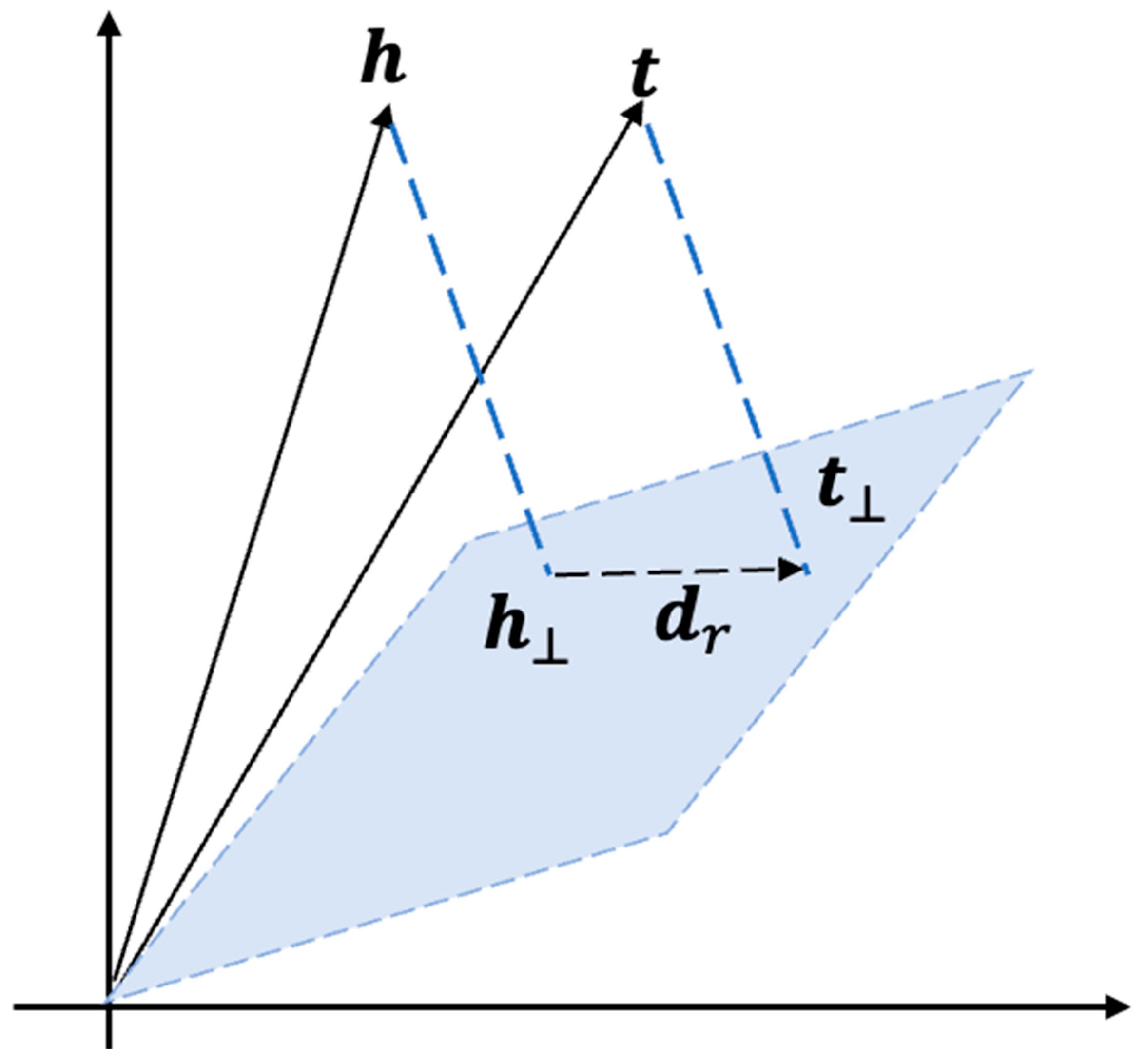
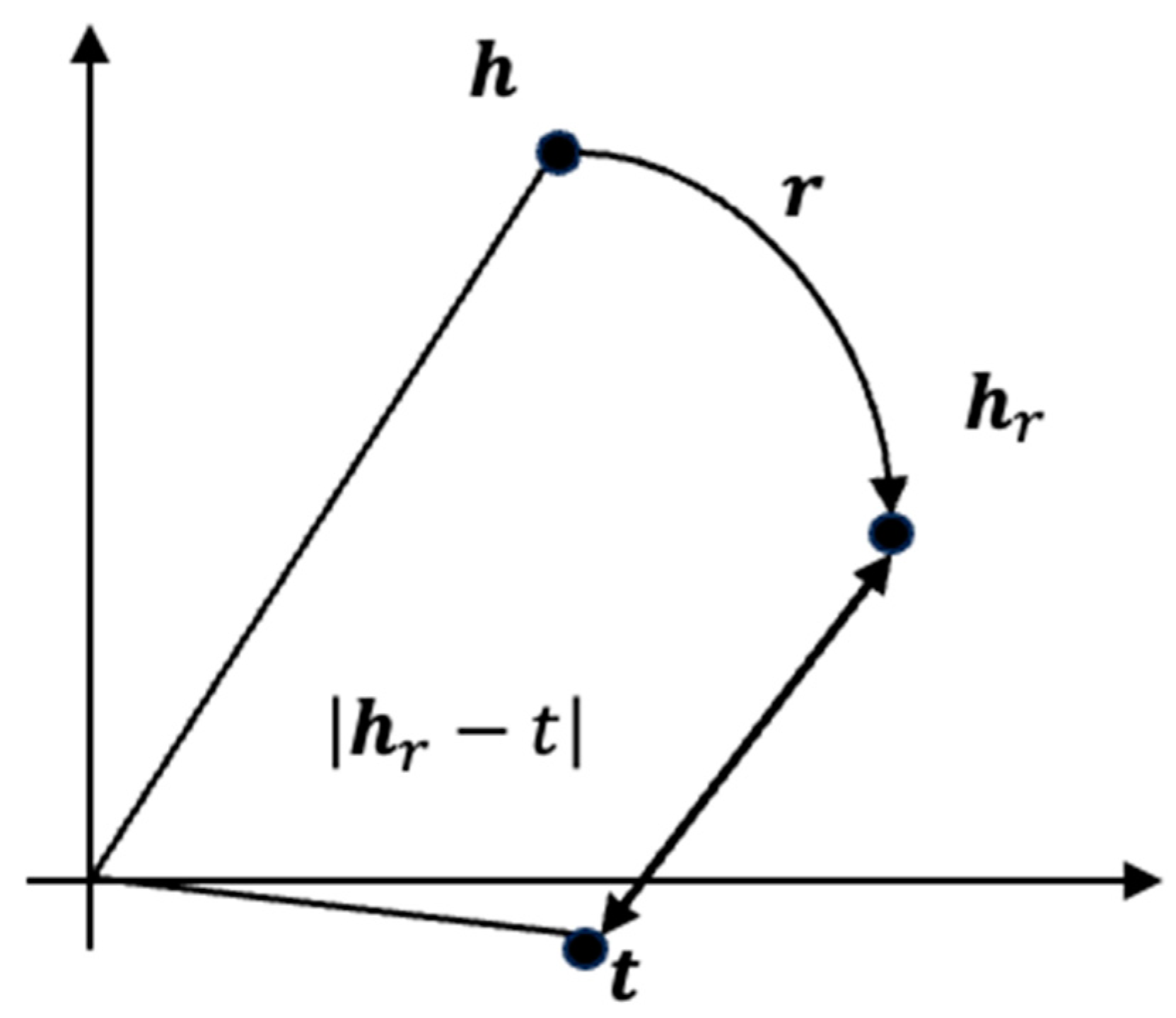
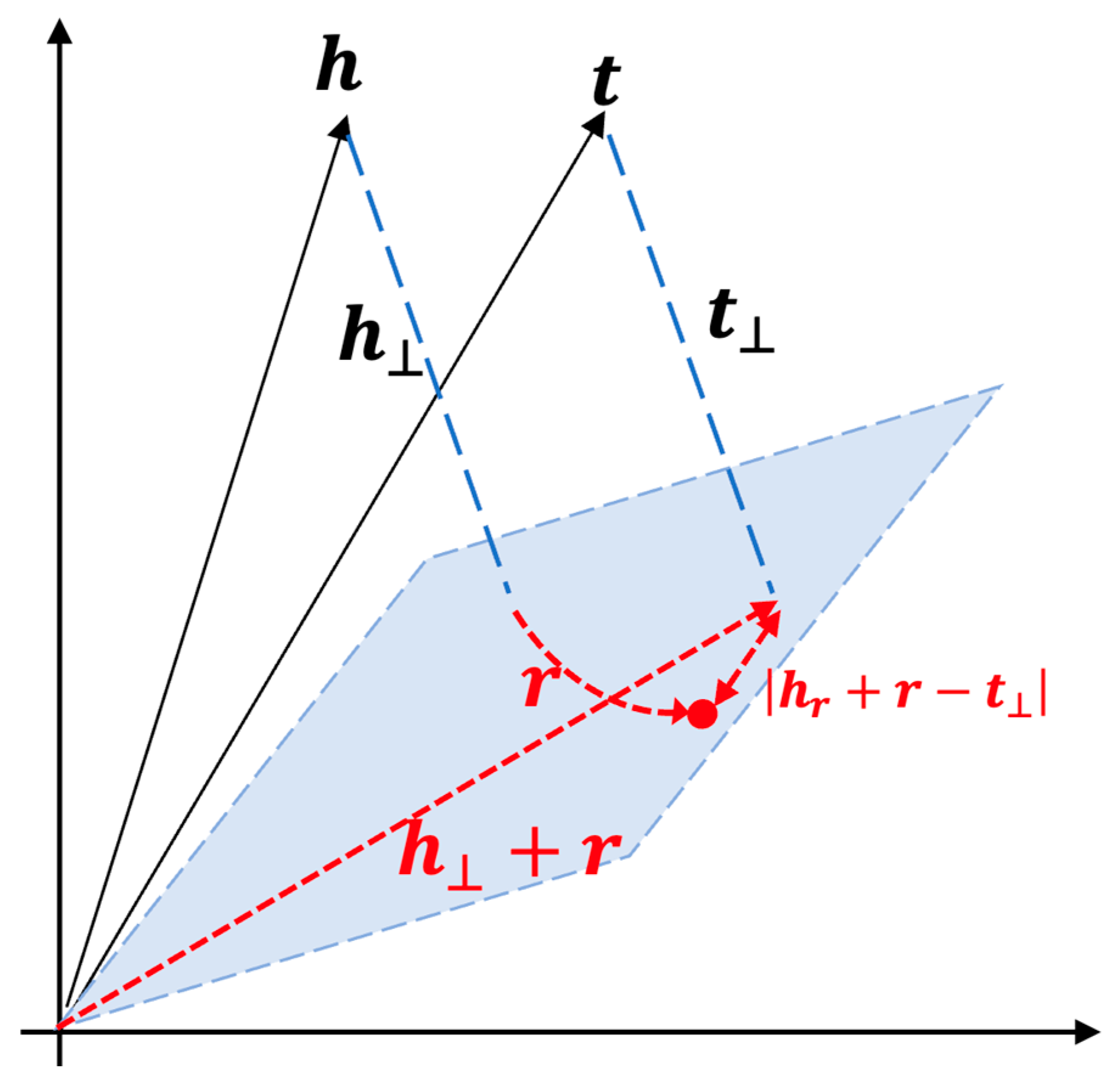
The TransH model, introduced by Wang et al. [10], builds upon the TransE [11] framework to better handle complex relationships in KGs. Instead of embedding entities and relationships in a shared vector space, TransH utilizes relation-specific hyperplanes, defined by their normal vectors, enabling entities to possess unique embeddings for each relation. This concept is illustrated in Figure 3. This provides a more flexible representation, enabling an entity to assume different roles across various relationships.
Figure 3.
Geometric illustration of the TransH model.
In the TransH model, each relation r is represented by a hyperplane defined by a normal vector . Entities connected by a relation are projected onto this hyperplane to distinguish their roles in different relational contexts. Specifically, given a triple , where and are the head and tail entities, the projections onto the hyperplane are calculated as shown in Equations (1) and (2).
Here, and represent the projections of and on the hyperplane associated with .
The scoring function in TransH is designed to measure the plausibility of triples by evaluating the distance between the projected head and tail entities in a relation-specific space. This scoring function is expressed as follows:
where is the embedding of the relation . The model is trained to minimize this score for correct triples and maximize it for incorrect ones, thus enhancing its discriminative power.
TransH improves upon its predecessor TransE by addressing its limitations in handling one-to-many, many-to-one, and many-to-many relationships. This ability makes it particularly advantageous for complex KGs such as those used in railway operational equipment fault diagnosis.
In the domain of Chinese railway operational equipment fault diagnosis, the TransH model’s strengths align closely with the inherent challenges of modeling interdependent and hierarchical relationships. Railway systems often exhibit intricate fault propagation patterns. For example, a failure in the signaling system can simultaneously influence track circuits, power supplies, and communication subsystems. TransH’s projection mechanism effectively separates these overlapping relationships by projecting entities onto distinct hyperplanes for each relation, preserving relational semantics and reducing interference.
In the context of fault diagnosis for Chinese railway operational equipment, the TransH model provides a robust framework for capturing the nuances of equipment relationships and their operational dynamics. This forms a critical component of the integrated TH-RotatE model, contributing to its overall effectiveness in anticipating equipment failures and optimizing maintenance strategies.
3.3.3. RotatE Model
The RotatE model, introduced by Sun et al. [12], represents entities and relations in a complex vector space, enabling it to capture intricate relational patterns within KGs. The key innovation of RotatE lies in its ability to model various relation properties, such as symmetry, anti-symmetry, inversion, and composition, by representing relations as rotations in the complex plane. This capability allows RotatE to differentiate between complex relational patterns, outperforming traditional models in tasks like link prediction and KG completion.
In RotatE, each entity is represented as a complex vector , and each relation is represented as a phase vector , where denotes the embedding dimension. Given a triple , the model predicted the tail entity by applying a rotation to the head entity using the relation , as Equation (4):
Here, denotes the Hadamard (element-wise) product in the complex space. The real and imaginary parts of the entities and relations are separately handled to facilitate this rotation.
The scoring function in RotatE measures the plausibility of a given triple by calculating the distance between the rotated head entity and the tail entity using either the or norm. It is defined as Equation (5):
where , and are the embeddings of the head entity, relation, and tail entity, respectively. The model minimizes this distance for true triples while maximizing it for corrupted triples, thus ensuring an accurate representation of relationships in the KG.
Figure 4 illustrates RotatE using a 1-dimensional embedding, showcasing its ability to model symmetric relations. RotatE’s capability to model and infer complex relational patterns makes it highly suitable for fault diagnosis in railway operational equipment. By leveraging RotatE, our approach can effectively identify and predict potential faults by analyzing the intricate relationships between different equipment components, operational conditions, and historical fault data. This enhances the accuracy and reliability of fault diagnosis, contributing to improved maintenance strategies and operational efficiency.
Figure 4.
Illustrations of RotatE with only one dimension of embedding.
In the context of fault diagnosis for railway operational equipment, the RotatE model enables a more detailed understanding of the dependencies among various system components, operational conditions, and historical fault records. For instance, relationships such as “fault causes another fault” (causality) or “equipment belongs to subsystem” (hierarchical structure) are inherently complex and benefit from RotatE’s ability to represent such relations geometrically.
By embedding entities such as “fault location”, “fault type”, and “maintenance action” into a complex vector space, RotatE provides a robust mechanism for analyzing interdependencies. When applied to our CROEFKG dataset, which consists of triples describing equipment faults, operational scenarios, and corrective measures, RotatE excels at identifying patterns that link specific fault phenomena to their underlying causes and potential remedies.
3.3.4. Integration of TransH and RotatE Models for Fault Diagnosis
The TH-RotatE model is a hybrid knowledge graph embedding framework that integrates the strengths of both TransH and RotatE to enhance fault diagnosis in Chinese railway operational equipment. This integration is motivated by the need to capture both the geometric structure of entity relations (via TransH) and the semantic–relational patterns including symmetry and hierarchy (via RotatE), as illustrated in Figure 5. Such capability is crucial for modeling the multifaceted fault dependencies and propagation characteristics in railway systems.
Figure 5.
Illustrations of TH-RotatE with only one dimension of embedding.
- (1)
- Unified Embedding and Fusion Strategy
In TH-RotatE, each input triple is processed in parallel through two distinct embedding pipelines:
TransH pipeline: projects the head and tail entities onto a relation-specific hyperplane using Equations (1) and (2), and computes the relational plausibility score using the TransH scoring function defined in Equation (3).
RotatE pipeline: Represents each entity as a complex-valued vector and each relation as a phase vector, applying an element-wise rotation to the head entity to obtain the predicted tail entity , as defined in Equation (4). The plausibility of the triple is then evaluated using the RotatE scoring function (Equation (5)).
To integrate these two distinct representations, TH-RotatE adopts a score-level fusion strategy, combining the outputs of both scoring functions via a weighted additive formulation:
Here, and are non-negative trainable scalar parameters that govern the contribution of each component model during training. Rather than assigning these weights manually, they are optimized end-to-end via backpropagation, enabling the model to adaptively prioritize either structural (TransH) or semantic (RotatE) signals depending on the complexity and characteristics of different relational contexts.
To prevent degenerate behavior—such as over-reliance on a single component—we initialize and impose an normalization constraint throughout training. This constraint encourages balanced learning and improves interpretability by making the relative influence of each model explicitly quantifiable.
TH-RotatE deliberately adopts score-level fusion instead of embedding-level integration due to the heterogeneous nature of the component models. TransH operates in a real-valued space , while RotatE employs complex-valued vectors with phase-based relational transformations. Directly merging these embeddings—such as via concatenation or projection—would result in geometric inconsistencies and may distort the relational semantics that each model captures.
By integrating at the scoring function level, TH-RotatE preserves the semantic integrity of both embedding spaces and enables a modular yet coherent combination of their respective relational inductive biases: TransH excels at modeling hierarchical and type-constrained structures, while RotatE captures symmetric, anti-symmetric, and compositional relations. This fusion strategy enhances flexibility, robustness, and overall model expressiveness. For instance, in a scenario where a signal failure is caused by either a disconnection in the cable or a malfunction in the control module, TransH captures the hierarchical dependencies between components (e.g., signal → control circuit → power supply), while RotatE models the compositional or symmetric relationships between fault causes and their recurring patterns across different locations.
- (2)
- Embedding Dimensions
To ensure architectural consistency and compatibility across the dual embedding pipelines in TH-RotatE, we explicitly set the embedding dimension to for both the TransH and RotatE components. This unified dimensionality facilitates a coherent fusion of the respective scoring functions, as it ensures that all embeddings possess equivalent representational capacity and are directly comparable in scale.
The choice of represents a well-considered trade-off between expressive power and computational efficiency. This configuration was selected based on a grid search over candidate values , where performance was evaluated on a held-out validation set. As detailed in Section 4.3.3 (3) Effect of Embedding Dimension, the setting consistently outperformed alternatives in terms of link prediction accuracy (MRR, Hit@K) while maintaining favorable training convergence speed and memory usage.
Moreover, maintaining identical dimensionality across both embedding streams simplifies model design and mitigates the risk of score imbalance during the weighted fusion process. In particular, it avoids complications arising from mismatched vector norms or heterogeneous feature distributions, thereby supporting stable gradient updates and preserving the semantic and structural complementarities encoded by the TransH and RotatE modules. This embedding strategy ultimately enhances the robustness and generalization capacity of the TH-RotatE framework.
- (3)
- Self-adversarial Negative Sampling Strategy
To enhance the quality of negative samples during training, we incorporate a self-adversarial negative sampling strategy into the TH-RotatE framework. Unlike uniform sampling, which treats all negative samples equally, this method assigns higher weights to harder negatives—i.e., those that the model mistakenly deems plausible—thereby sharpening the model’s discrimination capability.
Given a positive triple , a set of corrupted negative triples is generated by replacing either the head or tail entity. The model computes the plausibility score for each negative triple . The sampling probability of the -th negative sample is then calculated using a softmax function over the scores:
where is a temperature parameter that controls the sharpness of the distribution, and is the number of negative samples. These probabilities are used to weigh the negative log-likelihood loss, enabling the model to focus more on informative negative examples.
This strategy aligns the training process with the true optimization goal—minimizing ranking errors—while improving the training stability and convergence speed. It is particularly beneficial for modeling complex and ambiguous relationships in the fault knowledge graph.
- (4)
- Loss Function
Building upon the self-adversarial negative sampling strategy described earlier, the training objective of TH-RotatE is defined to explicitly reward plausible triples while penalizing misleading yet informative negatives. To this end, we adopt a log-likelihood loss function that combines both positive and adversarially weighted negative components, as formulated in Equation (8):
Here, denotes the plausibility score for a triple computed by the fused scoring function, and is a fixed margin parameter controlling the separation between positive and negative examples. The negative sampling probabilities are computed using the self-adversarial sampling mechanism introduced in Equation (7), ensuring that more plausible negatives receive higher weights during optimization.
Intuitively, the first term of the loss function encourages the model to assign higher scores to valid triples, thus reinforcing their plausibility in the knowledge graph. The second term, on the other hand, penalizes negative triples in proportion to their predicted likelihood—placing more emphasis on hard negatives that the model is prone to misclassify. This contrastive learning approach helps the model sharpen its decision boundaries and reduces false positives.
Following the corruption strategy in [10], negative triples are generated by replacing either the head or the tail entity in a ground truth triple , using a Bernoulli distribution-based sampling scheme. This introduces diverse and representative negatives for each relation type.
By training under this self-adversarial loss framework, the TH-RotatE model learns to robustly differentiate between true and false relational patterns. This capability is particularly critical in the CROEFKG dataset, where ambiguous fault dependencies and overlapping semantics frequently occur among entities such as fault causes, locations, categories, and handling measures.
- (5)
- Training Algorithm of TH-RotatE
The end-to-end learning procedure of the TH-RotatE model is summarized in Algorithm 1. It jointly optimizes the real-valued and complex-valued embeddings using a weighted fusion mechanism and a self-adversarial loss function.
| Algorithm 1: TH-RotatE Training Algorithm | |
| 1 | , E |
| 2 | , |
| 3 | , |
| 4 | |
| 5 | to E do |
| 6 | |
| 7 | B by Bernoulli corruption |
| 8 | |
| 9 | |
| 10 | |
| 11 | for i = 1 to k do |
| 12 | |
| 13 | |
| 14 | } |
| 15 | |
| 16 | return E, R |

4. Experiments
4.1. Data Collection and Preprocessing
This study utilizes 1689 railway operational equipment fault reports provided by a Chinese railway bureau, covering the period from 1 January 2018 to 30 April 2020. The classification of faults adheres to the standards outlined in Chapter Classification of Equipment Faults, of the Measures for the Investigation and Handling of Railway Operational Equipment Faults in China. Railway operational equipment faults are categorized into 16 distinct classes, including G1 locomotive faults, G2 vehicle faults, G3 EMU faults, G4 railway ferry equipment faults, G5 self-propelled special equipment faults, G6 track and bridge/tunnel equipment faults, G7 signaling equipment faults, G8 communication equipment faults, G9 power supply equipment faults, G10 water supply equipment faults, G11 information system equipment faults, G12 tail device faults, G13 monitoring and control equipment faults, G14 damage to line safety protection equipment and facilities, G15 water damage, landslides, rockfalls, and fallen trees, and G16 other equipment faults.
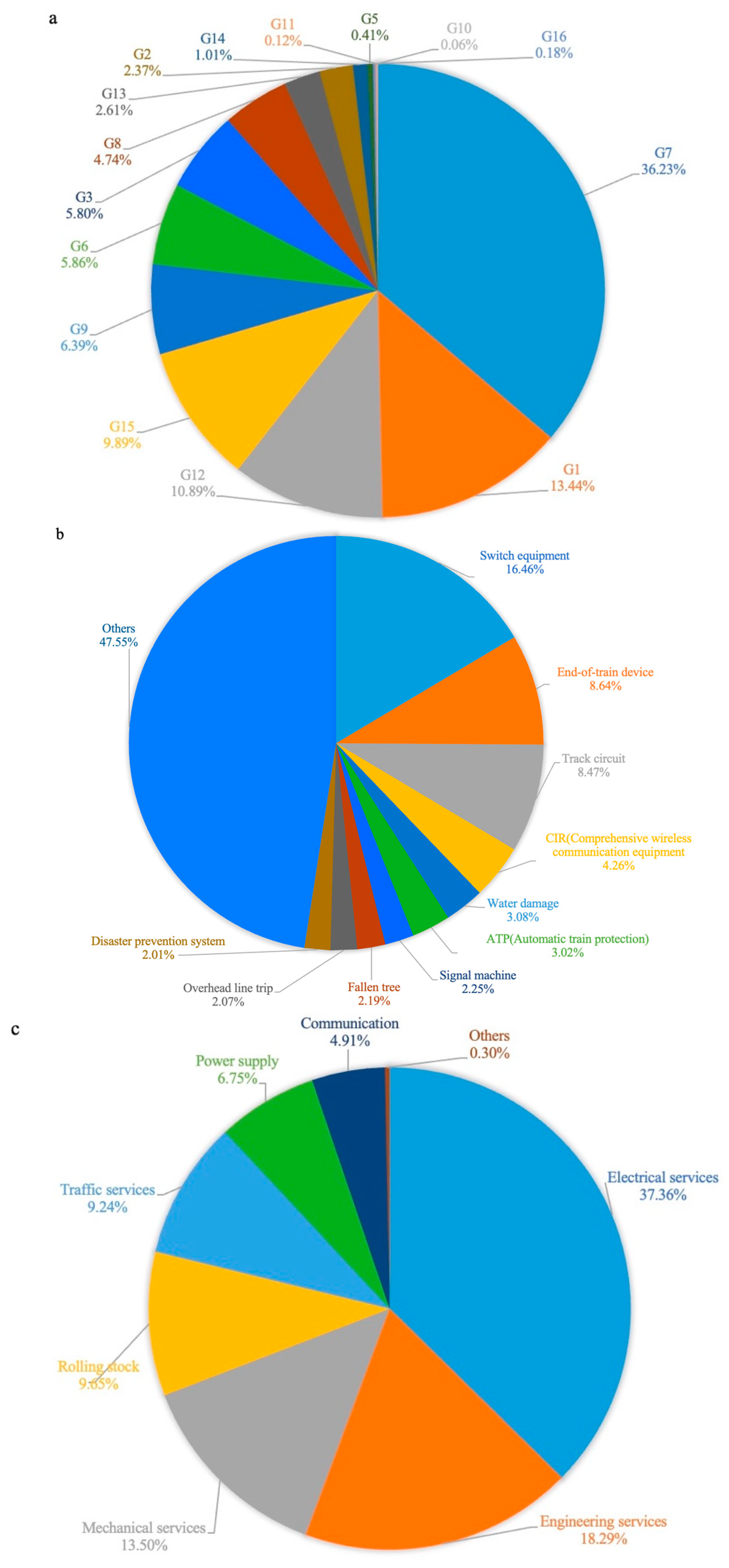
For this study, the fault reports were systematically categorized according to these standards. As shown in Figure 6a, G7 signaling equipment faults, G1 locomotive faults, and G12 tail device faults are the most prevalent, accounting for 36.23%, 13.44%, and 10.89% of the total, respectively. Additionally, fault reports were further analyzed by location, revealing 80 distinct fault locations. We also compiled the top ten most frequently reported fault locations, as illustrated in Figure 6b. The top three most frequent fault locations are switch equipment (16.46%), end-of-train device (8.64%), and track circuit (8.47%).
Figure 6.
Statistics of the collected data, (a) fault categories, (b) fault locations, and (c) responsible systems.
Additionally, we categorized the report data by the responsible system. As shown in Figure 6c, there are seven categories of responsible systems for railway operational equipment faults: operations, vehicles, locomotives, tracks, signaling, power supply, and communication. In the fault reports, electrical services, engineering services, and mechanical services have the highest percentages, accounting for 37.38%, 18.31%, and 13.51%, respectively. Predicting faults based on these historical railway operational equipment fault reports can assist maintenance personnel in taking preventive measures in advance, thereby reducing the likelihood of faults, improving train operation efficiency, and ensuring railway operational safety.
As illustrated in Figure 6a,b, the distribution of fault classes and fault locations is notably imbalanced. For instance, G7 (signaling equipment faults) accounts for more than one-third of all fault reports, whereas certain categories—such as G10 (water supply equipment faults) and G11 (information system equipment faults)—are significantly underrepresented. Similarly, fault locations like switch equipment are frequently reported, while others, such as axle temperature sensors and catenary equipment, appear only sporadically.
This imbalance presents potential challenges for model training, as learning algorithms may become biased toward frequently occurring classes and locations, leading to reduced accuracy for rare or minority types. In this study, we deliberately retain the original distribution to preserve the real-world characteristics of railway fault occurrences, which is critical for building practical, deployable diagnostic systems. Nevertheless, future work could explore techniques such as weighted loss functions, data augmentation, or targeted data collection to mitigate these effects and enhance model generalizability.
To ensure data quality and reliability, a rigorous data preprocessing procedure was implemented:
- (1)
- Data cleaning: fault reports with missing critical information or duplicate entries were excluded, and inconsistent terminology was normalized to align with the classification standards.
- (2)
- Outlier handling: anomalous or implausible entries (e.g., extreme timestamps or irrelevant fault locations) were verified through domain expert consultation or excluded if unresolvable.
- (3)
- Text standardization: textual fault descriptions were tokenized and standardized to enable compatibility with downstream natural language processing tasks.
- (4)
- Category validation: fault categories, locations, and responsible systems were cross-validated to address inconsistencies and ensure accurate alignment with the established taxonomy.
These preprocessing steps were critical in improving the dataset’s integrity and minimizing potential biases, thereby ensuring the reliability of the subsequent analysis and model training processes. This robust foundation supports accurate fault diagnosis and prediction, enhancing the practical applicability of the proposed approach.
4.2. CROEKG Construction
Building upon the preprocessed fault reports described in Section 4.1, the construction of the CROEFKG begins with the extraction of entities and relations as detailed in Section 3.2. Beyond identifying the 16 fault categories, we also extracted 80 fault locations, 7 responsible systems, 43 railway lines, and over 100 train services. Each report also includes descriptions of fault events, causes, handling measures, impacts, and occurrence time.
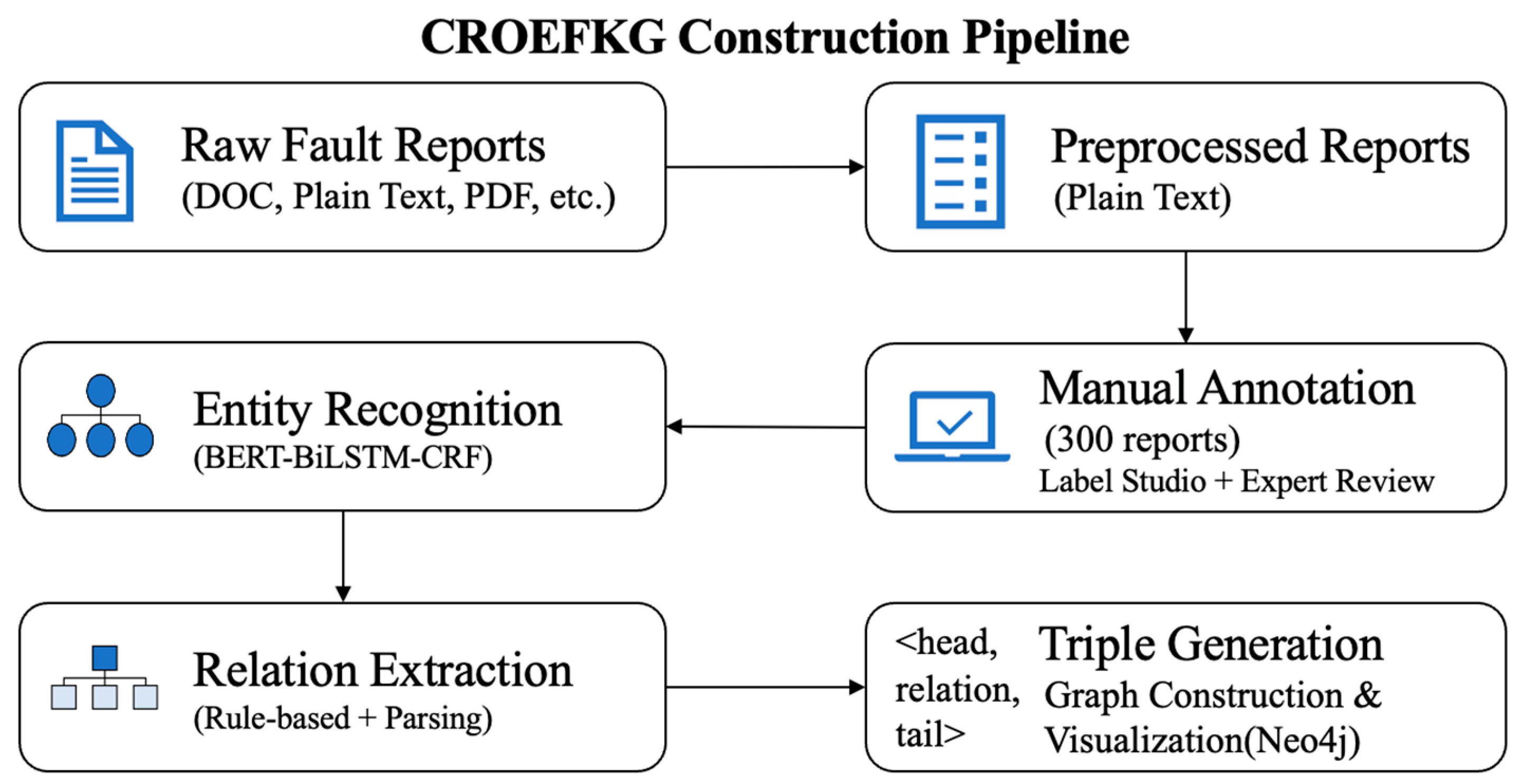
To efficiently transform these unstructured reports into structured triples, we adopted a semi-automated knowledge graph construction pipeline, consisting of the following steps:
- (1)
- Manual Annotation of Gold Data: A subset of 300 reports was annotated by two experienced railway engineers using Label Studio [37] (https://labelstud.io/, accessed from October 2024 to June 2025), covering ten entity types and multiple relationship types. To ensure annotation consistency, Cohen’s Kappa [38] was calculated, achieving an inter-annotator agreement score of 0.86.
- (2)
- Model-Assisted Extraction: The manually labeled data were used to train a BERT-BiLSTM-CRF [33] model for NER. Entity relationship extraction combined rule-based methods with dependency parsing to identify semantic relations such as caused_by, result_in, and measure_taken.
- (3)
- Triple Formation and Quality Validation: Extracted entity pairs and their relations were converted into structured triples ⟨head, relation, tail⟩. All triples were validated by domain experts to remove semantic errors, resolve contradictions, and unify terminologies.
- (4)
- Graph Construction and Visualization: The resulting high-quality triples were imported into the Neo4j graph database, forming the CROEFKG. The graph comprises 13,760 triples, including 2633 cause–effect, 3361 inheritance, and 7761 association relationships.
To further illustrate the overall construction pipeline, Figure 7 presents a high-level flowchart of the CROEFKG development process. It shows the end-to-end stages from raw report ingestion, manual and model-assisted annotation, to entity/relation extraction and triple formation. This visual representation clarifies the interaction between domain expertise and intelligent algorithms, and demonstrates how structured knowledge emerges from unstructured fault narratives. The output triples are then systematically integrated into the Neo4j-based graph database, resulting in the final CROEFKG.
Figure 7.
A flowchart illustrating the overall construction pipeline of the CROEFKG.
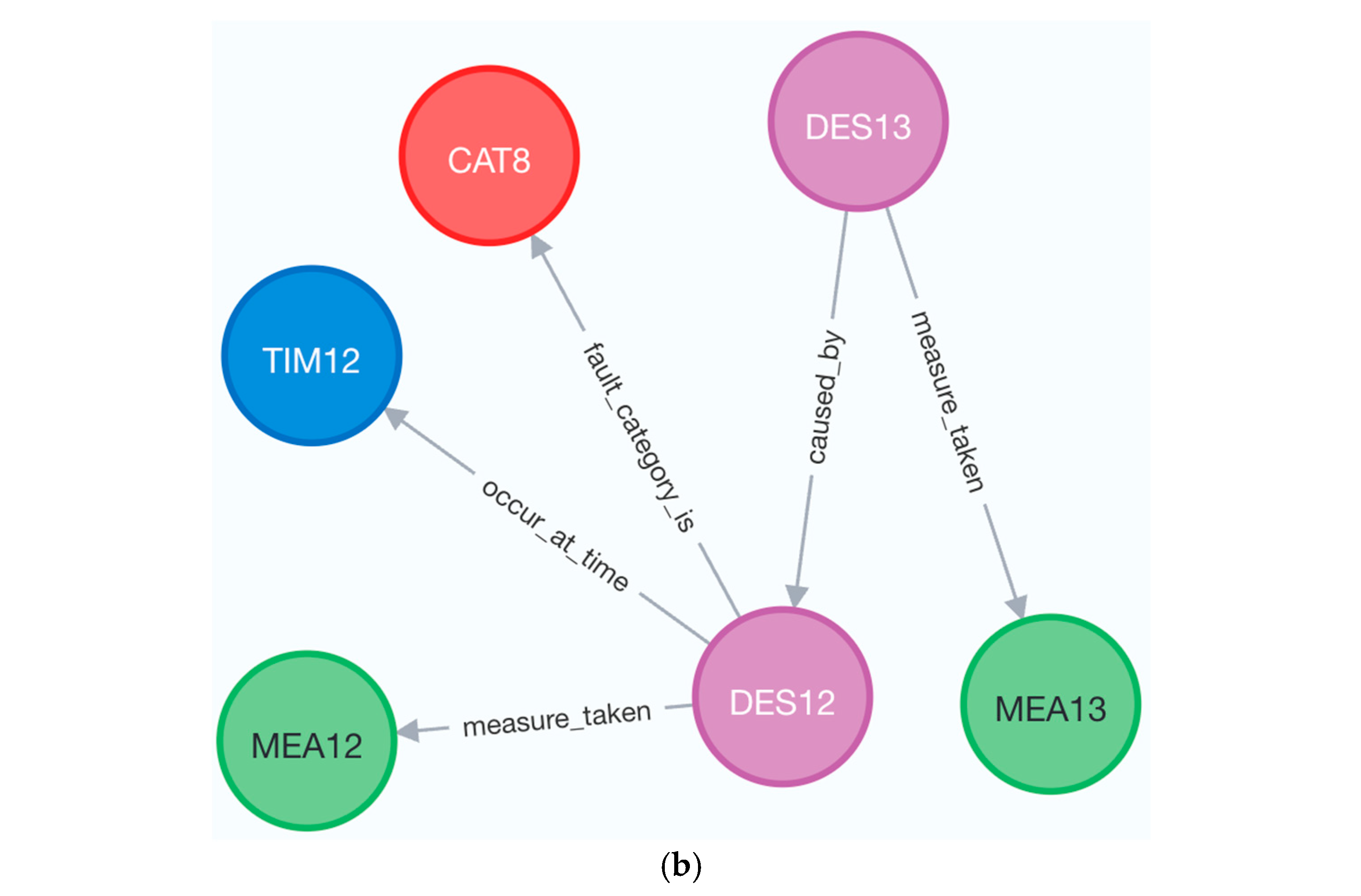
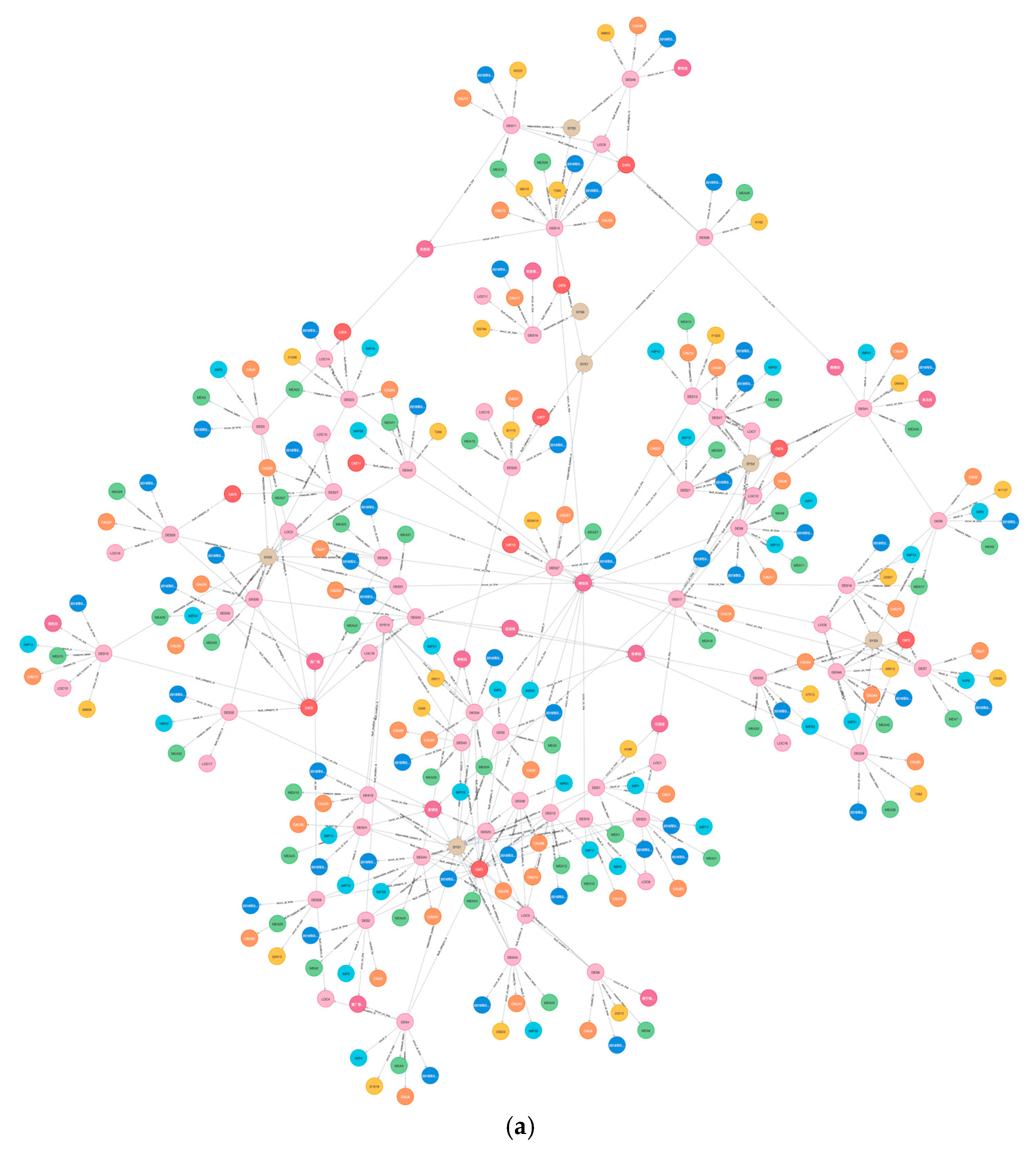
As shown in Figure 8a, each entity type is represented with a distinct color according to the definition in Section 3.2.1, and Figure 8b provides a detailed view of a local subgraph. The CROEFKG serves as a structured relational foundation that encodes rich fault-related knowledge, enabling the subsequent TH-RotatE model to perform knowledge graph embedding and reasoning. This structured knowledge base lays the groundwork for accurate and interpretable fault diagnosis in railway operational equipment.

Figure 8.
The CROEFKG of the collected 1689 reports in our study. (a) Full view of the CROEFKG. (b) Portion of view to show more details.
4.3. Chinese Railway Operational Equipment Fault Diagnosis
4.3.1. Evaluation Metrics
In accordance with standard practices in link prediction tasks [39,40,41,42], we employ Hits at n (Hit@n) and mean reciprocal rank (MRR) [42] to evaluate fault diagnosis performance, as specified in Equations (9) and (10).
In these equations, refers to the collection of correct triples evaluated, with representing the total count of triples in . The variable indicates the position of the -th triple in the ranking, while serves as an indicator function that equals 1 if the condition is met, and 0 otherwise. The Hit@n metric quantifies predictive accuracy by determining the average proportion of correct triples ranked within the top positions. Specifically, this study employs Hit@1, Hit@3, and Hit@10 for evaluation purposes. Meanwhile, the MRR metric evaluates the overall quality of the ranking by assessing its rationality. As indicated by Equation (10), a higher MRR value implies higher rankings of correct triples, thus indicating superior overall prediction performance.
4.3.2. Experiment Settings
Table 4 details the main parameter settings for the TH-RotatE model. It is important to note that the existing triples in the CROEFKG dataset are treated as positive, representing correct instances, while triples missing from the ROHKG dataset serve as negative samples. These negative triples are generated using a dynamic, adversarial sampling approach integrated with the TH-RotatE model. An adversarial approach was employed to generate negative samples that are particularly challenging. This involves introducing adversarial perturbations to the negative samples, which makes them more difficult for the model to classify correctly. By doing so, the model is trained to be more robust and generalizable. This methodology ensures that the negative samples used in the training process are not only challenging but also dynamically adjusted, thus contributing to a more effective and robust learning process.
Table 4.
Hyperparameters of TH-RotatE.
Furthermore, the essence of fault diagnosis lies in predicting the tail entities of triples associated with fault events. These triples include <DES, caused_by, ?>, <DES1, result_in), ?>, <DES1, fault_category_is, ?>, <DES1, responsible_system_is, ?>, <DES1, measure_taken, ?>, and <DES1, fault_location_is, ?>. Consequently, triples with these relationships can be utilized as test data. More specifically, the dataset is split into a ratio of 8:1:1, with 10% allocated to the validation set, 10% to the test set, and the remaining 80% used as the training set.
To demonstrate the superiority of the proposed method, several baseline models have been introduced for comparison. It is important to note that there has been limited research focused specifically on railway operational equipment fault diagnosis, making direct and fair comparisons with other methods challenging. However, since the core of fault diagnosis in this context involves link prediction within a KG, we have selected relevant link prediction models as baselines. Specifically, several typical models in the traditional link prediction models are selected, including DistMult [43] and ComplEx [44] from the semantic-based link prediction techniques, ConvE [45] and ConvKB [46] from the neural network-based methods, and TransH and TransE from the translation-based techniques. Additionally, we performed a comprehensive evaluation of the TH-RotatE model on the CROEF datasets by comparing it with other state-of-the-art models, including RotatE, SCAN [47], and Conv-TransE [47].
Although graph neural network (GNN) [48] models such as R-GCN [49] and CompGCN [50] have achieved state-of-the-art performance in general knowledge graph completion tasks, we deliberately exclude them from our baseline comparisons due to both theoretical and practical considerations. Firstly, our railway fault knowledge graph is highly sparse and contains many low-degree or isolated nodes, which significantly limits the effectiveness of message passing in GNNs. Secondly, many GNN-based models require additional entity-level attributes or auxiliary node features, which are not available in our fault graph context. Thirdly, GNNs often entail considerable computational overhead and complexity during both training and inference, making them less suitable for real-time or large-scale deployment in railway operational environments.
Therefore, we focus our comparison on representative embedding-based models and lightweight neural architectures that are more aligned with the structure and constraints of railway fault knowledge graphs.
4.3.3. Prediction Performance
The proposed TH-RotatE model diagnoses faults using embedding-based link prediction on the CROEFKG. This section compares its performance with baseline and advanced link prediction methods, demonstrating its ability to capture multidimensional fault relationships. Key evaluation metrics include MRR, Hit@10, Hit@3, and Hit@1, which are directly linked to the practical requirements of railway fault management.
- (1)
- Comparison With Traditional Link Prediction Models
Table 5 presents a comparison of TH-RotatE with the baseline link prediction models. Translation-based models exhibit higher MRR values compared to semantic- and neural network-based models, highlighting their effectiveness in ranking fault elements. Among them, TH-RotatE achieves the highest MRR of 0.4165, representing a 34.18% improvement over TransH.
Table 5.
Performance comparison of TH-RotatE with baseline link prediction models.
The superior performance of TH-RotatE is attributed to its hybrid design, combining TransH’s capability for many-to-many hierarchical modeling with RotatE’s strength in capturing cyclic and symmetric relationships. Railway operational faults often exhibit hierarchical structures, such as cascading failures in power systems, and periodic malfunctions in signaling systems. By integrating both local (specific relationships) and global (system-wide patterns) information, TH-RotatE significantly improves fault ranking accuracy.
For Hit@1, only TH-RotatE surpasses 0.2, achieving 0.2801, indicating its superior ability to predict the correct fault in the top-ranked results. In Hit@3, TH-RotatE achieves 48.75%, demonstrating its effectiveness in prioritizing probable faults. Notably, TH-RotatE reaches 80.01% in Hit@10, a crucial metric for practical fault diagnosis where safety-critical decisions require the prioritization of potential failures.
- (2)
- Comparison With Advanced Link Prediction Models
Table 6 compares TH-RotatE with advanced models such as RotatE, SCAN, and Conv-TransE. While RotatE achieves the highest Hit@1, TH-RotatE surpasses all models in MRR, Hit@3, and Hit@10, highlighting its ability to handle complex fault relationships.
Table 6.
Performance comparison of TH-RotatE with advanced link prediction models.
The hybrid architecture of TH-RotatE is particularly effective in railway fault diagnosis. While RotatE performs well for simple symmetric relationships, it struggles with hierarchical chains and nested structures. In contrast, TH-RotatE integrates RotatE’s rotational embeddings with TransH’s hierarchical modeling, making it more effective in capturing diverse fault patterns.
For instance, in diagnosing a signal system fault, TH-RotatE accurately identifies the cause–effect chain linking “sensor failure” → “communication delay” → “control system disruption”, demonstrating its superior relational reasoning capabilities over state-of-the-art methods.
- (3)
- Effect of Embedding Dimension
To assess the impact of embedding dimensionality on model performance, we conducted a sensitivity analysis of the TH-RotatE model under varying embedding sizes. Specifically, we evaluated for both the TransH and RotatE components, ensuring consistent dimensionality across both modules to facilitate coherent fusion. The results, reported in Table 7, show that an embedding dimension of consistently yields the best balance between predictive accuracy and computational efficiency.
Table 7.
Performance of TH-RotatE under different embedding dimensions.
While results in underfitting due to limited representational capacity, further increasing the dimension to leads to only marginal performance gains while significantly increasing the training time and memory consumption. Therefore, we select as the optimal configuration for all experiments, as it provides superior performance in terms of MRR and Hit@K metrics without incurring excessive cost.
These results demonstrate that the selected embedding size enables TH-RotatE to capture multi-scale relational dependencies in fault knowledge graphs while maintaining scalability and deployment practicality in real-world railway systems.
- (4)
- Effect of Self-adversarial Negative Sampling
To evaluate the effect of self-adversarial negative sampling, we conducted an ablation experiment by comparing TH-RotatE models trained with and without this sampling strategy. All other configurations, including embedding dimension , learning rate, and batch size, were kept constant to ensure fair comparison.
As shown in Table 8, the self-adversarial variant outperforms the uniform baseline across all evaluation metrics. Specifically, the MRR improves by 8.91%, and Hit@10 increases by 9.56%. These improvements demonstrate the effectiveness of guiding the model to focus on more informative negative examples during training, leading to more accurate fault inference in the railway domain.
Table 8.
Ablation study on the impact of self-adversarial sampling strategy.
This result empirically supports the design choice to integrate self-adversarial negative sampling into the TH-RotatE framework, validating its importance in improving generalization and robustness in link prediction tasks.
- (5)
- Practical Implications
The high Hit@10 performance (80.01%) underscores TH-RotatE’s practical relevance in railway fault diagnosis. By prioritizing the top 10 most probable faults with high accuracy, railway operators can make proactive maintenance decisions, reducing system downtime and safety risks.
Furthermore, the structured fault representation in CROEFKG enhances interpretability, providing domain experts with valuable insights into how fault elements interact. This contributes to a more robust and scalable predictive maintenance framework, improving operational safety and efficiency in railway systems.
4.3.4. Error Analysis and Diagnostic Challenges
To better understand the strengths and limitations of the proposed TH-RotatE model in practical railway fault diagnosis scenarios, we conduct an in-depth error analysis. This analysis encompasses representative mispredicted triples, identifies challenging entity and relation types, and interprets evaluation metrics from a diagnostic perspective.
- (1)
- Analysis of Incorrect Predictions
We manually sampled and analyzed several mispredicted triples from the test set, categorizing the errors into three representative types. Table 9 presents illustrative examples of each type.
Table 9.
Case analysis of hard-to-predict triples involving difficult entities and relations.
These cases illustrate key challenges in fault knowledge modeling. Firstly, semantically similar but technically different causes can confuse the model when fine-grained distinctions are necessary. Secondly, fault descriptions frequently lack contextual cues (spatial, procedural, or temporal), which hinders precise relation inference. Thirdly, many faults present multi-type characteristics, reflecting the interdependent and layered nature of real-world operational failures. Overcoming these challenges may require enhanced contextual modeling (e.g., transformer-based encoders with attention over history) or the integration of expert-crafted rules to guide reasoning and disambiguation.
- (2)
- Difficult Entities and Relations
We further examined the average MRR and Hit@K scores for each entity and relation type, identifying several underperforming cases. The relation caused_by, though the most frequent, exhibited the lowest Hit@1 and Hit@3 scores due to the broad range of and subtle variation in causal expressions. Similarly, fault_location_is relations showed persistent ambiguity, as descriptions often lacked explicit spatial markers, and locations like “in-station signal device” and “turnout area” frequently co-occur with overlapping symptoms. The entity type MEASURE was also particularly difficult to predict, due to the long, varied, and procedural nature of its texts (e.g., “Notify maintenance crew to inspect the turnout’s external locking device”), which are challenging for fixed-size embeddings to fully encode.
These difficulties stem from several hypothesized causes:
- Data imbalance, where rare fault types (e.g., relay base erosion) and niche locations are severely underrepresented.
- Semantic ambiguity, as some fault symptoms correlate with multiple plausible causes or categories, increasing confusion in the absence of contextual constraints.
- Temporal limitations, given that static embeddings fail to model sequential dependencies or evolving fault chains (e.g., signal delay → traffic congestion → equipment overload). These factors mirror real-world diagnostic complexity, where incomplete information, overlapping symptoms, and multi-step fault evolution hinder accurate reasoning.
- (3)
- Relevance of Selected Relations
The relations defined in the CROEFKG were chosen based on their diagnostic value and alignment with domain expert reasoning. Their effectiveness is reflected in both improved inference metrics and enhanced interpretability. Table 10 summarizes each relation’s diagnostic role.
Table 10.
Diagnostic roles of relation types in the CROEFKG.
Notably, the high Hit@10 score (80.01%, see Section 4.3.3) indicates that TH-RotatE is capable of surfacing plausible fault candidates within the top-K predictions, which is critical in real-time fault triage where rapid decision-making can mitigate cascading failures.
- (4)
- Diagnostic Significance of Evaluation Metrics
The evaluation metrics used not only measure standard link prediction performance but also reflect key diagnostic priorities. MRR and Hit@1 measure the model’s precision in identifying the most probable fault factor—essential for automated troubleshooting. Hit@3 and Hit@10 assess the model’s capability to generate a shortlist of plausible causes or remedies, which aligns with human-in-the-loop workflows in field diagnosis. Furthermore, choices regarding embedding dimension (Section 4.3.3 (3)) and sampling strategies (Section 4.3.3 (4)) contribute to both performance and interpretability under realistic constraints.
4.4. Scalability and Deployment Considerations
To ensure the practical applicability of the TH-RotatE model in real-world railway systems, it is critical to evaluate its scalability and deployment feasibility, especially in scenarios involving large-scale and dynamically evolving knowledge graphs.
- (1)
- Computational Complexity
TH-RotatE incorporates both the TransH and RotatE modules. The time complexity of TransH is linear with respect to the number of triples, i.e., , where is the number of training triples and d is the embedding dimension. RotatE operates in a complex space but maintains the same linear complexity . The integration strategy adopted in TH-RotatE (i.e., weighted score fusion) does not significantly increase the overall computational cost, making it feasible for large-scale datasets.
- (2)
- Training Efficiency and Optimization
To address scalability, the model employs mini-batch training with negative sampling and supports parallel processing across GPU cores. In our implementation, we leverage self-adversarial negative sampling, which improves training efficiency by focusing on harder negative samples. Additionally, early stopping based on validation loss helps reduce the training time.
- (3)
- Graph Growth and Heterogeneity
When the knowledge graph grows dynamically (e.g., due to real-time fault updates), we recommend incremental learning strategies or fine-tuning pretrained embeddings to reduce retraining costs. For heterogeneous data sources (e.g., different railway subsystems, multilingual fault reports), the model’s embedding flexibility in both real and complex spaces allows it to generalize effectively across diverse domains.
- (4)
- Deployment Considerations
For deployment in railway systems, we propose a two-stage inference strategy: (i) offline embedding training and (ii) online fault inference using pre-computed embeddings. This hybrid deployment minimizes computational overhead in real-time settings while ensuring predictive accuracy. Further integration with graph databases (e.g., Neo4j) allows embedding-based querying and reasoning on updated knowledge graphs.
These considerations ensure that TH-RotatE remains both computationally efficient and practically deployable even as railway knowledge graphs scale in size and complexity.
5. Conclusions
This study proposes a novel embedding-based knowledge graph (KG) framework for fault diagnosis in Chinese railway operational equipment, aiming to improve operational safety and efficiency. We introduce a structured modeling approach to construct the CROEFKG, which comprehensively represents fault-related features—such as causes, types, locations, systems involved, treatment measures, and potential impacts—and their interrelationships. To leverage this rich semantic structural information, we develop TH-RotatE, a hybrid knowledge graph embedding model that integrates the advantages of TransH and RotatE. This model effectively captures both hierarchical and relational patterns within the CROEFKG.
Extensive experiments demonstrate that TH-RotatE consistently outperforms both baseline and advanced embedding models in diagnostic accuracy, highlighting its capability to support intelligent fault understanding and decision-making. Moreover, the proposed framework shows strong potential for extension to other types of railway fault diagnosis and supports the development of proactive safety interventions.
Despite the promising results, several directions remain for future work. Firstly, incorporating heterogeneous data sources—such as real-time sensor readings, maintenance records, and environmental factors—into the KG can enhance diagnostic precision and enable dynamic, real-time fault prediction. Secondly, to ensure real-world applicability in large-scale railway systems, improving the scalability and adaptability of TH-RotatE is crucial. Potential strategies include incremental embedding updates, distributed or parallelized training mechanisms, and hybrid online–offline inference frameworks. Thirdly, exploring more expressive embedding paradigms—such as graph neural networks or transformer-based relational encoders—may further boost model performance while maintaining computational efficiency. Finally, extending this approach to cross-domain applications (e.g., urban rail transit, aviation maintenance) will help validate its generalizability and provide broader societal value.
In summary, the proposed TH-RotatE-based KG completion framework offers a robust and extensible solution for intelligent fault diagnosis, with implications not only for enhancing railway safety and reliability but also for supporting fault analysis in other critical infrastructure domains.
Author Contributions
Conceptualization, X.Y. and H.L.; Methodology, X.Y. and J.Y.; Data curation, X.Y., H.L. and J.Y.; Writing—original draft, X.Y.; Writing—review & editing, X.Y. and H.L.; Supervision, R.H.; Funding acquisition, H.L. All authors have read and agreed to the published version of the manuscript.
Funding
This research was funded by the Project on the High-Quality Development and Safety Assurance System and Key Technologies for Railways, funded by China National Railway Group Corporation Limited (Grant number: 2319YF8501). The APC was funded by China National Railway Group Corporation Limited.
Data Availability Statement
The dataset utilized in this study consists of Chinese railway operational equipment fault reports, covering the period from 1 January 2018 to 30 April 2020. Due to ownership restrictions imposed by the third-party organization, the dataset is not publicly accessible at this time. However, despite these restrictions, we remain committed to collaborating with researchers and students who seek access to the dataset for academic and research purposes. Researchers with a legitimate academic or professional interest in the dataset may contact the Data Application Department of the Nanning Railway Bureau to inquire about potential access. For further inquiries, please reach out via phone at +86-771-12306 or email at nanningkyd@163.com.
Conflicts of Interest
The authors declare no conflict of interest.
References
- Liu, J.; Schmid, F.; Zheng, W.; Zhu, J. Understanding railway operational accidents using network theory. Reliab. Eng. Syst. Saf. 2019, 189, 218–231. [Google Scholar] [CrossRef]
- Yan, D.; Li, K.; Zhu, Q.; Liu, J. A railway accident prevention method based on reinforcement learning—Active preventive strategy by multi-modal data. Reliab. Eng. Syst. Saf. 2023, 234, 109136. [Google Scholar] [CrossRef]
- Chen, H.; Jiang, B.; Ding, S.X.; Huang, B. Data-driven fault diagnosis for traction systems in high-speed trains: A survey, challenges, and perspectives. IEEE Trans. Intell. Transp. Syst. 2011, 23, 1700–1716. [Google Scholar] [CrossRef]
- Xie, T.; Huang, X.; Choi, S.K. Intelligent mechanical fault diagnosis using multisensor fusion and convolution neural network. IEEE Trans. Ind. Inform. 2011, 18, 3213–3223. [Google Scholar] [CrossRef]
- Hoang, D.T.; Kang, H.J. A survey on deep learning based bearing fault diagnosis. Neurocomputing 2019, 335, 327–335. [Google Scholar] [CrossRef]
- He, M.; He, D. Deep learning based approach for bearing fault diagnosis. IEEE Trans. Ind. Appl. 2017, 53, 3057–3065. [Google Scholar] [CrossRef]
- Gawde, S.; Patil, S.; Kumar, S.; Kamat, P.; Kotecha, K.; Abraham, A. Multi-fault diagnosis of Industrial Rotating Machines using Data-driven approach: A review of two decades of research. Eng. Appl. Artif. Intell. 2023, 123, 106139. [Google Scholar] [CrossRef]
- Ren, J.; Jin, W.; Li, L.; Wu, Y.; Sun, Z. Performance degradation estimation of high-speed train bogie based on 1D-ConvLSTM time-distributed convolutional neural network. Comput. Intell. Neurosci. 2022, 2022, 5030175. [Google Scholar] [CrossRef]
- Liu, C.; Yang, S. A text mining-based approach for understanding Chinese railway incidents caused by electromagnetic interference. Eng. Appl. Artif. Intell. 2023, 117, 105598. [Google Scholar] [CrossRef]
- Wang, Z.; Zhang, J.; Feng, J.; Chen, Z. Knowledge graph embedding by translating on hyperplanes. In Proceedings of the AAAI Conference on Artificial Intelligence, Québec City, QC, Canada, 27–31 July 2014; Volume 28. [Google Scholar]
- Bordes, A.; Usunier, N.; Garcia-Duran, A. Translating embeddings for modeling multi-relational data. Adv. Neural Inf. Process. Syst. 2013, 26, 2787–2795. [Google Scholar]
- Sun, Z.; Deng, Z.H.; Nie, J.Y.; Tang, J. Rotate: Knowledge graph embedding by relational rotation in complex space. arXiv 2019, arXiv:1902.10197. [Google Scholar]
- Li, J.; Cao, Y.; Ying, Y.; Li, S. A Rolling Element Bearing Fault Diagnosis Approach Based on Multifractal Theory and Gray Relation Theory. PLoS ONE 2016, 11, e0167587. [Google Scholar] [CrossRef]
- Miller, J.J. Graph database applications and concepts with Neo4j. In Proceedings of the Southern Association for Information Systems Conference, Atlanta, GA, USA, 23–24 March 2018; Volume 2324, pp. 141–147. [Google Scholar]
- Burriel-Valencia, J.; Puche-Panadero, R.; Martinez-Roman, J.; Sapena-Bano, A.; Pineda-Sanchez, M. Short-frequency Fourier transform for fault diagnosis of induction machines working in transient regime. IEEE Trans. Instrum. Meas. 2017, 66, 432–440. [Google Scholar] [CrossRef]
- Trilla, A.; Gratacòs, P. Maintenance of bogie components through vibration inspection with intelligent wireless sensors: A case study on axle-boxes and wheel-sets using the empirical mode decomposition technique. Proc. Inst. Mech. Eng. Part F J. Rail Rapid Transit 2016, 230, 1408–1414. [Google Scholar] [CrossRef]
- Sapena-Bañó, A.; Pineda-Sanchez, M.; Puche-Panadero, R.; Martinez-Roman, J.; Matic, D. Fault diagnosis of rotating electrical machines in transient regime using a single stator current’s FFT. IEEE Trans. Instrum. Meas. 2015, 64, 3137–3146. [Google Scholar] [CrossRef]
- Jardine, A.K.; Lin, D.; Banjevic, D. A review on machinery diagnostics and prognostics implementing condition-based maintenance. Mech. Syst. Signal Process. 2006, 20, 1483–1510. [Google Scholar] [CrossRef]
- Zhao, R.; Yan, R.; Chen, Z.; Mao, K.; Wang, P.; Gao, R. Deep learning and its applications to machine health monitoring. Mech. Syst. Signal Process. 2019, 115, 213–237. [Google Scholar] [CrossRef]
- Zhang, Y.; Deng, X.; Huang, Y. Research on railroad turnout fault diagnosis based on support vector machine. In Proceedings of the 2021 7th International Symposium on Mechatronics and Industrial Informatics (ISMII), Zhuhai, China, 22–24 January 2021; pp. 119–122. [Google Scholar]
- Li, X.; Qin, Y.; Wang, Z.; Kan, J.; Zhang, X. Switch machine fault diagnosis method based on Kalman filter and support vector machines. In Proceedings of the 4th International Conference on Electrical and Information Technologies for Rail Transportation (EITRT) 2019: Rail Transportation System Safety and Maintenance Technologies, Brescia, Italy, 5–7 February 2013; Volume 639, pp. 727–735. [Google Scholar]
- Huang, S.; Zhang, F.; Yu, R.; Chen, W.; Hu, F.; Dong, D. Turnout fault diagnosis through dynamic time warping and signal normalization. J. Adv. Transp. 2017, 2017, 3192967. [Google Scholar] [CrossRef]
- Gienger, A.; Wagner, J.; Bohm, M.; Sawodny, O.; Tarin, C. Robust fault diagnosis for adaptive structures with unknown stochastic disturbances. IEEE Trans. Control Syst. Technol. 2021, 29, 1131–1146. [Google Scholar] [CrossRef]
- Chen, G.; Yu, Y.; Xing, D.; Yang, J. Turnout fault diagnosis algorithms of full-electronic interlocking system based on BP_Adaboost. In Proceedings of the 2019 CAA Symposium on Fault Detection, Supervision and Safety for Technical Processes, Xiamen, China, 5–7 July 2019; pp. 906–910. [Google Scholar]
- Huang, S.; Yang, L.; Zhang, F.; Chen, W.; Wu, Z. Turnout fault diagnosis based on CNNs with self-generated samples. J. Transp. Eng. Part A Syst. 2020, 146, 04020105. [Google Scholar] [CrossRef]
- Chen, Q.; Nicholson, G.; Ye, J.; Roberts, C. Fault diagnosis using discrete wavelet transform (DWT) and artificial neural network (ANN) for a railway switch. In Proceedings of the 2020 Prognostics and Health Management Conference (PHM-Besançon), Besancon, France, 4–7 May 2020; pp. 67–71. [Google Scholar]
- Huang, W.; Sun, H.; Wang, W. Resonance-based sparse signal decomposition and its application in mechanical fault diagnosis: A review. Sensors 2017, 17, 1279. [Google Scholar] [CrossRef] [PubMed]
- Liu, M.; Li, X.; Li, J.; Liu, Y.; Zhou, B.; Bao, J. A knowledge graph-based data representation approach for IIoT-enabled cognitive manufacturing. Adv. Eng. Inf. 2022, 51, 101515. [Google Scholar] [CrossRef]
- Yang, L.; Tsung, F.; Wang, K.; Zhou, J. Wind Power Forecasting Based on a Spatial-Temporal Graph Convolution Network with Limited Engineering Knowledge. IEEE Trans. Instrum. Meas. 2024, 73, 9002113. [Google Scholar] [CrossRef]
- Wang, J.; Qu, J.; Zhao, Z.; Dong, X. SMAAMA: A named entity alignment method based on Siamese network character feature and multi-attribute importance feature for Chinese civil aviation. J. King Saud Univ.-Comput. Inf. Sci. 2023, 35, 101856. [Google Scholar] [CrossRef]
- Tsanousa, A.; Bektsis, E.; Kyriakopoulos, C.; González, A.G.; Leturiondo, U.; Gialampoukidis, I.; Karakostas, A.; Vrochidis, S.; Kompatsiaris, I. A review of multisensor data fusion solutions in smart manufacturing: Systems and trends. Sensors 2022, 22, 1734. [Google Scholar] [CrossRef]
- Zhang, Q.; Ma, Z.; Zhang, P.; Jenelius, E. Mobility knowledge graph: Review and its application in public transport. Transportation 2023, 1–27. [Google Scholar] [CrossRef]
- Liu, Y.; Wei, S.; Huang, H.; Lai, Q.; Li, M.; Guan, L. Naming entity recognition of citrus pests and diseases based on the BERT-BiLSTM-CRF model. Expert Syst. Appl. 2023, 234, 121103. [Google Scholar] [CrossRef]
- Ji, S.; Pan, S.; Cambria, E.; Marttinen, P.; Philip, S.Y. A survey on knowledge graphs: Representation, acquisition, and applications. IEEE Trans. Neural Netw. Learn. Syst. 2021, 33, 494–514. [Google Scholar] [CrossRef]
- Liu, J.; Chen, K.; Duan, H.; Li, C. A knowledge graph-based hazard prediction approach for preventing railway operational accidents. Reliab. Eng. Syst. Saf. 2024, 247, 110126. [Google Scholar] [CrossRef]
- Yan, K. Rethinking China’s quest for railway standardization: Competition and complementation. J. Chin. Gov. 2022, 7, 111–136. [Google Scholar] [CrossRef]
- Narushynska, O.; Teslyuk, V.; Doroshenko, A.; Arzubov, M. Data sorting influence on short text manual labeling quality for hierarchical classification. Big Data Cogn. Comput. 2024, 8, 41. [Google Scholar] [CrossRef]
- Yu, T.; Ren, B.; Li, M. Regard to assessing agreement between two raters with kappa statistics. Int. J. Cardiol. 2024, 403, 131896. [Google Scholar] [CrossRef]
- Le, T.; Le, N.; Le, B. Knowledge graph embedding by relational rotation and complex convolution for link prediction. Expert Syst. Appl. 2023, 214, 119122. [Google Scholar] [CrossRef]
- Zhang, H.; Bai, L. Few-shot link prediction for temporal knowledge graphs based on time-aware translation and attention mechanism. Neural Netw. 2023, 161, 371–381. [Google Scholar] [CrossRef]
- Baghershahi, P.; Hosseini, R.; Moradi, H. Self-attention presents low-dimensional knowledge graph embeddings for link prediction. Knowl.-Based Syst. 2023, 260, 110124. [Google Scholar] [CrossRef]
- Voorhees, E.M. The trec-8 question answering track report. Trec 1999, 99, 77–82. [Google Scholar]
- Yang, B.; Yih, W.T.; He, X.; Gao, J.; Deng, L. Embedding entities and relations for learning and inference in knowledge bases. arXiv 2014, arXiv:1412.6575. [Google Scholar]
- Trouillon, T.; Welbl, J.; Riedel, S.; Gaussier, É.; Bouchard, G. Complex Embeddings for Simple Link Prediction. Int. Conf. Mach. Learn. 2016, 48, 2071–2080. [Google Scholar]
- Dettmers, T.; Minervini, P.; Stenetorp, P.; Riedel, S. Convolutional 2d knowledge graph embeddings. In Proceedings of the AAAI Conference on Artificial Intelligence, New Orleans, LA, USA, 2–7 February 2018; Volume 32. [Google Scholar]
- Nguyen, D.Q.; Nguyen, T.D.; Nguyen, D.Q.; Phung, D. A novel embedding model for knowledge base completion based on convolutional neural network. arXiv 2017, arXiv:1712.02121. [Google Scholar]
- Shang, C.; Tang, Y.; Huang, J.; Bi, J.; He, X.; Zhou, B. End-to-end structure-aware convolutional networks for knowledge base completion. In Proceedings of the AAAI conference on artificial intelligence, Honolulu, HI, USA, 27 January–1 February 2019; Volume 33. [Google Scholar]
- Scarselli, F.; Gori, M.; Tsoi, A.C.; Hagenbuchner, M.; Monfardini, G. The Graph Neural Network Model. IEEE Trans. Neural Netw. 2009, 20, 61–80. [Google Scholar] [CrossRef]
- Schlichtkrull, M.; Kipf, T.N.; Bloem, P.; Van den Berg, R.; Titov, I.; Welling, M. Modeling relational data with graph convolutional networks. In Proceedings of the European Semantic Web Conference, Crete, Greece, 3–7 June 2018; Volume 208, pp. 593–607. [Google Scholar]
- Lili, F.; Yuan, J.; Fan, Z. MHGTN: Multi-Interaction Heterogeneous Graph Transformer Network for Knowledge Graph Completion. Neurocomputing 2025, 624, 129368. [Google Scholar] [CrossRef]
Disclaimer/Publisher’s Note: The statements, opinions and data contained in all publications are solely those of the individual author(s) and contributor(s) and not of MDPI and/or the editor(s). MDPI and/or the editor(s) disclaim responsibility for any injury to people or property resulting from any ideas, methods, instructions or products referred to in the content. |
© 2025 by the authors. Licensee MDPI, Basel, Switzerland. This article is an open access article distributed under the terms and conditions of the Creative Commons Attribution (CC BY) license (https://creativecommons.org/licenses/by/4.0/).