Article

Highly Sensitive Online Detection of Acetylene in Transformer Oil Using Photoacoustic Spectroscopy

1
Hangzhou Kelin Electric Co., Ltd., Hangzhou 311112, China
2
School of Mechanical Engineering, Hangzhou Dianzi University, Hangzhou 310018, China
*
Author to whom correspondence should be addressed.
Electronics 2025, 14(24), 4907; https://doi.org/10.3390/electronics14244907
Submission received: 25 November 2025 / Revised: 9 December 2025 / Accepted: 11 December 2025 / Published: 13 December 2025

Abstract

To meet the demand for online monitoring of acetylene (C2H2) in transformer oil, a high-sensitivity detection system based on photoacoustic spectroscopy (PAS) is presented. The system integrates custom-designed modules for signal acquisition, phase-sensitive detection, and data processing, centered around a high-performance microcontroller. A full-wave lock-in amplification-based phase-sensitive detection circuit enables precise extraction of nV-level photoacoustic signals. Finite element simulations of the resonant photoacoustic cell in COMSOL 6.2 were conducted to optimize the structural configuration and sensor placement, achieving maximum acoustic response. Calibration experiments confirmed excellent system performance, demonstrating a linear response (R2 > 0.99) over the 0.5–20 ppm range and a practical detection limit of 0.1 ppm. Comparative evaluations against conventional dissolved gas analysis (DGA) equipment verify the system’s sensitivity, stability, and temporal resolution, demonstrating its potential as a high-sensitivity and reliable solution for transformer fault gas diagnostics.

1. Introduction

DGA of transformer insulating oil is one of the most widely used and effective methods for assessing transformer operating conditions and predicting potential faults [1,2]. During long-term operation, transformers are inevitably affected by oxygen, moisture, impurities, and elevated temperatures, which accelerate the degradation of oil–paper insulation. When insulation aging or internal faults such as overheating or partial discharge occur, various characteristic gases are generated, including methane (CH4), ethylene (C2H4), acetylene, carbon monoxide (CO), and carbon dioxide (CO2) [3]. Among them, acetylene is highly flammable, with an explosion range in air from 2.5% to nearly 100%, and even ppm-level C2H2 serves as a critical early indicator of high-energy arcing faults, emphasizing the need for sensitive low-concentration monitoring. Without timely detection and intervention, gas accumulation may trigger combustion or explosions, leading to large-scale outages and threatening power system stability [4].
Traditionally, dissolved gas detection has relied on manual oil sampling followed by offline laboratory analysis using chromatographic or spectroscopic techniques [5,6]. However, this approach is time-consuming, inefficient, and often requires equipment shutdown, which complicates maintenance and limits portability. With the rapid advancement of information and sensing technologies, online monitoring devices have been increasingly applied to dissolved gas detection, reducing the detection cycle from several hours to only a few minutes, and thus significantly improving efficiency [7].
Currently, online dissolved gas monitoring systems can be classified into two main categories: multi-component and single-component systems [8]. Multi-component systems can simultaneously measure several key gases and, when combined with DGA interpretation, the three-ratio method, and gas generation rate analysis, allow accurate fault identification and comprehensive transformer health assessment. However, the relatively high cost of existing commercial dissolved gas analyzers limits their deployment mainly to large and critical power transformers, making them economically impractical for small- and medium-sized transformers [9]. In contrast, single-component systems offer a lower-cost solution capable of high-precision detection of a specific target gas. They can capture subtle concentration changes during the early stages of transformer faults, providing valuable early-warning information before severe failures occur [10].
Although conventional techniques such as gas chromatography and infrared photoacoustic spectroscopy provide high accuracy, they often suffer from long analysis times, complex operation, and heavy maintenance requirements, including carrier gas and column replacement [11]. Traditional broadband infrared PAS, often using thermal IR sources and large cell volumes, tends to suffer from long analysis times due to limited optical power and slower gas exchange processes. The proposed laser-excited, small-volume resonant PAS cell enables significantly faster response times—on the order of seconds—making it ideal for real-time, online monitoring of dissolved gases in transformer oil. For large power transformers, routine fault handling typically requires shutdown, multi-point oil chromatographic testing, and on-site partial discharge localization using high-frequency or ultrasonic detection methods [12]. Due to the complex internal insulation and oil flow structures of large transformers, these approaches often lack spatial specificity, demanding significant manpower and time to locate faults accurately, thereby reducing the economic and operational efficiency of the power grid [13].
Among emerging detection techniques, Laser Photoacoustic Spectroscopy (LPAS) has attracted increasing attention for dissolved gas monitoring due to its high sensitivity, rapid response, and suitability for trace gas online detection [14,15,16,17,18]. Laser photoacoustic spectroscopy (LPAS) converts gas absorption of laser light into acoustic waves, which are detected by an acoustic transducer. Common detectors include MEMS microphones, cantilevers, and quartz tuning forks. Here, a MEMS condenser microphone is used for its robustness and suitability for long-term field deployment in transformer substations. This principle is particularly suitable for the rapid detection of acetylene, a typical fault-indicating gas [19,20]. Consequently, in the condition monitoring of oil-immersed transformers, LPAS-based gas detection offers the potential to overcome the limitations of traditional chromatographic methods and achieve minute-level rapid response [21].
In recent years, compact and portable PAS and QEPAS sensors have advanced rapidly for fast, in situ hydrocarbon detection in environmental and oil & gas applications. For instance, Cantatore et al. demonstrated a miniaturized QEPAS system for simultaneous detection of methane, ethane, and propane [22], while Zhang et al. reported an optimized PAS sensor for detecting acetylene in transformer oil with high sensitivity under laboratory conditions [23]. These developments highlight the potential of PAS-based technologies for compact, robust gas monitoring. However, existing systems for transformer dissolved gas analysis have not been validated for long-term, unattended field operation, where temperature fluctuations, humidity, oil contamination, and mechanical stress present additional challenges [24]. This limitation motivates the development of the field-deployable LPAS system presented in this work. Moreover, photoacoustic signals are easily affected by environmental noise, temperature fluctuations, and system sealing quality, leading to signal drift, false alarms, or missed detections under complex field conditions [25]. The insufficient evaluation of long-term reliability and anti-interference performance further restricts their large-scale engineering application [26]. Although PAS has been widely investigated in laboratory environments, its application to long-term online dissolved gas monitoring in high-voltage transformer systems has remained largely unexplored.
Therefore, the development of a highly sensitive, fast-response, and reliable photoacoustic spectroscopy system capable of detecting trace acetylene during early fault stages is of great significance for transformer condition assessment and fault prevention [27]. As the most representative gas of discharge faults in transformer oil, acetylene is widely recognized as the “gold standard” indicator for fault diagnosis and early warning [28]. Achieving minute-level quantitative detection and trend tracking of acetylene concentration provides an effective means to identify internal discharge faults promptly and prevent catastrophic failures [29,30,31].
Building upon the well-established principles of photoacoustic spectroscopy, this study developed a highly sensitive and robust system for rapid detection of acetylene in transformer oil, suitable for long-term online monitoring in harsh substation environments. The system employs a differential resonant photoacoustic cell, a well-designed full-wave lock-in amplification circuit capable of extracting nanovolt-level signals, achieving a detection limit better than 0.1 ppm. Comprehensive validation was conducted not only through laboratory calibration but also via a year-long field test in an operational 110 kV substation, confirming that the system meets practical utility standards. These results offer a new approach to transformer condition monitoring and hold significant potential for enhancing the safety and reliability of power grid operation.

2. Design Principle

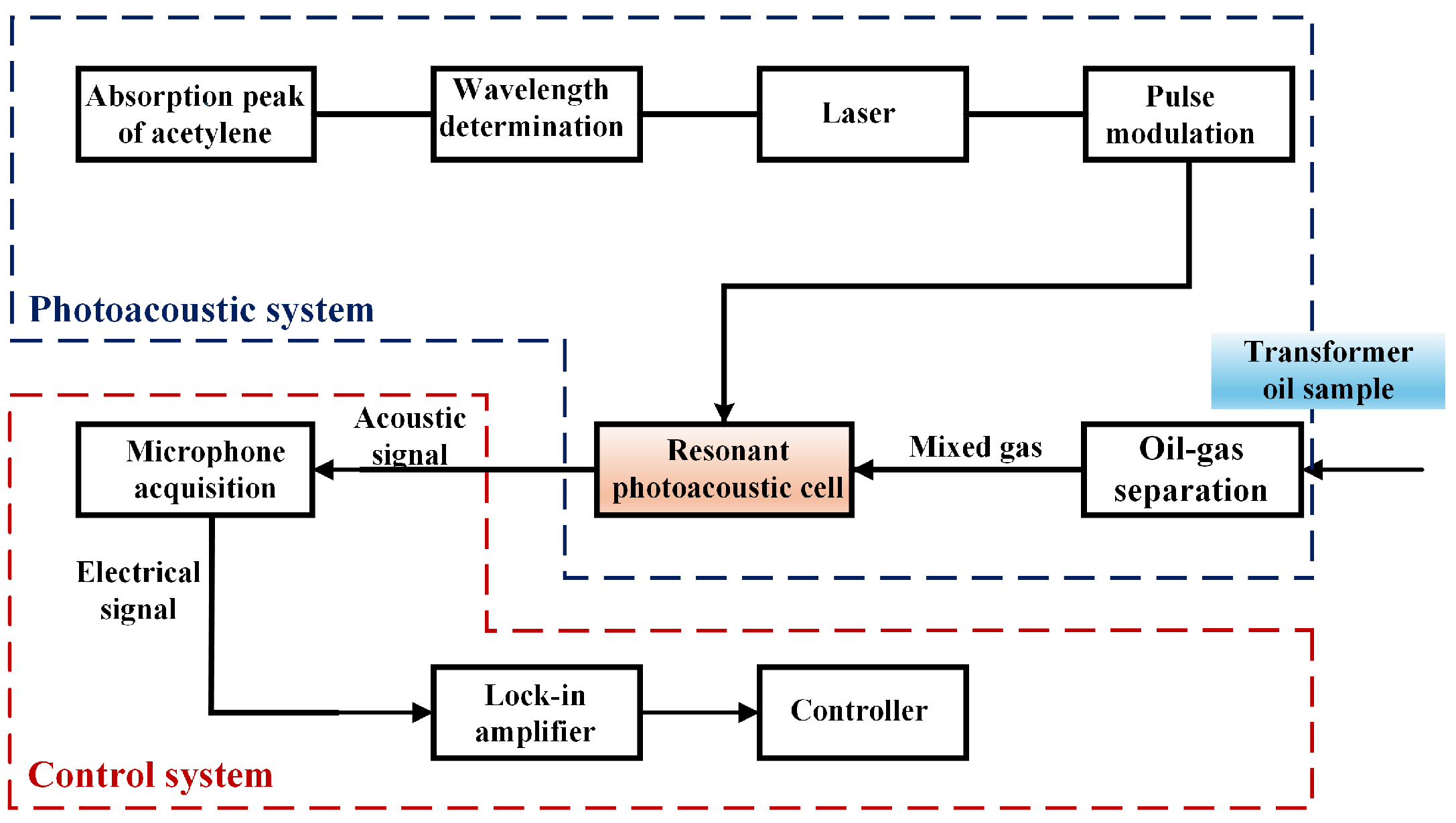
The overall architecture of the proposed acetylene monitoring system, illustrated in Figure 1, consists of two main subsystems: the photoacoustic subsystem and the control subsystem, responsible for acoustic signal generation and signal acquisition/processing, respectively.
In the photoacoustic subsystem, transformer oil samples are first extracted and passed through a gas–liquid separation module to release dissolved gases. The separated gas mixture is then directed into a dual-cavity differential resonant photoacoustic cell (Figure 2 and Figure 3), which functions as the detection chamber. A distributed feedback (DFB) laser, precisely tuned to the characteristic absorption line of acetylene, is modulated by a composite waveform that combines sinusoidal and sawtooth components to periodically vary its output power. The modulated laser radiation is absorbed by the target gas, inducing localized heating and periodic thermal expansion, thereby generating acoustic waves proportional to the acetylene concentration.
To improve the signal strength and system robustness, the laser output is amplified to 800 mW using an erbium-doped fiber amplifier (EDFA). The dual-cavity differential configuration effectively suppresses common-mode noise by exploiting the anti-phase property of the first longitudinal acoustic mode between the two resonant cavities. By electronically subtracting the signals from the two microphones (Knowles FG-23629-D65, Knowles Corporation, Itasca, USA), the true photoacoustic signal is enhanced while common-mode interference is eliminated, resulting in a significantly improved signal-to-noise ratio (SNR) and detection stability.
The weak acoustic signals captured by the high-sensitivity microphone array are synchronously demodulated using a lock-in amplifier, enabling the extraction of nanovolt-level photoacoustic signals from ambient noise. The demodulated output is then amplified, filtered, and digitized by a high-resolution analog-to-digital converter (ADC). An STM32F103 microcontroller (STMicroelectronics, Geneva, Switzerland) performs real-time feature extraction and concentration retrieval, after which the processed data are transmitted via an RS-485 interface using the Modbus RTU protocol to a remote monitoring platform for visualization and further analysis.
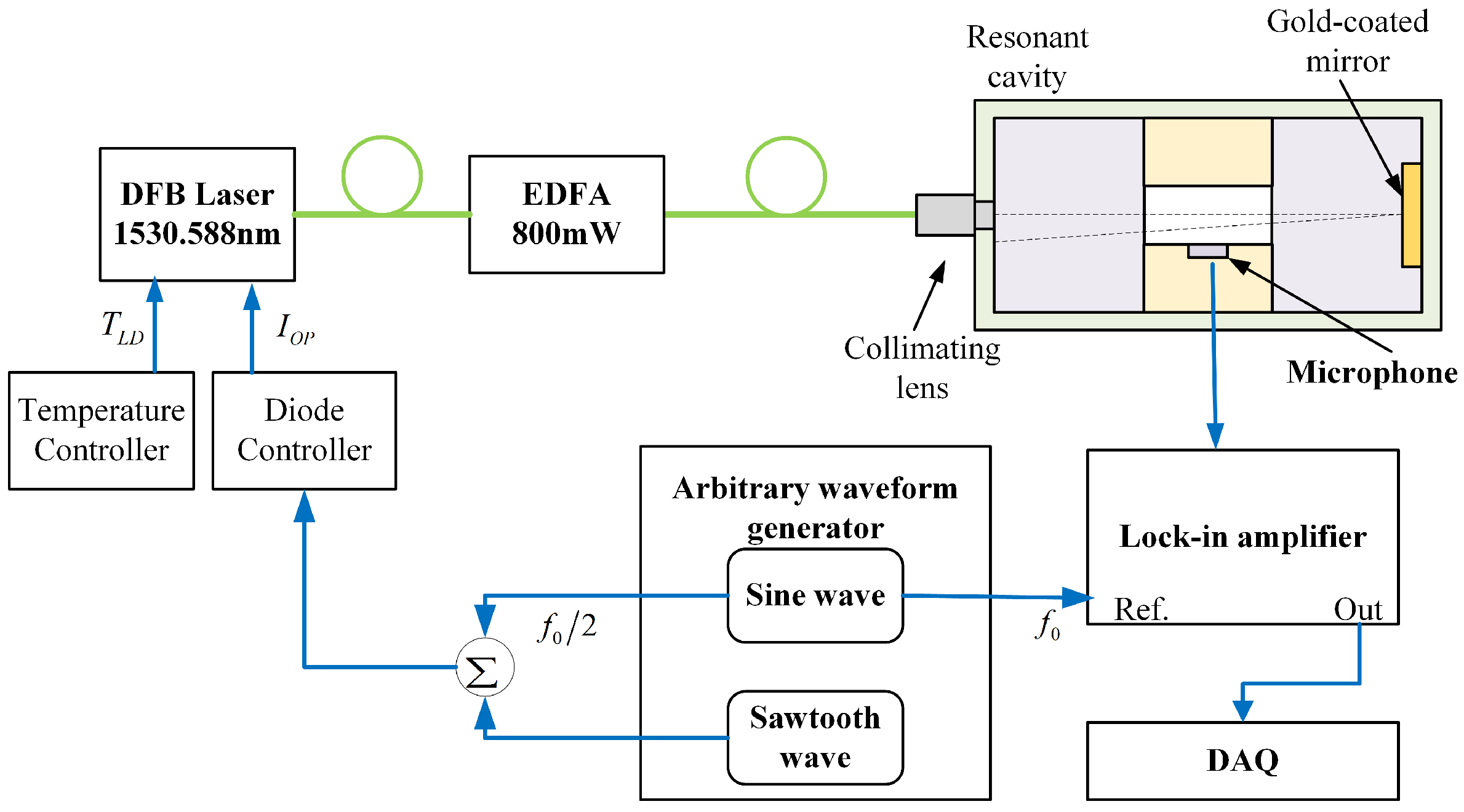
The laser source module, illustrated in Figure 2, integrates a laser diode controller (LDC202C) and a temperature controller (TED200C) to ensure wavelength stability and consistent output power. The system employs a hybrid modulation scheme combining sinusoidal power modulation and low-frequency wavelength scanning. Such combined wavelength–amplitude modulation approaches have been widely used in infrared gas spectroscopy and PAS/QEPAS systems [32], as they enhance signal amplitude while suppressing low-frequency intensity and thermal noise. In this work, the modulation scheme is adopted and optimized to achieve stable long-term operation in transformer substations.
Since different gas molecules exhibit distinct absorption features at specific wavelengths, the HITRAN database was consulted to identify suitable transitions for acetylene detection. Acetylene shows strong absorption in the near-infrared region between 6480–6645 cm−1 (1530–1565 nm), which falls within the C-band commonly used in optical communications. This spectral region benefits from the availability of low-cost, stable commercial DFB lasers, making it well-suited for engineering applications. In this work, the absorption line at 1530.588 nm was selected as the excitation wavelength. According to HITRAN, it has a line strength of S = 1.12 × 10⁻²¹ cm·molecule−1 at 296 K, offering high sensitivity while avoiding interference from gases such as methane and carbon monoxide.
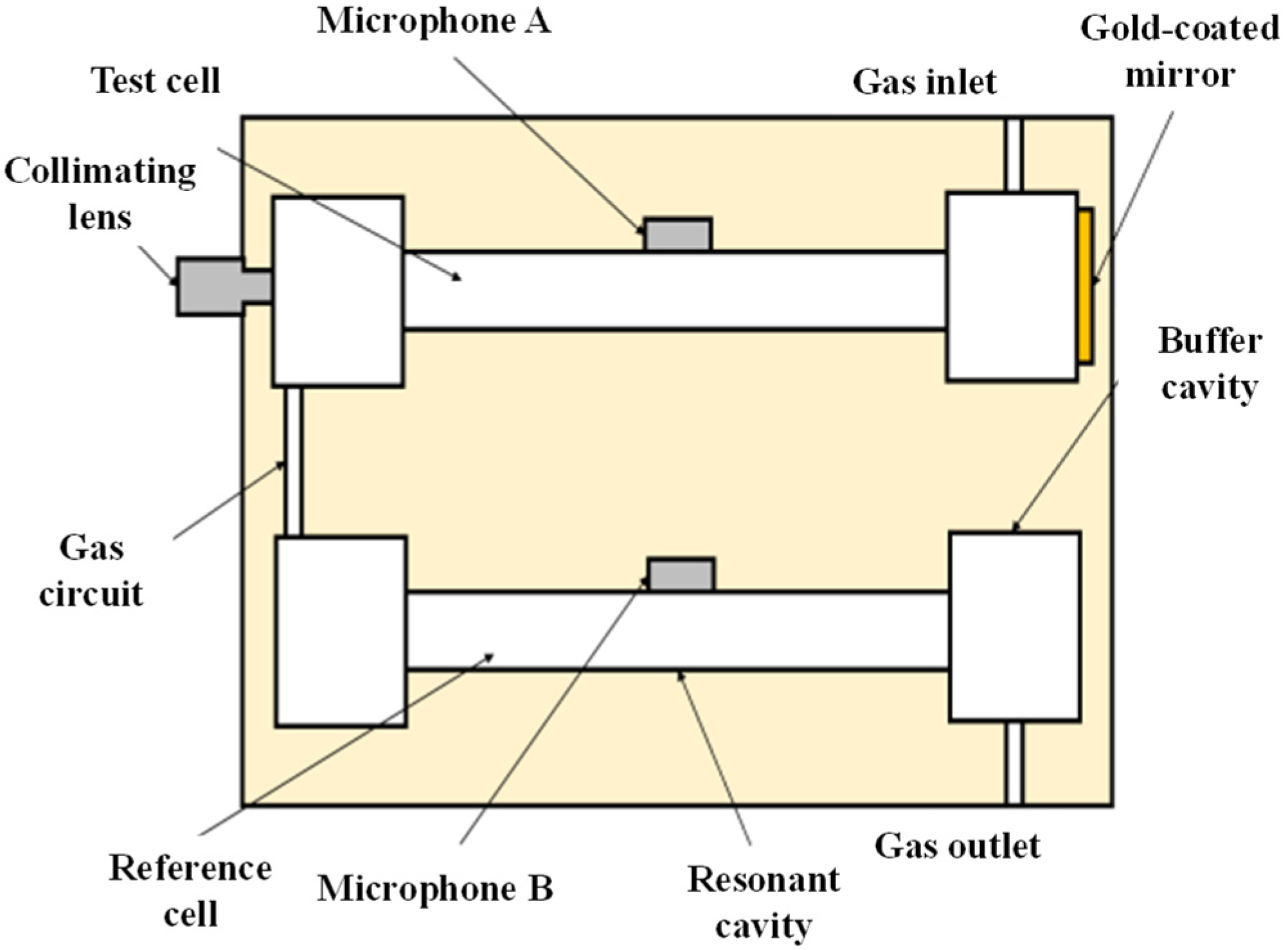
The resonant photoacoustic cell integrated into the system is further illustrated and analyzed in detail in Figure 3, where its geometric structure and FEM-simulated acoustic modes are presented. The resonant photoacoustic cell enhances the photoacoustic signal through resonant amplification, achieved when the laser modulation frequency matches the acoustic resonant frequency of the cell, forming a standing wave within the cavity. The dual-cavity differential configuration comprises two identical resonant and buffer chambers, ensuring that both cavities experience nearly identical environmental and flow-induced noise. By performing differential subtraction of the signals acquired by the two microphones (Microphone A and Microphone B), common-mode noise is effectively suppressed, resulting in a significantly improved SNR. The photoacoustic cell has a total length of 130 mm. Each resonant cavity is 100 mm in length and 8 mm in diameter, while each buffer cavity is 15 mm in length and 20 mm in diameter, symmetrically positioned on both sides of the resonant section. The measurement and reference cells share identical geometrical parameters, ensuring consistent acoustic characteristics and optimal differential performance.
The incident laser radiation enters the photoacoustic cell assembly through an AR-coated ZnSe window and propagates collinearly along the shared optical axis of the two resonant chambers. After passing through the first (measurement) cavity, the beam is guided through a central aperture into the second (reference) cavity, with internal apertures maintaining beam alignment and suppressing stray reflections. In normal operation, the measurement cavity is filled with the extracted oil-derived gas mixture, whereas the reference cavity is continuously flushed with nitrogen, producing negligible absorption at the excitation wavelength. Consequently, only the measurement cavity generates a photoacoustic response, while the reference cavity contributes solely to background acoustic noise. This inline optical configuration ensures identical illumination of both chambers and is essential for achieving effective differential suppression of flow-induced and environmental disturbances.
The system architecture is designed with scalability in mind, supporting future expansion to multi-component gas detection. By integrating additional DFB lasers tuned to the absorption lines of other characteristic fault gases—such as methane, ethylene, or carbon monoxide—the platform can be extended to perform simultaneous or sequential detection of multiple dissolved gases in transformer oil. All laser modules can share the same dual-cavity differential photoacoustic cell and signal processing electronics, ensuring compactness, cost efficiency, and system stability. This modular design provides a flexible foundation for developing a comprehensive online DGA platform, enabling more accurate and continuous transformer fault diagnosis.

3. Design of Control System

3.1. Principle of Control System

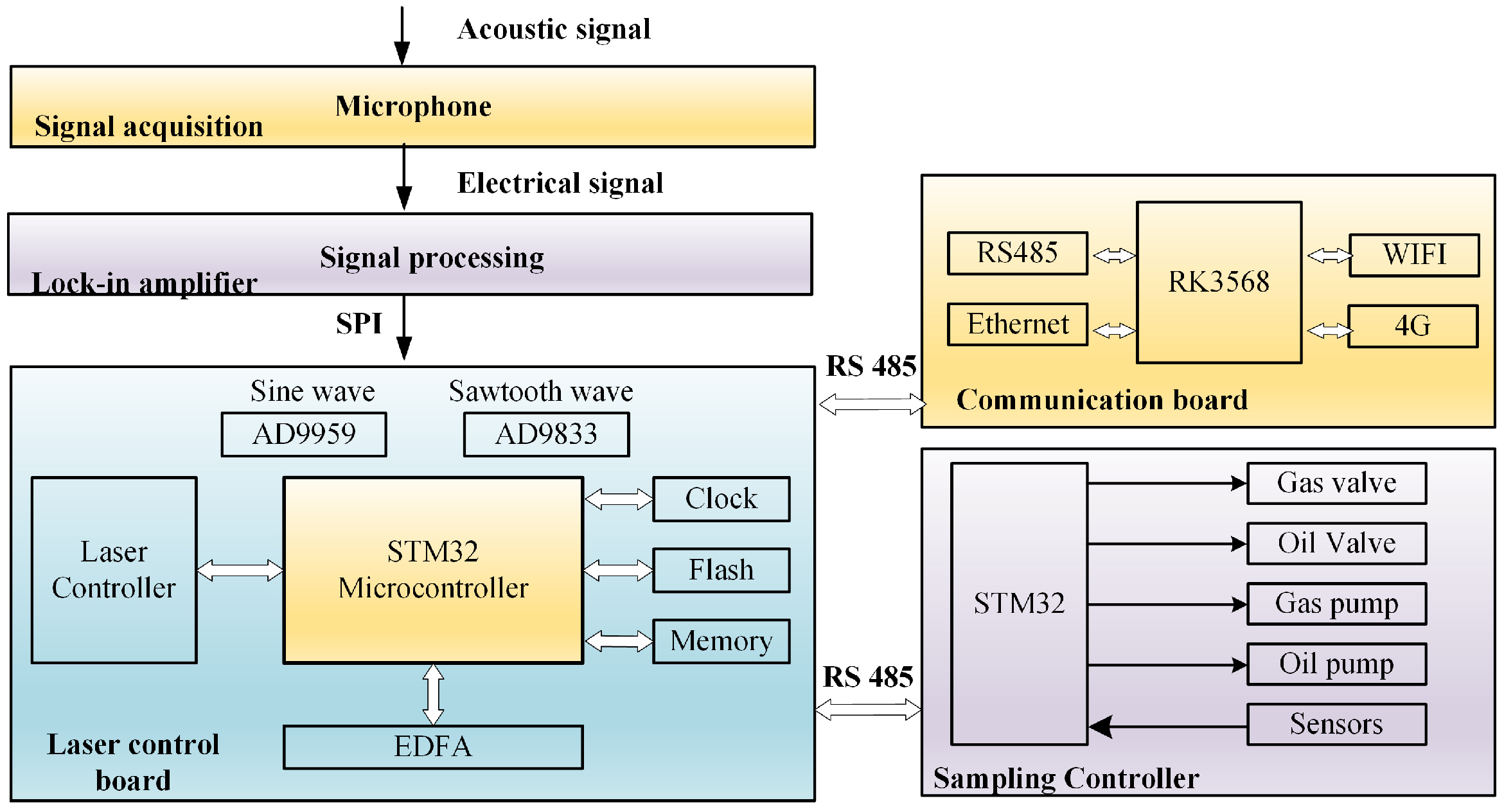
The acetylene monitoring system is designed for online detection in oil-immersed transformers. Oil samples are extracted from the transformer and directed into an integrated degassing module, where dissolved gases are efficiently separated from the insulating oil, achieving effective oil–gas partitioning. A negative-pressure rapid headspace degassing technique was developed, combining vacuum and dynamic methods to enable faster gas release and higher concentration. The STM32-controlled module achieves over 98% separation efficiency. The scheme diagram of the control system is shown in Figure 4. By means of coordinated control of oil, solenoid, and gas valves, the system accurately regulates the gas flow path and delivers the separated gas into the photoacoustic cell for analysis.
During measurement, an infrared DFB laser operating at 1530.588 nm with a predefined modulation frequency is utilized. According to the principle of photoacoustic spectroscopy, the modulated laser beam induces periodic pressure fluctuations inside the photoacoustic cell. These acoustic signals are captured by a high-sensitivity miniature microphone array and processed through a lock-in amplifier for synchronous demodulation. The demodulated signals are subsequently digitized via an ADC and quantified. Processed digital data are handled by a microcontroller and transmitted in real time to a remote monitoring platform through the communication module, enabling online visualization and continuous supervision of acetylene concentration in transformer oil. This architecture provides reliable data support for transformer health assessment and early fault diagnosis. The system consumes less than 25 W, mainly from the EDFA (~8 W), laser diode (~0.5 W), and control circuits. Intelligent power management, including intermittent degassing and low-power standby modes, ensures high efficiency and reliable operation in power-limited field environments.

3.2. Design of Hardware System

Considering the complex control logic among the functional modules of the monitoring system and the demand for high-performance computation, both precise actuation of gas and solenoid valves and real-time data acquisition and communication require a high-performance core processor for effective operation. The main control module employs an STM32F103ZET6 microcontroller ((STMicroelectronics, Geneva, Switzerland)) in an LQFP package, providing 144 pins, most of which are general-purpose I/O ports for flexible connection to various peripherals and communication interfaces. To manage large volumes of data and execute complex control programs, the module is equipped with 16 MB of external Flash memory for program and data storage, and a 2 KB EEPROM (AT24C02) to store sensor calibration parameters and user-defined settings, ensuring system stability and operational flexibility.
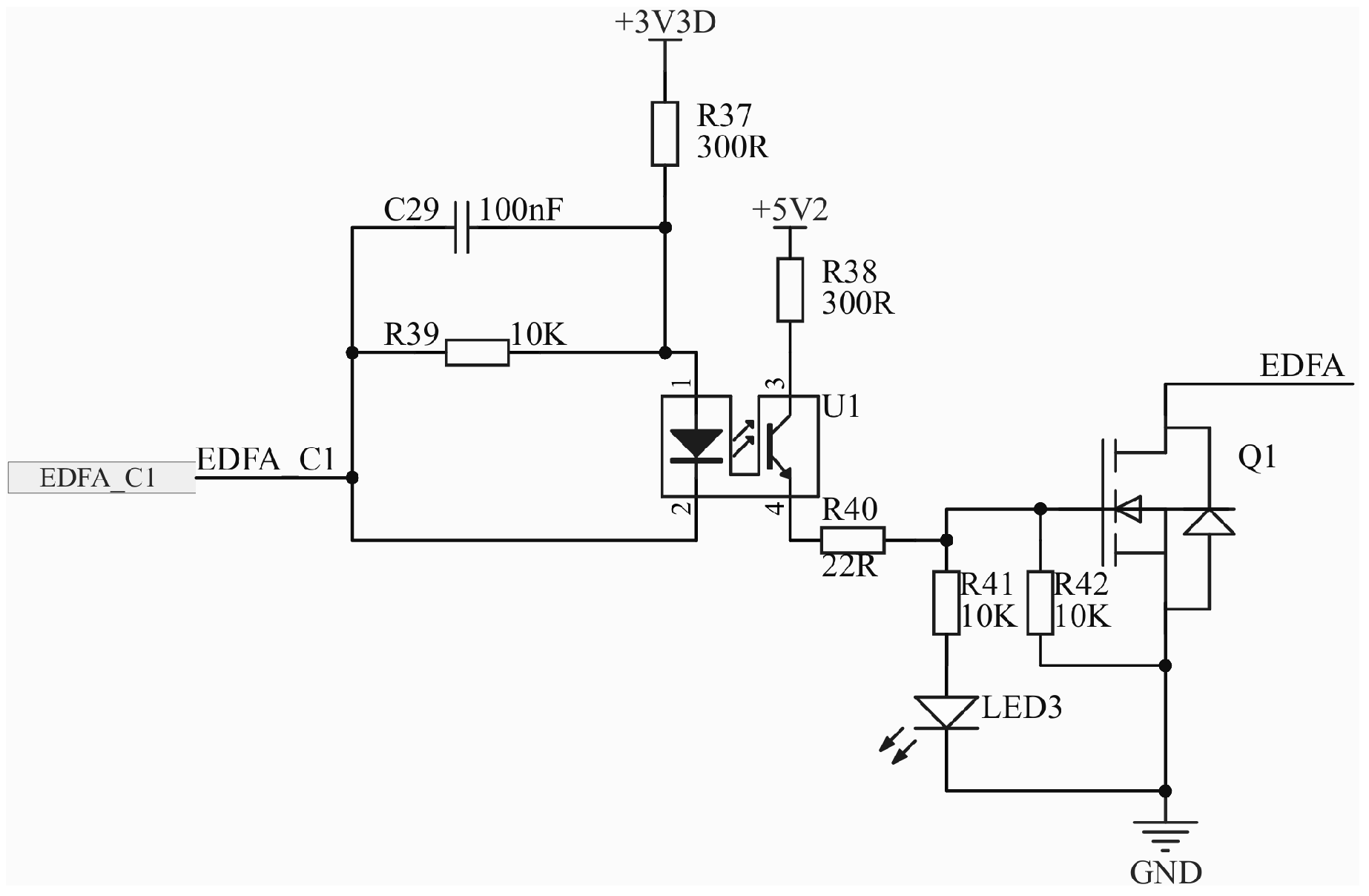
For optical signal transmission, an EDFA is incorporated between the laser driver board and the photoacoustic cell to maintain stable and sufficient laser power. The EDFA compensates for losses in the fiber transmission path, ensuring that the signal delivered to the photoacoustic cell achieves the required intensity. The system utilizes the EDFA-C-15-SM-FC/APC model from Shenzhen Teyuan, Shenzhen, China, which provides a high output power of up to 23 dBm and operates over a wavelength range of 1528–1563 nm, fully covering the 1530.588 nm line required for acetylene detection. By employing this fiber amplifier, the system enhances both the stability and sensitivity of the photoacoustic signal, providing a reliable hardware foundation for high-precision, rapid-response, online acetylene monitoring. The EDFA control circuit is shown in Figure 5.
In this system, the AD9959 chip is employed as the sine wave signal generator. This chip integrates a four-channel, 10-bit DAC with a 500 MSPS direct digital synthesizer (DDS), capable of producing four frequency- and phase-independent sine waves. The main microcontroller, STM32F103ZET6, configures the AD9959′s internal registers via the serial I/O interface to precisely control the frequency, phase, and amplitude of the output signals. In the present design, three DDS channels—CH0, CH2, and CH3—are utilized to generate three sine signals. One channel, combined with a superimposed triangular waveform, drives the laser, while the other two channels are frequency-converted to generate in-phase square waves serving as reference signals for the lock-in amplifier. To maximize the photoacoustic signal amplitude, the output frequencies of all three sine waves are tuned to the resonant frequency of the photoacoustic cell, ensuring that the laser modulation frequency matches the acoustic resonance and achieving optimal acoustic signal enhancement within the cell.
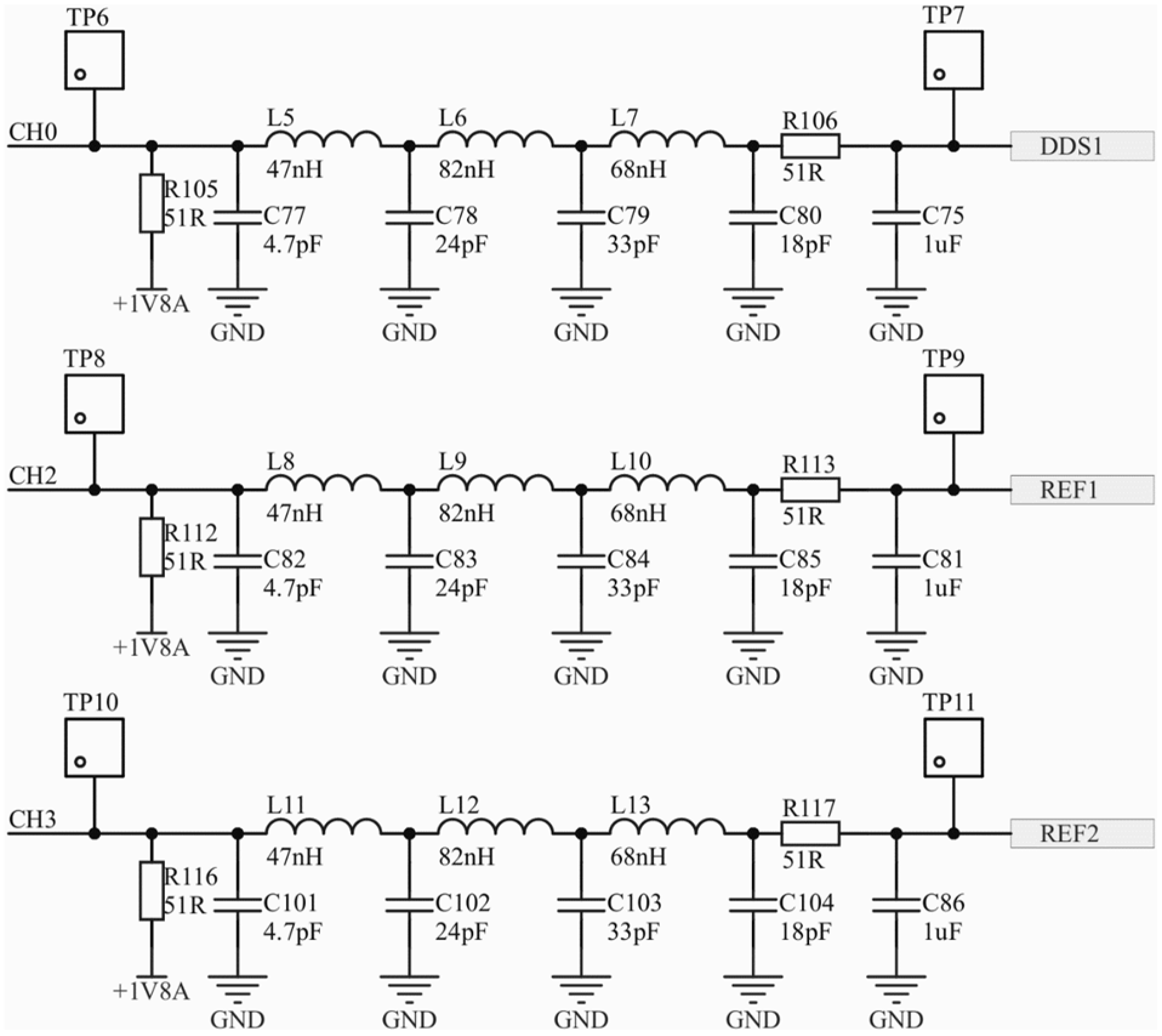
Since DDS outputs may contain higher-order harmonics, clock feedthrough noise, and quantization spurs, dedicated filtering is necessary to improve signal purity. In this system, multi-stage π-type LC low-pass filters are employed to filter the CH0, CH2, and CH3 outputs, as illustrated in Figure 6. Compared with T-type or L-type filters, the π-type topology offers superior out-of-band suppression at the same filter order, while the parallel capacitor design reduces output impedance. This ensures that the filtered signals are better matched to the low input impedance of subsequent circuits, providing high-quality, stable signals for both laser driving and lock-in amplifier reference inputs.
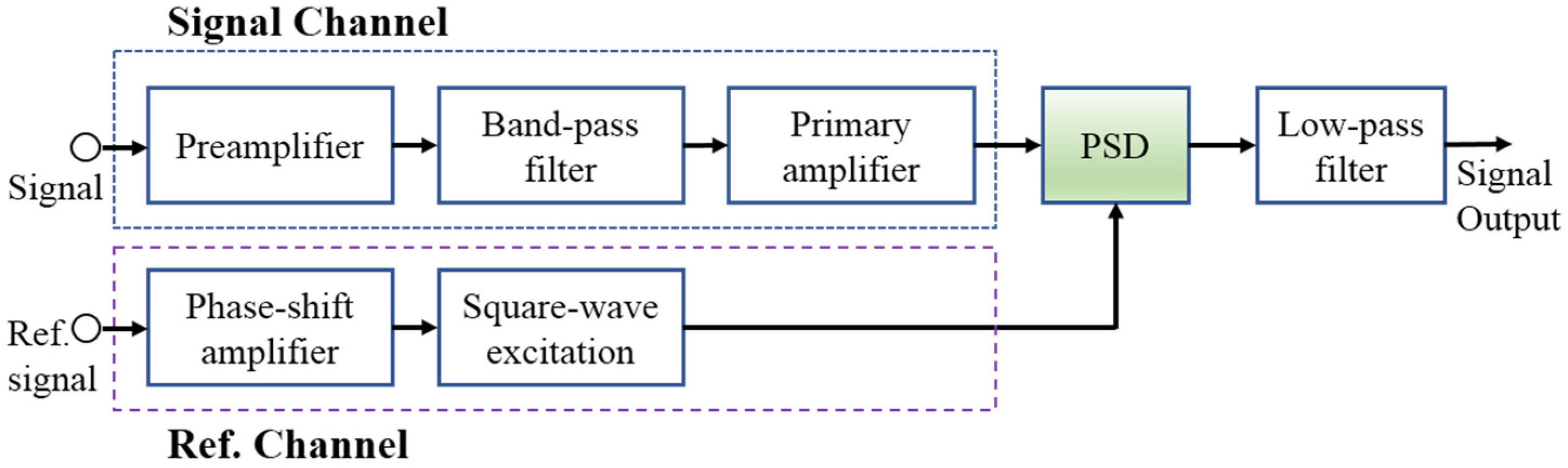
The amplitude of the photoacoustic signal is extremely weak, typically at the nanovolt level, and is highly susceptible to various interferences such as background noise, power supply ripple, and mechanical vibrations. To effectively extract this weak signal, the system incorporates a lock-in amplifier (LIA) circuit. As shown in Figure 7, the circuit consists of key modules including a signal channel, a reference channel, a phase-sensitive detector (PSD), and a low-pass filter (LPF). The signal channel receives the weak acoustic signal from the photoacoustic cell, while the reference channel inputs a signal synchronized with the optical modulation. The PSD performs phase comparison between the signal and reference, selectively enhancing in-phase components, whereas the LPF suppresses high-frequency noise and interference to provide a high signal-to-noise ratio output. This design effectively mitigates environmental disturbances, enhances the detection sensitivity and stability of the photoacoustic signal, and provides a reliable foundation for subsequent analog-to-digital conversion and data processing.
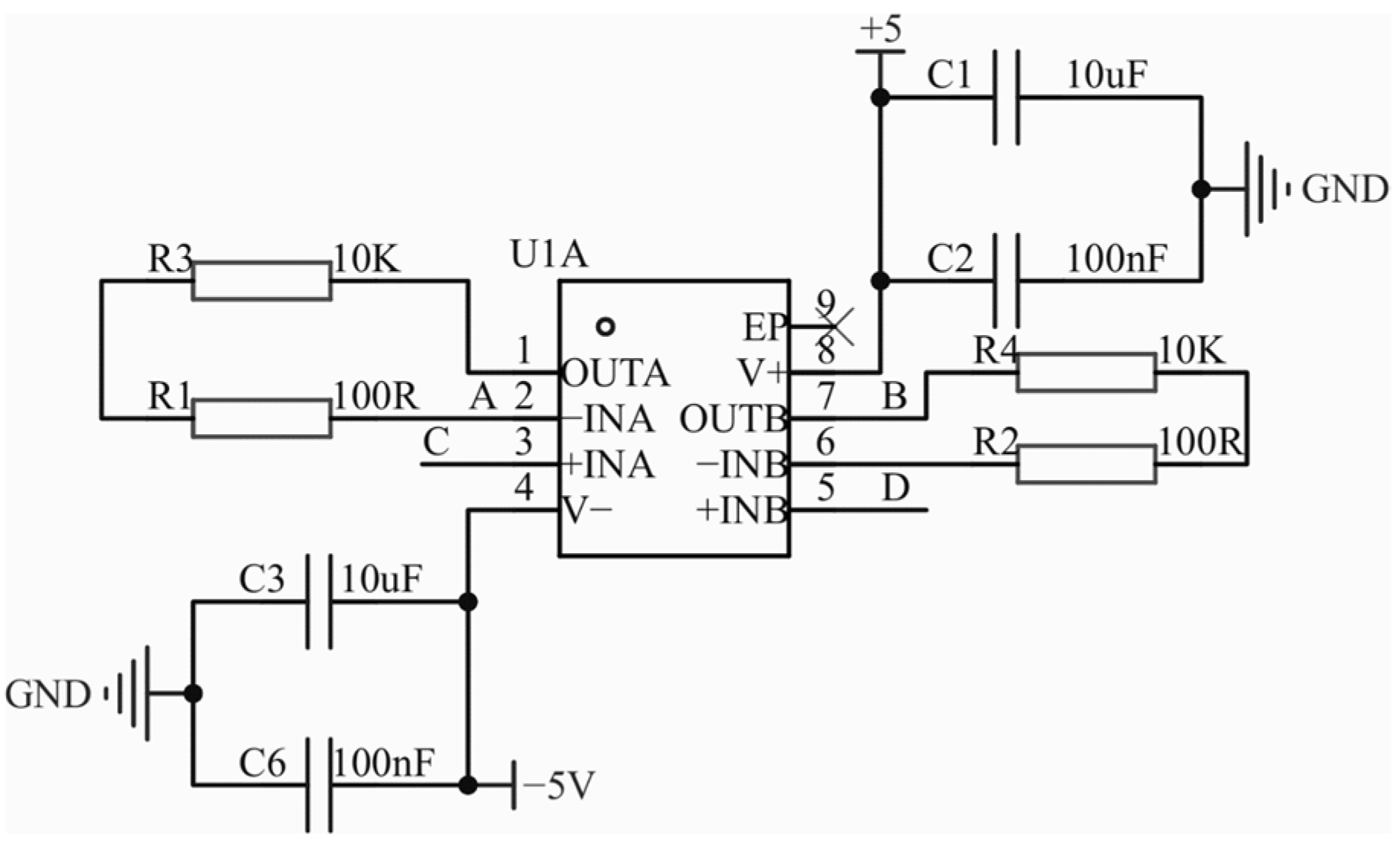
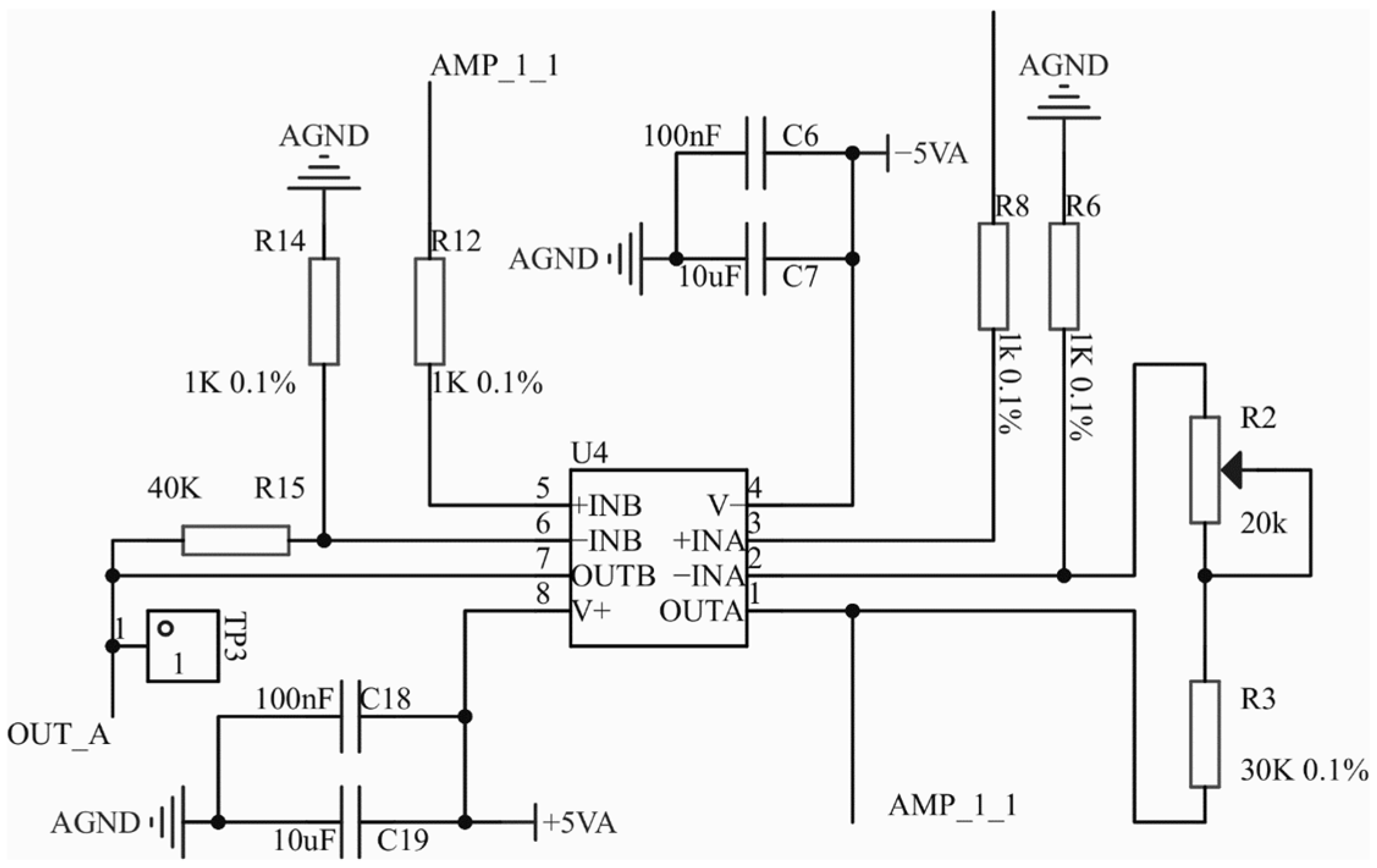
The preamplifier circuit employs the OPA2210IDR operational amplifier from Texas Instruments (TI), which features ultra-low noise, high precision, and low power consumption. Its noise level is only 2.2 nV/√Hz at 1 kHz, making it highly suitable for high-speed, high-precision signal acquisition applications. As shown in Figure 8, the analog signals from two miniature microphones in the photoacoustic cell (C-terminal and D-terminal) are first processed by the preamplifier circuit. The signals are fed into the INA+ and INB+ non-inverting inputs for differential amplification, which enhances the weak signal amplitude while effectively suppressing common-mode interference. This ensures high-quality signals for subsequent lock-in amplification and analog-to-digital conversion.
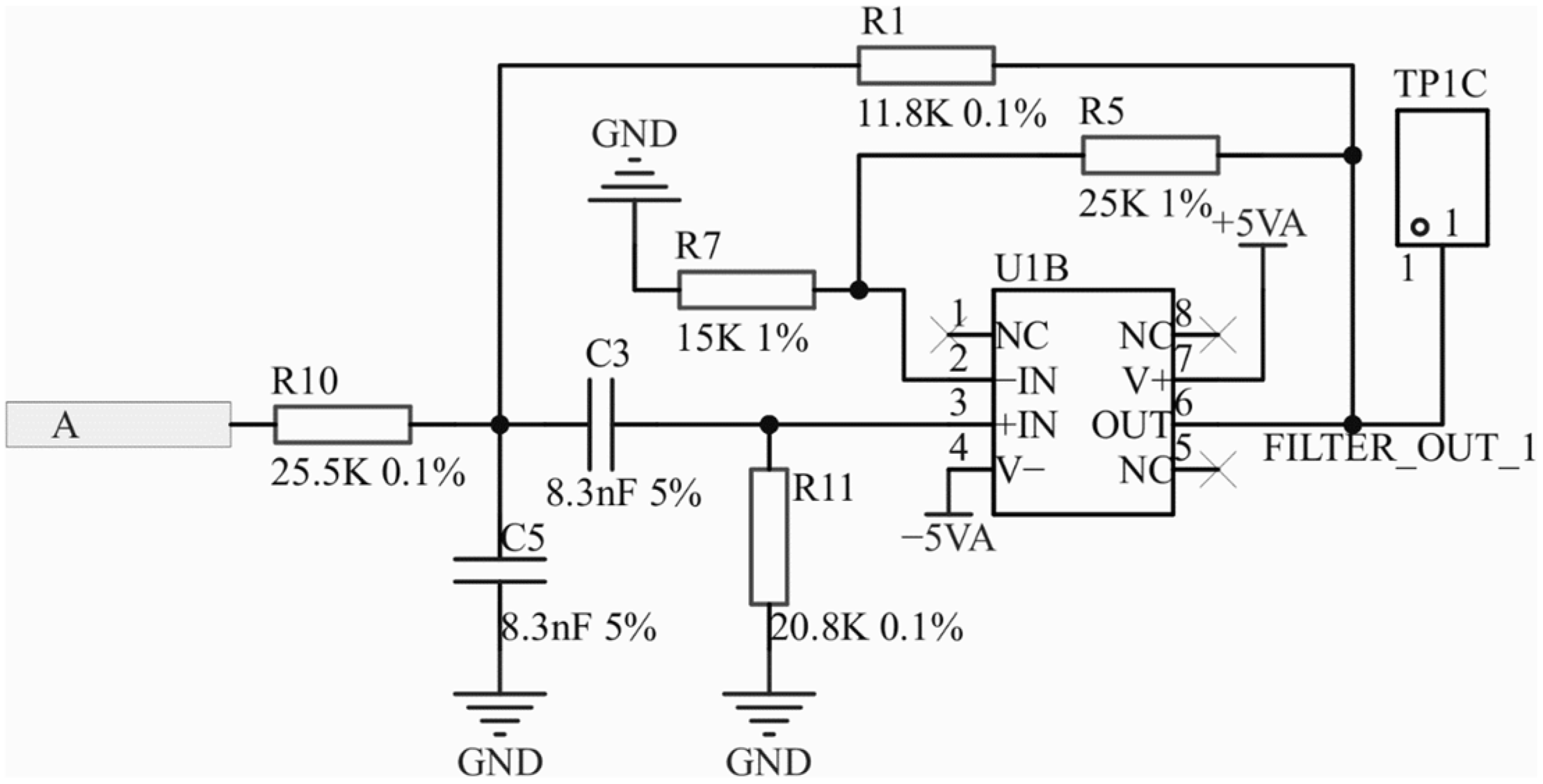
The second-order active band-pass filter, shown in Figure 9, consists of two resistors (R10, R11), two capacitors (C5, C3), and an OPA210IDR operational amplifier. The differential voltage signals from channels A and B, processed by the preamplifier, are fed into this band-pass filter to select signals within a specific frequency range, effectively suppressing low-frequency drift and high-frequency noise. The filter is designed with a lower cutoff frequency of 914 Hz and an upper cutoff frequency of 1120.58 Hz, yielding a passband of 200 Hz. This allows precise transmission of the signal band matching the resonant frequency of the photoacoustic cell, providing a high-purity input for subsequent lock-in amplification and signal analysis.
After the second-order band-pass filtering, the amplitude of the photoacoustic signal remains extremely weak, typically only a few hundred microvolts, making it insufficient to directly drive the subsequent PSD effectively. To address this, a variable-gain amplifier is designed following the band-pass filter to amplify the weak signal while accommodating input signals of different amplitudes. The amplifier employs the OPA2210IDR operational amplifier from Texas Instruments (TI), which integrates two high-precision operational amplifiers, enabling two-stage signal amplification. As shown in Figure 10, the first amplification stage leverages the low-noise characteristics of the op-amp for initial signal amplification while suppressing noise interference. The second stage fully utilizes its high-precision performance to ensure accurate amplitude and phase of the output signal, providing a high-quality and stable input for the subsequent phase-sensitive detection.
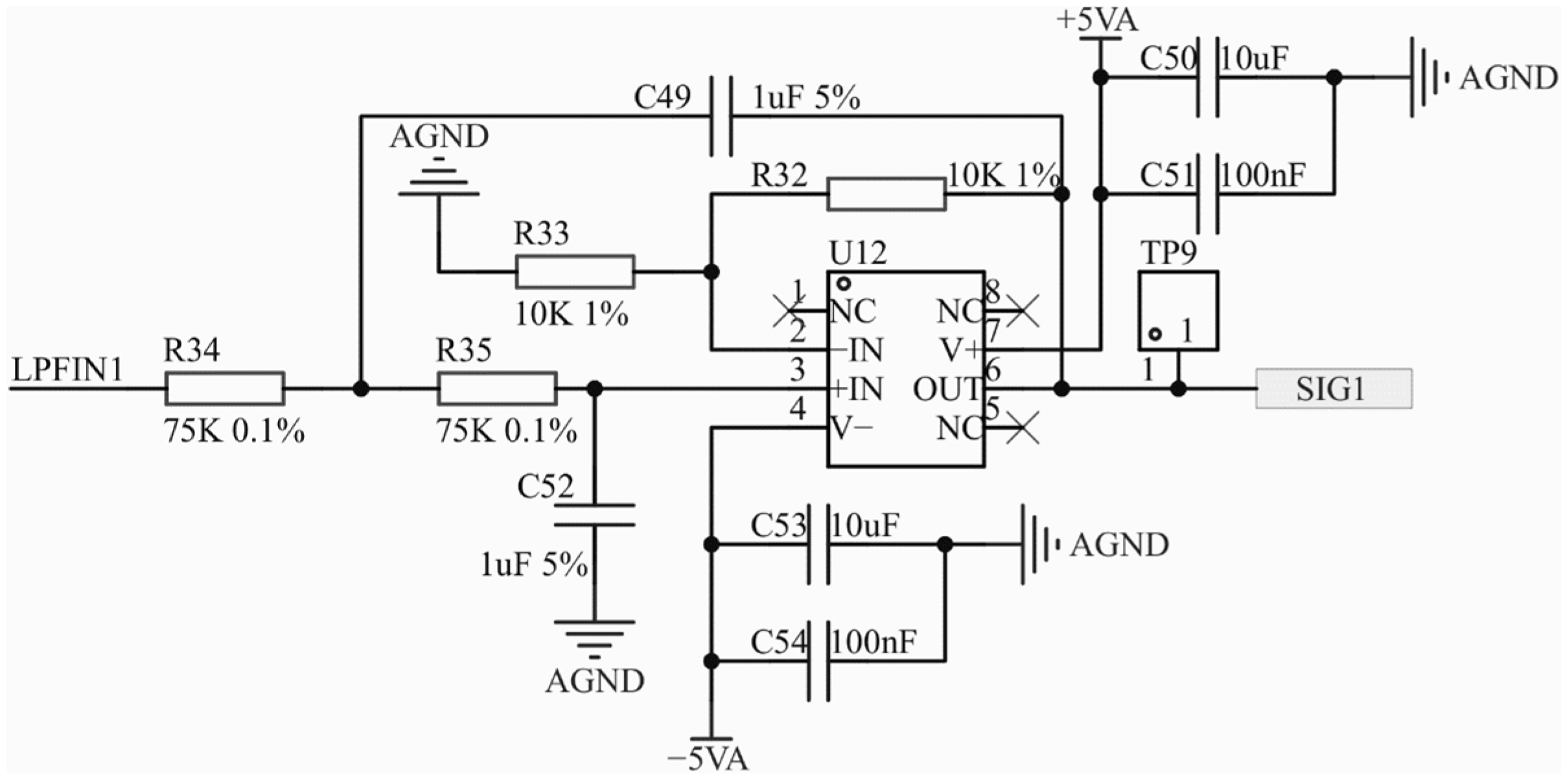
The active LPF is used to process the two signals, LPFIN1 and LPFIN2, output from the full-wave switching stage, which contain both high- and low-frequency components, as shown in Figure 11. The low-pass filter effectively removes high-frequency interference, retaining only the DC component related to the phase difference in the input signals. This significantly improves the signal-to-noise ratio of the detected signal, ensuring accurate and stable subsequent signal processing and quantification.
Its cutoff frequency is
f o = 1 2 π R 34 R 35 C 49 C 52 = 2   H z
The ADC circuit employs the AD7192BRUZ chip (Analog Devices, Wilmington, USA), a low-noise, fully integrated ADC designed for high-precision measurement applications. It features a 24-bit Σ-Δ ADC, capable of achieving a noise-free resolution of up to 22 bits under specific conditions, allowing precise capture of extremely weak analog signal variations. In the system, the two single-ended signals processed by the front-end circuitry are converted to differential signals and connected to the ADC inputs: AIN1–AIN2 and AIN3–AIN4. Combined with the chip’s internal programmable gain amplifier (PGA) and high-precision 24-bit ADC, this configuration enables high-accuracy measurement of acetylene gas concentration, providing a reliable foundation for digital processing of the photoacoustic signals and subsequent data analysis.

3.3. Design of Software System

The online detection system is built around an STM32 series microcontroller, with STM32CubeIDE selected as the development platform to facilitate efficient software development and management.
In terms of main program design, this photoacoustic spectroscopy-based acetylene monitoring device for transformers can receive configuration parameters or detection commands from the backend, perform real-time measurement of acetylene concentration in transformer oil, and simultaneously report transformer internal temperature, oil level, and device environmental temperature and humidity, enabling comprehensive online monitoring of transformer operating status. Upon system startup and login to the backend monitoring platform, the device enters the initialization stage, which includes configuration of functional modules, register parameter setup, definition of interrupt service routines, and initialization of serial communication interfaces. After initialization, the system begins collecting the status of various components, such as the oil–gas pump and valves, transformer oil temperature, device environmental temperature and humidity, and oil chamber level, and uploads the initial data to the backend to monitor current operational conditions.
When a command is received from the backend management system, as Algorithm 1 shown, the main program responds according to the command type: for parameter configuration requests, the system enters the parameter configuration unit; for scheduled sampling commands, the system sets the corresponding sampling period and initiates the timed sampling routine; for gas sampling requests, the system controls the relevant modules to perform characteristic gas collection and detection. The measurement results are then transmitted to the backend via the communication module, enabling real-time monitoring and management of acetylene concentration and related transformer operating parameters.
Algorithm 1 Command Execution Flow
Start
Initialize system configuration (initConfig())
Repeat the following operations:
      a. Collect system parameters (collectParams())
      b. Receive external commands (receiveCommand())
      c. If the command is a sampling operation:
            i. If the system is in automatic mode:
                  - Execute sampling according to preset automatic program and times
                    (executeByAutoProgramOrTimes())
            ii. Else (manual mode):
                  - Set sampling times (setSamplingTimes())
                  - Execute sampling according to the set times (executeByAutoProgramOrTimes())
      d. Else (the command is a configuration operation):
            i. Configure system parameters (configSystemParams())
            ii. Save configuration and exit the loop (saveAndExit())
      e. Upload sampling data (uploadData())
End
The backend management platform communicates with the on-site IED through an Ethernet TCP/IP interface. Measurement data transmitted from the detection unit are parsed and time-stamped at the station-level server, then archived in a SQL-based database. The backend software provides real-time visualization of gas concentrations, historical data retrieval, alarm and event handling, and device-status monitoring. This architecture ensures robust and reliable communication between the field-deployed detector and the supervisory control system, enabling long-term unattended operation within the substation environment. The IED receives data from the online transformer oil acetylene monitoring device and converts it into a format compliant with the IEC 61850 [33] standard. The data is then transmitted to the substation backend system via optical fiber or network cable for real-time display and monitoring, and can be further uploaded to a cloud platform for centralized analysis and intelligent management, providing critical data support for transformer condition assessment and fault early warning.
The backend monitoring and management system comprises four main modules: Home, Debug, Parameter Setting, and Historical Data. The Home module displays heartbeat intervals, transformer ID, and system monitoring status; the Debug module supports both manual and automatic debugging modes; the Parameter Setting module allows basic configuration, alarm threshold settings, and monitoring period adjustments; the Historical Data module enables querying of past acetylene measurements and alarm records. These modules and their sub-functions work together to provide comprehensive monitoring and management of the system.

4. Simulation of Photoacoustic Cell

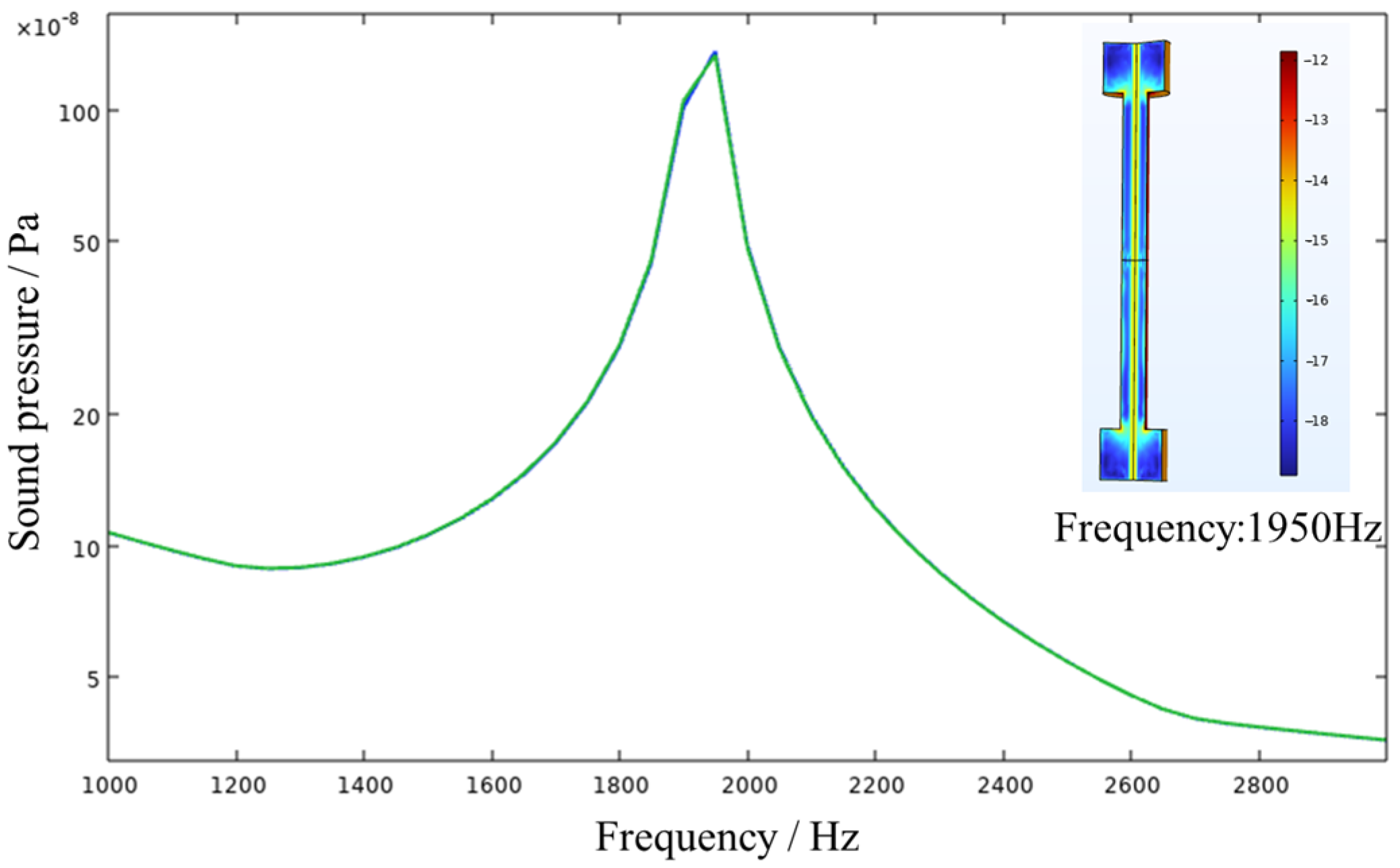
The internal structure of the photoacoustic cell has a significant impact on the amplitude of characteristic photoacoustic signals. For a cylindrical resonant cavity, the acoustic pressure within the gas chamber exhibits specific spatial distribution patterns when photoacoustic conversion occurs. To enhance the measurement accuracy and data reliability of the detection system, it is necessary to position the miniature microphones at locations corresponding to the maximum acoustic pressure, as shown in Figure 12. Based on the specific structure and dimensions of the photoacoustic cell (as shown in Figure 3), this study employs COMSOL Multiphysics for multiphysics simulation to systematically analyze the acoustic pressure distribution inside the cell, providing a theoretical basis for optimizing microphone placement, improving photoacoustic signal collection efficiency, and enhancing monitoring accuracy. It should be noted that the photoacoustic cell modeled in this section is a custom-designed component, specifically developed for this study to meet the requirements of long-term transformer-station deployment.
During the construction of the simulation model, the photoacoustic cell was appropriately simplified, selecting only the internal gas cavity as the simulation domain while neglecting the influence of the gas inlet and outlet holes in the buffer cavities at both ends. Additionally, the gas within the cavity was assumed to be uniformly distributed to simplify the calculations. In the finite element model, the gas was set as nitrogen (N2) with a density of 1.25 kg/m3 and a corresponding sound speed of 349.2 m/s in the medium. The initial temperature was set to 297 K, and the ambient pressure was assumed to be standard atmospheric pressure (1 atm). For boundary conditions, the geometry of the acoustic cavity was defined as a rigid, non-absorbing boundary, where the normal derivative of the acoustic pressure is zero, simulating the sound field distribution under ideal hard-wall conditions.
The FEM simulation presented here models only one resonant chamber of the dual-cavity cell. This simplified approach was used to evaluate the key acoustic features—fundamental eigenfrequency, mode symmetry, and pressure distribution—which were found experimentally to differ only slightly from those of the complete structure. Although weak coupling between the two chambers may cause a small shift in the pressure antinode, it does not affect the resonance frequency or the selected microphone positions. While a full dual-cavity model would provide additional detail, the single-chamber simulation was sufficient for guiding the structural design. A full-cell model will be explored in future work.
Based on the simulated acoustic pressure mode of the photoacoustic cell cavity, the resonant frequency of the cell model is determined to be 1950 Hz. The simulation indicates that the gas acoustic pressure amplitude along the cavity axis exhibits a symmetric distribution. The buffer cavity regions at both ends appear in deep blue, indicating near-zero pressure amplitudes, while within the resonant cavity, the color gradually transitions from blue at the ends to deep red at the center, showing that the pressure amplitude increases along the cavity axis and reaches its maximum at the center. Therefore, to obtain the strongest photoacoustic signal, the miniature microphone should be installed at the center of the resonant cavity, maximizing signal acquisition.

5. Experiments and Discussions

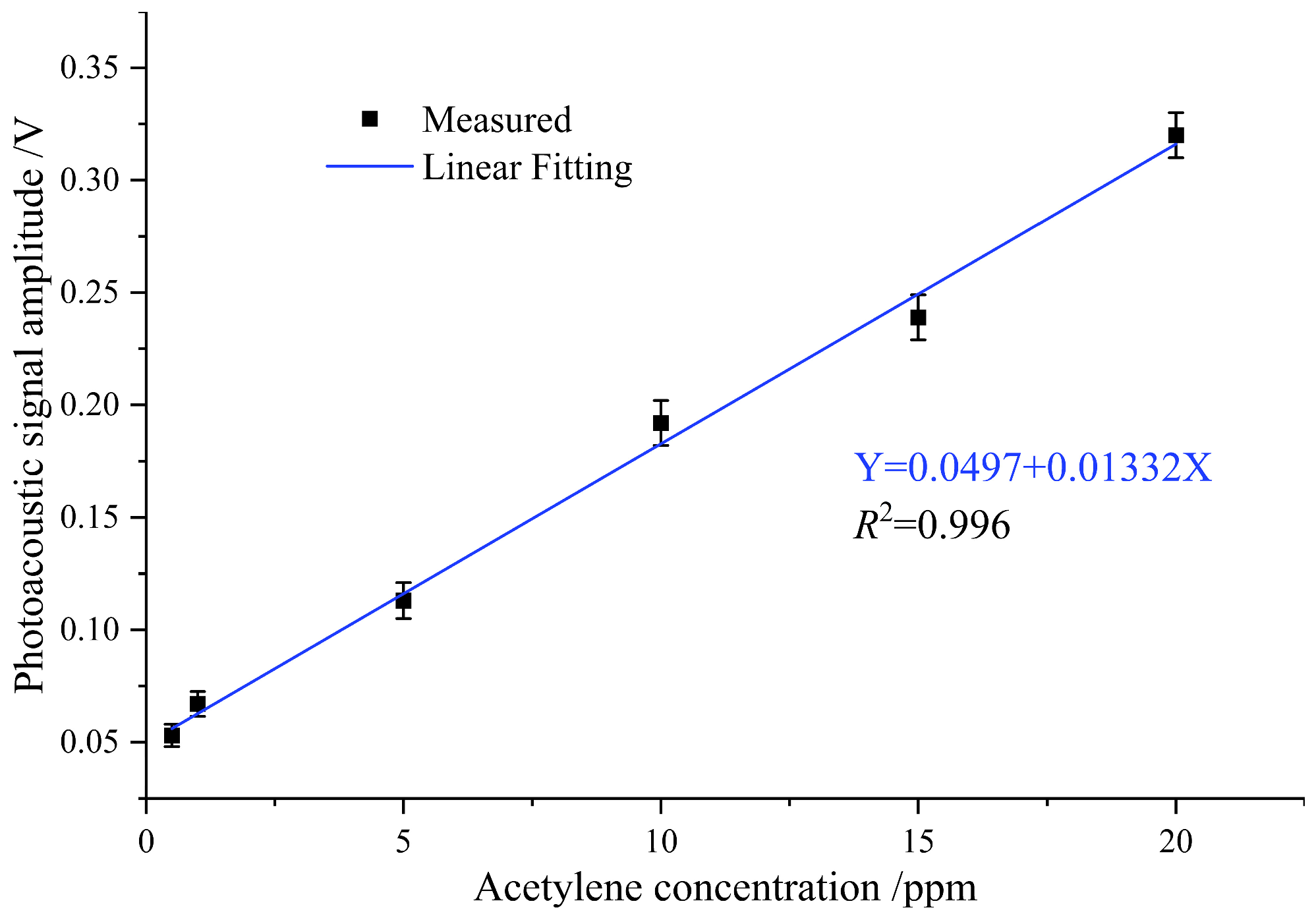
All tests were conducted at room temperature (25 °C) and standard atmospheric pressure. Pure nitrogen gas was first introduced into the photoacoustic cell for several minutes to purge any residual gases, ensuring the baseline accuracy. Subsequently, acetylene–nitrogen gas mixtures with standard concentrations of 0.5, 1, 5, 10, 15, and 20 ppm were introduced sequentially. The photoacoustic signals collected by the miniature microphone are summarized in Table 1. During all concentration-dependent measurements, wavelength-modulation photoacoustic spectroscopy (WM-PAS) was employed. A sinusoidal modulation was applied to the drive current of the DFB laser, and the microphone output was demodulated using first-harmonic (WM-1f) detection via the lock-in amplifier.
The dimensions of the resonant and buffer cavities were unified as 100 mm × 8 mm and 15 mm × 20 mm, respectively, consistent with the COMSOL simulation model described in Section 3. The experimental setup employed an acetylene laser source coupled with an 800 mW EDFA.
Linear fitting of the measured data yields the following relationship:
Y = 0.01332 X + 0.0497
where Y represents the photoacoustic signal amplitude (V) and X denotes the acetylene concentration (ppm).
The linear fit yields a slope of k = 0.01332 ± 4.47 × 10⁻⁴ and an intercept of b = 0.0497 ± 0.00418. Multiple calibration repetitions show that the intercept remains within its 95% confidence interval across all trials, confirming that the baseline is stable and that the apparent offset is statistically insignificant within the measurement accuracy.
To quantify the system sensitivity, the noise floor was characterized by measuring the signal fluctuation in a pure nitrogen atmosphere. The standard deviation of this background signal was determined to be 0.0032 V. Based on this, the SNR at 0.5 ppm is calculated to be 2.08. Notably, as shown in Figure 13, the signal at 0.5 ppm is clearly distinguishable from the noise, and the linearity extends down to this concentration, confirming the system’s capability for trace-level detection. The correlation coefficient R2 = 0.996 indicates excellent linearity across the 0–20 ppm range, enabling precise quantification of trace acetylene dissolved in transformer oil.
In this work, the sensor performance was evaluated using gas-phase acetylene–nitrogen mixtures. It should be noted that the detection limits specified in Q/GDW 10536-2021 [34] refer to the concentrations of dissolved gases in transformer oil, and therefore, they are not strictly equivalent to gas-phase concentrations. The comparison is provided only to show that the sensitivity level achieved by the sensor is compatible with dissolved gas monitoring applications. The sensor was calibrated and validated using mixtures in the range of 0.1 to 20 ppm, as shown in Table 2, which is within the sensor’s known dynamic range. Higher concentrations (20 to 100 ppm) were tested for exploratory purposes to assess the sensor’s potential performance at elevated concentrations. These tests are not used for evaluating sensor linearity but provide insight into the sensor’s behavior at the upper limits of its potential range.
The verification results show that the measurement errors across all concentrations are well within the Grade A accuracy requirements of the State Grid standard, confirming the reliability and high precision of the proposed PAS-based acetylene detection system.
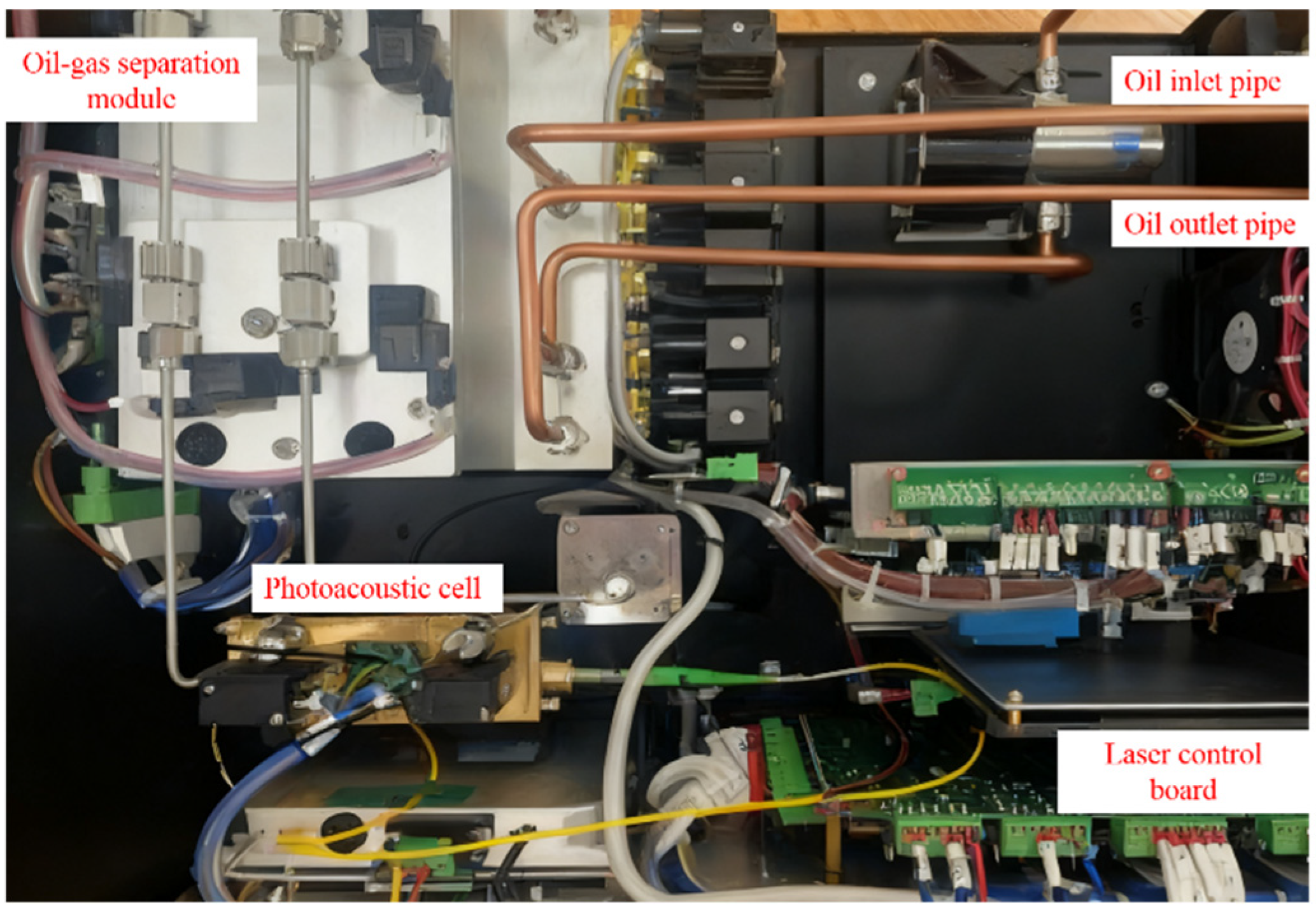
After completing the design of the photoacoustic system and the hardware circuitry, the PCB boards for each circuit module were fabricated and subsequently debugged and validated, as shown in Figure 14. On the software side, the system employs a lightweight program architecture combined with modular and configurable platform development concepts, enabling efficient development of the device control program and the monitoring platform. An experimental verification platform was then established to systematically test the characteristics of the photoacoustic signal amplitude and optimize system parameters. Through these experiments, the resonant frequency of the photoacoustic cell was determined, and the monitoring device was physically assembled, laying a solid foundation for subsequent performance testing and practical application validation.
Beyond assessing measurement accuracy, the year-long field data reveals a meaningful long-term trend. As shown in Table 3, the average acetylene concentration measured by both this device and the reference gas chromatograph (GC) shows a consistent, gradual increase, from approximately 1.8 ppm in July 2023 to 2.2 ppm in July 2024. The GC analysis was performed using an Agilent 7890B gas chromatograph (Agilent Technologies, Santa Clara, USA), coupled with a flame ionization detector (FID) for quantification of acetylene concentrations. The study selected the #2 main transformer at the 110 kV Baoqiao Substation in Ningbo, Zhejiang, as the monitoring target. From July 2023 to July 2024, oil samples were collected every three months, resulting in a total of five sampling events, with four consecutive measurements taken per sampling. Experimental conditions were as follows: the monitoring device was installed on the #2 main transformer, housed in an electrical cabinet equipped with temperature control, maintaining an ambient temperature of 25 °C. Oil samples were collected on-site for immediate detection. For comparison, the GC analyzed the oil samples following standard laboratory procedures; the samples were filtered through a 0.45 μm membrane and sealed for transport to the laboratory. Table 3 presents the detection results of acetylene in transformer oil obtained by the monitoring device and the ZF-301Q gas chromatograph (Henan Zhongfen, Shangqiu, China), providing a reference for the device’s field application performance.
As shown in Table 3, it can be observed that for each single sampling, the four measured acetylene concentrations obtained by this device have maximum values of 2.02, 2.11, 2.19, 2.27, and 2.41 ppm, and minimum values of 1.68, 1.76, 1.87, 1.92, and 2.04 ppm, respectively. The corresponding ranges are 0.34, 0.35, 0.32, 0.35, and 0.37 ppm, all within the allowable error limit of 20%. Taking the ZF-301Q gas chromatograph measurements as the reference (excluding possible effects from oil sample transportation), the relative standard deviations (RSDs) of this device are 8.90%, 8.67%, 7.93%, 7.20%, and 7.09%, respectively, showing a decreasing trend with increasing acetylene concentration. This trend can be attributed to the enhancement of the photoacoustic signal with higher gas concentration, which improves the signal-to-noise ratio. The absolute errors are +0.09, +0.09, +0.07, +0.06, and +0.08 ppm, indicating a slight systematic overestimation in the measurement results. The possible reasons include calibration deviation of the photoacoustic cell or spectral interference, suggesting that further optimization of the device is still required in future experiments.
The system was designed for robust performance under real-world conditions with strong acoustic and vibrational noise. Its dual-cavity differential resonator plays a key role in achieving this robustness. Although a direct comparison with a single-cell resonator was not conducted, the measured signal-to-noise ratio of 24 dB at 0.5 ppm and the consistently low standard deviations over one year confirm the design’s effectiveness and stability. These results demonstrate that the differential configuration effectively suppresses common-mode noise, validating its use for reliable field detection.
A performance comparison of various acetylene detection techniques is summarized in Table 4. While gas chromatography remains the benchmark for offline laboratory analysis with the lowest LOD and high precision, it lacks online capability. Compared to NDIR, our PAS system achieves a significantly lower detection limit, making it suitable for trace-level early warning. Furthermore, when compared to another PAS system reported in the literature, our work demonstrates validated long-term field precision and a successfully implemented online monitoring architecture, bridging the gap between laboratory research and industrial application. Unlike prior PAS works, which focus on laboratory sensitivity enhancement, the novelty of this research lies in the development of a complete system capable of year-scale operation in transformer stations.
It should be noted that several recent PAS and fiber-optic photoacoustic systems demonstrate significantly higher sensitivities than the field-oriented system presented here, as shown by the works of Zhang et al. [35,36], Zhou et al. [37], which achieve detection limits down to the ppb level under laboratory-stabilized conditions using multi-pass enhancement or cantilever/fiber-optic microphones. In contrast, the present study focuses on robustness, simple maintenance, and long-term unattended operation in transformer substations. As a result, the detector is optimized for system durability rather than absolute sensitivity.

6. Conclusions

This study presents the development and validation of an online monitoring device for detecting dissolved acetylene in transformer oil based on laser photoacoustic spectroscopy. The system’s key contributions include the optimized design of a dual-cavity differential resonant photoacoustic cell and the implementation of a custom low-noise electronic control system featuring phase-sensitive detection and high-precision data acquisition. Finite element simulations guided the cell design to maximize acoustic response, while the differential cavity configuration effectively suppresses environmental and common-mode noise, enhancing measurement stability.
Calibration experiments confirmed excellent system performance, demonstrating a linear response (R2 > 0.99) over the 0.5–20 ppm range and a practical detection limit of 0.1 ppm. Field testing at a 110 kV substation over one year validated the device’s reliability, showing strong agreement with standard gas chromatography and relative standard deviations below 9%, highlighting its robustness under real-world operating conditions.
The proposed system provides a robust platform for high-sensitivity, real-time transformer fault diagnosis. For future field deployment, the laboratory-grade laser controllers will be replaced with a miniaturized custom driver circuit to improve portability and integration. This work establishes a practical and accurate technical pathway for online dissolved gas analysis and offers significant potential for extension to multi-component detection, supporting more comprehensive transformer condition monitoring and predictive maintenance.

Author Contributions

Conceptualization, F.C. and M.X.; methodology, F.C. and M.X.; software, M.N. and T.C.; validation, T.C.; investigation, F.C.; data curation, F.C. and M.N.; writing—original draft preparation, F.C., M.N. and M.X.; writing—review and editing, F.C. and M.X.; project administration, F.C.; funding acquisition, F.C. and M.X. All authors have read and agreed to the published version of the manuscript.

Funding

This work was supported by the “Pioneer” and “Leading Goose” R&D Program of Zhejiang under Grant No. 2023C01065.

Data Availability Statement

The data that support the findings of this study are available from the corresponding author upon reasonable request.

Conflicts of Interest

Author Fuxing Cui, Mingjun Nie, and Ting Chen were employed by the Hangzhou Kelin Electric Co.,Ltd. The authors declare that this study received funding from the “Pioneer” and “Leading Goose” R&D Program of Zhejiang under Grant No. 2023C01065. The funder was not involved in the study design, collection, analysis, interpretation of data, the writing of this article or the decision to submit it for publication.

References

  1. Bustamante, S.; Manana, M.; Arroyo, A.; Castro, P.; Laso, A.; Martinez, R. Dissolved Gas Analysis Equipment for Online Monitoring of Transformer Oil: A Review. Sensors 2019, 19, 4057. [Google Scholar] [CrossRef]
  2. IEEE Standard C57.104™-2019; IEEE Guide for the Interpretation of Gases Generated in Mineral Oil-Immersed Transformers. IEEE: New York, NY, USA, 2019.
  3. Wani, S.A.; Rana, A.S.; Sohail, S.; Rahman, O.; Parveen, S.; Khan, S.A. Advances in DGA based condition monitoring of transformers: A review. Renew. Sustain. Energy Rev. 2021, 149, 111347. [Google Scholar] [CrossRef]
  4. Mu, Z.; Wang, C.; Meng, Y.; Ding, W. Gas Generation and Pressure Characteristics of Arcing Faults in Transformer Oil. IEEE Trans. Power Deliv. 2025, 40, 2048–2058. [Google Scholar] [CrossRef]
  5. Fan, J.; Fu, C.; Yin, H.; Wang, Y.; Jiang, Q. Power transformer condition assessment based on online monitor with SOFC chromatographic detector. Int. J. Electr. Power Energy Syst. 2020, 118, 105805. [Google Scholar] [CrossRef]
  6. Zhao, T.; Chen, T.; Ma, D.; Wu, G.; Chen, T. On line monitoring method for overheating fault of oil immersed transformer based on oil’s chromatographic data. Measurement 2025, 253, 117603. [Google Scholar] [CrossRef]
  7. Chen, Y.; Wang, Z.; Li, Z.; Zheng, H.; Dai, J. Development of an Online Detection Setup for Dissolved Gas in Transformer Insulating Oil. Appl. Sci. 2021, 11, 12149. [Google Scholar] [CrossRef]
  8. Wolmarans, C.; Cox, R. Online transformer DGA monitoring case studies in condition assessment. In Proceedings of the 2024 IEEE Electrical Insulation Conference (EIC), Minneapolis, MN, USA, 2–6 June 2024. [Google Scholar]
  9. Wijesinghe, D.R.; Zobair, M.A.; Esmaeelpour, M. A Review on Photoacoustic Spectroscopy Techniques for Gas Sensing. Sensors 2024, 24, 6577. [Google Scholar] [CrossRef]
  10. Shi, Y.; Gu, P.; Zhao, M.; Han, Y. Rapid Online Detection of Dissolved Acetylene in Transformer Oil by Photoacoustic Spectroscopy and Membrane Degassing. Electr. Eng. 2025, 107, 3075–3081. [Google Scholar] [CrossRef]
  11. Gong, Z.; Gao, T.; Mei, L.; Chen, K.; Chen, Y.; Zhang, B.; Peng, W.; Yu, Q. Ppb-Level Detection of Methane Based on an Optimized T-Type Photoacoustic Cell and a NIR diode laser. Photoacoustics 2021, 21, 100216. [Google Scholar] [CrossRef]
  12. Wang, G.; Fu, D.; Yuan, S.; Li, C.; Han, X.; Du, J.; Du, F.; Chen, K. Rapid detection of dissolved acetylene in oil Based on T-type photoacoustic cell. Microw. Opt. Technol. Lett. 2024, 66, e33793. [Google Scholar] [CrossRef]
  13. Zou, D.; Li, Z.; Quan, H.; Peng, Q.; Wang, S.; Hong, Z.; Dai, W.; Zhou, T.; Yin, J. Transformer fault classification for diagnosis based on DGA and deep belief network. Energy Rep. 2023, 9, 250–256. [Google Scholar] [CrossRef]
  14. Patimisco, P.; Scamarcio, G.; Tittel, F.K.; Spagnolo, V. Quartz-Enhanced Photoacoustic Spectroscopy: A Review. Sensors 2014, 14, 6165–6206. [Google Scholar] [CrossRef]
  15. Ma, Y. Review of Recent Advances in QEPAS-Based Trace Gas Sensing. Appl. Sci. 2018, 8, 1822. [Google Scholar] [CrossRef]
  16. Wu, Y.; Ma, T.; Liu, C.; Fan, Y.; Shi, S.; Guo, S.; Wang, Y.; Xu, X.; Guo, G.; Qiu, X.; et al. High-Sensitivity Dynamic Detection of Dissolved Acetylene in Transformer Oil Based on High-Power Quartz-Enhanced Photoacoustic Spectroscopy Sensing System. Photonics 2025, 12, 713. [Google Scholar] [CrossRef]
  17. Yang, T.; Zhou, K.; Jin, L.; Liu, R.; Chen, W. Optimization of Photoacoustic Cell for Trace Acetylene Detection in Transformer Oil. Atmosphere 2023, 14, 801. [Google Scholar] [CrossRef]
  18. Wysocki, G.; Kosterev, A.; Tittel, F.K. Influence of molecular relaxation dynamics on quartz-enhanced photoacoustic detection of CO2 at λ = 2 μm. Appl. Phys. B 2006, 85, 301–306. [Google Scholar] [CrossRef]
  19. Elia, A.; Lugarà, P.M.; Franco, C.D.; Spagnolo, V. Photoacoustic Techniques for Trace Gas Sensing Based on Semiconductor Laser Sources. Sensors 2009, 9, 9618–9628. [Google Scholar] [CrossRef] [PubMed]
  20. Tomberg, T.; Vainio, M.; Hieta, T.; Halonen, L. Sub-Parts-Per-Trillion level Sensitivity in trace gas detection by Cantilever-Enhanced Photo-acoustic spectroscopy. Sci. Rep. 2018, 8, 1848. [Google Scholar] [CrossRef]
  21. Zhang, T.; Wang, W.; Zhang, Q.; Wang, J.; Wei, Y.; Wang, L.; Gu, Y.; Li, C. A photoacoustic spectroscopy gas sensor based on double-cone resonant photoacoustic cells for simultaneous detection of CH4/C2H2. Sens. Actuators A Phys. 2025, 393, 116819. [Google Scholar] [CrossRef]
  22. Cantatore, A.F.P.; Menduni, G.; Zifarelli, A.; Patimisco, P.; Giglio, M.; Gonzalez, M.; Seren, H.R.; Luo, P.; Spagnolo, V.; Sampaolo, A. Methane, Ethane, and Propane Detection Using a Quartz-Enhanced Photoacoustic Sensor for Natural Gas Composition Analysis. Energy Fuels 2024, 39, 638–646. [Google Scholar] [CrossRef]
  23. Zhang, J.; Zuo, D.; Zheng, C.; Zhu, X.; Cheng, H.; Liu, K.; Liu, C.; Sun, Y. Detecting acetylene (C2H2) dissolved in transformer oil using optimized photoacoustic spectroscopy. Opt. Laser Technol. 2025, 192, 113665. [Google Scholar] [CrossRef]
  24. Guo, M.; Chen, K.; Li, C.; Xu, L.; Zhang, G.; Wang, N.; Li, C.; Ma, F.; Gong, Z.; Yu, Q. High-Sensitivity Silicon Cantilever-Enhanced Photoacoustic Spectroscopy Analyzer with Low Gas Consumption. Anal. Chem. 2022, 94, 1151–1157. [Google Scholar] [CrossRef]
  25. Zhang, Q.; Jeong, W.; Kang, D.J. Lock-in amplifiers as a platform for weak signal measurements: Development and applications. Curr. Appl. Phys. 2024, 66, 95–109. [Google Scholar] [CrossRef]
  26. Kishore, K.; Akbar, S.A. Evolution of Lock-In Amplifier as Portable Sensor Interface Platform: A Review. IEEE Sens. J. 2020, 20, 10345–10354. [Google Scholar] [CrossRef]
  27. Ma, Y. Recent Advances in QEPAS and QEPTS based Trace Gas Sensing: A Review. Front. Phys. 2020, 8, 268. [Google Scholar] [CrossRef]
  28. Bijnen, F.G.C.; Reuss, J.; Harren, F.J.M. Geometrical optimization of a longitudinal resonant photoacoustic cell for sensitive and fast trace gas detection. Rev. Sci. Instrum. 1996, 67, 2914–2923. [Google Scholar] [CrossRef]
  29. Cheng, H.; Zeng, F.; Zhang, X.; Tang, J.; Zhang, Y. The effect of the photoacoustic Field-Photoacoustic cell coupling term on the performance of the gas detection system. Opt. Laser Technol. 2022, 153, 108211. [Google Scholar] [CrossRef]
  30. Xiong, S.; Yin, X.; Wang, Q.; Xia, J.; Chen, Z.; Lei, H.; Yan, X.; Zhu, A.; Qiu, F.; Chen, B.; et al. Photoacoustic spectroscopy gas detection technology research progress. Appl. Spectrosc. 2024, 78, 139–158. [Google Scholar] [CrossRef]
  31. Jin, H.; Luo, P.; Dou, J.; Bai, H. Study on neural network algorithm for detecting respirable dust in photoacoustic cavity. AIP Adv. 2021, 11, 125307. [Google Scholar] [CrossRef]
  32. Patimisco, P.; Sampaolo, A.; Bidaux, Y.; Bismuto, A.; Scott, M.; Jiang, J.; Muller, A.; Faist, J.; Tittel, F.K.; Spagnolo, V. Purely wavelength-and amplitude-modulated quartz-enhanced photoacoustic spectroscopy. Opt. Express 2016, 24, 25943–25954. [Google Scholar] [CrossRef]
  33. IEC 61850; Communication Networks and Systems for Power Utility Automation. International Electrotechnical Commission: Geneva, Switzerland, 2013.
  34. Q/GDW 10536-2021; Technical specification for on-line monitoring device of gases dissolved in transformer oil. State Grid Corporation of China: Beijing, China, 2021.
  35. Zhang, B.; Chen, K.; Chen, Y.; Yang, B.; Guo, M.; Deng, H.; Ma, F.; Zhu, F.; Gong, Z.; Peng, W.; et al. High-sensitivity photoacoustic gas detector by employing multi-pass cell and fiber-optic microphone. Opt. Express 2020, 28, 6618–6630. [Google Scholar] [CrossRef] [PubMed]
  36. Zhang, B.; Jia, Y.; Zhao, B.; Zhu, X.; Shi, Y. Highly sensitive photoacoustic gas sensor with micro-embedded acoustic resonator for gas leakage detection. Opt. Lett. 2023, 48, 4201–4204. [Google Scholar] [CrossRef] [PubMed]
  37. Zhou, S.; Iannuzzi, D. A fiber-tip photoacoustic sensor for in situ trace gas detection. Rev. Sci. Instrum. 2019, 90, 023102. [Google Scholar] [CrossRef] [PubMed]
Figure 1. System architecture and functional design.
Electronics 14 04907 g001
Figure 2. Overall architecture of the photoacoustic acetylene detection system, showing the optical path, electronic control modules, and the integration of the resonant PA cell (detailed in Figure 3).
Electronics 14 04907 g002
Figure 3. Structure and finite-element (FEM) model of the resonant photoacoustic cell.
Electronics 14 04907 g003
Figure 4. Schematic diagram of the control system.
Electronics 14 04907 g004
Figure 5. Schematic of the EDFA control circuit.
Electronics 14 04907 g005
Figure 6. Design of the multi-stage π-type LC low-pass filter.
Electronics 14 04907 g006
Figure 7. Schematic diagram of the Lock-in amplifier.
Electronics 14 04907 g007
Figure 8. Preamplifier in the Lock-in Amplifier Circuit.
Electronics 14 04907 g008
Figure 9. Second-Order Band-Pass Filter Circuit in the Lock-in Amplifier Stage.
Electronics 14 04907 g009
Figure 10. Main Amplifier Circuit in the Lock-in Amplifier Stage.
Electronics 14 04907 g010
Figure 11. Active Low-Pass Filter Circuit in the Lock-in Amplifier Stage.
Electronics 14 04907 g011
Figure 12. Finite Element Simulation of the Photoacoustic Cell.
Electronics 14 04907 g012
Figure 13. Linear relationship between acetylene gas concentration and photoacoustic signal.
Electronics 14 04907 g013
Figure 14. Photograph of the monitoring device.
Electronics 14 04907 g014
Table 1. Acetylene Concentration and Photoacoustic Signal.
Acetylene Concentration (ppm)0.515101520
Photoacoustic Signal Amplitude (V)0.0530.0670.1130.1920.2390.320
Table 2. Validation results for acetylene–nitrogen mixtures.
Set Concentration (ppm)Measured (ppm)Relative Error (%)
0.10.1110.0
0.50.468.0
54.48.0
2018.29.0
5051.83.6
7572.53.3
100102.42.4
Table 3. Comparison of Actual Test Results Between the Two Devices.
Experiment TimeDevicesMeasured Value (ppm)Average Concentration (ppm)Standard Deviation (ppm)Relative Standard Deviation (RSD)
17 July 2023This work1.75, 1.97, 1.68, 2.021.860.1658.90%
GC1.73, 1.74, 1.81, 1.781.770.0321.81%
21 October 2023This work2.07, 1.85, 2.11, 1.761.9501698.67%
GC1.84, 1.89, 1.89, 1.821.860.0311.67%
18 January 2024This work1.92, 1.87, 2.19, 2.152.030.1617.93%
GC1.94, 1.99, 1.91, 1.971.960.0301.53%
22 April 2024This work2.06, 1.92, 2.18, 2.272.110.1527.20%
GC2.10, 2.04, 2.07, 2.012.060.0351.69%
20 July 2024This work2.29, 2.04, 2.18, 2.412.230.1587.09%
GC2.16, 2.13, 2.19, 2.102.150.0341.58%
Table 4. Performance comparison of different acetylene detection techniques.
Performance ParameterThis WorkGas Chromatography (GC) [5]Non-Dispersive Infrared (NDIR) [1]Other PAS [16]
Detection Limit (LOD)0.1 ppm~0.1 ppm1–5 ppm0.5 ppm
Measurement Range0–100 ppmWide0–500 ppm0–1000 ppm
Response Time~3 min>30 min~10 min~15 min
Long-term StabilityValidated in 12-month field testRequires frequent calibrationModerate, prone to driftLaboratory validation
Online/Portable CapabilityOnlineOfflineOnlineLaboratory prototype
Cost & ComplexityMediumHighLowHigh
Disclaimer/Publisher’s Note: The statements, opinions and data contained in all publications are solely those of the individual author(s) and contributor(s) and not of MDPI and/or the editor(s). MDPI and/or the editor(s) disclaim responsibility for any injury to people or property resulting from any ideas, methods, instructions or products referred to in the content.