Article

Liquid-Augmented MPC in Quadrupedal Robot for Disturbance Learning

1
School of Electrical and Electronic Engineering, Nanyang Technological University, Singapore 639798, Singapore
2
Zhejiang University-University of Illinois Urbana-Champaign Institute, Zhejiang University, Haining 314400, China
3
Electrical and Computer Engineering Department, University of New Mexico, Albuquerque, NM 87106, USA
*
Author to whom correspondence should be addressed.
These authors contributed equally to this work.
Electronics 2025, 14(24), 4843; https://doi.org/10.3390/electronics14244843
Submission received: 6 November 2025 / Revised: 29 November 2025 / Accepted: 6 December 2025 / Published: 9 December 2025
(This article belongs to the Special Issue Eco-Safe Intelligent Mobility Development and Application)

Abstract

This paper presents a Liquid-Augmented Model Predictive Control (LA-MPC) framework for robust and adaptive motion control of quadrupedal robots operating under dynamic disturbances. The proposed approach integrates liquid neural dynamics into the predictive control loop, endowing the controller with real-time disturbance learning and model adaptation capabilities. System dynamics are formulated by linearizing single-rigid-body motion in three-dimensional space, while the liquid module continuously refines latent representations of unmodeled perturbations through its internal memory dynamics. The resulting hybrid predictive controller captures both short-term physical consistency and long-term disturbance evolution. By embedding the learned disturbance model within the MPC cost and constraint structure, the control law is reformulated as a quadratic program that can be solved efficiently in real time. Simulation on a quadrupedal platform demonstrates that the proposed LA-MPC achieves superior disturbance rejection, gait stability, and trajectory tracking accuracy compared to several popular learning baselines. The framework was further tested on the MuJoCo simulation platform, confirming its feasibility and practicality for agile quadrupedal locomotion in uncertain environments.

1. Introduction

Legged animals display remarkable agility across irregular terrain through purposeful coordination of body and limbs [1,2,3]. Designing quadrupedal robots that approach this capability demands control architectures that respect rigid body dynamics while confronting abrupt and persistent disturbances from terrain variability and actuator effects [4]. Model Predictive Control (MPC) has become a central paradigm [5] because it reasons over dynamics and constraints within an optimization loop and has matured with advances in embedded computation. However, locomotion in the wild reveals that unknown external wrenches and contact irregularities degrade nominal models and erode the predictive power of the controller [6]. A principled mechanism for online disturbance learning within the predictive loop is therefore essential for resilient mobility.
The direct application of MPC to systems with many degrees of freedom (DoF) often poses significant computational demands [7]. Earlier work in [8] reduced complexity through simplified templates or hand-tuned heuristics that approximate dominant behaviors. Prominent among these strategies is the use of reduced-order models (ROMs) [9], such as the Linear Inverted Pendulum (LIP) model, to plan center-of-mass trajectories [10,11,12]. These designs yield fast computation yet struggle when exogenous effects evolve over time or when contact conditions change rapidly. Learning augmented control has emerged as a remedy by enriching models with data-driven corrections [13,14,15]. Among such approaches, liquid neural networks are compelling because their stateful dynamics provide strong temporal expressivity with modest parameterization. Embedding liquid neural dynamics inside the predictive loop promises rapid adaptation while preserving hard state and input constraints, thereby maintaining feasibility and safety.
A common modeling abstraction for agile quadrupeds is the single rigid body (SRB) model [16], where ground reaction forces (GRFs) govern the evolution of the center of mass (CoM) position and orientation. This strategy effectively captures the dominant dynamics from the net external wrench, enabling computationally tractable online optimization for gait planning and tracking. The utility of this nominal model, however, is challenged by the inevitable model-reality gap. Discrepancies such as unmodeled contact compliance [17], terrain height variations [18], actuator latencies [19], and sensing noise—manifest [20] as significant, time-varying disturbances. These disturbances evolve dynamically, often varying both across and within a single stance phase. Consequently, controllers predicated purely on the nominal SRB dynamics must either adopt highly conservative strategies, thereby sacrificing performance, or risk constraint violations during aggressive maneuvers. Augmenting this template with a learned disturbance process, one that evolves temporally, promises to recover tracking accuracy while preserving the model’s inherent computational efficiency.
Representing orientation with local coordinates, such as Euler angles, introduces singularities and can break invariance to rigid transformations. Quaternions avoid singularities but can create ambiguity in the configuration space [21]. We adopt a formulation on the special orthogonal group S O 3 that preserves geometric consistency of rotational dynamics. Within this representation, the liquid module learns residual wrenches and contact patterns from data streams, while the predictive optimizer governs motion subject to dynamics and constraints. The separation between geometric consistency in the physics model and adaptive residual learning enables stable behavior across a broad set of operating configurations including motions with significant rotation.
In this work, we introduce Liquid-Augmented Model Predictive Control (LA-MPC), a hybrid framework for quadrupedal locomotion integrating online disturbance learning. The approach combines a first-principles, single rigid-body predictive model with a continuous-time liquid neural module that infers latent disturbance states in real-time. The core of our methodology is a proactive compensation strategy: the disturbance wrench predicted by the liquid module is embedded directly within the dynamic constraints of the optimal control problem. This mechanism transforms the controller from a purely reactive system, which only corrects state error, to an anticipatory one that proactively counteracts unmodeled dynamics. The resulting control law is transcribed into a convex quadratic program, enabling efficient solution at high rates on embedded processors. Simulation studies demonstrate improved disturbance rejection, superior trajectory tracking, and reliable gait stabilization compared with strong baselines while sustaining high-frequency execution rates.
The primary contributions of this paper are threefold:
  • The formulation of a novel hybrid control framework, Liquid-Augmented Model Predictive Control (LA-MPC), which integrates a continuous-time Liquid Time-Constant (LTC) network for disturbance learning with a first-principles, geometric MPC on the S O ( 3 ) manifold.
  • A proactive disturbance compensation strategy wherein the LTC’s predicted disturbance wrench is directly embedded within the dynamic constraints of the optimal control problem. This mechanism transforms the controller from a reactive system, which corrects for state error, to an anticipatory one that proactively counteracts unmodeled dynamics.
  • The systematic optimization of the LTC disturbance model using a multi-stage Neural Architecture Search (NAS), and the demonstration of the complete LA-MPC framework’s real-time viability, achieved on the MuJoCo platform [22] during diverse, dynamic locomotion tasks.
  • This paper is organized as follows: Section 2 reviews the related literature on quadrupedal locomotion, MPC, and learning augmented strategies. Section 3 details the proposed methodology. It begins by formulating the single rigid body dynamic template and the geometric nonlinear model predictive controller. This section then introduces the Liquid Time Constant neural network for disturbance modeling and describes its formal integration into the unified Liquid Augmented MPC framework. Section 4 presents the result validation, detailing the simulation setup and providing empirical evidence to confirm the framework’s robustness, tracking performance, and real-time viability. This paper concludes with a discussion of the findings and an outlook on future work, such as adaptive contact modeling. Section 5 shows the conclusion of this work and our future plan.

2. Related Work

Classical control laid the foundation for stable quadrupedal locomotion. Early systems relied on proportional-integral-derivative (PID) regulation and impedance control [23] to track predefined joint and body trajectories [24]. Virtual model control further shaped compliant behaviors by commanding forces that emulate mechanical elements [25]. These approaches achieve reliable tracking on level terrain and under moderate perturbations by exploiting well-tuned gains and carefully structured task hierarchies. However, they depend on accurate reference patterns and exhibit sensitivity to modeling gaps at contact transitions. As speed and agility increase the fixed structure of classical controllers struggles to maintain body momentum regulation and precise ground reaction force allocation in the presence of unmeasured shocks or terrain irregularities.
Template models have emerged as a powerful tool in legged robotics [26], capturing the dominant mechanics of motion while retaining a structure amenable to online optimization. A common realization is the single rigid body (SRB) abstraction [27], which explicitly models the system’s centroidal dynamics. These dynamics describe the evolution of the 6-DoF linear and angular momentum under the net external wrench, which is itself approximated by aggregated ground reaction forces. This modeling choice preserves the essential coupling between contact forces and center-of-mass (CoM) motion while circumventing the high-dimensional complexity of the full articulated dynamics. Consequently, SRB-based models have enabled rapid planning for diverse gaits, e.g., walking, trotting, pacing, and bounding, and have provided a crucial bridge between high-level contact scheduling and low-level motion regulation on quadrupedal platforms. Nevertheless, relying on a simplified nominal model creates an inevitable gap between the model and reality. These abstractions, by design, cannot capture significant unmodeled phenomena—including actuator latencies, joint-level constraints, and complex ground-contact dynamics—which can degrade performance during aggressive or off-nominal scenarios.
MPC is built upon these templates to unify planning and control under constraints. Quadratic programs allocate contact forces and body motion over a prediction horizon while enforcing friction limits torque bounds and kinematic reachability [28]. Early demonstrations established stable periodic gaits and agile maneuvers such as turning and jumping with online recomputation at high rates [29]. Subsequent advances introduced terrain adaptation and step timing selection through mixed integer or smooth surrogate formulations [30]. Whole-body variants combined centroidal dynamics with task-space priorities to coordinate trunk motion and foothold placement. Despite these achievements, predictive controllers remain vulnerable to disturbances that are not captured by the template, such as compliance at contact, actuator lag, or rapid changes in terrain height.
Orientation handling is central to stability during dynamic maneuvers. Many implementations replaced rotation matrices with local coordinates, such as Euler angles for convenience [31]. This choice can introduce singularities and breaks invariance to rigid transformations. Quaternion-based designs eliminate singularities but may introduce ambiguity across the configuration space. Geometric control on the special orthogonal group preserves consistency of attitude description and supports large rotation motion. When coupled with predictive optimization, it yields reliable tracking across a broad range of operating conditions, including aerial phases and rapid pitch and roll excursions.
Robustness has been pursued through several extensions of model predictive control. Disturbance observers estimate external wrenches from body motion and contact feedback and then compensate at the control level. Tube-based method [32] tightens constraints to guarantee safety under bounded uncertainty. Adaptive formulations update model parameters online to reduce bias. These strategies provide important safeguards but they often rely on simplified uncertainty descriptions or on slowly changing parameterizations. Unknown inputs during foot touchdown and lift off, as well as compliance-driven oscillations, can evolve faster than these mechanisms can track. This gap motivates disturbance models that can learn temporal structure directly from sensor streams while remaining compatible with real-time optimization.
Learning augmented locomotion offers such a capability [33]. Neural networks have been utilized to generate reference trajectories, predict contact events, or provide residual dynamics that correct physics models. Policies trained with reinforcement learning can produce agile motions yet often require extensive data and careful transfer strategies. Sequence models such as recurrent networks capture temporal dependencies but their parameter counts and training demands limit deployment on embedded platforms with strict latency budgets. Liquid neural networks present an appealing alternative [34]. Their state dynamics confer strong temporal expressivity with compact parameterization and natural regularization. They have proven effective in modeling nonstationary time series and in control tasks that require fast adaptation. Within legged robotics the integration of a liquid learner inside a predictive loop remains relatively unexplored, especially for online estimation of latent disturbances that vary across steps and terrain.
The present work builds on these lines by coupling a geometric predictive controller with a liquid disturbance learner. The physics model preserves momentum consistency and contact constraints, while the liquid module infers residual wrenches and contact trends from proprioception and force measurements. The learned signal enters the objective and the constraint design to anticipate future perturbations and to allocate forces proactively. This liquid augmented formulation retains the transparency and safety of model predictive control, yet it equips the controller with rapid adaptation that has been missing in classical and robust variants. Experiments indicate improved rejection of terrain and actuation disturbances along with sustained real time execution, thereby advancing the practical reliability of quadrupedal locomotion in uncertain environments.

3. Methodology

Our objective is to develop a liquid augmented model predictive controller for quadrupedal locomotion that operates at high rates while maintaining strict safety and feasibility. Orientation is expressed with a rotation matrix to ensure a globally consistent attitude description across aggressive motions. To satisfy real-time demands, the dominant body dynamics are captured through a single rigid body template, and ground reaction forces are treated as control inputs. A compact liquid neural module learns latent disturbances from proprioceptive and contact measurements and updates its internal state online. The predicted disturbance influences the predictive optimizer through disturbance-aware costs and constraint tightening so that the controller adapts to terrain variability and actuation effects. The resulting formulation is expressed as a quadratic program that is solved efficiently on resource-limited processors and delivers adaptive control with strong disturbance rejection for agile quadrupeds.

3.1. Dynamics of Single Body

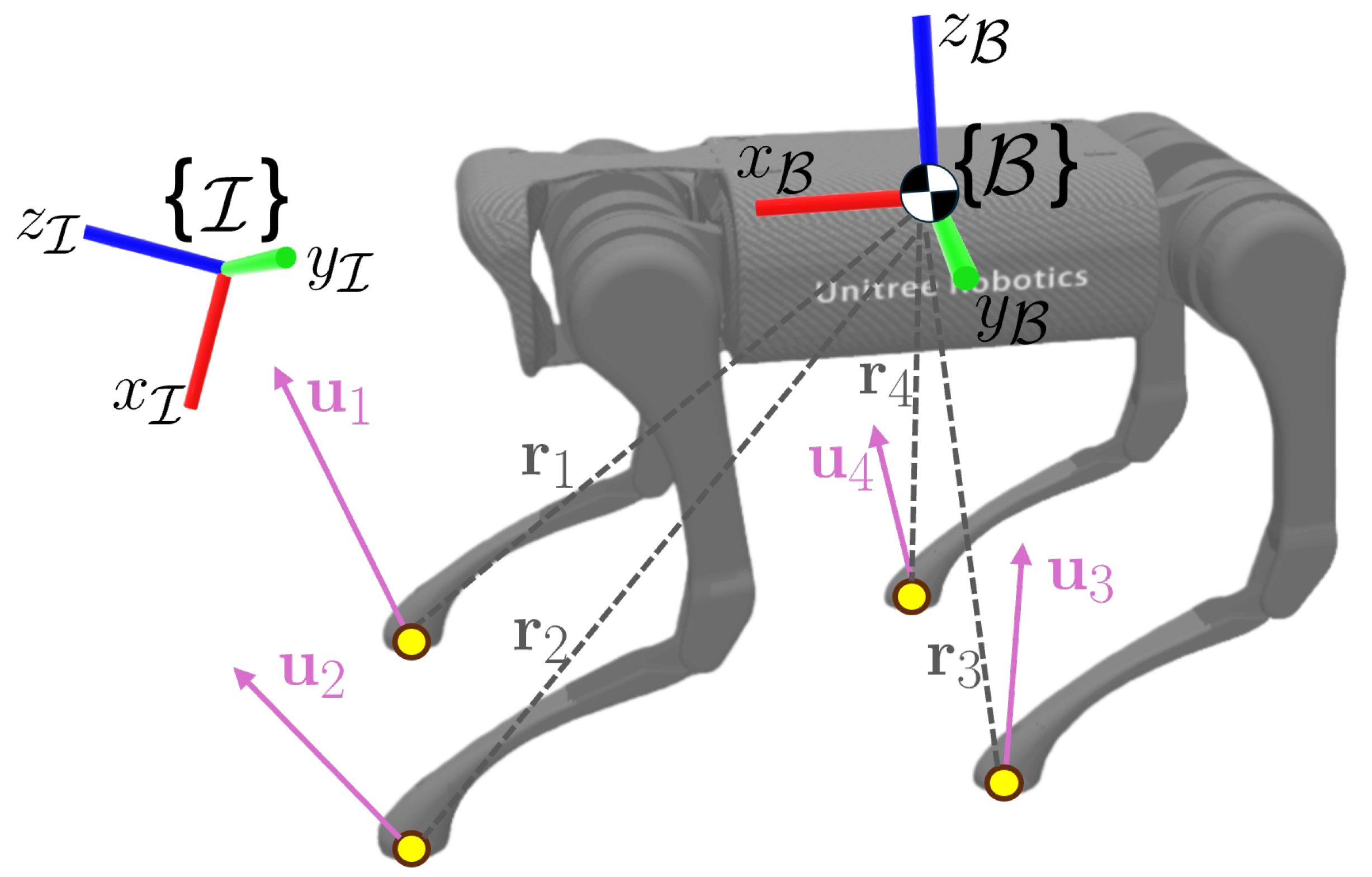
In this study, the robot’s dynamics are approximated as a single rigid body. We define the inertial reference frame as { I } and the body-fixed frame, with its origin at the robot’s Center of Mass (CoM), as { B } . The structure details of the robot as shown in Figure 1.
The state of the system is encapsulated in the vector x , which includes the CoM position and velocity, the body orientation, and the body’s angular velocity:
x : = [ r , v , R , ω ]
where r R 3 and v R 3 represent the position and linear velocity of the CoM, respectively, expressed in the inertial frame { I } . The matrix R S O ( 3 ) is the rotation matrix [35] that maps vectors from the body frame { B } to the inertial frame { I } , with S O ( 3 ) = { R R 3 × 3 R T R = I , det ( R ) = 1 } . The vector ω R 3 denotes the angular velocity of the body, expressed in the body frame { B } .
The system is actuated by external wrenches generated by ground reaction forces (GRFs). Let f i R 3 be the GRF from the i-th contact point (e.g., a foot), and let p i R 3 be its point of application in the inertial frame. The vector from the CoM to this contact point, also in the inertial frame, is given by r i = p i r . Note that the state of the system evolves continuously as a function of time and is encapsulated in the time-dependent vector x. This vector aggregates the Center of Mass position r and linear velocity v expressed in the inertial frame along with the body orientation matrix R and the angular velocity ω . To ensure notational conciseness while preserving mathematical rigor we explicitly define all kinematic and dynamic variables introduced in this formulation as implicit functions of time t. Consequently, the notation x implies the instantaneous state x at time t throughout the continuous time derivation.
The total external wrench, comprising the force F e x t and torque τ e x t acting on the CoM, is the sum of the contributions from all N c active contact points (assuming N c = 4 for a quadruped):
F e x t τ e x t = i = 1 N c I r i ] × f i
where I is the 3 × 3 identity matrix. The operator [ · ] × : R 3 so ( 3 ) maps a vector to its corresponding skew-symmetric matrix, such that [ a ] × b = a × b for any a , b R 3 . The space so ( 3 ) is the set of all 3 × 3 skew-symmetric matrices.
The full rigid-body dynamics are governed by the Newton-Euler equations. The continuous-time dynamics x ˙ = f ( x , u ) can be written as follows:
x ˙ = r ˙ v ˙ R ˙ ω ˙ = v 1 m F e x t g R [ ω ] × J 1 ( R T τ e x t ω × ( J ω ) )
where m is the total mass of the body and g R 3 is the gravitational acceleration vector. The constant moment of inertia tensor, defined with respect to the body frame { B } , is J R 3 × 3 . The control input vector u R 3 N c is the stacked vector of all active ground reaction forces: u = [ f 1 T , f 2 T , , f N c T ] T .

3.2. Nonlinear MPC

The nonlinear nature of the system dynamics, particularly the rotational components, necessitates a control strategy capable of handling such complexities. We employ a custom Model Predictive Control framework developed by the authors using the C++ programming language to address the specific real-time constraints of the platform. This bespoke architecture formulates the optimal control problem, which is subsequently solved using the Operator Splitting Quadratic Program (OSQP) software library [36].
To solve this OCP, we adopt a direct collocation approach, discretizing the continuous-time dynamics over a prediction horizon of N steps. This transcription converts the OCP into a large-scale nonlinear programming (NLP) problem. The objective is to find an optimal state trajectory X = { x i } i = 0 N and a corresponding control trajectory U = { u i } i = 0 N 1 that minimize a cumulative cost while adhering to system dynamics and operational constraints.
The discrete-time OCP is formulated as follows:
min X , U V f ( x N ) + i = 0 N 1 L ( x i , u i ) s . t . x i + 1 = f d ( x i , u i ) x 0 = x c u r r e n t x i X , i = 0 , , N u i U , i = 0 , , N 1
where L is the stage cost function and V f is the terminal cost. The function f d represents the discretized system dynamics, and x c u r r e n t is the system’s measured state at the time of optimization. The sets X and U define the feasible regions for the state and control inputs, respectively.
The stage cost L ( x i , u i ) is designed as a quadratic function to penalize deviations of the predicted trajectory from a time-varying reference trajectory ( x i , r e f , u i , r e f ) . It is defined as follows:
L ( x i , u i ) = j S e j , i Q j 2 + e u , i R u 2
where e W 2 e T W e . The set S includes all state components being tracked (e.g., position, velocity, orientation, angular velocity). The matrices Q j and R u are symmetric positive-definite weighting matrices.
The error terms for translational components (e.g., e p , i = p i p i , r e f ) and the control input ( e u , i = u i u i , r e f ) are computed as simple vector subtractions. However, the orientation and angular velocity errors must be defined to respect the non-Euclidean structure of the S O ( 3 ) manifold:
e R , i = Log ( R i , r e f T R i ) e ω , i = ω i R i T R i , r e f ω i , r e f
where Log : S O ( 3 ) so ( 3 ) is the matrix logarithm, and ( · ) : so ( 3 ) R 3 is the vee operator, which maps a skew-symmetric matrix to its corresponding 3-vector. The terminal cost V f ( x N ) is similarly defined as a quadratic cost on the final state error.
A direct solution of this NLP is computationally intensive and susceptible to local minima, rendering it unsuitable for real-time implementation. The primary source of this complexity is the nonlinear discretization of the rotational dynamics. Using a first-order integration scheme on the manifold, the discrete-time rotational dynamics are:
R i + 1 = R i Exp ( h [ ω i ] × ) ω i + 1 = ω i + h J 1 ( τ b o d y , i [ ω i ] × J ω i )
where h is the discrete time step, Exp : so ( 3 ) S O ( 3 ) is the matrix exponential, and τ b o d y , i is the net torque expressed in the body frame { B } .
To achieve real-time performance, we linearize these nonlinear dynamic constraints at each optimization step. This is accomplished using a variation-based linearization scheme, which transforms the OCP into a convex problem (e.g., a Quadratic Program) that can be solved efficiently.

3.3. Liquid Neural Network

The Optimal Control Problem (OCP) formulated in our Model Predictive Control (MPC) framework relies on the discrete-time dynamics model f d ( x i , u i ) . This model is derived from the first-principles Newton-Euler equations in (3), which describe an idealized rigid body. In practice, this analytical model is an approximation. Unmodeled phenomena such as joint friction, actuator dynamics, or complex ground-contact interactions can lead to a significant reality gap, degrading controller performance.
To bridge this gap, we augment our framework with a data-driven dynamics component. Given that the robot’s dynamics evolve in continuous time, we investigate models that are inherently continuous-time, allowing for principled integration and robust prediction at variable time steps.
A highly expressive approach to modeling continuous-time dynamics is the Neural Ordinary Differential Equation (Neural ODE). A Neural ODE learns the vector field of a hidden state, z ( t ) R D , using a neural network. The dynamics are defined by a differential equation parameterized by a set of weights θ :
d z ( t ) d t = G ( z ( t ) , inp ( t ) , θ )
where G is the neural network, and inp ( t ) represents external inputs (such as control signals u ( t ) from our MPC). The system’s state at any future time T is determined by numerically integrating this equation: z ( T ) = z ( 0 ) + 0 T G ( z ( t ) , inp ( t ) , θ ) d t . Training is performed by backpropagating through the ODE solver, often utilizing the adjoint sensitivity method for memory-efficient gradient calculation.
While powerful, a generic Neural ODE formulation for G can be difficult to train and may lack desirable properties like stability. For physical systems, it is often beneficial to impose more structure.
We turn to a structured continuous-time model inspired by Continuous-Time Recurrent Neural Networks (CT-RNNs). A conventional CT-RNN often assumes a fixed relaxation dynamic, governed by a static time constant τ :
d z ( t ) d t = 1 τ z ( t ) + F ( z ( t ) , inp ( t ) , θ )
This fixed timescale is a strong limiting assumption for a system like a legged robot, which must operate across multiple, rapidly changing timescales (e.g., slow, stable walking vs. fast, reflexive-like stumbling). Therefore, we adopt a more sophisticated architecture, the Liquid Time-Constant (LTC) model. This model makes the system’s time constant itself a learnable, input- and state-dependent function. The mics of the hidden state z ( t ) are formulated as follows:
d z ( t ) d t = Ψ ( z ( t ) , inp ( t ) , θ ) z ( t ) + H ( z ( t ) , inp ( t ) , θ )
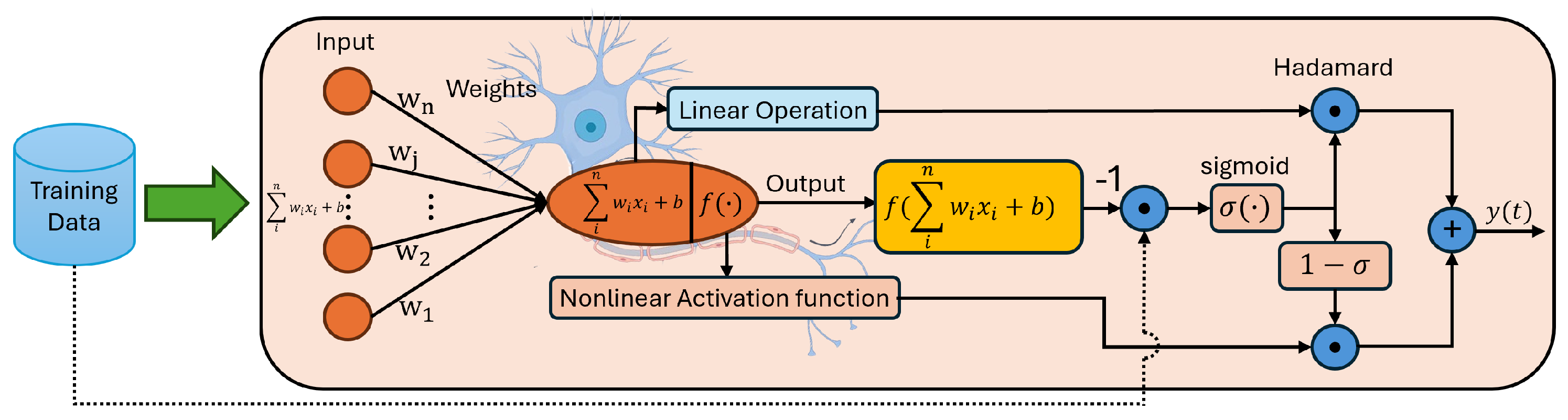
where ⊙ denotes element-wise multiplication. The crucial component is Ψ ( · ) , a neural network function that outputs the inverse time constant (or “leakiness”) for each element of the hidden state. This structure allows the system to endogenously learn its own temporal dynamics, adapting its sensitivity and integration speed based on the current context. For example, the model can learn to react very quickly (small time constant) to a sharp disturbance but integrate information slowly (large time constant) during a stable, periodic gait. This property enables a single model to capture the specialized, multi-scale dynamical behaviors required for robust locomotion, making it a compelling choice for augmenting our first-principles dynamic model. The internal architecture of this LTC unit is visualized in Figure 2. Its structure implements this adaptive timescale by dynamically modulating the hidden state’s intrinsic leakiness (the inverse time constant) through a gated mechanism that is itself a function of the current inputs and hidden state.

3.4. Liquid-Augmented Model Predictive Control (LA-MPC)

The preceding sections have established the ideal rigid-body dynamics f ( x , u ) from (3), the nominal OCP formulation (4), and the Liquid Time-Constant (LTC) model in (10) as a powerful tool for representing complex, continuous-time dynamics. This section details our core contribution: the formal integration of these components into a unified Liquid-Augmented MPC (LA-MPC) framework designed for real-time disturbance learning and rejection.
The ideal dynamics in (3) do not account for the “reality gap” identified in Section 3.3. We augment this model by introducing a generalized disturbance wrench, w d ( t ) R 6 . This wrench represents the aggregate effect of all unmodeled dynamics, including ground-contact variations (e.g., friction, terrain compliance), actuator lag, and external perturbations.
This disturbance wrench is composed of a disturbance force f d ( t ) R 3 (expressed in the inertial frame { I } ) and a disturbance torque τ d ( t ) R 3 (expressed in the body frame { B } ). The true continuous-time dynamics of the system are therefore:
x ˙ = f ( x , u ) + G ( x ) w d ( t )
where f ( x , u ) is the ideal dynamics function from (3), and G ( x ) R 12 × 6 is the disturbance mapping matrix that projects the wrench into the state derivative space:
G ( x ) = 0 3 × 3 0 3 × 3 1 m I 0 3 × 3 0 3 × 3 0 3 × 3 0 3 × 3 J 1
where I is the 3 × 3 identity matrix, and 0 3 × 3 is the zero matrix.
A nominal MPC formulation, which relies solely on the ideal model f ( x , u ) , can only correct for the disturbance w d ( t ) reactively, treating it as an unmeasured perturbation that manifests as state tracking error. The central tenet of LA-MPC is to transition from this reactive posture to a proactive one. We achieve this by endowing the controller with the ability to predict the evolution of the disturbance wrench over the optimization horizon.
To this end, we employ the Liquid Time-Constant (LTC) network, L θ , introduced in Section 3.3. At each control step k, the network’s hidden state z k is updated with an input vector I k composed of recent proprioceptive history (e.g., I k = [ v k H : k , ω k H : k , u k H : k ] ). The LTC’s continuous-time dynamics in (10) are then integrated forward over the N steps of the prediction horizon, yielding a sequence of predicted disturbance wrenches:
{ w ^ d , k + i | k } i = 0 N 1 = L θ ( z k , I k , N )
This sequence, { w ^ d , k + i | k } , represents the model-plant mismatch (e.g., unmodeled contact forces, terrain effects) that the controller anticipates encountering.
This predictive information is directly integrated into the optimization. We reformulate the nominal OCP in (4) by preserving its quadratic objective function and terminal cost:
min X , U V f ( x N ) + i = 0 N 1 L ( x i , u i )
s . t . x i + 1 = f d ( x i , u i ) + h G ( x i ) w ^ d , k + i | k x 0 = x c u r r e n t x i X , i = 0 , , N u i U , i = 0 , , N 1
The critical modification lies in the system dynamics constraint. The ideal model x i + 1 = f d ( x i , u i ) is replaced by its disturbance-augmented counterpart, which now incorporates the LTC’s prediction as a known, time-varying feedforward term. The full set of constraints for the LA-MPC problem is therefore:
By embedding the predicted disturbance w ^ d directly into the dynamics constraint on (14), the optimization process is fundamentally altered. The optimizer is now compelled to find a control sequence U that not only minimizes tracking error through the cost L but also generates proactive control actions to counteract the anticipated disturbance wrench. This anticipatory mechanism effectively transforms the resulting control law from a purely feedback-driven system to a hybrid feedforward-feedback controller. Upon linearization, this problem is transcribed into a convex Quadratic Program (QP), retaining the real-time solvability required for high-frequency quadrupedal locomotion. We formally define real-time solvability as the capability of the control stack to converge to a feasible solution within the fixed temporal budget determined by the update frequency. For the specific implementation detailed in Section 4 this equates to a hard deadline of 6.25  ms per control cycle corresponding to the 160 Hz update rate. Verification is achieved by enforcing strict iteration limits on the numerical solver and monitoring execution timestamps to guarantee that the total computation time, including the neural inference pass, remains strictly below this threshold. The complete, step-by-step implementation of this hybrid feedforward-feedback controller, which formalizes the receding-horizon loop integrating disturbance prediction, variation-based linearization, and the final QP solution, is presented in Algorithm 1.
Algorithm 1: Liquid–Augmented Model Predictive Control
Require: Current state x k = [ r k , v k , R k , ω k ] , history buffer H k of recent ( v , ω , u ) , references { x k + i ref , u k + i ref } i = 0 N , contact schedule { C k + i } i = 0 N 1 , horizon N, step size h, weights { Q j } , R u , Q f , physical parameters ( m , J , g )
    Models
       Continuous rigid–body template x ˙ = f ( x , u )
       Geometric discretization x + = f d ( x , u ) with R + = R Exp h skew ( ω )
       Disturbance wrench w d = [ f d , τ d ] R 6 , mapping G = diag ( 0 3 , 1 m I 3 , 0 3 , J 1 )
      Liquid Time–Constant module L θ : z ˙ = Ψ ( z , inp ) z + H ( z , inp ) with wrench readout
  1:
procedure LA–MPC–Step( x k , H k , z k )
  2:
    Build input to liquid:  I k PACK ( H k )
  3:
    Predict disturbance over horizon:  { w ^ d , k + i | k } i = 0 N 1 , { z k + i | k } i = 0 N L θ ( z k , I k , N , h )
  4:
    Nominal rollout with predicted wrench
  5:
        x k nom x k ,     G diag ( 0 3 , 1 m I 3 , 0 3 , J 1 )
  6:
    for  i = 0  to  N 1  do
  7:
         x k + i + 1 nom f d x k + i nom , u k + i ref + h G w ^ d , k + i | k
  8:
    Variation–based linearization on S E ( 3 )
  9:
    for  i = 0  to  N 1  do
10:
         ( A i , B i ) f d / x , f d / u | ( x k + i nom , u k + i ref )
11:
    Form tracking errors and cost
12:
        Orientation error e R , i = vee Log ( R k + i ref R k + i )
13:
        Angular–velocity error e ω , i = ω k + i R k + i R k + i ref ω k + i ref
14:
        Stage cost j S e j , i Q j 2 + u k + i u k + i ref R u 2 ,    terminal j e j , N Q f 2
15:
    Assemble QP in variation coordinates
16:
        Initial variation δ x 0 = Lift ( x k , x k nom )   ▹ translation by subtraction, rotation via Log
17:
        Dynamics δ x i + 1 = A i δ x i + B i δ u i for i = 0 : N 1
18:
        Feasibility: x k + i X , u k + i U , contact pattern C k + i zeroes noncontact GRF blocks and enforces friction/box limits
19:
    Solve QP and extract control
20:
        { δ u i } i = 0 N 1 QP _ SOLVE ( cos t , constraints )
21:
        u k u k ref + δ u 0
22:
    Execute and update
23:
        Apply u k to the low–level controller
24:
        Update buffers H k + 1 with new ( v , ω , u )
25:
        z k + 1 z k + 1 | k                              ▹ carry liquid hidden state forward
26:
    Return  u k , z k + 1
27:
Repeat for k k + 1 in a receding horizon loop

4. Result Validation

To empirically validate the performance, robustness, and computational efficiency of the proposed Liquid-Augmented Model Predictive Control (LA-MPC) framework, we designed a series of challenging simulation experiments. The simulation environment, robot model, and control architecture are detailed below.

4.1. Simulation Setup

All dynamic simulations are conducted using the MuJoCo physics enginer (MuJoCo [22], by Google DeepMind.), chosen for its high speed and accurate contact modeling, as well as its prevalence in dynamic legged locomotion research. We utilize a high-fidelity model of the Unitree Go2 quadrupedal robot, which includes accurate mass and inertial properties, joint limits, and kinematic structure. The simulation environment is integrated with the ROS 2 (Robot Operating System 2) framework, providing a modular and high-performance software architecture that mirrors real-world deployment. The control node encapsulates the Liquid Augmented MPC logic and executes on a dedicated process to ensure modularity and maintain separation between the control node and the MPC logic. We utilize the OSQP solver to find the optimal contact forces within the allotted time window. Data exchange between the physics simulation and the controller relies on the ROS 2 middleware. This architecture comprises a simulation node that encapsulates the MuJoCo environment and a separate control node executing the LA-MPC. Communication between nodes relies on standard ROS 2 topics for state estimation (publishing sensor_msgs/Imu and sensor_msgs/JointState) and motor commands (subscribing to desired joint torques). This decoupled architecture facilitates a seamless and robust sim-to-real transition. The LA-MPC controller itself is implemented in C++ and, consistent with this paper’s objective for real-time viability, operates at a target frequency of 160 Hz. At each 6.25 ms control cycle, the controller solves the complete OCP. This involves linearizing the single-rigid-body dynamics, querying the LTC network for the predicted disturbance wrench sequence { w ^ d , k + i | k } , and formulating the problem as a convex Quadratic Program (QP). We employ a computationally efficient QP solver, such as OSQP, to find the optimal ground reaction forces. The Liquid Time-Constant (LTC) disturbance model, pre-trained in Python (version 3.12) using a framework like PyTorch, is integrated into the C++ control loop via a C++ inference engine (e.g., LibTorch) to ensure its forward pass executes within the stringent real-time budget. This pre-training phase involved a systematic optimization to discover the most performant network architecture.
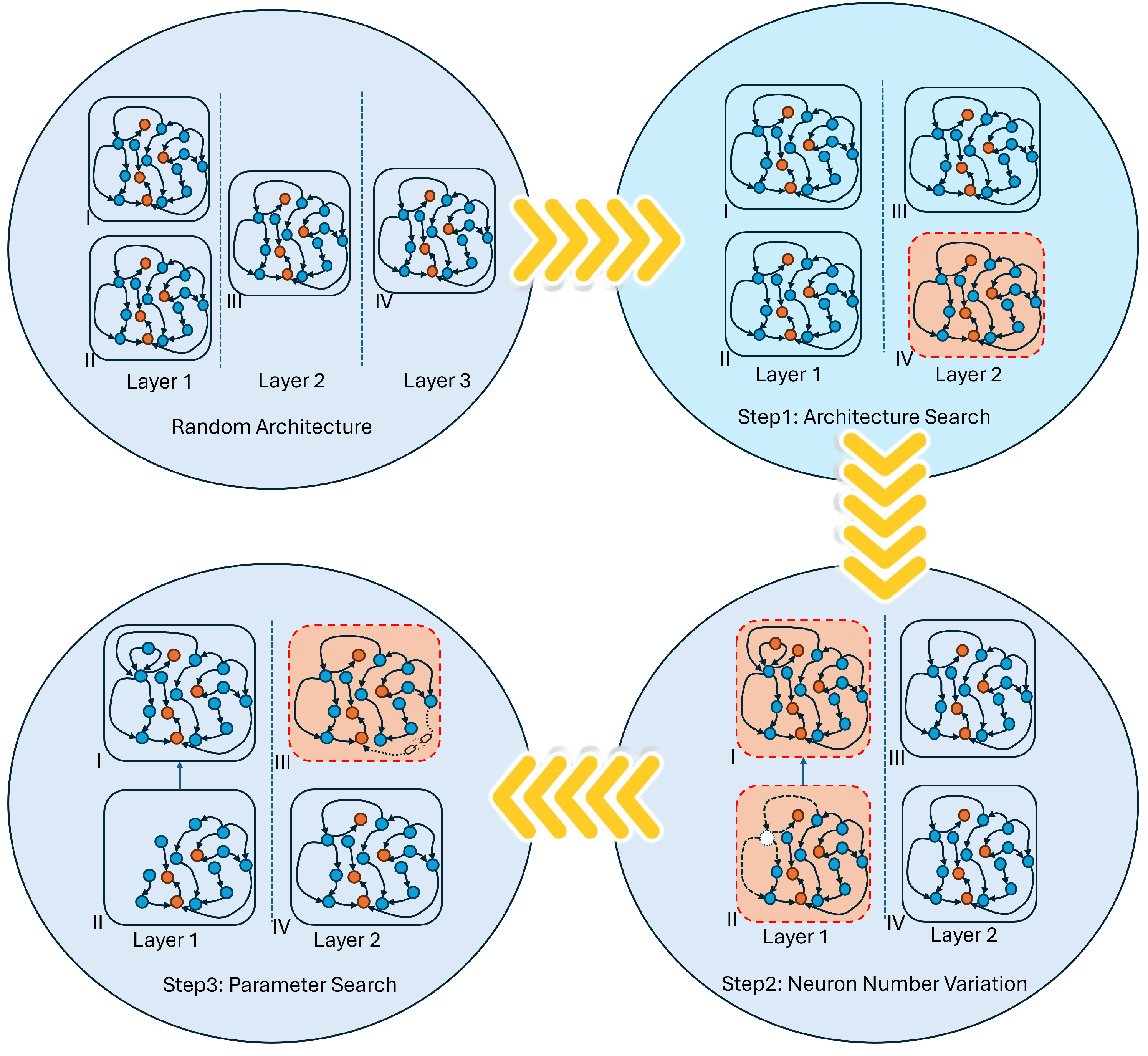
The pretraining phase involved a systematic optimization to discover the most performant network architecture. We employed a multistage Neural Architecture Search process as overviewed in Figure 3 to sequentially refine the model structure. This methodology aligns with progressive search strategies [37] that reduce the dimensionality of the optimization problem by decoupling topology selection from capacity tuning. The process initiates with a connectivity search where the algorithm evaluates diverse wiring patterns to identify the most effective information flow structures. This stage prioritizes the discovery of sparse connections, which are essential for maintaining low-latency inference on embedded hardware. Following the selection of the optimal topology, the second stage performs a capacity sweep by varying the number of neurons within the established layers. This sequential tuning ensures that the final model achieves an optimal balance between tracking accuracy and computational efficiency.
We deliberately selected this hierarchical approach over alternative methods to satisfy the strict real-time constraints of the control loop. While techniques such as Differentiable Architecture Search [38] provide powerful optimization, they often yield dense architectures that are computationally expensive to execute. Similarly, a reinforcement learning-based architecture search [39] was considered but deemed too data-intensive for this specific application. Our multistage evolutionary strategy offers a pragmatic alternative that avoids the local minima often encountered in simultaneous weight and topology optimization. This ensures the resulting Liquid Time Constant network remains lightweight enough for the high-frequency execution required by the quadrupedal platform. To ensure numerical stability and physics fidelity, the MuJoCo simulation is stepped forward at a much higher frequency of 1 kHz ( d t = 0.001 s ). The determination of the training hyperparameters followed a rigorous validation protocol to ensure both optimality and reproducibility. We utilized a structured grid search strategy on a dedicated holdout validation set to identify the ideal values for the learning rate batch size and the regularization coefficients. This selection process prioritized minimizing the long-term prediction error while strictly monitoring for signs of overfitting. To confirm the robustness of the chosen configuration, we performed a local sensitivity analysis by perturbing the key hyperparameters by ten percent around their optimal values. The resulting empirical data indicate that the tracking accuracy of the controller remains stable and consistent despite these minor variations, which suggests that the solution occupies a flat region within the loss landscape. Furthermore, we addressed reproducibility by fixing the random number generator seeds for both the simulation environment and the neural training framework. All performance metrics reported in this work represent the mean values calculated over ten independent training trials to mitigate the influence of stochastic weight initialization. To rigorously evaluate the contribution of our disturbance-learning component, we establish a Nominal MPC as a primary baseline. This baseline controller shares the identical MPC formulation, cost function, constraints, and optimization solver as the LA-MPC. However, it operates without the liquid-augmentation module, assuming the disturbance wrench w ^ d is zero. This comparison is designed to directly isolate the performance improvements, in terms of trajectory tracking, stability, and disturbance rejection, attributable to the proactive, learned disturbance compensation. The experiments will test the controllers against a gamut of unmodeled dynamics, including external pushes, locomotion on unmodeled compliant surfaces, and terrain variability, thereby validating the framework’s effectiveness for agile locomotion in uncertain environments.

4.2. Results Analysis

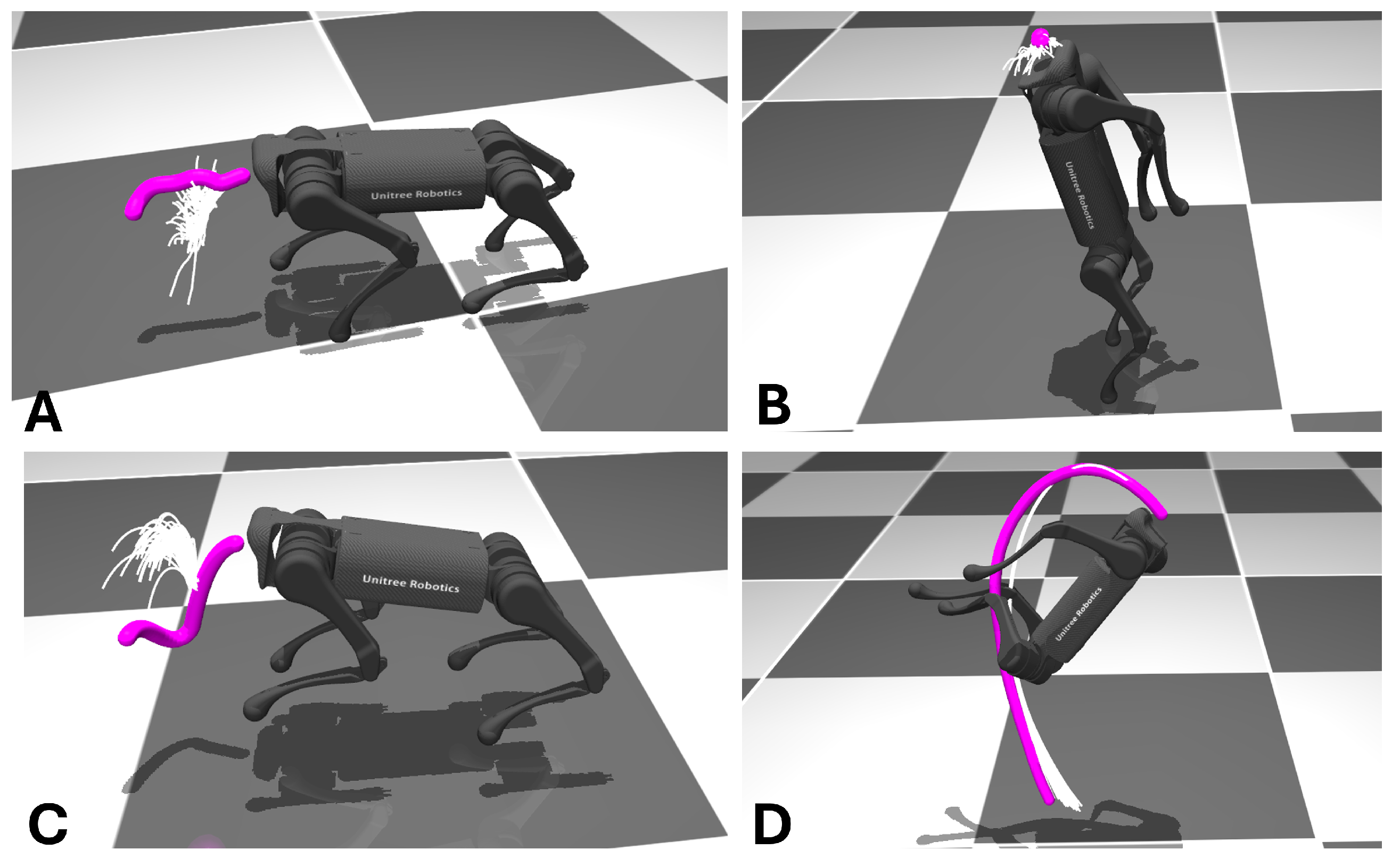
Figure 4 illustrates the qualitative performance of the proposed Liquid Augmented Model Predictive Control framework across four diverse and dynamic locomotion tasks in MuJoCo platform. The reference trajectory for the Center of Mass is depicted by the pink line, while the actual trajectory tracked by the robot is shown in white. Panel A demonstrates robust quadrupedal walking along a specified reference path. Panel B presents a more challenging bipedal walking task, requiring the controller to maintain dynamic balance and follow a trajectory using only two limbs. Panel C displays a dynamic jumping maneuver, which Table 1 identifies as pronking. Finally, Panel D highlights a highly agile 360-degree backflip, a task that validates the framework’s capability to execute complex non-periodic acrobatic maneuvers and achieve a stable landing.
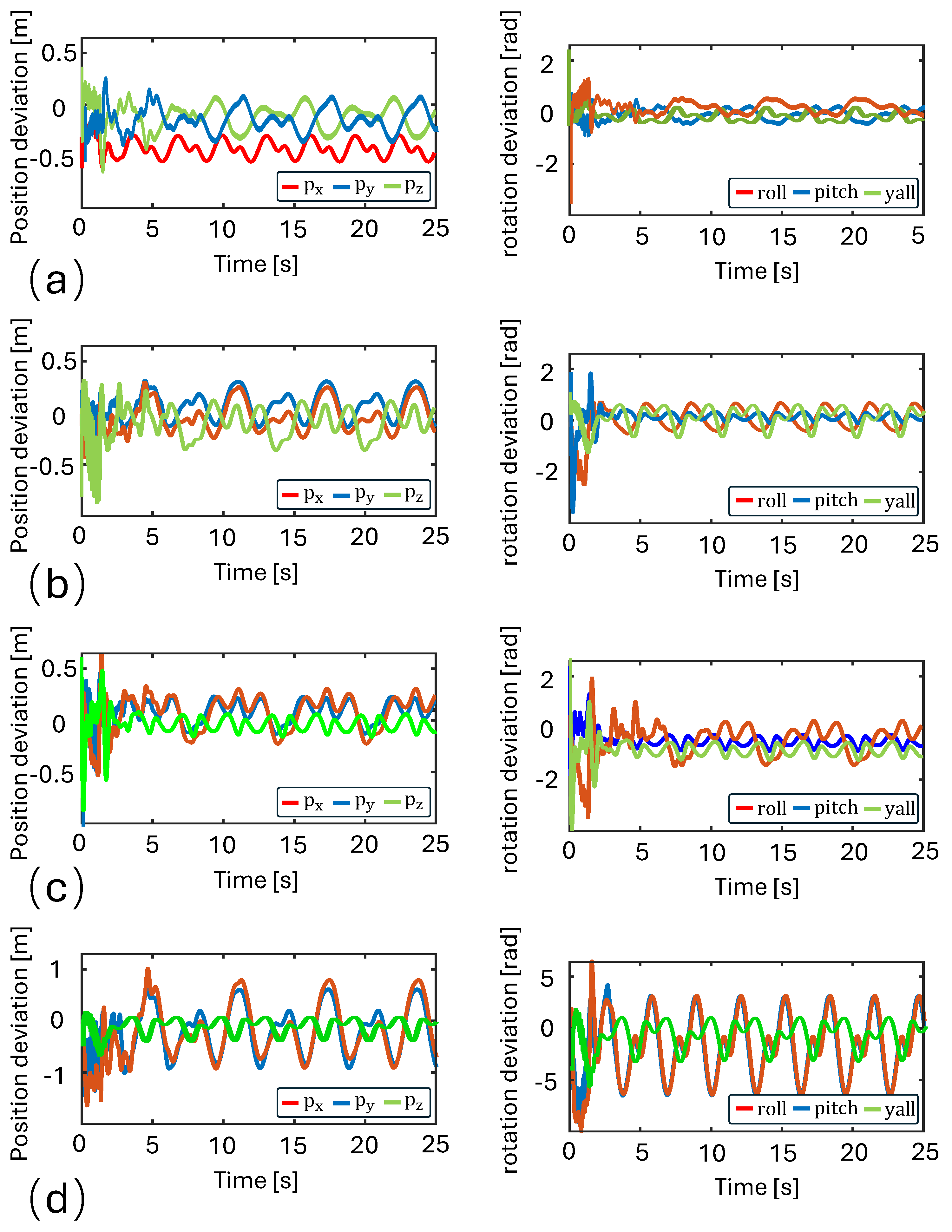
Figure 5 presents a quantitative analysis of the trajectory tracking performance for the Liquid Augmented Model Predictive Control framework, corresponding to the four tasks previously illustrated. Each row in the figure correlates to a specific maneuver: the first row for quadrupedal walking, the second for bipedal walking, the third for dynamic jumping, and the fourth for the 360-degree backflip. The left column plots the time series data for the Center of Mass positional deviation in meters, detailing the error components p x , p y , and p z 9. The right column plots the corresponding rotational deviation in radians, showing the roll, pitch, and yaw errors. These rotational errors are derived from the geometric S O ( 3 ) error metric. The plots collectively demonstrate the controller’s ability to maintain small and bounded tracking errors. Notably, the framework achieves rapid stabilization and robust tracking even during the highly agile backflip maneuver shown in the final row, validating the effectiveness of the proactive disturbance learning mechanism.
Table 1 provides a comparative summary of our Liquid Augmented Model Predictive Control framework against several common deep reinforcement learning baselines. The evaluation is conducted across four challenging locomotion tasks: Walking, Bipedal walking, Pronking, and Flipping. The selected baselines include prominent algorithms such as SAC, TD3, GAIL, AMP, and DDPG. Two key metrics are reported for this comparison: Success Rate, expressed as a percentage, and Tracking Error, measured in meters. The results clearly demonstrate the superior performance of the proposed LA-MPC approach. For all four tasks, our method achieves the highest success rate, for example 94% for Walking and 95% for Flipping. Concurrently, our framework attains the lowest tracking error across all categories, for instance achieving 0.09 m for Walking and 0.18 m for Flipping, significantly outperforming all other methods.
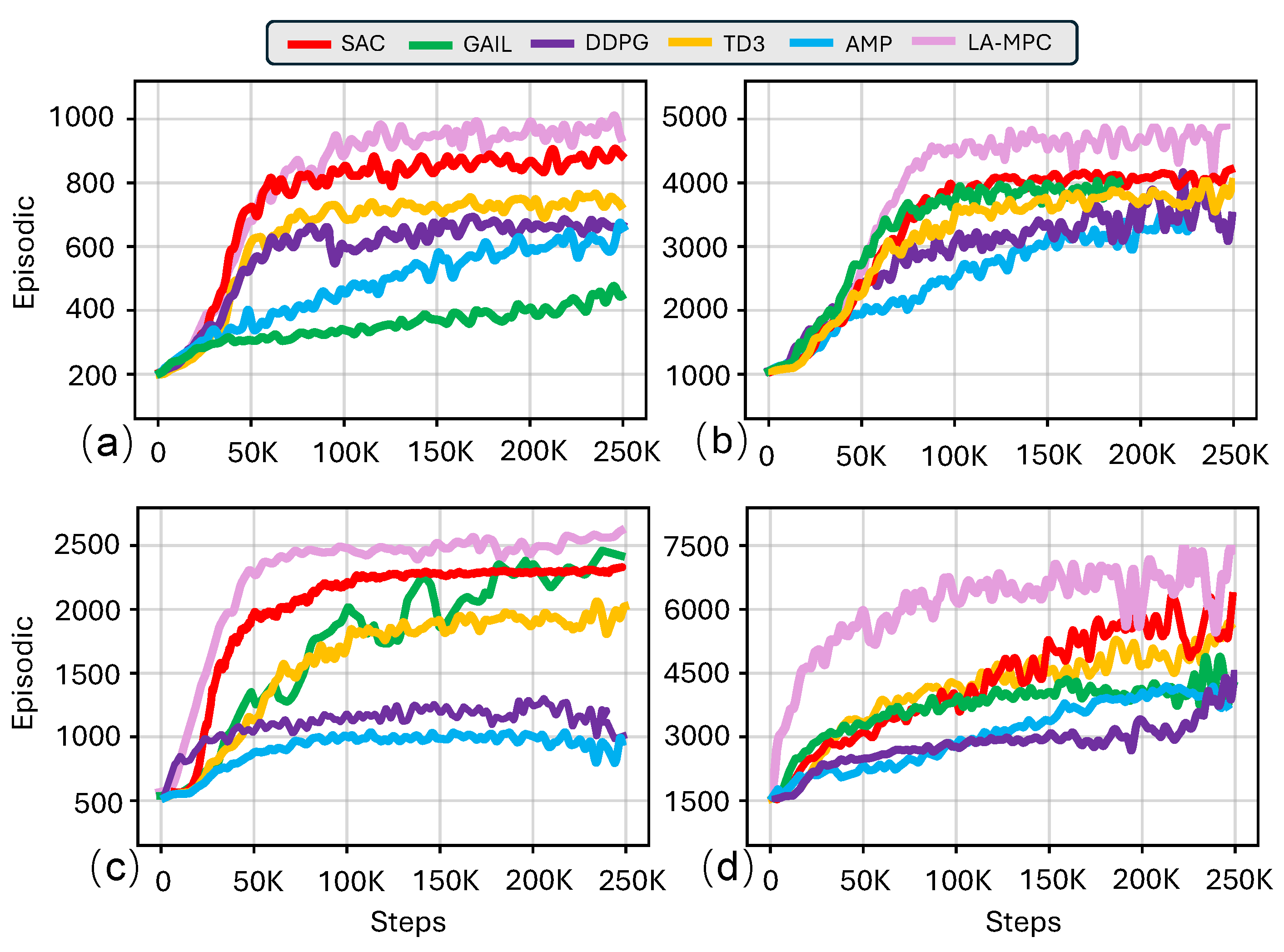
Figure 6 presents a quantitative comparison of the learning performance of the proposed LA-MPC framework against five established deep reinforcement learning (RL) baselines: SAC, GAIL, DDPG, TD3, and AMP. The analysis focuses on sample efficiency and asymptotic performance, visualized through episodic reward curves (y-axis) plotted against 250,000 training steps (x-axis). This evaluation is conducted across the four distinct locomotion tasks detailed previously: (a) Walking, (b) Bipedal walking, (c) Pronking, and (d) Flipping. This comparative benchmark is designed to demonstrate how effectively each method learns a robust control policy from environment interactions. A consistent trend is immediately evident across all four subplots. The LA-MPC framework (illustrated by the light pink curve) demonstrates markedly superior sample efficiency, achieving a higher episodic return much earlier in the training process compared to all baselines. Furthermore, LA-MPC not only learns faster but also converges to a significantly higher and more stable level of performance in all tasks. While the baseline methods show varying degrees of success, with AMP and TD3 generally outperforming the others, none match the convergence speed or the peak episodic reward attained by our method. This superior learning dynamic is attributable to the integration of the LTC disturbance model (Section 3.3), which provides a structured and data-efficient mechanism for adapting to unmodeled dynamics, as opposed to the end-to-end learning characteristic of the pure RL approaches.
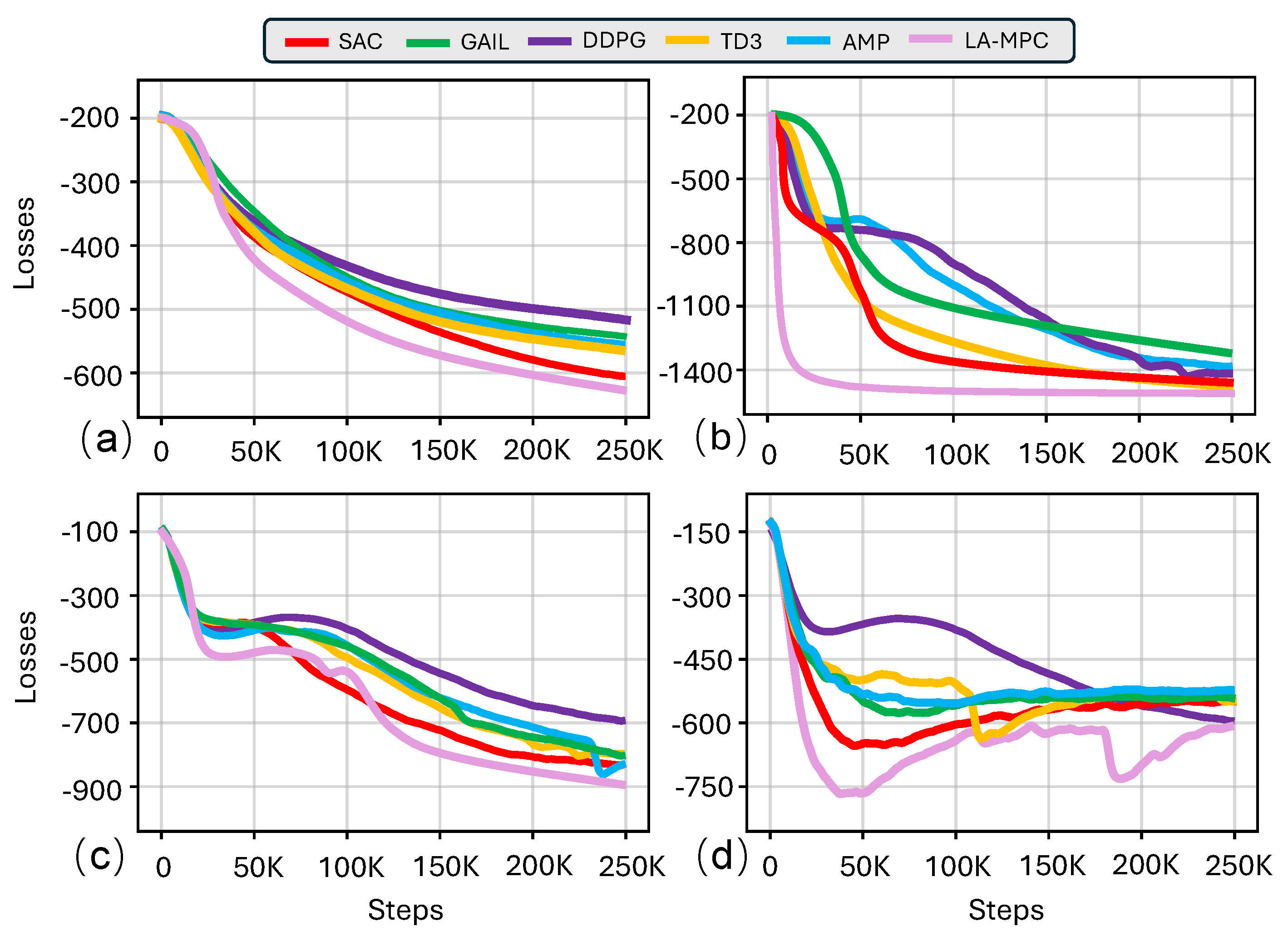
Figure 7 provides a complementary analysis to Figure 6, illustrating the convergence behavior of the respective training loss functions for LA-MPC and the five deep RL baselines over 250,000 training steps. It is important to note that the y-axis represents different objectives: for the RL baselines (SAC, TD3, etc.), the plots primarily depict the critic or value function loss; for our LA-MPC framework, the curve (light pink) illustrates the training convergence of the Liquid Time-Constant (LTC) disturbance model itself. The comparison is again presented across the four benchmark tasks: (a) Walking, (b) Bipedal walking, (c) Pronking, and (d) Flipping. These plots demonstrate the stable and efficient convergence of the LA-MPC’s learning component. In all four scenarios, the LA-MPC loss (light pink) shows a rapid and smooth decrease, settling at a stable, low value. This indicates that the LTC network is effectively and quickly learning to model the unmodeled dynamics and disturbances present in the simulation. In contrast, the loss curves for several deep RL baselines, particularly in the more dynamic tasks like (d) Flipping, exhibit greater volatility and less consistent convergence. This stable convergence of the LTC disturbance model is a key underlying factor for the superior performance observed in Figure 6. By rapidly developing an accurate, predictive model of the disturbance wrench, the LA-MPC’s optimizer is supplied with high-fidelity information, enabling it to find a proactive control policy that yields higher episodic rewards.

5. Conclusions

This paper introduced Liquid Augmented Model Predictive Control, a novel hybrid framework designed to achieve robust and adaptive locomotion for quadrupedal robots. Our approach successfully integrates a first-principle geometric model predictive controller operating on the S O ( 3 ) manifold with a continuous-time liquid time-constant neural network. This integration facilitates real-time disturbance learning and proactive model adaptation.
The core contribution of this work is the formulation of an anticipatory control strategy. By embedding the disturbance wrench predicted by the liquid network directly into the dynamic constraints of the optimal control problem, the controller proactively compensates for unmodeled dynamics rather than merely reacting to state errors. This hybrid formulation retains the structure of a convex quadratic program, enabling efficient and reliable online computation at high frequencies, as demonstrated by our 160 hertz execution rate. Empirical validation through extensive, high-fidelity simulations confirmed the effectiveness of the proposed LA MPC framework. Across a range of challenging and dynamic maneuvers, including stable walking, bipedal balancing, pronking, and acrobatic flipping, our method demonstrated superior performance. It consistently achieved higher success rates and significantly lower trajectory tracking errors compared to several prominent deep reinforcement learning baselines. This research presents a viable and computationally efficient pathway toward endowing legged robots with the agility and resilience necessary to operate in complex, uncertain environments.
Future investigations will focus on advancing adaptive contact modeling and enhancing the cross-domain generalization of learned disturbance models.

6. Discussion

The proposed Liquid Augmented Model Predictive Control framework exhibits certain limitations that merit further analysis. The primary constraint involves the additional computational burden introduced by the Liquid Time Constant neural module. The integration of the neural network necessitates a forward inference pass during every control cycle to generate the predicted disturbance sequence. This process involves dense matrix operations that are absent in the nominal single-rigid-body formulation. Consequently, the inference step consumes a measurable portion of the available computation time, reducing the time margin available for the quadratic programming solver. The theoretical certification of the stability of the neural dynamics constitutes a critical avenue for future research. While the Liquid Time Constant architecture utilized in this work inherently exhibits bounded state evolution due to its contractive nature, we acknowledge the necessity of providing a rigorous mathematical proof. Future developments will aim to leverage these intrinsic properties to derive explicit Lyapunov-based stability guarantees for the coupled system. This will allow us to certify closed-loop stability under rigorous theoretical frameworks similar to the methodologies established in the aforementioned literature.
Our implementation mitigates this latency by utilizing a compiled C++ inference engine, which ensures the total control cycle remains within the 6.25 millisecond budget required for the 160 Hz update rate. Nevertheless, the added computational complexity implies that the framework requires more powerful embedded processors compared to standard linear controllers. This hardware dependency could restrict the deployment of the algorithm on extremely resource-constrained platforms or microcontrollers with limited floating-point capabilities.
A second limitation relates to the generalization capability of the learning component. The disturbance rejection performance relies on the distribution of the training data collected during the offline phase. Environmental conditions or terrain properties that deviate significantly from the training set may result in suboptimal disturbance predictions. The current approach assumes that the learned latent representation can extrapolate to unseen scenarios but extreme outliers in the disturbance profile could potentially degrade the tracking accuracy. Future iterations of this work will address this by incorporating online learning mechanisms to update the network weights in real time and further enhance adaptability.

Author Contributions

Conceptualization, Y.M. and L.G.; methodology, Y.M., Y.Z. and L.G.; software, Y.M., Y.Z. and L.G.; validation, L.G.; formal analysis, Y.M., Y.Z. and L.G.; investigation, Y.M. and Y.Z.; resources, L.G.; data curation, Y.M. and L.G.; writing—original draft preparation, Y.M. and Y.Z.; writing—review and editing, L.G.; visualization, Y.M. and Y.Z.; supervision, L.G.; funding acquisition, L.G. All authors have read and agreed to the published version of the manuscript.

Funding

This research received no external funding.

Data Availability Statement

The simulation software we used for this work is open source and can be downloaded at https://mujoco.org/ (accessed on 5 November 2025). The model of the Unitree Go2 robot we used for the simulation can be found at https://github.com/unitreerobotics/unitree_mujoco (accessed on 5 November 2025). For more data related to this work, please send an email to the corresponding author for further information about this work.

Conflicts of Interest

The authors declare no conflicts of interest.

References

  1. Rezazadeh, S.; Abate, A.; Hatton, R.L.; Hurst, J.W. Robot leg design: A constructive framework. IEEE Access 2018, 6, 54369–54387. [Google Scholar] [CrossRef]
  2. Wang, S.; Chen, Z.; Li, J.; Wang, J.; Li, J.; Zhao, J. Flexible motion framework of the six wheel-legged robot: Experimental results. IEEE/ASME Trans. Mech. 2021, 27, 2246–2257. [Google Scholar] [CrossRef]
  3. Bjelonic, M.; Klemm, V.; Lee, J.; Hutter, M. A survey of wheeled-legged robots. In Proceedings of the Climbing and Walking Robots Conference, Ponta Delgada, Portugal, 12–14 September 2022; Springer: London, UK, 2022; pp. 83–94. [Google Scholar]
  4. Li, Q.; Cicirelli, F.; Vinci, A.; Guerrieri, A.; Qi, W.; Fortino, G. Quadruped Robots: Bridging Mechanical Design, Control, and Applications. Robotics 2025, 14, 57. [Google Scholar] [CrossRef]
  5. Minniti, M.V.; Grandia, R.; Farshidian, F.; Hutter, M. Adaptive CLF-MPC with application to quadrupedal robots. IEEE Robot. Autom. Lett. 2021, 7, 565–572. [Google Scholar] [CrossRef]
  6. Kim, K.; Spieler, P.; Lupu, E.S.; Ramezani, A.; Chung, S.J. A bipedal walking robot that can fly, slackline, and skateboard. Sci. Robot. 2021, 6, eabf8136. [Google Scholar] [CrossRef] [PubMed]
  7. Arroyo, J.; Manna, C.; Spiessens, F.; Helsen, L. Reinforced model predictive control (RL-MPC) for building energy management. Appl. Energy 2022, 309, 118346. [Google Scholar] [CrossRef]
  8. Pandala, A.; Fawcett, R.T.; Rosolia, U.; Ames, A.D.; Hamed, K.A. Robust predictive control for quadrupedal locomotion: Learning to close the gap between reduced-and full-order models. IEEE Robot. Autom. Lett. 2022, 7, 6622–6629. [Google Scholar] [CrossRef]
  9. Lucia, D.J.; Beran, P.S.; Silva, W.A. Reduced-order modeling: New approaches for computational physics. Prog. Aerosp. Sci. 2004, 40, 51–117. [Google Scholar] [CrossRef]
  10. Huang, S.J.; Huang, C.L. Control of an inverted pendulum using grey prediction model. IEEE Trans. Ind. Appl. 2000, 36, 452–458. [Google Scholar] [CrossRef]
  11. Kajita, S.; Morisawa, M.; Miura, K.; Nakaoka, S.; Harada, K.; Kaneko, K.; Kanehiro, F.; Yokoi, K. Biped walking stabilization based on linear inverted pendulum tracking. In Proceedings of the 2010 IEEE/RSJ International Conference on Intelligent Robots and Systems, Taipei, Taiwan, 18–22 October 2010; pp. 4489–4496. [Google Scholar]
  12. Li, L.; Xie, Z.; Luo, X.; Li, J. Trajectory planning of flexible walking for biped robots using linear inverted pendulum model and linear pendulum model. Sensors 2021, 21, 1082. [Google Scholar] [CrossRef]
  13. Khan, A.; Zhang, C.; Atanasov, N.; Karydis, K.; Kumar, V.; Lee, D.D. Memory augmented control networks. arXiv 2017, arXiv:1709.05706. [Google Scholar]
  14. Laskin, M.; Lee, K.; Stooke, A.; Pinto, L.; Abbeel, P.; Srinivas, A. Reinforcement learning with augmented data. Adv. Neural Inf. Process. Syst. 2020, 33, 19884–19895. [Google Scholar]
  15. Yarats, D.; Fergus, R.; Lazaric, A.; Pinto, L. Mastering visual continuous control: Improved data-augmented reinforcement learning. arXiv 2021, arXiv:2107.09645. [Google Scholar] [CrossRef]
  16. Biswal, P.; Mohanty, P.K. Development of quadruped walking robots: A review. Ain Shams Eng. J. 2021, 12, 2017–2031. [Google Scholar] [CrossRef]
  17. Li, Y.; Lyu, Q.; Yang, J.; Salam, Y.; Wang, W. A Hybrid Framework Using Diffusion Policy and Residual RL for Force-Sensitive Robotic Manipulation. IEEE Robot. Autom. Lett. 2025, 10, 10266–10273. [Google Scholar] [CrossRef]
  18. Hosseinpoor, S.; Torresen, J.; Mantelli, M.; Pitto, D.; Kolberg, M.; Maffei, R.; Prestes, E. Traversability analysis by semantic terrain segmentation for mobile robots. In Proceedings of the 2021 IEEE 17th International Conference on Automation Science and Engineering (CASE), Lyon, France, 23–27 August 2021; pp. 1407–1413. [Google Scholar]
  19. Gangapurwala, S.; Campanaro, L.; Havoutis, I. Learning low-frequency motion control for robust and dynamic robot locomotion. arXiv 2022, arXiv:2209.14887. [Google Scholar]
  20. Kuck, E.; Sands, T. Space robot sensor noise amelioration using trajectory shaping. Sensors 2024, 24, 666. [Google Scholar] [CrossRef] [PubMed]
  21. Voight, J. Quaternion Algebras; Springer Nature: London, UK, 2021. [Google Scholar]
  22. Todorov, E.; Erez, T.; Tassa, Y. Mujoco: A physics engine for model-based control. In Proceedings of the 2012 IEEE/RSJ International Conference on Intelligent Robots and Systems, Vilamoura-Algarve, Portugal, 7–12 October 2012; pp. 5026–5033. [Google Scholar]
  23. Xin, G.; Wolfslag, W.; Lin, H.C.; Tiseo, C.; Mistry, M. An optimization-based locomotion controller for quadruped robots leveraging cartesian impedance control. Front. Robot. AI 2020, 7, 48. [Google Scholar] [CrossRef]
  24. Aldair, A.A.; Al-Mayyahi, A.; Wang, W. Design of a stable an intelligent controller for a quadruped robot. J. Electr. Eng. Technol. 2020, 15, 817–832. [Google Scholar] [CrossRef]
  25. Mason, M.T. Compliance and force control for computer controlled manipulators. IEEE Trans. Syst. Man, Cybern. 2007, 11, 418–432. [Google Scholar] [CrossRef]
  26. Schumacher, C.; Sharbafi, M.; Seyfarth, A.; Rode, C. Biarticular muscles in light of template models, experiments and robotics: A review. J. R. Soc. Interface 2020, 17, 20180413. [Google Scholar] [CrossRef]
  27. Shen, J.; Hong, D. Convex model predictive control of single rigid body model on so (3) for versatile dynamic legged motions. In Proceedings of the 2022 International Conference on Robotics and Automation (ICRA), Philadelphia, PA, USA, 23–27 May 2022; pp. 6586–6592. [Google Scholar]
  28. Kamidi, V.R.; Kim, J.; Fawcett, R.T.; Ames, A.D.; Hamed, K.A. Distributed quadratic programming-based nonlinear controllers for periodic gaits on legged robots. IEEE Control Syst. Lett. 2022, 6, 2509–2514. [Google Scholar] [CrossRef]
  29. Reher, J.; Ames, A.D. Dynamic walking: Toward agile and efficient bipedal robots. Annu. Rev. Control. Robot. Auton. Syst. 2021, 4, 535–572. [Google Scholar] [CrossRef]
  30. Dallas, J.; Cole, M.P.; Jayakumar, P.; Ersal, T. Terrain adaptive trajectory planning and tracking on deformable terrains. IEEE Trans. Veh. Technol. 2021, 70, 11255–11268. [Google Scholar] [CrossRef]
  31. Junkins, J.L.; Turner, J.D. Optimal Spacecraft Rotational Maneuvers; Elsevier: Amsterdam, The Netherlands, 2012; Volume 3. [Google Scholar]
  32. Raghuraman, V.; Koeln, J.P. Tube-based robust MPC with adjustable uncertainty sets using zonotopes. In Proceedings of the 2021 American Control Conference (ACC), New Orleans, LA, USA, 26–28 May 2021; pp. 462–469. [Google Scholar]
  33. Chen, Y.; Nguyen, Q. Learning agile locomotion and adaptive behaviors via rl-augmented mpc. In Proceedings of the 2024 IEEE International Conference on Robotics and Automation (ICRA), Yokohama, Japan, 13–17 May 2024; pp. 11436–11442. [Google Scholar]
  34. Chahine, M.; Hasani, R.; Kao, P.; Ray, A.; Shubert, R.; Lechner, M.; Amini, A.; Rus, D. Robust flight navigation out of distribution with liquid neural networks. Sci. Robot. 2023, 8, eadc8892. [Google Scholar] [CrossRef] [PubMed]
  35. Kirillov, A.A. An Introduction to Lie Groups and Lie Algebras; Cambridge University Press: Cambridge, UK, 2008; Volume 113. [Google Scholar]
  36. Stellato, B.; Banjac, G.; Goulart, P.; Bemporad, A.; Boyd, S. OSQP: An operator splitting solver for quadratic programs. Math. Program. Comput. 2020, 12, 637–672. [Google Scholar] [CrossRef]
  37. Chaslot, G.M.J.; Winands, M.H.; Herik, H.J.V.D.; Uiterwijk, J.W.; Bouzy, B. Progressive strategies for Monte-Carlo tree search. New Math. Nat. Comput. 2008, 4, 343–357. [Google Scholar] [CrossRef]
  38. Liu, H.; Simonyan, K.; Yang, Y. Darts: Differentiable architecture search. arXiv 2018, arXiv:1806.09055. [Google Scholar]
  39. Zoph, B.; Le, Q.V. Neural architecture search with reinforcement learning. arXiv 2016, arXiv:1611.01578. [Google Scholar]
Figure 1. Illustration of the coordinate systems and the multi-legged robot model. The inertial frame is denoted by { I } , and the body-fixed frame, with its origin at the robot’s Center of Mass (CoM), is denoted by { B } . The vectors u 1 , u 2 , u 3 , u 4 represent the ground reaction forces (GRFs) acting at the i-th contact foot, expressed in the inertial frame { I } . The vectors r 1 , r 2 , r 3 , r 4 denote the position vectors from the CoM to each foot contact point, also expressed in the inertial frame { I } .
Electronics 14 04843 g001
Figure 2. Architecture of the Liquid-Augmented Network (LAN) utilized for disturbance learning within the MPC framework. The network takes raw training data as input, which is processed through a feedforward component (orange circles and oval) that applies weighted sums and a nonlinear activation function. The core “liquid” augmentation is achieved by dynamically modulating the intrinsic time constant of the recurrent unit based on the input and current state. This modulation is implemented through a linear operation on the input, which is then combined with the output of a sigmoid function via a Hadamard product. This creates an input-dependent “forget” or “memory retention” gate ( 1 σ ) and an “update” gate ( σ ) mechanism, effectively allowing the network to learn and adapt its own temporal integration properties. The final output y ( t ) is a blend of these dynamically weighted internal states, enabling highly expressive and adaptive continuous-time dynamics representation for robust disturbance learning.
Electronics 14 04843 g002
Figure 3. Overview of the Neural Architecture Search (NAS) process for optimizing the Liquid Time-Constant (LTC) disturbance model L θ . The process begins with a (Top-Left) ’Random Architecture’ representing the initial search space. This is followed by (Top-Right) for Step 1: Architecture Search to determine the optimal network connectivity and layer composition. (Bottom-Right) Step 2: Neuron Number Variation then tunes the capacity (e.g., neuron count) of the selected modules. Finally, (Bottom-Left) Step 3: Parameter Search performs gradient-based optimization to find the final network weights θ for the discovered architecture.
Electronics 14 04843 g003
Figure 4. Performance of the Liquid-Augmented MPC framework across four diverse and dynamic tasks. The pink and white lines illustrate the desired reference and the actual tracked Center of Mass (CoM) trajectories, respectively. (A) Robust quadrupedal walking while tracking a reference trajectory. (B) A challenging bipedal walking task, requiring the controller to maintain dynamic balance and track a trajectory on two limbs. (C) A dynamic jumping maneuver along a desired path. (D) A highly agile 360-degree backflip, demonstrating the framework’s capability to execute complex, non-periodic acrobatic maneuvers and achieve a stable landing.
Electronics 14 04843 g004
Figure 5. Quantitative analysis of trajectory tracking performance for the LA-MPC framework across the four dynamic tasks. Each row corresponds to a specific maneuver: (a) quadrupedal walking, (b) bipedal walking, (c) dynamic jumping, and (d) a 360-degree backflip. The left column displays the time-series data for the Center of Mass (CoM) positional deviation ( p x , p y , p z ) in meters, representing the error e p , i from the reference path. The right column plots the corresponding rotational deviation in radians, showing the roll, pitch, and yaw errors derived from the geometric S O ( 3 ) error metric e R , i . The plots collectively demonstrate the controller’s ability to maintain small, bounded tracking errors. Notably, the framework achieves rapid stabilization and robust tracking even during the highly agile backflip maneuver (d), validating the effectiveness of the proactive disturbance learning and compensation mechanism 3333 in executing complex, non-periodic motions.
Electronics 14 04843 g005
Figure 6. Comparative analysis of training-phase episodic returns for the proposed LA-MPC framework against five deep reinforcement learning (RL) baselines. The plots illustrate the episodic reward (y-axis) as a function of training steps (x-axis) across 250 K environment interactions. Each subplot corresponds to a distinct locomotion task, aligned with the tasks presented in Table 1 and Figure 4: (a) Walking, (b) Bipedal walking, (c) Pronking, and (d) Flipping. The LA-MPC framework (light pink) consistently demonstrates superior sample efficiency and converges to a significantly higher and more stable level of performance (episodic return) compared to all baseline methods (SAC, GAIL, DDPG, TD3, and AMP) on all four dynamic tasks.
Electronics 14 04843 g006
Figure 7. Convergence analysis of training loss functions for the proposed LA-MPC framework and deep RL baselines. The plots track the respective loss values (y-axis) over 250K training steps (x-axis). For the RL baselines (SAC, TD3, etc.), this typically represents the critic or value function loss. For the LA-MPC framework, this curve illustrates the training convergence of its Liquid Time-Constant (LTC) disturbance model (as detailed in Section 3.3). The subplots correspond to the four benchmark tasks: (a) Walking, (b) Bipedal walking, (c) Pronking, and (d) Flipping. These plots demonstrate the stable and efficient convergence of the LA-MPC’s learning component, which underlies the superior reward performance and disturbance rejection capabilities demonstrated in Table 1.
Electronics 14 04843 g007
Table 1. Comparison of our LA–MPC against common deep RL baselines on four locomotion tasks.
TaskMetricsSACTD3GAILAMPDDPGLA-MPC
WalkingSuccess Rate(%)878274788594
Tracking error ( m )0.200.180.150.140.220.09
MSE ( m 2 )0.0410.0330.0230.0200.0490.008
FPE ( m )0.350.310.260.220.380.12
Bipedal walkingSuccess Rate(%)827671758091
Tracking error ( m )0.240.210.180.160.270.11
MSE ( m 2 )0.0580.0450.0330.0260.0740.012
FPE ( m )0.420.360.300.270.480.15
PronkingSuccess Rate(%)857977838290
Tracking error ( m )0.280.220.190.170.300.12
MSE ( m 2 )0.0790.0490.0370.0290.0910.015
FPE ( m )0.490.380.320.280.550.18
FlippingSuccess Rate(%)888372798695
Tracking error ( m )0.400.320.280.250.450.18
MSE ( m 2 )0.1620.1040.0790.0630.2050.033
FPE ( m )0.650.520.450.390.720.21
Disclaimer/Publisher’s Note: The statements, opinions and data contained in all publications are solely those of the individual author(s) and contributor(s) and not of MDPI and/or the editor(s). MDPI and/or the editor(s) disclaim responsibility for any injury to people or property resulting from any ideas, methods, instructions or products referred to in the content.