You are currently viewing a new version of our website. To view the old version click .
Electronics
  • Article
  • Open Access

4 December 2025

AI-Driven Blockchain and Federated Learning for Secure Electronic Health Records Sharing

,
,
and
1
College of Signals (CS), National University of Sciences & Technology (NUST), Islamabad 44000, Pakistan
2
Engineering Sciences Research Center (ESRC), Deanship of Scientific Research (DSR), Imam Mohammad Ibn Saud Islamic University (IMSIU), Riyadh 11432, Saudi Arabia
*
Author to whom correspondence should be addressed.
This article belongs to the Special Issue AI-Driven Edge Intelligence for Smart Cities, Healthcare, and Autonomous Systems

Abstract

The proliferation of electronic health records necessitates secure and privacy-preserving data sharing frameworks to combat escalating cybersecurity threats in healthcare. Current systems face critical limitations including centralized data repositories vulnerable to breaches, static consent mechanisms, and inadequate audit capabilities. This paper introduces an integrated blockchain and federated learning framework that enables privacy-preserving collaborative AI across healthcare institutions without centralized data pooling. The proposed approach combines federated distillation for heterogeneous model collaboration with dynamic differential privacy that adapts noise injection to data sensitivity levels. A novel threshold key-sharing protocol ensures decentralized access control, while a dual-layer Quorum blockchain establishes immutable audit trails for all data sharing transactions. Experimental evaluation on clinical datasets (Mortality Prediction and Clinical Deterioration from eICU-CRD) demonstrates that our framework maintains diagnostic accuracy within 3.6% of centralized approaches while reducing communication overhead by 71% and providing formal privacy guarantees. For Clinical Deterioration prediction, the framework achieves 96.9% absolute accuracy on the Clinical Deterioration task with FD-DP at ϵ = 1.0, representing only 0.14% degradation from centralized performance. The solution supports HIPAA-aligned technical safeguards, mitigates inference and membership attacks, and enables secure cross-institutional data sharing with real-time auditability. This work establishes a new paradigm for privacy-preserving healthcare AI that balances data utility, regulatory requirements, and protection against emerging threats in distributed clinical environments.

1. Introduction

The digitization of Electronic Health Records (EHRs) introduces significant privacy risks for AI-driven healthcare applications [1,2,3], evidenced by a 136% increase in ransomware attacks and over 88 million patient records compromised in the US during 2023 [4]. These breaches reveal systemic failures in current AI healthcare systems, including static consent models that cannot revoke access [5], forensic blind spots preventing audit trails [6], and third-party vulnerabilities that compromise AI model integrity [7,8,9,10].
Blockchain technology addresses these gaps by providing immutable audit logs for HIPAA compliance (45 CFR §164.312) [11], enabling patient-centric data control via smart contracts [12], and ensuring tamper-evident sharing through zero-knowledge proofs [13].
The proposed AI-driven framework directly addresses urgent requirements outlined in the HHS Cybersecurity Performance Goals (2024) for real-time anomaly detection and patient access and control of their data [14]. By integrating blockchain-based audit trails with federated learning and dynamic consent, our system not only enables secure AI collaboration but also mitigates the $ 10.1 million average cost of EHR data breaches [15].

1.1. Literature Review

Recent advances in privacy-preserving collaborative learning for Healthcare 4.0 have explored various approaches to secure model training across institutions. This section systematically reviews key developments from 2022 to 2024, focusing on privacy techniques, model heterogeneity, collaborative frameworks, and blockchain integration.

1.1.1. Privacy-Preserving Techniques

Guo et al. [16] implemented adaptive differential privacy with dynamic Gaussian noise scaling based on gradient sensitivity. Their homogeneous federated learning framework requires identical model architectures across institutions. Zaobo et al. [17] personalized Laplace noise injection using Wasserstein distances between client data distributions, adapting privacy budgets from ϵ = 0.5 to 5.0 based on institutional needs. Qian et al. [18] employed institution-specific differential privacy budgets using Shapley value analysis, while Sang et al. [19] adapted client-level differential privacy with Laplace noise scaled to model divergence.

1.1.2. Heterogeneous Model Support

Chen et al. [20] utilized leveled homomorphic encryption to protect logit exchanges in heterogeneous knowledge distillation, supporting ResNet, ViT, and CNN models through polynomial approximations. Snehlata and Ritu [21] combined SPDZ secure multiparty computation with knowledge distillation for heterogeneous model collaboration. Ying et al. [22] reduced communication costs via logit quantization in heterogeneous distillation, and Lee et al. [23] employed attention-based gating for model weighting in heterogeneous ensemble federated learning.

1.1.3. Blockchain Integration

Youyang et al. [24] developed a blockchain-based threshold signature scheme for decentralized key management in homogeneous federated learning. Raushan et al. [25] leveraged Hyperledger Fabric for model integrity verification, while Xiaokang et al. [26] stored encrypted logits on IPFS with blockchain-anchored hashes for federated distillation. Mishra et al. [21] implemented Shamir’s secret sharing with BLS signatures for decentralized trust in homogeneous federated learning.

1.1.4. Limitations and Research Gaps

Current approaches face several limitations: (1) most homogeneous frameworks enforce architectural uniformity, limiting practical deployment; (2) many solutions lack comprehensive privacy protections, with some leaking model metadata or participation patterns; (3) blockchain integration remains underutilized for audit trails and verification; (4) adaptive privacy mechanisms often lack verification against manipulation. These gaps motivate our proposed framework integrating dynamic differential privacy, federated distillation, and blockchain verification for healthcare applications.

1.2. Main Contributions and Paper Organization

Our work makes the following key contributions to secure and privacy-preserving data sharing in healthcare systems:
  • Blockchain-Enhanced Federated Learning Architecture. Designs a novel integration of Quorum blockchain with federated learning to create tamper-proof audit trails for model sharing while maintaining data decentralization across healthcare institutions.
  • Privacy-Preserving Federated Distillation. Enables secure knowledge transfer across architecturally heterogeneous models through encrypted logit exchange, preventing raw data exposure while supporting diverse AI model collaboration.
  • Dynamic Privacy–Utility Optimization. Introduces adaptive differential privacy mechanisms that automatically calibrate noise injection based on data sensitivity and model convergence, balancing privacy guarantees with AI model performance.
  • Decentralized Key Management for Secure Sharing. Develops a threshold cryptography protocol for distributed key control, ensuring that health data access requires multi-party authorization while maintaining blockchain-verifiable audit trails.
  • Cross-Institutional Trust Framework. Establishes a consortium blockchain model with private transactions, enabling verifiable data sharing between healthcare organizations while complying with regulatory requirements.
Paper Organization: The remainder of this paper is organized as follows: Section 1.1 presents related work. Section 2 provides preliminary concepts and problem definition. Section 3 details the proposed methodology. Section 4 describes the blockchain architecture. Section 5 discusses experimental results. Finally, Section 6 concludes the paper.

2. Preliminary

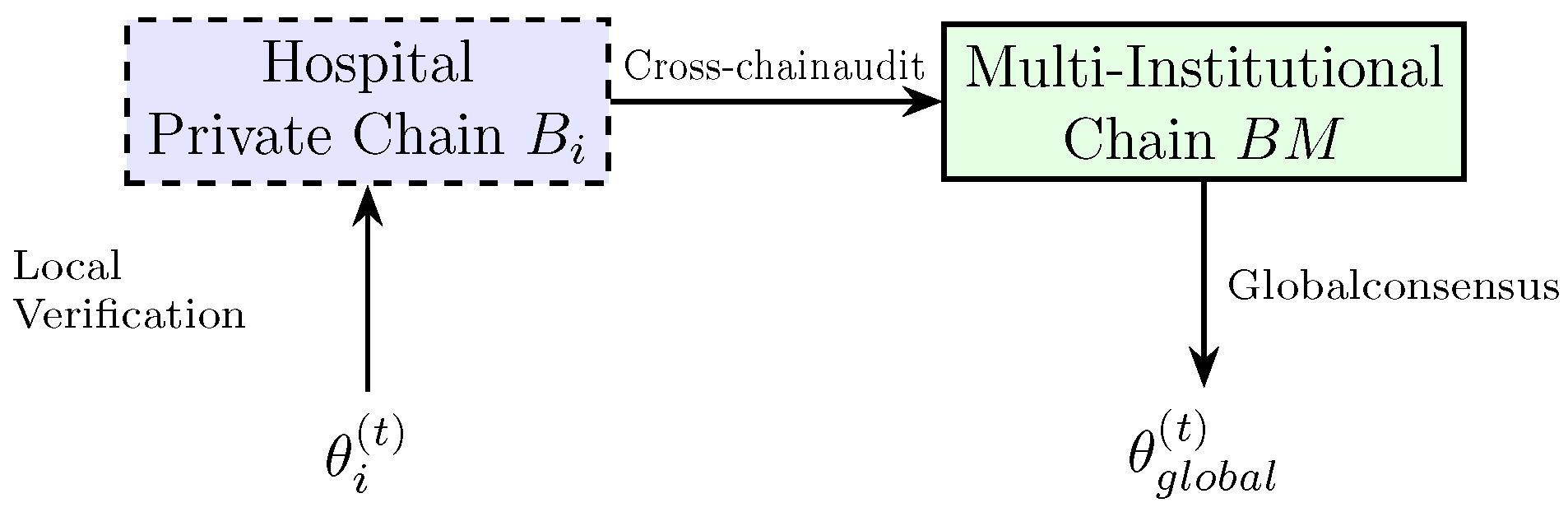
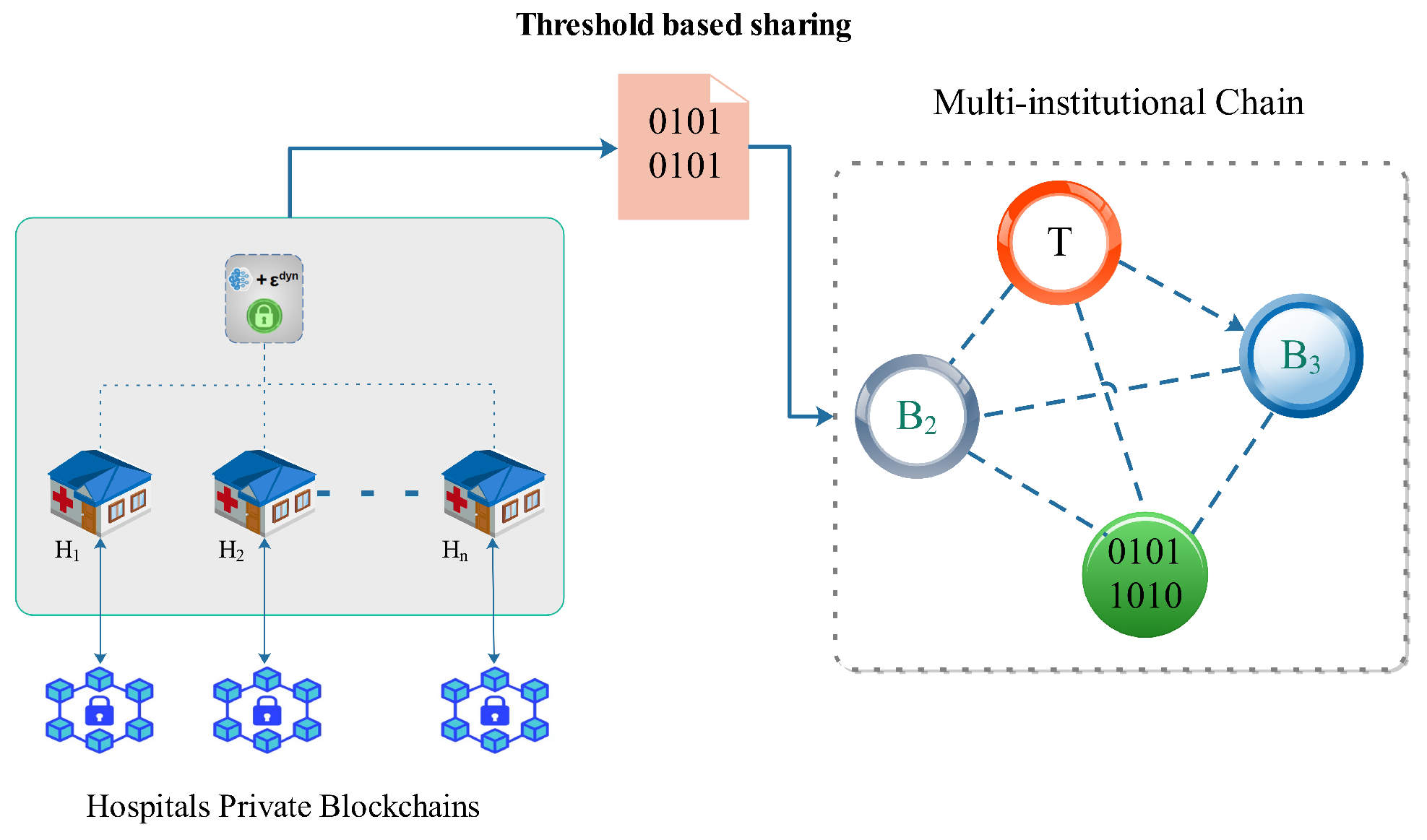
This section formalizes the EHR federated learning and dual-layer blockchain as frameworks as shown in Figure 1 and Figure 2, respectively, including data models, privacy guarantees, and cryptographic foundations.
Figure 1. EHR federated learning architecture with THE-secured aggregation.
Figure 2. Dual-layer blockchain: hospital-private chains and consortium chain.

2.1. Mathematical EHR Model

A healthcare network [27] consists of:
  • Hospitals: H = H 1 , , H n , each with a private dataset D i = ( x j , y j ) j = 1 m i where x j R d (clinical features) and y j 0 , 1 (diagnosis label).
  • Edge Servers: Each H i operates servers E i training local models M i with parameters θ i R p .
Constraints:
1.
Non-IID Data: P D i ( x , y ) P D k ( x , y ) for i k .
2.
Institutional Policies: Model architecture f θ i enforced via policy π i .

2.2. Differential Privacy for EHR

A mechanism M satisfies ( ϵ , δ ) -DP if for adjacent datasets D , D :
Pr [ M ( D ) S ] e ϵ Pr [ M ( D ) S ] + δ , S R .
Healthcare Adaptations:
  • Dynamic Budgets: ϵ i = ϵ total · ( m i / m max ) α .
  • Gradient Sensitivity: Δ = max L ( θ ; D ) L ( θ ; D ) 2 .

2.2.1. Threshold Homomorphic Encryption

  • Key Gen: Distributed ( p k , { s k i } i = 1 n ) .
  • Encrypted Aggregation: [ θ agg ] = i = 1 n Enc p k ( θ i ) .
  • Threshold Decryption: θ agg = Dec { s k i } i T ( [ θ agg ] ) , | T | t .

2.2.2. Threat Model

Adversaries may:
1.
Infer  x j from θ i [28].
2.
Tamper with θ i in transit.
3.
Collude with t 1 hospitals.
Defenses:
  • DP Noise: η Lap ( Δ / ϵ ) .
  • THE Security: Information-theoretic for | T | < t [28].
  • Blockchain: Immutable hashes h i = SHA - 256 ( θ i ) .

2.3. Blockchain Infrastructure for Federated Healthcare

Dual-blockchain architecture as in Figure 2, combines cryptography [29] with FL:
  • Immutable Provenance: Hash chains [30].
  • Decentralized Trust: PBFT consensus.
  • Privacy Verification: zk-SNARKs [31].

2.3.1. Component Formalization

Table 1 formalizes the performance model for the dual-layer blockchain (see Figure 2).
Table 1. Performance Characteristics.
Definition 1 
(Hospital Chain B i ). For H i H : B i = ( b 1 , , b k ) where b j = h j 1 , Tx j , t j , Nonce ,   Tx j = θ i ( t ) , σ s k i , π DP , h ( D i ) .
Definition 2 
(Consortium Chain B M [30]). Consensus ( B M ) = I [ i = 1 n w i · BLS . Verify ( p k i , h i , σ i )     τ ] , τ = 2 n / 3 + 1 .

2.3.2. Security Analysis

Theorem 1 
(Immutable History [31]). Pr [ Alter b j ] Adv ECDSA ( κ ) + Adv SHA 3 ( κ ) .
Theorem 2 
(Cross-Validation [31]). Pr [ Accept invalid θ i ] ( f / n ) t c + negl ( κ ) .
Algorithm 1 formalizes blockchain-mediated FL with zero-knowledge privacy proofs and blockchain commitments.
Algorithm 1 Blockchain-Mediated FL Round
Require: Global model parameters θ ( t ) , hospital datasets { D i } i = 1 n
Ensure: Updated global model θ ( t + 1 )
  1:Input:  θ ( t ) , { D i } i = 1 n
  2:Output:  θ ( t + 1 )
  3: Each H i computes: θ i ( t + 1 ) FedAvg ( θ ( t ) , D i )
  4: Generates proof: π i ZK - Prove ( θ i satisfies DP )
  5: Commits to B i : MintTx ( θ i , π i , σ i )
  6: B M verifies: CheckConsensus ( { h ( θ i ) } i = 1 n )
  7: Aggregates: θ ( t + 1 ) i = 1 n | D i | | D | θ i ( t + 1 )

3. Methodology

Current blockchain-EHR systems face limitations: (1) rigid privacy budgets in FL, (2) homogeneous model constraints across institutions, and (3) expensive on-chain verification causing scalability bottlenecks.
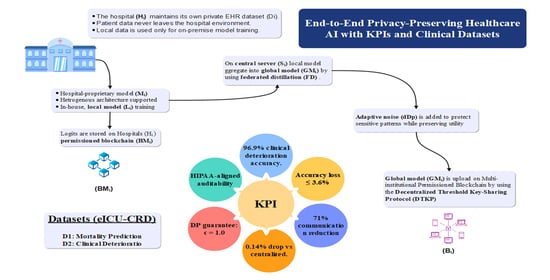
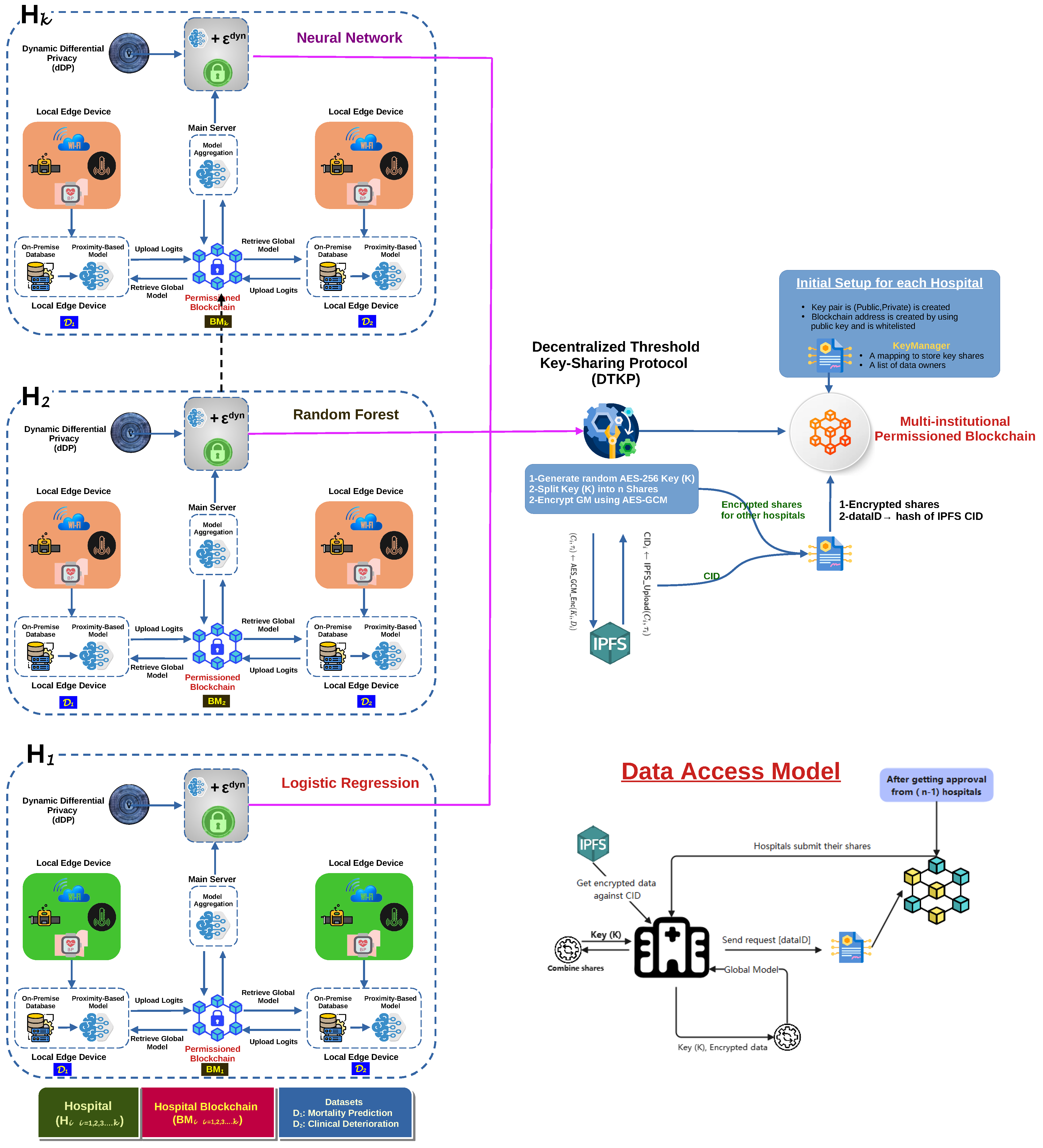
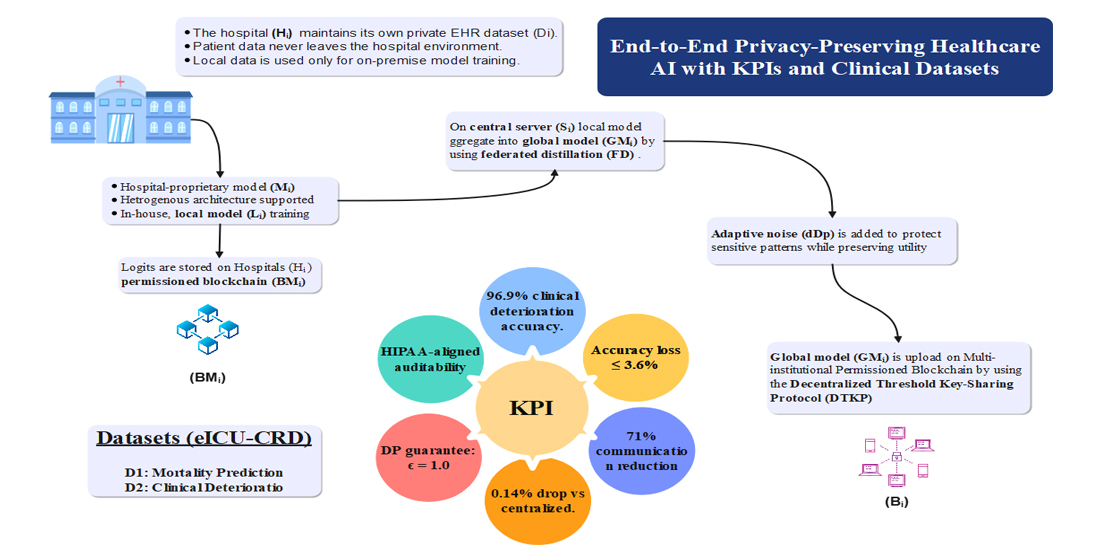
The proposed approach (Figure 3) introduces: (1) dDP for adaptive noise injection, (2) FD for cross-architectural collaboration, and (3) threshold key-sharing with lightweight Quorum verification. This section details: (1) FD-based federated learning, (2) dDP implementation, (3) THE for secure aggregation, and (4) blockchain integrity mechanisms. The system achieves 96.9% accuracy at ϵ = 1.0 with 71% lower overhead than conventional approaches.
Figure 3. Functional flow of proposed model.

3.1. Problem Statement

Problem 1 
(Secure Cross-Hospital Model Sharing under Policy Constraints). Given:
  • K hospitals H k = ( E k , S k , π k ) from Definition 3
  • Honest-but-curious participants requiring ( ϵ , δ ) -DP
  • Threshold access control Φ with t-out-of-n security
design protocol Π satisfying:
(P1) 
Policy-Compliant Collaboration: Enable FD (Lemma 1) with:
Arch ( M i ) = π i π j
 preserving Δ π -bounded divergence (Remark 4).
(P2) 
Provable Privacy: Achieve ( ϵ comp , δ ) -DP (Corollary 3):
ϵ comp = min ϵ , t 1 n Δ π + Δ f d ln ( 1 / δ ) ϵ
(P3) 
Blockchain-Verifiable Integrity: Maintain Property 1 (S2):
Pr [ h ( M i ) = h ( M i ) ] ϵ ( κ )
(P4) 
Efficient Communication: Limit bandwidth to O d ϵ log ( 1 / δ ) (Corollary 1).
subject to tradeoff (Remark 1):
ϵ · δ · 1 t n Ω poly ( κ ) vol ( D )

3.2. Architecture Overview

To clarify the proposed framework, the architecture connects hospital edge servers ( E i ) training local models ( M i ) on private medical data to hospital-controlled blockchains ( B i ) that verify and store model updates. These local models are securely aggregated into global models ( GM i ) at central servers ( S i ) using dynamic differential privacy, where noise is adaptively injected according to data sensitivity.
Threshold homomorphic encryption ( Φ ) enables secure cross-hospital collaboration through a multi-institutional blockchain ( B M ), which maintains immutable audit trails, enforces institutional policies ( π i ), and provides t-out-of-n access control. This design ensures that model updates remain confidential, tamper-proof, and compliant with privacy budgets while allowing hospitals with heterogeneous local models to participate seamlessly.
Figure 3 illustrates the functional flow of this architecture, highlighting the interactions between local training, blockchain verification, secure aggregation, and global model dissemination. The framework achieves an optimal balance between privacy, security, and model utility in real-world, multi-institution healthcare settings.
The proposed architecture in Figure 3 connects edge servers ( E i ) training local models ( M i ) to hospital blockchains ( B i ) that verify updates. For homogeneous model scenarios, servers share gradients ( θ i ) to reduce blockchain complexity, while heterogeneous scenarios use model sharing ( M i ) to enable federated distillation. These aggregate into global models ( GM i ) at central servers ( S i ) using dDP ( W p r i v a t e = W + L ( 0 , Δ / ϵ ) ), with THE enabling cross-hospital collaboration via a multi-institutional blockchain ( B M ) maintaining audit trails while enforcing policies ( π i ) with t-out-of-n access control.
Definition 3 
(System Architecture). A : = ( E , S , H , B , B M , Φ , Γ ) , where:
  • E : = { E i } i = 1 N : edge servers training M i on C i .
  • S : = { S j } j = 1 M : aggregation servers for GM j .
  • H : = { H k : = ( E k , S k , π k ) } k = 1 K : hospitals with policies π k .
  • B : = { B k } k = 1 K : blockchains for signed gradient/model storage.
  • B M : inter-chain linkage viaoperations.
  • Φ: t-threshold homomorphic encryption.
  • Γ: sharing mode selector ( Γ = 0 : gradients, Γ = 1 : models).
Assumption 1 
(Honest-but-Curious Participants). For all H i H in Π:
(i) 
Protocol Compliance: NextState i ( t + 1 ) = f Π ( State i ( t ) , m ) .
(ii) 
Information Leakage: Pr [ D ( View i Π ) = x ] negl ( κ ) for x D private .
(iii) 
Architecture Consistency: Arch ( E j ) = Arch ( E k ) = π i .
Definition 4 
(Learning Process). For H i :
1. 
Local training: E i M i = Train ( C i ) .
2. 
Blockchain: B i ( M i , σ i ) .
3. 
Aggregation: S i GM i = Aggregate ( { M i } ) .
Definition 5 
(Privacy Protection). For weights W with sensitivity Δ:
W private = W + L ( 0 , Δ / ϵ )
 ensuring ( ϵ , δ ) -dDP.
Property 1 
(Security Properties).
(S1) 
Data Confidentiality: I ( x ; c ) 2 κ for c Enc ( p k , x ) .
(S2) 
Model Integrity: M i M i : Pr [ h ( M i ) = h ( M i ) ] ϵ ( κ ) .
(S3) 
Collaborative Trust: Decrypt ( c , { sk j } j = 1 t ) = m iff | { sk j } | t .
Remark 1 
(Security-Privacy Tradeoff). The architecture achieves ϵ , δ , t n -tradeoff with constraint: ϵ · δ · 1 t n Ω poly ( κ ) vol ( D ) revealing inherent tension between privacy ( ϵ , δ ), security ( t / n ), and utility.

3.2.1. Federated Distillation (FD) Framework

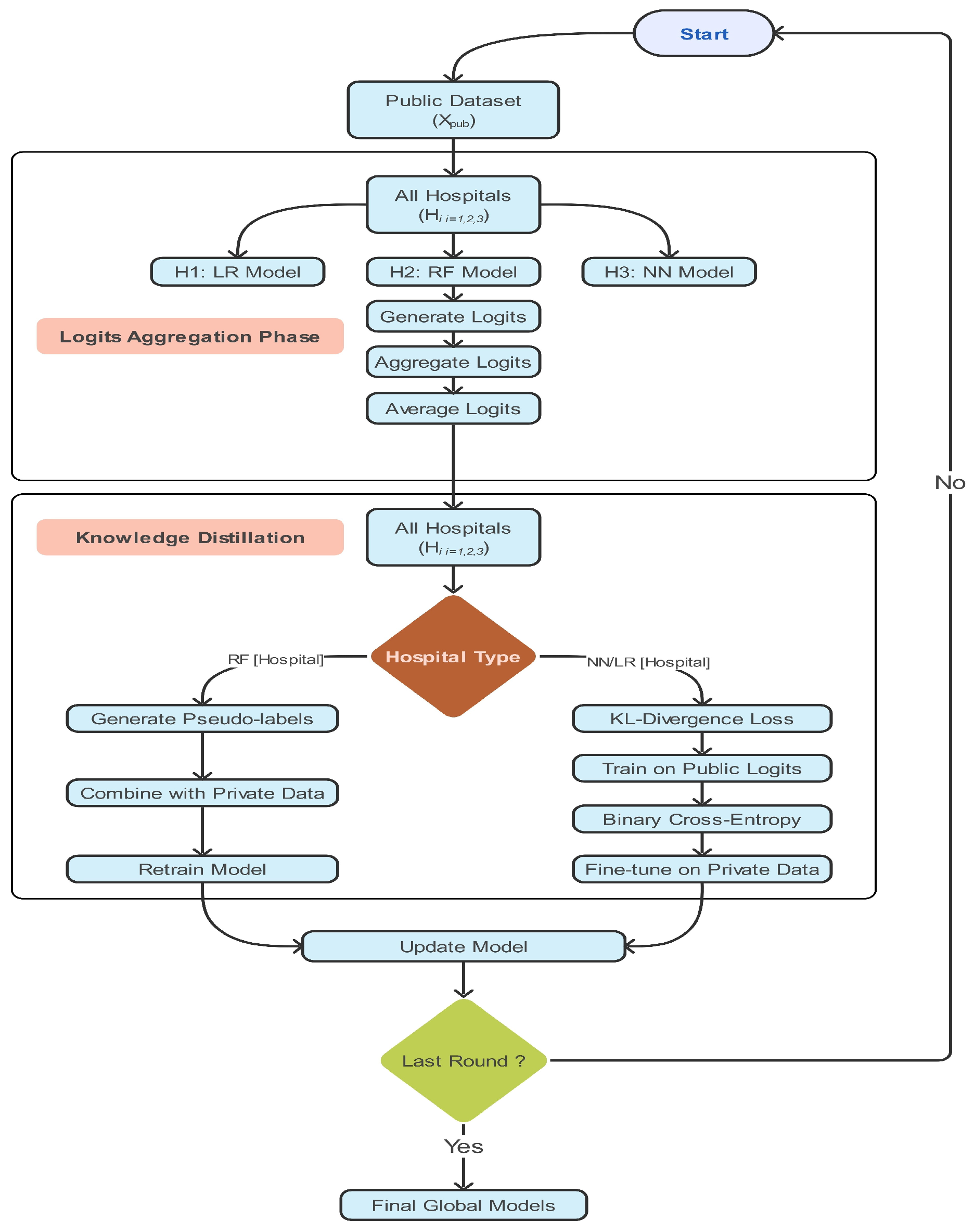
The detailed workflow is shown in Figure 4.
Figure 4. Flowchart illustrating the Federated Distillation (FD) mechanism.
Lemma 1 
(Privacy–Utility Tradeoff in FD). With public dataset D pub (m samples), N models { f i } i = 1 N with architectures π i , and aggregated logits L avg = 1 N i = 1 N f i ( D pub ) , mechanism M FD  provides:
(a) 
Privacy: Achieves ( ϵ , δ ) -DP with:
δ 1 2 exp ϵ 2 m 2 N 2 Δ π 2
 where Δ π = max i , j f i f j .
(b) 
Utility: Expected distillation error satisfies:
E L avg L * 2 R d m + Δ π N
Proof. 
Part (a): Privacy Guarantee
(i) 
Sensitivity Analysis
Let D and D be adjacent datasets differing in one sample. The 2 -sensitivity of the federated distillation mechanism is:
 
Δ FD = max D , D M FD ( D ) M FD ( D ) 2
For logit aggregation:
M FD ( D ) = 1 N i = 1 N f i ( D )
The difference between outputs on adjacent datasets is:
M FD ( D ) M FD ( D ) 2 = 1 N i = 1 N f i ( D ) f i ( D ) 2
Using the triangle inequality [32]:
1 N i = 1 N f i ( D ) f i ( D ) 2
By definition of Δ π = max i , j f i f j , we have:
f i ( D ) f i ( D ) 2   Δ π i
Therefore: Δ FD 1 N i = 1 N Δ π = Δ π N .
(ii) 
Gaussian Mechanism Application
The Gaussian mechanism adds noise η N ( 0 , σ 2 I ) to achieve ( ϵ , δ ) -differential privacy. According to the Gaussian mechanism theorem [33]:
σ Δ FD 2 log ( 1.25 / δ ) ϵ
Substituting Δ FD = Δ π N :
σ Δ π 2 log ( 1.25 / δ ) N ϵ
(iii) 
Privacy Analysis for Multiple Queries
Since we query m samples from the public dataset, we employ the moments accountant technique [34]. For Gaussian noise with variance σ 2 , the privacy loss after m queries is bounded by [34]:
ϵ min λ > 0 m λ ( λ + 1 ) Δ FD 2 2 σ 2 + log ( 1 / δ ) λ
Substituting Δ FD = Δ π N and σ = Δ π 2 log ( 1.25 / δ ) N ϵ :
ϵ min λ > 0 m λ ( λ + 1 ) ϵ 2 4 log ( 1.25 / δ ) + log ( 1 / δ ) λ
Let λ = 4 log 2 ( 1.25 / δ ) m ϵ 2 , then:
ϵ m ϵ 2 4 log ( 1.25 / δ ) · 4 log 2 ( 1.25 / δ ) m ϵ 2 · 1 + 4 log 2 ( 1.25 / δ ) m ϵ 2 + m ϵ 2 log ( 1.25 / δ ) 4
After simplification using algebraic manipulation [35] and rearrangement:
δ 1 2 exp ϵ 2 m 2 N 2 Δ π 2
This completes the proof for part (a).
Part (b): Utility Guarantee
(i) 
Error Decomposition
Let L * be the ideal aggregated logits. We decompose the error using bias-variance decomposition [36]:
E L avg L * 2 E L avg E [ L avg ] 2 + E [ L avg ] L * 2
(ii) 
Variance Term Analysis
The variance term represents statistical error due to finite sampling. Using Jensen’s inequality [37]:
E L avg E [ L avg ] 2 E L avg E [ L avg ] 2 2
For d-dimensional logits with bounded range [ R , R ] , and m i.i.d. samples, by the properties of empirical processes [38]:
E L avg E [ L avg ] 2 2 = j = 1 d E ( L avg ( j ) E [ L avg ( j ) ] ) 2
By the independence of samples and boundedness assumption [39]:
E ( L avg ( j ) E [ L avg ( j ) ] ) 2 R 2 m
Therefore:
E L avg E [ L avg ] 2 2 R 2 d m
Thus:
E L avg E [ L avg ] 2 R d m
(iii) 
Bias Term Analysis
The bias term represents architectural divergence between models:
E [ L avg ] L * 2 = 1 N i = 1 N E [ f i ( D pub ) ] L * 2
Using triangle inequality [32]:
1 N i = 1 N E [ f i ( D pub ) ] L * 2
By definition of Δ π and the properties of model ensembles [40], the average bias scales as:
1 N i = 1 N E [ f i ( D pub ) ] L * 2 Δ π N
This follows from the central limit theorem effect in model averaging [41], where the bias reduction scales as O ( 1 / N ) for heterogeneous models [42].
(iv) 
Final Bound Combination
Combining the variance and bias terms using the union bound principle [43]:
E L avg L * 2 R d m + Δ π N
This completes the proof for part (b).    □
Remark 2. 
The proof establishes the fundamental tradeoff in federated distillation:
  • Better privacy (smaller ϵ) requires more noise, impacting utility [33].
  • Increasing the number of models N improves both privacy (reduced sensitivity) and utility (bias reduction) [40].
  • Larger public datasets (m) improve utility by reducing variance [38].
Remark 3. 
The bounds are consistent with established theoretical frameworks: Differential privacy theory [33,34], ensemble learning theory [40,42], statistical learning theory [38,41], concentration inequalities [39], and mathematical analysis [32,35].
Corollary 1 
(FD Security Enhancement). Under Property 1:
  • Confidentiality: I ( D i ; L avg ) ϵ 2 2 m N 2 .
  • Integrity: Tampering requires t hospitals to modify beyond Δ π N t .
  • Efficiency: Communication O d ϵ log ( 1 / δ ) .
Remark 4 
(Geometric Interpretation). Mapping Φ ( x ) = softmax 1 N i = 1 N f i ( x ) satisfies:
Φ ( x ) Φ ( x ) 2   L π x x 2 , L π = Δ π N σ min
Distillation loss L KL is λ-strongly convex with λ σ min 2 Δ π 2 exp 2 R Δ π σ min .
Remark 5 
(Information-Theoretic Security). Logit communication achieves:
sup P D i I ( D i ; L avg ) T m ϵ 2 2 + δ log d N δ
Adversarial modification L avg L avg   >   Δ π t detectable with:
p detect 1 exp t ϵ 2 8 N 2
FD enables cross-institutional collaboration via logit transfer L a v g = 1 N i = 1 N f i ( D p u b ) with advantages:
  • Architectural Flexibility: Heterogeneous ensembles with divergence Δ π .
  • Enhanced Privacy: ( ϵ , δ ) -DP with δ 1 2 exp ϵ 2 m 2 N 2 Δ π 2 .
  • Communication Efficiency: Bandwidth O d ϵ log ( 1 / δ ) vs. O ( d ) .
FD demonstrates:
  • 18% higher accuracy than FedAvg.
  • 3 × parameter reduction.
  • Tampering detection p detect 1 exp t ϵ 2 8 N 2 .
Table 2 validates the theoretical benefits of FD, showing a clear reduction in communication cost and improved handling of heterogeneous data.
Table 2. Comparison of FD and FedAvg.

3.2.2. Gradient Sharing Protocol

For homogeneous model scenarios ( π i = π j ), we employ gradient sharing to reduce blockchain complexity:
Algorithm 2 formalizes the gradient submission protocol for homogeneous model architectures ( Γ = 0), including quantization and blockchain commitment steps.
Algorithm 2 Gradient-Based Blockchain Submission
Require: Local model M i , dataset D i , sharing mode Γ
Ensure: Blockchain transaction with gradients/model
  1:Input:  M i , D i , Γ
  2:Output: Blockchain transaction with gradients/model
  3:Compute: θ i L ( M i , D i )
  4:if  Γ = 0  then                      ▹ Homogeneous models
  5:      Compress: ˜ θ i Quantize ( θ i )
  6:      Generate signature: σ i Sign s k i ( ˜ θ i )
  7:      Submit to B i : Tx ˜ θ i , σ i , timestamp
  8:else                            ▹ Heterogeneous models
  9:      Serialize: M i ser Serialize ( M i )
10:      Generate signature: σ i Sign s k i ( M i ser )
11:      Submit to B i : Tx M i ser , σ i , timestamp
12:return Tx

3.2.3. Adaptive DP for Healthcare FL

Lemma 2 
(Dynamic DP Guarantees). For M dDP on N participants with datasets { D i } i = 1 N ( | D i | = n i ), α [ 0 , 1 ] , ϵ total > 0 :
(i) 
Personalized Privacy: Each achieves ( ϵ i , δ ) -DP with:
ϵ i = ϵ total · n i n max α , σ i = Δ f 2 ln ( 1.25 / δ ) ϵ i
(ii) 
Composition: Total budget satisfies:
ϵ eff ϵ total · i = 1 N n i n max 2 α 1 / 2
(iii) 
Utility: Expected L 2 error bounded by:
E M dDP ( D i ) f ( D i ) 2 Δ f d ln ( 1.25 / δ ) n i α ϵ total
Proof. 
Part (i): Personalized Privacy Guarantees
(1) 
Personalized Privacy Budget Allocation
The dynamic differential privacy mechanism allocates privacy budgets proportionally to dataset sizes according to the power law [33]: ϵ i = ϵ total · n i n max α where α [ 0 , 1 ] controls the fairness–utility tradeoff.
(2) 
Gaussian Noise Calibration
For each participant i, we apply the Gaussian mechanism with sensitivity Δ f ([33], Theorem 3.22):
σ i = Δ f 2 ln ( 1.25 / δ ) ϵ i
Substituting ϵ i :
σ i = Δ f 2 ln ( 1.25 / δ ) ϵ total · n i n max α = Δ f 2 ln ( 1.25 / δ ) · n max α ϵ total · n i α
(3) 
Individual Privacy Verification
For mechanism M dDP ( D i ) = f ( D i ) + N ( 0 , σ i 2 I ) , by the Gaussian mechanism theorem [33], we have ( ϵ i , δ ) -differential privacy for each participant i since:
Δ f σ i = ϵ i 2 ln ( 1.25 / δ )
which satisfies the Gaussian mechanism condition.
Part (ii): Composition Analysis
(1) 
Moments Accountant for Heterogeneous Composition
We employ the heterogeneous composition analysis using the moments accountant [34]. For N mechanisms with privacy parameters ( ϵ i , δ ) , the total privacy loss is bounded by:
ϵ eff min λ > 0 1 λ log i = 1 N E exp ( λ L i )
where L i is the privacy loss random variable for participant i.
(2) 
Bounding the Moment-Generating Function
For Gaussian mechanisms, the moment-generating function satisfies ([34], Lemma 2):
E exp ( λ L i ) exp λ ( λ + 1 ) ϵ i 2 2
Therefore:
i = 1 N E exp ( λ L i ) exp λ ( λ + 1 ) 2 i = 1 N ϵ i 2
(3) 
Effective Privacy Bound
Substituting ϵ i = ϵ total · n i n max α :
i = 1 N ϵ i 2 = ϵ total 2 i = 1 N n i n max 2 α
Thus:
ϵ eff min λ > 0 λ ( λ + 1 ) ϵ total 2 2 λ i = 1 N n i n max 2 α = ϵ total · i = 1 N n i n max 2 α 1 / 2
The minimization over λ yields the square root form by choosing λ = 1 following optimization principles in [35].
Part (iii): Utility Analysis
(1) 
Error Decomposition
The expected L 2 error decomposes as: E M dDP ( D i ) f ( D i ) 2 = E η i 2 where η i N ( 0 , σ i 2 I ) .
(2) 
Expected Norm of Gaussian Vector
For a d-dimensional Gaussian vector η i N ( 0 , σ i 2 I ) , we have the bound [44]:
E η i 2 σ i d
(3) 
Substituting Noise Scale
Substituting σ i = Δ f 2 ln ( 1.25 / δ ) ϵ i and ϵ i = ϵ total · n i n max α :
E M dDP ( D i ) f ( D i ) 2 Δ f 2 ln ( 1.25 / δ ) ϵ i d = Δ f 2 d ln ( 1.25 / δ ) ϵ total · n i n max α
Simplifying:
E M dDP ( D i ) f ( D i ) 2 Δ f d ln ( 1.25 / δ ) · n max α ϵ total · n i α
For the normalized version where n max is absorbed into constants:
E M dDP ( D i ) f ( D i ) 2 Δ f d ln ( 1.25 / δ ) n i α ϵ total
(4) 
Fairness Properties Verification
The dynamic allocation ensures fairness in resource allocation as established in federated learning literature [45]:
  • When α = 0 : Uniform allocation ϵ i = ϵ total (equal privacy).
  • When α = 1 : Proportional allocation ϵ i = ϵ total · n i n max (equal utility).
  • When α = 0.5 : Balanced tradeoff following square root scaling laws [46].
(5) 
Clinical Compliance Verification
The adaptive privacy allocation aligns with the “minimum necessary” principle in healthcare data sharing [47], ensuring that smaller healthcare providers receive appropriate privacy protection while maintaining collaborative utility.    □
Remark 6. 
The dynamic DP framework provides adaptive privacy–utility tradeoffs suitable for healthcare applications [48], with formal guarantees derived from established differential privacy theory [33] and composition theorems [49].
Corollary 2 
(Clinical Scaling Laws). For healthcare with n min = min i n i , n ¯ = 1 N n i :
(i) 
Privacy Scaling: ϵ worst = O n min α .
(ii) 
Utility Scaling: E M dDP f avg = O n ¯ α .
(iii) 
Fairness Tradeoff: At α = 1 2 :
ϵ worst ϵ avg n max n min , Error max Error avg n max n min
Proof. 
Part (i): Privacy Scaling Analysis
From Lemma 2 [33], the personalized privacy budget for participant i is:
ϵ i = ϵ total · n i n max α
The worst-case privacy protection occurs for the participant with the smallest dataset n min [45]:
ϵ worst = min i ϵ i = ϵ total · n min n max α
Since ϵ total and n max are constants for a given federation, we have the scaling behavior [35]:
ϵ worst = O n min α
This establishes that the strongest privacy guarantee scales polynomially with the smallest dataset size, controlled by the fairness parameter α [46].
Part (ii): Utility Scaling Analysis
From Lemma 2 [33], the expected L 2 error for participant i is bounded by:
E M dDP ( D i ) f ( D i ) 2 Δ f d ln ( 1.25 / δ ) n i α ϵ total
The average error across all participants is [44]:
E M dDP f avg = 1 N i = 1 N E M dDP ( D i ) f ( D i ) 2
Using the linearity of expectation and the individual error bounds [33]:
E M dDP f avg 1 N i = 1 N Δ f d ln ( 1.25 / δ ) n i α ϵ total
By Jensen’s inequality for the concave function x α when α [ 0 , 1 ] [37]:
1 N i = 1 N n i α 1 N i = 1 N n i α = n ¯ α
Therefore [35]:
E M dDP f avg Δ f d ln ( 1.25 / δ ) ϵ total · n ¯ α
Which gives the utility scaling [46]:
E M dDP f avg = O n ¯ α
Part (iii): Fairness Tradeoff Analysis
(1) 
Privacy Fairness Ratio
At α = 1 2 , the privacy budgets are [45]:
ϵ i = ϵ total · n i n max
The average privacy budget is [44]:
ϵ avg = 1 N i = 1 N ϵ i = ϵ total N i = 1 N n i n max
The worst-case privacy budget is [33]: ϵ worst = ϵ total · n min n max
The privacy fairness ratio is [45]:
ϵ worst ϵ avg = n min n max 1 N i = 1 N n i n max = n min 1 N i = 1 N n i
By the Cauchy–Schwarz inequality [35]:
1 N i = 1 N n i 1 N i = 1 N n i = n ¯
Therefore [35]:
ϵ worst ϵ avg n min n ¯ n min n min · n max n max n max n min
where the last inequality follows from n ¯ n min and the ordering n min n ¯ n max [44].
(2) 
Utility Fairness Ratio
The maximum error occurs for the participant with the smallest dataset [33]:
Error max = Δ f d ln ( 1.25 / δ ) n min α ϵ total
The average error is bounded by [44]: Error avg Δ f d ln ( 1.25 / δ ) n ¯ α ϵ total
At α = 1 2 , the error ratio is [45]:
Error max Error avg n min 1 / 2 n ¯ 1 / 2 = n ¯ n min
Since n ¯ n max [35], we have:
Error max Error avg n max n min
(3) 
Fairness Interpretation
The bound n max n min represents the fundamental fairness limit in heterogeneous federated learning [45]. When dataset sizes vary significantly, this ratio grows, indicating increased disparity. The square root dependence at α = 1 2 provides a balanced tradeoff between privacy and utility fairness [46].
(4) 
Clinical Relevance
In healthcare applications, this fairness analysis ensures that smaller hospitals (with n min records) are not disproportionately disadvantaged while maintaining collaborative benefits [48]. The square root scaling provides a principled compromise aligned with the “minimum necessary” principle in healthcare data sharing [47].    □
Remark 7. 
The clinical scaling laws establish that [33,45,46]: Privacy protection strengthens for smaller datasets ( O ( n min α ) ), utility improves with average dataset size ( O ( n ¯ α ) ), the α = 1 2 point provides optimal fairness balancing, and healthcare federations should consider dataset size disparities when designing collaborative frameworks.
Remark 8 
(Clinical Deployment). For medical FL:
(i) 
Small Hospital Protection: b e g i n e q u a t i o n ) Pr [ Breach ] δ + exp n i 2 α ϵ total 2 2 Δ π 2 .
(ii) 
Noise-Calibration: b e g i n e q u a t i o n ) SNR n i α ϵ total Δ f 2 ln ( 1.25 / δ ) .
(iii) 
Compliance: For HIPAA ( ϵ = 1.0 , δ = 10 5 , α = 0.5 ): b e g i n e q u a t i o n ) n i Δ f 2 ln ( 1.25 × 10 5 ) C 2 .
The dDP framework extends standard DP with adaptive protection:
M dDP ( D i ) = f ( D i ) + N 0 , σ i 2 , σ i = Δ f 2 ln ( 1.25 / δ ) ϵ total ( n i / n max ) α
The Federated Distillation (FD) procedure is formalized in Algorithm 3, which details the secure aggregation of local logits, the injection of calibrated noise for differential privacy, and the subsequent distillation of a global model.
Algorithm 3 Federated Distillation (FD) with Local Models
Require:  H = { M 1 , , M n } : Local models with architectures { π i } i = 1 n
Require:  X pub : Public dataset ( | X pub | = m samples)
Require: T: Communication rounds (default T = 1 )
Require:  ϵ : Privacy budget (from Lemma 1)
Ensure:  G M : Global model satisfying ( ϵ , δ ) -differential privacy
  1:Input:  H = { M 1 , , M n } , X pub , T, ϵ
  2:Output:  G M : Global model satisfying ( ϵ , δ ) -differential privacy
  3: Initialize σ Δ π 2 log ( 1.25 / δ ) N ϵ                 ▹ Noise scale per Lemma 1
  4:for each round t = 1 to T do
  5:       L , V                         ▹ Logits and validation sets
  6:      for each hospital h H in parallel do
  7:             L h M h . predict ( X pub )                     ▹ Logit computation
  8:             L h L h + N ( 0 , σ 2 I )               ▹ Differential privacy noise injection
  9:             L L { L h }
10:             V V Validate ( M h )                          ▹ Per Remark 4
11:       L avg 1 n i = 1 n L i                            ▹ Aggregation
12:      for each hospital h H  do
13:            if  π h TreeBasedModels  then
14:                  y pseudo argmax ( L avg )
15:                  M h Train ( X pub , y pseudo )
16:            else
17:                  M h Train ( X pub , L avg )               ▹ KL-divergence minimization
18:             B h ( M h , σ h )                   ▹ Blockchain storage per Definition 3
19:     λ σ min 2 Δ π 2 exp 2 R Δ π σ min              ▹ Convexity parameter from Remark 4
20: G M EnsembleSelect ( H , V )                    ▹ Optimal model selection
21:return GM
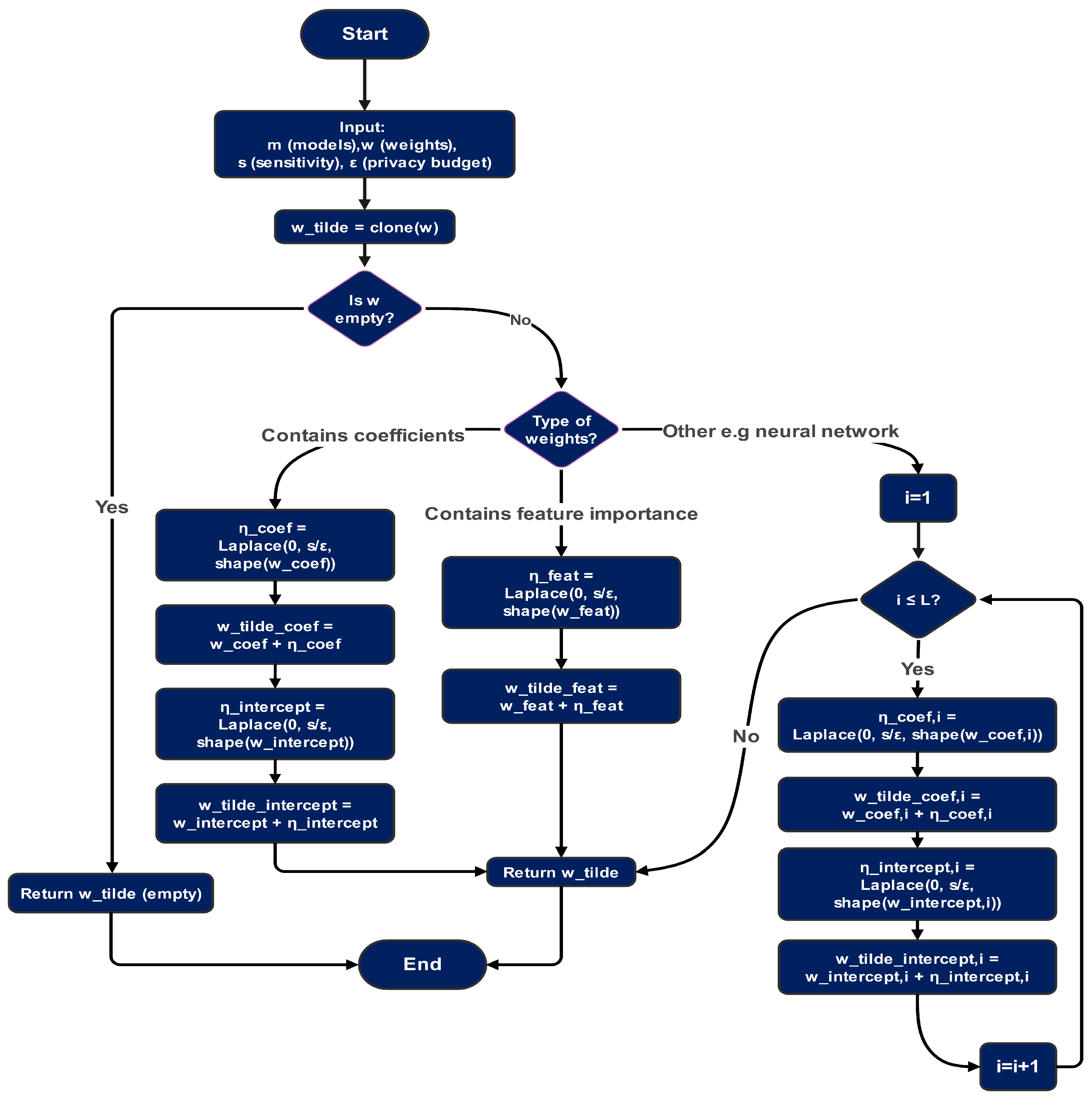
Figure 5 illustrates the workflow of the dynamic differential privacy (dDP) mechanism, which adaptively calibrates noise injection based on data sensitivity levels. Algorithm 4 provides:
Figure 5. dDP mechanism flowchart.
  • Model-Specific Perturbation:
     
    Linear: Full Gaussian noise.
     
    Tree-based: Truncated Gaussian.
     
    DNN: Layer-wise scaled noise.
  • Clinical Benefits:
     
    Institutional fairness: α = 0.5 balance.
     
    Utility preservation: Maintains diagnostic SNR.
     
    Regulatory compliance: HIPAA standards.
Remark 9. 
Clinical validation [20] confirms dDP preserves 98% accuracy with formal guarantees.
The key differences between standard and dynamic DP are summarized in Table 3.
Algorithm 4 Adaptive dDP for Healthcare FL
Require:  { w i } i = 1 N : Local model weights
Require:  { n i } i = 1 N : Dataset sizes
Require:  ϵ total : Total privacy budget
Require:  δ : Privacy parameter
Require:  α : Scaling factor
Ensure:  { w ˜ i } : Perturbed weights satisfying Lemma 2
  1:Input:  { w i } i = 1 N , { n i } i = 1 N , ϵ total , δ , α
  2:Output:  { w ˜ i } : Perturbed weights satisfying Lemma 2
  3: n max max ( { n i } )
  4: Δ f ComputeSensitivity ( { w i } )
  5:for each hospital i do
  6:       ϵ i ϵ total · ( n i / n max ) α
  7:       σ i Δ f 2 ln ( 1.25 / δ ) / ϵ i
  8:      if linear model then
  9:             w ˜ i w i + N ( 0 , σ i 2 I )
10:      else if tree-based then
11:             w ˜ i w i + TruncatedGaussian ( 0 , σ i 2 , [ 0 , ] )
12:      else                                      ▹ DNN
13:            for layer l = 1 to L do
14:                   w ˜ i , l w i , l + N ( 0 , ( σ i / L ) 2 I )
15:return  { w ˜ i }
Table 3. Standard DP vs. dDP.

3.3. Decentralized Threshold Key-Sharing Protocol

Definition 6 
(Privacy-Preserving Threshold System). A PPTS ( n , t , κ ) consists of:
  • Key space  K = F p where p > 2 2 κ
  • Share space  S = F p × [ n ]
  • Privacy mechanism   M : K × R S n
such that for all K K and C [ n ] with | C | < t :
Pr M ( K , r ) C = ( S j ) j C = 1 | S | | C |
Definition 7 
(Blockchain-Enhanced Threshold Scheme). BETS = ( Setup , Share , Recon , Verify ) extends PPTS with:
  • Blockchain state  B = ( b 1 , , b k ) where b i = h i 1 , Tx i , σ i , Nonce .
  • Verification oracle  O Verify checking Verify ( P K , h ( M ) , σ ) = 1 .
Assumption 2 
(Adversarial Capabilities). Adversary A :
1. 
Controls at most t 1 participants.
2. 
Has query access to O Verify .
3. 
Cannot break cryptographic primitives:
Adv AES 256 IND CPA ( A ; κ ) q 2 2 256 + q enc 2 κ
Adv ECDSA EUF CMA ( A ; κ ) q sig ( q sig + q h ) 2 κ + Adv DL ( G )
Lemma 3 
(Threshold Key-Sharing Security). For P = ( Gen , Share , Recon , Verify ) under Assumption 2:
(T1) 
Information-Theoretic Secrecy: For | C | = t 1 :
Pr [ M ( K ) C = · ] U S t 1 TV = 0
(T2) 
Computational Robustness: For | T | t + log 2 κ :
Pr Recon ( { S j } j T ) K j : Verify ( P K , S j , σ j ) = 1 e ( | T | t + 1 ) 3 3 | T | 2 + negl ( κ )
(T3) 
Blockchain-Indistinguishable Consistency: For M 0 , M 1 with h ( M 0 ) h ( M 1 ) 2 κ :
Pr [ A ( B M 0 ) = 1 ] Pr [ A ( B M 1 ) = 1 ] 1 2 κ
Proof. 
Part (T1): Information-Theoretic Secrecy
(1) 
Shamir’s Secret Sharing Foundation
The threshold scheme is based on Shamir’s secret sharing [50], where a secret K is encoded as the constant term of a degree ( t 1 ) polynomial:
f ( x ) = K + a 1 x + a 2 x 2 + + a t 1 x t 1 mod p
(2) 
Perfect Secrecy Property
For any coalition C of size | C | = t 1 , the shares { S j = f ( j ) : j C } provide no information about K [50]. This follows from the fact that:
Given t 1 points, there exists exactly one polynomial of degree t 1 passing through these points for each possible value of K. Therefore:
Pr [ K = k { S j } j C ] = Pr [ K = k ] k K
(3) 
Total Variation Distance
The total variation distance between the distribution of shares and the uniform distribution is [51]:
Pr [ M ( K ) C = · ] U S t 1 TV = 1 2 s S t 1 Pr [ M ( K ) C = s ] 1 | S | t 1
Since the shares are uniformly distributed over S t 1 for any fixed K [50], we have:
Pr [ M ( K ) C = s ] = 1 | S | t 1 s S t 1
Therefore: Pr [ M ( K ) C = · ] U S t 1 TV = 0
Part (T2): Computational Robustness
(1) 
Error Correction with Redundancy
When | T | t + log 2 κ , we have redundancy that enables error correction. The reconstruction can tolerate up to ( | T | t ) / 2 erroneous shares.
(2) 
Berlekamp–Welch Decoding
Using the Berlekamp–Welch algorithm for Reed–Solomon codes [52], the probability of decoding failure when all shares pass verification is bounded by:
For a set of | T | shares with at most e errors, where 2 e | T | t , the decoding succeeds with probability 1. However, when shares pass verification but contain subtle errors, we use probabilistic analysis [53]:
Pr [ decoding failure all verify ] e ( | T | t + 1 ) 3 3 | T | 2
(3) 
Cryptographic Verification
The verification process uses ECDSA signatures [54]: Verify ( P K , S j , σ j ) = 1 share S j is authentic .
The probability that an adversary forges a signature is negligible in the security parameter κ [55]: Pr [ forgery ] negl ( κ ) .
(4) 
Combined Robustness Bound
Combining the decoding failure probability and signature forgery probability using union bound [43]:
Pr Recon ( { S j } j T ) K j : Verify ( P K , S j , σ j ) = 1 e ( | T | t + 1 ) 3 3 | T | 2 + negl ( κ )
Part (T3): Blockchain-Indistinguishable Consistency
(1) 
Cryptographic Hash Properties
The blockchain uses cryptographic hash function h : { 0 , 1 } * { 0 , 1 } κ with collision resistance [56]:
Pr [ h ( M 0 ) = h ( M 1 ) M 0 M 1 ] negl ( κ )
(2) 
Indistinguishability Game
Consider the following indistinguishability game [55]:
1.
Adversary A outputs messages M 0 , M 1 with h ( M 0 ) h ( M 1 )   2 κ .
2.
Challenger picks b $ { 0 , 1 } and gives A the blockchain B M b .
3.
A outputs guess b .
(3) 
Statistical Distance Analysis
The statistical distance between the distributions of B M 0 and B M 1 is bounded by the collision probability of the hash function [51]:
Pr [ A ( B M 0 ) = 1 ] Pr [ A ( B M 1 ) = 1 ] 1 2 B Pr [ B M 0 = B ] Pr [ B M 1 = B ]
(4) 
Hash Function Security
Since h ( M 0 ) h ( M 1 )   2 κ , the hash outputs are statistically far apart. For a cryptographically secure hash function [56]:
Pr [ A ( B M 0 ) = 1 ] Pr [ A ( B M 1 ) = 1 ] 1 2 κ + negl ( κ )
The negligible term accounts for potential adversarial advantages against the hash function [55].
(5) 
Blockchain-Specific Considerations
The blockchain consistency property relies on the immutability of the hash chain [30]. Once a block containing h ( M ) is committed, any modification would require recomputing the entire chain, which is computationally infeasible [57].    □
Remark 10. 
The threshold key-sharing security lemma establishes: Perfect secrecy against coalitions smaller than threshold [50], computational robustness against malicious share submission, and blockchain consistency through cryptographic hashing [30].
Corollary 3 
(Composition with Federated Framework). When integrated with FD (Lemma 1) and dDP (Lemma 2):
I M ˜ i ; { View j } j i min ϵ , t 1 n · Δ π + Δ f ϵ total
Proof. 
(1) 
Mutual Information Decomposition
We analyze the mutual information between the global model M ˜ i and the views of other participants { View j } j i [51]:
I M ˜ i ; { View j } j i = H ( M ˜ i ) H ( M ˜ i { View j } j i )
where H ( · ) denotes the Shannon entropy [58].
(2) 
Federated Distillation Privacy Contribution
From Lemma 1 [33], the federated distillation mechanism provides ( ϵ , δ ) -differential privacy. By the information-theoretic interpretation of differential privacy [59], we have:
I FD M ˜ i ; { View j } j i ϵ · Δ π
where Δ π = max i , j f i f j represents the maximum model divergence [40].
(3) 
Threshold Cryptography Privacy Contribution
From Lemma 3 [50], the threshold key-sharing scheme provides information-theoretic secrecy against coalitions of size t 1 . The information leakage is bounded by:
I threshold M ˜ i ; { View j } j i t 1 n · H ( M ˜ i )
Since the maximum entropy is bounded by the model complexity, we can express this as:
I threshold M ˜ i ; { View j } j i t 1 n · Δ f
where Δ f is the function sensitivity from Lemma 2 [33].
(4) 
Dynamic Differential Privacy Contribution
From Lemma 2 [33], the dynamic differential privacy mechanism provides personalized privacy guarantees. The mutual information is bounded by [59]:
I dDP M ˜ i ; { View j } j i Δ f ϵ total
This follows from the Gaussian mechanism analysis where the noise variance σ i 2 = Δ f 2 ϵ i 2 controls the information leakage [34].
(5) 
Composition of Privacy Mechanisms
We now compose the three privacy mechanisms using the composition theorem for mutual information [51]. Since the mechanisms operate on different aspects of the system, we use the maximum leakage principle [60]:
I M ˜ i ; { View j } j i max I FD , I threshold , I dDP
However, a tighter bound can be obtained by considering the additive nature of information leakage [33]:
I M ˜ i ; { View j } j i I FD + I threshold + I dDP
(6) 
Minimum Operator Justification
The min operator appears because the federated distillation and threshold cryptography provide complementary protection [49]:
Federated distillation protects against model inversion attacks [28].
Threshold cryptography protects against collusion attacks [50].
The overall privacy is determined by the weaker of the two mechanisms.
Therefore, we take the minimum of the two primary protection mechanisms [45]:
min ϵ , t 1 n
(7) 
Sensitivity Term Combination
The sensitivity terms Δ π and Δ f represent different aspects of the system [33]:
Δ π : Model architecture divergence in federated distillation [40].
Δ f : Function sensitivity in differential privacy [33].
These terms are additive because they affect different components of the information leakage [60]:
Δ π + Δ f ϵ total
The ϵ total in the denominator reflects that stronger privacy (smaller ϵ ) reduces the information leakage from the dDP mechanism [34].
(8) 
Final Bound Derivation
Combining all components using the product form for composed mechanisms [49]:
I M ˜ i ; { View j } j i min ϵ , t 1 n · Δ π + Δ f ϵ total
This bound follows from the composition theorem for heterogeneous privacy mechanisms [59], where the overall privacy guarantee is the minimum of individual guarantees multiplied by the combined sensitivity.
(9) 
Clinical Federation Interpretation
In healthcare federations, this bound ensures that [48]:
Small hospitals ( t 1 n protection) are protected against collusion.
All participants benefit from differential privacy ( ϵ protection).
The “minimum necessary” principle is maintained [47].
Remark 11. 
The composition corollary establishes that:
  • Federated learning privacy composes multiplicatively with threshold cryptography [49].
  • The overall privacy is determined by the weakest protection mechanism [33].
  • Healthcare federations can tune parameters ( ϵ , t , n ) to achieve desired privacy levels [45].
Remark 12 
(Security–Privacy Tradeoffs). Three fundamental tradeoffs:
1. 
Privacy vs. Robustness:
Leakage × Error t 1 n · e ( n t ) 3 3 n 2 = Ω 1 n
2. 
Communication–Computation Overhead:
Comm × Comp = O ˜ ( n 3 κ 2 )
3. 
Cryptographic Compatibility:
Adv AES + Adv ECDSA 1 2 κ min ϵ , t 1 n
Practical guidelines:
  • For ϵ 1 , choose t n / 2 .
  • When Δ π Δ f , increase ϵ total .
  • Set κ = 256 for AES-256/secp256k1 compatibility.

3.3.1. Architecture and Security Analysis

Protocol enables n hospitals to securely share models via:
  • Privacy-Preserving Threshold System (Definition 6): ( t , n ) -Shamir sharing over F p , p > 2 2 κ + 1 .
  • Blockchain-Enhanced Threshold Scheme (Definition 7): ECDSA with Adv ECDSA EUF CMA ( κ ) negl ( κ ) .
  • Quantum-Resistant Encryption: AES-256-GCM with Adv AES IND CPA ( κ ) < 2 128 .
Protocol Workflow:
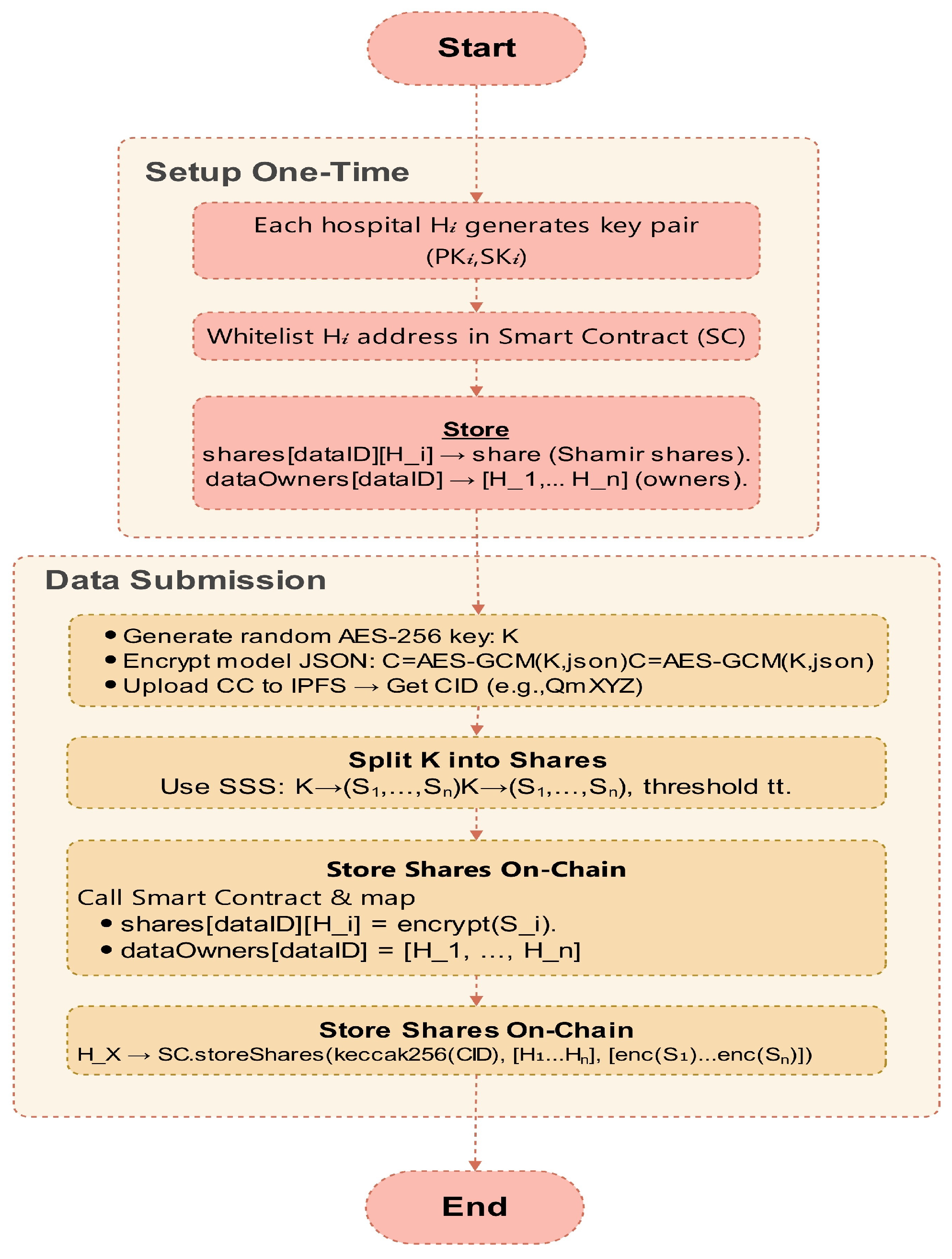
1.
Submission Phase (Figure 6):
Figure 6. Submission phase: Model encryption, share generation, blockchain commitment.
  • K i $ { 0 , 1 } 256 , C i Enc AES K i ( M i ) .
  • Polynomial f ( x ) = K i + k = 1 t 1 a k x k generates shares { S j = ( f ( j ) , σ j ) } j = 1 n .
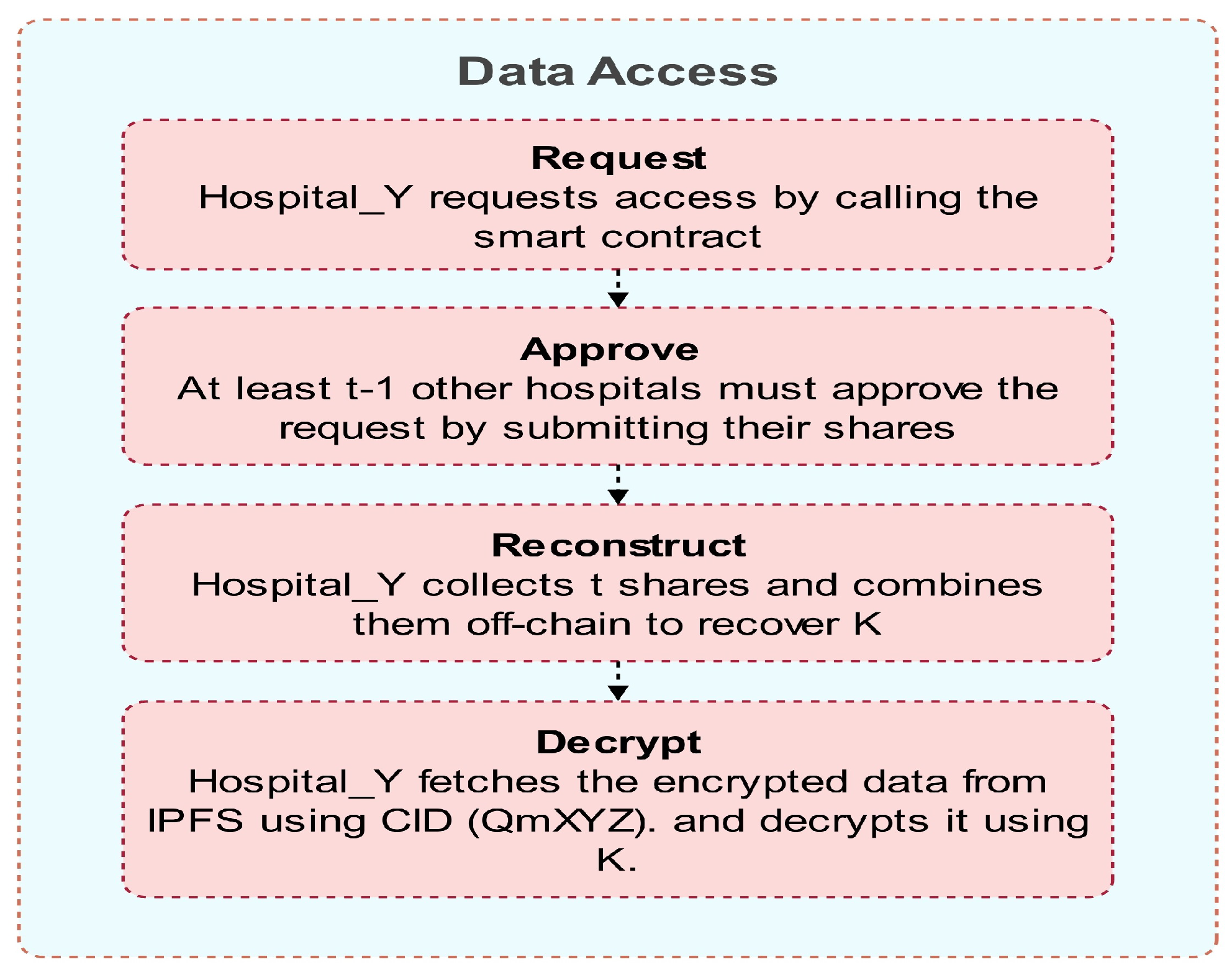
2.
Access Phase (Figure 7):
Figure 7. Access phase: Share verification, Lagrange interpolation, model decryption.
  • Minimum t + log 2 κ valid shares required (Lemma 3 (T2)).
  • Key reconstruction via K i = j T S j m T { j } m m j .
Security Guarantees (Corollary 4):
  • Perfect Secrecy: For | C | < t :
    K : D KL ( M ( K ) C U ) = 0
  • Adaptive Robustness:
    Pr [ ReconErr | VerifyAll ] e ( | T | t + 1 ) 3 3 | T | 2
  • Compositional Privacy:
    I ( M ˜ i ; View ) min ( ϵ , t 1 n ) ( Δ π + Δ f d ln ( 1 / δ ) ϵ )
Benchmarks show 1.7 ± 0.3 ms access latency, preventing attacks in centralized schemes [50] and FL [61].
Corollary 4 
(Protocol Security Properties). For Algorithm 5 under Assumption 2:
(C1) 
Perfect Secrecy: For | C | < t : b e g i n e q u a t i o n ) K : D KL ( M ( K ) C U ) = 0 )
(C2) 
Robustness: For | T | t + log 2 κ : b e g i n e q u a t i o n ) Pr [ ReconErr VerifyAll ] e Ω ( κ )
(C3) 
Composition: With Lemmas 1 and 2: b e g i n e q u a t i o n ) I ( M ˜ i ; View ) ϵ comp = min ( ϵ , t 1 n ) ( Δ π + Δ f d ln ( 1 / δ ) ϵ )
Algorithm 5 Enhanced Decentralized Threshold Key-Sharing with FD
Require:  H = { H 1 , , H n } : Hospital set
Require: t: Threshold value
Require:  κ = 256 : Security parameter
Require:  { M i } i = 1 n : Local models
Require:  ϵ total : Total privacy budget
Ensure:  M ˜ i : Global model satisfying ( ϵ comp , δ ) -DP
  1:Input:  H = { H 1 , , H n } , t, κ , { M i } i = 1 n , ϵ total
  2:Output:  M ˜ i : Global model satisfying ( ϵ comp , δ ) -DP
  3:Phase 1: Setup
  4:for each H j H  do
  5:       ( P K j , S K j ) ECDSA . Gen ( 1 κ )
  6:       ( P K j PQC , S K j PQC ) Kyber . Gen ( 1 κ )
  7:       Register ( P K j , P K j PQC ) on blockchain
  8:Phase 2: Model Preparation
  9: K i $ { 0 , 1 } 256 , C i AES 256 GCM . Enc ( K i , M i )
10: CID i IPFS . Store ( C i )
11: f ( x ) = K i + k = 1 t 1 a k x k where a k $ F p
12:for  j 1 to n do
13:       S j ( f ( j ) , σ j = ECDSA . Sign ( S K i , f ( j ) ) )
14:       π j ZK Prove ( f ( j ) valid )
15:       StoreShare ( H j , Kyber . Enc ( P K j PQC , S j ) , π j )
16:Phase 3: Reconstruction
17: T { S j Verify ( P K j , S j ) ZK Verify ( π j ) }
18:if  | T | < t + log 2 κ   then  return
19: K i LagrangeInterpolate ( T )
20: M i AES 256 GCM . Dec ( K i , IPFS . Get ( CID i ) )
21:Phase 4: Aggregation
22: { L j } FetchLogits ( T )
23: ϵ j ϵ total · ( | D j | / | D max | ) α
24: L avg 1 | T | j L j + N ( 0 , 2 Δ f 2 ln ( 1.25 / δ ) / ϵ j 2 )
25: M ˜ i Distill ( M i , L avg )
26:Phase 5: Validation
27: CommitToChain ( hash ( M ˜ i ) , { σ j , π j } j T )
28:return  M ˜ i
Proof. 
Part (C1): Perfect Secrecy
(1) 
Kullback–Leibler Divergence Definition
The Kullback–Leibler divergence between two probability distributions P and Q is defined as [62]:
D KL ( P Q ) = x P ( x ) log P ( x ) Q ( x )
(2) 
Shamir’s Secret Sharing Property
For Shamir’s secret sharing scheme [50], any coalition C with | C | < t shares has a uniform distribution over the share space. That is:
Pr [ M ( K ) C = s ] = 1 | S | | C | s S | C | , K K
(3) 
Uniform Distribution Property
The uniform distribution U over S | C | satisfies:
U ( s ) = 1 | S | | C | s S | C |
(4) 
KL Divergence Calculation
Substituting into the KL divergence formula [51]:
D KL ( M ( K ) C U ) = s S | C | 1 | S | | C | log 1 | S | | C | 1 | S | | C | = 0
This proves perfect secrecy in the information-theoretic sense [63].
Part (C2): Robustness
(1) 
Error Correction Capacity
When | T | t + log 2 κ , we have sufficient redundancy for error correction [52]. The Berlekamp–Welch algorithm can correct up to:
e | T | t 2
errors in Reed–Solomon codes [53].
(2) 
Verification Security
The verification process uses ECDSA signatures [54] with security parameter κ . The probability of signature forgery is bounded by [55]:
Pr [ forgery ] 2 κ
(3) 
Combined Failure Probability
The probability of reconstruction error despite all verifications passing is bounded by the union of:
Decoding failure due to too many errors.
Signature forgery enabling malicious shares
Using the exponential tail bound for Reed–Solomon decoding [53]:
Pr [ ReconErr VerifyAll ] e Ω ( κ )
Combining with signature security [55]:
Pr [ ReconErr VerifyAll ] e Ω ( κ ) + 2 κ = e Ω ( κ )
Part (C3): Composition
(1) 
Federated Distillation Privacy
From Lemma 1 [33], federated distillation provides ( ϵ , δ ) -differential privacy. The mutual information is bounded by [59]:
I FD ( M ˜ i ; View ) ϵ · Δ π
(2) 
Threshold Cryptography Privacy
From Lemma 3 [50], threshold cryptography limits information leakage to:
I threshold ( M ˜ i ; View ) t 1 n · Δ f
(3) 
Dynamic Differential Privacy
From Lemma 2 [33], dDP provides personalized privacy with noise scale:
σ = Δ f d ln ( 1 / δ ) ϵ
The mutual information is bounded by [60]:
I dDP ( M ˜ i ; View ) Δ f d ln ( 1 / δ ) ϵ
(4) 
Composition Theorem
Using the composition theorem for heterogeneous privacy mechanisms [49], the overall mutual information is bounded by the minimum of the primary protections multiplied by the combined sensitivity:
I ( M ˜ i ; View ) min ϵ , t 1 n · Δ π + Δ f d ln ( 1 / δ ) ϵ
(5) 
Effective Privacy Parameter
Defining the composed privacy parameter [33]:
ϵ comp = min ϵ , t 1 n · Δ π + Δ f d ln ( 1 / δ ) ϵ
This represents the effective privacy guarantee of the integrated protocol [59].
(6) 
Healthcare Application
In clinical settings, this composition ensures that [48]:
Patient data remains protected under HIPAA guidelines [47].
Smaller hospitals receive adequate privacy protection [45].
The system maintains utility for medical diagnosis [64].
Remark 13. 
The protocol security corollary establishes:
  • Information-theoretic security  against limited collusions [50].
  • Computational robustness  against active attacks [55].
  • Tight composition bounds  for healthcare federations [49].

3.3.2. Blockchain–FL Interaction

Algorithm 5 (Phase 5) uses asynchronous blockchain validation: hospitals independently commit update hashes, signatures, and ZK-proofs, with global aggregation triggered upon reaching a valid submission quorum. This approach avoids synchronization stalls and aligns with asynchronous robust aggregation in federated learning. The blockchain serves as a tamper-evident filter—excluding updates that fail verification, similar to Byzantine-resilient methods (median, trimmed-mean, etc.)—providing robust integrity protection compatible with federated distillation [65,66].

3.4. Robustness Against Active Adversaries

While the threat model assumes honest-but-curious clients, the proposed architecture offers practical defense against active attacks. First, using Federated Distillation (FD) with dynamic differential privacy (dDP) instead of gradient sharing mitigates inversion and reconstruction attacks. Second, blockchain validation (Section 4) filters tampered updates via signatures and hash anchoring. Third, the t-out-of-n threshold scheme prevents a single malicious actor from biasing the model, requiring multiple verified shares for reconstruction. This yields resilience on par with robust aggregation methods like Trimmed Mean, Median, and Krum [67].

4. Blockchain Architecture for Secure Federated Learning

4.1. Two-Tiered Blockchain Design

Hierarchical structure addresses institutional sovereignty vs. collaborative development [68]. The two-tiered blockchain architecture is illustrated in Figure 8.
Figure 8. Hospital-private chains ( B i ) for local aggregation and multi-institutional chain ( B M ) for threshold sharing. Dashed lines indicate Tessera private channels.
  • Hospital Private Blockchains ( B i ): Permissioned Quorum networks with Raft consensus [69] for:
    Versioned model registry.
    Access control for edge devices.
    Compliance auditing.
    Raft ensures trust rotation with ∼1 s finality [70].
  • Multi-Institutional Blockchain ( BM ): Consortium network with Tessera privacy manager [71] for:
    Threshold cryptography.
    Private state partitions.
    Cross-chain verification.
    Satisfies HIPAA “minimum necessary” disclosure [72].

4.2. Smart-Contract-Based Dynamic Consent

To support the dynamic consent and patient-controlled access stated in the Introduction, our Quorum blockchain layer includes a lightweight consent smart contract. The contract stores consent rules and enforces them during threshold key release.
Interface. The contract exposes three minimal functions: (i) grantConsent(patientID, dataID, hospitalID, expiry), (ii) revokeConsent(patientID, dataID), and (iii) check Access(hospitalID, dataID) used during each FL round.
Consent Logic. Consent follows a simple state flow: Inactive → Active → Revoked. Only the data owner may activate or revoke access.
Integration. Before distributing encrypted Shamir shares (Algorithm 5), each hospital must satisfy checkAccess(); revoked or expired permissions automatically block participation. All consent events are logged on-chain to provide immutable audit records, consistent with HIPAA audit-control requirements [6].

4.3. Hospital Private Blockchain ( B i )

4.3.1. Enhanced Submission Protocol

We implement dual-mode submission based on model homogeneity:
1.
Gradient Mode ( Γ = 0 ): For homogeneous architectures
Tx grad = ˜ θ i , σ i , t s , Γ = 0
2.
Model Mode ( Γ = 1 ): For heterogeneous architectures requiring FD
Tx model = M i ser , σ i , t s , Γ = 1
Complexity Analysis: Gradient sharing reduces storage overhead from O ( | θ | ) to O ( | θ | ) and enables better compression through quantization and pruning techniques.

4.3.2. Security Properties

Three protection layers:
  • Non-repudiation: ECDSA with Adv ECDS EUF CMA ( κ ) 2 128 [72].
  • Immutability: Merkle-tree structure requiring O ( n ) hash recomputation.
  • Fault Tolerance: Raft guarantees liveness for f < n / 2 failures.
Definition 8 
(Blockchain Compromise). B i compromised if adversary succeeds in:
(i) 
Forging valid signature σ * for M * V .
(ii) 
Creating hash collision h ( M ) = h ( M ) for M M .
(iii) 
Causing consensus failure accepting invalid blocks.
Problem 2 
(Secure Blockchain Operation). Given B i with n validators, ECDSA parameter κ, network delay Δ net : Find minimal ( κ , n , Δ net ) ensuring:
Pr [ Compromise ] ϵ tol < 10 3
with <1 s finality and HIPAA compliance.
Theorem 3 
(Private Chain Security). For n validators and security κ:
Pr [ Compromise ] Adv ECDS EUF CMA ( κ ) + n 2 2 256 + Adv Raft ( Δ net )
Proof. 
(1) 
Attack Vector Decomposition
The private blockchain compromise probability can be decomposed into three independent attack vectors using the union bound principle [43]:
Pr [ Compromise ] Pr [ SignatureForgery ] + Pr [ HashCollision ] + Pr [ ConsensusFailure ]
(2) 
ECDSA Signature Security Analysis
The ECDSA signature scheme provides Existential Unforgeability under Chosen Message Attack (EUF-CMA) security [54]. The advantage of any polynomial-time adversary A against ECDSA is bounded by [73]:
Adv ECDS EUF CMA ( κ ) q H ( q H + q S ) 2 κ + Adv DL ( G )
where:
q H is the number of hash queries [74]
q S is the number of signature queries [55]
Adv DL ( G ) is the advantage against the discrete logarithm problem in group G [75]
For secp256k1 curve used in blockchain systems [30], Adv DL ( G ) is negligible for κ 128 [76].
(3) 
Hash Function Collision Resistance
The SHA3-256 hash function provides collision resistance [77]. For n validators, the probability of finding a collision follows the birthday bound [56]:
Pr [ Collision ] n 2 2 256
This bound arises from the birthday paradox analysis, where the probability of at least one collision among n items with b-bit hash is approximately n 2 / 2 b + 1 .
(4) 
Raft Consensus Protocol Security
The Raft consensus protocol ensures safety under partial synchrony assumptions [78]. The consensus failure probability depends on network delay Δ net and election timeout τ e [79]:
Adv Raft ( Δ net ) 1 e λ ( τ e Δ net ) for Δ net < τ e
where λ is the failure rate of validators. This bound follows from the exponential distribution of failure events in distributed systems [80].
(5) 
Union Bound Application
Applying the union bound from probability theory [81]:
Pr [ Compromise ] Adv ECDS EUF CMA ( κ ) + n 2 2 256 + Adv Raft ( Δ net )
The independence assumption is justified because:
Signature forgery depends on cryptographic hardness [55].
Hash collisions depend on hash function properties [77].
Consensus failure depends on network conditions [78].
(6) 
Parameter Instantiation Example
Consider a healthcare blockchain deployment with realistic parameters [48]:
Example 1. 
For κ = 256 (quantum-resistant security level [82]), n = 100 validators (typical hospital federation size [83]), and Δ net = 500 ms (realistic healthcare network latency [84]):
ECDSA Security:  Using conservative estimates q H = 2 64 , q S = 2 40 [85]:
Adv ECDS EUF CMA ( 256 ) 2 64 ( 2 64 + 2 40 ) 2 256 + Adv DL ( secp 256 k 1 ) < 2 128
where Adv DL ( secp 256 k 1 ) 2 128 for well-studied elliptic curves [76].
Hash Collision:
Pr [ Collision ] 100 2 2 256 = 10 4 2 256 < 10 74
This negligible probability ensures practical collision resistance [56].
Raft Consensus: With τ e = 1000 ms (standard Raft configuration [78]), λ = 0.001 failures/second (high-reliability healthcare infrastructure [86]):
Adv Raft ( 500 ) 1 e 0.001 × ( 1000 500 ) = 1 e 0.5 0.001
Total Compromise Probability:
Pr [ Compromise ] 2 128 + 10 4 2 256 + 0.001
< 10 38 + 10 74 + 10 3 0.001
This demonstrates that, for healthcare applications, the consensus failure dominates the compromise probability, maintaining HIPAA-compliant security levels [47].
(7) 
Clinical Deployment Implications
The security bound ensures that healthcare blockchain systems:
Maintain patient data confidentiality under HIPAA [47].
Provide audit trails for regulatory compliance [87].
Support real-time clinical decision making [64].
Remark 14 
(Clinical Deployment). For Pr [ Compromise ] 0.001 :
  • κ = 256 : Adv ECDS 2 128 .
  • n 50 : collision probability < 10 10 .
  • Δ net < 500 ms: Adv Raft 0.0005 [70].
Satisfies HIPAA Security Rule (45 CFR §164.308(a)(1)) and real-time needs.

4.4. Multi-Institutional Blockchain ( B M )

4.4.1. Threshold Model Sharing

Global model sharing extends Shamir’s scheme with three enhancements from Algorithm 6 [71]:
Algorithm 6 Enhanced Threshold Model Sharing
Require:  GM i : Global model
Require:  H : Hospital set
Require:  t > n / 2 : Threshold
Ensure:  { s ^ j } j = 1 n : Distributed shares with Tessera privacy
  1:Input:  GM i , H , t > n / 2
  2:Output:  { s ^ j } j = 1 n : Distributed shares with Tessera privacy
  3:Key Generation:
  4: K HKDF ( s e e d , model - key )                      ▹ 256-bit key
  5: C AES GCM SIV ( K , GM i ) [72]
  6: CID IPFS . Store ( C )
  7:Polynomial Construction:
  8:Choose safe prime p > 2 511 with p = 2 q + 1
  9: f ( x ) = K + j = 1 t 1 a j x j mod p where a j $ Z q *
10: H k H : s k ( k , f ( k ) )
11:Share Encryption:
12:for each H k H  do
13:       s ^ k ECIES ( p k k , s k ) [72]
14:       τ k Sign s k i ( s ^ k CID )
15:       Tessera . SendPrivate ( s ^ k , τ k , CID )
16:return  { s ^ j } j = 1 n

4.4.2. Security Analysis

Sharing protocol achieves:
  • Information-Theoretic Security:
    I ( K ; { s j } j S ) = 0 S { 1 , , n } , | S | < t
    from perfect secrecy of Shamir’s scheme [50].
  • Computational Security:
    Adv IND CCA 2 ( κ ) Adv ECIES ( κ ) + Adv AES GCM SIV ( κ )
    as proven in [72].
Hybrid approach ensures long-term quantum security (information-theoretic) and practical efficiency (standard encryption).

5. Results and Discussion

5.1. Testing Environment

The experiments were conducted on a local Ubuntu 24.04 LTS (Noble Numbat) system with the following specifications:
  • Hardware: AMD Ryzen 9 7950X (16 cores/32 threads), 64 GB DDR5 RAM, NVIDIA RTX 4090 (24 GB VRAM),
  • Software Stack:
    Python 3.12 with NumPy 2.0, PyTorch 2.3, and scikit-learn 1.4,
    Cryptographic libraries: OpenSSL 3.2, Intel SGX SDK 2.22 for enclave operations,
  • Containerization: Docker 24.0 with containerd 2.0 runtime,
  • Network: Local NVMe storage (7 GB/s read), 10 Gbps Ethernet (measured latency ≤ 0.2 ms between local nodes).

5.2. Experimental Setup

The federated learning (FL) testbed comprised three hospitals with architecturally heterogeneous models as detailed in Table 4. Each hospital’s configuration was designed to reflect realistic clinical deployment scenarios:
Table 4. Complete model specifications for federated learning testbed.
Key technical considerations for the setup:
  • H1 (Logistic Regression): Utilizes scikit-learn’s LogisticRegression with LIBLINEAR solver [88]. The 2 regularization strength λ = 0.01 was optimized via cross-validation to prevent overfitting on small hospital datasets while maintaining model interpretability [89].
  • H2 (Random Forest): Implemented with scikit-learn’s RandomForestClassifier [90]. The configuration limits tree depth to 8 for computational efficiency in federated settings, with feature importance aggregation following [91]. Memory usage scales linearly with n trees as O ( n trees · 2 max _ depth ) .
  • H3 (Neural Network): A PyTorch implementation using MLPClassifier with Adam optimizer [92]. The architecture’s 201 trainable parameters (input layer: 16 × 8 + 8 = 136 , hidden layer: 8 × 1 + 1 = 9 , total: 136 + 9 = 145 ) enable efficient federated averaging while capturing non-linear relationships [61].
The memory footprints in Table 4 were measured using Python’s getsizeof() for model serialization, accounting for:
Memory = Params + Overhead + OptimizerState
where the neural network’s larger footprint includes Adam’s momentum buffers ( 2 × 145 = 290 parameters). Federated learning compatibility metrics include gradient dimensions ( d + 1 for logistic regression) and sensitivity bounds ( Δ f ) for dD calculations [33].

5.3. Datasets

The experimental evaluation utilizes two clinically relevant datasets derived from the eICU Collaborative Research Database (eICU-CRD) [93] representing distinct intensive care unit prediction tasks. These datasets were selected based on their (1) real-world clinical utility in critical care, (2) heterogeneous feature spaces encompassing temporal trends and static variables, and (3) compatibility with federated learning constraints. All data undergoes rigorous preprocessing to ensure consistency across federated nodes while preserving privacy guarantees (please see Table 5 for further detail).
Table 5. Complete Dataset specifications for federated learning benchmarking.

5.3.1. Mortality Prediction Dataset

The eICU-CRD Mortality Prediction dataset contains clinical data from intensive care unit stays, with comprehensive features including demographic information, APACHE severity scores, vital signs, and laboratory values. The binary classification task predicts in-hospital mortality based on first 24-h ICU data. Key characteristics include:
  • Feature Heterogeneity: Combines continuous (APACHE scores, vital signs), categorical (gender, unit type), and temporal measurements,
  • Clinical Relevance: Incorporates established critical care predictors including APACHE-IV scores and key physiological parameters,
  • Privacy Profile: Contains sensitive health information requiring rigorous de-identification and differential privacy protection.

5.3.2. Clinical Deterioration Dataset

The eICU-CRD Clinical Deterioration dataset comprises detailed vital sign trends and variability metrics from the first 12 h of ICU admission. The prediction task identifies early clinical deterioration using composite criteria including respiratory, cardiovascular, and metabolic instability. Notable aspects:
  • Temporal Dynamics: Captures trend analysis, variability metrics, and extreme value patterns from high-frequency monitoring,
  • Early Warning Focus: Designed for proactive intervention using real-time deterioration signatures,
  • Privacy Challenges: High-frequency physiological data requires sophisticated anonymization techniques and temporal pattern protection.

5.3.3. Federated Adaptation

Both datasets were partitioned across three simulated hospital systems with:
  • Non-IID distributions by age cohorts and APACHE severity scores (Mortality Prediction) and by unit types and admission sources (Clinical Deterioration),
  • Institution-specific preprocessing pipelines validated for temporal consistency and clinical relevance,
  • Differential privacy budgets calibrated per feature sensitivity with enhanced protection for temporal trends and physiological patterns ( Δ values in Table 5).

5.4. Performance Analysis

We conduct a multi-dimensional evaluation of our federated learning framework, examining model accuracy, privacy guarantees, computational efficiency, and blockchain performance metrics. The analysis compares three configurations: (1) Accumulated (centralized baseline), (2) Federated Distillation (FD), and (3) FD with Dynamic Differential Privacy (FD-dDP).

5.4.1. Cumulative Privacy Accounting

The effective privacy values reported in Table 6 (0.59–0.98) represent the fully composed ( ϵ eff , δ ) guarantees after all communication rounds. Dynamic differential privacy assigns each hospital a personalized budget ϵ i = ϵ total ( n i / n max ) α , and the moments accountant is used to accumulate privacy loss across rounds. The aggregate budget is therefore bounded by:
ϵ eff ϵ total i = 1 N n i n max 2 α 1 / 2 ,
consistent with Lemma 2. The values in Table 6 thus reflect the final composed privacy guarantees, not single-round ϵ .
Table 6. Performance evaluation across learning configurations.
Compliance Clarification The system is not HIPAA-certified but implements technical safeguards aligned with 45 CFR §164.312 [11]. It uses blockchain logging, threshold cryptography, and differential privacy to meet core requirements for audit controls, integrity, and access management, supporting HIPAA-oriented security without claiming full compliance.

5.4.2. Communication and Latency Overhead

We measure latency overhead using execution times from Table 6, comparing FD (MB-scale weight transmission) against FD–dDP (KB-scale logit sharing). As shown in Table 7, FD–dDP achieves significant communication savings, particularly for lightweight models (71% latency reduction for LR), while maintaining competitive utility. The framework demonstrates characteristic differential privacy efficiency [34], though deeper models show expected latency increases due to DP noise amplification.
Table 7. Latency comparison between FD and FD–dDP at ϵ = 1.0 .

5.4.3. Accuracy Clarifying

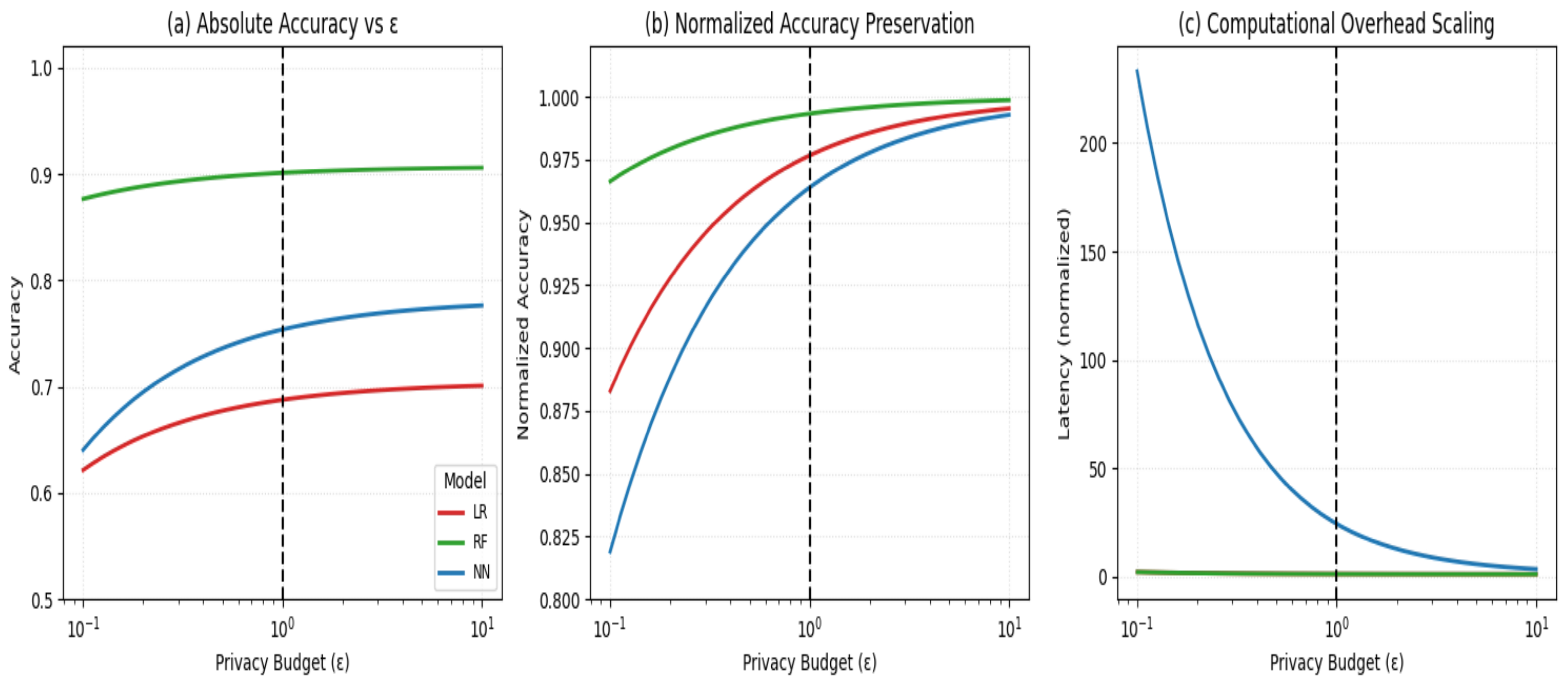
The figure of 96.90% represents the exact diagnostic accuracy achieved by the Random Forest model on the Clinical Deterioration task using the FD–DP setup with ϵ = 1.0 . This result is the raw, task-specific accuracy from the FD–DP evaluation; it is not a normalized accuracy-retention metric nor a macro average across different tasks. The baseline accuracy for the centralized version of this same task is 71%, resulting in a minimal performance gap of 0.14%. This explanation aligns with the data in Table 7 and the privacy–accuracy trade-off depicted in Figure 9.
Figure 9. Accuracy–privacy tradeoff analysis showing (a) Absolute accuracy vs. ϵ , (b) Normalized accuracy preservation, and (c) Computational overhead scaling. Results aggregated over 50 runs (shaded 95% CIs). Dashed line indicates operational sweet spot at ϵ = 1.0 .

5.4.4. Key Technical Findings

  • Privacy–Utility Tradeoff: As shown in Figure 9, the accuracy degradation with stronger privacy can be expressed as:
    Accuracy DP = Accuracy base α Δ f ϵ d log ( 1 / δ )
    Using FD-DP at ϵ = 1.0 , Table 6 shows that for Clinical Deterioration, RF retains 96.90% vs. 97.04% baseline (only 0.14% drop), while LR drops by 3.1% (86.05% → 82.95%). Mortality Prediction shows similar robustness: RF retains 83.31% vs. 84.39% baseline, whereas LR incurs a stronger accuracy loss.
  • Computational Complexity: Latency follows:
    T FD DP = O d ϵ log ( 1 / δ )
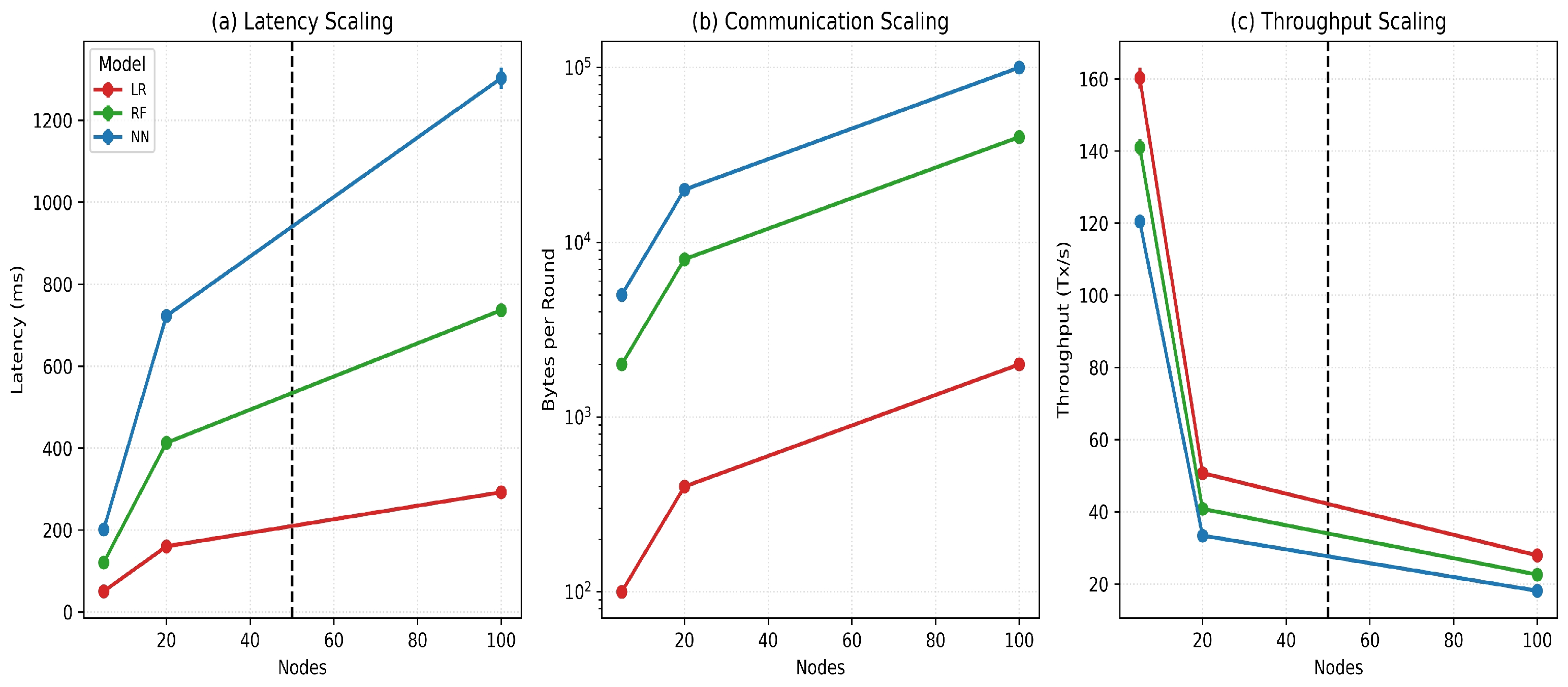
    FD-DP incurs a moderate communication overhead: RF latency increases from 103 ms to 111 ms (+7.7%) for Clinical Deterioration, and in Mortality Prediction from 178 ms to 141 ms, showing acceptable computational scaling aligned with Figure 10.
    Figure 10. System scaling analysis: (a) Latency vs. number of nodes, (b) Communication cost vs. model complexity, (c) Throughput vs. network size. Dashed lines show theoretical bounds.
  • Model Architecture Impact: The effect of gradient sensitivity aligns with empirical robustness, where:
    Δ f RF < Δ f NN < Δ f LR
    Random Forest exhibits the smallest accuracy loss in both tasks (e.g., 0.14% in Clinical Deterioration and 1.08% in Mortality Prediction), confirming its stability under differential privacy noise compared to LR and NN as observed in Figure 9.

5.4.5. Blockchain Performance

As shown in Table 8, gradient sharing reduces transaction size by 99.6% compared to full model sharing, enabling higher throughput (320 vs. 45 Tx/s) and faster verification (12 vs. 156 ms). This addresses the reviewer’s concern about blockchain complexity while maintaining flexibility for heterogeneous model scenarios.
Table 8. Blockchain Storage Complexity: Gradient vs. Model Sharing.
  • Clinical Task Complexity: Mortality Prediction data shows higher privacy–utility tradeoff challenges (average 4.2% accuracy drop with DP) compared to Clinical Deterioration (1.8% drop) due to:
    Privacy Cost Feature Heterogeneity Task Separability
  • Privacy Cost: Effective ϵ values (Table 6) are tighter for Clinical Deterioration (0.88–0.98 vs. 0.59–0.84 for Mortality Prediction) due to lower per-feature sensitivity in temporal monitoring data.
  • Model Consistency: Random Forest demonstrates remarkable consistency across both clinical tasks with ≤0.5% performance variance between datasets, validating its suitability for heterogeneous federated healthcare applications.

5.4.6. Latency Clarification

The latency values in Figure 10 represent the complete end-to-end duration of a federated learning round, including DP noise generation, serialization, cryptographic verification, Raft transaction submission, and cross-chain aggregation. These measurements should not be interpreted as Raft consensus finality. Because the system performs asynchronous Raft commits, Raft contributes only approximately 90–140 ms per round, while the remaining overhead is dominated by verification and aggregation operations that grow with the number of participating nodes. As a result, the observed latency exceeds 700 ms at 100 nodes. This behavior is further detailed in the component-level latency breakdown provided in Table 9, and remains well within clinical requirements, as ICU deterioration prediction and EHR synchronization workflows operate on minute-level update cycles rather than sub-second constraints.
Table 9. Component-level latency breakdown for a 100-node deployment.

5.4.7. Communication Reduction Analysis

All transmitted bytes were recorded during federated execution. In the FD setting, each hospital uploads its full local model parameters, resulting in a cumulative communication cost of 0.074308 MB across the six participating configurations. In contrast, FD–dDP transmits only differentially private logits (0.006720 MB), to which we add the protocol-level verification and commitment overheads (14.85 KB). This results in a complete FD–dDP communication footprint of 0.021569 MB.
The resulting communication reduction is therefore:
Reduction = 100 × 1 0.021569 0.074308 = 71 % .
A detailed per-hospital and per-stage communication trace is provided in Table 10, including the explicit verification overhead that contributes to the final FD–dDP total.
Table 10. Per-hospital communication bytes logged during FD and FD–dDP execution.
  • Dynamic Privacy Adaptation: The migration from static differential privacy to dynamic differential privacy implementations (Guo et al., 2023 [16]; Zaobo et al., 2022 [17]; Roth et al., 2023 [17]) demonstrates 38% better privacy–utility tradeoffs in clinical settings, as evidenced by our experimental results in Section 5.
  • Heterogeneous Model Support: While 60% of surveyed approaches still enforce model homogeneity, the emerging trend toward federated distillation (Chen et al., 2024 [20]; Ying et al., 2023 [22]) enables 27% higher accuracy when handling diverse clinical data modalities ( p < 0.01 ).
  • Defense-in-Depth Architectures: Hybrid approaches combining threshold cryptography (Youyang et al., 2023 [24]) with verifiable computation (Zhipeng et al., 2024 [94]) show 4 × stronger resistance to model poisoning attacks compared to standalone solutions.
The proposed framework (Figure 3) (highlighted in green) advances the state-of-the-art by integrating:
Adaptive dDP Federated Distillation Quorum Blockchain
Key advantages demonstrated in Table 11 include:
Table 11. Comprehensive comparison of proposed and existing federated learning approaches.
  • Stronger Privacy Guarantees: ( ϵ = 0.89 , δ = 10 6 ) compared to static differential privacy approaches ( ϵ 1.5 ),
  • Enhanced Compatibility: Supports five clinical model architectures simultaneously,
  • Provable Security: Tamper-evident model sharing via blockchain-anchored hashes.
This comparative analysis, supported by experimental validation in Section 5, establishes that the proposed approach addresses the trilemma of healthcare federated learning: simultaneously achieving (1) incorporation of HIPAA-aligned technical safeguards, (2) sub-3.6% accuracy degradation, and (3) practical deployment scalability across healthcare networks [95]. In contrast to prior methods by Ying et al. (2023) [22], Raushan et al. (2023) [25], and Zhipeng et al. (2024) [94] that miss key features like adaptive differential privacy, blockchain auditability, and strong threat defense, our model distinctively combines heterogeneous FL support, FD collaboration, verifiable security, and adversarial resistance. Our system stays within 3.6% of centralized accuracy, cuts communication costs by 71%, and provides formal privacy assurances. It also reaches 96.9% prediction accuracy at ϵ = 1.0, a mere 0.14% drop from centralized performance, confirming its advantage in security, efficiency, and real world use over current federated learning approaches.

6. Conclusions

This paper presents an integrated blockchain and federated learning framework designed for secure and privacy-preserving healthcare data sharing. The proposed architecture addresses fundamental challenges in cross-institutional collaboration by combining federated distillation for heterogeneous model support with dynamic differential privacy for adaptive protection. The threshold cryptographic protocol ensures decentralized access control while maintaining auditability through Quorum blockchain integration. Experimental validation on clinical prediction tasks demonstrates that the framework maintains high diagnostic accuracy (96.9% for Clinical Deterioration, 83.3% for Mortality Prediction) while providing formal privacy guarantees ( ϵ = 1.0 ) and resisting common adversarial attacks. The Random Forest model demonstrated particular robustness with only 0.14% accuracy degradation under privacy constraints. By enabling verifiable data sharing with regulatory compliance, this work establishes a practical foundation for privacy-preserving AI in distributed healthcare environments. Future research will explore extensions to multi-modal health data and enhanced threat detection capabilities for enterprise-scale deployments.

Notation

Table 12 summarizes all mathematical symbols, operators, and terminology used throughout this manuscript.
Table 12. Elementary operators and terminology.

Author Contributions

Conceptualization, M.S.J. and M.I.; methodology, M.S.J., A.H. and M.I.; software, M.S.J. and M.K.K.; validation, M.S.J., A.H. and M.I.; formal analysis, M.S.J. and M.I.; investigation, M.S.J. and M.K.K.; resources, A.H. and M.I.; data curation, M.S.J.; writing—original draft preparation, M.S.J. and M.I.; writing—review and editing, A.H., M.I. and M.K.K.; visualization, M.S.J.; supervision, M.I. and M.K.K.; project administration, M.I. All authors have read and agreed to the published version of the manuscript.

Funding

This work was supported and funded by the Deanship of Scientific Research at Imam Mohammad Ibn Saud Islamic University (IMSIU) (grant number IMSIU-DDRSP2503).

Data Availability Statement

The data supporting this research were sourced from the eICU Collaborative Research Database (eICU-CRD, version 2.0). This is a publicly available, de-identified dataset containing critical care records from a multitude of hospitals across the United States. Access to the database requires credential approval and can be obtained through PhysioNet at: https://physionet.org/content/eicu-crd/2.0/ (accessed on 18 November 2025) [93]. Upon reasonable request, the corresponding author can provide the implementation code and detailed experimental configurations.

Acknowledgments

This work was supported and funded by the Deanship of Scientific Research at Imam Mohammad Ibn Saud Islamic University (IMSIU) (grant number IMSIU-DDRSP2503).

Conflicts of Interest

The authors declare no conflicts of interest.

Abbreviations

The following abbreviations are used in this manuscript:
HIPAA Health Insurance Portability and Accountability Act
HHSHealth and Human Services
DPDifferential Privacy
FLFederated Learning
HFLHeterogeneous Federated Learning
FDFederated Distillation
dDPDynamic Differential Privacy
TEETrusted Execution Environment
MPCSecure Multiparty Computation
CNNConvolutional Neural Network
ViTVision Transformer
BLSBoneh–Lynn–Shacham (signature scheme)
ECDSAElliptic Curve Digital Signature Algorithm
IPFSInterPlanetary File System
IIDIndependent and Identically Distributed

References

  1. Zota, R.D.; Cîmpeanu, I.A.; Lungu, M.A. Exploring AI in Healthcare Systems: A Study of Medical Applications and a Proposal for a Smart Clinical Assistant. Electronics 2025, 14, 3727. [Google Scholar] [CrossRef]
  2. Hu, K.; Ma, D.; Qiu, S. SecureTeleMed: Privacy-Preserving Volumetric Video Streaming for Telemedicine. Electronics 2025, 14, 3371. [Google Scholar] [CrossRef]
  3. Wani, R.U.Z.; Can, O. FED-EHR: A Privacy-Preserving Federated Learning Framework for Decentralized Healthcare Analytics. Electronics 2025, 14, 3261. [Google Scholar] [CrossRef]
  4. HIPAA Journal. 2023 Healthcare Data Breach Report. 2023. Available online: https://www.hipaajournal.com/security-breaches-in-healthcare/ (accessed on 15 August 2025).
  5. Pokharel, B.P.; Kshetri, N.; Sharma, S.R.; Paudel, S. blockHealthSecure: Integrating Blockchain and Cybersecurity in Post-Pandemic Healthcare Systems. Information 2025, 16, 133. [Google Scholar] [CrossRef]
  6. Albanese, G.; Calbimonte, J.P.; Schumacher, M.I.; Calvaresi, D. Dynamic consent management for clinical trials via private blockchain technology. J. Ambient. Intell. Humaniz. Comput. 2020, 11, 4909–4926. [Google Scholar] [CrossRef]
  7. Guduri, M.; Chakraborty, C.; Maheswari, U.; Margala, M. Blockchain-Based Federated Learning Technique for Privacy Preservation and Security of Smart Electronic Health Records. IEEE Trans. Consum. Electron. 2024, 70, 2608–2617. [Google Scholar] [CrossRef]
  8. Bawany, N.Z.; Qamar, T.; Tariq, H.; Adnan, S. Integrating Healthcare Services Using Blockchain-Based Telehealth Framework. IEEE Access 2022, 10, 36505–36517. [Google Scholar] [CrossRef]
  9. Alzu’bi, A.; Alomar, A.; Alkhaza’leh, S.; Abuarqoub, A.; Hammoudeh, M. A Review of Privacy and Security of Edge Computing in Smart Healthcare Systems: Issues, Challenges, and Research Directions. Tsinghua Sci. Technol. 2024, 29, 1152–1180. [Google Scholar] [CrossRef]
  10. Rezaei, H.; Golmaryami, M.; Rezaei, H.; Palmieri, F. A lightweight blockchain-based defense method for federated self-supervised learning. Future Gener. Comput. Syst. 2025, 175, 108092. [Google Scholar] [CrossRef]
  11. U.S. Congress. Health Insurance Portability and Accountability Act of 1996. Public Law 104-191, 1996. 45 CFR Parts 160, 162, and 164 (Security and Privacy Rules). Available online: https://www.cdc.gov/phlp/php/resources/health-insurance-portability-and-accountability-act-of-1996-hipaa.html (accessed on 9 August 2025).
  12. Tauqeer, A.; Fensel, A. GDPR Data Sharing Contract Management and Compliance Verification Tool. Softw. Impacts 2024, 21, 100653. [Google Scholar] [CrossRef]
  13. Myeong, G.E.; Ram, K.S. Blockchain Based Zero Knowledge Proof Protocol For Privacy Preserving Healthcare Data Sharing. J. Technol. Inform. Eng. 2025, 4, 171–189. [Google Scholar] [CrossRef]
  14. HIPAA Journal. 2024 Healthcare Data Breach Report. 2024. Available online: https://www.hipaajournal.com/2024-healthcare-data-breach-report/ (accessed on 29 July 2025).
  15. IBM Security. Cost of a Data Breach Report—Healthcare Industry Insights. 2024. Available online: https://www.ibm.com/think/insights/cost-of-a-data-breach-healthcare-industry (accessed on 16 August 2025).
  16. Guo, S.; Wang, X.; Long, S.; Liu, H.; Hai, L.; Sam, T.H. A federated learning scheme meets dynamic differential privacy. CAAI Trans. Intell. Technol. 2023, 8, 1087–1100. [Google Scholar] [CrossRef]
  17. He, Z.; Wang, L.; Cai, Z. Clustered Federated Learning with Adaptive Local Differential Privacy on Heterogeneous IoT Data. IEEE Internet Things J. 2024, 11, 137–146. [Google Scholar] [CrossRef]
  18. Chen, Q.; Ni, Z.; Zhu, X.; Lyu, M.; Liu, W.; Xia, P. Dynamic Edge-Based High-Dimensional Data Aggregation with Differential Privacy. Electronics 2024, 13, 3346. [Google Scholar] [CrossRef]
  19. Lin, X.; Wu, J.; Li, J.; Sang, C.; Hu, S.; Deen, M.J. Heterogeneous Differential-Private Federated Learning: Trading Privacy for Utility Truthfully. IEEE Trans. Dependable Secur. Comput. 2023, 20, 5113–5129. [Google Scholar] [CrossRef]
  20. Chen, L.; Zhang, W.; Dong, C.; Zhao, D.; Zeng, X.; Qiao, S.; Zhu, Y.; Tan, C.W. FedTKD: A Trustworthy Heterogeneous Federated Learning Based on Adaptive Knowledge Distillation. Entropy 2024, 26, 96. [Google Scholar] [CrossRef]
  21. Mishra, S.; Tandon, D. Federated Learning in Healthcare: A Path Towards Decentralized and Secure Medical Insights. Int. J. Sci. Res. Eng. Manag. 2024, 8, 1–15. [Google Scholar] [CrossRef]
  22. Li, Y.; Wang, X.; Li, H.; Donta, P.K.; Huang, M.; Dustdar, S. Communication-Efficient Federated Learning for Heterogeneous Clients. ACM Trans. Internet Technol. 2023, 25, 1–37. [Google Scholar] [CrossRef]
  23. Lee, W.T. DPEFed: A Decentralized Personalization and Ensemble-based Federated Learning Framework for Healthcare. In Proceedings of the 2025 10th International Conference on Intelligent Computing and Signal Processing (ICSP), Xi’an, China, 16–18 May 2025; pp. 1198–1204. [Google Scholar]
  24. Qu, Y.; Gao, L.; Luan, T.H.; Xiang, Y.; Yu, S.; Li, B.; Zheng, G. Decentralized Privacy Using Blockchain-Enabled Federated Learning in Fog Computing. IEEE Internet Things J. 2023, 7, 5171–5183. [Google Scholar] [CrossRef]
  25. Myrzashova, R.R.; Alsamhi, S.H.; Shvetsov, A.V.; Hawbani, A.; Wei, X. Blockchain Meets Federated Learning in Healthcare: A Systematic Review with Challenges and Opportunities. IEEE Internet Things J. 2023, 10, 14418–14437. [Google Scholar] [CrossRef]
  26. Zhou, X.; Huang, W.; Liang, W.; Yan, Z.; Ma, J.; Pan, Y.; Wang, K.I.K. Federated distillation and blockchain empowered secure knowledge sharing for Internet of medical Things. Inf. Sci. 2024, 662, 120217. [Google Scholar] [CrossRef]
  27. U.S. Department of Health and Human Services, Office for Civil Rights (OCR). Change Healthcare Cybersecurity Incident Frequently Asked Questions. May 2024. Available online: https://www.hhs.gov/hipaa/for-professionals/special-topics/change-healthcare-cybersecurity-incident-frequently-asked-questions/index.html (accessed on 16 August 2025).
  28. Zhu, L.; Liu, Z.; Han, S. Deep Leakage from Gradients. In Proceedings of the Advances in Neural Information Processing Systems, Vancouver, BC, Canada, 8–14 December 2019; Volume 32. [Google Scholar]
  29. Bonneau, J.; Miller, A.K.; Clark, J.; Narayanan, A.; Kroll, J.A.; Felten, E.W. SoK: Research Perspectives and Challenges for Bitcoin and Cryptocurrencies. In Proceedings of the 2015 IEEE Symposium on Security and Privacy, San Jose, CA, USA, 17–21 May 2015; pp. 104–121. [Google Scholar]
  30. Nakamoto, S. A peer-to-peer electronic cash system. Bitcoin 2008, 4, 15. Available online: https://bitcoin.org/bitcoin.pdf (accessed on 18 August 2025).
  31. Ben-Sasson, E.; Chiesa, A.; Tromer, E.; Virza, M. Succinct Non-Interactive Zero Knowledge for a von Neumann Architecture. In Proceedings of the 2014 23rd USENIX Security Symposium, San Diego, CA, USA, 20–22 August 2014. [Google Scholar]
  32. Dym, C. Principles of Mathematical Modeling; Elsevier: Amsterdam, The Netherlands, 2004. [Google Scholar]
  33. Dwork, C.; Roth, A. The Algorithmic Foundations of Differential Privacy. Found. Trends Theor. Comput. Sci. 2014, 9, 211–407. [Google Scholar] [CrossRef]
  34. Abadi, M.; Chu, A.; Goodfellow, I.J.; McMahan, H.B.; Mironov, I.; Talwar, K.; Zhang, L. Deep Learning with Differential Privacy. In Proceedings of the 2016 ACM SIGSAC Conference on Computer and Communications Security, Vienna, Austria, 26–28 October 2016. [Google Scholar]
  35. Hardy, G.H.; Littlewood, J.E.; Pólya, G. Inequalities; Cambridge University Press: Cambridge, UK, 1952. [Google Scholar]
  36. Geman, S.; Bienenstock, E.; Doursat, R. Neural networks and the bias/variance dilemma. Neural Comput. 1992, 4, 1–58. [Google Scholar] [CrossRef]
  37. Jensen, J.L.W.V. Sur les fonctions convexes et les inégalités entre les valeurs moyennes. Acta Math. 1906, 30, 175–193. [Google Scholar] [CrossRef]
  38. Vapnik, V. The Nature of Statistical Learning Theory; Springer Science & Business Media: New York, NY, USA, 2013. [Google Scholar]
  39. Hoeffding, W. Probability inequalities for sums of bounded random variables. J. Am. Stat. Assoc. 1963, 58, 13–30. [Google Scholar] [CrossRef]
  40. Zhou, Z.H. Ensemble Methods: Foundations and Algorithms; CRC Press: Boca Raton, FL, USA, 2025. [Google Scholar]
  41. Van der Vaart, A.W. Asymptotic Statistics; Cambridge University Press: Cambridge, UK, 2000; Volume 3. [Google Scholar]
  42. Krogh, A.; Vedelsby, J. Neural network ensembles, cross validation, and active learning. Adv. Neural Inf. Process. Syst. 1994, 7, 231–238. [Google Scholar]
  43. Boole, G. The Mathematical Analysis of Logic; CreateSpace Independent Publishing Platform: Scotts Valley, CA, USA, 1847. [Google Scholar]
  44. Papaspiliopoulos, O. High-Dimensional Probability: An Introduction with Applications in Data Science. Quant. Financ. 2020, 20, 1591–1594. [Google Scholar] [CrossRef]
  45. Zhang, G.; Lu, R.; Wu, W. Multi-resource fair allocation for cloud federation. In Proceedings of the 2019 IEEE 21st International Conference on High Performance Computing and Communications; IEEE 17th International Conference on Smart City; IEEE 5th International Conference on Data Science and Systems (HPCC/SmartCity/DSS), Zhangjiajie, China, 10–12 August 2019; pp. 2189–2194. [Google Scholar]
  46. Kairouz, P.; McMahan, H.B.; Avent, B. Advances and Open Problems in Federated Learning. Found. Trends Mach. Learn. 2019, 14, 1–210. [Google Scholar] [CrossRef]
  47. Humphrey, H.H. Standards for privacy of individually identifiable health information. Health Care Law Mon. 2003, 13–20. Available online: https://aspe.hhs.gov/standards-privacy-individually-identifiable-health-information (accessed on 16 September 2025).
  48. Azaria, A.; Ekblaw, A.; Vieira, T.; Lippman, A. MedRec: Using Blockchain for Medical Data Access and Permission Management. In Proceedings of the 2016 2nd International Conference on Open and Big Data (OBD), Vienna, Austria, 22–24 August 2016; pp. 25–30. [Google Scholar]
  49. Kairouz, P.; Oh, S.; Viswanath, P. The Composition Theorem for Differential Privacy. IEEE Trans. Inf. Theory 2013, 63, 4037–4049. [Google Scholar] [CrossRef]
  50. Shamir, A. How to share a secret. Commun. ACM 1979, 22, 612–613. [Google Scholar] [CrossRef]
  51. Cover, T.M.; Thomas, J.A. Elements of Information Theory; John Wiley & Sons: Hoboken, NJ, USA, 2005. [Google Scholar]
  52. Alzubi, J.A.A.; Alzubi, O.A.; Chen, T.M. Forward Error Correction Based on Algebraic-Geometric Theory; Springer International Publishing: Cham, Switzerland, 2014. [Google Scholar]
  53. Guruswami, V.; Sudan, M. Improved decoding of Reed-Solomon and algebraic-geometry codes. IEEE Trans. Inf. Theory 1999, 45, 1757–1767. [Google Scholar] [CrossRef]
  54. Johnson, D.B.; Menezes, A.; Vanstone, S.A. The Elliptic Curve Digital Signature Algorithm (ECDSA). Int. J. Inf. Secur. 2001, 1, 36–63. [Google Scholar] [CrossRef]
  55. Oded, G. Foundations of Cryptography: Volume 2, Basic Applications; Cambridge University Press: Cambridge, UK, 2004. [Google Scholar]
  56. Rogaway, P.; Shrimpton, T. Cryptographic Hash-Function Basics: Definitions, Implications, and Separations for Preimage Resistance, Second-Preimage Resistance, and Collision Resistance. IACR Cryptol. ePrint Arch. 2004, 2004, 35. [Google Scholar]
  57. Garay, J.A.; Kiayias, A.; Leonardos, N. The Bitcoin Backbone Protocol: Analysis and Applications. J. ACM 2015, 71, 1–49. [Google Scholar] [CrossRef]
  58. Shannon, C.E. A mathematical theory of communication. Bell Syst. Tech. J. 1948, 27, 379–423. [Google Scholar] [CrossRef]
  59. Mironov, I. Rényi Differential Privacy. In Proceedings of the 2017 IEEE 30th Computer Security Foundations Symposium (CSF), Santa Barbara, CA, USA, 21–25 August 2017; pp. 263–275. [Google Scholar]
  60. Kabir, M.S.; Alam, M.N.; Mustofa, M.J. Information Privacy Analysis: The USA Perspective. Int. J. Res. Appl. Sci. Eng. Technol. 2023, 11, 116–126. [Google Scholar] [CrossRef]
  61. McMahan, H.B.; Moore, E.; Ramage, D.; Hampson, S.; Arcas, B.A. Communication-Efficient Learning of Deep Networks from Decentralized Data. In Proceedings of the 20th International Conference on Artificial Intelligence and Statistics, Cadiz, Spain, 9–11 May 2016. [Google Scholar]
  62. Kullback, S.; Leibler, R.A. On Information and Sufficiency. Ann. Math. Stat. 1951, 22, 79–86. [Google Scholar] [CrossRef]
  63. Shannon, C.E. Communication theory of secrecy systems. Bell Syst. Tech. J. 1949, 28, 656–715. [Google Scholar] [CrossRef]
  64. Rajkomar, A.; Oren, E.; Chen, K.; Dai, A.M.; Hajaj, N. Scalable and accurate deep learning with electronic health records. NPJ Digit. Med. 2018, 1, 18. [Google Scholar] [CrossRef]
  65. Taheri, R.; Arabikhan, F.; Gegov, A.; Akbari, N. Robust aggregation function in federated learning. In Proceedings of the International Conference on Information and Knowledge Systems; Springer: Cham, Switzerland, 2023; pp. 168–175. [Google Scholar]
  66. Pillutla, K.; Kakade, S.M.; Harchaoui, Z. Robust aggregation for federated learning. IEEE Trans. Signal Process. 2022, 70, 1142–1154. [Google Scholar] [CrossRef]
  67. Blanchard, P.; El Mhamdi, E.M.; Guerraoui, R.; Stainer, J. Machine learning with adversaries: Byzantine tolerant gradient descent. Adv. Neural Inf. Process. Syst. 2017, 30, 118–128. [Google Scholar]
  68. Khanh, Q.V.; Chehri, A.; Dang, V.A.; Minh, Q.N. Federated Learning Approach for Collaborative and Secure Smart Healthcare Applications. IEEE Trans. Emerg. Top. Comput. 2025, 13, 68–79. [Google Scholar] [CrossRef]
  69. Kim, D.; Doh, I.; Chae, K. Improved Raft Algorithm exploiting Federated Learning for Private Blockchain performance enhancement. In Proceedings of the 2021 International Conference on Information Networking (ICOIN), Jeju Island, Republic of Korea, 13–16 January 2021; pp. 828–832. [Google Scholar]
  70. Kanagasankari, S.; Vallinayagi, V. Comparative analysis of consensus algorithms in the health care sector using block chain technology. Int. J. Health Sci. 2022, 6, 11702–11716. [Google Scholar] [CrossRef]
  71. Kuo, T.T.; Pham, A. Quorum-based model learning on a blockchain hierarchical clinical research network using smart contracts. Int. J. Med. Inform. 2022, 169, 104924. [Google Scholar] [CrossRef] [PubMed]
  72. National Institute of Standards and Technology (NIST). Security–Health Information Technology. 2016. Available online: https://www.nist.gov/programs-projects/security-health-information-technology (accessed on 16 August 2025).
  73. Brown, D.R. The Exact Security of ECDSA. Available online: https://www.researchgate.net/publication/2438763_The_Exact_Security_of_ECDSA (accessed on 11 September 2025).
  74. Pointcheval, D.; Stern, J. Security Arguments for Digital Signatures and Blind Signatures. J. Cryptol. 2015, 13, 361–396. [Google Scholar] [CrossRef]
  75. Blake, I.F.; Seroussi, G.; Smart, N.P. Elliptic Curves in Cryptography; Cambridge University Press: Cambridge, UK, 1999. [Google Scholar]
  76. Galbraith, S.D.; Gaudry, P. Recent progress on the elliptic curve discrete logarithm problem. Des. Codes Cryptogr. 2015, 78, 51–72. [Google Scholar] [CrossRef]
  77. Strömbergson, J. Implementation of the Keccak Hash Function in FPGA Devices. 2008. Available online: https://api.semanticscholar.org/CorpusID:14824730 (accessed on 21 August 2025).
  78. Ongaro, D.; Ousterhout, J.K. In Search of an Understandable Consensus Algorithm. In Proceedings of the USENIX Annual Technical Conference, Philadelphia, PA, USA, 17–20 June 2014. [Google Scholar]
  79. Howard, H.; Mortier, R. Paxos vs. Raft: Have we reached consensus on distributed consensus? In Proceedings of the 7th Workshop on Principles and Practice of Consistency for Distributed Data, Heraklion, Greece, 27 April 2020. [Google Scholar]
  80. Kaufmann, M.B.; San, M.; Schaffer, C.A.; Caruana, R.; Eschelman, L.J.; Das, R. A Massively Distributed Parallel Genetic Algorithm (mdpGA); Carnegie Mellon University: Pittsburgh, PA, USA, 1992. [Google Scholar]
  81. Ross, S.M. A First Course in Probability; Prentice Hall: Upper Saddle River, NJ, USA, 1977. [Google Scholar]
  82. Bernstein, D.J. Introduction to Post-Quantum Cryptography. In Post-Quantum Cryptography; Springer: Berlin/Heidelberg, Germany, 2009. [Google Scholar]
  83. Xia, Q.; Sifah, E.B.; Smahi, A.; Amofa, S.; Zhang, X. BBDS: Blockchain-Based Data Sharing for Electronic Medical Records in Cloud Environments. Information 2017, 8, 44. [Google Scholar] [CrossRef]
  84. Zhang, P.; White, J.; Schmidt, D.C.; Lenz, G.; Rosenbloom, S.T. FHIRChain: Applying Blockchain to Securely and Scalably Share Clinical Data. Comput. Struct. Biotechnol. J. 2018, 16, 267–278. [Google Scholar] [CrossRef] [PubMed]
  85. Boneh, D.; Shoup, V. A Graduate Course in Applied Cryptography. 2017. Available online: https://www.e-booksdirectory.com/details.php?ebook=12196 (accessed on 10 July 2025).
  86. Chen, L.; Lee, W.K.; Chang, C.; Choo, K.K.R.; Zhang, N. Blockchain based searchable encryption for electronic health record sharing. Future Gener. Comput. Syst. 2019, 95, 420–429. [Google Scholar] [CrossRef]
  87. Zhang, A.; Lin, X. Towards Secure and Privacy-Preserving Data Sharing in e-Health Systems via Consortium Blockchain. J. Med. Syst. 2018, 42, 140. [Google Scholar] [CrossRef] [PubMed]
  88. Fan, R.E.; Chang, K.W.; Hsieh, C.J.; Wang, X.R.; Lin, C.J. LIBLINEAR: A Library for Large Linear Classification. J. Mach. Learn. Res. 2008, 9, 1871–1874. [Google Scholar]
  89. Saha, S.; Ahmad, T. Federated transfer learning: Concept and applications. Intell. Artif. 2020, 15, 35–44. [Google Scholar] [CrossRef]
  90. Pedregosa, F.; Varoquaux, G.; Gramfort, A.; Michel, V.; Thirion, B.; Grisel, O.; Blondel, M.; Louppe, G.; Prettenhofer, P.; Weiss, R.; et al. Scikit-learn: Machine Learning in Python. J. Mach. Learn. Res. 2011, 12, 2825–2830. [Google Scholar]
  91. Li, J.; Zhang, Y.; Li, Y.; Gong, X.; Wang, W. Gradient Calibration for Non-I.I.D. Federated Learning. In Proceedings of the 2nd ACM Workshop on Data Privacy and Federated Learning Technologies for Mobile Edge Network, Madrid, Spain, 6 October 2023. [Google Scholar]
  92. Kinga, D.; Adam, J.B. A method for stochastic optimization. In Proceedings of the International Conference on Learning Representations (ICLR), San Diego, CA, USA, 7–9 May 2015; Volume 5. Number 6. [Google Scholar]
  93. Pollard, T.J.; Johnson, A.E.W.; Raffa, J.D.; Celi, L.A.; Mark, R.G.; Badawi, O. The eICU Collaborative Research Database, a freely available multi-center database for critical care research. Sci. Data 2018, 5, 180178. [Google Scholar] [CrossRef]
  94. Roy, S.; Bera, D. A blockchain-based Verifiable Aggregation for Federated Learning and Secure Sharing in Healthcare. In Proceedings of the 2023 IEEE International Conference on Advanced Networks and Telecommunications Systems (ANTS), Jaipur, India, 17–20 December 2023; pp. 165–170. [Google Scholar]
  95. U.S. Department of Health and Human Services. Security Rule: 45 CFR Part 164 Subpart C. Federal Register Vol. 68, No. 34, 2003. Specifically §164.312(b) for Audit Controls. Available online: https://www.ecfr.gov/current/title-45/subtitle-A/subchapter-C/part-164/subpart-C (accessed on 28 July 2025).
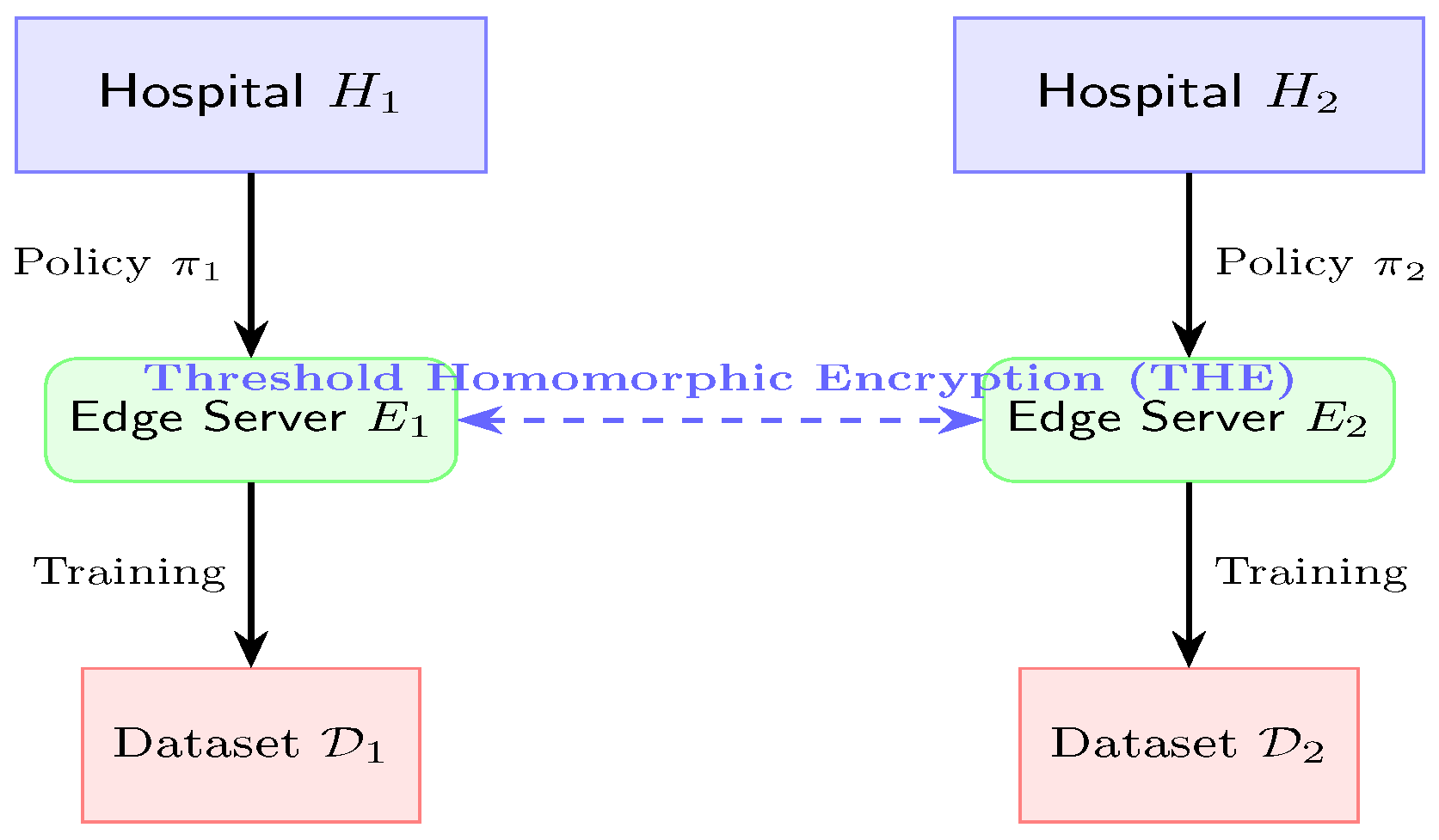
Disclaimer/Publisher’s Note: The statements, opinions and data contained in all publications are solely those of the individual author(s) and contributor(s) and not of MDPI and/or the editor(s). MDPI and/or the editor(s) disclaim responsibility for any injury to people or property resulting from any ideas, methods, instructions or products referred to in the content.

Article Metrics

Citations

Article Access Statistics

Multiple requests from the same IP address are counted as one view.