


Abstract
This paper investigates the control problem of a spacecraft attitude manoeuvrer with external disturbances. Firstly, the spacecraft attitude dynamical model is introduced; then, the tube-based framework is constructed, which includes a nominal system and an error system. Based on that, the control law design would be a two-step process. To start with, the nominal control law is developed via an adaptive dynamic programming technique and a neural network approximation in order to provide a nominal trajectory to the desired attitude. Moreover, based on the nonsingular terminal sliding mode control scheme, the error controller is derived to lead the actual system to track the nominal trajectory and suppress disturbances. The stability of the closed-loop system is analyzed via the Lyapunov approach and the simulation results could verify the effectiveness of the proposed control scheme.
1. Introduction
Recent years have witnessed prosperous developments in the field of aerospace engineering, especially in terms of the attitude control of spacecrafts, contributing to the success of a wide range of space missions, such as on-orbit monitoring [1], on-orbit inspection [2], and formation flights [3]. Among previous works in this area, many control schemes have been proven to be effective in reaching the goal of precise spacecraft attitude control, such as the back stepping method [4,5], sliding mode control [6,7], adaptive control [8,9], and observer-based control [10,11]. However, in most practical scenarios, electrical power is considered as the major energy for small spacecrafts, which can only carry very limited energy storage systems [12]. Considering the energy consumption utilized during attitude manoeuvrers of the spacecraft, only applying the above methods can guarantee optimal control performance and the minimizing of energy consumption; therefore, the optimal control theory plays an important role in many practical cases.
Various kinds of methods are included in the optimal control theory, such as inverse optimal control [13,14], H∞ optimal tracking control [15,16], and the online-learning technique [17,18]. Among these methodologies, adaptive dynamic programming (ADP) [19] has been proven to be a powerful data-driven method that is capable of ensuring optimal control performance through iteratively solving the Hamilton–Jacobi–Bellman (HJB) equation. This optimal control scheme has been widely adopted by many scholars to solve optimal control problems regarding spacecraft [20,21] and other objectives [22,23]. For the attitude dynamics of spacecraft with high nonlinearity and complexity, the corresponding HJB equation, subject to the pre-defined cost function, would be a complicated differential equation; thus, it is difficult to obtain its analytical solution. To address this obstacle efficiently, an adaptive neural network (ANN) can be adopted to actively approximate the HJB function. Through the ANN learning technique, the optimal control policy could be easily obtained.
Additionally, the on-orbit spacecraft would also suffer external disturbances caused by atmospheric drag, the Earth’s geomagnetic and solar radiation pressure, etc. A wide range of methods have been studied to deal with such a problem, among which the sliding mode control scheme is a major choice for spacecraft attitude control and suppressing disturbances. In [24], an adaptive nonsingular terminal sliding mode (NTSM) control scheme is proposed for spacecraft attitude tracking with actuator faults. Qiao et al. proposed a novel spacecraft composite attitude stabilization scheme in [25] using a nonsingular sliding mode technique, which could compensate for the estimated disturbances and attenuate the influence of estimated errors, showing the effectiveness of the NTSM. Furthermore, a tube-based control framework is also an effective method for improving the control performance for spacecraft attitude manoeuvring, and it includes a nominal system and an error system. In the nominal system, where the external disturbance is not considered, a nominal controller would be designed to draw the nominal states to the desired point, which provides a nominal trajectory. Additionally, the error controller for the error system would lead the actual system to the nominal trajectory and suppress unknown disturbances. In [26], a new tube-based framework is developed to design a guaranteed cost control law for spacecraft attitude reorientation, indicating the effectiveness of the tube-based framework.
Inspired by all the above methodologies, this article would consider the attitude reorientation control problem of a rigid spacecraft under external disturbances, with three reaction wheels being the actuators, and focus on the design of a tube-based control scheme via ADP and the NTSM technique. To be specific, the nominal system and the error system would be firstly constructed based on the attitude dynamical model of a spacecraft, which would be in the next section. Then, the tube-based control laws would be designed in Section 3, which would include an ADP-based nominal control law that ensures optimal control performance and convergence of the nominal system and a NTSM-based error control law that serves to stabilize the error system and deal with unknown disturbances. The stability of the closed-loop control system would be analyzed via the Lyapunov approach. The effectiveness of the proposed method would be verified through a numerical simulation conducted in Section 4. Section 5 would present the conclusion of this paper. The main contributions of this paper are concluded as follows:
- (1)
- A tube-based framework that includes a nominal system and an error system is constructed for spacecraft attitude control, allowing for “two degrees of freedom” for controller design. Moreover, with the generated nominal trajectory and a small error set, the knowledge of the actual states can be determined prior to control being applied.
- (2)
- The adaptive dynamic programming technique is adopted for the design of nominal control law, aiming to optimize the control performance and minimize energy costs while ensuring the convergence of the nominal system.
- (3)
- The nonsingular terminal sliding mode control scheme is used to derive the error control law, which serves to suppress external disturbances and lead the actual system to track the nominal system.
Notations: We denote by the identity matrix of . stands for the absolute value of a scalar, and is the standard Euclidean norm of a vector; represents the standard sign function; for any , we define as a diagonal matrix, and . Additionally, , is the cross-product operating element that transforms vector into a skew-symmetric matrix:
2. Problem Formulation and Preliminaries
In this section, we start with analyzing the attitude kinematics and dynamics of rigid spacecraft and then construct an error attitude dynamical model. Additionally, the tube-based control framework is also introduced to construct a nominal system and an error system. The control objective is to design a nominal controller and an error controller, respectively, for each system and ensure that the nominal system would be stabilized while the actual system could track the optimized nominal trajectory while all system state errors are guaranteed to be bounded.
2.1. Error Attitude Dynamical Model of Rigid Spacecraft
To begin, we introduce the Modified Rodriguez Parameters (MRPs) to describe the attitude kinematics and dynamics as follows [27]
with
where denotes the MRPs describing the attitude orientation with respect to the inertia frame ; represents the angular velocity and is the inertia matrix of the spacecraft; and is the external disturbance torque and the control input is denoted by . Before proceeding further, we shall make the following assumption:
Assumption 1.
The disturbance d is unknown but bounded by a unknown constant , i.e., .
Remark 1.
According to [28], the matrix is invertible as it satisfies .
By defining as the desired attitude trajectory, the relative attitude described by the error MRPs could be written as
then, the error kinematics and dynamics of the spacecraft could be represented in the following form
with
where is the relative angular velocity satisfying ; and are the desired angular velocity and its derivative, respectively.
Remark 2.
Based on the error attitude dynamical model above, the primary objective of control in this paper is to find the input signal for the spacecraft model (1) in order to transition the state to , where are equal to the desired values and is the task completion time. Additionally, the error MRPs and the relative angular velocity could converge to 0.
2.2. Tube-Based Control Framework
In what follows, by introducing a tube-based control framework, the original attitude model (3) would be split into a nominal system and an error system, where the external disturbance is only considered in the error system.
To start with, the spacecraft error attitude dynamical model (3) can be rewritten as
with
Then, we could define a nominal system in the following form where the external disturbance is not considered
where is the nominal control law to be designed. Additionally, the error system that includes the external disturbance is defined as follows
where , , and v is the error control law to be designed.
Combining the above two systems, the actual control input could be written as
Remark 3.
It should be noticed that the tube-based control framework mainly includes the nominal system (6) to be optimized and the error system (7) that serves to suppress the external disturbances. In this control scheme, the nominal control law is designed to optimize the nominal system without considering the external disturbances and the error controller is designed to lead the actual system, where the disturbances exist, to track the nominal system. In order to ensure that the actual system would track the optimized trajectory given by the nominal system with relatively small errors, the initial states of the nominal system should be set as the same as the actual states, which means that .
3. Main Results
In this section, the nominal control law would be developed based on the adaptive dynamic programming technique, where the HJB equation would be solved via an ANN approximation in order to further derive the optimal control policy that is capable of optimizing the control performance for the convergence and stabilization of the nominal system. Moreover, the terminal sliding mode control technique would be used to derive the error control law, which guarantees that the actual system can accurately track the optimized nominal trajectory.
3.1. ADP-Based Control Law for Nominal System
Consider the nominal system (6); to ensure that the original point is the only equilibrium, we define
where is a positive constant to be designed and the derivative of w can be easily calculated as
then the coordinate transformation system could be written as
where and are the nominal states. Additionally, (11) could be further written as
with
Consider the following performance function:
where is the convergence time of the system and .
To derive the optimal nominal control law that can stabilize the nominal system and minimize the performance function, we define the optimal function as follows
Based on the optimal control theory, the Hamilton–Jacobi–Bellman (HJB) equation and the optimal control policy can be given as follows
To further derive the optimal control law, solving of the HJB equation is required to obtain the analytical form of . However, due to the fact that the HJB equation is a complex nonlinear differential equation, it is difficult to directly obtain its solution. Thus, an adaptive neural network is introduced to approximate the solution of the HJB equation. According to the universal approximation property of the neural network, we have
where is the optimal weight and is the activation function. Taking the derivative with respect to the nominal state y yields
where and . Substituting (19) into (17) and (16) gives
where .
Then, the ANN can be implemented to approximate the performance function :
where is the estimation of . Additionally, by taking the derivative with respect to the nominal state, it can obtain
the approximated optimal control law can be given as
with the approximated Bellman function being
and the Hamiltonian error could be derived as
To minimize the above error, the update law for the weight of the ANN is designed as follows:
where and are constant parameters to be designed and and are defined as
If we define the estimation error of the ANN weight as
e could be rewritten as
and we could also obtain the derivative of as follows
Assumption 2.
It is assumed that , , .
Theorem 1.
Consider the nominal system of the spacecraft (6) and the performance function selected as (14); if the approximative optimal control law is designed as (24) and the update law of the ANN weight is designed as (27), then the nominal state y and the estimation error are guaranteed to be uniformly ultimately bounded.
Proof.
Select a Lyapunov function as follows
Taking the time derivative of (37), it gives
with the last term X satisfying
where is the maximum eigenvalue of A and , . is a parameter to be designed, satisfying that
Thus, satisfies that
Let , while , ; then, would function to stabilize the nominal state y. Then, it can obtain
where
And there exists a positive-definite matrix , such that
Additionally, it can be further derived that
where
Moreover, it can be derived that
where
Then, it could be concluded that, when the following inequality is satisfied
it can be ensured that , y and are ultimately uniformly bounded.
Additionally, while , , then satisfies that
When the following inequality is satistied
it can be ensured that , y and are ultimately uniformly bounded. This completes the proof. □
3.2. Sliding Mode Control Law for Error System
Consider the error system as follows
where we let
Select the nonsingular terminal sliding mode surface as follows
where k is a positive parameter to be designed and is defined as
where
and is a constant parameter to be designed. is a small positive constant.
Taking the derivative of s yields
where
Additionally, it could further obtain
Then, the error control law could be designed as follows
where , , and are positive constant parameters to be designed. is the estimation of the upper bound of the external disturbance and is defined as the estimation error.
Theorem 2.
Proof.
Select a Lyapunov function as follows
Regarding the time derivative, it presents
where
Then, it can be concluded that s and are ensured to be ultimately uniformly bounded, and there exists a positive constant such that .
Select another Lyapunov function as follows
Taking the derivative of it presents
If it is satisfied that , the system is ensured to reach the sliding mode surface within finite time and and are guaranteed to converge to a small region around the equilibrium. □
4. Simulation Results
In this section, a numerical simulation regarding the problem of spacecraft reorientation control is carried out to verify the effectiveness of the proposed tube-based control scheme. The simulation parameters are selected as follows. To start with, the inertia matrix of the spacecraft is chosen as
Additionally, we set the initial value of the error MRPs and the angular velocity as and , respectively. The desired angular velocity is 0. The control torque is bounded by and the external disturbance is selected as
Moreover, the parameters for the tube-based controller are selected as follows. , , ; , , , , and . The initial value of the adaptive parameter is set as 0 and the activation function for the adaptive neural network is selected as
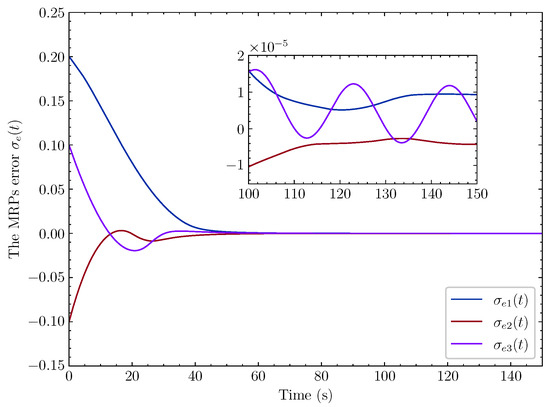
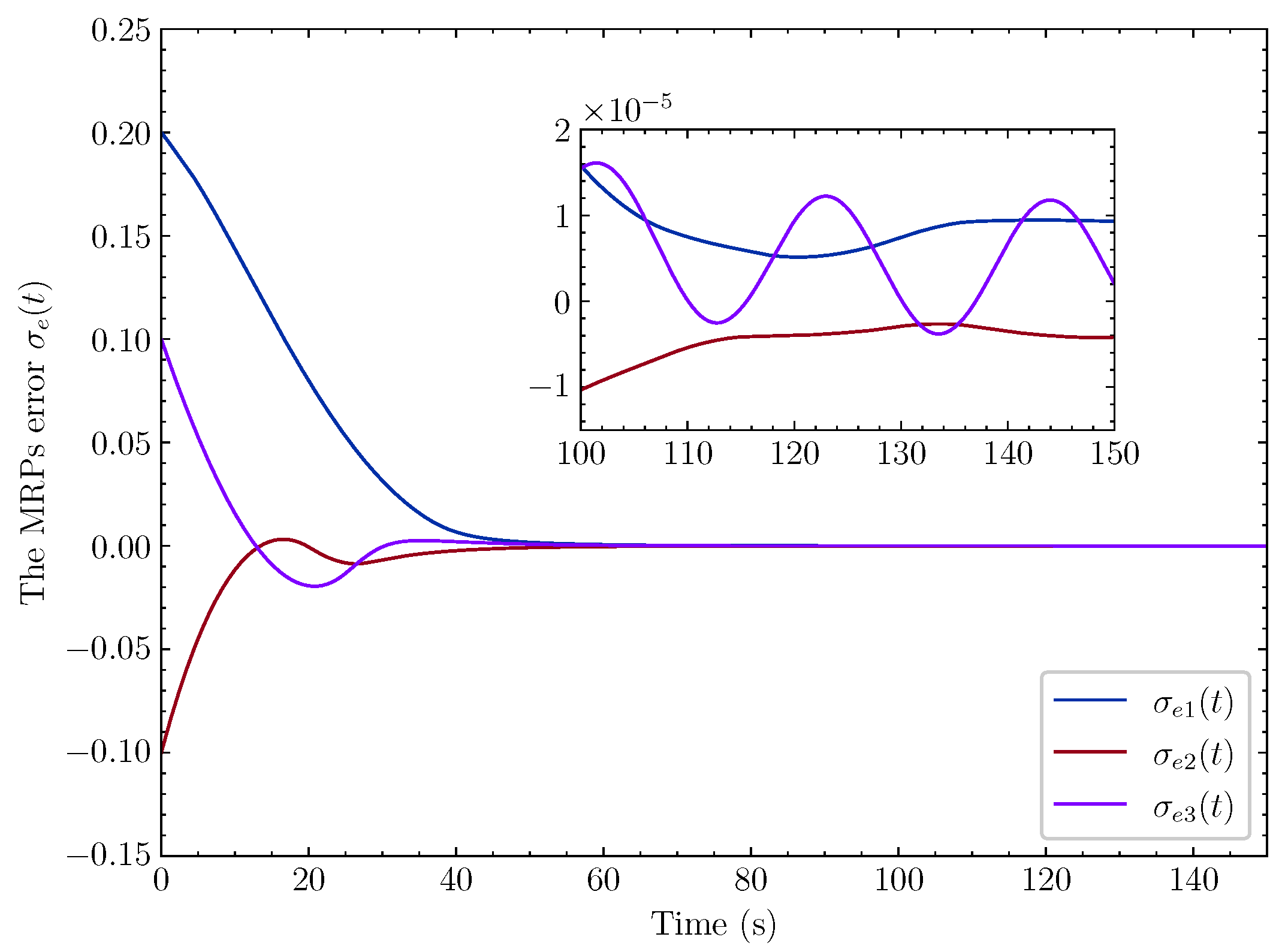
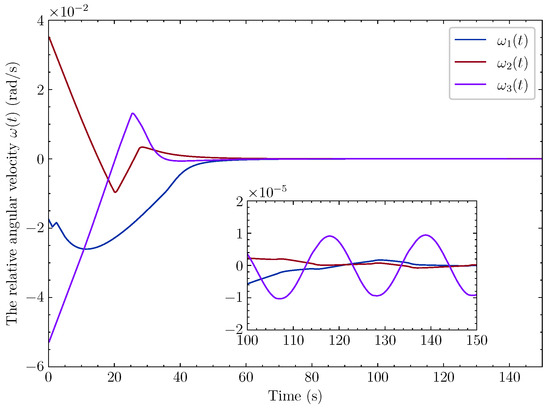
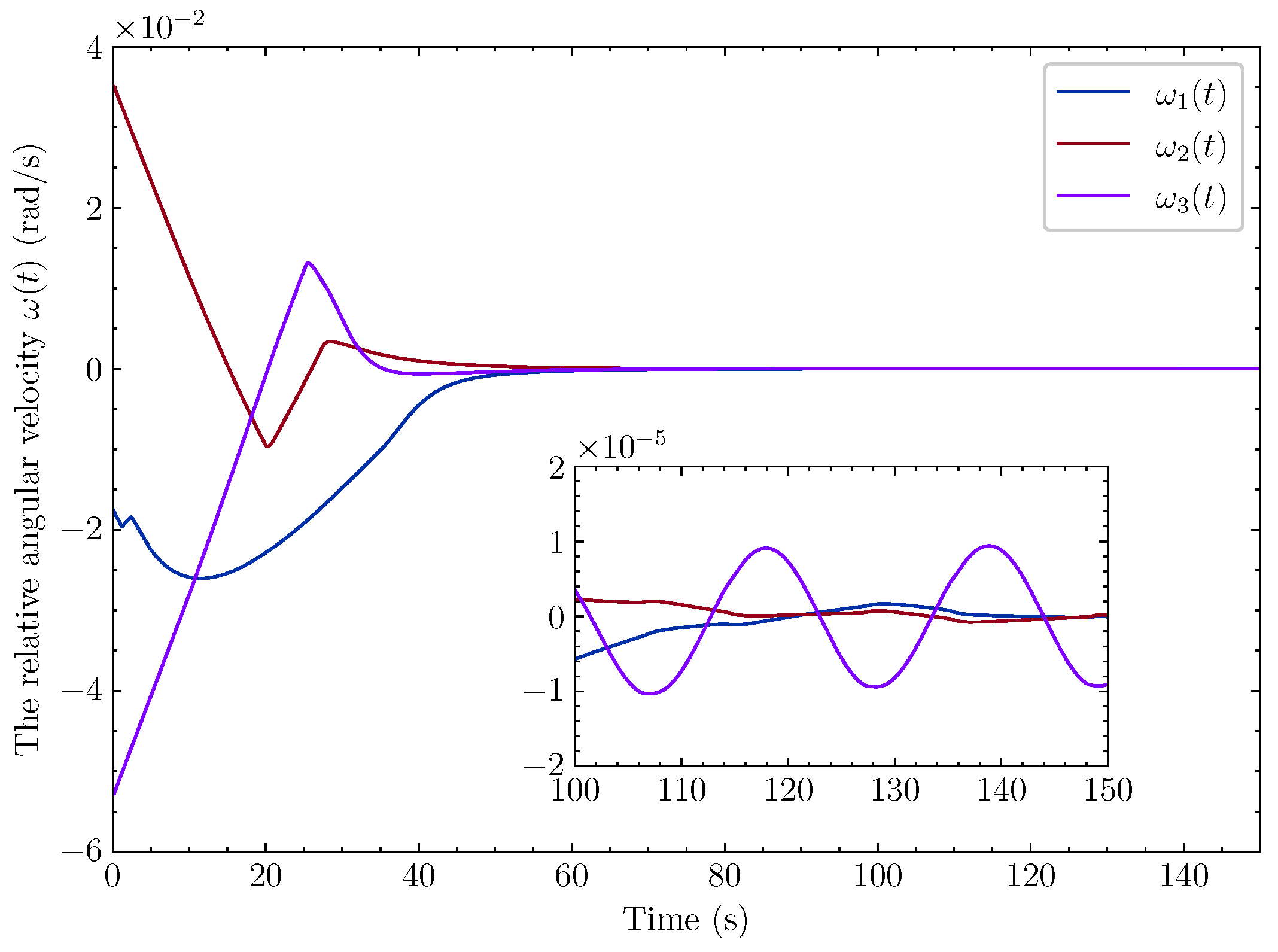
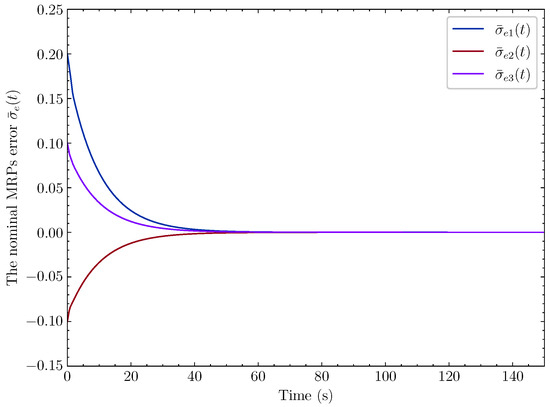
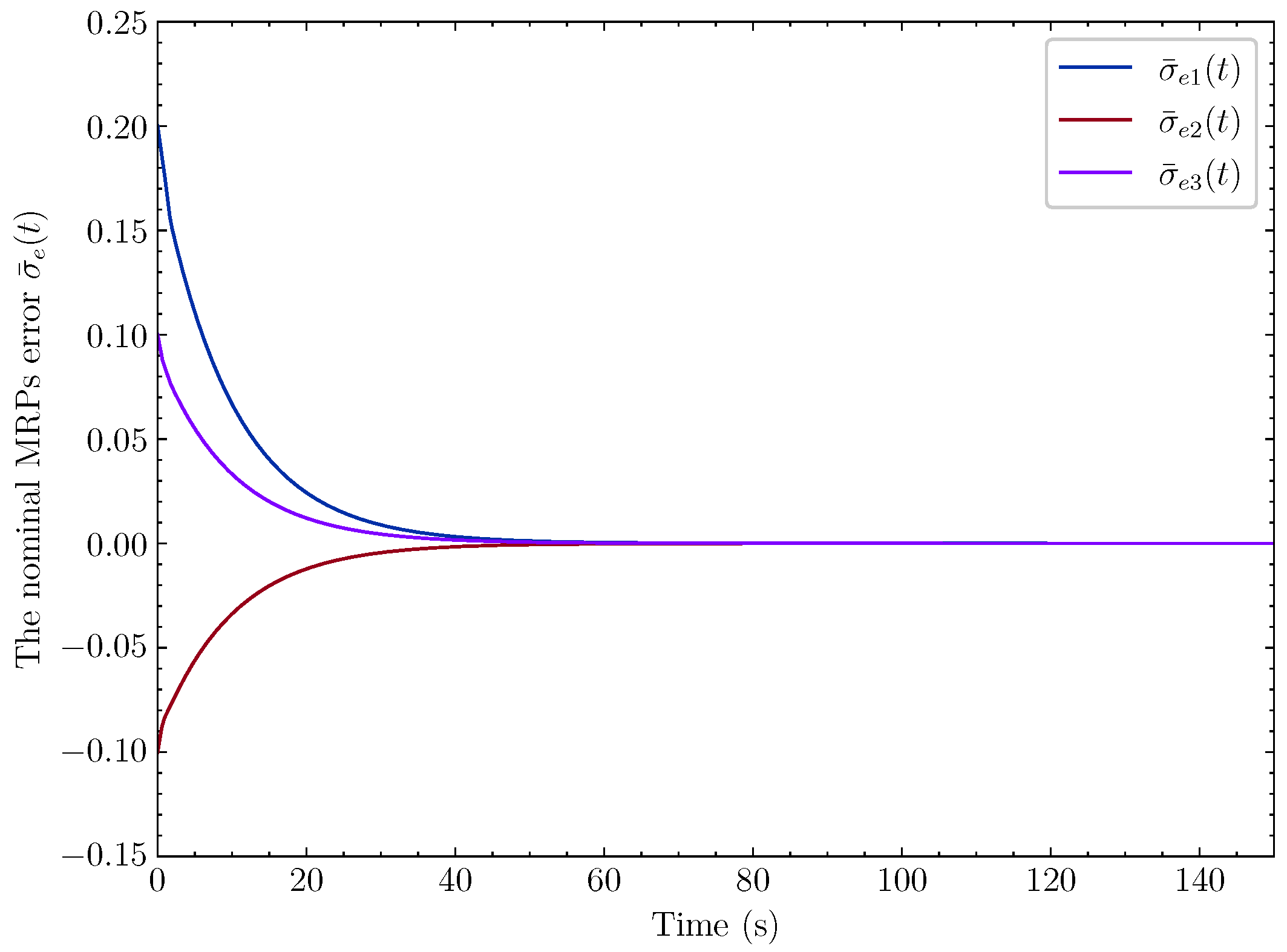
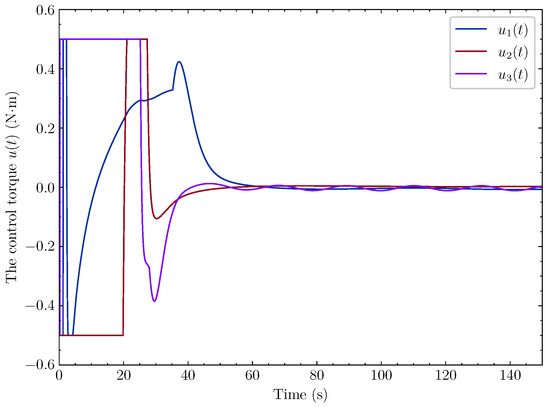
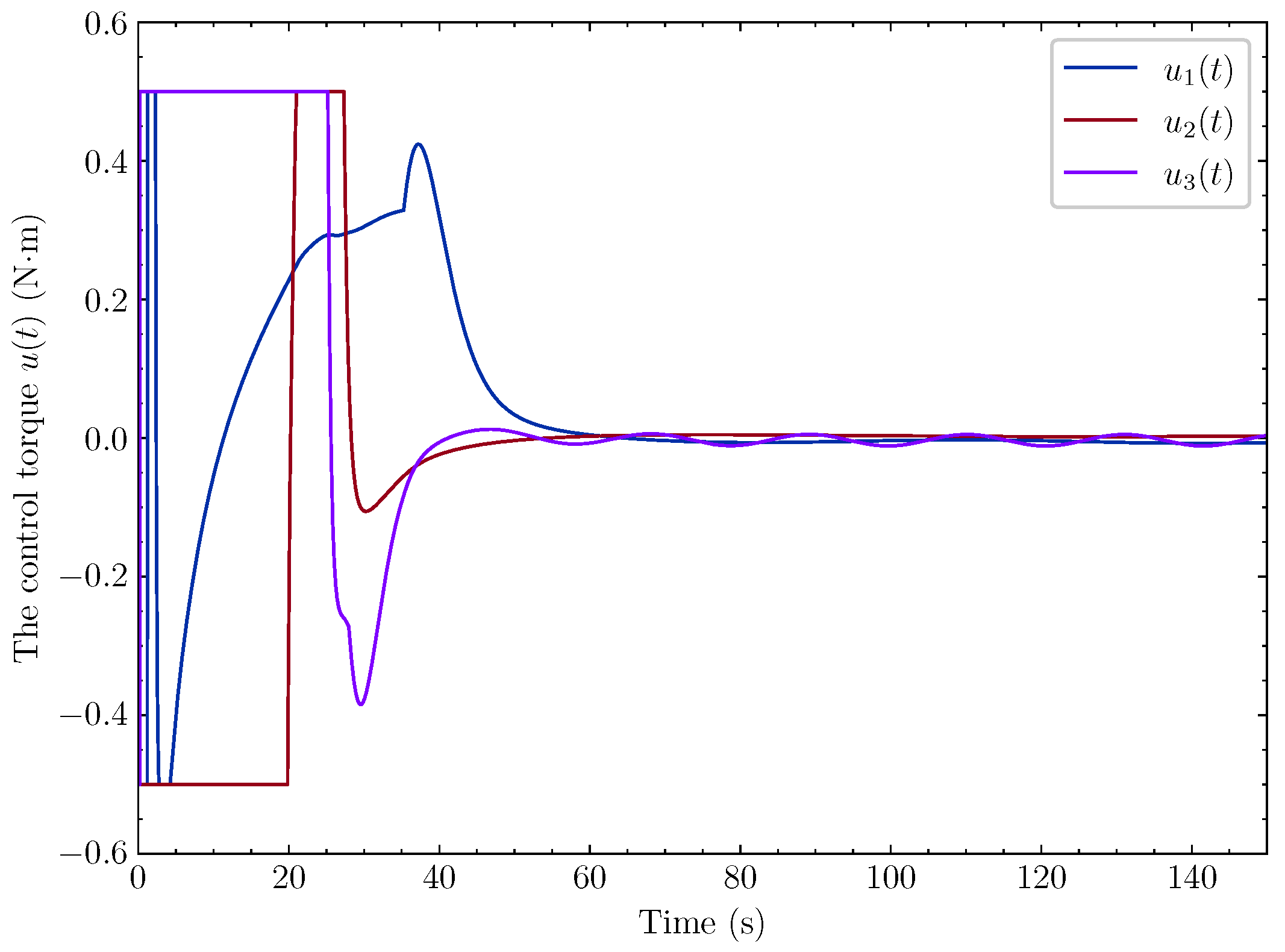
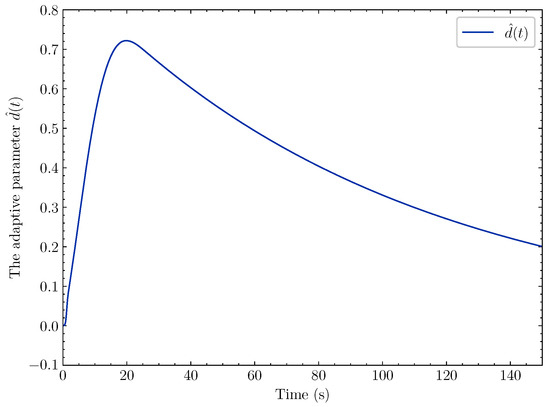
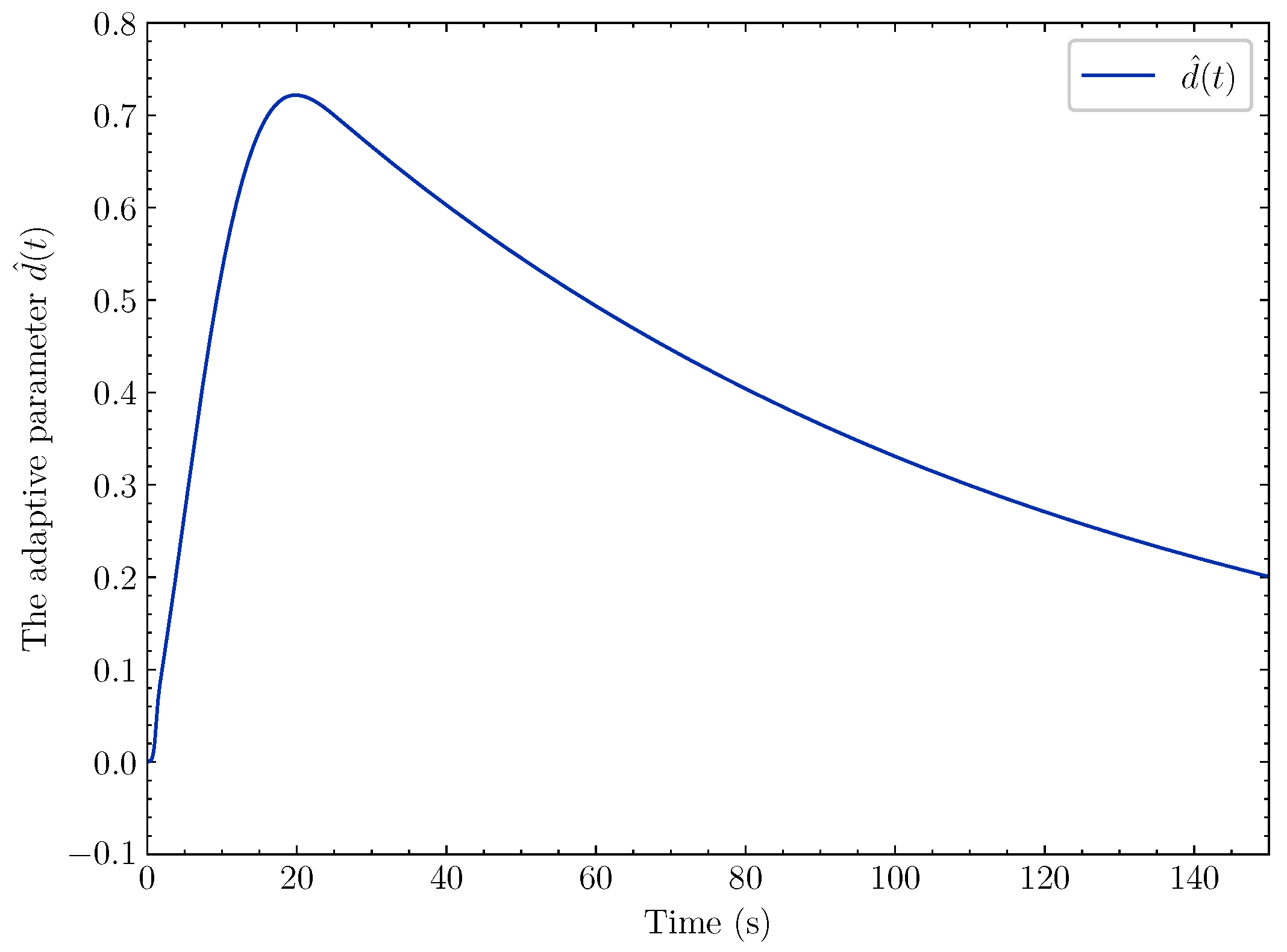
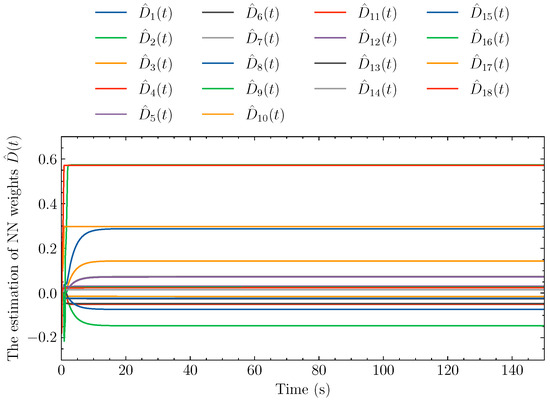
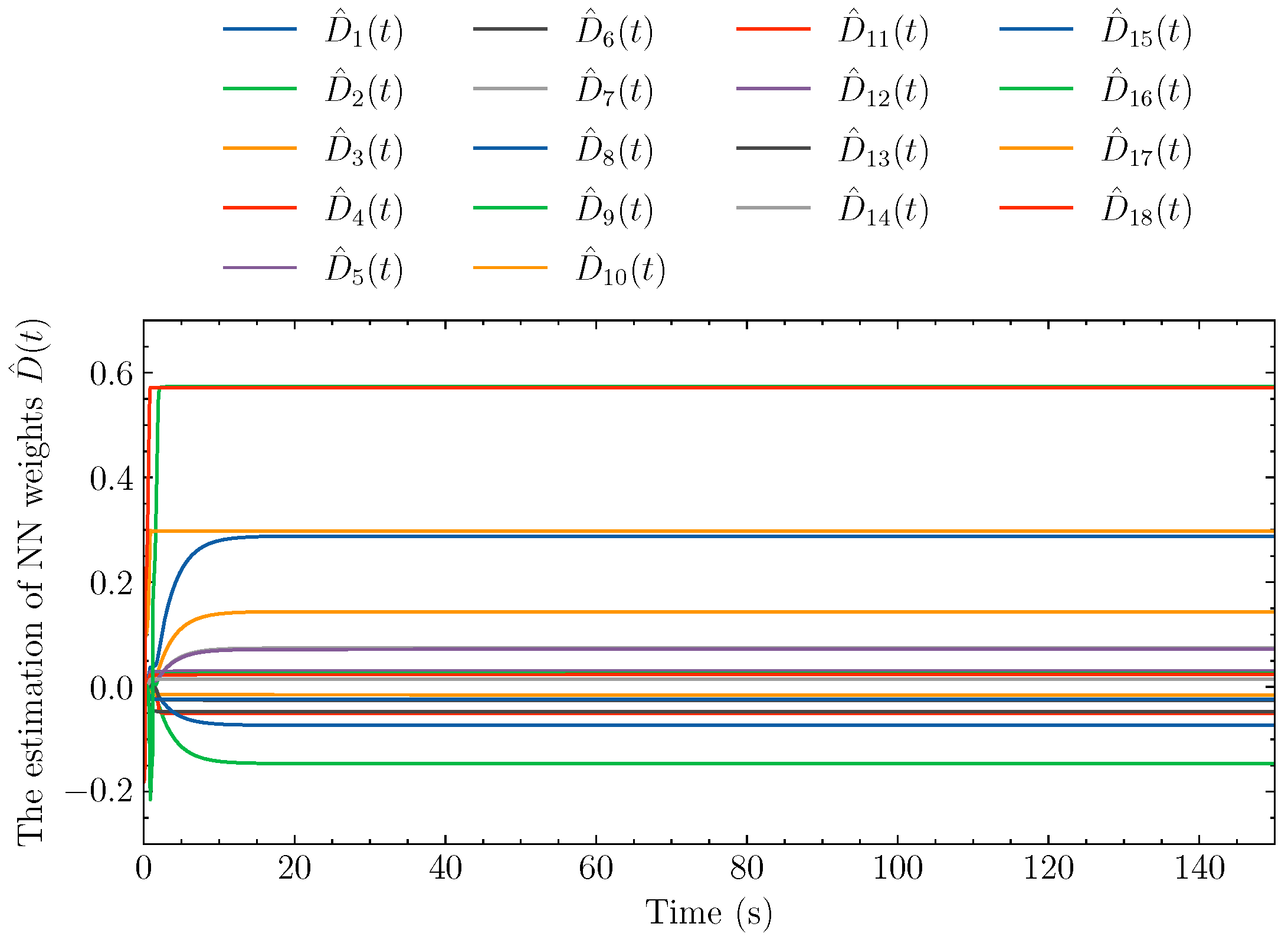
The simulation results have been shown in Figure 1, Figure 2, Figure 3, Figure 4, Figure 5 and Figure 6. Figure 1 and Figure 2 indicate the convergence of the error MRPs and the relative angular velocity of the spacecraft with the subplot showing that the steady-state errors are at the level of . Additionally, the nominal error MRP is plotted in Figure 3, where its convergence is clearly indicated. The control torque that is bounded by is shown in Figure 4 and the adaptive parameter is plotted in Figure 5. Figure 6 indicates the estimation of the ANN weight.
Figure 1.
Time responses of the error MRPs .
Figure 2.
Time responses of the relative angular velocity (rad/s).
Figure 3.
Time responses of the nominal error MRPs .
Figure 4.
The control torque (N·m).
Figure 5.
Time responses of the adaptive parameter .
Figure 6.
The estimation of the ANN weight .
5. Conclusions
This article has proposed a novel control method for spacecraft attitude reorientation with external unknown disturbances. Based on the tube-based framework formed by a nominal system and an error system, the design of the final control law has been divided into two parts: the nominal control law and the error control law. The adaptive dynamic programming technique is applied to the design of the nominal controller, which serves to provide a nominal trajectory to the desired attitude, and the nonsingular terminal sliding mode scheme is adopted when developing the error controller, which could lead the actual states to track the nominal trajectory. Through the Lyapunov approach, we have analyzed the control system stability and then verified its effectiveness via a numerical simulation. Compared to other methodologies, such as adaptive control, back stepping control, etc., which might cause overshooting of the system states during manoeuvrer control, the proposed ADP-based approach for spacecraft attitude reorientation is conducive to improving the optimal control performance and thus minimizing the energy consumption, while the tube-based framework and the NTSM scheme contribute to enhancing system stability and suppressing disturbances at the same time.
Author Contributions
S.L.: conceptualization; investigation; methodology. K.L.: validation; visualization; writing—original draft, review and editing. M.L.: conceptualization; funding acquisition; resources; supervision. All authors have read and agreed to the published version of the manuscript.
Funding
This work is supported by the Science Center Program of National Natural Science Foundation of China (Grant No. 62188101), National Natural Science Foundation of China (Grant No. 62273116), the Guangdong Major Project of Basic and Applied Basic Research (Grant No. 2019B030302001), the SiYuan Collaborative Innovation Alliance of Artificial Intelligence Science and Technology (Grant No. HTKJ2023SY502003), and the Heilongjiang Touyan Team.
Data Availability Statement
Data are contained within the article.
Conflicts of Interest
The authors declare no conflicts of interest.
References
- Li, L.; Zhou, X.; Hu, Z.; Gao, L.; Li, X.; Ni, X.; Chen, F. On-orbit monitoring flying aircraft day and night based on SDGSAT-1 thermal infrared dataset. Remote Sens. Environ. 2023, 298, 113840. [Google Scholar] [CrossRef] [Scilit]
- Jiao, B.; Sun, Q.; Han, H.; Dang, Z. A parametric design method of nanosatellite close-range formation for on-orbit target inspection. Chin. J. Aeronaut. 2023, 36, 194–209. [Google Scholar] [CrossRef] [Scilit]
- Xiao, Y.; de Ruiter, A.; Ye, D.; Sun, Z. Attitude Coordination Control for Flexible Spacecraft Formation Flying with Guaranteed Performance Bounds. IEEE Trans. Aerosp. Electron. Syst. 2023, 59, 1534–1550. [Google Scholar] [CrossRef] [Scilit]
- Chen, Z.; Chen, Q.; He, X.; Sun, M. Adaptive Backstepping Control Design for Uncertain Rigid Spacecraft with Both Input and Output Constraints. IEEE Access 2018, 6, 60776–60789. [Google Scholar] [CrossRef] [Scilit]
- Wang, Y.; Tang, S.; Guo, J.; Wang, X.; Liu, C. Fuzzy-Logic-Based Fixed-Time Geometric Backstepping Control on SO(3) For Spacecraft Attitude Tracking. IEEE Trans. Aerosp. Electron. Syst. 2019, 55, 2938–2950. [Google Scholar] [CrossRef]
- Wang, Y.; Ji, H. Integrated relative position and attitude control for spacecraft rendezvous with ISS and finite-time convergence. Aerosp. Sci. Technol. 2019, 85, 234–245. [Google Scholar] [CrossRef] [Scilit]
- Hou, Z.; Lan, X. Adaptive sliding mode and RBF neural network based fault tolerant attitude control for spacecraft with unknown uncertainties and disturbances. Adv. Space Res. 2024, 74, 1680–1692. [Google Scholar] [CrossRef] [Scilit]
- Gao, J.; Fu, Z.; Zhang, S. Adaptive Fixed-Time Attitude Tracking Control for Rigid Spacecraft with Actuator Faults. IEEE Trans. Ind. Electron. 2019, 66, 7141–7149. [Google Scholar] [CrossRef] [Scilit]
- Kang, Z.; Shen, Q.; Wu, S.; Damaren, C.J. Saturated adaptive pose tracking control of spacecraft on SE(3) under attitude constraints and obstacle-avoidance constraints. Automatica 2024, 159, 111367. [Google Scholar] [CrossRef] [Scilit]
- Liu, Q.Z.; Zhang, L.; Sun, B.; Xiao, Y.; Fan, G.W. Fixed-Time Disturbance Observer-Based Attitude Prescribed Performance Predictive Control for Flexible Spacecraft. IEEE Trans. Aerosp. Electron. Syst. 2024, 60, 3209–3220. [Google Scholar] [CrossRef] [Scilit]
- Xuan-Mung, N.; Golestani, M. Energy-Efficient Disturbance Observer-Based Attitude Tracking Control with Fixed-Time Convergence for Spacecraft. IEEE Trans. Aerosp. Electron. Syst. 2023, 59, 3659–3668. [Google Scholar] [CrossRef] [Scilit]
- Marshall, M.A.; Goel, A.; Pellegrino, S.R.M. Power-Optimal Guidance for Planar Space Solar Power Satellites. J. Guid. Control Dyn. 2020, 43, 518–535. [Google Scholar] [CrossRef] [Scilit]
- Li, Q.; Gao, D.; Sun, C.; Song, S.; Niu, Z.; Yang, Y. Prescribed performance-based robust inverse optimal control for spacecraft proximity operations with safety concern. Aerosp. Sci. Technol. 2023, 136, 108229. [Google Scholar] [CrossRef] [Scilit]
- Wang, P.; Zhang, X. Optimized Bézier-curve-based command generation and robust inverse optimal control for attitude tracking of spacecraft. Aerosp. Sci. Technol. 2022, 121, 107183. [Google Scholar] [CrossRef] [Scilit]
- Luo, W.; Chu, Y.C.; Ling, K.V. H-infinity Inverse Optimal Attitude-Tracking Control of Rigid Spacecraft. J. Guid. Control Dyn. 2005, 28, 481–494. [Google Scholar] [CrossRef] [Scilit]
- Huang, Y.; Zhang, Z.; Yang, X. Backstepping based neural H-infinite optimal tracking control for nonlinear state constrained systems with input delay and disturbances. Neurocomputing 2024, 595, 127869. [Google Scholar] [CrossRef] [Scilit]
- Liu, Y.; Ma, G.; Lyu, Y.; Wang, P. Neural network-based reinforcement learning control for combined spacecraft attitude tracking maneuvers. Neurocomputing 2022, 484, 67–78. [Google Scholar] [CrossRef] [Scilit]
- Wang, R.; Zhuang, Z.; Tao, H.; Paszke, W.; Stojanovic, V. Q-learning based fault estimation and fault tolerant iterative learning control for MIMO systems. ISA Trans. 2023, 142, 123–135. [Google Scholar] [CrossRef] [Scilit]
- Dierks, T.; Jagannathan, S. Optimal control of affine nonlinear continuous-time systems. In Proceedings of the 2010 American Control Conference, Baltimore, MD, USA, 30 June–2 July 2010; pp. 1568–1573. [Google Scholar] [CrossRef] [Scilit]
- Yang, H.; Hu, Q.; Dong, H.; Zhao, X. ADP-Based Spacecraft Attitude Control Under Actuator Misalignment and Pointing Constraints. IEEE Trans. Ind. Electron. 2022, 69, 9342–9352. [Google Scholar] [CrossRef] [Scilit]
- Xiao, B.; Zhang, H.; Chen, Z.; Cao, L. Fixed-Time Fault-Tolerant Optimal Attitude Control of Spacecraft with Performance Constraint via Reinforcement Learning. IEEE Trans. Aerosp. Electron. Syst. 2023, 59, 7715–7724. [Google Scholar] [CrossRef] [Scilit]
- Yuan, L.; Wang, L.; Zhang, J. Adaptive dynamic programming base on MMC device of a flexible high-altitude long endurance aircraft. Aerosp. Sci. Technol. 2024, 151, 109305. [Google Scholar] [CrossRef] [Scilit]
- Wei, Q.; Yang, Z.; Su, H.; Wang, L. Online Adaptive Dynamic Programming for Optimal Self-Learning Control of VTOL Aircraft Systems with Disturbances. IEEE Trans. Autom. Sci. Eng. 2024, 21, 343–352. [Google Scholar] [CrossRef] [Scilit]
- Jing, C.; Xu, H.; Niu, X.; Song, X. Adaptive Nonsingular Terminal Sliding Mode Control for Attitude Tracking of Spacecraft with Actuator Faults. IEEE Access 2019, 7, 31485–31493. [Google Scholar] [CrossRef] [Scilit]
- Qiao, J.; Li, Z.; Xu, J.; Yu, X. Composite Nonsingular Terminal Sliding Mode Attitude Controller for Spacecraft with Actuator Dynamics Under Matched and Mismatched Disturbances. IEEE Trans. Ind. Inform. 2020, 16, 1153–1162. [Google Scholar] [CrossRef] [Scilit]
- Zhang, L.; Wang, H.; Zhu, Y.; Yang, J. Tube-based attitude control of rigid-bodies with magnitude-bounded disturbances. Automatica 2021, 133, 109845. [Google Scholar] [CrossRef] [Scilit]
- Arjun Ram, S.P.; Akella, M.R. Uniform Exponential Stability Result for the Rigid-Body Attitude Tracking Control Problem. J. Guid. Control Dyn. 2020, 43, 39–45. [Google Scholar] [CrossRef] [Scilit]
- Li, Q.; Yuan, J.; Zhang, B. Extended state observer based output control for spacecraft rendezvous and docking with actuator saturation. ISA Trans. 2019, 88, 37–49. [Google Scholar] [CrossRef] [Scilit]
Disclaimer/Publisher’s Note: The statements, opinions and data contained in all publications are solely those of the individual author(s) and contributor(s) and not of MDPI and/or the editor(s). MDPI and/or the editor(s) disclaim responsibility for any injury to people or property resulting from any ideas, methods, instructions or products referred to in the content. |
© 2024 by the authors. Licensee MDPI, Basel, Switzerland. This article is an open access article distributed under the terms and conditions of the Creative Commons Attribution (CC BY) license (https://creativecommons.org/licenses/by/4.0/).