


Abstract
The Face Anti-Spoofing (FAS) methods plays a very important role in ensuring the security of face recognition systems. The existing FAS methods perform well in short-distance scenarios, e.g., phone unlocking, face payment, etc. However, it is still challenging to improve the generalization of FAS in long-distance scenarios (e.g., surveillance) due to the varying image quality. In order to address the lack of low-quality images in real scenarios, we build a Low-Quality Face Anti-Spoofing Dataset (LQFA-D) by using Hikvision’s surveillance cameras. In order to deploy the model on an edge device with limited computation, we propose a lightweight FAS network based on MobileFaceNet, in which the Coordinate Attention (CA) attention model is introduced to capture the important spatial information. Then, we propose a multi-scale FAS framework for low-quality images to explore multi-scale features, which includes three multi-scale models. The experimental results of the LQFA-D show that the Average Classification Error Rate (ACER) and detection time of the proposed method are 1.39% and 45 ms per image for the low-quality images, respectively. It demonstrates the effectiveness of the proposed method in this paper.
1. Introduction
With the rapid development of deep learning in computer vision, the accuracy and efficiency of face recognition technology have been significantly improved, and has been widely applied in intelligent security, criminal investigations, medical treatment, education, and other fields [1]. However, there are still many potential risks in the existing face recognition systems that are vulnerable to Presentation Attacks (PAs), ranging from print, replay, makeup, and 3D masks [2,3]. These spoofing attacks seriously threaten the security and reliability of face recognition systems, pose safety hazard to people’s property and privacy, and bring great challenges in public security management. Therefore, both academia and industry have paid extensive attention to developing Face Anti-Spoofing (FAS, namely, ‘face presentation attack detection’ or ‘face liveness detection’) technology for securing face recognition systems.
The existing FAS methods can be roughly divided into traditional handcrafted feature-based methods, hybrid (handcrafted + deep learning), and end-to-end deep learning methods. Traditional handcrafted feature-based FAS methods exploit human liveness cues [4,5,6,7] and handcrafted features [8,9,10,11,12,13,14,15]. The liveness cue-based methods explore dynamic discrimination, e.g., head movement [4], gaze tracking [5], eye-blinking [6], and remote physiological signals [7]. However, these physiological liveness cues are usually captured from long-term interactive face videos, which is inconvenient for practical deployment. The other handcrafted-based methods exploit the traditional descriptors (e.g., LBP [8], SIFT [9], and SURF [10]), texture [11,12], color distribution [13], and image quality [14,15] to extract effective spoofing patterns. The traditional handcrafted feature-based FAS methods need rich task-aware prior knowledge for design, the generalization ability of which is limited.
Deep learning and Convolutional Neural Network (CNN) have achieved great success in many computer vision tasks; however, they suffer from the overfitting problem for FAS tasks due to the limited amount and diversity of the training data. Therefore, the hybrid FAS methods (handcraft + deep learning) were proposed [16,17,18,19,20]. There are three types of hybrid frameworks: extracting deep convolutional features from the handcrafted features [16,17], extracting handcrafted features from deep convolutional features [18], and fusing the handcrafted and deep convolutional features for more generic representation [19]. Meanwhile, the emergence of large-scale public FAS datasets with rich attack types and recorded sensors together with the rapid development of learning techniques greatly boosts the end-to-end deep learning-based methods [21,22,23,24,25,26,27]. The deep learning FAS method mainly focuses on optimizing network structures [21,22,23,24] and integrating deep features [25,26,27] to improve its performance.
The FAS methods have achieved excellent performance in traditional scenarios, e.g., phone unlocking, face payment, and access authentication [2], in which the quality of the face images are high. However, FAS in long-distance scenes (i.e., surveillance), such as station squares, parks, and self-service supermarkets, has not yet been fully explored. The major reason is that the resolution of faces is low and contains noise from motion blur, occlusion, and other bad factors in surveillance scenarios, which results in the traditional FAS not being able to effectively generalize to faces with varying quality. Recovering the resolution of faces benefits the extraction of informative spoofing cues [28,29]; however, it is too hard to restore facial details from face images with unknown degradation processes. How to reduce the impact of image quality to further improve the generalization of FAS in surveillance scenes is still challenging. Domain generalization-based FAS methods [30] address the above problem by exploring adversarial learning to minimize the difference among source domains. Inspired by the idea of domain generalization, we simulate surveillance scenarios to build a large-scale face dataset with different qualities to learn quality-invariant features. Then, we propose a lightweight FAS network to further improve the generalization by learning quality-invariant features. Specifically, we simulate the surveillance scenarios to build a large-scale face dataset with different qualities. Then, we optimize MobileFaceNet by [31] introducing the Coordinate Attention (CA) module [32]. Finally, we train the proposed FAS network on the built dataset.
Our contributions are as follows:
- (1)
- We build a Low-Quality Face Anti-Spoofing Dataset (LQFA-D), which contains a large number of low-quality images by simulating surveillance scenarios.
- (2)
- We propose a lightweight FAS network for low-quality images based on MobileFaceNet [31], in which we introduce the CA module [32] for informative feature extraction.
- (3)
- We implement the proposed model and train multi-scale models by using face images with multi-scales, and we obtained the final detection results by fusing the multi-scale models. The experimental results show that the proposed FAS method has advantages in terms of accuracy and efficiency for low-quality face images.
2. Related Work
2.1. Face Anti-Spoofing (FAS)
2.1.1. Handcrafted and Hybrid Methods
Traditional handcrafted feature-based FAS methods mainly explore the traditional descriptors, e.g., LBP [8], SIF [9], and SURF [10], etc. Motivated by that deep learning and CNNs have achieved great success in many computer vision tasks. Some recent studies have proposed hybrid frameworks to combine handcrafted features with deep features for FAS. One of the hybrids extracts handcrafted features from face inputs firstly, and then employs CNNs for semantic feature extraction. Chen et al. [16] adopted multi-scale color LBP features as local texture descriptors, then a random forest was cascaded for semantic representation. Li et al. [17] captured illumination changes using a 1D CNN with inputs of the intensity difference histograms from reflectance images. The other type is to extract handcrafted features from deep convolutional features. Shao et al. [18] extracted motion features using optical flow from the sequential convolutional features. Another hybrid framework is to fuse the handcrafted and deep convolutional features for a more generic representation. Sharifi et al. [19] fused the predicted scores from both handcrafted LBP features and a deep VGG16 model. Li et al. [20] extracted intensity variation features via a 1D CNN, which were fused with the motion blur features from motion magnified face videos.
2.1.2. End-to-End Deep Learning-Based Methods
In recent years, deep learning techniques have largely promoted the development of FAS methods. On the one hand, more and more advanced network structures have been used in FAS. Yang et al. [21] proposed the first deep learning-based FAS, in which a CNN was used to extract features being fed into an SVM for classification. Xu et al. [22] used Long Short-Term Memory (LSTM) and a CNN together to explore sequential information, which effectively improves its accuracy. Tu et al. [23] used a pre-trained ResNet50 and transfer learning to further optimize the LSTM-CNN model. Yu et al. [24] designed a new Central Difference Convolutional Network (CDCN) and proposed the advanced version CDCN++ by assembling a multi-scale attention fusion module. One the other hand, many studies have tried to focus on pre-processing and feature fusion strategies to improve the performance of FAS. Alotaibi et al. [25] considered that the boundary of facial features should be degraded after nonlinear diffusion in the 2D spoofing faces, which should be retained in live faces; therefore, they used nonlinear diffusion to process face images and then used a CNN to extract features. Atoum et al. [26] proposed a two-channel CNN-based FAS method, which combined local features and depth information. Liu et al. [27] proposed a CNN-RNN FAS framework which learned the features from the depth map and remote Photoplethysmography (rPPG) signal.
2.1.3. FAS Methods for Low-Quality Face Images
To improve the generalization of FAS methods in surveillance scenes, in which the captured images usually have low quality since they offer suffered from low resolution, motion blur, occlusion, bad weather, and other bad factors. The method [23] attempted to recover high-resolution faces from low-resolution faces to extract informative spoofing cues. Aravena et al. [33] discarded some low-quality samples in training to improve the performance. In [28], an attention-based FAS network with feature augmentation was proposed for low-quality face images, which consists of the depth-wise separable attention module and the multi-modal-based feature augmentation module. Fang et al. [29] proposed a quality-invariant contrastive learning network to alleviate the performance degradation caused by image quality. In [34], the image quality degradation was regarded as a domain generalization problem and an end-to-end adversarial domain generalization network was proposed to improve the generalization of FAS. In [35], a dynamic feature queue and progressive training strategy were proposed to enhance the generalization ability of the FAS in long-distance settings.
2.2. Face Anti-Spoofing Dataset
Large-scale FAS databases paly a key role in deep learning-based methods; however, it is time-consuming and expensive to build large-scale datasets due to the diversity of spoofing attacks. Ref. [36] proposed the first public FAS dataset, which used a generic webcam to collect 5105 live face photos and 7509 spoofing face photos in different locations and illumination conditions. The spoofing attacks in [37] include complete color face photos, photos with the eyes covered, and videos. [38] used the high-resolution front-facing cameras of six smartphones to collect images in multiple settings, different light conditions, and different backgrounds. The spoofing photos were printed by two different printers, and spoofing videos were presented by two different display devices. [27] collected live and spoofing face images from 165 individuals, in which the spoofing attacks include two printing attacks and four video attacks. In the collection process, the changes in terms of distance, face pose, face expression, and external illumination were considered. [39] proposed a large-scale FAS dataset which includes three printing attacks, three paper cut attacks, three video attacks, and one 3D mask attack. It collected 625,537 images from 10,177 individuals in eight scenes. The face images in the existing public datasets were captured at a short distance, and the image quality of these are very high and contains plenty of texture details. There is a gap between the captured images in the above datasets and those captured in long-distance scenarios.
3. Face Anti-Spoofing Dataset of Low-Quality Images
Due to the lack of low-quality face images collected from practical applications, we built a Face Anti-Spoofing Low-Quality Image (LQFA-D) dataset by simulating surveillance scenarios, which can be used to train or test learning based models.
3.1. Collection System
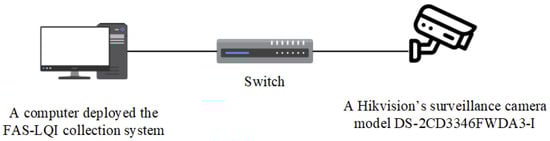
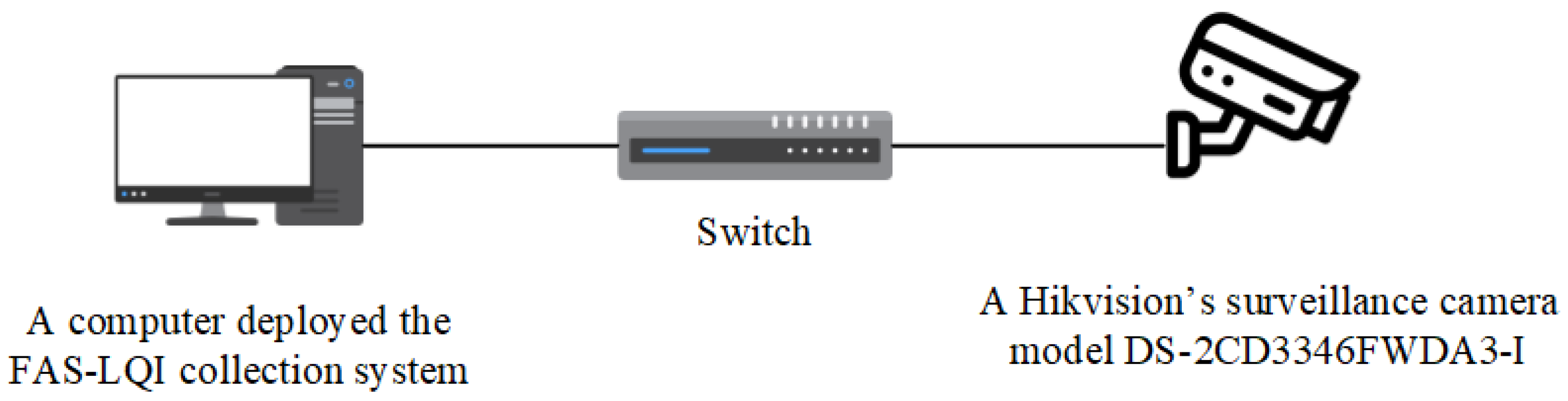
The architecture of the LQFA-D collection system is shown in Figure 1. The front end is equipped with Hikvision’s surveillance cameras DS-2CD3346FWDA3-I, which have a 1/3 progressive scan CMOS sensor and support the fast detection and capture of faces in motion. The backend part of the LQFA-D collection system is developed with the official SDK provided by Hikvision. It is implemented with Java8 and deployed in a computer with Windows 10. After establishing a connection with the camera through the local area network, the captured face images are transmitted to the backend and saved.
Figure 1.
The overall architecture of LQFA-D collection system.
- (1)
- In order to simulate real application scenarios and obtain large numbers of low-quality face images, we configured the camera as follows. Set the width and height of the captured image to be 1.5 times and twice the width of the face, respectively.
- (2)
- Adjust the speed of target generation and detection sensitivity to the maximum.
- (3)
- Enable rapid image capturing, set the threshold of capturing to 40 images per second, set the maximum time of capturing a single image to 1 s, and set the number of capturing to be unlimited.
3.2. Collection Process
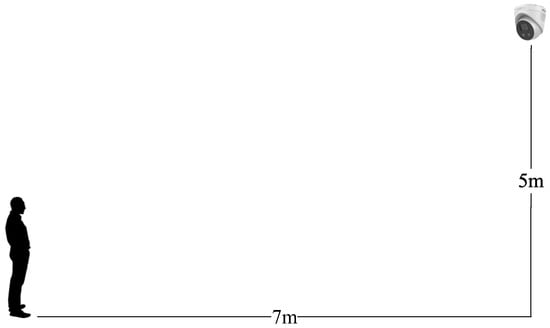
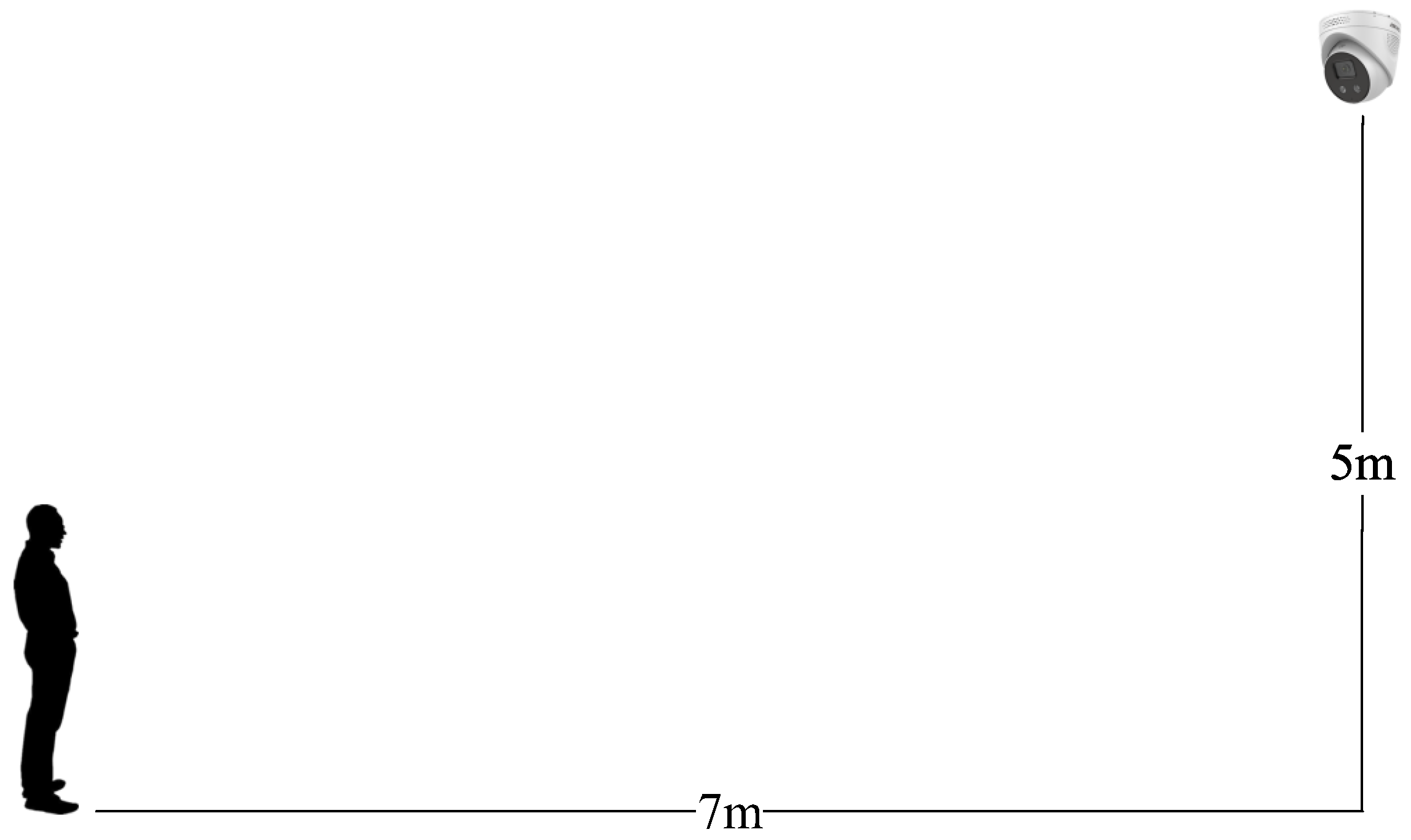
As shown in Figure 2, the camera is hung on the wall about five meters above the ground, and the subject stands at a horizontal distance about seven meters away from the camera. At this distance, the face occupies a very small part of the whole monitoring picture, which makes the captured image of the face low-resolution and fuzzy. In order to collect images under different conditions, we collected face images in the afternoon with strong sunlight, in the evening with dim light, and under normal light. For collecting live face images, the subject faced the camera to reveal the complete face and walked around freely. For collecting the spoofing face images, the subject held up a spoofing medium (A4 paper or Ipad) to completely cover the face. Several live face images and spoofing face images of each subject were captured in different scenarios.
Figure 2.
The position between the camera and the subject.
3.3. Statistics of LQFA-D
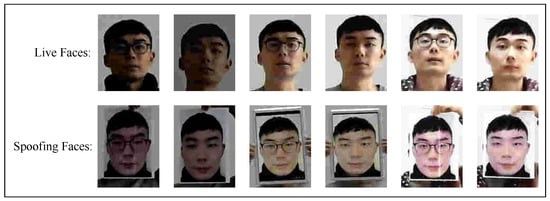
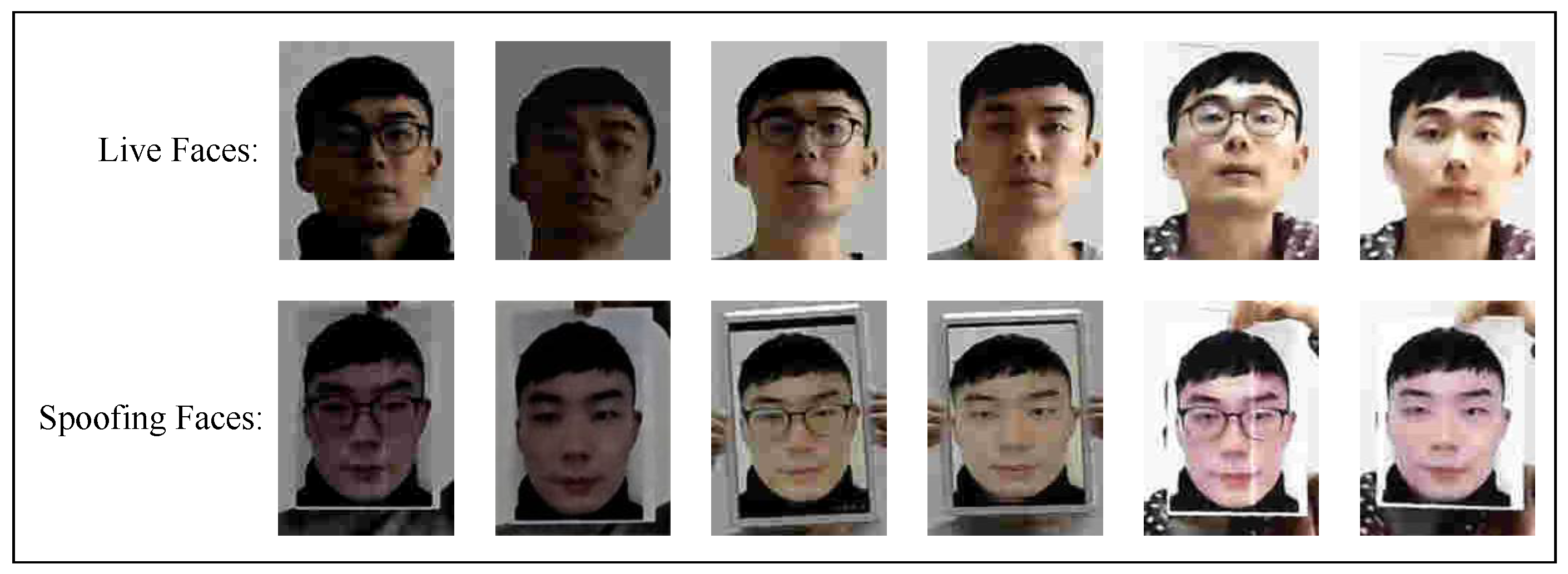
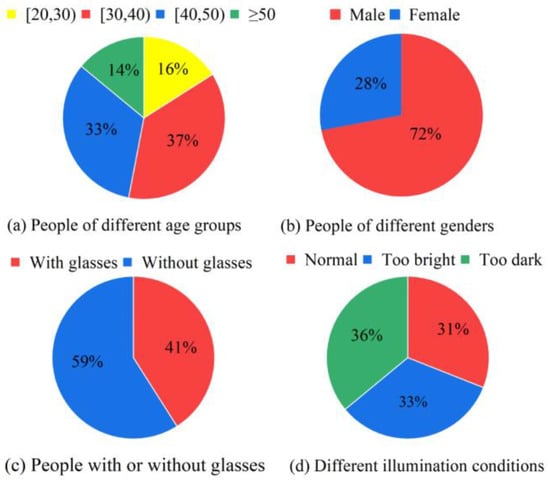
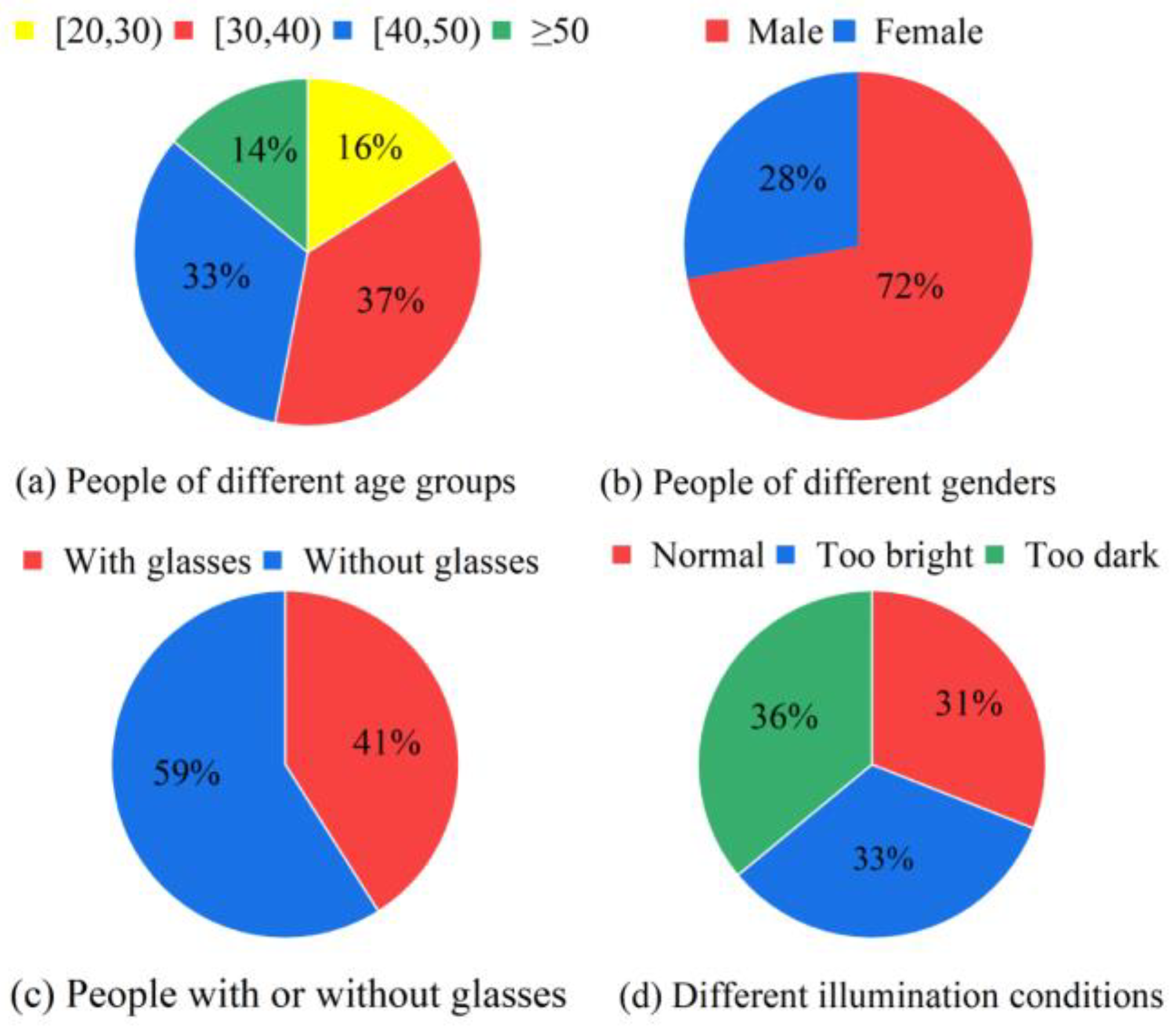
After preprocessing, 21,504 face images (7356 live face images and 14,108 spoofing face images) were selected for the LQFA-D. Figure 3 shows samples of the LQFA-D, which include printing attacks and video attacks. The face color photos were printed by a HP printer, and the videos were presented by an Ipad. The LQFA-D covers different age groups and genders, people with or without glasses, as well as a variety of illumination conditions and face poses. As shown in Figure 4a, the LQFA-D contains people over 20 years old, the proportion of people in the [20, 30), [30, 40), [40, 50), >50 age group is 16%, 37%, 33% and 14%, respectively. As shown in Figure 4b,c, the ratio of males to females is about 7:3, and the ratio of people with glasses to people without glasses is roughly 4:6. As shown in Figure 4d, the number of images in strong light, dim light, and normal light is almost equal. Limited by the camera performance, shooting distance, and illumination conditions, the images in the LQFA-D are low-resolution and have varying degrees of noise and are fuzzy, too bright, or too dark, which meets the requirements of low-quality images.
Figure 3.
Part of the samples in LQFA-D.
Figure 4.
The data distribution of LQFA-D.
4. A Silent Face Anti-Spoofing Method for Low-Quality Images
In practical applications, the computing ability of edge devices such as surveillance cameras and industrial computers are limited. In order to achieve real-time detection as much as possible under the premise of ensuring accuracy, we propose a FAS method for low-quality images based on a high-precision and lightweight model.
4.1. Model Structure
MobileFaceNet [31] is not only a lightweight model—the model size is only 4 MB and the number of parameters is less than 1 M—but it also achieves an excellent accuracy performance. Therefore, we propose the model by employing the key ideas from MobileFaceNet: (1) Depth-wise separable convolutions were employed instead of the standard convolution operation, which reduced the size of the parameters. (2) The shortcut technique was also used to improve feature extraction. The attention mechanism allows models to focus on important information in data processing, which has been widely used in various computer vision tasks to improve the efficiency and accuracy. As we know, Squeeze-and-Excitation (SE) [40], Efficient Channel Attention (ECA) [41], and CA [32] are three of the most used attention mechanisms in visual tasks. The SE module enhances the important features by capturing global information, and ECA reduces the computational complexity of the SE module by generating channel attention through local interaction information. However, both SE and ECA only focus on the channel attention and ignore the spatial information. CA combines spatial and channel information by decomposing the channel attention mechanism into a two-step process to capture long-range dependencies. The FAS algorithm distinguishes live faces from spoofing faces, in which the spoofing face (e.g., imaging distortion, borders with attack medium, etc.) often appear in specific regions of the image. Therefore, we introduced the CA attention module to capture the spatial attention; moreover, the CA attention module is a lightweight attention mechanism suitable for lightweight networks.
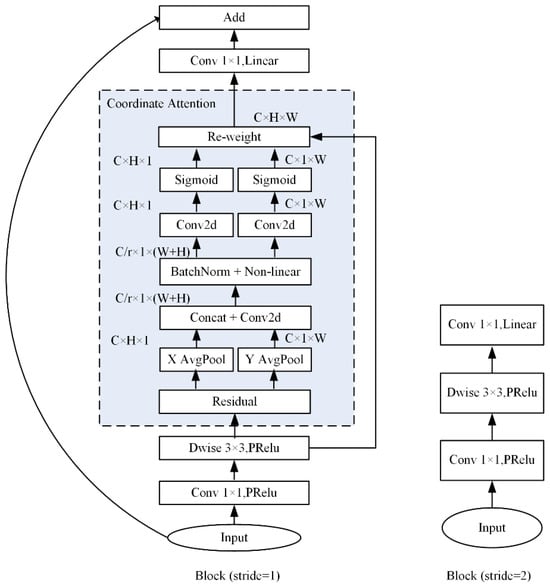
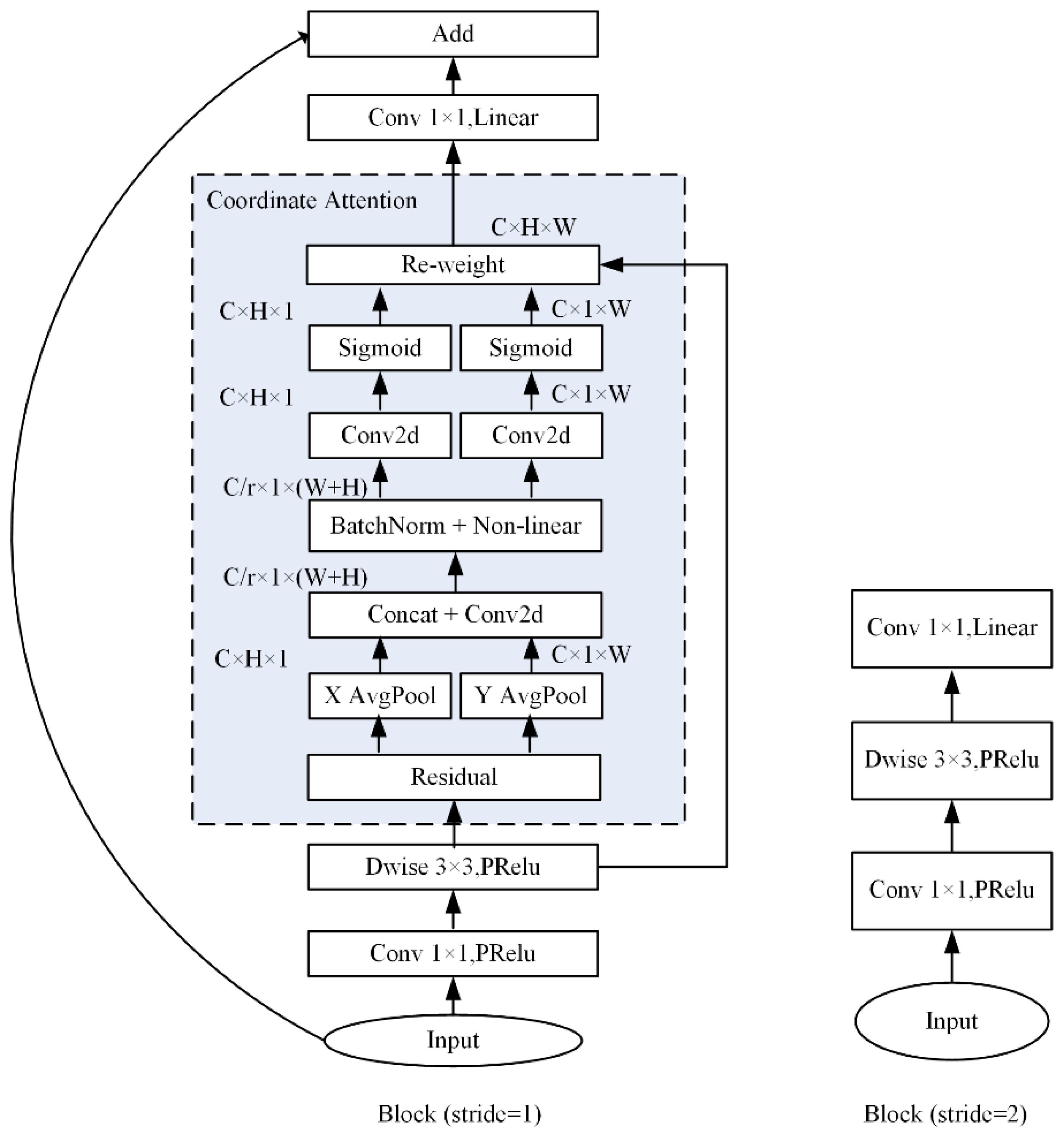
Figure 5 shows the proposed bottleneck that was modified from the inverted residual bottleneck of MobileFaceNet by incorporating the CA module into the block (stride 1). In the block (stride 1), a 1 × 1 convolution layer followed with a PRelu action function was used to expand the input dimensions to enhance the feature representation. Then, a 3 × 3 depth-wise convolution layer (stride 1) followed with PRelu was used to perform the convolution, in which each feature channel was processed by one kernel individually. The depth-wise convolution reduced the parameter scale at the cost of missing the information integration across the channels. There are two paths for the output feature; one is to feed into the CA module to estimate the attention weights. The input feature map is first subjected to global average pooling along the horizontal (X Avg pool) and vertical (Y Avg pool) directions to generate two feature maps; the two feature maps were concatenated and fed into a 2D convolution layer to reduce the channels. After the batch normalization, no-liner action, 2D convolution, and Sigmoid action processes, a C × H × W weight matrix (attention weights) was obtained and was used to weight the input feature. After re-weighting the features, a 1 × 1 point-wise convolution kernel followed with a linear action function was used to fuse the separate features among the different channels. The fused features and the input were added through a shortcut connection. The block (stride 2) was kept the same as that of MobileFaceNet, the stride of the 3 × 3 depth-wise convolution layer was 2, and there was no shortcut connection.
Figure 5.
The bottleneck of the proposed model.
Table 1 shows the configuration of the proposed model. The input is a 80 × 80 RGB face image, the number of bottlenecks (stride 1) is 12, the extracted feature is pooled by the global depth-wise convolution, the output of the network is a binary classification, and the loss is binary cross-entropy.
Table 1.
The architecture of the proposed model.
4.2. Framework
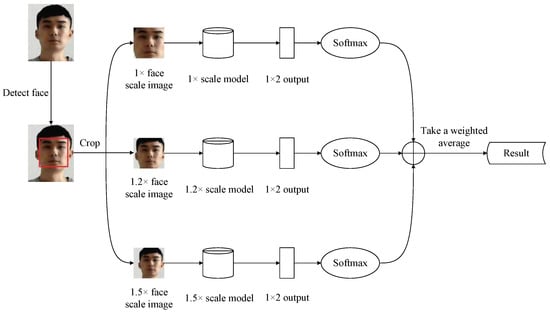
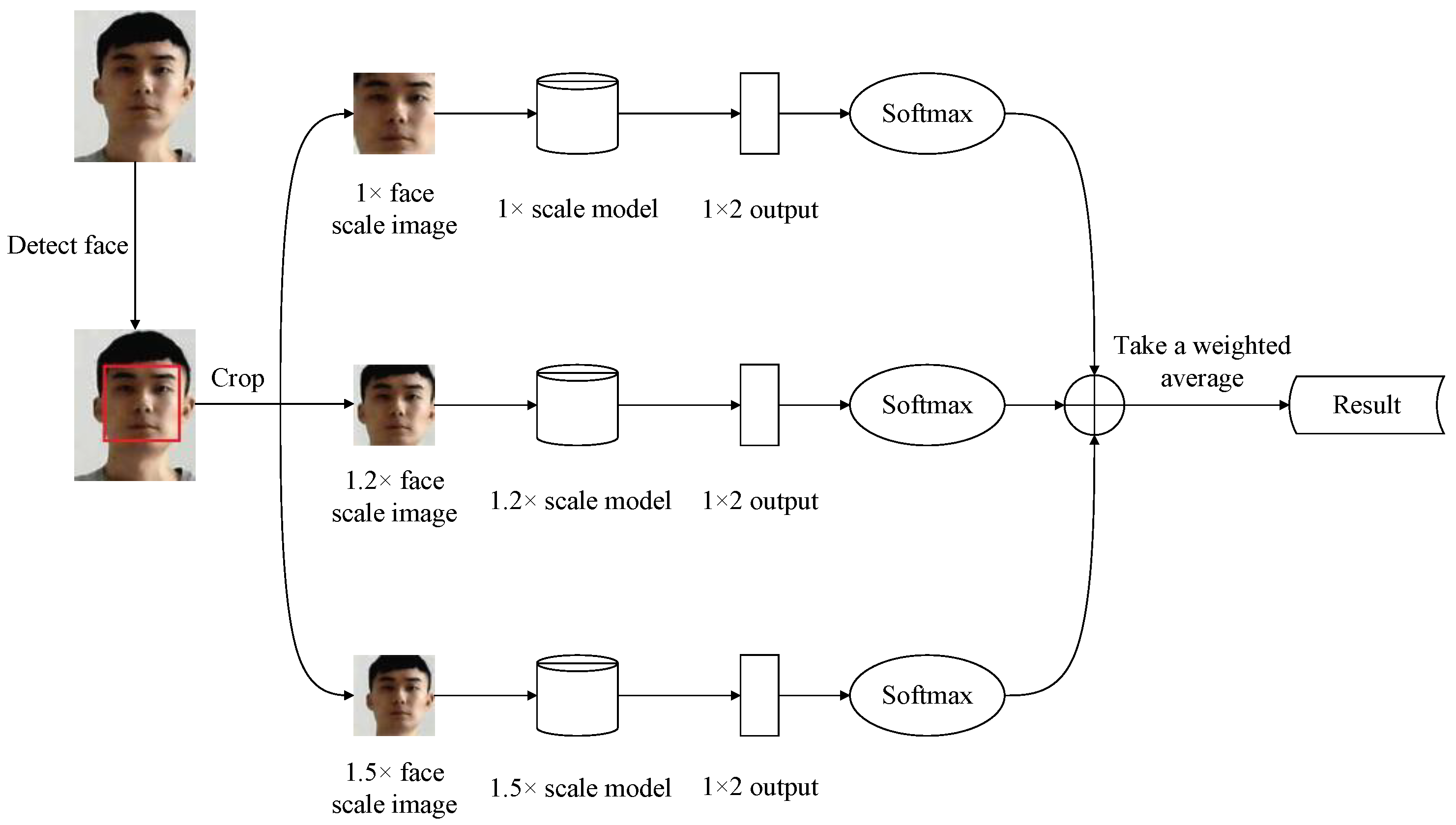
To explore the information of the face, background information, and attack medium border, we proposed a multi-scale model-based detection framework (shown in Figure 6). Firstly, the face box is detected by the face detection algorithm RetinaFace [42] from the original/rescaled input image to obtain 1×, 1.2× and 1.5× scale face images. The 1× face scale image is cropped along the face box from the original input image that mainly contains the face details. The input image is rescaled by 1.2 and 1.5 times, and from this the 1.2× and 1.5× face scale images are cropped, which contain the face, background information, or the attack medium border. Then, the 1×, 1.2× and 1.5× scale face images are resized to 80 × 80 and fed into the 1×, 1.2× and 1.5× scale models. The configurations of the 1×, 1.2×, and 1.5× scale model are kept the same (shown in Table 1), and are trained by the 1×, 1.2×, and 1.5× face scale images, respectively. The models obtain a two-channel output from the extracted features, and output the probabilities of being a positive and negative sample using Softmax. Finally, the proposed method takes a weighted average of the three outputs to obtain the final results. The proposed multi-scale framework aims to exploit the complementarity of the multi-scale images, which not only exploits the living analysis from the face detail information, but also uses the important auxiliary discrimination information from the no-face region. This effectively solves the problem of detail loss in low-quality face images and improves the accuracy.
Figure 6.
The framework of the proposed method.
5. Experimental Results and Analysis
In order to comprehensively evaluate the detection performance of the proposed method, we conduct comprehensive experiments on the self-built dataset LQFA-D. The proposed method is compared with CDCN, CDCN++, MobileFaceNet, MobileFaceNet+SE and MobileFaceNet+CA methods in terms of the detection accuracy. We also count and analyze the accuracy of the proposed method when facing different people and illumination conditions. The proposed method is compared with CDCN, CDCN++, MobileFaceNet, MobileFaceNet+SE, and MobileFaceNet+CA in terms of model size and computation time.
5.1. Setup
The proposed model was implemented with Pytorch 1.2.0 and Python 3.7. All models were run in a computer with Intel(R) Core(TM) i5-9300HF CPU @ 2.40 GHz, 16 GB RAM, NVIDIA GeForce GTX 1660ti and Windows 10. We use LQFA-D for model training and testing. The live faces were labeled as positive samples and spoofing faces were labeled as negative samples, respectively. The LQFA-D was randomly divided into a training and testing sub-set at a ratio of 8:2; the training dataset contained 17,200 images and the test data contains 4304 images. In order to enhance the richness and diversity of the data, we performed random cropping, rotation, scaling, flipping, color transformation, and other operations on the input image during training. In the training stage, the model was trained by an SGD optimizer with momentum. The initial learning rate and weight decay were 1 × 10⁻² and 5 × 10⁻⁴, respectively. We trained the model with a maximum of 50 epochs and set the batch size to 256, while the learning rate reduced tenfold every 15 epochs. We used the Attack Presentation Classification Error Rate (APCER), Normal Presentation Classification Error Rate (NPCER), and Average Classification Error Rate (ACER) as the evaluation metrics of the detection accuracy. In addition, the model size was measured by Floating Point Operations (FLOPs) and the number of parameters. And the detection efficiency was measured by the average computation time per image.
5.2. Experimental Results
5.2.1. Evaluation of the Proposed Method
Table 2 shows the detection accuracy of CDCN, CDCN++, MobileFaceNet, MobileFaceNet+SE, MobileFaceNet+CA and the proposed method in this work.
Table 2.
The comparison results between the proposed method and other methods in detection accuracy.
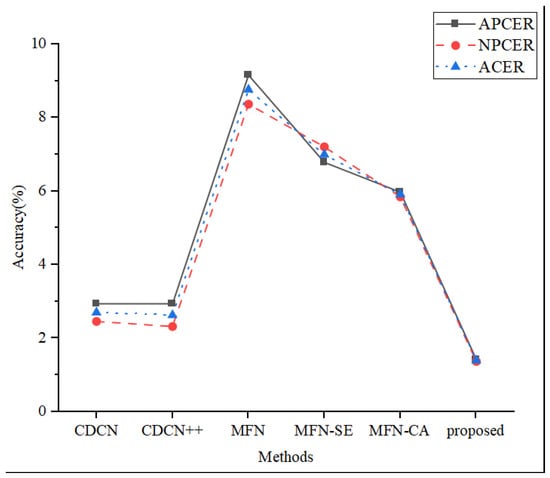
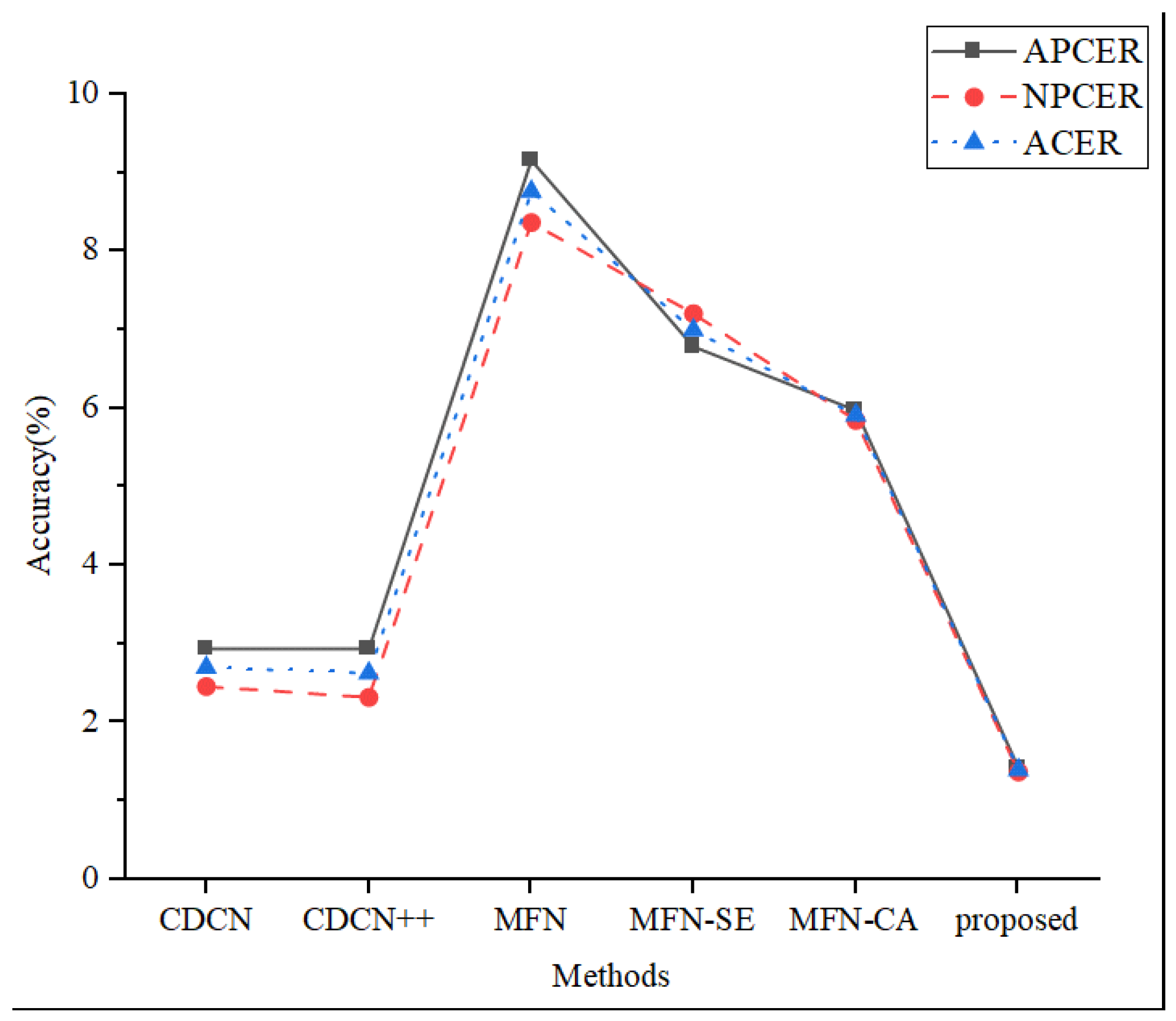
It can be seen that the APCER, NPCER, and ACER of the proposed model are 1.41%, 1.36%, and 1.385%, which are the lowest detection errors among the compared methods. Specifically, the accuracy of the proposed method is slightly better than that of CDCN (2.93%, 2.45%, 2.69%) and CDCN++ (2.93%, 2.31%, 2.62%), and much better than that of MobileFaceNet, MobileFaceNet+SE, and MobileFaceNet+CA. The reason for this is that the proposed method fuses multi-scale features by the three different scale models, in which each model is complementary to each other. The fusing framework not only uses the face details from the face region, but also exploits auxiliary information from the no-face area. This increases the detection accuracy significantly. Therefore, even if the proposed method is implemented based on the lightweight model, its performance is better than that of the single network. In addition, MobileFaceNet+CA is significantly better than MobileFaceNet and MobileFaceNet+SE in terms of the detection accuracy. This indicates that CA is more suitable for FAS than SE, which can cause a significant performance improvement to the proposed model. The detection results are also plotted in Figure 7.
Figure 7.
Detection accuracy of the FAS methods.
To comprehensively evaluate the proposed model, Table 3, Table 4, Table 5 and Table 6 show the detection accuracy for different age groups, different genders, people with/without glasses, and different illuminations, in which TOTAL represents the number of all the samples in this category. TP represents the positive samples predicted by the model as positive. FP represents the negative samples predicted by the model as positive. FN represents the positive samples predicted by the model as negative. And TN represents the negative samples predicted by the model as negative.
Table 3.
The detection results of different age groups.
Table 4.
The detection results of different genders.
Table 5.
The detection results of people with or without glasses.
Table 6.
The detection results of different illumination conditions.
As Table 3 shows, the APCER, NPCER, and ACER of the [20, 30), [30, 40), [40, 50), and ≥50 age groups are (2.5%, 0, 1.25%), (1.32%, 1.92%, 1.62%), (1.04%, 1.72%, 1.38%), and (1.80%, 1.28%, 1.54%), respectively. It can be seen that the accuracy gap is small; therefore, the proposed model is unbiased towards images of people of different ages and maintains high accuracy. We can observe a similar phenomenon in Table 4 and Table 5, and it can be concluded that the proposed model is unbiased towards images of people of different ages, different genders, and with/without glasses; meanwhile, it has a high accuracy. It can be seen from Table 4 that the APCER, NPCER, and ACER of the normal light, too bright, and too dark conditions are (0.43%, 0, 0.215%), (0.41%, 0.81%, 0.61%), and (3.46%, 3.10%, 3.28%), respectively. The proposed method is easily affected by the illumination condition, especially the dim light condition (too dark), for which the detection error is much higher than that of the normal light and too bright conditions. The reason for this is that the texture details of the face images captured in a dim light environment (too dark) were lost, which affected the detection accuracy.
5.2.2. Complexity Analysis
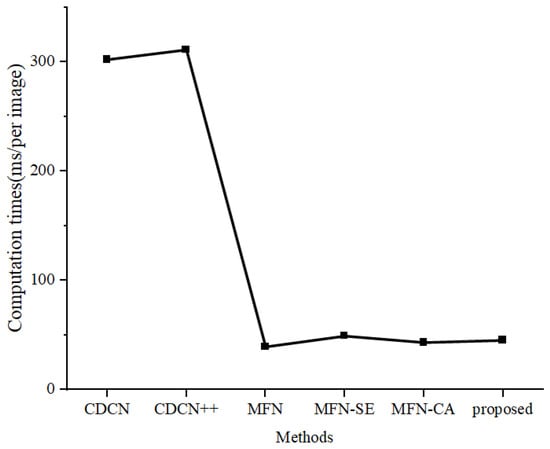
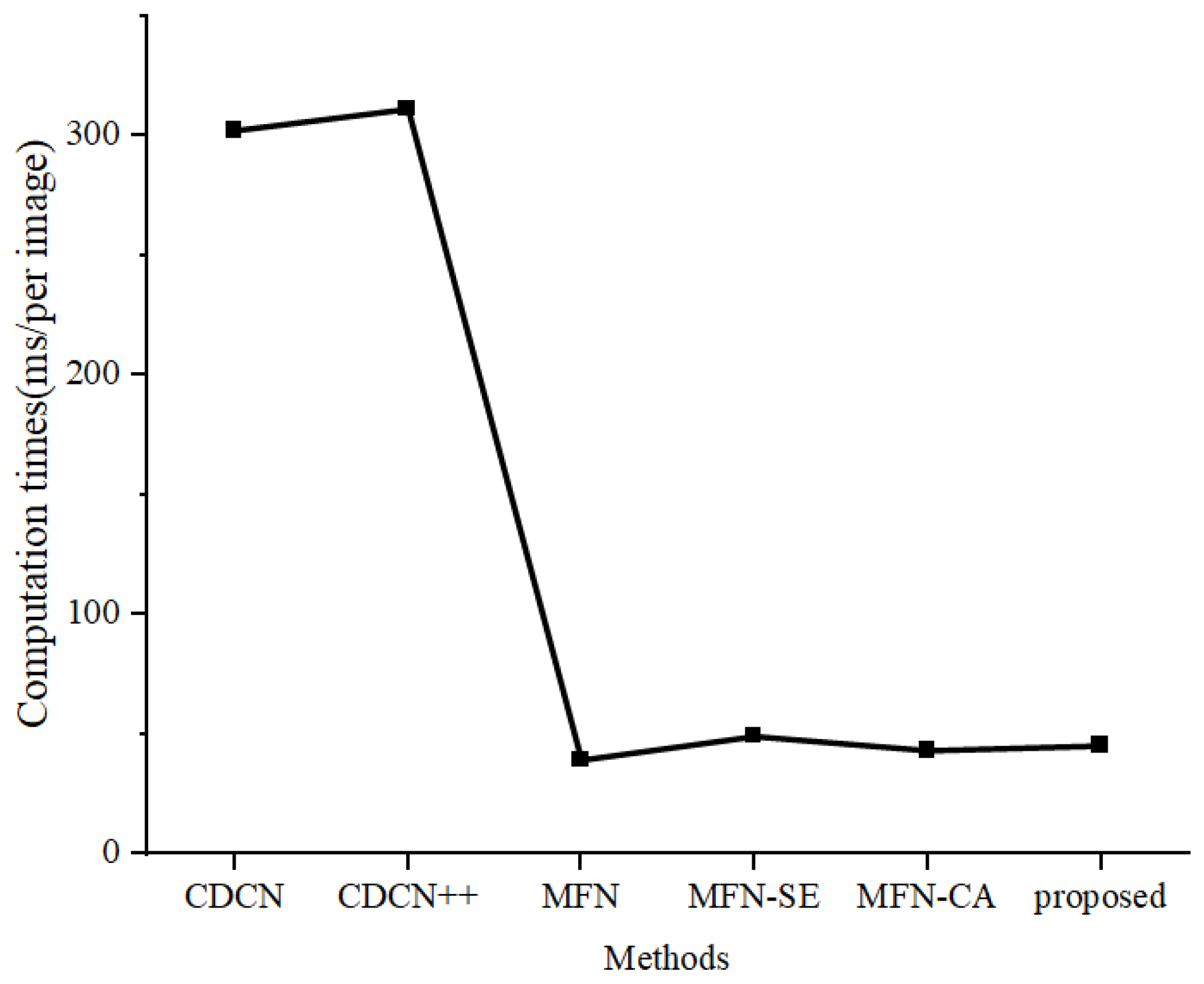
Table 7 shows the model size and detection time of CDCN, CDCN++, MobileFaceNet, MobileFaceNet+SE, MobileFaceNet+CA, and the proposed method. It can be seen that the FLOPs of MobileFaceNet+CA is only 0.242 G, the number of parameters is less than 1 M, and the average computation time per image is only 43 ms. The detection time of the proposed model is significantly less than that of the CDCN and CDCN, nearly equal to that of MobileFaceNet+SE, and slightly more than that of MobileFaceNet. The proposed method consists of three models working in parallel; the extra time was mainly spent on image cropping. The detection times per image are also plotted in Figure 8.
Table 7.
The comparison results between the proposed method and other methods in model size and detection efficiency.
Figure 8.
The computation time of the FAS methods.
As shown in Table 2 and Table 7, the model size and detection time of the proposed single model is slightly worse than that of MobileFaceNet; however, the detection accuracy of the proposed model has been significantly improved after introducing CA. Therefore, the proposed method has the best comprehensive performance, of which the accuracy and time consuming are enough for real applications.
6. Conclusions and Future Work
Due to the lack of low-quality face images from practical applications, we constructed the Low-Quality Face Anti-Spoofing Dataset (LQFA-D). In order to detect low-quality images, we proposed a MobileFaceNet-based Face Anti-Spoofing (FAS) network. A Coordinate Attention (CA) model was introduced to further improve the detection accuracy. We implemented the proposed model and validated it using the self-constructed dataset, which showed that the proposed model has the lowest Average Classification Error Rate (ACER) 1.385%. The running time achieved 45 ms per image which is similar to that of the MobileFaceNet methods and less than that of the CDCN methods. Therefore, the proposed method displays an accuracy increase and a low complexity when detecting the authenticity of low-quality face images. In subsequent research, we will study more spoofing attacks and application scenarios to further improve the generalization and robustness of the proposed method.
Author Contributions
Study conception and design, J.X. and H.L.; data collection, J.X. and L.Z.; analysis and interpretation of results, J.X., W.W. and H.L.; draft manuscript preparation, J.X. and H.L. All authors have read and agreed to the published version of the manuscript.
Funding
This work was supported by the Natural Science Foundation of Hunan Province (Grant No. 2022JJ30002, Grant No. 2024JJ7076), Special Funds for High-Tech Industry Technology Innovation Leading Plan of Hunan (Grant No. 2022GK4009), Scientific Research Project of Hunan Provincial Department of Education (Grant No. 21B0836), and Research Foundation of Education Bureau of Hunan Province (Grant No. 23B0896).
Institutional Review Board Statement
The study was conducted in accordance with the Declaration of Helsinki, and approved by the Institutional Review Board of Hunan University of Finance and Economics (No. 2022001, 28 August 2022).
Informed Consent Statement
Informed consent was obtained from all subjects involved in the study.
Data Availability Statement
The data that support the findings of this study are available from the corresponding author upon reasonable request.
Conflicts of Interest
The authors declare no conflicts of interest.
References
- Zhang, M.; Zeng, K.; Wang, J. A survey on face anti-spoofing algorithms. J. Inf. Hiding Priv. Prot. 2020, 2, 21. [Google Scholar] [CrossRef] [Scilit]
- Yu, Z.; Qin, Y.; Li, X.; Zhao, C.; Lei, Z.; Zhao, G. Deep learning for face anti-spoofing: A survey. IEEE Trans. Pattern Anal. Mach. Intell. 2022, 45, 5609–5631. [Google Scholar] [CrossRef] [Scilit] [PubMed]
- Ramachandra, R.; Busch, C. Presentation attack detection methods for face recognition systems: A comprehensive survey. ACM Comput. Surv. (CSUR) 2017, 50, 1–37. [Google Scholar] [CrossRef] [Scilit]
- Bao, W.; Li, H.; Li, N.; Jiang, W. A liveness detection method for face recognition based on optical flow field. In Proceedings of the 2009 International Conference on Image Analysis and Signal Processing, Linhai, China, 11–12 April 2009; pp. 233–236. [Google Scholar]
- Ali, A.; Deravi, F.; Hoque, S. Liveness detection using gaze collinearity. In Proceedings of the 2012 Third International Conference on Emerging Security Technologies, Lisbon, Portugal, 5–7 September 2012; pp. 62–65. [Google Scholar]
- Li, J.-W. Eye blink detection based on multiple Gabor response waves. In Proceedings of the 2008 International Conference on Machine Learning and Cybernetics, Kunming, China, 12–15 July 2008; pp. 2852–2856. [Google Scholar]
- Yu, Z.; Peng, W.; Li, X.; Hong, X.; Zhao, G. Remote heart rate measurement from highly compressed facial videos: An end-toend deep learning solution with video enhancement. In Proceedings of the IEEE/CVF International Conference on Computer Vision, Seoul, Republic of Korea, 27 October–2 November 2019; pp. 151–160. [Google Scholar]
- Boulkenafet, Z.; Komulainen, J.; Hadid, A. Face anti-spoofing based on color texture analysis. In Proceedings of the 2015 IEEE International Conference on Image Processing, Quebec City, QC, Canada, 27–30 September 2015; pp. 2636–2640. [Google Scholar]
- Patel, K.; Han, H.; Jain, A.K. Secure face unlock: Spoof detection on smartphones. IEEE Trans. Inf. Forensics Secur. 2016, 11, 2268–2283. [Google Scholar] [CrossRef] [Scilit]
- Boulkenafet, Z.; Komulainen, J.; Hadid, A. Face antispoofing using speeded-up robust features and fisher vector encoding. IEEE Signal Process. Lett. 2017, 24, 141–145. [Google Scholar]
- Määttä, J.; Hadid, A.; Pietikäinen, M. Face spoofing detection from single images using micro-texture analysis. In Proceedings of the 2011 International Joint Conference on Biometrics (IJCB), Washington, DC, USA, 11–13 October 2011; pp. 1–7. [Google Scholar]
- De Freitas Pereira, T.; Komulainen, J.; Anjos, A.; De Martino, J.M.; Hadid, A.; Pietikäinen, M.; Marcel, S. Face liveness detection using dynamic texture. EURASIP J. Image Video Process. 2014, 2014, 2. [Google Scholar] [CrossRef] [Scilit]
- Boulkenafet, Z.; Komulainen, J.; Hadid, A. Face spoofing detection using colour texture analysis. IEEE Trans. Inf. Forensics Secur. 2016, 11, 1818–1830. [Google Scholar] [CrossRef] [Scilit]
- Galbally, J.; Marcel, S.; Fierrez, J. Image quality assessment for fake biometric detection: Application to iris, fingerprint, and face recognition. IEEE Trans. Image Process. 2013, 23, 710–724. [Google Scholar] [CrossRef] [Scilit] [PubMed]
- Wen, D.; Han, H.; Jain, A.K. Face spoof detection with image distortion analysis. IEEE Trans. Inf. Forensics Secur. 2015, 10, 746–761. [Google Scholar] [CrossRef] [Scilit]
- Cai, R.; Chen, C. Learning deep forest with multi-scale local binary pattern features for face anti-spoofing. arXiv 2019, arXiv:1910.03850. [Google Scholar]
- Li, L.; Xia, Z.; Jiang, X.; Ma, Y.; Roli, F.; Feng, X. 3D face mask presentation attack detection based on intrinsic image analysis. IET Biom. 2020, 9, 100–108. [Google Scholar] [CrossRef] [Scilit]
- Shao, R.; Lan, X.; Yuen, P.C. Joint discriminative learning of deep dynamic textures for 3D mask face anti-spoofing. IEEE Trans. Inf. Forensics Secur. 2019, 14, 923–938. [Google Scholar] [CrossRef] [Scilit]
- Sharifi, O. Score-level-based face anti-spoofing system using handcrafted and deep learned characteristics. Int. J. Image Graph. Signal Process. 2019, 10, 15–20. [Google Scholar] [CrossRef] [Scilit]
- Li, L.; Xia, Z.; Hadid, A.; Jiang, X.; Zhang, H.; Feng, X. Replayed video attack detection based on motion blur analysis. IEEE Trans. Inf. Forensics Secur. 2019, 14, 2246–2261. [Google Scholar] [CrossRef] [Scilit]
- Yang, J.; Lei, Z.; Li, S.Z. Learn convolutional neural network for face anti-spoofing. arXiv 2014, arXiv:1408.5601. [Google Scholar]
- Xu, Z.; Li, S.; Deng, W. Learning temporal features using LSTM-CNN architecture for face anti-spoofing. In Proceedings of the 2015 3rd IAPR Asian Conference on Pattern Recognition (ACPR), Kuala Lumpur, Malaysia, 3–6 November 2015; pp. 141–145. [Google Scholar]
- Tu, X.; Fang, Y. Ultra-deep neural network for face anti-spoofing. In Proceedings of the International Conference on Neural Information Processing, Guangzhou, China, 14–18 November 2017; Springer: Cham, Switzerland, 2017; pp. 686–695. [Google Scholar]
- Yu, Z.; Zhao, C.; Wang, Z.; Qin, Y.; Su, Z.; Li, X.; Zhou, F.; Zhao, G. Searching central difference convolutional networks for face anti-spoofing. In Proceedings of the IEEE/CVF Conference on Computer Vision and Pattern Recognition, Seattle, WA, USA, 13–19 June 2020; pp. 5295–5305. [Google Scholar]
- Alotaibi, A.; Mahmood, A. Deep face liveness detection based on nonlinear diffusion using convolution neural network. Signal Image Video Process. 2017, 11, 713–720. [Google Scholar] [CrossRef] [Scilit]
- Atoum, Y.; Liu, Y.; Jourabloo, A.; Liu, X. Face anti-spoofing using patch and depth-based CNNs. In Proceedings of the 2017 IEEE International Joint Conference on Biometrics (IJCB), Denver, CO, USA, 1–4 October 2017; pp. 319–328. [Google Scholar]
- Liu, Y.; Jourabloo, A.; Liu, X. Learning deep models for face anti-spoofing: Binary or auxiliary supervision. In Proceedings of the IEEE Conference on Computer Vision and Pattern Recognition, Salt Lake City, UT, USA, 18–22 June 2018; pp. 389–398. [Google Scholar]
- Chen, X.; Xu, S.; Ji, Q.; Cao, S. A dataset and benchmark towards multi-modal face antispoofing under surveillance scenarios. IEEE Access 2021, 9, 28140–28155. [Google Scholar] [CrossRef] [Scilit]
- Fang, H.; Liu, A.; Wan, J.; Escalera, S.; Zhao, C.; Zhang, X.; Li, S.Z.; Lei, Z. Surveillance face anti-spoofing. arXiv 2023, arXiv:2301.00975. [Google Scholar] [CrossRef] [Scilit]
- Wang, Z.; Wang, Z.; Yu, Z.; Deng, W.; Li, J.; Gao, T.; Wang, Z. Domain generalization via shuffled style assembly for face anti-spoofing. In Proceedings of the IEEE/CVF Conference on Computer Vision and Pattern Recognition, New Orleans, LA, USA, 18–24 June 2022; pp. 4123–4133. [Google Scholar]
- Chen, S.; Liu, Y.; Gao, X.; Han, Z. Mobilefacenets: Efficient cnns for accurate real-time face verification on mobile devices. In Proceedings of the Biometric Recognition: 13th Chinese Conference, CCBR 2018, Urumqi, China, 11–12 August 2018; Proceedings 13. Springer International Publishing: Berlin/Heidelberg, Germany, 2018; pp. 428–438. [Google Scholar]
- Hou, Q.; Zhou, D.; Feng, J. Coordinate attention for efficient mobile network design. In Proceedings of the IEEE/CVF Conference on Computer Vision and Pattern Recognition, Nashville, TN, USA, 20–25 June 2021; pp. 13713–13722. [Google Scholar]
- Aravena, C.; Pasmino, D.; Tapia, J.E.; Busch, C. Impact of face image quality estimation on presentation attack detection. arXiv 2022, arXiv:2209.15489. [Google Scholar]
- Liu, Y.; Xu, Y.; Zou, Z.; Wang, Z.; Zhang, B.; Wu, L.; Guo, Z.; He, Z. Adversarial Domain Generalization for Surveillance Face Anti-Spoofing. In Proceedings of the 2023 IEEE/CVF Conference on Computer Vision and Pattern Recognition Workshops (CVPRW), Vancouver, BC, Canada, 17–24 June 2023; pp. 6352–6360. [Google Scholar] [CrossRef] [Scilit]
- Wang, K.; Huang, M.; Zhang, G.; Yue, H.; Zhang, G.; Qiao, Y. Dynamic Feature Queue for Surveillance Face Anti-spoofing via Progressive Training. In Proceedings of the 2023 IEEE/CVF Conference on Computer Vision and Pattern Recognition Workshops (CVPRW), Vancouver, BC, Canada, 17–24 June 2023; pp. 6372–6379. [Google Scholar] [CrossRef] [Scilit]
- Tan, X.; Li, Y.; Liu, J.; Jiang, L. Face Liveness Detection from a Single Image with Sparse Low Rank Bilinear Discriminative Model. In Proceedings of the Computer Vision–ECCV 2010: 11th European Conference on Computer Vision, Heraklion, Crete, Greece, 5–11 September 2010; Volume 6316, pp. 504–517. [Google Scholar]
- Zhang, Z.; Yan, J.; Liu, S.; Lei, Z.; Yi, D.; Li, S.Z. A face antispoofing database with diverse attacks. In Proceedings of the 2012 5th IAPR International Conference on Biometrics (ICB), New Delhi, India, 29 March–1 April 2012; pp. 26–31. [Google Scholar]
- Boulkenafet, Z.; Komulainen, J.; Li, L.; Feng, X.; Hadid, A. OULU-NPU: A mobile face presentation attack database with real-world variations. In Proceedings of the 2017 12th IEEE International Conference on Automatic Face & Gesture Recognition (FG 2017), Washington, DC, USA, 30 May–3 June 2017; pp. 612–618. [Google Scholar]
- Zhang, Y.; Yin, Z.F.; Li, Y.; Yin, G.; Yan, J.; Shao, J.; Liu, Z. Celeba-spoof: Large-scale face anti-spoofing dataset with rich annotations. In Proceedings of the Computer Vision–ECCV 2020, 16th European Conference, Glasgow, UK, 23–28 August 2020; Proceedings, Part XII 16. Springer International Publishing: Berlin/Heidelberg, Germany, 2020; pp. 70–85. [Google Scholar]
- Hu, J.; Shen, L.; Sun, G. Squeeze-and-excitation networks. In Proceedings of the IEEE Conference on Computer Vision and Pattern Recognition, Salt Lake City, UT, USA, 18–22 June 2018; pp. 7132–7141. [Google Scholar]
- Wang, Q.; Wu, B.; Zhu, P.; Li, P.; Zuo, W.; Hu, Q. ECA-Net: Efficient channel attention for deep convolutional neural net-works. In Proceedings of the IEEE/CVF Conference on Computer Vision and Pattern Recognition (CVPR), Seattle, WA, USA, 13–19 June 2020. [Google Scholar] [CrossRef] [Scilit]
- Deng, J.; Guo, J.; Ververas, E.; Kotsia, I.; Zafeiriou, S. Retinaface: Single-shot multi-level face localisation in the wild. In Proceedings of the IEEE/CVF Conference on Computer Vision and Pattern Recognition, Seattle, WA, USA, 13–19 June 2020; pp. 5203–5212. [Google Scholar]

Disclaimer/Publisher’s Note: The statements, opinions and data contained in all publications are solely those of the individual author(s) and contributor(s) and not of MDPI and/or the editor(s). MDPI and/or the editor(s) disclaim responsibility for any injury to people or property resulting from any ideas, methods, instructions or products referred to in the content. |
© 2024 by the authors. Licensee MDPI, Basel, Switzerland. This article is an open access article distributed under the terms and conditions of the Creative Commons Attribution (CC BY) license (https://creativecommons.org/licenses/by/4.0/).