1. Introduction
Safety-critical control is one of the most critical tasks in the research field of modern control theory. A safety-critical control problem often consists of spatio-temporal constraints and input constraints that are potentially conflicting [
1]. Spatio-temporal constraints can be understood as the combination of spatial and temporal constraints [
2]. Spatial constraints require the system states to converge in a surface or a point (stability constraint) while maintaining in a safe set (safety constraint). In addition, temporal constraints require the trajectories of the states to converge within a prescribed time period. Moreover, input constraints, e.g., saturation of actuators, are also unavoidable in reality.
In practice, an effective and efficient method in solving safety-critical control problems is to use Control Barrier Functions (CBFs) to describe spatio-temporal constraints [
1]. The Zeroing Control Barrier Function (ZCBF) is a type of CBF that drives the value of a function to zero when the states approach the boundary of its predefined desired set. Using ZCBF-based methods, the system states can be rendered forward-invariant [
2], which is a significant criterion for safety in control theory. Furthermore, ZCBFs can also be applied to describe stability constraints. In [
3], it is shown that ZCBFs can guarantee asymptotic convergence to desired sets. Despite the advantages of ZCBF, it cannot fulfill the temporal specifications of safety-critical systems. As an alternative, the Finite-Time (convergence) Control Barrier Function (FCBF) [
4] is proposed to ensure finite-time stability (FTS). Furthermore, fixed-time stability (FxTS) [
5] control methods are also proposed, where the time of convergence is determined by various parameters and is independent of the initial condition [
2]. Nevertheless, in the research field of safety-critical control, it is necessary to design control inputs that drive the system state to converge within a prescribed time period defined by the user, namely to achieve prescribed-time stability (PTS) [
6,
7,
8,
9] instead of FTS or FxTS. For instance, the space robot is required to catch the expired inhabited spacecraft within a prescribed time period [
10]. Inspired by the advantages of ZCBF, we can extend its property of asymptotic stability (AS) to PTS via time transformation techniques. Hence, it is necessary to propose the Prescribed-Time (convergence) ZCBF (PT-ZCBF), which can be applied as a stability constraint function for a safety-critical control system.
From another perspective, it is a challenging problem to describe and solve a safety-critical control task under the coexistence of the prescribed-time stability constraint, safety constraint, and input constraints [
2]. For example, the proposed methods in [
1,
2,
4] only achieved exponential stability (ES), FTS, and FxTS, respectively, instead of PTS. In addition, although the authors of [
11] designed a PTS controller, it failed to take the input constraints into consideration. A crucial approach of the current research is the application of a Quadratic Program (QP) to describe these constraints, which could be conflicting since a QP can find the optimal solutions to constrained optimization problems efficiently [
1,
12]. Therefore, in this paper, we aim at proposing a PT-ZCBF-based QP under safety and input constraints to address safety-critical control tasks.
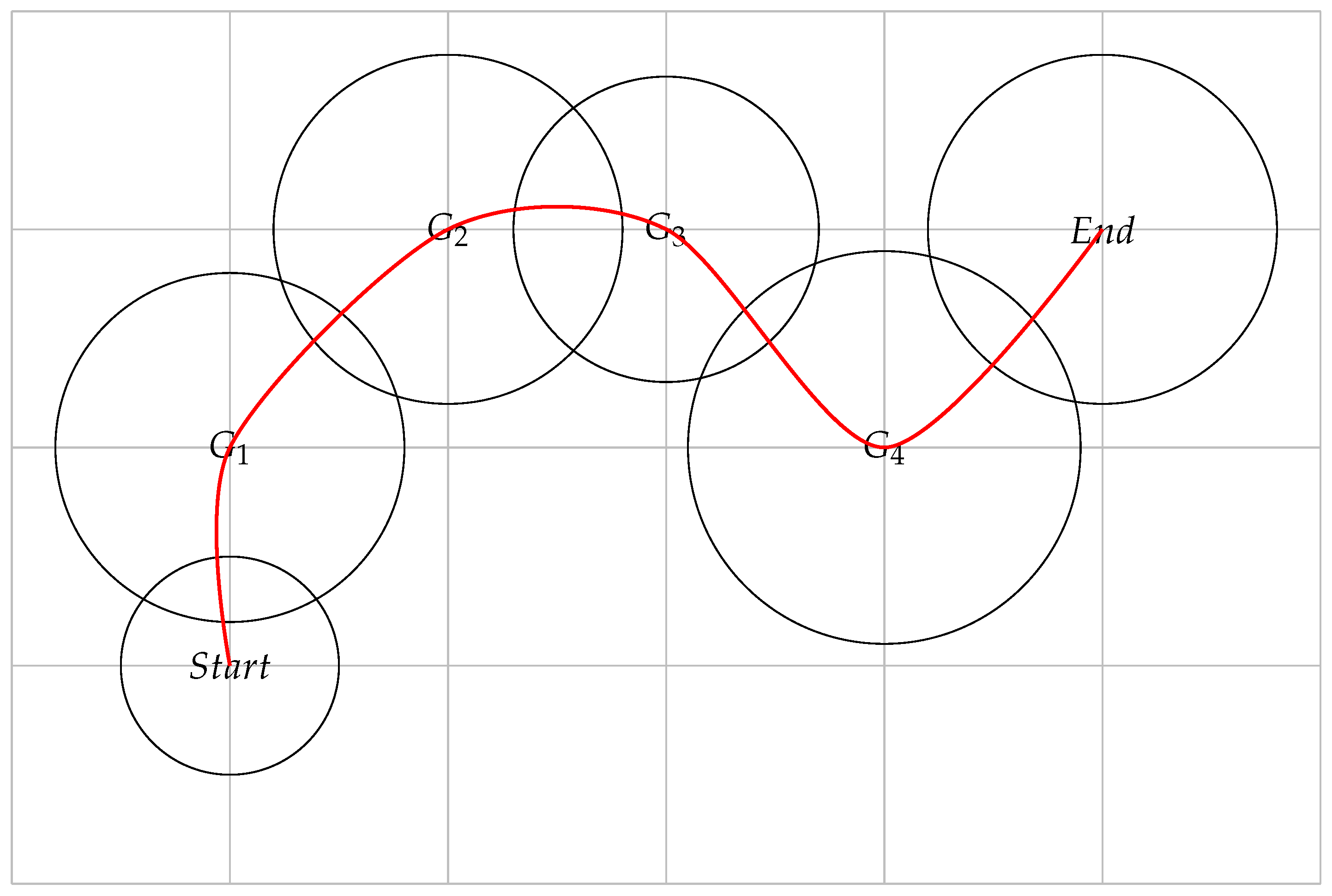
Take the trajectory planning of a robot as an example [
13,
14]. A finite amount of goal sets with intersections are set up to constrain the trajectory of the robot. This is shown in
Figure 1. The robot goes from the point
Start into the circle
within time
. Then, it goes from
into
within time
, and so on. Thus, the robot follows this trajectory with a prescribed time limit.
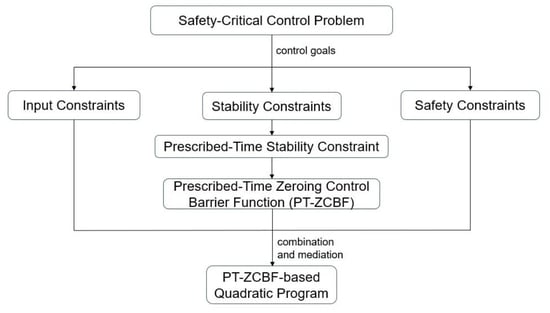
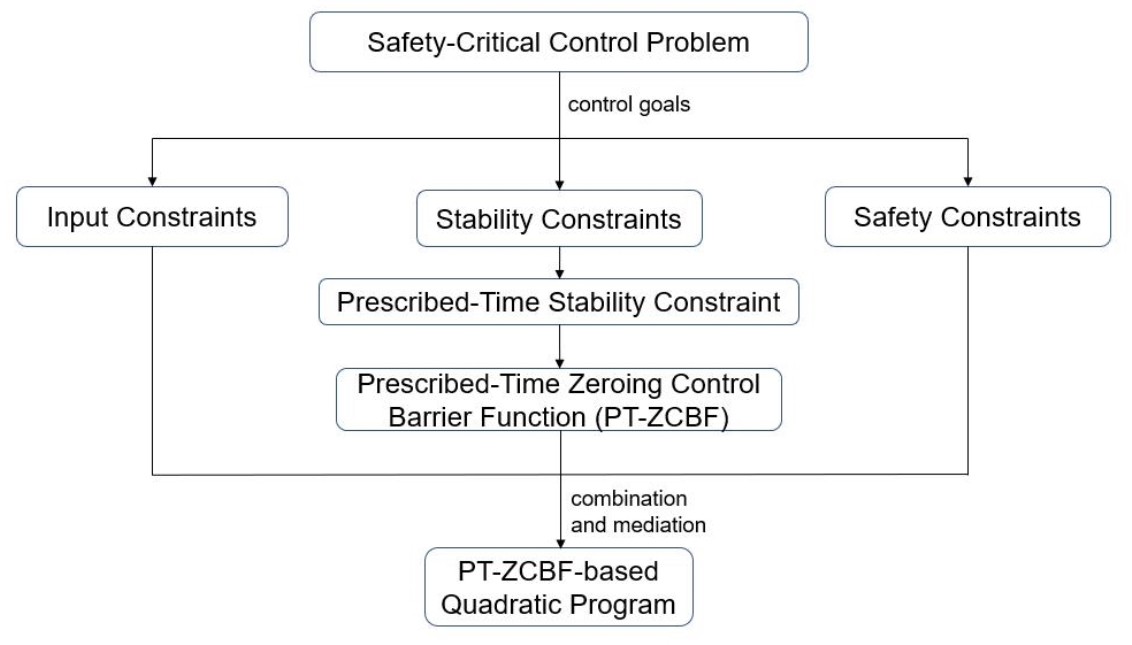
In this paper, we propose the PT-ZCBF to characterize the practical requirement that the system states converge within a prescribed time period, and obtain the control strategy via PT-ZCBF-based Quadratic Programs. To the best of the authors’ knowledge, the prescribed-time stability is realized in safety-critical control systems under safety and input constraints for the first time. Specifically, a time transformation technique is utilized to convert the normal ZCBF into the newly designed PT-ZCBF. This PT-ZCBF is incorporated as the prescribed-time stability constraint in QP. By introducing slack variables, we ensure the solvability of the QP such that the feasible control input always exists.
The remainder of the paper is organized as follows. The notations, preliminaries, and the main problem of the paper are demonstrated in
Section 2. Then, the main results and the related proofs are illustrated in
Section 3. Afterward, the Adaptive Cruise Control (ACC) problem is applied as an example of numerical simulation to evaluate the performance of the newly designed QP-based method in
Section 4. Finally, the paper is concluded with possibilities for future research in
Section 5.
3. Main Results
We present the main results of this paper and the related proofs in this section. First, we introduce our design of the Prescribed-Time (convergence) ZCBF (PT-ZCBF) via the time transformation technique. Afterward, we propose the QP-based formulation, using PT-ZCBF as a constraint function. We prove the feasibility of the QP and the continuity of its solution under certain conditions, which are necessary to prove that Problem 1 can be solved by the QP solution under certain conditions. All the main results in this section are demonstrated under Assumptions 1 and 2.
3.1. PT-ZCBF and Its Properties
In this subsection, we propose the definition of PT-ZCBF, showing its property of prescribed-time stability.
We define PT-ZCBF as follows.
Definition 7. Consider the system (1). Consider a set with a function h defined as in (2). The function h is a PT-ZCBF on set with , if an extended class function α exists, which satisfies Furthermore, we introduce the Comparison Lemma, which is essential for the proof of Theorem 1.
Lemma 2 ([
20] (Lemma 4.4))
. Consider the following scalar differential equation:with the locally Lipschitz class function α defined on . The solution of this differential equation in time interval is unique for all . In addition, the solution can be described aswith a class function σ defined on . Now, we are ready to present our first main result.
Theorem 1. Consider the system (1). The set with a function h is defined as in (2). If there exists an extended class function α, such that the function h is a PT-ZCBF on set with satisfying (11) and (12), then there exists a function such thatfor any given time limit , where the initial value , decreases strictly in t for , and holds. Specifically, any Lipschitz continuous controller of the system (1) satisfying (11) and (12) renders the trajectories of the closed-loop system (1) to converge to the set in user-defined prescribed time T, and then remain forward-invariant. Using the time transformation technique and the Comparison Lemma, Theorem 1 can be proven.
Proof. First, is considered.
From (
11) and (
1), we can derive
We use the time transformation candidate function
with the time constant
defined by the user. It is easy to prove that (
18) satisfies (9). The back-transformation of (
18) is
It can be derived that
Inserting (
20) into (
17), we can derive
Since we have
where we denote
as the value of the function
in domain
s, we can derive
Next, we apply Lemma 2. In Lemma 2, let
y denote
, and let
t denote
s with
. It can be concluded that a class
function
with
exists, where
is the initial value of the function
h at
. Applying the back-transformation (
19) to (
24), we can prove (
15). Based on the definition of the class
function, it can be concluded that
decreases strictly with
t for
, and
holds. According to (
6) in Definition 5, it is evident that
is a ZCBF in the
s domain. Thus, we can conclude according to Lemma 1 that any Lipschitz continuous controller
of (
1) forces the closed-loop trajectories to converge in the set
in user-defined time
T.
Then,
is considered. At
, we can conclude from (
15) that
holds. According to (
12), we can conclude that
h is a ZCBF for
. Therefore, the set
is forward-invariant for
. Hence, (
16) is proven.
Thus, Theorem 1 is proven. □
3.2. PT-ZCBF-Based QP
In this subsection, the PT-ZCBF-based QP and its feasibility are demonstrated, and it is proven that Problem 1 can be solved by the QP solution under certain conditions. Define
and the PT-ZCBF-based QP is defined as follows:
The matrix
is diagonal with weights
. The matrix
and the vector
define the input constraints.
is the user-defined prescribed time of convergence, and the hyperparameters
. According to Theorem 1, the constraints (
28c) and (
28d) are designed according to the PT-ZCBF, which aim to ensure prescribed-time convergence. According to Lemma 1, the constraint (
28e) guarantees safety.
Parameters are relaxation parameters. With the relaxation parameters, the feasibility of the QP (28) is guaranteed.
We can rewrite the constraints (
28b)–(
28e) in the form of
where
The elements of the column vector
are zeros. Furthermore, we define the functions
where
denote the
j-th row of
A and
b. Then, we can express the constraints of the QP (28) as
Lemma 3. Parameters , which satisfy (28b)–(28e), always exist for all x. In other words, the QP (28) is always feasible for all x. Proof. Consider the cases of and separately.
First, the case
(
) is to be considered. Because the set
is not empty, there exists
, which satisfies (
28b). We define
which satisfies (
28e) with equality. Finally, we choose
and
so that (
28c) and (
28d) are satisfied with equality. Therefore, in the first case, parameters
exist, which satisfy (
28b)–(
28e).
Then, the case
(
) is to be considered. According to Assumption 2, it can be concluded that
satisfying (
28b) exists. Because
, any value of
is possible. Therefore,
can be chosen. As a result, we can choose
which satisfies (
28b)–(
28e).
Therefore, the QP (28) is always feasible. □
Remark 1. Due to the coexistence of multiple constraints that are potentially conflicting, we must add slack variables (relaxation parameters) and to ensure the feasibility of the QP (28). However, due to the slack variables , the stability constraint, i.e., prescribed-time stability, may not be perfectly guaranteed. When the input, stability, and safety constraints are not conflicting, the solution of the QP will result in if a weight is chosen appropriately. As a result, a sufficiently large weight will result in a negligible value of , which ensures the effectiveness of the stability constraint. In short, the stability objective is a soft constraint because of the existence of the relaxation parameter, and it is still effective if a sufficiently large weight is chosen. Setting will make the stability constraint a hard constraint, but the feasibility of the QP cannot be guaranteed [21,22]. In contrast, the safety constraint (28e) implies that the forward invariance of the safe set can never be violated according to Definition 5 and Assumption 2. Therefore, the safety constraint (28e) is a hard constraint. Next, we would like to prove that under certain assumptions, the solution of the QP (28) solves Problem 1. That is, the solution of the QP (28) can render the trajectories of the system (
1) forward-invariant in the safe set
, and the system states will converge to the goal set
in user-defined prescribed time
T while satisfying the input constraints (
28b).
According to [
2], the authors’ idea to ensure safety is a combination of Nagumo’s theorem [
16] and Assumption 2. As the prerequisite for safety and stability, the continuity of the solution
of the QP (28) has to be ensured. Thus, we make the following assumptions to prove that the solution
of the QP (28) is continuous.
Assumption 3. At , the solution of the QP (28) is continuous.
Let and denote the optimal solution of the QP (28) and the corresponding Lagrange multiplier.
Assumption 4 ([
2] (Assumption 3))
. The constraints (28b)–(28e) of the QP (28) satisfy strict complementary slackness, which means that either or holds for all and for each . Remark 2. For an explanation of complementary slackness, please refer to [2] (Section IV). Assumption 5. The functions are at least three times continuously differentiable in x.
Theorem 2. Under Assumptions 3–5, the solution of the QP (28) is continuous on .
Proof. According to [
2] (Theorem 5), the QP (28) solution
is continuous under the assumptions above. Note that the Lie derivatives
,
,
,
should be at least twice continuously differentiable in
x [
23] (Theorem 2.1). Therefore,
,
should be at least three times continuously differentiable in
x, which corresponds to Assumption 5. □
Now, we are ready to show that the solution of the QP (28) solves Problem 1 under the aforementioned assumptions.
Theorem 3. Under Assumptions 1–5, if the solution of the QP (28) given assatisfies , then solves Problem 1 for all . Proof. This proof is based on [
2] (Theorem 6).
First, we show that the closed-loop trajectories of (
1) have the property of prescribed-time stability with respect to
. From Theorem 2, it can be concluded that the closed-loop system dynamics are continuous when we choose
. Applying [
24] (Theorem 3.15.1) and using a Lyapunov function candidate
we can prove that
is the unique solution of the equation
for
under Assumption 3. From the properties of the goal set function
, we have that
and that
i.e., the goal set function
is positive definite with respect to the goal set
. Therefore, per [
24] (Theorem 3.18.1), with the function
g defined as
and the fact that
holds since
, the closed-loop system (
1) has a unique solution. According to Theorem 1, it can be concluded that the closed-loop trajectories of (
1) with
converge to the goal set
within user-defined prescribed time
T for all
, and then remain forward-invariant with respect to the goal set
.
Then, we show that the closed-loop trajectories have the property of safety, i.e.,
for all
when we choose
. Since the solution
is continuous under the assumptions above, the optimal control input
is also continuous. Furthermore, a bounded safe set
results in bounded closed-loop trajectories. Thus, the solution of the closed-loop system (
1) is well-defined and unique [
24] (Chapter 3). Since
is a ZCBF, it satisfies (
5). Therefore, by Nagumo’s Theorem on set invariance [
16], we directly obtain the forward invariance (safety) of the safe set
.
Additionally, according to the input constraints (
28b) and the solvability of the QP (28) from Theorem 3, it can be concluded that the control input
satisfies the linear input constraints (
28b).
Therefore, the optimal control input solves Problem 1 for all under the aforementioned assumptions. □
In many engineering problems, the system vector fields and the control input are assumed to be Lipschitz continuous. Next, we will show that under the following technical assumption, Problem 1 can be solved by the solution of QP (28) [
1,
3].
Assumption 6. The system vector fields f, g in (1) and the solution of the QP (28) are (locally) Lipschitz continuous. Theorem 4. Denoteas the solution of the QP (28). Under Assumptions 1, 2, 3 and 6, Problem 1 can be solved by for all . Proof. According to Lemma 1, if the solution of the QP (28) is Lipschitz continuous for all
, then the trajectory of the closed-loop system (
1) will be forward-invariant in safe set
under the safety constraint (
28e). Furthermore, according to Theorem 1, under the condition that the QP solution is Lipschitz continuous for all
, the system states will be driven into the goal set
within user-defined prescribed time period
T under the stability constraint (
28c), and then remain forward-invariant under the stability constraint (
28d). Moreover, the input constraint (
28b) specifies the upper and lower bounds of control inputs as described in Problem 1. In addition, the QP (28) is always feasible according to Lemma 3. Hence, Problem 1 can be solved by
for all
. □
Remark 3. According to [1] (Theorem 3), if we ignore the input constraints (28b), we can prove the Lipschitz continuity of the solution of QP (28) for under the assumptions that the QP solution is locally Lipschitz continuous at , and that the functions f, g in (1), the gradients of , are locally Lipschitz continuous, and that the relative degree one condition holds. However, the Lipschitz continuity of the QP solution with input constraints (28b) is not currently guaranteed. Remark 4. The newly designed QP (28) can find the optimal control input of a control affine system (1) under the prescribed-time stability constraint, safety constraint, and input constraints of a typical safety-critical system, which is different from the function of the controllers designed in [1,2]. We learn from the ideas of proofs in [1,2], but for our newly designed QP (28), it is proven that the control goal of PTS is achieved. Although we are inspired by the ideas in previous research, the prescribed-time stability constraint in our QP (28) is based on PT-ZCBF, which is different from the stability constraints in [1,2]. Then, the resulted closed-loop trajectories of the safety-critical system will be prescribed-time stable under safety and input constraints. 4. A Numerical Case Study
In this section, the Adaptive Cruise Control (ACC) problem [
1] (Section V.A) is adopted to show the effectiveness of the designed method. The objective of our problem is to track the expected speed of the following vehicle while keeping a safe distance from the leading vehicle. QP (28) is applied to find the control input that solves the ACC problem. The
Matlab solver
ode4 with a fixed step size is applied in our program. The
Matlab function
quadprog is applied to find the QP solution at every time step.
4.1. Introduction of the ACC Problem
The ACC problem contains a following vehicle and a leading vehicle. The following vehicle possesses the ACC system, which aims to converge to a prescribed driving speed (stability constraint, soft constraint). Furthermore, the following vehicle needs to keep a safe distance behind the leading vehicle (safety constraint, hard constraint). Therefore, the following vehicle’s speed has to be reduced to observe the safety constraint when the distance between the two vehicles decreases. We assume that both vehicles are modeled as mass points, and they travel in a one-dimensional coordinate.
The system equation of the ACC problem is [
1]
By choosing the system vector fields properly, we can derive
In the system equations,
are the system states, where we define
as the following vehicle speed (in m/s),
as the leading vehicle speed (in m/s), and
D as the space between both vehicles (in m).
is the control input, whose physical significance is the driving wheel force (in N) of the following vehicle supplied from the powertrain system.
M is defined as the mass of the following vehicle (in kg);
is the resistance (in N), where the constants
,
, and
are chosen empirically. We define
as the acceleration (or deceleration) of the leading vehicle (in m/s
2).
Furthermore, we have to define the goal set function
and safe set function
in our QP (28). We set
and
with
being the prescribed velocity defined by the user and
the desired time headway.
Next, we choose the model parameters according to the physical systems in reality. We set the desired velocity m/s, the desired time headway s, the mass of the following vehicle kg, the gravitational acceleration m/s2, the maximum available control effort (driving wheel force) , the constants in the expression of aerodynamic drag force N, Ns/m, Ns2/m2, and the leading vehicle acceleration parameter . Then, we define the initial condition of the dynamic system: m/s, m/s, m. We choose s.
To achieve better performance for our control system in the ACC problem, we slightly change the QP (28) such that the stability constraints are forced to be invalid when the value of the safe set function
approximates zero (when
), which can result in better obedience to the safety constraints. We implement the QP (28) with
,
,
,
,
,
, and
,
defined in (
48), (
49).
4.2. Simulation Results without Disturbances
Now, we are ready to present the simulation results.
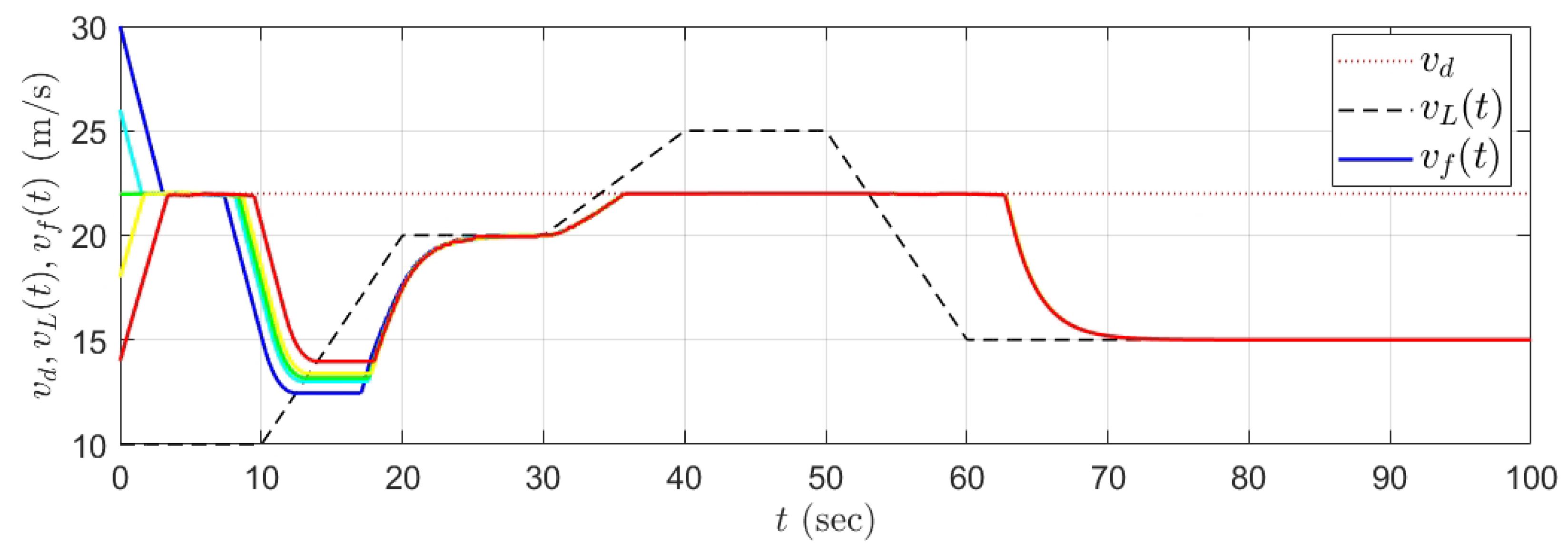
Figure 2 shows the tracking performance of the following vehicle with the control input computed from QP (28). The solid lines in different colors represent the following vehicle speeds for different initial conditions
m/s.
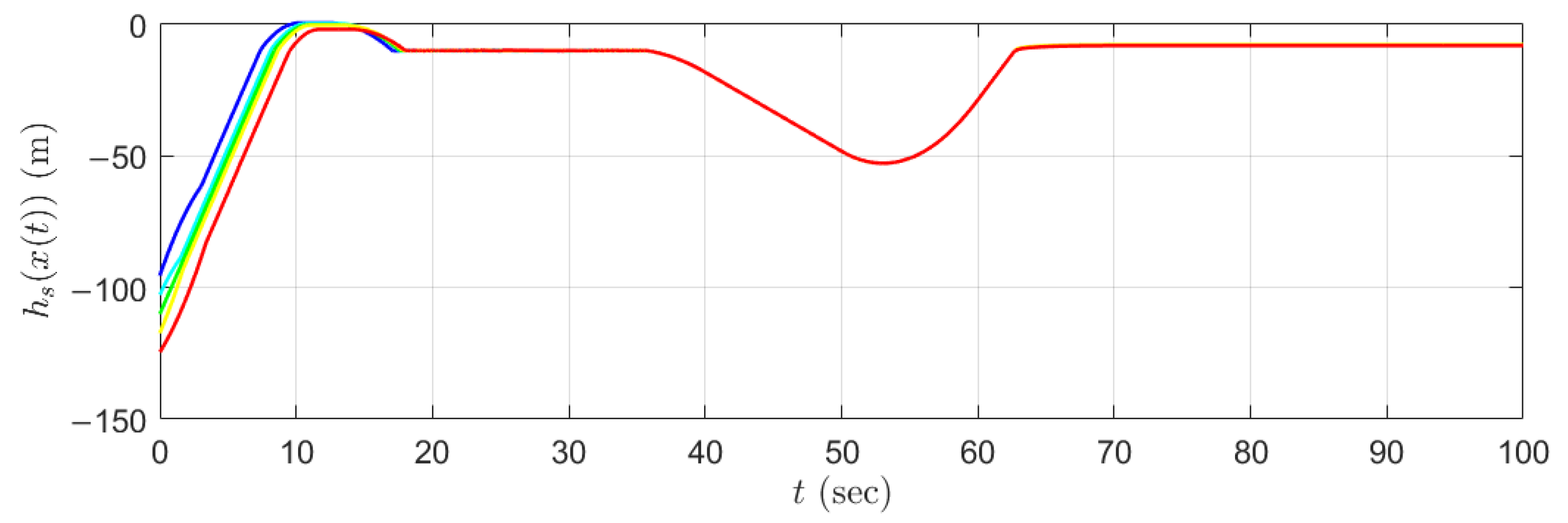
Figure 3 illustrates the dynamics of the safe set function
with the same initial conditions.
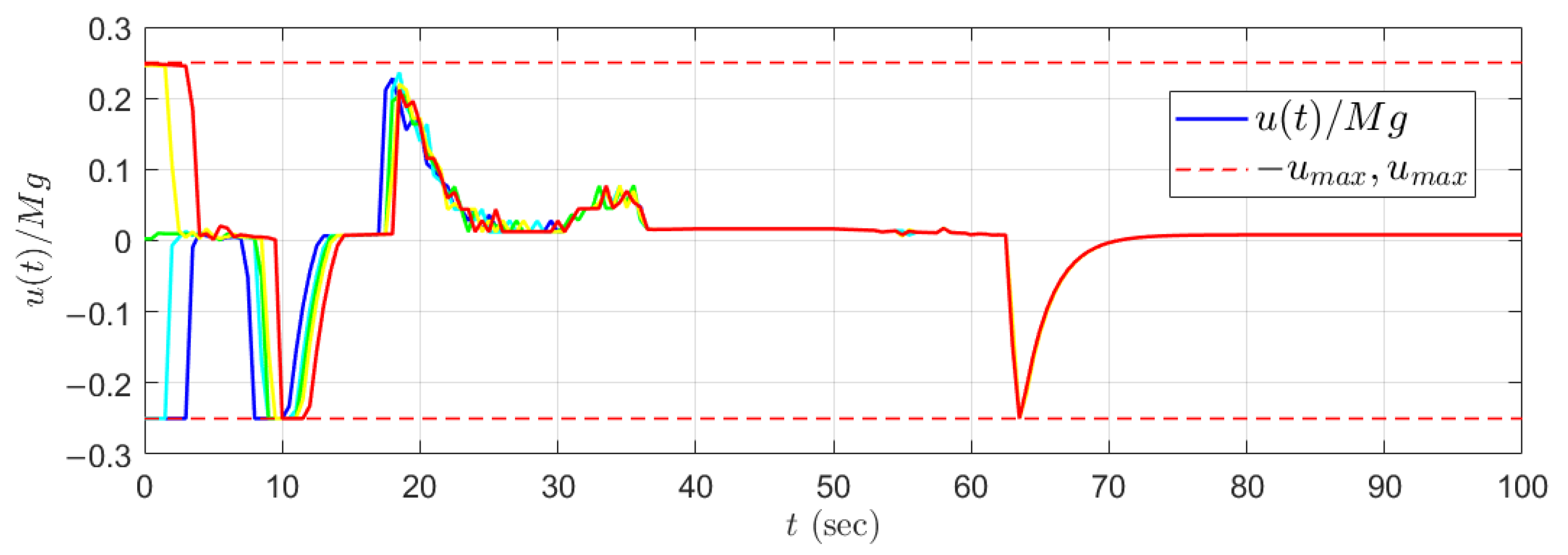
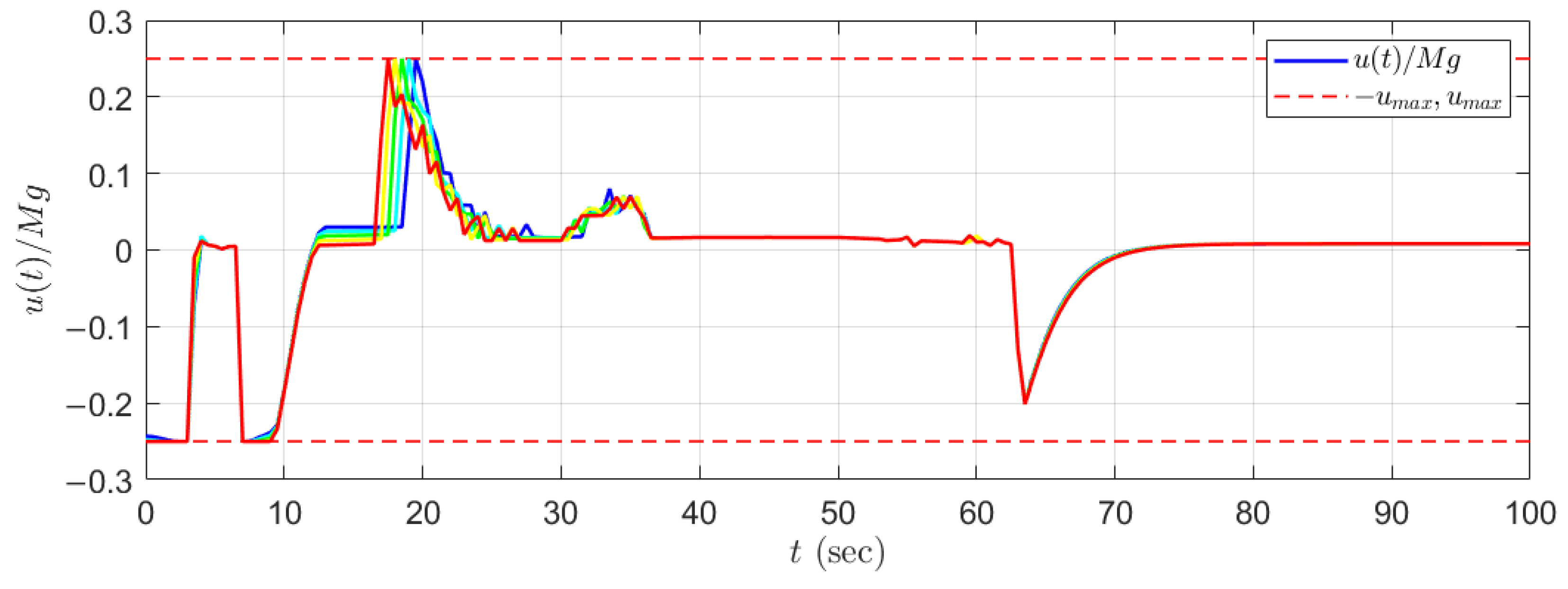
Figure 4 shows the dynamics of the computed control input
(driving wheel force of the following vehicle supplied from the powertrain system).
4.3. Simulation Results with Disturbances
We now examine the robustness of the proposed approach against disturbances. Suppose that the system equations with disturbances can be written as
where
and
g are given in (
46), and we consider the Lipschitz continuous disturbance
where
is the disturbance constant. In our simulation program, we set
kg/s, the initial velocity of the following vehicle
m/s, and we slightly modify the proposed QP (28) such that the stability constraints are set to be invalid when the value of the safe set function
approximates zero (when
).
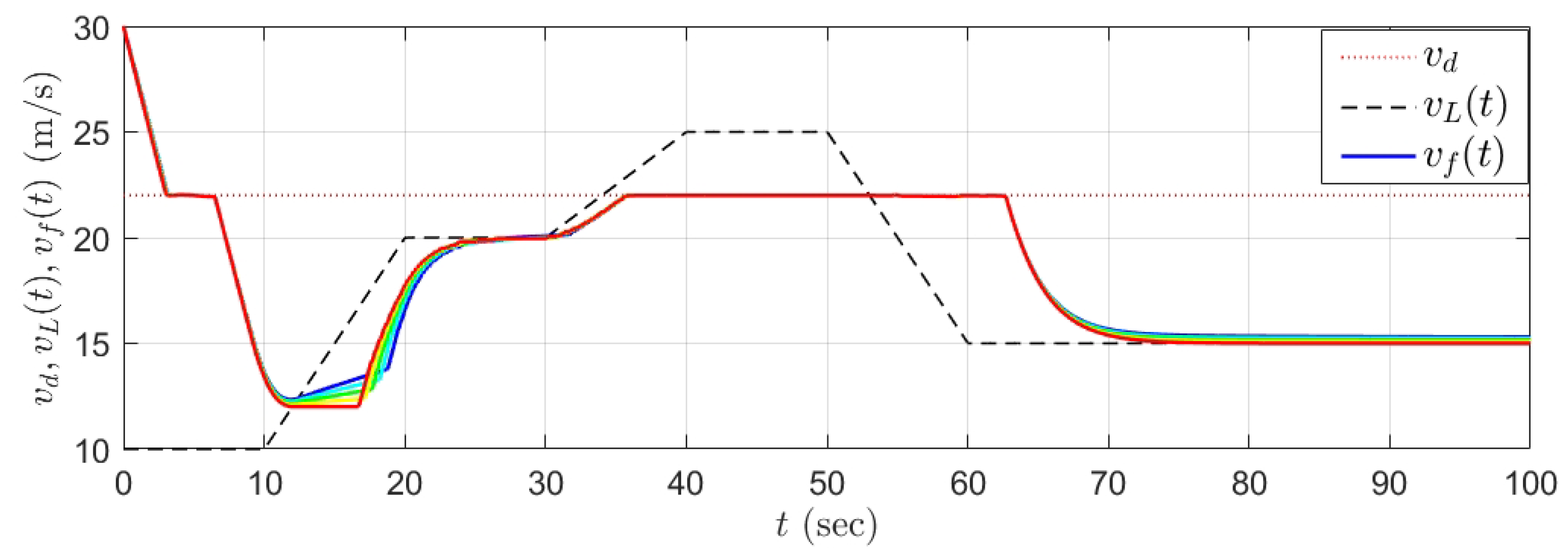
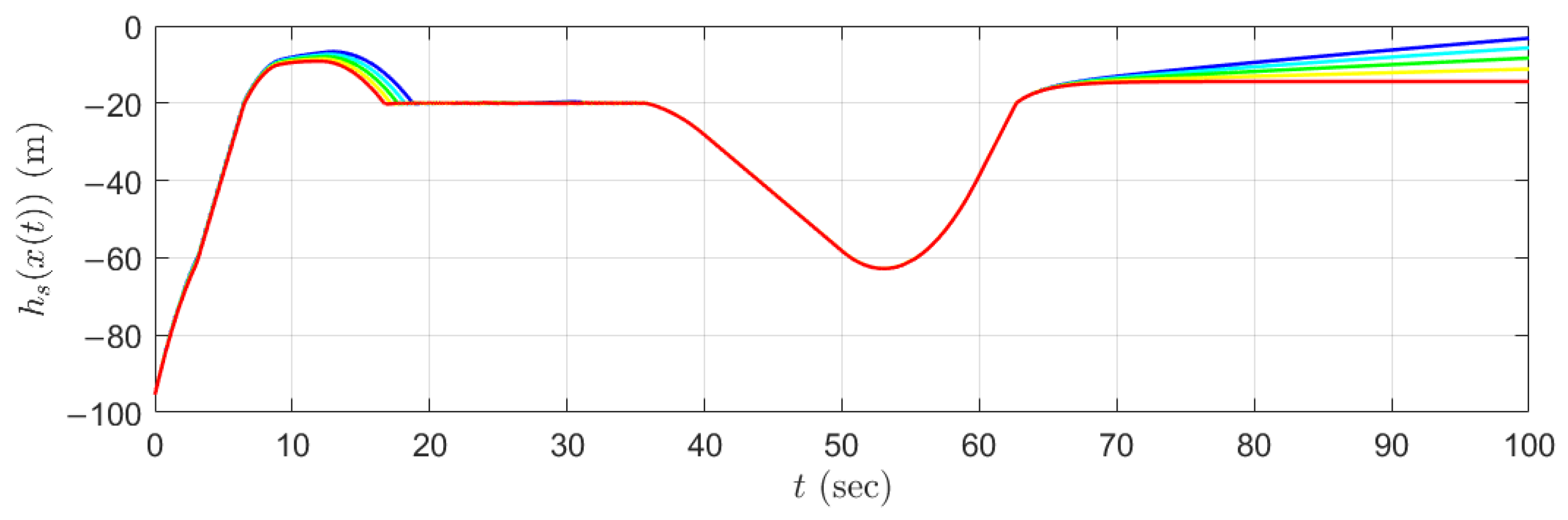
Figure 5,
Figure 6 and
Figure 7 illustrate the tracking performance, dynamics of the safe set function
, and control input
, respectively.
4.4. Conclusions of Simulation Results
It can be concluded that the desired velocity of the following vehicle can be reached in a user-defined prescribed time s without violating the input constraints when the trajectories of the system states are away from the boundaries of the safe set, namely when the value of the function is much smaller than zero. Furthermore, the velocity of the following vehicle will be decreased to satisfy the safety constraint if the system states are near the safe set boundaries, namely if approaches zero.
We can see that there are slight oscillations in our simulation results, especially in
Figure 4. One of the reasons lies in the fact that the computed control input varies when the value of the safe set function
approaches the predefined value from above and below. Furthermore, there are small simulation errors in the solver
ode4. For example, in
Figure 2, the speed of the following vehicle oscillates between 21.95 m/s and 22.05 m/s in a steady state. Theoretically, many control techniques can be applied to reduce the oscillation (e.g., a dead-zone controller [
25]). However, the oscillation of the vehicle speed with an amplitude of 0.1 m/s may not cause any serious problems in reality.
5. Conclusions
We presented the definition and properties of PT-ZCBF, which can describe the prescribed-time stability constraint of safety-critical systems. We combined the input, safety, and stability constraints of safety-critical systems in a PT-ZCBF-based QP formulation, which is able to find the optimal control input under the designated constraints. We discussed its feasibility and how it can solve the main problem under certain mild assumptions. Finally, we applied the proposed QP to the ACC problem as a numerical simulation example. The simulation results showed that the proposed approach can solve the ACC problem with satisfaction. Compared to previous works, a QP-based method combining the prescribed-time stability constraint, safety constraint, and input constraints is proposed in this paper for the first time.
In the future, we would like to search for a method to reduce the oscillation behaviors of the proposed method in numerical case studies. In addition, we are interested in different methods to solve the prescribed-time stability problem, e.g., the Control Lyapunov Function method introduced in [
11]. We want to modify the stability constraints of the proposed QP according to different PTS methods, use the modified QP in numerical case studies, and compare the results using the QP with different PTS methods. Furthermore, we would like to study the applicability of the proposed approach to more numerical examples and large-scale systems [
26,
27], and then apply the methods to practical experimental studies.