You are currently on the new version of our website. Access the old version .
ElectronicsElectronics
  • Article
  • Open Access

13 March 2023

HCoF: Hybrid Collaborative Filtering Using Social and Semantic Suggestions for Friend Recommendation


,
,
,
,
,
and
1
Department of Computer Science and Engineering, Faculty of Engineering and Technology, JAIN (Deemed-to-be University), Bengaluru 562112, India
2
School of Information Technology and Engineering, Vellore Institute of Technology University, Vellore 632014, India
3
Department of Information Systems, College of Computer Science and Information Technology, King Faisal University, Al Ahsa 31982, Saudi Arabia
4
College of Computing and Informatics, Saudi Electronic University, Riyadh 11673, Saudi Arabia
This article belongs to the Special Issue Recommender Systems: Approaches, Challenges and Applications (Volume II)

Abstract

Today, people frequently communicate through interactions and exchange knowledge over the social web in various formats. Social connections have been substantially improved by the emergence of social media platforms. Massive volumes of data have been generated by the expansion of social networks, and many people use them daily. Therefore, one of the current problems is to make it easier to find the appropriate friends for a particular user. Despite collaborative filtering’s huge success, accuracy and sparsity remain significant obstacles, particularly in the social networking sector, which has experienced astounding growth and has a large number of users. Social connections have been substantially improved by the emergence of social media platforms. In this work, a social and semantic-based collaborative filtering methodology is proposed for personalized recommendations in the context of social networking. A new hybrid collaborative filtering (HCoF) approach amalgamates the social and semantic suggestions. Two classification strategies are employed to enhance the performance of the recommendation to a high rate. Initially, the incremental K-means algorithm is applied to all users, and then the KNN algorithm for new users. The mean precision of 0.503 obtained by HCoF recommendation with semantic and social information results in an effective collaborative filtering enhancement strategy for friend recommendations in social networks. The evaluation’s findings showed that the proposed approach enhances recommendation accuracy while also resolving the sparsity and cold start issues.

1. Introduction

The most widely used uses of big data technology are the recommendation system that effectively addresses the issue of information overload in social networks. However, the model’s recommendation quality is affected by the data sparsity issue. This study suggests a hybrid recommendation approach to achieve this. Modern social networking systems make recommendations for friends based on the networks of individual users. This might not be the best technique to advise friends to a particular user because friend suggestions ought to be more heavily weighted toward actual buddy-selecting methods. There are more users who are engaged online than ever before, and social networking sites (SNSs) have taken over as the primary way to make new acquaintances. It has been established that friendships formed through regular physical contact are inferior to those formed through social networking sites (SNS). Each of these social networks relies on a friend recommendation system (FRS), which links individuals together by identifying shared characteristics between them.
It is quite hard to recommend a trustworthy friend to a user with the current social networking systems. The majority of social networking sites currently in use rely on user relationships already in place to suggest peers. A few social networking sites, such as Facebook, rely on social connection analysis between users who already have friends in common. These suggest prospective friends among symmetrical users. According to recent sociological research, people can be divided into a variety of groups based on their attitudes, tastes, lifestyles, and economic status. The everyday activities and habits of a user are strongly tied to their lifestyle. Although it is the most natural characteristic, its utility is limited because it is challenging to observe a user’s way of life. If we could gather data on users’ everyday activities and routines, and then suggest buddies based on how closely their lifestyles match, that would be a novel approach. This suggestion method can be incorporated into current social networking frameworks or implemented on cell phones as a standalone app. Users of the app can use it to meet friends who lead similar lifestyles to themselves.
Recommender systems (RS) are in higher demand than ever. Recommender systems address the challenge of information overburden [1] by selectively filtering important fragments of information from a huge quantity of dynamically produced data based on user interests, preferences, or observed behaviors [2]. The RS can suggest that the user like an item or consider any user profile. RS benefits service providers and users as well [3]. It decreases the costs of searching as well as selecting items in a typical online purchasing environment [4]. RS has proved to enhance the decision-making process along with quality [5]. RS increases the income of an e-commerce scenario as they effectively sell more products [6]. Collaborative filtering (CoF) requires the users’ previous preferences on a set of objects [7]. Based on the legacy data, the CoF adopts the concept that the previously agreed customers do agree again in the future. Concerning user preferences, there are two types. An explicit rating is a numerical rating provided by a user to an item, such as five stars for a Spiderman movie. It is a straightforward way for users to express how much users enjoy a product. RS possess attentiveness in the previous decade because of its powerful capacity to solve information overload [8,9,10]. The user preferences for certain interests are predicted automatically by the recommender systems, which then supply them with useful recommendations.
People frequently rely on suggestions from friends as well as acquaintances for decisions. Collaborative filtering (CoF) is the most popular recommendation technique to compare neighbors to create multiple suggestions and not differentiate between neighborhood friends and strangers with similar likes. These days, interactions and knowledge exchange on social network websites are the primary means of communication among individuals. Users are unable to acquire suitable information because of the exponential proliferation of data, prompting researchers to investigate social-based recommender systems. The proposed research work concentrates on suggesting friends on social networks. The suggested method begins by supplementing the CoF recommendations with social data. To deal with the rating of variability and sparsity challenges, the social dimension is featured by social behavior measures, namely friendship, trust, and degrees of commitment amongst users. Lastly, social similarity and collaborative measures are employed to improve the accomplishment of the RS classification techniques.

Motivation of Research

Collaborative filtering, as well as content-based semantic models, were the two commonly used algorithms in the prior stages of the creation of RS, which have advanced significantly over the past 10 years. In light of the extraordinary successes of deep learning (DL) technology in numerous applications of artificial intelligence (AI), the deep learning-based recommendation model has steadily emerged as the focus of researchers’ attention. Although the limitations of text mining and user behavior analysis have prevented much progress in these areas of research, they hold great promise for addressing issues with recommendations. In contrast to the classic recommendation algorithm, social networks typically have more severe data sparse and cold start issues, which presents significant hurdles for the study of social recommendation algorithms. This proposed work suggests a hybrid collaborative filtering model based on the aforementioned studies.
Existing research demonstrates that since users’ preferences are similar to or influenced by their connected peers, social information can produce more accurate and individualized recommendation outcomes. The semantic features also enable a more accurate depiction of knowledge. However, only a small number of works combined the CoF algorithm with social and semantic data. Some of the current trust-aware recommendation methods primarily rely on trust propagation or the trust-based neighbors of users to find user communities. However, it is important to note that user trust information is not frequently available on social networks. Therefore, we believe that formalizing and modeling the trust for a specific user in the context of a social network while taking into consideration his/her interactions with other users is more pertinent.
Our contributions to this study are mentioned below:
  • The proposed recommendation system of users incorporates both social and collaborative classification approaches;
  • The proposed study proposes a list of the most acceptable potential friends based on the user’s profile;
  • The proposed work provides a better RS based on hybridizations of collaborative, semantic, and social filtering;
  • The amalgamation of semantic as well as social information completely eliminates the problem of a cold start.
The article is further structured as follows: Section 2 outlines the relevance of the social recommendation research. The recommendation strategy is presented in Section 3. Section 4 provides an outline of the implemented research. Finally, Section 5 details the observations, conclusions, and future scope.

3. Materials and Methods

This section details the proposed enhancement of the CoF algorithm that incorporates collaborative and social data into the recommendation process.

3.1. Combination of Social and Semantic Filtering

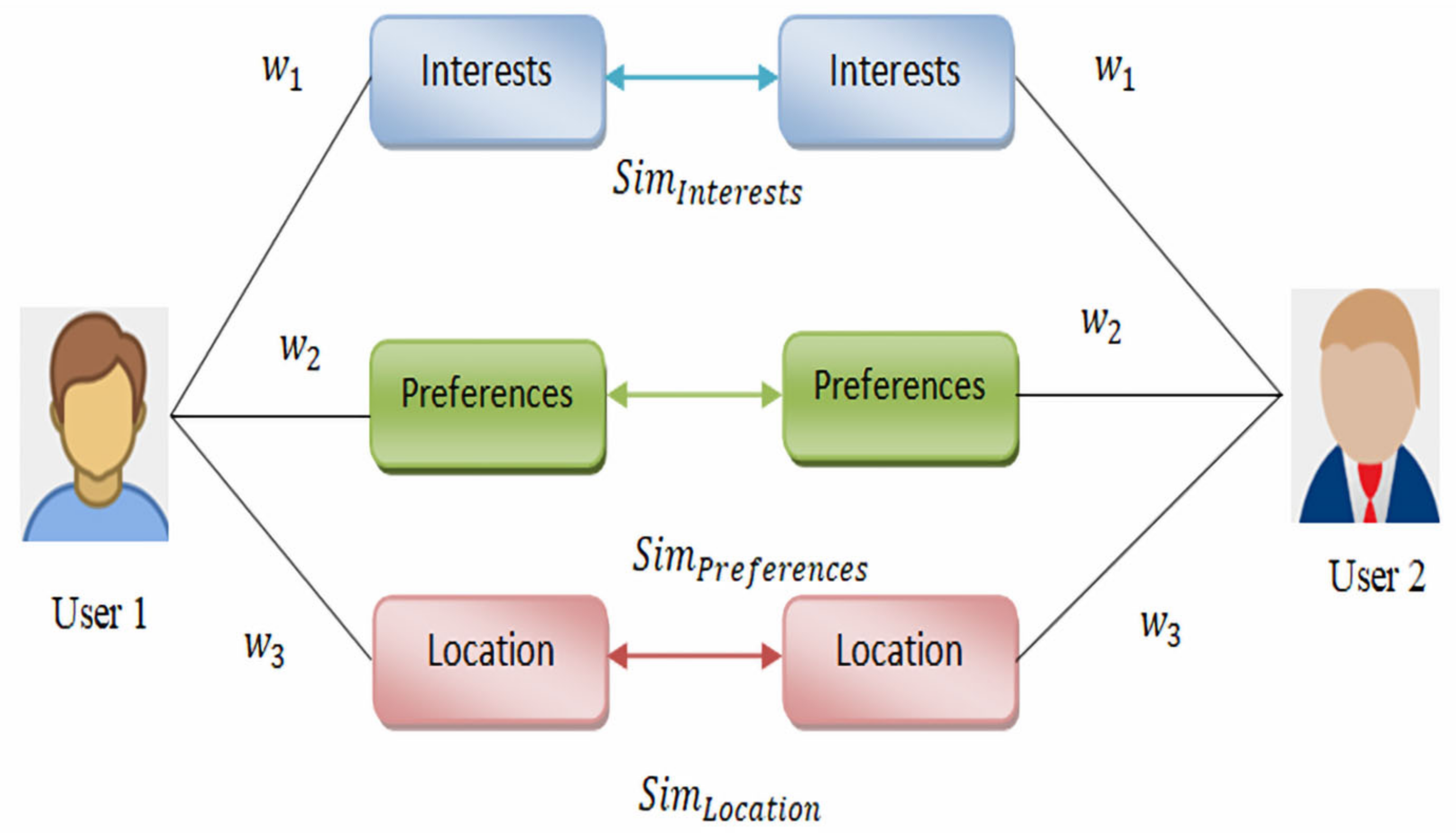
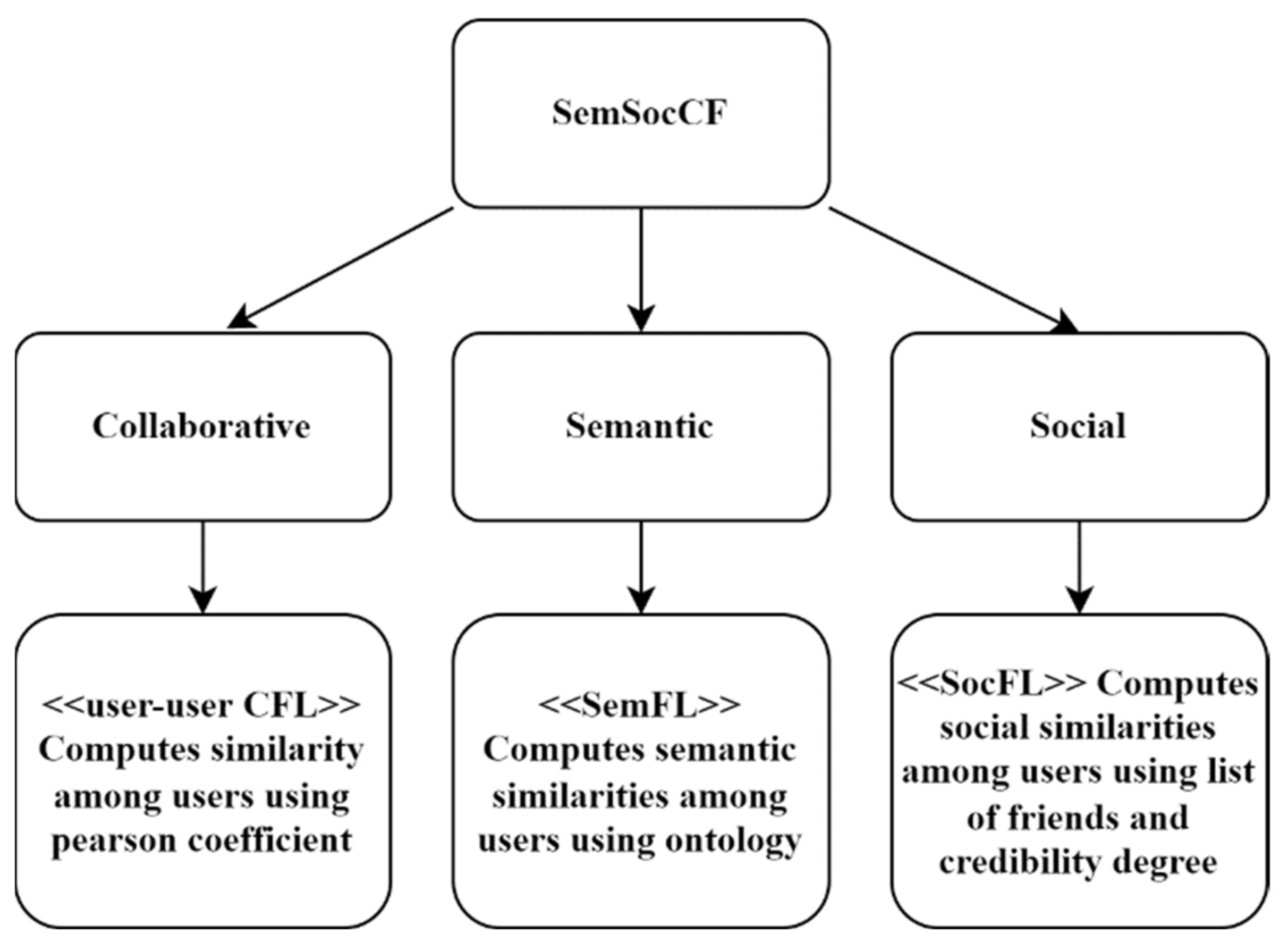
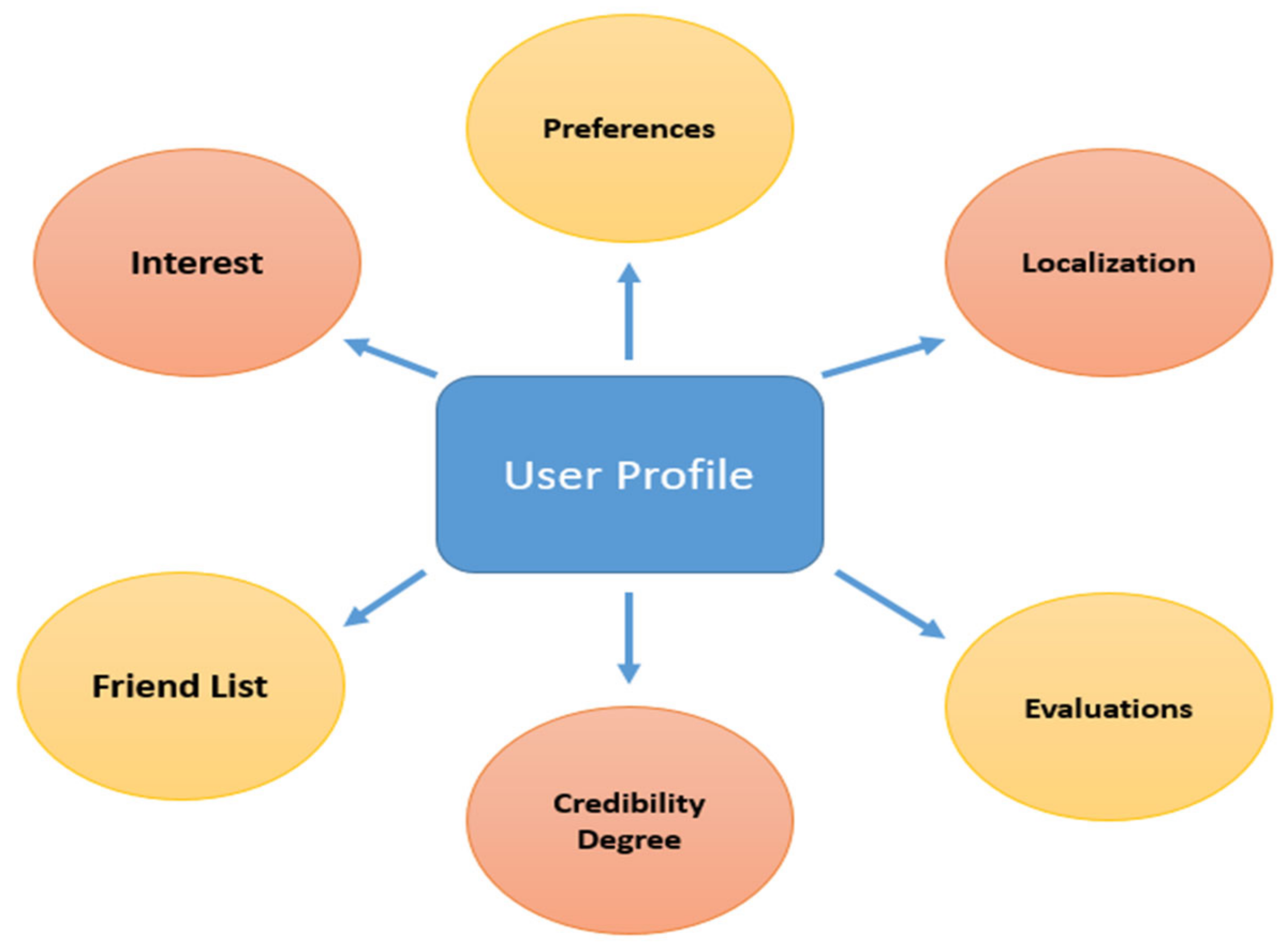
Figure 1 shows the different components of the profile of user. The combination of social-based CoF and semantic approach is shown in Figure 2.
Figure 1. The components of user’s profile.
Figure 2. The combination of social-based CoF and semantic approach.
The semantic filtering (SemF) algorithm being used to compute the similarity degree among the user and other remaining users; suggests the users with a certain threshold of similarity degree.
(1).
CoF based on user–user
A memory-based CoF technique and user-to-user recommendation system are employed in the current research work. The proposed approach uses the utilization matrix to determine which neighbors are best for a user [33]. The ratings by the users are utilized to create the rating matrix. The Pearson correlation formula determines the degree of similarity between users. Pearson correlation is a measure of linear relationship strength and direction. This metric is calculated for the vectors P and Q, as shown in Equation (1). Essentially, the calculation involves the division of covariance by-product of the standard deviations. Users’ collaborative similarities allow for the identification of neighborhoods.
C O R R P , Q = i = 1 n P i   P ¯ Q i   Q ¯ i = 1 n     P i   P ¯ 2   i = 1 n     Q i   Q ¯ 2  
where P ¯ = 1 n i = 1 n P i
(2).
Social Filtering (SocF)
User profile social information is calculated using two metrics such as friendship and credibility [34]. Commitment and trust degree are two characteristics used to determine an active user’s credibility.
Friendship metric: As shown in Equation (2), this metric calculates the similarity weight among two users, user1 and user2, based on the social links of users, described as the size of the intersection by the size of union.
S i m S o c i a l u s e r 1 , u s e r 2 = s i z e F u s e r 1   F u s e r 2 s i z e F u s e r 1 F u s e r 2
where F u s e r 1   and F u s e r 2 depicts friends of u s e r 1 and u s e r 2   , respectively.
Multiple methods exist to evaluate the resemblance among ’n’ components. Using the formulation in Equation (3), recommendation systems may suggest components very close to the user’s current pattern.
S i m i l a r i t y = i , j = 1 n u s e r i   · u s e r j / i = 1 n u s e r i 2 ·   j = 1 n u s e r j 2
Degree of commitment metric: To calculate the degree of commitment, two characteristics are considered. Firstly, an active user involvement level that includes the number and type of evaluations completed by the user. Secondly, user sociability level that represents the social network friendship rate. The degree of commitment is computed using Equation (4).
D e g r e e   O f   C o m m i t m e n t u s e r = θ 1 · P a r t i c i p a t i o n u s e r + δ 1 · S o c i a b i l i t y u s e r
where θ 1 and δ 1 are weights that express level of priority with θ 1 + δ 1 = 1 .
User participation degree: Specifically, it refers to the number of user-performed evaluations. This is being generated based on the total count of evaluations completed by the user,   N u m E v a l u s e r , in relation to all of the system’s evaluations, N u m T o t a l E v a l . It is computed using Equation (5).
P a r t i c i p a t i o n u s e r = N u m E v a l u s e r N u m T o t a l E v a l
User sociability degree: This degree is determined by the number of friends a user has among all of the social network’s registered users, as shown in Equation (6).
S o c i a b i l i t y u s e r = N u m F r i e n d s u s e r N u m U s e r s 1
Degree of trust metric: This metric uses the following formula to take into account user’s seniority and level of skill in the social network, as shown in Equation (7).
D e g r e e   O f   T r u s t u s e r = θ 2 · S e n i o r i t y u s e r + δ 2 · C o m p e t e n c y u s e r
where θ 2 and δ 2   are weights that express level of priority with θ 2 + δ 2 = 1 .
  • User’s seniority level is computed as shown in Equation (8) using the date of the user’s social network registration [34];
S e n i o r i t y u s e r = C u r r e n t   D a t e R e g i s t r a t i o n   D a t e   o f   u s e r C u r r e n t   D a t e S o c i a l   n e t w o r k i n g   S t a r t i n g   D a t e
  • User’s competence level: It is estimated in two steps, based on the presumption [35] that “a friend is very competent if only if the friend has accurately evaluated all the resources in comparison to his mean ratings in social networks”.
The steps involved are as follows:
Step 1: Compute a friend F’s competency level in relation to a specific item R j . We begin by determining the mean of each item’s evaluations [35]. The mean value is then compared with the F’s rating given for the identical item, as shown in Equation (9).
C o m p e t e n c y F , R j = m e a n R j E v a l i , j       i f   M e a n R j E v a l i , j E v a l i , j m e a n R j         i f   E v a l i , j M e a n R j
where m e a n R j is the item’s mean rating based on the opinions of all users, and E v a l i , j is the evaluation of F for the item R j .
The competency degree at the global level for the friend is computed using Equation (10) below:
C o m p e t a n c e F = 1 n i = 1 n C o m p e t e n c y F , R j  
where n denotes the total amount of items evaluated by friend.
Step 2: Compute the friend’s global trust level using the following formula, as shown in Equation (11):
T r u s t F = 1 n u m   j = 1 n u m D e g r e e C o m p e t e n c y ( F ,   R j )
where num is the total count of items that the friend has evaluated.
(3).
Semantic Filtering (SemF):
Any information-filtering technique used to examine the textual content of social networks and combat information overload must deal with two challenges. Firstly, the absence of context, and secondly, a dynamically changing language [36]. Analyzing social network textual contents is very critical to the development of an efficient information-filtering system. However, it is essential to determine the user interests based on posts liked or posts shared over social media and filter posts relevant to user interests. Natural disasters, elections, and sporting events may all be tracked via social media. Changes in the dictionary that are being used over social media mirror changes in these themes [37]. During natural disasters, social network interactions alter dramatically over time. As the crisis progresses, the disasters have been proven to move through phases [38].
If the degree of closeness between two users, user1 and user2, is more than or equal to a particular threshold, they are denoted as semantically close friends. This indicates that general resemblance will be calculated based on several characteristics. The user–user CoF approach is depicted in Figure 3. Consider the following parameters,
  • Sharing of knowledge domains of similar users
  • Sharing of preferences of users that are similar
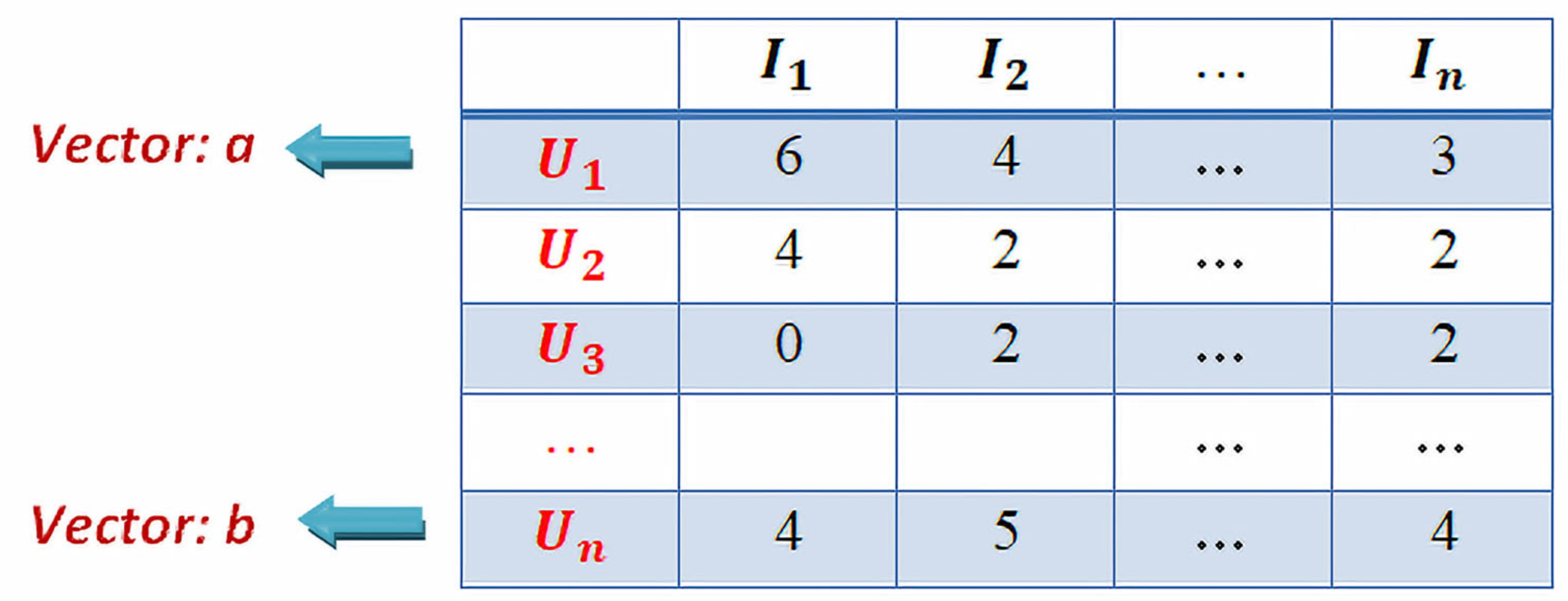
Figure 3. An example of user–user CFL method.
Computation of similarity between two users is shown in Figure 4.
Figure 4. Computation of similarity between two users.
The global similarity is computed using the formula [39], as shown in Equation (12).
S i m G l o b a l u s e r 1 , u s e r 2 = i = 1 N P S i m i u s e r 1 , u s e r 2 w i N P
where NP is partial similarities number; S i m i u s e r 1 , u s e r 2 is partial similarity and w i denotes weights representing priority level.
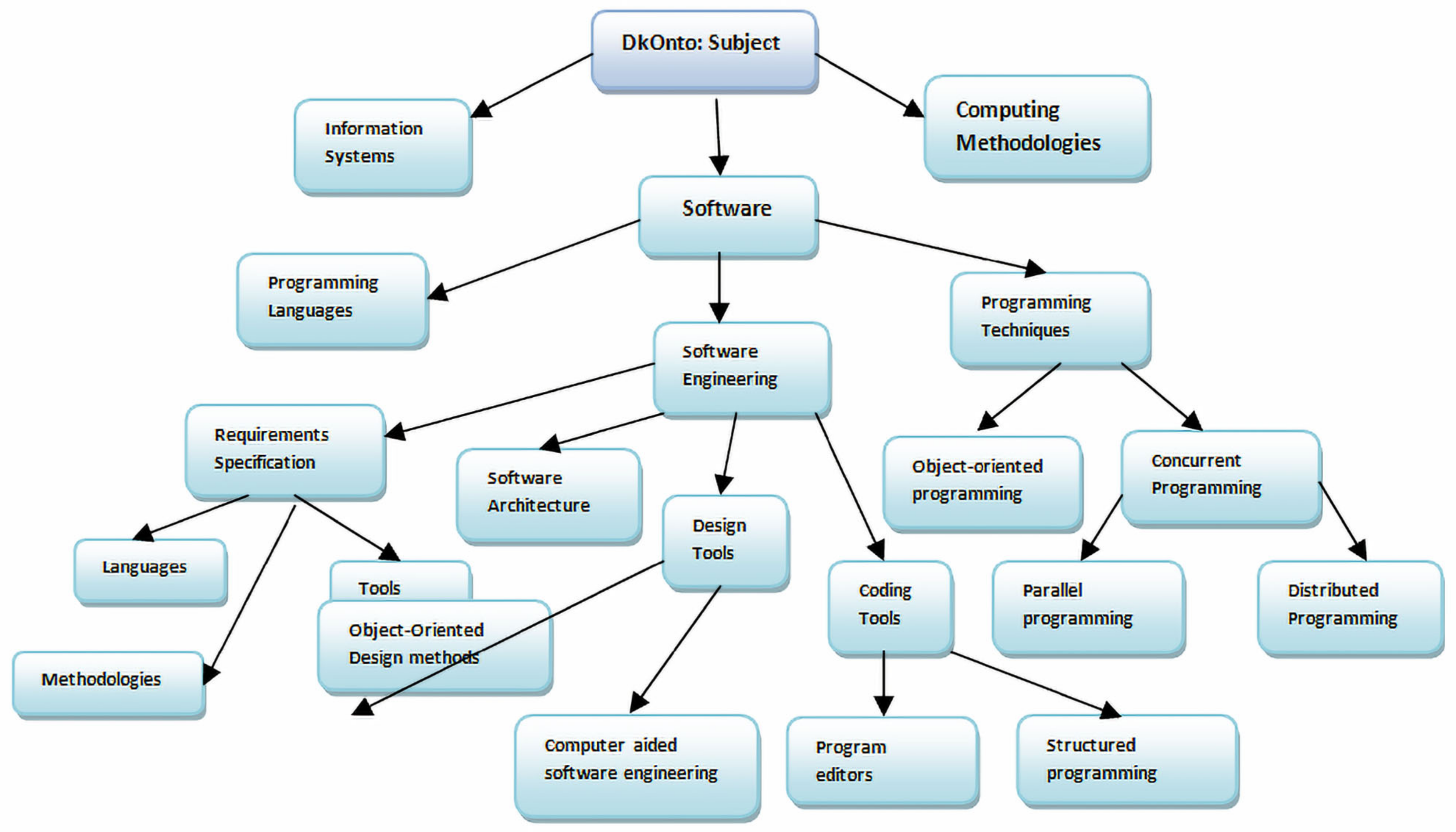
S i m I n t e r e s t s (interests-based similarity): Calculates the similarity degree among active user 1 and all the remaining users in terms of their knowledge domain, utilizing DKOnto, that is, domain knowledge ontology, which represents the ideas connected to the interested domain. Figure 5 depicts a portion of this ontology.
Figure 5. A portion of computer-science domain ontology.
User 1, as well as his friend user 2, may have multiple areas of interest. A similarity matrix is being created in which the lines show all of user 1′s domains D, and the columns represent all of user 2′s domains D | .The similarity measure of Wu et al. [40] is used to compute the matrix elements, as shown in Equation (13).
S i m D , D | = 2 D e p t h D c D e p t h D + D e p t h D |
where D is the domain of user 1 and D | is the domain of user 2. Depth ( D ) is D’s depth, D e p t h D | is D | s depth, and D c is the nearest familiar parent to both D   and   D | .
Using the similarity measure specified in [41,42], let us investigate the similarity among two domains, namely 1. “Tools” and 2. ”Software architecture”, as shown in Equations (14) and (15).
S i m T o o l s ,   S o f t w a r e   a r c h i t e c t u r e = 2 D e p t h s o f t w a r e _ e n g i n e e r i n g D e p t h T o o l s + D e p t h S o f t w a r e a r c h i t e c t u r e =   2 3 5 + 4 = 0.66
Finally, the mean of matrix elements is calculated to produce a global similarity:
S i m i n t e r e s t s u s e r 1 , u s e r 2 = 1 N i = 1 M S i m i D i , D j , j = 1 N
S i m P r e f e r e n c e s (preferences-based similarity): the attributes of the user’s most evaluated items are referred to as preferences. A couple represents each preference (preference name: count of reviews carried). It is computed using Equation (16).
P r e f e r e n c e s u s e r = a , n | n > 0
where a is the attribute and n is total amount of rating made by user for attribute a.
The Jaccard index used to calculate the similarity preferences of two users is shown in Equation (17).
S i m P r e f e r e n c e s u s e r 1 , u s e r 2 = 1 a A min n a , m a a A max n a , m a
where A is the set of all preferences of user 1 and user 2, n a is count of reviews performed by u s e r 1 on attribute a, and   m a is count of reviews performed by u s e r 2 on attribute a.
S i m L o c a t i o n (geographic location-based similarity): The data based on geography reflect a user’s spatial attributes. The objects’ locations that the user has examined are taken into account so as to determine where the user spends the most time. The following Equation (18) is a description of the information:
L o c a t i o n s u s e r =   l a t i t u d e ,   l o n g i t u d e , n u m | n u m > 0
where num is the total count of reviews of the item that the user has performed.

3.2. Combination of Classification Algorithms with Social-Based Collaborative Filtering (SoC-CoF)

The classification of the recommendation approach has the primary goal of grouping comparable individuals based on social dimensions. It reduces the duration of time needed to find neighbors and thereby allows grouping together the different groups. As a result, each social network user has both collaborative as well as social class. Furthermore, if a user has buddy friends, but has not yet completed enough evaluations, the system suggests other friends solely based on the social component. In the same way, if user has completed enough evaluations and is still yet to add any friends, the system will suggest new friends completely based on the collaborative dimension.
(1).
Incremental K-means
A variation of K-means, namely, incremental K-means, was used, which was described in [43]. The initialization problem of centroids is no longer a problem with this technique. This is based upon the global K-means approach, which seeks to reach an ideal solution, rather than having a single population center (global K-means). This method selects two objects, each of which is the middle point of cluster, with the latter two being the farthest apart. The next stage is to select the next middle point or center. Distance among the cluster’s center, as well as its neighbors, can be calculated using a simple function. The elected contender for the new centroids is the furthest element of the center. Following this, clusters are reassembled by impacting the collection of items with the shortest distance between them and the center. This process is repeated until a total of K clusters have been formed.
(2).
K-NN algorithm
This approach has a complexity of O (num), where num is the total count of users in training set. Since this method is time-consuming, the newly issued ratings cannot be used to swiftly update the categorization acquired by the algorithm incremental K-means. To overcome this barrier, we applied both collaborative as well as social K-NN methods, which were tuned for collaborative and social categorization, respectively.

3.3. Proposed Algorithms for HCoF Recommendation Systems

We performed certain preprocessing activities for the incorporation of data that are implicit before accessing the Yelp database. The resulting database contains 4823 restaurants, and 5436 individuals who rated these restaurants 118,709 times in 65 categories (only users who rated more than 9 restaurants are considered). The SocCoF user recommendation as shown in Algorithm 1 incorporates both social as well as collaborative classification approaches.
Algorithm 1 SocCoF recommendation.
Input required: User Table containing Collaborative and also, users’ social classes
Output expected: Recommended Friends list of user “u”.
Step_1:   L e t   α     r e p r e s e n t s   a   w e i g h t e d   l e v e l   o f   C o l l a b o r a t i v e   C l a s s C C l a s s   a n d
                                                                            β   a s   s o c i a l   c l a s s S C l a s s
Step_2: if   u   h a s   C C l a s s   a n d   S C l a s s   t h e n   α = 0.5   a n d   β = 0.5  
               if   u   h a s   n o   C C l a s s   a n d   k a s   S C l a s s   t h e n   α = 0   a n d   β = 1  
               if   u   h a s   C C l a s s   a n d   h a s   n o   S C l a s s   t h e n   α = 1   a n d   β = 0  
               if   u   h a s   n o   C C l a s s   a n d   n o   S C l a s s   t h e n   α = 0   a n d   β = 0  
Step_3: if   u   h a s   n o   C C l a s s   a n d   n o   S C l a s s   t h e n
               Add Recommended list to very active users of social network.
Step_4: For the remaining users namely u| not friends of who has same CClass and SClass:
               Calculate credibility: Take 80% of Trust, 20% of Commitment
               Recommend_val: 80% of   C C l a s s   a n d   S C l a s s   and 20% credibility of user
               If Recommend_val > threshold value, add u| to the recommended list of user u
Step_5: Repeat 2 to 4 for all the users present in user table
The subsequent recommendation algorithm proposes a list of quite commonly acceptable potential friends based on the user’s profile. As follows, we offer the semantic as well as social-based CoF (SemSocCoF) recommendation algorithm, as shown in Algorithm 2.
Algorithm 2 SemSocCoF recommendation.
Input required: Profile of user and rating matrix
Output expected: Recommended Friends list of user “u”.
Step_1: if user “u” is actually a new user of the social network, then add him to the active
              users of social network.
Step_2: if not step 1 and if the user “u” does not have enough rating, combine the Semantic
              Filtering (SemFL) and the Social filtering (SocFL) values.
Step_3:if step 2 is not satisfied, then combine collaborative filtering values with the Semantic
              Filtering and the Social filtering values.
Step_4: Display the Recommended List in sorted order
The SocFL method will be used if the user u has friends, but his profile is not properly informed. Similarly, the SemFL algorithm will be used if the user u has an informed profile (a preference and/or interest list is available), but has not yet added any friends. On the other side, if there are sufficient evaluations, the SemSocCoF algorithm, which combines the CoF algorithm with the semantic and social algorithms, will be used (i.e., in this case, the CoF is applicable). The following combinations of the three algorithms were taken into consideration (CoF, SemFL, and SocFL).
  • The Sem-based CoF and the Soc-based CoF were created to examine the influence of semantics and social information, respectively, on the CoF suggestions. For the Sem-based CF algorithm, the neighborhood computation in the CoF will be based on the list of semantically close friends, and for the Soc-based CoF method, it will be based on the list of socially close friends;
  • Semantics and social information are used in the Sem-Soc-based CoF to examine its impact. In this instance, the list of semantically and socially close friends will serve as the foundation for the neighborhood computation in the CoF.
Out of 5436, 2400 users are categorized as new users, 1924 users are observed to be existing users with minimal ratings, and thus 1112 users are identified to be evaluated under step 3, which combines collaborative filtering with semantic filtering and the SocialSem filtering process. Since the SemSocCoF testing range (u = 1112) is lesser than the testing range of other two categories, we assessed the SemSocCoF process with the same range of other two categories (i.e., for all three recommendation process common and minimal testing range (1112) is considered. Though a uniform testing range is fixed, it is necessary to verify the diversity of the user, which can be estimated via fairness equalized odds process. Equalized odds assess whether the recommendation system is equally accurate for users from different diverse groups. It is calculated as follows:
P α = P β
where, α = (true outcome|diverse user group, recommendation), β = (true outcome|diverse user group).
From Equation (19), the probability of accurately predicting the true outcome (such as a user liking an item) given a particular diverse user group and a recommended item should be the same as the probability of accurately predicting the true outcome for that diverse user group overall. If the recommendation system is biased towards one diverse group, then the left-hand side of the equation will be higher or lower than the right-hand side.
The above fairness for step 3 process can be delineated with a perfect example. Let us say we randomly select 100 “u” ratings to evaluate the recommendation system’s accuracy. We find that for users under age group 30, the recommendation system accurately predicts the true rating for 60% of the ratings, while for users over 30, it accurately predicts the true rating for 70% of the ratings.
Using the equalized odds equation, we can assess whether the recommendation system is equally accurate for both age groups:
P(predicted rating = true rating|under 30, recommendation) = 0.6 P(predicted rating = true rating|over 30, recommendation) = 0.7 P(predicted rating = true rating|under 30) = 0.55 P(predicted rating = true rating|over 30) = 0.6
We can see that the left-hand side of the equation is higher for users over 30 than for users under 30, which suggests that the recommendation system is more accurate for users over 30. However, the right-hand side of the equation is also higher for users over 30 than for users under 30, which suggests that users over 30 are generally easier to predict accurately.
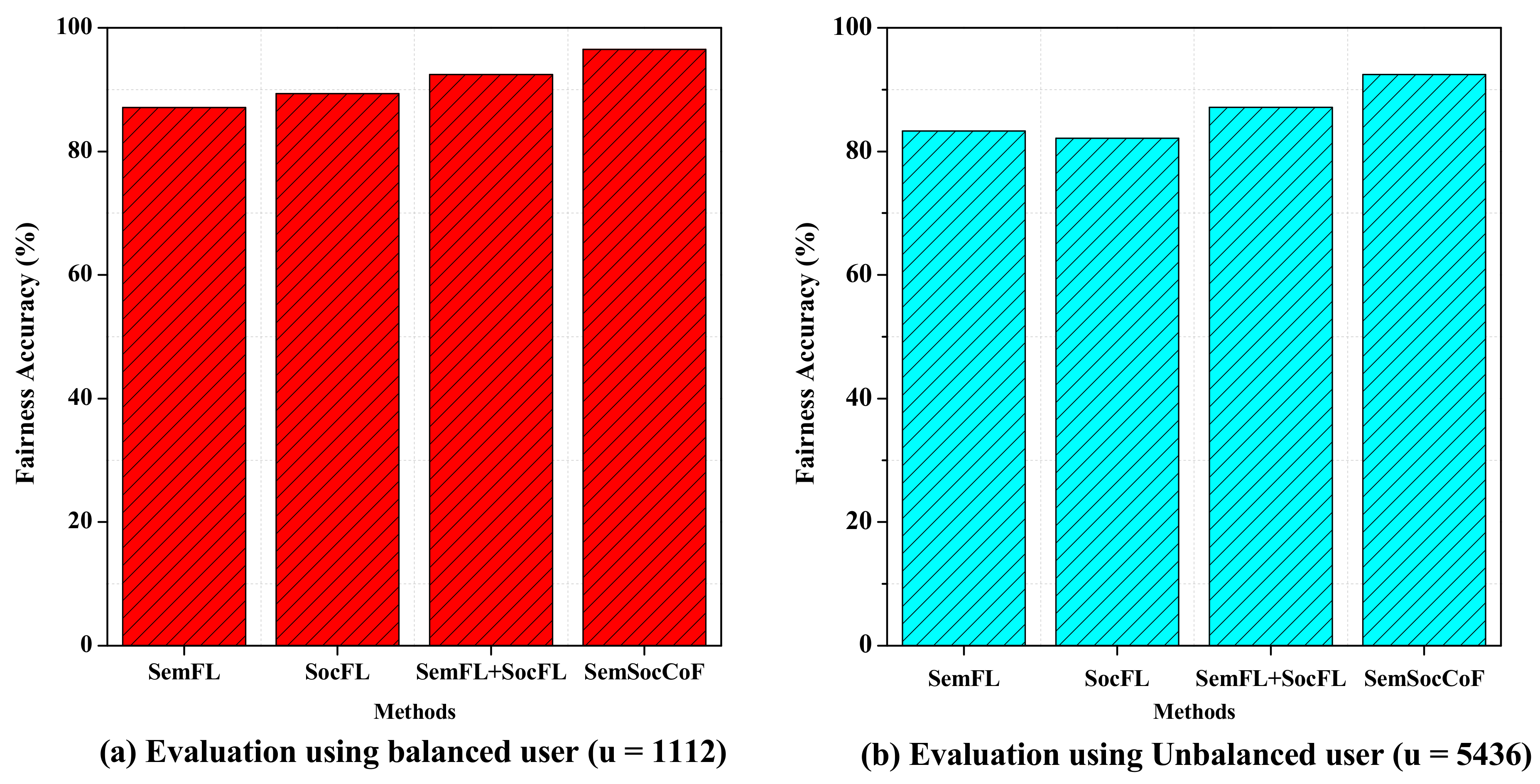
From Figure 6, it is noted that for the balanced user (u = 1112) level, a precise accuracy is obtained for the overall trial estimation of each methodology. Evidently, the outcome exhibits that the combination of SemSocCoF algorithm yields better results (96.49%) than the other methodologies. In addition to these outcomes, though there is slight decrease in the accuracy level for unbalanced users, SemSocCoF algorithm still performs better than the other models with more than 90% accuracy level. All the facts state that the recommendation system is fair across diverse users.
Figure 6. Fairness accuracy.

4. Results and Discussions

We conducted a number of experiments on the Yelp social network, whose primary goal is to link users with nearby businesses, in order to evaluate our methodology. Yelp’s “restaurant” category was our selection because it is the most frequently used category on this social media platform. To complete the definition of profiles, we took advantage of the user interaction records. The implicit information of a specific user consists of his or her preferences and interests, the quantity of his or her evaluations and votes (funny, useful, cool), the average number of stars (he or she assigned to the restaurants he or she evaluated), involvement levels, and levels of trust. The total number of reviews a restaurant has received over time and the average number of stars it has received make up implicit information about that restaurant at time t. The analysis of the Yelp database revealed that many restaurants had characteristics that other establishments do not. Only the most popular and pertinent ones were retained, such as “Good For Groups”, “Take-out”, “Late-night”, “Outdoor Seating”, “Good for Kids”, “Street”, “Delivery”, “Accepts Credit Cards”, “Classy”, “Garage”, “Romantic”, “Expensive”, “Wi-Fi”, and so on.
The different evaluation metrics, along with evaluation results, are discussed in this section.
A.
Evaluation metrics
The model developed was evaluated against different performance metrics [40]. The accuracy is calculated using Equation (20).
A c c u r a c y = T N s + T P s T N s + T P s + F P s + F N s
where TPs are true positives, TNs are true negatives, FPs are false positives, and FNs are false negatives.
The precision is computed using Equation (21).
P r e c i s i o n = T P s T P s + F P s
The recall is computed using Equation (22).
r e c a l l = T P s T P s + F N s
F1-score, which is also called harmonic mean, is computed [41], as shown in Equation (23).
F 1   S c o r e = 2 p r e c i s i o n r e c a l l p r e c i s i o n + r e c a l l
B.
Experimental Results
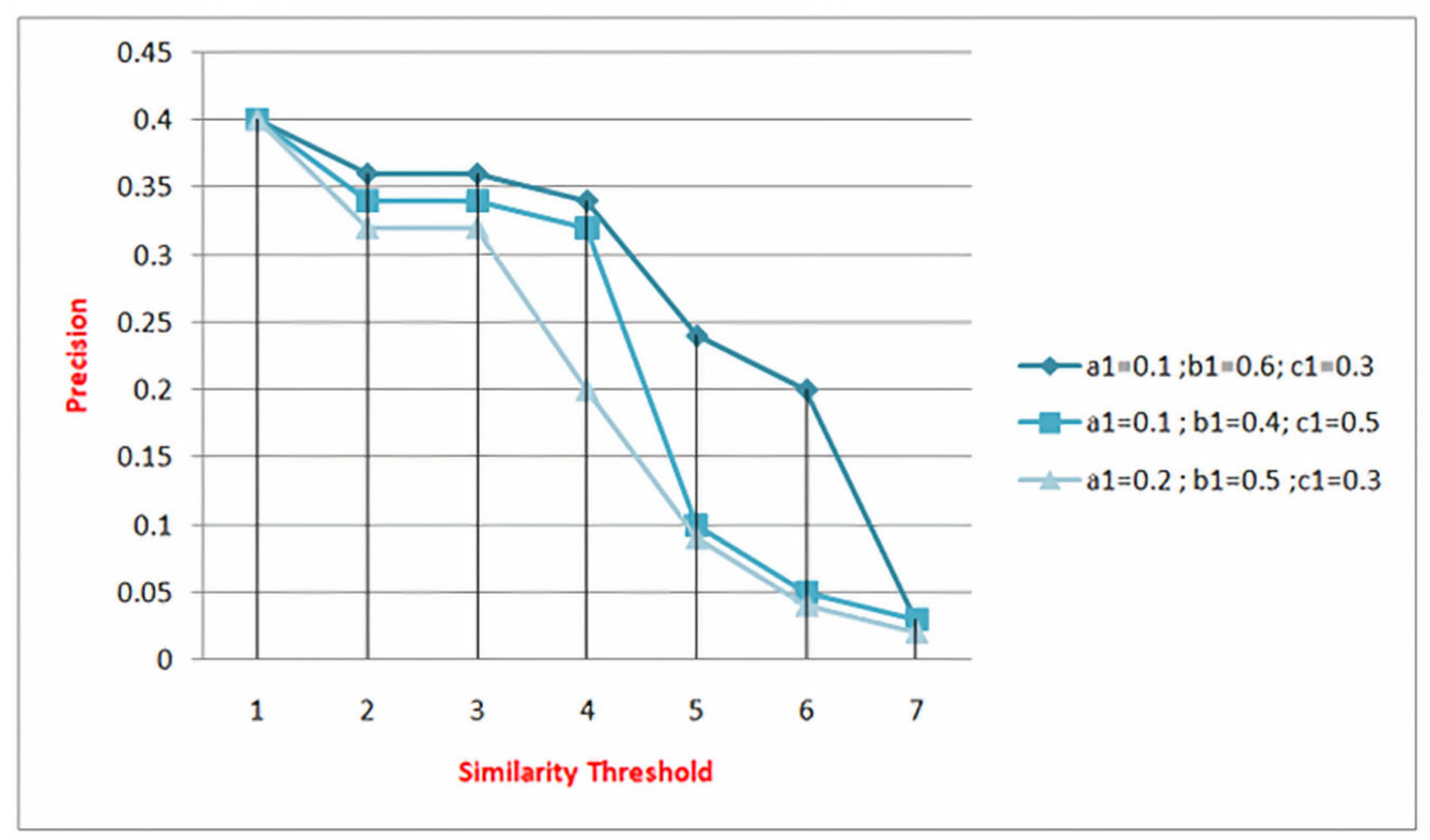
The CoF using the Pearson correlation function is tested by varying the similarity rate from the values 0.1 to 0.9 (similarity threshold). The Soc-CoF is assessed by altering the three parameter weights, such as commitment, friendship, and trust levels. Consider that a1 denotes friendship, b1 denotes commitment, and c represents trust. The results of the testing revealed the fact that combining a1 = 0.1, c1 = 0.3, and b1 = 0.6 delivers better results with respect to performance metrics than the other two combinations, as shown in Figure 7.
Figure 7. Social parameter weight identification.
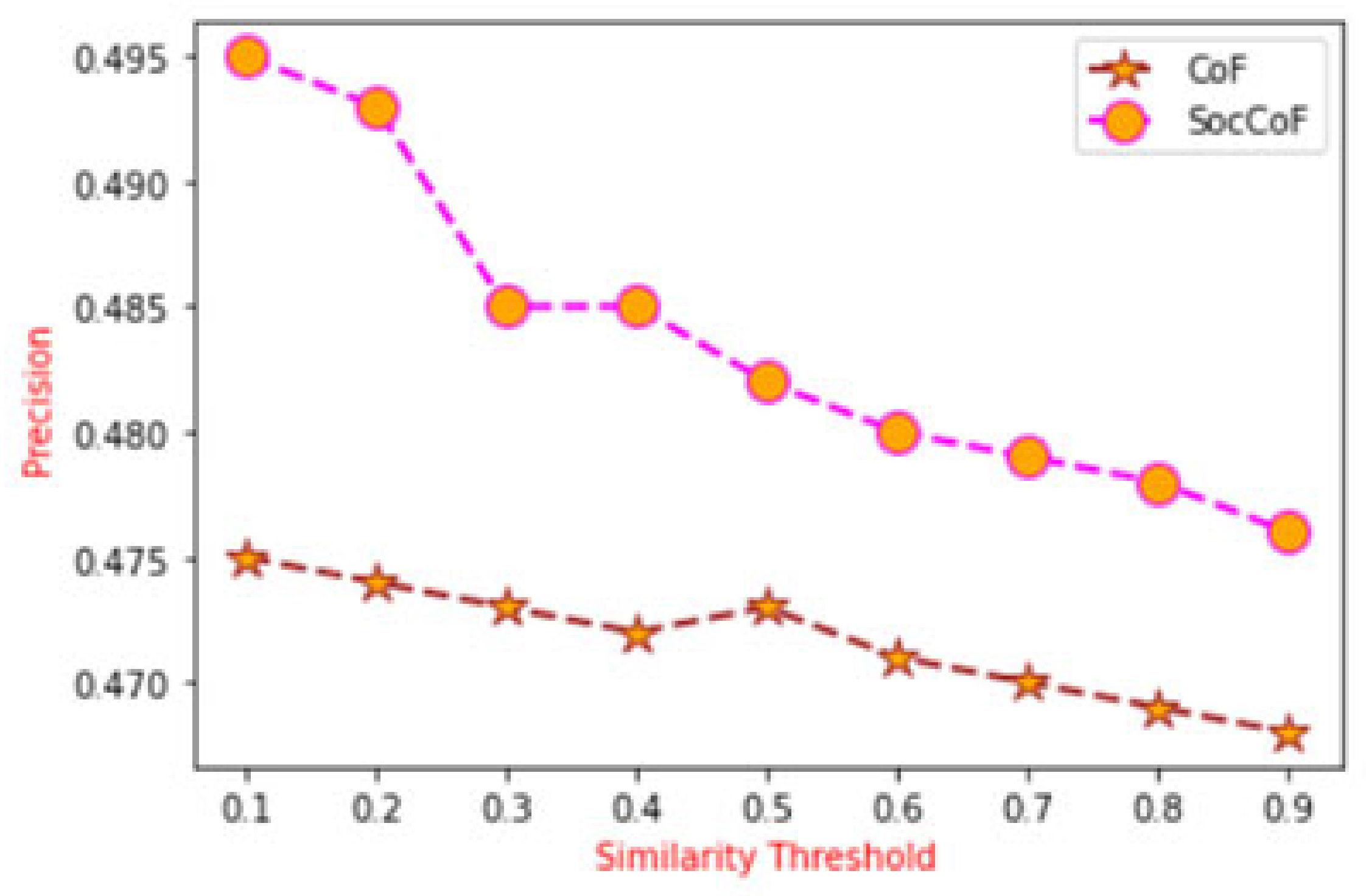
The SocCoF was assessed using the optimal parameters for every algorithm. Figure 8 shows how the usage of social data improved the accuracy of CoF recommendations. When compared to the CoF, the SocCoF provided superior precision and F-measure.
Figure 8. Social information contribution on CoF recommendation.
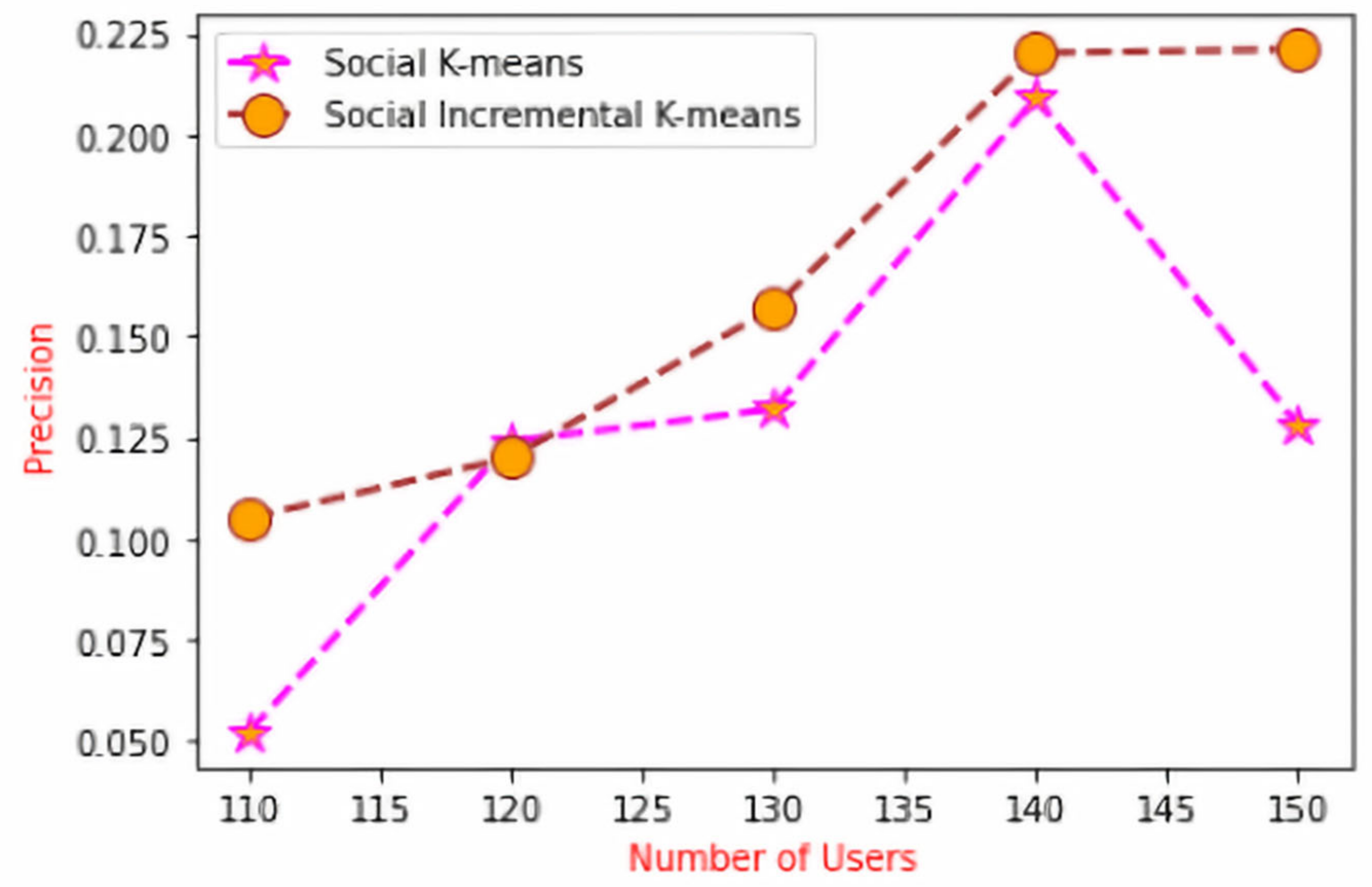
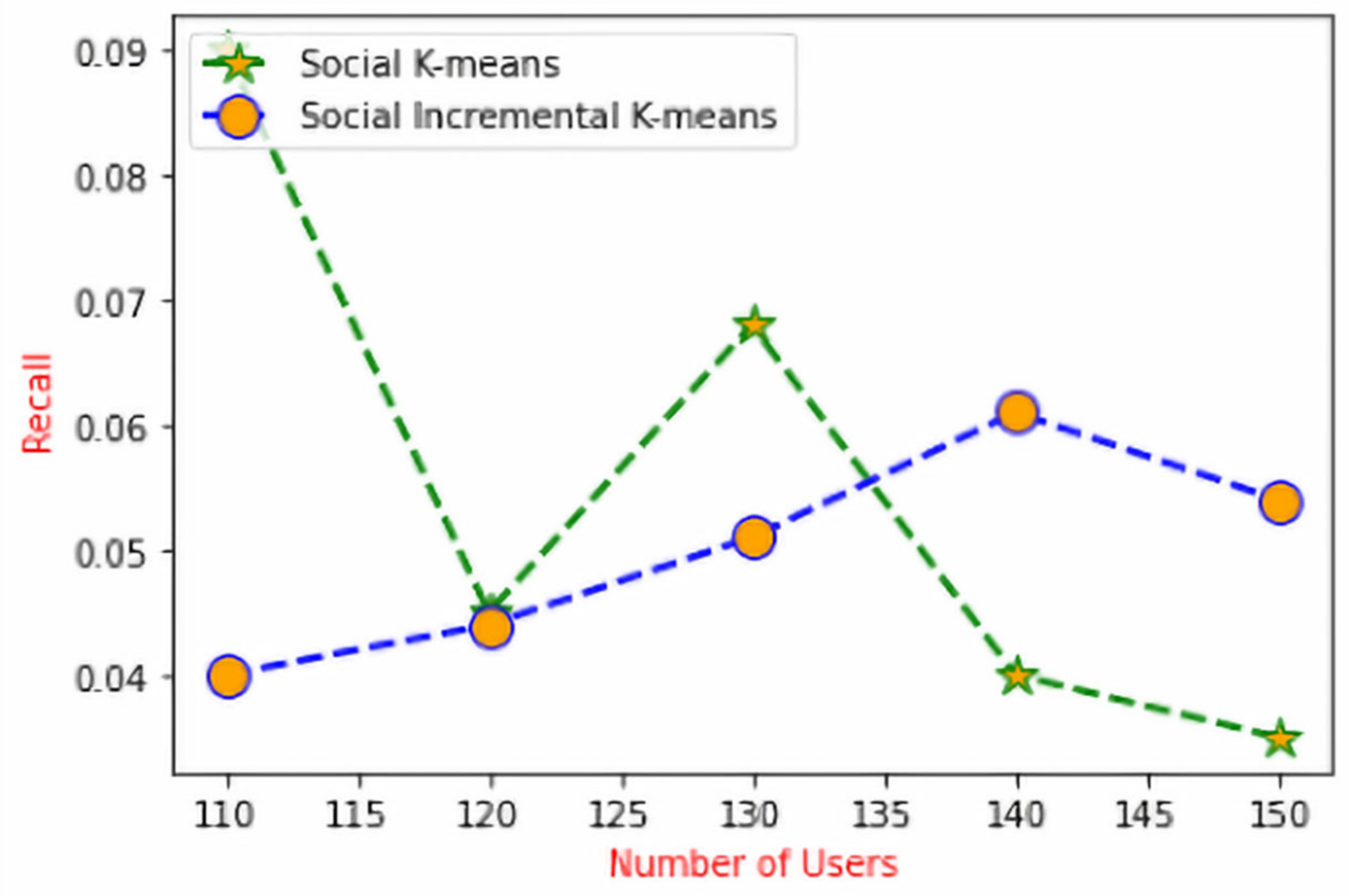
To compare K-means as well as incremental K-means evolution, the focus is on social classification in this experiment and simulated social network evolution using a database partition with 150 members, 351 restaurants, and 4852 ratings. In the experimental setup, the parameter K = 3 identifies the social class numbers, sets the threshold to value 0.3, and experiments with the total count of evaluations (NubE), users (NubU), and destroyed/deleted friendships (NubDF) to see if the system could suggest them again. The results achieved are displayed in Table 2.
Table 2. Outcomes of K-means and incremental K-means algorithms with social information.
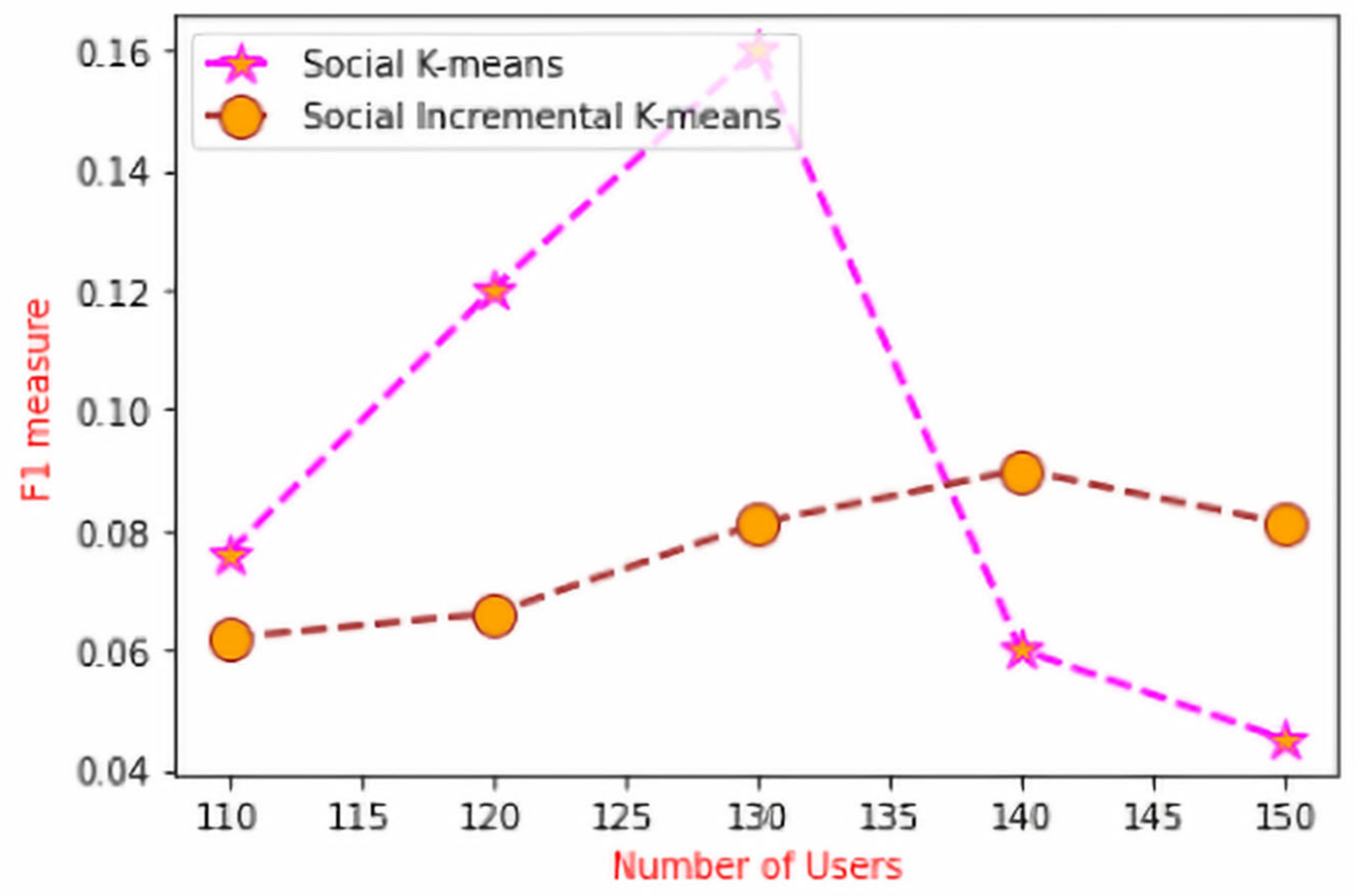
Figure 9, Figure 10 and Figure 11 depict the distinction between the progression of the social K-means algorithm as well as the social-incremental K-means algorithm.
Figure 9. Precision—K-means versus incremental K-means algorithms with social information.
Figure 10. Recall—K-means versus incremental K-means algorithms with social information.
Figure 11. F1 measure—K-means versus incremental K-means algorithms with social information.
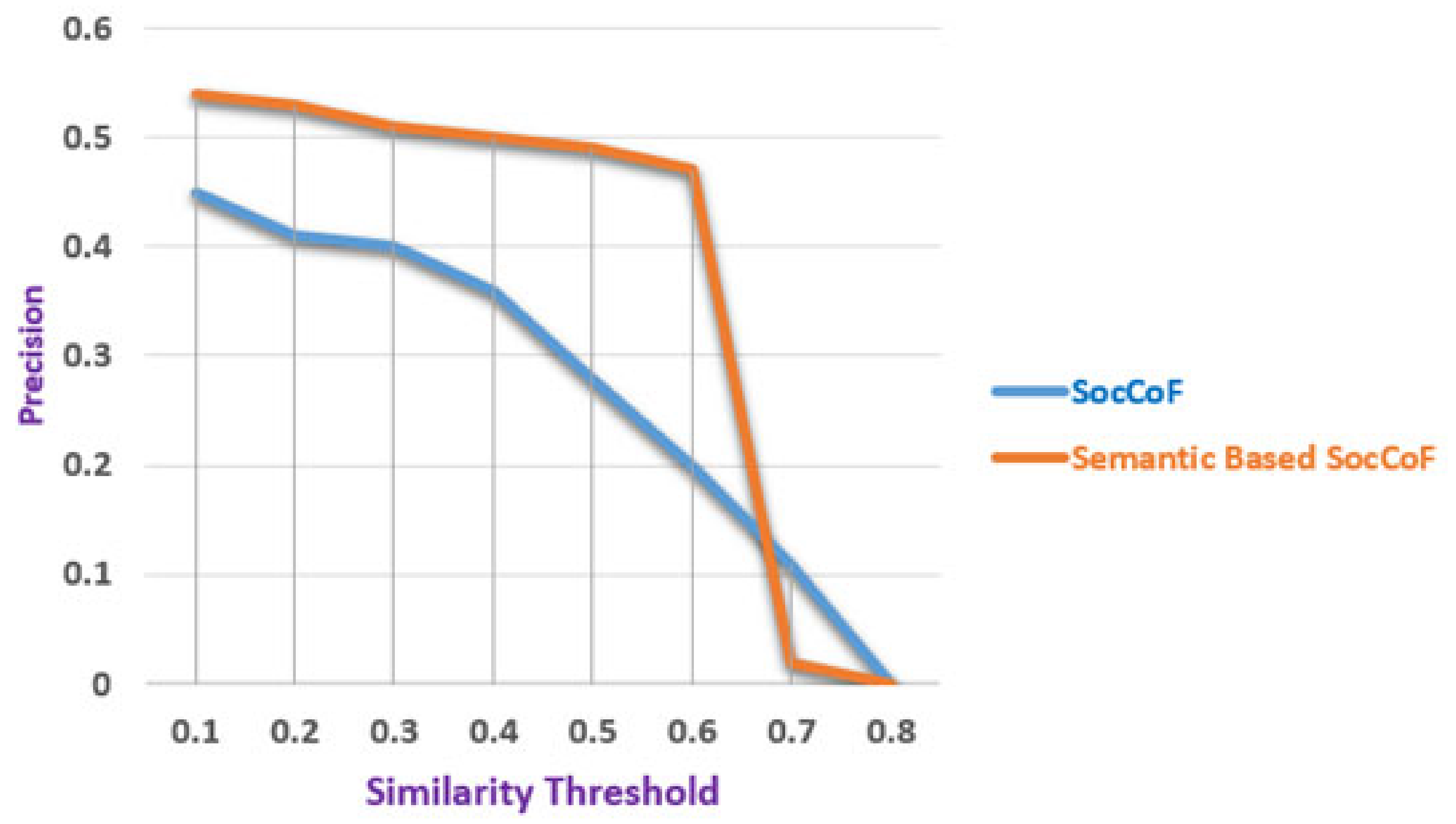
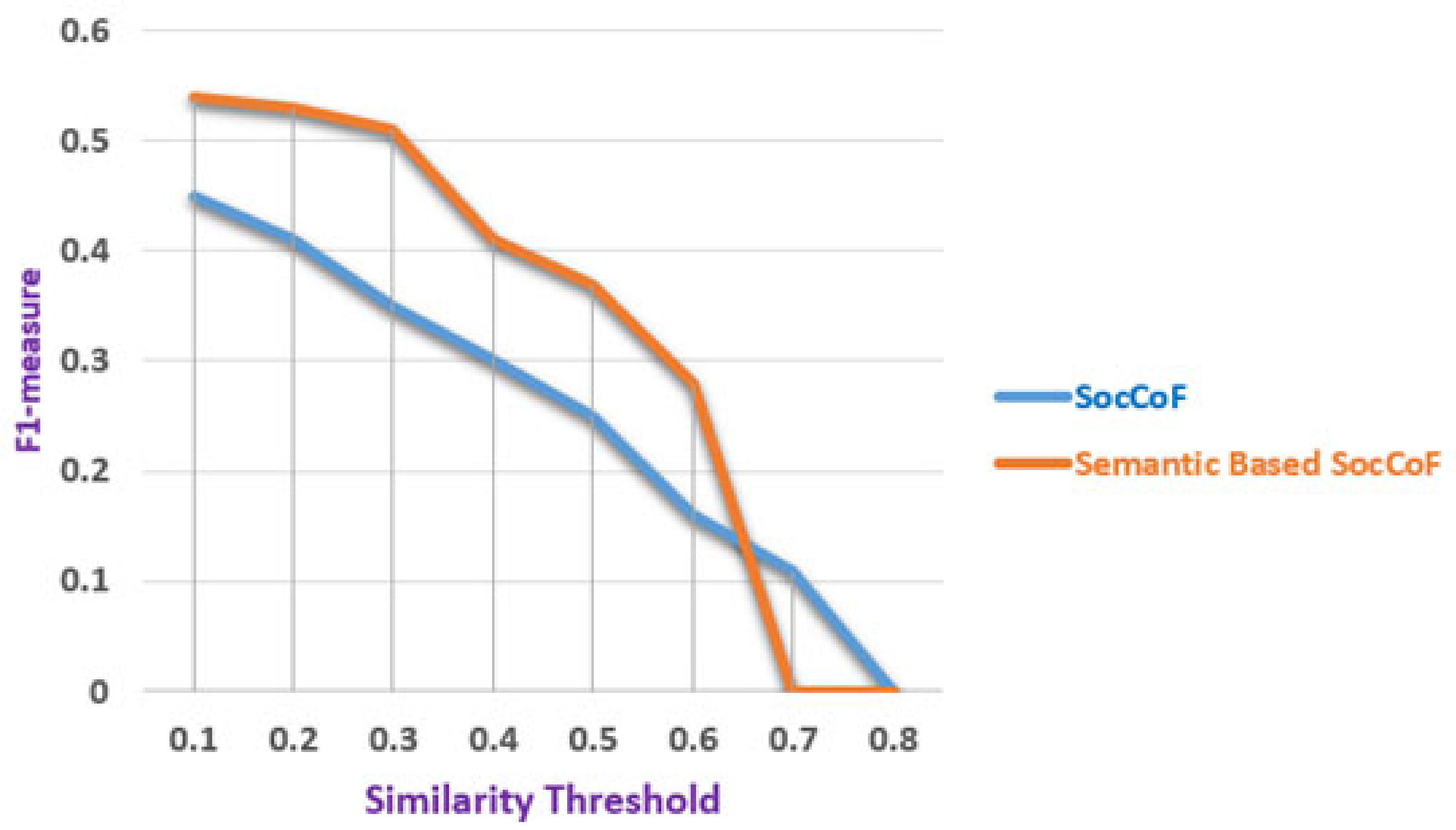
The numerous combinations of the SemF, SocCoF, and different amalgamations of the CoF, the SemF, as well as the SocCoF are assessed. The precision and F1 of semantic-based SocCoF and SocCoF algorithms are shown in Figure 12 and Figure 13. The inclusion of semantic information with SocCoF increased the performance of the recommendation model, as evidenced by this evaluation.
Figure 12. Precision of semantic-based SocCoF and SocCoF algorithms.
Figure 13. F1 measure of semantic-based SocCoF and SocCoF algorithms.
When compared to the CoF and other algorithms, the SemSocCoF performs better. As seen in Table 3, combining semantics with social information improved the correctness of CoF recommendations. The mean precision, mean recall, and mean F-measure of various techniques are presented. In comparison to the classic CoF method, the findings highlight the hybrid approach’s contribution.
Table 3. Summary of the results obtained by different algorithms.
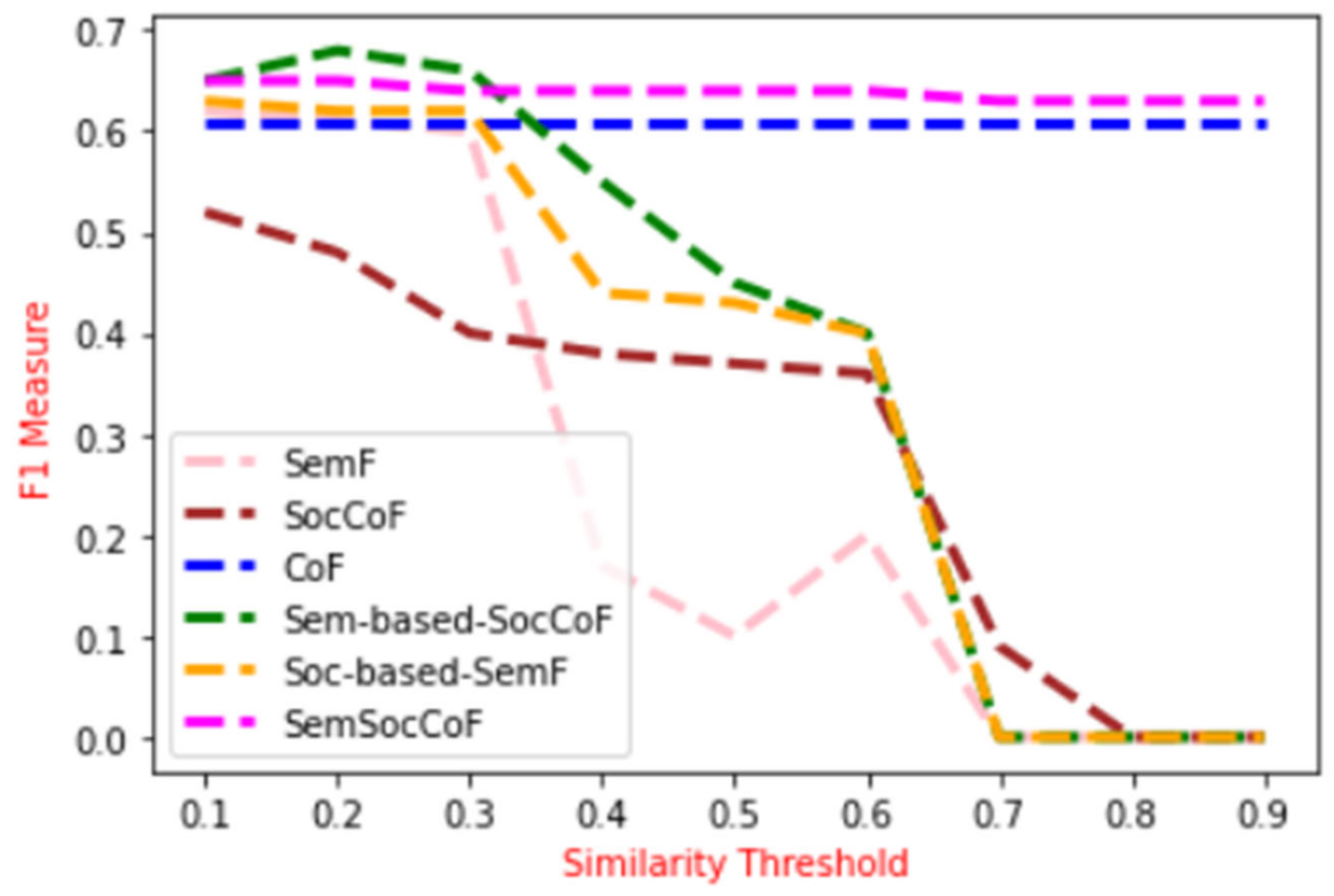
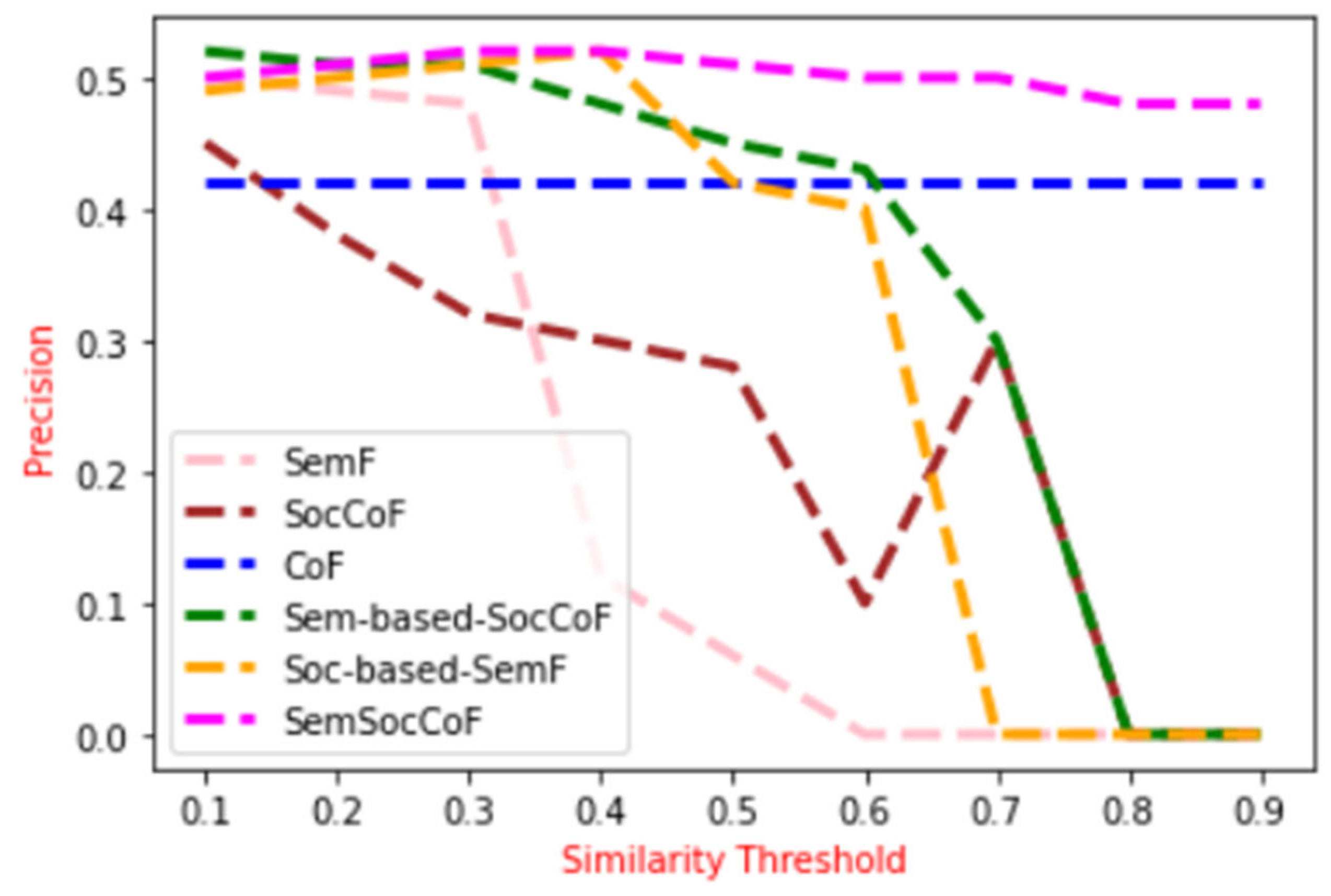
Figure 14 and Figure 15 show the performance metric values of the various methods by adjusting the similarity threshold value for each algorithm from 0.1 to 0.9.
Figure 14. Comparison of F1 measure of various algorithms.
Figure 15. Comparison of precision values of various algorithms.
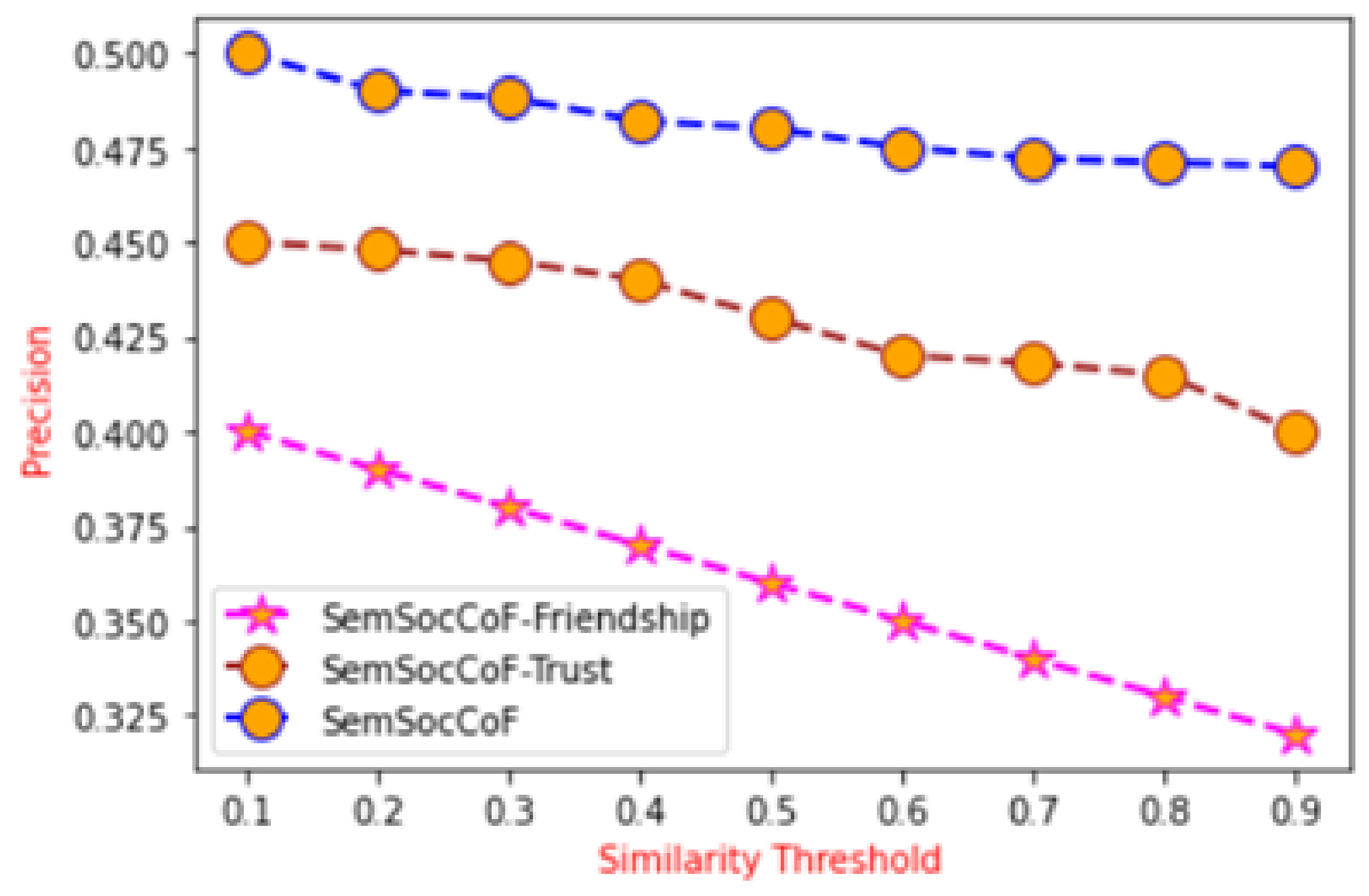
The hybrid SemSocCoF algorithm is tested using three different combinations: (1) amalgamation of the CoF, the SemF, and the SocCoF based solely on friendship factor; (2) combining the CoF, the SemF, as well as the SocCoF based solely on trust; and (3) combining the CoF, the SemF, and the SocCoF based on both friendship and credibility factors. In comparison to the other algorithms, the SemSocCoF approach showcased the best results compared to all the performance metrics. The result with respect to precision is shown in Figure 16.
Figure 16. Credibility information contribution in the recommendation system.
The analysis and comparison of the obtained results show that the proposed SemSocCoF model provides remarkable values for precision and F1 measure as 0.5 and 0.65, respectively, even when the similarity threshold is increased from 0.1 to 0.9. The proposed work clearly depicts that two classification strategies can be employed to boost the performance of the RS, the incremental K-means ML algorithm applied to all the users at the initial level and the KNN algorithm applied to the newly added users, which show good results. Our method integrates CoF recommendations with semantic and social information, resulting in an effective collaborative filtering enhancement strategy for friend recommendations in social networks when compared to the other related work [30] with a precision of 0.49 and an F1 measure of 0.64.
Table 4 provides a comparison of the proposed study with existing recent works.
Table 4. Comparison of proposed with existing methods.

5. Conclusions

The proposed system showcases improved collaborative filtering (CoF) strategy developed for friend recommendations in social networks. The CoF recommendation is combined with social data in the proposed methodology. Furthermore, two classification techniques, incremental K-means and K-NN algorithms, are incorporated to boost the performance in the recommendation process. The results of the testing process using the Yelp dataset reveal that the suggested methodology is highly effective than the CoF with respect to precision and F1 measure. User semantic and social information is considered in the proposed method. The proposed work results in a better recommendation algorithm based on hybridizations of collaborative, semantic, and social filtering (SocF). The obtained results with Yelp social network suggest that combining semantic and social data with the CoF algorithm improves recommendation accuracy when compared to the user-based CoF algorithm. Furthermore, because the system may offer a list of other relevant users to a given user based on semantic and social information, this combination completely eliminates the cold start problem. Finally, the results proved that the credibility information provides value to the recommendation system. The limitation of this study is that it does not consider all nearby points simultaneously in order to bundle a single point, but instead repeatedly only considers the closest point based on a selection approach utilizing a distance vector. However, other types of information, such as information about close/distant friends, influence, and local/global trust, could be incorporated into the proposed model in order to enhance the quality of the recommendations. On the other hand, as part of our ongoing research, evaluating strategy for a virtual community of learners can be the future extension. In the future, we will try to incorporate dynamic graph neural networks into social recommendation systems to more effectively mine users’ possible preferences, which is anticipated to enhance recommendation systems’ performance even more.

Author Contributions

Conceptualization, V.K.V. and M.T.R.; methodology, M.T.R.; software, S.B., M.K.I.R. and R.B.; validation, V.K.V., S.A.L. and S.B.; formal analysis, M.K.I.R., S.A.L. and S.B.; investigation, M.T.R. and M.K.I.R.; resources, S.A.L. and A.M.A.; data curation, R.B. and A.M.A.; writing—original draft preparation, M.T.R. and V.K.V.; writing—review and editing, M.T.R., S.B., M.K.I.R. and R.B.; visualization, S.A.L. and S.B.; supervision, A.M.A. and R.B.; project administration, M.K.I.R.; funding acquisition, S.A.L. and M.K.I.R. All authors have read and agreed to the published version of the manuscript.

Funding

This research received no external funding.

Data Availability Statement

The data used to support the findings of this study are included within the article.

Conflicts of Interest

The authors declare that they do not have any conflict of interest.

References

  1. Konstan, J.A.; Riedl, J. Recommender systems: From algorithms to user experience. User Model. User-Adapt. Interact. 2012, 22, 101–123. [Google Scholar] [CrossRef]
  2. Venkatesan, V.K.; Ramakrishna, M.T.; Batyuk, A.; Barna, A.; Havrysh, B. High-Performance Artificial Intelligence Recommendation of Quality Research Papers Using Effective Collaborative Approach. Systems 2023, 11, 81. [Google Scholar] [CrossRef]
  3. Pu, P.; Chen, L.; Hu, R. A user-centric evaluation framework for recommender systems. In Proceedings of the Fifth ACM Conference on Recommender Systems, Chicago, IL, USA, 23–27 October 2011; pp. 157–164. [Google Scholar]
  4. Ramakrishna, M.T.; Venkatesan, V.K.; Izonin, I.; Havryliuk, M.; Bhat, C.R. Homogeneous Adaboost Ensemble Machine Learning Algorithms with Reduced Entropy on Balanced Data. Entropy 2023, 25, 245. [Google Scholar] [CrossRef] [PubMed]
  5. Devarajan, D.; Stalin Alex, D.; Mahesh, T.R.; Vinoth Kumar, V.; Aluvalu, R.; Uma Maheswari, V.; Shitharth, S. Cervical Cancer Diagnosis Using Intelligent Living Behavior of Artificial Jellyfish Optimized with Artificial Neural Network. IEEE Access 2022, 10, 126957–126968. [Google Scholar] [CrossRef]
  6. Mooney, R.J.; Roy, L. Content-based book recommending using learning for text categorization. In Proceedings of the Fifth ACM Conference on Digital Libraries, San Antonio, TX, USA, 2–7 June 2000; pp. 195–204. [Google Scholar]
  7. Celdrán, A.H.; Pérez, M.G.; Clemente, F.J.G.; Pérez, G.M. Design of a recommender system based on users’ behavior and collaborative location and tracking. J. Comput. Sci. 2016, 12, 83–94. [Google Scholar] [CrossRef]
  8. Mahesh, T.R.; Vinoth Kumar, V.; Sivakami, R.; Manimozhi, I.; Krishnamoorthy, N.; Swapna, B. Early Predictive Model for Detection of Plant Leaf Diseases Using MobileNetV2 Architecture. Int. J. Intell. Syst. Appl. Eng. 2023, 11, 46–54. [Google Scholar]
  9. Adomavicius, G.; Tuzhilin, A. Toward the next generation of recommender systems: A survey of the state-of-the-art and possible extensions. IEEE Trans. Knowl. Data Eng. 2005, 17, 734–749. [Google Scholar] [CrossRef]
  10. Dharahas, R.T.; Mahesh, T.R. A Pragmatic Approach for Detecting Brain Tumors Using Machine Learning Algorithms. Biosci. Biotechnol. Res. Commun. Spec. Issue 2021, 14, 1–8. [Google Scholar]
  11. Liu, F.; Lee, H.J. Use of social network information to enhance collaborative filtering performance. Expert Syst. Appl. 2010, 37, 4772–4778. [Google Scholar] [CrossRef]
  12. Chang, C.-C.; Chu, K.-H. A recommender system combining social networks for tourist attractions. In Proceedings of the 2013 Fifth International Conference on Computational Intelligence, Communication Systems and Networks, Madrid, Spain, 5–7 June 2013; pp. 42–47. [Google Scholar]
  13. Banati, H.; Mehta, M.; Bajaj, M. Social behaviour based metrics to enhance collaborative filtering. Int. J. Comput. Inf. Syst. Ind. Manag. Appl. 2014, 6, 217–226. [Google Scholar]
  14. Jha, K.K.; Jha, R.; Jha, A.K.; Hassan, M.A.M.; Yadav, S.K.; Mahesh, T. A Brief Comparison on Machine Learning Algorithms Based on Various Applications: A Comprehensive Survey. In Proceedings of the 2021 IEEE International Conference on Computation System and Information Technology for Sustainable Solutions (CSITSS), Bangalore, India, 16–18 December 2021; pp. 1–5. [Google Scholar] [CrossRef]
  15. Guo, G.; Zhang, J.; Yorke-Smith, N. Leveraging multiviews of trust and similarity to enhance clustering-based recommender systems. Knowl.-Based Syst. 2015, 74, 14–27. [Google Scholar] [CrossRef]
  16. Roopashree, S.; Anitha, J.; Mahesh, T.R.; Vinoth Kumar, V.; Viriyasitavat, W.; Kaur, A. An IoT based authentication system for therapeutic herbs measured by local descriptors using machine learning approach. Measurement 2022, 200, 111484. [Google Scholar] [CrossRef]
  17. Agarwal, V.; Bharadwaj, K.K. A collaborative filtering framework for friends recommendation in social networks based on interaction intensity and adaptive user similarity. Soc. Netw. Anal. Min. 2013, 3, 359–379. [Google Scholar] [CrossRef]
  18. Vivek, V.; Mahesh, T.R.; Saravanan, C.; Kumar, K.V. A Novel Technique for User Decision Prediction and Assistance Using Machine Learning and NLP: A Model to Transform the E-commerce System. In Big Data Management in Sensing; River Publishers: Aalborg, Denmark, 2022; pp. 61–76. [Google Scholar]
  19. Zhang, Y.; Tu, Z.; Wang, Q. Temporec: Temporal-topic based recommender for social network services. Mob. Netw. Appl. 2017, 22, 1182–1191. [Google Scholar] [CrossRef]
  20. Li, Y.-M.; Wu, C.-T.; Lai, C.-Y. A social recommender mechanism for e-commerce: Combining similarity, trust, and relationship. Decis. Support Syst. 2013, 55, 740–752. [Google Scholar] [CrossRef]
  21. Sharada, K.A.; Sushma, K.S.; Muthukumaran, V.; Mahesh, T.R.; Swapna, B.; Roopashree, S. High ECG diagnosis rate using novel machine learning techniques with Distributed Arithmetic (DA) based gated recurrent units. Microprocess. Microsyst. 2023, 98, 104796. [Google Scholar] [CrossRef]
  22. Chen, J.; Wang, C.; Shi, Q.; Feng, Y.; Chen, C. Social recommendation based on users’ attention and preference. Neurocomputing 2019, 341, 1–9. [Google Scholar] [CrossRef]
  23. Lai, C.-H.; Lee, S.-J.; Huang, H.-L. A social recommendation method based on the integration of social relationship and product popularity. Int. J. Hum.-Comput. Stud. 2019, 121, 42–57. [Google Scholar] [CrossRef]
  24. Zhang, Z.; Liu, Y.; Ding, W.; Huang, W.W. A Friend Recommendation System Using Users’ Information of Total Attributes. In ICDS 2015: Data Science; Lecture Notes in Computer Science; Springer: Cham, Switzerland, 2015; pp. 34–41. [Google Scholar] [CrossRef]
  25. Shahane, A.; Galgali, R. Friend Recommendation System for Social Networks. IOSR J. Comput. Eng. 2016, 18, 3741. [Google Scholar]
  26. Zheng, H.; Wu, J. Friend Recommendation in Online Social Networks: Perspective of Social Influence Maximization. In Proceedings of the 2017 26th International Conference on Computer Communication and Networks (ICCCN), Honolulu, HI, USA, 3–6 August 2017; pp. 1–9. [Google Scholar] [CrossRef]
  27. Dhawan, S.; Singh, K.; Gupta, H. User Behavior Based Friend Recommendation in Facebook Social Networks. Int. J. Comput. Sci. Eng. 2018, 6, 69–73. [Google Scholar] [CrossRef]
  28. Srikantaiah, K.C.; Mewara, S.; Goyal, S.; Subhiksha, S. A Friend Recommendation System using Semantic Based KNN Algorithm. J. Seybold Rep. 2020, 15, 1201–1209. [Google Scholar] [CrossRef]
  29. Parveen, R.; Sandeep Varma, N. Friend’s recommendation on social media using different algorithms of machine learning. Glob. Transit. Proc. 2021, 2, 273–281. [Google Scholar] [CrossRef]
  30. Roy, D.; Dutta, M. A systematic review and research perspective on recommender systems. J. Big Data 2022, 9, 59. [Google Scholar] [CrossRef]
  31. Zhu, J.; Wang, C.; Guo, X.; Ming, Q.; Li, J.; Liu, Y. Friend and POI recommendation based on social trust cluster in location-based social networks. J. Wirel. Commun. Netw. 2019, 2019, 89. [Google Scholar] [CrossRef]
  32. Zhu, J.; Liu, Y.; Yin, X. A New Structure Hole-based Algorithm for Influence Maximization in Large Online Social Networks. IEEE Access 2017, 5, 23405–23412. [Google Scholar] [CrossRef]
  33. Berkani, L. Sscf: A semantic and social-based collaborative filtering approach. In Proceedings of the 2015 IEEE/ACS 12th International Conference of Computer Systems and Applications (AICCSA), Marrakech, Morocco, 17–20 November 2015; pp. 1–4. [Google Scholar]
  34. Berkani, L.; Belkacem, S.; Ouafi, M.; Guessoum, A. Recommendation of users in social networks: A semantic and social based classification approach. Expert Syst. 2021, 38, e12634. [Google Scholar] [CrossRef]
  35. Sheth, A.; Kapanipathi, P. Semantic filtering for social data. IEEE Internet Comput. 2016, 20, 74–78. [Google Scholar] [CrossRef]
  36. Wu, Z.; Palmer, M. Verb semantics and lexical selection. arXiv 1994, arXiv:cmp-lg/9406033. [Google Scholar]
  37. Kesavamoorthy, R.; Anandaraj, S.P.; Mahesh, T.R.; Kumar, V.R.; Srinivasulu, A. Detection of Online Sexual Predatory Chats Using Deep Learning. In Artificial Intelligence and Blockchain in Digital Forensics; River Publishers: Aalborg, Denmark, 2023; pp. 69–80. [Google Scholar]
  38. Berkani, L. Using a social-based collaborative filtering with classification techniques. In Proceedings of the IFIP International Conference on Computational Intelligence and Its Applications, Organ, Algeria, 8–10 May 2018; Springer: Cham, Switzerland, 2018; pp. 267–278. [Google Scholar]
  39. Berkani, L. A semantic and social-based collaborative recommendation of friends in social networks. Softw. Pract. Exp. 2020, 50, 1498–1519. [Google Scholar] [CrossRef]
  40. Abu-Salih, B.; Alsawalqah, H.; Elshqeirat, B.; Issa, T.; Wongthongtham, P. Toward a Knowledge-based Personalised Recommender System for Mobile App Development. J. Univers. Comput. Sci. 2021, 27, 208–229. [Google Scholar] [CrossRef]
  41. Hazrati, N.; Ricci, F. Recommender systems effect on the evolution of users’ choices distribution. Inf. Process. Manag. 2022, 59, 102766. [Google Scholar] [CrossRef]
  42. Mol, F.; Neetha, B.S. Friend Recommendation System for Social Networks: A Semantic and Profile based Approach. Int. J. Eng. Res. Technol. 2015, 3, 1–4. [Google Scholar]
  43. Lyes, B.; Mourad, A.; Djamil, A.; Sofiane, A. P2PCF: A Collaborative Filtering Based Recommender System for Peer to Peer Social Networks. J. High Speed Netw. 2021, 27, 13–31. [Google Scholar]
Disclaimer/Publisher’s Note: The statements, opinions and data contained in all publications are solely those of the individual author(s) and contributor(s) and not of MDPI and/or the editor(s). MDPI and/or the editor(s) disclaim responsibility for any injury to people or property resulting from any ideas, methods, instructions or products referred to in the content.

Article Metrics

Citations

Article Access Statistics

Multiple requests from the same IP address are counted as one view.