You are currently viewing a new version of our website. To view the old version click .
Electronics
  • Editor’s Choice
  • Article
  • Open Access

24 January 2023

Visualization Technology and Deep-Learning for Multilingual Spam Message Detection

,
,
and
Department of Information Security, Seoul Women’s University, Nowon-gu, Seoul 01797, Republic of Korea
*
Author to whom correspondence should be addressed.
This article belongs to the Section Artificial Intelligence

Abstract

Spam detection is an essential and unavoidable problem in today’s society. Most of the existing studies have used string-based detection methods with models and have been conducted on a single language, especially with English datasets. However, in the current global society, research on languages other than English is needed. String-based spam detection methods perform different preprocessing steps depending on language type due to differences in grammatical characteristics. Therefore, our study proposes a text-processing method and a string-imaging method. The CNN 2D visualization technology used in this paper can be applied to datasets of various languages by processing the data as images, so they can be equally applied to languages other than English. In this study, English and Korean spam data were used. As a result of this study, the string-based detection models of RNN, LSTM, and CNN 1D showed average accuracies of 0.9871, 0.9906, and 0.9912, respectively. On the other hand, the CNN 2D image-based detection model was confirmed to have an average accuracy of 0.9957. Through this study, we present a solution that shows that image-based processing is more effective than string-based processing for string data and that multilingual processing is possible based on the CNN 2D model.

1. Introduction

Since the outbreak of COVID-19, reliance on cyberspace has increased, and spam abuse is increasing as well. Smishing, a type of spam, is a combination of SMS and phishing and is a new fraudulent method that steals users’ financial information with spam messages containing malicious URLs. However, these smishing instances often show different aspects than previous types of spam. Firstly, there are increases in the rate of smishing, as well as in impersonating public institutions and acquaintances. Secondly, international spam crimes, which are no longer domestic but cross borders, are also emerging. According to the article [1], Federal Trade Commission (FTC), the amount of damage caused by scam text is estimated to be USD 86 million. In addition, the reported number of damages is 334,524 per year, which is equal to 916 cases per day on average. Therefore, spam SMS detection is essential for damage prevention.
To solve this SMS smishing problem, various methods of spam detection have been proposed. In particular, a study [2] classified recent spam detection methods into those using background information (including SMS messages, as well as accounts and behavior features) and those using content-level spam detection (focusing on the content of messages), finding that, among these spam detection methods, text-based spam detection was widely applied. Additionally, in [3], a bag of words (BOW) was used as a text-based content-level spam detection method.
Existing spam detection methods essentially require natural language processing to process input text data. Many researchers have proposed English natural language processing, but the amount of papers with non-English natural language processing is relatively small. In addition, each language’s grammatical characteristics make it more complex to process spam content. For example, Korean has linguistic characteristics such as large differences between spoken and written language; honorifics according to relationships between listeners and speakers; semantic changes according to prosodic elements; frequent omissions of subjects, predicates, and objects; and difficulty in word spacing. However, since there are not many research methods available, it is difficult to process natural languages compared to English. Thus, it inevitably appears differently depending on the natural language processing method and level, as the characteristics are different for each language to detect content level. In a previous study [4], multilingualism showed lower accuracy than English. The researchers proceeded with natural language processing for Spanish, Chinese, and Indonesian [5], but as there were differences in character form and grammatical complexity, they found the same limitations as previous models. In the case of using OCR, spam messages are processed by applying deep learning after natural language processing. In addition, there are difficulties in applying existing detection models to the form of current spam text. Spammers intentionally make typos or alterations, such as creating spaces between words, and preprocessing cannot determine whether these words are spam. In response, ref. [6] used CBOW and skip-gram methods to detect not only general strings, but also texts replaced with special symbols, languages of other countries, and numbers. In this paper, to conduct image-based detection research, spam and ham were classified by applying image-processed SMS to deep learning through separate visualization processing.
In this study, an image-based spam detection method using a CNN 2D model is used to generate Unicode-based images. We conduct research by converting English, which can be considered a basic sample, and Korean, which can be considered a unique sample, into Unicode in our dataset. Our study shows higher accuracy than existing methods. In addition, in another respect, it shows different characteristics from existing spam detection methods using deep learning.
Firstly, the Unicode-based image creation method eliminates preprocessing. Therefore, the comprehensive operation is possible for spam detection not only in English, but also in non-English languages that can be expressed in Unicode or in datasets with mixed languages.
Secondly, we propose an image-based spam detection method that is different from existing general text-based spam detection methods. In this method, the model learns spam and ham dataset images separately and extracts the features of the images to detect spam.

3. Proposed Method

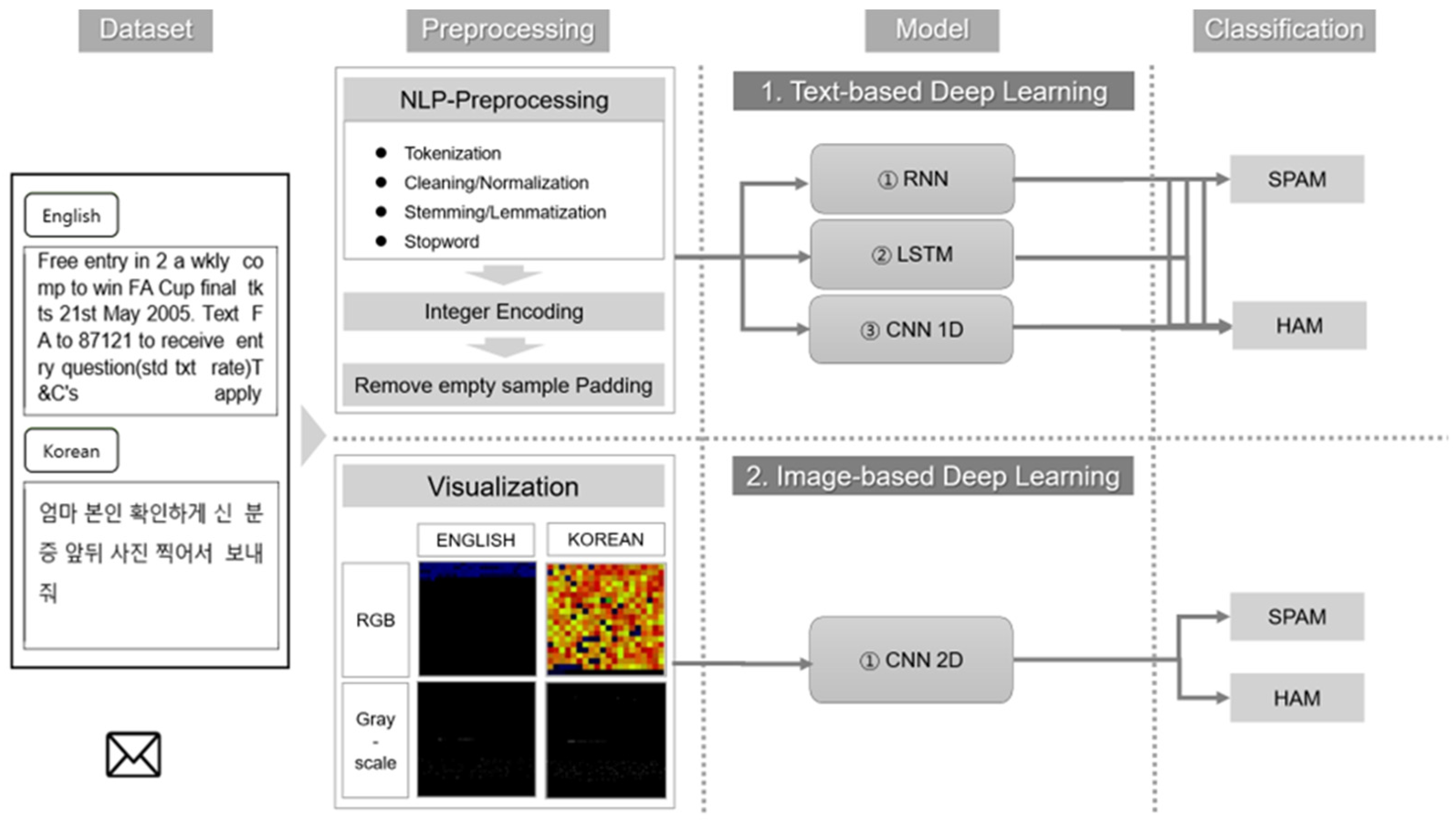
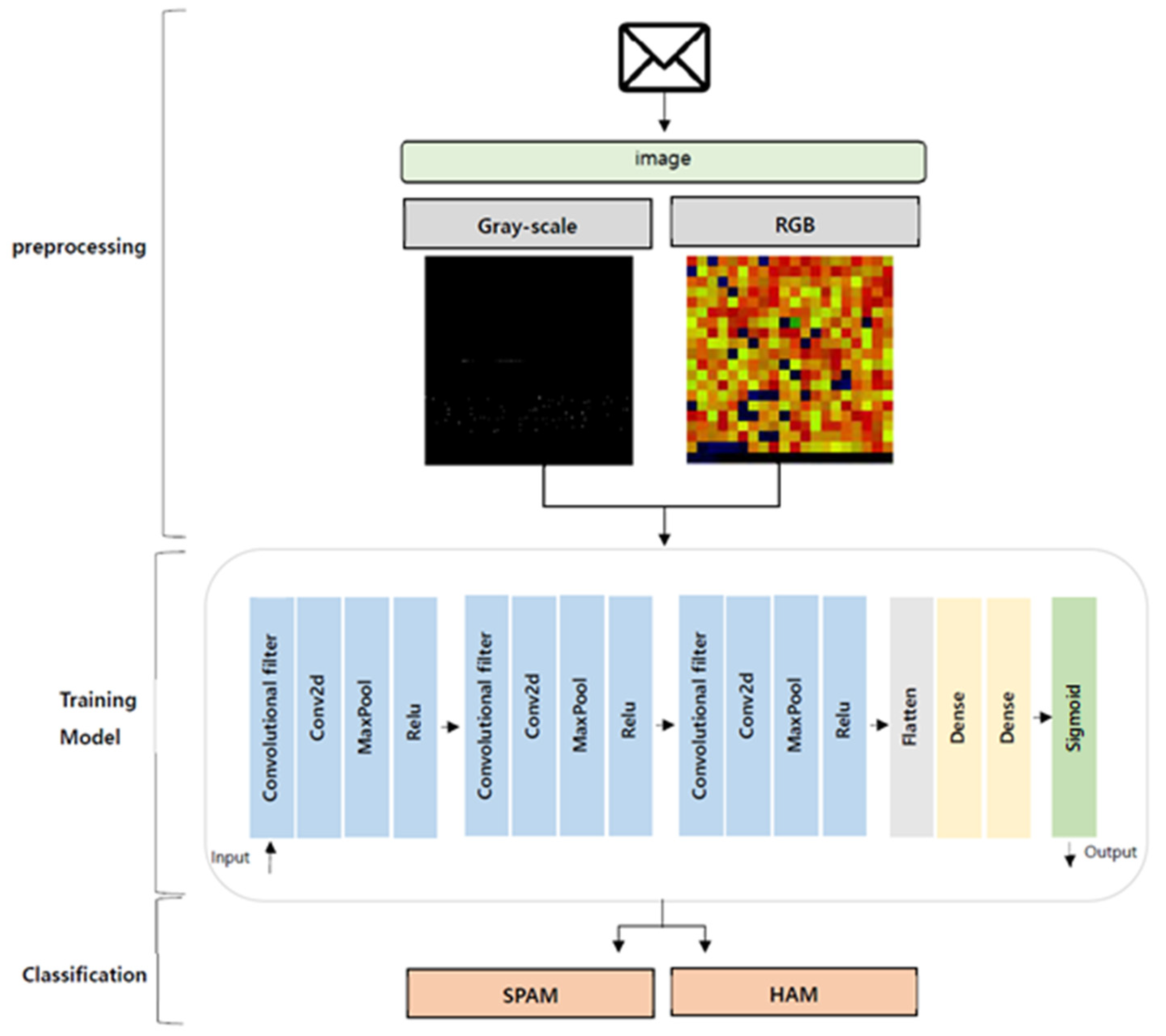
The proposed spam detection framework is shown in Figure 1 and consisted of three processes: preprocessing (NLP, preprocessing, and visualization), training, and classification. Through the process of preprocessing, various visualizations of spam and ham messages were performed. The visualization proposed two methods: grayscale and RGB. This is explained in detail in the next section. In this paper, learning was conducted for various models, including RNN, LSTM, and CNN 1D models, but the method proposed as the optimal model among them achieved learning using a CNN 2D model. In the last step, spam and ham classification was performed through a dense layer using sigmoid activation. A description of each process follows.
Figure 1. General description of proposed spam detection methods.

3.1. Datasets

Three types of datasets were used: English, Korean, and a mixed dataset (English and Korean). For the English dataset, the “SMS spam collection dataset” published on Kaggle was used, and for the Korean dataset, we visited the Cyber Security Big Dataset Center and used a Korean smishing dataset in addition to collecting additional data from internet crawling and the open dataset “One-shot conversation dataset with Korean emotional information” from AI Hub. There were three types of datasets used in this study: an English ham and spam dataset, a Korean ham and spam dataset, and a mixed Korean and English dataset. The datasets contained 5568, 69,654, and 75,222 samples, respectively. Spam data were labeled as 1, and ham data were labeled as 0. Table 2 shows the summary of the datasets.
Table 2. Dataset matrix.

3.2. Application of Text-Based Deep Learning

In this paper, research was conducted with RNN, LSTM, and CNN 1D models, which have been suggested by many researchers as spam and ham detection models, to compare our accuracy results with those of existing studies.

3.2.1. NLP Preprocessing

The process by which a model receives natural language as input is not simply a process of receiving a sentence literally. In general, a model transforms characters into numbers through tokenization, word set generation, integer encoding, padding, and vectorization and then proceeds with learning. In this process, strings are greatly affected by language characteristics. Therefore, in this paper, we conducted practice by adding a preprocessing step that considered language characteristics, as well as basic preprocessing steps for each Korean and English dataset.
Tokenization
Tokenization is the step in which data are cut into words or characters. In the case of the English dataset, we proceeded with tokenization in two ways. First, we distinguished upper- and lowercase letters and converted them uniformly into lowercase letters. Second, we removed stop words using the “English” stop word library from NLTK. In the case of the Korean dataset, there were difficulties in tokenizing according to spaces, as Korean has a variable word form, which changes form depending on the context, even if it is the same word. Therefore, instead of spacing, we used word normalization, and morpheme tokenization was performed using a morpheme analyzer. In addition, as a lot of SMS data include special symbols, characters, etc., so a process of blanking out all characters except those in English and Korean was added.
Integer Encoding
In this step, the data were treated as numbers. It could largely be divided into the process of creating a word set and the process of assigning an index to each word set. First, both Korean and English data were tokenized, and each word was given a unique integer. Furthermore, when the data were processed, it was determined that data with significant effects on classification would appear at least twice, so data with frequencies of less than two were removed.
Removing Empty Samples and Padding
In this step, after conducting the previous two steps, empty data were deleted and padding was performed to make data of different lengths equal.

3.2.2. Models

  • RNN
h t = tan h ( x t W i h T + b i h + h t 1     W h h T + b h h )
Ref. [34] RNN is the most basic form of a sequence model that processes inputs and outputs in sequence units and is a model that mainly deals with sequential data or time series data. These deep-learning algorithms classify the next input based on the information obtained from the previous input and show excellent performances in use for continuously correlated data, such as language translation, natural language processing (NLP), and voice recognition. In this paper, the model was designed with the parameter values shown in the figure below, and a simple RNN was used as the model. Table 3 shows the settings of RNN model
Table 3. Settings of RNN model.
2.
LSTM
i t =   σ ( W ii x t   +   b ii   +   W hi h t 1 +   b hi )
f t   =   σ ( W if x t +   b if +   W hg h t 1 +   b hf )
g t =   tan h ( W ig x t   + b ig +   W hg h t 1 +   b hg )
O t =   σ ( W io x t +   b io +   W ho h t 1 +   b ho )
C t   =   f t   C t 1 + i t   g t
h t   =   o t tanh ( c t )
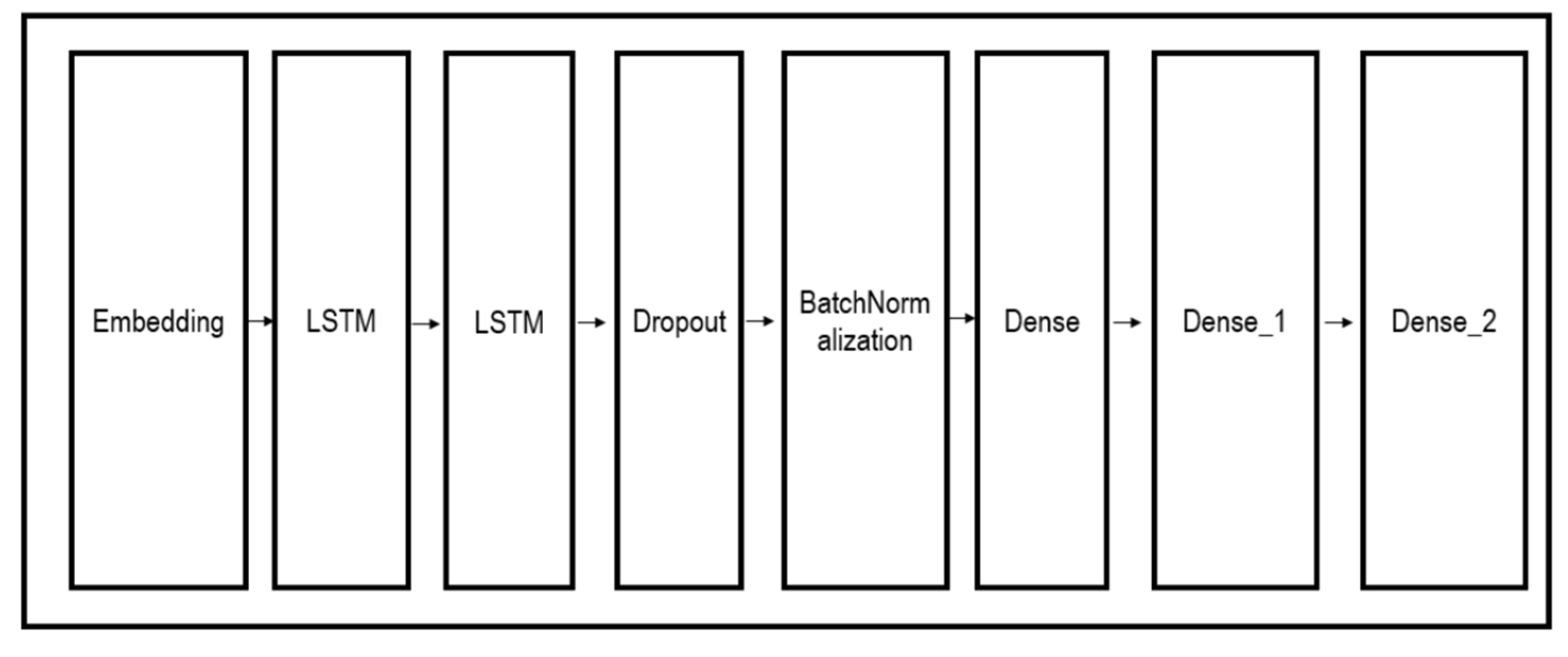
Ref. [35] An LSTM model is also a type of sequence model that can proceed with interactions among cell states without significantly changing the overall information. We designed the model in this paper with seven layers, including a dropout layer, a batch normalization layer, a dense layer, and so on. In the first layer, the input came as an embedding layer, passed through the next two LSTM layers, and dropped some nodes while passing through the dropout layer. Afterward, the batch_normalization layer went through the process of stabilizing the learning process as a whole and passed through three dense layers. At this stage, the last layer, Dense_1, output one final value by distinguishing whether the final value the model wanted to predict was spam (1) or ham (0), so the activation function was designated as sigmoid and dense (1) at the same time. Table 4 shows the settings of LSTM model. Figure 2 shows the structure of LSTML model.
Table 4. Settings of LSTM model.
Figure 2. Structure of LSTM model.
3.
CNN 1D
out ( N j , C out j ) = bias ( C out j ) + k = 0 C in 1 weight ( C out j , k ) input ( N i , k )
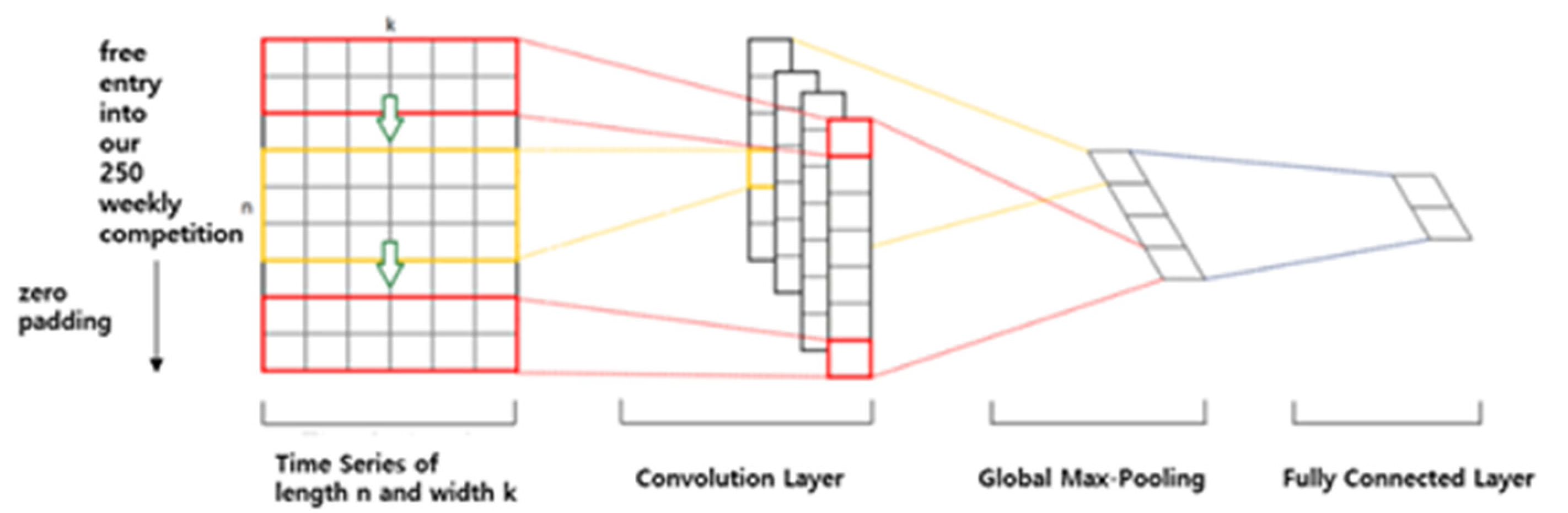
Ref. [36] CNN 1D is a convolutional neural network model (CNN). A CNN’s basic concept is to look at data as pictures. There is no exception for strings. A CNN 1D model receives a vector as input that is created by stacking word embeddings of sentences and processes it by performing 1D filtering from top to bottom. In addition, the model is frequently referred to as the most-used model in the design of natural language processing (NLP). In this paper, the model was constructed as follows: overall, the model was similar to the configuration of the LSTM model mentioned above, and a global_max_pooling layer was added to prevent overfitting. Figure 3 shows the Text-based CNN 1D preprocessing. Table 5 shows the settings of CNN 1D model.
Figure 3. Text-based CNN 1D preprocessing.
Table 5. Settings of CNN 1D model.

3.2.3. Experiment Results

When using each model, the accuracy was as follows: overall, it was confirmed that the detection accuracy for Korean was higher than that for English by about 0.01 percentage point. As a result of the experiment, the LSTM model showed the highest accuracy for the mixed dataset. Table 6 shows the performance of each model accuracy per dataset.
Table 6. Performance of each model accuracy per dataset.

3.3. Application of Image-Based Deep Learning

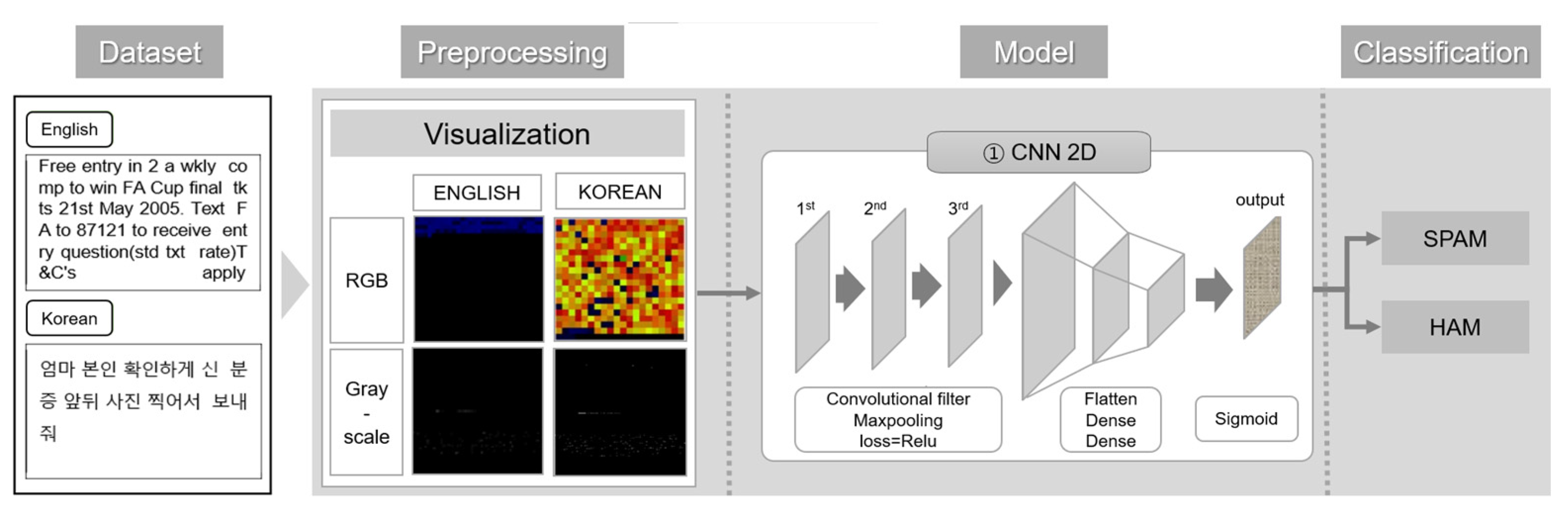
Figure 4 shows general decription of spam detection using image-based deep learning.
Figure 4. General description of spam detection using image-based deep learning.

3.3.1. Preprocessing

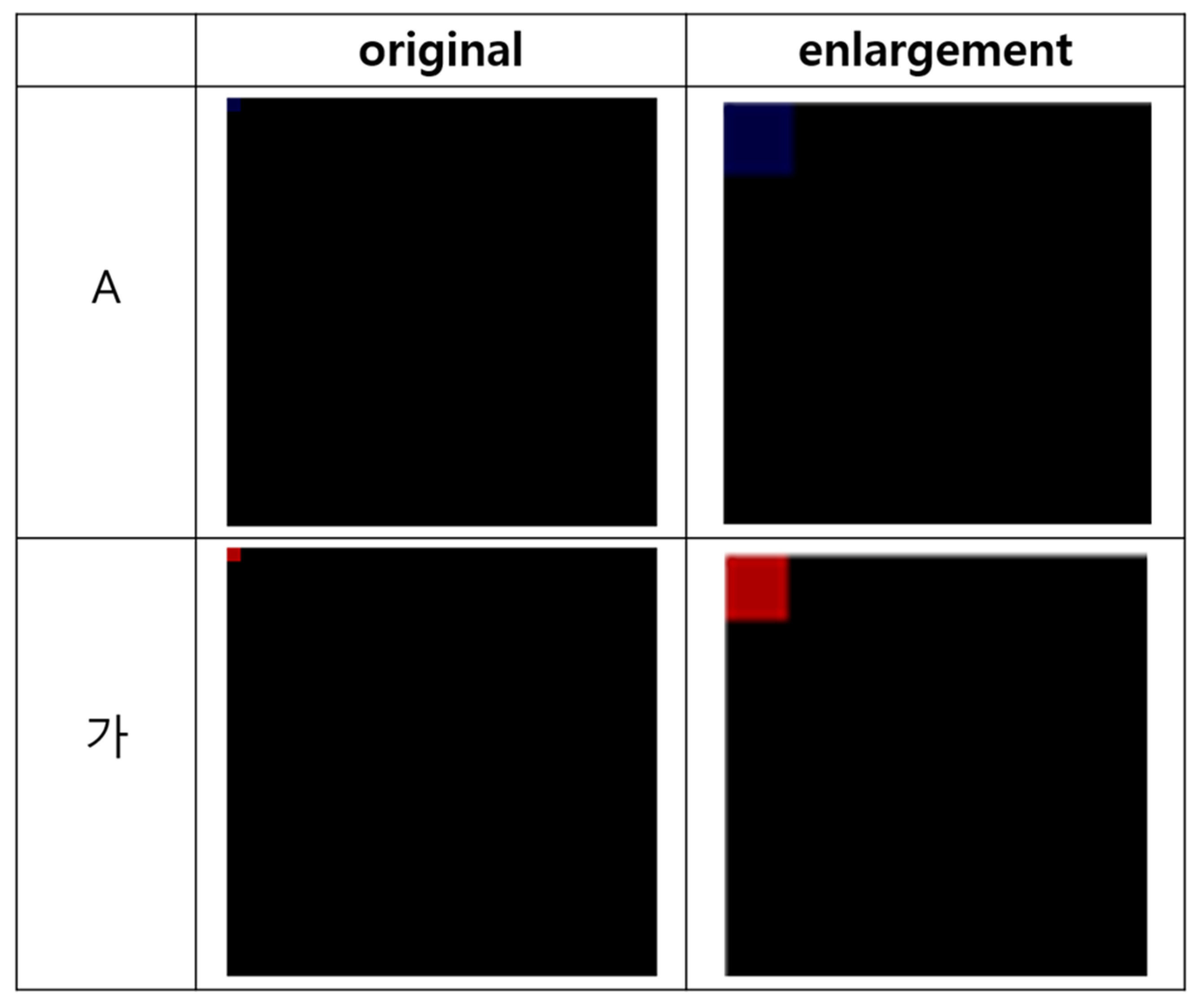
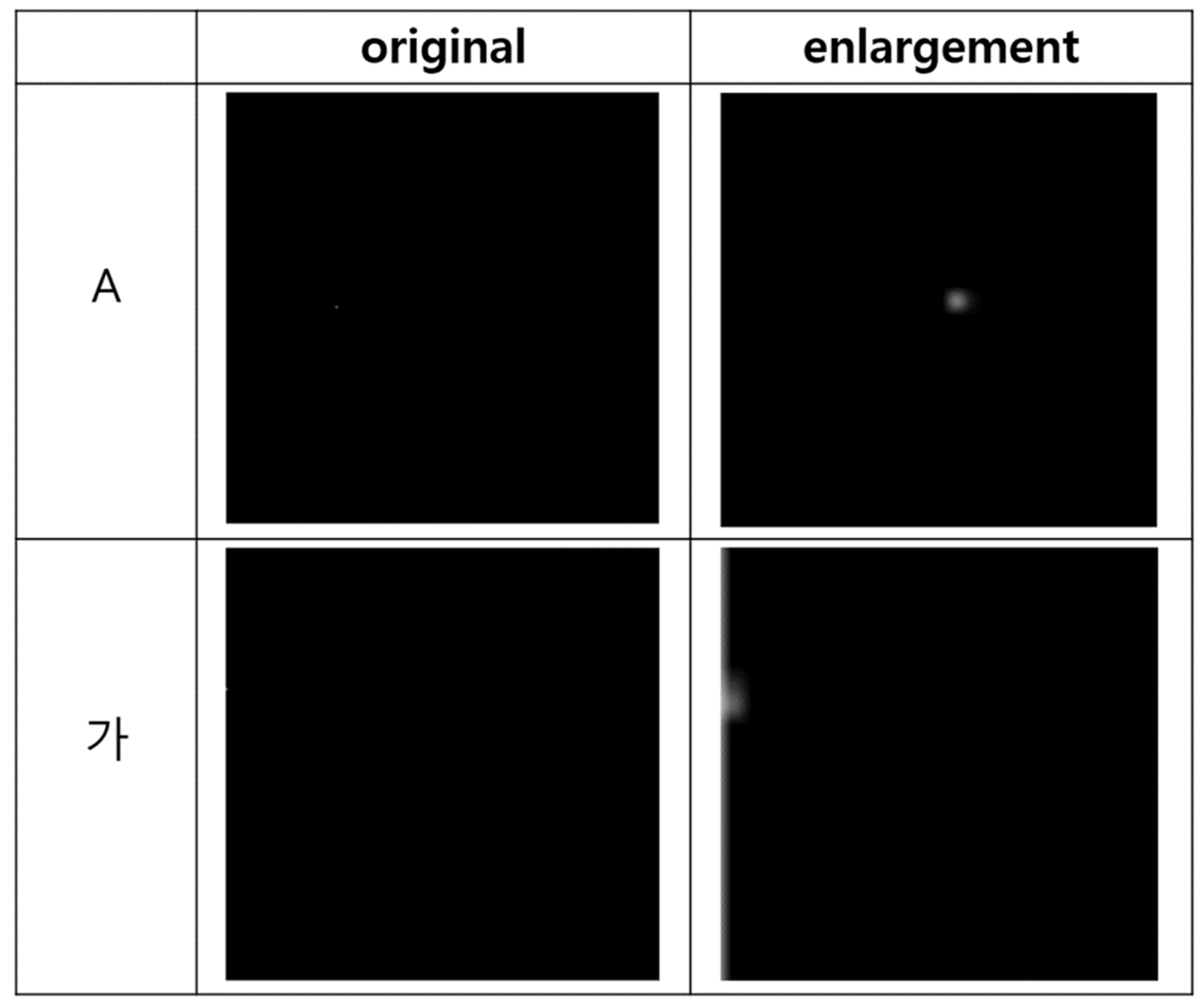
Both the grayscale and RGB image-processing methods involved converting characters to Unicode values. In this process, blank characters in the input string were removed. This was because blank characters are considered to be a linguistic characteristic, as the presence or absence of blank characters is different for each language, and meaning is created through blank characters. Therefore, blank characters were removed to exclude language characteristics as much as possible. On the other hand, special characters were not removed because they were considered part of the preprocessing process, which had nothing to do with the grammatical characteristics of the languages. Table 7 shows unicode and coordinate values of characters. Figure 5 shows the Grayscle images of ‘A’, ‘가’. Figure 6 shows the RGB images of ‘A’, ‘가’.
Table 7. Unicode and coordinate values of characters.
Figure 5. Grayscale, ‘A’,’가’.
Figure 6. RGB, ‘A’,’가’.
  • Grayscale Image
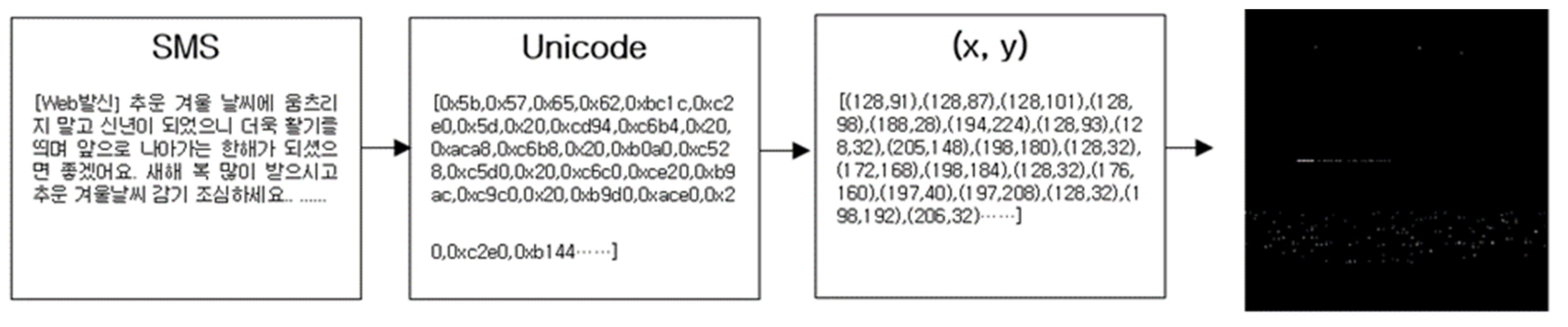
In this step, the Unicode of the character was converted into a pair of coordinates (X,Y) for conversion into a grayscale image. When text was entered, the Unicode value was extracted from each character. The extracted value was divided by one byte and matched with (X,Y) coordinates. 256∗256 was used to increase the value of an element corresponding to each coordinate in the image. The values of the elements in the array contained the pixel brightness values. The brightness of one pixel ranged from 0 to 255. For example, a character whose Unicode value was 0xff00 corresponded to the coordinates (255,0) and increased the value of the corresponding element.
When encoding with Unicode, English is 1 byte per character, and Korean is 2 bytes per character. Since an English character is 1 byte, the x-value is always 0 when converting to a coordinate. The coordinate values of English characters are all located on the edge of an image, making it difficult to identify them. To solve this problem, instead of using 0 for x, we used 128, which was the median of the coordinate plane. Since the 128 (+UC80XX) area was the value of the CJK (China, Japan integrated Chinese and Korea) character area, there were no characters that overlapped for the Korean, English, or Unicode special symbols. Figure 7 shows changing process from text to a grayscale image
Figure 7. Changing process from text to a grayscale image.
256∗256 pixel values were initialized to zero, and the Unicode value of each character was mapped as a coordinate (X,Y). In addition, if the length of a string was short, the mapped coordinate values were very small, making them difficult to identify. To solve this problem, when the values of the array elements were taken at once, the brightness per pixel was increased by increasing the value by 200 so that it could be seen more clearly. Through this process, a grayscale image was finally generated.
2.
RGB Image
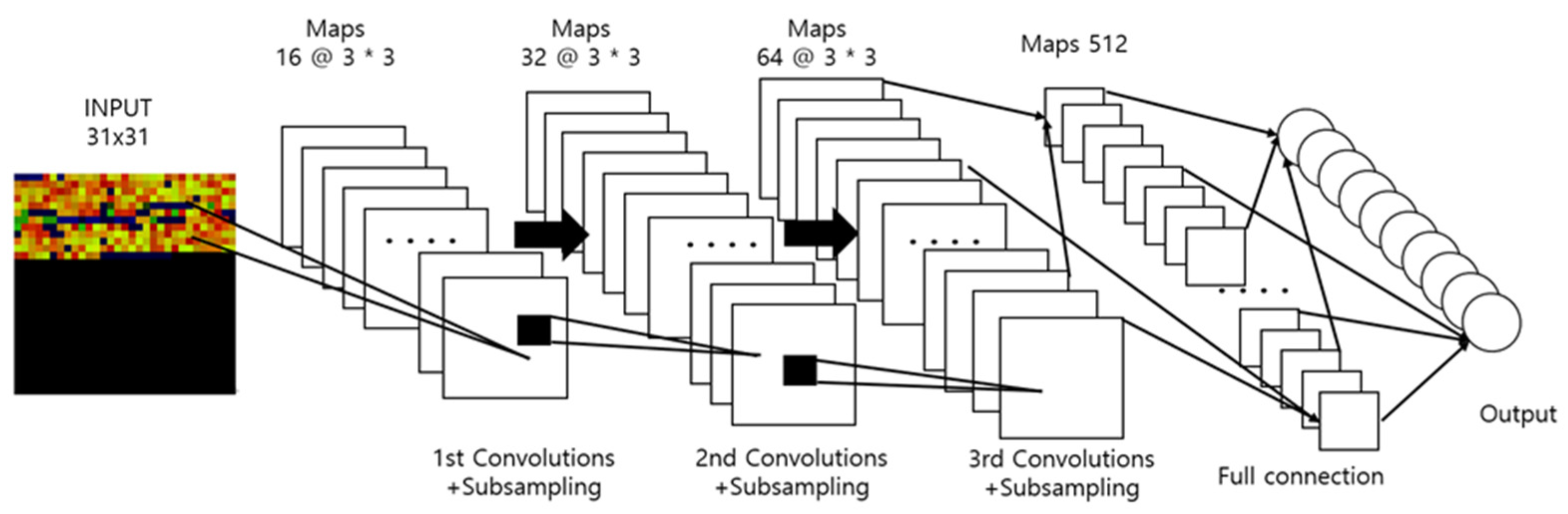
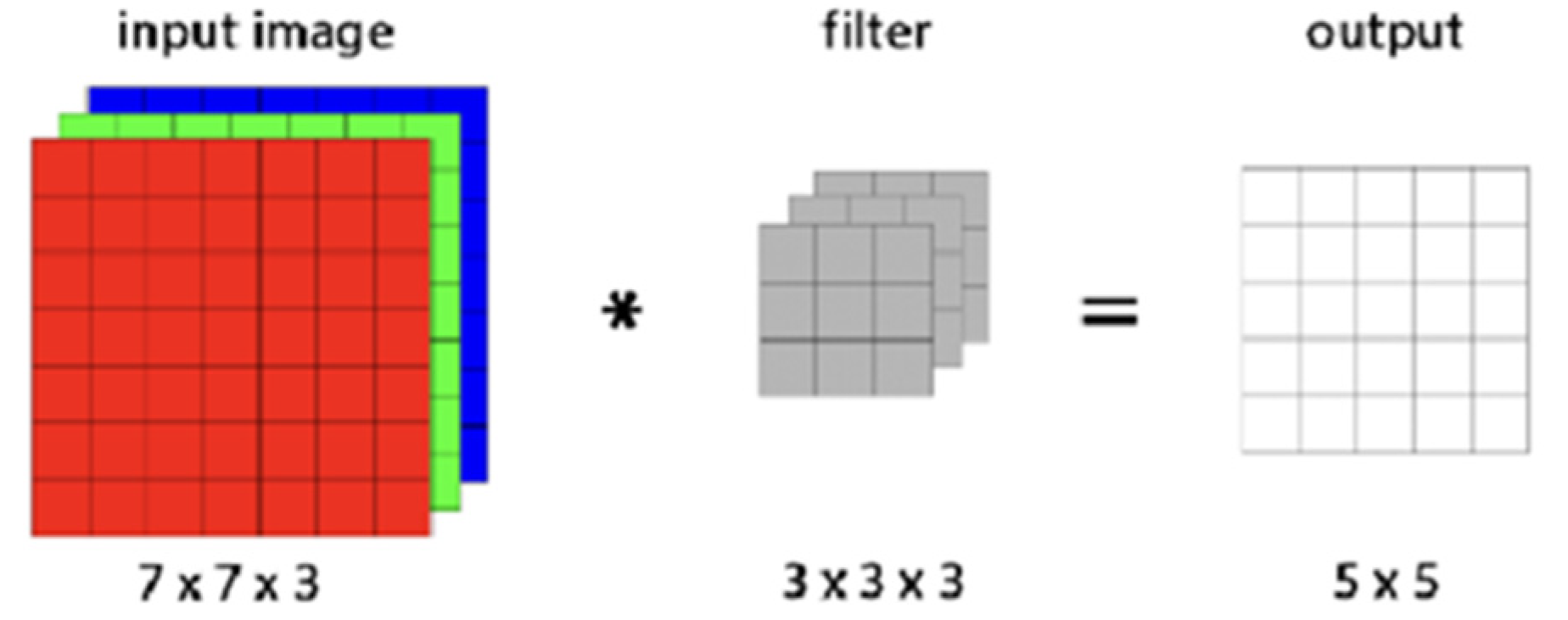
The RGB visualization method creates an image by converting the Unicode of a character to a value corresponding to its RGB position and fills pixels with a color in order to obtain a 31∗31-sized image initialized to 0. Three-dimensional data, which are RGB three-pixels expressed in real numbers per pixel, are used for color image production. If N filters are applied to the convolution layer, the output data have N channels. In this study, three channels were classified by language using RGB, and since multiple languages were used, colors were applied according to the number of bytes. Figure 8 shows CNN for RGB images.
Figure 8. CNN for RGB images.
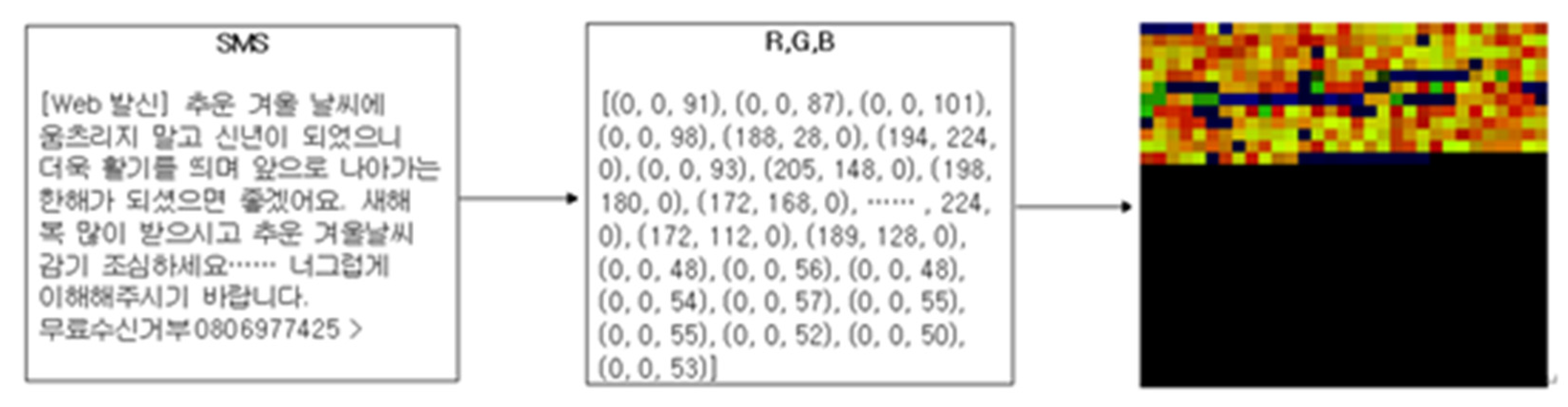
This model changed each character to a Unicode value to distinguish languages with different bytes when creating RGB images. The changed character was secondarily converted to a decimal to match the size of 0-255 for the image to be displayed in the two models. Korean, which was 2 bytes, was set to RG, and English, which was 1 byte, was set to B, while the other channels were assigned as 0. Mixed languages were sometimes used in the dataset, so colors were assigned to avoid overlapping. Among the 2-byte languages, the Korean language used by our model had over 10 times more types than English Unicode. In order to prevent pixels that were concentrated on one side or that were not captured in certain parts, an image was created using RGB. Through this process, a tuple for the sentence at the bottom was created, and the image shown in Figure 9 was output. The size of the output image of the convolution layer contributing to the output of all channels of the input was ( nOutputPlane × height × width ) (value varied according to batch size).
Figure 9. Each character was converted to one pixel of an image.
Even if only two channels were used out of the total three channels, six separate filters must be operated because each output channel was affected by all the input channels. The output value could be calculated as the sum of the input channels and convolution filters. Figure 9 shows the process of converting each character into one pixel of an image.

3.3.2. Models

Figure 10 provides illustration of the architecture of CNN 2D processing image data. To classify the visualized spam and ham data, a standard CNN was used. Deep learning is an advanced form of the model in the neural network field of artificial intelligence, and their hidden layers consist of several stages.
Figure 10. Illustration of the architecture of CNN 2D processing image data.
Convolutional neural networks (CNNs) mimic biological visual processing and are the most commonly used artificial neural network for visual image analysis and classification. By not combining all nodes, the method is used to reduce the amount of computation and increase efficiency. By maintaining the spatial information of an image, it effectively recognizes and emphasizes data as features with adjacent images. CNN models sconsist of parts that extract and classify the features of an image.
A convolutional layer extracts visual features of images, such as lines and colors. In this case, image extraction was performed effectively using a filter to minimize the number of shared parameters. A fully connected layer classified images based on the discovered features. All nodes with the result data processed thus far were connected and presented as a one-dimensional array.
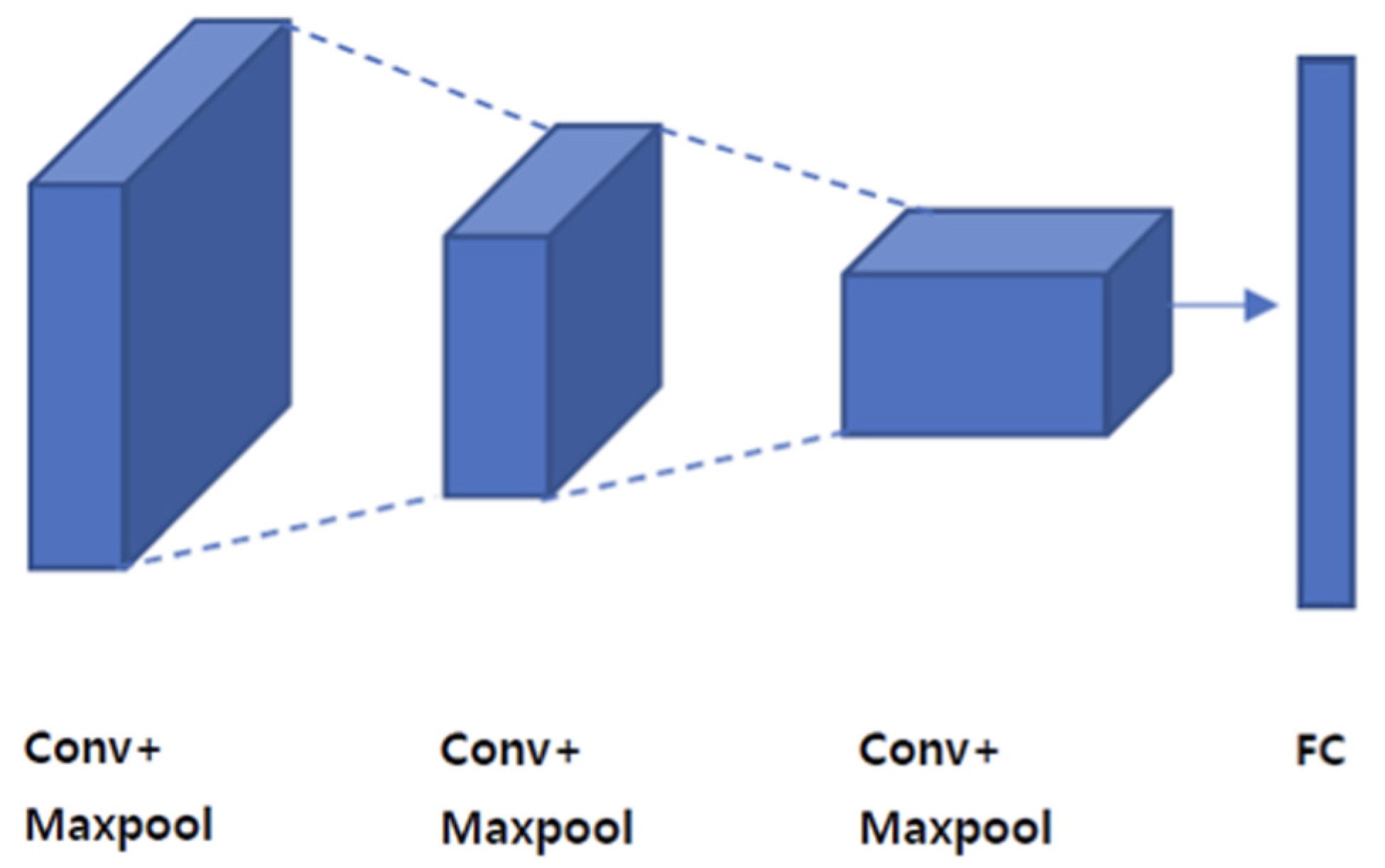
Looking at Figure 11, the local receptive field, which refers to the lower square in the input, is connected to the node and filter (weight) of the next layer. In this case, the input data size of the feature map should be the same. Applying a filter to all areas of the input and passing the node of the panel is called “convolution.” At this time, there are n different filters, and these filters can recognize one feature.
Figure 11. CNN structure.
The CNN structure included three convolutional layers (one convolutional operation and one max-pooling operation), a fully connected layer, and an output layer. This model was constructed by repeating the convolutional layer Conv2D and the max-pooling layer MaxPooling2D six times, as well as overlapping the dense layer twice. (Conv2D(a,b,c), padding, input_shape = (d,e,f), activation) was the configuration for the CONV2D layer that extracted features with filters. In this case, the first argument was the number of filters, and the second argument was the kernel (row, column). Padding defined the boundary-processing method, and the input shape was the input shape excluding the number of samples as (row, column, channel); activation referred to setting the activation function. A filter indicated a weight, which could be expressed as a dense layer that determined the number of weights. The first factor values of Conv2D (a,b,c) were increased to 16, 32, and 64, respectively, while the second-factor value remained constant at (3,3). Activation used the rectifier function of “relu.” Since the input shape was defined only in the first layer, it was fixed as (256,256,3). Dense applied 512 output neurons to the activation function “relu” and 1 output neuron to the sigmoid. The max-pooling layer extracted the main values of the output image so that it was not affected by minor changes when producing a small-sized output image. This model repeated layer 3 and set the pool size to (2,2) to reduce the vertical–horizontal size by half. The CONV neural network model specified target_size to set the patch image size and batch_size as 32 and (150,150), respectively. Classification class _model set the binary to return a 1D binary label. In all the classification experiments, the learning rates were set to 0.001. All filters in the convolutional layers used 3∗3 filters. Each layer used 16, 32, or 64 filters. A fully connected layer consisted of 512 units. In the final step, for binary classification, the activation function of the sigmoid with one output neuron was used. Figure 12 provides an illustration showing our image-based spam detection process. Table 8 shows the settings of CNN 2D model.
Figure 12. An illustration showing our image-based spam detection process.
Table 8. Settings of CNN 2D model.

3.3.3. Experiment Results

In this section, the effectiveness of the multilingual spam classifier is demonstrated by applying the visualization method proposed above to the experimental data. The experiment shows that meaningful classification was possible with visualization using three types of data sets: English, Korean, and an English–Korean mixture. The two visualization methods proposed earlier were compared with the accuracy of each dataset. Table 9 shows spam detection performance using CNN 2D images.
Table 9. Spam detection performance using CNN 2D images.
When the grayscale visualization method was applied, English achieved an accuracy of 99.67%, Korean achieved 98.38%, and Mixed achieved 99.03%. In the case of RGB, 99.81%, 99.95%, and 99.98% classification accuracies were achieved for the cases of English, Korean, and Mixed, respectively. Both the grayscale and RGB error rates of verification and testing did not differ by more than 0.1%.
In addition, when evaluating the overall performance, the RGB dataset showed a slightly higher recall than the grayscale dataset. The accuracy of smishing detection through text visualization could be determined based on the results when a conversion resulted in an RGB image showing a higher performance than a grayscale image.

4. Discussion

Our work has potential for improvement. First, the UCI spam data used as the English dataset included about 5000 samples. Since more than 10,000 Korean datasets were used, there was a limitation in that the dataset was not balanced. Thus, the experiment could be conducted by adding more English spam data. Second, in addition to the spam SMS classification task, an image-processing method could be used for applications in more fields. Third, in this experiment, a standard CNN was used for image-based classification, but variations of CNN models could be applied. Fourth, in addition to Korean and English, other languages could also be applied. Finally, although this study used an existing model, further research should be expected to compare detection using a PLM model, one of the newly proposed detection models, or to study the efficiency of combinations with CNN models.

5. Conclusions

Existing spam detection methods are based on strings, and classification is performed through machine-learning or deep-learning models through natural language processing. In this paper, a visualization step was added to an existing detection process for effective spam SMS detection.
The visualization method was largely divided into two types. The first method converted each character’s Unicode value into a pair of coordinates. The second method stored each character’s Unicode value in an RGB tuple and returned it as a pixel in the image.
A CNN was used as a deep-learning model for spam SMS detection. As a result of applying the deep-learning model after visualization, it was confirmed that there was no difference from the results of the text-based classification experiment. The preprocessing step was eliminated through image processing, and the classification results were outperformed. The proposed visualization method could perform more efficient classification tasks by omitting preprocessing tasks, such as tokenization, stemming, and spell-checking.


Author Contributions

Conceptualization, methodology, visualization, validation, software, formal analysis, writing-original draft, writing review and editing, data acquisition, investigation—H.L.; Conceptualization, methodology, Investigation, visualization, validation, software, writing-original draft, writing review and editing, data acquisition, resources—S.J.; Conceptualization, methodology, Investigation, visualization, software, writing-original draft, writing review and editing, data acquisition, data curation—S.C.; funding acquisition, Project administration, supervision —E.C. All authors have read and agreed to the published version of the manuscript.

Funding

This research was funded by [Seoul Women’s University] grant number [2022-0164, 2022-0214].

Data Availability Statement

The English data that support the findings of this study are available in UCI ML repository at Kaggle. These data were derived from the following resources available in the public domain: [https://www.kaggle.com/datasets/uciml/sms-spam-collection-dataset]. The “One-shot conversation dataset with Korean emotional information” dataset are available in from AI Hub. These data were derived from the following resources available in the public domain: [https://aihub.or.kr/aihubdata/data/view.do?currMenu=115&topMenu=100&aihubDataSe=realm&dataSetSn=86]. The Korean smishing data that support the findings of this study are available on request from Cyber Security Big Dataset Center. The data are not publicly available due to their containing information that could compromise the privacy of research participants.

Conflicts of Interest

The authors declare no conflict of interest.

References

  1. How to Spot Scam Texts on Your Smartphone. Available online: https://www.aarp.org/money/scams-fraud/info-2021/texts-smartphone.html (accessed on 20 April 2022).
  2. Cao, J.; Lai, C. A Bilingual Multi-type Spam Detection Model Based on M-BERT. In Proceedings of the GLOBECOM 2020–2020 IEEE Global Communications Conference, Taipei, Taiwan, 7–11 December 2020; pp. 1–6. [Google Scholar]
  3. Crawford, M.; Khoshgoftaar, T.M.; Prusa, J.D.; Richter, A.N.; Al Najada, H. Survey of review spam detection using machine learning techniques. J. Big Data 2015, 2, 1–24. [Google Scholar] [CrossRef]
  4. Luo, W. Research and Implementation of Text Topic Classification Based on Text CNN. In Proceedings of the 2022 3rd International Conference on Computer Vision, Image and Deep Learning & International Conference on Computer Engineering and Applications (CVIDL & ICCEA), Changchun, China, 20–22 May 2022; pp. 1152–1155. [Google Scholar]
  5. Rafique, A.; Rustam, F.; Narra, M.; Mehmood, A.; Lee, E.; Ashraf, I. Comparative analysis of machine learning methods to detect fake news in an Urdu language corpus. PeerJ Comput. Sci. 2022, 8, e1004. [Google Scholar] [CrossRef] [PubMed]
  6. Lee, H.-Y.; Kang, S.-S. Word embedding method of sms messages for spam message filtering. In Proceedings of the 2019 IEEE International Conference on Big Data and Smart Computing (BigComp), Kyoto, Japan, 27 February–2 March 2019. [Google Scholar]
  7. Jain, G.; Sharma, M.; Agarwal, B. Optimizing semantic LSTM for spam detection. Int. J. Inf. Technol. 2019, 11, 239–250. [Google Scholar] [CrossRef]
  8. Greff, K.; Srivastava, R.K.; Koutník, J.; Steunebrink, B.R.; Schmidhuber, J. LSTM: A Search Space Odyssey. IEEE Trans. Neural Netw. Learn. Syst. 2017, 28, 2222–2232. [Google Scholar] [CrossRef] [PubMed]
  9. Cho, K.; Van Merrienboer, B.; Gülçehre, Ç.; Bahdanau, D.; Bougares, F.; Schwenk, H.; Bengio, Y. Learning Phrase Representations using RNN Encoder–Decoder for Statistical Machine Translation. In Proceedings of the 2014 Conference on Empirical Methods in Natural Language Processing (EMNLP), Doha, Qatar, 25–29 October 2014. [Google Scholar]
  10. Wei, F.; Nguyen, T. A lightweight deep neural model for sms spam detection. In Proceedings of the 2020 International Symposium on Networks, Computers and Communications (ISNCC), Montreal, QC, Canada, 16–18 June 2020. [Google Scholar]
  11. Kim, Y. Convolutional Neural Networks for Sentence Classification. In Proceedings of the 2014 Conference on Empirical Methods in Natural Language Processing (EMNLP), Doha, Qatar, 25–29 October 2014. [Google Scholar]
  12. Raza, M.; Jayasinghe, N.D.; Ali Muslam, M.M. A Comprehensive Review on Email Spam Classification using Machine Learning Algorithms. In Proceedings of the 2021 International Conference on Information Networking (ICOIN), Jeju, Korea, 13–16 January 2021; pp. 327–332. [Google Scholar]
  13. Tang, D.; Qin, B.; Liu, T. Document Modeling with Gated Recurrent Neural Network for Sentiment Classification. In Proceedings of the 2015 Conference on Empirical Methods in Natural Language Processing, Lisbon, Portugal, 17–21 September 2015. [Google Scholar]
  14. Jain, G.; Sharma, M.; Agarwal, B. Spam detection in social media using convolutional and long short term memory neural network. Ann. Math. Artif. Intell. 2018, 85, 21–44. [Google Scholar] [CrossRef]
  15. Gadde, S.; Lakshmanarao, A.; Satyanarayana, S. SMS spam detection using machine learning and deep learning techniques. In Proceedings of the 2021 7th International Conference on Advanced Computing and Communication Systems (ICACCS), Coimbatore, India, 19–20 March 2021; Volume 1. [Google Scholar]
  16. Orellana, M.; Trujillo, A.; Cedillo, P. A Comparative Evaluation of Preprocessing Techniques for Short Texts in Spanish. In Advances in Information and Communication, Proceedings of the 2020 Future of Information and Communication Conference, San Francisco, CA, USA, 5–6 March 2020; Springer: Cham, Switzerland, 2020; pp. 111–124. [Google Scholar]
  17. Sibarani, E.M.; Nadial, M.; Panggabean, E.; Meryana, S. A Study of Parsing Process on Natural Language Processing in Bahasa Indonesia. In Proceedings of the 2013 IEEE 16th International Conference on Computational Science and Engineering, Sydney, NSW, Australia, 3–5 December 2013; pp. 309–316. [Google Scholar]
  18. Banday, M.T.; Sheikh, S.A. Multilingual e-mail classification using Bayesian filtering and language translation. In Proceedings of the 2014 International Conference on Contemporary Computing and Informatics (IC3I), Mysore, India, 27–29 November 2014; pp. 696–701. [Google Scholar]
  19. Multi-language Spam-A New Trend Among Spammers. SPAMfighter News. Available online: https://www.spamfighter.com/News-12908-Multi-language-Spam-A-New-Trend-Among-Spammers.htms (accessed on 15 August 2009).
  20. Tuan, V.M.; Tran, Q.A.; Jiang, F.; Tran, W.Q. Multilingual Rules for Spam Detection. J. Mach. Mach. Commun. 2015, 1, 107–122. [Google Scholar] [CrossRef]
  21. Cormack, G.V.; Hidalgo, J.M.G.; Sanz, E.P. Feature engineering for mobile (sms) spam filtering. In Proceedings of the 30th Annual International ACM SIGIR Conference on Research and Development in Information Retrieval, Amsterdam, The Netherlands, 23–27 July 2007; pp. 871–872. [Google Scholar]
  22. Sohn, D.N.; Lee, J.T.; Rim, H.C. The contribution of stylistic information to content-based mobile spam filtering. In Proceedings of the 47th Annual Meeting of the Association for Computational Linguistics and the 4th International Joint Conference on Natural Language, Singapore, 2–7 August 2009; pp. 321–324. [Google Scholar]
  23. Abid, M.A.; Ullah, S.; Siddique, M.A.; Mushtaq, M.F.; Aljedaani, W.; Rustam, F. Spam SMS filtering based on text features and supervised machine learning techniques. Multimed. Tools Appl. 2022, 81, 39853–39871. [Google Scholar] [CrossRef]
  24. Hsia, J.-H.; Chen, M.-S. Language-model-based detection cascade for efficient classification of image-based spam e-mail. In Proceedings of the 2009 IEEE International Conference on Multimedia and Expo, New York, NY, USA, 28 June–3 July 2009. [Google Scholar]
  25. Biggio, B.; Fumera, G.; Pillai, I.; Roli, F. A survey and experimental evaluation of image spam filtering techniques. Pattern Recognit. letters 2011, 32, 1436–1446. [Google Scholar] [CrossRef]
  26. Fatichah, C.; Lazuardi, W.F.; Navastara, D.A.; Suciati, N.; Munif, A. Image spam detection on instagram using convolutional neural network. In Intelligent and Interactive Computing; Springer: Singapore, 2019; pp. 295–303. [Google Scholar]
  27. Sharmin, T.; Troia, F.D.; Potika, K.; Stamp, M. Convolutional neural networks for image spam detection. Inf. Secur. J. A Glob. Perspect. 2020, 29, 103–117. [Google Scholar] [CrossRef]
  28. Merdivan, E.; Vafeiadis, A.; Kalatzis, D.; Hanke, S.; Kroph, J.; Votis, K.; Giakoumis, D.; Tzovaras, D.; Chen, L.; Hamzaoui, R.; et al. Image-Based Text Classification using 2D Convolutional Neural Networks. In Proceedings of the 2019 IEEE SmartWorld, Ubiquitous Intelligence & Computing, Advanced & Trusted Computing, Scalable Computing & Communications, Cloud & Big Data Computing, Internet of People and Smart City Innovation (SmartWorld/SCALCOM/UIC/ATC/CBDCom/IOP/SCI), Leicester, UK, 19–23 August 2019; pp. 144–149. [Google Scholar]
  29. Gupta, M.; Bakliwal, A.; Agarwal, S.; Mehndiratta, P. A Comparative Study of Spam SMS Detection Using Machine Learning Classifiers. In Proceedings of the 2018 Eleventh International Conference on Contemporary Computing (IC3), Noida, India, 2–4 August 2018; pp. 1–7. [Google Scholar]
  30. Amaar, A.; Aljedaani, W.; Rustam, F.; Ullah, S.; Rupapara, V.; Ludi, S. Detection of Fake Job Postings by Utilizing Machine Learning and Natural Language Processing Approaches. Neural Process. Lett. 2022, 54, 2219–2247. [Google Scholar] [CrossRef]
  31. Amir Sjarif, N.N.; Mohd Azmi, N.F.; Chuprat, S.; Sarkan, H.M.; Yahya, Y.; Sam, S.M. SMS Spam Message Detection using Term Frequency-Inverse Document Frequency and Random Forest Algorithm. Procedia Comput. Sci. 2019, 161, 509–515. [Google Scholar] [CrossRef]
  32. Liu, X.; Lu, H.; Nayak, A. A spam transformer model for SMS spam detection. IEEE Access 2021, 9, 80253–80263. [Google Scholar] [CrossRef]
  33. Taheri, R.; Javidan, R. Spam filtering in SMS using recurrent neural networks. In Proceedings of the 2017 Artificial Intelligence and Signal Processing Conference (AISP), Shiraz, Iran, 25–27 October 2017; pp. 331–336. [Google Scholar]
  34. RNN. PyTorch. Available online: https://pytorch.org/docs/stable/generated/torch.nn.RNN.html?highlight=rnn#torch.nn.RNN (accessed on 6 November 2022).
  35. LSTM. PyTorch. Available online: https://pytorch.org/docs/stable/generated/torch.nn.LSTM.html?highlight=lstm#torch.nn.LSTM (accessed on 6 November 2022).
  36. CONV1D. PyTorch. Available online: https://pytorch.org/docs/stable/generated/torch.nn.Conv1d.html (accessed on 6 November 2022).
Disclaimer/Publisher’s Note: The statements, opinions and data contained in all publications are solely those of the individual author(s) and contributor(s) and not of MDPI and/or the editor(s). MDPI and/or the editor(s) disclaim responsibility for any injury to people or property resulting from any ideas, methods, instructions or products referred to in the content.

Article Metrics

Citations

Article Access Statistics

Multiple requests from the same IP address are counted as one view.