


Abstract
The paper addresses optical solitons in magneto-optic waveguides that are studied using Kudryashov’s law of nonlinear refractive index in the presence of chromatic dispersion and Hamiltonian-type perturbation terms. The trial solution approach yielded a variety of soliton solutions, which are listed in this paper.
1. Introduction
Optical soliton dynamics is an essential feature in the telecommunications industry. The current world is paralyzed without Internet activity, which means with no solitons, life comes to a pure standstill. Therefore, it is imperative to address the soliton science dynamics to the fullest extent [1,2,3,4,5,6,7,8,9]. Incidentally, it is always wise to take into account magneto-optic waveguides as opposed to regular waveguides. Such forms of waveguides are always helpful considering the data load that is transmitted across trans-continental and trans-oceanic distances. The presence of a magnetic field can loosen up the solitons from their state of clutter. This only protects the spill-over of information between the solitons when they are very close together. Thus, it is of paramount importance to address the soliton science dynamics in nonlinear optics.
Incidentally, a variety of models that have been studied in the context of magneto-optic solitons. The various forms of the non-Kerr law of nonlinearity, apart from the Kerr law itself, studied in this context are parabolic law, power law, quadratic-cubic law, dual-power law and various others. The current work addresses the same issue, but with Kudryashov’s proposed form of nonlinear refractive index [10,11,12,13,14,15]. The trial solutions approach will be implemented to secure the solitons. The analytical results are displayed, along with the respective parameter constraints, and the corresponding numerical simulations are also exhibited. The derivation and display of the solitons and their numerics are presented after an overview of the model.
Governing Model
The model equations are introduced below [10,11,12,13,14,15]:
and
where and for come from the nonlinear dispersions, while stem from the magneto-optic parameters. , , and arise from the cross-phase modulation, while emerge from the self-steepening terms. , , and yield the self-phase modulation, while give the inter-modal dispersions. x and t are the spatial and temporal variables in sequence, while stem from the chromatic dispersion. and depict the soliton wave profiles, while n comes from the full nonlinearity. Lastly, the first terms stem from the linear temporal evolution of the solitons, where .
2. Mathematical Analysis
The soliton wave profiles shape up as
where and are the soliton amplitude components, while the wave variable and soliton phase component evolve as
Here c, , and represent the velocity, frequency, wave number and phase constant in the sequence. Inserting (3) and (4) into (1) and (2), the real parts stick out as
and
while the imaginary parts stand out as
and
Equations (8) and (9) leave us with the following restrictions:
and
while Equations (10) and (12) provide the frequency
Set
Thus, Equations (6) and (7) come out as
and
Considering Equations (16) and (17), one can be addressed by the aid of the constraint relations
and
Equations (18) and (21) give way to the wave number
With this restriction, simplifies (16) to
where
We take the trial equation
then we derive
Substituting (27) and (28) into (25) and the next balancing with decreases (27) to
where
Take transformation
Rewrite Equation (32) as
where . According to Liu [16], the fourth-order complete discrimination system for the polynomial is given as
We can classify the roots of [16,17,18,19,20,21,22,23,24] and solve the integral (34).
3. Exact Solutions
(1) , then , we get the rational wave
(2) , then , we get the singular periodic wave
where and are real constants.
(3) , then , we get the singular soliton
and the dark soliton
where and are real constants.
(4) , then , we get the rational wave
where and are real constants.
(5) , then , we get the bright soliton
and the singular soliton
where , and are real constants.
(6) , then , we get the rational wave
where , and are real constants.
(7) , then , we get the snoidal periodic waves
and
where , , and are real constants, and .
(8) , then , we get the cnoidal periodic wave
where , , and are real constants, and
(9) , then , we get the combo snoidal and cnoidal periodic wave
where , , and are real constants, and
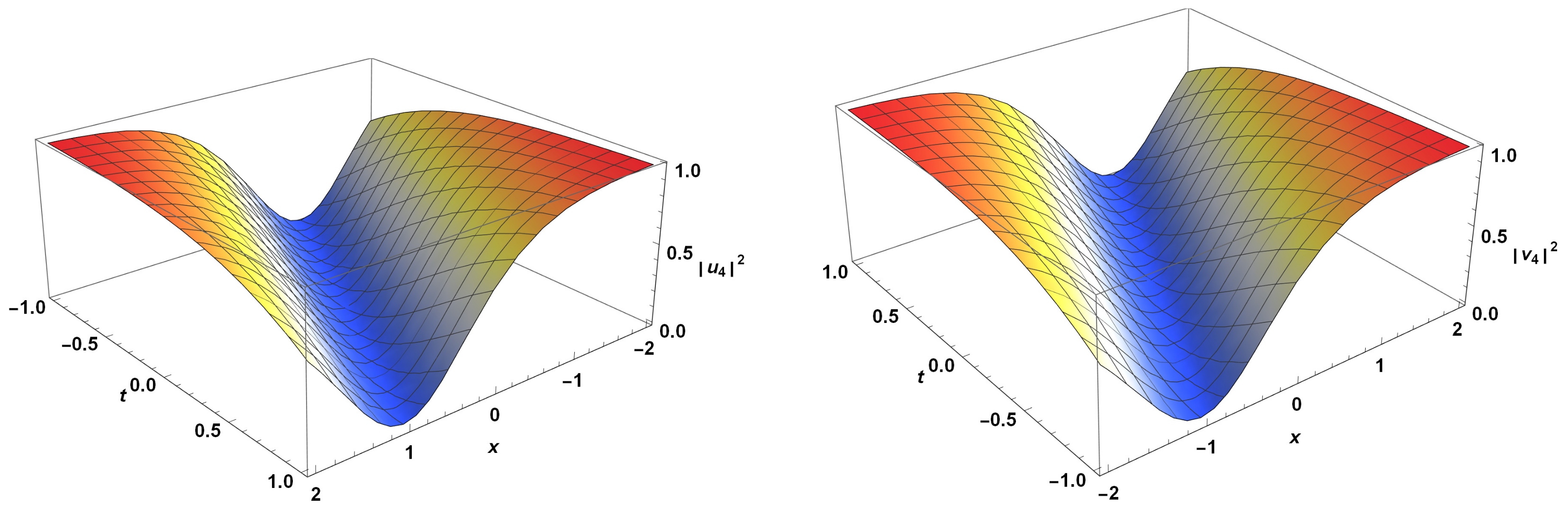
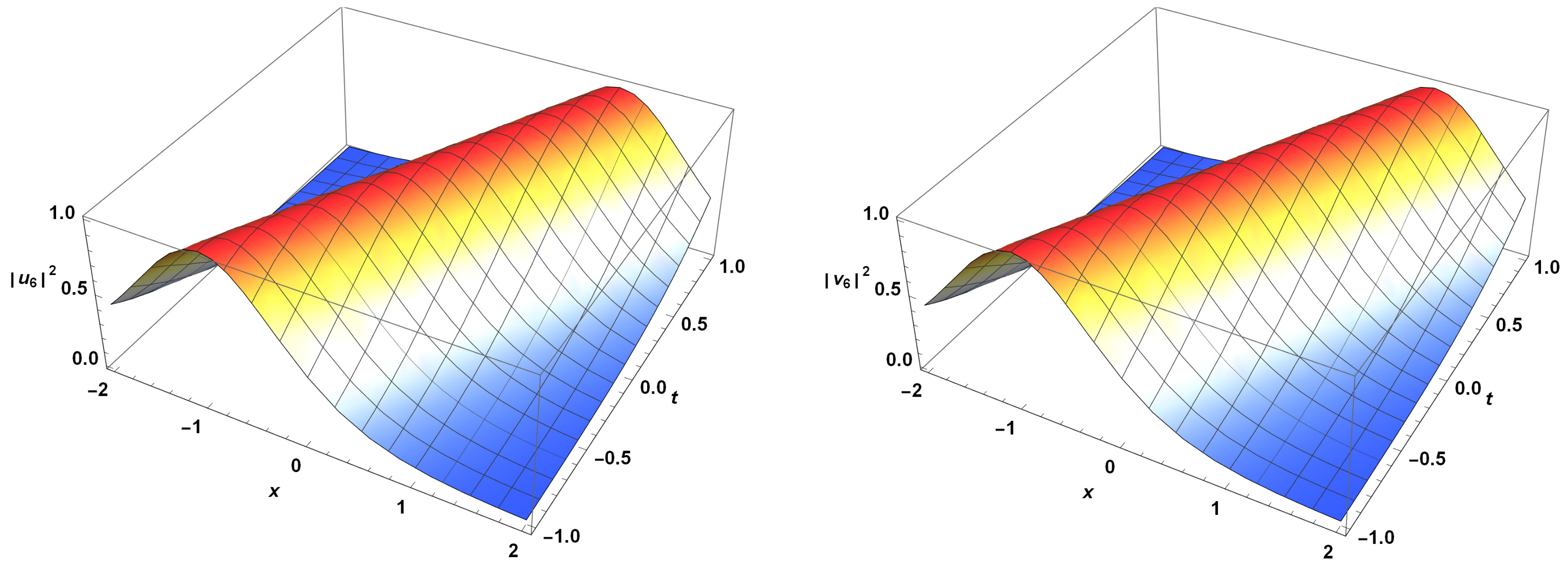
Figure 1 and Figure 2 exhibit the plots of dark and bright magneto-optic solitons (39) and (41), respectively.
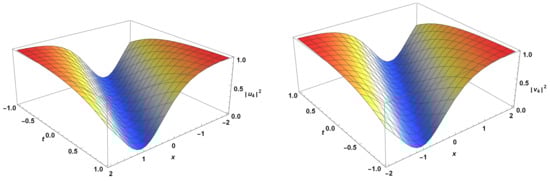
Figure 1.
Surface plots of dark magneto-optic solitons (39) with , , and .
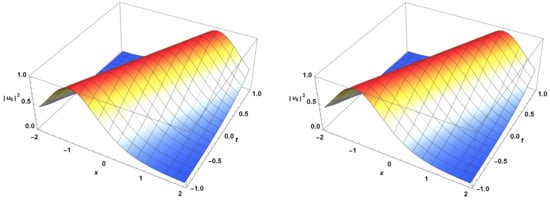
Figure 2.
Surface plots of bright magneto-optic solitons (41) with , , and .
4. Conclusions
The current paper displays solitons in magneto-optic waveguides that are studied using Kudryashov’s proposed law of refractive index. The trial solutions approach gave way to the solitons. The results are displayed, along with the numerical simulations. These results give a further insight into such waveguides with the form of self-phase modulation, as studied. These results give way to a number of future avenues of research. An immediate thought would be to handle the conservation laws. The conservation laws, when computed, would lead to further openings. The issue of quasi-monochromatic dynamics of optical solitons in a magneto-optic waveguide would subsequently follow through. The stochastically perturbed version of the model can also be pursued and studied once the conservation laws are in place. This would lead to the Langevin equations to finally depict the mean-free velocity of the soliton. Such studies are all underway and the results would be sequentially reported.
Author Contributions
Conceptualization, M.-Y.W.; methodology, A.B.; software, Y.Y.; writing—original draft preparation, L.M.; writing—review and editing, S.M.; project administration, A.A.A. All authors have read and agreed to the published version of the manuscript.
Funding
This research received no external funding.
Institutional Review Board Statement
Not applicable.
Informed Consent Statement
Not applicable.
Data Availability Statement
Not applicable.
Acknowledgments
The authors thank the anonymous referees whose comments helped to improve this paper.
Conflicts of Interest
The authors declare no conflict of interest.
References
- Ozisik, M.; Secer, A.; Bayram, M. The bell-shaped perturbed dispersive optical solitons of Biswas–Arshed equation using the new Kudryashov’s approach. Optik 2022, 267, 169650. [Google Scholar] [CrossRef]
- Secer, A. Stochastic optical solitons with multiplicative white noise via Itô calculus. Optik 2022, 268, 169831. [Google Scholar] [CrossRef]
- Ozisik, M.; Secer, A.; Bayram, M. On the examination of optical soliton pulses of Manakov system with auxiliary equation technique. Optik 2022, 268, 169800. [Google Scholar] [CrossRef]
- Esen, H.; Secer, A.; Ozisik, M.; Bayram, M. Dark, bright and singular optical solutions of the Kaup–Newell model with two analytical integration schemes. Optik 2022, 261, 169110. [Google Scholar] [CrossRef]
- Esen, H.; Ozisik, M.; Secer, A.; Bayram, M. Optical soliton perturbation with Fokas–Lenells equation via enhanced modified extended tanh-expansion approach. Optik 2022, 267, 169615. [Google Scholar] [CrossRef]
- Ozdemir, N.; Esen, H.; Secer, A.; Bayram, M.; Sulaiman, T.A.; Yusuf, A.; Aydin, H. Optical solitons and other solutions to the Radhakrishnan-Kundu-Lakshmanan equation. Optik 2021, 242, 167363. [Google Scholar] [CrossRef]
- Ozisik, M.; Secer, A.; Bayram, M.; Aydin, H. An encyclopedia of Kudryashov’s integrability approaches applicable to optoelectronic devices. Optik 2022, 265, 169499. [Google Scholar] [CrossRef]
- Hutchings, D.C.; Holmes, B.M. Quasi-phase matching magneto-optical waveguides. MRS Online Proc. Libr. OPL 2011, 1291. [Google Scholar] [CrossRef]
- Choueikani, F.; Royer, F.; Jamon, D.; Siblini, A.; Rousseau, J.J.; Neveu, S.; Charara, J. Magneto-optical waveguides made of cobalt ferrite nanoparticles embedded in silica/zirconia organic-inorganic matrix. Appl. Phys. Lett. 2009, 94, 051113. [Google Scholar] [CrossRef]
- Wang, M.Y.; Biswas, A.; Yıldırım, Y.; Alshehri, H.M. Dispersive solitons in magneto-optic waveguides with Kudryashov’s form of self-phase modulation. Optik 2022, 269, 169860. [Google Scholar] [CrossRef]
- Sun, F. Propagation of solitons in optical fibers with generalized Kudryashov’s refractive index. Results Phys. 2021, 28, 104644. [Google Scholar] [CrossRef]
- Zayed, E.M.; Alngar, M.E.; Biswas, A.; Asma, M.; Ekici, M.; Alzahrani, A.K.; Belic, M.R. Solitons in magneto–optic waveguides with Kudryashov’s law of refractive index. Chaos Solitons Fractals 2020, 140, 110129. [Google Scholar] [CrossRef]
- Zayed, E.M.; Alngar, M.E.; Biswas, A.; Kara, A.H.; Asma, M.; Ekici, M.; Khan, S.; Alzahrani, A.K.; Belic, M.R. Solitons and conservation laws in magneto–optic waveguides with generalized Kudryashov’s equation. Chin. J. Phys. 2021, 69, 186–205. [Google Scholar] [CrossRef]
- Kudryashov, N.A. A generalized model for description of propagation pulses in optical fiber. Optik 2019, 189, 42–52. [Google Scholar] [CrossRef]
- Kudryashov, N.A. Mathematical model of propagation pulse in optical fiber with power nonlinearities. Optik 2020, 212, 164750. [Google Scholar] [CrossRef]
- Liu, C.S. Applications of complete discrimination system for polynomial for classifications of traveling wave solutions to nonlinear differential equations. Comput. Phys. Commun. 2010, 181, 317–324. [Google Scholar] [CrossRef]
- Liu, C.S. Trial equation method based on symmetry and applications to nonlinear equations arising in mathematical physics. Found. Phys. 2011, 41, 793–804. [Google Scholar] [CrossRef]
- Liu, C. Trial equation method and its applications to nonlinear evolution equations. Acta Phys. Sin. 2005, 54, 2505–2509. [Google Scholar]
- Liu, C.S. Using trial equation method to solve the exact solutions for two kinds of KdV equations with variable coefficients. Acta Phys. Sin. 2005, 54, 4506–4510. [Google Scholar]
- Cheng-Shi, L. A new trial equation method and its applications. Commun. Theor. Phys. 2006, 45, 395. [Google Scholar] [CrossRef]
- Cheng-Shi, L. Exact travelling wave solutions for (1+1)-dimensional dispersive long wave equation. Chin. Phys. 2005, 14, 1710. [Google Scholar] [CrossRef]
- Tang, L. Bifurcation analysis and multiple solitons in birefringent fibers with coupled Schrödinger-Hirota equation. Chaos Solitons Fractals 2022, 161, 112383. [Google Scholar] [CrossRef]
- Tang, L. Bifurcations and dispersive optical solitons for the nonlinear Schrödinger–Hirota equation in DWDM networks. Optik 2022, 262, 169276. [Google Scholar] [CrossRef]
- Tang, L. Bifurcations and multiple optical solitons for the dual-mode nonlinear Schrödinger equation with Kerr law nonlinearity. Optik 2022, 265, 169555. [Google Scholar] [CrossRef]
Disclaimer/Publisher’s Note: The statements, opinions and data contained in all publications are solely those of the individual author(s) and contributor(s) and not of MDPI and/or the editor(s). MDPI and/or the editor(s) disclaim responsibility for any injury to people or property resulting from any ideas, methods, instructions or products referred to in the content. |
© 2023 by the authors. Licensee MDPI, Basel, Switzerland. This article is an open access article distributed under the terms and conditions of the Creative Commons Attribution (CC BY) license (https://creativecommons.org/licenses/by/4.0/).