
You are currently viewing a new version of our website. To view the old version click .
Electronics
  • Article
  • Open Access

29 September 2022

A DDoS Vulnerability Analysis System against Distributed SDN Controllers in a Cloud Computing Environment


,
,
,
,
,
and
1
Department of Computer Science and Engineering, Lovely Professional University, Phagwara 144411, India
2
AIIT, Amity University, Noida 201303, India
3
Department of Computer Engineering and Technology, Guru Nanak Dev University, Amritsar 143005, India
4
Department of Electrical Engineering, Government College University, Lahore 54000, Pakistan
This article belongs to the Special Issue Intelligent Data Sensing, Processing, Mining, and Communication

Abstract

Software-Defined Networking (SDN) is now a well-established approach in 5G, Internet of Things (IoT) and Cloud Computing. The primary idea behind its immense popularity is the separation of its underlying intelligence from the data-carrying components like routers and switches. The intelligence of the SDN-based networks lies in the central point, popularly known as the SDN controller. It is the central control hub of the SDN-based network, which has full privileges and a global view over the entire network. Providing security to SDN controllers is one such important task. Whenever one wishes to implement SDN into their data center or network, they are required to provide the website to SDN controllers. Several attacks are becoming a hurdle in the exponential growth of SDN, and among all one such attack is a Distributed Denial of Service (DDoS) attack. In a couple of years, several new SDN controllers will be available. Among many, Open Networking Operating System (ONOS) and OpenDayLight (ODL) are two popular SDN controllers laying the foundation for many other controllers. These SDN controllers are now being used by numerous businesses, including Cisco, Juniper, IBM, Google, etc. In this paper, vulnerability analysis is carried out against DDoS attacks on the latest released versions of both ODL and ONOS SDN controllers in real-time cloud data centers. For this, we have considered distributed SDN controllers (located at different locations) on two different clouds (AWS and Azure). These controllers are connected through the Internet and work on different networks. DDoS attacks are bombarded on the distributed SDN controllers, and vulnerability is analyzed. It was observed with experimentation that, under five different scenarios (malicious traffic generated), ODL-3 node cluster controller had performed better than ONOS. In these five different scenarios, the amount of malicious traffic was incregradually increased. It also observed that, in terms of disk utilization, memory utilization, and CPU utilization, the ODL 3-node cluster was way ahead of the SDN controller.

1. Introduction

Software-Defined Networking (SDN) was introduced in the year of 2008 and since then it is considered a well-established technology from a radically novel concept in the networking sector. A lot of advancement has already been introduced in its architecture. Well-established APIs (Application Programming Interfaces) such as OpenFlow protocol, automation tools and many more are there in its recent advancement [1,2]. The central control point of SDN architecture known as the SDN controller has also obtained new rays of hope. Starting from NOX, many new varied SDN controllers are there in the market. Since it is the core part, there is a huge responsibility for choosing the best SDN controller for the underlying infrastructure [3,4]. The SDN controller configures the network’s complete perspective. It can be stated as an application through which it manages the overall flow of the network traffic. The most important aspect in relevance to SDN architecture is the security of the SDN controller [5]. If the SDN controller’s security is compromised, then entire control over the network will be taken over by the intruder. Attackers can manipulate the legitimate traffic from one place to another and sometimes also falsify the original Open daylight (ODL) and Open Networking Operating System (ONOS) both are open-source SDN controllers [6,7]. They are hosted by the Linux foundation. Nowadays, attackers are making use of varied applications to get installed on a controller and potentially reconfigure the network [6]. This can lead the entire network to something unexpected. Therefore, it is mandatory to look for the various security aspects of the SDN controller before you. There are many attacks/threats to which SDN architecture is vulnerable but among all Distributed Denial of Service (DDoS) attacks are the most disruptive [8]. The whole SDN-based network collapse implements SDN into your underlying infrastructure [6,7] also falsifies the original SDN controller. Nowadays, attackers are making use of varied applications to get installed on the controller and potentially reconfigure the network [6]. This can lead the entire network to something unexpected. Therefore, it is mandatory to look for the various security aspects of the SDN controller before you. There are many attacks/threats to which SDN architecture is vulnerable but among all DDoS attacks are the most disruptive [8]. With the bombardment of massive amounts of traffic heading in the direction of the objective, botnets halt the normal functionality of the network. DDoS attacks can be launched on various soft targets in SDN architecture such as APIs, Data Plane, Application layer and SDN central point (controller) [9]. In this paper, we are considering the vulnerability of SDN controllers against DDoS attacks. When the intruder launches the DDoS attack on the SDN controller, a huge amount of traffic is forwarded towards the SDN controller, the flow table of SDN controller has limited memory, and thus it halts its functionality. The legitimate traffic flow also stops in the meantime and therefore at the end the whole SDN based network collapses. ODL and ONOS both are open source SDN controllers [10]. They are hosted by the Linux foundation. Among all the available SDN controllers, both ODL and ONOS are considered to be the most popularly used [10]. There are some well-defined APIs used in both of them. For northbound, REST API is often used, whereas, for southbound, API OpenFlow protocol is used. For both, there are varied versions available. For example, in the case of ODL, since 2014, there are around 13 versions available, whereas, on the other hand, in the case of ONOS, there are around 22 versions available [11]. The latest stable versions for ODL and ONOS are Aluminum (released in September 2020) and Velociraptor (LTS) 2.5 (released in December 2020), respectively [12]. Due to the immense popularity of both the controllers, with every released version, developers are making the best of their efforts to add new security paradigms to them. However, at the same time, intruders are making use of dynamic and new ways to launch attacks on the SDN network [13].
With every passing year due to the immense popularity of SDN and its exponential growth, most of the focus is towards its security [14,15]. As mentioned earlier, since SDN controller is the main control point, thus vulnerability analysis of this is to be addressed properly. In this paper, we have considered ODL and ONOS as study points. In order to check the vulnerability of ODL (Aluminum) and ONOS (2.5), the latest stable released versions against DDoS attacks, different scenarios and tools are used.

1.1. Major Contributions

The contributions of this paper are well accomplished and summarized:
  • To analyze the DDoS attack vulnerability of ODL and ONOS (stable released versions) by using different penetration tools and scripts on distributed cloud environments (AWS, Azure);
  • The network topology is created using the Mininet emulation tool on the host PC;
  • Generated malicious network traffic is bombarded on the leader node of every controller and, for this, we have considered five varied scenarios;
  • Real-time network analysis is achieved through Wireshark on varied scenarios;
  • From experimentation, we have found that a vulnerability system against DDoS attacks on both ODL and ONOS (located distributed) is successful in a distributed cloud environment.

1.2. Structure of the Paper

The rest of the article is organized as follows: The work done by other researchers has been summarized in Section 2, and the comparison has been conducted with our proposed work. In Section 3, we present the methodology that was utilized in the course of conducting the research for this particular piece of writing. While the findings are presented in Section 4, further analysis and interpretation of those findings are depicted. In the end, in Section 5, the conclusions along with the future directions to this research work are given.

3. Proposed Methodology

Every experimentation requires a detailed methodology which illustrates the entire step-by-step procedure to execute the experimentation.

3.1. Emulation Tool

For implementing the topology in the host user, we have made use of an emulation tool known as Mininet. This tool is a powerful tool for creating realistic virtual networks with just simple commands. We can easily connect with the network through its CLI mode. It offers various network topologies which can be used to perform various network experimentation and testing. In our work, we have made use of custom topology with 100 hosts and 60 switches. Mininet also extends its support for multiple versions of OpenFlow protocol. We have made use of OpenFlow version 1.3 to carry out this experimentation.

3.2. Multiple Machines and Distributed Environment

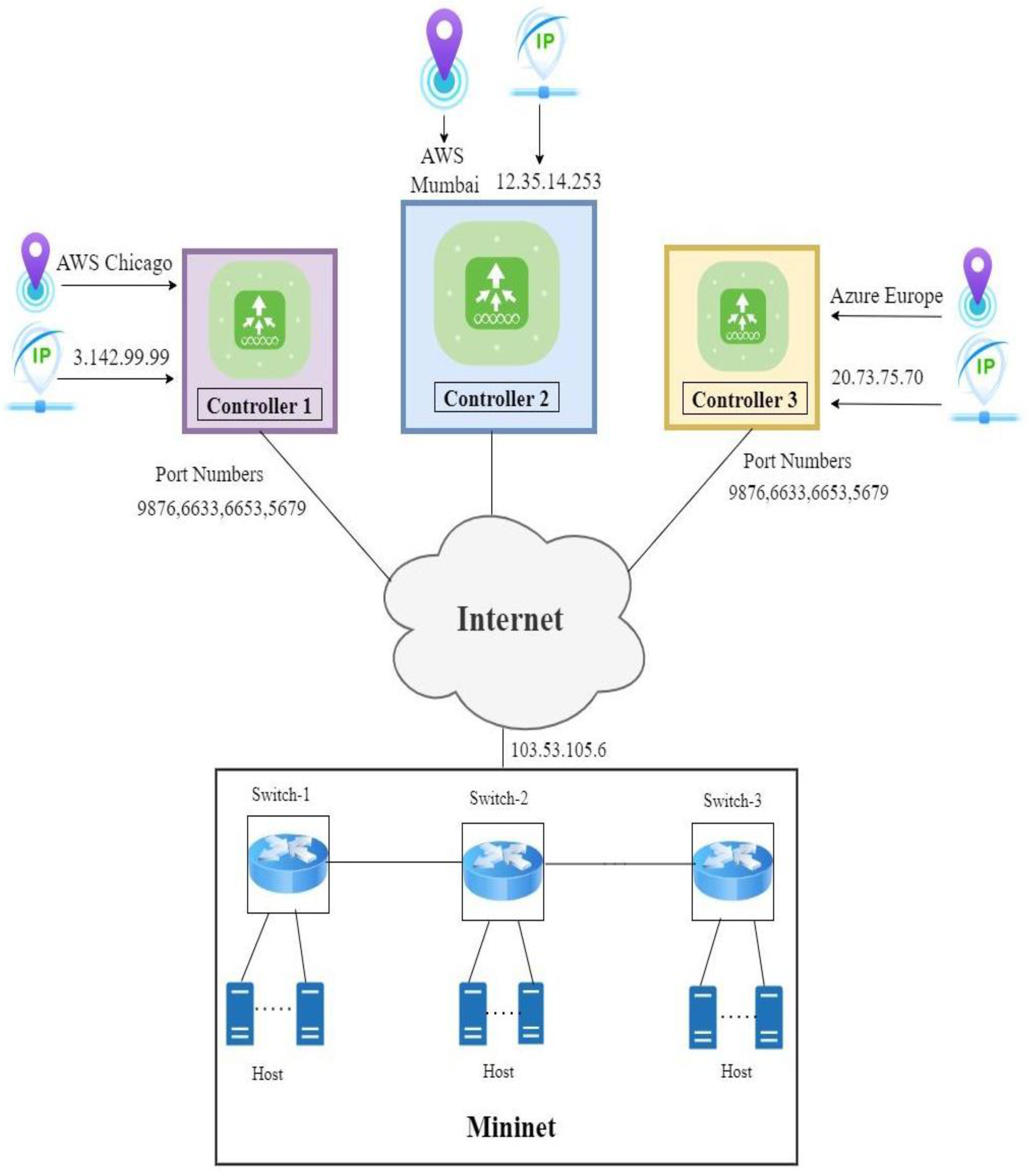
We have considered four different machines situated in varied environments. Machine-1 is a leading SDN controller (ONOS) incorporated in AWS at Chicago.
Machine-2 is an ONOS follower incorporated in AWS at Mumbai. The distributed environment to these different machines will lead to better results in terms of traffic generation and handling huge spikes as well. The fourth one is the Mininet machine, and it is considered as the most important machine because it is the one which is responsible for handling the custom network topology with a corresponding number of switches and hosts. The detailed information regarding these machines and distributed environment is provided in Table 2 and Figure 1.
Table 2. A variety of machine specifications.
Figure 1. Experimental set.

4. Results of the Experimentation

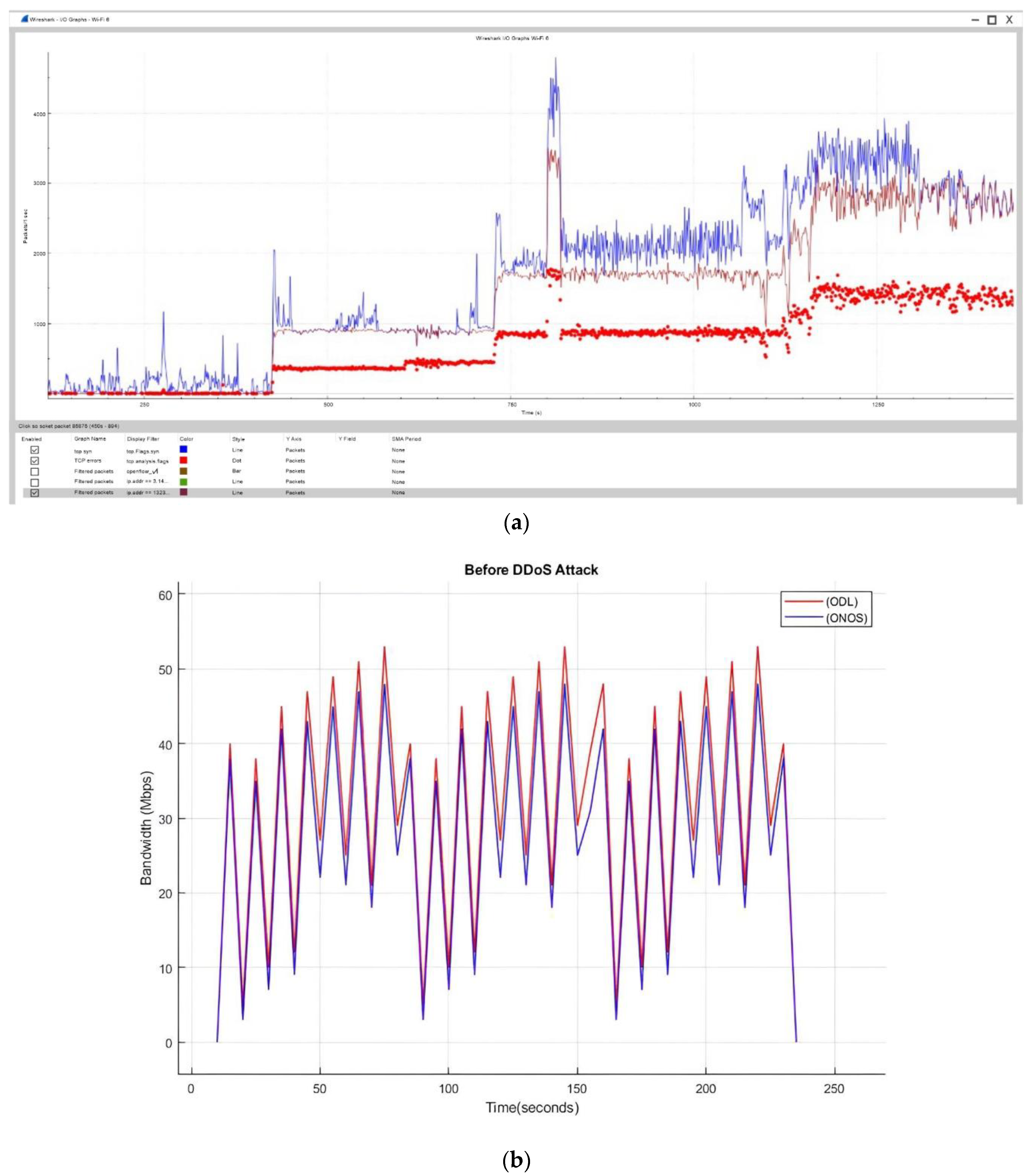
In this section, results drawn from various experiments are depicted. The parameters that we have considered for comparison and evaluation are CPU, memory, and disk utilization. In Figure 2a,b, the scenario before and after DDoS happened over the emulated environment is depicted. The traffic flow was normal and can be easily observed.
Figure 2. (a) Experimental Analysis Scenario before the occurrence of DDoS attacks; (b) difference in flow of network traffic once DDoS attacks is launched.

4.1. Scenario before DDoS Attack

When enough devices are compromised, the hacker gives them authorizations to assault; each system begins flooding the target server or network with requests, overwhelming it and creating inefficiency or inability. DDoS attacks take several forms, including volume-based, protocol-based, and application-layer attacks. ‘Even if you have previously been attacked, you may face additional attacks. DDoS attacks are analogous to home invasions. Any unprotected website or web application is vulnerable, and it happens regularly. As a result, if you have had a DDoS attack and only treated the symptoms rather than the underlying flaws and gaps, you are effectively leaving your digital assets open to future DDoS attacks [16,17,18,19,20,21].

4.2. An Attack Could Be Launched against Any Organization

Whether you are a little business or a major organization, and whether you run a static website, a simple blog, or a popular e-commerce site, you are a possible attack target. Smaller firms and simple websites and web apps may put forth less effort to create powerful DDoS defenses, making them easy targets. DDoS attacks are common and frequently change; they have increased by about 20% over the previous two years. The impact and magnitude of these attacks have increased by around 200 percent as of late. In the first month of 2019, there were roughly as many DDoS attacks as there were in all of 2018. DDoS attacks occur much more frequently than you may think and are always evolving in terms of both form and nature as hackers and cybercriminals develop new techniques for staging DDoS attacks.

4.3. Traffic Range for ODL and ONOS

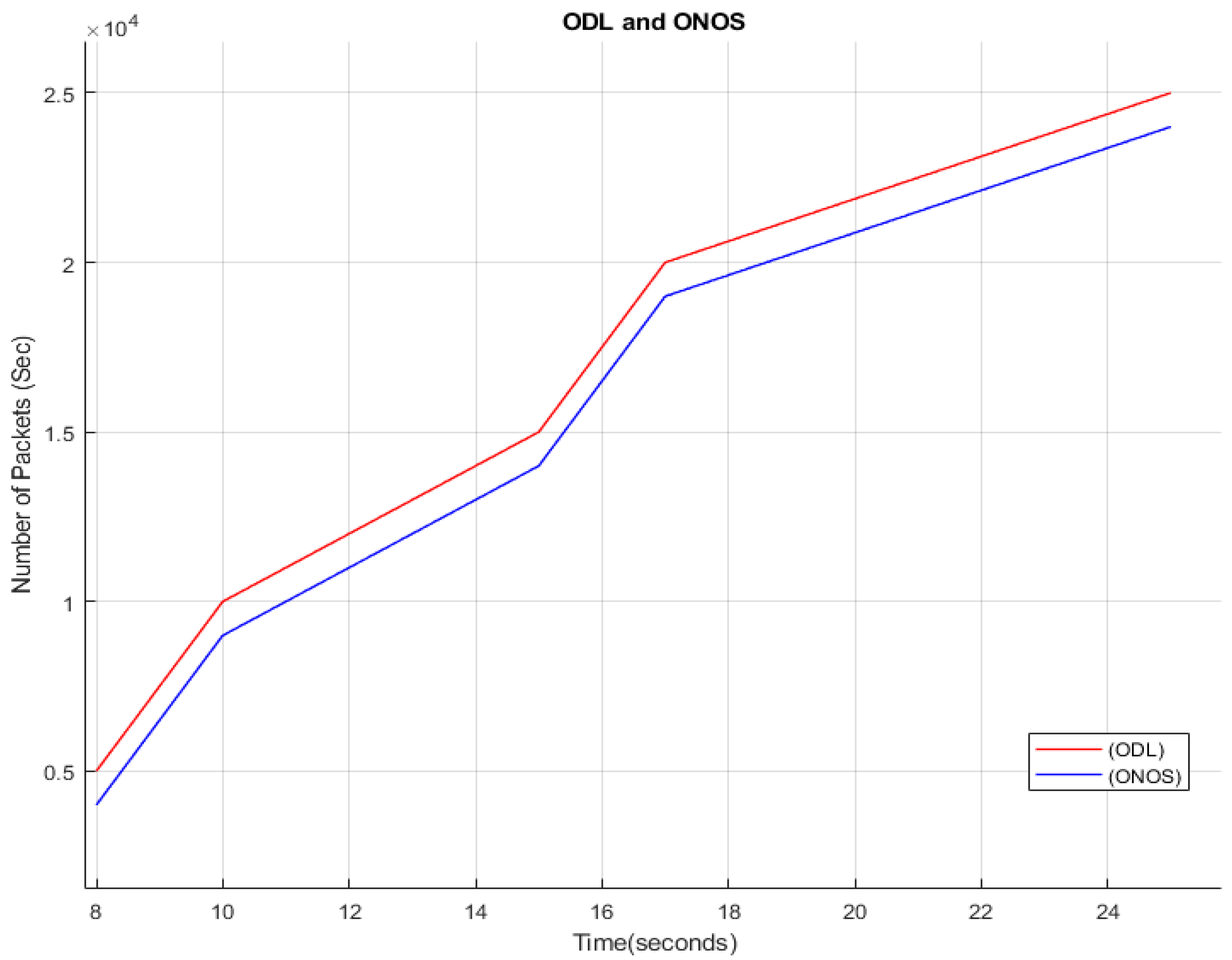
As already stated, businesses can choose from a range of controllers, but two of the most well-known are ODL and ONOS. In Figure 3, the normal traffic analysis is depicted for both of the popular controllers. The time for which the experiment was implemented was around 24 s, and it was found that ODL has transferred the maximum number of packets as compared to ONOS. Although they both are linked to the Linux Foundation, there are several differences between the two that consumers should be aware of. However, before delving deeper into ONOS and ODL, we must first consider the other market participants. Significant rivals ONOS and ODL should be evaluated head-to-head—Corporate vs. Academic—ONOS vs. ODL—Cloud provider vs. Carrier-grade networks. Both ONOS and ODL are built in Java and created for modular use with a flexible infrastructure, and each ONOS partner is also a member of ODL. Aside from that, they are distinguished by a few key qualities. The Eclipse Public License is used by ODL; however, the Apache 2.0 license is used by ONOS. ONOS is more focused on service providers and cloud providers. ONOS is composed of a complex web of interconnected subsystems and scalable telecom system activities, some of which are actively in development. ODL, on the other hand, is based on a strong central abstraction layer and a model-view-control platform.
Figure 3. ODL and ONOS.

4.4. Customers to Target

According to the ONF, both ONOS and ODL have hybrid commercial strategies, albeit there are differences in which business attracts which providers. Even though the Whole Stack associated ONOS with telecommunications, it claimed that ODL was primarily concerned with data centers. ODL connects Next Generation Networks (NGN) (OpenFlow and SDN) and Legacy (BGP, SNMP, and so on). Since ONOS places a greater emphasis on performance characteristics and clustering to improve availability and scalability, carriers are frequently more interested in it. ONOS concentrates on carrier-grade networks as a result, and telecommunications companies are included into their initiatives. In comparison with ONOS, ODL has more vendors, such as NES, Cisco, and Juniper.

4.5. CPU Utilization

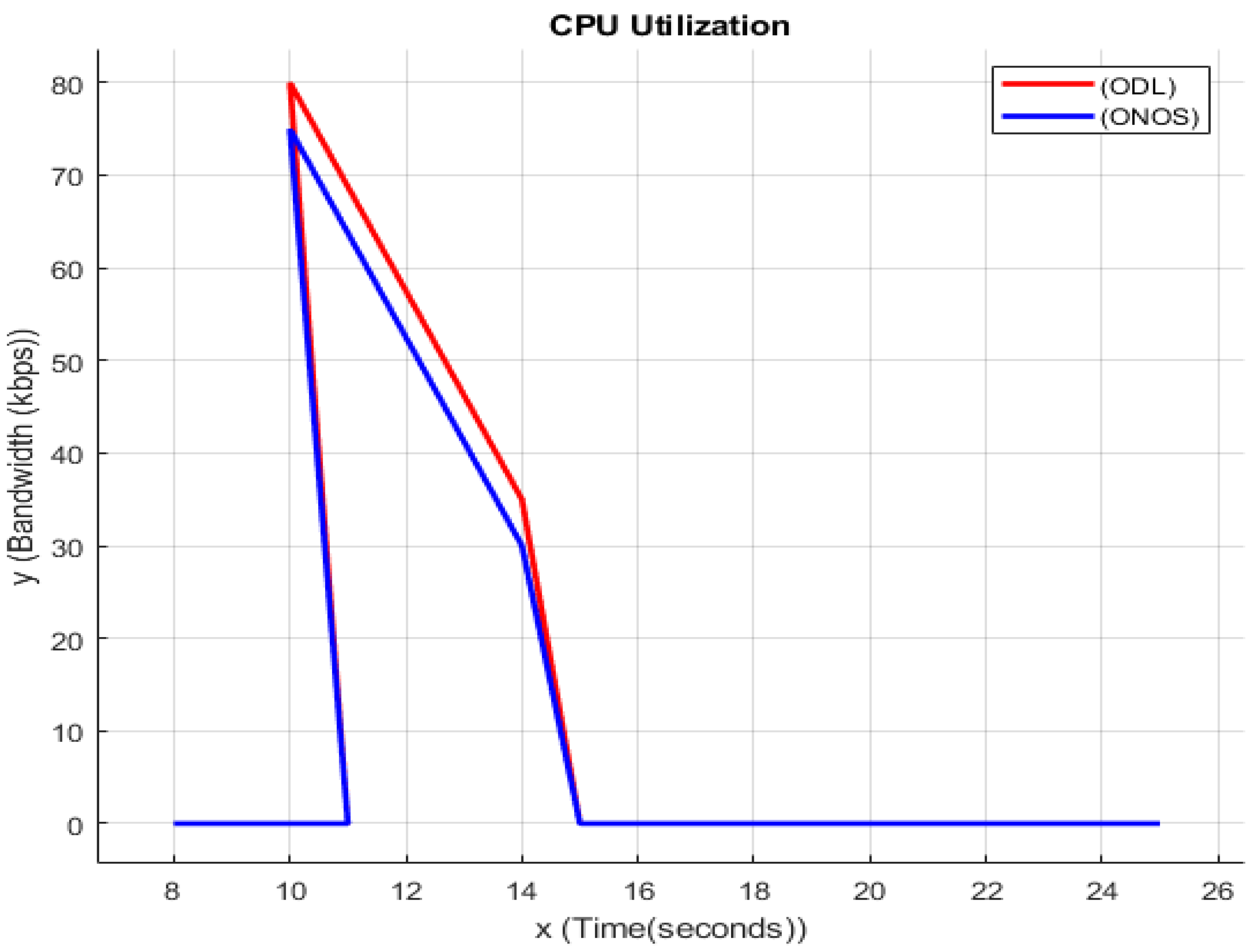
Figure 4 analyses the effect of the CPU use metric. DDoS assaults, a well publicised phenomenon, pose one of the greatest challenges to the security of modern Internet infrastructure and services. All too often, denial-of-service attacks have a negative impact on and are themselves a target of VOIP services, DNS servers, online games, and e-commerce applications. Online application assaults and denial of service are becoming more common in distributed architecture. While active, the denial-of-service assault lessens the strain on web servers’ processing power. Therefore, it is necessary to reduce CPU burden once an attack has been effectively detected.
Figure 4. CPU utilization.
The primary purpose is to reduce the CPU’s workload after a SYN Flood attack:
  • Permits authorized users to access resources and services after identifying a denial-of-service attack, such as a TCP;
  • Lowers and SYN Flood CPU burden;
  • To successfully detect denial-of-service attacks, the method employs a threshold and abuse detection strategy. TCP SYN flood attacks are created using the Linux hping tool. The majority of the malicious TCP packets are generated by the hping tool for web servers.
CPU use before, during, and after an attack has been detected is compared to gauge the system’s efficacy. The processor uses before, during, and after DoS attacks, such as TCP SYN flood detection. As the numbers demonstrate, CPU use spikes during a TCP SYN Flood assault and then drops down sharply after the attack is identified. Unfortunately, this method can only identify denial-of-service assaults like SYN flooding. The next step is to subject the system to a number of DOS simulations. It was discovered via testing that CPU use was lower than ODL by a significant margin.

4.6. Memory Utilization

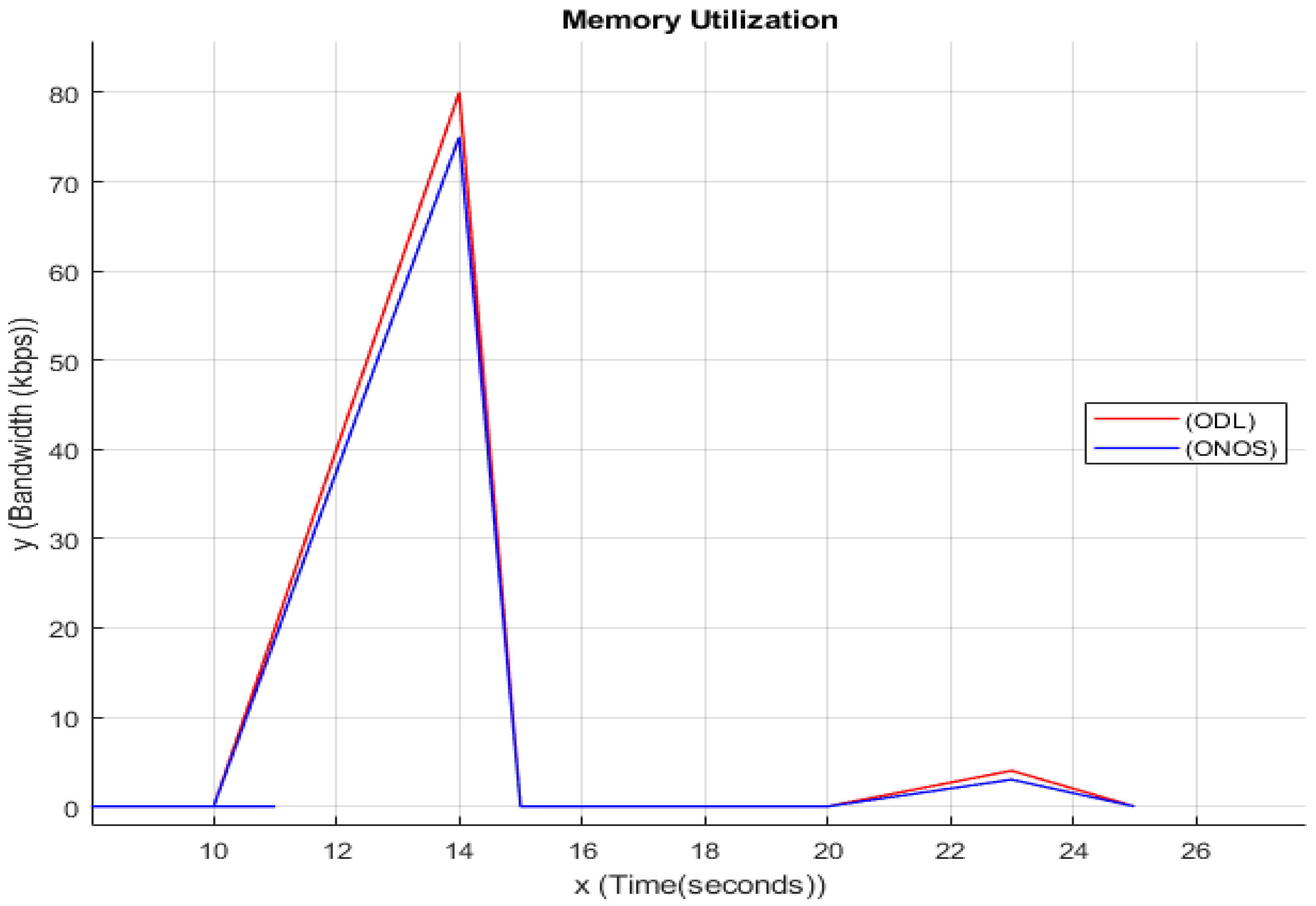
While DDoS attack is being performed on a server, all the resources of that server will be used to its maximum limit like CPU Utilization memory will also get used to the max limit; as you can see in the above graph at a particular time interval, the memory is being used to its max limit, which indicated that the memory is also being affected by the DDoS attack. In the above Figure 5, the y-axis indicates the Bandwidth in Kbps, and x-axis indicates Time which is in seconds, and the lines represent both ODL and ONOS value in the time that a certain amount of memory is being utilized. A hardware memory subsystem has multiple levels of storage-based resources and is hierarchical. Numerous sites connect those that deal with scheduling. Memory attacks can use both scheduling- and storage-based contention. An adversary can transfer data from the victim from upper-level storage-based memory resources to lower-level memory resources in the case of a storage-based dispute. In Figure 5 as a result, the victim will have to wait longer for the data to reach the processor core. An attacker can lessen the likelihood that the scheduler would choose the victim’s memory requests at a given memory level by tricking it into assigning the attacker’s requests a higher priority or by constantly attacking the scheduler with many requests at once in scheduling-based contention.
Figure 5. Memory utilization.

4.7. Disk Utilization

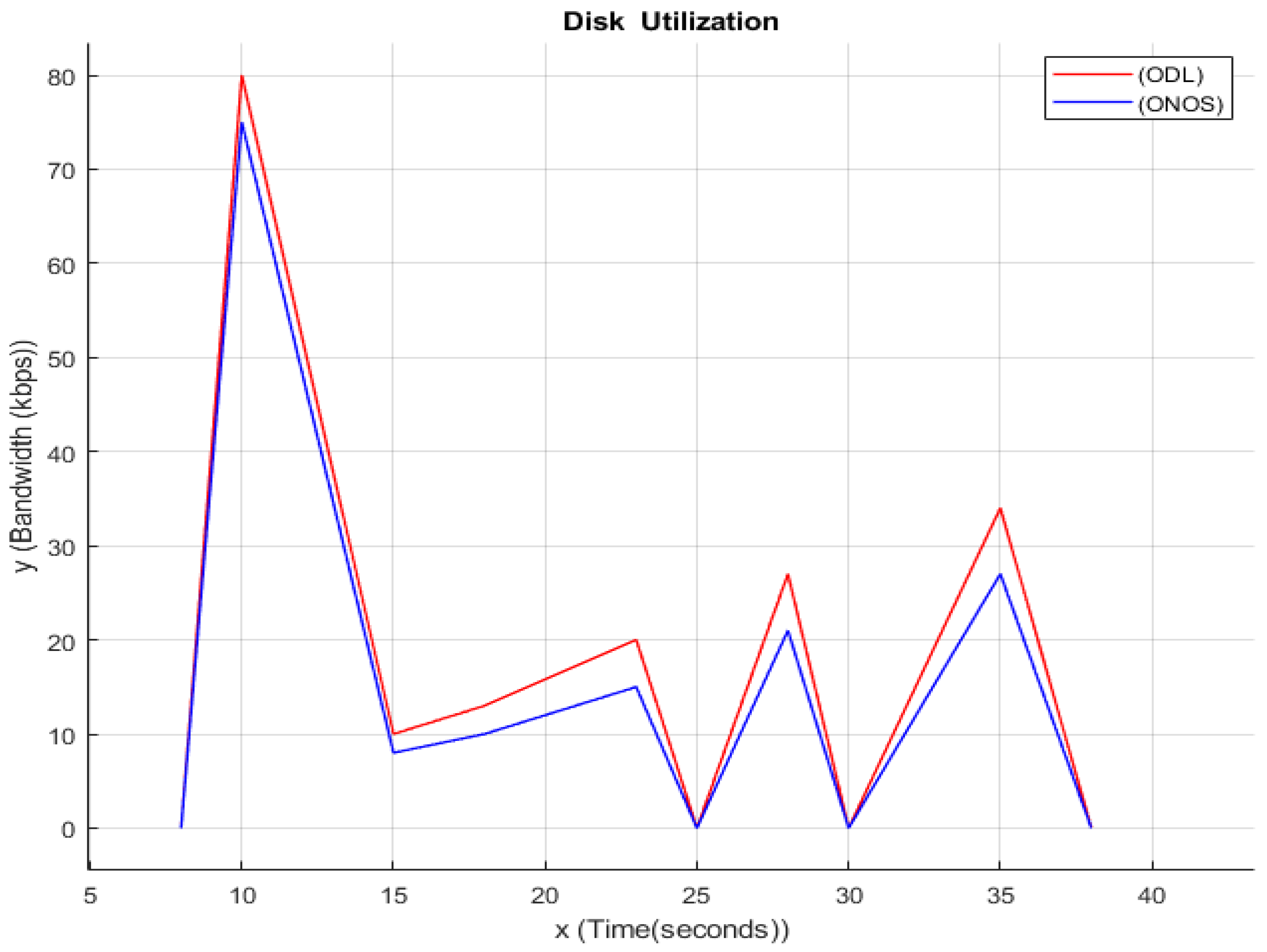
While DDoS attack is being performed on a server, all the resources of that server will be used to their maximum limit, like the CPU Utilization Disk, as shown in Figure 6, which will also get used to its maximum limit; as you can see in the above graph, at a particular time interval when the DDoS attack is being performed, the disk is being utilized, which indicated that the disk is also being affected by the DDoS attack. The y-axis in the graph above indicates the Bandwidth in Kbps, and the x-axis indicates Time, which is in seconds, and the lines represent both ODL and ONOS values in the time that a certain amount of memory is being utilized. Because of their enhanced dependability, storage capacity, fault tolerance, and other qualities, hard disc drives (HDDs) have grown to be the most popular kind of nonvolatile storage. Because of technological breakthroughs and the constant need to store massive amounts of data, modern computing systems rely largely on HDDs. The detailed scenarios and comparisons are illustrated in Table 3.
Figure 6. Disk utilization.
Table 3. Comparison of different parameters and scenarios.
Indeed, the researchers discovered that hard disc drives (HDDs) are now an integral component of many commonplace systems, including personal computers, cloud servers, medical bedside monitors, closed-circuit television (CCTV) systems, and automated teller machines (ATMs). As a result, an efficient and easy DDoS attack against HDDs could cause major practical issues for people and organizations. In Table 3, summarization of all the parameters along with the comparison of both controllers is depicted. It can be clearly observed that ODL went down after ONOS in every scenario. ODL has the maximum utilization for all three parameters (Disk, Memory, and CPU). TCP SYN and HTTP type of traffic were used for every scenario.

5. Conclusions and Future Scope

Software Defined Networking is a relatively new networking architecture that has become the most widely discussed networking technology in recent years and the latest development in developing digital networks, which aims to break down the traditional connection in the middle of the control surface and the infrastructure surface. This separation aims to make resources more manageable, secure, and controllable. As a result, many controllers such as Beacon, Floodlight, Ryu, ODL, ONOS, NOX, and Pox have been developed. The selection of the finest-fit controller has evolved into an application-specific tool operation due to the extensive range of SDN applications and controllers. In this paper, we have selected two popular SDN controllers for the point of the study (ODL and ONOS). For experimentation, four different machines with varied configurations were considered. ODL-3 node cluster controller and ONOS controller were bombarded under different scenarios. Open source tools were used to generate malicious traffic of DDoS and bombarded the targeted controller. Both SDN controllers were found to be vulnerable to DDoS attacks, and under different scenarios, it was observed that the ODL-3 node cluster outperforms in terms of disk, memory, and CPU utilization. The time when controllers went down was also high in the case of the ODL-3node cluster controller. We were limited to parameters for comparison. In further study, more parameters and scenarios (more traffic generation) could be considered for future study of points.

Author Contributions

Conceptualization, S.B. (Sumit Badotra), S.B. (Salil Bharany), S.T., A.U.R., E.T.E., N.A.G. and M.S.; methodology, S.B. (Sumit Badotra), S.B. (Salil Bharany), S.T., A.U.R., E.T.E., N.A.G. and M.S.; software, S.B. (Sumit Badotra) and S.T.; validation, S.B. (Sumit Badotra) and S.B. (Salil Bharany); formal analysis, S.T., A.U.R. and M.S.; investigation, S.B. (Sumit Badotra) and S.B. (Salil Bharany); resources, M.S. and E.T.E.; data curation, S.B. (Sumit Badotra) and S.B. (Salil Bharany); writing—original draft preparation, S.B. (Sumit Badotra), S.B. (Salil Bharany), S.T., A.U.R., E.T.E., N.A.G. and M.S.; writing—review and editing, S.B. (Sumit Badotra), S.B. (Salil Bharany), S.T., A.U.R., E.T.E., N.A.G. and M.S.; visualization, S.B. (Sumit Badotra) and S.T.; supervision, S.T. and M.S.; project administration, S.B. (Salil Bharany), A.U.R. and E.T.E.; funding acquisition, E.T.E. All authors have read and agreed to the published version of the manuscript.

Funding

This research was supported by the Future University Researchers Supporting Project No. FUESP-2020/48 at Future University in Egypt, New Cairo 11845, Egypt.

Conflicts of Interest

The authors declare no conflict of interest.

References

  1. Casado, M.; Koponen, T.; Shenker, S.; Tootoonchian, A. Fabric: A retrospective on evolving SDN. In Proceedings of the First Workshop on Hot Topics in Software Defined Networks, Helsinki, Finland, 13 August 2012; Association for Computing Machinery: New York, NY, USA, 2012; pp. 85–90. [Google Scholar]
  2. Gelberger, A.; Yemini, N.; Giladi, R. Performance analysis of software-defined networking (SDN). In Proceedings of the 2013 IEEE 21st International Symposium on Modelling, Analysis and Simulation of Computer and Telecommunication Systems, San Francisco, CA, USA, 14–16 August 2013; IEEE: Piscataway, NJ, USA; pp. 389–393. [Google Scholar]
  3. Khondoker, R.; Zaalouk, A.; Marx, R.; Bayarou, K. Feature-based comparison and selection of Software Defined Networking (SDN) controllers. In Proceedings of the 2014 World Congress on Computer Applications and Information Systems (WCCAIS), Hammamet, Tunisia, 17–19 January 2014; IEEE: Piscataway, NJ, USA; pp. 1–7. [Google Scholar]
  4. Baktir, A.C.; Ozgovde, A.; Ersoy, C. How Can Edge Computing Benefit From Software-Defined Networking: A Survey, Use Cases, and Future Directions. IEEE Commun. Surv. Tutor. 2017, 19, 2359–2391. [Google Scholar] [CrossRef]
  5. Sun, S.; Gong, L.; Rong, B.; Lu, K. An intelligent SDN framework for 5G heterogeneous networks. IEEE Commun. Mag. 2015, 53, 142–147. [Google Scholar] [CrossRef]
  6. Yoon, C.; Park, T.; Lee, S.; Kang, H.; Shin, S.; Zhang, Z. Enabling security functions with SDN: A feasibility study. Comput. Netw. 2015, 85, 19–35. [Google Scholar] [CrossRef]
  7. Badotra, S.; Panda, S.N. SNORT based early DDoS detection system using Opendaylight and open networking operating system in software defined networking. Clust. Comput. 2021, 24, 501–513. [Google Scholar] [CrossRef]
  8. Basta, A.; Kellerer, W.; Hoffmann, M.; Morper, H.J.; Hoffmann, K. Applying NFV and SDN to LTE mobile core gateways, the functions placement problem. In Proceedings of the 4th Workshop on All Things Cellular: Operations, Applications, Challenges, Chicago, IL, USA, 22 August 2014; Association for Computing Machinery: New York, NY, USA, 2014; pp. 33–38. [Google Scholar]
  9. Xia, W.; Wen, Y.; Foh, C.H.; Niyato, D.; Xie, H. A survey on software-defined networking. IEEE Commun. Surv. Tutor. 2015, 17, 27–51. [Google Scholar] [CrossRef]
  10. Aburukba, R.O.; AliKarrar, M.; Landolsi, T.; El-Fakih, K. Scheduling Internet of Things requests to minimize latency in hybrid Fog–Cloud computing. Future Gener. Comput. Syst. 2020, 111, 539–551. [Google Scholar] [CrossRef]
  11. Gupta, A.; Sharma, L.S. Performance Evaluation of Snort and Suricata Intrusion Detection Systems on Ubuntu Server. In Proceedings of the ICRIC 2019, Jammu, India, 8–9 March 2019; Springer: Cham, Switzerland, 2020; pp. 811–821. [Google Scholar]
  12. Shorey, T.; Subbaiah, D.; Goyal, A.; Sakxena, A.; Mishra, A.K. Performance Comparison and Analysis of Slowloris, GoldenEye and Xerxes DDoS Attack Tools. In Proceedings of the 2018 International Conference on Advances in Computing, Communications and Informatics (ICACCI), Bangalore, India, 19–22 September 2018; IEEE: Piscataway, NJ, USA; pp. 318–322. [Google Scholar]
  13. Mouradian, C.; Kianpisheh, S.; Abu-Lebdeh, M.; Ebrahimnezhad, F.; Jahromi, N.T.; Glitho, R.H. Application component placement in NFV-based hybrid cloud/fog systems with mobile fog nodes. IEEE J. Sel. Areas Commun. 2019, 37, 1130–1143. [Google Scholar] [CrossRef]
  14. Badotra, S.; Panda, S.N. Software-defined networking: A novel approach to networks. In Handbook of Computer Networks and Cyber Security; Springer: Cham, Switzerland, 2020; pp. 313–339. [Google Scholar]
  15. Badotra, S.; Panda, S.N.; Datta, P. Detection and Prevention from DDoS Attack Using Software-Defined Security. In Progress in Advanced Computing and Intelligent Engineering; Springer: Singapore, 2021; pp. 207–217. [Google Scholar]
  16. Badotra, S.; Nagpal, D.; Panda, S.N.; Tanwar, S.; Bajaj, S. IoT-enabled healthcare network with SDN. In Proceedings of the 2020 8th International Conference on Reliability, Infocom Technologies and Optimization (Trends and Future Directions)(ICRITO), Noida, India, 4–5 June 2020; IEEE: Piscataway, NJ, USA; pp. 38–42. [Google Scholar]
  17. Bharany, S.; Kaur, K.; Badotra, S.; Rani, S.; Wozniak, M.; Shafi, J.; Ijaz, M.F. Efficient Middleware for the Portability of PaaS Services Consuming Applications among Heterogeneous Clouds. Sensors 2022, 22, 5013. [Google Scholar] [CrossRef]
  18. Badotra, S.; Panda, S.N. Experimental comparison and evaluation of various OpenFlow software defined networking controllers. Int. J. Appl. Sci. Eng. 2020, 17, 317–324. [Google Scholar]
  19. Bharany, S.; Sharma, S.; Bhatia, S.; Rahmani, M.K.I.; Shuaib, M.; Lashari, S.A. Energy Efficient Clustering Protocol for FANETS Using Moth Flame Optimization. Sustainability 2022, 14, 6159. [Google Scholar] [CrossRef]
  20. Betgé-Brezetz, S.; Kamga, G.B.; Tazi, M. Trust support for SDN controllers and virtualized network applications. In Proceedings of the 2015 1st IEEE Conference on Network Softwarization (NetSoft), London, UK, 13–17 April 2015; IEEE: Piscataway, NJ, USA; pp. 1–5. [Google Scholar]
  21. Isong, B.; Kgogo, T.; Lugayizi, F.; Kankuzi, B. Trust establishment framework between SDN controller and applications. In Proceedings of the 2017 18th IEEE/ACIS International Conference on Software Engineering, Artificial Intelligence, Networking and Parallel/Distributed Computing (SNPD), Kanazawa, Japan, 26–28 June 2017; IEEE: Piscataway, NJ, USA; pp. 101–107. [Google Scholar]
Publisher’s Note: MDPI stays neutral with regard to jurisdictional claims in published maps and institutional affiliations.

Article Metrics

Citations

Article Access Statistics

Multiple requests from the same IP address are counted as one view.