AI-Based Wormhole Attack Detection Techniques in Wireless Sensor Networks
 ,
,  , , and
Abstract
:1. Introduction
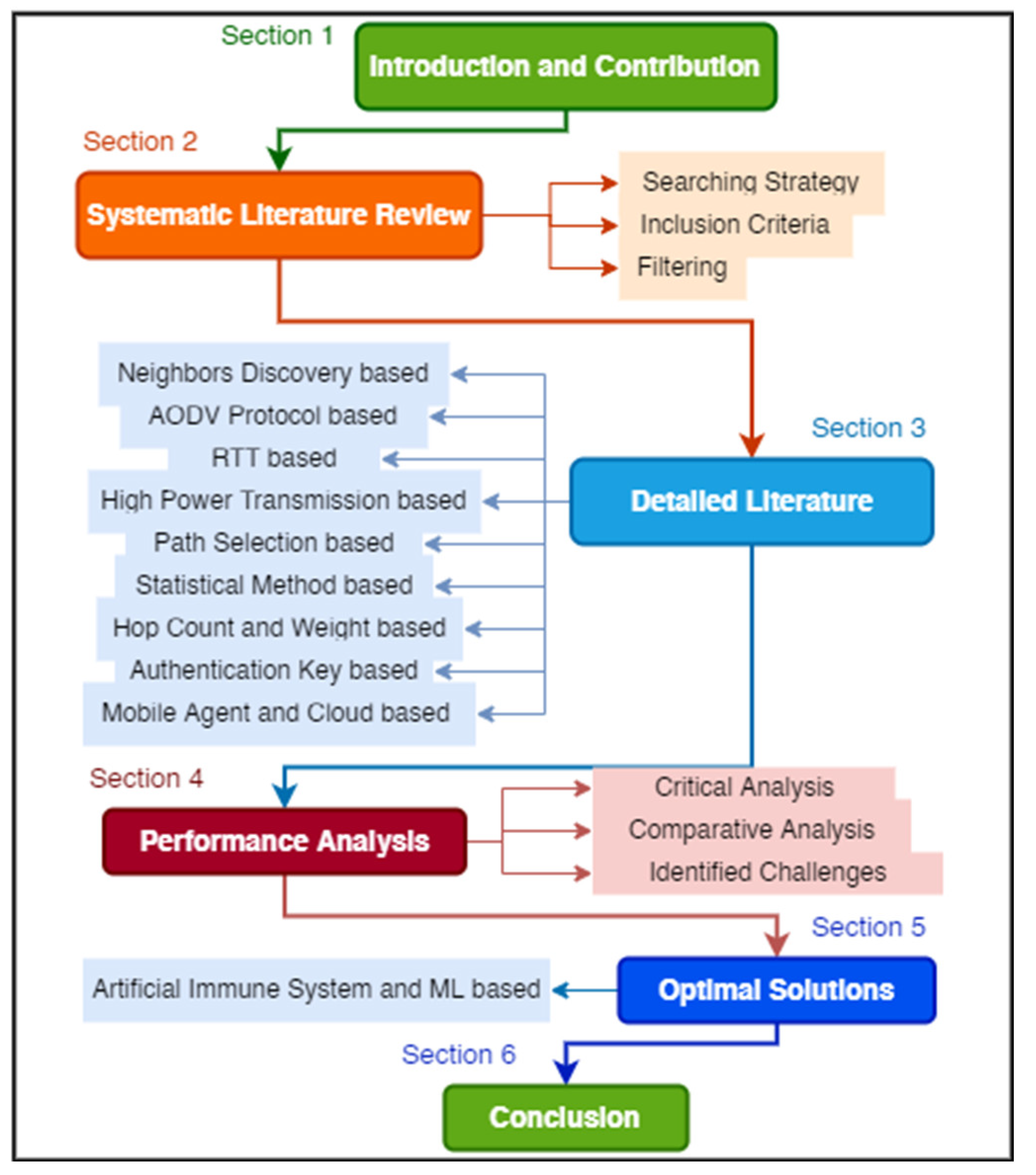
- A detailed review is performed to analyse the problems in state-of-the-art techniques for wormhole attack detection.
- In this paper, AI and ML techniques are proposed as the optimal solution to the state-of-the-art problems in wormhole detection in wireless sensor networks.
- The open research challenges are identified, and the literature addressing them is listed.
2. Systematic Literature Review
2.1. Searching Protocol
2.2. String Development
2.3. Inclusion Criteria
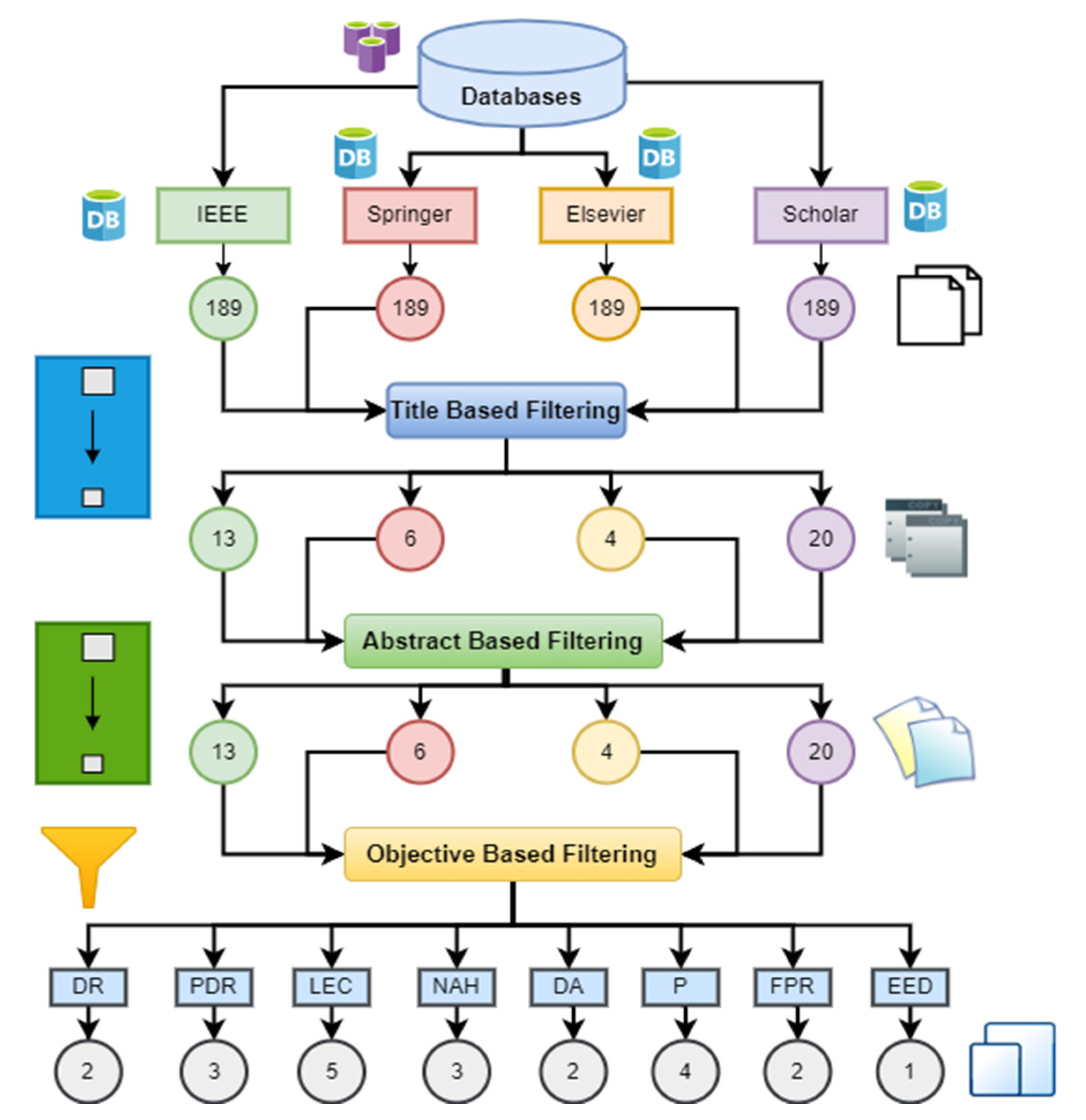
2.4. Filtering
3. Detailed Literature
3.1. Artificial Immune Systems and Machine Learning-Based Systems
3.2. Neighbor Discovery-Based Systems
3.3. AODV Protocol-Based Systems
3.4. RTT-Based Systems
3.5. High-Power Transmission-Based Systems
3.6. Path Selection-Based Systems
3.7. Statistical Method-Based Systems
3.8. Hop Count and Weight-Based Methods
3.9. Authentication Key-Based Systems
3.10. Mobile Agent and Cloud-Based Systems
4. Performance Analysis
4.1. Critical Analysis

| Detection Algorithm | Effort Year | Technique | Performance Metrics | Shortcoming | |
|---|---|---|---|---|---|
| Neighbours discovery-based | [37] | 2019 | CREDND (creating a credible neighbour discovery) Protocol | No additional hardware, less energy consumption, detection accuracy | It cannot work well with dynamic changing in the communication range of nodes [37] |
| [38] | 2018 | Trust-based scheme | Low energy consumption | RPL is a complex protocol that increases the network’s control packets, resulting in overhead and increased energy consumption [71] | |
| [39] | 2018 | Decentralized statistical scheme | Detection accuracy, false-positive rate, mean detection delay | Loss of control, costlier operations | |
| [40] | 2019 | MLAMAN scheme | Tunnel length, the maximum moving speed of nodes | Loss of energy in multi-hop count analysis | |
| [41] | 2019 | MaxIS scheme | Poor connectivity | The greedy algorithm fails to find an optimal solution | |
| [42] | 2019 | NIAPC scheme | High detection accuracy, PDR, and throughput, no specific storage requirement | The FNR for a short-distance wormhole is high [42] | |
| [43] | 2019 | ESPMAW scheme | High throughput, less E2E delay, less energy consumption, and traffic overhead | It cannot detect wormholes for shorter tunnel lengths [43] | |
| [44] | 2021 | SDN-based scheme (SWANS) | Less communication overhead, less FNR | The FPR is low [44] | |
| AODV protocol-based schemes | [45] | 2018 | Wormhole recognition using AODV | Low energy consumption, less complex | No scalability, no congestion control, no load balancing [70] |
| [46] | 2018 | Confirmation system using honeypot | Fewer resources | No protection against misconfiguration (easy to create loops) | |
| [47] | 2018 | AODV based scheme | High detection accuracy | Low throughput [47] | |
| [48] | 2021 | Lightweight scheme (AODV) | High throughput, high PDR, less routing overhead | The end-to-end delay is average [48] | |
| RTT-based | [49] | 2018 | RTT-centred wormhole recognition | No additional hardware and clock synchronization | Increases with the increase in distance between nodes, LAN traffic affects the functionality of RTT |
| [50] | 2020 | RTT centred scheme | Detection rate | Increases with the increase in distance between nodes, LAN traffic affects the functionality of RTT | |
| [51] | 2018 | EIRGP- and RTT-based scheme | High throughput, less PDR | It cannot find malicious nodes effectively [51] | |
| [52] | 2019 | Trust-based scheme | High PDR, no additional hardware | The throughput rate is low [52] | |
| High-power transmission-based | [53] | 2019 | Energy model by using AODV and hop count | High packet delivery ratio, less end-to-end delay | No scalability, no congestion control, no load balancing [70] |
| [54] | 2019 | RPL-based scheme | Detection rate | RPL is a complex protocol that increases the control packets in the network which results in overhead and increased energy consumption [71]. | |
| Path selection | [55] | 2018 | 3PATw scheme | Detection rate, packet delivery ratio | Increases with the increase in distance between nodes, LAN traffic affects the functionality of RTT |
| [56] | 2018 | Spanning trees scheme | No additional hardware, high detection accuracy | Restricts more direct paths as all data flow towards only a single path | |
| [57] | 2020 | AD-PSO scheme | Less energy consumption, effective network lifetime | No scalability, no congestion control, no load balancing [70] | |
| Statistical method-based | [58] | 2019 | Encapsulation and fragmentation of message (EFM) scheme | Less PLR | The packet delivery ratio is average [58] |
| [59] | 2020 | Intrusion prevention system | High detection accuracy | The traffic overhead is increased and the computation cost is high [70] | |
| [60] | 2021 | HCBS protocol-based scheme | High throughput, high PDR, less PLR, less E2E delay | Cluster head selection increase computational complexity [60] | |
| Hop count and Weight-based | [61] | 2018 | LITS scheme | High detection accuracy, reduced localization error | It requires clock synchronization, which increases the computation cost [61] |
| [62] | 2018 | WDV-hop scheme | High detection accuracy | The packet delay is increased and the complexity is high [62] | |
| [63] | 2021 | Delay per hour indication (DELPHI)-based scheme | High throughput, PDR, less PLR, less Jitter | The end-to-end delay is average [63] | |
| [64] | 2021 | RHE2WADI scheme using RSSI value | High detection accuracy, less traffic overhead, less energy consumption | The end-to-end delay is average [64] | |
| Authentication Key-based | [65] | 2019 | EDAK scheme | Less traffic overhead, scalable to large networks | There is no data integrity [65] |
| [66] | 2018 | HKP-HD scheme | High detection accuracy, less chance of attack | It does not apply to highly mobile networks [66] | |
| [67] | 2021 | Elliptic curve cryptography scheme | High throughput, high PDR, less E2E delay, less routing overhead | No scalability, no congestion control, no load balancing [70] | |
| Mobile agent and Cloud-based | [68] | 2018 | Visiting centre local-based scheme | High detection accuracy, less energy consumption, enhanced network lifetime | Security in the transaction context is medium [68] |
| [69] | 2019 | Cross-layer verification scheme | High detection accuracy, high throughput, less E2E delay | It cannot be applied to multicast routing protocols; the performance rate of the network degrades with time |
4.2. Comparative Analysis
4.3. Identified Challenges
4.3.1. Need to Work with Constantly Shifting Ranges
4.3.2. Need for Scalability and Load Balancing
4.3.3. Need for High-Rate Transmission over Long Distance
5. Optimal Solutions
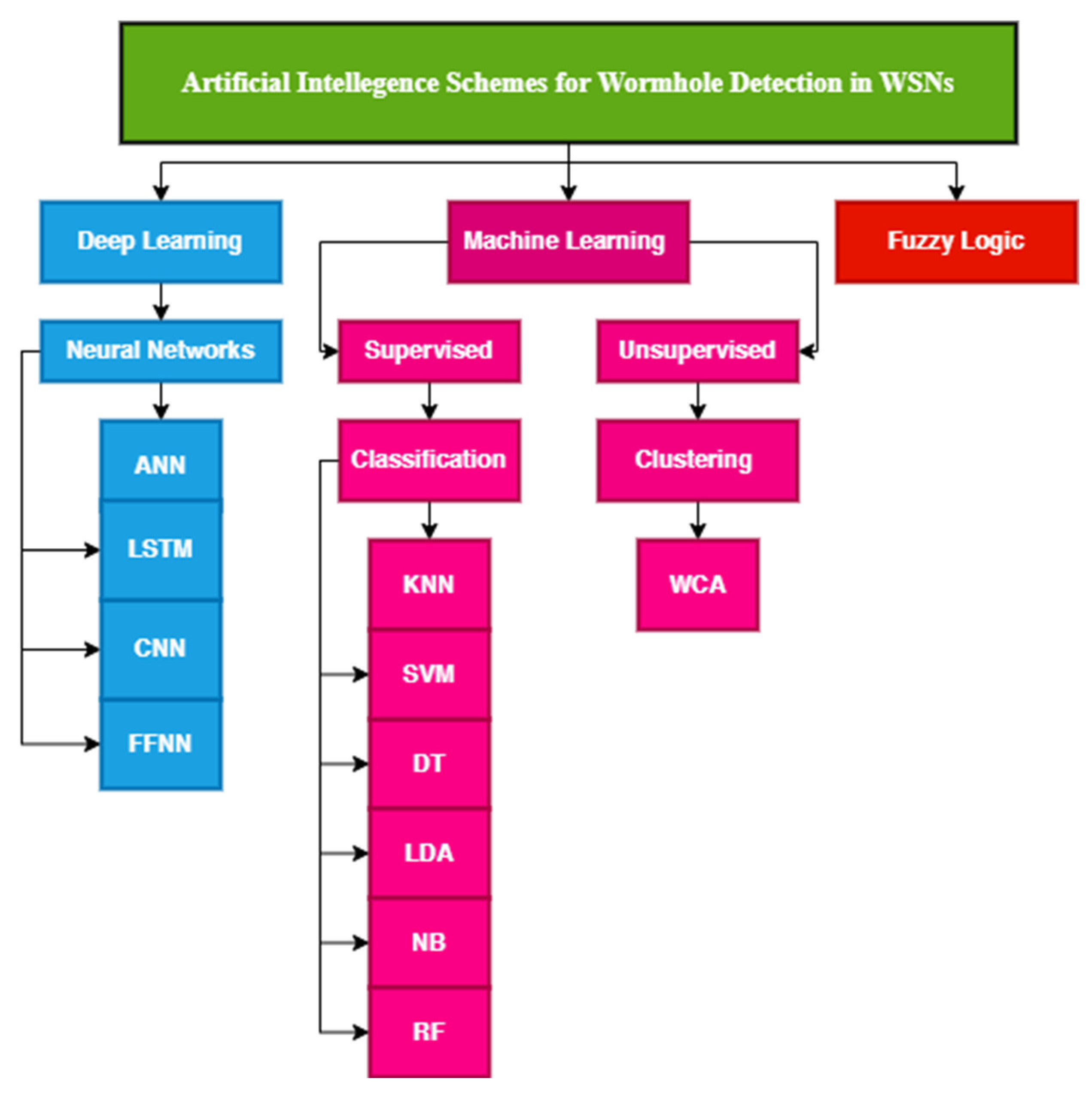
AI- and ML-Based Schemes as Optimal Solutions to State-of-the-Art Problems
6. Conclusions
Author Contributions
Funding
Institutional Review Board Statement
Informed Consent Statement
Data Availability Statement
Acknowledgments
Conflicts of Interest
References
- Adil, M.; Almaiah, M.A.; Omar Alsayed, A.; Almomani, O. An anonymous channel categorization scheme of edge nodes to detect jamming attacks in wireless sensor networks. Sensors 2020, 20, 2311. [Google Scholar] [CrossRef] [PubMed] [Green Version]
- Elsayed, W.; Elhoseny, M.; Sabbeh, S.; Riad, A. Self-maintenance model for wireless sensor networks. Comput. Electr. Eng. 2018, 70, 799–812. [Google Scholar] [CrossRef]
- Sah, D.K.; Amgoth, T. Renewable energy harvesting schemes in wireless sensor networks: A survey. Inf. Fusion 2020, 63, 223–247. [Google Scholar] [CrossRef]
- Sampoornam, K.P.; Saranya, S.; Mohanapriya, G.K.; Devi, P.S.; Dhaarani, S. Analysis of LEACH Routing Protocol in Wireless Sensor Network with Wormhole Attack. In Proceedings of the 2021 Third International Conference on Intelligent Communication Technologies and Virtual Mobile Networks (ICICV), Tirunelveli, India, 4–6 February 2021; pp. 147–152. [Google Scholar]
- Shahraki, A.; Taherkordi, A.; Haugen, Ø.; Eliassen, F. Clustering objectives in wireless sensor networks: A survey and research direction analysis. Comput. Netw. 2020, 180, 107376. [Google Scholar] [CrossRef]
- Numan, M.; Subhan, F.; Khan, W.Z.; Hakak, S.; Haider, S.; Reddy, G.T.; Alazab, M. A systematic review on clone node detection in static wireless sensor networks. IEEE Access 2020, 8, 65450–65461. [Google Scholar] [CrossRef]
- Kandris, D.; Nakas, C.; Vomvas, D.; Koulouras, G. Applications of wireless sensor networks: An up-to-date survey. Appl. Syst. Innov. 2020, 3, 14. [Google Scholar] [CrossRef] [Green Version]
- Ali, A.; Ming, Y.; Chakraborty, S.; Iram, S. A comprehensive survey on real-time applications of WSN. Future Internet 2017, 9, 77. [Google Scholar] [CrossRef] [Green Version]
- Premkumar, M.; Sundararajan, T.V.P. DLDM: Deep learning-based defense mechanism for denial of service attacks in wireless sensor networks. Microprocess. Microsyst. 2020, 79, 103278. [Google Scholar] [CrossRef]
- Liu, Y.; Ma, M.; Liu, X.; Xiong, N.N.; Liu, A.; Zhu, Y. Design and analysis of probing route to defense sinkhole attacks for Internet of Things security. IEEE Trans. Netw. Sci. Eng. 2018, 7, 356–372. [Google Scholar] [CrossRef]
- Yousefpoor, M.S.; Yousefpoor, E.; Barati, H.; Barati, A.; Movaghar, A.; Hosseinzadeh, M. Secure data aggregation methods and countermeasures against various attacks in wireless sensor networks: A comprehensive review. J. Netw. Comput. Appl. 2021, 190, 103118. [Google Scholar] [CrossRef]
- Ahutu, O.R.; El-Ocla, H. Centralized routing protocol for detecting wormhole attacks in wireless sensor networks. IEEE Access 2020, 8, 63270–63282. [Google Scholar] [CrossRef]
- Sankara Narayanan, S.; Murugaboopathi, G. Modified secure AODV protocol to prevent wormhole attacks in MANET. Concurr. Comput. Pract. Exp. 2020, 32, e5017. [Google Scholar] [CrossRef]
- Alenezi, F.A.; Song, S.; Choi, B.Y. WAND: Wormhole Attack Analysis using the Neighbor Discovery for Software-defined Heterogeneous Internet of Things. In Proceedings of the 2021 IEEE International Conference on Communications Workshops (ICC Workshops), Montreal, QC, Canada, 14–23 June 2021; pp. 1–6. [Google Scholar]
- Siddiqui, M.N.; Malik, K.R.; Malik, T.S. Performance Analysis of Blackhole and Wormhole Attack in MANET-Based IoT. In Proceedings of the 2021 International Conference on Digital Futures and Transformative Technologies (ICoDT2), Islamabad, Pakistan, 20–21 May 2021; pp. 1–8. [Google Scholar]
- Verma, M.K.; Dwivedi, R.K. A Survey on Wormhole Attack Detection and Prevention Techniques in Wireless Sensor Networks. In Proceedings of the 2020 International Conference on Electrical and Electronics Engineering (ICE3), Gorakhpur, India, 14–15 February 2020; pp. 326–331. [Google Scholar]
- Dwivedi, R.K.; Sharma, P.; Kumar, R. Detection and prevention analysis of wormhole attack in wireless sensor network. In Proceedings of the 2018 8th International Conference on Cloud Computing, Data Science & Engineering (Confluence), Noida, India, 11–12 January 2018; pp. 727–732. [Google Scholar]
- Goyal, M.; Dutta, M. Intrusion Detection of Wormhole Attack in IoT: A Review. In Proceedings of the 2018 International Conference on Circuits and Systems in Digital Enterprise Technology (ICCSDET), Kottayam, India, 21–22 December 2018; pp. 1–5. [Google Scholar]
- Farjamnia, G.; Gasimov, Y.; Kazimov, C. Review of the techniques against the wormhole attacks on wireless sensor networks. Wirel. Pers. Commun. 2019, 105, 1561–1584. [Google Scholar] [CrossRef]
- Ghugar, U.; Pradhan, J. Survey of wormhole attack in wireless sensor networks. Comput. Sci. Inf. Technol. 2020, 2, 33–42. [Google Scholar] [CrossRef]
- Kumar, S.S. Abridgement and Prevention of Wormhole Attack in Mobile Ad Hoc Networks using Coordinator Node. Ph.D. Thesis, Vels University, Chennai, India, 7 February 2020. Available online: http://hdl.handle.net/10603/274578 (accessed on 28 May 2022).
- Giri, D.; Borah, S.; Pradhan, R. Approaches and measures to detect wormhole attack in wireless sensor networks: A survey. In Advances in Communication 2018, Devices, and Networking; Springer: Singapore, 2018; pp. 855–864. [Google Scholar]
- Padmapriya, S.D.; Jeyalaksshmi, S.S.; Kamalakkannan, S. A Survey: Techniques and Challenges to Detect Wormhole Attack in Wireless Sensor Network. J. Appl. Sci. Comput. 2018, 5, 2120–2126. [Google Scholar]
- Liu, Y.; Dong, M.; Ota, K.; Liu, A. ActiveTrust: Secure and trustable routing in wireless sensor networks. IEEE Trans. Inf. Forensics Secur. 2016, 11, 2013–2027. [Google Scholar] [CrossRef] [Green Version]
- Memon, S.K.; Nishar, K.; Hanafi Ahmad Hijazi, M.; Chowdhry, B.S.; Sodhro, A.H.; Pirbhulal, S.; Rodrigues, J.J.P.C. A survey on 802.11 MAC protocols industrial standards, architecture elements for providing QoS guarantee, supporting emergency traffic, and security: Future directions. J. Ind. Inf. Integr. 2021, 4, 100225. [Google Scholar]
- Jamali, S.; Fotohi, R. Defending against Wormhole Attack in MANET Using an Artificial Immune System. New Rev. Inf. Netw. 2016, 21, 79–100. [Google Scholar] [CrossRef]
- Jhanjhi, N.Z.; Brohi, S.N.; Malik, N.A.; Humayun, M. Proposing a Hybrid RPL Protocol for Rank and Wormhole Attack Mitigation using Machine Learning. In Proceedings of the 2020 2nd International Conference on Computer and Information Sciences (ICCIS), Sakaka, Saudi Arabia, 13–15 October 2020; pp. 1–6. [Google Scholar]
- Singh, M.M.; Dutta, N.; Singh, T.R.; Nandi, U. A Technique to Detect Wormhole Attack in Wireless Sensor Network Using Artificial Neural Network. In Evolutionary Computing and Mobile Sustainable Networks; Springer: Singapore, 2021; pp. 297–307. [Google Scholar]
- Pawar, M.V.; Anuradha, J. Detection and prevention of black-hole and wormhole attacks in wireless sensor network using optimized LSTM. Int. J. Pervasive Comput. Commun. 2021, ahead of print. [Google Scholar] [CrossRef]
- KP, K.S. Delta Ruled First Order Iterative Deep Neural Learning for Sybil and Wormhole Attacks Detection in Healthcare Wireless Sensor Network. Preprint 2021. [Google Scholar] [CrossRef]
- Abdan, M.; Seno, S.A.H. Machine Learning Methods for Intrusive Detection of Wormhole Attack in Mobile Ad-Hoc Network (MANET). Wirel. Commun. Mob. Comput. 2021, 2021, 2375702. [Google Scholar] [CrossRef]
- Ezhilarasi, M.; Gnanaprasanambikai, L.; Kousalya, A.; Shanmugapriya, M. A novel implementation of routing attack detection scheme by using fuzzy and feed-forward neural networks. Soft Comput. 2022, 1–12. [Google Scholar] [CrossRef]
- Gulganwa, P.; Jain, S. EES-WCA: Energy-efficient and secure weighted clustering for WSN using machine learning approach. Int. J. Inf. Technol. 2022, 14, 135–144. [Google Scholar] [CrossRef]
- Ali, S.; Nand, P.; Tiwari, S. Detection of Wormhole Attack in Vehicular Ad-hoc Network over Real Map using Machine Learning Approach with Preventive Scheme. J. Inf. Technol. Manag. 2022, 14, 159–179. [Google Scholar]
- Lakshmi Narayanan, K.; Santhana Krishnan, R.; Golden Julie, E.; Harold Robinson, Y.; Shanmuganathan, V. Machine learning-based detection and a novel EC-BRTT algorithm-based prevention of DoS attacks in wireless sensor networks. Wirel. Pers. Commun. 2021, 1–25. [Google Scholar] [CrossRef]
- Gite, P.; Chouhan, K.; Krishna, K.M.; Nayak, C.K.; Soni, M.; Shrivastava, A. ML Based Intrusion Detection Scheme for various types of attacks in a WSN using C4. 5 and CART classifiers. Mater. Today Proc. 2021, in press. [Google Scholar] [CrossRef]
- Luo, X.; Chen, Y.; Li, M.; Luo, Q.; Xue, K.; Liu, S.; Chen, L. CREDND: A novel secure neighbor discovery algorithm for wormhole attack. IEEE Access 2019, 7, 18194–18205. [Google Scholar] [CrossRef]
- Mehta, R.; Parmar, M.M. Trust-based mechanism for Securing IoT Routing Protocol RPL against Wormhole & Grayhole Attacks. In Proceedings of the 2018 3rd International Conference for Convergence in Technology (I2CT), Pune, India, 6–8 April 2018; pp. 1–6. [Google Scholar]
- As’adi, H.; Keshavarz-Haddad, A.; Jamshidi, A. A New Statistical Method for Wormhole Attack Detection in MANETs. In Proceedings of the 2018 15th International ISC (Iranian Society of Cryptology) Conference on Information Security and Cryptology (ISCISC), Tehran, Iran, 28–29 August 2018; pp. 1–6. [Google Scholar]
- Vo, T.T.; Luong, N.T.; Hoang, D. MLAMAN: A novel multi-level authentication model and protocol for preventing wormhole attacks in mobile ad hoc networks. Wirel. Netw. 2019, 25, 4115–4132. [Google Scholar] [CrossRef]
- Bai, S.; Liu, Y.; Li, Z.; Bai, X. Detecting wormhole attacks in 3D wireless ad hoc networks via 3D forbidden substructures. Comput. Netw. 2019, 150, 190–200. [Google Scholar] [CrossRef]
- Patel, M.; Aggarwal, A.; Chaubey, N. Detection of Wormhole Attack in Static Wireless Sensor Networks. In Advances in Computer Communication and Computational Sciences; Springer: Singapore, 2019; Volume 760, pp. 463–471. [Google Scholar] [CrossRef]
- Aliady, W.A.; Al-Ahmadi, S.A. Energy preserving secure measure against wormhole attack in wireless sensor networks. IEEE Access 2019, 7, 84132–84141. [Google Scholar] [CrossRef]
- Alenezi, F.A.; Song, S.; Choi, B.Y. SWANS: SDN-based Wormhole Analysis using the Neighbor Similarity for a Mobile ad hoc network (MANET). In Proceedings of the 2021 IFIP/IEEE International Symposium on Integrated Network Management (IM), Bordeaux, France, 17–21 May 2021; pp. 653–657. [Google Scholar]
- Kaur, T.; Kumar, R. Mitigation of blackhole attacks and wormhole attacks in wireless sensor networks using aodv protocol. In Proceedings of the 2018 IEEE International Conference on Smart Energy Grid Engineering (SEGE), Oshawa, ON, Canada, 12–15 August 2018; pp. 288–292. [Google Scholar]
- Tiruvakadu, D.S.K.; Pallapa, V. Confirmation of wormhole attack in MANETs using honeypot. Comput. Secur. 2018, 76, 32–49. [Google Scholar] [CrossRef]
- Govindasamy, J.; Punniakody, S. A comparative study of reactive, proactive, and hybrid routing protocol in wireless sensor networks under wormhole attack. J. Electr. Syst. Inf. Technol. 2018, 5, 735–744. [Google Scholar] [CrossRef]
- Zardari, Z.A.; Memon, K.A.; Shah, R.A.; Dehraj, S.; Ahmed, I. A lightweight technique for detection and prevention of wormhole attacks in MANET. EAI Endorsed Trans. Scalable Inf. Syst. 2021, 8, e2. [Google Scholar] [CrossRef]
- Kori, S.; Krishnamurthy, G.N.; Sidnal, N. RTT Centered Automatic and Dynamic Wormhole Attack Discovery in Sensor Network. In Proceedings of the 2018 International Conference on Electrical, Electronics, Communication, Computer, and Optimization Techniques (ICEECCOT), Msyuru, India, 14–15 December 2018; pp. 1684–1690. [Google Scholar]
- Roy, A.K.; Khan, A.K. RTT-based wormhole detection for wireless mesh networks. Int. J. Inf. Technol. 2020, 12, 1–8. [Google Scholar] [CrossRef]
- Karthigadevi, K.; Balamurali, S.; Venkatesulu, M. Wormhole attack detection and prevention using EIGRP protocol based on round trip time. J. Cyber Secure. Mobil. 2018, 7, 215–228. [Google Scholar] [CrossRef]
- Kori, S.; Krishnamurthy, G.N.; Sidnal, N. Distributed Wormhole Attack Mitigation Technique in WSNs. Int. J. Comput. Netw. Inf. Secure 2019, 11, 20–27. [Google Scholar] [CrossRef]
- Gayathri, S.; Seetharaman, R.; Subramanian, L.H.; Premkumar, S.; Viswanathan, S.; Chandru, S. Wormhole Attack Detection using Energy Model in MANETs. In Proceedings of the 2019 2nd International Conference on Power and Embedded Drive Control (ICPEDC), Chennai, India, 21–23 August 2019; pp. 264–268. [Google Scholar]
- Deshmukh-Bhosale, S.; Sonavane, S.S. A real-time intrusion detection system for wormhole attack in the RPL-based Internet of Things. Procedia Manuf. 2019, 32, 840–847. [Google Scholar] [CrossRef]
- Thanuja, R.; Ram, E.S.; Umamakeswari, A. A linear-time approach to detect wormhole tunnels in mobile Adhoc networks using 3PAT and transmission radius (3PAT w). In Proceedings of the 2018 2nd International Conference on Inventive Systems and Control (ICISC), Coimbatore, India, 19–20 January 2018; pp. 837–843. [Google Scholar]
- Harsányi, K.; Kiss, A.; Szirányi, T. Wormhole detection in wireless sensor networks using spanning trees. In Proceedings of the 2018 IEEE International Conference on Future IoT Technologies (Future IoT), Eger, Hungary, 18–19 January 2018; pp. 1–6. [Google Scholar]
- Tamilarasi, N.; Santhi, S.G. Detection of Wormhole Attack and Secure Path Selection in Wireless Sensor Network. Wirel. Pers. Commun. 2020, 114, 329–345. [Google Scholar] [CrossRef]
- Scholar, M.T.; Yadav, B. Predication and Root Selection of Worm Hole Attack in WSN. Int. J. Sci. Res. Eng. Trends 2019, 5, 1937–1944. [Google Scholar]
- Scholar, M.T.; Kant, R.; Sen, A.D. Collaborative Decision for Wormhole Attack Prevention in WSN. Int. J. Sci. Res. Eng. Trends 2020, 6, 212. [Google Scholar]
- Chatla, A.B. Trust-Based Secure Network For Detection Of Attacks (Wormhole And Black Hole) Due To Malicious Nodes In Ad Hoc Wireless Sensor Network. Turk. J. Comput. Math. Educ. TURCOMAT 2021, 12, 2763–2769. [Google Scholar]
- Bhushan, B.; Sahoo, G. Detection and defense mechanisms against wormhole attacks in wireless sensor networks. In Proceedings of the 3rd International Conference on Advances in Computing, Communication & Automation (ICACCA) (Fall), Dehradun, India, 15–16 September 2017; pp. 1–5. [Google Scholar] [CrossRef]
- Li, J.; Wang, D.; Wang, Y. Security DV-hop localization algorithm against wormhole attack in wireless sensor network. IET Wirel. Sens. Syst. 2018, 8, 68–75. [Google Scholar] [CrossRef]
- Kaur, P.; Kaur, D. Performance Evaluation of the Proposed Wormhole Detection Scheme with Existing Schemes. Wirel. Pers. Commun. 2021, 119, 1–11. [Google Scholar] [CrossRef]
- Bhosale, S.A.; Sonavane, S.S. Wormhole Attack Detection System for IoT Network: A Hybrid Approach. Wirel. Pers. Commun. 2021, 124, 1081–1108. [Google Scholar] [CrossRef]
- Athmani, S.; Bilami, A.; Boubiche, D.E. EDAK: An Efficient Dynamic Authentication and Key Management Mechanism for heterogeneous WSNs. Futur. Gener. Comput. Syst. 2019, 92, 789–799. [Google Scholar] [CrossRef]
- Ahlawat, P.; Dave, M. An attack resistant key predistribution scheme for wireless sensor networks. J. King Saud Univ. Comput. Inf. Sci. 2021, 33, 268–280. [Google Scholar] [CrossRef]
- Shukla, M.; Joshi, B.K.; Singh, U. Mitigate Wormhole Attack and Blackhole Attack Using Elliptic Curve Cryptography in MANET. Wirel. Pers. Commun. 2021, 121, 1–24. [Google Scholar] [CrossRef]
- Patel, M.A.; Patel, M.M. Wormhole Attack Detection in Wireless Sensor Network. In Proceedings of the International Conference on Inventive Research in Computing Applications, ICIRCA, Coimbatore, India, 11–12 July 2018; pp. 269–274. [Google Scholar] [CrossRef]
- Jagadeesan, S.; Parthasarathy, V. Design and implement a cross-layer verification framework (CLVF) for detecting and preventing black hole and wormhole attack in wireless ad-hoc networks for cloud environment. Clust. Comput. 2019, 22, 299–310. [Google Scholar] [CrossRef]
- Chezhiyan, D.U. Measurement-based analysis of reactive protocols in manet. Int. J. Wired Wirel. Commun. 2013, 1, 60562730. Available online: https://api.semanticscholar.org/CorpusID:60562730 (accessed on 28 May 2022).
- Sobral, J.V.; Rodrigues, J.J.; Rabêlo, R.A.; Al-Muhtadi, J.; Korotaev, V. Routing protocols for low power and lossy networks in internet of things applications. Sensors 2019, 19, 2144. [Google Scholar] [CrossRef] [Green Version]
- Kambalimath, S.; Deka, P.C. A basic review of fuzzy logic applications in hydrology and water resources. Appl. Water Sci. 2020, 10, 1–14. [Google Scholar] [CrossRef]
- Gupta, D.; Gupta, U. On robust asymmetric Lagrangian ν-twin support vector regression using pinball loss function. Appl. Soft. Comput. 2021, 102, 107099. [Google Scholar] [CrossRef]
- Yap, K.Y.; Sarimuthu, C.R.; Lim, J.M.Y. Artificial Intelligence Based MPPT Techniques for Solar Power System: A review. J. Mod. Power Syst. Clean Energy 2020, 8, 1043–1059. [Google Scholar]
- Purkar, S.V.; Deshpande, R.S. A review on energy-efficient clustering protocols of heterogeneous wireless sensor network. Int. J. Eng. Technol. 2017, 9, 2514–2527. [Google Scholar] [CrossRef] [Green Version]




| Year | Main Focus of Survey | Major Contributions | Enhancements in Our Paper |
|---|---|---|---|
| 2020 | Survey wormhole attack detection and prevention techniques in WSN | Mohit et al. [16] reviewed schemes such as WGDD, RTT, Packet leaches, AOMDV, ANN, and high-power transmission. The advantages and disadvantages of these schemes are listed along with the author’s remarks about the schemes. However, a performance analysis based on quality assessment was not included. | Our survey presents a detailed performance analysis, including critical analysis and results comparison, and identified the gaps in all existing schemes. |
| 2018 | Detection and prevention analysis of wormhole attacks in wireless sensor networks | Kumar et al. [17] presented a comparative analysis of several techniques, including reputation-based routing, Packet leashes, Beacon nodes, LITEWORP, and algorithms using active nodes. However, the study did not include the strengths and limitations of the existing schemes. | Our survey presents a detailed critical analysis and comparative analysis of the schemes and identified gaps. |
| 2018 | Review intrusion detection of wormhole attacks in IoT | Goyal et al. [18] compared several existing techniques, including the use of the hound packet, distributed detection algorithm, modified AODV, node connectivity, Merkle tree, and AODV protocol for recognising and preventing wormhole attacks, including the constraints of all the schemes. However, strengths were not specified. | Our survey presents a comprehensive comparative analysis of all existing schemes and detailed critical analysis. |
| 2019 | Review techniques used against wormhole attacks on wireless sensor networks | Farjamnia et al. [19] presented a review of the existing models (including AOVD with different sizes, ADT, T-AOVD, AOMDV, and DV-Hop with different sizes). The advantages and disadvantages of the models were specified. | Our survey presents a detailed literature review along with a solution to identify gaps in the existing schemes. |
| 2020 | Schemes to detect wormholes in WSNs | Umashankar et al. [20] presented a detailed review of the literature on wormhole attack detection. However, the latest schemes were not included. The advantages and disadvantages of the existing schemes were not specified. | Our survey presents all the latest schemes, including AI- and ML-based schemes, and a detailed critical analysis of all existing schemes. |
| 2019 | Survey the detection and prevention of wormhole attacks in mobile ad hoc networks | Anju et.al. [21] presented several existing schemes of wormhole recognition, including AODV, RTT, Neighbour Discovery, and Hop count. However, the strengths of the schemes were not specified, and the presented survey was not systematic. | Our survey presents all existing schemes in detail and identifies a better technique. Moreover, challenges are specified for future research. |
| 2018 | Survey approaches and measures in detecting wormhole attacks in WSNs | Diksha et al. [22] presented a literature review on different location time, cluster-base, public key encapsulation, moving average indicator, hop count, and RTT-based approaches. However, it is not a systematic survey and not all the pros and cons of the schemes were elaborated in detail. | Our survey presents a detailed literature review of existing techniques along with a comprehensive critical analysis. It also includes AI- and ML-based schemes. |
| 2018 | Techniques and challenges in detecting wormhole attacks in WSNs | Padmarpriya et al. [23] presented challenges in WSN concerning the limited bandwidth, time, power management, design constraints, and security. The schemes of wormhole recognition were presented on a category basis. However, there was neither a critical analysis of schemes nor a quality assessment of research articles. | Our survey presents a comprehensive critical analysis of all existing schemes. Moreover, research gaps and challenges are identified. |
| Acronyms | Definition | Acronyms | Definition | Acronyms | Definition |
|---|---|---|---|---|---|
| AODV | Advance On-Demand Distance Vector | FPR | False Positive Rate | PSO | Particle Swarm Optimization |
| AOMDV | Advance On-Demand Modified Distance Vector | HCBS | Heterogeneous Cluster-Based Secure Protocol | PDR | Packet Delivery Ratio |
| AD-PSO | Advance Distance Particle Swarm Optimization | HKP-HD | Hybrid Key Pre-Distribution | P | Performance |
| ANN | Artificial Neural Network | IPS | Intrusion Prevention System | PC | Poor Connectivity |
| ACI | Augmented Concentration Index | KNN | K Nearest Neighbour | PLR | Packet Loss Ratio |
| CREDND | Creating Credible Discovery using Neighbour Discovery | LEC | Less Energy Consumption | RTT | Round Trip Time |
| DOS | Denial-Of-Service | LR | Fewer Resources | RPL | Routing Protocol for Low Power and Lossy Networks |
| DA | Detection Accuracy | LC | Less Complexity | RSSI | Received Signal Strength Indicator |
| DR | Detection Rate | LITEWORP | Light Weight Countermeasure for Wormhole Detection | RHE2WADI | RSSI and Hop Count-based Energy-Efficient Wormhole Attack Detection in IoT |
| DT | Decision Tree | LSTM | Long Short-Term Memory | SLR | Systematic Literature Review |
| DV-HOP | Distance Vector–Hop | LDA | Linear Discriminant Analysis | S | Speed |
| DRFOIDL-ID | Delta Rule First Order Iterative Deep Learning-Intrusion Detection | LITS | Location Information and Time Synchronization | SVM | Support Vector Machine |
| DELPHI | Delay Per Hour Indicator | MANET | Mobile Ad Hoc Network | SWAN | Statistical Wormhole Apprehension Using Neighbours |
| DMK | Dynamic Matrix Key | MDD | Mean Detection Delay | VCL | Visiting Centre Local |
| ETS | Energy Trust System | MAXIS | Maximum Independent Sets | WSN | Wireless Sensor Network |
| EPSMAW | Energy Preserving Secure Measure Against Wormhole | MAPS | Mobile Agent Packet Structure | WLAN | Wide Local Area Network |
| EIGRP | Enhanced Interior Gateway Routing Protocol | NB | Naïve Bayes | CNN | Convolutional Neural Network |
| EFM | Encapsulation and Fragmentation of Message | NIAPC | Neighbourhood Information and Alternate Path Calculation | FFNN | Feed Forward Neural Network |
| EDAK | Efficient Dynamic Authentication and Key Management | NSI | Neighbour Similarity Index | WCA | Weighted Cluster Algorithm |
| Ref. | DR | PDR | LEC | NAH | DA | P | FPR | MDD | EED | LR | LC | S | PC |
|---|---|---|---|---|---|---|---|---|---|---|---|---|---|
| [26] | - | ✓ | - | - | ✓ | - | ✓ | - | - | - | - | - | - |
| [27] | - | - | ✓ | - | ✓ | - | - | - | - | - | - | - | - |
| [28] | ✓ | - | - | ✓ | - | - | - | - | - | - | - | - | - |
| [29] | ✓ | ✓ | ✓ | - | - | - | - | - | ✓ | - | - | - | - |
| [30] | - | - | - | - | ✓ | - | ✓ | - | - | - | - | - | - |
| [31] | ✓ | - | - | - | - | - | - | - | - | - | - | - | - |
| [32] | - | - | - | - | ✓ | - | - | - | - | - | - | - | - |
| [33] | - | - | - | - | - | - | - | - | - | - | - | - | - |
| [34] | ✓ | - | - | - | - | - | - | - | - | - | - | - | - |
| [35] | ✓ | - | - | - | - | - | - | ✓ | - | - | ✓ | - | - |
| [36] | - | - | - | - | ✓ | - | - | - | - | - | - | - | - |
| [37] | - | - | ✓ | ✓ | ✓ | - | - | - | - | - | - | - | - |
| [38] | - | - | ✓ | - | - | - | - | - | - | - | - | - | - |
| [39] | - | - | - | - | ✓ | - | ✓ | ✓ | - | - | - | - | - |
| [40] | - | - | - | - | - | - | - | - | ✓ | - | - | ✓ | - |
| [41] | - | - | - | - | - | - | - | - | - | - | - | - | ✓ |
| [42] | ✓ | ✓ | - | - | - | - | - | - | - | - | - | - | - |
| [43] | - | - | ✓ | - | - | - | - | - | ✓ | - | - | - | - |
| [44] | - | - | - | - | - | - | ✓ | - | - | - | ✓ | - | - |
| [45] | - | - | ✓ | - | - | - | - | - | - | - | ✓ | ✓ | - |
| [46] | - | - | - | - | - | - | - | - | - | ✓ | - | - | - |
| [47] | - | - | ✓ | - | - | - | - | - | - | - | - | - | - |
| [48] | - | ✓ | - | - | - | ✓ | - | ✓ | - | - | - | - | - |
| [49] | - | - | - | ✓ | - | - | - | - | - | - | - | - | - |
| [50] | ✓ | - | - | - | - | - | - | - | - | - | - | - | - |
| [51] | - | ✓ | - | - | - | - | - | - | - | - | - | - | - |
| [52] | - | ✓ | - | - | - | - | - | - | - | - | - | - | - |
| [53] | - | ✓ | - | - | - | - | - | - | ✓ | - | - | - | - |
| [54] | ✓ | - | - | - | - | - | - | - | - | - | - | - | - |
| [55] | ✓ | - | - | - | - | - | - | - | - | - | - | - | - |
| [56] | - | - | - | ✓ | - | - | - | - | - | - | - | - | - |
| [57] | - | - | ✓ | - | - | - | - | - | - | - | - | - | - |
| [58] | - | ✓ | - | - | - | - | - | - | - | - | - | - | - |
| [59] | - | - | - | - | ✓ | - | - | - | - | - | - | - | - |
| [60] | - | ✓ | - | - | - | - | - | - | ✓ | - | - | - | - |
| [61] | - | - | - | - | ✓ | - | - | - | - | - | - | - | - |
| [62] | ✓ | - | - | - | - | - | - | ✓ | - | - | - | - | - |
| [63] | - | ✓ | - | - | - | - | - | - | ✓ | - | - | - | - |
| [64] | - | - | ✓ | - | ✓ | - | - | - | ✓ | - | - | - | - |
| [65] | - | - | - | - | - | - | - | - | - | - | ✓ | - | - |
| [66] | ✓ | - | - | - | - | - | - | - | - | - | - | - | - |
| [67] | ✓ | ✓ | - | - | - | - | - | ✓ | - | - | - | - | |
| [68] | - | - | ✓ | - | ✓ | - | - | - | - | - | - | - | - |
| [69] | - | - | - | - | ✓ | - | - | - | ✓ | - | - | - | - |
| [70] | - | - | - | - | - | ✓ | - | - | - | - | - | - | - |
| [71] | - | - | - | - | - | ✓ | - | - | - | - | - | - | - |
| [72] | - | - | - | - | - | ✓ | - | - | - | - | - | - | - |
| [73] | - | - | - | - | - | ✓ | - | - | - | - | - | - | - |
| [74] | - | - | - | - | - | ✓ | - | - | - | - | - | ✓ | - |
| [75] | - | - | ✓ | - | - | - | - | - | - | - | - | - | - |
| Ref. | Scheme | Methodology | |
|---|---|---|---|
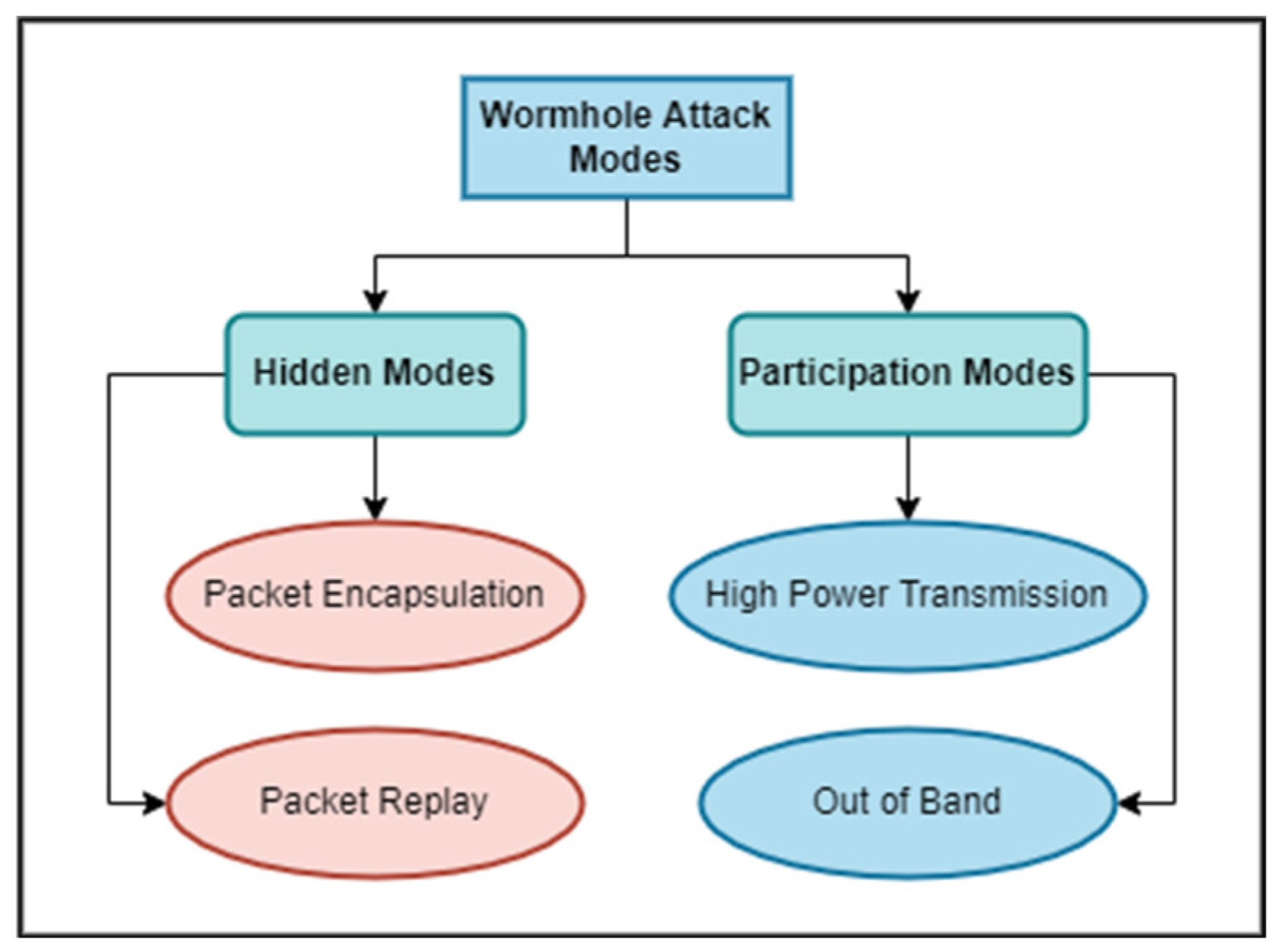
| Neighbours discovery based | [37] | CREDND (creating a credible neighbour discovery) protocol | This scheme uses a neighbour ration threshold to evaluate which nodes should be checked. After this, an external wormhole is recognized by hop count as external malicious nodes acting in hidden mode and using the out-of-band channel. In the last step, an internal wormhole is recognized by authentication packets as internal malicious nodes act as normal nodes and use packet encapsulation. |
| [38] | Trust-based scheme | This lightweight trust-based scheme computes direct trust (DT) by considering the node properties and indirect trust (IT) and by considering the opinions of neighbour nodes. Every node keeps track of its neighbours and checks that they work according to the RPL network rules. The sum of DT and IT is calculated, and the decision is made based on TT (total trust). | |
| [39] | Decentralized statistical scheme | This scheme uses two parameters, i.e., the number of new neighbours and the number of old neighbours. The SWAN algorithm is used for detecting the number of neighbours. The decision rule is used with a sliding window to make the decision. | |
| [40] | MLAMAN scheme | This scheme works by changing tunnel lengths and the speed networks of the nodes. The malicious node is recognized by using hop-difference and AODV protocol. It detects intruders at the packet, neighbour, and membership levels. | |
| [41] | MaxIS scheme | The proposed method uses a greedy algorithm to search for intruders in maximum independent sets with forbidden sub-structures. | |
| [42] | NIAPC scheme | This scheme uses the AODV protocol and neighbourhood information to detect malicious nodes. It finds an alternate path for secure communication all over the network. | |
| [43] | ESPMAW scheme | This scheme uses the AODV routing protocol, neighbour, and connectivity information to find intruders in the system. | |
| [44] | SDN-based scheme (SWANS) | This scheme uses the information of neighbour similarity for the detection of wormholes in software-defined networks. | |
| AODV protocol-based schemes | [45] | Wormhole recognition using AODV | The sender sends an RREQ (route request packet) to the receiver node in the AODV network. The sender calculates the average sequence numbers of all the receiver nodes. The receiver sends an RREP (route reply packet) to the sender, who compares the sequence number of the receiver with the already calculated average and decides whether the path is attacked. |
| [46] | Confirmation system using honeypot | This method uses a honeypot for creating trees. The AODV and resilient ethernet protocol searches these trees for wormhole node detection. | |
| [47] | AODV based scheme | AODV, OSLR, and ZRP are used to detect malicious nodes in the wireless sensor network. | |
| [48] | Lightweight scheme (AODV) | In this scheme, the sender nodes collect all reply packets along with their sequence numbers and compare them with the calculated average sequence number to detect intruders. | |
| RTT based | [49] | RTT-centred wormhole recognition | The AODV protocol is used in the route discovery phase. The sender sends an RREQ and saves the TREQ. The receiver sends the RREP back to the sender. The RTT is calculated as the difference between the TREP and TREQ. The path is considered a wormhole attack if the RTT exceeds the threshold limit. |
| [50] | RTT centred scheme | This scheme uses RTT in conjunction with propagation time. The sender sends an RREQ packet and receives an RREP packet. The sender then calculates the RTT and propagation time to decide whether the route is attacked or attacked-free. | |
| [51] | EIRGP and RTT-based scheme | This scheme uses the EIGRP protocol and round-trip time for the detection of intruders. | |
| [52] | Trust-based scheme | This scheme uses RTT and AODV protocols for detecting malicious nodes. | |
| High-power transmission based | [53] | Energy model by using AODV and hop count | Hop count is used to computing the distance between sender and receiver. Every node consists of a routing table and the next-hop of all nodes. The AODV routing protocol and high-power transmission are used to build a wormhole path. The malicious nodes send data packets with high energy levels, resulting in nodes draining. The system shows the normal nodes in green and the negative nodes in red. |
| [54] | RPL-based scheme | The RPL routing protocol is used with the RSSI value to detect malicious nodes in the network. | |
| Path selection | [55] | 3PATw scheme | This scheme applied 3PAT to recognize the blackhole in each communication in the network. Once it recognized the black hole, the modified transmission radius based (TRB) is applied to recognize the wormhole. |
| [56] | Spanning trees scheme | This scheme selects a rode node for the spanning tree. The Breadth-First Search (BFS) algorithm is applied to detect wormhole nodes in the tree. | |
| [57] | AD-PSO scheme | First of all, K paths are selected. The sender sends a detection packet (DP) containing RTT and hops count information. The receiver generates a feedback packet (FP). The DP and FP are compared to find wormhole nodes. Once it detects the malicious node, PSO is used to find the optimal attacker-free path. | |
| Statistical method based | [58] | Encapsulation and fragmentation of message (EFM) scheme | This scheme presents a data packet security process that encapsulates the message and adds extra four-bit information. The message is decapsulated at the receiver’s end. The technique divides the message into small pieces and sends all pieces through different parts to the destination. |
| [59] | Intrusion prevention system | This scheme presents an intrusion prevention system (IPS) which detects malicious nodes and broadcasts their credentials all over the network so that no more nodes connect with those malicious nodes. | |
| [60] | HCBS protocol-based scheme | This scheme detects malicious nodes in clusters by using the heterogeneous cluster-based secure directing convention (HCBS) protocol. | |
| Hop count and Weight-based | [61] | LITS scheme | This scheme uses a verification process of two replayable control messages and time synchronization to detect malicious nodes. |
| [62] | WDV-hop scheme | This scheme first detects suspicious nodes by using hop count, calculates localization error for them, and drops the malicious nodes. | |
| [63] | Delay per hour indication (DELPHI)-based scheme | This scheme uses DELPHI (delay per hop indication) approach with some broadcasting modification by computing threshold values to detect intruders. | |
| [64] | RHE2WADI scheme using RSSI value | This scheme uses received signal strength indicator (RSSI) values and hop count to detect malicious nodes in the IoT network. | |
| Authentication Key-based | [65] | EDAK scheme | This scheme uses a dynamic matrix key process to store all the local information of the nodes so that legal nodes can be identified. It performs encryption and decryption along with two hash functions. |
| [66] | HKP-HD scheme | This scheme uses key generation and its pre-distribution to reduce the chance of attacker nodes. | |
| [67] | Elliptic curve cryptography scheme | This scheme uses elliptic curve cryptography with the AODV protocol for wormhole attack-free networks. | |
| Mobile agent and Cloud-based | [68] | Visiting centre local-based scheme | This scheme introduces a mobile agent in the network which is responsible for distinguishing malicious nodes from normal nodes. |
| [69] | Cross-layer verification scheme | This scheme presents a cross-layer verification framework (CLVF) to find intruders in the system. |
| Scheme | DR | EC | TO | NL | T | FPR | MDD | PDR | PLR |
|---|---|---|---|---|---|---|---|---|---|
| Artificial immune system with fuzzy logic [26] | High | - | - | - | - | High | - | High | Low |
| SVM-based scheme [27] | High | - | - | - | - | - | - | - | - |
| ANN with hop count [28] | High | - | - | - | - | - | - | - | - |
| LSTM with RTT [29] | High | Low | - | - | - | - | Low | High | - |
| DRFOIDL-ID using RPL [30] | High | - | - | - | - | Low | - | Low | Low |
| ML-based scheme [31] | High | - | - | - | - | - | - | - | - |
| Fuzzy Logic based scheme [32] | High | - | - | - | High | - | - | High | - |
| WCA [33] | - | Low | Low | High | - | Low | - | - | |
| KNN and RF [34] | - | - | Low | - | - | Low | - | - | - |
| EC-BRTT [35] | High | - | - | - | - | - | - | - | - |
| CART [36] | High | - | Low | - | - | - | - | - | - |
| CREDND [37] | High | Low | - | - | - | - | - | - | - |
| Trust-based scheme [38] | - | Low | - | - | - | - | - | - | - |
| Decentralized statistical scheme [39] | High | - | - | - | - | Low | Low | - | - |
| MLAMAN [40] | High | - | - | - | - | - | - | - | - |
| MaxIS [41] | Avg | - | - | - | - | - | - | - | - |
| NIAPC [42] | High | - | - | - | High | - | - | High | - |
| ESPMAW [43] | - | Low | Low | - | High | - | Low | - | - |
| SDN- SWANS [44] | - | - | Low | - | - | Low | - | - | - |
| AODV [45] | - | Low | - | - | - | - | - | - | - |
| Confirmation system using honeypot [46] | High | - | - | - | - | - | - | - | - |
| AODV based [47] | High | - | - | - | - | - | High | - | - |
| Lightweight AODV [48] | - | - | Low | - | High | - | - | High | - |
| RTT-centred scheme [49] | High | - | - | - | - | - | - | - | - |
| RTT-based scheme [50] | High | - | - | - | - | - | - | - | - |
| EIRGP with RTT [51] | - | - | - | - | High | - | - | Low | - |
| Trust-based scheme [52] | - | - | - | - | - | - | - | High | - |
| Energy model with AODV [53] | - | - | - | - | - | - | Low | High | - |
| RPL-based scheme [54] | High | - | - | - | - | - | - | - | - |
| 3PATw [55] | High | - | - | - | - | - | - | High | - |
| Spanning trees [56] | High | - | - | - | - | - | - | - | - |
| AD-PSO [57] | - | Low | - | High | - | - | - | - | - |
| EFM [58] | - | - | - | - | - | - | - | - | Low |
| Statistical scheme [59] | High | - | - | - | - | - | - | - | - |
| HCBS protocol [60] | - | - | - | - | High | - | Low | High | Low |
| LITS [61] | High | - | - | - | - | - | - | - | - |
| WDV-hop [62] | High | - | - | - | - | - | - | - | - |
| DELPHI [63] | - | - | - | - | High | - | - | High | Low |
| RHE2WADI with RSSI [64] | High | Low | Low | - | - | - | - | - | - |
| EDAK [65] | - | - | Low | - | - | - | - | - | - |
| HKP-HD [66] | High | - | - | - | - | - | - | - | - |
| Elliptic curve cryptography [67] | - | - | Low | - | High | - | Low | High | - |
| Visiting Centre Local-based [68] | High | Low | Low | - | - | - | - | - | - |
| Cross-layer verification [69] | High | - | - | - | High | - | Low | - | - |
| Category | Challenges |
|---|---|
| Neighbour discovery-based schemes [37,38,39,40,41,42,43,44] | It is difficult to work well in different communication ranges and dynamically changing WSNs. The dependency on the neighbour node should not be high. In addition, the energy consumption is high, which shortens the network lifetime. |
| AODV-based schemes [45,46,47,48] | It is difficult to provide scalability, load balancing, and congestion control in working with the AODV protocol. The shortest path may be lost due to traffic overhead. The delivery ratio of the AODV protocol decreases with a high increase in the number of connections. Therefore, it is difficult to work with it in complex conditions. It also cannot be implemented in a network with many nodes. |
| RTT-based schemes [49,50,51,52] | The RTT stops when there is an increase in network traffic. It also increases with the increase in distance between nodes. It is difficult to work with RTT in a complex network as the increase in server requests increases, affecting RTT’s efficiency. |
| RPL-based schemes [38,54] | It is difficult to work in the RPL network as it is a complex protocol that generates a large number of control packets resulting in high energy consumption. The network overhead increase with an increased number of data packets. |
Publisher’s Note: MDPI stays neutral with regard to jurisdictional claims in published maps and institutional affiliations. |
© 2022 by the authors. Licensee MDPI, Basel, Switzerland. This article is an open access article distributed under the terms and conditions of the Creative Commons Attribution (CC BY) license (https://creativecommons.org/licenses/by/4.0/).
Share and Cite
Hanif, M.; Ashraf, H.; Jalil, Z.; Jhanjhi, N.Z.; Humayun, M.; Saeed, S.; Almuhaideb, A.M. AI-Based Wormhole Attack Detection Techniques in Wireless Sensor Networks. Electronics 2022, 11, 2324. https://doi.org/10.3390/electronics11152324
Hanif M, Ashraf H, Jalil Z, Jhanjhi NZ, Humayun M, Saeed S, Almuhaideb AM. AI-Based Wormhole Attack Detection Techniques in Wireless Sensor Networks. Electronics. 2022; 11(15):2324. https://doi.org/10.3390/electronics11152324
Chicago/Turabian StyleHanif, Maria, Humaira Ashraf, Zakia Jalil, Noor Zaman Jhanjhi, Mamoona Humayun, Saqib Saeed, and Abdullah M. Almuhaideb. 2022. "AI-Based Wormhole Attack Detection Techniques in Wireless Sensor Networks" Electronics 11, no. 15: 2324. https://doi.org/10.3390/electronics11152324
APA StyleHanif, M., Ashraf, H., Jalil, Z., Jhanjhi, N. Z., Humayun, M., Saeed, S., & Almuhaideb, A. M. (2022). AI-Based Wormhole Attack Detection Techniques in Wireless Sensor Networks. Electronics, 11(15), 2324. https://doi.org/10.3390/electronics11152324