A Proposal of Accessibility Guidelines for Human-Robot Interaction


Abstract
1. Introduction
2. Related Work
2.1. Socially Assistive Robotics
2.2. Accessibility Barriers in HRI
2.2.1. Visual Disabilities: Three Main Visual Disabilities, Which Are
- Low Vision: Is the degree of visual acuity which is defined as less than 6/18 and equal to or better than 3/60 in the better eye with best correction [9].
- Color-Blindness: “Is the inability to perceive differences in various shades of colors, particularly green and red, that others can distinguish. It is most often inherited (genetic)” [10].
2.2.2. Auditory Disabilities
2.2.3. Motor Disabilities
2.2.4. Cognitive Disabilities
2.3. Accessibility Laws and Guidelines for HCI
2.4. Accessibility Laws and Guidelines for HRI
2.5. Proposed Accessibility Guidelines for HRI
- The main accessibility standards, guidelines and recommendations for web sites, web applications, software applications and hardware, in addition to personal user experience guidelines were studied.
- Based on these and based on the authors’ experience, the main characteristics of a different SARs interfaces were studied.
- Afterwards, six accessibility guidelines: WCAG 2.0 [25], BBC [27], Funka Nu [26], IBM [28], WAI-ARIA [32] and PUX [33] were selected to form the basis for the new guidelines. The accessibility requirements of the six guidelines were studied and analyzed, to check whether they apply to robotic interfaces or not based on the similarity with robot technology.
- Then redundant requirements were removed from the document.
- The classification applied on the final document/draft was following WCAG 2.0 and under four aspects: Perceivable, operable, understandable and general; to fit the new added accessibility requirements, where the first three aspect include accessibility requirements that users need to perceive, understand and operate robot’s hardware or software components during HRI. The rest of accessibility requirements that do not belong to the previous three aspect were grouped under general aspect. Table 1 shows the general classification of the proposed guidelines requirements. The proposed guidelines are available on (https://github.com/Malak-Qbilat/HRI-Accessibility-.git (accessed on 27 February 2021)).
3. Evaluation
3.1. Evaluation Design
3.1.1. Objective
3.1.2. Participants
3.1.3. Materials
- Questionnaire interview: First a pre-test questionnaire was applied to gather participants’ demographic information. Then, participants were asked to answer the post-test questionnaire which consisted of nine 5-point Likert Scale questions with 1 being (strongly disagree) and 5 being (strongly agree). Also, three open-ended questions were structured to measure usability, user experience, user satisfaction and societal impact factors from experts’ point of view. Face to face interviews were carried out at Ghent University, Free University of Brussels and University Carlos III of Madrid. The rest of the interviews were audio-conference interviews. All interviews were audio recorded, so evaluators could refer later to participants’ feedback, especially answers to open-ended questions, where the users enriched the evaluation by exposing their experience in an informal way.
- Observations: Evaluators observed participants during the evaluation sessions, which enabled assessing the efficiency indicator (see details in Section 3.2).
- Expert evaluation: Based on the study and analysis of user recommendations by experts, the proposed guidelines were reviewed to investigate the possibility of adopting these recommendations.
3.1.4. Protocol
- Evaluation appointment: First, participants were contacted to appoint a date for the evaluation session and to determine whether it would be a face to face or an audio-conference interview.
- Pre-test introduction and questionnaire: At the interview, the objective of the evaluation was explained to the participant first, and then s/he was asked to provide some demographic information (see details of the questionnaire in Section 3).
- Choosing the expert role: The participant had to choose one of two tasks based on his/her experience, as follows:
- If the participant had the designer or developer role, s/he was asked to imagine designing a robot to perform a geriatric assessment through interaction with elderly people by asking them to answer questions or perform simple tasks such as walking for a few meters. The robot has a tactile display, microphone and RGB-D camera (s/he could add other necessary hardware components) in order to interact and collect data for later analysis by doctors. Additionally, s/he would design the robot following the accessibility guidelines to ensure that the robot can be used by people with different abilities.
- Otherwise, the participant was asked to watch three different videos of elderly people interacting with a socially assistive robot (CLARC) [34] to perform a geriatric assessment at a hospital where the elderlies interacted with the robot through speech and tactile channels to answer questions about their daily life routine and perform some activities as well. The participant’s task was to find all accessibility barriers during the HRI interaction in the videos based on the accessibility guidelines.
- Guidelines familiarity and performing the selected task: Then, a summarized version of the proposed guidelines was presented to the participant. They were asked to read it carefully in order to achieve the objective set in step (2). The minimum recorded time to complete the task was (5) min and the maximum time was (12.19) min, while the mean was (8.12) min.
- Post-test interview: Thereafter, the participant was asked to answer the five-point Likert Scale and 6 open-ended questions. All responses were recorded for more accuracy while studying and analyzing participants’ responses.
3.2. Evaluation Conclusions
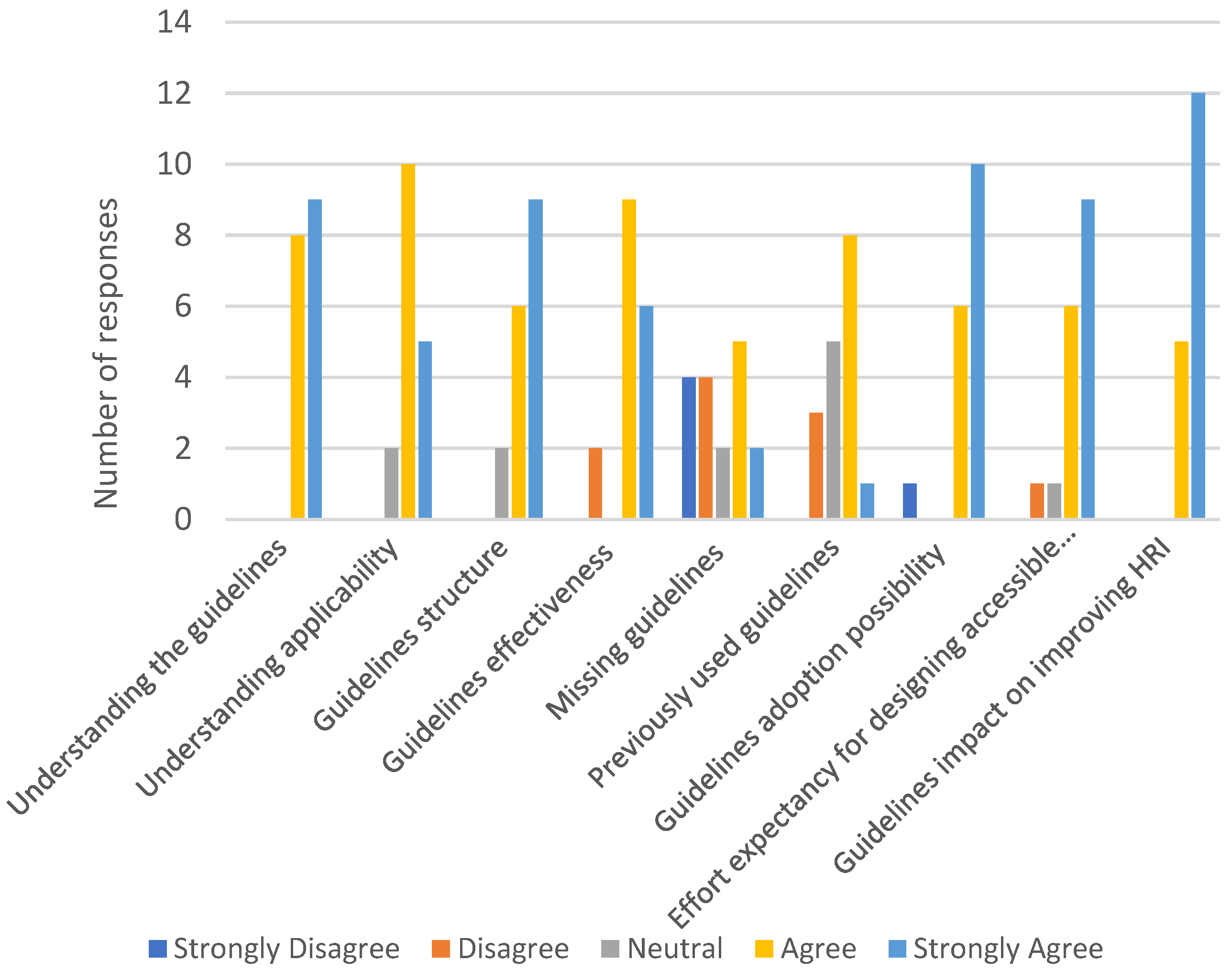
- Usability factor: The study included four 5-point Likert Scale items (questions q1–q4 in Table 3), one open-ended question (question q2.1 in Table 3) and one objective question (question q5 at Table 3) to assess the usability factor. The following indicators were measured:
- Understanding: Question 1 and question 2 were dedicated to evaluate understanding both the checkpoints (accessibility requirements) and the guidelines (techniques to achieve each accessibility requirement). All participants agreed that the checkpoints were fully understood with 15 of 17 participants understanding the guidelines completely. Two of 15 participants selected neutral. Careful analysis of their answers to the open-ended questions revealed that both participants think the guidelines should be accompanied with graphical examples. The participants also responded to an open-ended question (Question q2.1) to report some difficulties met in understanding the guidelines. They also gave recommendations to improve guidelines understanding. For instance, 7 participants recommended to enhance the guidelines with graphical practical examples.
- Guidelines structure: Question 3 revealed participants’ responses regarding the guidelines structure, where 15 of 17 participants agreed that guidelines are structured in an order easy for them to use or apply. None of the participants disagreed with this assumption. Two of 17 participants chose neutral. After analyzing their answers to open-ended questions, it was found that both participants did not oppose the current guidelines’ structure, but they preferred another structure or classification. These structures include targeted user’ characteristics where the guidelines are classified under three categories (visual, auditive and tactile) or to classify them to hardware and software guidelines.
- Effectiveness: To evaluate the effectiveness of the proposed guidelines in helping the designers and developers to design accessible robots or detect accessibility barriers, participants responded to question 4. Fifteen of 17 participants agreed that the guidelines will be helpful to design and develop accessible robots. Two of 17 disagreed with this assumption. Following the review of their answers to the open-ended questions, one participant thought applying all the guidelines is hard due to high cost; instead, the priority should be given to the guidelines that relate to characteristics of the targeted user. The other participant thought that implementing all guidelines will slow robots’ system and complicate interaction with users.
- Efficiency: In question 5, the evaluators measured the time each participant spent to accomplish the task with the mean being (8.12 min). The evaluators found the required time to accomplish the task reasonably to fall between (5–12.19) min.
- User’s experience factor: The study dedicated two 5-point Likert Scale items (questions q6 and q7 in Table 4) for the user experience factor. The following indicators were measured:
- Missing guidelines: Eight of 17 participants thought there were some accessibility aspects missing in the proposed guidelines (question 6). They highlighted some missing aspects such as appropriate distance for interaction between user and robot. Most of the participants’ recommendations in the open-ended questions were not related to accessibility alone but to different factors such as usability and user acceptation; for instance, guidelines for robot gender preferences.
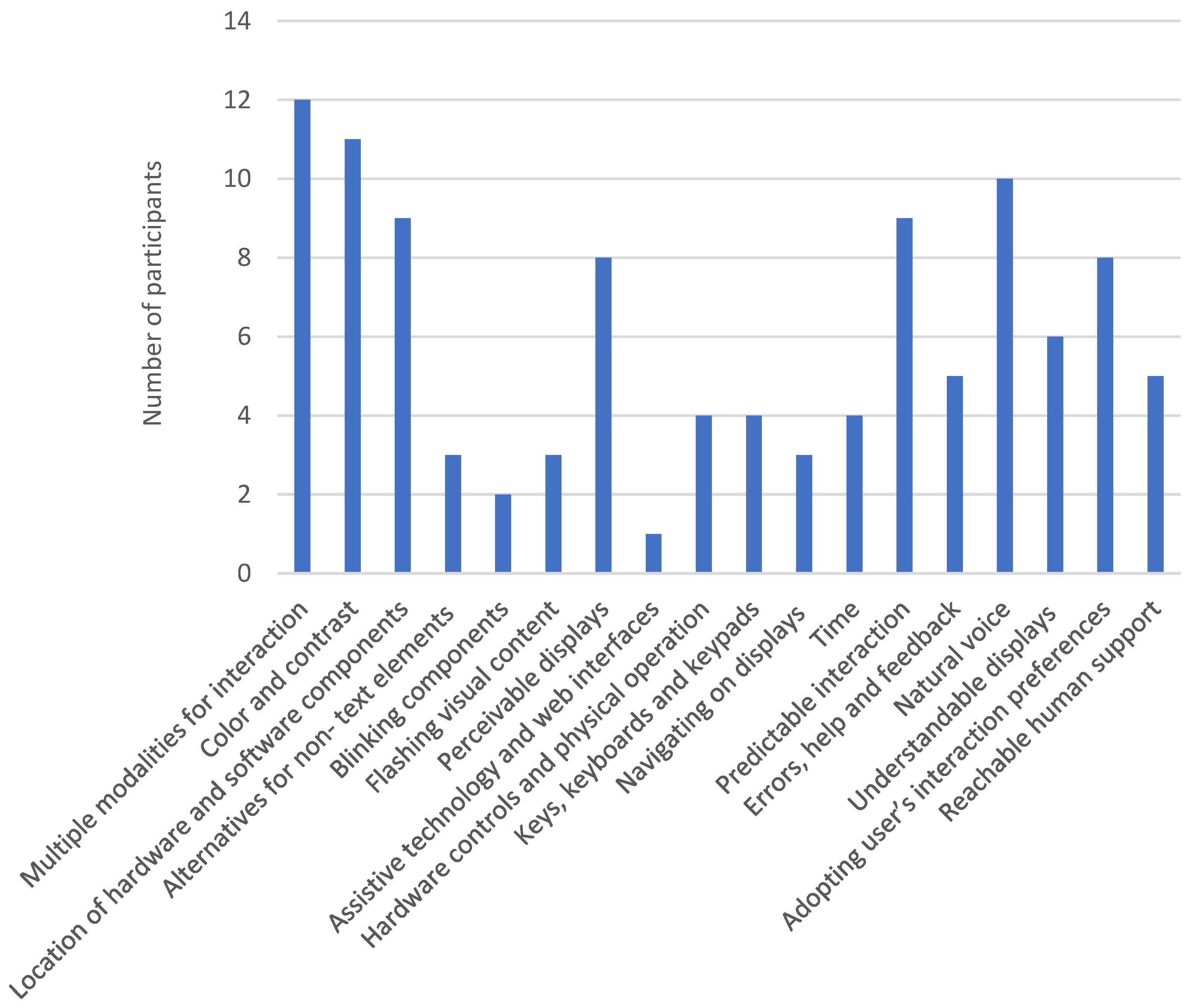
- Previously used guidelines: With the purpose of assessing participants’ familiarity with the guidelines, participants responded about whether they considered these aspects in their previous designs or evaluations, even when they had not considered accessibility issues (question 7). None of the 17 participants had completely applied all the proposed guidelines in her/his designs or evaluations. One of 17 participants said that he had never applied any of them. A total of 72% of the proposed guidelines have been applied by less than or equal to 8 participants for each guideline. All the guidelines have been applied at least once due to participants’ knowledge of HCI accessibility. Figure 4 shows the number of participants who previously applied each guideline.
- User’s satisfaction factor: The study dedicated two 5-point Likert Scale items (questions q8 and q9 at Table 5) for user satisfaction. The following indicators were measured:
- Guidelines adoption possibility: Responses on question 8 show that the majority (16 of 17 participants) would use the proposed guidelines in their future robot designs or evaluations. Only 1 of 17 participants would not use the proposed guidelines. However, analysis of his answers to the open-ended questions showed that the participant thought applying all the proposed guidelines contradicts with cost, business and users’ expectations issues.
- Effort expectancy: The majority (15 of 17 participants) agreed that they think the design of accessible robots for all will require more effort. One of 17 participants selected neutral, while 1 of 17 participants disagreed with this assumption. After studying their answers extensively, it was concluded that they thought the design and implementation of an accessible robot can be achieved by considering business, user’s expectations and cost for each robotic product separately, rather than complying with general accessibility guidelines (question 9).
- Societal impact factor: The study dedicated one 5-point Likert Scale item (question q10 in Table 6) for the societal impact factor. The following indicator was measured: Quality of life/Importance: All participants agreed on the importance of considering accessibility guidelines in the inclusive design of robots (questions 10).
4. Conclusions and Further Research
Author Contributions
Funding
Institutional Review Board Statement
Informed Consent Statement
Data Availability Statement
Acknowledgments
Conflicts of Interest
References
- Feil-Seifer, D.; Matarić, M.J. Toward Socially Assistive Robotics for Augmenting Interventions for Children with Autism Spectrum Disorders. Springer Tracts Adv. Robot. 2009, 54, 201–210. [Google Scholar] [CrossRef]
- Heerink, M.; Kröse, B.; Wielinga, B.; Evers, V. Measuring the Influence of Social Abilities on Acceptance of an Interface Robot and a Screen Agent by Elderly Users. People Comput. XXIII Celebr. People Technol. Proc. HCI 2009, 2009, 430–439. [Google Scholar]
- Asimo Meets Pepper: Honda and Softbank Partnering in Robots. Available online: https://phys.org/news/2016-07-asimo-pepper-honda-softbank-partnering.html (accessed on 26 November 2020).
- Kim, J.; Kumar Mishra, A.; Limosani, R.; Scafuro, M.; Cauli, N.; Santos-Victor, J.; Mazzolai, B.; Cavallo, F. Control Strategies for Cleaning Robots in Domestic Applications: A Comprehensive Review. Int. J. Adv. Robot. Syst. 2019, 16. [Google Scholar] [CrossRef]
- Riek, L.D. Robotics Technology in Mental Health Care. Artif. Intell. Behav. Ment. Health Care 2015, 185–203. [Google Scholar] [CrossRef]
- WebAIM: Visual Disabilities-Introduction. Available online: https://webaim.org/articles/visual/ (accessed on 6 June 2020).
- WHO. Blindness and Deafness; WHO: Geneva, Switzerland, 2015. [Google Scholar]
- Change the Definition of Blindness. Available online: https://www.who.int/blindness/Change%20the%20Definition%20of%20Blindness.pdf (accessed on 3 February 2021).
- WHO | Priority Eye Diseases. Available online: https://www.who.int/blindness/causes/priority/en/index4.html (accessed on 14 June 2020).
- Blindness: Causes, Type, Treatment & Symptoms. Available online: https://www.medicinenet.com/blindness/article.htm (accessed on 29 November 2020).
- Kim, E.; Paul, R.; Shic, F.; Scassellati, B. Bridging the Research Gap: Making HRI Useful to Individuals with Autism. J. Human-Robot Interact. 2012, 1, 26–54. [Google Scholar] [CrossRef]
- Fernaeus, Y.; Håkansson, M.; Jacobsson, M.; Ljungblad, S. How Do You Play with a Robotic Toy Animal? A Long-Term Study of Pleo. In Proceedings of the 9th International Conference on Interaction Design and Children, IDC 2010, Barcelona, Spain, 9–12 June 2010; pp. 39–48. [Google Scholar] [CrossRef]
- Deafness and Hearing Loss. Available online: https://www.who.int/news-room/fact-sheets/detail/deafness-and-hearing-loss (accessed on 19 June 2020).
- Diverse Abilities and Barriers | Web Accessibility Initiative (WAI) | W3C. Available online: https://www.w3.org/WAI/people-use-web/abilities-barriers/#auditory (accessed on 20 June 2020).
- Gouaillier, D.; Hugel, V.; Blazevic, P.; Kilner, C.; Monceaux, J.; Lafourcade, P.; Marnier, B.; Serre, J.; Maisonnier, B. Mechatronic Design of NAO Humanoid. In Proceedings of the 2009 IEEE International Conference on Robotics and Automation, Kobe, Japan, 12–17 May 2009. [Google Scholar] [CrossRef]
- Pot, E.; Monceaux, J.; Gelin, R.; Maisonnier, B.; Robotics, A. Choregraphe: A Graphical Tool for Humanoid Robot Programming. Proc.-IEEE Int. Work. Robot Hum. Interact. Commun. 2009, 46–51. [Google Scholar] [CrossRef]
- WebAIM: Motor Disabilities-Assistive Technologies. Available online: https://webaim.org/articles/motor/assistive (accessed on 23 June 2020).
- Andreasen Struijk, L.N.S.; Egsgaard, L.L.; Lontis, R.; Gaihede, M.; Bentsen, B. Wireless Intraoral Tongue Control of an Assistive Robotic Arm for Individuals with Tetraplegia. J. Neuroeng. Rehabil. 2017, 14, 1–8. [Google Scholar] [CrossRef] [PubMed]
- Diverse Abilities and Barriers | Web Accessibility Initiative (WAI) | W3C. Available online: https://www.w3.org/WAI/people-use-web/abilities-barriers/#cognitive (accessed on 24 June 2020).
- WebAIM: Cognitive Disabilities-Design Considerations. Available online: https://webaim.org/articles/cognitive/design (accessed on 4 July 2020).
- Law, M.; Sutherland, C.; Ahn, H.S.; Macdonald, B.A.; Peri, K.; Johanson, D.L.; Vajsakovic, D.-S.; Kerse, N.; Broadbent, E. Developing Assistive Robots for People with Mild Cognitive Impairment and Mild Dementia: A Qualitative Study with Older Adults and Experts in Aged Care. BMJ 2019, 9. [Google Scholar] [CrossRef] [PubMed]
- IT Accessibility Laws and Policies | Section508.gov. Available online: https://www.section508.gov/manage/laws-and-policies (accessed on 30 July 2020).
- EUR-Lex-32016L2102-EN-EUR-Lex. Available online: https://eur-lex.europa.eu/legal-content/EN/TXT/?qid=1596098310471&uri=CELEX:32016L2102 (accessed on 30 July 2020).
- Internet Accessibility | Samuelson-Glushko Canadian Internet Policy and Public Interest Clinic (CIPPIC). Available online: https://cippic.ca/fr/node/128422#canadian (accessed on 30 July 2020).
- Web Content Accessibility Guidelines (WCAG) 2.1. Available online: https://www.w3.org/TR/WCAG21/#wcag-2-layers-of-guidance (accessed on 30 July 2020).
- Mobile Guidelines-Funka. Available online: https://www.funka.com/en/our-assignments/research-and-innovation/archive---research-projects/mobile-guidelines/ (accessed on 26 February 2020).
- BBC-Future Media Standards & Guidelines-Accessibility Guidelines v2.0. Available online: https://www.bbc.co.uk/guidelines/futuremedia/accessibility/ (accessed on 30 July 2020).
- IBM Human Ability and Accessibility Center | Developer Guidelines. Available online: https://www.ibm.com/able/guidelines/index.html (accessed on 30 July 2020).
- ISO-ISO 13482:2014-Robots and Robotic Devices—Safety Requirements for Personal Care Robots. Available online: https://www.iso.org/standard/53820.html (accessed on 1 December 2020).
- British Standard BS 8611: Robots and Robotic Devices. Guide to the Ethical Design and Application of Robots and Robotic Systems–Explore AI Ethics. Available online: https://www.exploreaiethics.com/guidelines/bs-86112016/ (accessed on 20 December 2020).
- Qbilat, M.; Iglesias, A. Accessibility Guidelines for Tactile Displays in Human-Robot Interaction. A Comparative Study and Proposal; Springer: Cham, Switzerland, 2018. [Google Scholar] [CrossRef]
- WAI-ARIA Authoring Practices 1.1. Available online: https://www.w3.org/TR/wai-aria-practices-1.1/ (accessed on 26 November 2020).
- Personal User Experience (PUX) Recommendations and Lessons Learned. Available online: https://gpii.eu/pux/guidelines/ (accessed on 3 February 2021).
- Bandera, P.; Bustos, L.V.; Calderita, A.; Dueñas, F.; Fernandez, R.; Fuentetaja, A.; Garcia Olaya, F.J.; Garcia-Polo, J.C.; Gonzalez, A.; Iglesias, L.J.; et al. CLARC: A Robotic Architecture for Comprehensive Geriatric Assessment. Proc. XVII Workshop of Physical Agents. Available online: http://waf2016.uma.es/web/proceedings.pdf (accessed on 29 August 2020).



| Aspects | Checkpoints |
|---|---|
| Perceivable | Multiple modalities for interaction |
| Color and contrast | |
| Location of hardware and software components | |
| Alternatives for non- text elements | |
| Blinking components | |
| Flashing visual content | |
| Displays | |
| Assistive technology and web interfaces | |
| Operable | Hardware controls and physical operation |
| Keys, keyboards and keypads | |
| Navigating on displays | |
| Time | |
| Understandable | Predictable interaction |
| Errors, help and feedback | |
| Natural voice | |
| Displays | |
| General | Adopting user’s interaction preferences |
| Reachable human support |
| Charactaristics | Percentages |
|---|---|
| Age | (21–35) 41% |
| (36–50) 59% | |
| Gender | (Male) 65% |
| (Female) 35% | |
| Proficincy in English langauage | (Fluent) 35% |
| (Fairly fluent) 65% | |
| Education level | (PhD) 71% |
| (Master degree) 29% | |
| Experience | (More than six years) 64.71% |
| (Five to six years) 23.53% | |
| (One to two years) 5.88% | |
| (Less than one year) 5.88% | |
| Familiarity with accessibility | (Fairly familiar) 29.41% |
| (Somewhat familiar) 29.41% | |
| (Not very familiar) 23.53% | |
| (Not familiar at all) 17.65% |
| Question ID | Description | Mean | SD |
|---|---|---|---|
| q1 | I could easily understand the checkpoints | 4.53 | 0.52 |
| q2 | I could easily understand how to apply the technique for each checkpoint | 4.18 | 0.64 |
| q2.1 | Difficulties in any checkpoint? Please, explain which one and how it could be improved | - | - |
| q3 | The guidelines are structured in an order that is easy for me to use or apply | 4.41 | 0.71 |
| q4 | I can easily design accessible robots or detect accessibility barriers by using the guidelines | 4.12 | 0.93 |
| q5 | How much time did you spend to complete the task? | 8.12 | 2.10 |
| Question ID | Description | Mean | SD |
|---|---|---|---|
| q6 | I think there are accessibility aspects missing in the guidelines | 2.82 | 1.43 |
| q7 | I considered these aspects in my previous designs/evaluations, even when I had not taken into account accessibility issues. | 3.41 | 0.87 |
| Question ID | Description | Mean | SD |
|---|---|---|---|
| q8 | I would like to use these guidelines in my future robot design/evaluation. | 4.41 | 1.00 |
| q9 | I think the design of accessible robots for all will require more effort. | 4.35 | 0.86 |
| Question ID | Description | Mean | SD |
|---|---|---|---|
| q10 | I think the inclusive design of robots, taking into account the accessibility guidelines, is necessary to improve the robot’s interaction success and adoption. | 4.71 | 0.47 |
Publisher’s Note: MDPI stays neutral with regard to jurisdictional claims in published maps and institutional affiliations. |
© 2021 by the authors. Licensee MDPI, Basel, Switzerland. This article is an open access article distributed under the terms and conditions of the Creative Commons Attribution (CC BY) license (http://creativecommons.org/licenses/by/4.0/).
Share and Cite
Qbilat, M.; Iglesias, A.; Belpaeme, T. A Proposal of Accessibility Guidelines for Human-Robot Interaction. Electronics 2021, 10, 561. https://doi.org/10.3390/electronics10050561
Qbilat M, Iglesias A, Belpaeme T. A Proposal of Accessibility Guidelines for Human-Robot Interaction. Electronics. 2021; 10(5):561. https://doi.org/10.3390/electronics10050561
Chicago/Turabian StyleQbilat, Malak, Ana Iglesias, and Tony Belpaeme. 2021. "A Proposal of Accessibility Guidelines for Human-Robot Interaction" Electronics 10, no. 5: 561. https://doi.org/10.3390/electronics10050561
APA StyleQbilat, M., Iglesias, A., & Belpaeme, T. (2021). A Proposal of Accessibility Guidelines for Human-Robot Interaction. Electronics, 10(5), 561. https://doi.org/10.3390/electronics10050561