You are currently viewing a new version of our website. To view the old version click .
Electronics
  • Article
  • Open Access

11 August 2021

RETRACTED: Road Object Detection: A Comparative Study of Deep Learning-Based Algorithms

and
1
School of Information Science and Technology, Southwest Jiaotong University, Chengdu 611756, China
2
Department of Automatic Control and Robotics, Faculty of Electrical Engineering, Automatics, Computer Science and Biomedical Engineering, AGH University of Science and Technology, 30-059 Kraków, Poland
*
Author to whom correspondence should be addressed.
This article belongs to the Section Computer Science & Engineering

Abstract

Automated driving and vehicle safety systems need object detection. It is important that object detection be accurate overall and robust to weather and environmental conditions and run in real-time. As a consequence of this approach, they require image processing algorithms to inspect the contents of images. This article compares the accuracy of five major image processing algorithms: Region-based Fully Convolutional Network (R-FCN), Mask Region-based Convolutional Neural Networks (Mask R-CNN), Single Shot Multi-Box Detector (SSD), RetinaNet, and You Only Look Once v4 (YOLOv4). In this comparative analysis, we used a large-scale Berkeley Deep Drive (BDD100K) dataset. Their strengths and limitations are analyzed based on parameters such as accuracy (with/without occlusion and truncation), computation time, precision-recall curve. The comparison is given in this article helpful in understanding the pros and cons of standard deep learning-based algorithms while operating under real-time deployment restrictions. We conclude that the YOLOv4 outperforms accurately in detecting difficult road target objects under complex road scenarios and weather conditions in an identical testing environment.

1. Introduction

The automobile industries have developed rapidly since the first demonstration in the 1980s [1], the vehicle navigation and intelligence system have improved. However, the increase in road vehicles raises traffic congestion, road safety, pollution, etc. Autonomous driving is a challenging task; a small error in the system can lead to fatal accidents. Visual data play an essential role in enabling advanced driver-assistance systems in autonomous vehicles [2]. The low cost and wide availability of vision-based sensors offer great potential to detect road incidents. Additionally, emerging autonomous vehicles use various sensors and deep learning methods to detect and classify four classes (such as a vehicle, pedestrian, traffic sign, and traffic light) to improve safety by monitoring the current road environment.
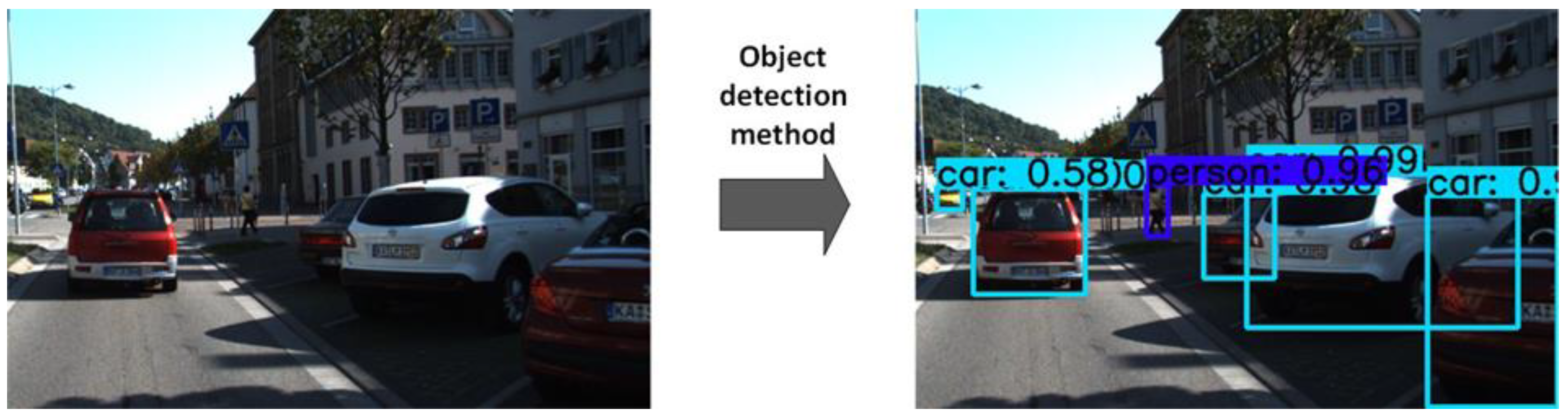
Object detection is a method of localizing and classifying an object in an image to understand the image entirely. It is currently one of the first fundamental tasks in vision-based autonomous driving. The object detection methods make bounding boxes around the detected objects and the predicted class label and confidence score associated with each bounding box. Figure 1 shows an example of an object detection method to identify and locate target objects in an image. Object detection and tracking are challenging tasks and play an essential role in many visual-based applications. At present, the deep learning field provides several methods for advancing the automation levels by improving the environment perception [3]. The autonomous vehicles have developed from Level-0 class with no automation to Level-1 with driver assistance automation. The Level-2 class with partial automation enables the vehicle to assist in steering and acceleration functionality, and the driver controls many safety-critical actions. For Level-3 class with conditional automation, the intelligent vehicle must monitor the whole surroundings in real-time, and the driver can only take control over the vehicle when prompted by the system. However, to achieve autonomous driving in vehicles, there is a long way to reach the Level-4 class with high automation, and finally, the Level-5 class with full automation [3].
Figure 1. (left) Objects before detection; (right) Objects after detection show the detected object’s bounding box coordinates with the predicted confidence score and class label.
The sensors used to detect and monitor vehicles may be identified as containing three components: the transducer, the unit for signal processing, and the device for data processing. In an autonomous vehicle, all types of sensors are essential to obtain correct information about its surrounding environment. At present, sensors used in the vehicles primarily include the Monocular Camera, Binocular camera, Light Detecting and Ranging (LiDAR), Global Navigation Satellite System (GNSS), Global Positioning System (GPS), Radio Detection and Ranging (Radar), Ultrasonic sensor, Odometer, and many more [4]. However, all these sensors have their benefits and drawbacks. A LiDAR operates with a similar principle of radar, but it emits infrared light waves instead of radio waves. It has much higher accuracy than radar under 200 meters. Weather conditions such as fog or snow have a negative impact on the performance of LiDAR. Another aspect is the sensor size: smaller sensors are preferred on the vehicle because of limited space and aerodynamic restraints, and LiDAR is generally larger than radar, stereo camera [5], flash camera [6], event camera [7], and thermal camera [8,9]. However, researchers work on reducing the cost, size, and weight of LiDAR recently [10], but it still needs more work. However, in this paper, we are working on the enhancement of visual data by using the camera.
Furthermore, the radar only detects objects in close range. Therefore, the radar may detect objects at less than their specified range if a vehicle moves faster. Furthermore, both binocular cameras and monocular cameras may produce worse detection results in low light. The GPS chip is a power-hungry device that drains the battery rapidly and is costly. The GPS may also have inaccuracy due to environmental interference. Sensors are mainly used to perceive the environment, including dynamic and static objects, e.g., drivable areas, buildings, pedestrian crossings, Cameras, LiDAR, Radar, and Ultrasonic sensors are the most commonly used modalities for this task. A detailed comparison of sensors is given in Table 1.
Table 1. Sensor Details.
Early autonomous driving systems heavily relied on sensory data for accurate environment perception. Several instrumented vehicles are introduced by different research groups, such as Stanford’s Junior [11], which employs various sensors with different modalities for perceiving external and internal variables. Boss won the DARPA Urban Challenge with an abundance of sensors [12]. RobotCar [13] is a cheaper research platform aimed at data collection. In addition, different levels of driving automation have been introduced by the industry; Tesla’s Autopilot [14] and Google’s self-driving car [15] are some examples.
However, finding the coordinate of the object in the frame has become challenging due to various factors such as variations in viewpoints, poses, scales, lighting, occlusions, etc. [16]. After the development of the deep neural network, computer vision gained even more strides [17]. With the advances in sensing and computational technologies in the field of computer vision, the performance of traditional manual feature-based object detection algorithms has been compared to that of the deep learning-based object detection algorithms because of continuous growth in large volumes of data and fast development of hardware, particularly Multicore Processors and Graphical Processing Units (GPUs). Furthermore, the deep learning-based algorithms exceed the traditional algorithms in terms of detection speed and accuracy. The deep learning methods have gained much attention due to the promising results it has achieved in multiple fields, such as image classification [18], segmentation [19], and moving object detection and tracking [4]. Object counting, overtaking detection, object classification [5], lane change detection [20], emergency vehicle detection, traffic control, traffic sign, light identification, license plate recognition, and many other applications of deep learning-based detection can be found in every Intelligent Transportation System (ITS) field. Road object detection has been a hot topic for many researchers over the past decade. In the following literature: deep learning-based object detection [21], on-road vehicle detection [22], object detection, and safe navigation by Markov random field (MRF) [5] in which authors aim to analyze the deep learning-based algorithms without considering recent improvements in the deep learning field.
In contrast, various literature use datasets with low fine-grained recognition and are limited in significant aspects, discussed in the dataset description section. Furthermore, Wang et al. [23] focus on detecting a single object, namely vehicles. Furthermore, different types of deep learning detection methods have been analyzed, but only a few comparable studies test both the detection speed and accuracy on different road scenarios of different objects [24,25], so there is a lack of detailed analysis and comparison between the different trending state-of-the-art detection models. This comparative study aims to fill the gap in the literature with the primary key contributions as follows:
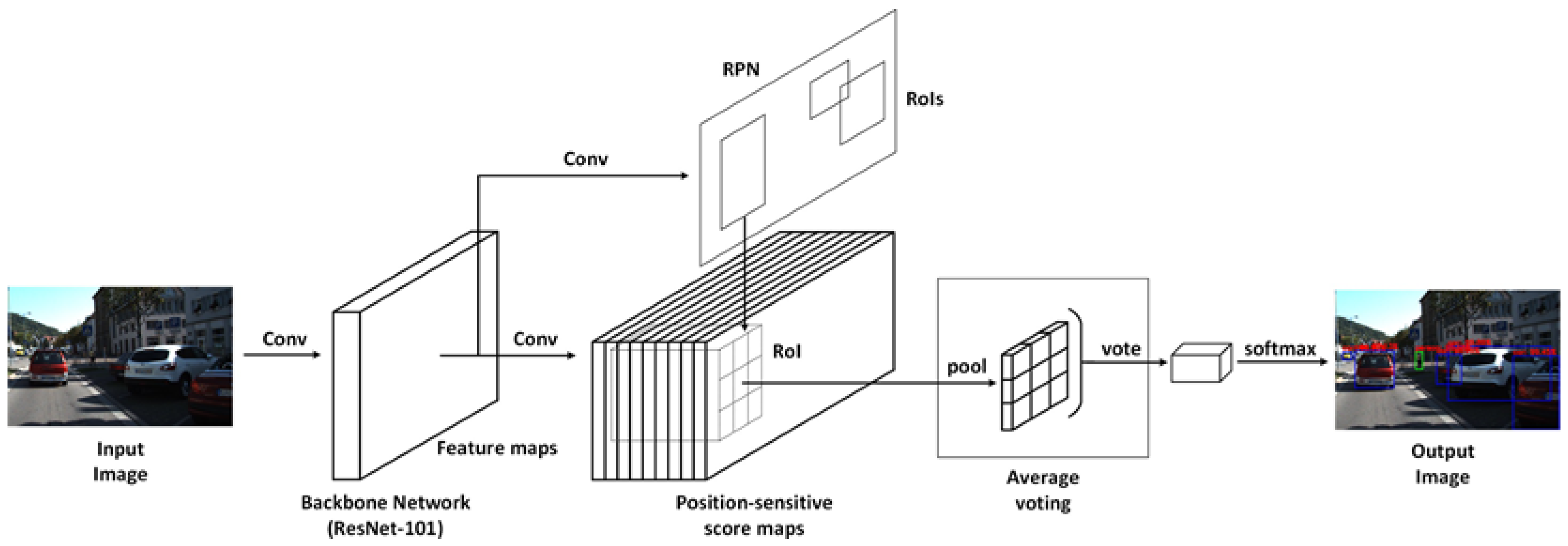
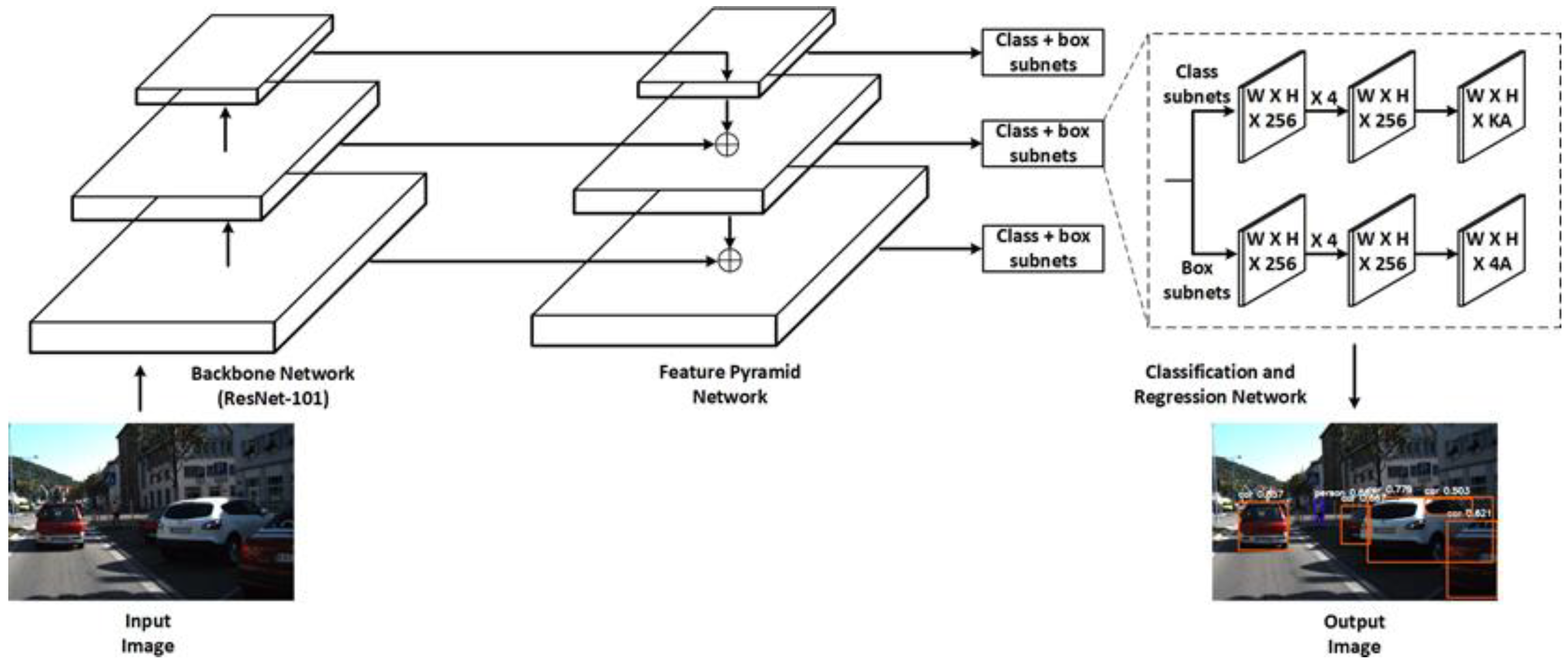
  • A comparative review of different aspects of the five popular and trending deep learning algorithms (R-FCN [26], Mask R-CNN [27], SSD [28], RetinaNet [29], and YOLOv4 [30]) from many object detection algorithms with their key contributions on popular benchmarks are presented.
  • The primarily-used deep learning-based algorithms for road object detection are compared on a new diverse and large-scale Berkeley Deep Drive (BDD100K) dataset [31].
  • The results are analyzed and summarized to show their performance in terms of detection speed and accuracy. The generalization ability of each model is shown under different road environmental conditions at different times of day and night. The parameters are chosen to ensure the credibility of experimental results.
  • Significant guidance for future research and the development of new trends in the field of deep learning-based object detection are included in this work.

3. Experimental Evaluations

3.1. Dataset Description

The selection of a dataset is considered very necessary for exploiting various tasks in real-time autonomous driving. Table 3 shows a comparison of a few different datasets available for autonomous driving applications, primarily for road object detection. The annotations include only four classes (per availability): vehicle, pedestrian, traffic sign, and traffic light. In comparison to other datasets, the BDD100K dataset [31] is selected for experimental evaluation containing 100 K images (70 K training images, 20 K testing images, and 10 K validation images) from different geographic, environmental, and weather scenarios, such as streets, tunnel, gas station, parking lot, residential, and high-ways under diverse conditions at different times of day and night in real traffic urban streets; with up to 90 objects per image. Each object has Boolean values for occlusion and truncation.
Table 3. Comparison of autonomous driving datasets for road object detection.
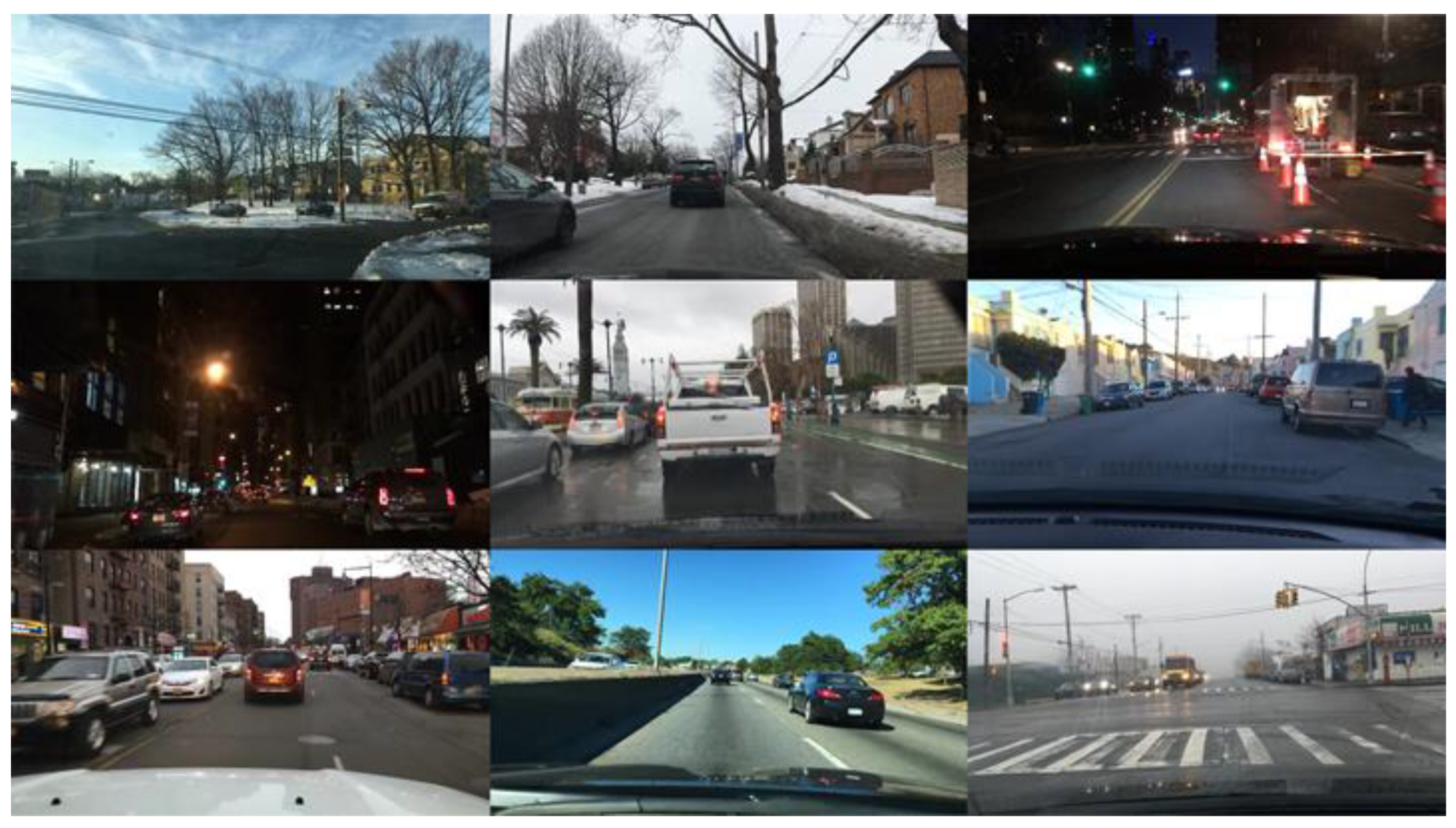
This article selects the BDD100K dataset [31] due to its many images under complex road scenarios and diverse weather conditions. Additionally, the dataset provides real-world driving images to test the deep learning-based algorithms under constraints performing tasks of various complexities. A snapshot of multiple images from the BDD100K dataset [31] is shown in Figure 7.
Figure 7. A snapshot of multiple images from the Berkeley Deep Drive (BDD100K) dataset.
The BDD100K dataset [31] originally contains objects, namely person, rider, bike, car, bus, truck, motor, train, traffic light, and a traffic sign. In this evaluation, the irrelevant samples are eliminated because of class imbalance and specifically four object classes that are considered most critical for an autonomous vehicle, namely vehicle (bike, car, bus, truck, and motor), a pedestrian (person and rider), traffic sign, and traffic light are retained. It is worth mentioning that few images in the dataset are invalid (incorrect label or coordinates). After resolving the number of annotated objects that are considered in this article are listed in Table 4.
Table 4. The number of annotated objects in the Berkeley Deep Drive (BDD100K) dataset.

3.2. Dataset Augmentation

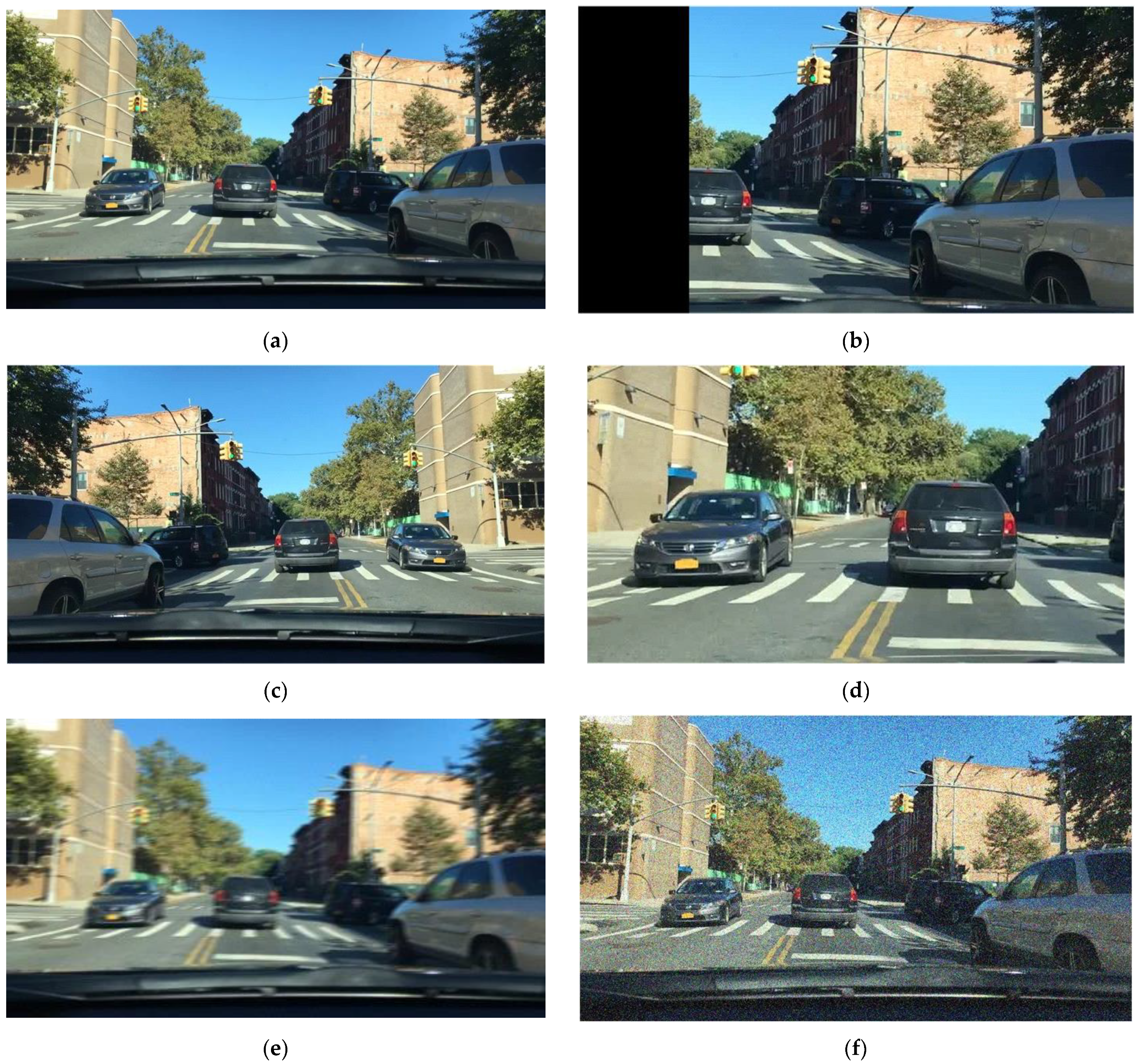
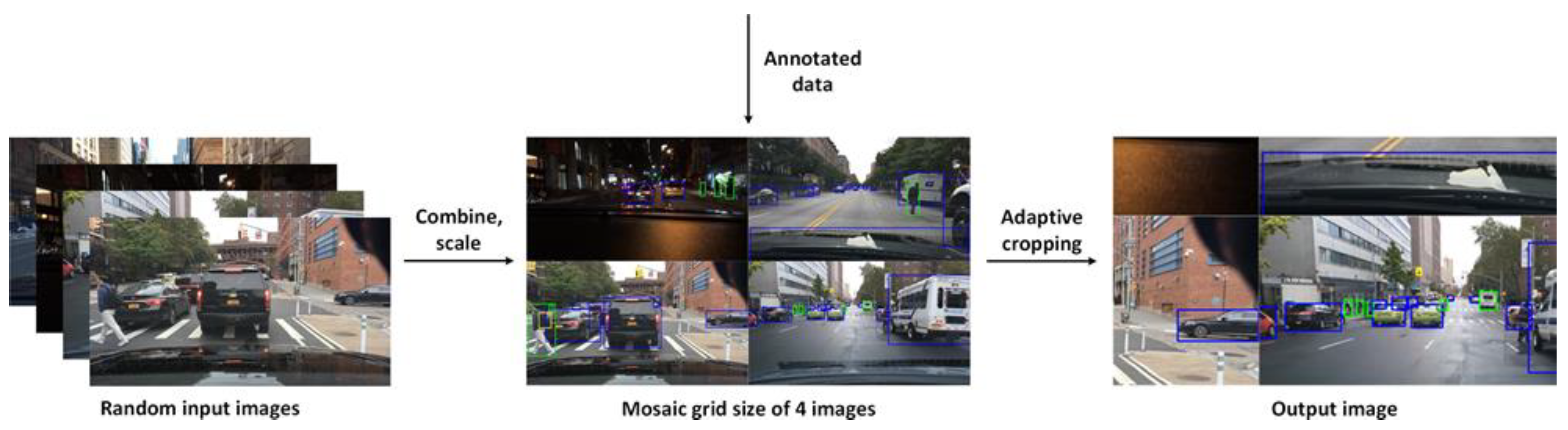
Data augmentation is a set of different techniques used to enhance the size and quality of training models. The objective is to increase the generalization ability without changing the category of images. This article performs basic augmentation operations on the BDD100K dataset, including image displacement, horizontal flipping, random scaling, random cropping, motion blurring, and random noise adding, as shown in Figure 8. In addition to basic augmentation methods, this article uses Mosaic data augmentation [53]. The Mosaic is a new data augmentation technique proposed by Jocher et al. in 2020 that uses four training images instead of a single image [53]. This has two main advantages. Firstly, the model learns to recognize objects outside of the normal contexts found in the dataset. Secondly, it improves the batch normalization statistics using small mini-batches, making the training possible on a single GPU. The implementation of Mosaic data augmentation is shown in Figure 9.
Figure 8. Data augmentation methods (a) original image (b) displacement (c) horizontal flipping (d) random cropping (e) motion blurring (f) random noise adding.
Figure 9. Implementation of the Mosaic data Augmentation.

3.3. Experimental Setup

The popular deep learning frameworks, TensorFlow [54] and Caffe [55], are used to train the models as per official documentation. The experimental environment consists of CUDA v10.1, cuDNN v7.6.4, OpenCV v4.5.0, Ubuntu 18.04.5 OS, 16 GB RAM, Intel i7-8750H CPU, and Nvidia GeForce RTX 2080 Ti GPU. The augmentation is applied to all the images to increase the learning ability. Therefore, the optimal batch sizes of 2 (for Mask-RCNN), 8 (for R-FCN and RetinaNet), and 16 (for SSD and YOLOv4) are used in this evaluation. The initial value of the learning rate is set to 0.0001, the momentum rate is set to 0.949, and the decay rate is set to 0.001 to reduce training loss and prevent gradient explosion. No other parameters were modified and taken as default by the frameworks. The training lasted for 500 epochs. After training, the network weights are obtained to test the experimental results on images from the BDD100K test dataset.

3.4. Object Detection Metrics

For evaluation of detection performance, the mean Average Precision (mAP) is computed. A mAP is currently the most popular object detection measure for evaluating detection methods, as described by PASCAL VOC Challenge [56]. The basic parameters used are True Positive (TP), False Positive (FP), and False Negative (FN). TP is the number of detections in both ground truth and results. FP is the number of detections in results only, but not in the ground truth. FN is the number of detections in ground truth only, but not in results. Precision (P) is the percentage of correct positive predictions, defined in Equation (1). Recall (R) is the percentage of correct positive predictions among all ground truths, defined in Equation (2). The P and R cannot comprehensively determine the performance of a model, so Average Precision (AP) is obtained individually for each class. The AP is a more accurate metric than F1-score because it displays the relationship between P and R glob-ally; therefore, F1-score is not calculated in this article. A Precision-Recall (PR) curve is initially computed based on prediction results against all the ground truth values. A prediction is considered as TP if it satisfies the following two criteria: (1) the bounding box it represents has an IOU > 50% (default threshold) relative to its corresponding ground truth bounding box, and (2) the predicted class label must be same as the ground truth. The curve is then updated by monotonically decreasing the precision. This is obtained by considering the precision for recall R to the maximum precision obtained for whose recall value is greater than or equal to R. Finally, AP is the area under the PR curve calculated under the default threshold, defined in Equation (3). The mAP is simply the average of AP over all classes, defined in Equation (4).
P r e c i s i o n ( P ) = T P T P + F P = T P a l l   d e t e c t i o n s
R e c a l l ( R ) = T P T P + F N = T P a l l   g r o u n d   t r u t h s
A v e r a g e   P r e c i s i o n   ( A P ) = n ( R n + 1 R n ) P R : R ˜ R n + 1 m a x ( R ˜ )
where P ( R ˜ ) is the measured precision at recall R ˜
m e a n   A v e r a g e   P r e c i s i o n ( m A P ) = 1 4 i = 1 4 A P i
where A P i is the AP at class i

4. Results and Discussion

4.1. Results

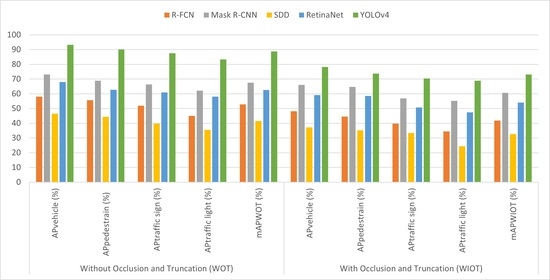
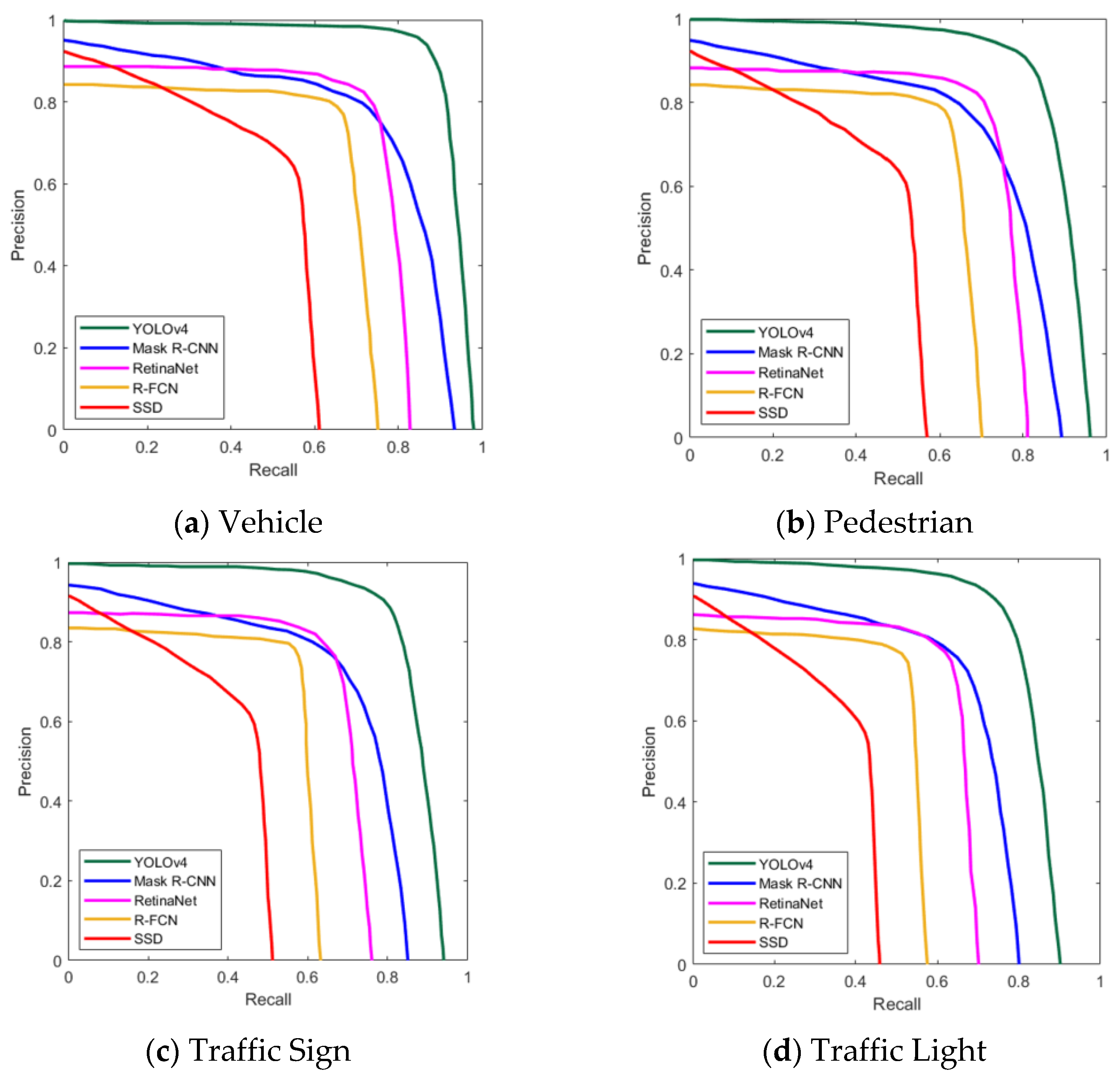
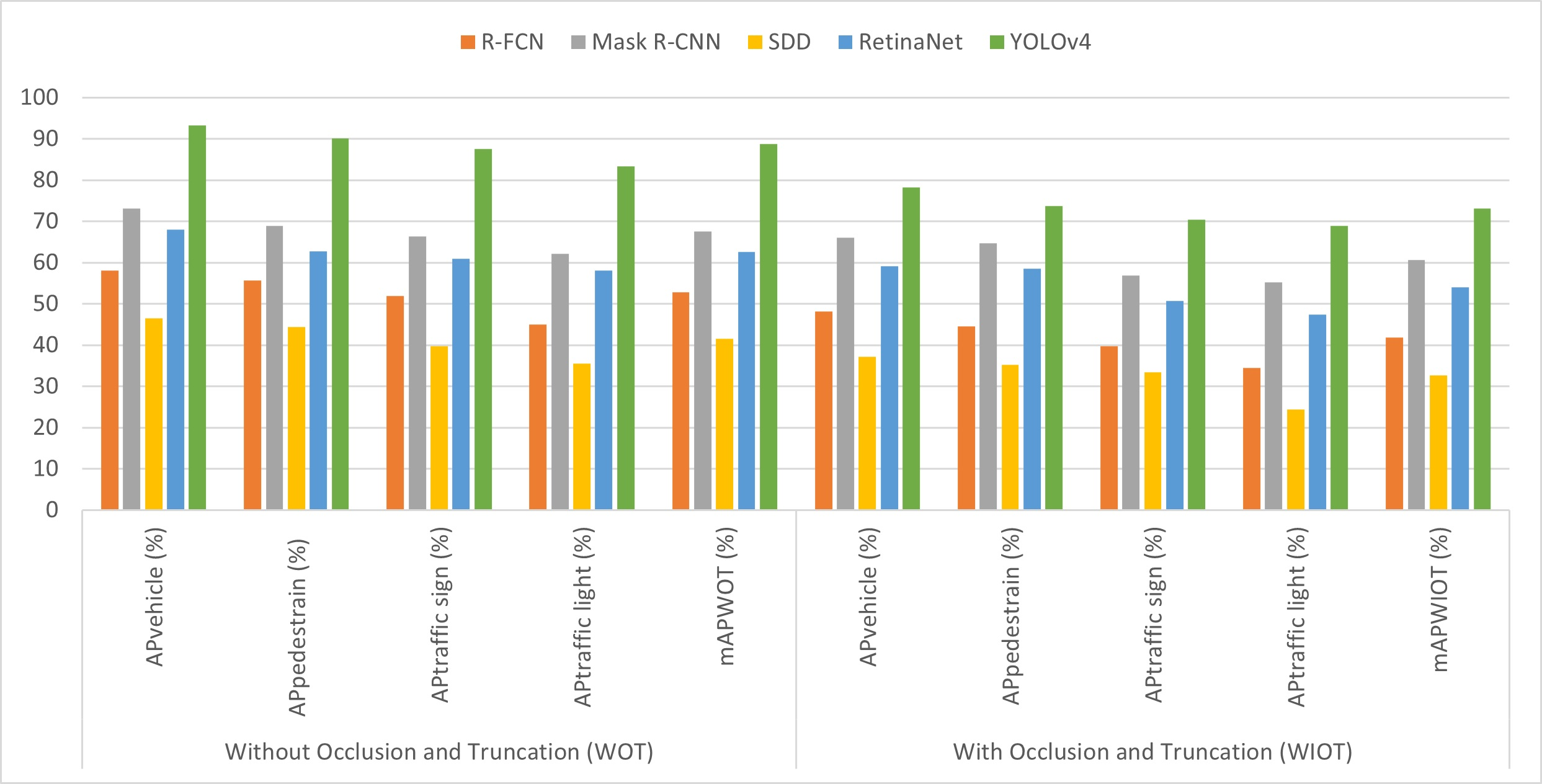
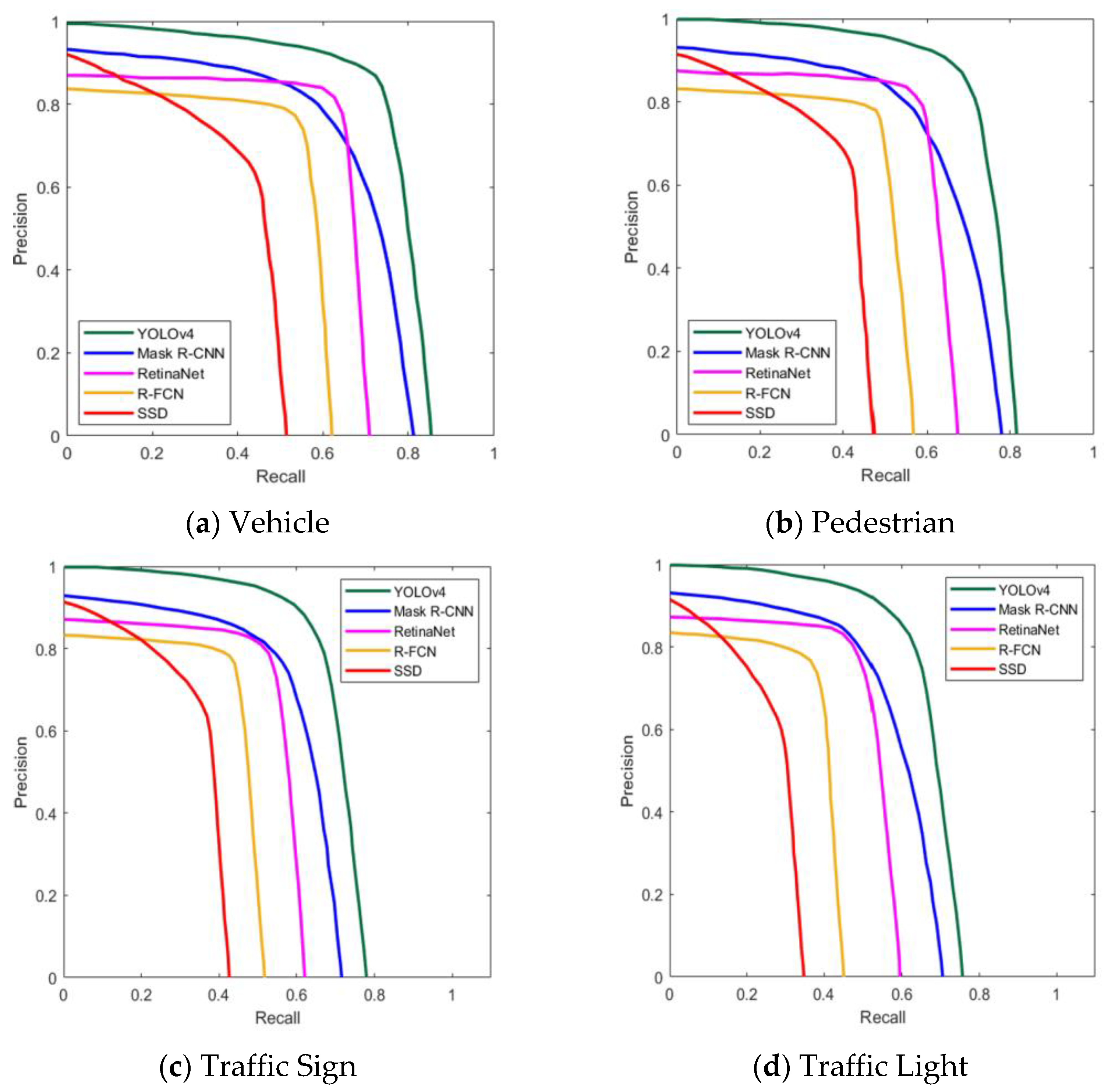
From earlier studies [16,57], it is found that occluded and truncated objects can greatly impact the performance of an object detection model. Therefore, in this comparative study, the test set is divided into two category levels, i.e., objects without occlusion and truncation and objects with occlusion and truncation. Figure 10 shows the PR curves obtained during model training of each object detection algorithm for each class without occlusion and truncation. Figure 11 shows the PR curves obtained during model training of each object detection algorithm for each class with occlusion and truncation. Table 5 lists the detection performance in terms of AP of each class and mAP of object detection models. Table 6 lists the comparison of object detection algorithms with average execution time on CPU and GPU. All results are obtained on the images from the BDD100K test dataset. The best values in Table 5 and Table 6 are represented in bold.
Figure 10. Precision-Recall (PR) curves of object detection models without occlusion and truncation on BDD100K dataset.
Figure 11. Precision-Recall (PR) curve of object detection models with occlusion and truncation on BDD100K dataset.
Table 5. Detection Accuracy of Object Detect Models on BDD100K dataset.
Table 6. The computation time of object detection models on the BDD100K dataset.
From Figure 10 and Figure 11, the following inferences can be drawn:
  • The one-stage detection model YOLOv4 achieves the highest detection precision and recall for target detection at all levels.
  • Mask R-CNN’s two-stage detection model shows better precision and recall than RetinaNet, R-FCN, and SSD for target detection at all levels.
  • The R-FCN shows better precision as compared to SSD for target detection at all levels.
  • The recall of Mask R-CNN is close to YOLOv4 for target detection with occlusion and truncation.
  • SSD recall is the lowest among all the models, which shows a high miss detection rate for targets at all levels.
From Table 5 following inferences can be drawn:
  • The one-stage detection model YOLOv4 achieves the highest detection accuracy for target detection at all levels.
  • The two-stage detection model Mask R-CNN shows better detection accuracy over RetinaNet, R-FCN, and SSD.
  • The SSD shows the lowest AP among all the models at all levels.
From Table 6 following inferences can be drawn:
  • The one-stage detector SSD is faster than other two-stage and one-stage detection models.
  • The YOLOv4 shows almost the same detection speed as compared to SSD on GPU.
  • The R-FCN is faster than Mask R-CNN and RetinaNet on CPU and GPU.
  • The Mask R-CNN is slower than other two-stage and one-stage detection models on GPU.
  • The RetinaNet is slower than other two-stage and one-stage detection models on CPU.
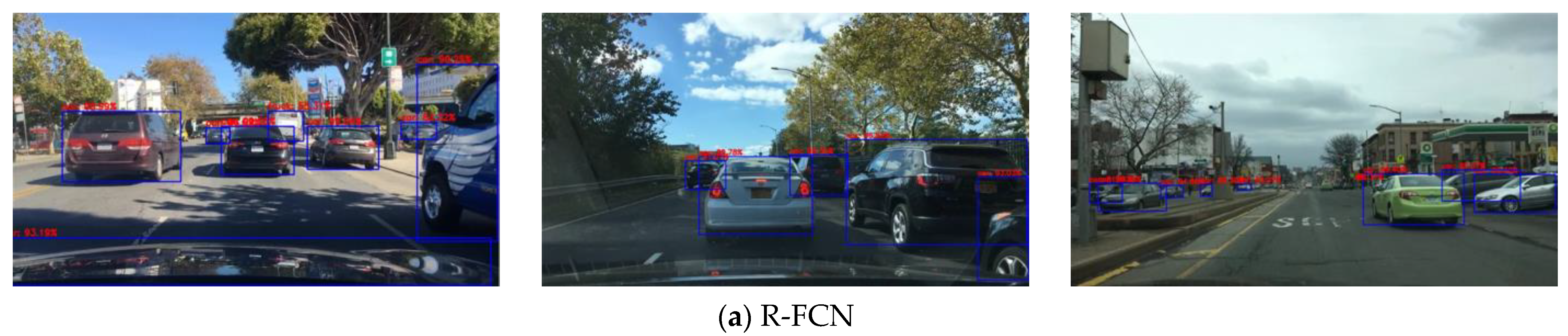
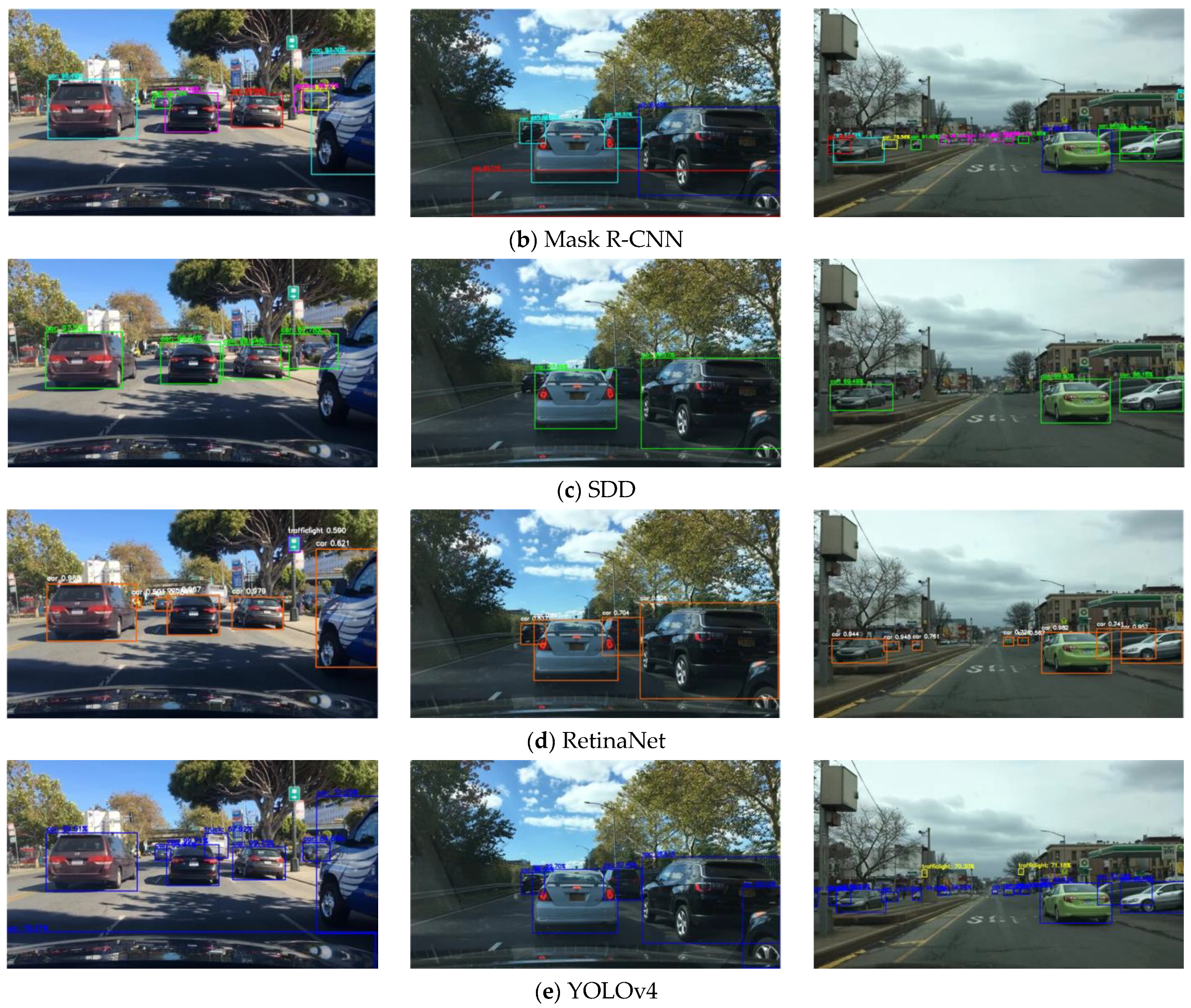
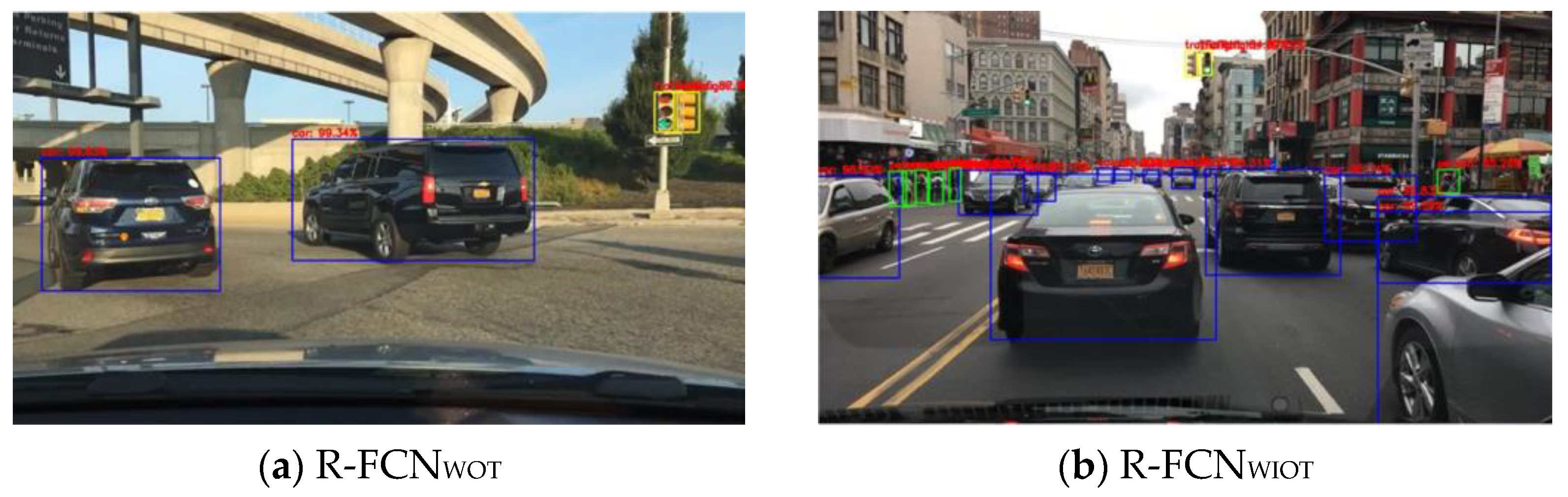
In this evaluation, the vehicles are considered large objects, pedestrians as medium objects, and traffic signs and traffic lights as small objects. Figure 12 shows the performance of object detection models on few test images. This article selects few distinct images based on the occlusion and truncation levels to visually show each algorithm’s effect. From top to bottom, object detection algorithms are R-FCN, Mask R-CNN, SSD, RetinaNet, and YOLOv4. It can be seen clearly that all models have good performance in large target detection, but there is a huge difference in detecting small targets. The selection of YOLOv4 can be considered best for target detection at all levels. The SSD has started to miss targets; as occlusion and truncation increase, the vehicles and pedestrians occluded in the lower left and right are not detected accurately. As the detection size reduces with occlusion and truncation, the YOLOv4 and, in few cases, Mask R-CNN detect the medium and small targets accurately.
Figure 12. Performance of five deep learning models in two category levels.
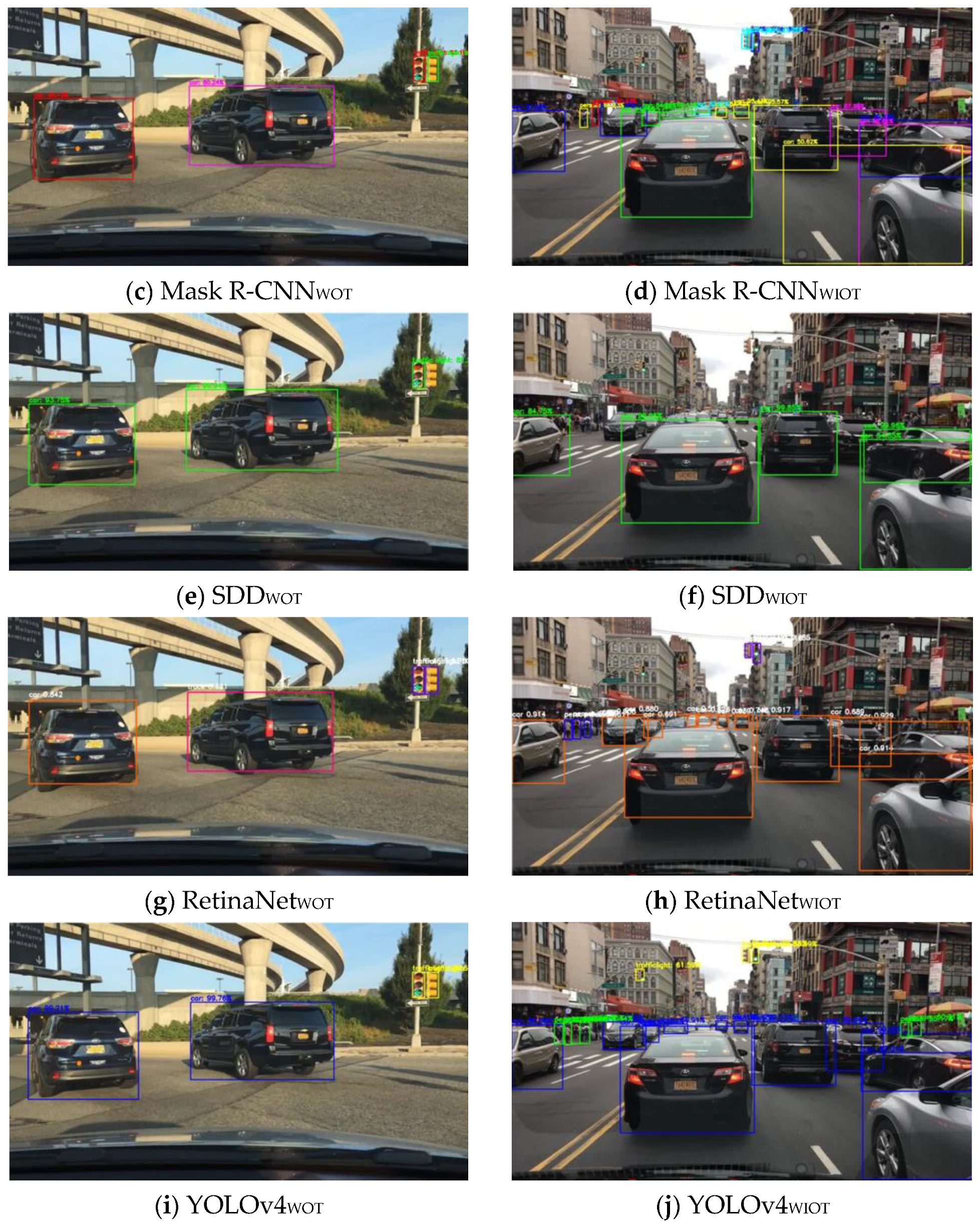
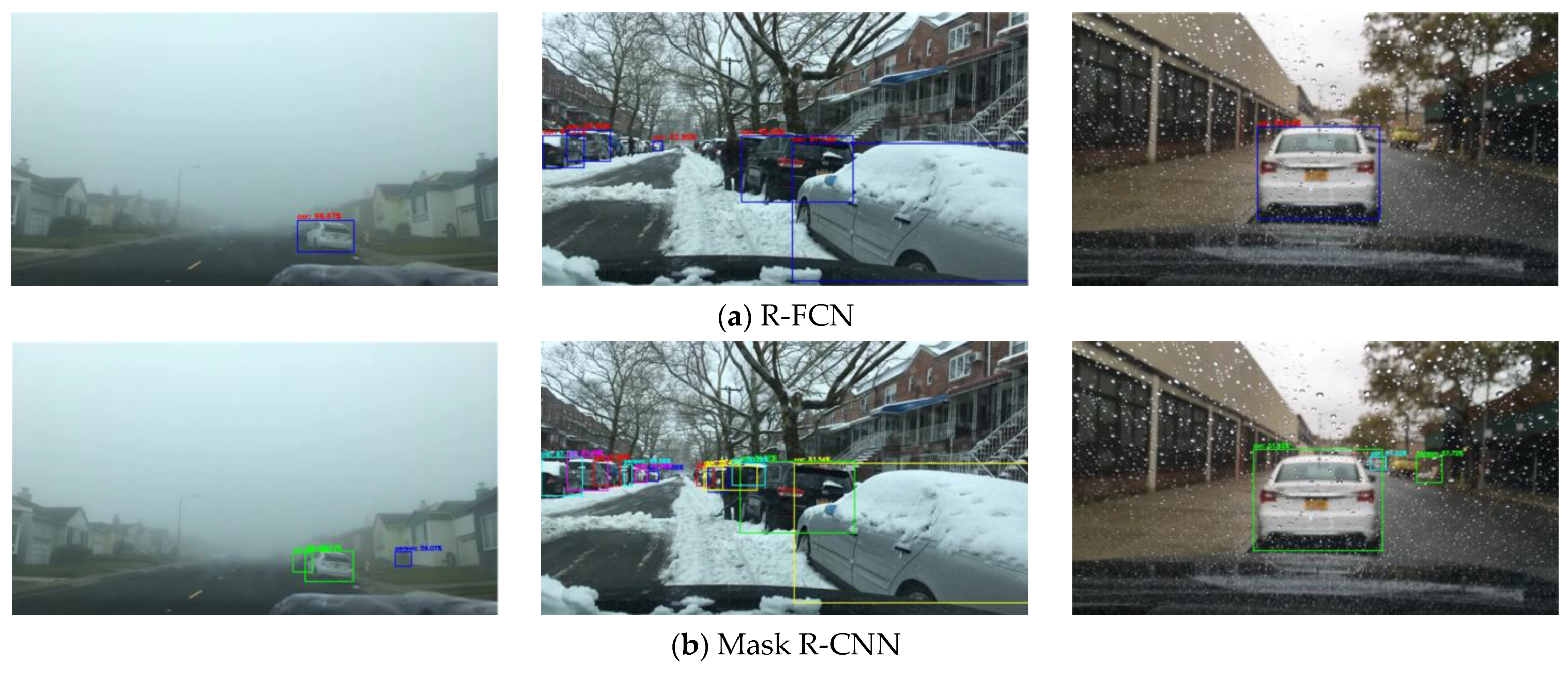
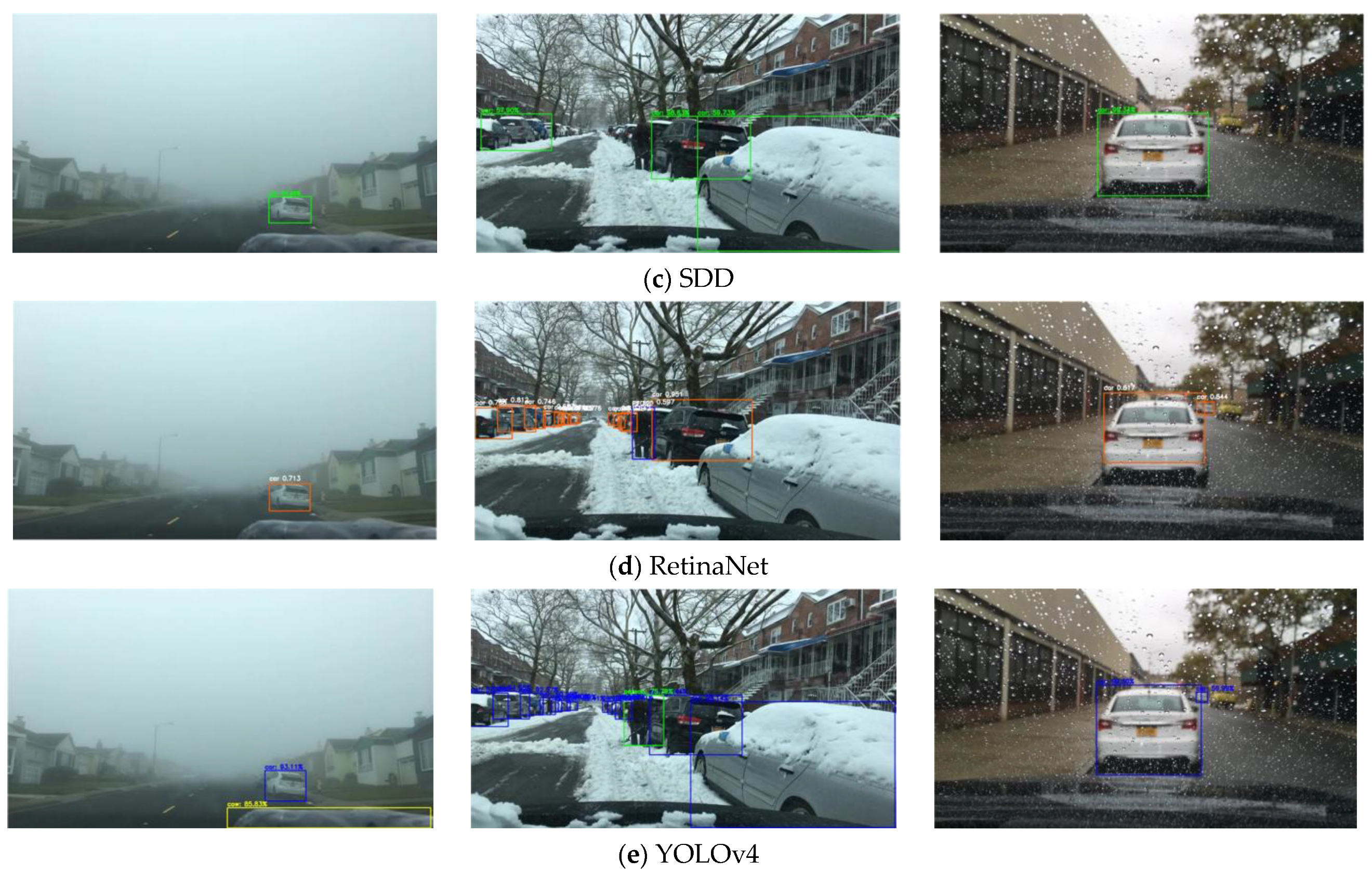
In addition to further test the accuracy on the BDD100K dataset, to investigate the generalization ability of each model under complex weather scenarios, various models are used to test under different road environmental conditions during the clear, partly cloudy, overcast (as shown in Figure 13), foggy, snowy, and rainy (as shown in Figure 14) at different times of day and night. Table 7 lists the generalization ability of five object detection models using low, medium, and high indicators for all road weather conditions at daytime, dawn/dusk, and night. The one-stage detector YOLOv4 has shown to be very strong for the generalization of real scenarios with an excellent detection capability in other road environments. Moreover, the two-stage detector Mask R-CNN performs equivalently to YOLOv4 in all scenarios at night. However, YOLOv4 performs accurately in precipitating dusk/dawn while Mask R-CNN performs accurately on rainy days.
Figure 13. Performance of five deep learning models in different road environmental conditions (from left to right columns: clear, partly cloudy, and overcast).
Figure 14. Performance of five deep learning models in different road environmental conditions (from left to right columns: foggy, snowy, and rainy).
Table 7. The generalization ability of object detection models on the BDD100K dataset.

4.2. Analysis of Results

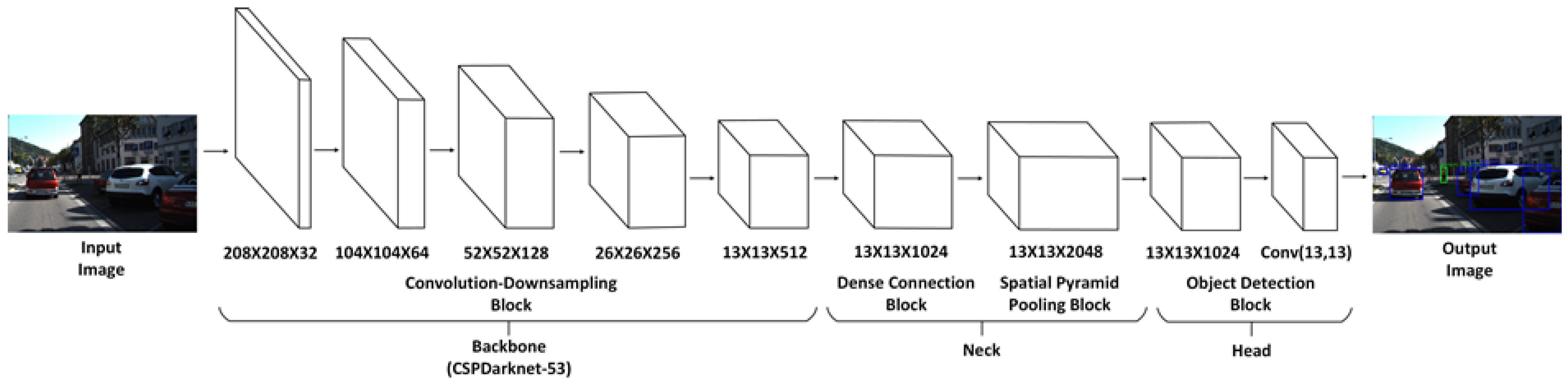
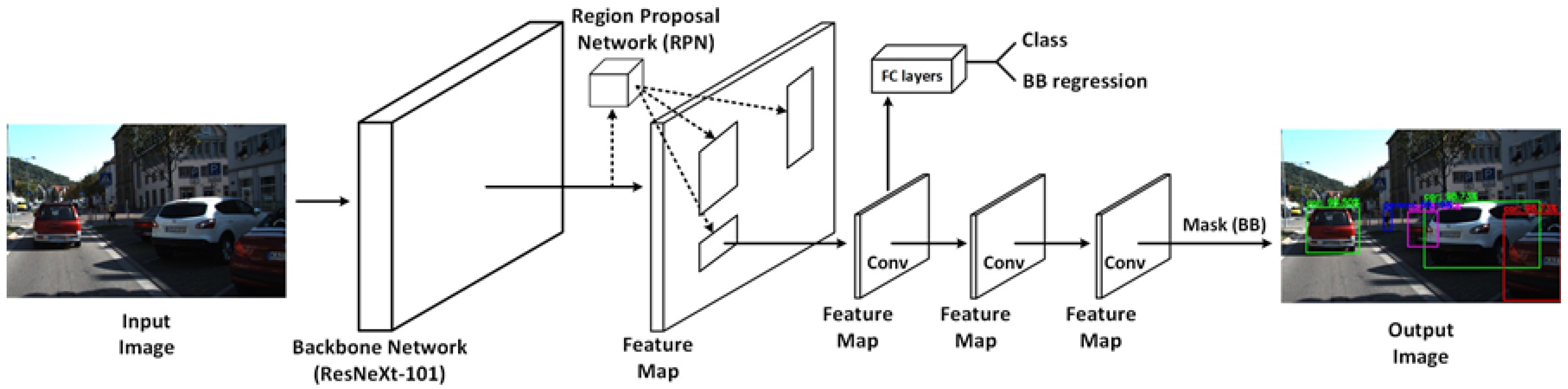
The two-stage detectors generally showed better detection accuracy compared to one-stage detectors. As per the above experimental results, it is observed that the one-stage detection algorithm YOLOv4 has outstanding performance in terms of both speed and accuracy than other one-stage and two-stage detection algorithms for road object detection. It uses a new backbone, CSPDarkNet-53, which increases the accuracy of the classifier and detector. Moreover, adding an SPP block with PANet increases the receptive field that separates the most significant context features without reducing the network speed. This makes the YOLOv4 detection accuracy exceed the two-stage detectors, with the advantage of fast detection speed on the BDD100K dataset. The two-stage detection algorithm Mask R-CNN shows good detection accuracy because it uses Roi Align to produce a more accurate pixel-to-pixel bounding box alignment. As shown in Figure 10 and Figure 11, the SSD shows a low precision and recall because the model runs detection for medium and small targets from very few layers; therefore, it has insufficient semantic and edge information to detect the majority of road objects. Whereas the R-FCN shows a low precision and recall because it does not use global average pooling, final predictions are based on the position-sensitive feature maps decreasing the overall precision and recall. The Mask R-CNN shows a low precision because it ignores the spatial information between receptive fields, which means that it does not consider the instance details between the edge pixels. Furthermore, the Mask R-CNN uses multiscale FPN, and the Roi Align module reduces misalignments between classification confidence and predicted boxes, improving the detection of medium and small targets. The recall rate of Mask R-CNN is close to YOLOv4 for object detection with occlusion and truncation because the number of false detections is significantly higher than correct detections; therefore, it cannot be considered a balanced algorithm. In this article, it is found that the accuracy of two-stage models is lower than one-stage models. As the detection level changes, the performance decreases with the occlusion and truncation transformation, particularly for the SSD because it has started to miss targets. The SSD shows high precision and low recall, increasing the miss detection rate, indicating that it was more unchecked while detecting medium and 12 small targets; therefore, it cannot be considered a balanced algorithm.
On the contrary, the RetinaNet has strong adaptability to multiscale images because of FPN and Focal Loss; therefore, it achieves good results for medium and large target detection. As shown in Table 5, the RetinaNet can be considered as a balanced algorithm. Still, the YOLOv4 can be seen as a more balanced algorithm than other models because it maintains high precision on high recall in all category levels for all road objects. This article uses specific test samples like the actual road scenario from the BDD100K test dataset to analyze the detection performance further. As shown in Table 7, the performance results of YOLOv4 show excellent generalization ability even in complex and low-lighting conditions because of using a robust feature extractor, CSPDarkNet-53, but limited in rainy weather conditions. At the same time, the generalization ability of the two-stage detector Mask R-CNN is very high, especially in low-lighting scenarios because of using the RoiAlign layer for accurate localization but limited in snowy and rainy conditions. The R-FCN shows high generalization ability, especially in low-lighting conditions, but is limited in foggy, snowy, and rainy weather conditions. The RetinaNet also shows high generalization ability under different weather scenarios but is very limited in snowy, rainy, and low-lighting conditions, especially nighttime. The SSD shows low generalization ability, especially in foggy, snowy, rainy, and low-lighting conditions.
From Table 6, SSD can be considered a fast object detection algorithm in two-stage and one-stage detection models without any additional hardware requirements. The detection speed of YOLOv4 is almost the same compared to SSD with GPU requirements. The detection speed of Mask R-CNN is slow because of using an additional branch by the Roi Align module, which increases the computation time for final classification and bounding box regression. As per the evaluation of the above experimental results, Table 8 summarizes the comparison of various object detection algorithms in terms of backbone architecture used in this experimentation, sensitivity, overall specificity, accuracy, and model complexity using low, medium, and high as an indicator to measure the sensitivity, specificity, accuracy, and complexity of various object detection algorithms.
Table 8. Performance of object detection models on BDD100K dataset.
In summary, the YOLOv4 model has shown outstanding accuracy with fast detection speed, satisfying the current standards of real-time object detection, and can be deployed to the road driving environment for actual vehicles as compared to other discuss models. The two-stage detector Mask R-CNN shows good detection accuracy and high generalization under various low-lighting scenarios but cannot be applied to real-time applications and is more suitable for applications, such as identifying drivable areas, lane detection, etc. The RetinaNet shows good accuracy but has low detection speed and cannot be applied to real-time applications when the vehicle is running unless its hardware requirements are fulfilled. It is more suitable for low-speed scenarios, such as automatic parking, etc. The R-FCN has shown low accuracy and is more suitable for applications like traffic detection, obstacle detection, etc. The SSD shows extremely fast detection speed without any additional hardware requirements but low detection accuracy and can be suitable for deployment on various embedded devices and mobile platforms due to its low power requirements, such as Unmanned Aerial Vehicles (UAVs) that can perform real-time detection with limited computing power.

4.3. Discussion

In earlier two-stage and one-stage target detector models, the two-stage models always had better accuracy and slow speed than the one-stage models. Table 6 and Table 8 show that the one-stage detection algorithm YOLOv4 achieves high detection accuracy while maintaining fast detection speed outperforming the two-stage detection algorithm Mask R-CNN because of a new backbone network, CSPDarkNet-53. In addition, YOLOv4 uses SAT, BoF, and BoS methods to increase detection accuracy during detector training. The Mask R-CNN has shown high generalization ability because of using the Roi Align module for accurate localization. But it cannot be applied to real-time applications because of its highly complex architecture and slow detection speed. The RetinaNet has shown good detection accuracy because it uses a special loss function called, Focal Loss to optimize the weights of easy samples; therefore, the model concentrates more on classifying difficult samples during training. With RPN, RetinaNet can be suitable for applications that require good detection accuracy with certain hardware requirements, such as GPU for real-time performance. The R-FCN has low accuracy and cannot be applied to real-time applications due to its slow detection speed. Through comparative analysis, this article finds that even though SSD is an old object detection algorithm, it still has a huge advantage in real-time detection compared to other object detection algorithms without any additional hardware requirements. The SSD uses a simple feature extraction network that effectively reduces the model complexity. The SSD has low computation requirements and lightweight architecture. This article considers SSD suitable for deployment on embedded devices and mobile platforms, such as UAVs, to perform real-time environment perception instead of traditional object detection algorithms. The YOLOv4 has low computation requirements, but the network introduces certain complexity in the model depending on the selection of architecture and other features. This article finds that the YOLOv4 may accurately detect difficult road target objects under complex road scenarios and weather conditions. It is worth mentioning that YOLOv4 sometimes fails to perform detections on very small occluded and truncated objects.
On the contrary, this article also tests various deep learning-based algorithms under different road scenarios. The YOLOv4 has excellent generalization ability in multiple road environmental scenarios. Though YOLOv4 has a medium complex architecture, it satisfies the current requirements for real-time applications with strong detection robustness, proving its feasibility in practical engineering. The YOLOv4 model introduces many new features, and through the combination of various such features, state-of-the-art results can be achieved. To the best of our knowledge, these types of study are very rare in which to show the performance of one-stage detection models exceeds the two-stage detection models on a real large-scale dataset. This article selects five models based on significant improvements over the decade and trains the individual models with Mosaic data augmentation [53] to increase the learning ability under complex scenarios. Researchers deeply passionate about analyzing and applying deep learning-based algorithms in ITS can get inspiration from this comparative study. For instance, the researchers can apply various new features to existing models, such as Mosaic training, SAT, and CmBN, to efficiently train the model at a low cost and improve the detection performance. The selection of optimal hyper-parameters, modifying the loss function, and hard training difficult samples instead of adding more layers in the model are additional possibilities that researchers can explore. Moreover, accurate detection of very small target objects, such as traffic lights under low-lighting conditions, is still challenging to solve in the future of deep learning.

6. Conclusions

This article presents a comparative study on five independent deep learning-based algorithms (R-FCN, Mask R-CNN, SSD, RetinaNet, YOLOv4) for road object detection. The BDD100K dataset is used to train, validate, and test the individual deep learning models to detect four road objects: vehicles, pedestrians, traffic signs, and traffic lights. The comprehensive performance of the models is compared using three parameters: (1) precision rate, recall rate, and AP of four object classes on the BDD100K dataset; (2) mAP on the BDD100K dataset; and (3) CPU and GPU computation time on the BDD100K dataset.
The experimental results show that the YOLOv4 in the one-stage detection model achieves the highest detection accuracy for target detection at all levels, while in the two-stage detection model, Mask R-CNN shows better detection accuracy over RetinaNet, R-FCN, and SDD. The SDD shows the lowest AP among all the models at all levels. However, the computation time of the models for object detection is different from accuracy. We conclude that the one-stage detector SSD is faster than other one/two-stages detection models. The YOLOv4 shows almost the same detection speed as compared to SSD on GPU. The R-FCN is faster than Mask R-CNN and RetinaNet on CPU and GPU. The Mask R-CNN is slower than other one/two-stages detection models on GPU. The RetinaNet is slower than other one/tow-stage detection models on CPU.
This work also considers different complex weather scenarios to intuitively evaluate the applicability of individual algorithms for target detection. This article provides a benchmark illustrating researchers’ comparison of popular deep learning-based object detection algorithms for road target detection. With the fast developments in smart driving, deep learning-based object detection is still a subject worthy of study. To deploy more accurate scenarios for real-time detection, the need for high accuracy and efficient detection systems is becoming increasingly urgent. The main challenge is to balance accuracy, efficiency, and real-time performance. Although recent achievements have been proven effective, much research is still required for solving this challenge.


Author Contributions

Conceptualization, M.H.; methodology, M.H.; software, M.H.; validation, M.H. and A.G.; formal analysis, M.H.; investigation, M.H.; resources, M.H.; data curation, M.H.; writing—original draft preparation, M.H.; writing—review and editing, A.G.; visualization, M.H.; supervision, A.G.; project administration, M.H. and A.G.; funding acquisition, A.G. All authors have read and agreed to the published version of the manuscript.

Funding

This research was funded by the AGH University of Science and Technology, Grant No: 16.16.120.773.

Data Availability Statement

BDD100K dataset is available at: https://bdd-data.berkeley.edu/ (accessed on 20 October 2020).

Conflicts of Interest

The authors declare no conflict of interest.

References

  1. Kuutti, S.; Bowden, R.; Jin, Y.; Barber, P.; Fallah, S. A Survey of Deep Learning Applications to Autonomous Vehicle Control. IEEE Trans. Intell. Transp. Syst. 2020, 22, 712–733. [Google Scholar] [CrossRef]
  2. Sivaraman, S.; Trivedi, M.M. Looking at Vehicles on the Road: A Survey of Vision-Based Vehicle Detection, Tracking, and Behavior Analysis. IEEE Trans. Intell. Transp. Syst. 2013, 14, 1773–1795. [Google Scholar] [CrossRef]
  3. Ahangar, M.N.; Ahmed, Q.Z.; Khan, F.A.; Hafeez, M. A Survey of Autonomous Vehicles: Enabling Communication Technologies and Challenges. Sensors 2021, 21, 706. [Google Scholar] [CrossRef]
  4. Huang, Y.; Chen, Y. Autonomous Driving with Deep Learning: A Survey of State-of-Art Technologies. arXiv 2020, arXiv:2006.06091. [Google Scholar]
  5. Haris, M.; Hou, J. Obstacle Detection and Safely Navigate the Autonomous Vehicle from Unexpected Obstacles on the Driving Lane. Sensors 2020, 20, 4719. [Google Scholar] [CrossRef] [PubMed]
  6. Jang, C.H.; Kim, C.S.; Jo, K.C.; Sunwoo, M. Design Factor Optimization of 3D Flash Lidar Sensor Based on Geometrical Model for Automated Vehicle and Advanced Driver Assistance System Applications. Int. J. Automot. Technol. 2017, 18, 147–156. [Google Scholar] [CrossRef]
  7. Maqueda, A.I.; Loquercio, A.; Gallego, G.; García, N.; Scaramuzza, D. Event-Based Vision Meets Deep Learning on Steering Prediction for Self-Driving Cars. In Proceedings of the IEEE Conference on Computer Vision and Pattern Recognition, Salt Lake City, UT, USA, 18–23 June 2018; pp. 5419–5427. [Google Scholar]
  8. Fries, C.; Wuensche, H.-J. Autonomous Convoy Driving by Night: The Vehicle Tracking System. In Proceedings of the 2015 IEEE International Conference on Technologies for Practical Robot Applications (TePRA), Woburn, MA, USA, 11–12 May 2015; pp. 1–6. [Google Scholar]
  9. Glowacz, A. Ventilation Diagnosis of Angle Grinder Using Thermal Imaging. Sensors 2021, 21, 2853. [Google Scholar] [CrossRef]
  10. Kumar, S.; Shi, L.; Ahmed, N.; Gil, S.; Katabi, D.; Rus, D. Carspeak: A Content-Centric Network for Autonomous Driving. ACM SIGCOMM Comput. Commun. Rev. 2012, 42, 259–270. [Google Scholar] [CrossRef]
  11. Levinson, J.; Askeland, J.; Becker, J.; Dolson, J.; Held, D.; Kammel, S.; Kolter, J.Z.; Langer, D.; Pink, O.; Pratt, V. Towards Fully Autonomous Driving: Systems and Algorithms. In Proceedings of the 2011 IEEE Intelligent Vehicles Symposium (IV), Baden-Baden, Germany, 5–9 June 2011; pp. 163–168. [Google Scholar]
  12. Urmson, C.; Anhalt, J.; Bagnell, D.; Baker, C.; Bittner, R.; Clark, M.N.; Dolan, J.; Duggins, D.; Galatali, T.; Geyer, C. Autonomous Driving in Urban Environments: Boss and the Urban Challenge. J. Field Robot. 2008, 25, 425–466. [Google Scholar] [CrossRef]

  13. Maddern, W.; Pascoe, G.; Linegar, C.; Newman, P. 1 Year, 1000 Km: The Oxford Robotcar Dataset. Int. J. Rob. Res. 2017, 36, 3–15. [Google Scholar] [CrossRef]
  14. Request for Investigation of Deceptive and Unfair Practices in Advertising and Marketing of the “Autopilot” Feature Offered in Tesla Motor Vehicles. Available online: https://www.autosafety.org/wp-content/uploads/2018/05/CAS-and-CW-Letter-to-FTC-on-Tesla-Deceptive-Advertising.pdf (accessed on 23 May 2019).
  15. Novak, V. Google Self-Driving Car. Ph.D. Thesis, Vinnytsia National Technical University, Vinnytsia, Ukraine, 2016. [Google Scholar]
  16. Xiao, Y.; Tian, Z.; Yu, J.; Zhang, Y.; Liu, S.; Du, S.; Lan, X. A Review of Object Detection Based on Deep Learning. Multimed. Tools Appl. 2020, 79, 23729–23791. [Google Scholar] [CrossRef]
  17. Chen, G.; Wang, H.; Chen, K.; Li, Z.; Song, Z.; Liu, Y.; Chen, W.; Knoll, A. A Survey of the Four Pillars for Small Object Detection: Multiscale Representation, Contextual Information, Super-Resolution, and Region Proposal. IEEE Trans. Syst. Man Cybern. Syst. 2020. [Google Scholar] [CrossRef]
  18. Garcia-Garcia, A.; Orts-Escolano, S.; Oprea, S.; Villena-Martinez, V.; Martinez-Gonzalez, P.; Garcia-Rodriguez, J. A Survey on Deep Learning Techniques for Image and Video Semantic Segmentation. Appl. Soft Comput. 2018, 70, 41–65. [Google Scholar] [CrossRef]
  19. Minaee, S.; Boykov, Y.Y.; Porikli, F.; Plaza, A.J.; Kehtarnavaz, N.; Terzopoulos, D. Image Segmentation Using Deep Learning: A Survey. IEEE Trans. Pattern Anal. Mach. Intell. 2021. [Google Scholar] [CrossRef] [PubMed]
  20. Haris, M.; Glowacz, A. Lane Line Detection Based on Object Feature Distillation. Electronics 2021, 10, 1102. [Google Scholar] [CrossRef]
  21. Jiao, L.; Zhang, F.; Liu, F.; Yang, S.; Li, L.; Feng, Z.; Qu, R. A Survey of Deep Learning-Based Object Detection. IEEE Access 2019, 7, 128837–128868. [Google Scholar] [CrossRef]
  22. Sun, Z.; Bebis, G.; Miller, R. On-Road Vehicle Detection: A Review. IEEE Trans. Pattern Anal. Mach. Intell. 2006, 28, 694–711. [Google Scholar] [PubMed]
  23. Wang, H.; Yu, Y.; Cai, Y.; Chen, X.; Chen, L.; Liu, Q. A Comparative Study of State-of-the-Art Deep Learning Algorithms for Vehicle Detection. IEEE Intell. Transp. Syst. Mag. 2019, 11, 82–95. [Google Scholar] [CrossRef]
  24. Liu, Y.; Xie, Z.; Liu, H. An Adaptive and Robust Edge Detection Method Based on Edge Proportion Statistics. IEEE Trans. Image Process. 2020, 29, 5206–5215. [Google Scholar] [CrossRef]
  25. Yurtsever, E.; Lambert, J.; Carballo, A.; Takeda, K. A Survey of Autonomous Driving: Common Practices and Emerging Technologies. IEEE Access 2020, 8, 58443–58469. [Google Scholar] [CrossRef]
  26. Dai, J.; Li, Y.; He, K.; Sun, J. R-Fcn: Object Detection via Region-Based Fully Convolutional Networks. arXiv 2016, arXiv:1605.06409. [Google Scholar]
  27. He, K.; Gkioxari, G.; Dollár, P.; Girshick, R. Mask R-CNN. In Proceedings of the IEEE International Conference on Computer Vision, Venice, Italy, 22–29 October 2017. [Google Scholar]
  28. Liu, W.; Anguelov, D.; Erhan, D.; Szegedy, C.; Reed, S.; Fu, C.Y.; Berg, A.C. SSD: Single Shot Multibox Detector. In Proceedings of the 14th European Conference on Computer Vision, Amsterdam, The Netherlands, 8 October 2016; pp. 21–37. [Google Scholar]
  29. Lin, T.-Y.; Goyal, P.; Girshick, R.; He, K.; Dollár, P. Focal Loss for Dense Object Detection. In Proceedings of the IEEE International Conference on Computer Vision, Venice, Italy, 22–29 October 2017; pp. 2980–2988. [Google Scholar]
  30. Bochkovskiy, A.; Wang, C.-Y.; Liao, H.-Y.M. Yolov4: Optimal Speed and Accuracy of Object Detection. arXiv 2020, arXiv:2004.10934. [Google Scholar]
  31. Yu, F.; Chen, H.; Wang, X.; Xian, W.; Chen, Y.; Liu, F.; Madhavan, V.; Darrell, T. Bdd100k: A Diverse Driving Dataset for Heterogeneous Multitask Learning. In Proceedings of the IEEE/CVF Conference on Computer Vision and Pattern Recognition, Seattle, WA, USA, 13–19 June 2020; pp. 2636–2645. [Google Scholar]
  32. Lienhart, R.; Maydt, J. An Extended Set of Haar-like Features for Rapid Object Detection. In Proceedings of the international Conference on Image Processing, Rochester, NY, USA, 22–25 September 2002; Volume 1. [Google Scholar]
  33. Rybski, P.E.; Huber, D.; Morris, D.D.; Hoffman, R. Visual Classification of Coarse Vehicle Orientation Using Histogram of Oriented Gradients Features. In Proceedings of the 2010 IEEE Intelligent Vehicles Symposium, La Jolla, CA, USA, 21–24 June 2010; pp. 921–928. [Google Scholar]
  34. Chen, Z.; Chen, K.; Chen, J. Vehicle and Pedestrian Detection Using Support Vector Machine and Histogram of Oriented Gradients Features. In Proceedings of the 2013 International Conference on Computer Sciences and Applications, Wuhan, China, 14–15 December 2013; pp. 365–368. [Google Scholar]
  35. Broggi, A.; Cardarelli, E.; Cattani, S.; Medici, P.; Sabbatelli, M. Vehicle Detection for Autonomous Parking Using a Soft-Cascade AdaBoost Classifier. In Proceedings of the 2014 IEEE Intelligent Vehicles Symposium Proceedings, Dearborn, MI, USA, 8–11 June 2014; pp. 912–917. [Google Scholar]
  36. Aziz, L.; bin Haji Salam, S.; Ayub, S. Exploring Deep Learning-Based Architecture, Strategies, Applications and Current Trends in Generic Object Detection: A Comprehensive Review. IEEE Access 2020, 8, 170461–170495. [Google Scholar] [CrossRef]
  37. Ren, S.; He, K.; Girshick, R.; Sun, J. Faster R-CNN: Towards Real-Time Object Detection with Region Proposal Networks. IEEE Trans. Pattern Anal. Mach. Intell. 2016, 39, 1137–1149. [Google Scholar] [CrossRef]
  38. Lin, T.-Y.; Dollár, P.; Girshick, R.; He, K.; Hariharan, B.; Belongie, S. Feature Pyramid Networks for Object Detection. In Proceedings of the IEEE Conference on Computer Vision and Pattern Recognition, honolulu, HI, USA, 21–26 July 2017; pp. 2117–2125. [Google Scholar]
  39. Simonyan, K.; Zisserman, A. Very Deep Convolutional Networks for Large-Scale Image Recognition. arXiv 2014, arXiv:1409.1556. [Google Scholar]
  40. Szegedy, C.; Ioffe, S.; Vanhoucke, V.; Alemi, A. Inception-v4, Inception-Resnet and the Impact of Residual Connections on Learning. In Proceedings of the AAAI Conference on Artificial Intelligence, San Francisco, CA, USA, 4–10 February 2017. [Google Scholar]
  41. Redmon, J.; Divvala, S.; Girshick, R.; Farhadi, A. You Only Look Once: Unified, Real-Time Object Detection. In Proceedings of the IEEE Computer Society Conference on Computer Vision and Pattern Recognition, Las Vegas, NV, USA, 27–30 June 2016; pp. 779–788. [Google Scholar]
  42. Redmon, J.; Farhadi, A. YOLO9000: Better, Faster, Stronger. In Proceedings of the 30th IEEE Conference on Computer Vision and Pattern Recognition, CVPR 2017, Honolulu, HI, USA, 21–26 July 2017; Volume 2017, pp. 6517–6525. [Google Scholar]
  43. Redmon, J.; Farhadi, A. YOLOv3: An Incremental Improvement. arXiv 2018, arXiv:1804.02767. [Google Scholar]
  44. Hnewa, M.; Radha, H. Object Detection under Rainy Conditions for Autonomous Vehicles. arXiv 2020, arXiv:2006.16471. [Google Scholar]
  45. Husain, A.A.; Maity, T.; Yadav, R.K. Vehicle Detection in Intelligent Transport System under a Hazy Environment: A Survey. IET Image Process. 2020, 14, 1–10. [Google Scholar] [CrossRef]
  46. Meng, C.; Bao, H.; Ma, Y. Vehicle Detection: A Review. Proc. J. Phys. Conf. Ser. 2020, 12107. [Google Scholar] [CrossRef]
  47. Geiger, A.; Lenz, P.; Urtasun, R. Are We Ready for Autonomous Driving? The KITTI Vision Benchmark Suite. In Proceedings of the IEEE Computer Society Conference on Computer Vision and Pattern Recognition, Providence, RI, USA, 16–21 June 2012; pp. 3354–3361. [Google Scholar]
  48. Huang, X.; Cheng, X.; Geng, Q.; Cao, B.; Zhou, D.; Wang, P.; Lin, Y.; Yang, R. The Apolloscape Dataset for Autonomous Driving. In Proceedings of the Conference on Computer Vision and Pattern Recognition Workshops, Salt Lake City, UT, USA, 18–23 June 2018; pp. 954–960. [Google Scholar]
  49. Abadi, M.; Barham, P.; Chen, J.; Chen, Z.; Davis, A.; Dean, J.; Devin, M.; Ghemawat, S.; Irving, G.; Isard, M.; et al. EuroCity Persons: A Novel Benchmark for Person Detection in Traffic Scenes. In Proceedings of the 12th USENIX Symposium on Operating Systems Design and Implementation, OSDI 2016, Savannah, GA, USA, 2–4 November 2016; Volume 41, pp. 11621–11631. [Google Scholar]
  50. Caesar, H.; Bankiti, V.; Lang, A.H.; Vora, S.; Liong, V.E.; Xu, Q.; Krishnan, A.; Pan, Y.; Baldan, G.; Beijbom, O. NuScenes: A Multimodal Dataset for Autonomous Driving. Comput. Vis. Pattern Recognit. 2020, 11621–11631. [Google Scholar] [CrossRef]
  51. Chang, M.-F.; Lambert, J.; Sangkloy, P.; Singh, J.; Bak, S.; Hartnett, A.; Wang, D.; Carr, P.; Lucey, S.; Ramanan, D. Argoverse: 3d Tracking and Forecasting with Rich Maps. In Proceedings of the IEEE/CVF Conference on Computer Vision and Pattern Recognition, Long Beach, CA, USA, 15–20 June 2019; pp. 8748–8757. [Google Scholar]
  52. Sun, P.; Kretzschmar, H.; Dotiwalla, X.; Chouard, A.; Patnaik, V.; Tsui, P.; Guo, J.; Zhou, Y.; Chai, Y.; Caine, B. Scalability in Perception for Autonomous Driving: Waymo Open Dataset. In Proceedings of the IEEE/CVF Conference on Computer Vision and Pattern Recognition, Seattle, WA, USA, 13–19 June 2020; pp. 2446–2454. [Google Scholar]
  53. Ultralytics/Yolov3: V9.5.0—YOLOv5 v5.0 Release Compatibility Update for YOLOv3. 2021. Available online: https://zenodo.org/record/4681234#.YRJXoYgzaM8 (accessed on 12 April 2021).
  54. Abadi, M.; Barham, P.; Chen, J.; Chen, Z.; Davis, A.; Dean, J.; Devin, M.; Ghemawat, S.; Irving, G.; Isard, M.; et al. TensorFlow: A System for Large-Scale Machine Learning. In Proceedings of the 12th USENIX Symposium on Operating Systems Design and Implementation (OSDI), Savannah, GA, USA, 2–4 November 2016; pp. 265–283. [Google Scholar]
  55. Jia, Y.; Shelhamer, E.; Donahue, J.; Karayev, S.; Long, J.; Girshick, R.; Guadarrama, S.; Darrell, T. Caffe: Convolutional Architecture for Fast Feature Embedding. In Proceedings of the 22nd ACM International Conference on Multimedia, Orlando, FL, USA, 3–7 November 2014; pp. 675–678. [Google Scholar]
  56. Girshick, R.; Donahue, J.; Darrell, T.; Malik, J. Rich Feature Hierarchies for Accurate Object Detection and Semantic Segmentation. In Proceedings of the IEEE Conference on Computer Vision and Pattern Recognition, Columbus, OH, USA, 23–28 June 2014; pp. 580–587. [Google Scholar]
  57. Ma, W.; Wu, Y.; Cen, F.; Wang, G. MDFN: Multiscale Deep Feature Learning Network for Object Detection. Pattern Recognit. 2020, 100, 107149. [Google Scholar] [CrossRef]
  58. Jetson AGX Xavier: Deep Leasrning Inference Benchmarks|NVIDIA Developer. Available online: https://developer.nvidia.com/embedded/jetson-agx-xavier-dl-inference-benchmarks (accessed on 25 July 2021).
  59. Tan, M.; Pang, R.; Le, Q. Efficientdet: Scalable and Efficient Object Detection. In Proceedings of the IEEE/CVF Conference on Computer Vision and Pattern Recognition, Seattle, WA, USA, 13–19 June 2020; pp. 10781–10790. [Google Scholar]
Publisher’s Note: MDPI stays neutral with regard to jurisdictional claims in published maps and institutional affiliations.

Article Metrics

Citations

Article Access Statistics

Multiple requests from the same IP address are counted as one view.