
Product Innovation for Remanufacturing in the Closed-Loop Supply Chain with Third-Party Remanufacturing

Abstract
1. Introduction
2. Literature Review
2.1. Remanufacturing Mode
2.2. Technology Innovation in the Closed-Loop Supply Chain
3. Problem Description and Assumptions
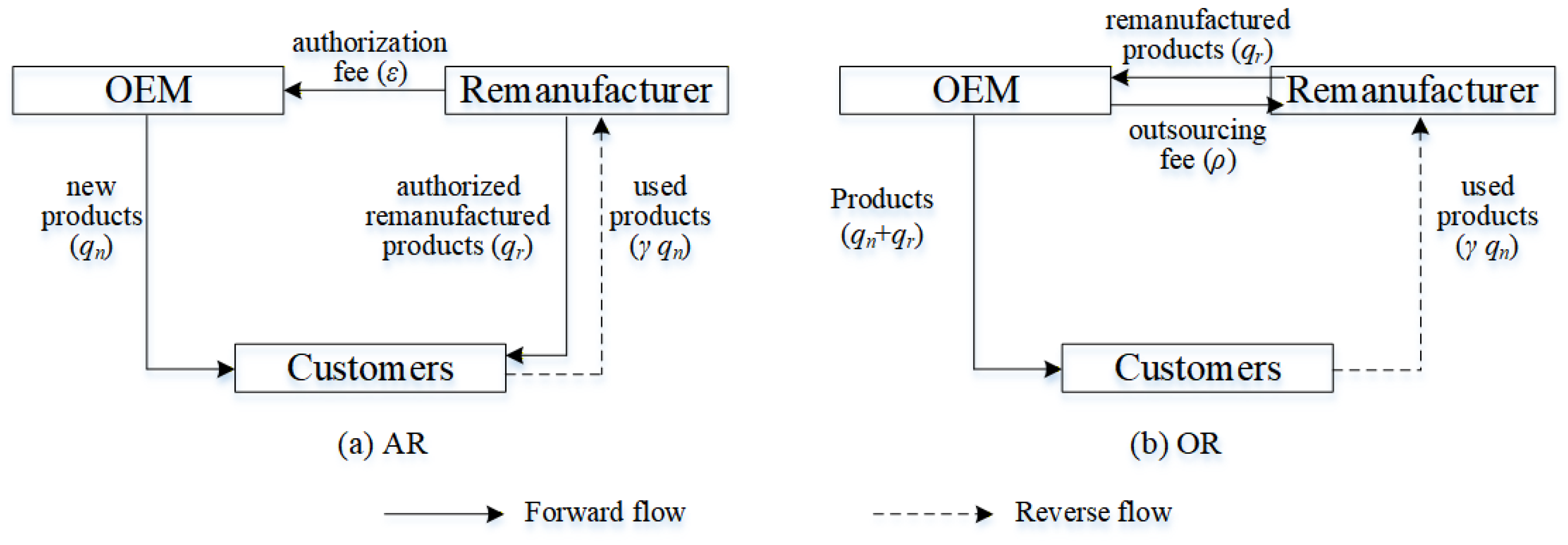
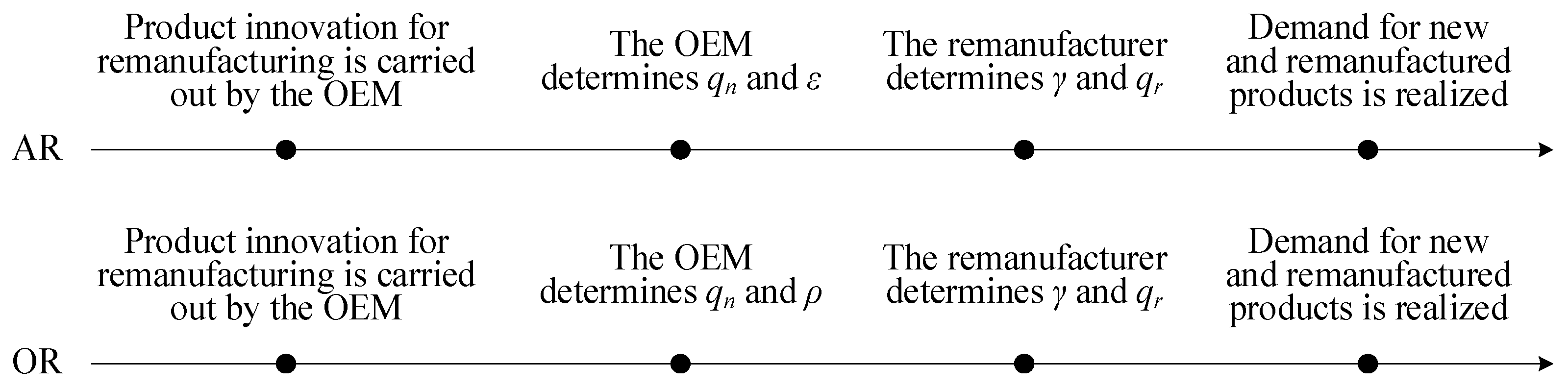
3.1. The Structure of Third-Party Remanufacturing
3.2. The Cost Structure
3.3. Inverse Demand Functions
4. Mathematical Models
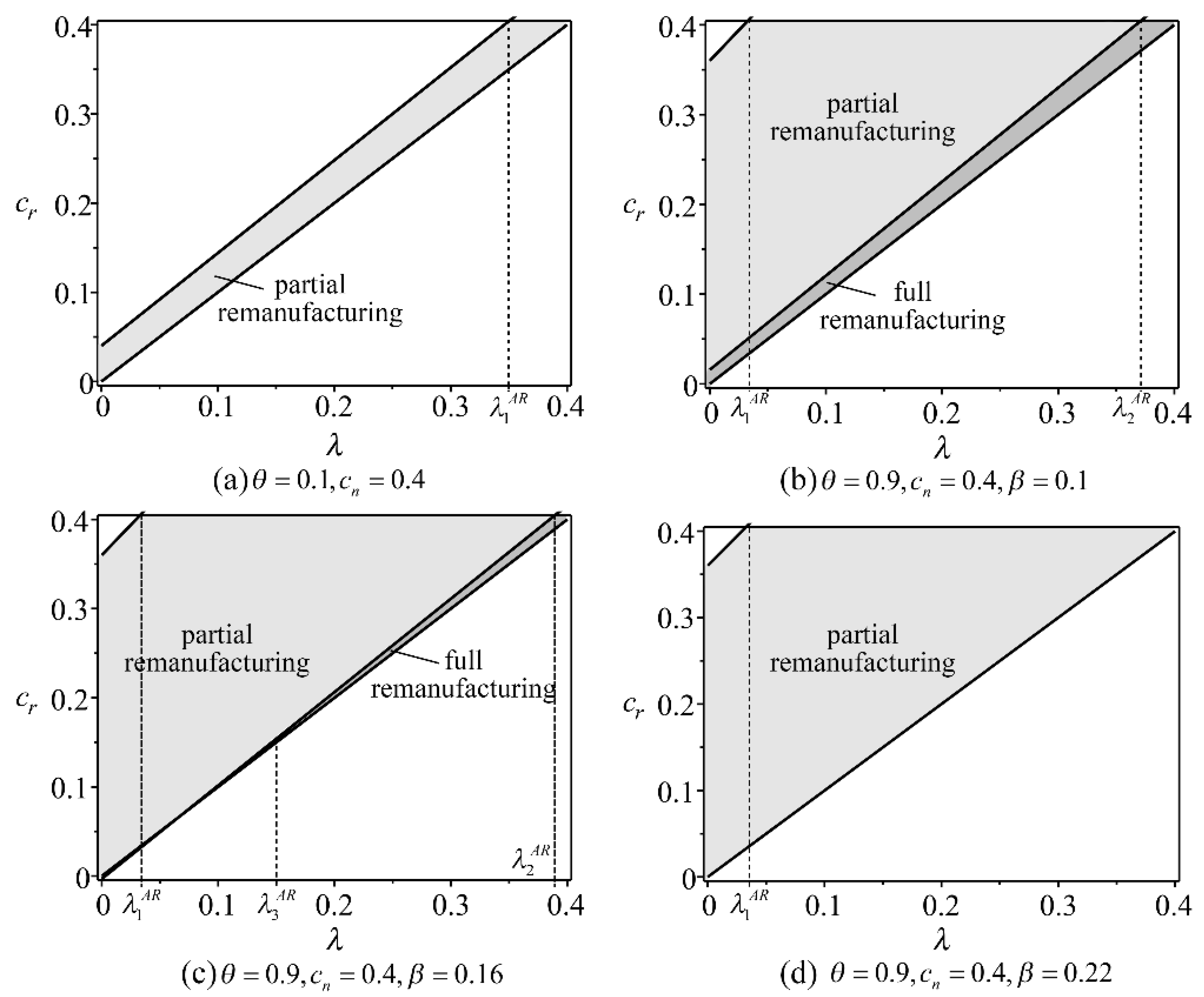
4.1. AR Mode
- (1)
- No remanufacturing when ,
- (2)
- Partial remanufacturing when ,
- (3)
- Full remanufacturing when .
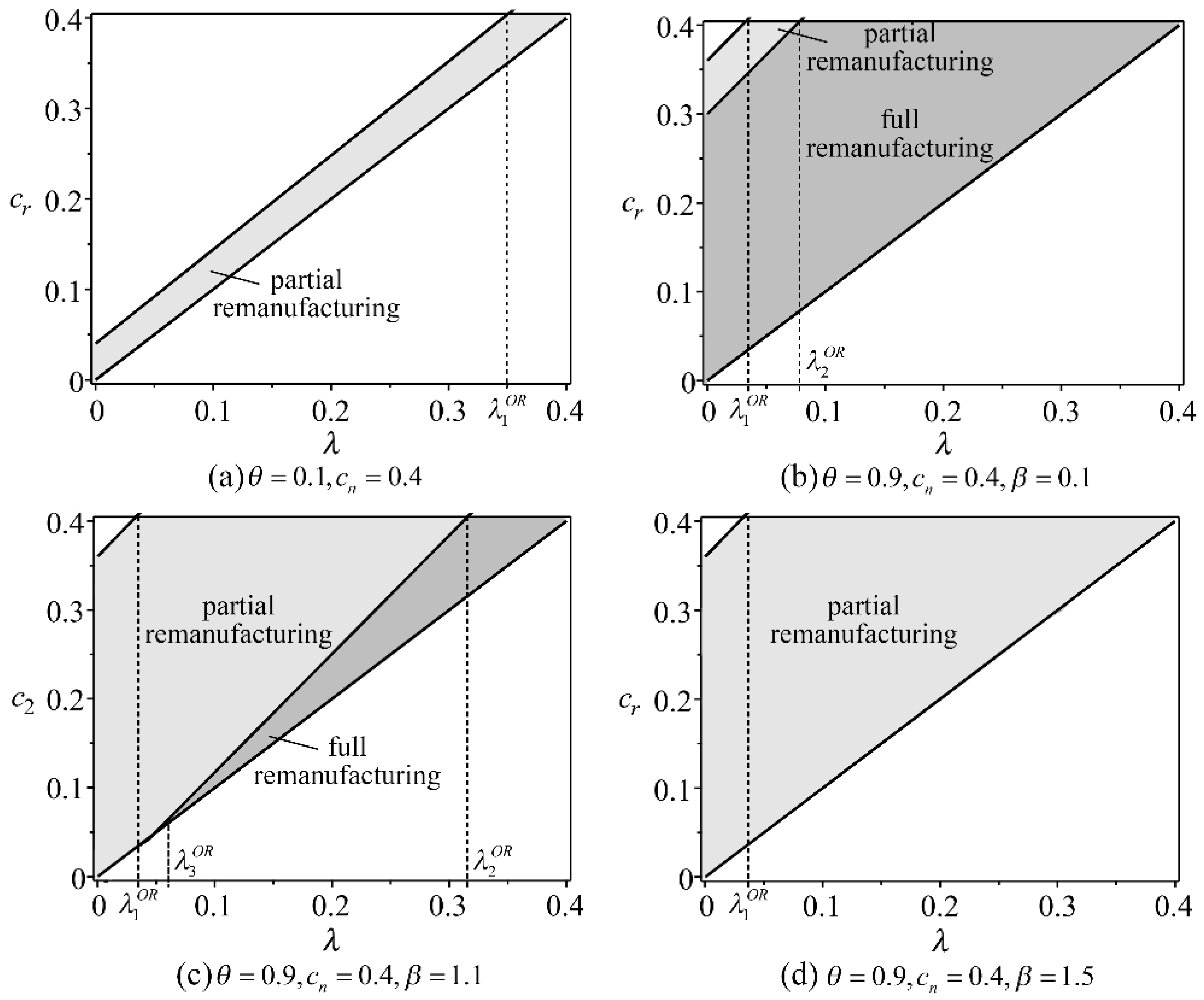
4.2. OR Mode
- (1)
- No remanufacturing when ,
- (2)
- Partial remanufacturing when ,
- (3)
- Full remanufacturing when .
5. Results and Discussion
5.1. The Optimal Level of Product Innovation for Remanufacturing
- (1)
- For the OEM, there exist and such that when , . When , if , ; otherwise, .
- (2)
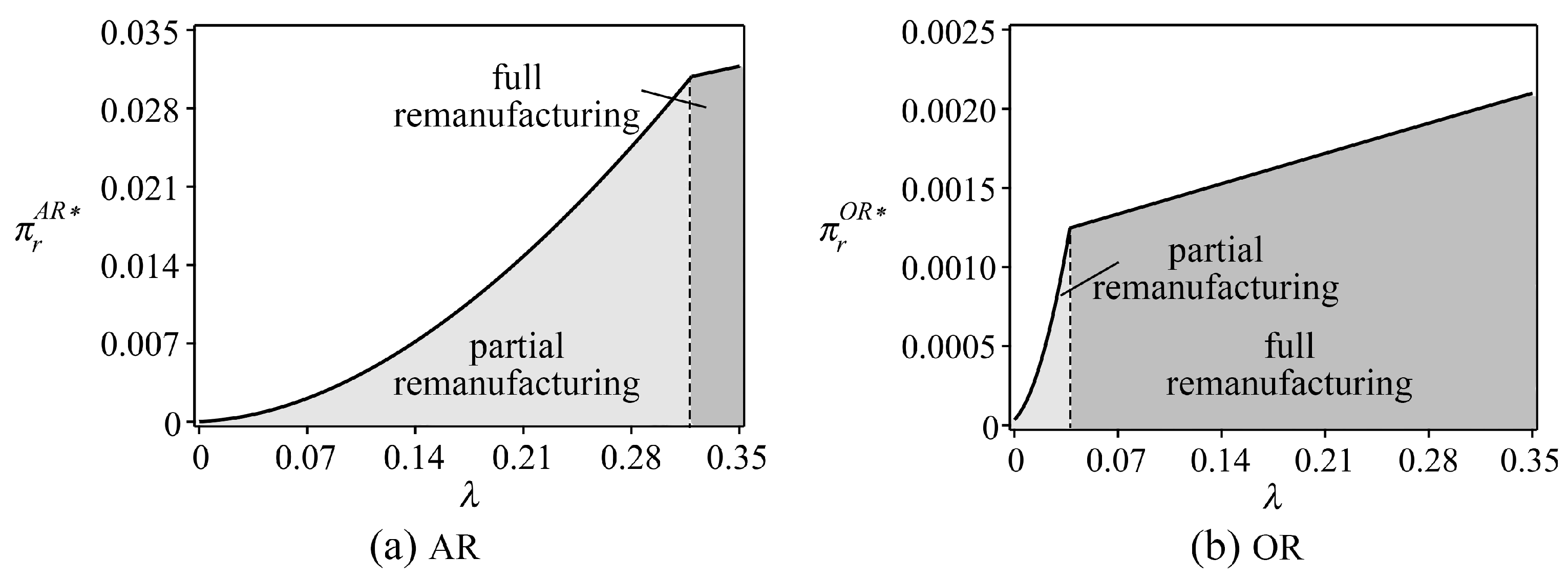
- For the remanufacturer, always holds.
5.2. Impact of Product Innovation for Remanufacturing on the Optimal Decisions
- (1)
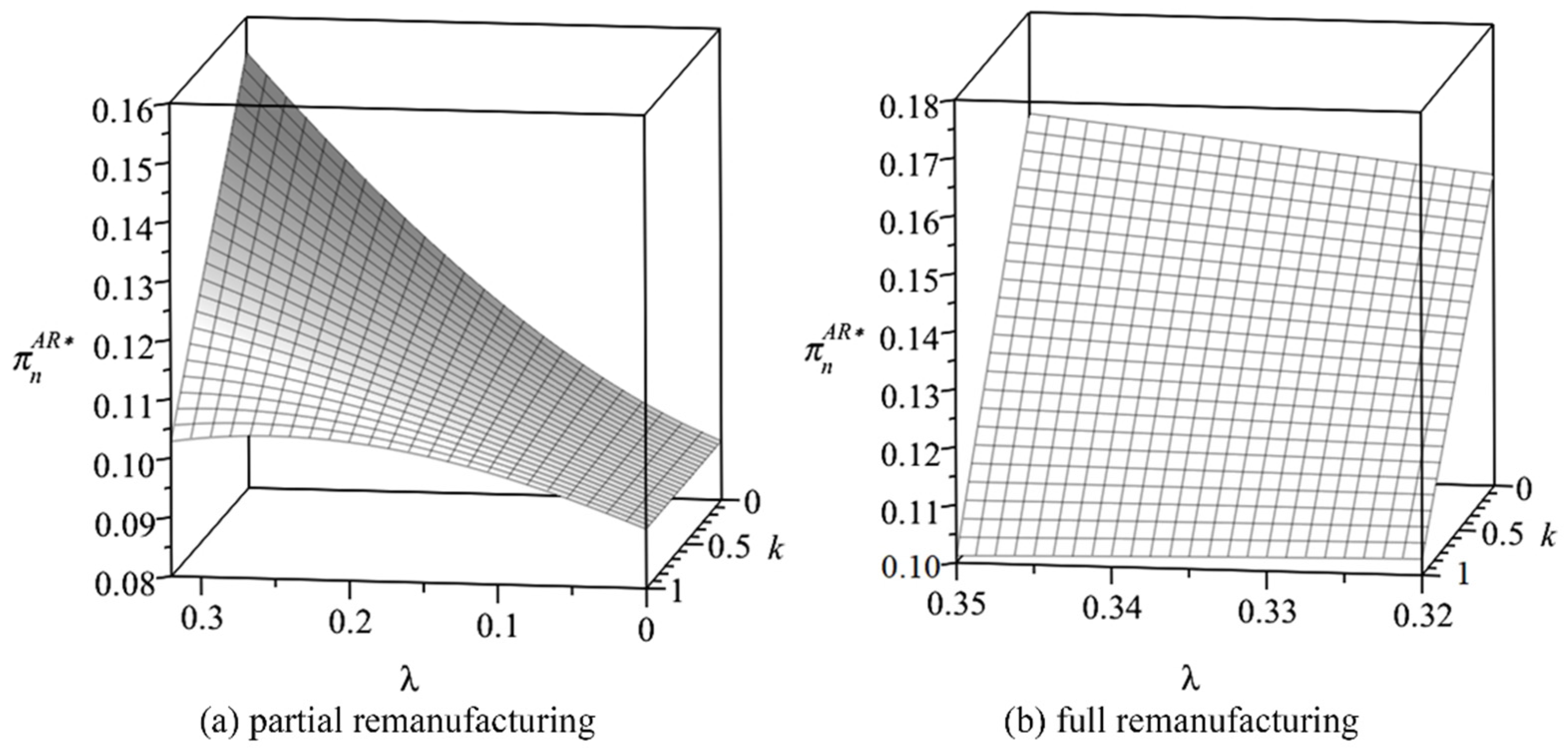
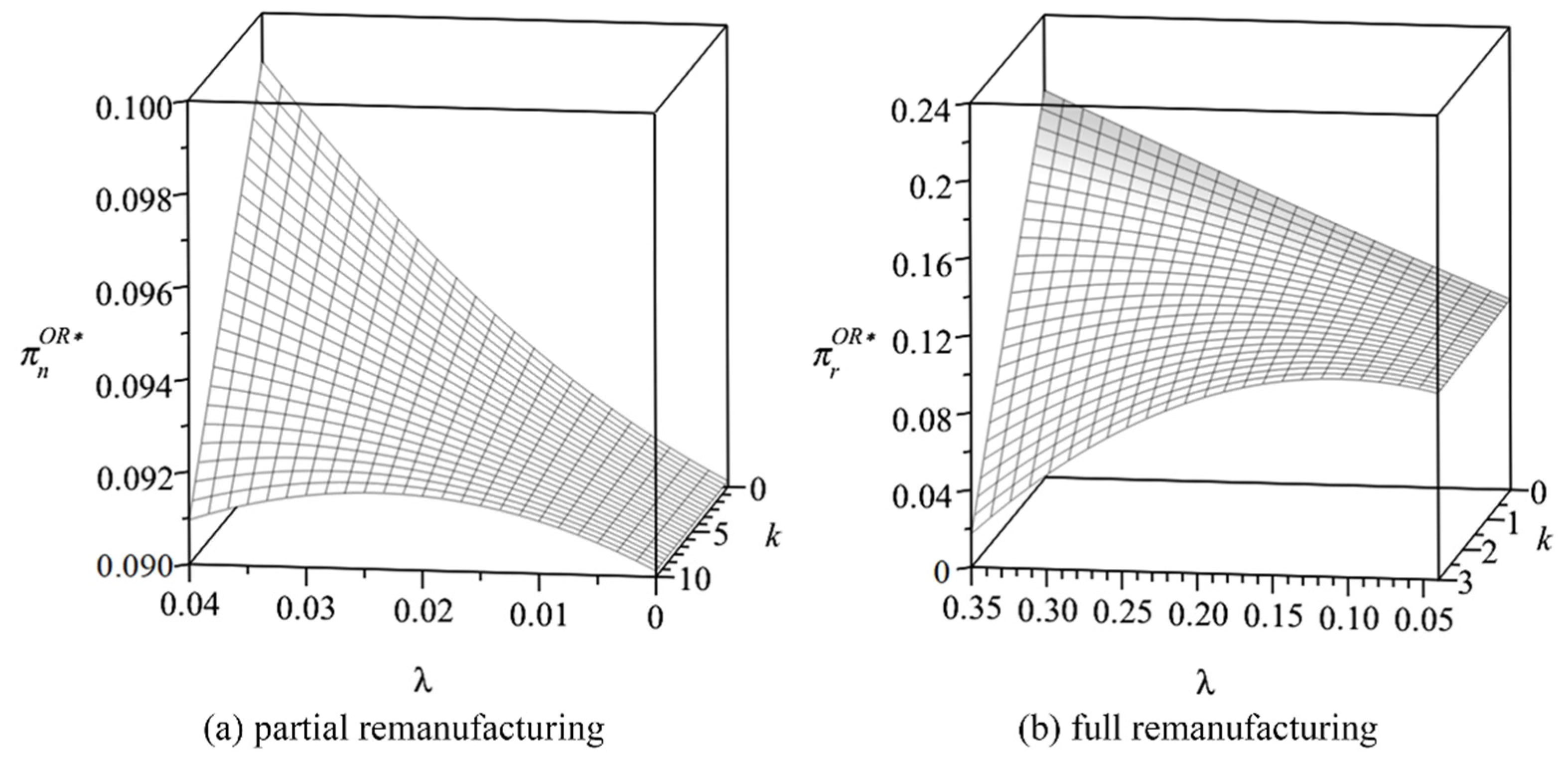
- When the remanufacturer adopts partial remanufacturing,
- (i)
- for the OEM, , , , , ;
- (ii)
- for the remanufacturer, , , .
- (2)
- When the remanufacturer adopts full remanufacturing,
- (i)
- for the OEM, , , , , ;
- (ii)
- for the remanufacturer, , , .
5.3. Environmental Impacts
- (1)
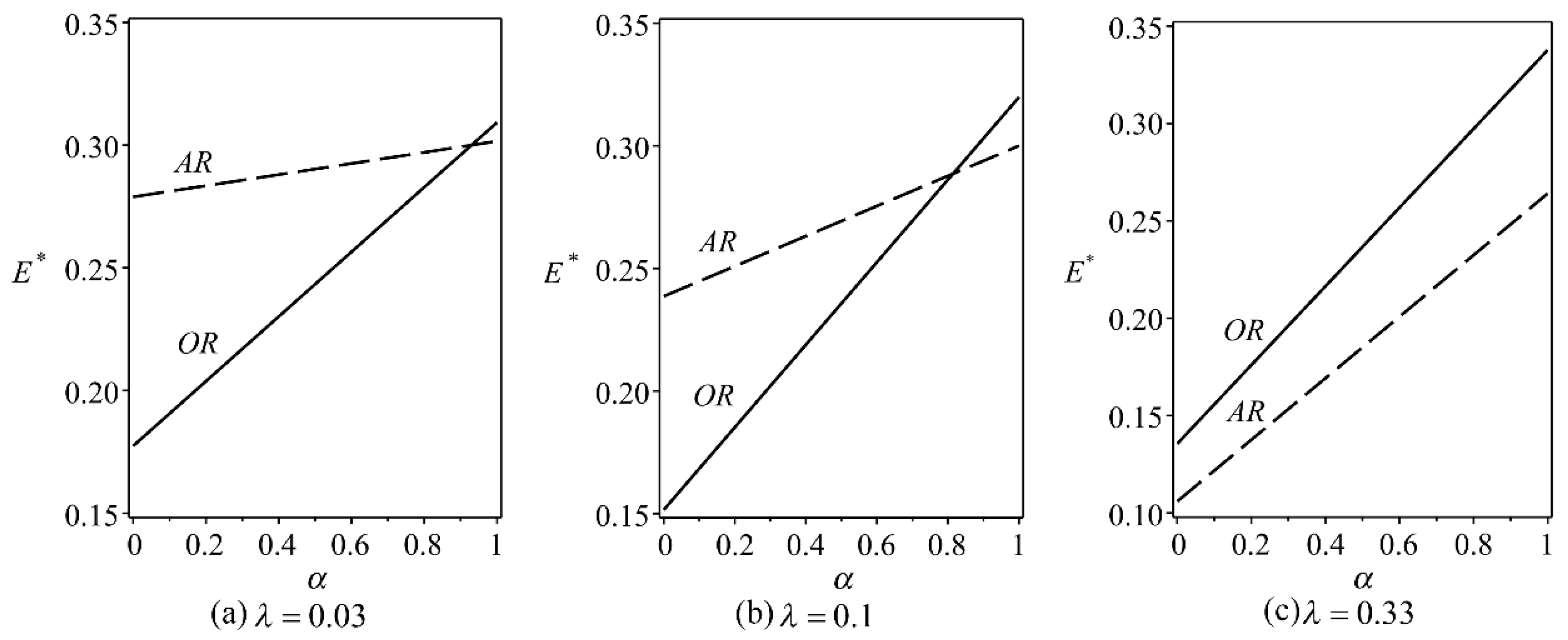
- When , if , ; otherwise, .
- (2)
- When , there exists such that when , ; otherwise, .
- (3)
- When , .
- (1)
- When the remanufacturer adopts partial remanufacturing, there exists such that when , ; otherwise, .
- (2)
- When the remanufacturer adopts full remanufacturing, there exists such that when , ; otherwise, .
6. Conclusions
6.1. Summary and Managerial Implications
- (1)
- The OEM always engages in product innovation for remanufacturing in third-party remanufacturing. However, not all innovation opportunities are valuable. When the industry is highly developed, or investment efficiency is high, the optimal level of innovation is sufficiently high. Conversely, with lower levels of industry development or investment efficiency, the optimal innovation level decreases, demonstrating that more innovation is not always better. Compared to the AR mode, the OR mode offers a wider range of scenarios where product innovation for remanufacturing can generate profits for the OEM.
- (2)
- In both third-party remanufacturing modes, there are certain remanufacturing cost conditions for the remanufacturer to enter the market. Compared with the single market result from Zou et al. [35], this paper discovered three market entry strategies for the remanufacturer. The remanufacturing strategies of the remanufacturer are primarily influenced by consumer preferences and recycling costs. Product innovation for remanufacturing can lower the entry condition for the remanufacturer and increases the likelihood of adopting a full remanufacturing strategy. The conditions for market entry remain the same under both AR and OR modes. However, the OR mode increases the likelihood that remanufacturers will adopt a full remanufacturing strategy.
- (3)
- Although product innovation for remanufacturing can bring profits to the OEM and remanufacturer, it does not consistently reduce environmental impact. In the forward supply chain, increasing the level of product innovation always affects the environment. However, in the reverse supply chain, when remanufactured products are widely accepted by consumers, innovation can reduce the overall environmental impact. When a full remanufacturing strategy is adopted, the OR model results in a higher environmental impact. In addition, as the level of innovation increases, the AR model is initially more environmentally friendly, followed by the OR model becoming more eco-friendly.
6.2. Limitations and Future Research
Author Contributions
Funding
Data Availability Statement
Conflicts of Interest
Abbreviations
| OEM | Original Equipment Manufacturer |
| AR | Authorization Remanufacturing |
| OR | Outsourcing Remanufacturing |
| IR | Independent Remanufacturing |
| ERP | Extended Producer Responsibility |
Appendix A
- If the solutions obtained satisfy the feasibility constraint , then the optimal solutions can be obtained when the remanufacturer is involved in the remanufacturing. When the solutions do not satisfy the feasibility constraint (i.e., ), the optimal solutions can be obtained by enforcing . needs to be higher, so the price of the new products must be lower. The total demand of two types of products is , which is not influenced by . Therefore, we can get . According to the inverse demand function, the new product price can be obtained.
- When , the remanufacturer will not engage in remanufacturing. By solving , the remanufacturing cost threshold () that allows a remanufacturer to enter the market can be obtained. By solving , the remanufacturing cost threshold () that allows a remanufacturer to collect discarded products to remanufacture can be obtained. must also satisfy and . According to the above solution process, Proposition 1 and Proposition 2 can be obtained. □
- For the OEM, if partial remanufacturing strategy is adopted in the AR mode, we can get . Let represent the denominator part:. Here, can be viewed as a function of k. Then, and . Therefore, this expression is first negative and then positive as k increases. When this expression is equal to 0, . As k increases, is first positive and then negative. When , . When and , . Therefore, when , always holds. When , there exists , and if , ; otherwise, . The other case in Proposition 5(1) can be proven by a similar process.
- For the remanufacturer, if partial remanufacturing strategy is adopted in the AR mode, we can get . Both parts of the molecule are greater than 0. Therefore, . The other case in Proposition 5(2) can be proved by a similar process. □
- In the OR mode, when the remanufacturer adopts partial remanufacturing, and
- . As increases, gets smaller and gets larger. Because , , and. We can get . Because , . Because , . Therefore, . When , . When , . So, .
- The proof is like the above when the remanufacturer adopts full remanufacturing. □
- When , . If , ; otherwise, .
- When , we can getThe denominator can be viewed as a function of . The primary term is called , and the constant term is called . and can be further viewed as the functions of . When , and . When , . Therefore, there exist such that when , ; otherwise, , where is the solution to .
- When , . Therefore, . □
- . Both quadratic and primary terms of are greater than 0. The constant term becomes positive and then negative as increases. When , . There exits such that when , ; otherwise, , where is the solution to . The proof in other cases is like the above. □
References
- Liu, B.; Liu, X.; Zhou, T.; Zheng, H.; Jin, X.; Li, K. Research on supply chain optimization under different government subsidy strategies in the remanufacturing-insurance combination system. Expert Syst. Appl. 2026, 304, 130726. [Google Scholar] [CrossRef] [Scilit]
- Huang, Q.; Hou, J.; Shen, H. Remanufacturing and pricing strategies under modular architecture. Comput. Ind. Eng. 2024, 188, 109863. [Google Scholar] [CrossRef] [Scilit]
- Li, W.; Sun, H.; Dong, H.; Gan, Y.; Koh, L. Outsourcing decision-making in global remanufacturing supply chains: The impact of tax and tariff regulations. Eur. J. Oper. Res. 2023, 304, 997–1010. [Google Scholar] [CrossRef] [Scilit]
- Liu, W.; Li, B.; Wang, Z.; Wang, Q.; Chen, Y.; Cheng, Y. Consequence analysis for integrating remanufactured products for social donation (RSD) under mandatory take-back regulation. Comput. Ind. Eng. 2022, 171, 108468. [Google Scholar] [CrossRef] [Scilit]
- Zhu, X.; Zhang, T.; Cao, Y. Managing production and inventory in a remanufacturing supply chain with two classes of cores under consignment stock agreement. Int. Trans. Oper. Res. 2024, 31, 1232–1269. [Google Scholar] [CrossRef] [Scilit]
- Perez, M.; Lieder, M.; Jeong, Y.; Asif, F.M.A. A simulation-based decision support tool for circular manufacturing systems in the automotive industry using electric machines as a remanufacturing case study. Int. J. Prod. Res. 2025, 63, 5899–5918. [Google Scholar] [CrossRef] [Scilit]
- Shi, T.; Chhajed, D.; Wan, Z.; Liu, Y. Distribution channel choice and divisional conflict in remanufacturing operations. Prod. Oper. Manag. 2020, 29, 1702–1719. [Google Scholar] [CrossRef] [Scilit]
- Ma, P.; Li, M. Operational and financing decisions of original equipment manufacturers under third-party remanufacturing modes. Comput. Ind. Eng. 2023, 183, 109508. [Google Scholar] [CrossRef] [Scilit]
- Ding, J.; Chen, W.; Wang, W. Production and carbon emission reduction decisions for remanufacturing firms under carbon tax and take-back legislation. Comput. Ind. Eng. 2020, 143, 106419. [Google Scholar] [CrossRef] [Scilit]
- Wu, X.; Zhou, Y. Buyer-specific versus uniform pricing in a closed-loop supply chain with third-party remanufacturing. Eur. J. Oper. Res. 2019, 273, 548–560. [Google Scholar] [CrossRef] [Scilit]
- Zhang, Y.; Chen, W.; Li, Q. Third-party remanufacturing mode selection for a capital-constrained closed-loop supply chain under financing portfolio. Comput. Ind. Eng. 2021, 157, 107315. [Google Scholar] [CrossRef] [Scilit]
- Xia, X.; Li, J.; Zhao, S. A comparative analysis of carbon tax strategies basing on outsourcing remanufacturing: Differential VS progressive. Int. J. Prod. Econ. 2025, 281, 109501. [Google Scholar] [CrossRef] [Scilit]
- Hong, X.; Govindan, K.; Xu, L.; Du, P. Quantity and collection decisions in a closed-loop supply chain with technology licensing. Eur. J. Oper. Res. 2017, 256, 820–829. [Google Scholar] [CrossRef] [Scilit]
- Ma, P.; Li, J.; Xu, H.; Chen, M. Financing decisions of third-party remanufacturers with different co-opetition modes: The impact of blockchain adoption. Manag. Decis. Econ. 2024, 45, 5054–5076. [Google Scholar] [CrossRef] [Scilit]
- Xia, X.; Chen, J.; Wang, W.; Wang, H. Impact of differentiated carbon taxes on remanufacturing mode selection. Energ. Econ. 2024, 140, 107955. [Google Scholar] [CrossRef] [Scilit]
- Wu, C. Product-design and pricing strategies with remanufacturing. Eur. J. Oper. Res. 2012, 222, 204–215. [Google Scholar] [CrossRef] [Scilit]
- Ghungrad, S.; Molossi, M.; Amico, C.; Cigolini, R.; Haghighi, A. Towards cloud remanufacturing: Economic feasibility of hybrid additive manufacturing-enabled metal component repair. Ann. Oper. Res. 2025. [Google Scholar] [CrossRef] [Scilit]
- Engelmann, F.; Holland, M.; Nigischer, C.; Stjepandic, J. Intellectual property protection and licensing of 3D print with blockchain technology. In Proceedings of the 25th ISPE Inc International Conference on Transdisciplinary Engineering, Modena, Italy, 3–6 July 2018. [Google Scholar]
- Reimann, M.; Xiong, Y.; Zhou, Y. Managing a closed-loop supply chain with process innovation for remanufacturing. Eur. J. Oper. Res. 2019, 276, 510–518. [Google Scholar] [CrossRef] [Scilit]
- Wang, H.; Liu, J.M.; Chen, L. A comparative analysis of government intervention under the EPR system: Eco-design and authorized remanufacturing. Expert Syst. Appl. 2024, 249, 123680. [Google Scholar] [CrossRef] [Scilit]
- Yao, F.-M.; Xie, T.-T.; Yan, Y.-L.; Sun, J.-Y. Recycling decision and corporate social responsibility implement for closed-loop supply chain considering green design under EPR policy. Manag. Decis. Econ. 2024, 45, 4777–4794. [Google Scholar] [CrossRef] [Scilit]
- Genc, T.S.; De Giovanni, P. Closed-loop supply chain games with innovation-led lean programs and sustainability. Int. J. Prod. Econ. 2020, 219, 440–456. [Google Scholar] [CrossRef] [Scilit]
- Chen, H.; Dong, Z.; Li, G.; He, K. Remanufacturing process innovation in closed-loop supply chain under cost-sharing mechanism and different power structures. Comput. Ind. Eng. 2021, 162, 107743. [Google Scholar] [CrossRef] [Scilit]
- Gu, W.; Chhajed, D.; Petruzzi, N.C.; Yalabik, B. Quality design and environmental implications of green consumerism in remanufacturing. Int. J. Prod. Econ. 2015, 162, 55–69. [Google Scholar] [CrossRef] [Scilit]
- Zhou, Q.; Meng, C.; Sheu, J.-B.; Yuen, K.F. Remanufacturing mode and strategic decision: A game-theoretic approach. Int. J. Prod. Econ. 2023, 260, 108841. [Google Scholar] [CrossRef] [Scilit]
- He, J.; Yan, W.; Li, Y.; Lu, D. Recycling and/or reusing: When product innovation meets the recast of WEEE direct. Int. J. Prod. Res. 2024, 62, 7018–7029. [Google Scholar] [CrossRef] [Scilit]
- Zhou, Q.; Meng, C.; Yuen, K.F.; Sheu, J.-B. Remanufacturing authorization strategy for an original equipment manufacturer-contract manufacturer supply chain: Cooperation or competition? Int. J. Prod. Econ. 2021, 240, 108238. [Google Scholar] [CrossRef] [Scilit]
- Qian, Z.; Chai, J.; Li, H.; Yan, W.; Chen, H. Implications of product upgrading confronting supplier remanufacturing. Int. J. Prod. Res. 2020, 58, 5870–5892. [Google Scholar] [CrossRef] [Scilit]
- Galbreth, M.R.; Boyaci, T.; Verter, V. Product reuse in innovative industries. Prod. Oper. Manag. 2013, 22, 1011–1033. [Google Scholar] [CrossRef] [Scilit]
- Zheng, B.; Jin, L. Relicensing scheme selection in closed-loop supply chains with differentiated new and remanufactured products. Comput. Ind. Eng. 2022, 171, 108443. [Google Scholar] [CrossRef] [Scilit]
- Oraiopoulos, N.; Ferguson, M.E.; Toktay, L.B. Relicensing as a secondary market strategy. Manag. Sci. 2012, 58, 1022–1037. [Google Scholar] [CrossRef] [Scilit]
- Zhang, F.; Chen, H.; Xiong, Y.; Yan, W.; Liu, M. Managing collecting or remarketing channels: Different choice for cannibalisation in remanufacturing outsourcing. Int. J. Prod. Res. 2021, 59, 5944–5959. [Google Scholar] [CrossRef] [Scilit]
- Zhou, Q.; Yuen, K.F. An investigation of original equipment manufacturer’s optimal remanufacturing mode and engagement strategy. Int. T. Oper. Res. 2021, 28, 1890–1916. [Google Scholar] [CrossRef] [Scilit]
- Jin, M.; Li, G.; Reimann, M. Team of rivals: How should original equipment manufacturers cooperate with independent remanufacturers via authorisation? Eur. J. Oper. Res. 2022, 296, 837–845. [Google Scholar] [CrossRef] [Scilit]
- Zou, Z.; Wang, J.; Deng, G.; Chen, H. Third-party remanufacturing mode selection: Outsourcing or authorization? Transp. Res. Part E Logist. Transp. Rev. 2016, 87, 1–19. [Google Scholar] [CrossRef] [Scilit]
- Wu, X.; Zhou, Y. Does the entry of third-party remanufacturers always hurt original equipment manufacturers? Decis. Sci. 2016, 47, 762–780. [Google Scholar] [CrossRef] [Scilit]
- Ray, A.; De, A.; Mondal, S.; Wang, J. Selection of best buyback strategy for original equipment manufacturer and independent remanufacturer—Game theoretic approach. Int. J. Prod. Res. 2021, 59, 5495–5524. [Google Scholar] [CrossRef] [Scilit]
- Liu, H.; Lei, M.; Huang, T.; Leong, G.K. Refurbishing authorization strategy in the secondary market for electrical and electronic products. Int. J. Prod. Econ. 2018, 195, 198–209. [Google Scholar] [CrossRef] [Scilit]
- Guo, H.; Lian, X.; Zhang, Y.; Ren, Y.; He, Z.; Zhang, R.; Ding, N. Analysis of environmental policy’s impact on remanufacturing decision under the effect of green network using differential game model. IEEE Access 2020, 8, 115251–115262. [Google Scholar] [CrossRef] [Scilit]
- Wang, Q.; Li, B.; Chen, B.; Wang, Z.; Liu, W.; Cheng, Y. Impact of product design on remanufacturing under environmental legislation. Comput. Ind. Eng. 2022, 165, 107889. [Google Scholar] [CrossRef] [Scilit]
- Joshi, A.D.; Gupta, S.M. Evaluation of design alternatives of End-Of-Life products using internet of things. Int. J. Prod. Econ. 2019, 208, 281–293. [Google Scholar] [CrossRef] [Scilit]
- Liu, Z.; Li, K.W.; Li, B.; Huang, J.; Tang, J. Impact of product-design strategies on the operations of a closed-loop supply chain. Transp. Res. Part E Logist. Transp. Rev. 2019, 124, 75–91. [Google Scholar] [CrossRef] [Scilit]
- Subramanian, R.; Ferguson, M.E.; Toktay, L.B. Remanufacturing and the Component Commonality Decision. Prod. Oper. Manag. 2013, 22, 36–53. [Google Scholar] [CrossRef] [Scilit]
- Tang, J.; Song, A.-L.; Liu, C.-Y.; Liu, Z. Optimal decisions in a remanufacturing supply chain under money-back guarantees. Manag. Decis. Econ. 2023, 44, 2254–2277. [Google Scholar] [CrossRef] [Scilit]
- Qiang, Q. The closed-loop supply chain network with competition and design for remanufactureability. J. Clean. Prod. 2015, 105, 348–356. [Google Scholar] [CrossRef] [Scilit]
- Chai, J.; Qian, Z.; Wang, F.; Zhu, J. Process innovation for green product in a closed loop supply chain with remanufacturing. Ann. Oper. Res. 2021, 333, 533–557. [Google Scholar] [CrossRef] [Scilit]
- Javier Ramirez, F.; Aledo, J.A.; Gamez, J.A.; Pham, D.T. Economic modelling of robotic disassembly in end-of-life product recovery for remanufacturing. Comput. Ind. Eng. 2020, 142, 106339. [Google Scholar] [CrossRef] [Scilit]
- Tozanli, O.; Kongar, E.; Gupta, S.M. Trade-in-to-upgrade as a marketing strategy in disassembly-to-order systems at the edge of blockchain technology. Int. J. Prod. Res. 2020, 58, 7183–7200. [Google Scholar] [CrossRef] [Scilit]
- Wu, X.; Zhou, Y. The optimal reverse channel choice under supply chain competition. Eur. J. Oper. Res. 2017, 259, 63–66. [Google Scholar] [CrossRef] [Scilit]
- Gilbert, S.M.; Cvsa, V. Strategic commitment to price to stimulate downstream innovation in a supply chain. Eur. J. Oper. Res. 2003, 150, 617–639. [Google Scholar] [CrossRef] [Scilit]
- Jin, M.; Nie, J.; Yang, F.; Zhou, Y. The impact of third-party remanufacturing on the forward supply chain: A blessing or a curse? Int. J. Prod. Res. 2017, 55, 6871–6882. [Google Scholar] [CrossRef] [Scilit]
- Chen, Y.; Chen, F. On the competition between two modes of product recovery: Remanufacturing and refurbishing. Prod. Oper. Manag. 2019, 28, 2983–3001. [Google Scholar] [CrossRef] [Scilit]



| Papers | Third-Party Remanufacturing | OEM Remanufacturing | Product Innovation for Remanufacturing | Process Innovation for Remanufacturing | ||
|---|---|---|---|---|---|---|
| AR | OR | IR | ||||
| Reimann et al. [19] | √ | √ | ||||
| Chen et al. [23] | √ | √ | ||||
| Chai et al. [46] | √ | √ | ||||
| Wu [16] | √ | √ | ||||
| Qiang et al. [45] | √ | √ | ||||
| Liu et al. [42] | √ | √ | ||||
| Gu [24] | √ | √ | ||||
| Wang et al. [20] | √ | √ | ||||
| Zou et al. [35] | √ | √ | ||||
| This paper | √ | √ | √ | |||
| Parameters | |
|---|---|
| Unit cost of new/remanufactured products | |
| Recovery cost coefficient | |
| The level of product innovation for remanufacturing | |
| k | Innovation cost coefficient |
| The willingness of consumers to buy a new product | |
| The net utility of purchasing new/remanufactured products | |
| Consumer’s value discount coefficient for remanufactured products, | |
| Environmental impact of the remanufactured product (new product = 1) | |
| Profit of the OEM/remanufacturer | |
| * | A superscript denoting the optimal value |
| L | A superscript denoting a different model, L = (AR, OR) |
| Decision variables | |
| Quantity of new/remanufactured products | |
| Unit price of new/remanufactured products | |
| Recovery rate | |
| Unit authorization fee | |
| Unit outsourcing fee | |
| Conditions | Remanufacturing Strategy | ||
|---|---|---|---|
| No, Partial | |||
| Partial | |||
| No, Partial, Full | |||
| Partial, Full | |||
| Full | |||
| No, Partial | |||
| Partial | |||
| Partial, Full | |||
| Full | |||
| No, Partial | |||
| Partial | |||
| Region | ||
|---|---|---|
| 1 | ||
| Conditions | Remanufacturing Strategy | ||
|---|---|---|---|
| No, Partial | |||
| Partial | |||
| No, Partial, Full | |||
| Partial, Full | |||
| Full | |||
| No, Partial | |||
| Partial | |||
| Partial, Full | |||
| Full | |||
| No, Partial | |||
| Partial | |||
| Region | ||
|---|---|---|
| 1 | ||
Disclaimer/Publisher’s Note: The statements, opinions and data contained in all publications are solely those of the individual author(s) and contributor(s) and not of MDPI and/or the editor(s). MDPI and/or the editor(s) disclaim responsibility for any injury to people or property resulting from any ideas, methods, instructions or products referred to in the content. |
© 2026 by the authors. Licensee MDPI, Basel, Switzerland. This article is an open access article distributed under the terms and conditions of the Creative Commons Attribution (CC BY) license.
Share and Cite
Du, D.; Wu, A. Product Innovation for Remanufacturing in the Closed-Loop Supply Chain with Third-Party Remanufacturing. Systems 2026, 14, 131. https://doi.org/10.3390/systems14020131
Du D, Wu A. Product Innovation for Remanufacturing in the Closed-Loop Supply Chain with Third-Party Remanufacturing. Systems. 2026; 14(2):131. https://doi.org/10.3390/systems14020131
Chicago/Turabian StyleDu, Danyang, and Aiping Wu. 2026. "Product Innovation for Remanufacturing in the Closed-Loop Supply Chain with Third-Party Remanufacturing" Systems 14, no. 2: 131. https://doi.org/10.3390/systems14020131
APA StyleDu, D., & Wu, A. (2026). Product Innovation for Remanufacturing in the Closed-Loop Supply Chain with Third-Party Remanufacturing. Systems, 14(2), 131. https://doi.org/10.3390/systems14020131