


Abstract
This study investigates the evolutionary game dynamics of medical knowledge sharing (KS) among Chinese hospitals under government regulation, focusing on the strategic interactions between general hospitals, community health service centers, and governmental bodies. Leveraging evolutionary game theory, we construct a tripartite evolutionary game model incorporating replicator dynamics to characterize the strategic evolution of the involved parties. Our analysis examines the regulatory decisions of the government and the strategic choices of Chinese hospitals, considering critical factors such as KS costs, synergistic benefits, government incentives and penalties, and patient evaluations. The model is analyzed using replicator dynamic equations to derive evolutionary stable strategies (ESSs), complemented by numerical simulations for sensitivity analysis. Key findings reveal that the system’s equilibrium depends on the balance between KS benefits and costs, with government regulation and patient evaluations significantly influencing Chinese hospital behaviors. The results highlight that increasing government incentives and penalties, alongside enhancing patient feedback mechanisms, can effectively promote KS. However, excessive incentives may reduce willingness to regulate, suggesting the need for balanced policy design. This research provides novel theoretical insights and practical recommendations by (1) pioneering the application of a tripartite evolutionary game framework to model KS dynamics in China’s hierarchical healthcare system under government oversight, (2) explicitly integrating the dual influences of government regulation and patient evaluations on hospital strategies, and (3) revealing the non-linear effects of policy instruments. These contributions are crucial for optimizing Chinese medical resource allocation and fostering sustainable collaborative healthcare ecosystems.
1. Introduction
In recent years, the rapid advancement of information technology and the evolving medical needs in China have significantly enhanced the medical and health service system [1,2]. However, this improvement is often accompanied by challenges, such as widespread disparities in the quality of primary healthcare (PHC) and the uneven distribution of medical resources [3,4,5]. This disparity has resulted in a relative surplus of resources in general hospitals, while community health service centers face a shortage of essential services. To address these issues, the government has actively promoted the establishment of regional medical consortia and facilitated the creation of medical data knowledge-sharing (KS) platforms, such as the Shenkang Hospital Development Center in the city of Shanghai in China, to foster collaboration and trust among hospitals [6,7]. For general hospitals, medical KS can alleviate the pressure of patient consultations and broaden the impact of their services. Conversely, for community health service centers, medical KS can effectively address the health needs of local residents. Additionally, by regulating KS among hospitals, the government can enhance the quality of healthcare services in rural areas, ultimately yielding improved social benefits.
However, several obstacles continue to hinder KS behaviors between Chinese hospitals in the current healthcare environment in China [8,9]. Against the backdrop of China’s efforts to promote hierarchical diagnosis and treatment systems and equitable medical resource distribution, the government has implemented policies such as medical consortia and “Internet + Healthcare” initiatives to facilitate KS among hospitals of different tiers. For instance, the 2017 Guidelines on Promoting Medical Consortium Development mandated resource sharing between tertiary and primary hospitals. Despite these measures, challenges persist due to inter-hospital competition and uneven policy implementation. The government, as the primary entity responsible for fostering medical KS, must balance the pursuit of long-term national interests with the financial investments required in human and material resources [10,11]. Regulatory tools like performance-linked funding (e.g., tying KS participation to hospital accreditation) and subsidies for cross-institutional training aim to align incentives. However, as a result, all parties involved in the KS process face complex trade-offs—hospitals weigh operational costs against potential benefits like reputational gains, while regulators must optimize oversight without stifling institutional autonomy. This dynamic not only reflects the internal considerations of hospitals regarding costs and benefits but also underscores the necessity for adaptive government regulation to sustain collaborative ecosystems.
This paper aims to thoroughly investigate the evolutionary game process of medical KS among hospitals of different levels under government regulation. This study concentrates on the regulatory decisions made by the government, as well as the strategic choices and evolutionary trajectories of hospitals at different levels in the context of medical KS. An evolutionary game model including three key participants, i.e., a general hospital, a community health service center, and the government, is constructed. By solving the replicator dynamic equations, an in-depth analysis of the evolutionary stabilization strategies employed by each party involved in medical KS is conducted.
The main contribution of this paper lies in three aspects. Firstly, we propose the first evolutionary game model that captures the tripartite dynamics among general hospitals, community health centers, and government entities in KS. Unlike prior studies limited to dyadic interactions, our framework reveals emergent complexities arising from multi-agent strategic interdependence, offering a new theoretical lens for analyzing hierarchical healthcare systems. Secondly, this study innovatively integrates patient evaluations as a dual mechanism influencing both hospital decision-making and regulatory strategies, bridging a critical gap in the existing literature that often overlooks patient-centric feedback. Finally, by combining replicator dynamics with scenario-based simulations, this research quantifies the impact of incentive–penalty equilibrium and cost–benefit thresholds, offering actionable insights for designing balanced policies to optimize KS efficiency. These contributions advance evolutionary game theory in healthcare contexts and provide a practical framework for policymakers to enhance collaborative ecosystems while mitigating regulatory overreach.
The rest of this paper is organized as follows. Section 2 provides a comprehensive overview of the relevant literature. Section 3 develops a tripartite evolutionary game model based on theoretical assumptions. Section 4 provides an in-depth discussion of evolutionary stable strategies among the three subjects. Section 5 conducts numerical simulations to validate the stability strategies and performs sensitivity analysis. Finally, Section 6 proposes countermeasures and recommendations for promoting KS behaviors among hospitals of different levels under government regulation.
2. Literature Review
2.1. Medical KS Level
As a crucial method to optimize the allocation of medical resources, enhance service quality, and boost technological innovation, medical KS is highly valuable in tackling public health challenges [12,13]. For example, the sharing of chest imaging data in transnational cooperation has notably improved the diagnosis and treatment of the patients of COVID-19 [14]. However, there are multiple complex obstacles in this process: the knowledge base of each entity, the degree of trust, KS capabilities, and the capacity for knowledge absorption and learning [15,16], along with practical obstacles like knowledge disparities, synergy capabilities, and sharing costs and risks, leading to obvious game characteristics in cross-institutional KS [17]. This game behavior underscores the essential role of government participation. It decides to regulate sharing behavior or not and prominently affects the sharing decision of hospitals this way, realizing the co-evolution of the medical ecosystem [18].
2.2. Application of Evolutionary Games in the Medical Area
In recent years, the wide application of the evolutionary game theory in mechanism design and behavioral analysis in the medical area has been witnessed, as it can explain the characteristics of long-term strategic interaction and the dynamic adjustment of subjects [19,20,21]. This theory, by simulating the strategic evolution process of limited rational subjects, provides a dynamic analysis framework for analyzing issues like the balance of interests of multiple parties and the stability of cooperation mechanisms in complex medical systems. For example, Tian et al. built a three-party evolutionary game model of “government-hospital-patient”, which unveiled the long-term strategic evolution mechanism of vertical integration core participants in the construction of medical treatment alliances and the dynamic effect of policy tools and profit distribution on the strategic choices of each subject [22]. In the field of doctor–patient relationship studies, Liu et al. focused on intersubjectivity in the diagnosis and treatment scenario, and verified the inhibiting effect of a lack of trust, information asymmetry, and moral hazard on medical cooperation utilizing the evolutionary game model, putting forward that the trust repair strategy based on reputation feedback can markedly improve the convergence direction of strategy evolution [23]. Ouyang et al. built a three-party evolutionary game model to simulate the strategic evolution of the government, media, and the public at different stages of the COVID-19 pandemic, and showcased the decision-making support value of the dynamic equilibrium strategy for the prevention and control of public health events, providing a methodological reference for the study of interest games in medical collaboration scenarios [24]. Yuan et al., by building a three-party evolutionary game model of government non-profit organizations, hospitals, and the government, found out the key approach of improving the emergency medical supplies distribution strategy with the evolutionary game theory under the condition of information asymmetry, providing a game theory decision-making framework for the scientific allocation of medical resources in public health crises like COVID-19 [25].
What is noteworthy is that the application of evolutionary game theory in the specific field of medical KS further gives prominence to its analytical advantages in the compatibility of incentive mechanisms and system stability. In this aspect of studies, Dong et al. built an evolutionary game model of leading hospitals and grassroots medical institutions for the governance scenario of county-level medical communities and proved that the collaborative design of government financial subsidies and performance evaluation can break through the “low-level equilibrium trap” of KS [26].
2.3. The Influence of Government Regulation
In the process of deepening China’s healthcare system reform, the government has prioritized institutional KS and collaborative development among medical institutions as a key strategic direction. Notably, the implementation of the Data Security Law and the Personal Information Protection Law in 2021 established a data security regulatory framework for medical KS. Through a classified and tiered authorization system for medical data, this framework facilitates information exchange while safeguarding privacy. These practices reflect the Chinese government’s governance approach of continuously optimizing healthcare resource allocation efficiency and collaborative innovation capabilities through multi-pronged policy tools, including legal constraints.
Government regulation directly affects the efficiency of Chinese hospital collaboration in the medical area with policy design and dynamic adjustment mechanisms, and the core lies in balancing individual interests and social benefits [27,28]. According to these studies, the collaborative design of differentiation incentives and penalties is a key strategy. For example, Tian et al. found that the efficiency of vertical integration of electronic health records (EHRs) within medical alliances hinges on the matching of government subsidies and regulatory rules: moderate incentives can shape up a positive feedback loop of “policy guidance-resource sharing”, while excessive intervention inhibits hospital autonomy [22]. Qi et al. collected the literature on government regulations (GRs) in healthcare following the PRISMA guidelines and conducted a quantitative analysis of these documents with the VOSviewer software, pinpointing the critical role of GRs in healthcare [29]. Applying a three-party evolutionary game model, Li et al. analyzed the strategic interaction between family doctors, community residents, and general hospitals under the influence of economic factors, concluding that the government must give priority to motivating general hospitals to participate via compensation mechanisms to propel the development of the family doctor service system [30].
The influence of government regulation has also been validated in other fields [31,32]: Zhou et al. proved that the government must reinforce the reward and punishment mechanism to encourage companies to meet the standards of emission and public participation with the “wastewater enterprise-government-public” three-party evolutionary game model, but excessive rewards must be avoided, which reduce the government’s incentive willingness [33]. Also, the reduction in enterprise costs can contribute to standard emissions; Zhai et al. further pointed out in a study of green collaborative innovation in the manufacturing industry that the improvement of government supervision intensity can secondhand facilitate cross-subject cooperation by enhancing trust between enterprises [34].
It is found through the literature review that there is a lack of quantitative studies on the KS behavior among hospitals of different levels under government supervision. The current study objects of KS are mainly concentrated in the areas of supply chain companies, online health communities, and virtual teams [35,36,37,38]. As such, this paper, taking KS between hospitals under government supervision as the research object, studies the sharing willingness between hospitals of different levels and the government’s willingness to regulate with the evolutionary game theory. Further, taking into consideration multiple factors like patient evaluation, the strategy results among hospitals of different levels under government regulation are discussed. Then, the mechanism of the influence of changes in influencing factors on the three parties is explored with simulation experiments, intending to find strategies that can promote cooperation among general hospitals, community health service centers, and the government. A theoretical reference for the government to drive forward the healthy development of the medical service market and the optimal allocation of medical resources is provided, and a basis for the cooperative and competitive decision-making of general hospitals and community health service centers is offered.
3. Problem Description and Model Construction
3.1. Problem Description
In the context of hospitals, KS presents a duality of benefits and challenges. On the one hand, KS facilitates the dissemination of medical research findings and diagnostic information, which can enhance the overall medical capabilities of hospitals and promote the efficient utilization of medical resources. On the other hand, it incurs certain costs and risks, including direct expenses associated with the explicit or implicit sharing of medical knowledge, as well as indirect losses stemming from reduced examination revenues due to the reuse of patient examination data. Consequently, both general hospitals and community health service centers must exercise discretion in their decision to share medical knowledge, aiming to maximize their respective benefits. From the government’s perspective—encompassing various regulatory bodies such as the Ministry of Health, the Food and Drug Administration, and the Ministry of Finance—it is crucial to support medical KS initiatives. To safeguard long-term national interests and enhance social benefits, such as improving the overall level of medical services and optimizing the allocation of medical resources, the government should play a proactive regulatory role in the initial stages of hospital KS. This includes establishing appropriate incentive and penalty mechanisms to encourage KS among hospitals of different levels.
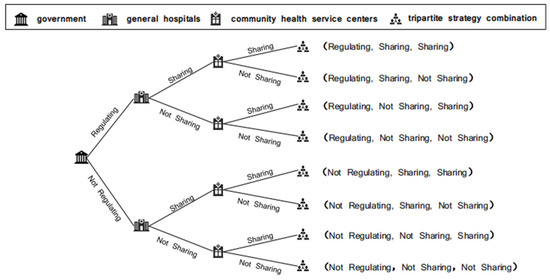
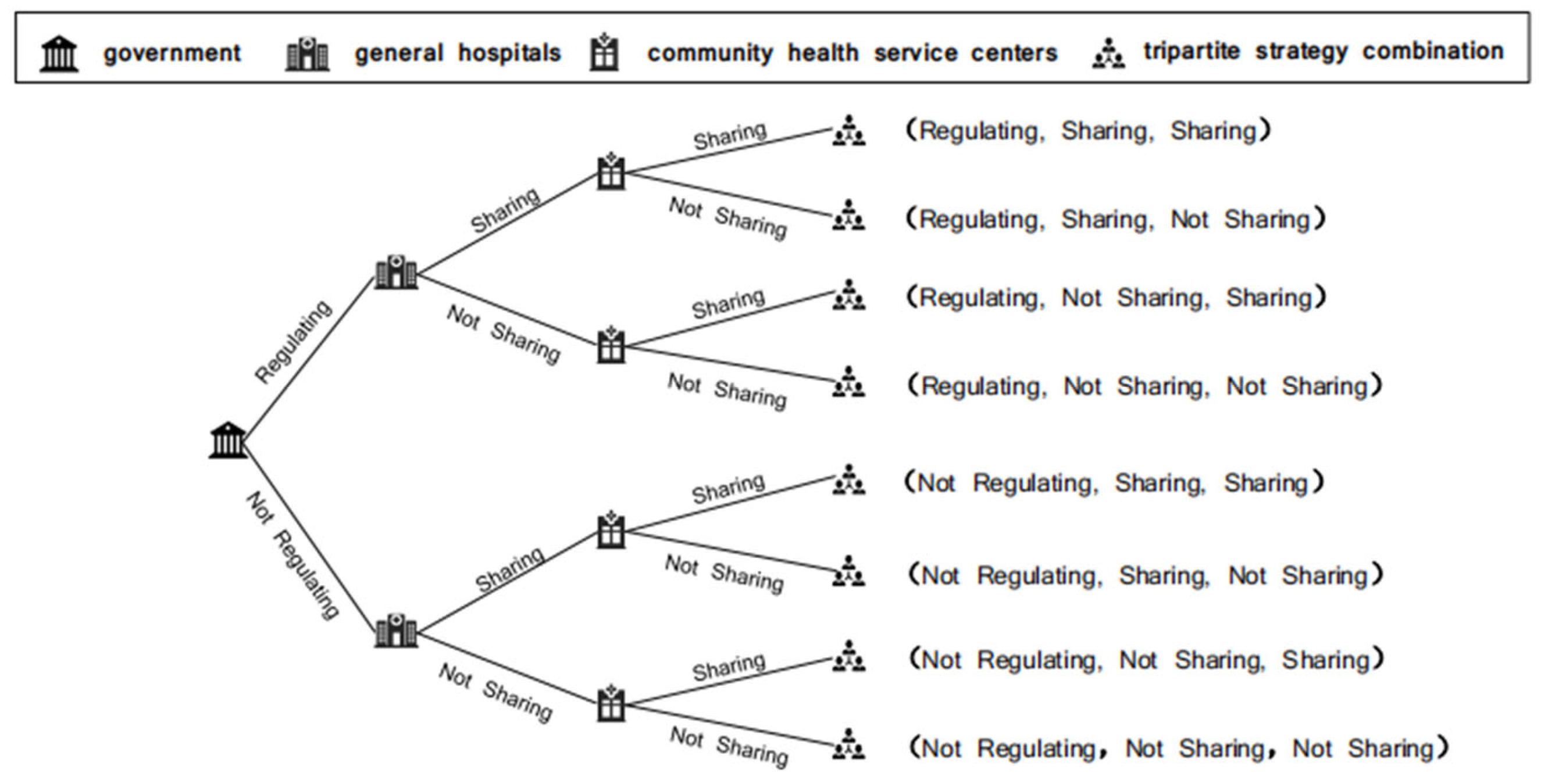
In summary, governmental entities must take into account the interdependencies of their strategies and carefully balance their own interests with broader social benefits when developing regulatory frameworks and deciding on the implementation of KS strategies. Consequently, the behavioral choices of general hospitals and community health service centers can be categorized as either {Sharing, Not Sharing}, while governmental decisions can be classified as {Regulating, Not Regulating}. The interactions among these three stakeholders create a dynamic interplay, leading to a gradual attainment of equilibrium through continuous evolution. This logical relationship is illustrated in Figure 1.
Figure 1.
Logistic diagram of the tripartite evolutionary game model. Note: This figure illustrates the logic of interaction among the government, general hospitals, and community health service centers during the evolutionary game, and all possible combinations of strategies between them.
Therefore, this paper aims to address the following key research questions:
- RQ1: What are the ESS choices and preferences of the three parties (general hospitals, community health centers, and government) in the medical KS game under government regulation?
- RQ2: How do critical factors—such as sharing costs, synergistic benefits, government incentives and penalties, and patient evaluations—influence the strategic choices and evolutionary paths of each party?
- RQ3: What is the role of government regulation in this process, and how can regulatory policies be designed to effectively promote sustainable KS among hospitals of different levels?
3.2. Model Assumptions and Construction
3.2.1. Model Assumptions
Recognizing the disparities in KS strategies among hospitals of different levels and the government, this study integrates multiple factors into the benefit function of KS among the government, one general hospital, and one community health service center. These factors include basic benefits, direct benefits of KS, knowledge aggregation benefits, knowledge synergy benefits, rewards and punishments, and sharing costs. This integration is grounded in the research findings of Ma et al. [39] and Gao et al. [40], as well as the prevailing conditions of healthcare institutions in China. The following fundamental assumptions are established for the model:
Assumption 1.
The general hospital adopts the “Sharing” strategy with probability and the “Not Sharing” strategy with probability ; the community health service center adopts the “Sharing” strategy with probability and the “Not Sharing” strategy with probability ; the government adopts the “Regulating” strategy with probability and the “Not Regulating” strategy with probability . Here, .
Assumption 2.
When adopting the “Regulating” strategy, the government incurs a fixed regulatory cost (covering manpower and material resources). It provides rewards to hospitals that adopt the “Sharing” strategy, and the reward benefits for the general hospital and the community health service center are denoted as and , respectively. Conversely, hospitals adopting the “Not Sharing” strategy face punishment from the government, and the punishment costs are denoted as for the general hospital and for the community health service center.
Assumption 3.
The government adopts the “Not Regulating” strategy; its basic benefit is
. At the same time, the general hospital and the community health service center will not be able to obtain the benefit of rewards or punishment from the government in the process of KS.
Assumption 4.
When hospitals adopt the “Sharing” strategy, the KS costs paid by the general hospital and the community health service center are denoted as and , respectively. The direct benefits obtained from KS by the general hospital and the community health service center are denoted asand , respectively, indicating the knowledge directly acquired from each other. The knowledge aggregation benefits are denoted as and , referring to the process through which each hospital integrates and digests the acquired knowledge based on its existing knowledge structure, thereby creating new knowledge. The synergistic benefits of KS are denoted as and , which refer to the gains achieved through collaboration based on the knowledge shared between the two subjects, facilitated by continuous communication, exchange, cooperation, and feedback. In addition, KS between hospitals of different levels helps optimize the allocation of medical resources and improve the overall level of medical services in society, thus enabling the government to obtain certain social and economic benefits. It is assumed that when the general hospital adopts the “Sharing” strategy and the community health service center adopts the “Not Sharing” strategy, the social and economic benefits are denoted as ; when the general hospital adopts the “Not Sharing” strategy and the community health service center adopts the “Sharing” strategy, the social and economic benefits are denoted as; when both the general hospital and the community health service center adopt the “Sharing” strategies, the social and economic benefits are denoted as , and .
Assumption 5.
Both the general hospital and the community health service center adopt the “Not Sharing” strategy, and their basic benefits are denoted as and , respectively. At the same time, the government will not be able to derive socio-economic benefits from it.
Assumption 6.
The patient, as the service object of the hospital subject and also the focus of attention of the government subject, has a medical experience that is highly valued by both parties. Therefore, patient evaluation is an important factor influencing the decision-making of hospitals and the government. It is assumed that when the general hospital and the community health service center adopt the “Sharing” strategies, patients perceive integrated services (such as seamless referrals and coherent treatment), which enhances trust and satisfaction. This directly translates into benefit for the general hospital (improved medical efficiency) and benefit for the community health service center (strengthened grassroots reputation). Conversely, when the “Not Sharing” strategy is adopted, patients experience service fragmentation (such as repeated tests and treatment discontinuity), leading to dissatisfaction and a crisis of trust. This results in Loss for the general hospital (complaint costs and reputational damage) and Loss for the community health service center (patient attrition and erosion of public trust). In addition, if the government adopts the “Regulating” strategy in the process of KS, the patients tend to believe that the government actively performs its duties, which enhances the sense of trust and acceptance, and thus improves the government’s image and reputation, which can be regarded as benefits gained by the government, denoted as . On the contrary, if the government adopts the “Not Regulating” strategy, this may be regarded as inaction by the patients, which leads to a decline in trust, damage to reputation, and may accumulate to trigger a certain degree of social dissatisfaction and instability, and this part of the loss can be regarded as punishment costs paid by the government, denoted as .
In summary, Table A1 in Appendix A lists the parameters and their definitions for the tripartite evolutionary game model analyzing KS behaviors among Chinese hospitals of different levels under government regulation.
3.2.2. Model Construction
When the general hospital and the community health service center engage in the KS game, different strategy combinations will not only affect the benefits of both parties, but will also be subject to the intervention and regulation of the government. The strategy space of both the general hospital and the community health service center is {Sharing, Not Sharing}, and the strategy space of the government is {Regulating, Not Regulating}. This generates eight possible strategy combinations as follows:
- Strategy Combination 1: (Sharing, Sharing, Regulating). Both hospitals adopt the “Sharing” strategy and the government adopts the “Regulating” strategy.
- Strategy Combination 2: (Sharing, Not Sharing, Regulating). The general hospital adopts the “Sharing” strategy, the community health service center adopts the “Not Sharing” strategy, and the government adopts the “Regulating” strategy.
- Strategy Combination 3: (Not Sharing, Sharing, Regulating). The general hospital adopts the “Not Sharing” strategy, the community health service center adopts the “Sharing” strategy, and the government adopts the “Regulating” strategy.
- Strategy Combination 4: (Not Sharing, Not Sharing, Regulating). Both hospitals adopt the “Not Sharing” strategy and the government adopts the “Regulating” strategy.
- Strategy Combination 5: (Sharing, Sharing, Not Regulating). Both hospitals adopt the “Sharing” strategy and the government adopts the “Not Regulating” strategy.
- Strategy Combination 6: (Sharing, Not Sharing, Not Regulating). The general hospital adopts the “Sharing” strategy, the community health service center adopts the “Not Sharing” strategy, and the government adopts the “Not Regulating” strategy.
- Strategy Combination 7: (Not Sharing, Sharing, Not Regulating). The general hospital adopts the “Not Sharing” strategy, the community health service center adopts the “Sharing” strategy, and the government adopts the “Not Regulating” strategy.
- Strategy Combination 8: (Not Sharing, Not Sharing, Not Regulating). Both hospitals adopt the “Not Sharing” strategy and the government adopts the “Not Regulating” strategy.
The game payoff matrix of the three subjects—the general hospital, the community health service center, and the government—is shown in Table 1.
Table 1.
Tripartite game payoff matrix.
4. Replicator Dynamic Equation
According to Table 2, the expected revenue for the general hospital when adopting the “Sharing” strategy is as follows:
Table 2.
Results of the system equilibrium point stability analysis.
The expected revenue for the general hospital when adopting the “Not Sharing” strategy is as follows:
The average expected revenue for the general hospital when adopting the “Sharing” strategy (with probability ) and the “Not Sharing” strategy (with probability ), respectively, is as follows:
Similarly, the expected revenue for the community health service center when adopting the “Sharing” strategy is as follows:
The expected revenue for the community health service center when adopting the “Not Sharing” strategy is as follows:
The average expected revenue for the community health service center when adopting the “Sharing” strategy (with probability ) and the “Not Sharing” strategy (with probability ), respectively, is as follows:
Similarly, the average expected revenue for the government when adopting “Regulating” strategy is as follows:
The expected revenue for the government when adopting “Not Regulating” strategy is as follows:
The average expected revenue for the government when adopting the “Regulating” (with probability ) strategy and “Not Regulating” strategy (with probability ), respectively, is as follows:
The replicator dynamics equations of the general hospital, the community health service center, and the government can be combined to derive the system of replicator dynamics equations for the tripartite evolutionary game system, as illustrated in Equation (10).
5. Evolutionary Stability Analysis
5.1. Stability Analysis of Subject Strategies
According to the stability theorem of evolutionary game theory, each of the three subjects—the general hospital, the community health service center, and the government—adopts an evolutionarily stable strategy (ESS) if and ; and ; and and .
- (1)
- Strategy stability analysis of the general hospital
The derivation of is obtained as follows:
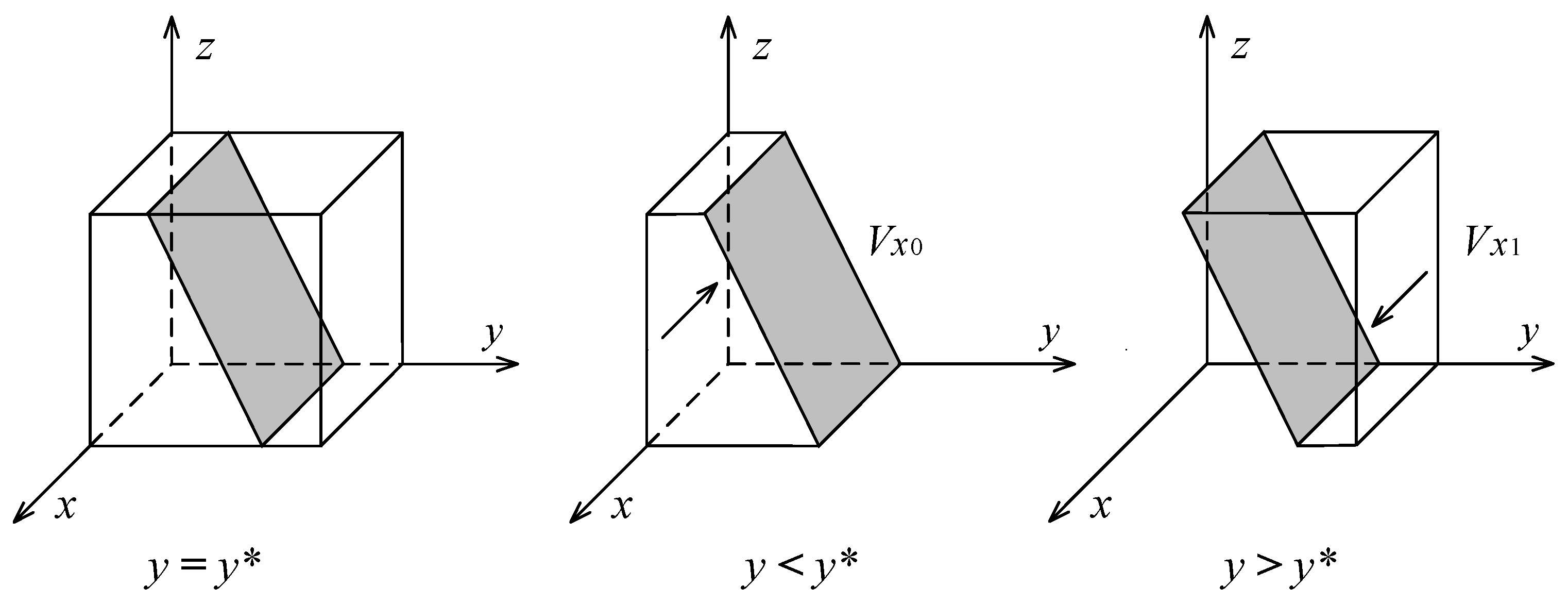
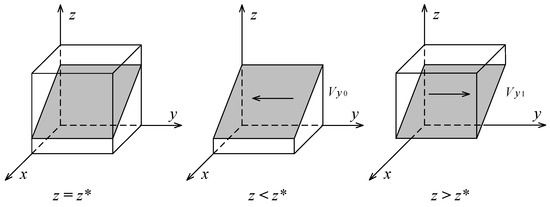
Let . According to the stability theorem of differential equations, the probability that the general hospital adopts the “Sharing” strategy is in a stable state only when and . Therefore, when , , and , which means that the general hospital cannot obtain the ESS; when and , , , and is a stable point, the “Not Sharing” strategy is the ESS for the general hospital; when and , at this time we have and , the stable point is , then “Sharing” strategy is the ESS of the general hospital. In summary, the strategy evolution phase diagram of the general hospital is shown in Figure 2.
Figure 2.
Strategy evolution phase diagram of the general hospital.
From the phase diagram in Figure 2, the initial strategy probabilities of the general hospital— (representing adoption of the “Not Sharing” strategy) and (representing adoption of the “Sharing” strategy)—are related to , and are calculated as follows:
Corollary 1.
The probability of adopting the “Sharing” strategy of general hospitals is negatively related to KS costs; it is positively related to synergistic benefits of KS, government reward benefits and punishment costs, and patient evaluation reward benefits and punishment costs.
Proof.
According to the probability formula for adopting the “Sharing” strategy in the general hospital, the first-order partial derivatives of the influencing factors are found to be .Therefore, an increase in , or a decrease in , all can increase the probability of adopting the “Sharing” strategy in the general hospital. □
Corollary 2.
In the process of KS, the probability of the general hospital engaging in KS increases with the KS rate of the community health service and the regulatory intensity of the government.
Proof.
From the stability analysis of the general hospital strategy, when and , the stable point is , , , and the general hospital tends to the “Sharing” strategy; conversely, is the ESS. Therefore, with the gradual increase of y and z, the stabilization strategy of the general hospital gradually evolves from (Not Sharing) to (Sharing). □
- (2)
- Strategy stability analysis of the community health service center
The derivation of is obtained as follows:
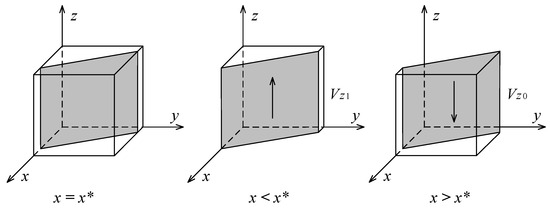
Let . According to the stability theorem of the differential equation, the probability that the community health service center adopting the “Sharing” strategy is in a stable state must satisfy and . Therefore, when , , at this time, . This means that the community health service center cannot determine the ESS; when , , at this time, is the stable point, and the “Not Sharing” is the ESS of the community health service center; when , , at this time, the stable point is ; then, “Sharing” is the ESS of the community health service center. In summary, the strategy evolution phase diagram of the community health service center is shown in Figure 3.
Figure 3.
Strategy evolution phase diagram of the community health service center.
From the phase diagram in Figure 3, the initial strategy probabilities of the community health service center— (representing adoption of the “Not Sharing” strategy) and (representing adoption of the “Sharing” strategy)—are related to , and are calculated as follows:
Corollary 3.
The probability of KS in the community health service centers is negatively related to the cost of KS; it is positively related to the synergistic benefits of KS, government reward benefits and punishment costs, and patient evaluation reward benefits and punishment costs.
Proof.
According to the probability formula for KS in the community health service center, the first-order partial derivatives of the influencing factors are obtained as follows: . Therefore, an increase in or a decrease in can increase the probability of adopting the “Sharing” strategy in the community health service center. □
Corollary 4.
The probability of KS by community health service centers in the KS process increases with the increase in the rate of KS by the general hospital and the rate of regulation by the government.
Proof
. According to the community health service center strategy stability analysis, when ,, the stability point is , and the community health service center tends to the KS strategy; conversely, is the ESS. Therefore, as and increase, the stabilization strategy of community health service center gradually evolves from (Not Sharing) to (Sharing). □
- (3)
- Strategy stability analysis of the government
The derivation of F(z) is obtained as follows:
Let . According to the stability theorem of differential equations, the probability of the government adopting the “Regulating” strategy is in a stable state and must satisfy and . Thus, when , at this time, , which means that the government cannot determine the ESS; when and , the stable point is ; then, the “Not Regulating” strategy is the ESS of the government.
In summary, the strategy evolution phase diagram of the government is shown in Figure 4.
Figure 4.
Strategy evolution phase diagram of the government.
From the phase diagram in Figure 4, the initial strategy probabilities of the government— (representing adoption of the “Not Regulating” strategy) and (representing adoption of the “Regulating” strategy)—are related to , and are calculated as follows:
Corollary 5.
The probability of the government adopting the “Regulating” strategy is negatively related to regulatory costs and incentive fiscal expenditures, and positively related to patient evaluation reward benefits and punishment costs and punitive fiscal revenues.
Proof.
According to the probability formula for adopting the “Regulating” strategy by the government, the first-order partial derivatives of the influencing factors are found to be . Thus, an increase in and or a decrease in can increase the probability that the government adopts the “Regulating” strategy. □
Corollary 6.
In the process of KS, the probability of the government adopting the “Regulating” strategy decreases with the increase in the KS rate between the general hospital and the community health service center.
Proof.
According to the stability analysis of the government’s strategy, when and , the stable point is , and the government tends to adopt the “Regulating” strategy; conversely, is the ESS. Therefore, with the gradual increase of and , the stabilization strategy of the government gradually evolves from (Regulating) to (Not Regulating). □
Corollary 6 suggests that the rate of government regulation is influenced by the strategic choices of both hospitals, and that the socio-economic benefits gained by the government increase as the rate of KS between the general hospital and the community health service center increases. Given the positive effects of KS, the government tends to reduce its regulatory efforts, which may lead to a certain degree of regulatory failure.
5.2. Stability Analysis of System Equilibrium Points
The ESS for the KS game between the general hospital and the community health service center under government regulation can be determined by performing an equilibrium point stability analysis on the Jacobi matrix of the replicator dynamic equation system (Equation (10) above. The corresponding Jacobi matrix for this tripartite evolutionary game system is
Detailed mathematical equations are provided in Appendix B (Equations (A1)–(A9)).
In the asymmetric game, the stable equilibrium of the evolutionary game must be a strict Nash equilibrium, while the strict Nash equilibrium belongs to the pure strategy equilibrium. Therefore, according to Selten’s conclusion [41], this paper only needs to analyze pure strategy in the tripartite evolutionary game of KS behavior among Chinese hospitals of different levels under government regulation. Let ; we can obtain eight pure strategy equilibrium points of the system, which are . By substituting the eight pure strategy equilibrium points into the Jacobi matrix J, respectively, in sequence, the eigenvalues of the Jacobi matrix J corresponding to each equilibrium point can be obtained, as shown in Table 3. From the evolutionary game theory and Lyapunov discriminant method, if and only if all the eigenvalues of J are negative values, i.e., , this equilibrium is the ESS of the system.
Table 3.
Parameter settings in different scenarios.
The positive and negative eigenvalues of each equilibrium point are analyzed according to the size relationship between the known parameters to obtain the stable state of the system equilibrium point and its corresponding conditions, and the analysis results are shown in Table 2. From Table 2, points and are unstable points, and the stability of the remaining equilibrium points depends on whether they satisfy certain conditions, which constitutes a necessary prerequisite for them to be a stable strategy for the system evolution.
Scenario 1: When either or and , that is, when the sum of synergy benefits, government reward benefits and punishment costs, and patient evaluation reward benefits and punishment costs for at least one of the hospitals (general hospital or community health service center) is less than the cost of KS and the sum of patient evaluation reward and punishment benefits, and penalty revenues for the government are less than the regulatory cost, the ESS of the tripartite game system is (0, 0, 0).
Scenario 2: When either or and , that is, when the sum of synergy benefits, government reward benefits and punishment costs, and patient evaluation reward benefits and punishment costs for at least one of the hospitals (general hospital or community health service center) is less than the cost of KS and the sum of patient evaluation reward and punishment benefits, and penalty revenues for the government are greater than the regulatory cost, the ESS of the tripartite game system is .
Scenario 3: When , and , that is, when the sum of synergy benefits and patient evaluation reward benefits and punishment costs of general hospitals and community health service centers is greater than KS cost, and the government reward benefits and punishment costs are less than the sum of incentive expenditures and regulatory cost, the ESS of the tripartite game system is .
Scenario 4: When , , , , and , that is, when the sum of KS synergy benefits, government reward benefits and punishment costs, and patient evaluation reward benefits and punishment costs of general hospitals and community health service centers is greater than the KS cost, and the patient evaluation reward and punishment benefit of the government is greater than the sum of the incentive expenditure and regulatory cost, the ESS of the tripartite game system is .
6. Simulation Experiments Analysis
According to Zhongshan Hospital interviews, practical research, and with reference to [39,40], the parameters are set. Since the relationship between the KS synergy benefits, the reward and punishment benefits, and the KS costs in different scenarios determines the final ESS of the system, the parameters are set as shown in Table 3.
6.1. Stability Strategy Simulation
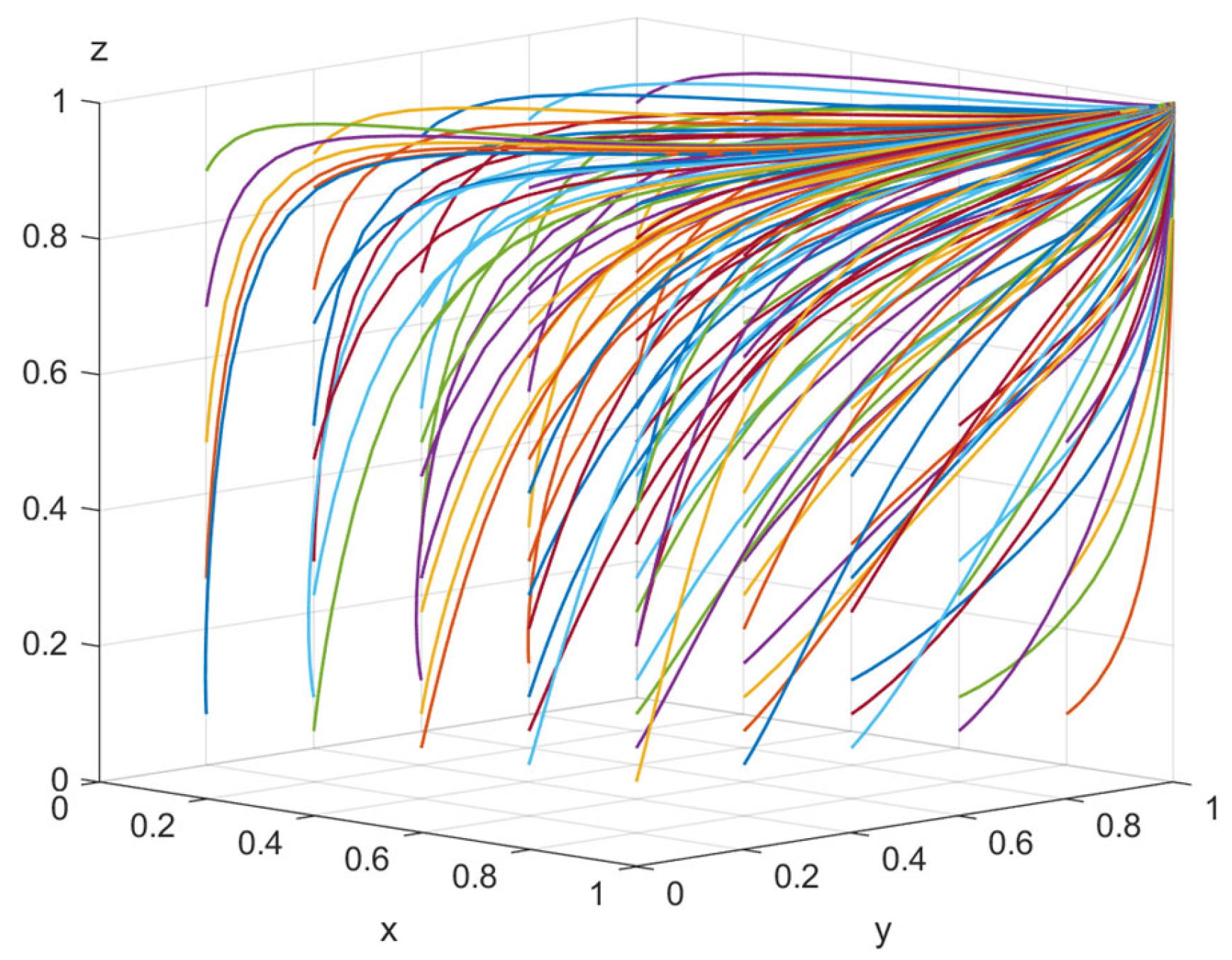
In order to verify the correctness of the system’s ESS under different scenarios, this study used Matlab software (R2023b) to conduct simulation experiments on the above tripartite evolutionary game model of KS behaviors among hospitals of different levels under government regulation. The x-axis, y-axis, and z-axis in the figure represent the general hospital, the community health service center, and the government.
The simulation experiment of scenario 1 verifies that when and at least one condition between and is satisfied, the ESS of the system is . Suppose and meet the conditions of the above scenario 1. The final evolution trend of the system game subject is shown in Appendix C (Figure A1), where , and all tend to 0, indicating is the ESS of the system at this time.
The simulation experiment of scenario 2 verifies that when and at least one condition between and is satisfied, the ESS of the system is . Suppose and meet the conditions of the above scenario 2. The final evolution trend of system game subject is shown in Appendix C (Figure A2), where both and tend to 0 and tends to 1, indicating is the ESS of the system.
The simulation experiment in scenario 3 verifies that when , and , the ESS of the system is . Suppose and meet the conditions of the above scenario 3. The final evolution trend of the system game subject is shown in Appendix C (Figure A3), where both and tend to 1, and tends to 0, indicating is the ESS of the system at this time.
The simulation experiment in scenario 4 verifies that when , and , the ESS of the system is . Suppose and meet the conditions of the above scenario 4. The final evolution trend of the system game subject is shown in Appendix C (Figure A4), where , and all tend to 1, indicating is the ESS of the system at this time.
6.2. Parameter Sensitivity Analysis
This study aims to promote KS behavior among hospitals of different levels under government regulation. The equilibrium represents an ESS where all parties fully cooperate (denoted by 1,1,1). This makes it the ideal focus, as the ESS signifies a stable state resistant to alternative strategies, directly supporting the goal of sustained KS adoption, so the initial values of each parameter are set based on the parameter settings of scenario 4. Through research on the relevant literature [31,42], we found that factors such as government rewards and penalties, patient evaluations, and costs significantly influence game outcomes. To more effectively analyze the patterns of how these factors—government rewards and penalties, patient evaluations, and costs—affect the decision-making outcomes of Chinese hospitals and government, we conducted simulation experiments for the parameter sensitivity analysis based on the parameter settings of scenario 4. In addition, the initial strategy proportions of the tripartite game subjects are all set to 0.5, i.e., ; the horizontal axis denotes the evolution time (); and the vertical axis denotes the probability of adopting the “Sharing” strategy for general hospitals (), the probability of adopting the “Sharing” strategy for community health service centers (), and the probability of adopting the “Regulating” strategy for the governmental department (, respectively.
(1) The impact of different initial propensities on subject strategy evolution.
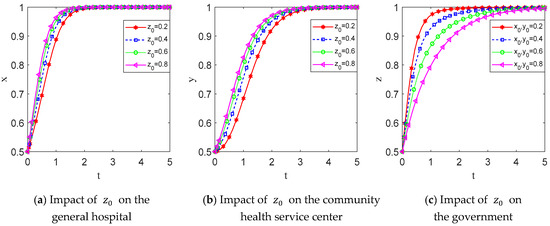
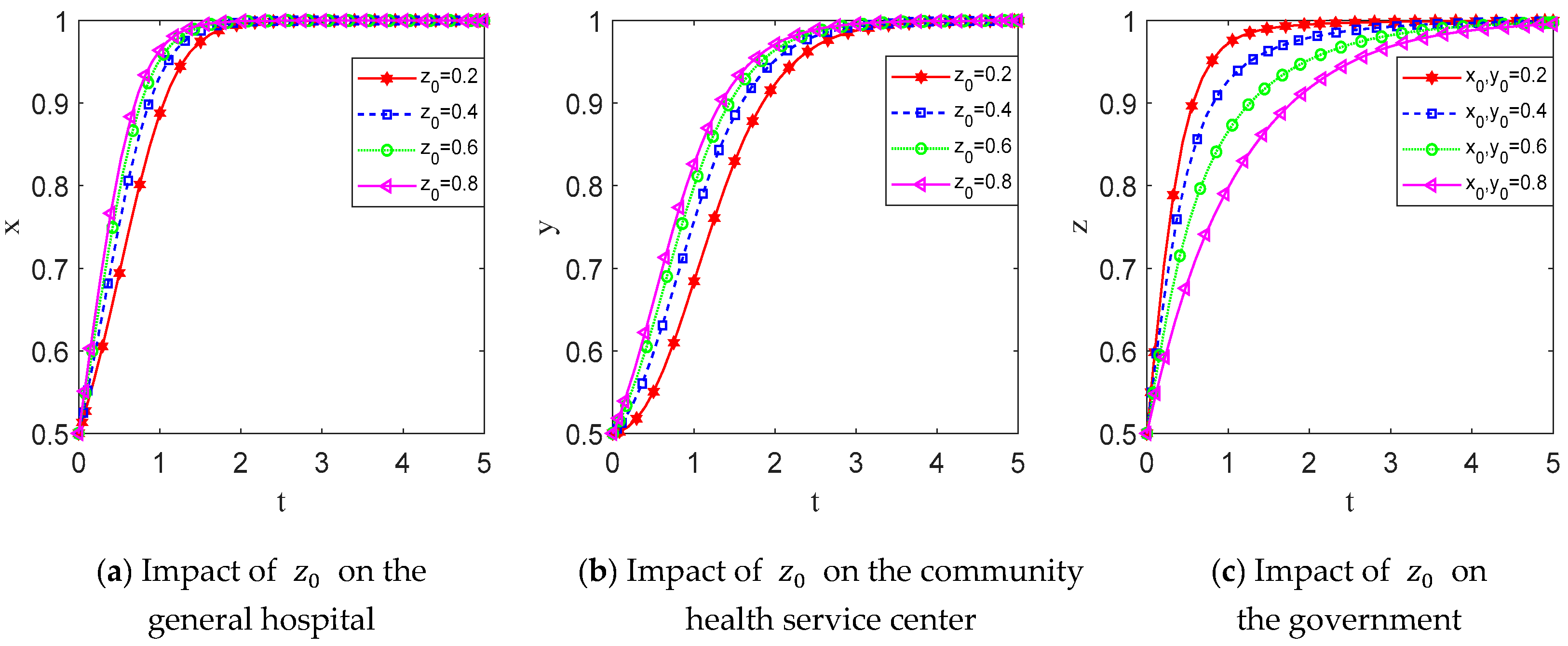
With other parameters unchanged, the values of and are and , respectively, and the influence of different subjects’ initial willingness on other subjects’ strategy adoption behavior is studied. The results are shown in Figure 5.
Figure 5.
The impact of different initial propensities on subject strategy evolution.
As can be seen from Figure 5a,b, with the increase in the government’s initial willingness to regulate, the strategy of general hospitals and community health service centers tends to be 1, and the speed is gradually accelerating, which means that government regulation has a positive role in promoting KS among hospitals. On the contrary, as can be seen from Figure 5c, with the increase in the initial willingness of hospitals to share, the speed of government strategy approaching 1 gradually slows down, that is, the willingness of hospitals to share has a negative obstacle to government regulation. This is because when the probability of the hospital adopting the “Sharing” strategy is high, it shows that KS behavior has stabilized in the system, and the government does not need additional intervention, thus reducing its regulatory will.
(2) The impact of government reward benefits on subject strategy evolution.
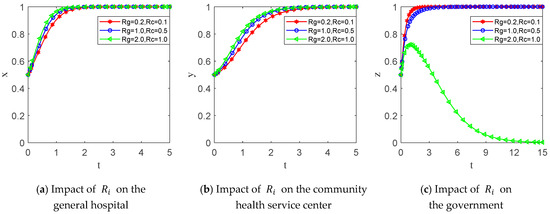
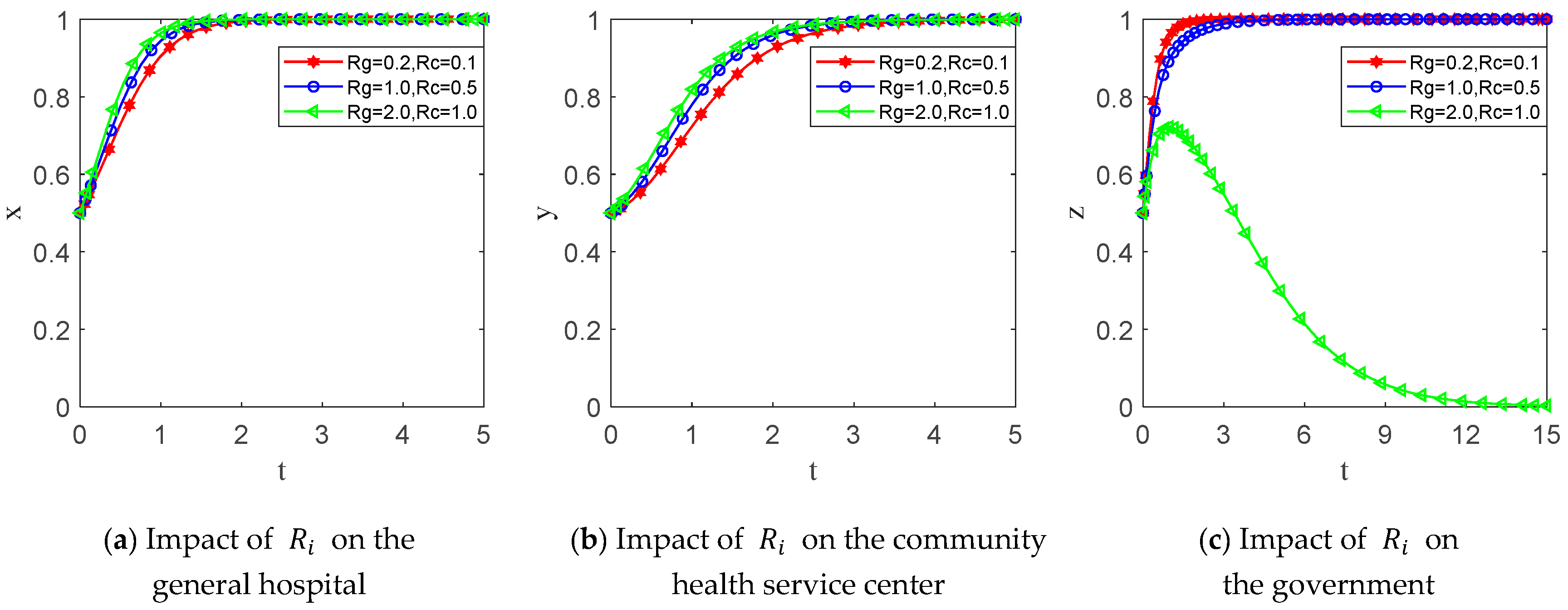
With other parameters unchanged, , and the influence of government incentive income on different subjects’ strategic choice behavior is studied. The results are shown in Figure 6.
Figure 6.
Impact of government reward benefits on subject strategy evolution.
As can be seen from Figure 6, with the increase in government reward benefits , the speed at which the strategies of general hospitals and community health service centers tend to approach 1 is gradually accelerating, while the government’s strategy gradually changes from tending to approach 1 to tending to approach 0, which shows that government reward benefits have a positive role in promoting KS among hospitals of different levels and a negative role in hindering government regulation. At a low reward level (e.g., ), when the incentives set by the government increase, to a certain extent, it will improve the enthusiasm of general hospitals and community health service centers to participate in KS and urge them to adopt “Sharing” strategies. However, with the continuous increase in reward, the marginal promotion of government reward benefits to hospital KS behavior gradually weakens, and at the same time, it will also reduce the willingness to regulate of the government. When the reward reaches a moderate level (as represented by ), the promotion effect is typically near its peak, but further increases become less effective. When the reward exceeds a certain critical point and becomes excessive (e.g., Rg = 2, exceeding the moderate level), the government may be inclined to give up regulation.
(3) The influence of government punishment costs on subject strategy evolution.
With other parameters unchanged, , and the influence of government punishment costs on different subject strategic choice behavior is studied. The result is shown in Figure 7.
Figure 7.
Impact of government punishment costs on subject strategy evolution.
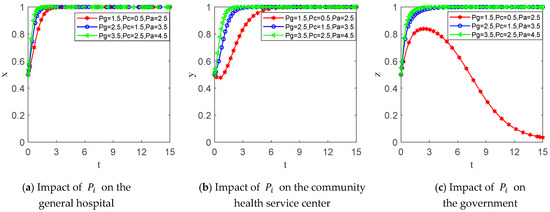
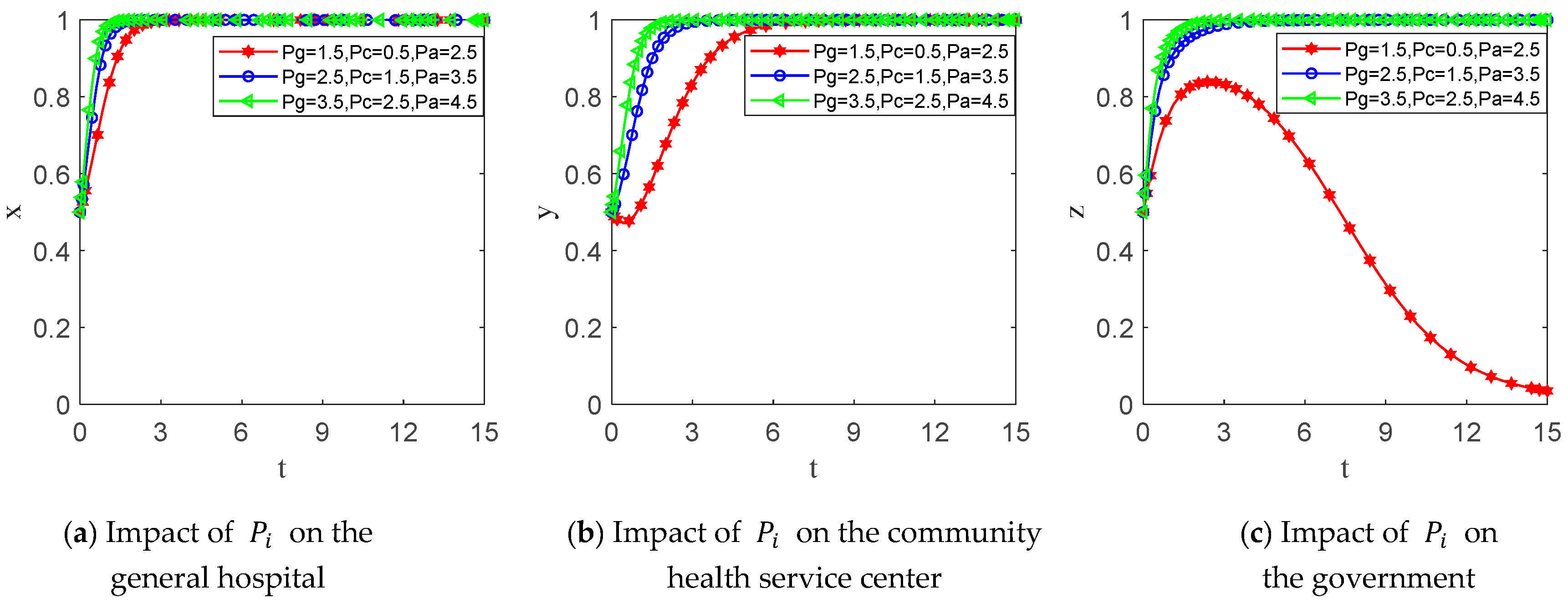
As can be seen from Figure 7, with the increase in government punishment costs , the speed with which the strategy selection of general hospitals, community health service centers, and the government tends to 1 is gradually accelerated, which shows that the government punishment cost has a positive role in promoting KS behavior among hospitals of different levels and the regulation behavior of the government. When the punishment set by the government increases, the cost risk faced by hospitals increases, so they are more inclined to adopt “Sharing” strategies to avoid punishment. At the same time, the increase in punishment costs can promote the implementation of KS policy, further enhance the regulatory will of the government, and promote them to actively perform their regulatory duties.
(4) The influence of patient evaluation reward benefits on subject strategy evolution.
With other parameters unchanged, , and the influence of patient evaluation reward benefits on different subjects’ strategic choice behavior is studied. The result is shown in Figure 8.
Figure 8.
Impact of patient evaluation reward benefits on subject strategy evolution.
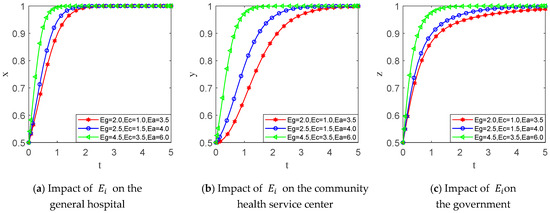
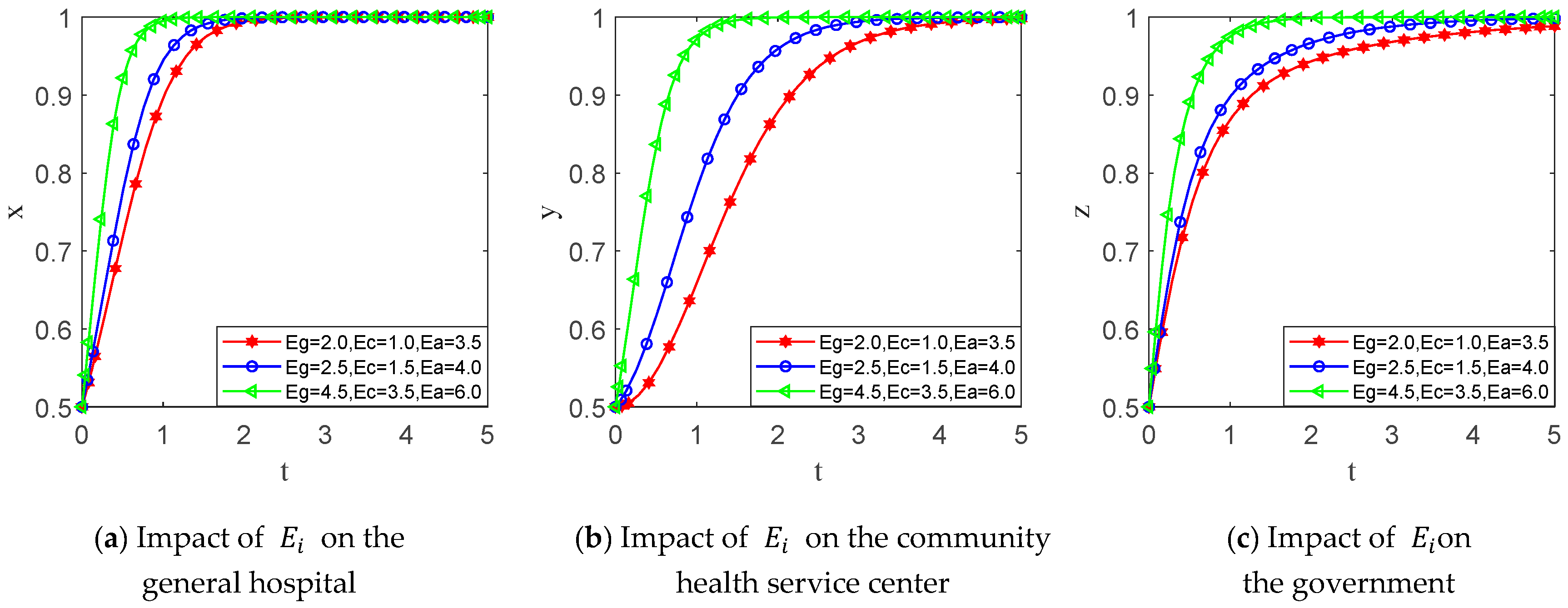
As can be seen from Figure 8, the patient evaluation reward benefits have a positive role in promoting the KS behavior between hospitals and the government’s regulatory behavior. When general hospitals and community health service centers adopt the “Sharing” strategy, which can bring higher rewards for patients’ evaluation, hospitals tend to adopt KS to obtain higher evaluation and recognition from patients. Furthermore, the increase in patient evaluation reward benefits also means that the government can win more trust and support from patients and enhance their social reputation when regulating the KS behavior in hospitals. This positive feedback mechanism urges the hospital and the government to jointly promote KS, which helps to build a more trusting and collaborative medical service environment, thus accelerating the convergence of the system to a stable state of KS equilibrium.
Within the patient evaluation system, rewards in practical operation are primarily embodied as substantial benefits that hospitals gain from achieving high patient satisfaction. These benefits mainly include reputation enhancement (better public image, brand value), economic incentives (such as performance-linked medical insurance payments, financial subsidies, performance-based bonuses), policy support (preferential resource allocation, project prioritization), and increased patient trust.
Based on the above mechanism research and the anticipated direction of the sensitivity analysis, this holds significant practical implications for optimizing real-world healthcare policies and services. It is recommended to deeply integrate scientifically designed patient evaluation indicators into hospital performance assessments, financial subsidy allocation, medical payment reforms (e.g., quality adjustment factors in DRG/DIP), and hospital accreditation systems. This integration ensures that high evaluations translate into tangible reputation and resource rewards that hospitals value. By closely linking the patient evaluation rewards identified in the theoretical model with the key parameters analyzed in sensitivity studies, it becomes possible to more effectively guide medical institutions to proactively share knowledge and motivate governments to actively fulfill their regulatory duties. This approach will ultimately accelerate the construction of a patient-centered, collaborative, and highly efficient high-quality healthcare service system.
(5) The influence of patient evaluation punishment costs on subject strategy evolution.
With other parameters unchanged, , and the influence of patient evaluation punishment costs on different subjects’ strategic choice behavior is studied. The result is shown in Figure 9.
Figure 9.
Impact of patient evaluation punishment costs on subject strategy evolution.
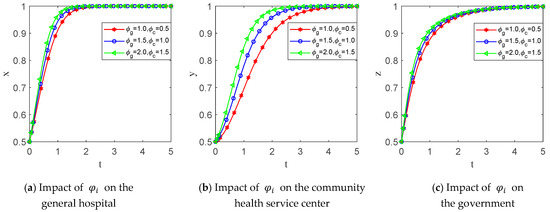
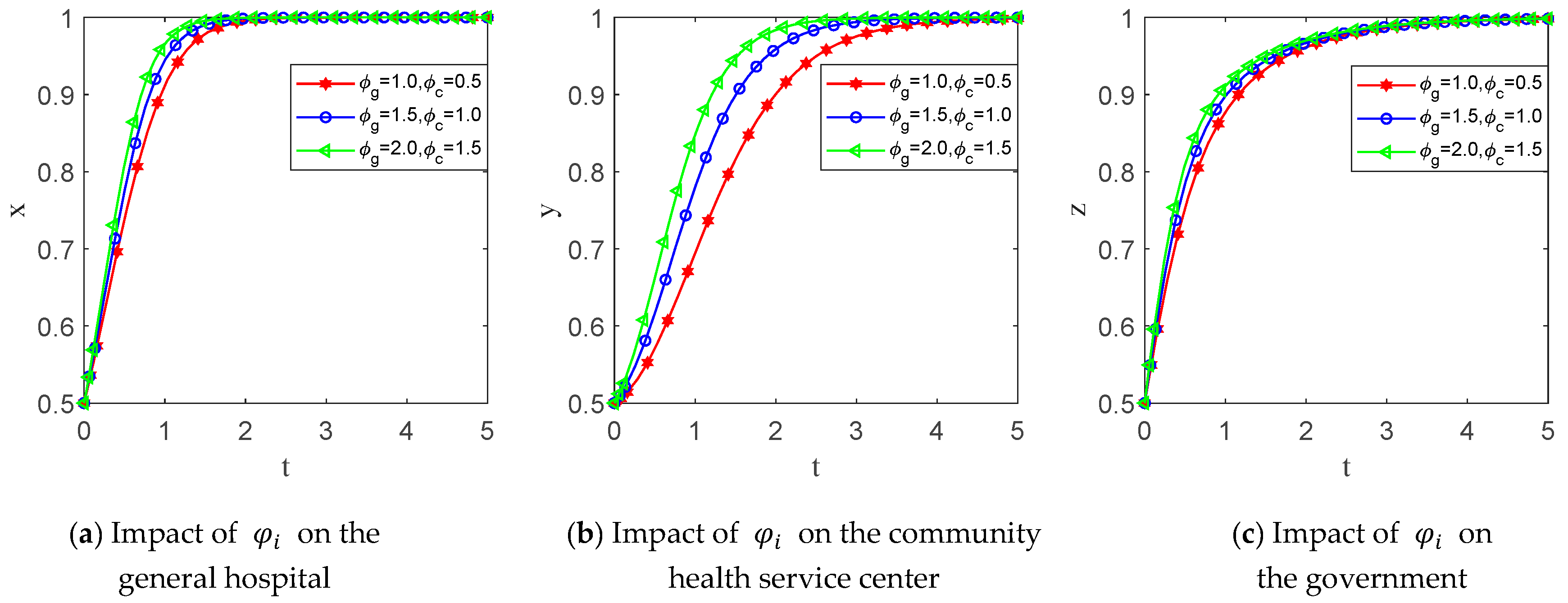
As can be seen from Figure 9, with the increase in patient evaluation punishment costs , the speed of approaching 1 of the strategies of the general hospital and the community health center is gradually accelerated, and the strategy selection of the government is gradually changed from approaching 0 to approaching 1, which suggests that the patient evaluation punishment costs have a positive facilitating effect on the knowledge-sharing behaviors among hospitals as well as the government’s regulatory behaviors. When the patient evaluation punishment costs increase, it means that hospitals will face a greater decline in patient satisfaction when adopting the “Not Sharing” strategy, thus prompting hospitals to be more inclined to adopt the “Sharing” strategy in order to avoid being adversely affected by poor patient evaluation. At the same time, as patient evaluation punishment costs increase, the government gradually tends to choose the strategy of active regulation to respond to social needs, enhance the government’s image, and reduce the potential loss of trust due to inaction.
Patient evaluation punishment costs reflect the actual deterrent power of the punishment mechanism. At its core, this represents the tangible losses suffered by hospitals or governments due to low patient evaluations—often stemming from subpar services such as poor collaboration or reduced service quality resulting from insufficient KS. These losses primarily include reputational damage (deteriorating public image, diminished brand value), economic losses (such as reductions in medical insurance payments, cuts in financial subsidies, fines), weakened policy support (restricted resource allocation, hindered project applications), and difficult-to-repair crises in patient and public trust.
Policy design must leverage the deterrent power of punishment costs within patient evaluation systems. It is important to establish transparent, stringent penalty systems, where low satisfaction leads to significant reputational, economic, and administrative consequences (e.g., linking payments to evaluations, graduated fines, public reprimands). Further, it is important to provide foundational support (e.g., information platforms, training) to reduce KS compliance costs. This enables hospitals, influenced by clear negative expectations and positive rewards, to proactively share knowledge, while governments fulfill regulatory duties through clear risk–benefit assessments. This collaboration drives rapid convergence to a stable state of high knowledge sharing and strong regulation, improving system efficiency and patient satisfaction.
(6) The influence of Sharing or Regulating costs on subject strategy evolution.
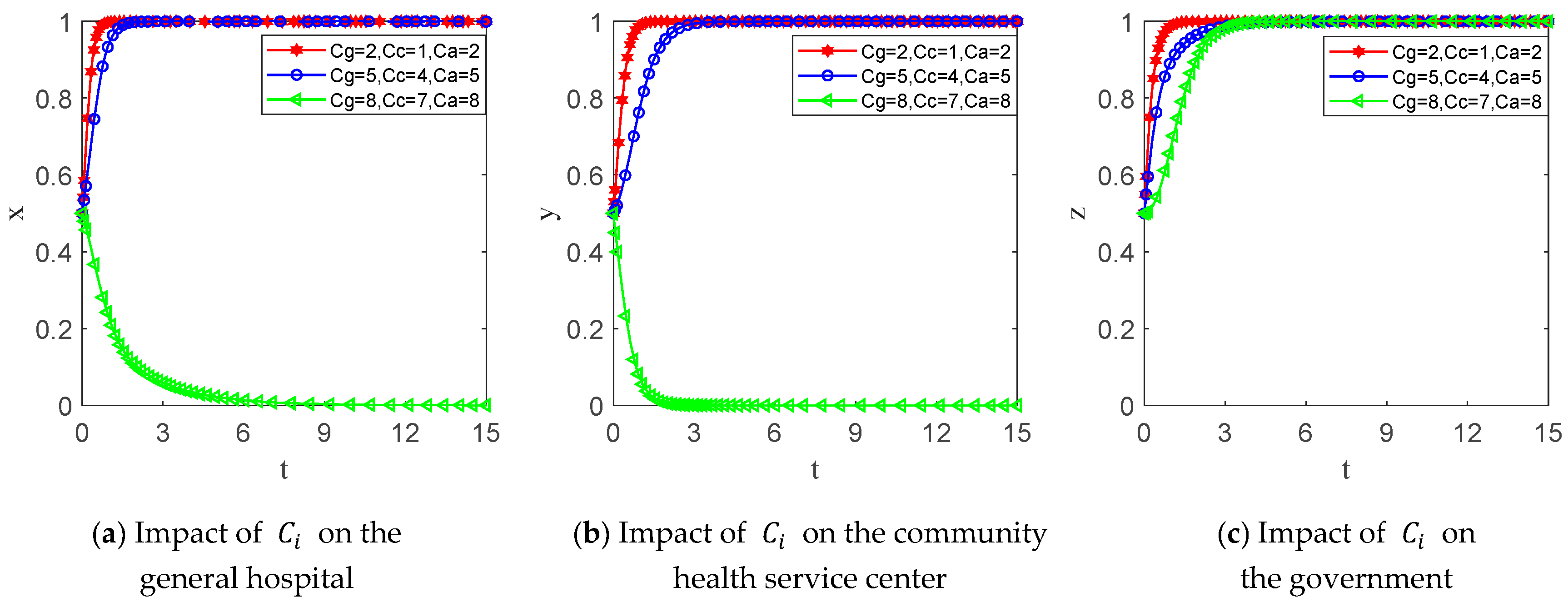
With other parameters unchanged, , and the influence of Sharing or Regulating costs on different subject strategic choice behavior is studied. The result is shown in Figure 10.
Figure 10.
Impact of sharing/regulating costs on subject strategy evolution.
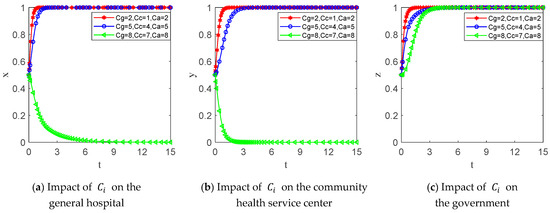
As can be seen in Figure 10, with the increase in cost, the strategy of the general hospital and the community health service center gradually shifts from approaching 1 to approaching 0, and the government strategy approaches to 1 at a gradually slower rate, which indicates that the cost has a negative hindering effect on the behavior of KS among hospitals as well as the government’s regulatory behavior. When the cost of sharing increases, the willingness of hospitals to adopt the “Sharing” strategy decreases and gradually shifts to adopt the “Not Sharing” strategy to avoid the burden due to the increase in cost. Similarly, as the cost of regulation increases, the government’s willingness to regulate decreases, but the government will not completely give up regulation due to its responsibility for public health and the balanced distribution of medical resources. Therefore, in the case of high costs of hospital KS, the government should reduce the cost of sharing on hospitals and reward them to participate in KS by developing effective reward and punishment mechanisms (e.g., building a KS platform, etc.).
7. Discussion and Conclusions
7.1. Marginal Contributions
In this paper, we explored the evolutionary game process of medical KS among hospitals of different levels under government regulation. While Chen et al. [42] pioneered the complex network-based modeling approach for inter-hospital KS, this study innovatively incorporates the government as a game player, analyzing the impact of government regulatory decisions on hospital KS strategies. The introduction of government oversight renders the model more complex and realistic, providing new perspectives for understanding knowledge-sharing behaviors under policy interventions. Our significant extension beyond Zhang et al.’s [27] research on government regulation lies in the innovative integration of patient evaluations as a dual mechanism influencing both hospital decisions and government regulatory strategies. This addresses a gap in the existing literature, which often overlooks patient feedback, making the model analysis more aligned with real-world healthcare service scenarios. Despite variations in specific contexts and constraints—from corporate R&D [43] to business strategy [44], virtual communities [45], and finally our healthcare study—a core consensus has become increasingly evident: successful KS delivers significant, cross-domain advantages. In corporate environments, KS accelerates innovation cycles, reduces redundant R&D costs, and enhances overall competitiveness. Our findings contribute to a deeper understanding of how hospitals and governments interact in the context of medical knowledge management and the impact of regulatory policies on these interactions.
7.2. Main Conclusions and Management Insights
Considering the government’s guiding and regulating role in the process of KS in hospitals, this paper constructed a tripartite evolutionary game model of general hospitals, community health service centers and government. Through simulation experiments, the key factors affecting the strategic choices of each game subject and their evolution paths under government regulation were explored and analyzed. The main conclusions and management insights are as follows.
- (1)
- The system’s equilibrium state is determined by the relationship between KS synergistic benefits, government reward benefits and punishment costs, patient evaluation benefits and punishment costs, and sharing costs. The ESS (Sharing, Sharing, Regulating) emerges only when the cumulative benefits from reward and punishment mechanisms exceed the combined input costs borne by both hospitals and the government in the KS process. Crucially, to effectively deter non-sharing, the magnitude of government penalties must be sufficiently large relative to the KS costs incurred by hospitals; our simulations suggest that penalties should be set at a level significantly higher than the perceived cost of sharing to ensure a strong deterrent effect.
- (2)
- The likelihood of KS between general hospitals and community health service centers exhibits a positive correlation with both the reciprocal KS rate and the intensity of government regulation. Conversely, governmental regulatory intervention decreases as inter-institutional KS rates rise. Therefore, policy efforts should promote the establishment of long-term cooperative relationships between general hospitals and community health service centers to facilitate knowledge flow through joint training, resource-sharing platforms, and research projects. In addition, the government needs to dynamically adjust its regulatory intensity, gradually reducing its direct intervention in institutions with high sharing rates and focusing more resources on institutions with low sharing rates, thereby achieving the efficient allocation of regulatory resources.
- (3)
- Increasing government rewards and punishments can help promote KS behaviors among hospitals of different levels, but the promotion effect exhibits diminishing marginal returns. Furthermore, the government’s willingness to regulate is weakened with the increase in rewards due to the associated fiscal burden. Therefore, the government should establish a financially sustainable reward and punishment mechanism. This entails not only providing appropriate rewards (such as financial subsidies, tax breaks, or policy support) to stimulate active KS participation, but also setting penalties (such as reducing fund allocation or restricting project eligibility) at levels significantly exceeding KS costs to constrain speculative behavior. Critically, policymakers must carefully assess the budgetary impact of rewards, especially when extending them to both hospital types simultaneously. Our model indicates that while rewarding both parties enhances cooperation, it substantially increases government expenditure; therefore, reward levels and eligibility criteria must be calibrated against fiscal constraints to ensure long-term viability. Simultaneously, the government should maintain a balance between the reward/punishment intensity and its regulatory commitment to avoid undermining regulatory willingness due to excessive reward costs.
- (4)
- Patient evaluation rewards and punishments have a positive effect on KS among hospitals and government regulation. Therefore, it is necessary to raise patients’ awareness of KS and guide them to actively participate in evaluation and feedback, so as to give full play to the role of patients in the process of KS. The government and hospitals can build convenient feedback channels, strengthen the protection of patients’ privacy, carry out health promotion and education, and link the evaluation results to hospital performance evaluation to enhance patients’ trust and motivation to participate, thus forming a positive interaction among hospitals, patients, and the government, and promoting the continuous improvement in the quality of healthcare services and resource sharing.
7.3. Limitations and Future Research
While this study systematically reveals the evolutionary game-theoretic patterns of KS in medical institutions under Chinese government regulation, several limitations warrant attention and point to future research directions:
- (1)
- The current sensitivity analysis employs the optimal equilibrium point as its benchmark, neglecting sensitivity assessments of the other three equilibrium points. Future studies should therefore incorporate sensitivity analyses for all four equilibrium points while investigating their interrelationships.
- (2)
- While the current research focuses on domestic medical data ecosystems, future work could construct transnational research frameworks. By examining diverse data-sharing paradigms and national regulatory architectures, such frameworks could elucidate the coupling mechanisms between cultural traditions, legal systems, and heterogeneous sharing trend levels in shaping data-sharing behaviors.
- (3)
- Current policy discussions involve extrapolations beyond the simulated ranges. Therefore, future research will rigorously explore the specific thresholds triggering behavioral shifts and theoretically derive the detailed quantitative relationships between incentive levels, willingness to regulate, and knowledge-sharing outcomes.
Author Contributions
Conceptualization, L.Z., N.L. and N.C.; methodology, L.Z., N.L. and N.C.; software, N.L. and N.C.; validation, L.Z. and N.C.; formal analysis, L.Z., N.L. and N.C.; investigation, N.C., N.L. and L.Z.; resources, N.C.; data curation, L.Z. and N.C.; writing—original draft preparation, N.L. and N.C.; writing—review and editing, L.Z., N.L. and N.C.; visualization, L.Z.; supervision, N.C.; project administration, N.C.; funding acquisition, N.C. All authors have read and agreed to the published version of the manuscript.
Funding
This research was funded by National Natural Science Foundation of China, grant number 72301166.
Data Availability Statement
All data and information within this manuscript are in the form of tables and other details.
Acknowledgments
The authors would like to thank the National Natural Science Foundation of China and the Science and Technology Commission of Shanghai Municipality for financial support for this study. The authors would like to thank the specialists at Zhongshan Hospital for their provision of critical datasets and expert advice. The authors would also like to thank all the respondents who participated in this study and generously offered their time.
Conflicts of Interest
The authors declare no conflicts of interest. The funders had no role in the design of the study; in the collection, analyses, or interpretation of data; in the writing of the manuscript; or in the decision to publish the results.
Appendix A
Table A1.
Model parameters and definitions.
Appendix B
Appendix C
Figure A1.
Evolutionary outcomes of scenario 1.
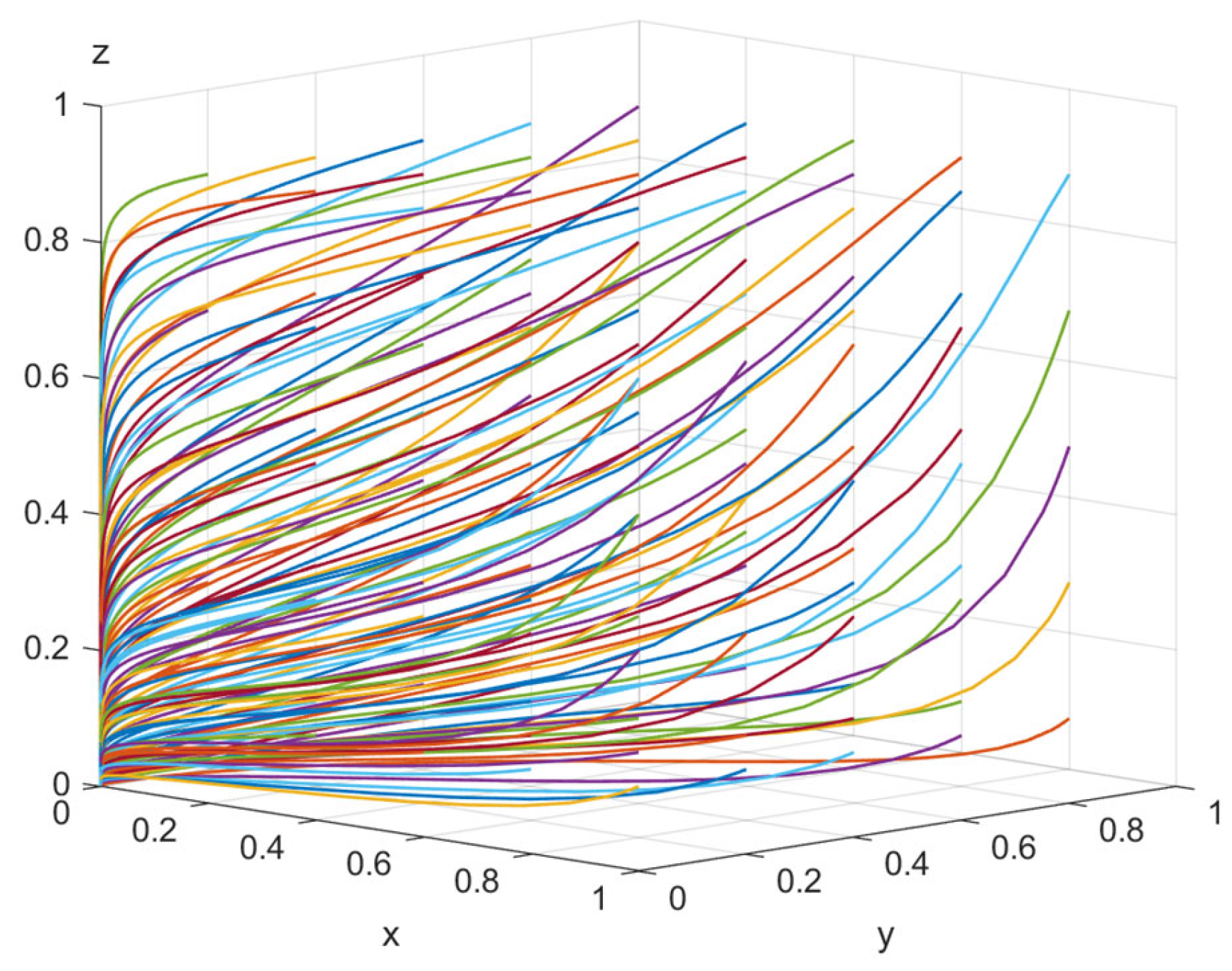
Figure A2.
Evolutionary outcomes of scenario 2.
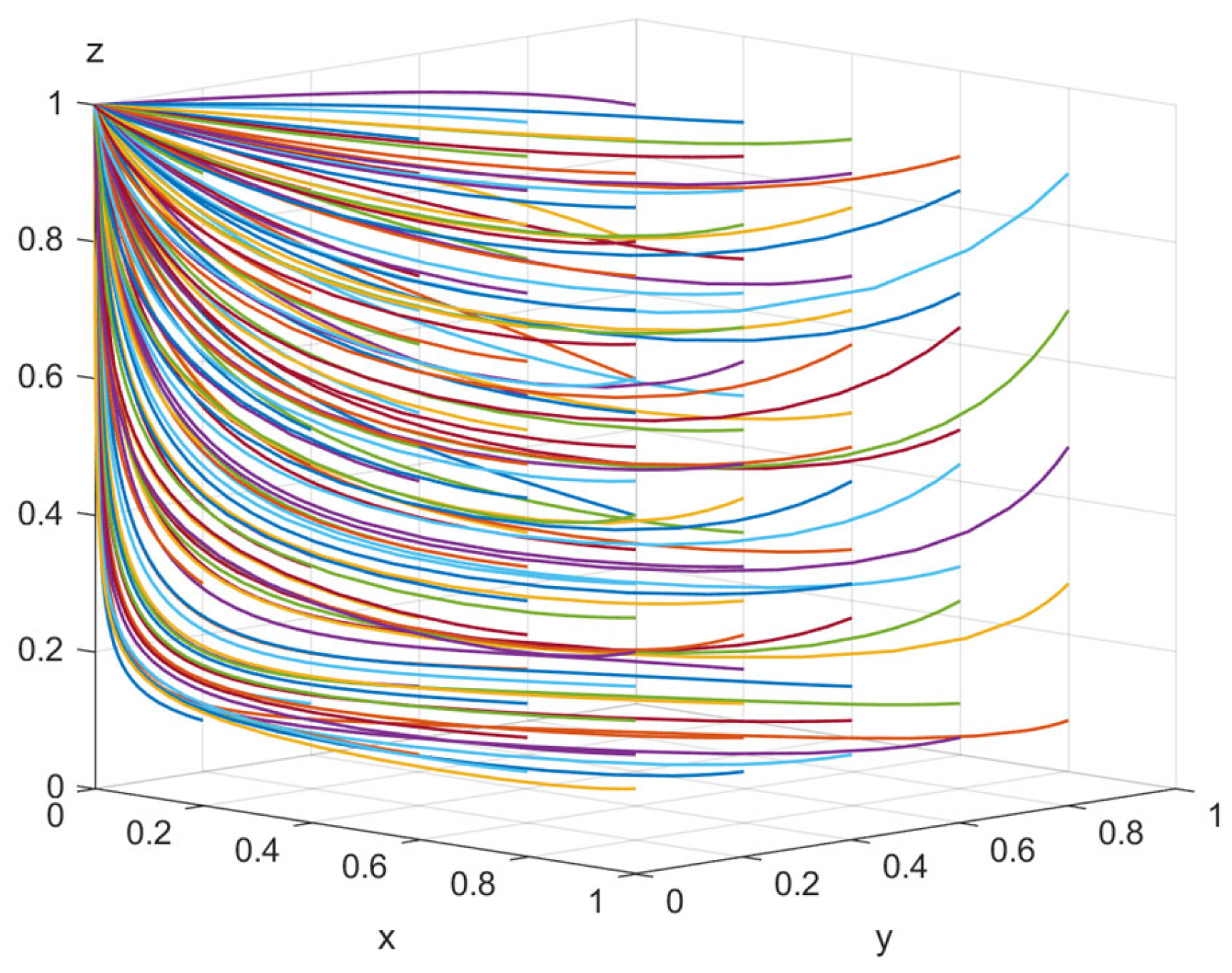
Figure A3.
Evolutionary outcomes of scenario 3.
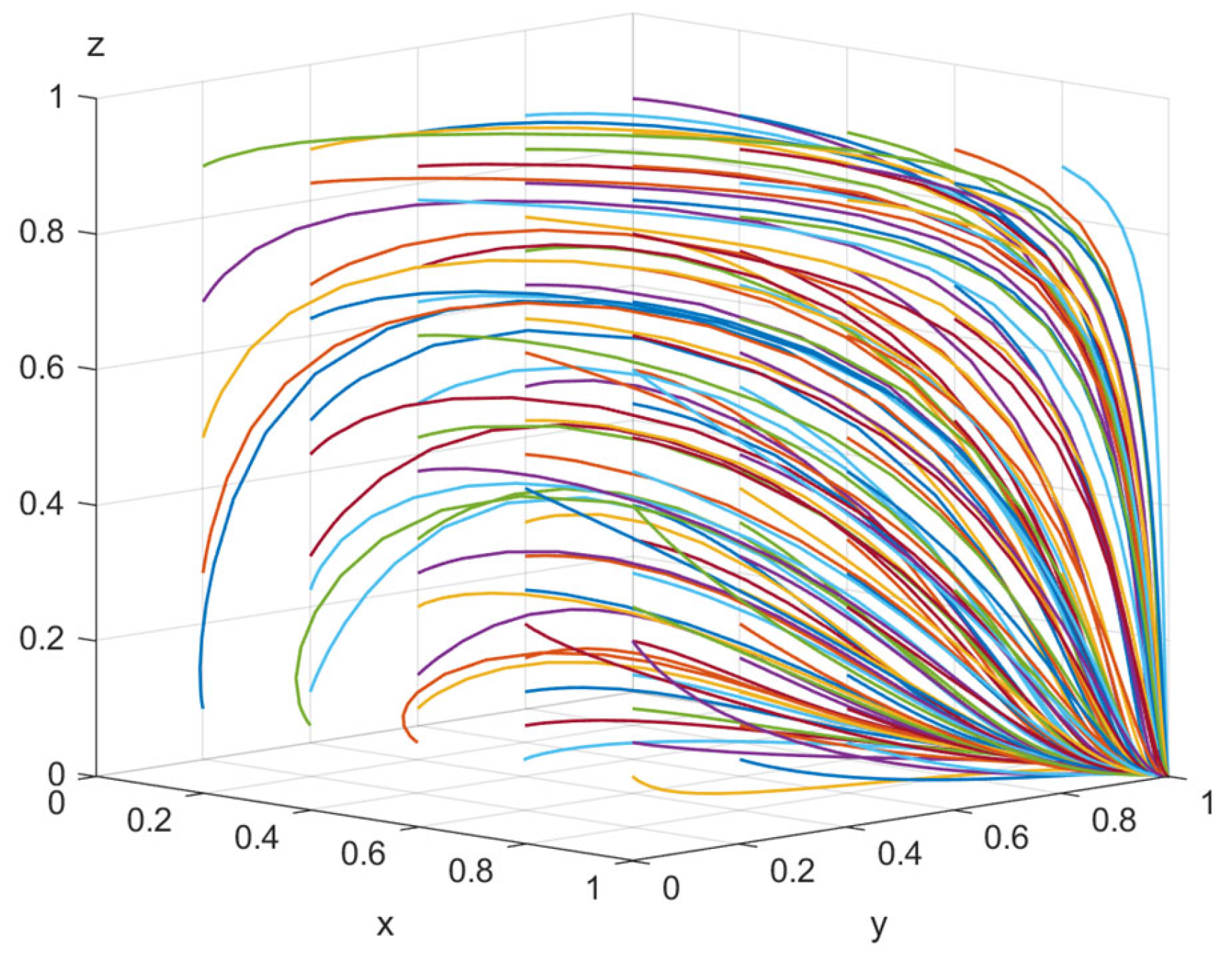
Figure A4.
Evolutionary outcomes of scenario 4.
References
- Liang, J.; Li, Y.; Zhang, Z.; Shen, D.; Xu, J.; Yu, G.; Dai, S.; Ge, F.; Lei, J. Evaluating the applications of health information technologies in China during the past 11 years: Consecutive survey data analysis. JMIR Med. Inform. 2020, 8, e17006. [Google Scholar] [CrossRef] [Scilit] [PubMed]
- Sun, S.; Xie, Z.; Yu, K.; Jiang, B.; Zheng, S.; Pan, X. COVID-19 and healthcare system in China: Challenges and progression for a sustainable future. Glob. Health 2021, 17, 14. [Google Scholar] [CrossRef] [Scilit] [PubMed]
- Zhao, N.; Chen, K. Equity and efficiency of medical and health service system in China. BMC Health Serv. Res. 2023, 23, 33. [Google Scholar] [CrossRef] [Scilit] [PubMed]
- Li, X.; Krumholz, H.M.; Yip, W.; Cheng, K.K.; De Maeseneer, J.; Meng, Q.; Mossialos, E.; Li, C.; Lu, J.; Su, M. Quality of primary health care in China: Challenges and recommendations. Lancet 2020, 395, 1802–1812. [Google Scholar] [CrossRef] [Scilit]
- Wang, X.; Nie, X. The uneven distribution of medical resources for severe diseases in China: An analysis of the disparity in inter-city patient mobility. Appl. Geogr. 2024, 165, 103226. [Google Scholar] [CrossRef] [Scilit]
- Wu, C.; Tu, Y.; Li, Z.; Yu, J. An early assessment of the County Medical Community reform in China: A case study of Zhejiang province. J. Chin. Gov. 2021, 6, 463–485. [Google Scholar] [CrossRef] [Scilit]
- Ye, Y.; Evans, R.; Jing, L.; Rizwan, M.; Xuan, Y.; Lu, W. The impact of county medical community reform on the medical service efficiency of county-level public general hospitals in China: A case study of Shanxi Province. Int. J. Environ. Res. Public Health 2022, 19, 13827. [Google Scholar] [CrossRef] [Scilit]
- Roba, D.; Jimma, W.; Diriba, C. Individual, organizational and technological factors affect knowledge sharing practices in Assosa Hospital, Ethiopia. Eur. Acad. Res. 2016, 5, 2286–4822. [Google Scholar]
- Lee, H.S.; Hong, S.A. Factors affecting hospital employees’ knowledge sharing intention and behavior, and innovation behavior. Osong Public Health Res. Perspect. 2014, 5, 148–155. [Google Scholar] [CrossRef] [Scilit]
- Zhu, C.; Zhou, L.; Zhang, X.; Walsh, C.A. Tripartite Evolutionary Game and Simulation Analysis of Healthcare Fraud Supervision under the Government Reward and Punishment Mechanism. Healthcare 2023, 11, 1972. [Google Scholar] [CrossRef] [Scilit]
- Fan, R.; Wang, Y.; Lin, J. Study on multi-agent evolutionary game of emergency management of public health emergencies based on dynamic rewards and punishments. Int. J. Environ. Res. Public Health 2021, 18, 8278. [Google Scholar] [CrossRef] [Scilit] [PubMed]
- Xue, R.; Xiong, L.; Wang, K. An evolutionary game approach for information sharing within medical consortium based on complex network. Comput. Ind. Eng. 2025, 203, 110963. [Google Scholar] [CrossRef] [Scilit]
- Yang, B.; Ye, S.; Bandarchi, M. A new model for investigating the factors influencing the innovation in medical services: The mediating role of attitude toward knowledge sharing. Vine J. Inf. Knowl. Manag. Syst. 2020, 50, 669–690. [Google Scholar] [CrossRef] [Scilit]
- Rubin, G.D.; Ryerson, C.J.; Haramati, L.B.; Sverzellati, N.; Kanne, J.P.; Raoof, S.; Schluger, N.W.; Volpi, A.; Yim, J.-J.; Martin, I.B. The role of chest imaging in patient management during the COVID-19 pandemic: A multinational consensus statement from the Fleischner Society. Radiology 2020, 296, 172–180. [Google Scholar] [CrossRef] [Scilit]
- Wang, M.; Wang, Y.; Mardani, A. Empirical analysis of the influencing factors of knowledge sharing in industrial technology innovation strategic alliances. J. Bus. Res. 2023, 157, 113635. [Google Scholar] [CrossRef] [Scilit]
- Zhou, L.; Nunes, M.B. Barriers to knowledge sharing in Chinese healthcare referral services: An emergent theoretical model. Glob. Health Action 2016, 9, 29964. [Google Scholar] [CrossRef] [Scilit]
- Liu, X.; Ai, S. Analysis of Evolutionary Game on Knowledge-Sharing Behavior in IT Outsourcing. Oper. Res. Manag. Sci. 2015, 24, 82. [Google Scholar]
- Yang, S.; Wang, H.; Lin, X. Dynamic decision of health information exchange under different hospital relationships: A differential game approach. J. Ind. Manag.Optim. 2023, 19, 6634–6663. [Google Scholar] [CrossRef] [Scilit]
- Song, L.; Yu, Z.; Fang, J.; He, Q. Evolutionary game theory and simulations based on doctor and patient medical malpractice under government regulation. Sci. Rep. 2023, 13, 18234. [Google Scholar] [CrossRef] [Scilit]
- Nishihata, Y.; Liu, Z.; Nishi, T. Evolutionary-game-theory-based epidemiological model for prediction of infections with application to demand forecasting in pharmaceutical inventory management problems. Appl. Sci. 2023, 13, 11308. [Google Scholar] [CrossRef] [Scilit]
- Guo, Y.; Zhang, W.; Song, Z.; Liu, H.; Jiang, T. Evolutionary game of resources integration on rural basic medical institution in family physician signing model. Chin. J. Health Policy 2018, 12, 35–44. [Google Scholar]
- Tian, S.; Chen, Y. Vertical integration of electronic health records in medical consortiums: Dynamic modeling approach based on the evolutionary game theory. JMIR Serious Games 2023, 11, e41528. [Google Scholar] [CrossRef] [Scilit] [PubMed]
- Liu, J.; Yu, C.; Li, C.; Han, J. Cooperation or conflict in doctor-patient relationship? An analysis from the perspective of evolutionary game. IEEE Access 2020, 8, 42898–42908. [Google Scholar] [CrossRef] [Scilit]
- Ouyang, Y.; Zhao, H. Evolutionary Game Analysis of Collaborative Prevention and Control for Public Health Emergencies. Sustainability 2022, 14, 15089. [Google Scholar] [CrossRef] [Scilit]
- Yuan, Y.; Du, L.; Luo, L.; Cui, L. Allocation strategy of medical supplies during a public health emergency: A tripartite evolutionary game perspective. Sci. Rep. 2023, 13, 9571. [Google Scholar] [CrossRef] [Scilit]
- Dong, C.; Liu, J.; Mi, J. Information-driven integrated healthcare: An analysis of the cooperation strategy of county medical community based on multi-subject simulation. Healthcare 2023, 11, 2019. [Google Scholar] [CrossRef] [Scilit]
- Zhang, Q.; Wang, L.; Geng, N. Evolutionary Game Analysis of Medical Information Sharing Based on the Government Regulation. Oper. Res. Manag. Sci. 2020, 29, 23–31. [Google Scholar]
- Dong, Y.; Sun, Z.; Qiu, L. A Tripartite Evolutionary Game Analysis of Enterprise Data Sharing Under Government Regulations. Systems 2025, 13, 151. [Google Scholar] [CrossRef] [Scilit]
- Qi, M.; Ren, J. An overview and visual analysis of research on government regulation in healthcare. Front. Public Health 2023, 11, 1272572. [Google Scholar] [CrossRef] [Scilit]
- Luo, L.; Zhang, S.; Xiang, J. Development of the family doctor service: An evolutionary game theory analysis. Ekon. Istraz. 2023, 36, 2106507. [Google Scholar] [CrossRef] [Scilit]
- Fan, W.; Wang, S.; Gu, X.; Zhou, Z.; Zhao, Y.; Huo, W. Evolutionary game analysis on industrial pollution control of local government in China. J. Environ. Manag. 2021, 298, 113499. [Google Scholar] [CrossRef] [Scilit] [PubMed]
- Mahmoudi, R.; Rasti-Barzoki, M. Sustainable supply chains under government intervention with a real-world case study: An evolutionary game theoretic approach. Comput. Ind. Eng. 2018, 116, 130–143. [Google Scholar] [CrossRef] [Scilit]
- Zhou, K.; Wang, Q.; Tang, J. Evolutionary game analysis of environmental pollution control under the government regulation. Sci. Rep. 2022, 12, 474. [Google Scholar] [CrossRef] [Scilit] [PubMed]
- Zhai, J.; Xu, X.; Xu, J.; Lyu, X. Research on green collaborative innovation mechanism of cloud manufacturing enterprises under government supervision. Math. Probl. Eng. 2021, 2021, 8820791. [Google Scholar] [CrossRef] [Scilit]
- Zhou, Z.; Ruan, L.; Ding, Q. Evolutionary Game Analysis of Cross-organizational Knowledge Sharing Behavior in Enterprise Innovation Network. Oper. Res. Manag. Sci. 2021, 30, 83. [Google Scholar]
- Ayala, N.F.; Paslauski, C.A.; Ghezzi, A.; Frank, A.G. Knowledge sharing dynamics in service suppliers’ involvement for servitization of manufacturing companies. Int. J. Prod. Econ. 2017, 193, 538–553. [Google Scholar] [CrossRef] [Scilit]
- Renqiang, X.; Wende, Z. An empirical study on the impact of platform environmental factors on knowledge sharing in virtual communities. Technol. Soc. 2022, 71, 102094. [Google Scholar] [CrossRef] [Scilit]
- Zhang, X.; Liu, S.; Deng, Z.; Chen, X. Knowledge sharing motivations in online health communities: A comparative study of health professionals and normal users. Comput. Hum. Behav. 2017, 75, 797–810. [Google Scholar] [CrossRef] [Scilit]
- Ma, R.; Jiang, L.; Wang, T.; Wang, X.; Ruan, J. How do manufacturing companies and service providers share knowledge in the context of servitization? An evolutionary-game model of complex networks. Int. J. Prod. Res. 2023, 61, 4279–4301. [Google Scholar] [CrossRef] [Scilit]
- Gao, Y.; Sun, B. The Large-Small Group-Based Evolutionary Game on Knowledge Sharing in Uncertain Environment under the Background of Telemedicine Service. Complexity 2020, 2020, 9818417. [Google Scholar] [CrossRef] [Scilit]
- Selten, R. A Note on Evolutionarily Stable Strategies in Asymmetric Animal Conflicts; Springer: Berlin/Heidelberg, Germany, 1988. [Google Scholar]
- Chen, N.; Lv, N.; Chen, Z. Knowledge Sharing among Hospitals of Different Levels: A Complex Network Evolutionary Game Approach. IEEE Access 2025, 13, 41040–41053. [Google Scholar] [CrossRef] [Scilit]
- Xiao, J.; Bao, Y.; Wang, J.; Yu, H.; Ma, Z.; Jing, L. Knowledge sharing in R&D teams: An evolutionary game model. Sustainability 2021, 13, 6664. [Google Scholar] [CrossRef] [Scilit]
- Razak, N.A.; Pangil, F.; Zin, M.L.M.; Yunus, N.A.M.; Asnawi, N.H. Theories of knowledge sharing behavior in business strategy. Procedia Econ. Fin. 2016, 37, 545–553. [Google Scholar] [CrossRef] [Scilit]
- Koh, J.; Kim, Y.-G. Knowledge sharing in virtual communities: An e-business perspective. Expert Syst. Appl. 2004, 26, 155–166. [Google Scholar] [CrossRef] [Scilit]

Disclaimer/Publisher’s Note: The statements, opinions and data contained in all publications are solely those of the individual author(s) and contributor(s) and not of MDPI and/or the editor(s). MDPI and/or the editor(s) disclaim responsibility for any injury to people or property resulting from any ideas, methods, instructions or products referred to in the content. |
© 2025 by the authors. Licensee MDPI, Basel, Switzerland. This article is an open access article distributed under the terms and conditions of the Creative Commons Attribution (CC BY) license (https://creativecommons.org/licenses/by/4.0/).