You are currently viewing a new version of our website. To view the old version click .
Systems
  • Article
  • Open Access

13 December 2024

Unraveling the Complex Barriers to and Policies for Shared Autonomous Vehicles: A Strategic Analysis for Sustainable Urban Mobility

,
,
,
,
and
1
Transportation Engineering College, Dalian Maritime University, Dalian 116026, China
2
Department of Business and Administration, ILMA University, Karachi 75190, Pakistan
3
Key Lab of CAD & CG, Laboratory of Soft Machines and Smart Devices of Zhejiang Province & Department of Engineering Mechanics, Zhejiang University, Hangzhou 310027, China
4
Department of Civil Engineering, Thapathali Campus, Institute of Engineering, Tribhuvan University, Kathmandu 44600, Nepal
This article belongs to the Special Issue Application of System Engineering and Complex Theory in Transportation

Abstract

Integrating shared autonomous vehicles (SAVs) in urban transportation systems holds transformative potential but is accompanied by notable challenges. This study, conducted in Saudi Arabia (KSA), aims to address these challenges by identifying and prioritizing the key barriers and policies that are necessary if we are to successfully adopt SAVs. A comprehensive analysis was performed through a literature review and expert consultations, revealing 24 critical barriers and 10 policies for solving them. The research employed a three-phase methodology to evaluate and rank the policies proposed to overcome these barriers. Initially, the study assessed the specific barriers and policies related to SAVs. Subsequently, the Fuzzy Analytic Hierarchy Process (FAHP) was employed to evaluate the relative importance of these barriers. Finally, the Fuzzy Technique for Order of Preference by Similarity to Ideal Solution (F-TOPSIS) was applied to rank the policies; the process identified government-backed investment, urban planning integration, and funding for research and development in sensor and hardware technologies as the most effective policies. The study underscores the importance of targeted policies in addressing technical and infrastructural challenges. Emphasizing system reliability, cybersecurity, and effective integration of SAVs into urban planning, the findings advocate for robust government support and continued technological innovation. These insights offer a roadmap for policymakers and industry leaders in the KSA to foster a more sustainable and resilient urban transportation future.

1. Introduction

The Kingdom of Saudi Arabia (KSA) is undergoing a significant transformation in its transportation sector, driven by the ambitious goals of Vision 2030, which aims to diversify the economy and reduce its reliance on oil. The current transportation infrastructure in the KSA is predominantly car-centric, with a heavy reliance on private vehicle ownership [1]. Private vehicles pose numerous challenges, including traffic congestion, environmental pollution, and the inefficiency of urban mobility [2]. In the KSA, public transportation options are limited, particularly in cities outside of Riyadh, and this lack of alternatives contributes to a high dependency on private cars [3]. Moreover, rapid urbanization and population growth are increasing the pressure on the current transportation infrastructure, leading to longer commute times and higher transportation costs [4].
It has been anticipated that shared autonomous vehicles (SAVs) can provide sustainable mobility and overcome the above challenges in metropolitan areas such as the KSA. It has been argued that SAVs can significantly reduce traffic congestion using high-quality sensors like Lidar and automatic technology systems [5]. However, some studies have run simulations suggesting that SAVs can increase traffic congestion and platooning of vehicles. They can provide mobility to disabled persons, which was not possible before the invention of SAVs. Some previous studies suggest that SAVs would be first introduced as a mode of shared mobility and could be controlled by a fleet.
By providing a more efficient and cost-effective alternative to private car ownership, SAVs can help shift the cultural preference towards shared mobility, which is essential for the long-term sustainability of cities in the KSA. In addition, SAVs can enhance accessibility and mobility for all consumers, especially those who are disabled or pregnant, in addition to all segments of the population, including elderly persons [6]; they provide convenient transportation options, which a user would not need a driver’s license or vehicle ownership to access. As the KSA continues to modernize its transportation infrastructure, integrating SAVs rapidly will be crucial in building a more resilient, inclusive, and sustainable transportation system that supports broader long-term economic and mobility goals.
SAVs have emerged as a new and sophisticated shared mobility mode besides their traditional modes [7], such as bike sharing, car sharing, on-demand ride services, and ride-sharing, which consumers can use collectively for their intercity trips [8]. Shared mobility and autonomous vehicles (AVs) give rise to a new mode of service: shared autonomous mobility. The advent of autonomous vehicle technology (AVT) can expedite shared mobility services [9], and with shared services, AVT can become financially feasible [10]. If integrated with public transit, a sustainable transportation system with enhanced mobility and equity can be achieved [11]. Since ridesharing services such as Kakao T., SOCAR, and Uber are notoriously used, the transportation sector is already ready to implement SAVs. Today’s dynamic ridesharing services resemble future SAV-based services, except that SAVs will be less expensive, more convenient, and more flexible [12]. Particularly, SAV services can reposition themselves to balance demand–supply for vehicles, resulting in more accessible and convenient commuting modes [12,13]. The sharing economy is among the most significant benefits of transportation technology advancements [14,15]. The sharing economy has already revolutionized micro-mobility sharing through scooters, bicycles, and car sharing. Shared SAVs can radically reshape car ownership [16]. SAVs can transform the automobile industry and the transportation of people and products in urban areas. In a mid-sized city, sharing techniques can lower CO2 emissions by 17% or 19%, which is an instrumental factor for the effective deployment of SAVs, and it is anticipated that successful operation can help in ensuring reductions in energy consumption, travel costs, and traffic congestion [17]. Stead and Vaddadi suggested that the implementation of shared mobility services will result in fewer automobile owners, alleviating the need for parking spaces [18]. Consequently, SAVs are viewed as a transformative concept for urban road environments [19], promoting more effective and sustainable transportation systems.
In addition, AVs can enhance public health and road safety, ensure safe and efficient maneuvers, reduce traffic congestion, reduce delays through minimizing the occurrence of less car crashes, increase positive environmental effects, improve fuel efficacy, etc. [20]. Likewise, SAVs can supplement the public transportation system by enabling door-to-door services on less demanding routes [6]. With such services, an added benefit occurs, as users can devote extra time to working or engaging in leisure activities of interest. However, it is still difficult to endorse these services, since they rely on users’ willingness to share their trips with other service users [21]. Most of the previous studies have found that the uptake of SAVs, with their perceived advantages and usability, as well as the users’ preferences, safety concerns, commuter behaviors, and attitudes toward the potential adoption of SAVs, are the common influential factors [22,23]. The adoption of AVs/SAVs is also influenced by consumer intentions toward technology and SAVs’ functional and service attributes, such as travel cost, time, speed, and safety. So, many behavioral factors have a critical role in the adoption of AVs, making the behavioral drivers of SAV adoption a complex and interdisciplinary research topic.
Unfortunately, not all countries are equally committed to achieving the ambitious goals of autonomous transportation systems. On the other hand, South Korea stands out as a model at federal and local levels, showing dedication to the commercialization of autonomous driving. The nation’s Ministry of Land, Infrastructure, and Transport (MoLIT), in September 2022, unveiled its updated plan for the future of self-driving technologies that incorporated timelines for achieving commercialization targets, revising safety regulations and insurance policies, and establishing infrastructure and testing grounds for AVs and infrastructure [24]. This announcement marks ongoing attempts to hasten the commercialization of AVs.
  • This study is among the first to investigate the barriers and policies for promoting SAVs, extend the existing literature and expanding knowledge in the context of the KSA.
  • Given that SAVs are still in the early stages of adoption, particularly in the transportation sector, this research contributes to advancing sustainable and innovative transportation practices.
  • The study introduces a novel method by integrating AHP and F-TOPSIS to prioritize the barriers and policies related to systematic SAV adoption.
  • Lastly, an implication-based method seamlessly integrates SAVs into the KSA’s transportation sector.

2. Literature Review

2.1. SAV Barriers

SAVs confront many of the same issues that come with implementing AVs. Though AVs present many advantages and opportunities for a more sustainable transportation system, their adoption is hindered by issues related to inadequate policies, infrastructure, and a general lack of public confidence in complete AVs. However, depending on individual interaction and experiences with the technology, advancements in artificial intelligence (AI) may impact the behavior of behavioral commuters. SAVs have also been made more difficult by issues like parking challenges, restricted access for SAVs in urban and suburban regions, and incompatibility with current infrastructure. This study identifies six significant obstacles to their execution. After a comprehensive literature review of the extant literature, we have identified the numerous barriers to SAVs, as presented in Table 1.
Table 1. Description of the barriers.

2.1.1. Regulatory and Policy Barriers

The regulatory and policy barriers to the adoption of SAVs contain a range of challenges, including issues related to insurance and liability [25], obtaining necessary licensing and permits [26], and ensuring compliance with local laws and regulations [27]. There may be circumstances in which an accident is unavoidable, even with almost flawless autonomous driving capability. Whether or not they make the right choice, human drivers are usually not held accountable for reacting to uncontrollable situations when they have a split second to make a judgment. In contrast, AVs have sensors, algorithms, and software for visual interpretation, enabling them to make better judgments. Even if the AV is not legally “at fault”, such decisions could be contested in court. Other philosophical questions also come up: How much emphasis should be placed on AVs reducing injuries to their occupants versus other crash participants? Should owners be provided with the ability to change such settings? Among other problems, AV producers may have to deal with regulatory ambiguity and needless overlap without a uniform certification structure and set of safety requirements for acceptance [20]. Furthermore, local law compliance may significantly challenge the effective deployment of SAVs. Even inside the nation, pervasive AV certification and legislation can be a huge concern for the federal government because laws and regulations vary within each state.

2.1.2. Public Perception and Trust

Public perception and trust are essential for AVs to be widely accepted. Public perception is significantly influenced by user experience [28], because it enhances safety, reliability, and overall effectiveness [23]. Innovations like full AVs in developed countries are typically met with skepticism and reluctance due to poor awareness and understanding of new technologies [47]. After surveying the regulatory obstacles facing AVs in California, it can be concluded that regulatory bodies, developers, and third parties find it difficult to certify the safety of AVs due to the lack of clear standards and testing processes. Similarly, previous studies on the barriers to AV adoption revealed safety concerns [30], user acceptability/community acceptance, and behavior concerns as crucial factors [31]. Additionally, they discovered that perception and feelings of distrust have a significant influence customer adoption of AV technologies. Also, concerns around cyber security are prevalent among policymakers, manufacturers, and future AV drivers. Concerns over electronic security are problematic. Cybercriminals, hackers, disgruntled employees, terrorist organizations, and adversarial countries could target AVs and intelligent transportation networks, leading to traffic disruptions and collisions [20]. However, MoLIT, South Korea, amended the Automobile Management Act to guarantee a safe autonomous system, mandating AV makers to set up cybersecurity management systems. By 2024, the nation wants regulations on performance evaluations, redundancy requirements, safety standards, and actions connected to malfunctions. In December 2019, the nation created the first safety guidelines in history for Level 3 autonomy [24].

2.1.3. Infrastructure Limitations

Infrastructure limitations for SAVs include numerous issues related to the development of parking and docking stations [32], adequate road and lane infrastructure [33], reliable charging facilities [34], and the integration of SAVs into urban planning frameworks [35]. Further, the burgeoning transportation era, characterized by novel transportation technologies like AVs, will necessitate substantial adjustments to infrastructure planning, building, and operation [48]. Driving in conditions that could lead to a myriad of operational conditions, like snowfall, nighttime, properly interpreting traffic signs, control of devices that differ from state to state, and poor road surface markings for lane-keeping are infrastructural hindrances to the ubiquitous adoption of AVs. These barriers can be addressed through well-thought-out, well-planned, and sufficiently prepared infrastructure. A lack of money and scarce resources exacerbate the current lousy status of road infrastructure. The extant infrastructure must confront the present significant difficulties before it can accommodate AVs [49]. Ensuring infrastructure readiness for AVs is a struggle because the current infrastructure is created and constructed to satisfy human driving skills and information needs. The lack of accessible facilities compatible with SAV fleet integration into the existing urban planning and public transportation systems impedes SAV market penetration. Moreover, the vast majority of SAVs in the future will presumably be electric. The architecture of the infrastructure for charging and the car’s vehicle range will impact how well SAV services operate [50]. Notably, fast-charging stations and well-placed charging spots that reduce the distances between demand hotspots and charging stations lead to better performance.

2.1.4. Economic and Financial Challenges

Economic and financial challenges are substantial barriers to the widespread adoption of SAVs. The high upfront and operational costs also impede AVs’ wide use by affecting large-scale production and public accessibility [36]. Consequently, the cost of buying AVs will make it less desirable to the traditional vehicle fleet. The high initial capital investment required for developing AV technology and the cost of building and maintaining the necessary infrastructure present a significant hurdle [51]. Furthermore, the uncertainty surrounding the profitability of SAVs in the early stages of adoption further complicates investment decisions as companies face challenges in achieving economies of scale [20]. Additionally, regulatory and insurance costs related to liability and safety concerns add to the financial burden [52]. These challenges require coordinated efforts from governments, the private sector, and other stakeholders to establish financial incentives, different pricing strategies, subsidies, and investment frameworks that can reduce the financial risks associated with the deployment of SAVs [37,38,53].

2.1.5. Technological Issues

Technological issues are among the most significant barriers to the widespread deployment of SAVs. SAVs utilize sophisticated sensors [42], such as light detection and ranging (LiDAR), radar, and cameras, which are crucial for sensor and data accuracy. These sensors enable these vehicles to sense their surroundings and make critical, real-time decisions [54]. Moreover, up-to-date and accurate digital maps are essential for safe AV operation. Cybersecurity has been a big concern, and a possible AV system breaches can lead to a city’s functional breakdown [40]. Achieving a highly reliable and quick-responding fully autonomous system is daunting and costly. Numerous factors require improvement, most notably, the operational safety of algorithms and sensors, to reduce uncertainty for perception [55]. Therefore, we should focus on increasing safety, driving safety, mobility, and sustainability in the near future. However, as technology advances, integration with other services is raised as a hurdle to adoption [41]. Furthermore, it is plausible that AVs could fail to comprehend real-world situations; for example, when an AV encounters a plastic bag flying in front of it, it might stop prematurely; or if its sensor detects a group of birds perched on the road, it will slam on the brakes. Unlike human drivers, AI might not know that birds will take off as they advance.

2.1.6. Market Competition and Dynamics

Market competition and dynamics play a crucial role in the growth and adoption of SAVs. Numerous critical factors can shape it. The competitive landscape is marked by intense rivalry among automakers and tech companies [43]. As multiple stakeholders, including automakers, tech companies, and ride-hailing services, vie for market share, competition intensifies, influencing pricing strategies, innovation, demand fluctuation, market penetration, and service offerings [44,45]. The entry of established companies like Uber and Lyft into the AV space has further escalated the competitive landscape, with these companies investing heavily in AV technology to maintain their market position [20]. Furthermore, the rapid pace of innovation in autonomous driving technologies and artificial intelligence means market leaders are continuously pressured to enhance their offerings and improve service efficiency [56]. However, competition may also lead to strategic collaborations, such as partnerships between automakers and tech companies, to accelerate the development of SAVs and address regulatory challenges [57]. Ultimately, the dynamics of market competition will shape the speed of SAV adoption and influence the economic viability of these services.

2.2. Policies to Overcome the Barrier of SAV Adoption

AVs can alleviate traffic jams, increase road safety, and enhance air quality. The ideal regulatory environment for AVs is one that effectively promotes technological advancement improvements while simultaneously fostering market readiness and achieving local to national mobility goals. That encompasses safety improvement, congestion alleviation, equity in mobility, employment, sustainable mobility at all levels, and economic growth [58].
Countries should develop standardized insurance and liability coverage policies for AVs to streamline risk management [59]. Singapore has made it obligatory to have valid liability insurance during use or trials [60]. A state-based insurance plan or other suitable insurance must be offered to guard against hazards encountered during the trial. According to UK government AV policy guidelines, any level of automated technology can be trailed without a permit as the driver or operator is present and prepared to take control inside or outside the vehicle [61]. Such regulatory approaches have enabled AVs to be utilized with maximum flexibility. Simplifying the acquisition of the necessary licenses and permits [62] within a unified national framework, reducing regulatory complexity, is crucial for AV usage. The cyber threat against AVs could breach the tremendous data of users and the transportation infrastructure, which could halt the system. Thus, cybersecurity is one of the safety standards that AVs should satisfy.
The Australian government mandated self-certification against safety criteria. Accordingly, every trialing organization must create a safety management plan to recognize and control the safety risks, including hacker security [63]. It is necessary to establish clear and comprehensive data privacy and cybersecurity standards for AVs to protect user information, ensuring compliance [64]. California’s AV testing regulations have specified that all local conventional motor vehicle laws must comply with the autonomous fleet. Such regulations maintain local law compliance [58]. For better performance of AVs, setting up rules for reporting disengagement requirements or a collision is crucial. For example, California mandates the reporting of collisions and provides publicly available data related to miles driven and annual disengagement. Each country and state is working, in its own way, to establish rules and regulations for the sustainable implementation of AVs. Governments should support the creation of a framework and a set of national criteria for AV certification at the state level to promote regulatory consistency. Certifying AVs for the use of the general public should be endorsed by federal guidelines via developing safety, operations, and other requirements. Concerns about liability, security, and privacy stand in the way of the wide use of AV systems. Manufacturers and investors will be more confident in pursuing development once federal and state governments address these challenges. Moreover, liability standards must strike a balance in assigning responsibility to manufacturers. Regarding infrastructure, the Etminani-Ghasrodashti et al., suggest street redesign approaches for residential streets and urban arterial roadways, considering the opportunities that would arise due to the development [65].
Automakers and other parties have invested many resources to improve AV technologies via research and development (R&D) [66]. Substantial financial support is essential for technical advancement in AVs. AV development will be fostered by offering grants or tax credits for R&D in sensor and hardware innovation, increasing performance and reducing cost [20]. The Department of Transport (DOT), local transportation agencies, planning organizations, ministries, and other stakeholders should endorse R&D to empower regions and countries to foresee and more effectively plan for the potential and implications of AVs. The government should be focused on implementing safety certification [67], building consumer trust, launching public awareness [68], and starting community engagement initiatives [69] to educate stakeholders on the benefits of SAVs; they should also address safety concerns and overall user experience, including comfort and convenience.
Furthermore, it appears that the development of sustainable AVs will only be feasible if shared autonomous decision making is encouraged. First and foremost, it is essential to make sure that shared AVs are available, and that people are prepared to share and transition between different modes of transportation. Consequently, there is a need to actively promote and incentivize all types of shared mobility, mainly ride and car sharing. Ride sharing usage is correlated with tax incentives for shared trips. Also, promotional campaigns, prioritizing parking spaces, and awareness campaigns with pilot projects to prepare citizens for SAVs go side by side. In addition to limiting the number of single cars on the road, more must be implemented to prevent the use of empty private AVs. The second point is to ensure that these SAV vehicle fleets are integrated into a comprehensive mobility solution, with high-capacity public transportation serving as the backbone in heavily trafficked regions to accommodate the majority of journeys, in addition to walking and cycling [70]. The detailed policies for SAV adoption as presented in Table 2.
Table 2. Policies for SAV adoption.

3. Research Methodology

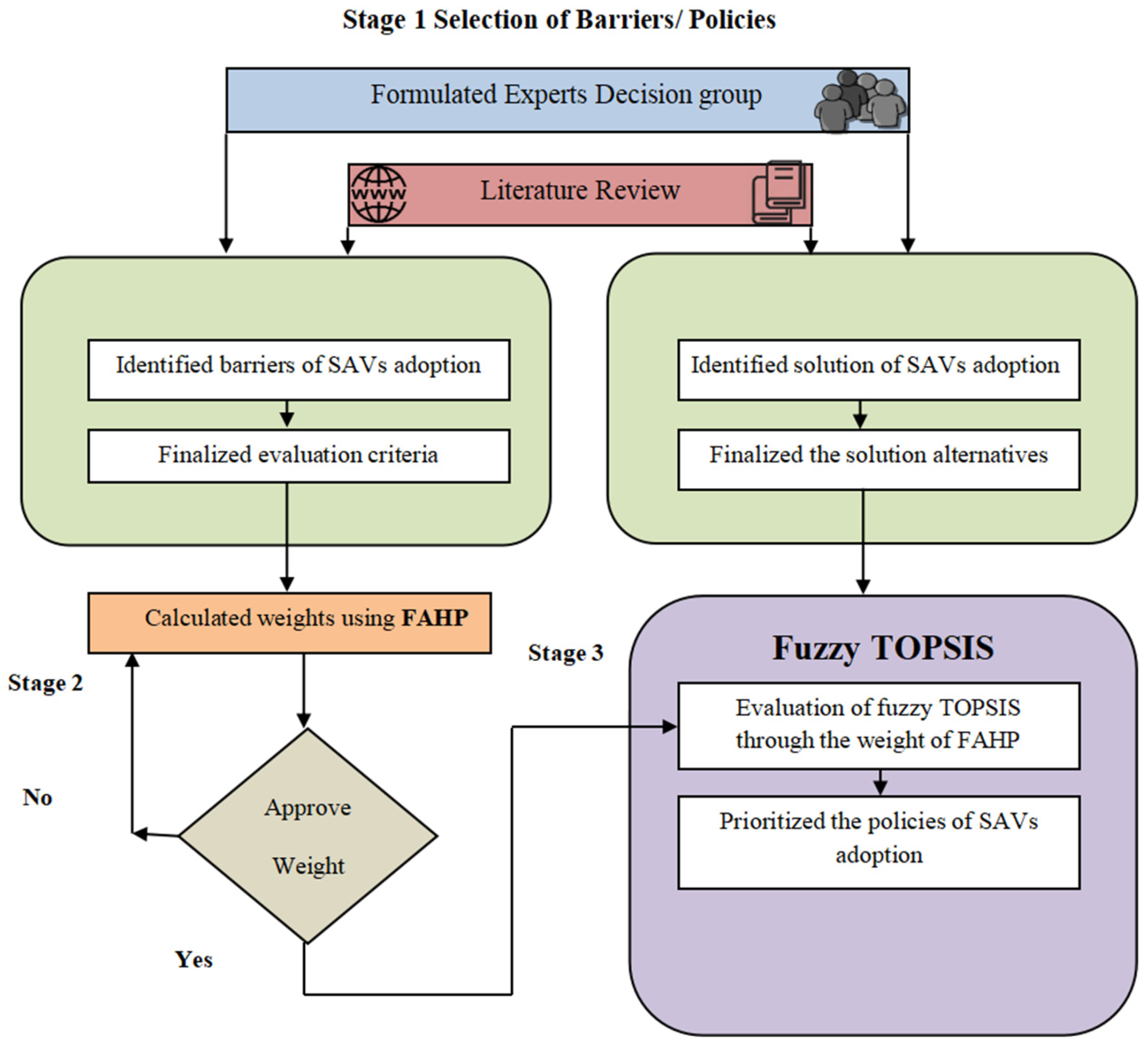
A three-phase approach was employed in this study to rank the policies of SAV adoption to alleviate its barriers. FAHP is used to examine the weight of policies’ criteria, and the F-TOPSIS method is chosen to rank them. The FAHP approach addresses complex decision-making challenges while incorporating F-TOPSIS, which can improve decision making. Applying a fuzzy framework alongside these multi-criteria techniques helps eliminate uncertainty and ambiguity in decision making. The research framework for this study is illustrated in Figure 1.
Figure 1. The research framework of three-stage approach.
Phase I: Evaluation of SAV barriers and policies
In the initial phase of the method, a diverse expert group was gathered, comprising scholars in academia and professionals in industry. To engage this group, emails were sent to 35 potential experts, inviting them to participate in the study by filling out the questionnaire. This study did not consider non-professionals, as the analysis required specialized knowledge and expertise in transportation systems. Of those contacted, 12 experts responded positively and agreed to contribute, providing valuable insights and perspectives integral to the research process. These experts played a crucial role in evaluating the relevant barriers and developing strategies to address them. Previous studies revealed that the experts (sample size) could vary from study to study [78]. Nevertheless, one study determined that the sample size should not be less than 2 in a multi-criteria decision-making analysis [79]. However, our study’s sample size is acceptable because several previous studies used 5 to 10 experts for the multi-criteria decision-making analysis [80,81,82]. Furthermore, Table 3 shows the details of the participating experts, with extensive knowledge of SAVs. Later, barriers to SAV implementation were identified and assessed through a comprehensive review of the extant literature and in-depth discussions with the expert group. Likewise, policies to alleviate these barriers were identified from the literature and reviewed by other experts, including transportation specialists.
Table 3. Experts’ profiles.
Phase II: Fuzzy analytical hierarchy process (FAHP)
The AHP method introduced by [83] is the quantitative approach of MCDM. The application of AHP has several drawbacks, including its reliance on a crisp environment, an unbalanced decision scale, susceptibility to uncertainty, and subjective decision making. To overcome these issues, the fuzzy method is integrated with AHP. In the FAHP method, uncertainty and imprecision are accomplished by incorporating decision-makers’ judgments using linguistic variables. This approach has been widely applied in various previous studies [84]. This method can achieve more consistent results by utilizing pairwise comparisons within a matrix, employing triangular fuzzy numbers (TFNs). The TFN scale used in this research is presented in Table 4. The following are the main steps for FAHP [85].
Table 4. TFN of linguistic comparison matrix.
Definition 1.
If A ˘ 1 = ( p 1 , q 1 , r 1 ) and A ˘ 2 = ( p 2 , q 2 , r 2 ) represent two triangular fuzzy numbers, then the algebraic operations are as follows:
A ˘ 1     A ˘ 2 = ( p 1 , q 1 , r 1 )     ( p 2 , q 2 , r 2 ) = ( p 1 + p 2 ,   q 1 + q 2 , r 1 + r 2 )
A ˘ 1     A ˘ 2 = p 1 , q 1 , r 1 ( p 2 , q 2 , r 2 ) = ( p 1 r 2 ,   q 1 q 2 , r 1 p 2 )
A ˘ 1     A ˘ 2 = p 1 ,   q 1 ,   r 1     ( p 2 ,   q 2 ,   r 2 ) = ( p 1 ,   p 2 ,   q 1 ,   q 2 ,   r 1   r 2 )
A ˘ 1     A ˘ 2 = p 1 ,   q 1 ,   r 1       ( p 2 ,   q 2 ,   r 2 ) = ( p 1 / r 2 ,   q 1 / q 2 ,   r 1 / p 2 )
α     A ˘ 2 = α p 1 ,   α q 1 ,   α r 1   where   α > 0
A ˘ 1 1 = ( p 1 ,   q 1 ,   r 1   ) 1 = 1 r 1 ,       1 q 1 ,     1 p 1
Applying FAHP
M g i 1 ,   M g i 2 ,   M g i 3 ,   ,   M g i m
where g i represents the goal set ( = 1,2 , 3,4 , 5 , , n ) and M g i j represents the triangular fuzzy numbers associated with each goal ( j = 1,2 , 3,4 , 5 , , m ) . The goal set represents specific objectives or criteria for evaluation in the decision-making process.
The triangular fuzzy numbers are shown in Table 4 The following steps describe the Da Yong Chang’s method [86]:
Step 1. The fuzzy synthetic extent value ( H i ) concerning i t h criterion is defined as,
H i = j = 1 m M g i   j × i = 1 n j = 1 m M g i j 1
j = 1 m M g i   j = j = 1 m p i j ,   j = 1 m q i j ,   j = 1 m r i j
i = 1 n j = 1 m M g i j 1 = 1 n i = 1 m j = 1 p i j ,     1 n i = 1 m j = 1 q i j   ,     1 n i = 1 m j = 1 r i j  
where p denotes the lower value, q is identified as the medium value, and r is denoted as a maximum value.
Step 2. The degree of possibility of D 2 = p 2 , q 2 , r 2 D 1 = p 1 , q 1 , r 1 is defined as
V D 2   D 1 = y x s u p [ m i n ( μ d 1   x ,     μ d 2   y ]
D 1 and D 2 are the fuzzy set, μ d 1 and μ d 2 are the membership function, indicating the degree to x and y belong to the respective sets, s u p is the upper limit, and y x specifies the condition where y is greater or equal to x .
The values of x and y are represented on the axis of the membership function for each criterion, as defined by the following equation.
V D 2   D 1   = 1                                                                                                 i f   q 2         q 1 0                                                                                                 i f   p 1         r 2   p 1 r 2 q 2 r 2 q 1 p 1     o t h e r w i s e
where μ d is the maximum connection point μ d 1 and μ d 2 . To combine D 1 and D 2 , we needed both.
V D 1 D 2   and   V D 2 D 1
Step 3. The degree of possibility for a convex fuzzy number D should be higher than K convex fuzzy numbers D i i = 1,2 , , k and can be defined by
V D   D 1 ,     D 2 ,   ,     D k = V   D D 1 ,     D D 2 ,   ,     ( D D k )   = min   V   ( D     D i ) ,             i = 1,2 , , k
Suppose that d B i = min V ( D i D k ) .
For k = 1 , 2 , , n , k i ; the weight vectors are denoted in the equation as,
W = d   B 1 ,       d ( B 2 ) ,   ,   d ( B m ) T
Step 4. Once normalization is completed, the normalized weight vectors are shown in the equation:
W = d B 1 ,       d ( B 2 ) ,   ,   d ( B m ) T
The normalization procedure was achieved to ensure the weight vector W is dimensionless and consistent. This allows the weights d B 1 ,   d ( B 2 ) ,   ,   d ( B m ) to represent proportional contributions of the criteria B 1 ,   B 2 , B m in the decision-making process. After normalization, the weights are summed to one, which aligns with standard multi-criteria analysis practices, ensuring the results are robust and interpretable.
Phase III: F-TOPSIS
The F-TOPSIS method was introduced in [87]. This approach relies on the detailed elements of the negative ideal solution, demonstrating the longest distance and the further positive ideal solution (FPIS), indicating the closest distance. In this approach, individual choices are considered using crisp values. Nevertheless, this method efficiently addresses the inconsistency and uncertainty in crisp values. Due to the variation in a fuzzy environment, the approach implemented in this study is a more suitable method for resolving real-life complexities. Table 5 shows the TFN scale based on linguistic variables. The subsequent steps outline the F-TOPSIS process.
Table 5. TFN of linguistic comparison matrix for TOPSIS.
Step 1.
Based on the criteria, the linguistic values were chosen for each variable. The linguistic values are shown in Table 4, and the matrix for alternative in fuzzy form is established.
Step 2.
The aggregate for the solution is calculated based on various experts. If the fuzzy ranking of the N t h expert is X ˘ abN = e a b N , f a b N , g a b N , where a = 1,2 , 3 , , m , b = 1,2 , 3 , . n , then the fuzzy aggregated and ranking X ˘ ab of policies giving to every criterion is denoted by X ˘ ab e a b , f a b , g a b , where
a = e a b N , N m i n   b = 1 N N = 1 n f a b N , C = g a b N N m a x
a represents the decision value of creation a derived by minimizing a function or set of values e a b N across N .
b denotes an average value, calculated as the mean of f a b N across N .
C represents a maximized value obtained from the set g a b N over N .
Step 3.
Step 3 uses a linear scale transformation to normalize the data using a comparable scale. It is denoted by B ˘ , where
B ˘ = l i j m × n
This indicates that the elements of the matrix are represented by l i j , where i is the row index, j is the column index, m is the number of rows, n and is the number of columns.
where i = 1,2 , 3 , , m   a n d   j = 1,2 , 3 , , n
l ˘ i j = a i j c j ,     b i j c j ,     c i j c j     a n d   c j = max c i j     a r e   b e n e f i t   c r i t e r i a
l ˘ i j denotes the normalized form of the element. a i j ,   b i j ,   c i j are the TFNs corresponding to the i t h row and j t h column of the decision matrix. The TFN consists of three values. a i j is the lower bond,   b i j is the median bond, and c i j is the upper bond.
l ˘ i j = a j c i j ,   a j b i j ,     a j a i j       and   a j = min a i j   are cost criteria
Step 4.
In step 4, establish the weighted normalized by
V ˘ =   v ˘ i j m   x   n   where   i = 1,2 , 3 , ,   m   a n d   j = 1,2 , 3 , , n  
Where   v ˘ = l ˘ ij     W J
l ˘ ij is the normalized value, W J is the weight, and v ˘ i j is the weighted normalized values.
In step 5, the subsequent equation finds the fuzzy negative (FNIS) and FPIS.
A + = v 1 + , ,   v n +   Where   v j + = max v i j i f   j   J ; min v i j i f   j J ,   j = 1 ,   ,   n
A = v 1 , ,   v n   Where   v j = min v i j i f   j   J ; max v i j i f   j J ,   j = 1 ,   ,   n
Step 6.
In step 6, the calculation of each variable of FNIS and FPIS is found by the subsequent equation.
d i + = j = 1 n ( v i j + v i j + ) 2 1 / 2 ,   i = 1 , ,   m
d i = j = 1 n ( v i j + v i j ) 2 1 / 2 ,   i = 1 , ,   m
Step 7.
Step 7 uses Equation (27) to calculate each variable’s proximity coefficient.
C C i = d i d i + d i + ,   i = 1 ,   ,   m .           C i ( 0,1 )
Step 8.
Step 8 ranks the policies in descending order based on the closeness rating and utilization if C C i .

4. Results and Discussion

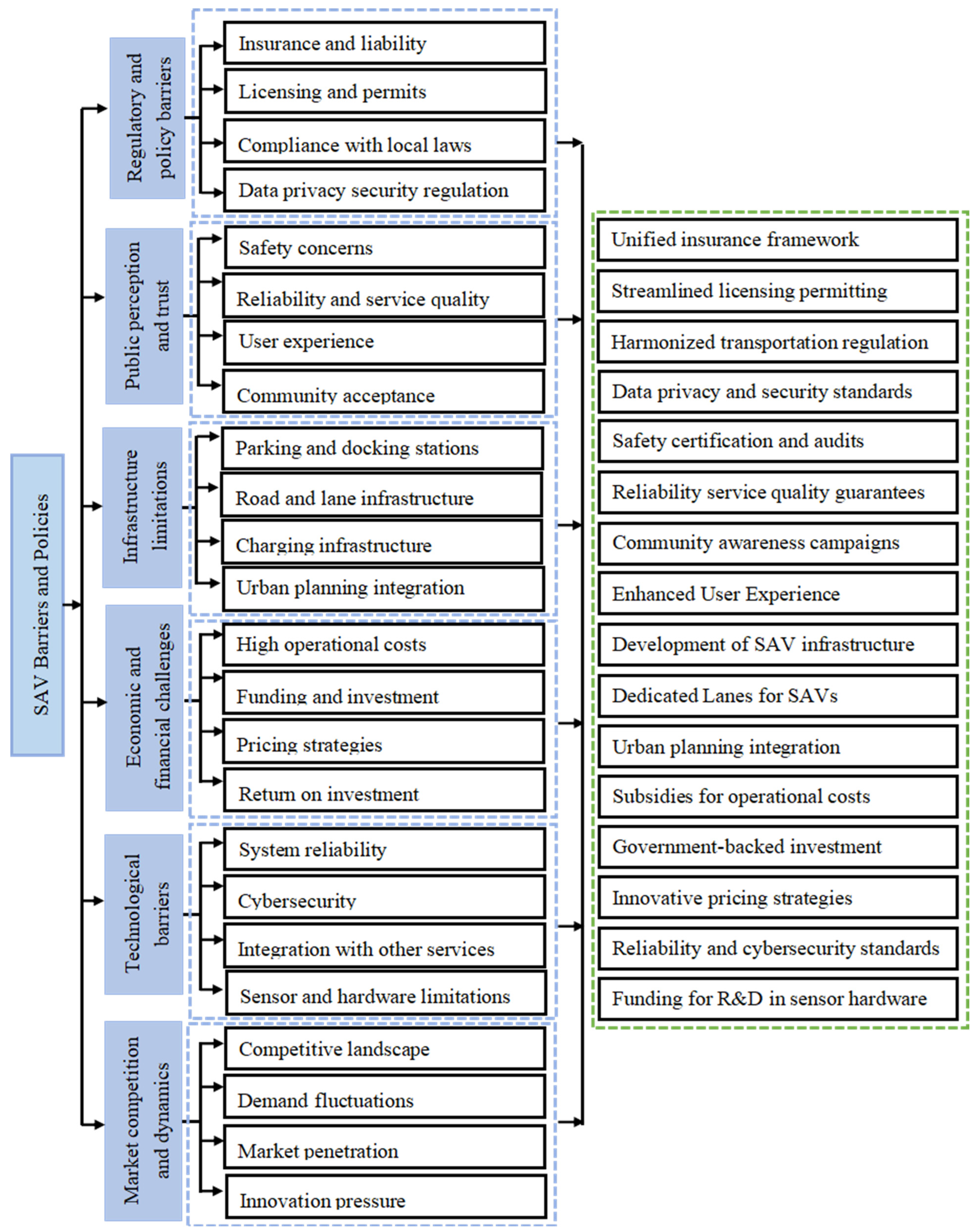
An integrated decision-making approach combining FAHP and FTOPSIS was developed to determine the weights of 6 and 24, the barriers and sub-barriers alternatively, and 16 policies related to SAVs. The hierarchical decision structure of this study is shown in Figure 2. The FAHP approach was initially used to analyze and rank the barriers and sub-barriers. Afterward, the FTOPSIS approach was employed to evaluate and rank the policies for SAVs
Figure 2. Hierarchical decision structure of this study.

4.1. Results of FAHP

In this section, we present the evaluation of all the barriers and sub-barriers employing the FAHP approach. The detailed results for the barriers and sub-barriers are discussed below.
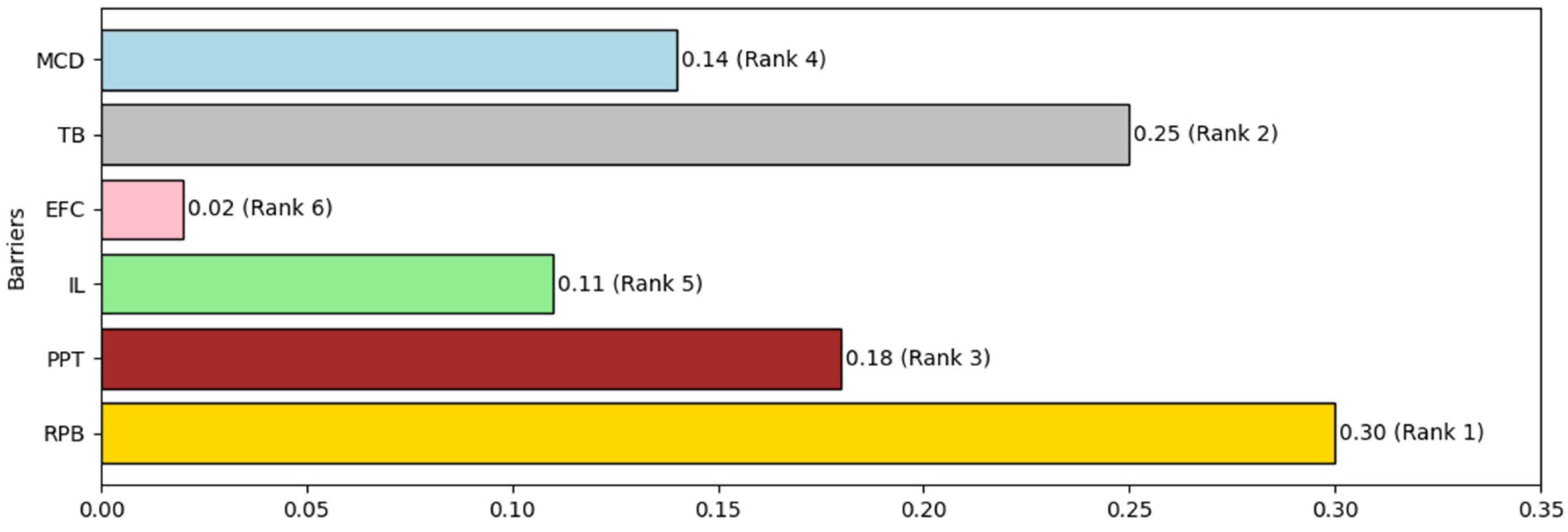
The FAHP approach was employed to compute the weight of six barriers: regulatory and policy barriers (RPB), public perception and trust (PPT), infrastructure limitations (IL), economic and financial challenges (EFC), technological barriers (TB), and market competition and dynamics (MCD). Table 6 shows the fuzzy pairwise comparison matrix of SAV barriers, and the rank of SAV barriers is shown in Figure 3. The results show that the RPB with a weight of 0.30 ranks first, hindering SAV adoption. TB indicates that the second most crucial barrier has a weight of 0.25. The PPT achieved third rank, with a weight of 0.18. Furthermore, the MCD and IL are ranked as the fourth and fifth barriers, weighing 0.14 and 0.11, respectively. Finally, the EFC was ranked sixth in the barrier ranking, weighing 0.02.
Table 6. The fuzzy pairwise comparison matrix of SAV barriers.
Figure 3. Ranking of SAV barriers.
Furthermore, a pairwise comparison matrix was built for individual SAV barriers and the related sub-barriers. A fuzzy pairwise comparison matrix is provided in the Supplementary Materials (Tables S1–S6). The results are shown in Figure 4, Figure 5, Figure 6, Figure 7, Figure 8 and Figure 9.
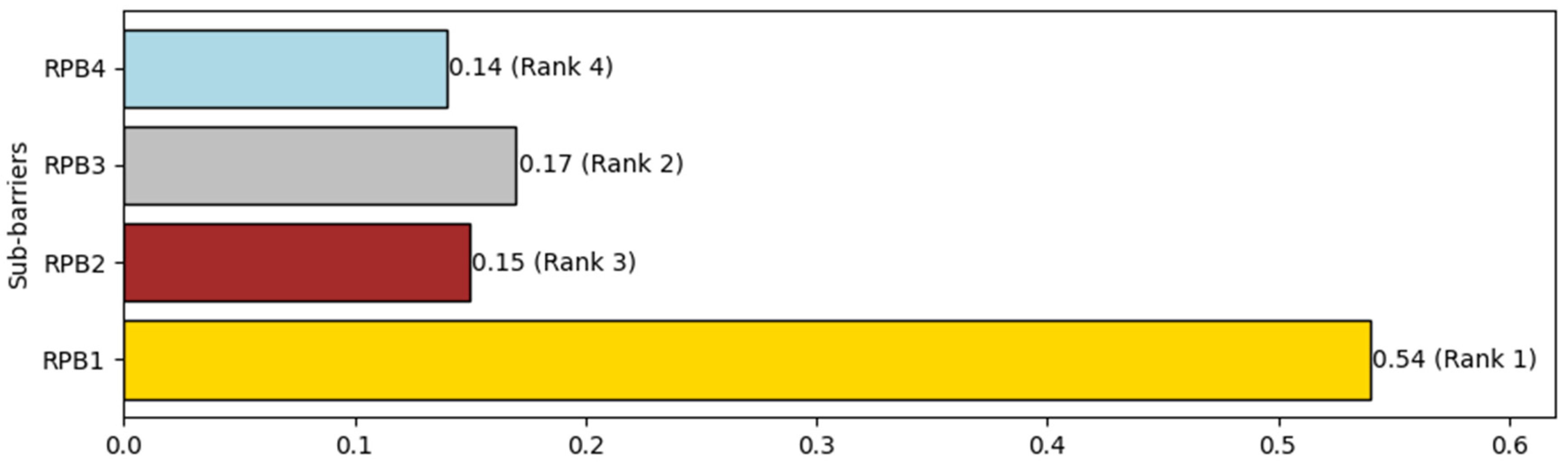
Figure 4 shows the weight and rank of the SAV barriers concerning RPB. The result indicates that insurance and liability (RPB1) is the most significant sub-barrier, weighing 0.54. The compliance with local laws (RPB3) sub-barrier is considered the second, ranked with a weight of 0.17. Moreover, licensing and permits (RPB2) received the third-ranked sub-barrier position, with a weight of 0.15. Lastly, the data privacy and security regulations (RPB4) sub-barrier attained the lowest weight of 0.14.
Figure 4. RPB sub-barriers ranking.
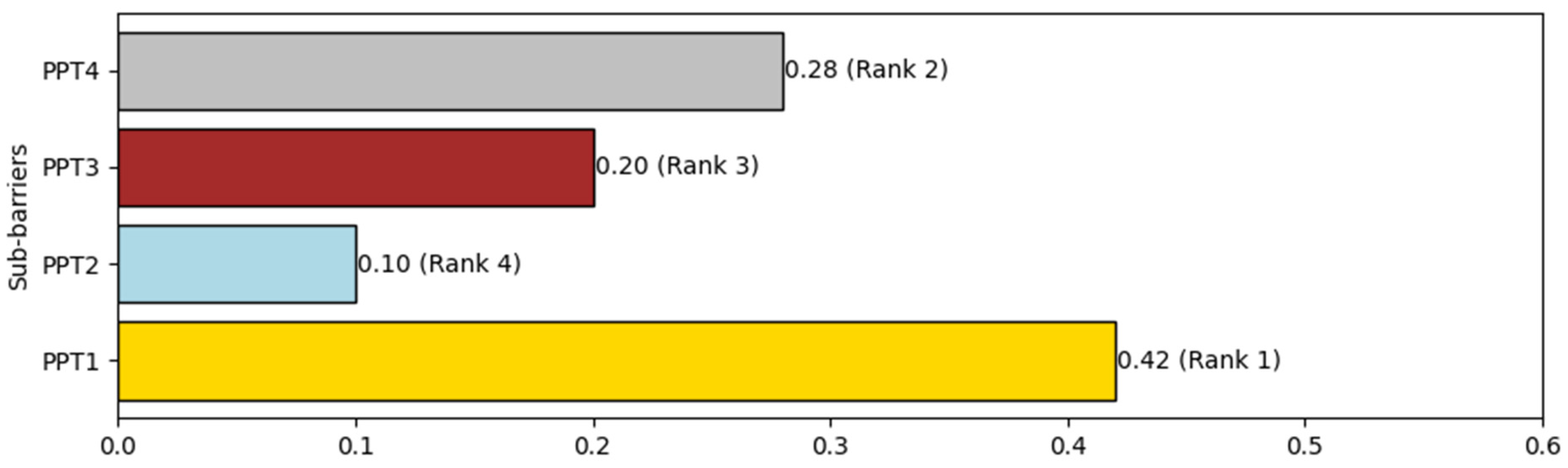
Figure 5 displays the ranking of sub-barriers under PPT. The analysis shows that safety concerns (PPT1) have priority, with a weight of 0.42. Community acceptance (PPT4) achieved the second place in the significance ranking, with a weight of 0.28. The user experience (PPT3), reliability, and service quality (PPT2) sub-barriers received the third and fourth rankings, with weights of 0.20 and 0.10, respectively.
Figure 5. PPT sub-barriers ranking.
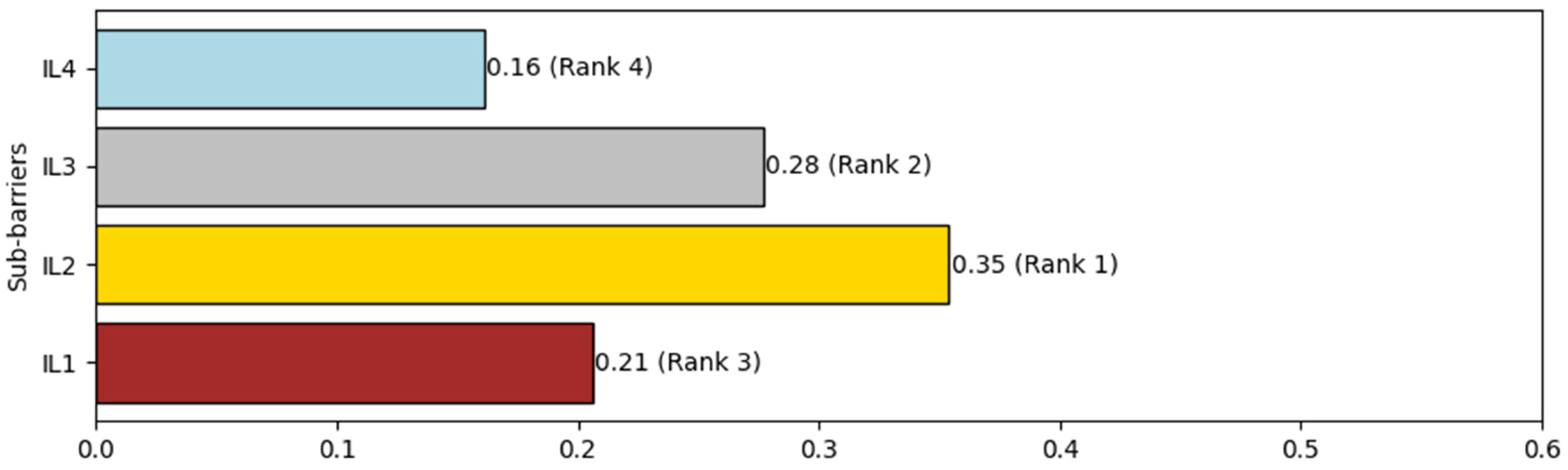
Figure 6 illustrates the ranking of sub-barriers for IL. The results show that road and lane infrastructure (IL2) holds the position of the most significant sub-barrier, with a weight of 0.35. Subsequently, the charging infrastructure (IL3) sub-barrier ranked second, with a weight of 0.28. The parking and docking stations (IL1) and urban planning integration (IL4) sub-barriers ranked third and fourth, respectively, with weights of 0.21 and 0.16.
Figure 6. IL sub-barriers ranking.
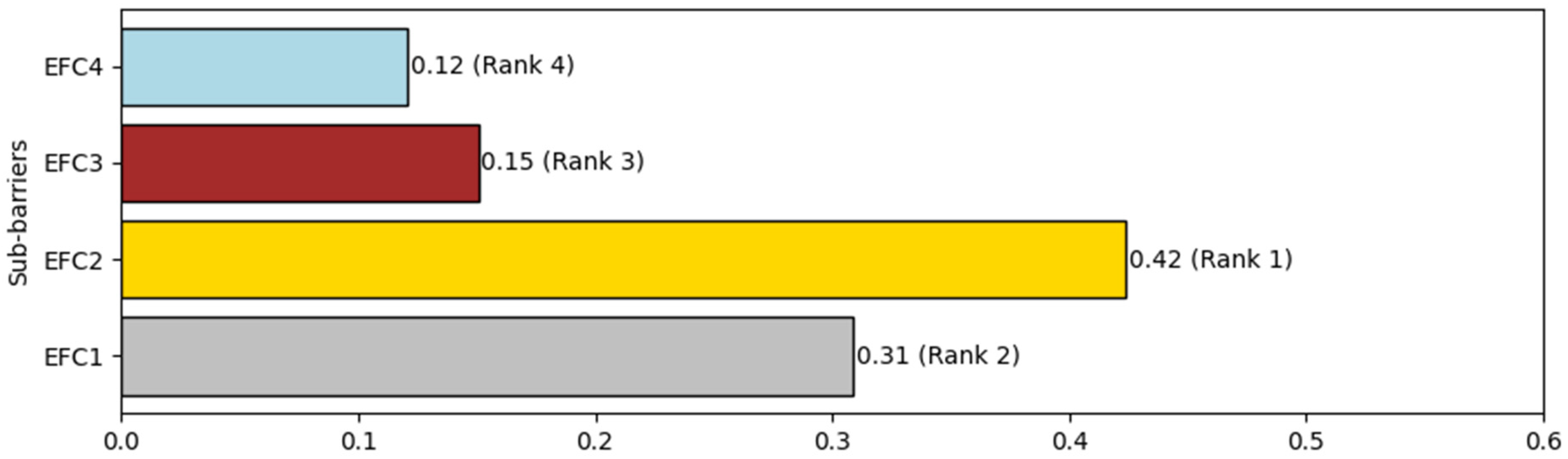
Figure 7 exhibits the ranking order of sub-barriers from the perspective of EFC. The figure shows that the funding and investment (EFC2) sub-barrier is top-ranked, with a weight of 0.42. The high operational costs (EFC1) and charging infrastructure (EFC3) sub-barriers obtained the second and third rank positions, with weights of 0.31 and 0.15, respectively. Finally, return on investment (EFC4) achieved fourth place, with the lowest weighting of 0.12.
Figure 7. EFC sub-barriers ranking.
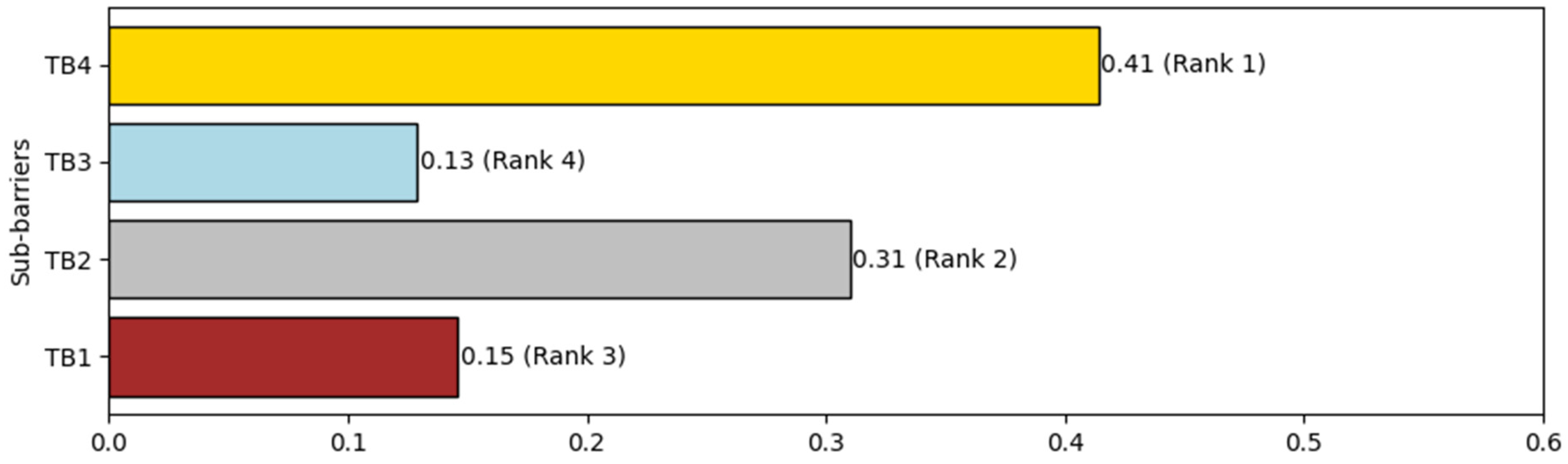
Figure 8 shows the ranking of the TB sub-barriers. The results reveal that the sensor and hardware limitation (TB4) sub-barrier is the most significant, with a weight of 0.41. The second-ranking considerable sub-barrier is cybersecurity (TB2), with a weight of 0.31. The third- and fourth-ranked influential sub-barriers are system reliability (TB1) and integration with other services (TB3), with weights of 0.15 and 0.13, respectively.
Figure 8. TB sub-barriers ranking.
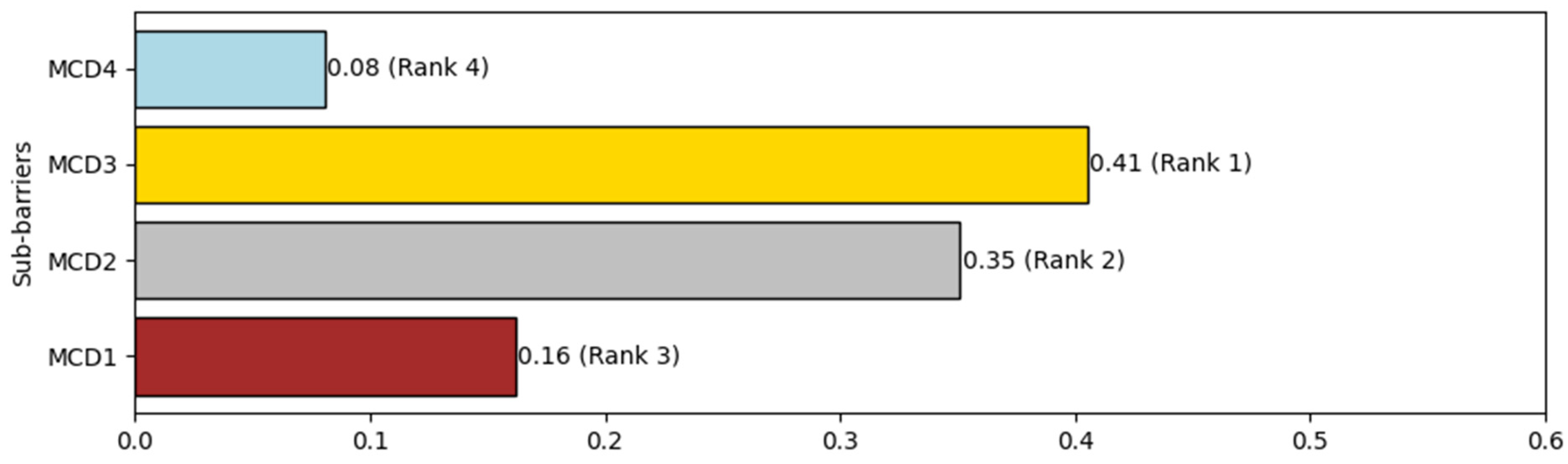
Figure 9 displays the ranking of MCD sub-barriers. The results show that market penetration (MCD3) is the most crucial sub-barrier, with a weight of 0.41. The demand fluctuations (MCD2) sub-barrier ranked second, with a weight of 0.35. The competitive landscape (MCD1) and innovation pressure (MCD4) sub-barriers were identified as the third- and fourth-ranked sub-barriers, with weights of 0.16 and 0.08, respectively.
Figure 9. MCD sub-barriers ranking.
The weights of the SAVs sub-barriers were calculated by multiplying their initial weights by the weights of their respective barriers. The results indicate that the sub-barrier insurance and liability (RPB1) attained the highest weight of 0.161 amongst all the sub-barriers. This sub-barrier belongs to the regulatory and policy barriers category, which also received the highest overall weight (0.30) among the SAV barriers. Table 7 shows the overall ranking of the SAV barriers.
Table 7. The final ranking of sub-barriers.

4.2. Results of F-TOPSIS

The FTOPSIS approach analyzed 10 policies for adopting SAVs in the KSA. Experts were requested to evaluate each policy based on 24 sub-barriers, and a detailed analysis is available in the Supplementary Materials (Tables S7–S9). The final step of this approach involved determining the closeness coefficient (CCi) value, where the highest value shows the most feasible policy for adopting SAVs.
The table shows the final ranking of the 15 SAV policies. The result shows government-backed investment (P13), weighing 0.0149091, to be the highest-ranked. Urban planning integration (P11) follows closely, ranked second, with a weight of 0.0149083. Funding for R&D in sensors and hardware (P16) is recognized as the third most important policy. The remaining SAV policies are ranked in the following order: P9 < P4 < P10 < P2 < P6 < P14 < P15 < P5 < P8 < P7 < P1 < P12 < P3. Table 8 shows that policies addressing these barriers and sub-barriers are essential for overcoming the hindrances to the adoption of SAVs in the KSA.
Table 8. The final ranking of SAV policies.

4.3. Discussion

This research proposed an integrated decision model to assess and prioritize SAV barriers, sub-barriers, and policies in the KSA. The findings show that adopting SAVs is crucial due to their direct impact on the technology’s successful implementation and widespread acceptance.
The insurance and liability (RPB1) barrier is the most significant obstacle to SAV adoption. It has been found that considerable accidents concern AV perspectives, and previous studies showed that it could hinder the widespread adoption of SAVs [20]. The sensor and hardware limitation (TB4) sub-barrier achieved the second ranking in autonomous-driving-related sensors and hardware, which is crucial. These restrictions can create and influence safe operation, where vehicles perceive and respond precisely to the environment. These results are consistent with previous studies highlighting the same AV functionality barriers [88]. The third rank was achieved by cybersecurity (TB2), which illustrates that it is a big problem, as SAVs depend heavily on data and communication systems. To protect these systems from cyberattacks, it is vital to avoid malicious attacks that could compromise user privacy and vehicle safety. A study has highlighted cybersecurity as an important concern that needs to be addressed if we are to build public trust in AV technologies [89]. Safety concerns (PPT1) ranked fourth, indicating that they remain a significant barrier to adopting SAVs. The public’s fear of potential accidents and the unknowns of AV technology can hinder the acceptance of SAVs. The authors of [89] also found that safety concerns are the main barriers influencing public opinion on AVs worldwide. Market penetration (MCD3) is also crucial for the adoption of SAVs. The ability of SAVs to penetrate the market efficiently is another influential barrier. Market penetration is thoroughly tied to the acceptance and adoption rates of new technology. Previous studies show how market penetration is significant for the success of AVs as it determines the scale and speed of their adoption [90]. Community acceptance (PPT4) is also essential for the adoption of SAVs. The community’s acceptance of the SAV is critical for its widespread adoption. Large-scale AV implementation will be complex if the community is against them. A study also emphasized the role of community acceptance in the success of SAVs [91]. Compliance with local laws (RPB3) is also significant, as navigating the regulatory landscape is an important barrier.
Furthermore the findings shows that government-backed investment (P13) was found to be the highest ranked policy in our study. Our findings align with [92], which shows the significance of government investment in infrastructure and technology adoption. Urban planning integration (P11) ranked second; this is critical in overcoming infrastructure limitations, a finding that aligns with a previous study that stresses the importance of integrating new mobility solutions into urban development plans [93]. R&D in sensor and hardware (P16), the third-ranked policy, tackles technological barriers, such as system reliability and cybersecurity; these are essential in the safe deployment of SAVs, as highlighted by [94]. Additionally, developing SAV-specific infrastructure (P9) and establishing data privacy and security standards (P4) are essential in overcoming infrastructural and technological limitations. These findings reflect the consensus in the literature on the need for targeted infrastructure investments and robust data governance [20,95].
Furthermore, other policies like dedicated lanes for SAVs (P10) and streamlined licensing and permitting (P2), ranked sixth and seventh, focus on creating a supportive regulatory environment, which is vital for the efficient integration of SAVs into existing transportation systems, as supported by [88]. An emphasis on reliability and service quality guarantees (P6), ranked eighth, underscores the need to address public trust and perception. This barrier has been widely recognized as crucial for successfully adopting SAVs [89]. The findings show that the other policies are less influential in overcoming the identified barriers to SAV adoption.

5. Conclusions

Urban transportation systems stand to gain much from the deployment of SAVs, but essential barriers must be addressed. This study conducted a thorough analysis to pinpoint and rank the main barriers and regulations necessary for effectively applying SAVs. The study identified 24 crucial barriers that could prevent the broad implementation of SAVs, such as system dependability, cybersecurity, urban planning integration, high operating costs, etc., through a thorough literature analysis and the integration of expert perspectives.
To overcome these barriers and identify the most effective policies for promoting SAV adoption, this study employed a three-phase approach. First, we identified 6 barriers, 24 sub-barriers, and 16 policies from our literature review and expert opinions. Then, we applied the FAHP approach to assess the relative importance of these barriers. Lastly, we employed F-TOPSIS to rank the policies. The outcome of this study shows that insurance and liability, sensor and hardware limitations, cybersecurity, safety concerns, and market penetration are the critical barriers to SAVs adoption.
Furthermore, the findings show that government-backed investment, urban planning integration, and funding for R&D in sensor and hardware technologies are the top policies that should be implemented to overcome these barriers. These findings emphasize the importance of targeted policies that overcome the technical and infrastructural challenges of implementing SAVs. By focusing on system reliability, cybersecurity, and integrating SAVs into urban planning, along with robust government support and continued technological innovation, stakeholders can better navigate the complexities of SAV adoption. The insights from this study provide a roadmap for policymakers and industry leaders to facilitate a more sustainable and resilient urban transportation future.
These policies are important for guiding the adoption of strategic SAVs in urban transport systems. The findings highlight the need for a coordinated policy framework that prioritizes investments in system reliability and cybersecurity to ensure the safe and efficient operation of SAVs. In addition, integrating SAVs into urban planning is critical for developing infrastructure that supports their deployment. Policies should also focus on enhancing research and development in sensor and hardware technologies, which is essential for addressing technical barriers. Government-backed investment and innovative pricing strategies emerged as key enablers, emphasizing the importance of financial support and economic incentives to accelerate the transition to SAVs. By addressing these areas, urban planners and policymakers can create a favorable environment for SAV adoption, ultimately leading to more sustainable and connected urban mobility solutions.
This study does have certain limitations that should be acknowledged. Firstly, the expert opinions gathered were limited to a specific geographical region (focused on the KSA), which may affect the generalizability of the findings to other contexts. Secondly, the study’s focus on current technologies may not fully account for rapid advancements that could alter the relevance of the identified barriers and policies. Thirdly, the small sample size of experts is consistent with previous research studies employing multi-criteria decision-making analyses; we acknowledge that it may limit the generalizability of the findings and recommend validating the results with a more extensive and diverse sample in future research.
Future research could expand the geographical scope of this study and incorporate a broader range of technological scenarios to enhance the robustness of the findings. In addition, exploring the impact of social and behavioral factors on SAV adoption and conducting longitudinal studies to assess the effectiveness of the proposed policies over time would provide valuable insights for the ongoing development of SAV systems.


Supplementary Materials

The following supporting information can be downloaded at: https://www.mdpi.com/article/10.3390/systems12120558/s1.

Author Contributions

Conceptualization, I.U., S.U. and J.Z.; methodology, I.U., S.U. and J.Z.; software, I.U., K.B. and H.A. (Hamad Alawad): validation., S.U., K.B. and H.A. (Hamad Almujibah); formal analysis, I.U., J.Z. and H.A. (Hamad Alawad); investigation, J.Z., S.U., K.B. and H.A. (Hamad Almujibah); writing—original draft preparation, I.U.; writing—review and editing, J.Z., S.U. and H.A. (Hamad Almujibah); visualization, H.A. (Hamad Almujibah), H.A. (Hamad Alawad) and J.Z.; supervision, J.Z. and H.A. (Hamad Alawad); project administration, J.Z. and H.A. (Hamad Almujibah); funding acquisition, H.A. (Hamad Almujibah). All authors have read and agreed to the published version of the manuscript.

Funding

This research is supported by the Taif University, Saudi Arabia, Project No. (TU-DSPP-2024-33).

Data Availability Statement

Data will be made available on request.

Acknowledgments

The authors extend their appreciation to Taif University, Saudi Arabia, for supporting this work through project number (TU-DSPP-2024-33).

Conflicts of Interest

The authors declare no conflicts of interest.

References

  1. Almaghlouth, T.; Gazder, U.; Abudayyeh, O. Need for Smart Mobility and Challenges and Opportunities for Transitioning toward It in Car-Dependent Countries: Insights from Literature. Sci. J. Silesian Univ. Technol. Ser. Transp. 2024, 122, 21–47. [Google Scholar] [CrossRef]
  2. Badi, I.; Bouraima, M.B.; Muhammad, L.J. The Role of Intelligent Transportation Systems in Solving Traffic Problems and Reducing Environmental Negative Impact of Urban Transport. Decis. Mak. Anal. 2023, 1, 1–9. [Google Scholar] [CrossRef]
  3. Anwar, A.M.; Oakil, A.T.; Muhsen, A.; Arora, A. What Would It Take for the People of Riyadh City to Shift from Their Cars to the Proposed Metro? Case Stud. Transp. Policy 2023, 12, 101008. [Google Scholar] [CrossRef]
  4. Bao, Z.; Ng, S.T.; Yu, G.; Zhang, X.; Ou, Y. The Effect of the Built Environment on Spatial-Temporal Pattern of Traffic Congestion in a Satellite City in Emerging Economies. Dev. Built Environ. 2023, 14, 100173. [Google Scholar] [CrossRef]
  5. Fan, Q.; van Essen, J.T.; Correia, G.H. Optimising Fleet Sizing and Management of Shared Automated Vehicle (SAV) Services: A Mixed-Integer Programming Approach Integrating Endogenous Demand, Congestion Effects, and Accept/Reject Mechanism Impacts. Transp. Res. Part C Emerg. Technol. 2023, 157, 104398. [Google Scholar] [CrossRef]
  6. Etminani-Ghasrodashti, R.; Kermanshachi, S.; Rosenberger, J.M.; Foss, A. Exploring Motivating Factors and Constraints of Using and Adoption of Shared Autonomous Vehicles (SAVs). Transp. Res. Interdiscip. Perspect. 2023, 18, 100794. [Google Scholar] [CrossRef]
  7. Golbabaei, F.; Yigitcanlar, T.; Bunker, J. The Role of Shared Autonomous Vehicle Systems in Delivering Smart Urban Mobility: A Systematic Review of the Literature. Int. J. Sustain. Transp. 2021, 15, 731–748. [Google Scholar] [CrossRef]
  8. Narayanan, S.; Chaniotakis, E.; Antoniou, C. Shared Autonomous Vehicle Services: A Comprehensive Review. Transp. Res. Part C Emerg. Technol. 2020, 111, 255–293. [Google Scholar] [CrossRef]
  9. Bucchiarone, A.; Battisti, S.; Marconi, A.; Maldacea, R.; Ponce, D.C. Autonomous Shuttle-as-a-Service (ASaaS): Challenges, Opportunities, and Social Implications. IEEE Trans. Intell. Transp. Syst. 2020, 22, 3790–3799. [Google Scholar] [CrossRef]
  10. Gurumurthy, K.M.; Kockelman, K.M. Analyzing the Dynamic Ride-Sharing Potential for Shared Autonomous Vehicle Fleets Using Cellphone Data from Orlando, Florida. Comput. Environ. Urban Syst. 2018, 71, 177–185. [Google Scholar] [CrossRef]
  11. Venter, C.; Jennings, G.; Hidalgo, D.; Valderrama Pineda, A.F. The Equity Impacts of Bus Rapid Transit: A Review of the Evidence and Implications for Sustainable Transport. Int. J. Sustain. Transp. 2018, 12, 140–152. [Google Scholar] [CrossRef]
  12. Litman, T. Autonomous Vehicle Implementation Predictions: Implications for Transport Planning; Victoria Transport Policy Institute: Victoria, BC, Canada, 2023; Available online: https://www.vtpi.org/avip.pdf (accessed on 9 December 2024).
  13. Nazari, F.; Noruzoliaee, M.; Mohammadian, A. (Kouros) Shared versus Private Mobility: Modeling Public Interest in Autonomous Vehicles Accounting for Latent Attitudes. Transp. Res. Part C Emerg. Technol. 2018, 97, 456–477. [Google Scholar] [CrossRef]
  14. Kruszyna, M. Should Smart Cities Introduce a New Form of Public Transport Vehicles? Smart Cities 2023, 6, 2932–2943. [Google Scholar] [CrossRef]
  15. Kubik, A. Impact of the Use of Electric Scooters from Shared Mobility Systems on the Users. Smart Cities 2022, 5, 1079–1091. [Google Scholar] [CrossRef]
  16. Garus, A.; Mourtzouchou, A.; Suarez, J.; Fontaras, G.; Ciuffo, B. Exploring Sustainable Urban Transportation: Insights from Shared Mobility Services and Their Environmental Impact. Smart Cities 2024, 7, 1199–1220. [Google Scholar] [CrossRef]
  17. Milakis, D.; Van Arem, B.; Van Wee, B. Policy and Society Related Implications of Automated Driving: A Review of Literature and Directions for Future Research. J. Intell. Transp. Syst. 2017, 21, 324–348. [Google Scholar] [CrossRef]
  18. Stead, D.; Vaddadi, B. Automated Vehicles and How They May Affect Urban Form: A Review of Recent Scenario Studies. Cities 2019, 92, 125–133. [Google Scholar] [CrossRef]
  19. Tsigdinos, S.; Tzouras, P.G.; Bakogiannis, E.; Kepaptsoglou, K.; Nikitas, A. The Future Urban Road: A Systematic Literature Review-Enhanced Q-Method Study with Experts. Transp. Res. Part D Transp. Environ. 2022, 102, 103158. [Google Scholar] [CrossRef]
  20. Fagnant, D.J.; Kockelman, K. Preparing a Nation for Autonomous Vehicles: Opportunities, Barriers and Policy Recommendations. Transp. Res. Part A Policy Pract. 2015, 77, 167–181. [Google Scholar] [CrossRef]
  21. Triantafillidi, E.; Tzouras, P.G.; Spyropoulou, I.; Kepaptsoglou, K. Identification of Contributory Factors That Affect the Willingness to Use Shared Autonomous Vehicles. Future Transp. 2023, 3, 970–985. [Google Scholar] [CrossRef]
  22. Etzioni, S.; Daziano, R.A.; Ben-Elia, E.; Shiftan, Y. Preferences for Shared Automated Vehicles: A Hybrid Latent Class Modeling Approach. Transp. Res. Part C Emerg. Technol. 2021, 125, 103013. [Google Scholar] [CrossRef]
  23. Yuen, K.F.; Huyen, D.T.K.; Wang, X.; Qi, G. Factors Influencing the Adoption of Shared Autonomous Vehicles. Int. J. Environ. Res. Public Health 2020, 17, 4868. [Google Scholar] [CrossRef] [PubMed]
  24. LeddarTech. South Korea Accelerates Commercialization of Autonomous Vehicles; LeddarTech: Québec, QC, Canada, 2023. [Google Scholar]
  25. Tarr, J.-A.; Tarr, A.A. Autonomous Vehicles: Liability and Insurance. In The Global Insurance Market and Change; Informa Law from Routledge: London, UK, 2024; pp. 157–181. [Google Scholar]
  26. Zhong, S.; Liu, A.; Jiang, Y.; Hu, S.; Xiao, F.; Huang, H.-J.; Song, Y. Energy and Environmental Impacts of Shared Autonomous Vehicles under Different Pricing Strategies. NPJ Urban Sustain. 2023, 3, 8. [Google Scholar] [CrossRef]
  27. Duffy, J. “SAV” the Bay: Achieving the Chesapeake Bay Program’s Submerged Aquatic Vegetation (SAV) Restoration Goals Through Law. Univ. Baltim. Law Rev. 2024, 53, 7. [Google Scholar]
  28. Liu, N.; Nikitas, A.; Parkinson, S. Exploring Expert Perceptions about the Cyber Security and Privacy of Connected and Autonomous Vehicles: A Thematic Analysis Approach. Transp. Res. Part F Traffic Psychol. Behav. 2020, 75, 66–86. [Google Scholar] [CrossRef]
  29. Rahimi, A.; Azimi, G.; Jin, X. Examining Human Attitudes toward Shared Mobility Options and Autonomous Vehicles. Transp. Res. Part F Traffic Psychol. Behav. 2020, 72, 133–154. [Google Scholar] [CrossRef]
  30. Patel, R.K.; Etminani-Ghasrodashti, R.; Kermanshachi, S.; Rosenberger, J.M.; Pamidimukkala, A.; Foss, A. Identifying Individuals’ Perceptions, Attitudes, Preferences, and Concerns of Shared Autonomous Vehicles: During-and Post-Implementation Evidence. Transp. Res. Interdiscip. Perspect. 2023, 18, 100785. [Google Scholar] [CrossRef]
  31. Hogye-Nagy, Á.; Kovács, G.; Kurucz, G. Acceptance of Self-Driving Cars among the University Community: Effects of Gender, Previous Experience, Technology Adoption Propensity, and Attitudes toward Autonomous Vehicles. Transp. Res. Part F Traffic Psychol. Behav. 2023, 94, 353–361. [Google Scholar] [CrossRef]
  32. Fakhrmoosavi, F.; Gurumurthy, K.M.; Kockelman, K.M.; Hunter, C.B.; Dean, M.D. Parking Strategies and Outcomes for Shared Autonomous Vehicle Fleet Operations. J. Transp. Eng. Part A Syst. 2024, 150, 04024009. [Google Scholar] [CrossRef]
  33. Chen, S.; Zong, S.; Chen, T.; Huang, Z.; Chen, Y.; Labi, S. A Taxonomy for Autonomous Vehicles Considering Ambient Road Infrastructure. Sustainability 2023, 15, 11258. [Google Scholar] [CrossRef]
  34. Zhang, Z.; Liu, J.; Bastidas, J.P.; Jones, S. Charging Infrastructure Assessment for Shared Autonomous Electric Vehicles in 374 Small and Medium-Sized Urban Areas: An Agent-Based Simulation Approach. Transp. Policy 2024, 155, 58–78. [Google Scholar] [CrossRef]
  35. Khan, M.A.; Etminani-Ghasrodashti, R.; Kermanshachi, S.; Rosenberger, J.M.; Foss, A. A User and Ridership Evaluation of Shared Autonomous Vehicles. J. Urban Plann. Dev. 2023, 149, 05022048. [Google Scholar] [CrossRef]
  36. Singh, H.; Kavianipour, M.; Ghamami, M.; Zockaie, A. Adoption of Autonomous and Electric Vehicles in Private and Shared Mobility Systems. Transp. Res. Part D Transp. Environ. 2023, 115, 103561. [Google Scholar] [CrossRef]
  37. Tu, L.; Xu, M. An Analysis of the Use of Autonomous Vehicles in the Shared Mobility Market: Opportunities and Challenges. Sustainability 2024, 16, 6795. [Google Scholar] [CrossRef]
  38. Cartenì, A. The Acceptability Value of Autonomous Vehicles: A Quantitative Analysis of the Willingness to Pay for Shared Autonomous Vehicles (SAVs) Mobility Services. Transp. Res. Interdiscip. Perspect. 2020, 8, 100224. [Google Scholar] [CrossRef]
  39. Wang, F.; Araújo, D.F.; Li, Y.-F. Reliability Assessment of Autonomous Vehicles Based on the Safety Control Structure. Proc. Inst. Mech. Eng. Part O J. Risk Reliab. 2023, 237, 389–404. [Google Scholar] [CrossRef]
  40. George, A.S.; Baskar, T.; Srikaanth, P.B. Securing the Self-Driving Future: Cybersecurity Challenges and Solutions for Autonomous Vehicles. Partn. Univers. Innov. Res. Publ. 2023, 1, 137–156. [Google Scholar]
  41. Patel, R.K.; Etminani-Ghasrodashti, R.; Kermanshachi, S.; Rosenberger, J.M.; Foss, A. Exploring Willingness toUse Shared Autonomous Vehicles. Int. J. Transp. Sci. Technol. 2023, 12, 765–778. [Google Scholar] [CrossRef]
  42. Jhung, J.; Suk, H.; Park, H.; Kim, S. Hardware Accelerators for Autonomous Vehicles. In Artificial Intelligence and Hardware Accelerators; Mishra, A., Cha, J., Park, H., Kim, S., Eds.; Springer International Publishing: Cham, Switzerland, 2023; pp. 269–317. ISBN 978-3-031-22169-9. [Google Scholar]
  43. Rahman, M.M.; Thill, J.-C. Impacts of Connected and Autonomous Vehicles on Urban Transportation and Environment: A Comprehensive Review. Sustain. Cities Soc. 2023, 96, 104649. [Google Scholar] [CrossRef]
  44. Xu, T.; Cieniawski, M.; Levin, M.W. FMS-Dispatch: A Fast Maximum Stability Dispatch Policy for Shared Autonomous Vehicles Including Exiting Passengers under Stochastic Travel Demand. Transp. A Transp. Sci. 2024, 20, 2214968. [Google Scholar] [CrossRef]
  45. Iacobucci, R.; Donhauser, J.; Schmöcker, J.-D.; Pruckner, M. The Demand Potential of Shared Autonomous Vehicles: A Large-Scale Simulation Using Mobility Survey Data. J. Intell. Transp. Syst. 2024, 28, 719–740. [Google Scholar] [CrossRef]
  46. Turienzo, J.; Cabanelas, P.; Lampón, J.F. Business Models in Times of Disruption: The Connected and Autonomous Vehicles (Uncertain) Domino Effect. J. Bus. Res. 2023, 156, 113481. [Google Scholar] [CrossRef]
  47. Shladover, S.E.; Nowakowski, C. Regulatory Challenges for Road Vehicle Automation: Lessons from the California Experience. Transp. Res. Part A Policy Pract. 2019, 122, 125–133. [Google Scholar] [CrossRef]
  48. Saeed, T.U. Road Infrastructure Readiness for Autonomous Vehicles. Ph.D. Thesis, Purdue University, West Lafayette, IN, USA, August 2019. [Google Scholar] [CrossRef]
  49. Johnson, C. Readiness of the Road Network for Connected and Autonomous Vehicles; RAC Foundation: London, UK, 2017. [Google Scholar]
  50. Vosooghi, R.; Puchinger, J.; Bischoff, J.; Jankovic, M.; Vouillon, A. Shared Autonomous Electric Vehicle Service Performance: Assessing the Impact of Charging Infrastructure. Transp. Res. Part D Transp. Environ. 2020, 81, 102283. [Google Scholar] [CrossRef]
  51. Bagloee, S.A.; Tavana, M.; Asadi, M.; Oliver, T. Autonomous Vehicles: Challenges, Opportunities, and Future Implications for Transportation Policies. J. Mod. Transport. 2016, 24, 284–303. [Google Scholar] [CrossRef]
  52. Ryan, M. The Future of Transportation: Ethical, Legal, Social and Economic Impacts of Self-Driving Vehicles in the Year 2025. Sci Eng Ethics 2020, 26, 1185–1208. [Google Scholar] [CrossRef]
  53. Patil, P. The Future of Electric Vehicles: A Comprehensive Review of Technological Advancements, Market Trends, and Environmental Impacts. J. Artif. Intell. Mach. Learn. Manag. 2020, 4, 56–68. [Google Scholar]
  54. Ekatpure, R. Challenges and Opportunities in the Deployment of Fully Autonomous Vehicles in Urban Environments in Developing Countries. J. Sustain. Technol. Infrastruct. Dev. Ctries. 2023, 6, 72–91. [Google Scholar]
  55. Van Brummelen, J.; O’Brien, M.; Gruyer, D.; Najjaran, H. Autonomous Vehicle Perception: The Technology of Today and Tomorrow. Transp. Res. Part C Emerg. Technol. 2018, 89, 384–406. [Google Scholar] [CrossRef]
  56. Shladover, S.E. Connected and Automated Vehicle Systems: Introduction and Overview. J. Intell. Transp. Syst. 2018, 22, 190–200. [Google Scholar] [CrossRef]
  57. Schoettle, B.; Sivak, M. Potential Impact of Self-Driving Vehicles on Household Vehicle Demand and Usage; University of Michigan, Ann Arbor, Transportation Research Institute: Ann Arbor, MI, USA, 2015. [Google Scholar]
  58. World Economic Forum Autonomous. Vehicle Policy Framework: Selected National and Jurisdictional Policy Efforts to Guide Safe AV Development; World Economic Forum Autonomous: New York, NY, USA, 2020. [Google Scholar]
  59. Muzahid, A.J.M.; Kamarulzaman, S.F.; Rahman, M.A.; Murad, S.A.; Kamal, M.A.S.; Alenezi, A.H. Multiple Vehicle Cooperation and Collision Avoidance in Automated Vehicles: Survey and an AI-Enabled Conceptual Framework. Sci. Rep. 2023, 13, 603. [Google Scholar] [CrossRef] [PubMed]
  60. Hanson, S. Autonomous Vehicles Law and Regulation in Singapore. 2020. Available online: https://cms.law/en/int/expert-guides/cms-expert-guide-to-autonomous-vehicles-avs/singapore (accessed on 9 December 2024).
  61. Skeete, J.-P. Level 5 Autonomy: The New Face of Disruption in Road Transport. Technol. Forecast. Soc. Chang. 2018, 134, 22–34. [Google Scholar] [CrossRef]
  62. Robles, P.; Mallinson, D.J. Policy Learning and the Diffusion of Autonomous Vehicle Policy in the American States. State Local Gov. Rev. 2024, 56, 0160323X241262816. [Google Scholar] [CrossRef]
  63. Eastman, B.; Collins, S.; Jones, R.; Martin, J.; Blumenthal, S.M.; Stanley, D.K. A Comparative Look at Various Countries’ Legal Regimes Governing Automated Vehicles. J. Law Mobil. 2023, 2023, 1. [Google Scholar]
  64. Benyahya, M.; Collen, A.; Kechagia, S.; Nijdam, N.A. Automated City Shuttles: Mapping the Key Challenges in Cybersecurity, Privacy and Standards to Future Developments. Comput. Secur. 2022, 122, 102904. [Google Scholar] [CrossRef]
  65. Etminani-Ghasrodashti, R.; Patel, R.K.; Kermanshachi, S.; Rosenberger, J.M.; Weinreich, D.; Foss, A. Integration of Shared Autonomous Vehicles (SAVs) into Existing Transportation Services: A Focus Group Study. Transp. Res. Interdiscip. Perspect. 2021, 12, 100481. [Google Scholar] [CrossRef]
  66. Tihanyi, V.; Tettamanti, T.; Csonthó, M.; Eichberger, A.; Ficzere, D.; Gangel, K.; Hörmann, L.B.; Klaffenböck, M.A.; Knauder, C.; Luley, P. Motorway Measurement Campaign to Support R&D Activities in the Field of Automated Driving Technologies. Sensors 2021, 21, 2169. [Google Scholar] [CrossRef] [PubMed]
  67. Sanguino, T.D.; Domínguez, J.M.; de Carvalho Baptista, P. Cybersecurity Certification and Auditing of Automotive Industry. In Advances in Transport Policy and Planning; Elsevier: Amsterdam, The Netherlands, 2020; Volume 5, pp. 95–124. [Google Scholar]
  68. Mahdavian, A.; Shojaei, A.; Mccormick, S.; Papandreou, T.; Eluru, N.; Oloufa, A.A. Drivers and Barriers to Implementation of Connected, Automated, Shared, and Electric Vehicles: An Agenda for Future Research. IEEE Access 2021, 9, 22195–22213. [Google Scholar] [CrossRef]
  69. Nair, G.S.; Bhat, C.R. Sharing the Road with Autonomous Vehicles: Perceived Safety and Regulatory Preferences. Transp. Res. Part C Emerg. Technol. 2021, 122, 102885. [Google Scholar] [CrossRef]
  70. UITTP. Autonomous Vehicles: A Potential Game Changer for Urban Mobility; UITTP: Bruxelles, Belgium, 2017. [Google Scholar]
  71. Kim, S.; Shrestha, R. Security and Privacy in Intelligent Autonomous Vehicles. In Automotive Cyber Security; Springer: Singapore, 2020; pp. 35–66. ISBN 9789811580529. [Google Scholar]
  72. Lee, M.; Lee, Y. UI Proposal for Shared Autonomous Vehicles: Focusing on Improving User’s Trust. In Proceedings of the International Conference on Human-Computer Interaction, Copenhagen, Denmark, 19–24 July 2020; pp. 282–296. [Google Scholar]
  73. Wang, Z.; An, K.; Correia, G.; Ma, W. Real-Time Scheduling and Routing of Shared Autonomous Vehicles Considering Platooning in Intermittent Segregated Lanes and Priority at Intersections in Urban Corridors. Transp. Res. Part E Logist. Transp. Rev. 2024, 186, 103546. [Google Scholar] [CrossRef]
  74. Gavanas, N. Autonomous Road Vehicles: Challenges for Urban Planning in European Cities. Urban Sci. 2019, 3, 61. [Google Scholar] [CrossRef]
  75. Mo, B.; Cao, Z.; Zhang, H.; Shen, Y.; Zhao, J. Competition between Shared Autonomous Vehicles and Public Transit: A Case Study in Singapore. Transp. Res. Part C Emerg. Technol. 2021, 127, 103058. [Google Scholar] [CrossRef]
  76. Zhao, B. Connected Cars in China: Technology, Data Protection and Regulatory Responses. In Grundrechtsschutz im Smart Car; Roßnagel, A., Hornung, G., Eds.; DuD-Fachbeiträge; Springer Fachmedien: Wiesbaden, Germany, 2019; pp. 417–438. ISBN 978-3-658-26944-9. [Google Scholar]
  77. Kaddoura, I.; Bischoff, J.; Nagel, K. Towards Welfare Optimal Operation of Innovative Mobility Concepts: External Cost Pricing in a World of Shared Autonomous Vehicles. Transp. Res. Part A Policy Pract. 2020, 136, 48–63. [Google Scholar] [CrossRef]
  78. Nikjow, M.A.; Liang, L.; Xijing, Q.; Sonar, H. Risk Analysis of Belt and Road Infrastructure Projects Using Integrated ISM-MICMAC Approach. J. Model. Manag. 2022, 17, 1410–1431. [Google Scholar] [CrossRef]
  79. Ravi, V.; Shankar, R. Analysis of Interactions among the Barriers of Reverse Logistics. Technol. Forecast. Soc. Chang. 2005, 72, 1011–1029. [Google Scholar] [CrossRef]
  80. Iqbal, M.; Ma, J.; Ullah, Z.; Ahmad, N.; Ibrahim, M.; Waqas, M.; Ahmad, M. Identifying Lockdown Relaxation Strategies and Policy Implications to Fight against COVID-19: Medical Experts Perspective from Pakistan. Soc. Work. Public Health 2022, 37, 609–630. [Google Scholar] [CrossRef] [PubMed]
  81. Bux, H.; Zhang, Z.; Ahmad, N. Promoting Sustainability through Corporate Social Responsibility Implementation in the Manufacturing Industry: An Empirical Analysis of Barriers Using the ISM-MICMAC Approach. Corp. Soc. Responsib. Environ. Manag. 2020, 27, 1729–1748. [Google Scholar] [CrossRef]
  82. Iqbal, M.; Ma, J.; Ahmad, N.; Hussain, K.; Usmani, M.S.; Ahmad, M. Sustainable Construction through Energy Management Practices in Developing Economies: An Analysis of Barriers in the Construction Sector. Environ. Sci Pollut. Res. 2021, 28, 34793–34823. [Google Scholar] [CrossRef] [PubMed]
  83. Saaty, R.W. The Analytic Hierarchy Process—What It Is and How It Is Used. Math. Model. 1987, 9, 161–176. [Google Scholar] [CrossRef]
  84. Iqbal, M.; Ma, J.; Ahmad, N.; Ullah, Z.; Ahmed, R.I. Uptake and Adoption of Sustainable Energy Technologies: Prioritizing Strategies to Overcome Barriers in the Construction Industry by Using an Integrated AHP-TOPSIS Approach. Adv. Sustain. Syst. 2021, 5, 2100026. [Google Scholar] [CrossRef]
  85. Prakash, C.; Barua, M.K. Integration of AHP-TOPSIS Method for Prioritizing the Solutions of Reverse Logistics Adoption to Overcome Its Barriers under Fuzzy Environment. J. Manuf. Syst. 2015, 37, 599–615. [Google Scholar] [CrossRef]
  86. Chang, D.-Y. Applications of the Extent Analysis Method on Fuzzy AHP. Eur. J. Oper. Res. 1996, 95, 649–655. [Google Scholar] [CrossRef]
  87. Yoon, K.; Hwang, C.L. TOPSIS (Technique for Order Preference by Similarity to Ideal Solution)—A Multiple Attribute Decision Making, w: Multiple Attribute Decision Making–Methods and Applications, a State-of-the-at Survey; Springer: Berlin/Heidelberg, Germany, 1981; Volume 128, p. 140. [Google Scholar]
  88. Litman, T. Autonomous Vehicle Implementation Predictions: Implications for Transport Planning. 2020. Available online: https://trid.trb.org/View/1678741 (accessed on 9 December 2024).
  89. Schoettle, B.; Sivak, M. A Survey of Public Opinion about Autonomous and Self-Driving Vehicles in the US, the UK, and Australia; University of Michigan, Transportation Research Institute: Ann Arbor, MI, USA, 2014. [Google Scholar]
  90. Bansal, P.; Kockelman, K.M. Forecasting Americans’ Long-Term Adoption of Connected and Autonomous Vehicle Technologies. Transp. Res. Part A Policy Pract. 2017, 95, 49–63. [Google Scholar] [CrossRef]
  91. Krueger, R.; Rashidi, T.H.; Rose, J.M. Preferences for Shared Autonomous Vehicles. Transp. Res. Part C Emerg. Technol. 2016, 69, 343–355. [Google Scholar] [CrossRef]
  92. Wadud, Z.; MacKenzie, D.; Leiby, P. Help or Hindrance? The Travel, Energy and Carbon Impacts of Highly Automated Vehicles. Transp. Res. Part A Policy Pract. 2016, 86, 1–18. [Google Scholar] [CrossRef]
  93. Zhang, W.; Guhathakurta, S.; Fang, J.; Zhang, G. Exploring the Impact of Shared Autonomous Vehicles on Urban Parking Demand: An Agent-Based Simulation Approach. Sustain. Cities Soc. 2015, 19, 34–45. [Google Scholar] [CrossRef]
  94. Anderson, J.M.; Nidhi, K.; Stanley, K.D.; Sorensen, P.; Samaras, C.; Oluwatola, O.A. Autonomous Vehicle Technology: A Guide for Policymakers; Rand Corporation: Santa Monica, CA, USA, 2014. [Google Scholar]
  95. Goodall, N.J. Machine Ethics and Automated Vehicles. In Road Vehicle Automation; Meyer, G., Beiker, S., Eds.; Lecture Notes in Mobility; Springer International Publishing: Cham, Switzerland, 2014; pp. 93–102. ISBN 978-3-319-05989-1. [Google Scholar]
Disclaimer/Publisher’s Note: The statements, opinions and data contained in all publications are solely those of the individual author(s) and contributor(s) and not of MDPI and/or the editor(s). MDPI and/or the editor(s) disclaim responsibility for any injury to people or property resulting from any ideas, methods, instructions or products referred to in the content.

Article Metrics

Citations

Article Access Statistics

Multiple requests from the same IP address are counted as one view.