Recurrent and Long-Term Oceanic Anoxia Contributed to Aborted Biotic Recovery Following the Permian–Triassic Crisis


Simple Summary
Abstract
1. Introduction
2. Samples and Methods
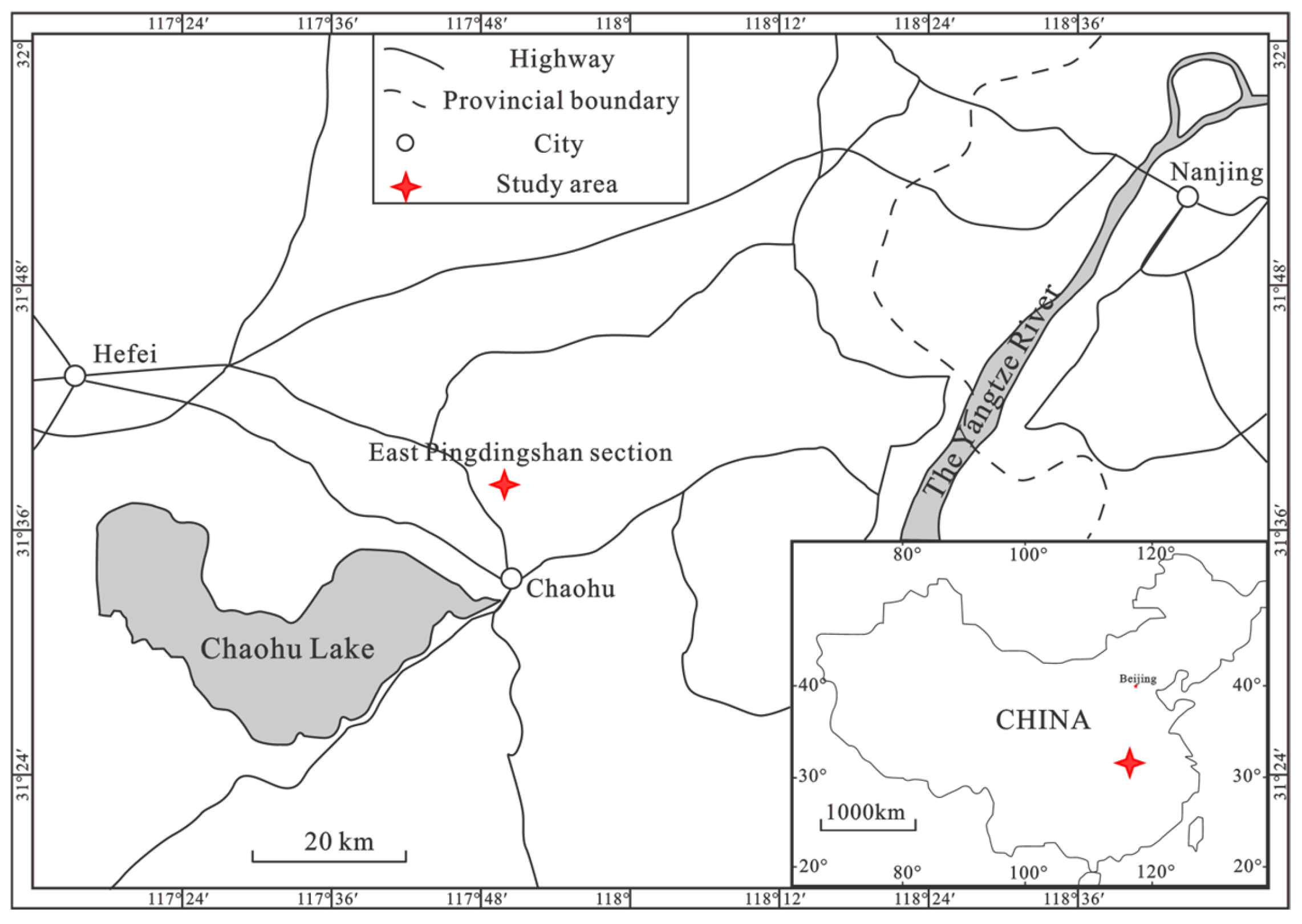
2.1. Sample Information
2.2. Methods
3. Results and Discussion
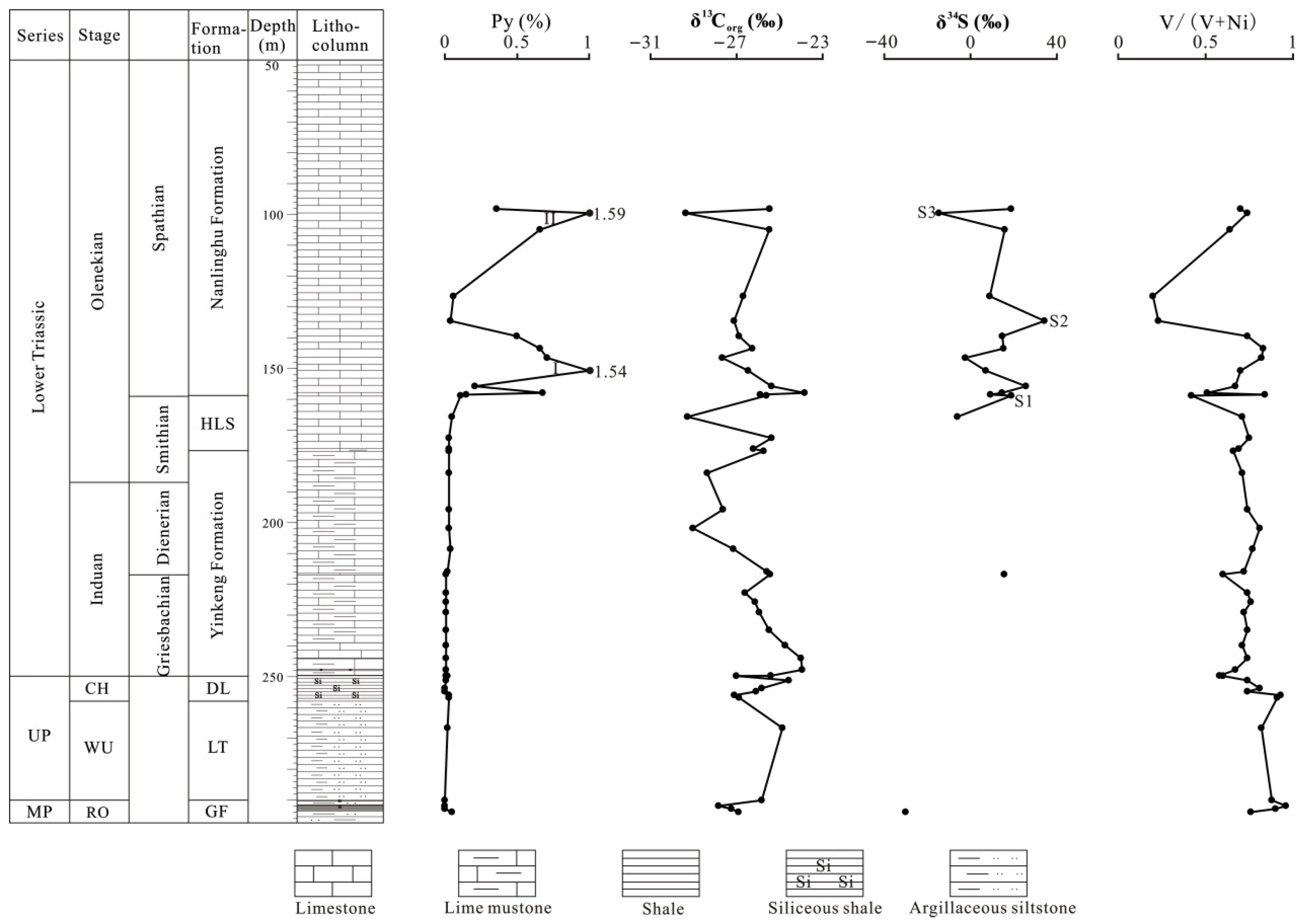
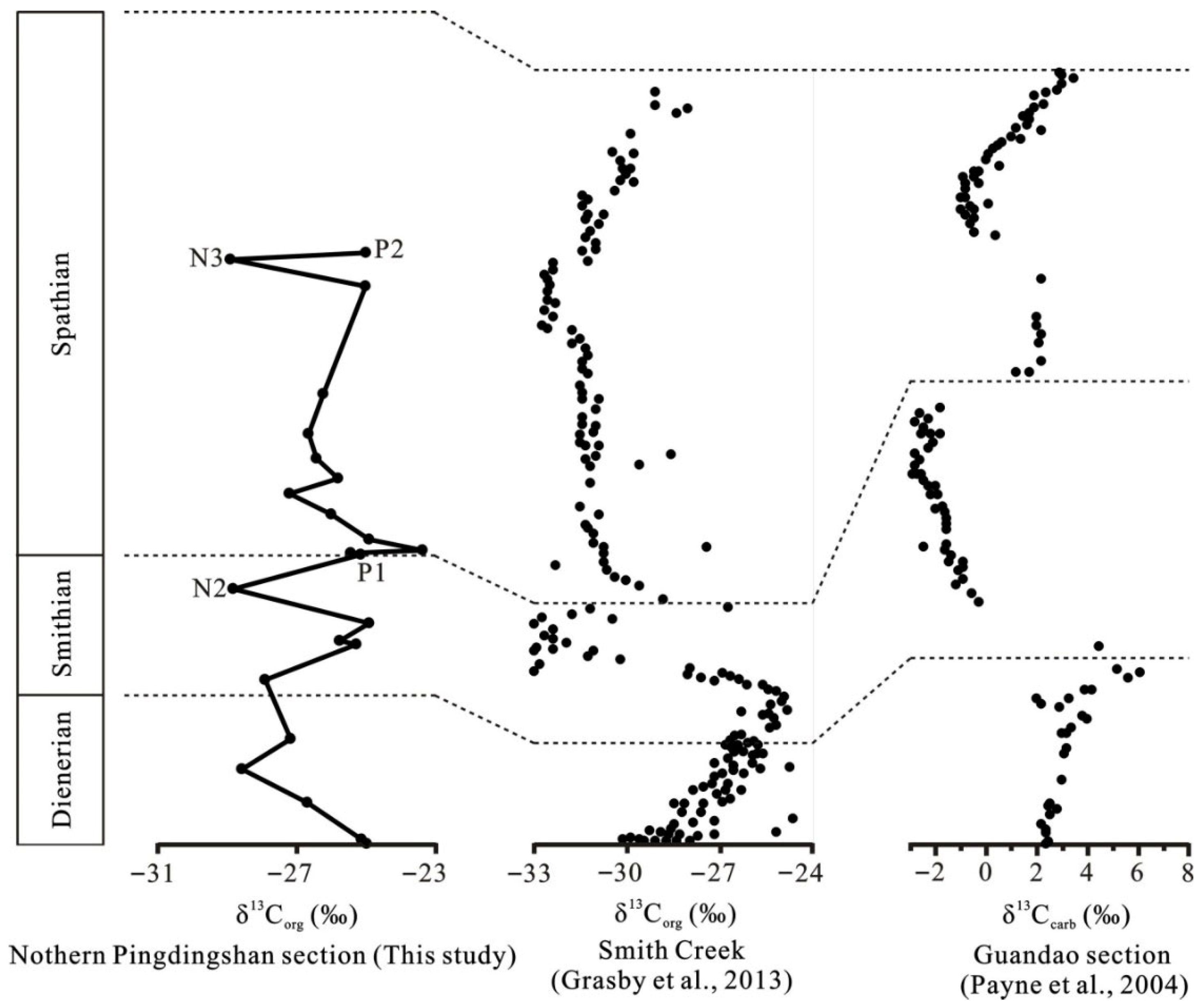
3.1. Redox Conditions During the Permian–Triassic Crisis
3.2. Biotic Recovery During the Early Triassic
4. Conclusions
Author Contributions
Funding
Institutional Review Board Statement
Informed Consent Statement
Data Availability Statement
Acknowledgments
Conflicts of Interest
References
- Wignall, P.B.; Twitchett, R.J. Oceanic anoxia and the End Permian mass extinction. Science 1996, 272, 1155–1158. [Google Scholar] [CrossRef] [PubMed]
- Isozaki, Y. Permo-Triassic boundary superanoxia and stratified superocean: Records from lost deep sea. Science 1997, 276, 235–238. [Google Scholar] [CrossRef] [PubMed]
- Kump, L.R.; Pavlov, A.; Arthur, M.A. Massive release of hydrogen sulfide to the surface ocean and atmosphere during intervals of oceanic anoxia. Geology 2005, 33, 397–400. [Google Scholar] [CrossRef]
- Meyer, K.M.; Kump, L.R.; Ridgwell, A. Biogeochemical controls on photic-zone euxinia during the end-Permian mass extinction. Geology 2008, 36, 747–750. [Google Scholar] [CrossRef]
- Brennecka, G.A.; Herrmann, A.D.; Algeo, T.J.; Anbar, A.D. Rapid expansion of oceanic anoxia immediately before the end-Permian mass extinction. Proc. Natl. Acad. Sci. USA 2011, 108, 17631–17634. [Google Scholar] [CrossRef]
- Payne, J.L.; Clapham, M.E. End-Permian mass extinction in the oceans: An ancient analog for the twenty-first century? Annu. Rev. Earth Planet. Sci. 2012, 40, 89–111. [Google Scholar] [CrossRef]
- Clarkson, M.O.; Wood, R.A.; Poulton, S.W.; Richoz, S.; Newton, R.J.; Kasemann, S.A.; Bowyer, F.; Krystyn, L. Dynamic anoxic ferruginous conditions during the end-Permian mass extinction and recovery. Nat. Commun. 2016, 7, 12236. [Google Scholar] [CrossRef]
- Brayard, A.; Escarguel, G.; Bucher, H.; Monnet, C.; Brühwiler, T.; Goudemand, N.; Galfetti, T.; Guex, J. Good genes and good luck: Ammonoid diversity and the end-Permian mass extinction. Science 2009, 325, 1118–1121. [Google Scholar] [CrossRef]
- Stanley, S.M. Evidence from ammonoids and conodonts for multiple Early Triassic mass extinction. Proc. Natl. Acad. Sci. USA 2009, 106, 15264–15267. [Google Scholar] [CrossRef]
- Grasby, S.E.; Beauchamp, B.; Embry, A.; Sanei, H. Recurrent Early Triassic ocean anoxia. Geology 2013, 41, 175–178. [Google Scholar] [CrossRef]
- Wei, H.Y.; Shen, J.; Schoepfer, S.D.; Krystyn, L.; Richoz, S.; Algeo, T.J. Environmental controls on marine ecosystem recovery following mass extinctions, with an example from the Early Triassic. Earth-Sci. Rev. 2015, 149, 108–135. [Google Scholar] [CrossRef]
- Chen, Z.Q.; Tong, J.; Fraiser, M.L. Trace fossils evidence for restoration of marine ecosystems following the end-Permian mass extinction in the Lower Yangtze region, South China. Palaeogeogr. Palaeoclimatol. Palaeoecol. 2011, 299, 449–474. [Google Scholar] [CrossRef]
- Chen, Z.Q.; Benton, M.J. The timing and pattern of biotic recovery following the end-Permian mass extinction. Nat. Geosci. 2012, 5, 375–383. [Google Scholar] [CrossRef]
- Grice, K.; Cao, C.Q.; Love, G.D.; Bottcher, M.E.; Twichett, R.J. Photic zone euxinia during the Permian-Triassic superanoxic event. Science 2005, 307, 706–709. [Google Scholar] [CrossRef] [PubMed]
- Fenton, S.; Grice, K.; Twitchett, R.J.; Böttcher, M.E.; Looy, C.V.; Nabbefeld, B. Changes in biomarker abundances and sulfur isotopes of pyrite across the Permian-Triassic (P/Tr) Schuchert Dal section (East Greenland). Earth Planet. Sci. Lett. 2007, 262, 230–239. [Google Scholar] [CrossRef]
- Song, H.J.; Wignall, P.B.; Tong, J.N.; Bond, D.P.G.; Song, H.Y.; Lai, X.L.; Zhang, K.X.; Wang, H.M.; Chen, Y.L. Geochemical evidence from bio-apatite for multiple oceanic anoxic events during Permian–Triassic transition and the link with end-Permian extinction and recovery. Earth Planet. Sci. Lett. 2012, 353–354, 12–21. [Google Scholar] [CrossRef]
- Metcalfe, I.; Nicoll, R.S.; Willink, R.; Ladjavadi, M.; Grice, K. Early Triassic (Induan–Olenekian) conodont biostratigraphy, global anoxia, carbon isotope excursions and environmental perturbations: New data from Western Australian Gondwana. Gondwana Res. 2013, 23, 1136–1150. [Google Scholar] [CrossRef]
- Saito, R.; Oba, M.; Kaiho, K.; Schaeffer, P.; Adam, P.; Takahashi, S.; Nara, F.W.; Chen, Z.Q.; Tong, J.N.; Tsuchiya, N. Extreme euxinia just prior to the Middle Triassic biotic recovery from the latest Permian mass extinction. Org. Geochem. 2014, 73, 113–122. [Google Scholar] [CrossRef]
- Fraiser, M.L.; Bottjer, D.J. Elevated atmospheric CO2 and the delayed biotic recovery from the end-Permian mass extinction. Palaeogeogr. Palaeoclimatol. Palaeoecol. 2007, 252, 164–175. [Google Scholar] [CrossRef]
- Nielsen, J.K.; Shen, Y.A.; Piasecki, S.; Stemmerik, L. No abrupt change in redox condition caused the end-Permian marine ecosystem collapse in the East Greenland Basin. Earth Planet. Sci. Lett. 2010, 291, 32–38. [Google Scholar] [CrossRef]
- Zhou, W.F.; Algeo, T.J.; Ruan, X.Y.; Luo, G.M.; Chen, Z.Q.; Xie, S.C. Expansion of photic-zone euxinia during the Permian-Triassic biotic crisis and its causes: Microbial biomarker records. Palaeogeogr. Palaeoclimatol. Palaeoecol. 2017, 474, 140–151. [Google Scholar] [CrossRef]
- Li, W.H.; Zhang, Z.H.; Li, Y.C.; Fu, N. The effect of river-delta system on the formation of the source rocks in the Baiyun Sag, Pearl River Mouth Basin. Mar. Pet. Geol. 2016, 76, 279–289. [Google Scholar] [CrossRef]
- Canfield, D.E.; Raiswell, R.; Westrich, J.T.; Reaves, C.M.; Berner, R.A. The use of chromium reduction in the analysis of reduced inorganic sulfur in sediments and shales. Chem. Geol. 1986, 54, 149–155. [Google Scholar] [CrossRef]
- Huang, Y.; Chen, Z.Q.; Wignall, P.B.; Zhao, L. Latest Permian to Middle Triassic redox condition variations in ramp settings, South China: Pyrite framboid evidence. Geol. Soc. Am. Bull. 2017, 129, 229–243. [Google Scholar] [CrossRef]
- Song, H.Y.; Du, Y.; Algeo, T.J.; Tong, J.N.; Owens, J.D.; Song, H.J.; Tian, L.; Qiu, H.O.; Zhu, Y.Y.; Lyons, T.W. Cooling-driven oceanic anoxia across the Smithian/Spathian boundary (mid-Early Triassic). Earth-Sci. Rev. 2019, 195, 133–146. [Google Scholar] [CrossRef]
- Algeo, T.J.; Maynard, J.B. Trace-element behavior and redox facies in core shales of Upper Pennsylvanian Kansas-type cyclothems. Chem. Geol. 2004, 206, 289–318. [Google Scholar] [CrossRef]
- Joachimski, M.M.; Ostertag-Henning, C.; Pancost, R.D.; Strauss, H.; Freeman, K.H.; Littke, R.; Sinninghe Damsté, J.S.; Racki, G. Water column anoxia, enhanced productivity and concomitant changes in δ13C and δ34S across the Frasnian-Famennian boundary (Kowala—Holy Cross Mountains/Poland). Chem. Geol. 2001, 175, 109–131. [Google Scholar] [CrossRef]
- Zhang, T.G.; Trela, W.; Jiang, S.Y.; Nielsen, J.K.; Shen, Y.A. Major oceanic redox condition change correlated with the rebound of marine animal diversity during the Late Ordovician. Geology 2011, 39, 675–678. [Google Scholar] [CrossRef]
- Du, Y.; Song, H.Y.; Corso, J.D.; Wang, Y.H.; Zhu, Y.Y.; Song, H.J.; Tian, L.; Chu, D.L.; Huang, J.D.; Tong, J.N. Paleoenvironments of the Lower Triassic Chaohu Fauna, South China. Palaeogeogr. Palaeoclimatol. Palaeoecol. 2023, 617, 111497. [Google Scholar] [CrossRef]
- Zhang, T.G.; Shen, Y.A.; Zhan, R.B.; Shen, S.Z.; Chen, X. Large perturbations of the carbon and sulfur cycle associated with the Late Ordovician mass extinction in South China. Geology 2009, 37, 299–302. [Google Scholar] [CrossRef]
- Nabbefeld, B.; Grice, K.; Twitchett, R.J.; Summons, R.E.; Hays, L.; Böttcher, M.E.; Asif, M. An integrated biomarker, isotopic and palaeoenvironmental study through the Late Permian event at Lusitaniadalen, Spitsbergen. Earth Planet. Sci. Lett. 2010, 291, 84–96. [Google Scholar] [CrossRef]
- Shen, J.; Feng, Q.L.; Algeo, T.J.; Li, C.; Planavsky, N.J.; Zhou, L.; Zhang, M.L. Two pulses of oceanic environmental disturbance during the Permian-Triassic boundary crisis. Earth Planet. Sci. Lett. 2016, 443, 139–152. [Google Scholar] [CrossRef]
- Tian, L.; Tong, J.N.; Algeo, T.J.; Song, H.J.; Song, H.Y.; Chu, D.L.; Shi, L.; Bottjer, D.J. Reconstruction of Early Triassic ocean redox conditions based on framboidal pyrite from the Nanpanjiang Basin, South China. Palaeogeogr. Palaeoclimatol. Palaeoecol. 2014, 412, 68–79. [Google Scholar] [CrossRef]
- Payne, J.L.; Lehrmann, D.J.; Wei, J.; Orchard, M.J.; Schrag, D.P.; Knoll, A.H. Large perturbations of the carbon cycle during recovery from the end-Permian extinction. Science 2004, 305, 506–509. [Google Scholar] [CrossRef]
- Horacek, M.; Richoz, S.; Brandner, R.; Krystyn, L.; Spötl, C. Evidence for recurrent changes in Lower Triassic oceanic circulation of the Tethys: The δ13C record from marine sections in Iran. Palaeogeogr. Palaeoclimatol. Palaeoecol. 2007, 252, 355–369. [Google Scholar] [CrossRef]
- Orchard, M.J. Conodont diversity and evolution through the latest Permian and Early Triassic upheavals. Palaeogeogr. Palaeoclimatol. Palaeoecol. 2007, 252, 93–117. [Google Scholar] [CrossRef]
- Sun, Y.D.; Joachimski, M.M.; Wignall, P.B.; Yan, C.B.; Chen, Y.L.; Jiang, H.S.; Wang, L.N.; Lai, X.L. Lethally Hot Temperatures During the Early Triassic Greenhouse. Science 2012, 338, 366–370. [Google Scholar] [CrossRef]
- Zhang, L.; Orchard, M.J.; Brayard, A.; Algeo, T.J.; Zhao, L.S.; Chen, Z.Q.; Lyu, Z.Y. The Smithian/Spathian boundary (late Early Triassic): A review of ammonoid, conodont, and carbon-isotopic criteria. Earth-Sci. Rev. 2019, 195, 7–36. [Google Scholar] [CrossRef]
- Hermann, E.; Hochuli, P.A.; Méhay, S.; Bucher, H.; Bruhwiler, T.; Ware, D.; Hautmann, M.; Roohi, G.; Yaseen, A. Organic matter and palaeoenvironmental signals during the Early Triassic biotic recovery: The Salt Range and Surghar Range records. Sediment. Geol. 2011, 234, 19–41. [Google Scholar] [CrossRef]
- Song, H.Y.; Tong, J.N.; Algeo, T.J.; Horacek, M.; Qiu, H.O.; Song, H.J.; Tian, L.; Chen, Z.Q. Large vertical δ13CDIC gradients in early Triassic seas of the South China craton: Implications for oceanographic changes related to Siberian Traps volcanism. Glob. Planet. Change 2013, 105, 7–20. [Google Scholar] [CrossRef]
- Payne, J.L.; Kump, L.R. Evidence for recurrent early Triassic massive volcanism from quantitative interpretation of carbon isotope fluctuations. Earth Planet. Sci. Lett. 2007, 256, 264–277. [Google Scholar] [CrossRef]
- Li, H.X.; Wignall, P.B.; Jiang, H.S.; Zhang, M.H.; Wu, X.L.; Lai, X.L. A review of carbon isotope excursions, redox changes and marine red beds of the Early Triassic with insights from the Qinling Sea, northwest China. Earth-Sci. Rev. 2023, 247, 104623. [Google Scholar] [CrossRef]



| Sample | Formation | FePy (%) | δ13Corg (‰) | δ34S (‰) | V/(V + Ni) |
|---|---|---|---|---|---|
| JD-1 | Gufeng | 0.05 | −26.90 | −30.1 | 0.76 |
| JD-2 | Gufeng | 0.00 | −27.23 | / | 0.90 |
| JD-3 | Gufeng | 0.00 | −27.83 | / | 0.96 |
| JD-4 | Gufeng | 0.00 | −25.83 | / | 0.88 |
| JD-5 | Longtan | 0.02 | −24.86 | / | 0.82 |
| JD-6 | Dalong | 0.03 | −26.88 | / | 0.91 |
| JD-7 | Dalong | 0.03 | −27.10 | / | 0.93 |
| JD-8 | Dalong | 0.00 | −26.09 | / | 0.74 |
| JD-9 | Dalong | 0.00 | −25.83 | / | 0.81 |
| JD-10 | Dalong | 0.01 | −24.56 | / | 0.74 |
| JD-11 | Dalong | 0.02 | −27.01 | / | 0.60 |
| JD-12 | Yinkeng | 0.01 | −25.40 | / | 0.58 |
| JD-13 | Yinkeng | 0.01 | −23.95 | / | 0.67 |
| JD-14 | Yinkeng | 0.01 | −24.00 | / | 0.74 |
| JD-15 | Yinkeng | 0.01 | −24.74 | / | 0.71 |
| JD-16 | Yinkeng | 0.01 | −25.48 | / | 0.74 |
| JD-17 | Yinkeng | 0.01 | −25.94 | / | 0.72 |
| JD-18 | Yinkeng | 0.01 | −26.14 | / | 0.76 |
| JD-19 | Yinkeng | 0.01 | −26.61 | / | 0.74 |
| JD-20 | Yinkeng | 0.01 | −25.43 | 15.7 | 0.60 |
| JD-21 | Yinkeng | 0.02 | −25.58 | / | 0.72 |
| JD-22 | Yinkeng | 0.04 | −27.14 | / | 0.77 |
| JD-23 | Yinkeng | 0.03 | −29.02 | / | 0.81 |
| JD-24 | Yinkeng | 0.03 | −27.63 | / | 0.74 |
| JD-25 | Yinkeng | 0.03 | −28.36 | / | 0.71 |
| JD-26 | Yinkeng | 0.03 | −25.73 | / | 0.66 |
| JD-27 | Helongshan | 0.03 | −26.21 | / | 0.69 |
| JD-28 | Helongshan | 0.03 | −25.37 | / | 0.75 |
| JD-29 | Helongshan | 0.05 | −29.28 | −6.0 | 0.71 |
| JD-30 | Helongshan | 0.11 | −25.61 | 18.9 | 0.42 |
| JD-31 | Nanlinghu | 0.15 | −25.89 | 9.3 | 0.84 |
| JD-32 | Nanlinghu | 0.68 | −23.83 | 14.6 | 0.51 |
| JD-33 | Nanlinghu | 0.21 | −25.37 | 25.7 | 0.67 |
| JD-34 | Nanlinghu | 1.54 | −26.46 | 7.1 | 0.70 |
| JD-35 | Nanlinghu | 0.71 | −27.66 | −2.4 | 0.82 |
| JD-36 | Nanlinghu | 0.66 | −26.26 | 15.2 | 0.83 |
| JD-37 | Nanlinghu | 0.50 | −26.88 | 14.7 | 0.74 |
| JD-38 | Nanlinghu | 0.04 | −27.11 | 34.2 | 0.23 |
| JD-39 | Nanlinghu | 0.06 | −26.68 | 8.9 | 0.20 |
| JD-40 | Nanlinghu | 0.66 | −25.47 | 15.8 | 0.64 |
| JD-41 | Nanlinghu | 1.59 | −29.36 | −14.7 | 0.74 |
| JD-42 | Nanlinghu | 0.36 | −25.46 | 18.8 | 0.70 |
Disclaimer/Publisher’s Note: The statements, opinions and data contained in all publications are solely those of the individual author(s) and contributor(s) and not of MDPI and/or the editor(s). MDPI and/or the editor(s) disclaim responsibility for any injury to people or property resulting from any ideas, methods, instructions or products referred to in the content. |
© 2026 by the authors. Licensee MDPI, Basel, Switzerland. This article is an open access article distributed under the terms and conditions of the Creative Commons Attribution (CC BY) license.
Share and Cite
Li, W.; Yuan, B. Recurrent and Long-Term Oceanic Anoxia Contributed to Aborted Biotic Recovery Following the Permian–Triassic Crisis. Biology 2026, 15, 237. https://doi.org/10.3390/biology15030237
Li W, Yuan B. Recurrent and Long-Term Oceanic Anoxia Contributed to Aborted Biotic Recovery Following the Permian–Triassic Crisis. Biology. 2026; 15(3):237. https://doi.org/10.3390/biology15030237
Chicago/Turabian StyleLi, Wenhao, and Bowei Yuan. 2026. "Recurrent and Long-Term Oceanic Anoxia Contributed to Aborted Biotic Recovery Following the Permian–Triassic Crisis" Biology 15, no. 3: 237. https://doi.org/10.3390/biology15030237
APA StyleLi, W., & Yuan, B. (2026). Recurrent and Long-Term Oceanic Anoxia Contributed to Aborted Biotic Recovery Following the Permian–Triassic Crisis. Biology, 15(3), 237. https://doi.org/10.3390/biology15030237