Beyond the Surface: The Peculiar World of Benthic Biodiversity, from Microbes to Multicellular Life and Their Ecosystem Roles



Conflicts of Interest
References
- Gogina, M.; Renz, J.R.; Forster, S.; Zettler, M.L. Benthic Macrofauna Community Bioirrigation Potential (BIPc): Regional Map and Utility Validation for the South-Western Baltic Sea. Biology 2022, 11, 1085. [Google Scholar] [CrossRef] [PubMed]
- Tsikopoulou, I.; Smith, C.J.; Papadopoulou, K.N.; Austen, M.C. Linking Species Functional Traits to Specific Biogeochemical Processes under Trawling Pressure. Biology 2022, 11, 1378. [Google Scholar] [CrossRef] [PubMed]
- Dixon, O.; Gammal, J.; Clark, D.; Ellis, J.I.; Pilditch, C.A. Estimating Effects of Sea Level Rise on Benthic Biodiversity and Ecosystem Functioning in a Large Meso-Tidal Coastal Lagoon. Biology 2023, 12, 105. [Google Scholar] [CrossRef] [PubMed]
- Miernik, N.A.; Janas, U.; Kendzierska, H. Role of Macrofaunal Communities in the Vistula River Plume, the Baltic Sea—Bioturbation and Bioirrigation Potential. Biology 2023, 12, 147. [Google Scholar] [CrossRef] [PubMed]
- Zheng, S.; Zhang, T.; Tu, K.; Li, L.; Liu, Z.; Wu, B.; Zhou, L.; Sun, X. Population Genetics of Manila Clam (Ruditapes philippinarum) in China Inferred from Microsatellite Markers. Biology 2023, 12, 557. [Google Scholar] [CrossRef] [PubMed]
- Wu, H.; Zhang, Y.; Chen, A.; Stubbs, T.L. A Highly Diverse Olenekian Brachiopod Fauna from the Nanpanjiang Basin, South China, and Its Implications for the Early Triassic Biotic Recovery. Biology 2023, 12, 622. [Google Scholar] [CrossRef] [PubMed]
- Romoth, K.; Darr, A.; Papenmeier, S.; Zettler, M.L.; Gogina, M. Substrate Heterogeneity as a Trigger for Species Diversity in Marine Benthic Assemblages. Biology 2023, 12, 825. [Google Scholar] [CrossRef] [PubMed]
- Istomina, A.A.; Zhukovskaya, A.F.; Mazeika, A.N.; Barsova, E.A.; Chelomin, V.P.; Mazur, M.A.; Elovskaya, O.A.; Mazur, A.A.; Dovzhenko, N.V.; Fedorets, Y.V.; et al. The Relationship between Lifespan of Marine Bivalves and Their Fatty Acids of Mitochondria Lipids. Biology 2023, 12, 837. [Google Scholar] [CrossRef] [PubMed]
- Sachs, M.; Dünn, M.; Arndt, H. Benthic Heterotrophic Protist Communities of the Southern Baltic Analyzed with the Help of Curated Metabarcoding Studies. Biology 2023, 12, 1010. [Google Scholar] [CrossRef] [PubMed]
- Baletaud, F.; Lecellier, G.; Gilbert, A.; Mathon, L.; Côme, J.-M.; Dejean, T.; Dumas, M.; Fiat, S.; Vigliola, L. Comparing Seamounts and Coral Reefs with eDNA and BRUVS Reveals Oases and Refuges on Shallow Seamounts. Biology 2023, 12, 1446. [Google Scholar] [CrossRef] [PubMed]
- Marx, D.; Feldens, A.; Papenmeier, S.; Feldens, P.; Darr, A.; Zettler, M.L.; Heinicke, K. Habitats and Biotopes in the German Baltic Sea. Biology 2024, 13, 6. [Google Scholar] [CrossRef] [PubMed]
- Gogina, M.; Hahn, S.J.; Ohde, R.; Brandt, A.; Forster, S.; Kröncke, I.; Powilleit, M.; Romoth, K.; Sonnewald, M.; Zettler, M.L. Baseline Inventory of Benthic Macrofauna in German Marine Protected Areas (2020–2022) before Closure for Bottom-Contact Fishing. Biology 2024, 13, 389. [Google Scholar] [CrossRef] [PubMed]
- Gintowt, N.A.; Kendzierska, H.; Janas, U. Seasonal Dynamics of Benthic Infauna Communities in Zostera marina Meadows: Effects of Plant Density Gradients. Biology 2025, 14, 153. [Google Scholar] [CrossRef] [PubMed]


| Reference | Focal Organism Group | Methodological Approach | Key Ecosystem Function Finding |
|---|---|---|---|
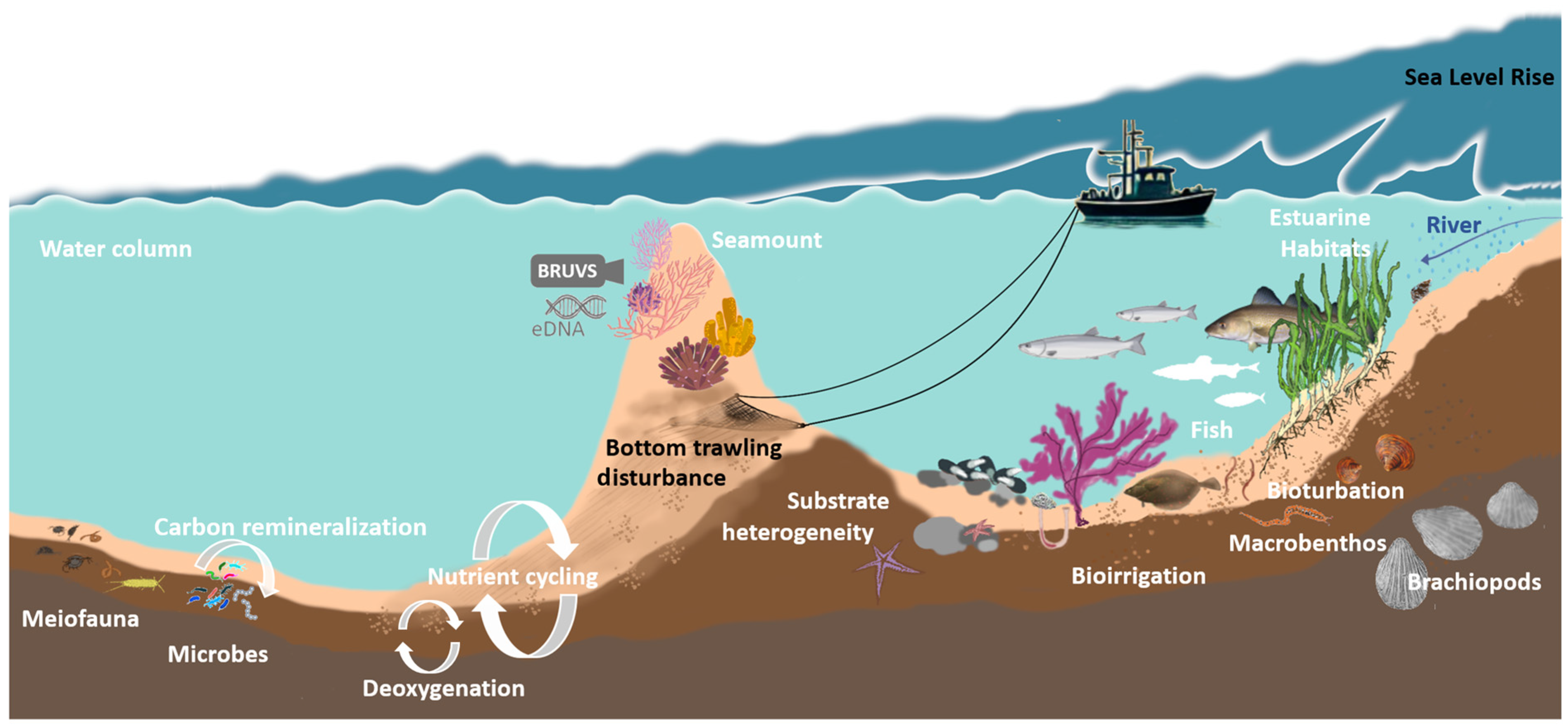
| [1] | Macrofauna | Observational, Modeling, Experimental | The Bioirrigation Potential index (BIPc) derived from observational macrofauna data correlates with irrigation rates, confirming that macrofaunal activity significantly enhances the efficiency of solute transfer in benthic environments. |
| [2] | Macrofauna | Observational, Experimental | Bottom trawling shifts benthic communities toward opportunistic, deposit-feeding species that do not bioturbate. This disturbance does not affect oxygen consumption (site- and season-dependent) but reduces carbon mineralization due to the removal of reactive surface sediment. The decline in community complexity and bioturbation leads to decreased sediment oxygenation, a reduction in carbon mineralization, and higher organic carbon concentrations in the sediment. |
| [3] | Macrofauna | Observational | Sea level rise will modify the seafloor macrofauna communities in estuaries and subsequently alter the related ecosystem functions. |
| [4] | Macrofauna | Observational | With increasing depth and decreasing influence from the river plume, species density and related sediment mixing and bioirrigation decreased. Highest macrofauna diversity was observed in the upper first cm of sediment, but the highest biomass was in deeper (6 cm) depth layers. |
| [5] | Macrofauna | Observational | Using microsatellite markers, the genetic diversity of commercially important clams was shown to be influenced by breeding mode and revealed no genetic isolation of populations by distance. |
| [6] | Macrofauna, brachiopods | Observational, paleo | Based on precise age constraints from conodont biostratigraphy and quantitative brachiopod data, a previous underestimate of the diversity of Olenekian brachiopod fauna diversity is suggested, and brachiopod recovery in the studied section is attributed to the latest Spathian period. |
| [7] | Macrofauna | Observational | Field assessments document a direct link between macrofaunal diversity and sediment structure. Small patches of different soft sediment types are associated with elevated species richness and a higher rate of occurrence of rare species. |
| [8] | Macrofauna | Observational | Research on marine bivalves suggested that lipid matrix membranes of the mitochondria of long-lived species are less sensitive to in vitro-initiated peroxidation compared to species with shorter life spans. |
| [9] | Microbes, protists | Observational | Metabarcoding-based assessment of benthic protists, which act as controllers of bacterial and microphytobenthos production and contribute significantly to the carbon flux, suggested community response to salinity, sediment properties, and oxygen. |
| [10] | Fish (demersal and benthopelagic), megafauna | Observational | Field surveys using environmental DNA metabarcoding (eDNA) and baited video (BRUVS) revealed no diversity hotspots for fish at seamounts. Shallower seamounts, as biomass oases and refuges for threatened megafauna, were spotted as protection priorities. |
| [11] | Macrofauna | Observational, Modeling | Field geological and biological surveys and modeling were used to map the distribution of seabed habitats and biotopes and their inhabitants. |
| [12] | Macrofauna | Observational | Field surveys compare recent benthic macrofauna biodiversity in German Marine Protected Areas of the Baltic and the North Sea along environmental gradients and decreasing bottom trawling intensity. |
| [13] | Macrofauna | Observational | Seagrass (regardless of density) positively affects macrozoobenthic communities and their functioning, indicating meadows as key biotopes that can support biogeochemical processes in coastal zones more effectively than bare sands. |
Disclaimer/Publisher’s Note: The statements, opinions and data contained in all publications are solely those of the individual author(s) and contributor(s) and not of MDPI and/or the editor(s). MDPI and/or the editor(s) disclaim responsibility for any injury to people or property resulting from any ideas, methods, instructions or products referred to in the content. |
© 2025 by the authors. Licensee MDPI, Basel, Switzerland. This article is an open access article distributed under the terms and conditions of the Creative Commons Attribution (CC BY) license (https://creativecommons.org/licenses/by/4.0/).
Share and Cite
Gogina, M.; Piontek, J. Beyond the Surface: The Peculiar World of Benthic Biodiversity, from Microbes to Multicellular Life and Their Ecosystem Roles. Biology 2025, 14, 368. https://doi.org/10.3390/biology14040368
Gogina M, Piontek J. Beyond the Surface: The Peculiar World of Benthic Biodiversity, from Microbes to Multicellular Life and Their Ecosystem Roles. Biology. 2025; 14(4):368. https://doi.org/10.3390/biology14040368
Chicago/Turabian StyleGogina, Mayya, and Judith Piontek. 2025. "Beyond the Surface: The Peculiar World of Benthic Biodiversity, from Microbes to Multicellular Life and Their Ecosystem Roles" Biology 14, no. 4: 368. https://doi.org/10.3390/biology14040368
APA StyleGogina, M., & Piontek, J. (2025). Beyond the Surface: The Peculiar World of Benthic Biodiversity, from Microbes to Multicellular Life and Their Ecosystem Roles. Biology, 14(4), 368. https://doi.org/10.3390/biology14040368