


Multi-Omic Advances in Olive Tree (Olea europaea subsp. europaea L.) Under Salinity: Stepping Towards ‘Smart Oliviculture’

 ,
,  , , ,
, , ,  , ,
, ,  and
and 
Simple Summary
Abstract
1. Soil Salinisation Is a Major Problem in the Context of Climate Change
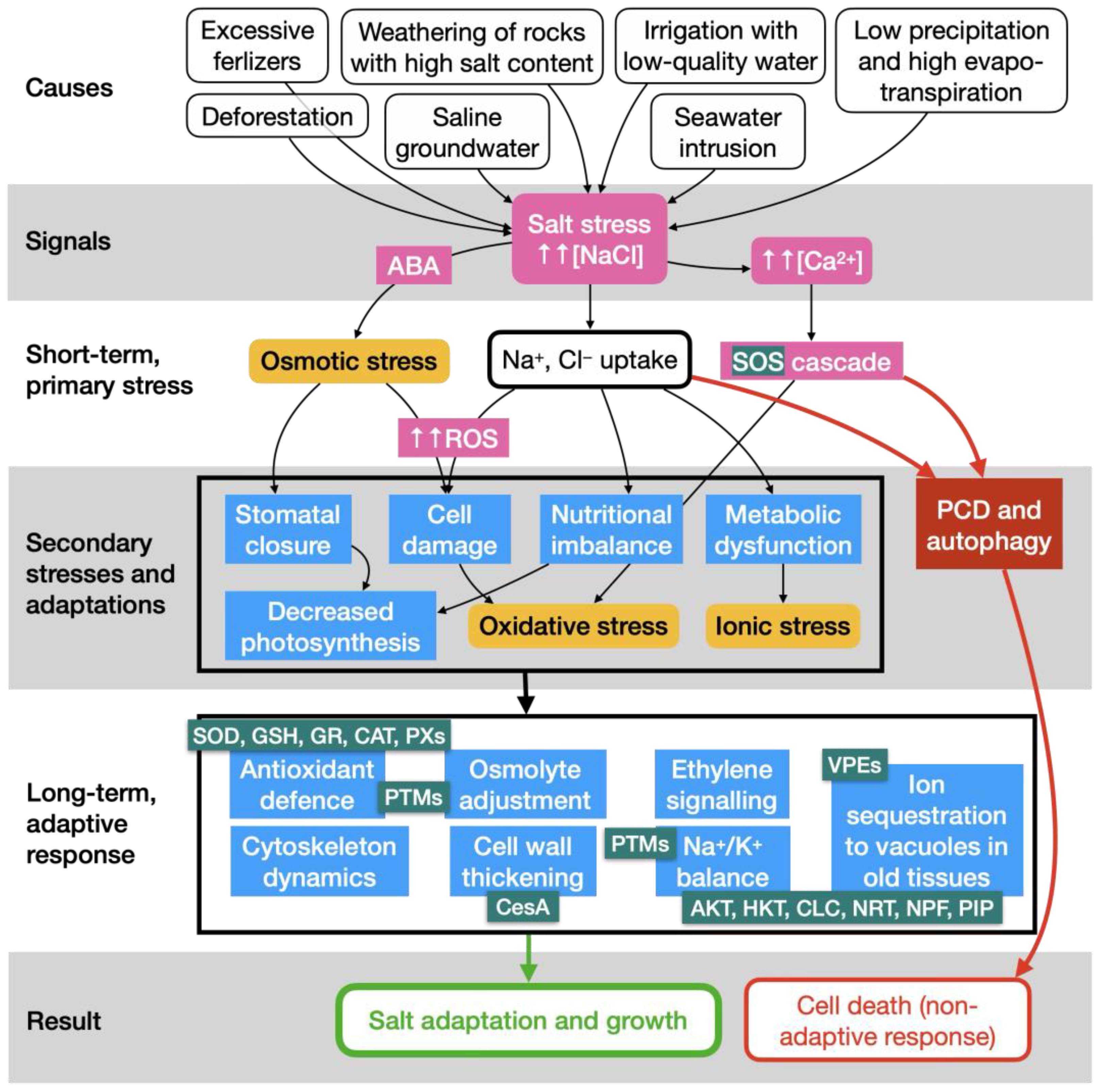
1.1. Causes and Economical Impact of Soil Salinisation
1.2. Salt Stress Is Manifested in Long-Term Exposure
1.3. Why Olive Tree?
2. Salt Tolerance in Olive Tree Is Cultivar-Dependent

| Cultivar | Reference | Country | Salt in Irrigation Water | Treatment Time |
|---|---|---|---|---|
| Abou-Satl | [66] | Syria | 12 dS/m NaCl | 90 days |
| Amigdalilolia | [69] | Iran | 12 dS/m NaCl | 90 days |
| Ayvalık | [70] | Turkey | 300 mM NaCl | 30 days |
| Barnea | [49] | Israel | 7.5 dS/m | 9 years |
| Cañivano | [67] | Spain | 100 mM NaCl | 49 days |
| Chemlali | [49] | Tunisia | brackish water | 8 months |
| [71] | 200 mM NaCl | 5 months | ||
| Dakal | [69] | Iran | 12 dS/m NaCl | 90 days |
| Empeltre | [72] | Spain | 10 dS/m | 4 years |
| Escarabajuelo | [67] | Spain | 100 mM NaCl | 49 days |
| Frantoio | [73] | Italy | 200 mM NaCl | 60 days |
| [74] | 100 mol/m3 SIW a | ND | ||
| [68] | 200 mM NaCl | 84 days | ||
| [75] | 200 mM NaCl | 56 days | ||
| Hamed | [49] | Egypt | 6000 ppm NaCl, Na2SO4, CaCl2, and MgSO4 | 2 years |
| Istarska bjelica | [76] | Croatia | 100 mM NaCl | 70 days |
| Jabaluna | [67] | Spain | 100 mM NaCl | 49 days |
| Jlot | [77] | Syria | 8000 ppm NaCl | ND |
| Kalamata | [49] | Greece | 200 mM NaCl | 5 months |
| Kalamon | [78] | Greece | 120 mM NaCl | 90 days |
| [79] | 120 mM NaCl | 90 days | ||
| Kerkiras | [49] | Greece | ND | ND |
| Kilis | [70] | Turkey | 300 mM NaCl | 30 days |
| Kilis Yağlık | [80] | Turkey | 150 mM NaCl | 4 months |
| Koroneiki I38 | [65] | Spain | 200 mM NaCl | 5 months |
| Kothreiki | [49] | Greece | 200 mM NaCl | 5 months |
| Lechín de Sevilla | [67] | Spain | 100 mM NaCl | 49 days |
| Lianolia | [49] | Greece | ND | ND |
| Megaritiki | [73] | Greece | 150 meq NaCl | 4 months |
| [81] | 200 mM NaCl | 5 months | ||
| Nevadillo | [67] | Spain | 100 mM NaCl | 49 days |
| Oblica | [76] | Croatia | 100 mM NaCl | 70 days |
| Ocal | [68] | Spain | 200 mM NaCl | 84 days |
| Pocama | [82] | Egypt | 6000 ppm NaCl, Na2SO4, CaCl2, and MgSO4 | 2 years |
| Royal de Cazorla | [83] | Spain | 100 mM and 200 mM NaCl | 8 months |
| [84] | 100 mM and 200 mM NaCl | 60 days | ||
| [85] | 200 mM NaCl | 8 months | ||
| Verdale | [82] | France | 6000 ppm NaCl, Na2SO4, CaCl2, and MgSO4 | 2 years |
| ‘Zeitoun Ennour’ b | [64] | Tunisia | 225 mM (21.8 mS/cm) NaCl | 6 months |
| Cultivar | Reference | Country | Salt in Irrigation Water | Treatment Time |
|---|---|---|---|---|
| Adramitini | [49] | Greece | ND | ND |
| Aggezi | [49] | Egypt | 6000 ppm NaCl, Na2SO4, CaCl2, and MgSO4 | 2 years |
| Alameño | [67] | Spain | 100 mM NaCl | 49 days |
| Arbosana I43 | [71] | Spain | 200 mM NaCl | 5 months |
| Blanqueta | [67] | Spain | 100 mM NaCl | 49 days |
| Cañivano Negro | [67] | Spain | 100 mM NaCl | 49 days |
| Carolea | [73] | Italy | 14.97 mS/cm | 11 months |
| Casta Cabra | [68] | Spain | 200 mM NaCl | 84 days |
| Changlot Real | [67] | Spain | 100 mM NaCl | 49 days |
| Chorruo | [67] | Spain | 100 mM NaCl | 49 days |
| Coratina | [73] | Italy | 200 mM NaCl | 60 days |
| Cornicabra | [68] | Spain | 200 mM NaCl | 84 days |
| Dezful | [69] | Iran | 12 dS/m NaCl | 90 days |
| Gordal Sevillana | [67] | Spain | 100 mM NaCl | 49 days |
| Hojiblanca | [67] | Spain | 100 mM NaCl | 49 days |
| Khaisi | [77] | Syria | 8000 ppm NaCl | ND |
| Lechín de Granada | [67] | Spain | 100 mM NaCl | 49 days |
| Manzanilla de Sevilla | [67] | Spain | 100 mM NaCl | 49 days |
| Manzanillo | [73] | Spain | 60 mM NaCl | 115 days |
| [86] | 4000 mg/L MgSO4, CaSO4, NaCl, MgCl2, and CaCO3 | 9 months | ||
| [82] | 6000 ppm NaCl, Na2SO4, CaCl2, and MgSO4 | 2 years | ||
| Maraiolo | [49] | Italy | ND | ND |
| Maurino | [49] | Italy | 200 mM NaCl | 60 days |
| Moraiolo | [73] | Italy | 200 mM NaCl | 60 days |
| Mostazal | [49] | Peru | 6000 ppm NaCl, Na2SO4, CaCl2, and MgSO4 | 2 years |
| Nabali Muhassan | [49] | Jordan | 100 mol/m3 SIW a | ND |
| Nizip Yağlik | [80] | Turkey | 150 mM NaCl | 4 months |
| Oblonga | [67] | Italy | 100 mM NaCl | 49 days |
| Redondil | [67] | Spain | 100 mM NaCl | 49 days |
| Toffahi | [49] | Egypt | 6000 ppm NaCl, Na2SO4, CaCl2, and MgSO4 | 2 years |
| Tokhm-e-Kabki | [69] | Iran | 12 dS/m NaCl | 90 days |
| Valanolia | [49] | Greece | ND | ND |
| Verdial de Vélez-Málaga | [67] | Spain | 100 mM NaCl | 49 days |
| Wardan | [49] | Egypt | 6000 ppm NaCl, Na2SO4, CaCl2, and MgSO4 | 2 years |
| Zorzariega | [67] | Spain | 100 mM NaCl | 49 days |
| Cultivar | Reference | Country | Salt in Irrigation Water | Treatment Time |
|---|---|---|---|---|
| Aggezi Shami | [86] | Egypt | 4000 mg/L MgSO4, CaSO4, NaCl, MgCl2, and CaCO3 | 275 days |
| Aguromanaki | [49] | Greece | ND | ND |
| Arbequina I18 | [71] | Spain | 200 mM NaCl | 5 months |
| Arbosana | [65] | Spain | 200 mM NaCl | 5 months |
| Bezeri | [77] | Syria | 8000 ppm NaCl | ND |
| Bouteillan | [49] | France | 6000 ppm NaCl, Na2SO4, CaCl2, and MgSO4 | 2 years |
| Buža | [76] | Croatia | 100 mM NaCl | 70 days |
| Chondrolia Chalkidikis | [78] | Greece | 120 mM NaCl | 90 days |
| [87] | 150 meq NaCl | 4 months | ||
| [78] | 120 mM NaCl | 90 days | ||
| [88] | 75 mM NaCl | 45 days | ||
| [89] | 75 mM and 150 mM NaCl | 45 days | ||
| Cobrançosa | [67] | Portugal | 100 mM NaCl | 49 days |
| Conservalia | [69] | Iran | 12 dS/m NaCl | 90 days |
| Drobnica | [76] | Croatia | 100 mM NaCl | 70 days |
| Fadaq86 | [85] | Iran | 200 mM NaCl | 8 months |
| Galego | [67] | Spain | 100 mM NaCl | 49 days |
| Khederi | [77] | Syria | 8000 ppm NaCl | ND |
| Lastovka | [76] | Croatia | 100 mM NaCl | 70 days |
| Leccino | [73] | Italy | 200 mM NaCl | 60 days |
| [76] | 100 mM NaCl | 70 days | ||
| [75] | 200 mM NaCl | 56 days | ||
| Mastoidis | [90] | Greece | 200 mM NaCl | 5 months |
| Meski | [67] | Tunisia | 100 mM NaCl | 49 days |
| Mission | [82] | US | 6000 ppm NaCl, Na2SO4, CaCl2, and MgSO4 | 2 years |
| Nabal | [49] | Egypt | 6000 ppm NaCl, Na2SO4, CaCl2, and MgSO4 | 2 years |
| Nocellara del Belice | [91] | Italy | 14.97 mS/cm | 11 months |
| Pajarero | [73] | Spain | 100 mM NaCl | 49 days |
| Rosciola | [82] | Italy | 6000 ppm NaCl, Na2SO4, CaCl2, and MgSO4 | 2 years |
| Shiraz | [69] | Iran | 12 dS/m NaCl | 90 days |
| Sourani | [77] | Syria | 8000 ppm NaCl | ND |
| Throubolia | [49] | Greece | ND | ND |
| Cultivar | Tolerant | Intermediate | Sensitive | Country | Salt in Irrigation Water | Treatment Time |
|---|---|---|---|---|---|---|
| Amphissis | [87] | Greece | 150 meq NaCl | 4 months | ||
| [90] | 200 mM NaCl | 5 months | ||||
| Arbequina | [73] | Spain | 100 mM NaCl | 49 days | ||
| [72] | 10 dS/m | 4 years | ||||
| [65] | 200 mM NaCl | 5 months | ||||
| [84] | 100 mM and 200 mM NaCl | 60 days | ||||
| [66] | 12 dS/m NaCl | 90 days | ||||
| Chétoui | [71] | Tunisia | 200 mM NaCl | 5 months | ||
| [67] | 100 mM NaCl | 49 days | ||||
| Gemlik | [70] | Turkey | 300 mM NaCl | 30 days | ||
| [80] | 150 mM NaCl | 4 months | ||||
| Koroneiki | [82] | Greece | 6000 ppm NaCl, Na2SO4, CaCl2, and MgSO4 | 2 years | ||
| [87] | 150 meq NaCl | 4 months | ||||
| [84] | 100 mM and 200 mM NaCl | 60 days | ||||
| [83] | 100 mM and 200 mM NaCl | 8 months | ||||
| [85] | 200 mM NaCl | 8 months | ||||
| [71] | 200 mM NaCl | 5 months | ||||
| [90] | 200 mM NaCl | 5 months | ||||
| Picual | [73] | Spain | 100 mM NaCl | 49 days | ||
| [86] | 4000 mg/L MgSO4, CaSO4, NaCl, MgCl2, and CaCO3 | 9 months | ||||
| [82] | 6000 ppm NaCl, Na2SO4, CaCl2, and MgSO4 | 2 years | ||||
| [84] | 100 mM and 200 mM NaCl | 60 days | ||||
| [85] | 200 mM NaCl | 8 months | ||||
| [68] | 200 mM NaCl | 84 days | ||||
| Picudo | [68] | Spain | 200 mM NaCl | 84 days | ||
| [67] | 100 mM NaCl | 49 days | ||||
| Zard | [66] | Iran | 12 dS/m NaCl | 90 days | ||
| [69] | 12 dS/m NaCl | 90 days |
3. Mechanisms of Salt Adaptation in Olive Tree
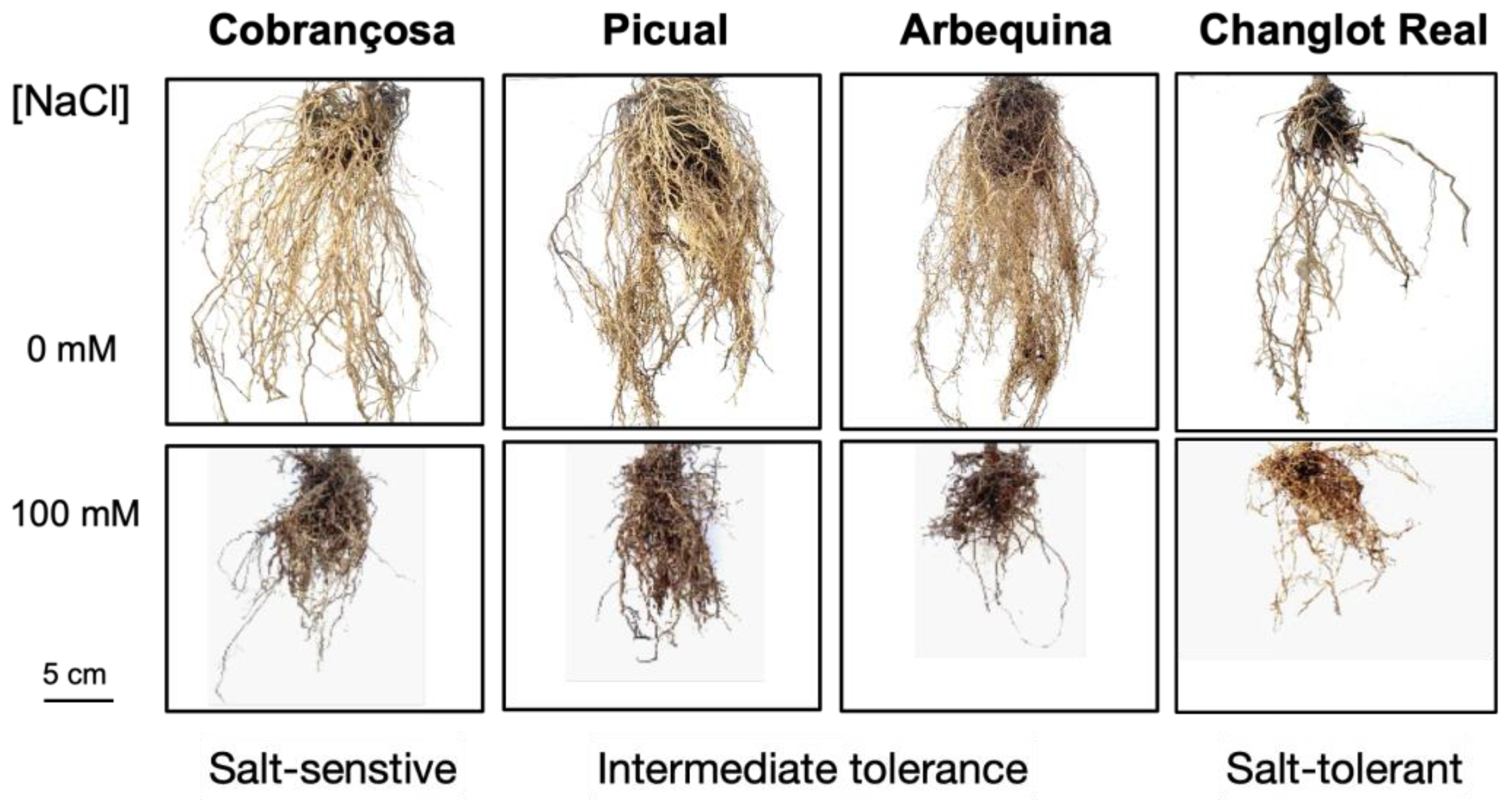
3.1. Root Cell Wall Thickening
3.2. Osmoprotection
3.3. Antioxidant Adaptations
3.4. Ion Detoxification
3.5. Salt-Adaptive Responses of Emerging Interest
3.5.1. Post-Translational Modifications
3.5.2. Programmed Cell Death
3.5.3. Autophagy
4. Genomics of Salt Stress in Olive Tree
4.1. Genome Sequences of Olive Cultivars
4.2. Low-Throughput Transcriptional Studies
4.3. High-Throughput Transcriptomics
4.4. Combining Salt and Drought Stresses
4.5. Genetic Engineering for Salt Tolerance
5. Metagenomics of Salinised Olive Grove Soils
5.1. Distribution of Plant-Associated Microorganisms
5.2. Olive Grove Microbiota
5.3. Decrease in Microbiota Biodiversity Due to Agricultural Practices
5.4. Olive Tree Microbiota Changes Under Salt Stress
5.5. Soil Amendments and Salt Stress
6. Bioinformatics of Salt Stress in Olive Tree
6.1. From Olive Tree Transcriptome to OliveAtlas
6.2. Computational Integrative Approaches to Study Salt Stress
6.3. Machine Learning Studies in Olive Tree
7. Conclusions: Stepping Towards ‘Smart Oliviculture’
Author Contributions
Funding
Institutional Review Board Statement
Informed Consent Statement
Data Availability Statement
Acknowledgments
Conflicts of Interest
Abbreviations
References
- Daliakopoulos, I.N.; Tsanis, I.K.; Koutroulis, A.; Kourgialas, N.N.; Varouchakis, A.E.; Karatzas, G.P.; Ritsema, C.J. The Threat of Soil Salinity: A European Scale Review. Sci. Total Environ. 2016, 573, 727–739. [Google Scholar] [CrossRef] [PubMed]
- Hassani, A.; Azapagic, A.; Shokri, N. Global Predictions of Primary Soil Salinization under Changing Climate in the 21st Century. Nat. Commun. 2021, 12, 6663. [Google Scholar] [CrossRef] [PubMed]
- Mukhopadhyay, R.; Sarkar, B.; Jat, H.S.; Sharma, P.C.; Bolan, N.S. Soil Salinity under Climate Change: Challenges for Sustainable Agriculture and Food Security. J. Environ. Manag. 2021, 280, 111736. [Google Scholar] [CrossRef] [PubMed]
- Calvin, K.; Dasgupta, D.; Krinner, G.; Mukherji, A.; Thorne, P.W.; Trisos, C.; Romero, J.; Aldunce, P.; Barrett, K.; Blanco, G.; et al. IPCC, 2023: Climate Change 2023: Synthesis Report. In Contribution of Working Groups I, II and III to the Sixth Assessment Report of the Intergovernmental Panel on Climate Change, 1st ed.; Core Writing Team, Lee, H., Romero, J., Eds.; Intergovernmental Panel on Climate Change (IPCC): Geneva, Switzerland, 2023. [Google Scholar]
- Chicea, D.; Olaru, S. Profiling Particles of Sahara Dust Settled on the Ground by a Simplified Dynamic Light Scattering Procedure and Sedimentation. Int. J. Environ. Res. Public Health 2023, 20, 4860. [Google Scholar] [CrossRef]
- Shahid, S.A.; Zaman, M.; Heng, L. Introduction to Soil Salinity, Sodicity and Diagnostics Techniques. In Guideline for Salinity Assessment, Mitigation and Adaptation Using Nuclear and Related Techniques; Springer International Publishing: Cham, Switzerland, 2018; pp. 1–42. ISBN 978-3-319-96189-7. [Google Scholar]
- Whittle, A.; Barnett, R.L.; Charman, D.J.; Gallego-Sala, A.V. Low-Salinity Transitions Drive Abrupt Microbial Response to Sea-Level Change. Ecol. Lett. 2022, 25, 17–25. [Google Scholar] [CrossRef]
- Shrivastava, P.; Kumar, R. Soil Salinity: A Serious Environmental Issue and Plant Growth Promoting Bacteria as One of the Tools for Its Alleviation. Saudi J. Biol. Sci. 2015, 22, 123–131. [Google Scholar] [CrossRef]
- Singh, A. Soil Salinity: A Global Threat to Sustainable Development. Soil Use Manag. 2022, 38, 39–67. [Google Scholar] [CrossRef]
- Stavi, I.; Thevs, N.; Priori, S. Soil Salinity and Sodicity in Drylands: A Review of Causes, Effects, Monitoring, and Restoration Measures. Front. Environ. Sci. 2021, 9, 712831. [Google Scholar] [CrossRef]
- Majeed, A.; Siyyar, S. Salinity Stress Management in Field Crops: An Overview of the Agronomic Approaches. In Plant Ecophysiology and Adaptation Under Climate Change: Mechanisms and Perspectives II; Hasanuzzaman, M., Ed.; Springer: Singapore, 2020; pp. 1–16. ISBN 9789811521713. [Google Scholar]
- Romero-Trigueros, C.; Vivaldi, G.A.; Nicolás, E.N.; Paduano, A.; Salcedo, F.P.; Camposeo, S. Ripening Indices, Olive Yield and Oil Quality in Response to Irrigation With Saline Reclaimed Water and Deficit Strategies. Front. Plant Sci. 2019, 10, 1243. [Google Scholar] [CrossRef]
- Qadir, M.; Quillérou, E.; Nangia, V.; Murtaza, G.; Singh, M.; Thomas, R.J.; Drechsel, P.; Noble, A.D. Economics of Salt-induced Land Degradation and Restoration. Nat. Resour. Forum 2014, 38, 282–295. [Google Scholar] [CrossRef]
- Chele, K.H.; Tinte, M.M.; Piater, L.A.; Dubery, I.A.; Tugizimana, F. Soil Salinity, a Serious Environmental Issue and Plant Responses: A Metabolomics Perspective. Metabolites 2021, 11, 724. [Google Scholar] [CrossRef] [PubMed]
- Meena, M.D.; Yadav, R.K.; Narjary, B.; Yadav, G.; Jat, H.S.; Sheoran, P.; Meena, M.K.; Antil, R.S.; Meena, B.L.; Singh, H.V.; et al. Municipal Solid Waste (MSW): Strategies to Improve Salt Affected Soil Sustainability: A Review. Waste Manag. 2019, 84, 38–53. [Google Scholar] [CrossRef] [PubMed]
- Balasubramaniam, T.; Shen, G.; Esmaeili, N.; Zhang, H. Plants’ Response Mechanisms to Salinity Stress. Plants 2023, 12, 2253. [Google Scholar] [CrossRef]
- Mondal, S.; Seelam, R.T.; Mondal, B.; Jespersen, D. Understanding Abiotic Stress Tolerance Mechanisms in Non-Food Grass Species through Omics Approaches. Plant Stress 2024, 13, 100516. [Google Scholar] [CrossRef]
- Farooq, M.; Zahra, N.; Ullah, A.; Nadeem, F.; Rehman, A.; Kapoor, R.; Al-Hinani, M.S.; Siddique, K.H.M. Salt Stress in Wheat: Effects, Tolerance Mechanisms, and Management. J. Soil Sci. Plant Nutr. 2024. [Google Scholar] [CrossRef]
- Xiao, F.; Zhou, H. Plant Salt Response: Perception, Signaling, and Tolerance. Front. Plant Sci. 2023, 13, 1053699. [Google Scholar] [CrossRef]
- Hualpa-Ramirez, E.; Carrasco-Lozano, E.C.; Madrid-Espinoza, J.; Tejos, R.; Ruiz-Lara, S.; Stange, C.; Norambuena, L. Stress Salinity in Plants: New Strategies to Cope with in the Foreseeable Scenario. Plant Physiol. Biochem. 2024, 208, 108507. [Google Scholar] [CrossRef]
- Liang, X.; Li, J.; Yang, Y.; Jiang, C.; Guo, Y. Designing Salt Stress Resilient Crops: Current Progress and Future Challenges. J. Integr. Plant Biol. 2024, 66, 303–329. [Google Scholar] [CrossRef]
- Romero-Aranda, R.; Moya, J.L.; Tadeo, F.R.; Legaz, F.; Primo-Millo, E.; Talon, M. Physiological and Anatomical Disturbances Induced by Chloride Salts in Sensitive and Tolerant Citrus: Beneficial and Detrimental Effects of Cations. Plant Cell Environ. 1998, 21, 1243–1253. [Google Scholar] [CrossRef]
- Romero-Aranda, R.; Soria, T.; Cuartero, J. Tomato Plant-Water Uptake and Plant-Water Relationships under Saline Growth Conditions. Plant Sci. 2001, 160, 265–272. [Google Scholar] [CrossRef]
- Muchate, N.S.; Nikalje, G.C.; Rajurkar, N.S.; Suprasanna, P.; Nikam, T.D. Plant Salt Stress: Adaptive Responses, Tolerance Mechanism and Bioengineering for Salt Tolerance. Bot. Rev. 2016, 82, 371–406. [Google Scholar] [CrossRef]
- Munns, R.; Tester, M. Mechanisms of Salinity Tolerance. Annu. Rev. Plant Biol. 2008, 59, 651–681. [Google Scholar] [CrossRef] [PubMed]
- Chartzoulakis, K.S. Salinity and Olive: Growth, Salt Tolerance, Photosynthesis and Yield. Agric. Water Manag. 2005, 78, 108–121. [Google Scholar] [CrossRef]
- Soltabayeva, A.; Ongaltay, A.; Omondi, J.O.; Srivastava, S. Morphological, Physiological and Molecular Markers for Salt-Stressed Plants. Plants 2021, 10, 243. [Google Scholar] [CrossRef]
- van Zelm, E.; Zhang, Y.; Testerink, C. Salt Tolerance Mechanisms of Plants. Annu. Rev. Plant Biol. 2020, 71, 403–433. [Google Scholar] [CrossRef]
- Afzal, M.Z.; Jia, Q.; Ibrahim, A.K.; Niyitanga, S.; Zhang, L. Mechanisms and Signaling Pathways of Salt Tolerance in Crops: Understanding from the Transgenic Plants. Trop. Plant Biol. 2020, 13, 297–320. [Google Scholar] [CrossRef]
- Tang, R.-J.; Wang, C.; Li, K.; Luan, S. The CBL-CIPK Calcium Signaling Network: Unified Paradigm from 20 Years of Discoveries. Trends Plant Sci. 2020, 25, 604–617. [Google Scholar] [CrossRef]
- Ismail, A.; Takeda, S.; Nick, P. Life and Death under Salt Stress: Same Players, Different Timing? J. Exp. Bot. 2014, 65, 2963–2979. [Google Scholar] [CrossRef]
- Zhao, S.; Zhang, Q.; Liu, M.; Zhou, H.; Ma, C.; Wang, P. Regulation of Plant Responses to Salt Stress. Int. J. Mol. Sci. 2021, 22, 4609. [Google Scholar] [CrossRef]
- Raja, V.; Majeed, U.; Kang, H.; Andrabi, K.I.; John, R. Abiotic Stress: Interplay between ROS, Hormones and MAPKs. Environ. Exp. Bot. 2017, 137, 142–157. [Google Scholar] [CrossRef]
- Kumar, A.; Singh, S.; Gaurav, A.K.; Srivastava, S.; Verma, J.P. Plant Growth-Promoting Bacteria: Biological Tools for the Mitigation of Salinity Stress in Plants. Front. Microbiol. 2020, 11, 1216. [Google Scholar] [CrossRef] [PubMed]
- Zhu, J.-K. Abiotic Stress Signaling and Responses in Plants. Cell 2016, 167, 313–324. [Google Scholar] [CrossRef] [PubMed]
- Romero-Aranda, M.R.; González-Fernández, P.; Pérez-Tienda, J.R.; López-Diaz, M.R.; Espinosa, J.; Granum, E.; Traverso, J.Á.; Pineda, B.; Garcia-Sogo, B.; Moreno, V.; et al. Na+ Transporter HKT1;2 Reduces Flower Na+ Content and Considerably Mitigates the Decline in Tomato Fruit Yields under Saline Conditions. Plant Physiol. Biochem. 2020, 154, 341–352. [Google Scholar] [CrossRef] [PubMed]
- Niu, G.; Rodriguez, D.S.; Starman, T. Response of Bedding Plants to Saline Water Irrigation. HortScience 2010, 45, 628–636. [Google Scholar] [CrossRef]
- Atta, K.; Mondal, S.; Gorai, S.; Singh, A.P.; Kumari, A.; Ghosh, T.; Roy, A.; Hembram, S.; Gaikwad, D.J.; Mondal, S.; et al. Impacts of Salinity Stress on Crop Plants: Improving Salt Tolerance through Genetic and Molecular Dissection. Front. Plant Sci. 2023, 14, 1241736. [Google Scholar] [CrossRef]
- Trabelsi, L.; Gargouri, K.; Ayadi, M.; Mbadra, C.; Ben Nasr, M.; Ben Mbarek, H.; Ghrab, M.; Ben Ahmed, G.; Kammoun, Y.; Loukil, E.; et al. Impact of Drought and Salinity on Olive Potential Yield, Oil and Fruit Qualities (Cv. Chemlali) in an Arid Climate. Agric. Water Manag. 2022, 269, 107726. [Google Scholar] [CrossRef]
- El Yamani, M.; Cordovilla, M.D.P. Tolerance Mechanisms of Olive Tree (Olea europaea) Under Saline Conditions. Plants 2024, 13, 2094. [Google Scholar] [CrossRef]
- Rugini, E.; Cristofori, V.; Silvestri, C. Genetic Improvement of Olive (Olea europaea L.) by Conventional and in Vitro Biotechnology Methods. Biotechnol. Adv. 2016, 34, 687–696. [Google Scholar] [CrossRef]
- Fraga, H.; Moriondo, M.; Leolini, L.; Santos, J.A. Mediterranean Olive Orchards under Climate Change: A Review of Future Impacts and Adaptation Strategies. Agronomy 2020, 11, 56. [Google Scholar] [CrossRef]
- Dini, I.; Laneri, S. Spices, Condiments, Extra Virgin Olive Oil and Aromas as Not Only Flavorings, but Precious Allies for Our Wellbeing. Antioxidants 2021, 10, 868. [Google Scholar] [CrossRef]
- Unver, T.; Wu, Z.; Sterck, L.; Turktas, M.; Lohaus, R.; Li, Z.; Yang, M.; He, L.; Deng, T.; Escalante, F.J.; et al. Genome of Wild Olive and the Evolution of Oil Biosynthesis. Proc. Natl. Acad. Sci. USA 2017, 114, E9413–E9422. [Google Scholar] [CrossRef] [PubMed]
- Mousavi, S.; de la Rosa, R.; Moukhli, A.; El Riachy, M.; Mariotti, R.; Torres, M.; Pierantozzi, P.; Stanzione, V.; Mastio, V.; Zaher, H.; et al. Plasticity of Fruit and Oil Traits in Olive among Different Environments. Sci. Rep. 2019, 9, 16968. [Google Scholar] [CrossRef] [PubMed]
- Gucci, R.; Tattini, M. Salinity Tolerance in Olive. In Horticultural Reviews; Janick, J., Ed.; John Wiley & Sons, Inc.: Oxford, UK, 1997; Volume 21, pp. 177–214. ISBN 978-0-470-65066-0. [Google Scholar]
- León, L.; De La Rosa, R.; Arriaza, M. Prioritization of Olive Breeding Objectives in Spain: Analysis of a Producers and Researchers Survey. Span. J. Agric. Res. 2021, 19, e0701. [Google Scholar] [CrossRef]
- Rugini, E.; Fedeli, E. Olive (Olea europaea L.) as an Oilseed Crop. In Legumes and Oilseed Crops I; Bajaj, Y.P.S., Ed.; Biotechnology in Agriculture and Forestry; Springer: Berlin, Heidelberg, 1990; Volume 10, pp. 593–641. ISBN 978-3-642-74450-1. [Google Scholar]
- Chartzoulakis, K.S. The Potential of Saline and Residual Water Use in Olive Growing. Acta Hortic. 2014, 257–273. [Google Scholar] [CrossRef]
- Wiesman, Z.; Itzhak, D.; Ben Dom, N. Optimization of Saline Water Level for Sustainable Barnea Olive and Oil Production in Desert Conditions. Sci. Hortic. 2004, 100, 257–266. [Google Scholar] [CrossRef]
- Moretti, S.; Francini, A.; Hernández, M.L.; Martínez-Rivas, J.M.; Sebastiani, L. Effect of Saline Irrigation on Physiological Traits, Fatty Acid Composition and Desaturase Genes Expression in Olive Fruit Mesocarp. Plant Physiol. Biochem. 2019, 141, 423–430. [Google Scholar] [CrossRef]
- Ghrab, M.; Gargouri, K.; Bentaher, H.; Chartzoulakis, K.; Ayadi, M.; Ben Mimoun, M.; Masmoudi, M.M.; Ben Mechlia, N.; Psarras, G. Water Relations and Yield of Olive Tree (Cv. Chemlali) in Response to Partial Root-Zone Drying (PRD) Irrigation Technique and Salinity under Arid Climate. Agric. Water Manag. 2013, 123, 1–11. [Google Scholar] [CrossRef]
- Weissbein, S.; Wiesman, Z.; Ephrath, Y.; Silberbush, M. Vegetative and Reproductive Responseof Olive Cultivars to Moderate Saline Water Irrigation. HortScience 2008, 43, 320–327. [Google Scholar] [CrossRef]
- Melgar, J.C.; Mohamed, Y.; Serrano, N.; García-Galavís, P.A.; Navarro, C.; Parra, M.A.; Benlloch, M.; Fernández-Escobar, R. Long Term Responses of Olive Trees to Salinity. Agric. Water Manag. 2009, 96, 1105–1113. [Google Scholar] [CrossRef]
- Bey, N.E.; Maazoun, A.M.; Nahdi, O.; Krima, N.B.; Aounallah, M.K. Water Stress Indicators in Citrus, Olive and Apple Trees: A Review. J. Appl. Hortic. 2024, 26, 3–9. [Google Scholar] [CrossRef]
- Tattini, M.; Traversi, M. On the Mechanism of Salt Tolerance in Olive (Olea europaea L.) under Low- or High-Ca2+ Supply. Environ. Exp. Bot. 2009, 65, 72–81. [Google Scholar] [CrossRef]
- Tabatabaei, S.J. Salinity Stress and Olive: An Overview. Plant Stress 2007, 1, 105–112. [Google Scholar]
- Abdel-Mohsen, M.; Rashedy, A. Nitrogen and Potassium Uptake and Utilization of Four Grapevine Rootstocks. J. Plant Prod. 2015, 6, 1941–1956. [Google Scholar] [CrossRef]
- Haberman, A.; Tsror (Lahkim), L.; Lazare, S.; Hazanovsky, M.; Lebiush, S.; Zipori, I.; Busatn, A.; Simenski, E.; Dag, A. Management of Verticillium Wilt of Avocado Using Tolerant Rootstocks. Plants 2020, 9, 531. [Google Scholar] [CrossRef]
- Rashedy, A.A.; Hamed, H.H. Morphological, Physio-Biochemical and Nutritional Status as Potential Markers for Grafting Compatibility in Kalamata Olive Cultivar. BMC Plant Biol. 2023, 23, 334. [Google Scholar] [CrossRef]
- Díaz-Rueda, P.; Peinado-Torrubia, P.; Durán-Gutiérrez, F.J.; Alcántara-Romano, P.; Aguado, A.; Capote, N.; Colmenero-Flores, J.M. Avoidant/Resistant Rather than Tolerant Olive Rootstocks Are More Effective in Controlling Verticillium Wilt. Front. Plant Sci. 2022, 13, 1032489. [Google Scholar] [CrossRef]
- Díaz-Rueda, P.; Franco-Navarro, J.D.; Messora, R.; Espartero, J.; Rivero-Núñez, C.M.; Aleza, P.; Capote, N.; Cantos, M.; García-Fernández, J.L.; De Cires, A.; et al. SILVOLIVE, a Germplasm Collection of Wild Subspecies With High Genetic Variability as a Source of Rootstocks and Resistance Genes for Olive Breeding. Front. Plant Sci. 2020, 11, 629. [Google Scholar] [CrossRef]
- Dag, A.; Ben-Gal, A.; Goldberger, S.; Yermiyahu, U.; Zipori, I.; Or, E.; David, I.; Netzer, Y.; Kerem, Z. Sodium and Chloride Distribution in Grapevines as a Function of Rootstock and Irrigation Water Salinity. Am. J. Enol. Vitic. 2015, 66, 80–84. [Google Scholar] [CrossRef]
- Elloumi, O.; Amar, F.B.; Trigui, A.; Gargouri, K.; Ghrab, M. Early Evaluation of Salt-Stress Tolerance of New Released Olive Cultivars Based on Physiological and Biomass Allocation Indicators. J. Agric. Food Res. 2024, 18, 101503. [Google Scholar] [CrossRef]
- Poury, N.; Seifi, E.; Alizadeh, M. Effects of Salinity and Proline on Growth and Physiological Characteristics of Three Olive Cultivars. Gesunde Pflanz. 2023, 75, 1169–1180. [Google Scholar] [CrossRef]
- Azimi, M.; Khoshzaman, T.; Taheri, M.; Dadras, A. Evaluation of Salinity Tolerance of Three Olive (Olea europaea L.) Cultivars. J. Cent. Eur. Agric. 2021, 22, 571–581. [Google Scholar] [CrossRef]
- Marin, L.; Benlloch, M.; Fernández-Escobar, R. Screening of Olive Cultivars for Salt Tolerance. Sci. Hortic. 1995, 64, 113–116. [Google Scholar] [CrossRef]
- Aparicio, C.; Urrestarazu, M.; Cordovilla, M.D.P. Comparative Physiological Analysis of Salinity Effects in Six Olive Genotypes. HortScience 2014, 49, 901–904. [Google Scholar] [CrossRef]
- Rahemi, M.; Karimi, S.; Sedaghat, S.; Ali Rostami, A. Physiological Responses of Olive Cultivars to Salinity Stress. Adv. Hortic. Sci. 2017, 31, 53–59. [Google Scholar] [CrossRef]
- Ayaz, M.; Varol, N.; Yolcu, S.; Pelvan, A.; Kaya, Ü.; Aydoğdu, E.; Bor, M.; Özdemir, F.; Türkan, İ. Three (Turkish) Olive Cultivars Display Contrasting Salt Stress-Coping Mechanisms under High Salinity. Trees 2021, 35, 1283–1298. [Google Scholar] [CrossRef]
- Kchaou, H.; Larbi, A.; Gargouri, K.; Chaieb, M.; Morales, F.; Msallem, M. Assessment of Tolerance to NaCl Salinity of Five Olive Cultivars, Based on Growth Characteristics and Na+ and Cl− Exclusion Mechanisms. Sci. Hortic. 2010, 124, 306–315. [Google Scholar] [CrossRef]
- Aragüés, R.; Guillén, M.; Royo, A. Five-Year Growth and Yield Response of Two Young Olive Cultivars (Olea europaea L., Cvs. Arbequina and Empeltre) to Soil Salinity. Plant Soil 2010, 334, 423–432. [Google Scholar] [CrossRef]
- Bakshi, P.; Amit; Wali, V.K. Mitigation Strategies of Abiotic Stress in Fruit Crops. In Abiotic & Biotic Stress Management in Plants; CRC Press: London, UK, 2022; pp. 261–288. ISBN 978-1-00-328198-6. [Google Scholar]
- Al-Absi, K.; Qrunfleh, M.; Abu-Sharar, T. Mechanism of Salt Tolerance of Two Olive Olea europaea L. Cultivars as Related to Electrolyte Concentration and Toxicity. Acta Hortic. 2003, 618, 281–290. [Google Scholar] [CrossRef]
- Palm, E.R.; Salzano, A.M.; Vergine, M.; Negro, C.; Guidi Nissim, W.; Sabbatini, L.; Balestrini, R.; De Pinto, M.C.; Fortunato, S.; Gohari, G.; et al. Response to Salinity Stress in Four Olea europaea L. Genotypes: A Multidisciplinary Approach. Environ. Exp. Bot. 2024, 218, 105586. [Google Scholar] [CrossRef]
- Perica, S.; Brkljača, M.; Goreta, S.; Romić, M. Vegetative Growth and Salt Accumulation of Six Olive Cultivars under Salt Stress. Acta Hortic. 2004, 664, 555–560. [Google Scholar] [CrossRef]
- AL-Ouda, A. Evaluation of the Response of Some Syrian Olive (Olea Europea L.) Cultivars to Salinity Stress. Ed. Academia. Available online: https://www.academia.edu/9282984/Evaluation_of_the_Response_of_Some_Syrian_Olive_Olea_europea_L_Cultivars_to_Salinity_Stress (accessed on 9 March 2025).
- Bazakos, C.; Manioudaki, M.E.; Therios, I.; Voyiatzis, D.; Kafetzopoulos, D.; Awada, T.; Kalaitzis, P. Comparative Transcriptome Analysis of Two Olive Cultivars in Response to NaCl-Stress. PLoS ONE 2012, 7, e42931. [Google Scholar] [CrossRef] [PubMed]
- Bazakos, C.; Manioudaki, M.E.; Sarropoulou, E.; Spano, T.; Kalaitzis, P. 454 Pyrosequencing of Olive (Olea europaea L.) Transcriptome in Response to Salinity. PLoS ONE 2015, 10, e0143000. [Google Scholar] [CrossRef] [PubMed]
- Demir, S.; Cetinkaya, H. Effects of Saline Conditions on Polyphenol and Protein Content and Photosynthetic Response of Different Olive (Olea europaea L.). Appl. Ecol. Environ. Res. 2020, 18, 2599–2610. [Google Scholar] [CrossRef]
- Chartzoulakis, K.; Loupassaki, M.; Bertaki, M.; Androulakis, I. Effects of NaCl Salinity on Growth, Ion Content and CO2 Assimilation Rate of Six Olive Cultivars. Sci. Hortic. 2002, 96, 235–247. [Google Scholar] [CrossRef]
- El-Sayed Emtithal, H.; El-Said, M.E.; El-Sherif, A.H.; Sari El-Deen, S.A. Estudios químicos sobre la tolerancia a la sanidad de algunos cultivares. Olivae 1996, 64, 52–57. [Google Scholar]
- Regni, L.; Del Pino, A.M.; Mousavi, S.; Palmerini, C.A.; Baldoni, L.; Mariotti, R.; Mairech, H.; Gardi, T.; D’Amato, R.; Proietti, P. Behavior of Four Olive Cultivars During Salt Stress. Front. Plant Sci. 2019, 10, 867. [Google Scholar] [CrossRef]
- Mousavi, S.; Regni, L.; Bocchini, M.; Mariotti, R.; Cultrera, N.G.M.; Mancuso, S.; Googlani, J.; Chakerolhosseini, M.R.; Guerrero, C.; Albertini, E.; et al. Physiological, Epigenetic and Genetic Regulation in Some Olive Cultivars under Salt Stress. Sci. Rep. 2019, 9, 1093. [Google Scholar] [CrossRef]
- Mousavi, S.; Mariotti, R.; Valeri, M.C.; Regni, L.; Lilli, E.; Albertini, E.; Proietti, P.; Businelli, D.; Baldoni, L. Characterization of Differentially Expressed Genes under Salt Stress in Olive. Int. J. Mol. Sci. 2021, 23, 154. [Google Scholar] [CrossRef]
- Hassan, I.; Gaballah, M.; Bedour, A.; Proietti, P.; Regni, L. Salinity Stress Effects on Three Different Olive Cultivars and the Possibility of Their Cultivation in Reclaimed Lands. Plant Arch. 2020, 20, 2378–2382. [Google Scholar]
- Therios, I.N.; Misopolinos, N.D. Genotypic Response to Sodium Chloride Salinity of Four Major Olive Cultivars (Olea europea L.). Plant Soil 1988, 106, 105–111. [Google Scholar] [CrossRef]
- Skodra, C.; Michailidis, M.; Dasenaki, M.; Ganopoulos, I.; Thomaidis, N.S.; Tanou, G.; Molassiotis, A. Unraveling Salt-responsive Tissue-specific Metabolic Pathways in Olive Tree. Physiol. Plant. 2021, 173, 1643–1656. [Google Scholar] [CrossRef] [PubMed]
- Skodra, C.; Michailidis, M.; Moysiadis, T.; Stamatakis, G.; Ganopoulou, M.; Adamakis, I.-D.S.; Angelis, L.; Ganopoulos, I.; Tanou, G.; Samiotaki, M.; et al. Disclosing the Molecular Basis of Salinity Priming in Olive Trees Using Proteogenomic Model Discovery. Plant Physiol. 2023, 191, 1913–1933. [Google Scholar] [CrossRef] [PubMed]
- Chartzoulakis, K.; Loupassaki, M.; Androulakis, I. Comparative Study on NaCl Salinity Tolerance of Six Olive Cultivars. Acta Hortic. 2002, 497–501. [Google Scholar] [CrossRef]
- Briccoli-Bati, C.; Basta, P.; Tocci, C.; Turco, D. Influencia del riego con agua salobre en jóvenes plantas de oliva. Olivae 1994, 53, 35–38. [Google Scholar]
- Tattini, M.; Mergar, J.C.; Traversi, M.L. Responses of Olea Europaea to High Salinity: A Brief-Ecophysiological-Review. Adv. Hortic. Sci. 2008, 20, 159–173. [Google Scholar] [CrossRef]
- Venkataraman, G.; Shabala, S.; Véry, A.-A.; Hariharan, G.N.; Somasundaram, S.; Pulipati, S.; Sellamuthu, G.; Harikrishnan, M.; Kumari, K.; Shabala, L.; et al. To Exclude or to Accumulate? Revealing the Role of the Sodium HKT1;5 Transporter in Plant Adaptive Responses to Varying Soil Salinity. Plant Physiol. Biochem. 2021, 169, 333–342. [Google Scholar] [CrossRef]
- Waheed, A.; Zhuo, L.; Wang, M.; Hailiang, X.; Tong, Z.; Wang, C.; Aili, A. Integrative Mechanisms of Plant Salt Tolerance: Biological Pathways, Phytohormonal Regulation, and Technological Innovations. Plant Stress 2024, 14, 100652. [Google Scholar] [CrossRef]
- Tan, J.; Ben-Gal, A.; Shtein, I.; Bustan, A.; Dag, A.; Erel, R. Root Structural Plasticity Enhances Salt Tolerance in Mature Olives. Environ. Exp. Bot. 2020, 179, 104224. [Google Scholar] [CrossRef]
- Sánchez-Blanco, M.J.; Álvarez, S.; Ortuño, M.F.; Ruiz-Sánchez, M.C. Root System Response to Drought and Salinity: Root Distribution and Water Transport. In Root Engineering; Morte, A., Varma, A., Eds.; Soil Biology; Springer: Berlin/Heidelberg, Germany, 2014; Volume 40, pp. 325–352. ISBN 978-3-642-54275-6. [Google Scholar]
- Plant Roots. In The Hidden Half, 3rd ed.; Waisel, Y., Eshel, A., Beeckman, T., Kafkafi, U., Eds.; CRC Press: Boca Ratón, FL, USA, 2002; ISBN 978-0-203-90942-3. [Google Scholar]
- Soda, N.; Ephrath, J.E.; Dag, A.; Beiersdorf, I.; Presnov, E.; Yermiyahu, U.; Ben-Gal, A. Root Growth Dynamics of Olive (Olea europaea L.) Affected by Irrigation Induced Salinity. Plant Soil 2017, 411, 305–318. [Google Scholar] [CrossRef]
- Colin, L.; Ruhnow, F.; Zhu, J.-K.; Zhao, C.; Zhao, Y.; Persson, S. The Cell Biology of Primary Cell Walls during Salt Stress. Plant Cell 2023, 35, 201–217. [Google Scholar] [CrossRef]
- Lei, X.; Liu, Z.; Xie, Q.; Fang, J.; Wang, C.; Li, J.; Wang, C.; Gao, C. Construction of Two Regulatory Networks Related to Salt Stress and Lignocellulosic Synthesis under Salt Stress Based on a Populus davidiana × P. bolleana Transcriptome Analysis. Plant Mol. Biol. 2022, 109, 689–702. [Google Scholar] [CrossRef] [PubMed]
- Dabravolski, S.A.; Isayenkov, S.V. The Regulation of Plant Cell Wall Organisation under Salt Stress. Front. Plant Sci. 2023, 14, 1118313. [Google Scholar] [CrossRef] [PubMed]
- Liu, J.; Zhang, W.; Long, S.; Zhao, C. Maintenance of Cell Wall Integrity under High Salinity. Int. J. Mol. Sci. 2021, 22, 3260. [Google Scholar] [CrossRef]
- Ben Abdallah, M.; Trupiano, D.; Polzella, A.; De Zio, E.; Sassi, M.; Scaloni, A.; Zarrouk, M.; Ben Youssef, N.; Scippa, G.S. Unraveling Physiological, Biochemical and Molecular Mechanisms Involved in Olive (Olea europaea L. Cv. Chétoui ) Tolerance to Drought and Salt Stresses. J. Plant Physiol. 2018, 220, 83–95. [Google Scholar] [CrossRef]
- Rossi, L.; Francini, A.; Minnocci, A.; Sebastiani, L. Salt Stress Modifies Apoplastic Barriers in Olive (Olea europaea L.): A Comparison between a Salt-Tolerant and a Salt-Sensitive Cultivar. Sci. Hortic. 2015, 192, 38–46. [Google Scholar] [CrossRef]
- Li, H.; Duijts, K.; Pasini, C.; Van Santen, J.E.; Lamers, J.; De Zeeuw, T.; Verstappen, F.; Wang, N.; Zeeman, S.C.; Santelia, D.; et al. Effective Root Responses to Salinity Stress Include Maintained Cell Expansion and Carbon Allocation. New Phytol. 2023, 238, 1942–1956. [Google Scholar] [CrossRef]
- Tu, T.Q.; Vaciaxa, P.; Lo, T.T.M.; Nguyen, N.H.; Pham, N.T.T.; Nguyen, Q.H.; Do, P.T.; Nguyen, L.T.N.; Nguyen, Y.T.H.; Chu, M.H. GmDREB6, a Soybean Transcription Factor, Notably Affects the Transcription of the NtP5CS and NtCLC Genes in Transgenic Tobacco under Salt Stress Conditions. Saudi J. Biol. Sci. 2021, 28, 7175–7181. [Google Scholar] [CrossRef]
- Ahmed, C.B.; Rouina, B.B.; Sensoy, S.; Boukhris, M.; Abdallah, F.B. Changes in Gas Exchange, Proline Accumulation and Antioxidative Enzyme Activities in Three Olive Cultivars under Contrasting Water Availability Regimes. Environ. Exp. Bot. 2009, 67, 345–352. [Google Scholar] [CrossRef]
- Sofo, A.; Dichio, B.; Xiloyannis, C.; Masia, A. Lipoxygenase Activity and Proline Accumulation in Leaves and Roots of Olive Trees in Response to Drought Stress. Physiol. Plant. 2004, 121, 58–65. [Google Scholar] [CrossRef]
- Cordovilla, M.d.P.; Aparicio, C.; Melendo, M.; Bueno, M. Exogenous Application of Indol-3-Acetic Acid and Salicylic Acid Improves Tolerance to Salt Stress in Olive Plantlets (Olea europaea L. cultivar Picual) in Growth Chamber Environments. Agronomy 2023, 13, 647. [Google Scholar] [CrossRef]
- Cimato, A.; Castelli, S.; Tattini, M.; Traversi, M.L. An Ecophysiological Analysis of Salinity Tolerance in Olive. Environ. Exp. Bot. 2010, 68, 214–221. [Google Scholar] [CrossRef]
- Das, K.; Roychoudhury, A. Reactive Oxygen Species (ROS) and Response of Antioxidants as ROS-Scavengers during Environmental Stress in Plants. Front. Environ. Sci. 2014, 2, 53. [Google Scholar] [CrossRef]
- Singh, A.; Roychoudhury, A. Gene Regulation at Transcriptional and Post-transcriptional Levels to Combat Salt Stress in Plants. Physiol. Plant. 2021, 173, 1556–1572. [Google Scholar] [CrossRef] [PubMed]
- Mansour, M.M.F.; Hassan, F.A.S. How Salt Stress-Responsive Proteins Regulate Plant Adaptation to Saline Conditions. Plant Mol. Biol. 2022, 108, 175–224. [Google Scholar] [CrossRef]
- Hasegawa, P.M.; Bressan, R.A.; Zhu, J.-K.; Bohnert, H.J. Plant Celular and Molecular Responses to High Salinity. Annu. Rev. Plant Physiol. Plant Mol. Biol. 2000, 51, 463–499. [Google Scholar] [CrossRef]
- Goreta, S.; Bučević-Popović, V.; Pavela-Vrančić, M.; Perica, S. Salinity-induced Changes in Growth, Superoxide Dismutase Activity, and Ion Content of Two Olive Cultivars. J. Plant Nutr. Soil Sci. 2007, 170, 398–403. [Google Scholar] [CrossRef]
- Petridis, A.; Therios, I.; Samouris, G.; Tananaki, C. Salinity-Induced Changes in Phenolic Compounds in Leaves and Roots of Four Olive Cultivars (Olea europaea L.) and Their Relationship to Antioxidant Activity. Environ. Exp. Bot. 2012, 79, 37–43. [Google Scholar] [CrossRef]
- Rossi, L.; Borghi, M.; Francini, A.; Lin, X.; Xie, D.-Y.; Sebastiani, L. Salt Stress Induces Differential Regulation of the Phenylpropanoid Pathway in Olea europaea Cultivars Frantoio (Salt-Tolerant) and Leccino (Salt-Sensitive). J. Plant Physiol. 2016, 204, 8–15. [Google Scholar] [CrossRef]
- Flowers, T.J.; Colmer, T.D. Salinity Tolerance in Halophytes. New Phytol. 2008, 179, 945–963. [Google Scholar] [CrossRef]
- Cheeseman, J.M. The Evolution of Halophytes, Glycophytes and Crops, and Its Implications for Food Security under Saline Conditions. New Phytol. 2015, 206, 557–570. [Google Scholar] [CrossRef]
- Hasegawa, P.M. Sodium (Na+) Homeostasis and Salt Tolerance of Plants. Environ. Exp. Bot. 2013, 92, 19–31. [Google Scholar] [CrossRef]
- Hussain, S.; Zhang, J.; Zhong, C.; Zhu, L.; Cao, X.; Yu, S.; Allen Bohr, J.; Hu, J.; Jin, Q. Effects of Salt Stress on Rice Growth, Development Characteristics, and the Regulating Ways: A Review. J. Integr. Agric. 2017, 16, 2357–2374. [Google Scholar] [CrossRef]
- Kronzucker, H.J.; Coskun, D.; Schulze, L.M.; Wong, J.R.; Britto, D.T. Sodium as Nutrient and Toxicant. Plant Soil 2013, 369, 1–23. [Google Scholar] [CrossRef]
- Munns, R.; James, R.A.; Gilliham, M.; Flowers, T.J.; Colmer, T.D. Tissue Tolerance: An Essential but Elusive Trait for Salt-Tolerant Crops. Funct. Plant Biol. 2016, 43, 1103. [Google Scholar] [CrossRef]
- Tester, M. Na+ Tolerance and Na+ Transport in Higher Plants. Ann. Bot. 2003, 91, 503–527. [Google Scholar] [CrossRef]
- Garcia-Daga, S.; Roy, S.J.; Gilliham, M. Redefining the Role of Sodium Exclusion within Salt Tolerance. Trends Plant Sci. 2025, 30, 137–146. [Google Scholar] [CrossRef]
- Brumós, J.; Colmenero-Flores, J.M.; Conesa, A.; Izquierdo, P.; Sánchez, G.; Iglesias, D.J.; López-Climent, M.F.; Gómez-Cadenas, A.; Talón, M. Membrane Transporters and Carbon Metabolism Implicated in Chloride Homeostasis Differentiate Salt Stress Responses in Tolerant and Sensitive Citrus Rootstocks. Funct. Integr. Genomics 2009, 9, 293–309. [Google Scholar] [CrossRef]
- Brumós, J.; Talón, M.; Bouhlal, R.; Colmenero-Flores, J.M. Cl- Homeostasis in Includer and Excluder Citrus Rootstocks: Transport Mechanisms and Identification of Candidate Genes. Plant Cell Environ. 2010, 33, 2012–2027. [Google Scholar] [CrossRef]
- Li, B.; Tester, M.; Gilliham, M. Chloride on the Move. Trends Plant Sci. 2017, 22, 236–248. [Google Scholar] [CrossRef]
- Celis, N.; Suarez, D.L.; Wu, L.; Li, R.; Arpaia, M.L.; Mauk, P. Salt Tolerance and Growth of 13 Avocado Rootstocks Related Best to Chloride Uptake. HortScience 2018, 53, 1737–1745. [Google Scholar] [CrossRef]
- Colmenero-Flores, J.M.; Franco-Navarro, J.D.; Cubero-Font, P.; Peinado-Torrubia, P.; Rosales, M.A. Chloride as a Beneficial Macronutrient in Higher Plants: New Roles and Regulation. Int. J. Mol. Sci. 2019, 20, 4686. [Google Scholar] [CrossRef] [PubMed]
- Kumar, A.; Sandhu, N.; Kumar, P.; Pruthi, G.; Singh, J.; Kaur, S.; Chhuneja, P. Genome-Wide Identification and in Silico Analysis of NPF, NRT2, CLC and SLAC1/SLAH Nitrate Transporters in Hexaploid Wheat (Triticum aestivum). Sci. Rep. 2022, 12, 11227. [Google Scholar] [CrossRef]
- Rajappa, S.; Krishnamurthy, P.; Huang, H.; Yu, D.; Friml, J.; Xu, J.; Kumar, P.P. The Translocation of a Chloride Channel from the Golgi to the Plasma Membrane Helps Plants Adapt to Salt Stress. Nat. Commun. 2024, 15, 3978. [Google Scholar] [CrossRef] [PubMed]
- Wleklik, K.; Borek, S. Vacuolar Processing Enzymes in Plant Programmed Cell Death and Autophagy. Int. J. Mol. Sci. 2023, 24, 1198. [Google Scholar] [CrossRef] [PubMed]
- Aina, O.; Bakare, O.O.; Fadaka, A.O.; Keyster, M.; Klein, A. Plant Biomarkers as Early Detection Tools in Stress Management in Food Crops: A Review. Planta 2024, 259, 60. [Google Scholar] [CrossRef]
- Mani, B.; Kaur, I.; Dhingra, Y.; Saxena, V.; Krishna, G.K.; Kumar, R.; Chinnusamy, V.; Agarwal, M.; Katiyar-Agarwal, S. Tetraspanin 5 Orchestrates Resilience to Salt Stress through the Regulation of Ion and Reactive Oxygen Species Homeostasis in Rice. Plant Biotechnol. J. 2024, 23, 51–57. [Google Scholar] [CrossRef]
- Loreto, F.; Centritto, M.; Chartzoulakis, K. Photosynthetic Limitations in Olive Cultivars with Different Sensitivity to Salt Stress: Photosynthetic Limitations and Salt Stress in Olive Cultivars. Plant Cell Environ. 2003, 26, 595–601. [Google Scholar] [CrossRef]
- Sodini, M.; Astolfi, S.; Francini, A.; Sebastiani, L. Multiple Linear Regression and Linear Mixed Models Identify Novel Traits of Salinity Tolerance in Olea europaea L. Tree Physiol. 2022, 42, 1029–1042. [Google Scholar] [CrossRef]
- Melgar, J.C.; Syvertsen, J.P.; Martínez, V.; García-Sánchez, F. The Relative Salt Tolerance of ‘Rangpur’ Seedlings and ‘Arbequina’ Olive Cuttings. Proc. Fla. State Hort Soc. 2007, 120, 79–84. [Google Scholar]
- Gao, Z.; Ma, C.; Zheng, C.; Yao, Y.; Du, Y. Advances in the Regulation of Plant Salt-Stress Tolerance by miRNA. Mol. Biol. Rep. 2022, 49, 5041–5055. [Google Scholar] [CrossRef]
- Najar, M.A. Updates on Protein Post-Translational Modifications for Modulating Response to Salinity. In Genetics of Salt Tolerance in Plants; Ganie, S.A., Wani, S.H., Eds.; CABI: Wallingford, UK, 2024; pp. 96–118. ISBN 978-1-80062-301-9. [Google Scholar]
- Mata-Pérez, C.; Sánchez-Vicente, I.; Arteaga, N.; Gómez-Jiménez, S.; Fuentes-Terrón, A.; Oulebsir, C.S.; Calvo-Polanco, M.; Oliver, C.; Lorenzo, Ó. Functions of Nitric Oxide-Mediated Post-Translational Modifications under Abiotic Stress. Front. Plant Sci. 2023, 14, 1158184. [Google Scholar] [CrossRef]
- Benjamin, J.J.; Miras-Moreno, B.; Araniti, F.; Salehi, H.; Bernardo, L.; Parida, A.; Lucini, L. Proteomics Revealed Distinct Responses to Salinity between the Halophytes Suaeda maritima (L.) Dumort and Salicornia brachiata (Roxb). Plants 2020, 9, 227. [Google Scholar] [CrossRef] [PubMed]
- Zulfiqar, F.; Nafees, M.; Chen, J.; Darras, A.; Ferrante, A.; Hancock, J.T.; Ashraf, M.; Zaid, A.; Latif, N.; Corpas, F.J.; et al. Chemical Priming Enhances Plant Tolerance to Salt Stress. Front. Plant Sci. 2022, 13, 946922. [Google Scholar] [CrossRef] [PubMed]
- Luo, S.; Liu, Z.; Wan, Z.; He, X.; Lv, J.; Yu, J.; Zhang, G. Foliar Spraying of NaHS Alleviates Cucumber Salt Stress by Maintaining N+/K+ Balance and Activating Salt Tolerance Signaling Pathways. Plants 2023, 12, 2450. [Google Scholar] [CrossRef]
- Affenzeller, M.J.; Darehshouri, A.; Andosch, A.; Lutz, C.; Lutz-Meindl, U. Salt Stress-Induced Cell Death in the Unicellular Green Alga Micrasterias denticulata. J. Exp. Bot. 2009, 60, 939–954. [Google Scholar] [CrossRef]
- Joseph, B.; Jini, D. Salinity Induced Programmed Cell Death in Plants: Challenges and Opportunities for Salt-Tolerant Plants. J. Plant Sci. 2010, 5, 376–390. [Google Scholar] [CrossRef][Green Version]
- Shabala, S. Salinity and Programmed Cell Death: Unravelling Mechanisms for Ion Specific Signalling. J. Exp. Bot. 2009, 60, 709–712. [Google Scholar] [CrossRef]
- Kim, Y.; Wang, M.; Bai, Y.; Zeng, Z.; Guo, F.; Han, N.; Bian, H.; Wang, J.; Pan, J.; Zhu, M. Bcl-2 Suppresses Activation of VPEs by Inhibiting Cytosolic Ca2+ Level with Elevated K+ Efflux in NaCl-Induced PCD in Rice. Plant Physiol. Biochem. 2014, 80, 168–175. [Google Scholar] [CrossRef]
- Chen, H.; Dong, J.; Wang, T. Autophagy in Plant Abiotic Stress Management. Int. J. Mol. Sci. 2021, 22, 4075. [Google Scholar] [CrossRef]
- Minina, E.A.; Filonova, L.H.; Fukada, K.; Savenkov, E.I.; Gogvadze, V.; Clapham, D.; Sanchez-Vera, V.; Suarez, M.F.; Zhivotovsky, B.; Daniel, G.; et al. Autophagy and Metacaspase Determine the Mode of Cell Death in Plants. J. Cell Biol. 2013, 203, 917–927. [Google Scholar] [CrossRef]
- Minina, E.A.; Smertenko, A.P.; Bozhkov, P.V. Vacuolar Cell Death in Plants: Metacaspase Releases the Brakes on Autophagy. Autophagy 2014, 10, 928–929. [Google Scholar] [CrossRef]
- Yue, J.-Y.; Wang, Y.-J.; Jiao, J.-L.; Wang, W.-W.; Wang, H.-Z. The Metacaspase TaMCA-Id Negatively Regulates Salt-Induced Programmed Cell Death and Functionally Links With Autophagy in Wheat. Front. Plant Sci. 2022, 13, 904933. [Google Scholar] [CrossRef] [PubMed]
- Bozhkov, P.V.; Suarez, M.F.; Filonova, L.H.; Daniel, G.; Zamyatnin, A.A.; Rodriguez-Nieto, S.; Zhivotovsky, B.; Smertenko, A. Cysteine Protease mcII-Pa Executes Programmed Cell Death during Plant Embryogenesis. Proc. Natl. Acad. Sci. USA 2005, 102, 14463–14468. [Google Scholar] [CrossRef] [PubMed]
- Zhu, P.; Yu, X.-H.; Wang, C.; Zhang, Q.; Liu, W.; McSweeney, S.; Shanklin, J.; Lam, E.; Liu, Q. Structural Basis for Ca2+-Dependent Activation of a Plant Metacaspase. Nat. Commun. 2020, 11, 2249. [Google Scholar] [CrossRef] [PubMed]
- Cruz, F.; Julca, I.; Gómez-Garrido, J.; Loska, D.; Marcet-Houben, M.; Cano, E.; Galán, B.; Frias, L.; Ribeca, P.; Derdak, S.; et al. Genome Sequence of the Olive Tree, Olea europaea. GigaScience 2016, 5, 29. [Google Scholar] [CrossRef]
- Julca, I.; Marcet-Houben, M.; Cruz, F.; Gómez-Garrido, J.; Gaut, B.S.; Díez, C.M.; Gut, I.G.; Alioto, T.S.; Vargas, P.; Gabaldón, T. Genomic Evidence for Recurrent Genetic Admixture during the Domestication of Mediterranean Olive Trees (Olea europaea L.). BMC Biol. 2020, 18, 148. [Google Scholar] [CrossRef]
- Jiménez-Ruiz, J.; Ramírez-Tejero, J.A.; Fernández-Pozo, N.; Leyva-Pérez, M.d.l.O.; Yan, H.; Rosa, R.d.L.; Belaj, A.; Montes, E.; Rodríguez-Ariza, M.O.; Navarro, F.; et al. Transposon Activation Is a Major Driver in the Genome Evolution of Cultivated Olive Trees (Olea europaea L.). Plant Genome 2020, 13, e20010. [Google Scholar] [CrossRef]
- Rao, G.; Zhang, J.; Liu, X.; Lin, C.; Xin, H.; Xue, L.; Wang, C. De Novo Assembly of a New Olea europaea Genome Accession Using Nanopore Sequencing. Hortic. Res. 2021, 8, 64. [Google Scholar] [CrossRef]
- Lv, J.; Jiang, C.; Wu, W.; Mao, K.; Wei, Q.; Zheng, Y.; Gao, C.; Niu, Z.; Jin, G.; Zhang, R.; et al. The Gapless Genome Assembly and Multi-Omics Analyses Unveil a Pivotal Regulatory Mechanism of Oil Biosynthesis in the Olive Tree. Hortic. Res. 2024, 11, uhae168. [Google Scholar] [CrossRef]
- Sebastiani, L.; Sarfraz, I.; Francini, A.; Celii, M.; Wing, R.A.; Zuccolo, A. PacBio Genome Assembly of Olea europaea L. Subsp. europaea Cultivars ‘Frantoio’ and ‘Leccino’ Reveal Main Structural Differences in Key Genes Related to Salt Stress. bioRxiv 2024. [Google Scholar] [CrossRef]
- Wang, L.; Zhang, J.; Peng, D.; Tian, Y.; Zhao, D.; Ni, W.; Long, J.; Li, J.; Zeng, Y.; Wu, Z.; et al. High-Quality Genome Assembly of Olea europaea subsp. cuspidata Provides Insights into Its Resistance to Fungal Diseases in the Summer Rain Belt in East Asia. Front. Plant Sci. 2022, 13, 879822. [Google Scholar] [CrossRef]
- Wu, T.; Ma, T.; Xu, T.; Pan, L.; Zhang, Y.; Li, Y.; Ning, D. The De Novo Genome Assembly of Olea europaea subsp. cuspidata, a Widely Distributed Olive Close Relative. Front. Genet. 2022, 13, 868540. [Google Scholar] [CrossRef]
- Khadivi, A.; Mirheidari, F.; Saeidifar, A.; Moradi, Y. Morphological Characterizations of Olea europaea subsp. cuspidata. Genet. Resour. Crop Evol. 2024, 71, 1837–1853. [Google Scholar] [CrossRef]
- Rautiainen, M.; Nurk, S.; Walenz, B.P.; Logsdon, G.A.; Porubsky, D.; Rhie, A.; Eichler, E.E.; Phillippy, A.M.; Koren, S. Telomere-to-Telomere Assembly of Diploid Chromosomes with Verkko. Nat. Biotechnol. 2023, 41, 1474–1482. [Google Scholar] [CrossRef]
- Garg, V.; Bohra, A.; Mascher, M.; Spannagl, M.; Xu, X.; Bevan, M.W.; Bennetzen, J.L.; Varshney, R.K. Unlocking Plant Genetics with Telomere-to-Telomere Genome Assemblies. Nat. Genet. 2024, 56, 1788–1799. [Google Scholar] [CrossRef]
- Jamil, A.; Riaz, S.; Ashraf, M.; Foolad, M.R. Gene Expression Profiling of Plants under Salt Stress. Crit. Rev. Plant Sci. 2011, 30, 435–458. [Google Scholar] [CrossRef]
- Hoang, X.L.T.; Nhi, D.N.H.; Thu, N.B.A.; Thao, N.P.; Tran, L.-S.P. Transcription Factors and Their Roles in Signal Transduction in Plants under Abiotic Stresses. Curr. Genomics 2017, 18, 483–497. [Google Scholar] [CrossRef]
- Sadder, M.T.; Ateyyeh, A.F.; Alswalmah, H.; Zakri, A.M.; Alsadon, A.A.; Al-Doss, A.A. Characterization of Putative Salinity-Responsive Biomarkers in Olive (Olea europaea L.). Plant Genet. Resour. Charact. Util. 2021, 19, 133–143. [Google Scholar] [CrossRef]
- Poku, S.A.; Seçgin, Z.; Kavas, M. Overexpression of Ks-Type Dehydrins Gene OeSRC1 from Olea europaea Increases Salt and Drought Tolerance in Tobacco Plants. Mol. Biol. Rep. 2019, 46, 5745–5757. [Google Scholar] [CrossRef]
- Asins, M.J.; Bullones, A.; Raga, V.; Romero-Aranda, M.R.; Espinosa, J.; Triviño, J.C.; Bernet, G.P.; Traverso, J.A.; Carbonell, E.A.; Claros, M.G.; et al. Combining Genetic and Transcriptomic Approaches to Identify Transporter-Coding Genes as Likely Responsible for a Repeatable Salt Tolerance QTL in Citrus. Int. J. Mol. Sci. 2023, 24, 15759. [Google Scholar] [CrossRef]
- Benny, J.; Marchese, A.; Giovino, A.; Marra, F.P.; Perrone, A.; Caruso, T.; Martinelli, F. Gaining Insight into Exclusive and Common Transcriptomic Features Linked to Drought and Salinity Responses across Fruit Tree Crops. Plants 2020, 9, 1059. [Google Scholar] [CrossRef]
- Rallo, L.; Barranco, D.; Díez, C.M.; Rallo, P.; Suárez, M.P.; Trapero, C.; Pliego-Alfaro, F. Strategies for Olive (Olea europaea L.) Breeding: Cultivated Genetic Resources and Crossbreeding. In Advances in Plant Breeding Strategies: Fruits; Al-Khayri, J.M., Jain, S.M., Johnson, D.V., Eds.; Springer International Publishing: Cham, Switzerland, 2018; pp. 535–600. ISBN 978-3-319-91943-0. [Google Scholar]
- Jiang, X.; Zhang, W.; Fernie, A.R.; Wen, W. Combining Novel Technologies with Interdisciplinary Basic Research to Enhance Horticultural Crops. Plant J. 2022, 109, 35–46. [Google Scholar] [CrossRef] [PubMed]
- Kotula, L.; Garcia Caparros, P.; Zörb, C.; Colmer, T.D.; Flowers, T.J. Improving Crop Salt Tolerance Using Transgenic Approaches: An Update and Physiological Analysis. Plant Cell Environ. 2020, 43, 2932–2956. [Google Scholar] [CrossRef] [PubMed]
- Hu, H.; Dai, M.; Yao, J.; Xiao, B.; Li, X.; Zhang, Q.; Xiong, L. Overexpressing a NAM, ATAF, and CUC (NAC) Transcription Factor Enhances Drought Resistance and Salt Tolerance in Rice. Proc. Natl. Acad. Sci. USA 2006, 103, 12987–12992. [Google Scholar] [CrossRef] [PubMed]
- Cabello, J.V.; Lodeyro, A.F.; Zurbriggen, M.D. Novel Perspectives for the Engineering of Abiotic Stress Tolerance in Plants. Curr. Opin. Biotechnol. 2014, 26, 62–70. [Google Scholar] [CrossRef]
- Palomo-Ríos, E.; Narváez, I.; Pliego-Alfaro, F.; Mercado, J.A. Olive (Olea europaea L.) Genetic Transformation: Current Status and Future Prospects. Genes 2021, 12, 386. [Google Scholar] [CrossRef]
- Bashir, M.A.; Silvestri, C.; Coppa, E.; Brunori, E.; Cristofori, V.; Rugini, E.; Ahmad, T.; Hafiz, I.A.; Abbasi, N.A.; Nawaz Shah, M.K.; et al. Response of Olive Shoots to Salinity Stress Suggests the Involvement of Sulfur Metabolism. Plants 2021, 10, 350. [Google Scholar] [CrossRef]
- Bruetschy, C. The EU Regulatory Framework on Genetically Modified Organisms (GMOs). Transgenic Res. 2019, 28, 169–174. [Google Scholar] [CrossRef]
- Shelake, R.M.; Kadam, U.S.; Kumar, R.; Pramanik, D.; Singh, A.K.; Kim, J.-Y. Engineering Drought and Salinity Tolerance Traits in Crops through CRISPR-Mediated Genome Editing: Targets, Tools, Challenges, and Perspectives. Plant Commun. 2022, 3, 100417. [Google Scholar] [CrossRef]
- Stokstad, E. European Parliament Votes to Ease Regulation of Gene-Edited Crops. Science 2024. [Google Scholar] [CrossRef]
- Puchta, H. Regulation of Gene-Edited Plants in Europe: From the Valley of Tears into the Shining Sun? aBIOTECH 2023, 5, 231–238. [Google Scholar] [CrossRef]
- Qin, Y.; Druzhinina, I.S.; Pan, X.; Yuan, Z. Microbially Mediated Plant Salt Tolerance and Microbiome-Based Solutions for Saline Agriculture. Biotechnol. Adv. 2016, 34, 1245–1259. [Google Scholar] [CrossRef] [PubMed]
- Fausto, C.; Mininni, A.N.; Sofo, A.; Crecchio, C.; Scagliola, M.; Dichio, B.; Xiloyannis, C. Olive Orchard Microbiome: Characterisation of Bacterial Communities in Soil-Plant Compartments and Their Comparison between Sustainable and Conventional Soil Management Systems. Plant Ecol. Divers. 2018, 11, 597–610. [Google Scholar] [CrossRef]
- Costa, D.; Fernandes, T.; Martins, F.; Pereira, J.A.; Tavares, R.M.; Santos, P.M.; Baptista, P.; Lino-Neto, T. Illuminating Olea europaea L. Endophyte Fungal Community. Microbiol. Res. 2021, 245, 126693. [Google Scholar] [CrossRef] [PubMed]
- Liu, H.; Brettell, L.E.; Qiu, Z.; Singh, B.K. Microbiome-Mediated Stress Resistance in Plants. Trends Plant Sci. 2020, 25, 733–743. [Google Scholar] [CrossRef]
- Pascale, A.; Proietti, S.; Pantelides, I.S.; Stringlis, I.A. Modulation of the Root Microbiome by Plant Molecules: The Basis for Targeted Disease Suppression and Plant Growth Promotion. Front. Plant Sci. 2020, 10, 1741. [Google Scholar] [CrossRef]
- Ma, Y.; Dias, M.C.; Freitas, H. Drought and Salinity Stress Responses and Microbe-Induced Tolerance in Plants. Front. Plant Sci. 2020, 11, 591911. [Google Scholar] [CrossRef]
- Chialva, M.; De Rose, S.; Novero, M.; Lanfranco, L.; Bonfante, P. Plant Genotype and Seasonality Drive Fine Changes in Olive Root Microbiota. Curr. Plant Biol. 2021, 28, 100219. [Google Scholar] [CrossRef]
- Trivedi, P.; Leach, J.E.; Tringe, S.G.; Sa, T.; Singh, B.K. Plant-Microbiome Interactions: From Community Assembly to Plant Health. Nat. Rev. Microbiol. 2020, 18, 607–621. [Google Scholar] [CrossRef]
- Mina, D.; Pereira, J.A.; Lino-Neto, T.; Baptista, P. Epiphytic and Endophytic Bacteria on Olive Tree Phyllosphere: Exploring Tissue and Cultivar Effect. Microb. Ecol. 2020, 80, 145–157. [Google Scholar] [CrossRef]
- Fernández-González, A.J.; Villadas, P.J.; Gómez-Lama Cabanás, C.; Valverde-Corredor, A.; Belaj, A.; Mercado-Blanco, J.; Fernández-López, M. Defining the Root Endosphere and Rhizosphere Microbiomes from the World Olive Germplasm Collection. Sci. Rep. 2019, 9, 20423. [Google Scholar] [CrossRef]
- Malacrinò, A.; Mosca, S.; Li Destri Nicosia, M.G.; Agosteo, G.E.; Schena, L. Plant Genotype Shapes the Bacterial Microbiome of Fruits, Leaves, and Soil in Olive Plants. Plants 2022, 11, 613. [Google Scholar] [CrossRef] [PubMed]
- Abdelfattah, A.; Li Destri Nicosia, M.G.; Cacciola, S.O.; Droby, S.; Schena, L. Metabarcoding Analysis of Fungal Diversity in the Phyllosphere and Carposphere of Olive (Olea europaea). PLoS ONE 2015, 10, e0131069. [Google Scholar] [CrossRef] [PubMed]
- Kumar, N.; Haldar, S.; Saikia, R. Root Exudation as a Strategy for Plants to Deal with Salt Stress: An Updated Review. Environ. Exp. Bot. 2023, 216, 105518. [Google Scholar] [CrossRef]
- Caliz, J.; Montes-Borrego, M.; Triadó-Margarit, X.; Metsis, M.; Landa, B.B.; Casamayor, E.O. Influence of Edaphic, Climatic, and Agronomic Factors on the Composition and Abundance of Nitrifying Microorganisms in the Rhizosphere of Commercial Olive Crops. PLoS ONE 2015, 10, e0125787. [Google Scholar] [CrossRef]
- Sofo, A.; Ricciuti, P.; Fausto, C.; Mininni, A.N.; Crecchio, C.; Scagliola, M.; Malerba, A.D.; Xiloyannis, C.; Dichio, B. The Metabolic and Genetic Diversity of Soil Bacterial Communities Depends on the Soil Management System and C/N Dynamics: The Case of Sustainable and Conventional Olive Groves. Appl. Soil Ecol. 2019, 137, 21–28. [Google Scholar] [CrossRef]
- Müller, H.; Berg, C.; Landa, B.B.; Auerbach, A.; Moissl-Eichinger, C.; Berg, G. Plant Genotype-Specific Archaeal and Bacterial Endophytes but Similar Bacillus Antagonists Colonize Mediterranean Olive Trees. Front. Microbiol. 2015, 6, 138. [Google Scholar] [CrossRef]
- Vita, F.; Sabbatini, L.; Sillo, F.; Ghignone, S.; Vergine, M.; Guidi Nissim, W.; Fortunato, S.; Salzano, A.M.; Scaloni, A.; Luvisi, A.; et al. Salt Stress in Olive Tree Shapes Resident Endophytic Microbiota. Front. Plant Sci. 2022, 13, 992395. [Google Scholar] [CrossRef]
- Fernández-González, A.J.; Ramírez-Tejero, J.A.; Nevado-Berzosa, M.P.; Luque, F.; Fernández-López, M.; Mercado-Blanco, J. Coupling the Endophytic Microbiome with the Host Transcriptome in Olive Roots. Comput. Struct. Biotechnol. J. 2021, 19, 4777–4789. [Google Scholar] [CrossRef]
- Ruiz-Lozano, J.M.; Porcel, R.; Azcon, C.; Aroca, R. Regulation by Arbuscular Mycorrhizae of the Integrated Physiological Response to Salinity in Plants: New Challenges in Physiological and Molecular Studies. J. Exp. Bot. 2012, 63, 4033–4044. [Google Scholar] [CrossRef]
- Zhang, C.; Meng, Y.; Zhao, M.; Wang, M.; Wang, C.; Dong, J.; Fan, W.; Xu, F.; Wang, D.; Xie, Z. Advances and Mechanisms of Fungal Symbionts in Improving the Salt Tolerance of Crops. Plant Sci. 2024, 349, 112261. [Google Scholar] [CrossRef]
- Wahab, A.; Muhammad, M.; Munir, A.; Abdi, G.; Zaman, W.; Ayaz, A.; Khizar, C.; Reddy, S.P.P. Role of Arbuscular Mycorrhizal Fungi in Regulating Growth, Enhancing Productivity, and Potentially Influencing Ecosystems under Abiotic and Biotic Stresses. Plants 2023, 12, 3102. [Google Scholar] [CrossRef] [PubMed]
- Porras-Soriano, A.; Soriano-Martín, M.L.; Porras-Piedra, A.; Azcón, R. Arbuscular Mycorrhizal Fungi Increased Growth, Nutrient Uptake and Tolerance to Salinity in Olive Trees under Nursery Conditions. J. Plant Physiol. 2009, 166, 1350–1359. [Google Scholar] [CrossRef] [PubMed]
- Wang, Q.; Liu, M.; Wang, Z.; Li, J.; Liu, K.; Huang, D. The Role of Arbuscular Mycorrhizal Symbiosis in Plant Abiotic Stress. Front. Microbiol. 2024, 14, 1323881. [Google Scholar] [CrossRef] [PubMed]
- Martins, F.; Pereira, J.A.; Bota, P.; Bento, A.; Baptista, P. Fungal Endophyte Communities in Above- and Belowground Olive Tree Organs and the Effect of Season and Geographic Location on Their Structures. Fungal Ecol. 2016, 20, 193–201. [Google Scholar] [CrossRef]
- Fernández-González, A.J.; Wentzien, N.M.; Villadas, P.J.; Valverde-Corredor, A.; Lasa, A.V.; Gómez-Lama Cabanás, C.; Mercado-Blanco, J.; Fernández-López, M. Comparative Study of Neighboring Holm Oak and Olive Trees-Belowground Microbial Communities Subjected to Different Soil Management. PLoS ONE 2020, 15, e0236796. [Google Scholar] [CrossRef]
- Llimós, M.; Segarra, G.; Sancho-Adamson, M.; Trillas, M.I.; Romanyà, J. Impact of Olive Saplings and Organic Amendments on Soil Microbial Communities and Effects of Mineral Fertilization. Front. Microbiol. 2021, 12, 653027. [Google Scholar] [CrossRef]
- Sofo, A.; Palese, A.M.; Casacchia, T.; Xiloyannis, C. Sustainable Soil Management in Olive Orchards. In Emerging Technologies and Management of Crop Stress Tolerance; Elsevier: Amsterdam, The Netherlands, 2014; pp. 471–483. ISBN 978-0-12-800875-1. [Google Scholar]
- Bizos, G.; Papatheodorou, E.M.; Chatzistathis, T.; Ntalli, N.; Aschonitis, V.G.; Monokrousos, N. The Role of Microbial Inoculants on Plant Protection, Growth Stimulation, and Crop Productivity of the Olive Tree (Olea europea L.). Plants 2020, 9, 743. [Google Scholar] [CrossRef]
- Kumar, V.; Kumar, P.; Khan, A. Optimization of PGPR and Silicon Fertilization Using Response Surface Methodology for Enhanced Growth, Yield and Biochemical Parameters of French Bean (Phaseolus vulgaris L.) under Saline Stress. Biocatal. Agric. Biotechnol. 2020, 23, 101463. [Google Scholar] [CrossRef]
- Roy, S.; Chakraborty, A.P.; Chakraborty, R. Understanding the Potential of Root Microbiome Influencing Salt-tolerance in Plants and Mechanisms Involved at the Transcriptional and Translational Level. Physiol. Plant. 2021, 173, 1657–1681. [Google Scholar] [CrossRef]
- Mercado-Blanco, J.; Abrantes, I.; Barra Caracciolo, A.; Bevivino, A.; Ciancio, A.; Grenni, P.; Hrynkiewicz, K.; Kredics, L.; Proença, D.N. Belowground Microbiota and the Health of Tree Crops. Front. Microbiol. 2018, 9, 1006. [Google Scholar] [CrossRef]
- Vergine, M.; Palm, E.R.; Salzano, A.M.; Negro, C.; Nissim, W.G.; Sabbatini, L.; Balestrini, R.; De Pinto, M.C.; Dipierro, N.; Gohari, G.; et al. Water and Nutrient Availability Modulate the Salinity Stress Response in Olea europaea Cv. Arbequina. Plant Stress 2024, 14, 100648. [Google Scholar] [CrossRef]
- Costa-Gutierrez, S.B.; Lami, M.J.; Santo, M.C.C.-D.; Zenoff, A.M.; Vincent, P.A.; Molina-Henares, M.A.; Espinosa-Urgel, M.; de Cristóbal, R.E. Plant Growth Promotion by Pseudomonas putida KT2440 under Saline Stress: Role of eptA. Appl. Microbiol. Biotechnol. 2020, 104, 4577–4592. [Google Scholar] [CrossRef] [PubMed]
- Vives-Peris, V.; Gómez-Cadenas, A.; Pérez-Clemente, R.M. Salt Stress Alleviation in Citrus Plants by Plant Growth-Promoting Rhizobacteria Pseudomonas putida and Novosphingobium sp. Plant Cell Rep. 2018, 37, 1557–1569. [Google Scholar] [CrossRef]
- Raupp, P.; Carrillo, Y.; Nielsen, U.N. Soil Health to Enhance Ecological Restoration and Conservation. J. Sustain. Agric. Environ. 2024, 3, e70022. [Google Scholar] [CrossRef]
- Kapoor, A.; Sharma, R.; Kumar, A.; Sepehya, S. Biochar as a Means to Improve Soil Fertility and Crop Productivity: A Review. J. Plant Nutr. 2022, 45, 2380–2388. [Google Scholar] [CrossRef]
- Khan, Z.; Jan, R.; Asif, S.; Farooq, M.; Jang, Y.-H.; Kim, E.-G.; Kim, N.; Kim, K.-M. Exogenous Melatonin Induces Salt and Drought Stress Tolerance in Rice by Promoting Plant Growth and Defense System. Sci. Rep. 2024, 14, 1214. [Google Scholar] [CrossRef]
- Ding, Z.; Kheir, A.M.S.; Ali, M.G.M.; Ali, O.A.M.; Abdelaal, A.I.N.; Lin, X.; Zhou, Z.; Wang, B.; Liu, B.; He, Z. The Integrated Effect of Salinity, Organic Amendments, Phosphorus Fertilizers, and Deficit Irrigation on Soil Properties, Phosphorus Fractionation and Wheat Productivity. Sci. Rep. 2020, 10, 2736. [Google Scholar] [CrossRef]
- Khan, I.; Mahmood, S.; Chattha, M.U.; Bilal Chattha, M.; Ahmad, S.; Awan, M.I.; Alqahtani, F.M.; Hashem, M.; Alhaithloul, H.A.S.; Qari, S.H.; et al. Organic Amendments Improved the Productivity and Bio-Fortification of Fine Rice by Improving Physiological Responses and Nutrient Homeostasis under Salinity Stress. Plants 2023, 12, 1644. [Google Scholar] [CrossRef]
- Chartzoulakis, K.; Psarras, G.; Vemmos, S.; Loupassaki, M.; Bertaki, M. Response of Two Olive Cultivars to Salt Stress and Potassium Supplement. J. Plant Nutr. 2006, 29, 2063–2078. [Google Scholar] [CrossRef]
- Ziskin, R.; Dag, A.; Yermiyahu, U.; Levy, G.J. Different Amendments for Combating Soil Sodicity in an Olive Orchard. Agric. Water Manag. 2024, 299, 108837. [Google Scholar] [CrossRef]
- Chehab, H.; Tekaya, M.; Hajlaoui, H.; Abdelhamid, S.; Gouiaa, M.; Sfina, H.; Chihaoui, B.; Boujnah, D.; Mechri, B. Complementary Irrigation with Saline Water and Soil Organic Amendments Modified Soil Salinity, Leaf Na+, Productivity and Oil Phenols of Olive Trees (Cv. Chemlali) Grown under Semiarid Conditions. Agric. Water Manag. 2020, 237, 106183. [Google Scholar] [CrossRef]
- Naeini, N.R.; Esna-Ashari, M.; Khoshgoftarmanesh, A.; Cheraghi, H.; Hatami, A.; Mirzapour, M. The Effect of Zinc Nutrition on Two Olive (Olea europaea L.) Cultivars Components and Alleviate Oxidative Damage in Salinity Conditions. J. Med. Plants Byprod. 2016, 1, 23–31. [Google Scholar]
- Rodriguez, R.J.; Henson, J.; Van Volkenburgh, E.; Hoy, M.; Wright, L.; Beckwith, F.; Kim, Y.-O.; Redman, R.S. Stress Tolerance in Plants via Habitat-Adapted Symbiosis. ISME J. 2008, 2, 404–416. [Google Scholar] [CrossRef] [PubMed]
- Kumawat, K.C.; Razdan, N.; Saharan, K. Rhizospheric Microbiome: Bio-Based Emerging Strategies for Sustainable Agriculture Development and Future Perspectives. Microbiol. Res. 2022, 254, 126901. [Google Scholar] [CrossRef]
- Kumawat, K.C.; Nagpal, S.; Sharma, P. Potential of Plant Growth-Promoting Rhizobacteria-Plant Interactions in Mitigating Salt Stress for Sustainable Agriculture: A Review. Pedosphere 2022, 32, 223–245. [Google Scholar] [CrossRef]
- Barnawal, D.; Bharti, N.; Pandey, S.S.; Pandey, A.; Chanotiya, C.S.; Kalra, A. Plant Growth-Promoting Rhizobacteria Enhance Wheat Salt and Drought Stress Tolerance by Altering Endogenous Phytohormone Levels and TaCTR1/TaDREB2 Expression. Physiol. Plant. 2017, 161, 502–514. [Google Scholar] [CrossRef]
- Galicia-Campos, E.; García-Villaraco, A.; Montero-Palmero, M.B.; Gutiérrez-Mañero, F.J.; Ramos-Solano, B. Bacillus G7 Improves Adaptation to Salt Stress in Olea europaea L. Plantlets, Enhancing Water Use Efficiency and Preventing Oxidative Stress. Sci. Rep. 2023, 13, 22507. [Google Scholar] [CrossRef]
- Galla, G.; Barcaccia, G.; Ramina, A.; Collani, S.; Alagna, F.; Baldoni, L.; Cultrera, N.G.; Martinelli, F.; Sebastiani, L.; Tonutti, P. Computational Annotation of Genes Differentially Expressed along Olive Fruit Development. BMC Plant Biol. 2009, 9, 128. [Google Scholar] [CrossRef]
- Munoz-Merida, A.; Gonzalez-Plaza, J.J.; Canada, A.; Blanco, A.M.; Garcia-Lopez, M.d.C.; Rodriguez, J.M.; Pedrola, L.; Sicardo, M.D.; Hernandez, M.L.; De la Rosa, R.; et al. De Novo Assembly and Functional Annotation of the Olive (Olea europaea) Transcriptome. DNA Res. 2013, 20, 93–108. [Google Scholar] [CrossRef]
- Carmona, R.; Zafra, A.; Seoane, P.; Castro, A.J.; Guerrero-Fernández, D.; Castillo-Castillo, T.; Medina-García, A.; Cánovas, F.M.; Aldana-Montes, J.F.; Navas-Delgado, I.; et al. ReprOlive: A Database with Linked Data for the Olive Tree (Olea europaea L.) Reproductive Transcriptome. Front. Plant Sci. 2015, 6, 625. [Google Scholar] [CrossRef]
- Bullones, A.; Castro, A.J.; Lima-Cabello, E.; Fernandez-Pozo, N.; Bautista, R.; Alché, J.D.D.; Claros, M.G. Transcriptomic Insight into the Pollen Tube Growth of Olea europaea L. subsp. europaea Reveals Reprogramming and Pollen-Specific Genes Including New Transcription Factors. Plants 2023, 12, 2894. [Google Scholar] [CrossRef] [PubMed]
- Fernandez-Pozo, N.; Zheng, Y.; Snyder, S.I.; Nicolas, P.; Shinozaki, Y.; Fei, Z.; Catala, C.; Giovannoni, J.J.; Rose, J.K.C.; Mueller, L.A. The Tomato Expression Atlas. Bioinformatics 2017, 33, 2397–2398. [Google Scholar] [CrossRef] [PubMed]
- Bag, P.; Lihavainen, J.; Delhomme, N.; Riquelme, T.; Robinson, K.M.; Jansson, S. An Atlas of the Norway Spruce Needle Seasonal Transcriptome. Plant J. 2021, 108, 1815–1829. [Google Scholar] [CrossRef]
- Toufighi, K.; Brady, S.M.; Austin, R.; Ly, E.; Provart, N.J. The Botany Array Resource: E-Northerns, Expression Angling, and Promoter Analyses: The Botany Array Resource. Plant J. 2005, 43, 153–163. [Google Scholar] [CrossRef]
- Fernandez-Pozo, N.; Haas, F.B.; Meyberg, R.; Ullrich, K.K.; Hiss, M.; Perroud, P.-F.; Hanke, S.; Kratz, V.; Powell, A.F.; Vesty, E.F.; et al. PEATmoss (Physcomitrella Expression Atlas Tool): A Unified Gene Expression Atlas for the Model Plant Physcomitrella patens. Plant J. Cell Mol. Biol. 2020, 102, 165–177. [Google Scholar] [CrossRef]
- Gómez-Ollé, A.; Bullones, A.; Hormaza, J.I.; Mueller, L.A.; Fernandez-Pozo, N. MangoBase: A Genomics Portal and Gene Expression Atlas for Mangifera indica. Plants 2023, 12, 1273. [Google Scholar] [CrossRef]
- Bullones, A.; Castro, A.J.; Lima-Cabello, E.; Alché, J.D.D.; Luque, F.; Claros, M.G.; Fernandez-Pozo, N. OliveAtlas: A Gene Expression Atlas Tool for Olea europaea. Plants 2023, 12, 1274. [Google Scholar] [CrossRef]
- Kamilaris, A.; Prenafeta-Boldú, F.X. Deep Learning in Agriculture: A Survey. Comput. Electron. Agric. 2018, 147, 70–90. [Google Scholar] [CrossRef]
- Khalifani, S.; Darvishzadeh, R.; Azad, N.; Seyed Rahmani, R. Prediction of Sunflower Grain Yield under Normal and Salinity Stress by RBF, MLP and, CNN Models. Ind. Crops Prod. 2022, 189, 115762. [Google Scholar] [CrossRef]
- Navarro, A.; Nicastro, N.; Costa, C.; Pentangelo, A.; Cardarelli, M.; Ortenzi, L.; Pallottino, F.; Cardi, T.; Pane, C. Sorting Biotic and Abiotic Stresses on Wild Rocket by Leaf-Image Hyperspectral Data Mining with an Artificial Intelligence Model. Plant Methods 2022, 18, 45. [Google Scholar] [CrossRef]
- Gao, G.; Tester, M.A.; Julkowska, M.M. The Use of High-Throughput Phenotyping for Assessment of Heat Stress-Induced Changes in Arabidopsis. Plant Phenomics 2020, 2020, 3723916. [Google Scholar] [CrossRef] [PubMed]
- Koh, E.; Sunil, R.S.; Lam, H.Y.I.; Mutwil, M. Confronting the Data Deluge: How Artificial Intelligence Can Be Used in the Study of Plant Stress. Comput. Struct. Biotechnol. J. 2024, 23, 3454–3466. [Google Scholar] [CrossRef] [PubMed]
- Raza, A.; Gangurde, S.S.; Singh Sandhu, K.; Lv, Y. Omics-Assisted Crop Improvement under Abiotic Stress Conditions. Plant Stress 2024, 100626. [Google Scholar] [CrossRef]
- Zhou, C.; Ye, H.; Sun, D.; Yue, J.; Yang, G.; Hu, J. An Automated, High-Performance Approach for Detecting and Characterizing Broccoli Based on UAV Remote-Sensing and Transformers: A Case Study from Haining, China. Int. J. Appl. Earth Obs. Geoinf. 2022, 114, 103055. [Google Scholar] [CrossRef]
- Meher, P.K.; Sahu, T.K.; Gupta, A.; Kumar, A.; Rustgi, S. ASRpro: A Machine-Learning Computational Model for Identifying Proteins Associated with Multiple Abiotic Stress in Plants. Plant Genom. 2022, 17, e20259. [Google Scholar] [CrossRef]
- Pradhan, U.K.; Meher, P.K.; Naha, S.; Rao, A.R.; Kumar, U.; Pal, S.; Gupta, A. ASmiR: A Machine Learning Framework for Prediction of Abiotic Stress–Specific miRNAs in Plants. Funct. Integr. Genom. 2023, 23, 92. [Google Scholar] [CrossRef]
- Medina, C.A.; Hawkins, C.; Liu, X.-P.; Peel, M.; Yu, L.-X. Genome-Wide Association and Prediction of Traits Related to Salt Tolerance in Autotetraploid Alfalfa (Medicago sativa L.). Int. J. Mol. Sci. 2020, 21, 3361. [Google Scholar] [CrossRef]
- Medina, C.A.; Kaur, H.; Ray, I.; Yu, L.-X. Strategies to Increase Prediction Accuracy in Genomic Selection of Complex Traits in Alfalfa (Medicago sativa L.). Cells 2021, 10, 3372. [Google Scholar] [CrossRef]
- Kang, D.; Ahn, H.; Lee, S.; Lee, C.-J.; Hur, J.; Jung, W.; Kim, S. StressGenePred: A Twin Prediction Model Architecture for Classifying the Stress Types of Samples and Discovering Stress-Related Genes in Arabidopsis. BMC Genom. 2019, 20, 949. [Google Scholar] [CrossRef]
- Singh, D.; Chaudhary, P.; Taunk, J.; Singh, C.K.; Singh, D.; Tomar, R.S.S.; Aski, M.; Konjengbam, N.S.; Raje, R.S.; Singh, S.; et al. Fab Advances in Fabaceae for Abiotic Stress Resilience: From “Omics” to Artificial Intelligence. Int. J. Mol. Sci. 2021, 22, 10535. [Google Scholar] [CrossRef]
- Ullah, M.A.; Abdullah-Zawawi, M.-R.; Zainal-Abidin, R.-A.; Sukiran, N.L.; Uddin, M.I.; Zainal, Z. A Review of Integrative Omic Approaches for Understanding Rice Salt Response Mechanisms. Plants 2022, 11, 1430. [Google Scholar] [CrossRef] [PubMed]
- Rohart, F.; Gautier, B.; Singh, A.; Lê Cao, K.-A. mixOmics: An R Package for ‘omics Feature Selection and Multiple Data Integration. PLoS Comput. Biol. 2017, 13, e1005752. [Google Scholar] [CrossRef] [PubMed]
- Tuncbag, N.; Gosline, S.J.C.; Kedaigle, A.; Soltis, A.R.; Gitter, A.; Fraenkel, E. Network-Based Interpretation of Diverse High-Throughput Datasets through the Omics Integrator Software Package. PLOS Comput. Biol. 2016, 12, e1004879. [Google Scholar] [CrossRef] [PubMed]
- Zoppi, J.; Guillaume, J.-F.; Neunlist, M.; Chaffron, S. MiBiOmics: An Interactive Web Application for Multi-Omics Data Exploration and Integration. BMC Bioinform. 2021, 22, 6. [Google Scholar] [CrossRef]
- Zhou, J.; Zhang, B.; Li, G.; Chen, X.; Li, H.; Xu, X.; Chen, S.; He, W.; Xu, C.; Liu, L.; et al. An AI Agent for Fully Automated Multi-Omic Analyses. Adv. Sci. 2024, 2407094. [Google Scholar] [CrossRef]
- Wang, H.; Cimen, E.; Singh, N.; Buckler, E. Deep Learning for Plant Genomics and Crop Improvement. Curr. Opin. Plant Biol. 2020, 54, 34–41. [Google Scholar] [CrossRef]
- Zaied, Y.B.; Zouabi, O. Impacts of Climate Change on Tunisian Olive Oil Output. Clim. Change 2016, 139, 535–549. [Google Scholar] [CrossRef]
- Harfouche, A.L.; Jacobson, D.A.; Kainer, D.; Romero, J.C.; Harfouche, A.H.; Scarascia Mugnozza, G.; Moshelion, M.; Tuskan, G.A.; Keurentjes, J.J.B.; Altman, A. Accelerating Climate Resilient Plant Breeding by Applying Next-Generation Artificial Intelligence. Trends Biotechnol. 2019, 37, 1217–1235. [Google Scholar] [CrossRef]
- Cruz, A.C.; Luvisi, A.; De Bellis, L.; Ampatzidis, Y. X-FIDO: An Effective Application for Detecting Olive Quick Decline Syndrome with Deep Learning and Data Fusion. Front. Plant Sci. 2017, 8, 1741. [Google Scholar] [CrossRef]
- Di Nisio, A.; Adamo, F.; Acciani, G.; Attivissimo, F. Fast Detection of Olive Trees Affected by Xylella fastidiosa from UAVs Using Multispectral Imaging. Sensors 2020, 20, 4915. [Google Scholar] [CrossRef]
- Atef, M.; Khattab, A.; Agamy, E.A.; Khairy, M.M. Deep Learning Based Time-Series Forecasting Framework for Olive Precision Farming. In Proceedings of the 2021 IEEE International Midwest Symposium on Circuits and Systems (MWSCAS), East Lansing, MI, USA, 9–11 August 2021; pp. 1062–1065. [Google Scholar]
- Sesli, M.; Yegenoğlu, E.D.; Altıntaa, V. Determination of Olive Cultivars by Deep Learning and ISSR Markers. J. Environ. Biol 2020, 41, 426–431. [Google Scholar] [CrossRef]
| Subsp. | Cultivar | Last Version | Scaffold N50 (Mb) | Genome Size (Gb) | %GC | Gene Models | #AC | Reference |
|---|---|---|---|---|---|---|---|---|
| europaea | Farga | OLEA9 | 0.73 | 1.38 | 33.8 | 56,349 | GCA_902713445.1 | [155,156] |
| sylvestris | Wild type | O_europea_v1 | 12.57 | 1.48 | 31.9 | 47,911 | GCA_002742605.1 | [44] |
| europaea | Picual | Oleur0.6.1 | 0.41 | 1.68 a | 33.8 | 79,667 | PRJNA556567 b | [157] |
| europaea | Arbequina | Olive | 42.6 | 1.30 | 34.3 | 53,518 | GWHAOPM00000000 c | [158] |
| europaea | Leccino | T2T_Lec | 54.85 | 1.28 | 35.9 | 70,138 | GWHEUUU00000000.1 c | [159] |
| europaea | Leccino | - | 45.86 | 1.43 a | 36.87 | 67,103 | PRJNA1197712 | [160] |
| europaea | Frantoio | - | 1.78 | 1.18 a | 35.81 | 59,777 | PRJNA1197703 | [160] |
| cuspidata | - | JYM_FINAL | 52.68 | 1.38 | 34.7 | 46,904 | CNP0002655 d | [161] |
| cuspidata | KM Yaf | YAF_Ocus_V1 | 50.2 | 1.20 | 35.3 | 43,511 | GCA_023089605.1 | [162] |
| Gene Name | Description | Function | Response | Cultivar | Method | References |
|---|---|---|---|---|---|---|
| PPO | Polyphenol oxidase | Tyrosine metabolism | Up 3 | Chondrolia Chalkidikis (salt-sensitive) | qPCR, multi-omics | [88,89] |
| hisC | Histidine decarboxylase | |||||
| F3H | Anthocyanidin 3-O-glucosyltransferase | Flavonoid metabolism | ||||
| FNSII | Flavone synthase II | |||||
| CA4H | Cinnamate 4-hydroxylase | |||||
| PLRTp2 | Pinoresinol-lariciresinol reductase 2 | Lignan metabolism | ||||
| GTF | Glucosyl transferase flavouring | Secoiridoid metabolism | ||||
| DRP | Desiccation-related protein PCC13 | Cellular response to salt | ||||
| PP1 | Peptidyl prolyl cis/trans isomerase | Protein folding and brassinostroid response | ||||
| G80 | 8-Hydroxygeraniol dehydrogenase | Oleuropein biosynthesis | ||||
| EREBP | Ethylene-responsive transcription factor 1B | Plant development and stress signalling | ||||
| KTI2 | Kunitz trypsin inhibitor 2 | Control of cell death | ||||
| FTSH2 | ATP-dependent zinc metalloprotease | Thylakoid formation and removal of damaged D1 in photosystem II | ||||
| ACA9 | calcium-transporting ATPase 9 | Transport of cytosolic Ca out of the cell or into the organelle | ||||
| FAD6 | Fatty acid desaturase | Conversion of oleic acid (C18:1) to linoleic acid (C18:2) | Down 3 | Leccino (salt-sensitive) | qPCR | [51] |
| SAD1 | Stearoyl-acyl carrier protein desaturase | Conversion of stearic acid (C18:0) to oleic acid (C18:1) | Up 3 | |||
| NHX7 | Sodium/hydrogen exchanger (NHX) | Ion transport across cellular membranes | Up 1 | Royal de Cazorla (salt-tolerant) Picual (moderately tolerant) Fadak86 (salt-sensitive) | qPCR | [85] |
| P5CS | Δ¹-pyrroline-5-carboxylate | Proline biosynthesis | ||||
| RD19A | Responsive to dehydration/dehydrin | Stabilising proteins and membranes under water-limited conditions | ||||
| PetD | Electron transfer between cytochrome b6f complex and photosystem I | Component involved in photosystem complexes within chloroplasts specifically associated with electron transport chains during photosynthesis | ||||
| V-H+-ATPase subE | Vacuole-type H+-ATPase subunit E | Pumping protons (H+ ions) across cellular membranes | Up 2 | Frantoio (salt-tolerant) Leccino (salt-sensitive) | qPCR | [137] |
| NHX | Sodium-hydrogen exchanger | Vacuolar Na+/H+ antiporter | Up 2 | |||
| P-ATPase11 | P-type ATPase, | Pumping protons (H+ ions) across cellular membranes | Up 1 | |||
| P-ATPase8 | P-type ATPase, | |||||
| SOS1 | Salt overly sensitive 1 | Plasma membrane Na+/H+ antiporter | ||||
| NHX7 | Sodium/hydrogen exchanger (NHX) | Ion transport across cellular membranes | Up 1 | Royal de Cazorla (salt-tolerant) Picual (moderately tolerant) Fadak86 (salt-sensitive) | qPCR | [85] |
| P5CS | Δ¹-pyrroline-5-carboxylate | Proline biosynthesis | ||||
| RD19A | Responsive to dehydration/dehydrin | Stabilising proteins and membranes under water-limited conditions | ||||
| PetD | Electron transfer between cytochrome b6f complex and photosystem I | Component involved in photosystem complexes within chloroplasts specifically associated with electron transport chains during photosynthesis | ||||
| PIP1.1 | Aquaporin | Water transport across cell membranes | Up 1 | Royal de Cazorla (salt-tolerant) Picual (moderately tolerant) Fadak86 (salt-sensitive) | qPCR, MSAP 4 | [84] |
| PetD | Electron transfer between cytochrome b6f complex and photosystem I | Component involved in photosystem complexes within chloroplasts specifically associated with electron transport chains during photosynthesis | ||||
| PI4Kg4 | Phosphatidylinositol 4–kinase gamma | Phosphatidylinositol metabolism/lipid signalling pathway | ||||
| XylA | Xylose isomerase | Conversion of D-xylulose into D-xylose | ||||
| MO1 | Monooxygenase 1 | Addition of an oxygen atom into organic substrates/synthesis of secondary metabolites | Down 1 | Picual (moderately tolerant) Nabali (moderately tolerant) | qPCR | [168] |
| STO | Salt tolerance protein | Transporter or chaperone to facilitate ion exchange | ||||
| PMP3 | Proteolipid membrane potential modulator | Modulation of membrane potential across cellular membranes | ||||
| USP2 | Universal stress protein | Molecular chaperone | ||||
| AP-4 | Adaptor protein complex 4 medium mu4 subunit | Vesicle trafficking within cells | ||||
| WRKY1 | WRKY1 transcription factor | Transcription factor | ||||
| CCX1 | Cation calcium exchanger 1 | Cation/proton antiporter | Up 1 | |||
| KT2 | Potassium transporter 2 | Potassium channel | ||||
| AP2/ERF | Apetala2/Ethylene response factor | Transcription factors | Up 1 | Kalamon (salt-tolerant) Chondrolia Chalkidikis (salt-sensitive) | RNAseq | [78,79] |
| NF-Y | Nuclear factor Y | |||||
| JERF | Juvenile ethylene response factor | |||||
| GRAS | Gibberellic acid receptor-like family | |||||
| bZIP | Basic leucine zipper | |||||
| HMG | High mobility group | Gene transcription regulation DNA replication, repair mechanisms, and chromatin remodelling | ||||
| SGT | Putative small glutamine-rich tetratricopeptide repeat-containing protein | Protein–protein interactions | ||||
| RPS6 | 40S Ribosomal protein | Protein synthesis and signal transduction pathways | ||||
| ART/PARP | NAD+ ADP-Ribosyltransferase | Signal transduction pathways | ||||
| ANXA4 | Annexin A4 | Membrane stabilisation and vesicle trafficking | ||||
| XET | Xyloglucan endotransglycosylase | Elongation by modifying cell walls | ||||
| UGE | UDP-Galactose epimerase | Carbohydrate metabolism | ||||
| SCR1 | KS-type dehydrin | ROS-reducing activity that provided salt and drought tolerance | Up | Transgenic tobacco | [169] |
Disclaimer/Publisher’s Note: The statements, opinions and data contained in all publications are solely those of the individual author(s) and contributor(s) and not of MDPI and/or the editor(s). MDPI and/or the editor(s) disclaim responsibility for any injury to people or property resulting from any ideas, methods, instructions or products referred to in the content. |
© 2025 by the authors. Licensee MDPI, Basel, Switzerland. This article is an open access article distributed under the terms and conditions of the Creative Commons Attribution (CC BY) license (https://creativecommons.org/licenses/by/4.0/).
Share and Cite
Claros, M.G.; Bullones, A.; Castro, A.J.; Lima-Cabello, E.; Viruel, M.Á.; Suárez, M.F.; Romero-Aranda, R.; Fernández-Pozo, N.; Veredas, F.J.; Belver, A.; et al. Multi-Omic Advances in Olive Tree (Olea europaea subsp. europaea L.) Under Salinity: Stepping Towards ‘Smart Oliviculture’. Biology 2025, 14, 287. https://doi.org/10.3390/biology14030287
Claros MG, Bullones A, Castro AJ, Lima-Cabello E, Viruel MÁ, Suárez MF, Romero-Aranda R, Fernández-Pozo N, Veredas FJ, Belver A, et al. Multi-Omic Advances in Olive Tree (Olea europaea subsp. europaea L.) Under Salinity: Stepping Towards ‘Smart Oliviculture’. Biology. 2025; 14(3):287. https://doi.org/10.3390/biology14030287
Chicago/Turabian StyleClaros, Manuel Gonzalo, Amanda Bullones, Antonio Jesús Castro, Elena Lima-Cabello, María Ángeles Viruel, María Fernanda Suárez, Remedios Romero-Aranda, Noé Fernández-Pozo, Francisco J. Veredas, Andrés Belver, and et al. 2025. "Multi-Omic Advances in Olive Tree (Olea europaea subsp. europaea L.) Under Salinity: Stepping Towards ‘Smart Oliviculture’" Biology 14, no. 3: 287. https://doi.org/10.3390/biology14030287
APA StyleClaros, M. G., Bullones, A., Castro, A. J., Lima-Cabello, E., Viruel, M. Á., Suárez, M. F., Romero-Aranda, R., Fernández-Pozo, N., Veredas, F. J., Belver, A., & Alché, J. d. D. (2025). Multi-Omic Advances in Olive Tree (Olea europaea subsp. europaea L.) Under Salinity: Stepping Towards ‘Smart Oliviculture’. Biology, 14(3), 287. https://doi.org/10.3390/biology14030287

