


Quantitative and Computational Spinal Imaging in Neurodegenerative Conditions and Acquired Spinal Disorders: Academic Advances and Clinical Prospects

Simple Summary
Abstract
1. Introduction
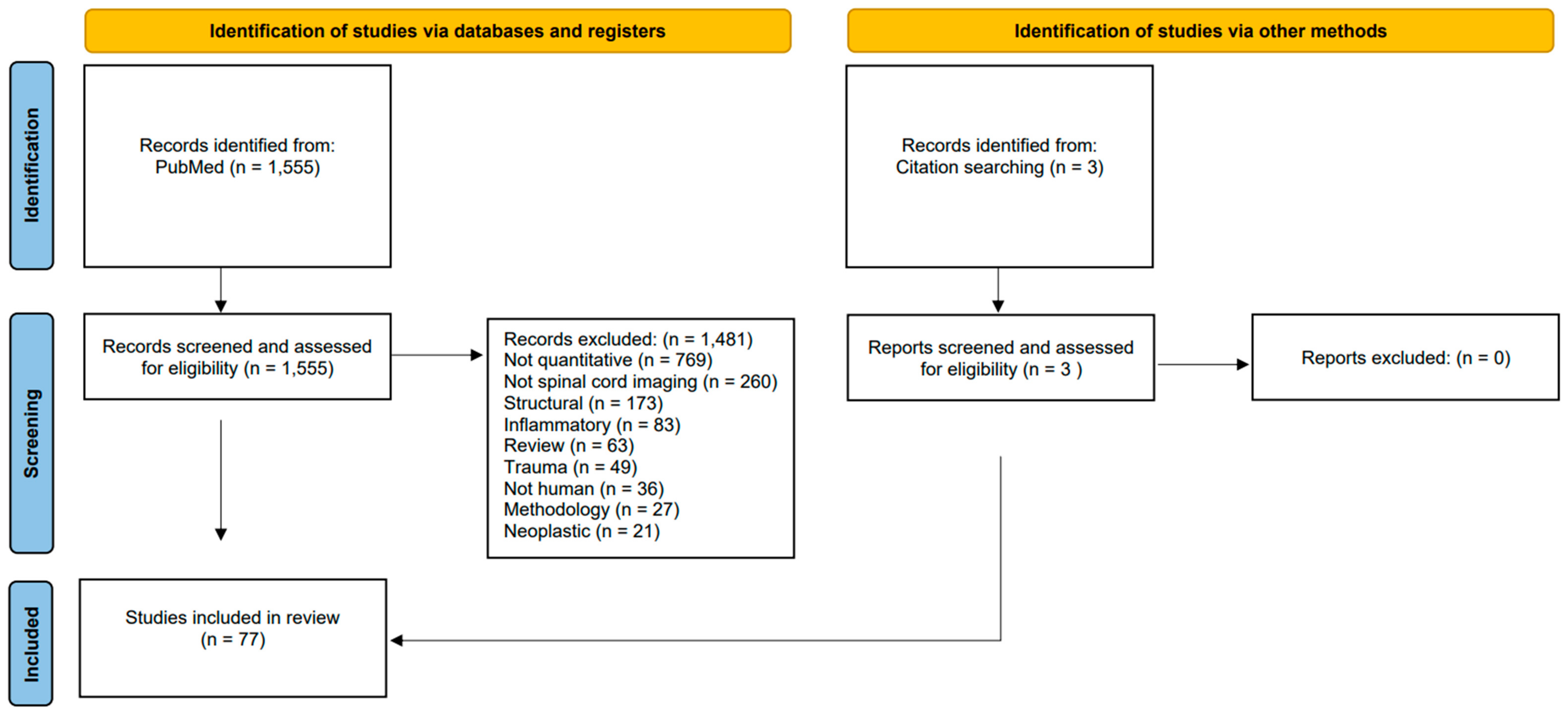
2. Methods
3. Results
3.1. Motor Neuron Disease
3.1.1. Amyotrophic Lateral Sclerosis
3.1.2. Primary Lateral Sclerosis
3.1.3. Progressive Muscular Atrophy
3.1.4. Spinal and Bulbar Muscular Atrophy
3.1.5. Post-Polio Syndrome
3.1.6. Spinal Muscular Atrophy
4. Hereditary Ataxias
4.1. Autosomal Dominant Hereditary Ataxias
Spinocerebellar Ataxia
4.2. Autosomal Recessive Hereditary Ataxias
4.2.1. Friedreich’s Ataxia
4.2.2. Autosomal Recessive Cerebellar Ataxia Type 1
4.3. Hereditary Spastic Paraparesis
5. Other Genetic Neurodegenerative Disorders
5.1. Huntington’s Disease
5.2. Adrenoleukodystrophy
6. Acquired Spinal Cord Disorders
6.1. Sensory Neuronopathy
6.2. HTLV-1 Associated Myelopathy and Tropical Spastic Paraparesis
6.3. Vascular Aetiologies
7. Discussion
8. Academic Insights
9. Clinical Applications
10. Gaps and Shortcomings
11. Research Priorities for the Development of Viable Clinical Tools
12. Conclusions
Supplementary Materials
Author Contributions
Funding
Institutional Review Board Statement
Informed Consent Statement
Data Availability Statement
Acknowledgments
Conflicts of Interest
Abbreviations
References
- Sun, S.W.; Liang, H.F.; Trinkaus, K.; Cross, A.H.; Armstrong, R.C.; Song, S.K. Noninvasive detection of cuprizone induced axonal damage and demyelination in the mouse corpus callosum. Magn. Reson. Med. Off. J. Soc. Magn. Reson. Med./Soc. Magn. Reson. Med. 2006, 55, 302–308. [Google Scholar] [CrossRef] [PubMed]
- Song, S.K.; Sun, S.W.; Ramsbottom, M.J.; Chang, C.; Russell, J.; Cross, A.H. Dysmyelination revealed through MRI as increased radial (but unchanged axial) diffusion of water. NeuroImage 2002, 17, 1429–1436. [Google Scholar] [CrossRef] [PubMed]
- By, S.; Xu, J.; Box, B.A.; Bagnato, F.R.; Smith, S.A. Application and evaluation of NODDI in the cervical spinal cord of multiple sclerosis patients. NeuroImage Clin. 2017, 15, 333–342. [Google Scholar] [CrossRef]
- Grussu, F.; Schneider, T.; Zhang, H.; Alexander, D.C.; Wheeler-Kingshott, C.A. Neurite orientation dispersion and density imaging of the healthy cervical spinal cord in vivo. NeuroImage 2015, 111, 590–601. [Google Scholar] [CrossRef]
- Cohen-Adad, J.; Descoteaux, M.; Rossignol, S.; Hoge, R.D.; Deriche, R.; Benali, H. Detection of multiple pathways in the spinal cord using q-ball imaging. NeuroImage 2008, 42, 739–749. [Google Scholar] [CrossRef]
- Labounek, R.; Valošek, J.; Horák, T.; Svátková, A.; Bednařík, P.; Vojtíšek, L.; Horáková, M.; Nestrašil, I.; Lenglet, C.; Cohen-Adad, J.; et al. HARDI-ZOOMit protocol improves specificity to microstructural changes in presymptomatic myelopathy. Sci. Rep. 2020, 10, 17529. [Google Scholar] [CrossRef]
- Gupta, V. Positron emission tomography in spinal cord disease. Mayo Clin. Proc. 2013, 88, 1188–1190. [Google Scholar] [CrossRef]
- Flanagan, E.P.; Hunt, C.H.; Lowe, V.; Mandrekar, J.; Pittock, S.J.; O’Neill, B.P.; Keegan, B.M. [18F]-fluorodeoxyglucose-positron emission tomography in patients with active myelopathy. Mayo Clin. Proc. 2013, 88, 1204–1212. [Google Scholar] [CrossRef]
- Powers, J.M.; Ioachim, G.; Stroman, P.W. Ten Key Insights into the Use of Spinal Cord fMRI. Brain Sci. 2018, 8, 173. [Google Scholar] [CrossRef]
- Bede, P.; Bokde, A.L.; Byrne, S.; Elamin, M.; Fagan, A.J.; Hardiman, O. Spinal cord markers in ALS: Diagnostic and biomarker considerations. Amyotroph. Lateral Scler. Off. Publ. World Fed. Neurol. Res. Group Mot. Neuron Dis. 2012, 13, 407–415. [Google Scholar] [CrossRef]
- El Mendili, M.M.; Querin, G.; Bede, P.; Pradat, P.F. Spinal Cord Imaging in Amyotrophic Lateral Sclerosis: Historical Concepts-Novel Techniques. Front. Neurol. 2019, 10, 350. [Google Scholar] [CrossRef] [PubMed]
- Tahedl, M.; Tan, E.L.; Chipika, R.H.; Hengeveld, J.C.; Vajda, A.; Doherty, M.A.; McLaughlin, R.L.; Siah, W.F.; Hardiman, O.; Bede, P. Brainstem-cortex disconnection in amyotrophic lateral sclerosis: Bulbar impairment, genotype associations, asymptomatic changes and biomarker opportunities. J. Neurol. 2023, 270, 3511–3526. [Google Scholar] [CrossRef] [PubMed]
- Bede, P.; Chipika, R.H.; Finegan, E.; Li Hi Shing, S.; Chang, K.M.; Doherty, M.A.; Hengeveld, J.C.; Vajda, A.; Hutchinson, S.; Donaghy, C.; et al. Progressive brainstem pathology in motor neuron diseases: Imaging data from amyotrophic lateral sclerosis and primary lateral sclerosis. Data Brief 2020, 29, 105229. [Google Scholar] [CrossRef] [PubMed]
- Brettschneider, J.; Del Tredici, K.; Toledo, J.B.; Robinson, J.L.; Irwin, D.J.; Grossman, M.; Suh, E.; Van Deerlin, V.M.; Wood, E.M.; Baek, Y.; et al. Stages of pTDP-43 pathology in amyotrophic lateral sclerosis. Ann. Neurol. 2013, 74, 20–38. [Google Scholar] [CrossRef]
- Meier, J.M.; van der Burgh, H.K.; Nitert, A.D.; Bede, P.; de Lange, S.C.; Hardiman, O.; van den Berg, L.H.; van den Heuvel, M.P. Connectome-Based Propagation Model in Amyotrophic Lateral Sclerosis. Ann. Neurol. 2020, 87, 725–738. [Google Scholar] [CrossRef]
- Agosta, F.; Chio, A.; Cosottini, M.; De Stefano, N.; Falini, A.; Mascalchi, M.; Rocca, M.A.; Silani, V.; Tedeschi, G.; Filippi, M. The present and the future of neuroimaging in amyotrophic lateral sclerosis. AJNR Am. J. Neuroradiol. 2010, 31, 1769–1777. [Google Scholar] [CrossRef]
- Agosta, F.; Valsasina, P.; Riva, N.; Copetti, M.; Messina, M.J.; Prelle, A.; Comi, G.; Filippi, M. The cortical signature of amyotrophic lateral sclerosis. PLoS ONE 2012, 7, e42816. [Google Scholar] [CrossRef]
- Chipika, R.H.; Finegan, E.; Li Hi Shing, S.; McKenna, M.C.; Christidi, F.; Chang, K.M.; Doherty, M.A.; Hengeveld, J.C.; Vajda, A.; Pender, N.; et al. “Switchboard” malfunction in motor neuron diseases: Selective pathology of thalamic nuclei in amyotrophic lateral sclerosis and primary lateral sclerosis. NeuroImage Clin. 2020, 27, 102300. [Google Scholar] [CrossRef] [PubMed]
- Bede, P.; Chipika, R.H.; Christidi, F.; Hengeveld, J.C.; Karavasilis, E.; Argyropoulos, G.D.; Lope, J.; Li Hi Shing, S.; Velonakis, G.; Dupuis, L.; et al. Genotype-associated cerebellar profiles in ALS: Focal cerebellar pathology and cerebro-cerebellar connectivity alterations. J. Neurol. Neurosurg. Psychiatry 2021, 92, 1197–1205. [Google Scholar] [CrossRef]
- Chipika, R.H.; Christidi, F.; Finegan, E.; Li Hi Shing, S.; McKenna, M.C.; Chang, K.M.; Karavasilis, E.; Doherty, M.A.; Hengeveld, J.C.; Vajda, A.; et al. Amygdala pathology in amyotrophic lateral sclerosis and primary lateral sclerosis. J. Neurol. Sci. 2020, 417, 117039. [Google Scholar] [CrossRef] [PubMed]
- Agosta, F.; Ferraro, P.M.; Riva, N.; Spinelli, E.G.; Chio, A.; Canu, E.; Valsasina, P.; Lunetta, C.; Iannaccone, S.; Copetti, M.; et al. Structural brain correlates of cognitive and behavioral impairment in MND. Hum. Brain Mapp. 2016, 37, 1614–1626. [Google Scholar] [CrossRef] [PubMed]
- Christidi, F.; Karavasilis, E.; Velonakis, G.; Ferentinos, P.; Rentzos, M.; Kelekis, N.; Evdokimidis, I.; Bede, P. The Clinical and Radiological Spectrum of Hippocampal Pathology in Amyotrophic Lateral Sclerosis. Front. Neurol. 2018, 9, 523. [Google Scholar] [CrossRef] [PubMed]
- Strong, M.J.; Abrahams, S.; Goldstein, L.H.; Woolley, S.; McLaughlin, P.; Snowden, J.; Mioshi, E.; Roberts-South, A.; Benatar, M.; HortobaGyi, T.; et al. Amyotrophic lateral sclerosis—Frontotemporal spectrum disorder (ALS-FTSD): Revised diagnostic criteria. Amyotroph. Lateral Scler. Front. Degener. 2017, 18, 153–174. [Google Scholar] [CrossRef] [PubMed]
- Strong, M.J.; Grace, G.M.; Freedman, M.; Lomen-Hoerth, C.; Woolley, S.; Goldstein, L.H.; Murphy, J.; Shoesmith, C.; Rosenfeld, J.; Leigh, P.N.; et al. Consensus criteria for the diagnosis of frontotemporal cognitive and behavioural syndromes in amyotrophic lateral sclerosis. Amyotroph. Lateral Scler. 2009, 10, 131–146. [Google Scholar] [CrossRef]
- Brooks, B.R.; Miller, R.G.; Swash, M.; Munsat, T.L. El Escorial revisited: Revised criteria for the diagnosis of amyotrophic lateral sclerosis. Amyotroph. Lateral Scler. 2000, 1, 293–299. [Google Scholar] [CrossRef] [PubMed]
- Roche, J.C.; Rojas-Garcia, R.; Scott, K.M.; Scotton, W.; Ellis, C.E.; Burman, R.; Wijesekera, L.; Turner, M.R.; Leigh, P.N.; Shaw, C.E.; et al. A proposed staging system for amyotrophic lateral sclerosis. Brain A J. Neurol. 2012, 135, 847–852. [Google Scholar] [CrossRef]
- Balendra, R.; Jones, A.; Jivraj, N.; Knights, C.; Ellis, C.M.; Burman, R.; Turner, M.R.; Leigh, P.N.; Shaw, C.E.; Al-Chalabi, A. Estimating clinical stage of amyotrophic lateral sclerosis from the ALS Functional Rating Scale. Amyotroph. Lateral Scler. Front. Degener. 2014, 15, 279–284. [Google Scholar] [CrossRef]
- Chio, A.; Hammond, E.R.; Mora, G.; Bonito, V.; Filippini, G. Development and evaluation of a clinical staging system for amyotrophic lateral sclerosis. J. Neurol. Neurosurg. Psychiatry 2015, 86, 38–44. [Google Scholar] [CrossRef]
- Burke, T.; Elamin, M.; Bede, P.; Pinto-Grau, M.; Lonergan, K.; Hardiman, O.; Pender, N. Discordant performance on the ‘Reading the Mind in the Eyes’ Test, based on disease onset in amyotrophic lateral sclerosis. Amyotroph. Lateral Scler. Front. Degener. 2016, 17, 467–472. [Google Scholar] [CrossRef] [PubMed]
- Burke, T.; Lonergan, K.; Pinto-Grau, M.; Elamin, M.; Bede, P.; Madden, C.; Hardiman, O.; Pender, N. Visual encoding, consolidation, and retrieval in amyotrophic lateral sclerosis: Executive function as a mediator, and predictor of performance. Amyotroph. Lateral Scler. Front. Degener. 2017, 18, 193–201. [Google Scholar] [CrossRef] [PubMed]
- Christidi, F.; Karavasilis, E.; Rentzos, M.; Kelekis, N.; Evdokimidis, I.; Bede, P. Clinical and Radiological Markers of Extra-Motor Deficits in Amyotrophic Lateral Sclerosis. Front. Neurol. 2018, 9, 1005. [Google Scholar] [CrossRef] [PubMed]
- Chiò, A.; Calvo, A.; Moglia, C.; Mazzini, L.; Mora, G.; PARALS Study Group. Phenotypic heterogeneity of amyotrophic lateral sclerosis: A population based study. J. Neurol. Neurosurg. Psychiatry 2011, 82, 740–746. [Google Scholar] [CrossRef] [PubMed]
- Trojsi, F.; Di Nardo, F.; Caiazzo, G.; Siciliano, M.; D’Alvano, G.; Passaniti, C.; Russo, A.; Bonavita, S.; Cirillo, M.; Esposito, F.; et al. Between-sex variability of resting state functional brain networks in amyotrophic lateral sclerosis (ALS). J. Neural Transm. (Vienna) 2021, 128, 1881–1897. [Google Scholar] [CrossRef] [PubMed]
- Bede, P.; Elamin, M.; Byrne, S.; Hardiman, O. Sexual dimorphism in ALS: Exploring gender-specific neuroimaging signatures. Amyotroph. Lateral Scler. Front. Degener. 2014, 15, 235–243. [Google Scholar] [CrossRef] [PubMed]
- Lebouteux, M.V.; Franques, J.; Guillevin, R.; Delmont, E.; Lenglet, T.; Bede, P.; Desnuelle, C.; Pouget, J.; Pascal-Mousselard, H.; Pradat, P.F. Revisiting the spectrum of lower motor neuron diseases with snake eyes appearance on magnetic resonance imaging. Eur. J. Neurol. 2014, 21, 1233–1241. [Google Scholar] [CrossRef]
- Leoni, T.B.; Rezende, T.J.R.; Peluzzo, T.M.; Martins, M.P.; Neto, A.R.C.; Gonzalez-Salazar, C.; Cruzeiro, M.M.; Camargos, S.T.; de Souza, L.C.; França, M.C., Jr. Structural brain and spinal cord damage in symptomatic and pre-symptomatic VAPB-related ALS. J. Neurol. Sci. 2022, 434, 120126. [Google Scholar] [CrossRef]
- Olney, N.T.; Bischof, A.; Rosen, H.; Caverzasi, E.; Stern, W.A.; Lomen-Hoerth, C.; Miller, B.L.; Henry, R.G.; Papinutto, N. Measurement of spinal cord atrophy using phase sensitive inversion recovery (PSIR) imaging in motor neuron disease. PLoS ONE 2018, 13, e0208255. [Google Scholar] [CrossRef] [PubMed]
- Paquin, M.; El Mendili, M.M.; Gros, C.; Dupont, S.M.; Cohen-Adad, J.; Pradat, P.F. Spinal Cord Gray Matter Atrophy in Amyotrophic Lateral Sclerosis. AJNR Am. J. Neuroradiol. 2018, 39, 184–192. [Google Scholar] [CrossRef]
- van der Burgh, H.K.; Westeneng, H.J.; Meier, J.M.; van Es, M.A.; Veldink, J.H.; Hendrikse, J.; van den Heuvel, M.P.; van den Berg, L.H. Cross-sectional and longitudinal assessment of the upper cervical spinal cord in motor neuron disease. NeuroImage Clin. 2019, 24, 101984. [Google Scholar] [CrossRef] [PubMed]
- Wimmer, T.; Schreiber, F.; Hensiek, N.; Garz, C.; Kaufmann, J.; Machts, J.; Vogt, S.; Prudlo, J.; Dengler, R.; Petri, S.; et al. The upper cervical spinal cord in ALS assessed by cross-sectional and longitudinal 3T MRI. Sci. Rep. 2020, 10, 1783. [Google Scholar] [CrossRef]
- Nigri, A.; Dalla Bella, E.; Ferraro, S.; Medina Carrion, J.P.; Demichelis, G.; Bersano, E.; Consonni, M.; Bischof, A.; Stanziano, M.; Palermo, S.; et al. Cervical spinal cord atrophy in amyotrophic lateral sclerosis across disease stages. Ann. Clin. Transl. Neurol. 2023, 10, 213–224. [Google Scholar] [CrossRef]
- Toh, C.; Keslake, A.; Payne, T.; Onwuegbuzie, A.; Harding, J.; Baster, K.; Hoggard, N.; Shaw, P.J.; Wilkinson, I.D.; Jenkins, T.M. Analysis of brain and spinal MRI measures in a common domain to investigate directional neurodegeneration in motor neuron disease. J. Neurol. 2023, 270, 1682–1690. [Google Scholar] [CrossRef] [PubMed]
- Barry, R.L.; Torrado-Carvajal, A.; Kirsch, J.E.; Arabasz, G.E.; Albrecht, D.S.; Alshelh, Z.; Pijanowski, O.; Lewis, A.J.; Keegan, M.; Reynolds, B.; et al. Selective atrophy of the cervical enlargement in whole spinal cord MRI of amyotrophic lateral sclerosis. NeuroImage Clin. 2022, 36, 103199. [Google Scholar] [CrossRef] [PubMed]
- Branco, L.M.; De Albuquerque, M.; De Andrade, H.M.; Bergo, F.P.; Nucci, A.; Franca, M.C., Jr. Spinal cord atrophy correlates with disease duration and severity in amyotrophic lateral sclerosis. Amyotroph. Lateral Scler. Front. Degener. 2014, 15, 93–97. [Google Scholar] [CrossRef]
- de Albuquerque, M.; Branco, L.M.; Rezende, T.J.; de Andrade, H.M.; Nucci, A.; Franca, M.C., Jr. Longitudinal evaluation of cerebral and spinal cord damage in Amyotrophic Lateral Sclerosis. NeuroImage Clin. 2017, 14, 269–276. [Google Scholar] [CrossRef]
- Pisharady, P.K.; Eberly, L.E.; Cheong, I.; Manousakis, G.; Guliani, G.; Clark, H.B.; Bathe, M.; Walk, D.; Lenglet, C. Tract-specific analysis improves sensitivity of spinal cord diffusion MRI to cross-sectional and longitudinal changes in amyotrophic lateral sclerosis. Commun. Biol. 2020, 3, 370. [Google Scholar] [CrossRef]
- Querin, G.; Bede, P.; El Mendili, M.M.; Li, M.; Pélégrini-Issac, M.; Rinaldi, D.; Catala, M.; Saracino, D.; Salachas, F.; Camuzat, A.; et al. Presymptomatic spinal cord pathology in c9orf72 mutation carriers: A longitudinal neuroimaging study. Ann. Neurol. 2019, 86, 158–167. [Google Scholar] [CrossRef]
- Querin, G.; El Mendili, M.M.; Bede, P.; Delphine, S.; Lenglet, T.; Marchand-Pauvert, V.; Pradat, P.F. Multimodal spinal cord MRI offers accurate diagnostic classification in ALS. J. Neurol. Neurosurg. Psychiatry 2018, 89, 1220–1221. [Google Scholar] [CrossRef]
- Cohen-Adad, J.; El Mendili, M.M.; Morizot-Koutlidis, R.; Lehericy, S.; Meininger, V.; Blancho, S.; Rossignol, S.; Benali, H.; Pradat, P.F. Involvement of spinal sensory pathway in ALS and specificity of cord atrophy to lower motor neuron degeneration. Amyotroph. Lateral Scler. Front. Degener. 2013, 14, 30–38. [Google Scholar] [CrossRef]
- El Mendili, M.M.; Cohen-Adad, J.; Pelegrini-Issac, M.; Rossignol, S.; Morizot-Koutlidis, R.; Marchand-Pauvert, V.; Iglesias, C.; Sangari, S.; Katz, R.; Lehericy, S.; et al. Multi-parametric spinal cord MRI as potential progression marker in amyotrophic lateral sclerosis. PLoS ONE 2014, 9, e95516. [Google Scholar] [CrossRef]
- Querin, G.; El Mendili, M.M.; Lenglet, T.; Delphine, S.; Marchand-Pauvert, V.; Benali, H.; Pradat, P.F. Spinal cord multi-parametric magnetic resonance imaging for survival prediction in amyotrophic lateral sclerosis. Eur. J. Neurol. 2017, 24, 1040–1046. [Google Scholar] [CrossRef] [PubMed]
- Rasoanandrianina, H.; Grapperon, A.M.; Taso, M.; Girard, O.M.; Duhamel, G.; Guye, M.; Ranjeva, J.P.; Attarian, S.; Verschueren, A.; Callot, V. Region-specific impairment of the cervical spinal cord (SC) in amyotrophic lateral sclerosis: A preliminary study using SC templates and quantitative MRI (diffusion tensor imaging/inhomogeneous magnetization transfer). NMR Biomed. 2017, 30, e3801. [Google Scholar] [CrossRef] [PubMed]
- Agosta, F.; Rocca, M.A.; Valsasina, P.; Sala, S.; Caputo, D.; Perini, M.; Salvi, F.; Prelle, A.; Filippi, M. A longitudinal diffusion tensor MRI study of the cervical cord and brain in amyotrophic lateral sclerosis patients. J. Neurol. Neurosurg. Psychiatry 2009, 80, 53. [Google Scholar] [CrossRef] [PubMed]
- Valsasina, P.; Agosta, F.; Benedetti, B.; Caputo, D.; Perini, M.; Salvi, F.; Prelle, A.; Filippi, M. Diffusion anisotropy of the cervical cord is strictly associated with disability in amyotrophic lateral sclerosis. J. Neurol. Neurosurg. Psychiatry 2007, 78, 480–484. [Google Scholar] [CrossRef] [PubMed]
- Agosta, F.; Spinelli, E.G.; Marjanovic, I.V.; Stevic, Z.; Pagani, E.; Valsasina, P.; Salak-Djokic, B.; Jankovic, M.; Lavrnic, D.; Kostic, V.S.; et al. Unraveling ALS due to SOD1 mutation through the combination of brain and cervical cord MRI. Neurology 2018, 90, e707–e716. [Google Scholar] [CrossRef] [PubMed]
- Grolez, G.; Kyheng, M.; Lopes, R.; Moreau, C.; Timmerman, K.; Auger, F.; Kuchcinski, G.; Duhamel, A.; Jissendi-Tchofo, P.; Besson, P.; et al. MRI of the cervical spinal cord predicts respiratory dysfunction in ALS. Sci. Rep. 2018, 8, 1828. [Google Scholar] [CrossRef]
- Wang, Y.; Liu, L.; Ma, L.; Huang, X.; Lou, X.; Wang, Y.; Wu, N.; Liu, T.; Guo, X. Preliminary study on cervical spinal cord in patients with amyotrophic lateral sclerosis using MR diffusion tensor imaging. Acad. Radiol. 2014, 21, 590–596. [Google Scholar] [CrossRef]
- Patzig, M.; Bochmann, K.; Lutz, J.; Stahl, R.; Küpper, C.; Liebig, T.; Reilich, P.; Dieterich, M. Measurement of structural integrity of the spinal cord in patients with amyotrophic lateral sclerosis using diffusion tensor magnetic resonance imaging. PLoS ONE 2019, 14, e0224078. [Google Scholar] [CrossRef]
- Nair, G.; Carew, J.D.; Usher, S.; Lu, D.; Hu, X.P.; Benatar, M. Diffusion tensor imaging reveals regional differences in the cervical spinal cord in amyotrophic lateral sclerosis. Neuroimage 2010, 53, 576–583. [Google Scholar] [CrossRef] [PubMed]
- Iglesias, C.; Sangari, S.; El Mendili, M.M.; Benali, H.; Marchand-Pauvert, V.; Pradat, P.F. Electrophysiological and spinal imaging evidences for sensory dysfunction in amyotrophic lateral sclerosis. BMJ Open 2015, 5, e007659. [Google Scholar] [CrossRef]
- Fukui, Y.; Hishikawa, N.; Sato, K.; Nakano, Y.; Morihara, R.; Shang, J.; Takemoto, M.; Ohta, Y.; Yamashita, T.; Abe, K. Detecting spinal pyramidal tract of amyotrophic lateral sclerosis patients with diffusion tensor tractography. Neurosci. Res. 2018, 133, 58–63. [Google Scholar] [CrossRef] [PubMed]
- Budrewicz, S.; Szewczyk, P.; Bladowska, J.; Podemski, R.; Koziorowska-Gawron, E.; Ejma, M.; Słotwiński, K.; Koszewicz, M. The possible meaning of fractional anisotropy measurement of the cervical spinal cord in correct diagnosis of amyotrophic lateral sclerosis. Neurol. Sci. 2016, 37, 417–421. [Google Scholar] [CrossRef] [PubMed]
- Sperfeld, A.D.; Bretschneider, V.; Flaith, L.; Unrath, A.; Hanemann, C.O.; Ludolph, A.C.; Kassubek, J. MR-Pathologic Comparison of the Upper Spinal Cord in Different Motor Neuron Diseases. Eur. Neurol. 2005, 53, 74–77. [Google Scholar] [CrossRef] [PubMed]
- Cohen-Adad, J.; Zhao, W.; Keil, B.; Ratai, E.M.; Triantafyllou, C.; Lawson, R.; Dheel, C.; Wald, L.L.; Rosen, B.R.; Cudkowicz, M.; et al. 7-T MRI of the spinal cord can detect lateral corticospinal tract abnormality in amyotrophic lateral sclerosis. Muscle Nerve 2013, 47, 760–762. [Google Scholar] [CrossRef]
- Ikeda, K.; Murata, K.; Kawase, Y.; Kawabe, K.; Kano, O.; Yoshii, Y.; Takazawa, T.; Hirayama, T.; Iwasaki, Y. Relationship between cervical cord 1H-magnetic resonance spectroscopy and clinoco-electromyographic profile in amyotrophic lateral sclerosis. Muscle Nerve 2013, 47, 61–67. [Google Scholar] [CrossRef]
- Carew, J.D.; Nair, G.; Andersen, P.M.; Wuu, J.; Gronka, S.; Hu, X.; Benatar, M. Presymptomatic spinal cord neurometabolic findings in SOD1-positive people at risk for familial ALS. Neurology 2011, 77, 1370–1375. [Google Scholar] [CrossRef]
- Carew, J.D.; Nair, G.; Pineda-Alonso, N.; Usher, S.; Hu, X.; Benatar, M. Magnetic resonance spectroscopy of the cervical cord in amyotrophic lateral sclerosis. Amyotroph. Lateral Scler. Off. Publ. World Fed. Neurol. Res. Group Mot. Neuron Dis. 2011, 12, 185–191. [Google Scholar] [CrossRef]
- Li Hi Shing, S.; McKenna, M.C.; Siah, W.F.; Chipika, R.H.; Hardiman, O.; Bede, P. The imaging signature of C9orf72 hexanucleotide repeat expansions: Implications for clinical trials and therapy development. Brain Imaging Behav. 2021, 15, 2693–2719. [Google Scholar] [CrossRef] [PubMed]
- Chipika, R.H.; Siah, W.F.; McKenna, M.C.; Li Hi Shing, S.; Hardiman, O.; Bede, P. The presymptomatic phase of amyotrophic lateral sclerosis: Are we merely scratching the surface? J. Neurol. 2021, 268, 4607–4629. [Google Scholar] [CrossRef] [PubMed]
- Schuster, C.; Elamin, M.; Hardiman, O.; Bede, P. Presymptomatic and longitudinal neuroimaging in neurodegeneration--from snapshots to motion picture: A systematic review. J. Neurol. Neurosurg. Psychiatry 2015, 86, 1089–1096. [Google Scholar] [CrossRef]
- Benatar, M.; Wuu, J. Presymptomatic studies in ALS: Rationale, challenges, and approach. Neurology 2012, 79, 1732–1739. [Google Scholar] [CrossRef] [PubMed]
- Benatar, M.; Turner, M.R.; Wuu, J. Defining pre-symptomatic amyotrophic lateral sclerosis. Amyotroph. Lateral Scler. Front. Degener. 2019, 20, 303–309. [Google Scholar] [CrossRef] [PubMed]
- Verstraete, E.; Turner, M.R.; Grosskreutz, J.; Filippi, M.; Benatar, M. Mind the gap: The mismatch between clinical and imaging metrics in ALS. Amyotroph. Lateral Scler. Front. Degener. 2015, 16, 524–529. [Google Scholar] [CrossRef] [PubMed]
- Turner, M.R.; Barohn, R.J.; Corcia, P.; Fink, J.K.; Harms, M.B.; Kiernan, M.C.; Ravits, J.; Silani, V.; Simmons, Z.; Statland, J.; et al. Primary lateral sclerosis: Consensus diagnostic criteria. J. Neurol. Neurosurg. Psychiatry 2020, 91, 373–377. [Google Scholar] [CrossRef]
- Bede, P.; Pradat, P.F.; Lope, J.; Vourc’h, P.; Blasco, H.; Corcia, P. Primary Lateral Sclerosis: Clinical, radiological and molecular features. Rev. Neurol. 2022, 178, 196–205. [Google Scholar] [CrossRef]
- Bede, P.; Siah, W.F. The diagnostic challenge of primary lateral sclerosis: The integration of clinical, genetic and radiological cues. Eur. J. Neurol. 2021, 28, 3875–3876. [Google Scholar] [CrossRef]
- Finegan, E.; Chipika, R.H.; Shing, S.L.H.; Hardiman, O.; Bede, P. Primary lateral sclerosis: A distinct entity or part of the ALS spectrum? Amyotroph. Lateral Scler. Front. Degener. 2019, 20, 133–145. [Google Scholar] [CrossRef]
- Finegan, E.; Li Hi Shing, S.; Siah, W.F.; Chipika, R.H.; Chang, K.M.; McKenna, M.C.; Doherty, M.A.; Hengeveld, J.C.; Vajda, A.; Donaghy, C.; et al. Evolving diagnostic criteria in primary lateral sclerosis: The clinical and radiological basis of “probable PLS”. J. Neurol. Sci. 2020, 417, 117052. [Google Scholar] [CrossRef]
- Finegan, E.; Chipika, R.H.; Li Hi Shing, S.; Doherty, M.A.; Hengeveld, J.C.; Vajda, A.; Donaghy, C.; McLaughlin, R.L.; Pender, N.; Hardiman, O.; et al. The clinical and radiological profile of primary lateral sclerosis: A population-based study. J. Neurol. 2019, 266, 2718–2733. [Google Scholar] [CrossRef]
- Tahedl, M.; Li Hi Shing, S.; Finegan, E.; Chipika, R.H.; Lope, J.; Hardiman, O.; Bede, P. Propagation patterns in motor neuron diseases: Individual and phenotype-associated disease-burden trajectories across the UMN-LMN spectrum of MNDs. Neurobiol. Aging 2021, 109, 78–87. [Google Scholar] [CrossRef]
- Tahedl, M.; Tan, E.L.; Shing, S.L.H.; Chipika, R.H.; Siah, W.F.; Hengeveld, J.C.; Doherty, M.A.; McLaughlin, R.L.; Hardiman, O.; Finegan, E.; et al. Not a benign motor neuron disease: Longitudinal imaging captures relentless motor connectome disintegration in primary lateral sclerosis. Eur. J. Neurol. 2023, 30, 1232–1245. [Google Scholar] [CrossRef] [PubMed]
- Finegan, E.; Li Hi Shing, S.; Chipika, R.H.; Doherty, M.A.; Hengeveld, J.C.; Vajda, A.; Donaghy, C.; Pender, N.; McLaughlin, R.L.; Hardiman, O.; et al. Widespread subcortical grey matter degeneration in primary lateral sclerosis: A multimodal imaging study with genetic profiling. NeuroImage Clin. 2019, 24, 102089. [Google Scholar] [CrossRef] [PubMed]
- Finegan, E.; Shing, S.L.H.; Chipika, R.H.; Chang, K.M.; McKenna, M.C.; Doherty, M.A.; Hengeveld, J.C.; Vajda, A.; Pender, N.; Donaghy, C.; et al. Extra-motor cerebral changes and manifestations in primary lateral sclerosis. Brain Imaging Behav. 2021, 15, 2283–2296. [Google Scholar] [CrossRef] [PubMed]
- Tahedl, M.; Tan, E.L.; Siah, W.F.; Hengeveld, J.C.; Doherty, M.A.; McLaughlin, R.L.; Hardiman, O.; Finegan, E.; Bede, P. Radiological correlates of pseudobulbar affect: Corticobulbar and cerebellar components in primary lateral sclerosis. J. Neurol. Sci. 2023, 451, 120726. [Google Scholar] [CrossRef]
- Agosta, F.; Canu, E.; Inuggi, A.; Chio, A.; Riva, N.; Silani, V.; Calvo, A.; Messina, S.; Falini, A.; Comi, G.; et al. Resting state functional connectivity alterations in primary lateral sclerosis. Neurobiol. Aging 2014, 35, 916–925. [Google Scholar] [CrossRef]
- Dvorak, A.V.; Ljungberg, E.; Vavasour, I.M.; Liu, H.; Johnson, P.; Rauscher, A.; Kramer, J.L.K.; Tam, R.; Li, D.K.B.; Laule, C.; et al. Rapid myelin water imaging for the assessment of cervical spinal cord myelin damage. NeuroImage Clin. 2019, 23, 101896. [Google Scholar] [CrossRef]
- Pradat, P.F.; Bernard, E.; Corcia, P.; Couratier, P.; Jublanc, C.; Querin, G.; Morelot Panzini, C.; Salachas, F.; Vial, C.; Wahbi, K.; et al. The French national protocol for Kennedy’s disease (SBMA): Consensus diagnostic and management recommendations. Orphanet J. Rare Dis. 2020, 15, 90. [Google Scholar] [CrossRef]
- Querin, G.; Bede, P.; Marchand-Pauvert, V.; Pradat, P.F. Biomarkers of Spinal and Bulbar Muscle Atrophy (SBMA): A Comprehensive Review. Front. Neurol. 2018, 9, 844. [Google Scholar] [CrossRef]
- Spinelli, E.G.; Agosta, F.; Ferraro, P.M.; Querin, G.; Riva, N.; Bertolin, C.; Martinelli, I.; Lunetta, C.; Fontana, A.; Sorarù, G.; et al. Brain MRI shows white matter sparing in Kennedy’s disease and slow-progressing lower motor neuron disease. Hum. Brain Mapp. 2019, 40, 3102–3112. [Google Scholar] [CrossRef]
- Li Hi Shing, S.; Chipika, R.H.; Finegan, E.; Murray, D.; Hardiman, O.; Bede, P. Post-polio Syndrome: More Than Just a Lower Motor Neuron Disease. Front. Neurol. 2019, 10, 773. [Google Scholar] [CrossRef]
- Li Hi Shing, S.; Lope, J.; Chipika, R.H.; Hardiman, O.; Bede, P. Extra-motor manifestations in post-polio syndrome (PPS): Fatigue, cognitive symptoms and radiological features. Neurol. Sci. 2021, 42, 4569–4581. [Google Scholar] [CrossRef] [PubMed]
- Li Hi Shing, S.; Lope, J.; Chipika, R.H.; Hardiman, O.; Bede, P. Imaging data indicate cerebral reorganisation in poliomyelitis survivors: Possible compensation for longstanding lower motor neuron pathology. Data Brief 2021, 38, 107316. [Google Scholar] [CrossRef] [PubMed]
- Li Hi Shing, S.; Lope, J.; McKenna, M.C.; Chipika, R.H.; Hardiman, O.; Bede, P. Increased cerebral integrity metrics in poliomyelitis survivors: Putative adaptation to longstanding lower motor neuron degeneration. J. Neurol. Sci. 2021, 424, 117361. [Google Scholar] [CrossRef]
- Shing, S.L.H.; Murad, A.; Lope, J.; Hardiman, O.; Bede, P. Cerebellar remodelling decades after spinal cord insult: Neuroplasticity in poliomyelitis survivors. J. Integr. Neurosci. 2022, 21, 65. [Google Scholar] [CrossRef]
- Wendebourg, M.J.; Weigel, M.; Richter, L.; Gocheva, V.; Hafner, P.; Orsini, A.L.; Crepulja, V.; Schmidt, S.; Huck, A.; Oechtering, J.; et al. Spinal cord gray matter atrophy is associated with functional decline in post-polio syndrome. Eur. J. Neurol. 2022, 29, 1435–1445. [Google Scholar] [CrossRef] [PubMed]
- Querin, G.; El Mendili, M.M.; Lenglet, T.; Behin, A.; Stojkovic, T.; Salachas, F.; Devos, D.; Le Forestier, N.; Del Mar Amador, M.; Debs, R.; et al. The spinal and cerebral profile of adult spinal-muscular atrophy: A multimodal imaging study. Neuroimage Clin. 2019, 21, 101618. [Google Scholar] [CrossRef]
- Querin, G.; Lenglet, T.; Debs, R.; Stojkovic, T.; Behin, A.; Salachas, F.; Le Forestier, N.; Amador, M.D.M.; Bruneteau, G.; Laforêt, P.; et al. Development of new outcome measures for adult SMA type III and IV: A multimodal longitudinal study. J. Neurol. 2021, 268, 1792–1802. [Google Scholar] [CrossRef]
- El Mendili, M.M.; Lenglet, T.; Stojkovic, T.; Behin, A.; Guimaraes-Costa, R.; Salachas, F.; Meininger, V.; Bruneteau, G.; Le Forestier, N.; Laforet, P.; et al. Cervical Spinal Cord Atrophy Profile in Adult SMN1-Linked SMA. PLoS ONE 2016, 11, e0152439. [Google Scholar] [CrossRef]
- Stam, M.; Haakma, W.; Kuster, L.; Froeling, M.; Philippens, M.E.P.; Bos, C.; Leemans, A.; Otto, L.A.M.; van den Berg, L.H.; Hendrikse, J.; et al. Magnetic resonance imaging of the cervical spinal cord in spinal muscular atrophy. Neuroimage Clin. 2019, 24, 102002. [Google Scholar] [CrossRef]
- Piccinin, C.C.; Rezende, T.J.R.; de Paiva, J.L.R.; Moysés, P.C.; Martinez, A.R.M.; Cendes, F.; França, M.C., Jr. A 5-Year Longitudinal Clinical and Magnetic Resonance Imaging Study in Spinocerebellar Ataxia Type 3. Mov. Disord. 2020, 35, 1679–1684. [Google Scholar] [CrossRef]
- Higgins, J.J.; Harvey-White, J.D.; Nee, L.E.; Colli, M.J.; Grossi, T.A.; Kopin, I.J. Brain MRI, lumbar CSF monoamine concentrations, and clinical descriptors of patients with spinocerebellar ataxia mutations. J. Neurol. Neurosurg. Psychiatry 1996, 61, 591–595. [Google Scholar] [CrossRef] [PubMed][Green Version]
- Fahl, C.N.; Branco, L.M.; Bergo, F.P.; D’Abreu, A.; Lopes-Cendes, I.; França, M.C., Jr. Spinal cord damage in Machado-Joseph disease. Cerebellum 2015, 14, 128–132. [Google Scholar] [CrossRef] [PubMed]
- Rezende, T.J.R.; de Paiva, J.L.R.; Martinez, A.R.M.; Lopes-Cendes, I.; Pedroso, J.L.; Barsottini, O.G.P.; Cendes, F.; França, M.C., Jr. Structural signature of SCA3: From presymptomatic to late disease stages. Ann. Neurol. 2018, 84, 401–408. [Google Scholar] [CrossRef] [PubMed]
- Martins, C.R., Jr.; Martinez, A.R.M.; de Rezende, T.J.R.; Branco, L.M.T.; Pedroso, J.L.; Barsottini, O.G.P.; Lopes-Cendes, I.; França, M.C., Jr. Spinal Cord Damage in Spinocerebellar Ataxia Type 1. Cerebellum 2017, 16, 792–796. [Google Scholar] [CrossRef]
- Lukas, C.; Hahn, H.K.; Bellenberg, B.; Hellwig, K.; Globas, C.; Schimrigk, S.K.; Köster, O.; Schöls, L. Spinal cord atrophy in spinocerebellar ataxia type 3 and 6: Impact on clinical disability. J. Neurol. 2008, 255, 1244–1249. [Google Scholar] [CrossRef] [PubMed]
- Hernandez-Castillo, C.R.; Diaz, R.; Rezende, T.J.R.; Adanyeguh, I.; Harding, I.H.; Mochel, F.; Fernandez-Ruiz, J. Cervical Spinal Cord Degeneration in Spinocerebellar Ataxia Type 7. AJNR Am. J. Neuroradiol. 2021, 42, 1735–1739. [Google Scholar] [CrossRef]
- Faber, J.; Schaprian, T.; Berkan, K.; Reetz, K.; França, M.C., Jr.; de Rezende, T.J.R.; Hong, J.; Liao, W.; van de Warrenburg, B.; van Gaalen, J.; et al. Regional Brain and Spinal Cord Volume Loss in Spinocerebellar Ataxia Type 3. Mov. Disord. 2021, 36, 2273–2281. [Google Scholar] [CrossRef]
- Chevis, C.F.; da Silva, C.B.; D’Abreu, A.; Lopes-Cendes, I.; Cendes, F.; Bergo, F.P.; França, M.C., Jr. Spinal cord atrophy correlates with disability in Friedreich’s ataxia. Cerebellum 2013, 12, 43–47. [Google Scholar] [CrossRef]
- Dogan, I.; Romanzetti, S.; Didszun, C.; Mirzazade, S.; Timmann, D.; Saft, C.; Schöls, L.; Synofzik, M.; Giordano, I.A.; Klockgether, T.; et al. Structural characteristics of the central nervous system in Friedreich ataxia: An in vivo spinal cord and brain MRI study. J. Neurol. Neurosurg. Psychiatry 2019, 90, 615. [Google Scholar] [CrossRef]
- Hernandez, A.; Rezende, T.J.R.; Martinez, A.R.M.; de Brito, M.R.; França, M.C., Jr. Tract-Specific Spinal Cord Diffusion Tensor Imaging in Friedreich’s Ataxia. Mov. Disord. 2022, 37, 354–364. [Google Scholar] [CrossRef]
- Rezende, T.J.R.; Martinez, A.R.M.; Faber, I.; Girotto Takazaki, K.A.; Martins, M.P.; de Lima, F.D.; Lopes-Cendes, I.; Cendes, F.; França, M.C., Jr. Developmental and neurodegenerative damage in Friedreich’s ataxia. Eur. J. Neurol. 2019, 26, 483–489. [Google Scholar] [CrossRef] [PubMed]
- Rezende, T.J.R.; Adanyeguh, I.M.; Arrigoni, F.; Bender, B.; Cendes, F.; Corben, L.A.; Deistung, A.; Delatycki, M.; Dogan, I.; Egan, G.F.; et al. Progressive Spinal Cord Degeneration in Friedreich’s Ataxia: Results from ENIGMA-Ataxia. Mov. Disord. 2023, 38, 45–56. [Google Scholar] [CrossRef] [PubMed]
- Joers, J.M.; Adanyeguh, I.M.; Deelchand, D.K.; Hutter, D.H.; Eberly, L.E.; Iltis, I.; Bushara, K.O.; Lenglet, C.; Henry, P.G. Spinal cord magnetic resonance imaging and spectroscopy detect early-stage alterations and disease progression in Friedreich ataxia. Brain Commun. 2022, 4, fcac246. [Google Scholar] [CrossRef] [PubMed]
- Georgiou-Karistianis, N.; Corben, L.A.; Reetz, K.; Adanyeguh, I.M.; Corti, M.; Deelchand, D.K.; Delatycki, M.B.; Dogan, I.; Evans, R.; Farmer, J.; et al. A natural history study to track brain and spinal cord changes in individuals with Friedreich’s ataxia: TRACK-FA study protocol. PLoS ONE 2022, 17, e0269649. [Google Scholar] [CrossRef]
- Lulé, D.E.; Müller, H.P.; Finsel, J.; Weydt, P.; Knehr, A.; Winroth, I.; Andersen, P.; Weishaupt, J.; Uttner, I.; Kassubek, J.; et al. Deficits in verbal fluency in presymptomatic C9orf72 mutation gene carriers-a developmental disorder. J. Neurol. Neurosurg. Psychiatry 2020, 91, 1195–1200. [Google Scholar] [CrossRef]
- Bede, P.; Siah, W.F.; McKenna, M.C.; Li Hi Shing, S. Consideration of C9orf72-associated ALS-FTD as a neurodevel-opmental disorder: Insights from neuroimaging. J. Neurol. Neurosurg. Psychiatry 2020, 91, 1138. [Google Scholar] [CrossRef]
- Gama, M.T.D.; Piccinin, C.C.; Rezende, T.J.R.; Dion, P.A.; Rouleau, G.A.; França Junior, M.C.; Barsottini, O.G.P.; Pedroso, J.L. Multimodal neuroimaging analysis in patients with SYNE1 Ataxia. J. Neurol. Sci. 2018, 390, 227–230. [Google Scholar] [CrossRef]
- Agosta, F.; Scarlato, M.; Spinelli, E.G.; Canu, E.; Benedetti, S.; Bassi, M.T.; Casali, C.; Sessa, M.; Copetti, M.; Pagani, E.; et al. Hereditary Spastic Paraplegia: Beyond Clinical Phenotypes toward a Unified Pattern of Central Nervous System Damage. Radiology 2015, 276, 207–218. [Google Scholar] [CrossRef]
- Hedera, P.; Eldevik, O.P.; Maly, P.; Rainier, S.; Fink, J.K. Spinal cord magnetic resonance imaging in autosomal dominant hereditary spastic paraplegia. Neuroradiology 2005, 47, 730–734. [Google Scholar] [CrossRef] [PubMed]
- Faber, I.; Martinez, A.R.M.; de Rezende, T.J.R.; Martins, C.R., Jr.; Martins, M.P.; Lourenço, C.M.; Marques, W., Jr.; Montecchiani, C.; Orlacchio, A.; Pedroso, J.L.; et al. SPG11 mutations cause widespread white matter and basal ganglia abnormalities, but restricted cortical damage. Neuroimage Clin. 2018, 19, 848–857. [Google Scholar] [CrossRef]
- Hocquel, A.; Ravel, J.M.; Lambert, L.; Bonnet, C.; Banneau, G.; Kol, B.; Tissier, L.; Hopes, L.; Meyer, M.; Dillier, C.; et al. Reduced penetrance of an eastern French mutation in ATL1 autosomal-dominant inheritance (SPG3A): Extended phenotypic spectrum coupled with brain (18)F-FDG PET. Neurogenetics 2022, 23, 241–255. [Google Scholar] [CrossRef] [PubMed]
- Lin, Q.; Liu, Y.; Ye, Z.; Hu, J.; Cai, W.; Weng, Q.; Chen, W.J.; Wang, N.; Cao, D.; Lin, Y.; et al. Potential markers for sample size estimations in hereditary spastic paraplegia type 5. Orphanet J. Rare Dis. 2021, 16, 391. [Google Scholar] [CrossRef] [PubMed]
- Liu, Y.; Ye, Z.; Hu, J.; Xiao, Z.; Zhang, F.; Yang, X.; Chen, W.; Fu, Y.; Cao, D. White Matter Alterations in Spastic Paraplegia Type 5: A Multiparametric Structural MRI Study and Correlations with Biochemical Measurements. AJNR Am. J. Neuroradiol. 2022, 43, 56–62. [Google Scholar] [CrossRef]
- Navas-Sánchez, F.J.; Marcos-Vidal, L.; de Blas, D.M.; Fernández-Pena, A.; Alemán-Gómez, Y.; Guzmán-de-Villoria, J.A.; Romero, J.; Catalina, I.; Lillo, L.; Muñoz-Blanco, J.L.; et al. Tract-specific damage at spinal cord level in pure hereditary spastic paraplegia type 4: A diffusion tensor imaging study. J. Neurol. 2022, 269, 3189–3203. [Google Scholar] [CrossRef]
- Rezende, T.J.R.; de Albuquerque, M.; Lamas, G.M.; Martinez, A.R.M.; Campos, B.M.; Casseb, R.F.; Silva, C.B.; Branco, L.M.T.; D’Abreu, A.; Lopes-Cendes, I.; et al. Multimodal MRI-Based Study in Patients with SPG4 Mutations. PLoS ONE 2015, 10, e0117666. [Google Scholar] [CrossRef]
- Servelhere, K.R.; Casseb, R.F.; de Lima, F.D.; Rezende, T.J.R.; Ramalho, L.P.; França, M.C., Jr. Spinal Cord Gray and White Matter Damage in Different Hereditary Spastic Paraplegia Subtypes. AJNR Am. J. Neuroradiol. 2021, 42, 610–615. [Google Scholar] [CrossRef] [PubMed]
- Sperfeld, A.D.; Baumgartner, A.; Kassubek, J. Magnetic resonance investigation of the upper spinal cord in pure and complicated hereditary spastic paraparesis. Eur. Neurol. 2005, 54, 181–185. [Google Scholar] [CrossRef]
- Lindig, T.; Ruff, C.; Rattay, T.W.; König, S.; Schöls, L.; Schüle, R.; Nägele, T.; Ernemann, U.; Klose, U.; Bender, B. Detection of spinal long fiber tract degeneration in HSP: Improved diffusion tensor imaging. Neuroimage Clin. 2022, 36, 103213. [Google Scholar] [CrossRef]
- Krabbe, K.; Nielsen, J.E.; Fallentin, E.; Fenger, K.; Herning, M. MRI of autosomal dominant pure spastic paraplegia. Neuroradiology 1997, 39, 724–727. [Google Scholar] [CrossRef]
- Mühlau, M.; Engl, C.; Boucard, C.C.; Schmidt, P.; Biberacher, V.; Görsch, I.; Sorg, C.; Wohlschläger, A.; Zimmer, C.; Hemmer, B.; et al. Spinal cord atrophy in early Huntington’s disease. Ann. Clin. Transl. Neurol. 2014, 1, 302–306. [Google Scholar] [CrossRef]
- Wilhelms, W.; Bellenberg, B.; Köster, O.; Weiler, F.; Hoffmann, R.; Gold, R.; Saft, C.; Lukas, C. Progressive spinal cord atrophy in manifest and premanifest Huntington’s disease. J. Neurol. Neurosurg. Psychiatry 2017, 88, 614–616. [Google Scholar] [CrossRef] [PubMed]
- Lule, D.; Ludolph, A.C.; Ludolph, A.G. Neurodevelopmental and neurodegenerative diseases—Is there a pathophysiological link? Attention-deficit/hyperactivity disorder and amyotrophic lateral sclerosis as examples. Med. Hypotheses 2008, 70, 1133–1138. [Google Scholar] [CrossRef] [PubMed]
- Castellano, A.; Papinutto, N.; Cadioli, M.; Brugnara, G.; Iadanza, A.; Scigliuolo, G.; Pareyson, D.; Uziel, G.; Köhler, W.; Aubourg, P.; et al. Quantitative MRI of the spinal cord and brain in adrenomyeloneuropathy: In vivo assessment of structural changes. Brain 2016, 139, 1735–1746. [Google Scholar] [CrossRef] [PubMed]
- Politi, L.S.; Castellano, A.; Papinutto, N.; Mauro, E.; Pareyson, D.; Henry, R.G.; Falini, A.; Salsano, E. Longitudinal quantitative magnetic resonance imaging in adrenomyeloneuropathy. Eur. J. Neurol. 2019, 26, 1341–1344. [Google Scholar] [CrossRef]
- van de Stadt, S.I.W.; van Ballegoij, W.J.C.; Labounek, R.; Huffnagel, I.C.; Kemp, S.; Nestrasil, I.; Engelen, M. Spinal cord atrophy as a measure of severity of myelopathy in adrenoleukodystrophy. J. Inherit. Metab. Dis. 2020, 43, 852–860. [Google Scholar] [CrossRef]
- Casseb, R.F.; de Paiva, J.L.; Branco, L.M.; Martinez, A.R.; Reis, F.; de Lima-Junior, J.C.; Castellano, G.; Junior, M.C. Spinal cord diffusion tensor imaging in patients with sensory neuronopathy. Neuroradiology 2016, 58, 1103–1108. [Google Scholar] [CrossRef]
- Bao, Y.-F.; Tang, W.-J.; Zhu, D.-Q.; Li, Y.-X.; Zee, C.-S.; Chen, X.-J.; Geng, D.-Y. Sensory neuronopathy involves the spinal cord and brachial plexus: A quantitative study employing multiple-echo data image combination (MEDIC) and turbo inversion recovery magnitude (TIRM). Neuroradiology 2013, 55, 41–48. [Google Scholar] [CrossRef]
- Evangelou, I.E.; Massoud, R.; Jacobson, S. HTLV-I-associated myelopathy/tropical spastic paraparesis: Semiautomatic quantification of spinal cord atrophy from 3-dimensional MR images. J. Neuroimaging 2014, 24, 74–78. [Google Scholar] [CrossRef]
- Liu, W.; Nair, G.; Vuolo, L.; Bakshi, A.; Massoud, R.; Reich, D.S.; Jacobson, S. In vivo imaging of spinal cord atrophy in neuroinflammatory diseases. Ann. Neurol. 2014, 76, 370–378. [Google Scholar] [CrossRef]
- Taniguchi, A.; Mochizuki, H.; Yamashita, A.; Shiomi, K.; Asada, Y.; Nakazato, M. Spinal cord anteroposterior atrophy in HAM/TSP: Magnetic resonance imaging and neuropathological analyses. J. Neurol. Sci. 2017, 381, 135–140. [Google Scholar] [CrossRef]
- Vilchez, C.; Gonzalez-Reinoso, M.; Cubbison, C.; Perez-Then, E.; Roa, P.; Martínez, A.; Foerster, B.; Oviedo, J.; Stoeter, P. Atrophy, focal spinal cord lesions and alterations of diffusion tensor imaging (DTI) parameters in asymptomatic virus carriers and patients suffering from human T-lymphotrophic virus type 1 (HTLV-1)-associated myelopathy/tropical spastic paraparesis (HAM/TSP). J. Neurovirol. 2014, 20, 583–590. [Google Scholar] [CrossRef] [PubMed]
- Théaudin, M.; Saliou, G.; Denier, C.; Adams, D.; Ducreux, D. A correlation between fractional anisotropy variations and clinical recovery in spinal cord infarctions. J. Neuroimaging 2013, 23, 256–258. [Google Scholar] [CrossRef] [PubMed]
- Li Hi Shing, S.; Bede, P. The neuroradiology of upper motor neuron degeneration: PLS, HSP, ALS. Amyotroph. Lateral Scler. Front. Degener. 2021, 23, 1–3. [Google Scholar] [CrossRef] [PubMed]
- Landelle, C.; Dahlberg, L.S.; Lungu, O.; Misic, B.; De Leener, B.; Doyon, J. Altered Spinal Cord Functional Connectivity Associated with Parkinson’s Disease Progression. Mov. Disord. 2023, 38, 636–645. [Google Scholar] [CrossRef]
- Raudino, F.; Leva, S. Involvement of the spinal cord in Parkinson’s disease. Int. J. Neurosci. 2012, 122, 1–8. [Google Scholar] [CrossRef]
- Costello, E.; Rooney, J.; Pinto-Grau, M.; Burke, T.; Elamin, M.; Bede, P.; McMackin, R.; Dukic, S.; Vajda, A.; Heverin, M.; et al. Cognitive reserve in amyotrophic lateral sclerosis (ALS): A population-based longitudinal study. J. Neurol. Neurosurg. Psychiatry 2021, 92, 460–465. [Google Scholar] [CrossRef]
- Bede, P.; Bogdahn, U.; Lope, J.; Chang, K.M.; Xirou, S.; Christidi, F. Degenerative and regenerative processes in amyotrophic lateral sclerosis: Motor reserve, adaptation and putative compensatory changes. Neural Regen. Res. 2021, 16, 1208–1209. [Google Scholar] [CrossRef]
- Bastos, P.A.D.; Barbosa, R. Motor reserve: How to build neuronal resilience against ageing and neurodegeneration? Rev. Neurol. 2022, 178, 845–854. [Google Scholar] [CrossRef] [PubMed]
- Zeller, D.; Hiew, S.; Odorfer, T.; Nguemeni, C. Considering the response in addition to the challenge—A narrative review in appraisal of a motor reserve framework. Aging 2024, 16, 5772–5791. [Google Scholar] [CrossRef]
- Bede, P.; Murad, A.; Hardiman, O. Pathological neural networks and artificial neural networks in ALS: Diagnostic classification based on pathognomonic neuroimaging features. J. Neurol. 2021, 269, 2440–2452. [Google Scholar] [CrossRef]
- Bede, P.; Murad, A.; Lope, J.; Li Hi Shing, S.; Finegan, E.; Chipika, R.H.; Hardiman, O.; Chang, K.M. Phenotypic categorisation of individual subjects with motor neuron disease based on radiological disease burden patterns: A machine-learning approach. J. Neurol. Sci. 2021, 432, 120079. [Google Scholar] [CrossRef] [PubMed]
- Tahedl, M.; Chipika, R.H.; Lope, J.; Li Hi Shing, S.; Hardiman, O.; Bede, P. Cortical progression patterns in individual ALS patients across multiple timepoints: A mosaic-based approach for clinical use. J. Neurol. 2021, 268, 1913–1926. [Google Scholar] [CrossRef] [PubMed]
- Tahedl, M.; Murad, A.; Lope, J.; Hardiman, O.; Bede, P. Evaluation and categorisation of individual patients based on white matter profiles: Single-patient diffusion data interpretation in neurodegeneration. J. Neurol. Sci. 2021, 428, 117584. [Google Scholar] [CrossRef] [PubMed]
- Qiu, S.; Joshi, P.S.; Miller, M.I.; Xue, C.; Zhou, X.; Karjadi, C.; Chang, G.H.; Joshi, A.S.; Dwyer, B.; Zhu, S.; et al. Development and validation of an interpretable deep learning framework for Alzheimer’s disease classification. Brain A J. Neurol. 2020, 143, 1920–1933. [Google Scholar] [CrossRef]
- Basaia, S.; Agosta, F.; Wagner, L.; Canu, E.; Magnani, G.; Santangelo, R.; Filippi, M. Automated classification of Alzheimer’s disease and mild cognitive impairment using a single MRI and deep neural networks. NeuroImage Clin. 2019, 21, 101645. [Google Scholar] [CrossRef]
- Feng, Q.; Ding, Z. MRI Radiomics Classification and Prediction in Alzheimer’s Disease and Mild Cognitive Impairment: A Review. Curr. Alzheimer Res. 2020, 17, 297–309. [Google Scholar] [CrossRef]
- Moradi, E.; Pepe, A.; Gaser, C.; Huttunen, H.; Tohka, J. Machine learning framework for early MRI-based Alzheimer’s conversion prediction in MCI subjects. NeuroImage 2015, 104, 398–412. [Google Scholar] [CrossRef]
- Garcia Santa Cruz, B.; Husch, A.; Hertel, F. Machine learning models for diagnosis and prognosis of Parkinson’s disease using brain imaging: General overview, main challenges, and future directions. Front. Aging Neurosci. 2023, 15, 1216163. [Google Scholar] [CrossRef]
- Bede, P.; Iyer, P.M.; Finegan, E.; Omer, T.; Hardiman, O. Virtual brain biopsies in amyotrophic lateral sclerosis: Diagnostic classification based on in vivo pathological patterns. NeuroImage Clin. 2017, 15, 653–658. [Google Scholar] [CrossRef]
- Behler, A.; Müller, H.P.; Ludolph, A.C.; Kassubek, J. Diffusion Tensor Imaging in Amyotrophic Lateral Sclerosis: Machine Learning for Biomarker Development. Int. J. Mol. Sci. 2023, 24, 1911. [Google Scholar] [CrossRef] [PubMed]
- Kocar, T.D.; Behler, A.; Ludolph, A.C.; Müller, H.P.; Kassubek, J. Multiparametric Microstructural MRI and Machine Learning Classification Yields High Diagnostic Accuracy in Amyotrophic Lateral Sclerosis: Proof of Concept. Front. Neurol. 2021, 12, 745475. [Google Scholar] [CrossRef] [PubMed]
- Tan, E.L.; Lope, J.; Bede, P. Harnessing Big Data in Amyotrophic Lateral Sclerosis: Machine Learning Applications for Clinical Practice and Pharmaceutical Trials. J. Integr. Neurosci. 2024, 23, 58. [Google Scholar] [CrossRef] [PubMed]
- Bede, P.; Chang, K.M.; Tan, E.L. Machine-learning in motor neuron diseases: Prospects and pitfalls. Eur. J. Neurol. 2022, 29, 2555–2556. [Google Scholar] [CrossRef] [PubMed]
- Schuster, C.; Hardiman, O.; Bede, P. Survival prediction in Amyotrophic lateral sclerosis based on MRI measures and clinical characteristics. BMC Neurol. 2017, 17, 73. [Google Scholar] [CrossRef]
- Schuster, C.; Hardiman, O.; Bede, P. Development of an Automated MRI-Based Diagnostic Protocol for Amyotrophic Lateral Sclerosis Using Disease-Specific Pathognomonic Features: A Quantitative Disease-State Classification Study. PLoS ONE 2016, 11, e0167331. [Google Scholar] [CrossRef]
- Chipika, R.H.; Finegan, E.; Li Hi Shing, S.; Hardiman, O.; Bede, P. Tracking a Fast-Moving Disease: Longitudinal Markers, Monitoring, and Clinical Trial Endpoints in ALS. Front. Neurol. 2019, 10, 229. [Google Scholar] [CrossRef]
- Mulkerrin, G.; França, M.C., Jr.; Lope, J.; Tan, E.L.; Bede, P. Neuroimaging in hereditary spastic paraplegias: From qualitative cues to precision biomarkers. Expert. Rev. Mol. Diagn. 2022, 22, 745–760. [Google Scholar] [CrossRef]
- Bede, P.; Elamin, M.; Byrne, S.; McLaughlin, R.L.; Kenna, K.; Vajda, A.; Fagan, A.; Bradley, D.G.; Hardiman, O. Patterns of cerebral and cerebellar white matter degeneration in ALS. J. Neurol. Neurosurg. Psychiatry 2015, 86, 468–470. [Google Scholar] [CrossRef]
- Tahedl, M.; Tan, E.L.; Kleinerova, J.; Delaney, S.; Hengeveld, J.C.; Doherty, M.A.; McLaughlin, R.L.; Pradat, P.F.; Raoul, C.; Ango, F.; et al. Progressive Cerebrocerebellar Uncoupling in Sporadic and Genetic Forms of Amyotrophic Lateral Sclerosis. Neurology 2024, 103, e209623. [Google Scholar] [CrossRef]
- Ando, T.; Riku, Y.; Akagi, A.; Miyahara, H.; Uematsu, T.; Aiba, I.; Sone, J.; Katsuno, M.; Yoshida, M.; Iwasaki, Y. Degeneration of olivospinal tract in the upper cervical spinal cord of multiple system atrophy patients: Reappraisal of Helweg’s triangular tract. Brain Pathol. 2024, 34, e13226. [Google Scholar] [CrossRef]
- Lorenzi, R.M.; Palesi, F.; Castellazzi, G.; Vitali, P.; Anzalone, N.; Bernini, S.; Cotta Ramusino, M.; Sinforiani, E.; Micieli, G.; Costa, A.; et al. Unsuspected Involvement of Spinal Cord in Alzheimer Disease. Front. Cell. Neurosci. 2020, 14, 6. [Google Scholar] [CrossRef] [PubMed]
- Dugger, B.N.; Hidalgo, J.A.; Chiarolanza, G.; Mariner, M.; Henry-Watson, J.; Sue, L.I.; Beach, T.G. The distribution of phosphorylated tau in spinal cords of Alzheimer’s disease and non-demented individuals. J. Alzheimer’s Dis. JAD 2013, 34, 529–536. [Google Scholar] [CrossRef] [PubMed]
- Abidi, M.; de Marco, G.; Grami, F.; Termoz, N.; Couillandre, A.; Querin, G.; Bede, P.; Pradat, P.F. Neural Correlates of Motor Imagery of Gait in Amyotrophic Lateral Sclerosis. J. Magn. Reson. Imaging 2021, 53, 223–233. [Google Scholar] [CrossRef] [PubMed]
- Abidi, M.; Pradat, P.F.; Termoz, N.; Couillandre, A.; Bede, P.; de Marco, G. Motor imagery in amyotrophic lateral Sclerosis: An fMRI study of postural control. NeuroImage Clin. 2022, 35, 103051. [Google Scholar] [CrossRef]
- Feron, M.; Couillandre, A.; Mseddi, E.; Termoz, N.; Abidi, M.; Bardinet, E.; Delgadillo, D.; Lenglet, T.; Querin, G.; Welter, M.L.; et al. Extrapyramidal deficits in ALS: A combined biomechanical and neuroimaging study. J. Neurol. 2018, 265, 2125–2136. [Google Scholar] [CrossRef]
- Chipika, R.H.; Mulkerrin, G.; Pradat, P.F.; Murad, A.; Ango, F.; Raoul, C.; Bede, P. Cerebellar pathology in motor neuron disease: Neuroplasticity and neurodegeneration. Neural Regen. Res. 2022, 17, 2335–2341. [Google Scholar] [CrossRef]
- Finegan, E.; Siah, W.F.; Li Hi Shing, S.; Chipika, R.H.; Hardiman, O.; Bede, P. Cerebellar degeneration in primary lateral sclerosis: An under-recognized facet of PLS. Amyotroph. Lateral Scler. Front. Degener. 2022, 23, 542–553. [Google Scholar] [CrossRef]
- Barry, R.L.; Vannesjo, S.J.; By, S.; Gore, J.C.; Smith, S.A. Spinal cord MRI at 7T. NeuroImage 2018, 168, 437–451. [Google Scholar] [CrossRef]
- Massire, A.; Rasoanandrianina, H.; Taso, M.; Guye, M.; Ranjeva, J.P.; Feiweier, T.; Callot, V. Feasibility of single-shot multi-level multi-angle diffusion tensor imaging of the human cervical spinal cord at 7T. Magn. Reson. Med. Off. J. Soc. Magn. Reson. Med./Soc. Magn. Reson. Med. 2018, 80, 947–957. [Google Scholar] [CrossRef]
- Cloney, M.B.; Smith, Z.A.; Weber, K.A., 2nd; Parrish, T.B. Quantitative Magnetization Transfer MRI Measurements of the Anterior Spinal Cord Region are Associated With Clinical Outcomes in Cervical Spondylotic Myelopathy. Spine (Phila. Pa. 1976) 2018, 43, 675–680. [Google Scholar] [CrossRef]
- Smith, A.K.; By, S.; Lyttle, B.D.; Dortch, R.D.; Box, B.A.; McKeithan, L.J.; Thukral, S.; Bagnato, F.; Pawate, S.; Smith, S.A. Evaluating single-point quantitative magnetization transfer in the cervical spinal cord: Application to multiple sclerosis. NeuroImage Clin. 2017, 16, 58–65. [Google Scholar] [CrossRef] [PubMed]
- Guo, Y.; Liu, Z.; Wen, Y.; Spincemaille, P.; Zhang, H.; Jafari, R.; Zhang, S.; Eskreis-Winkler, S.; Gillen, K.M.; Yi, P.; et al. Quantitative susceptibility mapping of the spine using in-phase echoes to initialize inhomogeneous field and R2* for the nonconvex optimization problem of fat-water separation. NMR Biomed. 2019, 32, e4156. [Google Scholar] [CrossRef] [PubMed]
- Harada, T.; Kudo, K.; Fujima, N.; Yoshikawa, M.; Ikebe, Y.; Sato, R.; Shirai, T.; Bito, Y.; Uwano, I.; Miyata, M. Quantitative Susceptibility Mapping: Basic Methods and Clinical Applications. Radiographics 2022, 42, 1161–1176. [Google Scholar] [CrossRef]
- Combes, A.; Narisetti, L.; Sengupta, A.; Rogers, B.P.; Sweeney, G.; Prock, L.; Houston, D.; McKnight, C.D.; Gore, J.C.; Smith, S.A.; et al. Detection of resting-state functional connectivity in the lumbar spinal cord with 3T MRI. Sci. Rep. 2023, 13, 18189. [Google Scholar] [CrossRef]
- Wyss, P.O.; Hock, A.; Kollias, S. The Application of Human Spinal Cord Magnetic Resonance Spectroscopy to Clinical Studies: A Review. Semin. Ultrasound CT MR 2017, 38, 153–162. [Google Scholar] [CrossRef]
- Marini, C.; Cistaro, A.; Campi, C.; Calvo, A.; Caponnetto, C.; Nobili, F.M.; Fania, P.; Beltrametti, M.C.; Moglia, C.; Novi, G.; et al. A PET/CT approach to spinal cord metabolism in amyotrophic lateral sclerosis. Eur. J. Nucl. Med. Mol. Imaging 2016, 43, 2061–2071. [Google Scholar] [CrossRef] [PubMed]
- Courault, P.; Zimmer, L.; Lancelot, S. Toward Functional PET Imaging of the Spinal Cord. Semin. Nucl. Med. 2024, in press. [Google Scholar] [CrossRef]
- Guner, L.A.; Unal, K.; Vardareli, E.; Kaya, E.; Temiz, H.; Dayioglu, T. Physiological fluorodeoxyglucose uptake of spinal cord in adults. Nucl. Med. Commun. 2020, 41, 659–665. [Google Scholar] [CrossRef]
- Patel, P.Y.; Dalal, I.; Griffith, B. [(18)F]FDG-PET Evaluation of Spinal Pathology in Patients in Oncology: Pearls and Pitfalls for the Neuroradiologist. AJNR Am. J. Neuroradiol. 2022, 43, 332–340. [Google Scholar] [CrossRef]
- Oliva, V.; Hartley-Davies, R.; Moran, R.; Pickering, A.E.; Brooks, J.C. Simultaneous brain, brainstem, and spinal cord pharmacological-fMRI reveals involvement of an endogenous opioid network in attentional analgesia. eLife 2022, 11, 71877. [Google Scholar] [CrossRef]
- Sprenger, C.; Finsterbusch, J.; Büchel, C. Spinal cord-midbrain functional connectivity is related to perceived pain intensity: A combined spino-cortical FMRI study. J. Neurosci. Off. J. Soc. Neurosci. 2015, 35, 4248–4257. [Google Scholar] [CrossRef] [PubMed]
- Vahdat, S.; Lungu, O.; Cohen-Adad, J.; Marchand-Pauvert, V.; Benali, H.; Doyon, J. Simultaneous Brain-Cervical Cord fMRI Reveals Intrinsic Spinal Cord Plasticity during Motor Sequence Learning. PLoS Biol. 2015, 13, e1002186. [Google Scholar] [CrossRef] [PubMed]
- Dauleac, C.; Frindel, C.; Pélissou-Guyotat, I.; Nicolas, C.; Yeh, F.C.; Fernandez-Miranda, J.; Cotton, F.; Jacquesson, T. Full cervical cord tractography: A new method for clinical use. Front. Neuroanat. 2022, 16, 993464. [Google Scholar] [CrossRef] [PubMed]
- Delvecchio, G.; Maggioni, E.; Pigoni, A.; Crespo-Facorro, B.; Nenadić, I.; Benedetti, F.; Gaser, C.; Sauer, H.; Roiz-Santiañez, R.; Poletti, S.; et al. Sexual Regional Dimorphism of Post-Adolescent and Middle Age Brain Maturation. A Multi-center 3T MRI Study. Front. Aging Neurosci. 2021, 13, 622054. [Google Scholar] [CrossRef]
- Menzler, K.; Belke, M.; Wehrmann, E.; Krakow, K.; Lengler, U.; Jansen, A.; Hamer, H.M.; Oertel, W.H.; Rosenow, F.; Knake, S. Men and women are different: Diffusion tensor imaging reveals sexual dimorphism in the microstructure of the thalamus, corpus callosum and cingulum. NeuroImage 2011, 54, 2557–2562. [Google Scholar] [CrossRef] [PubMed]
- Pioro, E.P.; Turner, M.R.; Bede, P. Neuroimaging in primary lateral sclerosis. Amyotroph. Lateral Scler. Front. Degener. 2020, 21, 18–27. [Google Scholar] [CrossRef]
- Kushol, R.; Luk, C.C.; Dey, A.; Benatar, M.; Briemberg, H.; Dionne, A.; Dupré, N.; Frayne, R.; Genge, A.; Gibson, S.; et al. SF2Former: Amyotrophic lateral sclerosis identification from multi-center MRI data using spatial and frequency fusion transformer. Comput. Med. Imaging Graph. Off. J. Comput. Med. Imaging Soc. 2023, 108, 102279. [Google Scholar] [CrossRef]
- Weiner, M.W.; Veitch, D.P.; Aisen, P.S.; Beckett, L.A.; Cairns, N.J.; Green, R.C.; Harvey, D.; Jack, C.R.; Jagust, W.; Liu, E.; et al. The Alzheimer’s Disease Neuroimaging Initiative: A review of papers published since its inception. Alzheimer’s Dement. J. Alzheimer’s Assoc. 2013, 9, e111–e194. [Google Scholar] [CrossRef]
- Tabrizi, S.J.; Reilmann, R.; Roos, R.A.; Durr, A.; Leavitt, B.; Owen, G.; Jones, R.; Johnson, H.; Craufurd, D.; Hicks, S.L.; et al. Potential endpoints for clinical trials in premanifest and early Huntington’s disease in the TRACK-HD study: Analysis of 24 month observational data. Lancet Neurol. 2012, 11, 42–53. [Google Scholar] [CrossRef]
- Muller, H.P.; Turner, M.R.; Grosskreutz, J.; Abrahams, S.; Bede, P.; Govind, V.; Prudlo, J.; Ludolph, A.C.; Filippi, M.; Kassubek, J. A large-scale multicentre cerebral diffusion tensor imaging study in amyotrophic lateral sclerosis. J. Neurol. Neurosurg. Psychiatry 2016, 87, 570–579. [Google Scholar] [CrossRef]

| Year | Authors | Participants | Symptom Duration | Study Design | Follow-Up | Field Strength | MRI Technique | MRI Localization | Cardiac-Gating | Respiratory-Gating | Post-Mortem Data | Genetics | Study Outcome | Summary of Quantitative Spinal Cord Imaging Results |
|---|---|---|---|---|---|---|---|---|---|---|---|---|---|---|
| ALS | ||||||||||||||
| 2009 | Agosta | ALS n = 17 Controls n = 20 | Median (range): 27 (12–58) months | Longitudinal; case control | Mean 9 (6–12) months | 1.5 T | Spinal cord area DTI T2 hyperintensities | Cervical | No | No | No | N/A | Positive | In ALS, there was progressive cord atrophy and structural changes (FA and MD). This was independent of brain changes. |
| 2018 | Agosta | SOD1 ALS n = 20; sporadic ALS n = 11 | Mean ± SD: SOD1 ALS 69.9 ± 50.5; sporadic ALS 27.9 ± 29.0 months | Cross-sectional; case control | N/A | 1.5 T | Spinal cord area MTR | Cervical | No | No | No | SOD1 ALS n = 20 | Positive | In SOD1 ALS, there was significant cervical cord atrophy compared with sporadic ALS. Cervical cord atrophy correlated with disease duration and functional impairment in both SOD1 and sporadic ALS |
| 2022 | Barry | ALS n = 15 Controls n = 17 | 13.2 (8.0) months | Cross-sectional; case control | N/A | 3.0 T | Spinal cord area | Cervical Thoracic Lumbar | No | No | No | C9orf72 n = 1; SOD1 n = 1; TBK1 n = 1; Unknown n = 12 | Positive | In ALS, there was cervical, but not thoracolumbar, cord atrophy. |
| 2014 | Branco | ALS n = 43 Controls n = 43 | Mean ± SD: 34.0 ± 29.9 months | Cross-sectional; case control | N/A | 3.0 T | Spinal cord area | Cervical | No | No | No | N/A | Positive | In ALS, there was cervical cord atrophy without flattening compared to controls. The degree of atrophy correlated with disease duration and severity. |
| 2016 | Budrewicz | ALS n = 15 Controls n = 15 | Mean: 7.3 months | Cross-sectional; case control | N/A | 1.5 T | DTI | Cervical | No | No | No | N/A | Positive | In ALS, there were decreased FA values in the cervical cord with a caudal predominance in the anterior, lateral, posterior columns and central cord. |
| 2011 | Carew | ALS n = 14 Controls n = 16 | Median (IQR): 26.7 (16.8–36.3) | Cross-sectional; case control | N/A | 3.0 T | MRS | Cervical | No | No | No | N/A | Positive | In ALS, there was reduced NAA/Cr, NAA/mIns, Cho/Cr ratios in the cervical cord compared with controls. The reduced NAA/mIns and NAA/Cho ratios correlated with worsening respiratory function. The neurometabolite ratios did not correlate with clinical disability. |
| 2011 | Carew | Pre-symptomatic SOD1 n = 24; SOD1 ALS n = 23 Controls n = 29 | SOD1 ALS Mean (IQR): 567 (262.5–1084) days | Cross-sectional; case control | N/A | 3.0 T | MRS | Cervical | No | No | No | Pre-symptomatic SOD1 n = 24; ALS SOD1 n = 23 | Positive | In pre-symptomatic SOD1, the altered metabolite ratios (reduced NAA/Cr, NAA/mIns and mIns/Cr) in the cervical cord were similar to symptomatic SOD1 ALS (reduced NAA/Cr, NAA/mIns and NAA/Cho) compared with controls. This suggests that metabolic changes occur in early disease. |
| 2013 | Cohen-Adad | ALS n = 29 Controls n = 21 | Mean 1.4 years | Cross-sectional; Case control | N/A | 3.0 T | Spinal cord area DTI MTR | Cervical | Yes | No | No | SOD1 n = 2 Sporadic n = 27 | Positive | In ALS, there was cervical cord atrophy; reduced FA and increased RD in the lateral CST and dorsal regions; and reduced MTR in the lateral CST of the cervical cord. Reduced FA of lateral CST correlated with clinical severity. Focal spinal cord atrophy was associated with corresponding muscle weakness. |
| 2013 | Cohen-Adad | ALS n = 1 Controls n = 1 | 23 months | Cross-sectional; case control | N/A | 7.0 T | T2 hyperintensities | Cervical | No | No | No | N/A | Positive | 7.0T MRI detected T2 hyperintensities in the lateral CST of the cervical cord in a single patient with ALS compared to a control |
| 2017 | deAlbuquerque | ALS n = 27 Controls n = 27 | Median (range): 30.5 (16–150) months | Longitudinal; case control | 8 months | 3.0 T | Spinal cord area | Cervical | No | No | No | C9orf72 negative ALS n = 27 | Positive | In sporadic ALS, there was progressive cervical spinal cord atrophy without flattening that correlated with disease severity (ALSFRS-R). |
| 2014 | ElMendili | ALS n = 29, baseline ALS n = 14, follow-up | 26.8 ± 26.9 months | Longitudinal; case series | 11 ± 3 months | 3.0 T | Spinal cord area DTI MTR | Cervical | Yes | No | No | N/A | Positive | In ALS, there was longitudinal cervical cord atrophy and decreased MTR. The rate of atrophy correlated with upper limb ALSFRS-R and MMT scores. |
| 2018 | Fukui | ALS n = 38; HSP n = 7; SBMA n = 6 Controls n = 8 | ALS: 1.3 ± 1; SBMA: 16.5 ± 7; HSP: 15.3 ± 7.7 years | Cross-sectional; case control | N/A | 3.0 T | DTI | Cervical | No | No | No | SBMA n = 6 | Positive | In ALS, there was reduced FA in the cervical cord compared with controls and SBMA. The rate of ALS disease progression of significantly correlated with FA. |
| 2018 | Grolez | ALS n = 40 Controls n = 21 | N/A | Longitudinal; case control | 3 months | 3.0 T | Volumetry | Cervical | No | No | No | N/A | Positive | In ALS, the longitudinal decrease in cervical cord volume over 3 months was predictive of the change in slow vital capacity at 12 months. |
| 2015 | Iglesias | ALS n = 21 Controls n = 21 | 26.6 ±3.6 months | Cross-sectional; case control | N/A | 3.0 T | DTI | Cervical | Yes | No | No | N/A | Positive | In ALS, there was increased RD and MD in the posterior columns; and increased RD, MD and reduced FA in the lateral CST of the cervical cord. No correlation of DTI metrics with clinical measures. |
| 2013 | Ikeda | ALS n = 19 Controls n = 20 | Mean ± SD: 20.4 ± 8.0 months | Cross-sectional; case control | N/A | 1.5 T | MRS | Cervical | No | No | No | N/A | Positive | In ALS, there was reduced NAA/Cr, NAA/mIns and increased mIns/Cr ratios in the cervical cord compared with controls. NAA/Cr and NAA/mIns ratios were significantly associated with ALSFRS and FVC and inversely linked to annual decline in ALSFRS and FVC. |
| 2022 | Leoni | Pre-symptomatic VAPB n = 10; VAPB ALS n = 20; Sporadic ALS n = 20; Controls n = 30 | Mean ± SD: 6.4 ± 4.4 years | Cross-sectional; case control | N/A | 3.0 T | Spinal cord area | Cervical | No | No | No | Pre-symptomatic and symptomatic VAPB ALS n = 30; sporadic ALS (C9orf72, ATXN2, VAPB, SOD1 negative) n = 20 | Positive | There is cervical spinal cord atrophy in pre-symptomatic and symptomatic VAPB-related ALS. The degree of atrophy was greater in the symptomatic VAPB-related ALS. This did not correlate with disease duration or ALSFRS. |
| 2010 | Nair | ALS n = 14 Controls n = 15 | Mean (IQR): 2 (1.1–3.8) years | Cross-sectional; case control | N/A | 3.0 T | DTI | Cervical | No | No | No | N/A | Positive | In ALS, there was reduced FA and increased RD in the cervical cord—more prominent in the distal cervical cord—compared with controls. Reduced FA correlated with average finger and foot tapping speed; and increased RA correlated with average finger and foot tapping speed, ALSFRS-R, and FVC |
| 2023 | Nigri | ALS n = 48 Controls n = 17 | Median (IQR): 14 (9–27) months | Cross-sectional; case control | N/A | 3.0 T | Spinal cord area | Cervical | No | No | No | Sporadic ALS n = 48 negative for C9orf72, SOD1, FUS, OPTN, TARDBP | Positive | In ALS, cervical cord atrophy spreads from GM to WM across the clinical King’s Staging System. Cervical GM and WM atrophy correlates with disability. |
| 2018 | Olney | ALS n = 10 Controls n = 10 | Mean (range): 44 (11–128) months | Cross-sectional; case control | N/A | 3.0 T | Spinal cord area | Cervical | No | No | No | N/A | Positive | In ALS, there reduced total cervical cord CSA, GM, and WM area. |
| 2018 | Paquin | ALS n = 29 Controls n = 22 | N/A | Cross-sectional; case control | N/A | 3.0 T | Spinal cord area | Cervical | No | No | No | SOD1 n = 2 | Positive | Cervical cord GM atrophy is more sensitive than cross-sectional atrophy at differentiating patients with ALS from controls. Cervical cord GM and cross-sectional area correlated with baseline and 1-year clinical disability scores. ALSFRS-R prediction at 1 year improves with combined GM and WM area. |
| 2019 | Patzig | ALS n = 14 Controls n = 15 | Median (range): 20 (5–108) months | Cross-sectional; case control | N/A | 3.0 T | DTI | Cervical | No | No | No | N/A | Positive | In ALS, there was reduced CSA at C2-C4 and reduced FA in the cervical cord anterolateral motor tracts compared with controls. These findings did not correlate with clinical measures. |
| 2020 | Pisharady | ALS n = 20 Controls n = 20 | 38.5 ± 42.5 (3.4–147.7) months | Longitudinal; case control | 6 months (n = 10); 12 months (n = 11) | 3.0 T | Spinal cord area DTI | Cervical | No | No | No | N/A | Positive | In ALS, there was reduced cervical cord CSA; reduced FA in the lateral CST; and a trend towards reduced FA in the posterior columns. There was longitudinal increase in RD and MD. Multimodal analysis of both cervical cord CSA and FA significantly improved sensitivity in differentiating from patients with ALS from controls. There was a strong correlation between CSA, FA, and ALSFRS-R scores. |
| 2018 | Querin | ALS n = 60 Controls n = 45 | Mean ± SD (range): 30 ± 30 (1–168) months | Cross-sectional; case control | N/A | 3.0 T | Spinal cord area DTI MTR | Cervical | Yes | No | No | N/A | Positive | A classification model using cervical cord CSA, DTI and MTR variables differentiated ALS from controls (sensitivity 88%; specificity 85%; AUC 0.96). The best-performing individual variables were RD, FA, CSA at C5 spinal level. |
| 2017 | Querin | ALS n = 49 | Mean ± SD: 27.9 ± 28.52 months | Cross-sectional; case series | N/A | 3.0 T | Spinal cord area DTI MTR | Cervical | Yes | No | No | N/A | Positive | In ALS, reduced CSA, FA and MTR in cervical cord are all associated shorter disease duration. Multi-modal cord analyses could predict survival in ALS. |
| 2019 | Querin | Pre-symptomatic C9orf72 n = 40 Controls n = 32 | N/A | Longitudinal; case control | 18 months | 3.0 T | Spinal cord area DTI | Cervical | Yes | No | No | C9orf72 n = 40 | Positive | In pre-symptomatic C9orf72 aged >40 years, there was cervical cord WM atrophy at baseline; and reduced FA in cervical CST at longitudinal follow-up. |
| 2017 | Rasoanandrianina | ALS n = 10 Controls n = 20 | Median (IQR): 15.5 (11–22) months | Cross-sectional; case control | N/A | 3.0 T | Spinal cord area DTI MTR ihMTR | Cervical | Yes | No | No | N/A | Positive | In ALS, there was cervical cord GM and WM atrophy, reduced FA in CST; reduced AxD in CST and posterior columns; reduced MTR in CST; and reduced ihMTR in all ROIs. These MRI metrics strongly correlated with clinical scores. |
| 2005 | Sperfeld | ALS n = 39; LMND n = 19; SBMA n = 19; Controls n = 96 | Mean ± SD: ALS: 3 ± 4; SBMA: 24 ± 11; LMND: 21 ± 18 years | Cross-sectional; case control | N/A | 1.5 T | T2 hyperintensities AP diameter | Cervical Thoracic | No | No | No | SBMA n = 19 | Negative | No difference in cervical and thoracic cord thickness or altered signal in CST or posterior columns in ALS compared to controls. |
| 2023 | Toh | ALS n = 75; Controls n = 13 | Mean ± SD: 17 ± 17 months | Cross-sectional; case control | N/A | 3.0 T | Spinal cord area | Cervical | No | No | No | Case-by-case basis, and not systematically in all patients. C9orf72+ n = 1; and SOD1+ n = 1 | Negative | In ALS, there was no difference in cervical cord CSA compared to controls. There was a positive cranio-caudal step-wise gradient between intracranial CST and C1, and between cervical cord C5 and C6 levels. |
| 2007 | Valsasina | ALS n = 28; Controls n = 20 | Median (range): 26 (6–58) months | Cross-sectional; case control | N/A | 1.5 T | Spinal cord area DTI T2 hyperintensities | Cervical | No | No | No | N/A | Positive | In ALS, there was reduced cervical cord CSA and FA. FA correlated with ALSFRS. |
| 2019 | vanderBurgh | (n = baseline, follow-up) C9orf72-ALS n = 108, 64 C9orf72 + ALS n = 26; 18 PLS n = 28; 18 PMA n = 56; 41 Controls n = 114, 54 | Median (range): C9orf72-ALS 14.4 (2.9–174.4); C9orf72 + ALS 11.5 (3.3–68.3); PLS 90.6 (23.5–224.9); PMA 20.3 (4.6–467.4) months | Longitudinal; case control | Median (range): C9orf72-ALS 4.9, (3.0–9.8); C9orf72 + ALS 5.4, (3.0–10.0); PLS 6.8 (3.2–85.9); PMA 5.5 (3.0–59.0) months | 3.0 T | Spinal cord area | Cervical | No | No | No | C9orf72 + ALS n = 26 | Positive | In C9orf72 + ALS and C9orf72-ALS, there was upper cervical cord atrophy that was progressive in C9orf72-ALS but not in C9orf72 + ALS. Disease progression measured by longitudinal ALSFRS-R scores correlated with cervical cord atrophy in C9orf72-ALS. |
| 2014 | Wang | ALS n = 24 Controls n = 16 | Range: 6–42 months | Cross-sectional; case control | N/A | 1.5 T | DTI | Cervical | No | No | No | N/A | Positive | In ALS, there was decreased FA in bilateral lateral CSTs compared to controls. It did not correlate with disease severity. |
| 2020 | Wimmer | ALS n = 158 (incl. PLS n = 9) Controls n = 86 | Median (range): 16 (3–272) months | Longitudinal; case control | 6-months | 3.0 T | Spinal cord area | Cervical | No | No | No | ALS n = 63 tested for SOD1 and C9orf72 (SOD1+ n = 7 and C9orf72+ n = 7) | Positive | In ALS, there was cervical cord atrophy, with a trend towards longitudinal progression at 6-month interval. It was most marked in limb-onset ALS. Baseline cervical cord CSA correlated with ALSFRS-R disease severity. |
| PLS | ||||||||||||||
| 2019 | Dvorak | PLS n = 2 RRMS n = 1; PPMS n = 1; NMO n = 2 | N/A | Cross-sectional; case control | N/A | 3.0 T | DTI MWI | Cervical | No | No | No | N/A | Positive | In PLS, there was low myelin water fraction in the lateral funiculi; high RD in GM; low FA in whole cord, GM and lateral funiculi compared to controls. |
| 2019 | vanderBurgh | (n = baseline, follow-up) C9orf72-ALS n = 108, 64 C9orf72 + ALS n = 26; 18 PLS n = 28; 18 PMA n = 56; 41 Controls n = 114, 54 | Median (range): C9orf72-ALS 14.4 (2.9–174.4); C9orf72 + ALS 11.5 (3.3–68.3); PLS 90.6 (23.5–224.9); PMA 20.3 (4.6–467.4) months | Longitudinal; case control | Median (range): C9orf72-ALS 4.9, (3.0–9.8); C9orf72 + ALS 5.4, (3.0–10.0); PLS 6.8 (3.2–85.9); PMA 5.5 (3.0–59.0) months | 3.0 T | Spinal cord area | Cervical | No | No | No | C9orf72 + ALS n = 26 | Positive | In PLS, there was upper cervical cord atrophy without longitudinal changes. This correlated with disease progression measured by longitudinal ALSFRS-R. |
| 2020 | Wimmer | ALS n = 158 (incl. PLS n = 9) Controls n = 86 | Median (range): 16 (3–272) months | Longitudinal; case control | 6 months | 3.0 T | Spinal cord area | Cervical | No | No | No | ALS n = 63 tested for SOD1 and C9orf72 (SOD1+ n = 7 and C9orf72+ n = 7) | Positive | In ALS, there was cervical cord atrophy, with a trend towards longitudinal progression at 6-month interval. It was most marked in limb-onset ALS. Baseline cervical cord CSA correlated with ALSFRS-R disease severity. |
| PMA | ||||||||||||||
| 2005 | Sperfeld | ALS n = 39; LMND n = 19; SBMA n = 19; Controls n = 96 | Mean ± SD: ALS: 3 ± 4; SBMA: 24 ± 11; LMND: 21 ± 18 years | Cross-sectional; case control | N/A | 1.5 T | T2 hyperintensities AP diameter | Cervical Thoracic | No | No | No | SBMA n = 19 | Negative | In PMA, there was no difference in cervical and thoracic spinal cord thickness and no signal alterations in CST or posterior columns compared to controls. |
| 2019 | vanderBurgh | (n = baseline, follow-up) C9orf72-ALS n = 108, 64 C9orf72 + ALS n = 26; 18 PLS n = 28; 18 PMA n = 56; 41 Controls n = 114, 54 | Median (Range): C9orf72-ALS 14.4 (2.9–174.4); C9orf72 + ALS 11.5 (3.3–68.3); PLS 90.6 (23.5–224.9); PMA 20.3 (4.6–467.4) months | Longitudinal; case control | Median (range): C9orf72-ALS 4.9, (3.0–9.8); C9orf72 + ALS 5.4, (3.0–10.0); PLS 6.8 (3.2–85.9); PMA 5.5 (3.0–59.0) months | 3.0 T | Spinal cord area | Cervical | No | No | No | C9orf72 + ALS n = 26 | Positive | In PMA, there is progressive upper cervical cord atrophy. Disease progression measured by longitudinal ALSFRS-R scores correlated with atrophy in PMA. |
| SBMA | ||||||||||||||
| 2018 | Fukui | ALS n = 38; HSP n = 7; SBMA n = 6 Controls n = 8 | ALS: 1.3 ± 1; SBMA: 16.5 ± 7; HSP: 15.3 ± 7.7 years | Cross-sectional; case control | N/A | 3.0 T | DTI | Cervical | No | No | No | SBMA n = 6 | Negative | In SBMA, there was no difference in DTI metrics compared with controls. |
| 2005 | Sperfeld | ALS n = 39; LMN disease n = 19; SBMA n = 19; Controls n = 96 | Mean ± SD: ALS: 3 ± 4; SBMA: 24 ± 11; LMND: 21 ± 18 years | Cross-sectional; case control | N/A | 1.5 T | T2 hyperintensities AP diameter | Cervical Thoracic | No | No | No | SBMA n = 19 | Positive | In SBMA, there was cervical and thoracic spinal cord atrophy and no signal alterations in CST or posterior columns compared to controls. |
| PPS | ||||||||||||||
| 2022 | Wendebourg | PPS n = 20 Controls n = 20 | Mean, median (range): 44.4, 43.5 (25–61) | Cross-sectional; case control | N/A | 3.0 T | Spinal cord area | Cervical Thoracic | Yes | No | No | N/A | Positive | In PPS, there was cervical and thoracic cord atrophy that correlated with muscle strength in corresponding myotomes. It was associated with patient-reported PPS-related functional decline. The atrophy was more marked in those with progressive upper limb symptoms compared to stable disease. |
| SMA | ||||||||||||||
| 2016 | ElMendili | SMA n = 18 (Type IIIa n = 5; IIIb n = 10; IV n = 3) Controls n = 18 | 26 ± 15 years | Cross-sectional; case control | N/A | 3.0 T | Spinal cord area | Cervical | No | No | No | SMN1 SMA Type III or IV n = 18 | Positive | In adult SMA, there was cervical cord atrophy—particularly in segments that innervate the proximal muscles. There was no correlation with strength or disability scores. |
| 2021 | Querin | SMA Type III or IV n = 14 | N/A | Longitudinal; case series | 24 months | 3.0 T | Spinal cord area | Cervical | No | No | No | SMA Type III or IV n = 14 (SMN2 4 copies n = 11; SMN2 3 copies n = 3) | Negative | In SMA type III and IV, there was no significant longitudinal difference in cervical cord GM-CSA and WM-CSA between baseline and 2-year scans |
| 2019 | Querin | SMA n = 25 (Type III n = 19; IV n = 6) Controls n = 25 | Mean ± SD (range): 30.38 ± 15.4 (5–55) years | Cross-sectional; case control | N/A | 3.0 T | Spinal cord area DTI | Cervical | Yes | No | No | SMN1 SMA Type III or IV n = 25 | Positive | In SMA type III and IV, there was whole cervical cord atrophy with selective GM degeneration. GM-CSA at C3-C4 correlated with deltoid strength. |
| 2019 | Stam | SMA n = 10 (Type II n = 1; IIIa n = 4; IIIb n = 5) Controls n = 30 | N/A | Cross-sectional; case control | N/A | 3.0 T | Spinal cord area DTI | Cervical | No | No | No | SMA Type II or III n = 10 | Positive | In SMA, there was increased AxD in the cervical GM; reduced MD, AxD and RD in the cervical nerve roots; and a trend towards whole cervical cord atrophy, greatest at C7 level. These imaging findings did not correlate with clinical measures. |
| Year | Authors | Participants | Symptom Duration | Study Design | Follow-Up | Field Strength | MRI Technique | MRI Localization | Cardiac-Gating | Respiratory-Gating | Post-Mortem Data | Genetics | Study Outcome | Summary of Quantitative Spinal Cord Imaging Results |
|---|---|---|---|---|---|---|---|---|---|---|---|---|---|---|
| SCA | ||||||||||||||
| 2021 | Faber | SCA3 Ataxic n = 210 SCA3 pre-ataxic n = 48 Controls n = 63 | Mean (SD): SCA3 Ataxic 13 ± 9; SCA3 pre-ataxic (estimated) -2 ± 9 years | Cross-sectional; case control | N/A | Mixed | Spinal cord area | Cervical | No | No | No | SCA3 Ataxic n = 210; SCA3 Pre-ataxic n = 48 | Positive | In SCA3, there is cervical cord atrophy before symptomatic ataxia. There was reduced cervical cord CSA in ataxic SCA3 compared with pre-ataxic SCA3 and in pre-ataxic SCA3 compared with controls. |
| 2015 | Fahl | SCA3 n = 48 Controls n = 48 | Mean (SD: 9 ± 4 years | Cross-sectional; case control | N/A | 3.0 T | Spinal cord area | Cervical | No | No | No | SCA3 n = 48 | Positive | In SCA3, there was cervical cord atrophy and anteroposterior flattening compared with controls. The cervical cord CSA correlated with ataxia severity and disease duration. |
| 2021 | Hernandez-Castillo | SCA7 n = 48 Controls n = 48 | Mean (SD): 9.5 (6.3) years | Cross-sectional; case control | N/A | 3.0 T | Spinal cord area | Cervical | No | No | No | SCA7 n = 48 | Positive | In SCA7, there was cervical cord atrophy and increased eccentricity. The degree of cervical cord atrophy correlated with disease severity measured by SARA and was associated with disease duration. |
| 1996 | Higgins | AD SCA n = 34 Controls = not specified | N/A | Longitudinal; case control | 1 year | 0.5T | Spinal cord area | Cervical | No | No | No | SCA1n = 7 SCA3n = 17 Not SCA1 or 3 n = 10 | Positive | In SCA3 and SCA1, there was reduced cervical cord CSA, without longitudinal progression at 1 year. |
| 2008 | Lukas | SCA3 n = 14 SCA6 n = 10 Controls n = 24 | SCA3 n = 14 Mean 7 years SCA6 n = 10 Mean 9 years | Cross-sectional; case control | N/A | 1.5 T | Spinal cord area | Cervical | No | No | No | SCA3 n = 14; SCA6 n = 10 | Positive | In SCA3, there was cervical cord atrophy that did not correlate with clinical severity. In SCA6, there was normal cervical cord CSA, but lower mean cervical cord CSAs correlated with clinical severity. |
| 2017 | Martins Jr | SCA1 n = 31 Controls n = 31 | Mean (SD): 7.7 ± 6.5 years | Cross-sectional; case control | N/A | 3.0 T | Spinal cord area | Cervical | No | No | No | SCA1 n = 31 | Positive | In SCA1, there was cervical spinal cord atrophy and flattening. The degree of cervical cord atrophy correlated with disease severity and was associated with disease duration. |
| 2020 | Piccinin | SCA3 n = 23 Controls n = 22 | Mean (SD): 9 ± 5 years | Longitudinal; case control | 5 years | 3.0 T | Spinal cord area | Cervical | No | No | No | SCA3 n = 23 | Negative | In SCA3, there was no longitudinal change in cervical cord CSA over 5 years. This may be because the mean disease duration is 9 years and maximal spinal cord atrophy has already occurred. |
| 2018 | Rezende | SCA3 n = 79 Pre-symptomatic SCA3 n = 12 Controls n = 91 | Mean (SD) 10 ± 7 years | Cross-sectional; case control | N/A | 3.0 T | Spinal cord area | Cervical | No | No | No | SCA3 n = 79 pre-symptomatic SCA3 n = 12 | Positive | There was reduced cervical cord CSA in all groups including pre-symptomatic and symptomatic SCA3 (stratified: <5years, 5–10 years, 10–15 years and >15 years), with linear progression over time. |
| FDRA | ||||||||||||||
| 2013 | Chevis | FRDA n = 33 Controls n = 30 | 10.6 ± 8.3 years | Cross-sectional; case control | N/A | 3.0 T | Spinal cord area | Cervical | No | No | No | FRDA n = 33 | Positive | In FDRA, there is cervical cord atrophy and flattening compared with controls. The cervical cord CSA correlates with disease severity as measured by FARS. |
| 2019 | Dogan | FDRA n = 21 Controls n = 22 | Mean ± SD: 18.95 ± 9.08 years | Cross-sectional; case control | N/A | 3.0 T | Spinal cord area Volumetry | Cervical Thoracic | No | No | No | FRDA n = 21 | Positive | In FRDA, there was reduced CSA, volume and flattening of the cervical and thoracic cord. There was greater atrophy in the cervical cord, and greater flattening in the distal thoracic cord. CSA and volume were associated with disease severity. |
| 2022 | Hernandez | FDRA n = 30 Controls n = 30 | 11 ± 9 years | Cross-sectional; case control | N/A | 3.0 T | Spinal cord area DTI | Cervical | No | No | No | FDRA n = 30 | Positive | In FDRA, there is cervical cord atrophy and flattening. The DTI abnormalities in the total WM, dorsal columns, fasciculus gracilis, fasciculus cuneatus, and CSTs in all cervical levels correlated with disease duration and severity. |
| 2022 | Joers | FDRA n = 28 Controls n = 20 | Mean ± SD: 5.5 ± 4.0 years | Longitudinal; cross-sectional; case control | 1 year n = 21; 2 year n = 19 | 3.0 T | Spinal cord area DTI MRS | Cervical | Yes | No | No | FDRA n = 28 | Positive | In FDRA at baseline, there was reduced cervical cord CSA and higher eccentricity; reduced FA, increased RD, MD and AxD; and reduced tNAA/mIns ratio compared to controls. At follow-up, there was progressively reduced cervical cord CSA; reduced tNAA/mIns ratio; and a trend towards decreasing in FA. Cervical cord CSA correlated with disease severity (SARA, FARS). FA and tNAA/mIns also correlated with clinical measures, but to a lesser extent. |
| 2018 | Rezende | FDRA n = 38 (Adult FDRA n = 25; Young FDRA n = 12) Controls n = 37 | Mean ± SD (range): Adult FDRA: 15 ± 11 (4–46); Young FDRA 6 ± 3 (2–9) years | Cross-sectional; case control | N/A | 3.0 T | Spinal cord area | Cervical | No | No | No | FDRA n = 38 | Positive | In both adult- and young-onset FDRA, there was cervical cord atrophy and increased eccentricity. In young FDRA, cervical cord CSA correlated with age. |
| 2023 | Rezende | FDRA n = 256 Controls n = 223 | Mean ± SD: 14 ± 10 years | Cross-sectional; case control | N/A | 3.0 T | Spinal cord area | Cervical | No | No | No | FDRA n = 256 | Positive | In FDRA, there was reduced cervical cord CSA that correlated with disease severity; and increased eccentricity that did not correlate with clinical metrics. |
| ACRA | ||||||||||||||
| 2018 | Gama | SYNE1 n = 6 Controls n = 6 | Mean 10.2 ± 2.6 years | Cross-sectional; case control | N/A1 | 3.0 T | Spinal cord area | Cervical | No | No | No | SYNE1 n = 6 | Negative | In SYNE-ataxia, there was no significant cervical spinal cord involvement |
| Year | Authors | Participants | Symptom Duration | Study Design | Follow-Up | Field Strength | MRI Technique | MRI Localization | Cardiac-Gating | Respiratory-Gating | Post-Mortem Data | Genetics | Study Outcome | Summary of Quantitative Spinal Cord Imaging Results |
|---|---|---|---|---|---|---|---|---|---|---|---|---|---|---|
| 2015 | Agosta | Pure HSP n = 20; complicated HSP n = 24 Controls n = 19 | Mean ± SD (range): pHSP 26.1 ± 13.1 (8–47); cHSP 18.1 ± 9.7 (4–51) years | Cross-sectional; case control | N/A | 1.5 T | Spinal cord area | Cervical | No | No | No | SPG4 n = 11; SPG11 n = 3; SPG15 n = 2; SPG3A n = 1; SPG5 n = 1; SPG7 n = 1; SPG10 n = 1 | Positive | In pHSP and cHSP, there was upper cervical cord atrophy compared with controls. No difference in cord atrophy between pHSP and cHSP. No correlation between cord atrophy and disease severity. |
| 2018 | Faber | SPG11 n = 25 Controls n = 25 | Mean (range): 13.2 (0–30) years | Cross-sectional; case control | N/A | 3.0 T | Spinal cord area | Cervical | No | No | No | SPG11 n = 25 | Positive | In SPG11, there was reduced cervical cord CSA without changes in eccentricity. The cervical cord CSA was reduced in patients with longer disease duration and inversely correlated with SPRS. |
| 2018 | Fukui | HSP n = 7 SBMA n = 6 ALS n = 38 Controls n = 8 | HSP: 15.3 ± 7.7 SBMA: 16.5 ± 7; ALS 1.3 ± 1 years | Cross-sectional; case control | N/A | 3.0 T | DTI | Cervical | No | No | No | SBMA n = 6 | Negative | In HSP, no cervical cord DTI abnormalities were detected. |
| 2005 | Hedera | HSP n = 13 (SPG4 n = 5; SPG3A n = 3; SPG8 n = 3; SPG6 n = 2) Controls n = 38 | Mean (range): 22.2 (7–50) years | Cross-sectional; case control | N/A | 1.5 T | Spinal cord area | Cervical Thoracic | No | No | No | SPG4 n = 5; SPG3A n = 3; SPG8 n = 3; SPG6 n = 2 | Positive | In HSP, there was reduced cervical and thoracic cord CSA compared to controls. It was most marked in SPG6 and SPG8. No correlation between cord atrophy and disease severity in any HSP genotype. |
| 2022 | Hocquel | SPG3A n = 5 Controls n = 8 | Mean (range): 25.6 (6–48) years | Cross-sectional; case control | N/A | 3.0 T | Spinal cord area Volumetry | Cervical Thoracic | No | No | No | SPG3A n = 5 | Positive | In SPG3A, significant decrease in cervical and thoracic cord CSA compared to controls. |
| 1997 | Krabbe | AD pure HSP n = 16 Controls n = 8 | Range: (4–31) years | Cross-sectional; case control | N/A | 1.0 T | Spinal cord area | Cervical Thoracic | No | No | No | N/A | Positive | In pHSP, there was significantly smaller AP diameter of spinal cord at T3 and T9 compared to controls. |
| 2022 | Lindig | HSP n = 40 (SPG7 n = 15; SPG4 n = 12; SPG5 n = 4; SPG11 n = 1) Controls n = 125 | Median (IQR): 16.5 ± 12 years | Cross-sectional; case control | N/A | 3.0 T | DTI | Cervical | Yes | No | No | SPG7 n = 15; SPG4 n = 12; SPG5 n = 4; SPG11 n = 1 | Positive | In HSP, there was reduced FA, MD and increased RD in the pyramidal tracts; and reduced FA in dorsal columns. No significant correlation between DTI metrics and in all participants. In a subgroup of SPG4 genotype, DTI metric RD in dorsal columns significantly correlated with disease severity. |
| 2022 | Liu | SPG5 n = 17 Controls n = 17 | Mean (range): 18 (6–37) | Cross-sectional; case control | N/A | 3.0 T | DTI | Cervical Thoracic | No | No | No | SPG5 n = 17 | Positive | In SPG5, there was WM degeneration in the cervical and thoracic spinal cord compared with controls. It did not correlate with clinical data. |
| 2022 | Navas-Sanchez | SPG4 n = 12 Controls n = 14 | Mean: 21.8 years | Cross-sectional; case control | N/A | 1.5 T | Spinal cord area DTI | Cervical Thoracic | No | No | No | SPG4 n = 12 | Positive | In SPG4, there was mild atrophy of the cervical and thoracic spinal cord and tract-specific axonal damage compared with controls. The severity of motor disability negatively correlated with FA, particularly lateral funiculi in cervical cord and dorsal columns in thoracic cord. |
| 2021 | Qianqian | SPG5 n = 17 Controls = not specified | Median (range): 14 (6–40) years | Cross-sectional; case control | N/A | 3.0 T | Spinal cord area | Cervical Thoracic | No | No | No | SPG5 n = 17 | Positive | In SPG5, there is cervical and thoracic cord atrophy, that was most marked at thoracic levels. |
| 2014 | Rezende | SPG4 n = 11 Controls n = 23 | Mean (range): 13.9 (4–30) years | Cross-sectional; case control | N/A | 3.0 T | Spinal cord area | Cervical | No | No | No | SPG4 n = 11 | Positive | In SPG4, there was cervical spinal cord atrophy without flattening compared with controls. |
| 2021 | Servelhere | HSP n = 37 (SPG3A n = 7; SPG4 n = 12; SPG7 n = 10; SPG11 n = 8) Controls n = 21 | Mean (range): 22.4 years; (SPG3A = 33.0; SPG4 = 21.0; SPG7 = 27.0; SPG11 = 10.0) | Cross-sectional; case control | N/A | 3.0 T | Spinal cord area | Cervical | No | No | No | SPG3A n = 7; SPG4 n = 12; SPG7 n = 10; SPG11 n = 8 | Positive | In SPG4, there was GM and WM cervical cord atrophy; and the GM cervical cord atrophy negatively correlated with disease duration and severity. In SPG11, there was GM and WM cervical cord atrophy; and there were no clinical-imaging correlations. There was no cervical cord atrophy in SP3A or SPG7. |
| 2005 | Sperfeld | HSP n = 30 (pHSP n = 20; cHSP n = 10) Controls n = 54 | pHSP: 19.7 ± 13.1; cHSP 14.9 ± 10.1 years | Cross-sectional; case control | N/A | 1.5 T | Spinal cord area | Cervical Thoracic | No | No | No | SPG4 n = 6 in pHSP group | Positive | In HSP (both pHSP and cHSP), there was significant cervical and thoracic cord atrophy compared to controls. There was no difference in cervical cord atrophy between pHSP and cHSP. There radiological findings did not correlate with spasticity as measured by Modified Ashworth Scale. |
| Year | Authors | Participants | Symptom Duration | Study Design | Follow-Up | Field Strength | MRI Technique | MRI Localization | Cardiac-Gating | Respiratory-Gating | Post-Mortem Data | Genetics | Study Outcome | Summary of Quantitative Spinal Cord Imaging Results |
|---|---|---|---|---|---|---|---|---|---|---|---|---|---|---|
| HD | ||||||||||||||
| 2014 | Muhlau | HD n = 51 Alzheimer’s disease n = 35 Controls n = 227 | N/A | Cross-sectional; case control | N/A | Mixed 1.5 T, 3.0 T | Spinal cord area | Cervical | No | No | No | HD n = 51 | Positive | In HD, there is cervical spinal cord atrophy that correlates with motor deficits. |
| 2017 | Wilhelms | HD n = 17 Pres-ymptomatic HD n = 27 | N/A | Cross-sectional; longitudinal; case control | 23 months for pre-symptomatic HD | 1.5 T | Spinal cord area | Cervical | No | No | No | HD n = 44 | Positive | The mean upper cervical cord area was significantly reduced in HD and to a lesser extent in pre-symptomatic HD compared with controls. There was longitudinal progression of cervical cord atrophy in pre-symptomatic HD. It did not correlate with clinical scores related to motor function. |
| ALD | ||||||||||||||
| 2016 | Castellano | ALD n = 13 Controls n = 13 | 10.5 ± 4.3 years | Cross-sectional; case control | N/A | 3.0 T | Spinal cord area DTI | Cervical; thoracic | No | No | No | ALD n = 13 | Positive | In ALD, there was reduced cervical and thoracic cord area compared with controls. It was more marked in the thoracic regions. There was reduced FA, AxD and increased RD in the upper cervical cord. Total cord area and DTI parameters did not correlate with clinical scores. |
| 2019 | Politi | ALD n = 6 Controls n = 6 | N/A | Longitudinal; case control | Mean 22.6 months (range 15–29) | 3.0 T | Spinal cord area DTI | Cervical; thoracic | No | No | No | ALD n = 6 | Positive | There was reduced cervical and thoracic spinal cord area in ALD at baseline and at follow-up compared to controls. Progressive atrophy in the upper thoracic cord, and a trend towards progression in lower cervical cord. Reduced WM FA in the upper cervical cord at baseline and at follow-up. Increased MD and RD at C2-C3 levels on follow-up. No significant change in clinical scores at follow-up. |
| 2020 | vandeStadt | ALD n = 42 Controls n = 32 | Median (IQR) 15.0 (8–21) years | Cross-sectional; longitudinal; case control | 1 year, n = 26 | 3.0 T | Spinal cord area | Cervical | No | No | No | ALD n = 42 | Positive | In ALD, there was reduced cervical cord CSA and increased eccentricity. The cervical cord CSA correlated with disease severity. No longitudinal change in cervical cord CSA at 1-year follow-up. |
| Year | Authors | Participants | Symptom Duration | Study Design | Follow-Up | Field Strength | MRI Technique | MRI Localization | Cardiac-Gating | Respiratory-Gating | Post-Mortem Data | Genetics | Study Outcome | Summary of Quantitative Spinal Cord Imaging Results |
|---|---|---|---|---|---|---|---|---|---|---|---|---|---|---|
| HTLV-1 | ||||||||||||||
| 2014 | Evangelou | Definite HAM/TSP n = 5 Possible HAM/TSP n = 2 Asymptomatic HTLV1 n = 2 Controls n = 5 | Mean (range) 8.2 (2–13) years | Cross-sectional; case control | N/A | 1.5 T | Volumetry | Cervical; thoracic | No | No | No | N/A | Positive | Definite HAM/TSP had reduced cervical and thoracic cord volume compared to controls. Possible HAM/TSP had lower thoracic cord volumes similar to definite HAM/TSP. Asymptomatic HTLV1 had thoracic cord volumes similar to controls. Imaging metrics did not correlate with clinical measures. |
| 2014 | Liu | HAM/TSP n = 18 Asymptomatic HTLV1 n = 4 MS n = 18 Controls n = 10 | Mean ± SD 11 ± 7 | Cross-sectional; case control | N/A | 3.0 T | Spinal cord area | Cervical; thoracic; lumbar | No | No | No | N/A | Positive | In HAM/TSP, there was cervical, thoracic and lumbar cord atrophy. There was a similar atrophy pattern in an asymptomatic HTLV-1. In HAM/TSP, the cervical and thoracic atrophy correlated with “Ambulation Index”; and cervical cord atrophy correlated with disease duration. |
| 2017 | Taniguchi | HAM/TSP n = 15 Controls n = 20 | Mean ± SD 4.1 ± 3.0 years | Cross-sectional; case control | N/A | 3.0 T | Spinal cord area | Cervical; thoracic | No | No | Yes | N/A | Positive | In HAM/TSP, there was reduced cervical and thoracic cord CSA compared with controls. Pathologically, it was more prominent in the WM, especially lateral columns. It did not correlate with clinical metrics. |
| 2014 | Vilchez | HAM/TSP n = 10 Asymptomatic HTLV1 n = 11 Controls n = 18 | 11.9 ± 8.4 years | Cross-sectional; case control | N/A | 3.0 T | Spinal cord area Volumetry DTI T2 hyperintensities | Cervical; thoracic | No | No | No | N/A | Positive | In HAM/TSP, there was reduced spinal cord area and volume–most marked in the thoracic cord; focal T2 hyperintensities in the anterolateral and dorsal columns; and reduced FA in the ventral and dorsal tracts compared to asymptomatic HTLV1 and controls. Reduced cervical cord CSA and volume correlated with disease duration; and reduced FA in the dorsal tracts correlated with ASIA score. No cervical cord atrophy or altered DTI parameters were detected in asymptomatic HTLV1. |
| Infarct | ||||||||||||||
| 2013 | Theaudin | Spinal cord infarct n = 2 | 2 days and 3 days | Longitudinal; case series | Day 3–4; Day 9–10; Day 15–22 | 1.5 T | DTI | Cervical; thoracic; lumbar | No | No | No | N/A | Positive | In both cases there was initial reduced FA in the spinal cord, that progressively reduced in the case with worsening symptoms and progressively increased in the case with improving symptoms. |
| Sensory Neuronopathy | ||||||||||||||
| 2012 | Bao | Sensory neuronopathy n = 9 (follow-up n = 3) Disease controls n = 16 (ALS n = 14, SACD n = 2) Controls n = 20 | Mean (range): 4.2 (0.5–15) years | Cross-sectional; longitudinal; case control | 3 cases at 4, 8, and 14 months | 3.0 T | Spinal cord area MEDIC TRIM DRG, posterior column, C7 nerve diameter and signal intensity. | Cervical | No | No | No | N/A | Positive | In sensory neuronopathy, MEDIC and TRIM sequences reveal increased signal intensity and decreased area of DRG and posterior columns, and decreased C7 nerve root area compared to both healthy and disease-control groups. There was no correlation between sensory ataxia and imaging findings. |
| 2016 | Casseb | Sensory neuronopathy n = 28 (idiopathic n = 18; Sjogren’s n = 4; Other n = 6 (HTLV, autoimmune hepatitis, paraneoplastic, MGUS, VB12 deficiency) Disease controls n = 14 (diabetic neuropathy n = 14) Controls n = 20 | 11.4 ± 9.3 years | Cross-sectional; case control | N/A | 3.0 T | DTIT2 hyperintensities | Cervical | No | No | No | N/A | Positive | In sensory neuronopathy, reduced FA in the cervical cord may differentiate from polyneuropathies or controls. DTI abnormalities preceded T2 hyperintensities and did not correlate with clinical measures. |
|
Disclaimer/Publisher’s Note: The statements, opinions and data contained in all publications are solely those of the individual author(s) and contributor(s) and not of MDPI and/or the editor(s). MDPI and/or the editor(s) disclaim responsibility for any injury to people or property resulting from any ideas, methods, instructions or products referred to in the content. |
© 2024 by the authors. Licensee MDPI, Basel, Switzerland. This article is an open access article distributed under the terms and conditions of the Creative Commons Attribution (CC BY) license (https://creativecommons.org/licenses/by/4.0/).
Share and Cite
McKenna, M.C.; Kleinerova, J.; Power, A.; Garcia-Gallardo, A.; Tan, E.L.; Bede, P. Quantitative and Computational Spinal Imaging in Neurodegenerative Conditions and Acquired Spinal Disorders: Academic Advances and Clinical Prospects. Biology 2024, 13, 909. https://doi.org/10.3390/biology13110909
McKenna MC, Kleinerova J, Power A, Garcia-Gallardo A, Tan EL, Bede P. Quantitative and Computational Spinal Imaging in Neurodegenerative Conditions and Acquired Spinal Disorders: Academic Advances and Clinical Prospects. Biology. 2024; 13(11):909. https://doi.org/10.3390/biology13110909
Chicago/Turabian StyleMcKenna, Mary Clare, Jana Kleinerova, Alan Power, Angela Garcia-Gallardo, Ee Ling Tan, and Peter Bede. 2024. "Quantitative and Computational Spinal Imaging in Neurodegenerative Conditions and Acquired Spinal Disorders: Academic Advances and Clinical Prospects" Biology 13, no. 11: 909. https://doi.org/10.3390/biology13110909
APA StyleMcKenna, M. C., Kleinerova, J., Power, A., Garcia-Gallardo, A., Tan, E. L., & Bede, P. (2024). Quantitative and Computational Spinal Imaging in Neurodegenerative Conditions and Acquired Spinal Disorders: Academic Advances and Clinical Prospects. Biology, 13(11), 909. https://doi.org/10.3390/biology13110909

