Abstract
One of the methods used to obtain notch filters involves one or several gradient index layers. In this method, the indices are decreased and then increased step by step to create a sinusoidal-like gradient layer. This paper reports a sinusoidal-like gradient layer fabrication method based on solid state diffusion. Al2O3/MgO/Al2O3 (AMA) was deposited by electron beam evaporation and then post-annealed at 800 °C for 4 h. Through inner diffusion, the MgO layers became a low refractive index material with a porous structure (the average refractive index was 1.55) such that the MgAl2O4 spinel was formed as an inhomogeneous layer with an average refractive index of 1.69. This allowed simply using a structured multilayer, (Al2O3/MgO)8 Al2O3, and post-annealing to form a sinusoidal-like gradient layer for a UV notch filter.
1. Introduction
Optical coatings with a combination of high and low refractive indices have attracted a significant amount of attention for their applications in distributed Bragg reflectors, notch filters, polarizers, antireflection coatings, and band-pass filters, among others. These optical coatings have excellent performance for optical system design if the refractive indices of each layer are appropriate. To make a layer with the correct refractive index, manufacturers have used co-evaporation [1], co-sputtering [2], adjusting the reactive gas [3], or depositing at an oblique angle [4]. In this study, the Kirkendall effect was applied to obtain a layer with an appropriate refractive.
The Kirkendall effect is a solid-state diffusion phenomenon in metallurgy. In 1942, the first experiment studying this phenomenon was performed by Kirkendall. This effect refers to a non-reciprocal mutual solid-state diffusion process by an interface between two metals, so that vacancy diffusion occurs to compensate for the inequality of the material flow. In a previous study, the modification of the Al2O3/ZnO refractive index has been investigated [5,6].
Notch filter describes a structure exhibiting a regular cyclic variation of refractive index resembling a sine or cosine wave. Such structures have the property of reflecting a narrow spectral region and transmitting all others. However, the manufacturing of notch filters is a difficult task. No material can be produced to a varying continuously refractive index; it is usually a trapezoidal discontinuous change. Conversely, an inhomogeneous layer can be deposited that exhibits a variation of refractive index by the co-evaporation method [7,8].
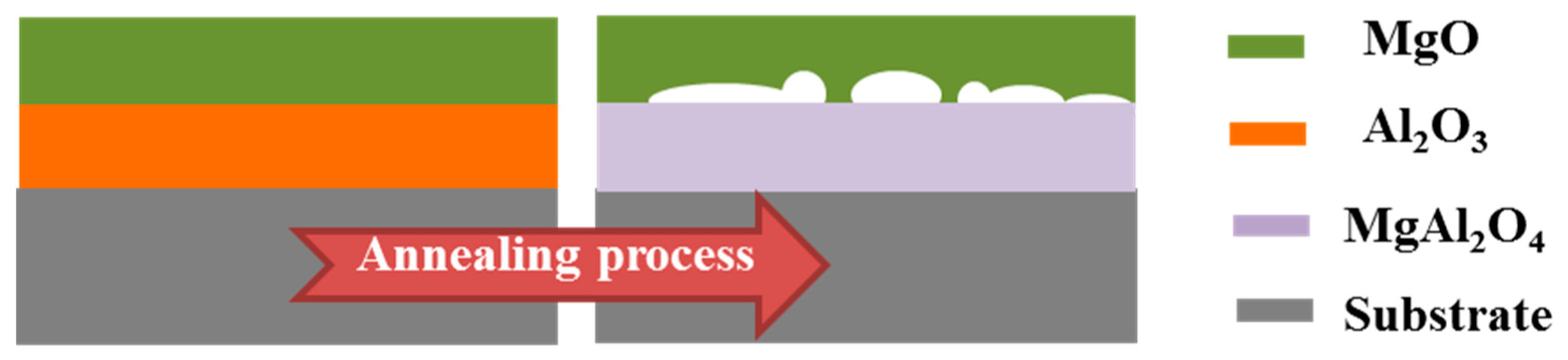
In this study, we found that the Kirkendall effect also occurs at the interface between Al2O3 and MgO. Mg atoms diffused into the Al2O3 layer and combined with the Al2O3 molecules to form the spine of the MgAl2O4 structures under specific annealing processes [9]. The effective refractive index of the MgO was decreased by the Kirkendall voids generated in the MgO layer. Figure 1 schematically shows the Kirkendall effect at the interface between MgO and Al2O3 [10]. The refractive index of MgO, with generated Kirkendall voids, was 1.55, while that of MgAl2O3 was 1.69. The differences in the indices between the layers were small. Owing to the inhomogeneity at the interface of MgO with void/MgAl2O4 and the small difference of the refractive indices of MgO with void and MgAl2O4 in comparison with that of MgO and Al2O3, it was possible to construct a notch filter based on Al2O3/MgO/Al2O3 multilayer deposition processes. The multilayer structure, (Al2O3/MgO)8 Al2O3, then behaved as a sinusoidal-like gradient layer (MgAl2O4/MgO with void/MgAl2O4)8 after post-annealing, and demonstrated its notch filter application potential [11,12].
Figure 1.
The synopsis illustrations of the Kirkendall effect at the interface of MgO and Al2O3.
2. Experimental
To form a spinel structure for the proposed design, we used Al2O3 and MgO. Al2O3/MgO/Al2O3 deposited on the quartz substrate using e-gun evaporation with ion-assisted deposition at 300 °C, gun power at 8 KV, and Ar flow rate at 13 sccm. The thicknesses of the layers measured by ellipsometry were 41, 38, and 40 nm respectively. A post-annealing process was implemented without additional gas injection, at 800 °C for 4 h at 1 atm. Inter-diffusions occurred during the post-annealing process through solid state diffusion. Therefore, the refractive indices of the layers changed by the Kirkendall effect. We also performed the deposition and post-annealing process of (Al2O3/MgO)8 Al2O3 multilayer as a reflection filter. The optical properties of the multilayer films were measured by a PerkinElmer Lambda 900 spectrometer (Waltham, MA, USA) prepared with an integrating sphere. The cross-sectional microstructures were inspected using a transmission electron microscopy (TEM) and scanning electron microscope (SEM). The composition depth profile of the three-layer structure was inspected by energy dispersive spectroscopy (EDS) line scan analysis and ellipsometry measurement [13]. After the annealing process, the effective refractive indices of the composite films were calculated using the Bruggeman effective medium approximation.
3. Results and Discussions
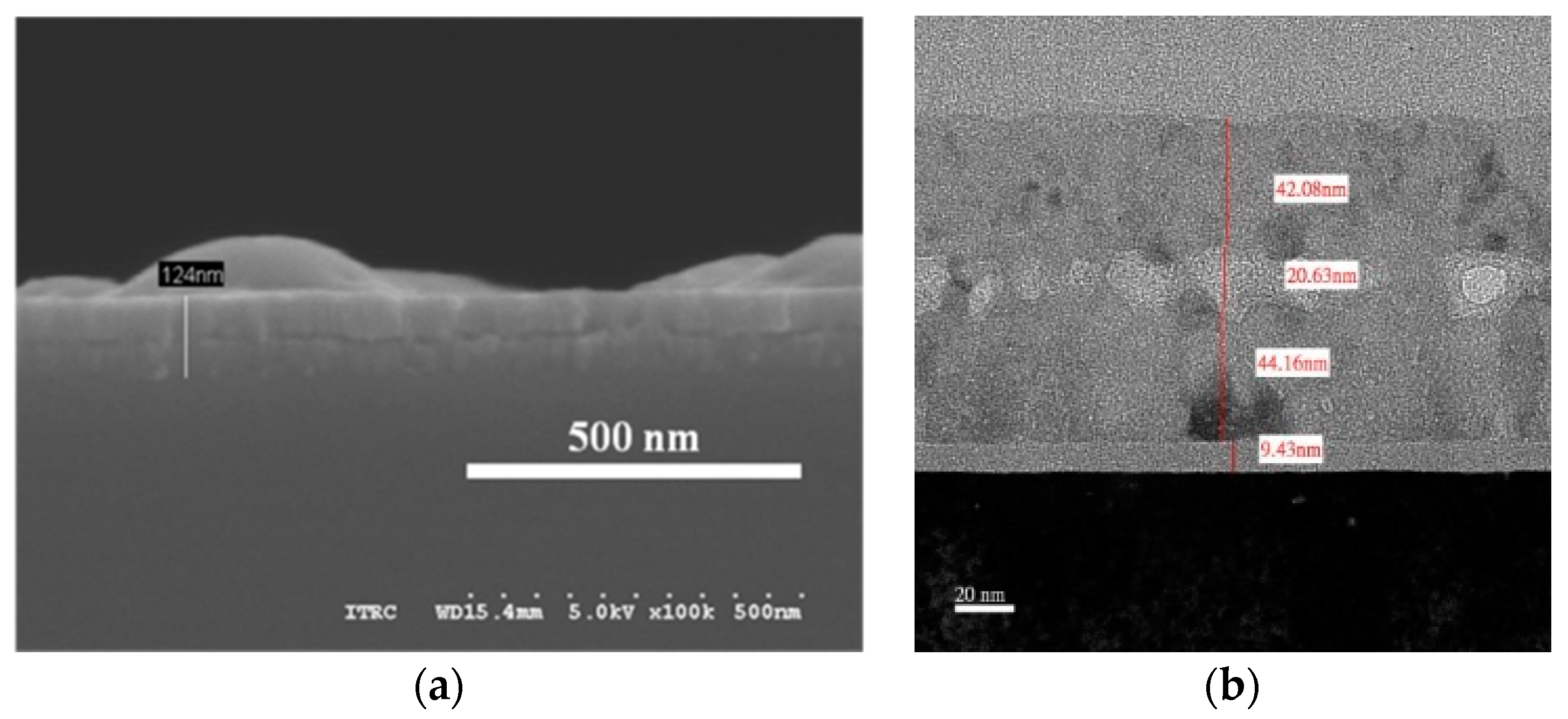
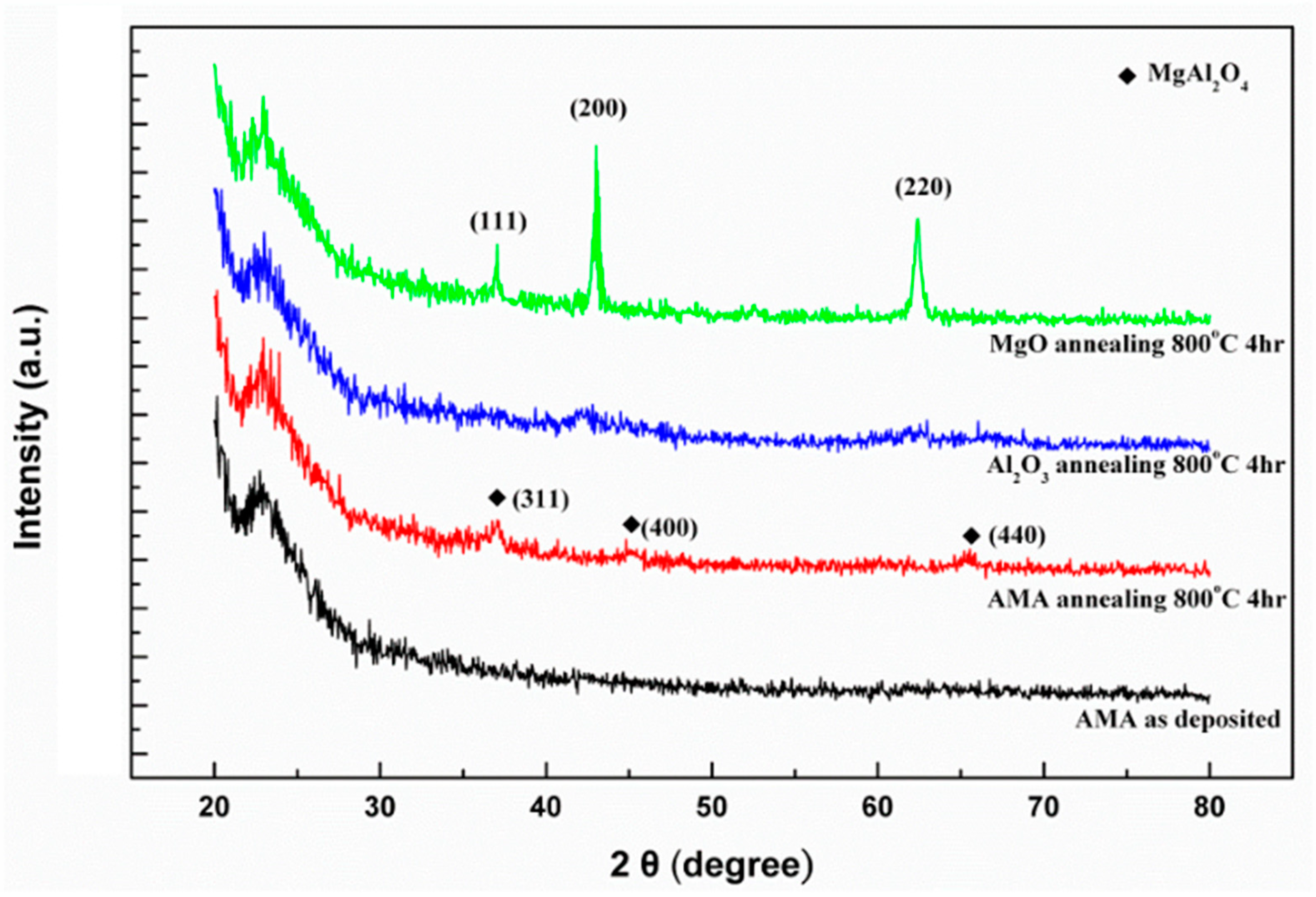
In Figure 2a, the cross-sectional SEM image of MgO/Al2O3 after annealing at 800 °C shows that, after the annealing process, the voids appeared at the interface of MgO/Al2O3. It is inferred that complete inter-diffusion reactions between the Al2O3 and MgO layers were achieved. The dimension of voids was about 10–20 nm, according to the TEM image in Figure 2b. After the annealing process, the total thickness of the multi-film structure did not change significantly. Figure 3 shows the XRD of Al2O3, MgO, and AMA thin films after a 4-h annealing process at 800 °C. The green line show the MgO single layer and the blue line shows the Al2O3 single layer after a 4-h annealing process at 800 °C. Compared with the red line and black line, the AMA thin-film as deposited (black line) shows non-crystalline MgAl2O4, and the AMA thin-film processes further show the crystalline structure of MgAl2O4, as labeled by the diamond mark.
Figure 2.
Cross-sectional images of Al2O3/MgO/Al2O3 thin films after a 4-h annealing process at 800 °C: (a) SEM; and (b) TEM.
Figure 3.
The XRD of Al2O3, MgO, and Al2O3/MgO/Al2O3 thin films after a 4-h annealing process at 800 °C.
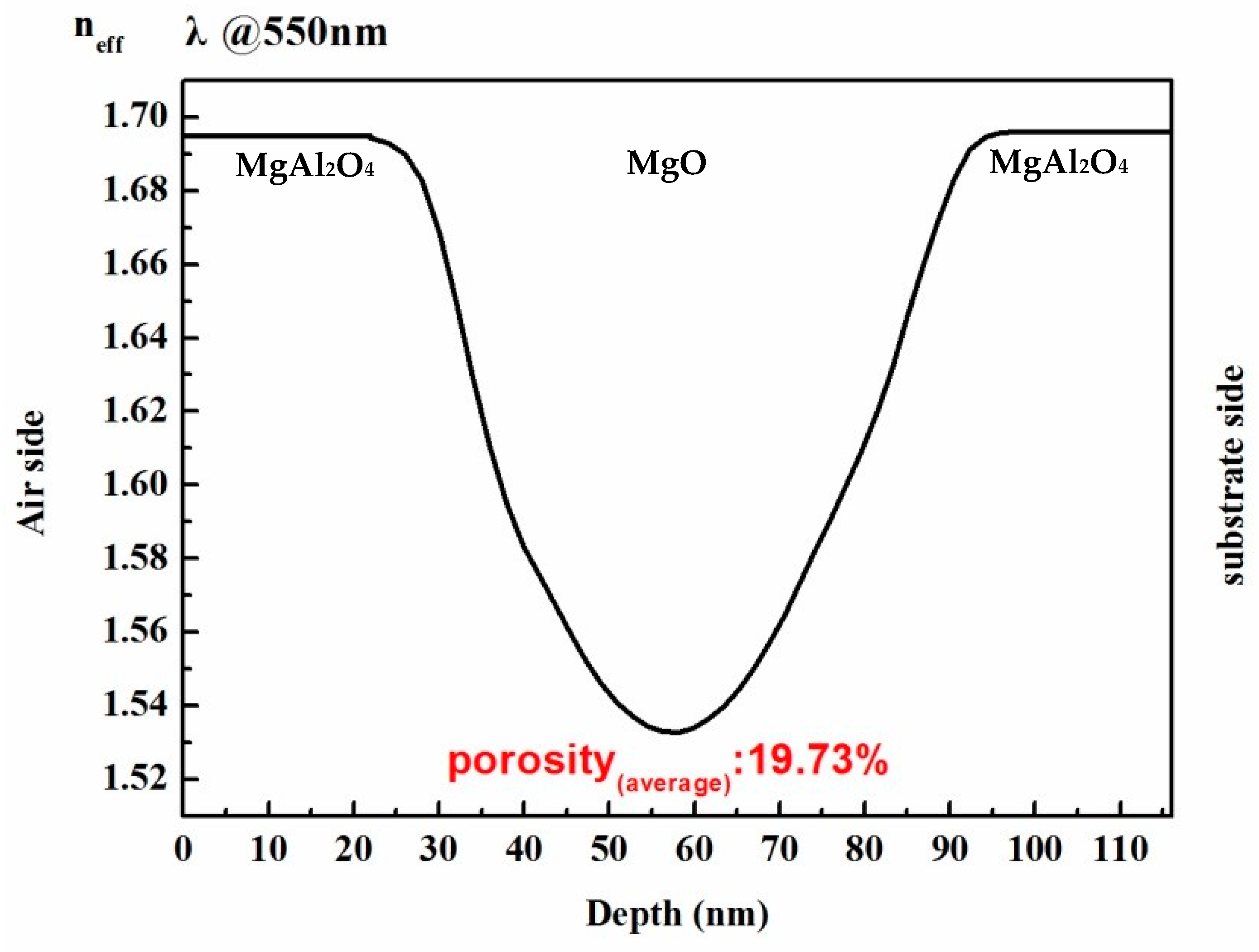
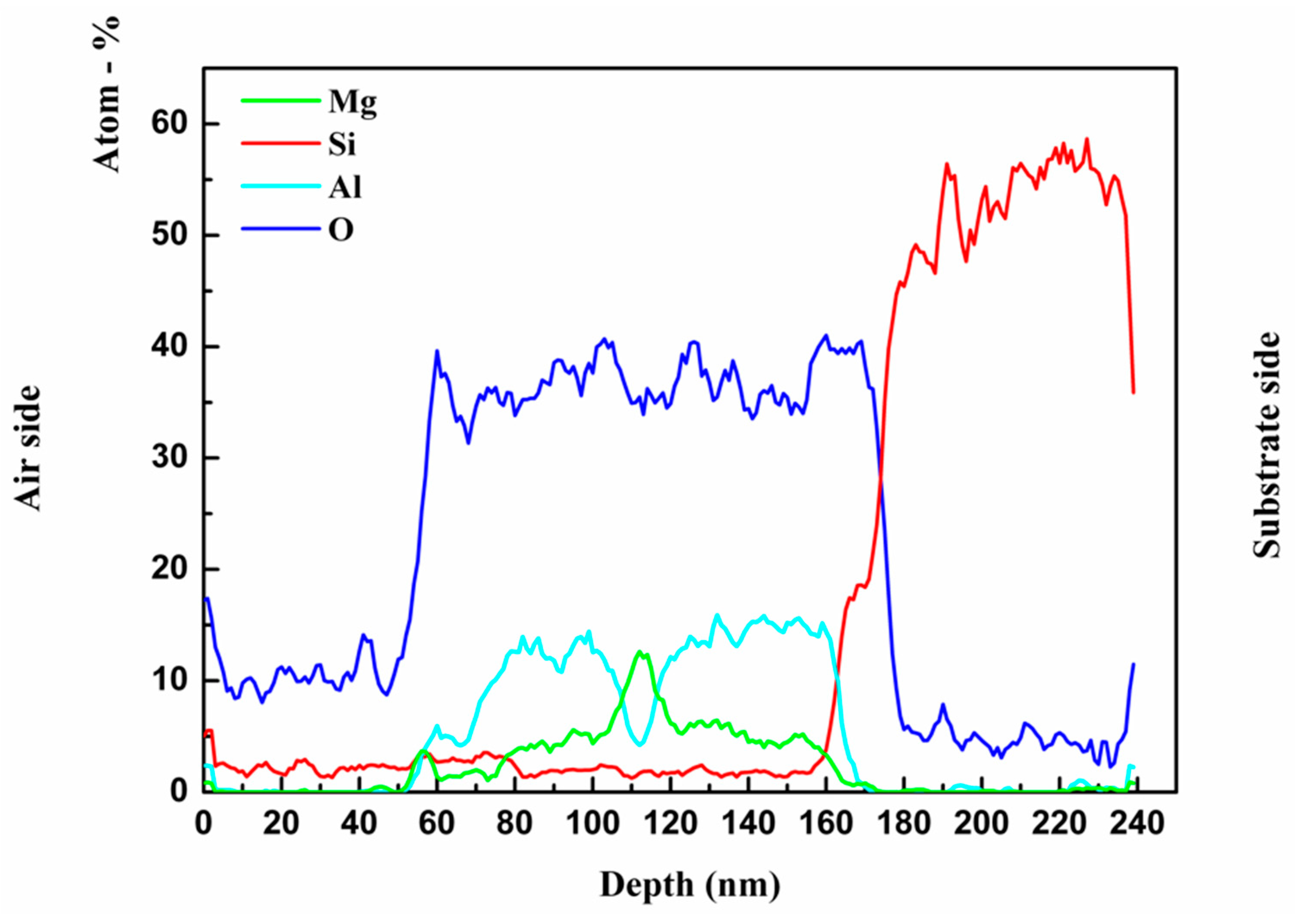
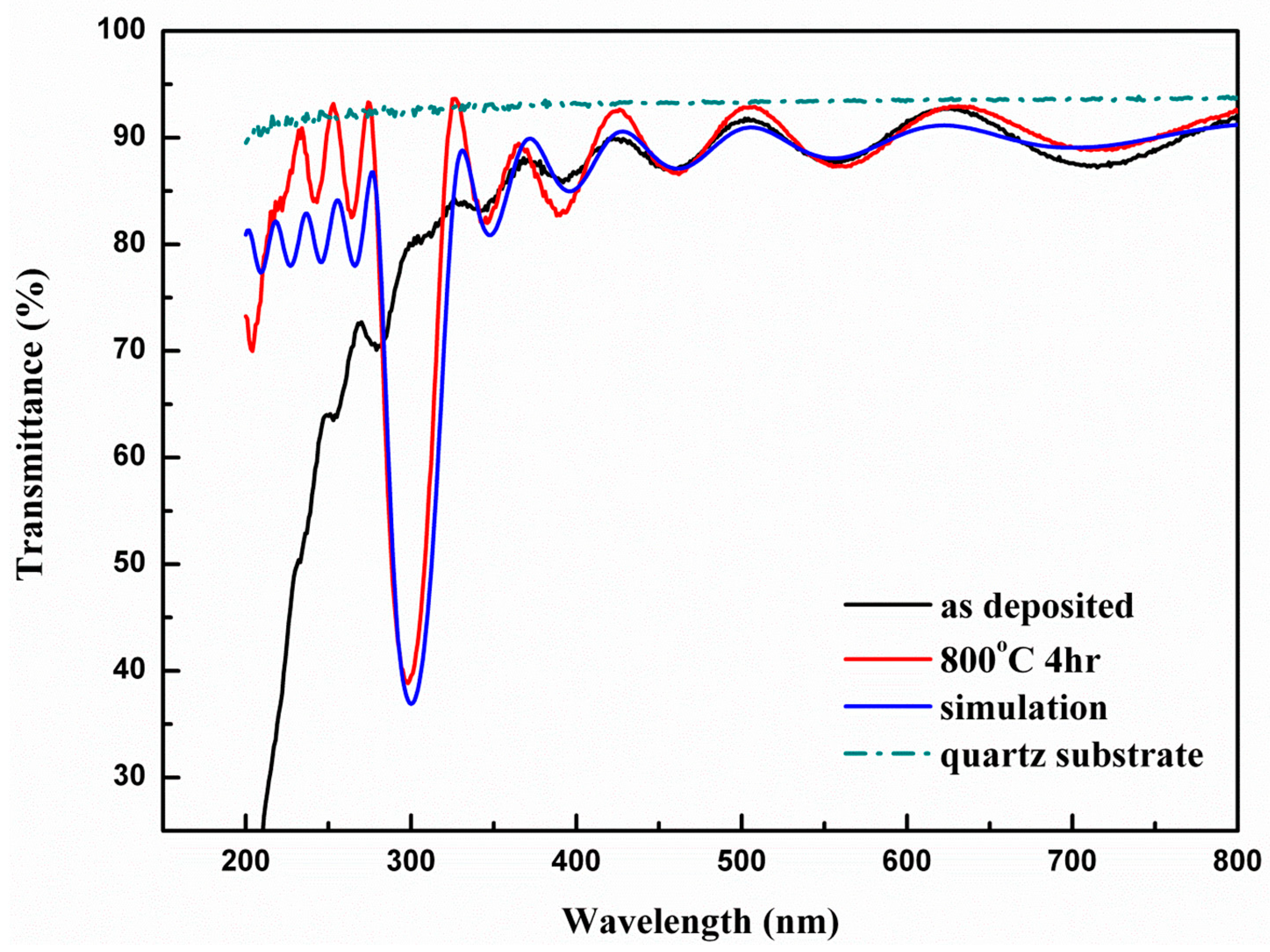
Figure 4 shows the inhomogeneous index profile of MgAl2O4/MgO with void/MgAl2O4 when AMA was annealed at 800 °C for 4 h, as simulated by the ellipsometry measurement. It started with MgAl2O4 moving onto the middle layer MgO with voids, and ended with MgAl2O4. The middle layer was set by MgO, and voids were set with a Gaussian distribution. The middle layer (MgO with voids) exhibited an average porosity of 19.73% by the ellipsometry measurement [14]. The composition depth profile analysis of MgAl2O4/MgO with voids/MgAl2O4 by TEM EDS line scan analysis was illustrated by the inter-diffusion mechanism between Al2O3 and MgO, as shown in Figure 5. The atomic ratio of Al and Mg were found to be constant in both the top and bottom layers. Additionally, we deposited the (Al2O3/MgO)8 Al2O3 multilayer stack and performed the post-annealing process at 800 °C for 4 h. After the post-annealing process, the multilayer stack changed from (Al2O3/MgO)8 Al2O3 to (MgAl2O4/MgO with voids/MgAl2O4)8. Figure 6 show the transmittance spectrum as deposited (black line) and after annealing (red line). There was no reflection band in the transmittance spectrum before the post-annealing process. The blue spectrum line in Figure 6 is the transmittance of (MgAl2O4/MgO with voids/MgAl2O4)8 simulated with a 0.14 refractive index difference between MgAl2O4 and MgO (with voids) at a wavelength of 300 nm. The transmittance spectrum of the multilayer stack after annealing (red line) was close to the simulated result (blue line). This shows that thin film fabrications of (Al2O3/MgO)8 Al2O3 multilayers can be applied as notch filters through solid state diffusion. Solid state diffusion can make the diffusion index difference more gradual in a multilayer structure, which is advantageous in fabricating rugate filters [15,16].
Figure 4.
The inhomogeneous index profile of MgAl2O4/MgO with void/MgAl2O4.
Figure 5.
TEM EDS line scan of MgAl2O4/MgO with voids/MgAl2O4.
Figure 6.
The transmittance spectra of thin films as deposited (black line), after annealing (red line), and according to simulation (blue line).
4. Conclusions
In this study, MgAl2O4 and porous MgO layer were successfully fabricated as an AMA structure. The average porosity of MgO with voids was 19.73%, and the refractive index difference between the high (MgAl2O4) and low (MgO with voids) index materials was increased to 0.14 by an 800 °C post-annealing process due to solid-state diffusion. This allowed simply using a structured multilayer, (Al2O3/MgO)8 Al2O3, and post-annealing to form a sinusoidal-like gradient layer for a UV notch filter. The possibility of solid-state diffusion in multilayer films was demonstrated and a notch filter with a (MgAl2O4/MgO with voids/MgAl2O4)8 multilayer structure was successfully fabricated.
Author Contributions
Conceptualization, H.-P.C. and C.-C.L.; Methodology, H.-P.C. and W.-H.C.; Validation, W.-H.C.; Formal Analysis, W.-C.C. and C.-T.L.; Investigation, W.-H.C.; Data Curation, W.-H.C.; Writing-Original Draft Preparation, H.-P.C. and W.-H.C.; Writing-Review & Editing, H.-P.C. and C.-C.L.
Funding
This research was funded by the Ministry of Science and Technology (Nos. MOST 106-2622-E-492 -017 -CC3 and MOST 107-2622-E-492 -020 -CC3).
Conflicts of Interest
The authors declare that they have no conflict of interest.
References
- Lee, C.C.; Hsu, J.C. Technique for Deposition Multiplayer Interference Thin films Using Silicon as the Only Coating Material. US Patent 6425978B1, 30 July 2002. [Google Scholar]
- Lee, C.C.; Tang, C.J.; Hsu, J.C.; Wu, J.Y. Rugate filter made with composite thin film by ion beam sputtering. Appl. Opt. 2006, 45, 1333–1337. [Google Scholar] [CrossRef] [PubMed]
- Lee, C.C.; Hsu J., C. Technique for Deposition of Multiplayer Interference Thin Film Using Only One Coating Material. ROC Patent Invention No. 137551, 23 June 2001. [Google Scholar]
- Hodgkinson, I.; Wu, Q.H.; Brett, M.; Robbie, K. Vacuum deposition of biaxial film with surface-aligned principal axes and large birefringence Δn. Opt. Soc. Am. Tech. Digest 1998, 9, 104–106. [Google Scholar]
- Cho, W.H.; Lee, C.C. Low-refractive-index oxide thin films originated from the Kirkendall effect. Appl. Opt. 2014, 53, A175–A178. [Google Scholar] [CrossRef] [PubMed]
- Xi, J.-Q.; Schubert, M.F.; Kim, J.K.; Schubert, E.F.; Chen, M.; Lin, S.-Y.; Liu, W.; Smart, J.A. Optical thin-film materials with low refractive index for broadband elimination of Fresnel reflection. Nat. Photonics 2007, 1, 176–179. [Google Scholar] [CrossRef]
- Chen, J.; Wang, B.; Yang, Y.; Shi, Y.; Xu, G.; Cui, P. Porous anodic alumina with low refractive index for broadband graded-index antireflection coatings. Appl. Opt. 2012, 51, 6839. [Google Scholar] [CrossRef] [PubMed]
- Van Dal, M.J.H.; Gusak, A.M.; Cserháti, C.; Kodentsov, A.A.; van Loo, F.J.J. Microstructural stability of the Kirkendall plane in solid state diffusion. Phys. Rev. Lett. 2001, 86, 3352. [Google Scholar] [CrossRef] [PubMed]
- Schubert, E.F.; Kim, J.K.; Xi, J.Q. Low-refractive-index materials: A new class of optical thin-film materials. Phys. Status Solidi (B) 2007, 244, 3002–3008. [Google Scholar] [CrossRef]
- Kuo, Y. Etch mechanism in the low refractive index silicon nitride plasma enhanced chemical vapor deposition process. Appl. Phys. Lett. 1993, 63, 144–146. [Google Scholar] [CrossRef]
- Carter, R.E. Mechanism of Solid-state Reaction Between Magnesium Oxide and Aluminum Oxide and Between Magnesium Oxide and Ferric Oxide. J. Am. Ceram. Soc. 1961, 44, 116–120. [Google Scholar] [CrossRef]
- Rao, C.N.R.; Gopalakrishnan, J. New Directions in Solid State Chemistry; Cambridge University Press: Cambridge, UK, 1997; pp. 488–490. [Google Scholar]
- Wicht, G.; Ferrini, R.; Schüttel, S.; Zuppiroli, L. Nanoporous Films with Low Refractive Index for Large-Surface Broad-Band Anti-Reflection Coatings. Macromol. Mater. Eng. 2010, 295, 628–636. [Google Scholar] [CrossRef]
- Redel, E.; Mirtchev, P.; Huai, C.; Petrov, S.; Ozin, G.A. Nanoparticle Films and Photonic Crystal Multilayers from Colloidally Stable, Size-Controllable Zinc and Iron Oxide Nanoparticles. ACS Nano 2011, 5, 2861–2869. [Google Scholar] [CrossRef] [PubMed]
- Garcia-Garcia, F.J.; Gil-Rostra, J.; Terriza, A.; González, J.C.; Cotrino, J.; Frutos, F.; Ferrer, F.J.; González-Elipe, A.R.; Yubero, F. Low refractive index SiOF thin films prepared by reactive magnetron sputtering. Thin Solid Films 2013, 542, 332–337. [Google Scholar] [CrossRef]
- Streubel, K.; Rapp, S.; André, J.; Chitica, N. 1.26 mu m vertical cavity laser with two InP/air-gap reflectors. Electron. Lett. 1996, 32, 1369. [Google Scholar] [CrossRef]
© 2019 by the authors. Licensee MDPI, Basel, Switzerland. This article is an open access article distributed under the terms and conditions of the Creative Commons Attribution (CC BY) license (http://creativecommons.org/licenses/by/4.0/).