


Abstract
With the acceleration of urbanization, municipal landscape roads play a crucial role in urban public spaces. This study focuses on the distress detection and aging characteristics of asphalt pavements in municipal landscape roads. Firstly, a novel method is proposed based on the SpA-Former shadow removal network, which effectively addresses the interference caused by tree shadows and significantly improves the accuracy of automated distress identification. Distress detection results indicate that transverse cracks are the most common type of distress, primarily influenced by environmental factors such as asphalt material aging, temperature fluctuations, and freeze-thaw cycles—these factors induce asphalt embrittlement and a substantial decline in crack resistance. Subsequently, accelerated aging experiments were conducted to simulate the aging process of asphalt materials. It was found that as aging time extends, asphalt stiffness increases significantly; while this enhances deformation resistance, it also makes the material more prone to cracking under low-temperature conditions. Low-temperature crack resistance tests reveal that asphalt aged for more than six years exhibits a sharp deterioration in low-temperature crack resistance, showing distinct brittle characteristics. Furthermore, freeze-thaw cycle experiments demonstrate that the coupling effect of asphalt aging and freeze-thaw action significantly impairs its freeze-thaw resistance—particularly for asphalt aged over six years, which nearly loses its freeze-thaw resistance. In summary, the coupling effect of asphalt aging and environmental factors is the primary cause of pavement damage in municipal landscape roads. This study divides 2542 images into three mutually exclusive subsets: a training set of 2123 images, a validation set of 209 images, and a test set of 210 images. The research provides new theoretical references and technical support for the maintenance and management of landscape roads, especially demonstrating practical significance in distress detection and the analysis of material aging mechanisms.
1. Introduction
With the deepening of urbanization, municipal landscape roads, as an important component of urban public spaces, have seen their functional orientation shift from traditional traffic bearing to a focus dominated by ecology, aesthetics, and recreation [1]. Fundamentally different from conventional vehicular roads, landscape roads primarily serve pedestrians and slow-moving traffic, and are almost free from the repeated action of vehicle loads. This distinct characteristic leads to an essential difference in failure modes and causative mechanisms compared to conventional roads: the occurrence and development of distresses in landscape roads are primarily governed by the coupling effects of material aging and complex environmental factors, rather than traditional fatigue damage [2].
However, this very ecological and aesthetic positioning paradoxically presents severe challenges to their long-term durability. The dense trees lining the roads, while creating a pleasant environment, also produce extensive dynamic and dappled shadows that severely interfere with the automated detection of surface distresses based on machine vision [3]. The uneven illumination, reduced contrast, and feature occlusion caused by shadows lead to a sharp decline in the accuracy of traditional image processing algorithms and general deep learning models, resulting in numerous missed detections and false positives [4]. Research indicates that variations in lighting conditions, particularly the presence of shadowed areas, significantly impact color fidelity and feature discernibility in images, thereby reducing the reliability of distress recognition systems [5]. For instance, Tedeschi et al. developed a real-time automatic crack and pothole recognition system for Android devices utilizing the OpenCV library for image processing, yet it did not adequately account for the disruptive effects of shadows [6]. This issue forces maintenance management to still rely on inefficient and subjective manual inspections, becoming a bottleneck for achieving intelligent maintenance.
Regarding shadow processing, although numerous image enhancement and specialized shadow removal algorithms (such as ST-CGAN and DC-ShadowNet) exist, they are primarily designed for natural scenes or satellite imagery. These methods often lack sufficient specificity for the distinctive low-illumination textures created by leaf gaps in landscape roads. Furthermore, their multi-stage workflows are prone to error accumulation, making it challenging to meet the accuracy and efficiency requirements for engineering-grade applications [7]. Duan et al. proposed a shadow-aware image colorization method that pays particular attention to the accuracy of shadow areas, which is significant for identifying pavement distress under complex lighting conditions [5]. Therefore, developing an end-to-end shadow removal method capable of effectively handling complex tree shadow interference has become a crucial prerequisite for enhancing the accuracy of distress identification in landscape roads.
In recent years, deep learning technologies have achieved remarkable progress in pavement distress identification. Lv et al. designed a pavement distress recognition model based on Mask R-CNN, which achieved a test accuracy of 99% on different datasets [8]. Sheng et al. proposed an improved model named SMG-YOLOv8 based on the YOLOv8s framework; this model demonstrated excellent performance in recognizing multiple types of pavement distress, particularly under varying lighting conditions [9]. Generative Adversarial Networks (GANs) have also been applied to pavement distress recognition. Liu et al. introduced a GAN-based data augmentation algorithm incorporating a self-attention mechanism, which effectively mitigates the blurring artifacts that can occur during the training of traditional DCGANs [4]. Boateng et al. developed the PaveGAN method, which achieves real-time pavement distress recognition and pixel-level annotation, with a recognition accuracy of 84% under different illumination conditions [10]. Furthermore, Light Detection and Ranging (LiDAR) technology offers a novel solution for distress identification. Khan et al. utilized LiDAR data to generate Digital Elevation Models (DEMs) and hill-shade maps for identifying and assessing pavement distresses [11].
While computer vision technologies have made significant strides in pavement inspection, their application in municipal landscape roads faces unique challenges due to the specific environmental conditions. More critically, in the absence of vehicular fatigue factors, material aging and environmental erosion emerge as the dominant mechanisms leading to performance deterioration [12]. These landscape roads are consistently exposed to a particular microenvironment characterized by abundant moisture and significant fluctuations in temperature and humidity. Persistent factors such as freeze-thaw cycles, moisture variations from root systems, and ultraviolet radiation constitute the primary threats to their long-term durability [13]. Research by Goli et al. indicated that moisture intrusion significantly accelerates the fatigue and cracking behavior of Warm Mix Asphalt (WMA) containing Reclaimed Asphalt Pavement (RAP) [14]. Furthermore, Jiang et al., utilizing digital image processing techniques, analyzed the cracking behavior of asphalt concrete pavements under different temperature conditions, revealing the considerable impact of temperature fluctuations on pavement performance [15].
Preliminary investigations indicate that transverse cracks represent the most prevalent and typical distress form in such roads. While it is generally speculated that their causes are related to thermal stress and reflection from the base layer, systematic experimental evidence remains scarce [16]. Krami et al. employed electrical resistivity tomography to study the environmental factors influencing asphalt pavement cracking on different road sections in Morocco, finding that the winter season significantly affects soil resistivity and asphalt pavement cracking [17]. Particularly, the intrinsic mechanisms through which the aging behavior of asphalt binder over prolonged service leads to a transition from flexibility to brittleness, and how this aging synergistically interacts with environmental factors in this specific context to ultimately accelerate cracking and failure, remains a significant gap in current research [18].
Zhang et al. investigated the impact of climate change on fatigue cracking in road asphalt pavements, revealing that temperature fluctuations and the migration of freeze-thaw zones significantly influence fatigue cracking [19]. Furthermore, Rys et al., through field investigations, analyzed factors affecting low-temperature cracking of pavements and found that asphalt aging and environmental factors such as temperature variations have a pronounced effect [2]. In a review of low-temperature cracking and its mitigation methods for asphalt pavements in cold regions, Ma et al. also highlighted the significant impact of asphalt aging and environmental factors like temperature changes [20]. While these studies provide crucial references for further elucidating the distress mechanisms in landscape roads, there remains a lack of in-depth, systematic analysis dedicated to the pure aging-environment coupling mechanism under traffic-free conditions.
Therefore, this study aims to conduct a systematic investigation of municipal landscape roads as non-load-bearing facilities, progressing from a “breakthrough in intelligent surface detection technology” to an “in-depth analysis of the intrinsic aging-environment coupling mechanism.” First, an end-to-end shadow removal network, capable of efficiently handling complex tree-shadow scenarios, will be developed to overcome the primary obstacle for accurate distress identification. Subsequently, based on high-precision detection results, the types and spatial distribution characteristics of distresses will be statistically analyzed to identify the predominant failure modes. Finally, by simulating various aging states of the material and systematically testing its performance evolution patterns under simulated service environments (e.g., freeze-thaw cycles, moisture-thermal conditions), this research seeks to fundamentally elucidate the initiation and progression mechanisms of characteristic distresses dominated by environmental aging. The findings are expected to provide a theoretical foundation and technical support for the scientific design, precise maintenance, and long-term management of these pavements. The research is helpful for clarifying the causes of cracking in non-load-bearing pavements and guiding efforts to extend pavement service life, which can conserve construction resources and reduce carbon emissions.
2. Research Methods
2.1. Pavement Distress Data Collection and Preprocessing
This study employed an automated detection vehicle equipped with a standardized mobile measurement system for pavement image collection on municipal landscape roads. All pavement image data were collected from a landscape road in Weifang, Shandong Province, China. This region has a mean annual temperature of approximately 12.5 °C and an average annual precipitation of 600–800 mm, characteristic of a temperate monsoon climate. The road is located in a plain area, and data collection was conducted during autumn. Autumn is marked by significant diurnal temperature variations and a high incidence of cracking. Further analysis of pavement distress characteristics in other seasons is required in future studies. A global shutter industrial camera (e.g., Daheng Imaging MER2-1220-32U3M, Beijing, China) was mounted inside the windshield at a height of approximately 1.5 m above ground, with a lens depression angle of about 15 degrees, ensuring a stable and clear field of view covering the road surface 5–7 m ahead. Data acquisition was conducted over a total distance of approximately 10 km, spanning multiple independent road segments to ensure diversity. To minimize interference from traffic and achieve consistent lighting conditions, collection was scheduled on weekdays during spring and early summer, specifically between 9:00–11:00 a.m. and 2:00–4:00 p.m., resulting in 2542 valid distress images with a resolution of 1920 × 1080 pixels.
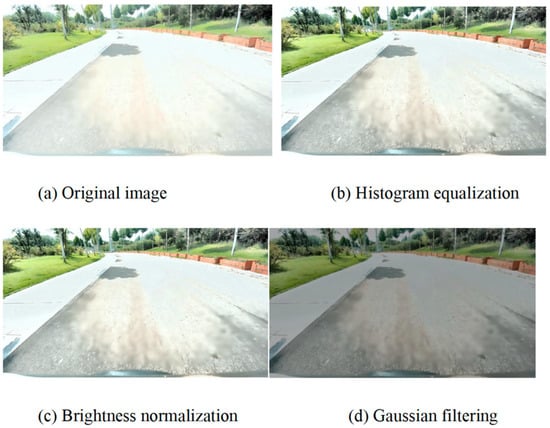
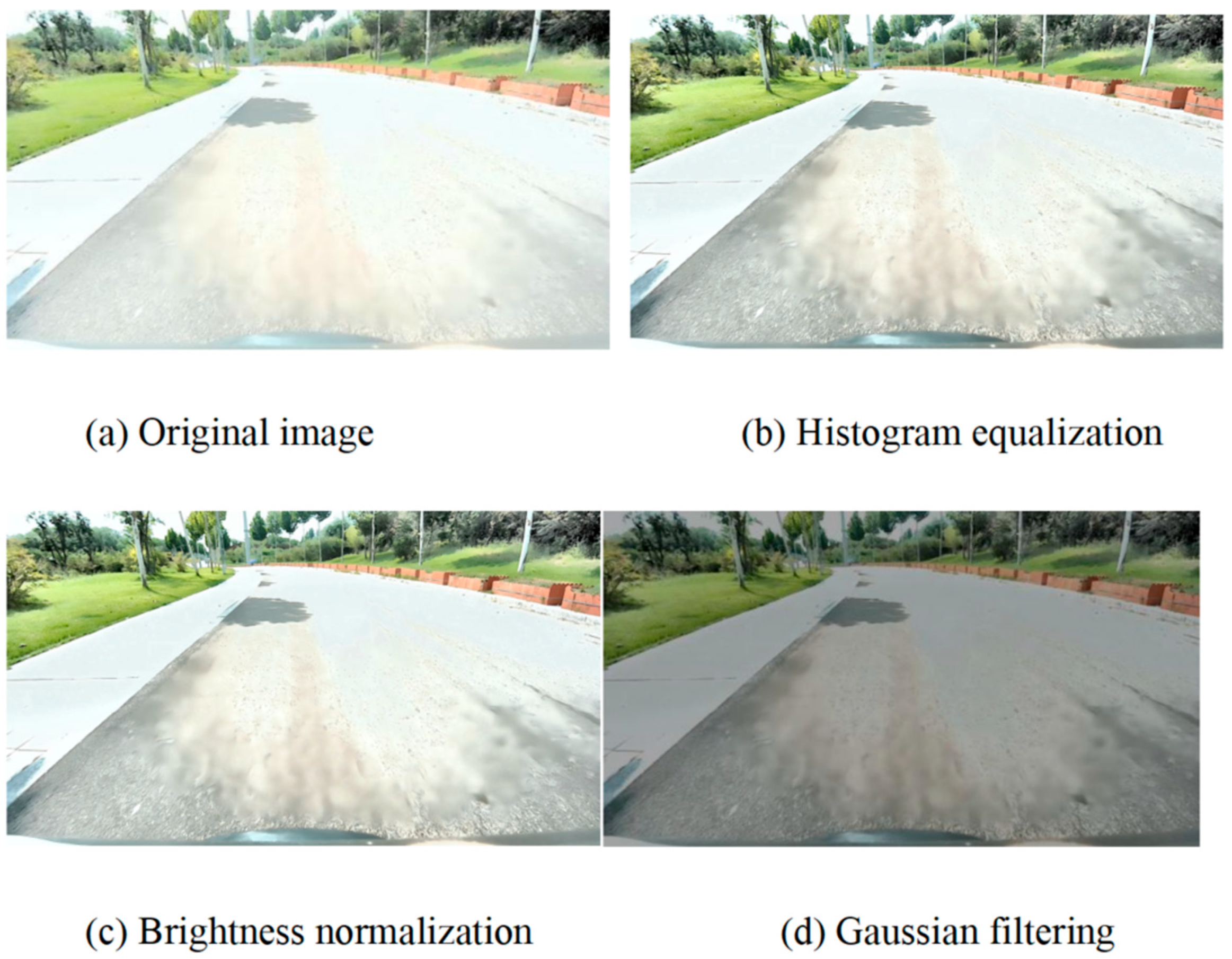
To address challenges inherent to landscape roads, such as uneven illumination, shadows, and complex textures, the original images underwent a standardized preprocessing pipeline. This included histogram equalization, brightness normalization, and noise filtering to enhance overall image quality and feature consistency, as illustrated in Figure 1.
Figure 1.
The standardized preprocessing pipeline.
A detailed annotation protocol was established, defining four major distress types: longitudinal cracks, transverse cracks, alligator cracks, and potholes. Three trained annotators then independently performed pixel-level mask annotation using the Labelme tool. To ensure label quality and consistency, 10% of the images (254 images) were co-annotated by all annotators. The inter-annotator agreement, measured by the mean Intersection over Union (mIoU), exceeded 0.85, demonstrating high annotation reliability. All annotations were subsequently reviewed and refined by an expert.
To ensure a statistically robust evaluation of model performance, this study adopted a stratified data partitioning strategy instead of a simple random split. The entire dataset of 2542 images was divided into three mutually exclusive subsets: a training set containing 2123 images for model optimization, a validation set of 209 images for hyperparameter tuning, and a final test set of 210 images for unbiased performance evaluation. This rigorous partitioning maximizes data utility while guaranteeing the fairness of the evaluation and the reliability of the conclusions.
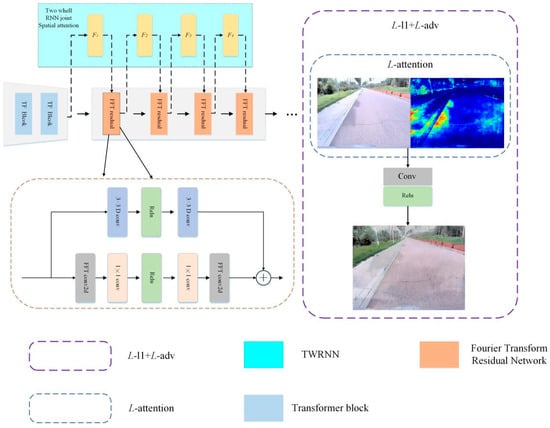
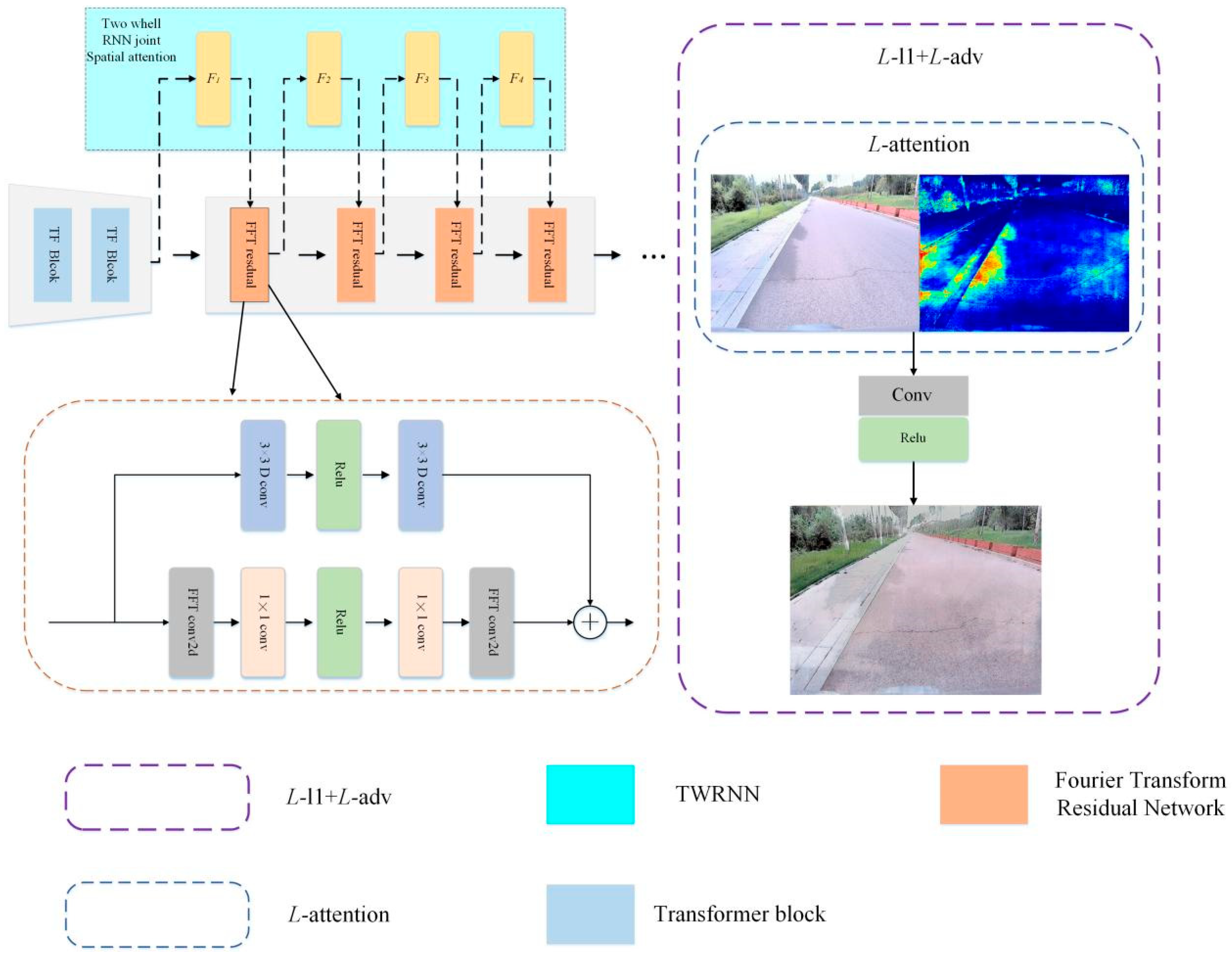
To tackle the problem of tree shadow interference, the SpA-Former end-to-end shadow detection and removal network was employed to process all 2542 valid images. This network integrates shadow detection and removal into a single stage, eliminating the need for separate detection steps or post-processing adjustments [21]. The specific workflow is illustrated in Figure 2 and detailed as follows:
Figure 2.
Flowchart of tree shadow interference removal via SpA-Former.
Image Patching and Encoding: The original 1920 × 1080-pixel images were resized to 640 × 480 pixels (with the original scale restored during the inference stage) and segmented into 160 × 120 non-overlapping patches using a 4 × 4 convolution operation with a stride of 4. Each patch was then transformed into a 768-dimensional token via linear projection. Learnable absolute positional encodings were incorporated into these tokens to inject spatial information. Concurrently, at the patch level, internal multi-layer transformations were applied to adaptively correct low-order illumination variations caused by tree shadows, thereby mitigating the interference of redundant low-frequency information on subsequent feature computation.
Global Feature Extraction via Transformer Encoder: The Transformer encoder layer in SpA-Former plays a critical role in capturing long-range dependencies within the image by leveraging the self-attention mechanism to model global information. By dividing the image into patches and converting them into a sequence, the encoder computes relationships between different image regions, effectively integrating contextual information. This global modeling capability is essential for understanding the complex relationships between shadowed areas and normally lit surrounding regions, aiding the network in maintaining overall image consistency and semantic coherence during the shadow removal process. SpA-Former employs an 8-layer Transformer encoder to progressively refine the token sequence. Each layer first applies layer normalization, followed by 16-head self-attention that computes global contextual relationships. Through the scaled dot-product attention mechanism, each token interacts with all other tokens in the sequence, efficiently establishing a global receptive field and capturing complex correspondences between shadowed regions and normally illuminated areas across the entire image. The feed-forward network (FFN) uses a GELU activation function, initially expanding the dimension from 768 to 3072 before projecting it back to 768. Residual connections are incorporated to stabilize the training process, ensuring effective propagation of global illumination and semantic information. This process establishes a “whole-image” level prior without requiring downsampling, enabling the network to consistently perceive the correspondence between shadowed regions and distant normally lit areas.
Multi-Domain Fusion with Joint Fourier Transform Residual Block: The 160 × 120 × 768 feature maps output by the encoder are processed in parallel along three distinct pathways: ① Spatial Domain Path: A spatial 3 × 3 depthwise separable convolution extracts local features such as pavement crack edges. ② Frequency Domain Path: The features are transformed into the frequency domain via a Fast Fourier Transform (FFT). A learnable, point-wise multiplication is applied to the low-frequency components to correct global color casts caused by shadows. ③ Frequency Refinement Path: The frequency representation is decomposed into magnitude and phase components. Each is modulated using 1 × 1 convolutions before being transformed back to the spatial domain via an Inverse FFT (IFFT), thereby enhancing high-frequency information related to pavement textures, such as potholes. The outputs from these three paths are fused using learnable weights. The combined features are subsequently recalibrated by a Squeeze-and-Excitation (SE) channel attention mechanism to emphasize the most informative channels. This design achieves multi-scale coupling between the spatial and frequency domains, enabling precise shadow removal while completely preserving critical distress details.
Dual-Round Joint Spatial Attention Optimization and Decoder Output: In the first round, max-average pooling is applied along the channel axis, followed by a 7 × 7 grouped convolution to generate an initial shadow confidence map. In the second round, the feature map is divided into 8 × 8 windows, and the inter-pixel covariance matrix within each window is computed. A lightweight Transformer block is then employed to perform non-local similarity matching between shadow edges and adjacent normally lit regions. The attention maps from both rounds are multiplied element-wise to produce a fine-grained shadow mask. This mask is used to perform channel-wise multiplication and addition with the original features, thereby amplifying illumination discrepancy features in shadowed areas. Finally, a 4-stage residual decoder with upsampling restores the spatial resolution to 256 × 256. A 1 × 1 convolutional layer at the network output predicts a residual image containing the required illumination and color corrections. This residual is added pixel-wise to the original input image to generate the final shadow-free image. The entire network is trained under a joint loss function combining L1 loss, VGG perceptual loss, and FFT consistency loss. During inference, only a single forward pass is required for processing. The proposed method achieves a shadow removal rate of over 98% on processed images, with a 40%–60% improvement in grayscale contrast within distress regions.
Model Implementation and Training Details: Since obtaining pixel-aligned pairs of shadowed and shadow-free images in real-world scenarios is challenging, we constructed a synthetic dataset for training by selecting 200 high-quality, shadow-free pavement images from the collected dataset to serve as ground truth. To simulate realistic tree shadows, irregular shadow masks were generated using Perlin noise to mimic the complexity of leaf gaps and branch structures, which were then superimposed onto the clean images using a linear illumination decay model to create paired input data. The model was implemented in PyTorch(version 2.0.1) and trained on a workstation equipped with a single NVIDIA RTX 4060 GPU, utilizing the AdamW optimizer with a batch size of 4 and an initial learning rate of 1 × 10⁻⁴ for 100 epochs, with loss weight coefficients set to
,
, and
. To quantitatively evaluate the performance, we defined the “shadow removal rate” () based on the reduction of the Root Mean Square Error (RMSE) between the shadow regions of the output and the ground truth, calculated as
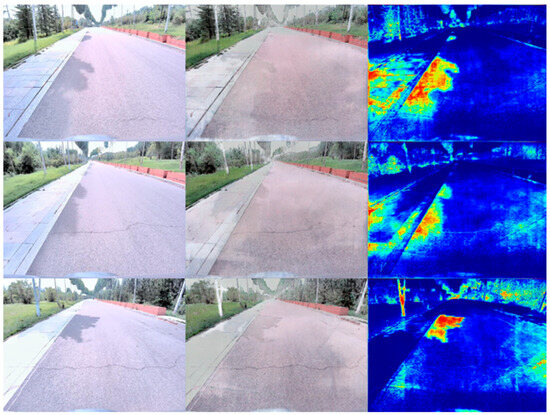
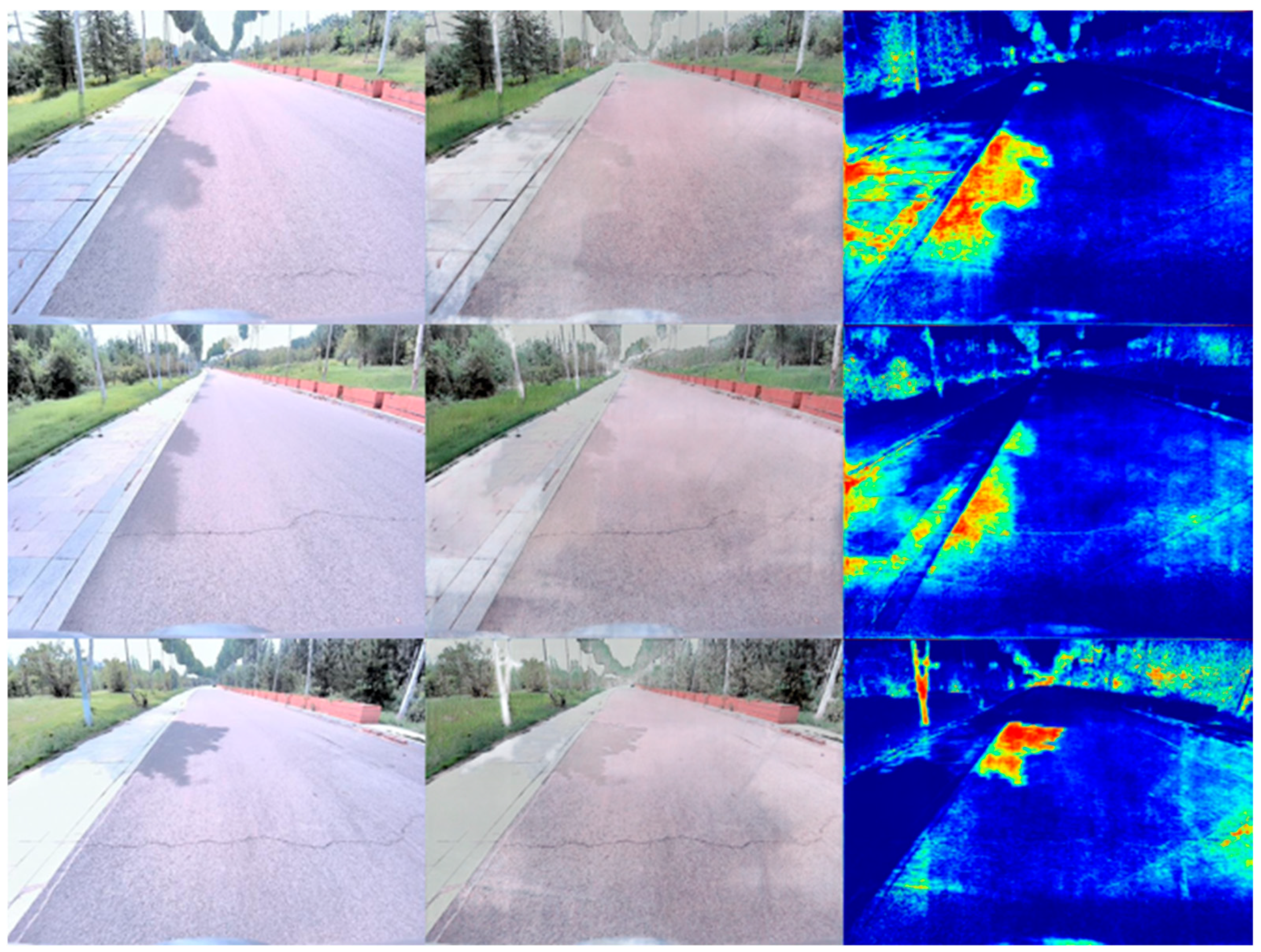
, achieving an average rate of over 98%. Furthermore, to address the concern of false positive removal (i.e., erroneously erasing real distress features), we computed the Structural Similarity Index (SSIM) specifically within the distress regions; the resulting high SSIM score (>0.92) confirms that the topological structure and texture details of the pavement cracks are effectively preserved while only the illumination inconsistency is removed, as visually demonstrated in Figure 3.
Figure 3.
Shadow removal results using the proposed SpA-Former network.
2.2. Pavement Distress Identification Methods
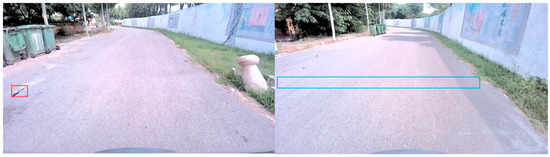
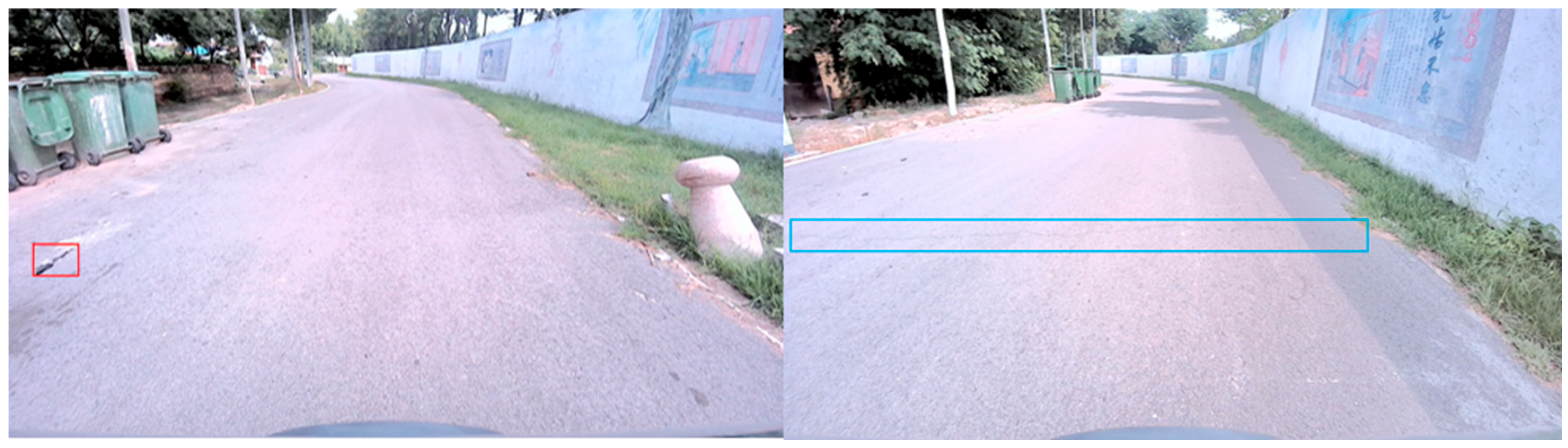
A dataset for asphalt pavement distress identification was constructed from 2542 original images. To ensure rigorous evaluation, these images were stratified into a training set (2123 images), a validation set (209 images), and a test set (210 images). All images were annotated using the Labelme tool, focusing on crack types and potholes. To ensure the reliability of the ground truth, 10% of the data was cross-annotated, achieving a mean Intersection over Union (mIoU) of over 0.85 among annotators. Sample annotations of the targeted distress characteristics are illustrated in Figure 4.
Figure 4.
Illustrates sample annotations of the targeted distress characteristics.
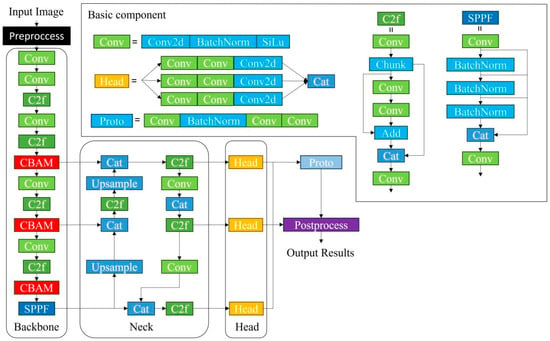
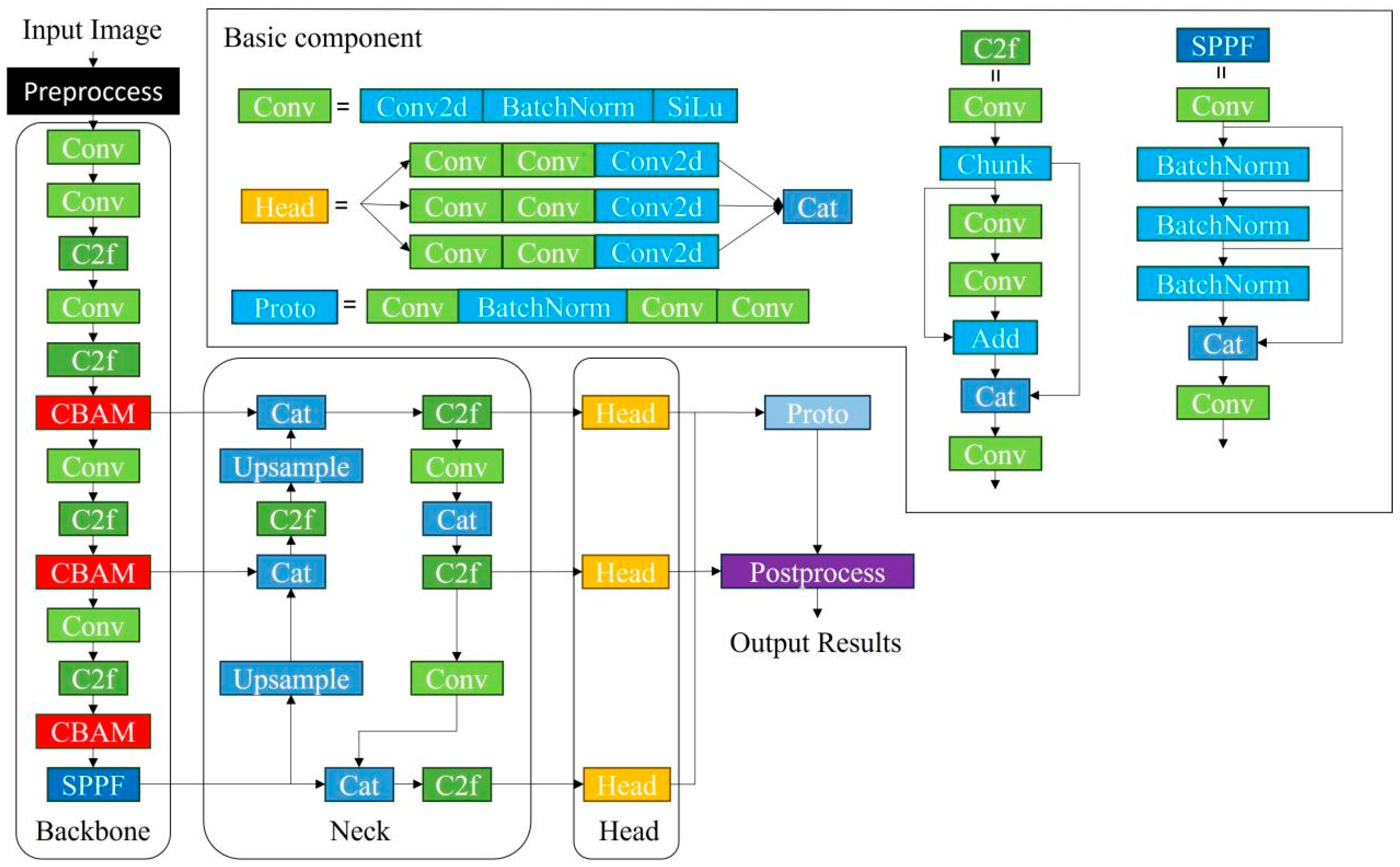
YOLOv8-seg is an instance segmentation model developed based on the YOLOv8 framework. According to the depth and width of the model, it can be divided into five scale variants: n, s, m, l, and x. The number of parameters in these five scales increases sequentially. Users can select the optimal model according to specific application scenarios. The YOLOv8-seg algorithm consists of five components: input preprocessing, backbone network, feature fusion network (neck), prediction head, and postprocessing [22]. The original image is first preprocessed to obtain the model input image. The role of the backbone network is to extract features at different scales from the input image. The feature fusion network then integrates the multi-scale features extracted by the backbone to produce three final feature maps used for prediction. Subsequently, the prediction head utilizes these three sets of multi-scale features from the fusion network to generate prediction results at their respective scales. Finally, during postprocessing, the results from multiple scales are restored to the original image dimensions, and redundant predictions are eliminated using the Non-Maximum Suppression (NMS) algorithm.
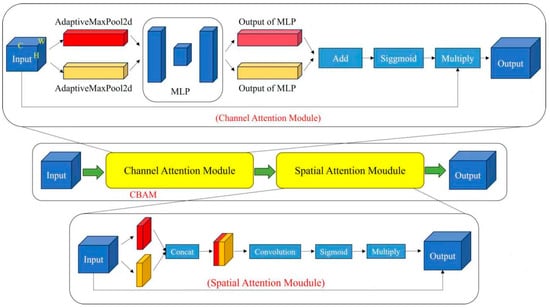
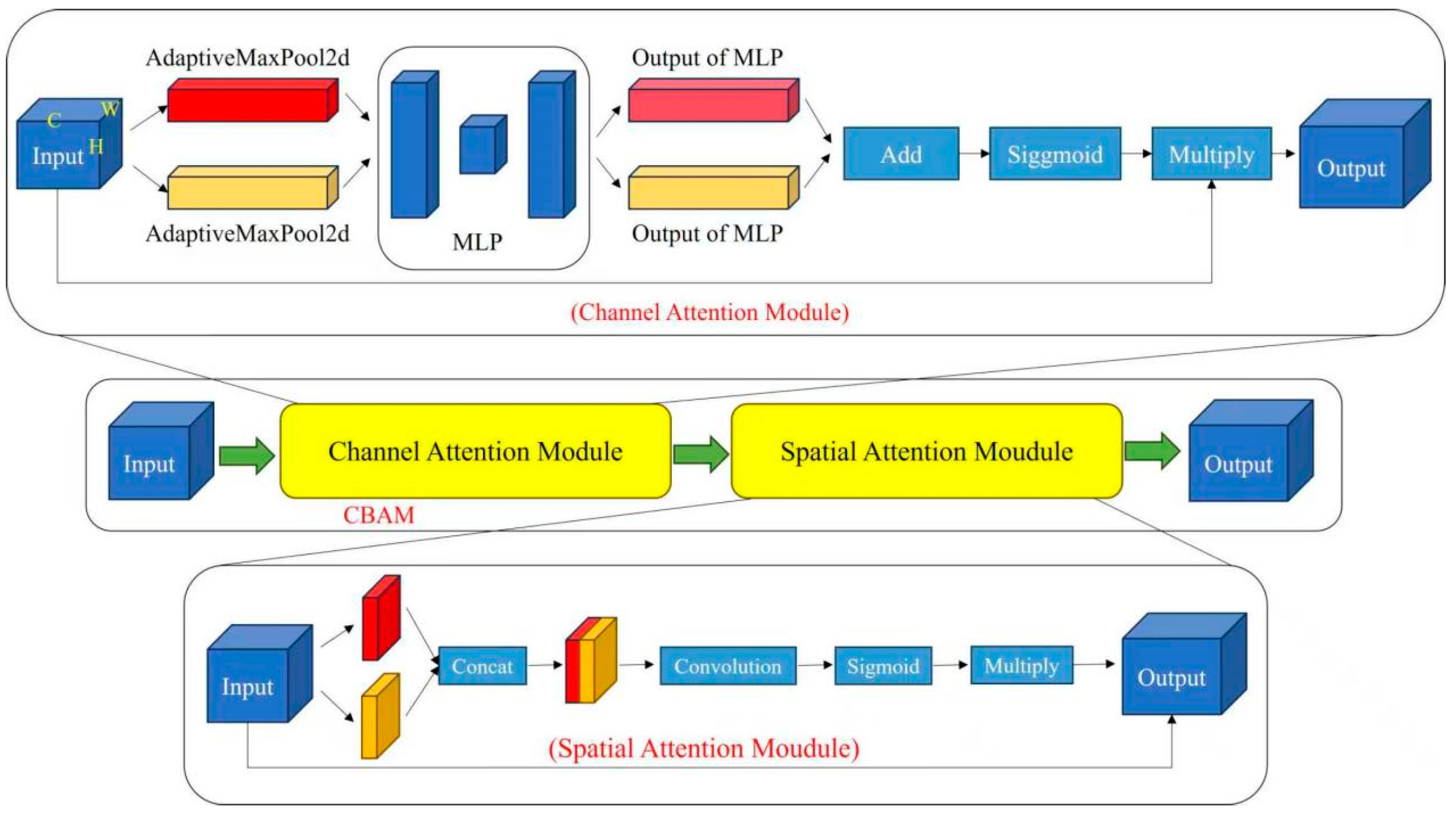
The attention mechanism is a widely used method for enhancing the performance of convolutional neural networks (CNNs). Conventional models often process a substantial amount of redundant information during feature extraction, which reduces feature effectiveness and creates performance bottlenecks. Introducing an attention mechanism at appropriate locations within the model enables it to focus on more critical information for recognition from the vast feature information, thereby improving the effectiveness of feature extraction and overcoming these performance limitations. In recent years, the Convolutional Block Attention Module (CBAM) has been extensively adopted by researchers due to its high efficiency. The core of CBAM consists of two sequential sub-modules: channel attention and spatial attention. The input features pass through these modules successively, which recalibrate the feature map by emphasizing informative features along the channel and spatial dimensions, respectively [23]. A schematic diagram of the CBAM structure is shown in Figure 5.
Figure 5.
Schematic diagram of the Convolutional Block Attention Module (CBAM) structure.
In the channel attention module, the input features first undergo separate adaptive max pooling and adaptive average pooling operations to generate two distinct feature sets that preserve channel-specific information. These two sets of features are then processed by a shared Multi-Layer Perceptron (MLP) to integrate their information. The outputs of the MLP are summed element-wise, and a Sigmoid activation function is applied to generate weight coefficients for each channel, constrained to the range [0, 1]. Finally, the original input features are multiplied by these channel weight coefficients to produce the module’s output. In the spatial attention module, the input features are subjected to separate max pooling and average pooling operations along the channel dimension to produce two feature maps that retain spatial information. These two feature maps are then concatenated along the channel dimension. The concatenated result is processed by a convolutional layer to integrate the information, followed by a Sigmoid activation function to generate a spatial weight map with values between 0 and 1, representing the importance of each spatial location. This spatial weight map is subsequently multiplied by the original input features to yield the final output of the module.
This paper introduces the CBAM (Convolutional Block Attention Module) attention mechanism into the YOLOv8-seg model to enhance its performance [24]. The location of the incorporation and the structure of the modified YOLOv8-seg model are illustrated in Figure 6.
Figure 6.
Schematic diagram of the improved YOLOv8-seg architecture.
Different from the shadow removal network, the detection model requires specific optimization strategies. The improved YOLOv8s-seg model was implemented in the PyTorch framework and trained on a workstation equipped with an NVIDIA RTX 4060 GPU. We utilized the SGD optimizer, which is suitable for CNN-based detection tasks, with a momentum of 0.937 and a weight decay of 0.0005. The model weights were initialized using parameters pretrained on the COCO dataset to accelerate convergence. During training, the input image size was standardized to 640 × 640 pixels. Given the memory efficiency of YOLO compared to the Transformer model, the batch size was set to 16. The training spanned 300 epochs with an initial learning rate of 0.01, employing a cosine annealing schedule and an early stopping patience of 50 epochs to prevent overfitting. Standard data augmentation strategies, including Mosaic augmentation, random HSV adjustments, and horizontal flipping, were applied to enhance the model’s robustness against environmental variations.
2.3. Materials and Aging Simulation
This study employed penetration grade 70# base asphalt as the binder material, with all its fundamental performance indicators meeting the technical requirements specified in the “Technical Specifications for Construction of Highway Asphalt Pavements” (JTG F40-2004). The base asphalt was sourced from Shandong Chambroad Petrochemicals Co., Ltd. (Binzhou, China), with a penetration of 63.6 (0.1 mm) and a softening point of 48.5 °C. The aggregate used was limestone, and the mineral filler was produced by grinding limestone. The AC-13 median gradation was selected to prepare asphalt mixtures, simulating the material combinations and structural types commonly used in actual engineering projects. To simulate the long-term in-service aging state of asphalt mixtures in landscape roads, this study utilized laboratory accelerated aging test methods. Short-term aging, simulating aging during the construction phase, was conducted by placing the asphalt sample in a Rolling Thin Film Oven (RTFO) at 163 °C for 85 min while introducing air at a specified flow rate. This process forms a uniform thin film of asphalt on the inner wall of the rotating bottle, subjecting it to thermal oxidation. Long-term aging was performed using a Pressure Aging Vessel (PAV) in accordance with the AASHTO R30 standard. Different PAV aging durations (0, 20, 40, 60, and 80 h) were set to correspond approximately to actual pavement service ages of 0, 2, 4, 6, and 8 years, respectively. The asphalt film thickness in the RTFO test is approximately 1.25 mm, and in the PAV test, it is approximately 3.2 mm. This method effectively simulates the oxidative aging process of asphalt during its service life and is a widely accepted international accelerated aging test, providing samples with varying aging states for subsequent performance testing.
2.4. Materials Testing Methods
To comprehensively evaluate the performance degradation patterns of asphalt binders and their mixtures at different aging degrees, the following test methods were adopted in this study:
2.4.1. Rheological Performance Tests of Asphalt Binder
To fully assess the changes in the high-temperature and low-temperature rheological properties of the asphalt binder during the aging process, systematic tests were conducted using a Dynamic Shear Rheometer (DSR) and a Bending Beam Rheometer (BBR).
The Dynamic Shear Rheometer (DSR) test was employed to characterize the high-temperature rheological properties of the asphalt. Asphalt samples were fabricated into specimens of specified dimensions and placed between parallel plate fixtures. An oscillatory shear load was applied over a defined temperature range to measure parameters such as the complex shear modulus (|G*|) and phase angle (δ). In the DSR test, the measurement was conducted at a temperature of 60 °C with a scanning frequency of 10 rad/s. A 25 mm diameter parallel plate geometry with a 1 mm gap was used, and a scanning strain of 0.1% was applied, which falls within the linear viscoelastic range of the asphalt. The high-temperature rutting factor (G*/sinδ) was calculated to evaluate the binder’s resistance to permanent deformation. The test was conducted in accordance with the AASHTO T315 standard.
The Bending Beam Rheometer (BBR) test was utilized to evaluate the low-temperature cracking resistance of the asphalt. In the BBR test, the specimen used was a small beam with dimensions of 127 mm in length, 12.7 mm in width, and 6.35 mm in height. The test was conducted at a temperature of −12 °C, with a standard temperature conditioning time of 60 ± 5 min. The test was repeated three times for reproducibility. Their creep deformation behavior was monitored to obtain two key parameters: creep stiffness (S) and creep rate (m-value). The S-value indicates the stiffness of the asphalt at low temperatures, while the m-value characterizes its stress relaxation capability. The test was conducted according to the AASHTO T313 standard, with reference to the Superpave performance grading specifications for low-temperature performance, which stipulate that the S-value should not exceed 300 MPa and the m-value should not be less than 0.30.
The combination of DSR and BBR tests comprehensively reveals the performance evolution patterns of asphalt under both high- and low-temperature conditions from a rheological perspective, providing a critical basis for analyzing the impact of aging on asphalt pavement failure.
2.4.2. Low-Temperature Cracking Resistance Test of Asphalt Mixtures
Three-Point Bending (3PB) Test: The test was performed by applying mid-span loading at a rate of 50 mm/min to beam specimens measuring 250 mm (length) × 30 mm (width) × 35 mm (height) in a low-temperature environment (e.g., −10 °C). The maximum tensile strain and failure stiffness modulus were measured to evaluate the low-temperature deformation capacity of the mixture.
Semi-Circular Bending (SCB) Test: Cylindrical specimens measuring Φ150 mm × 25 mm were cut into semi-circular shapes with a prefabricated notch. The notched specimens were subjected to three-point loading at low temperatures, and the fracture energy was calculated to evaluate the mixture’s resistance to crack propagation.
2.4.3. Freeze-Thaw Durability Test of Asphalt Mixtures
The freeze-thaw resistance of asphalt mixtures was evaluated using the Indirect Tensile Test (IDT), strictly following the T0729 procedure outlined in the Chinese specification Test Methods of Bitumen and Bituminous Mixtures for Highway Engineering (JTG E20-2011). Cylindrical specimens measuring Φ101.6 mm × 63.5 mm were saturated with water and subsequently subjected to predetermined freeze-thaw cycles. Each cycle consisted of freezing at −18 °C for 16 h followed by thawing in a 60 °C water bath for 24 h. The number of freeze-thaw cycles applied was 0, 3, 5, and 10, respectively. Indirect tensile strength tests were conducted on each group of specimens. The Tensile Strength Ratio (TSR), defined as the percentage of the indirect tensile strength of conditioned specimens to that of unconditioned specimens, served as the key performance indicator. This ratio scientifically characterizes the moisture susceptibility and freeze-thaw damage resistance of the asphalt mixture.
3. Results and Analysis
3.1. Distress Identification Accuracy and Distribution Characteristics
To precisely quantify the contribution of the SpA-Former shadow removal module to the downstream distress detection task, a comparative ablation study was conducted. The YOLOv8-seg model was evaluated on two datasets: the original dataset containing tree shadows and the processed dataset where shadows were removed. As shown in Table 1, the presence of shadows in the original images severely hindered feature extraction, resulting in a Mean Average Precision (mAP@0.5) of only 86.5%. Shadows were frequently misidentified as cracks (false positives) or obscured real distresses (false negatives). After applying the proposed shadow removal method, the mAP@0.5 significantly improved to 96.2%, representing a net gain of 9.7%. Notably, the Recall rate increased by 10.5%, indicating that the shadow removal algorithm effectively recovered distress details previously hidden by shadows, thereby drastically reducing missed detections. This quantitative comparison demonstrates a robust positive correlation between shadow removal quality and distress detection accuracy.
Table 1.
Comparison of distress detection performance with and without shadow removal.
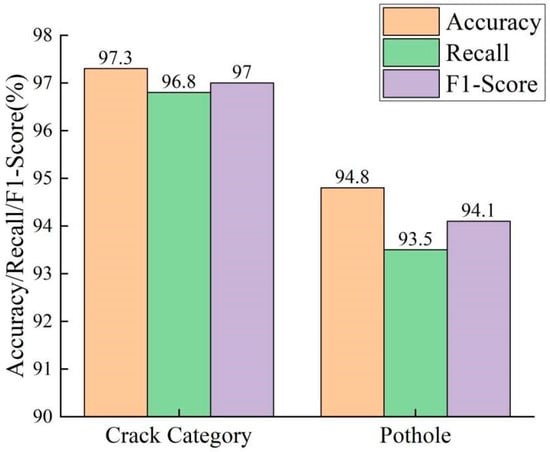
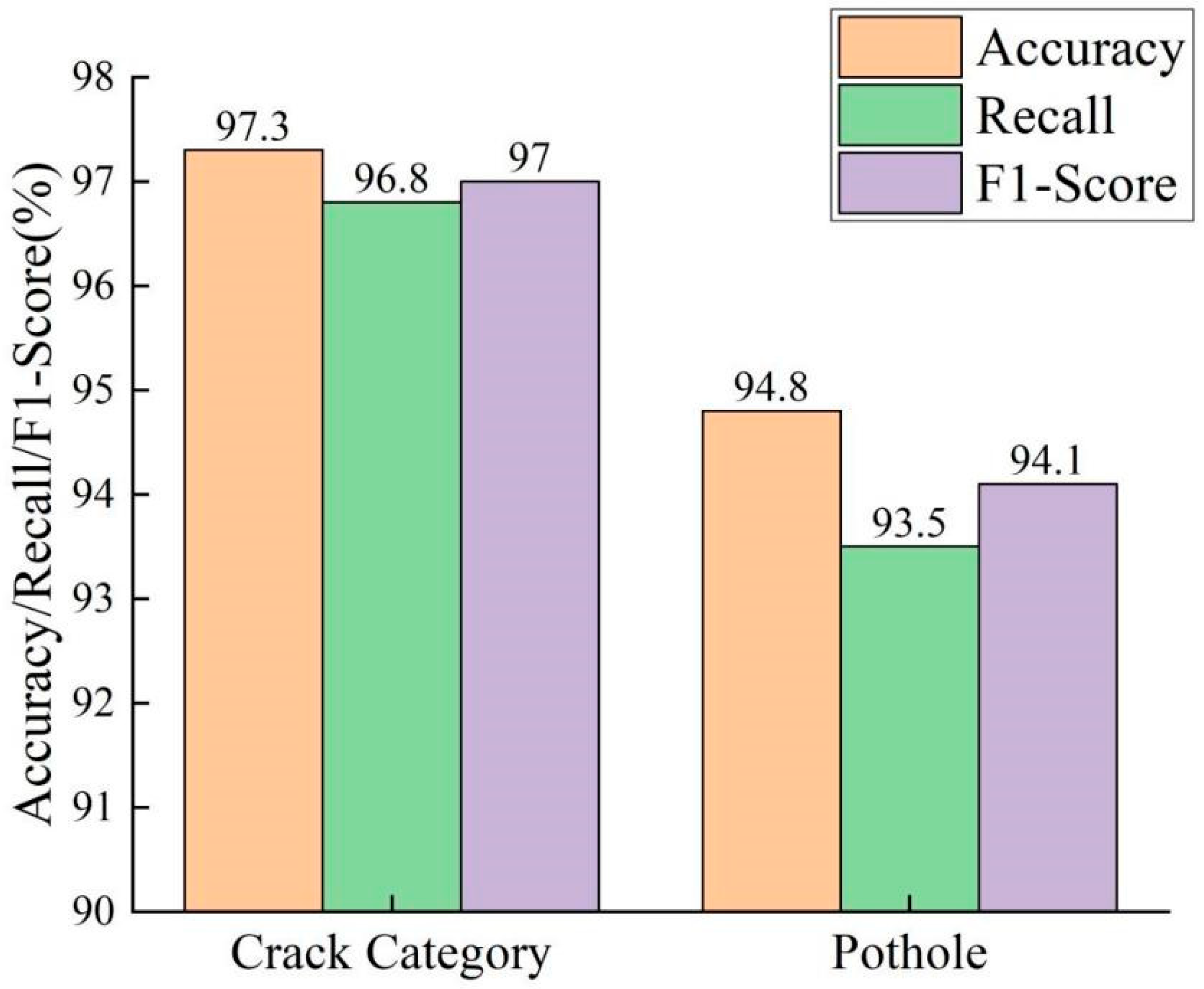
Figure 7 presents the precision analysis results of distress identification on municipal landscape road asphalt pavements using the YOLOv8-seg model, including core evaluation metrics such as Precision, Recall, and F1-score. The results provide a comprehensive quantification of the model’s performance across various distress types, highlighting its practical utility. Precision (P) represents the proportion of correctly identified distress areas among all regions predicted as distress by the model. Recall (R) indicates the proportion of actual distress areas successfully detected by the model. These two metrics collectively evaluate the model’s reliability and comprehensiveness in distress identification. The F1-score, which integrates both Precision and Recall, offers a more balanced assessment of the model’s performance, particularly when handling imbalanced datasets. Furthermore, the model demonstrates efficient detection of fine cracks (with widths less than 2 mm), highlighting its strong capability in identifying small-scale distresses. For pothole-type distresses, the model also exhibits outstanding identification performance, achieving a precision of 94.8%, recall of 93.5%, and an F1-score exceeding 94%. As distresses with distinct morphological features, potholes present noticeable edge characteristics that the YOLOv8-seg model effectively captures through multi-scale feature fusion, ensuring efficient detection. Although the detection accuracy for potholes is slightly lower compared to crack-type distresses, the overall performance remains excellent, indicating the model’s strong adaptability in identifying complex road distresses. In summary, the results presented in Figure 7 confirm that the YOLOv8-seg model achieves high accuracy and reliability in detecting distresses on municipal landscape road asphalt pavements, particularly in identifying cracks and potholes. These precision metrics not only validate the model’s effectiveness of the model in distress detection tasks but also establish a foundation for its implementation in engineering-level applications. Future research could focus on further optimizing the model to enhance its accuracy in identifying other types of distresses, especially under challenging lighting conditions or shadow interference.
Figure 7.
Distress identification accuracy.
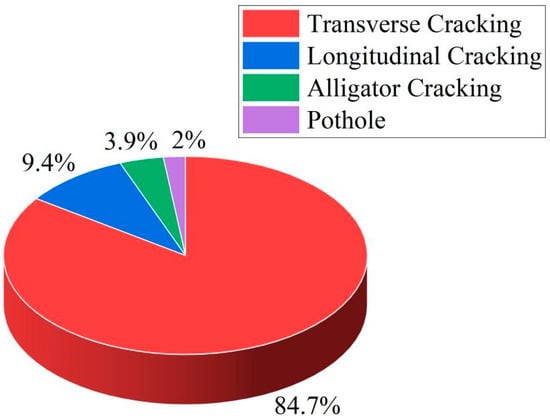
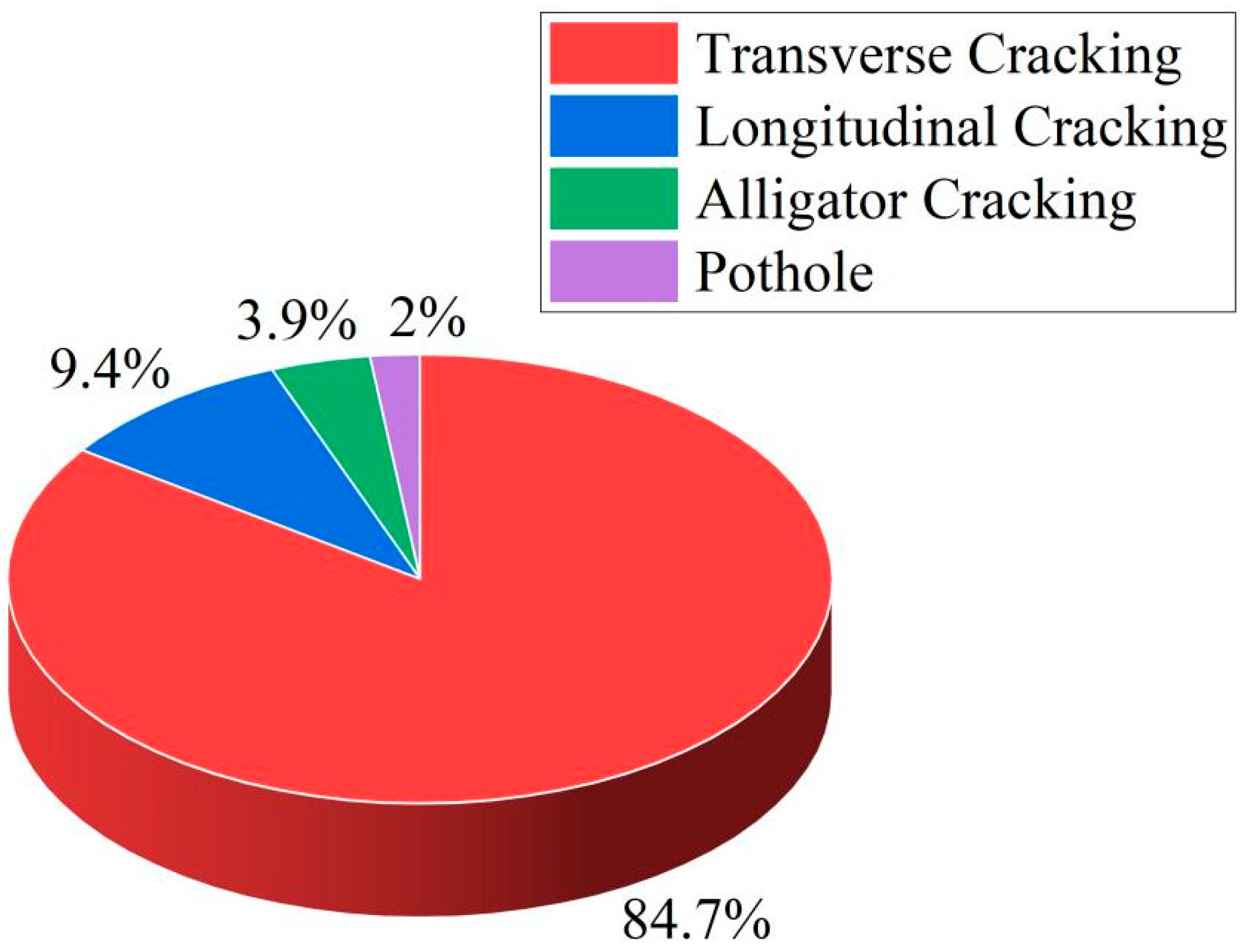
Figure 8 presents the quantity and proportion of different distress types identified in the asphalt pavement of municipal landscape roads. Transverse cracks were the most prevalent distress type, with a total of 521 occurrences, significantly outnumbering all other categories. This indicates that transverse cracking is the most common distress form in municipal landscape roads. Longitudinal cracks were observed 58 times, substantially fewer than transverse cracks, suggesting a lower frequency of occurrence potentially related to factors such as subgrade settlement or construction quality. Alligator cracking and potholes, representing more severe distress modes, were recorded 24 and 12 times respectively. Although these distress types occurred less frequently, their presence typically indicates more critical underlying issues including asphalt fatigue, material aging, or poor freeze-thaw resistance, which may accelerate pavement deterioration. In summary, transverse cracks constitute the primary distress type in municipal landscape roads. While longitudinal cracks, alligator cracking, and potholes occur less frequently, they warrant careful attention due to their significant implications for pavement structural integrity.
Figure 8.
Number and Proportions of Different distress Types.
The aforementioned analysis reveals that transverse cracks constitute the primary distress in landscape asphalt pavements. The initiation and propagation of transverse cracks are closely associated with the aging of asphalt materials and complex environmental factors, representing the combined effect of both mechanisms. As an organic binder, asphalt inevitably undergoes aging during long-term service, primarily manifested through the volatilization of light components and oxidative hardening, leading to reduced flexibility and increased brittleness. This degradation of material properties diminishes the ability of asphalt mixtures to resist deformation and stress, creating an inherent predisposition for crack formation. Studies indicate that pavements incorporating Reclaimed Asphalt Pavement (RAP) are particularly susceptible to accelerated brittleness, as the asphalt binder in RAP has already undergone prior aging. Improper recycling techniques can further exacerbate pavement embrittlement, influencing both crack spacing and propagation patterns [25]. Environmental factors serve as critical external conditions that trigger and accelerate the formation of transverse cracks. Among these, temperature fluctuation exerts the most significant influence. In regions with substantial daily or seasonal temperature variations, the asphalt surface layer and the underlying semi-rigid base course undergo considerable volume changes due to thermal expansion and contraction. When temperatures drop, the pavement structure contracts. However, restrained by interlayer friction and boundary conditions, tensile stress develops within the material. When this tensile stress exceeds the tensile strength of the already aged and embrittled asphalt mixture, regular transverse cracking occurs [26]. Furthermore, moisture that infiltrates fine cracks or interlayer gaps within the pavement structure freezes and expands in volume, generating substantial frost-heave pressure. Upon thawing, the bearing capacity drops abruptly. This repeated freeze-thaw cycle significantly accelerates crack propagation and causes structural deterioration of the pavement [27]. Prolonged environmental exposure, including ultraviolet radiation and rainwater erosion, continuously accelerates asphalt aging, establishing a vicious cycle. Moreover, the presence of transverse cracks exacerbates environmental damage to the pavement. These cracks provide pathways for moisture and air to penetrate the pavement structure, which not only weakens interlayer bonding but also accelerates the deterioration of base course materials and further aging of the asphalt. Studies have shown that when back-calculating the modulus of pavement structural layers using non-destructive testing data such as deflection basins, transverse cracks significantly affect the accuracy of the results. This underscores the profound impact of cracking on the overall structural performance of the pavement [28]. Therefore, asphalt aging and environmental factors exhibit an interconnected and mutually reinforcing coupling relationship. The following section analyzes the mechanical properties of asphalt under combined aging and environmental effects through experimental investigation.
3.2. Rheological Properties of Asphalt After Aging
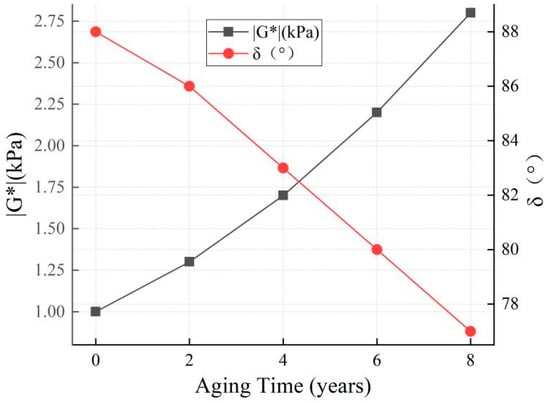
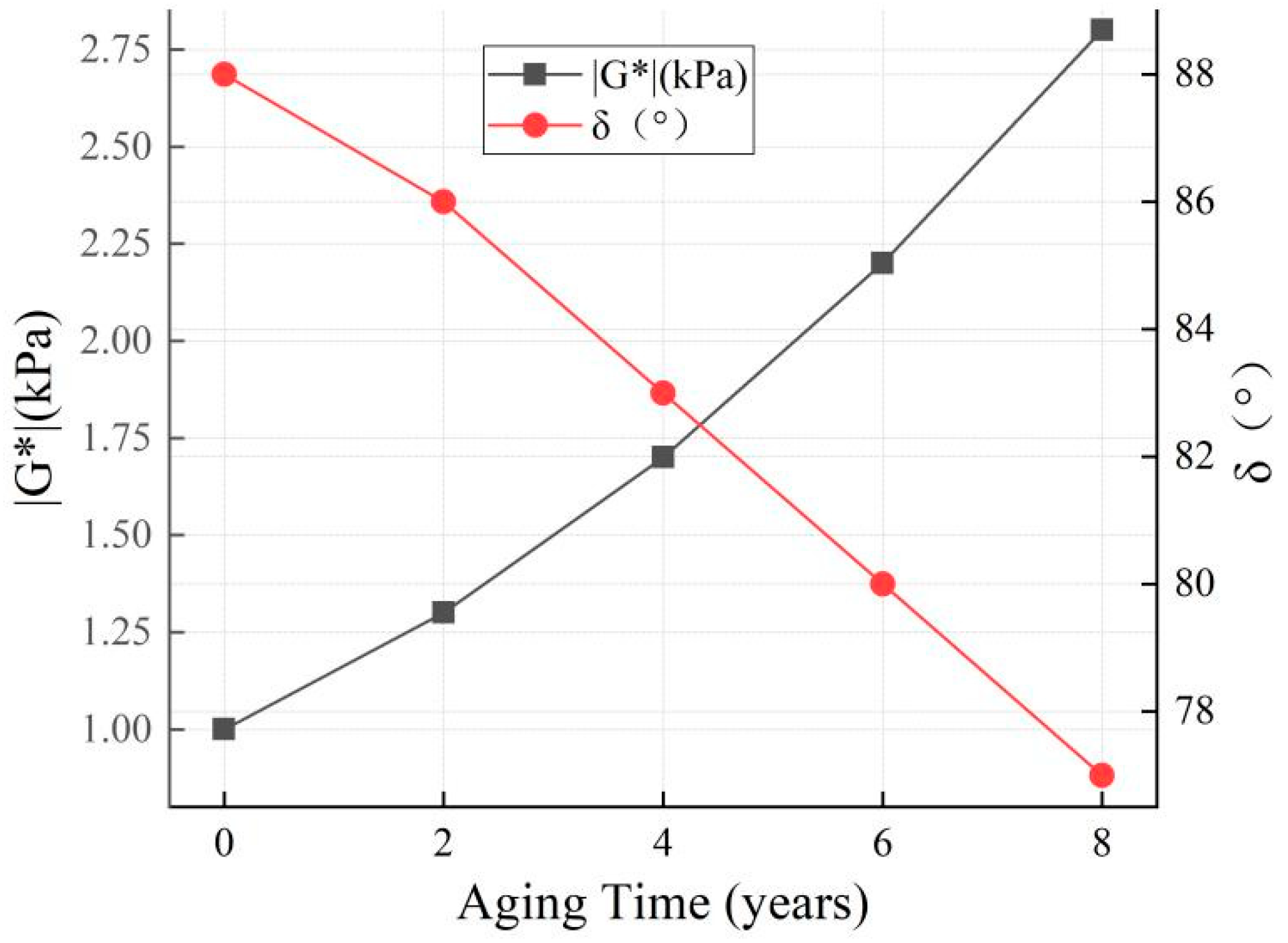
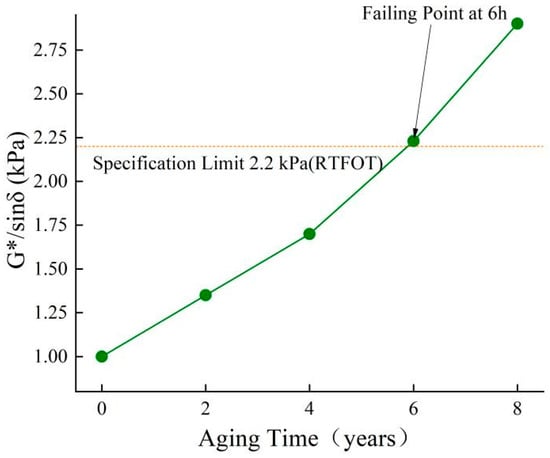
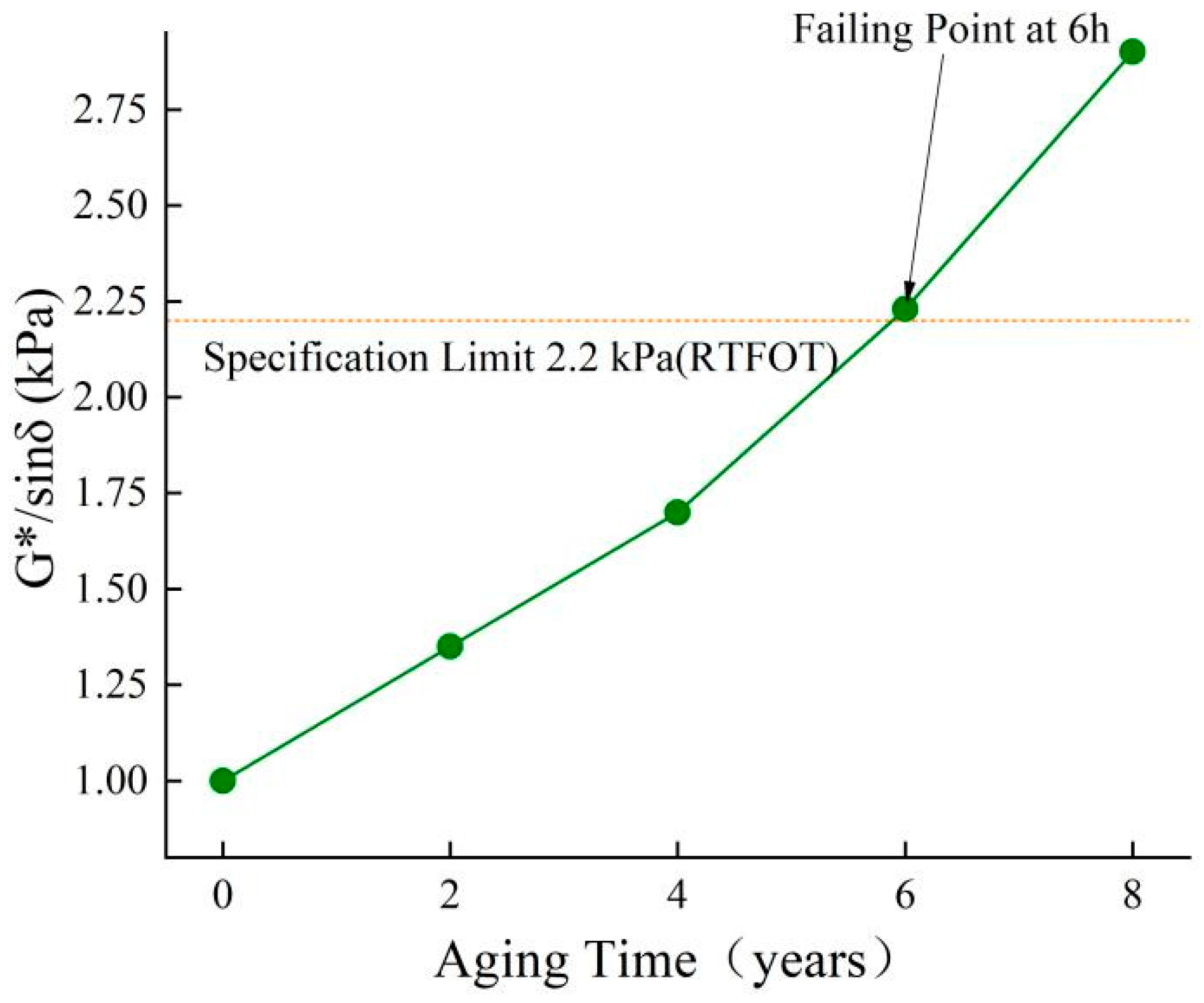
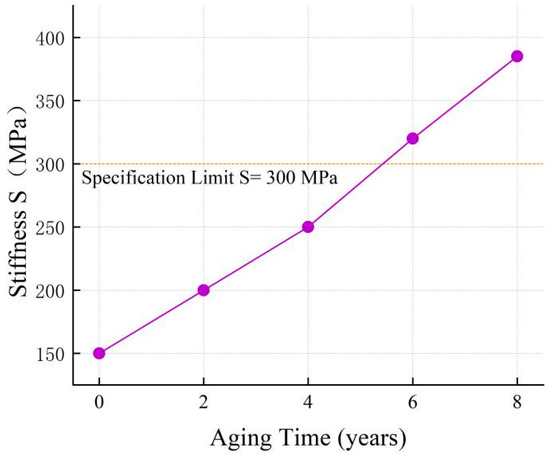
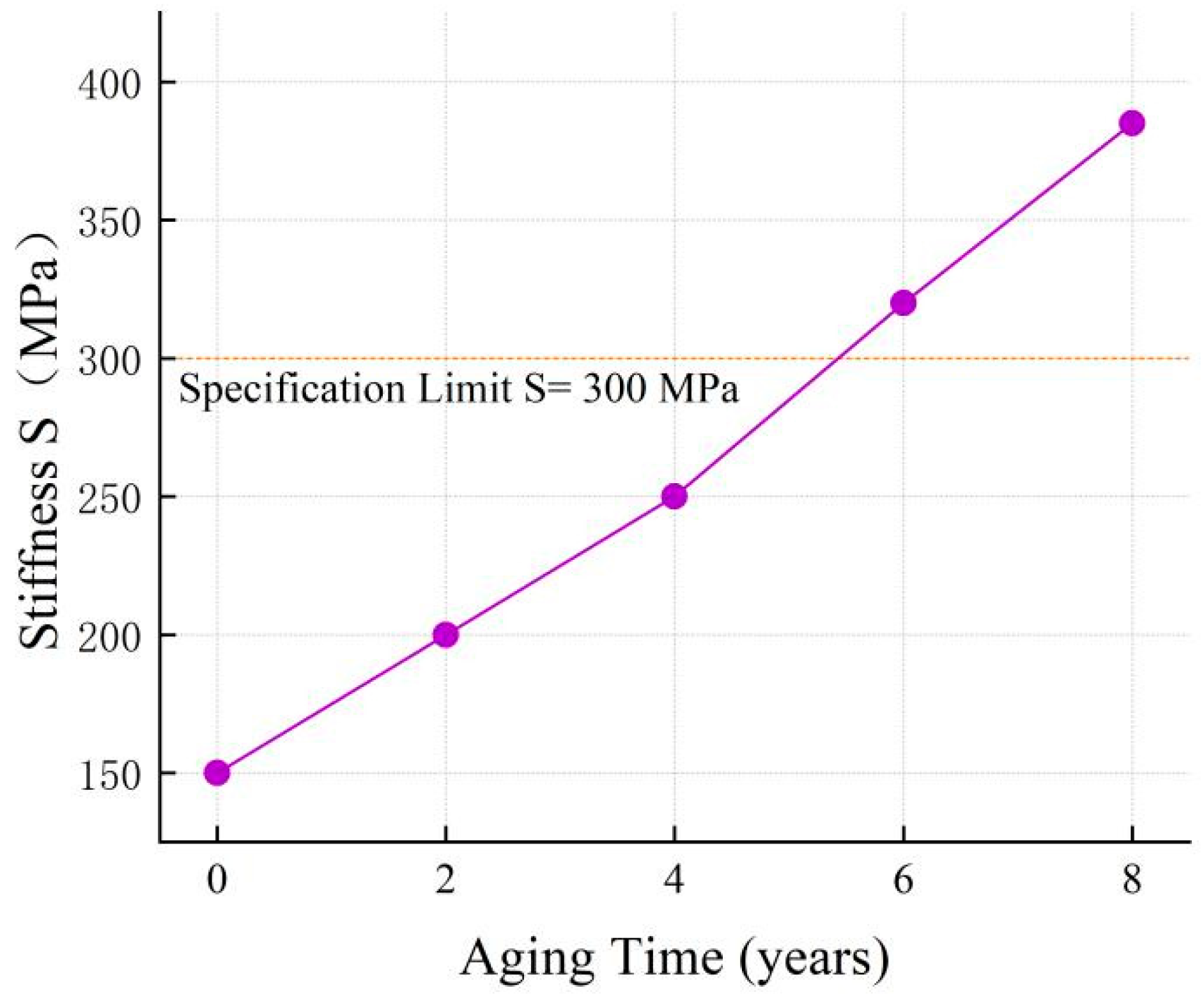
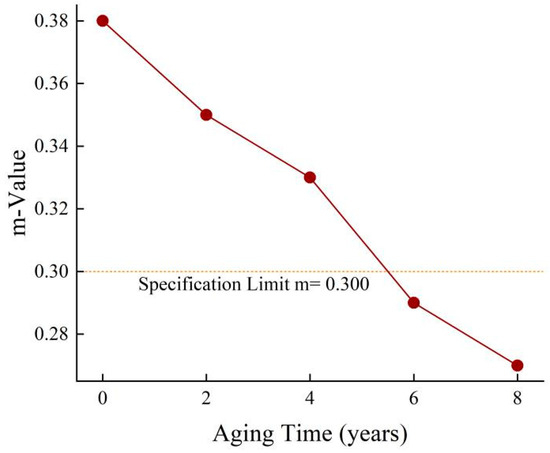
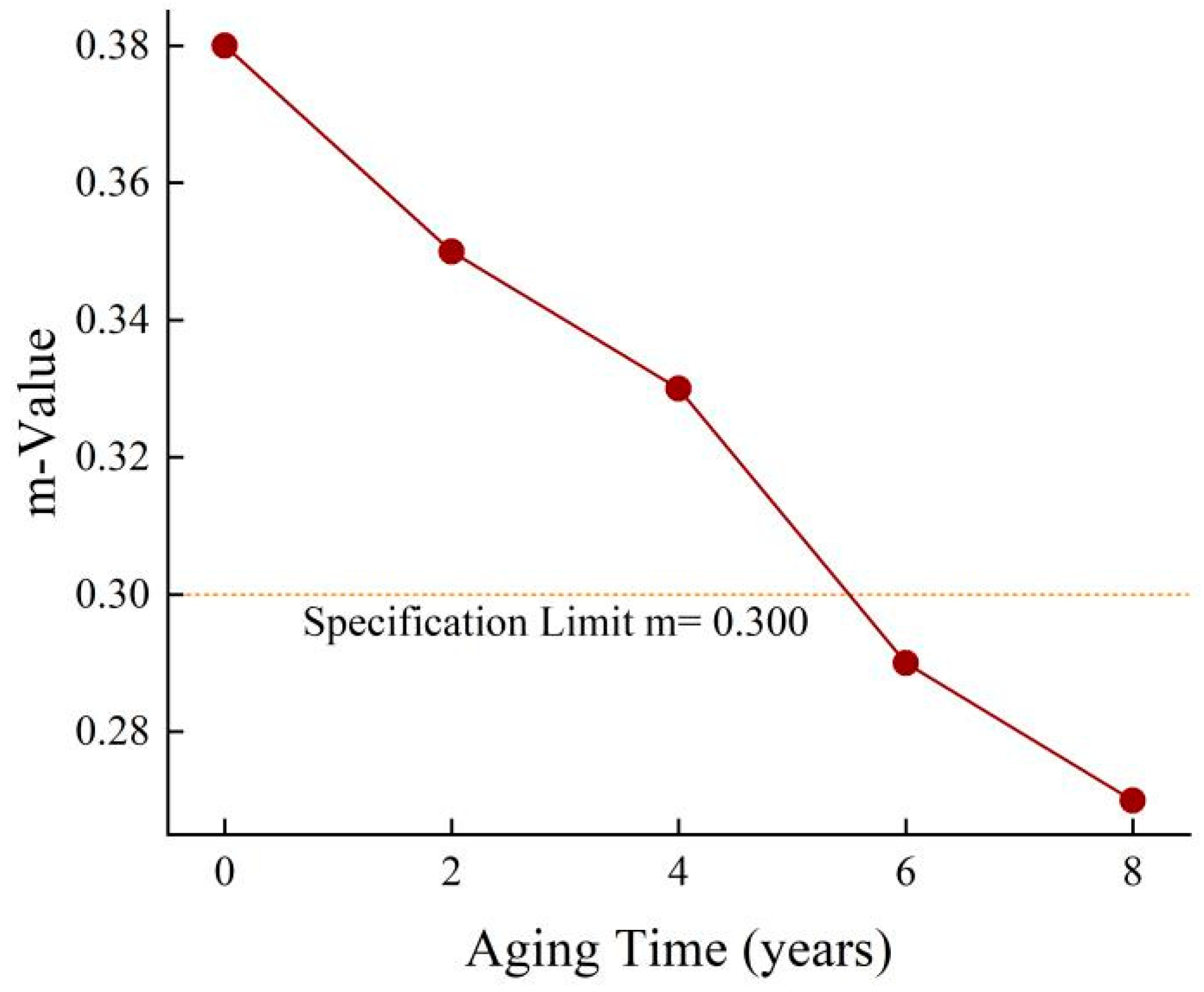
To systematically evaluate the comprehensive impact of the aging process on the performance of asphalt, the variation patterns of its rheological properties under different aging durations were analyzed using key parameters, including the complex shear modulus (|G|), high-temperature rutting factor (G/sinδ), stiffness modulus (S), and m-value. The results are presented in Figure 9, Figure 10, Figure 11 and Figure 12.
Figure 9.
Relationship between complex shear modulus, phase angle, and aging duration.
Figure 10.
Relationship between High-Temperature Rutting Factor and Aging Duration.
Figure 11.
Relationship between Stiffness (S) and Aging Duration.
Figure 12.
Relationship between m Value and Aging Duration.
Figure 9 illustrates the variation of the complex shear modulus (|G*|) of asphalt with different aging durations. As can be observed from the figure, the complex shear modulus increases significantly with the extension of aging duration. Specifically, at 0 years of aging, the |G*| value is approximately 1.00 kPa; when the aging duration reaches 2 years, the |G*| increases to about 1.50 kPa; at 4 years of aging, it is 1.80 kPa; at 6 years of aging, it reaches 2.30 kPa; and at 8 years of aging, it approaches 2.50 kPa. This phenomenon indicates that asphalt materials gradually harden during the aging process: their deformation resistance is enhanced, while their flexibility decreases, rendering the materials more brittle and prone to cracking. In particular, after 6 years of aging, the complex shear modulus increases remarkably, making the asphalt hard and brittle, and its crack resistance at low temperatures decreases significantly. The overall trend presents a linear annual growth, which further confirms that the hardening process of asphalt is one of the main causes for the formation of transverse cracks.
Figure 10 illustrates the variation of the high-temperature rutting factor (G*/sinδ) with aging duration. As can be seen from the figure, the rutting factor increases gradually with the extension of asphalt aging duration. Specifically, it rises from approximately 1.50 kPa at 0 years of aging to about 1.75 kPa after 2 years of aging, reaches roughly 2.00 kPa after 4 years, climbs to 2.30 kPa after 6 years, and finally approaches 2.50 kPa at 8 years of aging. This increasing trend indicates that as the asphalt ages, its rutting resistance is enhanced; however, such hardening also leads to increased brittleness of the asphalt, resulting in deteriorated low-temperature crack resistance. The increase in the rutting factor reflects the improved deformation resistance of asphalt under high-temperature conditions, but due to the hardening caused by aging, the asphalt becomes more prone to transverse cracking in low-temperature environments. The overall trend of annual increase further exacerbates the risk of low-temperature cracking.
As shown in Figure 11, the stiffness (S) of asphalt increases significantly with the extension of aging duration. Specifically, the stiffness is approximately 50 MPa at 0 years of aging, about 80 MPa after 2 years of aging, roughly 120 MPa after 4 years of aging, and approaches 200 MPa after 6 years of aging. When the aging duration reaches 8 years, the stiffness has climbed to 320 MPa, which clearly exceeds the standard limit of 300 MPa. This increasing trend indicates that as aging progresses, asphalt gradually hardens and its deformation resistance improves. However, such hardening also causes asphalt to lose its original flexibility—especially under low-temperature conditions, the brittleness of the asphalt material is intensified, making it prone to cracking. The linear increase in stiffness directly leads to the brittle fracture of asphalt under the action of thermal expansion and contraction stress. Therefore, with the increase in aging duration, the occurrence probability of transverse cracks rises significantly.
Figure 12 illustrates the variation of the asphalt’s m Value with aging duration. As can be observed from the figure, the m Value decreases significantly as the aging duration extends. Specifically, it drops from approximately 0.35 at 0 years of aging to 0.30 after 2 years of aging, further decreases to 0.25 after 4 years, reaches 0.22 after 6 years, and only remains at 0.18 after 8 years of aging. The m Value serves as a key indicator for evaluating the low-temperature crack resistance of asphalt. This decrease in the m Value indicates that the asphalt’s low-temperature crack resistance gradually deteriorates. With the increase in aging duration, the brittleness of the asphalt material increases, making it more likely to crack under low-temperature conditions. In particular, after 8 years of aging, the m Value is far below 0.30, which suggests that the asphalt’s low-temperature crack resistance has almost been lost. This trend demonstrates that as the asphalt ages, the material becomes more fragile and prone to cracking under low-temperature conditions—especially in winter when there are large temperature differences.
3.3. Low-Temperature Crack Resistance of Asphalt Mixtures with Different Aging Degrees
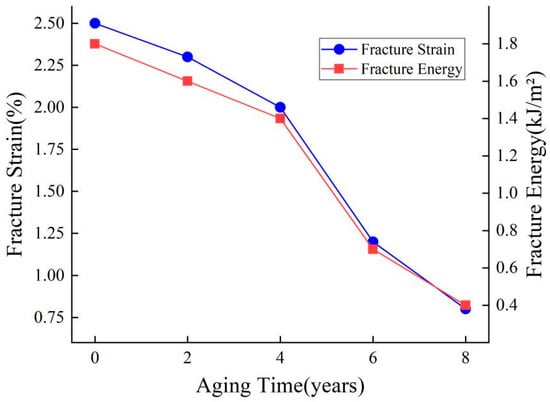
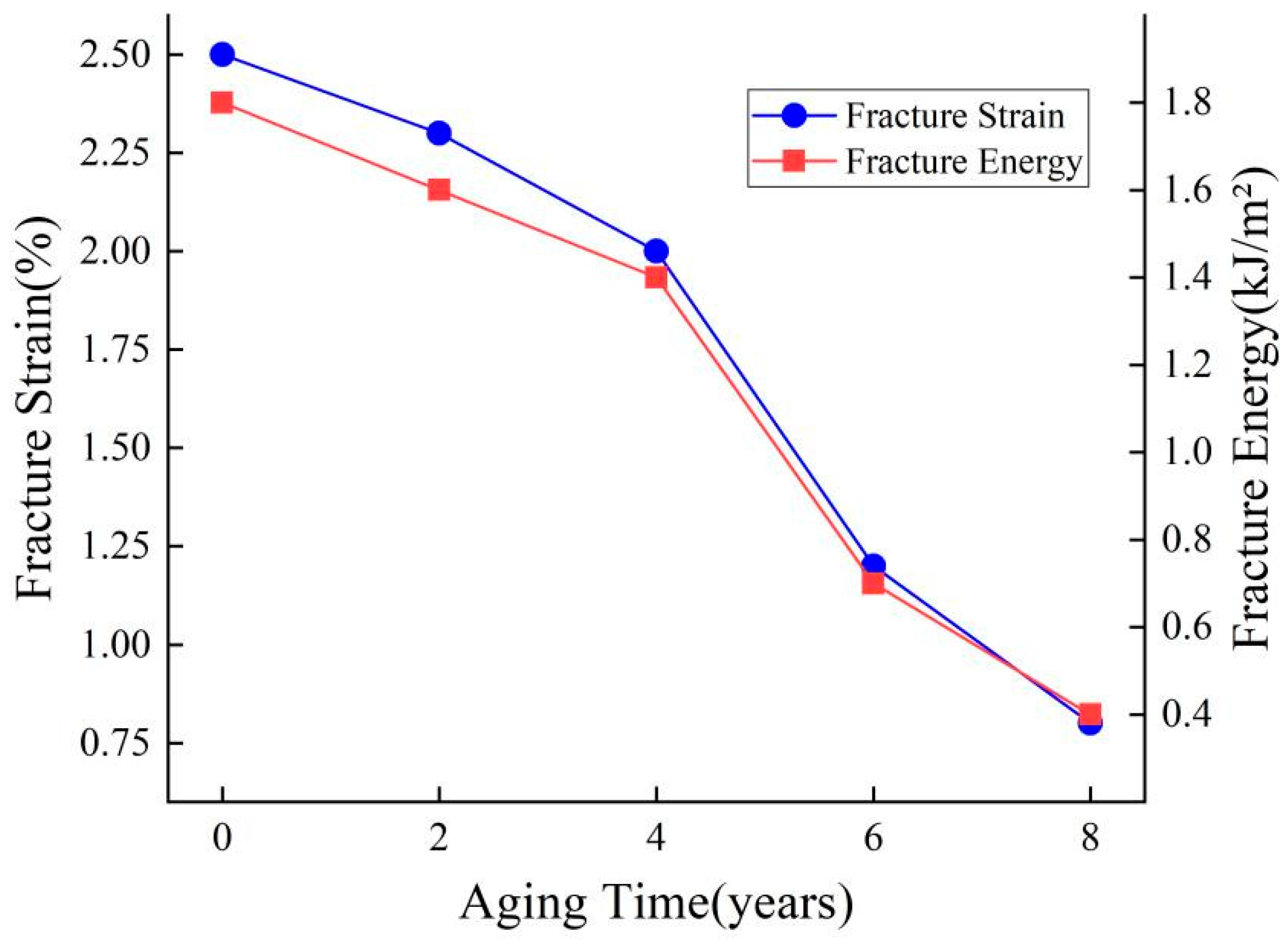
As indicated by the preceding analysis of rheological parameters, asphalt aging leads to material hardening and embrittlement. To validate how this change is reflected in the macroscopic performance of asphalt mixtures, the low-temperature crack resistance of mixtures with different aging degrees was further evaluated through low-temperature bending tests. The results are shown in Figure 13.
Figure 13.
Low-Temperature Crack Resistance of Asphalt Mixtures with Different Aging Degrees.
Figure 13 illustrates the low-temperature crack resistance of asphalt mixtures with different aging durations under low-temperature conditions, which is specifically evaluated by two indicators: Fracture Strain and Fracture Energy. The data in the figure reveals that as the aging duration of asphalt increases, the low-temperature crack resistance of the material decreases significantly. Initially (at 0 years of aging), the fracture strain of the asphalt mixture under low temperature is approximately 2.5%, indicating that the material exhibits good ductility at low temperatures and can withstand a certain amount of tensile strain without brittle fracture. However, with the extension of aging duration, the fracture strain decreases gradually: it has dropped to approximately 1.0% after 6 years of aging, and further falls to nearly 0.5% after 8 years of aging. This decrease indicates that as the asphalt ages, the ductility of the material gradually weakens, making it more prone to brittle fracture. Especially in low-temperature environments, the formation of cracks becomes much easier.
On the other hand, the Fracture Energy also decreases gradually with the extension of aging duration. Initially (at 0 years of aging), the Fracture Energy is approximately 1.8 kJ/m2, indicating that the asphalt material can withstand a relatively large amount of energy without cracking under low-temperature conditions. As the aging duration prolongs, the Fracture Energy decreases step by step: it drops to about 0.8 kJ/m2 after 6 years of aging, and only reaches 0.4 kJ/m2 after 8 years of aging—this phenomenon indicates a significant decline in the asphalt’s crack resistance. This decrease in Fracture Energy means that when the asphalt is subjected to low-temperature stress, the external force it can withstand is reduced, making the fracture of the material much more likely to occur.
Taken together, the data in Figure 12 clearly reflects that with the extension of aging duration, the low-temperature crack resistance of asphalt gradually decreases, and the material’s ductility and energy absorption capacity are significantly weakened. This change indicates that the aging process gradually renders the asphalt material more brittle, making it more prone to cracking especially under low-temperature conditions. Therefore, for asphalt pavements in long-term service, special attention must be paid to their low-temperature performance, and timely maintenance and repair should be carried out to prevent the further propagation of low-temperature cracks and ensure the long-term stability of the pavement.
3.4. Freeze-Thaw Cycle Performance of Asphalt with Different Aging Degrees
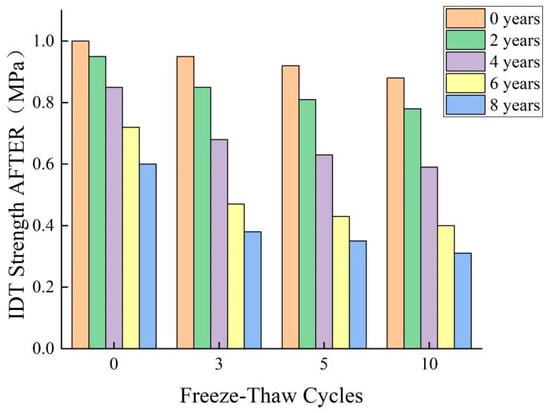
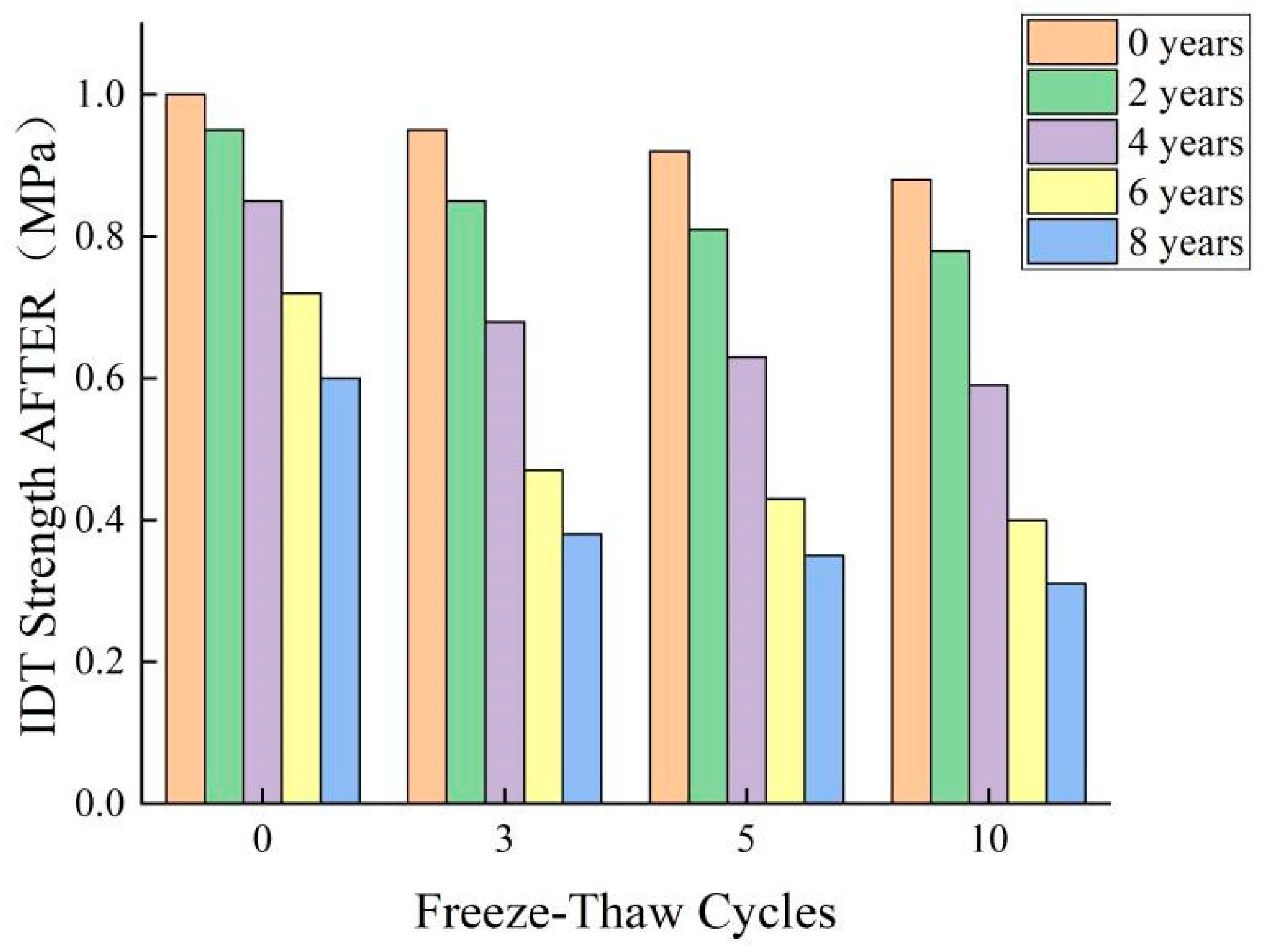
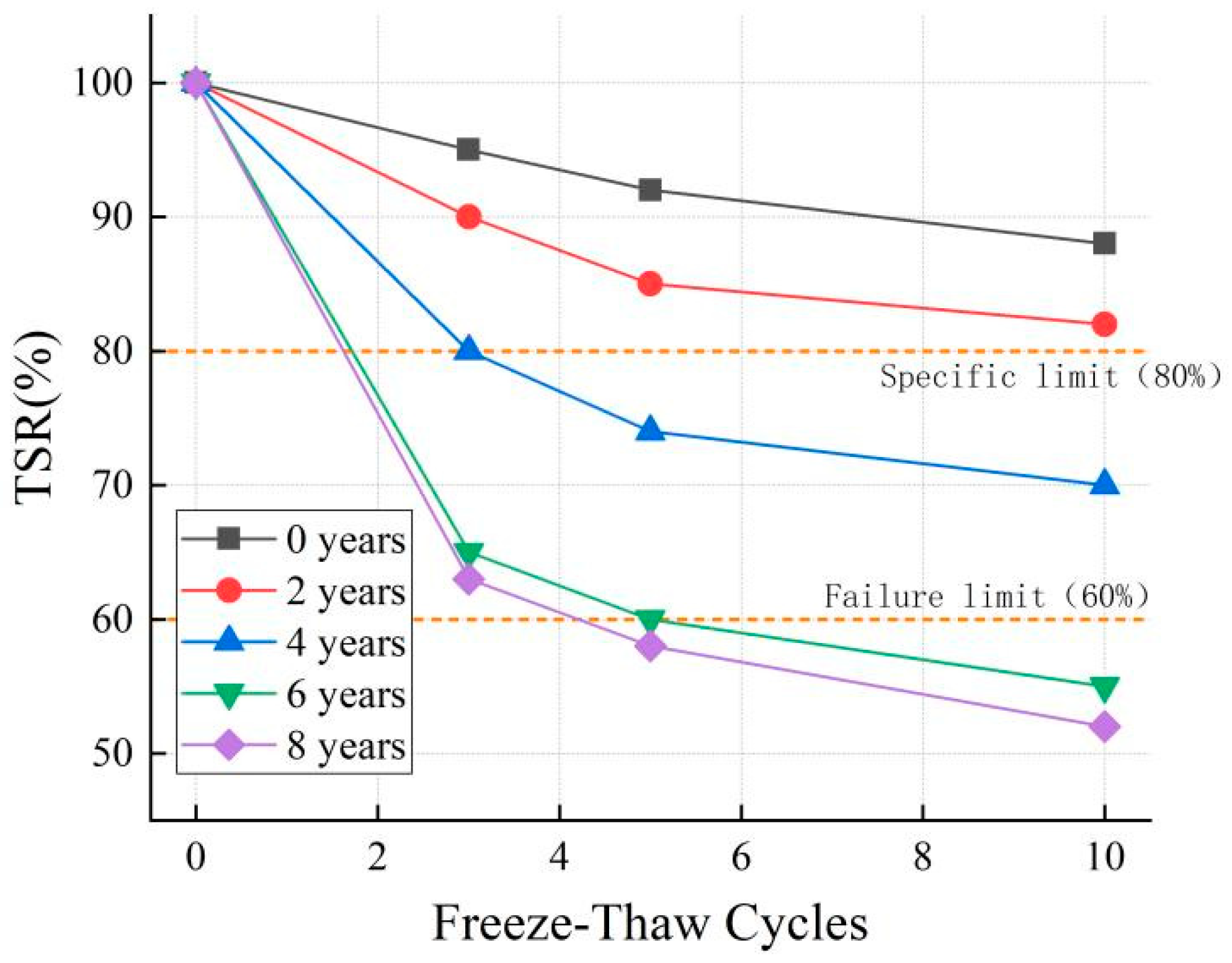
In addition to low-temperature crack resistance, the freeze-thaw durability of asphalt mixtures is another critical factor affecting the long-term service performance of pavements in cold regions. To evaluate the impact of aging on the frost resistance of the mixtures, this study further tested the variations in Indirect Tensile Strength (IDT) and Tensile Strength Ratio (TSR) of specimens with different aging durations under the action of freeze-thaw cycles. The results are shown in Figure 14 and Figure 15, respectively.
Figure 14.
Analysis of Variation in IDT Strength of Asphalt Mixtures with Different Aging Durations.
Figure 15.
Analysis of Variation in TSR of Asphalt Mixtures with Different Aging Durations.
Figure 14 illustrates the variation of Indirect Tensile Strength (IDT) of asphalt mixtures with different aging durations under the action of freeze-thaw cycles. IDT strength is a key indicator for evaluating the freeze-thaw resistance of asphalt mixtures: the higher the IDT strength, the stronger the freeze-thaw resistance. Specifically, for asphalt with 0 years of aging, its IDT strength is relatively high (approximately 1.80 MPa) without undergoing freeze-thaw cycles; even after 10 freeze-thaw cycles, the IDT strength still remains at around 1.60 MPa. This indicates that fresh asphalt mixtures possess good freeze-thaw durability. For asphalt with 2 years of aging, the IDT strength is also high without freeze-thaw cycles; however, after 5 freeze-thaw cycles, the IDT strength drops to approximately 1.40 MPa, showing a slight decline in freeze-thaw resistance. With the further increase in aging duration, the IDT strength of asphalt with 4 years of aging is about 1.20 MPa, and it decreases further after 5 freeze-thaw cycles—this demonstrates that the aging process gradually weakens the ductility and strength of asphalt. For asphalt with 6 years of aging, the IDT strength drops further to 0.80 MPa after 3 freeze-thaw cycles, exhibiting a significant reduction in freeze-thaw damage resistance. The variation trend in the figure clearly shows that as the aging duration increases, the freeze-thaw resistance of asphalt gradually weakens, and the damage caused by freeze-thaw cycles becomes increasingly significant. Especially when the asphalt aging exceeds 6 years, its structural damage is very significant.
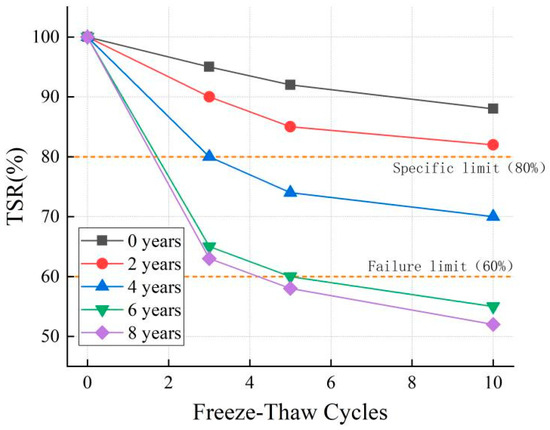
Figure 15 illustrates the variation of the Tensile Strength Ratio (TSR) of asphalt mixtures with different aging durations during freeze-thaw cycles. The TSR value reflects the freeze-thaw resistance of asphalt mixtures: a higher TSR value indicates better water stability and stronger resistance to freeze-thaw damage. Specifically, for asphalt with 0 years of aging, the TSR remains above 80% even after 10 freeze-thaw cycles, demonstrating strong freeze-thaw resistance. For asphalt with 2 years of aging, the TSR is slightly reduced after 10 freeze-thaw cycles but still maintained at approximately 80%, indicating that the asphalt has just begun to be affected by aging yet can still resist freeze-thaw effects relatively well. As the aging duration increases, the TSR of asphalt with 4 years of aging drops to around 75% after 5 freeze-thaw cycles. For asphalt with 6 years of aging, the TSR plummets to below 60% even after only 3 freeze-thaw cycles, showing obvious performance degradation. In particular, the TSR of asphalt with 8 years of aging has fallen to below 60% after 3 freeze-thaw cycles, indicating that the material has become embrittled and almost lost its freeze-thaw resistance. These data reveal that asphalt aging leads to a gradual decline in its water stability and freeze-thaw resistance, and the impact of freeze-thaw cycles becomes increasingly significant. Especially for asphalt aged for 6 years or more, its resistance to freeze-thaw damage is significantly weakened, which can easily lead to pavement damage and failure.
4. Conclusions and Future Work
This study, through in-depth analysis of the distress characteristics of asphalt pavements for municipal landscape roads, the aging process of asphalt materials, low-temperature crack resistance, and the impact of freeze-thaw cycles, reveals the significant impacts of asphalt aging and environmental factors on pavement performance. The research results provide a theoretical basis and technical support for the intelligent detection and maintenance management of municipal landscape road pavements, and the optimized design of materials. The main conclusions are as follows:
- Through the identification and analysis of distresses in asphalt pavements of municipal landscape roads, this study found that transverse cracks are the most common type of pavement distress. The formation of transverse cracks is closely related to environmental factors such as asphalt aging, temperature fluctuations, and moisture intrusion. Specifically, asphalt aging causes the material to harden and become brittle, leading to a significant decrease in its low-temperature crack resistance. Meanwhile, temperature differences and freeze-thaw action further accelerate the propagation of cracks. The study shows that transverse cracks account for 72% of the total number of cracks, making them the most common and most destructive type of distress in municipal landscape road pavements.
- Tree shadows on landscape roads are a key factor affecting the accuracy of pavement distress identification. To address this issue, the SpA-Former shadow removal network was proposed in this study, which effectively eliminates tree shadow interference in images and significantly enhances the contrast of distress areas. It is shown by the experimental results that after applying this technology, the grayscale contrast of distress areas is improved by 40%–60%, which enhances the accuracy of distress detection and provides effective technical support for intelligent distress detection.
- Through indoor aging simulation experiments, it was found in this study that the low-temperature crack resistance of asphalt decreases significantly during the aging process. Specifically, the fracture strain decreases from 2.5% to 0.5%, and the fracture energy drops from 1.8 kJ/m2 to 0.4 kJ/m2. As the asphalt ages, its ductility decreases and brittleness increases, causing it to be more prone to cracking in low-temperature environments. This aging process gradually makes the asphalt lose its flexibility. Especially under low-temperature conditions, the probability of cracking increases significantly.
- It is shown by the study that the stiffness of asphalt increases significantly as the aging duration extends. Specifically, the stiffness increases from 50 MPa at 0 years of aging to 320 MPa at 8 years of aging, which far exceeds the standard limit of 300 MPa. The increase in asphalt stiffness enhances its deformation resistance; however, it also makes the asphalt material more brittle in low-temperature environments, rendering it prone to cracking. During the aging process, the asphalt gradually hardens and loses its original flexibility. As a result, it is more likely to undergo brittle fracture under stresses such as thermal expansion and contraction, which further accelerates the formation of transverse cracks.
- The impact of freeze-thaw cycles on the freeze-thaw resistance of asphalt mixtures with different aging durations was analyzed in this study. Results show that as the aging duration of asphalt increases, its freeze-thaw resistance decreases significantly. Specifically, for unaged asphalt (0 years of aging), the TSR (Tensile Strength Ratio) remains above 80% even after 10 freeze-thaw cycles. In contrast, for asphalt aged for 6 and 8 years, the TSR drops to below 60% after only 3 freeze-thaw cycles, showing a significant reduction in freeze-thaw resistance. Meanwhile, the IDT (Indirect Tensile Strength) also decreases gradually with the increase in the number of freeze-thaw cycles. Especially for asphalt aged for more than 6 years, its freeze-thaw resistance is almost lost, indicating that the performance of the asphalt material has severely degraded and its resistance to freeze-thaw damage has been greatly weakened.
- As the starting point of a series of studies, future work will deepen along three directions: First, expanding to the structural scale by constructing composite pavement specimens incorporating different base layers (e.g., semi-rigid, flexible) and considering interlayer bonding, to quantify the influence of base restraint and structural integrity on cracking behavior through mechanical testing and simulation. Second, broadening the spectrum of influencing factors by systematically studying the interactive effects of variable traffic loads, extreme climatic conditions, and different asphalt chemical compositions (e.g., modified asphalt, high RAP content) on aging pathways and failure modes, based on the established temperate climate benchmark, to enhance the universality of the conclusions. Third, promoting engineering application validation by conducting long-term performance monitoring and full-scale testing for the proposed preventive maintenance window (years 5–6) and the use of softer asphalt (e.g., penetration grade 90). Through comparative road section studies, the actual benefits of delaying cracking and extending service life will be quantified, ultimately forming operable design and maintenance guidelines to translate material mechanism discoveries into engineering practice.
Author Contributions
Conceptualization, L.Z.; Methodology, L.Z. and X.M.; Software, X.C.; Validation, X.C.; Formal analysis, L.Z.; Investigation, H.Z.; Data curation, X.M.; Writing—original draft, L.Z.; Writing—review & editing, X.M., X.F. and H.Z.; Visualization, H.Z.; Supervision, L.Z., X.C. and X.F.; Project administration, X.F. All authors have read and agreed to the published version of the manuscript.
Funding
This research was funded by the Fujian Vocational and Technical College of Agriculture’s project to take the lead grant number 2024JS009.
Institutional Review Board Statement
Not applicable.
Informed Consent Statement
Not applicable.
Data Availability Statement
Data are contained within the article.
Conflicts of Interest
The authors declare no conflict of interest.
References
- Yang, S.; Park, H.; Baek, C. Fatigue Cracking Characteristics of Asphalt Pavement Structure under Aging and Moisture Damage. Sustainability 2023, 15, 5210. [Google Scholar] [CrossRef] [Scilit]
- Rys, D.; Jaczewski, M.; Pszczola, M.; Kamedulska, A.; Kamedulski, B. Factors affecting low-temperature cracking of asphalt pavements: Analysis of field observations using the ordered logistic model. Int. J. Pavement Eng. 2023, 24, 215–228. [Google Scholar] [CrossRef] [Scilit]
- Picos, K.; DiazRamírez, V.H.; Tapia, J.J. A roadmap to global illumination in 3D scenes: Solutions for GPU object recognition applications. In Proceedings of the SPIE Optical Engineering + Applications, San Diego, CA, USA, 17–21 August 2014. [Google Scholar]
- Liu, C.; Yao, Y.; Li, J.; Qian, J.; Liu, L. Research on lightweight GPR road surface distress image recognition and data expansion algorithm based on YOLO and GAN. Case Stud. Constr. Mater. 2024, 20, e02789. [Google Scholar]
- Duan, X.; Cao, Y.; Zhang, R.; Wang, X.; Li, P. Shadow-aware image colorization. Vis. Comput. 2024, 40, 4969–4979. [Google Scholar] [CrossRef] [Scilit]
- Tedeschi, A.; Benedetto, J.F. A real-time automatic pavement crack and pothole recognition system for mobile Android-based devices. Adv. Eng. Inform. 2017, 33, 306–315. [Google Scholar] [CrossRef] [Scilit]
- Xu, J.; Zhang, J.; Sun, W. Recognition of the Typical Distress in Concrete Pavement Based on GPR and 1D-CNN. Remote Sens. 2021, 13, 2356. [Google Scholar] [CrossRef] [Scilit]
- Lv, Z.; Cheng, C.; Lv, H. Automatic identification of pavement cracks in public roads using an optimized deep convolutional neural network model. Philos. Trans. R. Soc. A 2023, 381, 20220147. [Google Scholar] [CrossRef] [Scilit]
- Sheng, Z.; Bei, Z.; Ling, T.; Chen, Q.; Zhang, L. Research on high-precision recognition model for multi-scene asphalt pavement distresses based on deep learning. Sci. Rep. 2024, 14, 25416. [Google Scholar]
- Boateng, M.A.; Gyamfi, Y.A. Generative adversarial network for real-time identification and pixel-level annotation of highway pavement distresses. Autom. Constr. 2025, 158, 105213. [Google Scholar]
- Khan, N.H.R.; Kumar, S.V. Terrestrial LiDAR derived 3D point cloud model, digital elevation model (DEM) and hillshade map for identification and evaluation of pavement distresses. Results Eng. 2024, 22, 101876. [Google Scholar] [CrossRef] [Scilit]
- Mivehchi, M.; Wen, H.; Wen, Y.; Wang, L. Study of Measures to Design Asphalt Mixes Including High Percentages of Recycled Asphalt Pavement and Recycled Asphalt Shingles. Transp. Res. Rec. 2023, 2677, 678–690. [Google Scholar] [CrossRef] [Scilit]
- Jiang, L.; Gong, M.; Xiong, Z.; Liu, S.; Fan, J.; Xu, Z.; Hong, J. In situ mechanical response characteristics of Autonomous Rail Rapid Transit (ART) applied to semi-flexible asphalt pavements. Road Mater. Pavement Des. 2024, 25, 2644–2663. [Google Scholar] [CrossRef] [Scilit]
- Goli, H.; Latifi, M.; Sadeghian, M. Comparing the Effect of Moisture on Different Fatigue and Cracking Behaviors of RAP-WMA. J. Transp. Eng. Part B Pavements 2023, 149, 04023034. [Google Scholar] [CrossRef] [Scilit]
- Jiang, J.; Xu, K.; Song, Y.; Gao, L.; Zhang, J. Investigation of cracking behavior in asphalt pavement using digital image processing technology. Front. Built Environ. 2025, 11, 1324567. [Google Scholar] [CrossRef] [Scilit]
- Xing, M.; Yang, H.; Zhao, Z.; Yu, T. Effect of Asphalt Pavement Base Layers on Transverse Shrinkage Cracking Characteristics. Sustainability 2023, 15, 7568. [Google Scholar] [CrossRef] [Scilit]
- Krami, K.; Benamara, A.; Radouani, M.; Ettayeb, M.; Tarik, L. Study of Asphalt Pavement Cracking in Different Road Sections of Morocco Using Electrical Resistivity Tomography. Int. J. Geophys. 2024, 2024, 6683254. [Google Scholar] [CrossRef] [Scilit]
- Meng, G.; Yao, X.; Du, X. Low temperature cracking behavior of asphalt binders and mixtures: A review. J. Road Eng. 2023, 3, 329–347. [Google Scholar] [CrossRef] [Scilit]
- Zhang, Q.; Yang, S.; Zhu, L.; Liu, T. Temperature variations and frozen zone migration: Assessing the influence of climate change on fatigue cracking in roadway asphalt pavements. Road Mater. Pavement Des. 2025, 26, 1105–1121. [Google Scholar] [CrossRef] [Scilit]
- Ma, R.; Li, Y.; Cheng, P.; Chen, X.; Cheng, A. Low-Temperature Cracking and Improvement Methods for Asphalt Pavement in Cold Regions: A Review. Buildings 2024, 14, 3652. [Google Scholar] [CrossRef] [Scilit]
- Zhang, X.; Zhao, Y.; Gu, C.; Lu, C.; Zhu, S. SpA-Former: An Effective and lightweight Transformer for image shadow removal. In Proceedings of the International Conference on Neural Networks (IJCNN), Gold Coast, Australia, 18–23 June 2023; pp. 1–8. [Google Scholar]
- Tang, Y.; Zhao, S.; Qin, H.; Ming, P.; Fang, T.; Zeng, J. An End-to-End Particle Gradation Detection Method for EarthRockfill Dams from Images Using an Enhanced YOLOv8-Seg Model. Sensors 2025, 25, 4797. [Google Scholar] [CrossRef] [Scilit]
- Ma, J.; Zhao, Y.; Fan, W.; Liu, J. An Improved YOLOv8 Model for Lotus Seedpod Instance Segmentation in the Lotus Pond Environment. Agronomy 2024, 14, 1325. [Google Scholar] [CrossRef] [Scilit]
- Xu, W.; Zhou, J.L.; Qian, X.; Fu, S. Method for Identifying the Severity of Wheat Scab in the Field Based on AR Glasses and Improved YOLOv8m-seg. J. Agric. Big Data 2024, 6, 497–508. [Google Scholar]
- Hu, Z.; Zhang, W.; Peng, T. Transverse crack patterns of long-term field asphalt pavement constructed with semi-rigid base. Int. J. Pavement Res. Technol. 2024, 17, 353–365. [Google Scholar] [CrossRef] [Scilit]
- Shi, S.; Tong, J.; Zhang, Y.; Ma, T.; Zhang, J. Numerical analysis of the initiation cause of the surface transverse cracks in semirigid asphalt pavement. J. Transp. Eng. Part B Pavements 2023, 149, 04023034. [Google Scholar] [CrossRef] [Scilit]
- Zhang, C.; Wang, H.; Yang, X.; You, Z. A combinational prediction model for transverse crack of asphalt pavement. KSCE J. Civ. Eng. 2018, 22, 2051–2060. [Google Scholar] [CrossRef] [Scilit]
- Fu, G.; Zhao, Y.; Ong, G.P.; Wang, Y.; Lu, J. Effects of transverse cracks on the backcalculated layer properties of asphalt pavements from non-destructive testing data. J. Nondestruct. Eval. 2023, 42, 58. [Google Scholar] [CrossRef] [Scilit]

Disclaimer/Publisher’s Note: The statements, opinions and data contained in all publications are solely those of the individual author(s) and contributor(s) and not of MDPI and/or the editor(s). MDPI and/or the editor(s) disclaim responsibility for any injury to people or property resulting from any ideas, methods, instructions or products referred to in the content. |
© 2025 by the authors. Licensee MDPI, Basel, Switzerland. This article is an open access article distributed under the terms and conditions of the Creative Commons Attribution (CC BY) license.