

Proteomic Analysis of the Differential Response of Pseudomonas aeruginosa and Staphylococcus aureus to Lacticaseibacillus rhamnosus Cell-Free Supernatant and Lactic Acid
 ,
,  ,
,  ,
,  and
and
Abstract
1. Introduction
2. Results
2.1. Analysis of the Effects of CFS and LA on the Proteome of P. aeruginosa
2.1.1. Proteomic Characterisation of P. aeruginosa
2.1.2. Differential Proteomic Analysis of P. aeruginosa Following Exposure to CFS and LA
2.1.3. Protein Interaction Network on the Response of P. aeruginosa to CFS and LA
2.2. Analysis of the Effects of CFS and LA on the Proteome of S. aureus
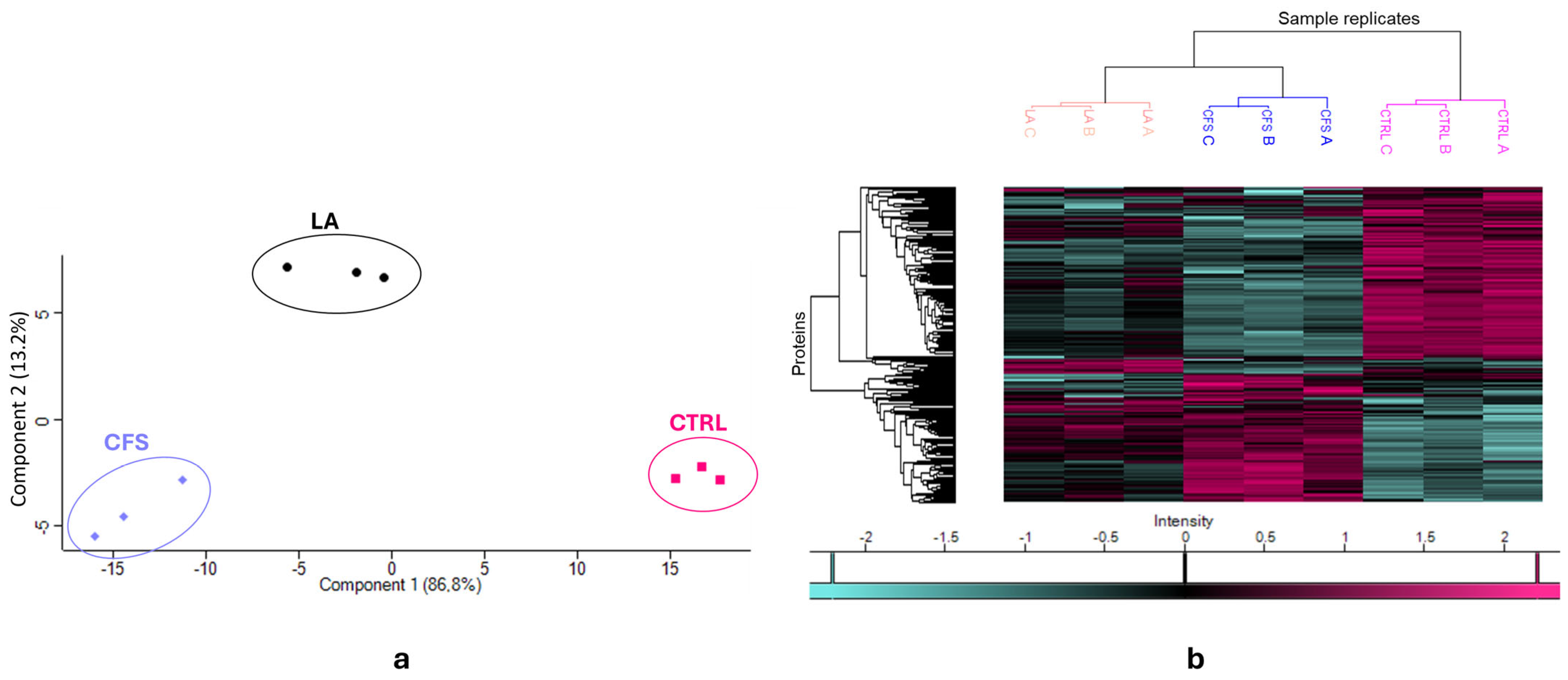
2.2.1. Proteomic Characterisation of S. aureus
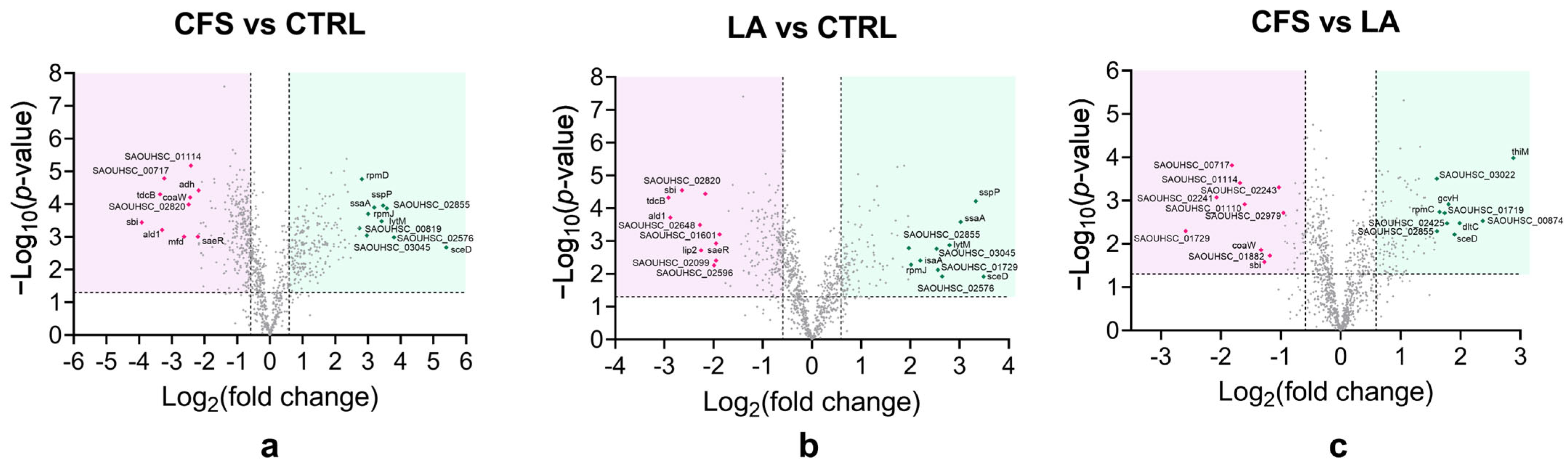
2.2.2. Differential Proteomic Analysis of S. aureus Following Exposure to CFS and LA
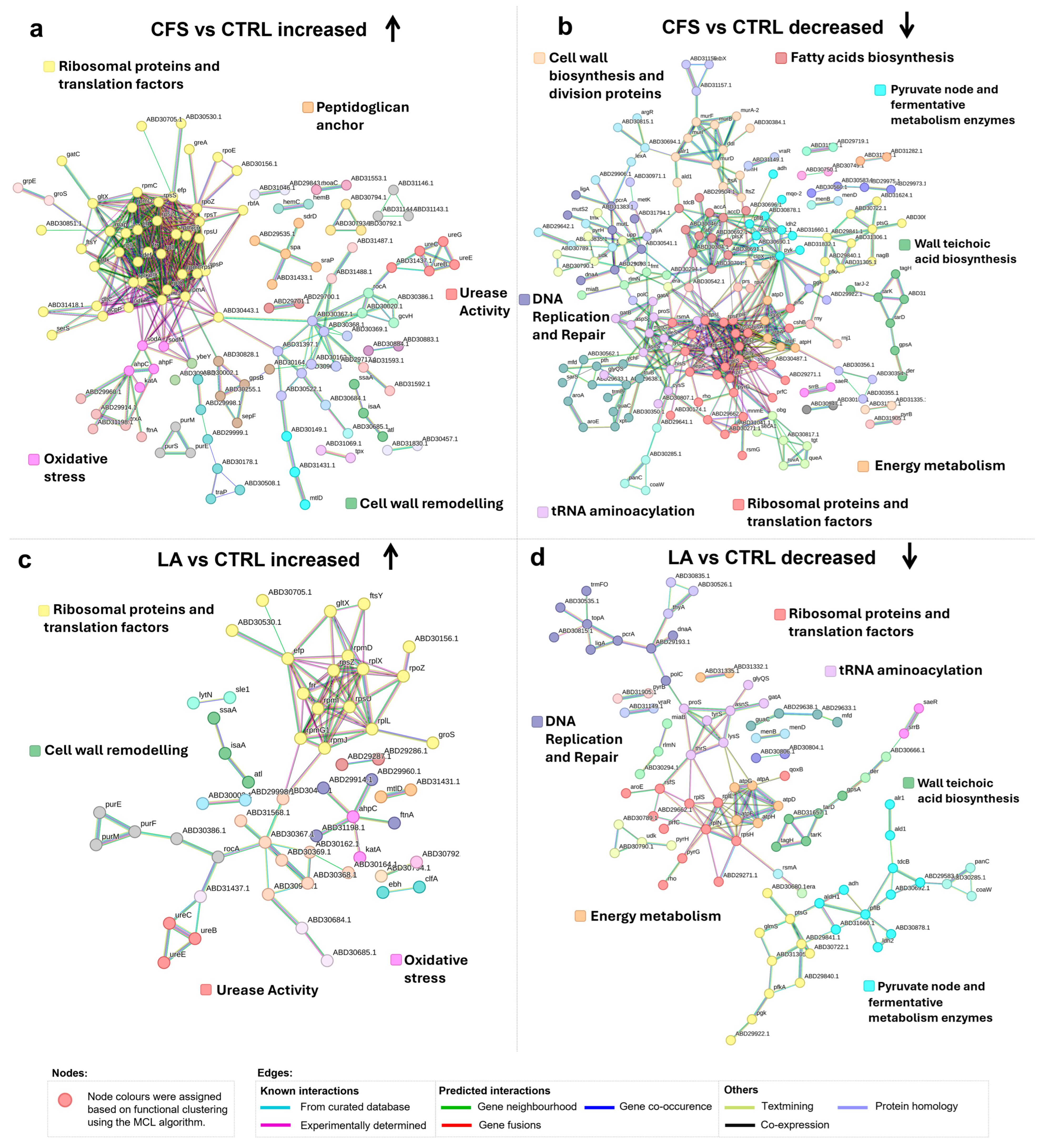
2.2.3. Protein Interaction Network on the Response of S. aureus to CFS and LA
3. Discussion
3.1. Proteomic Response of P. aeruginosa to CFS and LA
3.1.1. Upregulation of Denitrification, Aerobic Respiration and Citric Acid Cycle
3.1.2. pH Neutralisation via Urease and Arginine Deiminase in P. aeruginosa
3.1.3. Outer Cell Membrane Protection from Acidity
3.1.4. Virulence-Associated Pathways: Phenazine Biosynthesis, Quorum-Sensing and T3SS
3.1.5. Reduced Amino Acid Catabolism as Part of Carbon Source-Driven Metabolic Shifts
3.1.6. CFS and LA Comparison: P. aeruginosa
3.2. Proteomic Response of S. aureus to CFS and LA
3.2.1. pH Neutralisation via Urease in S. aureus
3.2.2. Oxidative Stress Response Under Acidic Conditions
3.2.3. Ribosomal Remodelling and Reduced DNA-Related Protein Abundance Suggest a Bacteriostatic-like Response
3.2.4. Cell Wall Remodelling and Virulence Factors
3.2.5. Reduced Fatty Acids Biosynthesis
3.2.6. Metabolic Remodelling
3.2.7. CFS and LA Comparison: S. aureus
- Metabolic Remodelling
- Autolysins and Cell Wall-Related Proteins
- Chaperonins and Protein Folding Stress
- Oxidative Stress and Translation
- Cell Wall Remodelling and Virulence Factors
3.3. Contextualisation, Limitations, and Clinical Implications
4. Materials and Methods
4.1. Bacterial Strain and Culture Conditions
4.2. Preparation of CFS and LA Solution
4.3. Extraction and Purification of Protein from P. aeruginosa or S. aureus Treated with CFS or LA
4.4. LFQ Analysis of P. aeruginosa and S. aureus Cell Lysates Treated with CFS: Preparation and Data Analysis
4.5. Data Availability
5. Conclusions
Supplementary Materials
Author Contributions
Funding
Institutional Review Board Statement
Informed Consent Statement
Data Availability Statement
Conflicts of Interest
Abbreviations
| ADI | Arginine deiminase pathway |
| ATCC | American Type Culture Collection |
| CAMPs | Cationic antimicrobial peptides |
| CCR | Carbon catabolite repression |
| CF | Cystic fibrosis |
| CFS | Cell-free supernatant |
| COX-2 | Cyclooxygenase-2 |
| CTRL | Control condition |
| DTT | Dithiothreitol |
| FASII | Fatty acid synthesis type II pathway |
| IL-6 | Interleukin-6 |
| iNOS | Inducible nitric oxide synthase |
| LA | Lactic acid |
| LFQ | Label-free quantitative |
| LPXTG | Leucine–proline–X–threonine–glycine motif |
| LPS | Lipopolysaccharide |
| MALDI-TOF | Matrix-Assisted Laser Desorption/Ionisation Time-of-Flight |
| MCL | Markov Cluster Algorithm |
| MIC | Minimum inhibitory concentration |
| mRNA | Messenger RNA |
| MRSA | Methicillin-resistant Staphylococcus aureus |
| MRSB | Man, Rogosa and Sharpe Broth |
| PBS | Phosphate-buffered saline |
| PCA | Principal component analysis |
| PMSF | Phenylmethylsulfonyl fluoride |
| QS | Quorum sensing |
| ROS | Reactive oxygen species |
| RPM | Revolutions per minute |
| SSDA | Statistically significant differentially abundant (proteins) |
| STRING | Search Tool for the Retrieval of Interacting Genes/Proteins |
| T3SS | Type III secretion system |
| TFA | Trifluoroacetic acid |
| TNF-α | tumour necrosis factor alpha |
| TSB | Tryptic Soy Broth |
| WHO | World Health Organisation |
| WTA | Wall teichoic acid |
References
- Naghavi, M.; Vollset, S.E.; Ikuta, K.S.; Swetschinski, L.R.; Gray, A.P.; Wool, E.E.; Aguilar, G.R.; Mestrovic, T.; Smith, G.; Han, C.; et al. Global burden of bacterial antimicrobial resistance 1990–2021: A systematic analysis with forecasts to 2050. Lancet 2024, 404, 1199–1226. [Google Scholar] [CrossRef] [PubMed]
- Sharma, A.; Tripathi, S.; Rani, K.; Vibhuti, A.; Pandey, R.P.; Raj, V.S. The antimicrobial spectrum to manage the co-infections of Pseudomonas aeruginosa and Staphylococcus aureus. Discov. Bact. 2025, 2, 18. [Google Scholar] [CrossRef]
- WHO. Bacterial Priority Pathogens List; WHO: Geneva, Switzerland, 2024. [Google Scholar]
- Doron, S.; Gorbach, S.L. Probiotics: Their role in the treatment and prevention of disease. Expert. Rev. Anti Infect. Ther. 2006, 4, 261–275. [Google Scholar] [CrossRef]
- Silva, D.R.; Sardi, J.D.C.O.; de Souza Pitangui, N.; Roque, S.M.; da Silva, A.C.B.; Rosalen, P.L. Probiotics as an alternative antimicrobial therapy: Current reality and future directions. J. Funct. Foods 2020, 73, 104080. [Google Scholar] [CrossRef]
- Teame, T.; Wang, A.; Xie, M.; Zhang, Z.; Yang, Y.; Ding, Q.; Gao, C.; Olsen, R.E.; Ran, C.; Zhou, Z. Paraprobiotics and Postbiotics of Probiotic Lactobacilli, Their Positive Effects on the Host and Action Mechanisms: A Review. Front. Nutr. 2020, 7, 570344. [Google Scholar] [CrossRef]
- Batoni, G.; Maisetta, G.; Kaya, E.; Esin, S. Lung-Directed Bacteriotherapy in Cystic Fibrosis: Could It Be an Option? Antibiotics 2022, 11, 326. [Google Scholar] [CrossRef]
- Aguilar-Toalá, J.E.; Arioli, S.; Behare, P.; Belzer, C.; Berni Canani, R.; Chatel, J.-M.; D’Auria, E.; de Freitas, M.Q.; Elinav, E.; Esmerino, E.A.; et al. Postbiotics—when simplification fails to clarify. Nat. Rev. Gastroenterol. Hepatol. 2021, 18, 825–826. [Google Scholar] [CrossRef]
- Liang, B.; Xing, D. The Current and Future Perspectives of Postbiotics. Probiotics Antimicro. Prot. 2023, 15, 1626–1643. [Google Scholar] [CrossRef]
- Kumar, A.; Green, K.M.; Rawat, M. A Comprehensive Overview of Postbiotics with a Special Focus on Discovery Techniques and Clinical Applications. Foods 2024, 13, 2937. [Google Scholar] [CrossRef]
- Lalezadeh, A.; Fadaee, M.; Saedi, S.; Nezhadi, J.; Ozma, M.A.; Ahmadi, S.; Mobaseri, M.; Kafil, H.S. A Critical Review on the Potential of Inactivated Bacteria in Counteracting Human Pathogens. Curr. Microbiol. 2025, 82, 295. [Google Scholar] [CrossRef]
- Abán, C.L.; Orosco, S.; Argañaraz Aybar, J.N.; Albarracín, L.; Venecia, A.; Perret, L.; Ortiz Mayor, S.; Nishiyama, K.; Valdéz, J.C.; Kitazawa, H.; et al. Effect of Lactiplantibacillus plantarum cell-free culture on bacterial pathogens isolated from cystic fibrosis patients: In vitro and in vivo studies. Front. Microbiol. 2024, 15, 1440090. [Google Scholar] [CrossRef]
- Fangous, M.S.; Alexandre, Y.; Hymery, N.; Gouriou, S.; Arzur, D.; Blay, G.L.; Berre, R.L. Lactobacilli intra-tracheal administration protects from Pseudomonas aeruginosa pulmonary infection in mice—A proof of concept. Benef. Microbes 2019, 10, 893–900. [Google Scholar] [CrossRef] [PubMed]
- Nicola, T.; Wenger, N.; Xu, X.; Evans, M.; Qiao, L.; Rezonzew, G.; Yang, Y.; Jilling, T.; Margaroli, C.; Genschmer, K.; et al. A lactobacilli-based inhaled live biotherapeutic product attenuates pulmonary neutrophilic inflammation. Nat. Commun. 2024, 15, 7113. [Google Scholar] [CrossRef] [PubMed]
- Glieca, S.; Quarta, E.; Bottari, B.; Bancalari, E.; Monica, S.; Scaltriti, E.; Tambassi, M.; Flammini, L.; Bertoni, S.; Bianchera, A.; et al. Development of inhalation powders containing lactic acid bacteria with antimicrobial activity against Pseudomonas aeruginosa. Int. J. Antimicrob. Agents 2024, 63, 107001. [Google Scholar] [CrossRef] [PubMed]
- Ren, S.; Yuan, X.; Liu, F.; Fang, F.; Iqbal, H.M.N.; Zahran, S.A.; Bilal, M. Bacteriocin from Lacticaseibacillus rhamnosus sp. A5: Isolation, Purification, Characterization, and Antibacterial Evaluation for Sustainable Food Processing. Sustainability 2022, 14, 9571. [Google Scholar] [CrossRef]
- Drumond, M.M.; Tapia-Costa, A.P.; Neumann, E.; Nunes, Á.C.; Barbosa, J.W.; Kassuha, D.E.; Mancha-Agresti, P. Cell-free supernatant of probiotic bacteria exerted antibiofilm and antibacterial activities against Pseudomonas aeruginosa: A novel biotic therapy. Front. Pharmacol. 2023, 14, 1152588. [Google Scholar] [CrossRef]
- Bianchi, M.; Kaya, E.; Logiudice, V.; Maisetta, G.; Curtis, A.; Kavanagh, K.; Batoni, G.; Esin, S. Biotherapeutic potential of different fractions of cell-free supernatants from Lacticaseibacillus rhamnosus against Pseudomonas aeruginosa. Front. Cell. Infect. Microbiol. 2025, 15, 1608897. [Google Scholar] [CrossRef]
- Benítez-Chao, D.F.; León-Buitimea, A.; Lerma-Escalera, J.A.; Morones-Ramírez, J.R. Bacteriocins: An Overview of Antimicrobial, Toxicity, and Biosafety Assessment by in vivo Models. Front. Microbiol. 2021, 12, 630695. [Google Scholar] [CrossRef]
- Angelin, J.; Kavitha, M. Exopolysaccharides from probiotic bacteria and their health potential. Int. J. Biol. Macromol. 2020, 162, 853–865. [Google Scholar] [CrossRef]
- Venkataraman, S.; Rajendran, D.S.; Vaidyanathan, V.K. An insight into the utilization of microbial biosurfactants pertaining to their industrial applications in the food sector. Food Sci. Biotechnol. 2024, 33, 245–273. [Google Scholar] [CrossRef]
- Nataraj, B.H.; Ramesh, C.; Mallappa, R.H. Characterization of biosurfactants derived from probiotic lactic acid bacteria against methicillin-resistant and sensitive Staphylococcus aureus isolates. LWT 2021, 151, 112195. [Google Scholar] [CrossRef]
- Capurso, L. Thirty Years of Lactobacillus rhamnosus GG: A Review. J. Clin. Gastroenterol. 2019, 53, S1. [Google Scholar] [CrossRef]
- Ceapa, C.; Davids, M.; Ritari, J.; Lambert, J.; Wels, M.; Douillard, F.P.; Smokvina, T.; de Vos, W.M.; Knol, J.; Kleerebezem, M. The Variable Regions of Lactobacillus rhamnosus Genomes Reveal the Dynamic Evolution of Metabolic and Host-Adaptation Repertoires. Genome Biol. Evol. 2016, 8, 1889–1905. [Google Scholar] [CrossRef] [PubMed]
- von Ossowski, I.; Reunanen, J.; Satokari, R.; Vesterlund, S.; Kankainen, M.; Huhtinen, H.; Tynkkynen, S.; Salminen, S.; de Vos, W.M.; Palva, A. Mucosal Adhesion Properties of the Probiotic Lactobacillus rhamnosus GG SpaCBA and SpaFED Pilin Subunits. Appl. Environ. Microbiol. 2010, 76, 2049–2057. [Google Scholar] [CrossRef] [PubMed]
- Liu, S.; Hu, P.; Du, X.; Zhou, T.; Pei, X. Lactobacillus rhamnosus GG supplementation for preventing respiratory infections in children: A Meta-analysis of Randomized, Placebo-controlled Trials. Indian. Pediatr. 2013, 50, 377–381. [Google Scholar] [CrossRef] [PubMed]
- Li, Y.-T.; Xu, H.; Ye, J.-Z.; Wu, W.-R.; Shi, D.; Fang, D.-Q.; Liu, Y.; Li, L.-J. Efficacy of Lactobacillus rhamnosus GG in treatment of acute pediatric diarrhea: A systematic review with meta-analysis. World J. Gastroenterol. 2019, 25, 4999–5016. [Google Scholar] [CrossRef]
- Kyser, A.J.; Mahmoud, M.Y.; Johnson, N.T.; Fotouh, B.; Steinbach-Rankins, J.M.; Gilbert, N.M.; Frieboes, H.B. Development and Characterization of Lactobacillus rhamnosus-Containing Bioprints for Application to Catheter-Associated Urinary Tract Infections. ACS Biomater. Sci. Eng. 2023, 9, 4277–4287. [Google Scholar] [CrossRef]
- Liu, Y.; Chen, Y.; Liao, H.; Sun, S.; Zhang, X.; Xie, L.; Liu, H. Research progress on the application of Lacticaseibacillus rhamnosus GG in pediatric respiratory diseases. Front. Nutr. 2025, 12, 1553674. [Google Scholar] [CrossRef]
- Westerik, N.; Kort, R.; Sybesma, W.; Reid, G. Lactobacillus rhamnosus Probiotic Food as a Tool for Empowerment Across the Value Chain in Africa. Front. Microbiol. 2018, 9, 1501. [Google Scholar] [CrossRef]
- Chae, S.A.; Ramakrishnan, S.R.; Kim, T.; Kim, S.-R.; Bang, W.Y.; Jeong, C.-R.; Yang, J.; Kim, S.-J. Anti-inflammatory and anti-pathogenic potential of Lacticaseibacillus rhamnosus IDCC 3201 isolated from feces of breast-fed infants. Microb. Pathog. 2022, 173, 105857. [Google Scholar] [CrossRef]
- Bianchi, M.; Esin, S.; Kaya, E.; Batoni, G.; Maisetta, G. Anti-Persisters Activity of Lacticaseibacillus rhamnosus Culture Filtrates against Pseudomonas aeruginosa in Artificial Sputum Medium. Int. J. Mol. Sci. 2024, 25, 7113. [Google Scholar] [CrossRef]
- Kaya, E.; Bianchi, M.; Maisetta, G.; Esin, S.; Batoni, G. Strong Activity and No Resistance Induction Exerted by Cell-Free Supernatants from Lacticaseibacillus rhamnosus against Mono-Species and Dual-Species Biofilms of Wound Pathogens in In Vivo-like Conditions. Int. J. Mol. Sci. 2024, 25, 2087. [Google Scholar] [CrossRef]
- Pompilio, A.; Kaya, E.; Lupetti, V.; Catelli, E.; Bianchi, M.; Maisetta, G.; Esin, S.; Di Bonaventura, G.; Batoni, G. Cell-free supernatants from Lactobacillus strains exert antibacterial, antibiofilm, and antivirulence activity against Pseudomonas aeruginosa from cystic fibrosis patients. Microbes Infect. 2024, 26, 105301. [Google Scholar] [CrossRef] [PubMed]
- Piras, A.M.; Bianchi, M.; Bona, N.D.; Grassiri, B.; Kaya, E.; Bertacca, A.; Migone, C.; Maisetta, G.; Esin, S.; Batoni, G. Activity in an air–liquid interface lung infection model, feasibility of inhaled delivery, and stability of cell-free supernatants from Lacticaseibacillus rhamnosus against Pseudomonas aeruginosa pulmonary infections. Front. Microbiol. 2025, 16, 1630017. [Google Scholar] [CrossRef] [PubMed]
- Cash, P. Proteomics of bacterial pathogens. Expert. Opin. Drug Discov. 2008, 3, 461–473. [Google Scholar] [CrossRef] [PubMed]
- Pérez-Llarena, F.J.; Bou, G. Proteomics as a Tool for Studying Bacterial Virulence and Antimicrobial Resistance. Front. Microbiol. 2016, 7, 410. [Google Scholar] [CrossRef]
- Hegde, P.S.; White, I.R.; Debouck, C. Interplay of transcriptomics and proteomics. Curr. Opin. Biotechnol. 2003, 14, 647–651. [Google Scholar] [CrossRef]
- McArdle, A.J.; Menikou, S. What is proteomics? Arch. Dis. Child. Educ. Pract. Ed. 2021, 106, 178–181. [Google Scholar] [CrossRef]
- Goodyear, M.C.; Seidel, L.; Krieger, J.R.; Geddes-McAlister, J.; Levesque, R.C.; Khursigara, C.M. Quantitative proteomics reveals unique responses to antimicrobial treatments in clinical Pseudomonas aeruginosa. mSystems 2023, 8, e0049123. [Google Scholar] [CrossRef]
- Liu, X.; Hu, Y.; Pai, P.-J.; Chen, D.; Lam, H. Label-Free Quantitative Proteomics Analysis of Antibiotic Response in Staphylococcus aureus to Oxacillin. J. Proteome Res. 2014, 13, 1223–1233. [Google Scholar] [CrossRef]
- Piatek, M.; O’Beirne, C.; Beato, Z.; Tacke, M.; Kavanagh, K. Pseudomonas aeruginosa and Staphylococcus aureus Display Differential Proteomic Responses to the Silver(I) Compound, SBC3. Antibiotics 2023, 12, 348. [Google Scholar] [CrossRef]
- Sung, K.; Park, M.; Chon, J.; Kweon, O.; Khan, S.A.; Shen, A.; Paredes, A. Concentration-Dependent Global Quantitative Proteome Response of Staphylococcus epidermidis RP62A Biofilms to Subinhibitory Tigecycline. Cells 2022, 11, 3488. [Google Scholar] [CrossRef]
- Trunk, K.; Benkert, B.; Quäck, N.; Münch, R.; Scheer, M.; Garbe, J.; Jänsch, L.; Trost, M.; Wehland, J.; Buer, J.; et al. Anaerobic adaptation in Pseudomonas aeruginosa: Definition of the Anr and Dnr regulons. Environ. Microbiol. 2010, 12, 1719–1733. [Google Scholar] [CrossRef] [PubMed]
- Arai, H. Regulation and Function of Versatile Aerobic and Anaerobic Respiratory Metabolism in Pseudomonas aeruginosa. Front. Microbiol. 2011, 2, 103. [Google Scholar] [CrossRef] [PubMed]
- Carey, C.J.; Duggan, N.; Drabinska, J.; McClean, S. Harnessing hypoxia: Bacterial adaptation and chronic infection in cystic fibrosis. FEMS Microbiol. Rev. 2025, 49, fuaf018. [Google Scholar] [CrossRef] [PubMed]
- Lund, P.; Tramonti, A.; De Biase, D. Coping with low pH: Molecular strategies in neutralophilic bacteria. FEMS Microbiol. Rev. 2014, 38, 1091–1125. [Google Scholar] [CrossRef]
- Cusumano, Z.T.; Caparon, M.G. Citrulline Protects Streptococcus pyogenes from Acid Stress Using the Arginine Deiminase Pathway and the F1Fo-ATPase. J. Bacteriol. 2015, 197, 1288–1296. [Google Scholar] [CrossRef]
- Zhou, C.; Fey, P.D. The acid response network of Staphylococcus aureus. Curr. Opin. Microbiol. 2020, 55, 67–73. [Google Scholar] [CrossRef]
- Lindgren, J.K.; Thomas, V.C.; Olson, M.E.; Chaudhari, S.S.; Nuxoll, A.S.; Schaeffer, C.R.; Lindgren, K.E.; Jones, J.; Zimmerman, M.C.; Dunman, P.M.; et al. Arginine Deiminase in Staphylococcus epidermidis Functions to Augment Biofilm Maturation through pH Homeostasis. J. Bacteriol. 2014, 196, 2277–2289. [Google Scholar] [CrossRef]
- Cheng, Q.; Han, Y.; Xiao, Y.; Li, Z.; Qin, A.; Ji, S.; Kan, B.; Liang, W. The ArgR-Regulated ADI Pathway Facilitates the Survival of Vibrio fluvialis under Acidic Conditions. Int. J. Mol. Sci. 2024, 25, 5679. [Google Scholar] [CrossRef]
- Xiong, L.; Teng, J.L.L.; Watt, R.M.; Liu, C.; Lau, S.K.P.; Woo, P.C.Y. Molecular characterization of arginine deiminase pathway in Laribacter hongkongensis and unique regulation of arginine catabolism and anabolism by multiple environmental stresses. Environ. Microbiol. 2015, 17, 4469–4483. [Google Scholar] [CrossRef] [PubMed]
- Mobley, H.L.; Island, M.D.; Hausinger, R.P. Molecular biology of microbial ureases. Microbiol. Rev. 1995, 59, 451–480. [Google Scholar] [CrossRef] [PubMed]
- Zambelli, B.; Musiani, F.; Benini, S.; Ciurli, S. Chemistry of Ni2+ in Urease: Sensing, Trafficking, and Catalysis. Acc. Chem. Res. 2011, 44, 520–530. [Google Scholar] [CrossRef] [PubMed]
- Xiong, L.; Teng, J.L.; Watt, R.M.; Kan, B.; Lau, S.K.; Woo, P.C. Arginine deiminase pathway is far more important than urease for acid resistance and intracellular survival in Laribacter hongkongensis: A possible result of arc gene cassette duplication. BMC Microbiol. 2014, 14, 42. [Google Scholar] [CrossRef]
- Marshall, B.J.; Barrett, L.J.; Prakash, C.; McCallum, R.W.; Guerrant, R.L. Urea protects Helicobacter (Campylobacter) pylori from the bactericidal effect of acid. Gastroenterology 1990, 99, 697–702. [Google Scholar] [CrossRef]
- Mozaheb, N.; Rasouli, P.; Kaur, M.; Van Der Smissen, P.; Larrouy-Maumus, G.; Mingeot-Leclercq, M.-P. A Mildly Acidic Environment Alters Pseudomonas aeruginosa Virulence and Causes Remodeling of the Bacterial Surface. Microbiol. Spectr. 2023, 11, e04832-22. [Google Scholar] [CrossRef]
- Silver, S.; Wendt, L.; Bhattacharyya, P.; Beauchamp, R.S. Effects of Polyamines on Membrane Permeability. Ann. N. Y. Acad. Sci. 1970, 171, 838–862. [Google Scholar] [CrossRef]
- Li, J.; Beuerman, R.; Verma, C.S. Mechanism of polyamine induced colistin resistance through electrostatic networks on bacterial outer membranes. Biochim. Biophys. Acta Biomembr. 2020, 1862, 183297. [Google Scholar] [CrossRef]
- Bang, M.; Yong, C.-C.; Ko, H.-J.; Choi, I.-G.; Oh, S. Transcriptional Response and Enhanced Intestinal Adhesion Ability of Lactobacillus rhamnosus GG after Acid Stress. J. Microbiol. Biotechnol. 2018, 28, 1604–1613. [Google Scholar] [CrossRef]
- Tollman, H. Investigation of the Regulation of Expression of E. coli Common Pilus Subunit, ECPA, of Enterohaemorrhagic E. coli 0157:H7 Under Acid Stress. Ph.D. Thesis, Toronto Metropolitan University, Toronto, ON, Canada, 2021. [Google Scholar]
- Bertrand, J.J.; West, J.T.; Engel, J.N. Genetic Analysis of the Regulation of Type IV Pilus Function by the Chp Chemosensory System of Pseudomonas aeruginosa. J. Bacteriol. 2010, 192, 994–1010. [Google Scholar] [CrossRef]
- Tammam, S.; Sampaleanu, L.M.; Koo, J.; Manoharan, K.; Daubaras, M.; Burrows, L.L.; Howell, P.L. PilMNOPQ from the Pseudomonas aeruginosa Type IV Pilus System Form a Transenvelope Protein Interaction Network That Interacts with PilA. J. Bacteriol. 2013, 195, 2126–2135. [Google Scholar] [CrossRef] [PubMed]
- Duan, K.; Surette, M.G. Environmental Regulation of Pseudomonas aeruginosa PAO1 Las and Rhl Quorum-Sensing Systems. J. Bacteriol. 2007, 189, 4827–4836. [Google Scholar] [CrossRef] [PubMed]
- Kiymaci, M.E.; Altanlar, N.; Gumustas, M.; Ozkan, S.A.; Akin, A. Quorum sensing signals and related virulence inhibition of Pseudomonas aeruginosa by a potential probiotic strain’s organic acid. Microb. Pathog. 2018, 121, 190–197. [Google Scholar] [CrossRef] [PubMed]
- Sonbol, F.I.; El-Banna, T.E.-S.; Ghazy, A.M.; Al-Madboly, L.A. Inhibition of Quorum Sensing Genes Involved in Biofilm Formation and Other Virulence Factors is a Promising Approach in Combating the Pathogenicity of Pseudomonas aeruginosa. Int. J. Curr. Microbiol. App. Sci. 2022, 11, 51–59. [Google Scholar] [CrossRef]
- Yang, Y.; Pan, D.; Tang, Y.; Li, J.; Zhu, K.; Yu, Z.; Zhu, L.; Wang, Y.; Chen, P.; Li, C. H3-T6SS of Pseudomonas aeruginosa PA14 contributes to environmental adaptation via secretion of a biofilm-promoting effector. Stress. Biol. 2022, 2, 55. [Google Scholar] [CrossRef]
- Ermoli, F.; Malengo, G.; Spahn, C.; Glatter, T.; Diepold, A. Yersinia Actively Downregulates Type III Secretion and Adhesion at Higher Cell Densities. PLoS Pathog. 2025, 21, e1013423. [Google Scholar] [CrossRef]
- Rojo, F. Carbon catabolite repression in Pseudomonas: Optimizing metabolic versatility and interactions with the environment. FEMS Microbiol. Rev. 2010, 34, 658–684. [Google Scholar] [CrossRef]
- Yung, Y.P.; McGill, S.L.; Chen, H.; Park, H.; Carlson, R.P.; Hanley, L. Reverse diauxie phenotype in Pseudomonas aeruginosa biofilm revealed by exometabolomics and label-free proteomics. npj Biofilms Microbiomes 2019, 5, 31. [Google Scholar] [CrossRef]
- Florek, L.C.; Lin, X.; Lin, Y.-C.; Lin, M.-H.; Chakraborty, A.; Price-Whelan, A.; Tong, L.; Rahme, L.G.; Dietrich, L. The L-lactate dehydrogenases of Pseudomonas aeruginosa are conditionally regulated but both contribute to survival during macrophage infection. mBio 2024, 15, e00852-24. [Google Scholar] [CrossRef]
- Hasegawa, N.; Arai, H.; Igarashi, Y. Two c-Type Cytochromes, NirM and NirC, Encoded in the nir Gene Cluster of Pseudomonas aeruginosa Act as Electron Donors for Nitrite Reductase. Biochem. Biophys. Res. Commun. 2001, 288, 1223–1230. [Google Scholar] [CrossRef]
- Barken, K.B.; Pamp, S.J.; Yang, L.; Gjermansen, M.; Bertrand, J.J.; Klausen, M.; Givskov, M.; Whitchurch, C.B.; Engel, J.N.; Tolker-Nielsen, T. Roles of type IV pili, flagellum-mediated motility and extracellular DNA in the formation of mature multicellular structures in Pseudomonas aeruginosa biofilms. Environ. Microbiol. 2008, 10, 2331–2343. [Google Scholar] [CrossRef]
- Giltner, C.L.; Van Schaik, E.J.; Audette, G.F.; Kao, D.; Hodges, R.S.; Hassett, D.J.; Irvin, R.T. The Pseudomonas aeruginosa type IV pilin receptor binding domain functions as an adhesin for both biotic and abiotic surfaces. Mol. Microbiol. 2006, 59, 1083–1096. [Google Scholar] [CrossRef] [PubMed]
- Nguyen, Y.; Sugiman-Marangos, S.; Harvey, H.; Bell, S.D.; Charlton, C.L.; Junop, M.S.; Burrows, L.L. Pseudomonas aeruginosa Minor Pilins Prime Type IVa Pilus Assembly and Promote Surface Display of the PilY1 Adhesin *. J. Biol. Chem. 2015, 290, 601–611. [Google Scholar] [CrossRef] [PubMed]
- Bore, E.; Langsrud, S.; Langsrud, Ø.; Rode, T.M.; Holck, A. Acid-shock responses in Staphylococcus aureus investigated by global gene expression analysis. Microbiology 2007, 153, 2289–2303. [Google Scholar] [CrossRef] [PubMed]
- Bruno-Bárcena, J.M.; Azcárate-Peril, M.A.; Hassan, H.M. Role of Antioxidant Enzymes in Bacterial Resistance to Organic Acids. Appl. Environ. Microbiol. 2010, 76, 2747–2753. [Google Scholar] [CrossRef]
- Garcia, Y.M.; Barwinska-Sendra, A.; Tarrant, E.; Skaar, E.P.; Waldron, K.J.; Kehl-Fie, T.E. A Superoxide Dismutase Capable of Functioning with Iron or Manganese Promotes the Resistance of Staphylococcus aureus to Calprotectin and Nutritional Immunity. PLoS Pathog. 2017, 13, e1006125. [Google Scholar] [CrossRef]
- Horsburgh, M.J.; Clements, M.O.; Crossley, H.; Ingham, E.; Foster, S.J. PerR Controls Oxidative Stress Resistance and Iron Storage Proteins and Is Required for Virulence in Staphylococcus aureus. Infect. Immun. 2001, 69, 3744–3754. [Google Scholar] [CrossRef]
- Cosgrove, K.; Coutts, G.; Jonsson, I.-M.; Tarkowski, A.; Kokai-Kun, J.F.; Mond, J.J.; Foster, S.J. Catalase (KatA) and Alkyl Hydroperoxide Reductase (AhpC) Have Compensatory Roles in Peroxide Stress Resistance and Are Required for Survival, Persistence, and Nasal Colonization in Staphylococcus aureus. J. Bacteriol. 2007, 189, 1025–1035. [Google Scholar] [CrossRef]
- Peng, H.; Zhou, G.; Yang, X.-M.; Chen, G.-J.; Chen, H.-B.; Liao, Z.-L.; Zhong, Q.-P.; Wang, L.; Fang, X.; Wang, J. Transcriptomic Analysis Revealed Antimicrobial Mechanisms of Lactobacillus rhamnosus SCB0119 against Escherichia coli and Staphylococcus aureus. Int. J. Mol. Sci. 2022, 23, 15159. [Google Scholar] [CrossRef]
- Mao, Y.; Wang, Y.; Luo, X.; Chen, X.; Wang, G. Impact of cell-free supernatant of lactic acid bacteria on Staphylococcus aureus biofilm and its metabolites. Front. Vet. Sci. 2023, 10, 1184989. [Google Scholar] [CrossRef]
- Biswas, R.; Voggu, L.; Simon, U.K.; Hentschel, P.; Thumm, G.; Götz, F. Activity of the major staphylococcal autolysin Atl. FEMS Microbiol. Lett. 2006, 259, 260–268. [Google Scholar] [CrossRef] [PubMed]
- Stapleton, M.R.; Horsburgh, M.J.; Hayhurst, E.J.; Wright, L.; Jonsson, I.-M.; Tarkowski, A.; Kokai-Kun, J.F.; Mond, J.J.; Foster, S.J. Characterization of IsaA and SceD, Two Putative Lytic Transglycosylases of Staphylococcus aureus. J. Bacteriol. 2007, 189, 7316–7325. [Google Scholar] [CrossRef] [PubMed]
- Tiwari, K.; Gatto, C.; Walker, S.; Wilkinson, B. Exposure of Staphylococcus aureus to Targocil Blocks Translocation of the Major Autolysin Atl across the Membrane, Resulting in a Significant Decrease in Autolysis. Antimicrob. Agents Chemother. 2018, 62, 1–10. [Google Scholar] [CrossRef] [PubMed]
- Buchad, H.; Nair, M. The small RNA SprX regulates the autolysin regulator WalR in Staphylococcus aureus. Microbiol. Res. 2021, 250, 126785. [Google Scholar] [CrossRef]
- Ton-That, H.; Mazmanian, S.K.; Faull, K.F.; Schneewind, O. Anchoring of Surface Proteins to the Cell Wall of Staphylococcus aureus: Sortase Catalyzed in vitro Transpeptidation Reaction Using lpxtg Peptide and nh2-gly3substrates *. J. Biol. Chem. 2000, 275, 9876–9881. [Google Scholar] [CrossRef]
- Stelzner, K.; Boyny, A.; Hertlein, T.; Sroka, A.; Moldovan, A.; Paprotka, K.; Kessie, D.; Mehling, H.; Potempa, J.; Ohlsen, K.; et al. Intracellular Staphylococcus Aureus Employs the Cysteine Protease Staphopain A to Induce Host Cell Death in Epithelial Cells. PLoS Pathog. 2021, 17, e1009874. [Google Scholar] [CrossRef]
- Jenul, C.; Horswill, A.R. Regulation of Staphylococcus aureus Virulence. Microbiol. Spectr. 2019, 7. [Google Scholar] [CrossRef]
- Nygaard, T.K.; Pallister, K.B.; Ruzevich, P.; Griffith, S.; Vuong, C.; Voyich, J.M. SaeR binds a consensus sequence within virulence gene promoters to advance USA300 pathogenesis. J. Infect. Dis. 2010, 201, 241–254. [Google Scholar] [CrossRef]
- Weinrick, B.; Dunman, P.M.; McAleese, F.; Murphy, E.; Projan, S.J.; Fang, Y.; Novick, R.P. Effect of Mild Acid on Gene Expression in Staphylococcus aureus. J. Bacteriol. 2004, 186, 8407–8423. [Google Scholar] [CrossRef]
- Smith, E.J.; Visai, L.; Kerrigan, S.W.; Speziale, P.; Foster, T.J. The Sbi Protein Is a Multifunctional Immune Evasion Factor of Staphylococcus aureus. Infect. Immun. 2011, 79, 3801–3809. [Google Scholar] [CrossRef]
- Heath, R.J.; Rock, C.O. Fatty acid biosynthesis as a target for novel antibacterials. Curr. Opin. Investig. Drugs 2004, 5, 146–153. [Google Scholar] [PubMed]
- Christmas, B.A.F.; Rolfe, M.; Rose, M.; Green, J. Staphylococcus aureus adaptation to aerobic low-redox-potential environments: Implications for an intracellular lifestyle. Microbiology 2019, 165, 779–791. [Google Scholar] [CrossRef] [PubMed]
- Halsey, C.R.; Lei, S.; Wax, J.K.; Lehman, M.K.; Nuxoll, A.S.; Steinke, L.; Sadykov, M.; Powers, R.; Fey, P.D. Amino Acid Catabolism in Staphylococcus aureus and the Function of Carbon Catabolite Repression. mBio 2017, 8, e01434-16. [Google Scholar] [CrossRef] [PubMed]
- Troitzsch, A.; Loi, V.V.; Methling, K.; Zühlke, D.; Lalk, M.; Riedel, K.; Bernhardt, J.; Elsayed, E.M.; Bange, G.; Antelmann, H.; et al. Carbon Source-Dependent Reprogramming of Anaerobic Metabolism in Staphylococcus aureus. J. Bacteriol. 2021, 203. [Google Scholar] [CrossRef]
- Prasad, U.V.; Swarupa, V.; Yeswanth, S.; Kumar, P.S.; Kumar, E.S.; Reddy, K.M.K.; Kumar, Y.N.; Rani, V.J.; Chaudhary, A.; Sarma, P.V.G.K. Structural and Functional analysis of Staphylococcus aureus NADP-dependent IDH and its comparison with Bacterial and Human NADPdependent IDH. Bioinformation 2014, 10, 81–86. [Google Scholar] [CrossRef][Green Version]
- Leonardi, R.; Chohnan, S.; Zhang, Y.-M.; Virga, K.G.; Lee, R.E.; Rock, C.O.; Jackowski, S. A Pantothenate Kinase from Staphylococcus aureus Refractory to Feedback Regulation by Coenzyme A *. J. Biol. Chem. 2005, 280, 3314–3322. [Google Scholar] [CrossRef]
- Crooke, A.K.; Fuller, J.R.; Obrist, M.W.; Tomkovich, S.E.; Vitko, N.P.; Richardson, A.R. CcpA-Independent Glucose Regulation of Lactate Dehydrogenase 1 in Staphylococcus aureus. PLoS ONE 2013, 8, e54293. [Google Scholar] [CrossRef]
- Zhang, K.; Yang, X.; Yang, J.; Qiao, X.; Li, F.; Liu, X.; Wei, J.; Wang, L. Alcohol dehydrogenase modulates quorum sensing in biofilm formations of Acinetobacter baumannii. Microb. Pathog. 2020, 148, 104451. [Google Scholar] [CrossRef]
- Chapot-Chartier, M.-P.; Kulakauskas, S. Cell wall structure and function in lactic acid bacteria. Microb. Cell Fact. 2014, 13, S9. [Google Scholar] [CrossRef]
- Vermassen, A.; Leroy, S.; Talon, R.; Provot, C.; Popowska, M.; Desvaux, M. Cell Wall Hydrolases in Bacteria: Insight on the Diversity of Cell Wall Amidases, Glycosidases and Peptidases Toward Peptidoglycan. Front. Microbiol. 2019, 10, 331. [Google Scholar] [CrossRef]
- Drebes, J.; Künz, M.; Windshügel, B.; Kikhney, A.G.; Müller, I.B.; Eberle, R.J.; Oberthür, D.; Cang, H.; Svergun, D.I.; Perbandt, M.; et al. Structure of ThiM from Vitamin B1 biosynthetic pathway of Staphylococcus aureus—Insights into a novel pro-drug approach addressing MRSA infections. Sci. Rep. 2016, 6, 22871. [Google Scholar] [CrossRef] [PubMed]
- Laczkovich, I.; Teoh, W.P.; Flury, S.; Grayczyk, J.P.; Zorzoli, A.; Alonzo, F., III. Increased flexibility in the use of exogenous lipoic acid by Staphylococcus aureus. Mol. Microbiol. 2018, 109, 150–168. [Google Scholar] [CrossRef] [PubMed]
- Liberini, E.; Fan, S.-H.; Bayer, A.S.; Beck, C.; Biboy, J.; François, P.; Gray, J.; Hipp, K.; Koch, I.; Peschel, A.; et al. Staphylococcus aureus Stress Response to Bicarbonate Depletion. Int. J. Mol. Sci. 2024, 25, 9251. [Google Scholar] [CrossRef] [PubMed]
- Koprivnjak, T.; Peschel, A.; Gelb, M.H.; Liang, N.S.; Weiss, J.P. Role of Charge Properties of Bacterial Envelope in Bactericidal Action of Human Group IIA Phospholipase A2 against Staphylococcus aureus. J. Biol. Chem. 2002, 277, 47636–47644. [Google Scholar] [CrossRef]
- Kristian, S.A.; Datta, V.; Weidenmaier, C.; Kansal, R.; Fedtke, I.; Peschel, A.; Gallo, R.L.; Nizet, V. D-Alanylation of Teichoic Acids Promotes Group A Streptococcus Antimicrobial Peptide Resistance, Neutrophil Survival, and Epithelial Cell Invasion. J. Bacteriol. 2005, 187, 6719–6725. [Google Scholar] [CrossRef]
- Peschel, A.; Jack, R.W.; Otto, M.; Collins, L.V.; Staubitz, P.; Nicholson, G.; Kalbacher, H.; Nieuwenhuizen, W.F.; Jung, G.; Tarkowski, A.; et al. Staphylococcus aureus Resistance to Human Defensins and Evasion of Neutrophil Killing via the Novel Virulence Factor Mprf Is Based on Modification of Membrane Lipids with l-Lysine. J. Exp. Med. 2001, 193, 1067–1076. [Google Scholar] [CrossRef]
- Kraus, D.; Herbert, S.; Kristian, S.A.; Khosravi, A.; Nizet, V.; Götz, F.; Peschel, A. The GraRS regulatory system controls Staphylococcus aureus susceptibility to antimicrobial host defenses. BMC Microbiol. 2008, 8, 85. [Google Scholar] [CrossRef]
- Voth, W.; Jakob, U. Stress-Activated Chaperones: A First Line of Defense. Trends Biochem. Sci. 2017, 42, 899–913. [Google Scholar] [CrossRef]
- Mehboudi, N.; Rahimi, H.R.; Bakhtiari, H.A.; Alimardani, M.; Jalili, A. The impact of probiotic cell-free metabolites in MDR Pseudomonas aeruginosa: Antibacterial properties and effect on antibiotic resistance genes expression. Lett. Appl. Microbiol. 2023, 76, ovad111. [Google Scholar] [CrossRef]
- Myo, N.Z.; Kamwa, R.; Jamnong, T.; Swasdipisal, B.; Somrak, P.; Rattanamalakorn, P.; Neatsawang, V.; Apiwatsiri, P.; Yata, T.; Hampson, D.J.; et al. Metabolomic profiling and antibacterial efficacy of probiotic-derived cell-free supernatant encapsulated in nanostructured lipid carriers against canine multidrug-resistant bacteria. Front. Vet. Sci. 2025, 11, 1525897. [Google Scholar] [CrossRef]
- Díaz, M.A.; González, S.N.; Alberto, M.R.; Arena, M.E. Human probiotic bacteria attenuate Pseudomonas aeruginosa biofilm and virulence by quorum-sensing inhibition. Biofouling 2020, 36, 597–609. [Google Scholar] [CrossRef] [PubMed]
- Zmora, N.; Zilberman-Schapira, G.; Suez, J.; Mor, U.; Dori-Bachash, M.; Bashiardes, S.; Kotler, E.; Zur, M.; Regev-Lehavi, D.; Brik, R.B.-Z.; et al. Personalized Gut Mucosal Colonization Resistance to Empiric Probiotics Is Associated with Unique Host and Microbiome Features. Cell 2018, 174, 1388–1405.e21. [Google Scholar] [CrossRef] [PubMed]
- Lan, J.; Wu, S.; Li, H.; Wang, J.; Li, M. Postbiotics in Respiratory Health: Functional Components, Innovative Application, and Emerging Challenges. J. Nutr. 2025, 155, 3676–3692. [Google Scholar] [CrossRef] [PubMed]
- Margalit, A.; Sheehan, D.; Carolan, J.C.; Kavanagh, K. Exposure to the Pseudomonas aeruginosa secretome alters the proteome and secondary metabolite production of Aspergillus fumigatus. Microbiology 2022, 168, 001164. [Google Scholar] [CrossRef]
- The UniProt Consortium. UniProt: The Universal Protein Knowledgebase in 2025. Nucleic Acids Res. 2025, 53, D609–D617. [CrossRef]
- Tyanova, S.; Temu, T.; Sinitcyn, P.; Carlson, A.; Hein, M.Y.; Geiger, T.; Mann, M.; Cox, J. The Perseus computational platform for comprehensive analysis of (prote)omics data. Nat. Methods 2016, 13, 731–740. [Google Scholar] [CrossRef]
- Côté, R.G.; Griss, J.; Dianes, J.A.; Wang, R.; Wright, J.C.; van den Toorn, H.W.P.; van Breukelen, B.; Heck, A.J.R.; Hulstaert, N.; Martens, L.; et al. The PRoteomics IDEntification (PRIDE) Converter 2 Framework: An Improved Suite of Tools to Facilitate Data Submission to the PRIDE Database and the ProteomeXchange Consortium*. Mol. Cell. Proteom. 2012, 11, 1682–1689. [Google Scholar] [CrossRef]



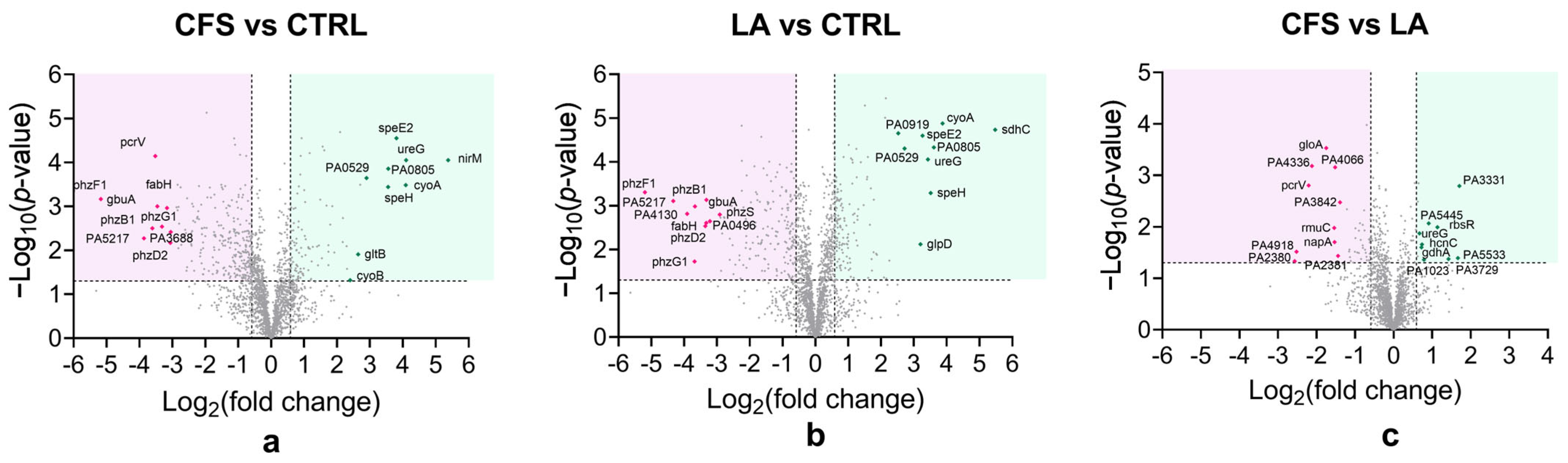
| Gene Names | Protein IDs | Protein Names | −Log10 (p-Value) | Log2 (Fold Change) |
|---|---|---|---|---|
| nirM | P00099 | Cytochrome c-551 (Cytochrome C8) | 4.05 | 5.38 |
| ureG | Q9HUS0 | Urease accessory protein UreG | 4.05 | 4.10 |
| cyoA | Q9I427 | Cytochrome bo(3) ubiquinol oxidase subunit 2 | 3.48 | 4.09 |
| speE2 | Q9HV34 | Polyamine aminopropyltransferase 2/Spermidine synthase 2 (PAPT 2/SPDS 2) | 4.55 | 3.81 |
| PA0805 | Q9I5D3 | DUF3509 domain-containing protein | 3.85 | 3.56 |
| speH | Q9HV35 | S-adenosylmethionine decarboxylase proenzyme (AdoMetDC) (SAMDC) | 3.44 | 3.55 |
| PA0529 | Q9I607 | MOSC domain-containing protein | 3.64 | 2.90 |
| PA0531 | Q9I605 | Probable glutamine amidotransferase | 3.49 | 2.70 |
| gltB | Q9HUD5 | Glutamate synthase large chain | 1.91 | 2.64 |
| cyoB | Q9I426 | Cytochrome bo(3) ubiquinol oxidase subunit 1 | 1.32 | 2.40 |
| PA3688 | Q9HXV2 | Pilin assembly protein | 2.42 | −3.05 |
| phzD2 phzD | P0DPC1 | Phenazine biosynthesis protein PhzD2 (Isochorismatase) | 2.17 | −3.06 |
| fabH | Q9HYR2 | Beta-ketoacyl-[acyl-carrier-protein] synthase III | 2.96 | −3.16 |
| phzG1 | G3XCV4 | Probable pyridoxamine 5′-phosphate oxidase | 2.54 | −3.31 |
| gbuA | Q9I3S3 | Guanidinobutyrase | 2.10 | −3.46 |
| pcrV P | G3XD49 | Type III secretion protein PcrV | 4.14 | −3.52 |
| phzB1 | O69753 | Phenazine biosynthesis protein PhzB1 | 2.50 | −3.61 |
| PA5217 | Q9HTX3 | Probable binding protein component of ABC iron transporter PA5217 | 2.27 | −3.86 |
| phzF1/phzF2 | O69754 | Phenazine/pyocyanine biosynthesis protein PhzF | 3.16 | −5.17 |
| Gene Names | Protein IDs | Protein Names | −Log10 (p-Value) | Log2 (Fold Change) |
|---|---|---|---|---|
| sceD | Q2FWF8 | Probable transglycosylase SceD | 2.68 | 5.39 |
| SAOUHSC_02576 | Q2G1W1 | - | 2.99 | 3.80 |
| SAOUHSC_02855 | Q2FV81 | - | 3.87 | 3.58 |
| sspP | Q2G2R8 | Staphopain A | 3.96 | 3.46 |
| lytM | O33599 | Glycyl-glycine endopeptidase LytM | 3.47 | 3.41 |
| ssaA | Q2FV55 | Staphylococcal secretory antigen SsaA | 3.90 | 3.19 |
| rpmJ | Q2FW29 | 50S ribosomal protein L36 | 3.70 | 3.00 |
| SAOUHSC_03045 | Q2FUQ9 | - | 3.04 | 2.96 |
| rpmD | P0A0G2 | 50S ribosomal protein L30 | 4.76 | 2.81 |
| SAOUHSC_00819 | Q2G009 | - | 3.27 | 2.74 |
| adh | Q2G0G1 | Alcohol dehydrogenase | 4.42 | −2.18 |
| saeR | Q2G2G2 | Response regulator SaeR | 3.00 | −2.21 |
| SAOUHSC_01114 | Q2FZB8 | - | 5.18 | −2.42 |
| coaW | Q2FWC7 | Type II pantothenate kinase | 4.21 | −2.44 |
| SAOUHSC_02820 | Q2FVB4 | - | 3.99 | −2.49 |
| mfd | Q2G0R8 | Transcription-repair-coupling factor | 3.01 | −2.62 |
| SAOUHSC_00717 | Q2G2G0 | - | 4.78 | −3.23 |
| ald1 | Q2FYJ2 | Alanine dehydrogenase 1 | 3.21 | −3.30 |
| tdcB | Q2FYJ3 | L-threonine dehydratase catabolic TdcB | 4.30 | −3.36 |
| sbi | Q2FVK5 | Immunoglobulin-binding protein Sbi | 3.44 | −3.92 |
Disclaimer/Publisher’s Note: The statements, opinions and data contained in all publications are solely those of the individual author(s) and contributor(s) and not of MDPI and/or the editor(s). MDPI and/or the editor(s) disclaim responsibility for any injury to people or property resulting from any ideas, methods, instructions or products referred to in the content. |
© 2025 by the authors. Licensee MDPI, Basel, Switzerland. This article is an open access article distributed under the terms and conditions of the Creative Commons Attribution (CC BY) license (https://creativecommons.org/licenses/by/4.0/).
Share and Cite
Bianchi, M.; Maisetta, G.; Esin, S.; Batoni, G.; Kavanagh, K. Proteomic Analysis of the Differential Response of Pseudomonas aeruginosa and Staphylococcus aureus to Lacticaseibacillus rhamnosus Cell-Free Supernatant and Lactic Acid. Antibiotics 2025, 14, 1271. https://doi.org/10.3390/antibiotics14121271
Bianchi M, Maisetta G, Esin S, Batoni G, Kavanagh K. Proteomic Analysis of the Differential Response of Pseudomonas aeruginosa and Staphylococcus aureus to Lacticaseibacillus rhamnosus Cell-Free Supernatant and Lactic Acid. Antibiotics. 2025; 14(12):1271. https://doi.org/10.3390/antibiotics14121271
Chicago/Turabian StyleBianchi, Marta, Giuseppantonio Maisetta, Semih Esin, Giovanna Batoni, and Kevin Kavanagh. 2025. "Proteomic Analysis of the Differential Response of Pseudomonas aeruginosa and Staphylococcus aureus to Lacticaseibacillus rhamnosus Cell-Free Supernatant and Lactic Acid" Antibiotics 14, no. 12: 1271. https://doi.org/10.3390/antibiotics14121271
APA StyleBianchi, M., Maisetta, G., Esin, S., Batoni, G., & Kavanagh, K. (2025). Proteomic Analysis of the Differential Response of Pseudomonas aeruginosa and Staphylococcus aureus to Lacticaseibacillus rhamnosus Cell-Free Supernatant and Lactic Acid. Antibiotics, 14(12), 1271. https://doi.org/10.3390/antibiotics14121271