You are currently viewing a new version of our website. To view the old version click .
Biosensors
  • Review
  • Open Access

21 February 2024

Miniaturized Biosensors Based on Lanthanide-Doped Upconversion Polymeric Nanofibers


and
1
Department of Chemistry, Sunandan Divatia School of Science, SVKM’s NMIMS (Deemed to be) University, V.L. Mehta Road, Vile Parle (West), Mumbai 400056, India
2
Hanse-Wissenschaftskolleg—Institute for Advanced Study (HWK), Lehmkuhlenbusch 4, 27753 Delmenhorst, Germany
*
Author to whom correspondence should be addressed.
This article belongs to the Special Issue Biosensors Aiming for Practical Uses

Abstract

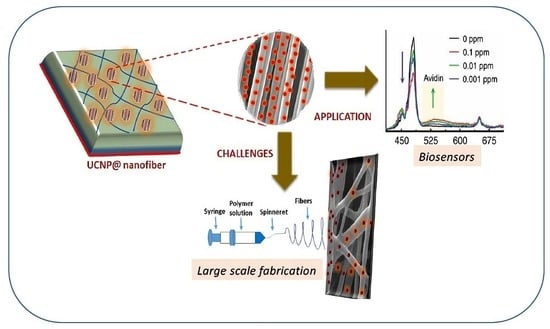
Electrospun nanofibers possess a large surface area and a three-dimensional porous network that makes them a perfect material for embedding functional nanoparticles for diverse applications. Herein, we report the trends in embedding upconversion nanoparticles (UCNPs) in polymeric nanofibers for making an advanced miniaturized (bio)analytical device. UCNPs have the benefits of several optical properties, like near-infrared excitation, anti-Stokes emission over a wide range from UV to NIR, narrow emission bands, an extended lifespan, and photostability. The luminescence of UCNPs can be regulated using different lanthanide elements and can be used for sensing and tracking physical processes in biological systems. We foresee that a UCNP-based nanofiber sensing platform will open opportunities in developing cost-effective, miniaturized, portable and user-friendly point-of-care sensing device for monitoring (bio)analytical processes. Major challenges in developing microfluidic (bio)analytical systems based on UCNPs@nanofibers have been reviewed and presented.

1. Introduction

Lab-on-a-chip, frequently referred to as micro-fabricated, (bio)analytical devices provide an efficient interface for multiple physiologically significant chemical evaluations. The creation and application of microfluidic-based (bio)analytical techniques encompasses a variety from both established ideas and innovations such as micromachining, microlithography, the field of nanotechnology, and micro-electromechanical systems [1]. Mechanism-based (bio)analytical methods (MBBTs) can reveal the presence of individual molecules and compounds that are toxic and harmful. The gene induction assays, enzyme inhibition assays, receptor assays, and immunoassays are included in MBBTs. The initial interaction of a chemical species with a biological target and their subsequent transformation into a specific signal forms the basis of (bio)analytical techniques. For instance, the chemical binding of a ligand to a biological receptor may be the first step in the chemical–biological interaction. It would then be feasible to quantify the actual ligand–receptor association by determining the gene that encodes luciferase expression in a cell sensor gene bioassay. The (bio)analytical techniques are also preferred over conventional equipment like high-performance liquid chromatography (HPLC) and liquid chromatography tandem mass spectrometry (LC-MS/MS) because of the requirement for smaller sample volumes, quicker response time, and economical benefits.
Microfluidics is an emerging technology that has been regarded as crucial in various fields, from material science to biomedical engineering. Bioluminescence-based optical biosensors are used to analyze variations in the bioluminescence pattern of a luminous bacteria-incubated sample in comparison to a control sample [2,3]. By absorbing low-energy photons in the near-infrared (NIR) range, lanthanide-doped upconversion nanoparticles (UCNPs) can exhibit high-energy photon emission in the visible spectrum. The UCNPs’ high-energy luminescent emission has lengthy decay times, a minimum background signal, and remarkably crisp optical characteristics. The energy associated with these excited states further splits under the crystal field once it is entwined in massive crystals and nanostructures, establishing an array of modes with several distant energies. On the anatomical scale, the physical mechanisms causing upconversion in nanoparticles are the same as those in bulk crystals; however, there are special concerns in the realm of nanoparticles regarding their overall efficiency and other ensemble effects. The 4f-4f or 4f-5d transitions underlie the lanthanides’ (Ln3+) distinctive emission [4], which on excitation produces strong emissions in the NIR, visible, and UV regions, thus acting as optically active centers. Lanthanide-doped UCNPs can be regarded as host–guest systems where Ln3+ are guest molecules that occupy the host lattice. Host materials like NaYF4, NaGdF4, CaF2, etc., [5,6,7,8] are generally used to hold the lanthanides (sensitizer and activator ions) within a proper distance to generate intense NIR-to-visible upconversion (UC) fluorescence. When doped with sensitizers (Yb3+) and activators (Er3+, Tm3+, Ho3+), the host can emit strong green and red light. Although the photon upconversion mechanism in lanthanide-doped nanoparticles is generally the same as in bulk material, it has been demonstrated that certain factors linked to the surface and size of the UCNPs have significant implications [9]. Since the 4f electrons are suitably localized, quantum confinement is not predicted to affect the energy levels in lanthanide ions; nonetheless, other phenomena have been demonstrated to have significant influence on the emission spectra and efficiency of UCNPs. The conflict between radiative and non-radiative relaxation makes the phonon density of states a crucial consideration. Furthermore, phonon-assisted processes play a crucial role in bringing the f orbitals’ energy states into range for energy transfer to take place. Although low-frequency vibrations are not found in the spectrum in nanocrystals/nanomaterials, the phonon band diminishes to a distinct collection of states. The repercussions of dimensionality are convoluted because of the competition between non-radiative relaxation, which shortens the durations of excited states, and phonon-assistance, which enhances the energy transfer. The color and efficiency of luminescence are also influenced by surface-related factors. Large vibrational energy levels of surface ligands on nanocrystals can greatly enhance phonon-assisted actions [10].
Therefore, research has been attracted to their applications in bioimaging-guided disease monitoring, photodynamic therapy (PDT), (bio)analytical sensing, photovoltaics, and so on [11,12,13]. Obtaining quick, consistent, and reliable analytical signals is a crucial component of a sensing platform that qualifies for bioassay in bio(analytical) sensing. Most fluorescent dyes have modest luminous life spans, light bleaching, auto-fluorescence in living tissues, as well as moderate Stokes shifts, which limit their potential in biosensing and biochemical tests. However, UCNPs can circumvent these limitations due to their unique capacity to absorb NIR light and display compact emission bands at an inferior wavelength. This can lessen light dispersion, enable deep tissue penetration without inducing autofluorescence, and can have an extended luminescence lifespan. When developing assays, UCNPs’ ruggedness and broad chemical range provide a variety of choices, including the recognition of ions in the inside region of the cells and analytes as well as biomarkers [14]. Upconversion nanoparticles based on a crystalline host lattice (in most cases hexagonal NaYF4) and doped with different combinations of lanthanide ions diverge from other nanoscale luminescent probes mainly in using infrared excitation waves, as they frequently cause biological tissues and polymeric materials to become transparent in the infrared spectrum, low auto-fluorescence, and high signal-to-noise ratios. The numerous long-lived electronic states of lanthanide ions are sequentially absorbed by several photons, converting the NIR light into visible and UV light into a nonlinear process. This method permits lower excitation intensity because it increases the likelihood of attaining higher excited states than two-photon excitation of dyes [15].
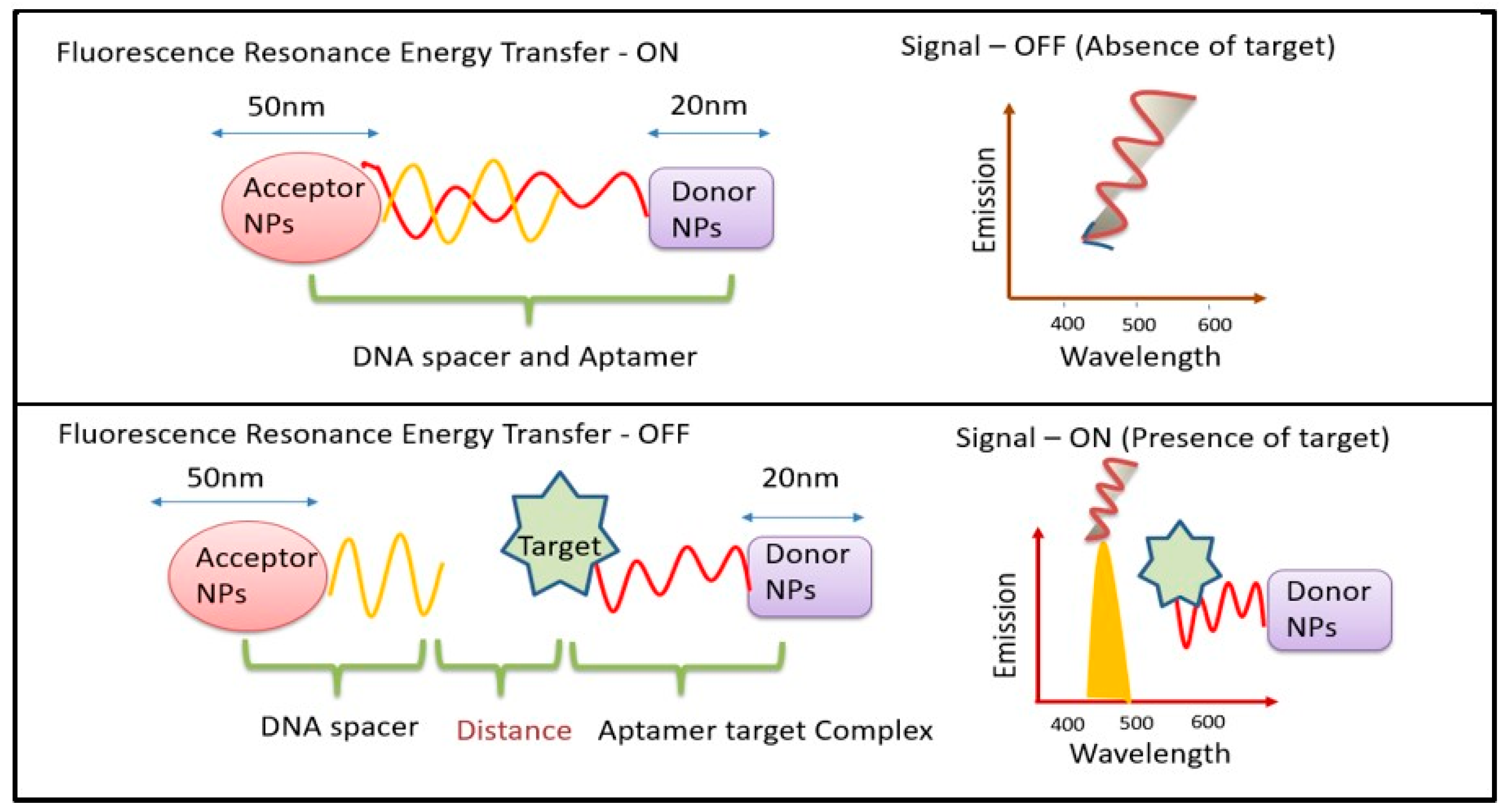
The two main mechanisms used by UCNP-using biosensors are fluorescence and FRET. One of the three methods—fluorescence enhancement (turning on), fluorescence quenching (turning off), or fluorescence resonance energy transfer (FRET)—is employed by fluorescence-based biosensors. Generally, turn/switch/signal-ON or turn/switch/signal-OFF FRET tests are categorized. FRET can occur when an acceptor and a donor molecule are brought close to one another under specific circumstances, as shown in (Figure 1). Numerous techniques can be used to achieve FRET detection and quantification. The phenomenon can be observed by exciting a specimen that contains molecules of both the donor and the acceptor, with light emitted at wavelengths centered near the acceptor’s emission maximum. The two signals can be used for a ratiometric analysis since FRET can result in both an increase in the acceptor’s fluorescence and a decrease in the donor molecule’s fluorescence. The benefit of this method is that it takes interaction measurement independent of the absolute concentration of the sensor. Since not all acceptor moieties are fluorescent, they can be employed to dampen fluorescence. In these situations, there would be a decrease in the signal from interactions that cause a fluorescent donor molecule to become near to such a molecule. As UCNPs have an electron relaxation period in the temporal frame, UCNP-based FRET systems are commonly referred to in the literature as luminescent resonance energy transfer (LRET). The fact that the stimulus needed to activate the donor must be outside of the environment’s absorption range makes UCNPs excellent options for biological-sample detection [16]. An increasing number of UCNPs have been integrated onto nanofibers in recent years to serve as both on- and off-chip transducers in biosensors.
Figure 1. Schematic diagram for mechanism of FRET biosensors.
A one-dimensional nanostructure with a diameter usually between 10 and 100 nm makes up a nanofiber. When loaded with biorecognition molecules, nanofibers with a high surface-to-volume ratio can offer a large sensing surface without removing a significant amount of sample volume [17]. An emerging field of study for biomedical applications is the controlled manufacturing of well-defined fibrillar nano-structured composites, which may be tailored to acquire desired mechanical and chemical properties that can also resemble a cellular matrix. Until now, the majority of UCNP-based sensor devices and applications have been intensity-based; variations in particle concentration result in unfavorable uncertainties and a larger detection limit. PMMA, polystyrene nanofibers, PVP poly(ε-caprolactone), and TiO2 nanofibers have all effectively incorporated UCNPs [18,19]. An oxygen sensor based on the ruthenium complex’s spectrum overlap with the emission of Tm3+ doped UCNPs embedded in polysulfone nanofibers was described by Presley et al. [20], and Fu et al. investigated a microRNA detection technique. Light scattering effects on the surface are enhanced when nanomaterials, such as luminous nanofibers, are incorporated into microfluidic channels, which hinders an adequate signal response [21].
We have covered in depth the effects of UCNP embedding on luminescence efficiency in this review, along with the developments and difficulties associated with UCNP@nanofibers, particularly in (bio)analytical devices. We have also focused on the fundamental process that UCNPs use for these (bio)analytical devices. We have examined both conventional and novel approaches to circumvent the quenching effect of UCNP@nanofibers.

1.1. Impact of Morphology of UCNP@nanofibers on Luminescence Efficiency

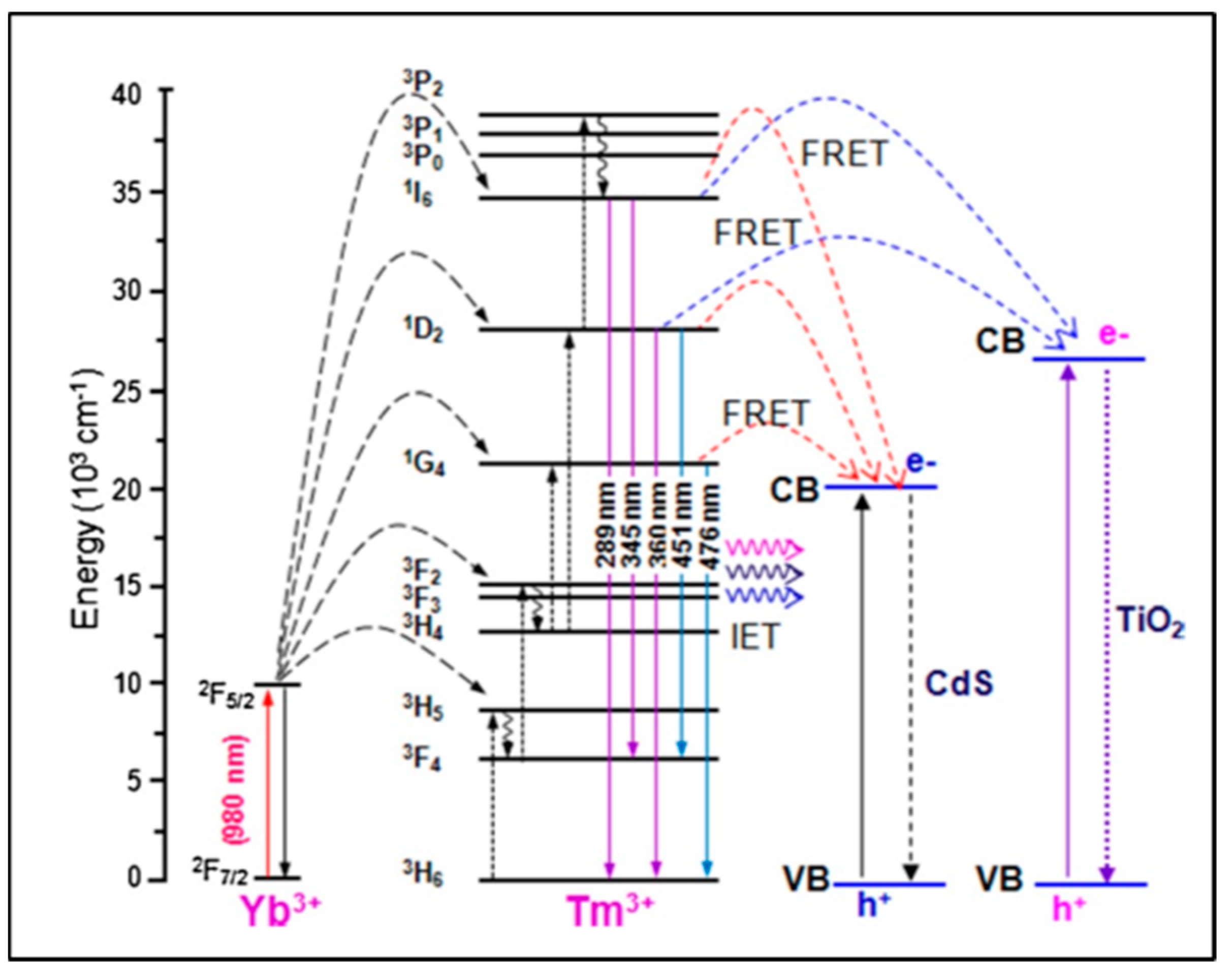
The design and morphology of UCNP@nanofibers have a significant effect on plasmon-enhanced luminescence efficiency which depends on a complex interplay between different dopant ions and host lattices. Electrospinning has been considered as one of the best techniques for fabricating both organic and inorganic nanofibers mainly because the nanoparticles can be easily combined with the fibers to form composite nanofibers. Mainly, the nanoparticles are either doped inside the nanofibers or loaded on their surface. These nanofibers may range within tens to hundreds of nanometers in diameter. Various other parameters that contribute to the formation of nanofibers are the electrospinning solution (polymer blend/nanoparticles/biomolecules), electrical conductivity and rheological properties of the blend, and processing conditions like applied voltage, flow rate of the blend. Yang and colleagues in 2012 reported, for the first time, the upconverted fluorescence of lanthanide-doped YOF nanofibers [22]. Varying the composition of the lanthanides and at 980 nm excitation, blue and red emissions were obtained using YOF: Yb3+,Tm3+, and YOF:Yb3+,Er3+, respectively. The morphology and size of the Ln3+-doped YOF nanofibers were governed using electrospinning parameters like voltage, distance between the tip and collector, relative humidity, and, most importantly, the mass ratio of PVP in the solution. An increase in the diameter of the nanofibers was observed with the increase in the mass ratio of precursor/PVP in solution. Large-scale free-standing and flexible uniform NaYF4:Yb/Tm@NaYF4@TiO2 nanofibers were reported by Qian and colleagues [23] in which water dispersible UCNPs were first assembled into a polyvinyl pyrrolidone (PVP)/tetrabutyl titanate (TBT) matrix with electrospinning and then calcined at a high temperature to form the TiO2-based nanofibers. The TiO2 nanofibers were activated with the UCNPs via a non-irradiative resonant energy transfer process (FRET) upon excitation with the near-IR light. The energy conversion efficiency between the donor and the acceptor chromophore depends on the structure and distance between the chromophores [24]. The energy transfer occurs through charge–charge interaction between the diploes of the oscillating donor and acceptor molecules that are in close proximity (~1 to 10 nm). In addition to the distance, a favorable orientation of the transition dipole moments of donor and acceptor molecules are also required for an effective FRET. An overlap of lanthanide PL (photo-luminescence) emission and the FRET acceptor absorption spectra can be applied for multiplexed bio-analytical analyses. To enable full-spectrum absorption of solar energy (280 to 800 nm), the UCNPs@TiO2 nanofibers were embedded with semiconductor CdS nanoparticles which caused efficient transfer of the NIR photon energy to the CdS nanoparticles and TiO2 using irradiative energy-transfer (IET) and FRET processes (Figure 2) [25]. With respect to the shape of the host matrix, hexagonal NaYF4 has been reported to be a better upconverting host lattice than the cubic lattice NaYF4. Further, core–shell UCNPs are considered to be the best NIR-to-UV UCNPs, particularly with a concentration range of NaYF4:Yb(20–30%)/Tm(0.2–0.5%)@NaYF4 [26]. The low doping ratio of Tm prevented cross-relaxations. However, the choice of emitting UCNPs is limited to NaYF4:Yb/Tm@NaYF4 with low NIR-to-UV efficiency for application in live systems where quenching of the emission is induced by molecules containing hydroxyl (-OH) groups like water, proteins, etc., [27]. This is due to the high-energy vibrational frequency of -OH which increases the non-radiative relaxation of the excited states of the lanthanides. Bogdan et al. [28] reported the quenching of Er3+ ions with -OH groups due to multiphonon relaxation of the 4I11/2 4I13/2 and 2H11/2/4S3/2 4F9/2 transitions. They also mentioned that the relaxation pathways favored the formation of 4F9/2 states with red emission that occurred at the expense of the green luminescence. The requirements of high laser power and heating effects also limit the use of UCNPs to a greater extent. While polymeric nanofibers can be used to harbor the UCNPs to monitor (bio)analytical processes, on the other hand, it remains a challenge to integrate functionalized nanofibers within a microfluidic platform. The main advantage of incorporating the nanofibers is to create more surface area and porosity for immobilizing the recognition moieties for the detection of analyte. The integration of nanofibers into microfluidics has an edge over macro-electrode biomedical devices as the small geometry of a microfluidics chip provides better mass transport and diffusion, a low detection limit, and high signal-to-noise ratio [29]. The detection method based on emission luminescence of the UCNPs can provide a meaningful readout of the desired analysis. The effective synthesis of beta-phase NaYF4:20% Yb3+, 2% Er3+ nanocrystals with controllable dimensions ranging from 4.5 to 15 nm was demonstrated by Cohen and colleagues. They optimized the temperature, ratio of Y3+ to F ions, concentration of basic surfactants, and other test variables to modify the dimensions of the UCNPs [30]. Lanthanide-doped NaYF4 nanoparticles with governed crystal phase and peak performance of upconversion luminosity with thermal breakdown were demonstrated by Milliron and colleagues using an automated platform [31]. Hence, we could say that by adjusting and monitoring the test variables of the UCNPs and polymeric nanofiber, one can synthesize UCNP@nanofibers of variable sizes and shapes, such as cylinder, beads-on-string, and ribbon [11]. Large-scale synthesis of pure, super-long, single-crystalline YAG nanofibers using one-step calcination has also been reported wherein enhanced Photoluminescence (PL) from solitary YAG:Eu3+ electrospun nanofibers was influenced by Eu3+ ions; this polarized PL also depended on the dimension of the nanofibers [32].
Figure 2. Irradiative energy transfer (IET) and non - irradiative energy transfer (FRET) processes (Adapted from Ref. [26]).

1.2. Impact of Design of UCNP@nanofibers on Luminescence Efficiency

Pang and his colleagues [33] incorporated hydrophilic NaYF4:Yb3+,Er3+ Nanoparticles (UCNP-COOH) into photoluminescent nylon 6 (PA6)/PMMA nanofiber using co-electrospinning and spin-coating processes. The transparent UCNP-COOH/PA6/PMMA nanofiber mats exhibited strong green and red upconverted emission under 980 nm laser excitation, and the upconversion could be tuned by adjusting the weight fraction of the nanoparticles. Two green and one red emission band of Er3+ were observed at 521 nm (2H11/2 4I15/2), 539 nm (4S3/2 4I15/2), and 654 nm (4F9/2 4I15/2). However, the upconverted emission decreased slightly in the polymeric PMMA matrix due to the slow relaxation processes [34]. When NaYF4:Yb3+,Er3+ was electrospun in PVP nanotubes, significant upconversion luminescence was observed [35].
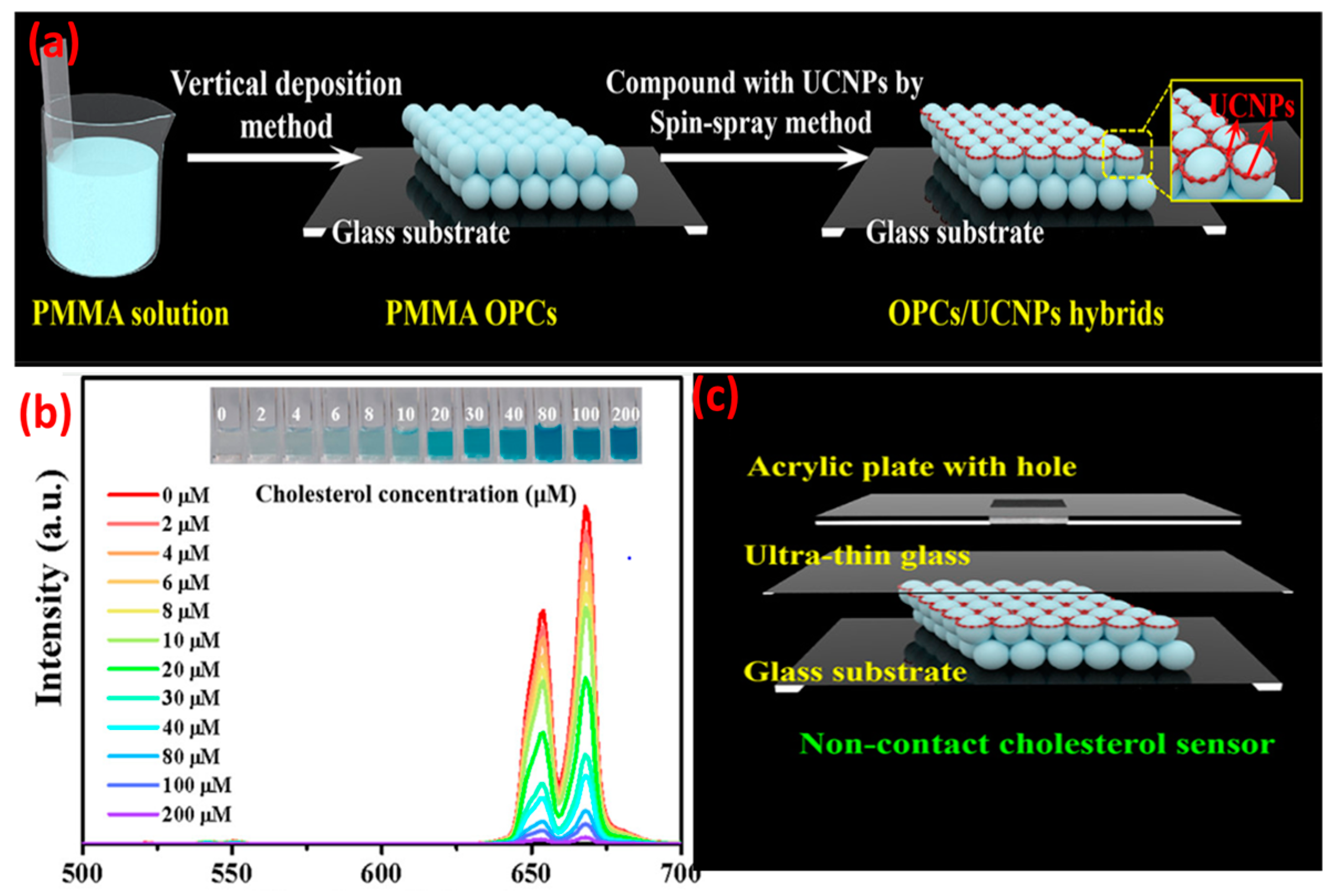
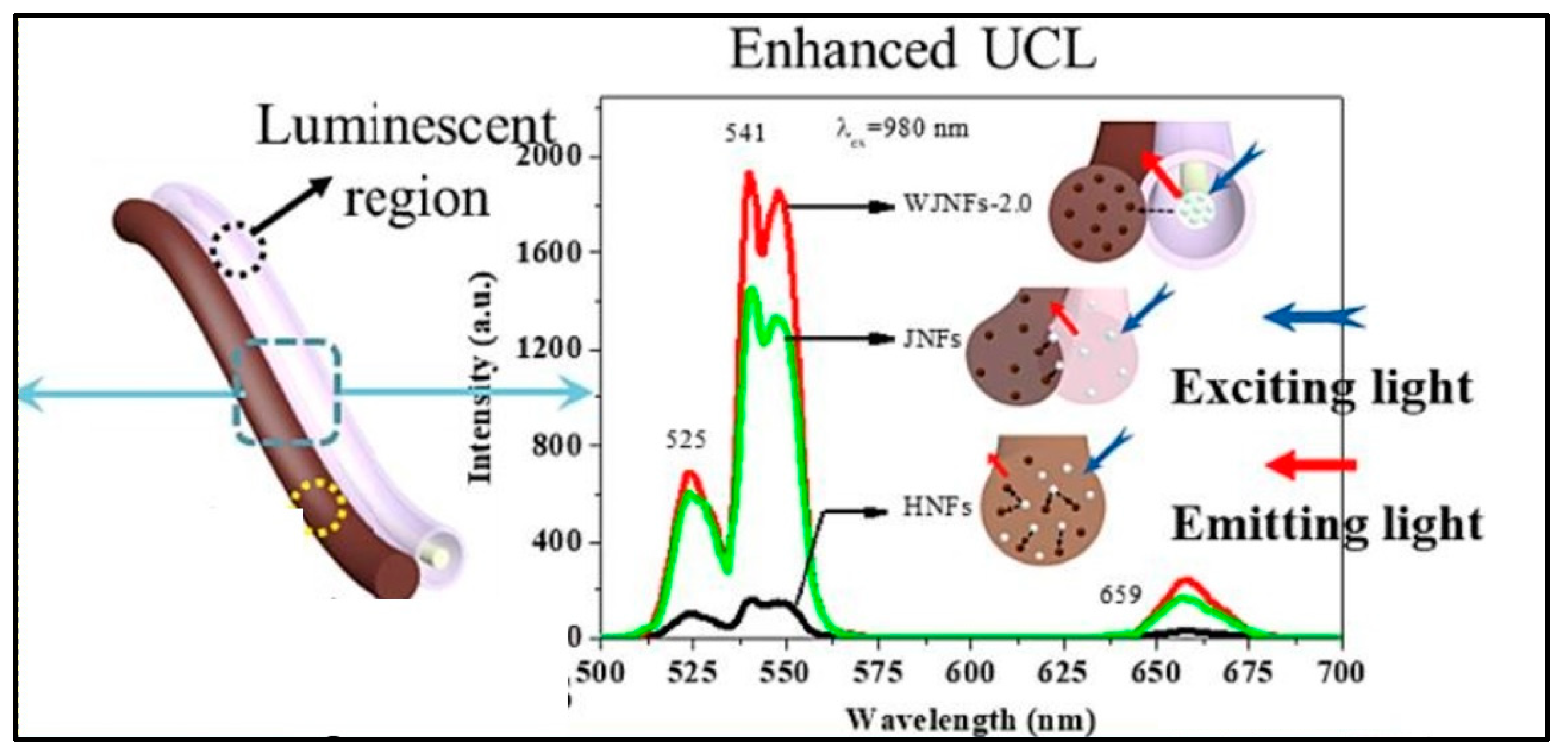
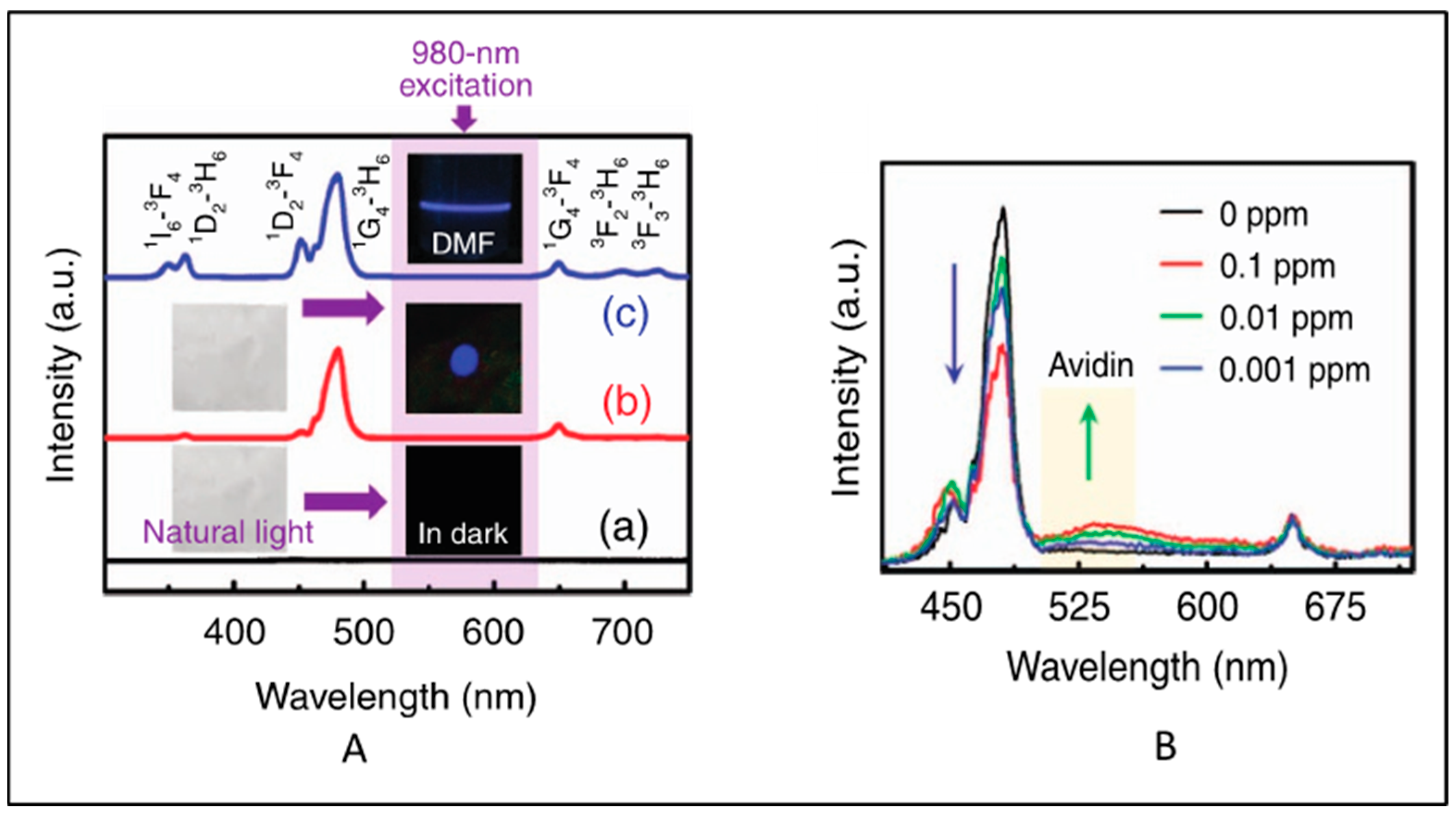
When compared with NaYF4:Yb3+, Er3+ nanoparticles, the UCNPs@PVP nanofibers showed enhanced violet (381 nm), blue (409 nm), green (520 and 541 nm), and red (653 nm) emissions of Er3+. In the case of UCNPs, presence of non-radiative centers on the surface and high-phonon-energy groups would transfer the energy to non-radiative centers and enhance the non-radiation relaxation. Presence of PVP on the UCNPs could effectively eliminate such energy surface traps and suppress the quenching of non-radiative pathways. Concentration of activators in UCNPs has a significant effect on upconversion efficiency. Lahtinen and colleagues [36] studied the effects of varying doping percentages of Tm3+ and Er3+ on luminescence intensity. NaYF4:Yb3+ with Er3+ (3 and 20% doping) and NaYF4:Yb3+ with Tm3+ (0.5 and 8% doping) were selected for measuring the brightness and decay behavior of upconversion at high excitation intensity. NaYF4:Yb3+ with 8% Tm3+ favored 1D2 3F4 transition in the blue spectral region with an emission at 450 nm. Higher Tm doping also shortened the luminescence decay time to 31 μs. UCNPs with lightly (3%) and highly (20%) doped Er3+ activator ions exhibited a shorter decay time and emissions at 550 nm (4S3/2 4I15/2 transition). However, higher doping of Er3+ did not show significant enhancement in the emission intensity. There has been a growing interest in using UCNPs in (bio)analytical applications, for example, to monitor the redox state of an enzyme. Oakland et al. [37] monitored the presence of a flavoprotein, pentaerythritol tetranitrate reductase (PETNR), by detecting the variation in energy transfer from the UCNPs (Tm-based) to the flavin cofactor (flavin mononucleotide) of the redox state of PETNR. The emission at 475 nm (1G4 3H6) was quenched by the enzyme. By altering the rare-earth dopant, the emission profile of the UCNPs can be tuned to monitor biological molecules, e.g., glucose oxidase, vitamin B12, and heme cofactor of cytochrome c. However, it is also important to maximize the apparent energy transfer (AET) between the donor UCNPs and the acceptor biomolecules. This can be achieved by attaching the biomolecules to the surface of the UCNPs and placing the donor–acceptor moieties within the Förster radius. Rare-earth upconversion phosphors (UCPs) were also used to probe the redox chemistry of PETNR [38] wherein the changes in FRET between the emission band of the UCPs and the absorbance band of the enzyme was monitored. With a continuous wave excitation at 980 nm, the UCPs showed two emission bands in the blue (475 nm; 1G4 3H6) and near IR regions’ (800 nm; 3H4 3H6) transitions of Tm3+. The separation of the transition bands ( ~ 500   n m ) allowed for a ratiometric analysis of the enzyme concentration by monitoring the variation in the ratio of the two emission bands. The spectral multiplexing capability of UCNP-QDs was used for the recognition of biotin-streptavidin in a competitive replacement assay. Due to the spectral overlap of QDs FRET acceptor with the UCNPs donor, the PL quantum yield was enhanced [39]. The FRET process was effective because both the donor and acceptor were fluorescent and the distance between them was <10 nm. The study opened the possibility of developing upconverted luminescent probes for the ratiometric detection of enzyme–substrate metabolism. Zhang et al. [40] modified the immobilization technique in which, firstly, the detection solution containing the enzyme (cholesterol oxidase) and different concentrations of cholesterol were mixed and incubated for 30 min at 37 °C. The cholesterol was catalyzed with the enzyme to produce H2O2 and choleste-4-en-3-one. The generated H2O2 oxidized 3,3′,5,5′-tetramethylbenzidine (TMB) in the presence of HRP to form the oxidation products (Ox-TMB) which showed intense absorption at ~652 nm that overlapped with the red upconversion of LiErF4:0.5%Tm3+@LiYF4 UCNPs. The detection mixture was dropped into an ultrathin glass sheet containing the UCNPs-and-PMMA-based opal photonic crystal. The monochromic red UC emission of the UCNPs were quenched with Ox-TMB, and the intensity of the quenching was proportional to the cholesterol concentration (Figure 3).
Figure 3. (a) Formation process for OPCs/UCNPs; (b) UC emission change of LiErF4:0.5%Tm3+@LiYF4 UCNPs versus concentration of cholesterol (2 to 200 μM) under 980 nm excitation. (c) Construction of a non-contact OPCs/UCNPs cholesterol sensor. The inset shows the corresponding photographs of the colored products. (Adapted from Ref. [40]).

3. Challenges in Embedding UCNP’s in Nanofiber

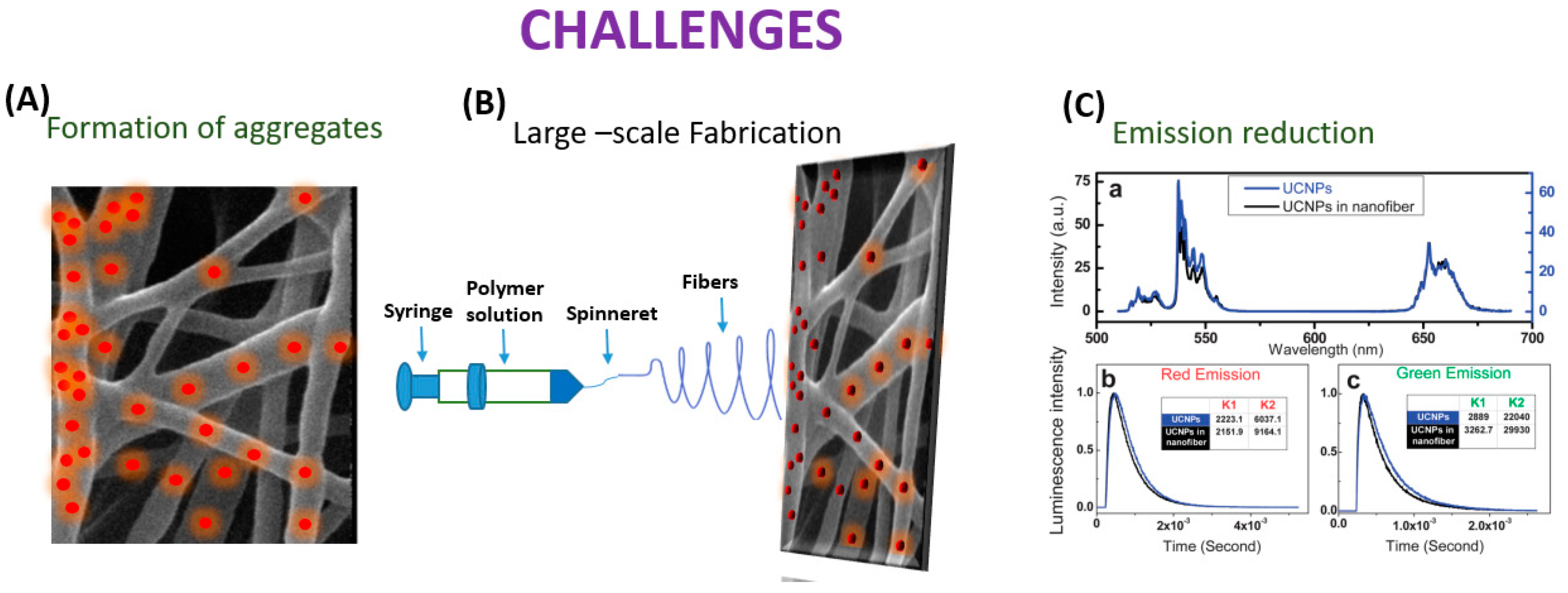
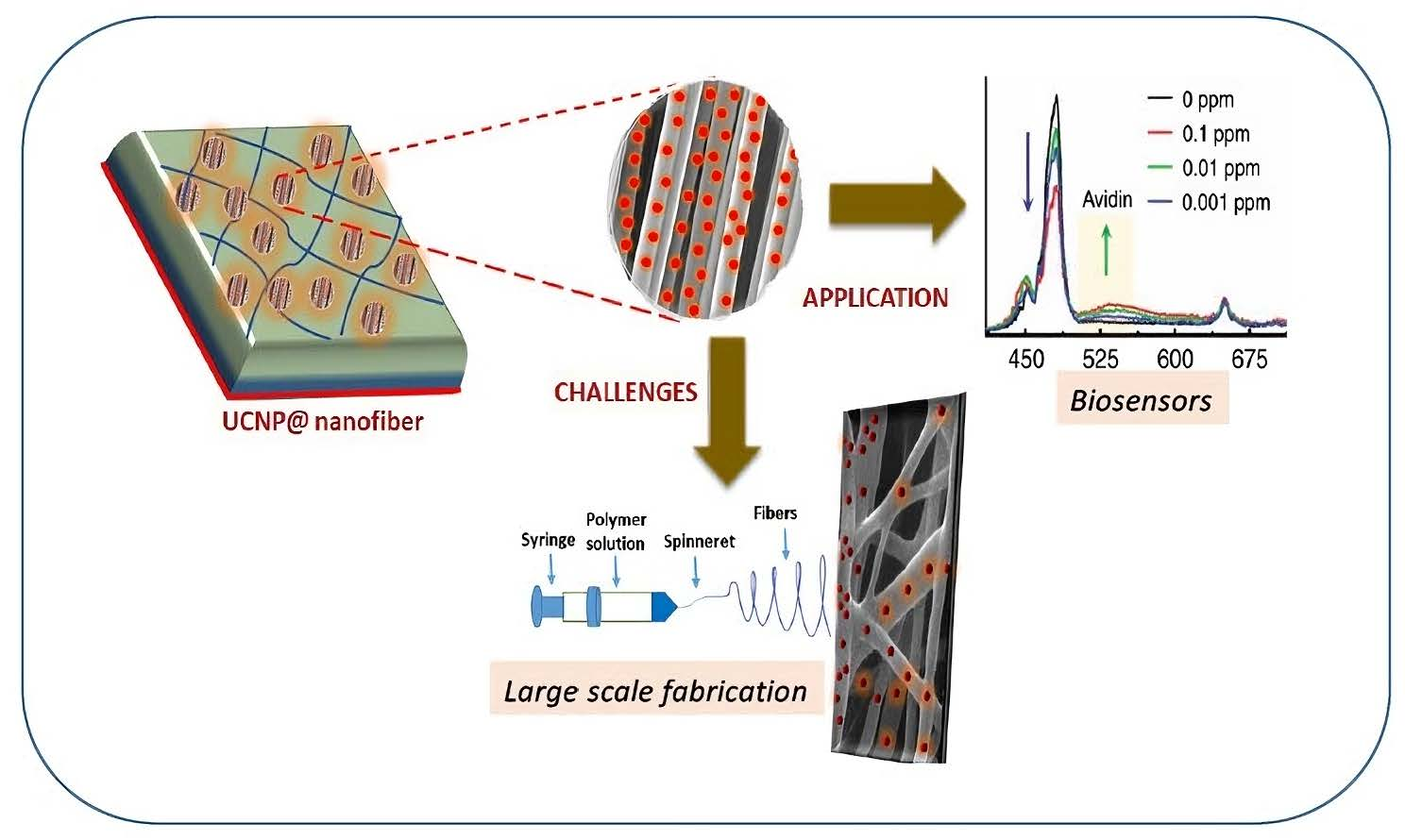
Even though the process of electrospinning UCNPs into nanofibers has advanced significantly, there is still an assortment of areas that need to be improved (Figure 7).
Figure 7. Schematic diagram depicting challenges in embedding UCNP’s in nanofiber.
In the electrospinning process, UCNPs have the potential to coalesce while UCNP@ nanofibers are being spun. According to Bao et al.’s research, the anisotropic propensity of the UCNPs to coalesce into particle chains near the hexagonal face was most likely caused by the non-polar hydrocarbon tails of the oleate capping ligands maximizing surface-area contact and van der Waals interaction. By using novel electrospinning techniques like coaxial, which provide more control over the orientation of the electrospun nanofibers, this constraint has been lessened. Additionally, Bao discussed the UCNP/PMMA nanofibrous films, and the UCNPs’ powder’s green emission to red emission luminescence intensity ratio (IG/R) in the spectra of the UCNP/PMMA nanofibrous films was lower than in the spectra from the powdered UCNPs. The process of creating sensors using electrospinning is fraught with difficulties. The primary goal is to create a homogenous, spinnable mixture. The consistency of the mixture and the proportions of the components are vital in this instance [85]. RE ions in matrix forms of polymers typically demonstrate relatively low emission efficiency, but effective fabrication of the crystal fiber via electrospinning is not doable, as demonstrated by Toncelli et al.’s review studies. On the other hand, when growing oxide crystal nanofibers, a mixture with the appropriate viscosity for the method can be acquired through the application of a polymeric precursor (which is typically PVP).
The material can then be eliminated through the ensuing calcination procedure, which can occur at conditions lower than those usually necessary for the stable state development of the crystal host. Following the calcination procedure, a further fluorination step is required for the development of fluoride crystal nanofibers. This makes the process more difficult because hazardous reagents are used in the fluorination process. Because of this, incorporating fluoride crystal nanoparticles into polymer fibers is another well-liked method. Fluoride materials are widely used as bulk crystal hosts and as nanoparticles. However, due to the relatively small number of published papers regarding oxide materials, the electrospinning growth of fluoride fibers is still in its early stages. When formed in bulk crystal form, fluoride materials need very high purity of the starting materials with careful management of the growing environment since even very low levels of contaminants greatly impair the emission efficiency of rare earth ions. This kind of material is typically generated using electrospinning and fluorinating oxide electrospun fibers. Bypassing the inherent challenges in the electrospinning growth of fluoride crystal matrixes, the bottom-up growth of nanoparticles has been optimized to produce high-quality monodisperse nanoparticles. Adding these high-quality nanoparticles to polymeric fibers is likely the simplest method to produce highly efficient upconverting nanofibers. To regulate the quality and shape of the materials developed, several other growth factors, such as the composition of the starting solution, the flow rate, the voltage, and the distance between the needle and collector, must be optimized. Moreover, the collector temperature and atmosphere humidity can have a large influence on the fiber quality. The electrospinning technique naturally leads to the growth of amorphous materials; therefore, a calcination step is always needed to obtain crystal nanofibers [86]. Among the obstacles and difficulties is the complexity of the fabrication process, the range of materials that can be spun, the homogeneity of the fibers, and reproducibility. Moreover, one of the present difficulties that researchers hope to solve in the future is the creation of portable sensors without the requirement for large apparatus. Additionally, it becomes difficult to quench and enhance the luminescence of UCNP@nanofiber. When UCNPs are embedded into nanofibers, aggregates may form, which could change the characteristics of both UCNPs and the nanofibers and limit their use in (bio)analytical devices as well as the needle–collector separation. Researchers should try to focus on the enhancement of the luminescence of the UCNP@nanofibers by changing the strategies of embedding lanthanide doped materials into the nanofibers. Enhancing UCNPs with multi-excitation wavelengths or improved UV emission is vital. Well-controlled nanostructures may also have greater potential to increase the energy transfer efficiency of UCNPs [87]. Despite the demands of industrialization, the large-scale production of UCNPs@nanofiber continues to be difficult. There are problems with jet interactions, needle clogging, and cleaning with multi-needle collaborative electrospinning. Initially, the needle-free electrospinning approach produces a lot of nanofibers, but their dispersion is incredibly uneven [88].
Future perspectives: Future research in replacing time-consuming analytical monitoring methods with a real-time monitoring system that is quick, sensitive, and efficient has been realized and found to be important in designing a (bio)analytical monitoring system. UCNPs have emerged in applications of biochemical sensors due to their unique and extraordinary optical and chemical features of having a high quantum yield, high resistance to photo-bleaching, low toxicity, long-term lifetime, narrow emission bandwidths, as well as very low optical background noise. Integration of UCNPs@nanofibers into microfluidic systems using bacterial cellulose nanopaper and chitin nanofibers papers [89] has opened an era of rapid and sensitive analyses of analytes using the luminescence of the nanoparticles. This new class of nanosensor can also be used to monitor dynamic processes at the molecular level upon interaction with NIR light, which is often inaccessible using other techniques. Analytical probes based on UCNPs can be used in both solution-phase and in heterogeneous assays and can, therefore, surpass conventional probes (like QDs, dyes, etc.). Heterogeneous assays based on UCNPs@nanofibers can be achieved using a microfluidic platform to fabricate point-of-care devices for on-site monitoring. Such a microfluidic platform can be devised if the UCNPs are of a smaller size, typically less than 10 nm, the synthesis of which is quite challenging. Further, absence of optical background interference in UCNPs, as opposed to other fluorescent molecules, can lead to the development of digital immunoassays where every UCNP can be counted as an optical probe. For that, it is important to synthesize the UCNPs of appropriate size, surface chemistry, and chemical entities (definite concentration/types of sensitizer and activators) and incorporate it in a suitable nanofiber matrix and ensure that they are bright enough to be detected at the single-nanoparticle level. Also, it is important to improve the UC emission efficiency and retain the same levels once it is inside the nanofibers. The upconversion emissions are adversely affected by the presence of surrounding molecules and, therefore, significant research is directed towards improving it, and the upconversion intensity and signal contrast [90]. UCNPs also provide a vehicle in sensing applications by emitting UV-Visible light and providing relevant signals for the measurements. Tsai and colleagues [91] used the green emission band of the UCNPs which was quenched with a pH-dependent inner filter effect (IFE), while the red emission band remained unchanged and acted as the reference signal for ratiometric pH measurements. Shen and colleagues [92] used biocompatible CaF2 to form an epitaxial shell on the UCNPs that showed high optical transparency and was effective in preserving the emission quenching in aqueous medium. The similarity in the lattice of CaF2 and NaYF4, a = 5.448 Å (CaF2, a = 5.451 Å) has paved the way in forming heterogeneous core–shell UCNPs that could provide resistance to aqueous quenchers and further research in this direction would lead to the use of UCNPs in photonics and biophotonics.
In this trend article, we have discussed UCNP-based nanofibers for the detection of analytes and their road to commercialization. A significant increase in sensitivity, ease of use, and easy fabrication techniques has added value to the miniaturized UCNP@nanofibers systems. The possibilities of integrating sensing transducers in microfluidic platforms and their smaller footprints can serve as important tool for evaluating bio(analytical) processes at the point of care. A microfluidic platform with a nanoengineered interface can serve as a sensor for several disease biomarkers. Though there are several benefits of an integrated microfluidics platform, commercialization of such systems may take a slightly longer time. One of the reasons may be since commercialization not only depends on innovations, but also on the feasibility of using the platform on a larger scale.
In our perspective, such systems could be the future of smart sensing technology; particularly when conjugated with a recognition moiety, for example an enzyme, sensors for specific analytes with low detection limit and specificity can be fabricated. However, such a device must be extremely robust and user-friendly. To be used for analytical applications, it is also important to investigate the sensitivity and multiplexing abilities of the UCNPs@nanofibers. For significant optimization, simple and economically feasible set ups are required for commercialization. For optimization, with respect to the activity and accessibility of the bioreceptor, binding events and signal transductions are required for accuracy, sensitivity, and selectivity of a bio(analytical) assay. The future perspectives of the development of a multiplexed microfluidic analytical system and the generation of organ-on-a-chip platforms are envisaged. An integration of bio-imaging and tissue engineering on a same platform may find applications in monitoring different organs and their responses to cellular parameters in situ, paving the way to advancing the field.

Author Contributions

Conceptualization, S.C., investigation, S.C., writing, N.D. and S.C., Formal analysis, N.D., writing—review and editing, S.C. All authors have read and agreed to the published version of the manuscript.

Funding

This research received no external funding.

Acknowledgments

N.D. and S.C. are grateful to SVKM’s NMIMS University, Mumbai and Hanse-Wissenschaftskolleg—Institute for Advanced Study (HWK), Delmenhorst, respectively, for financial support.

Conflicts of Interest

The authors declare no conflict of interest.

References

  1. Khandurina, J.; Guttman, A. Bioanalysis in microfluidic devices. J. Chromatogr. 2002, 2, 159–183. [Google Scholar] [CrossRef]
  2. Li, X.; Soler, M.; Belushkin, A.; Yesilkoÿ, F.; Altug, H. Optofluidic nanoplasmonic biosensor for label-free live cell analysis in real time. In Plasmonics in Biology and Medicine XV; International Society for Optics and Photonics: Bellingham, WA, USA, 2018; p. 105090. [Google Scholar]
  3. Rezaei, Z.; Mahmoudifard, M. Pivotal role of electrospun nanofibers in microfluidic diagnostic systems—A review. J. Mater. Chem. B 2019, 30, 4602–4619. [Google Scholar] [CrossRef]
  4. Yang, D.; Ma, P.; Hou, Z.; Cheng, Z.; Li, C.; Lin, J. Current advances in lanthanide ion (Ln3+)-based upconversion nano-materials for drug delivery. Chem. Soc. Rev. 2015, 44, 1416–1448. [Google Scholar] [CrossRef]
  5. Qin, H.; Wu, D.; Sathian, J.; Xie, X.; Ryan, M.; Xie, F. Tuning the upconversion photoluminescence lifetimes of NaYF4:Yb3+, Er3+ through lanthanide Gd3+ doping. Sci. Rep. 2018, 8, 12683. [Google Scholar] [CrossRef]
  6. Yin, W.; Tian, G.; Ren, W.; Yan, L.; Jin, S.; Gu, Z.; Zhou, L.; Lia, J.; Zhao, Y. Design of multifunctional alkali ion doped CaF2 upconversion nanoparticles for simultaneous bioimaging and therapy. Dalton Trans. 2014, 43, 3861–3870. [Google Scholar] [CrossRef] [PubMed]
  7. Li, Z.; Zhang, Y.; Huang, L.; Yang, Y.; Zhao, Y.; El-Banna, G.; Han, G. Nanoscale “fluorescent stone”: Luminescent calcium fluoride nanoparticles as theranostic platforms. Theranostics 2016, 13, 2380–2393. [Google Scholar] [CrossRef] [PubMed]
  8. Garfield, D.J.; Borys, N.J.; Hamed, S.M.; Torquato, N.A.; Tajon, C.A.; Tian, B.; Shevitski, B.; Barnard, E.S.; Suh, Y.D.; Aloni, S.; et al. Enrichment of molecular antenna triplets amplifies upconverting nanoparticle emission. Nat. Photonics 2018, 12, 402–407. [Google Scholar] [CrossRef]
  9. Zhou, J.; Liu, Q.; Feng, W.; Sun, Y.; Li, F. Upconversion luminescent materials: Advances and applications. Chem. Rev. 2015, 1, 395–465. [Google Scholar] [CrossRef] [PubMed]
  10. Liu, G. Advances in the theoretical understanding of photon upconversion in rare-earth activated nanophosphors. Chem. Soc. Rev. 2015, 6, 1635–1652. [Google Scholar] [CrossRef] [PubMed]
  11. Bao, Y.; Luu, Q.A.N.; Zhao, Y.; Fong, A.; May, P.S.; Jiang, C. Upconversion polymeric nanofibers containing lantha-nide-doped nanoparticles via electrospinning. Nanoscale 2012, 4, 7369–7375. [Google Scholar] [CrossRef] [PubMed]
  12. Long, Q.; Li, H.; Zhang, Y.; Yao, S. Upconversion nanoparticle-based fluorescence resonance energy transfer assay for organo- phosphorus pesticides. Biosens. Bioelectron. 2015, 68, 168–174. [Google Scholar] [CrossRef]
  13. Singh, R.; Dumlupinar, G.; Andersson-Engels, S.; Melgar, S. Emerging applications of upconverting nanoparticles in in-testinal infection and colorectal cancer. Int. J. Nanomed. 2019, 14, 1027–1038. [Google Scholar] [CrossRef] [PubMed]
  14. Chen, B.; Wang, F. Emerging frontiers of upconversion nanoparticles. Trends Chem. 2020, 5, 427–439. [Google Scholar] [CrossRef]
  15. Schroter, A.; Hirsch, T. Control of Luminescence and Interfacial Properties as Perspective for Upconversion Nanoparticles. Small 2023, 2306042. [Google Scholar] [CrossRef]
  16. Dubey, N.; Chandra, S. Upconversion nanoparticles: Recent strategies and mechanism based applications. J. Rare Earths 2022, 9, 1343–1359. [Google Scholar] [CrossRef]
  17. Bhardwaj, N.; Kundu, S.C. Electrospinning: A fascinating fibre fabrication technique. Biotechnol. Adv. 2010, 28, 325–347. [Google Scholar] [CrossRef]
  18. Watkins, Z.; Taylor, J.; D’Souza, S.; Britton, J.; Nyokong, T.J. Fluorescence behaviour and singlet oxygen production of aluminium phthalocyanine in the presence of upconversion nanoparticles. J. Fluoresc. 2015, 25, 1417–1429. [Google Scholar] [CrossRef]
  19. Simsek, M.; Hoecherl, K.; Schlosser, M.; Baeumner, A.J.; Wongkaew, N. Printable 3D carbon nanofiber networks with embedded metal nanocatalysts. ACS App. Mater. Interfaces 2020, 12, 39533–39540. [Google Scholar] [CrossRef]
  20. Presley, K.; Hwang, J.; Cheong, S.; Tilley, R.; Collins, J.; Viapiano, M.; Lannutti, J. Nanoscale upconversion for oxygen sensing. Mater. Sci. Eng. C 2017, 70, 76–84. [Google Scholar] [CrossRef] [PubMed]
  21. Fu, Y.; Chen, T.; Wang, G.; Gu, T.; Xie, C.; Huang, J.; Li, X.; Best, S.; Han, G. Production of a fluorescence resonance energy transfer(FRET) biosensor membrane for microRNA detection. J. Mater. Chem. B 2017, 65, 87. [Google Scholar] [CrossRef] [PubMed]
  22. Yang, R.; Qin, G.; Zhao, D.; Zheng, K.; Qin, W. Synthesis and upconversion properties of Ln3+ doped YOF nanofibers. J. Fluo. Chem. 2012, 140, 38–42. [Google Scholar] [CrossRef]
  23. Zhang, F.; Zhang, C.-L.; Peng, H.-Y.; Cong, H.-P.; Qian, H.-S. Near-infrared photocatalytic upconversion nanoparticles/TiO2 nanofibers assembled in large scale by electrospinning. Part. Part. Syst. Charact. 2016, 33, 248–253. [Google Scholar] [CrossRef]
  24. Santos, M.C.D.; Algar, W.R.; Medintz, I.L.; Hildebrandt, N. Quantum dots for Förster Resonance Energy Transfer (FRET). TrAC Trends Anal. Chem. 2020, 125, 115819. [Google Scholar] [CrossRef]
  25. Zhang, F.; Zhang, C.-L.; Wang, W.-N.; Cong, H.-P.; Qian, H.-S. Titanium dioxide/upconversion nanoparticles/cadmium sulfide nanofibers enable enhanced full-spectrum absorption for superior solar light driven photocatalysis. ChemSusChem 2016, 9, 1449–1454. [Google Scholar] [CrossRef]
  26. Yan, B.; Boyer, J.-C.; Habault, D.; Branda, N.R.; Zhao, Y. Near infrared light triggered release of biomacromolecules from hydrogels loaded with upconversion nanoparticles. J. Am. Chem. Soc. 2012, 134, 16558–16561. [Google Scholar] [CrossRef]
  27. Arppe, R.; Hyppänen, I.; Perälä, N.; Peltomaa, R.; Kaiser, M.; Würth, C.; Christ, C.; Resch-Genger, U.; Schäferlinga, M.; Soukkaa, T. Quenching of the upconversion luminescence of NaYF4:Yb3+,Er3+ and NaYF4:Yb3+,Tm3+ nanophosphors by water: The role of the sensitizer Yb3+ in non-radiative relaxation. Nanoscale 2015, 7, 11746–11757. [Google Scholar] [CrossRef]
  28. Bogdan, N.; Vetrone, F.; Ozin, G.A.; Capobianco, J.A. Synthesis of ligand-free colloidally stable water dispersible brightly luminescent lanthanide-doped upconverting nanoparticles. Nano Lett. 2011, 11, 835–840. [Google Scholar] [CrossRef]
  29. Dai, M.; Jin, S.; Nugen, S.R. Water-soluble electrospun nanofibers as a method for on-chip reagent storage. Biosensors 2012, 2, 388–395. [Google Scholar] [CrossRef]
  30. Ostrowski, A.D.; Chan, E.M.; Gargas, D.J.; Katz, E.M.; Han, G.; Schuck, P.J.; Milliron, D.J.; Cohen, B.E. Controlled Synthesis and Single-Particle Imaging of Bright, Sub-10 nm Lanthanide-Doped Upconverting Nanocrystals. ACS Nano 2012, 3, 2686–2692. [Google Scholar] [CrossRef]
  31. Chan, E.M.; Xu, C.X.; Mao, A.W.; Han, G.; Owen, J.S.; Cohen, B.E.; Milliron, D.J. Reproducible, High-Throughput Synthesis of Colloidal Nanocrystals for Optimization in Multidimensional Parameter Space. Nano Lett. 2010, 10, 1874–1885. [Google Scholar] [CrossRef]
  32. Dong, G.; Xiao, X.; Chi, Y.; Qian, B.; Liu, X.; Ma, Z.; Wu, E.; Zeng, H.; Chen, D.; Qiu, J. Size-dependent polarized pho-toluminescence from Y 3 Al 5 O 12: Eu3+ single crystalline nanofiber prepared by electrospinning. J. Mater. Chem. 2010, 8, 1587–1593. [Google Scholar] [CrossRef]
  33. Zhang, W.; Hongrui, J.; Ye, H.; Dai, T.; Yin, X.; He, J.; Chen, R.; Wang, Y.; Pang, X. Facile fabrication of transparent and upconversion photoluminescent nanofiber mats with tunable optical properties. ACS Omega. 2018, 3, 8220–8225. [Google Scholar] [CrossRef]
  34. Dimitriev, O.P. Effect of confinement on photophysical properties of P3HT chains in PMMA matrix. Nanoscale Res. Lett. 2017, 12, 510. [Google Scholar] [CrossRef]
  35. Zou, P.; Hong, X.; Ding, Y.; Zhang, Z.; Chu, X.; Shaymurat, T.; Shao, C.; Liu, Y. Up-Conversion luminescence of NaYF4:Yb3+/Er3+ nanoparticles embedded into PVP nanotubes with controllable diameters. J. Phys. Chem. C 2012, 116, 5787–5791. [Google Scholar] [CrossRef]
  36. Lahtinen, S.; Liisberg, M.K.; Raiko, K.; Krause, S.; Soukka, T.; Vosch, T. Thulium- and erbium-doped nanoparticles with poly(acrylic acid) coating for upconversion cross-correlation spectroscopy-based sandwich immunoassays in plasma. ACS Appl. Nano Mater. 2021, 4, 432–440. [Google Scholar] [CrossRef]
  37. Oakland, C.; Andrews, M.; Burgess, L.; Jones, A.; Hay, S.; Harvey, P.; Natrajan, L. Expanding the scope of biomolecule monitoring with ratiometric signaling from rare-earth upconverting phosphors. Eur. J. Inorg. Chem. 2017, 44, 5176–5185. [Google Scholar] [CrossRef]
  38. Harvey, P.; Oakland, C.; Driscoll, M.D.; Hay, S.; Natrajan, L.S. Ratiometric detection of enzyme turnover and flavin reduction using rare-earth upconverting phosphors. Dalton Trans. 2014, 43, 5265–5268. [Google Scholar] [CrossRef] [PubMed]
  39. Mattsson, L.; Wegner, K.D.; Hildebrandt, N.; Soukka, T. Upconverting nanoparticle to quantum dot FRET for homoge-neous double-nano biosensors. RSC Adv. 2015, 5, 13270–13277. [Google Scholar] [CrossRef]
  40. Zhang, L.; Hu, S.; Lu, Y.; Jiang, B.; Liu, X.; Li, X.; Zhao, X.; Yan, X.; Wang, C.; Jia, X.; et al. Photonic crystal effects on upconversion enhancement of LiErF4:0.5%Tm3+@LiYF4 for noncontact cholesterol detection. ACS Appl. Mater. Interfaces 2022, 14, 428–438. [Google Scholar] [CrossRef]
  41. Elnabawy, E.; Sun, D.; Shearer, N.; Shyha, I. Electro-Blown Spinning: New Insight into the Effect of Electric Field and Airflow Hybridized Forces on the Production Yield and Characteristics of Nanofiber Membranes. J. Sci. Adv. Mater. Dev. 2023, 8, 100552. [Google Scholar] [CrossRef]
  42. Liu, F.; Li, S.; Fang, Y.; Zheng, F.; Li, J.; He, J. Fabrication of highly oriented nanoporous fibers via airflow bub-ble-spinning. Appl. Surf. Sci. 2017, 421, 61–67. [Google Scholar] [CrossRef]
  43. Hu, X.; Zhang, X.; Shen, X.; Li, H.; Takai, O.; Saito, N. Plasma-induced synthesis of CuO nanofibers and ZnO nanoflowers in water. Plasma Chem. Plasma Process. 2014, 34, 1129–1139. [Google Scholar] [CrossRef]
  44. Suzuki, A.; Mikuni, T.; Hasegawa, T. Nylon 66 nanofibers prepared by CO2 laser supersonic drawing. J. Appl. Polym. Sci. 2014, 6, 40015. [Google Scholar] [CrossRef]
  45. Wu, C.; Su, B.; Xin, N.; Tang, J.; Xiao, J.; Luo, H.; Wei, D.; Luo, F.; Sun, J.; Fan, H. An upconversion nanoparticle-integrated fibrillar scaffold combined with a NIR-optogenetic strategy to regulate neural cell performance. J. Mater. Chem. B 2023, 11, 430–440. [Google Scholar] [CrossRef]
  46. Smith, S.; Goodge, K.; Delaney, M.; Struzyk, A.; Tansey, N.; Frey, M.A. Comprehensive review of the covalent immobi-lization of biomolecules onto electrospun nanofibers. Nanomaterials 2020, 10, 2142. [Google Scholar] [CrossRef] [PubMed]
  47. Ning, Y.; Shen, W.; Ao, F. Application of blocking and immobilization of electrospun fiber in the biomedical field. RSC Adv. 2020, 10, 37246–37265. [Google Scholar] [CrossRef]
  48. Wohnhaas, C.; Friedemann, K.; Busko, D.; Landfester, K.; Baluschev, S.; Crespy, D.; Turshatov, A. All organic nanofibers as ultralight versatile support for triplet− triplet annihilation upconversion. ACS Macro. Lett. 2013, 2, 446–450. [Google Scholar] [CrossRef]
  49. Buchner, M.; Ngoensawat, U.; Schenck, M.; Fenzl, C.; Wongkaew, N.; Matlock-Colangelo, L.; Hirsch, T.; Duerkop, A.; Baeummer, A.J. Embedded nanolamps in electrospun nanofibers enabling online monitoring and ratiometric measurements. J. Mater. Chem. C 2017, 5, 9712–9720. [Google Scholar] [CrossRef]
  50. Haghju, S.; Bari, M.R.; Khaled-Abad, M.A. Affecting parameters on fabrication of β-D-galactosidase immobilized chi-tosan/poly (vinyl alcohol) electrospun nanofibers. Carbohydr. Polym. 2018, 200, 137–143. [Google Scholar] [CrossRef]
  51. Gupta, S.K.; Hernandez, C.; Zuniga, J.P.; Lozano, K.; Mao, Y. Luminescent PVDF nanocomposite films and fibers encapsulated with La2Hf2O7:Eu3+ nanoparticles. SN Appl. Sci. 2020, 2, 616. [Google Scholar] [CrossRef]
  52. Hou, Z.; Li, C.; Ma, P.; Li, G.; Cheng, Z.; Peng, C.; Yang, D.; Yang, P.; Lin, J. Electrospinning Preparation and Drug-Delivery Properties of an Up-conversion Luminescent Porous NaYF4:Yb3+, Er3+@Silica Fiber Nanocomposite. Adv. Funct. Mater. 2011, 12, 2356–2365. [Google Scholar] [CrossRef]
  53. Song, H.; Yu, L.; Lu, S.; Liu, Z.; Yang, L.; Wang, T. Improved photoluminescent properties in one-dimensional LaPO4: Eu3+ nanowires. Optics. Lett. 2005, 5, 483–485. [Google Scholar] [CrossRef] [PubMed]
  54. Heer, S.; Kömpe, K.; Güdel, H.U.; Haase, M. Highly efficient multicolour upconversion emission in transparent colloids of lanthanide-doped NaYF4 nanocrystals. Adv. Mater. 2004, 16, 2102–2105. [Google Scholar] [CrossRef]
  55. Hou, Z.; Li, X.; Li, C.; Dai, Y.; Ma, P.; Zhang, X.; Kang, X.; Cheng, Z.; Lin, J. Electrospun upconversion composite fibers as dual drugs delivery system with individual release properties. Langmuir 2013, 29, 9473–9482. [Google Scholar] [CrossRef] [PubMed]
  56. Lucky, S.S.; Idris, N.M.; Li, Z.; Huang, K.; Soo, K.C.; Zhang, Y. Titania coated upconversion nanoparticles for near-infrared light triggered photodynamic therapy. ACS Nano 2015, 9, 191–205. [Google Scholar] [CrossRef]
  57. Zhang, F.; Hao, L.-N.; Wang, Y.; Cheng, S.; Wang, W.-N.; Zhang, C.-L.; Xu, F.; Qian, H.-S. Hydrothermal-assisted crystallization for the synthesis of upconversion nanoparticles/CdS/TiO2 composite nanofibers by electrospinning. CrystEngComm 2016, 18, 6013–6018. [Google Scholar] [CrossRef]
  58. Yu, H.; Jiang, P.; Chen, B.; Sun, J.; Cheng, L.; Li, X.; Zhang, J.; Xu, S. Electrospinning preparation and upconversion lumi-nescence of Y2Ti2O7:Tm/Yb nanofibers. Appl. Phys. A Mater. Sci. Process. 2020, 126, 690. [Google Scholar] [CrossRef]
  59. González-Béjar, M.; Pérez-Prieto, J. Upconversion luminescent nanoparticles in physical sensing and in monitoring physical processes in biological samples. Methods Appl. Fluoresc. 2015, 3, 042002. [Google Scholar] [CrossRef]
  60. Wiesholler, L.M.; Genslein, C.; Schroter, A.; Hirsch, T. Plasmonic enhancement of NIR to UV upconversion by a nanoen-gineered interface consisting of NaYF4:Yb, Tm nanoparticles and a gold nanotriangle array for optical detection of vitamin B12 in serum. Analy. Chem. 2018, 90, 14247–14254. [Google Scholar] [CrossRef]
  61. Peng, J.; Xu, W.; Teoh, C.L.; Han, S.; Kim, B.; Samanta, A.; Jun, C.; Wang, L.; Yuan, L.; Liu, X.; et al. High-efficiency in vitro and in vivo detection of Zn2+ by dye-assembled upconversion nanoparticles. J. Am. Chem. Soc. 2015, 137, 2336–2342. [Google Scholar] [CrossRef]
  62. Gu, B.; Zhang, Q. Recent advances on functionalized upconversion nanoparticles for detection of small molecules and ions in biosystems. Adv. Sci. 2018, 5, 1700609. [Google Scholar] [CrossRef]
  63. Fu, J.; Qiao, H.; Li, D.; Luo, L.; Chen, K.; Wei, Q. Laccase biosensor based on electrospun copper/carbon composite nanofibers for catechol detection. Sensors 2014, 14, 3543–3556. [Google Scholar] [CrossRef]
  64. Mondal, K.; Ali, M.A.; Agrawal, V.V.; Malhotra, B.D.; Sharma, A. Highly sensitive biofunctionalized mesoporous electrospun TiO2 nanofiber based interface for biosensing. ACS App. Mater. Inter. 2014, 6, 2516–2527. [Google Scholar] [CrossRef] [PubMed]
  65. Jankowska, K.; Zdarta, J.; Grzywaczyk, A.; Kijeńska-Gawrońska, E.; Biadasz, A.; Jesionowski, T. Electrospun poly(methyl methacrylate)/polyaniline fibres as a support for laccase immobilisation and use in dye decolourisation. Environ. Res. 2020, 184, 109332. [Google Scholar] [CrossRef]
  66. Liu, X.; Fang, Y.; Yang, X.; Li, Y.; Wang, C. Electrospun nanofibrous membranes containing epoxy groups and hydrophilic polyethylene oxide chain for highly active and stable covalent immobilization of lipase. J. Chem. Eng. 2018, 336, 456–464. [Google Scholar] [CrossRef]
  67. Uzun, S.D.; Kayaci, F.; Uyar, T.; Timur, S.; Toppare, L. Bioactive surface design based on functional composite electrospun nanofibers for biomolecule immobilization and biosensor applications. ACS Appl. Mater. Inter. 2014, 6, 5235–5243. [Google Scholar] [CrossRef]
  68. Fazel, R.; Torab, S.-F.; Naseri-Nosar, P.; Ghasempur, S.; Ranaei-Siadat, S.-O.; Khajeh, K. Electrospun polyvinyl alcohol/bovine serum albumin biocomposite membranes for horseradish peroxidase immobilization. Enzym. Microb. Technol. 2016, 93, 1–10. [Google Scholar] [CrossRef] [PubMed]
  69. Dai, Y.; Niu, J.; Liu, J.; Yin, L.; Xu, J. In situ encapsulation of laccase in microfibers by emulsion electrospinning: Preparation, characterization, and application. Bioresour. Technol. 2010, 101, 8942–8947. [Google Scholar] [CrossRef]
  70. Li, C.; Zuo, J.; Zhang, L.; Chang, Y.; Zhang, Y.; Tu, L.; Liu, X.; Xue, B.; Li, Q.; Zhao, H.; et al. Accurate quan-titative sensing of intracellular pH based on self-ratiometric upconversion luminescent nanoprobe. Sci. Rep. 2016, 6, 38617. [Google Scholar] [CrossRef]
  71. Wilhelm, S.; Barrio, M.; Heiland, J.; Himmelstoß, S.F.; Galban, J.; Wolfbeis, O.S.; Hirsch, T. Spectrally matched upconverting luminescent nanoparticles for monitoring enzymatic reactions. ACS Appl. Mater. Inter. 2014, 6, 15427–15433. [Google Scholar] [CrossRef]
  72. Long, Q.; Fang, A.; Wen, Y.; Li, H.; Zhang, Y.; Yao, S. Rapid and highly-sensitive uric acid sensing based on enzymatic ca-talysis-induced upconversion inner filter effect. Biosens. Bioelectron. 2016, 86, 109–114. [Google Scholar] [CrossRef]
  73. Ni, J.; Shan, C.; Li, B.; Zhang, L.; Ma, H.; Luo, Y.; Song, H. Assembling of functional cyclodextrin-decorated upconversion luminescence nanoplatform for cysteine-sensing. Chem. Commun. 2015, 51, 14054–14056. [Google Scholar] [CrossRef]
  74. Sheng, Y.; Qi, H.; Li, N.; Xie, Y.; Shao, H.; Hu, Y.; Li, D.; Ma, Q.; Liu, G.; Dong, X. Wire-in-tube nanofiber as one side to construct specific-shaped Janus nanofiber with improved upconversion luminescence and tunable magnetism. J. Colloid. Interface Sci. 2024, 655, 58–69. [Google Scholar] [CrossRef]
  75. Wu, W.; Wang, L.; Yuan, J.; Zhang, Z.; Zhang, X.; Dong, S.; Hao, J. Formation and degradation tracking of a composite hydrogel based on UCNPs@PDA. Macromolecules 2020, 53, 2430–2440. [Google Scholar] [CrossRef]
  76. Yao, J.; Ji, P.; Wang, B.; Wang, H.; Chen, S. Color-tunable luminescent macrofibers based on CdTe QDs-loaded bacterial cellulose nanofibers for pH and glucose sensing. Sens. Actuators B Chem. 2018, 254, 110–119. [Google Scholar] [CrossRef]
  77. Antoniadou, M.; Pilch-Wrobel, A.; Riziotis, C.; Tanasă, E.; Krasia-Christoforou, T. Fluorescent electrospun PMMA micro-fiber mats with embedded NaYF4:Yb/Er upconverting nanoparticles. Methods Appl. Fluoresc. 2019, 7, 034002. [Google Scholar] [CrossRef] [PubMed]
  78. Liu, K.-C.; Zhang, Z.-Y.; Shan, Z.-Q.; Feng, Z.-Q.; Li, J.-S.; Song, C.-L.; Bao, Y.-N.; Qi, X.-H.; Bong, B. A flexible and superhy-drophobic upconversion-luminescence membrane as an ultrasensitive fluorescence sensor for single droplet detection. Light. Sci. Appl. 2016, 5, 16136. [Google Scholar] [CrossRef] [PubMed]
  79. Dong, B.; Song, H.; Yu, H.; Zhang, H.; Qin, R.; Bai, X.; Pan, G.; Lu, S.; Wang, F.; Fan, L.; et al. Upconversion properties of Ln3+ doped NaYF4/polymer composite fibers prepared by electrospinning. J. Phys. Chem. C 2008, 112, 1435–1440. [Google Scholar] [CrossRef]
  80. Ge, W.; Xu, M.; Shi, J.; Zhu, J.; Li, Y. Highly temperature-sensitive and blue upconversion luminescence properties of Bi2Ti2O7: Tm3+/Yb3+ nanofibers by electrospinning. J. Chem. Eng. 2020, 391, 123546. [Google Scholar] [CrossRef]
  81. Liu, W.; Zhang, Y.; Kong, X.; Pun, E.Y.B.; Lin, H. Excitation Mechanism Rearrangement in Yb3+-Introduced La2O2S: Er3+/Polyacrylonitrile Photon-Upconverted Nanofibers for Optical Temperature Sensors. ACS Appl. Nano Mater. 2023, 14, 13570–13581. [Google Scholar] [CrossRef]
  82. Liu, Z.; Wang, R.X.; Sun, K.W.; Ling, X.C.; Sun, J.W.; Chen, D.H. Upconversion red light emission and luminescence thermometry of Gd2O3:Er3+@Gd2O3:Yb 3+ core-shell nanofibers synthesized via electrospinning. Chalcogenide Lett. 2023, 7, 1841–4834. [Google Scholar]
  83. Deng, Z.; Wu, H.; Mu, H.; Jiang, L.; Xi, W.; Xu, X.; Zheng, W. Preparation and properties of electrospun NaYF4: Yb3+, Er3+-PLGA-gelatin nanofibers. J. Appl. Polym. Sci. 2022, 26, 52422. [Google Scholar] [CrossRef]
  84. Zhang, J.; Li, X.; Zhang, J.C.; Yan, J.S.; Zhu, H.; Liu, J.J.; Li, R.; Ramakrishna, S.; Long, Y.Z. Ultrasensitive and reusable upconversion-luminescence nanofibrous indicator paper for in-situ dual detection of single drop-let. J. Chem. Eng. 2020, 382, 122779. [Google Scholar] [CrossRef]
  85. Han, W.; Wang, Y.; Su, J.; Xin, X.; Guo, Y.; Long, Y.Z.; Ramakrishna, S. Fabrication of nanofibrous sensors by electrospinning. Sci. China Technol. Sci. 2019, 62, 886–894. [Google Scholar] [CrossRef]
  86. Toncelli, A. RE-based inorganic-crystal nanofibers produced by electrospinning for photonic applications. Materials 2021, 10, 2679. [Google Scholar] [CrossRef] [PubMed]
  87. Mahmood, R.; Mananquil, T.; Scenna, R.; Dennis, E.S.; Castillo-Rodriguez, J.; Koivisto, B.D. Light-Driven Energy and Charge Transfer Processes between Additives within Electrospun Nanofibres. Molecules 2023, 12, 4857. [Google Scholar] [CrossRef]
  88. Zhang, M.; Song, W.; Tang, Y.; Xu, X.; Huang, Y.; Yu, D. Polymer-based nanofiber–nanoparticle hybrids and their medical applications. Polymers 2022, 2, 351. [Google Scholar] [CrossRef] [PubMed]
  89. Naghdi, T.; Golmohammadi, H.; Yousefi, H.; Hosseinifard, M.; Kostiv, U.; Horak, D.; Merkoci, A. Chitin nanofiber paper toward optical (bio) sensing applications. ACS Appl. Mater. Int. 2020, 13, 15538–15552. [Google Scholar] [CrossRef]
  90. Kumar, B.; Malhotra, K.; Fuku, R.; Houten, J.V.; Qu, G.Y.; Piunno, P.A.E.; Krull, U.J. Recent trends in the developments of analytical probes based on lanthanide-doped upconversion nanoparticles. TrAC Trends Anal. Chem. 2021, 139, 116256. [Google Scholar] [CrossRef]
  91. Tsai, E.S.; Himmelstoß, S.F.; Wiesholler, L.M.; Hirsch, T.; Hall, E.A. Upconversion nanoparticles for sensing pH. Analyst 2019, 18, 5547–5557. [Google Scholar] [CrossRef]
  92. Shen, J.; Chen, G.; Ohulchanskyy, T.Y.; Kesseli, S.J.; Buchholz, S.; Li, Z.; Prasad, P.N.; Han, G. Tunable near infrared to ul-traviolet upconversion luminescence enhancement in (α-NaYF4:Yb, Tm)/CaF2 core/shell nanoparticles for in situ real-time recorded biocompatible photoactivation. Small 2013, 9, 3213–3217. [Google Scholar] [CrossRef] [PubMed]
Disclaimer/Publisher’s Note: The statements, opinions and data contained in all publications are solely those of the individual author(s) and contributor(s) and not of MDPI and/or the editor(s). MDPI and/or the editor(s) disclaim responsibility for any injury to people or property resulting from any ideas, methods, instructions or products referred to in the content.

Article Metrics

Citations

Article Access Statistics

Multiple requests from the same IP address are counted as one view.