Abstract
We investigated the hysteresis, pseudo-critical, and compensation behaviors of a quasi-spherical FeCo alloy nanoparticle (2 nm in diameter) using Monte Carlo simulations with thermal bath-type algorithms and a 3D mixed Ising model. The nanostructure was modeled in a body-centered cubic lattice (BCC) through the following configurations: spin for Co and for Fe. These simulations reveal that, under the influence of crystal and magnetic fields, the nanoparticle exhibits compensation phenomena, exchange bias, and pseudo-critical temperatures. Knowledge of this type of phenomena is crucial for the design of new materials, since compensation temperatures and exchange bias improve the efficiency of advanced magnetic devices, such as sensors and magnetic memories. Meanwhile, pseudo-critical temperatures allow the creation of materials with controlled phase transitions, which is vital for developing technologies with specific magnetic and thermal properties. An increase in single-ion anisotropies within the nanosystem leads to higher pseudo-critical and compensation temperatures, as well as superparamagnetic behavior at low temperatures.
1. Introduction
Complex nanomagnetic structures exhibit diverse physical behaviors when subjected to the influence of internal and external interactions. These behaviors are reflected in some phenomena, such as first- and second-order transitions, compensation points, and exchange anisotropies [1,2]. In this work, a nanoparticle structured by body-centered cubic (BCC) lattices that is type B2 ferrimagnetic of FeCo intermetallic alloys [3] and encapsulated in a spherical geometry nanoconfiguration of 2 nm in diameter is considered. The problem to be solved in this research consists in the thermomagnetic characterization of this nanosystem, through an analysis of the hysteresis, pseudo-critical, and compensation behaviours that it exhibits. The system has been considered an approximate concentration of 50/50, with spin values for Co and for Fe. This interesting alloy of Fe and Co can be chemically disordered from its equiatomic phase B2 in bulk into an A2-type phase for temperatures of the order of 730 °C [4]. When the alloy is ordered (phase B2), the crystal behaves as the intercalation of two simple cubic sublattices, one of Fe and the other of Co; this is unlike phase A2, where the atoms of the compound are randomly distributed [5].
The importance of this research lies in the fact that, according to the composition of the FeCo binary intermetallic alloy, the alloy has demonstrated useful properties such as a high maximum value of saturation magnetization (up to 240 emu/g in bulk), low single-ion anisotropies, high permeability along with good mechanical properties, and high temperatures of second-order transitions [5]. Among the applications to which the aforementioned properties give rise, we could highlight potential uses of FeCo alloys in biomedicine through magnetic resonance imaging [6,7], as well as for anticancer therapies [8,9]. Similarly, FeCo is used in magneto-elastic soft actuators [10,11], high-frequency power applications [12,13], electromagnetic wave absorption [14,15], and high technology applications such as magnetic recording media, and the generation of permanent magnets through exchange coupled nanocomposites with hard/soft magnetic phases [16]. Studies by Vadillo et al. reported the synthesis of FeCo nanoparticles in the BCC structure using the chemical reduction technique, highlighting its importance in the fabrication of magnetorheological fluids (RFMs) [17].
Scientific work at nanometer scales in magnetic materials has allowed the discovery of novel phenomena and physical properties not seen at larger scales, which has generated expectations for new applications in different fields of engineering and technology. The FeCo binary alloy is no stranger to this type of research in the field of nanostructures, which can be corroborated in the works of Kolhatkar et al., Dalavi et al., and Kandapallil et al., who showed saturation magnetization in the range from 100 to 220 emu/g for FeCo nanoparticles synthesized by chemical methods [18,19,20]. Likewise, Kodama et al. reported disordered cubic FeCo nanostructures at room temperature after being synthesized by polyol processes and with high-spin moments [21]. With this same process, Karipoth et al. report the physical properties of flower-like nanoparticles prepared by a unique polyol process based on the addition of precursors at an elevated temperature [22]. An additional interesting aspect investigated for FeCo nanoparticles is their usefulness in high-frequency electrical circuits due to their magnetization rapidly changing direction once the magnetic field is reversed, as well as the property of being magnetically soft [23]. There is also the use of FeCo magnetic nanoalloys in the heating properties for magnetic fluid hyperthermia [24]. Comparable in interest to what this research has stated is the research of Kim et al., who developed a two-step electro-less plating method to control the morphology and grain size of FeCo films to obtain excellent magnetic properties [25]; this goes alongside the works of Sánchez et al. on the structural analysis and magnetic properties of FeCo alloys obtained by mechanical alloying [26] and Saber et al. and their studies of the magnetic properties of the ternary alloy with mixed spins Fe (S = 2), Co ( = 3/2) and Ni (Q = 1) using Monte Carlo simulations and the Metropolis Algorithm [2].
To solve the problem at hand, we will be employing computational simulations with Monte Carlo techniques (MC), thermal bath-type algorithms, and a mixed Ising 3D model. These theoretical models have been widely used to explain the qualitative behavior of various spin configurations, given their complementarity with experimental studies, helping to predict thermomagnetic properties and to understand the relevant underlying mechanisms [27,28,29]. The versatility of the Ising model allows for constructing the Hamiltonian, which defines the system under study by adding different interactions that enable understanding the role of each of them in the thermomagnetic behavior of the system [30]. The remainder of this paper is organized as follows. In Section 2, we formulate the model and describe briefly the Monte Carlo simulations. In Section 3, we analyze the results, and finally, in Section 4, we discuss them.
2. Model and Computational Method
2.1. Model
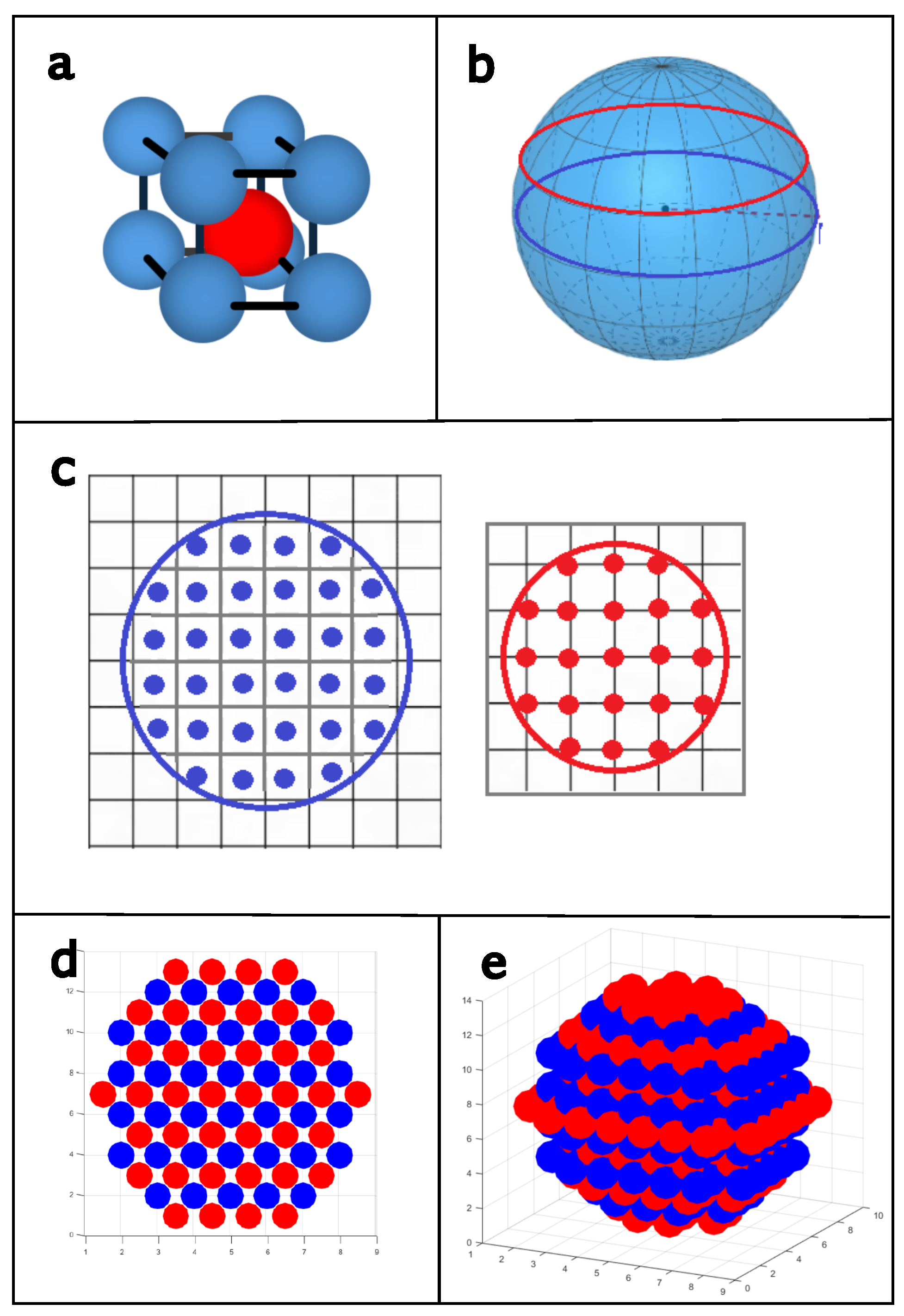
The system under study is a nanoparticle with a quasi-spherical geometry of 2 nm, which is constituted by body-centered cubic structures, which are of type B2 of ferrimagnetic FeCo alloys; the system has an approximate concentration of 50/50, with spin values of for Co in a sublattice A of size and for Fe in a sublattice B of size (Figure 1a). The numerical modeling of the nanoparticle was performed by dividing the sphere into cross-sections, which were separated according to the lattice parameters of the BCC structure for the FeCo alloy (Figure 1b). Each slice is a circular plane with different diameters according to its location on the sphere, containing the positions of the Fe (red) and Co (blue) spins (Figure 1c). In one slice, the spins of one type of atom are located in the interstitial spaces; in the following slice, the other type is located in the vertices of the unit cell (Figure 1d). The ensemble of all planes forms the quasi-spherical nanoscaled structure (Figure 1e). Based on the above, the nanoparticle capacity was structured with 487 Ising-type atoms, 243 Co and 244 Fe.
Figure 1.
Schematic representation of FeCo quasi-spherical nanoparticle. (a) BCC structure of type B2; (b) nanoparticle geometry; (c) cross-sections of Fe and Co atoms; (d) surface view; (e) isometric view of quasi-spherical nanoparticle.
When the alloy is ordered (phase B2), the crystal behaves as the intercalation of two simple cubic sublattices A and B of spins (Co) and (Fe), respectively. For its thermomagnetic characterization, we consider antiferromagnetic exchange interactions with the next neighbors () in the lattice and anisotropic couplings of the A and B sublattices, as well as interactions with an external magnetic field. Free boundary conditions on the surface atoms will be used in the simulation. The interactions of the system are defined through the following Hamiltonian:
In Equation (1), represents ferrimagnetic isotropic bilinear exchange interactions (). and represent anisotropic biquadratic single-ion couplings in the A and B sublattices, and h is an applied external field. , , and h act on each of the ising-type atoms in the sublattices of the ferrimagnet. All the parameters are in energy units. We define dimensionless parameters reduced as follows: , , , and . is the Boltzmann constant.
2.2. Monte Carlo Simulations
Ferrimagnetic nanomagnetic systems are complex spintronic structures due to the effects of size, shape, and interactions within the material. The -dimensions of the nanostructures are in the range [31], which allows them particular physical properties, unlike larger magnetic configurations; the origin of these properties is a result of changes in the electronic levels and the increase in surface atoms with respect to bulk atoms. Spintronic nanoconfigurations are catalogued as a link between bulk materials and atomic structure; thus, researching this type of material proves fascinating. All of the above characteristics make it very complex to analyze a nanoscaled material. Therefore, appropriate experimental and/or theoretical techniques must be employed. In this work, Monte Carlo simulations will be used; such methods have proven to be a useful tool for the magnetic characterization of these types of systems [32,33]. The computational technique is executed as follows: Once the initial configuration is organized, the following ones are randomly selected and changed through the Boltzmann probability. The transition probabilities are then calculated, considering that the number of possible changes depends on the type of particle located in the lattice. The data were obtained with Monte Carlo steps per site, initially discarding the first steps per spin, until equilibrium was reached. Errors were calculated by the block method, dividing the sample of size Monte Carlo into b blocks of size , where L is the total sample. This implies that the errors are estimated from the block averages and not from the original measurements. Error bars are calculated by grouping all measurements in 10 blocks and taking their standard deviation [34,35].
The total () and sublattice () magnetization and total magnetic susceptibility () were calculated with the following expressions:
considering that represents the internal energy of the system and , and where . Due to the size of the quasi-nanosphere, the location of the transition temperature is considered a pseudo-critical temperature , located in a range where the magnetic susceptibility presents a maximum of smooth or “flattened” contour. To locate the compensation points experienced by the nanosystem, the intersection point of with the temperature axis was found.
3. Results
Thermomagnetic characterization of the nanospherical ferrimagnetic system was determined by the anisotropic effects of the crystal fields of the A and B sublattices, as well as by the influence of external magnetic fields on the magnetic moments for Co and for Fe.
3.1. –– Model: Effects of
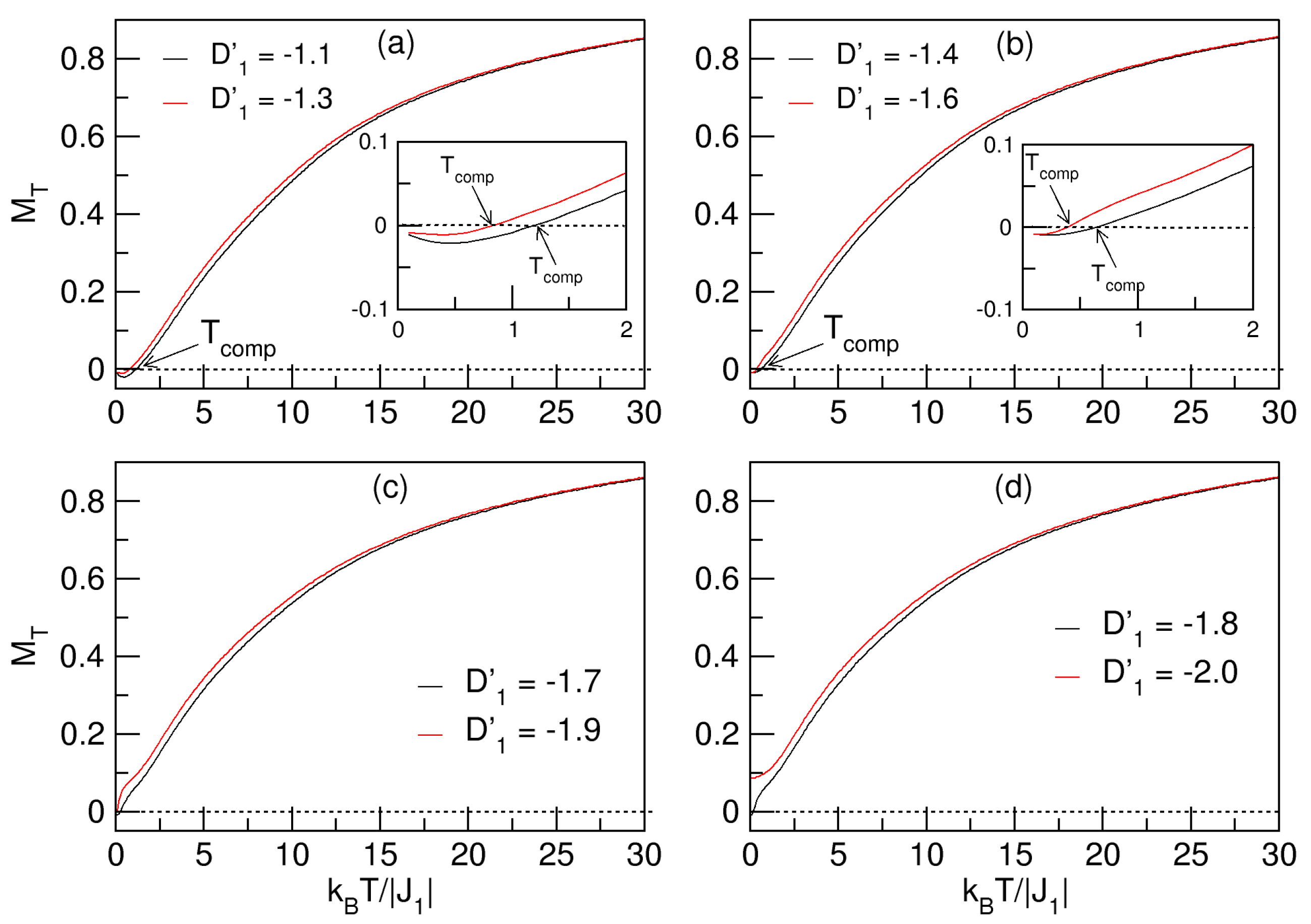
represents the magnetocrystalline anisotropy experienced by the spin lattice of Co and the –– model indicates that no magnetic field is applied to the nanoparticle (). We will analyze the effects of the field on the magnetization and the total magnetic susceptibility when and . In Figure 2a–d, the behavior of as a function of temperature in the range is analyzed.
Figure 2.
Magnetization behavior of the quasi-spherical FeCo nanosystem. The insets in (a,b) show the compensation points () experienced by the nanoparticle in the ranges and . In (c,d), it is observed that the negative increase in destroys the compensation phenomenon.
The nanosystem undergoes compensation phenomena at low temperatures when , which are denoted as , and are enlarged in the insets of Figure 2a,b. The compensation points are generated by the struggle between the anisotropic fields, because helps to keep the lattice spins with the antiferromagnetic orientation exerted by the exchange; also, , being of lower intensity, exerts a slight opposition to try to direct the magnetic moments in the opposite direction. The competition between the crystal fields of the sublattices arises because implies that the spin states of the A sublattice (S-spin Co atoms) have a preference to orient themselves toward the hard-to-magnetize axis, and entails that the B sublattice (Q-spin-Fe atoms) orients itself toward the easy axis. Moreover, since the spin states are larger than , the system is compensated up to a certain value of , and for values smaller than , the lattice decompensates. Next, for , the temperature increase destroys the compensation in the sublattices, with the thermal energy prevailing over the effects of the crystal fields. In the curves, the temperatures of the transition of the system to the paramagnetic phase are not clearly visible due to size effects.
We consider that the effect of not observing the critical temperatures, despite the nanosphere not yet being subjected to external fields, is due to factors present in the nanoscaled systems, such as the following: (i) The coordination number (z) of the lattice that composes them. In this case, it is a BCC () with antiferromagnetic couplings , implying a competition of the atoms to align themselves antiparallel in the crystal, possibly leading to the non-achievement of minimum energy configurations for all pairs of atoms at the same time—that is, a phenomenon of magnetic frustration could occur, since there can be several configurations of analogously low energy. (ii) The second factor has to do with the various types of interactions in the Hamiltonian, such as bilinear exchange and () intrinsic anisotropic biquadratic couplings in the sublattices, with opposite orientations. (iii) A third aspect for the non-appearance of the critical temperature in the of the nanosphere is the existence of pseudo-critical temperatures (); these are within a range surrounding the ferri-paramagnetic phase transition with some features analogous to the critical transition, without clearly defining the transition to the paramagnetic state. In this case, we can state that the interactions considered for the quasi-spherical nanoparticle do not allow the system to be configured with a clear and specific magnetic order. (iv) Finally, the nanoparticle is of diameter 2 nm; it is thus small enough not to neglect anisotropic effects on the surface, which can affect the spintronic configuration of the core (innermost spins) [36].
On the other hand, it should be noted that when working with very small nanoparticles, the so-called critical size () must be taken into account, below which it can happen that the nanostructure has a single domain and can become a uniformly magnetized core, while having its net spin oriented along one of its easy magnetocrystalline directions. In this case, to demagnetize the nanoparticle, an external field must be applied that overcomes the anisotropy of the system and causes a rotation of the coupling generated by the exchange interaction. Otherwise, if we have a nanoparticle with size larger than , a multidomain nanoscale particle, the energy barrier to overcome is considered relatively low and the nanosystem could be magnetized or demagnetized with an external field that moves the domain walls [37].
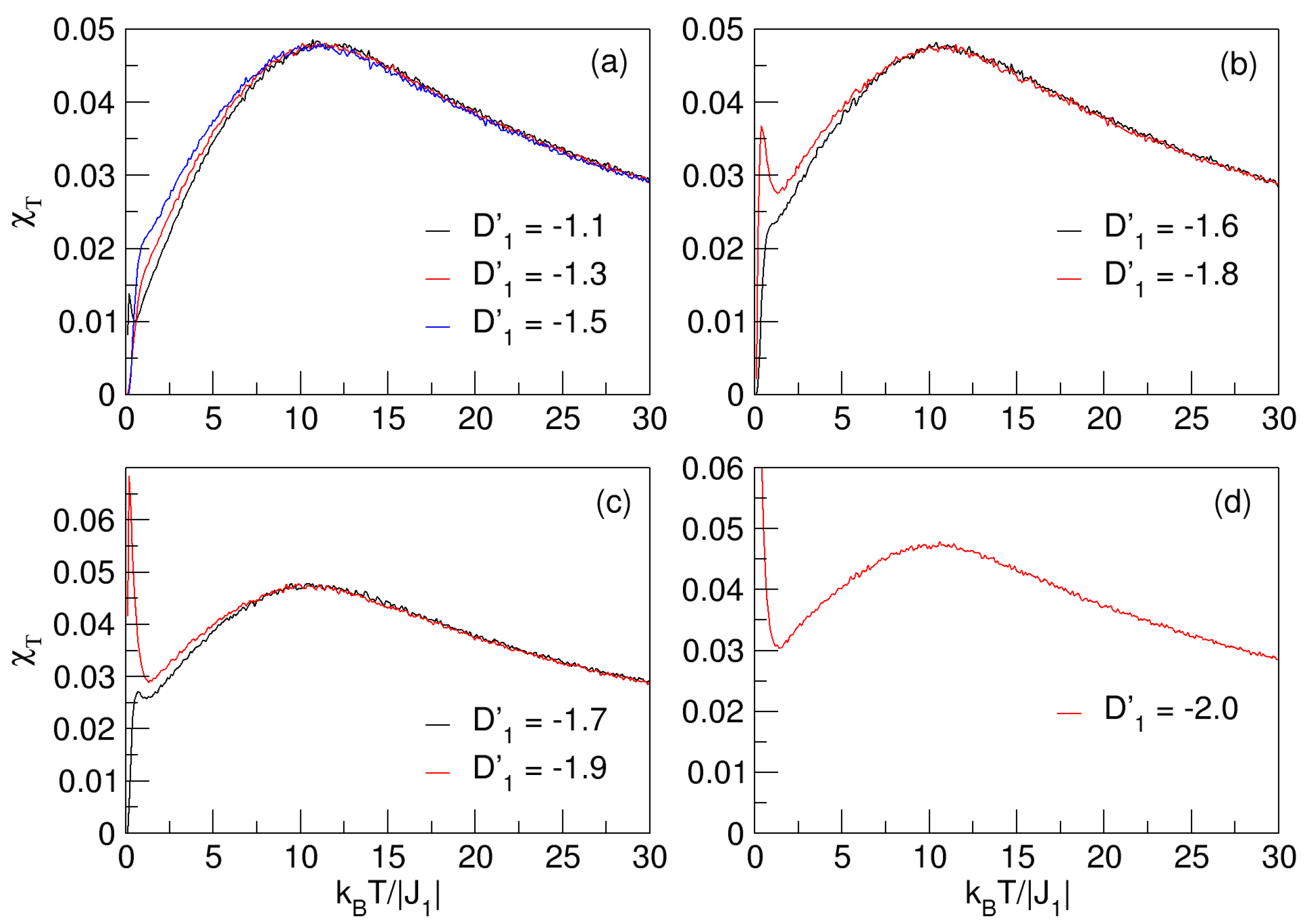
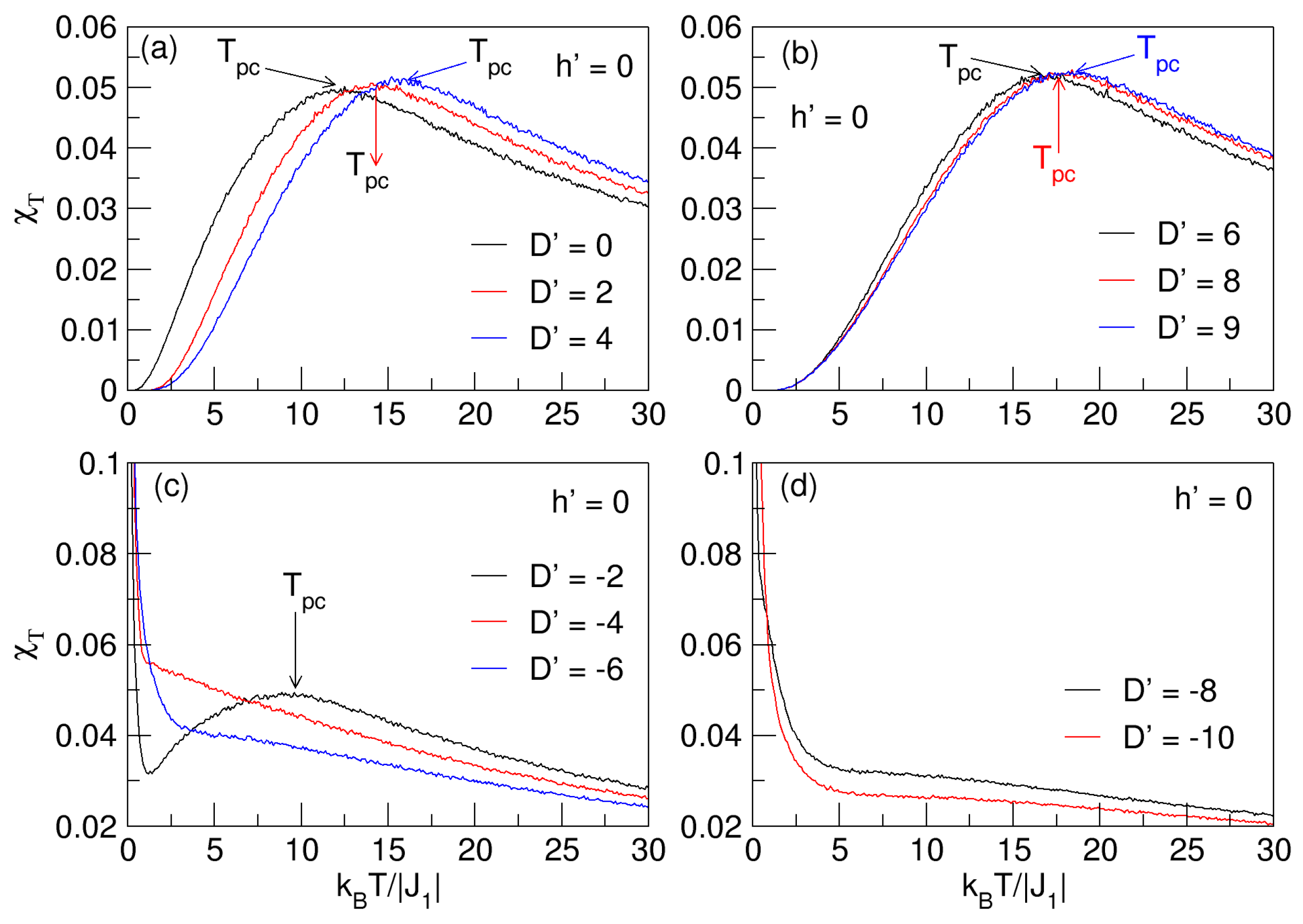
A way to approximately establish the location of pseudo-critical temperatures in nanostructured materials is by analyzing the magnetic fluctuations resulting from interactions in the nanosystem. In Figure 3, this analysis is performed through the total susceptibility .
Figure 3.
Response function of magnetic fluctuations of quasi-spherical FeCo nanoparticle varying with temperature. Curves (a,b) present flatter maxima, which increase slightly with negative decrease in in ranges and . Curves of in (c,d) show same behavior in ranges and . maxima represent pseudo-critical temperatures.
In each of the curves, there is notably a non-sharp maximum that is quite “flattened”, meaning the temperature for the transition to the disordered phase could not be determined accurately. In this case, critical phase transitions cannot be referred to, but pseudo-critical ones can because of their anomalous and significant effects in some physical properties, such as magnetization and its response function , causing internal restructuring of the material in a significant way. It is important to mention that the nanosize of the quasi-sphere (2 nm), imposes certain spatial constraints, i.e., a kind of magnetic confinement, which influences the , , and interactions, hence the thermomagnetic characteristics of the nanoparticle. For instance, the nanoconfiguration will have more magnetic stability at higher temperatures compared to bulk materials, indicating that the system experiences less impact on its thermomagnetic fluctuations and less influence on its magnetic order. The minor effect on thermal fluctuations can cause momentary rearrangements between different magnetic states of insufficient intensities to generate a transition that is not very clear, but is still significant in the production of pseudo-critical transition temperatures. Similarly, the so-called confinement, due to size effects, can lead to a reduction in the intensity of the exchange coupling and to a more localized distribution of magnetic moments; in addition, it is able to generate an anisotropic increase in the sublattices, which could be reflected in the coercivity of the system. The curves in Figure 3 reflect a more gradual transition, which is not abrupt as in bulk systems, indicating that the ferri-paramagnetic transition is smoothed because of the size; further, confinement effects remove the critical energy that gives rise to a sudden transition—hence, these temperatures are considered pseudo-critical (). No less important in the study of pseudo-critical transitions is the effect of negative anisotropies on the thermomagnetic behavior of nanosubstances. Similar is the case of , wherein it may happen that the magnetization is aligned on a plane that is perpendicular to a specific axis of axial direction, such that the spin orientations minimize the energy in that plane—i.e., the spin moments are aligned perpendicular to the plane where the energy is lowest, which may lead to thermal destabilization of the nanosystem, reflected, for example, in its hysteretic behavior and in the magnetic domains that may arise. In this case, the influences of would make the XY plane the difficult magnetization axis and the model could be easier magnetized through the Z axis.
3.2. –– Model: Effects of
Next, Figure 4 shows the behavior of the nanosphere magnetization under the effects of the crystal field in the interval , for . We can observe that the qualitative behavior of is similar to the effects caused by on the system, both in magnitude and in the shape of the curves, as evidenced in Figure 2. However, for , the nanosystem does not experience compensation temperatures, which is possible because the influence of combined with is significantly larger than the influences of . This effect could be associated with or influenced by the nanoparticle size. On the other hand, since as the values of increase markedly, the same behavior is observed in , we might suggest that this is independent of the positive increase in .
Figure 4.
Behavior of the total magnetization of the quasi-spherical FeCo nanosystem, due to the effects of the and fields. In the curves of (a–d), increases with temperature. No compensation points were found for this case.
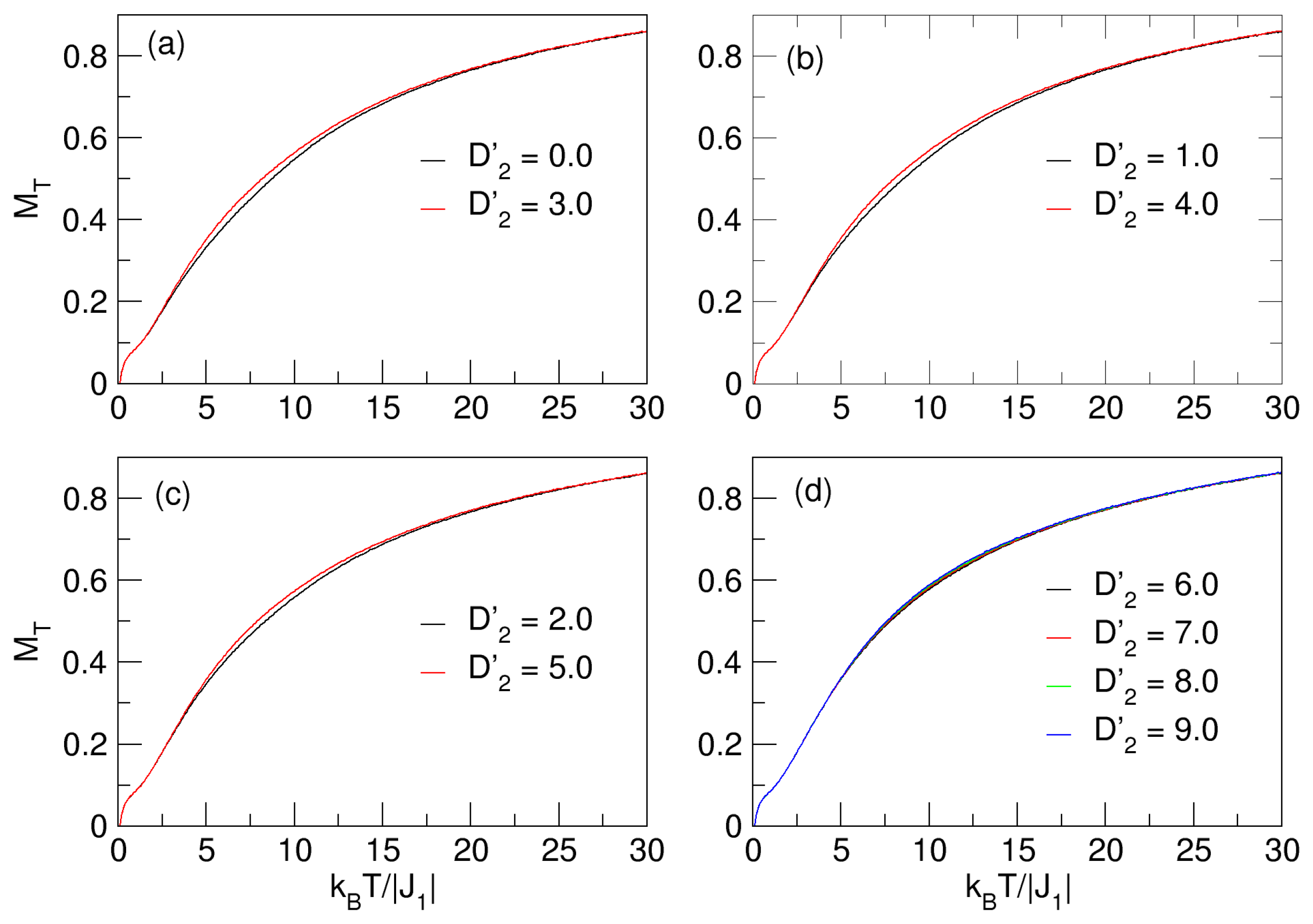
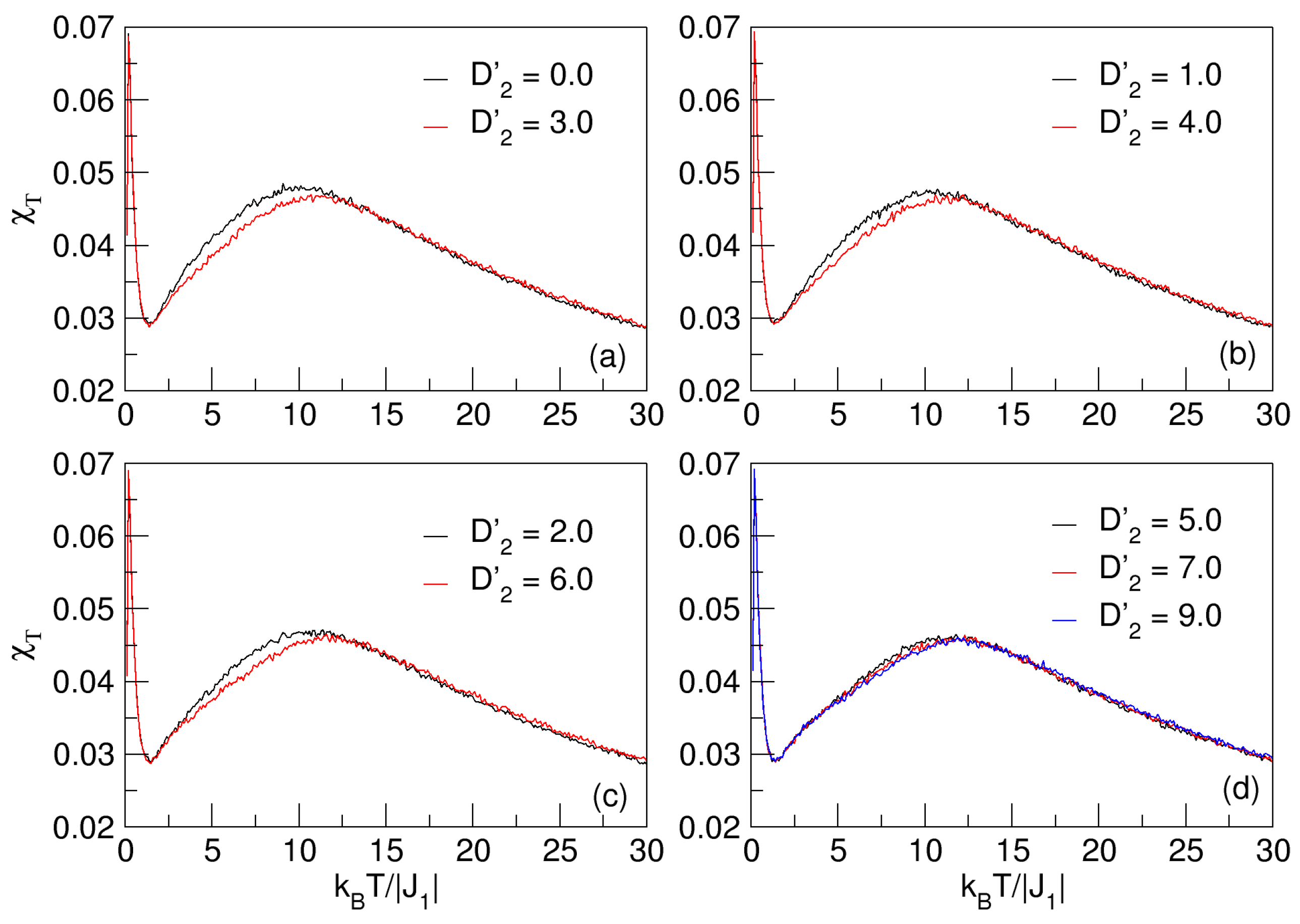
Similarly for the curves in Figure 2, the effect of on the nanosystem also does not evidence critical temperatures at ; that is, pseudo-critical transitions are also present, a phenomenon that was extensively explained when the effects of were studied in Section 3.1. In Figure 5, the behavior of the magnetic fluctuations as a function of temperature in the curves of vs. T can be appreciated, where again there are smooth maximum peaks in the vicinity of the pseudo-critical temperatures, which increase with increasing .
Figure 5.
Magnetic susceptibility as a function of temperature for and . In (a–d), a slight shift of the flattened maximum of the curves toward the higher temperature region is observed. The maxima of these smooth curves represent a pseudo-transition or a pseudo-critical temperature.
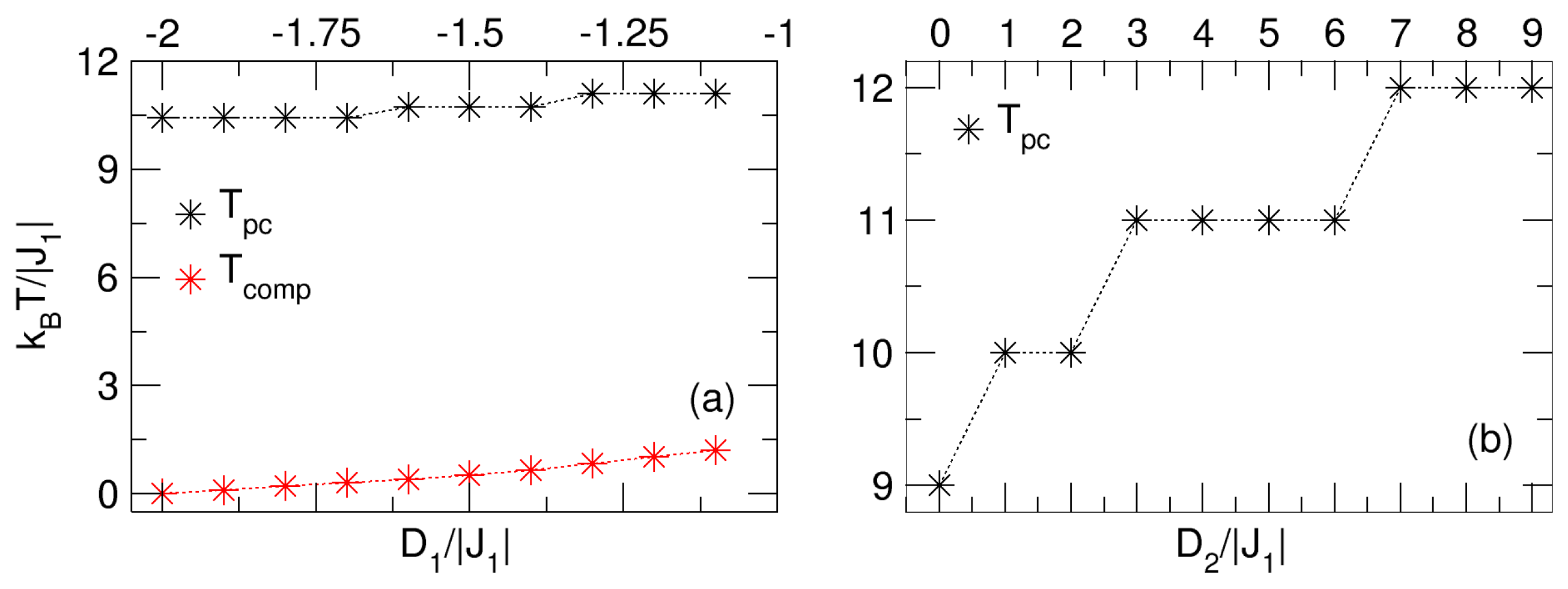
A summary of the influences of and on the temperatures and are detailed in Figure 6a,b. It is observed that and experience a slight growth with the negative decrease in the crystal field (see Figure 6a). Meanwhile, grows gradually with the positive increase in , indicating a larger effect of the anisotropy of the Fe spin sublattice (Q-type), as shown in Figure 6b.
Figure 6.
Summary of the behavior of the pseudo-critical () and compensation () temperatures: (a) due to the influence of the field with , and (b) due to the effects of the anisotropy with . In both cases, is increased by the action of the corresponding crystal field. The dotted lines are a guide for the eye.
3.3. –– Model: Effects of
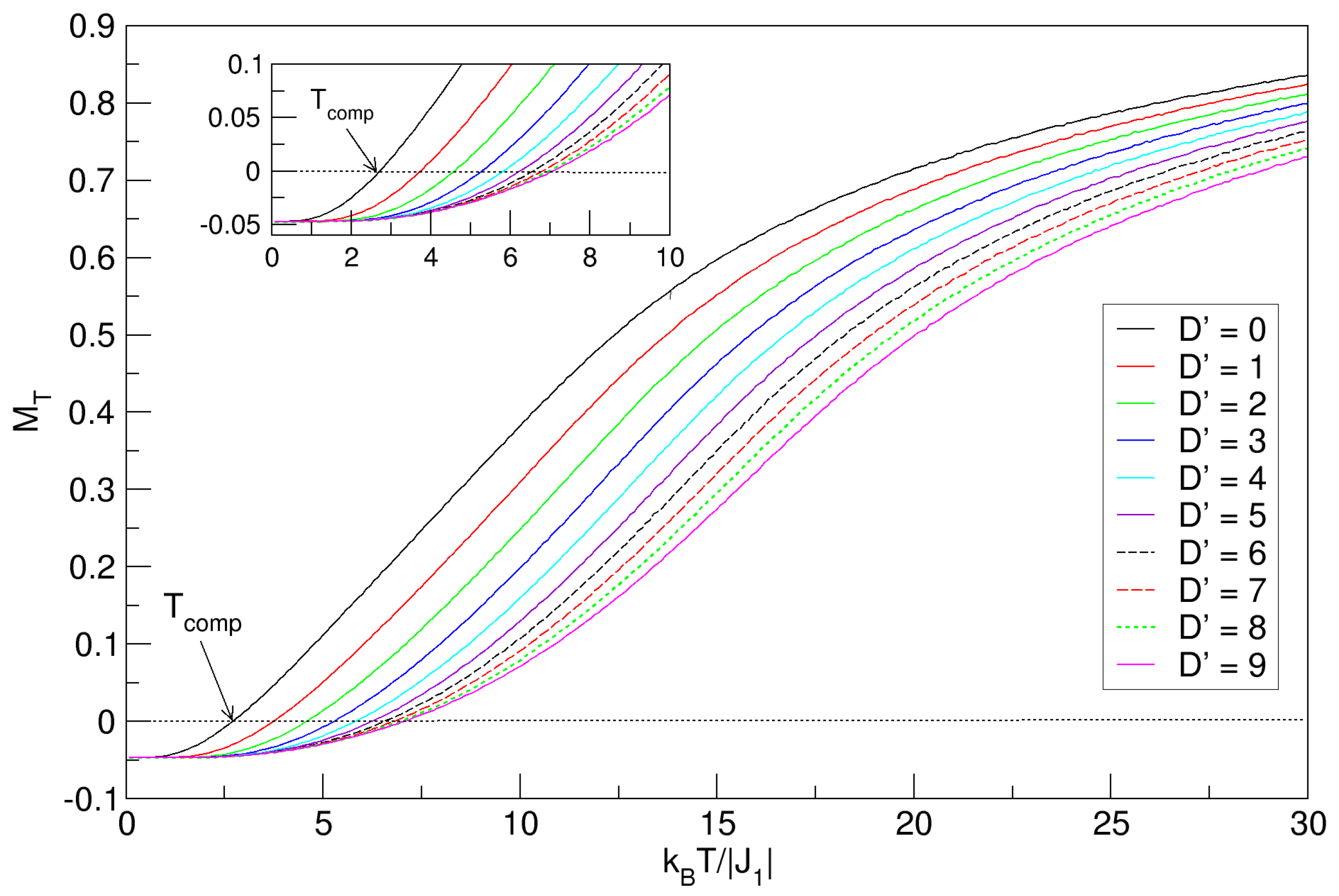
In this section, we include changes with respect to the previous model (Section 3.1 and Section 3.2). Consider now a average anisotropic field for the entire lattice, between and , and consider the calculation of the physical variables and as a function of temperature, initially in the absence of a magnetic field (), and then in the presence of a fixed external field with . The finite-temperature phase diagram of , in the absence of external fields, is shown in Figure 7, for . The curves present a constant value in the ground state magnetization (), for each value of the magnetocrystalline anisotropy, and their tendency is to increase with increasing temperature, until reaching an approximately constant saturation value for the higher temperature region. The constant value experienced by at could be explained by the fact that for positive anisotropies , regardless of their value, the ground state configuration tends to stabilize, meaning all spins are aligned at a minimum magnetization and the system is oriented in the direction of easy magnetization.
Figure 7.
Effects of the average crystal field on the total magnetization of the quasi-spherical FeCo nanoparticle in the absence of external field . In the interval , exhibits compensation points (), which increase with . The compensation phenomenon is enlarged in the inset above.
The nanostructure undergoes compensation phenomena in the range , because the lattice spins tend to orient in the direction imposed by , whereby the magnetization prefers to align itself along a specific axis of the crystal, usually the easy axis; meanwhile, the antiferromagnetic exchange, determining the general magnetic order in addition to the phase stability of the nanosphere, exerts internally a strong opposition, and many magnetic moments are reoriented to the point that at a specific value of the temperature, the sublattices are compensated—i.e., they have the same magnetization value with opposite signs. It has been proved in some cases of mixed-spin magnetic systems that first-neighbor exchange interactions and anisotropic couplings, represented by the parameters and , are responsible for the origin of compensation points in these systems [38,39,40]. The trend of indicates an increase with respect to the increase in the field. The enlarged inset shows the region where the compensation phenomenon occurs. Analogous to Figure 2 and Figure 4, where the influences of the and fields on the magnetization behavior of the FeCo nanocrystal are shown, in Figure 7, reflects quite similar curves for , which increase with temperature; in the latter figure, the system also maintains its magnetic stability, with the difference that in Figure 7, they start at with the nonzero magnetization ()—that is, the average anisotropy rearranges the spins in the nanosystem at low temperatures. The critical points for the system to pass to the paramagnetic phase are also not visible in this case, which is explained in Section 3.1.
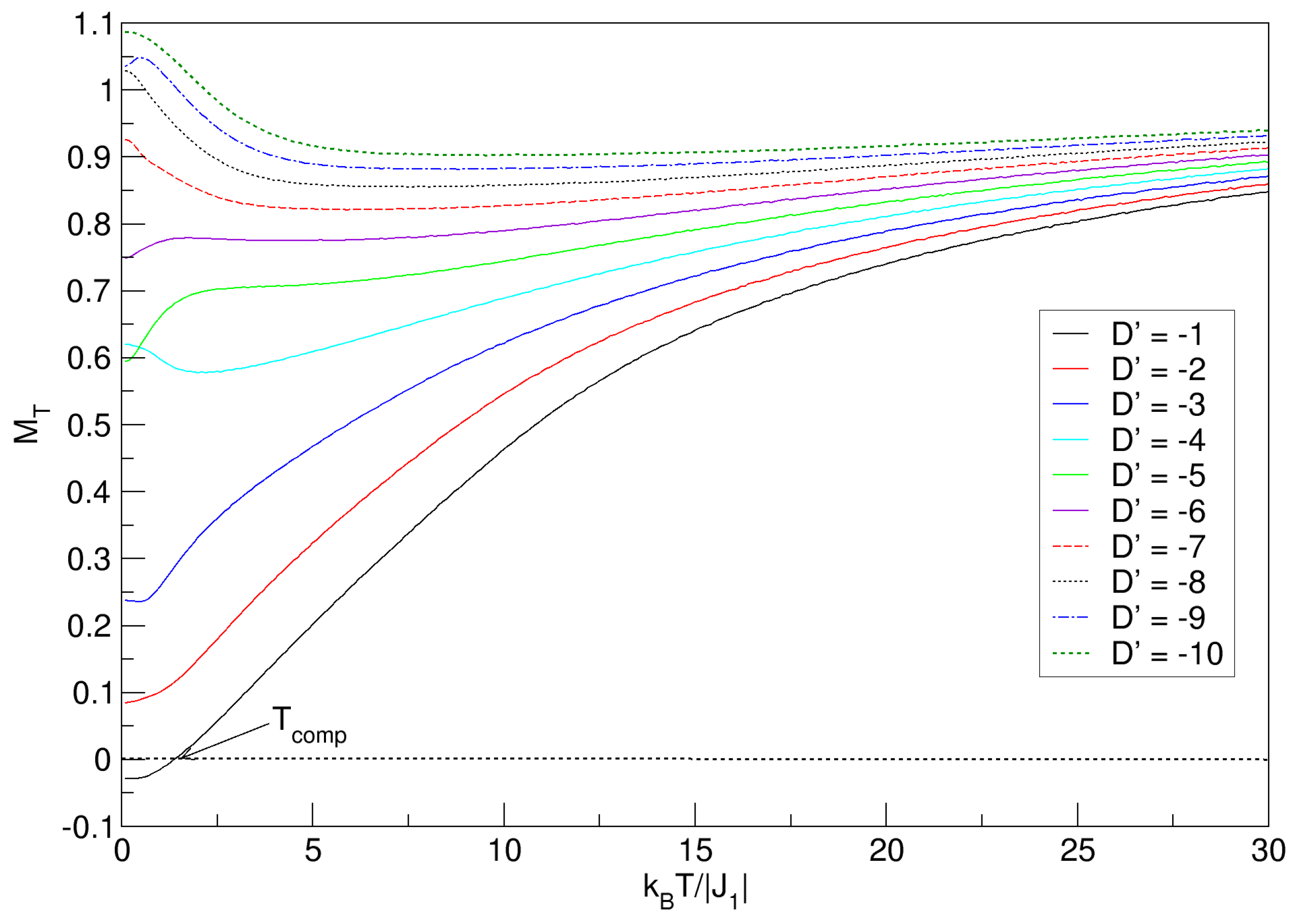
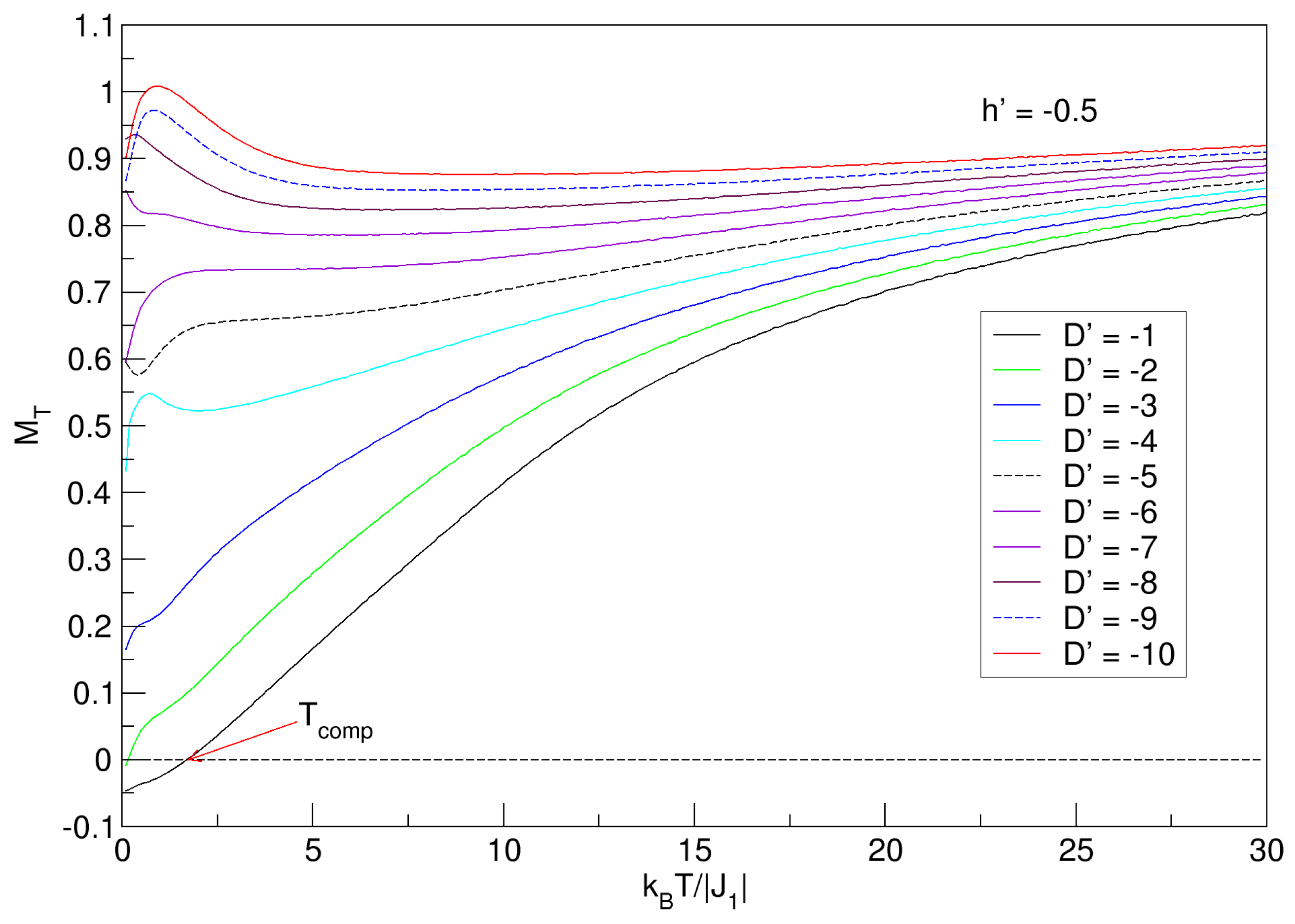
An important aspect to consider to continue the thermomagnetic analysis of the FeCo nanoconfiguration is the effect of negative anisotropy () on the behavior of . In Figure 8, by reversing the anisotropic direction, the imbalance in the sublattices can be noticed with the breaking of the compensation phenomenon; only one point prevails when (the closest to ), with a lower value than all values of for positive anisotropies. Interesting, too, is the diversity of ground-state values that arise when . For , curves increase with temperature, and in the range , the magnetization decreases. In both ranges, it is observed that the curves tend to quasi-constant values for high temperatures. The consideration is that the type of behavior of the magnetization, in both ranges, is caused by the size of the nanosphere, which imposes confinement conditions, which undoubtedly affect the exchange energy; here, a non-uniform distribution of spins in the nanostructure can arise, generating a prevalence of anisotropic coupling over exchange. When the intensity of decreases, and spintronic (non-uniform) redistribution of domains in the nanomaterial appears, each time the anisotropy increases, many of these domains prefer to align along an axis that minimizes the total energy of the system. The superiority of the negative anisotropy intensity over the exchange energies makes the nanosphere have better magnetic stabilization; this is a property that can be appreciated for the highest values of in the interval .
Figure 8.
Effects of the average crystal field on the total magnetization of the quasi-spherical FeCo nanoparticle in the absence of external field (). exhibits only for . For large temperature values, each of the curves tends to a constant value.
To complement the occurrence of the spectrum of values in the ground state, in addition to the phenomena already mentioned, negative anisotropies also generate other interesting physical situations in nanoscaled systems. Indeed, as in our study, when one has a ferrimagnetic exchange coupling () and is more negative (), then the system will experience a strong preference for the spins to align in a specific direction, resulting in a higher magnetization in the ground state; thus, with increasing temperature, the thermal energy () will reorient many random magnetic moments, reducing the magnetization. On the other hand, when is less negative, the preference for aligning the spins is weaker, resulting in a lower magnetization in the ground state. Interestingly, for the case of less negative anisotropies, the increase in temperature helps to increase , since the thermal energy and thermomagnetic fluctuations cause some “local” energy barriers imposed by the field to be overcome, allowing more spins to align in the preferred direction and the nanostructure to become magnetized. All of the above leads to the conclusion that anisotropy effects tend to dominate especially at low temperatures.
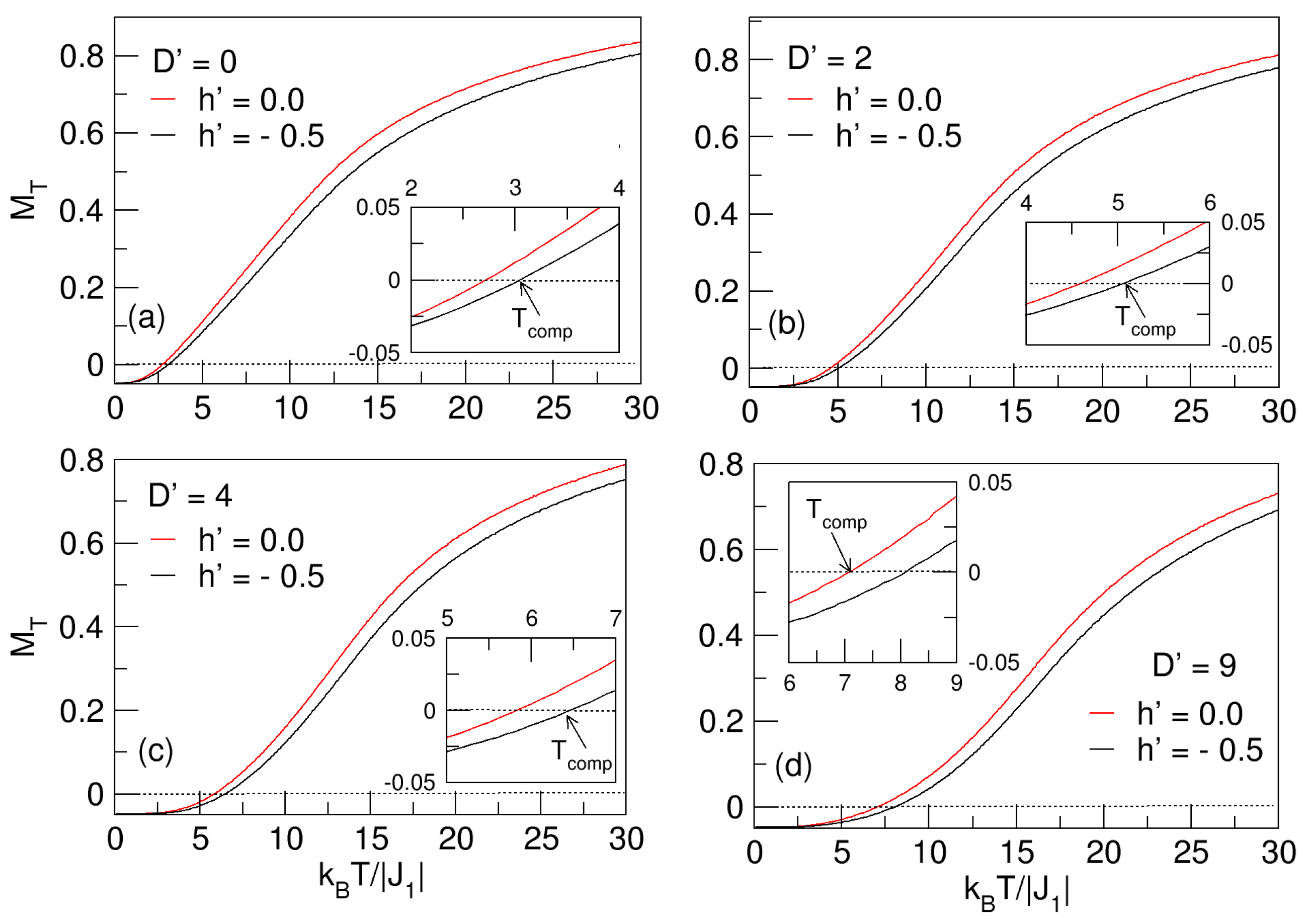
As interesting as the previous analyses is the study of the influence of an external magnetic field on the direction of the exchange interaction. Considering the same model ––, let us subject the nanosphere to a fixed field with . In Figure 9a–d, we note the effect of on the nanosystem. The performed comparison of the behavior of for is carried out, noting in the inner boxes a broadening of the compensation points. In this case, is not destroyed because and keep the spins in a given antiferromagnetic direction; that is, the external field reinforces the existing of antiferromagnetism in the lattice by next-neighbor exchange effects. The magnetocrystalline anisotropy tries to counteract the exchange effect; competition does not unbalance the sublattices, but moves the compensation temperature toward slightly larger values, as noticed in the insets of Figure 9a–d. Due to the effect of many magnetic moments, especially from the spin states of values in Fe and in Co, the system tries to find an easy magnetization axis in the lattice and causes the shift of the compensation points. It is worth noting that another factor contributing to the shift of is that slightly modifies the magnetization of the A and B sublattices, such that in the S spin sublattice decreases subtly, and in the Q spin sublattice increases. This implies that the external field is oriented parallel to the axes of easy magnetization.
Figure 9.
Comparison of the total magnetization behavior of the quasi-spherical FeCo nanosystem in the absence () and presence () of an external magnetic field. The effect of the anisotropic field is noted at the compensation points () highlighted in the inner insets of the figure. In (a), exists even in the absence of . In (a–d), the proportional increase in with respect to is noticeable.
The effects of negative anisotropies and the external field are seen in Figure 10. As in Figure 8, for , the system experiences a variety of values in the ground state, but with smaller values of . This reduction is due to the fact that for more negative anisotropies (), the external field is perpendicular to the spin orientation in the interval , so that a preference arises towards the weaker alignment, manifesting in this case an increase in magnetization with increasing temperature. For large values of , all curves tend to a quasi-constant value. It should be noted that the qualitative behavior of the curves with in Figure 10 is similar to that shown in Figure 8 with . A physical explanation of the behavior of magnetization as a function of temperature has been given in Section 3.1 and Section 3.2.
Figure 10.
Effects of the average crystal field on the total magnetization of the quasi-spherical FeCo nanoparticle in the presence of an external field () in the range . exhibits only for . For large temperature values, each of the curves tends to a quasi-constant value.
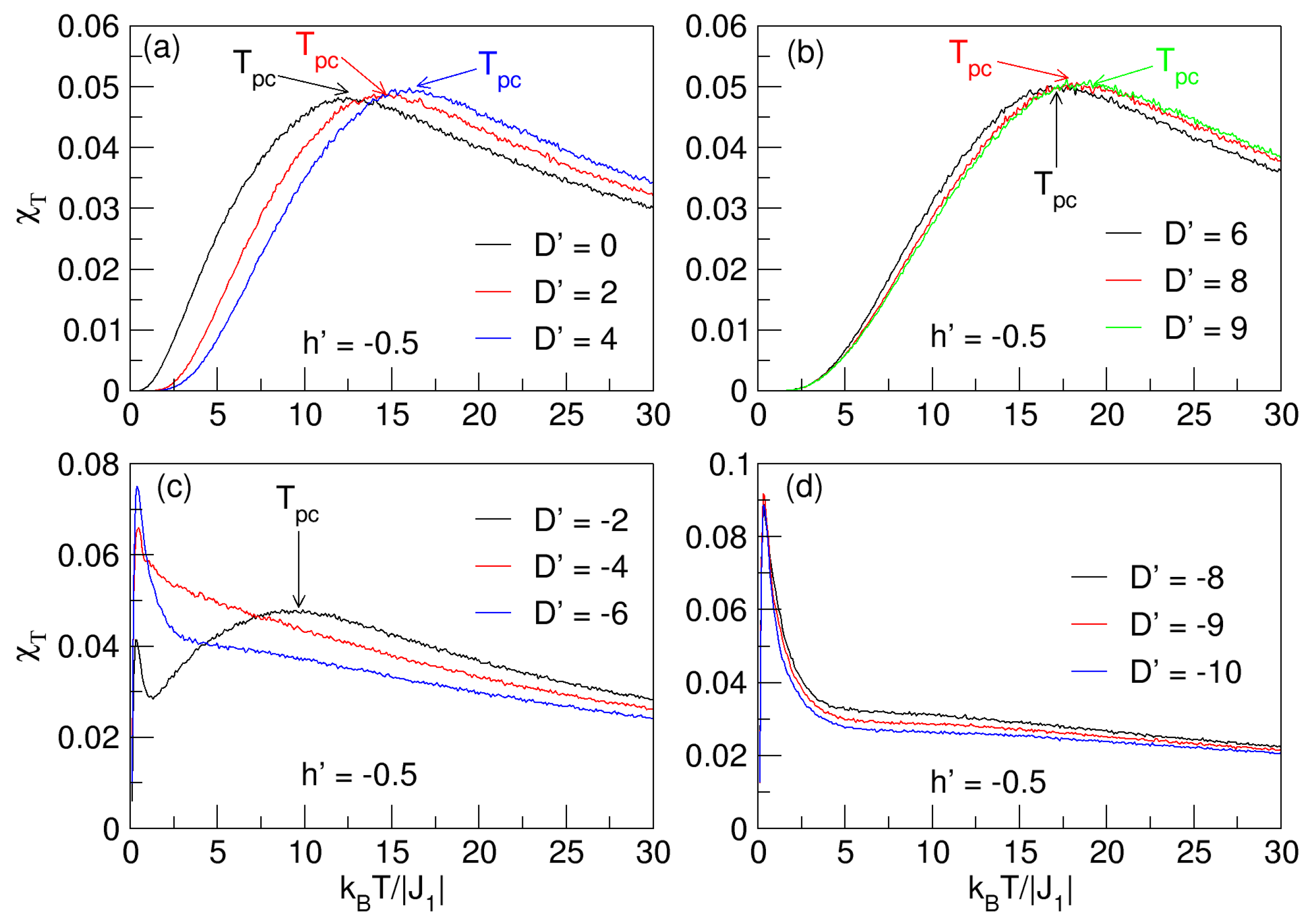
For the analysis of the magnetic fluctuations and the approximate location of the continuous phase transitions of the nanosphere, i.e., the pseudo-critical temperatures, considering the behavior of the total magnetic susceptibility in the absence and presence of a magnetic field () and in the range , the analysis information is displayed in Figure 11 and Figure 12.
Figure 11.
Total magnetic susceptibility as a function of temperature for in the absence of an external magnetic field (). In (a,b) for , the pseudo-critical temperatures (), represented in the “flattened” maxima of the curves, increase with increasing . In (c,d), for , only is seen for .
Figure 12.
Total magnetic susceptibility as a function of temperature for in the presence of an external magnetic field (). In (a,b) for , the pseudo-critical temperatures (), represented in the “flattened” maxima of the curves, increase with increasing . In (c,d), for , only is seen for , and at low temperatures, there are non-critical peaks resulting from the thermal rearrangement of the spins in the nanoparticle.
The behaviors of the curves in Figure 11a,b display flattening at their maxima, as do the susceptibility curves in Figure 3 of Section 3.1; therefore, the transition to the paramagnetic phase cannot be accurately determined when it comes to pseudo-critical temperatures (), as explained in Section 3.1. As anisotropy increases, also increases. A sign of the increase in the pseudo-critical temperature is reflected in a higher magnetic stability of the system, which is present when the anisotropy increases. As for Figure 11c,d for negative anisotropies, there are a “smooth” maxima for a value of close to zero (), but as the anisotropy increases to larger negative values (), the magnetic fluctuations increase, and becomes much smaller.
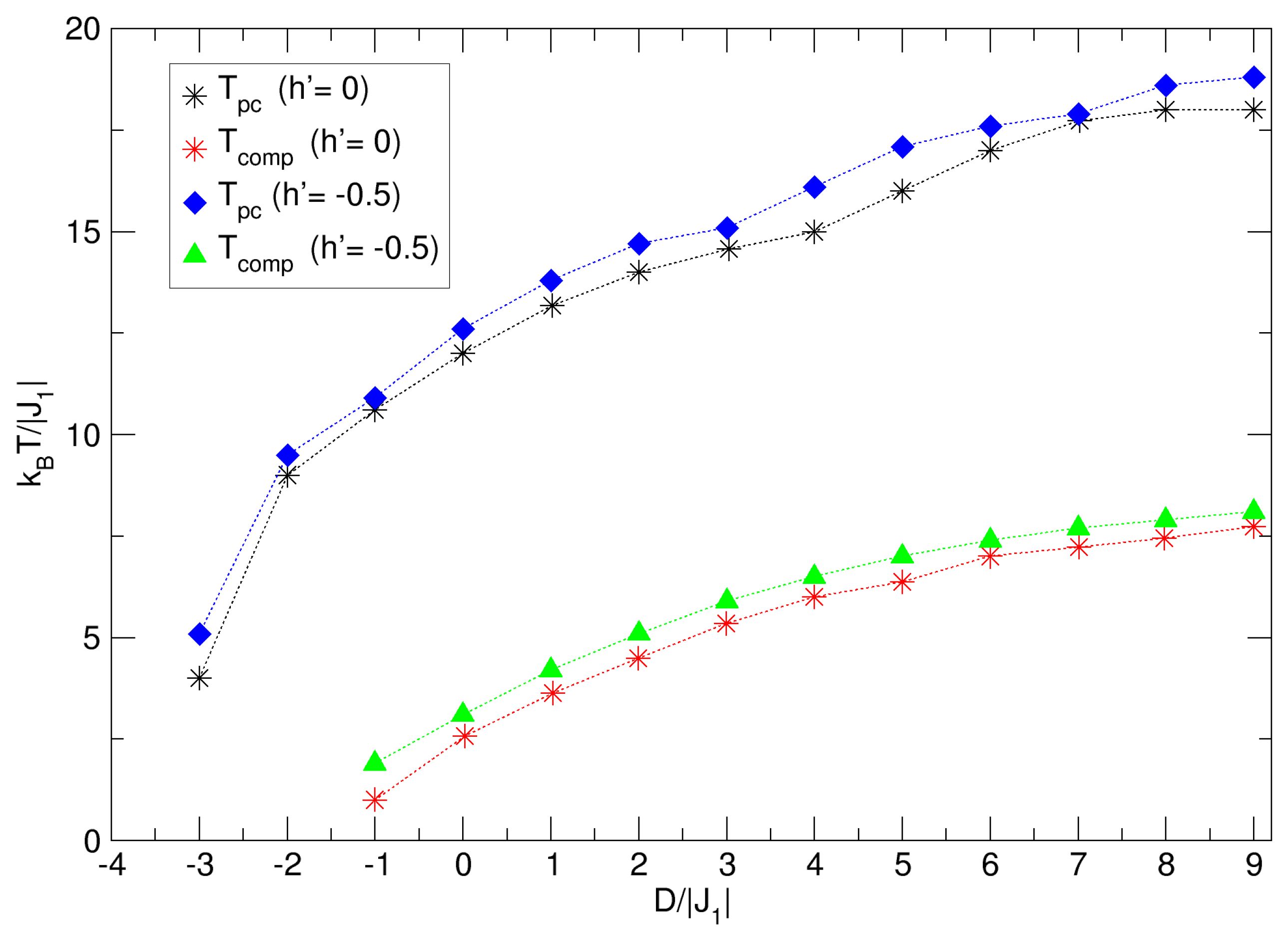
The analysis of the effect of a fixed negative field () is detailed in Figure 12. For both cases, (Figure 11a,b and Figure 12a,b) and (Figure 11c,d and Figure 12c,d), the behavior is analogous to the case in Figure 11; that is, grows with increasing (see Figure 12a,b) and decreases when (see Figure 12c,d). The difference lies in the fact that the presence of on the nanosphere causes the to increase slightly with respect to the case. A summary analysis of the behavior of the temperatures and , deduced from Figure 7, Figure 8, Figure 9, Figure 10, Figure 11 and Figure 12, is detailed in Figure 13 for , corroborating what has already been explained.
Figure 13.
Summary of the behavior of the pseudo-critical () and compensation () temperatures, in the absence and presence of an external magnetic field, due to the influence of the field. In both cases, and , it is noted that and are proportional to . In addition, the presence of the magnetic field causes and to increase slightly.
3.4. Hysteresis Behavior at Different Temperatures
Magnetic nanoparticles present several characteristics that generate phenomena not often present in massive materials; because of this particularity in their physical behavior, it is important to analyze them under certain magnetic interactions, which bring out the phenomenological richness that nanostructured materials possess. In the following, we will analyze the hysteretic behavior of the nanosphere for different temperatures, when it is influenced by the and anisotropic fields of the sublattices that compose it, and by the average field thereof.
3.4.1. Influences of Anisotropy:
In this section, we will analyze what happens when we equalize the anisotropies, estimating that represents the average crystal field of the whole nanoscaled system. We will study the influences of the total anisotropy on the nanoparticle for positive and negative values.
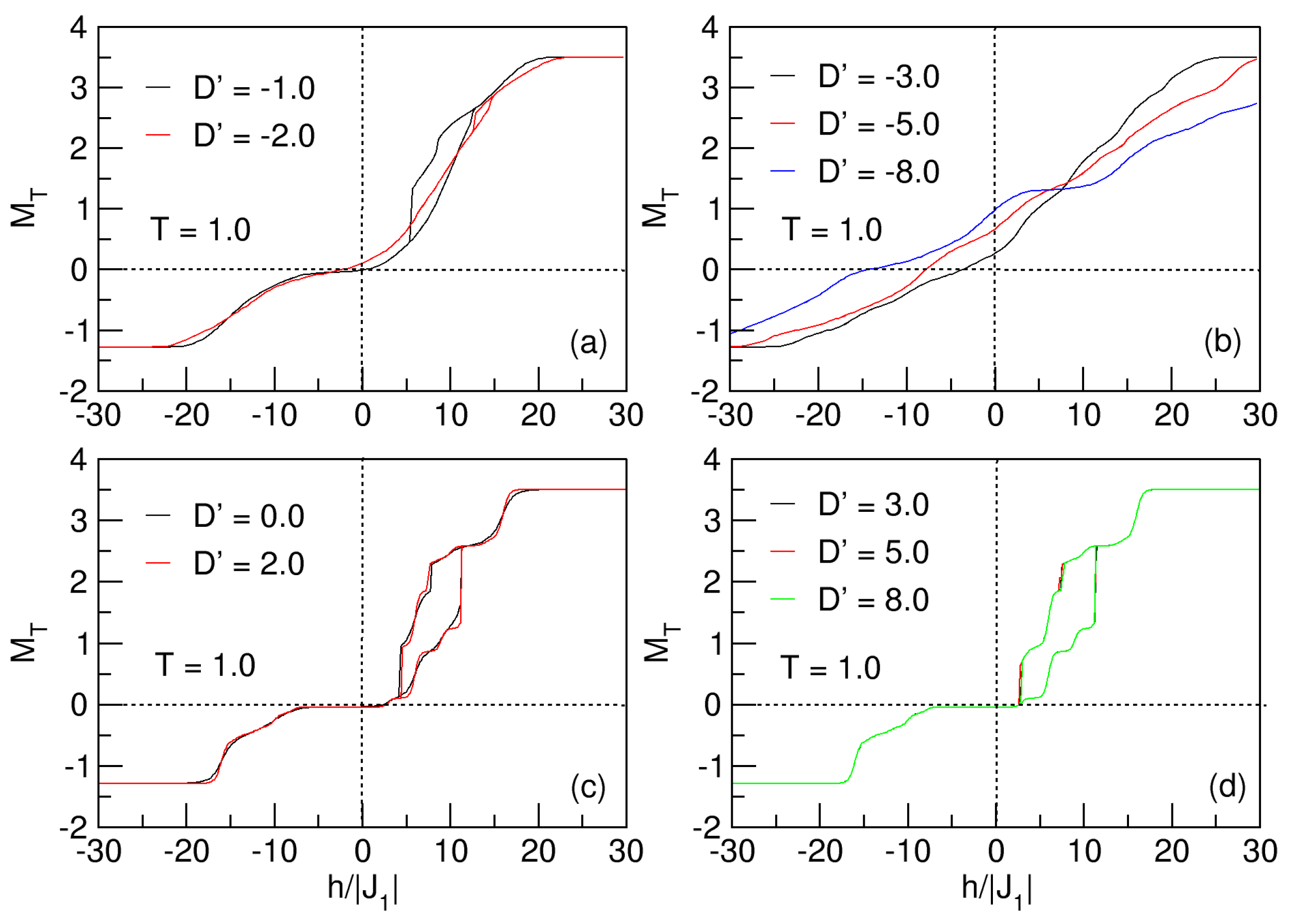
Initially, we study how , in the ranges and for , influences the hysteresis behavior of the FeCo nano-ferrimagnet for . In Figure 14a,c,d, the nanosystem exhibits exchange bias, a phenomenon generally caused by an interfacial exchange between two couplings, one ferromagnetic and the other antiferromagnetic, such that for , a kind of unidirectional exchange anisotropy () arises in the nanosystem, which acts as another field, and when it is in the same direction as the applied field, it shifts the hysteresis loop. For magnetic nanoconfigurations, the effects due to exchange anisotropy in their magnetization are reflected by horizontal or vertical displacements of the hysteresis loops, which are asymmetric with respect to the axis, or else a widening of the loop occurs [41]. In the hysteretic processes of nanostructured magnetic systems, as the external magnetic field increases, the magnetic domains of the material are reoriented in the direction of the field, so that their magnetization increases progressively, gradually breaking the walls of these domains until saturation is reached (formation of a monodomain). However, often, in addition to the external field, additional interactions can be considered in the Hamiltonian that defines the nanostructure, which implies many times the appearance of interesting physical phenomena reflected in the vs. curves. For example, the influence of these intrinsic couplings of the nanoconfiguration could cause sudden jumps or drops that destroy the apparent continuity or smoothness of the curves. These abrupt jumps are due to the displacement of the domain walls by the effects of the internal parameters of the nanoparticle; it is possible that for some values, this wall breaking is not continuous, but increases or decreases the intensity of the magnetization of the system.
Figure 14.
Hysteretic behavior of the quasi-spherical FeCo nanoparticle for and . In (a), the nanosystem experiences the exchange bias phenomenon, for . In (b), the negative increment of transfers the nanoparticle to the superparamagnetic phase. For in (c,d), the system undergoes exchange bias, with loops of approximately constant areas.
The research concerns of this paper limit us to taking into consideration exchange, anisotropic, and external field couplings. For negative anisotropies (), the magnetization () of the nanosystem tends to be oriented towards the direction of the hard axis; consequently, the negative intensity of increases, and it is more difficult to magnetize—i.e., to reach saturation (), larger external magnetic fields are required. This situation results in a slower displacement of the domain walls and smoother magnetization curves (no abrupt jumps). On the contrary, when , the tendency of the magnetization in the nanoparticle is oriented towards the easier axis, so that for large positive anisotropies, it is easier to magnetize the material, accelerating the formation of the monodomain when , due to faster displacements of the walls. The above leads to the appearance of jumps in the magnetization curves as a consequence of the gradual decrease in these domains. This phenomenology is explained below, through the hysteresis curves of the nanoparticle for in the Figure 14.
Figure 14a shows that in the range of , the nanoparticle exhibits saturation, since the external field is not yet able to disrupt the lattice to change the magnetization of the nanosystem. Meanwhile, for , the external field reorients the spins of the magnetic domains, then the magnetization cancels out for in the case of the curve and exhibits a very small coercive field and remanence (different from zero) for the case. By positively increasing the external field, , the magnetization of the system increases smoothly until saturation is reached for fields. Upon demagnetizing the system, it can be observed that for small anisotropies (), the system exhibits irreversibility, as manifested by the hysteresis loop in the first quadrant. This is a result of anisotropy, interactions between the ferromagnetic and antiferromagnetic sublattices, and surface effects. This phenomenon is known as exchange bias. In Figure 14b, what was previously explained about the influence of in the magnetization of the material can be seen; the figure highlights how the coercive field and the remanence increase as the magnitude of the anisotropy increases, making it more difficult to magnetize the nanoparticle to saturation. On the other hand, the effect of in Figure 14c,d biases the orientation of the nanoparticle magnetization toward an easy axis, whereby the nanosystem exhibits discontinuities (sudden jumps) due to abrupt displacements of the domain walls, as noticed for and in Figure 14c, as well as for and in Figure 14d; this situation gives rise to the presence of exchange bias in the nanoparticle.
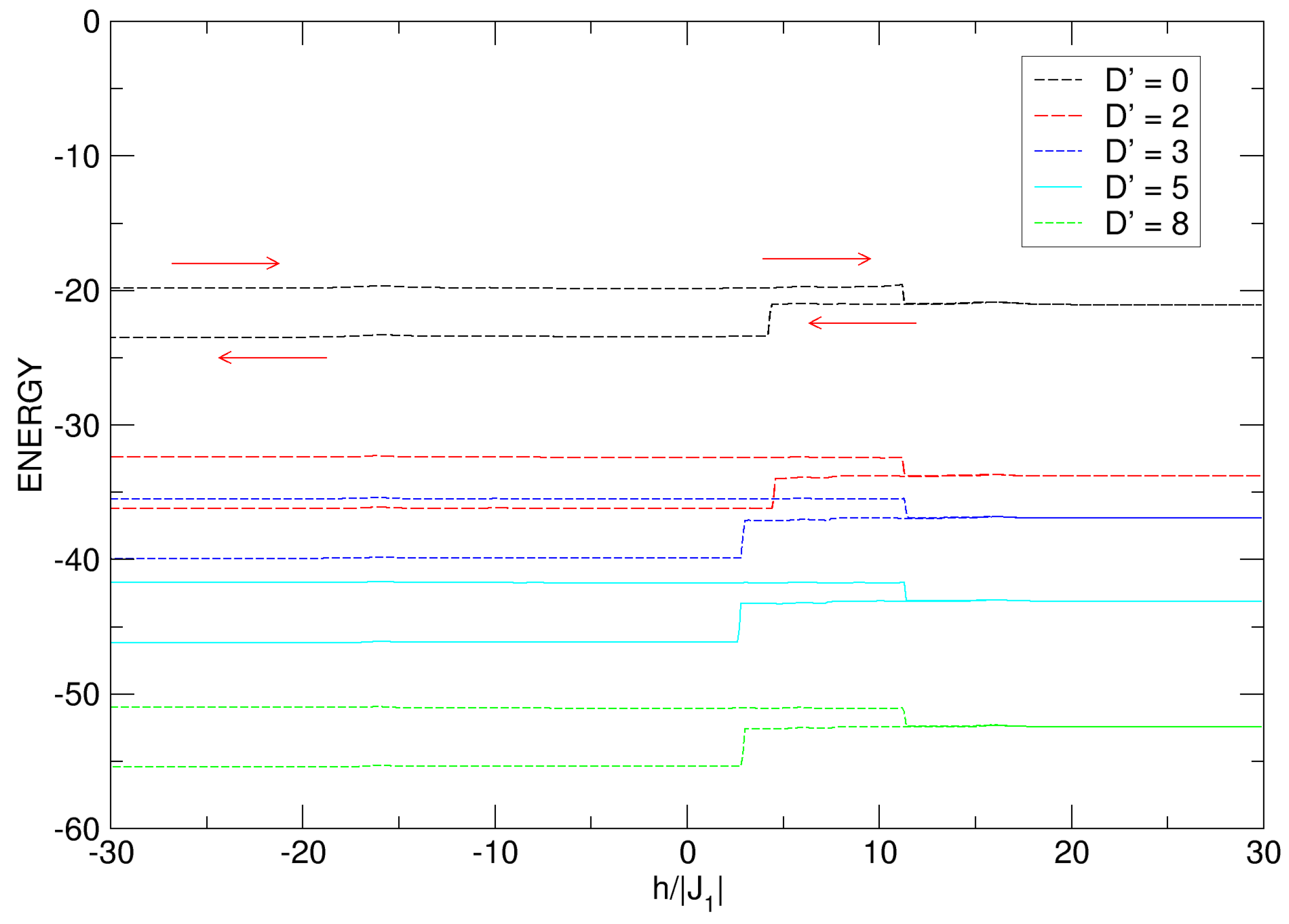
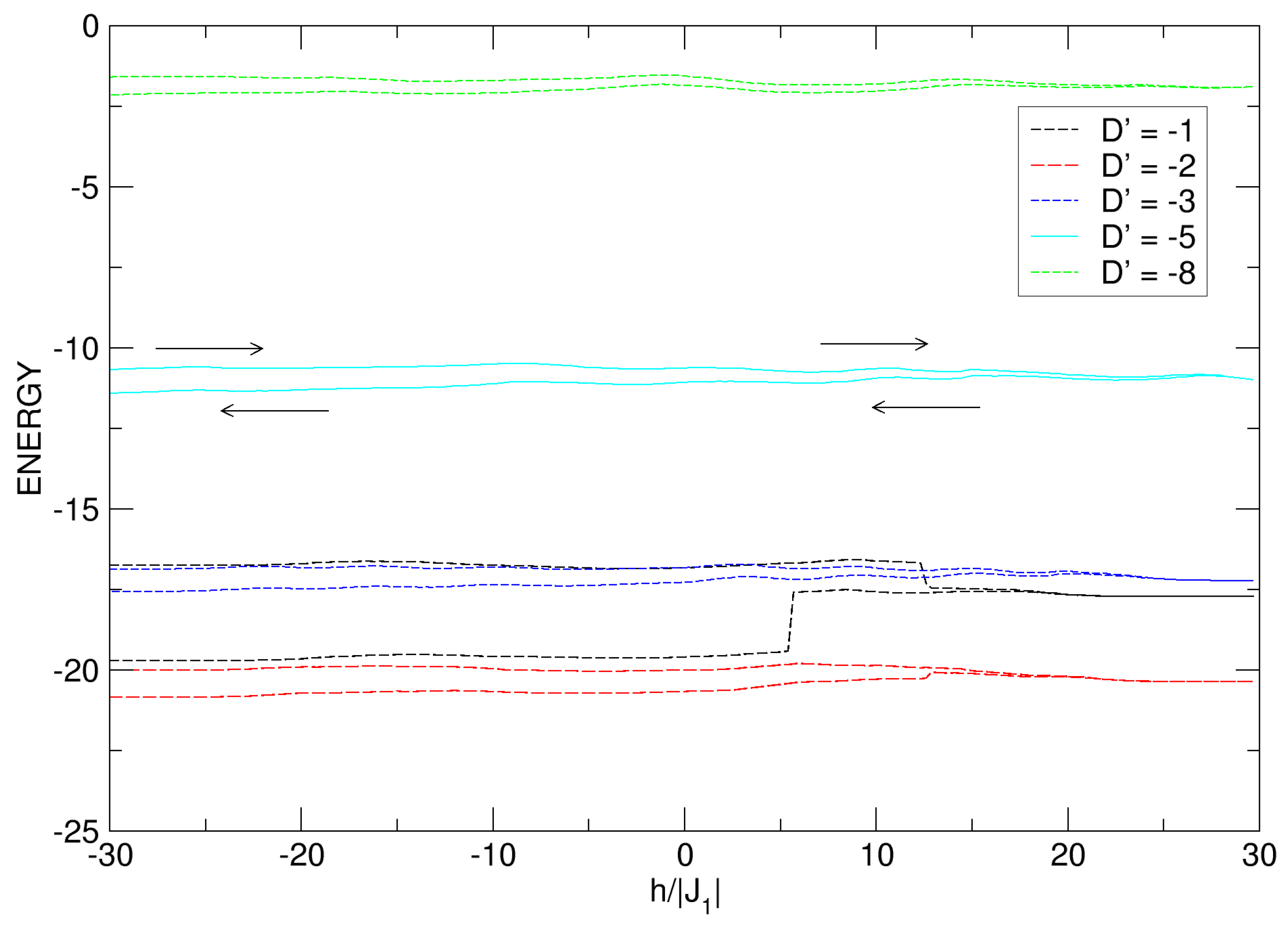
As is known, anisotropy introduces a directional preference for spin orientation, creating an energy barrier that the spins must overcome to change direction; as this increases, for , the energy of the system increases, while for , the energy of the system decreases. In Figure 14b, for cases with no hysteresis loops (), it is as if there is a threshold value of () above which the loops are destroyed and possible superparamagnetic states are experienced in the nanoparticle. Thus, as the anisotropy increases negatively from this threshold value (), the absolute value of the energy decreases, along with , as seen in the curves of Figure 15. It is relevant to emphasize that the hysteretic behavior of a magnetic system is associated with changes in its internal energy during a complete cycle of magnetization and demagnetization. For a better understanding of this behavior, the energy curves presented for the nanoconfiguration for the same values of the anisotropy are shown in Figure 14.
Figure 15.
Internal energy of the quasi-spherical FeCo nanoparticle under the effects of the anisotropic field. The negative increase in leads to a gradual decrease in the energy. The arrows indicate the energetic process, which starts at the top of each curve in the range .
For negative crystal fields, for , in Figure 15, a noticeable change in energy can be observed: comparing the curves for and , a larger change is noticed when (interval ). The energy curve for and starts with a quasi-constant value from until experiencing an abrupt drop at approximately , and then ends after a half cycle when . Once the external field is reversed, the nanosphere presents another sudden drop for , and continues its irreversible process with a quasi-constant value of , until completing the cycle when . This indicates that the difference between the energy values when the nanosystem makes the complete hysteretic cycle is . In an analogous process for , it is noted that the increase in anisotropy generates a smaller energy difference () by developing the whole cycle in the range . All of the above is in agreement with the hysteresis curves in Figure 14a, where a smaller area is noted for the loop associated with . The intensity of these values of is so small that the system is able to overcome the anisotropic barrier to become magnetized on the hard axis and form a single loop for this value of the anisotropic field, but with different areas.
For , in Figure 16, as expected and according to the results observed in the curves of vs. , there is variation in the energy with changes approximately equal () for all cases; in addition, sudden jumps in the irreversible process of the energy cycle are noticed, for the same values of where such jumps are presented for the magnetization (see Figure 14c,d). It should be noted that as increases, the absolute value of the energy increases.
Figure 16.
Internal energy of the quasi-spherical FeCo nanoparticle under the effects of the anisotropic field. The positive increase in leads to a gradual increase in the energy. The arrows indicate the energetic process, which starts at the top of each curve in the range .
3.4.2. Influences of Anisotropy:
As interesting as the effects of an average crystal field for the nanosystem at hand turns out to be the influence of each of the single-ion anisotropies of the sublattices composing the nano-ferrimagnet. We begin in this section, Section 3.4.2, an analysis of the behavior of the magnetization when the effect of the anisotropy of the sublattice of Co atoms, , with spins is taken into account.
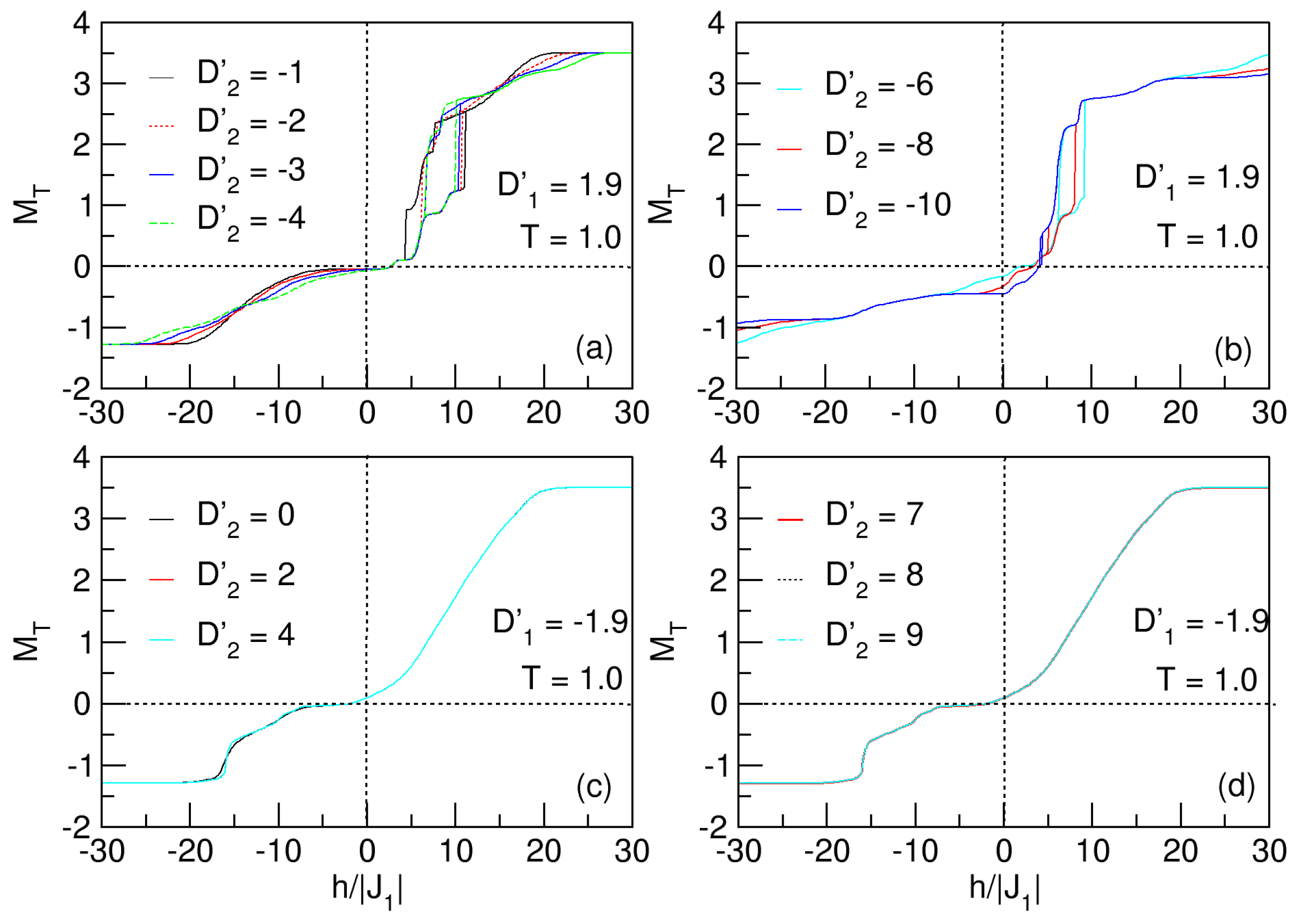
In Figure 17a, the nanosystem exhibits an asymmetric loop to the right of the axis for each of the values of , which decreases with increasing ||.
Figure 17.
Hysteretic behavior of the quasi-spherical FeCo nanoparticle, for and . In (a), the nanosystem experiences the exchange bias phenomenon, for . There is a threshold value of in the range , at which the nanoparticle enters the superparamagnetic phase, as shown in (b–d).
As in Figure 14, when considering the average anisotropy, in Figure 17, there is also a threshold value, , at which the hysteresis loops are destroyed, and the system enters the superparamagnetic phase. In this case, this value is smaller because there is competition with the anisotropy . Similarly, a qualitatively analogous behavior to that analyzed for is observable.
There are some factors that lead the system to the exchange bias phenomenon, which we consider below. Initially, the crystal field tries to order the Q-type spin lattice (B sublattice with Fe atoms) by orienting its magnetization towards an easy axis. This apparent order of the B sublattice is counteracted by the action of the antiferromagnetic exchange to the first neighbors, and the orientation of the magnetization of the A sublattice spins (Co atoms) towards a difficult axis, a product of the anisotropic field. This anisotropy exchange competition between the parameters of the Hamiltonian reduces the hysteresis loops, and at low temperatures, the system is superparamagnetic, as shown for values, as expected for this type of nanoparticle. For the range , the thermomagnetic evolution of the nanostructure is independent of the anisotropic effect, since superparamagnetism is still constantly present.
3.4.3. Influences of Anisotropy:
The influence of the crystal field on the hysteretic behavior of the nanosystem is shown in Figure 18a,b. Analogous to the previously studied cases on the effect of and on the magnetization behavior, the influence of on the hysteresis of the system also reflects the exchange bias phenomenon, with a decrease in the loop area when the crystal field grows negatively.
Figure 18.
Hysteretic behavior of the quasi-spherical FeCo nanoparticle, for and . In (a,b), for , the nanosystem experiences the exchange bias phenomenon in the ranges and , respectively. The area of the loops is ostensibly reduced with the negative increment of , until passing to the paramagnetic phase when . For and . In (c,d), the system undergoes the superparamagnetic phenomenon.
Similarly, a threshold value of (much larger than the previous ones), at which the system transitions to the superparamagnetic phase, is also seen. Figure 18a,b also show that there is a prevalence of anisotropy to keep the lattice more ordered. This reflects the need for a larger crystal field, oriented on the hard axis (), to disorder the lattice, and make the transition to the superparamegnetic phase. The dominance of the crystal field associated with the sublattice of Co atoms () on the nanosystem can be seen in the same way in the curves of Figure 18c, since although the anisotropy tends to orient the spins towards the easy axis with values from zero to four, it is not enough to overcome the energy barrier caused by the anisotropy , since superparamagnetism is observed in all cases.
4. Discussion
The most significant thing to highlight in this research is how, through computational simulations, the qualitative behavior of various nanostructured physical systems can be obtained, which is reflected in the different phenomena they experience. These simulations help to support and complement several experimental investigations, allowing for predicting the behavior of systems under different conditions. Likewise, they support the search for and design of new materials with specific properties before attempting to synthesize them. In our case, this paper deals with a quasi-spherical nanoparticle in the presence of exchange, an external field, and, above all, anisotropic interactions. Among the phenomena found due to the effects of these interactions on the nanoparticle, it is pertinent highlight pseudo-critical and compensation temperatures, as well as hysteresis loops and superparamagnetism at low temperatures.
Comparing the results of this paper with previous work on nanostructured systems, Ahsan and Singh [42] in their work on Atomistic simulation study of FeCo alloy nanoparticles reported critical temperatures for different concentrations of the alloy; in contrast to their research, we only found pseudo-critical temperatures, which do not clearly reflect the ferri-paramagnetic phase transition. Another important aspect to highlight is the finding of compensation and exchange bias phenomena in this paper, which were not reported in the [42]. On the other hand, Kumari et al. [43] experimentally investigated magnetocrystalline anisotropy and exchange bias phenomena through the interface effects of nanocrystalline FeCo; they demonstrated, as achieved in this research, that the behavior of magnetization as a function of temperature does not show critical temperatures—i.e., the qualitative behavior of the magnetization curves in [43] (see Figure 5a of [43]) is analogous to that reported in our work in Figure 2, Figure 4, and Figure 9. Another experimental demonstration that corroborates our findings on how increases with thermal energy is established in work on the exchange bias effect in FeCo nanoparticles reported by Potpattanapol et al., who fabricated three nanoparticles using the hydrothermal method, where XRD studies determined that the structures of the first two nanoparticles were body-centered cubic (BCC) [44]. Potpattanapol et al. measured their magnetic properties through FC and ZFC magnetization curves (see Figure 3a,b of [44]) in order to study the exchange bias effects that cause a horizontal shift of the hysteresis loops, also reflected in this research. It is worth noting that as in this paper, in [44], the researchers posit that the differences between the FC and ZFC curves of the three FeCo nanoparticles are caused by the energy barriers resulting from the magnetic anisotropies in the three samples.
It should be noted that, in the present work, we used different values of internal couplings, such as the crystal fields , , and , which allowed us to demonstrate their influence on the aforementioned phenomena. For example, the effect of generated pseudo-critical temperatures and compensation points in the system, while for the application of , we only found . By averaging the anisotropies (), the system experienced and . Similarly, this study also permitted us to analyze the hysteretic behavior of the nanoparticle for various values of , , and in the easy and hard directions of the magnetization of the nanosystem. Our findings highlight the importance of computational simulations in the investigation of the thermomagnetic behavior of these nanostructures, as a complement to experimental investigations.
This discussion could be extended by complementing this work with other research in which new physical factors are involved. For instance, the influence of intrinsic parameters such as surface anisotropy might be studied, and future studies may consider these interactions under a different Hamiltonian, as in the case of the Heisenberg one that defines the nanosystem.
Author Contributions
Conceptualization, J.C.M., E.R.-P. and N.D.L.E.; methodology, J.C.M. and N.D.L.E.; investigation, J.C.M., E.R.-P. and N.D.L.E.; writing—original draft preparation, J.C.M. and N.D.L.E.; writing—review and editing, J.C.M., E.R.-P. and N.D.L.E.; visualization, J.C.M. and N.D.L.E.; formal analysis, J.C.M., E.R.-P. and N.D.L.E. All authors have read and agreed to the published version of the manuscript.
Funding
This research has not been funded by any academic or scientific entity.
Data Availability Statement
The original contributions presented in this study are included in the article. Further inquiries can be directed to the corresponding author.
Acknowledgments
N. De La Espriella and J. C. Madera thank Emmanuel Salvatore for his guidance in the development of this article.
Conflicts of Interest
The authors declare no conflicts of interest.
References
- Vatansever, E. Monte Carlo simulation of dynamic phase transitions and frequency dispersions of hysteresis curves in core/shell ferrimagnetic cubic nanoparticle. Phys. Lett. A 2017, 381, 1535–1542. [Google Scholar] [CrossRef]
- Saber, N.; Fadil, Z.; Mhirech, A.; Kabouchi, B.; Bahmad, L.; Ousi, B.W. Magnetic properties of the ternary FeCoxNi1−x alloy: Monte Carlo simulations. Philos. Mag. 2022, 102, 1725–1738. [Google Scholar] [CrossRef]
- Kima, K.J.; Leeb, S.J.; Lynch, D.W. Study of optical properties and electronic structure of ferromagnetic FeCo. Solid State Commun. 2000, 114, 457–460. [Google Scholar] [CrossRef]
- Lucas, M.S.; Muñoz, J.A.; Mauger, L.; Chen, W.L.; Sheets, A.O.; Turgut, Z.; Horwath, J.; Abernathy, D.L.; Stone, M.B.; Delaire, O.; et al. Effects of chemical composition and B2 order on phonons in bcc Fe-Co alloys. J. Appl. Phys. 2010, 108, 023519. [Google Scholar] [CrossRef]
- Sundar, R.S.; Deevi, S.C. Soft magnetic FeCo alloys: Alloy development, processing, and properties. Int. Mater. Rev. 2005, 50, 157–192. [Google Scholar] [CrossRef]
- Seo, W.S.; Lee, J.H.; Sun, X.; Suzuki, Y.; Mann, D.; Liu, Z.; Terashima, M.; Yang, P.C.; McConnell, M.V.; Nishimura, D.G.; et al. FeCo/graphitic-shell nanocrystals as advanced magnetic-resonance-imaging and near-infrared agents. Nat. Mater. 2006, 5, 971–976. [Google Scholar] [CrossRef] [PubMed]
- Moores, B.A.; Eichler, A.; Tao, Y.; Takahashi, H.; Navaretti, P.; Degen, C.L. Accelerated nanoscale magnetic resonance imaging through phase multiplexing. Appl. Phys. Lett. 2015, 106, 213101. [Google Scholar] [CrossRef]
- Hütten, A.; Sudfeld, D.; Ennen, I.; Reiss, G.; Hachmann, W.; Heinzmann, U.; Wojczykowski, K.; Jutzi, P.; Saikaly, W.; Thomas, G. New magnetic nanoparticles for biotechnology. J. Biotechnol. 2004, 112, 47–63. [Google Scholar] [CrossRef] [PubMed]
- Mehdaoui, B.; Carrey, J.; Stadler, M.; Cornejo, A.; Nayral, C.; Delpech, F.; Chaudret, B.; Respaud, M. Influence of a transverse static magnetic field on the magnetic hyperthermia properties and high-frequency hysteresis loops of ferromagnetic FeCo nanoparticles. Appl. Phys. Lett. 2012, 100, 052403. [Google Scholar] [CrossRef]
- Snyder, R.L.; Nguyen, V.Q.; Ramanujan, R.V. Design parameters for magneto-elastic soft actuators. Smart Mater. Struct. 2010, 19, 055017. [Google Scholar] [CrossRef]
- Ahmed, A.S.; Ramanujan, R.V. Hysteretic Buckling for Actuation of Magnet–Polymer Composites. Macromol. Chem. Phys. 2015, 216, 1594–1602. [Google Scholar] [CrossRef]
- Tang, Y.J.; Parker, F.T.; Harper, H.; Berkowitz, A.E.; Jiang, Q.; Smith, D.J.; Brand, M.; Wang, F. Co/sub 50/Fe/sub 50/ fine particles for power frequency applications. IEEE Trans. Magn. 2004, 40, 2002–2004. [Google Scholar] [CrossRef]
- Li, D.; Wang, Z.; Han, X.; Li, Y.; Guo, X.; Zuo, Y.; Xi, L. Improved high-frequency soft magnetic properties of FeCo films on organic ferroelectric PVDF substrate. J. Magn. Magn. Mater. 2015, 375, 33–37. [Google Scholar] [CrossRef]
- Lv, R.; Kang, F.; Gu, J.; Gui, X.; Wei, J.; Wang, K.; Wu, D. Carbon nanotubes filled with ferromagnetic alloy nanowires: Lightweight and wideband microwave absorber. Appl. Phys. Lett. 2008, 93, 223105. [Google Scholar] [CrossRef]
- Zhang, Y.; Wang, P.; Wang, Y.; Qiao, L.; Wang, T.; Li, F. Synthesis and excellent electromagnetic wave absorption properties of parallel aligned FeCo@C core–shell nanoflake composites. J. Mater. Chem. C 2015, 3, 10813–10818. [Google Scholar] [CrossRef]
- Bian, B.; Jin, L.; Zheng, Q.; Wang, F.; Xu, X.; Du, J. Exchange-coupled nanocomposites with novel microstructure and enhanced remanence by a new approach. J. Mater. Sci. Technol. 2021, 79, 118–122. [Google Scholar] [CrossRef]
- Vadillo, V.; Insaustia, M.; Gutiérrez, J. FexCo1−x alloy nanoparticles: Synthesis, structure, magnetic characterization and magnetorheological application. J. Magn. Magn. Mater. 2022, 563, 169975. [Google Scholar] [CrossRef]
- Kolhatkar, A.G.; Nekrashevich, I.; Litvinov, D.; Willson, R.C.; Lee, T.R. Cubic Silica-Coated and Amine-Functionalized FeCo Nanoparticles with High Saturation Magnetization. Chem. Mater. 2013, 25, 1092–1097. [Google Scholar] [CrossRef] [PubMed]
- Dalavi, S.B.; Raja, M.M.; Panda, R.N. FTIR, magnetic and Mössbauer investigations of nano-crystalline FexCo1−x (0.4 ⩽ x ⩽ 0.8) alloys synthesized via a superhydride reduction route. New J. Chem. 2015, 39, 9641–9649. [Google Scholar] [CrossRef]
- Kandapallil, B.; Colborn, R.E.; Bonitatibus, P.J.; Johnson, F. Synthesis of high magnetization Fe and FeCo nanoparticles by high temperature chemical reduction. J. Magn. Magn. Mater. 2015, 378, 535–538. [Google Scholar] [CrossRef]
- Kodama, D.; Shinoda, K.; Sato, K.; Konno, Y.; Joseyphus, R.J.; Motomiya, K.; Takahashi, H.; Matsumoto, T.; Sato, Y.; Tohji, K.; et al. Chemical Synthesis of Sub-micrometer- to Nanometer-Sized Magnetic FeCo Dice. Adv. Mater. 2006, 18, 3154–3159. [Google Scholar] [CrossRef]
- Karipoth, P.; Thirumurugan, A.; Velaga, S.; Greneche, J.-M.; Joseyphus, R.J. Magnetic properties of FeCo alloy nanoparticles synthesized through instant chemical reduction. J. Appl. Phys. 2016, 120, 123909. [Google Scholar] [CrossRef]
- Reiss, G.; Hütten, A. Applications beyond data storage. Nat. Mater. 2005, 4, 725–726. [Google Scholar] [CrossRef] [PubMed]
- Çelik, Ö.; Fırat, T. Synthesis of FeCo magnetic nanoalloys and investigation of heating properties for magnetic fluid hyperthermia. J. Magn. Magn. Mater. 2018, 456, 11–16. [Google Scholar] [CrossRef]
- Kim, D.; Kim, J.; Lee, J.; Kang, M.K.; Kim, S.; Park, S.H.; Kim, J.; Choa, Y.-H.; Lim, J.-H. Enhanced Magnetic Properties of FeCo Alloys by Two-Step Electroless Plating. J. Electrochem. Soc. 2019, 166, D131–D136. [Google Scholar] [CrossRef]
- Sánchez-De Jesús, F.; Bolarín-Miró, A.M.; Cortés Escobedo, C.A.; Torres-Villaseñor, G.; Vera-Serna, P. Structural Analysis and Magnetic Properties of FeCo Alloys Obtained by Mechanical Alloying. J. Metall. 2016, 2016, 1–8. [Google Scholar] [CrossRef]
- Madera, J.C.; De La Espriella, N.; Restrepo-Parra, E. Phase Diagrams to Finite Temperatures of an Ising-Type Ferrimagnet of 3/2 and 2 Spins: A Monte Carlo Investigation. IEEE Trans. Magn. 2025, 61, 1000111. [Google Scholar] [CrossRef]
- Babaev, A.B.; Murtazaev, A.K. Computer simulation of diluted magnetic nanostructures. Low. Temp. Phys. 2016, 42, 1120–1121. [Google Scholar] [CrossRef]
- Xiong, W.; Zhong, F.; Yuan, W.; Fan, S. Critical behavior of a three-dimensional random-bond Ising model using finite-time scaling with extensive Monte Carlo renormalization-group method. Phys. Rev. E 2010, 81, 051132. [Google Scholar] [CrossRef]
- De La Espriella, N.; Madera, J.C.; Buendía, G. Critical phenomena in a mixed spin-3/2 and spin-5/2 Ising ferro-ferrimagnetic system in a longitudinal magnetic field. J. Magn. Magn. Mater. 2017, 442, 350–359. [Google Scholar] [CrossRef]
- Coey, J.M.D. Magnetism and Magnetic Materials, Primera Edicion; Cambridge University Press: New York, NY, USA, 2010; p. 264. [Google Scholar]
- Wang, S.-Y.; Lv, D.; Liu, Z.-Y.; Wang, W.; Bao, J.; Huang, H. Thermodynamic properties and hysteresis loops in a hexagonal core-shell nanoparticle. J. Mol. Graph. Modell. 2021, 107, 107967. [Google Scholar] [CrossRef] [PubMed]
- Jerrari, M.; Masroura, R.; Sahdane, T. Study of magnetocaloric effect and magnetic properties of the nano-graphene bilayer with RKKY interactions of a mixed spins S = 3/2 and σ = 3: A Monte Carlo simulation. Eur. Phys. J. Plus 2023, 138, 235. [Google Scholar] [CrossRef]
- Newman, M.E.J. Monte Carlo Methods in Statistical Physics, 2nd ed.; Oxford University Press: Oxford, UK, 2001; pp. 45–69. [Google Scholar]
- Landau, D.P.; Binder, K. A Guide Monte Carlo Simulations in Statistical Physics, 2nd ed.; Cambridge University Press: New York, NY, USA, 2005. [Google Scholar]
- Labaye, Y.; Crisan, O.; Berger, L.; Greneche, J.M.; Coey, J.M.D. Surface anisotropy in ferromagnetic nanoparticles. J. Appl. Phys. 2002, 91, 8715. [Google Scholar] [CrossRef]
- Koksharov, Y.A. Magnetism of Nanoparticles: Effects of Size, Shape, and Interactions. In Magnetic Nanoparticles; Gubin, S.P., Ed.; WILEY-VCH Verlag GmbH and Co., KGaA: Weinheim, Germany, 2009; pp. 197–246. [Google Scholar]
- Boubekri, A.; Elmaddahi, Z.; Farchakh, A.; Hafidi, M.E. Critical and compensation temperature in a ferrimagnetic mixed spin Ising trilayer nano-graphene superlattice. Phys. B Condens. Matter. 2022, 626, 413526. [Google Scholar] [CrossRef]
- Madera, J.C.; Karimou, M.; De La Espriella, N. Effect of exchange, anisotropy, and external field interactions on the hysteresis and compensation of a two-dimensional ferrimagnet. Phys. A 2023, 632, 129341. [Google Scholar] [CrossRef]
- Madera, J.C.; De La Espriella, N.; Burgos, R. Hysteresis and Double-Spin Compensation Behaviors in a Ferro-Ferrimagnetic Model of High Half-Integer Spins. Phys. Status Solidi B 2023, 260, 2200517. [Google Scholar] [CrossRef]
- Blachowicz, T.; Ehrmann, A.; Wortmann, M. Exchange Bias in Nanostructures: An Update. Nanomaterials 2023, 13, 2418. [Google Scholar] [CrossRef]
- Ahsan, J.U.; Singh, H. Atomistic simulation study of FeCo alloy nanoparticles. Appl. Phys. A 2022, 128, 443. [Google Scholar] [CrossRef]
- Kumari, K.; Kumar, A.; Shin, M.; Kumar, S.; Huh, S.H.; Koo, B.H. Investigating the magnetocrystalline anisotropy and the exchange bias through interface effects of nanocrystalline FeCo. J. Korean Phys. Soc. 2021, 79, 1180–1189. [Google Scholar] [CrossRef]
- Potpattanapol, P.; Tang, I.M.; Somyanonthanakun, W.; Thongmee, S. Exchange Bias Effect in FeCo Nanoparticles. J. Supercond. Nov. Magn. 2018, 31, 791–796. [Google Scholar] [CrossRef]
Disclaimer/Publisher’s Note: The statements, opinions and data contained in all publications are solely those of the individual author(s) and contributor(s) and not of MDPI and/or the editor(s). MDPI and/or the editor(s) disclaim responsibility for any injury to people or property resulting from any ideas, methods, instructions or products referred to in the content. |
© 2025 by the authors. Licensee MDPI, Basel, Switzerland. This article is an open access article distributed under the terms and conditions of the Creative Commons Attribution (CC BY) license (https://creativecommons.org/licenses/by/4.0/).