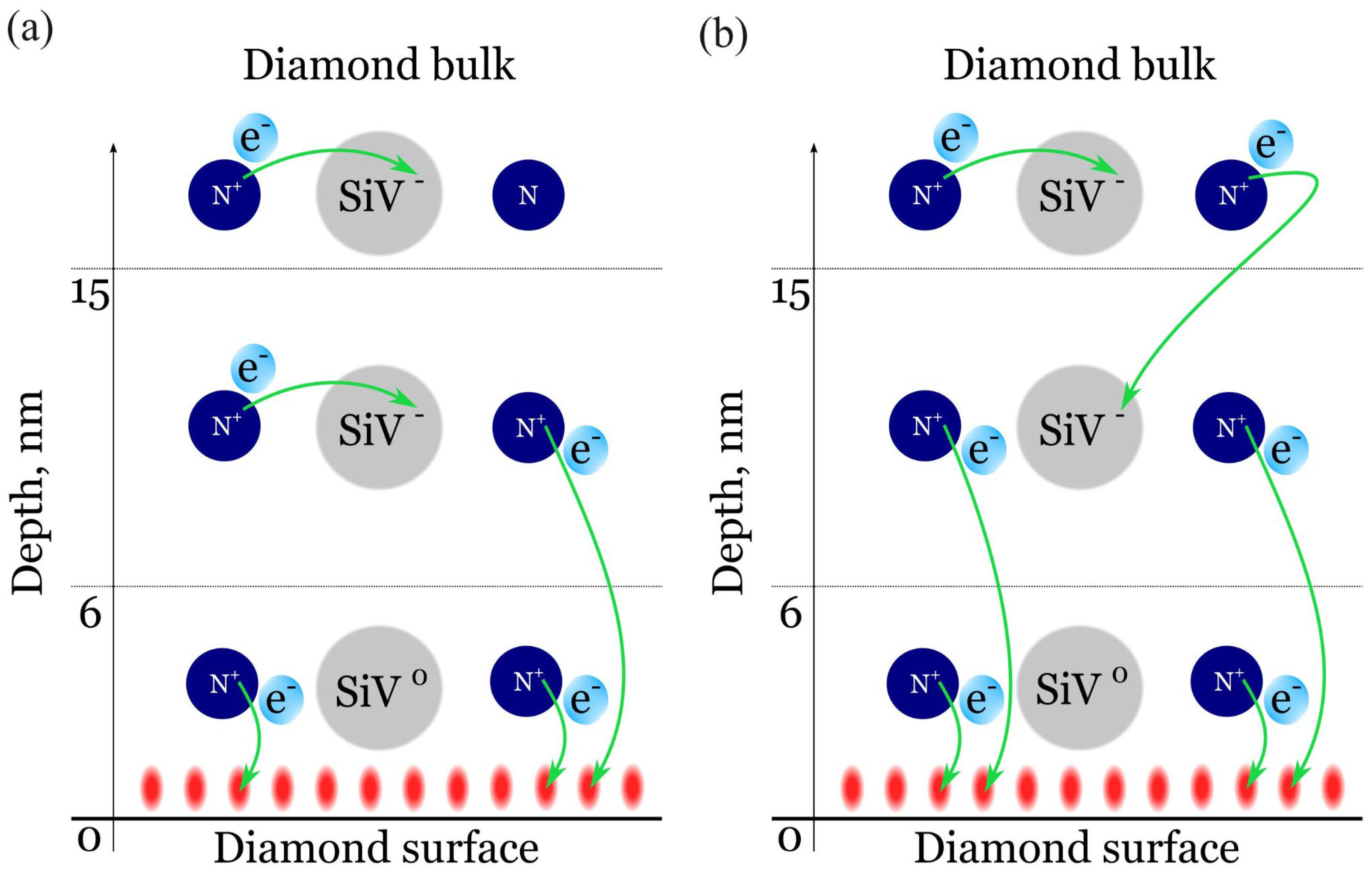
Effect of H-Terminated Surfaces on “Silicon-Vacancy” Fluorescence in High-Pressure Nanodiamonds

 , , , , ,
Abstract
1. Introduction
2. Materials and Methods
3. Results and Discussion
3.1. The SiV Fluorescence Spectra of As-Grown HPHT Diamond Nanoparticles
3.2. Surface Hydrogen Desorption and Size Characterization of Diamond Nanoparticles
3.3. Comparative Analysis of SiV Fluorescence in Diamond Nanoparticles Before and After Hydrogen Desorption
4. Conclusions
Author Contributions
Funding
Data Availability Statement
Conflicts of Interest
References
- Alkahtani, M.; Lang, J.; Naydenov, B.; Jelezko, F.; Hemmer, P. Growth of High-Purity Low-Strain Fluorescent Nanodiamonds. ACS Photonics 2019, 6, 1266–1271. [Google Scholar] [CrossRef] [Scilit]
- Radtke, M.; Bernardi, E.; Slablab, A.; Nelz, R.; Neu, E. Nanoscale Sensing Based on Nitrogen Vacancy Centers in Single Crystal Diamond and Nanodiamonds: Achievements and Challenges. Nano Futur. 2019, 3, 042004. [Google Scholar] [CrossRef] [Scilit]
- Pasternak, D.G.; Romshin, A.M.; Zhivopistsev, A.A.; Bagramov, R.H.; Filonenko, V.P.; Vlasov, I.I. Bicolour Single Photon Source Based on HPHT Nanodiamond. Opt. Spectrosc. 2024, 132, 72. [Google Scholar] [CrossRef]
- Choi, S.; Leong, V.; Davydov, V.A.; Agafonov, V.N.; Cheong, M.W.O.; Kalashnikov, D.A.; Krivitsky, L.A. Varying Temperature and Silicon Content in Nanodiamond Growth: Effects on Silicon-Vacancy Centres. Sci. Rep. 2018, 8, 3792. [Google Scholar] [CrossRef] [Scilit] [PubMed]
- Fehler, K.G.; Ovvyan, A.P.; Antoniuk, L.; Lettner, N.; Gruhler, N.; Davydov, V.A.; Agafonov, V.N.; Pernice, W.H.P.; Kubanek, A. Purcell-Enhanced Emission from Individual SiV− Center in Nanodiamonds Coupled to a Si3N4-Based, Photonic Crystal Cavity. Nanophotonics 2020, 9, 3655–3662. [Google Scholar] [CrossRef] [Scilit]
- Nahra, M.; Alshamaa, D.; Deturche, R.; Davydov, V.; Kulikova, L.; Agafonov, V.; Couteau, C. Single Germanium Vacancy Centers in Nanodiamonds with Bulk-like Spectral Stability. AVS Quantum Sci. 2021, 3, 012001. [Google Scholar] [CrossRef] [Scilit]
- Romshin, A.M.; Pasternak, D.G.; Altakhov, A.S.; Bagramov, R.H.; Filonenko, V.P.; Vlasov, I.I. Temperature Characteristics of “silicon-Vacancy” Luminescent Centers in Diamond Particles Synthesized by Various Methods. Opt. Spectrosc. 2023, 131, 133. [Google Scholar] [CrossRef]
- Weil, T.; Liu, W.; Alam, M.N.A.; Liu, Y.; Agafonov, V.N.; Qi, H.; Koynov, K.; Davydov, V.A.; Uzbekov, R.; Kaiser, U.; et al. Silicon-Vacancy Nanodiamonds as High Performance Near-Infrared Emitters for Live-Cell Dual-Color Imaging and Thermometry. Nano Lett. 2022, 22, 2881–2888. [Google Scholar] [CrossRef] [Scilit]
- Wu, Y.; Alam, M.N.A.; Balasubramanian, P.; Ermakova, A.; Fischer, S.; Barth, H.; Wagner, M.; Raabe, M.; Jelezko, F.; Weil, T. Nanodiamond Theranostic for Light-Controlled Intracellular Heating and Nanoscale Temperature Sensing. Nano Lett. 2021, 21, 3780–3788. [Google Scholar] [CrossRef] [Scilit]
- Wu, Y.; Weil, T. Recent Developments of Nanodiamond Quantum Sensors for Biological Applications. Adv. Sci. 2022, 9, 2200059. [Google Scholar] [CrossRef] [Scilit]
- Pasternak, D.G.; Bagramov, R.H.; Romshin, A.M.; Zibrov, I.P.; Filonenko, V.P.; Vlasov, I.I. Controlled Formation of Silicon-Vacancy Centers in High-Pressure Nanodiamonds Produced from an “Adamantane + Detonation Nanodiamond” Mixture. Nanomaterials 2024, 14, 1843. [Google Scholar] [CrossRef] [Scilit]
- Alkahtani, M.H.; Alzahrani, Y.A.; Hazrathosseini, A.; Alessa, A.M.; Sow, M.; Alromaeh, A.; Alghihab, A.A.; Alghannam, F.S.; Jelezko, F.; Hemmer, P.R. Advanced Post-Treatment Strategy for Quantum-Grade Fluorescent Nanodiamonds. Front. Quantum Sci. Technol. 2025, 4, 1687810. [Google Scholar] [CrossRef] [Scilit]
- Kudryavtsev, O.S.; Bagramov, R.H.; Pasternak, D.G.; Satanin, A.M.; Lebedev, O.I.; Filonenko, V.P.; Vlasov, I.I. Raman Fingerprints of Ultrasmall Nanodiamonds Produced from Adamantane. Diam. Relat. Mater. 2023, 133, 109770. [Google Scholar] [CrossRef] [Scilit]
- Maier, F.; Riedel, M.; Mantel, B.; Ristein, J.; Ley, L. Origin of Surface Conductivity in Diamond. Phys. Rev. Lett. 2000, 85, 3472–3475. [Google Scholar] [CrossRef] [Scilit] [PubMed]
- Ristein, J.; Riedel, M.; Maier, F.; Mantel, B.F.; Stammler, M.; Ley, L. Surface Conductivity of Diamond as a Function of Nitrogen Doping. Phys. Status Solidi A 2001, 186, 249–256. [Google Scholar] [CrossRef]
- Nebel, C.; Ristein, J. Thin-Film Diamond I: Part of the Semiconductors and Semimetals Series, 1st ed.; Semiconductors and Semimetals; Elsevier Science: Burlington, VT, USA, 2004; ISBN 978-0-08-054103-7. [Google Scholar]
- Strobel, P.; Riedel, M.; Ristein, J.; Ley, L. Surface Transfer Doping of Diamond. Nature 2004, 430, 439–441. [Google Scholar] [CrossRef] [Scilit]
- Hauf, M.V.; Grotz, B.; Naydenov, B.; Dankerl, M.; Pezzagna, S.; Meijer, J.; Jelezko, F.; Wrachtrup, J.; Stutzmann, M.; Reinhard, F.; et al. Chemical Control of the Charge State of Nitrogen-Vacancy Centers in Diamond. Phys. Rev. B 2011, 83, 081304. [Google Scholar] [CrossRef] [Scilit]
- Petráková, V.; Taylor, A.; Kratochvílová, I.; Fendrych, F.; Vacík, J.; Kučka, J.; Štursa, J.; Cígler, P.; Ledvina, M.; Fišerová, A.; et al. Luminescence of Nanodiamond Driven by Atomic Functionalization: Towards Novel Detection Principles. Adv. Funct. Mater. 2012, 22, 812–819. [Google Scholar] [CrossRef] [Scilit]
- Stehlik, S.; Varga, M.; Stenclova, P.; Ondic, L.; Ledinsky, M.; Pangrac, J.; Vanek, O.; Lipov, J.; Kromka, A.; Rezek, B. Ultrathin Nanocrystalline Diamond Films with Silicon Vacancy Color Centers via Seeding by 2 Nm Detonation Nanodiamonds. ACS Appl. Mater. Interfaces 2017, 9, 38842–38853. [Google Scholar] [CrossRef] [Scilit] [PubMed]
- Khvostantsev, L.G.; Slesarev, V.N.; Brazhkin, V.V. Toroid Type High-Pressure Device: History and Prospects. High Press. Res. 2004, 24, 371–383. [Google Scholar] [CrossRef] [Scilit]
- Pasternak, D.G.; Romshin, A.M.; Bagramov, R.H.; Galimov, A.I.; Toropov, A.A.; Kalashnikov, D.A.; Leong, V.; Satanin, A.M.; Kudryavtsev, O.S.; Gritsienko, A.V.; et al. Donor–Acceptor Recombination Emission in Hydrogen-Terminated Nanodiamond. Adv. Quantum Technol. 2024, 8, 2400263. [Google Scholar] [CrossRef] [Scilit]
- Cui, J.B.; Ristein, J.; Stammler, M.; Janischowsky, K.; Kleber, G.; Ley, L. Hydrogen Termination and Electron Emission from CVD Diamond Surfaces: A Combined Secondary Electron Emission, Photoelectron Emission Microscopy, Photoelectron Yield, and Field Emission Study. Diam. Relat. Mater. 2000, 9, 1143–1147. [Google Scholar] [CrossRef] [Scilit]
- Schindelin, J.; Arganda-Carreras, I.; Frise, E.; Kaynig, V.; Longair, M.; Pietzsch, T.; Preibisch, S.; Rueden, C.; Saalfeld, S.; Schmid, B.; et al. Fiji: An Open-Source Platform for Biological-Image Analysis. Nat. Methods 2012, 9, 676–682. [Google Scholar] [CrossRef] [Scilit]
- Green, B.L.; Collins, A.T.; Breeding, C.M. Diamond Spectroscopy, Defect Centers, Color, and Treatments. Rev. Mineral. Geochem. 2022, 88, 637–688. [Google Scholar] [CrossRef] [Scilit]
- Garcia-Arellano, G.; López-Morales, G.I.; Manson, N.B.; Flick, J.; Wood, A.A.; Meriles, C.A. Photo-Induced Charge State Dynamics of the Neutral and Negatively Charged Silicon Vacancy Centers in Room-Temperature Diamond. Adv. Sci. 2024, 11, 2308814. [Google Scholar] [CrossRef] [Scilit]
- Dhomkar, S.; Zangara, P.R.; Henshaw, J.; Meriles, C.A. On-Demand Generation of Neutral and Negatively Charged Silicon-Vacancy Centers in Diamond. Phys. Rev. Lett. 2018, 120, 117401. [Google Scholar] [CrossRef] [Scilit]
- Pederson, C.; Yama, N.S.; Beale, L.; Markham, M.; Turiansky, M.E.; Fu, K.-M.C. Rapid, in Situ Neutralization of Nitrogen- and Silicon-Vacancy Centers in Diamond Using Above-Band Gap Optical Excitation. Nano Lett. 2025, 25, 673–680. [Google Scholar] [CrossRef] [Scilit] [PubMed]
- Breeze, B.G.; Meara, C.J.; Wu, X.X.; Michaels, C.P.; Gupta, R.; Diggle, P.L.; Dale, M.W.; Cann, B.L.; Ardon, T.; D’Haenens-Johansson, U.F.S.; et al. Doubly Charged Silicon Vacancy Center, Si-N Complexes, and Photochromism in N and Si Codoped Diamond. Phys. Rev. B 2020, 101, 184115. [Google Scholar] [CrossRef] [Scilit]
- Ristein, J.; Riedel, M.; Stammler, M.; Mantel, B.F.; Ley, L. Surface Conductivity of Nitrogen-Doped Diamond. Diam. Relat. Mater. 2002, 11, 359–364. [Google Scholar] [CrossRef] [Scilit]


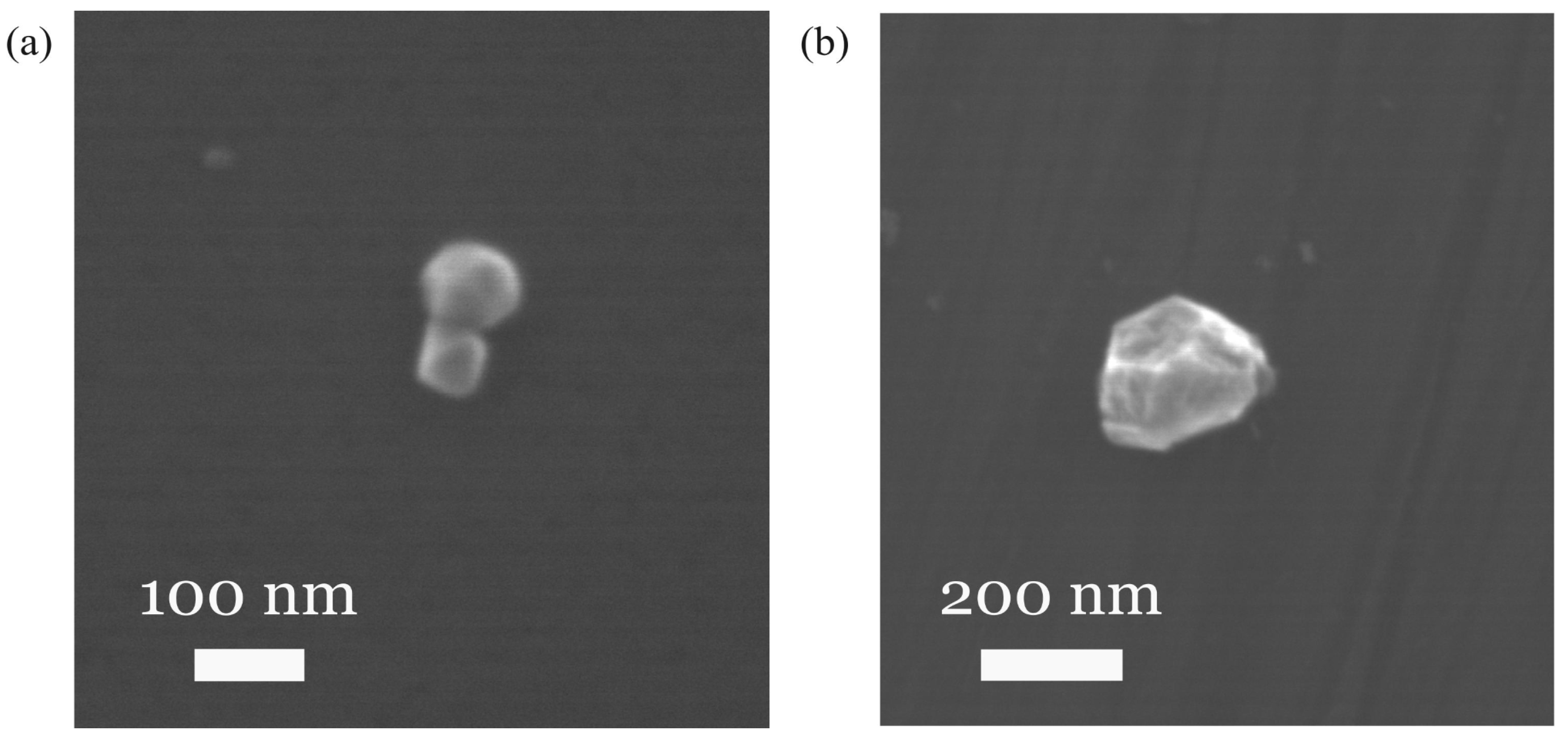
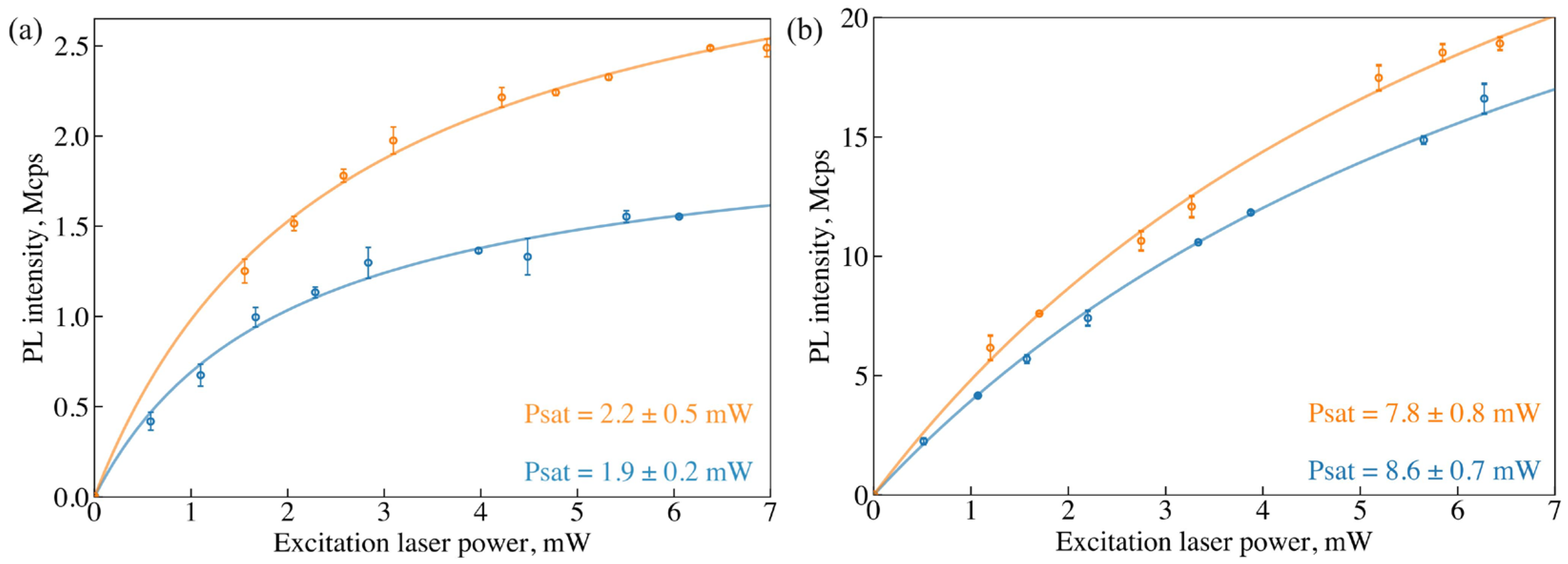



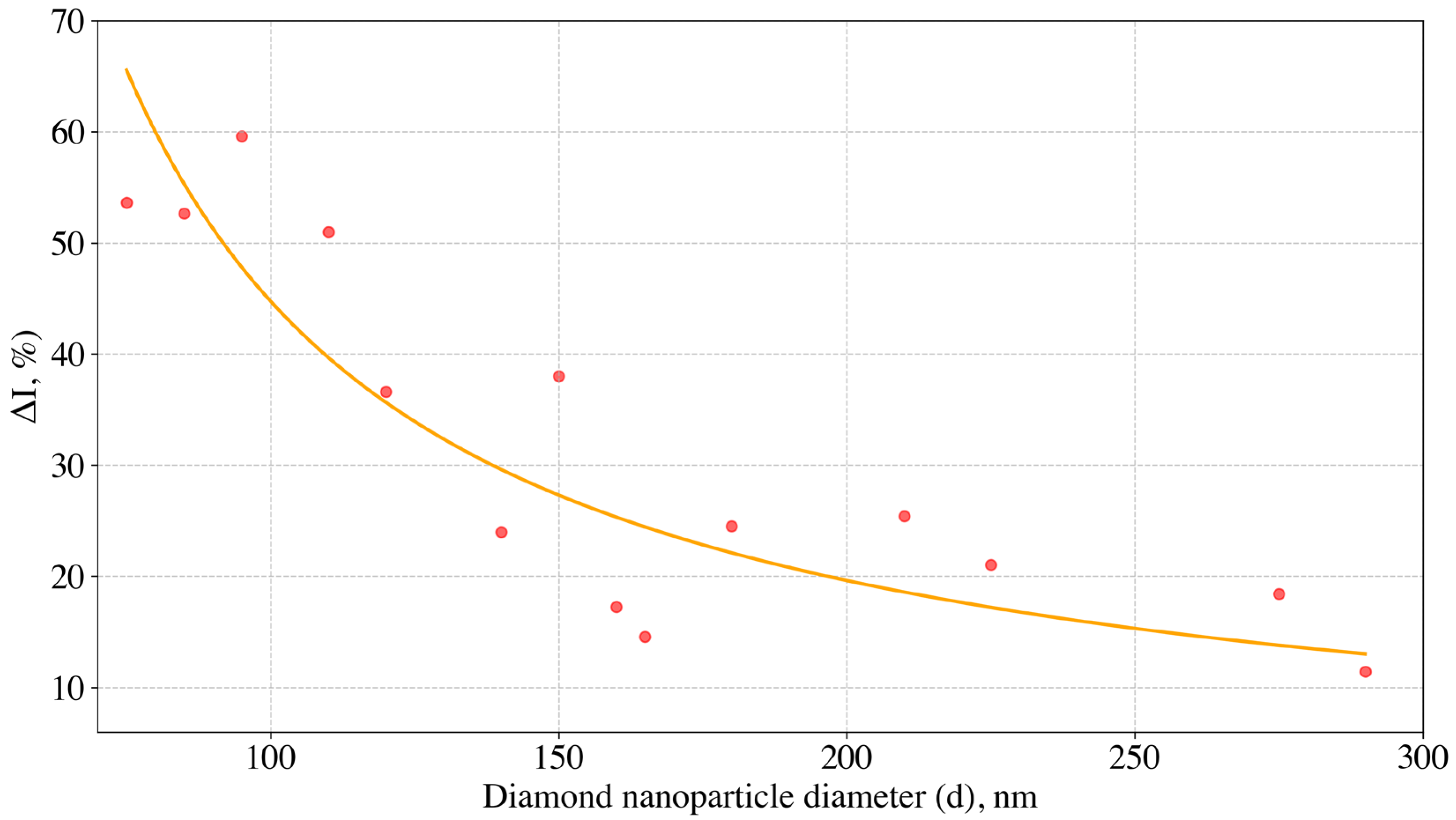
| d, nm | 75 | 85 | 95 | 110 | 120 | 140 | 150 | 160 | 165 | 180 | 210 | 225 | 275 | 290 |
| Ibefore, kcps | 3.2 | 3.5 | 359 | 5.1 | 86 | 206 | 196 | 235 | 245 | 538 | 1337 | 2683 | 3524 | 1756 |
| Iafter, kcps | 4.9 | 5.3 | 570 | 7.7 | 118 | 255 | 271 | 276 | 281 | 675 | 1687 | 3256 | 4173 | 1948 |
| ∆I, % | 53 | 51 | 59 | 51 | 37 | 24 | 38 | 17 | 15 | 25 | 26 | 21 | 18 | 11 |
Disclaimer/Publisher’s Note: The statements, opinions and data contained in all publications are solely those of the individual author(s) and contributor(s) and not of MDPI and/or the editor(s). MDPI and/or the editor(s) disclaim responsibility for any injury to people or property resulting from any ideas, methods, instructions or products referred to in the content. |
© 2025 by the authors. Licensee MDPI, Basel, Switzerland. This article is an open access article distributed under the terms and conditions of the Creative Commons Attribution (CC BY) license (https://creativecommons.org/licenses/by/4.0/).
Share and Cite
Pasternak, D.G.; Zhivopistsev, A.A.; Romshin, A.M.; Kudryavtsev, O.S.; Bagramov, R.H.; Filonenko, V.P.; Kargin, N.I.; Vlasov, I.I. Effect of H-Terminated Surfaces on “Silicon-Vacancy” Fluorescence in High-Pressure Nanodiamonds. Nanomaterials 2025, 15, 1842. https://doi.org/10.3390/nano15241842
Pasternak DG, Zhivopistsev AA, Romshin AM, Kudryavtsev OS, Bagramov RH, Filonenko VP, Kargin NI, Vlasov II. Effect of H-Terminated Surfaces on “Silicon-Vacancy” Fluorescence in High-Pressure Nanodiamonds. Nanomaterials. 2025; 15(24):1842. https://doi.org/10.3390/nano15241842
Chicago/Turabian StylePasternak, D. G., A. A. Zhivopistsev, A. M. Romshin, O. S. Kudryavtsev, R. H. Bagramov, V. P. Filonenko, N. I. Kargin, and I. I. Vlasov. 2025. "Effect of H-Terminated Surfaces on “Silicon-Vacancy” Fluorescence in High-Pressure Nanodiamonds" Nanomaterials 15, no. 24: 1842. https://doi.org/10.3390/nano15241842
APA StylePasternak, D. G., Zhivopistsev, A. A., Romshin, A. M., Kudryavtsev, O. S., Bagramov, R. H., Filonenko, V. P., Kargin, N. I., & Vlasov, I. I. (2025). Effect of H-Terminated Surfaces on “Silicon-Vacancy” Fluorescence in High-Pressure Nanodiamonds. Nanomaterials, 15(24), 1842. https://doi.org/10.3390/nano15241842