Abstract
The results of experimental and theoretical studies of standing spin waves in a series of epitaxial films of the ferromagnetic Pd1−xFex alloy (0.02 < x < 0.11) with different distributions of the magnetic properties across the thickness are presented. Films with linear and stepwise, as well as more complex Lorentzian, sine and cosine profiles of iron concentration in the alloy, and thicknesses from 20 to 400 nm are considered. A crucial influence of the magnetic properties profile on the spectrum of spin wave resonances is demonstrated. A capability of engineering the standing spin waves in graded ferromagnetic films for applications in magnonics is discussed.
1. Introduction
Spin waves have been known for more than 90 years, but recently, the interest in them has increased dramatically due to the rapid development of magnonics, which, unlike electronics, for example, studies the transfer of energy and information not by the electric current, but rather by the current of magnons. Moreover, magnonics has evolved to a large field in engineering that develops devices based on wave principles, such as magnon transistors, switches, sensors and inductors, as well as media for magnetic information recording (see reviews [1,2,3,4] and references therein). Existing technologies that allow the fabrication of nanostructures with a variety of physical and geometric parameters, as well as new experimental methods for studying the dynamics of high-frequency magnetization, open up broad possibilities for the engineering of magnetic devices that can be used to effectively manipulate magnetization waves, their excitation and propagation [2,5,6,7].
Nowadays, spin waves are studied intensely in thin ferromagnetic films and heterostructures [8,9,10,11]. In the majority of the reports, homogeneous films or magnonic crystals with a homogeneous periodic structure are investigated [12,13]. However, the studies of the spin waves in films with artificially created inhomogeneity of magnetic properties across the thickness, known in the literature as graded magnetic materials, have been performed mostly in theory [14,15,16,17,18]. These papers report that by varying the profile of the magnetic properties distribution over the thickness, it is possible to manipulate the spectrum of spin waves in thin magnetic films [14].
Our recent studies have shown that Pd–Fe alloys are promising and convenient model materials that allow the synthesis of high-quality thin epitaxial films with a predetermined distribution of magnetic inhomogeneity across the thickness [19]. This study aimed at the experimental investigation of the possibility to engineer the spin wave spectra by means of controlling a magnetic property profile in graded films of Pd–Fe alloy.
2. Materials and Methods
2.1. Description of Samples and Research Methods
The synthesized collection of epitaxial Pd–Fe alloy films with variable distribution profiles of a composition across the thickness included (see Table 1):
Table 1.
Samples description.
- Films with a fixed iron concentration gradient from 2 at.% to 10 at.%—linear, with thicknesses in the range of 50–400 nm;
- Bilayer and trilayer structures with different iron concentrations in each layer and a total thickness in the range of 20–220 nm. Each individual layer was epitaxial and uniform in composition. The layers were deposited on top of each other in a single run. Several concentrations of iron were chosen in the bilayer and trilayer samples: 4 at.% and 8 at.% in the bilayer and 2 at.% and 10 at.% in the trilayer ones;
- Films with non-linear composition distributions across the thickness—Lorentzian, sine and cosine, with thicknesses in the range of 200–400 nm.
All Pd–Fe alloy films investigated in this work were epitaxial, continuous and single-crystalline. The high-purity (99.95%) Pd and Fe metals were evaporated from the effusion cells from Createc Fischer & Co GmbH (Erligheim, Germany) and deposited to a rotating (001) MgO single-crystal substrate (Supplement of Ref. [19]). The entire synthesis process was carried out under ultrahigh vacuum (5 × 10⁻¹⁰ mbar) in the molecular beam epitaxy (MBE) chamber manufactured by SPECS GmbH (SPECS, Berlin, Germany). The iron concentration profile in the palladium matrix was realized by a controllable variation of the iron evaporation cell temperature with a fixed palladium cell temperature. The temperature variation cyclogram was loaded in the Eurotherm 3504 temperature controller of the iron effusion cell. Immediately after synthesis, all films were high-temperature annealed at 873 K under ultrahigh vacuum conditions for their structural optimization. A detailed description of the stages of film synthesis and methods for controlling their structural perfection and chemical composition, as well as their thickness, were described in detail in our previous works [20,21,22]. The magnetic characteristics of the films were studied by vibration sample magnetometry (VSM) with the Quantum Design (San Diego, California, USA) PPMS-9 system and by magnetic resonance with the Bruker ESP300 continuous wave X-band spectrometer in a wide field range of 0–1.4 T and a temperature range of 20–300 K [19,21,22].
2.2. Simulations of Thermomagnetic Curves and Spin Waves
In Pd1−xFex alloys, the Curie temperature TC and the saturation magnetization depend on the iron concentration [22]. Therefore, in Pd–Fe films with inhomogeneous iron distribution across the thickness, each sufficiently thin layer has its local and . The profile of iron concentration in the film will manifest itself in the experimental dependence of the integral saturation magnetization on temperature . Then the simulation of can be used as an indicator of whether the real iron concentration profile corresponds to its target shape. In the calculation of the dependence of saturation magnetization on temperature, we used the earlier established fact that the dependence for all homogeneous epitaxial Pd1−xFex films (0 < x < 0.08) can be described by a general expression [23]:
with and , deduced from the fit of the experimental data for Pd1−xFex [22]. Based on the predefined dependence of the iron concentration on thickness , as well as the concentration dependence of the saturation magnetization and the Curie temperature , and introducing , , the dependence for each sample can be calculated using the expression:
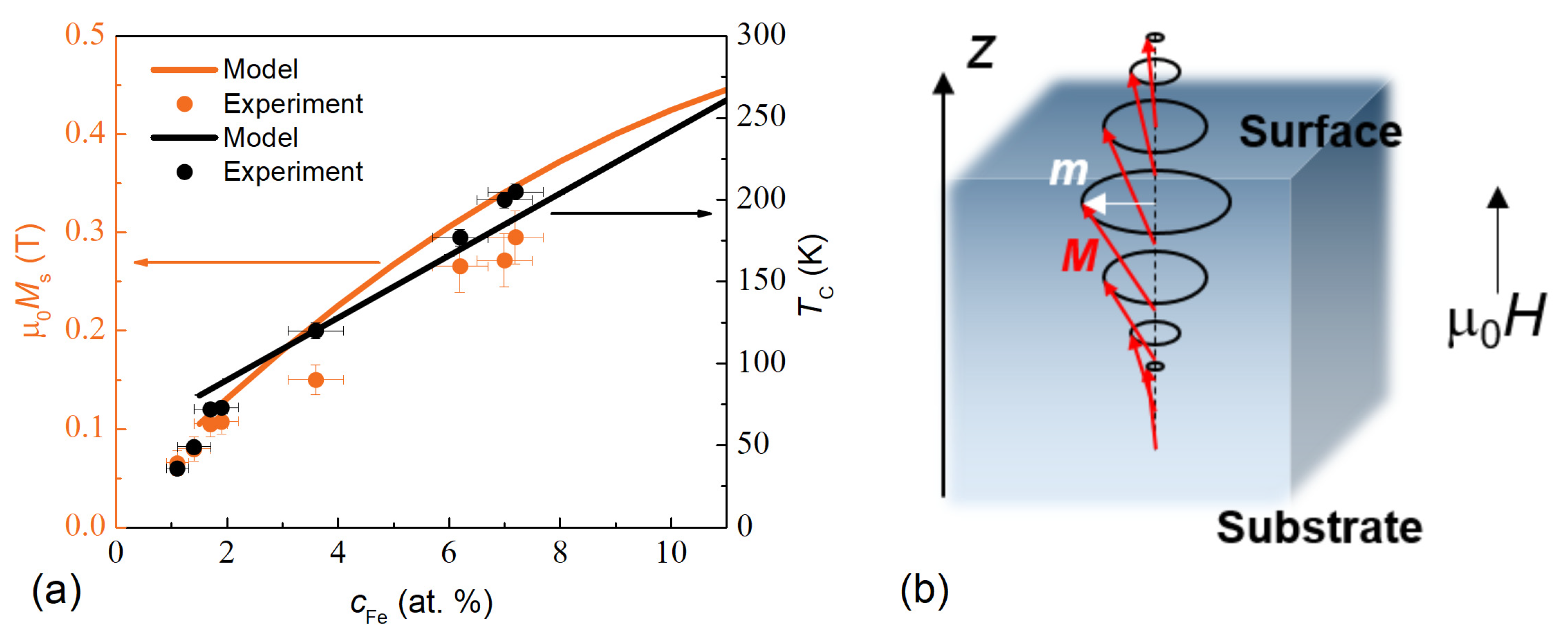
Figure 1a shows the dependences and used in the work in comparison with the experimental values for thin homogeneous films [22].
Figure 1.
(a) Dependences of the saturation magnetization (left axis) and the Curie temperature (right axis) on iron concentration in Pd–Fe films used in the calculations (lines) and corresponding experimental data for homogeneous thin films (symbols). (b) A sketch for a simulation of the standing spin waves in a film.
The linear approximation of was adopted for in calculations (Figure 1a). A non-linear dependence of the saturation magnetization on iron concentration was used (Figure 1a). This dependence has also been used in all further calculations along with .
In Figure 1b, a sketch is shown for a simulation of a standing spin wave (SSW) in a film. It is supposed that the magnetic properties of a film are varied along the normal to a film, and the magnetic field is applied in the same direction that coincides with the z-axis of the laboratory frame. An SSW in a ferromagnetic film with an inhomogeneous magnetization across the thickness is described by a linearized Landau–Lifshitz–Gilbert equation of motion for a resonant circular projection of magnetization [15,19,24]:
Here, is the normalized exchange stiffness coefficient, and
where is the excitation frequency, is the gyromagnetic ratio and is the effective-to-saturation magnetization ratio, which is larger than 1 for easy-plane ferromagnets, while it is smaller than 1 for the easy out-of-plane ferromagnets.
Equation (3) has a structure of the Schrödinger equation with the boundary conditions of
where , being the surface pinning coefficient, is the surface anisotropy energy and is the exchange stiffness constant at the surface. In the case of , the spin boundary conditions are free, while in the case of , the spin boundary conditions are fixed, or pinned. By the analogy with the Schrödinger equation, V(z) plays a role of potential energy which has a shape of a potential well. Within such an approach, is the n-th “energy level” of the standing spin waves in the potential well V(z) given by Equation (4). Therefore, in this work, the visualization of the SSW modes is a filling of the potential well by the waves at levels, as it was done in [15,25]. The calculation was performed assuming , and , which are the same for all samples. For certain profiles, such as a linear one, it is quite a good approximation, but for the others it allows to catch basic qualitative features of the SSW.
An intensity of the resonant line in the spectrum was calculated following the expression:
where is the distribution of the rf magnetic field within the film and is the ferromagnetic skin depth [19,26]. The resonance field and line intensities calculated from Equations (3)–(6) were used to construct a spin wave resonance spectrum. The linewidth estimation from the frequency dependence of the first SSW mode in Ref. [19] has shown that, at the measurement frequency of ~9.44 GHz, the contribution of the inhomogeneous line broadening and the intrinsic Gilbert damping are almost equal, and the Gilbert damping parameter α ≈ 0.007 (because of possible concentration dependence, the estimated value of α should be considered as the “effective” one). For the actual calculations, the integral linewidth taken from the experimental data and the Lorentzian line shape were used. For more details on the SSW spectrum calculation, see [19].
3. Results and Discussion
3.1. Temperature Dependences
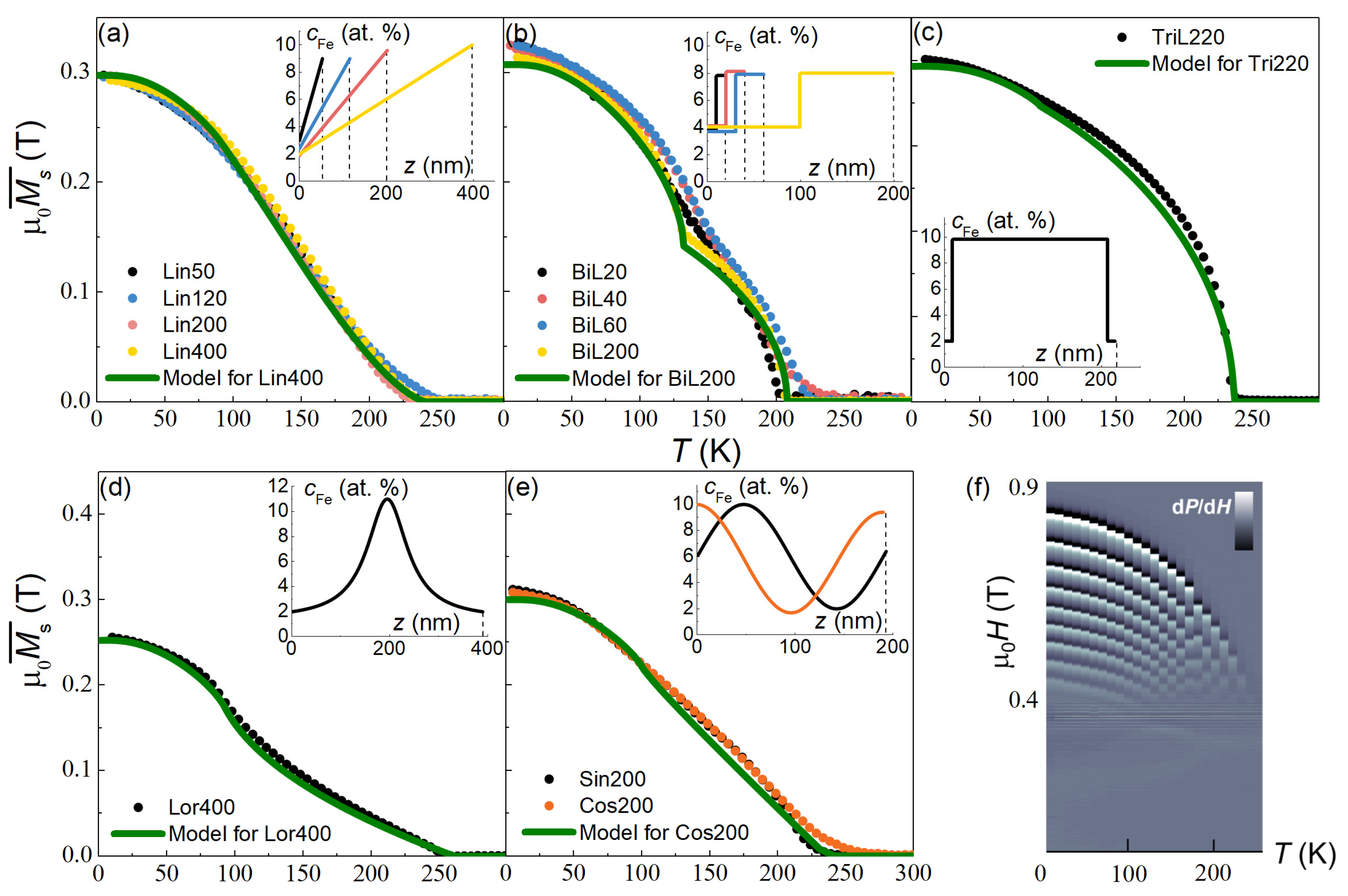
In Figure 2a–e, the measured dependences for all twelve samples of Table 1 are shown (symbols) and compared with the calculated dependences (line) according to Equation (2). One can see that the dependences of Lin50–400 samples practically coincide, which confirms the unified character of the iron concentration profile in these films (Figure 2a). The same is evident for Sin200 and Cos200 films (Figure 2e). In films with a stepped profile of magnetic properties, the kink is clearly visible in the thick BiL200 structure and becomes blurred as the thickness of the film decreases (Figure 2b). In general, the experimental dependences for all films are reasonably well described by Equation (2) with the profiles defined by the deposition procedure (profiles are shown in the insets to the panels).
Figure 2.
Measured dependences (symbols) of the samples listed in Table 1 with the magnetic field of μ0H = 5 mT applied along the easy direction in the film plane (a–e). Lines—the calculated dependences following Equation (2); in the insets to panels (a–e), the iron concentration profiles are presented. (f)—temperature evolution of the magnetic resonance spectra of sample Lin200 in the out-of-plane arrangement.
The temperature evolution of the magnetic resonance spectra of sample Lin200 is shown in Figure 2f. The decrease in the resonance field values with increasing temperature is associated with a gradual decrease in both the magnetization and the effective thickness of the ferromagnetic layer, the latter because of dependence. This trend is the typical feature for all investigated samples. All of the resonance spectra studied further were obtained at 20 K, close to the low-temperature plateau of the dependences of the samples.
3.2. SSW Resonance Spectra of Linear-Profile Samples Lin50–400
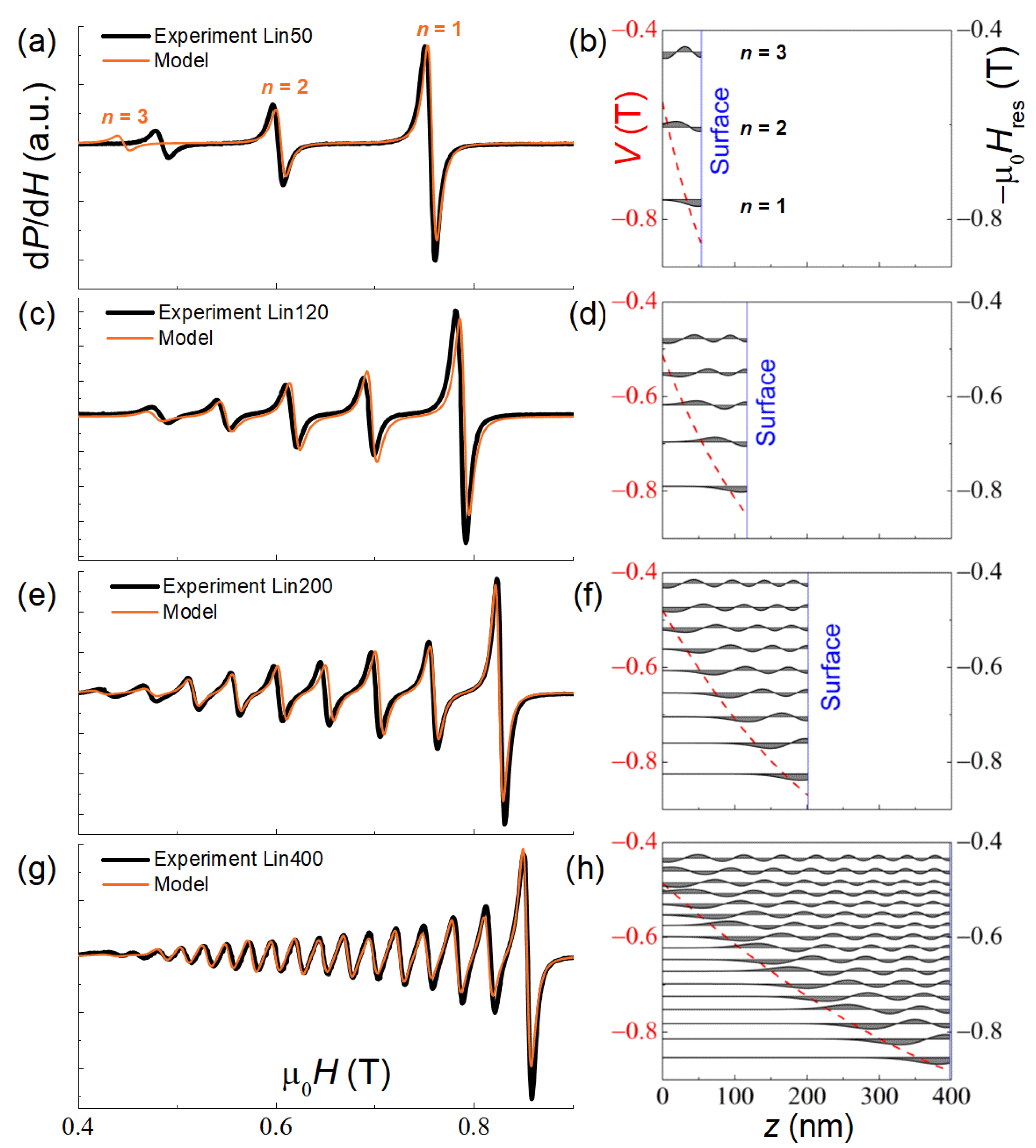
Figure 3 shows the spin wave resonance spectra for Lin50–400 samples. As one can see, the number of modes increases with the film thickness, which is typical for standing spin waves in thin films. A set of the collected spectra was used to adjust the parameter values , T·nm2, nm and that have not been varied for the rest of the samples. The value of indicates the hard direction along the normal to the film, which is verified by the shape of the magnetization curves in the out-of-plane geometry (not shown here, see Ref. [19]). A small value of testifies insignificant pinning of the spins at the film surface. The inaccuracy of the x(z) profile and the film thickness measurement could be at the origin of the n = 3 mode discrepancy in Figure 3a.
Figure 3.
Measured (black lines) at T = 20 K and simulated (orange lines) SSW resonance spectra of the Lin50–400 samples (a,c,e,g). In the right-hand panels, the spatial distributions of the magnetization precession amplitude are shown for each mode in its resonance field marked by the horizontal lines (b,d,f,h). The red dashed line is the potential well profile V(z).
Consideration of the spatial distribution of the magnetization precession amplitude m(z) for each SSW mode in its resonant field showed that, at the potential well V(z) boundary, the amplitude drops to zero, i.e., the dynamic pinning occurs [15]. Most of the absorption also occurs near the potential boundary.
3.3. SSW in Bilayer Samples BiL20–200
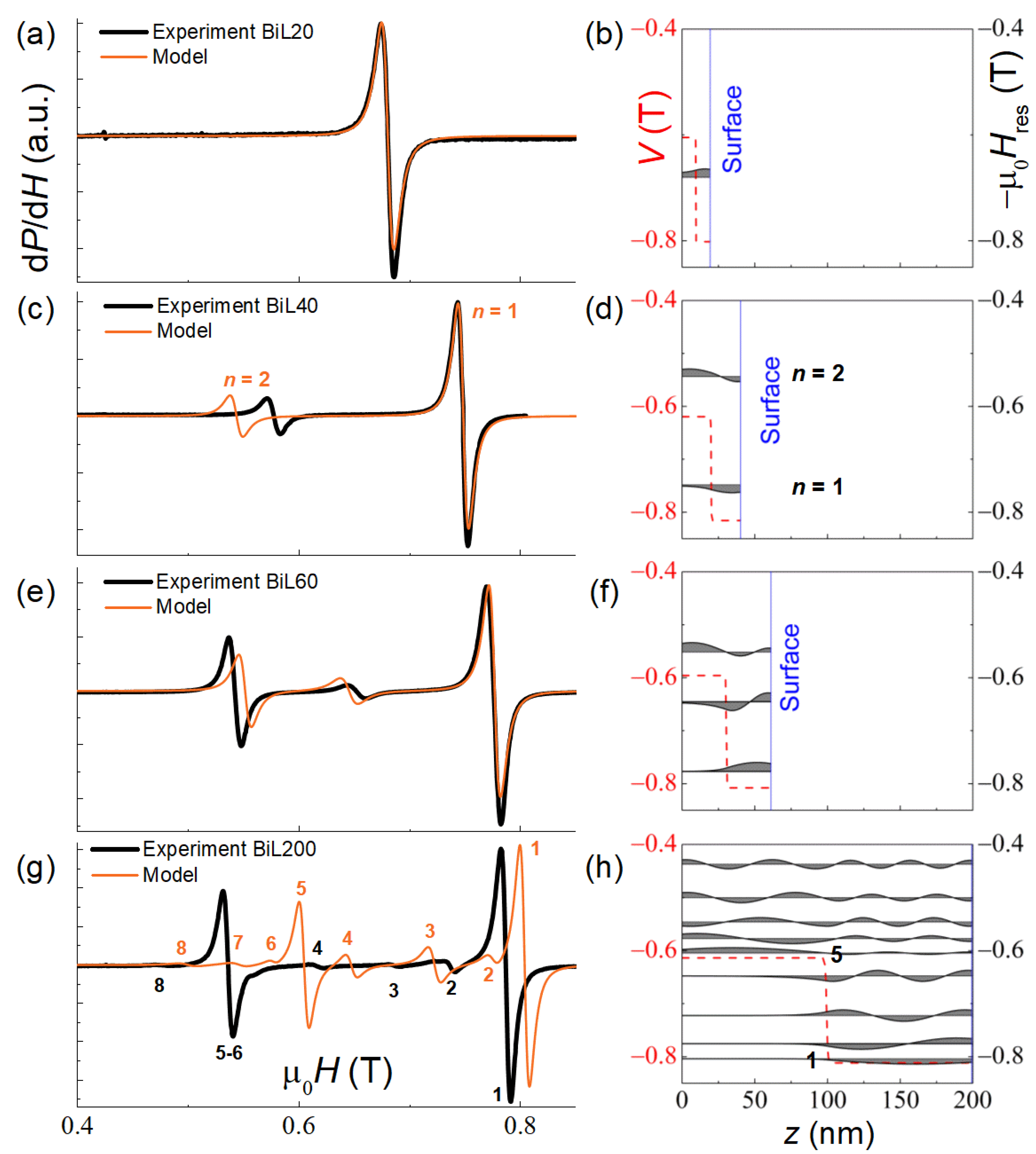
Studies of bilayer samples are intriguing in terms of the formation of spin waves in a structure with extended homogeneous regions though inhomogeneous as a whole. In this case, the model no longer describes the experimental data well, although its predictions qualitatively fit the experimental observations (Figure 4).
Figure 4.
Experimental (black lines) and simulated (orange lines) spectra of SSW resonances at T = 20 K of the bilayer BiL20–200 samples (a,c,e,g). In the right-hand panels, the spatial distribution of the magnetization precession amplitude for each mode is displayed (b,d,f,h).
In the thin BiL20 sample, which does not accommodate a single standing wave, only one resonance line is observed (Figure 4a). The simulation indicates (Figure 4b) that the precession amplitude does not vary significantly over the thickness (which is close to a classic FMR). The resonance field corresponds approximately to a mean value of the two-layer potential. As the thickness of the bilayer increases, two modes become observable (Figure 4c,d), similar in character to the acoustic (n = 1) and optical (n = 2) coupled precession modes. With the further increase in thickness (Figure 4e,f), the second intense resonance line appears in the spectrum; here, most of the absorption occurs in the layer with lower magnetization. In a sufficiently thick bilayer (Figure 4g,h), this trend is manifested even brighter: in addition to two quasi-FMR intense modes (n = 1 and 5), originating from the layers with higher/lower magnetization, respectively, at their local potentials, several much less intense modes are resolved.
Magnetic resonances in bilayer systems were studied extensively during the last decades, both experimentally and theoretically [27,28,29,30,31,32,33,34,35,36,37,38]. In some of the works, the coupled precession with the acoustic and optical modes formation was considered ([27,28,29,30,31,32] and references therein). The others dealt with spin wave resonances for particular realizations of the layered magnetic structure [33,34,35,36,37,38]. The theoretical approach similar to ours is presented in Ref. [39], though without comparison with an experiment. An important result of our work is an observation of multiple SSW modes in bilayer samples. This fact, as well as the successful semi-quantitative reproduction of the SSW spectra for all four samples within a unified spin-wave excitation approach, in our opinion, indicates its improved reliability and applicability to a wider range of complex magnetic systems and phenomena.
3.4. SSW in the Trilayer Structure and Films with Non-Linear Magnetization Profiles
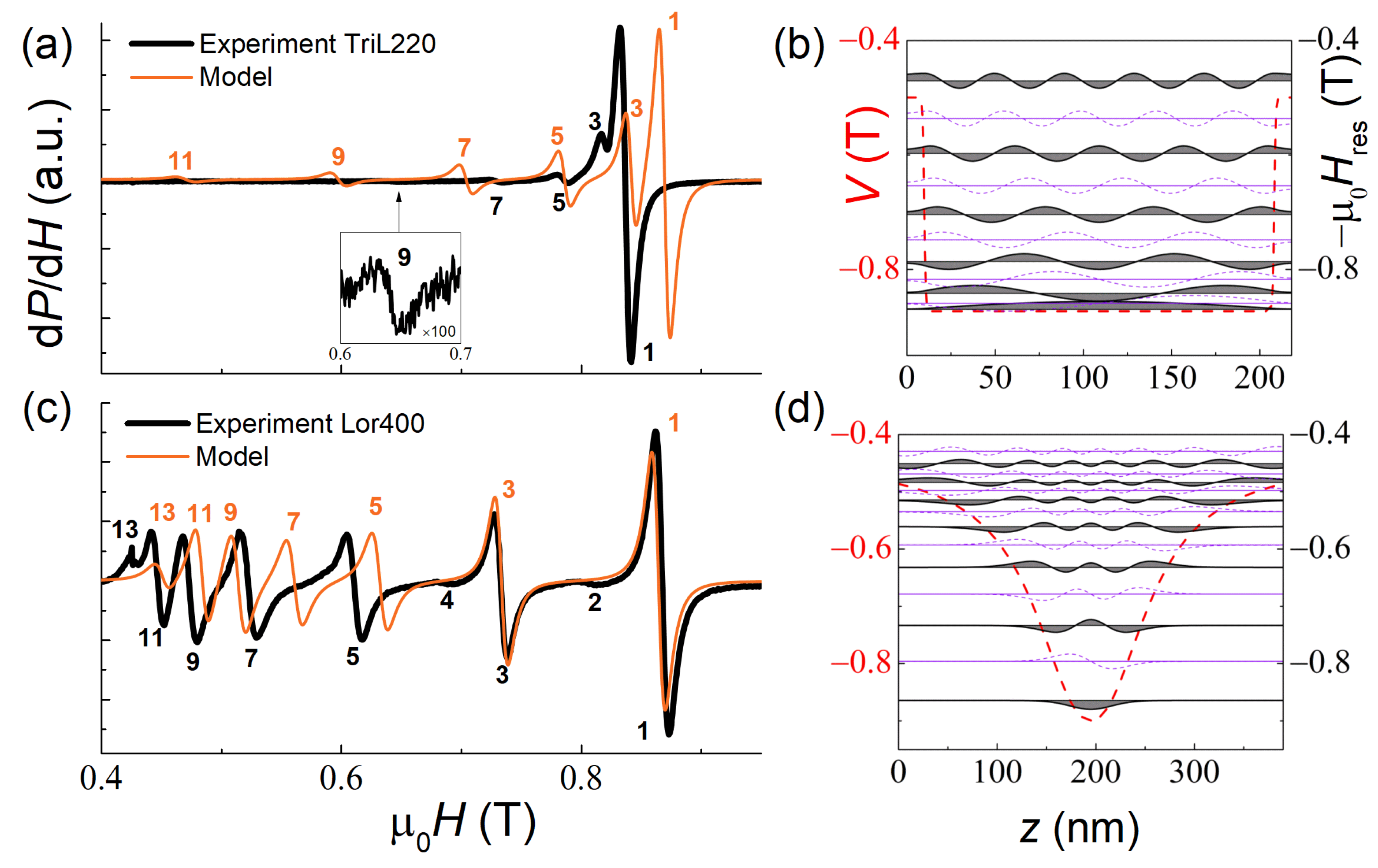
The TriL220 and Lor400 samples were fabricated to demonstrate how, by varying the magnetization profile across the thickness of the film, one could dramatically modify the character of the SSW spectrum. For this purpose, suitable profiles were initially calculated within the model of Equation (3). Then the samples with the specified profiles were deposited. In the TriL220 sample, additional effective pinning at the interfaces was created by sandwiching the thick homogeneous layer with thin layers of significantly lower magnetization. According to the preliminary simulation, this should result in the SSW spectrum with . In the Lor400 sample, the profile was calculated so that the resonances follow the dependence . Figure 5 approves the qualitative agreement of the model predictions with our experiment. However, a notable disagreement takes place for the TriL220 sample with the stepped character of the profile, since, as it was shown above, the model does not describe the systems with sharp magnetization drops as well.
Figure 5.
Experimental (black lines) and simulated (orange lines) SSW resonance spectra of the TriL220 (a) and Lor400 (c) samples at T = 20 K. In the right-hand panels, the spatial distribution of the magnetization precession amplitude for each mode is shown (b,d); the dashed violet lines indicate the antisymmetric modes.
We note also that antisymmetric modes—the modes with an even index and zero intensity—should exist in samples with a symmetric magnetization profile [15]. Such modes have indeed been identified and are shown by dashed violet lines in Figure 5b,d. In the experiment, such low-intensity modes (n = 2 and 4) were observed in the Lor400 sample.
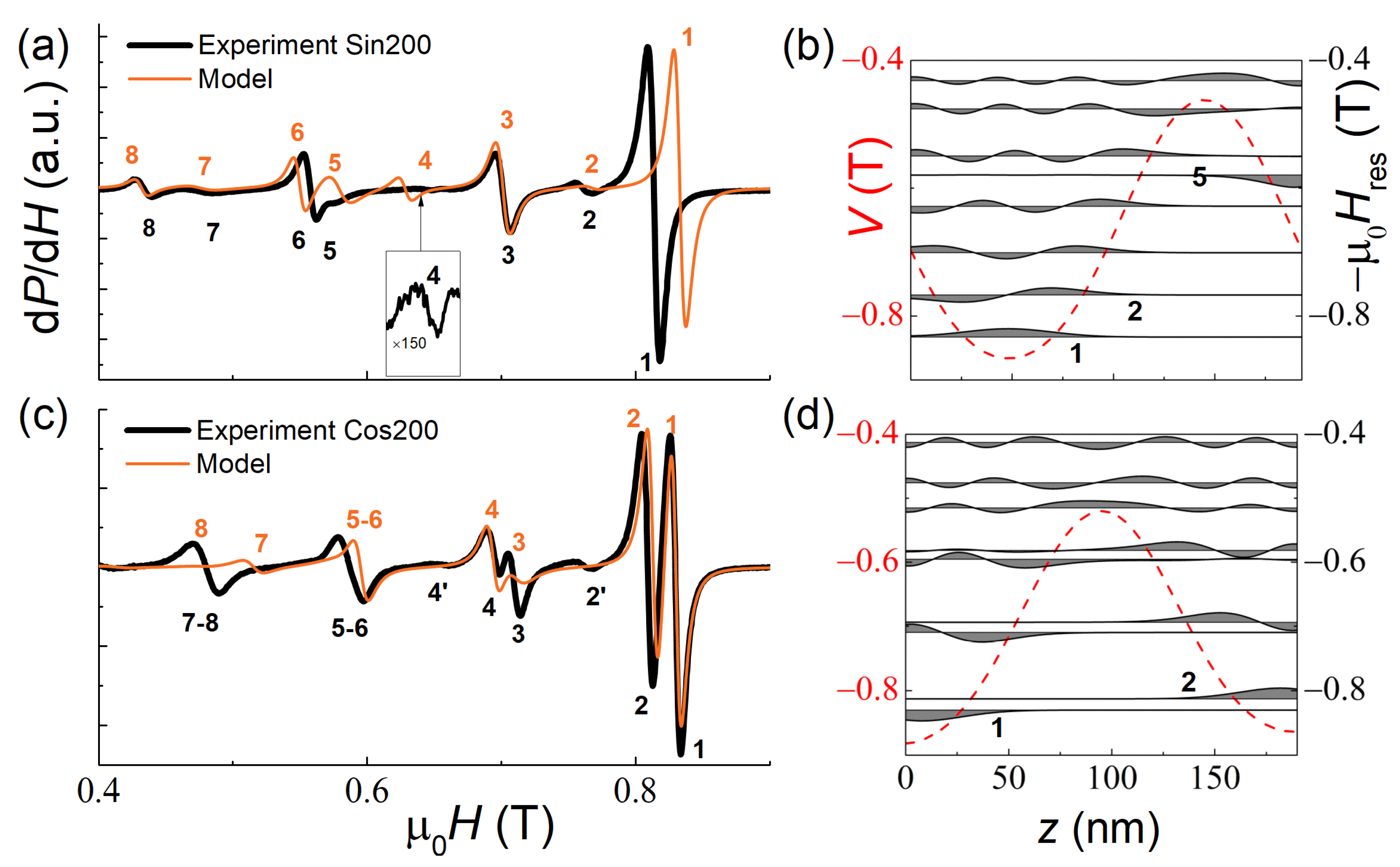
The Sin200 and Cos200 samples are integrally identical in terms of thickness, concentration drops and drop characters. The integral similarity of the samples is manifested in an almost identical temperature dependence of (see Figure 2e). However, the SSW analysis within the model Equation (3) predicted a significant difference in the magnetic resonance spectra of these samples (preliminary modeling and its results were discussed in our recent paper [19]). This dissimilarity originates from the difference in potential wells V(z) in these samples, that, consequently, are filled differently by the SSW modes (Figure 6b,d). Our experiments have confirmed the predictions of Ref. [19].
Figure 6.
Experimental (black lines) and simulated (orange lines) SSW resonance spectra of the Sin200 (a) and Cos200 (c) samples at T = 20 K. In the right-hand panels, the spatial distribution of the magnetization precession amplitude for each mode is shown (b,d).
According to the simulations [19], in the Cos200 sample, the symmetric (odd n) and antisymmetric modes (even n) should have the same resonance fields. In the experiment, however, the even and odd modes split and have comparable intensities. In our opinion, this indicates some asymmetry of the actual potential wells, which lifts the degeneracy and violates the condition of the antisymmetric modes occurrence (Figure 6d). Indeed, an introduction of a small asymmetry to the concentration profile (of ~0.5 at.%) in the simulation allowed us to reproduce the splitting pattern and the line intensities in the experimental spectrum (Figure 6c). The origin of the weak lines 2′ and 4′ in Figure 6c with the properties characteristic of antisymmetric modes remains unclear.
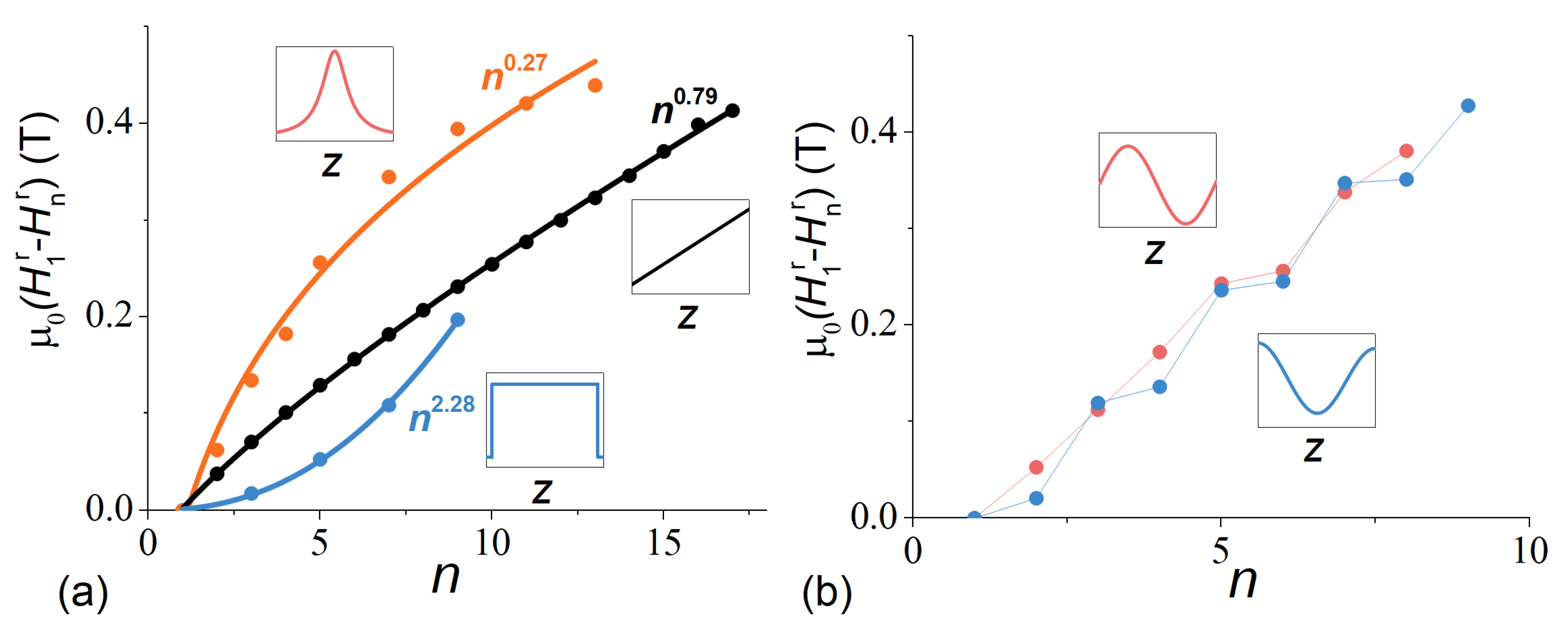
To visualize the drastic differences between the SSW resonance spectra of graded ferromagnetic films and the “classic” dependence for homogeneous films, we compared the latter with the fits of experimental SSW resonance field patterns of the SSW with the power law (Figure 7). The results clearly demonstrate a possibility to manipulate the standing spin wave spectrum in thin film structures by varying the magnetization profile. In contrast to “classic” power “2” for the homogeneous ferromagnetic films, the fitting parameter δ changes within a broad range from 0.27 (for Lor400 sample) to 2.28 (for TriL220 sample). In single-well potential structures, the shape of the potential well determines the character of the SSW spectrum. At the same time, for more complex profiles with several spatially separated potential wells, the dependence has a more complex character determined, in addition to the shape of the wells, by the order of their filling. This is clearly demonstrated in samples Sin200 and Cos200 (Figure 7b).
Figure 7.
Experimental resonance field difference between the 1st and n-th SSWs as a function of the mode index for TriL220, Lin400 and Lor400 (a), and for Sin200 and Cos200 (b), samples. The lines present the best fit results with function (a).
Based on the analysis of the SSW data collected for twelve epitaxial Pd–Fe films with different iron concentration profiles, we conclude that the model Equations (3)–(6) used for calculating the SSW spectra describe the experimental results well. However, this model is better applicable to films with smooth profiles rather to sharp/stepped ones. The possible reasons of discrepancy between experimental and theoretical spectra include the oversimplified definition of the normalized exchange stiffness coefficient D(z) in Equation (3), as well as the possible redistribution of Fe and local mechanical stress at internal interfaces of films with a sharp gradient of Fe content.
4. Conclusions
Magnetic resonances due to standing spin waves in Pd–Fe films with different distributions of the magnetic properties across the thickness have been studied. Variation of the profile shape allows us to predictably modify the SSW resonance spectrum, e.g., the dependence of the resonance field on the mode index within our samples set varied from to . Analysis of the SSW spectra provided the following common parameters for the ferromagnetic Pd–Fe films: the normalized exchange stiffness constant T·nm2, the surface pinning coefficient , the skin layer depth nm and the ratio of the effective magnetization to saturation magnetization . The obtained results indicate that the approach suggested and realized in this work can be applied to engineer the spin waves dispersion in graded ferromagnetic films.
Author Contributions
Conceptualization, I.G., I.Y. and A.G.; methodology, I.G. and L.T.; validation, I.Y. and A.G.; formal analysis, I.Y.; investigation, I.Y., A.G. and B.G.; resources, R.Y. and L.T.; data curation, I.Y.; writing—original draft preparation, I.Y., A.G., R.Y., I.G. and L.T.; writing—review and editing, I.Y., A.G., R.Y., I.G. and L.T.; visualization, I.Y.; supervision, R.Y.; project administration, L.T. and I.G.; funding acquisition, R.Y. and I.G. All authors have read and agreed to the published version of the manuscript.
Funding
The synthesis of samples and experiments has been supported by the Kazan Federal University Strategic Academic Leadership Program (PRIORITY-2030). Theoretical studies were supported by the Ministry of Science and Higher Education of the Russian Federation (project No 0718-2020-0025). Preliminary studies and sample characterization were supported by the Priority-2030 program of the National University of Science and Technology «MISiS», project No. K2-2022-029.
Data Availability Statement
The data presented in this study are available on request from the corresponding author.
Conflicts of Interest
The authors declare no conflict of interest.
References
- Nikitov, S.A.; Safin, A.R.; Kalyabin, D.V.; Sadovnikov, A.V.; Beginin, E.N.; Logunov, M.V.; Morozova, M.A.; Odintsov, S.A.; Osokin, S.A.; Sharaevskaya, A.Y.; et al. Dielectric Magnonics—From Gigahertz to Terahertz. Uspekhi Fiz. Nauk 2020, 190, 945–974. [Google Scholar] [CrossRef]
- Mahmoud, A.; Ciubotaru, F.; Vanderveken, F.; Chumak, A.V.; Hamdioui, S.; Adelmann, C.; Cotofana, S. Introduction to Spin Wave Computing. J. Appl. Phys. 2020, 128, 161101. [Google Scholar] [CrossRef]
- Barman, A.; Gubbiotti, G.; Ladak, S.; Adeyeye, A.O.; Krawczyk, M.; Grafe, J.; Adelmann, C.; Cotofana, S.; Naeemi, A.; Vasyuchka, V.I.; et al. The 2021 Magnonics Roadmap. J. Phys. Condens. Matter 2021, 33, 413001. [Google Scholar] [CrossRef] [PubMed]
- Chumak, A.V.; Kabos, P.; Wu, M.; Abert, C.; Adelmann, C.; Adeyeye, A.O.; Akerman, J.; Aliev, F.G.; Anane, A.; Awad, A.; et al. Advances in Magnetics Roadmap on Spin-Wave Computing. IEEE Trans. Magn. 2022, 58, 0800172. [Google Scholar] [CrossRef]
- Li, Y.; Zhang, W.; Tyberkevych, V.; Kwok, W.K.; Hoffmann, A.; Novosad, V. Hybrid Magnonics: Physics, Circuits, and Applications for Coherent Information Processing. J. Appl. Phys. 2020, 128, 130902. [Google Scholar] [CrossRef]
- Yu, H.; Xiao, J.; Schultheiss, H. Magnetic Texture Based Magnonics. Phys. Rep. 2021, 905, 1–59. [Google Scholar] [CrossRef]
- Dobrovolskiy, O.V.; Bunyaev, S.A.; Vovk, N.R.; Navas, D.; Gruszecki, P.; Krawczyk, M.; Sachser, R.; Huth, M.; Chumak, A.V.; Guslienko, K.Y.; et al. Spin-Wave Spectroscopy of Individual Ferromagnetic Nanodisks. Nanoscale 2020, 12, 21207–21217. [Google Scholar] [CrossRef] [PubMed]
- Dąbrowski, M.; Hicken, R.J.; Frisk, A.; Newman, D.G.; Klewe, C.; N’Diaye, A.T.; Shafer, P.; van der Laan, G.; Hesjedal, T.; Bowden, G.J. Canted Standing Spin-Wave Modes of Permalloy Thin Films Observed by Ferromagnetic Resonance. New J. Phys. 2021, 23, 023017. [Google Scholar] [CrossRef]
- Banerjee, C.; Chaurasiya, A.K.; Saha, S.; Sinha, J.; Barman, A. Tunable Spin Wave Properties in [Co/Ni80Fe20]r Multilayers with the Number of Bilayer Repetition. J. Phys. D. Appl. Phys. 2015, 48, 395001. [Google Scholar] [CrossRef]
- Dreyer, R.; Schäffer, A.F.; Bauer, H.G.; Liebing, N.; Berakdar, J.; Woltersdorf, G. Imaging and Phase-Locking of Non-Linear Spin Waves. Nat. Commun. 2022, 13, 4939. [Google Scholar] [CrossRef]
- Sarker, M.S.; Yamahara, H.; Yao, L.; Tang, S.; Liao, Z.; Seki, M.; Tabata, H. Sensitivity Enhancement in Magnetic Sensor Using CoFeB/Y3Fe5O12 Resonator. Sci. Rep. 2022, 12, 11105. [Google Scholar] [CrossRef] [PubMed]
- Krawczyk, M.; Grundler, D. Review and Prospects of Magnonic Crystals and Devices with Reprogrammable Band Structure. J. Phys. Condens. Matter 2014, 26, 123202. [Google Scholar] [CrossRef] [PubMed]
- Zakeri, K. Magnonic Crystals: Towards Terahertz Frequencies. J. Phys. Condens. Matter 2020, 32, 363001. [Google Scholar] [CrossRef] [PubMed]
- Gallardo, R.A.; Alvarado-Seguel, P.; Schneider, T.; Gonzalez-Fuentes, C.; Roldán-Molina, A.; Lenz, K.; Lindner, J.; Landeros, P. Spin-Wave Non-Reciprocity in Magnetization-Graded Ferromagnetic Films. New J. Phys. 2019, 21, 033026. [Google Scholar] [CrossRef]
- Ignatchenko, V.A.; Tsikalov, D.S. Spin-Wave Resonance in Gradient Ferromagnets with Concave and Convex Variations of Magnetic Parameters. J. Appl. Phys. 2020, 127, 123903. [Google Scholar] [CrossRef]
- Ignatchenko, V.A.; Tsikalov, D.S. Spin-Wave Oscillations in Gradient Ferromagnets: Exactly Solvable Models. J. Magn. Magn. Mater. 2020, 510, 166643. [Google Scholar] [CrossRef]
- Gallardo, R.A.; Alvarado-Seguel, P.; Brevis, F.; Roldán-Molina, A.; Lenz, K.; Lindner, J.; Landeros, P. Spin-Wave Channeling in Magnetization-Graded Nanostrips. Nanomaterials 2022, 12, 2785. [Google Scholar] [CrossRef]
- Fallarino, L.; Kirby, B.J.; Fullerton, E.E. Graded Magnetic Materials. J. Phys. D. Appl. Phys. 2021, 54, 303002. [Google Scholar] [CrossRef]
- Golovchanskiy, I.A.; Yanilkin, I.V.; Gumarov, A.I.; Gabbasov, B.F.; Abramov, N.N.; Yusupov, R.V.; Khaibullin, R.I.; Tagirov, L.R. Exchange Spin Waves in Thin Films with Gradient Composition. Phys. Rev. Mater. 2022, 6, 064406. [Google Scholar] [CrossRef]
- Esmaeili, A.; Yanilkin, I.V.; Gumarov, A.I.; Vakhitov, I.R.; Gabbasov, B.F.; Kiiamov, A.G.; Rogov, A.M.; Osin, Y.N.; Denisov, A.E.; Yusupov, R.V.; et al. Epitaxial Growth of Pd1−xFex Films on MgO Single-Crystal Substrate. Thin Solid Films 2019, 669, 338–344. [Google Scholar] [CrossRef]
- Esmaeili, A.; Vakhitov, I.R.; Yanilkin, I.V.; Gumarov, A.I.; Khaliulin, B.M.; Gabbasov, B.F.; Aliyev, M.N.; Yusupov, R.V.; Tagirov, L.R. FMR Studies of Ultra-Thin Epitaxial Pd0.92Fe0.08 Film. Appl. Magn. Reson. 2018, 49, 175–183. [Google Scholar] [CrossRef]
- Esmaeili, A.; Yanilkin, I.V.; Gumarov, A.I.; Vakhitov, I.R.; Gabbasov, B.F.; Yusupov, R.V.; Tatarsky, D.A.; Tagirov, L.R. Epitaxial Thin-Film Pd1−xFex Alloy: A Tunable Ferromagnet for Superconducting Spintronics. Sci. China Mater. 2020, 64, 1246–1255. [Google Scholar] [CrossRef]
- Kuz’min, M.D. Landau-Type Parametrization of the Equation of State of a Ferromagnet. Phys. Rev. B Condens. Matter Mater. Phys. 2008, 77, 184431. [Google Scholar] [CrossRef]
- Rappoport, T.G.; Redliński, P.; Liu, X.; Zaránd, G.; Furdyna, J.K.; Jankó, B. Anomalous Behavior of Spin-Wave Resonances in Ga1−xMnxAs Thin Films. Phys. Rev. B Condens. Matter Mater. Phys. 2004, 69, 125213. [Google Scholar] [CrossRef]
- Bihler, C.; Schoch, W.; Limmer, W.; Goennenwein, S.T.B.; Brandt, M.S. Spin-Wave Resonances and Surface Spin Pinning in Ga1−xMnxAs Thin Films. Phys. Rev. B Condens. Matter Mater. Phys. 2009, 79, 045205. [Google Scholar] [CrossRef]
- Almeida, N.; Mills, D. Eddy Currents and Spin Excitations in Conducting Ferromagnetic Films. Phys. Rev. B 1996, 53, 12232. [Google Scholar] [CrossRef]
- Zhang, Z.; Zhou, L.; Wigen, P.E.; Ounadjela, K. Angular Dependence of Ferromagnetic Resonance in Exchange-Coupled Co/Ru/Co Trilayer Structures. Phys. Rev. B 1994, 50, 6094. [Google Scholar] [CrossRef]
- Heinrich, B. Ferromagnetic Resonance in Ultrathin Film Structures. In Ultrathin Magnetic Structures II; Heinrich, B., Bland, J.A.C., Eds.; Springer: Berlin/Heidelberg, Germany, 1994; pp. 195–296. [Google Scholar] [CrossRef]
- Lindner, J.; Baberschke, K. Ferromagnetic Resonance in Coupled Ultrathin Films. J. Phys. Condens. Matter 2003, 15, S465. [Google Scholar] [CrossRef]
- Alayo, W.; Pelegrini, F.; Baggio-Saitovitch, E. Ferromagnetic Resonance Study of Sputtered NiFe/V/NiFe Heterostructures. J. Magn. Magn. Mater. 2015, 377, 104–110. [Google Scholar] [CrossRef][Green Version]
- Stenning, G.B.G.; Shelford, L.R.; Cavill, S.A.; Hoffmann, F.; Haertinger, M.; Hesjedal, T.; Woltersdorf, G.; Bowden, G.J.; Gregory, S.A.; Back, C.H.; et al. Magnetization Dynamics in an Exchange-Coupled NiFe/CoFe Bilayer Studied by x-Ray Detected Ferromagnetic Resonance. New J. Phys. 2015, 17, 013019. [Google Scholar] [CrossRef][Green Version]
- Castillo Alvarado, F.L.; Rutkowski, J.H.; Urbaniak-Kucharczyk, A.; Wojtczak, L. The Role of Interface Anisotropy in Spin Wave Resonance Spectra of Magnetic Multilayers Exchange Coupled through Nonmagnetic f.c.c. Spacer. Thin Solid Films 1998, 324, 225–229. [Google Scholar] [CrossRef]
- Puszkarski, H. Ferromagnetic-Bilayer Spin-Wave Resonance: Reassignment of Interface-Affected Lines. Phys. Rev. B 1992, 46, 8926. [Google Scholar] [CrossRef] [PubMed]
- Krawczyk, M.; Puszkarski, H.; Lévy, J.C.S.; Mercier, D. Spin-Wave Mode Profiles versus Surface/Interface Conditions in Ferromagnetic/Ni Layered Composites. J. Phys. Condens. Matter 2003, 15, 2449. [Google Scholar] [CrossRef]
- Belmeguenai, M.; Martin, T.; Woltersdorf, G.; Maier, M.; Bayreuther, G. Frequency- and Time-Domain Investigation of the Dynamic Properties of Interlayer-Exchange-Coupled Ni81 Fe19 Ru Ni81 Fe19 Thin Films. Phys. Rev. B Condens. Matter Mater. Phys. 2007, 76, 104414. [Google Scholar] [CrossRef]
- Zyuzin, A.M.; Bakulin, M.A.; Bezborodov, S.V.; Radaikin, V.V.; Sabaev, S.N. The Effect of the Frequency of an Alternating Magnetic Field on the Dispersion Characteristics of the Spin-Wave Resonance Spectra in Multilayer Films. Tech. Phys. Lett. 2015, 41, 832–835. [Google Scholar] [CrossRef]
- Ben Youssef, J.; Castel, V.; Vukadinovic, N.; Labrune, M. Spin-Wave Resonances in Exchange-Coupled Permalloy/Garnet Bilayers. J. Appl. Phys. 2010, 108, 063909. [Google Scholar] [CrossRef]
- Zyuzin, A.M.; Bakulin, M.A.; Radaikin, V.V.; Sabaev, S.N.; Yantsen, N.V. Spin-Wave Resonance Spectra for Two-Layer Films with Strongly Different Uniform Resonance Fields in the Layers. Tech. Phys. 2009, 54, 723–726. [Google Scholar] [CrossRef]
- Krawczyk, M.; Puszkarski, H.; Lévy, J.C.; Mamica, S.; Mercier, D. Theoretical Study of Spin Wave Resonance Filling Fraction Effect in Composite Ferromagnetic [A|B|A] Trilayer. J. Magn. Magn. Mater. 2002, 246, 93–100. [Google Scholar] [CrossRef]
Publisher’s Note: MDPI stays neutral with regard to jurisdictional claims in published maps and institutional affiliations. |
© 2022 by the authors. Licensee MDPI, Basel, Switzerland. This article is an open access article distributed under the terms and conditions of the Creative Commons Attribution (CC BY) license (https://creativecommons.org/licenses/by/4.0/).