


Abstract
The aim of this research article is to use the extended fractional operators involving the multivariate Mittag–Leffler (M-M-L) function, we provide the generalization of the Hermite–Hadamard–Fejer (H-H-F) inequalities. We relate these inequalities to previously published disparities in the literature by making appropriate substitutions. In the last section, we analyze several inequalities related to the H-H-F inequalities, focusing on generalized h-convexity associated with extended fractional operators involving the M-M-L function. To achieve this, we derive two identities for locally differentiable functions, which allows us to provide specific estimates for the differences between the left, middle, and right terms in the H-H-F inequalities. Also, we have constructed specific inequalities and visualized them through graphical representations to facilitate their applications in analysis. The research bridges theoretical advancements with practical applications, providing high-accuracy bounds for complex systems involving fractional calculus.
1. Introduction
The study of fractional calculus and its diverse applications has received more attention in recent times. Chronologically ordering the development of this theory, we find that fractional calculus was first applied when Abel solved the Tautocrone problem [1]. Scholars have written their own books [2,3] to advance the field of fractional calculus, these books are essential to the advancement of applications of fractional calculus in mathematical modeling and applied analysis. The well-known caputo sense derivative without non-singular kernel was developed by Caputo et al. in [4], although there are still many gaps in the theory that the researchers have discovered. In order to overcome these gaps, several researchers have developed their own fractional operators with non-singular kernels [5,6,7,8]. Furthermore, the symmetric properties as well as the non-linear and non-singular extensions of fractional operators were illustrated by Wu et al. in [9]. In [10], Samraiz et al. developed the fractional derivative with non-linear and non-singular kernel, also discussed its applications in applied analysis. Consequently, fractional operators were developed in [11,12] using different kinds of Mittag–Leffle (M-L) functions as a kernel. We direct readers to explore [13,14,15,16,17,18] for additional developments and applications on fractional calculus. Roman et al. described the fractional derivatives and their applications in time series with long-time memory and random walks in [19]. In [20], Moreles at al. introduced modeling for the mathematical study of circuit components with fractional orders, they also discussed applications of bioimpedance. In [21] the authors explore the integration of harmonic univalent functions with the generalized -Poisson distribution, presenting a novel theoretical contribution to complex analysis and fractional calculus. It extends the classical understanding of harmonic functions by incorporating this distribution, offering new results on their univalence and injectivity properties. The study uses standard mathematical analysis techniques, providing explicit examples and graphical representations to support the theoretical claims. While the theoretical framework is solid, the article could benefit from a clearer explanation of the practical applications and real-world implications of these results. Although it makes a significant contribution to the field, a more detailed discussion on how these findings could be applied to practical problems in mathematics, physics, and engineering would strengthen the work. Using fractional calculus to simulate dielectric relaxation events in polymeric materials was demonstrated by Melo et al. in [22]. You can find a presentation of fractional integral in conjunction with wave theory in [23]. The theory of inequalities in [24,25] is closely related to convex functions (Cf) and their expansions Cf.
Definition 1.
The function (Set of real numbers) is said to be Cf, if
and .
In [25], Brechner gave the definition of s-Cf, stated by the following definition.
Definition 2.
A function is called second sense Cf for some fixed , is given by
where . This class of function is denoted as .
In [26,27], authors discussed novel fractional operators and class of inequalities involving novel fractional operators. Hakiki et al. described H-H-F inequalities involving second kind of Cf via Riemann–Liouville (RL) FI and novel inequalities of H-H-F kind inequalities for Cf via FI in [28,29].
Furthermore, matching nonsingular kernels and new fractional operators, like the M-L function, have also been introduced [30,31]. Diverse historical applications of fractional operators were illustrated by the researchers. The scientists have currently designed a large number of physical models [32,33]. Several of these models solve particular differential equations of fractional order using the M-L non-singular kernel [34,35]. The -fractional calculus of the generalized M-L function was discussed by Nisar et al. [36]. For more details and applications of fractional operators, we suggest readers to [37,38]. Readers are referred to [35,39,40,41] for additional information and applications on fractional operators. In 1903, Gosta [42] proposed the classical M-L function. Several approaches have been taken to generalize it, such as adding two or three parameters [43].
Definition 3
([11]). The generalized multivariate Mittag–Leffler (M-M-L) function is defined by
where , with for all Furthermore, If we substitute then we obtain M-M-L function defined by Sexana et al. in [44].
Let be Cf, such that , and be a non-negative integrable and symmetric with respect to , then the H-H-F inequality can be found in [45] by
The classical H-H inequality (see also [46]) is given by the following:
Because of the lot of applications of said inequalities, some researchers prolonged their research via functions of several classes, as an illustration [47] for Cf and [48,49] for h-Cf. In 2007, Varošanec [50] presented the concept of h-Cf, in the second sense which was a generalization of s-convexity, non-negative convexity, P-convexity and Godunova–Levin mappings. Chen et al. [51] presented H-H and H-H-F inequalities for generalized FI. In [52], Khan et al. generalized the conformable fractional operators and a new class of fractional operators. For details applications of fractional operators we refer readers [53,54]. Here, we have some more fundamental definitions which are indispensable for explaining the key findings in the coming results.
Definition 4
([51]). The incomplete beta function is defined by
where, .
Definition 5
([55]). Let with and , then the integral form of Hölder inequality is presented as
with .
Definition 6.
The left and right-sided RLFI and , of order on are defined as
and
respectively. Here Γ represents the Gamma function and its integral representation is given below.
Now, we present the definition of the -RLFI, which is defined in [56].
Definition 7.
If a function f is continuous on , then the -RLFI for order can be defined as
The following is the definition of the fractional integral operator in its generalized form with M-M-L function as part of its kernel is defined in [11].
Definition 8.
If a function f is continuous on , for 0, , let the parameters , , be complex numbers with and Θ be the strictly increasing function and differentiable then the generalized fractional integral operators for can be defined as
Definition 9.
If a function f is continuous on , for 0, , let the parameters , , be complex numbers with and Θ be the strictly increasing function and differentiable then the left and right sided generalized fractional integral operators for can be defined as
and
2. A Class of Some Results
In this section we have developed H-H-F type inequalities for generalized extended fractional operator encompassing the M-M-L function.
Lemma 1.
For 0, , and are complex parameters, Θ be an increasing function and Υ be a differentiable on with and be bounded. If then the below expression holds.
where
Proof.
Corollary 1.
If we replace , and in Lemma 1 then we have ([28], Lemma 4),
where
Theorem 1.
For 0, , and are complex parameters, Θ be an increasing function and Υ be a differentiable on with and be bounded. If then the below expression holds.
where , and
Proof.
As we know that is Cf for all that is
which implies, for and substituting
By multiplying
and after simplifying and taking integration on with respect to , we can have
By replacing , we arrive at
that is
Continuing in the same way if we multiply the below term on both sides
then after simplifying and taking integration on with respect to , we arrive at
Adding (5) and (6), we arrive at
This shows the first half of required inequality. Now we are going to prove second half of inequality. Since, we know that is Cf on , after implementation, we reach
Continuing in the same way if we multiply the below term on both sides as in first part of inequality
then after simplifying and integrating over with respect to , we arrive at
By replacing , we obtain
This implies
Now, by multiplying on both sides of the first half of the inequality
then, after simplifying and integrating over with respect to , we obtain
Adding (8) and (9), we obtain
Hence, by adding (7) and (10), we get our desired inequality. □
Example 1.
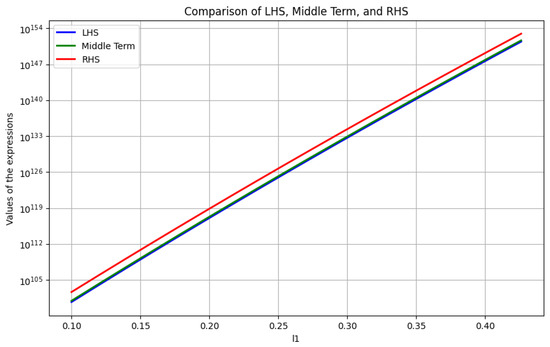
Assume that then the left side of above inequality (4) becomes
Similarly, we have
If we choose and then the middle term of above inequality is
Also
So we have
The computational values of (15), are shown in Table 1, and Table 2 corresponding to the choice of parameters , , , , , , and for some fixed values of and . Figure 1, shows the graphical representation of (15), corresponding to the choice of parameters
Figure 1.
The graphical representation of (15) corresponding to choice .
For tabular values

Table 1.
Tabular form presents the computational values of (15) corresponding to choice .
Table 1.
Tabular form presents the computational values of (15) corresponding to choice .
| / | ||
|---|---|---|
| (4.25 × , 1.23 × , 2.19 × ) | (5.56 × , 1.39 × , 3.72 × ) | |
| (6.51 × , 2.14 × , 2.87 × ) | (7.83 × , 2.26 × , 4.91 × ) |
Table 2.
Tabular form presents the computational values of (15) corresponding to choice .
Table 2.
Tabular form presents the computational values of (15) corresponding to choice .
| / | ||
|---|---|---|
| (7.48 × , 1.68 × , 4.51 × ) | (8.74 × , 1.95 × , 5.63 × ) | |
| (9.66 × , 2.72 × , 5.74 × ) | (1.12 × , 3.06 × , 6.85 × ) |
Corollary 2.
If we replace , and in Theorem 1, choose χ is symmetric about then we have
Theorem 2.
For 0, , and are complex parameters, Θ be an increasing function and Υ be a differentiable on with and be bounded. If and on for any fixed , then the H-H-F kind inequality for generalized RLFI holds.
where ϝ fulfilled the condition as in Theorem 1.
Proof.
By using defined s-convexity of second kind, we can write
Using Theorem 1, we reach
We reach at desired outcome. □
Corollary 3.
If we replace , and in Theorem 2 and χ is symmetric about then we have
Proposition 1.
Furthermore, If we replace , and in Corollary 3, so we obtain the below mid point inequality
Theorem 3.
For 0, , and are complex parameters, Θ be an increasing function and Υ be a differentiable on with and be bounded. If then the below expression holds.
Proof.
By using Theorem 1, we can write
This is our desired result. □
Remark 1.
For the choice of , , and in the Theorem 3, then we obtain ([27], Theorem 7).
Remark 2.
For the choice of , and in the Theorem 3, then we obtain ([57], Theorem 5).
Corollary 4.
For the choice of , and in the Theorem 3, then we arrive at the following mid-point inequality
Theorem 4.
For 0, , and are complex parameters, Θ be an increasing function and Υ be a differentiable on with and be bounded. If then the below expression holds.
Proof.
Using Hölder’s inequality, we have
Which is our desired result. □
Corollary 5.
If we replace , and then we obtain ([28], Theorem 8).
Proposition 2.
If we replace , and we obtain the following
3. Generalized H-H-F Type Inequalities Involving h-Convexity Associated with an Extended Fractional Operator and M-M-L Function
This section’s first result reveals the M-M-L function for a generalized h-Cf and the generalized H-H-F inequality related with an extended fractional operator. In order to achieve this, the generalized supermultiplicative (s-m) mappings are necessary.
Definition 10.
Let us consider be invertals, and be a positive. Also, a non-negative function is known as h-Cf if the inequality given below
holds for all
Definition 11.
A mapping is known as generalized s-m if
holds for all .
Theorem 5.
For 0, , and are complex parameters, and Θ be an increasing function on with , also be the geneeralized h-Cf and , be symmetric pertaining to . If , then we have
Proof.
Let exists such that
As we know that f is generalized h-Cf, we have
and
By multiplying on both sides of (17),
and after simplifying and taking integration on with respect to , we can have
By replacing we have
Continuing in the same way if we multiply the below term on both sides of (18)
then after simplifying and taking integration on with respect to , we arrive at
By adding (19) and (20), we obtain (16). □
Theorem 6.
For 0, , and are complex parameters, and Θ be an increasing function on with , also be the geneeralized h-Cf with h define on and , be symmetric pertaining to and . Then we have
Furthemore, if is generalized s-m and f is non-negative and
then, we have
Proof.
(i) Using the h-Cf if , and , then we have that
By multiplying on both sides of (25),
and after simplifying and taking integration on with respect to , we have
By replacing so we have
(ii) Let h be generalized s-m and for . For any such that , we have
Since h is s-m
and
When we have
By multiplying weighted iterated integrals on both sides of (29),
and after simplifying and taking integration of and on and , respectively, we have
By replacing and then we have
□
Lemma 2.
If is generalized h-Cf, then identity given below
hold for all and .
Proof.
We skip the proof of Lemma 2 here, because essentially it is very identical with that of (Lemma 1, [58]). □
Theorem 7.
For 0, , and are complex parameters, and Θ be an increasing function on with , also the geneeralized h-Cf and , both are symmetric pertaining to , then we have
Proof.
We have
Since w is symmetric
□
Example 2.
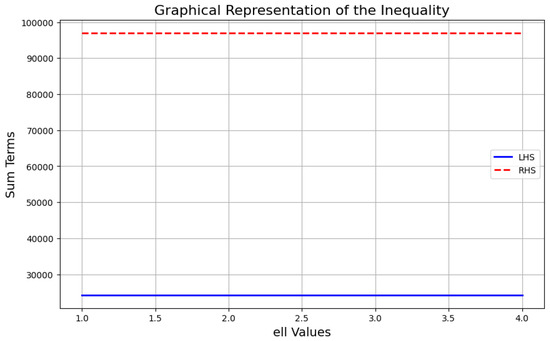
If we choose and , we have
and
By comparing above results we have
The computational values of (31), are shown in Table 3 and Table 4 corresponding to the choice of parameters , , , , , , , for some fixed values of and . Figure 2, shows the graphical representation of (31), corresponding to the choice of parameters .
Table 3.
The computational values of (31) corresponding to choice are as follows.
Table 4.
The computational values of (31) corresponding to choice .
Figure 2.
The graphical representation of (31) corresponding to choice .
Theorem 8.
For 0, , and are complex parameters, and Θ be an increasing function on with , also be the geneeralized h-Cf, be non-negative function and , be symmetric pertaining to and . Then the subsequent the inequality
holds for all
Proof.
Using Lemma 2 and the symmetricalness of the weight w, we have
Which is the left part of the inequality. Alternatively, we have
□
Example 3.
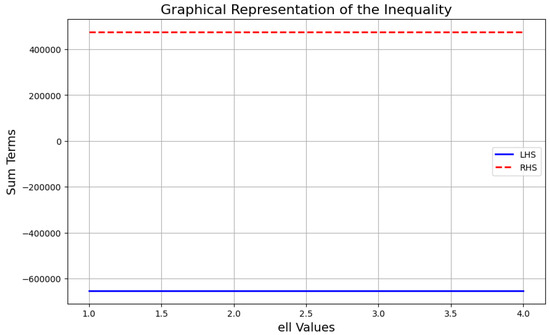
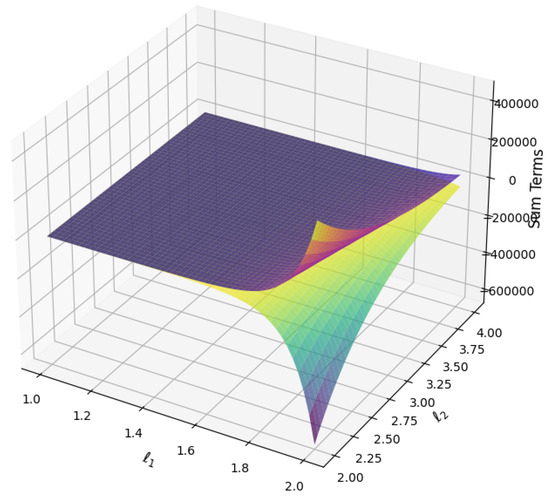
For graphical representation we choose , and in (32), we have
The computational values of (33), are shown in Table 5 and Table 6 corresponding to the choice of parameters , , , , , , and for some fixed values of and . The Figure 3, shows the two-dimensional graphical representation of (33), corresponding to the choice of parameters . The Figure 4 shows the three-dimensional graphical representation of (33) corresponding to the choice of parameters .
Figure 3.
The two-dimensional graphical representation of (33) corresponding to choice .
Figure 4.
The three-dimensional graphical representation of (33) corresponding to choice .
For tabular values
Table 5.
The computational values of (33) corresponding to choice .
Table 5.
The computational values of (33) corresponding to choice .
| / | |||
|---|---|---|---|
| 0.10 | (4.12 × , 3.14 × ) | (5.23 × , 4.16 × ) | (6.98 × , 5.69 × ) |
| 0.30 | (5.29 × , 4.21 × ) | (6.43 × , 5.25 × ) | (8.44 × , 7.07 × ) |
| 0.50 | (6.47 × , 5.29 × ) | (7.62 × , 6.34 × ) | (9.89 × , 8.08 × ) |
| 0.70 | (7.65 × , 6.36 × ) | (8.82 × , 7.42 × ) | (1.10 × , 9.09 × ) |
| 0.90 | (8.83 × , 7.43 × ) | (1.00 × , 8.51 × ) | (1.24 × , 1.04 × ) |
| 1.00 | (1.00 × , 8.57 × ) | (1.13 × , 9.45 × ) | (1.39 × , 1.17 × ) |
Table 6.
The computational values of (33) corresponding to choice .
Table 6.
The computational values of (33) corresponding to choice .
| / | |||
|---|---|---|---|
| 0.10 | (8.72 × , 7.22 × ) | (1.04 × , 8.75 × ) | (1.16 × , 9.87 × ) |
| 0.30 | (1.03 × , 8.78 × ) | (1.21 × , 1.05 × ) | (1.34 × , 1.17 × ) |
| 0.50 | (1.20 × , 9.89 × ) | (1.40 × , 1.16 × ) | (1.55 × , 1.30 × ) |
| 0.70 | (1.32 × , 1.10 × ) | (1.53 × , 1.29 × ) | (1.69 × , 1.43 × ) |
| 0.90 | (1.48 × , 1.27 × ) | (1.72 × , 1.49 × ) | (1.88 × , 1.64 × ) |
| 1.00 | (1.64 × , 1.38 × ) | (1.90 × , 1.58 × ) | (2.06 × , 1.72 × ) |
4. Discussion
In the first table, the comparison of the LHS, Middle Term, and RHS in the graphs and tables reveals that the RHS is generally larger than both the LHS and Middle Term, with the values increasing as and increase. The Middle Term tends to be closer to the LHS in magnitude, suggesting its role as a balancing factor between the two sides. As increases, the RHS grows more rapidly compared to the LHS and Middle Term, indicating that the RHS is more sensitive to changes in . The inequality appears to hold in the form across the tested values, with the LHS being consistently smaller than or equal to the Middle Term, and the Middle Term smaller than or equal to the RHS. This confirms the validity of the inequality and suggests that while the terms grow with and , the RHS exhibits the fastest growth. These observations highlight that the inequality holds true in the given range, with the terms influenced differently by and , and the RHS proving to be the dominant term in terms of magnitude. In the remaining graphs and tables demonstrate that for all combinations of and , the RHS values are consistently greater than the corresponding LHS values, indicating that the inequality is satisfied in all cases. This suggests that the inequality becomes more pronounced for larger and , with the RHS serving as a more accurate upper bound, confirming the robustness of the inequality in these conditions.
5. Conclusions
In recent times, mathematical fractional inequalities have found their way into various domains such as the material sciences, heat conduction, viscoelasticity, time series analysis, circuits, human body modeling, and shear waves. While inequalities, itself may not directly take note of issues of educational access, high-quality research, and mathematical advancement—topics such as inequality contribute to the larger objective of improving educational through the dissemination of knowledge, the development of critical thinking abilities, and the encouragement of mathematical literacy among researchers. In this work, we extended the well-known H-H-F inequalities by introducing generalized fractional operators involving the M-M-L function. Through the derivation of two key identities for locally differentiable functions, we were able to provide more accurate estimates of the differences between the left, middle, and right terms in the H-H-F inequalities. These generalized inequalities offer valuable insights into generalized convexity and the behavior of fractional operators in various mathematical contexts. The practical applications of these inequalities are significant, particularly in fields such as optimization, fractional calculus, and applied analysis. For instance, the improved inequalities can aid in more precise bounding of functions and contribute to solving complex problems in areas such as signal processing, system modeling, and the study of fractional differential equations. The graphical representations included in this study serve to visualize these inequalities, providing a useful tool for researchers and practitioners. Overall, the results presented in this paper lay a foundation for further exploration of fractional inequalities and their applications in real-world problems. Future research could extend these methods to higher-dimensional settings and explore their potential in new areas such as financial modeling and the modeling of physical systems in plasma physics. Researchers can apply our defined operator to generalized Opial-type, Chebyshev-type, and composite Cf inequality problems, among other types of inequalities. These inequalities play a vital role in computing the special means. Specifically, we have looked into some of the well-known H-H-F inequality’s relations to generalized h-convexity and extended fractional operators. In order to achieve this goal, two identities for local differentiable mappings are created. From these identities, we may derive estimates for the difference between the center and right parts of the H-H-F inequality as well as the difference between the left and central inequality.
Author Contributions
All authors contributed equally and significantly in writing this article. All authors have read and agreed to the published version of the manuscript.
Funding
This work does not receive any external funding.
Data Availability Statement
The data used to support the findings of this study are available from the corresponding author upon request.
Acknowledgments
The authors S. Haque, A. Aloqaily and Nabil Mlaiki would like to thank Prince Sultan University for the funding support and for the support through the TAS research lab.
Conflicts of Interest
The authors declare that they have no conflicts of interest.
References
- Abel, N. Solution de quelques problemes l’aide d’integrales definies. Mag. Naturv. 1823, 55–63. [Google Scholar]
- Kilbas, A.A.; Srivastava, H.H.; Trujillo, J.J. Theory and Applications of Fractional Differential Equations; Elsevier B.V.: Amsterdam, The Netherlands, 2006. [Google Scholar]
- Oldham, K.B.; Spanier, J. The Fractional Calculus; Academic Press: New York, NY, USA, 1974. [Google Scholar]
- Caputo, M.; Fabrizio, M. A new definition of fractional derivative without singular kernel. Prog. Frac. Differ. Appl. 2015, 2, 73–85. [Google Scholar]
- Losada, J.; Nieto, J.J. Properties of a new fractional derivative without singular kernel. Prog. Fract. Differ. Appl. 2015, 1, 87–92. [Google Scholar]
- Yang, X.J.; Srivastava, H.M.; Machado, J.A.T. A new fractional derivative without a singular kernel: Application to the moddeling of the steady heat flow. Therm. Sci. 2016, 20, 753–756. [Google Scholar] [CrossRef]
- Fernandez, A.; Ozarslan, M.A.; Baleanu, D. On fractional calculus with general analytic kernels. Appl. Math. Comput. 2019, 354, 248–265. [Google Scholar] [CrossRef]
- Teodoro, G.S.; Machado, J.A.T.; de Oliveira, E.C. A review of definitions of fractional derivatives and other operators. J. Comput. Phys. 2019, 388, 195–208. [Google Scholar] [CrossRef]
- Wu, S.; Samraiz, M.; Mehmood, A.; Jarad, J.; Naheed, S. Some symmetric propertise and applications of weighted fractional integral operator. Fractals 2023, 31, 2340011. [Google Scholar] [CrossRef]
- Samraiz, M.; Mehmood, A.; Iqbal, S.; Naheed, S.; Rehman, G.; Chu, Y.M. Generalized fractional operator with applications in mathematical physics. Chaos Solition Fractals 2022, 16, 112830. [Google Scholar] [CrossRef]
- Samraiz, M.; Mehmood, A.; Naheed, S.; Rehman, G.; Kashuri, A.; Nonlaopon, K. On novel fractional Operators involving the multivariate M-L function. Mathematics 2022, 10, 3991. [Google Scholar] [CrossRef]
- Huang, W.H.; Samraiz, M.; Mehmood, A.; Baleanu, D.; Rehman, G.; Naheed, S. Modified Atangana- Baleanu Fractional operators Involving generalized Mittag-Leffler function. Alexanderia Eng. J. 2023, 75, 639–648. [Google Scholar] [CrossRef]
- Cho, Y.; Kim, I.; Sheen, D. A fractional-order model for MINMOD Millennium. Math. Biosci. 2015, 262, 36–45. [Google Scholar] [CrossRef] [PubMed]
- Magin, R.L.; Ovadia, M. Modeling the cardiac tissue electrode interface using fractional calculus. J. Vib. Control 2008, 1, 1431–1442. [Google Scholar] [CrossRef]
- Chen, W.; Pang, G. A new definition of fractional Laplacian with application to modeling three-dimensional nonlocal heat conduction. J. Comput. Phys. 2016, 309, 350–367. [Google Scholar] [CrossRef]
- Grahovac, N.M.; Zigic, M.M. Modelling of the hamstring muscle group by use of fractional derivatives. Comput. Math. Appl. 2010, 59, 1695–1700. [Google Scholar] [CrossRef][Green Version]
- Rossikhin, Y.A.; Shitikova, M.Y. Analysis of two colliding fractionally damped spherical shells in modelling blunt human head impacts. Cent. Eur. J. Phys. 2013, 11, 760–778. [Google Scholar] [CrossRef]
- Balci, M.A. Fractional virus epidemic model on financial networks. Open Math. 2016, 14, 1074–1086. [Google Scholar] [CrossRef]
- Roman, H.E.; Porto, M. Fractional derivatives of random walks: Time series with long-time memory. Phys. Rev. E 2008, 78, 031127. [Google Scholar] [CrossRef]
- Moreles, M.A.; Lainez, R. Mathematical modelling of fractional order circuit elements and bioimpedance applications. Commun. Nonlinear Sci. Numer. Simul. 2017, 46, 81–88. [Google Scholar] [CrossRef]
- Yalçın, S.; Bayram, H. On harmonic univalent functions involving q-Poisson distribution series. MJPS 2021, 8, 105–111. [Google Scholar]
- Reyes-Melo, E.; Martinez-Vega, J.; Guerrero-Salazar, C.; Ortiz-Mendez, U. Application of fractional calculus to the modeling of dielectric relaxation phenomena in polymeric materials. J. Appl. Polym. Sci. 2005, 98, 923–935. [Google Scholar] [CrossRef]
- Carcione, J.M. Theory and modeling of constant-QP- and S -waves using fractional time derivatives. Geophysics 2009, 74, 1–11. [Google Scholar] [CrossRef]
- Jensen, J.L.W.V. Sur les fonctions convexes et les inegalites entre les valeurs moyennes. Acta Math. 1905, 30, 175–193. [Google Scholar] [CrossRef]
- Breckner, W.W. Stetigkeitsaussagen fur eine Klasse verallgemein konvexer Funktionen in topologischen linearen Raumen. Publ. Inst. Math. 1978, 23, 13–20. [Google Scholar]
- Jarad, F.; Ugurlu, E.; Abdeljawad, T.; Baleanu, D. On a new class of fractional operators. Adv. Differ. Equ. 2017, 2017, 247. [Google Scholar] [CrossRef]
- Set, E.; Iscan, I.; Sarikaya, M.Z.; Ozdemir, M.E. On new inequalities of Hermite-Hadamard-Fejer’ type for convex functions via fractional integrals. Appl. Math. Comput. 2015, 259, 875–881. [Google Scholar] [CrossRef]
- Gradshteyn, I.S.; Ryzhik, I.M. Table of Integrals Series and Products, 7 Eds.; Academic Press: San Diego, CA, USA, 1980. [Google Scholar]
- Sarikaya, M.Z.; Dahmani, Z.; Kiris, M.E.; Ahmad, F. (k, s)-Riemann-Liouville fractional integral and applications. Hacet. J. Math. Stat. 2016, 45, 77–89. [Google Scholar] [CrossRef]
- Gorenflo, R.; Kilbas, A.A.; Mainardi, F.; Rogosin, S.V. Mittag-Leffler Functions, Related Topics and Applications; Springer Monographs in Mathematics; Springer: New York, NY, USA, 2014. [Google Scholar]
- Akgül, E.K.; Akgül, A.; Yavuz, M. New illustrative application of integral transform to financial models with different fractional derivatives. Chaos Solitions Fractals 2021, 146, 110877. [Google Scholar] [CrossRef]
- Yavuz, M.; Sene, N. Approximation solution of the model describing fluid flow using generalized laplace transform method and heat balance integral method. Axioms 2020, 9, 123. [Google Scholar] [CrossRef]
- Yavuz, M.; Abdeljawad, T. Nonlinear regularized long-wave with a new integral transformation applied to the fractional derivative with power and Mittag-Leffler kernel. Adv. Differ. Equ. 2020, 2020, 367. [Google Scholar] [CrossRef]
- Yavuz, M.; Ozdemir, N. Comparison the new fractional derivative operators involving exponential and Mittag-Leffler kernal. Discrete Contin. Dyn. Syst. Ser. S. 2020, 13, 995–1006. [Google Scholar]
- Podlubny, I. Fractional Differential Equations; Academic Press: San Diego, CA, USA, 1999. [Google Scholar]
- Nisar, K.S.; Rahman, G.; Baleanu, D.; Mubeen, S.; Arshad, M. The (k, s)-fractional calculus of k Mittag-Leffler function. Adv. Differ. Equ. 2017, 2017, 118. [Google Scholar] [CrossRef]
- Baleanu, D.; Diethelm, K.; Scalas, E.; Trujillo, J.J. Fractional Calculus: Models and Numerical Methods, Series on Complexity, Nonlinearity and Chaos; World Scientific: Singapore, 2012. [Google Scholar]
- Mainardi, F. Fractional Calculus and Waves in Linear Viscoelasticity: An Introduction to Mathematical Models; World Scientific Publishing Company: Singapore; Hackensack, NJ, USA; London, UK, 2010. [Google Scholar]
- Zhao, D.; Luo, M. Representations of acting processes and memory effects: General fractional derivative and its application to theory of heat conduction with finite wave speeds. Appl. Math. Comput. 2019, 49, 531–544. [Google Scholar] [CrossRef]
- Chen, S.B.; Rashid, S.; Noor, M.A.; Ashraf, R.; Chu, Y.M. A new approach on fractional calculus and probability density function. AIMS Math. 2020, 5, 7041–7054. [Google Scholar] [CrossRef]
- Samraiz, M.; Umer, M.; Abduljawad, T.; Naheed, S.; Rahman, G.; Shah, K. On Riemann-type weighted fractional operator and solution to cauchy problems. Comput. Model. Eng. Sci. 2022, 136, 901–917. [Google Scholar] [CrossRef]
- Mittag-Leffler, M.G. Sur la nouvelle fonction E(x). C. R. Acad. Sci. 1903, 137, 5548. [Google Scholar]
- Garg, M.; Manohar, P.; Kalla, S.L. A Mittag-Leffler-type function of two variables. Int. Transf. Spec. Funct. 2013, 24, 9344. [Google Scholar] [CrossRef]
- Saxena, R.K.; Kalla, S.L.; Saxena, R. Multivariate analogue of generalised Mittag-Leffler function. Int. Transf. Spec. Funct. 2011, 22, 533–548. [Google Scholar] [CrossRef]
- Fej, L. Über die Fourierreihen. II. Math. Naturwiss Anz. Ungar. Akad. Wiss. 1906, 24, 369–390. [Google Scholar]
- Hadamard, J. Étude sur les propriétés des fonctions entières et en particulier d’une fonction considérée par Riemann. J. Mathématiques Pures Appliquées 1893, 9, 171–215. [Google Scholar]
- Tseng, K.L.; Yang, G.S.; Hsu, K.C. Some inequalities for differentiable mappings and applications to Fejér inequality and weighted trapezoidal formula. Taiwan J. Math. 2011, 15, 1737–1747. [Google Scholar] [CrossRef]
- Delavar, M.R.; Dargomir, S.S. Trapezoidal type inequalities related to h-convex functions with applications. Rev. R. Acad. Cienc Exactas Fís Nat. Ser.-A Math. 2019, 113, 1487–1498. [Google Scholar] [CrossRef]
- Matloka, M. Weighted Simpson type inequalities for h-convex functions. J. Non-Linear Sci. Appl. 2017, 10, 5770–5780. [Google Scholar] [CrossRef]
- Varošanec, S. On h-convexity. J. Math. Anal. Appl. 2007, 326, 303–311. [Google Scholar] [CrossRef]
- Chen, H.; Katugampola, U.N. Hermite-Hadamard and Hermite-Hadamard-Fejer type inequalities for generalized fractional integrals. J. Math. Anal. Appl. 2017, 446, 1274–1291. [Google Scholar] [CrossRef]
- Khan, T.U.; Khan, M.A. Generalized conformable fractional operators. J. Comput. Appl. Math. 2019, 346, 378–389. [Google Scholar] [CrossRef]
- Samko, S.G.; Kilbas, A.A.; Marichev, O.I. Fractional Integrals and Derivatives, Theory and Applications; Gordon and Breach: Montreux, Switzerland, 1993. [Google Scholar]
- Agarwal, P.; Nieto, J.J. Some fractional integral formulas for the Mittag-Leffler type function with four parameters. Open Math. 2015, 13, 537–546. [Google Scholar] [CrossRef]
- Hölder, O.L. Nachrichten von der Königl Gesel Schaft der Wissenschaften und der Georg-August-Universität zu Göttingen; Dieterichsche Verlags-Buchhandlung: Gottingen, Germany, 1889; pp. 38–47. [Google Scholar]
- Alqudah, M.A.; Mohammed, P.O.; Abdeljawad, T. Solution of Singular integral equation via Riemann-Liouville fractional integral. Math. Prob. Eng. 2020, 1, 1250970. [Google Scholar] [CrossRef]
- Hakiki, M.T.; Wibowo, A. Hermite-Hadamard-Fejer type inequalities for s-convex functions in the second sense via Riemann-Liouville fractional integral. J. Phys. Conf. Ser. 2020, 1442, 012039. [Google Scholar] [CrossRef]
- Sarikaya, M.Z.; Set, E.; Özdemir, M.E. On some new inequalities of Hadamard type involving h-convex functions. Acta Math. Univ. Comeniane 2010, 79, 265–272. [Google Scholar]
Disclaimer/Publisher’s Note: The statements, opinions and data contained in all publications are solely those of the individual author(s) and contributor(s) and not of MDPI and/or the editor(s). MDPI and/or the editor(s) disclaim responsibility for any injury to people or property resulting from any ideas, methods, instructions or products referred to in the content. |
© 2025 by the authors. Licensee MDPI, Basel, Switzerland. This article is an open access article distributed under the terms and conditions of the Creative Commons Attribution (CC BY) license (https://creativecommons.org/licenses/by/4.0/).