


Abstract
Condition Monitoring (CM) is a key component of Self-Adaptive and Self-Organizing (SASO) systems. By analyzing sensor data, CM enables systems to react to dynamic conditions, supporting the core principles of Organic Computing (OC): robustness, adaptability, and autonomy. This survey presents a structured overview of CM techniques, application areas, and input data. It also assesses the extent to which current approaches support self-* properties, real-time operation, and predictive functionality. Out of 284 retrieved publications, 110 were selected for detailed analysis. About 38.71% focus on manufacturing, 65.45% on system-level monitoring, and 6.36% on static structures. Most approaches (69.09%) use Machine Learning (ML), while only 18.42% apply Deep Learning (DL). Predictive techniques are used in 16.63% of the studies, with 38.89% combining prediction and anomaly detection. Although 58.18% implement some self-* features, only 42.19% present explicitly self-adaptive or self-organizing methods. A mere 6.25% incorporate feedback mechanisms. No study fully combines self-adaptation and self-organization. Only 5.45% report processing times; however, 1000 Hz can be considered a reasonable threshold for high-frequency, real-time CM. These results highlight a significant research gap and the need for integrated SASO capabilities in future CM systems—especially in real-time, autonomous contexts.
1. Introduction
Self-adaptive and self-organizing systems (SASO) refer to systems that perceive their environment and its changes through receptive components, evaluate the situation, plan an appropriate response, and execute it autonomously [1]. Two of the most significant initiatives for realizing such systems are Organic Computing (OC) [2] and Autonomic Computing (AC) [3], which propose concrete techniques, control mechanisms, and concepts based on Machine Learning (ML) for autonomous decision-making [4]. In particular, OC combines self-adaptation and self-organization to enhance system robustness, flexibility, and resilience [5].
Beyond these, there exists a wide range of additional self-* terms that refer to system capabilities enabling runtime adaptation, optimization, and resilience without human intervention. While the list of possible self-* properties is theoretically endless, the core set typically emphasized in research includes self-adaptive (adjusting behavior in response to changes), self-organizing (restructuring internal organization), self-healing (recovering from faults), self-protecting (defending against threats), and self-explaining (providing understandable reasons for actions) [6,7,8,9].
The most widely recognized reference model for SASO, particularly for self-adaptive systems, is the Monitor-Analyze-Plan-Execute over a shared Knowledge (MAPE-K) feedback loop [10]. This concept structures such systems into distinct components: monitoring the environment using sensors, analyzing the collected data, planning an appropriate response to environmental changes, and executing the response via actuators [11]. Additionally, the knowledge component helps refine future analysis and decision-making processes. A schematic representation of the MAPE-K loop is shown in Figure 1. It can be emphasized that MAPE-K is generally applicable to the approach of SASO systems and can be implemented in various patterns [12]. Specifically, it can be directly mapped to the Observer/Controller pattern in OC [13].
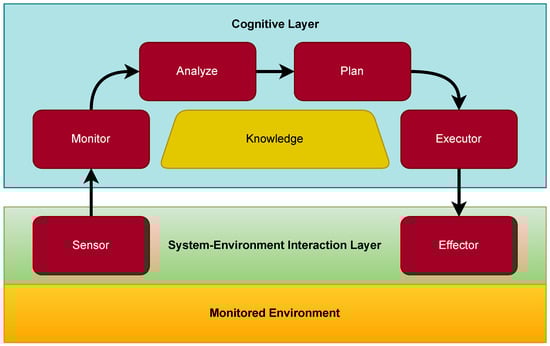
Figure 1.
Schematic illustration of the MAPE-K loop, comprising the cognitive layer (Monitoring, Analysis, Planning, Execution and the overarching Knowledge), the system–environment interaction layer (Sensors and Effectors), and the monitored environment.
While numerous approaches and diverse use cases exist for implementing SASO, real-world systems remain scarce. Given that planning and execution components have already been extensively tested using deep reinforcement learning techniques [14], one of the key challenges appears to be the effective description of system states.
Achieving self-adaptation and self-organization in a system relies heavily on the ability to monitor its states and parameters, as well as those of its environment. Effective monitoring enables the detection, analysis, and response to changes, ensuring that the system remains efficient and adaptable.
Condition Monitoring (CM) refers to the process of continuously assessing the state of a system or process through one or more sensor elements, often enabling automated responses based on the collected data [15]. CM can range from detecting anomalies or faults to predicting future failures by analyzing the system’s current condition. In industrial machinery, for instance, it can be used to estimate remaining useful life and schedule maintenance proactively. A practical example is its application in the Industrial Internet of Things (IIoT), where vibration sensors are used to monitor and predict bearing wear in production equipment, helping to prevent unexpected breakdowns and reduce downtime [16]. As a result, CM systems can incorporate both anomaly detection and predictive modules. Predictive maintenance, in particular, stands out as one of the most innovative approaches to proactively preventing failures [17].
Beyond anomaly detection, CM can encompass the analysis, recognition, and classification of anomalies, as well as the diagnosis of their root causes. Therefore, CM can be regarded as a critical component of OC, contributing to the system’s ability to self-adapt and self-organize.
Certain processes and systems require real-time state monitoring due to their rapid operation and the need to adhere to strict safety constraints. Real-time monitoring allows the system to adapt its behavior or structure within a timeframe appropriate to the specific process or system. This aligns closely with the requirements of OC systems, as described by Tomforde et al., which emphasize the need for runtime modifications to behavior and/or structure.
A fundamental aspect of CM systems is the collection of data about the current state of the system or process using sensors. These sensors can be categorized into heterogeneous or homogeneous types. Heterogeneous sensors combine multiple types, such as vibration, temperature, force, and acoustic sensors, whereas homogeneous sensors rely on a single type of sensor.
This article aims to provide researchers with a comprehensive overview of real-time CM techniques that exhibit SASO system properties, along with their associated application domains. It also facilitates the comparison of these methods based on input data and predictive capabilities, while identifying research gaps and outlining potential directions for future investigation.
In particular, this article contributes to the field through an extensive review of the literature by:
- Overview of real-time CM techniques with SASO properties.
- Taxonomy and categorization of existing studies based on the implemented techniques, application domains, input data, and predictive approaches for CM in SASO systems.
- Analysis of self-* properties and the extent to which SASO system requirements are fulfilled.
- Exploration of high-frequency monitoring and CM system processing time
- Deriving research gaps and proposing a structured research agenda for future investigation
The review is structured as follows: Section 2 outlines the related works and distinguishes them from the current study. Section 3 provides a detailed description of the implemented methodology, including the definition of research questions, search strategy, selection criteria, and selection process. Section 4 presents the results derived from the included papers. In Section 5, an analytical discussion of these findings is conducted. Building on this discussion, Section 6 introduces the research agenda, which summarizes the identified research gaps and proposes potential future research directions. Finally, Section 7 concludes the survey with a summary of the key insights.
2. Related Works
In recent years, several review and survey publications have covered CM; however, they have not specifically focused on self-adaptive (SA) or self-organizing (SO) systems, and particularly not on SASO systems. These studies often focus on specific application areas, techniques, or a combination of both. Many authors concentrate their research on specific subdomains of CM, particularly anomaly detection. For instance, Hodge et al. presented approaches for outlier detection in 2004, without considering their applicability to SA or SO systems and covering only research up to that time [18].
Other reviews have primarily focused on fault diagnosis. For example, Sun et al. in 2012 explored fault diagnosis in oil-immersed power transformers by analyzing dissolved gases [19]. Their work provided an overview of ML techniques—including fuzzy logic, neural networks, and evolutionary optimization approaches—but did not address SASO systems. Moreover, their study not only emphasized a specific application but also limited its scope to ML-based methods.
Similarly, Yan et al. in 2014 investigated fault diagnosis in rotary machines, concentrating on wavelet techniques and showcasing various applications of these methods [20]. However, they only briefly mentioned an SA approach for diagnosis and covered research only up to 2014.
Fault prediction and maintenance interval estimation are also critical aspects of CM. Unlike the previous studies, El-Thalji et al. in 2015 examined predictive health monitoring methods and fault modeling specifically for rolling element bearings, yet they mentioned only one SO method [21]. In 2016, Rai et al. also focused on rolling element bearings, investigating fault diagnosis and prognosis using signal processing techniques [22]. However, their study provided only a few SA preprocessing and feature extraction techniques for CM in SASO systems.
In contrast, Zhou et al. in 2018 addressed CM methods with a specific focus on tool CM in the milling process [23]. Their review analyzed the literature in terms of CM models, sensor types, and feature extraction methods, but mentioned only one SA technique for preprocessing, without covering CM comprehensively. Similarly, Wang et al. in 2019 concentrated on CM techniques, restricting their scope to methods that utilize vibration sensor data for turbine planetary gearbox applications [24]. Their study emphasized fundamental analysis, signal processing, feature extraction, and fault detection, yet it addressed only one SA feature extraction method.
A more recent publication by Kumar et al. in 2020 explored gear defect diagnosis and prognosis methods for CM by categorizing different types of gear defects, although they mentioned only one SO method and one SA preprocessing technique [25]. Lastly, Chaupal et al. in 2023 examined damage identification methods for laminated composite structures using vibration-based data [26]. Their review highlighted optimization techniques, signal processing methods, and ML algorithms, but it referenced only one SA technique for CM.
The discussed review papers primarily focus on specific methods, data, application domains, or a combination of these aspects. Table 1 provides a comparative overview and differentiation of various related works in the field of CM, with respect to their limitations, techniques analyzed, time periods covered, and how they differ from the present study. However, many fail to comprehensively address all areas of CM. Moreover, there is either a lack of or an insufficient consideration of CM implementation in SASO systems, with no explicit focus on SASO systems. To bridge this gap, this work provides a comprehensive review of established and recent methods, applications, and various input data used in the field of CM for SASO systems. Furthermore, all key aspects of CM are thoroughly analyzed, including an investigation of the self-* properties implemented in the CM methods. In addition, the processing time of the applied approaches is carefully examined.

Table 1.
Comparison of related surveys on CM with respect to their limitations, techniques analyzed, time periods covered, and distinction from this work.
3. Methodology
The primary aim of this survey is to provide a comprehensive review of the literature, focusing on techniques for CM in SASO systems, with particular emphasis on high-frequency systems. Furthermore, it distinguishes between non-ML methods and ML approaches, including Deep Learning (DL) techniques. The methodology of this study follows the approach outlined by Piliuk et al. for the review of quantitative-focused contributions and is structured as follows [27].
- Defined research questions to guide the direction of the review.
- Designed a search strategy, including the specific search terms and the contribution sources.
- Created selection criteria to identify studies to exclude from the review.
- Established a systematic procedure to apply the selection criteria consistently.
These steps are designed to ensure an unbiased and comprehensive study. Each step is explained in detail within this section.
3.1. Research Questions and Search Strategy
In this section, the research questions and the search strategy are described. The research questions serve as a foundation for developing an appropriate search strategy and selection process for contributions, ensuring a focused and systematic approach to addressing the research questions. The following research questions have been identified, and they will be answered through the analysis of the selected contributions.
- In which application domains is CM employed in SASO systems and how are the applied methods influenced by specific applications?
- To what extent do the presented CM approaches implement self-* properties, and how well do they meet the requirements of a SASO system?
- What technologies and methods are utilized for CM in SASO systems, and what is the role of ML and DL in this context?
- What types of sensor data and features are used for CM, and how frequently is the data processed?
- What challenges and open research questions exist in integrating CM into SASO systems, particularly with the use of DL techniques?
The basis of the search strategy is a clearly defined search term, which was used to identify relevant sources. To determine the most suitable and relevant databases, an initial exploration was conducted using Google Scholar [28]. This process identified four key databases recognized for their significance in the fields of ML and engineering sciences. For the specific source search, the selected databases included ACM Digital Library, IEEE Xplore, Springer Nature Link, and ScienceDirect [29,30,31,32].
The ACM Digital Library and IEEE Xplore were utilized for gathering primary studies due to their extensive collection of publications in computer science and engineering, with a specific focus on ML, real-time systems, and adaptive technologies. In contrast, Springer Nature Link and ScienceDirect were included for their broad range of subject-specific contributions relevant to SASO systems and CM. By selecting two method-specific and two general sources, we aim to provide a comprehensive overview while ensuring a balanced representation of both method-specific and subject-specific contributions.
To achieve a transparent selection of contributions that aligns closely with the main focus of the study while simultaneously providing a comprehensive literature overview, a precise search term was established. This search term is defined as follows:
(“condition monitoring”) AND (“self-adaptive” OR “self-organization” OR “self-aware” OR “self-correcting”) AND (“real-time”) AND NOT (“framework”)
The first part of the search term narrows the scope to CM, while the second part focuses on the self-* properties and characteristics of SASO systems. Together, these address the autonomous monitoring of system states. The third part specifically targets real-time systems, as the primary focus of the study is on high-frequency systems. Combined with the first two parts, this ensures alignment with the core objectives of the study. Lastly, the exclusion of frameworks in the final section of the search term ensures that only concrete techniques are considered, as frameworks generally describe a structural outline rather than a specific model or methodology. The contributions were identified and selected using the search strategy conducted on 15 November 2024. This systematic review adheres to the PRISMA guidelines [33], with the corresponding PRISMA checklists and flow diagram included in Appendix D.
3.2. Selection Criteria and Process
Initially, contributions categorized as reviews, abstracts, glossaries, datasets, keywords and indices, or retracted papers were excluded (EC 1). Furthermore, book chapters that do not constitute standalone publications and primarily provide summaries or overviews of current techniques and topics related to CM were excluded. Additionally, duplicate studies and older versions of contributions were manually removed in the next step (EC 2). Subsequently, studies that did not explicitly address CM or related concepts, such as predictive maintenance, were excluded. This included all contributions that did not describe a concrete CM process for system operations (EC 3), as well as those focusing on monitoring physical states or conditions. Furthermore, contributions lacking a detailed description of the methodology—i.e., studies that did not clearly explain how CM was conducted—were excluded (EC 4). This includes contributions that failed to specify concrete techniques. Finally, inaccessible paper were also removed (EC 5).
The filtering process was conducted step-by-step as outlined in Table 2, ensuring that the criteria were not weighed against each other. No formal tools or automation software were employed to assess the risk of bias in the included studies. Additionally, no risk of bias assessment was performed for individual studies. Furthermore, neither an assessment of the certainty or confidence in the evidence nor sensitivity analyses were carried out, as the study relied on a qualitative synthesis. The selection process was conducted independently by both authors. Applying this process resulted in the inclusion of 110 papers. The total number of papers identified through the selection process and search strategy can be found in the Appendix A. Additionally, Table A9 provides a list of excluded papers, while Table 3 presents the distribution of included and excluded papers across the various databases used. Analyzing the number of publications over two-year intervals reveals a growing interest in intelligent self-regulating CM systems, as illustrated in Figure 2. This study was not registered, and no formal protocol was developed prior to its initiation. Consequently, no amendments to a protocol or registration were necessary.
Table 2.
Overview of the applied exclusion criteria.
Table 3.
Distribution of included and excluded papers across the various databases.
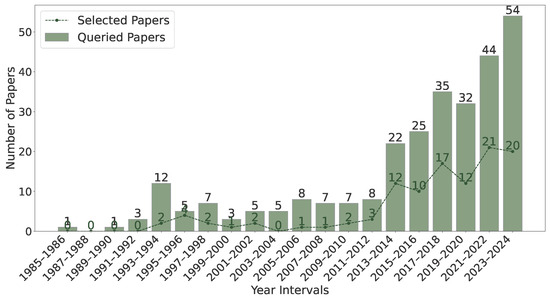
Figure 2.
Representation of the selected and queried contributions per time interval, where each time interval spans a period of two years.
4. Results
This section provides an explanation of the taxonomy used in this study. It was applied to the 110 selected studies that remained after the filtering process.
4.1. Taxonomy
The selected papers were categorized based on several criteria to ensure a comprehensive analysis and to effectively address the research questions outlined in the methodology of this study. The primary classification criteria include the application domain and the techniques employed, which are further divided into non-ML and ML methods. Within the ML category, an additional distinction is made between traditional ML methods and DL approaches. Furthermore, the papers were analyzed based on the type of input data used and the type of CM implemented. The contributions were further examined with respect to the self-* properties of the applied CM methods. Moreover, the analysis includes the presence of a control component for a feedback loop, the number of sensors used, the feature size, the nature of the data (e.g., real or simulated), and the processing time required by the CM approaches.The following sections provide a detailed overview of this classification.
4.1.1. Application Domain
The selected contributions are categorized based on their practical application described in the study or the specific application addressed by the method. The categorization is as follows:
- Manufacturing/Process: Papers that focus on CM of manufacturing processes or procedures, such as cutting, drilling, or milling operations, as well as the examination of the produced object, are classified in this category.
- Structure: Studies categorized here address CM of static objects, including buildings and other structures.
- System: This category includes the monitoring of system parameters, such as machines, circuits, or autonomous vehicles.
4.1.2. Technique
In this category, the classification is based on the techniques utilized.
- Machine Learning: This category includes papers that utilize ML techniques for CM, with a further distinction made between DL and traditional ML.
- Non-Machine Learning: Contributions in this category rely on traditional techniques such as signal processing or statistical methods for CM.
4.1.3. Input Data
This section categorizes the selected papers based on the types of input data utilized in the studies.
4.1.4. Type of Condition Monitoring
This category differentiates between the types of CM: the prediction of future states using predictive approaches and the detection of anomalies based on current states. Additionally, papers that address both aspects are classified in a separate category.
- Predictive Approach: This category includes papers that focus on predictive approaches to monitoring states, such as forecasting the lifespan of a machine or estimating maintenance intervals.
- Anomaly Detection: Contributions in this category examine the current state, specifically identifying existing faults or changes within the system or process.
- Combination of Both Approaches: This category encompasses papers that integrate both predictive methods and current state monitoring techniques in their approaches.
4.1.5. Self-* Properties
For the realization of SASO systems, the implementation of the CM component must incorporate self-* properties, particularly self-adaptivity and self-organization. This section examines whether the CM techniques implemented in the analyzed papers exhibit these properties and, accordingly, whether they are suitable for deployment in SASO systems. Furthermore, it is investigated whether existing publications have partially realized the MAPE-K feedback loop through CM.
4.2. Application Domain
CM is applied across various applications. Some applications focus on entire processes, such as manufacturing workflows, while others target the CM of individual machine elements, such as bearings or specific processes. Additionally, Table 4, Table 5 and Table 6 provide a classification of the papers by three CM application categories—Manufacturing/Process, System, and Structures—along with their specific application areas and the number of contributions in each category.
Table 4.
Number of contributions in various application areas from the Manufacturing/Process category.
Table 5.
Summary of the distribution of contributions across the application areas of the System category.
Table 6.
Overview of the distribution of contributions across the application areas of the Structure category.
4.2.1. Manufacturing and Process Monitoring
A significant proportion of the analyzed studies, approximately 38.71%, addressing CM in manufacturing processes focus on the milling process, particularly in CNC machines [34]. Tool wear monitoring and the detection of faults and anomalies occurring during the process play a crucial role in these applications. Similar processes, such as drilling and cutting, are also frequently studied in CM research, accounting for approximately 16.13% and 12.9% of the contributions, respectively.
Beyond tool monitoring during manufacturing, the literature also explores the monitoring of materials or products throughout the entire production process [35]. The primary focus remains on the detection of defects and irregularities. Some studies further address the classification and analysis of such faults [36]. Additionally, a number of publications examine the development of CM diagnosis systems [37]. A detailed distribution of manufacturing applications is presented in Table 4.
4.2.2. System-Level Monitoring
Many publications shift their focus from monitoring process flows and manufacturing outcomes to analyzing individual system components, standalone systems, or systems composed of multiple subsystems. The distribution of these applications is provided in Table 5. A key area of interest in CM research is the assessment of critical machine components, particularly bearings, which account for 48.61% of the studied cases [38,39]. A significant portion of the research is dedicated to CM of rolling element bearings, commonly found in rotating machinery [40], including motors such as those used in Autonomous Underwater Vehicles (AUV) [41], aero engines [42], and generators like those in whirlpool turbine generators [43]. Other bearing types include planetary bearings used in wind turbines [44] and ball bearings found in induction motors [45].
Beyond bearings, CM studies also investigate other components, such as gears (approximately 8.33%) in wind turbine gearboxes [46], and shafts (about 2.78%), such as rotor shafts [47].
Standalone system monitoring encompasses diverse applications, ranging from components in pressure systems, such as reciprocating compressors in refrigerators [48], to entire machines, such as induction machines [49], aircraft engines [50], and turbomachinery in oil plants [51]. Applications concerning pressure systems constitute 8.33% of all system-related studies, while oil plants and induction machines account for only 1.39% each. Overall, 81.94% of system-level applications focus on machinery, with approximately 72.88% concentrating on individual key components such as bearings, gears, or shafts. Additionally, 8.33% of system-related studies examine the monitoring of multiple interconnected systems. A detailed breakdown of these applications is presented in Table 5.
4.2.3. Full-System Monitoring
Comprehensive CM approaches also address entire systems composed of multiple interconnected subsystems. Examples include CM of entire wind farms [52], AUVs [53], electrical circuits [54], and nuclear facilities [55].
As with manufacturing process monitoring, the primary objective in full-system monitoring is the detection of faults and anomalies, as well as system-wide analysis and diagnostics. Some studies focus on predicting the remaining useful life of a system or the occurrence of potential failures [56]. Additionally, research has been conducted on monitoring the deterioration of system conditions and degradation processes [57].
4.2.4. Structural Monitoring
Another important focus area is the monitoring of static structures. This includes civil and steel structures [58,59], as well as tanks, such as rocket fuel tanks [60], and pipelines [61]. CM is also applied to smaller structural components, such as steel beams [62] and heavy haul locomotive components, particularly wheels [63]. The primary objective in structural monitoring is damage detection.
Overall, only 6.36% of the analyzed studies focus on CM of structures and static objects. In contrast, 28.18% of contributions address manufacturing processes, while the majority (approximately 65.45%) focus on system-level CM. A detailed distribution of CM applications for structural and static objects is presented in Table 6.
4.3. Techniques
To conduct CM, various methods are employed, including both ML and non-ML approaches. ML techniques can be further divided into DL models and conventional ML methods.
4.3.1. Machine Learning
A variety of models are used for system CM. The distribution of employed models is illustrated in Table 7. As depicted in Figure 3, there has been a steady increase in the use of ML techniques over time. A particularly notable rise in DL applications begins around the 2013–2014 period. Before that, only conventional ML methods were used. This rapid growth in DL adoption reflects a clear shift toward more complex models and a gradual decline in the reliance on simpler techniques. Among the analyzed studies, 56.36% apply conventional ML models (excluding DL techniques). Neural networks (NN) are the most frequently implemented, appearing in 23 studies (approximately 37.1% of ML techniques). These include standard Artificial Neural Networks (ANN) and Multilayer Perceptrons (MLP) [64], Fuzzy-Neural Networks (FNN) [53], Self-Adaptive Growing Neural Networks (SAGNN) [65], and Self-Organizing Mapping Neural Networks (SOM) [66]. Other commonly used ML models include clustering techniques, such as mean shift clustering [67], Principal Component Analysis (PCA) [68], and k-means-like Adaptive Sequential K-means (ASK) [69]. Classical approaches like Decision Trees (DT) [70], regression models [71], and Support Vector Machines (SVM) combined with optimization algorithms, such as genetic algorithms (GA) [72] and Grey Wolf Optimizations (GWO) [73], are also employed. Additionally, CM implementation utilizes Gaussian mixture models (GMM) [61] and Markov models [74].
Table 7.
List of ML models and the number of articles utilizing these techniques (excluding DL methods).
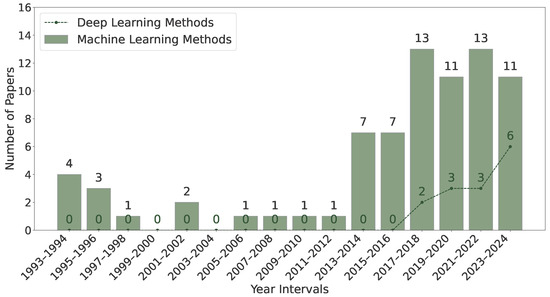
Figure 3.
Annual distribution of machine learning methods used for condition monitoring, with a particular focus on DL. Background bars represent the total number of studies applying machine learning techniques in each two-year interval, while the foreground line illustrates the subset specifically employing DL approaches.
To enhance CM accuracy and quality, feature extraction, optimization, and preprocessing techniques are frequently applied. Feature extraction and preprocessing often involve decomposition algorithms such as Empirical Mode Decomposition (EMD) [75], Variational Mode Decomposition (VMD) [76], Singular Value Decomposition (SVD) [40], Intrinsic Time-scale Decomposition (ITD) [77], Local Characteristic-scale Decomposition (LCD) [78], and Local Mean Decomposition (LMD) [58], along with their extensions like Ensemble Empirical Mode Decomposition (EEMD) [79]. Wavelet transformations, such as Discrete Wavelet Transform (DWT) [80], PCA [78], and Linear Discriminant Analysis (LDA) [81], are also common. Signal processing techniques include Fast Fourier Transforms (FFT) [62] and Adaptive Wiener Filters like Energy Variation-Driven Adaptive Wiener Filter (EDAWF) [61]. Optimization algorithms include Fruit Fly of Algorithm (FOA) [46], Particle Swarm Optimization (PSO) [54], and GA [82].
4.3.2. Deep Learning
DL models utilize deeper layers to facilitate advanced pattern and feature learning. The distribution of DL models in CM studies is detailed in Table 8. Convolutional Neural Network (CNN)-based approaches, often combined with preprocessing and optimization techniques similar to those discussed in Section 4.3.1, are prevalent. CNN models are frequently integrated with other ML or DL techniques, such as SVMs [83], short-time Fourier transform [84], particle filters (PF) [42], and decomposition methods like EEMD [85]. CNN implementations utilize both one-dimensional and two-dimensional approaches [86]. Long Short-Term Memory (LSTM) [87] are also frequently used, often in combination with preprocessing techniques [88] and CNNs [63]. Additional DL models include Gated Recurrent Units (GRU) [57] and Safe Semi-Supervised Support Vector Machine (S4VMs), often paired with autoencoders such as Stacked Denoising Autoencoder (SDAE) [89]. CNNs constitute 57.14% of DL models, followed by LSTMs at 21.43%.
Table 8.
Distribution of contributions across various DL techniques.
4.3.3. Non-Machine Learning
CM is also conducted using non-ML approaches, which can be categorized into mathematical models, signal processing techniques, and hybrid adaptive optimization methods. The distribution of these methods is presented in Table 9. Signal processing techniques account for the largest portion (67.6%), followed by mathematical models (11.8%) and hybrid adaptive optimization techniques (20.6%). Mathematical models include approaches such as boundary models and the 3 threshold principle [90]. Signal processing techniques encompass various filtering algorithms, such as second-generation wavelet transforms [91], frequency-domain transformations such as FFT [49] and Continuous Wavelet Transform (CWT) [59], as well as decomposition methods including EMD [34], LMD [92], and VMD [93].
Table 9.
Overview and count of papers classified as non-ML methods, organized into three sections.
Hybrid adaptive optimization methods integrate optimization algorithms such as Nelder-Mead Salp Swarm Algorithm (SSA-NM) [94] and Clonal Selection Algorithm Differential Evolution Algorithm (CSA-DEA) [47], along with adaptive filters combined with signal processing techniques [95]. Additionally, advanced approaches like Synchronized Switching Harvesting on an Inductor with Self-Adaptive Mechanical Switches (SSHI-SAMS), which utilizes self-adaptive mechanical switches, have been employed [96].
Preprocessing techniques vary depending on the applied method and include strategies such as Bi-Spectrum based EMD (BSEMD) [97], Spline-Based LMD (SBLMD) [98], and FFT-based feature extraction in LMD-FFT [99].
4.4. Input Data
Despite variations in techniques, both ML and non-ML approaches utilize a limited range of sensor types, leading to overlaps in input data types. Vibration data from accelerometers [100], acoustic data from microphones [101], and force data [102] are commonly used. Additional input data include temperature [103], current [35], and pressure [104]. Sampling frequencies range from 0.003 kHz to 6250 kHz, with vibration data typically between 0.1 kHz and 100 kHz. Almost all reviewed papers validate their proposed methods using real-world data and case studies, with 18.18 % additionally incorporating simulated data. Only one of the reviewed papers exclusively used simulation data, specifically from a 320 W power plant [105], accounting for 0.91% of all papers. For the generation of training, testing, and validation datasets, between one and 63 different sensors (or process parameters) were monitored [106]. Figure 4 illustrates the heterogeneity of sensors used in the reviewed publications, grouped in two-year intervals. Over the past ten years, the number of studies relying on a single type of sensor has remained relatively constant. However, there has been a noticeable increase in publications combining two different types of sensors, with an even more pronounced rise in the use of more than two sensor types. This highlights a clear trend toward multi-sensor data acquisition. From these data, between one and 2000 distinct features were extracted—or up to 2000 feature values used as input—primarily through spectral and/or statistical feature extraction techniques [63]. The data characteristics of the reviewed papers can be found in Table 10. Additionally, a comprehensive overview of all selected publications, including the number of sensors used, the type of data, and the feature size, is provided in Table A6, Table A7 and Table A8.
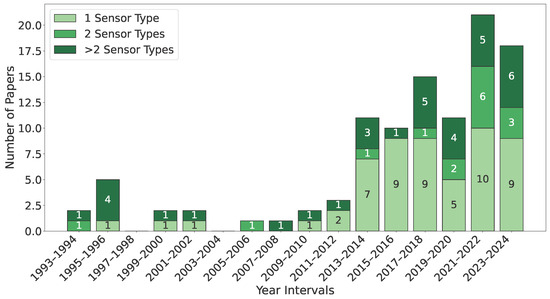
Figure 4.
Distribution of sensor diversity in the analyzed publications over time. The stacked bar chart illustrates the number of studies in each two-year interval using only one sensor type (light green), exactly two sensor types (medium green), and more than two sensor types (dark green). The visualization highlights the trend toward increasing sensor heterogeneity in recent years.
Table 10.
Overview of data characteristics.
4.5. Types of Condition Monitoring
CM techniques extend beyond real-time fault detection and anomaly diagnosis to include predictive maintenance strategies. Some studies implement algorithms to assess the current health status and generate predictions using models such as Support Vector Regression (SVR) [107] and Markov models [74]. Other approaches combine real-time fault detection with predictive maintenance, often utilizing CNNs [85,108].
4.6. Self-* Properties
In the domain of process and manufacturing applications, only 20 out of 31 papers (64.52%) demonstrate self-* properties. Among these, two papers do not implement true self-adaptivity, but rather introduce only a self-adaptive learning rate algorithm [64] and a self-adaptive scaling factor [73]. Furthermore, six of the remaining 18 papers employ solely self-adaptive feature extraction methods, such as EMD [100], EEMD [79], a self-adaptive Kalman wave filter [37], and Second Generation Wavelet (SGW) [91]. As a result, only 38.71% of the papers in this category exhibit concrete self-* capabilities. Six papers implement self-adaptive CM methods, for instance, using an MLP [109], a self-adaptive learning algorithm [90], self-adaptive models [106], a model combining self-learning and self-adaptation [88], or even self-adaptive control [108]. Additionally, six papers implement CM techniques based on self-organization, such as Adaptive Resonance Theory 2 (ART2) used as a self-learning and self-organizing algorithm [110] and SOM [111].
In applications addressing system-level monitoring, only 41 out of 72 papers (56.94%) utilize techniques with self-* properties. Among them, five publications implement only self-adaptive techniques for noise removal, such as the self-adaptive noise cancellation algorithm (SANC) [39]. Nineteen papers apply self-* properties solely for feature extraction methods, including EMD [40], EEMD [85], LCD [78], LMD [99], Local Oscillatory-Characteristic Decomposition (LOD) [112], SVD [77], VMD [113], and Statistic Filter (SF) [43], as well as two filtering algorithms based on Least Mean Square (LMS) [56] and a self-adapting sample representation method Dependent Feature Vector (DFV) [114]. Only ten of the 72 papers specifically address the implementation of self-adaptive methods for CM. One study utilizes a self-adaptive Differential Evolution Algorithm (DEA) for fault identification [47], while others propose adaptive thresholds [92] or self-adaptive baselines [57] for anomaly detection. Additional approaches involve self-adaptive CM models, such as SAGNNs [65] and Online Sequential Extreme Learning Machine (OS-ELM) [115]. Other techniques include self-adaptive tuning of model parameters [116] and the self-adaptive adjustment of clustering algorithms to input data [69]. Three papers focus on parameter correction and control based on updated sensor data: two publications implement self-adaptive control algorithms [96,117], and one proposes a self-correcting algorithm [118]. In addition to self-adaptivity, one paper addresses self-awareness and self-regulation for online fault monitoring [119], while five publications implement self-organizing approaches, including SOM [120], Self-Organising Feature Maps (SOFM) [48], and self-organizing models such as ART for classification and fault identification [55].
In the field of structural monitoring, three out of seven papers (42.86%) employ CM approaches with self-* properties. However, one paper only utilizes a self-adaptive Adam optimizer [63], and another applies a self-adaptive feature extraction method based on LMD [58]. Moreover, one contribution implements a self-correcting neural network for road pavement diagnostics [121].
Table A6, Table A7 and Table A8 provide an overview of the self-* properties, the presence of additional control components, processing time, the number of sensors used, and the number of extracted features or input features categorized by application type. Furthermore, Table 11 provides an overview of the number of self-* properties applied in the reviewed publications for implementing CM approaches across the various application categories.
Table 11.
Overview of the self-* properties used in the different application areas for CM.
5. Discussion
5.1. Machine Learning and Application Domains
For the implementation of CM, various methods have been utilized. In applications categorized under manufacturing and process, the literature predominantly employs DL and conventional ML techniques. Based on the analysis of 110 examined papers, 76 contributions (69.09%) utilize ML techniques. Among these, 14 papers implement DL (18.42% of all ML models and 12.73% of all examined contributions). Conventional ML techniques can be categorized into 16 different model types, whereas DL methods encompass four model categories. Additionally, 34 (30.91%) contributions address non-ML approaches, which can be further classified into three broad categories.
Analyzing the contributions focused on CM in manufacturing processes, 21 out of 31 applications (67.74%) employ ML models, accounting for approximately two-thirds of the total. A detailed list of applications, the employed techniques, input data, preprocessing techniques, and sensor data sampling frequencies is provided in Table A1. It is evident that despite belonging to the same application domain, no standardized methods or techniques are employed. Even when identical applications and input data are used, different methods and procedures for CM are implemented. For example, in milling applications using vibration data, various methods are applied. However, in some cases, specific applications consistently use the same input data and similar techniques, such as neural networks combined with force data. Among the 21 ML models implemented in the manufacturing category, four (19.05%) are DL models, with 50% being LSTM-based and 50% CNN-based. These models are distributed across different application categories rather than being concentrated in a single category. The sampling frequencies used in these studies vary not only concerning the application and input data but also within the manufacturing category itself.
In the application domain categorized as system-level monitoring, 46 out of 72 publications (63.89%) implement ML. A list of the examined contributions within this category, including their application areas, employed techniques, input data, preprocessing techniques, and sensor data sampling frequencies, is provided in Table A2 and Table A3. These tables distinguish between machine-related and non-machine-related applications. Among the identified ML techniques, nine (12.5%) belong to DL methods. Bearings applications, with 35 contributions, represent the most extensively studied application in this category; however, only two contributions (5.71%) implement DL methods. The remaining DL methods are distributed across various applications without a clear concentration. Notably, vibration data is used in 49 studies across different applications, with 39 exclusively in the system category. Among these, 29 out of 35 publications (82.86%) focused on bearings employ vibration data as input. This suggests a correlation between input data and application domain. Despite the frequent use of identical input data, no standardized techniques are applied within specific applications. Additionally, there is no uniform approach regarding sampling frequencies. However, for similar applications such as bearings, the sampling frequencies generally range between 4 kHz and 20 kHz, with occasional exceptions.
The smallest number of examined papers falls under the structure category. Out of seven studies, four (57.14%) employ ML approaches. A detailed breakdown of applications and other critical parameters is presented in Table A4. Among the four ML methods, only one is a DL approach. Due to the limited number of studies and their diverse nature, neither the use of similar models nor standardized input data can be identified. Furthermore, the choice of sampling frequency varies significantly across the applied methods.
Overall, the examined papers employ a diverse range of methods, including both ML and non-ML techniques, across various application domains. The applied methods differ not only between applications but also within the same application category. This can be attributed to the highly specific focus of each study, even within identical application categories, as well as the extensive availability of different methods that have evolved independently. Due to the large number of analyzed papers, certain correlations can be identified. Broad connections exist between input data and applications, as similar sensors are used across multiple studies. However, significant variations in sampling frequencies within the same application and for identical input data are observed. Different methods may require different frequency ranges. Vibration data is the most commonly used input for CM, appearing in 53 out of 110 (48.18%) analyzed publications, while system-level applications dominate the examined studies. It can be observed that applications requiring rapid response times, such as those in manufacturing, predominantly utilize conventional and simple ML techniques. This is mainly because complex models, particularly DL methods, introduce latency that can hinder system responsiveness. In summary, 76 contributions predominantly employ ML techniques for CM, with DL methods accounting for only 12.72% of all analyzed contributions. The lowest proportion (0.91%) is found in structural applications. Additionally, most studies rely on homogeneous data, meaning that data from a single sensor type is predominantly used. Only about 24.55% of all examined publications utilize more than one sensor type, and approximately 10% employ more than two different sensor types.
5.2. Type of Condition Monitoring and Applications
Predictive maintenance and remaining life estimation exclusively utilize ML models due to their high capability. Among the 110 examined papers, only 18 (16.36%) implement predictive approaches. Of these, four (22.22%) employ DL methods. DL techniques are primarily used in studies combining fault detection with remaining life or fault prediction. Half of the analyzed papers implementing predictive approaches (50%) focus on manufacturing processes, while one-third address machine components. Overall, only a few contributions (38.89%) simultaneously address remaining life prediction, predictive maintenance, and anomaly detection. This may be due to the need for more complex models, which could reduce system responsiveness. A detailed overview of the implemented condition monitoring predictive approaches—highlighting the type of CM, employed models and techniques, data types, and prediction targets—is provided in Table A5.
5.3. Distinction Between Real-Time Categories
The term real-time categorizes the examined papers based on the implementation of techniques, models, sensor data acquisition, and preprocessing techniques within a single processing cycle over a specific timeframe. This implies that the implemented systems can respond to environmental changes within an acceptable time frame to detect and mitigate errors or problems promptly. However, system response times can vary significantly, necessitating a distinction between low-frequency and high-frequency real-time systems. A key question arises: at what frequency or processing time does a system qualify as high-frequency? To address this, the examined papers were analyzed. While some specify the sampling frequency of sensor systems, only few provide concrete data regarding processing speed or response time.
Out of the 110 reviewed papers, only six (5.45%) report execution times for processing, training, or detection tasks as shown in Table A6, Table A7 and Table A8. However, due to the varying operational contexts and hardware requirements or limitations of each application, different hardware components are used, making direct comparisons difficult. Nevertheless, the reported execution times can serve as reference points for achievable processing speeds and performance expectations across different types of applications.
In manufacturing and process-related applications—particularly milling—processing times ranged between 0.25 s and 1.3 s. These include two signal processing techniques, SGW with a processing time of 0.25 s [91], and Katz’s fractal dimension (FD) method at 0.84 s [34]. Two basic ML approaches were also reported: mean shift clustering [67] with a processing time of 1.3 s, and an artificial neural network (ANN) [64] with a processing time of 0.5 s. In contrast, more complex models such as LSTM-based architectures used for cutting monitoring demonstrated significantly longer processing times, reaching 138 s [88].
In the context of system-level applications, specifically for wear particle detection, the WP-DRnet model achieved a total runtime of 23.4 ms for both detection and recognition [83].
Furthermore, rough estimates can be made based on the implemented techniques and sampling frequencies. However, due to the differing hardware components and combinations of techniques used, accurately estimating the processing time is difficult. Additionally, the required frequency varies significantly depending on the application. For example, high response speeds are necessary in production environments and processes, as well as in individual systems like AUVs. In contrast, lower frequencies suffice for defect detection in structures, as these issues can be addressed over an extended period. Even within the same process category, such as pressure systems and bearings, different response time requirements exist. While bearing degradation may not be immediately critical, pressure fluctuations in a system require immediate intervention.
Overall, applications related to manufacturing processes and system categories typically demand higher-frequency CM systems. In contrast, structural applications generally require lower response speeds. However, the monitoring frequencies required are highly dependent on the specific application.
To effectively detect anomalies and quickly respond to potential failures in production processes or system conditions, it would be beneficial to develop systems with very short response times. For such applications, a frequency of 1000 Hz (1 ms response time) would be ideal to immediately correct any deviation from the normal state. In other cases, response times of 10–100 ms (10–100 Hz) may suffice, as already implemented in some of the reviewed concepts. Although the reaction times achieved by the reviewed systems may be sufficient for monitoring purposes, they may be too slow when immediate system adjustments or corrective actions are required. Based on this observation, we propose a general classification of real-time frequency ranges:
CM systems with closed feedback loops and parameter adaptation—such as concrete SASO systems—can be considered high-frequency real-time systems when operating at processing frequencies above 1000 Hz (reaction time < 1 ms). Systems with processing frequencies between 1000 Hz and 100 Hz (1–10 ms reaction time) fall into the mid-frequency range. Those operating below 100 Hz (>10 ms reaction time) are considered low-frequency systems, while systems within the 10–1 Hz range (100–1000 ms reaction time) may be categorized as very low-frequency, which are generally unsuitable for applications requiring fast feedback. A summary of this classification is provided in Table 12.
Table 12.
Proposed classification of real-time CM systems based on processing frequency, response time, and typical application domains.
Notably, none of the reviewed papers explicitly define required or minimal response times for detection and corrective actions—indicating a significant gap and the need for further research in this area.
Based on this classification, CM systems operating above 1000 Hz can be classified as high-frequency systems. However, as mentioned earlier, since the reported frequencies are based on rough estimates, a definitive classification into different real-time categories remains unresolved.
5.4. Self-* Properties
The results of the analyzed papers regarding their self-* properties reveal that only approximately 58.18% of all reviewed publications implement such features. Among these, 59.38% base their self-* properties on self-adaptive feature extraction methods, while 7.81% use self-adaptive noise canceling algorithms. Additionally, 4.69% solely implement self-adaptive learning rate algorithms, self-adaptive scaling factors, or self-adaptive optimizers. Only 25% of the papers that implement self-* properties present a concrete or partially self-adaptive technique specifically designed for CM. Furthermore, 17.19% of the publications employ methods aimed at achieving self-organization or partial self-organization within the system.
Self-awareness is implemented in only 1.56% of the cases, and self-correcting features appear in just 3.13% of the papers. None of the reviewed publications combine approaches that simultaneously incorporate self-adaptivity, self-organization, self-awareness, and self-correction. However, combining self-adaptivity and self-organization is essential for realizing a SASO (self-adaptive, self-organizing) system.
While most contributions address either the self-adaptivity or the self-organization of the model parameters, only four papers (6.25% of those using self-* properties) implement a controlling component. For instance, Gouarir et al. propose an approach where a CNN learns the behavior of the tool and the workpiece and predicts their states [108]. Based on this prediction, a feedback loop adjusts the feed rate and spindle speed to achieve the desired force. Another paper monitors solder layer aging and adapts the parameters of an initial thermal network model in response to aging effects [118].
Additionally, Liu et al. developed a synchronous switching circuit with a self-adaptive peak-detection system that automatically tracks the displacement amplitude and adjusts the synchronous switching operations accordingly [96]. Gao et al. described an approach for intelligent process optimization and self-adaptive control of the spinning process using predictive modeling of the process behavior [117].
These papers implement system-level self-adaptivity—that is, adaptation to changes in the external environment—moving closer to the concept of OC and the realization of SASO systems. In contrast, most of the other examined publications merely adapt the CM model itself without addressing broader system adaptation.
However, several critical aspects required for a true SASO system are missing across these approaches. Notably, there is no monitoring of sensor health, nor diagnosis and recovery mechanisms (i.e., self-healing capabilities). Furthermore, the self-organizing part—essential for dynamic reconfiguration of model architectures and thus system stability—is absent. Furthermore, none of the examined papers explicitly addresses the aspect of self-explainability.
Moreover, the feedback loop proposed by Gouarir et al. remains purely conceptual [108], and Gao et al.’s work lacks practical experimentation [117]. Although Liu et al. achieve adaptation to amplitude changes, their system remains static and does not continue learning based on new data [96]. None of the systems are decentralized, nor do sensor subsystems communicate with one another. Nevertheless, runtime adaptation of the systems is possible.
Regarding the implementation of a full MAPE-K loop, several key elements are missing. For example, while some approaches implement prediction and reactive adjustments based on current input data, they lack planning components that evaluate and calculate alternative actions. Only Liu et al.’s approach includes a concrete actuator component [96], while the others merely adapt model parameters without the involvement of a direct actuator. Furthermore, there is no dedicated component for storing and utilizing learned knowledge about specific environmental or system states—although past data are sometimes retained for model retraining.
In conclusion, none of the reviewed approaches for CM can be classified as true SASO systems. Although some aspects are addressed, significant efforts are still required to fully realize SASO capabilities in this domain.
To achieve a fully SASO-compliant CM system, particularly in industrial environments, it is recommended to implement the self-properties outlined in Table 13. A critical requirement is the integration of self-adaptivity, which enables the CM system to dynamically adjust to changing environmental conditions—such as varying sensor readings—without missing current or future faults. For example, this may include self-adaptive thresholds for anomaly detection, dynamic feature selection to handle novel data patterns, and continuous adaptation of the system’s internal knowledge base to cope with previously unseen anomalies and measurement values. Such adaptability improves the overall resilience and performance of the system and allows it to react effectively to evolving input conditions.
Table 13.
Recommended self-* properties and their corresponding functions for realizing a fully SASO-compliant CM system.
In addition to adapting to external environmental changes, the system must also be capable of adapting to changes within its own components. This necessitates the implementation of self-healing capabilities. Over time, sensors and actuators are subject to degradation, which can result in altered readings that do not necessarily indicate a fault. Self-healing mechanisms can detect, diagnose, and compensate for such gradual shifts, recalibrating sensors as necessary and identifying internal failures independently of external conditions.
Another essential property for a SASO CM system is self-organization. Components such as sensors and actuators may degrade at different rates or even fail entirely. Self-organizing capabilities allow the system to autonomously compensate for such failures by restructuring its internal architecture and data pathways. This includes dynamic fusion of heterogeneous sensor data and reorganizing the system’s internal network in response to environmental or structural changes, thereby enhancing the overall system resilience.
In industrial settings, the self-protecting property is particularly vital due to the risk of external disturbances such as cyberattacks. The system must be able to identify malicious interferences or falsified sensor readings and prevent inappropriate self-adaptive or self-healing responses that could compromise safety or system integrity. Protecting critical components from such threats is essential for maintaining secure and reliable operations.
Lastly, self-explaining capabilities are crucial, especially in industrial applications, to ensure transparency and trust in the system. The CM system should be able to provide comprehensible justifications for its actions and decisions, such as anomaly detections, system adaptations, or predictive maintenance measures. This is key to avoiding costly misunderstandings or misinterpretations of system behavior.
While the core self-properties discussed here form a strong foundation, they may be extended by additional self-* capabilities as required by the specific application context.
6. Research Agenda
Following a thorough analysis of the reviewed publications, this section highlights the existing research gaps and explores potential approaches to address them. The examined studies target different application areas and scenarios, employing a variety of models, input data types, feature sizes, sensor types, and numbers of sensors for CM, even within similar or identical use cases. This raises the question:
- Is it possible to develop a concept that performs equally well across different application domains and scenarios?
To explore this, a benchmark study could be conducted to evaluate the performance of a unified concept across multiple use cases. Currently, only a few publications employ more than two distinct sensor types, suggesting considerable research potential in this direction. A key question that emerges is:
- Can the fusion of more than three heterogeneous sensor types improve the performance of CM systems compared to systems with fewer sensor types?
To investigate this, a real-world scenario could be selected in which the number and type (homogeneous vs. heterogeneous) of sensors are varied. The resulting system performance can then be evaluated accordingly.
Moreover, only a limited number of DL models have been proposed for CM of SASO systems, revealing a need for deeper exploration into their advantages over traditional ML methods. In particular, there is a need for systems that integrate prediction with real-time anomaly detection while considering computational efficiency. Given their deeper architectures, DL models are theoretically more capable of learning complex fault features, which may lead to more accurate predictions and anomaly detection. This prompts the following research question:
- Can more efficient and faster DL models be developed to address all aspects of CM in real time?
The literature points to the superiority of Temporal Convolutional Networks (TCNs) over LSTM models in terms of stability, performance, and training speed [122]. Therefore, future research should investigate the integration of TCNs with other model architectures.
However, a major limitation in current studies is the lack of reported processing times, compounded by the use of varying hardware platforms, making it nearly impossible to compare the proposed methods in terms of processing efficiency. Furthermore, none of the existing contributions address the required processing time necessary to effectively carry out CM tasks, especially when integrated into a complete SASO system with a runtime feedback loop for error correction. This leads to several key questions:
- Is a comparison of processing time and performance feasible across proposed methods despite varying application domains and hardware components?
- What processing time requirements must CM systems meet to be sufficiently fast for different application areas and real-time scenarios?
- What constitutes “high-frequency” processing in the context of real-time, and how can real-time be meaningfully categorized based on processing time thresholds?
To address these questions, a benchmark study could be conducted, initially comparing existing methods within similar application areas and input data types. Subsequently, a broader evaluation of processing time requirements across various real-time scenarios should be carried out. This would involve identifying the maximum permissible time by which CM and corresponding system adjustments—potentially via a feedback loop—must be completed. The process speed of the respective systems should be analyzed to support this effort. Moreover, an investigation into real-time categories based on the fastest and slowest required processing speeds can offer a structured classification.
An additional and highly relevant research direction involves the implementation of SASO principles within CM systems and the realization of a complete SASO system. The reviewed literature indicates that only a few studies present systems with true self-* properties—beyond merely self-adaptive feature extraction or self-organizing model parameter adjustments. Crucially, none of the current approaches implement a comprehensive feedback loop that enables real-time SA and SO, nor have they explored the combination of SA and SO capabilities in a unified system. This leads to the following research questions:
- How can a CM system be designed to meet the requirements of a full SASO system?
- Can such a system be integrated into a complete SASO framework with a feedback mechanism or MAPE-K loop, enabling real-time, autonomous adaptation and reconfiguration?
To realize such a system, models based on self-unsupervised learning and continuous self-unsupervised learning should be explored. Additionally, the system should include components capable of autonomously adjusting sensor parameters to the environment, correcting deviations, and self-reorganizing in case of component failures. A control unit that self-adaptively tunes system parameters via feedback and responds to problems through self-organization is also essential.
Initial approaches already exist that address self-healing in manufacturing processes through anomaly detection and pattern recognition, offering valuable starting points [123]. Similarly, the use of TCNs for self-adaptive anomaly detection has been explored and can serve as a foundational method [124]. In addition, unsupervised continuous learning techniques for anomaly detection in industrial environments provide further inspiration [125]. Another publication introduces a combined approach that integrates self-organizing and self-protecting capabilities, which may serve as an early framework [126].
An additional research gap builds upon this: the aspect of self-explainability, which so far has not been addressed in any of the reviewed papers. This raises the following question:
- Can a SASO system be designed in such a way that its actions and decisions are inherently self-explainable?
To address this, one possible approach could involve leveraging XCS (eXtended Classifier Systems) or similar methods to enhance the interpretability of the system’s behavior, providing transparent and understandable explanations for its autonomous decisions [127,128]. Additionally, Gated Recurrent Units (GRUs), as proposed in [129], could be employed to implement mechanisms for self-explainability, providing insights into the system’s internal decision-making processes. In addition, a TCN-based model has already demonstrated self-explaining capabilities and may serve as a foundational approach for further development in this area [130].
A previously unaddressed issue, not covered by the examined papers, is the lack of labeled datasets, which is crucial for comparing the performance of techniques. Furthermore, there is a lack of diversity in the types of anomalies in real-world scenarios, especially those that are unpredictable or rare. These infrequent errors often result in poor performance of CM techniques. This raises two critical questions:
- How can unlabeled real-world datasets be accurately labeled in an unsupervised manner?
- How can the lack of rare anomalies, which are crucial for robust model performance, be addressed?
To tackle the long-tail distribution problem, the dataset shaping approach can be considered [131]. This involves using generative AI to synthesize data-label pairs for underrepresented anomalies—specifically those for which the model shows poor performance due to a lack of training data. In parallel, few-shot or zero-shot learning techniques may help address the challenge of unlabeled datasets by enabling models to generalize to unseen anomaly types with minimal or no labeled examples [132].
To enable community-wide evaluation of SASO-capable CM approaches, a realistic real-time scenario could be implemented using current simulation platforms such as NVIDIA Isaac Sim [133]. This would involve a simulated yet physically plausible environment featuring multiple high-fidelity virtual sensors, a realistic system setup, and diverse operating conditions. The scenario could incorporate realistic challenges such as system and sensor degradation, cyberattacks, and various types of anomalies, thus providing a comprehensive and reproducible testbed for benchmarking self-* capabilities.
7. Conclusions
A comprehensive review of existing contributions on CM of SA and SO systems in the literature has been conducted. For this purpose, an appropriate search strategy was implemented, which identified 284 publications, of which 110 relevant papers were analyzed. To minimize potential selection bias, sources from various publishers were used. The goal of this extensive review was to identify established and emerging techniques and applications, as well as to pinpoint current challenges and open questions for further research. The examined techniques include both ML methods—specifically differentiating DL approaches—and non-ML techniques. The analyzed papers were categorized based on their application and the techniques used for implementing CM. Additionally, the contributions were analyzed with respect to sampling frequency, the types of input data, and predictive approaches.
The majority of the reviewed papers employed ML techniques; however, only a small subset specifically utilized DL. Most studies focused on monitoring individual critical system components, standalone systems, or systems comprising multiple subsystems. A significant number of authors addressed monitoring in manufacturing processes, while static objects and structures received minimal attention. Furthermore, only a limited number of publications explored predictive approaches, often without integrating anomaly detection and system lifespan prediction.
The potential for more precise categorization of real-time systems based on processing speed was discussed. While some authors provided details about sampling frequencies, explicit information on system processing speeds was rarely included. Although a rough estimation for classification was feasible, a definitive definition of high-frequency systems could not be established.
Furthermore, the proposed approaches presented in the selected papers were examined with regard to the implementation of self-* properties and their alignment with the requirements for realizing a SASO system. In addition, the identified research gaps were summarized in a research agenda, outlining potential directions for future investigation.
Author Contributions
Conceptualization, T.N.; methodology, T.N.; data curation, T.N.; investigation, T.N.; visualization, T.N.; writing—original draft preparation, T.N.; writing—review and editing, S.T.; supervision, S.T. All authors have read and agreed to the published version of the manuscript.
Funding
We acknowledge the financial support from the federal state of Schleswig-Holstein through the European Fund for Regional Development (EFRE) under grant number LPW21-E/1.1.2.1/383 (‘AutoBarrel—Fully Automated Spool Changer for Barrel Gripper Machines’ (subproject of the Christian-Albrechts-University of Kiel)).
Institutional Review Board Statement
Not applicable.
Informed Consent Statement
Not applicable.
Data Availability Statement
No new data were created or analyzed in this study. Data sharing is not applicable to this article.
Conflicts of Interest
The authors declare no conflict of interest.
Abbreviations
The following abbreviations are used in this manuscript:
| 2SND | Two-Stage Novelty Detector |
| AFFGMM | Adaptive Forgetting Factor Gaussian Mixture Model |
| ANFIS | Adaptive Neuro-Fuzzy Inference System |
| ANN | Artificial Neural Network |
| AMSC | Average Magnitude Coherence Coefficient |
| AVMD | Adaptive Variational Mode Decomposition |
| AVSMF | Adaptive Variable Scale Morphological Filter |
| BN | Bayesian Network |
| BRNHMM | Bayesian Robust New Hidden Markov Model |
| CEEMDAN | Complete Ensemble Empirical Mode Decomposition with Adaptive Noise |
| CHMM | Continuous Hidden Markov Model |
| CMF | Combined Mode Functions |
| CMI | Common-Mode Interference |
| CR | Contribution Ratio |
| CSWVS | Wigner–Ville Spectrum Based on Cyclic Spectral Density |
| DDS | Dynamic Data System |
| DFV | Dependent Feature Vector |
| DNN | Deep Neural Network |
| ED | Energy Distribution |
| EDC | Entropy Drift Coefficient |
| ELM | Extreme Learning Machine |
| EMI | Electromagnetic Interference |
| EnKF | Ensemble Kalman Filter |
| ESRIR | Enhanced Sparse Representation-Based Intelligent Recognition |
| ET | Ensemble Tree |
| FBLMS | Fast Block LMS |
| FCM | Fuzzy C-Means |
| FrFT-Mel Filter | Fractional Fourier Transform-Mel Filter |
| Fuzzy ARTMAP | Adaptive Resonance Theory MAP |
| GG | Gath-Geva |
| GASF | Gramian Angular Summation Fields |
| GEFS | Generalized Evolving Fuzzy Systems |
| GARCH-MD | Generalized Autoregressive Conditional Heteroskedasticity-Mahalanobis Distance |
| GPR | Gaussian Process Regression |
| GTM | Generative Topographic Mapping |
| HMM | Hidden Markov Model |
| Higuchi’s FD | Higuchi’s Fractal Dimension |
| ICIELMD | Improved Compound Interpolation LMD |
| IHDGWO | Improved Hybrid Differential Grey Wolf Optimization |
| IPLS | Incremental Partial Least Squares |
| IPSO-SDUPF-AFFRLS | Improved Particle Swarm Optimization-Singular Value Decomposition Unscented Particle Filter-Adaptive Forgetting Factor Recursive Least Squares |
| IWTD | Improved Wavelet Threshold Denoising |
| Katz’s FD | Katz’s Fractal Dimension |
| KPCA | Kernel Principal Component Analysis |
| KNN | k-Nearest Neighbors |
| LCD-TEO-MF-DFA | Local Characteristic-Scale Decomposition–Teager Energy Operator-Multifractal Detrended Fluctuation Analysis |
| LGC | Local Gravitational Clustering |
| LOD | Local Oscillatory-Characteristic Decomposition |
| LMS | Least Mean Squares |
| LSSVM | Least Squares Support Vector Machine |
| LVQ | Learning Vector Quantization |
| M-PH-SF-HAT | Statistic Filter-Hilbert Transform-Moving-Peak-Hold |
| MB-CNN | Multi-Sensor Data Fusion and Bottleneck Layer Optimized Convolutional Neural Network |
| MCCC | Maximum Cross-Correlation Coefficient |
| Maximin LHDs | Space-Filling Maximin Latin Hypercube Design |
| MODWT | Maximal Overlap Discrete Wavelet Transform |
| MTS | Mahalanobis–Taguchi System |
| NB | Naive-Bayes |
| NLLP | Negative Likelihood Probability |
| NPSHa | Net Positive Suction Head Available |
| NPVLR | Negative Pressure Wave Method Based on Logical Reasoning |
| OCIGIVMD | Operating Condition Information-Guided Iterative VMD |
| OD | Online Dynamic |
| OS | Online Sequential |
| PNN | Probabilistic Neural Network |
| PLSR | Partial Least Squares Regression |
| QTA | Quantitative Trend Analysis |
| RBF | Radial Basis Function |
| RCE | Restricted Coulomb Energy |
| RF | Random Forest |
| SCNN | Self-Correcting Neural Network |
| SCA-Hamming | State Coupling Analysis-Hamming |
| SAKF-AR | Square-Root Unscented Kalman Filter-Autoregressive |
| SANC | Self-Adaptive Noise Cancellation |
| SFAM | Simplified Fuzzy Adaptive Resonance Theory Map |
| SK-COT | Spectral Kurtosis-Computed Order Tracking |
| SNN | Spiking Neural Network |
| SOFM | Self-Organizing Feature Map |
| SSGB | Semi-Supervised Graph-Based Model |
| SVR | Support Vector Regression |
| STFT | Short-Time Fourier Transform |
| WPT | Wavelet Packet Transform |
| WMRA | Wavelet Multi-Resolution Analysis |
| XGBoost | Extreme Gradient Boosting |
Appendix A. Tables Showing the Relationship Between Applications, Implemented Techniques, Types of Data Used, Preprocessing Methods, and Sampling Rates of Sensors
Table A1.
Tabular overview of contributions in various manufacturing categories, highlighting their models, techniques, data types, and sample rates for CM.
Table A1.
Tabular overview of contributions in various manufacturing categories, highlighting their models, techniques, data types, and sample rates for CM.
| Reference | Category | Application | Technique | Pre-Processing | Data | Sample Rate (kHz) |
|---|---|---|---|---|---|---|
| [103] | Additive manufacturing | Defect detection in additive manufacturing processes | ±3 principle | - | Temperature (IR-Sensor) data | - |
| [68] | Milling | Machining quality prediction (CNC machine/milling process) | PCA-models (LR, RF, DNN, and XGBoost) | Data segmentation and fusion, FFT | Time, vibration (3-axis) and noise data | 10 |
| [34] | Chatter monitoring (CNC machine/milling process) | Katz’s FD, Higuchi’s FD, and PSE (with EMD) | (EMD) | Vibration data (3-axis) | 12.8 (PCB 356A24) and 0.8 (ADXL345) | |
| [134] | Chatter detection (CNC machine/milling process) | AVMD-GA-EDC | - | Vibration data (3-axis) | 5.12 | |
| [98] | Stability analysis in milling process | SBLMD | LMD | Acoustic data | 8 | |
| [67] | Machine tool anomaly detection (milling process) | Mean shift clustering-SOM | Time series segmentation, FFT | Drive signal data (PLC signals) | 0.5 | |
| [135] | Energy efficiency state identification (milling process) | HMM | Feature extraction | Force (3-axis), tool temperature and cutting area temperature data | - | |
| [108] | Tool wear prediction (CNC machine/milling process) | CNN | GASF | Force (3-axis) data | 50 | |
| [64] | Tool life predictions (milling process) | ANN | Normalizing and RMS (power) | RMS power, in the time domain | - | |
| [91] | Milling cutter breakage detection (CNC machine/milling process) | SGW | - | Acoustic emission data | 2500 | |
| [80] | Tool failure detection (milling process) | DWT-ART2 | DWT | Force (3-axis) data | - | |
| [79] | Tool wear monitoring (milling) | EEMD-ANFIS | EEMD, feature extraction | Vibration, acoustic emission and motor current (AC/DC) data | 0.25 | |
| [90] | Tool wear monitoring (milling/CNC) | Boundary mathematical model (self-learning) and ±3 principle of normal distribution | RMS | Spindle current data | 3 | |
| [111] | Cutting | Cutting process monitoring | SNN | - | Vertical vibration, acoustic emission and force data | 20 |
| [100] | Tool life transition and wear monitoring (cutting) | WMRA-EMD | WMRA | Vibration data (3-axis) | 32.768 | |
| [102] | Tool wear monitoring (cutting) | ANN | - | Force (3-axis), cutting and feed data | - | |
| [86] | Identifying working status (CNC machine) | 1D-CNN/2D-CNN | Anti-aliasing filter, averaging, median filter and PCA | 5-axes servomotor data | 1000; 100 (different devices) | |
| [88] | Thermal error prediction in machining process | IWTD-LSTM | IWTD | Armature current, rotational speed, and temperature | 20 | |
| [136] | Drilling | Material recognition (drilling process) | Random forest | Nan handling, signal segmentation, FFT | Thrust force, torque (z-axis), acceleration (3-axis), pressure and flow rate data | 20 |
| [110] | Monitoring drill process (CNC machine/drilling process) | DWT-ART2 | DWT | Force (3-axis) and thrust force data | - | |
| [71] | Hole cleaning analysis | Linear regression | - | Low rate, inclination angle, rotation speed, rate of penetration, relative pellet density and equivalent fluid viscosity data | - | |
| [73] | Abrasive tool wear prediction | IHDGWO-SVM | Feature extraction (time-, frequency- and wavelet domain analysis) | Grinding force signal and vibration data | 10 | |
| [37] | FMS | Fault diagnosis of flexible manufacturing systems | SAKF-AR | - | Power, vibration, spindle temperature, acceleration feed axes (3-axis), as well hydraulic oil and pneumatic supply pressure data | - |
| [137] | Industry 4.0 | Remaining usable life prediction in industry 4.0 (conveyor chains) | Prophet | - | Ultrasonic data | - |
| [106] | Micro-fluidic chip | Micro-fluidic chip quality prediction | IPLS-GEFS | Re-dundancy removal, missing value replacement, feature extraction | Time-series data of process parameters from the micro-fluidic chip production | - |
| [138] | Pickling | Pickling process anomaly detection | PCA-SOM | PCA | Speed and length loop target value, as well as measured length loop value data | - |
| [36] | Machine surface | Machine surface analysis | ANN | - | Light intensity distribution data (diffraction image) | 1 |
| [87] | Tapping | Tapping process fault identification (CNC machine) | LSTM | - | Force data (2-way) | - |
| [109] | Welding | Welding process monitoring | MLP | - | Current, voltage (AC and DC components), time and weld tip age/acoustic emission data | - |
| [35] | Welding process porosity defect detection | GA-SVM | EMD | Spectrum; Voltage and current data | 0.03; 0.5 | |
| [139] | Semi-conductor manufacturing | Prescriptive maintenance for etching equipment | (SVM, DT, RF)-BN | Re-dundancy removal, missing value replacement, feature extraction, normalization | Automated Process Control (APC) data, limit violations | - |
Table A2.
Overview of machine-based applications classified under system applications, including their implemented CM techniques and relevant parameters.
Table A2.
Overview of machine-based applications classified under system applications, including their implemented CM techniques and relevant parameters.
| Reference | Category | Application | Technique | Pre-Processing | Data | Sample Rate (kHz) |
|---|---|---|---|---|---|---|
| [95] | Lithium battery | SOC estimation of Li-ion ternary battery | IPSO-SDUPF-AFFRLS | IPSO-SDUPF | Battery voltage and current data | - |
| [140] | Fluidized bed boilers | Fouling monitoring of Fluidized bed boilers | EnKF, PLSR | - | Vibration and CFB boiler data | 1 |
| [118] | Circuit | IGBT module solder layer aging | EMI and spectrum analyzer (Cauer model) | - | Common mode interference current signal data | - |
| [54] | Analog circuit fault analysis | PSO-LSSVM | Feature extraction (Mahalanobis distance) | Resistor and capacitor data | - | |
| [141] | Network intrusion | Computer network intrusion detection | 2SND and parametric density estimation (GMM) | Dimension reduction | KDD Cup 1999 network intrusion data set | - |
| [96] | Energy harvesting | Piezoelectric energy harvesting (synchronous extraction circuits) | SSHI-SAMS | - | Vibration data | - |
| [70] | Internet of things | Industrial Internet of Things (devices fault detection) | DT-SSGB (DT, SVM, SSGB, and NB) | - | Device metric data (Id, macaddress, messagetime, logid, funcid, time, energy, and cpu) | - |
| [116] | Oil refining | Early warning and anomaly detection in oil refining process | QTA (DT, Siegel’s repeated median filter) | Normalization, segmentation | Outlet temperature of the second side of the column, bottom level of the column and outlet temperature of the vacuum furnace | - |
| [117] | Spinning | Roller path defect detection (Spinning) | SVM, GPR and DNN (and PSO) | Maximin LHDs | Inner radius and flange width, roller path half cone angle, roller feed ratio and mandrel speed data | - |
| [115] | PEMFC | Monitoring for proton exchange membrane fuel cell (PEMFC) humidity | OS-ELM-FCM | - | Tiplet resistance data | - |
| [57] | Satellit | Long-term degradation prediction of satellite | GRU-GARCH-MD | - | Temperature data | - |
| [105] | Power plant | Fault diagnosis in power plant | MLP, RBF, KNN | - | Pressure, temperature and flow data | - |
| [52] | Wind farm failure analysis | Fuzzy clustering-mahalanobis distance | - | Sensor data of wind farm components and operating conditions (operating, environmental and system monitoring data) | - |
Table A3.
Summary of non-machine-based applications, their applied techniques, and relevant parameters within the System category.
Table A3.
Summary of non-machine-based applications, their applied techniques, and relevant parameters within the System category.
| Reference | Category | Application | Technique | Pre-Processing | Data | Sample Rate (kHz) |
|---|---|---|---|---|---|---|
| [93] | Bearing | Analysis of wear resistance for bearing coating | VMD | - | Vibration data | - |
| [42] | Rolling bearing fault of aero engine | wavelet band envelope-CNN-PF | - | Vibration data | 20.48 | |
| [75] | Rolling bearing analysis (Flywheel energy storage system (FESS)) | PCA-EMD-Kriging model-based prediction | - | Vibration, temperature sensor and torque data | 25.6 | |
| [41] | AUV motor fault detection (propeller, eccentric and bearing) | DT, SVM, and KNN | Normalization, feature extraction | Acoustic data | 44 | |
| [142] | Bearing fault diagnosis | ANN, ANFIS-DA | - | Vibration data | 50 | |
| [43] | RBE fault diagnosis (whirlpool turbine generators) | CWT-M-PH-SF-HAT-FNN | CWT, M-PH, SF, and HT | Vibration data | 100 | |
| [89] | Rolling bearing fault detection | S4VM | HHT, SDAE | IEEE PHM Challenge 2012, IMS and XJTU-SY dataset | 25.6 and 0.001 (temperature); 20; 25.6 | |
| [92] | Rolling bearing analysis | ICIELMD | LMD | Vibration data (CWRU and NASA dataset) | 12; 20 | |
| [72] | Bearing fault classification | GA-SVM | - | Acoustic emission data | 25-530 | |
| [143] | Bearing fault detection | BRNHMM | - | Acoustic emission data | 25-530 | |
| [112] | Machinery fault diagnosis (gear and roller bearing fault) | LOD | - | Vibration data | 4.096 | |
| [85] | Rolling bearing fault diagnosis | CNN-CMF-EEMD | - | Vibration data (CWRU and NASA dataset) | 100 | |
| [40] | REB fault condition diagnostics (rotating machine) | EEMD-SVD-GG | EEMD-SVD | Vibration data | 10 | |
| [144] | Bearing fault diagnosis | Linear Prediction, SANC, LMS and FBLMS | - | Vibration data | 5 | |
| [145] | Rolling element bearing residual life prediction | CHMM-based NLLP-SVR | - | Vibration data (NASA dataset) | 20 | |
| [78] | Rolling bearing fault diagnosis | LCD-TEO-MF-DFA-PCA | LCD-TEO | Vibration data (CWRU dataset) | 12 | |
| [56] | REB remaining life prediction | GMM-based NLLP-SVR | - | Vibration data (NASA dataset) | 20 | |
| [81] | Bearing fault diagnosis | EMD-LDA-PNN-SFAM | EMD-LDA | Vibration data (NASA and IMS dataset) | 20 | |
| [74] | REB remaining life prediction | GTM-based NLLP-markov model | Feature extraction | Vibration data (NASA dataset) | 20 | |
| [114] | REB fault diagnosis | DFV–PNN | DVF | Vibration data (CWRU dataset) | 12 | |
| [146] | Bearing fault (machine health condition prediction) | OD-FNN | - | Vibration data | - | |
| [147] | Bearing faults diagnosis | Linear prediction, SK, LMS and FBLMS | - | Vibration data | 5 | |
| [97] | Bearing faults diagnosis | BSEMD | EMD | Vibration data (CWRU dataset) | 12 | |
| [69] | Bearing faults and fatigue crack detection | ASK | PSD and normalization | Acoustic emission signal data | 6250 | |
| [148] | REB damage detection | Schur filter | - | Vibration data | 19.2 | |
| [66] | REB degradation identification | MTS–SOM | Basic noise reduction, feature extraction | Vibration data | 20 | |
| [38] | REB fault detection | SK-COT | - | Vibration data | 40 | |
| [39] | REB fault diagnosis | CSWVS | Wigner–Ville spectrum based on cyclic spectral density | Vibration data | 25.6; 48 (University of Wales) and 24 (3 different scenarios) | |
| [82] | Rotating mechanical system fault analysis | GA-ANN | Feature extraction | Vibration and acoustic emission data | - | |
| [44] | Planet bearing fault diagnosis in wind turbines | ESRIR (self-similarity, shift-invariance, parsity-based diagnosis strategy) | - | Vibration data | 20.48 | |
| [45] | Ball bearing fault diagnosis | WPT-ANN | WPT | Vibration data (CWRU dataset) | - | |
| [107] | Bearing defect detection (wind turbine shaft line) | SVR | - | Angular speed data | 97.656 | |
| [149] | Bearing fault detection (wind turbine gearbox) | Multiple signal processing techniques | - | Vibration data | - | |
| [94] | Rotor-bearing system fault detection (rotating machine) | SSA-NM | - | Vibration data | - | |
| [99] | Rotor-bearing system fault diagnosis (rotating machine) | LMD-FFT | ICIE | Vibration data | 5 | |
| [119] | Gear | Planetary gear fault diagnosis | CNN | SAE | Electrical signal data of the TPGS | - |
| [76] | Intelligent gearbox early stage fault detection | MODWT-VMD-PCA-(SVM, DT, ET, NB, kNN) | MODWT, VMD | Vibration data | 25.8 | |
| [77] | Gear fault diagnosis | ITD-SVD-SVM | ITD-SVD | Vibration data | - | |
| [120] | Planetary gearbox fault detection | LVQ | filtration (low-pass and band-pass), estimation and normalization (min–max) | Vibration data | 5 | |
| [46] | Wind turbines gearbox degradation analysis | CEEMDAN-KPCA-ELM-FOA | CEEMDAN | Vibration data | 4.096 | |
| [150] | Fault recognition in rotating machinery | MB-CNN | Image conversion | Vibration sensor (3-axis) | - | |
| [47] | Shaft | Rotor shaft crack detection | CSA-DEA | - | Vibration data | - |
| [151] | Shaft fault diagnosing (PVEH) | Time domain-based statistical features, FFT and WT | - | Vibration data | 12.8 | |
| [50] | Aircraft engine | Tool wear recognition (aircraft turbine disc) | GWO-SVM | Wavelet packet threshold, feature extraction | Vibration data (3-axis) | - |
| [65] | Industrial environment in general | Automatic fault detection and diagnosis in industrial environments (chemical reactor and machinery system of rotary elements) | DWT-SAGNN | DWT | Reactor pressure and cooling temperature, as well vibration data | - |
| [83] | Wear particle | Wear particle detection (machine defects) | CNN-SVM (WP-DRnet) | Translation, cropping and rotation of images | Ferrograph image data (oil lubrication) | - |
| [152] | Inverter-fed machine | State perception of inverter-fed machine turn insulation | FrFT-Mel filter | FrFT | Switching oscillation current data | - |
| [49] | Induction machine | Induction machine fault diagnosis | FFT | - | Three phase current data | 10 |
| [84] | ATV | Industrial autonomous transfer vehicle fault diagnosis | LeNet-5 model (CNN)-STFT | STFT signal transformation | Vibration and sound data | 0.1 |
| [53] | AUV | System CM with fuzzy neural network | FNN | - | Propeller size, yaw, velocity and acceleration fuzzy data | - |
| [104] | Pressure system | Fault diagnosis in air pressure system | ANN | Normalization | Temperature and pressure distribution data | - |
| [153] | Reciprocating compressors intelligent fault diagnosis | AVSMF | IPB | Vibration data | 10.24 | |
| [113] | Early surge state of centrifugal compressors | OCIGIVMD | - | Vibration data (for evaluation exhaust and noise sound pressure data) | 12.8 (10; 48) | |
| [154] | Inter turn fault detection in pumping system | ANN, ANFIS | Feature extraction | Stator current data | - | |
| [101] | Centrifugal pump analysis | EMD-NPSHa-based cavitation model | - | Acoustic data | 1000 | |
| [48] | Condition classification of small reciprocating refrigerator compressor | SVM, SOFM and LVQ | DWT, feature extraction | Vibration and noise (acoustic) data | 10 | |
| [155] | Complete machinery system | Detection and diagnosis of faults in industrial systems | DWT-SAGNN | DWT | Vibration, reactor pressure and reactor cooling temperature data | - |
| [51] | Oil plant | Predictive maintenance of turbomachinery | ANN | - | Vibration data | - |
| [55] | Nuclear plant | Reactor component diagnostics | ANN (RCE, Cascade correlation, Backpropagation, and Fuzzy ARTMAP) and CR-DDS | Normalization (ANN) | Pump power, pump speed, and pump pressure data | 0.01; 0.1; 0.01 |
Abbreviations: REB = Rolling Element Bearings.
Table A4.
Summary of various applications addressing static objects and structures, including applied methods for CM and key attributes of contributions.
Table A4.
Summary of various applications addressing static objects and structures, including applied methods for CM and key attributes of contributions.
| Reference | Application | Technique | Pre-Processing | Data | Sample Rate (kHz) |
|---|---|---|---|---|---|
| [58] | Nonparametric damage detection (civil structure) | LGC | LMD, SV | Acceleration data | 1.24 |
| [59] | Damage detection (steel structure) | CWT | CWT, MCCC, AMSC and ED | Acoustic emission data | 1.000 |
| [62] | Crack detection (steel beams) | Fuzzy relational clustering | FFT, CWT and feature extraction | Vibration data | 1 |
| [63] | Wheel polygonization detection (heavy haul locomotive) | CNN-LSTM | FFT, data augmentation, windowing | Axle box acceleration data | 4.096 |
| [60] | Leak detection (long transportation pipeline) | SCA-Hamming approach degree analysis, NPVLR | - | Pressure data | - |
| [121] | Road pavement diagnostics | SCNN | - | Image data (and vibration and GPS data) | 0.003 (30 fps) |
| [61] | Foreign object debris detection (rocket tank final assembly process) | EDAWF-AFFGMM | EDAWF | Acoustic data | - |
Table A5.
Overview of contributions employing a predictive approach, highlighting the type of CM, as well as their models, techniques, data types, and prediction topics.
Table A5.
Overview of contributions employing a predictive approach, highlighting the type of CM, as well as their models, techniques, data types, and prediction topics.
| Reference | Technique | Prediction Topic | Type of CM | Data | Category |
|---|---|---|---|---|---|
| [139] | SVM, DT, RF | Prescriptive maintenance | CBA | Automated Process Control (APC) data, limit violations | Semi-conductor manufacturing |
| [68] | LR, RF, DNN, XGBoost | Machining quality prediction | PA | Time, vibration (3-axis) and noise data | Milling |
| [88] | LSTM | Error prediction | CBA | Armature current, rotational speed, and temperature | Cutting |
| [75] | Kriging model-based prediction | Remaining useful life | PA (actual state monitoring) | Vibration, temperature sensor, and torque data | Bearing |
| [73] | SVM | Abrasive tool wear prediction | PA (actual state monitoring) | Grinding force signal and vibration data | Drilling |
| [137] | Prophet | Predictive maintenance | PA (actual state monitoring) | Ultrasonic data | Industry 4.0 |
| [57] | GRU-GARCH-MD | Degradation prediction | PA (actual state monitoring) | Temperature data | Satellite |
| [64] | ANN | Tool life prediction | PA (actual state monitoring) | RMS power (time domain) | Milling |
| [51] | ANN | Predictive maintenance | CBA | Vibration data | Oil plant |
| [46] | FOA-ELM | Remaining useful life | CBA | Vibration data | Bearing |
| [79] | ANFIS | Remaining useful life | PA (actual state monitoring) | Vibration, acoustic emission, and motor current (AC/DC) data | Milling |
| [146] | OD-FNN | Machine health condition prediction | CBA | Vibration data | Bearing |
| [106] | IPLS-GEFS | Predictive maintenance | PA (actual state monitoring) | Time-series data of process parameters from the micro-fluidic chip production | Micro-fluidic chip |
| [108] | CNN | Tool wear prediction | CBA | Force (3-axis) data | Milling |
| [85] | CNN | Compound fault prediction | CBA | Vibration data (CWRU and NASA dataset) | Bearing |
| [145] | SVR | Residual life prediction | PA (actual state monitoring) | Vibration data (NASA dataset) | Bearing |
| [56] | SVR | Remaining life prediction | PA (actual state monitoring) | Vibration data (NASA dataset) | Bearing |
| [74] | Markov model | Remaining life prediction | PA (actual state monitoring) | Vibration data (NASA dataset) | Bearing |
Abbreviations: PA = Prediction Approach, CBA = Combination of Both Approaches.
Appendix B. Tabular Analysis of Self-* Properties in Relation to Control Integration, Processing Time, Data Type, Number of Sensors, and Feature Size in Condition Monitoring Approaches
Table A6.
Overview of the data type including number of number of sensors and feature size, self-* properties, processing time and presence of control loop component of publications that implement CM for manufacture/ process applications.
Table A6.
Overview of the data type including number of number of sensors and feature size, self-* properties, processing time and presence of control loop component of publications that implement CM for manufacture/ process applications.
| Reference | Category | Number of Sensors (Feature) | Processing Time (in s) | Data | Control Loop | Self-* Properties |
|---|---|---|---|---|---|---|
| [103] | Additive manufacturing | 2 (4) | R | No | No | |
| [68] | Milling | 1–4 (128) | R | No | SA | |
| [34] | 2 (2) | 0.840 (pre-process + send data) | R | No | SA (EMD) | |
| [134] | 1 (3) | R/S | No | Only adaptive | ||
| [98] | 1 (12 statistical) | R | No | No | ||
| [67] | 3 (3) | 1.3 (mean shift clustering complete dataset) without SOM | R | No | SO (SOM) | |
| [135] | 7 (7) | R | No | No | ||
| [108] | 1 (3 channel) | R | Yes | SA | ||
| [64] | 1 (1) | 0.5 | R | No | SA learning rate algorithm | |
| [91] | 1 (4) | 0.250 (decompensation) | R | No | SA (SGW) | |
| [80] | 1–2 (23 WC) | R | No | SO network (ART2) | ||
| [79] | 6 (66 statistical) | R | No | SA (EEMD) | ||
| [90] | 1 (1) | R | No | SA learning | ||
| [111] | Cutting | 2–3 (14–15) | R/S | No | SO | |
| [100] | 1 (2) | R | No | SA (EMD) | ||
| [102] | 5 (5) | R | No | No | ||
| [86] | 1 (6) | R | No | No | ||
| [88] | 3 (8) | 138 | R | No | SA | |
| [136] | Drilling | 5 (114 statistical/-frequency domain) | R | No | No | |
| [110] | 2 (6-22 WC) | R | No | SO network (ART2) | ||
| [71] | 6 (6) | R | No | No | ||
| [73] | 2 (5 time, frequency and wavelet domain) | R | No | SA scaling factor | ||
| [37] | FMS | 7 (72) | R | No | SA Kalman wave filter | |
| [137] | Industry 4.0 | 1 (1) | R | No | No | |
| [106] | Micro-fluidic chip | 63 parameter (63) | R | No | SA | |
| [138] | Pickling | 3 (3) | R | No | SO (SOM) | |
| [36] | Machine surface | 1 (1 channel) | R | No | SO | |
| [87] | Tapping | 1 (3) | R | No | No | |
| [109] | Welding | 1–3 (1–3) | R | No | SA | |
| [35] | 3 (8) | R | No | SA (EMD) | ||
| [139] | Semi-conductor manufacturing | (1–4) | R | No | No |
Abbreviations: R = Real, S = Simulation, WC = Wavelet Coefficient, SA = Self-Adaptive, SO = Self-Organizing.
Table A7.
Tabular overview of data type including sensor and feature size, self-* properties, processing time and presence of control loop components of publications implementing CM for system applications.
Table A7.
Tabular overview of data type including sensor and feature size, self-* properties, processing time and presence of control loop components of publications implementing CM for system applications.
| Reference | Category | Number of Sensors (Feature) | Processing Time (in s) | Data | Control Loop | Self-* Properties |
|---|---|---|---|---|---|---|
| [95] | Lithium battery | 2 (2) | R | No | SA (SANC) | |
| [140] | Fluidized bed boilers | 2 (4) | R | No | No | |
| [118] | Circuit | 1 (1) | R | Yes | SC | |
| [54] | 16 (21 statistical) | R | No | No | ||
| [141] | Network intrusion | 41 parameter (6) | R | No | No | |
| [96] | Energy harvesting | R | Yes | SA | ||
| [70] | Internet of things | R | No | No | ||
| [116] | Oil refining | 3 (3) | R | No | SA | |
| [117] | Spinning | R/S | Yes | SA control | ||
| [115] | PEMFC | 3 (3) | R | No | SA | |
| [57] | Satellite | 1 (3) | R | No | SA baseline | |
| [105] | Power plant | 15 (15) | S | No | No | |
| [52] | R | No | No | |||
| [93] | Bearing | 1 (7 statistical) | R | No | No | |
| [42] | 1 (1 channel) | R | No | No | ||
| [75] | 2 (71) | R | No | SA (EMD) | ||
| [41] | 1 (6 statistical) | R | No | No | ||
| [142] | 1 (9 statistical) | R | No | Only adaptive | ||
| [43] | 1 (21 statistical and autoregression) | R | No | SA (SF) | ||
| [89] | 1 (30) | R | No | Only adaptive | ||
| [92] | 2 (1) | R | No | SA threshold | ||
| [72] | 2 (13) | R | No | No | ||
| [143] | 1 (13) | R | No | No | ||
| [112] | 1 (3) | R | No | SA (LOD) | ||
| [85] | 1 (1) | R | No | SA (EEMD) | ||
| [40] | 1 (3) | R | No | SA (EMD) | ||
| [144] | 1 (1) | R | No | SA (SANC) | ||
| [74] | 1 (1 statistical) | R | No | SA (SANC) | ||
| [78] | 1 (15) | R | No | SA (LCD) | ||
| [56] | 1 (4 statistical) | R | No | SA (LMS) | ||
| [81] | 1 (13) | R | No | SA (EMD) and SD | ||
| [74] | 1 (3) | R | No | SA (LMS) | ||
| [114] | 1 (100) | R | No | Self-adapting sample representation (DFV) | ||
| [146] | 1 (1 statistical) | R | No | SO | ||
| [147] | 1 (1) | R | No | No | ||
| [97] | 1 (8) | R | No | SA (EMD) | ||
| [69] | 1 (PSD feature vector) | R | No | SA | ||
| [148] | 1 (5) | R/S | No | SA (SANC) | ||
| [66] | 1-3 (9-27) | R | No | SO (SOM) | ||
| [38] | 1 (1 statistical) | R/S | No | SA envelope extraction | ||
| [39] | 1 (1) | R/S | No | SA (SANC) | ||
| [82] | 4 (242 statistical and spectral) | R | No | No | ||
| [44] | 4 (4) | R | No | SS | ||
| [45] | 1 (4 statistical) | R | No | No | ||
| [107] | 1 (1) | R | No | No | ||
| [149] | 1 (5) | R | No | No | ||
| [94] | 2 (8) | R/S | No | Only adaptive | ||
| [99] | 1 (3) | R/S | No | SA (LMD) | ||
| [119] | Gear | 1 (1 channel) | R | No | SAW and SR | |
| [76] | 1 (12 statistical) | R | No | SA (VMD) | ||
| [77] | 1 (8) | R | No | SA (SVD) | ||
| [120] | 1 (3) | R | No | SO (SOM) | ||
| [46] | 4 (8) | R | No | SA (EEMD) | ||
| [150] | 3 (3) | R | No | No | ||
| [47] | Shaft | 3 (9) | R | No | SA (DEA) | |
| [151] | 1 (8) | R/S | No | No | ||
| [50] | Aircraft engine | 4 (11-57) | R | No | No | |
| [65] | Industrial environment in general | 1-2 (3-6) | R/S | No | SA and SS (SAGNN) | |
| [83] | Wear particle | 1 (3) | 0.0234 | R | No | No |
| [152] | Inverter-fed machine | 1 (10) | R | No | No | |
| [49] | Induction machine | 3 (1 spectral) | R/S | No | No | |
| [84] | Auto-nomous transfer vehicles (ATV) | 1-4 (1-4) | R | No | No | |
| [53] | Auto-nomous underwater vehicle (AUV) | 4 (4) | R/S | No | No | |
| [104] | Pressure system | 5 (5) | R | No | No | |
| [153] | 1 (10-120 statistical and IPB) | R | No | SA (EEMD) | ||
| [113] | 2 (4 statistical) | R/S | No | SA (VMD) | ||
| [154] | 2 (12 statistical) | R/S | No | No | ||
| [101] | 1 (1) | R/S | No | SA (EMD) | ||
| [48] | 2 (16) | R/S | No | SO (SOFM) | ||
| [155] | Complete machinery system | 1-5 (2-5) | R/S | No | SA (SAGNN) | |
| [51] | Oil plant | 1 (2) | R | No | No | |
| [55] | Nuclear plant | 1 (55) | R/S | No | SO (ART) |
Abbreviations: R = Real, S = Simulation, SA = Self-Adaptive, SO = Self-Organizing, SS = Self-Similarity, SAW =
Self-Awareness, SD = Self-Determining, SR = Self-Regulation, SC = Self-Correction.
Table A8.
A tabular summary of publications implementing CM in structural applications, detailing data types, number of sensors and feature sizes, self-* properties, processing time, and control loop presence.
Table A8.
A tabular summary of publications implementing CM in structural applications, detailing data types, number of sensors and feature sizes, self-* properties, processing time, and control loop presence.
| Reference | Number of Sensors (Feature) | Processing Time | Data | Control Loop | Self-* Properties |
|---|---|---|---|---|---|
| [58] | 1–30 (6–180) | R | No | SA | |
| [59] | 1 (5) | R | No | No | |
| [62] | 1 (6) | R | No | No | |
| [63] | 1 (2000) | R/S | No | SA (Adam optimization) | |
| [121] | (12) | R/S | No | No | |
| [121] | 2 (6) | R | No | SC | |
| [61] | 8 (4) | R | No | Only adaptive |
Abbreviations: R = Real, S = Simulation, SA = Self-Adaptive, SC = Self-Correction.
Appendix C. Summary of Papers Excluded Following Selection Criteria and Process
Table A9.
List of excluded papers based on selection criteria and process.
Table A9.
List of excluded papers based on selection criteria and process.
| Exclusion Criterion ID | Excluded Contributions |
|---|---|
| E1 | [26,156,157,158,159,160,161,162,163,164], |
| [21,165,166,167,168,169,170,171,172,173], | |
| [18,174,175,176,177,178,179,180,181,182], | |
| [25,183,184,185,186,187,188,189,190,191], | |
| [22,192,193,194,195,196,197,198,199,200], | |
| [201,202,203,204,205,206,207,208,209,210], | |
| [19,20,24,211,212,213,214,215,216,217], | |
| [23,218,219,220,221] | |
| E2 | [18,222] |
| E3 | [223,224,225,226,227,228,229,230,231,232], |
| [233,234,235,236,237,238,239,240,241,242], | |
| [243,244,245,246,247,248,249,250,251,252], | |
| [253,254,255,256,257,258,259,260,261,262], | |
| [263,264,265,266,267,268,269,270,271,272], | |
| [273,274,275,276,277,278,279,280,281,282], | |
| [283,284,285,286,287,288,289,290,291,292], | |
| [293,294,295,296,297,298] | |
| E4 | [299,300,301,302,303,304,305,306,307,308] |
| E5 | [309,310,311,312,313,314,315] |
Appendix D. PRISMA Checklists and Flow Diagram
Table A10.
PRISMA-S checklist.
Table A10.
PRISMA-S checklist.
| Section and Topic | Item # | Checklist Item | Location |
|---|---|---|---|
| Information sources and methods | |||
| Database name | 1 | Name each individual database searched, stating the platform for each. | M |
| Multi-database searching | 2 | If databases were searched simultaneously on a single platform, state the name of the platform, listing all of the databases searched. | M |
| Study registries | 3 | List any study registries searched. | M |
| Online resources and browsing | 4 | Describe any online or print source purposefully searched or browsed (e.g., tables of contents, print conference proceedings, websites), and how this was done. | M |
| Citation searching | 5 | Indicate whether cited references or citing references were examined, and describe any methods used for locating cited/citing references (e.g., browsing reference lists, using a citation index, setting up email alerts for references citing included studies). | (Not utilized)/M |
| Contacts | 6 | Indicate whether additional studies or data were sought by contacting authors, experts, manufacturers, or others. | (Not utilized)/M |
| Other methods | 7 | Describe any additional information sources or search methods used. | (Not utilized)/M |
| Search strategies | |||
| Full search strategies | 8 | Include the search strategies for each database and information source, copied and pasted exactly as run. | M |
| Limits and restrictions | 9 | Specify that no limits were used, or describe any limits or restrictions applied to a search (e.g., date or time period, language, study design) and provide justification for their use. | M |
| Search filters | 10 | Indicate whether published search filters were used (as originally designed or modified), and if so, cite the filter(s) used. | (Not utilized)/M |
| Prior work | 11 | Indicate when search strategies from other literature reviews were adapted or reused for a substantive part or all of the search, citing the previous review(s). | (Not utilized)/M |
| Updates | 12 | Report the methods used to update the search(es) (e.g., rerunning searches, email alerts). | (Not utilized)/M |
| Dates of searches | 13 | For each search strategy, provide the date when the last search occurred. | M |
| Peer review | |||
| Peer review | 14 | Describe any search peer review process. | Not applicable |
| Managing records | |||
| Total records | 15 | Document the total number of records identified from each database and other information sources. | M |
| Deduplication | 16 | Describe the processes and any software used to deduplicate records from multiple database searches and other information sources. | M |
Abbreviations: M = Section 3. Methodology.
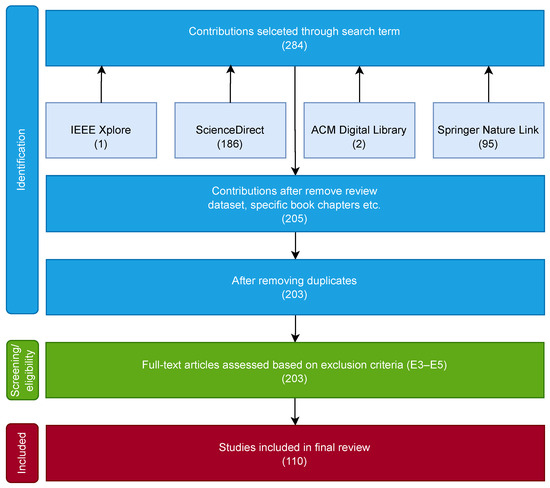
Figure A1.
PRISMA flow diagram.
Table A11.
PRISMA checklist for systematic review.
Table A11.
PRISMA checklist for systematic review.
| Section and Topic | Item # | Checklist Item | Location |
|---|---|---|---|
| Title | 1 | Identify the report as a systematic review. | Title |
| Abstract | 2 | See the PRISMA 2020 for Abstracts checklist. | Abstract |
| Introduction | 3 | Describe the rationale for the review in the context of existing knowledge. | I/RW |
| 4 | Provide an explicit statement of the objective(s) or question(s) the review addresses. | M | |
| Methods | 5 | Specify the inclusion and exclusion criteria for the review and how studies were grouped for the syntheses. | M |
| 6 | Specify all databases, registers, websites, organisations, reference lists and other sources searched or consulted to identify studies. Specify the date when each source was last searched or consulted. | M | |
| 7 | Present the full search strategies for all databases, registers and websites, including any filters and limits used. | M | |
| 8 | Specify the methods used to decide whether a study met the inclusion criteria, including how many reviewers screened each record and each report retrieved, whether they worked independently, and if applicable, details of automation tools used. | M | |
| 9 | Specify the methods used to collect data, including how many reviewers collected data, whether they worked independently, any processes for obtaining or confirming data, and if applicable, details of automation tools used. | M | |
| 10a | List and define all outcomes for which data were sought; specify whether all compatible results were sought, and if not, describe how results were selected. | R | |
| 10b | List and define all other variables sought (e.g., participant characteristics, funding sources); describe assumptions about missing/unclear info. | R | |
| 11 | Specify methods used to assess risk of bias in included studies, including tool(s) used, number of reviewers, whether they worked independently, and any automation tools. | M | |
| 12 | Specify effect measures used for each outcome. | R | |
| 13a | Describe processes used to decide study eligibility for each synthesis. | R | |
| 13b | Describe methods used to prepare data for presentation/synthesis, such as handling missing stats or conversions. | Not applicable | |
| 13c | Describe methods used to tabulate or visually display results. | Not required | |
| 13d | Describe methods used to synthesize results and rationale; if meta-analysis, include model(s), heterogeneity methods, and software used. | R | |
| 13e | Describe methods used to explore causes of heterogeneity. | Not required | |
| 13f | Describe any sensitivity analyses. | M | |
| 14 | Describe methods used to assess risk of bias due to missing results (reporting biases). | M | |
| 15 | Describe methods used to assess certainty/confidence in the evidence. | M | |
| Results | 16a | Describe search and selection results, ideally using a flow diagram. | M |
| 16b | Cite studies excluded despite appearing eligible, and explain why. | M/A | |
| 17 | Cite each included study and present characteristics. | M/R/A | |
| 18 | Present risk of bias assessments for each included study. | M | |
| 19 | For all outcomes, present summary stats and effect estimates with precision (e.g., confidence interval), ideally in tables/plots. | R | |
| 20a | Summarize characteristics and risk of bias in contributing studies for each synthesis. | M/R/D | |
| 20b | Present statistical synthesis results; if meta-analysis, report summary estimate, precision, heterogeneity, direction of effect. | R/D | |
| 20c | Present results of heterogeneity investigations. | R/D | |
| 20d | Present sensitivity analysis results. | Not required / M | |
| 21 | Present risk of bias assessments due to missing results (reporting biases) for each synthesis. | Not required / M | |
| 22 | Present certainty/confidence assessments for each outcome. | Not required / M | |
| Discussion | 23a | Provide a general interpretation of results in context of other evidence. | D |
| 23b | Discuss limitations of the evidence. | D | |
| 23c | Discuss limitations of the review process. | D | |
| 23d | Discuss implications for practice, policy, future research. | D/RA | |
| Other information | 24a | Provide registration info (register name, number), or state unregistered. | M |
| 24b | Indicate where protocol can be accessed or state that none was prepared. | M | |
| 24c | Describe/explain amendments to registration or protocol. | M | |
| 25 | Describe sources of financial/non-financial support and role of funders/sponsors. | BA | |
| 26 | Declare any competing interests of authors. | BA | |
| 27 | Report availability and location of data, code, and other materials (e.g., extraction forms, analytic code). | Not applicable/BA |
References
- Schweizer, P. Many-Objective Centralized Adaptation Planning: Towards Hybrid Self-Adaptive and Self-Organizing Systems. In Proceedings of the 2024 IEEE International Conference on Autonomic Computing and Self-Organizing Systems Companion (ACSOS-C), Aarhus, Denmark, 16–20 September 2024; pp. 167–169. [Google Scholar] [CrossRef]
- Müller-Schloer, C.; Tomforde, S. Organic Computing—Technical Systems for Survival in the Real World; Autonomic Systems; Springer International Publishing: Cham, Switzerland, 2017. [Google Scholar] [CrossRef]
- Kephart, J.; Chess, D. The vision of autonomic computing. Computer 2003, 36, 41–50. [Google Scholar] [CrossRef]
- Goller, M.; Tomforde, S. Identifying Adaptation Changes in Collections of Self-Adaptive Systems. In Proceedings of the 2022 IEEE International Conference on Autonomic Computing and Self-Organizing Systems Companion (ACSOS-C), Los Angeles, CA, USA, 19–23 September 2022; pp. 101–106. [Google Scholar] [CrossRef]
- Tomforde, S.; Rudolph, S.; Bellman, K.; Würtz, R. An Organic Computing Perspective on Self-Improving System Interweaving at Runtime. In Proceedings of the 2016 IEEE International Conference on Autonomic Computing (ICAC), Wuerzburg, Germany, 17–22 July 2016; pp. 276–284. [Google Scholar] [CrossRef]
- Wong, T.; Wagner, M.; Treude, C. Self-adaptive systems: A systematic literature review across categories and domains. Inf. Softw. Technol. 2022, 148, 106934. [Google Scholar] [CrossRef]
- Salehie, M.; Tahvildari, L. Self-adaptive software: Landscape and research challenges. ACM Trans. Auton. Adapt. Syst. 2009, 4, 1–42. [Google Scholar] [CrossRef]
- Würtz, R.P. Organic Computing; Springer Science & Business Media: Berlin/Heidelberg, Germany, 2008. [Google Scholar]
- Müller-Schloer, C.; Schmeck, H.; Ungerer, T. Organic Computing—A Paradigm Shift for Complex Systems; Springer Science & Business Media: Berlin/Heidelberg, Germany, 2011. [Google Scholar]
- Arcaini, P.; Riccobene, E.; Scandurra, P. Modeling and Analyzing MAPE-K Feedback Loops for Self-Adaptation. In Proceedings of the 2015 IEEE/ACM 10th International Symposium on Software Engineering for Adaptive and Self-Managing Systems, Florence, Italy, 18–19 May 2015; pp. 13–23. [Google Scholar] [CrossRef]
- Iglesia, D.G.D.L.; Weyns, D. MAPE-K Formal Templates to Rigorously Design Behaviors for Self-Adaptive Systems. ACM Trans. Auton. Adapt. Syst. 2015, 10, 1–31. [Google Scholar] [CrossRef]
- Weyns, D.; Schmerl, B.; Grassi, V.; Malek, S.; Mirandola, R.; Prehofer, C.; Wuttke, J.; Andersson, J.; Giese, H.; Göschka, K.M. On Patterns for Decentralized Control in Self-Adaptive Systems. In Software Engineering for Self-Adaptive Systems II: International Seminar, Dagstuhl Castle, Germany, October 24-29, 2010 Revised Selected and Invited Papers; de Lemos, R., Giese, H., Müller, H.A., Shaw, M., Eds.; Springer: Berlin/Heidelberg, Germany, 2013; pp. 76–107. [Google Scholar] [CrossRef]
- Tomforde, S.; Prothmann, H.; Branke, J.; Hähner, J.; Mnif, M.; Müller-Schloer, C.; Richter, U.; Schmeck, H. Observation and Control of Organic Systems. In Organic Computing—A Paradigm Shift for Complex Systems; Müller-Schloer, C., Schmeck, H., Ungerer, T., Eds.; Springer: Basel, Switzerland, 2011; pp. 325–338. [Google Scholar] [CrossRef]
- Jamshidi, S.; Amirnia, A.; Nikanjam, A.; Khomh, F. Enhancing Security and Energy Efficiency of Cyber-Physical Systems using Deep Reinforcement Learning. Procedia Comput. Sci. 2024, 238, 1074–1079. [Google Scholar] [CrossRef]
- Grimmelius, H.; Meiler, P.; Maas, H.; Bonnier, B.; Grevink, J.; van Kuilenburg, R. Three state-of-the-art methods for condition monitoring. IEEE Trans. Ind. Electron. 1999, 46, 407–416. [Google Scholar] [CrossRef]
- Shahzad, K.; O’Nils, M. Condition Monitoring in Industry 4.0-Design Challenges and Possibilities: A Case Study. In Proceedings of the 2018 Workshop on Metrology for Industry 4.0 and IoT, Brescia, Italy, 16–18 April 2018; pp. 101–106. [Google Scholar] [CrossRef]
- Correa, J.C.A.J.; Guzman, A.A.L. Mechanical Vibrations and Condition Monitoring; Academic Press: Cambridge, MA, USA, 2020. [Google Scholar]
- Hodge, V.; Austin, J. A Survey of Outlier Detection Methodologies. Artif. Intell. Rev. 2004, 22, 85–126. [Google Scholar] [CrossRef]
- Sun, H.C.; Huang, Y.C.; Huang, C.M. Fault Diagnosis of Power Transformers Using Computational Intelligence: A Review. Energy Procedia 2012, 14, 1226–1231. [Google Scholar] [CrossRef]
- Yan, R.; Gao, R.X.; Chen, X. Wavelets for fault diagnosis of rotary machines: A review with applications. Signal Process. 2014, 96, 1–15. [Google Scholar] [CrossRef]
- El-Thalji, I.; Jantunen, E. A summary of fault modelling and predictive health monitoring of rolling element bearings. Mech. Syst. Signal Process. 2015, 60–61, 252–272. [Google Scholar] [CrossRef]
- Rai, A.; Upadhyay, S.H. A review on signal processing techniques utilized in the fault diagnosis of rolling element bearings. Tribol. Int. 2016, 96, 289–306. [Google Scholar] [CrossRef]
- Zhou, Y.; Xue, W. Review of tool condition monitoring methods in milling processes. Int. J. Adv. Manuf. Technol. 2018, 96, 2509–2523. [Google Scholar] [CrossRef]
- Wang, T.; Han, Q.; Chu, F.; Feng, Z. Vibration based condition monitoring and fault diagnosis of wind turbine planetary gearbox: A review. Mech. Syst. Signal Process. 2019, 126, 662–685. [Google Scholar] [CrossRef]
- Kumar, A.; Gandhi, C.P.; Zhou, Y.; Kumar, R.; Xiang, J. Latest developments in gear defect diagnosis and prognosis: A review. Measurement 2020, 158, 107735. [Google Scholar] [CrossRef]
- Chaupal, P.; Rajendran, P. A review on recent developments in vibration-based damage identification methods for laminated composite structures: 2010–2022. Compos. Struct. 2023, 311, 116809. [Google Scholar] [CrossRef]
- Piliuk, K.; Tomforde, S. Artificial intelligence in emergency medicine. A systematic literature review. Int. J. Med. Inform. 2023, 180, 105274. [Google Scholar] [CrossRef]
- Google Scholar. Google Scholar Homepage. n.d. Available online: https://scholar.google.com (accessed on 15 November 2024).
- ACM Digital Library. ACM Digital Library Homepage. n.d. Available online: https://dl.acm.org (accessed on 15 November 2024).
- IEEE Xplore. IEEE Xplore Digital Library. n.d. Available online: https://ieeexplore.ieee.org (accessed on 15 November 2024).
- SpringerLink. Search Page on SpringerLink. n.d. Available online: https://link.springer.com/search (accessed on 15 November 2024).
- ScienceDirect | Science, Health and Medical Journals, Full Text Articles and Books. n.d. Available online: https://www.sciencedirect.com/ (accessed on 15 November 2024).
- Page, M.J.; McKenzie, J.E.; Bossuyt, P.M.; Boutron, I.; Hoffmann, T.C.; Mulrow, C.D.; Shamseer, L.; Tetzlaff, J.M.; Akl, E.A.; Brennan, S.E.; et al. The PRISMA 2020 statement: An updated guideline for reporting systematic reviews. BMJ 2021, 372, n71. [Google Scholar] [CrossRef]
- Mei, X.; Xu, H.; Feng, P.; Yuan, M.; Xu, C.; Ma, Y.; Feng, F. Online chatter monitor system based on rapid detection method and wireless communication. Int. J. Adv. Manuf. Technol. 2022, 122, 1321–1337. [Google Scholar] [CrossRef]
- Huang, Y.; Wu, D.; Zhang, Z.; Chen, H.; Chen, S. EMD-based pulsed TIG welding process porosity defect detection and defect diagnosis using GA-SVM. J. Mater. Process. Technol. 2017, 239, 92–102. [Google Scholar] [CrossRef]
- Lonardo, P.M.; Bruzzone, A.A.; Lonardo, A.M. Analysis of Machined Surfaces through Diffraction Patterns and Neural Networks. CIRP Ann. 1995, 44, 509–512. [Google Scholar] [CrossRef]
- Hu, W.; Starr, A.G.; Zhou, Z.; Leung, A.Y.T. A systematic approach to integrated fault diagnosis of flexible manufacturing systems. Int. J. Mach. Tools Manuf. 2000, 40, 1587–1602. [Google Scholar] [CrossRef]
- Guo, Y.; Liu, T.W.; Na, J.; Fung, R.F. Envelope order tracking for fault detection in rolling element bearings. J. Sound Vib. 2012, 331, 5644–5654. [Google Scholar] [CrossRef]
- Dong, G.; Chen, J. Noise resistant time frequency analysis and application in fault diagnosis of rolling element bearings. Mech. Syst. Signal Process. 2012, 33, 212–236. [Google Scholar] [CrossRef]
- Yu, K.; Lin, T.R.; Tan, J.W. A bearing fault diagnosis technique based on singular values of EEMD spatial condition matrix and Gath-Geva clustering. Appl. Acoust. 2017, 121, 33–45. [Google Scholar] [CrossRef]
- Altinors, A.; Yol, F.; Yaman, O. A sound based method for fault detection with statistical feature extraction in UAV motors. Appl. Acoust. 2021, 183, 108325. [Google Scholar] [CrossRef]
- Liu, X.; Chen, G.; Wei, X.; Liu, Y.; Wang, H. A rolling bearing fault evolution state indicator based on deep learning and its application. J. Mech. Sci. Technol. 2023, 37, 2755–2769. [Google Scholar] [CrossRef]
- Mubaraali, L.; Kuppuswamy, N.; Muthukumar, R. Intelligent fault diagnosis in microprocessor systems for vibration analysis in roller bearings in whirlpool turbine generators real time processor applications. Microprocess. Microsyst. 2020, 76, 103079. [Google Scholar] [CrossRef]
- Kong, Y.; Qin, Z.; Wang, T.; Han, Q.; Chu, F. An enhanced sparse representation-based intelligent recognition method for planet bearing fault diagnosis in wind turbines. Renew. Energy 2021, 173, 987–1004. [Google Scholar] [CrossRef]
- Chen, Q.; Hu, Y.; Xia, J.; Chen, Z.; Tseng, H.W. Data fusion of wireless sensor network for prognosis and diagnosis of mechanical systems. Microsyst. Technol. 2021, 27, 1187–1199. [Google Scholar] [CrossRef]
- Pan, Y.; Hong, R.; Chen, J.; Singh, J.; Jia, X. Performance degradation assessment of a wind turbine gearbox based on multi-sensor data fusion. Mech. Mach. Theory 2019, 137, 509–526. [Google Scholar] [CrossRef]
- Yadao, A.; Mishra, K. A Hybridization of CSA DEA Approach for Detection of Multiple Transverse Crack Rotor Shaft Rotating in Fluid Environment under Axial and Bending Loading. Mech. Solids 2024, 59, 2100–2126. [Google Scholar] [CrossRef]
- Yang, B.S.; Hwang, W.W.; Kim, D.J.; Chit Tan, A. Condition classification of small reciprocating compressor for refrigerators using artificial neural networks and support vector machines. Mech. Syst. Signal Process. 2005, 19, 371–390. [Google Scholar] [CrossRef]
- Guesmi, H.; Ben Salem, S.; Bacha, K. Smart wireless sensor networks for online faults diagnosis in induction machine. Comput. Electr. Eng. 2015, 41, 226–239. [Google Scholar] [CrossRef]
- Ying, S.; Sun, Y.; Fu, C.; Lin, L.; Zhang, S. Grey wolf optimization based support vector machine model for tool wear recognition in fir-tree slot broaching of aircraft turbine discs. J. Mech. Sci. Technol. 2022, 36, 6261–6273. [Google Scholar] [CrossRef]
- Piedras Lopes, T.A.; Troyman, A.C.R. Neural Networks on Predictive Maintenance of Turbomachinery. IFAC Proc. Vol. 1997, 30, 983–988. [Google Scholar] [CrossRef]
- Ruiz de la Hermosa González-Carrato, R. Wind farm monitoring using Mahalanobis distance and fuzzy clustering. Renew. Energy 2018, 123, 526–540. [Google Scholar] [CrossRef]
- Wang, Y.j.; Zhang, M.j. Study of fuzzy neural networks model for system condition monitoring of AUV. J. Mar. Sci. Appl. 2002, 1, 42–45. [Google Scholar] [CrossRef]
- Long, B.; Xian, W.; Li, M.; Wang, H. Improved diagnostics for the incipient faults in analog circuits using LSSVM based on PSO algorithm with Mahalanobis distance. Neurocomputing 2014, 133, 237–248. [Google Scholar] [CrossRef]
- Keyvan, S. Traditional signal pattern recognition versus artificial neural networks for nuclear plant diagnostics. Prog. Nucl. Energy 2001, 39, 1–29. [Google Scholar] [CrossRef]
- Wang, X.l.; Gu, H.; Xu, L.; Hu, C.; Guo, H. A SVR-Based Remaining Life Prediction for Rolling Element Bearings. J. Fail. Anal. Prev. 2015, 15, 548–554. [Google Scholar] [CrossRef]
- Tao, L.; Zhang, T.; Peng, D.; Hao, J.; Jia, Y.; Lu, C.; Ding, Y.; Ma, L. Long-term degradation prediction and assessment with heteroscedasticity telemetry data based on GRU-GARCH and MD hybrid method: An application for satellite. Aerosp. Sci. Technol. 2021, 115, 106826. [Google Scholar] [CrossRef]
- Kaloni, S.; Singh, G.; Tiwari, P. Nonparametric damage detection and localization model of framed civil structure based on local gravitation clustering analysis. J. Build. Eng. 2021, 44, 103339. [Google Scholar] [CrossRef]
- Mukherjee, A.; Banerjee, A. Analysis of Acoustic Emission Signal for Crack Detection and Distance Measurement on Steel Structure. Acoust. Aust. 2021, 49, 133–149. [Google Scholar] [CrossRef]
- Liang, W.; Kang, J.; Zhang, L. Leak detection for long transportation pipeline using a state coupling analysis of pump units. J. Loss Prev. Process Ind. 2013, 26, 586–593. [Google Scholar] [CrossRef]
- Lin, T.; Zhu, Y.; Zhang, X.; Huang, K.; Yan, K. A robust FOD acoustic detection method for rocket tank final assembly process. Appl. Acoust. 2023, 211, 109479. [Google Scholar] [CrossRef]
- Abu-Mahfouz, I.; Banerjee, A. Crack Detection and Identification Using Vibration Signals and Fuzzy Clustering. Procedia Comput. Sci. 2017, 114, 266–274. [Google Scholar] [CrossRef]
- Dong, M.; Chen, S.; Xie, B.; Wang, K.; Zhai, W. A quantitative detection method for wheel polygonization of heavy-haul locomotives based on a hybrid deep learning model. Measurement 2024, 227, 114206. [Google Scholar] [CrossRef]
- Drouillet, C.; Karandikar, J.; Nath, C.; Journeaux, A.C.; El Mansori, M.; Kurfess, T. Tool life predictions in milling using spindle power with the neural network technique. J. Manuf. Process. 2016, 22, 161–168. [Google Scholar] [CrossRef]
- Barakat, M.; Lefebvre, D.; Khalil, M.; Druaux, F.; Mustapha, O. Parameter selection algorithm with self adaptive growing neural network classifier for diagnosis issues. Int. J. Mach. Learn. Cybern. 2013, 4, 217–233. [Google Scholar] [CrossRef]
- Hu, J.; Zhang, L.; Liang, W. Dynamic degradation observer for bearing fault by MTS–SOM system. Mech. Syst. Signal Process. 2013, 36, 385–400. [Google Scholar] [CrossRef]
- Netzer, M.; Michelberger, J.; Fleischer, J. Intelligent Anomaly Detection of Machine Tools based on Mean Shift Clustering. Procedia CIRP 2020, 93, 1448–1453. [Google Scholar] [CrossRef]
- Sheng, Y.; Zhang, G.; Zhang, Y.; Luo, M.; Pang, Y.; Wang, Q. A multimodal data sensing and feature learning-based self-adaptive hybrid approach for machining quality prediction. Adv. Eng. Inform. 2024, 59, 102324. [Google Scholar] [CrossRef]
- Pomponi, E.; Vinogradov, A. A real-time approach to acoustic emission clustering. Mech. Syst. Signal Process. 2013, 40, 791–804. [Google Scholar] [CrossRef]
- Garcés-Jiménez, A.; Rodrigues, A.; Gómez-Pulido, J.M.; Raposo, D.; Gómez-Pulido, J.A.; Silva, J.S.; Boavida, F. Industrial Internet of Things embedded devices fault detection and classification. A case study. Internet Things 2024, 25, 101042. [Google Scholar] [CrossRef]
- Zhang, F.; Li, B.; Yu, C.; Chen, J.; Peng, T.; Wang, X. A new real-time hole cleaning monitoring method based on downhole multi-point pressure measurement and data driven approach. Nat. Gas Ind. B 2023, 10, 312–321. [Google Scholar] [CrossRef]
- Omoregbee, H.O.; Heyns, P.S. Fault Classification of Low-Speed Bearings Based on Support Vector Machine for Regression and Genetic Algorithms Using Acoustic Emission. J. Vib. Eng. Technol. 2019, 7, 455–464. [Google Scholar] [CrossRef]
- Liang, Y.; Hu, S.; Guo, W.; Tang, H. Abrasive tool wear prediction based on an improved hybrid difference grey wolf algorithm for optimizing SVM. Measurement 2022, 187, 110247. [Google Scholar] [CrossRef]
- Zhang, S.; Zhang, Y.; Zhu, J. An Adaptive Remaining Life Prediction for Rolling Element Bearings. J. Fail. Anal. Prev. 2015, 15, 82–89. [Google Scholar] [CrossRef]
- Wen, Z.; Fang, P.; Yin, Y.; Królczyk, G.; Gardoni, P.; Li, Z. A novel machine learning model for safety risk analysis in flywheel-battery hybrid energy storage system. J. Energy Storage 2022, 49, 104072. [Google Scholar] [CrossRef]
- Mansi; Saini, K.; Vanraj; Dhami, S.S. MODWT and VMD Based Intelligent Gearbox Early Stage Fault Detection Approach. J. Fail. Anal. Prev. 2021, 21, 1821–1837. [Google Scholar] [CrossRef]
- Xing, Z.; Qu, J.; Chai, Y.; Tang, Q.; Zhou, Y. Gear fault diagnosis under variable conditions with intrinsic time-scale decomposition-singular value decomposition and support vector machine. J. Mech. Sci. Technol. 2017, 31, 545–553. [Google Scholar] [CrossRef]
- Liu, H.; Wang, X.; Lu, C. Rolling bearing fault diagnosis based on LCD–TEO and multifractal detrended fluctuation analysis. Mech. Syst. Signal Process. 2015, 60–61, 273–288. [Google Scholar] [CrossRef]
- Wu, J.; Su, Y.; Cheng, Y.; Shao, X.; Deng, C.; Liu, C. Multi-sensor information fusion for remaining useful life prediction of machining tools by adaptive network based fuzzy inference system. Appl. Soft Comput. 2018, 68, 13–23. [Google Scholar] [CrossRef]
- Tansel, I.N.; Mekdeci, C.; Mclaughlin, C. Detection of tool failure in end milling with wavelet transformations and neural networks (WT-NN). Int. J. Mach. Tools Manuf. 1995, 35, 1137–1147. [Google Scholar] [CrossRef]
- Ben Ali, J.; Saidi, L.; Mouelhi, A.; Chebel-Morello, B.; Fnaiech, F. Linear feature selection and classification using PNN and SFAM neural networks for a nearly online diagnosis of bearing naturally progressing degradations. Eng. Appl. Artif. Intell. 2015, 42, 67–81. [Google Scholar] [CrossRef]
- Saxena, A.; Saad, A. Evolving an artificial neural network classifier for condition monitoring of rotating mechanical systems. Appl. Soft Comput. 2007, 7, 441–454. [Google Scholar] [CrossRef]
- Peng, Y.; Cai, J.; Wu, T.; Cao, G.; Kwok, N.; Peng, Z. WP-DRnet: A novel wear particle detection and recognition network for automatic ferrograph image analysis. Tribol. Int. 2020, 151, 106379. [Google Scholar] [CrossRef]
- Gültekin, Ö.; Cinar, E.; Özkan, K.; Yazıcı, A. Multisensory data fusion-based deep learning approach for fault diagnosis of an industrial autonomous transfer vehicle. Expert Syst. Appl. 2022, 200, 117055. [Google Scholar] [CrossRef]
- Singh, S.K.; Kumar, S.; Dwivedi, J.P. Compound fault prediction of rolling bearing using multimedia data. Multimed. Tools Appl. 2017, 76, 18771–18788. [Google Scholar] [CrossRef]
- Selvaraj, V.; Xu, Z.; Min, S. Intelligent Operation Monitoring of an Ultra-Precision CNC Machine Tool Using Energy Data. Int. J. Precis. Eng. Manuf.-Green Technol. 2023, 10, 59–69. [Google Scholar] [CrossRef]
- Chen, T.; Zheng, J.; Peng, C.; Zhang, S.; Jing, Z.; Wang, Z. Tapping process fault identification by LSTM neural network based on torque signal singularity feature. J. Mech. Sci. Technol. 2024, 38, 1123–1133. [Google Scholar] [CrossRef]
- Liu, J.; Ma, C.; Gui, H.; Wang, S. Intelligent digital-twin prediction and reverse control system architecture for thermal errors enabled by deep learning and cloud-edge computing. Expert Syst. Appl. 2023, 225, 120122. [Google Scholar] [CrossRef]
- Mao, W.; Tian, S.; Fan, J.; Liang, X.; Safian, A. Online detection of bearing incipient fault with semi-supervised architecture and deep feature representation. J. Manuf. Syst. 2020, 55, 179–198. [Google Scholar] [CrossRef]
- Ma, P.; Lan, X.; Tong, S.; Zheng, X.; Wang, W. The method of self-learning based online tool wear monitoring in semi-finishing or finishing working step. Int. J. Adv. Manuf. Technol. 2023, 124, 4649–4661. [Google Scholar] [CrossRef]
- He, Z.; Cao, H.; Li, Z.; Zi, Y.; Chen, X. The principle of second generation wavelet for milling cutter breakage detection. Sci. China Ser. E Technol. Sci. 2009, 52, 1312–1322. [Google Scholar] [CrossRef]
- Li, X.; Ma, J.; Wang, X.; Wu, J.; Li, Z. An improved local mean decomposition method based on improved composite interpolation envelope and its application in bearing fault feature extraction. ISA Trans. 2020, 97, 365–383. [Google Scholar] [CrossRef]
- Cambow, R.; Singh, M. Comparative Analysis of Wear Resistance for Bearing Coating Using VMD. J. Vib. Eng. Technol. 2024, 12, 93–108. [Google Scholar] [CrossRef]
- Abbasi, A.; Firouzi, B.; Sendur, P.; Ranjan, G.; Tiwari, R. Identification of unbalance characteristics of rotating machinery using a novel optimization-based methodology. Soft Comput. 2022, 26, 4831–4862. [Google Scholar] [CrossRef]
- Li, Z.; Wang, S.; Yu, C.; Qi, C.; Shen, X.; Fernandez, C. An improved adaptive weights correction-particle swarm optimization-unscented particle filter method for high-precision online state of charge estimation of lithium-ion batteries. Ionics 2024, 30, 311–334. [Google Scholar] [CrossRef]
- Liu, W.; Qin, G.; Zhu, Q.; Hu, G. Synchronous extraction circuit with self-adaptive peak-detection mechanical switches design for piezoelectric energy harvesting. Appl. Energy 2018, 230, 1292–1303. [Google Scholar] [CrossRef]
- Saidi, L.; Ali, J.B.; Fnaiech, F. Bi-spectrum based-EMD applied to the non-stationary vibration signals for bearing faults diagnosis. ISA Trans. 2014, 53, 1650–1660. [Google Scholar] [CrossRef]
- Mishra, R.; Singh, B. Stability analysis in milling process using spline based local mean decomposition (SBLMD) technique and statistical indicators. Measurement 2021, 174, 108999. [Google Scholar] [CrossRef]
- Deng, L.; Zhao, R. A vibration analysis method based on hybrid techniques and its application to rotating machinery. Measurement 2013, 46, 3671–3682. [Google Scholar] [CrossRef]
- Babouri, M.K.; Ouelaa, N.; Djebala, A. Experimental study of tool life transition and wear monitoring in turning operation using a hybrid method based on wavelet multi-resolution analysis and empirical mode decomposition. Int. J. Adv. Manuf. Technol. 2016, 82, 2017–2028. [Google Scholar] [CrossRef]
- Li, H.; Yu, B.; Qing, B.; Luo, S. Cavitation pulse extraction and centrifugal pump analysis. J. Mech. Sci. Technol. 2017, 31, 1181–1188. [Google Scholar] [CrossRef]
- Das, S.; Roy, R.; Chattopadhyay, A.B. Evaluation of wear of turning carbide inserts using neural networks. Int. J. Mach. Tools Manuf. 1996, 36, 789–797. [Google Scholar] [CrossRef]
- Hossain, R.E.N.; Lewis, J.; Moore, A.L. In situ infrared temperature sensing for real-time defect detection in additive manufacturing. Addit. Manuf. 2021, 47, 102328. [Google Scholar] [CrossRef]
- Juuma, T.; Parkkinen, R. Application of a Neural Network to Condition Monitoring and Fault Diagnosis in an Pressure System. IFAC Proc. Vol. 1994, 27, 603–609. [Google Scholar] [CrossRef]
- Guglielmi, G.; Parisini, T.; Rossi, G. Keynote paper: Fault diagnosis and neural networks: A power plant application. Control Eng. Pract. 1995, 3, 601–620. [Google Scholar] [CrossRef]
- Lughofer, E.; Pollak, R.; Zavoianu, A.C.; Pratama, M.; Meyer-Heye, P.; Zörrer, H.; Eitzinger, C.; Haim, J.; Radauer, T. Self-adaptive evolving forecast models with incremental PLS space updating for on-line prediction of micro-fluidic chip quality. Eng. Appl. Artif. Intell. 2018, 68, 131–151. [Google Scholar] [CrossRef]
- André, H.; Allemand, F.; Khelf, I.; Bourdon, A.; Rémond, D. Improving the monitoring indicators of a variable speed wind turbine using support vector regression. Appl. Acoust. 2020, 166, 107350. [Google Scholar] [CrossRef]
- Gouarir, A.; Martínez-Arellano, G.; Terrazas, G.; Benardos, P.; Ratchev, S. In-process Tool Wear Prediction System Based on Machine Learning Techniques and Force Analysis. Procedia CIRP 2018, 77, 501–504. [Google Scholar] [CrossRef]
- Skitt, P.J.C.; Javed, M.A.; Sanders, S.A.; Higginson, A.M. Process monitoring using auto-associative, feed-forward artificial neural networks. J. Intell. Manuf. 1993, 4, 79–94. [Google Scholar] [CrossRef]
- Tansel, I.N.; Mekdeci, C.; Rodriguez, O.; Uragun, B. Monitoring drill conditions with wavelet based encoding and neural networks. Int. J. Mach. Tools Manuf. 1993, 33, 559–575. [Google Scholar] [CrossRef]
- Silva, R.G. Condition monitoring of the cutting process using a self-organizing spiking neural network map. J. Intell. Manuf. 2010, 21, 823–829. [Google Scholar] [CrossRef]
- Zhang, K.; Chen, X.; Liao, L.; Tang, M.; Wu, J. A new rotating machinery fault diagnosis method based on local oscillatory-characteristic decomposition. Digit. Signal Process. 2018, 78, 98–107. [Google Scholar] [CrossRef]
- Hou, Y.; Wu, P.; Wu, D. An operating condition information-guided iterative variational mode decomposition method based on Mahalanobis distance criterion for surge characteristic frequency extraction of the centrifugal compressor. Mech. Syst. Signal Process. 2023, 186, 109836. [Google Scholar] [CrossRef]
- Chen, X.; Zhou, J.; Xiao, J.; Zhang, X.; Xiao, H.; Zhu, W.; Fu, W. Fault diagnosis based on dependent feature vector and probability neural network for rolling element bearings. Appl. Math. Comput. 2014, 247, 835–847. [Google Scholar] [CrossRef]
- Dong, Q.; Zhou, Y.; Lian, J.; Li, L. Online adaptive humidity monitoring method for proton exchange membrane fuel cell based on fuzzy C-means clustering and online sequence extreme learning machine. Electrochim. Acta 2022, 429, 141059. [Google Scholar] [CrossRef]
- Zhang, L.; Cai, S.; Hu, J. An adaptive pre-warning method based on trend monitoring: Application to an oil refining process. Measurement 2019, 139, 163–176. [Google Scholar] [CrossRef]
- Gao, P.; Yan, X.; Wang, Y.; Li, H.; Zhan, M.; Ma, F.; Fu, M. An online intelligent method for roller path design in conventional spinning. J. Intell. Manuf. 2023, 34, 3429–3444. [Google Scholar] [CrossRef]
- Liu, Y.; Du, M.; Yin, J.; Dong, C. A parameter self-correcting thermal network model considering IGBT module solder layer aging. Microelectron. J. 2023, 134, 105741. [Google Scholar] [CrossRef]
- Xie, Z.; Wang, Y.; Yu, M.; Yu, D.; Lv, J.; Yin, J.; Liu, J.; Wu, R. Triboelectric sensor for planetary gear fault diagnosis using data enhancement and CNN. Nano Energy 2022, 103, 107804. [Google Scholar] [CrossRef]
- Dabrowski, D. Condition monitoring of planetary gearbox by hardware implementation of artificial neural networks. Measurement 2016, 91, 295–308. [Google Scholar] [CrossRef]
- Staniek, M.; Czech, P. Self-correcting neural network in road pavement diagnostics. Autom. Constr. 2018, 96, 75–87. [Google Scholar] [CrossRef]
- Gopali, S.; Abri, F.; Siami-Namini, S.; Namin, A.S. A Comparison of TCN and LSTM Models in Detecting Anomalies in Time Series Data. In Proceedings of the 2021 IEEE International Conference on Big Data (Big Data), Orlando, FL, USA, 15–18 December 2021; pp. 2415–2420. [Google Scholar] [CrossRef]
- Taha, H.A.; Yacout, S.; Shaban, Y. Autonomous self-healing mechanism for a CNC milling machine based on pattern recognition. J. Intell. Manuf. 2023, 34, 2185–2205. [Google Scholar] [CrossRef]
- Chang, B.R.; Tsai, H.F.; Chen, G.R. Self-Adaptive Server Anomaly Detection Using Ensemble Meta-Reinforcement Learning. Electronics 2024, 13, 2348. [Google Scholar] [CrossRef]
- Li, W.; Zhan, J.; Wang, J.; Xia, B.; Gao, B.B.; Liu, J.; Wang, C.; Zheng, F. Towards Continual Adaptation in Industrial Anomaly Detection. In Proceedings of the 30th ACM International Conference on Multimedia, Lisboa, Portugal, 10–14 October 2022; pp. 2871–2880. [Google Scholar] [CrossRef]
- Huertas Celdrán, A.; Gil Pérez, M.; García Clemente, F.J.; Martínez Pérez, G. Towards the autonomous provision of self-protection capabilities in 5G networks. J. Ambient Intell. Humaniz. Comput. 2019, 10, 4707–4720. [Google Scholar] [CrossRef]
- Schönberner, C.; Rothenburger, K.M.; Mackensen, A.; Tomforde, S. Neural Rules for Reinforcement Learning with XCSF as Controller in Organic Computing Systems. In Proceedings of the ARCS ’25, Kiel, Germany, 22–24 April 2025. [Google Scholar]
- Heider, M.; Pätzel, D.; Stegherr, H.; Hähner, J. A Metaheuristic Perspective on Learning Classifier Systems. In Metaheuristics for Machine Learning: New Advances and Tools; Eddaly, M., Jarboui, B., Siarry, P., Eds.; Springer Nature: Singapore, 2023; pp. 73–98. [Google Scholar] [CrossRef]
- Ziesche, F.; Klös, V.; Glesner, S. Anomaly Detection and Classification to enable Self-Explainability of Autonomous Systems. In Proceedings of the 2021 Design, Automation & Test in Europe Conference & Exhibition (DATE), Grenoble, France, 1–5 February 2021; pp. 1304–1309. [Google Scholar] [CrossRef]
- Wang, Y.; Li, P.; Bai, C.; Leskovec, J. TEDIC: Neural Modeling of Behavioral Patterns in Dynamic Social Interaction Networks. In Proceedings of the Web Conference 2021, Ljubljana, Slovenia, 19–23 April 2021; pp. 693–705. [Google Scholar] [CrossRef]
- Nolte, L.; Finck, M.J.; Pirk, S.; Tomforde, S. Feedback-guided Dataset Shaping for Automated Downstream Task Optimization. In Proceedings of the GI Workshop on Organic Computing (OC); Supported by the IDIR-Project (Digital Implant Research), a cooperation financed by Kiel University, University Hospital Schleswig-Holstein and Helmholtz Zentrum Hereon; Gesellschaft für Informatik: Kiel, Germany, 2025. [Google Scholar]
- Wu, R.; Das, N.; Chaba, S.; Gandhi, S.; Chau, D.H.; Chu, X. A Cluster-then-label Approach for Few-shot Learning with Application to Automatic Image Data Labeling. J. Data Inf. Qual. 2022, 14, 1–23. [Google Scholar] [CrossRef]
- NVIDIA Corporation. Isaac Sim. n.d. Available online: https://developer.nvidia.com/isaac-sim (accessed on 2 June 2025).
- Chen, Q.; Zhang, C.; Hu, T.; Zhou, Y.; Ni, H.; Wang, T. Online chatter detection in robotic machining based on adaptive variational mode decomposition. Int. J. Adv. Manuf. Technol. 2021, 117, 555–577. [Google Scholar] [CrossRef]
- Cai, Y.; Shi, X.; Shao, H.; Wang, R.; Liao, S. Energy efficiency state identification in milling processes based on information reasoning and Hidden Markov Model. J. Clean. Prod. 2018, 193, 397–413. [Google Scholar] [CrossRef]
- Haoua, A.A.; Rey, P.A.; Cherif, M.; Abisset-Chavanne, E.; Yousfi, W. Material recognition method to enable adaptive drilling of multi-material aerospace stacks. Int. J. Adv. Manuf. Technol. 2024, 131, 779–796. [Google Scholar] [CrossRef]
- Einabadi, B.; Baboli, A.; Rother, E. A new methodology for estimation of dynamic Remaining Useful Life: A case study of conveyor chains in the automotive industry. Procedia Comput. Sci. 2022, 201, 461–469. [Google Scholar] [CrossRef]
- Salah, B.; Dit Leksir Yazid, L.; Jurgen, B. Evaluation-based closed-loop errors using principal component analysis and self-organisation map with an application to a pickling process. Int. J. Adv. Manuf. Technol. 2014, 70, 1033–1041. [Google Scholar] [CrossRef]
- Biebl, F.; Glawar, R.; Jalali, A.; Ansari, F.; Haslhofer, B.; Boer, P.d.; Sihn, W. A conceptual model to enable prescriptive maintenance for etching equipment in semiconductor manufacturing. Procedia CIRP 2020, 88, 64–69. [Google Scholar] [CrossRef]
- Ikonen, E.; Liukkonen, M.; Hansen, A.H.; Edelborg, M.; Kjos, O.; Selek, I.; Kettunen, A. Fouling monitoring in a circulating fluidized bed boiler using direct and indirect model-based analytics. Fuel 2023, 346, 128341. [Google Scholar] [CrossRef]
- Gruhl, C.; Sick, B. Novelty detection with CANDIES: A holistic technique based on probabilistic models. Int. J. Mach. Learn. Cybern. 2018, 9, 927–945. [Google Scholar] [CrossRef]
- Kumbhar, S.G.; Sudhagar P, E. An integrated approach of Adaptive Neuro-Fuzzy Inference System and dimension theory for diagnosis of rolling element bearing. Measurement 2020, 166, 108266. [Google Scholar] [CrossRef]
- Omoregbee, H.O.; Heyns, P.S. Fault detection in roller bearing operating at low speed and varying loads using Bayesian robust new hidden Markov model. J. Mech. Sci. Technol. 2018, 32, 4025–4036. [Google Scholar] [CrossRef]
- Elasha, F.; Mba, D.; Ruiz-Carcel, C. A comparative study of adaptive filters in detecting a naturally degraded bearing within a gearbox. Case Stud. Mech. Syst. Signal Process. 2016, 3, 1–8. [Google Scholar] [CrossRef][Green Version]
- Zhang, S.; Zhang, Y.; Zhu, D. Residual Life Prediction for Rolling Element Bearings Based on an Effective Degradation Indicator. J. Fail. Anal. Prev. 2015, 15, 722–729. [Google Scholar] [CrossRef]
- Pan, Y.; Er, M.J.; Li, X.; Yu, H.; Gouriveau, R. Machine health condition prediction via online dynamic fuzzy neural networks. Eng. Appl. Artif. Intell. 2014, 35, 105–113. [Google Scholar] [CrossRef]
- Elasha, F.; Ruiz-Carcel, C.; Mba, D.; Chandra, P. A Comparative Study of the Effectiveness of Adaptive Filter Algorithms, Spectral Kurtosis and Linear Prediction in Detection of a Naturally Degraded Bearing in a Gearbox. J. Fail. Anal. Prev. 2014, 14, 623–636. [Google Scholar] [CrossRef]
- Makowski, R.; Zimroz, R. A procedure for weighted summation of the derivatives of reflection coefficients in adaptive Schur filter with application to fault detection in rolling element bearings. Mech. Syst. Signal Process. 2013, 38, 65–77. [Google Scholar] [CrossRef]
- Shanbr, S.; Elasha, F.; Elforjani, M.; Teixeira, J. Detection of natural crack in wind turbine gearbox. Renew. Energy 2018, 118, 172–179. [Google Scholar] [CrossRef]
- Wang, H.; Li, S.; Song, L.; Cui, L. A novel convolutional neural network based fault recognition method via image fusion of multi-vibration-signals. Comput. Ind. 2019, 105, 182–190. [Google Scholar] [CrossRef]
- Debnath, B.; Kumar, R. A Piezoelectric Energy Harvester Designed for Vibration Energy Scavenging and Shaft Fault Diagnosing-Based Applications. J. Vib. Eng. Technol. 2021, 9, 1387–1398. [Google Scholar] [CrossRef]
- Fan, R.; Lei, X.; Jia, T.; Qin, M.; Li, H.; Xiang, D. High-sensitive state perception method for inverter-fed machine turn insulation based on FrFT-Mel. Glob. Energy Interconnect. 2024, 7, 155–165. [Google Scholar] [CrossRef]
- Fang, Z.; Wang, W.; Cao, Y.; Li, Q.; Lin, Y.; Li, T.; Wu, D.; Wu, S. Reciprocating compressors intelligent fault diagnosis under multiple operating conditions based on adaptive variable scale morphological filter. Measurement 2024, 224, 113778. [Google Scholar] [CrossRef]
- Dutta, N.; Kaliannan, P.; Shanmugam, P. Application of machine learning for inter turn fault detection in pumping system. Sci. Rep. 2022, 12, 12906. [Google Scholar] [CrossRef]
- Barakat, M.; Druaux, F.; Lefebvre, D.; Khalil, M.; Mustapha, O. Self adaptive growing neural network classifier for faults detection and diagnosis. Neurocomputing 2011, 74, 3865–3876. [Google Scholar] [CrossRef]
- Abualigah, L.; Sheikhan, A.; Ikotun, A.M.; Zitar, R.A.; Alsoud, A.R.; Al-Shourbaji, I.; Hussien, A.G.; Jia, H. 1—Particle swarm optimization algorithm: Review and applications. In Metaheuristic Optimization Algorithms; Abualigah, L., Ed.; Morgan Kaufmann: Burlington, MA, USA, 2024; pp. 1–14. [Google Scholar] [CrossRef]
- Al-geelani, N.A.; Piah, M.A.M.; Bashir, N. A review on hybrid wavelet regrouping particle swarm optimization neural networks for characterization of partial discharge acoustic signals. Renew. Sustain. Energy Rev. 2015, 45, 20–35. [Google Scholar] [CrossRef]
- Alavi, A.H.; Feng, M.Q.; Jiao, P.; Sharif-Khodaei, Z. (Eds.) Index. In The Rise of Smart Cities; Butterworth-Heinemann: Oxford, UK, 2022; pp. 661–674. [Google Scholar] [CrossRef]
- Baker, R.C. Turbine flowmeters: II. Theoretical and experimental published information. Flow Meas. Instrum. 1993, 4, 123–144. [Google Scholar] [CrossRef]
- Ball, S.R. (Ed.) Index. In Embedded Microprocessor Systems: Real World Design, 3rd ed.; Newnes: Burlington, NJ, USA, 2002; pp. 350–362. [Google Scholar] [CrossRef]
- Barschdorff, D.; Monostori, L. Neural networks—Their applications and perspectives in intelligent machining. Comput. Ind. 1991, 17, 101–119. [Google Scholar] [CrossRef]
- Bradley, D.; Russell, D.; Hehenberger, P.; Azorin-Lopez, J.; Watt, S.; Milne, C. From Mechatronics to the Cloud. In Reinventing Mechatronics; Yan, X.T., Bradley, D., Russell, D., Moore, P., Eds.; Springer International Publishing: Cham, Switzerland, 2020; pp. 17–33. [Google Scholar] [CrossRef]
- Brant, J.; Liang, B. Condition Monitoring Systems in the Railway Industry. In Advances in Asset Management and Condition Monitoring; Smart Innovation, Systems and Technologies; Ball, A., Gelman, L., Rao, B.K.N., Eds.; Springer International Publishing: Cham, Switzerland, 2020; Volume 166, pp. 671–683. [Google Scholar] [CrossRef]
- Chattell, A. Developing Digital-Era Products and Services. In Creating Value in the Digital Era; Palgrave Macmillan: London, UK, 1998; pp. 104–135. [Google Scholar] [CrossRef]
- Cho, H.S.; Leu, M.C. Artificial Neural Networks in Manufacturing Processes: Monitoring and Control. IFAC Proc. Vol. 1998, 31, 529–537. [Google Scholar] [CrossRef]
- Cirella, G.T.; Bąk, M.; Kozlak, A.; Pawłowska, B.; Borkowski, P. Transport innovations for elderly people. Res. Transp. Bus. Manag. 2019, 30, 100381. [Google Scholar] [CrossRef]
- Cohen, Y.; Faccio, M.; Pilati, F.; Yao, X. Design and management of digital manufacturing and assembly systems in the Industry 4.0 era. Int. J. Adv. Manuf. Technol. 2019, 105, 3565–3577. [Google Scholar] [CrossRef]
- Croall, I.F.; Mason, J.P. Pattern Recognition. In Industrial Applications of Neural Networks; Croall, I.F., Mason, J.P., Eds.; Springer: Berlin/Heidelberg, Germany, 1992; pp. 55–117. [Google Scholar] [CrossRef]
- Davies, A.; Prickett, P.W.; Grosvenor, R.I. Future developments in condition monitoring techniques and systems. In Handbook of Condition Monitoring; Davies, A., Ed.; Springer: Dordrecht, The Netherlands, 1998; pp. 541–560. [Google Scholar] [CrossRef]
- Deka, L.; Khan, S.M.; Chowdhury, M.; Ayres, N. 1—Transportation Cyber-Physical System and its importance for future mobility. In Transportation Cyber-Physical Systems; Deka, L., Chowdhury, M., Eds.; Elsevier: Amsterdam, The Netherlands, 2018; pp. 1–20. [Google Scholar] [CrossRef]
- Deng, H.; Xiao, S.; Yang, A.; Wu, H.; Tang, J.; Zhang, X.; Li, Y. Advances in nanogenerators for electrical power system state sensing and monitoring. Nano Energy 2023, 115, 108738. [Google Scholar] [CrossRef]
- Durazo-Cardenas, I.; Starr, A.; Tsourdos, A.; Bevilacqua, M.; Morineau, J. Precise Vehicle Location as a Fundamental Parameter for Intelligent Self-aware Rail-track Maintenance Systems. Procedia CIRP 2014, 22, 219–224. [Google Scholar] [CrossRef]
- Elforjani, M.; Bechhoefer, E. Analysis of extremely modulated faulty wind turbine data using spectral kurtosis and signal intensity estimator. Renew. Energy 2018, 127, 258–268. [Google Scholar] [CrossRef]
- Gado, W.S.; Aboalkhair, M.A.; Al-Gamal, A.G.; Kabel, K.I. New Trends and Challenges of Smart Sensors Based on Polymer Nanocomposites. In Handbook of Nanosensors; Ali, G.A.M., Chong, K.F., Makhlouf, A.S.H., Eds.; Springer Nature: Cham, Switzerland, 2024; pp. 1–32. [Google Scholar] [CrossRef]
- Ge, J.; Catalanotti, G.; Falzon, B.G.; Higgins, C.; McClory, C.; Thiebot, J.A.; Zhang, L.; He, M.; Jin, Y.; Sun, D. Process characteristics, damage mechanisms and challenges in machining of fibre reinforced thermoplastic polymer (FRTP) composites: A review. Compos. Part B Eng. 2024, 273, 111247. [Google Scholar] [CrossRef]
- Gressmann, B.; Hellbrueck, H. FlowerNet—How to design a user friendly Sensor Network. In Advances in Ad Hoc Networking; IFIP International Federation for Information Processing; Cuenca, P., Guerrero, C., Puigjaner, R., Serra, B., Eds.; Springer: Boston, MA, USA, 2008; Volume 265, pp. 61–72. [Google Scholar] [CrossRef]
- Gupta, K.; Paulo Davim, J. (Eds.) Index. In High Speed Machining; Academic Press: Cambridge, MA, USA, 2020; pp. 303–311. [Google Scholar] [CrossRef]
- Hill, R.; Berry, S. An Introduction to Industrial Analytics. In Guide to Industrial Analytics; Texts in Computer Science; Springer International Publishing: Cham, Switzerland, 2021; pp. 3–20. [Google Scholar] [CrossRef]
- Huang, K.Y.; Huang, Y.C.; Chen, H.F.; Chen, H.P. Advance in Neural Networks for Power Transformer Condition Assessment. In Proceedings of the 2nd International Conference on Intelligent Technologies and Engineering Systems (ICITES2013); Lecture Notes in Electrical Engineering; Juang, J., Chen, C.Y., Yang, C.F., Eds.; Springer International Publishing: Cham, Switzerland, 2014; Volume 293, pp. 675–681. [Google Scholar] [CrossRef]
- Jaros, R.; Byrtus, R.; Dohnal, J.; Danys, L.; Baros, J.; Koziorek, J.; Zmij, P.; Martinek, R. Advanced Signal Processing Methods for Condition Monitoring. Arch. Comput. Methods Eng. 2023, 30, 1553–1577. [Google Scholar] [CrossRef]
- Javed, M.A.; Hope, A.D. An Application of Unsupervised Neural Networks Based Condition Monitoring System. In Artificial Neural Nets and Genetic Algorithms; Albrecht, R.F., Reeves, C.R., Steele, N.C., Eds.; Springer: Vienna, Austria, 1993; pp. 300–306. [Google Scholar] [CrossRef]
- Jinji, G. Rise of Machines Draw Forth Artificial Self-recovery. In Artificial Self-Recovery and Autonomous Health of Machine; Springer Nature: Singapore, 2023; pp. 3–22. [Google Scholar] [CrossRef]
- Jinji, G. Turbine Machinery Fault Source Tracing Diagnosis and Targeted Suppression Technology. In Artificial Self-Recovery and Autonomous Health of Machine; Springer Nature: Singapore, 2023; pp. 213–266. [Google Scholar] [CrossRef]
- Khentout, N.; Magrotti, G. Fault supervision of nuclear research reactor systems using artificial neural networks: A review with results. Ann. Nucl. Energy 2023, 185, 109684. [Google Scholar] [CrossRef]
- Kidd, P.T. Marine Propulsion Plants: Control. In Concise Encyclopedia of Traffic & Transportation Systems; Papageorgiou, M., Ed.; Pergamon: Amsterdam, The Netherlands, 1991; pp. 250–257. [Google Scholar] [CrossRef]
- Li, D.; Song, Z.; Quan, C.; Xu, X.; Liu, C. Recent advances in image fusion technology in agriculture. Comput. Electron. Agric. 2021, 191, 106491. [Google Scholar] [CrossRef]
- Lingmei, W.; Enlong, M.; Jianlin, S.; Dongjie, G.; Shaoping, Y.; Jinxiu, J.; Ruize, L.; Yuehan, Y. State Monitoring and Fault Diagnosis of Wind Turbines. In Advances in Energy Systems Engineering; Kopanos, G.M., Liu, P., Georgiadis, M.C., Eds.; Springer International Publishing: Cham, Switzerland, 2017; pp. 803–822. [Google Scholar] [CrossRef]
- Mahmood, Z. Connected Vehicles in the IoV: Concepts, Technologies and Architectures. In Connected Vehicles in the Internet of Things; Mahmood, Z., Ed.; Springer International Publishing: Cham, Switzerland, 2020; pp. 3–18. [Google Scholar] [CrossRef]
- Marugán, A.P.; Márquez, F.P.G.; Perez, J.M.P.; Ruiz-Hernández, D. A survey of artificial neural network in wind energy systems. Appl. Energy 2018, 228, 1822–1836. [Google Scholar] [CrossRef]
- Mekid, S.; Pruschek, P.; Hernandez, J. Beyond intelligent manufacturing: A new generation of flexible intelligent NC machines. Mech. Mach. Theory 2009, 44, 466–476. [Google Scholar] [CrossRef]
- Nehmzow, U. Novelty Detection. In Mobile Robotics: A Practical Introduction; Springer: London, UK, 2003; pp. 167–182. [Google Scholar] [CrossRef]
- Oughton, D.R.; Hodkinson, S. (Eds.) Chapter 22—Automatic controls and building management systems. In Faber & Kell’s Heating and Air Conditioning of Buildings, 9th ed.; Butterworth-Heinemann: Oxford, UK, 2002; pp. 620–658. [Google Scholar] [CrossRef]
- Oughton, D.R.; Hodkinson, S.L. (Eds.) Chapter 28—Controls and building management systems. In Faber & Kell’s Heating & Air-conditioning of Buildings, 10th ed.; Butterworth-Heinemann: Oxford, UK, 2008; pp. 689–724. [Google Scholar]
- Patel, D.; Chothani, N. Introduction to Power Transformer Protection. In Digital Protective Schemes for Power Transformer; Power Systems; Springer: Singapore, 2020; pp. 1–31. [Google Scholar] [CrossRef]
- Peng, F.; Zheng, L.; Peng, Y.; Fang, C.; Meng, X. Digital Twin for rolling bearings: A review of current simulation and PHM techniques. Measurement 2022, 201, 111728. [Google Scholar] [CrossRef]
- Phiri, M.; Mulenga, M.; Zimba, A.; Eke, C.I. Deep learning techniques for solar tracking systems: A systematic literature review, research challenges, and open research directions. Sol. Energy 2023, 262, 111803. [Google Scholar] [CrossRef]
- Piardi, L.; Leitão, P.; Costa, P.; Schneider De Oliveira, A. Collaboration and Self-organization to Enable Self-healing in Industrial Cyber-Physical Systems. In Service Oriented, Holonic and Multi-Agent Manufacturing Systems for Industry of the Future; Studies in Computational Intelligence; Borangiu, T., Trentesaux, D., Leitão, P., Berrah, L., Jimenez, J.F., Eds.; Springer Nature: Cham, Switzerland, 2024; Volume 1136, pp. 532–543. [Google Scholar] [CrossRef]
- Pouliezos, A.D.; Stavrakakis, G.S. Fault Diagnosis Using Artificial Neural Networks (ANNs). In Real Time Fault Monitoring of Industrial Processes; Springer: Dordrecht, The Netherlands, 1994; pp. 369–429. [Google Scholar] [CrossRef]
- Pramanik, P.K.D.; Pal, S.; Choudhury, P. Beyond Automation: The Cognitive IoT. Artificial Intelligence Brings Sense to the Internet of Things. In Cognitive Computing for Big Data Systems Over IoT; Lecture Notes on Data Engineering and Communications Technologies; Sangaiah, A.K., Thangavelu, A., Meenakshi Sundaram, V., Eds.; Springer International Publishing: Cham, Switzerland, 2018; Volume 14, pp. 1–37. [Google Scholar] [CrossRef]
- Rafiq, H. Vibration Signal-Based Analysis for Gear Faults. In Condition Monitoring and Nonlinear Frequency Analysis Based Fault Detection of Mechanical Vibration Systems; Springer Fachmedien: Wiesbaden, Germany, 2023; pp. 41–70. [Google Scholar] [CrossRef]
- Ramya, R.; Brindha, D.T. A Comprehensive Review on Optimal Cluster Head Selection in WSN-IoT. Adv. Eng. Softw. 2022, 171, 103170. [Google Scholar] [CrossRef]
- Randall, R.B.; Antoni, J. Choosing the right signal processing tools for mechanical systems. Mech. Syst. Signal Process. 2024, 224, 112090. [Google Scholar] [CrossRef]
- Rao, B.K.N. Condition monitoring and the integrity of industrial systems. In Handbook of Condition Monitoring; Davies, A., Ed.; Springer: Dordrecht, The Netherlands, 1998; pp. 3–34. [Google Scholar] [CrossRef]
- Reinhart, F.; Von Enzberg, S.; Kühn, A.; Dumitrescu, R. Machine Learning for Process-X: A Taxonomy. In Machine Learning for Cyber Physical Systems; Technologien für die intelligente Automation; Beyerer, J., Maier, A., Niggemann, O., Eds.; Springer: Berlin/Heidelberg, Germany, 2020; Volume 11, pp. 25–33. [Google Scholar] [CrossRef]
- Rout, R.; Pramanik, J.; Das, S.K.; Samal, A.K. Alleviation of Safety Measures in Underground Coal Mines Using Wireless Sensor Network: A Survey. In Machine Learning and Information Processing; Advances in Intelligent Systems and Computing; Swain, D., Pattnaik, P.K., Gupta, P.K., Eds.; Springer: Singapore, 2020; Volume 1101, pp. 403–412. [Google Scholar] [CrossRef]
- Sarker, M.R.; Riaz, A.; Lipu, M.S.H.; Md Saad, M.H.; Ahmad, M.N.; Kadir, R.A.; Olazagoitia, J.L. Micro energy harvesting for IoT platform: Review analysis toward future research opportunities. Heliyon 2024, 10, e27778. [Google Scholar] [CrossRef] [PubMed]
- Shafer, W.H. Mechanical Engineering and Bioengineering. In Masters Theses in the Pure and Applied Sciences; Shafer, W.H., Ed.; Springer: Boston, MA, USA, 1993; pp. 261–303. [Google Scholar] [CrossRef]
- Shrivastava, P.; Soon, T.K.; Idris, M.Y.I.B.; Mekhilef, S. Overview of model-based online state-of-charge estimation using Kalman filter family for lithium-ion batteries. Renew. Sustain. Energy Rev. 2019, 113, 109233. [Google Scholar] [CrossRef]
- Speyer, J.J. Towards Design-Induced Error Tolerance. In Vigilance and Performance in Automatized Systems/Vigilance et Performance de l’Homme dans les Systèmes Automatisés; Coblentz, A., Ed.; Springer: Dordrecht, The Netherlands, 1989; pp. 139–165. [Google Scholar] [CrossRef]
- Strackeljan, J. Monitoring. In Do Smart Adaptive Systems Exist? Studies in Fuzziness and Soft Computing; Kacprzyk, J., Gabrys, B., Leiviskä, K., Strackeljan, J., Eds.; Springer: Berlin/Heidelberg, Germany, 2005; Volume 173, pp. 205–232. [Google Scholar] [CrossRef]
- Strangas, E.G. 4 - Fault diagnosis and failure prognosis of electrical drives. In Fault Diagnosis and Prognosis Techniques for Complex Engineering Systems; Karimi, H., Ed.; Academic Press: Cambridge, MA, USA, 2021; pp. 127–180. [Google Scholar] [CrossRef]
- Vanaraj, R.; Periyannan, J.; Mayakrishnan, G.; Kim, S.C.; Muniyandi, M. Surface modified and advanced magnetoelastic sensors for biomedical application. Surf. Interfaces 2024, 48, 104247. [Google Scholar] [CrossRef]
- Wilson, A.S.; Prescott, J.; Krasniewicz, J. Chapter 1—Using Technology for Evaluation and Support of Patients’ Emotional States in Healthcare. In Emotions, Technology, and Health; Tettegah, S.Y., Garcia, Y.E., Eds.; Emotions and Technology, Academic Press: San Diego, CA, USA, 2016; pp. 3–21. [Google Scholar] [CrossRef]
- Zhang, B.; Wu, S.; Wang, D.; Yang, S.; Jiang, F.; Li, C. A review of surface quality control technology for robotic abrasive belt grinding of aero-engine blades. Measurement 2023, 220, 113381. [Google Scholar] [CrossRef]
- Zhang, J.; Li, J. 3—Spacecraft autonomous health management connotation. In High-Reliability Autonomous Management Systems for Spacecraft; Zhang, J., Li, J., Eds.; Elsevier: Amsterdam, The Netherlands, 2023; pp. 37–54. [Google Scholar] [CrossRef]
- Zhang, S.; Bick, M.; Xiao, X.; Chen, G.; Nashalian, A.; Chen, J. Leveraging triboelectric nanogenerators for bioengineering. Matter 2021, 4, 845–887. [Google Scholar] [CrossRef]
- Zhang, W. Fault Diagnosis of LRE Based on ANN. In Failure Characteristics Analysis and Fault Diagnosis for Liquid Rocket Engines; Springer: Berlin/Heidelberg, Germany, 2016; pp. 121–164. [Google Scholar] [CrossRef]
- Zhu, D.; Zhang, X.; Ding, H. Tool wear characteristics in machining of nickel-based superalloys. Int. J. Mach. Tools Manuf. 2013, 64, 60–77. [Google Scholar] [CrossRef]
- Keyword index of Volumes 1–5. IFAC Proc. Vol. 1993, 26, 825–848, 913–936, 975–1002, 1241–1264. [CrossRef]
- Subject Index for Volume 19. Eng. Appl. Artif. Intell. 2006, 19, XI. [CrossRef]
- Types of Knowledge-Based Systems. In An Introduction to Knowledge Engineering; Springer: London, UK, 2007; pp. 26–88. [CrossRef]
- Liu, G.P.; Daley, S. Adaptive Predictive Control of Combustor NOx Emissions. IFAC Proc. Vol. 1999, 32, 7208–7213. [Google Scholar] [CrossRef]
- Abdel-Aal, R.E. Direct estimation of noisy sinusoids using abductive networks. Eng. Appl. Artif. Intell. 2003, 16, 615–627. [Google Scholar] [CrossRef]
- Adjallah, K.H.; Lozano, N.V.; Snoussi, H. Sensors Network Management for Health Condition Data Coverage on Largescale Infrastructures. IFAC Proc. Vol. 2010, 43, 116–121. [Google Scholar] [CrossRef]
- Akoglu, A.; Sreeramareddy, A.; Josiah, J.G. FPGA based distributed self healing architecture for reusable systems. Clust. Comput. 2009, 12, 269–284. [Google Scholar] [CrossRef]
- Armstrong, J.; Preston, J. Benefits from the remote monitoring of railway assets. Proc. Inst. Civ. Eng. Transp. 2017, 172, 63–72. [Google Scholar] [CrossRef]
- Arpaia, P.; Cennamo, F.; Daponte, P. Calibration and error compensation of analog to digital scan converters. Comput. Stand. Interfaces 1998, 19, 119–128. [Google Scholar] [CrossRef]
- Bandapalli, C.; Sutaria, B.M.; Bhatt, D.V.; Singh, K.K. Experimental Investigation and Estimation of Surface Roughness using ANN, GMDH & MRA models in High Speed Micro End Milling of Titanium Alloy (Grade-5). Mater. Today Proc. 2017, 4, 1019–1028. [Google Scholar] [CrossRef]
- Barbosa, G.F.; Grassi, G.Z.; De Andrade Bezerra, W.; Shiki, S.B. Drilling of carbon fiber parts performed by an Industry 4.0 systems-integrated technology. Int. J. Adv. Manuf. Technol. 2023, 126, 5191–5198. [Google Scholar] [CrossRef]
- Bi, H.; Desmet, A.; Gelenbe, E. Routing Emergency Evacuees with Cognitive Packet Networks. In Information Sciences and Systems 2013; Lecture Notes in Electrical Engineering; Gelenbe, E., Lent, R., Eds.; Springer International Publishing: Cham, Switzerland, 2013; Volume 264, pp. 295–303. [Google Scholar] [CrossRef]
- Bielawny, D.; Bruns, T.; Loh, C.C.; Traechtler, A. Multi-Robot Approach for Automation of an Industrial Profile Lamination Process. Procedia Eng. 2012, 41, 981–987. [Google Scholar] [CrossRef]
- Bomzon, Z.; Knight, M.M.; Bader, D.L.; Kimmel, E. Probing mechanical heterogeneity in chondrocytes using passive microtheology. J. Biomech. 2006, 39, S230. [Google Scholar] [CrossRef]
- Cai, Q.; Tang, D.; Zhu, H.; Zhou, J. Research on key technologies for immune monitoring of intelligent manufacturing system. Int. J. Adv. Manuf. Technol. 2018, 94, 1607–1621. [Google Scholar] [CrossRef]
- Camara, C.; Warwick, K.; Bruña, R.; Aziz, T.; Pereda, E. Closed-loop deep brain stimulation based on a stream-clustering system. Expert Syst. Appl. 2019, 126, 187–199. [Google Scholar] [CrossRef]
- Chen, Y.; Liu, R.; Li, Y.; Zhou, X. Research and application of cross validation of fault diagnosis for measurement channels. Prog. Nucl. Energy 2022, 150, 104324. [Google Scholar] [CrossRef]
- Cheng, M.X.; Ruan, L.; Wu, W. Coverage breach problems in bandwidth-constrained sensor networks. ACM Trans. Sens. Netw. 2007, 3, 12. [Google Scholar] [CrossRef]
- Dong, Z.; Li, X.; Luan, F.; Ding, J.; Zhang, D. Point and interval prediction of the effective length of hot-rolled plates based on IBES-XGBoost. Measurement 2023, 214, 112857. [Google Scholar] [CrossRef]
- Downey, J.; Bombiński, S.; Nejman, M.; Jemielniak, K. Automatic Multiple Sensor Data Acquisition System in a Real-time Production Environment. Procedia CIRP 2015, 33, 215–220. [Google Scholar] [CrossRef]
- Downey, J.; O’Leary, P.; Raghavendra, R. Comparison and analysis of audible sound energy emissions during single point machining of HSTS with PVD TiCN cutter insert across full tool life. Wear 2014, 313, 53–62. [Google Scholar] [CrossRef]
- Fan, H.; Meng, Q.; Zhang, Y.; Gao, Q.; Wang, F. Matching pursuit based on nonparametric waveform estimation. Digit. Signal Process. 2009, 19, 583–595. [Google Scholar] [CrossRef]
- Gao, J.X.; Hu, H.; Liu, F.; Li, Z.K.; Yao, Y.F. Signal extraction for GPS deformation monitoring in mining survey. Trans. Nonferrous Met. Soc. China 2014, 24, 3949–3954. [Google Scholar] [CrossRef]
- Gao, Y.W.; Lv, H.; Wang, X.D.; Yan, W.M. Enhanced Peltier cooling of two-stage thermoelectric cooler via pulse currents. Int. J. Heat Mass Transf. 2017, 114, 656–663. [Google Scholar] [CrossRef]
- Ge, X.; Xie, J.; Wang, X.; Liu, Y.; Shi, H. A virtual adjustment method and experimental study of the support attitude of hydraulic support groups in propulsion state. Measurement 2020, 158, 107743. [Google Scholar] [CrossRef]
- Ge, Y.; Xiao, M.; Yang, Z.; Zhang, L.; Hu, Z.; Feng, D. An integrated logarithmic fuzzy preference programming based methodology for optimum maintenance strategies selection. Appl. Soft Comput. 2017, 60, 591–601. [Google Scholar] [CrossRef]
- Han, Y.; Li, H.; Wang, R.; Tang, E.; Guo, K.; Chen, C.; Chang, M.; He, L. Research on the location of space debris impact spacecraft based on genetic neural network. Adv. Space Res. 2023, 72, 5070–5085. [Google Scholar] [CrossRef]
- Hu, Y.; Sun, Z.; Cao, L.; Zhang, Y.; Pan, P. Optimization configuration of gas path sensors using a hybrid method based on tabu search artificial bee colony and improved genetic algorithm in turbofan engine. Aerosp. Sci. Technol. 2021, 112, 106642. [Google Scholar] [CrossRef]
- Jiang, K.; Kong, Y.; Xu, C.; Ge, Z.; Du, X. Experimental performance of gas-solid countercurrent fluidized bed particle solar receiver with high-density suspension. Appl. Therm. Eng. 2022, 213, 118661. [Google Scholar] [CrossRef]
- Joddar, B.; Natividad-Diaz, S.L.; Padilla, A.E.; Esparza, A.A.; Ramirez, S.P.; Chambers, D.R.; Ibaroudene, H. Engineering approaches for cardiac organoid formation and their characterization. Transl. Res. 2022, 250, 46–67. [Google Scholar] [CrossRef]
- John Britto, J.J.; Vasanthanathan, A.; Nagaraj, P. Finite Element Modeling and Simulation of Condition Monitoring on Composite Materials Using Piezoelectric Transducers—ANSYS®. Mater. Today Proc. 2018, 5, 6684–6691. [Google Scholar] [CrossRef]
- Kambhampati, C.; Patton, R.J.; Uppal, F.J. RECONFIGURATION IN NETWORKED CONTROL SYSTEMS: Fault Tolerant Control and Plug-and-Play. IFAC Proc. Vol. 2006, 39, 126–131. [Google Scholar] [CrossRef]
- Kanake, V.; Ahuja, B.B. Prediction of tool wear length in micro-EDM process using an artificial neural network. Mater. Today Proc. 2022, 63, 107–112. [Google Scholar] [CrossRef]
- Kizim, A.V.; Denisov, M.V.; Davydova, S.V.; Kamaev, V.A. A Conceptual Agent-based Model to Supporting the Production Equipment Technical Service and Repair Organization. Procedia Technol. 2014, 16, 1176–1182. [Google Scholar] [CrossRef]
- Lai, C.C.; Lee, R.G.; Hsiao, C.C.; Liu, H.S.; Chen, C.C. A H-QoS-demand personalized home physiological monitoring system over a wireless multi-hop relay network for mobile home healthcare applications. J. Netw. Comput. Appl. 2009, 32, 1229–1241. [Google Scholar] [CrossRef]
- Li, H.; Wang, L. Research on Technologies in Smart Substation. Energy Procedia 2011, 12, 113–119. [Google Scholar] [CrossRef]
- Li, J.; Wang, H.; Song, L. A novel sparse feature extraction method based on sparse signal via dual-channel self-adaptive TQWT. Chin. J. Aeronaut. 2021, 34, 157–169. [Google Scholar] [CrossRef]
- Li, Y.; E, F. Intelligent Semi-Submersible Heavy Transport Vessel. In Proceedings of the MLMI ’19: 2019 2nd International Conference on Machine Learning and Machine Intelligence, New York, NY, USA, 18–20 September 2019; pp. 63–67. [Google Scholar] [CrossRef]
- Liang, Z.; Xie, B.; Liao, S.; Zhou, J. Concentration degree prediction of AWJ grinding effectiveness based on turbulence characteristics and the improved ANFIS. Int. J. Adv. Manuf. Technol. 2015, 80, 887–905. [Google Scholar] [CrossRef]
- Liu, G.P.; Daley, S. Design and implementation of an adaptive predictive controller for combustor NOx emissions. J. Process Control 1999, 9, 485–491. [Google Scholar] [CrossRef]
- Liu, G.P.; Daley, S. Adaptive predictive control of combustor NOx emissions. Control Eng. Pract. 2001, 9, 631–638. [Google Scholar] [CrossRef]
- Liu, Z.; Qi, X.; Yu, Z.; Ke, J.; Gao, X.; Shui, Z. Development and properties of cost-effective self-sensing Ultra-High Performance Fiber-Reinforced Concrete (UHPFRC) incorporating steel slags. Constr. Build. Mater. 2024, 449, 138502. [Google Scholar] [CrossRef]
- Lu, Y.; Lu, F. Adaptive integration method of transformer state big data based on deep hash algorithm. Multimed. Tools Appl. 2023, 82, 47313–47325. [Google Scholar] [CrossRef]
- Lughofer, E.; Sayed-Mouchaweh, M. Adaptive and on-line learning in non-stationary environments. Evol. Syst. 2015, 6, 75–77. [Google Scholar] [CrossRef]
- Ma, J.; Luo, D.; Liao, X.; Zhang, Z.; Huang, Y.; Lu, J. Tool wear mechanism and prediction in milling TC18 titanium alloy using deep learning. Measurement 2021, 173, 108554. [Google Scholar] [CrossRef]
- Ming, A.B.; Zhang, W.; Qin, Z.Y.; Chu, F.L. Envelope calculation of the multi-component signal and its application to the deterministic component cancellation in bearing fault diagnosis. Mech. Syst. Signal Process. 2015, 50–51, 70–100. [Google Scholar] [CrossRef]
- Mishra, R.; Singh, B. An ensemble approach to maximize metal removal rate for chatter free milling. J. Comput. Sci. 2022, 59, 101567. [Google Scholar] [CrossRef]
- Mohapatra, H.; Rath, A.K. A fault tolerant routing scheme for advanced metering infrastructure: An approach towards smart grid. Clust. Comput. 2021, 24, 2193–2211. [Google Scholar] [CrossRef]
- Mönks, U.; Lohweg, V.; Dörksen, H. Conflict Measures and Importance Weighting for Information Fusion Applied to Industry 4.0. In Information Quality in Information Fusion and Decision Making; Information Fusion and Data Science; Bossé, É., Rogova, G.L., Eds.; Springer International Publishing: Cham, Switzerland, 2019; pp. 539–561. [Google Scholar] [CrossRef]
- Monostori, L. On the Application of Multistrategy Learning and Hybrid AI Approaches in Intelligent Manufacturing. IFAC Proc. Vol. 1997, 30, 177–182. [Google Scholar] [CrossRef]
- Mrad, S.; Mraihi, R.; Murthy, A.S. Efficient implementation of a wavelet neural network model for short-term traffic flow prediction: Sensitivity analysis. Int. J. Transp. Sci. Technol. 2024, 17, 21–38. [Google Scholar] [CrossRef]
- Müller, J.M.; Voigt, K.I. The Impact of Industry 4.0 on Supply Chains in Engineer-to-Order Industries—An Exploratory Case Study. IFAC-PapersOnLine 2018, 51, 122–127. [Google Scholar] [CrossRef]
- Müller, J.M.; Buliga, O.; Voigt, K.I. Fortune favors the prepared: How SMEs approach business model innovations in Industry 4.0. Technol. Forecast. Soc. Chang. 2018, 132, 2–17. [Google Scholar] [CrossRef]
- Murakami, T.; Sakai, N.; Sawae, Y.; Okamoto, M.; Ishikawa, I.; Kurohara, Y. Time-dependent and depth-dependent compressive deformation of articular cartilage and chondrocytes. J. Biomech. 2006, 39, S230. [Google Scholar] [CrossRef]
- Niu, M.; Chen, K.; Li, W.; Hu, J.; Zhang, J.; Zhu, P.; Pan, Z.; Mao, Y. Ionic hydrogels-based electronic skins for electrophysiological monitoring. J. Mater. Res. 2024, 39, 188–211. [Google Scholar] [CrossRef]
- Orchard, B. Pump monitoring and communications. World Pumps 2007, 2007, 20–23. [Google Scholar] [CrossRef]
- Pilar Lambán, M.; Morella, P.; Royo, J.; Carlos Sánchez, J. Using industry 4.0 to face the challenges of predictive maintenance: A key performance indicators development in a cyber physical system. Comput. Ind. Eng. 2022, 171, 108400. [Google Scholar] [CrossRef]
- Pratama, M.; Lughofer, E.; Wang, D. Online real-time learning strategies for data streams for Neurocomputing. Neurocomputing 2017, 262, 1–3. [Google Scholar] [CrossRef]
- Requate, N.; Meyer, T. Active Control of the Reliability of Wind Turbines. IFAC-PapersOnLine 2020, 53, 12789–12796. [Google Scholar] [CrossRef]
- Saad Saoud, L.; Ghorbani, R.; Rahmoune, F. Cognitive Quaternion Valued Neural Network and some applications. Neurocomputing 2017, 221, 85–93. [Google Scholar] [CrossRef]
- Saffre, F.; Tateson, R.; Ghanea-Hercock, R. Reliable sensor networks using decentralised channel selection. Comput. Netw. 2004, 46, 651–663. [Google Scholar] [CrossRef]
- Sakurada, L.; Leitao, P.; la Prieta, F.D. Agent-Based Asset Administration Shell Approach for Digitizing Industrial Assets. IFAC-PapersOnLine 2022, 55, 193–198. [Google Scholar] [CrossRef]
- Schmitt, M.; Meixner, G.; Gorecky, D.; Seissler, M.; Loskyll, M. Mobile Interaction Technologies in the Factory of the Future. IFAC Proc. Vol. 2013, 46, 536–542. [Google Scholar] [CrossRef]
- Smith, D.; Ziebert, F.; Humphrey, D.; Duggan, C.; Zimmermann, W.; Käs, J. Interplay between crosslinkers and dynamic molecular motor-induced instabilities in the moderation of biopolymer organization. J. Biomech. 2006, 39, S230. [Google Scholar] [CrossRef]
- Tong, S.; Zhang, K.; Shi, H.; Zhao, J.; Sun, J. Neural Network Based Visual Servo Control Under the Condition of Heavy Loading. Int. J. Control Autom. Syst. 2021, 19, 3223–3238. [Google Scholar] [CrossRef]
- Wang, L.; An, L.; Ni, H.Q.; Ye, W.; Pardalos, P.M.; Fei, M.R. Pareto-based multi-objective node placement of industrial wireless sensor networks using binary differential evolution harmony search. Adv. Manuf. 2016, 4, 66–78. [Google Scholar] [CrossRef]
- Wang, Q.F. Application of DNA technology to signal processing in mechanical systems. J. Biomech. 2006, 39, S230. [Google Scholar] [CrossRef]
- Wang, W.; Yang, D.; Yan, X.; Wang, L.; Hu, H.; Wang, K. Triboelectric nanogenerators: The beginning of blue dream. Front. Chem. Sci. Eng. 2023, 17, 635–678. [Google Scholar] [CrossRef]
- Wang, Z.; Jing, R. Optimized design of flexible sensors for snow and ice sports characterization and intelligent recognition of training technique movements. J. Radiat. Res. Appl. Sci. 2024, 17, 101028. [Google Scholar] [CrossRef]
- Williams, J.H.; Davies, A. Controller based manufacturing system management—How close to reality? Int. J. Adv. Manuf. Technol. 1986, 1, 61–74. [Google Scholar] [CrossRef]
- Wu, H.; Wu, T.; Peng, Y.; Peng, Z. Watershed-Based Morphological Separation of Wear Debris Chains for On-Line Ferrograph Analysis. Tribol. Lett. 2014, 53, 411–420. [Google Scholar] [CrossRef]
- Xiao, K.; Wang, R.; Deng, H.; Zhang, L.; Yang, C. Energy-aware scheduling for information fusion in wireless sensor network surveillance. Inf. Fusion 2019, 48, 95–106. [Google Scholar] [CrossRef]
- Xiao, Y.y. An Architecture for Guaranteeing Real-Time Databases Available Ceaselessly. In Proceedings of the 2008 12th IEEE International Workshop on Future Trends of Distributed Computing Systems, Kunming, China, 21–23 October 2008; pp. 172–177. [Google Scholar] [CrossRef]
- Xu, L.; Wu, J.H.; Yuan, X.; Hao, M.; Liu, F.; Liu, Y.; Xie, X. Influence of inlet pressure disturbance on transient performance of liquid oxygen lubricated mechanical seal and rub-impact phenomenon caused by excitation overload. Tribol. Int. 2023, 178, 108058. [Google Scholar] [CrossRef]
- Yan, Y.; Liang, Y.; Zhang, H.; Zhang, W.; Feng, H.; Wang, B.; Liao, Q. A two-stage optimization method for unmanned aerial vehicle inspection of an oil and gas pipeline network. Pet. Sci. 2019, 16, 458–468. [Google Scholar] [CrossRef]
- Yan, Y.; Zhu, J.; Zhang, Y.; Wang, Z.; Jiang, L.; Wang, Z.L.; Zhu, J.; Cheng, T. Triboelectric-electromagnetic hybrid generator with swing-blade structures for effectively harvesting distributed wind energy in urban environments. Nano Res. 2023, 16, 11621–11629. [Google Scholar] [CrossRef]
- Yang, L. Data acquisition and transmission of laboratory local area network based on fuzzy DEMATEL algorithm. Wirel. Netw. 2022, 28, 2795–2804. [Google Scholar] [CrossRef]
- Zhang, C.; Jiang, P.; Cheng, K.; Xu, X.W.; Ma, Y. Configuration Design of the Add-on Cyber-physical System with CNC Machine Tools and its Application Perspectives. Procedia CIRP 2016, 56, 360–365. [Google Scholar] [CrossRef]
- Zhou, T.; Yang, C.; Chen, H.; Han, Y.; Bao, W.; Cheng, Q. Performance research on ZigBee wireless sensor network self-organizing network for 220 kV four-circuit transmission lines on the same tower. Sustain. Energy Technol. Assessments 2022, 53, 102302. [Google Scholar] [CrossRef]
- IFAC Symposium on artificial intelligence in real time control. Control Eng. Pract. 1995, 3, 1342–1344. [CrossRef]
- Bai, Q.; Gan, C.Z.; Zhou, T.; Du, Z.C.; Wang, J.H.; Wang, Q.; Wei, K.X.; Zou, H.X. A Triboelectric-Piezoelectric-Electromagnetic hybrid wind energy harvester based on a snap-through bistable mechanism. Energy Convers. Manag. 2024, 306, 118323. [Google Scholar] [CrossRef]
- Fleischmann, H.; Kohl, J.; Franke, J. A Modular Architecture for the Design of Condition Monitoring Processes. Procedia CIRP 2016, 57, 410–415. [Google Scholar] [CrossRef]
- Glawar, R.; Ansari, F.; Kardos, C.; Matyas, K.; Sihn, W. Conceptual Design of an Integrated Autonomous Production Control Model in association with a Prescriptive Maintenance Model (PriMa). Procedia CIRP 2019, 80, 482–487. [Google Scholar] [CrossRef]
- He, C.; Yang, T.; Fang, J.; Pu, X.; Shang, K.; Tian, G.; Lu, X.; Wu, J.; Yang, W.; Qian, L. Tensegrity-inspired triboelectric nanogenerator for broadband and impact-resistive vibration sensing. Nano Energy 2023, 109, 108279. [Google Scholar] [CrossRef]
- Hribernik, K.; Stietencron, M.v.; Bousdekis, A.; Bredehorst, B.; Mentzas, G.; Thoben, K.D. Towards a Unified Predictive Maintenance System—A Use Case in Production Logistics in Aeronautics. Procedia Manuf. 2018, 16, 131–138. [Google Scholar] [CrossRef]
- Li, X.H.; Li, W.Y. The Research on Intelligent Monitoring Technology of NC Machining Process. Procedia CIRP 2016, 56, 556–560. [Google Scholar] [CrossRef]
- Schneider, T.; Kruse, T.; Kuester, B.; Stonis, M.; Overmeyer, L. Evaluation of an energy self-sufficient sensor for monitoring marine gearboxes. Procedia Manuf. 2018, 24, 135–140. [Google Scholar] [CrossRef]
- Sun, Y.; Yan, Y.; Tian, S.; Liu, G.; Wu, F.; Wang, P.; Gao, M. Wireless sensing in high-speed railway turnouts with battery-free materials and devices. iScience 2024, 27, 108663. [Google Scholar] [CrossRef] [PubMed]
- Wang, X. Health Monitoring and Evaluation Method of Civil Engineering Structure Based on Machine Learning. In Proceedings of Conference on Sustainable Traffic and Transportation Engineering in 2023; Bieliatynskyi, A., Komyshev, D., Zhao, W., Eds.; Springer Nature: Singapore, 2024; Volume 603, pp. 572–581. [Google Scholar] [CrossRef]
- Wang, Z.; Qiu, H.; Jiao, X.; Wang, W.; Zhang, Q.; Tian, R.; Cao, D. Energy harvesting and speed sensing with a hybrid rotary generator for self-powered wireless monitoring. Acta Mech. Sin. 2024, 40, 523508. [Google Scholar] [CrossRef]
- Li, C.; Liu, J.; Gu, F.; Li, B.; Ball, A.D. Online Tool Condition Monitoring of Milling Machining Based on Time–frequency Analysis of Vibration Responses. In Proceedings of the UNIfied Conference of DAMAS, IncoME and TEPEN Conferences (UNIfied 2023); Mechanisms and Machine Science; Ball, A.D., Ouyang, H., Sinha, J.K., Wang, Z., Eds.; Springer Nature: Cham, Switzerland, 2024; Volume 151, pp. 807–818. [Google Scholar] [CrossRef]
- Aswani, A.R.; Shanmughasundaram, R. Fault Diagnosis Using VMD and Deep Neural Network. In Machine Learning and Autonomous Systems; Smart Innovation, Systems and Technologies; Chen, J.I.Z., Wang, H., Du, K.L., Suma, V., Eds.; Springer Nature: Singapore, 2022; Volume 269, pp. 565–577. [Google Scholar] [CrossRef]
- Marks, R.; Stancu, A.; Soua, S. Fatigue Crack Growth Monitoring Using Acoustic Emission: A Case Study on Railway Axles. In Advances in Condition Monitoring and Structural Health Monitoring; Lecture Notes in Mechanical Engineering; Gelman, L., Martin, N., Malcolm, A.A., Liew, C.K., Eds.; Springer: Singapore, 2021; pp. 551–560. [Google Scholar] [CrossRef]
- Yin, Y.; Hu, X.; Deng, C. Time–Frequency Energy Spectrum Analysis Technique in Main Joints Fault Diagnosis of Quayside Container Crane Track Based on Hilbert–Huang Transform. In Engineering Asset Management and Infrastructure Sustainability; Mathew, J., Ma, L., Tan, A., Weijnen, M., Lee, J., Eds.; Springer: London, UK, 2012; pp. 1125–1135. [Google Scholar] [CrossRef]
- Subbaraj, P.; Kannapiran, B. Neural Network Based Model for Fault Diagnosis of Pneumatic Valve with Dimensionality Reduction. In Swarm, Evolutionary, and Memetic Computing; Lecture Notes in Computer Science; Panigrahi, B.K., Suganthan, P.N., Das, S., Satapathy, S.C., Eds.; Springer: Berlin/Heidelberg, Germany, 2011; Volume 7076, pp. 341–348. [Google Scholar] [CrossRef]
- An, X. Self-Adaptive Anomaly Detection Method for Hydropower Unit Vibration Based on Radial Basis Function (RBF) Neural Network. In Proceedings of the 4th International Conference on Computer Engineering and Networks; Lecture Notes in Electrical Engineering; Wong, W.E., Ed.; Springer International Publishing: Cham, Switzerland, 2015; Volume 355, pp. 315–321. [Google Scholar] [CrossRef]
- Zhang, M.; Tang, J.; Zhang, X.; Zhang, J. Intelligent diagnosis of short hydraulic signal based on improved EEMD and SVM with few low-dimensional training samples. Chin. J. Mech. Eng. 2016, 29, 396–405. [Google Scholar] [CrossRef]
Disclaimer/Publisher’s Note: The statements, opinions and data contained in all publications are solely those of the individual author(s) and contributor(s) and not of MDPI and/or the editor(s). MDPI and/or the editor(s) disclaim responsibility for any injury to people or property resulting from any ideas, methods, instructions or products referred to in the content. |
© 2025 by the authors. Licensee MDPI, Basel, Switzerland. This article is an open access article distributed under the terms and conditions of the Creative Commons Attribution (CC BY) license (https://creativecommons.org/licenses/by/4.0/).