


Review of Modern Forest Fire Detection Techniques: Innovations in Image Processing and Deep Learning



Abstract
1. Introduction
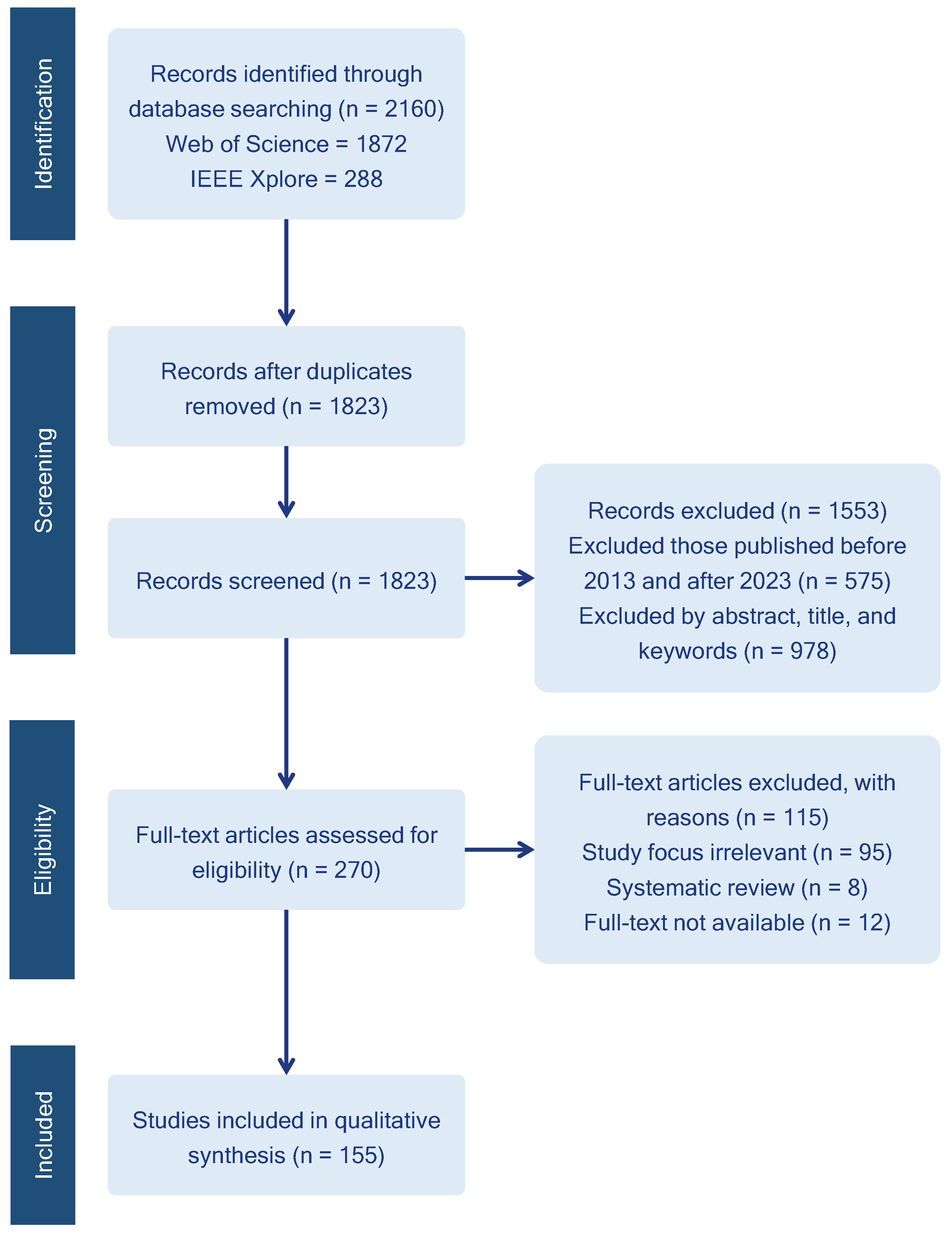
2. Methodology: Search Strategy and Selection Criteria
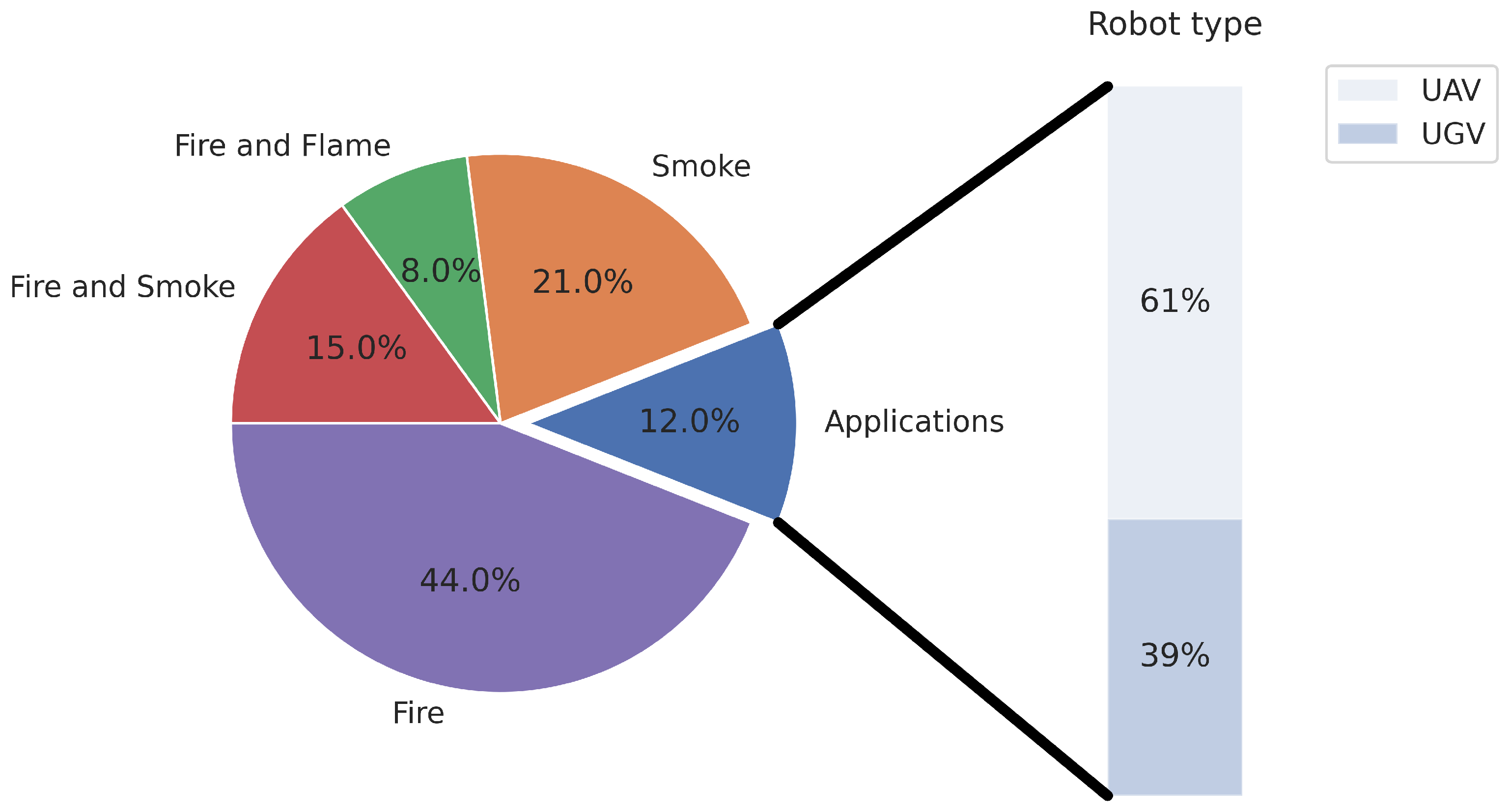
3. Research Topics
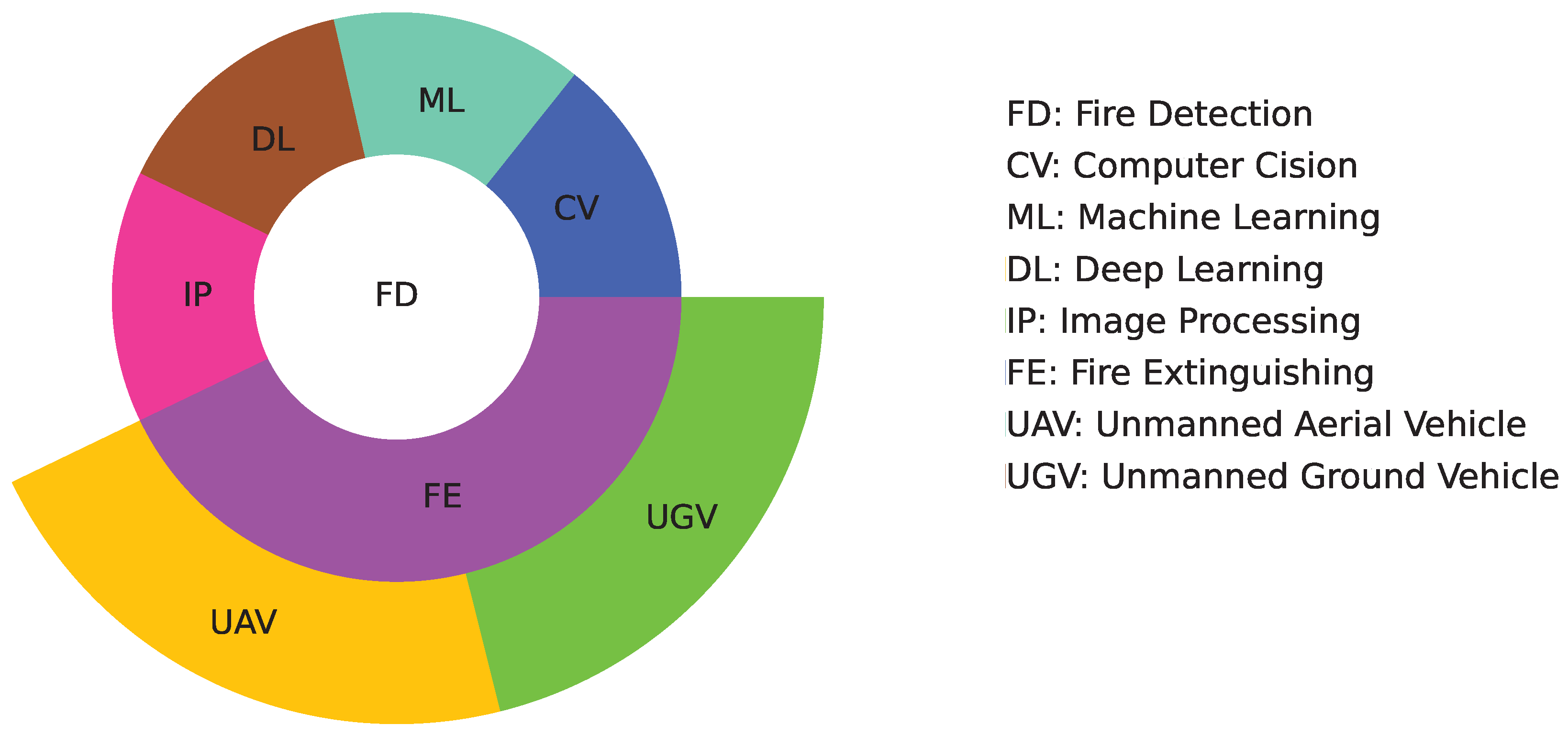
- Computer Vision: Research focusing on the algorithms to understand and interpret the visual data to identify fire [31].
- Deep Learning: Research associated with the models that can continuously enhance their ability to detect fires [32].
- Fire and Flame: Research associated with the methods that can identify fire and flame [37].
- Fire and Smoke: Research that explores the methods focusing on the accurate determination of fire and smoke [38].Another category has been introduced that is a part of the above-defined categories in the field, but with application orientation, with the help of robots.
4. Analysis
4.1. Fire
- Representative Publications:
4.2. Smoke
- Representative Publications:
4.3. Fire and Flame
- Representative Publications:
4.4. Fire and Smoke
- Representative Publications:
4.5. Applications of Robots in Fire Detection and Extinguishing
- Representative Publications:
5. Discussion
5.1. Variability in Fire, Smoke, and Flame Types and Appearances
5.2. Response Time
5.3. Environmental Contextual and Adaptability
5.4. Extinguishing Efficiency
5.5. Compliance and Standards
6. Recommendations for Future Research
6.1. Recommendation 1: Integration of Real-Time Data Processing and Decision-Making Algorithms
6.2. Recommendation 2: Effectiveness and Autonomy in Real-World Conditions
6.3. Recommendation 3: Human–Robot Interactions and Collaboration
7. Conclusions
Author Contributions
Funding
Conflicts of Interest
Abbreviations
| AAFLM | Attention-Based Adaptive Fusion Residual Module |
| AAPF | Auto-Organization, Adaptive Frame Periods |
| ADE-Net | Attention-based Dual-Encoding Network |
| AERNet | An Effective Real-time Fire Detection Network |
| AFM | Attention Fusion Module |
| AFSM | Attention-Based Feature Separation Module |
| AGE | Attention-Guided Enhancement |
| AMP | Automatic Mixed Precision |
| ANN | Artificial Neural Network |
| ASFF | Adaptively Spatial Feature Fusion |
| AUROC | Area Under the Receiver Operating Characteristic |
| BNN | Bayesian Neural Network |
| BiFPN | Bidirectional Feature Pyramid Network |
| BPNN | Back Propagation Neural Network |
| CA | Coordinate Attention |
| CARAFE | Content-Aware Reassembly of Features |
| CBAM | Convolutional Block Attention Module |
| CCDC | Continuous Change Detection and Classification |
| CEP | Complex Event Processing |
| CIoU | Complete Intersection over Union |
| CoLBP | Co-Occurrence of Local Binary Pattern |
| DARA | Dual Fusion Attention Residual Feature Attention |
| DBN | Deep Belief Network |
| DCNN | Deep Convolutional Neural Network |
| DDAM | Detail-Difference-Aware Module |
| DETR | Detection Transformer |
| DPPM | Dense Pyramid Pooling Module |
| DTMC | Discrete-Time Markov Chain |
| ECA | Efficient Channel Attention |
| ELM | Extreme Learning Machine |
| ESRGAN | Enhanced Super-Resolution Generative Adversarial Network |
| FCN | Fully Convolutional Network |
| FCOS | Fully Convolutional One-Stage |
| FFDI | Forest Fire Detection Index |
| FFDSM | Forest Fire Detection and Segmentation Model |
| FILDA | Firelight Detection Algorithm |
| FL | Federated Learning |
| FLAME | Fire Luminosity Airborne-based Machine Learning Evaluation |
| FSCN | Fully Symmetric Convolutional–Deconvolutional Neural Network |
| GCF | Global Context Fusion |
| GIS | Geographic Information System |
| GLCM | Gray Level Co-Occurrence Matrix |
| GMM | Gaussian Mixture Model |
| GRU | Gated Recurrent Unit |
| GSConv | Ghost Shuffle Convolution |
| HRI | Human–Robot Interaction |
| HDLBP | Hamming Distance Based Local Binary Pattern |
| ISSA | Improved Sparrow Search Algorithm |
| KNN | K-Nearest Neighbor |
| K-SVD | K-Singular Value Decomposition |
| LBP | Local Binary Pattern |
| LMINet | Label-Relevance Multi-Direction Interaction Network |
| LSTM | Long Short-Term Memory Networks |
| LwF | Learning without Forgetting |
| MAE-Net | Multi-Attention Fusion |
| MCCL | Multi-scale Context Contrasted Local Feature Module |
| MCAM | Multi-Connection Aggregation Method |
| MQTT | Message Queuing Telemetry Transport |
| MSD | Multi-Scale Detection |
| MTL | Multi-Task Learning |
| MWIR | Middle Wavelength Infrared |
| NBR | Normalized Burned Ratio |
| NDVI | Normalized Difference Vegetation Index |
| PANet | Path Aggregation Network |
| PConv | Partial Convolution |
| POD | Probability of Detection |
| POFD | Probability of False Detection |
| PRISMA | Preferred Reporting Items for Systematic Reviews and Meta-Analyses |
| PSNet | Pixel-level Supervision Neural Network |
| PSO | Particle Swarm Optimization |
| R-CNN | Region-Based Convolutional Neural Network |
| RECAB | Residual Efficient Channel Attention Block |
| RFB | Receptive Field Block |
| ROI | Region of Interest |
| RNN | Recurrent Neural Network |
| RS | Remote Sensing |
| SE-GhostNet | Squeeze and Excitation–GhostNet |
| SHAP | Shapley Additive Explanations |
| SIFT | Scale Invariant Feature Transform |
| SIoU | SCYLLA–Intersection Over Union |
| SPPF | Spatial Pyramid Pooling Fast |
| SPPF+ | Spatial Pyramid Pooling Fast+ |
| SVM | Support Vector Machine |
| TECNN | Transformer-Enhanced Convolutional Neural Network |
| TWSVM | Twin Support Vector Machine |
| USGS | United States Geological Survey |
| ViT | Vision Transformer |
| VHR | Very High Resolution |
| VIIRS | Visible Infrared Imaging Radiometer Suite |
| VSU | Video Surveillance Unit |
| WIoU | Wise–IoU |
| YOLO | You Only Look Once |
References
- Brunner, I.; Godbold, D.L. Tree roots in a changing world. J. For. Res. 2007, 12, 78–82. [Google Scholar] [CrossRef]
- Ball, G.; Regier, P.; González-Pinzón, R.; Reale, J.; Van Horn, D. Wildfires increasingly impact western US fluvial networks. Nat. Commun. 2021, 12, 2484. [Google Scholar] [CrossRef] [PubMed]
- Barmpoutis, P.; Papaioannou, P.; Dimitropoulos, K.; Grammalidis, N. A review on early forest fire detection systems using optical remote sensing. Sensors 2020, 20, 6442. [Google Scholar] [CrossRef] [PubMed]
- Truong, C.T.; Nguyen, T.H.; Vu, V.Q.; Do, V.H.; Nguyen, D.T. Enhancing fire detection technology: A UV-based system utilizing fourier spectrum analysis for reliable and accurate fire detection. Appl. Sci. 2023, 13, 7845. [Google Scholar] [CrossRef]
- Geetha, S.; Abhishek, C.; Akshayanat, C. Machine vision based fire detection techniques: A survey. Fire Technol. 2021, 57, 591–623. [Google Scholar] [CrossRef]
- Alkhatib, A.A. A review on forest fire detection techniques. Int. J. Distrib. Sens. Netw. 2014, 10, 597368. [Google Scholar] [CrossRef]
- Yuan, C.; Liu, Z.; Zhang, Y. Fire detection using infrared images for UAV-based forest fire surveillance. In Proceedings of the 2017 International Conference on Unmanned Aircraft Systems (ICUAS), Miami, FL, USA, 13–16 June 2017; pp. 567–572. [Google Scholar]
- Yang, X.; Hua, Z.; Zhang, L.; Fan, X.; Zhang, F.; Ye, Q.; Fu, L. Preferred vector machine for forest fire detection. Pattern Recognit. 2023, 143, 109722. [Google Scholar] [CrossRef]
- Yuan, C.; Liu, Z.; Zhang, Y. Learning-based smoke detection for unmanned aerial vehicles applied to forest fire surveillance. J. Intell. Robot. Syst. 2019, 93, 337–349. [Google Scholar] [CrossRef]
- Li, X.; Song, W.; Lian, L.; Wei, X. Forest fire smoke detection using back-propagation neural network based on MODIS data. Remote Sens. 2015, 7, 4473–4498. [Google Scholar] [CrossRef]
- Mahmoud, M.A.; Ren, H. Forest Fire Detection Using a Rule-Based Image Processing Algorithm and Temporal Variation. Math. Probl. Eng. 2018, 2018, 7612487. [Google Scholar] [CrossRef]
- Khan, A.; Hassan, B.; Khan, S.; Ahmed, R.; Abuassba, A. DeepFire: A novel dataset and deep transfer learning benchmark for forest fire detection. Mob. Inf. Syst. 2022, 2022, 5358359. [Google Scholar] [CrossRef]
- Rangwala, A.S.; Raghavan, V. Mechanism of Fires: Chemistry and Physical Aspects; Springer Nature: Berlin/Heidelberg, Germany, 2022. [Google Scholar]
- Wu, D.; Zhang, C.; Ji, L.; Ran, R.; Wu, H.; Xu, Y. Forest fire recognition based on feature extraction from multi-view images. Trait. Signal 2021, 38, 775–783. [Google Scholar] [CrossRef]
- Qiu, X.; Xi, T.; Sun, D.; Zhang, E.; Li, C.; Peng, Y.; Wei, J.; Wang, G. Fire detection algorithm combined with image processing and flame emission spectroscopy. Fire Technol. 2018, 54, 1249–1263. [Google Scholar] [CrossRef]
- Dzigal, D.; Akagic, A.; Buza, E.; Brdjanin, A.; Dardagan, N. Forest fire detection based on color spaces combination. In Proceedings of the 2019 11th International Conference on Electrical and Electronics Engineering (ELECO), Bursa, Turkey, 28–30 November 2019; pp. 595–599. [Google Scholar] [CrossRef]
- Khalil, A.; Rahman, S.U.; Alam, F.; Ahmad, I.; Khalil, I. Fire detection using multi color space and background modeling. Fire Technol. 2021, 57, 1221–1239. [Google Scholar] [CrossRef]
- Gaur, A.; Singh, A.; Kumar, A.; Kumar, A.; Kapoor, K. Video flame and smoke based fire detection algorithms: A literature review. Fire Technol. 2020, 56, 1943–1980. [Google Scholar] [CrossRef]
- Wu, H.; Wu, D.; Zhao, J. An intelligent fire detection approach through cameras based on computer vision methods. Process. Saf. Environ. Prot. 2019, 127, 245–256. [Google Scholar] [CrossRef]
- Khondaker, A.; Khandaker, A.; Uddin, J. Computer Vision-based Early Fire Detection Using Enhanced Chromatic Segmentation and Optical Flow Analysis Technique. Int. Arab. J. Inf. Technol. 2020, 17, 947–953. [Google Scholar] [CrossRef]
- He, Y. Smart detection of indoor occupant thermal state via infrared thermography, computer vision, and machine learning. Build. Environ. 2023, 228, 109811. [Google Scholar] [CrossRef]
- Mazur-Milecka, M.; Głowacka, N.; Kaczmarek, M.; Bujnowski, A.; Kaszyński, M.; Rumiński, J. Smart city and fire detection using thermal imaging. In Proceedings of the 2021 14th International Conference on Human System Interaction (HSI), Gdańsk, Poland, 8–10 July 2021; pp. 1–7. [Google Scholar] [CrossRef]
- Bouguettaya, A.; Zarzour, H.; Taberkit, A.M.; Kechida, A. A review on early wildfire detection from unmanned aerial vehicles using deep learning-based computer vision algorithms. Signal Process. 2022, 190, 108309. [Google Scholar] [CrossRef]
- Dong, S.; Wang, P.; Abbas, K. A survey on deep learning and its applications. Comput. Sci. Rev. 2021, 40, 100379. [Google Scholar] [CrossRef]
- Saponara, S.; Elhanashi, A.; Gagliardi, A. Real-time video fire/smoke detection based on CNN in antifire surveillance systems. J.-Real-Time Image Process. 2021, 18, 889–900. [Google Scholar] [CrossRef]
- Florath, J.; Keller, S. Supervised Machine Learning Approaches on Multispectral Remote Sensing Data for a Combined Detection of Fire and Burned Area. Remote Sens. 2022, 14, 657. [Google Scholar] [CrossRef]
- Mohammed, R. A real-time forest fire and smoke detection system using deep learning. Int. J. Nonlinear Anal. Appl. 2022, 13, 2053–2063. [Google Scholar] [CrossRef]
- Moher, D.; Liberati, A.; Tetzlaff, J.; Altman, D.G. Preferred reporting items for systematic reviews and meta-analyses: The PRISMA statement. Ann. Intern. Med. 2009, 151, 264–269. [Google Scholar] [CrossRef] [PubMed]
- Mahmoud, M.A.I.; Ren, H. Forest fire detection and identification using image processing and SVM. J. Inf. Process. Syst. 2019, 15, 159–168. [Google Scholar] [CrossRef]
- Yuan, C.; Ghamry, K.A.; Liu, Z.; Zhang, Y. Unmanned aerial vehicle based forest fire monitoring and detection using image processing technique. In Proceedings of the 2016 IEEE Chinese Guidance, Navigation and Control Conference (CGNCC), Miami, FL, USA, 13–16 June 2016; pp. 1870–1875. [Google Scholar] [CrossRef]
- Rahman, E.U.; Khan, M.A.; Algarni, F.; Zhang, Y.; Irfan Uddin, M.; Ullah, I.; Ahmad, H.I. Computer Vision-Based Wildfire Smoke Detection Using UAVs. Math. Probl. Eng. 2021, 2021, 9977939. [Google Scholar] [CrossRef]
- Almasoud, A.S. Intelligent Deep Learning Enabled Wild Forest Fire Detection System. Comput. Syst. Sci. Eng. 2023, 44. [Google Scholar] [CrossRef]
- Chen, X.; Hopkins, B.; Wang, H.; O’Neill, L.; Afghah, F.; Razi, A.; Fulé, P.; Coen, J.; Rowell, E.; Watts, A. Wildland fire detection and monitoring using a drone-collected RGB/IR image dataset. IEEE Access 2022, 10, 121301–121317. [Google Scholar] [CrossRef]
- Dewangan, A.; Pande, Y.; Braun, H.W.; Vernon, F.; Perez, I.; Altintas, I.; Cottrell, G.W.; Nguyen, M.H. FIgLib & SmokeyNet: Dataset and deep learning model for real-time wildland fire smoke detection. Remote Sens. 2022, 14, 1007. [Google Scholar] [CrossRef]
- Zhou, Z.; Shi, Y.; Gao, Z.; Li, S. Wildfire smoke detection based on local extremal region segmentation and surveillance. Fire Saf. J. 2016, 85, 50–58. [Google Scholar] [CrossRef]
- Zhang, Q.x.; Lin, G.h.; Zhang, Y.m.; Xu, G.; Wang, J.j. Wildland forest fire smoke detection based on faster R-CNN using synthetic smoke images. Procedia Eng. 2018, 211, 441–446. [Google Scholar] [CrossRef]
- Sudhakar, S.; Vijayakumar, V.; Kumar, C.S.; Priya, V.; Ravi, L.; Subramaniyaswamy, V. Unmanned Aerial Vehicle (UAV) based Forest Fire Detection and monitoring for reducing false alarms in forest-fires. Comput. Commun. 2020, 149, 1–16. [Google Scholar] [CrossRef]
- Hossain, F.A.; Zhang, Y.; Yuan, C.; Su, C.Y. Wildfire flame and smoke detection using static image features and artificial neural network. In Proceedings of the 2019 1st International Conference on Industrial Artificial Intelligence (IAI), Shenyang, China, 23–27 July 2019. [Google Scholar] [CrossRef]
- Ghamry, K.A.; Kamel, M.A.; Zhang, Y. Cooperative forest monitoring and fire detection using a team of UAVs-UGVs. In Proceedings of the 2016 International Conference on Unmanned Aircraft Systems (ICUAS), Arlington, VA, USA, 7–10 June 2016; pp. 1206–1211. [Google Scholar] [CrossRef]
- Akhloufi, M.A.; Couturier, A.; Castro, N.A. Unmanned aerial vehicles for wildland fires: Sensing, perception, cooperation and assistance. Drones 2021, 5, 15. [Google Scholar] [CrossRef]
- Battistoni, P.; Cantone, A.A.; Martino, G.; Passamano, V.; Romano, M.; Sebillo, M.; Vitiello, G. A cyber-physical system for wildfire detection and firefighting. Future Internet 2023, 15, 237. [Google Scholar] [CrossRef]
- Jiao, Z.; Zhang, Y.; Xin, J.; Mu, L.; Yi, Y.; Liu, H.; Liu, D. A deep learning based forest fire detection approach using UAV and YOLOv3. In Proceedings of the 2019 1st International Conference on Industrial Artificial Intelligence (IAI), Shenyang, China, 23–27 July 2019. [Google Scholar] [CrossRef]
- Ghali, R.; Akhloufi, M.A. Deep learning approaches for wildland fires using satellite remote sensing data: Detection, mapping, and prediction. Fire 2023, 6, 192. [Google Scholar] [CrossRef]
- Artés, T.; Oom, D.; De Rigo, D.; Durrant, T.H.; Maianti, P.; Libertà, G.; San-Miguel-Ayanz, J. A global wildfire dataset for the analysis of fire regimes and fire behaviour. Sci. Data 2019, 6, 296. [Google Scholar] [CrossRef] [PubMed]
- Sayad, Y.O.; Mousannif, H.; Al Moatassime, H. Predictive modeling of wildfires: A new dataset and machine learning approach. Fire Saf. J. 2019, 104, 130–146. [Google Scholar] [CrossRef]
- Zhang, G.; Wang, M.; Liu, K. Deep neural networks for global wildfire susceptibility modelling. Ecol. Indic. 2021, 127, 107735. [Google Scholar] [CrossRef]
- Zheng, S.; Zou, X.; Gao, P.; Zhang, Q.; Hu, F.; Zhou, Y.; Wu, Z.; Wang, W.; Chen, S. A forest fire recognition method based on modified deep CNN model. Forests 2024, 15, 111. [Google Scholar] [CrossRef]
- Zhang, L.; Wang, M.; Fu, Y.; Ding, Y. A Forest Fire Recognition Method Using UAV Images Based on Transfer Learning. Forests 2022, 13, 975. [Google Scholar] [CrossRef]
- Qian, J.; Lin, H. A Forest Fire Identification System Based on Weighted Fusion Algorithm. Forests 2022, 13, 1301. [Google Scholar] [CrossRef]
- Anh, N. Efficient Forest Fire Detection using Rule-Based Multi-color Space and Correlation Coefficient for Application in Unmanned Aerial Vehicles. Ksii Trans. Internet Inf. Syst. 2022, 16, 381–404. [Google Scholar] [CrossRef]
- Zhang, J.; Zhu, H.; Wang, P.; Ling, X. ATT Squeeze U-Net: A lightweight Network for Forest Fire Detection and Recognition. IEEE Access 2021, 9, 10858–10870. [Google Scholar] [CrossRef]
- Qi, R.; Liu, Z. Extraction and Classification of Image Features for Fire Recognition Based on Convolutional Neural Network. Trait. Signal 2021, 38, 895–902. [Google Scholar] [CrossRef]
- Chanthiya, P.; Kalaivani, V. Forest fire detection on LANDSAT images using support vector machine. Concurr.-Comput.-Pract. Exp. 2021, 33, e6280. [Google Scholar] [CrossRef]
- Sousa, M.; Moutinho, A.; Almeida, M. Thermal Infrared Sensing for Near Real-Time Data-Driven Fire Detection and Monitoring Systems. Sensors 2020, 20, 6803. [Google Scholar] [CrossRef] [PubMed]
- Chung, M.; Han, Y.; Kim, Y. A Framework for Unsupervised Wildfire Damage Assessment Using VHR Satellite Images with PlanetScope Data. Remote Sens. 2020, 12, 3835. [Google Scholar] [CrossRef]
- Wang, Y.; Dang, L.; Ren, J. Forest fire image recognition based on convolutional neural network. J. Algorithm. Comput. Technol. 2019, 13, 1748302619887689. [Google Scholar] [CrossRef]
- Park, W.; Park, S.; Jung, H.; Won, J. An Extraction of Solar-contaminated Energy Part from MODIS Middle Infrared Channel Measurement to Detect Forest Fires. Korean J. Remote Sens. 2019, 35, 39–55. [Google Scholar] [CrossRef]
- Yuan, C.; Liu, Z.; Zhang, Y. Aerial Images-Based Forest Fire Detection for Firefighting Using Optical Remote Sensing Techniques and Unmanned Aerial Vehicles. J. Intell. Robot. Syst. 2017, 88, 635–654. [Google Scholar] [CrossRef]
- Prema, C.; Vinsley, S.; Suresh, S. Multi Feature Analysis of Smoke in YUV Color Space for Early Forest Fire Detection. Fire Technol. 2016, 52, 1319–1342. [Google Scholar] [CrossRef]
- Polivka, T.; Wang, J.; Ellison, L.; Hyer, E.; Ichoku, C. Improving Nocturnal Fire Detection With the VIIRS Day-Night Band. IEEE Trans. Geosci. Remote Sens. 2016, 54, 5503–5519. [Google Scholar] [CrossRef]
- Lin, L. A Spatio-Temporal Model for Forest Fire Detection Using HJ-IRS Satellite Data. Remote Sens. 2016, 8, 403. [Google Scholar] [CrossRef]
- Yoon, S.; Min, J. An Intelligent Automatic Early Detection System of Forest Fire Smoke Signatures using Gaussian Mixture Model. J. Inf. Process. Syst. 2013, 9, 621–632. [Google Scholar] [CrossRef]
- Xue, Z.; Lin, H.; Wang, F. A Small Target Forest Fire Detection Model Based on YOLOv5 Improvement. Forests 2022, 13, 1332. [Google Scholar] [CrossRef]
- Seydi, S.T.; Saeidi, V.; Kalantar, B.; Ueda, N.; Halin, A.A. Fire-Net: A Deep Learning Framework for Active Forest Fire Detection. J. Sensors 2022, 2022, 8044390. [Google Scholar] [CrossRef]
- Lu, K.; Xu, R.; Li, J.; Lv, Y.; Lin, H.; Li, Y. A Vision-Based Detection and Spatial Localization Scheme for Forest Fire Inspection from UAV. Forests 2022, 13, 383. [Google Scholar] [CrossRef]
- Lu, K.; Huang, J.; Li, J.; Zhou, J.; Chen, X.; Liu, Y. MTL-FFDET: A Multi-Task Learning-Based Model for Forest Fire Detection. Forests 2022, 13, 1448. [Google Scholar] [CrossRef]
- Guan, Z.; Miao, X.; Mu, Y.; Sun, Q.; Ye, Q.; Gao, D. Forest Fire Segmentation from Aerial Imagery Data Using an Improved Instance Segmentation Model. Remote Sens. 2022, 14, 3159. [Google Scholar] [CrossRef]
- Li, W.; Lin, Q.; Wang, K.; Cai, K. Machine vision-based network monitoring system for solar-blind ultraviolet signal. Comput. Commun. 2021, 171, 157–162. [Google Scholar] [CrossRef]
- Kim, B.; Lee, J. A Bayesian Network-Based Information Fusion Combined with DNNs for Robust Video Fire Detection. Appl. Sci. 2021, 11, 7624. [Google Scholar] [CrossRef]
- Ghali, R.; Akhloufi, M.; Jmal, M.; Mseddi, W.; Attia, R. Wildfire Segmentation Using Deep Vision Transformers. Remote Sens. 2021, 13, 3527. [Google Scholar] [CrossRef]
- Toptas, B.; Hanbay, D. A new artificial bee colony algorithm-based color space for fire/flame detection. Soft Comput. 2020, 24, 10481–10492. [Google Scholar] [CrossRef]
- Barmpoutis, P.; Stathaki, T.; Dimitropoulos, K.; Grammalidis, N. Early fire detection based on aerial 360-degree sensors, deep convolution neural networks and exploitation of fire dynamic textures. Remote Sens. 2020, 12, 3177. [Google Scholar] [CrossRef]
- Ghali, R.; Akhloufi, M.; Mseddi, W. Deep Learning and Transformer Approaches for UAV-Based Wildfire Detection and Segmentation. Sensors 2022, 22, 1977. [Google Scholar] [CrossRef]
- Zhang, Q.; Ge, L.; Zhang, R.; Metternicht, G.; Liu, C.; Du, Z. Towards a Deep-Learning-Based Framework of Sentinel-2 Imagery for Automated Active Fire Detection. Remote Sens. 2021, 13, 4790. [Google Scholar] [CrossRef]
- Rashkovetsky, D.; Mauracher, F.; Langer, M.; Schmitt, M. Wildfire Detection From Multisensor Satellite Imagery Using Deep Semantic Segmentation. IEEE J. Sel. Top. Appl. Earth Obs. Remote Sens. 2021, 14, 7001–7016. [Google Scholar] [CrossRef]
- Pereira, G.; Fusioka, A.; Nassu, B.; Minetto, R. Active fire detection in Landsat-8 imagery: A large-scale dataset and a deep-learning study. Isprs J. Photogramm. Remote Sens. 2021, 178, 171–186. [Google Scholar] [CrossRef]
- Benzekri, W.; Moussati, A.; Moussaoui, O.; Berrajaa, M. Early Forest Fire Detection System using Wireless Sensor Network and Deep Learning. Int. J. Adv. Comput. Sci. Appl. 2020, 11, 496–503. [Google Scholar] [CrossRef]
- Zhao, Y.; Ban, Y. GOES-R Time Series for Early Detection of Wildfires with Deep GRU-Network. Remote Sens. 2022, 14, 4347. [Google Scholar] [CrossRef]
- Hong, Z. Active Fire Detection Using a Novel Convolutional Neural Network Based on Himawari-8 Satellite Images. Front. Environ. Sci. 2022, 10, 794028. [Google Scholar] [CrossRef]
- Xu, R.; Lin, H.; Lu, K.; Cao, L.; Liu, Y. A Forest Fire Detection System Based on Ensemble Learning. Forests 2021, 12, 217. [Google Scholar] [CrossRef]
- Pan, H.; Badawi, D.; Zhang, X.; Cetin, A. Additive neural network for forest fire detection. Signal Image Video Process. 2020, 14, 675–682. [Google Scholar] [CrossRef]
- Zhao, Y.; Ma, J.; Li, X.; Zhang, J. Saliency Detection and Deep Learning-Based Wildfire Identification in UAV Imagery. Sensors 2018, 18, 712. [Google Scholar] [CrossRef] [PubMed]
- Zhang, A.; Zhang, A. Real-Time Wildfire Detection and Alerting with a Novel Machine Learning Approach A New Systematic Approach of Using Convolutional Neural Network (CNN) to Achieve Higher Accuracy in Automation. Int. J. Adv. Comput. Sci. Appl. 2022, 13, 1–6. [Google Scholar]
- Wahyono; Harjoko, A.; Dharmawan, A.; Adhinata, F.D.; Kosala, G.; Jo, K.H. Real-time forest fire detection framework based on artificial intelligence using color probability model and motion feature analysis. Fire 2022, 5, 23. [Google Scholar] [CrossRef]
- Phan, T.; Quach, N.; Nguyen, T.; Nguyen, T.; Jo, J.; Nguyen, Q. Real-time wildfire detection with semantic explanations. Expert Syst. Appl. 2022, 201, 117007. [Google Scholar] [CrossRef]
- Yang, X. Pixel-level automatic annotation for forest fire image. Eng. Appl. Artif. Intell. 2021, 104, 104353. [Google Scholar] [CrossRef]
- Shamsoshoara, A.; Afghah, F.; Razi, A.; Zheng, L.; Fule, P.; Blasch, E. Aerial imagery pile burn detection using deep learning: The FLAME dataset. Comput. Netw. 2021, 193, 108001. [Google Scholar] [CrossRef]
- Liu, Z.; Zhang, K.; Wang, C.; Huang, S. Research on the identification method for the forest fire based on deep learning. Optik 2020, 223, 165491. [Google Scholar] [CrossRef]
- Khurana, M.; Saxena, V. A Unified Approach to Change Detection Using an Adaptive Ensemble of Extreme Learning Machines. IEEE Geosci. Remote Sens. Lett. 2020, 17, 794–798. [Google Scholar] [CrossRef]
- Huang, X.; Du, L. Fire Detection and Recognition Optimization Based on Virtual Reality Video Image. IEEE Access 2020, 8, 77951–77961. [Google Scholar] [CrossRef]
- Govil, K.; Welch, M.L.; Ball, J.T.; Pennypacker, C.R. Preliminary results from a wildfire detection system using deep learning on remote camera images. Remote Sens. 2020, 12, 166. [Google Scholar] [CrossRef]
- Ouni, S.; Ayoub, Z.; Kamoun, F. Auto-organization approach with adaptive frame periods for IEEE 802.15.4/zigbee forest fire detection system. Wirel. Netw. 2019, 25, 4059–4076. [Google Scholar] [CrossRef]
- Jang, E.; Kang, Y.; Im, J.; Lee, D.; Yoon, J.; Kim, S. Detection and Monitoring of Forest Fires Using Himawari-8 Geostationary Satellite Data in South Korea. Remote Sens. 2019, 11, 271. [Google Scholar] [CrossRef]
- Mao, W.; Wang, W.; Dou, Z.; Li, Y. Fire Recognition Based On Multi-Channel Convolutional Neural Network. Fire Technol. 2018, 54, 531–554. [Google Scholar] [CrossRef]
- Zheng, S.; Gao, P.; Zhou, Y.; Wu, Z.; Wan, L.; Hu, F.; Wang, W.; Zou, X.; Chen, S. An accurate forest fire recognition method based on improved BPNN and IoT. Remote Sens. 2023, 15, 2365. [Google Scholar] [CrossRef]
- Liu, T.; Chen, W.; Lin, X.; Mu, Y.; Huang, J.; Gao, D.; Xu, J. Defogging Learning Based on an Improved DeepLabV3+ Model for Accurate Foggy Forest Fire Segmentation. Forests 2023, 14, 1859. [Google Scholar] [CrossRef]
- Reis, H.C.; Turk, V. Detection of forest fire using deep convolutional neural networks with transfer learning approach. Appl. Soft Comput. 2023, 143, 110362. [Google Scholar] [CrossRef]
- Pang, Y.; Wu, Y.; Yuan, Y. FuF-Det: An Early Forest Fire Detection Method under Fog. Remote Sens. 2023, 15, 5435. [Google Scholar] [CrossRef]
- Lin, J.; Lin, H.; Wang, F. A semi-supervised method for real-time forest fire detection algorithm based on adaptively spatial feature fusion. Forests 2023, 14, 361. [Google Scholar] [CrossRef]
- Akyol, K. Robust stacking-based ensemble learning model for forest fire detection. Int. J. Environ. Sci. Technol. 2023, 20, 13245–13258. [Google Scholar] [CrossRef]
- Niu, K.; Wang, C.; Xu, J.; Yang, C.; Zhou, X.; Yang, X. An Improved YOLOv5s-Seg Detection and Segmentation Model for the Accurate Identification of Forest Fires Based on UAV Infrared Image. Remote Sens. 2023, 15, 4694. [Google Scholar] [CrossRef]
- Sarikaya Basturk, N. Forest fire detection in aerial vehicle videos using a deep ensemble neural network model. Aircr. Eng. Aerosp. Technol. 2023, 95, 1257–1267. [Google Scholar] [CrossRef]
- Rahman, A.; Sakif, S.; Sikder, N.; Masud, M.; Aljuaid, H.; Bairagi, A.K. Unmanned aerial vehicle assisted forest fire detection using deep convolutional neural network. Intell. Autom. Soft Comput 2023, 35, 3259–3277. [Google Scholar] [CrossRef]
- Ghali, R.; Akhloufi, M.A. CT-Fire: A CNN-Transformer for wildfire classification on ground and aerial images. Int. J. Remote Sens. 2023, 44, 7390–7415. [Google Scholar] [CrossRef]
- Abdusalomov, A.B.; Islam, B.M.S.; Nasimov, R.; Mukhiddinov, M.; Whangbo, T.K. An improved forest fire detection method based on the detectron2 model and a deep learning approach. Sensors 2023, 23, 1512. [Google Scholar] [CrossRef]
- Supriya, Y.; Gadekallu, T.R. Particle swarm-based federated learning approach for early detection of forest fires. Sustainability 2023, 15, 964. [Google Scholar] [CrossRef]
- Khennou, F.; Akhloufi, M.A. Improving wildland fire spread prediction using deep U-Nets. Sci. Remote Sens. 2023, 8, 100101. [Google Scholar] [CrossRef]
- Peruzzi, G.; Pozzebon, A.; Van Der Meer, M. Fight fire with fire: Detecting forest fires with embedded machine learning models dealing with audio and images on low power iot devices. Sensors 2023, 23, 783. [Google Scholar] [CrossRef]
- Barmpoutis, P.; Kastridis, A.; Stathaki, T.; Yuan, J.; Shi, M.; Grammalidis, N. Suburban Forest Fire Risk Assessment and Forest Surveillance Using 360-Degree Cameras and a Multiscale Deformable Transformer. Remote Sens. 2023, 15, 1995. [Google Scholar] [CrossRef]
- Almeida, J.S.; Jagatheesaperumal, S.K.; Nogueira, F.G.; de Albuquerque, V.H.C. EdgeFireSmoke++: A novel lightweight algorithm for real-time forest fire detection and visualization using internet of things-human machine interface. Expert Syst. Appl. 2023, 221, 119747. [Google Scholar] [CrossRef]
- Zheng, H.; Dembele, S.; Wu, Y.; Liu, Y.; Chen, H.; Zhang, Q. A lightweight algorithm capable of accurately identifying forest fires from UAV remote sensing imagery. Front. For. Glob. Chang. 2023, 6, 1134942. [Google Scholar] [CrossRef]
- Shahid, M.; Chen, S.F.; Hsu, Y.L.; Chen, Y.Y.; Chen, Y.L.; Hua, K.L. Forest fire segmentation via temporal transformer from aerial images. Forests 2023, 14, 563. [Google Scholar] [CrossRef]
- Ahmad, K.; Khan, M.S.; Ahmed, F.; Driss, M.; Boulila, W.; Alazeb, A.; Alsulami, M.; Alshehri, M.S.; Ghadi, Y.Y.; Ahmad, J. FireXnet: An explainable AI-based tailored deep learning model for wildfire detection on resource-constrained devices. Fire Ecol. 2023, 19, 54. [Google Scholar] [CrossRef]
- Wang, X.; Pan, Z.; Gao, H.; He, N.; Gao, T. An efficient model for real-time wildfire detection in complex scenarios based on multi-head attention mechanism. J.-Real-Time Image Process. 2023, 20, 66. [Google Scholar] [CrossRef]
- Ying, L.X.; Shen, Z.H.; Yang, M.Z.; Piao, S.L. Wildfire Detection Probability of MODIS Fire Products under the Constraint of Environmental Factors: A Study Based on Confirmed Ground Wildfire Records. Remote Sens. 2019, 11, 31. [Google Scholar] [CrossRef]
- Liu, T. Video Smoke Detection Method Based on Change-Cumulative Image and Fusion Deep Network. Sensors 2019, 19, 5060. [Google Scholar] [CrossRef] [PubMed]
- Bugaric, M.; Jakovcevic, T.; Stipanicev, D. Adaptive estimation of visual smoke detection parameters based on spatial data and fire risk index. Comput. Vis. Image Underst. 2014, 118, 184–196. [Google Scholar] [CrossRef]
- Xie, J.; Yu, F.; Wang, H.; Zheng, H. Class Activation Map-Based Data Augmentation for Satellite Smoke Scene Detection. IEEE Geosci. Remote Sens. Lett. 2022, 19, 6510905. [Google Scholar] [CrossRef]
- Zhu, G.; Chen, Z.; Liu, C.; Rong, X.; He, W. 3D video semantic segmentation for wildfire smoke. Mach. Vis. Appl. 2020, 31, 50. [Google Scholar] [CrossRef]
- Li, X.; Chen, Z.; Wu, Q.; Liu, C. 3D Parallel Fully Convolutional Networks for Real-Time Video Wildfire Smoke Detection. IEEE Trans. Circuits Syst. Video Technol. 2020, 30, 89–103. [Google Scholar] [CrossRef]
- Peng, Y.; Wang, Y. Real-time forest smoke detection using hand-designed features and deep learning. Comput. Electron. Agric. 2019, 167, 105029. [Google Scholar] [CrossRef]
- Lin, G.; Zhang, Y.; Xu, G.; Zhang, Q. Smoke detection on video sequences using 3D convolutional neural networks. Fire Technol. 2019, 55, 1827–1847. [Google Scholar] [CrossRef]
- Gao, Y.; Cheng, P. Forest Fire Smoke Detection Based on Visual Smoke Root and Diffusion Model. Fire Technol. 2019, 55, 1801–1826. [Google Scholar] [CrossRef]
- Jakovcevic, T.; Bugaric, M.; Stipanicev, D. A Stereo Approach to Wildfire Smoke Detection: The Improvement of the Existing Methods by Adding a New Dimension. Comput. Inform. 2018, 37, 476–508. [Google Scholar] [CrossRef]
- Jia, Y.; Yuan, J.; Wang, J.; Fang, J.; Zhang, Y.; Zhang, Q. A Saliency-Based Method for Early Smoke Detection in Video Sequences. Fire Technol. 2016, 52, 1271–1292. [Google Scholar] [CrossRef]
- Chen, S.; Li, W.; Cao, Y.; Lu, X. Combining the Convolution and Transformer for Classification of Smoke-Like Scenes in Remote Sensing Images. IEEE Trans. Geosci. Remote Sens. 2022, 60, 4512519. [Google Scholar] [CrossRef]
- Guede-Fernandez, F.; Martins, L.; Almeida, R.; Gamboa, H.; Vieira, P. A Deep Learning Based Object Identification System for Forest Fire Detection. Fire 2021, 4, 75. [Google Scholar] [CrossRef]
- Yazdi, A.; Qin, H.; Jordan, C.; Yang, L.; Yan, F. Nemo: An Open-Source Transformer-Supercharged Benchmark for Fine-Grained Wildfire Smoke Detection. Remote Sens. 2022, 14, 3979. [Google Scholar] [CrossRef]
- Shi, J.; Wang, W.; Gao, Y.; Yu, N. Optimal Placement and Intelligent Smoke Detection Algorithm for Wildfire-Monitoring Cameras. IEEE Access 2020, 8, 72326–72339. [Google Scholar] [CrossRef]
- Hossain, F.A.; Zhang, Y.M.; Tonima, M.A. Forest fire flame and smoke detection from UAV-captured images using fire-specific color features and multi-color space local binary pattern. J. Unmanned Veh. Syst. 2020, 8, 285–309. [Google Scholar] [CrossRef]
- Li, T.; Zhao, E.; Zhang, J.; Hu, C. Detection of Wildfire Smoke Images Based on a Densely Dilated Convolutional Network. Electronics 2019, 8, 1131. [Google Scholar] [CrossRef]
- Cao, Y.; Yang, F.; Tang, Q.; Lu, X. An Attention Enhanced Bidirectional LSTM for Early Forest Fire Smoke Recognition. IEEE Access 2019, 7, 154732–154742. [Google Scholar] [CrossRef]
- Prema, C.; Suresh, S.; Krishnan, M.; Leema, N. A Novel Efficient Video Smoke Detection Algorithm Using Co-occurrence of Local Binary Pattern Variants. Fire Technol. 2022, 58, 3139–3165. [Google Scholar] [CrossRef]
- Toulouse, T.; Rossi, L.; Campana, A.; Celik, T.; Akhloufi, M.A. Computer vision for wildfire research: An evolving image dataset for processing and analysis. Fire Saf. J. 2017, 92, 188–194. [Google Scholar] [CrossRef]
- Kim, S.Y.; Muminov, A. Forest fire smoke detection based on deep learning approaches and unmanned aerial vehicle images. Sensors 2023, 23, 5702. [Google Scholar] [CrossRef]
- Yang, H.; Wang, J.; Wang, J. Efficient Detection of Forest Fire Smoke in UAV Aerial Imagery Based on an Improved Yolov5 Model and Transfer Learning. Remote Sens. 2023, 15, 5527. [Google Scholar] [CrossRef]
- Huang, J.; Zhou, J.; Yang, H.; Liu, Y.; Liu, H. A small-target forest fire smoke detection model based on deformable transformer for end-to-end object detection. Forests 2023, 14, 162. [Google Scholar] [CrossRef]
- Saydirasulovich, S.N.; Mukhiddinov, M.; Djuraev, O.; Abdusalomov, A.; Cho, Y.I. An improved wildfire smoke detection based on YOLOv8 and UAV images. Sensors 2023, 23, 8374. [Google Scholar] [CrossRef]
- Chen, G.; Cheng, R.; Lin, X.; Jiao, W.; Bai, D.; Lin, H. LMDFS: A lightweight model for detecting forest fire smoke in UAV images based on YOLOv7. Remote Sens. 2023, 15, 3790. [Google Scholar] [CrossRef]
- Qiao, Y.; Jiang, W.; Wang, F.; Su, G.; Li, X.; Jiang, J. FireFormer: An efficient Transformer to identify forest fire from surveillance cameras. Int. J. Wildland Fire 2023, 32, 1364–1380. [Google Scholar] [CrossRef]
- Fernandes, A.M.; Utkin, A.B.; Chaves, P. Automatic early detection of wildfire smoke with visible-light cameras and EfficientDet. J. Fire Sci. 2023, 41, 122–135. [Google Scholar] [CrossRef]
- Tao, H. A label-relevance multi-direction interaction network with enhanced deformable convolution for forest smoke recognition. Expert Syst. Appl. 2024, 236, 121383. [Google Scholar] [CrossRef]
- Tao, H.; Duan, Q.; Lu, M.; Hu, Z. Learning discriminative feature representation with pixel-level supervision for forest smoke recognition. Pattern Recognit. 2023, 143, 109761. [Google Scholar] [CrossRef]
- James, G.L.; Ansaf, R.B.; Al Samahi, S.S.; Parker, R.D.; Cutler, J.M.; Gachette, R.V.; Ansaf, B.I. An Efficient Wildfire Detection System for AI-Embedded Applications Using Satellite Imagery. Fire 2023, 6, 169. [Google Scholar] [CrossRef]
- Ba, R.; Chen, C.; Yuan, J.; Song, W.; Lo, S. SmokeNet: Satellite smoke scene detection using convolutional neural network with spatial and channel-wise attention. Remote Sens. 2019, 11, 1702. [Google Scholar] [CrossRef]
- Larsen, A.; Hanigan, I.; Reich, B.J.; Qin, Y.; Cope, M.; Morgan, G.; Rappold, A.G. A deep learning approach to identify smoke plumes in satellite imagery in near-real time for health risk communication. J. Expo. Sci. Environ. Epidemiol. 2021, 31, 170–176. [Google Scholar] [CrossRef]
- Yuan, F.; Zhang, L.; Wan, B.; Xia, X.; Shi, J. Convolutional neural networks based on multi-scale additive merging layers for visual smoke recognition. Mach. Vis. Appl. 2019, 30, 345–358. [Google Scholar] [CrossRef]
- Pundir, A.S.; Raman, B. Dual deep learning model for image based smoke detection. Fire Technol. 2019, 55, 2419–2442. [Google Scholar] [CrossRef]
- Wu, H.; Zhang, A.; Han, Y.; Nan, J.; Li, K. Fast stochastic configuration network based on an improved sparrow search algorithm for fire flame recognition. Knowl.-Based Syst. 2022, 245, 108626. [Google Scholar] [CrossRef]
- Buza, E.; Akagic, A. Unsupervised method for wildfire flame segmentation and detection. IEEE Access 2022, 10, 55213–55225. [Google Scholar] [CrossRef]
- Zhao, Y.; Tang, G.; Xu, M. Hierarchical detection of wildfire flame video from pixel level to semantic level. Expert Syst. Appl. 2015, 42, 4097–4104. [Google Scholar] [CrossRef]
- Prema, C.; Vinsley, S.; Suresh, S. Efficient Flame Detection Based on Static and Dynamic Texture Analysis in Forest Fire Detection. Fire Technol. 2018, 54, 255–288. [Google Scholar] [CrossRef]
- Zhang, H.; Zhang, N.; Xiao, N. Fire detection and identification method based on visual attention mechanism. Optik 2015, 126, 5011–5018. [Google Scholar] [CrossRef]
- Liu, H.; Hu, H.; Zhou, F.; Yuan, H. Forest flame detection in unmanned aerial vehicle imagery based on YOLOv5. Fire 2023, 6, 279. [Google Scholar] [CrossRef]
- Wang, L.; Zhang, H.; Zhang, Y.; Hu, K.; An, K. A deep learning-based experiment on forest wildfire detection in machine vision course. IEEE Access 2023, 11, 32671–32681. [Google Scholar] [CrossRef]
- Kong, S.; Deng, J.; Yang, L.; Liu, Y. An attention-based dual-encoding network for fire flame detection using optical remote sensing. Eng. Appl. Artif. Intell. 2024, 127, 107238. [Google Scholar] [CrossRef]
- Kaliyev, D.; Shvets, O.; Györök, G. Computer Vision-based Fire Detection using Enhanced Chromatic Segmentation and Optical Flow Model. Acta Polytech. Hung. 2023, 20, 27–45. [Google Scholar] [CrossRef]
- Chen, B.; Bai, D.; Lin, H.; Jiao, W. Flametransnet: Advancing forest flame segmentation with fusion and augmentation techniques. Forests 2023, 14, 1887. [Google Scholar] [CrossRef]
- Morandini, F.; Toulouse, T.; Silvani, X.; Pieri, A.; Rossi, L. Image-based diagnostic system for the measurement of flame properties and radiation. Fire Technol. 2019, 55, 2443–2463. [Google Scholar] [CrossRef]
- Chen, Y.; Xu, W.; Zuo, J.; Yang, K. The fire recognition algorithm using dynamic feature fusion and IV-SVM classifier. Clust. Comput. 2019, 22, 7665–7675. [Google Scholar] [CrossRef]
- Dimitropoulos, K.; Barmpoutis, P.; Grammalidis, N. Spatio-temporal flame modeling and dynamic texture analysis for automatic video-based fire detection. IEEE Trans. Circuits Syst. Video Technol. 2014, 25, 339–351. [Google Scholar] [CrossRef]
- Zheng, X.; Chen, F.; Lou, L.; Cheng, P.; Huang, Y. Real-time detection of full-scale forest fire smoke based on deep convolution neural network. Remote Sens. 2022, 14, 536. [Google Scholar] [CrossRef]
- Martins, L.; Guede-Fernandez, F.; Almeida, R.; Gamboa, H.; Vieira, P. Real-Time Integration of Segmentation Techniques for Reduction of False Positive Rates in Fire Plume Detection Systems during Forest Fires. Remote Sens. 2022, 14, 2701. [Google Scholar] [CrossRef]
- Fernandes, A.; Utkin, A.; Chaves, P. Automatic Early Detection of Wildfire Smoke With Visible light Cameras Using Deep Learning and Visual Explanation. IEEE Access 2022, 10, 12814–12828. [Google Scholar] [CrossRef]
- Jiang, Y.; Wei, R.; Chen, J.; Wang, G. Deep Learning of Qinling Forest Fire Anomaly Detection Based on Genetic Algorithm Optimization. Univ. Politeh. Buchar. Sci. Bull. Ser.-Electr. Eng. Comput. Sci. 2021, 83, 75–84. [Google Scholar]
- Perrolas, G.; Niknejad, M.; Ribeiro, R.; Bernardino, A. Scalable Fire and Smoke Segmentation from Aerial Images Using Convolutional Neural Networks and Quad-Tree Search. Sensors 2022, 22, 1701. [Google Scholar] [CrossRef]
- Li, J. Adaptive linear feature-reuse network for rapid forest fire smoke detection model. Ecol. Inform. 2022, 68, 101584. [Google Scholar] [CrossRef]
- Hu, Y.; Zhan, J.; Zhou, G.; Chen, A.; Cai, W.; Guo, K.; Hu, Y.; Li, L. Fast forest fire smoke detection using MVMNet. Knowl.-Based Syst. 2022, 241, 108219. [Google Scholar] [CrossRef]
- Almeida, J.; Huang, C.; Nogueira, F.; Bhatia, S.; Albuquerque, V. EdgeFireSmoke: A Novel lightweight CNN Model for Real-Time Video Fire-Smoke Detection. IEEE Trans. Ind. Inform. 2022, 18, 7889–7898. [Google Scholar] [CrossRef]
- Zhao, E.; Liu, Y.; Zhang, J.; Tian, Y. Forest Fire Smoke Recognition Based on Anchor Box Adaptive Generation Method. Electronics 2021, 10, 566. [Google Scholar] [CrossRef]
- Pan, J.; Ou, X.; Xu, L. A Collaborative Region Detection and Grading Framework for Forest Fire Smoke Using Weakly Supervised Fine Segmentation and lightweight Faster-RCNN. Forests 2021, 12, 768. [Google Scholar] [CrossRef]
- Tran, D.; Park, M.; Jeon, Y.; Bak, J.; Park, S. Forest-Fire Response System Using Deep-Learning-Based Approaches With CCTV Images and Weather Data. IEEE Access 2022, 10, 66061–66071. [Google Scholar] [CrossRef]
- Ghosh, R.; Kumar, A. A hybrid deep learning model by combining convolutional neural network and recurrent neural network to detect forest fire. Multimed. Tools Appl. 2022, 81, 38643–38660. [Google Scholar] [CrossRef]
- Ayala, A.; Fernandes, B.; Cruz, F.; Macedo, D.; Zanchettin, C. Convolution Optimization in Fire Classification. IEEE Access 2022, 10, 23642–23658. [Google Scholar] [CrossRef]
- Lee, Y.; Shim, J. False Positive Decremented Research for Fire and Smoke Detection in Surveillance Camera using Spatial and Temporal Features Based on Deep Learning. Electronics 2019, 8, 1167. [Google Scholar] [CrossRef]
- Higa, L. Active Fire Mapping on Brazilian Pantanal Based on Deep Learning and CBERS 04A Imagery. Remote Sens. 2022, 14, 688. [Google Scholar] [CrossRef]
- Wu, X.; Cao, Y.; Lu, X.; Leung, H. Patchwise dictionary learning for video forest fire smoke detection in wavelet domain. Neural Comput. Appl. 2021, 33, 7965–7977. [Google Scholar] [CrossRef]
- Wang, S.; Zhao, J.; Ta, N.; Zhao, X.; Xiao, M.; Wei, H. A real-time deep learning forest fire monitoring algorithm based on an improved Pruned plus KD model. J.-Real-Time Image Process. 2021, 18, 2319–2329. [Google Scholar] [CrossRef]
- Sathishkumar, V.E.; Cho, J.; Subramanian, M.; Naren, O.S. Forest fire and smoke detection using deep learning-based learning without forgetting. Fire Ecol. 2023, 19, 9. [Google Scholar] [CrossRef]
- Chen, Y.; Li, J.; Sun, K.; Zhang, Y. A lightweight early forest fire and smoke detection method. J. Supercomput. 2024, 80, 9870–9893. [Google Scholar] [CrossRef]
- Wang, A.; Liang, G.; Wang, X.; Song, Y. Application of the YOLOv6 Combining CBAM and CIoU in Forest Fire and Smoke Detection. Forests 2023, 14, 2261. [Google Scholar] [CrossRef]
- Li, J.; Xu, R.; Liu, Y. An improved forest fire and smoke detection model based on yolov5. Forests 2023, 14, 833. [Google Scholar] [CrossRef]
- Sun, B.; Wang, Y.; Wu, S. An efficient lightweight CNN model for real-time fire smoke detection. J.-Real-Time Image Process. 2023, 20, 74. [Google Scholar] [CrossRef]
- Bahhar, C.; Ksibi, A.; Ayadi, M.; Jamjoom, M.M.; Ullah, Z.; Soufiene, B.O.; Sakli, H. Wildfire and smoke detection using staged YOLO model and ensemble CNN. Electronics 2023, 12, 228. [Google Scholar] [CrossRef]
- Zhao, J.; Zhang, Z.; Liu, S.; Tao, Y.; Liu, Y. Design and Research of an Articulated Tracked Firefighting Robot. Sensors 2022, 22, 5086. [Google Scholar] [CrossRef]
- Rodriguez-Sanchez, M.; Fernandez-Jimenez, L.; Jimenez, A.; Vaquero, J.; Borromeo, S.; Lazaro-Galilea, J. HelpResponder-System for the Security of First Responder Interventions. Sensors 2021, 21, 2614. [Google Scholar] [CrossRef]
- Radha, D.; Kumar, M.; Telagam, N.; Sabarimuthu, M. Smart Sensor Network-Based Autonomous Fire Extinguish Robot Using IoT. Int. J. Online Biomed. Eng. 2021, 17, 101–110. [Google Scholar] [CrossRef]
- Guo, A.; Jiang, T.; Li, J.; Cui, Y.; Li, J.; Chen, Z. Design of a small wheel-foot hybrid firefighting robot for infrared visual fire recognition. Mech. Based Des. Struct. Mach. 2021, 51, 4432–4451. [Google Scholar] [CrossRef]
- Yahaya, I.; Yeong, G.; Zhang, L.; Raghavan, V.; Mahyuddin, M. Autonomous Safety Mechanism for Building: Fire Fighter Robot with Localized Fire Extinguisher. Int. J. Integr. Eng. 2020, 12, 304–313. [Google Scholar]
- Ferreira, L.; Coimbra, A.; Almeida, A. Autonomous System for Wildfire and Forest Fire Early Detection and Control. Inventions 2020, 5, 41. [Google Scholar] [CrossRef]
- Aliff, M.; Yusof, M.; Sani, N.; Zainal, A. Development of Fire Fighting Robot (QRob). Int. J. Adv. Comput. Sci. Appl. 2019, 10, 142–147. [Google Scholar] [CrossRef]
- Bushnaq, O.; Chaaban, A.; Al-Naffouri, T. The Role of UAV-IoT Networks in Future Wildfire Detection. IEEE Internet Things J. 2021, 8, 16984–16999. [Google Scholar] [CrossRef]
- Cruz, H.; Eckert, M.; Meneses, J.; Martinez, J. Efficient Forest Fire Detection Index for Application in Unmanned Aerial Systems (UASs). Sensors 2016, 16, 893. [Google Scholar] [CrossRef]
- Yandouzi, M.; Grari, M.; Berrahal, M.; Idrissi, I.; Moussaoui, O.; Azizi, M.; Ghoumid, K.; Elmiad, A.K. Investigation of combining deep learning object recognition with drones for forest fire detection and monitoring. Int. J. Adv. Comput. Sci. Appl 2023, 14, 377–384. [Google Scholar] [CrossRef]
- Namburu, A.; Selvaraj, P.; Mohan, S.; Ragavanantham, S.; Eldin, E.T. Forest fire identification in uav imagery using x-mobilenet. Electronics 2023, 12, 733. [Google Scholar] [CrossRef]
- Rui, X.; Li, Z.; Zhang, X.; Li, Z.; Song, W. A RGB-Thermal based adaptive modality learning network for day–night wildfire identification. Int. J. Appl. Earth Obs. Geoinf. 2023, 125, 103554. [Google Scholar] [CrossRef]
- Choutri, K.; Lagha, M.; Meshoul, S.; Batouche, M.; Bouzidi, F.; Charef, W. Fire Detection and Geo-Localization Using UAV’s Aerial Images and Yolo-Based Models. Appl. Sci. 2023, 13, 11548. [Google Scholar] [CrossRef]
- Pena, P.F.; Ragab, A.R.; Luna, M.A.; Ale Isaac, M.S.; Campoy, P. WILD HOPPER: A heavy-duty UAV for day and night firefighting operations. Heliyon 2022, 8, e09588. [Google Scholar] [CrossRef]
- Aydin, B.; Selvi, E.; Tao, J.; Starek, M.J. Use of fire-extinguishing balls for a conceptual system of drone-assisted wildfire fighting. Drones 2019, 3, 17. [Google Scholar] [CrossRef]
- Soliman, A.M.S.; Cagan, S.C.; Buldum, B.B. The design of a rotary-wing unmanned aerial vehicles-payload drop mechanism for fire-fighting services using fire-extinguishing balls. Appl. Sci. 2019, 1, 1259. [Google Scholar] [CrossRef]
- Roldán-Gómez, J.J.; González-Gironda, E.; Barrientos, A. A survey on robotic technologies for forest firefighting: Applying drone swarms to improve firefighters’ efficiency and safety. Appl. Sci. 2021, 11, 363. [Google Scholar] [CrossRef]
- Zhu, J.; Pan, L.; Zhao, G. An Improved Near-Field Computer Vision for Jet Trajectory Falling Position Prediction of Intelligent Fire Robot. Sensors 2020, 20, 7029. [Google Scholar] [CrossRef] [PubMed]

| Ref | Dataset | Data Type | Method | Objective | Achievement |
|---|---|---|---|---|---|
| [48] | 47,992 images | Images | Transfer learning | Achieving early prevention and control of large-scale forest fires. | Recognition accuracy of 79.48% through FTResNet50 model. |
| [49] | 2976 images | Images | YOLOv5 and EfficientDet | Overcoming the shortcomings of manual feature extraction and achieving higher accuracy in forest fire recognition by weighted fusion. | The average accuracy of the proposed model for forest fire identification reached 87%. |
| [50] | 11 videos | Videos | YCbCr and correlation coefficient | Achieving efficient forest fire detection using rule-based multi-color space and a correlation coefficient. | Achieved 95.87% and 97.89% of F-score and accuracy on fire detection. |
| [51] | 11,456 images | Images | SqueezeNet | Identifying the existence of fire by first segmenting all fire-like areas and then processing through the classification module. | Attained 93% accuracy. |
| [52] | 2100 images | Images | CNN | Attempting to extract and classify image features for fire recognition based on CNN. | Achieved a classification accuracy of around 95%. |
| [53] | * data obtained from USGS website | Satellite images | SVM | Performing forest fire detection on LANDSAT images using SVM. | Obtained 99.21% accuracy and a high precision of 98.41% on fire detection. |
| [54] | 12,000 frames | Thermal images | Automatic gain control algorithm | Utilizing thermal infrared sensing for near real-time, data-driven fire detection and monitoring. | The proposed approach achieved better situation awareness when compared to existing methods. |
| [55] | 37 images | Satellite images | Simple linear iterative clustering | Building an unsupervised change detection framework that uses post-fire VHR images with prefire PS data to facilitate the assessment of wildfire damage. | Achieved an overall accuracy of over 99% on wildfire damage assessments. |
| [56] | 500 images | Images | YCbCr color space and CNN | Introducing conventional image processing techniques, CNNs, and an adaptive pooling approach. | Achieved an accuracy of 90.7% on fire detection. |
| [57] | 52 images | Images | MWIR | Detecting forest fires by middle infrared channel measurement. | Achieved 77.63% accuracy on fire detection. |
| [58] | * | Images | Horn and Schunck optical flow | Performing aerial images-based forest FD for firefighting using optical remote-sensing techniques. | Experimental results have verified that the proposed forest fire detection method can achieve good performance. |
| [59] | 175 videos | Videos | SVM | Performing multi-feature analysis in YUV color space for early forest FD. | Attained an average detection rate of 96.29%. |
| [60] | VIIRS | Satellite images | FILDA | Developing FILDA that characterizes fire pixels based on both visible light and IR signatures at night. | Compared to the existing algorithms, the proposed algorithm produced a much more accurate detection of fire. |
| [61] | 13 images | Images | Spatio-temporal model | Developing a spatio-temporal model for forest FD using HJ-IRS satellite data | Achieved 94.45% detection rate on fire detection. |
| [62] | 5 images | Images | GMM | Building an early detection system of forest fire smoke signatures using GMM. | The developed system detected fire in all of the test videos in less than 2 min. |
| [63] | 3320 images | Images | YOLOv5 | Performing small-target forest fire detection. | Achieved an 82.1 mAP@0.5 in forest fire detection and a 70.3 mAP@0.5-S in small-target forest fire detection. |
| [64] | 22 tiles of Landsat-8 images | Satellite images | Deep CNN | Determining the starting point of the fire for the early detection of forest fires. | Achieved a 97.35% overall accuracy under different scenarios. |
| [65] | 11,681 images | Images | FCOS | Detecting forest fires in real-time and providing firefighting assistance. | Attained 89.34% accuracy in forest fire detection. |
| [66] | 6595 images | Images | MTL | Solving the problems of poor small-target recognition and many missed and false detections in complex forest scenes. | Achieved 98.3% accuracy through segmentation and classification. |
| [67] | 8000 images | Images | R-CNN | Classifying video frames as two classes (fire, no-fire) according to the presence or absence of fire and the segmentation method used for incipient forest-fire detection and segmentation. | An accuracy of 93.65% and a precision of 91.85% were achieved on forest-fire detection and segmentation. |
| [68] | * | Images | Non-sub-sampling contourlet transform and visual saliency | Building a machine vision-based network monitoring system for solar-blind ultraviolet signals. | It was claimed that the fusion results of the proposed method had higher clarity and contrast, and retained more image features. |
| [69] | 81,810 images | Images | R-CNN, Bayesian network, and LSTM | Improving fire detection accuracy when compared with other video-based methods. | Achieved an accuracy of 97.68% for affected areas. |
| [70] | 500 images | RGB and NIR image | Vision transformer | Achieving early detection and segmentation to predict their spread and help with firefighting. | Obtained a 97.7% F1-score on wildfire segmentation. |
| [71] | 2000 images | Images | Artificial bee colony algorithm-based color space | Detecting forest fires using color space. | Obtained an evaluated mean Jaccard index value of 0.76 and a mean Dice index value of 0.85. |
| [72] | 4000 images | Images | Deep CNN | Detecting fire as early as possible. | Achieved a 94.6% F-score fire detection rate. |
| [73] | 48,010 images | Images | CNN and vision transformers | Detecting wildfire at early stages. | Obtained a 85.12% accuracy on wildfire classification and a 99.9% F1-score on semantic segmentation. |
| [74] | 37,016 images | Satellite images | CNN | Building automated an active fire detection framework using Sentinel-2 imagery. | Obtained an average IoU higher than 70% on active fire detection. |
| [75] | 38,897 images | Satellite images | CNN | Accurately detecting the fire-affected areas from satellite imagery. | Achieved a 92% detection rate under cloud-free weather conditions. |
| [76] | 8194 images | Satellite images | CNN | Performing active fire detection using deep learning techniques. | Achieved a precision of 87.2% and a recall of 92.4% on active fire detection. |
| [77] | 10,000 images | Images | RNN, LSTM, and GRU | Performing early detection of forest fires with higher accuracy. | An accuracy of 99.89% and a loss function value of 0.0088 were achieved on fire detection. |
| [78] | * | Satellite images | GRU network | Building an early fire detection system. | Performed GRU-based detection of the wildfire earlier than the VIIRS active fire products in most of the study area. |
| [79] | 5469 images | Satellite images | CNN | Building an accurate monitoring system for wildfires. | Achieved an accuracy of 99.9% on fire detection. |
| [80] | 10,581 images | Images | EfficientDet and YOLOv5 | Detecting forest fires in different scenarios by an ensemble learning method. | Obtained 99.6% accuracy on fire detection. |
| [81] | 4000 images | Images | CNN | Introducing an additive neural network for forest fire detection. | Attained 96% accuracy on fire detection. |
| [82] | 1500 images | Images | DCNN | Performing saliency detection and DL-based wildfire identification in UAV imagery. | Achieved an overall accuracy of 98% on fire classification. |
| [83] | 6137 images | Images | CNN | Building a system that can spot wildfire in real-time with high accuracy. | Achieved detection precision of 98% for fire detection. |
| [84] | 2425 images | Images | GMM-EM | Detecting fire based on combining color-motion-shape features with machine learning. | A TPR of 89.97% and an FNR of 10.03% were achieved for detection. |
| [85] | * | Images | CEP | Performing real-time wildfire detection with semantic explanations. | Through experimental results based on four real datasets and one synthetic dataset, the supremacy of the proposed method was established. |
| [86] | 12 images and 7 videos | Images and videos | kNN | Performing pixel-level automatic annotation for forest fire images. | Achieved a higher fire detection rate and a lower false alarm rate in comparison to existing algorithms. |
| [87] | 39,375 frames | Videos | ANN | Developing a dataset of aerial images of fire and performing fire detection and segmentation on this dataset. | Achieved a precision of 92% and a recall of 84% for detection. |
| [88] | 2000 images | Images | CNN and SVM | Developing a robust algorithm to deal with the problems of a complex background, the weak generalization ability of image recognition, and low accuracy. | Accomplished fire detection with a recognition rate of 97.6%, a false alarm rate of 1.4%, and a missed alarm rate of 1%. |
| [89] | 2 Landsat-7 images | Satellite images | ELM | Utilizing an adaptive ensemble of ELMs for the classification of RS images into change/no change classes. | Achieved an accuracy of 90.5% in detecting the change. |
| [90] | 30 images | Videos and Images | SVM | Identifying fires and providing fire warnings yielding excellent noise suppression and promotion. | Obtained a 97% TPR on classification. |
| [91] | 8500 images | Images | Data fusion | Detecting smoke from fires, usually within 15 min of ignition. | Achieved an accuracy of 91% on the test set and an F-1 score of 89%. |
| [92] | WSN | Transmission data | AAPF | Utilizing auto-organization and adaptive frame periods for forest fire detection. | Developed a comprehensive model to evaluate the communication delay and energy consumption. |
| [93] | 20,250 pixels | Satellite images | Random forest | Building a three-step forest fire detection algorithm by using Himawari-8 geostationary satellite data. | Achieved an overall accuracy of 99.16%, a POD of 93.08%, and a POFD of 0.07%. |
| [94] | 1194 images | Images | Multi-channel CNN | Performing fire detection using multichannel CNN. | Obtained 98% or more classification accuracy and claimed improvement by 2% than the traditional feature-based methods. |
| [95] | 7690 images | Images | DCNN and BPNN | Developing an improved DCNN model for forest fire risk prediction. Implementing the BPNN fire algorithm to calculate video image processing speed and delay rate. | Achieved an 84.37% accuracy in real-time forest fire recognition. |
| [96] | * | Images | DeepLabV3+ | Presenting Defog DeepLabV3+ for collaborative defogging and precise flame segmentation. Proposing DARA to enhance flame-related feature extraction. | Achieved a 94.26% accuracy, 94.04% recall, and 89.51% mIoU. |
| [97] | 1452 images | Images | Transfer learning | Exploring several CNN models, applying transfer learning, using SVM and RF for detection, and using train/test networks with random and ImageNet weights on a forest fire dataset. | Achieved a 99.32% accuracy. |
| [98] | 14,094 images | Images | FuF-Det (encoder–decoder transformer) | Designing AAFRM to preserve positional features. Constructing RECAB to retain fine-grained fire point details. Introducing CA in the detection head to improve localization accuracy | Achieve an AP@0.5 of 86.52% and a fire spot detection rate of 78.69%. |
| [99] | 3000 images | Images | YOLOv5 | Integrating the transformer module into YOLOv5’s feature extraction network. Inserting the CA mechanism before the YOLOv5 head. Using the ASFF in the model’s head to enhance multi-scale feature fusion. | Achieved an mAP@0.5 of 84.56%. |
| [100] | 1900 images | Images | Ensemble learning | Proposing a stacking ensemble model. Using pre-trained models as base learners for feature extraction and initial classification, followed by a Bi-LSTM network as a meta-learner for final classification. | Achieved 97.37%, 95.79%, and 95.79% accuracy with hold-out validation, five-fold cross-validation, and tenfold cross-validation. |
| [101] | 5250 infrared images | Images | YOLOv5s | Proposing FFDSM based on YOLOv5s-seg and incorporating ECA and SPPFCSPC modules to enhance fire detection accuracy and feature extraction. | Achieved an mAP@0.5 of 0.907. |
| [102] | 204,300 images | Images | Deep ensemble learning | Presenting a deep ensemble neural network model using Faster R-CNN, RetinaNet, YOLOv2, and YOLOv3. | The proposed approach significantly improved detection accuracy for potential fire incidents in the input data. |
| [103] | 1900 images | Images | CNN | Proposing a forest fire detection method using CNN architecture. Employing separable convolution layers for immediate fire detection, reducing computational resources, and enabling real-time applications. | Achieved an accuracy of a 97.63% and an F1-score of 98.00%. |
| [104] | 51,906 images | Images | Ensemble learning | Proposing CT-Fire by combining deep CNN RegNetY and vision transformer EfficientFormer v2 to detect forest fires in ground and aerial images. | Attained accuracy rates of 99.62% for ground images and 87.77% for aerial images. |
| [105] | 348,600 images | Images | Detectron2 | Detecting forest fires using different deep-learning models. Preparing a dataset. Comparing the proposed method with existing ones. Implementing it on Raspberry Pi for CPU and GPU utilization. | Achieved a precision of 99.3%. |
| [106] | 1900 images | Images | FL and PSO | Integrating PSO with FL to optimize communication time. Developing a CNN model incorporating FL and PSO to set basic parameters based on local client data. Enhancing FL performance and reducing latency in disaster response. | Achieved a prediction accuracy of 94.47%. |
| [107] | * data obtained from Landsat-8 | Satellite images | U-Net | Introducing FU-NetCastV2. Collecting historic GeoMac fire perimeters, elevation, and satellite maps. Retrieving 24-h weather data. Implementing and optimizing U-Nets. Generating a burned area map. | Achieved an accuracy rate of 94.6% and an AUC score of 97.7%. |
| [108] | 5060 images and 14,320 s audio | Images and audio | CNN | Proposing a VSU prototype with embedded ML algorithms for timely forest fire detection. Collecting and utilizing two datasets and audio and picture data for training the ML algorithm. | Achieved a 96.15% accuracy. |
| [109] | 210 images | 360-degree images | Multi-scale vision transformer | Introducing a FIRE-mDT model combining ResNet-50 and multiscale deformable transformer for early fire detection, location, and propagation estimation. Creating a dataset from real fire events in Seich Sou Forest. | Achieved an F-score of 91.6%. |
| [110] | 55,746 images | Images | ANN and CNN | Proposing EdgeFireSmoke++, based on EdgeFireSmoke, using ANN in the first level and CNN in the second level. | Achieved over 95% accuracy. |
| [111] | 23,982 images | Images | FireYOLO and Real-ESRGAN | Proposing a two-step recognition method combining FireYOLO and ESRGAN Net. Using GhostNet with dynamic convolution in FireYOLO’s backbone to eliminate redundant features. Enhance suspected small fire images with Real-ESRGAN before re-identifying them with FireYOLO. | Achieved a 94.22% average precision when implemented on embedded devices. |
| [112] | 48 videos | Videos | Vision transformers (ViTs) and CNNs | Proposing FFS-UNet, a spatio-temporal architecture combining a transformer with a modified lightweight UNet. Extracting keyframe and reference frames using three encoder paths for feature fusion, and then using a transformer for deep temporal-feature extraction. Finally, segmenting the fire using shallow keyframe features with skip connections in the decoder path. | Achieved a 95.1% F1-score and 86.8% IoU on the UAV-collected videos, as well as a 91.4% F1-score and 84.8% IoU on the Corsican Fire dataset. |
| [113] | 3800 images | Images | CNN | Proposing FireXnet, a lightweight model for wildfire detection that is suitable for resource-constrained devices. Incorporating SHAP to make the model’s decisions interpretable. Compare FireXnet’s performance against five pre-trained models. | Achieved an accuracy of 98.42%. |
| [114] | 4674 images | Images | YOLOv5 | Utilizing four detection heads in FireDetn. Integrating transformer encoder blocks with multi-head attention. Fusing the spatial pyramid pooling fast structure in detecting multi-scale flame objects at a lower computational cost. | Achieved an AP50 of 82.6%. |
| [115] | 2 active fire products and 1 burned area product | Satellite images | Temporal patterns and kernel density estimation (KDE) | Comparing various MODIS fire products with ground wildfire investigation records in southwest China to identify differences in the spatio-temporal patterns of regional wildfires detected and exploring the influence of instantaneous and local environmental factors on MODIS wildfire detection probability. | Detected at least twice as many wildfire events as that in the ground records. |
| Ref | Dataset | Data Type | Method | Objective | Achievement |
|---|---|---|---|---|---|
| [116] | 6 videos | Videos | Fusion deep network | Enhancing the detection accuracy of smoke objects through video sequences. | Achieved a 94.57% accuracy on smoke detection. |
| [117] | 2977 images | Images | GIS and augmented reality | Improving the detection range and the rate of correct detection and reducing false alarm rates. | Managed to reduce the false alarm rate to 0.001. |
| [118] | 6225 images | Images | Class activation map and ResNet-50 | Building a class activation map-based data augmentation system for smoke scene detection. | Achieved the best accuracy of 94.95%. |
| [119] | 90 videos | Videos | 3D convolution-based encoder/decoder network | Building a 3D convolution-based encoder–decoder network architecture for video semantic segmentation. | Achieved a 99.31% accuracy on wildfire smoke segmentation. |
| [120] | 90 videos | Videos | CNN | Building a 3D fully convolutional network for segmenting smoke regions. | Achieved a 0.7618 mAP on smoke detection. |
| [121] | 50,000 images | Images | CNN | Performing real-time forest smoke detection using hand-designed features and DL. | The detection model achieved 97.124% accuracy on the test set. |
| [122] | 38 smoke videos and 20 non-smoke videos | Videos | CNN | Detection of wildfire smoke based on faster RCNN and 3D CNNN. | Achieved a 95.23% accuracy on smoke detection. |
| [123] | 22 videos | Videos | Vibe algorithm | Detecting forest fire smoke based on a visual smoke root and diffusion model. | Achieved an accuracy higher than 90% on smoke detection. |
| [124] | 37,712 images | Images | Stereo vision triangulation | Achieving wildfire smoke detection using stereo vision. | Obtained results with an over 0.95 TPR on smoke detection. |
| [125] | 11 videos | Videos | Saliency maps | Building a saliency-based method for early smoke detection through video sequences. | Achieved an average smoke segmentation precision of 93.0% and a precision as high as 99.0% for forest fires. |
| [126] | 3225 images | Images | TECNN | Classification of smoke-like scenes in remote sensing images. | Obtained a 98.39% accuracy on smoke classification. |
| [127] | 3645 images | Images | R-CNN | Detecting smoke columns that are visible below or above the horizon. | Produced an F1-score of 80%, a G-mean of 80%, and a detection rate of 90%. |
| [128] | 1073 videos | Videos | DETR | Developing an open-source transformer-supercharged benchmark for fine-grained wildfire smoke detection. | Detected 97.9% of the fires in the incipient stage and 80% within 5 min from the start. |
| [129] | 240 videos | Videos | CNN | Developing an intelligent smoke detection algorithm for wildfire monitoring cameras. | The overall fire risk of the test region is reduced to just 36.28% of its original value. |
| [130] | 460 custom images | Images | GLCM, LBP, an ANN | Achieving a forest fire flame and smoke detection from UAV-captured images using fire-specific color features and multi-color space local binary patterns. | Achieved an F1-score of 90% for smoke detection. |
| [131] | 4595 images | Images | CNN | Detecting wildfire smoke images based on a densely dilated CNN. | Achieved a 99.2% accuracy on smoke detection. |
| [132] | 2000 images | Images | LSTM | Utilizing enhanced bidirectional LSTM for early forest fire smoke recognition. | Obtained an accuracy of 97.8% on smoke detection. |
| [133] | 240 videos | Videos | HDLBP, CoLBP, and ELM | Achieving a lesser rate of incorrect alarms by identifying the smoke and examining its distinctive texture attributes. | Results obtained with 95% F1-score on fire detection. |
| [134] | 500 images | Images | Multi-spectral fusion algorithm | Developing a wildfire image dataset and performing analysis on that dataset. | A tool was built for researchers and professionals through which they can access the dataset and also contribute. |
| [135] | 6500 images | Images | YOLOv7 | Collecting forest fire smoke photos, utilizing YOLOv7, incorporating CBAM attention mechanism, and applying SPPF+ and BiFPN modules to focus on small-scale forest fire smoke. | Achieved an of 86.4% and an of 91.5% |
| [136] | 2554 images | Images | YOLOv5 and transfer learning | Improving YOLOv5s using K-means++ for anchor box clustering, adding a prediction head for small-scale smoke detection, replacing the backbone with for efficiency, and incorporating coordinate attention for region focus. | Achieved an of 96% and an of 57.3%. |
| [137] | 10,250 images | Images | Deformable DETER | Proposing an improved deformable DETR model with MCCL and DPPM modules to enhance low-contrast smoke detection. Implementing an iterative bounding box combination method for precise localization and bounding of semi-transparent smoke. | Achieved an improvement of mAP (mean average precision) of 4.2% and anAPS (AP for small objects) of 5.1%. |
| [138] | 6000 images | Images | YOLOv8 | Incorporating WIoUv3 into a bounding box regression loss, integrating BiFormer into the backbone network, and using GSConv as a substitute for conventional convolution within the neck layer. | Achieved an average precision (AP) of 79.4%, an average precision small (APS) of 71.3%, and an average precision large (APL) of 92.6%. |
| [139] | 5311 images | Images | YOLOv7 | Proposing a lightweight model. Using GSConv in the neck layer, embedding multilayer coordinate attention in the backbone, utilizing the CARAFE up-sampling operator, and applying the SIoU loss function. | Achieved an accuracy of 80.2%. |
| [140] | 1664 images | Images | Transformer | Proposing the FireFormer model. Using a shifted window self-attention module to extract patch similarities in images. Applying GradCAM to analyze and visualize the contribution of image patches. | Achieved an OA, Recall, and F1-score of 82.21%, 86.635%, and 74.68%, respectively. |
| [141] | 35,328 images | Images | EfficientDet | Detecting distant smoke plumes several kilometers away using EfficientDet. | Achieved an 80.4% true detection rate and a 1.13% false-positive rate. |
| [142] | 43,060 images | Images | LMINet | Proposing a deformable convolution module. Introducing a multi-direction feature interaction module. Implementing an adversarial learning-based loss term. | Achieved a mIoU and pixel-level F-measure of 79.31% and 84.61%, respectively. |
| [143] | 77,910 images | Images | PSNet | Utilizing non-binary pixel-level supervision to guide model training. Introducing DDAM to distinguish smoke and smoke-like targets, AFSM to enhance smoke-relevant features, and MCAM for enhanced feature representation. | Achieved a detection rate of 96.95%. |
| [144] | 614 images | Images | CNN | Optimizing a CNN model. Training MobileNet to classify satellite images using a cloud-based development studio and transfer learning. Assessing the effects of input image resolution, depth multiplier, dense layer neurons, and dropout rate. | Achieved a 95% accuracy. |
| [145] | 6225 images | Satellite images | CNN | Introducing SmokeNet, a new model using spatial and channel-wise attention for smoke scene detection, including a unique bottleneck gating mechanism for spatial attention. | Achieved a 92.75% accuracy. |
| [146] | 975 images | Satellite images | FCN | Presenting a deep FCN for a near-real-time prediction of fire smoke in satellite imagery. | Achieved a 99.5% classification accuracy. |
| [147] | 24,217 images | Images | Deep multi-scale CNN | Designing a multi-scale basic block with parallel convolutional layers of different kernel sizes and merging outputs via addition to reduce dimension. Proposing a deep multi-scale CNN using a cascade of these basic blocks. | Achieved a 95% accuracy. |
| [148] | 20,000 images | Images | DCNN | Presenting a smoke detection method using a dual DCNN. The first framework extracts image-based features like smoke color, texture, and edge detection. The second framework extracts motion-based features, such as moving, growing, and rising smoke regions. | Achieved an average accuracy of 97.49%. |
| Ref | Dataset | Data Type | Method | Objective | Achievement |
|---|---|---|---|---|---|
| [149] | 338 images | Images | FSCN and ISSA | Improving the accuracy of fire recognition with a fast stochastic configuration network. | Achieved a 94.87% accuracy on fire detection. |
| [150] | 5 videos | Videos | Unsupervised method | Achieving the early detection of wildfires and flames from still images by a new unsupervised method based on RGB color space. | Achieved a 93% accuracy on flame detection. |
| [151] | 14 videos | Videos | K-SVD | Detecting wildfire flame using videos from pixel to semantic levels. | Obtained a 94.1% accuracy on flame detection. |
| [152] | 85 videos | Videos | ELM | Performing a static and dynamic texture analysis of flame in forest fire detection. | Attained an average detection rate of 95.65%. |
| [153] | 101 images | Images | SVM | Devising a new fire detection and identification method using a visual attention mechanism. | Accomplished an accuracy of 82% for flame recognition. |
| [154] | 51,998 images and 6 videos | Images & Videos | YOLOv5n | Applying YOLOv5 to detect forest fires from images captured by UAV and analyzing the flame detection performance of YOLOv5. | Achieved a detection speed of 1.4 ms/frame and an average accuracy of 91.4%. |
| [155] | 1900 images | Images | CNN | Proposing wildfire image classification with Reduce-VGGnet and region detection using an optimized CNN, combining spatial and temporal features. | Achieved an accuracy of 97.35%. |
| [156] | 2603 images | Images | ADE-Net | Introducing a dual-encoding path with semantic and spatial units, integrating AFM, using an MAF module, proposing an AGE module, and finally employing a GCF module. | Achieved a 90.69% and 80.25% Dice coefficient, as well as a 91.42% and 83.80% mIOU, on the FLAME and Fire_Seg datasets, respectively. |
| [157] | 20 videos | Videos | Optic flow | Proposing the following four-step algorithm: preprocessing input data, detecting flame regions using HSV color space, modeling motion information with optimal mass transport optical flow vectors, and measuring the area of detected regions. | Achieved a 96.6% accuracy. |
| [158] | 1000 images | Images | Encoder–decoder architecture | Proposing FlameTransNet. Implementing an encoder–decoder architecture. Selecting MobileNetV2 for the encoder and DeepLabV3+ for the decoder. | Achieved an IoU, Precision, and Recall of 83.72%, 91.88%, and 90.41%, respectively. |
| [159] | Live data from cameras, thermopile-type sensors, and anemometers | Images, infrared, and ultrasonic | Segmentation and reconstruction | Developing an image-based diagnostic system to enhance the understanding of wildfire spread and providing tools for fire management through a 3D reconstruction of turbulent flames. | Demonstrated that the flame volume measured through image processing can reliably substitute fire thermal property measurements. |
| [160] | * | Images | SVM | Proposing a fire image recognition method by integrating color space information into the SIFT algorithm. Extracting fire feature descriptors using the SIFT from images, filtering noisy features using fire color space, and transforming descriptors into feature vectors. Using an Incremental Vector SVM classifier to develop the recognition model. | Achieved a 97.16% testing accuracy. |
| [161] | 37 videos | Videos | SVM | Proposing a fire-flame detection model by defining the candidate fire regions through background subtraction and color analysis. Modeling fire behavior using spatio-temporal features and dynamic texture analysis. Classifying candidate regions using a two-class SVM classifier. | Achieved detection rates of approximately 99%. |
| Ref | Dataset | Data Type | Method | Objective | Achievement |
|---|---|---|---|---|---|
| [162] | 17,840 images | Images | CNN | Detecting forest fire smoke in real-time through using deep convolutional neural networks. | Achieved an accuracy of 95.7% on real-time forest fire smoke detection. |
| [163] | 3000 images | Images | R-CNN | Classifying smoke columns with object detection and a DL-based approach. | Dropped the FPR to 88.7% (from 93.0%). |
| [164] | 35,328 images | Images | Transfer learning | Improving fire and smoke recognition in still images by utilizing advanced convolutional techniques to balance accuracy and complexity. | Obtained an AUROC value of 0.949 with the test set that corresponded to a TPR and FPR of 85.3% and 3.1%, respectively. |
| [165] | 1900 images | Images | GA-CNN | Detecting fire occurrences with high accuracy in the environment. | Achieved a 95% accuracy and 92% TPR. |
| [166] | 3630 images | Images | CNN | Segmenting fire and smoke regions in high-resolution images based on a multi-resolution iterative quad-tree search algorithm. | Obtained a 95.9% accuracy on fire and smoke segmentation. |
| [167] | 4326 images | Images | CNN | Building an adaptive linear feature–reuse network for rapid forest fire smoke detection. | Achieved an 87.26% mAP50 on fire and smoke detection. |
| [168] | 15,909 images | Images | MVMNet | Detecting fire based on a value conversion attention mechanism module. | Obtained an mAP50 of 88.05% on fire detection. |
| [169] | 14,402 images | Videos | CNN | Wildfire detection through RGB images by the CNN model. | Achieved an accuracy of 98.97% and an F1-score of 95.77% on fire and smoke detection, respectively. |
| [170] | 7652 images | Images | R-CNN | Forest fire and smoke recognition based on an anchor box adaptive generation method. | Achieved an accuracy rate of 96.72% and an IOU of 78.96%. |
| [171] | 1323 fire or smoke images and 3533 non-fire images | Images | R-CNN | Performing collaborative region detection and developing a grading framework for forest fire smoke using weakly supervised fine segmentation and lightweight faster-RCNN. | Achieved a 99.6% detection accuracy and 70.2% segmentation accuracy. |
| [172] | 400,000 images | Images | BNN and RCNN | Constructing a model for early fire detection and damage area estimation for response systems. | Achieved an mAP of 27.9 for smoke and fire. |
| [173] | 23,500 images | Images | CNN and RNN | Detecting forest fire through using a hybrid DL model. | Accomplished fire detection with 99.62% accuracy. |
| [174] | 16,140 images | Images | CNN | Enhancing fire and smoke detection in still images through advanced convolutional methods to optimize accuracy and complexity. | Achieved 84.36% and 81.53% mean test accuracy for the fire and fire and smoke recognition tasks, respectively. |
| [175] | 14 fire and 17 non-fire videos | Videos | R-CNN | Reducing FP detection by a smoke detection algorithm. | Attained a 99.9% accuracy in performing smoke and fire detection. |
| [176] | 49 large images | Images | CNN | Performing active fire mapping using CNN. | Achieved a 0.84 F1-score on fire detection. |
| [177] | 5682 images | Images | Wavelet decomposition | Detecting forest fire smoke using videos in a wavelet domain. | Achieved a 94.04% accuracy on fire detection. |
| [178] | 1844 images | Images | MobileNetV3 | Building a lightweight deep learning fire recognition algorithm that can be employed on embedded hardware. | Through experimental results, a significant reduction in the number of model parameters and inference time was achieved when compared to YOLOv4. |
| [179] | 999 images | Satellite images | Transfer learning | Using learning without forgetting (LwF) to train the network with a new task but keeping the network’s preexisting abilities intact. | An accuracy of 91.41% was achieved by Xception with LwF on the BowFire dataset and 96.89% on the original dataset. |
| [180] | * | Images and videos | GS-YOLOv5 | Replacing the convolutional blocks in Super-SPPF by GhostConv and using the C3Ghost module instead of the C3 module in YOLOv5 to increase speed and reduce computational complexity. | Achieved a detection accuracy of 95.9%. |
| [181] | 3000 images | Images | YOLOv6 | Enhancing model performance by integrating the Convolutional Block Attention Module (CBAM), employing the CIoU loss function, and utilizing AMP automatic mixed-precision training. | Achieved an mAP of 0.619. |
| [182] | 450 images | Images | YOLOv5s | Integrating CA into YOLOv5, replacing YOLOv5’s SPPF module with an RFB module and enhancing the neck structure by upgrading PANet to Bi-FPN. | Improved the forest fire and smoke detection model in terms of mAP@0.5 by 5.1% compared with YOLOv5. |
| [183] | 18,217 images | Images | YOLOv4 | Proposing AERNet, a real-time fire detection network, optimizing for both accuracy and speed. Utilizing SE-GhostNet for lightweight feature extraction and an MSD module for enhanced feature emphasis. Employing decoupled heads for class and location prediction. | Achieved a 69.42% mAP50, 18.75 ms inference time, and 48 fps. |
| [184] | 39,375 images | Images | Ensemble CNN | Using an ensemble of XceptionNet, MobileNetV2, and ResNet-50 CNN architectures for early fire prediction. Implementing fire and smoke detection using YOLO architecture known for low latency and high fps. | The smoke detection model achieved an mAP@0.5 of 0.85, while the combined model achieved an mAP@0.5 of 0.76. |
| Ref | Environment | Robot Type | Objectives | Achievements |
|---|---|---|---|---|
| [185] | Outdoor | UGV | To build a four-drive articulated tracked fire extinguishing robot that can flexibly perform fire detection and fire extinguishing. | Designed a firefighting robot that can be operated remotely to control its movements and can spray through its cannon. |
| [186] | Indoor/outdoor | UGV | Building a firefighter intervention architecture that consists of several sensing devices, a navigation platform (an autonomous ground wheeled robot), and a communication/localization network. | Achieved an accuracy of 73% and precision of 99% in detecting fire points. |
| [187] | Indoor/outdoor | UGV | Building a smart sensor network-based autonomous fire extinguish robot using IoT. | Successfully demonstrated the robot working on nine different occasions. |
| [188] | Indoor/outdoor | UGV | Developing a small wheel-foot hybrid firefighting robot for infrared visual fire recognition. | Achieved an average recognition rate of 97.8% with the help of a flame recognition algorithm. |
| [189] | Buildings | UGV | Building an autonomous firefighter robot with a localized fire extinguisher. | The robot, which is equipped with six flame sensors, can detect flame instantly and can extinguish fire with the help of sand. |
| [190] | Outdoor | UGV | Building an autonomous system for wildfire and forest fire early detection and control. | The autonomous firefighting robot equipped with a far infrared sensor and turret can detect and extinguish small fires within range. |
| [191] | Indoor/outdoor | UGV | Performing fire extinguishing without the need for firefighters. | Extinguished fire at a maximum distance of 40 cm from the fire. |
| [192] | Forest | UAV | Building wildfire detection solution based on unmanned aerial vehicle-assisted Internet of Things (UAV-IoT) networks. | The rate of detecting a 2.5 km2 fire was more than 90%. |
| [193] | Forest | UAV | Detecting forest fires through the use of a new color index. | A detection precision of 96.82% is achieved. |
| [194] | Outdoor | UAV | Exploring the potential of DL models, such as YOLO and R-CNN, for forest fire detection using drones. | An mAP@0.5% of 90.57% and 89.45% were achieved by Faster R-CNN and YOLOv8n, respectively. |
| [195] | Outdoor | UAV | Proposing a low-cost UAV with extended MobileNet deep learning for classifying forest fires. Share fire detection and GPS location with state forest departments for a timely response. | Achieved an accuracy of 97.26%. |
| [196] | Outdoor | UAV | Proposing a novel wildfire identification framework that adaptively learns modality-specific and shared features. Utilizing parallel encoders to extract multiscale RGB and TIR features, integrating them into a fusion feature layer. | The proposed method achieved an average improvement of 6.41% and 3.39% in IoU and F1-score, respectively, compared to the second-best RGB-T semantic segmentation method. |
| [197] | Outdoor | UAV | Proposing a two-stage framework for fire detection and geo-localization. Compiling a large dataset from several sources to capture the various visual contexts related to fire scenes. Investigating YOLO models. | Achieved an mAP50 of 0.71 and an F1-score of 0.68. |
| [198] | Outdoor | UAV | Introducing the UAV platform “WILD HOPPER,” a 600-liter capacity system designed specifically for forest firefighting. | Achieved a payload capacity that addresses the common limitations of electrically powered drones, which are typically restricted to fire monitoring due to insufficient lifting power. |
| [199] | Outdoor | UAV | To explore the integration of fire extinguishing balls with drone and remote-sensing technologies as a complementary system to traditional firefighting methods. | Controlled experiments were conducted to assess the effectiveness and efficiency of fire extinguishing balls. |
| [200] | Outdoor | UAV | To promote the use of UAVs in firefighting by introducing a metal alloy rotary-wing UAV equipped with a payload drop mechanism for delivering fire-extinguishing balls to inaccessible areas. | Examined the potential of UAVs equipped with a payload drop mechanism for fire-fighting operations. |
| [201] | Outdoor | UAV | To propose a concept of deploying drone swarms in fire prevention, surveillance, and extinguishing tasks. | Developed a concept for utilizing drone swarms in firefighting, addressing issues reported by firefighters and enhancing both operational efficiency and safety. |
| [202] | Outdoor | UAV | To improve the Near-Field Computer Vision system for an intelligent fire robot to accurately predict the falling position of jet trajectories during fire extinguishing. | The system for intelligent fire extinguishing achieved a reduction in the average prediction error from 1.36 m to 0.1 m and a reduction in error variance from 1.58 m to 0.13 m in terms of predicting jet-trajectory falling positions. |
| Nature | Methods |
|---|---|
| Fire | Infrared [57,188], convex hulls [86], deep learning [67,76,83,94,175], color probabilities and motion features [84], multi-task learning [66], ensemble learning [73], semantic [85], optimization [165], Markov chain [192], support vector machine [53,59], visible infrared imaging [60], visible-NIR [159] |
| Flame | Deep learning [49,94], support vector machine [160], spatio-temporal features and SVM [161], infrared [190], visible-NIR [159], spatio-temporal features and deep learning [175] |
| Smoke | Deep learning [147,148,172], stereo camera [124], transformer [128] |
Disclaimer/Publisher’s Note: The statements, opinions and data contained in all publications are solely those of the individual author(s) and contributor(s) and not of MDPI and/or the editor(s). MDPI and/or the editor(s) disclaim responsibility for any injury to people or property resulting from any ideas, methods, instructions or products referred to in the content. |
© 2024 by the authors. Licensee MDPI, Basel, Switzerland. This article is an open access article distributed under the terms and conditions of the Creative Commons Attribution (CC BY) license (https://creativecommons.org/licenses/by/4.0/).
Share and Cite
Özel, B.; Alam, M.S.; Khan, M.U. Review of Modern Forest Fire Detection Techniques: Innovations in Image Processing and Deep Learning. Information 2024, 15, 538. https://doi.org/10.3390/info15090538
Özel B, Alam MS, Khan MU. Review of Modern Forest Fire Detection Techniques: Innovations in Image Processing and Deep Learning. Information. 2024; 15(9):538. https://doi.org/10.3390/info15090538
Chicago/Turabian StyleÖzel, Berk, Muhammad Shahab Alam, and Muhammad Umer Khan. 2024. "Review of Modern Forest Fire Detection Techniques: Innovations in Image Processing and Deep Learning" Information 15, no. 9: 538. https://doi.org/10.3390/info15090538
APA StyleÖzel, B., Alam, M. S., & Khan, M. U. (2024). Review of Modern Forest Fire Detection Techniques: Innovations in Image Processing and Deep Learning. Information, 15(9), 538. https://doi.org/10.3390/info15090538

