You are currently viewing a new version of our website. To view the old version click .
Information
  • Article
  • Open Access

3 December 2024

Complexity Evaluation of Test Scenarios for Autonomous Vehicle Safety Validation Using Information Theory


,
and
Department of Electrical Engineering and Computer Science, Embry-Riddle Aeronautical University, Daytona Beach, FL 32119, USA
*
Author to whom correspondence should be addressed.
This article belongs to the Special Issue Big Data Analytics in Smart Cities

Abstract

The validation of autonomous vehicles remains a vexing challenge for the automotive industry’s goal of fully autonomous driving. The systematic hierarchization of the test scenarios would provide valuable insights for the development, testing, and verification of autonomous vehicles, enabling nuanced performance evaluations based on scenario complexity. In this paper, an information entropy-based quantification method is proposed to evaluate the complexity of autonomous vehicle validation scenarios. The proposed method addresses the dynamic uncertainties within driving scenarios in a comprehensive way which includes the unpredictability of dynamic agents such as autonomous vehicles, human-driven vehicles, and pedestrians. The numerical complexity calculation of the approach and the ranking of the scenarios are presented through sample scenarios. To automate processes and assist with the calculations, a novel software tool with a user-friendly interface is developed. The performance of the approach is also evaluated through six example driving scenarios, then through extensive simulation using an open-source microscopic traffic simulator. The performance evaluation results confirm the numerical classification and demonstrate the method’s adaptability to diverse scenarios with a comparison of complexity calculation ranking to the ratio of collision, near collision, and normal operation tests observed during simulation testing. The proposed quantification method contributes to the improvement of autonomous vehicle validation procedures by addressing the multifaceted nature of scenario complexities. Beyond advancing the field of validation, the approach also aligns with the broad and active drive of the industry for the widespread deployment of fully autonomous driving.

1. Introduction

The automotive industry has undergone a significant transformation towards the development and integration of autonomous vehicles (AVs) and Advanced Driver Assistance Systems (ADAS) in recent years [1]. At the forefront of this technological evolution is the goal of fully autonomous driving, which corresponds to the Society of Automotive Engineers (SAE) level 5 classification [2]. This level envisions that the AV must be capable of driving independently in all driving situations. The driver is no longer required in the vehicle at this level and, therefore, cannot intervene with the system [3].
Central to the successful deployment of AVs is the validation of these systems [4]. Ensuring the reliability and safety of AVs requires the development of comprehensive testing processes that embrace a diverse range of situations that authentically mirror the intricacies of real-world driving [5,6]. This spectrum encompasses routine commute conditions, as well as rare and challenging scenarios that may be encountered infrequently but of substantial importance [7,8]. Scenario-based testing has been one of the main tools of AV validation approaches [9,10], in which it is required to explore and exploit a large number of scenarios in the scenario state space [11]. Hence, the complicated and critical task of quantifying the complexity of driving scenarios is a crucial aspect to guide the exploration of the scenario state space [12].
The assessment of the complexity of driving tasks constitutes a fundamental pillar in the design of test scenarios and the safety evaluation of AVs [8,13]. The complexity of the driving task can be a valuable parameter for selecting or designing test scenarios. Consequently, the use of high-complexity test scenarios and their variations in driving tasks becomes instrumental in enhancing overall test efficiency [14,15]. The hierarchization of testing scenarios becomes thus essential, requiring a thorough understanding of the complexity of individual scenarios. The multifaceted nature of scenario complexity involves variables such as unpredictable behaviors and interactions between the AV and its surroundings [16,17]. The acknowledgment of uncertainties introduced by dynamic and static entities in the operational range of AVs is important for this understanding [18].
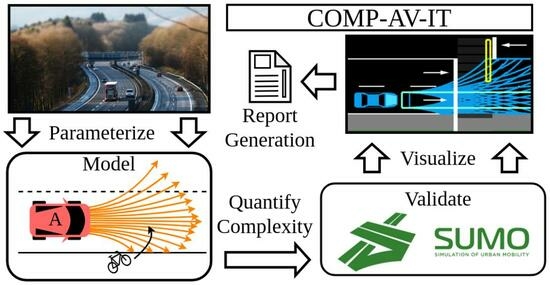
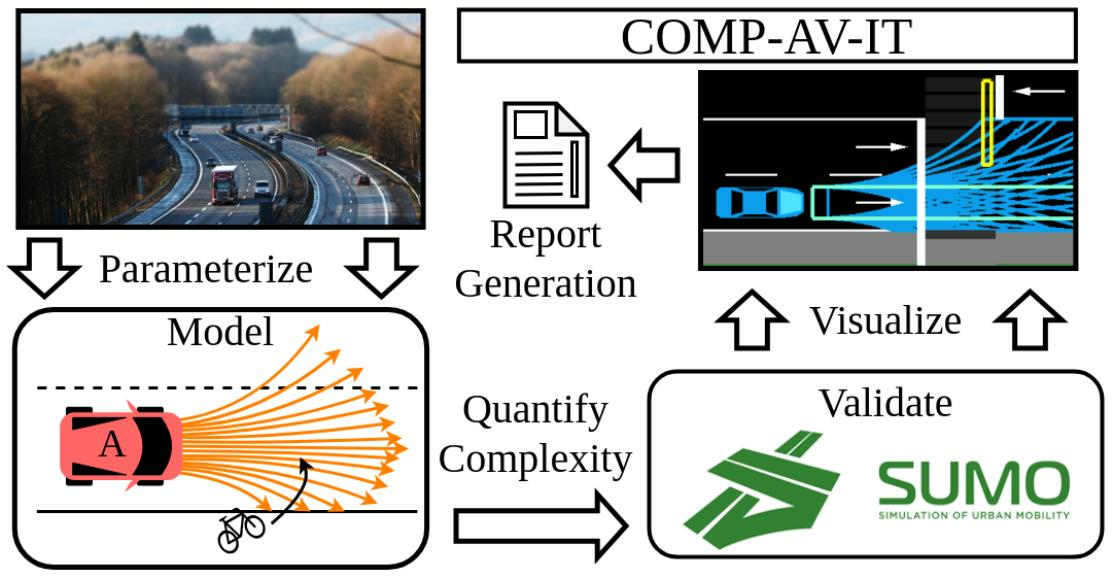
In this paper, we propose COMP-AV-IT, a complexity evaluation of AV safety validation scenarios using information theory. It is important to note that the scenario complexity in our approach is calculated from the perspective of the vehicle under test in the safety validation process. COMP-AV-IT allows for a nuanced evaluation of AV or ADAS performance, allowing developers to prioritize testing based on the potential challenges posed by different scenarios. By subjecting AVs to a comprehensive battery of tests that span the entire spectrum of complexity, engineers can refine algorithms, identify vulnerabilities, and enhance the overall robustness of autonomous driving systems [18,19].
The main contributions of this paper are four-fold as follows:
  • A novel quantification method is defined to evaluate the complexity of driving scenarios based on information entropy. The method includes the unpredictability of dynamic agents such as AVs, human-driven vehicles (HVs), and pedestrians.
  • The numerical complexity calculation is performed by defining driving scenarios and evaluating their complexity scores.
  • A software module with a user-friendly interface is developed to assist in complexity calculation and to allow users to try scenarios.
  • Independent simulations are conducted in a microscopic traffic simulator, Simulation of Urban MObility (SUMO), to evaluate the performance of the proposed method.
The remainder of the paper is organized as follows. In Section 2, the existing related literature is presented, and the relevant quantification approaches are explained. Section 3 defines COMP-AV-IT, our quantification method, to evaluate the complexity of driving scenarios based on information entropy. Section 4 illustrates the results of multiple driving scenarios by applying the proposed method and simulating scenarios in microscopic traffic simulation. The results are then compared and discussed in Section 5. Finally, conclusions are summarized, and future research recommendations are derived in Section 6.

3. Methodology

It is necessary to define what is meant by “complexity” to develop a quantification method that evaluates the complexity of driving scenarios based on information entropy. Several definitions vary depending on the scope of the research. For intelligent transportation systems, Sussman defines a system complex when it is difficult to predict the behavior [39]. This means that from an observer’s perspective, the system deals with many uncertainties. Based on this idea, Zhang et al. achieve a more objective quantification method of driving scenario complexity by considering the evolution of driving scenarios and predicting the motions of dynamic traffic participants [16]. In this paper, the term “scenario complexity” is used based on the definitions in these two references. It describes the level of randomness in a scenario, and hence, entropy in information theory is introduced to measure the motion uncertainties of traffic participants.
The focus of our paper is on the dynamic scenario complexity as it is more challenging to consider the unpredictability of dynamic traffic participants and their interactions in a driving scenario [40]. Hence, the static scenario complexity, which refers to weather and environmental conditions, is not the main focus of the approach. The dynamic scenario complexity C D considers AVs, HVs, bicycles, and pedestrians. The calculation of the entropy of vehicle motion is based on the statistical probability distribution of feasible vehicle trajectories.
The methodology section is divided into three parts to present the quantification method for the complexity evaluation of driving scenarios based on information entropy. In Section 3.1, the fundamental kinematic model used in COMP-AV-IT for vehicle position and dynamics is described. In Section 3.2, the method for the dynamic scenario complexity calculation using information theory is described. In Section 3.3, a sample-based searching algorithm is introduced to determine the drivable area of the subject vehicle.

3.1. Kinematic Model for Vehicle Position and Dynamics

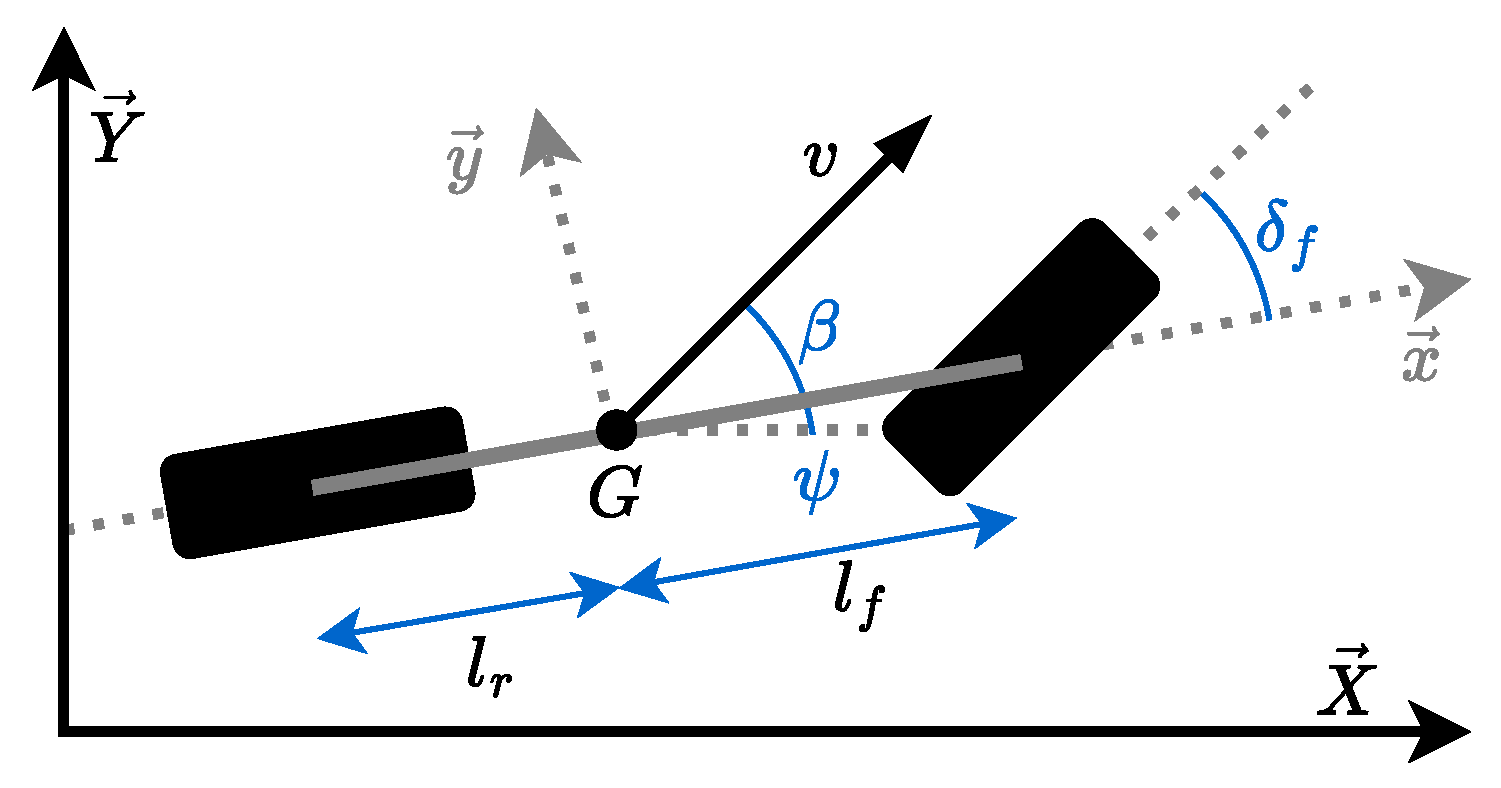
The drivable areas of subject vehicles are critical for the complexity calculation [41]. To generate the drivable area of a subject vehicle, a vehicle model is required. Zhang et al. introduced a kinematic bicycle model to describe the vehicle motions using relatively basic equations [16]. The vehicle model consists of equations that represent the lateral and longitudinal dynamics and the position on the road. In this paper, this model is extended and implemented to simulate and predict the behavior of the subject vehicle. The model is shown in Figure 1.
Figure 1. Kinematic bicycle model with tire slip.
The kinematic bicycle model with tire slip is used to predict the next state in a trajectory using the following state transition function:
KBM ( S i ) = S i + 1
where S i is the current state, and S i + 1 is the next state.
S i = [ x i , y i , v i , ψ i , a , δ , Δ t , l r , l f , s ̲ , s ¯ ]
Each state S is a vector of multiple features. The state variables are as follows:
  • x i : longitudinal position (m)
  • y i : lateral position (m)
  • v i : velocity (mps)
  • ψ i : heading angle at the center of gravity G for a given iteration i (rad)
  • Δ t: time elapsed
  • l r : distance from the center of gravity to the rear axle
  • l f : distance from the center of gravity to the front axle
  • s ̲ : minimum operational speed of the vehicle
  • s ¯ : maximum operational speed of the vehicle
The control inputs are as follows:
  • a: acceleration (mps2)
  • δ : steering angle of the front wheel, when assuming that only the front wheel can be steered (rad)
Knowing the slip angle at the center of gravity β , the next position ( x i + 1 , y i + 1 ) can be predicted using the following equations:
β = arctan l r l r + l f tan δ x i + 1 = x i + v i cos ψ i + β Δ t y i + 1 = y i + v i sin ψ i + β Δ t
The speed of the vehicle s at the next iteration i is predicted using the following equation:
s = v i + a Δ t
Then, the speed is confined to the operation speed of the vehicle such that s s ̲ , s ¯ and velocity v i + 1 is determined as follows:
v i + 1 = s < s ̲ s ̲ , s > s ̲ s ¯ , otherwise s
With vehicle speed, tires will slip slightly, altering the steering angle. The corrected angle is represented as ϑ , which is given as follows:
ϑ = v i l r sin β Δ t
Finally, the next heading angle ψ i + 1 is predicted as follows:
ψ i + 1 = ψ i + ϑ
The kinematic bicycle model with tire slip is required to generate the drivable area of a vehicle. The calculation of the driving area is necessary to define the dynamic scenario complexity calculation in Section 3.2. Then, a sample-based search algorithm is introduced in Section 3.3 that is based on this model.

3.2. Dynamic Scenario Complexity Calculation

This section defines the process for the complexity calculation. To calculate the complexity value, the following definitions are made:
  • The dynamic scenario complexity C D is calculated from the perspective of one of the vehicles in the scenario. This is the vehicle under test in the validation process.
  • The drivable area of the subject vehicle is described as the combination of possible trajectories and is determined by applying the kinematic bicycle model. The possible trajectories form a fan-shaped drivable area and depend on the vehicle speed.
  • The trajectories of the subject vehicle are Gaussian distributed with a mean equal to zero and variance equal to one.
  • The motions of the surrounding traffic participants in a driving scenario are known. The trajectory that the subject vehicle selects is unknown. The reaction of the subject vehicle is investigated in a specific scenario.
  • The entropy for selecting each trajectory of the subject vehicle is calculated to find the complexity of the whole scenario. For each trajectory, it must be defined which of the surrounding dynamic entities influences the motion of the subject vehicle and, therefore, must be considered in the entropy calculation for this specific trajectory. As soon as the trajectory of a surrounding traffic participant intersects with a trajectory within the fan-shaped drivable area of the subject vehicle, the object is included in the calculation. When a surrounding traffic participant is directly in the fan-shaped area, it is also considered in the calculation.
The entropy of a random variable measures the uncertainty and disorder of a system. The entropy is the sum of the variable’s possible values when given a discrete random variable X, which takes values in the alphabet X and is distributed according to p: X 0 , 1 :
H ( X ) = x X p ( x ) log 2 p ( x )
Based on this general idea of entropy, the entropy of a surrounding dynamic entity when the motion is known in a driving scenario is as follows:
H i = p ( τ i ) log 2 p ( τ i )
where H i is the entropy of a dynamic traffic participant for selecting one specific trajectory τ i and p ( τ i ) is the possibility of selecting a specific trajectory τ i .
For the calculation of the subject vehicle’s entropy in a driving scenario, it must be checked for each trajectory if other traffic participants influence its motion and, therefore, must be considered in the calculation. This decision depends on whether there are intersections of trajectories or if a traffic participant is in the fan-shaped area of the subject vehicle. The entropy of the subject vehicle for a specific trajectory H S u b j e c t ( τ = i ) is described as follows:
H Subject ( τ = i ) = p ( τ i ) log 2 p ( τ i ) + i = 1 N λ i H i
where N is the number of traffic participants that can influence the motion of the subject vehicle in a driving scenario and H i is the entropy of the ith surrounding dynamic entity in a driving scenario. λ i is the influence of a traffic participant and λ v e h i c l e = 1 , λ b i c y c l e = 0.9 , λ p e d e s t r i a n = 0.8 . p ( τ i ) is the possibility of selecting a specific trajectory τ i .
The dynamic scenario complexity C D for a subject vehicle is the sum of all entropies that are calculated for each trajectory of the subject vehicle:
C D = τ = i n H S u b j e c t τ = i
where H S u b j e c t τ = i is the entropy of the subject vehicle for a specific trajectory.

3.3. Sample-Based Search Algorithm

The computation of the drivable area of the subject vehicle is performed by our sample-based search algorithm, which is implemented as a software module specifically for this paper. The possible occupied drivable area of the subject vehicle is determined by generating trajectories that are represented as sequences of (x, y) positions in 2-dimensional space while adhering to vehicle kinematic constraints in a time window. The drivable area is made up of infinite feasible trajectories and is essential in quantifying the entropy of the vehicle. A novel sample-based search algorithm is introduced to identify the boundary trajectory of the maximum drivable area.
The model has two control parameter ranges, and all trajectories start at the root state S 0 :
  • Acceleration a a ̲ , a ¯ between the minimum acceleration a ̲ (i.e., max deceleration), and maximum acceleration a ¯ .
  • Steering angle of the front axle δ δ ̲ , δ ¯ between the rightmost steering angle δ ̲ and leftmost steering angle δ ¯ .
The number of trajectories generated is n a n δ where n a is the number of samples from a and n δ is the number of samples from δ . The duration of trajectories simulation time w and time step duration Δ t is to be chosen. Each trajectory is simulated for a maximum of w Δ t iterations. Each trajectory is uniquely identified by the ( a , δ ) sample and is a sequence of n x y ( x , y ) points that form a polyline where n x y 1 , w Δ t .
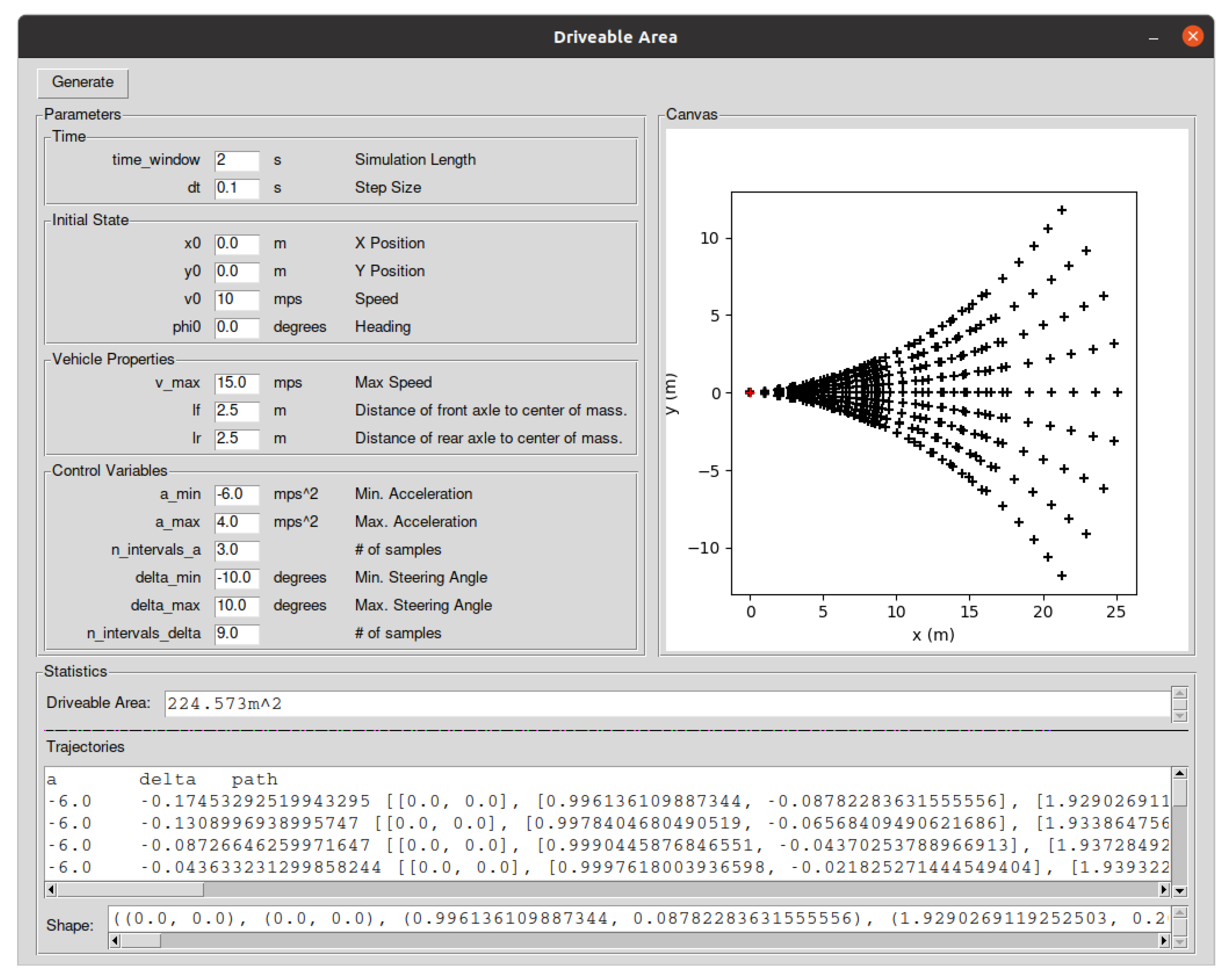
Figure 2 shows the designed user interface to determine the drivable area of a subject vehicle. In this configuration, the length of the time window is 3 s, and the time step duration Δ t is 0.1 s. The initial state of the subject vehicle is described by the parameters initial x and y positions, initial speed, and the initial vehicle heading angle. The subject vehicle cannot move faster than 15 mps. The distances from the axles to the center of gravity are each 2.5 m. The control inputs are set as described in [16]. The control inputs of a and δ are, respectively, sampled from the range [−6, 4] (mps2) and [−10, 10] (deg). Three samples are between the minimum and maximum acceleration, and 15 samples are set for the number of samples between the minimum and maximum steering angles.
Figure 2. User interface to determine the drivable area.
To obtain a drivable area polygon, the boundary points are determined from all points generated during trajectory simulations. With a polygon identified, the drivable area can be calculated using the shoelace equation. The model works under the following assumptions:
  • Minimum vehicle speed s ̲ > 0
  • Acceleration a and steering angle δ are constant for each trajectory simulation.
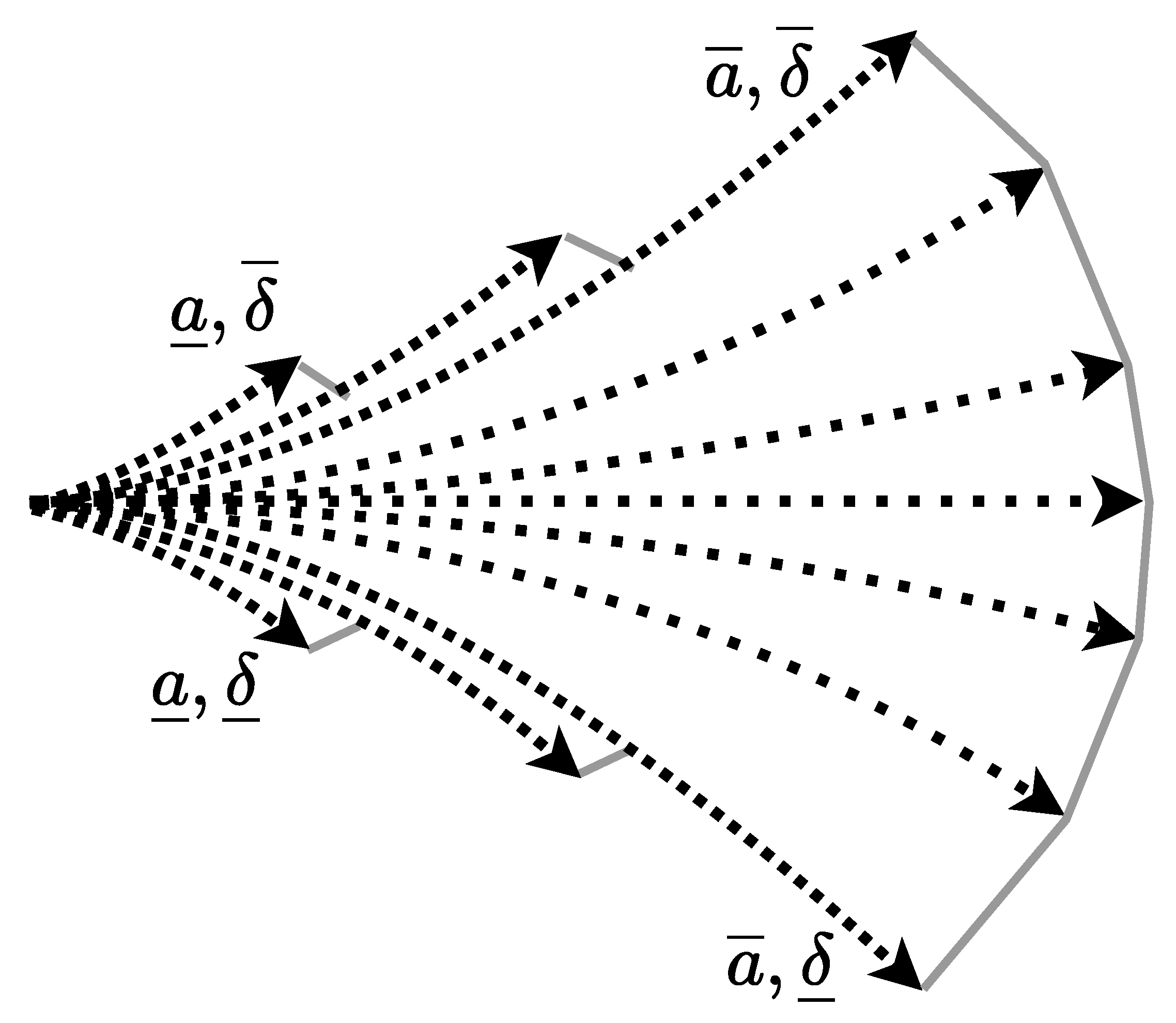
The trajectories form a potentially asymmetrical and irregular fan shape. The acceleration a and steering angle δ are the IDs of a trajectory. There are n increments in accelerations where a 0 = a ̲ and a n = a ¯ . Likewise, there are N increments in the steering angle where δ 0 = δ ̲ and δ n = δ ¯ . The model uses the following strategy to find the boundary polygon starting from the origin and proceeding clockwise around the points of the trajectory cluster (Figure 3):
  • The polyline that forms the boundary polygon starts with the leftmost trajectories, beginning with the trajectory with the smallest acceleration and largest steering angle ( a 0 , δ ¯ , i.e., a ̲ , δ ¯ ). The polyline continues from the nearest point in a 1 . δ ¯ to the last point in a 0 , δ ¯ and continues to the end of a 1 , δ ¯ . This is repeated through a n , δ ¯ .
  • Next, the front of the fan is added. This is the last point of trajectories with a ¯ , δ ¯ to a ¯ , δ ̲ , excluding the leftmost and rightmost trajectories, i.e., a ¯ , δ n 1 to a ¯ , δ 1 .
  • Finally, the polygon of the rightmost trajectories is added. To do so, the polyline from a ̲ , δ ̲ to a ¯ , δ ̲ is obtained. As this method finds the boundary points clockwise from the origin, the values of the rightmost trajectory polyline are appended to the boundary polyline from the last to the first index.
Figure 3. Trajectory boundary definition.

4. Scenario Complexities Using COMP-AV-IT

To demonstrate the performance of COMP-AV-IT, we define multiple sample driving scenarios and calculate their complexities. Hence, six (6) driving scenarios are selected to be presented and analyzed in this section for results. The complexity scores of these scenarios are first calculated according to the methodology presented in Section 3.2. The results are used to rank the driving scenarios from the most complex to the least complex scenario. Then, these scenarios are also modeled in SUMO [42] to see if the results align with the behavior in simulation and to evaluate the effectiveness and adaptability of the proposed framework.
Considerations are taken during scenario design to construct applicable driving scenarios that reflect real-life situations of driving conditions in traffic environments. Traffic environments are complex systems with many factors, e.g., the street network and the roads the vehicles travel on, as well as the vehicles that make up the traffic and their behaviors. There is an endless number of potential driving scenarios, which poses a problem when choosing which scenarios to test under time and resource constraints [12]. This is considered during the design of the scenario examples in this paper.
The driving scenarios focus on the behavior of vehicles and actors relative to an ego vehicle, Vehicle A. The scenarios are up to two other vehicle actors, Vehicles B and C, and a pedestrian actor P. The scenarios take place on a two (2) or three (3) lane segment of highway. A crosswalk is also present when pedestrians are included. The example scenarios are modeled in two forms, each with its own level of fidelity: In Section 4.1, the driving scenarios are modeled as lower-fidelity, theoretical scenarios, where vehicles are placed on a segment of the road relative to the ego Vehicle A, and their trajectories are given. In Section 4.2, the driving scenarios are modeled as higher-fidelity SUMO scenarios, where the actors operate along the edges (roads and sidewalks) of a street network.

4.1. Scenarios and Complexity Calculation

In the complexity calculation, the drivable area of the subject vehicle is determined using the sample-based search algorithm. The parameters are the same as shown in Figure 2. Then, six different scenarios are selected for the dynamic scenario complexity calculation. The steps to calculate the dynamic scenario complexity are described in Section 3.2. A figure for each scenario and the calculation steps are given in the following sections. In each scenario, Vehicle A is the subject vehicle, and the motions of the traffic participants surrounding the subject vehicle are predetermined. The subject vehicle can select any possible trajectory. For the sake of clarity and brevity, only the a ¯ trajectories are considered when calculating the drivable scenarios D1–D6.
D1.
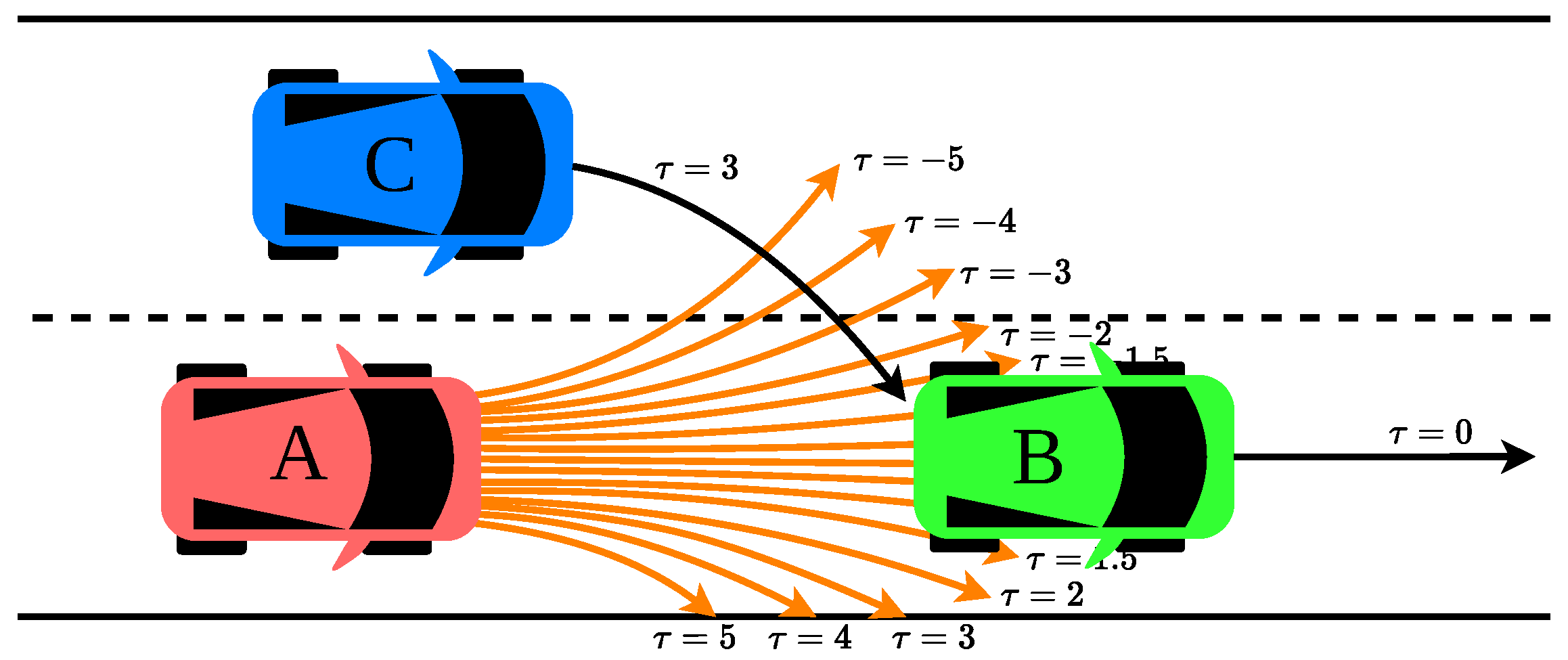
Cut-in Scenario A: In this scenario, Vehicle A is in traffic behind Vehicle B, and another vehicle, C, is making a “cut-in” maneuver toward Vehicle A’s lane. Vehicle A is the subject vehicle, and the scenario complexity is calculated from the perspective of this vehicle. The vehicle motions of Vehicle B and Vehicle C are known as shown in Figure 4.
Figure 4. Design of driving scenario D1.
Table 1 below describes for each trajectory of the subject vehicle if other vehicles must be considered in the entropy calculation or not. This consideration depends on whether the vehicle motion intersects with a trajectory within the fan-shaped area of the subject vehicle or if a traffic participant is directly within the fan-shaped area. For example, Vehicle C is considered for the entropy calculation of the subject vehicle for the leftmost trajectory ( τ = −5) because of the intersection. For the specific trajectory ( τ = 0), just Vehicle B is considered because this vehicle is in the fan-shaped area of the subject Vehicle A.
Table 1. Overview of the influencing vehicles for the entropy calculation.
For all driving scenarios D1–D6, Vehicle A has the same trajectory choices and weights. The difference between scenarios is the placement, trajectory, and involvement of Vehicles B and C. To compare scenarios concisely, we adapt Equation (3) to reflect the pattern in Table 1:
C D = H Subject τ = i = H A τ = i + λ B H B τ = i + λ C H C τ = i
where i is the index of the fifteen (15) possible discretized trajectories:
i { 5 , 4 , 3 , 2 , 1.5 , 1 , 0.5 , 0 , 0.5 , 1 , 1.5 , 2 , 3 , 4 , 5 }
In this representation, C D is the sum of all entity trajectories that overlap with the subject vehicle’s trajectories. Since the surrounding dynamic entities in this driving scenario are vehicles, the influence of those in scenarios D1–D5 is λ B = λ C = 1 .
In this driving scenario example, we will calculate the entropy of the subject vehicle, Vehicle A, for all scenarios D1–D6. Vehicle A has 15 possible trajectories that it may select. In this step, we find the entropy H A of all potential trajectories for Vehicle A:
H A ( τ = 5 ) = p ( τ 5 ) log 2 ( 5 ) = 1.49 ( 10 6 ) log 2 ( 1.49 ( 10 6 ) ) = 2.9 ( 10 5 ) H A ( τ = 4 ) = p ( τ 4 ) log 2 ( 4 ) = 0.000134 log 2 ( 0.000134 ) = 0.001724 H A ( τ = 3 ) = p ( τ 3 ) log 2 ( 3 ) = 0.004432 log 2 ( 0.004432 ) = 0.034649 H A ( τ = 2 ) = p ( τ 2 ) log 2 ( 2 ) = 0.053991 log 2 ( 0.053991 ) = 0.227364 H A ( τ = 1.5 ) = p ( τ 1.5 ) log 2 ( 1.5 ) = 0.129518 log 2 ( 0.129518 ) = 0.38192 H A ( τ = 1 ) = p ( τ 1 ) log 2 ( 1 ) = 0.241971 log 2 ( 0.241971 ) = 0.495337 H A ( τ = 0.5 ) = p ( τ 0.5 ) log 2 ( 0.5 ) = 0.352065 log 2 ( 0.352065 ) = 0.53024 H A ( τ = 0 ) = p ( τ 0 ) log 2 ( 0 ) = 0.398942 log 2 ( 0.398942 ) = 0.528897 H A ( τ = 0.5 ) = p ( τ 0.5 ) log 2 ( 0.5 ) = 0.352065 log 2 ( 0.352065 ) = 0.53024 H A ( τ = 1 ) = p ( τ 1 ) log 2 ( 1 ) = 0.241971 log 2 ( 0.241971 ) = 0.495337 H A ( τ = 1.5 ) = p ( τ 1.5 ) log 2 ( 1.5 ) = 0.129518 log 2 ( 0.129518 ) = 0.38192 H A ( τ = 2 ) = p ( τ 2 ) log 2 ( 2 ) = 0.053991 log 2 ( 0.053991 ) = 0.227364 H A ( τ = 3 ) = p ( τ 3 ) log 2 ( 3 ) = 0.004432 log 2 ( 0.004432 ) = 0.034649 H A ( τ = 4 ) = p ( τ 4 ) log 2 ( 4 ) = 0.000134 log 2 ( 0.000134 ) = 0.001724 H A ( τ = 5 ) = p ( τ 5 ) log 2 ( 5 ) = 1.49 ( 10 6 ) log 2 ( 1.49 ( 10 6 ) ) = 2.9 ( 10 5 )
The trajectories of Vehicle A overlap only themselves. Thus, the total entropy for H A is:
H A τ = i = 3.871423
We apply our dynamic scenario complexity calculation and calculate the entropy of the surrounding Vehicle B and Vehicle C in this driving scenario. We know the motion of Vehicles B and C. Vehicle B follows its current path that corresponds to the trajectory τ = 0 . The other vehicle, C, does a “cut-in” maneuver toward vehicle A’s lane. This movement corresponds to trajectory τ = 3 . We solve the entropy equations for surrounding Vehicles B and C using Equation (1). The trajectory of vehicle B overlaps seven (7) trajectories of Vehicle A. We solve for the influence of vehicle B:
λ B H B τ = i = 7 λ B H B ( τ = 0 ) = ( 7 ) ( 1 ) p ( τ 0 ) log 2 p ( τ 0 ) = ( 7 ) ( 0.398942 ) log 2 ( 0.398942 ) = 3.70227
The trajectory of Vehicle C overlaps five (5) trajectories of Vehicle A. We solve for the influence of Vehicle C:
λ C H C τ = i = 5 λ C H C τ = i = ( 5 ) ( 1 ) p ( τ 3 ) log 2 p ( τ 3 ) = ( 5 ) ( 0.004432 ) log 2 ( 0.004432 ) = 0.17324
To calculate the scenario complicity for scenario D1, we sum the influence of all vehicles as described by Equation (4):
C D 1 = H Subject τ = i = 3.871423 + 3.70227 + 0.17324 = 7.746933
The scenario complexity score is 7.746933.
D2.
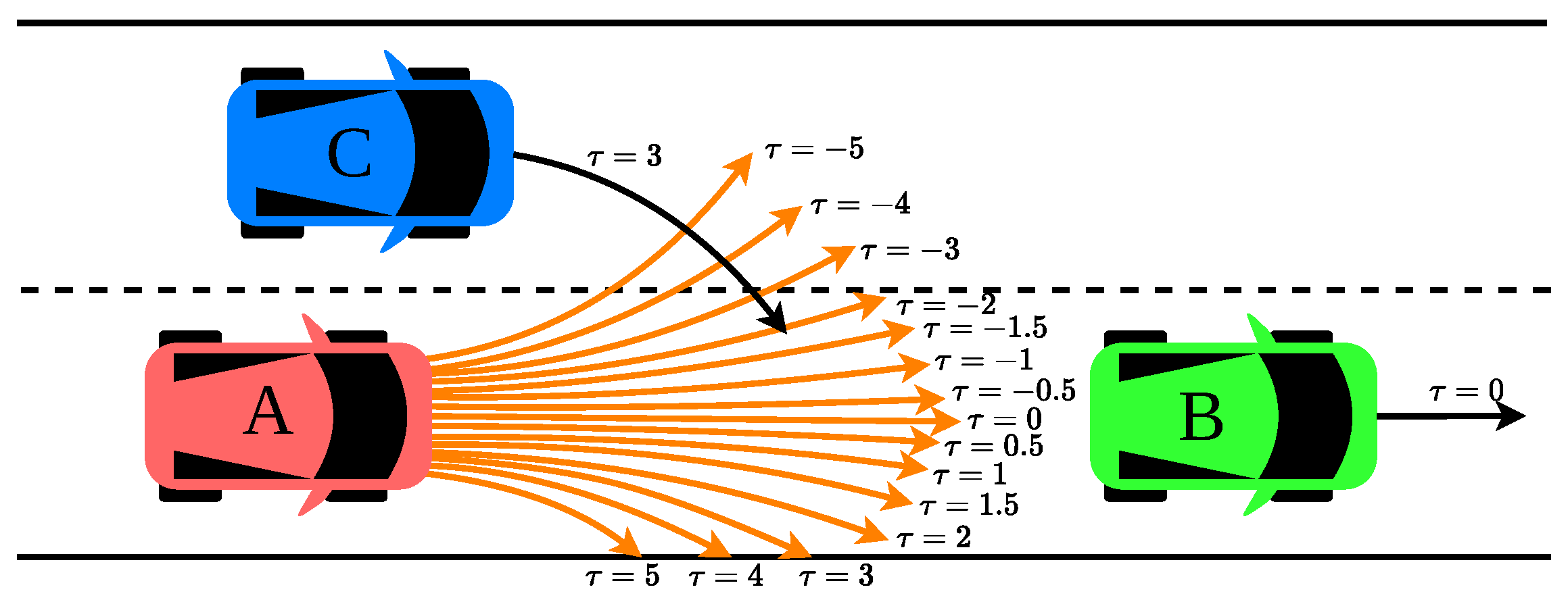
Cut-in Scenario B: In this scenario, Vehicle A is in traffic behind Vehicle B, and another Vehicle C is making a “cut-in” maneuver towards Vehicle A’s lane. Compared to the previous cut-in scenario, Vehicle B is never considered in the calculation because it is not in the drivable area of the subject Vehicle A. Figure 5 shows that Vehicle C is considered for the calculation of the entropy of the subject vehicle for trajectories τ = 5 , τ = 4 , τ = 3 and τ = 2 .
Figure 5. Design of driving scenario D2.
The trajectory of Vehicle C overlaps with four (4) trajectories of Vehicle A. We solve for the influence of Vehicle C:
λ C H C τ = i = ( 4 ) ( 1 ) ( 0.004432 ) log 2 ( 0.004432 ) = 0.138596
H A is unchanged from Equation (5) and H B = 0 . Thus, the scenario complexity is calculated as follows:
C D 2 = H Subject τ = i = 3.871423 + 0 + 0.138596 = 4.010019
D3.
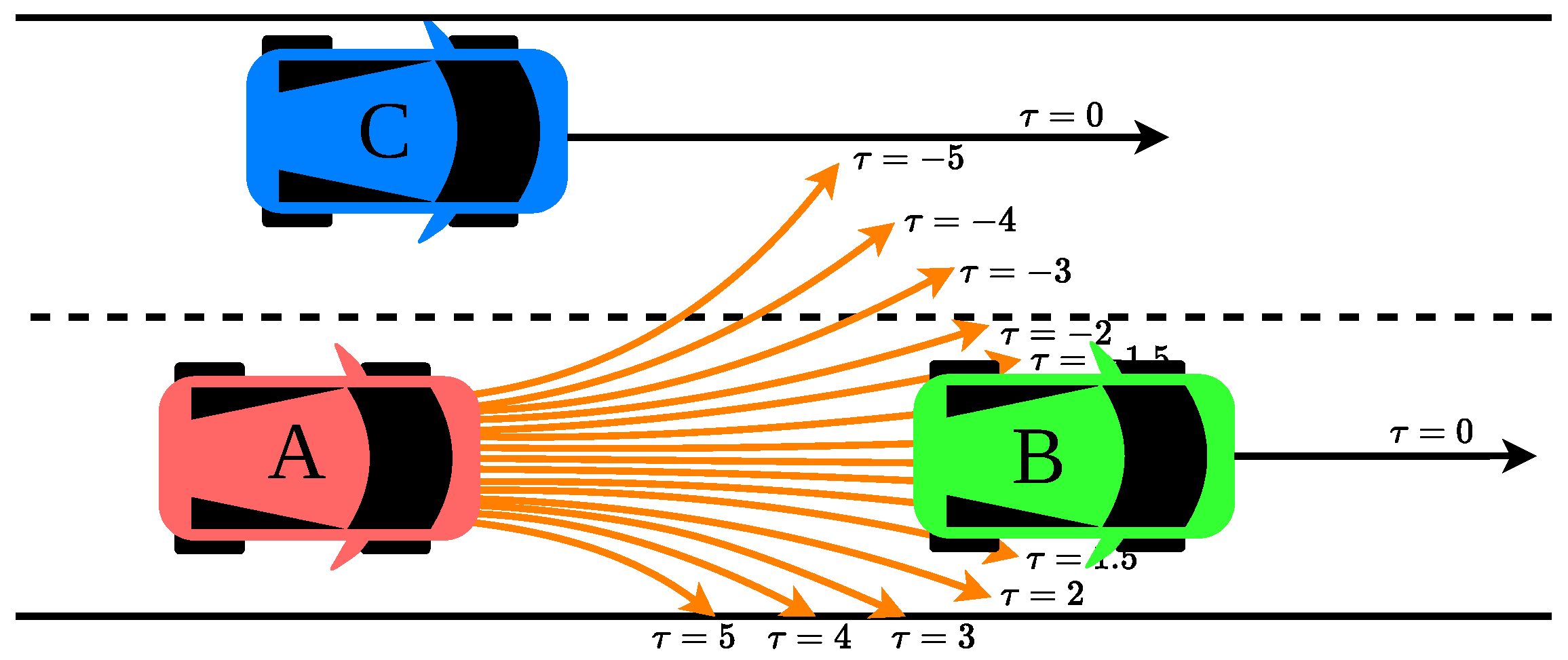
2-Lanes Traffic Scenario: In this scenario (Figure 6), Vehicle A is in traffic behind Vehicle B. Vehicle C continues straight in the lane next to the subject Vehicle A’s lane. Vehicle C is not considered in the scenario complexity calculation because it is not in the drivable area of the subject Vehicle A. Vehicle B is considered for the entropy calculation for the trajectories τ = 1.5 , τ = 1 , τ = 0.5 , τ = 0 , τ = 0.5 , τ = 1 and τ = 1.5 .
Figure 6. Design of driving scenario D3.
The trajectory of vehicle B ( τ = 0 ) overlaps with seven (7) trajectories of Vehicle A. The influence is already calculated in Equation (6) to be H B = 3.70227 . Thus, the scenario complexity is calculated as follows:
C D 3 = H Subject τ = i = 3.871423 + 3.70227 + 0 = 7.573693
D4.
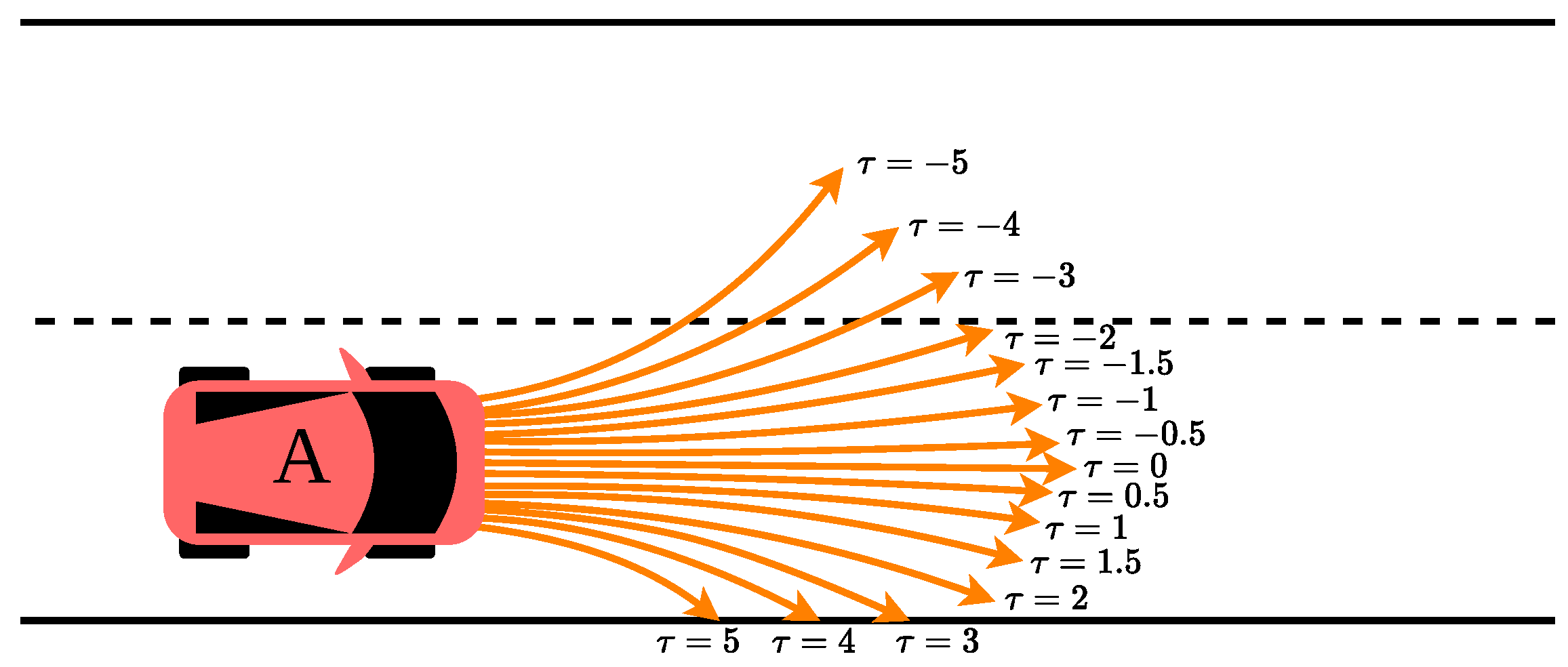
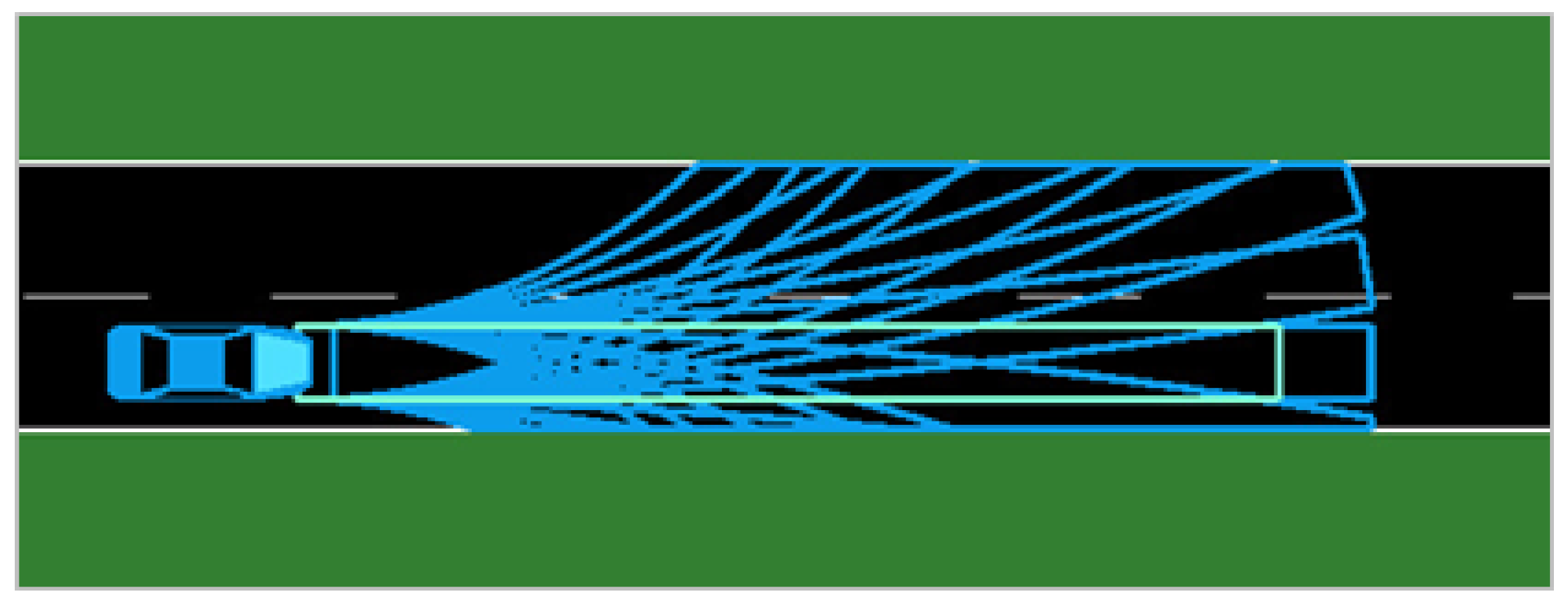
2-Lanes No Traffic Scenario: In this scenario, there is no traffic participant other than subject Vehicle A (Figure 7), which means H B = H C = 0 . The scenario complexity is calculated as follows:
C D 4 = H Subject τ = i = 3.871423 + 0 + 0 = 3.871423
Figure 7. Design of driving scenario D4.
D5.
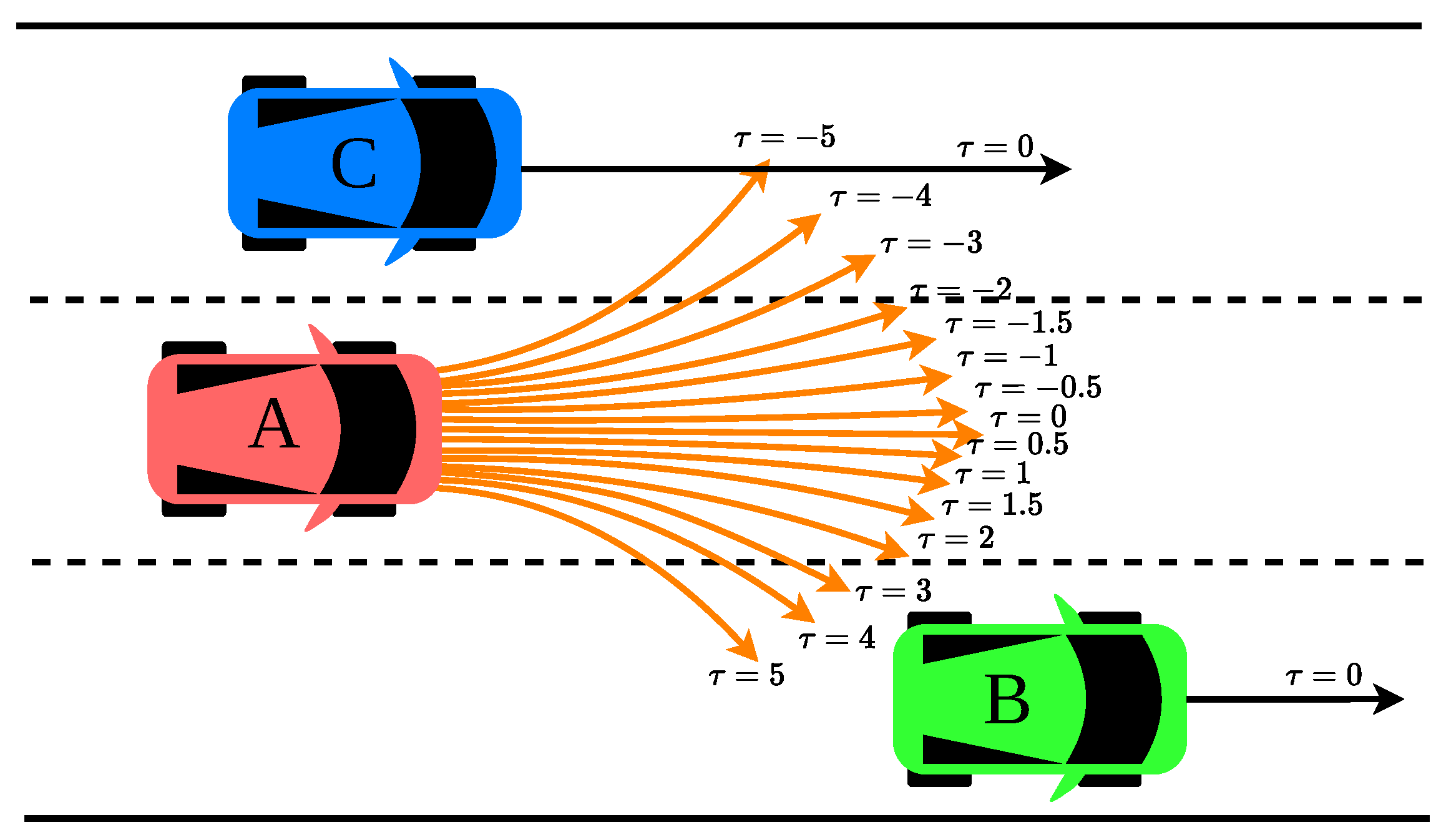
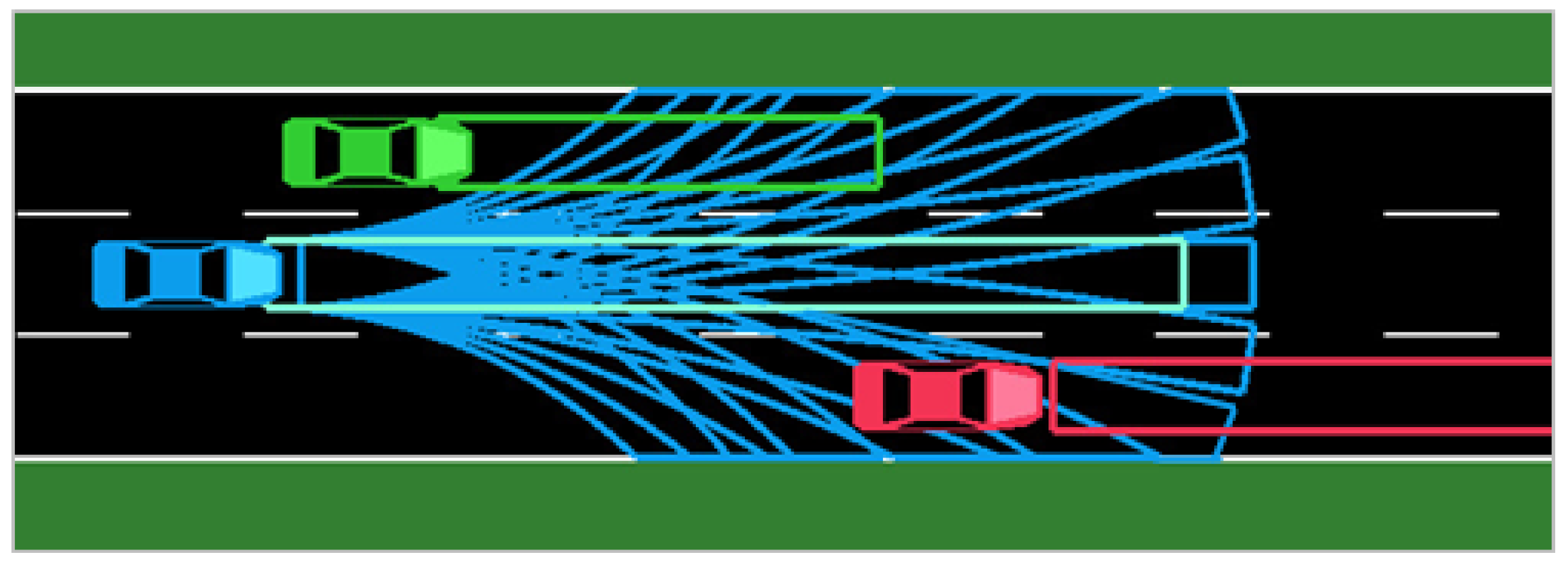
3-Lanes Traffic Scenario: Figure 8 shows the configuration of the fifth scenario. In this scenario, Vehicle A is in the middle traffic lane between Vehicle B and Vehicle C. Vehicle A is the subject vehicle, and the scenario complexity is calculated from the perspective of this vehicle. Vehicle B and Vehicle C go straight into their lane. Vehicle B is not considered in the scenario complexity calculation because it is not in the drivable area of the subject Vehicle A. Vehicle C is considered for the entropy calculation of the subject vehicle for the trajectory τ = 5 .
Figure 8. Design of driving scenario D5.
The trajectory of Vehicle C ( τ = 0 ) overlaps with one (1) trajectory of Vehicle A. We solve for the influence of Vehicle C:
λ C H C τ = i = ( 1 ) ( 1 ) ( 0.398942 ) log 2 ( 0.398942 ) = 0.528897
The scenario complexity is calculated as follows:
C D 5 = H Subject τ = i = 3.871423 + 0 + 0.528897 = 4.40032
D6.
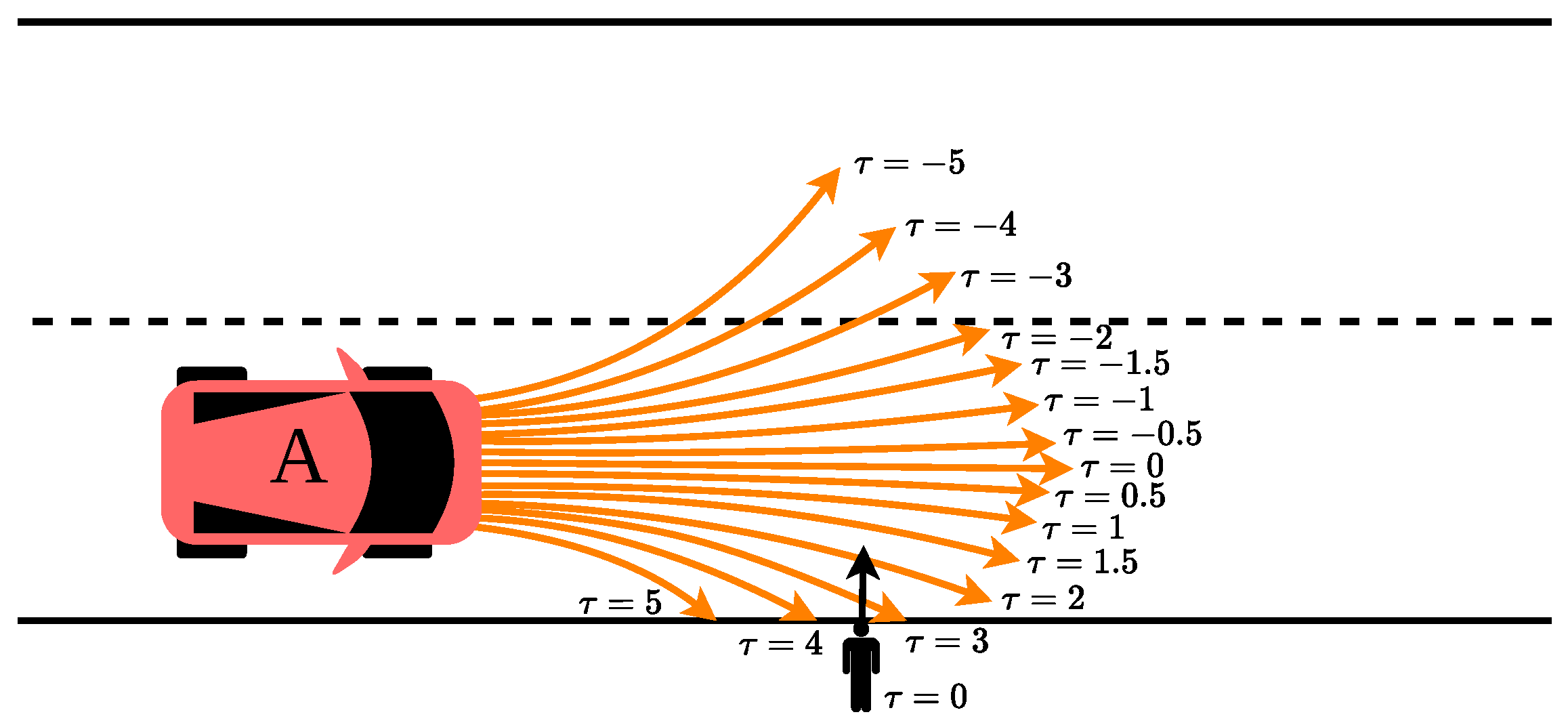
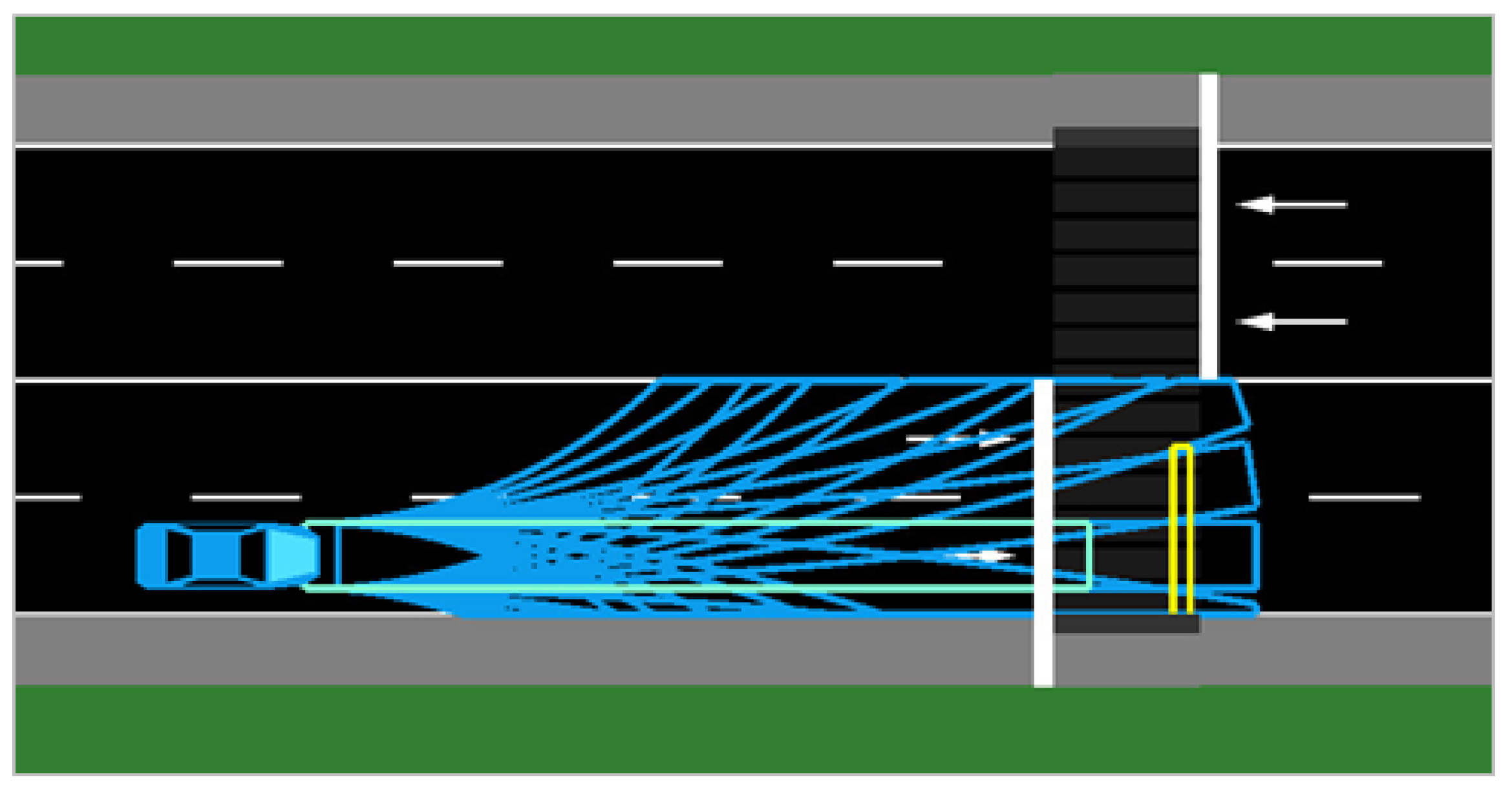
2-Lanes No Traffic with Pedestrian Crossing Scenario: In this last scenario, the subject vehicle is surrounded by no other vehicle, but a pedestrian is crossing the subject vehicle’s path (Figure 9). The pedestrian is considered for the entropy calculation of the subject vehicle for the trajectories τ = 2 and τ = 3 .
Figure 9. Design of driving scenario D6.
The trajectory of Pedestrian P ( τ = 0 ) overlaps with two trajectories of Vehicle A, and as a pedestrian, the influence is λ = 0.8 . We solve for the influence of Pedestrian P:
λ P H P τ = i = ( 0.8 ) ( 2 ) ( 0.398942 ) log 2 ( 0.398942 ) = 0.8462352
The scenario complexity is the sum of all influences in the scenario, which are H A and H P . Thus, the scenario complexity is calculated:
C D 6 = H Subject τ = i = λ P H P τ = i + λ P H P τ = i = 3.871423 + 0.8462352 = 4.717658

4.2. Simulation Scenarios and Complexity Classification

The performance of COMP-AV-IT is evaluated in simulation using the open-source microscopic traffic simulator SUMO v1.20.0 on Ubuntu v20.04.6 with Python v3.9.20 and the TraCI v1.19.0 Python package. SUMO is an open-source traffic simulation software that allows the modeling of traffic systems, including road vehicles, public transport, and pedestrians [42]. The scenarios that are used in the previous section are modeled and tested in SUMO. The implementation of scenario-based AV testing follows the approach of Goss et al. [26,27], where-in the modular, measurable, shareable, and general-case scenarios are derived from the scenarios of Section 4.1 then evaluated through extensive simulation tests.

4.2.1. Simulation Scenario Abstraction Levels

The scenarios in Section 4.1 are abstracted into five logical scenarios with parameter ranges for scenario-based testing. The parameter ranges are used to create variations of each simulation. Hence, an abstraction process is followed in the modeling and simulation process with the following three levels:
  • Formal Abstraction Level: At this abstraction level, a scenario is defined in a human-readable format, often through forms or in a conversational tone, which describes the setting, mission, actors, and actions of participants in a scenario. The actions are described using atomic ideas of behavior or misbehavior, e.g., “Make a left turn”, or “Turn right at the traffic light”. At this level of abstraction, an expert in an operational design domain (ODD) may make a reasonable estimation of a scenario based on expert knowledge, e.g., vehicles confined to roads adhere to or close to road network rules and operate within definable physical constraints. An example scenario at the formal abstraction level is as follows:
    • “A vehicle turns right at a traffic light”.
  • Logical Abstraction Level: At this abstraction level, a scenario is defined in a computer-readable formal with explicit instructions for scenario construction. Parameter ranges are used to represent multiple configurations with a single description. An example scenario at the logical abstraction level is as follows:
    • “Vehicle A is 0–100 m from an intersection with a traffic light, traveling at 0–5 mps. The vehicle under test will safely turn right at the intersection”.
  • Concrete Abstraction Level: At this abstraction level, one configuration of a scenario is represented by selecting explicit, concrete values from each parameter range. An example scenario at the concrete abstraction level is as follows:
    • “Vehicle A is 27 m from an intersection with a traffic light, traveling at 4 mps. The vehicle under test will safely turn right at the intersection”.

4.2.2. Simulation Scenarios Setup

A summary of the scenario setups is presented in Table 2. The two drivable cut-in scenarios (D1 and D2) are combined in one scenario (L1) that satisfies both configurations (See Figure 10). The remaining drivable scenarios are also abstracted into logical scenarios:
  • L2 is 2-lanes with traffic scenario (Figure 11).
    Figure 11. SUMO simulation of Scenario L2.
  • L3 is 2-lanes without traffic scenario (Figure 12).
    Figure 12. SUMO simulation of Scenario L3.
  • L4 is 3-lanes with traffic scenario (Figure 13).
    Figure 13. SUMO simulation of Scenario L4.
  • L4 is a pedestrian crossing scenario (Figure 14).
    Figure 14. SUMO simulation of Scenario L5.
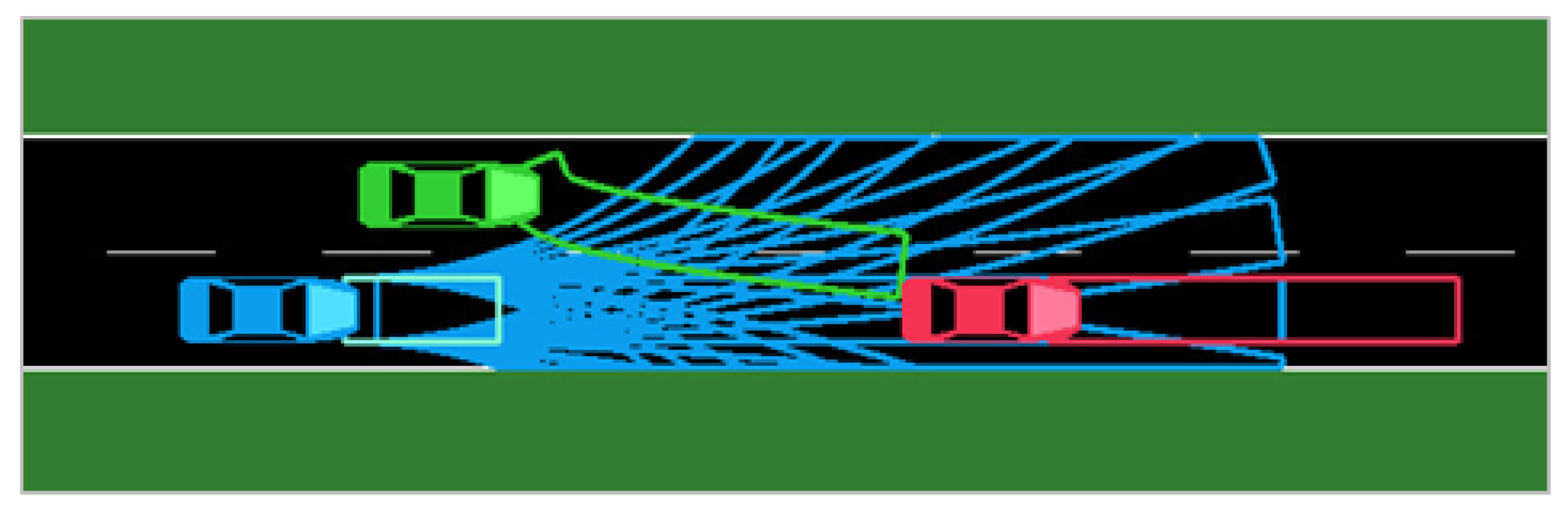
Figure 10. SUMO simulation of Scenario L1.
Table 2. Scenario Setup.
Logical
Scenario:L1L2L3L4L5
DrivingD1
Scenario:D2D3D4D5D6
Road Network Configuration
lanes22232
actors33132
ped X-ing
Actor Placement
lane 2 C
lane 1CC A
lane 0ABABABA
sidewalk P
Parameter Ranges
s 0 A
s 0 B
s 0 C
dist B A
dist C A
dist P A
dist P 0
lcd
Performance Metrics
C D
collision A
max(decelA)
min(dtcAB)
min(dtcAC)
min(dtcAP)
min(ttcAB)
min(ttcAC)
min(ttcAP)
Using SUMO and TraCI, which allows micro-control of the SUMO simulator, scenarios are implemented on road networks with lanes 3.5 m wide, sidewalks 2 m wide, and maximum network speed set to 50 mps. The vehicle parameters used are a maximum speed of 15 mps, a wheelbase of 2.63 m, and a maximum steering angle of 10 degrees. The vehicle AI used is the SUMO no-collision AI, which attempts to keep a gap of 2.5 m between vehicles and utilizes a driving plan that prevents the need for excessive braking when possible, i.e., braking force > 4.5 mps2. The pedestrian in the simulations always begins at a speed of 0 mps, has a maximum speed of 1.2 mps, and acceleration of 1.5 mps2.
The parameter ranges used in the scenarios vary according to the scenario requirements, as shown in Table 2. For each scenario, as depicted in Figure 10, Figure 11, Figure 12, Figure 13 and Figure 14, the blue vehicle is the subject Vehicle A, the red vehicle represents Vehicle B, and the green vehicle represents Vehicle C. The parameter ranges for these scenarios are defined as follows:
  • The initial speed of Vehicle A 0 mps s 0 A 15 mps by 0.27 mps increments.
  • The initial speed of Vehicle B 0 mps s 0 B 15 mps by 0.27 mps.
  • The initial speed of Vehicle C 0 mps s 0 C 15 mps by 0.27 mps.
  • The initial lateral distance of Vehicle B from Vehicle A dist B A . For scenarios L1 and L2. 10 m ≤ dist B A 30 m by 1 m. For scenario L4 0 m ≤ dist B A 30 m by 1.
  • The initial lateral distance of Vehicle C from Vehicle A 0 m ≤ dist C A 30 m by 1 m.
  • The initial lateral distance of Pedestrian P from Vehicle A 0 m ≤ dist P A 30 m by 1 m.
  • The distance Pedestrian P begins from the start of the crosswalk measured from right-to-left of the front of Vehicle A 0 m ≤ dist P 0 5 m by 1 m.
  • The duration of time a vehicle takes to transition from one lane to another during a lane-change maneuver, i.e., lane-change duration (lcd), 0.5 s ≤ lcd ≤ 5 s by 0.1 s.
Scenarios are evaluated using several performance metrics. Distance to collision (DTC) and TTC are commonly used to define these metrics. Hence, it is important to define DTC and TTC. DTC is the Euclidean distance between two positions, p and q, at the time instant i:
dtc i ( p i , q i ) = ( q x i p x i ) 2 + ( q y i p y i ) 2
The point of reference for the position is the center of the front of the vehicle or pedestrian. TTC at the time instant i for two vehicles is:
TTC i = dtc i s rel i
where s rel i is the relative speed between two vehicles at moment i. With DTC and TTC defined, the performance metrics can be listed as follows:
  • C D , scenario complexity prediction.
  • collisionA, whether Vehicle A is involved in a collision (collisionA = 1) or not (collisionA = 0).
  • max(decelA), the maximum deceleration force of Vehicle A observed during the testing window.
  • min(dtcAB), the minimum DTC between Vehicles A and B observed during the testing window.
  • min(dtcAC), the minimum DTC between Vehicles A and C observed during the testing window.
  • min(dtcAP), the minimum DTC between Vehicle A and Pedestrian P observed during the testing window.
  • min(ttcAB), the minimum TTC between Vehicles A and B observed during the testing window.
  • min(ttcAC), the minimum TTC between Vehicles A and C observed during the testing window.
  • min(ttcAP), the minimum TTC between Vehicle A and Pedestrian P observed during the testing window.
Table 2 shows the performance metrics used for each simulation scenario. Both distance and time metrics are used as part of the performance metrics. DTC metrics provide a concise estimation of the closeness between actors using the terminology of the ODD, thus allowing the performance metric to be compared as a ratio to vehicle properties such as length and min gap. Likewise, TTC directly estimates the collision risk using DTC and the relative speed of actors, allowing the performance metric to be compared as a ratio of relative actor speeds and distances.
A limitation of the TTC metric is the assumption that the speed of actors is constant when calculating the time to a possible collision. However, the limitation comes with the trade-off of reduced time and resource costs during simulation tests. In this paper, no further performance metrics are used; however, there exist other supplementary performance metrics which may be considered:
  • Deceleration Rate to Avoid Collision (DRAC) represents the rate at which a vehicle must decelerate to avoid a collision with another actor or object. DRAC may be defined as:
    DRAC = v 2 2 d
    where v is the relative speed of the vehicle and d is the distance to the other actor or object.
  • Modified Time to Collision (MTTC) takes into account relative acceleration a, which provides a more accurate estimation of TTC where relative velocity v is assumed to be constant. MTTC may be defined as:
    MTTC = v ± v 2 2 a d a
    where v is relative velocity, a is relative acceleration, and d is relative distance between two actors. The MTTC equation is quadratic and, as such, evaluates to two solutions. The negative solution may be mathematically valid but physically irrelevant, e.g., the objects are not at their current positions.
  • Proportion of Stopping Distance (PSD) quantifies the ratio of the distance available to stop a vehicle d a to the physically required stopping distance under current conditions d r . PSD may be defined as:
    PSD = d a d r
    where d a is the available stopping distance and d r is the required stopping distance. When PSD ≥ 1, the vehicle has adequate space to stop safely with normal braking force. When PSD < 1, the vehicle has inadequate space to stop safely, which means the vehicle must find another means to avoid a collision, e.g., going around the obstacle.
Using the performance metrics, a ranking system for the scenarios can be determined by categorizing the scenarios in three ways:
  • Collision: The subject vehicle collides with another dynamic traffic participant. If an accident happens, the performance metrics TTC and DTC are both zero.
  • Near Collision: In these scenarios, the subject vehicle is not involved in a collision, but the braking exceeds the normal braking force of 4.5 mps. This category represents situations in which the subject vehicle must make an immediate decision to slow down to avoid a collision.
  • Normal Operation: The subject vehicle operates normally and as expected within the environment. The subject vehicle is not involved in any collision, and the braking forces do not exceed 4.5 mps.
A driving scenario is considered complex if collisions or near-collisions occur during simulation. By implementing simulation testing according to the explained approach, the driving scenarios are modeled and evaluated. Each scenario is tested 10,000 times using the parameter ranges, and the testing window is set to 3 s. The results for each of the scenarios are presented in the following subsections.

5. Results Summary and Discussion

The complexities of the six selected scenarios are calculated in Section 4.1, and these results are summarized in Table 3. The results in Table 3 show that COMP-AV-IT enables the ranking of driving scenarios. The value range of scenario complexity varies from the least complex scenario, i.e., 3.871423 for the 2-Lanes No Traffic scenario (D4), to the most complex scenario, i.e., 7.746933 for the cut-in scenario A (D1). A lower complexity score means a less complex scenario. The 2-Lanes No Traffic scenario only has one actor, i.e., Vehicle A, where only Vehicle A is considered in the complexity calculation—without any other actors involved, scenario D4 is the low end of the scenario complexity score range. The scenario complexity score may be affected in a number of ways:
  • By adding more influential actors, i.e., actors whose possible trajectories overlap with Vehicle A. This causes the scenario to increase. For driving scenarios D1–D6, the additional actors are Vehicles B, C, and Pedestrian P.
  • By adding, removing, or extending possible trajectories, e.g., removing trajectory τ = 5 from Vehicle A in scenario D5 would remove Vehicle C from consideration in the scenario, and the complexity score would then be the same as scenario D4 as the other actors in the scenario no longer have overlapping trajectories. Likewise, extending trajectory τ = 3 from Vehicle A in scenario D5 into Vehicle B would increase the scenario complexity.
  • By adjusting the trajectory weights. For these examples, the trajectory weights are determined using a Gaussian distribution where μ = 0 and σ = 1 . Alternatively, the τ values for trajectories may be adjusted to account for more situations, e.g., assigning leftmost trajectories a τ at or closer to zero (0) to notate the preference of making a left turn.
  • By adjusting actor influence weight λ . A larger λ value directly increases the scenario complexity score, while a smaller λ value decreases the scenario complexity score.
Table 3. COMP-AV-IT scenario complexities.
#Driving ScenarioScenario Complexity
1Cut-in Scenario A7.746933
2Cut-in Scenario B4.010019
32-Lanes Traffic Scenario7.573693
42-Lanes No Traffic Scenario3.871423
53-Lanes Traffic Scenario4.400320
6Pedestrian Crossing4.717658
The results of the simulation study are summarized in Table 4, where the percentage of collisions, near-collisions, and normal operations are given for each type of scenario. As already mentioned, the most complex scenario is considered to be the one with the highest percentages of collision and near-collision categories.
Table 4. Results of simulations using SUMO.
The cut-in scenario has the highest collision rate for Vehicle A at 35.48%, while the 2-Lanes Traffic scenario has the next highest rate of 6.69%. Likewise, the near-collision rates of Vehicle A with another actor is 23.23% for the cut-in scenario and 21.84% for the 2-Lanes Traffic scenario. The 35.48% collision rate in the cut-in scenario indicates that three (3) to four (4) out of ten (10) vehicles would be involved in a collision. This may seem like an overestimation of collision risk when applied to a human driver—this is not an overestimation of collision risk, but actually a flaw in the AI of Vehicle A, which responds poorly to cut-in maneuvers. From a visual inspection of the vehicle AI during Cut-Scenario tests, Vehicle A does not recognize Vehicle C after a point in the merging maneuver, and thus, no preventative action is taken.
By comparing the results of the COMP-AV-IT calculations to the simulation results, it can be seen that the same ranking sequence of driving scenarios has been achieved. The cut-in traffic scenario is, in both cases, the most complex scenario configuration. The second most complex scenario is the 2-lane traffic scenario, followed by the 2-lane no-traffic scenario with pedestrian crossing. The 3-lane traffic scenario and the driving scenario with just the subject vehicle are the least complex scenarios.
This approach imposes some limitations to reduce the computational complexity such that it may be applied to simulation testing such as the SUMO scenario examples under time and resource constraints, e.g., in order to perform the 50,000 SUMO simulation tests within this paper, as well as the additional uncounted tests performed for debugging and tuning the approach. Rather than a drivable area, drivable trajectories are utilized at chosen at a discrete interval and assigned probabilities. The increase in performance of this decision comes at the cost of accuracy, e.g., in scenario D6, the pedestrian crosses trajectories τ = 2 and τ = 3 of Vehicle A and continues slightly farther towards trajectory τ = 1.5 which is not accounted for during complexity calculation.
In summary, independent simulations in SUMO have approved the quantification method to evaluate the complexity of driving scenarios based on information entropy. This demonstrates the adaptation and validity of the proposed method to diverse scenarios.

6. Conclusions

In this paper, a novel quantification method, COMP-AV-IT, is introduced to evaluate the complexity of driving scenarios based on information entropy. The proposed method addresses the dynamic uncertainties within driving scenarios in a comprehensive way. The evaluation of the quantification method is conducted with the comparison of the method’s calculations against simulation results. The evaluation scenarios are formally defined, and their complexity scores are calculated. By comparing the results of the numeric complexity calculations against the results of independent simulations in SUMO, the effectiveness, validity, and adaptability of the proposed framework are shown for various driving scenarios. Thus, the hierarchization and ranking of testing scenarios can be achieved based on their dynamic scenario complexity scores. This is essential to enable engineers to prioritize testing based on the potential challenges posed by different scenarios. Additionally, developers can design traffic scenarios and compare them without running complex simulations.
The paper contributes to the improvement of AV testing procedures by addressing the multifaceted nature of scenario complexities. Beyond advancing the field of AV testing, this paper also aligns with the larger industry push for the widespread deployment of fully autonomous driving. The paper opens up several future research directions. One of these could be the analysis of static uncertainties in the scenario complexity calculation. By integrating these factors into our model, the complexity of driving scenarios can be fully assessed. The change in dynamic scenario complexity scores could also be investigated by testing different statistical distributions and their influencing parameters.

Author Contributions

Conceptualization, M.I. and M.İ.A.; methodology, M.I., M.İ.A. and Q.G.; software, Q.G.; validation, M.I. and Q.G.; formal analysis, M.I.; investigation, M.I. and Q.G.; resources, M.İ.A.; data curation, M.I. and Q.G.; writing—original draft preparation, M.I., Q.G. and M.İ.A.; writing—review and editing, Q.G. and M.İ.A.; visualization, M.I. and Q.G.; supervision, M.İ.A.; project administration, M.İ.A. All authors have read and agreed to the published version of the manuscript.

Funding

This research received no external funding.

Institutional Review Board Statement

Not applicable.

Data Availability Statement

All pertinent supporting data on the scenario complexity calculations in Section 4.1 can be found within this document. The source code for the software of the user interface of the vehicle kinematics model shown in Figure 2 and the SUMO scenario simulations in Section 4.2.2 is available on GitHub at https://github.com/AkbasLab/Vehicle-Kinematics-Model (accessed on 1 December 2024).

Conflicts of Interest

The authors declare no conflict of interest.

Abbreviations

The following abbreviations are used in this manuscript:
ADASAdvanced Driver Assistance Systems
ASAMAssociation for Standardization of Automation and Measuring Systems
AVAutonomous Vehicle
COMP-AV-ITComplexity Evaluation of Autonomous Vehicles Using Information Theory
DRACDeceleration Rate to Avoid Collision
DTCDistance to Collision
HVHuman-Driven Vehicles
KBMKinematic Bicycle Model
MTTCModified Time to Collision
ODDOperational Design Domain
PSDProportion of Stopping Distance
SAESociety of Automotive Engineers
SUMOSimulation of Urban MObility
TraCITraffic Control Interface
TTCTime to Collision
degDegrees
mMeters
mpsMeters Per Second
radRadians

References

  1. Chai, Z.; Nie, T.; Becker, J. Autonomous Driving Changes the Future; Dover: Singapore, 2021. [Google Scholar] [CrossRef]
  2. Hopkins, D.; Schwanen, T. Talking about automated vehicles: What do levels of automation do? Technol. Soc. 2021, 64, 101488. [Google Scholar] [CrossRef]
  3. J3016_202104; Taxonomy and Definitions for Terms Related to Driving Automation Systems for On-Road Motor Vehicles. On-Road Automated Driving (ORAD) Committee: Washington, DC, USA, 2021. [CrossRef]
  4. Koopman, P.; Wagner, M. Challenges in autonomous vehicle testing and validation. SAE Int. J. Transp. Saf. 2016, 4, 15–24. [Google Scholar] [CrossRef]
  5. Stark, C.; Medrano-Berumen, C.; Akbaş, M.İ. Generation of Autonomous Vehicle Validation Scenarios Using Crash Data. In Proceedings of the 2020 SoutheastCon, Raleigh, NC, USA, 28–29 March 2020. [Google Scholar] [CrossRef]
  6. Wang, J.; Zhang, L.; Huang, Y.; Zhao, J. Safety of autonomous vehicles. J. Adv. Transp. 2020, 2020, 8867757. [Google Scholar] [CrossRef]
  7. Yu, R.; Zheng, Y.; Qu, X. Dynamic driving environment complexity quantification method and its verification. Transp. Res. Part C Emerg. Technol. 2021, 127, 103051. [Google Scholar] [CrossRef]
  8. Liu, Q.; Yuan, C.; Zeng, Y.; Chai, Y.; Shu, H. Assessment of driving task complexity of automated vehicles based on information entropy. In Proceedings of the CAA International Conference on Vehicular Control and Intelligence (CVCI), Nanjing, China, 28–30 October 2022. [Google Scholar] [CrossRef]
  9. Riedmaier, S.; Ponn, T.; Ludwig, D.; Schick, B.; Diermeyer, F. Survey on scenario-based safety assessment of automated vehicles. IEEE Access 2020, 8, 87456–87477. [Google Scholar] [CrossRef]
  10. Zhao, S.; Duan, J.; Wu, S.; Gu, X.; Li, C.; Yin, K.; Wang, H. Genetic Algorithm-Based SOTIF Scenario Construction for Complex Traffic Flow. Automot. Innov. 2023, 6, 531–546. [Google Scholar] [CrossRef]
  11. Deng, H.; Zhao, Y.; Wang, Q.; Nguyen, A.T. Deep Reinforcement Learning Based Decision-Making Strategy of Autonomous Vehicle in Highway Uncertain Driving Environments. Automot. Innov. 2023, 6, 438–452. [Google Scholar] [CrossRef]
  12. Thompson, J.M.; Goss, Q.; Akbaş, M.İ. A Strategy for Boundary Adherence and Exploration in Black-Box Testing of Autonomous Vehicles. In Proceedings of the 2023 IEEE International Conference on Mobility, Operations, Services and Technologies (MOST), Detroit, MI, USA, 17–19 May 2023; pp. 193–201. [Google Scholar] [CrossRef]
  13. Akbas, M.I.; Menase, M.; Verma, S.; Razdan, R. PolyFlows: Modular Test Framework Design for Autonomous Vehicles. In Proceedings of the 2024 IEEE International Conference on Mobility, Operations, Services and Technologies (MOST), Dallas, TX, USA, 1–3 May 2024; pp. 50–59. [Google Scholar] [CrossRef]
  14. Xing, Y.; Hu, Z.; Mo, X.; Hang, P.; Li, S.; Liu, Y.; Zhao, Y.; Lv, C. Driver Steering Behaviour Modelling Based on Neuromuscular Dynamics and Multi-Task Time-Series Transformer. Automot. Innov. 2024, 7, 45–58. [Google Scholar] [CrossRef]
  15. Ma, Y.; Pan, X.; Xiong, L.; Xing, X.; Bulut, S.; Chen, J. Definition and quantification of the complexity experienced by autonomous vehicles in the environment and driving Task. In CICTP 2020; ASCE Publishing: Reston, VA, USA, 2020; pp. 1030–1042. [Google Scholar]
  16. Zhang, L.; Ma, Y.; Xing, X.; Xiong, L.; Chen, J. Research on the Complexity Quantification Method of Driving Scenarios Based on Information Entropy. In Proceedings of the IEEE International Intelligent Transportation Systems Conference (ITSC), Indianapolis, IN, USA, 19–22 September 2021; pp. 3476–3481. [Google Scholar] [CrossRef]
  17. Xue, W.; Zheng, L. Active collision avoidance system design based on model predictive control with varying sampling time. Automot. Innov. 2020, 3, 62–72. [Google Scholar] [CrossRef]
  18. Li, Y.; Shi, H. Advanced Driver Assistance Systems and Autonomous Vehicles: From Fundamentals to Applications; Springer Nature: Singapore, 2022. [Google Scholar] [CrossRef]
  19. Zhou, J.; Wang, L.; Wang, X. Online adaptive generation of critical boundary scenarios for evaluation of autonomous vehicles. IEEE Trans. Intell. Transp. Syst. 2023, 24, 6372–6388. [Google Scholar] [CrossRef]
  20. Gray, R.M. Entropy and Information Theory, First Edition, Corrected; Springer: New York, NY, USA, 2023. [Google Scholar]
  21. Biddle, L.; Fallah, S. A novel fault detection, identification and prediction approach for autonomous vehicle controllers using SVM. Automot. Innov. 2021, 4, 301–314. [Google Scholar] [CrossRef]
  22. Aydin, M.; Akbas, M. Identification of Test Scenarios for Autonomous Vehicles Using Fatal Accident Data. SAE Intl. J. CAV 2021, 4, 119–132. [Google Scholar] [CrossRef]
  23. Hu, J.; Xu, T.; Yan, X.; Zhang, R. Validation on safety of the intended functionality of automated vehicles: Concept development. SAE Int. J. Connect. Autom. Veh. 2022, 6, 83–97. [Google Scholar] [CrossRef]
  24. Zhang, L.; Qin, K.; Zhou, B.; Wang, H. A method for evaluating the complexity of test scenarios for autonomous vehicles. In Proceedings of the Volume 12722, Third International Conference on Mechanical, Electronics, and Electrical and Automation Control (METMS), Hangzhou, China, 17–19 February 2023; Yuan, X., Wu, G., Eds.; International Society for Optics and Photonics: St. Bellingham, WA, USA, 2023; Volume 12722, p. 127221A. [Google Scholar] [CrossRef]
  25. Cheng, Y.; Liu, Z.; Gao, L.; Zhao, Y.; Gao, T. Traffic risk environment impact analysis and complexity assessment of autonomous vehicles based on the potential field method. Int. J. Environ. Res. Public Health 2022, 19, 10337. [Google Scholar] [CrossRef] [PubMed]
  26. Goss, Q.; Akbaş, M.İ. Integration of Formal Specification and Traffic Simulation for Scenario-Based Validation. In Proceedings of the IEEE International Conference on Mobility, Operations, Services and Technologies (MOST), Detroit, MI, USA, 17–19 May 2023; pp. 213–222. [Google Scholar] [CrossRef]
  27. Goss, Q.; Pate, W.C.; Akbaş, M.İ. An Integrated Scenario-Based Testing and Explanation Framework for Autonomous Vehicles. In Proceedings of the 2024 IEEE International Conference on Mobility, Operations, Services and Technologies (MOST), Dallas, TX, USA, 1–3 May 2024; pp. 60–71. [Google Scholar] [CrossRef]
  28. Sell, R.; Malayjerdi, M.; Pikner, H.; Razdan, R.; Malayjerdi, E.; Bellone, M. Open-Source Level 4 Autonomous Shuttle for Last—Mile Mobility. In Proceedings of the 2024 IEEE 29th International Conference on Emerging Technologies and Factory Automation (ETFA), Padova, Italy, 10–13 September 2024; IEEE: Piscataway Township, NJ, USA, 2024; pp. 34–41. [Google Scholar] [CrossRef]
  29. ASAM Open Scenario V 1.2.0. ASAM Standard. 2022. Available online: https://www.asam.net/standards/detail/openscenario (accessed on 30 November 2024).
  30. ASAM Open Scenario V 2.0.0. ASAM Standard. 2022. Available online: https://www.asam.net/standards/detail/openscenario/v200/ (accessed on 30 November 2024).
  31. Vin, E.; Kashiwa, S.; Rhea, M.; Fremont, D.J.; Kim, E.; Dreossi, T.; Ghosh, S.; Yue, X.; Sangiovanni-Vincentelli, A.L.; Seshia, S.A. 3D Environment Modeling for Falsification and Beyond with Scenic 3.0. arXiv 2023, arXiv:2307.03325. [Google Scholar]
  32. Foretellix Inc. Measurable Scenario Description Language (M-SDL); M-SDL 21.05.0.1 Release; Foretellix Inc.: Ramat Gan, Israel, 2021. [Google Scholar]
  33. Zhou, Y.; Sun, Y.; Tang, Y.; Chen, Y.; Sun, J.; Poskitt, C.M.; Liu, Y.; Yang, Z. Specification-Based Autonomous Driving System Testing. IEEE Trans. Softw. Eng. 2023, 49, 3391–3410. [Google Scholar] [CrossRef]
  34. Wegener, A.; Piorkowski, M.; Raya, M.; Hellbrück, H.; Fischer, S.; Hubaux, J.P. TraCI: An Interface for Coupling Road Traffic and Network Simulators. In Proceedings of the Communications and Networking Simulation Symposium (CNS), New York, NY, USA, 29 April–2 May 2008. [Google Scholar] [CrossRef]
  35. Foretellix. The Foretify Platform. 2023. Available online: https://www.foretellix.com/foretify-platform/ (accessed on 30 November 2024).
  36. Dreossi, T.; Fremont, D.J.; Ghosh, S.; Kim, E.; Ravanbakhsh, H.; Vazquez-Chanlatte, M.; Seshia, S.A. VERIFAI: A toolkit for the Formal Design and Analysis of Artificial Intelligence-Based Systems. In Proceedings of the International Conference on Computer Aided Verification, New York City, NY, USA, 15–18 July 2019; Springer: Berlin/Heidelberg, Germany, 2019; pp. 432–442. [Google Scholar]
  37. Rong, G.; Shin, B.H.; Tabatabaee, H.; Lu, Q.; Lemke, S.; Možeiko, M.; Boise, E.; Uhm, G.; Gerow, M.; Mehta, S.; et al. LGSVL Simulator: A High Fidelity Simulator for Autonomous Driving. arXiv 2020, arXiv:2005.03778. [Google Scholar]
  38. Dosovitskiy, A.; Ros, G.; Codevilla, F.; Lopez, A.; Koltun, V. CARLA: An Open Urban Driving Simulator. arXiv 2017, arXiv:1711.03938. [Google Scholar]
  39. Sussman, J.S. Perspectives on Intelligent Transportation Systems (ITS); Springer: Berlin/Heidelberg, Germany, 2008. [Google Scholar]
  40. Wei, Z.; Zhou, H.; Zhou, R. Risk and Complexity Assessment of Autonomous Vehicle Testing Scenarios. Appl. Sci. 2024, 14, 9866. [Google Scholar] [CrossRef]
  41. Guo, J.; Kurup, U.; Shah, M. Is it safe to drive? An overview of factors, metrics, and datasets for driveability assessment in autonomous driving. IEEE Trans. Intell. Transp. Syst. 2019, 21, 3135–3151. [Google Scholar] [CrossRef]
  42. Lopez, P.A.; Behrisch, M.; Bieker-Walz, L.; Erdmann, J.; Flötteröd, Y.P.; Hilbrich, R.; Lücken, L.; Rummel, J.; Wagner, P.; Wießner, E. Microscopic Traffic Simulation using SUMO. In Proceedings of the IEEE International Intelligent Transportation Systems Conference(ITSC), Maui, HI, USA, 4–7 November 2018; IEEE: Piscataway Township, NJ, USA, 2018. [Google Scholar]
Disclaimer/Publisher’s Note: The statements, opinions and data contained in all publications are solely those of the individual author(s) and contributor(s) and not of MDPI and/or the editor(s). MDPI and/or the editor(s) disclaim responsibility for any injury to people or property resulting from any ideas, methods, instructions or products referred to in the content.

Article Metrics

Citations

Article Access Statistics

Multiple requests from the same IP address are counted as one view.