

Research on Power Demand Side Information Quality Indicators and Evaluation Based on Grounded Theory Approach

Abstract
1. Introduction
1.1. Background
1.2. Literature Review
2. Theories and Methods
2.1. DSM Information
- (1)
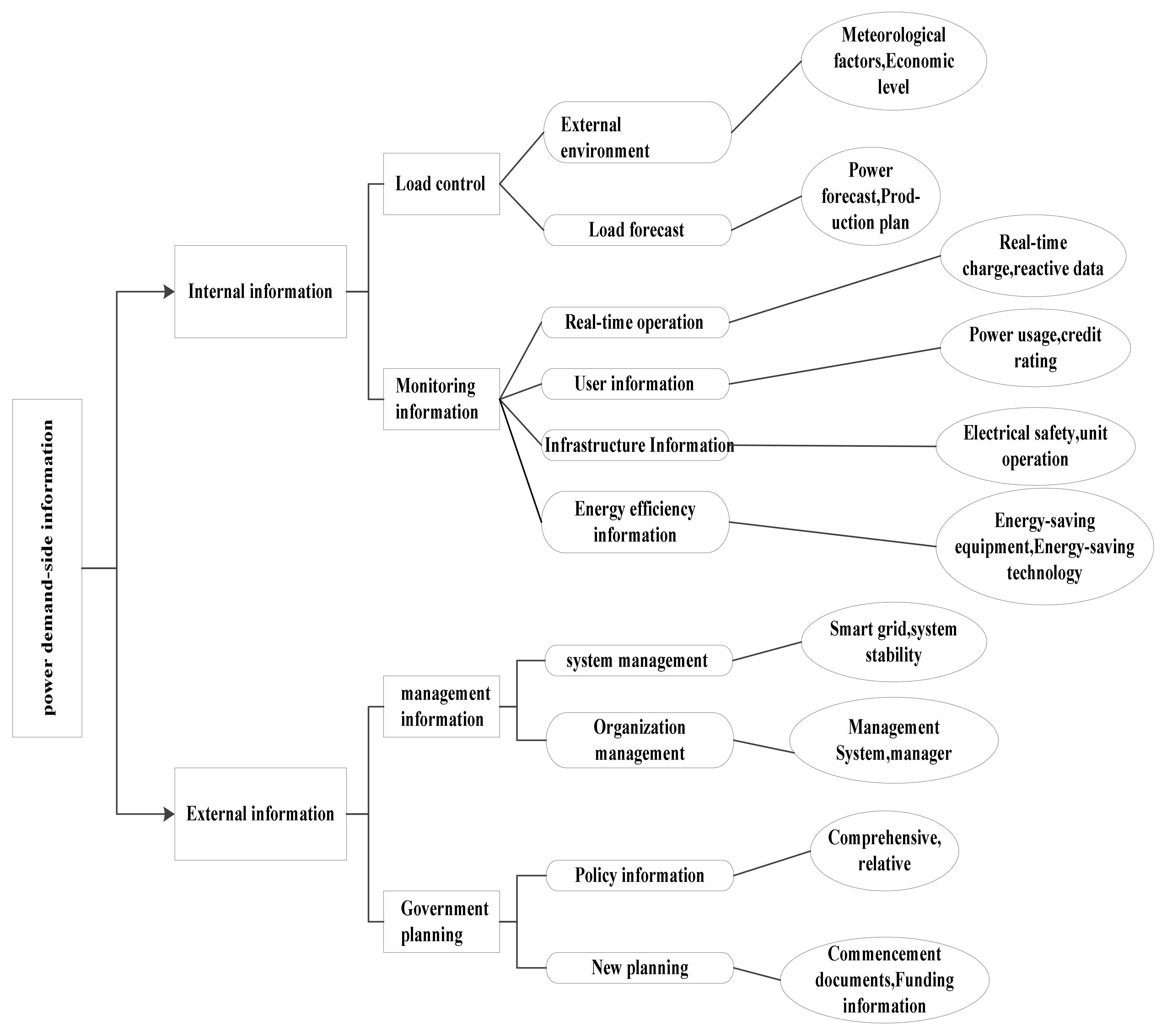
- Internal information. Internal information refers to information related to management operations and is selected to be reflected in two aspects, “load control” and “monitoring information”. Load control information mainly refers to information that affects load forecasts, mainly including external environment information and load forecasting techniques and methods; monitoring information mainly focuses on the real-time monitoring status of power operation, users, infrastructure, and other information.
- (2)
- External information. External information refers to objective environmental information that has an impact on demand-side management of electricity and is reflected in two parts, “management information” and “government planning”. “Management information” can generally be divided into systems and organizations. In addition to this, there is a need to consider the impact of relevant government planning on grid development. “Government planning information” also includes information on regional policy releases and new planning documents.
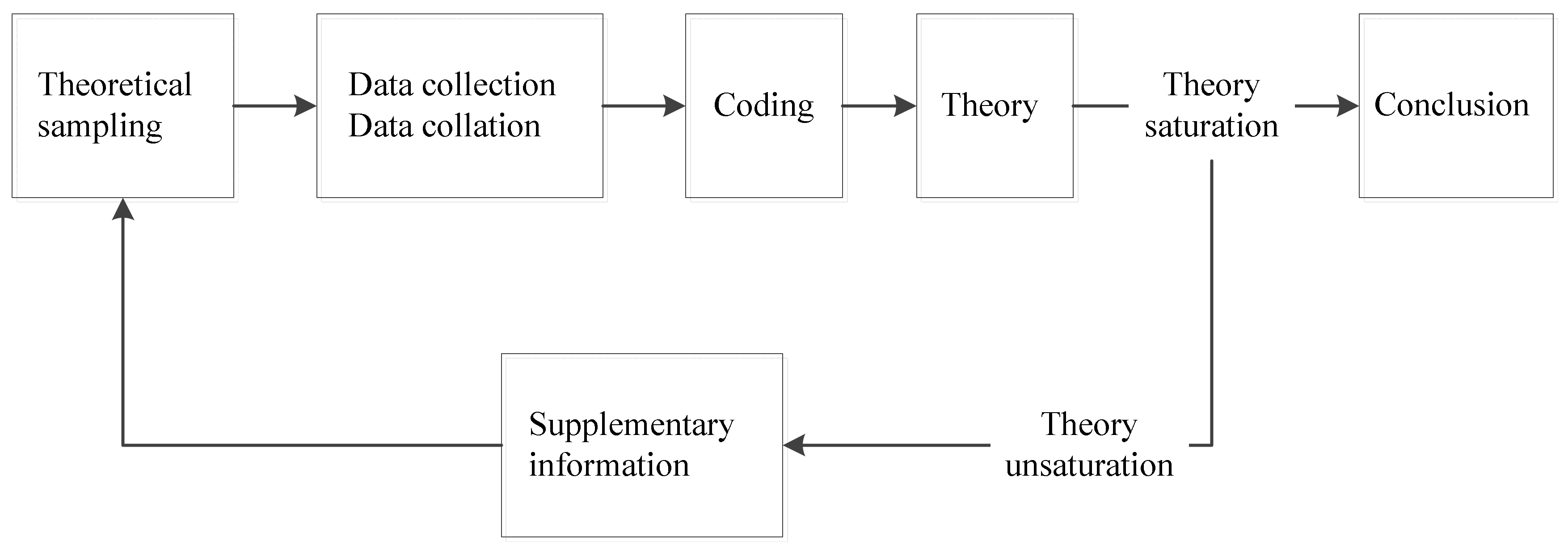
2.2. Grounded Theory Approach
2.3. Matter-Element Extension Evaluation Method
- (1)
- The correlation degree function of the th index number range belonging to the th level is the following:
- (2)
- The correlation degree of matter to be evaluated with respect to grade is as follows:
3. Results
3.1. Building DSM Information Quality Evaluation Indexes Based on the Grounded Theory
3.1.1. Data Sources
3.1.2. Data Coding and Analysis
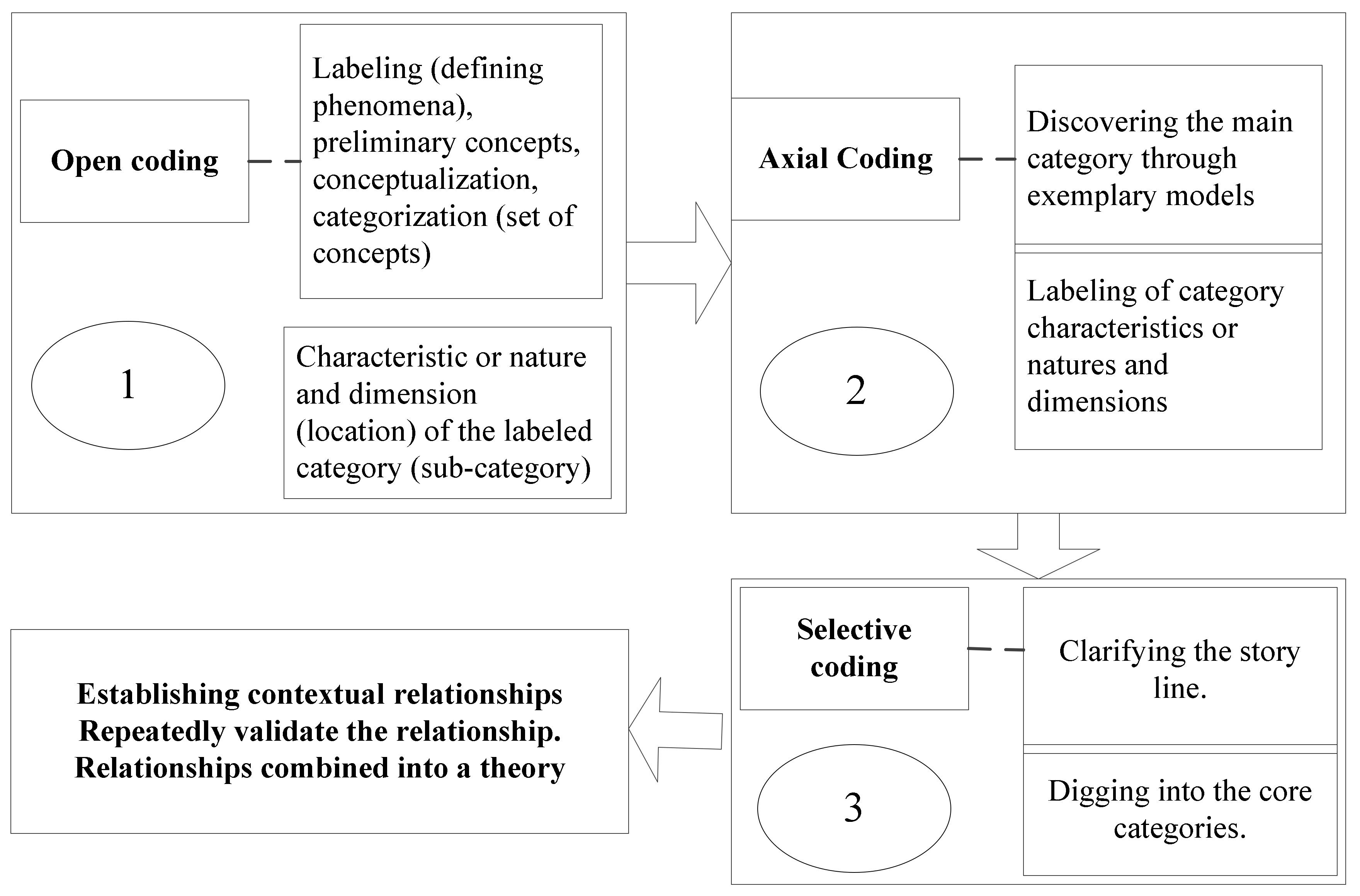
Open Coding
Axial Coding
Selective Coding
3.1.3. DSM Information Quality Evaluation Indexes
- (1)
- Load information quality
- (2)
- Monitoring information quality
- (3)
- Management information quality
- (4)
- Government planning information quality
3.2. Case Study of DSM Information Quality Evaluation Based on Matter-Element Extension Evaluation Method
3.2.1. Case Introduction
- (1)
- The large industrial power consumption in the power supply area of the company has always accounted for more than 60% of the total power consumption, so the implementation of DSM and load management for large industrial users will bring significant economic benefits and social significance.
- (2)
- The power company emphasizes regulating peak and flat loads, incentivizing underestimated power consumption, focusing examining on power consumption of underestimated periods, and adhering to hierarchical management and electricity conservation programs.
- (3)
- The Power Supply Company and relevant units in the city jointly carry out the publicity work of power demand side management and publicize the power demand side management project through media publicity, publicity activities, and rules and regulations.
- (4)
- The power supply company applies load control technology to ensure the safe and stable operation of the power system, to guarantee the basic electricity consumption of the community, and, through administrative and regulatory measures, to improve the load rate of the power grid.
- (5)
- In order to ensure the orderly power supply of the power grid, the power supply enterprises improve the security, reliability, and economic operation of the grid; strengthen the supervision and management; optimize the organizational management; scientifically and reasonably allocate and determine the power consumption indicators; and formulate corresponding assessment methods.
3.2.2. Index Weight
3.2.3. Evaluation Process
Evaluation Set Identification
Correlation Function and the Calculation of Comprehensive Correlation Degree
Evaluation Results Analysis
4. Discussion
5. Conclusions
- (1)
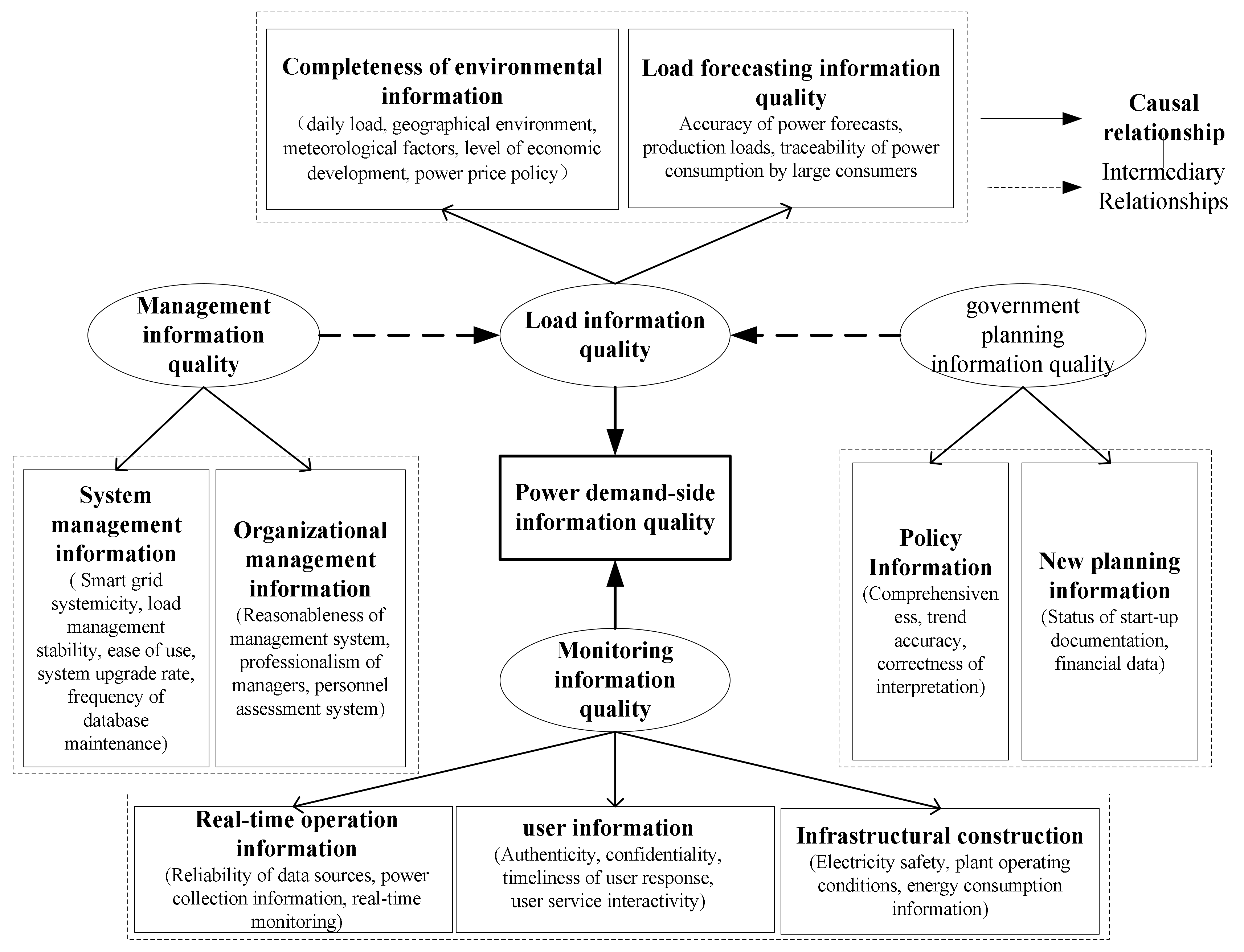
- Using the grounded theory to study the method of evaluating the information quality on the power demand side, the index system for evaluating the information quality on the power demand side was constructed, which is a beneficial supplement of the power demand-side management. The index system covers 4 dimensions (load information quality, monitoring information quality, management information quality, and government planning information quality) and includes 10 main categories (environmental information quality, load forecasting information quality, real-time operating information quality, user information quality, and infrastructure information quality, energy efficiency information quality, system information quality, organization information quality, policy information quality, and new planning information quality). The relationship between environment information, load forecasting information, real-time operating information, user information, infrastructure information, and power demand side information quality is causal; the relations between energy efficiency information, system information, organization information, policy information, new planning information, and power demand side information quality are intermediary relations. Through the interaction of factors, the evaluation index system of power demand side information quality is constructed. On this basis, the empirical analysis based on the extension comprehensive evaluation proves that the index system is feasible in theory and method. It is of practical significance to understand the current level of information quality on the demand side and point out the direction for improving information quality to the next higher stage.
- (2)
- The issue of power demand-side information quality is a complex and dynamic problem that cannot be solved entirely by a set of indicator systems and evaluation methods. Although we have done some work on the establishment of the index system and evaluation methods, there are still shortcomings. relevant research and the verification of specific cases can be further detailed, and the index system and evaluation methods can be further enriched and expanded. However, the original research on power demand side information evaluation can serve as a reference for future related research.
Author Contributions
Funding
Conflicts of Interest
References
- Energy Research Institute of State Grid of China. Study on Ways and Means to the Construction of EPP; China Electric Power Press: Beijing, China, 2010. (In Chinese) [Google Scholar]
- Zhu, Y.P.; Feng, W.; Fan, L.Z. An Evolutionary Game study on Implementation of Energy Efficiency Power Plants between Government and Enterprise Considering Carbon Emission Right Trading. Appl. Ecol. Environ. Res. 2019, 17, 699–722. [Google Scholar] [CrossRef]
- Mauritzen, J. Are solar panels commodities? A Bayesian hierarchical approach to detecting quality differences and asymmetric information. Eur. J. Oper. Res. 2020, 280, 365–382. [Google Scholar] [CrossRef]
- Corbets, J.B.; Willy, C.J.; Bischoff, J.E. Evaluating System Architecture Quality and Architecting Team Performance Using Information Quality Theory. IEEE Syst. J. 2017, 12, 1139–1147. [Google Scholar] [CrossRef]
- Dilruba, O.E.; Kaan, O. Dynamic data maintenance for quality data, quality research. Int. J. Inf. Manag. 2012, 32, 282–293. [Google Scholar]
- Yeganeh, N.K.; Sadiq, S.; Sharaf, M.A. A framework for data quality aware query systems. Inf. Syst. 2014, 46, 24–44. [Google Scholar] [CrossRef]
- Engelmann, J.; Fischer, C.; Nkenke, E. Quality assessment of patient information on orthognathic surgery on the internet. J. Cranio-Maxillofacial Surg. 2020, 48, 661–665. [Google Scholar] [CrossRef]
- Pouyan, E.; Tala, M.; Spurthy, D. The impact of data entry structures on perceptions of individuals with chronic mental disorders and physical diseases towards health information sharing. Int. J. Med. Inf. 2020, 141, 104157. [Google Scholar]
- Kim, C.-J.; Kang, H.S.; Kim, J.S.; Won, Y.Y.; Schlenk, E.A. Predicting physical activity and cardiovascular risk and quality of life in adults with osteoarthritis at risk for metabolic syndrome: A test of the information-motivation-behavioral skills model. Nurs. Open 2020, 7, 1239–1248. [Google Scholar] [CrossRef]
- Sibel, Y.F.; Turkan, K. Evaluation of the reliability, utility, and quality of the information in cardiopulmonary resuscitation videos shared on Open access video sharing platform YouTube. Australas. Emerg. Care 2020, 23, 211–216. [Google Scholar]
- Comero, S.; Dalla Costa, S.; Cusinato, A.; Korytar, P.; Kephalopoulos, S.; Bopp, S.; Gawlik, B.M. A conceptual data quality framework for IPCHEM—The European Commission Information Platform for chemical monitoring. TrAC Trends Anal. Chem. 2020, 127, 115879. [Google Scholar]
- Fosu, S.; Danso, A.; Agyei-Boapeah, H.; Ntim, C.G.; Adegbite, E. Credit information sharing and loan default in developing countries: the moderating effect of banking market concentration and national governance quality. Review Quant. Fin. Acc. 2020, 55, 55–103. [Google Scholar]
- Ullah, B. Signaling value of quality certification: Financing under asymmetric information. J. Multinatl. Financ. Manag. 2020, 100629. [Google Scholar] [CrossRef]
- Frenkel, S.; Guttman, I.; Kremer, I. The effect of exogenous information on voluntary disclosure and market quality. J. Fin. Econ. 2020, 138, 176–192. [Google Scholar] [CrossRef]
- Çakmak, R.; Altaş, I.H. A novel billing approach for fair and effective demand side management: Appliance level billing (AppLeBill). Int. J. Electr. Power Energy Syst. 2020, 121, 106062. [Google Scholar] [CrossRef]
- Venizelos, V.; George, M.; Venizelos, E.; Georghiou, G.E. Methodology for deploying cost-optimum price-based demand side management for residential prosumers. Renew. Energy 2020, 153, 228–240. [Google Scholar]
- Wang, J.M.; Zhu, Y.P. Cost-benefit analysis of DSM energy-efficiency project in low-carbon vision: A case in China. Energy Ed. Sci. Technol. 2014, 32, 645–658. [Google Scholar]
- Chamandoust, H.; Bahramara, S.; Derakhshan, G. Day-ahead scheduling problem of smart micro-grid with high penetration of wind energy and demand side management strategies. Sustain. Energy Technol. Assess 2020, 40, 100747. [Google Scholar]
- Zhu, Y.; Hu, Y.; Zhang, F. Progressive IRP Models for Power Resources Including EPP. Math. Probl. Eng. 2017, 2017, 1–7. [Google Scholar] [CrossRef]
- Wang, J.; Zhu, Y.; Li, Y. EPP Energy Efficiency Calculation and Influencing Factor Analysis: Cases in China. Math. Probl. Eng. 2015, 2015, 1–8. [Google Scholar] [CrossRef]
- Wang, J.-M.; Ge, X.; Zhang, L.; Zhang, H. Management Index Systems and Energy Efficiency Diagnosis Model for Power Plant: Cases in China. Math. Probl. Eng. 2016, 2016, 1–13. [Google Scholar] [CrossRef]
- Chakraborty, N.; Mondal, A.; Mondal, S. Efficient Load Control Based Demand Side Management Schemes towards a Smart Energy Grid System. Sustain. Cities Soc. 2020, 59, 102175. [Google Scholar] [CrossRef]
- Kalair, A.R.; Abas, N.; Hasan, Q.U.; Seyedmahmoudian, M.; Khan, N. Demand side management in hybrid rooftop photovoltaic integrated smart nano grid. J. Clean. Prod. 2020, 258, 120747. [Google Scholar] [CrossRef]
- Reddy, K.S.; Panwar, L.K.; Panigrahi, B.K.; Kumar, R.; Xu, Y. A dual objective approach for aggregator managed demand side management (DSM) in cloud based cyber physical smart distribution system. Futur. Gener. Comput. Syst. 2020, 105, 843–854. [Google Scholar] [CrossRef]
- Mendes, D.L.; Rabêlo, R.A.; Veloso, A.F.; Rodrigues, J.J.P.C.; Junior, J.V.D.R. An adaptive data compression mechanism for smart meters considering a demand side management scenario. J. Clean. Prod. 2020, 255, 120190. [Google Scholar] [CrossRef]
- Petushkov, S.V.; Vilderman, E.N.; Belov, L.A. Influence of power amplifier’s intermodulation distortion on transmitted information quality. In Proceedings of the 2018 Systems of Signal Synchronization, Generating and Processing in Telecommunications (SYNCHROINFO), Minsk, Belarus, 4–5 July 2018; pp. 1–4. [Google Scholar] [CrossRef]
- Peng, Z.; Zhang, Q. A new method of information quality analysis of power grid dispatching automation system and its application. Dianli Xitong Baohu yu Kongzhi/Power Syst. Prot. Control 2018, 46, 150–157. [Google Scholar]
- Bao, T.; Liu, S.; Bao, T.; Shufen, L. Quality evaluation and analysis for domain software: Application to management information system of power plant. Inf. Softw. Technol. 2016, 78, 53–65. [Google Scholar] [CrossRef]
- Yoojung, C. A Study on the Effect of Bargaining Power on Partnership, Information Quality, and SCM Features. Manag. Inf. Syst. Rev. 2015, 34, 171–189. [Google Scholar] [CrossRef]
- Çiftçioğlu, E.N.; Michaloliakos, A.; Psounis, K.; La Porta, T.F.; Yener, A. Power minimization with quality-of-information outages. In Proceedings of the 2014 IEEE Wireless Communications and Networking Conference (WCNC), Istanbul, Turkey, 6–9 April 2014; pp. 1655–1660. [Google Scholar]
- 3Castro, M.F.; Bragança, L.; Machado, B.; Andrade, J.; Bragança, L. European legislation and incentives programmes for demand Side management. Sol. Energy 2019, 200, 114. [Google Scholar] [CrossRef]
- Barney, G.; Anselm, S. The Discovery of Grounded Theory: Strategies for Qualitative Research; Aldine de Gruyter: New York, NY, USA, 1968. [Google Scholar]
- Bi, A.; Luo, Z.; Kong, Y.; Zhao, L. Comprehensive weighted matter-element extension method for the safety evaluation of underground gas storage. R. Soc. Open Sci. 2020, 7, 191302. [Google Scholar] [CrossRef]
- Shahzad, K.; Jianqiu, Z.; Hashim, M.; Nazam, M.; Wang, L. Impact of using information and communication technology and renewable energy on health expenditure: A case study from Pakistan. Energy 2020, 204, 117956. [Google Scholar] [CrossRef]
- Ramandi, M.Y.; Afshar, K.; Gazafroudi, A.S.; Bigdeli, N. Reliability and economic evaluation of demand side management programming in wind integrated power systems. Int. J. Electr. Power Energy Syst. 2016, 78, 258–268. [Google Scholar] [CrossRef]
- Tolulope, O.A.; Peter, O.O.; Olubayo, M.B. Techno-economic and environmental evaluation of demand side management techniques for rural electrification in Ibadan, Nigeria. Int. J. Energy Environ. Eng. 2014, 5, 375–385. [Google Scholar]
- Eissa, M.M. Demand side management program evaluation based on industrial and commercial field data. Energy Policy 2011, 39, 5961–5969. [Google Scholar] [CrossRef]
- Medici, V.; Salani, M.; Nespoli, L.; Giusti, A.; Derboni, M.; Vermes, N.; Rizzoli, A.E.; Rivola, D. Evaluation of The Potential Of Electric Storage Using Decentralized Demand Side Management Algorithms. Energy Procedia 2017, 135, 203–209. [Google Scholar] [CrossRef]


| Category | Initial Concept |
|---|---|
| A1 daily load data | a1 social event, a2 holiday, a3 workday |
| A2 geo-environmental information | a4 geographical position, a5 regional differences, a6 terrain differences |
| A3 meteorological information | a7 temperature, a8 rainfall, a9 season change, a10 weather |
| A4 economic development data | a11 urbanization level, a12 industrialization level, a13 population resources, a14 economic status |
| A5 power price information | a15 power price reform, a16 time-of-use power price, a17 peak-valley power price |
| A6 rate of deviation from power forecast | a18 load forecasting method, a19 data mining analysis techniques, a20 forecast model |
| A7 production load information | a21 production plan, a22 production law, a23 sustained and stable power consumption |
| A8 traceability of large power users | a24 power for large industrial users, a25 high-power mechanical electricity, a26 large user equipment operating status, a27 high energy user, a28 small hydropower management |
| A9 reliability of data sources | a29 original data, a30 data availability |
| A10 power collection information | a31 electrical energy collection, a32 terminal power efficiency |
| A11 deviation rates of real-time monitoring | a33 abnormal power consumption, a34 power theft monitoring, a35 monitoring of metering unit operation, a36 distribution monitoring, a37 grid quality monitoring, a38 energy efficiency assessment |
| A12 authenticity of user information | a39 regularity of life, a40 power consumption habits, a41 consumer behavior, a42 power consumption mode |
| A13 confidentiality | a43 user information collection security, a44 user privacy |
| a14 timeliness of user response | a45 perceived risk, a46 power price budget, a47 power consumption adjustment |
| A15 user service interactivity | a48 user warranty, a49 user complaints, a50 message reply, a51 online state grid app |
| A16 electrical safety | a52 safety protection technology, a53 safety management |
| A17 conditions of unit operating | a54 line loss, variable loss, power loss, a55 aging of equipment, a56 telecommunications equipment for grids |
| A18 energy consumption information | a57 equipment utilization, a58 energy information |
| A19 effectiveness of energy-saving equipment | a59 eco-friendly appliances, a60 energy-saving inverters, a61 energy storage equipment |
| A20 availability of energy saving technology | a62 renewable energy, a63 power substitution |
| A21 universality of energy saving promotion | a64 promotion of energy-saving lamps, a65 publicity efforts |
| A22 smart grid systematic | a66 automatic collection system, a67 terminal collection system, a68 automatic meter reading |
| A23 stability of load management | a69 voltage control systems, a70 reactive power compensation system |
| A24 ease of use | a71 collection of fundamental data, a72 power transmission and transformation equipment ledger |
| A25 rate of system upgrades | a73 internal update, a74 service system update, a75 work procedures update |
| A26 frequency of database maintenance | a76 safe operation, a77 low-level maintenance, a78 oracle database |
| A27 rationalization of the management system | a79 attribute management, a80 contract management, a81 oversight mechanisms, a82 festive care |
| A28 professionalism of managers | a83 managerial talent, a84 professional talent, a85 professionalism of employees |
| A29 personnel assessment system | a86 skills assessment, a87 power simulation training, a88 system of rewards and penalties, a89 team performance assessment |
| A30 relevance and comprehensiveness | a90 industry policy, a91 technical standard, a92 scientific and technical planning |
| A31 directional accuracy | a93 power gap, a94 consumption structure, a95 power market development |
| A32 correctness of interpretation | a96 brief analysis of power reform, a97 guideline, a98 restrictive measures |
| A33 status of start-up documents | a99 new projects, a100 annual development report, a101 enterprise credit evaluation |
| A34 fund information | a102 bank-enterprise direct connect, a103 budget management, a104 specific investment, a105 economic calculation |
| Dimensions | Main Categories | Categories | Category Connotation |
|---|---|---|---|
| load information quality | B1 environmental information quality | A1 daily load data | Daily load type is categorized into weekdays, holidays, and public holidays, with obvious cyclicality. |
| A2 geo-environmental information | Differentiated and complex development across regions and provinces, varying levels of electricity access, and whether the geographic information of the area under their jurisdiction is documented | ||
| A3 meteorological information | Weather affects the demand and delivery of electricity, consideration of meteorological factors can improve load forecasting accuracy, and whether meteorological factors in the area under jurisdiction are well documented | ||
| A4 economic development data | GDP, industrial structure and other economic development data is the reference basis for power load forecast, and the load curve also reflects the development of the economy to a certain extent. | ||
| A5 power price information | Flexibility in power price adjustments is prompting customers to change their electricity consumption structure, e.g., Off-peak power price, time-of-use power price | ||
| B2 load forecasting information quality | A6 rate of deviation from power forecast | The accuracy of power system load prediction is related to the stability and safety of power system operation | |
| A7 production load information | There are many different types of production processes, plans and rules | ||
| A8 traceability of large power users | Power load of large users changes violently and stochastically, which can reflect historical experience and processing capacity | ||
| monitoring information quality | B3 real-time operating information quality | A9 reliability of data sources | Only authentic and reliable data content has the value of analysis; the data source of collection must be true and reliable |
| A10 power collection information | Electric energy collection information includes data collection, analysis of electricity consumption, automatic settlement of electricity bills, assessment optimization, etc. | ||
| A11 deviation rates of real-time monitoring | The efficiency information mined in real-time dynamic monitoring data and its utilization degree affect the lean level of power enterprises | ||
| B4 user information quality | A12 authenticity of user information | Different types of residents, business locations, resident loads, and industrial loads have different degrees of impact on the load | |
| A13 confidentiality | Theft of electricity information and data mutations caused by incorrect data can lead to poor data quality and loss of user benefits | ||
| A14 timeliness of user response | Electricity consumption of electricity users is directly related to the price of electricity, region, temperature, lifestyle and the psychology of the consumer. | ||
| A15 user service interactivity | To provide business support and services for users, to provide data basis for intelligent power consumption work, and to serve the information system of power users. | ||
| B5 infrastructure information quality | A16 electrical safety | Mainly includes the user’s power imbalance, voltage flicker and other safe operations of the power grid. | |
| A17 conditions of unit operating | Device problems can lead to economic loss of power, real-time monitoring is good for efficient and economical electricity consumption. | ||
| A18 energy consumption information | Analysis of the energy consumption information of the power equipment and the energy saving potential of the equipment can improve the terminal power consumption rate and carry out scientific energy efficiency management | ||
| B6 energy efficiency information quality | A19 effectiveness of energy-saving equipment | Advanced, high-efficiency power-saving devices to achieve lower power consumption, more efficient power use and lower emissions from improved user-side power efficiency. | |
| A20 availability of energy saving technology | Can the development of renewable energy represented by wind and solar power replace coal, oil, and other energy sources and reduce pollution? | ||
| A21 universality of energy saving promotion | Energy conservation and environmental protection propaganda efforts to influence users’ awareness of energy conservation and environmental protection and users’ constant pursuit of consumption reduction and efficient electricity consumption behavior. | ||
| management information quality | B7 system information quality | A22 smart grid systematic | The smart grid is a combination of power grid and information technology for reliable, safe, economical, efficient, and environmentally friendly operation. |
| A23 stability of load management | Making full use of modern remote telemetry and other technical equipment, in-depth load management is the only way to modernize and refine power demand-side management. | ||
| A24 ease of use | Mainly reflected in the system is easy to use and operate, flexible, and accurate response, etc. | ||
| A25 rate of system upgrades | The system needs to be upgraded in time, and the 100% update rate of the system can guarantee the compatibility and normal operation of the system. | ||
| A26 frequency of database maintenance | Regular maintenance of the system improves system functionality and solves problems that occur during system operation. | ||
| B8 organization information quality | A27 rationalization of the management system | It includes the scientificity, rationality, operability and management efficiency of the management system. | |
| A28 professionalism of managers | The power demand side management, technology research and development team, and the professional team of power demand side management, which are related to the scientific nature of demand management. | ||
| A29 personnel assessment system | Organizational management should be based on the principle of objectivity and fairness, and implement a multi-level, multi-channel, comprehensive, and institutionalized evaluation system | ||
| government planning information quality | B9 policy information quality | A30 comprehensive | Macro power purchase policy is a guide to ensure normal and orderly production and life of citizens, key enterprises, and cities |
| A31 correctness of interpretation | Policies often reflect industry trends, and the policies included in the power information database can provide direction to business users. | ||
| A32 correctness of interpretation | Good power policy interpretation helps users and enterprises to better understand national policies and helps the implementation of national policies. | ||
| B10 new planning information quality | A33 status of start-up documents | This specifically includes the acceptance and audit of new plants and new projects. | |
| A34 fund information | Investment attraction and capital implementation of enterprise projects is a key part of the enterprise’s ongoing projects. |
| Typical Relationship | Relationship Structure | Connotation |
|---|---|---|
| Environmental information quality→ power demand side information quality | Causal relationship | Power load forecast is sensitive to weather, temperature, and season. Different factors such as temperature, weather, and season will have a significant impact on the power load. Even slight weather and temperature changes will cause fluctuations in power load forecast data. |
| Load forecast information quality→ power demand side information quality | Causal relationship | The production plan of the enterprise obviously affects the power load, and timely and accurate load forecast for large users can optimize the supply and distribution structure, improve the efficiency of the power grid and reduce the destructive impact of power load changes on the grid. |
| Real-time information quality→ power demand side information quality | Causal relationship | Information on grid operation, electricity consumption, real-time data and residential power consumption helps provide a comprehensive technical solution for lean metering and lean management of the demand-side grid. |
| User information quality→ power demand side information quality | Causal relationship | Electricity data from electricity consumers is the basis for effective management of the demand side of the power supply, and information should be collected from all customers, and the quality of customer information has an important impact on the quality of management. |
| Infrastructure information quality→ power demand side information quality | Causal relationship | By comparing the theoretical line loss and variable loss rate of power grid lines with the actual line loss and variable loss rate calculated from the power voltage, load current, and other data on the terminal equipment on the demand side, the actual line loss can be calculated for the variable loss statistics. |
| Energy efficiency information quality→ power demand side information quality | Intermediary Relationships | Energy efficiency management, which has an indirect impact on the amount of losses in households and society through the upgrading of power consumption equipment and the R&D and use of renewable energy technologies and power equipment, increasing the efficiency of the use of available energy and the users’ awareness to save electricity. |
| System information quality→ power demand side information quality | Intermediary Relationships | Power demand-side professional information management and application systems can reasonably allocate power resources, while reducing power demand, alleviating environmental pressures, realizing energy conservation and consumption reduction, and achieving economic operation on the premise of ensuring grid security. |
| Organization information quality→ power demand side information quality | Intermediary Relationships | The science of the system set up in the power company, the professionalism of the managers, and the reasonable division of work all affect the demand side of electricity management process. Optimizing the organization and management of electric power enterprises and building a modern and reasonable organization and management model are conducive to the formation of a unified and coordinated whole. |
| Policy information quality→ power demand side information quality | Intermediary Relationships | Implementing demand-side management systems to achieve power plant construction, power grid construction, short- and medium- and long-term planning of power grid operation, which improves the quality of the lines and ensures the power safety for the masses, and indirectly affect the stability of demand-side management. |
| New planning information quality→ power demand side information quality | Intermediary Relationships | Demand-side management of electricity requires high-quality expertise in a wide range of areas. It requires not only professional equipment and technology but also a large amount of human resources and investment. In the current situation, the lack of long-term and stable policy support in the power market environment makes it difficult for demand-side management and large-scale demand response business. Both enterprises and government agencies need to expand their professional teams to meet management needs and set up special management funds at the same time. |
| Primary Indictors | Secondary Indictors | Tertiary Indictors | Type of Indictors | Interpretation |
|---|---|---|---|---|
| load information quality C1 | external environment information quality C11 | daily load informationC111 | qualitative | Whether daily load data is recorded and whether there is significant cyclicality |
| geo-environmental informationC112 | qualitative | Whether geo-environmental information under its jurisdiction is recorded? | ||
| meteorological informationC113 | qualitative | Whether the meteorological factors in the area under their jurisdiction are well documented | ||
| economic development information C114 | qualitative | Whether GDP, industrial structure, and other economic development data and their data records are complete | ||
| information of flexibility of power price C115 | qualitative | Whether the recorded power price has certain flexibility, whether the peak and valley power prices and real-time power prices are recorded. | ||
| load forecasting information quality C12 | rate of deviation from power forecast C121 | quantitative | Whether power system load forecasts reflect power load trends | |
| production load informationC122 | qualitative | Whether the data on the enterprise’s production process, planned categories, and production laws are recorded. | ||
| traceability of large power usersC123 | qualitative | Whether the data recorded by large power users reflect historical experience and processing capacity | ||
| monitoring information quality C2 | real-time operation information quality C21 | reliability of data sourcesC211 | qualitative | Whether the source of the collected data is reliable and whether the data is available |
| power collection informationC212 | qualitative | Whether the collected data is comprehensive and accurate | ||
| deviation rates of real-time monitoringC213 | quantitative | Whether the information record is real-time monitoring | ||
| users information quality C22 | authenticityC221 | qualitative | Whether the user information such as the address of residents and enterprises and the type of work is true or not | |
| confidentialityC222 | qualitative | Whether the user data is secure | ||
| timeliness of user response C223 | qualitative | Whether user response and information feedback are timely | ||
| user service interactivityC224 | qualitative | Whether there is feedback from users’ complaints, and whether users are satisfied with business support and service capabilities | ||
| infrastructure information quality C23 | electrical SafetyC231 | qualitative | Whether infrastructure equipment can ensure the safe operation and safe use of electricity | |
| plant operating conditionsC232 | qualitative | Whether the operating condition of the device is recorded and whether the data is complete. | ||
| energy consumption informationC233 | qualitative | Whether energy consumption information is recorded and well documented. | ||
| energy efficiency information quality C24 | effectiveness of energy-saving equipmentC241 | qualitative | Whether energy-saving devices reduce power consumption and emissions | |
| availability of energy-saving technologiesC242 | qualitative | Whether renewable energy is useful and can replace energy sources such as coal and oil. | ||
| universality of energy-saving promotionC243 | qualitative | whether energy saving publicity efforts can influence users’ awareness of energy saving and power consumption behavior | ||
| management information quality C3 | system information quality C31 | smart grid systematicC311 | qualitative | Whether the power grid is deeply integrated with information technology and whether the smart grid is systematically complete |
| system stabilityC312 | qualitative | Whether load management is stable and whether it meets the requirements of refined management of power demand side | ||
| ease of useC313 | qualitative | Ease of use of the system and variety of search paths | ||
| system upgrade rateC314 | quantitative | The system software should be the latest version and meet the standard | ||
| frequency of database maintenance C315 | quantitative | Whether the system is routinely maintained and whether the frequency of maintenance meets the operational requirements of the system | ||
| organization information quality C32 | reasonableness of the management systemC321 | qualitative | Whether the power demand-side information management system meets management requirements. | |
| professionalism of managersC322 | qualitative | Whether power demand-side information managers can handle specialized work | ||
| personnel assessment systemC323 | qualitative | The existence of a fair and scientific assessment system for managers | ||
| government planning information quality C4 | policy information quality C41 | comprehensivenessC411 | qualitative | Whether the policy covers all aspects of power management |
| relevanceC412 | qualitative | Whether the collected policies are relevant to grid planning, and whether there is irrelevant policy information | ||
| accuracy of directionC413 | qualitative | Whether the collected policies are correct and consistent with power development trends | ||
| correctness of interpretationC414 | qualitative | Whether the interpretation of the power policy is correct and easy to understand | ||
| new planning information quality C42 | status of start-up documents C421 | qualitative | Whether the audit and review comments of the new project of the enterprise are collected and whether there is a report on the commencement. | |
| fund informationC422 | qualitative | Whether the project funds of the enterprise are implemented, and whether the investment information is grasped |
| Judgment Matrix | Weight Vector | |||
|---|---|---|---|---|
| G | 4.2343 | 0.0781 | 0.89 | (0.5556,0.3000,0.0940,0.0504) |
| A1 | 2.0000 | 0 | 0 | (0.2500,0.7500) |
| A2 | 4.0687 | 0.0229 | 0.89 | (0.5628,0.1079,0.2671,0.0622) |
| A3 | 2.0000 | 0 | 0 | (0.8889,0.1111) |
| A4 | 2.0000 | 0 | 0 | (0.2500,0.7500) |
| B11 | 5.3328 | 0.0831 | 1.12 | (0.2100,0.0646,0.4853,0.1002,0.1399) |
| B12 | 3.0387 | 0.01935 | 0.52 | (0.2605,0.6333,0.1062) |
| B21 | 3.0542 | 0.0271 | 0.52 | (0.1822,0.1149,0.7028) |
| B22 | 4.1923 | 0.0641 | 0.89 | (0.6366,0.1267,0.1404,0.0963) |
| B23 | 3.0948 | 0.0474 | 0.52 | (0.5321,0.3661,0.1018) |
| B24 | 3.0658 | 0.0329 | 0.52 | (0.7235,0.1932,0.0833) |
| B31 | 5.3915 | 0.0979 | 1.12 | (0.5490,0.1892,0.0800,0.0527,0.1291) |
| B32 | 3.0387 | 0.0193 | 0.52 | (0.2605,0.6333,0.1062) |
| B41 | 4.2013 | 0.0671 | 0.89 | (0.5011,0.2630,0.0768,0.1591) |
| B42 | 2.0000 | 0 | 0 | (0.6667,0.3333) |
| Quantitative Indexes | Level | ||||
|---|---|---|---|---|---|
| Excellent | Good | General | Poor | Very Poor | |
| Deviation rate of power forecasts | (0.5%) | (5%,10%) | (10%,20%) | (20%,30%) | (30%,100%) |
| Power collection information | (30%,100%) | (20%,30%) | (10%,20%) | (5%,10%) | (0,5%) |
| deviation rates of real-time monitoring | (0.5%) | (5%,10%) | (10%,20%) | (20%,30%) | (30%,100%) |
| System upgrade rate | (30%,100%) | (20%,30%) | (10%,20%) | (5%,10%) | (0,5%) |
| Database maintenance rate | (30%,100%) | (20%,30%) | (10%,20%) | (5%,10%) | (0,5%) |
| Tertiary Indexes | Variables | Average Scores |
|---|---|---|
| daily load data | C111 | 88 |
| geo-environmental information | C112 | 76 |
| meteorological information | C113 | 92 |
| economic development information | C114 | 86 |
| information of flexibility of power price | C115 | 83 |
| rate of deviation from power forecast [%] | C121 | 3 |
| production load information | C122 | 82 |
| traceability of large power users | C123 | 78 |
| reliability of data sources | C211 | 94 |
| power collection information [%] | C212 | 90 |
| deviation rates of real-time monitoring [%] | C213 | 2 |
| authenticity | C221 | 92 |
| confidentiality | C222 | 93 |
| timeliness of user response | C223 | 78 |
| user service interactivity | C224 | 76 |
| electrical safety | C231 | 88 |
| plant operating conditions | C232 | 92 |
| energy consumption information | C233 | 82 |
| effectiveness of energy-saving equipment | C241 | 75 |
| availability of energy-saving technologies | C242 | 78 |
| universality of energy-saving promotion | C243 | 76 |
| smart grid systematic | C311 | 92 |
| system stability | C312 | 94 |
| ease of use | C313 | 86 |
| system upgrade rate [%] | C314 | 95 |
| frequency of database maintenance [%] | C315 | 85 |
| reasonableness of the management system | C321 | 85 |
| professionalism of managers | C322 | 82 |
| personnel assessment system | C323 | 77 |
| comprehensiveness | C411 | 88 |
| relevance | C412 | 92 |
| accuracy of direction | C413 | 86 |
| correctness of interpretation | C414 | 82 |
| status of start-up documents | C421 | 75 |
| fund information | C422 | 78 |
| Indexes | Grade | ||||
|---|---|---|---|---|---|
| Excellent | Good | General | Poor | Very Poor | |
| daily load dataC111 | −0.143 | 0.2 | −0.4 | −0.6 | −0.7 |
| Geo-environmental informationC112 | −0.368 | −0.143 | 0.4 | −0.2 | −0.4 |
| meteorological informationC113 | 0.2 | −0.2 | −0.6 | −0.733 | −0.8 |
| economic development informationC114 | −0.222 | 0.4 | −0.3 | −0.533 | −0.65 |
| information of flexibility of power priceC115 | −0.292 | 0.3 | −0.15 | −0.433 | −0.575 |
| rate of deviation from power forecastC121 | 0.4 | −0.4 | −0.76 | −0.867 | −0.9 |
| production load informationC122 | −0.308 | 0.2 | −0.1 | −0.4 | −0.55 |
| traceability of large power usersC123 | −0.353 | −0.083 | 0.2 | −0.267 | −0.45 |
| reliability of data sourcesC211 | 0.4 | −0.6 | −0.8 | −0.867 | −0.9 |
| power collection informationC212 | 0.4 | −0.6 | −0.84 | −0.911 | −0.933 |
| deviation rates of real-time monitoringC213 | 0.895 | 0.889 | −0.879 | −0.862 | 0.143 |
| authenticityC221 | 0.2 | −0.2 | −0.6 | −0.733 | −0.8 |
| confidentialityC222 | 0.3 | −0.3 | −0.65 | −0.767 | −0.825 |
| timeliness of user responseC223 | −0.353 | −0.083 | 0.2 | −0.267 | −0.45 |
| user service interactivityC224 | −0.368 | −0.143 | 0.4 | −0.2 | −0.4 |
| electrical safetyC231 | −0.143 | 0.2 | −0.4 | −0.6 | −0.7 |
| plant operating conditionsC232 | 0.2 | −0.2 | −0.6 | −0.733 | −0.8 |
| energy consumption informationC233 | −0.308 | 0.2 | −0.1 | −0.4 | −0.55 |
| effectiveness of energy-saving equipmentC241 | −0.375 | −0.167 | 0.5 | −0.167 | −0.375 |
| availability of energy-saving technologiesC242 | −0.353 | −0.083 | 0.2 | −0.267 | −0.45 |
| universality of energy-saving promotionC243 | −0.369 | −0.144 | 0.4 | −0.2 | −0.4 |
| smart grid systematicC311 | 0.2 | −0.2 | −0.6 | −0.73 | −0.8 |
| system stability C312 | 0.4 | −0.4 | −0.7 | −0.8 | −0.85 |
| ease of useC313 | −0.222 | 0.4 | −0.3 | −0.533 | −0.65 |
| system upgrade rateC314 | 0.947 | 0.944 | −0.934 | −0.931 | 0.071 |
| frequency of database maintenanceC315 | 0.842 | 0.833 | −0.818 | −0.793 | 0.214 |
| reasonableness of the management systemC321 | −0.25 | 0.5 | −0.25 | −0.5 | −0.625 |
| professionalism of managersC322 | −0.308 | 0.2 | −0.1 | −0.4 | −0.55 |
| personnel assessment systemC323 | −0.361 | −0.115 | 0.3 | −0.233 | −0.425 |
| comprehensivenessC411 | −0.143 | 0.2 | −0.4 | −0.6 | −0.7 |
| relevanceC412 | 0.2 | −0.2 | −0.6 | −0.733 | −0.8 |
| accuracy of directionC413 | −0.222 | 0.4 | −0.3 | −0.533 | −0.65 |
| correctness of interpretationC414 | −0.308 | 0.2 | −0.1 | −0.4 | −0.55 |
| status of start-up documentsC421 | −0.375 | −0.167 | 0.5 | −0.167 | −0.375 |
| fund informationC422 | −0.353 | −0.083 | 0.2 | −0.267 | −0.45 |
| Excellent | Good | General | Poor | Very Poor | Result of Extension Evaluation | |
|---|---|---|---|---|---|---|
| overall assessment | 0.0763 | 0.0431 | −0.2947 | −0.7345 | −0.7751 | excellent |
© 2020 by the authors. Licensee MDPI, Basel, Switzerland. This article is an open access article distributed under the terms and conditions of the Creative Commons Attribution (CC BY) license (http://creativecommons.org/licenses/by/4.0/).
Share and Cite
Zhu, Y.; Zhou, Z. Research on Power Demand Side Information Quality Indicators and Evaluation Based on Grounded Theory Approach. Information 2020, 11, 477. https://doi.org/10.3390/info11100477
Zhu Y, Zhou Z. Research on Power Demand Side Information Quality Indicators and Evaluation Based on Grounded Theory Approach. Information. 2020; 11(10):477. https://doi.org/10.3390/info11100477
Chicago/Turabian StyleZhu, Yiping, and Zan Zhou. 2020. "Research on Power Demand Side Information Quality Indicators and Evaluation Based on Grounded Theory Approach" Information 11, no. 10: 477. https://doi.org/10.3390/info11100477
APA StyleZhu, Y., & Zhou, Z. (2020). Research on Power Demand Side Information Quality Indicators and Evaluation Based on Grounded Theory Approach. Information, 11(10), 477. https://doi.org/10.3390/info11100477

