


We are delighted to announce an exciting new chapter in the life of our journal. As a fitting celebration of our 15-year anniversary, Challenges now appears under a refreshed title and design as Challenges—Journal of Planetary Health [1].
This evolution reflects the journey our journal has been on since its inception in 2010. From the beginning, Challenges has provided a transdisciplinary platform to address pressing global issues—ranging from renewable energy, biodiversity, food systems, and climate change to the social, cultural, and economic contexts that shape human and environmental health. In recent years, we have increasingly aligned this mission under the framework of planetary health and reorganized our journal sections to reflect this.
Planetary health, as defined by the Planetary Health Alliance, is “a solutions-oriented, transdisciplinary field and social movement focused on analyzing and addressing the impacts of human disruptions to Earth’s natural systems on human health and all life on Earth [2]”. This framing underscores the deep interdependence of ecological, social, and cultural systems, and the need for integrated, multidimensional solutions (Figure 1).
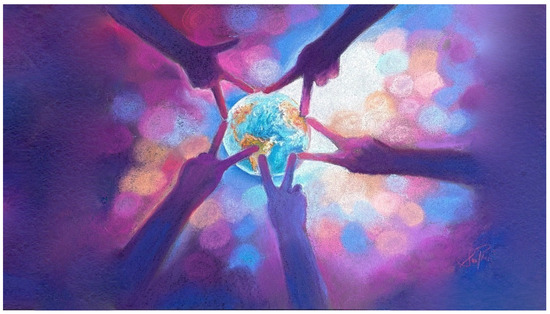
Figure 1.
Planetary health requires integrative, transdisciplinary approaches that combine technical solutions with social, cultural, and ethical dimensions to foster flourishing systems for people, places, and planet.
In our previous editorial, A New Vision for Challenges, we articulated how planetary health provides a cohesive narrative to integrate the diverse contributions of many disciplines [3]. It highlights that solutions must go beyond technological innovation to encompass values, education, culture, governance, and social and environmental justice. We emphasized the importance of engaging the social sciences, arts, and humanities alongside biological, physical, and health sciences to foster more holistic strategies for flourishing futures.
Under our new name, Challenges—Journal of Planetary Health, we will continue to welcome a wide range of contributions—from empirical research and policy studies to conceptual and creative perspectives—that illuminate pathways toward mutual flourishing of people, places, and planet. Our scope includes human flourishing, climate change, biodiversity, food systems, regenerative business and economies, Indigenous and traditional knowledge, ethics and spirituality, planetary health education, and governance.
With this new identity, we affirm our commitment to advancing scholarship and solutions in this growing field. Planetary health has rapidly gained recognition as an essential framework for meeting the grand challenges of the Anthropocene, and we believe our journal has a vital role to play in shaping its development.
We extend our deep gratitude to our authors, reviewers, and readers who have supported Challenges over the years. With your continued engagement, Challenges—Journal of Planetary Health will strive to be a home for bold, integrative, and transformative ideas that respond to the most important issues of our time. This new step forward feels like the perfect way to celebrate our first 15 years—and to set the course for the next.
Conflicts of Interest
The authors declare no conflict of interest.
References
- Challenges-Journal of Planetary Health Home Page. Available online: https://www.mdpi.com/journal/fossstud (accessed on 2 September 2025).
- Planetary Health Alliance. What is Planetary Health? Available online: https://www.planetaryhealthalliance.org/planetary-health (accessed on 1 September 2025).
- Prescott, S.L.; Webb, D. A New Vision for Challenges: A Transdisciplinary Journal Promoting Planetary Health and Flourishing for All. Challenges 2024, 15, 26. [Google Scholar] [CrossRef]
Disclaimer/Publisher’s Note: The statements, opinions and data contained in all publications are solely those of the individual author(s) and contributor(s) and not of MDPI and/or the editor(s). MDPI and/or the editor(s) disclaim responsibility for any injury to people or property resulting from any ideas, methods, instructions or products referred to in the content. |
© 2025 by the authors. Licensee MDPI, Basel, Switzerland. This article is an open access article distributed under the terms and conditions of the Creative Commons Attribution (CC BY) license (https://creativecommons.org/licenses/by/4.0/).