


Abstract
The present study seeks to trace the relationships among six versions of the Passio Ioannis—the account of Saint John of Trebizond, whose relics were transferred to Suceava—and to highlight the differences that emerge across the roughly four centuries separating them. Each version reflects the Orthodox Church’s attempt to communicate a particular message and to project signals intended to resonate as deeply as possible within the consciousness of the Christian communities of that era. By examining these hagiographic sources from a diachronic perspective, the study brings into focus a message imbued with pronounced political, theological, and moral dimensions. In addition to the broader challenges confronting Eastern Christianity at various historical moments, the texts also disclose the authors’ personal experiences and preoccupations, subtly interweaving allusions to contemporary realities with the narrative of the suffering and martyrdom of Saint John, the merchant of Trebizond. Through this comparative and contextually grounded analysis, it becomes possible to discern the diverse functions the same text has fulfilled over the centuries, thereby underscoring the distinct meanings attached to each edition of the hagiographic narrative—whether Slavonic, Romanian, or Greek.
1. Introduction
The recent decision of the Romanian Orthodox Church (ROC) on 12 July 2024 to sanctify a group of 16 priests and monks who lived in the 20th century has already aroused a series of reactions from several associations and non-governmental organizations regarding the qualities of the personalities declared saints1. This controversy indicates how little is understood about the meaning of the particular cases of canonization carried out by the Romanian Orthodox Church, especially in the last three decades; one should rather notice the signal or message that this act of “recognition and proclamation of sainthood” can transmit (Perşa 2023). In addition to a series of criteria established by the canonical tradition of the Church, which strictly concern holiness, canonization sometimes also involves an additional motivation:
- The consolation of the imperial family [the canonization of Flacilla, the first wife of Emperor Theodosius the Great, in 386 (Boicu 2017, p. 174), or of Theophanes Martinakia, the first wife of Emperor Leo VI, in 898 (Tougher 1997, p. 117; N. Chifăr 2007, p. 271)];
- The expression of gratitude (the canonization of emperors who organize Ecumenical Councils)2;
- The reconciliation of divided communities [on 27 January, 438 John Chrysostom is officially canonized by Bishop Proclus (Boicu 2020, pp. 177–94); Patriarch Ignatius is canonized by his former rival Photius, c. 878 (N. Chifăr 2007, p. 342); and the feast of the Three Holy Hierarchs is established, c. 1100 (Parry et al. 1999, pp. 491–92)];
- The emphasis and consolidation of a certain position of the Church [canonizations made by ROC in 1950–1955 of fighters for Orthodoxy against Calvinist and Uniate coercions (Păcurariu 1994a, p. 393)];
- The highlighting of a significant moment in local history [the canonizations of Saints Iachint of Vicina (Bălan 2005, pp. 83–85) and Ghelasie of Râmeț (Păcurariu 1994b, pp. 38–39), the first bishops of some ecclesial structures on the territory of Romania, about which we otherwise do not have much information].
There is certainly also a latent symbolism or political significance of these acts of the Church, which may align with the agenda of the state in which it operates, and thus a political statement, or, on the contrary, may indicate opposition or hostility towards a certain regime or a socio-political direction with which the Church cannot sympathize. One may recall here, for example, the canonization on 23 April 2015, of 1.5 million Armenians, killed in the Ottoman Empire 100 years earlier. During this event, Catholicos Garegin II and other top clergymen of the Armenian Apostolic Church confer sainthood on the victims of the 1915 Armenian genocide, stating that “We believe that we are weaving the crown of a new spiritual rebirth for our people, by canonizing the martyrs of the Armenian Genocide. The memory of our holy martyrs will heretofore not be a requiem prayer of victimhood and dormition, but rather a victorious song of praise by incorporeal soldiers, triumphant and sanctified by the blood of martyrdom” (Danielian 2015).
An essential element of the canonization processes is the description of the saint’s life that should justify the reason for this recognition of holiness, as well as the composition of the liturgical services, in which, through predetermined hymnographic structures, the saint’s life is summarized and their intercession before God is invoked. Inevitably, the content of these hagiographic creations reflects certain tendencies of the era in which they were composed and, across the centuries, offers a series of clues about the context in which ecclesial life unfolded at a given moment.
Over time, the emphasis placed on certain elements in a saint’s biography changes depending on the message that the Church wants to convey, strongly reflecting the political, social and religious framework of each era, and the aim of this study is to follow from a diachronic perspective the evolution of this message starting from the concrete case of the passio of Saint John the New from Suceava. Although it has already been studied in detail and from a much broader viewpoint, it is worth insisting on this “dossier”, starting from the results of previous research to attempt a comparative analysis of the hagiographic pieces that provide clues about how the Church adjusts its discourse according to the concrete conditions of the moment.
2. Short Hagiographic Sketch
According to the Synaxarion of 2nd June—a brief biography note included in the Menanion, meant to be read during the Matin service, right after the kontakion and the ikos—the Martyr John the New of Suceava lived in the fourteenth century in the city of Trebizond.
“He was a merchant, devout and firm in his Orthodoxy, and generous to the poor. Once, he happened to be sailing on a ship while pursuing his trading activities. The captain of the ship was not Orthodox, but got into an argument about the Faith with St John.
Having been vanquished by the saint’s words, the captain resolved to make trouble for him when they got to Belgorod (White Citadel). During the ship’s stay at Belgorod, the captain went to the city ruler, a fire-worshipper, and suggested that on his ship was a studious man who also desired to become a fire-worshipper.
The city ruler invited St John to join the fire-worshippers and renounce his faith in Christ.
The saint prayed secretly, calling on the help of Lord […] and God gave him the courage and understanding to counter all the claims of the impious and firmly confess himself a Christian. After this, the saint was so fiercely beaten with rods that his entire body was lacerated, and the flesh came off in pieces. The holy martyr thanked God for being found worthy to shed his blood for Him and thereby wash away his sins.
Afterwards they put him in chains and dragged him away to prison. In the morning the city ruler ordered the saint brought forth again. The martyr came before him with a bright and cheerful face. The intrepid martyr absolutely refused to deny Christ, denouncing the governor as a tool of Satan. Then they beat him again with rods, so that all his insides were laid bare.
The gathering crowd could not bear this horrible spectacle, and they began to shout angrily, denouncing the governor for tormenting a defenseless man. The governor, having the beating stopped, gave orders to tie the Great Martyr to the tail of a wild horse to drag him by the legs through the streets of the city. Residents of the Jewish quarter particularly scoffed at the martyr and threw stones at him. Finally, someone took a sword and cut off his head.
St John’s body with his severed head lay there until evening, and none of the Christians dared to take him away. By night a luminous pillar was seen over him, and a multitude of burning lamps. Three light-bearing men sang Psalms and censed the body of the saint. One of the Jews, thinking that these were Christians coming to take up the remains of the martyr, grabbed a bow and tried to shoot an arrow at them, but he was restrained by the invisible power of God, and became rigid.
In the morning the vision vanished, but the archer continued to stand motionless. Having told the gathering inhabitants of the city about the vision and what was done to him by the command of God, he was freed from his invisible bonds. Having learned about the occurrence, the ruler gave permission to bury the body of the martyr in the local church. […]
The captain who had betrayed St John repented of his deed, and decided secretly to convey the relics to his own country, but the saint appeared in a dream to the priest of the church, and prevented this.” (The Orthodox Calendar. Feasts and Saints 2025).
According to the Slavonic passio, seventy years after his death, the Saint’s relics were transferred to Suceava, the capital of the Moldavian principality, where they were placed in the cathedral church. They were received with full ceremonial honors by Voivode Alexandru the Good and Metropolitan Iosif Muşat, following the resolution of the conflict between the Orthodox Church of Moldavia and the Patriarchate of Constantinople.
Beginning in 1394, the ecumenical patriarchs refused to acknowledge the canonical legitimacy of Iosif Muşat’s ordination, whom Patriarch Anthony of Constantinople (1390–1397) regarded as a usurper and “adulterer” (μοιχός), that is, unlawfully installed. Consequently, the Ecumenical Patriarchate sought to impose a series of Greek hierarchs at the head of the newly established metropolis. The Moldavians, however, rejected Metropolitans Jeremiah and Michael of Bethlehem, and as a result the ruler, the bishops, the boyars, the populace, and the entire Church remained under patriarchal anathema until 1401, during the tenure of Ecumenical Patriarch Matthew I (1397–1402, 1403–1410) (Zaharia 1987, pp. 46–110).
It should also be noted that this shift in attitude occurred following the intervention of the Byzantine Emperor Manuel II Palaiologos (1391–1425), who had previously benefited from the support of Voivode Alexandru during the blockade of Constantinople imposed by Sultan Bayezid. Through this concession, Manuel II was trying to incorporate Moldavia into the Byzantine Commonwealth (Zaharia 1987, p. 105).
By placing the Saint’s intact relics in the metropolitan church of Suceava, the capital of the principality, the entire land of Moldavia was thus placed under the protection of Saint John the New. This act also affirmed the ecclesiastical prestige of the newly established metropolis, which became a site of large-scale pilgrimages on the day commemorating his martyrdom. In 1685 the Relics of St. John were taken by the Polish King Jan Sobieski to Stryy in Ukraine. They were later transferred to the Basilian Monastery in Zhovkva, as well as in Halychyna. Starting in 1744, Northern Moldavia (Bukovina), where the former capital Suceava was located, came under Austrian rule, and the Habsburg Emperor Joseph II returned them to Suceava in 1783. To safeguard the holy relics of Saint John the New from the dangers posed by the First World War (1914–1918) and from potential acts of desecration, the Austrian authorities ordered their evacuation and transfer to Vienna. From the autumn of 1914 until 25 July 1918, the relics were housed in the Romanian Orthodox Chapel in Vienna. On 27 July 1918, after the end of the war, the relics of Saint John were returned to Suceava, where they remain to this day. After the unification of Bukovina with the Kingdom of Romania on 15 November 1918, Suceava was reunited with the rest of Moldova in the modern Romanian state. Thus, Saint John continued to be considered the protector of Romanians in this part of the country.
4. 14th Century
I—Gregory the Monk, Slavonic
The time of the writing of the Slavonic text has been placed at the beginning of the 15th century, being closely connected with the translatio of the relics of Saint John from Cetatea Albă to Moldavia and their deposition at Suceava in the Church of Mirăuți, the old metropolitan cathedral. Based on some interpolations made by Misail the Monk (1675–1685) in the Chronicle of the Land of Moldavia compiled by Grigore Ureche (1642–1647), the moment of the translation of Saint John’s relics to Suceava would have taken place in the year 1402. However, in the “Cardaş manuscript”—the version lacking those interpolations—Grigore Ureche mentions, for that year, only the founding of the monasteries of Bistrița and Moldovița, and then, without any connection to that year, goes on to recount the bringing of the relics into Moldavia.
In the version interpolated by Axinte Uricariul († c. 1733) of the same chronicle of Grigore Ureche, the relics are received by Prince Alexandru the Good “in the year 6923,” that is, in 1415—the same year also indicated by the chronicler Nicolae Costin (†1712) (Cojocaru 1994, p. 538). Dating the arrival of Saint John’s relics in Moldavia to the year 1415 implicitly resolves the thorny issue of the authorship of the text attributed to Gregory Tsamblak (first mentioned by Bishop Pahomie of Roman, 1707–1714), who by that time was already in Kiev, struggling for the canonical recognition of his election—a situation that would not have been compatible with the position assumed by the author of this passio, who identifies himself as “a monk and presbyter in the Great Church of Moldovlachia.”
About thirty years ago, Father Professor Constantin Cojocaru wrote a synthesis in which he reviewed the entire body of arguments of those who attribute the work to Gregory Tsamblak, as well as a very solid refutation of this hypothesis, ultimately appealing to internal evidence found in the text itself—largely following Petre Năsturel. This concerns the use of the structure “ижe тoгдa” (Năsturel 1971, p. 347) in two key sentences.
- (a)
- „Iaжe й въ cлoyxa пpїидѡшѧ ижe тoгдa блгoчьcтивaгo гocпoдcтвoyѫщoмoy въceѫ мoлдoвлaxїѫ й пoмopїv” (And then they reached the ears of the then pious ruler of Moldavia and the land by the sea).
- (b)
- „й cъ cъвѣoмь ижe тoгдa цpкѡ внaa пpaвѧщaгo cщeннѣишaгo apxieпкпa Iѡcиφa” (And with the advice of the one who then led the true faith in the Church, His Holiness Archbishop Joseph).
Thus, both in the case of the voivode and of the metropolitan, the phrase “ижe тoгдa” (“the one who was then”) is used; therefore, the author composed this passio, united with the translatio of Saint John’s relics, at a time when neither Metropolitan Iosif (†1415/1416) nor the ‘then ruler,’ Alexandru the Good (†January 1, 1432), was still alive. Consequently, the text was written sometime between 1432 and 1439, when it already appears in the manuscript of Gavriil Uric—a time span of more than a decade after the death of Gregory Tsamblak (†1419) (Năsturel 1971, p. 350; Cojocaru 1994, pp. 532–33; Zaharia 1987, pp. 131–34).
Another aspect by no means negligible is the impact of shifting the year of the translation of the relics to Moldavia to 1415, since this also requires reconsidering the year of Saint John’s martyrdom, now placed about seventy years before the translatio, that is, in 1345 rather than 1330–1332, as previously thought based on the assumption that Alexandru the Good had brought the relics to Moldavia in 1402.
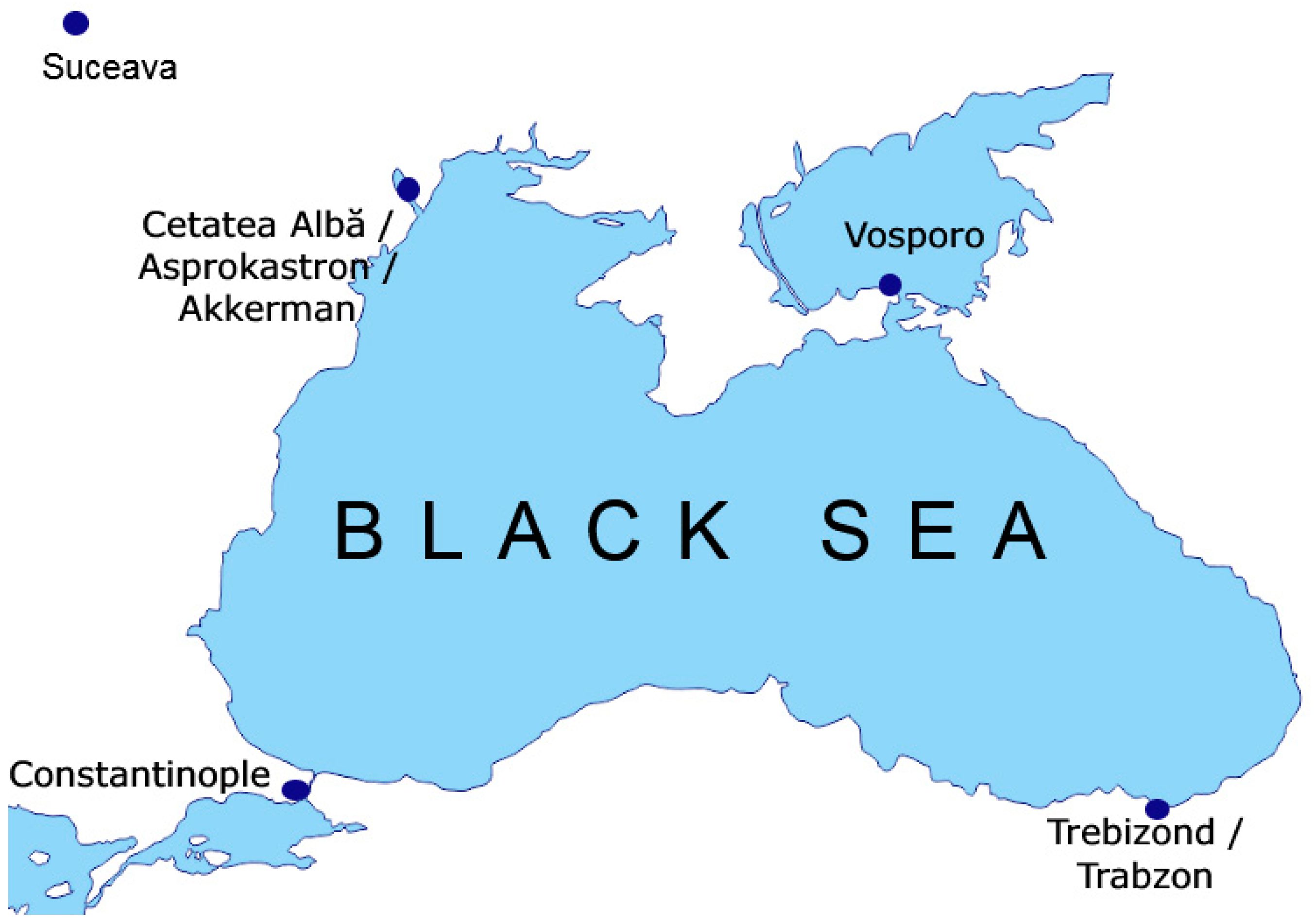
Starting from this chronological adjustment, Matei Cazacu recontextualizes the moment of Saint John’s martyrdom, thereby seemingly resolving the debate over the location of Cetatea Albă//Leukopolis//White Citadel—identifying it not with Asprokastron (Greek)/Akkerman (Turkish)/Belgorod-Dnestrovskiy in the western Black Sea, but with Vosporo, a port near the Cimmerian Bosporus (the Strait of Kerch) (Năsturel 1971, p. 347). For better geographical orientation see Figure 1.
Figure 1.
The location of the towns indicated by passiones Ioannis.
The most interesting aspect of this new chronological framework lies in the fact that in 1341 Khan Togtluk-Timur, then emir of Solget, granted the Venetians the fortress and port of Vosporo (Canale 1855, pp. 447–48), just as Khan Öz Beg had ceded the port of Caffa in Crimea to the Genoese in 1313 (Cazacu 2001, p. 156).
During the same period, amid the commercial rivalries in the Black Sea, the Venetian community of Trebizond was attacked by the Byzantines—an incident that resulted in the death of several Venetian merchants and in the suspension of trade between Venice and Trebizond. Only in 1344 were two Venetian galleys sent to Trebizond (Heyd 1886, p. 104). Thus, Matei Cazacu concluded, ‘We must therefore regard the martyrdom of John, a wealthy merchant from Trebizond, as the result of the tensions between the Venetians and the Trebizondians, based on commercial and religious competition. The date of the martyrdom can be placed around the years 1341–1343, or shortly after 1344–1345, when the wounds had not yet healed and memory was still marked by the conflicts of 1343.’ (Cazacu 2001, p. 156).
Therefore, the reason why the “Frankish” (i.e., Western) sailor—“of the Latin heresy” [лaтинcкьiѧ epecи cѫщa] and “very furious and inhuman”—denounced John to the city’s eparch was not limited merely to envy of the merchant’s virtue or to confessional rivalry—the “Latin heresy” designating the Catholic Church4—but also involved more mundane elements such as commercial competition and a desire for revenge.
Even the recent study written by Jan Mikołaj Wolski, who argues that the author of the martyrdom account, through an abusive rhetoric, seeks to dehumanize the non-Orthodox figures involved in the events by emphasizing their negative, degrading, and bestial traits (Wolski 2021, p. 774), ultimately concludes that the author—whom he identifies without a trace of doubt as Gregory Tsamblak—‘showed no hostility toward the Catholics and, in recounting the participation of the Catholic captain in John’s martyrdom, adopted the delicate position of an impartial witness.’ (Wolski 2021, p. 775).
The author seems far more concerned with tracing the consequences of the denunciation made before the city’s eparch [vпapxoy гpaдa], who was a Persian [пepcoy].
Beyond the particular details of this main hagiographic source, the purpose for which it was composed is extremely important. In addition to its liturgical function—honoring the martyr—its didactic function—introducing the faithful to the knowledge of this saint’s deeds—and its moral function—inspiring love of virtue in believers through such an example—the text of the monk Grigorie also carries a profound political meaning: it aims to record and to establish, at the local level, the cult of Saint John, since these events are described on the occasion of the translatio of his relics, brought, as already mentioned, by Voivode Alexandru the Good to Moldavia.
When the prince met the procession accompanying the relics of Saint John, “he prostrated himself before the [Saint’s] reliquary and embraced that much-suffering body, touched his eyes and lips to the Saint’s hands, shed many tears of joy, and appointed him as protector of his realm; thus he placed him with great honor in the Most Holy Metropolitan Church, in his radiant city of Suceava.”
If we look at the political and religious context in which this translatio took place, it is quite clear that such a gesture had a special significance—that of consecrating the political and ecclesiastical autonomy of this emerging East European state. So the text in not just a récit de translation, but also a récit de fondation.
Moreover, it was not an isolated gesture: there was a tradition among the Balkan kingdoms of consolidating their prestige and political and religious independence through such translationes, as happened, for example, in Tărnovo, where in 1238—three years after the recognition of the Bulgarian Church’s patriarchal status (1235)—the relics of Saint Paraskeva of Epivates were brought, or at Curtea de Argeș (Wallachia), where the relics of Saint Philothea were transferred (c. 1396–1397) (Cernovodeanu 2001) as the culmination of the establishment of the Metropolitan See of Ungro-Wallachia.
These acts of proclaiming sainthood (canonization/sanctification) conferred legitimacy upon the political power of those territories, highlighting the monarch’s prerogative as God’s chosen ruler to initiate such a cult, while also placing the state under the protection and blessing of the saint—who, in turn, reinforced the monarch’s authority both internally, in relation to other claimants to power, and externally, by securing the independence of the state and of its Church (Guran 1998, pp. 196–97).
The recent and complex study conducted by Elena Firea highlights that “in the actual account of the adventus ceremony, the voivode plays the central role, as he is the one who solemnly receives the relics, venerating them before the gathered people, thereby certifying their authenticity.” (Firea 2022, pp. 44–45). The gestures of the voivode described in the Slavonic text—his touching of the saint’s body, the ritual kiss, and the tears he shed—form part of the public dimension of princely devotion:
“Intimate contact with the relics was part of a representational construct of power, ostentatiously emphasizing the alliance between political authority and the new saint—an alliance which, moreover, extended over the ruler’s subjects, granting divine legitimization to his power. In the case of John the New, this idea is reinforced by the final invocation of the martyr as protector of the country (and implicitly of the princely house), as well as by the decision to place the relics permanently in ‘his radiant city of Suceava, his seat,’ that is, in the voivode’s center of power—an important aspect of how power functioned in the Middle Ages. The entire passage describing the reception of the relics by Alexandru the Good, and especially the final elements mentioned, reveal the political and ideological implications attributed to the new cult from the moment of its adoption in Moldavia, while also highlighting the hagiographic text’s character as a ‘manifesto of power,’ as previously noted in historiography”.(Firea 2022, p. 46)
We can thus speak of the foundational character of this passio, which both justifies and seeks to legitimize a certain political independence and a distinct ecclesiastical organization as an autocephalous metropolitan see. At the same time, it constitutes the basis for the cult of the martyr John, providing justification for the introduction of a new saint into the devotional practices of the Moldavians, given that John the New was at that time an almost anonymous figure in the Eastern synaxarion, and that ‘his relics did not have a prestigious provenance.’ (Firea 2012, p. 369).
Most likely, the text played a fundamental role in the deliberate creation of an official cult for the one who was to be invested with the role of the country’s patron saint, at a moment when Moldavia was asserting its political independence and ecclesiastical autocephaly. The iconographic representations emphasize this role of spiritual patron, protector, and bringer of victory, at times associating him with Saint George among the military saints (Firea 2022, p. 141), visually translating the description of the martyr found in the prooimion of the passio, ‘And our present discourse is about John, the valiant soldier of Christ and the one filled with the gifts of the Holy Spirit,’ as well as in the liturgical compositions—he is considered soldier of Christ in 14 occurrences.
5. 17th Century
The series of religious and political events that took place in the second half of the 15th century and throughout the following century left their mark on the way in which the life of Saint John the New is presented, reflecting the particular conditions of this new context.
5.1. II—Varlaam, Romanian
A first witness to these changes is the Romanian version published by Varlaam, Metropolitan of Moldavia (1632–1653), in the Romanian Book of Learning (Carte romănească de învăţătură duménece[le] preste a[n] şi la pra[z]nice împărătéşti şi la svă[n]ţi Mári: di în multe scri[i]turi tă[l]măcită, Iaşi, 1643), where this evolution is clearly reflected. It is still uncertain whether the translation was made by Varlaam himself or by another person, but what is certain is that it follows the Slavonic source written by “Gregory the monk,” which it adapts to new historical realities.
The title records a number of changes that attest to how deeply the veneration of Saint John the New had become rooted in the local Church: a toponymic epithet (“of Suceava”) is added, as well as the specification of the date of his celebration (“which is celebrated on the Thursday after Pentecost”). Yet these are not the most significant changes, but rather the religious nuances implied by the new version. Thus, the governor of the city is no longer identified as “a Persian [пepcoy], who zealously kept the delusions inherited from his fathers”—as the Slavonic version indicates—but is now presented as “a Turk, very fond of and devoted to the Turkish faith,” and is referred to in five instances as a “qadi” instead of an “eparch.”
Consequently, the merchant John is no longer asked to renounce Christianity and worship, “the bright sun and the star that shines before us, and to offer sacrifice only to these bright lights,” but is instead required merely to “renounce the Christian law […] trampling underfoot the law of the giaours.” Ewa Kocoj mistakenly understands that the future martyr is asked to adhere to “the law of the giaours,” ignoring that the term giaour refers to the “unbelievers,” i.e., non-Muslims (Kocoj 2019, p. 498).
Much more interesting is the adaptation of Saint John’s apologetic response, which, according to the Slavonic version, addresses the Persian governor:
“[…] Rather, you should learn from me the mystery of truth. Cast off, I beseech you, this darkness of impiety [from yourself], which has enveloped your soul, and be deemed worthy to become a son of light, shining more brightly than the sun through the dawns of the Divine Baptism. But do not suppose that this luminary [the sun] is God, for it was created by our Creator for the service of humankind, being a creation of fire, made on the fourth day. How, then, can a creature be God?”(I-G.S.)
The worship of the heavenly bodies and of fire, together with the vague reference to the “Persians,” suggests allusions to Zoroastrianism—a Persian religion in which the sun is revered as a symbol of purity and goodness, a manifestation of the divine light of the supreme deity Ahura Mazda. The symbolism of fire, in turn, concentrates within itself numerous attributes of the creative and purifying energy of this divinity.
In the version adapted by Varlaam, where Saint John’s opponent is portrayed as a Muslim, the saint’s reply is modified to take into account the particularities of Islam, which, in Sura 41 of the Qur’an, verse 37, states, “And among His signs are the night and the day and the Sun and the Moon. Do not prostrate yourselves to the Sun or to the Moon, but prostrate yourselves to Allah who created them!” Accordingly, in the text published by Varlaam several omissions are made, leaving the episode in the following condensed form:
“[…] Rather, you must learn from me what is true. Cast away the darkness of unbelief that lies within your soul, that you may be found worthy to become a son of light through the holy baptism, which shines brighter than the sun, to enlighten you toward the Kingdom of Heaven.”(II–V.R.)
These modifications certainly do not originate with Varlaam himself, but rather represent the indicators of a deeply rooted tradition that had already emerged in Moldavia by the end of the fifteenth century. The visual representations of the Passio Ioannis found in the frescoes of numerous churches in northern Moldavia—especially those around Suceava—depict the city’s governor in Turkish attire, while the torturers of Saint John appear in Ottoman armor and garments. Remarkably, one can even observe, in some cases, Western-style armor contemporary to that period (Firea 2022, p. 225). Similarly, the presence of Catholics in this painted passio is quite clearly individualized: not only is the Venetian merchant distinguishable by his clothing, but also the figures of Franciscan monks, recognizable by their characteristic robes, appear as representatives of Catholics in general (Firea 2022, pp. 231–32). This reflects the uncompromising attitude toward the Catholic Church in Moldavia—which had by then consolidated its influence—especially toward the Franciscan missions that promoted the Florentine Union and persecuted the Hussite refugees who had fled east of the Carpathians (Damian 2011, pp. 146–51).
These iconographic subtleties suggest a fairly consistent process of adaptation, carried out in a historical context in which the presence of Catholics was already well established, while the Ottoman authorities were forcing apostasy and encouraging conversion to Islam. Varlaam himself was well acquainted with this policy, being a close associate of Voivode Miron Barnovschi, who was arrested by order of Sultan Murad IV. The sultan is said to have promised to spare his life if he converted to Islam, but since Miron-Vodă refused to renounce the Christian faith, he was beheaded on 2 July 1633 in Constantinople (Boicu 2024, p. 103). This was but one episode in a series of executions that culminated in the Romanian Lands with the much more widely known case of the Brâncoveanu Martyrs (15 August 1714).
Dimitrie Gonis believes that, in order to harmonize the narrative of the martyrion with the historical circumstances of his own time, Varlaam did not content himself merely with occasional substitutions (Persian–Turk, sun worship–Islam), but resorted to yet another device: the omission of the name of Metropolitan Iosif of Moldavia from the scene depicting the translation of the relics. The purpose of this omission, according to Gonis, would have been to allow the relocation of the event of the relics’ transfer—and implicitly to shift the date of the martyrdom, which had occurred roughly seventy years earlier—into the period of Ottoman control over Cetatea Albă (Akkerman). Varlaam thus takes advantage of the ambiguity created by the mere mention of a ruler named Alexandru, a name that could refer to several Moldavian princes:
- Alexandru cel Bun (1400–1 January 1432);
- Alexandru II or Alexăndrel (December 1448–12 October 1449/February 1452–August 1454/February 1455–25 March 1455);
- Alexandru Cornea (December 1540–February 1541);
- Alexandru Lăpușneanu (September 1552–November 1561/March 1564–9 March 1568);
- Alexandru Movilă (November 1615–July 1616);
- Alexandru Iliaș (September 1620–September 1621);
- Alexandru Coconul (September 1629–April 1630).
The Greek scholar concludes that Varlaam’s published text gives the impression that both the martyrdom and the transfer of the relics took place after the Ottoman conquest of Cetatea Albă in 1484—an interpretation in flagrant contradiction with the information provided by the Slavonic source (Gonis 2015, pp. 166–68).
It is certain that the harsh daily reality shapes the content of this passio, which offers a reference much easier to understand and assimilate by the Christians who were to read or listen to the life of the martyr John the New. The martyr becomes a model of resistance in a period in which religious persecution and demands for public renunciation of Christianity had become current instruments of Ottoman policy. This seems to be even better highlighted in the other two sources written in the 17th century.
5.2. III—Nikiphoros, Greek
The third passio was written by Patriarch Nikephoros of Alexandria (1639–1645), who during his tenure traveled to Moldova for the purpose of collecting alms. He also enjoyed the support and intervention of Prince Vasile Lupu (1634–1653) in the conflict with the bishops of Sinai, who continued to perform religious ceremonies at the Sinai Dependency of Cairo, without the essential permission of the Patriarch of Alexandria. When Nikiphoros was away in Moldavia, they attained the relative permission from the Ecumenical Patriarch Parthenios I, who was later forced to retract it, following the protest by Patriarch Nikiphoros.
As for the text itself, a few clarifications should be made regarding the first piece preserved in the Greek language. D. Gonis mentions an edition from the seventeenth century that is said to have been printed in Iași in 1819 but subsequently lost. Fortunately, a copy of that edition has been preserved in the library of the “Saints Three Hierarchs” Monastery, now held at the Central University Library in Iași. The translation of the title already provides a wealth of information:
“The Service of the Holy Martyr John of Trebizond, composed by the Patriarch of Alexandria, Lord Nikiphoros the Cretan. And now published for the first time in print, with certain additions and corrections, through the generous expense of Lord Toma Buiukis of Trebizond, in Iași, 1819. In the Greek printing house.”
Although the second leaf is missing—on which there would have been an engraving by Dimitrios Kontoleos (most likely an icon of Saint John that was later detached for private veneration), reproducing an icon from Bârnova Monastery—the front flyleaf bears the following inscription: “This book belongs to the Holy Monastery of the Three Hierarchs of Iași. 17 May 1844. Costachi Tighinean.” On the guard leaf appears another note: “Let it be known that I, the undersigned reader, was at the Monastery of the Holy Three Hierarchs. 18 May 1844. Costachi Tighinean.”
Also highly informative is the “word to the readers,” which refers to the circulation of several services (acolouthias) dedicated to Saint John, composed by different authors.
“The present service (acolouthia) of Saint John of Trebizond, which—as the title states—was composed by Nikiphoros, Patriarch of Alexandria, had until now been preserved in manuscript form in several churches of Iași. Having been copied by various scribes, additions, omissions, and many errors crept in, as was the case with all old manuscript works before the discovery of printing. In addition to this, other services of the same saint were also composed by different poets who, wishing to appear as authors of the hymn, did not wish to borrow anything from the first composition, but instead created entirely new hymns. Thus, with three or four such services in circulation, when the feast day of the saint arrived, the head of the church was sometimes uncertain which one to use. In order to eliminate this confusion and to ensure that this service would be disseminated everywhere—but especially in the saint’s birthplace—so that he might be honored by Christians as the first martyr who was slain by the descendants of Agar (πρῶτος μάρτυς ὑπὸ υἱῶν τῆς Ἄγαρ σφαγιασθείς), the noble Lord Toma Buiuchis of the town of Rizion in the eparchy of Trebizond took it upon himself to bring it to light through print, correcting it where necessary for the benefit of his soul. At the same time, he hastened to have an image of the saint engraved in copper after an old icon preserved in the Bârnova Monastery here. Receive, therefore, all Orthodox Christians, this book with a joyful heart, giving thanks to God, who strengthens the faithful in their belief even in the most difficult circumstances; and celebrate the saint with psalms and hymns for your salvation and help.”(Copied in (Bianu et al. 1936, pp. 315–16).)
In describing the life of Saint John the New, Patriarch Nikiphoros of Alexandria seeks to introduce several Byzantine hagiographic topoi (such as “virtuous even from childhood”), while at the same time emphasizing the anti-Catholic polemical dimension by imagining a doctrinal conflict between the Orthodox merchant from Trebizond and the Latin sailor. To perceive the difference, one may compare this episode with the earlier two sources, as can be seen in Table 2.
Table 2.
Comparative view on the “reason” for denunciation.
More than a mere interpolation, the information inserted by Nikiphoros profoundly alters the meaning of the hagiographic text. In his version, the Latin sailor—defeated by Saint John in doctrinal disputes—seeks to eliminate his rival by denouncing him to the city’s ruler, “a Turk [ὀθωμανός], a zealous defender and faithful guardian of Turkish teachings” [ἐραστὴς καὶ ἀκριβὴς τῶν ὀθωμανικῶν δογμάτων φύλαξ]. The episode thus no longer concerns mere envy, but rather revenge—or even a deliberate act arising from the confessional rivalry between Catholics and Orthodox.
The confessional motive of the denunciation had a strong historical counterpart in that era, recalling the intrigues of Jesuit agents, who, through their machinations at the courts of the Sultan and the Grand Viziers, acted against the high prelates of the Orthodox Church, slandering and compromising them before the political authorities, who then reacted brutally against those denounced. One such case was the accusation brought against Patriarch Cyril Lukaris (Michaelides 1943, p. 122), who was alleged to have harbored sympathies for the Protestant states; as a result, Sultan Murad IV ordered that he be strangled by the Janissaries on 27 June 1638.
Although Patriarch Nikiphoros otherwise follows the Romanian source rather closely—making use of the adaptations published by Metropolitan Varlaam of Moldavia—he chooses to elaborate upon another passage, this time devoted to the killing of Saint John, which can be examined comparatively alongside the first two sources, like in Table 3.
Table 3.
Comparative view on the Jewish participation.
The difference in attitude that the Patriarch of Alexandria imprints in this text, giving it an anti-Semitic note, is quite obvious. If the Slavonic and Romanian versions evoke the participation of the Jews in this episode, the Greek version conveys a clear hostility, classifying them from the very beginning as “enemies of the Christian faith”. Even more interesting is the detail that the murderer of Saint John acts not only out of an impulse of hatred, but also at the request of the Muslims, becoming their accomplice.
5.3. IV—Meletius, Greek
Surprisingly, within the same span of the seventeenth century, another passio dedicated to Saint John the New was composed, also in Neo-Greek. This time, the author was Meletius Syrigos, a distinguished scholar of the Orthodox Church, known for his contributions to the reception of the Confession of Faith authored by Metropolitan Peter Mohyla of Kyiv, as well as for his involvement in the campaign to condemn Patriarch Cyril Lukaris. Even this latter aspect does not diminish his reputation as a fervent preacher and a prolific creator of a substantial body of hymnographic and hagiographic works (Strates 2004). According to the research of Jules Pargoire, the Passio Ioannis has been preserved in Codex M746, and, according to the note on page 567, it was composed in September 1649, with the martyrion itself occupying pages 571–594. Interestingly, the text of the Canon and its variants (pp. 599–679) were written earlier, in May 1646, when Meletios was residing in Iași and Suceava (Pargoire 1908, p. 280).
The originality of this version of the Saint’s Martyrdom lies in the elaboration of the plot. Meletius is more precise: the merchant embarks “on an Italian ship, whose captain was a certain Latin, and this people did not hold a particularly favorable attitude toward members of the Eastern Church since they had separated from Rome.” (Gonis 1984b)
John’s virtues—especially his compassion, “always weeping and generously comforting those who suffered, saying constantly that if we show mercy, we shall indeed obtain mercy”—provoke “the envious devil” to incite “the captain to violence and to enrage him against the saint, though he had no other reason except that the latter prayed and declared that those who have turned away from the original faith and abandoned apostolic traditions and doctrines have no hope of salvation.”
As Elena Firea has observed, the religious confrontation, an indispensable topos of all martyr acts, was self-evident; however, “explicit opposition to Catholicism seems to be a characteristic feature of the hagiography of Saint John,” since “the attribution of the counter-hero role to a Catholic figure is repeatedly emphasized in most textual and visual narratives of his martyrdom.” (Firea 2022, p. 232)
Further on, the “governor of the city” [τόν τῆς ἀκροπόλεως ἄρχοντα] is described as “an Agarean, a zealous supporter of the religion of Muhammad” [Ἀγαρηνὸν ὄντα καὶ δεινὸν προστάτην τῆς τοῦ Μωάμεθ θρησκείας]. After confronting “that deceitful and treacherous Agarean,” to whom he demonstrates that “true faith dispels the darkness of unbelief from the soul”, guiding it “toward the heavenly kingdom and not allowing it to stray from the divine path into the darkness of perdition,” Meletius reiterates this idea in the martyr’s address to Christ: “I will not worship darkness; I will not serve the devil; I will not bend the knee before Baal.”
Another distinctive feature is the composition of those who take part in Saint John’s torment in the Jewish quarter, whose inhabitants “came out of their houses and began to insult and mock him, rejoicing and striking him with stones and all kinds of sticks, their women and children joining in with joy. One of them seized a sword from somewhere, ran after the horse, caught up, and cut off the saint’s head.” Besides including women and children among the group of tormentors, Meletius adds an interesting interpolation when he reports that the martyr’s body remained unburied in the Jewish quarter, and that “no Christian dared to approach it out of fear of the Jews.”
The emphasis the Greek theologian places on the active participation of the Jewish inhabitants prepares the following episode—the saint’s wake conducted by angels—at which point one of the Jews, taking a bow and arrow, attempts to strike them, but “the arrow and the bowstring stuck to his hands until dawn, when he confessed the miracle before all those present, who had witnessed it that night.” Here, again, Meletius feels the need to enrich the original text, adding the detail that the Jew, who unwillingly became a witness to John’s sanctity, “later came to believe and was released from his bonds.”
The conversion of the Jew would echo much more strongly in the relatively late Romanian tradition, which, at the beginning of the twentieth century, even assigns him a symbolic name, Lazarus (Lascarov-Moldovanu 2002, pp. 88–89), as one who was raised from the death of unbelief. The phenomenon parallels, to some extent, the need to individualize the Latin sailor, who—according to this later tradition—bears the name Reiz (Popescu 1943, p. 39). Attempts have been made to demystify this addition to the Passio Ioannis (Rezuş 1956), demonstrating that this proper name derives from a common Turkish noun meaning “captain, especially of a ship.” (Dicționarul 1998). Nevertheless, the latest native versions of the Vita of Saint John continue to transmit these additions (Păcurariu 1994b, pp. 109–10).
Comparing Meletius Syrigos’s text with the earlier versions, we might say that his account is more passionate, more subjective, and innovative in several respects, reflecting certain prejudices and generalizing particular situations. The topos of religious conflict is approached in a rather standardized way if we consider the other hagiographical works and passiones composed by the same Greek theologian (Athanasius of Sparta, the three martyrs of Brusa, John of Thasos, Jordan of Trebizond, Mark of Crete, Macarius of Kios, Patriarch Parthenius III of Constantinople, etc.) (Alankiozides 2023, pp. 164–66).
According to Jules Pargoire, the martyrion-type texts written by Meletius represent the historical outlines of the neo-martyrs, which then become parts of the offices or services through which the new martyrs were integrated into the cult of the Eastern Church (Pargoire 1909, pp. 336–37). It may thus be inferred that Meletius, too, employed certain templates in composing these hagiographic works.
Therefore, Meletius Syrigos’s version appears to be an integral part of a much more complex project, and consequently subordinated to an intention of popularizing a specific segment of saints within the cult of the Eastern Church at a given moment. In fact, the texts composed in the seventeenth century are deeply anchored in contemporary realities, identifying the fate of Saint John with the phenomenon of forced Islamization that Christians faced since the second half of the fifteenth century.
For this reason, both Varlaam, Nikiphoros, and Meletius project into their texts nuances different from those mentioned in the original Slavonic version. They also highlight the challenges faced by Christians compelled to defend their identity after being accused either of wishing to convert to Islam and then refusing (a virtual apostasy) or of having blasphemed Islam. To these were added the growing Roman Catholic and Calvinist propaganda in the East since the end of the sixteenth century, along with the intrigues of the Jesuits and the calumnies of the Jews against the Orthodox Christians within the Ottoman Empire.
Thus, the insertion of new elements can be explained, such as the introduction of a doctrinal dialog or conflict between the Latin sailor and Saint John; the replacement of the Tatar–Zoroastrian governor with an Ottoman–Muslim one; and the increased emphasis on the participation of the Jews in the martyr’s torment (Gonis 1982, pp. 247–48).
6. 18th Century
6.1. V—Callinicus, Greek
Another reworking of the Passio Ioannis appears one hundred years later, composed by the Patriarch of Constantinople, Callinicus III or IV, as he is listed in some registers of the Ecumenical Patriarchate. This was Constantin Mavrikios (1713–1791), who also served for a time as bishop of Proilavia (Brăila) between 1743 and 1748, during which period he is said to have visited Cetatea Albă (1746), where he became familiar with the life and suffering of Saint John. Upon his return to Constantinople, amid a canonical dispute concerning the necessity of rebaptizing Christians from other confessions, Callinicus opposed this initiative, which was supported by Patriarch Cyril V and encouraged by the theologians Eugenios Voulgaris and Eustratios Argenti (Runciman 1985, pp. 358–59). With financial support from the French ambassador in Istanbul, Callinicus secured the deposition of Cyril and his own appointment as Ecumenical Patriarch by Sultan Osman III. His tenure, however, was brief—only a few months in 1757—after which he was exiled to Limnos, and then to Sinai, and finally permitted to return to his native town of Zagora, where he spent the remainder of his life (1763–1791) (Linaritakes 1996).
Investigating the twenty-eighth manuscript (pp. 43–58) among the thirty-five preserved from Patriarch Callinicus in the library he founded in Zagora, Dimitrie Gonis notes that the introductory note mentions that the text was translated from Slavonic. Most likely, however, Callinicus received the Greek translation from another “spiritual father,” which he then adapted—particularly since he also had access to Meletius Syrigos’s version, which he cites in the same manuscript (pp. 183–209) (Gonis 1982, p. 242). In this freer translation, Callinicus develops and nuances elements already present.
For example, he slightly modifies the episode of the meeting between Saint John and the Western sailor:
“The captain of the ship, who, being Latin, discussed daily with the saint about the five differences, especially regarding the primacy of the pope and the procession of the Holy Spirit [Filioque], and tried to draw him to his teachings. And because he did not succeed in achieving his aim, since the saint had sufficient knowledge and power regarding the divine Scriptures, their prior friendship turned into hatred.”.(V–C.G. §3)
Referring to the “περί των πέντε διαφορών,” we deduce from the continuation of the text that he is referring to the points discussed at the Council of Florence, among which he mentions the papal primacy and the Filioque. Yet the disputed points at the Unionist Synod of Ferrara-Florence (1438–1439) numbered only four. The fifth difference may vaguely allude to the mid-eighteenth-century controversy in which Patriarch Callinicus was directly involved: the challenge to the validity of Baptism administered by other Christian confessions (Roman Catholics, Lutherans, Calvinists, etc.) and, by implication, the necessity of repeating this sacrament within the Orthodox Church.
Another notable passage where the author leaves his mark concerns the transportation of Saint John into the Jewish quarter. The residents here no longer threw “whatever they had in their hands” (I–G.S., II–V.R.) or “stones and sticks” (III–N.G., IV–M.G.), but instead hurled “mud and filth upon him, and whatever they found” [ἔῤῥιπταν ἐπάνω του λάσπαις καὶ ἀκαθαρσίας καὶ ὅ,τι εὑρίσκεν ὁ καθ’ εἷς] (§14). More intensely than Meletius Syrigos, Callinicus emphasizes that the saint’s body remained unburied in the Jewish quarter “on a road covered in mud and filth, and no Christian dared to approach, fearing those of that nation.”
Equally interesting is the development of the episode regarding the stone-still Jewish bystander who attempted to shoot arrows at the angels: he “confessed loudly before the other Jews and Ottomans [εἰς τοὺς λοιποὺς Ἐβραίους καὶ Ὄθωμανούς] what he had seen” (§15). After the eparch granted permission for the burial of Saint John’s body, “the Christians, going there with joy, took even the Jew, who was bound and weeping and praying, freed from the invisible chains, and thereafter he was baptized, faithful in Christ Jesus.” The conversion episode is thus presented as a certainty, and the act of baptism is explicitly indicated, unlike in Meletius’s version, where it was merely implied.
Another inserted element appears regarding the translation of Saint John’s relics:
“having received permission and a decree from the Porte [λαβών ἄδειαν καὶ ὁρισμὸν ἀπὸ τὴν Πόρταν] and from the ruler of the Church at that time, [Voivode Ioan Alexandru] sent his ministers with a great multitude of people and his own carriage to bring the saint’s relics with great devotion and honor”.(V–C.G. §17)
Thus, the Moldavian prince acts only after obtaining permission from the Ottoman administration, a practice relatively common in the translation of holy relics from the fifteenth century onward. Besides this typical case of projecting a contemporary practice into the past, we should note the significance of the reformulated phrase suggesting that the approval was also required from “the one holding the helm of the Church at that time” [καὶ ἀπὸ τοῦ τότε τὸν οἴακα τῆς Ἐκκλησίας εὐθύνοντος], implicitly referring to the Church of Constantinople (Gonis 1982, pp. 243–44) rather than the initiative, encouragement, or approval of the local Moldavian hierarch. In other words, it reflects the permission of the Ecumenical Patriarch, indicating a tendency to consolidate ecclesiastical authority in Constantinople at the expense of other local Churches—a trend culminating in the reforms of Ecumenical Patriarch Samuel I (1763–1768 and 1773–1774), who, among other measures, annulled the autocephaly of the Archbishoprics of Peć and Ohrid, incorporating nearly the entire Balkan Peninsula under Constantinople’s jurisdiction.
This detail demonstrates that Patriarch Callinicus contributed—whether deliberately or involuntary—to promoting the idea of a Constantinopolitan primacy, echoes of which are still visible today in the description of the Ecumenical Patriarch as primus sine paribus5.
6.2. VI—Hagiorite, Greek
The final version belongs to Saint Nicodemus the Hagiorite, who published the Passio Ioannis within the New Martyrology (Νέον Μαρτυρολόγιον), composed between 1794 and 1796 and printed in Venice in 1799 (Hagiorite 1799). This version of the martyrdom opens the volume, with the date of death set in the year 1492, thus placing Saint John among the earliest and most renowned martyrs who suffered for their faith after the fall of Constantinople in 1453. For this reason, Saint Nicodemus refers to him as “this new martyr of Christ, John, the first fruit of the new martyrs contained in this book.”
According to the note at the beginning of this martyrion, the text represents an adaptation of the Slavonic version; however, the Greek scholar Dimitrios Gonis expresses serious doubts about this claim, since Nicodemus the Hagiorite reproduces many of the additions and features already found in the earlier Greek translations (Gonis 1982, pp. 244–45). The simplified form that brings this passio closer to the Slavonic variant is more likely due to the author’s intention to make the suffering of Saint John a model for the following eighty-five passiones. Using this narrative template—into which he selectively incorporates elements common to the dramatic ends of other neo-martyrs—Saint Nicodemus subordinates the story to the broader purpose of the volume, which was not merely to document the lives and deaths of Christians slain under Ottoman rule, but rather to provide a concrete example and moral foundation for a generation of Christians regularly facing persecution and pressure to renounce the Gospel in favor of Islam.
Indeed, in the Prologue to this collection, Nicodemus the Hagiorite outlines five reasons that, in his view, explain why God permitted the appearance of these new martyrs in contemporary times:
“Why has God willed that these new martyrs should arise in our own times? […]
- To bring about a renewal of the entire Orthodox faith;
- So that those of another faith may be left without excuse on the Day of Judgment;
- To serve, on the one hand, as glory and praise for the Eastern Church, and on the other, as a rebuke to those who believe otherwise;
- To provide an example of patience for all Orthodox Christians suffering under the heavy yoke of bondage;
- To encourage and inspire imitation of their martyric end among all Christians who are compelled to confess their faith in various circumstances, and especially among those who have already fallen away from the Orthodox faith.” (VI–H.G.)
Thus, we discover in this text a new moral dimension: beyond its value as a foundational testimony and as an anti-Latin and anti-Jewish polemical discourse, it becomes a means of strengthening and exhorting the faithful in the face of a phenomenon that had become increasingly common in the latter half of the eighteenth century—apostasy and forced conversions to Islam. Ottoman authorities frequently invoked various pretexts to compel Christians to adopt a critical stance toward Islam, thereby triggering persecutions that resulted either in renunciation of Christianity or in the martyrdom of those who remained steadfast in their faith.
I would illustrate the moral significance of Nicodemus’s version by comparing Saint John the New’s reply to the eparch’s demand that he renounces Christianity, in the Table 4.
Table 4.
Comparative view on the “function” of Saint John’s response.
We observe here a clear shift in emphasis—from the apologetic and theological dimension of the saint’s response, intended to counter the eparch’s demand, to the more fundamental assertion and preservation of Christian identity, even at the cost of life itself. After centuries of Ottoman persecution, there was no longer room for theological argumentation or elaborate explanations, but rather for the firm and unequivocal resolve to remain united with the Body of Christ. Significantly, the phrase “I was born a Christian, and a Christian I shall die” recurs throughout St. Nicodemus’s New Martyrologion as a leitmotif that establishes the work’s moral and exhortative rhythm.
7. Conclusions
Even in this age, profoundly shaped by visual culture, the word still holds a place of exceptional importance. Written or spoken, the word has the power to persuade, to soothe, to ignite, or to crush a soul; and mastering the art of wielding it remains, even today, an essential quality, for subtle nuances can create major differences in understanding and interpreting the message conveyed.
The present study has sought, in a selective manner, to highlight some of these nuances that distinguish the six known versions of the Passio of Saint John the New of Suceava, while also identifying the particular features of each text in relation to its historical and cultural context over a period of 400 years. Through each of these versions, the Orthodox Church tried to convey a specific message and signal, which would reach as deeply as possible into the consciousness of Christians of that era. In the fifteenth century, for “Gregory, monk and presbyter of the Great Church of Moldovlachia,” the main purpose was to establish the cult of Saint John, to build a framework intended to enhance the prestige of the Moldavian voivodate, and to affirm the autocephaly of its Metropolitan See after a laborious process of recognition by Constantinople.
By the seventeenth century, the narrative assumed a pronounced polemical and anti-Catholic character, closely reflecting the political realities of the time—Ottoman domination and the various pretexts employed to induce apostasy among Christians and compel their conversion to Islam. Thus, the Romanian metropolitan draws attention to the pressures coming from both the Ottomans and the Catholics. The Greek versions, particularly those composed by Patriarch Nikiphoros and Meletius Syrigos, emphasize the doctrinal dispute between the merchant from Trebizond and the “Latin” shipmaster, a moment that serves as the catalyst for the latter’s defamatory accusation. In these cases, the emphasis is on a better knowledge of the Orthodox doctrine in order to be able to resist attempts at Catholicization.
This anti-Catholic tone becomes even more pronounced in the mid-eighteenth-century version of Patriarch Callinicus, while toward the end of the same century, the focus shifts toward the apologetic and, above all, moral dimension. St. Nicodemus the Hagiorite seeks to transform the martyrdom of Saint John—and that of the other eighty-five martyrs commemorated in the New Martyrologion—into examples of steadfast faith, moral integrity, and spiritual endurance, to be imitated by every Christian confronted with the possibility of persecution or apostasy.
This multitude of valences shows us how versatile hagiographic text can be, being adapted and instrumented according to the political, polemical, and apologetic needs specific to a certain era. But on the other hand, this hermeneutical flexibility of the text raises another serious problem: with what authority and to what extent is the hagiographer allowed to intervene at the level of the narrative in order to imprint a certain meaning on it, even at the risk of distorting it?
Funding
This research and the APC was funded by the second Swiss Contribution MAPS, grant number 230566.
Institutional Review Board Statement
Not applicable.
Informed Consent Statement
Not applicable.
Data Availability Statement
Data are contained within the article.
Conflicts of Interest
The author declares no conflict of interest.
Notes
| 1 | In July 2024, to the accusations brought by the Elie Wiesel National Institute for Holocaust Studies that some recently canonized clergy had connections with the legionary movement, the ROC responded that in the case of each person’s passage among the saints (canonization), several “canonical, historical and pastoral-missionary criteria” were taken into account. “Some saints who are honored in the Orthodox Church had, at certain moments of their lives, attitudes and gestures that were difficult to understand or even contrary to Christian teaching, but the Church takes into account the change in the sinner’s life and, especially, the way in which they ended their lives, without, however, encouraging (sanctifying) certain slippages that the respective persons had during their lives.” (Comunicat 2024). This inner change and the energy dedicated by these sanctified persons to helping their fellow human beings become the core of the hagiographic narratives written today. |
| 2 | In addition to the Holy Emperors Constantine and Helena, considered not only the moral authors of the Christianization of the Roman Empire, but also the endorsers of the First Ecumenical Council (Nicaea–325), Theodosius the Great (17 January) and his wife Flacilla (14 September) were also canonized for the initiative of convening the Second Ecumenical Council (Constantinople–381), Theodosius II (29 July) for convening the Third Ecumenical Council (Ephesus–431), Marcian (17 February) and Pulcheria (17 February, 10 September, respectively) for organizing the Fourth Ecumenical Council (Chalcedon–451), Justinian and Theodora (14 November) as patrons of the Fifth Ecumenical Council (Constantinople–553), Constantine IV (3 September) for the reunion of the bishops at the Sixth Ecumenical Council (Constantinople–680–681), Justinian II (2 August) for organizing the Council Quinisext (Constantinople–691–692), Irene (7 August) for organizing the Seventh Ecumenical Council (Nicaea–787) and Theodora (11 February) for the support given to the definitive restoration of the cult of holy icons within the Constantinople Council of 843. The argumentation is explained in the Synaxarion of the day contained in the (Menaion 2000) of the coresponding month. |
| 3 | Kratima is, usually a free composition using meaningless syllables, and it is sung to elongate the melody, especially in cases where a long hymn has finished but the priest needs more time. Unlike the traditional meaningless sequence, Eustathius’ kratima has the following content: “You who hold the land of the north, rejoice and be glad, be glad, for you have in your midst the star that does not set and the very bright dawn of the rising sun, John the great-named, the good-faithful from the root of the martyrs, eternally fruitful and chosen, who loved Christ much and was loved by him and who shares much mercy with us.” |
| 4 | This expression should be viewed as evidence against assigning the text to Gregory Tsamblak, who, in February 1418, served as the Orthodox Church’s delegate to the Council of Constance for discussions on a possible union with the Catholic Church. |
| 5 | https://patriarchateofconstantinople.com/index.html; “As the Archbishop of Constantinople he is one among equals, as the Patriarch of Constantinople he is first among equals, and as the Ecumenical Patriarch of Constantinople he is primus sines paribus” (accessed on 15 October 2025). |
References
- Alankiozides, Konstantinos. 2023. Συγγραφείς, Κείμενα, Θέματα. Συμβολή στη μελέτη της μεταβυζαντινής αγιολογικής γραμματείας. Thessaloniki. [Google Scholar]
- Bălan, Ioanichie. 2005. Patericul Românesc. Sihăstria: Editura Mănăstirea Sihăstria. [Google Scholar]
- Bianu, Ioan, Nerva Hodoş, and Dan Simonescu, eds. 1936. Bibliografia românească veche 1508–1830, tom. III, 1809–1830. Bucureşti: Editura Academiei Române. [Google Scholar]
- Boicu, Dragoş. 2017. Împăratul Teodosian–patron al ecumenicităţii bisericii. In Imperiu şi Sacerdoţiu. Dinamica raporturilor Biserică-Stat în Imperiul Romano-Bizantin (306–867). Edited by Nicolae Chifăr and Dragoş Boicu. Iaşi: Doxologia, pp. 148–263. [Google Scholar]
- Boicu, Dragoş. 2020. “Domine, Conserva Ecclesiam…” Pastoraţia Hrisostomică şi Schisma Ioanită. Cluj-Napoca: Presa Universitară Clujeană. [Google Scholar]
- Boicu, Dragoş. 2024. Textul hagiografic și valențele lui multiple: Două perspective asupra vieții sf. Ioan cel nou de la Suceava. Candela III: 85–106. [Google Scholar]
- Canale, Michele Giuseppe. 1855. Commentari Storici Della Crimea, del suo Commercio e dei suoi Dominatori dalle Origini Fine ai di Nostril. Genova: Tipi del R.I. de Surdo-muti, vol. 2 II. [Google Scholar]
- Cazacu, Matei. 2001. Saint Jean le Nouveau, ses reliques et leur translation à Suceava (1415). In L’empereur Hagiographe. Culte des Saints et Monarchie Byzantine et Post-byzantine. Edited by Petre Guran and Bernard Flusin. Bucureşti: Colegiul Noua Europă, pp. 137–58. [Google Scholar]
- Cernovodeanu, Paul. 2001. La double histoire de sainte Philothee d’Argeş et ses miracles. In L’empereur hagiographe. Culte des saints et monarchie byzantine et post-byzantine. Edited by Petre Guran and Bernard Flusin. Bucureşti: Colegiul Noua Europă, pp. 159–76. [Google Scholar]
- Chaldaiake, Ahilleos. 1995. Μελετίου Συρίγου Aνέκδοτος Aκολουθία προς τιμήν Aγίου Ιγνατίου του Oμολογητού. Παρνασσός 37: 456–68. [Google Scholar]
- Chifăr, Nicolae. 2007. Istoria creştinismului. Sibiu: Editura Universităţii “Lucian Blaga” din Sibiu, vol. I. [Google Scholar]
- Cojocaru, Constantin. 1994. Grigorie monahul şi prezviterul Marii Biserici a Moldovlahiei. Cronica Episcopiei Romanului şi Huşilor IV: 529–32. [Google Scholar]
- Comunicat: Punct de vedere asupra canonizărilor recente ale Sfântului Sinod al Bisericii Ortodoxe Române. 2024. Available online: https://basilica.ro/comunicat-punct-de-vedere-canonizari-recente-ale-sfantului-sinod-al-bisericii-ortodoxe-romane/?swcfpc=1 (accessed on 23 October 2025).
- Damian, Iulian Mihai. 2011. Ioan de Capestrano şi Cruciada Târzie. Cluj-Napoca: Academia Română. [Google Scholar]
- Danielian, Gayane. 2015. Armenian Genocide Victims Canonized by Church. April 24. Available online: https://www.azatutyun.am/a/26975019.html (accessed on 20 November 2025).
- Dicționarul explicativ al limbii române. 1998. Bucureşti: Editura Univers Enciclopedic.
- Dogvan, Eutichius Felix. 2021. The Meaning the Veneration of the Holy Great Martyr John of Suceava, the Patron Saint of Trade. Teologia 87: 12–28. [Google Scholar]
- Dorneanul, Damaschin. 2022. Chipul Sf. Mare Mucenic Ioan cel Nou de la Suceava reflectat în texte imnografice. Candela II: 35–56. [Google Scholar]
- Dorneanul, Damaschin. 2023. Chipul Sf. Mare Mucenic Ioan cel Nou de la Suceava reflectat în texte imnografice. Slujba utreniei. Candela III: 37–68. [Google Scholar]
- Firea, Elena. 2012. Despre un episod uitat din istoria moaștelor Sf. Ioan cel Nou de la Suceava și implicațiile lui. In Aut via inveniam aut faciam. In honorem Ștefan Andreescu. Edited by Ovidiu Cristea, Petronel Zahariuc and Gheorghe Lazăr. Iași: Universității “Al. I. Cuza”, pp. 367–83. [Google Scholar]
- Firea, Elena. 2022. Nașterea unui cult. Sfântul Ioan cel Nou de la Suceava și reprezentările sale medievale (sec. XV–XVII). Cluj-Napoca: Mega. [Google Scholar]
- Gonis, Dimitrios. 1982. Νεοελληνικαί μεταφράσεις–διασκευαί του μαρτυρίου του Aγίου Ιωάννου του Νέου του εν Λευκόπολει, συνταχθέντος υπό Γρηγορίου Τσαμπλάκ. Θεολογία 22: 227–49. [Google Scholar]
- Gonis, Dimitrios. 1984a. Καλλινίκου Γ’ Μαρτύριον Ιωάννου του Νέου του εν Λευκοπόλει (e. + 1330). Επιστημονική επετηρίς της Θεολογικής Σχολής του εν Aθήνησι Πανεπιστημίου 26: 495–533. [Google Scholar]
- Gonis, Dimitrios. 1984b. Μελετίου Συρίγου, Μαρτύριον, ακολουθία παρακλητικός Κανών εις του Aγίου Ιωάννου του Νέου τον εν Λευκόπολει. 1330. Athena: Γραφικές Τέχνες Ευάγ. Μπουλούκος - Aντ. Λογοθέτης O. Ε. [Google Scholar]
- Gonis, Dimitrios. 2015. Τὸ Μαρτυρολόγιο τοῦ Ἁγίου Ἰωάννου τοῦ Τραπεζουντίου σὲ ρουμανικὴ διασκευὴ (1643). Fragmenta Hellenoslavica, Ψηφιακ ή Επετηρίδα της Ένωσης Ελλήνων Σλαβολόγων 2: 153–68. [Google Scholar]
- Gorovei, Ştefan. 2003. Mucenicia Sfântului Ioan cel Nou. Noi puncte de vedere. In Închinare lui Petre Ş. Năsturel la 80 de ani. Edited by Ionel Cândea, Paul Cernovodeanu and Gheorghe Lazăr. Brăila: Istros, pp. 559–65. [Google Scholar]
- Guran, Petru. 1998. Invention et translation des reliques-un cérémonial monarchique? Revue des Études Sud-Est Européennesi 36: 195–229. [Google Scholar]
- Hagiorite, Nicodemus. 1799. Νέον μαρτυρολόγιον: ἡτοι μαρτύρια τῶν νεοφανών μαρτύρων τὼν μετά τὴν ἄλωσιν τὴς Κωνσταντινουπόλεως κατὰ διαφόρους καιροὺς, καὶ τόπους μαρτυρησάντων. Venice: Νικολαος Γλυκειτος εξ Ιωαννινων. [Google Scholar]
- Heyd, Wilhelm von. 1886. Histoire du commerce du levant au Moyen-Age. Leipzig: Otto Harrassowitz, vol. 2. [Google Scholar]
- Kocoj, Ewa. 2019. A saint defender. The veneration of Saint John the New of Suceava in Bukovina–from history to contemporary culture. Analele Bucovinei 26-2: 491–506. [Google Scholar]
- Lascarov-Moldovanu, Alexandru. 2002. Viaţa Sfântului Ioan cel Nou de la Suceava. Bucureşti: Editura Anastasia. [Google Scholar]
- Lăudat, Ion. 1984. Gregorie Camblac et la tradition roumaine. Tъpнoвcкa книжoвнa шкoлa 3: 127–35. [Google Scholar]
- Linaritakes, Emmanouel. 1996. Oικουμενικός Πατριάρχης Καλλίνικος ο Γ΄ (Δ΄) και το θέμα του αναβαπτισμού. Ph.D. thesis, University of Crete, Rethymno, Greece. [Google Scholar]
- Manuscript Slavonic. 164. Library of Romanian Academy, 15th Century. [Google Scholar]
- Manuscript Vatopaidi. 812. Greek, 18th Century. [Google Scholar]
- Menaion (June). 2000. Translated in English by Isaac Lambertsen. Available online: https://www.ponomar.net/maktabah/MenaionLambertsenJune2000/index.html#0602 (accessed on 20 November 2025).
- Michaelides, George P. 1943. The Greek Orthodox Position on the Confession of Cyril Lucaris. Church History 12: 118–29. [Google Scholar] [CrossRef]
- 1875. Myчeничecтвo и житиe cвятoгo, вcexвaльнoгo вeликoмyчeникa Иoaннa нoвoгo Tpaпeзyнтcкoгo, пocтpaдaвшeгo в Лeвкoпoлe, нaзывaeмoм, пo oбщeмy yпoтpeблeнию, Aккepмaн. Зaпиcки Oдeccкoгo oбщecтвa иcтopии и дpeвнocтeй. (ZOOID) IX: 255–60.
- Năsturel, Petre. 1971. Une prétendue oeuvre de Grégoire Tsamblak: Le Martyr de Saint Jean le Nouveau. Actes du Premier Congrès International des Etudes balkaniques sud-est européennes VII: 345–51. [Google Scholar]
- Nikiphoros of Crete. 1819. Ἀκολουθία τοῦ ἁγίου μάρτυρος Ἰωάννου τοῦ Τραπεζουντίου. Iaşi: Ελληνικα Τυπογραφια. [Google Scholar]
- Pargoire, Jules. 1908. Mélétios Syrigos, sa vie et ses oeuvres. Échos d’Orient 11: 264–80. [Google Scholar] [CrossRef]
- Pargoire, Jules. 1909. Mélétios Syrigos, sa vie et ses oeuvres (fin). Échos d’Orient 12: 336–42. [Google Scholar] [CrossRef]
- Parry, Ken, David J. Melling, Dimitri Brady, Sidney H. Griffith, and John F. Healey, eds. 1999. The Blackwell Dictionary of Eastern Christianity. Oxford: Blackwell. [Google Scholar]
- Pava, Radu. 1962. Cartea de cântece a lui Eustatie de la Putna. Studii și Materiale de Istorie Medie 5: 335–48. [Google Scholar]
- Păcurariu, Mircea. 1994a. Istoria Bisericii Ortodoxe Române. Bucureşti: EIBMBOR, vol. II. [Google Scholar]
- Păcurariu, Mircea. 1994b. Sfinţi daco-romani şi români. Iaşi: Trintas. [Google Scholar]
- Perşa, Răzvan. 2023. Canonizarea Sfinţilor în Biserica Ortodoxă. Act de proclamare sau de recunoaştere a sfinţeniei? Altarul Reîntregirii 2: 45–112. [Google Scholar] [CrossRef]
- Popescu, Anton I. 1943. Viaţa, pătimirile şi minunile Sfântului Mucenic Ioan cel Nou ce s-a zis şi de la Suceava. Craiova: Tipografia Mitropoliei Olteniei. [Google Scholar]
- Rezuş, Petru. 1956. Viaţa şi faptele Sfântului Ioan cel Nou de la Suceava. Mitropolia Moldovei şi Sucevei 32: 322–37. [Google Scholar]
- Runciman, Steven. 1985. The Great Church in Captivity. Cambridge: University Press. [Google Scholar]
- Rusev, Penje, and Anghel Davidov. 1966. Grigoriy Tsamblak v Rumaniya i v starata rumanska literature. Sofia: Bulgarian Academy of Sciences. [Google Scholar]
- Strates, Dimitrios. 2004. Aνέκδοτη ακολουθία του Μελετίου Συρίγου στον άγιο νεομάρτυρα Ιωάννη τον Θάσιο. Θασιακά 11: 233–58. [Google Scholar]
- Ştefănescu, Melchisedec. 1884. Viaţa Sfântului Ioan cel Nou de la Suceva scrisă în limba slavonă de mitropolitul Grigorie Ţamblac. Revista pentru Istorie, Arheologie şi Filologie 2: 163–74. [Google Scholar]
- The Orthodox Calendar. Feasts and Saints. 2025. Available online: https://basilica.ro/en/orthodox-calendar-june-2/ (accessed on 20 November 2025).
- Tougher, Shaun. 1997. The Reign of Leo VI. Leiden, New York and Koln: Brill. [Google Scholar]
- Turdeanu, Emil. 1985. Etudes de litterature roumaine et d’ecrites slaves et grecs de Principautes Roumaines. Leiden: Brill. [Google Scholar]
- Varlaam. 1643. Carte românească de învăţătură. Anastatic edition by Dan Zmafirescu. Bucureşti: Editura: Roza Vânturilor, 2011. [Google Scholar]
- Veretennikov, Makarij. 1998. Makar’evskie sobory 1547 i 1549 godov i ikh znachenie. Russkaya khudozhestvennaya kul’tura XV–XVI vekov 40: 2–19. [Google Scholar]
- Wolski, Jan Mikołaj. 2021. The Non-Orthodox in The Martyrdom of John the New by Gregory Camblak Patterns of Dehumanization. Studia Ceranea 11: 763–81. [Google Scholar] [CrossRef]
- Zaharia, Ciprian. 1987. Iosif I Muşat, întâiul mare ierarh roman. Roman: Editura Episcopiei Romanului şi Huşilor. [Google Scholar]
Disclaimer/Publisher’s Note: The statements, opinions and data contained in all publications are solely those of the individual author(s) and contributor(s) and not of MDPI and/or the editor(s). MDPI and/or the editor(s) disclaim responsibility for any injury to people or property resulting from any ideas, methods, instructions or products referred to in the content. |
© 2025 by the author. Licensee MDPI, Basel, Switzerland. This article is an open access article distributed under the terms and conditions of the Creative Commons Attribution (CC BY) license.


