Article

Performing Identity on Social Media: Instagramming Jewishness on US University Campuses
1
Center for Innovation and Entrepreneurship, University of Haifa, Haifa 3498838, Israel
2
Department of Leadership and Policy in Education, University of Haifa, Haifa 3498838, Israel
3
Department of Learning and Instructional Sciences, University of Haifa, Haifa 3498838, Israel
*
Author to whom correspondence should be addressed.
Religions 2026, 17(1), 12; https://doi.org/10.3390/rel17010012
Submission received: 23 October 2025 / Revised: 10 December 2025 / Accepted: 16 December 2025 / Published: 22 December 2025

Abstract

This study examines how social media platforms function as arenas for identity construction among minority student groups. Social media fosters a culture of connectivity, openness, and positive affect, projecting images of belonging that often contrast with the challenges faced by marginalized communities in everyday campus life and their yearning for distinction and communal boundaries. Drawing on Butler’s framework, identity online is understood as performative, emerging through repeated acts and recognizable signs, rather than as a reflection of fixed essence. Against this backdrop, the study investigates the Instagram presence of Hillel centers in the United States. A semiotic analysis of over one thousand Instagram images, supported by informal conversations with students, staff, and social media managers, reveals a communicative repertoire we term Celebrating Identity. This repertoire integrates Jewishness, youthfulness, national belonging, and institutional affiliation to produce a diffuse and inclusive Jewish identity. While such representations foster community and affirm multiple affiliations, they also risk masking the vulnerabilities and tensions experienced by Jewish students amid campus unrest and antisemitism. Social media thus emerges as both a resource of empowerment and a fragile form of support for minority identity work in contemporary higher education.

1. Introduction

Since the advent of the internet, individuals and social collectives, including political, religious, and ethnic movements, have leveraged online platforms to advocate their beliefs, delineate social boundaries, and reach new target audiences (De Moya and Bravo 2016; Gremler and Weidmann 2024). This is particularly evident in the American mosaic, which emphasizes voluntary individual choice of affiliation, while its civil society showcases stakeholders who aim to foster specific identities. Movements such as the Nation of Islam, the Chicano Movement (El Movimiento), and La Raza Unida operate within their respective communities while also honing their online presence.
Indeed, the American identity has been constituted through a double-edged sword: fostering a universalistic ethos (nationalism, liberalism), while simultaneously acknowledging particularistic distinctions (ethnic, religious) (cf. Eisenstadt 2004). This duality is evident in institutions and often reflected in their online presence: governmental universalism (e.g., state office websites) versus NGO specialization (e.g., online sites for the associations for cultural heritage, advocacy of civil rights for ethnic groups). However, the top-down approach of external bodies (e.g., parochial education, heritage schools) poses a challenge for socializing youngsters, whose online experience often involves a quest for authenticity and autonomy in identity building (Kahane 1997). Hence, it is posited that a softer approach, delivered through the mediation of online communication, can offer a portal of socialization to deliver multiple ideological, religious, and modern values, which forge their identities.
Online communication has become a fundamental part of youth culture (Mesch and Talmud 2020). The internet has emerged as a space where adolescents explore and construct their identities, allowing them to examine aspects of themselves that they might not address in offline settings (Calvert 2002). In a similar vein, new media provide spaces where individuals can adopt and express chosen identities, enabling the creation of new and multiple versions of themselves that may not be possible in offline settings (Greenhow and Robelia 2009; Slater 2002). The widespread use of online social networks, coupled with the relative freedom from parental oversight that the internet provides, creates essential conditions for adolescents to build their identities, form social connections, and explore the boundaries between their private and public selves (Peter et al. 2009). Moreover, while creating an online presence, adolescents can construct an image that reflects both how they perceive themselves and how they wish to be perceived by others (Williams and Merten 2008). Scholars contend that as youth began to independently shape their digital environments, often in collaboration with peers, the socialization processes within peer groups and through media became closely intertwined (Greenfield and Yan 2006). This has led to the formation of identities that are developed and solidified in informal settings, both in online social networks and in key environments for youth socialization.
Identity formation during adolescence has received substantial scholarly attention; however, the evolution of digital identity across different life stages remains insufficiently examined, revealing a gap in comprehensive research (boyd and Ellison 2007; Rosana and Fauzi 2024). Arguably culminating in late adolescence and young adulthood, the college years represent a transitional phase from youth to adulthood, offering opportunities for intellectual, social, and personal experimentation (Sales and Saxe 2006). This transition to college life brings about significant changes, including new expectations and rules that influence the formation of an individual’s identity (Yares 2006). At this stage, students are actively engaged in exploring and developing their personal identities, values, and future trajectories (Abes et al. 2007). The academic environment provides them with prospects to broaden their social networks, explore different fields of study, and participate in voluntary organizations of their choosing, all without parental supervision (Yares 2006). This period of academic studies delays students’ entry into the workforce, extending their youthhood and offering a setting for the development of independent youth cultures that are a mix of maturity and childhood (Adler 1974; Demaria et al. 2024; Kahane 1997; Tsuda 1993). This life stage and its experience are crucial for identity formation, as the decisions students make during this period impact not only their careers but also their religious, ethnic, and political identities (Sales and Saxe 2006).
In light of the above, the study asks: How do student organizations construct identity through their social media practices? Specifically, this study explores how identity narratives are formed in the visual materials generated by a Jewish student organization on social media in the US. To address this query, the proposed research case studies the media activity of Hillel: The Foundation for Jewish Campus Life, which boasts over 550 centers spread out on American campuses and over 800 worldwide (Hillel International 2025; Sales and Saxe 2006). It is posited that American Jewish identity is continuously impacted by social media; however, its impact during a time of conflict and crisis is accelerated.
Religious student organizations on US campuses differ widely in their structures, forms of institutional recognition, and relations to orthodoxy and clerical authority. Groups such as InterVarsity, the Muslim Students Association, the Hindu Students Council, Buddhist or Sikh student organizations, and Bahá’í associations each navigate distinct expectations regarding doctrine, leadership, and religious legitimacy. Although the present study focuses on Hillel, we contend that the case offers broader insight into how minority student associations communicate, re-constitute, and affirm collective identities within a pluralistic campus environment and highlight how religious minority communities negotiate visibility, belonging, and identity through digital media.
Investigating identity work, the study documents and unveils the corpus of meanings embedded in social network posts. Within social networks, special attention was given to visual aspects, thus portraying the identity work enacted by social media managers who incorporate religious and national schemes from their personal epistemology (cf. Berger and Golan 2024)

2. Literature Review

2.1. Mediatized Identity: New Media and the Constitution of Identity

In recent years, the widespread adoption of online social networks has disrupted how identities are forged and represented. In classic sociological and anthropological discussions, identities are often forged through social bonds deeply rooted in racial or national identities, supported by common ancestry, culture, language, and historical experiences (Kahane 1982; Weber 1978). These bonds are seen as emotionally significant and central to an individual’s sense of belonging, particularly among minority groups in societies characterized by substantial cultural diversity. For Erikson (1968), identity is forged through a staged developmental process in which each new stage depends on the resolution of dilemmas embedded within its previous one. Thus, Erikson views identity as a stage-bound psychological consolidation of which its transgression leads to pathological outcomes. In contrast, Bauman (2013) views identity as a manifestation of liquid modernity, in which social structures no longer provide stable frames of reference. Accordingly, identity becomes a personal, ongoing, never-complete project, constantly reshaped by rapidly changing contexts. It lacks solidity, is temporary, revocable, revisable, and must be continuously performed and defended by the individual. Accordingly, modern societies and certainly online identities are seen as fluid, constructed, and malleable. This includes profiles on Instagram, Gamers’ avatar uses, and more, where users are free to experiment with their identities playfully (Danet 2001).
Similarly, Giddens (1992) argues that modern identity is endangered by conditions of risk, including the breakdown of reliable knowledge systems, increasing impersonalization, and commodification. In his perspective, individuals and institutions continually reassess and adjust their practices in response to new information. Furthermore, social interactions are removed from local contexts and reconfigured across vast and indefinite time and space. Although his work did not specifically address online identity, online interactions increasingly separate social relationships from their local contexts. Digital identities become part of the self’s reflexive process, constantly shaped and reshaped. The rapid expansion of social networks further challenges identities by deepening the fragmentation of the self, potentially leading to social anomie as individuals are confronted with an overwhelming array of choices. In this way, online identities play a crucial role in the self’s ongoing reflexive process, continually evolving and transforming.
Scholars debate the creation of a new “self” over the internet. While some highlight its independence as an “online self” (Ben-Ze’ev 2004; Boellstorff 2015), others underscore online identity as an extension of the offline (Bullingham and Vasconcelos 2013). Following the latter vein, Bullingham and Vasconcelos (2013) contend that rather than adopting completely new identities, online users frequently replicate their offline selves in the online environment by sharing personal information or designing avatars that reflect their real-life appearance (Bullingham and Vasconcelos 2013; John 2016). Similarly, boyd (2014) emphasizes that adolescents’ social media experiences do not constitute a fundamental shift from the challenges encountered by young people in the pre-digital era, rather, contemporary technologies amplify, normalize, and diffuse preexisting social dynamics. At the same time, scholars of digital youth have long highlighted the internet and social network’s affordances for expanded self-expression, social connection, and identity development (Livingstone 2002).
In her pioneering work, The Second Self: Computers and the Human Spirit, Sherry Turkle emphasizes the ubiquitous character of internet use which has impacted every facet of modern life, including communication, economics, politics, and art (Turkle 2005). Turkle further underscores the internet’s impact on self-perception and interpersonal relationships. For adolescents, the internet has become a crucial environment for exploring and developing their identities, as many of them turn to social media as a primary place for social gatherings (boyd 2014). Online interactions provide opportunities to explore aspects of themselves that they may not be comfortable examining in person (Calvert 2002), and to construct a self-image that reflects both their self-perception and the way they wish to be viewed by others (Greenhow and Robelia 2009). In a similar vein to Goffman’s and Giddens’s perspective, or Sonia Livingston’s scholarship on youngsters and the internet, Turkle (2005) asserts that the digital world has evolved into a social space for self-expression and identity exploration, allowing individuals to form connections with those they have never met and to adopt multiple identities. Hence, the internet and social networks offer young people expanded opportunities for self-expression, social connection, and identity development (Livingstone 2008). Livingstone further expands the ethnographic and psychological explanations offered by Turkle to sustain that young people gradually shift from their family environment into broader peer-based social circles. She posits that traditional sources of identity, ranging from the family unit to national institutions, lose influence as youngsters actively search for alternative frameworks. Accordingly, in the digital age, the intertwining of individualism and other sources (such as consumer culture) are shaped by global forces that cross national boundaries. Within this dynamic landscape, youth strive to develop meaningful life paths in connection with their peers, shaped by both local and global influences, and expressed through in-person and digital interactions (Livingstone 2002, p. 124).
Pivoting Livingstone’s sociological outlook to a network-based perspective, Rainie and Wellman (2012), highlights that individuals maintain a range of connections, allowing them to adapt their identity expressions to different audiences. Accordingly, the digital environment facilitates users’ ability to modify their identities based on the context, resulting in a more fragmented but personalized self-concept (Tseng and Li 2007), which leads to a fluid identity. An identity that is subject to constant negotiation. Furthermore, in the world of online networks, individuals are no longer restricted to traditional, close-knit groups. Instead, they engage with multiple social networks. This shift allows for greater autonomy in self-presentation and interaction, as individuals curate their online personas (Rainie and Wellman 2012). This concept of networked individualism, as described by Rainie and Wellman (2012), highlights the evolving nature of identity construction and emphasizes how individuals create online identities through digital interactions.
While Rainie and Wellman highlight the individuals’ agency in establishing a personalized community, this agency can be seen as significant in molding identities and reshaping primordial boundaries. For various publics, including religious bounded or even Gen Z youngsters, social media can foster parochial networks, which navigate communal identities beyond traditional offline communities (Einstein 2024; Teusner 2012).
Among young adults, online social networks have become a central activity (Fernández-de-Castro et al. 2023; Mesch and Talmud 2020). New media function not merely as technological tools, but as powerful social and cultural forces that transform youth culture, reshape family dynamics, and influence the development of young people’s personal and social identities in the digital age (Livingstone 2002). Given today’s youth’s avid engagement with social media, educational organizations, ranging from formal schools to informal civil society institutions, actively operate online to emphasize identities aligned with their primordial, ideological, or religious beliefs. These identities correspond to who young adults believe they are or aspire to be, as shaped through online identity performance (Chakim 2022; Mishol-Shauli and Golan 2022). In this way, educational institutions leverage new media’s expanding role in affording tracts of free choice and informal learning (Kross et al. 2021; Marler and Hargittai 2023).

2.2. American Jewry: Grappling with the Hyphenated Self

From the outset, Jewish immigrants in the US sought to live as Jews while adapting to the Protestant and liberal milieu of the “New World.” Their identity was marked by a tension between integration into American society and loyalty to Jewish particularism, a negotiation that continues even among separatist groups such as the ultra-Orthodox (Meyer 1995). For the majority, especially non-Orthodox Jews, the community’s future has been tied to the ideals of liberal democracy (Barak-Gorodetsky 2022).
The Jewish-American experience thus embodies a merging of Jewish tradition with American culture. In a society grounded in individualism and voluntary religion, Jewish settlers often chose observance rather than inheriting it. Sarna (2021) describes the Jewish effort to weave “Judaism” with “Americanism” as a “synthesis cult,” while Woocher (2005) identifies it as an American “Jewish civil religion.” Both highlight the paradox: American Jews embrace a dual identity yet continually grapple with reconciling its parts. Scholars often frame this as a hyphenated identity, combining Jewish heritage with majority culture (Smith 2008).
These identities have been further complicated in light of the changing structure of the American Jewish family and its inner challenges, which complicate their role as anchors of continuity. Demographic studies show a decline in the conventional Jewish family, once centered on in-marriage and stable nuclear households. Since the late 1960s, growing proportions of Jews have remained unmarried, divorced, or married non-Jewish partners, reducing the prevalence of families in which both parents identify as Jewish. These shifts, coupled with low fertility rates, have weakened the family’s capacity to ensure generational replacement and continuity of communal life (DellaPergola 2024; Waite 2002). Thus, the American Jewish family faces the dual challenge of maintaining cohesion under conditions of high assimilation pressure and adapting to broader cultural shifts in marriage, fertility, and identity formation. These pressures underscore the need for communal strategies beyond the home to sustain Jewish continuity in the United States including frameworks for mobilizing Jewish participation and visibility such as educational institutions, campus organizations, and identity-focused programs designed to compensate for weakened familial transmission of Jewish identity.
In the early twentieth century, universities restricted Jewish students through quotas and social exclusion, particularly from fraternities central to campus life (Katz 2020). However, by the late twentieth century, most American campuses shifted from purely secular orientations to becoming “spiritual marketplaces,” accommodating diverse religious expressions (Schmalzbauer 2013). This shift spurred a “Jewish campus renaissance,” evident in the growth of Hillel and Chabad. Scholarship on Jewish student life often presents Hillel and Chabad as a single organizational type, which has contributed to limited understanding of their distinct roles on campus (Small et al. 2025; Selznick et al. 2024; Selznick and Greene 2024). Ethnographic accounts and discussions with campus informants, however, reveal meaningful differences in their modes of engagement. Both organizations offer informal activities related to Jewish community life and holiday observance, yet they operate through markedly different institutional models.
Hillel functions as a formal and institutionally embedded campus organization, integrated into student life and university structures. Chabad follows a soft clerical model that derives authority from its close connection to religious practice. Its leaders typically serve as emissaries trained in Jewish and Rabbinical studies rather than holding academic backgrounds similar to those of the students. This orientation aligns with Chabad’s broader mission to engage Jewish publics and, to a lesser degree, non-Jewish audiences (see Golan and Stadler 2016).
These contrasts highlight the need for further research on how organizational form shapes the presence and practices of Jewish student life, an area that remains notably understudied. In the study at hand, we concentrate on Hillel as a setting in which American student identities are articulated within a broader spiritual marketplace, rather than on students who have chosen to situate themselves within a more distinctively defined Jewish variant.
Campuses became critical arenas for Jewish identity amid rising concerns over antisemitism, anti-Zionism, and continuity (Koren et al. 2016). Till today, higher education now plays a defining role: most Jewish high school graduates attend college, and many pursue advanced degrees (Pew Research Center 2016). Yet, the universalistic ethos of universities often challenges minority groups, including Jews, in manifesting their distinct identities (Sarna 2004).
On campus, Jewish identity proves multidimensional, encompassing religious, ethnic, cultural, and even racial expressions. Students express identity through observance, cultural affiliation, or ethnic pride (Selznick and Greene 2024). Many combines religion and ethnicity in fused self-definitions (Kushner 2009). Cousens (2007) further shows that Jewish students classify themselves beyond denominational lines, including agnostic, atheist, unaffiliated, or dually affiliated. This variation underscores that Jewish-American identity is shaped by both religious and secular resources and can be conceptualized through frameworks of multiple secularities (Kleine and Wohlrab-Sahr 2020).
Within this mosaic, educational organizations highlight different aspects of identity, albeit religious, cultural, or social. The most prominent is Hillel: The Foundation for Jewish Campus Life, with more than 550 centers across American campuses and over 800 globally (Hillel International 2025; Sales and Saxe 2006). Hillel serves as a central informal educational agency, engaging students in programs that connect heritage and contemporary concerns. Browsing through its website (Hillel International 2025), key menu categories convey Hillel’s creed, highlighting its diverse orientation toward Jewish life in a multicultural campus environment and its commitment to countering antisemitism. The site also provides resources on antisemitism (https://campus4all.org/ accessed 15 December 2025) and offers tools for engaging in informed conversations about Israel, a topic increasingly debated on campus. While activities related to Israel and student empowerment have expanded since the 7 October 2023 attacks, Hillel has long positioned itself as a defender of Jewish students’ collective identity, particularly as it is shaped in relation to American Jewry and Israel. Furthermore, its digital presence across websites and platforms such as YouTube, Facebook, and TikTok situates it in the competitive online identity marketplace.
This study, therefore, takes Hillel’s online activity as a case through which to explore the construction of Jewish-American identity in digital contexts. By focusing on the ways student organizations negotiate belonging on the internet, the research seeks to illuminate how identity organizations grapple with the hyphenated self in an era where multicultural identity is increasingly mediated through digital platforms.

3. Conceptual Framework: Performativity and Third Spaces of Digital Religion

To examine how student organizations construct identity through social media, we draw on Butler’s (2004) theory of performativity, which emphasizes identity as constituted in the public sphere, alongside Echchaibi and Hoover’s (2023) concept of third spaces of digital religion, which highlights the fluidity and autonomy of online religious practices that constitute identity.
Butler’s (2004) theory of performativity offers a way to understand identity not as a stable essence but as the effect of repeated acts that bring identity into being. For Butler, gender is not something one is but something one does, a performance that gains force through the reiteration of norms over time. These performances do not express an inner truth but construct the illusion of stable identity by continuously citing and reproducing social expectations (Singh 2024). Extending this framework beyond gender, social media may be read as a central arena where identity is constituted through repeated acts such as posting, commenting, or circulating recognizable cultural symbols (Cook and Hasmath 2014). These practices are structured by the visibility logics of digital platforms and by community expectations, which together produce and stabilize forms of identity that appear natural and authentic.
According to Hoover and Echchaibi in “Third Spaces of Digital Religion”, religious identity in the digital sphere is not pre-given but shaped and constructed through digital practices. In these spaces, people act “as-if” they are part of a community, a ritual, or a public arena, and through repeated practices a sense of belonging and meaning is produced. Such third spaces exist between institutional religion and personal practice, between authority and autonomy, and between the local and the global levels. In this way, Hoover and Echchaibi show that online identity is the outcome of ongoing and fluid negotiation, rather than a fixed essence.
Scholars have applied the concept of the third space of religion to describe how digital environments enable hybrid forms of religious practice and identity. For example, Okun and Nimrod’s (2017) study of Behadrei Haredim, a leading ultra-Orthodox Jewish online forum, shows how the platform blends religious and secular discourse, anonymity and disclosure, and serious debate with playful interaction. Members negotiate identity, authority, and belonging while engaging in intense participation that supplements offline religious life, illustrating how the forum enriches rather than replaces communal and spiritual practices. Similarly, Peterson (2023) examines a queer Muslim photo project on Tumblr, analyzing it as a third space of religion in which Tumblr functions as a fluid and fitting environment for religious expression, creativity, and meaning making. In this case, the platform not only supports marginalized identity work but also enables forms of social action. Together, these studies demonstrate the versatility of the third space framework for understanding how diverse communities mobilize digital media to negotiate tradition, identity, and social change.

4. Methodology

As aforementioned, this study aims to examine how student organizations construct identity through social media. To investigate the corpus of meanings embedded in Instagram social media posts, with an emphasis on visual dimensions, thereby expanding on the phenomenology of student organization activities in online social networks. In this visual-digital-ethnographic research, images serve as a reliable, unobtrusive, and accessible source of information (Utekhin 2017).
The study draws on Umberto Eco’s theorization of signs as culturally coded systems of meaning (Eco 1976). Eco’s model highlights that visual signs do not simply denote objects but operate within culturally structured codes that guide interpretation and open pathways for associative chains of meaning. In this sense, the visual content of Hillel’s Instagram posts is approached as a constellation of signifiers that presuppose shared cultural conventions rather than transparent representations of campus life.
We further draw on social semiotic studies that conceptualize visual elements as semiotic resources with distinct meaning potentials shaped by composition, typography, and symbolic motifs (Wu and Cheong 2024). Research on organizational iconography in higher education shows how institutional symbols rely on culturally recognizable codes that enable audiences to interpret identity and position organizations within competitive or contested fields (Drori et al. 2013). Together, these perspectives clarify how specific visual choices activate broader chains of meaning tied to civic belonging, legitimacy, and minority visibility, thereby providing a coherent and rigorous semiotic framework for interpreting Hillel’s visual repertoire.
Specifically, the study examined visual content, including photographs and video clips, from ten Instagram accounts of prominent Hillel centers. These accounts were selected to represent Hillel centers operating at universities with the highest Jewish undergraduate student populations, as ranked by Hillel International (Hillel International 2020 College Guide). To ensure comprehensive representation, the universities were categorized according to the American higher education distinction between private and public institutions. These ten Hillel Center Instagram accounts provided a dataset of 1050 visual items for analysis during a single academic year (2022/3). Image analysis was complemented by discussions with Hillel media managers who were identified on regional center’s websites, approached and snowballed to media managers. These directors and media managers served as informants to better understand the motivations and logic that direct media work.
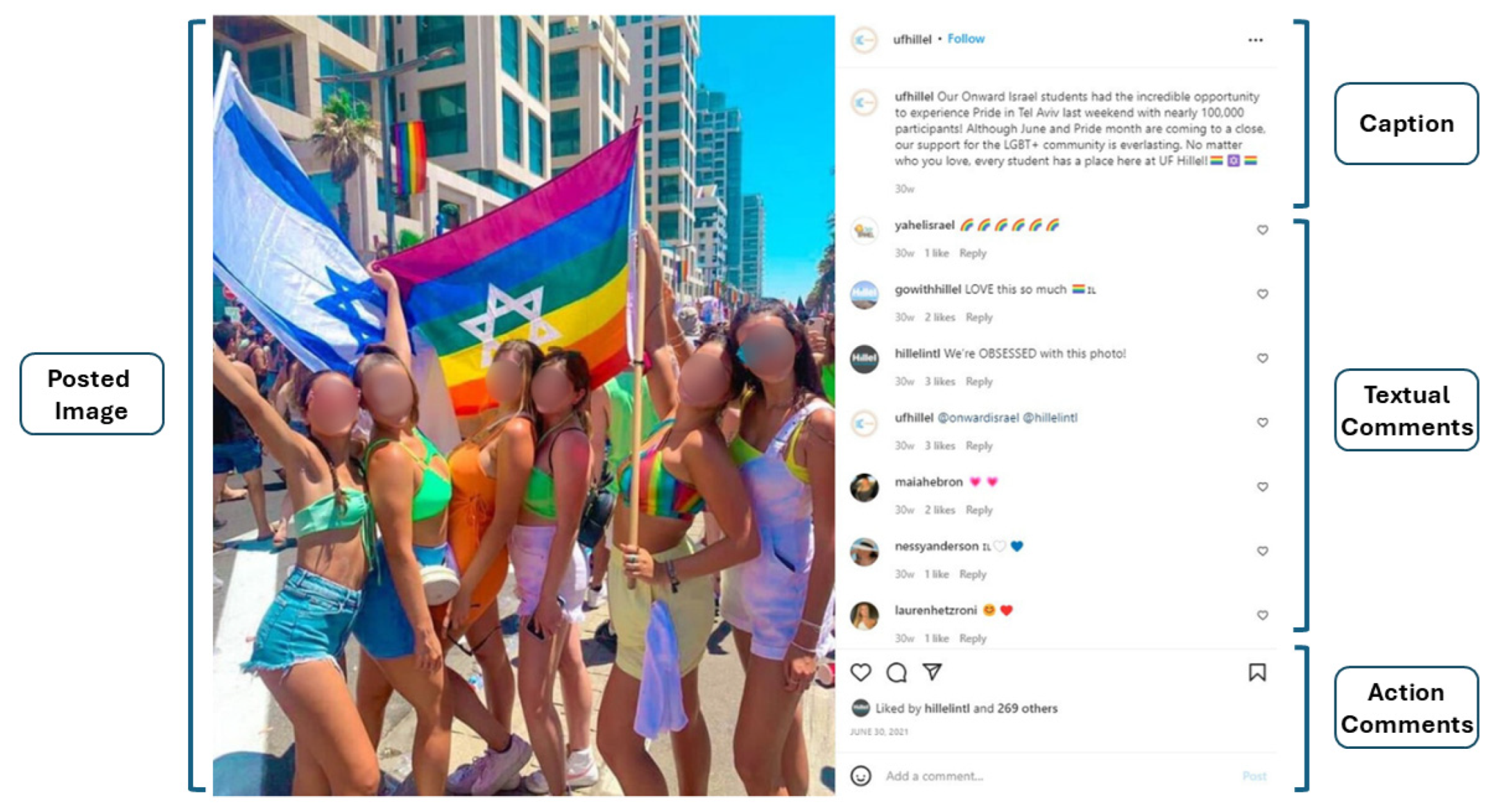
The data corpus was constructed from two distinct units of analysis. The primary unit is based on visual materials captured from Instagram pages, specifically still images and videos posted on the main feed and accessible to all social network users. The analysis was conducted both on the posted images themselves and on the accompanying text in the Instagram posts to validate the meanings derived from the visual content (see Figure 1). All visual materials were categorized by university of origin and imported into Dedoose software, which enabled management, presentation, and qualitative data analysis through defined codes and selected characteristics.
The analysis of both visual materials and texts, which were transcribed and entered into the system, enables the interpretation of each visual item and text independently. This approach aims to identify recurring patterns, classify them into categories, establish claims derived from the data, and potentially develop theory (Saldaña 2021).
For each image, the study documented the information and semiotic scheme shared with viewers, emphasizing the activities represented in the accounts and their accompanying captions. The coding and analysis of central themes followed the comparative analysis principles established by Glaser and Strauss (1967). A fundamental principle of grounded theory recognizes that data collection, coding, and analysis constitute not a linear, predetermined process, but rather a continuous, iterative cycle that moves between ambiguous elements toward revealing interconnected components throughout the research timeline, similar to assembling a puzzle where individual pieces gradually reveal a complete picture (Saldaña 2021, p. 71).
In this research, visual content served as the primary unit of analysis. Unlike traditional text analysis conducted post-coding, visual analysis began with initial impressions documented during image collection, emerging from immediate visual interpretation (Saldaña 2021). The coding schema evolved organically throughout the data collection and analysis phases, reflecting the visual narratives embedded within the photographs. The coding design involved direct visual annotation, with researchers marking specific image areas and tagging key characteristics (e.g., gender, university type, media format). This systematic approach was consistently applied across all visual materials and discussion notes to ensure comprehensive thematic representation and semiotic analysis within the established research parameters.
The final coding framework comprised 67 distinct codes, which underwent iterative refinement throughout the analytical process. These codes operate hierarchically, with broad conceptual categories containing multiple subordinate elements. The code ‘Jewish Identity’ exemplifies this structure, functioning as an overarching framework that encompasses various sub-categories, including religious observance, cultural practices, holiday celebrations, and related Jewish expressions.
The substantial volume of collected materials necessitated strategic methodological adjustments during data collection. Methodological rigor was enhanced through triangulation via informant validation, involving structured consultations with active Hillel participants who provided contextual insights as key informants. The analytical framework was further strengthened through systematic comparison with established scholarship examining Jewish identity expression and digital representation, alongside broader literature addressing collegiate social dynamics and identity performance.

5. Findings

Analysis of Hillel organization posts revealed several digital strategies employed by social media managers to create spaces for identity socialization while establishing infrastructure. These strategies advance organizational goals while providing sources of identification for followers.
Findings reveal a central theme that is threaded in Hillel’s digital social media activity, which we term Celebrating Identity and constitutes a framework through which identity work is conducted. We posit that through its lens of celebrating identity, Hillel centers’ Instagram accounts display elements drawn from Jewish temporal and ritual traditions, American identity markers, youth-oriented characteristics and iconography which conform to the language of US college culture.
Identity celebration can be understood as the means by which similarities among social actors are established or affirmed through emphasizing primordial aspects. Through this process, social network imagery affirms participants’ core identities that highlight social distinction and solidarity, along with the cultural character and implicit trust embedded within them. Although scholars lack consensus on the precise definition of ‘identity celebration,’ they employ this concept to describe rituals and events that explicitly or implicitly construct identities, particularly in contexts where identity is contested or unstable. Examples include research on events that reinforce social bonds and commemorate shared values (Scott-Maxwell 2015), as well as festivals and similar gatherings designed to establish and strengthen peripheral or marginalized local identities (Boyle 1997; Dávila 1997; De Bres and Davis 2001). In the study at hand, four interconnected axes of ‘identity celebration’ are identified: celebrated Jewishness, youthful identity celebration, national identity, and institutional student identity.

5.1. Celebrated Jewishness

In Hillel’s Instagram presence, we observe a visualization of activities that draw upon three key sources: primordial aspects of Judaism and Jewish lifestyle, characteristics of Americana and youthfulness. This visualization centers on adopting recognizable Jewish iconography and transforming it into representations of youth-oriented activities that cater to young adults at Hillel events. Rather than treating these domains as separate, Hillel’s posts weave them together into a shared visual grammar that makes Jewish ritual both familiar and appealing to young adults.
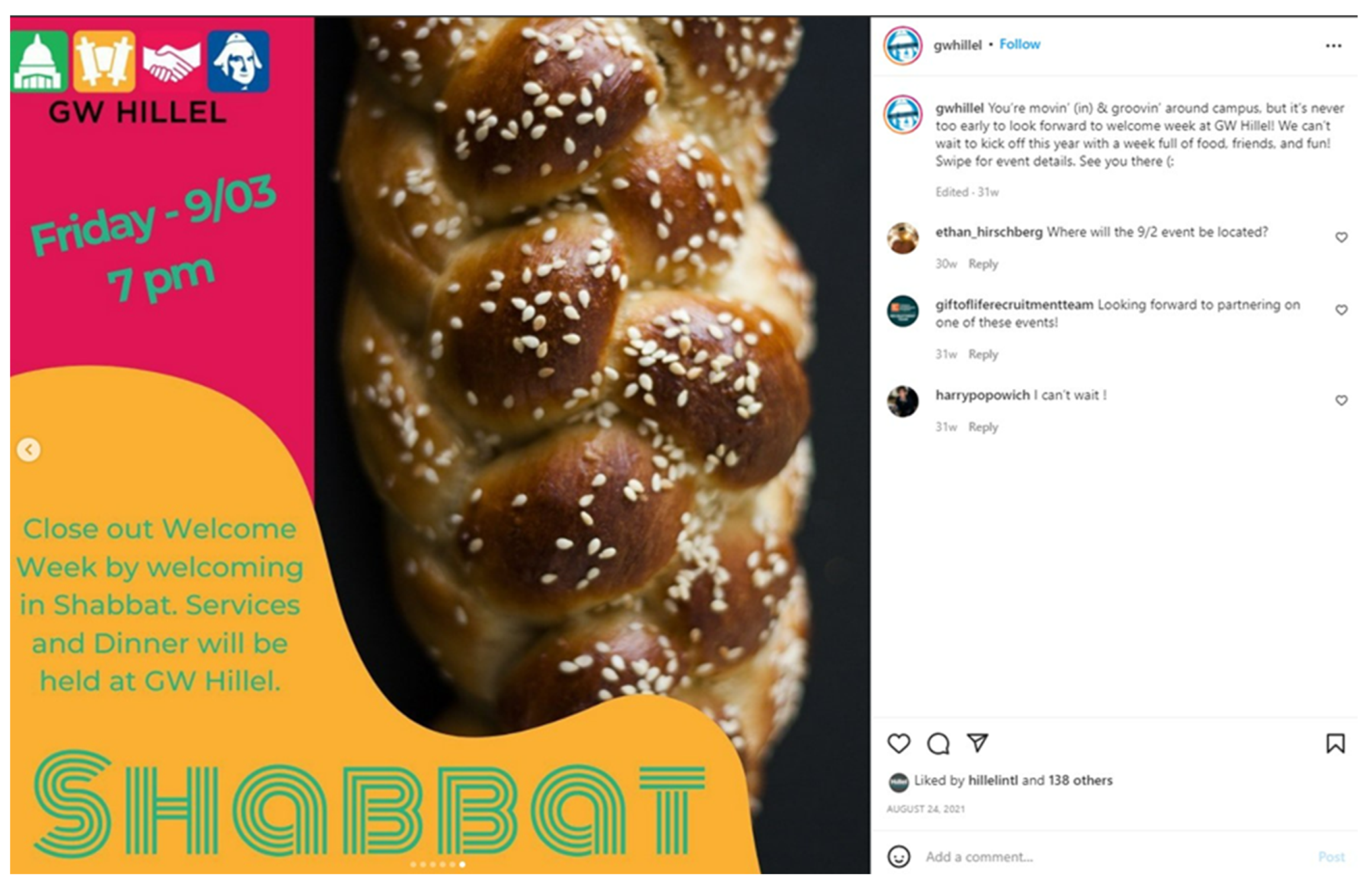
Figure 2 demonstrates the use of two sources within this approach through an invitation to Friday prayer and dinner as part of Orientation Week activities. The image presents a composition integrating several icons in aesthetic harmony. At its center, Challah bread appears alongside an invitation text for Shabbat reception and dining. The word “Shabbat” overlays the image in enlarged Neon font, a typeface associated with American urban culture. In addition, the logo displayed alongside the challah integrates four elements of American iconography: the Capitol building, George Washington, the first president of the United States, depicted wearing a kippah, a Torah scroll, and a handshake. This emblem, associated with the Hillel chapter at George Washington University, conveys a connection between American culture and Judaism, employing humor through the image of George Washington in a kippah.
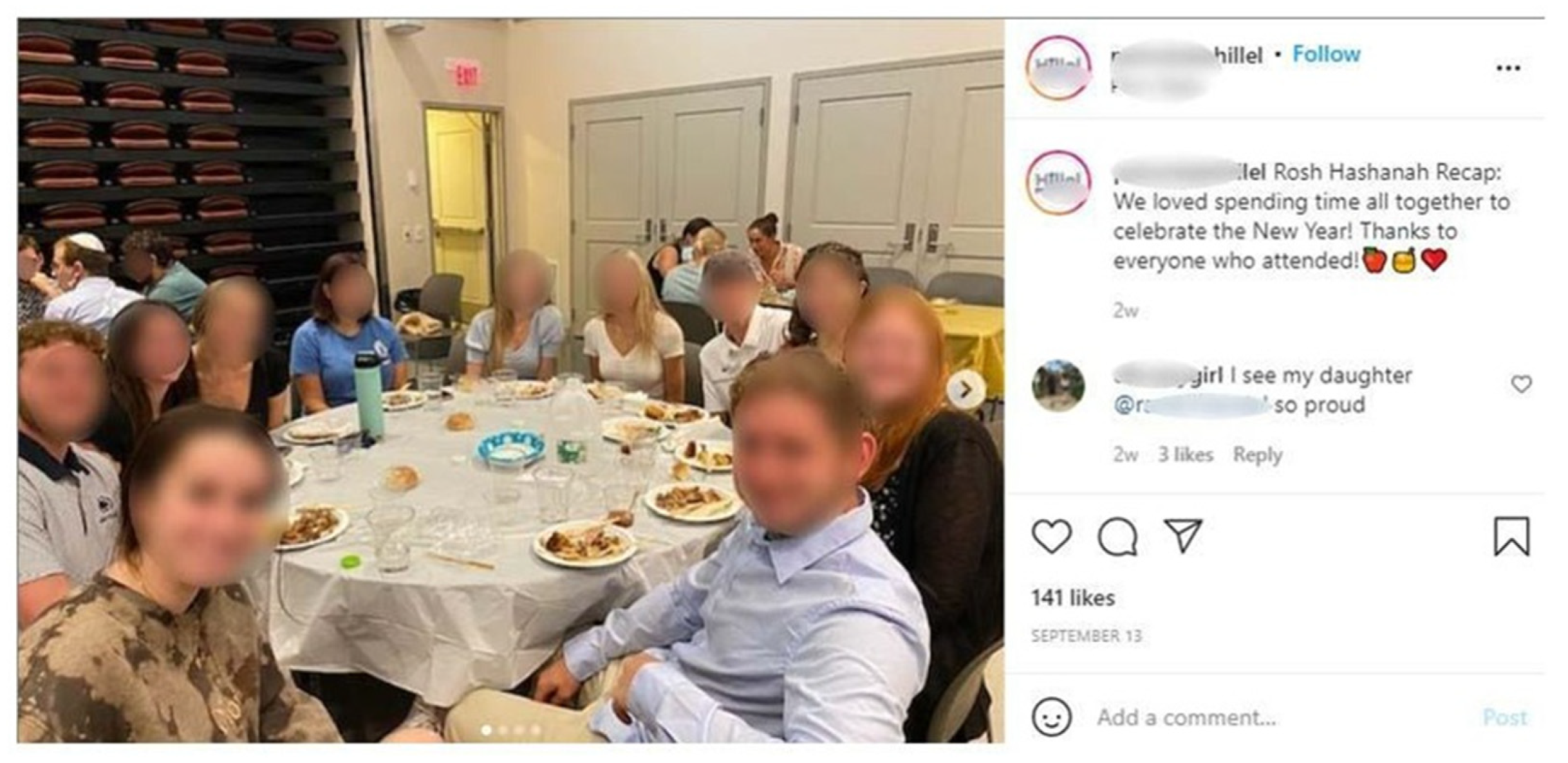
In this image, the Challah serves as the composition’s focal point and functions as a metonymic symbol of the Sabbath meal, representing surrogate family dynamics that are recreated in the Hillel spaces, which mimic foundational family practice motifs. Figure 3 shows a Rosh Ha’Shanah meal featuring diners of similar age and social status (students) with deliberately obscured class distinctions. The image’s comments clearly display their parents’ perspective, thus displaying a reversed dynamic between peer and reference groups, where parents observe from outside and implicitly legitimize the “new family” that is represented in the image.
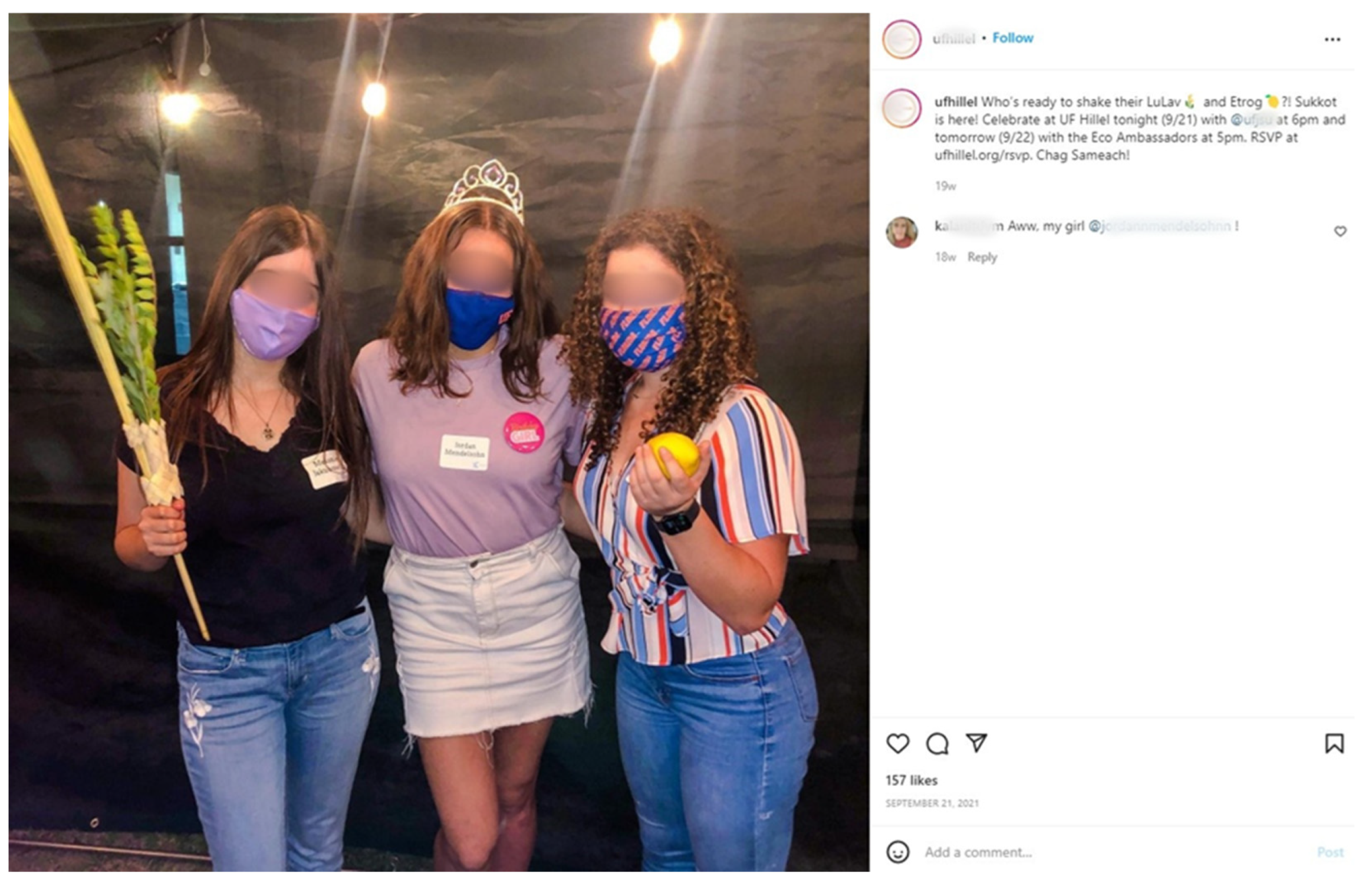
Figure 4 illustrates the incorporation of Jewish ritual practices, featuring three female students holding a ritualistic Lulav and Etrog inside a Sukkah. The accompanying caption employs wordplay: “Who’s ready to shake their LuLav and Etrog,” creating parallels to celebratory body movement while maintaining ritual authenticity. The event is framed as a collaboration with ‘Eco Ambassadors’, connecting Jewish practice with environmental activism.
To conclude, these examples illustrate how Hillel’s Instagram presence celebrates Jewishness not through static symbols, but through their dynamic recontextualization. Shabbat, Rosh Ha’Shanah, and Sukkot rituals are reimagined as occasions where Jewish tradition, American cultural references, and youth styles of communication converge. This strategy allows Hillel to render Jewish ritual life approachable, humorous, and resonant with the lived experiences of its student audience.

5.2. Youthful Identity

Youth represent a social position between childhood and adulthood. In modern societies, adolescents are dependent on their elders for legal and financial support yet manifest their autonomy through the engagement and development of subcultural styles, which distinguish themselves from mainstream or adult cultures (Hebdige 2013; Moody and Stahel 2025; Williams 2011). Freed from adult conventions, youngsters foster a visual vernacular that draws on their imagination of popular culture (e.g., games, films, music) and shared meanings to forge a symbolic language which appeals to their peers. Accordingly, Hillel’s Instagram images both represent and actively construct youth identity through established codes and shared meanings.
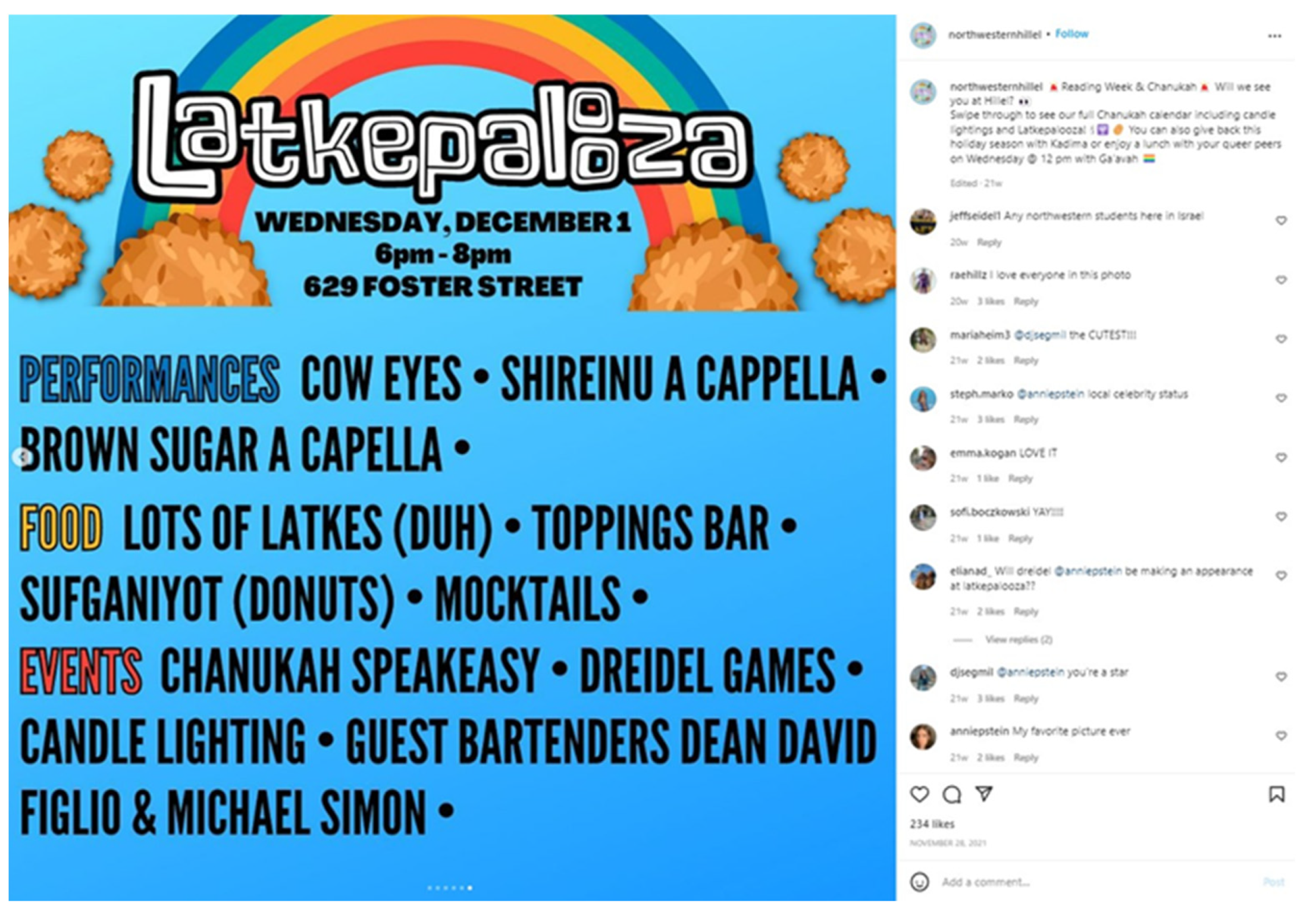
Figure 5 exemplifies the integration of youthful expressions within a Jewish Hanukkah holiday activity invitation. The colorful composition features “Latkepalooza”, combining the traditional potato fritter (latkes) with the popular music festival Lollapalooza. Furthermore, this posting incorporates LGBTQ+ community symbols through rainbow flag imagery and employs “Speakeasy” terminology, suggesting alcohol availability, while positioning the event as a youthful freedom space.
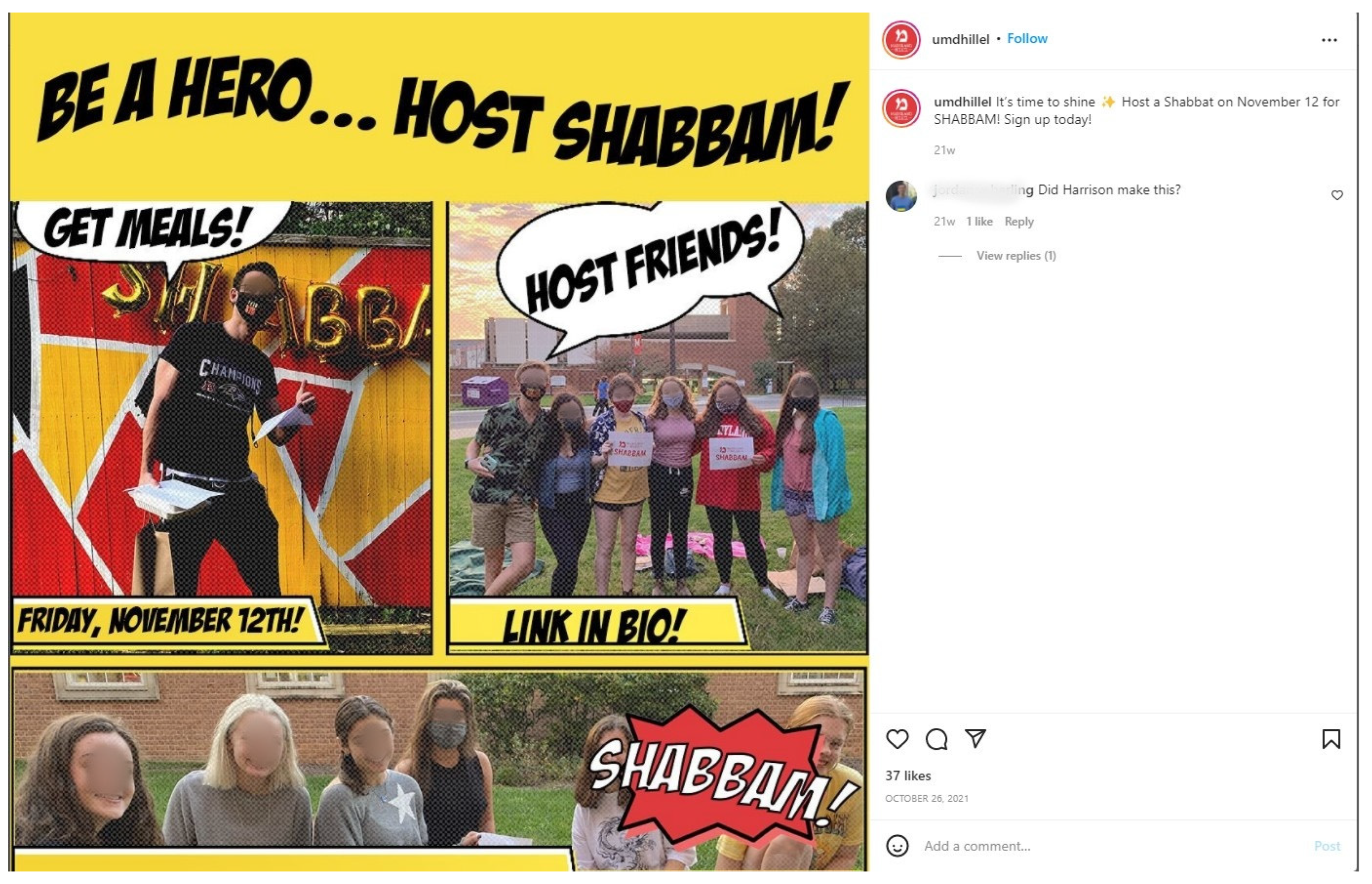
Further conforming to youthful visuals, Figure 6 presents a comic book-style invitation to host intimate Shabbat meals during the coronavirus pandemic. The term “Shabbam” represents a portmanteau combining “Shabbat” with “Sha-bam,” referencing the superhero “Shazam” and employing comic book aesthetics (font and overall design) to attain youth culture appeal.
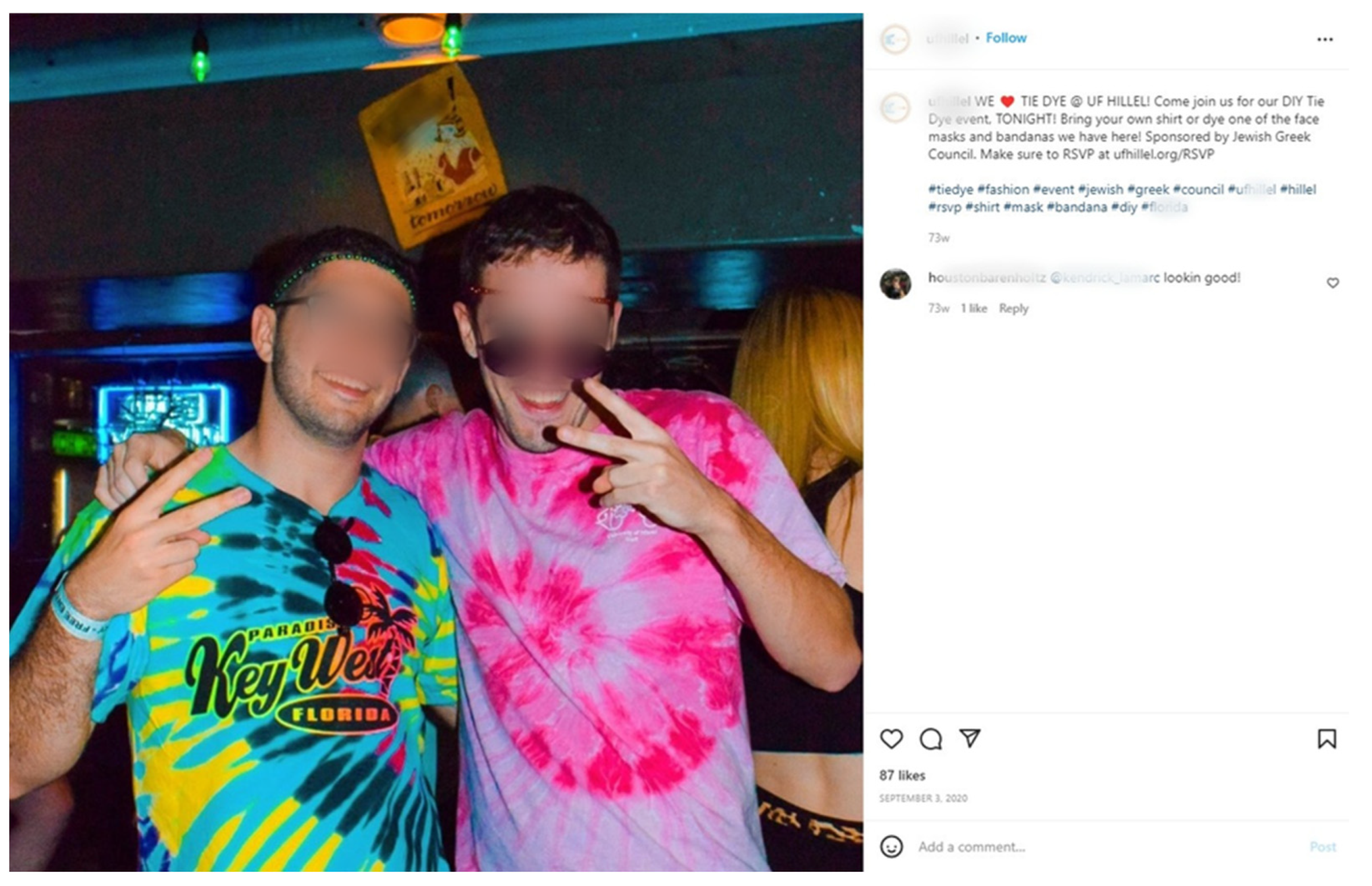
Finally, highlighting peer camaraderie, Figure 7 depicts two students in vibrant tie-dyed shirts employing relational tropes of fraternity cultures, including brotherhood, enjoyment, and youthful vitality (cf. Farquhar 2013).

5.3. National Identity: Pan-Americanism Versus Jewish Particularism

Tensions between pan-American national identity and particular Jewish identity are deeply rooted in Jewish-American history (Barak-Gorodetsky 2022; Sarna 2004). These tensions are manifest in Jewish efforts to preserve a distinct heritage while engaging with emerging political and economic opportunities that are afforded by mainstream society (Kahane 1968). While orthodox groups often opt for segregation, Hillel addresses this challenge through the integration of universal American identity with particular Jewish identity, creating legitimate spaces for dual identities to coexist.
To illustrate, Figure 8 and Figure 9 from the University of Florida feature students incorporating symbolic elements from American seasonal traditions. Figure 8 displays Halloween pumpkins alongside invitations to Shabbat events and the Sukkot Jewish holiday celebrations. Figure 9 documents a ‘fall celebration’ featuring collaboration with Greek Life organizations, emphasizing integration into American cultural patterns.
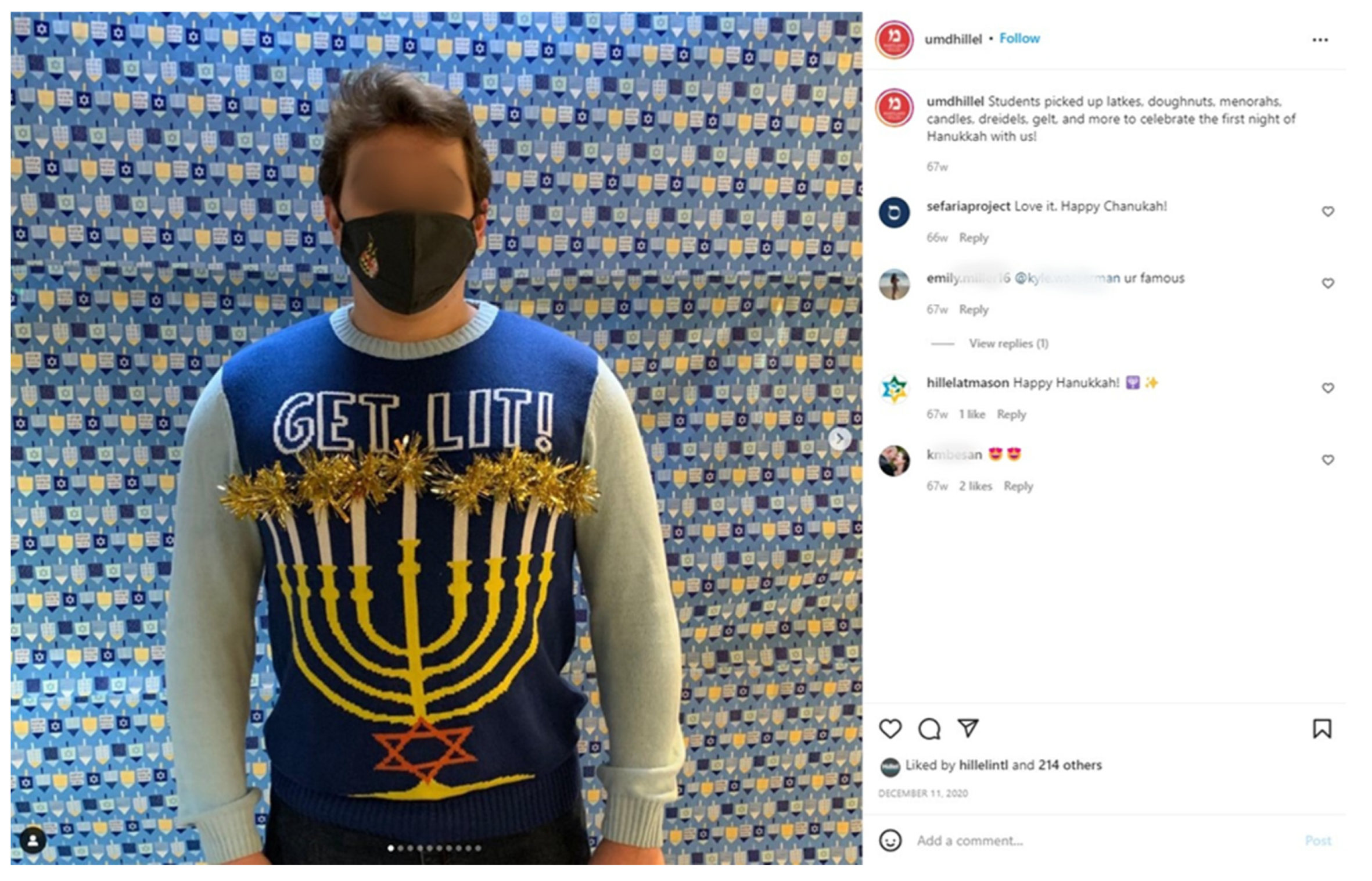
Similarly, Figure 10 illustrates American-Jewish cultural fusion through a student wearing a decorated sweater featuring a menorah design. The shirt features a three-dimensional flame motif that bursts outward from the fabric, accented with dangling embellishments that enhance its dynamic effect. This design clearly borrows from the “Christmas sweater” tradition. The accompanying text “Get Lit!” references college-age drinking culture, demonstrating how American-Jewish Hanukkah practices appropriate mainstream American Christmas traditions, while maintaining Jewish distinctiveness.
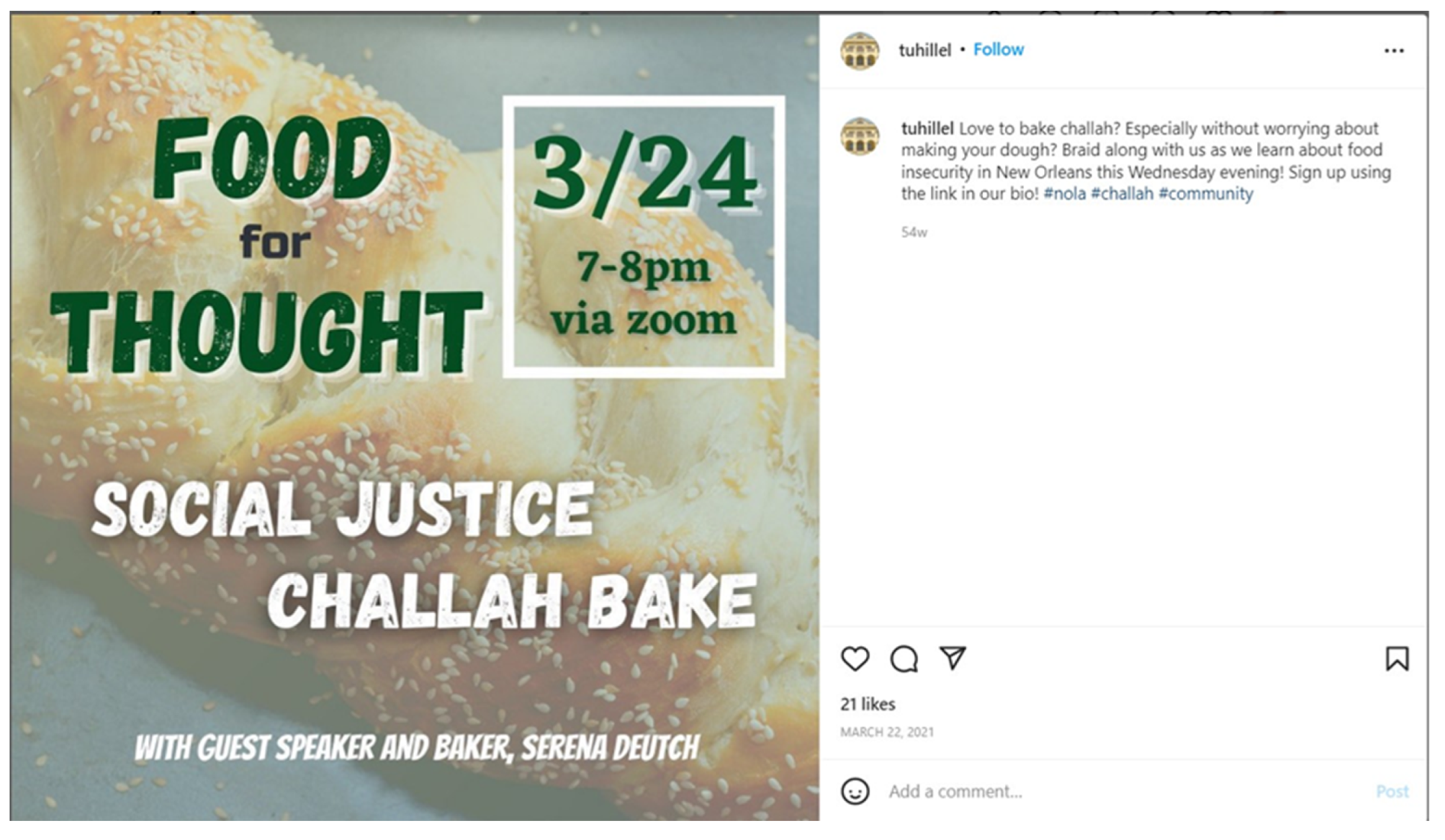
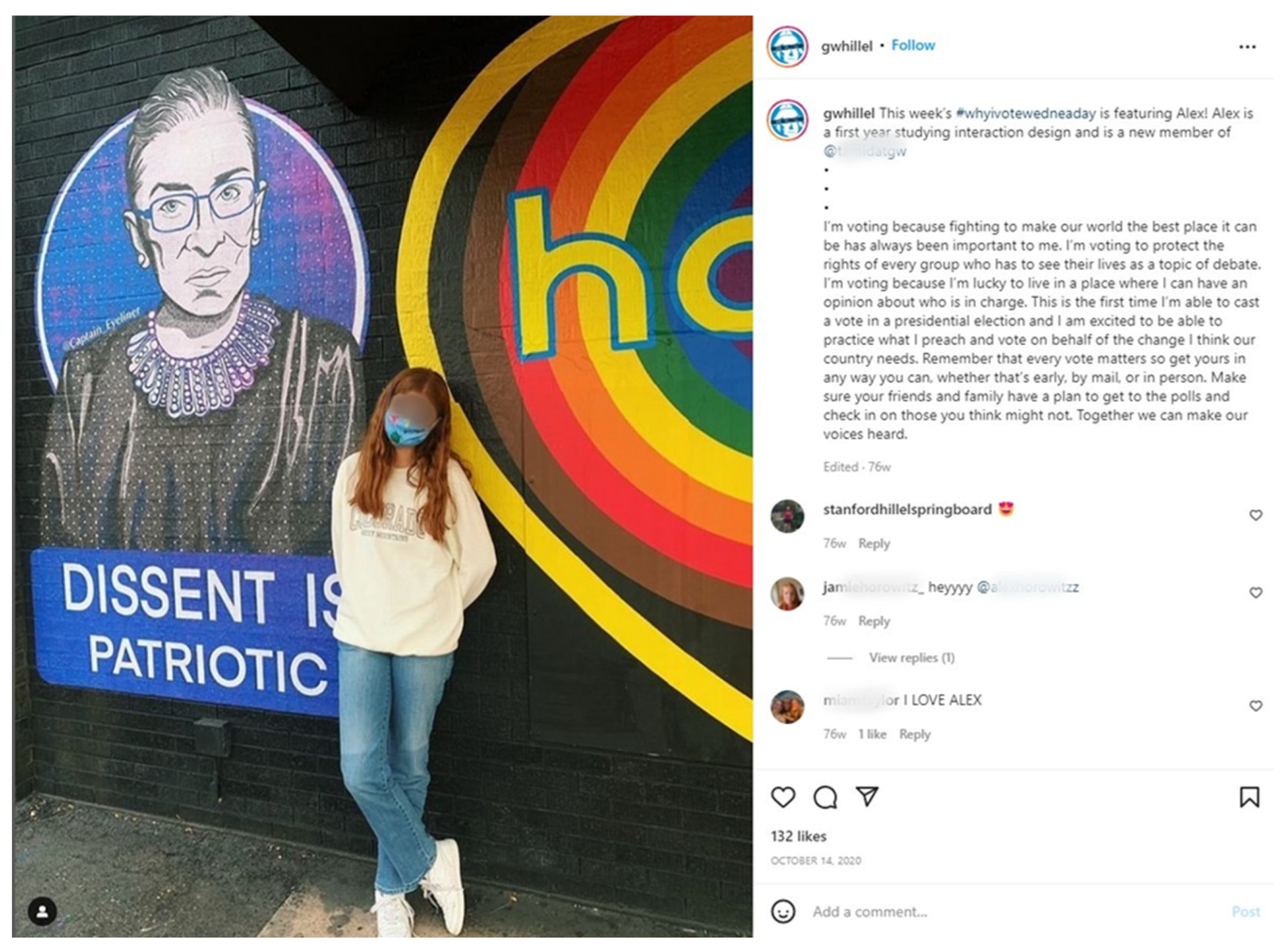
Adding a civic dimension, Figure 11 shows a Hillel invitation of followers to a ‘Social Justice event addressing food insecurity, while incorporating traditional Challah baking. Thus, the image ties in American civic engagement with Jewish cultural practices. Embracing a civic-political idol, Figure 12 features a mural of Supreme Court Justice Ruth Bader Ginsburg alongside a headline stating “Dissent is Patriotic”. Accordingly, the image calls for democratic participation while celebrating Jewish achievement in feminism and American jurisprudence.
To conclude, through the use of symbolism such as Halloween-themed Shabbat invitations, Hanukkah sweaters which are inspired by American-Christmas attire, highlighting events like Challah baking for social justice, and displaying murals honoring Ruth Bader Ginsburg, Hillel’s Instagram posts can be seen as furthering the bricolage of civic American ideals with Jewish heritage, promoting dual belonging among students.

5.4. Institutional Student Identity

The visual content uploaded to Hillel centers’ Instagram accounts incorporates motifs drawn from the visual corpus of their host institutional identities. Cultural-institutional repertoires encompass diverse material expressions, including seals, emblems, and markings found on official documents. These cultural-institutional representations have expanded into digital formats and have been identified on Hillel accounts and postings.
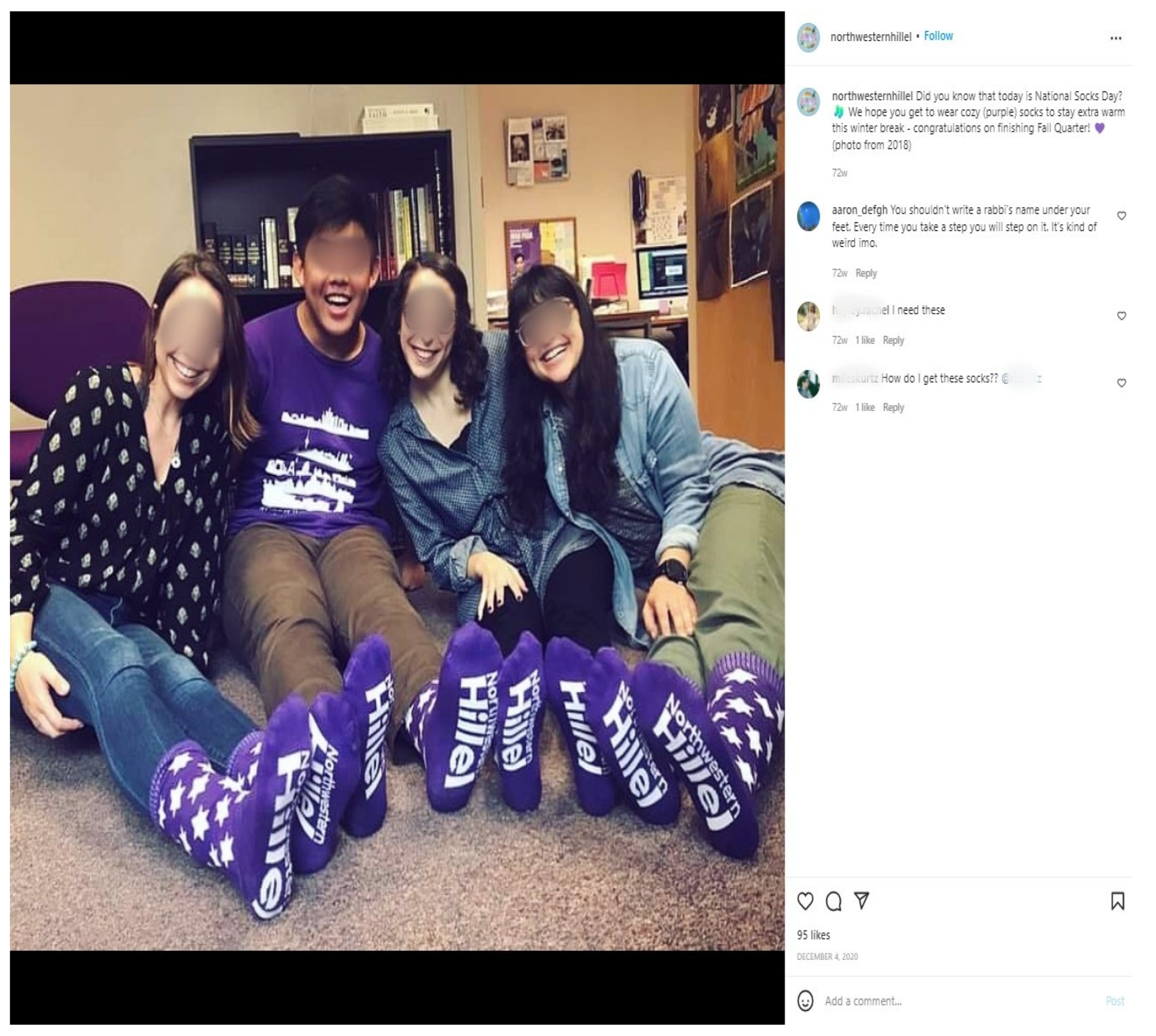
Visual content systematically incorporates motifs from host institutional identities, including university branding that includes specific colors, mascots, and logos. For example, Figure 13 features students wearing purple socks adorned with white Stars of David and “Northwestern (University) Hillel” text against the institution’s signature purple background. The enthusiastic follower responses demonstrate these symbols’ significant power as identity markers.
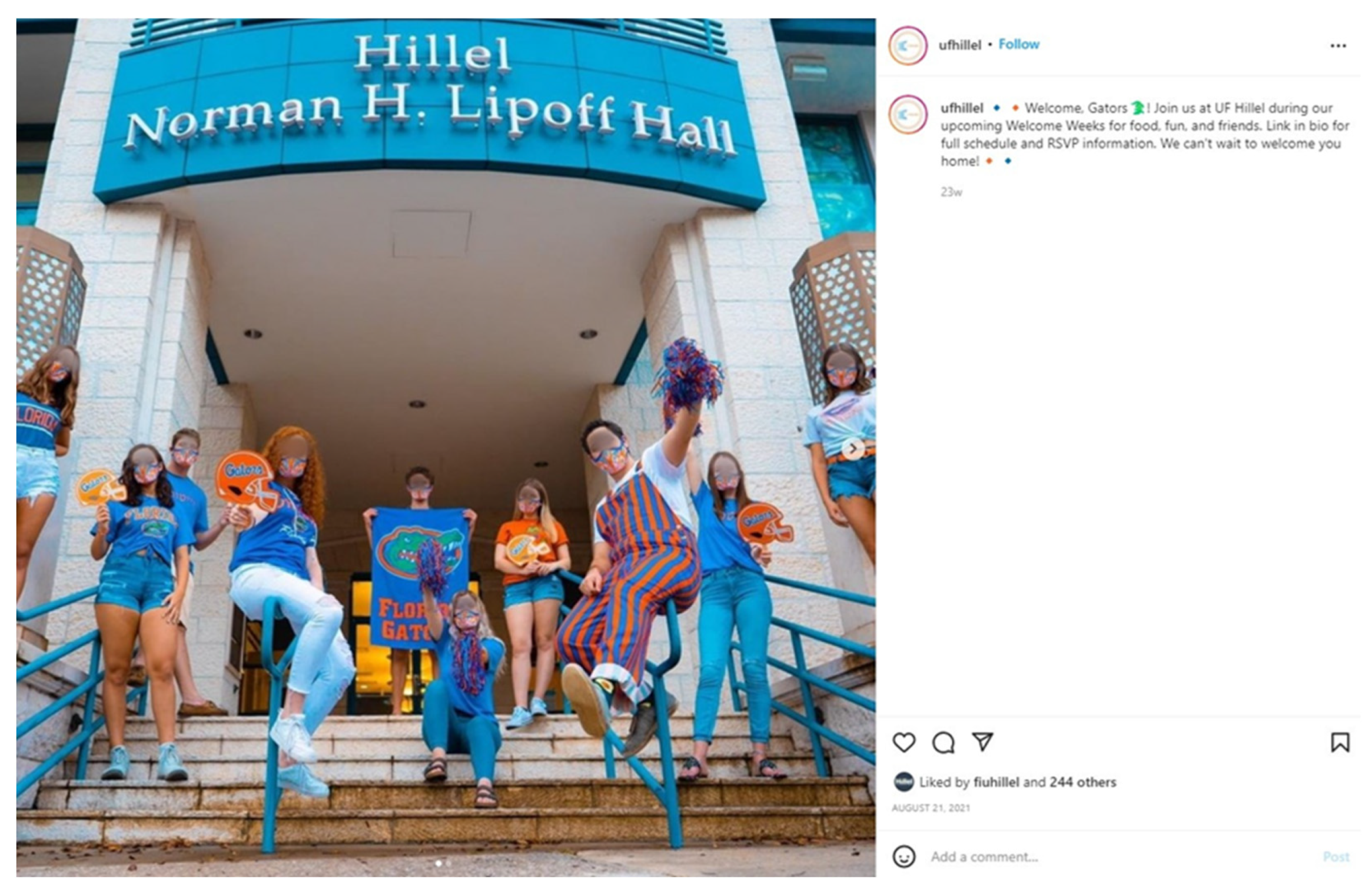
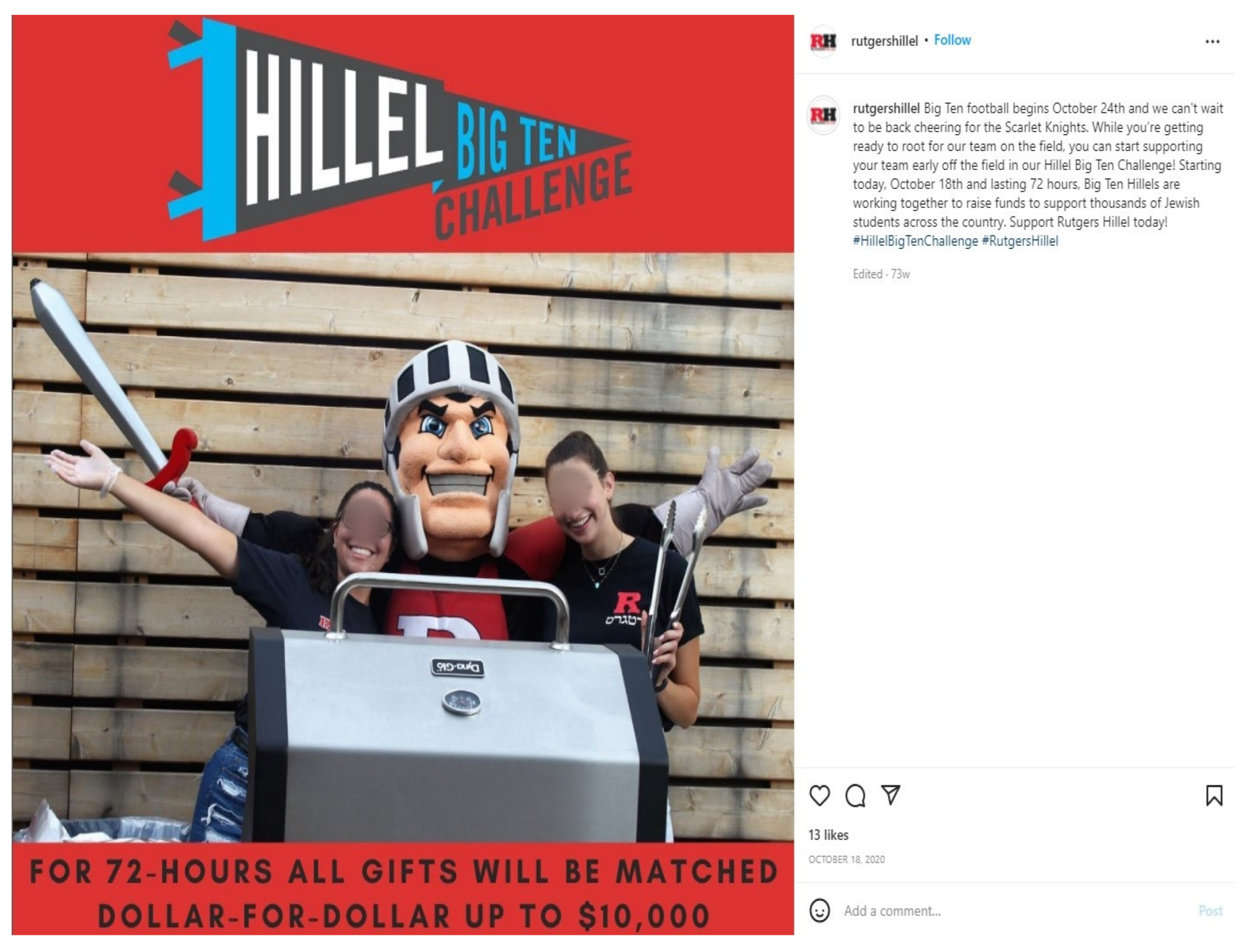
Figure 14 from the University of Florida shows students in tagged colors performing the signature “chomping” gesture, referencing the Gators’ mascot. Figure 15 and Figure 16 from Rutgers University feature the “Scarlet Knight” mascot in various contexts, including a whimsical camel-riding scene for an Israel trip promotion (Taglit-Birthright) and fundraising appeals that are set in an American football event setting.
To conclude, as demonstrated, Hillel strategically incorporates university mascots and institutional colors into photographs, graphics, and captions across its Instagram pages. By adopting the formal iconography of academic institutions within informal contexts, Hillel strengthens local student identity and cultivates a connection with individual Hillel centers. This integration of university branding with Hillel activities establishes the organization’s legitimacy as an authentic campus student group. Furthermore, this approach enables Hillel to both reinforce shared institutional identity and foster deeper engagement among its followers.

6. Discussion

The study aimed to uncover how identity narratives are constituted and transmitted via the visual discourse of Jewish student organizations’ social media in the US. Through Instagram, Hillel constructs and reinforces a particular diffuse form of Jewish identity using informal means. This approach stands in contrast to the formal university environment, which emphasizes the American melting pot ethos, blurs distinct identities, and promotes a universalist narrative. In contrast, Hillel uses its Instagram accounts to share and promote identity activities, with social media platforms providing a key arena for much of the organization’s identity work. This process is constituted by what we have termed Celebrating Identity, which Hillel imbues in its postings, enabling the reaffirmation of a Jewish identity while fostering integration and a sense of community.
Social media offers a mediascape that highlights festive elements (such as humor, performance and entertainment, see Shifman 2007), an atmosphere of joy, cheer, and jubilation. On campus life, this is contrasted by the hurdles of minority groups and the stress embedded in student life amid social and academic demands. Given the informal sensibilities of social media, student organizations, such as Hillel, embrace these tracts to highlight a positive perspective on college life. Moreover, their postings constitute an empowered identity that caters to their multifaceted Jewish publics. Most of the visual content shared across Hillel’s Instagram accounts emphasizes a generic Jewish identity that is not tied to any particular religious denomination or political movement. Thus, narrating a campus-based culture that fosters a fluid and generic Jewish identity. Whereas religious websites (ultra-Orthodox, Catholic, and others) often reinforce a coherent identity centered on specific practices and a unified worldview (Golan and Martini 2022), these Instagram postings offer an open-ended and ambiguous identity that invites multiple interpretations and avoids presenting a closed ideological framework.
For Jewish groups facing marginalization and antisemitism, particularly since the 7 October attacks and campus unrest, as well as for other minority student communities, identity threats have become acute. In this context, Instagram-based identity work enables students to contingently pick and choose among multiple identities (religious, institutional, youthful, ethnic), rather than prioritizing a single one. Moreover, given the apprehensions embedded in minority groups, the Instagram account offers a visual aesthetic that ties Jewish student culture to the broader American polity. Hillel’s postings draw on American emblems (for example, the flag, iconic leaders, or national events) to signal affinity between Jewish and American identity. Through Butler’s (2004) framework of performativity, these posts can be read as iterative acts that consolidate Jewish-American belonging, while their placement within what Echchaibi and Hoover (2023) describe as a digital third space underscores the negotiated nature of that belonging. From this view, aestheticized displays of patriotism both affirm inclusion and subtly suggest the conditional terms on which minority visibility is recognized, insofar as acceptance is mediated through alignment with majority cultural symbols. Thus, Hillel’s visual repertoire simultaneously strengthens a sense of belonging and intimates the inherent delicacy of identity claims in pluralistic public settings.
Crystallizing identity is often understood as adherence to a solid, stable, and inflexible set of tenets. Departures from such coherence can, in Erikson’s (1968) terms, be cast as lax, incoherent, or even deviant. In practice, this stance entails strict adherence to religious and communal practices. Paradoxically, we maintain that fostering a flexible or liquid identity (Bauman 2013) can sustain a stable, voluntary sense of self that aligns with American Jewish students’ college experience. In the context of Jewish student organizations such as Hillel, this flexible identity draws on multiple facets (religious, religious/ethnic, youthful, and institutional), which are contingent on the situation. Through such practices, an Instagram post highlighting Shabbat dinner may emphasize ritual while framing it in a youthful social setting, whereas a story about campus activism may stress institutional affiliation while quietly embedding Jewish pride. Thus, this form of identity flexibility (or liminality) can be seen as ultimately supporting their academic journey in the face of numerous challenges of American Jewish youngsters, including ambivalence towards Jewish practice, antisemitic voices on campus, student’s sense of isolation, alienation and such.
In the context of Jewish student organizations such as Hillel, Butler’s framework allows Jewishness online to be theorized as a performative construction enacted through organizational practice. Jewish identity in this setting emerges through public acts such as presenting holiday celebrations, sharing Hebrew phrases, or framing campus activities with markers of Jewish tradition. These acts are not reflections of an underlying essence but stylized, citational practices that draw on a repertoire of recognizable Jewish signs while adapting them to the affordances of platforms such as Instagram. Through these iterative performances, Hillel does not simply represent a pre-existing identity but actively produces it in the digital sphere, rendering Jewishness an effect of performative visibility rather than an inner state of belief.
While this production mobilizes Jewish tropes and symbols to construct a collective image of celebration and a festive Jewish life on campus, it simultaneously operates as a projected representation that displaces or attenuates the everyday anxieties and vulnerabilities experienced by Jewish students. In this sense, Illouz’s (2023) critique of the romantic ethos in advertising is instructive. She demonstrates how advertising mobilizes images of intimacy and joy to link consumption with emotional authenticity, thereby transforming love into a commodified and standardized experience. Similarly, Hillel’s social media posts deploy a visual repertoire of festivity that includes humor, performance, and celebration, linking Jewishness with positive affect and communal belonging. These Instagram images function less as reflections of spontaneous campus life and more as carefully orchestrated scripts of identity, designed to affirm a diffuse, non-denominational Jewish identity that feels authentic because it is saturated with affective cues of joy, togetherness, and celebration. Just as advertising commodifies romance, Hillel’s festive identity work commodifies Jewishness as a flexible, uplifting experience within the mediascape of campus life.
Hillel’s Jewish performance online feeds into an identity problem and a gap between social problems and projected realities. Thus, highlighting festivity may in fact obfuscate marginalized groups’ somber positions in society, albeit that of Muslim’s in Europe, LBGTQ communities, immigrants and others. Under these circumstances, Instagram’s festive projections can take users on a mental journey that identifies their reality with positive and affective images, while downplaying negative aspects. This very process affirms ethnic, religious, and other marginalized identities, while also revealing the fragility of social media, which can amplify positive effects but may provide little support in times of crisis.

Author Contributions

Conceptualization, T.U. and O.G.; methodology, T.U.; software, T.U. and O.G.; formal analysis, T.U. and O.G.; investigation, T.U.; data curation, T.U.; writing—original draft preparation T.U. and O.G.; writing—review and editing, TU and OG; visualization, T.U.; supervision, O.G.; project administration, O.G. All authors have read and agreed to the published version of the manuscript.

Funding

This research received no external funding.

Institutional Review Board Statement

The study was conducted in accordance with the Declaration of Helsinki, and approved by the Faculty of Education Ethics Review Committee of University of Haifa (protocol code 021/22 and date of approval 30 July 2025).

Informed Consent Statement

Informed consent was waived due to the adoption of screenshots of publicly accessible Instagram posts analyzed as empirical data within an academic, non-commercial context. The images derive from the verified public Instagram accounts of Hillel, a registered non-profit NGO engaged in student community activities. As such, the materials are organizational and educational in nature rather than commercial or proprietary content. The inclusion of such materials follows recognized academic and legal conventions concerning fair scholarly use (also referred to as fair use). According to international standards, brief excerpts of publicly available online content may be reproduced for the purposes of critique, commentary, or research when the use is transformative and non-commercial. This principle is consistent with: U.S. Copyright Law (Title 17 §107) – permitting fair use for purposes such as teaching, scholarship, and research; and European Union Directive 2001/29/EC, Article 5(3)(a) – allowing use for “illustration for teaching or scientific research.

Data Availability Statement

No publicly shareable dataset was generated for this study.

Conflicts of Interest

The authors declare no conflict of interest.

References

  1. Abes, Elisa S., Susan R. Jones, and Marylu K. McEwen. 2007. Reconceptualizing the Model of Multiple Dimensions of Identity: The Role of Meaning-Making Capacity in the Construction of Multiple Identities. Journal of College Student Development 48: 1–22. [Google Scholar] [CrossRef]
  2. Adler, Chaim. 1974. The Student Revolt: A Special Case of a Youth Culture. Teachers College Record 75: 123–39. [Google Scholar]
  3. Barak-Gorodetsky, David. 2022. Religion and State in Israel-Diaspora Relations—A Social-Covenant Approach. Israel Studies 27: 92–104. [Google Scholar] [CrossRef]
  4. Bauman, Zygmunt. 2013. Liquid Modernity. New York: John Wiley & Sons. [Google Scholar]
  5. Ben-Ze’ev, Aaron. 2004. Love Online: Emotions on the Internet. Cambridge: Cambridge University Press. [Google Scholar]
  6. Berger, Akiva, and Oren Golan. 2024. Online religious learning: Digital epistemic authority and self-socialization in religious communities. Learning, Media and Technology 49: 274–89. [Google Scholar]
  7. Boellstorff, Tom. 2015. Coming of Age in Second Life: An Anthropologist Explores the Virtually Human. Princeton: Princeton University Press. [Google Scholar]
  8. boyd, danah. 2014. It’s Complicated: The Social Lives of Networked Teens. New Haven: Yale University Press. [Google Scholar]
  9. boyd, danah M., and Nicole B. Ellison. 2007. Social Network Sites: Definition, History, and Scholarship. Journal of Computer-Mediated Communication 13: 210–30. [Google Scholar] [CrossRef]
  10. Boyle, Mark. 1997. Civic Boosterism in the Politics of Local Economic Development: Institutional Positions and Strategic Orientations in the Consumption of Hallmark Events. Environment and Planning A 29: 1975–97. [Google Scholar]
  11. Bullingham, Liam, and Ana C. Vasconcelos. 2013. “The Presentation of Self in the Online World”: Goffman and the Study of Online Identities. Journal of Information Science 39: 101–12. [Google Scholar] [CrossRef]
  12. Butler, Judith. 2004. Performative Acts and Gender Constitution. In The Performance Studies Reader, 2nd ed. Edited by Henry Bial. London: Routledge, pp. 154–66. [Google Scholar]
  13. Calvert, Sandra L. 2002. Identity on the Internet. In Children in the Digital Age: Influences of Electronic Media on Development. Edited by Sandra L. Calvert, Amy B. Jordan and Rodney R. Cocking. Westport: Praeger/Greenwood, pp. 55–70. [Google Scholar]
  14. Chakim, Sulaiman. 2022. The Youth and the Internet: The Construction of Doctrine, Islam in Practice, and Political Identity in Indonesia. Journal of Social Studies Education Research 13: 217–36. [Google Scholar]
  15. Cook, Joanne, and Reza Hasmath. 2014. The Discursive Construction and Performance of Gendered Identity on Social Media. Current Sociology 62: 975–93. [Google Scholar] [CrossRef]
  16. Cousens, Barry. 2007. Hillel’s Journey: Distinctively Jewish, Universally Human. Available online: http://www.bjpa.org/Publications/details.cfm?PublicationID=4537 (accessed on 12 September 2025).
  17. Danet, Brenda. 2001. Cyberpl@y: Communicating Online. Oxford: Berg. [Google Scholar]
  18. Dávila, Arlene. 1997. Negotiating Culture and Dollars: The Politics of Corporate Sponsorship in Puerto Rico. Identities 4: 71–97. [Google Scholar] [CrossRef]
  19. De Bres, Karen, and James Davis. 2001. Celebrating Group and Place Identity: A Case Study of a New Regional Festival. Tourism Geographies 3: 326–37. [Google Scholar] [CrossRef]
  20. DellaPergola, Sergio. 2024. US Jews: Reflections on Identity and Demography. Cham: Springer. [Google Scholar]
  21. Demaria, Federica, Maria Pontillo, Cristina Di Vincenzo, Domenico Bellantoni, Ilaria Pretelli, and Stefano Vicari. 2024. Body, Image, and Digital Technology in Adolescence and Contemporary Youth Culture. Frontiers in Psychology 15: 1445098. [Google Scholar] [CrossRef]
  22. De Moya, Milagros, and Vivian Bravo. 2016. The Role of Public Relations in Ethnic Advocacy and Activism: A Proposed Research Agenda. Public Relations Inquiry 5: 233–51. [Google Scholar] [CrossRef]
  23. Drori, Gili, Giuseppe Delmestri, and Achim Oberg. 2013. Branding the university: Relational strategy of identity construction in a competitive field. Trust in Higher Education Institutions 86: 134–47. [Google Scholar]
  24. Echchaibi, Nabil, and Stewart M. Hoover. 2023. Media Theory and the Third Spaces of Digital Religion. In The Third Spaces of Digital Religion. Edited by Nabil Echchaibi and Stewart M. Hoover. London: Taylor & Francis, pp. 1–32. [Google Scholar]
  25. Eco, Umberto. 1976. A Theory of Semiotics. Bloomington: Indiana University Press. [Google Scholar]
  26. Einstein, Mara. 2024. Faith-Centric Tiktoks: Promoting Religion through Personalized Experience and Engagement. In Selling the Sacred. London: Routledge, pp. 139–53. [Google Scholar]
  27. Eisenstadt, Shmuel N. 2004. Change and Continuity in Israeli Society. In Explorations in Jewish Historical Experience. Leiden: Brill, pp. 122–38. [Google Scholar]
  28. Erikson, Erik. 1968. Identity: Youth and Crisis. New York: Norton & Co. [Google Scholar]
  29. Farquhar, Lee. 2013. Performing and Interpreting Identity through Facebook Imagery. Convergence 19: 446–71. [Google Scholar] [CrossRef]
  30. Fernández-de-Castro, Pablo, Daniel Aranda, Santiago Moyano, and Víctor Sampedro. 2023. Digital Youth Work: A Systematic Review with a Proposal. Social Work Education 42: 318–36. [Google Scholar] [CrossRef]
  31. Giddens, Anthony. 1992. Modernity and Self-Identity: Self and Society in the Late Modern Age. Cambridge: Polity Press. [Google Scholar]
  32. Glaser, Barney, and Anselm Strauss. 1967. Grounded Theory: The Discovery of Grounded Theory. Sociology 12: 27–49. [Google Scholar]
  33. Golan, Oren, and Michele Martini. 2022. Sacred Cyberspaces: Catholicism, New Media and the Religious Experience. Montreal: McGill-Queens University Press. [Google Scholar]
  34. Golan, Oren, and Nurit Stadler. 2016. Building the sacred community online: The dual use of the Internet by Chabad. Media, Culture & Society 38: 71–88. [Google Scholar]
  35. Greenfield, Patricia M., and Zheng Yan. 2006. Children, Adolescents, and the Internet: A New Field of Inquiry in Developmental Psychology. Developmental Psychology 42: 391–94. [Google Scholar] [CrossRef] [PubMed]
  36. Greenhow, Christine, and Beth Robelia. 2009. Informal Learning and Identity Formation in Online Social Networks. Learning, Media and Technology 34: 119–40. [Google Scholar] [CrossRef]
  37. Gremler, Franziska, and Nils B. Weidmann. 2024. Ethnic Politics via Digital Means: Introducing the Ethnic Organizations Online Dataset. Journal of Peace Research 62: 761–71. [Google Scholar] [CrossRef]
  38. Hebdige, Dick. 2013. Subculture. London: Routledge. [Google Scholar]
  39. Hillel International. 2020. College Guide. Washington, DC: Hillel International. [Google Scholar]
  40. Hillel International. 2025. About Hillel International. Available online: https://www.hillel.org/about (accessed on 8 December 2025).
  41. Illouz, Eva. 2023. Consuming the Romantic Utopia: Love and the Cultural Contradictions of Capitalism. Berkeley: University of California Press. [Google Scholar]
  42. John, Nicholas A. 2016. The Age of Sharing. Malden: Polity. [Google Scholar]
  43. Kahane, Reuven. 1968. Patterns of National Identity in Israel. In Education and Society in Israel. Edited by Shmuel N. Eisenstadt. Jerusalem: Akademon, pp. 39–55. (In Hebrew) [Google Scholar]
  44. Kahane, Reuven. 1982. Legitimation and Integration in Developing Societies: The Case of India. Boulder: Westview Press. [Google Scholar]
  45. Kahane, Reuven. 1997. The Origins of Postmodern Youth: Informal Youth Movements in a Comparative Perspective. Berlin: Walter de Gruyter. [Google Scholar]
  46. Katz, Ariel. 2020. Jewish Students in American Higher Education. Journal of Student Affairs at New York University XVI: 14–19. Available online: https://steinhardt.nyu.edu/sites/default/files/2020-05/JoSA%2016_5.29.2020.pdf (accessed on 9 October 2021).
  47. Kleine, Christoph, and Monika Wohlrab-Sahr. 2020. Preliminary Findings and Outlook of the CASHSS “Multiple Secularities—Beyond the West, Beyond Modernities”. Leipzig: Leipzig University. [Google Scholar] [CrossRef]
  48. Koren, Amy, Leonard Saxe, and Eric Fleisch. 2016. Jewish Life on Campus: From Backwater to Battleground. In American Jewish Year Book 2015: The Annual Record of the North American Jewish Communities. Edited by Arnold Dashefsky and Ira Sheskin. Cham: Springer, pp. 45–88. [Google Scholar]
  49. Kross, Sean, Eszter Hargittai, and Elissa M. Redmiles. 2021. Characterizing the Online Learning Landscape: What and How People Learn Online. Proceedings of the ACM on Human-Computer Interaction 5: 1–19. [Google Scholar] [CrossRef]
  50. Kushner, Karen. 2009. The Journey of Identity Development for Jewish Millennial College Students. Journal of Student Personnel Association at Indiana University, 29–42. [Google Scholar]
  51. Livingstone, Sonia. 2002. Young People and New Media: Childhood and the Changing Media Environment. London: Sage. [Google Scholar]
  52. Livingstone, Sonia. 2008. Taking risky opportunities in youthful content creation: Teenagers’ use of social networking sites for intimacy, privacy and self-expression. New Media & Society 10: 393–411. [Google Scholar] [CrossRef]
  53. Marler, Will, and Eszter Hargittai. 2023. Understanding the Evolving Online Learning Landscape: The Case of Science and Religion. Social Media + Society 9: 1–12. [Google Scholar] [CrossRef]
  54. Mesch, Gustavo S., and Ilan Talmud. 2020. Wired Youth: The Online World of Adolescence. London: Routledge. [Google Scholar]
  55. Meyer, Michael A. 1995. Response to Modernity: A History of the Reform Movement in Judaism. Detroit: Wayne State University Press. [Google Scholar]
  56. Mishol-Shauli, Nakhi, and Oren Golan. 2022. Smartphone religious networking: Negotiating contested identities within a pious community over WhatsApp. Religions 13: 1034. [Google Scholar] [CrossRef]
  57. Moody, Zoé, and Tom Stahel. 2025. School Bullying: Children and Adolescent Norms, Cultures and Identity Development. Frontiers in Education 10: 1497681. [Google Scholar] [CrossRef]
  58. Okun, Shira, and Galit Nimrod. 2017. Online Ultra-Orthodox Religious Communities as a Third Space: A Netnographic Study. International Journal of Communication 11: 2825–41. [Google Scholar]
  59. Peter, Jochen, Patti M. Valkenburg, and Cedric Fluckiger. 2009. Adolescents and Social Network Sites: Identity, Friendships and Privacy. In Kids Online: Opportunities and Risks for Children. Edited by Sonia Livingstone and Leslie Haddon. Bristol: Policy Press, pp. 83–95. [Google Scholar]
  60. Peterson, Kristin M. 2023. Queer Muslim Identity in the Third Space of Tumblr. In The Third Spaces of Digital Religion. Edited by Nabil Echchaibi and Stewart M. Hoover. London: Taylor & Francis, pp. 63–76. [Google Scholar]
  61. Pew Research Center. 2016. The Most and Least Educated U.S. Religious Groups. Available online: https://www.pewresearch.org/fact-tank/2016/11/04/the-most-and-least-educated-u-s-religious-groups (accessed on 8 September 2025).
  62. Rainie, Harrison, and Barry Wellman. 2012. Networked: The New Social Operating System. Cambridge: MIT Press. [Google Scholar]
  63. Rosana, Arif, and Ikhwan Fauzi. 2024. The Role of Digital Identity in the Age of Social Media: Literature Analysis on Self-Identity Construction and Online Social Interaction. Journal of Social Science 1: 477–89. [Google Scholar] [CrossRef]
  64. Saldaña, Johnny. 2021. The Coding Manual for Qualitative Researchers, 3rd ed. London: Sage Publications. [Google Scholar]
  65. Sales, Amy L., and Leonard Saxe. 2006. Particularism in the University: Realities and Opportunities for Jewish Life on Campus. New York: Avi Chai. [Google Scholar]
  66. Sarna, Jonathan D. 2004. American Judaism: A History. New Haven: Yale University Press. [Google Scholar]
  67. Sarna, Jonathan D. 2021. Coming to Terms with America: Essays on Jewish History, Religion, and Culture. Lincoln: University of Nebraska Press. [Google Scholar]
  68. Schmalzbauer, John. 2013. Campus Religious Life in America: Revitalization and Renewal. Society 50: 115–31. [Google Scholar] [CrossRef]
  69. Scott-Maxwell, Alyssa. 2015. Representing Indonesia in Australia through Performance Communities, Collaborations, Identities. In Performing Contemporary Indonesia: Celebrating Identity, Constructing Community. Edited by Barbara Hatley and Brett Hough. Leiden: Brill, pp. 182–202. [Google Scholar]
  70. Selznick, Benjamin S., Matthew J. Mayhew, Christa E. Winkler, Musbah Shaheen, and Alyssa N. Rockenbach. 2024. Developing college students’ Jewish appreciation: A four-year mixed-methods study. Innovative Higher Education 49: 1177–211. [Google Scholar] [CrossRef]
  71. Selznick, Brian S., and Shayna Greene. 2024. Jewish on Campus: Complexity and Tikkun. New Directions for Higher Education 206: 27–39. [Google Scholar] [CrossRef]
  72. Shifman, Limor. 2007. Humor in the Age of Digital Reproduction: Continuity and Change in Internet-Based Comic Texts. International Journal of Communication 1: 187–209. [Google Scholar]
  73. Singh, Gurpreet. 2024. The Social Construction of Gender: An Exploration of Judith Butler’s Ideas. International Research Journal of Education and Technology 6: 2587–7795. [Google Scholar]
  74. Slater, Don. 2002. Social Relationships and Identity Online and Offline. In Handbook of New Media: Social Shaping and Consequences of ICTs. Edited by Leah Lievrouw and Sonia Livingstone. London: Sage, pp. 533–46. [Google Scholar]
  75. Small, Jenny L., Pietro Sasso, and Danielle Lund. 2025. Jewish Fraternities and Sororities as Sites of Campus Belonging, Community, and Resistance to Antisemitism. Journal of Jewish Education 91: 275–97. [Google Scholar] [CrossRef]
  76. Smith, Kenneth E. I. 2008. Hybrid Identities: Theoretical Examinations. In Hybrid Identities: Theoretical and Empirical Examinations. Edited by Kenneth E. I. Smith and Patricia Leavy. Leiden: Brill, pp. 3–12. [Google Scholar]
  77. Teusner, Paul E. 2012. Networked Individualism, Constructions of Community and Religious Identity: The Case of Emerging Church Bloggers in Australia. In Networked Sociability and Individualism: Technology for Personal and Professional Relationships. Hershey: IGI Global, pp. 264–88. [Google Scholar]
  78. Tseng, Shin-Feng, and Ming-Hua Li. 2007. A Sense of Community or Networked Individualism? Conference paper. Available online: https://repository.arizona.edu/handle/10150/106381 (accessed on 12 September 2025).
  79. Tsuda, Takeyuki. 1993. The Psychosocial Functions of Liminality: The Japanese University Experience. Journal of Psychohistory 20: 305–30. [Google Scholar]
  80. Turkle, Sherry. 2005. The Second Self: Computers and the Human Spirit, 20th anniversary ed. Cambridge: MIT Press. [Google Scholar]
  81. Utekhin, Ilya. 2017. Small Data First: Pictures from Instagram as an Ethnographic Source. Russian Journal of Communication 9: 185–200. [Google Scholar] [CrossRef]
  82. Waite, Linda J. 2002. The American Jewish Family: What We Know, What We Need to Know. Contemporary Jewry 23: 35–63. [Google Scholar] [CrossRef]
  83. Weber, Max. 1978. Economy and Society: An Outline of Interpretive Sociology. Berkeley: University of California Press. [Google Scholar]
  84. Williams, Alex L., and Michael J. Merten. 2008. A Review of Online Social Networking Profiles by Adolescents: Implications for Future Research and Intervention. Adolescence 43: 253–74. [Google Scholar]
  85. Williams, J. Patrick. 2011. Subcultural Theory: Traditions and Concepts. Cambridge: Polity. [Google Scholar]
  86. Woocher, Jonathan. 2005. Sacred Survival Revisited: American Jewish Civil Religion in the New Millennium. In The Cambridge Companion to American Judaism. Edited by Dana Evan Kaplan. Cambridge: Cambridge University Press, pp. 283–97. [Google Scholar]
  87. Wu, Ying Qi, and Cecilia Yin Mei Cheong. 2024. Corporate branding of academic institutions: Semiotic communication of logos and names. Journal of Marketing for Higher Education 34: 321–43. [Google Scholar] [CrossRef]
  88. Yares, Amy. 2006. Jewish Identity on Campus: Research and Recommendations for the College Years. Journal of Jewish Education 65: 41–48. [Google Scholar] [CrossRef]
Figure 1. Sample screenshot of a Hillel Instagram post.
Religions 17 00012 g001
Figure 2. Invitation to Friday prayer and dinner as part of Orientation Week activities.
Religions 17 00012 g002
Figure 3. Jewish New Year’s Eve (Rosh Ha’Shanna) dinner.
Religions 17 00012 g003
Figure 4. Invitation to an activity in the Sukkah with the Four Species, dealing with environmental quality.
Religions 17 00012 g004
Figure 5. Invitation to a Hanukkah activity.
Religions 17 00012 g005
Figure 6. Invitation to Shabbat dinner.
Religions 17 00012 g006
Figure 7. Invitation to an activity in collaboration with the Jewish fraternity on campus.
Religions 17 00012 g007
Figure 8. Registration invitation for Sukkot holiday activities.
Religions 17 00012 g008
Figure 9. Autumn event with the Jewish-Greek Council.
Religions 17 00012 g009
Figure 10. Call to collect candles and pancakes for the celebration of the first candle of Hanukkah.
Religions 17 00012 g010
Figure 11. Invitation to bake challah as part of an activity dealing with social justice.
Religions 17 00012 g011
Figure 12. A student encourages voting in the elections.
Religions 17 00012 g012
Figure 13. Students photographed wearing labeled socks.
Religions 17 00012 g013
Figure 14. Students are photographed at the entrance to the Hillel Center wearing the university’s brand colors.
Religions 17 00012 g014
Figure 15. Invitation to register for a discovery trip to Israel.
Religions 17 00012 g015
Figure 16. Invitation to cheer the ‘Knights’ and encourage donations.
Religions 17 00012 g016
Disclaimer/Publisher’s Note: The statements, opinions and data contained in all publications are solely those of the individual author(s) and contributor(s) and not of MDPI and/or the editor(s). MDPI and/or the editor(s) disclaim responsibility for any injury to people or property resulting from any ideas, methods, instructions or products referred to in the content.