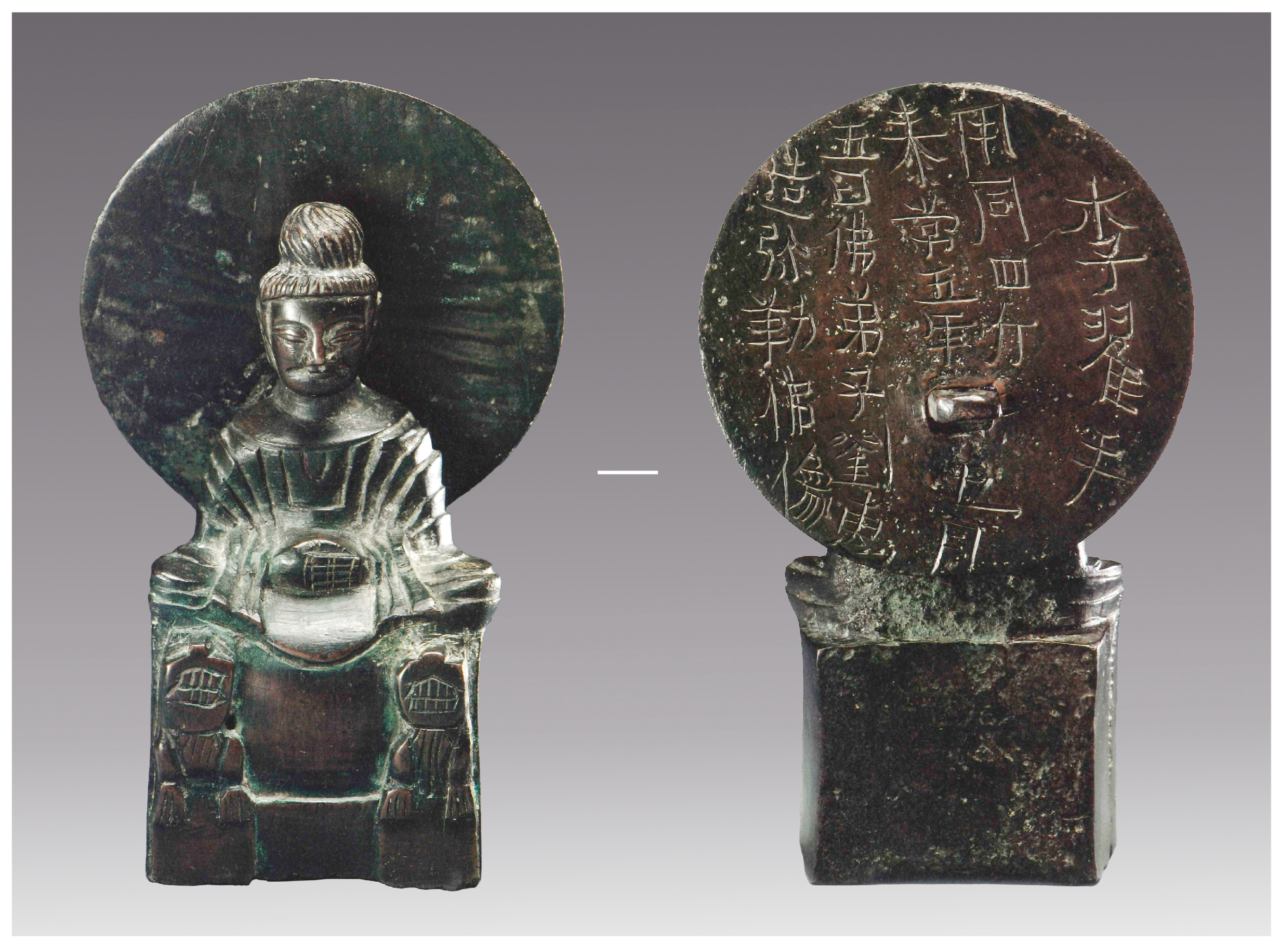
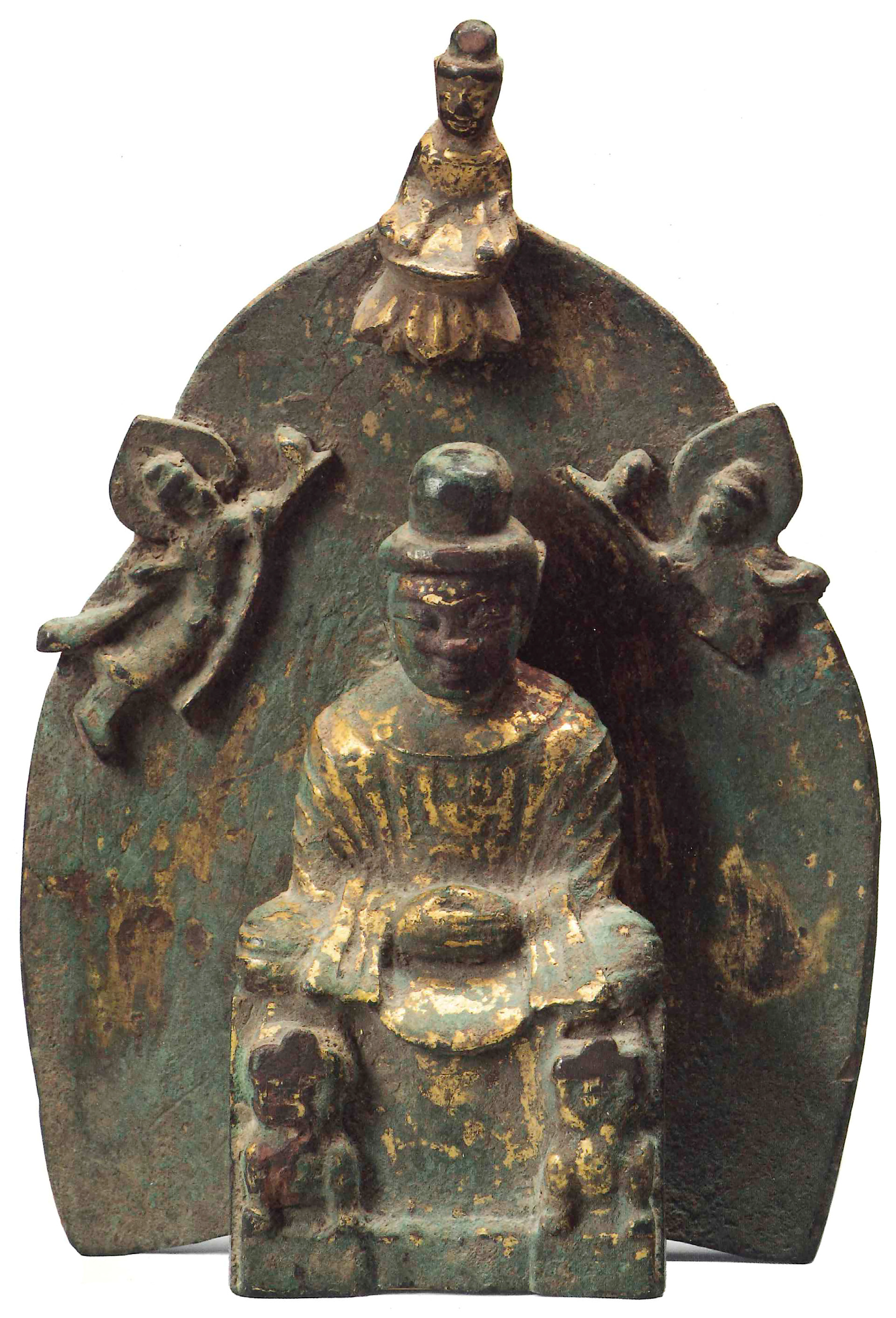
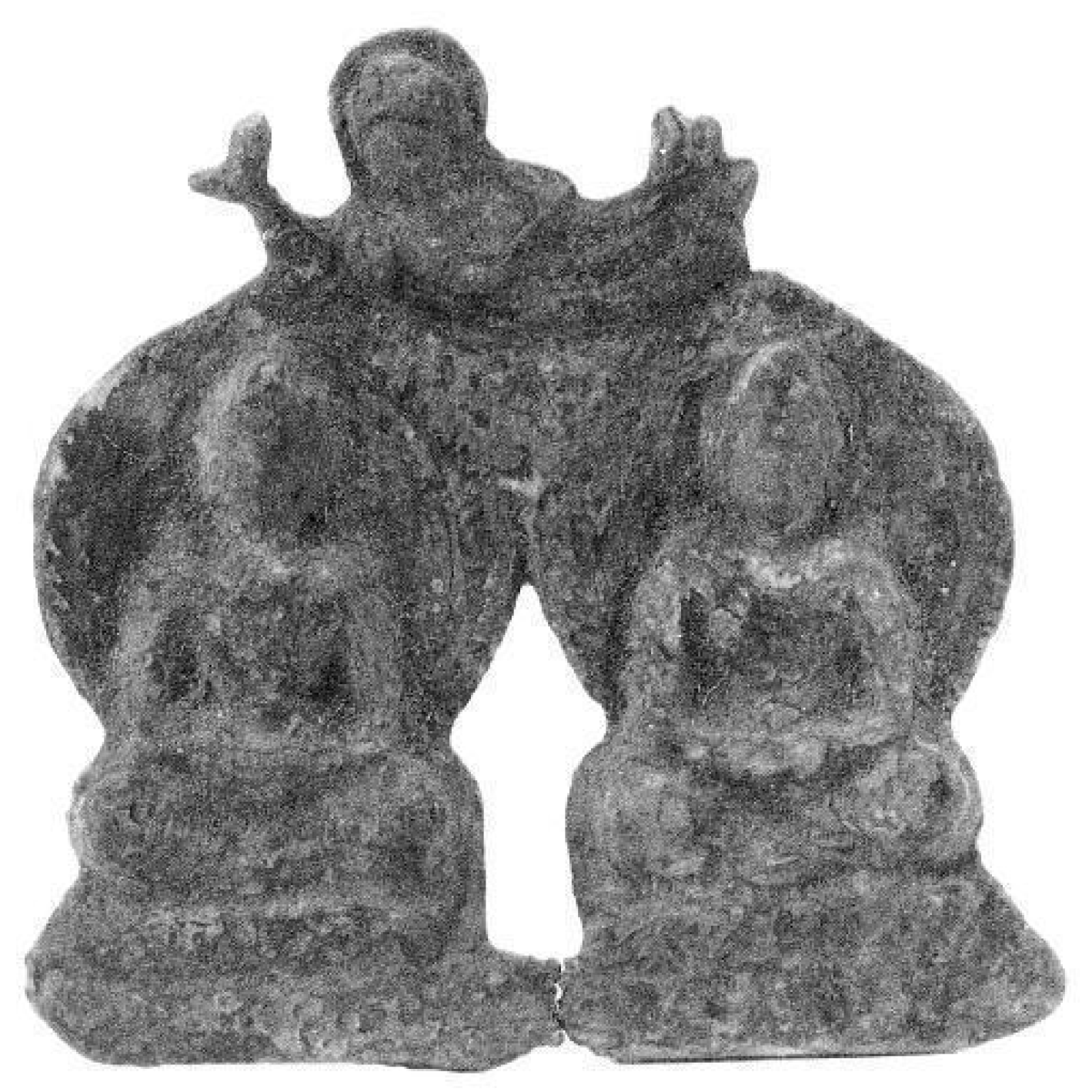
2. Current Research Status and Existing Issues
The research on these two Buddha statuettes is quite extensive, covering a wide range of topics, such as their dating, origin, manufacturing techniques, features, artistic style, cultural provenance, function, community of believers, and relation to different forms of belief. Scholars such as Ran Wanli 冉萬里 and Li Ming 李明, who were among the first to conduct specialized research on these statuettes, have offered in-depth analyses from nine distinct perspectives (
Ran et al. 2022, pp. 82–94). Among all the issues discussed, the most fundamental is the dating of the Buddha statuettes, which lies at the heart of the debate surrounding them. Currently, two main viewpoints dominate the discourse: the “Late Eastern Han Dynasty” and the “Period of the Sixteen Kingdoms”.
The dating of the Buddha statuettes is highly significant, as it represents a cornerstone for addressing most other pertinent issues. In essence, if the chronological framework on which the research is based is fundamentally flawed or disproven, then the discussion of other related topics loses its significance. For instance, it is only relevant to investigate whether these Buddha statuettes were “independently consecrated” or “manufactured locally in China” if they can be confidently dated to the late Eastern Han Period. Similarly, re-examinations of “the route of Buddhism’s introduction to China”, “the developmental sequence of early gilt bronze Buddha statuettes in China”, and “the community of believers during the Eastern Han Dynasty” all hinge on the accurate dating of these statuettes. Therefore, establishing the date of the Buddha statuettes represents a critical issue and the primary question that must be resolved in the related research on this topic.
Regarding the debate over the dating of the Buddha statuettes, Ran Wanli and the excavation team were the first to propose the theory of the “Late Eastern Han Dynasty” (
Shaanxi 2022, p. 27;
Ran et al. 2022, pp. 82–94). This view has been supported by subsequent publications from scholars like Lothar von Falkenhausen, Li Min 李旻, Robert L. Brown, Huang Chunhe 黃春和, and Cui Mengze 崔夢澤, each offering varying levels of detail and nuanced perspectives in their discussions. For example, Lothar von Falkenhausen believes that “the previous art historical sequence may have been founded on a misinterpretation of styles.” (
Lei 2022a). Huang Chunhe suggests that “the religious significance and value of these two Buddha statuettes are similar to the numerous statuettes found in tombs in southwestern China at that time, serving merely as general deities for sacrifices rather than independent representations of religious belief.” (
Huang 2022, pp. 47–56). Cui Mengze’s latest research article does not discuss the dating controversy, but instead directly builds its argument on the assumption of the “Late Eastern Han Dynasty” theory (
Cui 2024, pp. 73–76). Given the significant disagreements surrounding the dating of these statuettes, Cui’s research is fraught with risk and could potentially be entirely invalidated.
Immediately after the “Late Eastern Han Dynasty” theory was proposed, scholars introduced the “Period of the Sixteen Kingdoms” theory. Yang Xin 陽新 was the first to publish an article elaborating on this new perspective (
Yang 2021). Other representative scholars, including Yao Chongxin 姚崇新, Zhu Hu 朱滸, Li Wenwen 李雯雯, and He Zhiguo 何志國, have also published articles in agreement with this view. Both Yang Xin and Yao Chongxin both believe that the two Buddha statuettes were likely mixed into the tomb during later tomb-raiding activities. Yao Chongxin also performed a specific analysis of the nature of these two statuettes and the reasons for their entry into the tomb, suggesting that they might be portable miniature Buddha statuettes that were accidentally left behind by tomb raiders, serving as amulets. He also contends that even if the statuettes date to the “Late Eastern Han Dynasty”, they are not the earliest independent Buddha statuettes nor the earliest gilt bronze Buddha statuettes in China, a conclusion based on his analysis of the “Futu Jian” “浮屠簡” of the Eastern Han Period found at Xuanquanzhi 懸泉置 and other existing works from the Chinese literature (
Yao 2022, pp. 17–29). Li Wenwen and Zhu Hu focused on the stylistic aspects of the statuettes and have identified the standing statuette as exhibiting a fusion of three distinct styles: the Gandhara style of the Kushan Period, the Mathura style of the Kushan Period, and the Mathura style of the Gupta Period. They challenge the idea that the statuettes were forgotten by looters and propose instead that they entered the tomb through secondary or multiple burials (
Li and Zhu 2022, pp. 184–91). He Zhiguo conducted a more detailed analysis and comparative study of the statuettes’ characteristics. He remained circumspect about the exact reasons for the statuettes being mixed into the tomb, without providing a definitive conclusion (
He 2023, pp. 122–31).
Researchers who support the “Period of the Sixteen Kingdoms” theory have presented two key pieces of evidence. Firstly, they all reference a 1950s precedent involving the discovery of two small gilt bronze Buddha statuettes amidst scattered bricks in a looted Eastern Han tomb in BeiSong Village, Shijiazhuang City 石家莊北宋村 (
Sun et al. 1959, p. 55). Secondly, in their comparative studies of the characteristics and artistic styles of the Buddha statuettes, they all highlight a bronze standing Buddha statuette in a private collection in Japan (
Rhie 2002, pp. 424–25, fig. 2.67) that is similar to the standing Buddha statuette excavated from M3015. Previous research has dated all three statuettes to the Period of the Sixteen Kingdoms. However, proponents of the “Late Eastern Han Dynasty” theory find these pieces of evidence to be flawed. As Lothar von Falkenhausen notes, there has been a bias in the dating and classification of these small gilt bronze Buddha statuettes and that they should be re-examined (
Lei 2022a). The discovery of the gilt bronze Buddha statuettes in Chengren village actually serves to correct the previous conclusions. Objectively, these two arguments are inadequate, particularly that regarding the bronze standing Buddha statuette in the Japanese private collection. It is an isolated case outside of Chengren, its current whereabouts are unknown, and the specifics of its excavation and provenance are unclear. The research on this statuette is still pending, and its use as evidence has significant limitations.
In terms of the methodology, researchers advocating for both the “Late Eastern Han Dynasty” and “Period of the Sixteen Kingdoms” theories have largely employed the same three primary research methods, without much distinction. The first method focuses on establishing the relative chronological relationship between the Buddha statuettes and the tombs, i.e., whether the Buddha statuettes were original funerary objects or were introduced into the tombs at a later date. Given that M3015 was once looted, determining the chronological relationship between the statuettes and the tombs largely relies on logical reasoning. However, researchers on both sides of the debate have struggled to present a logic that can fully convince those with the opposing viewpoint. Even among scholars who support the “Period of the Sixteen Kingdoms” theory, there are numerous different ideas about the specific ways in which the Buddha statuettes may have entered the tombs. History is often filled with contingencies and uncertainties, and it is difficult to reach the historical truth based solely on logical reasoning without substantial evidence. We believe that it is unnecessary to dwell excessively on this problem, as it leads to the risk of falling into fruitless debates in which each side simply repeats their own arguments. The resolution of this issue is not essential in fundamentally determining the creation dates of the Buddha statuettes.
The second method involves comparative studies of the form, artistic style, and subject composition of the Buddha statuettes to determine their creation date. Researchers generally agree on the selection of comparative objects, primarily focusing on stone Buddhist sculptures from the Kushan Empire with Gandhara and Mathura styles, Buddha statuettes unearthed from tombs in the Southwest and Jiangnan regions of China from the Eastern Han to Western Jin Periods, and small gilt bronze Buddha statuettes from Northern China up until the “Period of the Sixteen Kingdoms”. However, due to the subjectivity of the researchers and variations in their starting premises, there are considerable variations in the analysis of the statuettes’ features and the selection of comparative focuses. This leads to an interesting phenomenon whereby different conclusions are drawn from the same materials, using the same research methodologies. This is largely attributable to the scope and effectiveness of these research methods. Within certain limits, comparative research of cultural factors undoubtedly represents an effective research method. However, when the comparative objects span a broad temporal and spatial range, with significant differences in their material, size, function, and user group, comparative research often allows for considerable subjective interpretation and can lack persuasiveness. For example, there is currently a comparative study of the two Buddha statuettes with Gandhara and Mathura statuettes. Such a wide-ranging cross-temporal and -spatial comparison can, at most, demonstrate the possible presence of individual Buddhist sculptures in China during the late Eastern Han Dynasty, but it fails to explain the specific creation dates of these two gilt bronze Buddha statuettes. Therefore, in comparative research, the selection of comparative objects is crucial. Generally speaking, the closer the temporal and spatial scope of the comparative objects, and the more similar their material, size, and function, the more reliable the conclusions are likely to be.
The third method involves utilizing natural sciences for the examination and analysis of the two Buddha statuettes. Due to the differences between metal and organic materials, scientific testing may provide insights into the manufacturing techniques used for these statuettes, and their origins. However, it is less effective in directly determining the exact dates of the Buddha statuettes.
It should be noted that previous researchers have overlooked two critical chronological issues. First, the creation date of a Buddha statuette must precede the date that it was placed in the tomb. Scholars have already demonstrated through the statuettes’ wear and tear that they were used for a long time (
Yao 2022, p. 18). Therefore, if the statuettes were not placed into the tomb at a later time, then the tomb’s date can only be considered as the lower limit for the statuettes’ dates; the duration of their use before entering the tomb remains unknown. If the statuettes were indeed placed into the tomb at a later date, then even if their creation date, as speculated by scholars, falls within the “Period of the Sixteen Kingdoms”, that date can only be considered as the upper limit for the statuette’s entry into the tomb. It may not necessarily correspond to the period during which scholars previously assumed that the statuettes were left in the tomb (
Yao 2022, p. 29).
Secondly, it is necessary to consider whether the two Buddha statuettes share the same creation date. After all, although they were unearthed from the same site, they are distinct entities. The current research, whether intentionally or inadvertently, tends to assume that they are contemporaneous relics. However, there are significant differences between them in terms of their subject matter, sculptural features, artistic style, and alloy composition. Could these differences signify that they are from different periods? After all, it is very common in archaeological discoveries to find objects of different ages in the same tomb or Buddha statuette hoard. According to the fundamental principles of archaeological chronology, the later-dated statuette should be considered as the upper limit for when both statuettes entered the tomb. In summary, the two gilt bronze Buddha statuettes from the Eastern Han Dynasty tomb at Chengren Village should not be treated as a single entity, but must instead be considered individually.
3. The Dating of the Standing Buddha Statuette and Related Issues
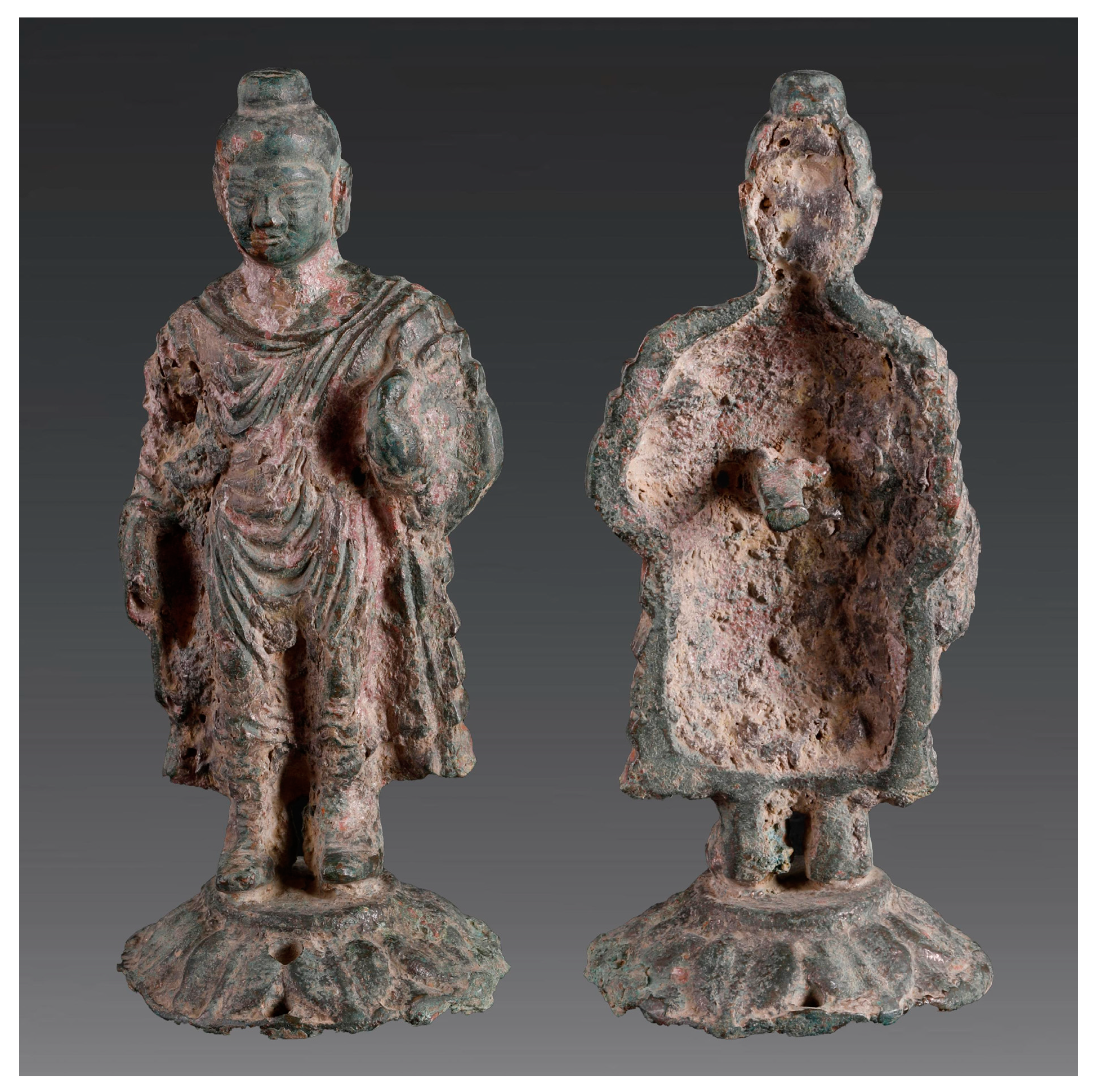
Of the two Buddha statuettes unearthed in M3015 in Chengren Village, the standing Buddha statuette is notably better preserved, with its sculptural features being relatively clear and thus leading to more attention and discussion among researchers. As previously noted, extensive comparative studies have been conducted on this statuette by scholars. However, due to varying perspectives and the inherent limitations of the comparative objects, the conclusions have been quite divergent. Given the current state of research, it seems unlikely that further substantial breakthroughs in dating the statuette based on its facial features, robes, and posture will be made. Fortunately, we have discovered that the lotus petals on the lotus pedestal of the standing Buddha statuette are quite distinctive and can provide an important breakthrough for determining the date of the statuette.
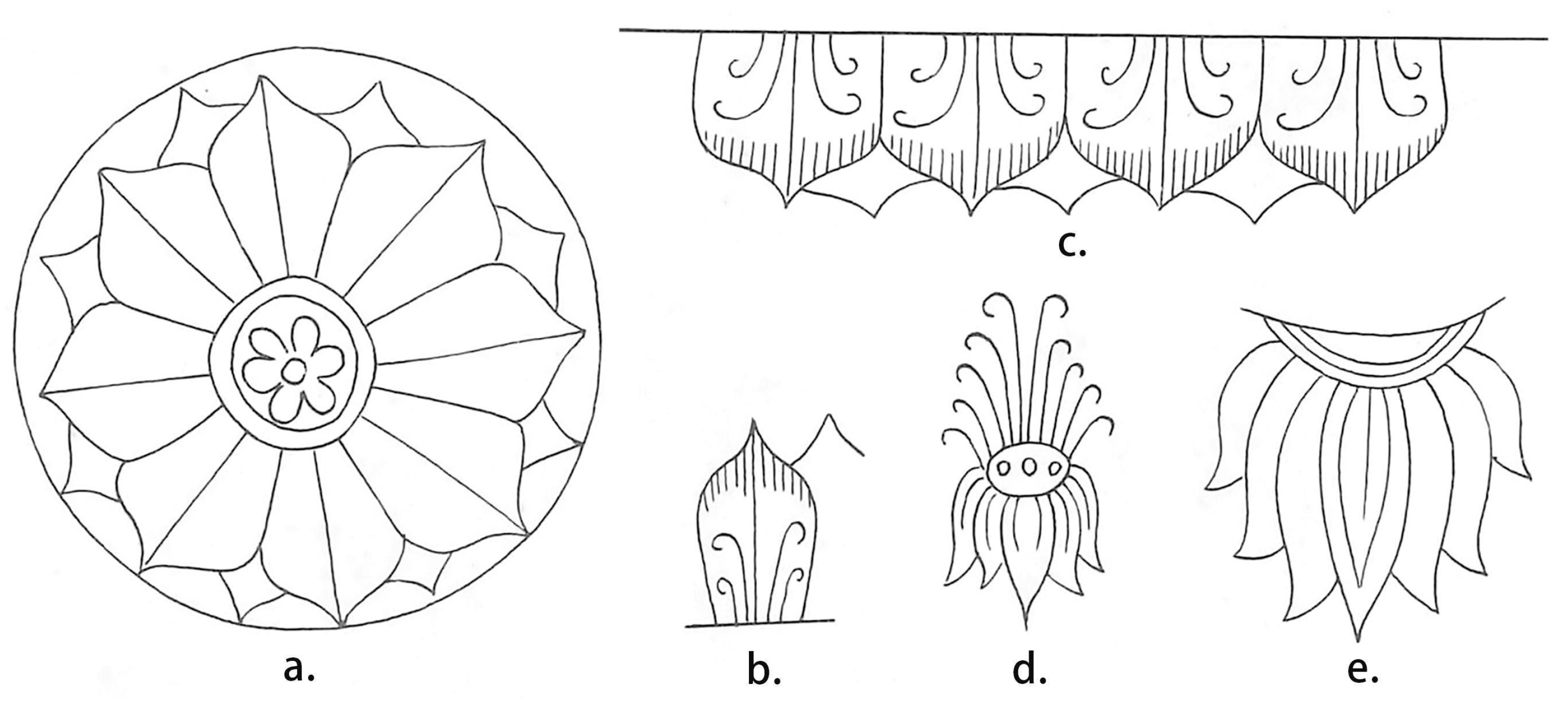
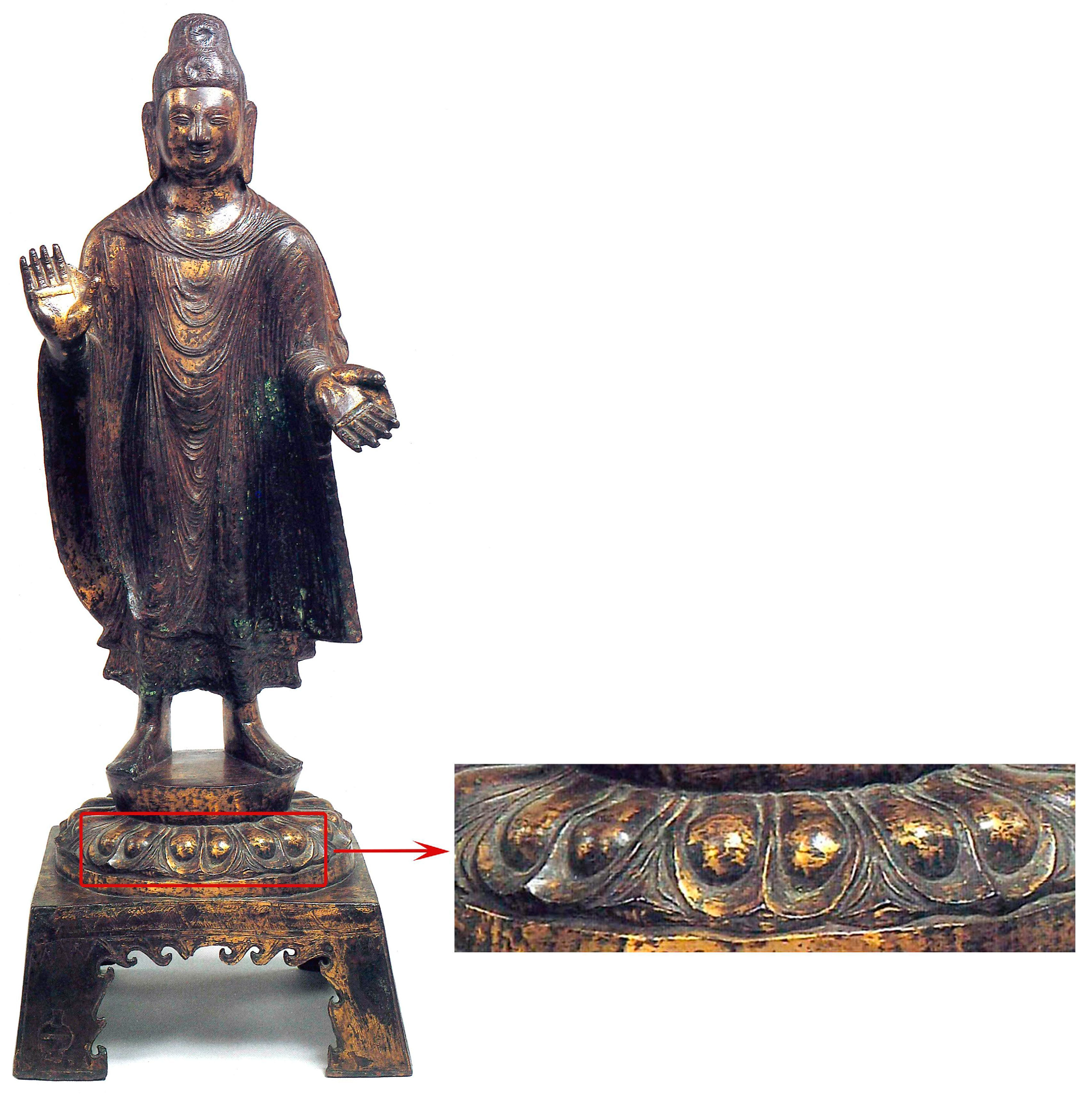
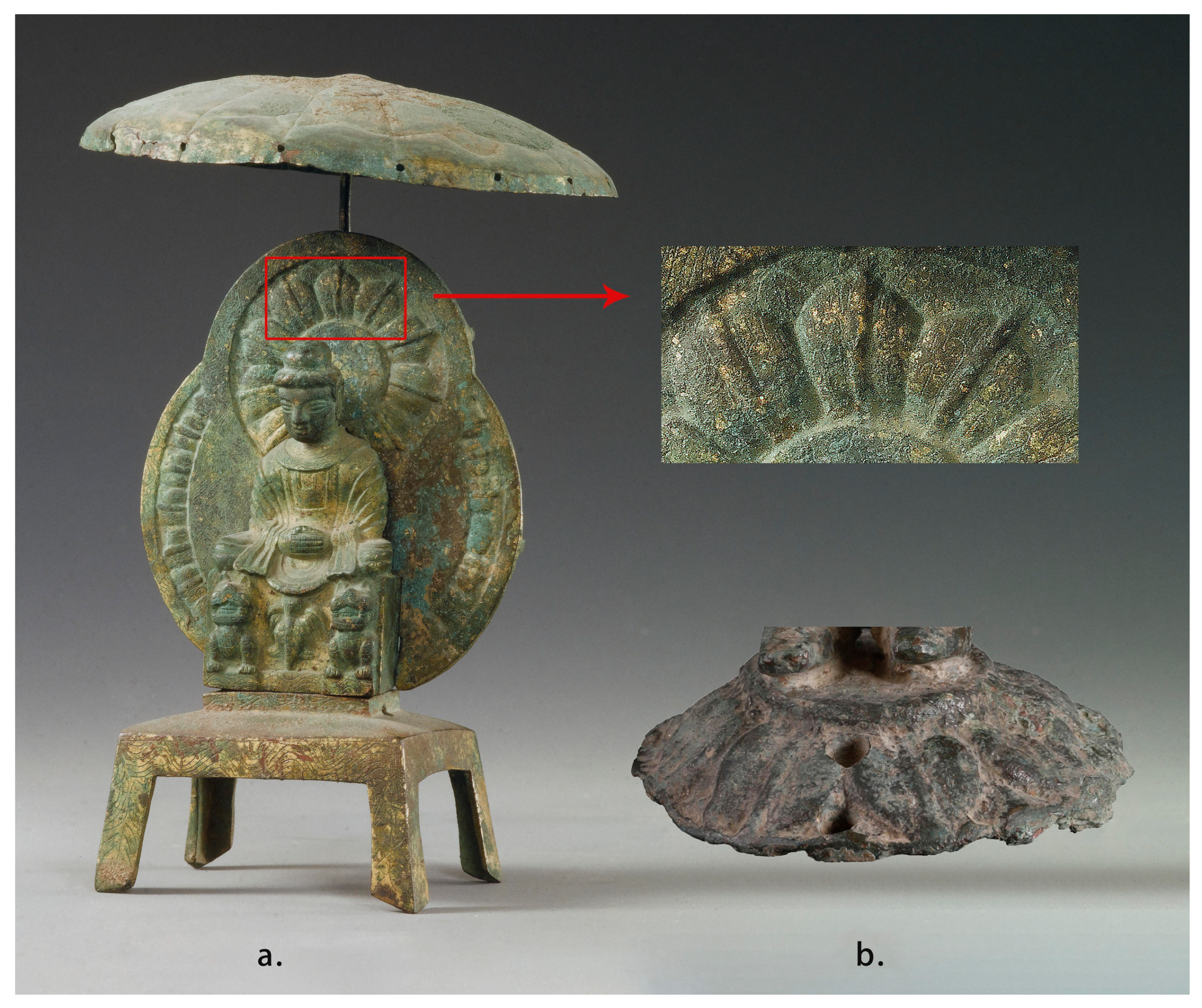
The characteristics of the lotus petals on the pedestal of the standing Buddha statuette unearthed in Chengren Village are as follows: the petals are thick, with a raised longitudinal vein in the center; the widest part can be found slightly towards the back of the middle, narrowing in an arc shape towards the tip, with a concave indentation in the middle at the tip and a protrusion in the front center, and the length of the petals slightly exceeds their width (
Figure 3b). Previous researchers, after comparative studies, have consistently concluded that these petals share similarities with the lotus petal patterns on the halo and umbrella cover of the gilt bronze Buddha statuette unearthed in Yudu Township, Jingchuan 涇川玉都鄉 (
Yang 2021). In fact, these are two completely different lotus petal patterns. The widest part of the lotus petals on the Buddha statuette from the Yudu Township Buddha statuette is not at the back but at the front, and from there, they taper straight back; the length of the petals is much greater than the width, leading to an elongated appearance overall (
Figure 3a). Apart from the central raised longitudinal vein, all other aspects of these petals differ significantly from those of the petals on the standing Buddha statuette’s pedestal in Chengren Village.
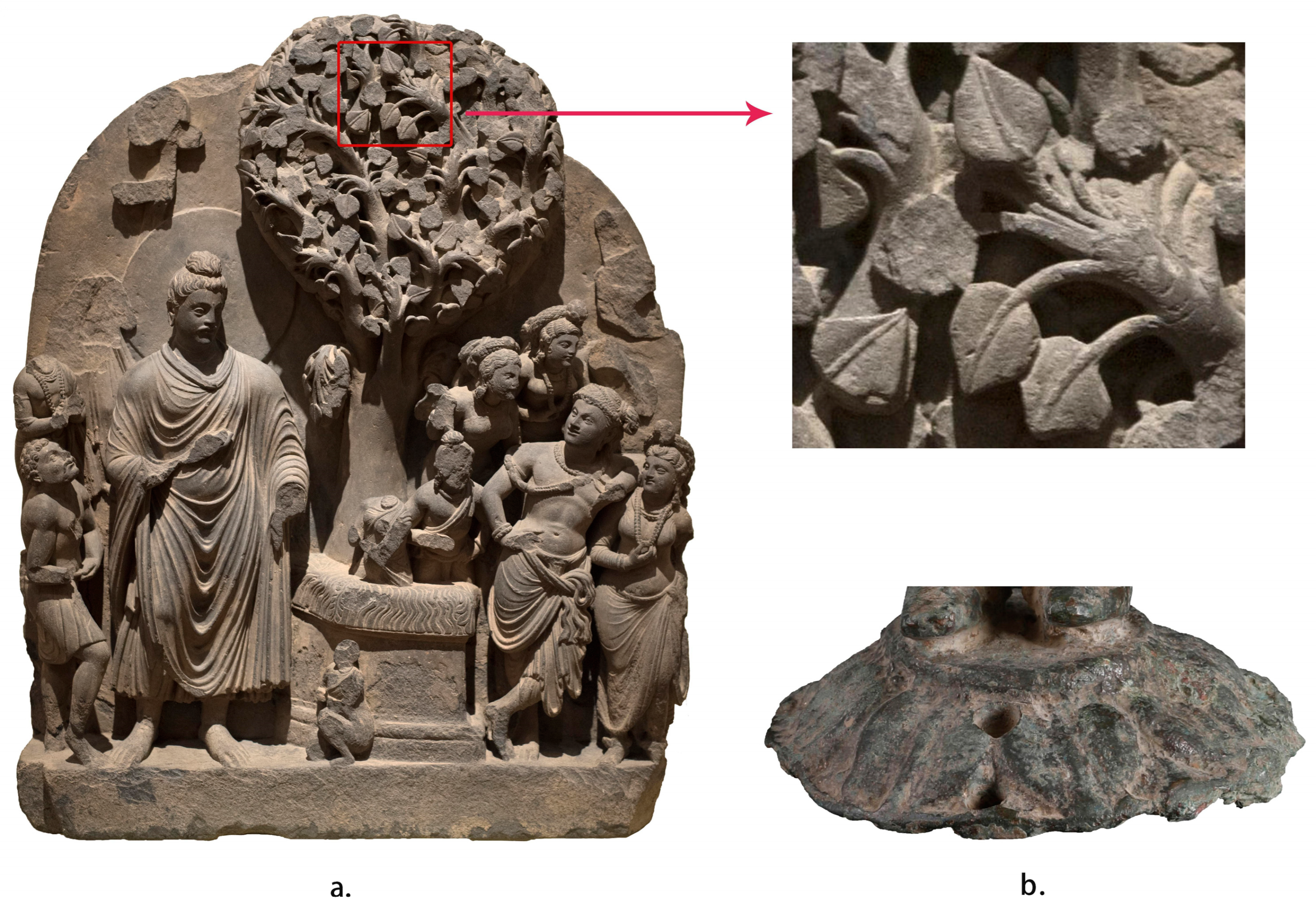
The shape of the lotus petals on the standing Buddha statuette from Chengren Village is very consistent with the Bodhi leaves prevalent in Gandharan Buddhist art (
Figure 4). In Gandharan Buddhist art, this shape of Bodhi leaf is not only frequently carved as an edge decoration on the stone slabs of stupas and temple steps, but is also extensively used as decoration within specific scenes of the Buddha’s life stories. For example, it is widely depicted in images such as the Buddha’s asceticism, the subjugation of demons to achieve enlightenment, the offering of the bowl by the Four Heavenly Kings, Brahma’s invitation, and the approach to the Bodhi throne
4 (
Figure 4a). The related iconography is extremely rich and is too extensive to list in full.
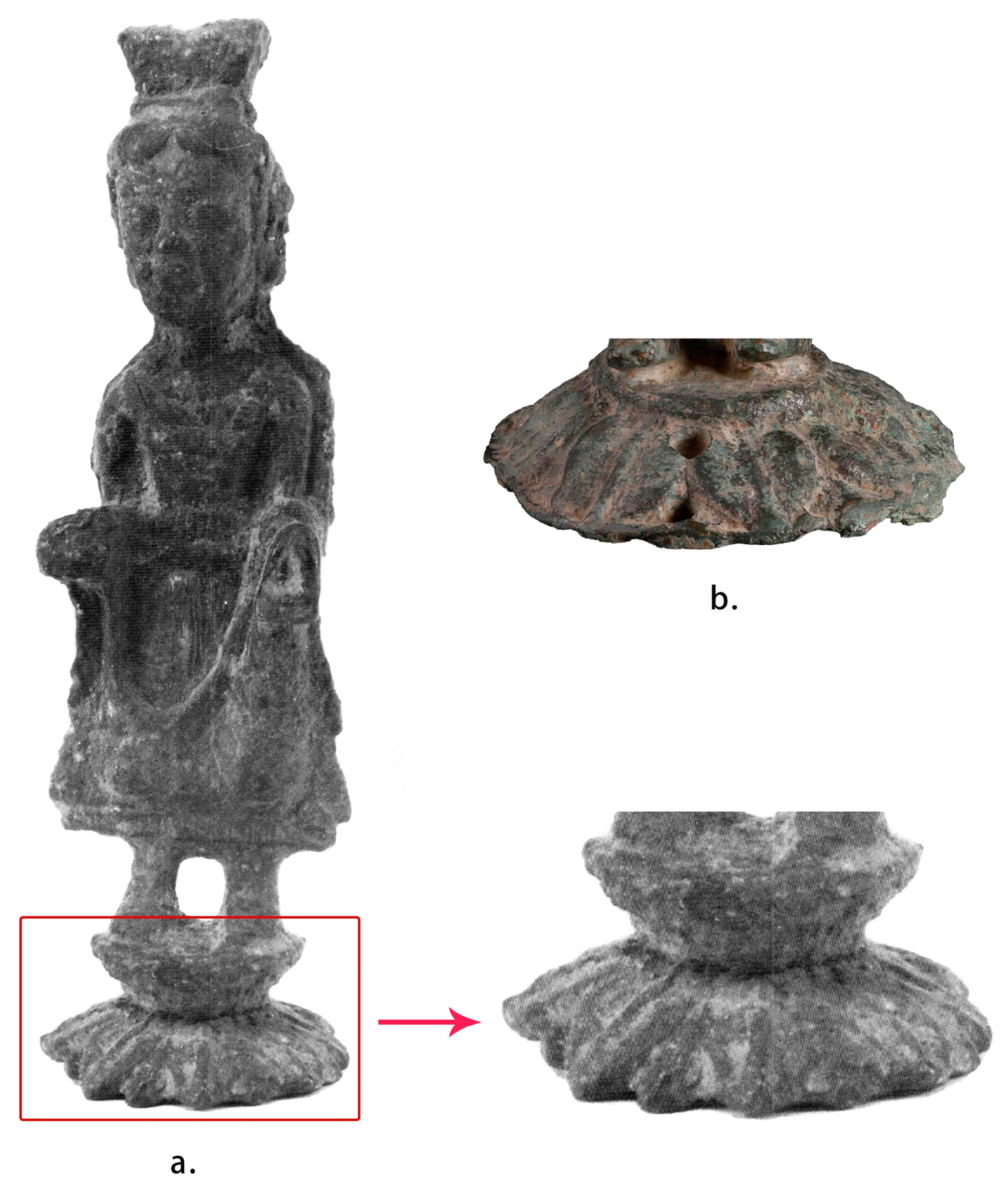
In China, it is not unusual to find lotus petals styled as Bodhi leaves on small gilt bronze Buddha figures. The Palace Museum houses a small gilt bronze standing statuette of Maitreya Bodhisattva with a lotus throne, with a total height of 9.9 cm. This statuette was purchased in Xi’an in the early 1960s and is cataloged as image No. 21 in
Chinese Gilt Bronze Buddha Statues 《中國金銅佛》 (
Li 1995, pp. 40, 229) (
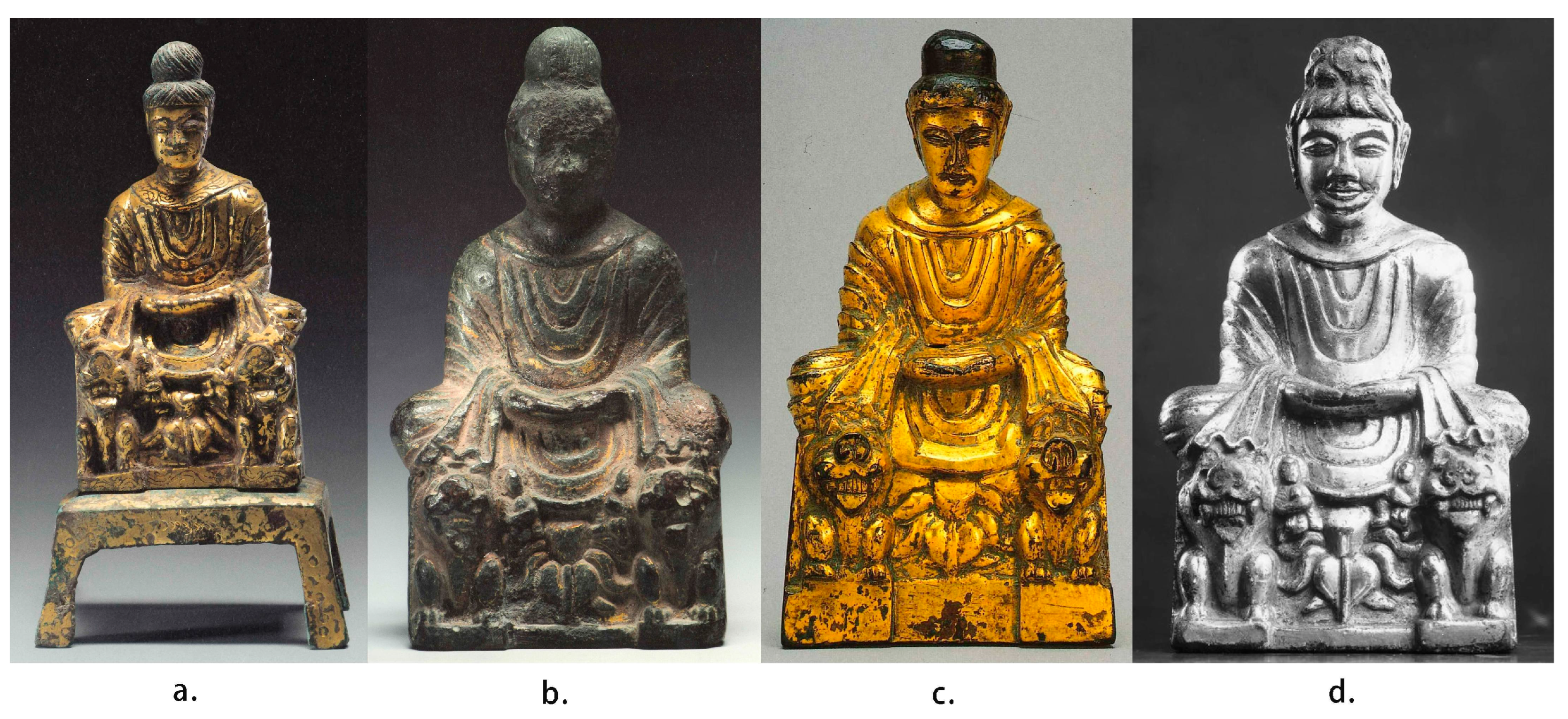
Figure 5a). The lotus petals on the throne of this statuette also take the form of Bodhi leaves, almost identical to those on the lotus throne of the standing Buddha from Chengren Village (
Figure 5).
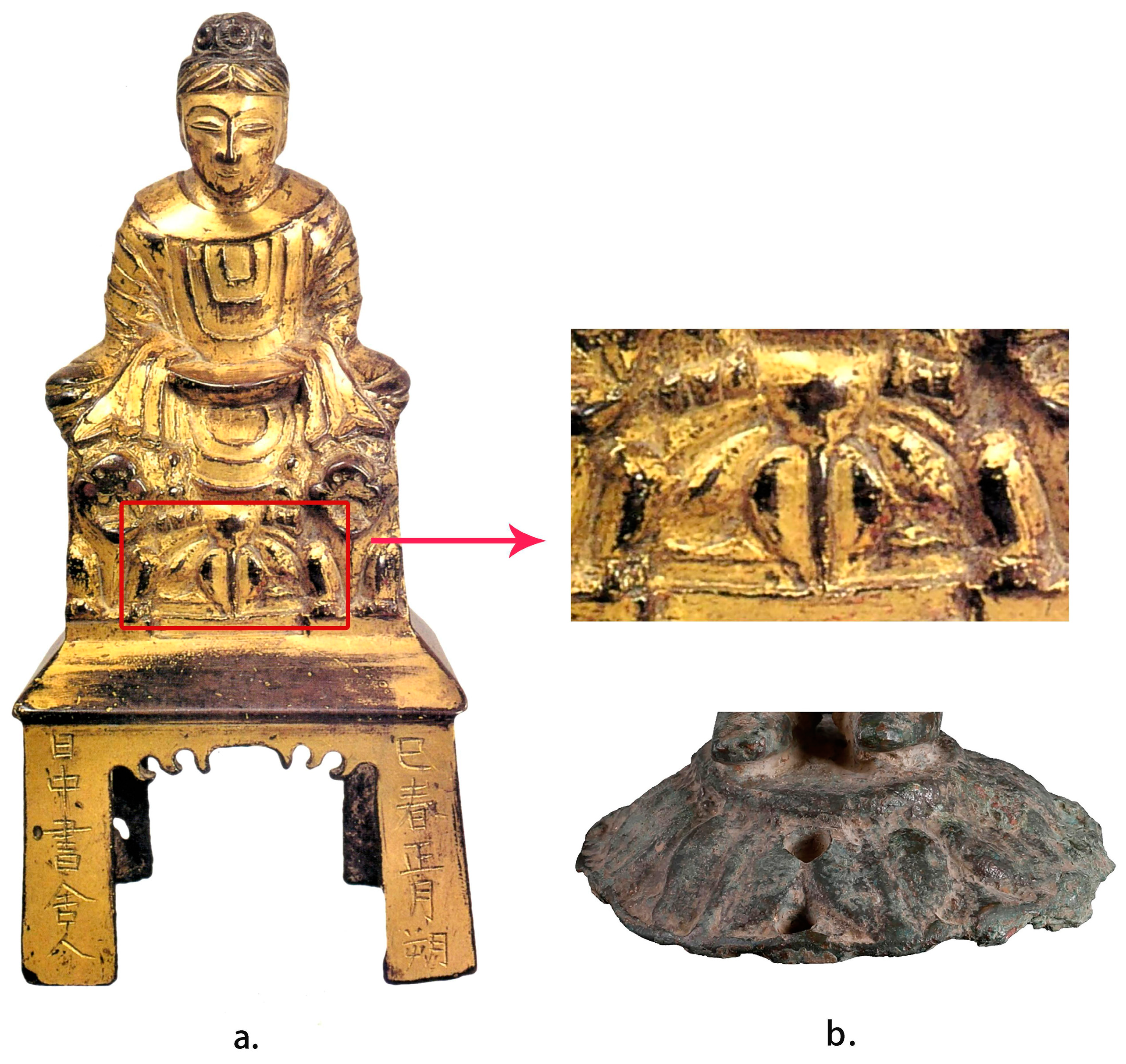
In addition, the same Bodhi leaf-shaped petals are cast in the center of the double-lion pedestal of the famous gilt bronze Buddha statuette from the second year of the Shengguang era of Daxia 大夏勝光二年 (429 AD) (
Figure 6). The second year of the Shengguang era saw the reign of Helian Ding 赫連定, the king of Daxia 大夏. At that time, Tongwan City 統萬城 had fallen, and Helian Ding fled to Pingliang 平凉 (
Huang 2015, p. 6). Shi Wen 施文, the devotee of the statuette, held the position of “Zhongshu Sheren” 中書舍人, a close minister who accompanied the monarch. The creation site of the statuette is expected to be in Pingliang (
Huang 2015, p. 6), part of the Longdong region 隴東地區, which is close to the location of the two statuettes mentioned above, all of which belong to the Guanlong cultural sphere.
The same Bodhi leaf-shaped lotus petals also appear in numerous early small gilt bronze Buddha statuettes found outside the Guanlong region in China, such as those excavated in Xiguancheng, Yi County, and Hebei 河北易縣西貫城 (
Figure 7a), as well as those collected in the Zhengzhou Museum 鄭州博物館 (
Figure 7b), the National Palace Museum, Taipei (
Figure 7c), the Nelson Atkins Museum in the United States (
Figure 7d), and the Idemitsu Museum of Arts in Japan. Each of these statuettes also cast the same Bodhi leaf-shaped lotus petal at the center of the double-lion pedestal. Moreover, these Buddha statuettes are highly consistent in terms of posture, robe style, clothing patterns, sleeve flares, tenons, and the form of the two lions, indicating that they belong to the same phase of the evolutionary sequence of early small meditative gilt bronze Buddha statuettes in China (
Zhang 2024, pp. 49–58). Taking the second year of the Shengguang era of Daxia as a chronological reference, it becomes evident that this Bodhi leaf-shaped lotus petal pattern was a common and popular design on small gilt bronze Buddha statuettes in the late Period of the Sixteen Kingdoms across the Guanlong region and even the entirety of northern China.
To the best of our knowledge, the Bodhi leaf-shaped lotus petal pattern has not appeared systematically on other Chinese Buddhist statuettes beyond the early small gilt bronze Buddha statuettes. Within the evolutionary sequence of early small meditative gilt bronze Buddha statuettes in China, the lotus petal pattern, as an important component, also exhibits strong characteristics of distinct stages. A Buddha statuette dated to the fifth year of the Taichang era 泰常五年 (420 AD), excavated in Sidaoying, Longhua County 隆化四道營, is another benchmark piece with an inscribed date in the evolutionary timeline of these statuettes (
Figure 8). Buddha statuettes belonging to the same stage as this one include statuette No. 2 unearthed in Beisong Village, Shijiazhuang, a selected statuette from the Baoding Native Products Management Department 保定土產經理部, Statuette No. 4 in the collection of the Palace Museum, and a statuette unearthed in Yudu, Jingchuan County (
Liu 2002, pp. 377–82, 385–87). The prevalent lotus petal patterns from this stage are highly uniform in shape and represent an earlier phase than the Bodhi leaf-shaped lotus petal pattern. Taking the well-preserved statuettes from Yudu and from Beisong Village, Shijiazhuang (Statuette No. 2) (
Figure 9) as examples, it can be seen that lotus petal patterns are extensively cast on the halo, umbrella cover, and pedestal, as well as the pedestals of miniature meditative seated Buddha or Bodhisattva statuettes attached to the halo. The lotus pedestal of the small Buddha statuette on top of the Buddha statuette selected from the Baoding Native Products Management Department also features petals of the same shape (
Figure 10).
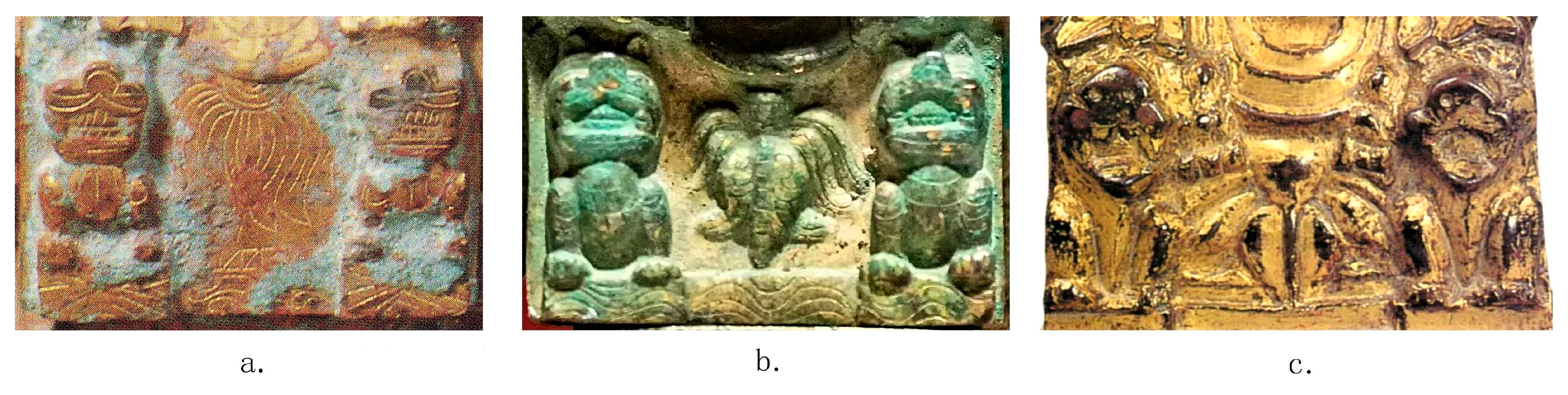
The small meditative gilt bronze Buddha statuette in the collection of the Idemitsu Museum of Arts in Japan is a remarkable artifact that captures the evolutionary transition of lotus petal patterns. This statuette displays lotus petals in two distinct styles: Those at the center of the Buddha’s double-lion pedestal and on the inverted lotus seats within the halo are shaped like Bodhi leaves, indicative of a later stage (
Figure 11). Conversely, the lotus petals on the inverted lotus seats of the standing Bodhisattva figures flanking the pedestal reflect an earlier form. Similarly, the lotus petal pattern at the center of the double-lion seat of the Yudu statuette also shows a clear transitional state, blending casting and carving techniques. It maintains the elongated petal pattern style seen in Statuette No. 2 from Beisong Village, Shijiazhuang, from the earlier stage (
Figure 9e), while also beginning to adopt the basic form of the Bodhi leaf-shaped lotus petals of the next stage, though the outline remains relatively slender (
Figure 12). In the absence of inscribed dates on these statuettes, we can use the slightly earlier Buddha statuette date to identify the fifth year of the Taichang era (420 AD) (
Liu 2002, p. 386) as the upper limit for determining the appearance of the Bodhi leaf-shaped lotus petal pattern in the small gilt bronze Buddha statuettes.
Finally, we will discuss the lower limit for the time of the popularization of the use of Bodhi leaf-shaped lotus petal patterns on small gilt bronze Buddha statuettes in northern China. In 439 AD, the Northern Wei Dynasty unified northern China, bringing about a significant transformation regarding the development of Buddhism in northern China. According to the record of
Wei Shu Shi Lao Zhi 《魏書·釋老志》, during the Taiyan era of the Northern Wei Dynasty, the Liangzhou region was conquered and its inhabitants were relocated to the capital. The Samanas followed them eastward, bringing Buddhist beliefs, which led to the further development of Buddhism in the capital. “太延中,涼州平,徙其國人於京邑,沙門佛事皆俱東,象教彌增矣” (
Wei 1974, p. 3032). Correspondingly, significant changes also occurred in Buddhist art.
The popularity of early small gilt bronze Buddha statuettes, once centered in the Hebei Province, has waned over time. The existing Buddha statuettes from the early Northern Wei Dynasty, specifically during the Taiping Zhenjun era 太平真君年間, show numerous innovative developments (
Liu 2002, pp. 383–84). Among the most notable changes are the lotus petal patterns on Buddhist statuettes, which are distinct from the Bodhi leaf-shaped lotus petal design that was extremely popular around 429 AD. The most distinctive feature of the new lotus petal patterns is the division of each petal into two sections, with a kidney-shaped protrusion at the middle of each part. For example, the lotus petals on the pedestals of the Buddha statuettes devoted by Zhu Xiong 朱雄 in the first year of the Taiping Zhenjun era (440 AD), the Buddha statuette devoted by Wanshen 菀申 in the fourth year of the Taiping Zhenjun era (443 AD) (
Figure 13), and the Buddha statuette devoted by Zhuyewei 朱業微 in the fifth year of the Taiping Zhenjun era (444 AD) all exhibit this new style. Moreover, this style persisted in popularity until the fall of the Northern Wei Dynasty and became the primary lotus petal motif on Buddhist statuettes in northern China. In contrast, the Bodhi leaf-shaped lotus petals that enjoyed a brief time in vogue during the late “Period of the Sixteen Kingdoms” did not reappear. Therefore, the year 439 AD marks an important milestone in Chinese Buddhist history and art and could be considered as the lower limit for the time of the popularization of the Bodhi leaf-shaped lotus petal patterns on small gilt bronze Buddha statuettes in northern China. In summary, I believe that the standing Buddha statuette unearthed in Chengren Village would have been created in the late period of the Sixteen Kingdoms, around the early 5th century.
4. The Dating of the Flat Five-Seated Buddha Statuette and Related Issues
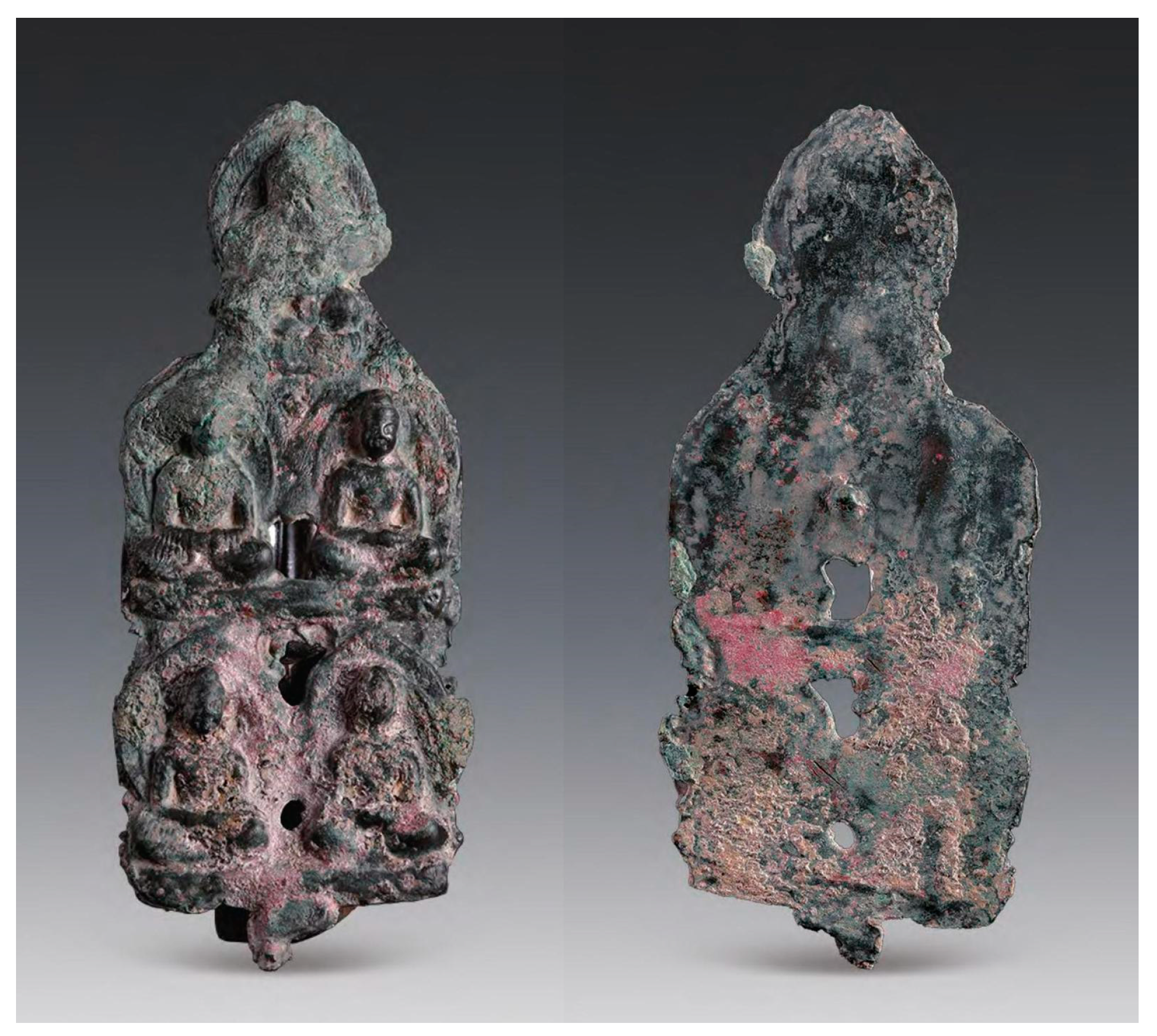
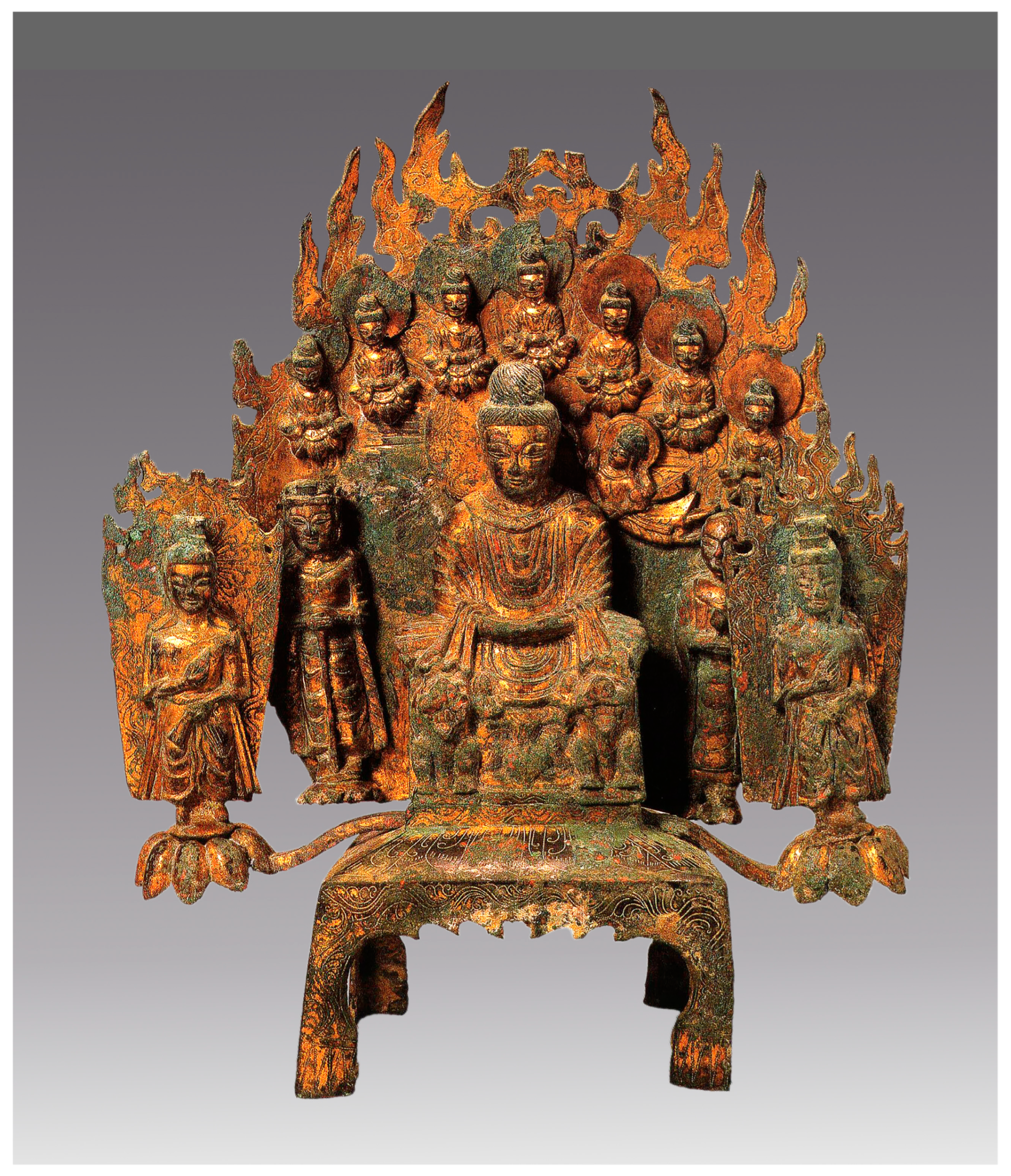
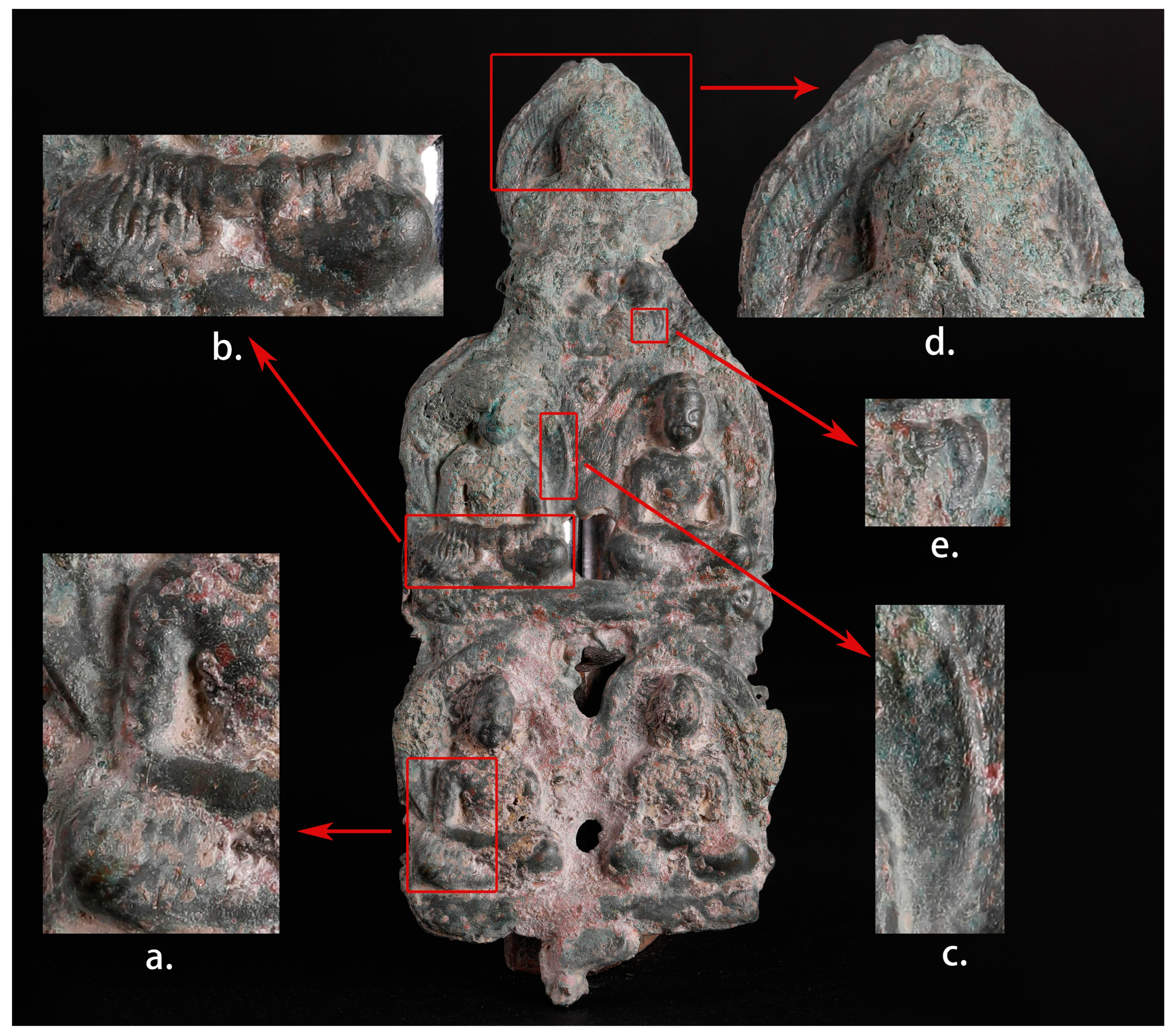
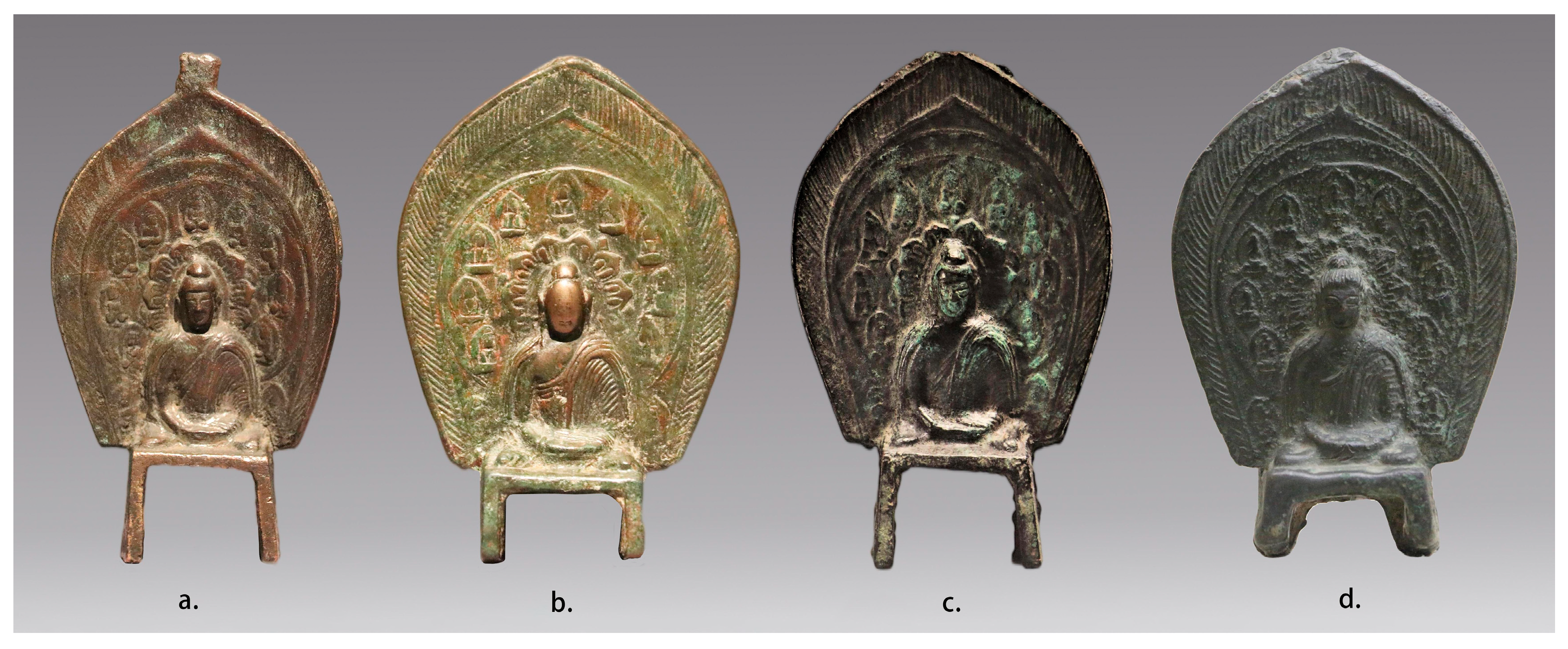
Each Buddha on the flat five-Buddha statuette has suffered varying degrees of damage, but it is possible to approximate the complete appearance of the Buddha images by piecing together the clear remaining parts of the figure. The Buddha statuette features a long, round face and is seated with a dhyana mudra in front of a peach-tip-shaped halo. The folds on the right arm of the lower-right Buddha statuette are obvious, indicating that it is adorned with a full-shoulder-style kasaya (
Figure 14a). The sleeve cuff of the Buddha statuette in the second row on the right remains intact, and the pleats are largely visible, symmetrically covering both knees (
Figure 14b). The left side of the halo still retains a clear belt-shaped joint bead pattern (
Figure 14c). The same band-like beaded pattern is also visible on the right side of the halo of the uppermost Buddha statuette, the outer edge of the halo is adorned with clear parallel radiating flame patterns (
Figure 14d), and beneath the left knee of this figure, a relatively clear piece of a petal pattern on the pedestal is visible and is of a style that became common in northern China after unification under the Northern Wei Dynasty (
Figure 14e). Therefore, the petal pattern alone refutes the assertion that the flat five-Buddha statuette dates from the late Eastern Han Dynasty, and it also indicates that the flat five-Buddha statuette from the Chengren tomb is from a later date than the standing Buddha statuette.
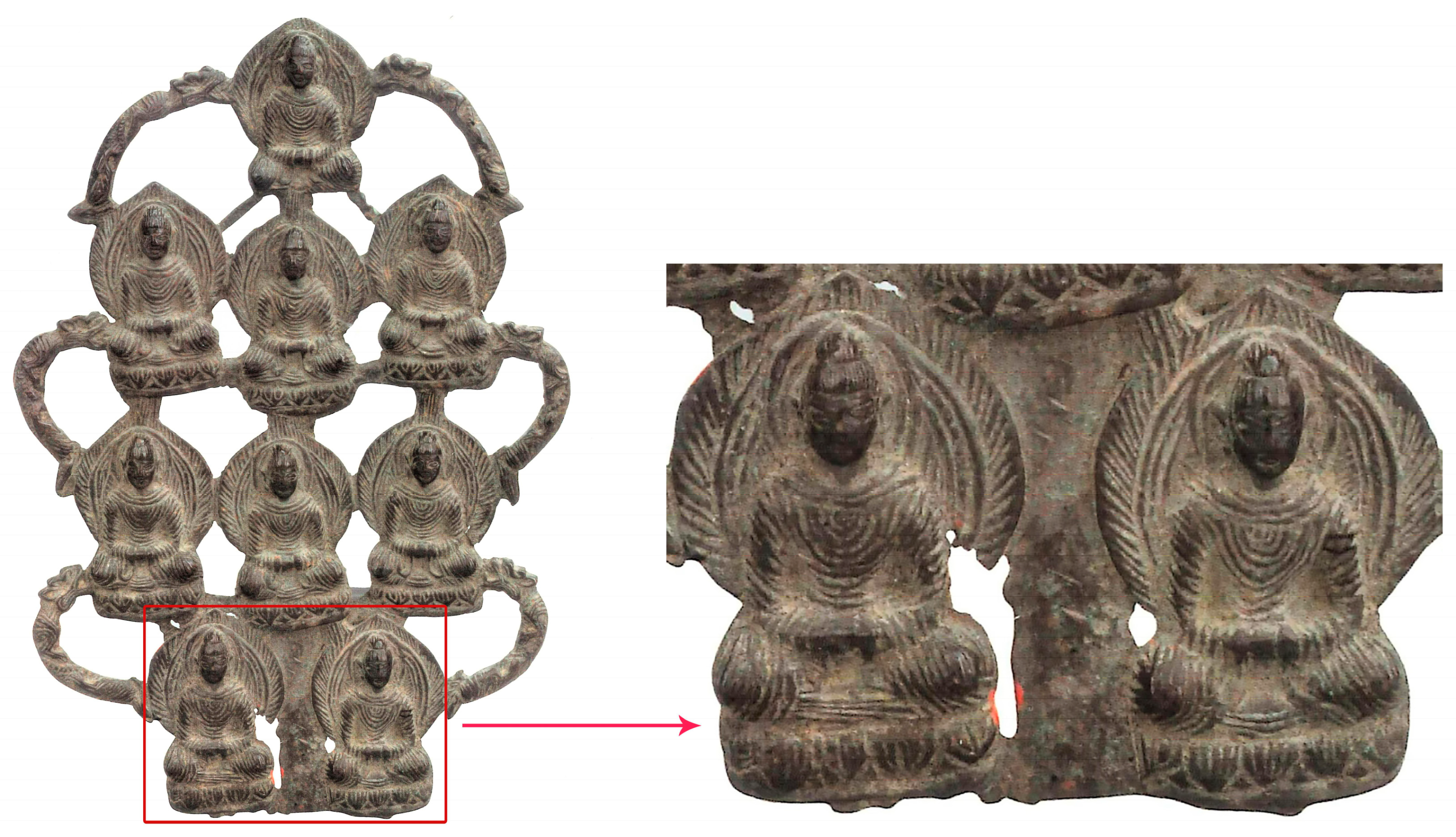
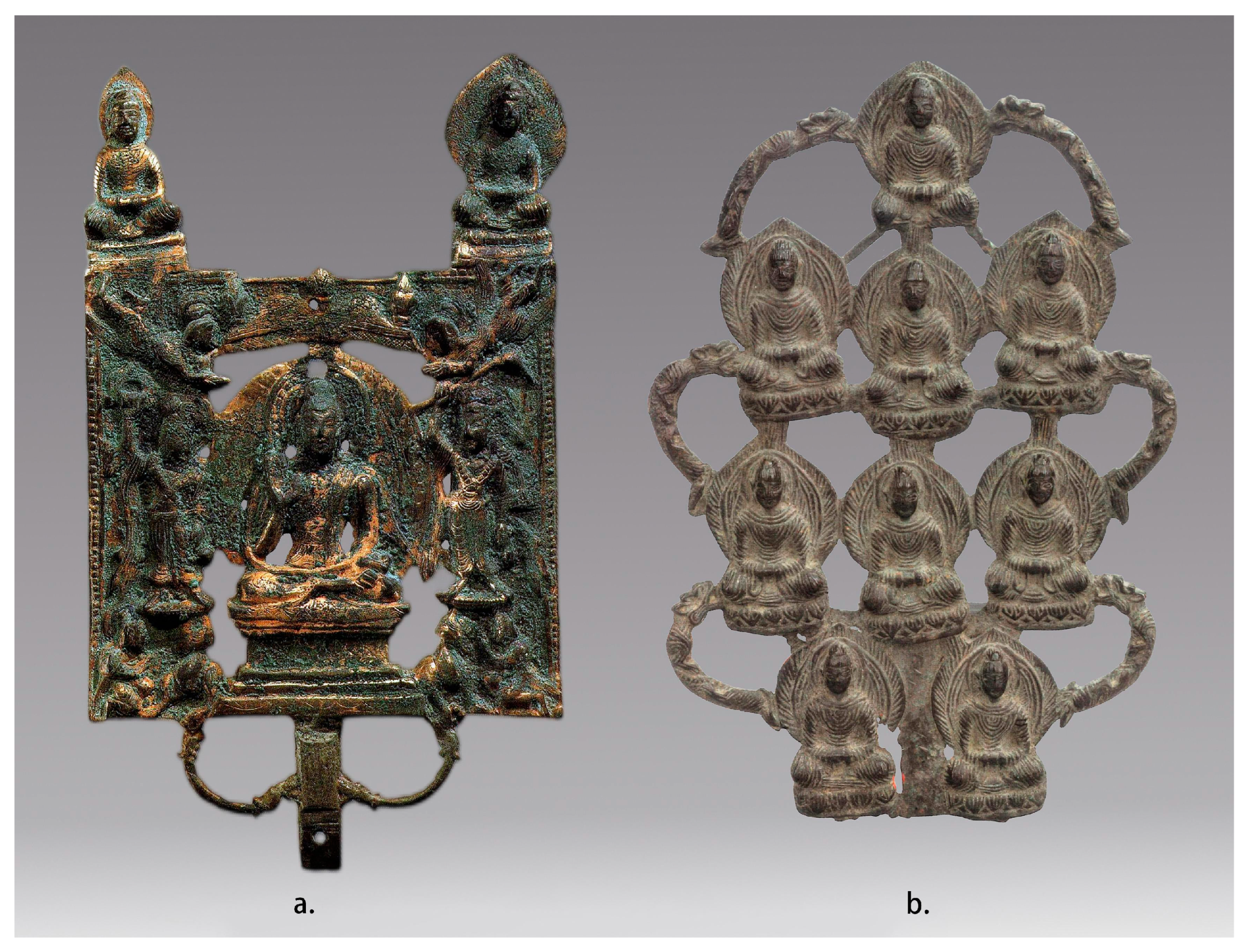
In fact, there are also some Buddha statuettes within the Guanlong region that share the same style as the Buddha figures on the flat five-Buddha statuette. Among them, the Lingtai County Museum 靈臺縣博物館 houses a well-preserved flat nine-Buddha statuette (
Wei 2018, p. 1436), where each figure is strikingly similar in appearance (
Figure 15) and highly consistent with the images of the Buddha figures on the flat five-Buddha statuette excavated from M3015 in Chengren Village. It is important to note that this consistency is not limited to individual elements, but extends across all aspects of the statuettes. A number of elements display a high degree of similarity, from the facial features and postures of the Buddha figures to the clothing patterns on their arms, the shape and texture of the sleeve cuffs, the detailed representation of the hand mudras, the shape of the halo, the position and form of the band-like joint bead patterns and parallel radiating flame patterns on the halo, and even the shape of the lotus petals on the pedestals.
The flat nine-Buddha statuette in the collection of the Lingtai Museum has a total height of 18.5 cm, and each individual Buddha statuette is the same height as those in the five-Buddha statuette, i.e., approximately 4.9 cm. This statuette was acquired from Xitun Township, Lingtai County 靈臺縣西屯鄉, which is adjacent to the Guanzhong region and has been deeply influenced by the Guanzhong culture, thus belonging to the same cultural sphere. The similarity between these two statuettes is also evident in their special forms; both the five-Buddha and nine-Buddha statuettes are essentially multi-Buddha statuettes composed of many small meditating Buddha figures.
The Palace Museum also has a similar flat multi-Buddha statuette in its collection, consisting of two identical meditating Buddha statuettes and one flying apsara statuette. It is catalogued as Statuette No. 6 in
Chinese Gilt Bronze Buddha Statues (
Li 1995, p. 24) (
Figure 16). The entire statuette is 6.7 cm tall, with each meditating Buddha statuette about 4.9 cm tall, matching the size of the previously mentioned multi-Buddha statuettes. Moreover, the features of each part of the Buddha figures, the shape of the halo, and the decorative patterns closely resemble those on the two previously discussed statuettes. The band-like beaded patterns decorating the halo of these Buddha figures are a prevalent decorative motif in the gilt bronze Buddhist statuettes of the Guanlong region and are rarely found on small gilt bronze Buddha statuettes from elsewhere (
Zhang and Wei, forthcoming). This statuette was purchased in Xi’an, and it is highly probable that it also originates from the Guanzhong region, where Xi’an is located. The three flat multi-Buddha statuettes referenced above can be classified as the same type of Buddha statuette; they were manufactured and popularized in close proximity and are likely of a similar age.
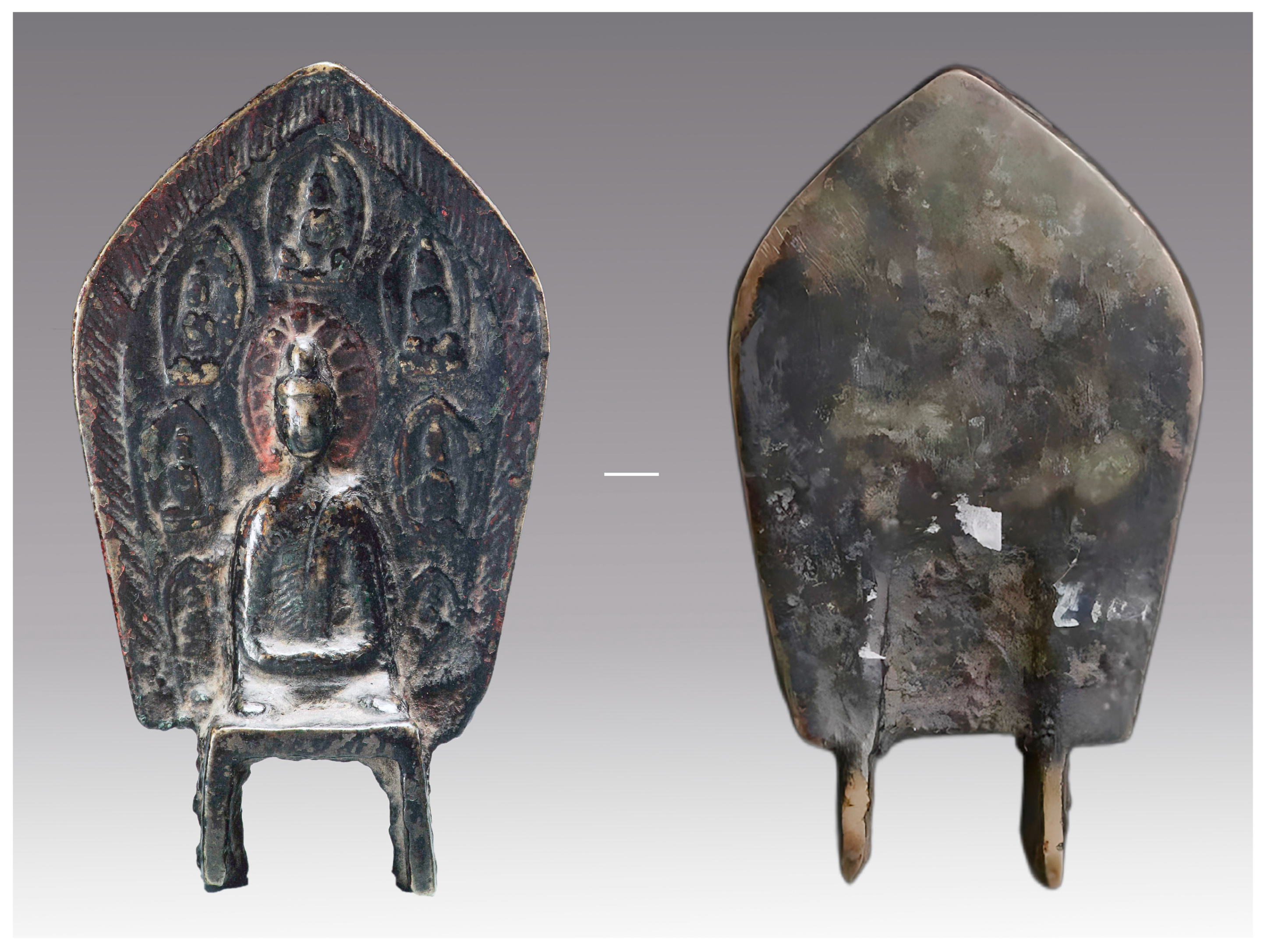
In terms of the subject matter of the flat five-Buddha statuette, the ancient Qinzhou region, adjacent to Guanzhong, has also yielded small gilt bronze Buddha statuettes with a composition of five Buddhas. The Tianshui Museum 天水市博物館 houses a meditating gilt bronze Buddha statuette with a short-footed couch-style pedestal, on the halo of which, five seated Buddhas are cast (
Zhejiang 2018, p. 75) (
Figure 17). Similar Buddha statuettes are also owned by private collectors. The consistency of the five-Buddha composition in the Tianshui Museum statuette with that unearthed at Chengren village is no mere coincidence. This can be confirmed through comparison with the nine-Buddha combinations discovered in the Guanzhong and Qinlong regions.
In addition to the Buddha statuette with a halo cast with five Buddhas, Tianshui Museum also has a similar meditating gilt bronze Buddha statuette in its collection, with a halo cast with nine Buddhas. There are a considerable number of similar meditating gilt bronze Buddha statuettes with a nine-Buddha combination, with examples unearthed from Xi’an 西安, Zhenyuan 鎮原, and Guyuan 固原, among other places (
Zhai 2003, pp. 46–47;
Wei and Wu 2003, pp. 16–21;
Guyuan 1984, p. 35) (
Figure 18). Moreover, there are many such Buddha statuettes spread among public and private collections both in China and abroad (
Saburo 1995 [Plates], pp. 55–59). As previously mentioned, the nine-Buddha statuette from Lingtai County and the five-Buddha statuette from Chengren village are also the same type of statuette. It can be seen that both the flat multi-Buddha statuettes and the meditating Buddha statuettes with short-footed couch-style pedestals, which are unique to the Guanzhong and Qinlong regions, feature combinations of five and nine Buddhas. These two types of statuette show a clear corresponding relationship in terms of their Buddha composition.
Through a comprehensive analysis and comparison of the style, size, origin, form, and subject matter of the five-Buddha statuette from Chengren Village, it can be concluded that this type of multi-Buddha statuette, comprising meditating gilt bronze Buddha statuettes approximately 4.9 cm tall, was a commonly popular type of Buddhist statuette in the Guanzhong and Qinlong regions during a certain historical period.
Next, we will discuss the dating of this type of flat multi-Buddha statuette.
Chinese Gilt Bronze Buddha Statues suggests that the flat two-Buddha statuette dates to the first half of the fifth century, but does not give a detailed explanation (
Li 1995, p. 24). There is also a very special type of plate-shaped Buddha statuette prevalent in the Guanlong region that can offer relatively reliable evidence for use in dating flat multi-Buddha statuettes. There are a total of five extant plate-shaped Buddha statuettes, four of which are dated. In 1980, a gilt bronze plate-shaped Buddha statuette made by the monks of the Zhuiyuan Temple 追遠寺 in the seventh year of the Taihe era 太和七年 (483 AD) was excavated in the Lianhu District in Xi’an City 西安市蓮湖區. It is generally believed that these statuettes were popular in the Shaanxi and Gansu regions (
Li 2016, p. 27;
Zhang 2016, p. 261). An undated plate-shaped Buddha statuette collected in Japan has two seated Buddha figures cast on its upper edge that closely resemble those on the flat multi-Buddha statuettes (
Jin 2002, p. 399) (
Figure 19a). The bottom of this statuette and the pedestal are connected by two complete “C”-shaped twin-dragon head knobs; a similar medallion connection joint can also be found on another plate-shaped Buddha statuette dated to the fourth year of the Yanxing era in the Northern Wei Dynasty 北魏延興四年 (474). Similarly, the Buddha figures on both sides of the flat nine-Buddha statuette from Lingtai County are also connected by a comparable “C”-shaped twin-dragon head knob (
Figure 19b). Furthermore, a similar “C”-shaped twin-dragon head image also appears on a copper knocker ring unearthed from a painted coffin tomb from the early Taihe era of the Northern Wei Dynasty in Leizumiao Village, Guyuan 固原雷祖廟村
5. The detailed features of the dragons, such as the mouth, the eyes, the ears, the mane under the ears, and even the incised lines and bead patterns on the body, are almost identical. This can serve as additional evidence for use in dating the nine-Buddha statuette from Lingtai.
According to the evolution of the plate-shaped Buddha statuettes, Li Jingjie argued that the undated plate-shaped Buddha statuette mentioned above predates the fourth year of the Yanxing era 延興四年 (474 AD); it is probably close to that of the first year of the Heping era 和平元年 (460 AD) (
Li 2016, p. 24). If we adopt a cautious approach, then we could estimate that the creation date of the undated plate-shaped Buddha statuette is between the first year of Heping (460) and the seventh year of Yanxing (474), and it is certainly no later than the creation of the latest-dated plate-shaped Buddha statuette, which is from the seventh year of Taihe (483). This range of dates can also be used as the chronological range for the nine-Buddha statuette from Lingtai.
On the other hand, based on the corresponding subject matter combinations and relationships, the Buddha statuettes with nine-Buddha combinations on their halos unearthed in places such as Xi’an, Zhenyuan, and Guyuan, as mentioned above, can also provide evidence for use in dating flat multi-Buddha statuettes. According to research by Wei Wenbin 魏文斌 and others, this type of seated Buddha statuette was prevalent during the Taihe Period before Emperor Xiaowen of the Northern Wei Dynasty 北魏孝文帝 relocated the capital to Luoyang 洛陽, corresponding to the second phase of the Yungang Grottoes (
Wei and Wu 2003, pp. 16–21). Saburo Matsubara 松原三郎 also suggests that these statuettes date back to around 475 AD (
Saburo 1995 [Texts], pp. 11–19).
To summarize, the production era of the flat multi-Buddha statuettes in the Guanzhong and Qinlong regions can be dated to the period between the Yanxing era and the early Taihe Period (around 471~484 AD), during the reign of Emperor Xiaowen of the Northern Wei Dynasty. The five-Buddha statuette from Chengren Village, like many similar statuettes, is also likely to have been created during this time.