Flow-Balanced Scheduled Routing and Robust Refueling for Inland LNG-Fuelled Liner Shipping

 ,
,
Abstract
1. Introduction
1.1. Research Background
1.2. Main Contributions
- (1)
- We establish the functional relationship between fuel consumption and sailing speed under speed deviations, subject to port call time window constraints, and analyze its impact on overall fuel usage.
- (2)
- We propose two mixed-integer nonlinear programming models: (i) an arc-variable based model, where empty container flows are represented by arcs; and (ii) a node-variable based model, where flows are represented by a smaller set of node variables.
- (3)
- By analyzing the extreme case of speed deviations, we construct an explicit function for maximum fuel consumption. Subsequently, linearization techniques are applied to reformulate the model as a linear programming formulation. By using the minimum number of piecewise linear segments, approximation errors are kept within a reasonable range, enabling efficient and accurate solution by professional solvers. Furthermore, we demonstrate the correspondence between the upper and lower bounds of models.
- (4)
- As shown in the appendix, even after multiple constraint relaxations, the problem remains strongly NP-hard. We also demonstrate that the arc-variable-based and node-variable-based models exhibit equivalent relaxation bound strength, and we further investigate the solution properties.
- (5)
- Using Yangtze River liner shipping cases, we validate the proposed models and conduct sensitivity analyses. Both models quickly yield optimal solutions for divisible demand, while the node-variable based model performs better in complex and indivisible-demand cases. The sensitivity results reveal generalizable patterns and managerial insights that support green inland shipping.
2. Literature Review
2.1. Sailing Speed Optimization for Maritime Liner Shipping
2.2. Sailing Speed Optimization for Inland Liner Shipping
2.3. Route Design for Maritime Liner Shipping
2.4. Route Design for Inland Liner Shipping
3. Problem Definition and Notation
3.1. Problem Definition
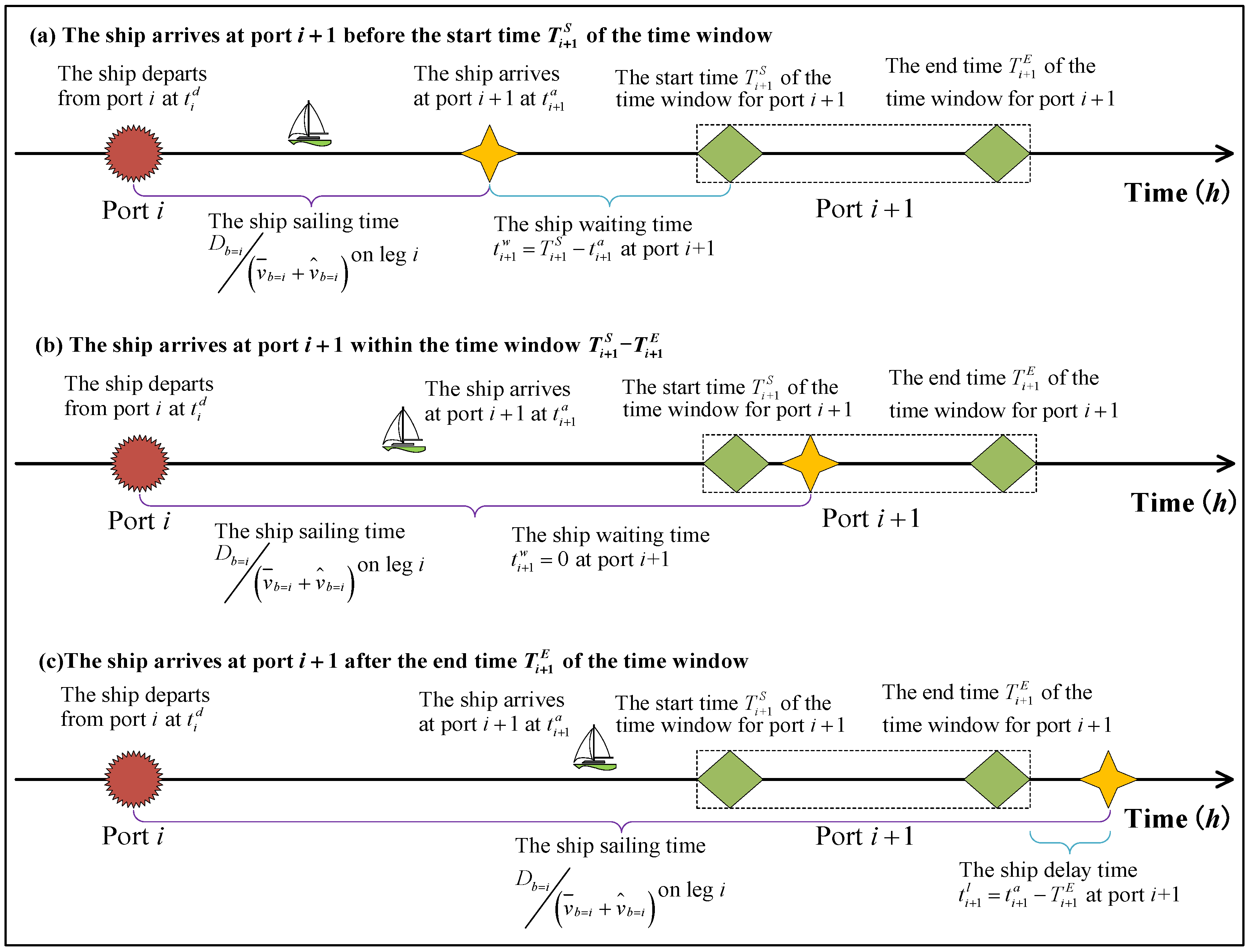
3.1.1. Situation of Ships Arriving at the Port
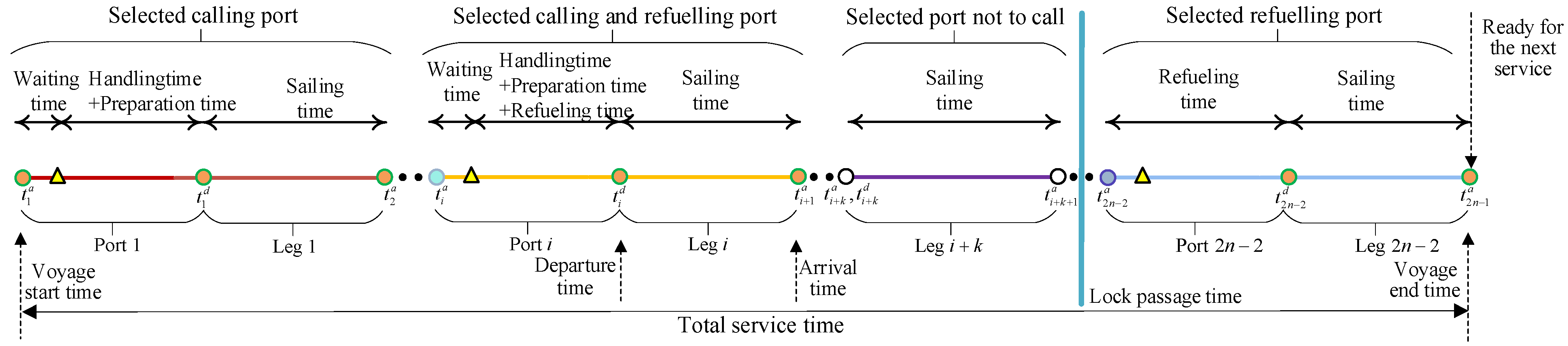
3.1.2. Relationship Between Port Calls and Service Time
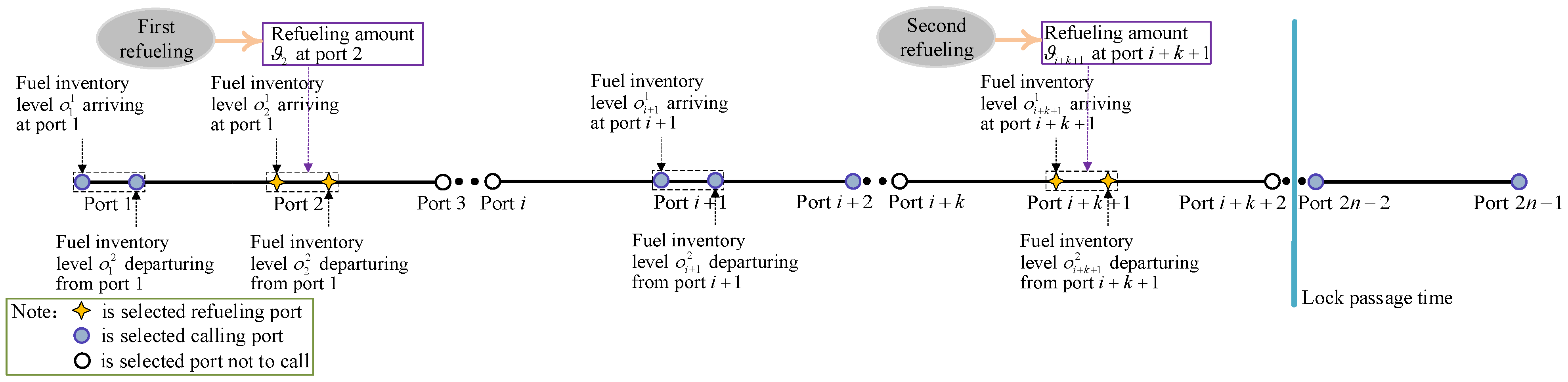
3.1.3. LNG Refueling for Inland LNG-Fuelled Ships
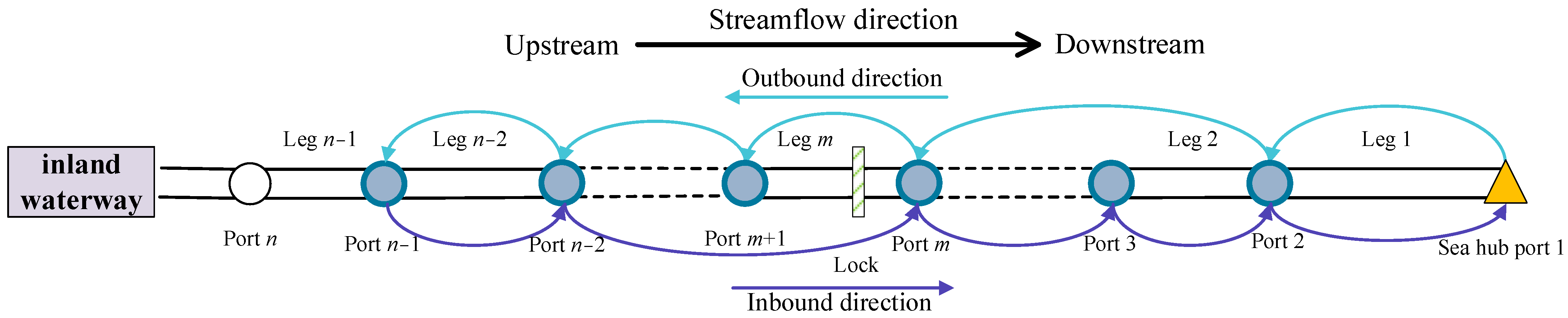
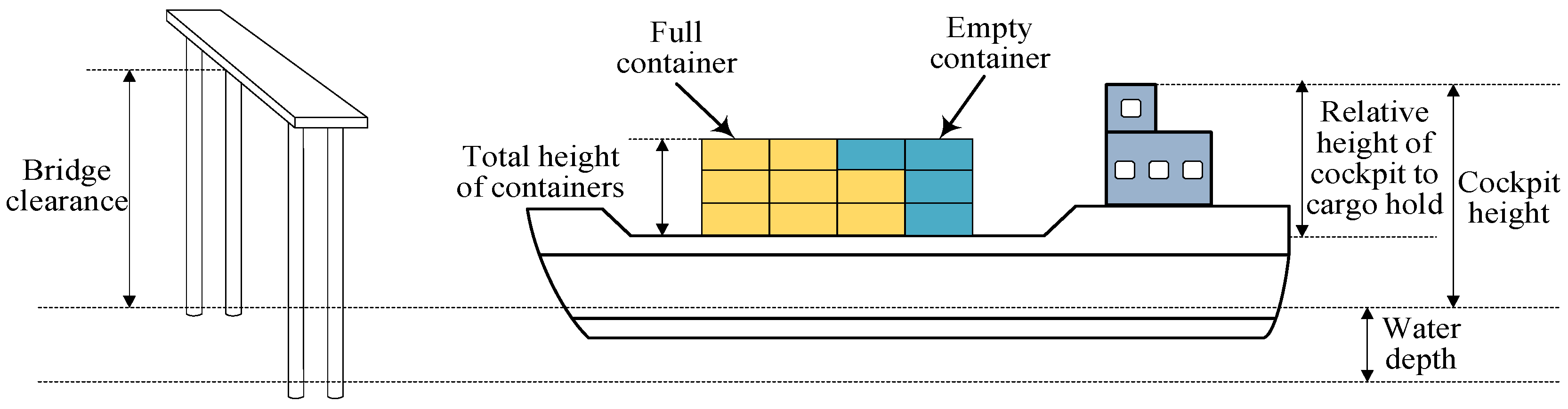
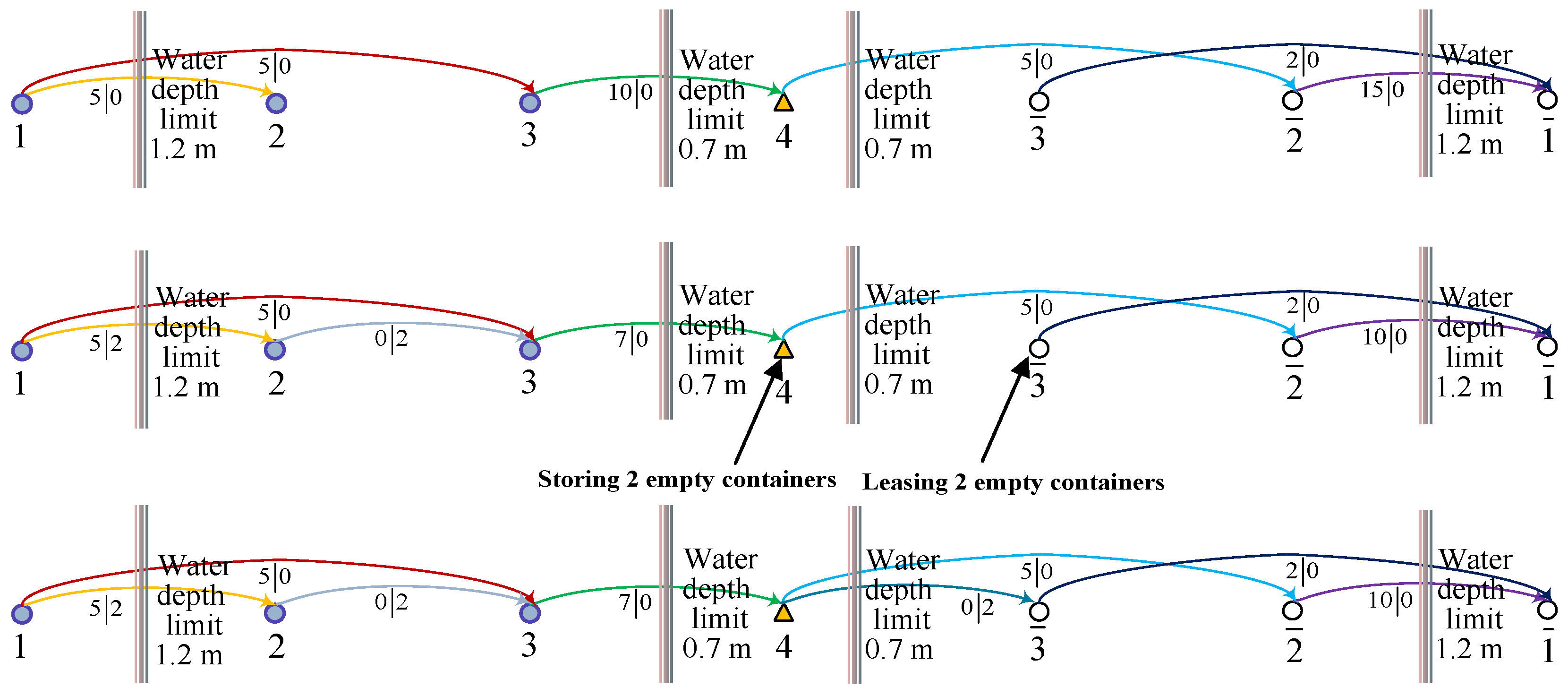
3.1.4. Navigational Restrictions and Empty Container Repositioning
3.1.5. Costs and Decisions
- (1)
- Ship deployment numbers;
- (2)
- Port calling sequences in the outbound and inbound directions;
- (3)
- Refueling ports and fuel amounts;
- (4)
- Full and empty container shipments;
- (5)
- Empty container storage or leasing at ports;
- (6)
- Determining the voyage schedule.
- (1)
- (2)
- (3)
- (4)
- (5)
- (6)
3.2. Notation
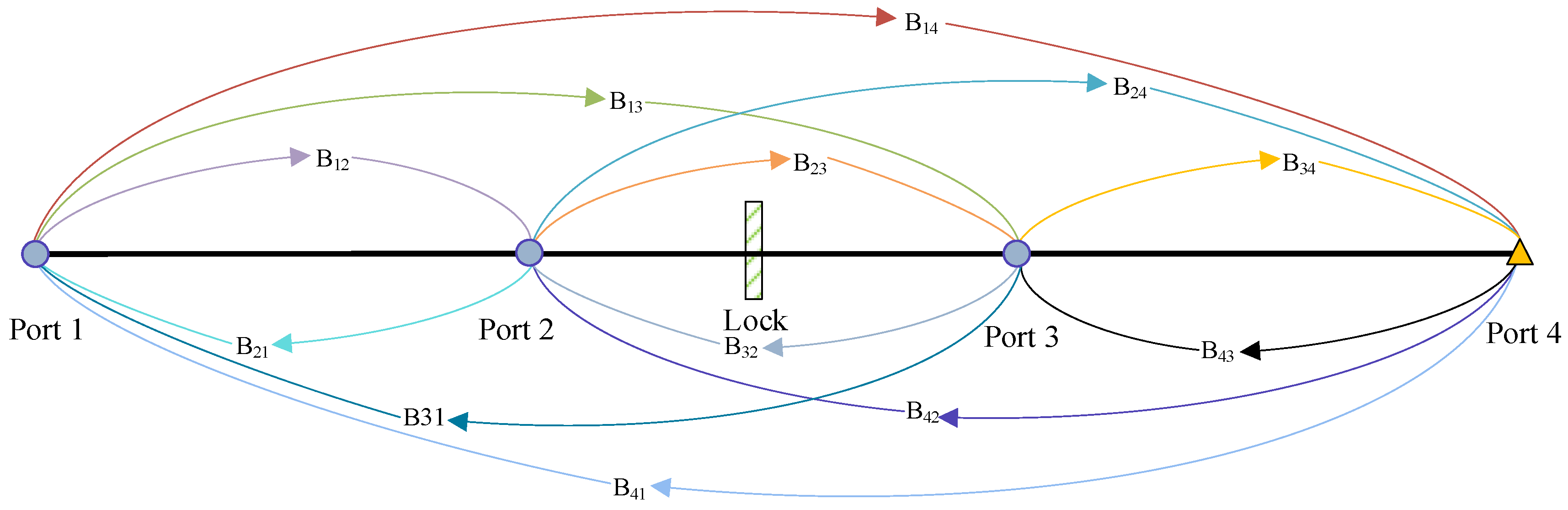
3.3. Graph Transformation
4. MIP Models
4.1. First Model Based on Empty Container Arc Variables
4.2. Second Model Based on Empty Container Node Variables
5. Solution Method
5.1. Linearization of Chance Constraints
5.2. Determination of the Maximum Fuel Consumption Function
5.3. Linearization of Speed-Dependent Constraints
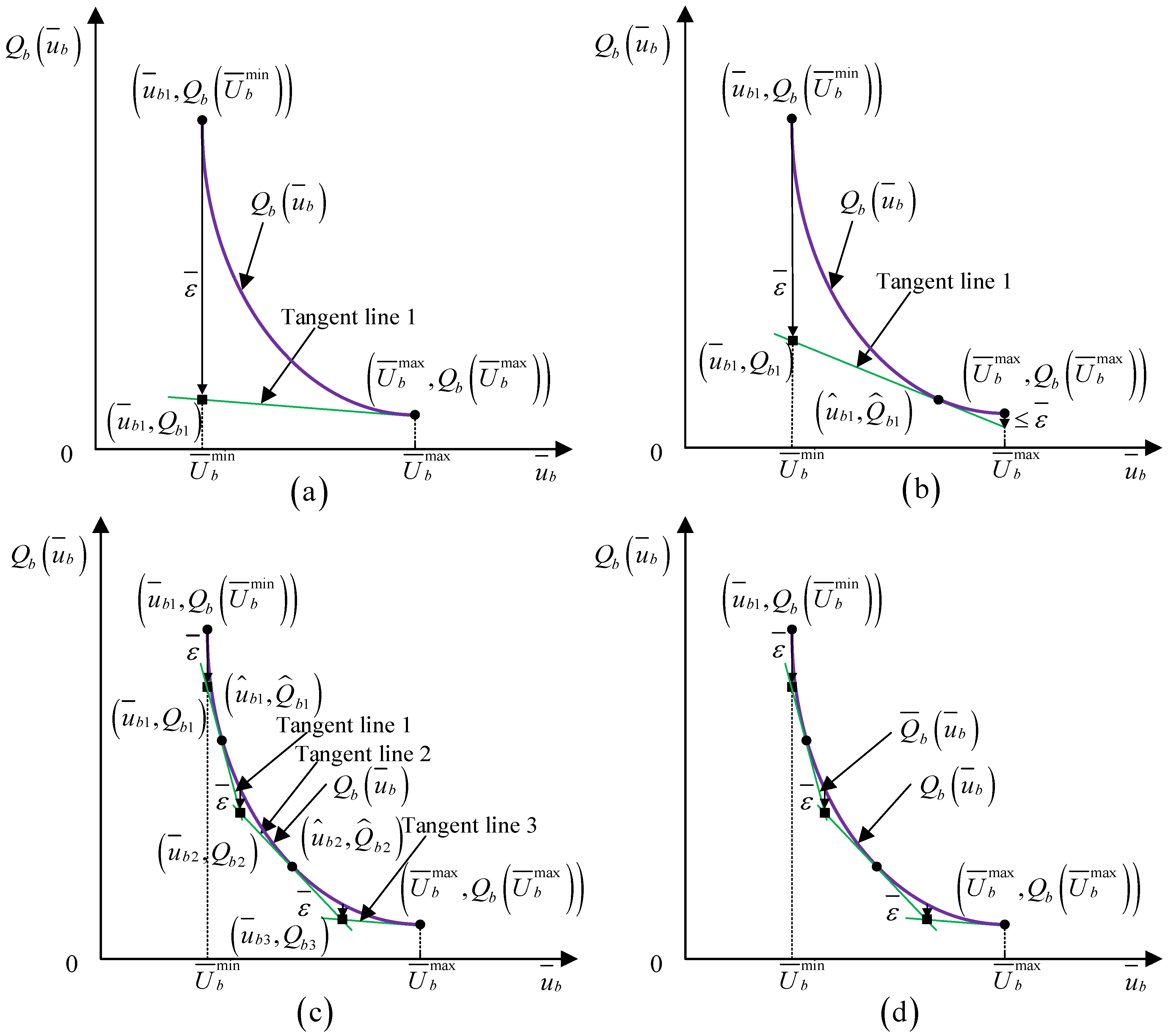
5.4. Outer-Approximation Method
| Algorithm 1. Construction of piecewise linear approximation function |
| Step 0: Initialize as the tangent line set, with and . Set , , , and . Step 1: Increase the iteration index by one, i.e., . If the following inequality is satisfied: |
| That is, the point lies on or below the tangent line at , as shown in Figure 9a. The tangent line is then added to the set of tangent lines , and the set is updated as follows: |
| Next, proceed to Step 3. If the above condition is not satisfied, the tangent line passing through the point and supporting the function is added to the set of tangent lines . Assum the tangent line supports the function at point , this point can be calculated using Equation (86). |
| According to the definition: |
| By combining Equations (86) and (87), the value of is obtained numerically via the bisection method. Therefore, according to Equation (88), the tangent line can be obtained. |
| Proceed to Step 2. |
| Step 2: For the tangent line , assess whether the following inequality holds when . |
| When the inequality holds, the gap between the tangent line and at is bounded by , even if . This conclusion can be extended to any between and , as shown in Figure 9b, and then proceed to Step 3. Otherwise, there exists a unique point on the tangent line such that and , as shown in Figure 9c. In this case, can be determined by the bisection method, followed by a return to Step 1. Step 3: Let be the number of tangent lines in the current set . Each tangent line , in is expressed in the general form: |
| The piecewise linear approximation function (see Figure 9d) can be expressed as: |
6. Model Enhancement for Handling Indivisible Demand
7. Numerical Experiments
7.1. Benchmark Instances
7.2. Reality Verification of the Method
7.3. Optimization Results Analysis
7.4. Sensitivity Analysis
8. Conclusions
- (1)
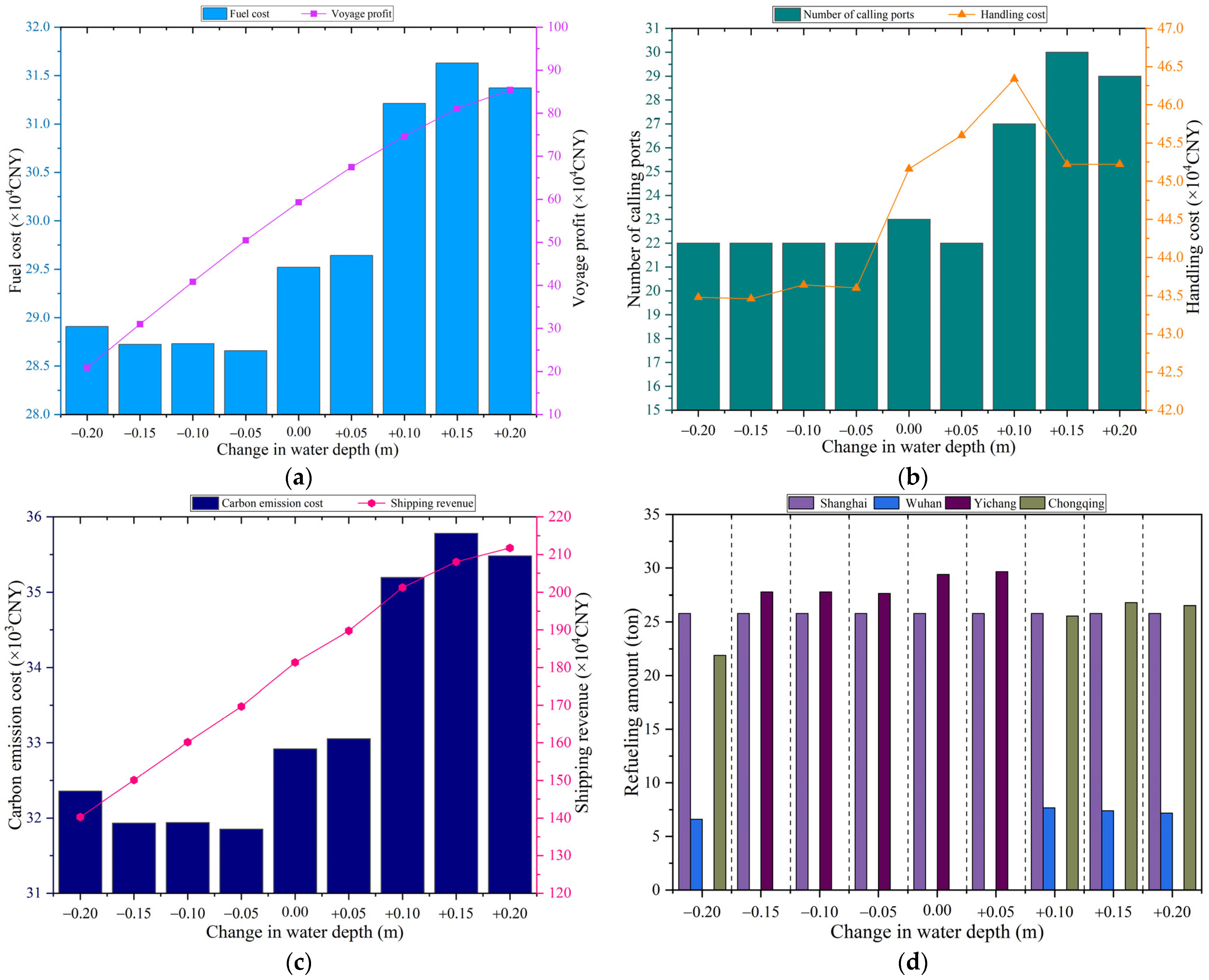
- Water depth is a critical determinant of voyage profit. Shipping companies should adjust tactical decisions and refueling strategy in line with seasonal variations in water depth. To maintain voyage profit and service reliability, companies may also consider seasonal freight rate adjustments. Ship upgrades can further enable efficient operations in midstream and upstream legs, thereby enhancing profitability.
- (2)
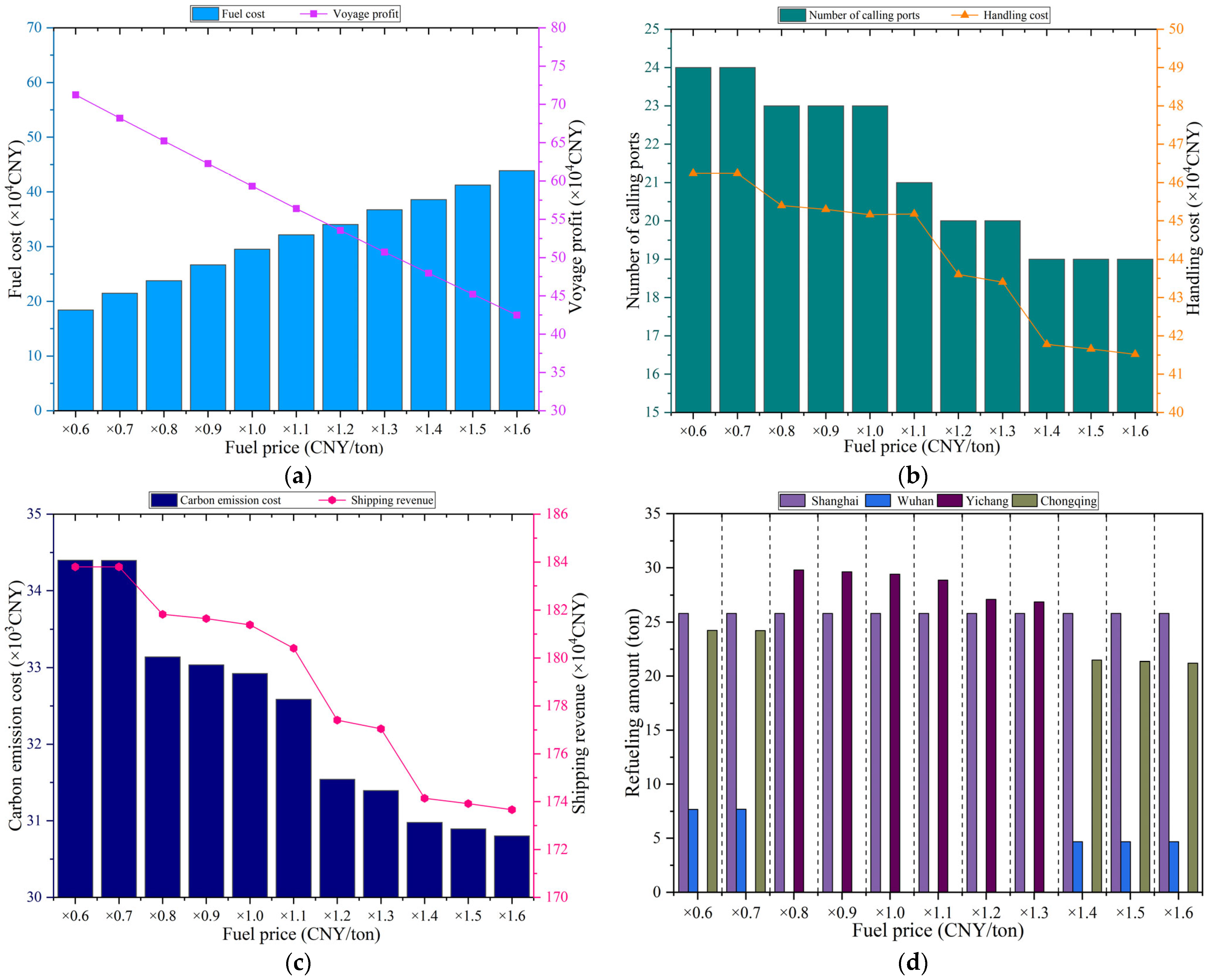
- Fuel price significantly influences tactical decisions and refueling strategy. Accurate forecasting of fuel prices is essential in scheduled route design. When fuel prices rise while ship allocated remains unchanged, shipping companies may reduce the number of calling ports, decrease sailing speeds, and maintain container flow balance to minimize fuel cost. For policy-makers, providing differentiated subsidies across routes can encourage the adoption of LNG-fuelled ships and ensure effective utilization of LNG refueling facilities.
- (3)
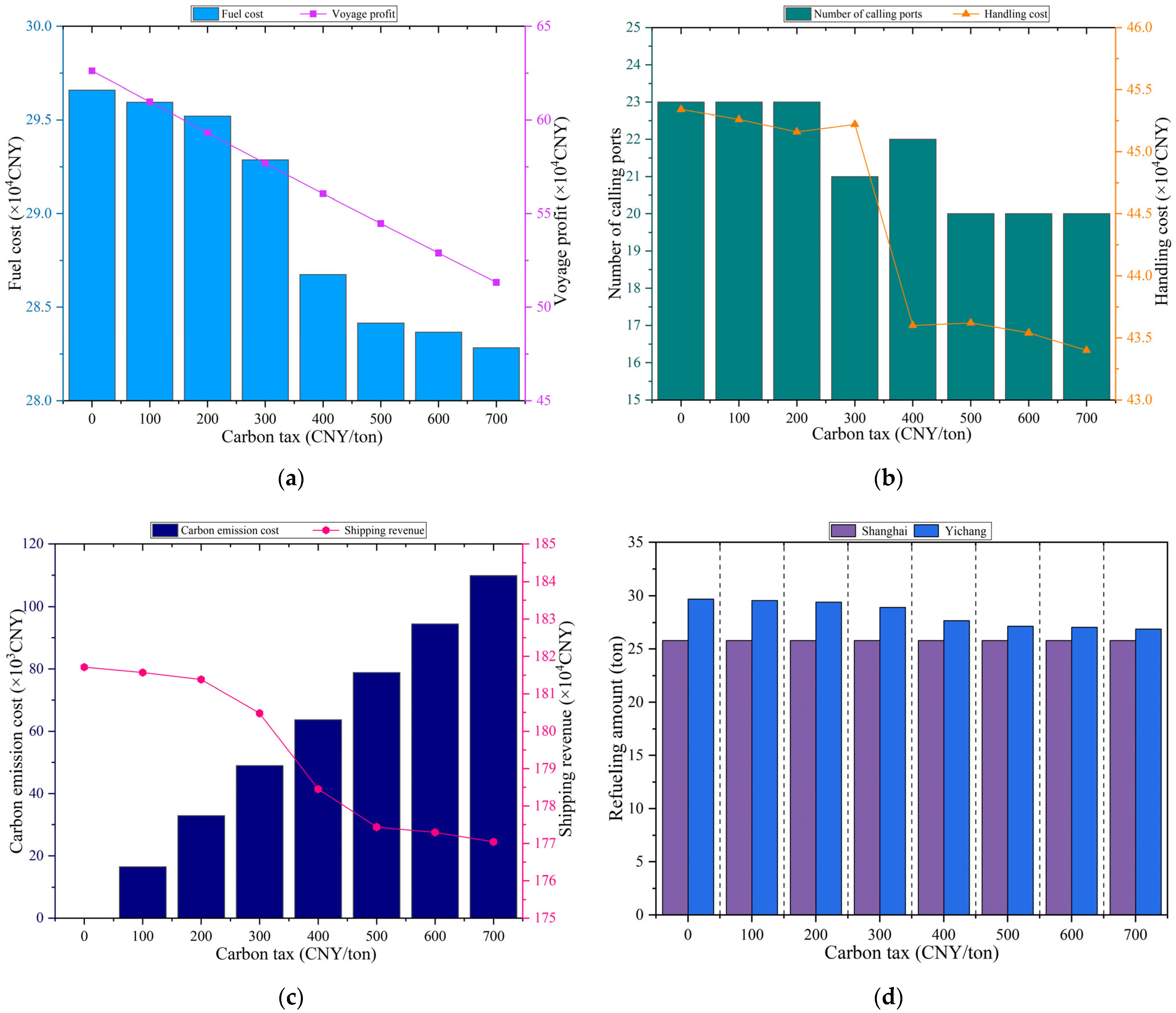
- The implementation of a carbon tax affects the operating costs of shipping companies, prompting adjustments in ship selection and operational strategies. To support the development of LNG-fuelled ships, governments should proactively adjust carbon tax intensity in anticipation of market responses.
- (4)
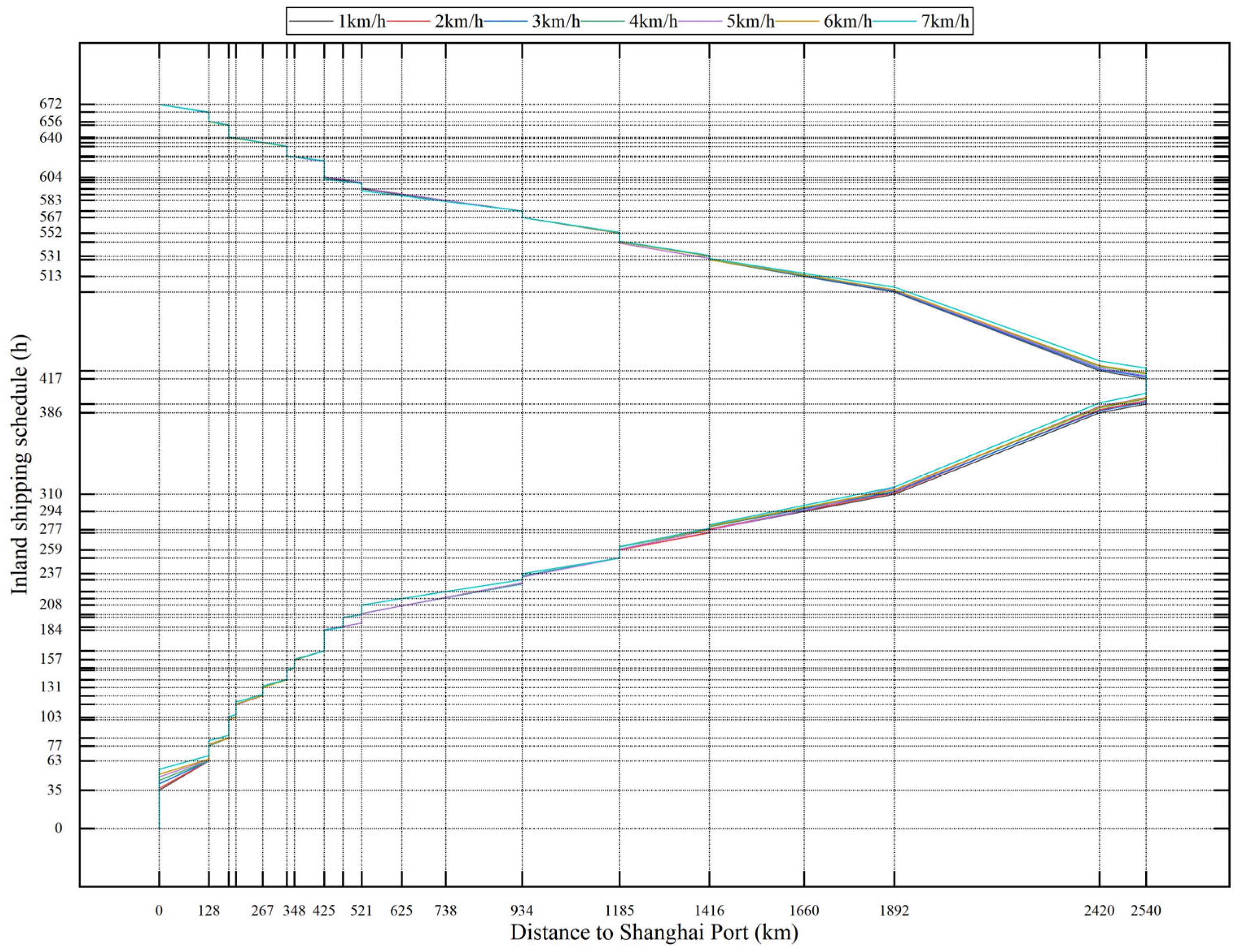
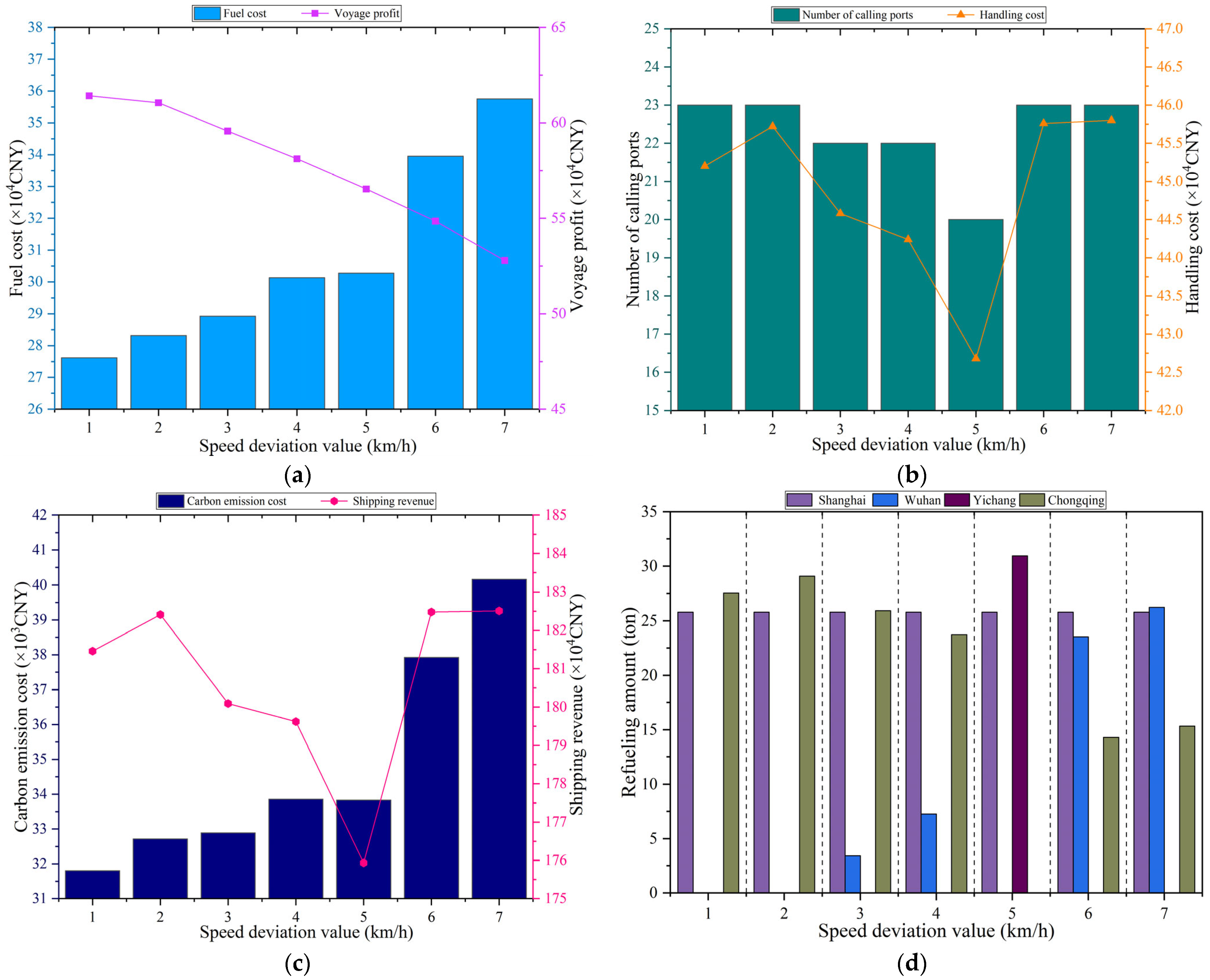
- Speed deviation value, influenced by seasonal channel conditions and captains’ operational habits, plays a vital role in ensuring the reliability of shipping plans. Properly managed speed deviation enhances schedule stability.
- (5)
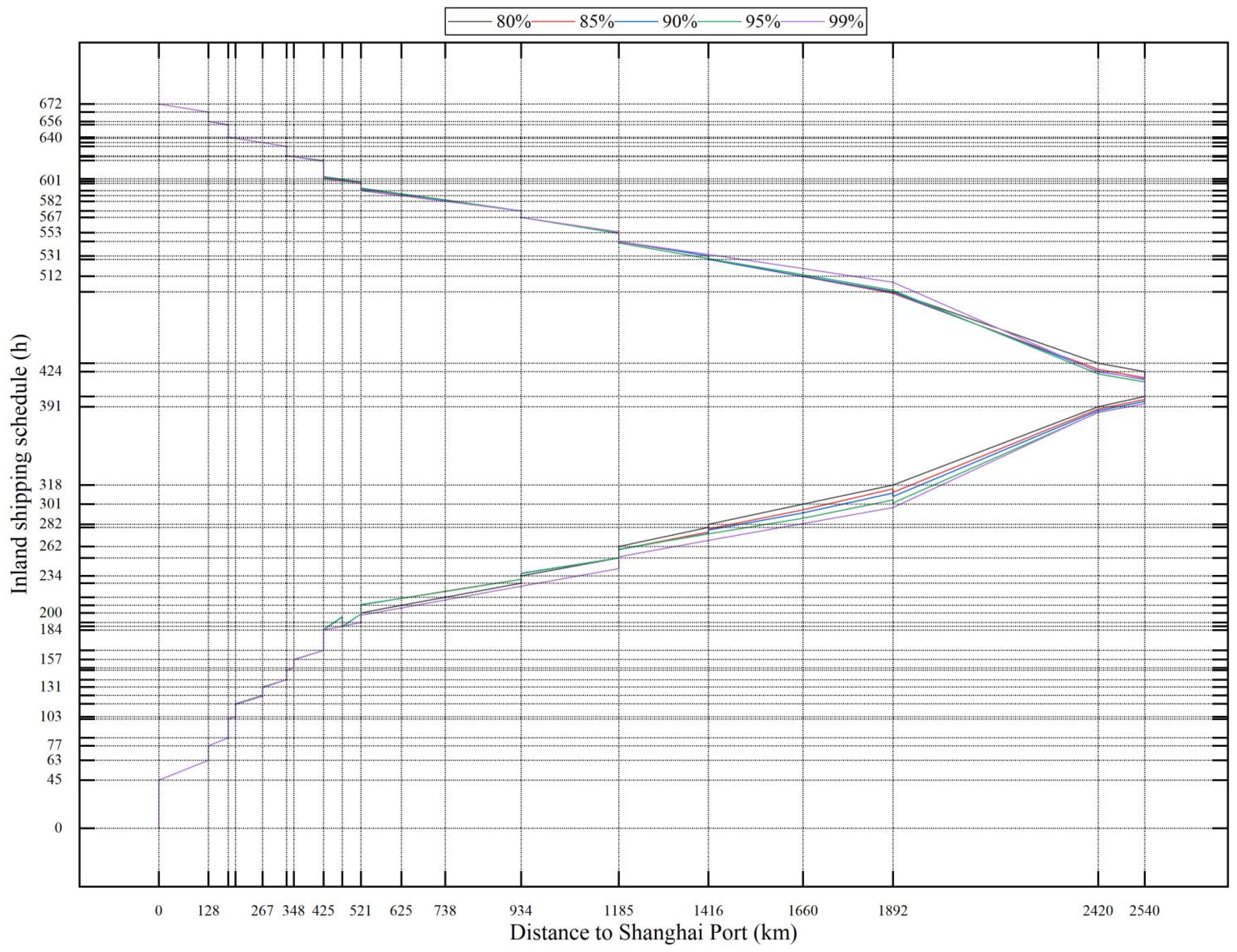
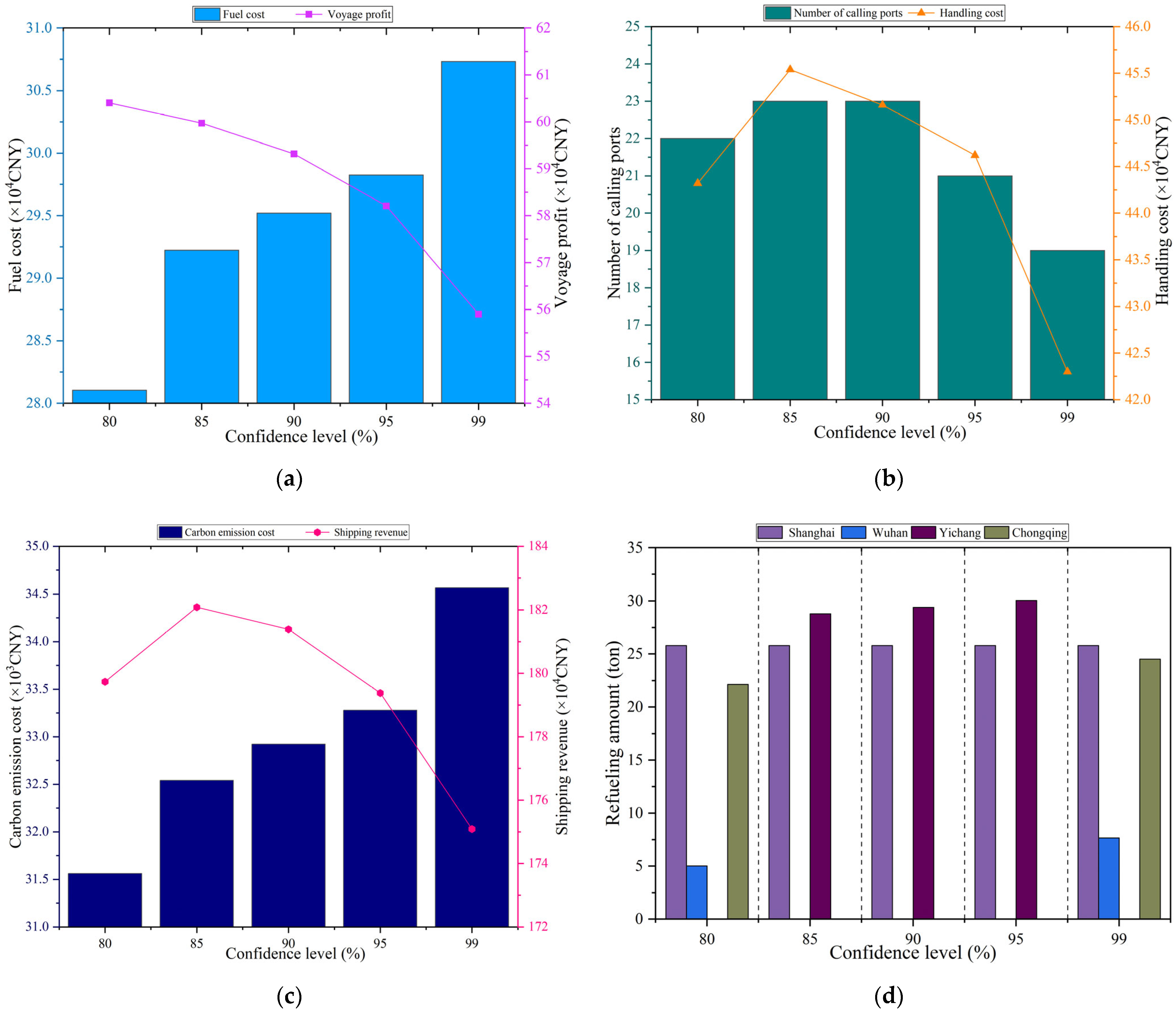
- Confidence level of lock passage time has a significant effect on scheduled route design. Shipping companies should adjust their risk expectations based on market conditions and lock congestion, balancing safety in passage with the maximization of voyage profit.
Author Contributions
Funding
Data Availability Statement
Acknowledgments
Conflicts of Interest
Appendix A. NP-Hardness Proof

Appendix B. Equivalence of the Two Models Proof

Appendix C. Properties of the Optimal Solution
Appendix D. Explicit Derivation of the Maximum Fuel Consumption Function
Appendix E. Table of Parameters

| Ship Type | (m) | (m) | (TEU) | Breadth (m) | (m) | (m) | (m) | Designed Draft (m) | (CNY/Week) | (ton) | (ton) | ||
|---|---|---|---|---|---|---|---|---|---|---|---|---|---|
| R1 | 0.07000 | 0.00500 | 100 | 9.0 | 7.0 | 7.5 | 2.0 | 2.5 | 30,000 | 0.000384 | 2.048 | 21.5 | 8.6 |
| R2 | 0.05000 | 0.00267 | 150 | 10.5 | 7.5 | 8.0 | 2.6 | 3.0 | 50,000 | 0.000354 | 2.128 | 25.8 | 8.6 |
| R3 | 0.04000 | 0.00250 | 200 | 10.8 | 8.0 | 8.5 | 3.0 | 4.0 | 60,000 | 0.000366 | 2.128 | 25.8 | 8.6 |
| R4 | 0.03000 | 0.00167 | 300 | 13.6 | 9.0 | 9.5 | 3.5 | 4.0 | 80,000 | 0.000386 | 2.145 | 25.8 | 8.6 |
| R5 | 0.02714 | 0.00143 | 350 | 16.4 | 9.5 | 10.0 | 3.5 | 4.0 | 90,000 | 0.000316 | 2.235 | 34.4 | 8.6 |
| R6 | 0.02222 | 0.00133 | 450 | 17.5 | 10.0 | 10.5 | 3.6 | 4.2 | 100,000 | 0.000189 | 2.478 | 34.4 | 8.6 |
| R7 | 0.02300 | 0.00160 | 500 | 19.0 | 11.5 | 12.0 | 3.7 | 4.5 | 120,000 | 0.000201 | 2.478 | 34.4 | 8.6 |
| R8 | 0.02231 | 0.00154 | 650 | 21.5 | 14.5 | 15.0 | 5.0 | 6.0 | 130,000 | 0.000354 | 2.478 | 21.5 | 8.6 |
| R9 | 0.01966 | 0.00106 | 941 | 25.6 | 18.5 | 19.0 | 5.0 | 6.0 | 150,000 | 0.000486 | 2.478 | 21.5 | 8.6 |
| R10 | 0.01886 | 0.00088 | 1140 | 26.0 | 21.5 | 22.0 | 6.0 | 7.0 | 160,000 | 0.000521 | 2.478 | 21.5 | 8.6 |
| No | 1 | 2 | 3 | 4 | 5 | 6 | 7 | 8 | 9 | 10 | 11 | 12 | 13 | 14 | 15 | 16 | 17 | 18 | 19 | 20 | 21 |
|---|---|---|---|---|---|---|---|---|---|---|---|---|---|---|---|---|---|---|---|---|---|
| 1 | 0 | 133 | 125 | 71 | 46 | 72 | 51 | 210 | 66 | 77 | 21 | 59 | 85 | 152 | 12 | 10 | 12 | 10 | 100 | 37 | 84 |
| 2 | 80 | 0 | 51 | 29 | 18 | 29 | 21 | 85 | 27 | 31 | 9 | 24 | 34 | 61 | 5 | 4 | 5 | 4 | 40 | 15 | 33 |
| 3 | 75 | 33 | 0 | 27 | 18 | 27 | 19 | 79 | 25 | 29 | 8 | 22 | 32 | 57 | 4 | 4 | 4 | 4 | 38 | 14 | 32 |
| 4 | 41 | 18 | 18 | 0 | 9 | 15 | 11 | 44 | 14 | 16 | 4 | 12 | 18 | 31 | 3 | 2 | 3 | 2 | 21 | 8 | 18 |
| 5 | 26 | 12 | 11 | 6 | 0 | 9 | 7 | 28 | 9 | 10 | 3 | 8 | 11 | 20 | 1 | 1 | 1 | 1 | 13 | 5 | 11 |
| 6 | 42 | 18 | 18 | 10 | 6 | 0 | 11 | 45 | 14 | 16 | 4 | 12 | 18 | 32 | 3 | 2 | 3 | 2 | 21 | 8 | 18 |
| 7 | 30 | 13 | 12 | 7 | 5 | 7 | 0 | 31 | 10 | 12 | 3 | 9 | 12 | 23 | 2 | 2 | 2 | 2 | 15 | 6 | 12 |
| 8 | 132 | 60 | 56 | 32 | 21 | 33 | 23 | 0 | 45 | 51 | 14 | 39 | 57 | 102 | 8 | 7 | 8 | 7 | 67 | 25 | 56 |
| 9 | 38 | 17 | 16 | 9 | 6 | 9 | 6 | 27 | 0 | 15 | 4 | 12 | 16 | 29 | 2 | 2 | 2 | 2 | 19 | 7 | 16 |
| 10 | 45 | 20 | 18 | 11 | 7 | 11 | 8 | 31 | 10 | 0 | 5 | 13 | 19 | 34 | 3 | 3 | 3 | 3 | 22 | 9 | 18 |
| 11 | 12 | 5 | 5 | 3 | 2 | 3 | 2 | 9 | 3 | 3 | 0 | 3 | 5 | 9 | 0 | 0 | 0 | 0 | 6 | 2 | 5 |
| 12 | 34 | 15 | 15 | 8 | 6 | 9 | 6 | 24 | 8 | 9 | 3 | 0 | 15 | 26 | 2 | 2 | 2 | 2 | 17 | 6 | 15 |
| 13 | 49 | 22 | 21 | 12 | 8 | 12 | 9 | 35 | 11 | 13 | 3 | 10 | 0 | 38 | 3 | 3 | 3 | 3 | 25 | 9 | 21 |
| 14 | 92 | 41 | 39 | 22 | 14 | 22 | 16 | 65 | 21 | 24 | 6 | 18 | 27 | 0 | 6 | 5 | 6 | 5 | 47 | 18 | 39 |
| 15 | 6 | 3 | 3 | 2 | 1 | 2 | 1 | 4 | 1 | 2 | 0 | 1 | 2 | 3 | 0 | 0 | 0 | 0 | 3 | 1 | 3 |
| 16 | 46 | 21 | 20 | 11 | 7 | 12 | 8 | 33 | 10 | 12 | 3 | 9 | 13 | 24 | 2 | 0 | 3 | 3 | 24 | 9 | 20 |
| 17 | 51 | 23 | 21 | 12 | 8 | 12 | 9 | 36 | 11 | 13 | 3 | 10 | 15 | 26 | 2 | 2 | 0 | 3 | 26 | 9 | 21 |
| 18 | 6 | 3 | 3 | 1 | 1 | 1 | 1 | 4 | 1 | 2 | 0 | 1 | 2 | 3 | 0 | 0 | 0 | 0 | 3 | 1 | 3 |
| 19 | 59 | 27 | 25 | 14 | 9 | 15 | 10 | 42 | 13 | 15 | 4 | 12 | 17 | 30 | 2 | 2 | 2 | 2 | 0 | 11 | 25 |
| 20 | 21 | 9 | 9 | 5 | 3 | 5 | 3 | 15 | 5 | 6 | 1 | 4 | 6 | 11 | 1 | 0 | 1 | 0 | 7 | 0 | 9 |
| 21 | 48 | 22 | 21 | 12 | 8 | 12 | 9 | 34 | 11 | 12 | 3 | 9 | 14 | 25 | 2 | 2 | 2 | 2 | 16 | 6 | 0 |
| No | 1 | 2 | 3 | 4 | 5 | 6 | 7 | 8 | 9 | 10 | 11 | 12 | 13 | 14 | 15 | 16 | 17 | 18 | 19 | 20 | 21 |
|---|---|---|---|---|---|---|---|---|---|---|---|---|---|---|---|---|---|---|---|---|---|
| 1 | 0 | 1676 | 1726 | 1745 | 1791 | 1823 | 1831 | 1855 | 1880 | 1903 | 1947 | 1984 | 2023 | 2027 | 2304 | 2433 | 2677 | 3419 | 3512 | 3650 | 3748 |
| 2 | 1676 | 0 | 1600 | 1619 | 1676 | 1717 | 1728 | 1763 | 1791 | 1816 | 1865 | 1909 | 1958 | 1975 | 2235 | 2365 | 2601 | 3320 | 3413 | 3554 | 3652 |
| 3 | 1726 | 1600 | 0 | 1569 | 1630 | 1675 | 1687 | 1727 | 1755 | 1782 | 1833 | 1879 | 1932 | 1955 | 2208 | 2338 | 2570 | 3281 | 3374 | 3515 | 3613 |
| 4 | 1745 | 1619 | 1569 | 0 | 1612 | 1659 | 1671 | 1713 | 1742 | 1769 | 1821 | 1867 | 1923 | 1947 | 2198 | 2328 | 2559 | 3266 | 3359 | 3501 | 3599 |
| 5 | 1791 | 1676 | 1630 | 1612 | 0 | 1602 | 1615 | 1663 | 1694 | 1722 | 1777 | 1827 | 1888 | 1920 | 2162 | 2291 | 2518 | 3213 | 3306 | 3449 | 3547 |
| 6 | 1823 | 1717 | 1675 | 1659 | 1602 | 0 | 1565 | 1619 | 1650 | 1680 | 1738 | 1790 | 1856 | 1895 | 2129 | 2258 | 2481 | 3165 | 3258 | 3403 | 3500 |
| 7 | 1831 | 1728 | 1687 | 1671 | 1615 | 1565 | 0 | 1605 | 1637 | 1667 | 1726 | 1779 | 1847 | 1887 | 2118 | 2248 | 2470 | 3150 | 3243 | 3388 | 3486 |
| 8 | 1855 | 1763 | 1727 | 1713 | 1663 | 1619 | 1605 | 0 | 1583 | 1615 | 1677 | 1734 | 1808 | 1856 | 2077 | 2207 | 2424 | 3091 | 3184 | 3331 | 3428 |
| 9 | 1880 | 1791 | 1755 | 1742 | 1694 | 1650 | 1637 | 1583 | 0 | 1583 | 1646 | 1706 | 1784 | 1837 | 2052 | 2182 | 2395 | 3054 | 3147 | 3294 | 3392 |
| 10 | 1903 | 1816 | 1782 | 1769 | 1722 | 1680 | 1667 | 1615 | 1583 | 0 | 1616 | 1678 | 1759 | 1817 | 2026 | 2156 | 2366 | 3017 | 3110 | 3258 | 3356 |
| 11 | 1947 | 1865 | 1833 | 1821 | 1777 | 1738 | 1726 | 1677 | 1646 | 1616 | 0 | 1616 | 1707 | 1775 | 1971 | 2101 | 2305 | 2937 | 3029 | 3180 | 3278 |
| 12 | 1984 | 1909 | 1879 | 1867 | 1827 | 1790 | 1779 | 1734 | 1706 | 1678 | 1616 | 0 | 1649 | 1730 | 1911 | 2041 | 2237 | 2849 | 2942 | 3095 | 3193 |
| 13 | 2023 | 1958 | 1932 | 1923 | 1888 | 1856 | 1847 | 1808 | 1784 | 1759 | 1707 | 1649 | 0 | 1651 | 1807 | 1936 | 2121 | 2698 | 2791 | 2948 | 3046 |
| 14 | 2027 | 1975 | 1955 | 1947 | 1920 | 1895 | 1887 | 1856 | 1837 | 1817 | 1775 | 1730 | 1651 | 0 | 1673 | 1803 | 1971 | 2504 | 2597 | 2759 | 2857 |
| 15 | 2304 | 2235 | 2208 | 2198 | 2162 | 2129 | 2118 | 2077 | 2052 | 2026 | 1971 | 1911 | 1807 | 1673 | 0 | 1680 | 1833 | 2326 | 2418 | 2586 | 2683 |
| 16 | 2433 | 2365 | 2338 | 2328 | 2291 | 2258 | 2248 | 2207 | 2182 | 2156 | 2101 | 2041 | 1936 | 1803 | 1680 | 0 | 1688 | 2137 | 2230 | 2402 | 2500 |
| 17 | 2677 | 2601 | 2570 | 2559 | 2518 | 2481 | 2470 | 2424 | 2395 | 2366 | 2305 | 2237 | 2121 | 1971 | 1833 | 1688 | 0 | 1958 | 2051 | 2228 | 2326 |
| 18 | 3419 | 3320 | 3281 | 3266 | 3213 | 3165 | 3150 | 3091 | 3054 | 3017 | 2937 | 2849 | 2698 | 2504 | 2326 | 2137 | 1958 | 0 | 1643 | 1831 | 1929 |
| 19 | 3512 | 3413 | 3374 | 3359 | 3306 | 3258 | 3243 | 3184 | 3147 | 3110 | 3029 | 2942 | 2791 | 2597 | 2418 | 2230 | 2051 | 1643 | 0 | 1741 | 1839 |
| 20 | 3650 | 3554 | 3515 | 3501 | 3449 | 3403 | 3388 | 3331 | 3294 | 3258 | 3180 | 3095 | 2948 | 2759 | 2586 | 2402 | 2228 | 1831 | 1741 | 0 | 1648 |
| 21 | 3748 | 3652 | 3613 | 3599 | 3547 | 3500 | 3486 | 3428 | 3392 | 3356 | 3278 | 3193 | 3046 | 2857 | 2683 | 2500 | 2326 | 1929 | 1839 | 1648 | 0 |
| No | Port | Leg | (km) | (m) | (m) | (CNY/ton) | (CNY/TEU) | (CNY/TEU) |
|---|---|---|---|---|---|---|---|---|
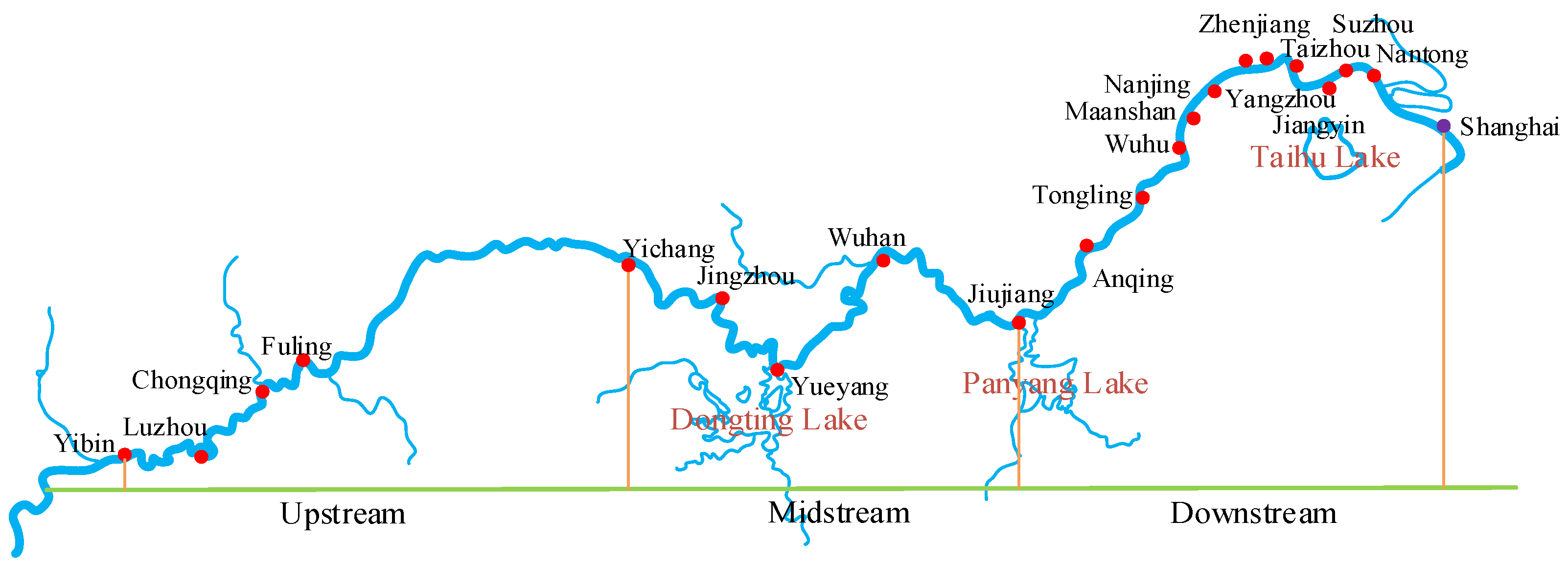
| 1 | Shanghai | Shanghai→Nantong | 128 | 12.5 | 68 | 5600 | 200 | 550 |
| 2 | Nantong | Nantong→Suzhou | 51 | 12.5 | 60 | – | 200 | 500 |
| 3 | Suzhou | Suzhou→Jiangyin | 19 | 12.5 | 48 | – | 200 | 400 |
| 4 | Jiangyin | Jiangyin→Taizhou | 69 | 12.5 | 48 | – | 200 | 500 |
| 5 | Taizhou | Taizhou→Yangzhou | 62 | 12.5 | 48 | – | 200 | 300 |
| 6 | Yangzhou | Yangzhou→Zhenjiang | 19 | 12.5 | 48 | – | 200 | 200 |
| 7 | Zhenjiang | Zhenjiang→Nanjing | 77 | 12.5 | 48 | 6500 | 200 | 500 |
| 8 | Nanjing | Nanjing→Maanshan | 48 | 10.5 | 23 | – | 200 | 480 |
| 9 | Maanshan | Maanshan→Wuhu | 48 | 9.0 | 23 | – | 200 | 280 |
| 10 | Wuhu | Wuhu→Tongling | 104 | 6.0 | 23 | 6200 | 200 | 500 |
| 11 | Tongling | Tongling→Anqing | 113 | 6.0 | 23 | – | 200 | 500 |
| 12 | Anqing | Anqing→Jiujiang | 196 | 5.0 | 23 | – | 200 | 200 |
| 13 | Jiujiang | Jiujiang→Wuhan | 251 | 5.0 | 23 | 6000 | 200 | 500 |
| 14 | Wuhan | Wuhan→Yueyang | 231 | 4.2 | 17 | 5800 | 200 | 500 |
| 15 | Yueyang | Yueyang→Jingzhou | 244 | 3.8 | 17 | – | 200 | 200 |
| 16 | Jingzhou | Jingzhou→Yichang | 232 | 4.0 | 17 | – | 200 | 500 |
| 17 | Yichang | Yichang→Fuling | 528 | 4.5 | 17 | 6100 | 200 | 500 |
| 18 | Fuling | Fuling→Chongqing | 120 | 3.8 | 17 | – | 200 | 200 |
| 19 | Chongqing | Chongqing→Luzhou | 254 | 2.9 | 17 | 5700 | 200 | 500 |
| 20 | Luzhou | Luzhou→Yibin | 130 | 2.9 | 17 | – | 200 | 500 |
| 21 | Yibin | – | – | – | – | – | 200 | 500 |
| No | Port | R1 | R2–R6 | R7 | R8–R10 |
|---|---|---|---|---|---|
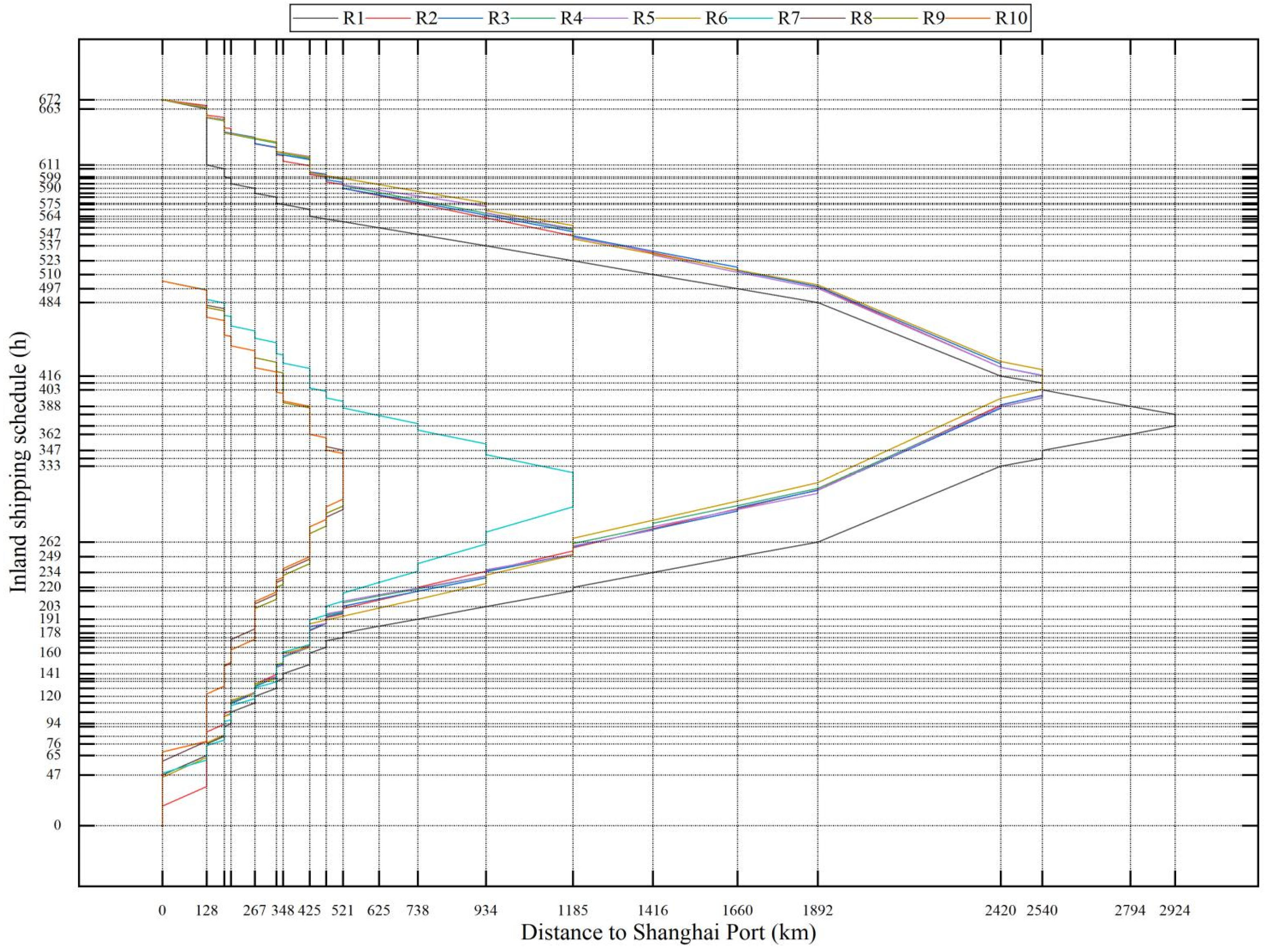
| 1 | Shanghai | 0/672 | 0/672 | 0/504 | 0/504 |
| 2 | Nantong | 55/605 | 63/654 | 60/487 | 68/476 |
| 3 | Suzhou | 85/593 | 84/641 | 79/472 | 119/444 |
| 4 | Jiangyin | 100/584 | 103/640 | 98/462 | 147/434 |
| 5 | Taizhou | 113/580 | 122/628 | 117/451 | 172/423 |
| 6 | Yangzhou | 126/568 | 136/614 | 133/436 | 206/411 |
| 7 | Zhenjiang | 136/567 | 149/613 | 149/428 | 220/383 |
| 8 | Nanjing | 149/554 | 165/595 | 167/405 | 239/352 |
| 9 | Maanshan | 165/551 | 187/593 | 194/395 | 277/341 |
| 10 | Wuhu | 169/548 | 191/590 | 207/386 | 302 |
| 11 | Tongling | 184/542 | 199/584 | 224/379 | – |
| 12 | Anqing | 192/535 | 207/578 | 235/366 | – |
| 13 | Jiujiang | 206/523 | 221/567 | 260/343 | – |
| 14 | Wuhan | 223/507 | 241/543 | 294 | – |
| 15 | Yueyang | 239/493 | 270/528 | – | – |
| 16 | Jingzhou | 256/478 | 288/512 | – | – |
| 17 | Yichang | 273/463 | 306/497 | – | – |
| 18 | Fuling | 325/416 | 385/424 | – | – |
| 19 | Chongqing | 333/403 | 394 | – | – |
| 20 | Luzhou | 357/387 | – | – | – |
| 21 | Yibin | 366 | – | – | – |
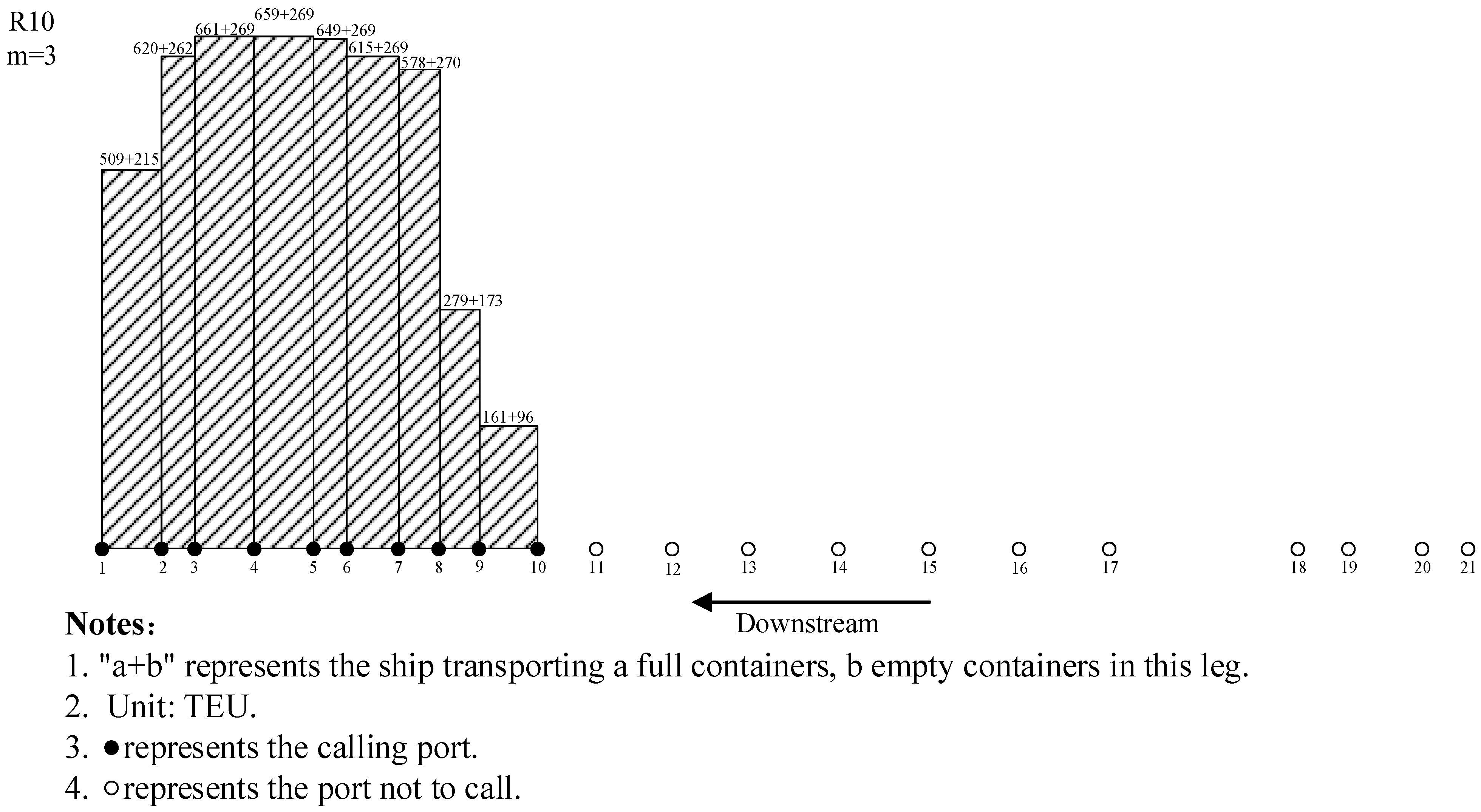
Appendix F. Diagram of Ship Loading Condition


References
- People’s Daily Online. Integrated Innovation to Build a New Generation of Shipping System. 2025. Available online: http://theory.people.com.cn/n1/2025/0316/c40531-40439758.html (accessed on 8 July 2025).
- Xinhuanet. The Total Waterborne Freight Volume Across the Country Reached 936.7 Million Tons in 2023. 2024. Available online: https://news.cctv.com/2024/07/11/ARTIkkF4nLr2gmC2oYbi5UyD240711.shtml (accessed on 8 August 2025).
- European Commission. Overview of Inland Waterway Shipping in Europe. 2024. Available online: https://alternative-fuels-observatory.ec.europa.eu/transport-mode/inland-waterways?utm_source=chatgpt.com (accessed on 8 June 2025).
- Fan, A.; Wang, J.; He, Y.; Perčić, M.; Vladimir, N.; Yang, L. Decarbonising inland ship power system: Alternative solution and assessment method. Energy 2021, 226, 120266. [Google Scholar] [CrossRef]
- China Waterborne Transport Research Institute. Development Trends of New-Energy Vessels in China’s Inland Waterways. 2025. Available online: https://mp.weixin.qq.com/s/yf5kI0VH63I5NAQy8njQrA (accessed on 8 December 2025).
- Li, D.-C.; Yang, H.-L. Economic feasibility of LNG-fuelled river ships: Carbon tax schemes perspective. Transp. Res. Part D Transp. Environ. 2024, 132, 104235. [Google Scholar] [CrossRef]
- LNGIndustryAssociation. Analysis of China’s LNG refueling Station Industry in Inland Waterways and Forecast of Development Prospects. 2025. Available online: https://mp.weixin.qq.com/s/7S9u4Y4kb0vI6RcDfobusQ (accessed on 8 December 2025).
- Zhou, S.; Ji, B.; Song, Y.; Yu, S.S.; Zhang, D.; Van Woensel, T. Hub-and-spoke network design for container shipping in inland waterways. Expert Syst. Appl. 2023, 223, 119850. [Google Scholar] [CrossRef]
- Talley, W.K.; Ng, M. Port congestion probability: Port performance evaluation using cargo port choice equilibrium. Transp. Res. Part E Logist. Transp. Rev. 2024, 185, 103488. [Google Scholar] [CrossRef]
- Wang, M.-R.; Li, Z.-C.; Fu, X.; Xiong, Y. Optimal ship fleet size in an inland river corridor with seasonal change in waterway depth. Transp. Policy 2025, 166, 108–123. [Google Scholar] [CrossRef]
- Wang, K.; Wang, Y.; Liang, H.; Jing, Z.; Cong, L.; Ma, R.; Huang, L. Ship energy efficiency optimization considering the influences of multiple complex navigational environments: A review. Mar. Pollut. Bull. 2025, 216, 117976. [Google Scholar] [CrossRef]
- Dejax, P.J.; Crainic, T.G. Survey paper—A review of empty flows and fleet management models in freight transportation. Transp. Sci. 1987, 21, 227–248. [Google Scholar] [CrossRef]
- Ronen, D. The effect of oil price on containership speed and fleet size. J. Oper. Res. Soc. 2011, 62, 211–216. [Google Scholar] [CrossRef]
- Fagerholt, K. Ship scheduling with soft time windows: An optimisation based approach. Eur. J. Oper. Res. 2001, 131, 559–571. [Google Scholar] [CrossRef]
- Ting, S.-C.; Tzeng, G.-H. Ship scheduling and cost analysis for route planning in liner shipping. Marit. Econ. Logist. 2003, 5, 378–392. [Google Scholar] [CrossRef]
- Dulebenets, M.A. Minimizing the total liner shipping route service costs via application of an efficient collaborative agreement. IEEE Trans. Intell. Transp. Syst. 2018, 20, 123–136. [Google Scholar] [CrossRef]
- Wang, Y.; Wang, S. Deploying, scheduling, and sequencing heterogeneous vessels in a liner container shipping route. Transp. Res. Part E Logist. Transp. Rev. 2021, 151, 102365. [Google Scholar] [CrossRef]
- Wang, S.; Meng, Q.; Liu, Z. Containership scheduling with transit-time-sensitive container shipment demand. Transp. Res. Part B Methodol. 2013, 54, 68–83. [Google Scholar] [CrossRef]
- Qi, X.; Song, D.-P. Minimizing fuel emissions by optimizing vessel schedules in liner shipping with uncertain port times. Transp. Res. Part E Logist. Transp. Rev. 2012, 48, 863–880. [Google Scholar] [CrossRef]
- Wang, S.; Meng, Q. Liner ship route schedule design with sea contingency time and port time uncertainty. Transp. Res. Part B Methodol. 2012, 46, 615–633. [Google Scholar] [CrossRef]
- Wang, S.; Meng, Q. Robust schedule design for liner shipping services. Transp. Res. Part E Logist. Transp. Rev. 2012, 48, 1093–1106. [Google Scholar] [CrossRef]
- Reinhardt, L.B.; Pisinger, D.; Sigurd, M.M.; Ahmt, J. Speed optimizations for liner networks with business constraints. Eur. J. Oper. Res. 2020, 285, 1127–1140. [Google Scholar] [CrossRef]
- Zhao, S.; Yang, H.; Zheng, J.; Li, D. A two-step approach for deploying heterogeneous vessels and designing reliable schedule in liner shipping services. Transp. Res. Part E Logist. Transp. Rev. 2024, 182, 103416. [Google Scholar] [CrossRef]
- Chen, J.; Zhang, Y.; Shi, J.; Pang, C.; She, S.; Chen, X.; Xu, J. Cost-benefit analysis of ships NOx Emission Control Areas (NECA) along China’s coastal area. Mar. Pollut. Bull. 2025, 215, 117830. [Google Scholar] [CrossRef]
- Doudnikoff, M.; Lacoste, R. Effect of a speed reduction of containerships in response to higher energy costs in Sulphur Emission Control Areas. Transp. Res. Part D Transp. Environ. 2014, 28, 51–61. [Google Scholar] [CrossRef]
- Kontovas, C.A. The green ship routing and scheduling problem (GSRSP): A conceptual approach. Transp. Res. Part D Transp. Environ. 2014, 31, 61–69. [Google Scholar] [CrossRef]
- Fagerholt, K.; Gausel, N.T.; Rakke, J.G.; Psaraftis, H.N. Maritime routing and speed optimization with emission control areas. Transp. Res. Part C Emerg. Technol. 2015, 52, 57–73. [Google Scholar] [CrossRef]
- Zhen, L.; Hu, Z.; Yan, R.; Zhuge, D.; Wang, S. Route and speed optimization for liner ships under emission control policies. Transp. Res. Part C Emerg. Technol. 2020, 110, 330–345. [Google Scholar] [CrossRef]
- Elmi, Z.; Li, B.; Fathollahi-Fard, A.M.; Tian, G.; Borowska-Stefańska, M.; Wiśniewski, S.; Dulebenets, M.A. Ship schedule recovery with voluntary speed reduction zones and emission control areas. Transp. Res. Part D Transp. Environ. 2023, 125, 103957. [Google Scholar] [CrossRef]
- Hu, Y.; Liu, J.; Jin, H.; Wang, S. Liner disruption recovery problem with emission control area policies. Transp. Res. Part D Transp. Environ. 2024, 132, 104227. [Google Scholar] [CrossRef]
- Wang, C.; Chen, J. Strategies of refueling, sailing speed and ship deployment of containerships in the low-carbon background. Comput. Ind. Eng. 2017, 114, 142–150. [Google Scholar] [CrossRef]
- Wang, S.; Meng, Q. Robust bunker management for liner shipping networks. Eur. J. Oper. Res. 2015, 243, 789–797. [Google Scholar] [CrossRef]
- Aydin, N.; Lee, H.; Mansouri, S.A. Speed optimization and bunkering in liner shipping in the presence of uncertain service times and time windows at ports. Eur. J. Oper. Res. 2017, 259, 143–154. [Google Scholar] [CrossRef]
- Wang, Y.; Meng, Q.; Kuang, H. Jointly optimizing ship sailing speed and bunker purchase in liner shipping with distribution-free stochastic bunker prices. Transp. Res. Part C Emerg. Technol. 2018, 89, 35–52. [Google Scholar] [CrossRef]
- De, A.; Choudhary, A.; Turkay, M.; Tiwari, M.K. Bunkering policies for a fuel bunker management problem for liner shipping networks. Eur. J. Oper. Res. 2021, 289, 927–939. [Google Scholar] [CrossRef]
- Wang, S.; Gao, S.; Tan, T.; Yang, W. Bunker fuel cost and freight revenue optimization for a single liner shipping service. Comput. Oper. Res. 2019, 111, 67–83. [Google Scholar] [CrossRef]
- Wang, C.; Liu, X.; Zhou, Y.; Qian, J. Optimization of speed and refueling strategy for liner shipping companies considering refueling at OPL. Reg. Stud. Mar. Sci. 2025, 89, 104355. [Google Scholar] [CrossRef]
- Smith, L.D.; Nauss, R.M.; Mattfeld, D.C.; Li, J.; Ehmke, J.F.; Reindl, M. Scheduling operations at system choke points with sequence-dependent delays and processing times. Transp. Res. Part E Logist. Transp. Rev. 2011, 47, 669–680. [Google Scholar] [CrossRef]
- Passchyn, W.; Briskorn, D.; Spieksma, F.C. No-wait scheduling for locks. Inf. J. Comput. 2019, 31, 413–428. [Google Scholar] [CrossRef]
- Passchyn, W.; Coene, S.; Briskorn, D.; Hurink, J.L.; Spieksma, F.C.R.; Vanden Berghe, G. The lockmaster’s problem. Eur. J. Oper. Res. 2016, 251, 432–441. [Google Scholar] [CrossRef]
- Zhang, Y.; Zheng, Q.-Q.; He, L.-J.; Tian, H.-W. Ship traffic optimization method for solving the approach channel and lock co-scheduling problem of the Three Gorges Dam on the Yangzi River. Ocean Eng. 2023, 276, 114196. [Google Scholar] [CrossRef]
- Golak, J.A.P.; Defryn, C.; Grigoriev, A. Optimizing fuel consumption on inland waterway networks: Local search heuristic for lock scheduling. Omega 2022, 109, 102580. [Google Scholar] [CrossRef]
- Buchem, M.; Golak, J.A.P.; Grigoriev, A. Vessel velocity decisions in inland waterway transportation under uncertainty. Eur. J. Oper. Res. 2022, 296, 669–678. [Google Scholar] [CrossRef]
- Tan, Z.; Wang, Y.; Meng, Q.; Liu, Z. Joint Ship Schedule Design and Sailing Speed Optimization for a Single Inland Shipping Service with Uncertain Dam Transit Time. Transp. Sci. 2018, 52, 1570–1588. [Google Scholar] [CrossRef]
- Li, D.-C.; Yang, H.-L. Voyage charterparty arrangement for river tramp shipping: Green and traditional vessels comparison. Transp. Policy 2024, 158, 75–92. [Google Scholar] [CrossRef]
- Zhang, H.; Wu, Y.; Jin, Y.; Wang, S. Optimal scheduling of ships in inland waterway with serial locks. Transp. Res. Part C Emerg. Technol. 2025, 178, 105241. [Google Scholar] [CrossRef]
- Rana, K.; Vickson, R.G. A model and solution algorithm for optimal routing of a time-chartered containership. Transp. Sci. 1988, 22, 83–95. [Google Scholar] [CrossRef]
- Rana, K.; Vickson, R. Routing container ships using Lagrangean relaxation and decomposition. Transp. Sci. 1991, 25, 201–214. [Google Scholar] [CrossRef]
- Wang, Y.; Meng, Q.; Jia, P. Optimal port call adjustment for liner container shipping routes. Transp. Res. Part B Methodol. 2019, 128, 107–128. [Google Scholar] [CrossRef]
- Shintani, K.; Imai, A.; Nishimura, E.; Papadimitriou, S. The container shipping network design problem with empty container repositioning. Transp. Res. Part E Logist. Transp. Rev. 2007, 43, 39–59. [Google Scholar] [CrossRef]
- Dong, J.-X.; Song, D.-P. Container fleet sizing and empty repositioning in liner shipping systems. Transp. Res. Part E Logist. Transp. Rev. 2009, 45, 860–877. [Google Scholar] [CrossRef]
- Meng, Q.; Wang, S. Liner shipping service network design with empty container repositioning. Transp. Res. Part E Logist. Transp. Rev. 2011, 47, 695–708. [Google Scholar] [CrossRef]
- Brouer, B.D.; Pisinger, D.; Spoorendonk, S. Liner shipping cargo allocation with repositioning of empty containers. INFOR Inf. Syst. Oper. Res. 2011, 49, 109–124. [Google Scholar] [CrossRef]
- Song, D.-P.; Dong, J.-X. Cargo routing and empty container repositioning in multiple shipping service routes. Transp. Res. Part B Methodol. 2012, 46, 1556–1575. [Google Scholar] [CrossRef]
- Akyüz, M.H.; Lee, C.-Y. Service type assignment and container routing with transit time constraints and empty container repositioning for liner shipping service networks. Transp. Res. Part B Methodol. 2016, 88, 46–71. [Google Scholar] [CrossRef]
- Rindone, C. AIS Data for Building a Transport Maritime Network: A Pilot Study in the Strait of Messina (Italy). In Computational Science and Its Applications–ICCSA 2024 Workshops, Hanoi, Vietnam, 1–4 July 2024; Gervasi, O., Murgante, B., Garau, C., Taniar, D., Rocha, A.M.A.C., Faginas Lago, M.N., Eds.; Springer Nature: Cham, Switzerland, 2024; pp. 213–226. [Google Scholar]
- Rindone, C.; Russo, A. Centrality analysis for railway network planning: Constrained measures for High Speed. Transp. Eng. 2025, 22, 100393. [Google Scholar] [CrossRef]
- Maraš, V. Determining optimal transport routes of inland waterway container ships. Transp. Res. Rec. 2008, 2062, 50–58. [Google Scholar] [CrossRef]
- Maraš, V.; Lazić, J.; Davidović, T.; Mladenović, N. Routing of barge container ships by mixed-integer programming heuristics. Appl. Soft Comput. 2013, 13, 3515–3528. [Google Scholar] [CrossRef]
- Alfandari, L.; Davidović, T.; Furini, F.; Ljubić, I.; Maraš, V.; Martin, S. Tighter MIP models for Barge Container Ship Routing. Omega 2019, 82, 38–54. [Google Scholar] [CrossRef]
- An, F.; Hu, H.; Xie, C. Service network design in inland waterway liner transportation with empty container repositioning. Eur. Transp. Res. Rev. 2015, 7, 1–11. [Google Scholar] [CrossRef]
- Braekers, K.; Caris, A.; Janssens, G.K. Optimal shipping routes and vessel size for intermodal barge transport with empty container repositioning. Comput. Ind. 2013, 64, 155–164. [Google Scholar] [CrossRef]
- Bian, Y.; Yan, W.; Hu, H.; Li, Z. Feeder Scheduling and Container Transportation with the Factors of Draught and Bridge in the Yangtze River, China. J. Mar. Sci. Eng. 2021, 9, 964. [Google Scholar] [CrossRef]
- Feng, X.; Song, R.; Yin, W.; Yin, X.; Zhang, R. Multimodal transportation network with cargo containerization technology: Advantages and challenges. Transp. Policy 2023, 132, 128–143. [Google Scholar] [CrossRef]
- Zhang, R.; Huang, C.; Feng, X. Empty container repositioning with foldable containers in a river transport network considering the limitations of bridge heights. Transp. Res. Part A Policy Pract. 2020, 133, 197–213. [Google Scholar] [CrossRef]
- Li, D.-C.; Yang, H.-L. Ship routing in inland waterway liner transportation with foldable and standard empty containers repositioning. Ocean Eng. 2023, 285, 115391. [Google Scholar] [CrossRef]
- Li, D.-C.; Yang, H.-L. Scheduling of Mixed Fleet Passing Through River Bottleneck in Multiple Ways. J. Mar. Sci. Eng. 2024, 12, 1860. [Google Scholar] [CrossRef]
- Moon, I.; Do Ngoc, A.-D.; Konings, R. Foldable and standard containers in empty container repositioning. Transp. Res. Part E Logist. Transp. Rev. 2013, 49, 107–124. [Google Scholar] [CrossRef]
- Wang, S.; Meng, Q. Sailing speed optimization for container ships in a liner shipping network. Transp. Res. Part E Logist. Transp. Rev. 2012, 48, 701–714. [Google Scholar] [CrossRef]
- Wang, S.; Meng, Q.; Liu, Z. Bunker consumption optimization methods in shipping: A critical review and extensions. Transp. Res. Part E Logist. Transp. Rev. 2013, 53, 49–62. [Google Scholar] [CrossRef]
- Dulebenets, M.A. A comprehensive multi-objective optimization model for the vessel scheduling problem in liner shipping. Int. J. Prod. Econ. 2018, 196, 293–318. [Google Scholar] [CrossRef]
- Ronen, D. The effect of oil price on the optimal speed of ships. J. Oper. Res. Soc. 1982, 33, 1035–1040. [Google Scholar] [CrossRef]
- Zhao, Y.; Chen, Z.; Lim, A.; Zhang, Z. Vessel deployment with limited information: Distributionally robust chance constrained models. Transp. Res. Part B Methodol. 2022, 161, 197–217. [Google Scholar] [CrossRef]
- Changjiang River Administration of Navigational Affairs. 2020 Report on the Development of the Yangtze River Shipping; China Communications Press: Beijing, China, 2020. [Google Scholar]
- Pisinger, D.; Toth, P. Knapsack problems. In Handbook of Combinatorial Optimization; Springer: Berlin/Heidelberg, Germany, 1998; pp. 299–428. [Google Scholar]


| Model | Indicator | R1 | R2 | R3 | R4 | R5 | R6 | R7 | R8 | R9 | R10 |
|---|---|---|---|---|---|---|---|---|---|---|---|
| Model [MS8] /Model [MU3] | constraint | 3709 | 3555 | 3555 | 3627 | 4113 | 5535 | 3871 | 2610 | 2610 | 2610 |
| variable | 1773 | 1525 | 1525 | 1525 | 1525 | 1525 | 976 | 607 | 607 | 607 | |
| Model [MS9] /Model [MU4] | constraint | 3816 | 3652 | 3652 | 3724 | 4210 | 5632 | 3942 | 2662 | 2662 | 2662 |
| variable | 1456 | 1276 | 1276 | 1276 | 1276 | 1276 | 861 | 565 | 565 | 565 |
| Ship Type | Model [MS8] | Model [MS9] | ||||||||
|---|---|---|---|---|---|---|---|---|---|---|
| Time (s) | Nodes | LP Gap (%) | Time (s) | Nodes | LP Gap (%) | |||||
| R1 | 4.39 | 6439 | 0.00% | 170,088.60 | 170,088.60 | 4.42 | 7456 | 0.00% | 170,088.60 | 170,088.60 |
| R2 | 1.78 | 2913 | 0.00% | 318,827.37 | 318,827.37 | 2.05 | 5696 | 0.00% | 318,827.37 | 318,827.37 |
| R3 | 7.16 | 9387 | 0.00% | 389,114.28 | 389,114.28 | 6.89 | 11,028 | 0.00% | 389,114.28 | 389,114.28 |
| R4 | 2.67 | 5406 | 0.00% | 495,359.88 | 495,359.88 | 6.31 | 6845 | 0.00% | 495,359.88 | 495,359.88 |
| R5 | 4.02 | 5085 | 0.00% | 593,178.48 | 593,178.48 | 5.06 | 6237 | 0.00% | 593,178.48 | 593,178.48 |
| R6 | 2.75 | 1432 | 0.00% | 456,073.58 | 456,073.58 | 3.24 | 2779 | 0.00% | 456,073.58 | 456,073.58 |
| R7 | 0.20 | 0 | 0.00% | 434,699.95 | 434,699.95 | 0.20 | 0 | 0.00% | 434,699.95 | 434,699.95 |
| R8 | 0.09 | 0 | 0.00% | 200,613.27 | 200,613.27 | 0.11 | 0 | 0.00% | 200,613.27 | 200,613.27 |
| R9 | 0.16 | 0 | 0.00% | 164,130.28 | 164,130.28 | 0.41 | 14 | 0.00% | 164,130.28 | 164,130.28 |
| R10 | 0.27 | 0 | 0.00% | 123,117.51 | 123,117.51 | 0.14 | 0 | 0.00% | 123,117.51 | 123,117.51 |
| Ship Type | Model [MU3] | Model [MU4] | ||||||||
|---|---|---|---|---|---|---|---|---|---|---|
| Time (s) | Nodes | Exit Gap (%) | Time (s) | Nodes | Exit Gap (%) | |||||
| R1 | 5392.84 | 2,229,769 | 0.10% | 118,125.54 | 118,009.78 | 2727.26 | 1,106,401 | 0.12% | 118,151.28 | 118,009.78 |
| R2 | 4656.72 | 1,546,588 | 0.12% | 290,384.20 | 290,043.70 | 1243.16 | 644,610 | 0.06% | 290,225.60 | 290,043.71 |
| R3 | 3142.08 | 2,106,695 | 0.03% | 361,276.52 | 361,151.74 | 2270.77 | 1,728,505 | 0.07% | 361,414.82 | 361,151.74 |
| R4 | 3187.97 | 1,253,782 | 0.01% | 466,044.28 | 465,974.74 | 1866.27 | 1,214,510 | 0.06% | 466,241.15 | 465,974.74 |
| R5 | 6001.11 | 1,385,966 | 0.31% | 567,637.69 | 565,905.90 | 3768.01 | 1,187,382 | 0.03% | 566,071.95 | 565,905.90 |
| R6 | 836.00 | 242,354 | 0.18% | 434,005.91 | 433,207.91 | 397.38 | 199,464 | 0.09% | 433,614.26 | 433,207.91 |
| R7 | 31.56 | 76,014 | 0.00% | 413,692.30 | 413,692.30 | 16.78 | 24,863 | 0.00% | 413,692.30 | 413,692.30 |
| R8 | 0.52 | 1275 | 0.00% | 181,036.66 | 181,036.66 | 0.59 | 350 | 0.00% | 181,036.66 | 181,036.66 |
| R9 | 0.34 | 31 | 0.00% | 155,003.59 | 155,003.59 | 0.31 | 56 | 0.00% | 181,036.66 | 181,036.66 |
| R10 | 0.27 | 0 | 0.00% | 113,837.22 | 113,837.22 | 0.36 | 31 | 0.00% | 113,837.22 | 113,837.22 |
Disclaimer/Publisher’s Note: The statements, opinions and data contained in all publications are solely those of the individual author(s) and contributor(s) and not of MDPI and/or the editor(s). MDPI and/or the editor(s) disclaim responsibility for any injury to people or property resulting from any ideas, methods, instructions or products referred to in the content. |
© 2025 by the authors. Licensee MDPI, Basel, Switzerland. This article is an open access article distributed under the terms and conditions of the Creative Commons Attribution (CC BY) license.
Share and Cite
Li, D.-C.; Li, K.; Duan, Y.-H.; Ji, Y.-B.; Ai, Z.-M.; Jiao, F.-F.; Yang, H.-L. Flow-Balanced Scheduled Routing and Robust Refueling for Inland LNG-Fuelled Liner Shipping. J. Mar. Sci. Eng. 2026, 14, 26. https://doi.org/10.3390/jmse14010026
Li D-C, Li K, Duan Y-H, Ji Y-B, Ai Z-M, Jiao F-F, Yang H-L. Flow-Balanced Scheduled Routing and Robust Refueling for Inland LNG-Fuelled Liner Shipping. Journal of Marine Science and Engineering. 2026; 14(1):26. https://doi.org/10.3390/jmse14010026
Chicago/Turabian StyleLi, De-Chang, Kun Li, Yu-Hua Duan, Yong-Bo Ji, Zhou-Meng Ai, Fang-Fang Jiao, and Hua-Long Yang. 2026. "Flow-Balanced Scheduled Routing and Robust Refueling for Inland LNG-Fuelled Liner Shipping" Journal of Marine Science and Engineering 14, no. 1: 26. https://doi.org/10.3390/jmse14010026
APA StyleLi, D.-C., Li, K., Duan, Y.-H., Ji, Y.-B., Ai, Z.-M., Jiao, F.-F., & Yang, H.-L. (2026). Flow-Balanced Scheduled Routing and Robust Refueling for Inland LNG-Fuelled Liner Shipping. Journal of Marine Science and Engineering, 14(1), 26. https://doi.org/10.3390/jmse14010026