Abstract
Lightning strikes are a major cause of wind turbine (WT) damage, with approximately 80% of cloud-to-ground lightning strikes exhibiting a multi-stroke characteristic. Therefore, studying the transient overvoltages induced by multiple lightning strokes is essential for the effective lightning protection of offshore WTs. Firstly, a multiple-stroke lightning current model representative of Guangdong Province, China, is established based on data from the lightning location system and rocket-triggered lightning experiments. Simulations are then employed to analyze the transient overvoltage of a Guangdong offshore wind farm under multiple lightning strikes. Simulation results indicate that when a WT is subjected to a two-stroke lightning flash, with current amplitudes corresponding to a cumulative probability density of approximately 1%, the surge arrester A1 must be configured with four parallel columns to ensure the insulation safety of the equipment without sustaining damage. Additionally, adequate electrical clearance must be maintained between the power cable and the tower wall, or alternatively, a high-strength insulating material may be applied over the cable armor to prevent flashover. Moreover, it is observed that the front time of the impulse current flowing through the surge arrester is approximately 2 μs, significantly shorter than the front time specified in IEC 60099-4 for the repetitive charge transfer capability test of ZnO varistors. Hence, it is essential to consider local lightning intensity and distribution characteristics when studying the transient overvoltages in offshore wind farms, optimizing surge arrester configurations, and assessing the impulse withstand performance of ZnO varistors, in order to ensure the safe and stable operation of offshore WTs.
1. Introduction
The world continues to face significant challenges related to the high proportion of fossil fuel consumption and global warming. Offshore wind power is a clean and renewable energy source that has attracted increasing attention. According to data from the Global Wind Energy Council, offshore wind turbine (WT) installations have experienced steady growth in recent years, with China’s offshore wind capacity surpassing 50% of the global total in 2024 [1]. As the rated capacity of the WT and the scale of offshore wind farms continue to grow rapidly, lightning strike accidents of WTs have been recognized as a critical concern. Furthermore, CIGRE TB 549 reports that approximately 80% of cloud-to-ground lightning flashes consist of multiple strokes [2]. Therefore, it is crucial to study the transient overvoltages of offshore WTs under multiple lightning strokes to enhance their lightning protection.
In recent years, numerous studies on lightning overvoltages in WTs have been conducted through an electromagnetic transient simulation program. Most of these studies focus on the low-voltage control system, which has the highest failure probability, and analyze the impact of transient overvoltage on control cables [3,4,5,6]. And some researchers have developed models of the WT and its transmission cables, or created more comprehensive models accounting for the electromagnetic coupling between the cables and the tower, to study the effects of various factors on transient overvoltages and surge arrester electrical stresses in WT [7,8,9]. Typically, to reduce the area of conductor loops through which the varying magnetic field passes inside a wind turbine after a lightning strike, the cables inside the wind turbine are placed relatively close to the tower [3]. This may cause the coupled transient overvoltage between the tower and the cables to exceed the insulation withstand capacity when the lightning current propagates along the tower. However, there is currently relatively little focus on the coupled transient overvoltage induced on power cables by lightning strikes to wind turbine blades. In our previous research [10], we conducted simulation analyses on the coupled transient overvoltage between power cables and wind turbine tower and the electrical stress of surge arresters caused by lightning strikes to multiple blades of wind turbines. Nevertheless, the impact of multiple lightning strikes, especially the subsequent lightning strokes with small front times on coupled transient overvoltage between power cables and wind turbine tower was not considered, which may lead to an underestimation of the transient overvoltage between power cables and wind turbine tower.
In this regard, Malcolm, N., based on the lightning current models recommended by Berger [11], CIGRE TB 549 [2], and IEC 61400-24 [12], conducted a simulation on the impact of multiple lightning strikes on the transient overvoltage and the energy absorption by surge arresters in wind farms [13]. Reference [14] performed simulation on the transient overvoltage in the collection lines of WTs during first and subsequent lightning strikes, with parameters of 10/350 μs and 0.25/100 μs, respectively, according to the lightning current parameters specified in IEC 61312-1. In [15], simulation analysis has been conducted used an 8/20 μs waveform for the first stroke and a subsequent stroke waveform based on Berger’s model, and Reference [16] employed a 10/350 μs waveform for the first stroke and a 2.6/50 μs waveform for subsequent strokes to conduct transient simulation on wind-farm transmission systems. However, these studies do not consider the impact of multiple lightning strikes the blades on the coupled transient overvoltage between power cables and wind turbine tower. In addition, 80% of negative lightning strikes consist of multiple strokes, with the typical number of strokes ranging from three to five [2]. And most studies also fail to consider the influence of the stroke multiplicity on the energy absorption and aging characteristics of surge arresters in wind turbines.
Meanwhile, studies have shown that there are significant differences in lightning activities between onshore and offshore [17,18], the probability of strong lightning is higher at sea than on land [19]. Additionally, there are also certain differences in the lightning current waveforms across different regions, such as the lightning current waveforms obtained from direct measurements on instrumented towers at Mount San Salvatore, Switzerland [20] and Morro do Cachimbo, Brazil [21], which are different, and which differs significantly from the first and subsequent lightning current waveforms recommended by the IEC 61400-24 [12]. Therefore, it is urgent to investigate the transient overvoltages of offshore wind farms under multiple lightning strokes and the protection measures by combining the local rocket-triggered lightning (RTL) experiments with the local lightning location system (LLS) data statistics.
In this paper, a simulation model is established to investigate the transient overvoltages and surge arrester electrical stresses of WTs in an offshore wind farm in Guangdong Province, China, under the impact of a two-stroke lightning flash. Corresponding surge arrester configuration schemes and equipment insulation level requirements are proposed, based on a multi-stroke lightning parameter model derived from LLS data and RTL experimental results conducted in Guangdong Province. Secondly, a comparative analysis is conducted between the two-stroke lightning current model proposed in this paper and the model recommended by the IEC 61400-24 [12], focusing on the differences to assess the applicability of the recommended model in IEC 61400-24 for lightning protection in WTs. Finally, this paper discusses the impact of multiple lightning strokes on the transient overvoltages and surge arrester electric stresses of offshore WTs and proposes recommendations regarding the multi-stroke lightning impulse current waveform for the impulse withstand test of ZnO varistors in surge arresters.
2. Electromagnetic Transient Simulation Model Under Multiple Lightning Strokes
2.1. Lightning Current Model Based on LLS Data and RTL Experiments
Lightning current parameters, including amplitude and waveform, are the decisive factors when assessing the effectiveness of lightning overvoltage protection for WTs. Cloud-to-ground lightning almost always involves multiple strokes, and the LLS is capable of estimating the peak current from the measured electromagnetic field peak while simultaneously providing a high-confidence position of the lightning flashes. We used the probabilistic functions of lightning current amplitudes for each stroke of negative multi-stroke lightning flashes (comprising 2, 3, 4, and 5 strokes), previously derived by the authors’ team from LLS data [22]. And the lightning current amplitudes for each stroke corresponding to the 1% probability level of lightning protection level I (LPL I) have been calculated and are shown in Table 1.
Table 1.
The lightning current amplitudes for each stroke of negative polarity multi-stroke lightning flashes (LPL I corresponds to a 1% probability).
Although advances in lightning current waveform monitoring have been made, and IEC 61400-24 [12], IEEE Std 1410 [23], and CIGRE TB 549 [2] all prescribe standard current waveform parameters for lightning protection design, region-specific deviations remain significant. To address this gap, this paper analyzes multi-stroke lightning current waveforms by utilizing the lightning stroke current data acquired at the Conghua triggered-lightning site in Guangzhou, Guangdong Province [24]. All recorded strokes are subsequent strokes following the initial discharge. Table 2 shows the measured peak current, front time, and half-peak time for subsequent stroke lightning current.
Table 2.
Multiple lightning strike parameters.
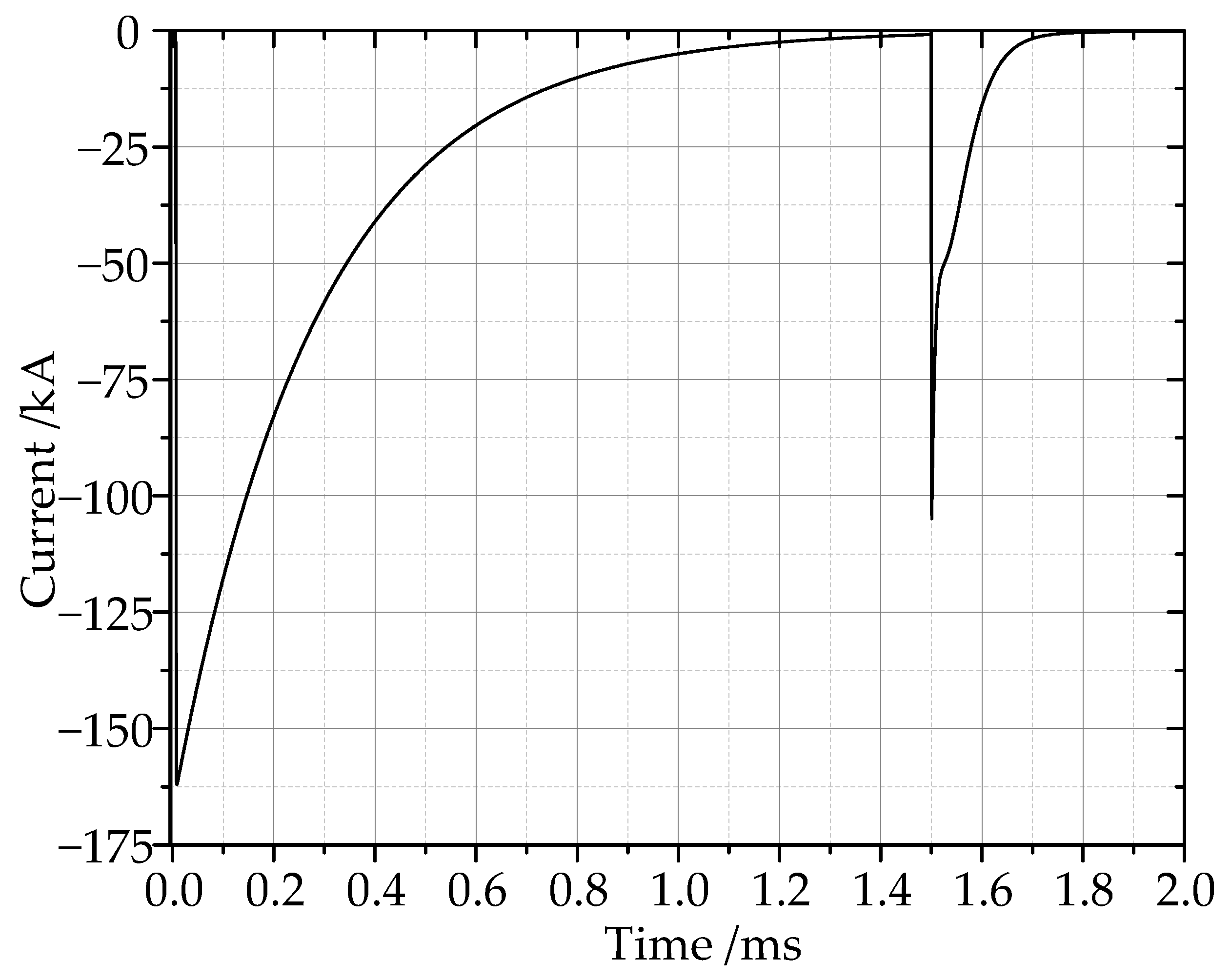
Since RTL experiments cannot capture the initial discharge of a multi-stroke lighting flash, the first-stroke current is modeled here according to IEC 61400-24 [12] as a 1/200 µs negative Heidler wave, whose expression is shown in Equation (1). The subsequent strokes adopt the waveshape parameters described in Table 2, employing a combination of Heider wave and Double-exponential wave, given as Equation (2). The first stroke peak current is set to 162.2 kA, while the subsequent strokes are set to 104.7 kA, as shown in Figure 1.
where Im1 and Im2 are the lightning current amplitude, η1 and η2 are the peak correction coefficient, n represents the order that describes the current steepness (which is set to 10 in this paper), τ1 and τ2 are the time constants of wave front and wave half-peak, and α and β denote the attenuation coefficient of wave front and wave half-peak.
Figure 1.
The lightning current waveforms employed in the simulation for the first stroke and subsequent stroke.
Considering that the interval between the first and subsequent strokes has only a minor influence on the transient overvoltages and the energy absorbed by the surge arrester [13], and to keep the simulation duration manageable, an interval of 1.5 ms is adopted in this model between the first and subsequent strokes. The surge impedance of the lightning channel is set to 300 Ω.
2.2. Electromagnetic Transient Simulation Model of the WT
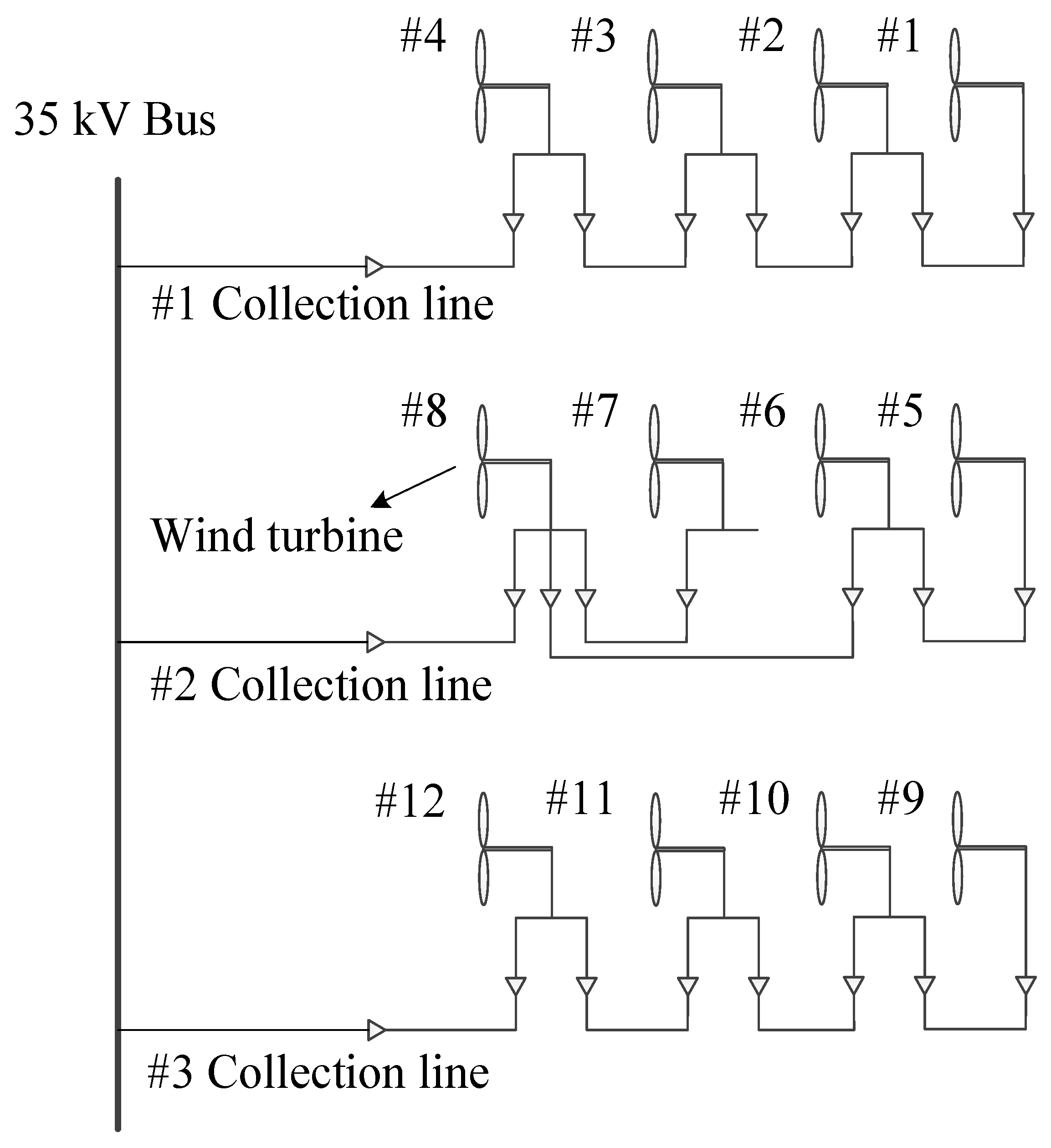
The offshore wind farm consists of twelve 7 MW WTs interconnected as shown in Figure 2. When a blade is struck by the lightning flash, the current is conducted through the blade down-conductor, the nacelle and tower, and ultimately dissipates into the sea through the grounding system [12]. As the lightning current propagates along the nacelle and tower, it induces electromagnetic coupling between these metallic structures and the internal equipment, leading to severe transient overvoltage.
Figure 2.
Topology of WTs in offshore wind farms.
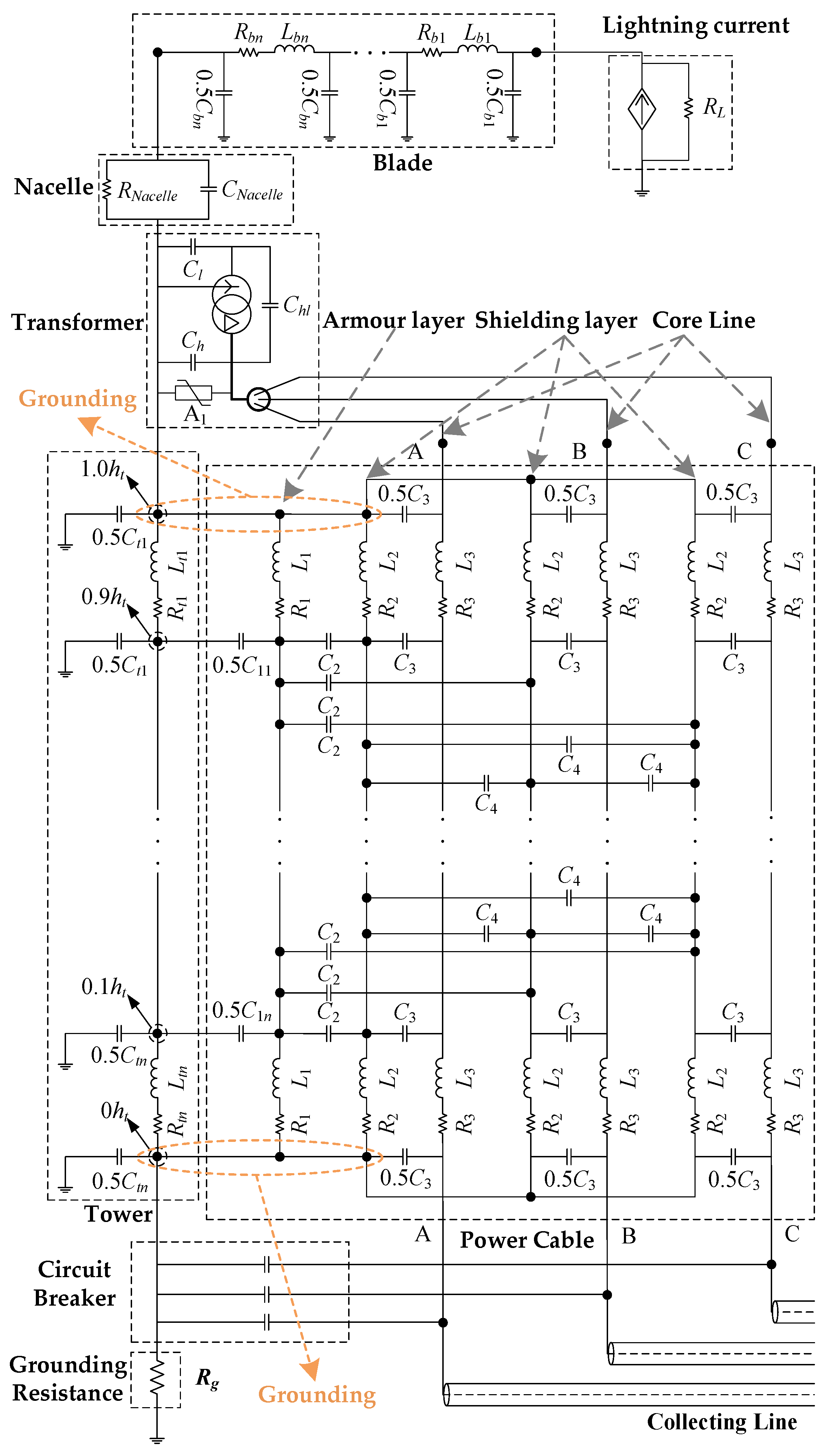
Therefore, the electromagnetic coupling between the nacelle and the transformer, as well as between the tower and the power cables, is explicitly considered. Based on transmission-line theory, high-frequency equivalent models are employed to represent the blade, tower, and the power cables inside the tower [3]. And the blade, tower and power cable sections are segmented according to the maximum segment length corresponding to the lightning current cutoff frequency. This enables the wave propagation process to be accurately modeled as the lightning current flows through the wind turbine. Additionally, the stray capacitances of the transformer and tower-base circuit breaker under lightning current injection are incorporated. A transient overvoltage simulation model for lightning strikes to the blade of an offshore WT is thus established, with the modeling methodology refined based on the authors’ previous work [10]. The single WT model is shown in Figure 3, in which the lead sheath and the armor are grounded on both ends, thereby providing an optional path for the lightning current flow to the ground to suppress transient overvoltages in wind turbine generators.
Figure 3.
Electromagnetic transient simulation model for a single WT.
3. Simulation Results and Analysis
Based on the mentioned modeling approach, a WT lightning overvoltage simulation model has been developed in PSCAD/EMTDC (Manitoba HVDC Research Centre, a division of MHI Ltd., Winnipeg, MB, Canada, Version 4.6). By incorporating multi-stroke lightning current parameters from LLS data and RTL experiments, the model is employed to analyze the impact of multiple lightning strikes to the blade on the transient overvoltage and the surge arrester electric stresses of WT. A comparative analysis is then performed using the multi-stroke lightning parameters recommended by IEC 61400-24 [12] to assess their applicability in the lightning protection design for WTs in southern China.
Our previous study [10] indicated that the surge arrester effectively suppresses the transient overvoltages between the core conductor and the lead sheath, while the transient overvoltages between the lead sheath and the armor are relatively low and do not pose a threat to the cable insulation. Therefore, this paper focuses on simulating the effects of multiple lightning strikes to the blade of WT8 on the transient overvoltage between the tower and the cable armor inside the tower, as well as the electrical stresses on 35 kV HY5WZ-51/134 surge arrester A1 (Guangzhou Zhongguang Electrical Technology Company Ltd., Guangzhou, China) that configured at the high-voltage terminal of the step-up transformer of the WT.
3.1. Simulation Results Obtained with the Proposed Model
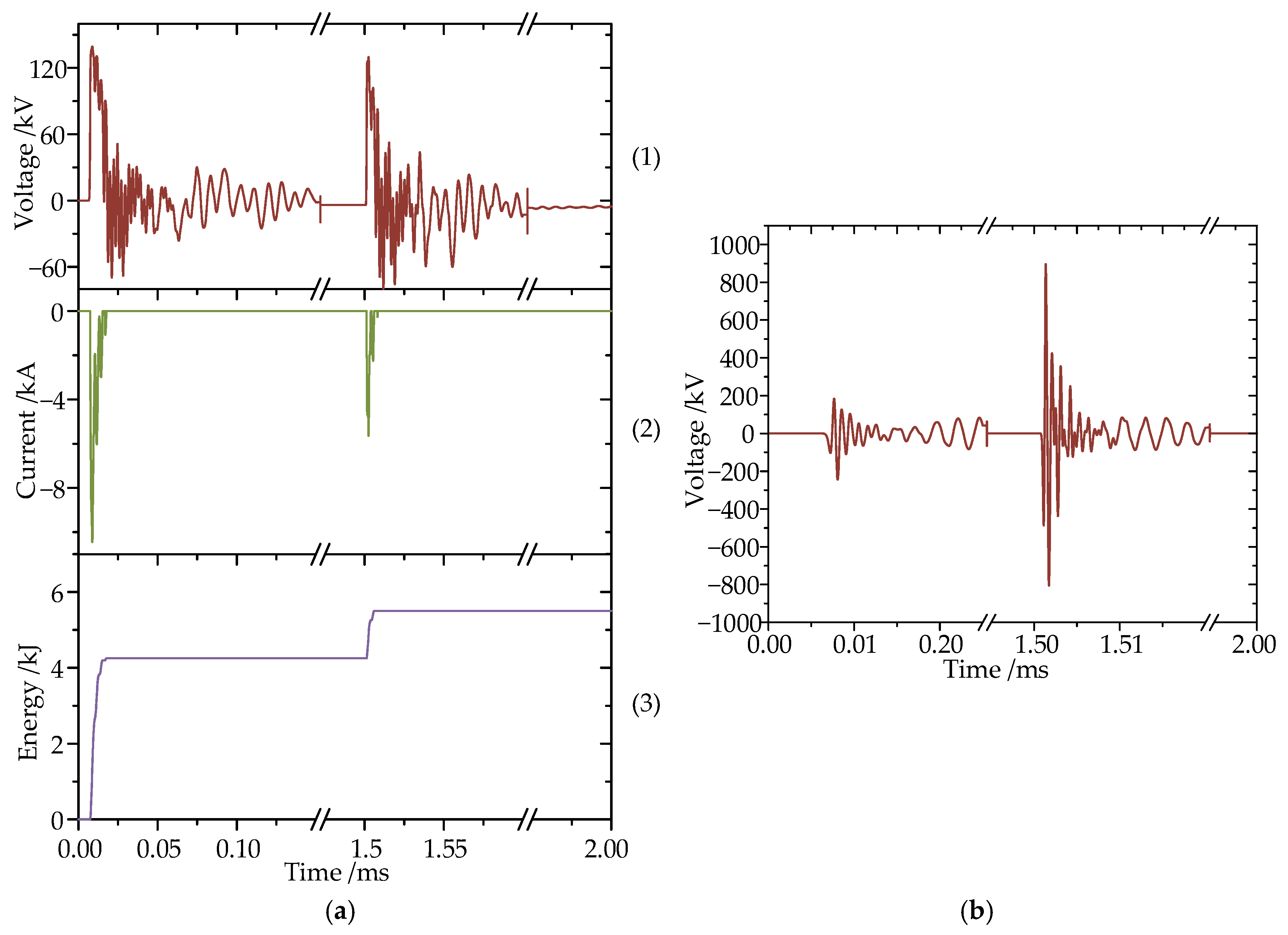
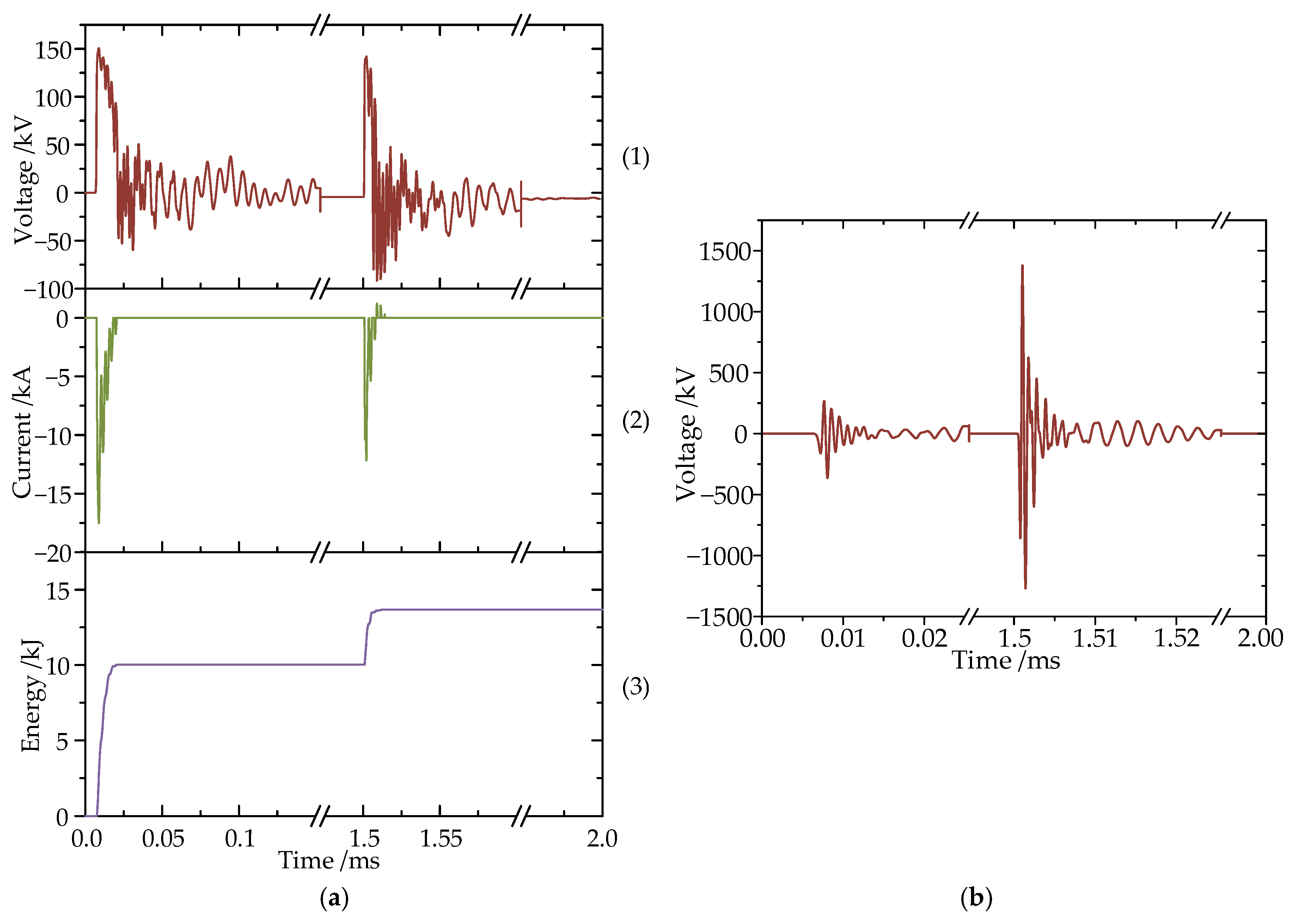
As illustrated in Figure 4, the electrical stresses on surge arrester A1 and the maximum transient overvoltage between the tower and the cable armor inside the tower are shown for the scenario where the blade of WT8 is subjected to two-stroke lightning flashes.
Figure 4.
Electrical stresses on surge arresters and transient overvoltage. (lightning model in this paper). (a) (1) Voltage across surge arrester A1, (2) current through surge arrester A1, and (3) energy absorbed by surge arrester A1; (b) transient overvoltage between tower and cable armor.
As shown in Figure 4a, when the first stroke of the two-stroke lightning flashes strikes the blade, the peak value of the transient overvoltage on surge arrester A1 is at approximately 151 kV, and the transient voltage on surge arrester A1 under the subsequent stroke is approximately 142 kV. Transient overvoltages of this magnitude pose a threat to the insulation of the transformer. During both the first stroke and the subsequent stroke, the peak currents through surge arrester A1 reach approximately 17.5 kA and 12.2 kA, respectively, which significantly exceed the surge arrester’s nominal discharge current of 5 kA. However, due to the brief duration of the transients, the energy absorbed by surge arrester A1 remains relatively low. The total energy deposited by the two-stroke lightning flash is approximately 13.7 kJ, well below the safety threshold of 80.4 kJ [25]. Consequently, for offshore wind farms in the Guangdong region subjected to two-stroke lightning strikes with current amplitudes corresponding to the 1% cumulative probability density, surge arrester A1 must be configured with four parallel columns to ensure the insulation safety of the equipment without sustaining damage.
In addition, Figure 4b shows that when the first stroke of the two-stroke lightning flashes strikes the blade, the transient overvoltage between the power cable armor and the tower reaches approximately 364 kV, whereas after the subsequent stroke, this overvoltage rises to 1380 kV. This can be attributed to the intensification of current reflection and refraction within the tower as the front time of the lightning current decreases, resulting in a significant deviation in the potential distribution at different heights of the tower. Consequently, the overvoltage between the tower and the cable armor increases rapidly as the lightning current front time shortens, potentially leading to discharge from the tower to the power cable armor, and even flashover breakdown. Therefore, the electrical clearance between the power cable and the tower wall should be increased in light of the actual circumstances, or high-strength insulating material should be applied to the armor to enhance the insulation margin.
3.2. Simulation Results Obtained with the Model of IEC61400-24 and Comparative Analysis
To compare the difference between the effects of the two-stroke lightning current model proposed in this paper with those of the model recommended by the IEC 61400-24 on the overvoltages and surge arrester electrical stresses of the WT, an additional simulation was conducted adopting the multi-stroke lightning current parameters of the IEC 61400-24 that is listed in Table 2. Figure 5 illustrates the surge arrester A1 electrical stresses and the transient overvoltage between the turbine tower and the cable armor inside the tower when the multi-stroke lightning current model recommended by the IEC 61400-24 is applied to a strike on the blade.
Figure 5.
Electrical stresses on surge arresters and transient overvoltage. (Model recommended by IEC61400-24.) (a) (1) Voltage across surge arrester A1, (2) current through surge arrester A1, and (3) energy absorbed by surge arrester A1; (b) transient overvoltage between tower and cable armor.
Figure 5a shows that when the first stroke of the multi-stroke lightning flashes strikes the blade, the transient overvoltage peak on surge arrester A1 reaches approximately 139 kV, and the transient voltage on surge arrester A1 under the subsequent stroke is approximately 130 kV. The peak currents through surge arrester A1 are approximately 10.4 kA for the first stroke and 5.67 kA for the subsequent stroke, both exceeding the surge arrester’s nominal discharge current of 5 kA. Consequently, even under the model recommended by the IEC 61400-24, surge arrester A1 must be configured with multiple parallel columns to ensure that the equipment survives the multiple lightning strokes without damage. Furthermore, as shown in Figure 5b, the subsequent stroke has a shorter front time than the first stroke; as a result, there is a higher transient overvoltage between the power cable armor and the tower, reaching 897 kV.
A comparison of the simulation results in Section 3.1 indicates that both the amplitude of transient overvoltage in the power equipment and electrical stresses in the surge arrester are more severe under the multi-stroke lightning current model derived from Guangdong LLS data and RTL experiments than those under the model recommended by IEC 61400-24. Therefore, investigations into multi-stroke lightning overvoltage and surge arrester electrical stresses for offshore wind farms must incorporate local lightning intensity and distribution characteristics to ensure the safe and stable operation of the WTs.
3.3. Influence of Stroke Multiplicity on Transient Overvoltage and Surge Arrester Electrical Stresses
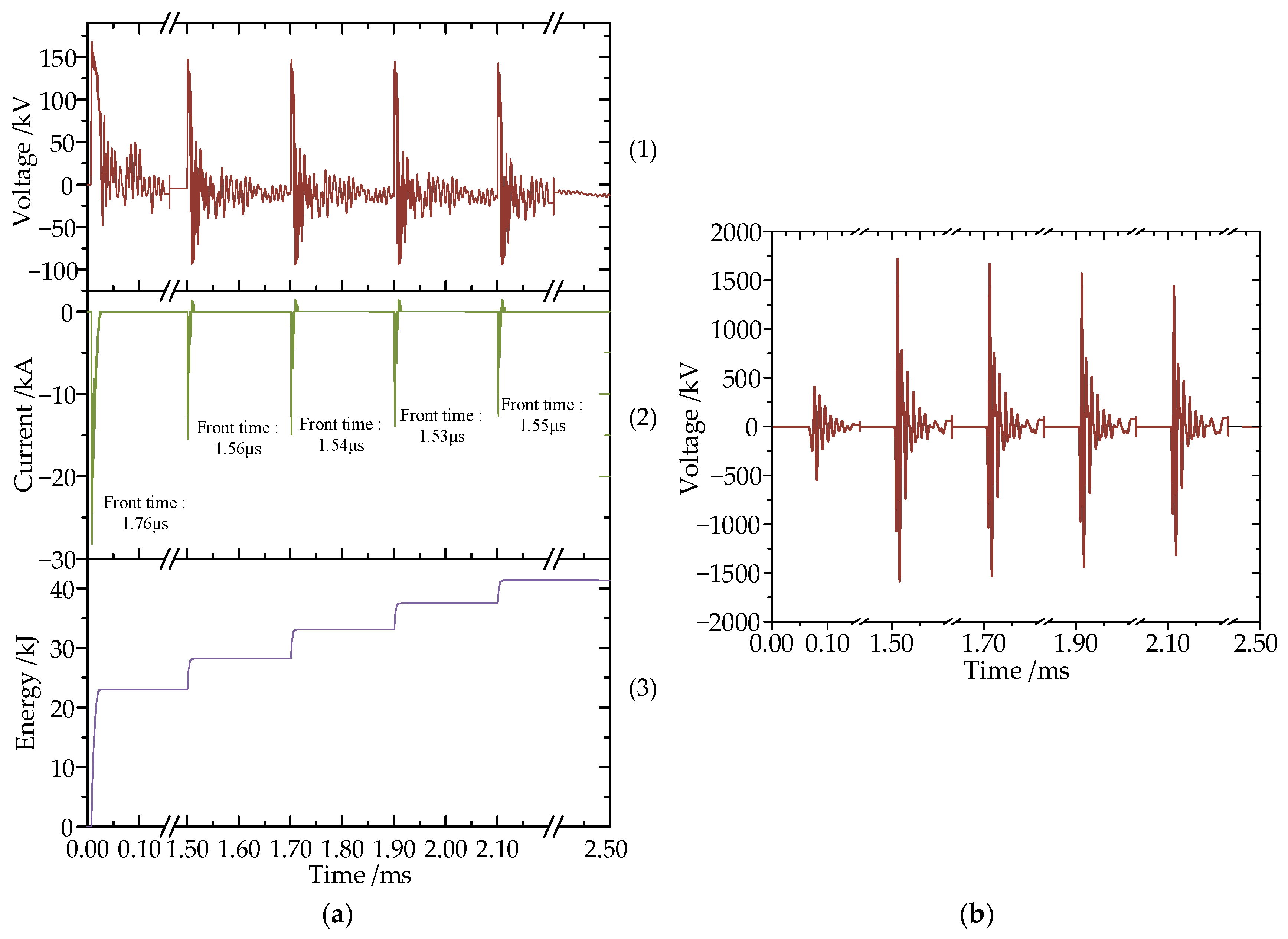
In our previous work [22], the parameter characteristics, such as the number of ground flashes, the amplitude of lightning current and the time interval of multiple lightning strikes, were statistically analyzed, based on the LLS data of Guangdong Province. The result shows that negative cloud-to-ground multiple-stroke lightning flashes, on average, contain 3.50 strokes, with 81.29% of lightning flashes consisting of 2–5 strokes. And it also indicates that both the amplitude and the probability distribution of lightning currents vary with the total number of strokes in the multiple-stroke lightning flashes. Consequently, this study further investigates the effect of stroke multiplicity on transient overvoltage in the power equipment and surge arrester electrical stresses. Figure 6 illustrates the surge arrester A1 electrical stresses and the transient overvoltage between the tower and the cable armor when the blade is struck by a five-stroke lightning flash simulated using the model proposed in this paper.
Figure 6.
Electrical stresses on surge arresters and transient overvoltage. (a) (1) Voltage across surge arrester A1, (2) current through surge arrester A1, and (3) energy absorbed by surge arrester A1; (b) transient overvoltage between tower and armor layer.
As shown in Table 1 and Figure 6, the increase in the total number of strokes in a negative multi-stroke lightning leads to higher current amplitudes for each individual stroke. This, in turn, causes both the surge arrester stresses and the transient overvoltage between the tower and the cable armor inside the tower to rise. When the first stroke of the five-stroke lightning flashes strikes the blade, the transient overvoltage on A1 reaches 168 kV, posing a serious threat to the transformer insulation. In addition, the peak current through surge arrester A1 is about 28.2 kA, far exceeding its nominal discharge current of 5 kA. Secondly, when the first subsequent lightning flash strikes the blade, the transient overvoltage between the armor of the power cable and the tower reaches 1716 kV, placing even more stringent requirements on the surge arrester configuration and equipment insulation level. Although the total energy absorbed by surge arrester A1 during the five-stroke lightning flashes (approximately 41.4 kJ) remains within the safety threshold for a single-column surge arrester, the high-magnitude current impulses will accelerate surge arrester aging and significantly shorten its service life. However, the scenario of five-stroke lightning flash with such high-current strikes and wind turbines is an extreme case. In actual implementation, technical and economic considerations should be made based on the actual lightning parameters to quantitatively assess the instantaneous failures throughout the entire life cycle of wind power equipment, thereby ensuring the safe and stable operation of WTs.
Furthermore, the impulse currents through the surge arrester exhibit a front time of approximately 2 μs, significantly shorter than the front time of 8/20 μs impulse current waveform specified in the IEC 60099-4 repetitive charge transfer capability test. And our previous works have investigated the impulse aging characteristics of ZnO varistors under equivalent charge but different waveforms impulse currents. As previously reported [26], for a given transferred charge (or energy), the aging rate of ZnO varistors under impulse currents increases as the front time shortens. Additionally, the plasma intensity and size increase with each succeeding impulse, and the accumulated plasma can aid side flashover on the ZnO varistor [27]. Therefore, it is recommended that the selection of surge arresters for offshore WTs and the impulse current withstand tests for ZnO varistors explicitly consider the effects of multiple lightning impulses as well as the actual front time of the impulse current through surge arrester.
4. Discussion
In this paper, combining the RTL experiments with LLS data statistics, and according to the LPL I requirements, the effects of multiple lightning strikes on the transient overvoltage of and the electrical stress of surge arresters in WT have been investigated. Based on the simulation results, this paper proposes insulation schemes for power cables, configuration schemes for surge arresters, and discusses the impulse current withstand tests demands for ZnO varistors in surge arresters. Regarding the insulation distance between power cables and tower, when there is sufficient internal space in the tower, an adequate margin of insulation distance can be reserved during actual installation. Otherwise, high-strength insulating materials should be applied to the armor, or the thickness of insulating materials should be increased to ensure insulation margin. For scenarios where the current flowing through the surge arrester A1 exceeds the nominal discharge current of 5 kA, if there is adequate space in the tower, a multi-column parallel configuration can be adopted, or ZnO varistors with larger current surge capacity (10 kA or 20 kA) should be applied to surge arrester for protection. Moreover, considering the impact of multiple lightning strikes on the aging and failure characteristics of ZnO varistors in surge arresters, surge arrester selection and ZnO varistor impulse current withstand tests explicitly consider the effects of the actual front time of the surge arrester impulse current. And the insulation performance of the side glaze layer of ZnO varistors can be improved by optimizing the formulation of glaze materials, thereby reducing the damage probability of surge arresters under multiple lightning strikes.
5. Conclusions
Based on statistics from LLS and RTL experiments, a regional multi-stroke lightning current model for Guangdong Province has been developed. Simulations were then conducted to analyze the transient overvoltage and surge arrester electric stresses in the offshore WT when the blade is exposed to multiple lightning strokes. The conclusions are as follows:
- For offshore wind farms in the Guangdong region, a two-stroke lightning strike with current amplitudes corresponding to a 1% cumulative probability density requires surge arrester A1 to be configured with four parallel columns, ensuring the insulation safety of the equipment without sustaining damage. Additionally, to prevent flashover occurring between the power cable and the tower wall, either the electrical clearance should be increased, or a high-strength insulating layer should be applied over the cable armor.
- The amplitudes of transient overvoltage on power equipment and the electrical stresses on surge arrester under the multi-stroke lightning current model proposed in this paper are more severe compared to the model recommended by IEC 61400-24. Therefore, lightning protection research for offshore wind farms should account for local lightning intensity and distribution characteristics to ensure the safe and stable operation of WTs.
- An increase in the total number of strokes in a negative multi-stroke lightning current leads to a higher amplitude for each individual stroke, thereby intensifying both the electric stresses on the surge arrester and the transient overvoltage between the tower and the cable armor. Moreover, the front time of the impulse current through the surge arrester A1 is approximately 2 µs, which is significantly shorter than the front time of 8/20 µs impulse current waveform specified in the IEC 60099-4 for the repetitive charge transfer test. A shorter front time accelerates the aging of ZnO varistors, thereby imposing new demands on their withstand capability, as well as on the selection and design of surge arresters.
- This study has certain limitations: in terms of modeling, simplifications were adopted, such as not considering the impact of the segmentation method for blades, power cables, and towers, nor the dynamic variation of lightning channel impedance. Regarding data, there is regional dependence—since the conclusions are based on lightning observation data from Guangdong Province, they may not be directly generalized to regions with significantly different lightning characteristics. Additionally, the simulation analysis does not cover positive lightning. In the future, we will expand lightning observation data from multiple regions, refine the simulation models, and conduct dedicated research on positive lightning scenarios, thereby enhancing the study’s generalizability and engineering applicability.
Author Contributions
Conceptualization, J.Z.; Data curation, J.Z.; Formal analysis, J.Z., J.L., L.Z. and C.H.; Funding acquisition, J.Z. and Y.H.; Investigation, Y.H.; Methodology, J.Z., J.L., L.Z. and C.H.; Project administration, Y.W. and Y.H.; Resources, Y.W.; Software, J.L. and L.Z.; Supervision, J.X.; Validation, L.Z. and C.H.; Visualization, C.H. and J.L.; Writing—original draft, J.Z.; Writing—review and editing, J.Z., Y.W., J.X., J.S. and Y.H. All authors have read and agreed to the published version of the manuscript.
Funding
This research was funded by the China Postdoctoral Science Foundation under Grant Number 2024M760576, and the Guangdong Basic and Applied Basic Research Foundation under grant number 2024A1515010276.
Data Availability Statement
The original contributions presented in this study are included in the article. Further inquiries can be directed to the corresponding author.
Conflicts of Interest
Authors Jie Zhang, Yong Wang, Jun Xiong, Junxiang Liu, and Lu Zhu were employed by the company, Guangdong Power Grid Corporation Limited. The remaining authors declare that the research was conducted in the absence of any commercial or financial relationships that could be construed as a potential conflict of interest.
Abbreviations
The following abbreviations are used in this manuscript:
| RTL | rocket-triggered lightning |
| LLS | lightning location system |
| WT | wind turbine |
| LPL | lightning protection level |
References
- Global Wind Energy Council. Global Wind Report; Global Wind Energy Council: London, UK, 2025. [Google Scholar]
- Lightning Parameters for Engineering Applications; TB 549; CIGRE: Littleton, CO, USA, 2013.
- Zhao, H.X.; Wang, X.R. Overvoltage Analysis of Wind Turbines Due to Lightning Strokes. Power Syst. Technol. 2004, 28, 27–29+72. [Google Scholar] [CrossRef]
- Luo, R.C.; Li, W.; Li, Z.Q.; Huang, Z.M.; Zhang, W. Modeling of Wind Turbine Generator Based on Piecewise Parameter and Its Lightning Transient Overvoltage Analysis. High Volt. Eng. 2015, 41, 2780–2787. [Google Scholar] [CrossRef]
- Chen, H.C.; Zhang, Y.; Du, Y.P.; Cheng, Q.S. Comprehensive Transient Analysis for Low-voltage System in a Wind Turbine under Direct Lightning. Int. J. Electr. Power Energy Syst. 2020, 121, 106131. [Google Scholar] [CrossRef]
- Jiang, J.L.; Chang, H.C.; Kuo, C.C.; Huang, C.K. Transient Overvoltage Phenomena on the Control System of Wind Turbines Due to Lightning strike. Renew. Energy 2013, 57, 181–189. [Google Scholar] [CrossRef]
- Li, X.Q.; Wang, J.G.; Wang, Y.; Fan, Y.D.; Zhang, B.Q.; Wang, S.C.; Cai, L. Lightning Transient Characteristics of Cable Power Collection System in Wind Power Plants. IET Renew. Power Gener. 2015, 9, 1025–1032. [Google Scholar] [CrossRef]
- Fady, W. Evaluative Analysis for Standardized Protection Criteria Against Single and Multiple Lightning Strikes in Hybrid PV-wind Energy Systems. Electr. Power Syst. Res. 2023, 218, 109227. [Google Scholar] [CrossRef]
- Jiao, Z.J.; Sun, J.R.; Yao, X.L.; Le, Y.J.; Chen, J.L.; Wang, A.Y. Lightning Overvoltage Simulation and Design of a Novel Surge Protective Device for High-Power Offshore Wind Farms. IEEE Trans. Power Deliv. 2024, 39, 2306–2316. [Google Scholar] [CrossRef]
- Zhang, J.; Han, Y.X.; Li, L.C.; Feng, S.S.; Liao, Z.M. The Impact of Lightning Strike to Multi-blade on The Lightning Overvoltage and Stresses of Arresters in Offshore Wind Farm. IET Renew. Power Gener. 2021, 15, 2814–2825. [Google Scholar] [CrossRef]
- Berger, K.; Anderson, R.B.; Kroninger, H. Parameters of Lightning Flashes. Electra 1975, 41, 23–37. [Google Scholar]
- IEC TR 61400-24: 2024; Wind Turbine Generator Systems-Part 24: Lightning Protection. International Electrotechnical Commission: Geneva, Switzerland, 2024.
- Malcolm, N.; Aggarwal, R.K. The Impact of Multiple Lightning Strokes on the Energy Absorbed by MOV Surge Arresters in Wind Farms During Direct Lightning Strikes. Renew. Energy 2015, 83, 1305–1314. [Google Scholar] [CrossRef]
- Xie, H.; Chen, Z.; Gu, C.S.; Ma, X.Y.; Liu, B.T. Lightning Transient Overvoltage of Wind Turbine Collecting Line Based on Multiple Lightning Strikes. Insul. Surge Arresters 2022, 4, 43–51. [Google Scholar] [CrossRef]
- Zhang, J.Y.; Ji, X.Y.; He, G.X.; Xing, H.Y. Transient Overvoltage Analysis of Wind Turbine Under Multiple Lightning Strokes. J. Electron. Meas. Instrum. 2019, 33, 153–160. [Google Scholar] [CrossRef]
- Guan, Y.C.; Mou, L.; Lei, L.; Tan, X.Y.; Wang, D.; Wang, J.; Le, J. Research on Transient Response Characteristies of Wind Farm Outgoing System Considering Mutiple Lightning Strikes. Electr. Meas. Instrum. 2025, 62, 83–90. [Google Scholar] [CrossRef]
- Kuleshov, Y.; Mackerras, D.; Darveniza, M. Spatial distribution and frequency of lightning activity and lightning flash density maps for Australia. J. Geophys. Res.-Atmos. 2006, 111, D19105. [Google Scholar] [CrossRef]
- Dwyer, J.R.; Uman, M.A. The physics of lightning. Phys. Rep.-Rev. Sec. Phys. Lett. 2014, 534, 147–241. [Google Scholar] [CrossRef]
- Hiroyuki, I. Climatology of Multiple-stroke Lightning in Japan. Int. J. Climatol. 2020, 40, 5043–5428. [Google Scholar] [CrossRef]
- Anderson, R.B.; Eriksson, A.J. Lightning parameters for engineering applications. Electra 1980, 69, 65–102. [Google Scholar]
- Visacro, S.; Soares, A.J.; Schroeder, M.; Cherchiglia, L.; de Sousa, V. Statistical analysis of lightning current parameters: Measurements at Morro do Cachimbo station. J. Geophys. Res. Atmos. 2004, 109, D01105. [Google Scholar] [CrossRef]
- Yang, L.; Han, Y.X.; Liao, Z.M.; Li, Q.; Zhao, X.F.; Li, Z.F.; Huang, J.N.; Zhang, J.; Liu, B.X. Parameter Statistics and Influencing Factor Analysis of Lightning Multiple Return Ground Flashover Based on LLS. Guangdong Electr. Power 2023, 36, 115–123. [Google Scholar] [CrossRef]
- IEEE Std 1410: 2010; Improving the Lightning Performance of Electric Power Overhead Distribution Lines. IEEE: Piscataway, NJ, USA, 2021.
- Huang, J.N.; Han, Y.X.; Liao, Z.M.; Zhao, X.F.; Li, Q.; Yan, X.; Du, S. Simulation Modeling and Protection of Lightning Intrusion Wave in Substation Under Multiple Return Strike Cloud Ground Flashes. Guangdong Electr. Power 2022, 35, 66–75. [Google Scholar] [CrossRef]
- Li, X.Q.; Wang, J.G.; Wang, Y.; Fan, Y.D.; Zhang, B.Q.; Zhou, M. Lightning Transient Numerical Calculation of Cable Power Collection System in Wind Power Plant. High Volt. Eng. 2015, 41, 1566–1573. [Google Scholar] [CrossRef]
- Zhang, J.; Han, Y.X.; Li, L.; Deng, J.W.; Liu, G. Study on Impulse Aging Characteristics of ZnO varistor Based on Equivalent Repeated Charge Transfer Capability. In Proceedings of the 2022 IEEE 5th International Electrical and Energy Conference (CIEEC), Nanjing, China, 27–29 May 2022. [Google Scholar] [CrossRef]
- Darveniza, M.; Tumma, L.R.; Richter, B.; Roby, D.A. Multipulse lightning currents and metal-oxide arresters. IEEE Trans. Power Deliv. 1997, 12, 1168–1175. [Google Scholar] [CrossRef]
Disclaimer/Publisher’s Note: The statements, opinions and data contained in all publications are solely those of the individual author(s) and contributor(s) and not of MDPI and/or the editor(s). MDPI and/or the editor(s) disclaim responsibility for any injury to people or property resulting from any ideas, methods, instructions or products referred to in the content. |
© 2025 by the authors. Licensee MDPI, Basel, Switzerland. This article is an open access article distributed under the terms and conditions of the Creative Commons Attribution (CC BY) license (https://creativecommons.org/licenses/by/4.0/).