Concept Design of a Hybrid Offshore Patrol Vessel


Abstract
1. Introduction
2. Main Tasks and Characteristics of Existing OPVs and Designs
- Surveillance of EEZ, migrant routes and fishing,
- Interception of suspicious vessels with fast RHIB boats,
- Prevention of smuggling of people, drugs, and weapons,
- Search and rescue,
- Actions against environmental pollution,
- Disaster relief to the island or coastal population,
- Logistic support,
- Protection of critical infrastructure at sea,
- ASW,
- AAW.
3. Concept Design Requirements and Multi-Attribute Optimization Approach
4. Design Variables and Constraints of the Parameter Space
- The maximum continuous speed must be at least 20 knots,
- The total required electric power must be less than the installed power of two diesel generators,
- The minimum depth of the hull depends on the ship’s longitudinal strength (LWL/14), and the height of the main propulsion engine,
- The stability of the ship in damaged condition requires that the edge of the main deck must be above the water at the angle of heel 25°,
- The constraints of initial stability represent a ratio of metacentric height and the breadth of the ship that should be in a range e.g., between 0.05 and 0.30,
- Vertical acceleration at the bridge should not exceed 0.25 g,
- Available design length should be equal to or greater than the required length,
- Available design area/volume should be equal to or greater than required.
5. Hybrid OPV Concept Design Attributes
6. Results
7. Discussion
8. Conclusions
Author Contributions
Funding
Conflicts of Interest
Abbreviations
| AAS | anti-air system, |
| AAW | anti-air warfare, |
| AHP | Analytic Hierarchical Process, |
| AP | aft perpendicular, |
| ASW | anti-ship warfare, |
| ASMS | anti-ship missile system, |
| AUT | the autonomy of the ship, [days] |
| B | breadth of the ship on the main section and WL, [m] |
| BGUN | bow gun, |
| CAD | Canadian Dollars, |
| C4I | command, control, communications, computers, and intelligence, |
| CBT | B to T ratio coefficient, [-] |
| CDL | volumetric coefficient, [-] |
| CLH | L to H ratio coefficient, [-] |
| CRD | distance from AP to the rear forecastle bulkhead to LWL ratio coeff., [-] |
| CRT | transom to main section immersed area ratio coefficient, [-] |
| CON | container, |
| CB | block coefficient, [-] |
| CC | cost of the crew, [MEUR] |
| CFD | Computational Fluid Dynamics, |
| CP | longitudinal prismatic coefficient, |
| CPP | controllable pitch propeller, |
| CM | main section coefficient, [-] |
| CGMB | GM to B ratio coefficient, [-] |
| CWP | waterplane coefficient, [-] |
| CODAD | combined diesel and diesel, |
| CODOE | combined diesel or electric, |
| D | displacement, [t] |
| DC | design cost, [MEUR] |
| DP | propeller diameter, [m] |
| EEZ | Exclusive Economic Zone, |
| END | endurance, [NM] |
| EOS | Electro-Optical System, |
| ES | economy speed, [kn] |
| FC | fuel and lubricants cost, [MEUR] |
| FEM | Finite Element Method, |
| GM | metacentric height, [m] |
| H | ship height, [m] |
| HELI | helicopter, |
| HT10 | depth of hull at LPP/2, [m] |
| IRS | infra-red signature |
| weight coefficients in expression for global effectiveness, [-] | |
| LOA | length overall, [m] |
| LWL | length of water line, [m] |
| L/B | length overall and breadth ratio, [-] |
| LPP | length between perpendiculars, [m] |
| MC | maintenance cost, [MEUR] |
| MCS | maximum continuous speed, [kn] |
| MUC | major upgrading during the life cycle cost, [MEUR] |
| MoD | Ministry of Defense, |
| NBC | nuclear, biological, chemical, |
| NSGA | Non-Dominated Sorting Genetic Algorithm, |
| OMAT | materials of hull and superstructure options, |
| OPSNS | options of ship propulsion, |
| OPENS | cruising range options, |
| OANS | autonomy options, |
| OBGNS | bow gun options, |
| OASMS | anti-ship missile system options, |
| ORHIB | RHIB options, |
| OAAS | anti-air system options, |
| ORS | radar signature options, |
| OIRS | infra-red signature options, |
| ONBC | NBC options, |
| OVNK | mission container options, |
| OHELI | helicopter options, |
| OMOE | overall measure of effectiveness, [-] |
| OPV | offshore patrol vessel, |
| P | initial population, |
| PPAT | cruising speed power, [kW] |
| PMCR | maximum continuous rating power, [kW] |
| PuQ | combined initial and child populations, |
| RHIB | rigid hull inflatable boat, |
| ROV | Remotely Operated Vehicle, |
| RS | radar signature, |
| Q | child population, |
| SCC | ship construction cost, [MEUR] |
| T | ship draft, [m] |
| TLCC | total life cycle cost, [MEUR] |
| UE | maximum continuous speed, [kn] |
| UMAX | maximum speed, [kn] |
| VELPOP | size of population, |
| VFP(i) | value functions, [-] |
| WLS | light ship mass, [t] |
| WMO | World Metrological Organization, |
| WT | total mass, [t] |
Appendix A

| Ship Designation | LOA | B | L/B | T | H | CL/H | CB/T | D | CDL | UMAX | UE | END | AUT | |
|---|---|---|---|---|---|---|---|---|---|---|---|---|---|---|
| m | m | m | m | - | - | t | - | kn | kn | NM | days | |||
| 1. | Avante 3000 | 93.9 | 14.2 | 6.61 | 4.36 | - | - | 3.26 | 2695 | 3.26 | 21 | 3500 | - | |
| 2. | Avante 2200 Patrol | 98.9 | 13.6 | 7.27 | 4.05 | - | - | 3.36 | 2455 | 2.54 | 25 | - | 3500 | - |
| 3. | Avante 1400 | 79.9 | 11.5 | 6.95 | 4.0 | - | - | 2.88 | 1500 | 2.94 | 22 | - | 4000 | - |
| 4. | Avante 300 | 55.65 | 9.0 | 6.18 | 2.17 | - | - | 4.15 | 490 | 2.84 | 34 | - | 1100 | - |
| 5. | Samuel Beckett Class | 90.0 | 14.0 | 6.43 | 3.8 | - | - | 3.68 | 2256 | 3.09 | 23 | 15 | 6000 | 21 |
| 6. | River Class PV Batch1 | 79.5 | 13.5 | 5.88 | 3.8 | - | - | 3.55 | 1700 | 3.38 | 20 | - | 5500 | 21 |
| 7. | River Class PV Batch2 | 90.5 | 13.5 | 6.7 | 3.8 | - | - | 3.55 | 2000 | 2.70 | 25 | - | 5500 | 35 |
| 8. | OPV-8301 | 84 | 15.4 | 5.45 | - | - | - | - | - | 22 | - | 8000 | 35 | |
| 9. | HMS Forth (P222) | 90.5 | 13.0 | 6.96 | 3.8 | - | - | 3.42 | 2000 | 2.70 | 24 | - | 5500 | 35 |
| 10. | HNLMS Holland | 108.4 | 16.0 | 6.78 | 4.55 | - | - | 3.52 | 3750 | 2.94 | 21.5 | - | 5000 | 21 |
| 11. | 80M OPV BAE Sys. | 81.5 | 13.5 | 6.04 | - | - | - | 1700 | 3.14 | 20 | - | 5500 | 21 | |
| 12. | 90M OPV BAE Sys. | 90 | 13.5 | 6.66 | - | - | - | 1800 | 2.47 | 25 | - | 5500 | 35 | |
| 13. | Damen OPV 2400 | 90 | 14.4 | 6.25 | 4.0 | 7.0 | 12.9 | 3.6 | 2400 | 3.29 | 23 | - | 6000 | 40 |
| 14. | Damen OPV 2400 | 83 | 13.7 | 6.06 | 3.75 | 6.8 | 12.2 | 3.65 | 1890 | 3.31 | 22 | - | 5000 | 30 |
| 15.* | Damen OPV 2400 | 61.94 | 9.7 | 6.39 | 3.25 | 4.7 | 13.18 | 2.98 | 1022 | 4.3 | 18 | - | - | - |
| 16. | Damen OPV 1400 | 72 | 12.7 | 5.67 | 3.75 | 6.20 | 11.61 | 3.39 | 1470 | 3.94 | 21 | - | 4000 | 25 |
| 17.** | Damen OPV 950 | 66 | 10.25 | 6.44 | 2.90 | 4.70 | 15.32 | 3.53 | 925 | 3.22 | 20.6 | - | - | - |
| 18. | OPV 90 Lurssen | 90 | 14.0 | 6.43 | 3.5 | - | - | 4.0 | 2100 | 2.88 | - | - | - | - |
| 19. | OPV 85 Lurssen | 85 | 13.5 | 6.3 | 3.5 | - | - | 3.86 | 1900 | 3.09 | - | - | - | - |
| 20. | OPV 80 Lurssen | 80 | 13.0 | 6.15 | 3.0 | - | - | 4.33 | 1486 | 2.9 | - | - | - | - |
References
- Ljulj, A.; Slapničar, V.; Grubišić, I. Multi-attribute concept design procedure of a generic naval vessel. AEJ 2020, 59, 1725–1734. [Google Scholar] [CrossRef]
- Schaffner, M.A.; Ross, A.M.; Rhodes, D.H. A Method for Selecting Affordable System Concepts: A Case Application to Naval Ship Design. In Proceedings of the Conference on System Engineering Research (CSER 2104), Massachusetts Institute of Technology, Redondo Beach, CA, USA, 21–22 March 2014. [Google Scholar]
- van Diessen, M.F.; Duchateau, E.A.E.; Kana, A.A.; Hopman, J.J. Integrating vulnerability analysis into the early stage distributed naval ship system design process. J. Mar. Eng. Technol. 2022, 21, 343–354. [Google Scholar] [CrossRef]
- Esbati, S. Design for Support in the Initial Design of Naval Combatants. Ph.D. Thesis, Department of Mechanical Engineering, University College London, London, UK, 2018. [Google Scholar]
- Andrews, D. Design Errors in Ship Design. J. Mar. Sci. Eng. 2021, 9, 34. [Google Scholar] [CrossRef]
- Rigterink, D.T.; Ames, R.; Gray, A.; Doerry, N. Early-Stage Assessment of the Impacts of Next Generation Combat Power and Energy Systems on Navy Ships. In Proceedings of the ASNE Advanced Machinery Technology Symposium, AMTS 2016, Villanova University Connelly Center, Villanova, PA, USA, 25–26 May 2016. [Google Scholar]
- Liao, Z.S.; Jagarlapudi, Y.; Faramarzifar, A.; Kaushal, K.; Yang, Y. Concept Design of an Offshore Patrol Vessel for the Canadian Coast Guard, NAME 591—Computer-Aided Ship Design Project; Naval Architecture and Marine Engineering Department of Mechanical Engineering University of British Columbia: Vancouver, BC, Canada, 2015. [Google Scholar]
- Barkel, E.K.; Story, R. Budget Analysis for the Acquisition of a Class of Arctic/Offshore Patrol Ships; Office of the Parliamentary Budget Officer: Ottawa, ON, Canada, 2014; pp. 1–42. [Google Scholar]
- Brown, A.; Kerns, C. Multi-Objective Optimization in Naval Ship Concept Design. Available online: https://www.phoenix-int.com/wp-content/uploads/2017/05/Multi-Objective_Optimization_in_Naval_Ship_Concept_Design.pdf (accessed on 21 October 2022).
- van Es, G.F. Designing and Evaluating Propulsion Concepts of Surface Combatants. Master’s Thesis, Delft University of Technology, Delft, The Netherlands, 16 September 2011. [Google Scholar]
- Hurwitz, R.B. Prediction of Thrust-Deduction and Wake Fractions for Twin-Screw Destroyers; David. W. Taylor Naval Ship Research and Development Center: Bethesda, MD, USA, 1980; pp. 1–121. [Google Scholar]
- Ohmayer, H.F. Propulsion System Choices for Modern Naval Vessels, Washington. 2012. Available online: https://studylib.net/doc/18070219/propulsion-system-choices-for-modern-naval-vessels (accessed on 21 October 2022).
- Brown, A.J.; Sajdak, J. Still Reenginering the Naval Ship Concept Design Process. Naval Eng. J. 2015, 127, 49–61. [Google Scholar]
- Park, J.; Kim, T.; Kang, H.; Jeon, S.; Jeong, W.; Cho, M.; Choi, D.; Lee, K. Recent Early-Phase Naval Ship Systems Engineering for Republic of Korea Navy. Naval Eng. J. 2016, 128, 103–115. [Google Scholar]
- Goodfriend, D.; Brown, A.J. Exploration of System Vulnerability in naval Ship Concept Design. J. Ship Prod. Design 2018, 34, 42–58. [Google Scholar] [CrossRef]
- Peri, D. Direct Tracking of the Pareto Front of a Multi-Objective Optimization Problem. J. Mar. Sci. Eng. 2020, 8, 699. [Google Scholar] [CrossRef]
- Boccadamo, G.; Rosano, G. Excessive Acceleration Criterion: Appllication to Naval Ships. J. Mar. Sci. Eng. 2019, 7, 431. [Google Scholar] [CrossRef]
- Pereira, T.; Garbatov, Y. Multi-Attribute Decision-Making Ship Structural Design. J. Mar. Sci. Eng. 2022, 10, 1046. [Google Scholar] [CrossRef]
- Zaccone, R.; Campoea, U.; Martelli, M. Optimisation of a Diesel-Electric Ship Propulsion and Power Generation system Using a Genetic Algorithm. J. Mar. Sci. Eng. 2021, 9, 587. [Google Scholar] [CrossRef]
- ZF Group. ZF Product Selection Guide, Marine Propulsion Systems; ZF Group: Friedrichshafen, Germany, 2022; pp. 1–168. [Google Scholar]
- Buckingham, J. BMT presentation on multi-engine propulsion solutions for Offshore Patrol Vessel (OPV). In Proceedings of the Renk Symposium, Augsburg, Germany, 7–8 June 2011. [Google Scholar] [CrossRef]
- Koenhardono, E.S.A. Comparative of Feasibility Study Between Diesel Mechanical Propulsion System and Combination of Diesel Engine and Electric Motor Propulsion System on Offshore Patrol Vessel (OPV) 80 m. In Proceedings of the 5th International Seminar on Ocean and Coastal Engineering, Environmental and Natural Disaster Management (ISOCEEN 2017), Surabaya, Indonesia, 8 November 2017. [Google Scholar]
- Caterpillar. Marine Power Solutions; Caterpillar: Irving, TX, USA, 2018; pp. 1–212. [Google Scholar]
- Rolls-Royce. MTU Solution Guide, Marine & Offshore; Rolls-Royce: Friedrichshafen, Germany, 2019; pp. 1–53. [Google Scholar]
- Wartsila. Wartsila Product Guide; Wartsila: Vaasa, Finland, 2021; pp. 1–200. [Google Scholar]
- Avante-300.pdf. Available online: https://www.navantia.es/wp-content/uploads/2018/05/Avante-300.pdf (accessed on 21 October 2022).
- Avante-1400.pdf. Available online: https://www.navantia.es/wp-content/uploads/2018/06/Avante-1400.pdf (accessed on 21 October 2022).
- Avante-2200-P_.pdf. Available online: https://www.navantia.es/wp-content/uploads/2018/05/Avante-2200-P_.pdf (accessed on 21 October 2022).
- Avante-3000-plata.pdf. Available online: https://www.navantia.es/wp-content/uploads/2018/06/Avante-3000-plata.pdf (accessed on 21 October 2022).
- Samuel Beckett-Class Offshore Patrol Vessel. Available online: https://military-history.fandom.com/wiki/Samuel_Beckett-class_offshore_patrol_vessel (accessed on 21 October 2022).
- River Class Offshore Patrol Vessel. Available online: https://www.seaforces.org/marint/Royal-Navy/Patrol-Vessel/River-class.htm (accessed on 21 October 2022).
- BRP Gabriela Silang (OPV-8301). Available online: https://en.wikipedia.org/wiki/BRP_Gabriela_Silang_(OPV-8301) (accessed on 21 October 2022).
- Holland-Class Offshore Patrol Vessel. Available online: https://en.wikipedia.org/wiki/Holland-class_offshore_patrol_vessel (accessed on 21 October 2022).
- Offshore Patrol Vessels. Available online: https://www.baesystems.com/en/product/offshore-patrol-vessels (accessed on 21 October 2022).
- Damen. Available online: https://products.damen.com/ (accessed on 21 October 2022).
- Offshore Patrol Vessels. Available online: https://nvl.de/en/naval-vessels/opv// (accessed on 21 October 2022).
- Demko, D. Tools for Multi-Objective and Multi-Disciplinary Optimization in Naval Ship Design. Master’s Thesis, Faculty of Virginia Polytechnic Institute and State University, Blacksburg, VA, USA, 2005. [Google Scholar]
- Wang, C.-N.; Yang, F.-C.; Nguyen, V.T.T.; Nguyen, Q.M.; Huynh, N.T.; Huynh, T.T. Optimal Design for Compliant Mechanism Flexure Hinges: Bridge-Type. Micromachines 2021, 12, 1304. [Google Scholar] [CrossRef] [PubMed]
- Nguyen, T.V.T.; Huynh, N.-T.; Vu, N.-C.; Kieu, V.N.D.; Huang, S.-C. Optimizing compliant gripper mechanism design by employing an effective bi-algorithm: Fuzzy logic and ANFIS. Microsyst. Technol. 2021, 27, 3389–3412. [Google Scholar] [CrossRef]
- Deb, K.; Agrawal, S.; Pratap, A.; Meyarivan, T. A Fast Elitist Non-Dominated Sorting Genetic Algorithm for Multi-Objective Optimization: NSGA-II. In Proceedings of the Parallel Problem Solving from Nature PPSN.VI, Paris, France, 18–20 September 2000. [Google Scholar]
- Deb, K.; Pratap, A.; Agarwal, S.; Meyarivan, T. A fast and Elitist Multiobjective Genetic Algorithm: NSGA-II. IEEE Trans. Evol. Comput. 2002, 6, 182–197. [Google Scholar] [CrossRef]
- Seshadri, A. Fast Elitist Multiobjective Genetic Algorithm, NSGA-II. Available online: https://web.njit.edu/~horacio/Math451H/download/Seshadri_NSGA-II.pdf (accessed on 21 October 2022).
- Saaty, L.T. Decision Making with the Analytic Hierarchy Process. Int. J. Serv. Sci. 2008, 1, 83–98. [Google Scholar] [CrossRef]

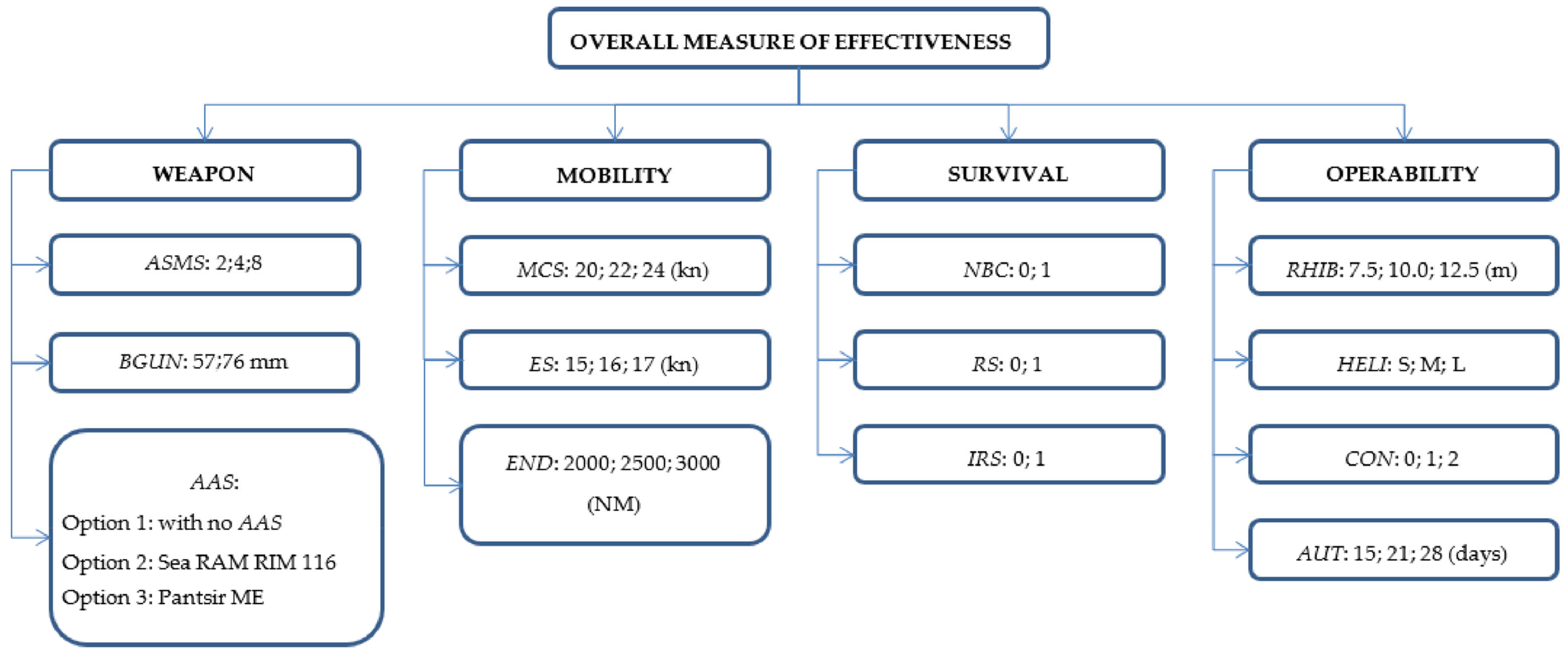
| Requirement | Description | Options | |
|---|---|---|---|
| 1 | Ship form | Displacement form. | Form parameters are varied to get the optimal ship form. |
| 2 | Hull and superstructure materials | Combined materials of high tensile steel and aluminum. | Hull from high-strength steel, and superstructure from high-strength steel. Hull from high-strength steel, and superstructure from marine-grade aluminum. |
| 3 | Propulsion | Mechanical diesel propulsion and hybrid propulsion. | CODAD 2× Diesel with CPP (different producers) CODOE with CPP (different producers) Diesel Engine 2× + CPP 2× |
| 4 | ASMS | Anti-ship missile system, up to 200 km range. | 0 missiles 4 missiles 8 missiles |
| 5 | BGUN | Bow gun, mid-caliber | BGUN 57 mm BGUN 76 mm |
| 7 | AAS | Anti-air system. | AA missile system for mid-range (up to 25 km) (different producers). |
| 8 | Maximum continuous speed | No less than 20 knots. | |
| 9 | Economy speed | No less than 15 knots. | |
| 10 | Ship range | Ship range at economy speed. | 2000 NM 2500 NM 3000 NM |
| 11 | Ship autonomy | Ship autonomy in days depends on the volume of space for food and freshwater capacity. | 15 days 21 days 28 days |
| 12 | NBC system | Nuclear, Biological, and Chemical System. | With the NBC system With no NBC system |
| 13 | Radar signature | Stealth design No stealth design | |
| 14 | IRS | Infra-red signature. | Design with reduced IRS Design with no reduced IRS |
| 15 | Ship operability | Fully operational for WMO sea state 4, and partially operational for WMO sea state 5. | |
| 16 | Main ship sensors | Acquisition radar, navigation radars (S and X band), EOS, or aiming radar. The same for all designs. | |
| 17 | Other electronic equipment | Decoy, radar signal detector, laser signal detector. The same for all designs. | |
| 18 | Auxiliary ship systems | The same for all designs. | |
| 19 | Ship damage control equipment | The same for all designs. | |
| 20 | C4I system | The same for all designs. | |
| 21 | Fire control system | The same for all designs. | |
| 22 | Navigation equipment | The same for all designs. | |
| 23 | Helicopter deck | For accommodation of three different sizes of helicopters. | Small Mid Heavy |
| 24 | Hangar for helicopter support | The same for all designs. | |
| 25 | Space for mission containers | Options for 0, 1, and 2 containers 20 feet in size. | 0 containers 1 container for equipment for eco protection 1 container for equipment for eco protection + 1 container for diving capabilities and underwater ROV |
| 26 | RHIB | Three different sizes of RHIB. | RHIB 7.5 m RHIB 10.0 m RHIB 12.5 m |
| 27 | Crew plus additional accommodation | 45 + 30 The same for all designs. | |
| 28 | Heavy machine guns 2 × 12.7 mm | The same for all designs. | |
| 29 | Ani-fire cannon | The same for all designs. |
| Design Variables | Description | Minimum Value | Maximum Value | |
|---|---|---|---|---|
| Design variables of the ship’s form | ||||
| 1 | CP | Longitudinal prismatic coefficient | 0.60 | 0.75 |
| 2 | CM | Main section coefficient | 0.70 | 0.85 |
| 3 | CDL | Volumetric coefficient | 1.75 | 5.75 |
| 4 | CBT | B to T ratio | 3.0 | 5.0 |
| 5 | CLH | L to H ratio | 8.0 | 14.5 |
| 6 | CRD | Distance from AP to the rear forecastle bulkhead to LWL ratio | 0.45 | 0.55 |
| 7 | CRT | Transom to main section immersed area ratio | 0.4 | 0.6 |
| Design variables for materials, propulsion, endurance, autonomy, weapons, and signature | ||||
| 8 | OMAT(i) | Materials of hull and superstructure options | i = 0,...,1 | |
| 9 | OPSNS(i) | 7 options of ship propulsion are predefined within the design model | i = 0,...,6 | |
| 10 | OPENS(i) | Cruising range options | i = 0,...,2 | |
| 11 | OANS(i) | Autonomy options | i = 0,...,2 | |
| 12 | OBGNS(i) | Bow gun options | i = 0,...,1 | |
| 13 | OASMS(i) | Anti-ship missile system options | i = 0,...,2 | |
| 14 | ORHIB(i) | RHIB options | i = 0,...,2 | |
| 15 | OAAS(i) | Anti-aircraft system options | i = 0,...,1 | |
| 16 | ORS(i) | Radar signature options | i = 0,...,1 | |
| 17 | OIRS(i) | Infra-red signature options | i = 0,...,1 | |
| 18 | ONBC(i) | NBC options | i = 0,...,1 | |
| 19 | OVNK(i) | mission container options | i = 0,...,2 | |
| 20 | OHELI(i) | Helicopter options | i = 0,...,2 | |
| OPV Standard | OPV as a Combat Ship | ||
|---|---|---|---|
| AUT | ship autonomy | 0.1607 | 0.0079 |
| ES | economy speed (patrol) | 0.1607 | 0.0857 |
| RHIB | interception boat | 0.1464 | 0.0167 |
| HELI | helicopter | 0.0979 | 0.0263 |
| END | endurance | 0.0625 | 0.0171 |
| BGUN | bow gun | 0.0625 | 0.0354 |
| NBC | nuclear, biological, and chemical protection | 0.0625 | 0.0448 |
| MCS | maximum continuous speed | 0.0536 | 0.0857 |
| CON | container | 0.0327 | 0.0055 |
| ASMS | anti-ship missile system | 0.0313 | 0.2478 |
| RS | radar signature | 0.0313 | 0.0897 |
| IRS | infra-red signature | 0.0313 | 0.0897 |
| AAS | anti-aircraft system | 0.0312 | 0.2478 |
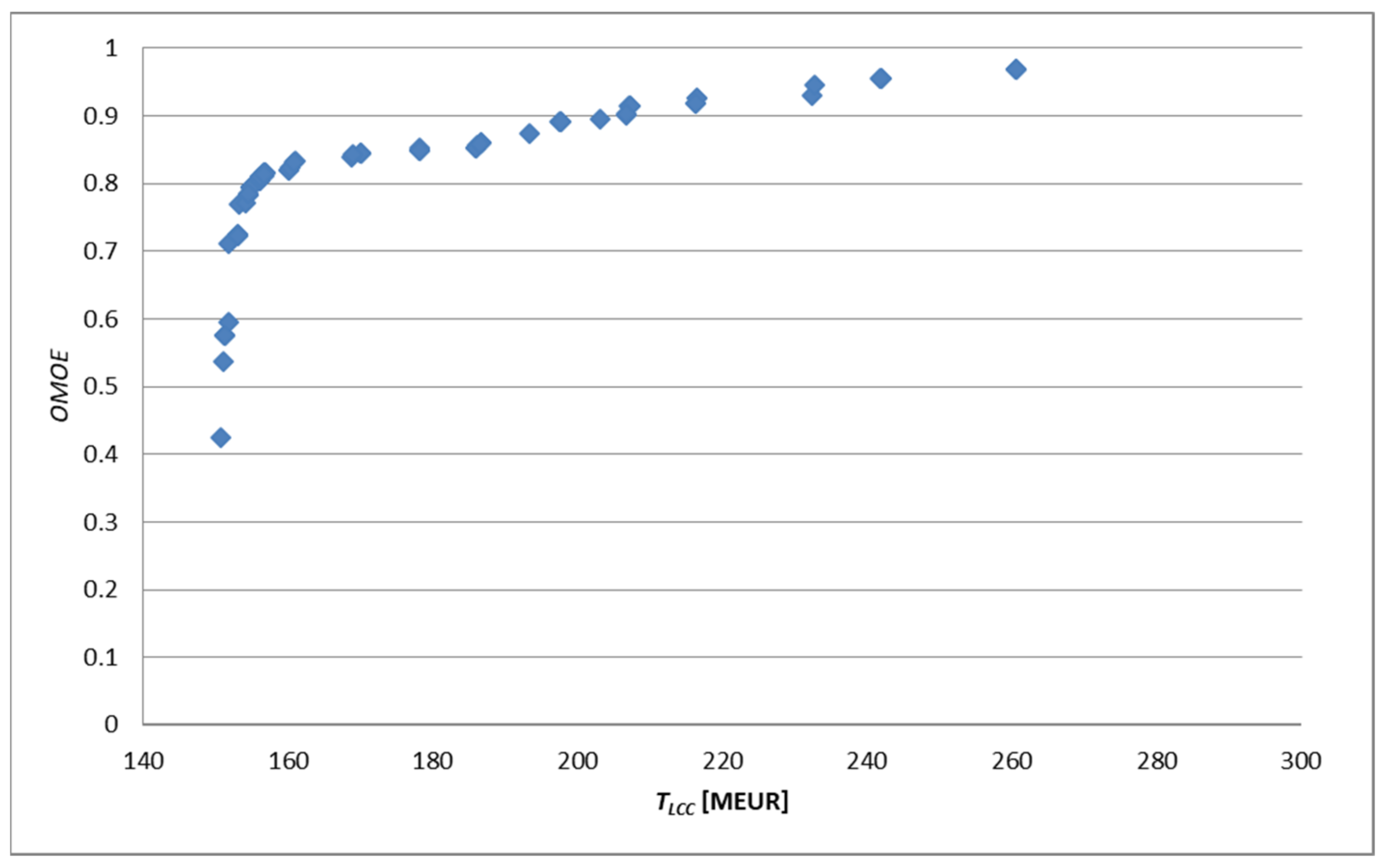
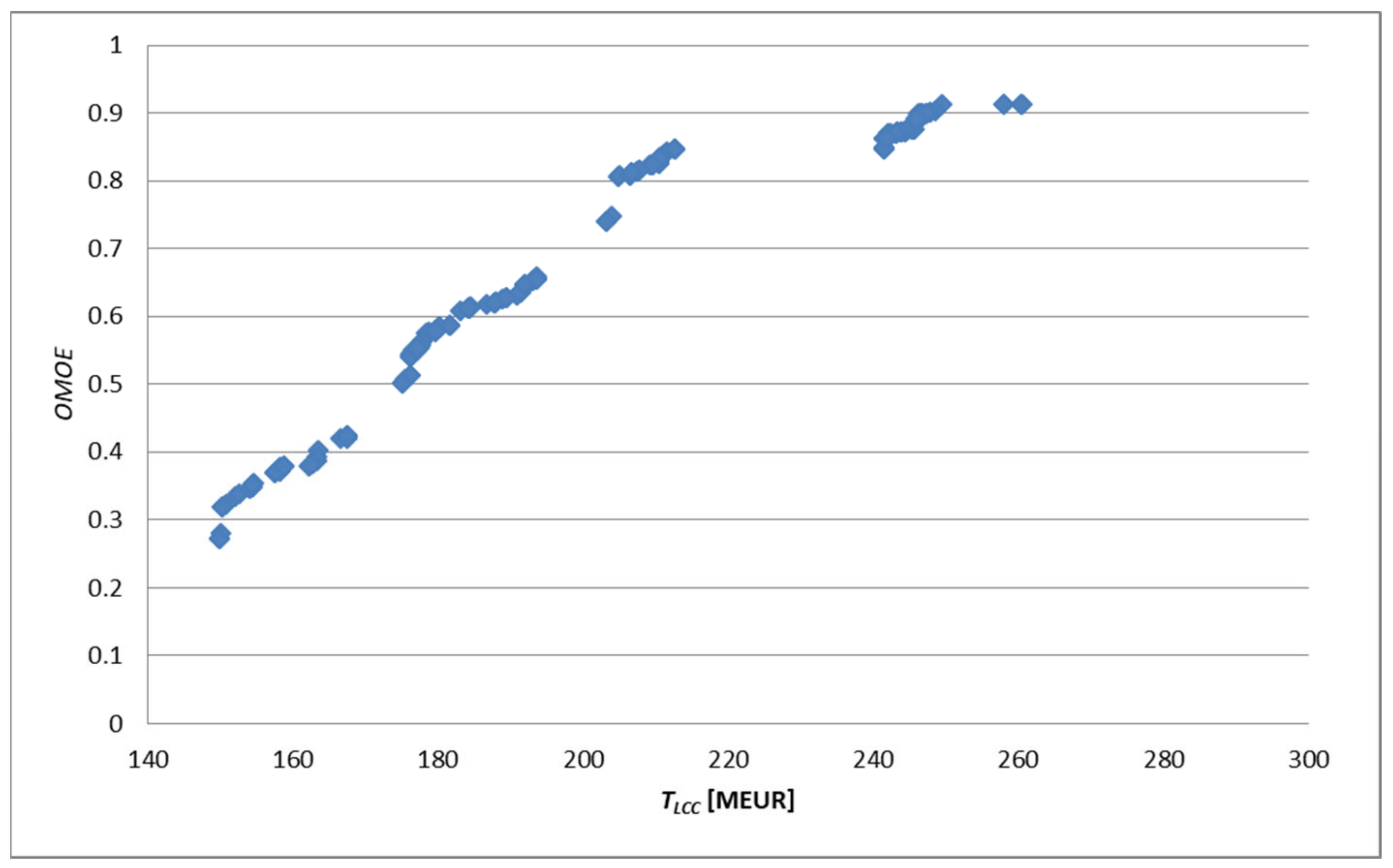
| Preferred Solutions | OPV Standard | OPV as a Combat Ship |
|---|---|---|
| LWL [m] | 82.30 | 82.30 |
| B [m] | 9.03 | 8.37 |
| T [m] | 3.01 | 2.79 |
| HT10 [m] | 8.48 | 7.79 |
| CP [-] | 0.60 | 0.63 |
| CB [-] | 0.49 | 0.51 |
| CM [-] | 0.81 | 0.80 |
| CWP [-] | 0.78 | 0.81 |
| DP [m] | 2.71 | 2.51 |
| PPAT [kW] | 4554.0 | 4554.0 |
| PMCR [kW] | 9108.0 | 9108.00 |
| MCS [kn] | 19.92 | 20.13 |
| ES [kn] | 16.71 | 16.95 |
| UMAX [kn] | 20.31 | 20.51 |
| WLS [t] | 914.0 | 803.0 |
| WT [t] | 1124.0 | 1007.0 |
| GM [m] | 2.71 | 2.51 |
| CGMB [-] | 0.3 | 0.3 |
| OMOE [-] | 0.8447 | 0.4243 |
| TLCC [MEUR] | 170.02 | 167.55 |
| OMAT | 1 | 1 |
| OPSNS | 6 | 6 |
| OPENS | 2 | 2 |
| OANS | 2 | 1 |
| OBGNS | 1 | 1 |
| OASMS | 1 | 1 |
| ORHIB | 2 | 2 |
| OAAS | 0 | 0 |
| ORS | 1 | 1 |
| OIRS | 1 | 1 |
| ONBC | 1 | 1 |
| OVNK | 2 | 0 |
| OHELI | 0 | 0 |
Disclaimer/Publisher’s Note: The statements, opinions and data contained in all publications are solely those of the individual author(s) and contributor(s) and not of MDPI and/or the editor(s). MDPI and/or the editor(s) disclaim responsibility for any injury to people or property resulting from any ideas, methods, instructions or products referred to in the content. |
© 2022 by the authors. Licensee MDPI, Basel, Switzerland. This article is an open access article distributed under the terms and conditions of the Creative Commons Attribution (CC BY) license (https://creativecommons.org/licenses/by/4.0/).
Share and Cite
Ljulj, A.; Slapničar, V.; Grubišić, I.; Mihanović, L. Concept Design of a Hybrid Offshore Patrol Vessel. J. Mar. Sci. Eng. 2023, 11, 12. https://doi.org/10.3390/jmse11010012
Ljulj A, Slapničar V, Grubišić I, Mihanović L. Concept Design of a Hybrid Offshore Patrol Vessel. Journal of Marine Science and Engineering. 2023; 11(1):12. https://doi.org/10.3390/jmse11010012
Chicago/Turabian StyleLjulj, Andrija, Vedran Slapničar, Izvor Grubišić, and Luka Mihanović. 2023. "Concept Design of a Hybrid Offshore Patrol Vessel" Journal of Marine Science and Engineering 11, no. 1: 12. https://doi.org/10.3390/jmse11010012
APA StyleLjulj, A., Slapničar, V., Grubišić, I., & Mihanović, L. (2023). Concept Design of a Hybrid Offshore Patrol Vessel. Journal of Marine Science and Engineering, 11(1), 12. https://doi.org/10.3390/jmse11010012