Abstract
In Underwater Sensor Networks (UWSNs), the energy sources of sensor nodes are limited and difficult to recharge and solar energy cannot be used in that environment. The power issue is one of the most significant constraints in underwater sensor networks and energy balancing is essential to prolong the network lifetime. The MAC/routing protocols that are used in other types of networks may not be suitable for UWSNs due to their unique characteristics. This paper aims to overcome the energy problem by developing a new MAC/routing protocol for UWSNs called the Energy-Efficient protocol for UWSNs (EE-UWSNs). It is based on five principles to save sensor energy and to prolong the lifetime of UWSNs. These principles are using finite levels of power, applying the multi-hops transmission, narrowing the scope of transmission, applying inactivation mode, and balancing energy consumption. Using the AUVNetSim simulator, which is a Python project developed by the Massachusetts Institute of Technology (MIT), the proposed EE-UWSNs protocol was compared with well-known protocols. Simulation results proved that the proposed protocol reduces the average energy consumption of sensors by up to 68.49% compared with the other protocols. Furthermore, the average number of collisions and the end-to-end delay are enhanced.
1. Introduction
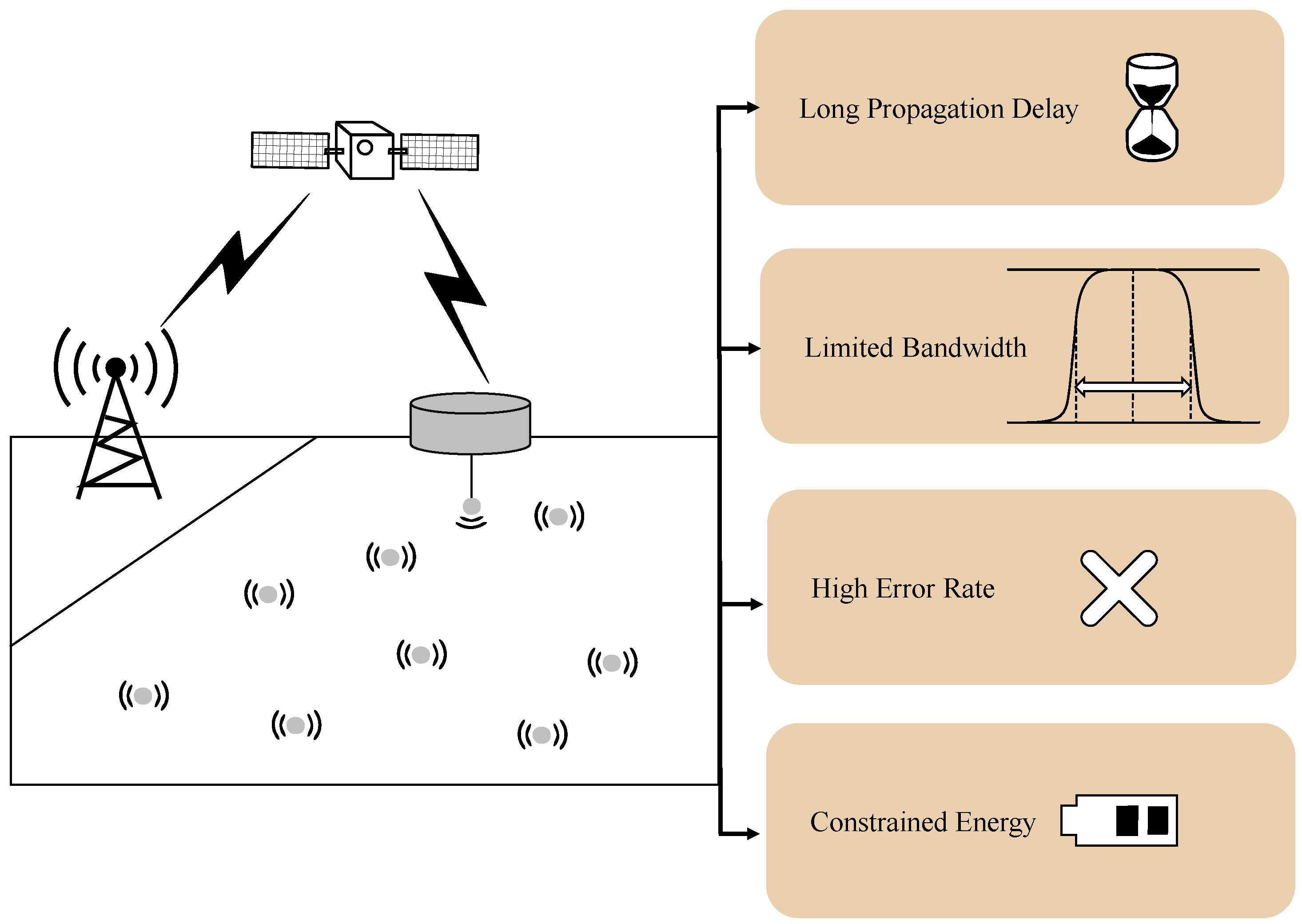
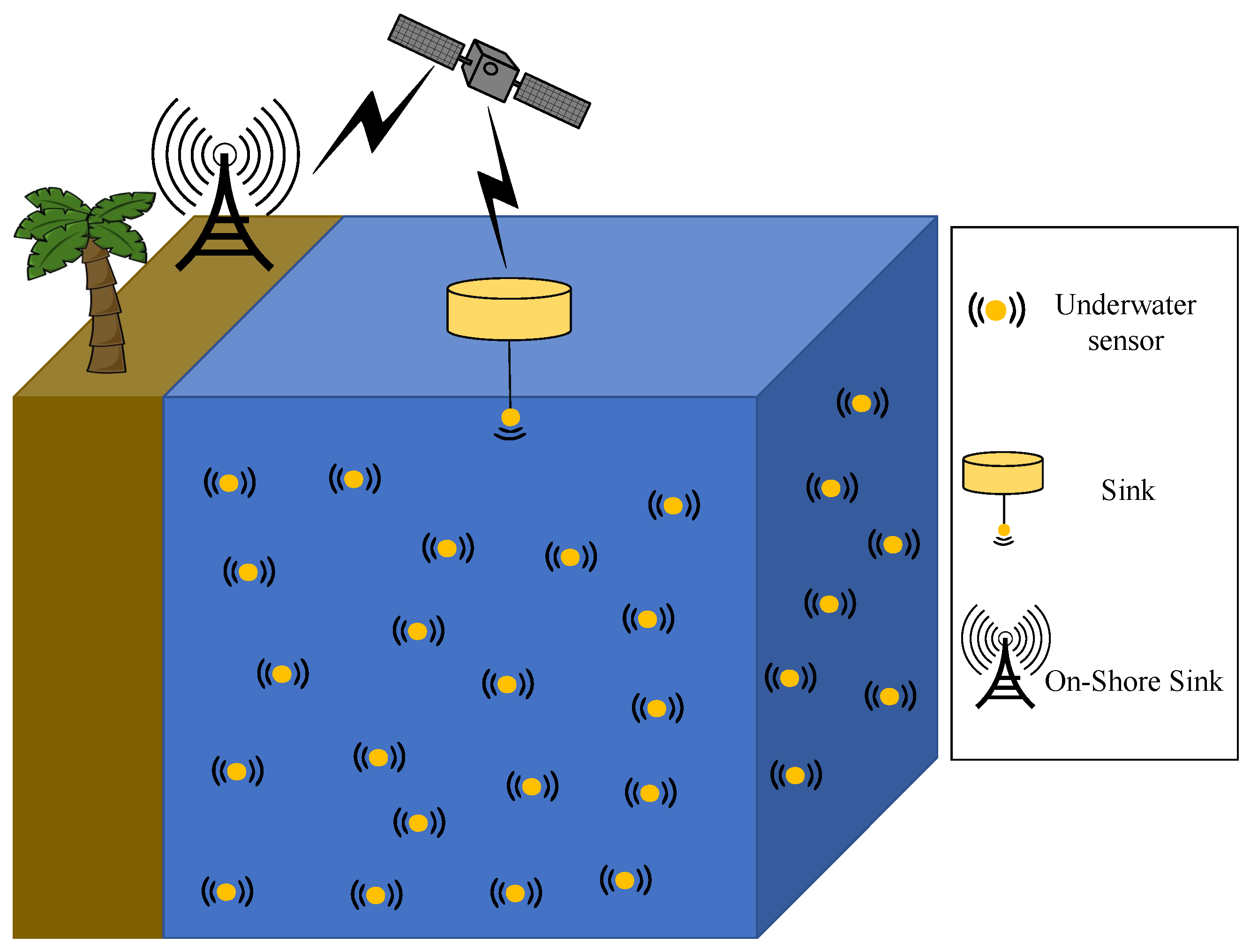
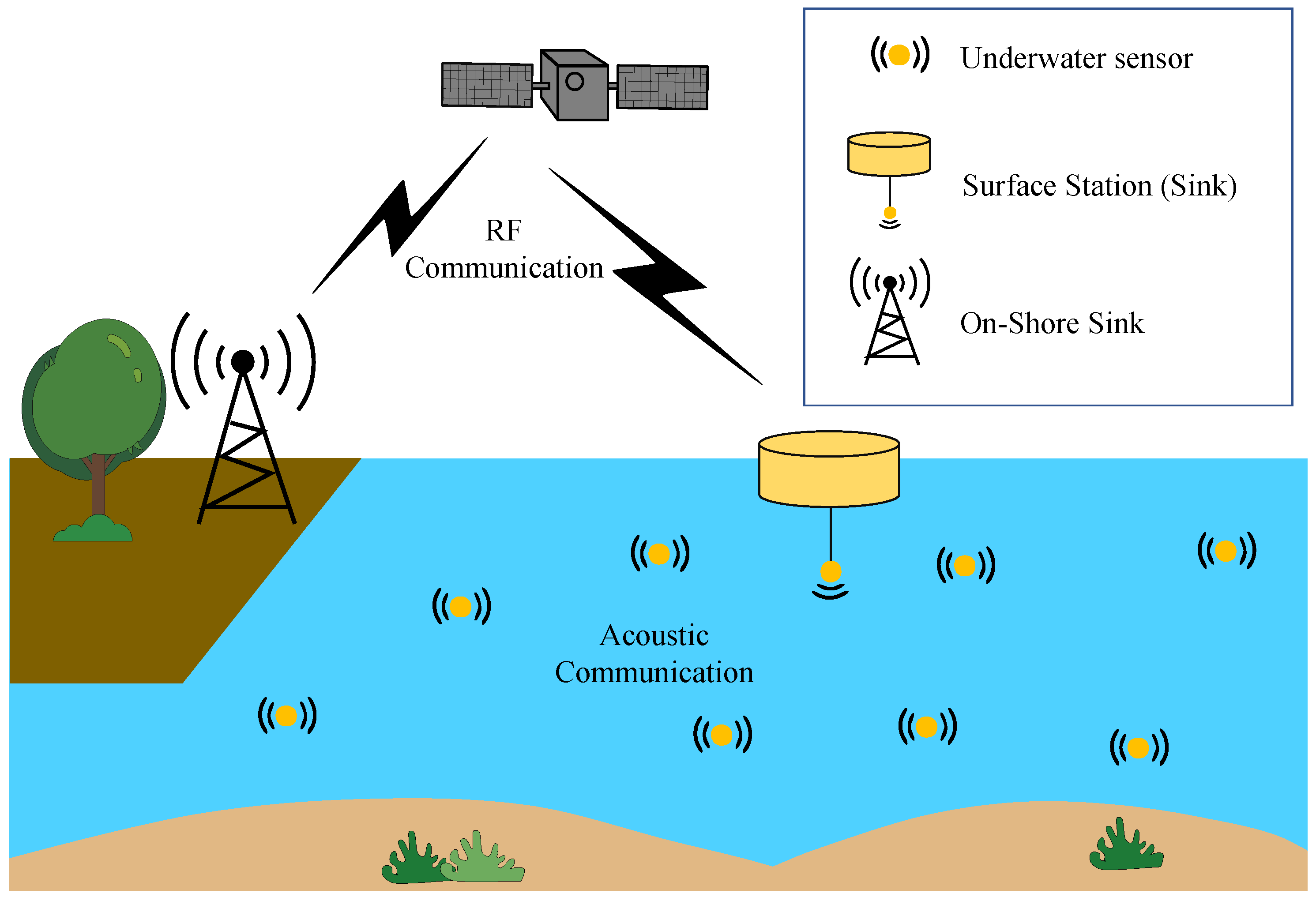
The water of the oceans, seas, rivers, and lakes cover about seventy percent of the earth’s surface [1]. Only less than ten percent of the oceans have been explored, but many areas have not yet been investigated [2]. Recently, ocean exploration is getting more and more common. However, the traditional methods for investigating oceans suffer from many limitations, such as high cost, long delay to receive the outcome, and the difficulty of human existence in such an environment [3]. Therefore, underwater wireless sensor networks are considered an important alternative for studying and discovering the character of the oceans [4]. UWSNs are an important part of the Internet of Things (IoT) technology [5], which is an emerging application of the fifth-generation (5G) technology [6,7,8]. A UWSN is a wireless communication network that consists of a number of underwater sensor nodes, a surface station (sink), an on-shore sink, and a satellite (Figure 1). Acoustic communications are used in the underwater environment because they are characterized by their greater efficiency and reliability compared to other communication methods [9]. Nowadays, UWSNs are receiving more attention because of their useful applications [10].
Figure 1.
The architecture of an underwater sensor network.
There are challenges encountered by underwater sensor networks, coming from the nature of underwater conditions and the utilization of acoustic links. UWSNs are characterized by high propagation latency, limited available bandwidth, high error rate, and constrained energy, as shown in Figure 2.
Figure 2.
The challenges faced by underwater sensor networks.
- Long Propagation Delay: In the water medium, the velocity of sound waves is around 1500 m/s. It is much slower than radio waves, which travel at the velocity of light ( m/s). Furthermore, several features of the water environment, like depth, temperature, and salinity, have an impact on the speed at which the sound signal spreads. The slow propagation of acoustic waves leads to quite a long propagation latency, even over a limited range [11].
- Limited Bandwidth: In comparison with radio networks, the actual bandwidth of the underwater acoustic medium is very low. It is extremely restricted because most acoustic systems work at under 30 kHz. In addition, the available bandwidth of sound media depends on both transmitting range and frequency. Because the bandwidth of the channel is limited, the data transmission rate will be low, usually lower than 10 kbps [12,13].
- High Error Rate: The sound link quality is impacted by many things, such as noise, signal attenuation, and multiple paths. The sound channel suffers from several sources of noise (both man-made and ambient). Man-made noise may result from shipping actions and machinery tasks. On the other hand, ambient noise originates from hydrodynamics (e.g., wave movement and storms on the water surface) or biological sources (e.g., seismic risk, the swimming behavior of fishes). If there is no noise, there is still transmission loss caused by the attenuation of the signal. This signal attenuation is a result of the absorption of sound energy and grows with distance and frequency. Multipath propagation mostly originates from reflections from the water surface and the water bottom. In addition, it may be caused by various refracted rays. All these factors give rise to high rates of error in data transmission [14,15].
- Constrained Energy: One of the major challenges when deploying underwater sensor networks is the limitation of energy resources of the sensor nodes. The reason is that they are powered by batteries. The sensor nodes expend their power when they receive, transmit, process, and overhear information. In underwater environments, it is difficult to replace or recharge the batteries of the sensors [16,17]. Moreover, other power sources, such as solar energy, are not available in the ocean depths. The unbalanced consumption of power will cause an early shortage of energy. This will affect the whole network and will impair the network’s integrity. As a result, balanced power consumption for each sensor node becomes essential in underwater circumstances and can prolong the lifetime of the network. The consumption of power in a way that results in the exhaustion of all sensors at the same time is desirable so that the sensors’ batteries can be replaced together [18].
Minimization of energy consumption is considered one of the most important issues to be solved [19]. Once an underwater sensor network is deployed, it is usually hard to change the power source (batteries) after it has been spent. Furthermore, alternative power sources, like solar energy, are not available in the dark depths of the seas [20,21]. In order to make an underwater sensor network as efficient as possible, Medium Access Control (MAC) and routing protocols should be designed in a smart way, based on the network topology, in order to overcome this issue and create an optimal system [12,19]. MAC protocols are classified into deterministic and non-deterministic methods. Examples of deterministic methods are Time Division Multiple Access (TDMA), Frequency-Division Multiple Access (FDMA), and Code Division Multiple Access (CDMA) [22]. Non-deterministic protocols include random access methods (e.g., ALOHA, slotted ALOHA, and Carrier Sense Multiple Access (CSMA)) and Collision Avoidance (CA) approaches (e.g., CSMA/CA) [23]. In the CSMA/CA protocol, the node waits before sending data or acknowledgment (ACK) packets, in order to avoid collisions [24]. To solve the hidden node problem, the CSMA/CA technique can be enhanced to perform Request to Send (RTS)/Clear to Send (CTS) handshaking [25]. Designing an energy-efficient MAC protocol should take into consideration the issues that cause waste in sensor energy, i.e., overheads, collisions, idle listening, and overhearing.
The main contribution of this paper is proposing an energy-efficient technique for underwater sensor networks, named EE-UWSNs, that overcomes the limitations of recent related works. It is based on five principles to save sensor energy and to prolong the lifetime of UWSNs.
The rest of this paper is organized as follows. Section 2 presents recent related MAC and routing protocols that are designed for UWSNs. The proposed EE-UWSNs protocol is explained in detail in Section 3. Section 4 presents the performance analysis of the proposed EE-UWSNs protocol in detail. Finally, Section 5 gives the conclusion of the paper and highlights suggested future work.
2. Related Works
Recent works on underwater sensor networks have indicated the importance of power efficiency. Some works focused on MAC protocols while others focused on routing protocols. A good protocol should take MAC and routing protocols into account because power consumption is influenced by both of them.
2.1. Energy-Aware MAC Protocols for UWSNs
The Distance Aware Collision Avoidance Protocol (DACAP) was proposed by Peleato and Stojanovic [26]. It was designed specifically for underwater acoustic networks. By using the DACAP algorithm, transmission power is saved by keeping packets away from collisions, using extra waiting periods. In addition, the protocol is based on reducing the handshaking period. Simulation results prove that the DACAP enhances the achievable throughput because it does not wait for the beginning of the next slot to perform transmissions.
The Hybrid Sender and Receiver (HSR)-initiated protocol was proposed by Lee and Cho in [27]. HSR protocols are based on exchanging handshakes by sending control packets between multiple nodes. HSR can overcome the problem of spatial unfairness among nodes, as well as minimize the signaling overhead.
Alfouzan et al. [28] proposed a reservation-based protocol known as the Efficient Depth-based MAC protocol (ED-MAC). It aims to avoid collisions and retransmissions by applying a duty cycle mechanism that assigns time slots to each sensor in UWSN in a distributed way. The main goal of the ED-MAC is to save the energy of sensors by putting them into sleep mode at some time slots. Simulation results demonstrate that the ED-MAC has superiority over contention-based MAC protocols in terms of energy consumption, throughput, packet delivery ratio, and fairness.
In [29], Deng et al. introduced a MAC protocol known as Data-Collection-Oriented MAC (DCO-MAC) for underwater acoustic sensor networks. By using the DCO-MAC algorithm, UWSN is split into two types of sub-networks, based on traffic load. The sub-network with light traffic load uses a contention-based MAC protocol, while the sub-network that has heavy traffic load applies a reservation-based MAC protocol. Simulation results and theoretical analysis prove that the proposed DCO-MAC algorithm has superiority over the other protocols in terms of energy overhead, end-to-end packet delay, the throughput of the network, and fairness.
Ammar et al. proposed a MAC protocol in [30] that aims to decrease the energy consumption of sensors. This goal is achieved by splitting a packet into several sub-packets and each sub-packet is transmitted to the next forwarding sensor. In addition, the sensor isolation issue is solved by depending on the principle of depth adjustment. Numerical results prove that the proposed strategy achieves significant enhancements in terms of energy-saving and packet delivery ratio.
A reservation-based MAC protocol was proposed by Roy et al. in [31]. It is called the Ordered Contention MAC (OCMAC) algorithm. It is designed for applications that monitor deepwater floors and require low data rates and a sparse topology of UWSN. The main goal of OCMAC is to avoid collisions by scheduling RTS frames. The analysis results show that the proposed protocol saves energy and provides acceptable reliability and throughput.
In [32], Liu et al. proposed a MAC protocol named Concurrent Scheduling based on Spatial-Temporal Uncertainty MAC (CSSTU-MAC). Concurrent transmission and collision avoidance are performed by the CSSTU-MAC protocol based on temporal-spatial uncertainty and long propagation latency properties of UWSNs. Simulation results demonstrate that the CSSTU-MAC algorithm enhances the mean network throughput and energy consumption compared with other MAC protocols.
2.2. Energy-Aware Routing Protocols for UWSNs
The Focused Beam Routing (FBR) protocol was proposed by Jornet et al. in [33]. The FBR protocol is considered a position-based routing protocol, where each node must know its location and the position of its final destination, but the intermediate nodes’ positions are not needed. The protocol determines the transmission area using the cone angle concept. Therefore, the reduction of unnecessary transmission results in minimizing power utilization. In addition, the FBR protocol uses a finite set of power levels in transmission. However, the FBR protocol may have some difficulties caused by water movements. The FBR protocol can be coupled with any MAC protocol. In general, the protocol can achieve high performance and high power efficiency with less delay. Simulation results indicate that the performance of the FBR protocol, which is measured in energy per bit consumption and average packet end-to-end delay, is near to the ideal case [33,34].
In [35], Domingo, M. and Prior, R. introduced a routing algorithm called Distributed Underwater Clustering Scheme (DUCS). It aims to reduce the exchanging of proactive routing messages and to decrease data loss. The simulation result demonstrates that the DUCS scheme enhances the packet delivery ratio and the achievable throughput and reduces the network overhead.
The Reliable Energy-efficient Routing Protocol based on Physical distance and Residual energy (R-ERP2R) was proposed by Wahid et al. in [36]. The main idea of this protocol is to balance energy consumption between nodes to prolong the UWSN’s lifetime. This is achieved by taking the physical distance and residual energy into account during the packet forwarding process. The simulation results show that the R-ERP2R protocol works well in UWSNs and improves the network lifetime, end-to-end delay, and delivery ratio. However, the analytical study in [37] found that when the number of sensors increases, the R-ERP2R would not achieve much improvement in terms of energy consumption.
Ghoreyshi et al. proposed a routing protocol called Opportunistic Void Avoidance Routing (OVAR) in [38]. The main goal of the OVAR protocol is to minimize the number of dropped packets by bypassing void areas. It has three phases: constructing an adjacency graph; adjusting the number of forwarding nodes, and calculating packet holding time. Simulation results show that the proposed OVAR protocol outperforms other protocols in terms of energy-saving, end-to-end delay, packet delivery ratio, and hop counts.
In [39], Jin et al. proposed a routing protocol called Q-learning-based Delay-Aware Routing (QDAR). The QDAR protocol has five main phases: (1) data ready, (2) routing decision, (3) interest, (4) packet forwarding, and (5) acknowledgment. In the data ready phase, information is collected and a DATA_READY packet is broadcast if a source node has data to transmit to the sink. In the routing decision phase, the sink performs a routing decision based on the received data. A path based on the QDAR algorithm is constructed in the interest phase and an INTEREST packet is sent to the source node. In the acknowledgment phase, the sink node transmits the ACK packet when it successfully receives the data. Simulation results verify that the proposed protocol can decrease the end-to-end delay by up to 25% compared with other methods.
Wang et al. [40] introduced a network coding routing protocol (NCRP) for UWSNs. It efficiently forwards data packets to sinks using network coding and cross-layer design. The NCRP fully utilizes multicast transmission and decodes encoded packets received from various potential nodes across the whole network. The NCRP performs two processes: initial routing construction and route maintenance. The transmission power is optimized to lengthen the network’s lifetime. A real-time routing maintenance protocol is created to update the route when inefficient relay nodes are detected. Simulation results show that the proposed NCRP enhances the network performance in terms of energy consumption, end-to-end delay, and the ratio of packet delivery, in comparison to other routing protocols.
A Distributed Energy-Efficient and Balanced (DEEB) routing algorithm was proposed by Lie et al. in [41]. It was designed for underwater wireless optical sensor networks. It is suitable for static and dynamic UWSNs. The protocol relies on setting an energy threshold so that the batteries of sensors in a network are not drained. The simulation result shows that the DEEB algorithm outperforms the FBR and R-ERP2R algorithms in terms of energy consumption.
A protocol called Underwater Modified LEACH (UMOD-LEACH) was proposed by Alhazmi et al. in [2]. It is an improvement of the Low Energy Algorithm Adaptive Clustering Hierarchy (LEACH) protocol and is based on TDMA scheduling. It aims to reduce energy consumption by using the localization concept. Simulation results indicated that UMOD-LEACH surpassed the LEACH protocol in terms of energy consumption by more than 30%.
In [42], Zou, Z. et al. proposed a Cluster-Based Adaptive Routing (CBAR) algorithm for UWSNs. Packet formatting is designed to be suitable for cluster networks. The CBAR algorithm depends on updating dynamic routes and saving energy consumed in the routing process. Simulation results show that the CBAR algorithm outperforms the FBR algorithm and DUCS in terms of energy consumption and the ratio of data delivery.
In [43], Zhang and Cai developed an Energy-Efficient Probabilistic Depth Based Routing called EEPDBR for UWSNs. The proposed EEPDBR considers vertical depth, residual energy, and the number of neighbors when calculating the probability of forwarding. Simulation results demonstrate that the EEPDBR algorithm achieves better performance results than other protocols in terms of energy consumption, packet delivery ratio, and time.
Karim et al. proposed a routing protocol called Geographic and Cooperative Opportunistic Routing Protocol (GCORP) in [44]. Determining the set of relay forwarding nodes is performed based on a depth fitness factor. A weight calculation scheme is performed to find the best relay node. Simulation results demonstrate that the GCORP algorithm outperforms other routing protocols in terms of average energy consumption, end-to-end delay, packet delivery ratio, and the lifetime of UWSNs.
2.3. The Limitations of the Existing MAC/Routing Protocols
Based on the works presented in this section in the field of routing and MAC protocols for underwater sensor networks, we found the following limitations:
- The existing protocols focus on either MAC or routing layer. The design of an energy-efficient protocol for UWSNs should consider both MAC and routing protocols, as they complement each other.
- Most of the recent proposed energy-aware protocols are based on only one principle to save sensor energy, which is usually putting some sensors in sleep mode. However, there are several principles that can be applied to save energy, such as providing several levels of energy according to the distances between the source sensor and the next one and narrowing the field of a sensor operation to a specific region.
- Most of the works do not consider distributing the traffic loads between sensors in UWSNs. Therefore, there is the problem of draining the energy of some sensors more than others, creating the issue of early sensor death.
3. The Proposed EE-UWSNs Protocol
In this section, the proposed EE-UWSNs protocol that is designed for UWSNs is discussed in detail.
3.1. The Main Principles of Energy Saving
The purpose of the proposed EE-UWSNs protocol is to save energy and balance the consumption of all nodes in order to prolong the lifetime of underwater sensor networks. The main idea of the proposed protocol is to use several principles in order to save energy. These principles are:
- Using finite levels of power, from minimum power level (P1) to maximum power level (PN). The objective of the use of several levels of power is to transmit data to nearby nodes with less energy than farther nodes. This leads to energy saving.
- Applying the multi-hops transmission method when sending data to a surface sink. Several references have proved that multi-hop transmission saves power. Using multi-hops leads to reducing the distance between the transmitter and the receiver. Thus, if the handshake is used, short distances lead to reducing the duration of RTS/CTS exchange.
- Narrowing the scope of transmission to a specific area by using a cone angle. When nodes are absent in this area, the angle can be shifted. The idea of narrowing the transmission scope leads to minimizing the number of nodes responsible for forwarding packets. Therefore, this leads to reducing collisions and thus decreasing the energy consumed. In addition, a shifting angle is used in order to avoid loss of data in case of the absence of nodes in a specific cone angle.
- Using the principle of inactivation, where some sensor nodes in the underwater sensor network become inactive. During the period of activation, nodes are powered off (i.e., do not send nor receive). The choosing of inactive nodes is based on the distance to the surface sink, as well as the energy consumption.
- Balancing energy consumption in order to avoid draining the energy of some nodes. This can be accomplished by taking into account the issue of the energy consumed when choosing relay nodes and inactive nodes. The objective of balancing the energy consumption is to prolong the life of the network by avoiding the early death of some nodes.
3.2. The Mechanism of the EE-UWSNs Protocol
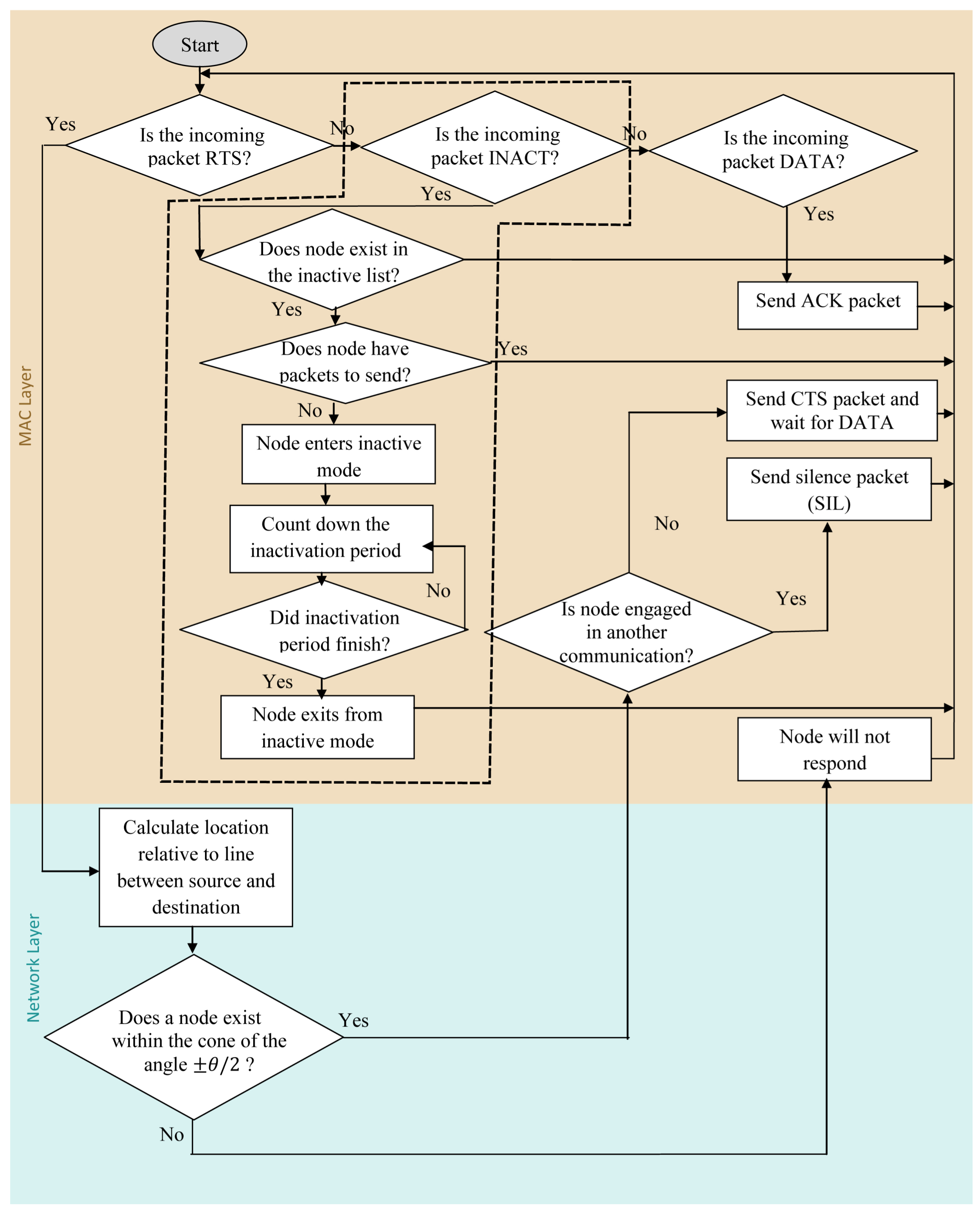
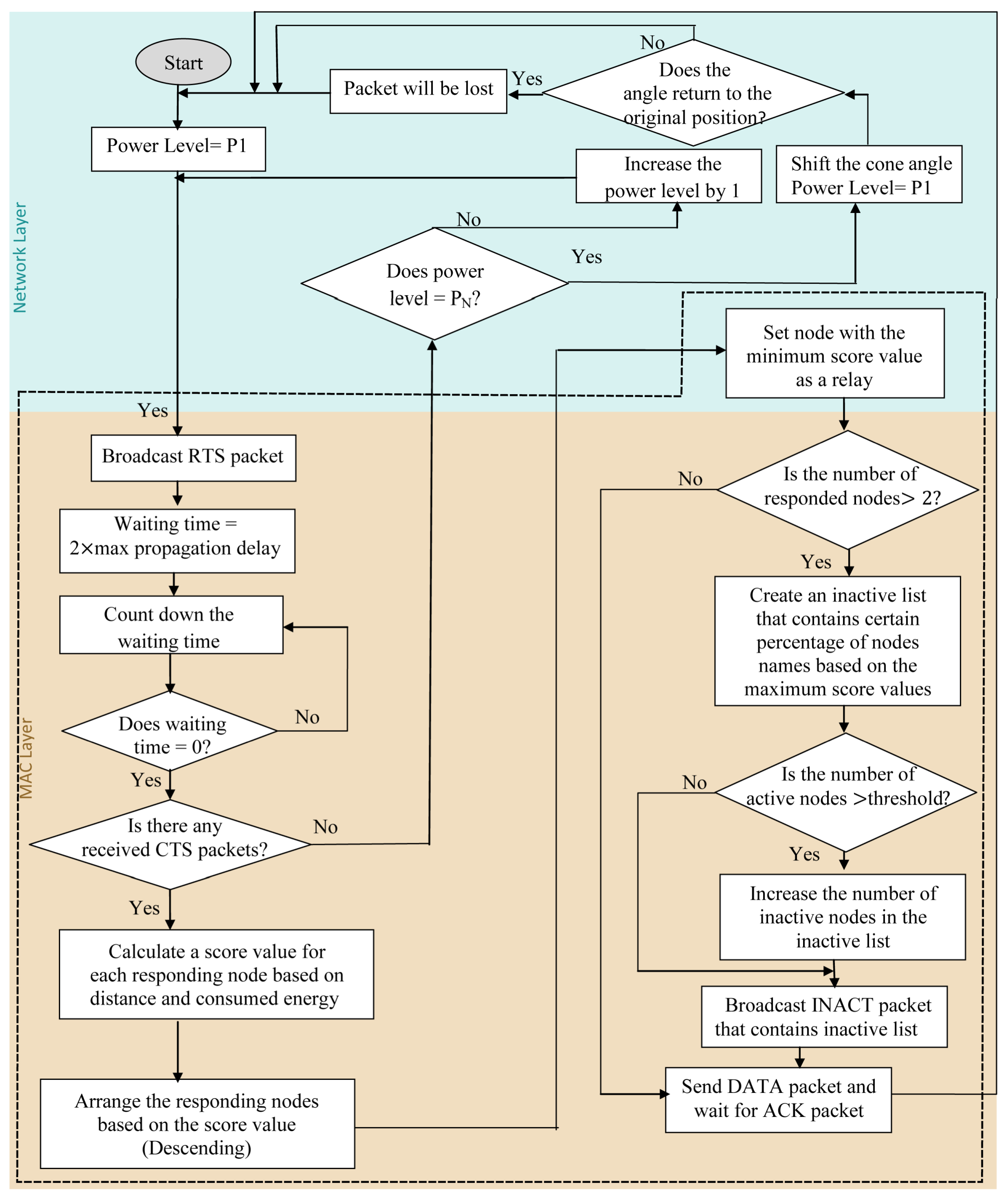
Figure 3 and Figure 4 show the flowcharts that display the proposed EE-UWSNs protocol from the sender side and receiver side, respectively. Dashed boxes illustrate the contribution of the proposed protocol at the level of MAC and routing layers.
Figure 3.
Flow chart of the proposed protocol from sender side.
Figure 4.
Flow chart of the proposed protocol from receiver side.
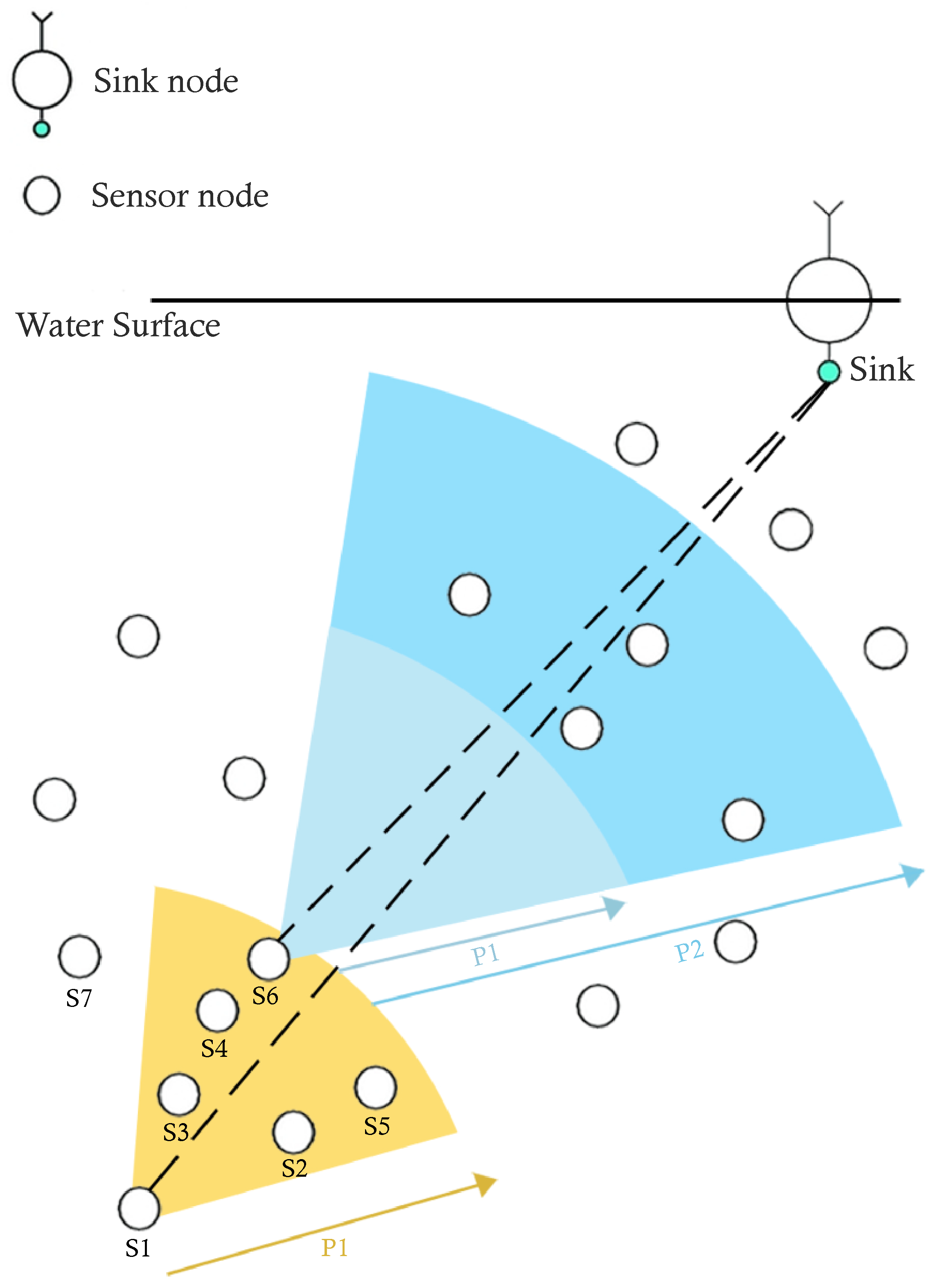
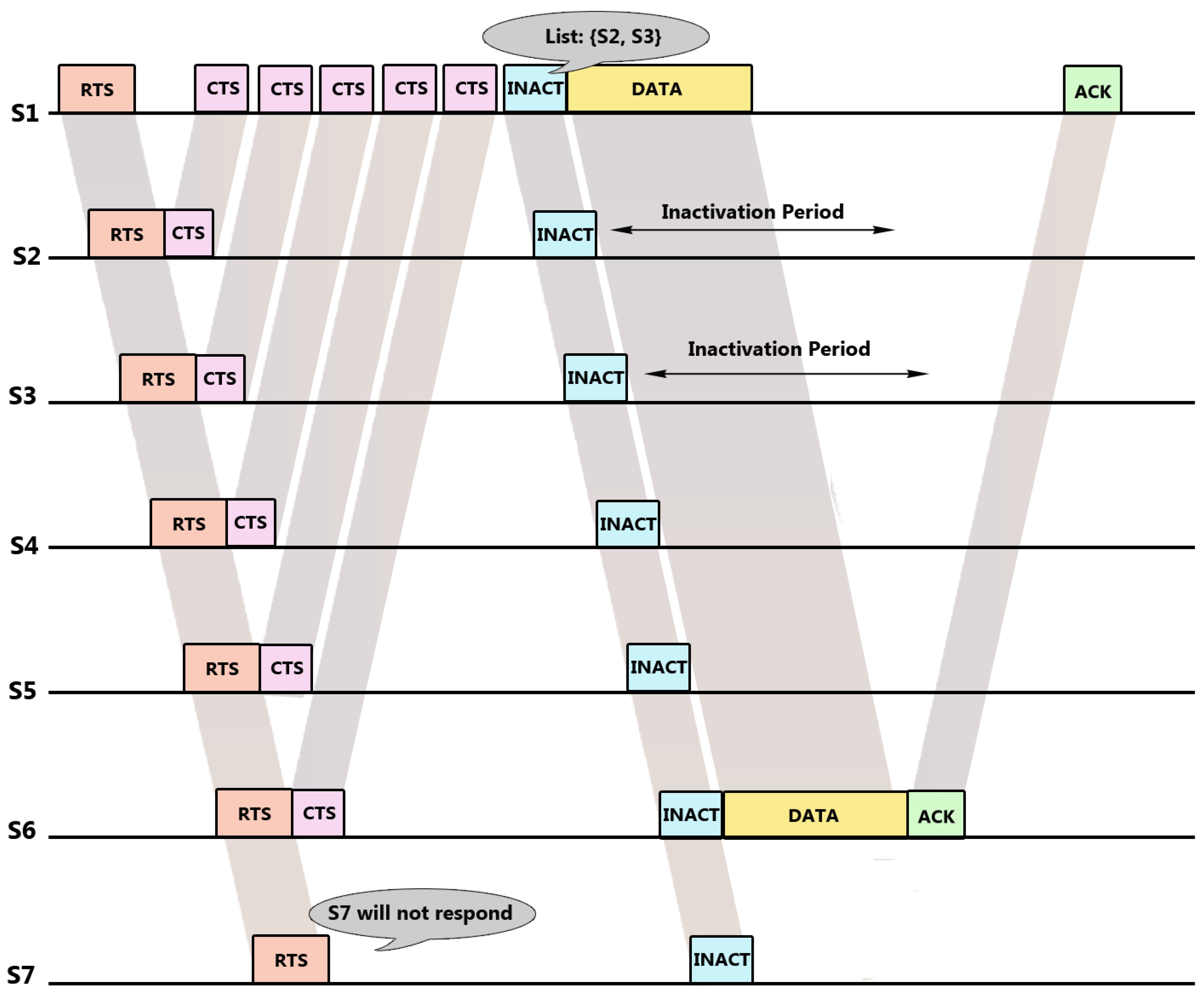
To explain the proposed protocol, an example is given in this section. Figure 5 displays a network of underwater sensor nodes deployed randomly at different depths. There is a source sensor node called S1 and a set of relay sensors including S2–S7. S3, S4, S5, S6, and S7. Sensor S7 is located outside the cone of S1. In addition, there is one sink at the water surface. In the beginning, the transmission is done at the minimum power level (P1). The power level can be increased if there are no nodes in a particular area. There is a specific number of power levels (i.e., from P1 to PN). Every power level has a transmission radius. Sensors located inside this radius will respond. The proposed protocol limits the transmission, using a cone angle. Let us draw an imaginary line between the source node (S1) and the sink. The cone of angle originates from the sender toward the sink. If sensor node S1 needs to send data to the surface sink, it will transmit an RTS packet to its neighbors, as shown in Figure 6. The RTS packet is a small control packet that includes the location of the source node (S1) and the desired destination (sink). When a node receives S1’s multicast RTS, it needs to decide if it can be a relay node or not. This is accomplished by determining its position with respect to the line between S1 and the sink. If a node is placed inside a cone of the angle, it will reply with a CTS packet that contains its location, sink location, and the value of consumed energy. The consumed energy refers to the summation of energy consumed in transmissions (tx-energy) and in receptions (rx-energy). If a node is located outside the cone, it will not reply (S7 in this example). There is an assumption that the sink location is known for every node in a network. In this example, there are five nodes inside the transmission cone that can be reached at the power level P1, which are S2-S6. Therefore, these nodes will reply with CTS packets. After transmitting multiple CTS packets back to the sender, it selects one node as a candidate node based on the score value, which is calculated based on the values included in the CTS packets, as follows:
where and are the distance between a node i and the sink and the maximum distance to the sink, respectively. is the energy consumption of a node i and is the maximum energy consumption. The sender selects the node that has the lowest score value to be a candidate. If more than two nodes have responded, the sender selects a set of them (e.g., half of them), that have high score values, to be in inactive mode. This is accomplished by transmitting an inactivation packet (INACT) that contains a list called “inactive list”. The inactive list contains the names of nodes that will be entering inactive mode. The length of the INACT packet depends on the number of nodes in the list.
where N and are the total number of nodes and the number of nodes in the inactive list, respectively. If the number of active nodes exceeds a specific threshold (e.g., seven nodes), the excess number of active nodes will be added to the inactive list based on the maximum score value.
Figure 5.
Representation of the routing process based on the proposed EE-UWSNs protocol.
Figure 6.
Timeline indicates the exchanging of packets.
In the example, it is assumed that the descending order of the responding nodes, based on score values, is as follows: S3, S2, S5, S4, S6. Node S6 has the lowest score value, so it will be selected as a relay node. Suppose that the required proportion of inactive nodes is 50% and the maximum number of active nodes (i.e., active node threshold) is seven. Therefore, the half of the responding nodes (i.e., two nodes) that have the highest score value will be in the inactivation list (S3 and S2 in the example). Note that the number of active nodes is three (S4, S5, and S6), which does not exceed the active nodes threshold.
When a node receives the INACT packet, it checks if its name is on the inactivate list or not. If so, it enters the inactivation mode for a specific period, only if the outgoing packet queue is empty. There is an assumption that the inactivation period is known already for every node in a network. During that time, the node is powered off. In other words, it does not send, receive or generate packets.
After transmitting the INACT packet, the sender transmits data to the selected relay node and awaits acknowledgment from it. After receiving the data packet successfully, a relay node (S6) responds with an ACK packet and starts the same process discussed previously, but as a forwarder. It will search for the next relay node in the direction of the sink. If it cannot find nodes inside the transmission cone that can be reached at the lowest power level P1, it will increase the transmission power level to P2, and send a new RTS. When the next relay has been selected, the process continues until the destination is reached.
Generally, the power level will be increased until a node reaches the next relay, or until all power levels have been tried. If the node is unable to reach any relay node at the maximum power level, PN, it will shift its cone and begin searching for relay nodes across the primary cone. The proposed protocol uses a special packet called the silence (SIL) packet. A very small SIL packet is used in order to inform about other communication engagements. After sending a multicast RTS, the neighbor nodes may currently operate in another communication as relay nodes. To prevent the situation where relay nodes are placed in inactive mode, a node that overhears the RTS packet will transmit an SIL packet to the requesting node. When a silence packet is received by the requesting node, it will defer its transmission. In fact, an SIL packet has another benefit in terms of saving energy, which is that it prevents an increase in the transmission power level when there is a node but it is already engaged in another communication.
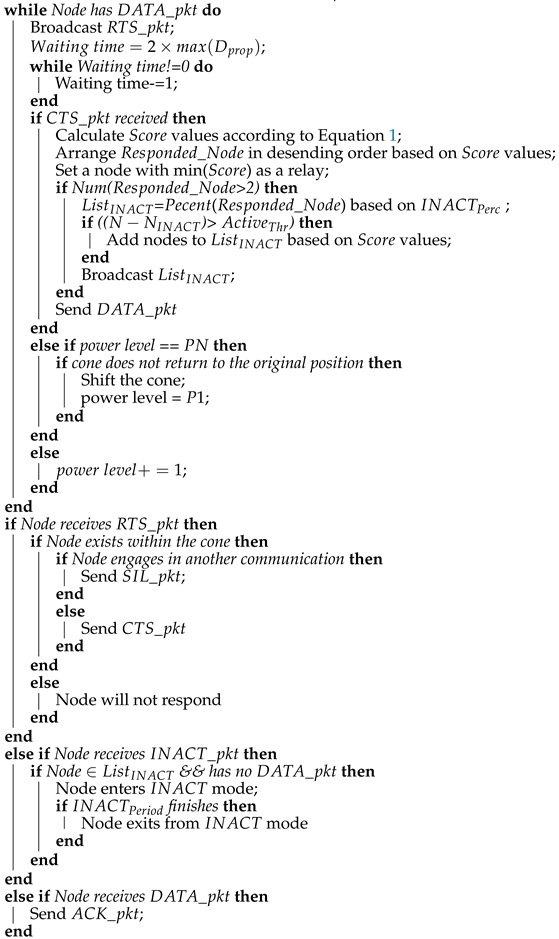
The pseudocode for the proposed EE-UWSNs protocol is shown in Algorithm 1.
| Algorithm 1: Pseudocode for the proposed EE-UWSNs protocol. |
Initialize power level; Set , , , , ; |
![]() |
4. Performance Analysis
4.1. Simulation Tool
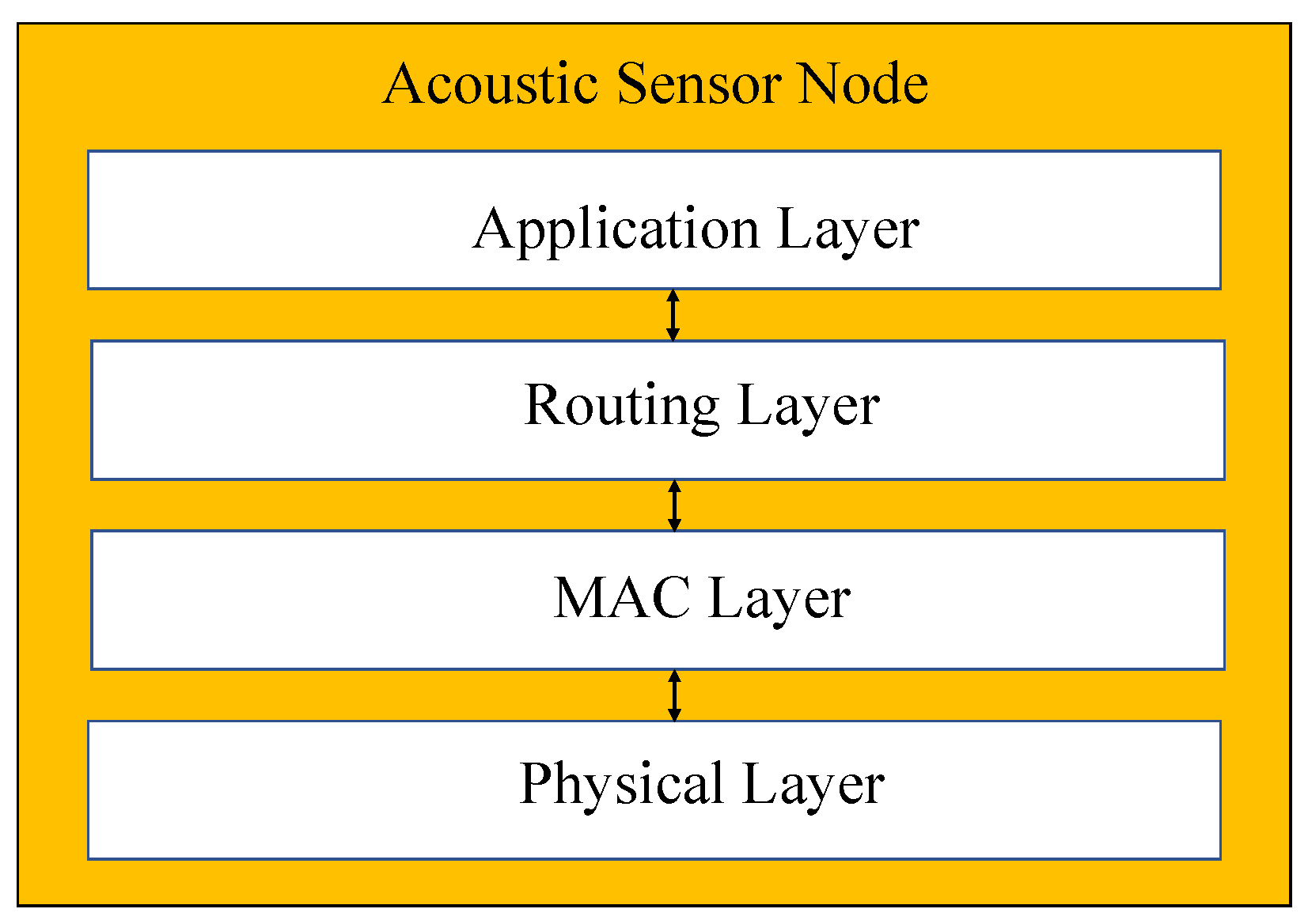
AUVNetSim is chosen to simulate the proposed MAC/routing protocol. AUVNetSim is a network simulator designed for underwater acoustic sensor networks of fixed and mobile nodes. It was developed by the Massachusetts Institute of Technology. It was written in standard Python and makes use of the SimPy discrete event simulation package. Python is a powerful easy-to-learn programming language. It has powerful high-level data structures (e.g., dictionary of data). AUVNetSim is distributed as open-source and it consists of many Python files (*.py) that call each other’s functions. The programming structure of the sensor node is represented in Figure 7. The main files of AUVNetSim are AcousticNode.py, ApplicationLayer.py, MAC.py, PhysicalLayer.py RoutingLayer.py, and Simulation.py. A developer who, for example, wants to include a new routing or MAC protocol, can simply do so by taking advantage of the existing structure. Furthermore, several functions are included in the downloadable package that can be used to illustrate the results and check at a glance the overall system performance.
Figure 7.
The programming structure of the sensor node.
4.2. Performance Metrics
The proposed EE-UWSNs protocol is evaluated in many Key Performance Indicators (KPIs), which are:
- Energy Consumption: It refers to the amount of sensor energy consumed to perform aggregation, transmission, and reception of data [45]. It is measured in units of joules (watts per second) [46].
- Number of Collisions: A collision occurs when more than one sensor node sends packets at the same time, resulting in packet corruption [47]. Therefore, the source node needs to retransmit the lost packet and this leads to energy wastage. There are several collision avoidance protocols that are based on using RTS and CTS packets prior to sending data [48]. Decreasing the number of collisions is an important issue to save the energy of sensors.
- End-to-End Delay: This is a function of several parameters, which includes the transmission delay, the propagation delay, the queuing delay, processing delay and the number of retransmissions [49]. The transmission delay is calculated by dividing the size of a packet by the transmission rate. The propagation delay can be estimated by dividing the distance between a sensor and a sink by the speed of sound (1500 m/s) [50]. Processing delay refers to the time taken by sensor nodes to process packets [51,52]. The queuing delay is the time that a packet spends waiting in a node’s queue until it departs [53].
- Jitter: Jitter of the packet delay is a critical factor in determining the quality of service in UWSNs. The jitter is defined as the variation in the packet delays [54].
4.3. Simulation Results
The proposed EE-UWSNs protocol is tested in a volume of 1 km3. A Poisson distribution for each transmitter was assumed. The sensors are deployed randomly in the 3D region at different depths following a uniform distribution. Figure 8 illustrates the system model and the simulation parameters are given in Table 1. The proposed EE-UWSNs protocol is compared with four other protocols, which are the DACAP/FBR and CSMA/CA/FBR, DACAP/DUCS, and DACAP/CBAR protocols.
Figure 8.
A 3D view of the system model.
Table 1.
The simulation parameters.
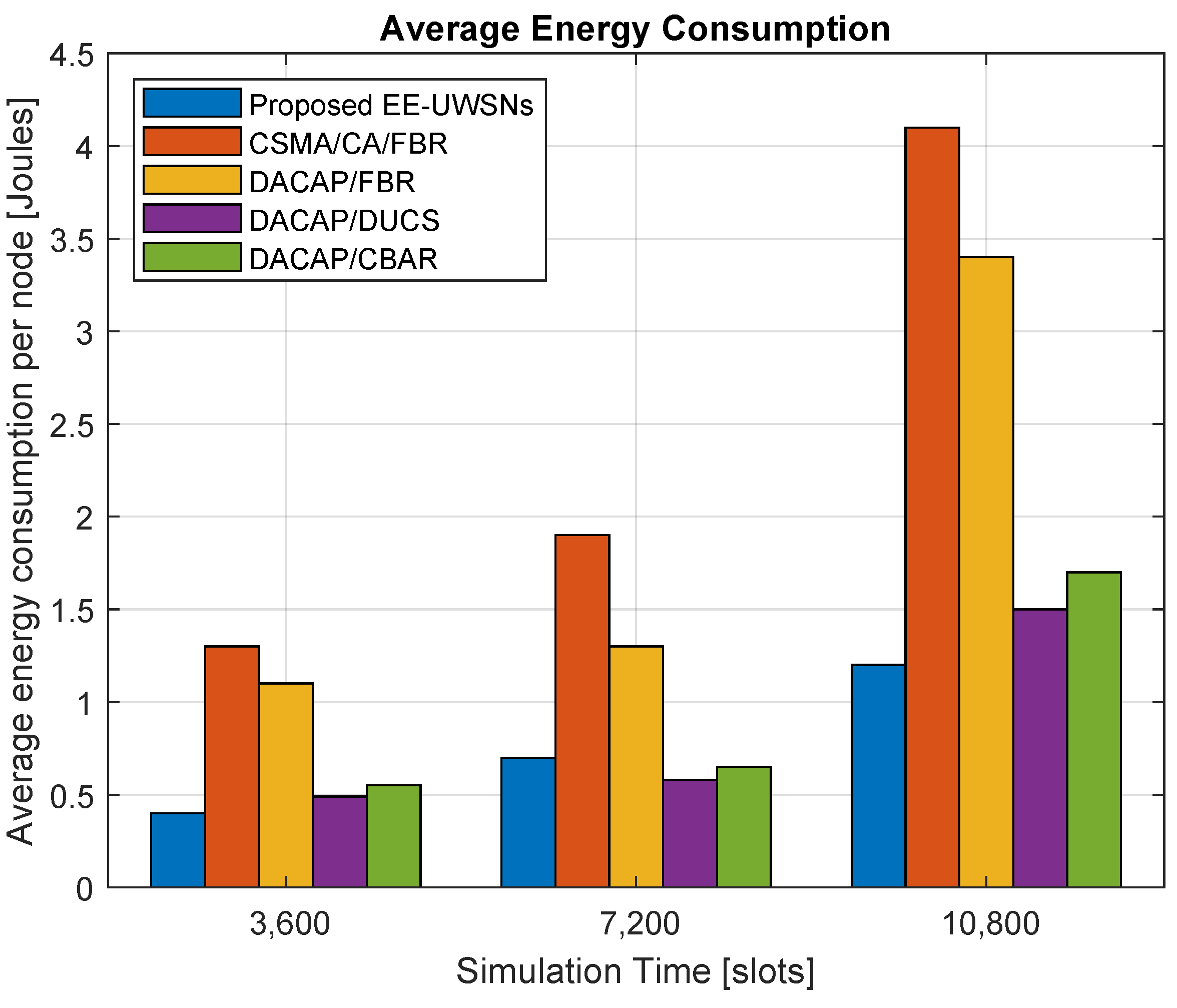
Figure 9 shows the average energy consumption per sensor node during different simulation durations. The longer the simulation, the higher the average energy consumption, due to the increase in the period of operation of the sensors. The proposed protocol outperforms other protocols in terms of the average energy consumption of the sensors. It outperforms CSMA/CA/FBR and DACAP/FBR by 68.49% and 60.34%, respectively. In addition, it has superiority over DACAP/DUCS by 10.51% and over DACAP/CBAR by 20.69%, despite their reliance on the principle of clustering to save energy. The reason behind the improvement is the introduction of the principle of inactivation. During the inactivation period, nodes will be powered-off and thus energy will be saved. Furthermore, the time at which the first sensor’s battery becomes empty is analyzed. It is assumed that the starting energy per node is 500 joules. Simulation results show that the first sensor exhausts its battery after 1999.14 time slots, 2259.01 time slots, 17,899.40 time slots, 15,863.25 time slots, and 20,001.57 time slots in the case of CSMA/CA/FBR, DACAP/FBR, DACAP/DUCS, DACAP/CBAR, and the EE-UWSNs proposed protocol, respectively. This result indicates that the proposed protocol prolongs the network lifetime as the energy-balancing scheme is adopted.
Figure 9.
Average energy consumption per node.
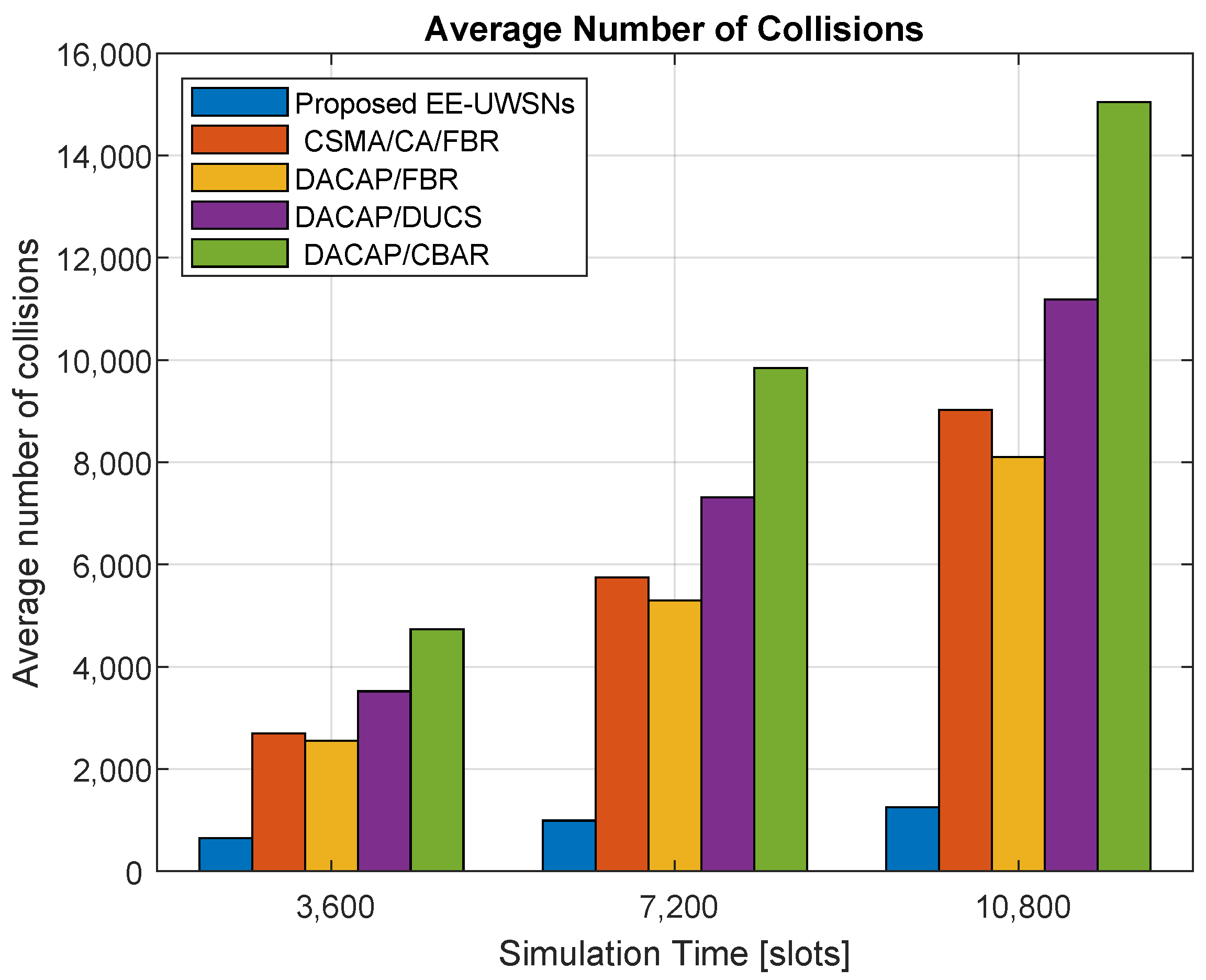
Figure 10 studies the average number of collisions during different simulation times. Increasing the simulation time leads to an increase in the average number of collisions due to the increase in the data transmission/reception period. The proposed EE-UWSNs protocol achieves the lowest number of collisions compared to the other protocols. It has superiority over CSMA/CA/FBR by 83.45% and over DACAP/FBR by 81.87%. Our proposed EE-UWSNs outperforms DACAP/DUCS and DACAP/CBAR by 86.87% and 90.24%, respectively. The reasons for this lie in applying the principle of inactivation, as well as narrowing the scope of transmission to a specific area. These measures reduce the number of nodes responsible for transmitting and forwarding packets and thus decrease the proportion of collisions.
Figure 10.
Average number of collisions.
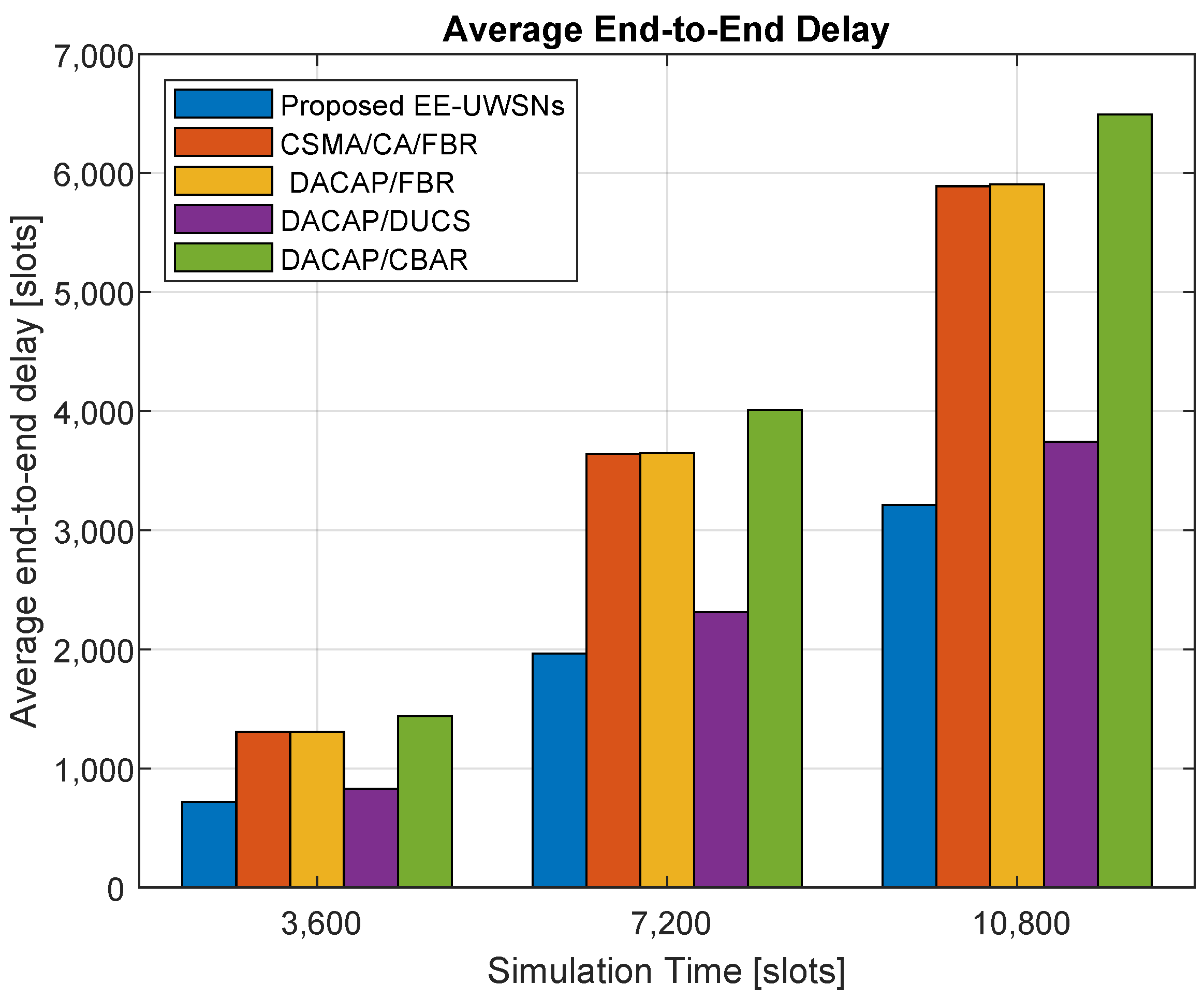
Figure 11 illustrates the values of the average end-to-end delay of the proposed EE-UWSNs and the other protocols under various simulation times. As shown in the figure, the proposed protocol achieves the lowest delay compared to the other protocols. The percentages of improvement over CSMA/CA/FBR and DACAP/FBR are 45.62% and 45.75%, respectively. Moreover, EE-UWSNs achieve superiority over DACAP/DUCS by 14.39% and over DACAP/CBAR by 50.64%. The reason behind the improvement is the method of selecting the inactive nodes and relay nodes, which depends on the score value, which takes into account the distance to the desired destination, as well as the consumed energy. Thus, the active relay nodes are the nodes that are closest to the destination. Therefore, the propagation delays will be reduced. In addition, nodes enter the inactive mode only under a certain condition, i.e., when they do not have any packet to transmit. This reduces the queuing delay caused during the inactivation period. Since the possibility of collisions is reduced, the number of retransmissions decreases, and, thus, the delay is reduced.
Figure 11.
Average end-to-end delay.
4.3.1. Effect of Changing the Cone Angle
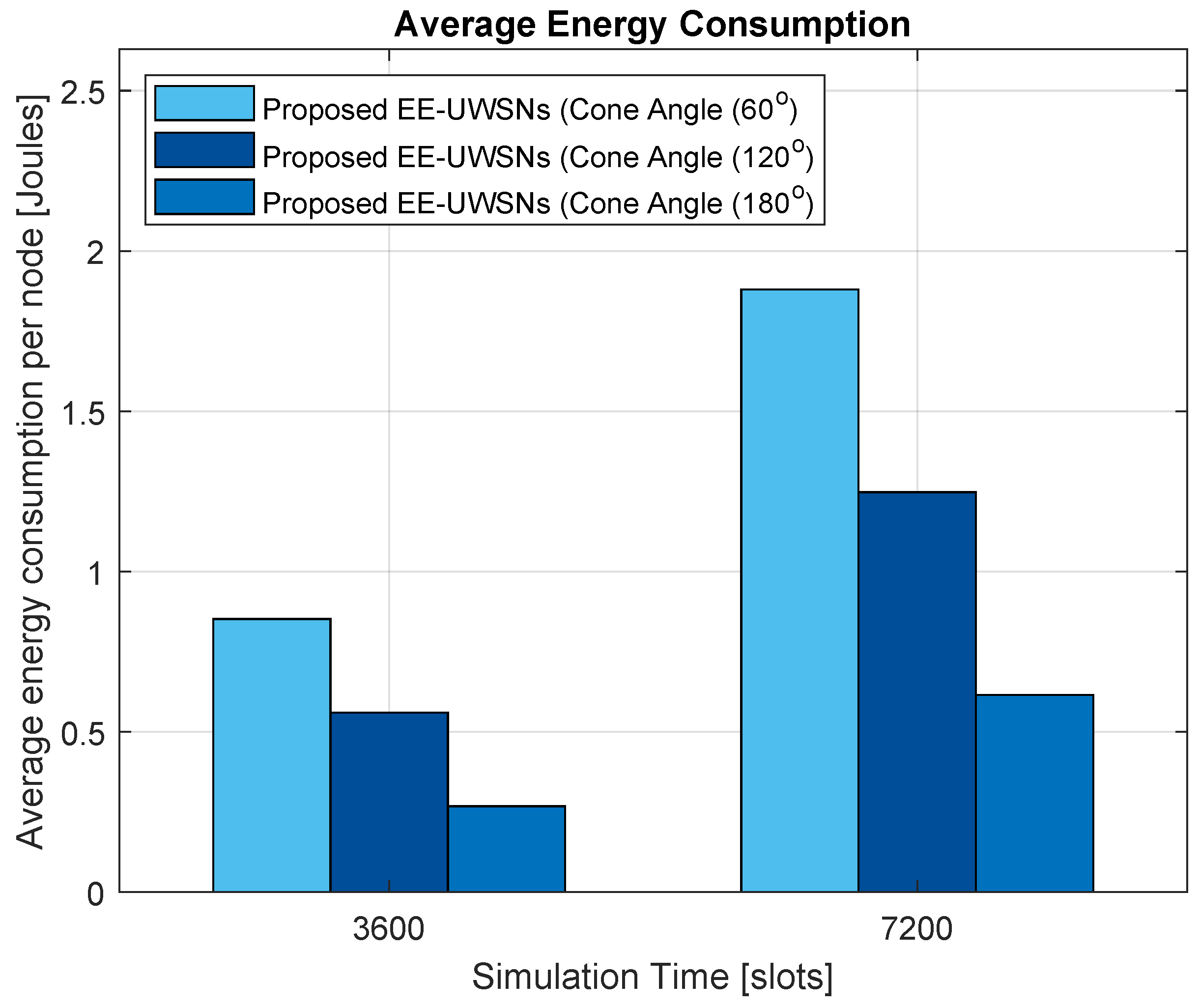
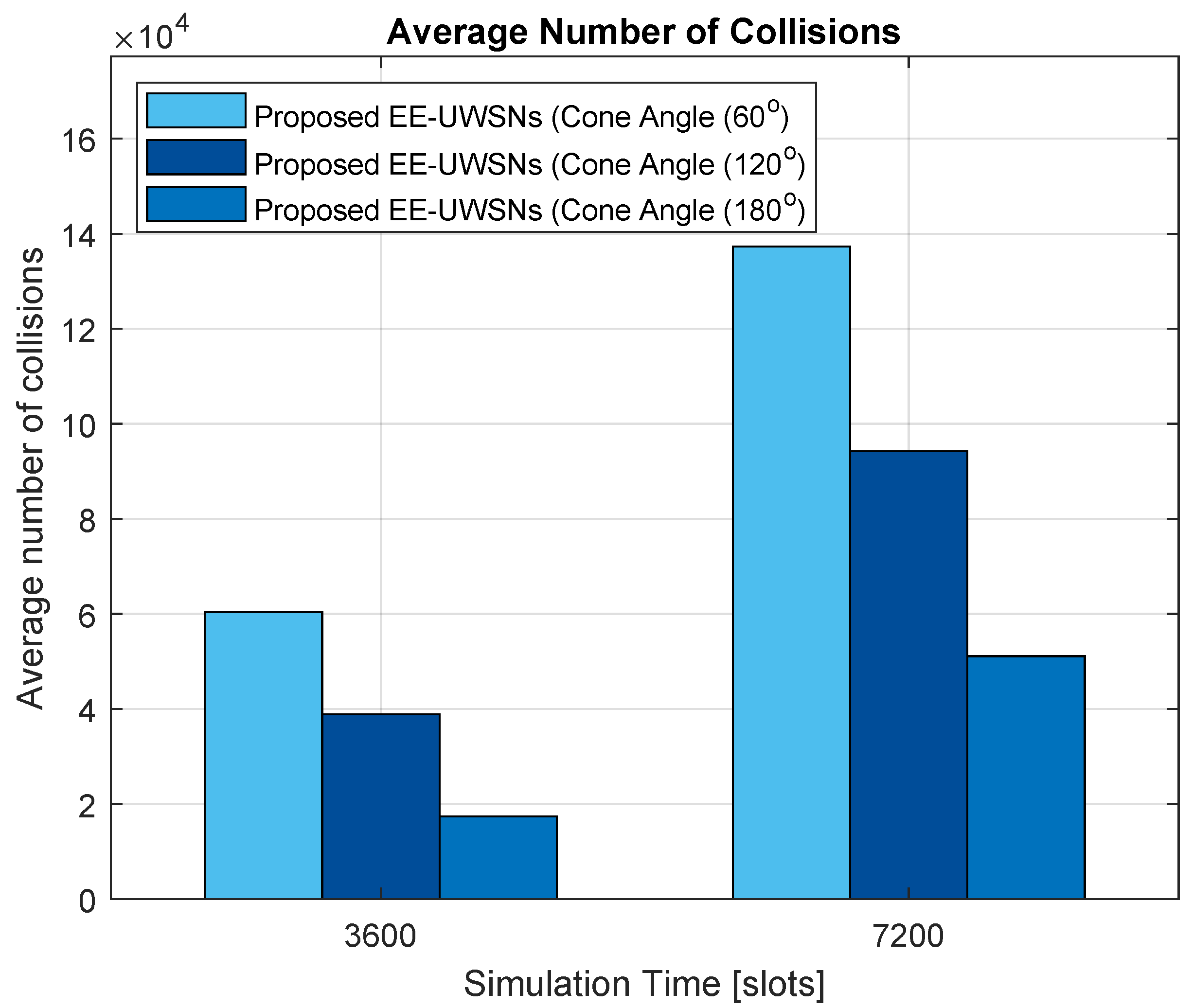
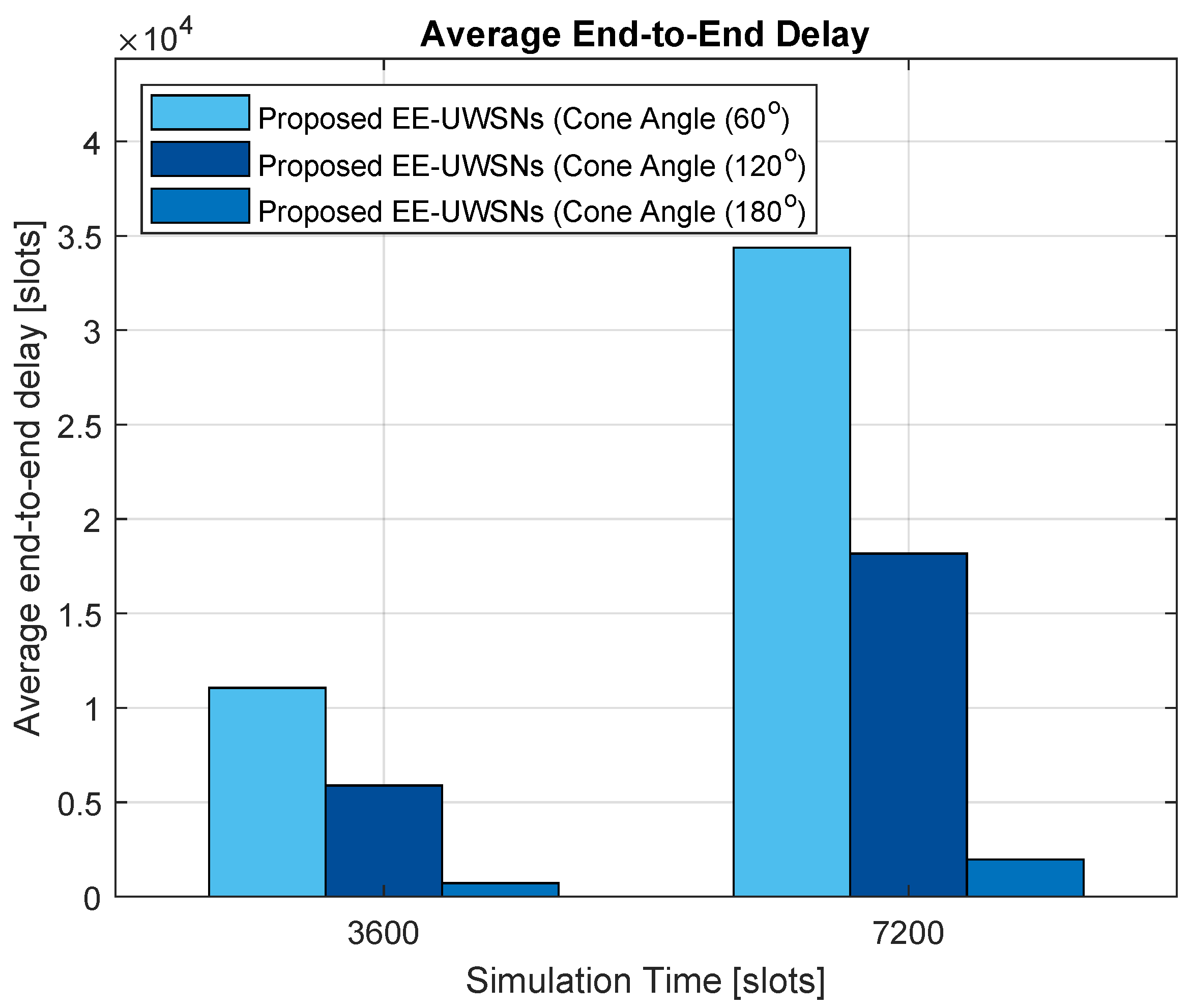
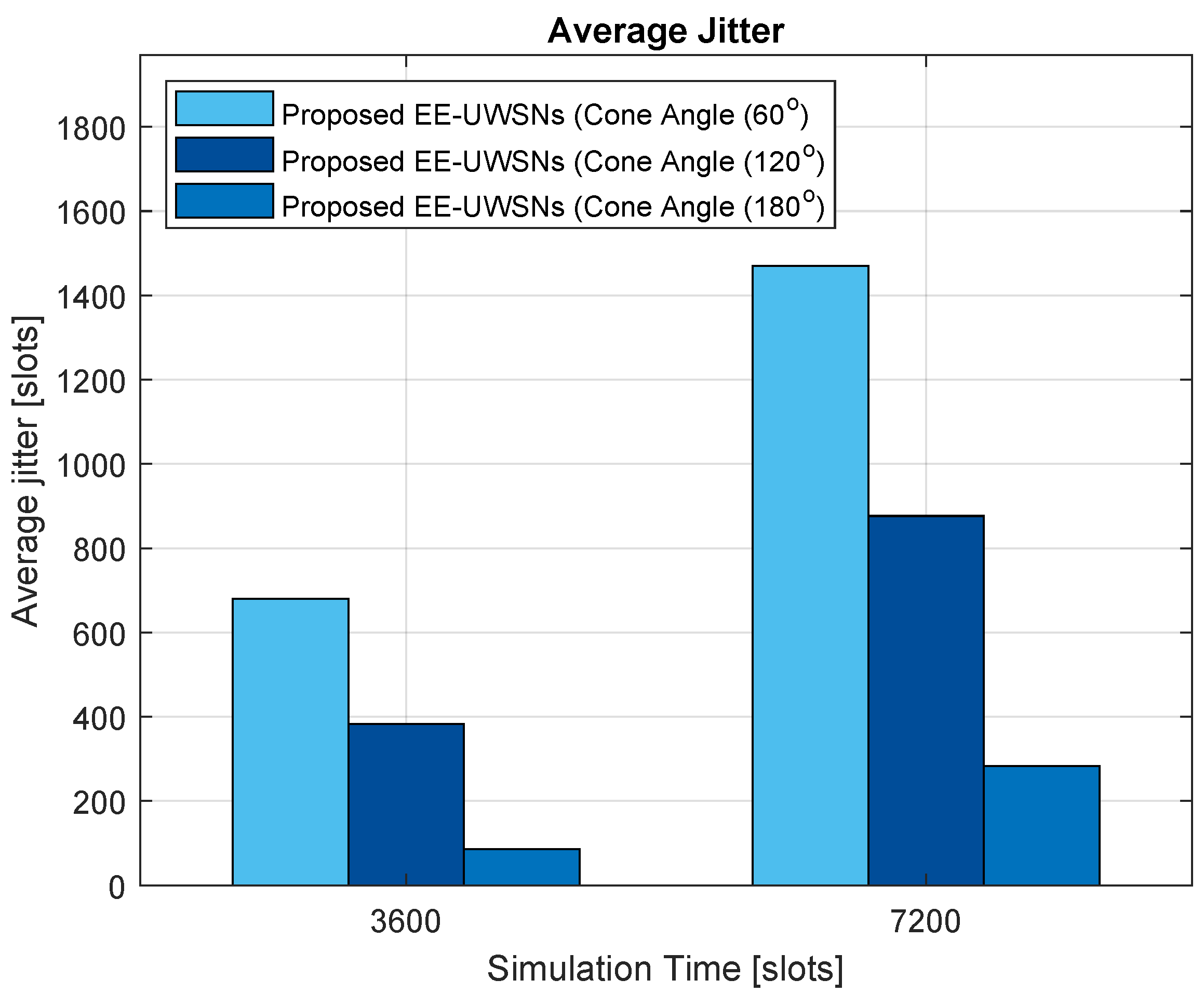
In this section, the impact of changing the cone angle value on the performance of the underwater sensor network is studied in terms of the average energy consumption of sensor batteries, the number of collisions, end-to-end delay, and jitter. Three cone angles are selected that have different sizes which are 60 (small angle), 120 (medium angle), and 180 (large angle). The cone angle should not be greater than 180 because this can lead to selecting a relay node that is not located in the direction from sending node to sink and thus the network performance will be influenced negatively.
Figure 12 shows the values of the average energy consumption per sensor node, using different cone angles and under various simulation times. We found that the amount of energy consumption is high in the case of a small angle (60°), as opposed to a large angle (180°). The average improvement from changing the cone angle, in terms of energy consumption of the sensor battery, is estimated at 42.49%. The reason for this is that the larger the cone angle, the greater the percentage of sensors that will enter the inactivation mode, and thus energy will be saved.
Figure 12.
The effect of changing cone angle on energy consumption.
Figure 13 shows the effect of changing the cone angle on the average number of collisions, using different simulation periods. As shown in the figure, there is an inverse relationship between the average number of collisions and the size of the cone angle. Increasing the angle leads to making a percentage of the sensors (50% of them in this scenario) enter the sleep mode, and therefore during this period there is no transmission of packets; consequently, the rate of collisions decreases by an average of 40.61%.
Figure 13.
The effect of changing cone angle on number of collisions.
Figure 14 and Figure 15 represent the impact of modifying the value of the cone angle on the average of end-to-end delay and packet jitter values. Increasing the value of the cone angle results in more sensors being located within it. The proposed EE-UWSNs protocol considers the distance to the desired destination when calculating score values. Therefore, the closest sensor to the destination is selected as a relay node and thus the propagation delay is enhanced. Furthermore, increasing the cone angle reduces the collision (as we mentioned in the previous figure) and thus decreases the number of retransmissions and improves the delay and jitter. The average percentages of improvements in end-to-end delay and jitter are 67.96% and 56.06%, respectively.
Figure 14.
The effect of changing cone angle on end-to-end delay.
Figure 15.
The effect of changing cone angle on jitter.
4.3.2. Effect of Changing the Number of Sinks
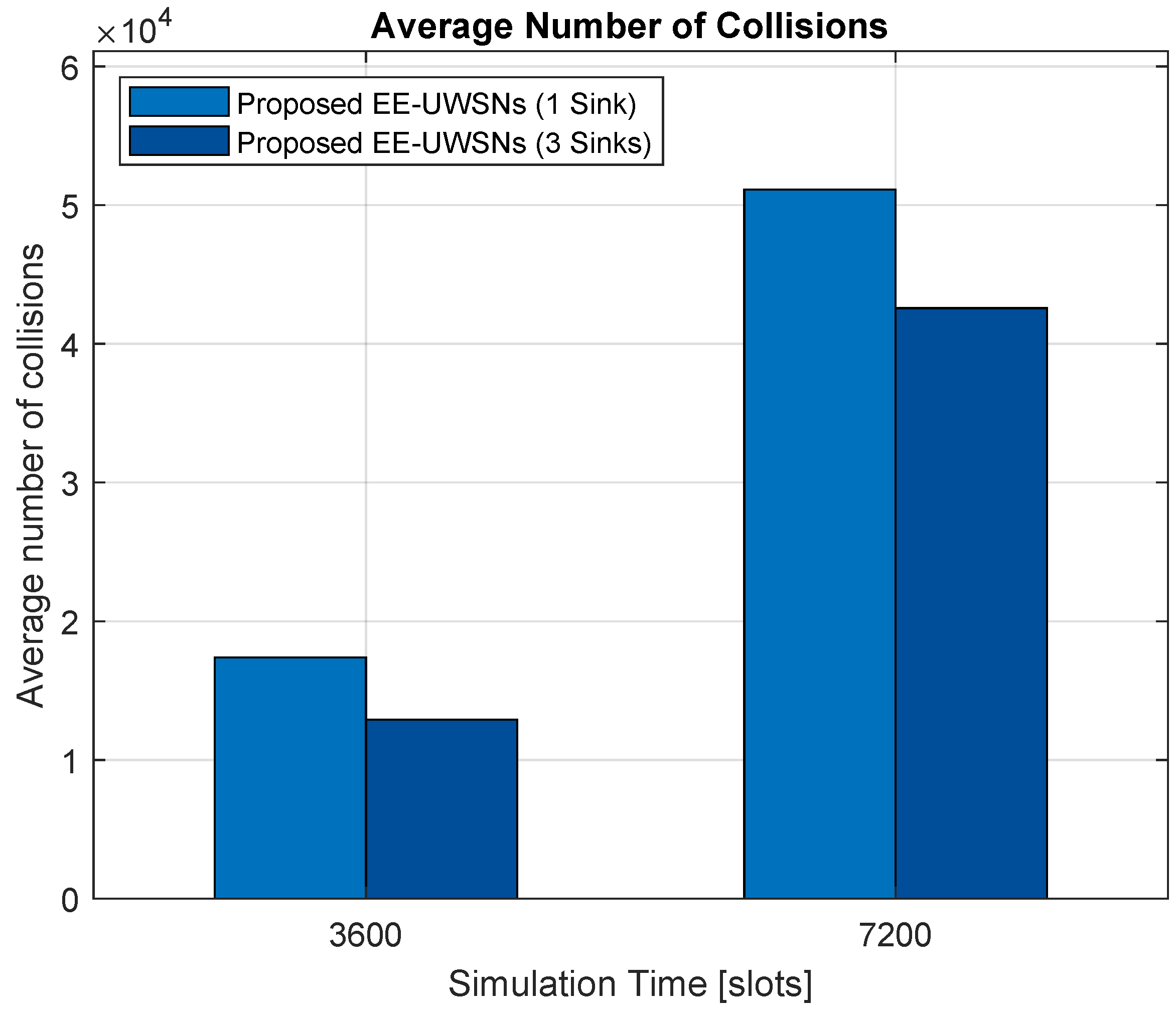
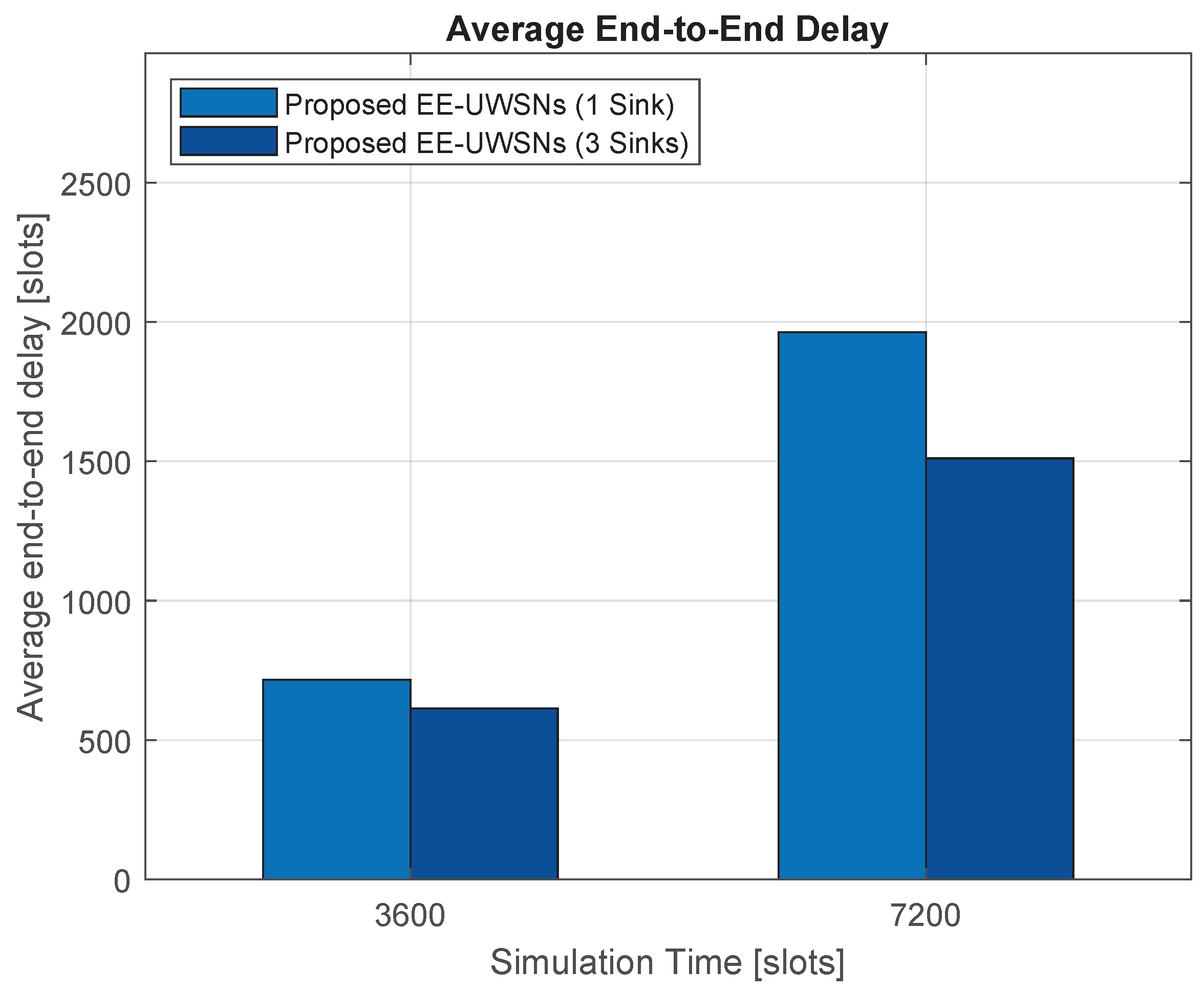
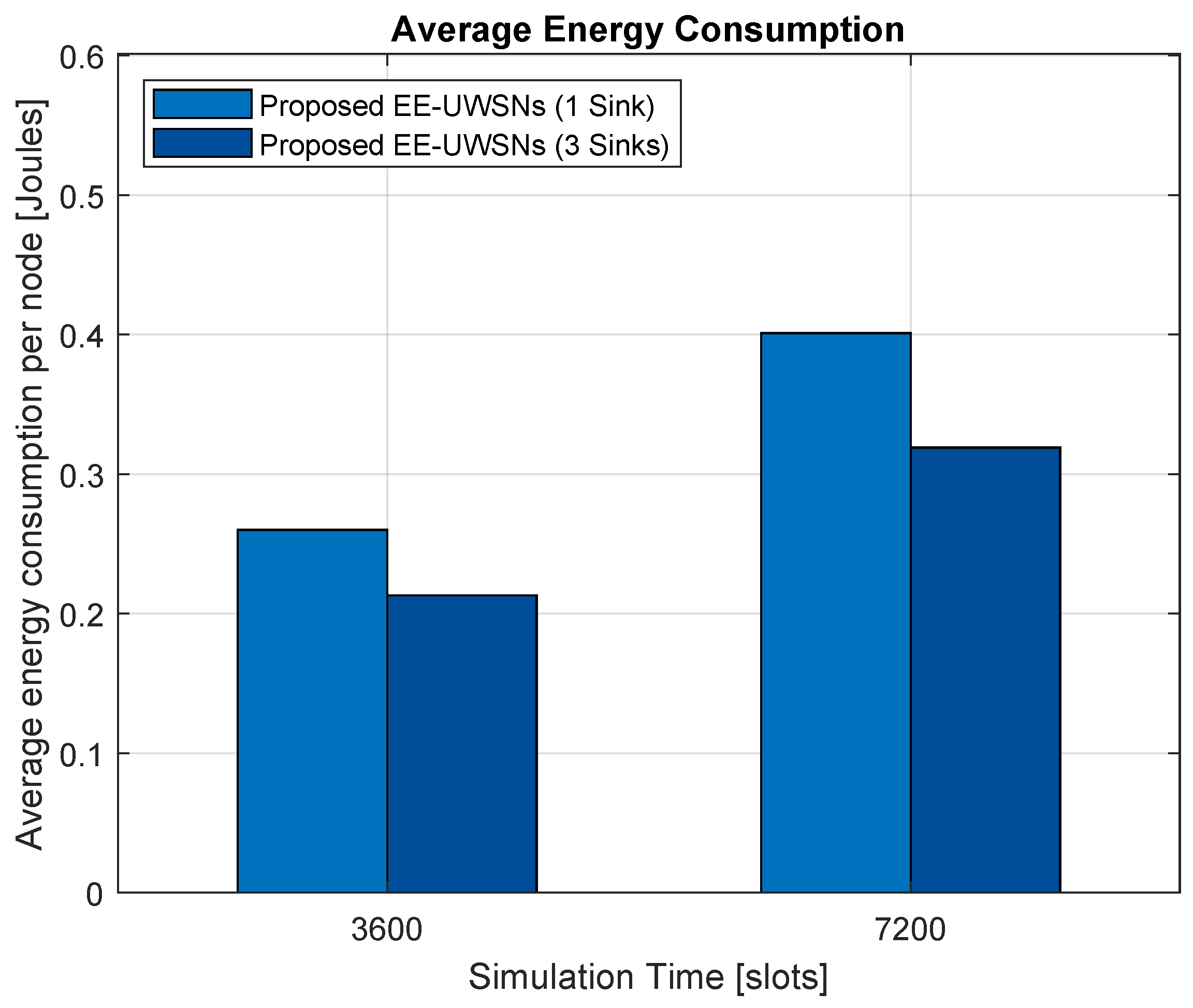
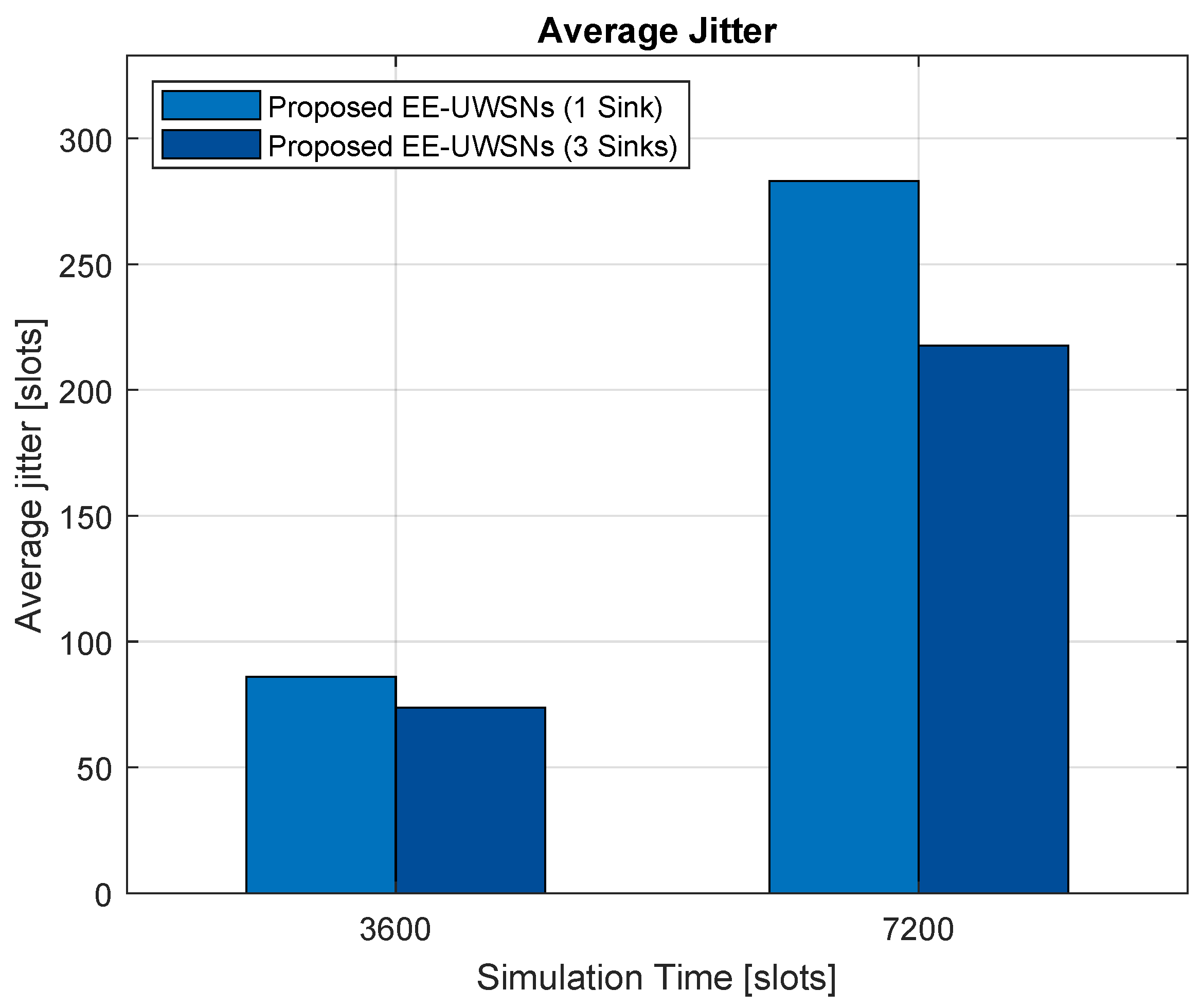
In this section, we study the effect of changing the number of surface sinks on the performance of UWSNs. The experiment is performed in the first case by considering only one sink that is deployed at the center of the simulation area. In the second case, there are three sinks (one in the center and the others on the left and right of the middle one). Then, we analyze the performance in terms of the average energy consumption, number of collisions, end-to-end delay, and jitter.
Figure 16 and Figure 17 show the impact of increasing the number of surface sinks on the average of energy consumption and number of collisions. The redundancy of sinks leads to making each node send packets to their closest sink. In other words, there is no competition for one sink, but the competition is distributed among three sinks. Therefore, this leads to minimizing the percentage of collisions and energy consumption. The average percentages of improvements in energy consumption and the number of collisions are 19.52% and 19.01%, respectively. Due to the reduction of the average number of collisions, the end-to-end delay and jitter are enhanced, as depicted in Figure 18 and Figure 19. The average percentage of enhancement in the delay is 20.73% and in jitter is 21.03%.
Figure 16.
The effect of changing the number of sinks on energy consumption.
Figure 17.
The effect of changing the number of sinks on the number of collisions.
Figure 18.
The effect of changing the number of sinks on end-to-end delay.
Figure 19.
The effect of changing the number of sinks on jitter.
5. Conclusions and Future Work
In this paper, an enhanced MAC/routing protocol was proposed for underwater acoustic networks to achieve efficiency in energy consumption and to prolong the lifetime of UWSNs. The proposed EE-UWSNs protocol depends on a number of principles to save energy and balance energy consumption. The performance of our proposed protocol was evaluated using a Python simulator developed by MIT called AUVNetSim. The simulation results show that the proposed UWSNs protocol has achieved progress in terms of average energy consumption, outperforming CSMA/CA/FBR and DACAP/FBR by 68.49% and 60.34%, respectively. Our EE-UWSN outperforms DACAP/DUCS and DACAP/CBAR by 10.51% and 20.69%, respectively. In addition, the proposed protocol reduces the average number of collisions and end-to-end delays. Furthermore, the performance of the protocol is evaluated using different cone angles and numbers of sinks. For future work, the effect of sensor distribution on network performance can be studied by considering regular and random distributions. Furthermore, the impact of changing the number of sensors and sensing environment will be investigated based on the purpose of the experiment. In addition, machine learning techniques can be applied to reduce the computational complexity and thus the processing delay.
Author Contributions
I.A.A. collected the data, performed the experiments, analyzed the results, and wrote the paper. M.A.A. supervised the research and critically revised the paper. All authors have read and agreed to the published version of the manuscript.
Funding
The authors extend their appreciation to the Deanship of Scientific Research at King Saud University for funding this work through research group No (RG-1440-122).
Institutional Review Board Statement
Not applicable.
Informed Consent Statement
Not applicable.
Data Availability Statement
Not applicable.
Acknowledgments
The authors thank the Deanship of Scientific Research and RSSU at King Saud University for their technical support.
Conflicts of Interest
The authors declare no conflict of interest.
Abbreviations
The following abbreviations are used in this manuscript:
| Abbreviation | Explanation |
| 5G | Fifth-Generation |
| ACK | Acknowledgment |
| CA | Collision Avoidance |
| CBAR | Cluster-Based Adaptive Routing |
| CDMA | Code Division Multiple Access |
| CSMA | Carrier Sense Multiple Access |
| CSMA/CA | Carrier Sense Multiple Access/Collision Avoidance |
| CSSTU-MAC | Spatial-Temporal Uncertainty MAC |
| CTS | Clear to Send |
| DACAP | Distance Aware Collision Avoidance Protocol |
| DCO-MAC | Data-Collection-Oriented MAC |
| DEEB | Distributed Energy-Efficient and Balanced |
| DUCS | Distributed Underwater Clustering Scheme |
| ED-MAC | Efficient Depth-based MAC |
| EE-UWSNs | Energy-Efficient protocol for UWSNs |
| FBR | Focused Beam Routing |
| FDMA | Frequency-Division Multiple Access |
| GCORP | Geographic and Cooperative Opportunistic Routing Protocol |
| HSR | Hybrid Sender and Receiver |
| IoT | Internet of Things |
| KPIs | Key Performance Indicators |
| LEACH | Low Energy Algorithm Adaptive Clustering Hierarchy |
| MAC | Medium Access Control |
| MIT | Massachusetts Institute of Technology |
| NCRP | Network Coding Routing Protocol |
| OCMAC | Ordered Contention MAC |
| OVAR | Opportunistic Void Avoidance Routing |
| QDAR | Q-learning based Delay-Aware Routing |
| R-ERP2R | Reliable Energy-efficient Routing Protocol based on Physical distance |
| and Residual energy | |
| RTS | Request to Send |
| TDMA | Time Division Multiple Access |
| UMOD-LEACH | Underwater Modified LEACH |
| UWSNs | Underwater Sensor Networks |
References
- Vithiya, R.; Sharmila, G.; Karthika, S. Enhancing the Performance of Routing Protocol in Underwater Acoustic Sensor Networks. In Proceedings of the 2018 IEEE International Conference on System, Computation, Automation and Networking (ICSCA), Pondicherry, India, 6–7 July 2018; pp. 1–5. [Google Scholar]
- Alhazmi, A.S.; Moustafa, A.I.; AlDosari, F.M. Energy Aware Approach For Underwater Wireless Sensor Networks Scheduling: UMOD_LEACH. In Proceedings of the 2018 21st Saudi Computer Society National Computer Conference (NCC), Riyadh, Saudi Arabia, 25–26 April 2018; pp. 1–5. [Google Scholar]
- Alasarpanahi, H.; Ayatollahitafti, V.; Gandomi, A. Energy-efficient void avoidance geographic routing protocol for underwater sensor networks. Int. J. Commun. Syst. 2020, 33, e4218. [Google Scholar] [CrossRef]
- Tariq, A.; Azam, F.; Anwar, M.W.; Zahoor, T.; Muzaffar, A.W. Recent Trends in Underwater Wireless Sensor Networks (UWSNs)–A Systematic Literature Review. Program. Comput. Softw. 2020, 46, 699–711. [Google Scholar] [CrossRef]
- Hong, Z.; Pan, X.; Chen, P.; Su, X.; Wang, N.; Lu, W. A topology control with energy balance in underwater wireless sensor networks for IoT-based application. Sensors 2018, 18, 2306. [Google Scholar] [CrossRef] [PubMed] [Green Version]
- Alablani, I.A.; Arafah, M.A. Enhancing 5G small cell selection: A neural network and IoV-based approach. Sensors 2021, 21, 6361. [Google Scholar] [CrossRef]
- Alablani, I.A.; Arafah, M.A. An Adaptive Cell Selection Scheme for 5G Heterogeneous Ultra-Dense Networks. IEEE Access 2021, 9, 64224–64240. [Google Scholar] [CrossRef]
- Alablani, I.A.; Arafah, M.A. An SDN/ML-Based Adaptive Cell Selection Approach for HetNets: A Real-World Case Study in London, UK. IEEE Access 2021, 9, 166932–166950. [Google Scholar] [CrossRef]
- Haque, K.F.; Kabir, K.H.; Abdelgawad, A. Advancement of routing protocols and applications of underwater wireless sensor network (UWSN)—A survey. J. Sens. Actuator Netw. 2020, 9, 19. [Google Scholar] [CrossRef] [Green Version]
- Alsalman, L.; Alotaibi, E. A Balanced Routing Protocol Based on Machine Learning for Underwater Sensor Networks. IEEE Access 2021, 9, 152082–152097. [Google Scholar] [CrossRef]
- Ahmed, A.; Mitchell, P.D.; Zakharov, Y.; Morozs, N. FD-LTDA-MAC: Full-Duplex Unsynchronised Scheduling in Linear Underwater Acoustic Chain Networks. Appl. Sci. 2021, 11, 10967. [Google Scholar] [CrossRef]
- Alfouzan, F.A. Energy-efficient collision avoidance MAC protocols for underwater sensor networks: Survey and challenges. J. Mar. Sci. Eng. 2021, 9, 741. [Google Scholar] [CrossRef]
- KM, D.R.; Yum, S.H.; Ko, E.; Shin, S.Y.; Namgung, J.I.; Park, S.H. Multi-Media and Multi-Band based adaptation layer techniques for underwater sensor networks. Appl. Sci. 2019, 9, 3187. [Google Scholar]
- Zhang, L. Underwater Acoustic Sensor Networks Protocol Design Energy Efficient and Traffic-Aware Detour Tree for Geographic Routing; Lap Lambert Academic Publisher: Sunnyvale, CA, USA, 2012. [Google Scholar]
- Wati, S.; Rakesh, N.; Astya, P.N. Data communication Issues in Underwater Sensor Network. In Proceedings of the 2019 International Conference on Computing, Communication, and Intelligent Systems (ICCCIS), Greater Noida, India, 18–19 October 2019; pp. 150–155. [Google Scholar] [CrossRef]
- Wang, M.; Chen, Y.; Sun, X.; Xiao, F.; Xu, X. Node Energy Consumption Balanced Multi-Hop Transmission for Underwater Acoustic Sensor Networks Based on Clustering Algorithm. IEEE Access 2020, 8, 191231–191241. [Google Scholar] [CrossRef]
- Chander, B. Wearable sensor networks for patient health monitoring: Challenges, applications, future directions, and acoustic sensor challenges. In Healthcare Paradigms in the Internet of Things Ecosystem; Elsevier: Amsterdam, The Netherlands, 2021; pp. 189–221. [Google Scholar]
- Gul, H.; Ullah, G.; Khan, M.; Khan, Y. EERBCR: Energy-efficient regional based cooperative routing protocol for underwater sensor networks with sink mobility. J. Ambient Intell. Humaniz. Comput. 2021, 1–13. [Google Scholar] [CrossRef]
- Pabani, J.K.; Luque-Nieto, M.Á.; Hyder, W.; Otero, P. Energy-efficient packet forwarding scheme based on fuzzy decision-making in underwater sensor networks. Sensors 2021, 21, 4368. [Google Scholar] [CrossRef]
- Zala, D.; Thummar, D.; Chandavarkar, B.R. Mitigating Blackhole attack of Underwater Sensor Networks. In Proceedings of the 2021 12th International Conference on Computing Communication and Networking Technologies (ICCCNT), Kharagpur, India, 6–8 July 2021; pp. 1–8. [Google Scholar] [CrossRef]
- Zhang, H.; Wang, F. Wireless Sensor Energy Harvesting and Management. In Smart Communications, Intelligent Algorithms and Interactive Methods; Springer: Berlin/Heidelberg, Germany, 2022; pp. 299–306. [Google Scholar]
- Bollapragada Subrahmanya, V.; Russell, H.B. RMTS: A novel approach to transmission scheduling in ad hoc networks by salvaging unused slot transmission assignments. Wirel. Commun. Mob. Comput. 2018, 2018, 2484897. [Google Scholar] [CrossRef]
- Kwon, J.H.; Zhang, X.; Kim, E.J. Scalable Wi-Fi Backscatter Uplink Multiple Access for Battery-Free Internet of Things. IEEE Access 2021, 9, 30929–30945. [Google Scholar] [CrossRef]
- Mun, G.; Kim, H.W.; Kim, D. Implementation of CSMA/CA state diagram for swarm drone network. In Proceedings of the 2021 International Conference on Information and Communication Technology Convergence (ICTC), Jeju Island, Korea, 20–22 October2021; pp. 1254–1257. [Google Scholar] [CrossRef]
- Youssef, Z.; Majeed, E.; Mueck, M.D.; Karls, I.; Drewes, C.; Bruck, G.; Jung, P. Performance Enhancement of the CSMA/CA MAC Mechanisms Using a Reject Request to Send (RRTS) Message for 3.5 GHz Shared Spectrum Systems. In Proceedings of the 2018 International Conference on Wireless Communications, Signal Processing and Networking (WiSPNET), Chennai, India, 22–24 March 2018; pp. 1–8. [Google Scholar] [CrossRef]
- Peleato, B.; Stojanovic, M. Distance aware collision avoidance protocol for ad-hoc underwater acoustic sensor networks. IEEE Commun. Lett. 2007, 11, 1025–1027. [Google Scholar] [CrossRef]
- Lee, J.W.; Cho, H.S. A hybrid sender-and receiver-initiated protocol scheme in underwater acoustic sensor networks. Sensors 2015, 15, 28052–28069. [Google Scholar] [CrossRef]
- Alfouzan, F.; Shahrabi, A.; Ghoreyshi, S.M.; Boutaleb, T. An efficient scalable scheduling MAC protocol for underwater sensor networks. Sensors 2018, 18, 2806. [Google Scholar] [CrossRef] [Green Version]
- Deng, M.; Chen, H.; Xie, L. DCO-MAC: A hybrid MAC protocol for data collection in underwater acoustic sensor networks. Sensors 2018, 18, 2300. [Google Scholar] [CrossRef] [Green Version]
- Ammar, M.; Ibrahimi, K.; Jouhari, M.; Ben-Othman, J. MAC Protocol-Based Depth Adjustment and Splitting Mechanism for UnderWater Sensor Network (UWSN). In Proceedings of the 2018 IEEE Global Communications Conference (GLOBECOM), Abu Dhabi, United Arab Emirates, 9–13 December 2018; pp. 1–6. [Google Scholar] [CrossRef]
- Roy, A.; Sarma, N. A synchronous duty-cycled reservation based MAC protocol for underwater wireless sensor networks. Digit. Commun. Netw. 2021, 7, 385–398. [Google Scholar] [CrossRef]
- Liu, X.; Du, X.; Li, M.; Wang, L.; Li, C. A MAC Protocol of Concurrent Scheduling Based on Spatial-Temporal Uncertainty for Underwater Sensor Networks. J. Sens. 2021, 2021, 5558078. [Google Scholar] [CrossRef]
- Jornet, J.M.; Stojanovic, M.; Zorzi, M. Focused beam routing protocol for underwater acoustic networks. In Proceedings of the Third ACM International Workshop on Underwater Networks, Shenzhen, China, 3–5 December 2008; ACM: Cambridge, MA, USA, 2008; pp. 75–82. [Google Scholar]
- Ayaz, M.; Baig, I.; Abdullah, A.; Faye, I. A survey on routing techniques in underwater wireless sensor networks. J. Netw. Comput. Appl. 2011, 34, 1908–1927. [Google Scholar] [CrossRef]
- Domingo, M.C.; Prior, R. Design and analysis of a GPS-free routing protocol for underwater wireless sensor networks in deep water. In Proceedings of the 2007 International Conference on Sensor Technologies and Applications, Valencia, Spain, 14–20 October 2007; pp. 215–220. [Google Scholar]
- Wahid, A.; Lee, S.; Kim, D. A reliable and energy-efficient routing protocol for underwater wireless sensor networks. Int. J. Commun. Syst. 2014, 27, 2048–2062. [Google Scholar] [CrossRef]
- Ahmed, S.; Khan, I.; Rasheed, M.B.; Ilahi, M.; Khan, R.; Bouk, S.H.; Javaid, N. Comparative analysis of routing protocols for under water wireless sensor networks. arXiv 2013, arXiv:1306.1148. [Google Scholar]
- Ghoreyshi, S.M.; Shahrabi, A.; Boutaleb, T. A novel cooperative opportunistic routing scheme for underwater sensor networks. Sensors 2016, 16, 297. [Google Scholar] [CrossRef]
- Jin, Z.; Ma, Y.; Su, Y.; Li, S.; Fu, X. A Q-learning-based delay-aware routing algorithm to extend the lifetime of underwater sensor networks. Sensors 2017, 17, 1660. [Google Scholar] [CrossRef] [Green Version]
- Wang, H.; Wang, S.; Bu, R.; Zhang, E. A novel cross-layer routing protocol based on network coding for underwater sensor networks. Sensors 2017, 17, 1821. [Google Scholar] [CrossRef] [Green Version]
- Liu, J.; Yin, H.; Xing, F.; Ji, X.; Wu, B. An Energy-Efficient Routing Algorithm for Underwater Wireless Optical Sensor Network. In Proceedings of the 2018 10th International Conference on Communication Software and Networks (ICCSN), Chongqing, China, 10–12 June 2018; pp. 95–98. [Google Scholar]
- Zou, Z.; Lin, X.; Sun, J. A Cluster-Based Adaptive Routing Algorithm for Underwater Acoustic Sensor Networks. In Proceedings of the 2019 International Conference on Intelligent Computing, Automation and Systems (ICICAS), Chongqing, China, 6–8 December 2019; pp. 302–310. [Google Scholar] [CrossRef]
- Zhang, M.; Cai, W. Energy-Efficient Depth Based Probabilistic Routing Within 2-Hop Neighborhood for Underwater Sensor Networks. IEEE Sens. Lett. 2020, 4, 1–4. [Google Scholar] [CrossRef]
- Karim, S.; Shaikh, F.K.; Chowdhry, B.S.; Mehmood, Z.; Tariq, U.; Naqvi, R.A.; Ahmed, A. GCORP: Geographic and Cooperative Opportunistic Routing Protocol for Underwater Sensor Networks. IEEE Access 2021, 9, 27650–27667. [Google Scholar] [CrossRef]
- Elshrkawey, M.; Elsherif, S.M.; Wahed, M.E. An enhancement approach for reducing the energy consumption in wireless sensor networks. J. King Saud Univ. Comput. Inf. Sci. 2018, 30, 259–267. [Google Scholar] [CrossRef]
- Nguyen, C.T.; Mai, V.V.; Nguyen, C.T. Probing Packet Retransmission Scheme in Underwater Optical Wireless Communication With Energy Harvesting. IEEE Access 2021, 9, 34287–34297. [Google Scholar] [CrossRef]
- Fahmy, H.M.A. Cross-Layer Protocols for WSNs. In Concepts, Applications, Experimentation and Analysis of Wireless Sensor Networks; Springer: Berlin/Heidelberg, Germany, 2021; pp. 267–335. [Google Scholar]
- Songzou, L.; Iqbal, B.; Khan, I.U.; Li, H.; Qiao, G. An Enhanced Full-Duplex MAC Protocol for an Underwater Acoustic Network. In Proceedings of the 2021 International Bhurban Conference on Applied Sciences and Technologies (IBCAST), Islamabad, Pakistan, 12–16 January 2021; pp. 894–898. [Google Scholar] [CrossRef]
- Alablani, I.A.; Arafah, M.A. Applying a Dwell Time-Based 5G V2X Cell Selection Strategy in the City of Los Angeles, California. IEEE Access 2021, 9, 153909–153925. [Google Scholar] [CrossRef]
- Iqbal, B.; Liu, S.; Ullah Khan, I. Multiple RTS and DATA Receptions in a Loop-Based Underwater Propagation Delay Aware MAC Protocol. In Proceedings of the 2021 OES China Ocean Acoustics (COA), Harbin, China, 14–17 July 2021; pp. 665–669. [Google Scholar] [CrossRef]
- Alablani, I.; Alenazi, M. EDTD-SC: An IoT sensor deployment strategy for smart cities. Sensors 2020, 20, 7191. [Google Scholar] [CrossRef]
- Alablani, I.; Alenazi, M. Performance Evaluation of Sensor Deployment Strategies in WSNs Towards IoT. In Proceedings of the 2019 IEEE/ACS 16th International Conference on Computer Systems and Applications (AICCSA), Abu Dhabi, United Arab Emirates, 3–7 November 2019; pp. 1–8. [Google Scholar] [CrossRef]
- Farhan, L.; Alzubaidi, L.; Abdulsalam, M.; Abboud, A.J.; Hammoudeh, M.; Kharel, R. An efficient data packet scheduling scheme for Internet of Things networks. In Proceedings of the 2018 1st International Scientific Conference of Engineering Sciences—3rd Scientific Conference of Engineering Science (ISCES), Diyala, Iraq, 10–11 January 2018; pp. 1–6. [Google Scholar] [CrossRef]
- Kartashevskiy, V.; Buranova, M. Analysis of Packet Jitter in Multiservice Network. In Proceedings of the 2018 International Scientific-Practical Conference Problems of Infocommunications, Science and Technology (PICST), Kharkiv, Ukraine, 9–12 October 2018; pp. 797–802. [Google Scholar] [CrossRef]
Publisher’s Note: MDPI stays neutral with regard to jurisdictional claims in published maps and institutional affiliations. |
© 2022 by the authors. Licensee MDPI, Basel, Switzerland. This article is an open access article distributed under the terms and conditions of the Creative Commons Attribution (CC BY) license (https://creativecommons.org/licenses/by/4.0/).