
Skip Content
You are currently on the new version of our website. Access the old version .

Agriculture, Volume 7, Issue 4

2017 April - 6 articles

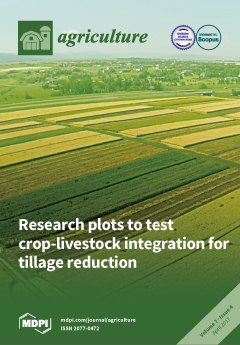
Cover Story: Organic farming has known benefits, but managing weeds and cover crops in semi-arid environments without herbicides, while preserving soil quality, is a challenge. The potential of integrating crop and livestock production to reduce tillage intensity is being tested using three management treatments: conventional no-till, tilled-organic, and grazed/reduced-till organic. Preliminary results highlight the agronomic potential of integration to reduce tillage intensity; however, observed yield and economic penalties represent barriers necessitating further research. View this paper
  • Issues are regarded as officially published after their release is announced to the table of contents alert mailing list .
  • You may sign up for email alerts to receive table of contents of newly released issues.
  • PDF is the official format for papers published in both, html and pdf forms. To view the papers in pdf format, click on the "PDF Full-text" link, and use the free Adobe Reader to open them.

Articles (6)

  • Review
  • Open Access
21 Citations
13,417 Views
15 Pages

Organic No-Till Systems in Eastern Canada: A Review

  • Caroline Halde,
  • Samuel Gagné,
  • Anaïs Charles and
  • Yvonne Lawley

For more than a decade, studies have aimed to adapt the agronomy of organic no-till systems for the environmental conditions of Eastern Canada. Most research on organic no-till practices in Eastern Canada has been conducted in the province of Québec,...

  • Review
  • Open Access
81 Citations
16,478 Views
17 Pages

Only 34% of all German farms apply reduced tillage (RT), while approximately 1% of the arable land is under no-tillage (NT). Statistics for organic farming are not available, but the percentages are probably even lower. The development of German orga...

  • Article
  • Open Access
74 Citations
14,808 Views
21 Pages

Cover Crop-Based, Organic Rotational No-Till Corn and Soybean Production Systems in the Mid-Atlantic United States

  • John M. Wallace,
  • Alwyn Williams,
  • Jeffrey A. Liebert,
  • Victoria J. Ackroyd,
  • Rachel A. Vann,
  • William S. Curran,
  • Clair L. Keene,
  • Mark J. VanGessel,
  • Matthew R. Ryan and
  • Steven B. Mirsky

Cover crop-based, organic rotational no-till (CCORNT) corn and soybean production is becoming a viable strategy for reducing tillage in organic annual grain systems in the mid-Atlantic, United States. This strategy relies on mechanical termination of...

  • Review
  • Open Access
29 Citations
11,857 Views
16 Pages

Organic Agriculture and the Quest for the Holy Grail in Water-Limited Ecosystems: Managing Weeds and Reducing Tillage Intensity

  • Erik Lehnhoff,
  • Zachariah Miller,
  • Perry Miller,
  • Stephen Johnson,
  • Tessa Scott,
  • Patrick Hatfield and
  • Fabian D. Menalled

Organic agricultural production has become a major economic and cultural force. However, in water-limited environments the tools used for weed control and nutrient supply, namely tillage and cover crops, may not be environmentally or economically sus...

  • Article
  • Open Access
31 Citations
20,520 Views
6 Pages

Effect of Organic, Inorganic Fertilizers and Plant Spacing on the Growth and Yield of Cabbage

  • Md Ashraful Islam,
  • Golam Ferdous,
  • Ayasha Akter,
  • Md Mokter Hossain and
  • Dilip Nandwani

The impact of chemical farming and the negative consequences on the environment and human health in Bangladesh are on the rise. Organic farming is gaining attention and increasing globally because it is eco-friendly, safe and has benefits for human h...

  • Review
  • Open Access
126 Citations
26,766 Views
22 Pages

Biofuels have the potential to alter the transport and agricultural sectors of decarbonizing societies. Yet, the sustainability of these fuels has been questioned in recent years in connection with food versus fuel trade-offs, carbon accounting, and...

Get Alerted

Add your email address to receive forthcoming issues of this journal.

XFacebookLinkedIn
Agriculture - ISSN 2077-0472