


Organic No-Till Systems in Eastern Canada: A Review

Abstract
:1. Introduction
2. Environmental Conditions and Agricultural Context for Organic No-Till in Eastern Canada
3. Selecting and Managing Cover Crops for Organic No-Till Systems
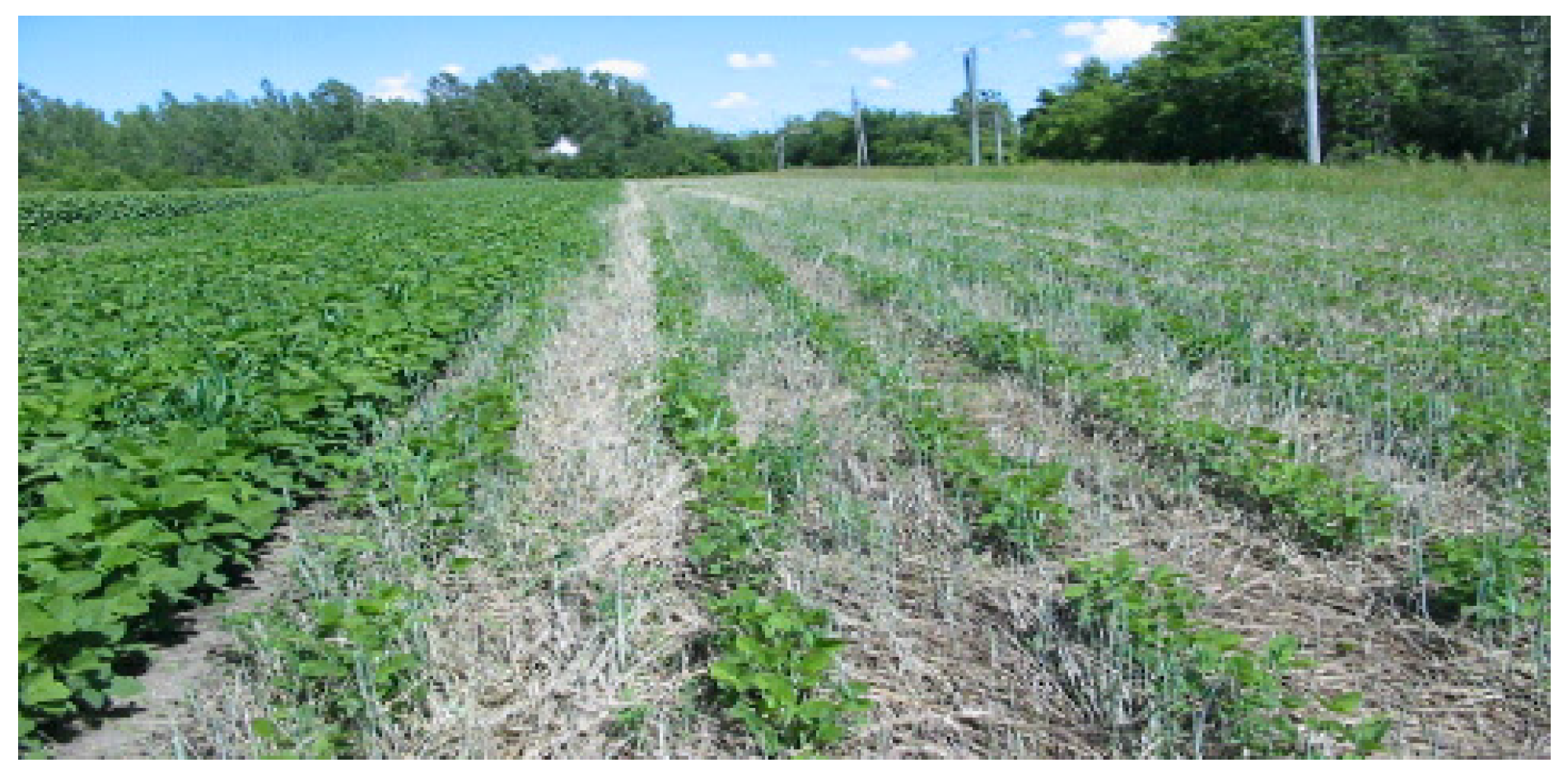
4. Weed Control by Cover Crop Mulches
- -
- Low winter survival of fall rye
- -
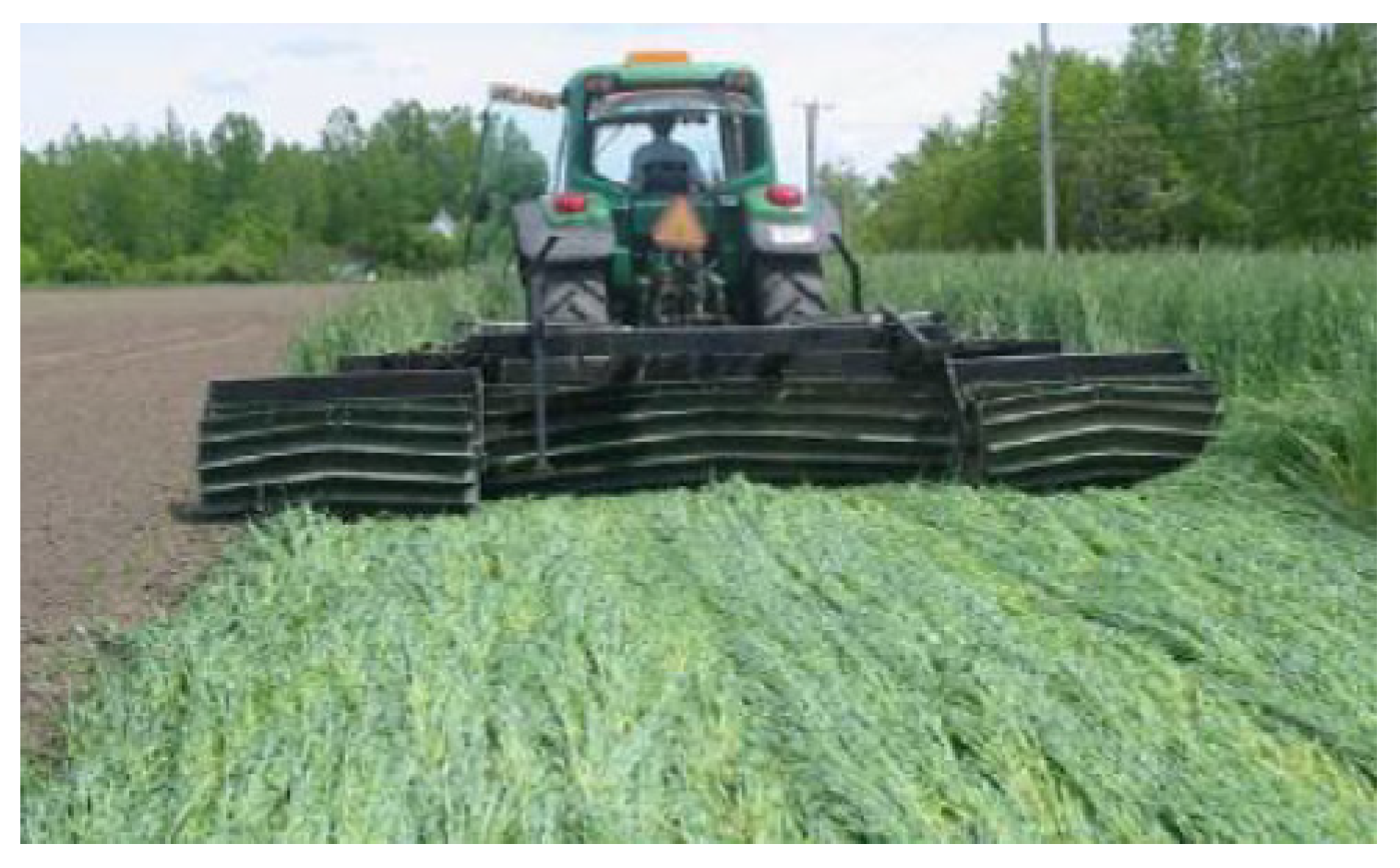
- Poor termination (timing, method) of the cover crops, leading to cover crop regrowth
- -
- Design of the roller-crimper
- -
- Low cover crop biomass (<6 t·ha−1)
- -
- Variability in cover crop biomass within a same field
- -
- Competition between the cover crop and cash crop for water, light, and nutrients
5. Insects in Organic No-Till Systems
6. Agronomic Performance and Profitability
6.1. Crop Yield and Quality
6.2. Profit margins
7. Ongoing and Future Needs for Organic No-Till Research
7.1. Ongoing Studies on Organic No-Till
7.2. Future Research Needs
Acknowledgments
Author Contributions
Conflicts of Interest
References
- Halde, C.; Hivon, J.-P. Le semis direct en bio: Les possibilités. Invited talk at “Colloque Bio pour Tous! 2017”, Victoriaville, QC, Canada, 16 February 2017. Available online: https://cegepvicto.sharepoint.com/cetab/_layouts/15/WopiFrame.aspx?docid=04b039b3fc6504a01b17ef25ea70dc988&authkey=ASFfXtno4_Ag5kvQQaV3krc&action=view (accessed on 1 March 2017).
- Turgeon, N. Stratégie de croissance du secteur biologique: Bilan de mi-parcours. Invited talk at “Journées Horticoles et Grandes Cultures de Saint-Rémi”, Saint-Remi, QC, Canada, 8 December 2016. Available online: https://www.agrireseau.net/documents/93973/strategie-de-croissance-du-secteur-bio-bilan-de-mi-parcours (accessed on 1 March 2017).
- Stratégie de Croissance du Secteur Biologique du Ministère de l’Agriculture, des Pêcheries et de l’Alimentation du Québec (MAPAQ). Available online: http://www.mapaq.gouv.qc.ca/fr/Productions/Production/agriculturebiologique/Pages/Produirebio.aspx (accessed on 1 March 2017).
- Plant Hardiness Zone Maps, Natural Resources Canada. Available online: http://www.planthardiness.gc.ca/?m=1&lang=en (accessed on 1 March 2017).
- Climate Change Scenarios, Agriculture and Agri-Food Canada. Available online: http://www.agr.gc.ca/eng/science-and-innovation/agricultural-practices/agriculture-and-climate/future-outlook/climate-change-scenarios/?id=1362684401064 (accessed on 1 March 2017).
- Carter, M.R. A review of conservation tillage strategies for humid temperate regions. Soil Tillage Res. 1994, 31, 289–301. [Google Scholar] [CrossRef]
- Carter, M.R.; Sanderson, J.B.; Ivany, J.A.; White, R.P. Influence of rotation and tillage on forage maize productivity, weed species, and soil quality of a fine sandy loam in the cool-humid climate of Atlantic Canada. Soil Tillage Res. 2002, 67, 85–98. [Google Scholar] [CrossRef]
- Buhler, S. Utilisation du Seigle D’automne (Secale cereale) Comme Culture de Couverture dans la Lutte Contre les Mauvaises Herbes Dans la Citrouille (Cucurbita pepo) au Québec. Master’s Thesis, Université Laval, Laval, QC, Canada, 2009; 106p. Available online: www.theses.ulaval.ca/2009/26258/26258.pdf (accessed on 1 March 2017).
- Estevez, B. Évaluation du Potentiel du Semis Direct en Agriculture Biologique au Québec: Construction d’un «Rouleau-Crêpeur de Couvre-Sols» et Essais à la Ferme; Progress Report 2006; December 2006; 30p, Available online: http://www.organicagcentre.ca/DOCs/Agri-reseau/Agrireseau_rouleur_f.pdf (accessed on 1 March 2017).
- Vaisman, I.; Entz, M.H.; Flaten, D.N.; Gulden, R.H. Blade-roller-green manure interactions on nitrogen dynamics, weeds, and organic wheat. Agron. J. 2011, 103, 879–889. [Google Scholar] [CrossRef]
- Robinson, D.E.; Nurse, R. Weed Management for Transition to Organic Vegetable Production; Final Report, Project #TF048923 SR9202; 2011; 17p. Available online: http://www.omafra.gov.on.ca/english/research/new_directions/projects/2008/SR9202.htm (accessed on 1 March 2017).
- Légère, A.; Shirtliffe, S.J.; Vanasse, A.; Gulden, R.H. Extreme grain-based cropping systems: When herbicide-free weed management meets conservation tillage in Northern climates. Weed Technol. 2013, 27, 204–211. [Google Scholar] [CrossRef]
- Estevez, B. Évaluation du potentiel du semis direct en agriculture biologique au Québec: Le «Rouleau-Crêpeur de Couvre-sols» (Saison 2007); Report 2007; February 2008; 57p, Available online: https://www.agrireseau.net/agriculturebiologique/documents/Rouleur%202007%20FIN%20_partie%201_.pdf (accessed on 1 March 2017).
- Leroux, G.D.; Benoît, D.L.; Buhler, S.; Bilodeau, A. Utilisation du Seigle d’automne Pour le Contrôle des Mauvaises Herbes dans les Cultures Maraîchères (09/2005–04/2008); Report #504036; 2008; 3p. Available online: http://www.mapaq.gouv.qc.ca/SiteCollectionDocuments/Recherche_Innovation/Legumesdechamp/Fichedetransfert_504036.pdf (accessed on 1 March 2017).
- Leroux, G.D.; Buhler, S.; Proulx, M. Évaluation des Cultures de Couverture de Vesce Velue et de Seigle d’automne et du Rouleau Crêpeur Comme Méthodes de Désherbage dans la Production Biologique de Maïs Sucré, Soya et blé Panifiable—Saisons 2007–2010; Final report, Project #PSDAB 07-BIO-35; February 2011; 28p, Available online: https://www.agrireseau.net/agriculturebiologique/documents/Rapport%20final%20PSDAB-GDLvp.pdf (accessed on 1 March 2017).
- Lefebvre, M.; Leblanc, M.; Gilbert, P.-A.; Estevez, B.; Grenier, M.; Belzile, L. Semis Direct sur Paillis de Seigle Roulé en Régie Biologique; Project #08-BIO-24; 2011; p. 36. Available online: https://www.agrireseau.net/agriculturebiologique/documents/Rapport%20Final_08-BIO-24%20(IRDA-400063)%20vf.doc (accessed on 1 March 2017).
- Leblanc, M.; Lefebvre, M.; Gilbert, P.-A.; Estevez, B.; Grenier, M.; Belzile, L. Semis de Soya sur un Pallis roulé de Seigle en Régie Biologique (09/2008–03/2011); 2011; 4p. Available online: https://www.mapaq.gouv.qc.ca/SiteCollectionDocuments/Recherche_Innovation/Grandescultures/08BIO24.pdf (accessed on 1 March 2017).
- Leyva Mancilla, C. Effects of Crimper-Rolled Rye on Weed Establishment, Insect Relative Abundance and Transplanted Organic Broccoli Productivity. Master’s Thesis, McGill University, Montreal, QC, Canada, 2013; 72p. Available online: http://digitool.library.mcgill.ca/R/?func=dbin-jump-full&object_id=119547&local_base=GEN01-MCG02 (accessed on 1 March 2017).
- Boisclair, J.; Lefrancois, E.; Leblanc, M.; Belzile, L.; Richard, G.; Grenier, M. Production Biologique de Graines de Citrouille Comme Aliment Fonctionnel Pour le Marché de la Collation et de la Transformation; Final Report, Project #6327; 4 July 2013; 88p. Available online: http://www.irda.qc.ca/assets/documents/Publications/documents/boisclair-et-al_rapport_final_graines_citrouilles_2013.pdf (accessed on 1 March 2017).
- Richard, G.; Boisclair, J.; Leblanc, M.; Lefrançois, E.; Lefebvre, M.; Grenier, M. Production Biologique de Citrouilles à Graines sans écale: Une Nouvelle Avenue au Québec; Technical Sheet #FS400060Fb (2014-06-03); 2014; 4p. Available online: http://www.irda.qc.ca/assets/documents/Publications/documents/richard-et-al-2014_fiche_citrouilles_desherbage.pdf (accessed on 1 March 2017).
- Miville, D. Évaluation de la Vesce Velue (Vicia villosa Roth.) et du Seigle d’automne (Secale cereale L.) Comme Paillis de Couverture Pour Maîtriser les Mauvaises Herbes dans les Cucurbitacées. Master’s Thesis, Université Laval, Québec, QC, Canada, 2015; p. 161. Available online: http://theses.ulaval.ca/archimede/meta/31702 (accessed on 1 March 2017).
- Leroux, G.D.; Miville, D.; Buhler, S. Évaluation de la Vesce Velue et du Seigle d’automne Comme Paillis de Couverture Pour Maîtriser les Mauvaises Herbes Dans les Cucurbitacées; Final Report, Project #ULAV-2-11-1567; 30 January 2015; 17p. Available online: https://www.mapaq.gouv.qc.ca/SiteCollectionDocuments/Agroenvironnement/1567_Rapport.pdf (accessed on 1 March 2017).
- La France, D.; Comeau, A. Développement d’un Seigle Adapté au rôle de Couvre-sol Pour le Semis Direct Sans Herbicide; Final Report, Project #IA 213078; 29 January 2016; 36p, Available online: https://www.agrireseau.net/documents/Document_92763.pdf (accessed on 1 March 2017).
- Marshall, C.; Lynch, D. Effect of Green Manure Termination Method on Soil Abiotic Properties and earthworm Numbers in an Organic Grain Rotation. Poster Presented at the ASA-CSA-SSSA-ESA Joint Annual Meeting, Minneapolis, MN, USA. 15–18 November 2015. Available online: https://scisoc.confex.com/scisoc/2015am/webprogram/Paper93686.html (accessed on 1 March 2017).
- Lynch, D.H.; Marshall, C.; Romanuk, T.; Entz, M.H. Hairy Vetch Green Manure; Influence of Termination Method on Earthworm Populations. Poster Presented at the ASA-CSA-SSA Joint Annual Meeting, Long Beach, CA, USA. 2–5 November 2014. Available online: https://scisoc.confex.com/scisoc/2014am/webprogram/Paper85571.html (accessed on 1 March 2017).
- Henry, R.; Rodd, V.; Mills, A. Organic soybeans: A Cash Crop with Real Potential; Agriculture and Agri-Food Canada: Charlottetown, PEI, Canada, 2015; p. 8. [Google Scholar]
- Halde, C.; Entz, M.H. Flax (Linum usitatissimum L.) production system performance under organic rotational no-till and two organic tilled systems in a cool subhumid continental climate. Soil Tillage Res. 2014, 143, 145–154. [Google Scholar] [CrossRef]
- Halde, C.; Gulden, R.H.; Entz, M.H. Selecting cover crop mulches for organic rotational no-till systems in Manitoba, Canada. Agron. J. 2014, 106, 1193–1204. [Google Scholar] [CrossRef]
- Keene, C.L.; Curran, W.S.; Wallace, J.M.; Ryan, M.R.; Mirsky, S.B.; VanGessel, M.J.; Barbercheck, M.E. Cover crop termination timing is critical in organic rotational no-till systems. Agron. J. 2016, 109, 272–282. [Google Scholar] [CrossRef]
- No-Till Roller/Crimper Plans: Collection of 19 Electronic Files, Rodale Institute. Available online: http://rodaleinstitute.org/our-work/organic-no-till/no-till-rollercrimper-plans/ (accessed on 1 March 2017).
- Syndicat des Producteurs de Grains Biologiques du Québec. Plan Technique du Rouleau-Crêpeur. 2006; p. 23. Available online: https://www.mapaq.gouv.qc.ca/SiteCollectionDocuments/Regions/BasSaintLaurent/plantechniquerouleurcrepeur.pdf (accessed on 1 March 2017).
- Drolet, C.; Rioux, R. Évaluation d’une Rampe Électrique Utilisant un Courant Électrique Pour le Contrôle des Mauvaises Herbes; ERDAF Rep. No. 345Z.010843-1-EC24; Research Branch, Agriculture Canada: Ottawa, ON, Canada, 1983; p. 66. [Google Scholar]
- Leroux, G.D.; Douheret, J.; Lanouette, M.; Martel, M. Selectivity of propane flamer as a means of weed control. HortScience 1995, 30, 820. [Google Scholar]
- Lefebvre, M.; Leblanc, M.; Tellier, S.; Gilbert, P.-A. Utilisation de Cultures à Huiles Essentielles Comme Désherbant en Productions Végétales Biologiques; Project #08-BIO-25, Final Report; 2012; 59p, Available online: https://www.agrireseau.net/agriculturebiologique/documents/rapport%20final_08-bio-25%20(version%202).pdf (accessed on 1 March 2017).
- Pérusse, L.; Leblanc, M.; Trahan, R.; Desroches, C.; Beaudry, É.; St-Amand, C.; Laquerre, S.; Trottier, S. Intégration de Différentes Plantes de Couverture dans la Production des Grandes Cultures Dans un Système de Semis-Direct (SCV) et Impact sur la Gestion des Mauvaises Herbes; Project #11-327; 2013; 2p. Available online: https://www.mapaq.gouv.qc.ca/SiteCollectionDocuments/Recherche_Innovation/Grandescultures/11-327.pdf (accessed on 1 March 2017).

| Canadian Provinces in Eastern Canada (from West to East) | Site Locations and Years of the Study | Cover Crop Species | Cash Crop Species | Treatments Tested in the Field Study | References |
|---|---|---|---|---|---|
| Ontario | Ridgetown, ON 2008–2009 2009–2010 2010–2011 | Fall rye | Cucumber and squash | - 2 fall rye seeding rates: 100 and 150 kg ha−1 - 5 rolling timings: prior to anthesis, and at 25%, 50%, 75%, and 100% anthesis - 3 termination methods of the fall rye: rolling, mowing, and disking-under | Robinson and Nurse, 2011 [11] |
| Québec | La Pocatière, QC 1987–2010 | Red clover (managed as a forage crop, not a mulch) | Corn | - 3 tillage intensities (1987–2006): moldboard plough (15–18 cm depth), conservation tillage (12–15 cm depth), and no-till - 4 cropping systems (2007–2010): organic system, herbicide-free, conventional, and herbicide-tolerant | Légère et al., 2013 [12] |
| Saint-Augustin-de-Desmaures, QC 2003–2004 2004–2005 | Fall rye (cv. Gauthier) | (no cash crop) | - 2 fall rye seeding dates: fall and spring - 4 fall rye termination methods: mowing, mowing and rolling, mowing and rototilling, and terminating with a herbicide (glyphosate) - 2 fall rye termination dates: late May and mid-June | Buhler, 2009 1 [8] | |
| Saint-Augustin-de-Desmaures, QC 2003–2004 2004–2005 | Fall rye (cv. Gauthier) | Pumpkin (cv. Connecticut Field) | - 5 fall rye termination methods: mowing (no-till), strip-tilling over a 40 cm row, strip-tilling over a 80 cm row, strip-tilling over a 120 cm row, and without fall rye (control) | ||
| Les Cèdres, QC 2005–2006 | Fall rye | Soybean (cv. Auriga) | - 3 termination methods: rolling once, rolling twice, and rolling once soybeans have reached the 1st trifoliate stage | Estevez, 2006 [9] | |
| Les Cèdres, QC 2006 | Yellow mustard, forage pea, and common vetch | Soybean | - 3 annual cover crop species: yellow mustard, forage pea, and common vetch | ||
| Les Cèdres, QC 2006–2007 | Fall rye | Soybean | - 2 termination methods: light rolling (6 m wide roller-crimper) and heavy rolling (3 m wide roller-crimper) | Estevez, 2008 [13] | |
| Sainte-Pie, QC 2006–2007 | Fall rye | Soybean | - 4 levels of row spacing: 30, 15 or 7 inch soybeans in rolled fall rye, and control (30 inch with inter-row cultivation) | ||
| L’Acadie, QC 2006–2007 Saint-Augustin-de-Desmaures, QC 2006–2007 | Fall rye (cv. Gauthier, Musketeer, and Prima) | Three horticultural crops | - 3 fall rye cultivars: Gauthier, Musketeer, and Prima - 3 horticultural crops and weeds | Leroux et al., 2008 [14] | |
| Baie-du-Febvre, QC 2007–2008 2008–2009 | Fall rye (cv. Gauthier) | Soybean | - 3 fall rye seeding rates: 70, 110, and 150 kg ha−1 - 3 application rates of bone and blood meal: 0, 30, and 60 kg N ha−1 | Leroux et al., 2011 [15] | |
| Sainte-Pie-de-Bagot, QC 2007–2008 2008–2009 | Fall rye | Soybean | - 5 termination methods of the fall rye: rolling at flowering, fall rye mowed at the 1st trifoliate stage of soybean, fall rye rolled at the 1st trifoliate stage of soybean, inter-row cultivation, and a weedy control | ||
| Baie-du-Febvre, QC 2008–2009 2009–2010 | Hairy vetch (with and without fall rye (cv. Gauthier) or spring wheat (cv. AC Barrie) | Sweet corn | - 3 cover crop species: pure hairy vetch, with fall rye, or with spring wheat - 4 seeding periods for hairy vetch (with and without fall rye or spring wheat): spring, mid-August, late August to early September, and early to mid-September | ||
| Saint-Bruno-de-Montarville, QC 2008–2009 2009–2010 | Fall rye | Soybean cv. Auriga, Phoenix, and S10-B7 | - 3 soybean cultivars: cv. Auriga, Phoenix, and S10-B7 - 3 row spacing: 19, 38, and 76 cm - 3 weed control management (rolled cover crop mulch, inter-row cultivation, and a weedy control) | Lefebvre et al., 2011 [16]; Leblanc et al., 2011 [17] | |
| Saint-Bruno-de-Montarville, QC 2010–2011 2011–2012 | Fall rye | Broccoli (cv. Diplomat) | - 5 management strategies: crimper-rolled rye, crimper-rolled rye with additional manual weeding, mechanical weeding, manual weeding, and weedy control | Leyva Mancilla, 2013 [18] | |
| Saint-Bruno-de-Montarville, QC 2010–2011 2011–2012 | Fall rye | Pumpkin (cv. Kakai, Snackjack, Snackface, and Styriaca) | - 6 weed control techniques: rolled cover crop mulch, plastic mulch, mechanical weed control (horticultural farm), mechanical weed control (grain farm), hand-weeding, and weedy control - 2–3 cultivars: Kakai, Snackjack, and Styriaca in 2011–2012; and Snackface and Styriaca in 2011–2012 | Boisclair et al., 2013 [19]; Richard et al., 2014 [20] | |
| Saint-Augustin-de-Desmaures, QC 2012–2013 2013–2014 and Beauport, QC 2012–2013 2013–2014 | Fall rye (cv. Gauthier) | Spaghetti squash and pumpkins | - 3 seeding rates of hairy vetch and fall rye mixtures: mixture of fall rye (90 kg ha−1) and hairy vetch (20 kg ha−1), mixture of fall rye (90 kg ha−1) and hairy vetch (30 kg ha−1), and pure fall rye (110 kg ha−1) - 2 growth stages for termination by rolling: Zadoks 51 and Zadocks 69 for fall rye | Miville, 2015 1 [21]; Leroux et al., 2015 1 [22] | |
| Saint-Bruno-de-Montarville, QC et Victoriaville, QC 2014–2015 | Fall rye (cv. International O.P., Brasetto) | Soybean (cv. OAC Prudence, Oxford) | - 2 cover crop rolling dates: 15 June 2015 and 19 June 2015 - 2 fall rye seeding rates: 150 and 300 kg ha−1 | La France and Comeau, 2016 [23] | |
| Nova Scotia | Truro, NS, and Carman, MB 2013–2016 | Fall rye | Soybeans | - 3 cover crop termination methods: full tillage, spring tillage, and no-till | Marshall and Lynch, 2015 [24]; Lynch et al., 2014 [25] |
| Pure hairy vetch, hairy vetch and barley mixture, or pea and oat mixture | Spring wheat | ||||
| Prince Edward Island | 2012–2014 | Fall rye | Soybean | - 3 cropping systems: tilled (solid stand), tilled (row crop), and no-till | Henry et al., 2015 [26] |
| Rolled Cover Crop Species | Fall Rye Seeding Rate | Fall Rye Seeding Date | Fall Rye Termination Date by Rolling | Cash Crop Seeding Date | Cash Crop Harvesting Date | References |
|---|---|---|---|---|---|---|
| Fall rye | 400 grains·m−2 | 8 September 2003 | 30 May 2004 | (no cash crop) | (no cash crop) | Buhler, 2009 1 [8] |
| 12 May 2004 | 18 June 2004 | |||||
| 24 September 2004 | 27 May 2005 | |||||
| 12 May 2005 | 10 June 2005 | |||||
| 8 September 2003 | 9–11 June 2004 | Pumpkin (cv. Connecticut Field) seeded on 14 June 2004 | 12 October 2004 | |||
| 24 September 2004 | 10–21 June 2005 | Pumpkin (cv. Connecticut Field) seeded on 21 June 2005 | 13 October 2005 | |||
| 110 kg·ha−1 | Early-September 2005 | Early-June and 26 June 2006 (rolled twice) | Soybean (cv. Auriga) seeded on 2 June 2006 | 26 October 2006 | Estevez, 2006 [9] | |
| 120 kg·ha−1 | 21 September 2006 | 29 May and 14 June 2007 (rolled twice) | Soybean seeded on 29 May 2007 | 17 October 2007 | Estevez, 2008 [13] | |
| 202 kg·ha−1 | 2 November 2006 | 26 May and 7 June 2007 (rolled twice) | Soybean (cv. S08–80) seeded on 26 May 2007 | 5 October to 10 November 2007 | ||
| 70, 110, and 150 kg·ha−1 | 20 September 2007 | 12 June 2008 | Soybean seeded on 13 June 2008 | 18 October 2008 | Leroux et al., 2011 [15] | |
| 11 September 2008 | Winter mortality caused field trial termination | |||||
| n/a | 8 September 2007 | 11 June 2008 | Soybean seeded on 11 June 2008 | 6 October 2008 | ||
| 16 September 2008 | 5 June 2009 | Soybean seeded on 5 June 2009 | 14 October 2009 | |||
| 150 kg·ha−1 | 25 September 2008 | 15 June 2009 | Soybean (cv. Auriga, Phoenix, and S10-B7) seeded on 16 June 2009 | 15 October 2009 | Lefebvre et al., 2011 [16]; Leblanc et al., 2011 [17] | |
| 125 kg·ha−1 | 4 September 2009 | 28 May 2010 | Soybean (cv. Auriga, Phoenix, and S10-B7) seeded on 28 May 2010 | 20 October 2010 | ||
| 125 kg·ha−1 | 20 September 2010 | 8 June 2011 | Pumpkin (cv. Kakai, Snackjack, and Styriaca) seeded in a greenhouse on 24 May 2011, then transplanted in the field on 8–9 June 2011 | Snackjack: 19 September 2011 Kakai: 3 October 2011 Styriaca: 6 October 2011 | Boisclair et al., 2013 [19]; Richard et al., 2014 [20] | |
| 160 kg·ha−1 | 23 September 2011 | 1 and 5 June 2012 | Pumpkin (cv. Snackface and Styriaca) seeded in a greenhouse on 22 May 2012, then transplanted in the field on 8 June 2012 | Snackface: 24 September 2012 Styriaca: 10 October 2012 | ||
| 125 kg·ha−1 | 20 September 2010 | 15 June 2011 | Broccoli (cv. Diplomat) seeded in a greenhouse on 27 April 2011, then transplanted in the field on 17 June 2011 | 16–29 August 2011 | Leyla Mancilla, 2013 [18] | |
| 160 kg·ha−1 | 21 September 2011 | 5 June 2012 | Broccoli (cv. Diplomat) seeded in a greenhouse on 13 April 2012, then transplanted in the field on 7 June 2012 | 31 July–31 August 2012 | ||
| 110 kg·ha−1 | 31 August 2012 | 29 May 2013 (fall rye at Zadocks 51) vs. 7 June 2013 (fall rye at Zadocks 69) | Spaghetti squash (cv. Végétal amélioré) and pumpkins (cv. Field trip) 1 seeded on 10–11 June 2013 | 23 September (squash) and 7 October (pumpkin) 2013 | Miville, 2015 1 [21]; Leroux et al., 2015 1 [22] | |
| 7 September 2012 | 30 May 2013 (fall rye at Zadocks 51) vs. 7 June 2013 (fall rye at Zadocks 69) | 30 September (squash) and 15 October (pumpkin) 2013 | ||||
| 9 September 2013 | 4 June 2014 (fall rye at Zadocks 51) vs. 11 June 2014 (fall rye at Zadocks 69) | Spaghetti squash (cv. Végétal amélioré) and pumpkins (cv. Field trip)1 seeded on 16–17 June 2014 | 22 (squash) and 30 September (pumpkin) 2014 | |||
| 30 August 2013 | 8 June 2014 (fall rye at Zadocks 51) vs. 16 June 2014 (fall rye at Zadocks 69) | 24 September 2014 (squash and pumpkin) | ||||
| 150 and 300 kg·ha−1 | 27 August 2014 | 15 June 2015 (1st rolling date) or 19 June 2015 (2nd rolling date) | Soybean (cv. OAC Prudence, Oxford) seeded on 15 June 2015 (1st rolling date) or 19 June 2015 (2nd rolling date) | n/a | La France and Comeau, 2016 [23] | |
| 100 and 150 kg·ha−1 | n/a | n/a | Cucumber and squash | n/a | Robinson and Nurse, 2011 [11] | |
| Rolled Cover Crop Species | Cover Crop Seeding Rate | Cover Crop Seeding Date | Cover Crop Termination Date by Rolling | Cash Crop Seeding Date | Cash Crop Harvesting Date | References |
|---|---|---|---|---|---|---|
| Hairy vetch | 30 kg·ha−1 for hairy vetch | 7 May 2008 | 10 July 2008 and 3 September 2008 (by mowing) | Winter mortality caused field trial termination | Leroux et al., 2011 [15] | |
| 30 April 2009 | 1 September 2009 (by mowing) | Sweet corn seeded on 9 June 2010 | n/a | |||
| 16 August, 23 August, and 3 September 2008 | Winter mortality caused field trial termination | |||||
| 17 August, 1 September, and 11 September 2009 | 9 June 2010 | Sweet corn seeded on 9 June 2010 | n/a | |||
| Pure yellow mustard, forage pea, or common vetch | n/a | n/a | 26 June 2006 | Soybean | n/a | Estevez, 2006 [9] |
| Mixture of 2 cover crop species or more | 20 kg·ha−1 for hairy vetch underseeded into a spring wheat crop (150 kg ha−1) | 7 May 2008 | 13 and 17 August 2008 (spring wheat mowing and harvest) | Winter mortality caused field trial termination | Leroux et al., 2011 [15] | |
| 30 April 2009 | 17 August 2009 (spring wheat harvest) | Sweet corn seeded on 9 June 2010 | n/a | |||
| 110 kg·ha−1 for fall rye and 20 kg·ha−1 for hairy vetch | 16 August, 23 August, and 3 September 2008 | Winter mortality caused field trial termination | ||||
| 17 August, 1 September, and 11 September 2009 | 9 June 2010 | Sweet corn seeded on 9 June 2010 | n/a | |||
| 90 kg·ha−1 for fall rye and 20 kg·ha−1 for hairy vetch and 90 kg·ha−1 for fall rye and 30 kg·ha−1 for hairy vetch | 31 August 2012 | 29 May 2013 (fall rye at Zadocks 51) vs. 7 June 2013 (fall rye at Zadocks 69) | Spaghetti squash (cv. Végétal amélioré) and pumpkins (cv. Field trip) 1 seeded on 10–11 June 2013 | 23 September (squash) and 7 October (pumpkin) 2013 | Miville, 2015 1 [21]; Leroux et al., 2015 1 [22] | |
| 7 September 2012 | 30 May 2013 (fall rye at Zadocks 51) vs. 7 June 2013 (fall rye at Zadocks 69) | 30 September (squash) and 15 October (pumpkin) 2013 | ||||
| 9 September 2013 | 4 June 2014 (fall rye at Zadocks 51) vs. 11 June 2014 (fall rye at Zadocks 69) | Spaghetti squash (cv. Végétal amélioré) and pumpkins (cv. Field trip) 1 seeded on 16–17 June 2014 | 22 (squash) and 30 September (pumpkin) 2014 | |||
| 30 August 2013 | 8 June 2014 (fall rye at Zadocks 51) vs. 16 June 2014 (fall rye at Zadocks 69) | 24 September 2014 (squash and pumpkin) | ||||
© 2017 by the authors. Licensee MDPI, Basel, Switzerland. This article is an open access article distributed under the terms and conditions of the Creative Commons Attribution (CC BY) license (http://creativecommons.org/licenses/by/4.0/).
Share and Cite
Halde, C.; Gagné, S.; Charles, A.; Lawley, Y. Organic No-Till Systems in Eastern Canada: A Review. Agriculture 2017, 7, 36. https://doi.org/10.3390/agriculture7040036
Halde C, Gagné S, Charles A, Lawley Y. Organic No-Till Systems in Eastern Canada: A Review. Agriculture. 2017; 7(4):36. https://doi.org/10.3390/agriculture7040036
Chicago/Turabian StyleHalde, Caroline, Samuel Gagné, Anaïs Charles, and Yvonne Lawley. 2017. "Organic No-Till Systems in Eastern Canada: A Review" Agriculture 7, no. 4: 36. https://doi.org/10.3390/agriculture7040036
APA StyleHalde, C., Gagné, S., Charles, A., & Lawley, Y. (2017). Organic No-Till Systems in Eastern Canada: A Review. Agriculture, 7(4), 36. https://doi.org/10.3390/agriculture7040036

