The Role of New Quality Productivity in Enhancing Agricultural Product Supply Chain Resilience: A Predictive and Configurational Analysis

Abstract
1. Introduction
- (1)
- Studies related to NQP. NQP is a new form of productivity driven by technological innovation (especially disruptive technology). Its emergence was rooted in China’s pursuit of high-quality “economic growth” [5]. Current studies on NQP are developing incrementally and can be roughly divided into three main areas: NQP measurement indicators, level measurement, and influencing factors.
- (a)
- Regarding the construction of indicators for NQP, from a systems theory perspective, NQP is a “factor-structure-function” system. Based on a deep understanding of NQP connotations, scholars have mostly built their measurement indicators on the three traditional factors of production (means of labor, labor objects, and laborers) [6,7,8,9,10,11]. While effective in reflecting NQP, the evaluation index system has limitations due to its lack of integration of new factors. Some scholars have also established NQP indicator systems from other dimensions. Lu and Wang (2024) [12] constructed an assessment system covering three dimensions: technological productivity, green productivity, and digital productivity. Han et al. (2024) [13] constructed an evaluation system for NQP from the two dimensions of importance and penetration. These studies have laid a theoretical foundation for measuring NQP level.
- (b)
- Regarding the measurement of the development level of NQP, it was noted that China’s development level is on an upward trend, but there are regional differences [14,15]. Currently, many studies have used the entropy method and TOPSIS method based on panel data from before 2022 to measure the development level of NQP [16,17,18]. Some scholars have achieved innovations in research methods. For example, Hua et al. (2024) [19] constructed the IDOCRIW-PROBID model to study the development level of NQP in the new energy vehicle (NEV) industry. Zhong et al. (2025) [20] used text analysis and machine learning to extract information from massive amounts of unstructured data to build more timely and fine-grained enterprise-level NQP indicators to measure the level of NQP.It can be observed that panel data used to measure NQP development levels suffer from statistical lag due to data availability. Analysis based on such retrospective data can only reveal historical correlations and is insufficient to support timely and forward-looking strategy formulation. Predicting NQP levels using large-scale models is an effective way to address this limitation; however, relevant research is still insufficient.
- (c)
- A study on factors influencing the development of NQP is the one by Ruan Zhou and Guo (2025) [21], which emphasized that strengthening intellectual property protection could effectively promote the development of NQP. The two factors have significant synergistic effects. Over time, NQP and intellectual property protection showed strong complementarity. Some scholars have focused on the enterprise level, pointing out that public data openness and artificial intelligence have had a significant role in promoting the NQP of enterprises [20,21,22].Therefore, the panel data measuring the NQP development level is time-lagged. Predicting the NQP level through some AI models is a good method. However, few studies have done this, especially those that combine ARIMA and BPNN models. In addition, the NQP indicator system overlooks the importance of the development environment and the development concept.
- (2)
- There have been studies on agricultural product SCR. Resilience was first applied in the field of ecology [23] and later introduced into the field of supply chains. Early studies focused on the connotation and characteristics of SCR. The complex structure of SCR encompasses multiple dimensions and levels. For example, SCR is conceptualized as the ability to recover, adapt, and continue after encountering risks and being damaged [24,25]. Delving into the agricultural product supply chain, Christopher and Peck (2004) [26] defined agricultural product SCR as the ability of a supply chain to recover to its original state or to a better state after a disruption. Later studies focused on the path to improving agricultural product SCR. For example, Aungkulanon et al. (2024) [27] proposed that iterative strategies can enhance agricultural product SCR. Yuan et al. (2024) [28] emphasized that under the influence of climate change, resilience can be enhanced by optimizing supply chain structure, integrating digital technologies, and strengthening collaborative mechanisms and policy guarantees. In recent years, research has focused more on the impact of new technologies and green development on SCR. The application of digital technologies such as blockchain, the Internet of Things, and artificial intelligence can significantly enhance efficiency, transparency, and agricultural product SCR [29,30]. Pu et al. (2025) [31] stressed that the digital transformation of agricultural product supply chains is crucial for improving efficiency, enhancing SCR, and promoting sustainable development. Coopmans et al. (2021) [32] found that deploying digital technology could optimize supply chain management and enhance the ability to respond to changes in market demand, thereby improving agricultural product SCR.Constructing an evaluation index system for agricultural product SCR is crucial to exploring the influencing factors of agricultural product SCR [33]. However, scant empirical research explicitly addresses the development of standardized resilience metrics for agricultural product SCR. For example, Ren and Hao (2025) [34] built an evaluation system that includes indicators such as resilience, recovery, reorganization, and renewal. Sargani et al. (2025) [35] quantified agricultural product SCR using three observation indicators: resilience, recovery speed, and continuity. Zhao et al. (2024) [36] divided the resilience phases, covering the entire process of “preparation-response-recovery-adaptation”. Wang et al. (2023) [37] incorporated predictive power and sustainability into common metrics. Most scholars have directly focused on a supply chain perspective and built an indicator system covering absorptive capacity, adaptive capacity, and resilience [38].From the above analyses, most studies suggest that the resilience, resistance, and transformative power of the supply chain can be used to measure the level of agricultural product SCR. Significantly, the integration of emerging technologies—such as IoT, blockchain, and predictive analytics—demonstrably enhances SCR robustness.
- (3)
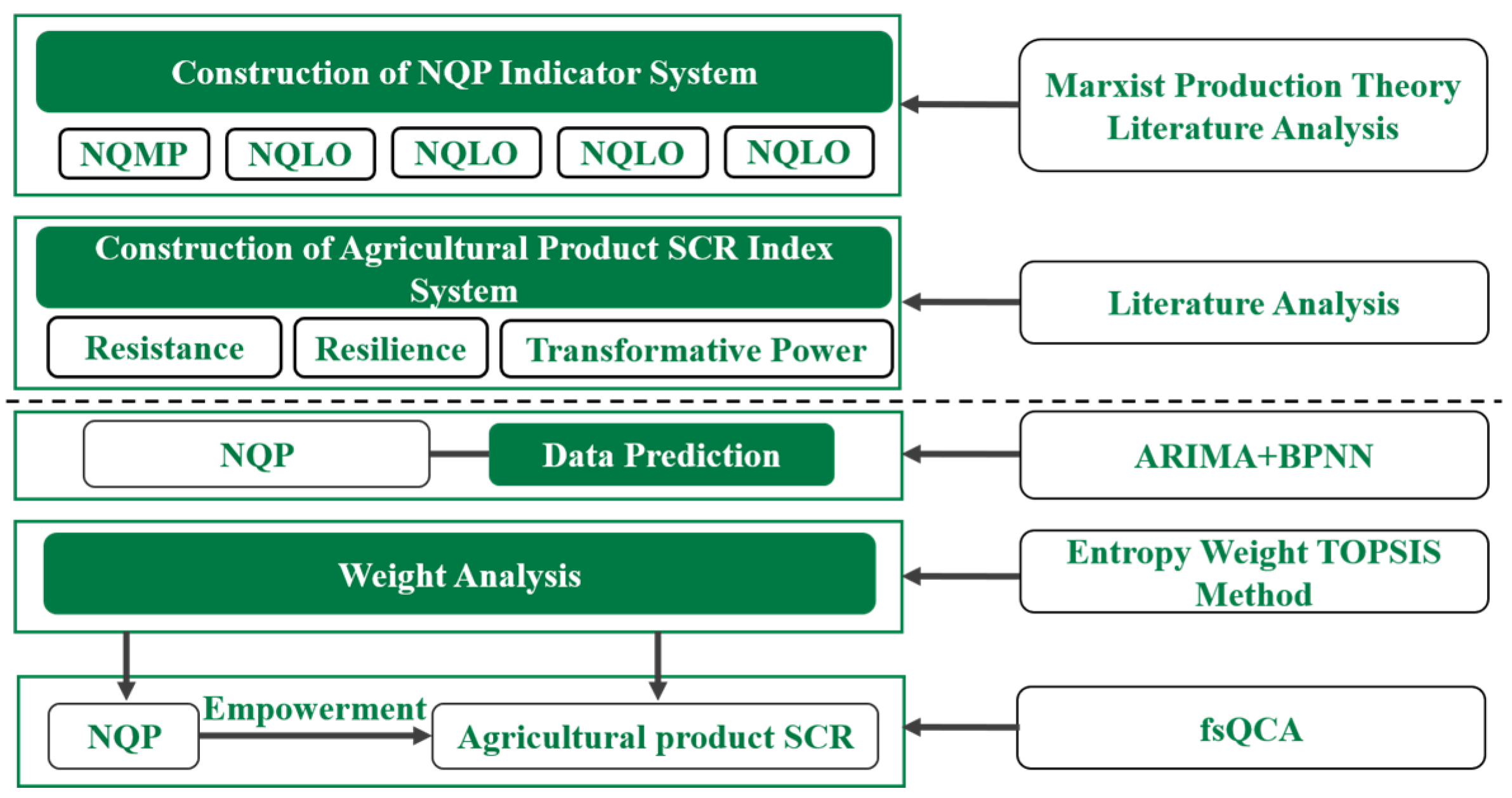
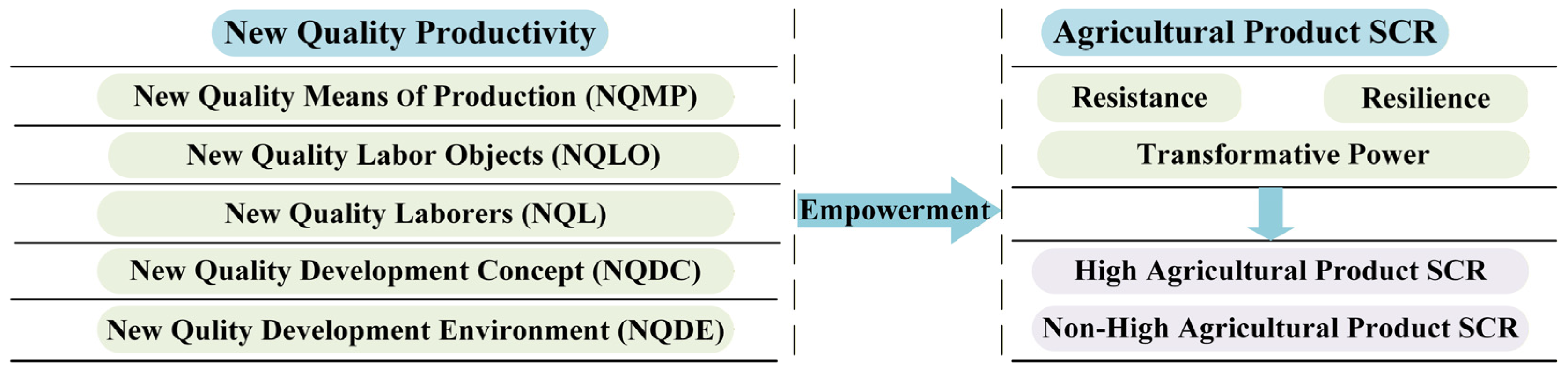
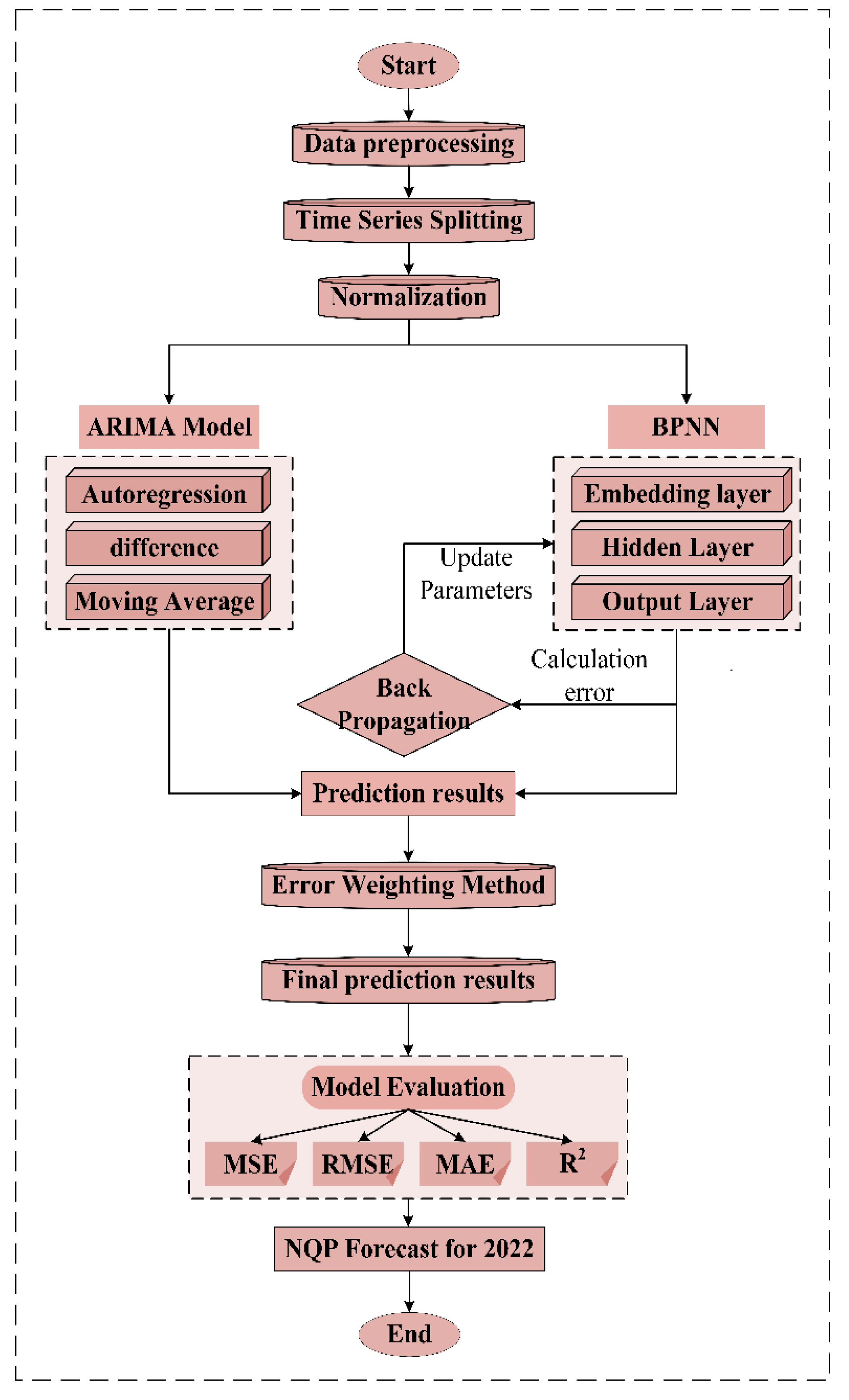
- There are studies about NQP empowering SCR. Most of the related studies remain at the stage of qualitative analysis. Cui and Du (2025) [39] believed that NQP could significantly improve SCR, and in areas with high adaptability, the effect of NQP on improving SCR was more significant. At the same time, Zhu et al. (2025) [40] pointed out that NQP-improved SCR is more significant in the eastern region and high-resilience regions. Specifically, NQP can enhance the resilience of the industrial and supply chain by reducing costs, reducing dependence on traditional production factors, and optimizing resource allocation [41]. It can also enhance the competitiveness and resilience of the industrial chain by deepening the industrial division of labor [42]. Technological innovation (especially disruptive technology) is the core of NQP. It can significantly improve SCR [43,44,45].Existing studies have the following shortcomings: (1) The construction of NQP indicators mostly focuses on three aspects, New Quality Laborers (NQL), New Quality Labor Objects (NQLO), and New Quality Means of Product (NQMP), and overlooks the importance of the New Quality Development Environment (NQDE) and the New Quality Development Concept (NQDC). (2) The measurement of the level of NQP mainly relies on panel data. However, there exists a “time lag” problem, and studies often overlook this issue. This oversight results in a lack of a forward-looking nature in current research findings. (3) The causal pathways through which NQP enhances SCR remain inadequately explored, particularly given the temporal disalignment inherent in conventional panel datasets.Therefore, considering the importance of NQDE and NQDC, and combining Marx’s theory of productive forces, an indicator system for new-quality productive forces was constructed from five dimensions: NQMP, NQLO, NQL, NQDC, and NQDE. At the same time, it selects resilience, resistance, and transformation power to measure the agricultural product SCR and constructs a corresponding indicator system. Then, based on panel data produced by 31 Chinese provinces from 2011 to 2022, we solved the “time lag” problem by integrating a BPNN with ARIMA modeling to predict the NQP level. Subsequently, the empowering paths through NQP that enhanced agricultural product SCR were explored via entropy weight TOPSIS and the fsQCA method. Finally, we put forward targeted policy recommendations for different provinces (the framework diagram is shown in Figure 1).
2. Theoretical Analysis and Research Hypothesis
Impacts of NQP on the Agricultural Product SCR
3. Study Design
3.1. Research Methods
- (1)
- Entropy-weighted TOPSIS method: In this paper, the entropy-weighted method is first used to determine the weights of the NQP and the agricultural product SCR indicators, and then the TOPSIS method is used to rank the indicators. The entropy-weighted TOPSIS method is a multi-indicator comprehensive evaluation method that combines entropy weighting (objective weighting) with the TOPSIS method (sorting by approaching ideal solutions). This method objectively assigns weights based on the degree of variation in the data itself to avoid subjective arbitrariness. NQP and agricultural product SCR indicators cover many aspects and have differences in magnitude and dimension. Before weighting, they need to be normalized for comparability. The indicators and their weights are weighted to make the comprehensive evaluation score more objective.
- (2)
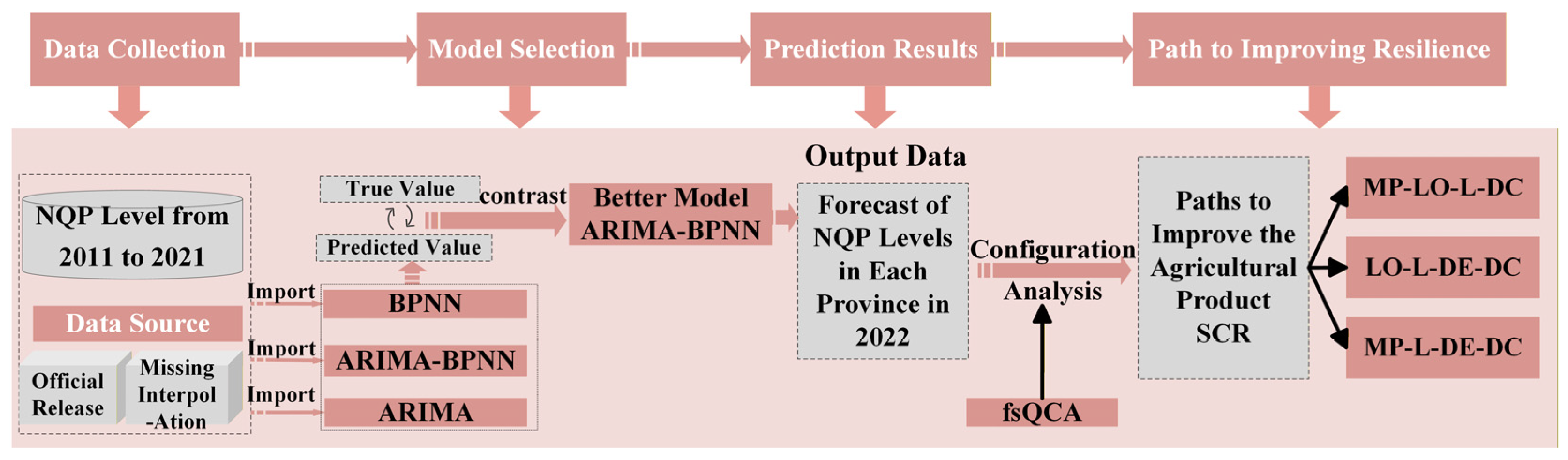
- ARIMA-BPNN hybrid model: To solve the problem of the panel data related to NQP, which “lags” the panel data related to agricultural product SCR, we proposed the ARIMA-BPNN hybrid model to predict the NQP indicator data.
- (a)
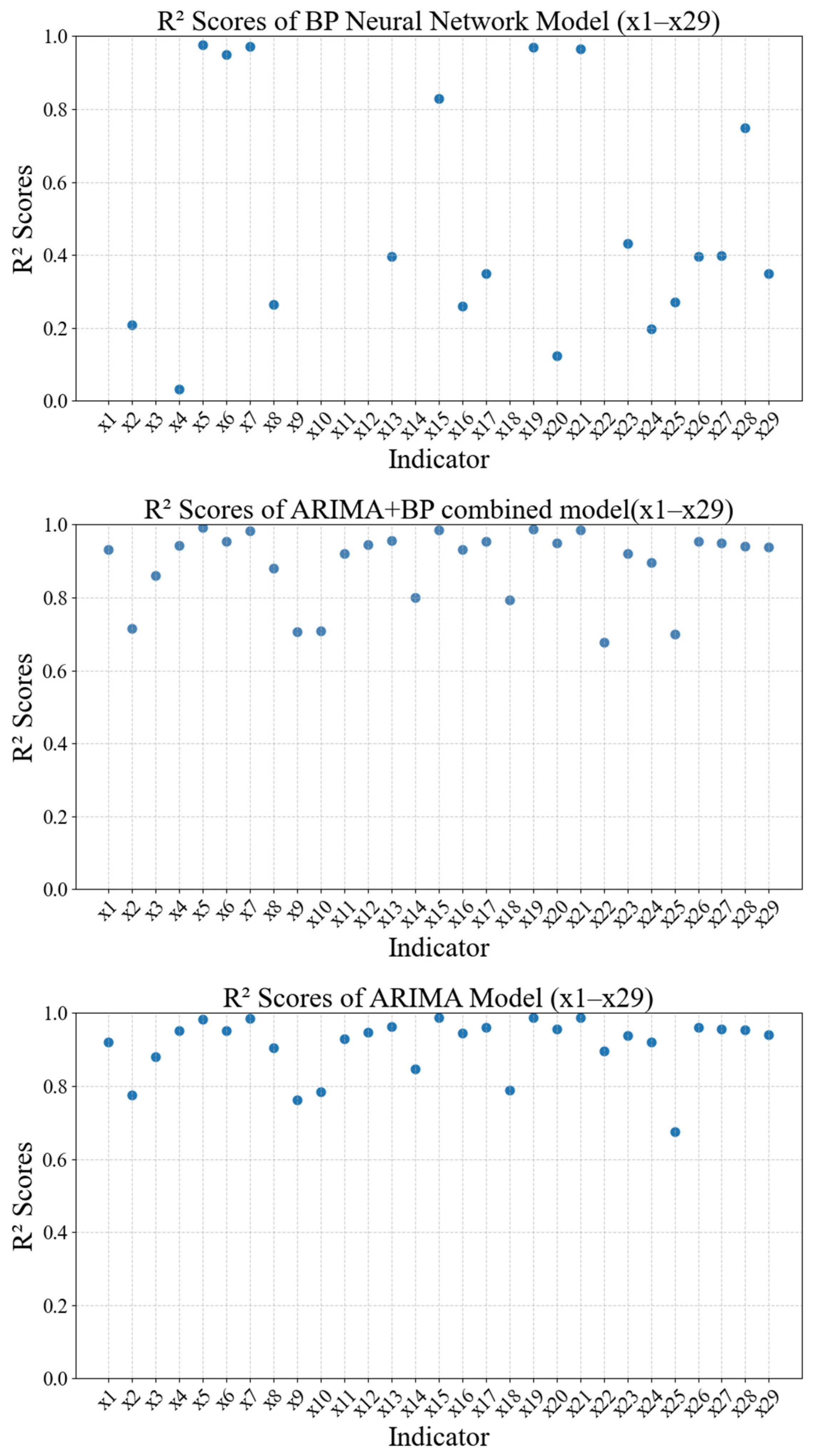
- The ARIMA model, also known as the autoregressive moving average model, combines the autoregressive (AR) and moving average (MA) models. It is a highly accurate linear time series forecasting method that utilizes historical trends and recent fluctuations in data for predictions. Its expression is as follows:where is the autoregressive coefficient, is the autoregressive order, is the moving average coefficient, is the moving average order, and is the white noise sequence. Usually, this model can be represented as ARIMA (), where is the difference order.The modeling process begins with a stationarity test, using the ADF unit root test to determine the difference order d (see Table A1 in Appendix A). Subsequently, the autoregressive order p and the moving average order q are preliminarily determined through autocorrelation function (ACF) and partial autocorrelation function (PACF) analysis, and parameter optimization is performed using Bayesian information criterion (BIC) minimization (Further details on model diagnostics are provided in Supplementary Materials). During model fitting, outliers are detected through residual analysis and influence functions, and identified outliers are Winsorized by adjusting extreme values to values at specified quantiles to mitigate their adverse effects on parameter estimation. After model establishment, a residual white noise test is performed to ensure effective extraction of linear information. Finally, dynamic prediction is achieved through a sliding window mechanism, with the window size set according to the periodic characteristics of the sequence.
- (b)
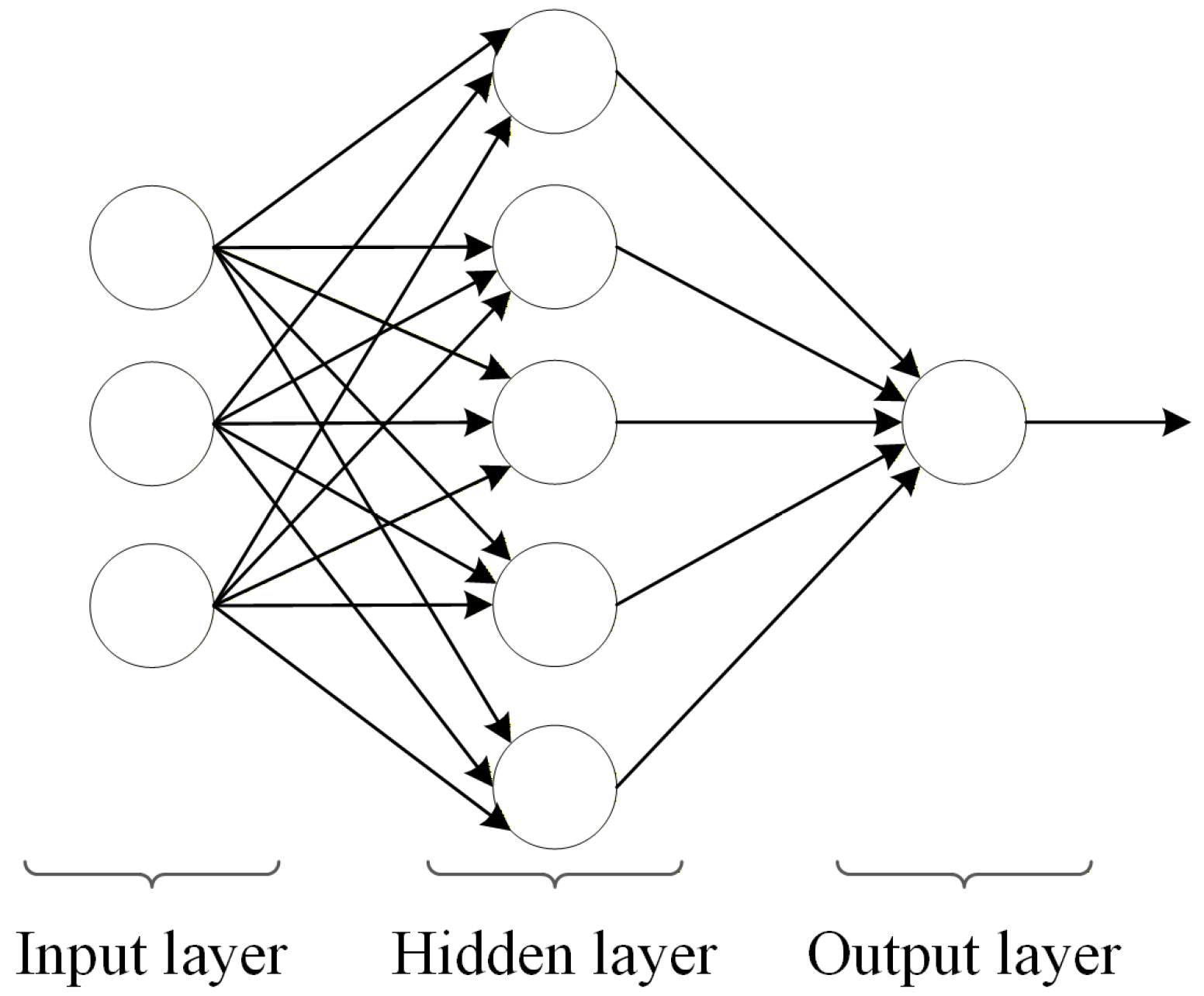
- Backpropagation Neural Network (BPNN) is a typical multi-layer feedforward neural network structure. This network typically consists of an input layer, an output layer, and one or more hidden layers, each layer composed of several neurons. In terms of connectivity, neurons in adjacent layers are fully connected through adjustable weights, while nodes within the same layer are not interconnected. A typical BP neural network is a three-layer structure with one hidden layer, as shown in Figure 4.Suppose a neural network has input neurons, output neurons, and hidden neurons. Then, the output of each neuron is as follows:The output of the output layer neurons is as follows:where and are the connection weights and bias terms, respectively, and are the activation functions of the hidden layer and the output layer, respectively.The core of the network training process is the backpropagation algorithm. This process first obtains the network output through forward computation, and then calculates the output error ( is the target input). During the crucial “backpropagation” phase, this error signal propagates backward along the network, and the gradient of the error function with respect to the weights and biases of each layer is calculated according to the chain rule and . Finally, the network uses this gradient information to update all weights and bias parameters through optimization algorithms such as the Levenberg–Marquardt algorithm, i.e., ( is the effective learning rate), thereby iteratively minimizing the error between the network output and the true value.In this study, the BPNN employs a single hidden layer structure with 5 nodes in the input layer, and the number of hidden layer nodes is optimized between 3 and 8 using a grid search. The hidden layer uses the hyperbolic tangent activation function, while the output layer uses a linear activation function. The network is trained using the Levenberg–Marquardt backpropagation algorithm, with a maximum training iteration count of 1000 and a target error of 0.001. To enhance the model’s robustness to outliers, L2 regularization is employed during training, and outlier detection is used to weight the training samples, reducing the impact of outliers on network parameter updates.
- (c)
- The combined model is determined. Most data sequences related to NQP levels exhibit composite characteristics, including both linear and nonlinear time series components. Simply using BPNN or ARIMA models may lead to excessive errors. Considering the nonlinear representation capabilities of BPNN and the statistical modeling advantages of ARIMA, as well as their different sensitivities to outliers, this paper proposes a novel inverse error weighting strategy based on backtesting performance. This method calculates the prediction errors of each model on the validation set and assigns weights according to the inverse of the error, giving models with smaller errors a larger share in the combination, thus adaptively highlighting the predictive power of the better-performing model. Weights are assigned based on the reciprocal of the error:and represent the weights of the ARIMA and BPNN models, respectively, and MAPE represents the mean absolute percentage error of each model on the validation set. The final combined prediction value is as follows:
- (3)
- fsQCA: This method is applied to analyze the path of NQP, empowering the agricultural product SCR. fsQCA is a methodology between qualitative and quantitative research, which is used to analyze causal complexity and identify multiple combinations of conditions (variables) that lead to specific results.
- (4)
- Necessary condition analysis (NCA) is an emerging method for analyzing causal relationships. It supplements traditional statistical methods and quantitative comparative analysis (QCA) by identifying the critical level that antecedent conditions must reach for an outcome to occur. To accurately test whether a single antecedent condition is necessary for high agricultural product SCR, this study introduced two estimation methods from NCA—upper bound regression (CR) and upper bound envelope (CE)—to calculate the effect size d and p-value before configuration analysis. A condition is considered necessary when both α ≥ 0.1 and α < 0.05 are simultaneously satisfied.
3.2. Sample Selection and Data Sources
3.3. Construction of the Indicator System
- (1)
- Construction of NQP indicators: Combining the existing literature, a comprehensive evaluation indicator system of NQP consisting of five levels, seven Tier-1 Indicators, fifteen Tier-2 Indicators, and twenty-nine Tier-3 Indicators was constructed (see Table A2 in Appendix A).
- (2)
- Construction of agricultural product SCR indicators: Starting from the three dimensions of resistance, resilience, and transformation power, an agricultural product SCR indicator system consisting of three Tier-1 Indicators, seven Tier-2 Indicators, and sixteen Tier-3 Indicators was constructed (see Table A3 in the Appendix A). Resistance comprises agricultural product production stability and supply level, and resilience encompasses economic recoverability and ecological sustainability. Transformative power integrates scientific and technological progress, diversity coordination, and innovation.
3.4. NQP Level Prediction
3.5. Variable Measurement and Calibration
- (1)
- Measurement of outcome variables. The outcome variable is the agricultural product SCR, which is comprehensively reflected by the three dimensions of resistance, resilience, and transformation power. We employed the entropy weight TOPSIS method to objectively determine indicator weights for generating a comprehensive evaluation score. Resistance constitutes the capacity of the agricultural product SCR to mitigate or hedge against risk exposures during disruptive events. It encompasses data such as agricultural product production stability and supply level. Resilience refers to the ability of the supply chain to maintain its function and structure in the face of major risks and to quickly recover to a normal or better state after being affected. It is divided into economic and ecological resilience. The transformation power emphasizes the ability of the supply chain to self-adjust, optimize, and quickly respond to changes when external factors change. It is represented by indicators such as scientific and technological progress, diversity and coordination, and innovation.
- (2)
- Measurement of conditional variables. The conditional variable is the development level of NQP, which is divided into five dimensions—NQMP, NQLO, NQL, NQDC, and NQDE—based on the inherent structure of NQP. The entropy-weighted TOPSIS method is used to objectively weight the indicators at each level and calculate a comprehensive score to characterize the development level of NQP at each level. Specifically, the NQMP dimension focuses on technology application and infrastructure, covering indicators such as agricultural technology input, mechanization level, and information infrastructure. The NQLO dimension mainly reflects the carriers and scale of technology application, measured by the number of agriculture-related enterprises. The NQL dimension covers labor quality and income levels, reflected by indicators such as education level and per capita output. The NQDC dimension emphasizes the organization’s sustainable perception and development orientation. The NQDE dimension includes the natural environment, industrial base, and market conditions, comprehensively evaluated through indicators such as resource endowment, industrial added value, and consumption scale.
- (3)
- Variable calibration. Drawing on the research approach of Fiss (2011) [51] and the standard practices of the fsQCA methodology [52], this study employs a direct calibration method to convert conditional variables into fuzzy sets. The specific anchor points are set as follows: the 95th percentile of the sample is used as the complete membership point (0.95), the 50th percentile (median) as the crossover point (0.5), and the 5th percentile as the complete non-membership point (0.05). This scheme follows the calibration principle of “based on substantial knowledge”, using sample quantiles as a robust alternative in the absence of external industry benchmarks. Choosing the 95th and 5th quantiles (rather than extreme values) effectively suppresses the interference of outliers, ensuring that only cases with extremely excellent or insufficient conditional performance are assigned extremely high (>0.95) or extremely low (<0.05) membership. Setting the median as the crossover point best reflects the membership state of the set with “maximum fuzziness”, thus theoretically conforming to the definition of intermediate states in fuzzy sets. The result variables and five conditional variables were calibrated using fsQCA software (v 4.1)at different time intervals (see Table 1).
4. Analysis of Empirical Results
4.1. Measurement of Agricultural Product SCR
4.1.1. Overall Analysis
4.1.2. Analysis of High Resilience Regions
4.1.3. Analysis of Low Resilience Regions
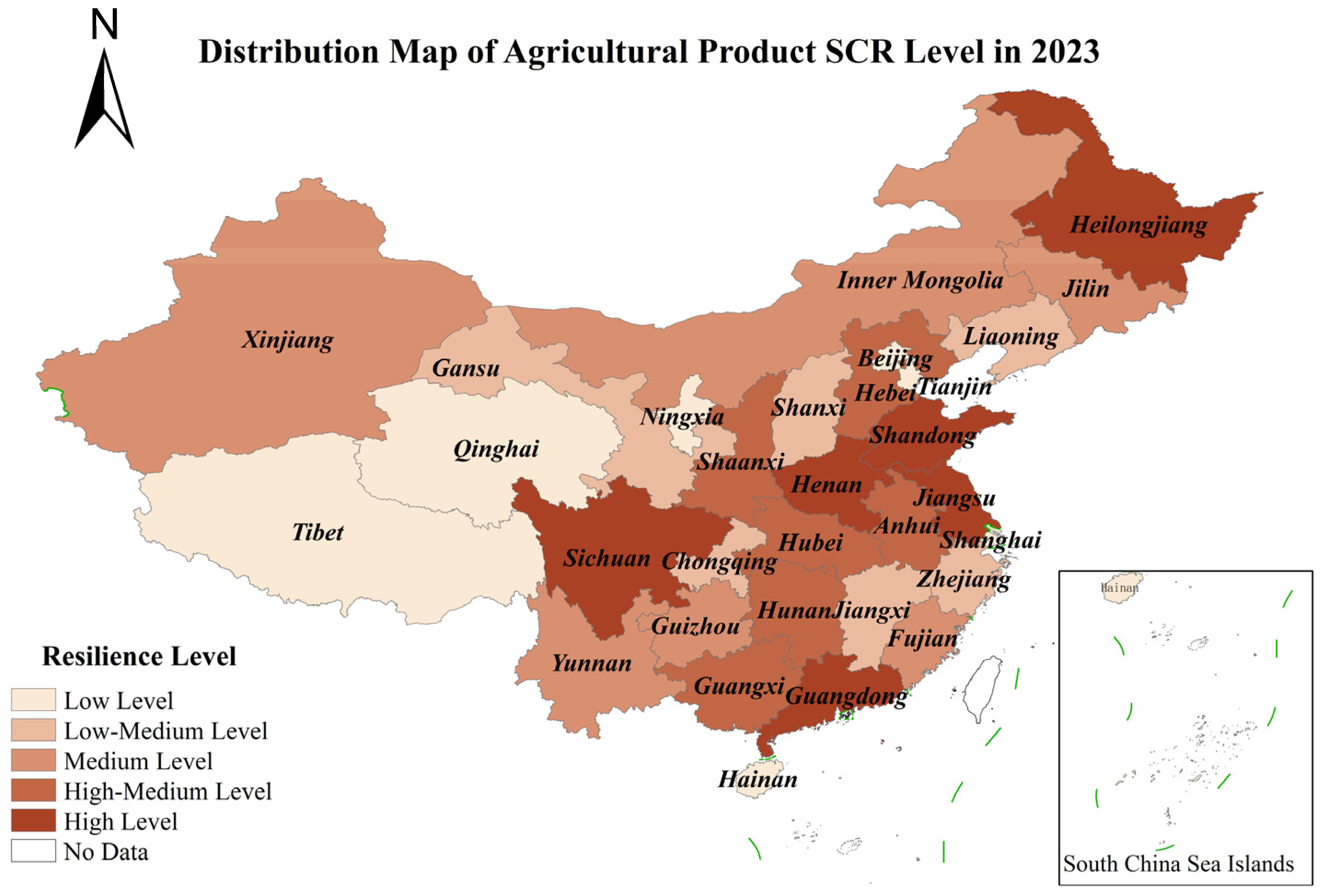
- At the level of natural constraints, differentiated measures should be adopted based on the unique natural conditions of each region: In Tibet, the focus should be on promoting cold-resistant and barren-tolerant crop varieties and greenhouse agriculture; in Qinghai, developing plateau-specific water-saving agriculture and animal husbandry; and in Ningxia, promoting a production model combining water-saving irrigation with sand-fixing crop cultivation. For Beijing, the focus should be on developing vertical agriculture and facility agriculture, compensating for insufficient arable land resources through technological innovation.
- At the level of industrial weaknesses, a precise industrial upgrading strategy should be implemented. Addressing the insufficient processing rate of specialty agricultural products in Tibet, Qinghai, and Ningxia, a special fund for deep processing should be established to promote the transformation from primary products to high-value-added products. For Beijing, its technological and market advantages should be fully utilized to extend agriculture towards high-value-added segments such as R&D, services, and branding, while maintaining a moderate scale of production capacity to balance the multi-functional positioning of agriculture.
- At the level of infrastructure, a logistics system adapted to regional characteristics should be constructed. In western regions, the focus should be on improving transportation accessibility and developing logistics solutions adapted to seasonal demands. In megacities like Beijing, an efficient agricultural product distribution network should be established, reducing dependence on external sources through digital supply chain management and regional collaboration.
4.1.4. Analysis of Unconventional Areas
- (1)
- As the main grain-producing area in Northeast China and a hub in the Bohai Rim Economic Zone, Liaoning boasts superior agricultural resource endowments (ranking among the top ten in the country in corn and rice production and eighth in pig production) and industrial location advantages. However, due to “triple structural imbalances”, the resilience of the agricultural product supply chain and resource conditions are seriously inverted. Industrial resource mismatch: Industry is prioritized, and agricultural input is diluted. Liaoning invests 60% of its fiscal resources in industry (such as the Shenyang Intelligent Connected Vehicle Industrial Park), while agricultural expenditure accounts for only 50% of Heilongjiang’s total expenditures. High-standard farmland accounts for 60% (90% in Heilongjiang), and the agricultural mechanization rate is 65% (90% in Heilongjiang). The “production end” of the supply chain has weak disaster resistance (in 2023, typhoons caused a 15% reduction in corn production, while in Heilongjiang it was only 5%). Industrial chain fault: weak processing and loss of added value. Liaoning’s corn processing is mainly based on primary products such as starch and alcohol (accounting for 70%), lacking deep processing (such as corn germ oil and protein feed in Heilongjiang). The agricultural product processing conversion rate is 40% (65% in Heilongjiang). When corn prices plummet in 2023, processing companies will have insufficient capacity to absorb the impact (Heilongjiang already absorbs 30% of excess capacity through deep processing).The core issue: Industrial advantages have not effectively fed back into agriculture, and resource endowments have become systematically ineffective under the “heavy industry, light agriculture” strategy.
- (2)
- As a major agricultural province, Jiangxi Province should theoretically have high SCR due to its natural resource endowment and industrial foundation, but in reality, it has medium-low resilience. Possible reasons are as follows. The single industrial structure: Jiangxi’s agriculture has long relied on the “four dominant” products of rice, pigs, citrus, and conventional aquatic products. In 2022, grain production accounted for more than 60% of the total agricultural output value, while cash crops and high-value-added industries accounted for less. Jiangxi’s agricultural product processing rate is only 61%, lower than the national average of 65%. Market dependence is high. Exports are concentrated in Southeast Asian and Middle Eastern markets. The ecological carrying capacity is limited. Jiangxi’s mountainous and hilly areas account for more than 60%, and cultivated land is severely fragmented. The transformation of low-yield fields, such as cold slurry fields, is difficult. In 2024, the transformation of cold slurry fields in Yuanzhou District only covered 10% of the affected area. Jiangsu has saved 20% of its irrigation water through “unmanned farms” and precision irrigation technology, achieving a balance between ecology and production.
4.2. Necessity Analysis
4.2.1. Necessity Analysis of Individual Conditions
4.2.2. NCA
4.3. NCA Bottleneck Level Analysis Results
4.4. Analysis of the Adequacy of Conditional Configuration
4.4.1. Configuration Analysis of High SCR
- (1)
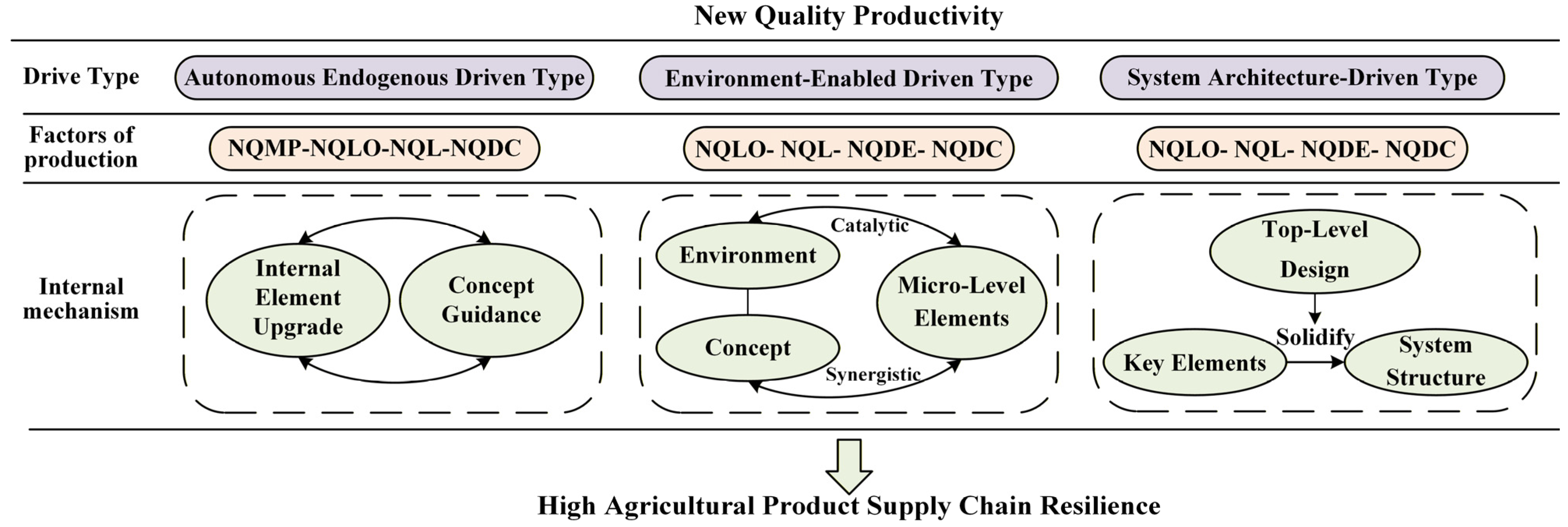
- Autonomous endogenously driven type (MP-LO-L-DC): Path H1 shows that the core combination of NQMP, NQLO, NQL, and NQDC constitutes an equivalent path for generating high agricultural product SCR. This path reveals that even in situations where external macroeconomic development environment support is relatively limited, regional agricultural systems can still build strong resilience by focusing on substantial upgrades of internal productivity factors and forward-looking guidance from development concepts. This reflects an “intrinsic” development logic, which does not rely on specific advantages of external location or policy dividends, but rather drives system evolution through synergistic innovation of internal technological foundation, human capital, industrial targets, and guiding ideologies. The original coverage of path H1 is 0.3419, indicating that this configuration can explain 34.19% of the high SCR samples. The unique coverage is 0.0621, indicating that 6.21% of the high SCR samples can only be explained by this configuration path. Typical regions include Guangxi and Shaanxi. Taking Guangxi as an example, although Guangxi is located in the west, in recent years it has focused on characteristic industries such as sugarcane and fruit, vigorously promoted small-scale agricultural machinery and water-saving irrigation technology in hilly and mountainous areas, implemented the “Local Expert” training program, promoted the development of primary and deep processing of agricultural products to optimize the value chain, and implemented the concept of “high-quality development of characteristic agriculture”. As a result, despite the unfavorable external circulation environment, it has formed a characteristic supply chain system with regional resilience.The core of the autonomous endogenously driven type lies in the positive closed loop formed by the upgrading of internal elements and the guidance of concepts. Specifically, advanced labor resources, represented by intelligent equipment and digital platforms, improve the operational efficiency and process controllability of the supply chain. Highly skilled professional farmers and new agricultural business entities, along with high-value-added, branded specialty agricultural products, together constitute the core carriers and driving forces of supply chain value creation, while the development concepts of greening and high quality provide strategic focus and action guidelines for the entire chain. These three elements reinforce each other: technological equipment empowers laborers and products, and the upgrading of concepts guides technological investment and product selection. Ultimately, this enables the supply chain system to maintain stable output and rapid recovery capabilities even under external market fluctuations or natural constraints, achieving endogenous resilience through its solid internal capabilities.
- (2)
- Environment-enabled driven type (LO-L-DE-DC). Path H2 shows that NQLO, NQL, NQDE, and NQDC are core conditions that can contribute to high agricultural product SCR. This path indicates that when a region possesses favorable external environments such as policy support, resource endowment, or market ecosystem, and has a clear development philosophy, even if its investment in traditional “hard” labor resources such as heavy mechanization and high-end intelligent facilities is not dominant, it can still achieve a leap in overall SCR through the deep empowerment of “people” (laborers) and “things” (labor objects) by the environment and philosophy. This highlights the decisive role of “soft environment” and “soft capital” under specific conditions. The original coverage of this configuration is 0.4856, which can explain 48.56% of the high agricultural product SCR sample; the unique coverage is 0.0768, indicating that 7.68% of the high agricultural product SCR sample can be explained only through this configuration path. Typical examples are Henan and Sichuan. Taking Henan as an example, Henan, relying on its strategic positioning as a core area of national grain production, enjoys stable policy expectations and a large-scale market, and firmly promotes the concepts of “storing grain in the land and storing grain in technology” and “digital transformation of agriculture”. Against this backdrop, Henan has continuously cultivated a large-scale, high-quality grain-growing workforce, developed high-quality specialty wheat and other crop varieties, and integrated resources through socialized service organizations to make up for the insufficient per capita machinery ownership, thus constructing a resilient generation path of “policy environment guidance-concept innovation drive-people and variety optimization”.The core of the environment-enabled-driven type lies in the catalytic and synergistic effect of the “environment-concept” dual framework on micro-level elements. A superior development environment provides supply chain entities with a low-risk foundation of innovation, abundant access channels for factors of production, and a large-scale demand market, reducing transaction costs and uncertainties. Advanced development concepts act as the system’s “brain”, identifying opportunities and guiding resources towards human capital enhancement and the upgrading of labor objects. Empowered workers and objects become the direct units for achieving resilience; they can more effectively utilize the opportunities provided by the environment, respond to the direction guided by the concepts, and form a flexible and highly adaptive supply chain network. This empowerment mechanism, from the outside in and from macro to micro, allows the system to achieve resilience without bearing heavy fixed capital investments by activating and optimizing its most dynamic elements.
- (3)
- System architecture-driven type (MP-L-DE-DC). Path H3 indicates that the core conditions constituted by NQMP, NQL, NQDE, and NQDC can foster high agricultural product SCR. This path demonstrates that if a region can systematically integrate advanced material and technological foundations, unique resource endowments, a favorable macroeconomic environment, and top-level strategic concepts to construct a stable and efficient institutionalized operational paradigm, then even with relatively low immediate dependence on individual high-end human resources, it can ensure that its supply chain exhibits extremely high and stable resilience. This emphasizes a “systematic” or “institutionalized” logic for resilience generation. The original coverage of this configuration is 0.5402, which can explain 54.02% of the high agricultural product SCR sample. The unique coverage is 0.1677, indicating that 16.77% of the high agricultural product SCR sample can only be explained through this configuration path. Typical regions include Heilongjiang and Guangdong. Taking Heilongjiang Province as an example, leveraging its globally scarce black soil resources, Heilongjiang has established a leading large-scale agricultural machinery equipment system in China. Under the strategic positioning of Heilongjiang as a “ballast stone” for national food security, it has received strong and continuous policy and investment support, and has long adhered to the development concepts of “modernized large-scale agriculture” and “black soil protection”. This highly coordinated “resource-technology-policy-concept” system architecture ensures that SCR is rooted in the robustness of the entire system, rather than relying on scattered, individualized skill advantages.The core of the system architecture-driven approach lies in solidifying key elements into a highly reliable system structure through top-level design. Its inherent operating mechanism is as follows: large-scale, standardized labor resources and objects constitute the standardized “hardware” modules and production processes of the supply chain, ensuring economies of scale and quality stability in output; a favorable development environment provides long-term, credible institutional commitments and resource guarantees, reducing external friction in system operation; and a clear development philosophy sets long-term goals and rule boundaries for system evolution. These three elements are interlocked, forming a resilient structure with low volatility and high predictability. Under this architecture, the operation of the supply chain relies more on pre-set rules, standard operating procedures, and stable resource inflows, reducing its immediate dependence on individual, random innovation. This allows it to exhibit strong structural stability and resilience in the face of shocks, achieving a kind of “system-inherent” resilience.The relatively unique low coverage of paths A and B reveals their emerging characteristics and potential shortcomings, primarily reflecting the high resilience resulting from technological innovation or organizational scale within individual provinces. This result indicates significant case overlap in explaining high agricultural product SCR in these paths. Most high-resilience cases can be achieved through multiple paths, demonstrating a “multiple concurrent causal” characteristic. While this development model based on specific resource endowments is effective, its replicability is limited. This finding reveals a key implication for agricultural product SCR construction: paths A and B are effective solutions for regions with specific conditions, while achieving more general high resilience requires exploring diversified path choices. Therefore, the lower unique coverage not only does not diminish the value of these paths but also provides an important basis for differentiated policy formulation in regions with different endowments, deepening our understanding of the complexity of agricultural product SCR systems.The core logic of the three highly configurable paths lies in the concurrent existence of core elements and the substitution and adaptation of non-core elements. That is, a deficiency in one dimension of new quality productivity can be compensated for by the synergistic effect of other core dimensions, without requiring all elements to reach their optimal levels, reflecting the flexibility and adaptability of “element substitution”. Element substitution is not a “direct replacement of a single element with another”, but rather a “systemic effect formed by the synergy of multiple core elements, compensating for the deficiency of a certain non-core element”. Its premise is the functional complementarity and synergistic adaptation of core elements, ultimately achieving the configuration logic of “multiple paths leading to the same result”.
4.4.2. Configuration Analysis of Non-High SCR
- (1)
- Comprehensive Shortcomings (L1 and L2). The core missing conditions for path L1 are NQMP, NQDC, and NQDE, while NQL and NQLO have no impact on the result. This means that when insufficient technical support, conservative development concepts, and lack of external environment coexist, regardless of the form of labor objects or the quality of laborers, a non-high agricultural product SCR will occur. The core missing conditions for path L2 are NQMP, NQDC, NQL, and NQLO, while NQDE has no impact on the result. This means that when the four core elements of technical equipment, product form, laborer quality, and development concepts are all insufficient, regardless of whether the external environment has supporting conditions, a non-high agricultural product SCR will occur.
- (2)
- Advantage Mismatch Type (L3, L4): The core missing conditions for path L3 are NQLO and NQDE, while the core existence conditions are NQMP and NQL. This is a typical path where “advantageous elements and key weaknesses coexist”. This means that even with advanced agricultural technology and highly skilled laborers, if agricultural products lack standardization, high-quality upgrading, and effective external support, the advantageous elements cannot be taken advantage of due to the lack of suitable scenarios, resulting in a non-high-value agricultural product SCR. The core missing conditions for path L3 are NQLO, NQDC, and NQDE, while the core existence conditions are NQMP and NQL. This is an “enhanced version of the weakness scenario” of path L3. This means that even with technological and human resource advantages, the three key conditions of product, concept, and environment are simultaneously missing, forming a triple constraint of “direction-value-platform”, which completely suppresses the role of advantageous elements, ultimately resulting in a non-high agricultural product SCR.Path L1 has higher original coverage and unique coverage than the other three paths, indicating that path L1 is relatively more dominant in explaining the SCR of non-high-value agricultural product SCR. The core logic is that technology, concepts, and the environment are the “basic support triangle” for supply chain upgrading. The simultaneous absence of all three leads to a triple lock-in of “no technological efficiency improvement, no conceptual guidance, and no environmental empowerment” in the supply chain. Even if the labor objects or laborers have a certain potential, they cannot be transformed into a resilience advantage. The core logic of this non-high configuration result is the “concurrent absence” of core conditions rather than a single deficient factor. That is, the core elements of the key dimensions of NQP are missing simultaneously, or the key supporting conditions are not met, ultimately leading to a non-high agricultural product SCR. The results of the non-high configuration once again verify the “causal asymmetry” and “multiple concurrent absences” characteristics of NQP’s ability to enhance agricultural product SCR.
4.5. Robustness Test
5. Discussion
6. Conclusions and Recommendations
6.1. Conclusions
- (1)
- China’s agricultural product SCR shows spatial differences with fluctuations in the east, central, and western regions. The central region (such as Henan) performs well due to resource integration and policy adaptability, while the western region (such as Tibet and Qinghai) has low resilience due to a weak foundation.
- (2)
- Both the fsQCA and NCA methods identified that a single factor does not constitute a necessary condition for high agricultural product SCR, but rather promotes the improvement of China’s agricultural product SCR by bolstering the synergy of factors. There are three driving paths for high agricultural product SCR: autonomous endogenously driven type (MP-LO-L-DC type), environment empowerment-driven type (LO-L-DE-DC type), and system architecture-driven type (MP-L-DE-DC type).
- (3)
- Bottleneck-level analysis results of NCA show that NQMP is the first to become a bottleneck factor for improving agricultural product SCR, and the bottleneck effect of each factor gradually increases with the improvement of the agricultural product SCR level.
- (4)
- The synergistic existence and functional complementarity of the core elements of high-resilience path dependence allow for system compensation through “element substitution”. Low resilience stems from the concurrent absence or structural mismatch of key conditions. Shortcomings in any core dimension may lead the system to a low-level equilibrium. NQP has multiple concurrent effects and asymmetric characteristics in improving agricultural product SCR.
6.2. Recommendations
Supplementary Materials
Author Contributions
Funding
Institutional Review Board Statement
Data Availability Statement
Acknowledgments
Conflicts of Interest
Abbreviations
| NQP | New Quality Productivity |
| SCR | Supply Chain Resilience |
| fsQCA | Fuzzy-Set Qualitative Comparative Analysis |
| BPNN | Backpropagation Neural Network |
| ARIMA | Autoregressive Integrated Moving Average |
| NQMP | New Quality Means of Product |
| NQLO | New Quality Labor Objects |
| NQL | New Quality Laborers |
| NQDE | New Quality Development Environment |
| NQDC | New Quality Development Concept |
Appendix A

| Variable | ADF Statistic | Critical Values | p-Value | Test Results | d | ||
|---|---|---|---|---|---|---|---|
| 1% | 5% | 10% | |||||
| X1 | −2.2289 | −4.6652 | −3.3672 | −2.8030 | 0.1959 | non-stationary | 1 |
| D(X1) | −5.1716 | −6.0451 | −3.9293 | −2.9868 | 0.0000 | stationary | |
| X2 | −2.8570 | −5.3543 | −3.6462 | −2.9012 | 0.0506 | non-stationary | 1 |
| D(X2) | −4.5819 | −6.0451 | −3.9293 | −2.9868 | 0.0001 | stationary | |
| X3 | −2.6069 | 0.0916 | −4.9387 | −3.4776 | −2.8439 | non-stationary | 1 |
| D(X3) | −6.9387 | −6.0451 | −3.9293 | −2.9868 | 0.0000 | stationary | |
| X4 | −4.6821 | 0.0000 | −4.9387 | −3.4776 | −2.8439 | stationary | 0 |
| X5 | −2.8118 | 0.0566 | −4.6652 | −3.3672 | −2.8030 | non-stationary | 1 |
| D(X5) | −4.6430 | −5.3543 | −3.6462 | −2.9012 | 0.0001 | stationary | |
| X6 | −2.1248 | 0.2347 | −4.6652 | −3.3672 | −2.8030 | non-stationary | 1 |
| D(X6) | −5.3653 | −6.0451 | −3.9293 | −2.9868 | 0.0000 | stationary | |
| X7 | −9.4559 | 0.0000 | −5.3543 | −3.6462 | −2.9012 | stationary | 0 |
| X8 | −3.4246 | 0.0101 | −5.3543 | −3.6462 | −2.9012 | stationary | 0 |
| X9 | −6.9904 | 0.0000 | −5.3543 | −3.6462 | −2.9012 | stationary | 0 |
| X10 | −0.4096 | −5.3543 | −3.6462 | −2.9012 | 0.9085 | non-stationary | 2 |
| D(X10) | −2.3573 | −6.0451 | −3.9293 | −2.9868 | 0.1541 | non-stationary | |
| D2(X10) | −3.6914 | −6.0451 | −3.9293 | −2.9868 | 0.0042 | stationary | |
| X11 | −3.4225 | −4.9387 | −3.4776 | −2.8439 | 0.0102 | stationary | 0 |
| X12 | −3.0326 | −4.9387 | −3.4776 | −2.8439 | 0.0320 | stationary | 0 |
| X13 | −8.1334 | −5.3543 | −3.6462 | −2.9012 | 0.0000 | stationary | 0 |
| X14 | 0.0790 | −5.3543 | −3.6462 | −2.9012 | 0.9646 | non-stationary | 2 |
| D(X14) | −1.7338 | −6.0451 | −3.9293 | −2.9868 | 0.4138 | non-stationary | |
| D2(X14) | −4.8876 | −6.0451 | −3.9293 | −2.9868 | 0.0000 | stationary | |
| X15 | −2.0860 | −5.3543 | −3.6462 | −2.9012 | 0.2502 | non-stationary | 1 |
| D(X15) | −5.1563 | −6.0451 | −3.9293 | −2.9868 | 0.0000 | stationary | |
| X16 | 0.2598 | −5.3543 | −3.6462 | −2.9012 | 0.9754 | non-stationary | 2 |
| D(X16) | −1.7844 | −6.0451 | −3.9293 | −2.9868 | 0.3882 | non-stationary | |
| D2(X16) | −5.0538 | −6.0451 | −3.9293 | −2.9868 | 0.0000 | stationary | |
| X17 | −5.0359 | −4.6652 | −3.3672 | −2.8030 | 0.0000 | stationary | 0 |
| X18 | −3.2459 | −5.3543 | −3.6462 | −2.9012 | 0.0175 | stationary | 0 |
| X19 | −3.1309 | −4.9387 | −3.4776 | −2.8439 | 0.0243 | stationary | 0 |
| X20 | −3.8003 | −4.9387 | −3.4776 | −2.8439 | 0.0029 | stationary | 0 |
| X21 | −2.4302 | −4.9387 | −3.4776 | −2.8439 | 0.1334 | non-stationary | 1 |
| D(X21) | −4.4498 | −6.0451 | −3.9293 | −2.9868 | 0.0002 | stationary | |
| X22 | −2.3112 | −4.9387 | −3.4776 | −2.8439 | 0.1684 | non-stationary | 1 |
| D(X22) | −4.0734 | −6.0451 | −3.9293 | −2.9868 | 0.0011 | stationary | |
| X23 | −3.6331 | −4.9387 | −3.4776 | −2.8439 | 0.0052 | stationary | 0 |
| X24 | −3.3483 | −5.3543 | −3.6462 | −2.9012 | 0.0129 | stationary | 0 |
| X25 | −0.6510 | −5.3543 | −3.6462 | −2.9012 | 0.8590 | non-stationary | 1 |
| D(X25) | −8.6741 | −6.0451 | −3.9293 | −2.9868 | 0.0000 | stationary | |
| X26 | 0.2517 | −5.3543 | −3.6462 | −2.9012 | 0.9750 | non-stationary | 2 |
| D(X26) | −2.2938 | −6.0451 | −3.9293 | −2.9868 | 0.1740 | non-stationary | |
| D2(X26) | −5.6542 | −6.0451 | −3.9293 | −2.9868 | 0.0000 | stationary | |
| X27 | −49.5688 | −5.3543 | −3.6462 | −2.9012 | 0.0000 | stationary | 0 |
| X28 | −0.3150 | −4.6652 | −3.3672 | −2.8030 | 0.9234 | non-stationary | 2 |
| D(X28) | −1.8533 | −5.3543 | −3.6462 | −2.9012 | 0.3543 | non-stationary | |
| D2(X28) | −5.1894 | −6.0451 | −3.9293 | −2.9868 | 0.0000 | stationary | |
| X29 | −3.2994 | −4.6652 | −3.3672 | −2.8030 | 0.0149 | stationary | 0 |
| Dimension | Tier-1 Indicators | Tier-2 Indicators | Tier-3 Indicators | Attributes |
|---|---|---|---|---|
| NQMP | Level of Agricultural Science and Technology | Science and Technology Innovation | Agricultural Science and Technology Employees [9,16] | Positive |
| Agricultural S&T Input [7,16] | Positive | |||
| R&D Expenditure [8] | Positive | |||
| R&D Personnel [8,11] | Positive | |||
| Level of Agricultural Mechanization | Total Power of Agricultural Machinery and Machinery [60] | Positive | ||
| Grain Production Capacity | Total Grain Production [7,9] | Positive | ||
| Agricultural Information Development | Information Infrastructure Development | Number of Agrometeorological Station Observations [6,7,18] | Positive | |
| Number of Rural Broadband Access Users [7,9] | Positive | |||
| Length of Fiber Optic Cable Lines Per Square Meter [6,7,9,12] | Positive | |||
| NQLO | The Scale of a Technological Organization (Organizational Perceived Capacity) | Above-Scale Agriculture-Related Enterprises | Number of Agricultural Production Enterprises [7,8,13] | Positive |
| Number of Agricultural IT Enterprises [7,8,13] | Positive | |||
| Agricultural Breeding Enterprises [7,8,13] | Positive | |||
| Number of Pesticide And Fertilizer Enterprises [7,8,13] | Positive | |||
| Number of Agricultural Logistics Enterprises [7,8,13] | Positive | |||
| NQL | Labor Force Development Level | Educational Attainment | Years of Education Per Rural Laborer [6,7,8,10] | Positive |
| Per Capita Output Value of Primary Industry | Output Value of Primary Industry/Number of Employees in Primary Industry [7,9] | Positive | ||
| Per Capita Income of Rural Residents | Per Capita Disposable Income of Rural Residents [7,9,10] | Positive | ||
| NQDC | Organizational Development Concept (Organizational Sustainability) | Resource Consumption | Water Consumption in Agriculture [7] | Negative |
| Agricultural Electricity Consumption [16] | Negative | |||
| Environmental Pollution | Fertilizer Application [8,16] | Negative | ||
| Pesticide Application [8,16] | Negative | |||
| Environmental Protection | Soil Erosion Control Area [6] | Positive | ||
| Forest Cover [10] | Positive | |||
| NQDE | Market Transaction Environment | Transaction Scale | Gross Agricultural Output [9] | Positive |
| Natural Environment | Water Resources | Total Water Resources [10] | Positive | |
| Industry Development Environment | Value Added to the Industry | GDP Output Value-Added of Primary Industry [60] | Positive | |
| Value Added of Tertiary Industry [60] | Positive | |||
| External Environment | Water Resources Irrigation Level [8] | Positive | ||
| Total Retail Sales of Consumer Goods [61] | Positive |
| Tier-1 Indicators | Tier-2 Indicators | Tier-3 Indicators | Attributes |
|---|---|---|---|
| Resistance [62] | Stability of Agricultural Production | Total Sown Area [63,64] | Positive |
| Effective Irrigation Area [63,64,65,66] | Positive | ||
| Total Power of Agricultural Machinery [65] | Positive | ||
| Agricultural Product Supply Level | Total Grain Production [63,64] | Positive | |
| Number of People Employed in One Industry [63,65] | Positive | ||
| Resilience [62] | Economic Recoverability | Industry Value Added [64,65] | Positive |
| The Proportion of Primary Industry-Added Value in Regional GDP [63,64] | Positive | ||
| Agricultural Producer Price Index [63] | Positive | ||
| Total Agricultural Output [63] | Positive | ||
| Ecological Sustainability | Amount of Agricultural Fertilizers Used [66] | Negative | |
| Agricultural Plastic Film Usage [63,65] | Negative | ||
| The Area of Crops Affected [63,65] | Negative | ||
| Transformative Power [62] | Technological Advancement | Agricultural Electricity Consumption [66] | Negative |
| Agricultural Diesel Consumption [63,65] | Negative | ||
| Diversity and Coordination | Rural Per Capita Disposable Income [66] | Positive | |
| Innovation | Agricultural Technology Investment [66] | Positive |
| Tier-3 Indicators | MSE | RMSE | MAE | R2 |
|---|---|---|---|---|
| Agricultural Science and Technology Employees | 126,717,585.1212 | 11,256.8906 | 9787.1783 | 0.9317 |
| Agricultural S&T Input | 4570.8838 | 67.6083 | 48.9924 | 0.7294 |
| R&D Expenditure | 26,248.0240 | 162.0124 | 126.4613 | 0.8501 |
| R&D Personnel | 1,027,515,575.5921 | 32,054.8838 | 27,488.1832 | 0.9457 |
| Total Power of Agricultural Machinery and Machinery | 1114.9808 | 33.3913 | 21.3362 | 0.9872 |
| Total Grain Production | 806.1365 | 28.3925 | 24.7510 | 0.9639 |
| Number of Agrometeorological Station Observations | 0.1694 | 0.4116 | 0.3432 | 0.9847 |
| Number of Rural Broadband Access Users | 0.0050 | 0.0710 | 0.0568 | 0.8861 |
| Length of Fiber Optic Cable Lines Per Square Meter | 4140.2197 | 64.3445 | 49.1519 | 0.6977 |
| Number of Agricultural Production Enterprises | 52.3230 | 7.2335 | 5.8294 | 0.7072 |
| Number of Agricultural IT Enterprises | 66.6693 | 8.1651 | 6.7185 | 0.9163 |
| Agricultural Breeding Enterprises | 0.1894 | 0.4352 | 0.3313 | 0.9488 |
| Number of Pesticide and Fertilizer Enterprises | 0.4689 | 0.6848 | 0.6131 | 0.9616 |
| Number of Agricultural Logistics Enterprises | 1.6913 | 1.3005 | 1.0034 | 0.7915 |
| Water Consumption in Agriculture | 8.2931 | 2.8798 | 2.2239 | 0.9865 |
| Agricultural Electricity Consumption | 48,247.7969 | 219.6538 | 176.4976 | 0.9329 |
| Fertilizer Application | 31.8832 | 5.6465 | 4.5023 | 0.9539 |
| Pesticide Application | 0.2006 | 0.4479 | 0.3931 | 0.8005 |
| Soil Erosion Control Area | 0.4961 | 0.7043 | 0.4638 | 0.9877 |
| Forest Cover | 2767.5808 | 52.6078 | 45.2128 | 0.9476 |
| Years of Education Per Rural Laborer | 0.0127 | 0.1126 | 0.0743 | 0.9864 |
| Output Value of Primary Industry/Number of Employees in Primary Industry | 2 × 10⁻⁹ | 4 × 10⁻⁵ | 3 × 10⁻⁵ | 0.6857 |
| Per Capita Disposable Income of Rural Residents | 438,454.1293 | 662.1587 | 541.8965 | 0.9245 |
| Gross Agricultural Output | 31,358.0325 | 177.0820 | 139.5979 | 0.8973 |
| Total Water Resources | 10,570.8289 | 102.8145 | 89.4070 | 0.7926 |
| GDP Output Value-Added Of Primary Industry | 8,500,737.3359 | 2915.6024 | 2489.5789 | 0.9537 |
| Value Added of Tertiary Industry | 9,286,204.5357 | 3047.3274 | 2568.6276 | 0.9548 |
| Water Resources Irrigation Level | 2558.7567 | 50.5842 | 39.7776 | 0.9404 |
| Total Retail Sales of Consumer Goods | 1,457,832.1501 | 1207.4072 | 897.6685 | 0.9431 |
References
- Yao, Y.C. Leading the Construction of Agricultural Powerful Country with New Quality Productive Forces: Requirement and Path. Frontiers 2024, 13, 40–46. [Google Scholar]
- Hu, Y. Theoretical Logic and Practical Path of New Quality Productivity Accelerating Agricultural Green Transformation. Acad. J. Zhongzhou 2024, 41, 30–38. [Google Scholar]
- Sheng, Z.H.; Wang, H.Y.; Hu, Z.H. Supply Chain Resilience: Adapting to Complexity—Based on the Perspective of Complex System Thinking. Chin. J. Manag. Sci. 2022, 30, 1–7. [Google Scholar]
- Zhang, X.C. Research on the Transformation, Development Dilemma, and Countermeasures of China’s Agricultural Product Supply Chain. Economist 2024, 36, 118–128. [Google Scholar]
- Gao, Z.Y.; Li, L.Q.; Hao, Y. Resource industry dependence and high-quality economic development of Chinese style: Reexamining the effect of the “Resource Curse”. Struct. Change Econ. Dyn. 2024, 68, 1–16. [Google Scholar] [CrossRef]
- Zhang, Z.Q.; Zhang, Y.F.; Zhang, X. The spatiotemporal evolution and threshold effect of new quality productive forces and territorial space ecological restoration scale in China. Environ. Dev. Sustain. 2025, 27, 2065–2091. [Google Scholar] [CrossRef]
- Fan, Z.N.; Qin, Z.H.; Ding, Z.G.; Tan, Q.J. Impact of China’s new quality agricultural productive forces on carbon emissions from grain production and its mechanism. Resour. Sci. 2025, 47, 1312–1326. [Google Scholar]
- Gao, J.; Zhu, J.T.; Li, Y.R.; Gong, Y.L.; Shen, M. Spatio-temporal pattern of China’s new quality agricultural productive forces and their impact on agriculture. Acta Geogr. Sin. 2025, 80, 1386–1404. [Google Scholar]
- Wang, L.S.; Fu, X.H.; Jiang, H.; Yang, J.X. Development level measurement, regional differences and coupling coordination of agricultural new quality productivity. J. Agro-For. Econ. Manag. 2025, 24, 55–64. [Google Scholar]
- Liu, Y.; He, Z. Synergistic industrial agglomeration, new quality productive forces and high-quality development of the manufacturing industry. Int. Rev. Econ. Financ. 2024, 94, 103373. [Google Scholar] [CrossRef]
- Yang, L.; Xu, Y.; Zhu, J.Q.; Sun, K. Spatiotemporal Evolution and Influencing Factors of the Coupling Coordination of Urban Ecological Resilience and New Quality Productivity at the Provincial Scale in China. Land 2024, 13, 1998. [Google Scholar] [CrossRef]
- Lu, J.; Guo, Z.A.; Wang, Y.P. Levels of development of new quality productivity, regional differences and paths to enhancement. J. Chongqing Univ. (Soc. Sci. Ed.) 2024, 30, 1–17. [Google Scholar]
- Han, W.L.; Zhang, R.S.; Zhao, F. The Measurement of New Quality Productivity and New Driving Force of the Chinese Economy. J. Quant. Technol. Econ. 2024, 41, 5–25. [Google Scholar]
- Cao, Y.P.; Dai, S.Z. Understanding and evaluating new quality productive forces in China: Based on machine learning. Appl. Econ. Lett. 2025. online release. [Google Scholar]
- Gang, H.; Zhao, F.Y. Research on the coupling and harmonization degree of new productive force and high-quality economic development. Financ. Res. Lett. 2025, 84, 107684. [Google Scholar] [CrossRef]
- Wang, Y.; Li, J.Q.; Fan, Y.Q.; Chen, W. High-Standard Farmland Construction Policy, Agricultural New-Quality Productivity, and Greenhouse Gas Emissions from Crop Cultivation: Evidence from China. Land 2025, 14, 1157. [Google Scholar] [CrossRef]
- Zhang, Y.C.; Chen, Y.; Ye, F. Digital financial innovation, productivity and modernization of industry chain and supply chain. Econ. Anal. Policy 2025, 87, 1198–1211. [Google Scholar] [CrossRef]
- Ye, L.G.; Fang, Z.H. The Impact of New-Quality Productivity on Environmental Pollution: Empirical Evidence from China. Sustainability 2025, 17, 3230. [Google Scholar] [CrossRef]
- Hua, G.Z.; Zeng, F.L.; Sun, H.P. Analyzing New Quality Productive Forces in New Energy Vehicle Companies Based on a New Multi-Criteria Decision Analysis Model. World Electr. Veh. J. 2024, 15, 503. [Google Scholar] [CrossRef]
- Zhong, Y.; Lai, H.S.; Zhang, L.; Guo, L.; Lai, X. Does public data openness accelerate new quality productive forces? Evidence from China. Econ. Anal. Policy 2025, 85, 1409–1427. [Google Scholar] [CrossRef]
- Ruanzhou, Y.L.; Guo, R.G. New quality productivity and intellectual property protection. Financ. Res. Lett. 2025, 83, 107650. [Google Scholar] [CrossRef]
- Li, X.M.; Tang, H.J.; Chen, Z.S. Artificial Intelligence and the New Quality Productive Forces of Enterprises: Digital Intelligence Empowerment Paths and Spatial Spillover Effects. Systems 2025, 13, 105–135. [Google Scholar] [CrossRef]
- Ponomarov, S.Y.; Holcomb, M.C. Understanding the concept of supply chain resilience. Int. J. Logist. Manag. 2009, 20, 124–143. [Google Scholar] [CrossRef]
- Sheykhizadeh, M.; Ghasemi, R.; Vandchali, H.R.; Sepehri, A.; Torabi, S.A. A hybrid decision-making framework for a supplier selection problem based on lean, agile, resilience, and green criteria: A case study of a pharmaceutical industry. Environ. Dev. Sustain. 2024, 26, 30969–30996. [Google Scholar] [CrossRef]
- Wieland, A.; Durach, C.F. Two perspectives on supply chain resilience. J. Bus. Logist. 2021, 42, 315–322. [Google Scholar] [CrossRef]
- Christopher, M.; Peck, H. Building the Resilient Supply Chain. Int. J. Logist. Manag. 2004, 15, 1–13. [Google Scholar] [CrossRef]
- Aungkulanon, P.; Atthirawong, W.; Luangpaiboon, P.; Chanpuypetch, W. Navigating Supply Chain Resilience: A Hybrid Approach to Agri-Food Supplier Selection. Mathematics 2024, 12, 1598. [Google Scholar] [CrossRef]
- Yuan, M.; Hu, H.; Xue, M.; Li, J. Framework for resilience strategies in agricultural supply chain: Assessment in the era of climate change. Front. Sustain. Food Syst. 2024, 8, 1444910. [Google Scholar] [CrossRef]
- Found, P.A.; Mogale, D.; Xu, Z.R.; Yang, J. Food supply chain resilience in major disruptions. J. Manuf. Technol. Manag. 2024, 35, 655–681. [Google Scholar] [CrossRef]
- Wang, W.H.; Li, Z.; Meng, Q.F. Digital Transformation Drivers, Technologies, and Pathways in Agricultural Product Supply Chains: A Comprehensive Literature Review. Appl. Sci. 2025, 15, 10487. [Google Scholar] [CrossRef]
- Pu, X.J.; Chen, B.H.; Li, X.F. Historical Evolution and Future Prospects of Research on the Digital and Intelligent Transformation of the Agricultural Product Supply Chain. Chin. J. Manag. Sci. 2025, 33, 235–250. [Google Scholar]
- Coopmans, I.; Bijttebier, J.; Marchand, F.; Mathijs, E.; Messely, L.; Rogge, E.; Sanders, A.; Wauters, E. COVID-19 impacts on Flemish food supply chains and lessons for agri-food system resilience. Agric. Syst. 2021, 190, 103136. [Google Scholar] [CrossRef]
- Wang, W.K.; Cao, Q.; Liu, Y.; Zhou, C.; Jiao, Q.; Mangla, S.K. Risk management of green supply chains for agricultural products based on social network evaluation framework. Bus. Strategy Environ. 2024, 33, 4913–4934. [Google Scholar] [CrossRef]
- Ren, Z.; Hao, A.M. Research on Digital Empowerment of Agricultural Product Supply Chain Resilience under the Background of Unified National Market: China’s Experience from the Perspective of Marxist Political Economy. Mod. Financ. Econ.-J. Tianjin Univ. Financ. Econ. 2025, 45, 58–77. [Google Scholar]
- Sargani, G.R.; Wang, B.W.; Leghari, S.J.; Ruan, J. Is digital transformation the key to agricultural strength? A novel approach to productivity and supply chain resilience. Smart Agric. Technol. 2025, 10, 100838. [Google Scholar] [CrossRef]
- Zhao, G.Q.; Vazquez-Noguerol, M.; Liu, S.F.; Prado-Prado, C. Agri-food supply chain resilience strategies for preparing, responding, recovering, and adapting in relation to unexpected crisis: A cross-country comparative analysis from the COVID-19 pandemic. J. Bus. Logist. 2024, 45, e12361. [Google Scholar] [CrossRef]
- Wang, J.; Liu, M.F.; Chen, Y.; Yu, M. Influencing factors on green supply chain resilience of agricultural products: An improved gray-DEMATEL-ISM approach. Front. Sustain. Food Syst. 2023, 7, 1166395. [Google Scholar] [CrossRef]
- Ivanov, D.; Tsipoulanidis, A.; Schönberger, J. Supply Chain Risk Management and Resilience. In Global Supply Chain and Operations Management: A Decision-Oriented Introduction to the Creation of Value; Springer International Publishing: Cham, Switzerland, 2021; pp. 485–520. [Google Scholar]
- Cui, J.; Du, D.S. New quality productive forces, urban-rural integration and industrial chain resilience. Int. Rev. Econ. Financ. 2025, 102, 104245. [Google Scholar] [CrossRef]
- Zhu, T.Q.; Zhu, T.C.; Zhao, L. The impact of new quality productive forces on the resilience of industrial chains: The moderating role of digital finance. Int. Rev. Econ. Financ. 2025, 102, 104333. [Google Scholar] [CrossRef]
- Ma, J.K.; Li, G.S.; Han, D. Digital economy-enabled food supply chain resilience: Pathways of action and policy orientations. Soc. Sci. Xinjiang 2023, 43, 46–54. [Google Scholar]
- Liu, Y.; Duan, D.Y.; Feng, Z.X. The Impact of New Quality Productive Forces on the High-Quality Development of China’s Foreign Trade. Systems 2025, 13, 367–386. [Google Scholar] [CrossRef]
- Iftikhar, A.; Ali, I.; Arslan, A.; Tarba, S. Digital Innovation, Data Analytics, and Supply Chain Resiliency: A Bibliometric-based Systematic Literature Review. Ann. Oper. Res. 2024, 333, 825–848. [Google Scholar] [CrossRef]
- Ismail, K.; Nikookar, E.; Pepper, M.; Stevenson, M. The implications of Industry 4.0 for managing supply chain disruption and enhancing supply chain resilience: A systematic literature review. Int. J. Prod. Res. 2025, 63, 7278–7304. [Google Scholar] [CrossRef]
- Xue, J.; Li, G. Balancing resilience and efficiency in supply chains: Roles of disruptive technologies under Industry 4.0. Front. Eng. Manag. 2023, 10, 171–176. [Google Scholar] [CrossRef]
- Li, B.Q.; Yue, H.Z. High-Quality Agricultural Development Enabled by Digital Economy: Theoretical Logic and Empirical Test. J. Jiangxi Univ. Financ. Econ. 2022, 24, 95–107. [Google Scholar]
- Liu, H.C.; Wang, X.W.; Chen, W.H. Research on the Safety Production Mechanism of Agricultural Products Based on Blockchain Technology. Issues Agric. Econ. 2021, 42, 66–76. [Google Scholar]
- Xu, T.; Yang, G.D.; Chen, T.Q. The role of green finance and digital inclusive finance in promoting economic sustainable development: A perspective from new quality productivity. J. Environ. Manag. 2024, 370, 122892. [Google Scholar] [CrossRef]
- Zhang, T. Analysis of New Quality Productivity as a Green Productivity in Its Own Right. Ideol. Theor. Educ. 2024, 40, 35–42. [Google Scholar]
- Zhang, M.L.; Li, B.Z.; Yin, S. Configurational paths to regional innovation performance: The interplay of innovation elements based on a fuzzy-set qualitative comparative analysis approach. Technol. Anal. Strateg. Manag. 2020, 32, 1422–1435. [Google Scholar] [CrossRef]
- Fiss, P.C. Building better causal theories: A fuzzy set approach to typologies in organization research. Acad. Manag. J. 2011, 54, 393–420. [Google Scholar] [CrossRef]
- Ragin, C. Redesigning Social Inquiry: Fuzzy Sets and Beyond; Bibliovault OAI, Repository; The University of Chicago Press: Chicago, IL, USA, 2008. [Google Scholar]
- Dul, J. Necessary Condition Analysis (NCA): Logic and Methodology of “Necessary but Not Sufficient” Causality. Organ. Res. Methods 2016, 19, 10–52. [Google Scholar] [CrossRef]
- Du, Y.Z.; Liu, Q.C.; Chen, K.W.; Xiao, R.Q.; Li, S.S. Ecosystem of Doing Business, Total Factor Productivity and Multiple Patterns of High-quality Development of Chinese Cities: A Configuration Analysis Based on Complex Systems View. J. Manag. World 2022, 38, 127–145. [Google Scholar] [CrossRef]
- Yu, J.T.; Wu, G.H. Spatial disparities and dynamics in the high quality agricultural development in Heilongjiang Province of China. Sci. Rep. 2025, 15, 4765. [Google Scholar] [CrossRef]
- Vaid, R.; Jain, K.; Sahi, G.K.; Modi, P. Designing a resilient agriculture supply network for mitigating the disruptions. Ann. Oper. Res. 2025, 344, 313–343. [Google Scholar] [CrossRef]
- Ikram, M. Assessing Food Security and Environmental Sustainability in North Africa: A Composite Indicator Approach Using Data Envelopment Analysis. Sustainability 2025, 17, 6017. [Google Scholar] [CrossRef]
- Shahriar, S.; Corradini, M.G.; Sharif, S.; Moussa, M.; Dara, R. The role of generative artificial intelligence in digital agri-food. J. Agric. Food Res. 2025, 20, 101787. [Google Scholar] [CrossRef]
- Adjei-Bamfo, P.; Djajadikerta, H.G.; Jie, F.; Brown, K.; Mavi, R.K. Supply chain innovation: A framework of public procurement as a demand-side innovation driver. Int. J. Phys. Distrib. Logist. Manag. 2025, 55, 118–143. [Google Scholar] [CrossRef]
- Wang, Y. Impact of Digital New Quality Productivity on Agricultural and Rural Modernization: Index System Construction and Effect Test. Stat. Decis. 2024, 40, 23–28. [Google Scholar]
- Dong, Q.Q. Measurement, spatiotemporal evolution, and convergence research on the development level of China’s new quality productivity. China Soft Sci. 2024, 8, 178–188. [Google Scholar]
- Tukamuhabwa, B.R.; Stevenson, M.; Busby, J.; Zorzini, M. Supply chain resilience: Definition, review and theoretical foundations for further study. Int. J. Prod. Res. 2015, 53, 5592–5623. [Google Scholar] [CrossRef]
- Hao, A.M.; Tan, J.Y. Impact of Digital Rural Construction on Food System Resilience. J. South China Agric. Univ. (Soc. Sci. Ed.) 2022, 21, 10–24. [Google Scholar]
- Wang, H.; Zheng, J.; Ran, H. Can smart rural construction improve agricultural products supply chain resilience? Empirical evidence from 31 provinces in China. Front. Sustain. Food Syst. 2025, 9, 1659012. [Google Scholar] [CrossRef]
- Abuduwali, A.; Mierkamili, D.; Zhao, Z.N. Rural Digitization and Food Supply Chain Resilience: Theoretical Mechanisms, Empirical Evidence and Policy Options. J. Northwest AF Univ. (Soc. Sci. Ed.) 2024, 24, 83–90. [Google Scholar]
- Zhang, D.; Jiang, D.; He, B. Empowering Agricultural Economic Resilience with Smart Supply Chain: Theoretical Mechanism and Action Path. Sustainability 2025, 17, 2930. [Google Scholar] [CrossRef]


| Variable Classification | Variable Name | Fully Affiliated | Intersection | Not Affiliated at All |
|---|---|---|---|---|
| Outcome Variable | Agricultural Product SCR | 0.5450 | 0.1980 | 0.0319 |
| Condition Variables | NQMP | 0.7571 | 0.2796 | 0.0075 |
| NQL | 0.6388 | 0.2864 | 0.1492 | |
| NQLO | 0.4403 | 0.2226 | 0.1283 | |
| NQDC | 0.6102 | 0.3130 | 0.0677 | |
| NQDE | 0.6428 | 0.3460 | 0.1650 |
| Condition Variables | High Agricultural Product SCR | ~High Agricultural Product SCR | ||
|---|---|---|---|---|
| Consistency | Coverage | Consistency | Coverage | |
| NQMP | 0.8074 | 0.8153 | 0.4356 | 0.5116 |
| ~NQMP | 0.5164 | 0.4403 | 0.8428 | 0.8358 |
| NQLO | 0.8046 | 0.7968 | 0.4493 | 0.5176 |
| ~NQLO | 0.5129 | 0.4447 | 0.8236 | 0.8306 |
| NQL | 0.6204 | 0.5982 | 0.6168 | 0.6918 |
| ~NQL | 0.6803 | 0.6042 | 0.6418 | 0.6629 |
| NQDC | 0.8311 | 0.7590 | 0.4920 | 0.5227 |
| ~NQDC | 0.4774 | 0.4469 | 0.7732 | 0.8419 |
| NQDE | 0.8632 | 0.8352 | 0.4482 | 0.5044 |
| ~NQDE | 0.4878 | 0.4318 | 0.8536 | 0.8789 |
| Variable | Method | d | p | C-Accuracy | Ceiling Zone | Scope |
|---|---|---|---|---|---|---|
| NQMP | CE | 0.325 | 0.000 | 100% | 0.290 | 0.89 |
| CR | 0.334 | 0.000 | 80.6% | 0.298 | ||
| NQLO | CE | 0.165 | 0.004 | 100% | 0.144 | 0.87 |
| CR | 0.192 | 0.031 | 90.3% | 0.168 | ||
| NQL | CE | 0.097 | 0.141 | 100% | 0.089 | 0.92 |
| CR | 0.098 | 0.306 | 90.3% | 0.090 | ||
| NQDC | CE | 0.291 | 0.000 | 100% | 0.262 | 0.90 |
| CR | 0.314 | 0.000 | 83.9% | 0.283 | ||
| NQDE | CE | 0.297 | 0.000 | 100% | 0.260 | 0.87 |
| CR | 0.314 | 0.000 | 90.3% | 0.275 |
| Agricultural Product SCR | NQMP | NQLO | NQL | NQDC | NQDE |
|---|---|---|---|---|---|
| 0 | NN | NN | NN | NN | NN |
| 10 | NN | NN | NN | NN | NN |
| 20 | 4.8 | NN | NN | NN | NN |
| 30 | 14.0 | NN | NN | 0.4 | 9.6 |
| 40 | 23.2 | 3.3 | NN | 13.1 | 19.5 |
| 50 | 32.4 | 12.9 | 2.0 | 25.8 | 29.4 |
| 60 | 41.6 | 22.4 | 9.0 | 38.5 | 39.3 |
| 70 | 50.8 | 32.0 | 16.1 | 51.2 | 49.1 |
| 80 | 60.0 | 41.5 | 23.1 | 63.9 | 59.0 |
| 90 | 69.2 | 51.1 | 30.1 | 76.6 | 68.9 |
| 100 | 78.5 | 60.6 | 37.2 | 89.3 | 78.8 |
| Condition Variables | High Configuration Results | Low Configuration Results | |||||
|---|---|---|---|---|---|---|---|
| A | B | C | a | b | c | d | |
| NQMP | ● | ● | ⊗ | ⊗ | ● | ● | |
| NQLO | ● | ● | ⊗ | ⊗ | ⊗ | ||
| NQL | ● | ● | ● | ⊗ | ● | ● | |
| NQDC | ● | ● | ⊗ | ⊗ | ⊗ | ||
| NQDE | ● | ● | ● | ⊗ | ⊗ | ⊗ | |
| Consistency | 0.9608 | 0.9803 | 0.9257 | 0.9470 | 0.9476 | 0.9483 | 0.9430 |
| Original Coverage | 0.3419 | 0.4856 | 0.5402 | 0.6543 | 0.4240 | 0.3078 | 0.2880 |
| Unique Coverage | 0.0621 | 0.0768 | 0.1677 | 0.1866 | 0.0091 | 0.0510 | 0.0275 |
| Case Counts | 2 | 3 | 8 | 10 | 6 | 2 | 2 |
| Solution Consistency | 0.8821 | 0.9440 | |||||
| Solution Coverage | 0.8685 | 0.7600 | |||||
| Condition Variables | High Configuration Results | Low Configuration Results | |||||
|---|---|---|---|---|---|---|---|
| A | B | C | a | b | c | d | |
| NQMP | ● | ● | ⊗ | ⊗ | ● | ● | |
| NQLO | ● | ● | ⊗ | ⊗ | ⊗ | ||
| NQL | ● | ● | ● | ⊗ | ● | ● | |
| NQDC | ● | ● | ⊗ | ⊗ | ⊗ | ||
| NQDE | ● | ● | ● | ⊗ | ⊗ | ⊗ | |
| Consistency | 0.9608 | 0.9803 | 0.9257 | 0.9470 | 0.9476 | 0.9483 | 0.9430 |
| Original Coverage | 0.3419 | 0.4856 | 0.5402 | 0.6543 | 0.4240 | 0.3078 | 0.2880 |
| Unique Coverage | 0.0621 | 0.0768 | 0.1677 | 0.1866 | 0.0091 | 0.0510 | 0.0275 |
| Case Counts | 2 | 3 | 8 | 10 | 6 | 2 | 2 |
| Solution Consistency | 0.9259 | 0.9440 | |||||
| Solution Coverage | 0.7154 | 0.7600 | |||||
Disclaimer/Publisher’s Note: The statements, opinions and data contained in all publications are solely those of the individual author(s) and contributor(s) and not of MDPI and/or the editor(s). MDPI and/or the editor(s) disclaim responsibility for any injury to people or property resulting from any ideas, methods, instructions or products referred to in the content. |
© 2025 by the authors. Licensee MDPI, Basel, Switzerland. This article is an open access article distributed under the terms and conditions of the Creative Commons Attribution (CC BY) license.
Share and Cite
Liu, P.; Nie, W.; Yang, S.; Sun, C.; Liu, Q. The Role of New Quality Productivity in Enhancing Agricultural Product Supply Chain Resilience: A Predictive and Configurational Analysis. Agriculture 2026, 16, 49. https://doi.org/10.3390/agriculture16010049
Liu P, Nie W, Yang S, Sun C, Liu Q. The Role of New Quality Productivity in Enhancing Agricultural Product Supply Chain Resilience: A Predictive and Configurational Analysis. Agriculture. 2026; 16(1):49. https://doi.org/10.3390/agriculture16010049
Chicago/Turabian StyleLiu, Pan, Weilin Nie, Shutong Yang, Changxia Sun, and Qian Liu. 2026. "The Role of New Quality Productivity in Enhancing Agricultural Product Supply Chain Resilience: A Predictive and Configurational Analysis" Agriculture 16, no. 1: 49. https://doi.org/10.3390/agriculture16010049
APA StyleLiu, P., Nie, W., Yang, S., Sun, C., & Liu, Q. (2026). The Role of New Quality Productivity in Enhancing Agricultural Product Supply Chain Resilience: A Predictive and Configurational Analysis. Agriculture, 16(1), 49. https://doi.org/10.3390/agriculture16010049