The Impact of Digital Inclusive Finance on the Resilience of Green Grain Production: The Case of 30 Chinese Provinces, 2011–2023

Abstract
1. Introduction
2. Research Hypotheses
2.1. Definition of Green Grain Production Resilience
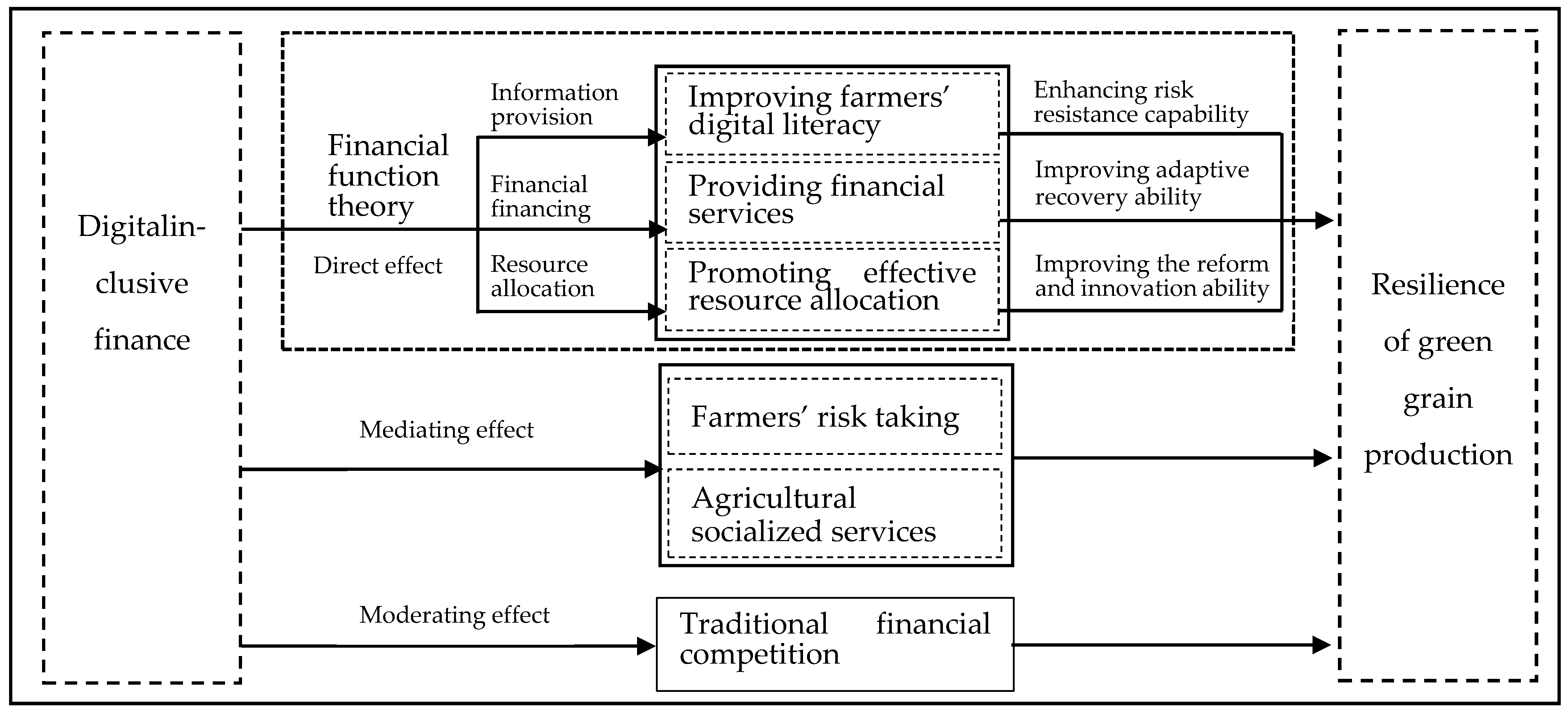
2.2. Digital Inclusive Finance and Green Grain Production Resilience
2.3. Mediating Mechanism of Farmers’ Risk Taking
2.4. Mediating Mechanism of Agricultural Socialized Services
2.5. Moderating Effect of Traditional Financial Competition
3. Models, Variables, and Data
3.1. Modeling
3.1.1. Baseline Regression Model
3.1.2. Mediating Effect Model
3.1.3. Moderating Effect Model
3.2. Variable Selection
3.2.1. Explained Variable: Green Grain Production Resilience (GGS)
3.2.2. Core Explanatory Variable: Digital Inclusive Finance (DIF)
3.2.3. Mediating Variables
3.2.4. Moderating Variable
3.2.5. Control Variable
3.3. Data Sources
4. Empirical Analysis
4.1. Baseline Test
4.2. Robustness Test and Endogeneity Analysis
4.2.1. Robustness Test
- (1)
- Changing the sample period: The sample period was shortened to 2013–2021, and the regression results are shown in Column (1) of Table 4. According to the results, the regression coefficient of digital inclusive finance was 0.0791 and significant at the 1% level, consistent with the baseline regression results.
- (2)
- Winsorization: Winsorization of 5% was applied to the variables. The regression results obtained after performing a series of tests are shown in Column (2) of Table 4. The coefficient of digital inclusive finance was 0.0945 and significant at the 1% level, consistent with the baseline regression results.
- (3)
- Changing the sample size: As Beijing, Shanghai, Tianjin, and Chongqing are municipalities directly under the central government, significantly differing from other provinces in terms of agricultural policies and green agricultural development environments, these cities were deleted from the sample. The regression results are shown in Column (3) of Table 4. The coefficient of digital inclusive finance was 0.1238, consistent with the baseline regression results.
4.2.2. Endogeneity Test
4.3. Heterogeneity Analysis
4.3.1. Regional Heterogeneity Test
4.3.2. Heterogeneity Test by Grain Functional Area
4.4. Mediating Effect
4.4.1. Mediating Effect of Farmers’ Risk Taking
4.4.2. Mediating Effect of Agricultural Socialized Services
4.5. Moderating Effect
5. Discussion
6. Conclusions and Policy Recommendations
Author Contributions
Funding
Institutional Review Board Statement
Data Availability Statement
Conflicts of Interest
References
- Ashraf, J.; Javed, A. Food Security and Environmental Degradation: Do Institutional Quality and Human Capital Make a Difference? J. Environ. Manag. 2023, 331, 117330. [Google Scholar] [CrossRef]
- Manioudis, M.; Meramveliotakis, G. Broad strokes towards a grand theory in the analysis of sustainable development: A return to the classical political economy. New Political Econ. 2022, 27, 866–878. [Google Scholar] [CrossRef]
- Zhang, H.; Bai, X.; Zhao, M. How Socialized Services Affect Agricultural Economic Resilience-Empirical Evidence from China. Agriculture 2024, 14, 1773. [Google Scholar] [CrossRef]
- Ozili Peterson, K. Digital Finance Research and Developments around the World: A Literature Review. Int. J. Bus. Forecast. Mark. Intell. 2023, 8, 35. [Google Scholar] [CrossRef]
- Sun, X.T.; Yu, T.; Yu, F.W. The Impact of Digital Finance on Agricultural Mechanization: Evidencefrom 1869 Counties in China. Chin. Rural Econ. 2022, 6, 76–93. (In Chinese) [Google Scholar]
- Fei, R.; Lin, Z.; Chunga, J. How Land Transfer Affects Agricultural Land Use Efficiency: Evidence from China’s Agricultural Sector. Land Use Policy 2021, 103, 105300. [Google Scholar] [CrossRef]
- Xie, Y.; Yao, R.; Wu, H.; Li, M. Digital Economy, Factor Allocation, and Resilience of Food Production. Land 2025, 14, 139. [Google Scholar] [CrossRef]
- Peng, D.; Su, Y.; Feng, Y. Nonlinear Mechanisms of the Impact of Digital Financial Inclusion on Agricultural Resilience: Threshold Effect of Agricultural Production Risk. China Popul. Resour. Environ. 2025, 35, 205–219. (In Chinese) [Google Scholar]
- Labeyrie, V.; Ouadah, S.; Raimond, C. Social Network Analysis: Which Contributions to The Analysis of Agricultural Systems Resilience? Agric. Syst. 2024, 215, 103832. [Google Scholar] [CrossRef]
- Yang, Z.; Wang, J. How Can the Aging of Agricultural Labor Affect Green Grain Production:Based on the Survey of Farmers in Six Provinces Along the Yangtze River. Resour. Environ. Yangtze Basin 2020, 29, 725–737. [Google Scholar]
- Zhao, W.; Luo, X.; Tang, L.; Sun, B. Impact of Digital Agricultural Extension Services on Farmers’ Green Grain Production Efficiency: An Analysis from the Dual Perspective of Aging and Digital Divide. J. Arid. Land Resour. Environ. 2024, 38, 55–68. [Google Scholar] [CrossRef]
- Wang, S.; Yang, Z. The Effect of the Aging of Agricultural Labor Force on the Change of Grain Green Total Factor Productivity. Res. Agric. Mod. 2020, 41, 396–406. [Google Scholar] [CrossRef]
- Zhang, R.; Ma, L.; Zhao, K.; Zhang, Z. The Role of Agricultural Production Trusteeship in Improving Green Production Efficiency of Grain. Resour. Sci. 2023, 45, 2248–2263. [Google Scholar] [CrossRef]
- Qin, Z.; Fan, Z.; Yu, S. The Impact and Transmission Mechanism of Temperature Changes on Green Production Efficiency of Grain. J. China Agric. Resour. Reg. Plan. 2024, 45, 81–94. [Google Scholar]
- Eeswaran, R.; Nejadhashemi, A.P.; Miller, S.R. Evaluating the Climate Resilience in Terms of Profitability and Risk for a Long-Term Corn-Soybean-Wheat Rotation under Different Treatment Systems. Clim. Risk Manag. 2021, 32, 100284. [Google Scholar] [CrossRef]
- Fan, Z.; Qin, Z.; Yu, S. Impact of Extreme Temperature on the Resilience of Grain Production: Perspectives on Green Finance. Chin. J. Eco-Agric. 2024, 32, 896–910. [Google Scholar] [CrossRef]
- Martin, R.; Sunley, P. On the Notion of Regional Economic Resilience: Conceptualization and Explanation. J. Econ. Geogr. 2015, 15, 1–42. [Google Scholar] [CrossRef]
- Wei, Z.; Peng, J.; Zhao, Y.; Li, X.; Wang, C. Reform of Agricultural Land Property Rights System and Grain Production Resilience: Empirical Evidence Based on China’s “Three Rights Separation” Reform. PLoS ONE 2025, 20, e0319387. [Google Scholar] [CrossRef]
- Tao, C.; Zhou, H.; Deng, R.; Zhang, Z. The Multi-Dimensional Spatial Network Effect on Grain Production Resilience: Evidence from China’s Provinces. Appl. Econ. 2025, 57, 5015–5031. [Google Scholar] [CrossRef]
- Sui, J.L.; Li, Y.X.; Liu, J.Q. The Spatiotemporal Convergence and Divergence, Heterogeneous Differentiation Characteristics of Economic Resilience in China: Identification Based on a Markov Switching Mixed-frequency Dynamic Factor Model. J. Manag. World 2024, 40, 16–36+73+37. [Google Scholar] [CrossRef]
- Chen, Y.; Zeng, M.; Chen, B. Impact of Climate Change on the Resilience of Food Production: Research of the Moderating Effect Based on Crop Diversification. Acta Ecol. Sin. 2024, 44, 6937–6951. [Google Scholar] [CrossRef]
- Kahiluoto, H.; Kaseva, J.; Balek, J.; Olesen, J.E.; Ruiz-Ramos, M.; Gobin, A.; Kersebaum, K.C.; Takac, J.; Ruget, F.; Ferrise, R.; et al. Decline in Climate Resilience of European Wheat. Proc. Natl. Acad. Sci. USA 2019, 116, 123–128. [Google Scholar] [CrossRef] [PubMed]
- Li, S.L.; Ma, L. The Mechanism and Policy Effects of National Modern Agricultural Demonstration Zone Construction on Grain Production Resilience. J. Shenzhen Univ. (Humanit. Soc. Sci.) 2025, 42, 5–15. (In Chinese) [Google Scholar]
- Cui, D. The Impact of Large-Scale Agricultural Operations on the Grain Production Resilience: A Quasi-Natural Experiment Based on Land Transfer Policy. Front. Sustain. Food Syst. 2025, 9, 1596449. [Google Scholar] [CrossRef]
- Zheng, T.; Zhao, G. The Impact of Policy-Oriented Agricultural Insurance on China’s Grain Production Resilience. Front. Sustain. Food Syst. 2025, 8, 1510953. [Google Scholar] [CrossRef]
- Fang, D.; Chen, J.; Wang, S.; Chen, B. Can Agricultural Mechanization Enhance the Climate Resilience of Food Production? Evidence from China. Appl. Energy 2024, 373, 123928. [Google Scholar] [CrossRef]
- Fang, G.F.; Cai, L. How Digital Financial Inclusion Affects Agricultural Output: Facts, Mechanism and Policy Implications. Issues Agric. Econ. 2022, 10, 97–112. (In Chinese) [Google Scholar]
- Li, M.; Chen, D.; Yu, G. Digital Inclusive Finance Empowers Food System Resilience based on the Perspective of Spatial Spillover Effect. J. China Agric. Resour. Reg. Plan. 2024, 45, 74–84. [Google Scholar]
- Zhang, X.; Yu, Y. The Impact of Digital Inclusive Finance on Food Supply Chain Resilience: A Perspective of Production Factor Development. Res. Agric. Mod. 2025, 46, 270–281. [Google Scholar] [CrossRef]
- Prasad, R.S.; Sud, R. Implementing climate change adaptation: Lessons from India’s national adaptation fund on climate change (NAFCC). Clim. Policy 2019, 19, 354–366. [Google Scholar] [CrossRef]
- Liu, L.; Li, X. How Does Digital Inclusive Finance Improve the Climate Resilience of Food Production? Front. Sustain. Food Syst. 2025, 9, 1612111. [Google Scholar] [CrossRef]
- Heller, M.C.; Keoleian, G.A. Assessing the Sustainability of the Us Food System: A Life Cycle Perspective. Agric. Syst. 2003, 76, 1007–1041. [Google Scholar] [CrossRef]
- Folke, C.; Carpenter, S.R.; Walker, B.; Scheffer, M.; Chapin, T.; Rockstrom, J. Resilience Thinking: Integrating Resilience, Adaptability and Transformability. Ecol. Soc. 2010, 15, 20. [Google Scholar] [CrossRef]
- Tendall, D.M.; Joerin, J.; Kopainsky, B.; Edwards, P.; Shreck, A.; Le, Q.B.; Kruetli, P.; Grant, M.; Six, J. Food System Resilience: Defining the Concept. Glob. Food Secur.-Agric. Policy Econ. Environ. 2015, 6, 17–23. [Google Scholar] [CrossRef]
- Xiong, F.; Rao, P.; Zhang, L.; Zhu, S. Influence of Digital Technology Application on Grain Growers’ Green Production Behavior. J. China Agric. Univ. 2025, 30, 257–268. [Google Scholar]
- Gong, S.; Sun, Z.; Wang, B.; Yu, Z. Could Digital Literacy Contribute to the Improvement of Green Production Efficiency in Agriculture? Sage Open 2024, 14, 1–18. [Google Scholar] [CrossRef]
- Zhou, Y.S.; Miao, Z.Y. The Impact of Digital Inclusive Finance on Farmers’ Investment in Production and Operation. China Rural Surv. 2023, 01, 40–58. [Google Scholar] [CrossRef]
- Zhang, X.L.; Li, Z. “De-grainization” or “grainization”:the impacts of digital financial inclusion on cropping structure. Res. Agric. Mod. 2025, 46, 680–690. [Google Scholar] [CrossRef]
- Liu, Q.; Yan, T. How Do Digital Media Strengthen the Role of Social Networks in Promoting Farmers’ Adoption of Climate Change Mitigation Measures? China Agric. Econ. Rev. 2024, 16, 445–467. [Google Scholar] [CrossRef]
- Wang, L.; Ma, J.M. Mechanism and Effect of Digital Financial Inclusion Affecting Green Development of Agriculture. J. S. China Agric. Univ. (Soc. Sci. Ed.) 2023, 22, 14–27. [Google Scholar]
- van Veelen, B. Cash Cows? Assembling Low-Carbon Agriculture through Green Finance. Geoforum 2021, 118, 130–139. [Google Scholar] [CrossRef]
- Zheng, J.; Zhao, W. Impact of Agricultural Insurance on Green Agricultural Production in China: Based on the Mediation Effect of Agricultural Technology Progress. Resour. Sci. 2023, 45, 2414–2432. [Google Scholar] [CrossRef]
- Gunnsteinsson, S. Experimental Identification of Asymmetric Information: Evidence on Crop Insurance in the Philippines. J. Dev. Econ. 2020, 144, 102414. [Google Scholar] [CrossRef]
- Elahi, E.; Abid, M.; Zhang, L.; ul Haq, S.; Sahito, J.G.M. Agricultural Advisory and Financial Services; Farm Level Access, Outreach and Impact in a Mixed Cropping District of Punjab, Pakistan. Land Use Policy 2018, 71, 249–260. [Google Scholar] [CrossRef]
- Yan, H.; Qi, Y.; Zhang, M. Research on the Effect and Mechanism of Agricultural Producer Services Promoting Green Grain Production. J. China Agric. Resour. Reg. Plan. 2023, 44, 54–67. [Google Scholar]
- Wang, S.R.; Lin, X.Y.; Geng, N. Research on Social Networks, Services Embedding and Farmers’ Green Production Behaviors: Based on the Mediated Effect Model Test. Chin. J. Agric. Resour. Reg. Plan. 2025, 1–11. (In Chinese) [Google Scholar]
- Song, K.; Liu, J.; Li, Z. Does the Development of Digital Financial Inclusion Narrows the Urban-rural Income Gap?—Concurrently Discuss the Synergistic Effect between Digital Financial Inclusion and Traditional Finance in Rural Area. China Soft Sci. 2022, 133–145. [Google Scholar]
- Volkov, A.; Morkunas, M.; Balezentis, T.; Streimikiene, D. Are Agricultural Sustainability and Resilience Complementary Notions? Evidence from the North European Agriculture. Land Use Policy 2022, 112, 105791. [Google Scholar] [CrossRef]
- Guo, F.; Wang, J.; Wang, F.; Cheng, Z.; Kong, T.; Zhang, X. Measuring China’s Digital Financial Inclusion: Index Compilation and Spatial Characteristics. China Econ. Q. 2020, 19, 1401–1418. (In Chinese) [Google Scholar] [CrossRef]
- Jiang, F.X.; Cai, W.J.; Cai, X.N.; Li, X.T. Microeconomic Effects of Bank Competition: Evidence from Corporate Financial Constraints. Econ. Res. J. 2019, 54, 72–88. [Google Scholar]
- Lin, L.; Tang, R.L. Digital New Quality Productivity Boosting Farmers’ Income: Theoretical Mechanism and Empirical Test. Econ. Probl. 2025, 104–112. [Google Scholar] [CrossRef]
- Tomislav, K. The Concept of Sustainable Development: From its Beginning to the Contemporary Issues. Zagreb Int. Rev. Econ. Bus. 2018, 21, 67–94. [Google Scholar] [CrossRef]
- Guo, J.; Chen, L.; Kang, X. Digital Inclusive Finance and Agricultural Green Development in China: A Panel Analysis (2013–2022). Financ. Res. Lett. 2024, 69, 106173. [Google Scholar] [CrossRef]
- Han, G.; Liu, T. Exploring Green Grain Production Pathways: Evidence from Farmland and Agricultural Service Scale Operations in China. Front. Sustain. Food Syst. 2025, 9, 1557321. [Google Scholar] [CrossRef]
- Yin, Y.; Zhang, Y.; Duan, W.; Xu, K.; Yang, Z.; Shi, B.; Yao, Z.; Yin, C.; Dogot, T. Farmers’ Preferences for Sustainable Farmland Construction—Insights From a Discrete Choice Experiment in China. Sustain. Prod. Consum. 2024, 48, 235–247. [Google Scholar] [CrossRef]
- Gao, Q.; Sun, M.; Chen, L. The Impact of Digital Inclusive Finance on Agricultural Economic Resilience. Financ. Res. Lett. 2024, 66, 105679. [Google Scholar] [CrossRef]


| Primary Indicators | Tertiary Indicators | Indicator Calculation Method | Indicator Attribute | Weight |
|---|---|---|---|---|
| Risk resistance ability | Proportion of high-quality arable land (A1) % | Area of high-standard farmland/total arable land area | + | 0.0962 |
| Effective irrigation rate (A2) % | Effective irrigated area/grain sown area | + | 0.1227 | |
| Soil and water conservation rate (A3) % | Area of soil and water loss control/total land area under jurisdiction | + | 0.1585 | |
| Agricultural natural disaster formation rate (A4) % | Area affected by agricultural natural disasters/total disaster-affected area | − | 0.0274 | |
| Fiscal support for agriculture (A5) % | Expenditure on agriculture, forestry, and water affairs/general public budget expenditure | + | 0.1265 | |
| Density of agricultural Meteorological observation stations (A6) % | Number of agricultural meteorological observation Stations/total land area | + | 0.1579 | |
| Grain yield per unit sown area (A7) t/hm2 | Total grain output/grain sown area | + | 0.0483 | |
| Adaptive recovery ability | Pesticide use per unit grain sown area (B1) kg/hm2 | Agricultural pesticide use/grain sown area | − | 0.0144 |
| Fertilizer use per unit grain sown area (B2) kg/hm2 | Converted pure amount of agricultural fertilizer use/grain sown area | − | 0.0306 | |
| Agricultural film use per unit Grain sown area (B3) kg/hm2 | Agricultural film use/grain sown area | − | 0.0184 | |
| Carbon emission intensity (B4) t/10,000 yuan | Agricultural carbon emissions/total output Value of agriculture, forestry, animal husbandry, and fishery | − | 0.0279 | |
| Grain multiple-cropping index (B5) % | Grain sown area/total arable land area | + | 0.0797 | |
| Total mechanical power per unit grain sown area (B6) kW/hm2 | Total agricultural mechanical power/grain sown area | + | 0.0334 | |
| Reform and innovation ability | Agricultural R&D expenditure (C1) CNY 100 million | Internal expenditure on R&D × (agricultural output value/total output value of agriculture, forestry, animal husbandry, and fishery) | + | 0.0018 |
| Agricultural R&D personnel input (C2) 10,000 persons | R&D personnel × (agricultural output value/total output value of agriculture, forestry, animal husbandry, and fishery) | + | 0.0158 | |
| Number of agricultural green innovation patent (C3) items | Number of authorized agricultural green innovation patents | + | 0.0071 | |
| and germplasm innovation level (C4) items | Number of applications for new agricultural plant variety rights | + | 0.0169 | |
| Proportion of certified area of organic grain products (C5) % | Certified area of organic agricultural products/grain sown area | + | 0.0047 | |
| Number of certified green food grain products (C6) % | Number of certified green food label products in the year × proportion of green grain products | + | 0.0117 |
| Variable Name | Sample Size | Mean | Std. Dev. | Min. | Max. |
|---|---|---|---|---|---|
| GGS | 390 | 0.155 | 0.060 | 0.073 | 0.428 |
| DIF | 390 | 2.555 | 1.113 | 0.183 | 4.738 |
| AR | 390 | 0.013 | 0.018 | 0.001 | 0.126 |
| ASS | 390 | 7.964 | 0.728 | 6.100 | 9.826 |
| TF | 390 | 0.091 | 0.032 | 0.042 | 0.250 |
| SZ | 390 | 9.488 | 1.529 | 4.263 | 12.749 |
| UR | 390 | 0.601 | 0.120 | 0.371 | 0.893 |
| IS | 390 | 0.096 | 0.051 | 0.002 | 0.240 |
| GPC | 390 | 103.612 | 6.268 | 90.410 | 122.600 |
| RI | 390 | 9.684 | 5.058 | 0.971 | 21.941 |
| IL | 390 | 7.869 | 13.874 | 0.084 | 92.97 |
| Variable | Green Grain Production Resilience | |||||
|---|---|---|---|---|---|---|
| (1) | (2) | (3) | (4) | (5) | (6) | |
| DIF | 0.0372 ** (2.08) | 0.0554 *** (3.07) | 0.0948 *** (4.91) | 0.0945 *** (4.52) | 0.0966 *** (4.65) | 0.0956 *** (4.56) |
| SZ | 0.0226 *** (4.11) | 0.0295 *** (5.33) | 0.0296 *** (5.25) | 0.0303 *** (5.41) | 0.0303 *** (5.41) | |
| IS | 0.589 *** (4.80) | 0.587 *** (4.53) | 0.509 *** (3.82) | 0.510 *** (3.82) | ||
| UR | −0.00319 (−0.04) | 0.0336 (0.39) | 0.0306 (0.36) | |||
| RI | −0.00409 ** (−2.33) | −0.0041 ** (−2.34) | ||||
| GPC | −0.0001 (−0.47) | |||||
| cons | 0.0968 *** (11.23) | −0.0967 ** (−2.02) | −0.231 *** (−4.27) | −0.230 *** (−3.27) | −0.213 *** (−3.03) | −0.194 ** (−2.37) |
| Region-fixed effects | Yes | Yes | Yes | Yes | Yes | Yes |
| Time-fixed effects | Yes | Yes | Yes | Yes | Yes | Yes |
| N | 390 | 390 | 390 | 390 | 390 | 390 |
| R2 | 0.644 | 0.660 | 0.682 | 0.682 | 0.687 | 0.687 |
| Variable | Changing Sample Period (1) | Winsorization (2) | Changing Sample Size (3) | Internet Penetration Rate (5) | Lagged One Period (4) |
|---|---|---|---|---|---|
| DIF | 0.0791 *** (3.80) | 0.0945 *** (4.37) | 0.1238 *** (5.15) | 0.0846 *** (3.94) | 0.0945 *** (4.37) |
| Cons | −0.352 *** (−3.44) | −0.214 ** (−2.47) | −0.095 (−1) | 0.0844 (1.14) | −0.214 ** (−2.47) |
| Control variables | Yes | Yes | Yes | Yes | Yes |
| Region-fixed effects | Yes | Yes | Yes | Yes | Yes |
| Time-fixed effects | Yes | Yes | Yes | Yes | Yes |
| N | 390 | 390 | 390 | 390 | 390 |
| F | 30.26 | 41.83 | 35.94 | 40.19 | 41.83 |
| Variable | Eastern Region (1) | Central Region (2) | Western Region (3) | Major Grain-Producing Areas (4) | Non-Major Grain-Producing Areas (5) |
|---|---|---|---|---|---|
| DIF | 0.105 *** (4.03) | 0.0455 (0.79) | 0.0816 (1.39) | 0.151 *** (5.22) | 0.0433 (1.52) |
| Cons | −0.337 ** (−2.23) | −0.0807 (−0.42) | −0.311 (−1.60) | 0.00160 (0.01) | −0.142 (−1.34) |
| Control variables | Yes | Yes | Yes | Yes | Yes |
| Region-fixed effects | Yes | Yes | Yes | Yes | Yes |
| Time-fixed effects | Yes | Yes | Yes | Yes | Yes |
| N | 390 | 390 | 390 | 390 | 390 |
| Variable | GGS (1) | AR (2) | GGS (3) | ASS (4) | GGS (5) | GGS (6) |
|---|---|---|---|---|---|---|
| DIF | 0.0956 *** (4.56) | 0.0122 *** (9.49) | 0.0924 *** (4.42) | 0.060 ** (2.27) | 0.054 *** (3.69) | 0.123 *** (4.88) |
| AR | 0.354 ** (2.10) | |||||
| ASS | 0.062 ** (1.97) | |||||
| TF | 0.033 *** (3.88) | |||||
| DIFI × TF | DIFI × TF | |||||
| Cons | −0.194 ** (−2.37) | 0.0589 *** (3.59) | −0.237 *** (−2.82) | 0.285 (1.52) | −0.120 (−1.18) | Cons |
| Sobel test | 0.005 *** (4.121) | 0.005 *** (2.709) | Sobel test | |||
| Bootstrap test (ind_eff) | 0.005 *** (5.05) | 0.006 *** (2.57) | Bootstrap test (ind_eff) | |||
| Bootstrap test (dir_eff) | 0.011 *** (3.68) | 0.010 ** (2.38) | Bootstrap test (dir_eff) | |||
| Region-fixed effects | Yes | Yes | Yes | Yes | Yes | Region-fixed effects |
| Time-fixed effects | Yes | Yes | Yes | Yes | Yes | Time-fixed effects |
| N | 390 | 390 | 390 | 390 | 390 | N |
| R2 | 0.687 | 0.407 | 0.691 | 0.779 | 0.681 | R2 |
Disclaimer/Publisher’s Note: The statements, opinions and data contained in all publications are solely those of the individual author(s) and contributor(s) and not of MDPI and/or the editor(s). MDPI and/or the editor(s) disclaim responsibility for any injury to people or property resulting from any ideas, methods, instructions or products referred to in the content. |
© 2025 by the authors. Licensee MDPI, Basel, Switzerland. This article is an open access article distributed under the terms and conditions of the Creative Commons Attribution (CC BY) license (https://creativecommons.org/licenses/by/4.0/).
Share and Cite
Hou, C.; Chen, H.; Zhou, C. The Impact of Digital Inclusive Finance on the Resilience of Green Grain Production: The Case of 30 Chinese Provinces, 2011–2023. Agriculture 2025, 15, 2460. https://doi.org/10.3390/agriculture15232460
Hou C, Chen H, Zhou C. The Impact of Digital Inclusive Finance on the Resilience of Green Grain Production: The Case of 30 Chinese Provinces, 2011–2023. Agriculture. 2025; 15(23):2460. https://doi.org/10.3390/agriculture15232460
Chicago/Turabian StyleHou, Chang, Hong Chen, and Chao Zhou. 2025. "The Impact of Digital Inclusive Finance on the Resilience of Green Grain Production: The Case of 30 Chinese Provinces, 2011–2023" Agriculture 15, no. 23: 2460. https://doi.org/10.3390/agriculture15232460
APA StyleHou, C., Chen, H., & Zhou, C. (2025). The Impact of Digital Inclusive Finance on the Resilience of Green Grain Production: The Case of 30 Chinese Provinces, 2011–2023. Agriculture, 15(23), 2460. https://doi.org/10.3390/agriculture15232460