


Abstract
Reducing fertilizer use and increasing its efficiency will improve the quality of farmland and resource conservation. These are necessary steps to achieving green development in agriculture. Nevertheless, fertilizer-reduction and efficiency-increasing technologies (FREITs) remain limited. To improve the situation, 538 farmers in Jiangsu and Hubei Provinces were surveyed with the goal of measuring the information acquisition ability (IAA) of farmers using an Item Response Theory (IRT) model. A model of improved technology selection was employed in conjunction with an IV-probit model to examine the impacts of IAA on farmers’ adoption of FREITs. The results showed that 34.76% of the surveyed farmers had adopted FREITs, with 12.45% and 26.02% having adopted Soil Testing and Formula Fertilization Technology (STFFT) and Organic Fertilizer Replacement Technology (OFRT), respectively. Second, farmers who used more information access channels had greater IAA, which significantly improved their adoption of FREITs. Third, participation in technical training and an increased degree of technical understanding increased the probability of farmers adopting FREITs. The results remained robust after accounting for endogeneity and correlation. Consequently, enhancing farmers’ IAA, organizing technical training, and improving technical publicity will promote the adoption of FREITs.
1. Introduction
The overuse of chemical fertilizer is an important contributor to resource wastage and the declining quality of arable land in China’s agriculture and rural areas. Efficient fertilization improves agricultural quality, efficiency, and competitiveness [1], which is of great significance in realizing the green development of agriculture. Since the 1960s, there has been a notable increase in the use of fertilizer in China, with fertilizer application projected to increase from 6.92 kg/hm2 to 350.49 kg/hm2 by 2019 (data from Food and Agriculture Organization of the United Nations: http://www.fao.org/faostat/zh/#compare, accessed on 10 March 2023). This consumption far exceeds internationally recognized safety standards. The overuse of chemical fertilizer imposes unnecessary costs on farmers, wastes resources, causes the eutrophication of water bodies, and intensifies the greenhouse effect, soil acidification, and other environmental issues [2,3,4,5,6]. Such practices give rise to concerns regarding food security. To facilitate high-quality development, the Ministry of Agriculture and Rural Affairs of the People’s Republic of China is dedicated to establishing a technical framework to support environmentally sustainable agricultural growth. Fertilizer-reduction and efficiency-increasing technologies (FREITs) have been identified as crucial objectives within this framework.
FREITs encompass several integrated technologies, including Soil Testing and Formula Fertilization Technology (STFFT) and Organic Fertilizer Replacement Technology (OFRT). These technologies are the focus of current research, development, and promotion (for further information, please refer to the Technical Guidelines for Greening Agriculture (2018–2030): http://www.gov.cn/gongbao/content/2018/content_5350058.htm, accessed on 5 May 2024). Studies have demonstrated the efficacy of STFFT and OFRT in reducing soil pollution and enhancing food production [7]. Despite the potential of these technologies to enhance yields and alleviate poverty, their adoption rate remains low [8]. For instance, survey data show that less than 10% of existing farmers have adopted STFFT. The adoption of OFRT has been more prevalent, with adoption rates ranging from 37% to 75% [9,10]. Nevertheless, the overall adoption rate for most agricultural technologies that protect the environment is less than 20% [11].
In this context, scholars have endeavored to understand the causes of the suboptimal uptake of FREITs [12,13,14]. These factors can be categorized into three domains. The first factor, a low level of education among farmers [15], leads to bias in their subjective perception of technology [16,17,18]. Second, production conditions, such as the small size of arable land [19,20] or poor irrigation [21], may affect the operability of some technologies and thus limit their adoption by farmers. Third, the external environmental context in which farmers operate, which includes government subsidy policies [22], distance to the market [23], and risk or uncertainty [24], may also influence the uptake of FREITs.
Previous studies have demonstrated that information acquired by farmers is an important factor in their adoption of new technologies [25,26,27]. Concurrently, with the informatization of society and the increase in information awareness among individuals, the accessibility of information is pivotal in the adoption of agricultural technology by farmers [11,28]. For instance, the manner in which farmers obtain information (through formal technical training and participation in agricultural cooperative organizations) affects the probability of their adopting new fertilizer or pesticide application techniques [29,30,31,32]. There is a complementary relationship between traditional media channels and social interactions among farmers, both of which facilitate the adoption of straw-returning technologies [33]. The use of smartphones can increase perceptions of environmental threats, which in turn can lead to the adoption of agricultural conservation technologies [34]. The use of different information channels reflects the information acquisition ability (IAA) of farmers, which has been demonstrated to significantly enhance the possibility of their adopting FREITs. Empirical examination has suggested that IAA is a mechanism by which capital endowments and social interactions influence outcomes [9,35].
Previous research has revealed the impact of IAA on technology adoption by farmers [36], but there are still gaps in our current understanding. First, the possible influence of information channels on technology adoption by farmers has been explored via textual compendiums; however, the interpretation of this influence is subjective, precluding interpretation from the perspective of economics. Second, most existing studies have focused on the decision-making processes of farmers adopting sustainable agricultural technologies [37], and there have been fewer studies on the behavior of farmers in relation to the adoption of FREITs. Finally, previous studies on technology adoption behavior did not explore the influence of IAA.
In this study, IAA was incorporated into a technology selection model to identify the mechanism by which IAA influences the decision-making of farmers adopting FREITs, using a derivation of a mathematical model. The IAA of 538 rice farmers in Jiangsu and Hubei Provinces was measured using Item Response Theory (IRT), and an IV-probit model was employed to investigate the influence of IAA on farmers’ adoption of FEIRTs (STFFT and OFRT), with a particular focus on the underlying mechanisms at play.
2. Theoretical Analysis
IAA was incorporated into a technology selection model of farmers operating under incomplete factor markets in China, based on the theoretical models by Just and Zilberman [38], Atanu et al. [39], and Ridier et al. [40]. Farmers face multiple factor constraints under incomplete factor markets, and the analysis aimed to determine whether farmers’ IAA affects their decisions regarding FEIRTs. The theoretical model assumes that, in the context of an incomplete factor market, technology adoption by farmers is primarily influenced by their initial endowment. It is challenging, if not impossible, for farmers to obtain additional factors such as land, labor, capital, and information. Consequently, farmers tend to adopt a technology set that combines applications of new and old technologies for the purpose of risk avoidance and production efficiency.
In our analysis, it was assumed that a farmer owns an amount of arable land, designated , that can be used for rice production. Traditional fertilizer application technologies are used on the arable land designated , while FREITs are used on the arable land designated , and then . The total amount of information available to farmers is . The amount of information required per unit area is for traditional fertilizer application technologies and for FREITs. Since FREITs are novel, the amount of information required is greater than that required for traditional fertilizer application technologies. Consequently, and . It is further assumed that the profits per unit area after adopting traditional fertilizer application technologies or FREITs are , respectively. The aforementioned values are expressed as follows:
where and are random perturbation terms for profit per unit area. and satisfy equations and , respectively. The variance in profit per unit area is expressed as and . If the degree of uncertainty associated with the output of FREITs is greater than that of traditional fertilizer application technologies, .
In the context of agricultural production, the objective of farmers is typically to maximize profit and minimize risk. This objective can be modeled as follows:
In Formula (2), represents income expectation, while denotes the absolute risk aversion coefficient. Assuming that farmers are risk-averse, . The constraints of Formula (3) are combined to construct the Lagrangian function as follows:
where represents the correlation coefficient between the traditional fertilizer application technology and FREITs. must be less than 0. The first-order partial derivative of Formula (4) is obtained from as the following equation:
From Formula (5), . This indicates that the greater the amount of information required to apply FREITs, the greater the likelihood that they will be adopted by farmers. To meet the information requirements of agricultural production, farmers must enhance their ability to gather and process information, which enables them to select appropriate information for the application of FREITs. When farmers possess a robust IAA, they can obtain a sufficient understanding of FREITs in a timely and cost-effective manner and possess a foundation for effective decision-making and production.
In light of the preceding analysis, we propose the following hypothesis:
H1:
Information acquisition ability can promote the adoption of fertilizer-reduction and efficiency-increasing technologies by farmers.
Similarly, according to Formula (5), since the risk aversion coefficient , then . This demonstrates that the greater the uncertainty surrounding a FREIT, the less likely it is to be adopted by farmers. Consequently, for farmers, reducing the uncertainty of FREITs is a prerequisite. In accordance with the Technology Acceptance Model (TAM) proposed by Davis et al. [41], the adoption of new technologies by farmers is contingent upon two primary factors: perceived usefulness and perceived ease of use. Both factors are conducive to reducing uncertainty. Farmers should strive to maximize the perceived ease of use and perceived usefulness of the technology by leveraging their IAA.
Farmers with greater access to information will be made aware of FREITs more promptly. To gain a more comprehensive understanding of the processes involved, market demand, and government policies on the technology, farmers can participate in agricultural technology training provided by the government. Perceptions of the ease of use of FREITs may be enhanced in farmers who participate in formal agricultural technology training, resulting in adoption decisions. It has been proposed that technical training, whether conducted online or offline, enables farmers to adopt new technologies [42]. Technical training not only reduces the risks associated with asymmetric information, but also encourages farmers to allocate their factors of production in a more rational and efficient manner. In summary, it provides an incentive for farmers to switch from traditional fertilizer application technologies to FREITs, thus increasing the likelihood of adoption [43].
In light of the preceding analysis, we propose the following hypothesis:
H2:
Information acquisition ability facilitates the adoption of fertilizer-reduction and efficiency-increasing technologies by facilitating farmers’ participation in technical training.
An enhanced understanding of FREITs by farmers increases the likelihood of their implementation. The greater the IAA of farmers, the greater their ability to access a wide range of information sources, which enables farmers to obtain information from multiple channels and perspectives. This facilitates a comprehensive understanding of the role that FREITs play in increasing agricultural income and protecting farmland environments [44] while also improving farmers’ understanding of the technology and encouraging farmers to adopt FREITs [45].
In light of the preceding analysis, we propose the following hypothesis:
H3:
Information acquisition ability increases the probability of adoption by increasing farmers’ knowledge of fertilizer-reduction and efficiency-increasing technologies.
The mechanism by which IAA influences the adoption of FREITs is illustrated in Figure 1.
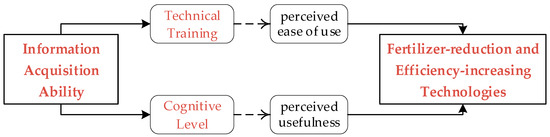
Figure 1.
Theoretical framework diagram. Note: The dashed arrows denote the reasoning process, whereas the solid arrows denote empirical testing.
3. Data and Methods
3.1. Data
Data were collected using a survey conducted between July and August 2018. The survey, entitled “Research on the production behavior of rice farmers in the middle and lower reaches of the Yangtze River”, was conducted in Jiangsu and Hubei Provinces. The middle and lower reaches of the Yangtze River in China experience excessive chemical fertilizer inputs, and the region is a primary rice-producing area. Therefore, chemical fertilizer application in rice production is a significant issue. Survey-takers were selected among farmers in Jiangsu and Hubei Provinces because these regions represent the broader context of this area.
A three-stage stratified random sampling design was employed for this study. First, Jiangsu and Hubei Provinces were selected from the middle and lower reaches of the Yangtze River as the main research areas. Second, two counties (cities) in Jiangsu Province and four counties (cities) in Hubei Province were selected. The geographic location, cultivation patterns, and scale of production were accounted for in the selection process. Third, approximately 100 farm households were haphazardly selected from the six counties (cities).
The specific research locations included Xuyi County and Xinghua City in Jiangsu Province and Huangmei County, Jianli City, Zhongxiang City, and Qianjiang City in Hubei Province. Following the exclusion of samples with missing information, 538 valid samples were obtained, including 139 samples from Jiangsu Province and 399 samples from Hubei Province (Figure 2). The survey concentrated on the characteristics of the farm household head, family characteristics, operating characteristics, and the adoption of STFFT and OFRT. It also examined other rice production behaviors. Prior to the formal commencement of the survey, we conducted a preliminary survey in Qianjiang City. The findings from this preliminary survey were used to revise and improve the questionnaire.
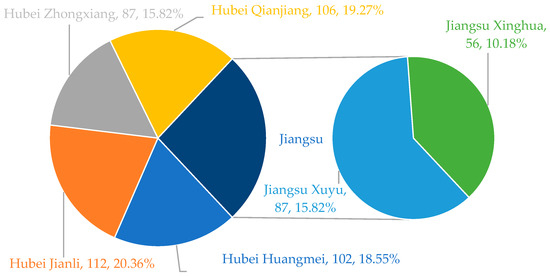
Figure 2.
Research area and sample distribution.
3.2. Model Set
3.2.1. Regression Model
The decision-making of farmers in relation to the adoption of FREITs can be described using dichotomous variables. To test the effect of IAA on farmers’ adoption of FREITs, we employed the following Probit model as a benchmark model:
In Formula (6), is dichotomous, indicating whether farmer has adopted either STFFT or OFRT. represents IAA, as measured by the IRT model. denotes a set of control variables, and represents a random perturbation term.
The preceding theoretical analysis demonstrated that IAA had a positive impact on farmers’ decisions regarding FREITs. However, as integrated and new agricultural technology systems, FREITs require comprehensive information to ensure their effective use by farmers. In other words, a decision to adopt FREITs necessitates a high level of IAA. This reverse causality between the explanatory and interpreted variables gives rise to significant endogeneity in the benchmark model (6), which affects the accuracy and validity of the parameters to be estimated in the model. Concurrently, a multitude of factors that influence technology adoption decisions by farmers cannot be fully incorporated into the analysis. Furthermore, there may be factors that affect IAA and technology adoption decisions, leading to a correlation between the explanatory variables and the model perturbation term. This generates an endogeneity problem. Thus, it was not possible to obtain a consistent estimate using an ordinary probit model, and the IV-probit model with an instrumental variable was employed to address endogeneity.
The instrumental variable was selected at the village level and was not directly related to technology adoption. Among the channels through which sample farmers obtained information, those connected to capital endowment, such as surrounding farmers and online platforms, had a direct impact on farmers’ decision-making processes. In contrast, agricultural enterprises and government departments are typically located within townships. Demonstration bases are more likely to span townships and are not under the control of villages. In conclusion, these channels did not have a direct impact on the ability of farmers to access information.
The number of agricultural cooperatives (as opposed to the number of cooperatives joined by farmers) within a farmer’s administrative village was selected as the instrumental variable in this study. A greater number of village cooperatives benefits farmers by providing agricultural information and technical knowledge. However, the number of cooperatives in villages does not directly affect farmers decision-making, which is consistent with the characteristics of instrumental variables.
3.2.2. Mechanism Testing Model
Following Alesina and Zhuravskaya [46], we adopted a three-step approach to mechanism testing. First, the effect of IAA on technology adoption by farmers was verified. If the effect was significant, it was continued. This step was conducted in the IV-probit model. Second, the impact of IAA on the mechanism variable was evaluated. If the effect was significant, it was continued. The model was expressed as follows:
In Formula (7), represents the mechanism variable, which is defined as the technical training and cognitive level of farmers. The remaining variables are defined in accordance with Formula (6), with serving as a random perturbation term. Should the value of be deemed significant, proceeding with the analysis is advisable.
Third, the combined effects of IAA and mechanism variables on technology adoption by farmers were evaluated simultaneously. If the coefficients and were significant and there was a significant change in the value of , the mechanism functioned in accordance with the model presented in Formula (8).
3.3. Variable Definitions and Choices
Reducing chemical fertilizer use is a crucial aspect of protecting arable land [47]. This study, which incorporates the policy background of chemical fertilizer application, rice production characteristics, and data availability, focuses on farmers’ decisions to adopt STFFT and OFRT. Therefore, adopting or not adopting STFFT and OFRT are the two key dependent variables in the research. A value of 1 was assigned to “adopted” and a value of 0 was assigned to “not adopted”.
Simultaneously, IAA was considered an independent variable. To assess farmers’ IAA through their utilization of various information access channels, we referred to Abdul-Salam and Phimister [48] and Huang et al. [49]. A two-parameter IRT model in logistic form was constructed as follows:
where is the probability that farmer obtains information through channel . represents the IAA for farmer and follows a standard normal distribution, i.e., , with a larger value indicating a greater level of IAA. is a differentiation parameter for identifying the magnitude of the role of the information access channel. The larger the value of , the more favourable the th channel is for farmers to access information. is the difficulty parameter for identifying the difficulty level of the channel. A greater value indicates greater difficulty for the farmer in obtaining information from the th channel. To estimate the relevant parameters in Formula (9), we determined the response variable of the IRT model, namely, whether farmers used the six channels mentioned above to obtain information. This was undertaken by assigning a value of 1 when farmers used a channel to obtain information and a value of 0 when a channel was not used. Second, a marginal maximum likelihood estimation method was used to estimate and in Formula (9). Finally, the Bayesian expected a posterior estimation method was used to estimate .
As the theoretical analysis showed, IAA promoted farmers’ adoption of FREITs by facilitating participation in technical training and cognition. Based on this, we selected technical training and cognitive level as the mechanism variables. The former was characterized by whether farmers participated in formal technical training; participation was assigned a value of 1 and not participating was assigned a value of 0. The latter was measured by farmers’ responses to the question on “cognitive level for FREITs” using a 5-point scale, with values ranging from very low to very high.
As stated previously, the technology adoption decisions by farmers operating under incomplete factor markets were constrained by the initial endowments of land, labor, and capital. Farmer decisions regarding FREITs are based on the principles of profit maximization and risk minimization. Consequently, the regression model incorporated a number of control variables, such as land endowment, household demographic characteristics, and production capital status, based on existing studies [9,50,51]. Regional attributes were introduced to control the influence of unobservable factors (economic development status and the environment) on decisions to adopt FREITs. Definitions and descriptive statistics for each variable are shown in Table 1.

Table 1.
Variable definitions and descriptive statistics.
3.4. Descriptive Statistics
As shown in Table 1, 12.5% and 26% of the 538 surveyed farmers adopted STFFT and ORFT, respectively, which mirrors the low level of adoption of this type of technology observed in previous studies [52]. To further analyze the adoption of FREITs, the adoption of different combinations of technologies by farmers is shown in Figure 3. Only 20 farmers adopted both STFFT and ORFT, representing 3.72% of the total sample. Conversely, 187 households, comprising 34.76% of the sample, adopted at least one FREIT, indicating that 65.24% of the sample had not implemented any FREITs (Figure 3). It is noteworthy that 167 households adopted only one of the FREITs, with 47 farmers adopting only STFFT and 120 farmers adopting only ORFT. These data demonstrate that the adoption rate among farmers is low.
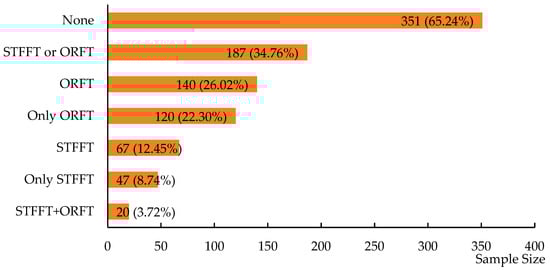
Figure 3.
Adoption of FREITs by sampled farmers.
Based on the survey data, there were six channels for farmers to obtain information through: agricultural enterprises (e.g., agribusiness dealers), demonstration bases, government departments (e.g., agricultural extension stations and rural information service stations), agricultural cooperatives, surrounding households, and network platforms. Table 1 presents the information channels available to farmers. These data suggest that farmers typically obtained relevant agricultural information through communication and interaction with their peers (i.e., surrounding households channel), since this channel was employed with the greatest frequency. The accumulation of information by farmers can significantly increase the adoption rate of new technologies [53]. The second most common method of acquiring technical knowledge and information was through government departments, such as agricultural extension stations and rural information service centers, which collectively accounted for 40.5% of the sample. The proportions of farmers who obtained information from agricultural enterprises and agricultural cooperatives were comparable, at 34.6% and 31.2%, respectively. This indicates that these two channels played a significant role in the process of accessing information. The network platform and demonstration base channels were the least favored by farmers, possibly due to their own limited knowledge and the underdevelopment of modern rural network technologies.
Among the control variables, the maximum area of production was 193.43 ha, while the minimum area was 0.133 ha. This implies that the sample was representative of operation scale. In terms of the demographic characteristics of farming households, the average number of agricultural laborers was two, with an average age of 52 and an average education of seven years. This aligns with the realities of current Chinese rural society, where spouses work together and the agricultural labor force is relatively high in age with a low level of education. The mean proportion of non-farm income for farm households was 0.220, but its distribution between [0, 0.974] indicates that the sample contained farmers from farm households that relied solely on agricultural income and farmers from part-time farm households with non-farm income. This finding aligns with the current development of rural society.
4. Results
4.1. Results of the IRT Model
4.1.1. Results of the IRT Model Parameter Estimation
The results of the differentiation and difficulty parameters of the IRT model, estimated using the marginal great likelihood estimation method, are presented in Table 2. The results demonstrate that the differentiation and difficulty parameters of all channels passed the test for significance at the 5% level, except for the differentiation parameter for the government departments channel, which passed the test for significance at the 10% level. This suggests that all six channels used by farmers are closely associated with their ability to access information.
Table 2.
Results of parameter estimation in the IRT model.
According to the differentiation parameter values, the channels ranked as follows: government departments > agricultural enterprises > demonstration bases > surrounding households > agricultural cooperatives > network platforms. The ranking suggests that public information channels, such as the government department and agricultural enterprise channels, continue to exert a more significant influence on farmers [54], while network platforms have the least impact. Information disseminated by agricultural technology stations or information service centers has a higher degree of credibility among farmers, who have a greater level of trust in these sources. Furthermore, the impact of such guidance on production is more pronounced. The personnel employed by agricultural enterprises are more familiar with relevant agricultural materials and disseminate accurate information to farmers, thereby promoting their safe production practices [55]. The minimal impact of network platforms may be attributed to the fact that this channel contains a plethora of heterogeneous information, which leads to a general distrust of online sources among farmers.
According to the difficulty parameter value, the channels ranked as follows: demonstration bases > agricultural cooperatives > agricultural enterprises > government departments > surrounding households > network platforms. This suggests that it is challenging but highly beneficial for farmers to obtain information from government departments and agricultural enterprises, as evidenced by the moderate difficulty parameter and the largest differentiation parameter. Consequently, these two channels are perceived as more desirable for obtaining information. Farmers can easily obtain relevant technology and knowledge from surrounding households and network platforms. This may be due to the frequency of daily interactions between farmers and higher network coverage in rural areas. Furthermore, the ease and convenience of searching for information through mobile phones may also contribute to this [56]. Unfortunately, the utility of pertinent data from surrounding households and network platforms is limited, as evidenced by the small differentiation parameter. Simultaneously, farmers encounter the greatest difficulty in obtaining information from demonstration bases and agricultural cooperatives. This may be attributed to the distance between farmers and demonstration bases, which hinders their ability to access information in a timely and effective manner. The difficulty in obtaining information from agricultural cooperatives may serve to confirm the existence of “shell” cooperatives in rural societies that do not function in any meaningful way.
4.1.2. Results of IAA Measurement
Based on the survey results, there were 42 different combinations of channels by which farmers accessed information. We classified IAA according to different channel combinations and counted the sample share under each combination (Table A1). As illustrated by the sample share data, the IAA estimated by the IRT model did not adhere to a standard normal distribution and deviated from the a priori assumptions of the model, which may result in biased estimation outcomes. Nevertheless, the range of values for IAA was [−1.101,1.560], as shown in Table 1. This value is included in the interval [–3,3], which indicates that the standard normally distributed a priori setting of the parameters can be disregarded [57,58]. Consequently, the estimates of IAA were reliable.
The IAA of farmers was analyzed based on the number of channels for accessing information, which resulted in the vertical line graph depicted in Figure 4. Based on the results in Table 1 and Figure 4, we made the following conclusions. First, farmers may obtain information without external channels (based on their own knowledge and production experience), or they may use all six channels of information acquisition at the same time. Second, the level of IAA in farmers is low (the mean was 0.002). In contrast, Figure 4 shows that using a greater number of channels led to greater IAA. Finally, if the number of channels used by farmers was the same, farmers with more highly differentiated channels (e.g., government departments and agricultural enterprises) had higher IAA, a result that is consistent with the findings of Yue et al. [59].
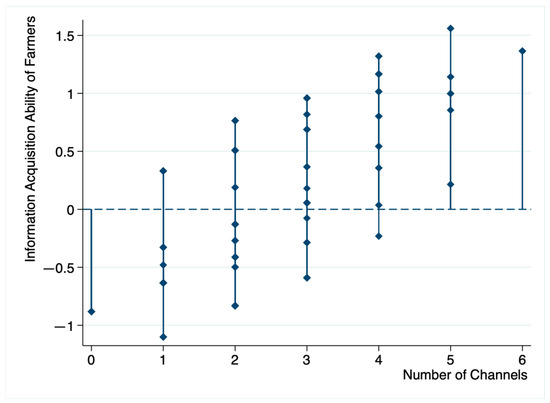
Figure 4.
Distribution of the IAA of farmers based on the number of channels used.
4.2. Impacts of IAA on Decisions to Adopt FREITs
We tested the effects of IAA on farmers’ decisions to adopt FREITs. The baseline model and the instrumental variables approach were employed, and the regression results are shown in Table 3. The log pseudo likelihood and chi-square value results of the benchmark model regression and the instrumental variable method indicated that the model was well fitted and the results were reliable. In Models 1 and 2 of the probit model, the coefficients of IAA failed to meet the criteria for statistical significance.
Table 3.
Results of the probit model and IV-probit model.
IV-probit was employed to test Models 3 and 4, and it demonstrated that IAA had a significant and positive effect on the probability of adoption of STFFT and ORFT at the 1% level. In conclusion, IAA facilitates the decision-making process regarding the adoption of FREITs, thereby corroborating Hypothesis H1. The first-stage regression results of the IV-probit model demonstrated that the number of village cooperatives exerted a positive influence on IAA, with a statistically significant effect at the 1% level. Moreover, a Wald test of the exogeneity of the instrumental variable passed at the 1% level of significance. This indicates that it was reasonable to use the number of village cooperatives as an instrumental variable for farmer IAA, and thus the regression results were credible.
Among the control variables in Models 3 and 4, the number of plots of arable land significantly and positively affected farmers’ decisions to adopt FREITs. The number of plots of arable land operated by a farmer characterized the degree of fragmentation of the arable land. The existence of multiple plots of arable land allows farmers to implement combinations of production methods and crop types. Consequently, the use of different technologies across different plots is possible, which facilitates the reorganization of factors and resources. This, in turn, reduces production risks in smallholder farming. The adoption of FREITs was negatively affected by the presence of village cadres and non-farm income. Households with a village cadre and a higher share of non-farm income lack sufficient labor and time to invest in agricultural production, which leads to a lack of motivation to learn and use new technologies; thus, these farmers failed to adopt FREITs.
4.3. Robustness Testing
We conducted robustness tests for the above results in three ways. First, we tested robustness by replacing the dependent variable. The focus of this study is the impact of IAA on decisions by farmers to adopt FREITs. Therefore, we merged the initial two dependent variables and assigned a value of 1 to the decision to adopt a FREIT and a value of 0 to the decision to adopt neither FREIT. The new dependent variable was reincorporated into the IV-probit model for the regression, and the results are shown in Table 4 under Model 5.
Table 4.
Results of the robustness tests.
Second, we tested robustness by replacing the independent variable. As shown in Figure 3, a greater number of information access channels used by farmers led to greater IAA. Consequently, we replaced IAA estimated by the IRT model with the number of information access channels used by farmers. The new independent variable was reincorporated into the IV-probit model for the regression, and the results are shown in Table 4 under Models 6 and 7.
Third, we tested robustness by replacing the estimation method. The preceding section represents an independent estimation of the two dependent variables using the IV-probit model. However, there was an underlying assumption that decisions to adopt STTFT and ORFT were independent of each other. Considering the complementarities between different technologies [60], we estimated the two dependent variables jointly in accordance with the Conditional Mixed Process (CMP) approach proposed by Roodman [61]. The results of the CMP estimation with IAA as the dependent variable can be seen in Table 4 under Model 8.
The results in Table 4 demonstrate that the test outcomes of the three methods were comparable, which indicates that IAA had a significant and positive effect on the decision to adopt FREITs. This finding is robust and verifies the conclusions previously drawn. In addition, the estimation of Model 8 indicates that atanhrho_12 was significant at the 5% level, suggesting that the residuals of Models 3 and 4 were correlated. This, in turn, implies that the regression using the IV-probit model was biased, necessitating the joint estimation of the two. The results also indicate that the adoption of STFFT and ORFT was correlated; the adoption of one technology significantly reduced the uncertainty of adopting the other [62], leading to joint adoption.
4.4. Mechanism Testing
Following the robustness tests, we proceeded to validate the two mechanism variables based on the econometric models outlined in Formulas (7) and (8). The results of the model fitting are shown in Table 5. It is important to note that for the sake of convenience, the mechanism was tested using the adoption of FREITs as the outcome variable.
Table 5.
Results of mechanism testing.
The results of Models 9 and 11 indicate that IAA has a significant and positive effect on formal technical training and the technical cognitive level of farmers, with significance at the 1% level. Farmers with greater IAA utilized multiple channels to obtain information on agricultural production. This facilitated their participation in training and in the dissemination of FREITs, which increased the perceived ease of use and the usefulness of the technology to the farmers.
The regression coefficients for Models 10 and 12, which included technical training and cognitive level, demonstrated a notable decline in the coefficient of IAA (from 1.197 to 1.070 and 1.154) compared to Model 5. This suggests that the mediating role of the mechanism variable was upheld. The results of Model 10 indicate that participation in formal technical training was effective in increasing the likelihood of farmers adopting FREITs. Furthermore, it played a significant mediating role in how IAA influenced technology adoption. Similarly, the results of Model 12 indicate that cognitive level had a significant effect on the adoption of FREITs by farmers. In summary, the mediating effect of cognitive level was also significant, and Hypotheses H2 and H3 were verified.
5. Discussion
A more efficient use of chemical fertilizer is important for overcoming constraints on resources, improving the quality of arable land in China, and promoting food security. In this context, the government has prioritized the popularization of FREITs, including STFFT and ORFT. Previous studies have investigated factors that influence farmers’ adoption of FREITs. For farmers, FREITs require novel soil management practices that differ from traditional fertilizer application. The implementation of novel techniques is characterized by a high degree of uncertainty. Consequently, there is a pressing need to gather sufficient information to reduce uncertainty, which places a significant burden on the information acquisition ability of farmers.
Considering that multiple information channels are available to farmers, we used the IRT model to assess farmers’ IAA. Our study is distinct from previous studies that only measured whether farmers had access to relevant agricultural information or not [63]. We found that IAA significantly increased the probability of adoption of FREITs. This finding builds on the study by Oduniyi and Tekana [64], who suggested a correlation between information acquisition by farmers and sustainable land management practices but did not reveal a causal relationship. We used the TAM to reveal the mechanism by which IAA influences the adoption of FREITs: technical training and technological cognitive level played key roles in the process of adopting FREITs. Our findings indicate potential avenues for enhanced technology adoption and for safeguarding arable land in the context of information acquisition.
It is clear that increasing chemical fertilizer efficiency requires the implementation of incentives and constraints through the establishment of supportive government policies. In order to address issues resulting from the excessive application of chemical fertilizers, developed countries have been engaged in exploring responses since the 1970s. In 1972, the United States proposed the Best Management Practices, which included measures such as minimum or no tillage, and limited chemical fertilizer application. This was carried out in an attempt to minimize negative impacts on agricultural production systems. Japan has promoted the application of environmentally friendly agriculture through a variety of strategies, including public opinion campaigns, government support, and guidance from agricultural associations. These strategies were designed to address the mitigation of point source pollution from agrochemicals and enhance the quality and safety of agricultural products. Furthermore, the European Union presented the European Green Deal in 2019 with the objective of achieving carbon neutrality in the European region by 2050. One of the measures was reducing the utilization of pesticides, chemical fertilizers, and antibiotics in order to establish a healthy and sustainable food production system. These practical experiences offered valuable insights for China to improve its fertilizer-reduction policy.
Some limitations to this study require further investigation. First, the study area was limited to Hubei and Jiangsu Provinces in China. The results are not nationally representative. China’s vast territory encompasses diverse regions, each exhibiting distinctive arable land quality issues, such as black soil degradation in the northeast, soil salinization in the Yellow River Basin, and soil acidification in the Lingnan region. These challenges cannot be fully addressed through FREITs. Subsequent studies will expand the scope of investigation. Second, the data were limited to a survey of farmers conducted over a single year. The application of FREITs may not result in arable land improvements until several years later. Consequently, future studies should determine whether farmers will continue to adopt FREITs and devise strategies to ensure that they do so.
6. Conclusions
In this study, we analyzed the influence of IAA on the adoption of FREITs by farmers using an improved technology selection model. With the IRT model and IV-probit model, we investigated the mechanisms by which IAA impacted the adoption of FREITs. The results of the study were as follows: First, the proportions of farmers adopting STFFT and ORFT were 12.5% and 26%, respectively, which demonstrates a low rate of technology adoption. Second, the number of information access channels used by farmers was directly proportional to their IAA, and when farmers used the same number of channels, those with more highly differentiated channels had a higher IAA. Third, after accounting for endogeneity, IAA had a significant and positive effect on the likelihood of farmers adopting FREITs. The robustness of these results was verified by the outcomes with substitutions of key variables and models. Fourth, IAA promoted the adoption of FREITs by facilitating farmer participation in technical training and by improving farmers’ cognitive levels.
Based on the above findings, the following policies may increase the likelihood of farmers adopting FREITs. First, the influence of government department and agricultural enterprise channels could be expanded by refining agricultural information services (e.g., pushing accurate agricultural price information through mobile apps), constructing new information agencies (e.g., establishing an agricultural information demonstration base), and regulating and broadening channels (e.g., regulating the operation of shell cooperatives) for the dissemination of information. Furthermore, it is imperative to develop new methods of government training in agricultural technology and to expand the influence of agricultural technology stations, rural information service centers, and agricultural dealers. This will increase the likelihood that farmers will be able to access technological information.
Second, a training program in FREITs could be organized for farmers. The government should actively encourage and organize the participation of farmers in FREIT training and explain the operational processes, technical requirements, and precautions associated with ORFT and STFFT. Concurrently, the government could implement specialized training in collaboration with agricultural demonstration cooperatives and household farms, thereby expanding the scope of technical training and publicity efforts. These measures will enhance farmers’ cognitive levels regarding technology.
Finally, the content, methods, and intensity of publicity of FREITs should be adjusted. The government should conduct a comprehensive survey to assess the knowledge and cognitive levels among farmers in relation to technological application. This will identify any shortcomings in farmers’ knowledge of technology and inform dissemination priorities. At the same time, the government could collaborate with academic institutions and other research organizations to devise a multifaceted method for technology dissemination to enhance the appeal of FREITs to farmers.
Author Contributions
Conceptualization, C.Y. and W.H.; methodology, Y.X. and K.Z.; resources, Y.L. and Z.Q.; writing—original draft preparation, C.Y.; writing—review and editing, C.Y. and W.H.; supervision, Z.Q. and K.Z.; funding acquisition, C.Y., W.H. and K.Z. All authors have read and agreed to the published version of the manuscript.
Funding
This research was funded by the Hunan Provincial Natural Science Foundation of China (No. 2023JJ41062), the Key Program of Hunan Provincial Education Department of China (No. 23A0233), and the National Social Science Foundation of China (No. 21CGL030).
Institutional Review Board Statement
Not applicable.
Data Availability Statement
The data presented in this study are available on request from the corresponding author. The data are not publicly available due to privacy restrictions.
Conflicts of Interest
The authors declare no conflicts of interest.
Appendix A
Due to space limitations, some results are included in Appendix A.
Table A1.
Analysis of farmers’ IAA under different combinations of information channels.
Table A1.
Analysis of farmers’ IAA under different combinations of information channels.
| Combinations of Information Channel | IAA | Proportion of Farmers (%) | Combinations of Information Channel | IAA | Proportion of Farmers (%) |
|---|---|---|---|---|---|
| NP | −1.101 | 1.301 | AE+DB+AC+SH+NP | 0.215 | 0.186 |
| None | −0.882 | 7.249 | GD | 0.331 | 2.416 |
| AC+NP | −0.832 | 0.929 | AE+DB+AC+SH | 0.357 | 0.558 |
| SH+NP | −0.830 | 5.019 | GD+SH+NP | 0.367 | 0.372 |
| AC | −0.636 | 0.929 | GD+AC | 0.507 | 1.115 |
| SH | −0.634 | 20.260 | GD+SH | 0.509 | 7.063 |
| AC+SH+NP | −0.589 | 3.160 | GD+AC+SH+NP | 0.543 | 0.558 |
| AE+NP | −0.498 | 0.743 | GD+AC+SH | 0.689 | 5.948 |
| DB | −0.480 | 0.186 | AE+GD | 0.765 | 1.301 |
| AC+SH | −0.412 | 5.576 | AE+GD+SH+NP | 0.803 | 1.115 |
| AE | −0.327 | 2.230 | DB+GD+SH | 0.819 | 0.743 |
| AE+SH+NP | −0.286 | 0.558 | DB+GD+AC+SH+NP | 0.856 | 0.186 |
| DB+SH | −0.269 | 0.929 | AE+GD+AC | 0.958 | 0.929 |
| DB+AC+SH+NP | −0.231 | 0.186 | AE+GD+SH | 0.959 | 9.665 |
| AE+AC | −0.130 | 0.743 | AE+GD+AC+SH+NP | 0.998 | 0.558 |
| AE+SH | −0.129 | 5.390 | DB+GD+AC+SH | 1.015 | 0.558 |
| DB+AC+SH | −0.076 | 0.186 | AE+DB+GD+SH+NP | 1.142 | 0.558 |
| AE+DB+SH+NP | 0.036 | 0.186 | AE+GD+AC+SH | 1.167 | 5.019 |
| AE+AC+SH | 0.057 | 2.788 | AE+DB+GD+SH | 1.320 | 0.743 |
| AE+DB+SH | 0.181 | 0.186 | AE+DB+GD+AC+SH+NP | 1.365 | 0.743 |
| GD+NP | 0.189 | 0.558 | AE+DB+GD+AC+SH | 1.560 | 0.372 |
References
- Li, Y.X.; Zhang, W.F.; Ma, L.; Huang, G.Q.; Oenema, O.; Zhang, F.S.; Dou, Z.X. An Analysis of China’s Fertilizer Policies: Impacts on the Industry, Food Security, and the Environment. J. Environ. Qual. 2013, 42, 972–981. [Google Scholar] [CrossRef] [PubMed]
- Guo, J.H.; Liu, X.J.; Zhang, Y.; Shen, J.L.; Han, W.X.; Zhang, W.F.; Christie, P.; Goulding, K.W.T.; Vitousek, P.M.; Zhang, F.S. Significant Acidification in Major Chinese Croplands. Science 2010, 327, 1008–1010. [Google Scholar] [CrossRef]
- Smith, L.E.D.; Siciliano, G. A comprehensive review of constraints to improved management of fertilizers in China and mitigation of diffuse water pollution from agriculture. Agric. Ecosyst. Environ. 2015, 209, 15–25. [Google Scholar] [CrossRef]
- Li, X.W.; Lei, Z.W.; Qu, J.; Li, Z.; Zhou, X.W.; Zhang, Q.W. Synthesizing slow-release fertilizers via mechanochemical processing for potentially recycling the waste ferrous sulfate from titanium dioxide production. J. Environ. Manag. 2017, 186, 120–126. [Google Scholar] [CrossRef] [PubMed]
- Meng, F.Q.; Qiao, Y.H.; Wu, W.L.; Smith, P.; Scott, S. Environmental impacts and production performances of organic agriculture in China: A monetary valuation. J. Environ. Manag. 2017, 188, 49–57. [Google Scholar] [CrossRef] [PubMed]
- Conley, D.J.; Paerl, H.W.; Howarth, R.W.; Boesch, D.F.; Seitzinger, S.P.; Havens, K.E.; Lancelot, C.; Likens, G.E. Ecology Controlling Eutrophication: Nitrogen and Phosphorus. Science 2009, 323, 1014–1015. [Google Scholar] [CrossRef]
- Kuang, F.; Li, J.; Jin, J.; Qiu, X. Do Green Production Technologies Improve Household Income? Evidence from Rice Farmers in China. Land 2023, 12, 1848. [Google Scholar] [CrossRef]
- Khonje, M.G.; Manda, J.; Mkandawire, P.; Tufa, A.H.; Alene, A.D. Adoption and welfare impacts of multiple agricultural technologies: Evidence from eastern Zambia. Agric. Econ. 2018, 49, 599–609. [Google Scholar] [CrossRef]
- Chen, Y.H.; Xiang, W.; Zhao, M.J. Impacts of Capital Endowment on Farmers’ Choices in Fertilizer-Reduction and Efficiency-Increasing Technologies (Preferences, Influences, and Mechanisms): A Case Study of Apple Farmers in the Provinces of Shaanxi and Gansu, China. Agriculture 2024, 14, 147. [Google Scholar] [CrossRef]
- Hörner, D.; Wollni, M. Does integrated soil fertility management increase returns to land and labor? Plot-level evidence from Ethiopia. Agric. Econ. 2022, 53, 337–355. [Google Scholar] [CrossRef]
- Wang, X.; Drabik, D.; Zhang, J.B. How channels of knowledge acquisition affect farmers’ adoption of green agricultural technologies: Evidence from Hubei province, China. Int. J. Agric. Sustain. 2023, 21, 2270254. [Google Scholar] [CrossRef]
- Liu, Q.Q.; Yan, T.W. The effect of noncognitive abilities on promoting the adoption of soil testing and formula fertilization technology by farmers: Empirical insights from Central China. Environ. Dev. Sustain. 2023, 15, 1–33. [Google Scholar] [CrossRef]
- Tian, M.L.; Liu, R.F.; Wang, J.; Liang, J.H.; Nian, Y.F.; Ma, H.Y. Impact of Environmental Values and Information Awareness on the Adoption of Soil Testing and Formula Fertilization Technology by Farmers-A Case Study Considering Social Networks. Agriculture 2023, 13, 2008. [Google Scholar] [CrossRef]
- Zhou, Z.Y.; Liao, H.L.; Li, H. The Symbiotic Mechanism of the Influence of Productive and Transactional Agricultural Social Services on the Use of Soil Testing and Formula Fertilization Technology by Tea Farmers. Agriculture 2023, 13, 1696. [Google Scholar] [CrossRef]
- Kabunga, N.S.; Dubois, T.; Qaim, M. Heterogeneous information exposure and technology adoption: The case of tissue culture bananas in Kenya. Agric. Econ. 2012, 43, 473–485. [Google Scholar] [CrossRef]
- Zeng, Y.M.; Tian, Y.; He, K.; Zhang, J.B. Environmental conscience, external incentives and social norms in rice farmers’ adoption of pro-environmental agricultural practices in rural Hubei province, China. Environ. Technol. 2020, 41, 2518–2532. [Google Scholar] [CrossRef]
- Ren, Z.; Zhong, K. Driving mechanism of subjective cognition on farmers’ adoption behavior of straw returning technology: Evidence from rice and wheat producing provinces in China. Front. Psychol. 2022, 13, 922889. [Google Scholar] [CrossRef]
- Savari, M.; Damaneh, H.E.; Damaneh, H.E.; Cotton, M. Integrating the norm activation model and theory of planned behaviour to investigate farmer pro-environmental behavioural intention. Sci. Rep. 2023, 13, 5584. [Google Scholar] [CrossRef]
- Robertson, M.J.; Llewellyn, R.S.; Mandel, R.; Lawes, R.; Bramley, R.G.V.; Swift, L.; Metz, N.; O’Callaghan, C. Adoption of variable rate fertiliser application in the Australian grains industry: Status, issues and prospects. Precis. Agric. 2012, 13, 181–199. [Google Scholar] [CrossRef]
- Ju, X.T.; Gu, B.J.; Wu, Y.Y.; Galloway, J.N. Reducing China’s fertilizer use by increasing farm size. Global Environ. Change 2016, 41, 26–32. [Google Scholar] [CrossRef]
- Aregay, F.A.; Minjuan, Z. Impact of irrigation on fertilizer use decision of farmers in China: A case study in Weihe River Basin. J. Sustain. Dev. 2012, 5, 74–82. [Google Scholar] [CrossRef]
- Khonje, M.G.; Nyondo, C.; Chilora, L.; Mangisoni, J.H.; Ricker-Gilbert, J.; Burke, W.J. Exploring adoption effects of subsidies and soil fertility management in Malawi. J. Agric. Econ. 2022, 73, 874–892. [Google Scholar] [CrossRef]
- Feder, G.; Just, R.E.; Zilberman, D. Adoption of agricultural innovations in developing countries: A survey. Econ. Devel. Cult. Change 1985, 33, 255–298. [Google Scholar] [CrossRef]
- Ghadim, A.K.A.; Pannell, D.J.; Burton, M.P. Risk, uncertainty, and learning in adoption of a crop innovation. Agric. Econ. 2005, 33, 1–9. [Google Scholar] [CrossRef]
- Mumin, Y.A.; Abdulai, A. Social networks, adoption of improved variety and household welfare: Evidence from Ghana. Eur. Rev. Agric. Econ. 2022, 49, 1–32. [Google Scholar] [CrossRef]
- Beaman, L.; BenYishay, A.; Magruder, J.; Mobarak, A.M. Can network theory-based targeting increase technology adoption? Am. Econ. Rev. 2021, 111, 1918–1943. [Google Scholar] [CrossRef]
- Mumin, Y.A.; Abdulai, A.; Goetz, R. The role of social networks in the adoption of competing new technologies in Ghana. J. Agric. Econ. 2023, 74, 510–533. [Google Scholar] [CrossRef]
- Genius, M.; Koundouri, P.; Nauges, C.; Tzouvelekas, V. Information Transmission in Irrigation Technology Adoption and Diffusion: Social Learning, Extension Services, and Spatial Effects. Am. J. Agric. Econ. 2014, 96, 328–344. [Google Scholar] [CrossRef]
- Ramirez, A. The influence of social networks on agricultural technology adoption. Procedia-Soc. Behav. Sci. 2013, 79, 101–116. [Google Scholar] [CrossRef]
- Mannan, S.; Nordin, S.M.; Rafik-Galea, S.; Rizal, A.R.A. The ironies of new innovation and the sunset industry: Diffusion and adoption. J. Rural. Stud. 2017, 55, 316–322. [Google Scholar] [CrossRef]
- Liu, Y.Y.; Shi, R.L.; Peng, Y.T.; Wang, W.; Fu, X.H. Impacts of Technology Training Provided by Agricultural Cooperatives on Farmers’ Adoption of Biopesticides in China. Agriculture 2022, 12, 316. [Google Scholar] [CrossRef]
- Huang, J.; Xiang, C.; Jia, X.; Hu, R. Impacts of training on farmers’ nitrogen use in maize production in Shandong, China. J. Soil Water Conserv. 2012, 67, 321–327. [Google Scholar] [CrossRef]
- Jiang, W.J.; Yan, T.W.; Chen, B. Impact of media channels and social interactions on the adoption of straw return by Chinese farmers. Sci. Total Environ. 2021, 756, 144078. [Google Scholar] [CrossRef] [PubMed]
- Li, F.D.; Yang, P.; Zhang, K.J.; Yin, Y.S.; Zhang, Y.N.; Yin, C.B. The influence of smartphone use on conservation agricultural practice: Evidence from the extension of rice-green manure rotation system in China. Sci. Total Environ. 2022, 813, 152555. [Google Scholar] [CrossRef] [PubMed]
- Chen, Z.; Li, X.J.; Xia, X.L.; Zhang, J.Z. The impact of social interaction and information acquisition on the adoption of soil and water conservation technology by farmers: Evidence from the Loess Plateau, China. J. Clean. Prod. 2024, 434, 139880. [Google Scholar] [CrossRef]
- Li, Z.; Zhang, D.S.; Yan, X.H. How Does Information Acquisition Ability Affect Farmers’ Green Production Behaviors: Evidence from Chinese Apple Growers. Agriculture 2024, 14, 680. [Google Scholar] [CrossRef]
- Khan, N.; Ray, R.L.; Sargani, G.R.; Ihtisham, M.; Khayyam, M.; Ismail, S. Current Progress and Future Prospects of Agriculture Technology: Gateway to Sustainable Agriculture. Sustainability 2021, 13, 4883. [Google Scholar] [CrossRef]
- Just, R.E.; Zilberman, D. The effects of agricultural development policies on income distribution and technological change in agriculture. J. Devel. Econ. 1988, 28, 193–216. [Google Scholar] [CrossRef]
- Atanu, S.; Love, H.A.; Schwart, R. Adoption of emerging technologies under output uncertainty. Am. J. Agric. Econ. 1994, 76, 836–846. [Google Scholar] [CrossRef]
- Ridier, A.; Ben El Ghali, M.; Nguyen, G.; Kephaliacos, C. The role of risk aversion and labor constraints in the adoption of low input practices supported by the CAP green payments in cash crop farms. Rev. Agric. Environ. Stud. Rev. D’etudes Agric. Environ. (RAEStud) 2013, 94, 195–219. [Google Scholar] [CrossRef]
- Davis, F.D.; Bagozzi, R.P.; Warshaw, P.R. User acceptance of computer technology: A comparison of two theoretical models. Manag. Sci. 1989, 35, 982–1003. [Google Scholar] [CrossRef]
- Xiuling, D.; Qian, L.; Lipeng, L.; Sarkar, A. The Impact of Technical Training on Farmers Adopting Water-Saving Irrigation Technology: An Empirical Evidence from China. Agriculture 2023, 13, 956. [Google Scholar] [CrossRef]
- Wozniak, G.D. Joint information acquisition and new technology adoption: Late versus early adoption. Rev. Econ. Stat. 1993, 75, 438–445. [Google Scholar] [CrossRef]
- Khataza, R.R.; Doole, G.J.; Kragt, M.E.; Hailu, A. Information acquisition, learning and the adoption of conservation agriculture in Malawi: A discrete-time duration analysis. Technol. Forecast. Soc. Change 2018, 132, 299–307. [Google Scholar] [CrossRef]
- Kabir, J.; Cramb, R.; Alauddin, M.; Gaydon, D.S.; Roth, C.H. Farmers’ perceptions and management of risk in rice/shrimp farming systems in South-West Coastal Bangladesh. Land Use Policy 2020, 95, 104577. [Google Scholar] [CrossRef]
- Alesina, A.; Zhuravskaya, E. Segregation and the Quality of Government in a Cross Section of Countries. Am. Econ. Rev. 2011, 101, 1872–1911. [Google Scholar] [CrossRef]
- Shen, L.; Wang, F. Can Market-Oriented Allocation of Land Factors Promote the Adoption of Cropland Quality Protection Behaviors by Farmers: Evidence from Rural China. Land 2024, 13, 665. [Google Scholar] [CrossRef]
- Abdul-Salam, Y.; Phimister, E. Efficiency Effects of Access to Information on Small-scale Agriculture: Empirical Evidence from Uganda using Stochastic Frontier and IRT Models. J. Agric. Econ. 2017, 68, 494–517. [Google Scholar] [CrossRef]
- Huang, W.H.; Yang, C.Y.; Liu, K.; Min, R. Information Acquisition Ability and Farmers’ Herd Behavior in Rice-Crayfish Coculture System Adoption. Agriculture 2023, 13, 1892. [Google Scholar] [CrossRef]
- Hall, T.J.; Dennis, J.H.; Lopez, R.G.; Marshall, M.I. Factors Affecting Growers’ Willingness to Adopt Sustainable Floriculture Practices. Hortscience 2009, 44, 1346–1351. [Google Scholar] [CrossRef]
- Zhou, Z.; Zhang, Y.; Yan, Z. Will Digital Financial Inclusion Increase Chinese Farmers’ Willingness to Adopt Agricultural Technology? Agriculture 2022, 12, 1514. [Google Scholar] [CrossRef]
- Guo, Z.; Chen, X.; Zhang, Y. Impact of environmental regulation perception on farmers’ agricultural green production technology adoption: A new perspective of social capital. Technol. Soc. 2022, 71, 102085. [Google Scholar] [CrossRef]
- Bandiera, O.; Rasul, I. Social networks and technology adoption in northern Mozambique. Econ. J. 2006, 116, 869–902. [Google Scholar] [CrossRef]
- Beethem, K.; Marquart-Pyatt, S.T.; Lai, J.N.F.; Guo, T. Navigating the information landscape: Public and private information source access by midwest farmers. Agric. Hum. Values 2023, 40, 1117–1135. [Google Scholar] [CrossRef]
- Tsakiris, P.; Damalas, C.A.; Koutroubas, S.D. Safety behavior in pesticide use among farmers of northern Greece: The role of information sources. Pest Manag. Sci. 2023, 79, 4335–4342. [Google Scholar] [CrossRef] [PubMed]
- Khatoon-Abadi, A. Prioritization of Farmers’ Information Channels: A Case Study of Isfahan Province, Iran. J. Agric Sci. Tech. 2011, 13, 815–828. Available online: https://sid.ir/paper/62486/en (accessed on 15 May 2011).
- Robins, R.W.; Fraley, R.C.; Krueger, R.F. Handbook of Research Methods in Personality Psychology; Guilford Press: New York, NY, USA, 2009. [Google Scholar]
- Edelen, M.O.; Reeve, B.B. Applying item response theory (IRT) modeling to questionnaire development, evaluation, and refinement. Qual. Life Res. 2007, 16, 5–18. [Google Scholar] [CrossRef] [PubMed]
- Yue, S.M.; Xue, Y.; Lyu, J.; Wang, K.K. The Effect of Information Acquisition Ability on Farmers’ Agricultural Productive Service Behavior: An Empirical Analysis of Corn Farmers in Northeast China. Agriculture 2023, 13, 573. [Google Scholar] [CrossRef]
- Wainaina, P.; Tongruksawattana, S.; Qaim, M. Tradeoffs and complementarities in the adoption of improved seeds, fertilizer, and natural resource management technologies in Kenya. Agric. Econ. 2016, 47, 351–362. [Google Scholar] [CrossRef]
- Roodman, D. Fitting Fully Observed Recursive Mixed-process Models with cmp. Stata J. 2011, 11, 159–206. [Google Scholar] [CrossRef]
- Aldana, U.; Foltz, J.D.; Barham, B.L.; Useche, P. Sequential Adoption of Package Technologies: The Dynamics of Stacked Trait Corn Adoption. Am. J. Agric. Econ. 2011, 93, 130–143. [Google Scholar] [CrossRef]
- Ma, W.; Ma, C.; Su, Y.; Nie, Z. Organic farming: Does acquisition of the farming information influence Chinese apple farmers’ willingness to adopt? China Agric. Econ. Rev. 2017, 9, 211–224. [Google Scholar] [CrossRef]
- Oduniyi, O.S.; Tekana, S.S. Does Information Acquisition Influence the Adoption of Sustainable Land Management Practices? Evidence from Mpumalanga Province South Africa. Front. Sustain. Food Syst. 2021, 5, 769094. [Google Scholar] [CrossRef]
Disclaimer/Publisher’s Note: The statements, opinions and data contained in all publications are solely those of the individual author(s) and contributor(s) and not of MDPI and/or the editor(s). MDPI and/or the editor(s) disclaim responsibility for any injury to people or property resulting from any ideas, methods, instructions or products referred to in the content. |
© 2024 by the authors. Licensee MDPI, Basel, Switzerland. This article is an open access article distributed under the terms and conditions of the Creative Commons Attribution (CC BY) license (https://creativecommons.org/licenses/by/4.0/).