


Abstract
Excessive nitrogen application may adversely impact grain yield and quality of rice. This study aimed to evaluate the impact of several nitrogen-reduction strategies on the grain yield and quality of mechanically transplanted hybrid indica rice. Field experiments were performed in 2020 and 2021 using Yixiangyou2115 and Fyou498. The research investigated variations in grain yield and quality of rice under different nitrogen-reduction strategies, including NR1, balanced N reduction; NR2, N reduction in basal fertilizer; NR3, N reduction in tillering fertilizer; and NR4, N reduction in earing fertilizer, compared to the conventional nitrogen application for high-yield cultivation (CK). Compared to CK, the grain yield of rice decreased by 1.63% to 19.71% under nitrogen-reduction strategies. Relative to NR3 and NR4, NR1 and NR2 exhibited an increase in grain yield ranging from 1.81% to 22.51%, attributed to increases in panicle number (0.61% to 13.19%) and spikelet number per panicle (1.60% to 12.28%). Meanwhile, NR1 and NR2 also had relatively high LAI and dry matter accumulation in rice plants at maturity. Compared to CK, NR1 and NR2 improved the processing quality of rice grain, while NR3 and NR4 resulted in reduced processing quality. The chalkiness rate and chalkiness degree of rice under the NR1, NR3, and NR4 treatments were reduced by 2.97% to 23.73% and 3.35% to 52.49%, respectively, in comparison to CK. Additionally, the NR1 and NR4 treatments were linked to an increase in taste value by 1.44% to 3.66% and gel consistency by 13.87% to 46.01% relative to CK. These findings suggest that balanced nitrogen reduction can maintain a high yield while improving the appearance and eating quality of mechanically transplanted hybrid indica rice. This study offers a theoretical basis for rational nitrogen reduction and high-quality cultivation in rice.
1. Introduction
Rice (Oryza sativa L.) is a crucial staple crop in China, with a pivotal role in national food security, and enhancing rice yield is essential. Historically, efforts to achieve higher grain yields have included the extensive application of fertilizers, particularly nitrogen (N) fertilizers. This practice has resulted in suboptimal N use efficiency, increased production costs, higher levels of diseases and pests, degradation of rice grain quality, and environmental pollution [1,2,3]. Recently, to advance sustainable agriculture [4], China actively implemented measures to reduce the use of chemical fertilizers and pesticides. This initiative will sustain high grain yields and enhance the quality of rice while minimizing N fertilizer inputs.
Numerous studies have investigated optimal N application rates and approaches for rice cultivation [5,6,7]. The average N application rate in China is approximately 180 kg/ha, 75% higher than the global average for paddy rice [8]. With new rice varieties, traditional N application rates used for high-yield cultivation may exceed the actual N requirements of these varieties [9,10]. To overcome this issue and reduce N application rates in rice production, several studies have reported a series of optimized N management models. Zhong et al. [11] introduced the “three-control” nutrient management approach for irrigated rice, encompassing fertilizer control, seedling control, and pest and disease control. This approach produced a 20% reduction in N fertilizer usage, a 10% increase in grain yield, and a 10% improvement in N use efficiency relative to traditional N application methods. Similarly, Peng et al. [12] demonstrated that, in contrast to conventional farmer practices, site-specific N management increased rice grain yield by 5% while achieving a 32% reduction in N fertilizer application. Qiao et al. [13] demonstrated that reducing the application rate of N fertilizer during rice-growing within the summer rice–winter wheat rotation system in the Taihu Lake region can sustain grain yield, increase N use efficiency, and limit environmental impact. Mboyerwa at al. [14] observed that the system of rice intensification (SRI) can achieve comparable grain yields and higher N use efficiency when N application levels are lowered from 150 to 60 kg/ha. These findings suggest that appropriate reductions in N fertilizer application are reasonable without compromising crop yield.
While a few studies focused on the grain yield and quality of rice in response to varying N reductions [15,16,17], accurately reducing N application depending on the rice growth process for high yield and quality remains uncertain. Previous research has indicated that over the entire growth period, the contributions of applied basal fertilizer, tillering fertilizer, and earing fertilizer to the accumulated N in rice plants were 6.9%, 7.5%, and 26.02%, respectively [18]. Peng et al. [19] proposed that a 30% reduction in the total nitrogen application rate during the early vegetative period could increase grain yield and agronomic N efficiency relative to conventional farming practices. Chen et al. [20] reported that an appropriate reduction in earing N fertilizer application could improve the appearance, eating, and cooking quality of japonica rice without significantly impacting grain yield. These findings provide useful information for high yield and quality after nitrogen reduction in traditional manually transplanted rice. However, it remains unclear how the grain yield and quality of mechanically transplanted hybrid indica rice change under nitrogen-reduction conditions.
Carpet seedlings mechanically transplanted rice (CSMTR) is the predominant method of mechanically transplanted rice in China, offering advantages like labor and cost savings, as well as high yield and high efficiency [21]. Most N application methods for CSMTR adhere to conventional N application practices designed for high-yield cultivation in manual transplanting systems. The seedlings utilized in CSMTR are approximately 25 days old, while in manually transplanting systems, they are approximately 35 days old. The difference in transplanting seedling age affects the growth and development and the N demand of rice plants, which may lead to another optimal N-reduction strategy for mechanically transplanted hybrid indica rice.
Building upon the findings of a previous study [22], two-year field experiments were performed to examine the variations in grain yield and quality of mechanically transplanted hybrid indica rice under different N-reduction strategies, compared to conventional N application for high-yield cultivation. The objectives of this study were as follows: (1) to investigate the effects of different N-reduction strategies on the grain yield and quality of mechanically transplanted hybrid indica rice, and (2) to identify the optimal N-reduction strategy for high grain yield and high quality of rice, providing a theoretical basis for rational nitrogen reduction and high-quality rice cultivation.
2. Materials and Methods
2.1. Plant Materials and Growing Condition
Two widely cultivated hybrid indica rice varieties, Yixiangyou2115 (Y2115) and Fyou498 (F498), were the experimental materials. Field experiments were performed at the research farm of the Rice Research Institute, Guizhou Academy of Agricultural Sciences, Guizhou Province, China, in 2020 and 2021. The experimental site is characterized by a subtropical monsoon humid climate. In 2020, the average temperature, total sunshine hours, and total precipitation during the rice growing season were 21.64 °C, 576.2 h, and 1212.7 mm, while in 2021, they were 22.18 °C, 810.4 h, and 1081.9 mm, as shown in Figure 1. Prior to transplanting in 2020, the soil at the experimental site was clay-based, with a pH of 5.62, containing 53.37 g/kg organic carbon, 1.49 g/kg total nitrogen, 16.00 mg/kg available nitrogen, 25.55 mg/kg available phosphorus, and 40.33 mg/kg available potassium.
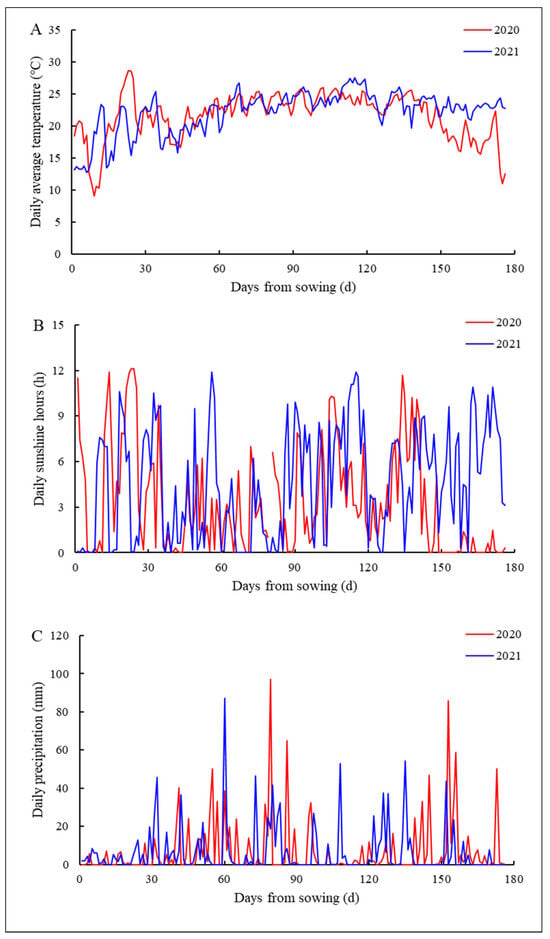
Figure 1.
Daily average temperature (A), daily sunshine hours (B), and daily precipitation (C) during the rice growing seasons in 2020 (red lines) and 2021 (blue lines) at the experimental site of Huaxi district, Guizhou, Southwest China.
2.2. Experimental Treatments and Design
Field experiments were performed using a split-plot design with three replicates, each plot encompassing an area of 15 m2. The main plots were used for Y2115 and F498, while the subplots were designated for N-reduction strategies. These strategies encompassed the conventional N application for high-yield cultivation (CK, 180 kg/ha N with 40% applied as basal fertilizer, 30% as tillering fertilizer, and 30% as earing fertilizer), balanced N reduction (NR1, 150 kg/ha N with 40% applied as basal fertilizer, 30% as tillering fertilizer, and 30% as earing fertilizer), N reduction in basal fertilizer (NR2, 150 kg/ha N with a 30 kg/ha N reduction in basal fertilizer; tillering fertilizer and earing fertilizer were consistent with CK), N reduction in tillering fertilizer (NR3, 150 kg/ha N with a 30 kg/ha N reduction in tillering fertilizer; basal fertilizer and earing fertilizer were consistent with CK), and N reduction in earing fertilizer (NR4, 150 kg/ha N with a 30 kg/ha N reduction in earing fertilizer; basal fertilizer and tillering fertilizer were consistent with CK). Detailed information regarding the N application for each treatment is presented in Table 1.

Table 1.
Detailed information about the N application for each treatment (kg/ha).
Seeds were planted on 15 April 2020 and 12 April 2021. The seeding rate was 70 g per tray, and 25-day-old seedlings were mechanically transplanted with two seedlings per hill at a spacing of 30 cm × 18 cm. Phosphorus fertilizer (P2O5) at a rate of 75 kg/ha was applied as a basal fertilizer. Potassium fertilizer (K2O) at a rate of 150 kg/ha was divided into basal and earing fertilizer applications applied in the same amount. The fertilizers utilized were urea (conventional N fertilizer, N content of 46.2%), superphosphate (P2O5 content of 12%), and potassium chloride (K2O content of 60%). The basal fertilizer was applied one day prior to transplanting, tillering fertilizer was applied seven days post-transplanting, and earing fertilizer was applied at the emergence of the fourth leaf from the top. To limit the intermixing of water and nitrogen fertilizer, 40 cm ridges were produced between plots using plastic baffles. Weed, insect, and disease management, as well as irrigation practices, were applied according to local high-yield cultivation techniques.
2.3. Sampling and Measurements
Data were primarily collected during the jointing, heading, and maturity stages. The number of tillers was recorded at these stages over 20 fixed, continuous hills per plot. According to the average tiller count, five rice hills per plot were sampled and divided into stem-sheath, leaf, and panicle components. The leaf area was quantified using a laser leaf area meter (CI-203; CID, Inc., Vancouver, WA, USA). The highly effective leaf area index was defined as the combined area of the top three leaves of productive tillers per unit area at the heading stage. Subsequently, separate samples were oven-dried at 105 °C for 30 min and then at 80 °C until a constant weight was attained. Dry matter accumulation was computed as the total dry matter weight of organs across each developmental stage.
At maturity, the number of productive tillers was evaluated across 20 fixed continuous hills per plot to identify the panicle number. Five representative hills of rice plants from each plot were sampled to characterize the spikelet number per panicle, seed-setting rate, and 1000-grain weight. Grain yield was determined from all plants in each plot and adjusted to a standard moisture content of 13.5%.
To assess grain quality, 1000 g of rice grains were obtained from each plot and maintained under natural drying conditions for three months to stabilize physicochemical properties. The brown rice rate, milled rice rate, and head milled rice rate were assessed according to the State Standard of the People’s Republic of China (GB/T 17891-2017) [23]. The quality attributes of rice appearance, including chalkiness rate, chalkiness degree, grain length, grain width, and length-to-width ratio, were assessed using a rice appearance quality detector (Wansheng DC-E, Hangzhou, China). The protein and amylose levels of milled rice were quantified with near-infrared reflectance employing a Foss Infratec 1241 grain analyzer (Foss Analytical Instruments Co., Ltd., Hilleroed, Denmark). The alkali value and gel consistency were determined according to the Agricultural Industry Standard of the People’s Republic of China (NY/T 83-2017) [24]. The taste value was quantified with a taste analyzer (RCTA11A, Satake Co., Ltd., Tokyo, Japan). The viscosity characteristics of rice flour, encompassing peak viscosity, trough viscosity, final viscosity, breakdown (peak viscosity minus trough viscosity), setback (final viscosity minus peak viscosity), peak time, and pasting temperature, were evaluated using a rapid viscosity analyzer (RVA-Tecmaster, Perten, Australia).
2.4. Statistical Analysis
Data analysis was performed utilizing analysis of variance (ANOVA) with Genstat 19.0 version software for Windows (VSN International Ltd., Hemel Hempstead, UK). Mean comparisons were performed using the least significant difference test at a significance level of p = 0.05 (LSD 0.05) within the same year. Graphical representations were produced using Microsoft Excel 2016.
3. Results
3.1. Grain Yield and Its Components
As outlined in Table 2, the grain yield and its components exhibited consistent trends in response to N-reduction strategies over 2020 and 2021. While F498 had a lower panicle number and 1000-grain weight, it had a higher grain yield due to the spikelet number per panicle as compared to Y2115. Compared to CK, the grain yield under NR1 and NR2 treatments did not exhibit a significant reduction following N reduction. This can be attributed to minimal differences in panicle number, spikelet number per panicle, seed-setting rate, and 1000-grain weight among NR1, NR2, and CK. Conversely, NR3 and NR4 treatments reduced grain yield by 8.06% to 19.71% compared to CK. There were no significant differences in the seed-setting rate and 1000-grain weight among the N-reduction strategies for the same variety, with the exception of the seed-setting rate and 1000-grain weight of F498 in 2020 and the 1000-grain weight of Y2115 in 2021 under the NR3 treatment. Variety and treatment exhibited significant effects on panicle number, spikelet number per panicle, 1000-grain weight, and grain yield.
Table 2.
Grain yield and its components of mechanically transplanted hybrid indica rice under different nitrogen-reduction methods.
3.2. Tillering Number
The tillering numbers of rice plants at the jointing, heading, and maturity stages are presented in Figure 2. Relative to CK, the tillering numbers at the jointing stage under NR1, NR2, and NR3 treatments decreased by 6.62% to 10.13%. There was a negligible difference in tillering numbers at the jointing stage between the CK and NR4 treatments. At the heading stage, the tillering number of rice plants subjected to N-reduction treatments was lower compared to CK. Notably, NR3 and NR4 treatments decreased tillering numbers by 4.69% to 9.78% compared to CK. At maturity, when compared to CK, there were minimal differences in the tillering numbers among NR1, NR2, and NR4 treatments. However, NR3 treatment significantly reduced tillering numbers by an average of 7.60%.
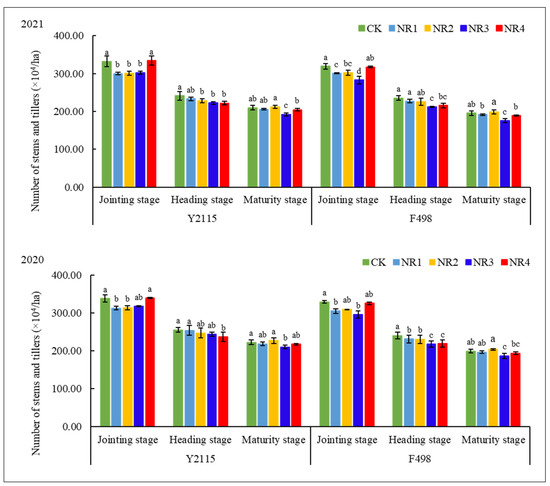
Figure 2.
Tillering number of mechanically transplanted hybrid indica rice under different nitrogen-reduction methods. Vertical bars represent ± S.E. of the mean. The S.E. was calculated by 3 replicates for each year. Different lowercase letters above the bars indicate significant differences among treatments (p < 0.05) of the same varieties within the same year. Y2115, rice variety Yixiangyou2115. F498, rice variety Fyou498. CK, the conventional N application for high-yield cultivation. NR1, balance N reduction. NR2, N reduction in basal fertilizer. NR3, N reduction in tillering fertilizer. NR4, N reduction in earing fertilizer.
3.3. Leaf Area Index (LAI)
As outlined in Table 3, the leaf area index (LAI) of rice plants at the jointing, heading, and maturity stages exhibited a decrease under N-reduction strategies compared to CK. However, the highly effective LAI at the heading stage demonstrated a slight increase, with the exception of the NR3 treatment. At the jointing stage, the LAI of rice plants subjected to N-reduction strategies decreased by 3.13% to 17.60% (excluding the NR4 treatment of F498 in 2020) relative to CK. At the heading stage, the lowest LAI of rice was observed in the NR3 treatment, exhibiting a significant decrease of 12.39%. Conversely, the relatively high LAI was maintained in NR1 and NR2 treatments without a significant decrease compared to CK. Additionally, there were no significant changes in the highly effective LAI of rice plants between N-reduction strategies and CK. At maturity, no significant differences in LAI were observed between the NR1, NR2, and CK treatments. However, NR3 and NR4 treatments significantly reduced LAI by 18.47% to 35.08% compared to CK. Variety and treatment significantly affected leaf area index at the jointing, heading, and maturity stages. Variety and treatment showed a significant interaction effect on the leaf area index of hybrid indica rice at the maturity stage.
Table 3.
Leaf area index of mechanically transplanted hybrid indica rice under different nitrogen-reduction methods.
3.4. Dry Matter Accumulation
The dry matter accumulation of rice at the jointing, heading, and maturity stages is illustrated in Figure 3. Compared to CK, the dry matter accumulation of rice under N-reduction strategies decreased at the jointing, heading, and maturity stages. Specifically, at the jointing stage, NR1, NR2, and NR3 treatments decreased the dry matter accumulation by 8.67% to 20.80%. However, there was no significant decrease in dry matter accumulation at the jointing stage in NR4 treatment compared to CK. During the heading stage, the dry matter accumulation of rice subjected to N-reduction strategies decreased by 2.97% to 19.07% compared to CK. At the maturity stage, the dry matter accumulation under NR3 and NR4 treatments decreased by 5.35% to 17.85%, while no significant decreases were observed under NR1 and NR2 treatments relative to CK.
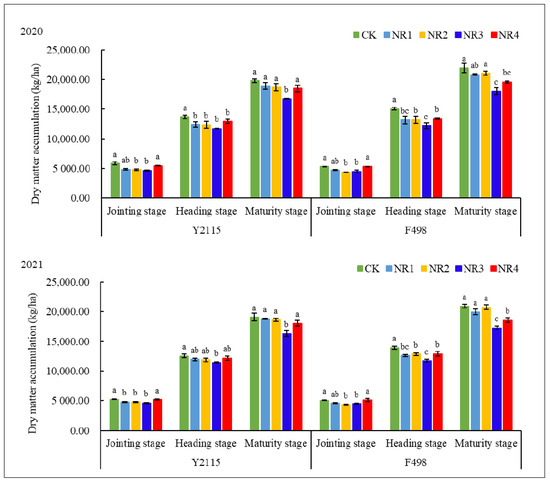
Figure 3.
Dry matter accumulation of mechanically transplanted hybrid indica rice under different nitrogen-reduction methods. Vertical bars represent ± S.E. of the mean. The S.E. was calculated by 3 replicates for each year. Different lowercase letters above the bars indicate significant differences among treatments (p < 0.05) of the same varieties within the same year. Y2115, rice variety Yixiangyou2115. F498, rice variety Fyou498. CK, the conventional N application for high-yield cultivation. NR1, balance N reduction. NR2, N reduction in basal fertilizer. NR3, N reduction in tillering fertilizer. NR4, N reduction in earing fertilizer.
3.5. Processing and Appearance Quality
As presented in Table 4, processing quality parameters, including the brown rice rate, milled rice rate, and head milled rice rate, exhibited slight improvements under NR1 and NR2 treatments relative to CK. However, these parameters were limited under NR3 and NR4 treatments. F498 had a higher chalkiness rate but a lower chalkiness degree than those of Y2115. No significant differences were identified in the chalkiness rate and chalkiness degree between the NR2 treatment and CK. The chalkiness rate and chalkiness degree of rice under NR1, NR3, and NR4 treatments were reduced by 2.97% to 23.73% and 3.35% to 52.49%, respectively, compared to CK. There were minimal differences in grain length, grain width, and length-to-width ratio among CK and the various N-reduction strategies, except for a significant decrease in grain length and grain width of F498 under the NR3 treatment in 2020. Variety and treatment exhibited significant interaction effects on chalkiness rate, chalkiness degree, grain length, grain width, and length-to-width ratio of grains.
Table 4.
Processing and appearance quality of mechanically transplanted hybrid indica rice under different nitrogen-reduction methods.
3.6. Cooking Taste and Nutritional Quality
As presented in Table 5, F498 had higher contents of protein and amylose but a lower alkali value, gel consistency, and taste value of rice grains than those of Y2115. The protein content of rice grains subjected to NR1 and NR4 treatments exhibited a significant reduction of 2.48% to 6.69% relative to CK. Conversely, the protein content of rice grains under NR2 and NR3 treatments did not exhibit a statistically significant difference from that of CK. The amylose content of rice grains under NR3 and NR4 treatments demonstrated a significant increase of 2.86% to 5.83% relative to CK, while the amylose content of rice grains under NR1 and NR2 treatments remained unchanged. The gel consistency of rice followed a trend of NR4 > NR1 > NR2 > NR3 under various N-reduction strategies. Specifically, NR1 and NR4 treatments significantly increased the gel consistency by 13.87% to 46.01% and the taste value by 1.44% to 3.66% compared to CK. Although the taste value of rice under NR2 and NR3 treatments also improved, these changes were not statistically significant relative to CK. Furthermore, a minor variation in the alkali value was identified among the different N-reduction strategies. Variety and treatment showed a significant interaction effect on the amylose content and gel consistency of rice grains.
Table 5.
Cooking taste and nutritional quality of mechanically transplanted hybrid indica rice under different nitrogen-reduction methods.
3.7. RVA Profile Characteristics
As outlined in Table 6, F498 had a higher final viscosity, setback, and pasting temperature than Y2115. The peak viscosity, trough viscosity, final viscosity, and breakdown of rice under N-reduction strategies increased by 0.65% to 5.62%, 0.71% to 4.76%, 0.21% to 3.14%, and 0.59% to 7.49%, respectively, compared to CK. However, the setback of rice under N-reduction strategies was 0.77% to 28.68% higher than CK. There was minimal variation in the peak time of rice between the N-reduction strategies and CK, while the pasting temperature of rice under N-reduction strategies was lower than CK. Variety and treatment showed significant interaction effects on setback, peak time, and pasting time of rice grains.
Table 6.
RVA profile characteristics of mechanically transplanted hybrid indica rice under different nitrogen-reduction methods.
4. Discussion
4.1. Optimized Nitrogen-Reduction Strategies for Achieving High Grain Yield in Mechanically Transplanted Hybrid Indica Rice
Numerous studies have focused on improving cultivation techniques for stabilizing the grain yield of rice in N-reduction conditions [15,25,26]. However, optimal practices for N reduction vary by soil fertility, climatic conditions, rice varieties, and planting densities [27,28,29,30]. Sui et al. [31] demonstrated that reducing the proportion of N applied during the early vegetative stage while increasing the proportion during the later reproductive growth stages can achieve high yields and significantly improve N use efficiency. In our study, compared to conventional N application for high-yield cultivation, NR1 and NR2 treatments could sustain relatively high grain yields, while NR3 and NR4 treatments led to a significant reduction in grain yield. The higher grain yield of NR1 and NR2 is mainly attributed to the higher panicle number and spikelet number per panicle (Table 2). NR3 and NR4 reduced the panicle number and spikelet number per panicle, respectively, which resulted in a significantly decreased grain yield. Consequently, both the panicle number and spikelet number per panicle are critical limiting factors for high grain yield in N-reduction conditions, corroborating findings from previous studies [32,33,34].
Previous research has demonstrated that high yield is associated with elevated LAI, and greater dry matter accumulation of rice plants during the middle and late growth stages [35,36,37]. Topdressing (tillering fertilizer and earing fertilizer) supported the growth and development of rice plants [38]. This study corroborates these findings: NR1 and NR2 exhibited lower LAI and dry matter accumulation at the early growth stage but higher LAI and dry matter accumulation at the later growth stages, while NR3 and NR4 had lower LAI and dry matter accumulation at maturity (Table 3 and Figure 3). Based on the conventional N application for high-yield cultivation, NR1 or NR2 could still ensure sufficient nutrient supply to form a high-yield population in mechanically transplanted hybrid indica rice, maintaining the relatively high LAI and dry matter accumulation amount, and thus achieving high grain yield. However, NR3 and NR4, due to the excessive decrease in tiller fertilizer or earing fertilizer, resulted in insufficient panicle number, LAI, and dry matter accumulation at later growth stages. These findings suggest that the redundancy of N application is not clear at every stage in conventional high-yield cultivation [39]. Nitrogen deficiencies induced by NR1 or NR2 can be limited through topdressing N fertilizer at later stages, while deficiencies caused by NR3 or NR4 are difficult to rectify with topdressing N fertilizer. Further study will be performed on the grain yield formation and its physiological mechanisms of mechanically transplanted hybrid indica rice in long-term nitrogen-reduction conditions.
4.2. Optimized Nitrogen-Reduction Strategies for Improving Grain Quality in Mechanically Transplanted Hybrid Indica Rice
Rice grain quality is impacted by many factors, including varietal differences, soil conditions, and cultivation practices, with N fertilizer being a significant factor [40,41,42]. Previous research has indicated that augmenting the earing fertilizer can enhance the processing and nutritional quality of rice. However, it may also adversely affect the appearance, cooking, and eating quality of rice [43,44]. In this study, compared to CK, NR1 and NR2 improved the processing quality of rice grain, while NR3 and NR4 resulted in a degradation of processing quality. The nitrogen-reduction strategy exhibited significant effects on the chalkiness rate and chalkiness degree. Suitable reduction in N topdressing (tillering fertilizer and/or earing fertilizer) could lower the chalkiness rate and chalkiness degree. Balanced N reduction maintained superior processing and appearance quality attributed to optimum nitrogen supply during the grain-filling period, preventing premature senescence, enhancing leaf photosynthetic capacity, facilitating the translocation of carbon and nitrogen metabolites to the panicle, and promoting grain filling [45]. The chalkiness rate and degree of NR2 were similar to CK, possibly due to a similar N in topdressing fertilizer [46,47]. Furthermore, the processing quality of rice grains in NR3 and NR4 treatments deteriorated, potentially due to insufficient photosynthate and accelerated leaf senescence produced by nitrogen deficiency during the grain-filling period, consistent with previous studies [48].
The cooking taste and nutritional qualities of rice grains are essential attributes of overall grain quality, influenced by protein content, amylose content, and physicochemical properties [49,50]. Zhao et al. [40] demonstrated that augmenting the N application rate can enhance the protein content while lowering the amylose content in rice grains, adversely affecting the cooking and sensory qualities of the rice. Zhang et al. [51] demonstrated that a 20% reduction in N fertilizer, relative to conventional application methods, can enhance amylose content while lowering protein content, improving aroma and taste, and optimizing the RVA profile. In this study, the decrease in earing N topdressing (NR1 and NR4) could decrease the protein content of grains and improve the taste value, while similar N application of earing fertilizer (NR2 and NR3) exhibited protein contents comparable to CK. The high N level for earing fertilizer may enhance N translocation to the grains during the grain-filling period, increasing the protein content of rice grains. These findings also indicated that N reduction could reduce the protein content while increasing the amylose content of rice grains. This might be attributed to the complementary relationship between protein and amylose. Specifically, increased protein content could elevate the activity of starch-branching enzymes, elevating amylopectin content and consequently reducing amylose content [52]. RVA profile characteristics are significantly linked to the eating and cooking quality of rice [53]. Higher final viscosity and breakdown, coupled with a lower setback, indicate superior eating and cooking quality [42]. In the present study, relative to CK, nitrogen-reduction strategies resulted in increased peak viscosity, trough viscosity, final viscosity, and breakdown, while lowering setback. These findings suggest that N reduction can optimize the RVA profile and enhance the eating and cooking quality of rice. NR1 and NR4 had the most favorable RVA profile characteristics compared to the other treatments. This outcome may be attributed to the reduction in total N application, particularly the earing fertilizer, resulting in a lower protein content in the grains. Protein can inhibit the swelling of starch granules and contribute to the maintenance of their structure when swollen [53]. These findings indicated that NR1 and NR4, which had lower protein contents, demonstrated higher peak viscosity and lower pasting temperatures. The reduced pasting temperature suggests a lower cooking temperature and shorter cooking time, representing the superior eating and cooking quality of rice. The effect of nitrogen-reduction approaches on the carbon and nitrogen metabolism in mechanically transplanted hybrid indica rice at the grain-filling stage, as well as its relationship with grain yield and quality, will be further examined.
5. Conclusions
Nitrogen-reduction strategies significantly influenced the grain yield and quality of mechanically transplanted hybrid indica rice. According to conventional N application for high-yield cultivation, both balanced N reduction and N reduction in basal fertilizer could attain relatively high grain yields because of the high panicle number and high spikelet number per panicle. Moreover, both balanced N reduction and N reduction in earing fertilizer could significantly enhance the eating and cooking quality of rice due to lower protein content and favorable RVA profile characteristics. Therefore, balanced N reduction will be beneficial in maintaining both high yields and improving rice quality. In the future, N application should be reduced to about 150 kg/ha, with 40% applied as basal fertilizer, 30% as tillering fertilizer, and 30% as earing fertilizer for mechanically transplanted hybrid rice in Southwest China.
Author Contributions
Conceptualization, M.-J.J. and M.L.; methodology, M.-J.J. and W.-B.X.; software, M.-J.J.; formal analysis, J.-Y.T. and D.-Q.L.; investigation, L.-J.L., J.-F.Z., G.-M.J. and R.-J.W.; resources, X.-H.J.; data curation, W.-B.X.; writing—original draft preparation, M.-J.J. and M.L.; supervision, M.L.; project administration, J.-F.Z.; funding acquisition, M.-J.J. and M.L. All authors have read and agreed to the published version of the manuscript.
Funding
This research was funded by the National Science Foundation of China (Grant No. 32160505), the Guizhou Provincial Basic Research Program (Natural Science) (Grant No. ZK [2023]-176), the Guizhou Provincial High-Level Innovative Talent Cultivation Program (Grant No. GCC [2023]-065), and the Post-Subsidy of the National Science Foundation of the Guizhou Academy of Agricultural Sciences (Grant No. [2022]-04).
Institutional Review Board Statement
Not applicable.
Data Availability Statement
Data available on request.
Conflicts of Interest
The authors declare no conflicts of interest.
References
- Qaswar, M.; Huang, J.; Ahmed, W.; Liu, S.J.; Li, D.C.; Zhang, L.; Liu, L.S.; Xu, Y.M.; Han, T.F.; Du, J.X.; et al. Substitution of Inorganic Nitrogen Fertilizer with Green Manure (GM) Increased Yield Stability by Improving C Input and Nitrogen Recovery Efficiency in Rice Based Cropping System. Agronomy 2019, 9, 609. [Google Scholar] [CrossRef]
- Yin, Y.L.; Zhao, R.F.; Yang, Y.; Meng, Q.F.; Ying, H.; Cassman, K.G.; Cong, W.F.; Tian, X.S.; He, K.; Wang, Y.C.; et al. A steady-state N balance approach for sustainable smallholder farming. Proc. Natl. Acad. Sci. USA 2021, 118, e2106576118. [Google Scholar] [CrossRef] [PubMed]
- Xu, L.; Yuan, S.; Wang, X.Y.; Yu, X.; Peng, S.B. High yields of hybrid rice do not require more nitrogen fertilizer than inbred rice: A meta-analysis. Food Energy Secur. 2021, 10, 341–350. [Google Scholar] [CrossRef]
- Liu, Y.F.; Sun, D.S.; Wang, H.J.; Wang, X.J.; Yu, G.Q.; Zhao, X.J. An evaluation of China’s agricultural green production: 1978–2017. J. Clean. Prod. 2020, 243, 118483. [Google Scholar] [CrossRef]
- Zhong, Y.M.; Wang, X.P.; Yang, J.P.; Zhao, X.; Ye, X.Y. Exploring a suitable nitrogen fertilizer rate to reduce greenhouse gas emissions and ensure rice yields in paddy fields. Sci Total Environ. 2016, 565, 420–426. [Google Scholar] [CrossRef] [PubMed]
- Kumar, N.; Mathpal, B.; Sharma, A.; Shukla, A.; Shankhdhar, D.; Shankhdhar, S.C. Physiological evaluation of nitrogen use efficiency and yield attributes in rice (Oryza sativaL.) genotypes under different nitrogen levels. Cereal Res. Commun. 2015, 43, 166–177. [Google Scholar] [CrossRef]
- Jiang, P.; Xie, X.B.; Huang, M.; Zhou, X.F.; Zhang, R.C.; Chen, J.N.; Wu, D.D.; Xia, B.; Xu, F.X.; Xiong, H.; et al. Comparisons of yield performance and nitrogen response between hybrid and inbred rice under different ecological conditions in southern China. J. Integr. Agric. 2015, 14, 1283–1294. [Google Scholar] [CrossRef]
- Ju, C.X.; Buresh, R.J.; Wang, Z.Q.; Zhang, H.; Liu, L.J.; Yang, J.C.; Zhang, J.H. Root and shoot traits for rice varieties with higher grain yield and higher nitrogen use efficiency at lower nitrogen rates application. Field Crops Res. 2015, 175, 47–55. [Google Scholar] [CrossRef]
- Hasegawa, H. High-yielding rice cultivars perform best even at reduced nitrogen fertilizer rate. Crop Sci. 2003, 43, 921–926. [Google Scholar] [CrossRef]
- Tang, L.; Xu, Z.J.; Chen, W.F. Advances and prospects of super rice breeding in China. J. Integr. Agric. 2017, 16, 984–991. [Google Scholar] [CrossRef]
- Zhong, X.H.; Huang, N.R.; Zheng, H.B.; Peng, S.B. Specification for the “Three Controls” nutrient management technology for irrigated rice. Guangdong Agric. Sci. 2007, 5, 13–15, (Chinese with English Abstract). [Google Scholar]
- Peng, S.B.; Buresh, R.J.; Huang, J.L.; Zhong, X.H.; Zou, Y.B.; Yang, J.C.; Wang, G.H.; Liu, Y.Y.; Hu, R.F.; Tang, Q.Y.; et al. Improving nitrogen fertilization in rice by site-specific N management. A review. Agron. Sustain. Dev. 2010, 30, 649–656. [Google Scholar] [CrossRef]
- Qiao, J.; Yang, L.Z.; Yan, T.M.; Xue, F.; Zhao, D. Nitrogen fertilizer reduction in rice production for two consecutive years in the Taihu Lake area. Agric. Ecosyst. Environ. 2012, 146, 103–112. [Google Scholar] [CrossRef]
- Mboyerwa, P.A.; Kibret, K.; Mtakwa, P.; Aschalew, A. Lowering nitrogen rates under the system of rice intensification enhanced rice productivity and nitrogen use efficiency in irrigated lowland rice. Heliyon 2022, 8, e09140. [Google Scholar] [CrossRef]
- Ju, C.X.; Zhu, Y.W.; Liu, T.; Sun, C.M. The Effect of Nitrogen Reduction at Different Stages on Grain Yield and Nitrogen Use Efficiency for Nitrogen Efficient Rice Varieties. Agronomy 2021, 11, 462. [Google Scholar] [CrossRef]
- Wang, B.J.; Cheng, W.D.; Chen, G.; Shen, Y.Q.; Zhang, H.M. Effect of straw returning and nitrogen reduction on soil nutrition, carbon pool and rice yield in rice field. Acta Agric. Zhejiangensis 2019, 31, 624–630, (Chinese with English Abstract). [Google Scholar]
- Du, Z.M.; Liu, X.L.; Shao, D.L.; Zhang, N.; Wang, Y.W.; Wang, J.B.; Wu, X.K.; Hu, T.; Xia, Y.Y.; Xu, H. Variation of plant type, yield and quality of hybrid progenies of Chinese and Japanese japonica rice varieties under nitrogen reduction practice and their interrelation. Chin. J. Rice Sci. 2020, 34, 171–180, (Chinese with English Abstract). [Google Scholar]
- Zhou, W.T.; Long, W.F.; Wang, H.R.; Long, P.; Xu, Y.; Fu, Z.Q. Matter Production Characteristics and Nitrogen Use Efficiency under Different Nitrogen Application Patterns in Chinese Double-Cropping Rice Systems. Agronomy 2022, 12, 1165. [Google Scholar] [CrossRef]
- Peng, S.B.; Buresh, R.J.; Huang, J.L.; Yang, J.C.; Zou, Y.B.; Zhong, X.H.; Wang, G.H.; Zhang, F.S. Strategies for overcoming low agronomic nitrogen use efficiency in irrigated rice systems in China. Field Crops Res. 2006, 96, 37–47. [Google Scholar] [CrossRef]
- Chen, Y.; Liu, K.; Zhang, H.L.; Li, S.Y.; Zhang, Y.J.; Wei, J.L.; Zhang, H.; Gu, J.F.; Liu, L.J.; Yang, J.C. Effects of machine transplanting density and panicle nitrogen fertilizer reduction on grains starch synthesis in good taste rice cultivars. Acta Agron. Sin. 2021, 47, 1540–1550, (Chinese with English Abstract). [Google Scholar]
- Liu, Q.H.; Zhou, X.B.; Li, J.L.; Xin, C.Y. Effects of seedling age and cultivation density on agronomic characteristics and grain yield of mechanically transplanted rice. Sci. Rep. 2017, 7, 14072. [Google Scholar] [CrossRef] [PubMed]
- Jiang, M.J.; Xu, W.B.; Wang, R.J.; Luo, D.Q.; Jiang, X.H.; Zhou, W.J.; Xu, F.X.; Sun, Y.J.; Li, M. Effects of nitrogen reduction on grain yield and quality of mechanical transplanting hybrid indica rice. J. South. Agric. 2022, 53, 104–114, (Chinese with English Abstract). [Google Scholar]
- GB/T 17891-2017; General Administration of Quality Supervision, Inspection and Quarantine of the People’s Republic of China. High Quality Paddy. Standards Press of China: Beijing, China, 2008.
- NY/T 83-2017; Ministry of Agriculture of the People’s Republic of China. Determination of Rice Quality. China Agriculture Press: Beijing, China, 2017.
- Wei, H.H.; Meng, T.Y.; Ge, J.L.; Zhang, X.B.; Shi, T.Y.; Ding, E.H.; Lu, Y.; Li, X.Y.; Tao, Y.; Chen, Y.L.; et al. Reduced nitrogen application rate with dense planting improves rice grain yield and nitrogen use efficiency: A case study in east China. Crop J. 2021, 9, 954–961. [Google Scholar] [CrossRef]
- Chong, H.T.; Jiang, Z.Y.; Shang, L.Y.; Shang, C.; Deng, J.; Zhang, Y.B.; Huang, L.Y. Dense Planting with Reduced Nitrogen Input Improves Grain Yield, Protein Quality, and Resource use Efficiency in Hybrid Rice. J. Plant Growth Regul. 2022, 42, 960–972. [Google Scholar] [CrossRef]
- Zhou, C.H.; Zhao, Z.K.; Pan, X.H.; Huang, S.; Tan, X.M.; Wu, J.F.; Shi, Q.H. Integration of Growing Milk Vetch in Winter and Reducing Nitrogen Fertilizer Application Can Improve Rice Yield in Double-Rice Cropping System. Rice Sci. 2016, 23, 132–143. [Google Scholar]
- Xue, L.H.; Yu, Y.L.; Yang, L.Z. Maintaining yields and reducing nitrogen loss in rice–wheat rotation system in Taihu Lake region with proper fertilizer management. Environ. Res. Lett. 2014, 9, 115010. [Google Scholar] [CrossRef]
- Lv, Y.D.; Lan, Y.C.; Xu, L.Q.; Yin, D.W.; Wang, H.Z.; Zheng, G.P.; Guo, X.H. Reducing nitrogen rate and hill distance improves rice dry matter production in saline–alkali soils. Agron. J. 2021, 113, 5114–5125. [Google Scholar] [CrossRef]
- Wehmeyer, H.; de Guia, A.H.; Connor, M. Reduction of Fertilizer Use in South China—Impacts and Implications on Smallholder Rice Farmers. Sustainability 2020, 12, 2240. [Google Scholar] [CrossRef]
- Sui, B.; Feng, X.M.; Tian, G.L.; Hu, X.Y.; Shen, Q.R.; Guo, S.W. Optimizing nitrogen supply increases rice yield and nitrogen use efficiency by regulating yield formation factors. Field Crops Res. 2013, 150, 99–107. [Google Scholar] [CrossRef]
- Wei, H.Y.; Zhang, H.C.; Blumwald, E.; Li, H.L.; Cheng, J.Q.; Dai, Q.G.; Huo, Z.Y.; Xu, K.; Guo, B.W. Different characteristics of high yield formation between inbred japonica super rice and inter-sub-specific hybrid super rice. Field Crops Res. 2016, 198, 179–187. [Google Scholar] [CrossRef]
- Xu, D.; Zhu, Y.; Chen, Z.F.; Han, C.; Hu, L.; Qiu, S.; Wu, P.; Liu, G.D.; Wei, H.Y.; Zhang, H.C. Yield characteristics of japonica/indica hybrids rice in the middle and lower reaches of the Yangtze River in China. J. Integr. Agric. 2020, 19, 2394–2406. [Google Scholar] [CrossRef]
- Yoshinaga, S.; Heinai, H.; Ohsumi, A.; Furuhata, M.; Ishimaru, T. Characteristics of growth and quality, and factors contributing to high yield in newly developed rice variety ‘Akidawara’. Plant Prod. Sci. 2018, 21, 186–192. [Google Scholar] [CrossRef]
- Huang, M.; Shan, S.L.; Zhou, X.F.; Chen, J.N.; Cao, F.B.; Jiang, L.G.; Zou, Y.B. Leaf photosynthetic performance related to higher radiation use efficiency and grain yield in hybrid rice. Field Crops Res. 2016, 193, 87–93. [Google Scholar] [CrossRef]
- Yang, Z.Y.; Li, N.; Ma, J.; Sun, Y.J.; Xu, H. High-yielding traits of heavy panicle varieties under triangle planting geometry: A new plant spatial configuration for hybrid rice in China. Field Crops Res. 2014, 168, 135–147. [Google Scholar] [CrossRef]
- Zhang, H.; Tan, G.L.; Xue, Y.G.; Liu, L.J.; Yang, J.C. Changes in Grain Yield and Morphological and Physiological Characteristics During 60-Year Evolution of Japonica Rice Cultivars in Jiangsu. Acta Agron. Sin. 2010, 36, 133–140, (Chinese with English Abstract). [Google Scholar] [CrossRef]
- Fan, L.H.; Xu, S.S.; Hou, P.F.; Xue, L.H.; Li, G.H.; Ding, Y.F.; Yang, L.Z. Effect of different ratios of basal to tiller nitrogen on rice yield and nitrogen utilization under different soil fertility. Sci. Agric. Sinica. 2016, 49, 1872–1884, (Chinese with English Abstract). [Google Scholar]
- Li, M.; Luo, D.Q.; Jiang, M.J.; Jiang, X.H.; Ji, G.M.; Li, L.J.; Zhou, W.J. Effects of nitrogen-reduction cultivation models on nitrogen accumulation and yield of hybrid indica rice. J. Plant Nutr. Fertil. 2022, 28, 598–610, (Chinese with English Abstract). [Google Scholar]
- Zhao, C.; Liu, G.M.; Chen, Y.; Jiang, Y.; Shi, Y.; Zhao, L.T.; Liao, P.Q.; Wang, W.L.; Xu, K.; Dai, Q.G.; et al. Excessive Nitrogen Application Leads to Lower Rice Yield and Grain Quality by Inhibiting the Grain Filling of Inferior Grains. Agriculture 2022, 12, 962. [Google Scholar] [CrossRef]
- Gao, H.; Ma, Z.B.; Wang, Y.Z.; Zhang, M.L.; Wang, X.J.; Wang, C.H.; Tang, Z.Q.; Zhang, L.Y.; Fu, L.; He, N.; et al. Analysis of parental genetic diversity and its impact on grain yield and quality of japonica hybrid rice in northern China. Crop J. 2022, 10, 904–910. [Google Scholar] [CrossRef]
- Hu, Y.J.; Li, L.; Tian, J.Y.; Zhang, C.X.; Wang, J.; Yu, E.W.; Xing, Z.P.; Guo, B.W.; Wei, H.Y.; Huo, Z.Y.; et al. Effects of dynamic low temperature during the grain filling stage on starch morphological structure, physicochemical properties, and eating quality of soft japonica rice. Cereal Chem. 2020, 97, 540–550. [Google Scholar] [CrossRef]
- Chen, M.Y.; Li, X.F.; Cheng, J.Q.; Ren, H.R.; Liang, J.; Zhang, H.C.; Huo, Z.Y. Effects of total straw returning and nitrogen application regime on grain yield and quality in mechanical transplanting Japonica rice with good taste quality. Acta Agron. Sin. 2017, 43, 1802–1816, (Chinese with English Abstract). [Google Scholar] [CrossRef]
- Hu, Q.; Xia, M.; Zhang, H.C.; Cao, L.Q.; Guo, B.W.; Wei, H.Y.; Chen, H.C.; Han, B.F. Effect of nitrogen application regime on yield and quality of mechanical pot-seedlings transplanting rice with good taste quality. Acta Agron. Sin. 2017, 43, 420–431, (Chinese with English Abstract). [Google Scholar] [CrossRef]
- Qiu, J.T. Influences of Nitrogen-Reduced Fertilization on the Production of Rice Population and Rice Quality and Research on the Nitrogen Reduction Strategy; Yangzhou University: Yangzhou, China, 2020. [Google Scholar]
- Wei, H.H.; Ge, J.L.; Zhang, X.B.; Zhu, W.; Deng, F.; Ren, W.J.; Chen, Y.L.; Meng, T.Y.; Dai, Q.G. Decreased panicle N application alleviates the negative effects of shading on rice grain yield and grain quality. J. Integr. Agric. 2023, 22, 2041–2053. [Google Scholar] [CrossRef]
- Xi, M.; Wu, W.G.; Xu, Y.Z.; Zhou, Y.J.; Chen, G.; Ji, Y.L.; Sun, X.Y. Grain chalkiness traits is affected by the synthesis and dynamic accumulation of the storage protein in rice. J. Sci. Food Agric. 2021, 101, 6125–6133. [Google Scholar] [CrossRef]
- Jiang, Y.W.; Zhao, T.T.; Liu, W.W.; Zhong, W.J.; Zhang, L.W.; Zhao, H.C.; Chen, L.Q.; Niu, T.X.; Li, M.; Zhou, J.; et al. Effect of Reducing Fertilizer Nitrogen on Quality of Kenjing 5 in Different Soil Fertility Level. J. Sichuan Agric. Univ. 2016, 34, 406–413, (Chinese with English Abstract). [Google Scholar]
- Custodio, M.C.; Cuevas, R.P.; Ynion, J.; Laborte, A.G.; Velasco, M.L.; Demont, M. Rice quality: How is it defined by consumers, industry, food scientists, and geneticists? Trends Food Sci. Technol. 2019, 92, 122–137. [Google Scholar] [CrossRef]
- Concepcion, J.C.T.; Ouk, M.; Zhao, D.L.; Fitzgerald, M.A. The need for new tools and investment to improve the accuracy of selecting for grain quality in rice. Field Crops Res. 2015, 182, 60–67. [Google Scholar] [CrossRef]
- Zhang, J.; Zhou, D.D.; Xu, K.; Li, B.Z.; Liu, Z.H.; Zhou, N.B.; Fang, S.L.; Zhang, Y.J.; Tang, J.; An, L.Z. Nitrogen fertilizer reduction and precise application model on mechanical transplanting Japonica rice with good taste quality under straw returning in Huaibei area. Acta Agron. Sin. 2022, 48, 410–422, (Chinese with English Abstract). [Google Scholar] [CrossRef]
- Hou, J.H.; Zhang, C.H.; Xu, K.; Li, G.H.; Yuan, J.Q.; Liu, Y.Y.; Guo, B.W.; Yan, W.W.; Chen, H.M.; Huo, Z.Y. Application regimes of controlled-release urea for high rice yield and quality in low fertility sandy soil. J. Plant Nutr. Fertil. 2021, 27, 630–642, (Chinese with English Abstract). [Google Scholar]
- Zhu, D.W.; Zhang, H.C.; Guo, B.W.; Xu, K.; Dai, Q.G.; Wei, H.Y.; Gao, H.; Hu, Y.J.; Cui, P.Y.; Huo, Z.Y. Effects of nitrogen level on yield and quality of japonica soft super rice. J. Integr. Agric. 2017, 16, 1018–1027. [Google Scholar] [CrossRef]
Disclaimer/Publisher’s Note: The statements, opinions and data contained in all publications are solely those of the individual author(s) and contributor(s) and not of MDPI and/or the editor(s). MDPI and/or the editor(s) disclaim responsibility for any injury to people or property resulting from any ideas, methods, instructions or products referred to in the content. |
© 2024 by the authors. Licensee MDPI, Basel, Switzerland. This article is an open access article distributed under the terms and conditions of the Creative Commons Attribution (CC BY) license (https://creativecommons.org/licenses/by/4.0/).