Older Patients with Atopic Dermatitis Show More Pronounced Early Clinical Improvement with Tralokinumab: A Single-Center Retrospective Real-World Study



Abstract
1. Introduction
2. Materials and Methods
2.1. Study Design and Patients
2.2. Treatment Regimen
2.3. Laboratory Assessments
2.4. Clinical Outcome Measures
2.5. Safety and Discontinuation Assessment
2.6. Treatment Persistence Analysis
2.7. Statistical Analysis
3. Results
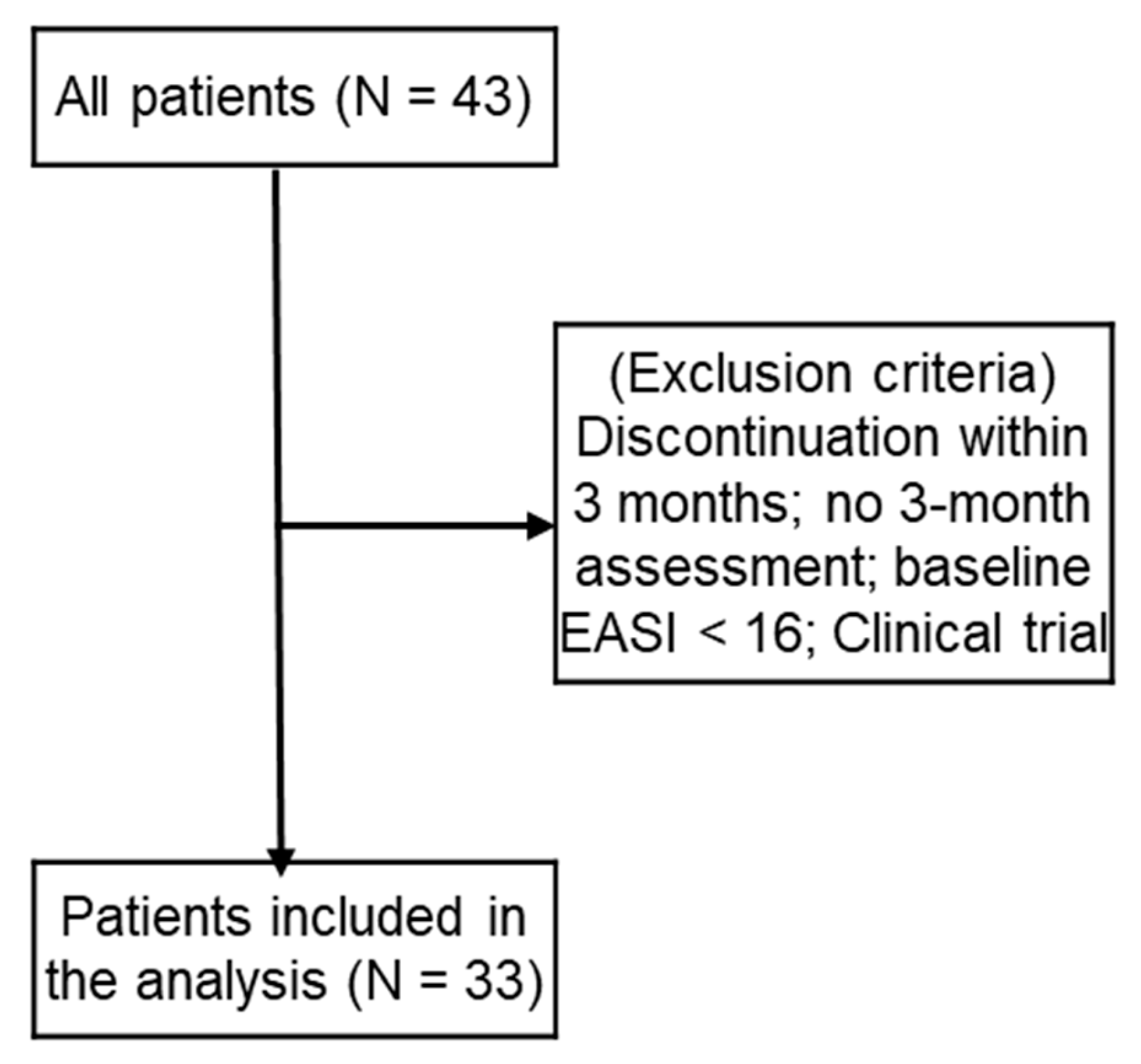
3.1. Patient Background and Characteristics
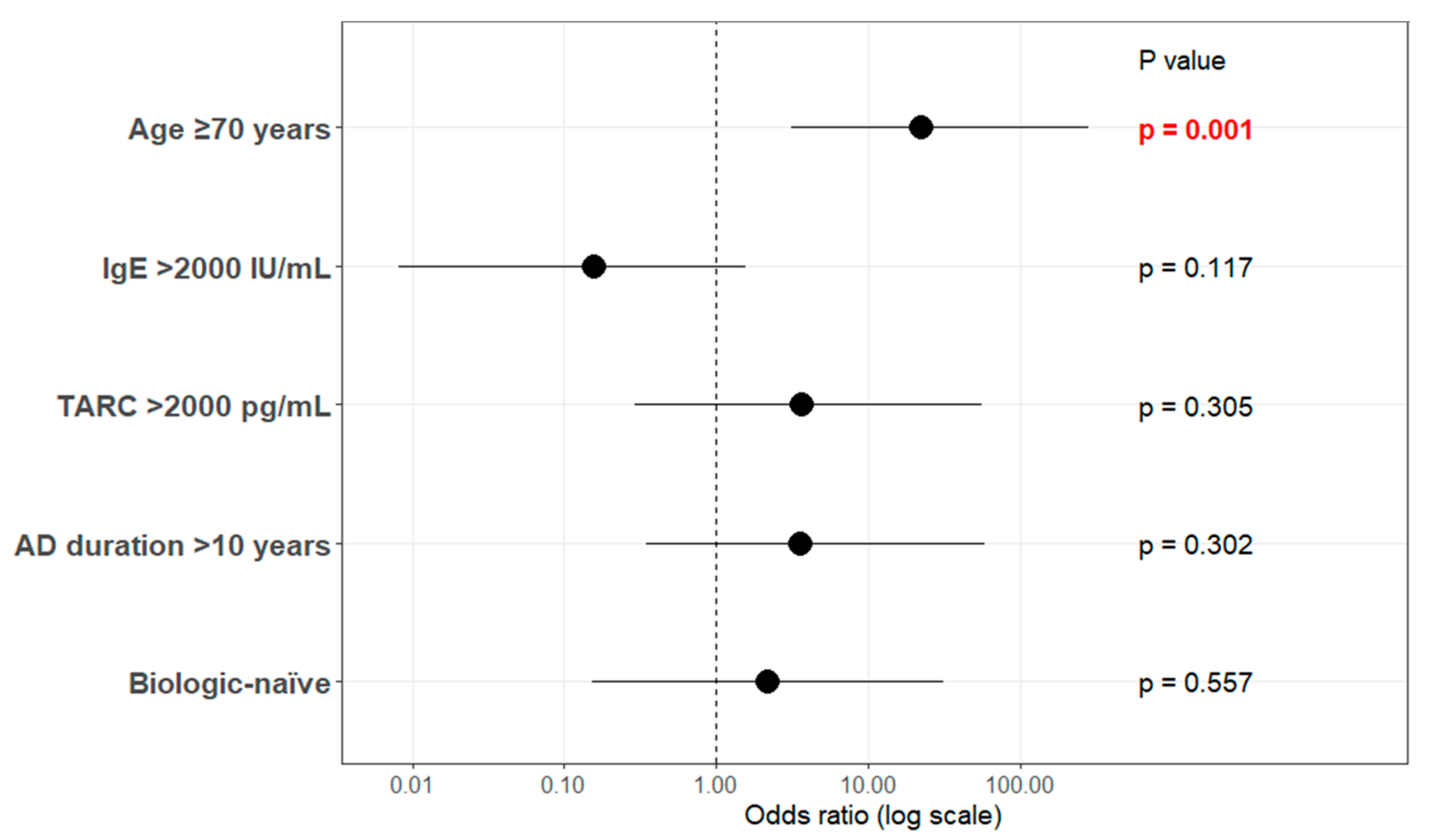
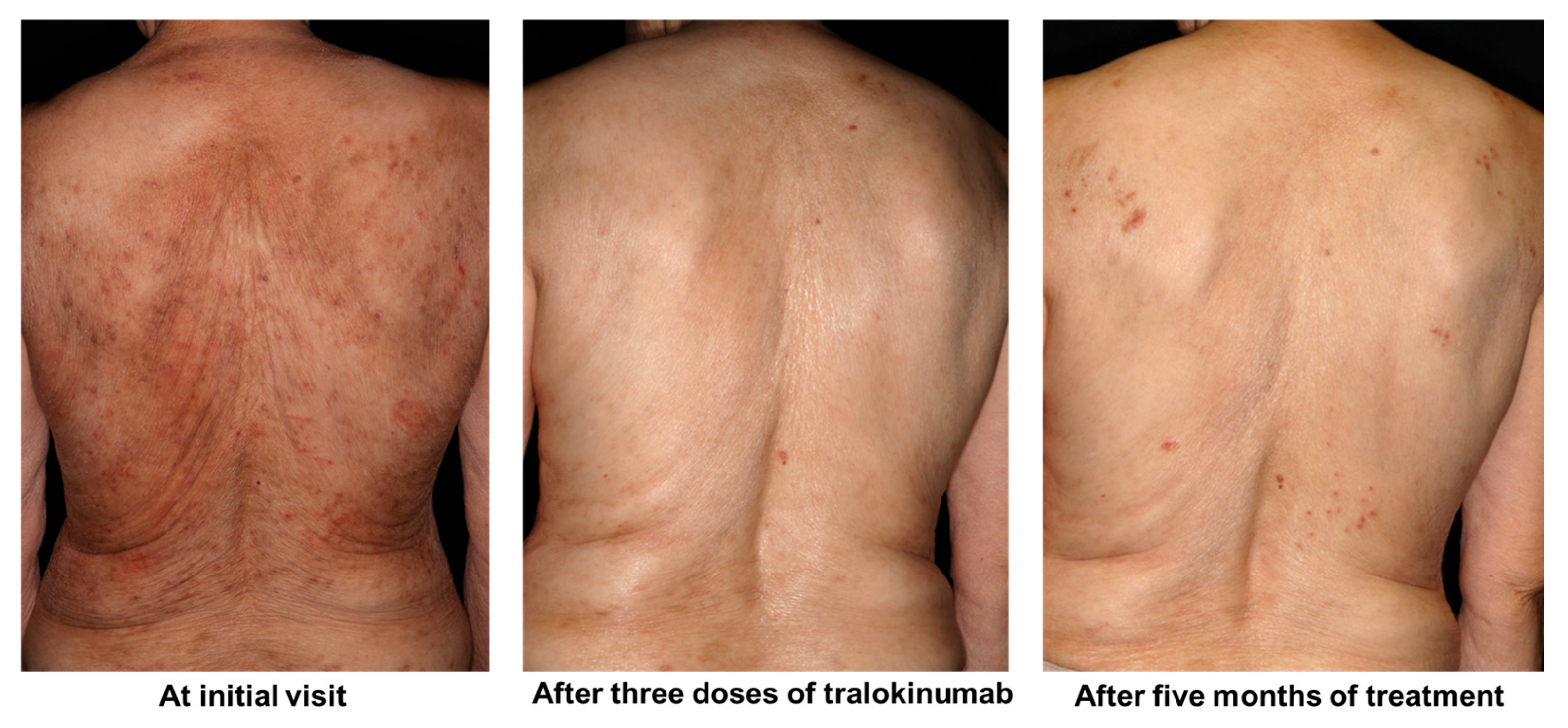
3.2. Efficacy of Tralokinumab
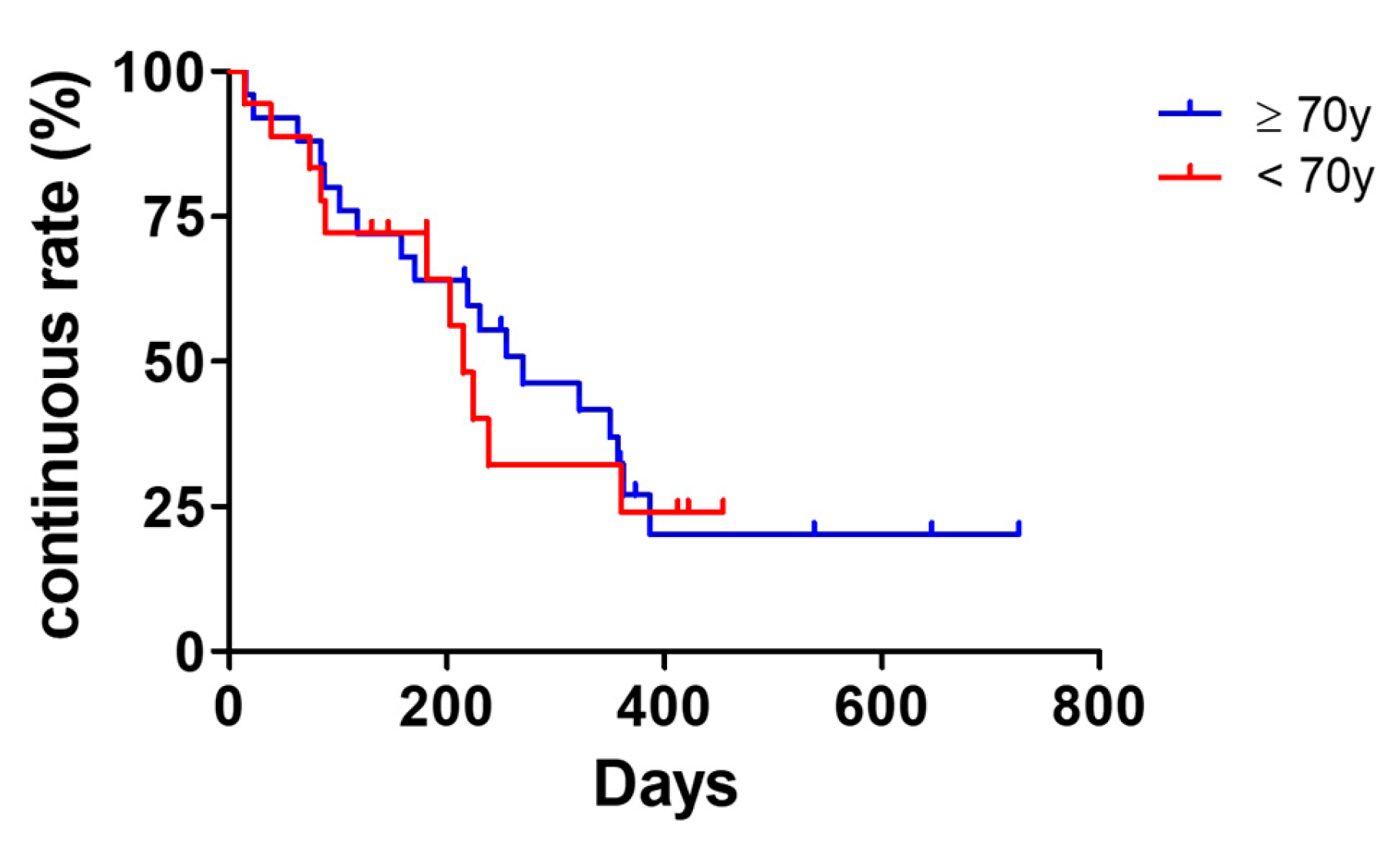
3.3. Treatment Persistence and Reasons for Discontinuation
3.4. Safety Profile and Subsequent Treatment
4. Discussion
Author Contributions
Funding
Institutional Review Board Statement
Informed Consent Statement
Data Availability Statement
Acknowledgments
Conflicts of Interest
Abbreviations
| AD | Atopic dermatitis |
| EASI | Eczema Area and Severity Index |
| IGA | Investigator’s Global Assessment |
| PP-NRS | Peak Pruritus Numerical Rating Scale |
| JAKi | Janus kinase inhibitors |
| QOL | Quality of life |
| CTCL | Cutaneous T-cell lymphoma |
| IL | Interleukin |
| IL-13Rα2 | IL-13 receptor α2 |
| TARC | thymus and activation-regulated chemokine |
| IgE | Immunoglobulin E |
References
- Guttman-Yassky, E.; Renert-Yuval, Y.; Brunner, P.M. Atopic dermatitis. Lancet 2025, 405, 583–596. [Google Scholar] [CrossRef] [PubMed]
- Meledathu, S.; Naidu, M.P.; Brunner, P.M. Update on atopic dermatitis. J. Allergy Clin. Immunol. 2025, 155, 1124–1132. [Google Scholar] [CrossRef]
- Hansen-Sackey, E.B.; Hartono, S. Atopic Dermatitis: Pathophysiology and Emerging Treatments. Allergies 2025, 5, 40. [Google Scholar] [CrossRef]
- Biliński, K.; Rakoczy, K.; Karwowska, A.; Cichy, O.; Wojno, A.; Wojno, A.; Kulbacka, J.; Ponikowska, M. Anti-Inflammatory Therapies for Atopic Dermatitis: A New Era in Targeted Treatment. J. Clin. Med. 2025, 14, 5053. [Google Scholar] [CrossRef] [PubMed]
- Tsiogka, A.; Kyriazopoulou, M.; Kontochristopoulos, G.; Nicolaidou, E.; Stratigos, A.; Rigopoulos, D.; Gregoriou, S. The JAK/STAT Pathway and Its Selective Inhibition in the Treatment of Atopic Dermatitis: A Systematic Review. J. Clin. Med. 2022, 11, 4431. [Google Scholar] [CrossRef]
- Rothenberg-Lausell, C.; Bar, J.; Dahabreh, D.; Renert-Yuval, Y.; Del Duca, E.; Guttman-Yassky, E. Biologic and small-molecule therapy for treating moderate to severe atopic dermatitis: Mechanistic considerations. J. Allergy Clin. Immunol. 2024, 154, 20–30. [Google Scholar] [CrossRef]
- Bieber, T. Atopic dermatitis: An expanding therapeutic pipeline for a complex disease. Nat. Rev. Drug Discov. 2022, 21, 21–40. [Google Scholar] [CrossRef]
- Sato, E.; Obonai, N.; Iwata, M.; Ito, K.; Imafuku, S. Comparative short-term efficacy of Janus kinase 1 inhibitors and anti-interleukin-13 antibodies in atopic dermatitis: A retrospective cohort analysis based on real-world data. Front. Immunol. 2025, 16, 1639932. [Google Scholar] [CrossRef]
- Silverberg, J.I.; Bunick, C.G.; Hong, H.C.; Mendes-Bastos, P.; Stein Gold, L.; Costanzo, A.; Ibrahim, N.; Sancho, C.; Wu, X.; Han, Y.; et al. Efficacy and safety of upadacitinib versus dupilumab in adults and adolescents with moderate-to-severe atopic dermatitis: Week 16 results of an open-label randomized efficacy assessor-blinded head-to-head phase IIIb/IV study (Level Up). Br. J. Dermatol. 2024, 192, 36–45. [Google Scholar] [CrossRef]
- Silverberg, J.I. Public Health Burden and Epidemiology of Atopic Dermatitis. Dermatol. Clin. 2017, 35, 283–289. [Google Scholar] [CrossRef]
- Chan, L.N.; Magyari, A.; Ye, M.; Al-Alusi, N.A.; Langan, S.M.; Margolis, D.; McCulloch, C.E.; Abuabara, K. The epidemiology of atopic dermatitis in older adults: A population-based study in the United Kingdom. PLoS ONE 2021, 16, e0258219. [Google Scholar] [CrossRef]
- Tanei, R.; Katsuoka, K. Clinical analyses of atopic dermatitis in the aged. J. Dermatol. 2008, 35, 562–569. [Google Scholar] [CrossRef] [PubMed]
- Abuabara, K.; Magyari, A.; McCulloch, C.E.; Linos, E.; Margolis, D.J.; Langan, S.M. Prevalence of Atopic Eczema Among Patients Seen in Primary Care: Data From The Health Improvement Network. Ann. Intern. Med. 2019, 170, 354–356. [Google Scholar] [CrossRef] [PubMed]
- Pollyn-Millot, C.; Maccari, F.; Perrot, J.L.; Reguiai, Z.; Boulard, C.; Becherel, P.A.; Poreaux, C.; Mery-Bossard, L.; Beaulieu, D.; Pourchot, D.; et al. Clinical Characteristics and Therapeutic Management of Atopic Dermatitis in Elderly Patients Compared with Young Adult Patients: A Prospective Multicentre Study. Acta Derm. Venereol. 2024, 104, adv40420. [Google Scholar] [CrossRef] [PubMed]
- Maurelli, M.; Chiricozzi, A.; Peris, K.; Gisondi, P.; Girolomoni, G. Atopic Dermatitis in the Elderly Population. Acta Derm. Venereol. 2023, 103, adv13363. [Google Scholar] [CrossRef]
- Hristov, A.C.; Tejasvi, T.; Wilcox, R.A. Cutaneous T-cell lymphomas: 2021 update on diagnosis, risk-stratification, and management. Am. J. Hematol. 2021, 96, 1313–1328. [Google Scholar] [CrossRef]
- Mandel, J.; Mehta, J.; Hafer, R.; Ayub, M.; Nusrat, F.; Yang, H.; Porcu, P.; Nikbakht, N. Increased Risk of Cutaneous T-Cell Lymphoma Development after Dupilumab Use for Atopic Dermatitis. Dermatol. Ther. 2024, 2024, 9924306. [Google Scholar] [CrossRef]
- Chiba, T.; Nagai, T.; Osada, S.I.; Manabe, M. Diagnosis of Mycosis Fungoides Following Administration of Dupilumab for Misdiagnosed Atopic Dermatitis. Acta Derm. Venereol. 2019, 99, 818–819. [Google Scholar] [CrossRef]
- Espinosa, M.L.; Nguyen, M.T.; Aguirre, A.S.; Martinez-Escala, M.E.; Kim, J.; Walker, C.J.; Pontes, D.S.; Silverberg, J.I.; Choi, J.; Pro, B.; et al. Progression of cutaneous T-cell lymphoma after dupilumab: Case review of 7 patients. J. Am. Acad. Dermatol. 2020, 83, 197–199. [Google Scholar] [CrossRef]
- Hollins, L.C.; Wirth, P.; Fulchiero, G.J., Jr.; Foulke, G.T. Long-standing dermatitis treated with dupilumab with subsequent progression to cutaneous T-cell lymphoma. Cutis 2020, 106, E8–E11. [Google Scholar] [CrossRef]
- Sugaya, M. Is blocking IL-4 receptor alpha beneficial for patients with mycosis fungoides or Sezary syndrome? J. Dermatol. 2021, 48, e225–e226. [Google Scholar] [CrossRef] [PubMed]
- Geskin, L.J.; Viragova, S.; Stolz, D.B.; Fuschiotti, P. Interleukin-13 is overexpressed in cutaneous T-cell lymphoma cells and regulates their proliferation. Blood 2015, 125, 2798–2805. [Google Scholar] [CrossRef] [PubMed]
- Knudson, K.M.; Hwang, S.; McCann, M.S.; Joshi, B.H.; Husain, S.R.; Puri, R.K. Recent Advances in IL-13Ralpha2-Directed Cancer Immunotherapy. Front. Immunol. 2022, 13, 878365. [Google Scholar] [CrossRef] [PubMed]
- Brown, C.E.; Hibbard, J.C.; Alizadeh, D.; Blanchard, M.S.; Natri, H.M.; Wang, D.; Ostberg, J.R.; Aguilar, B.; Wagner, J.R.; Paul, J.A.; et al. Locoregional delivery of IL-13Ralpha2-targeting CAR-T cells in recurrent high-grade glioma: A phase 1 trial. Nat. Med. 2024, 30, 1001–1012. [Google Scholar] [CrossRef]
- Popovic, B.; Breed, J.; Rees, D.G.; Gardener, M.J.; Vinall, L.M.; Kemp, B.; Spooner, J.; Keen, J.; Minter, R.; Uddin, F.; et al. Structural Characterisation Reveals Mechanism of IL-13-Neutralising Monoclonal Antibody Tralokinumab as Inhibition of Binding to IL-13Ralpha1 and IL-13Ralpha2. J. Mol. Biol. 2017, 429, 208–219. [Google Scholar] [CrossRef]
- Merola, J.F.; Butler, D.C.; Mark, T.; Schneider, S.; Kim, Y.; Abuabara, K. Safety and Efficacy of Tralokinumab in Older Adults with Moderate-to-Severe Atopic Dermatitis: A Secondary Analysis. JAMA Dermatol. 2023, 159, 1119–1123. [Google Scholar] [CrossRef]
- Melgosa Ramos, F.J.; Alarcon, S.S.; Motilla, J.M.S.; Mercader, P. Long-Term Efficacy and Potential Predictors of Tralokinumab Dose Optimization in Elderly Patients: A Multicentre Study. Dermatol. Ther. 2025, 15, 1251–1257. [Google Scholar] [CrossRef]
- Sato, E.; Arima, H.; Tsutsui, K.; Shimizu, H.; Ito, K.; Iwata, M.; Imafuku, S. Nemolizumab Improves Pruritus in Patients with Intrinsic Atopic Dermatitis Lacking Atopic Predisposition: A Single-Centre Pilot Retrospective Cohort Study. Exp. Dermatol. 2025, 34, e70120. [Google Scholar] [CrossRef]
- Alegre-Bailo, A.; Sanchez-Gilo, A.; Roman Mendoza, N.M.; Mateos-Rico, J.J.; Vicente-Martin, F.J. Tralokinumab treatment in atopic dermatitis: Depicting super-responders. J. Dermatol. 2023, 50, 1650–1652. [Google Scholar] [CrossRef]
- Hagino, T.; Saeki, H.; Fujimoto, E.; Kanda, N. Identification of Early and Late Responders to Anti-IL-13 Antibody Tralokinumab in Atopic Dermatitis: A Real-World Japanese Study. Dermatitis 2025, 36, 500–508. [Google Scholar] [CrossRef]
- Lauletta, G.; Potestio, L.; Patruno, C.; Ferrucci, S.M.; Angileri, L.; Barei, F.; Ortoncelli, M.; Ribero, S.; Girolomoni, G.; Malagoli, P.; et al. Letter: Effectiveness and Safety of Tralokinumab for the Elderly with Atopic Dermatitis in a Real-World Setting-IL AD. Dermatitis, 2025; online ahead of print. [Google Scholar] [CrossRef]
- Zhou, L.; Leonard, A.; Pavel, A.B.; Malik, K.; Raja, A.; Glickman, J.; Estrada, Y.D.; Peng, X.; Del Duca, E.; Sanz-Cabanillas, J.; et al. Age-specific changes in the molecular phenotype of patients with moderate-to-severe atopic dermatitis. J. Allergy Clin. Immunol. 2019, 144, 144–156. [Google Scholar] [CrossRef]
- Ohga, Y.; Bayaraa, B.; Imafuku, S. Chronic idiopathic erythroderma of elderly men is an independent entity that has a distinct TARC/IgE profile from adult atopic dermatitis. Int. J. Dermatol. 2018, 57, 670–674. [Google Scholar] [CrossRef]

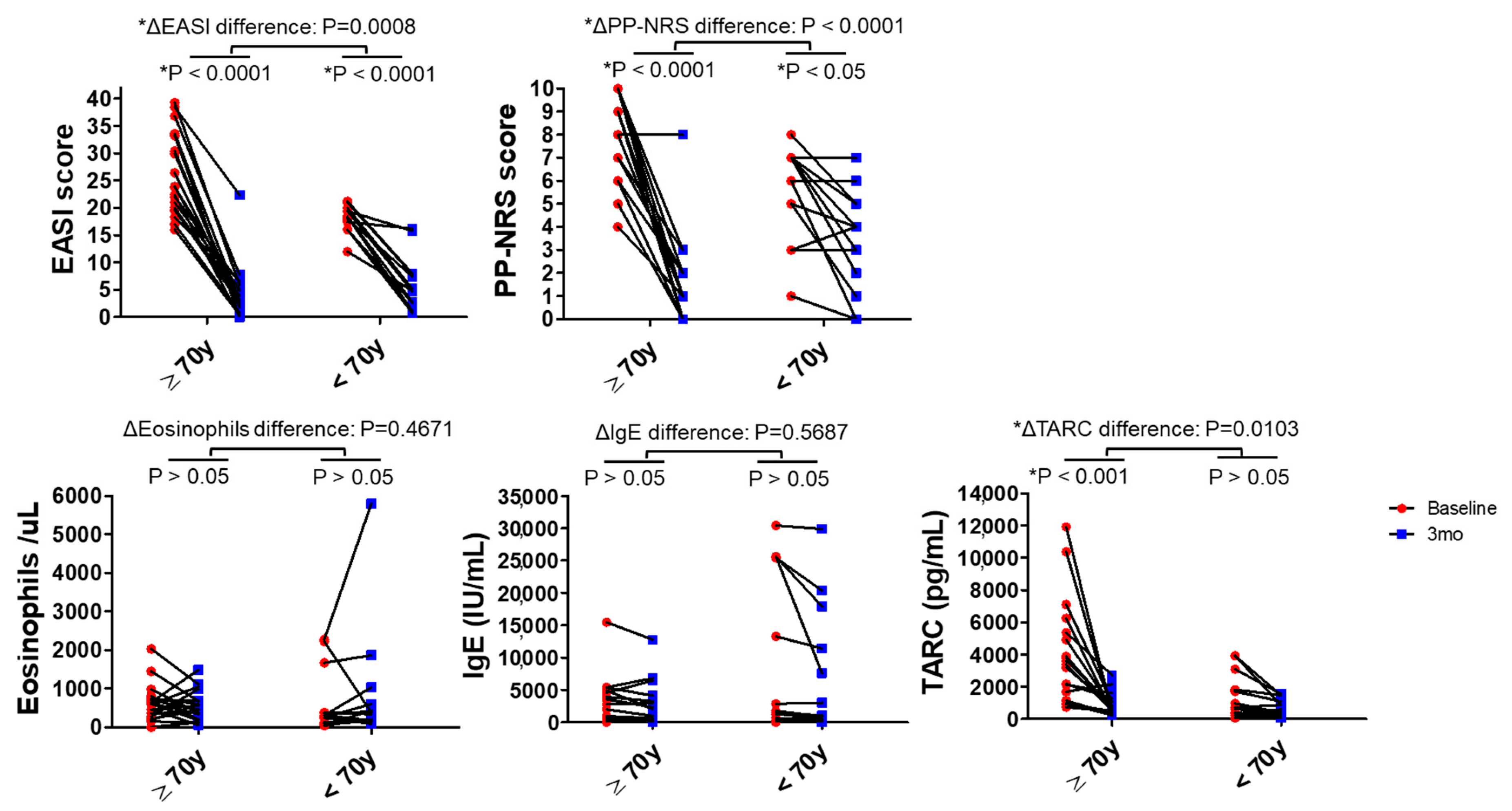



| Baseline | ≥70 y | <70 y | p-Value |
|---|---|---|---|
| Total, N (Female, N) | 19 (2) | 14 (6) | 0.0473 † |
| Age, y, median (Q1, Q3) | 82 (74, 86) | 50.5 (27.75, 60) | - |
| Disease duration, y, median (Q1, Q3) | 4 (1, 20) | 19 (5, 45.25) | 0.0173 ¶ |
| Body weight, kg, median (Q1, Q3) | 59.6 (50.75, 65.6) | 58 (52.88, 85) | 0.4358 ¶ |
| w/o atopic predisposition, N | 3 | 2 | 1.0000 † |
| Systemic therapy-naïve, N | 10 | 5 | 0.4824 † |
| Bio-naïve, N | 18 | 8 | 0.0260 † |
| PP-NRS, median (Q1, Q3) | 8 (6, 10) | 6.5 (4.5, 7) | 0.0050 ¶ |
| EASI, median (Q1, Q3) | 23.8 (19.6, 33.2) | 18.4 (16, 20.25) | 0.0011 ¶ |
| IGA, median (Q1, Q3) | 3 (3, 4) | 3 (3, 3) | 0.1638 ¶ |
| Eosinophil counts/μL, median (Q1, Q3) | 610 (276, 740) | 280 (124.3, 705.8) | 0.1502 ¶ |
| IgE, IU/mL, median (Q1, Q3) | 964 (167, 4608) | 1620 (335.5, 25,480) | 0.4125 ¶ |
| TARC, pg/mL, median (Q1, Q3) | 3390 (1156, 5356) | 734 (335.3, 2140) | 0.0027 ¶ |
| Three Months After Treatment | ≥70 y | <70 y | p-Value |
|---|---|---|---|
| Total, N | 19 | 14 | |
| PP-NRS, median (Q1, Q3) | 1 (0, 3) | 4 (1.75, 5) | 0.0103 ¶ |
| PP-NRS4, N | 17 | 4 | 0.0006 † |
| PP-NRS0/1, N | 11 | 3 | 0.0733 † |
| EASI, median (Q1, Q3) | 3 (1.8, 5.9) | 5 (2.25, 8) | 0.1500 ¶ |
| EASI 75, N | 16 | 6 | 0.0240 † |
| EASI 90, N | 9 | 3 | 0.1604 † |
| IGA, median (Q1, Q3) | 1 (1, 2) | 2 (1, 2) | 0.2084 ¶ |
| IGA0/1, N | 11 | 6 | 0.4905 † |
| Both PP-NRS4 and EASI75 achieved, N | 14 | 2 | 0.0013 † |
| Both PP-NRS4 and IGA0/1 achieved, N | 11 | 1 | 0.0036 † |
| Eosinophil counts/μL, median (Q1, Q3) | 460 (211, 696) | 364 (164, 715) | 0.5004 ¶ |
| IgE, IU/mL, median (Q1, Q3) | 687 (124, 3287) | 986 (334.3, 13,050) | 0.4125 ¶ |
| TARC, pg/mL, median (Q1, Q3) | 531 (402, 1070) | 517.5 (318.8, 1185) | 0.5974 ¶ |
| Reasons for Discontinuation | ≥70 y | <70 y | p-Value † |
|---|---|---|---|
| Total patients, N | 25 | 18 | |
| Total discontinuation, N (%) | 18 (72) | 11 (61.1) | 0.5205 |
| Effect reduction, N (%) | 4 (16) | 3 (16.7) | 1.0000 |
| Insufficient effect, N (%) | 3 (12) | 4 (22.2) | 0.4274 |
| Remission, N (%) | 4 (16) | 2 (11.1) | 1.0000 |
| Pruritus/prurigo nodularis, N (%) | 3 (12) | 0 (0) | 0.2525 |
| Social reason, N (%) | 2 (8) | 0 (0) | 0.5017 |
| Drug eruption *, N (%) | 1 (4) | 1 (5.6) | 1.0000 |
| Grade 3 eosinophilia, N (%) | 0 (0) | 1 (5.6) | 0.4186 |
| Pain at the injection site, N (%) | 1 (4) | 0 (0) | 1.0000 |
| Adverse Events | ≥70 y | <70 y | p-Value † |
|---|---|---|---|
| Total patients, N | 25 | 18 | |
| Total adverse events, N (%) | 10 (40) | 6 (33.3) | 0.7548 |
| Pruritus/prurigo nodularis, N (%) | 5 (20) | 1 (5.6) | 0.3747 |
| Eye itching/conjunctivitis, N (%) | 2 (8) | 2 (11.1) | 1.0000 |
| Joint pain, N (%) | 1 (4) | 1 (5.6) | 1.0000 |
| Drug eruption *, N (%) | 1 (4) | 1 (5.6) | 1.0000 |
| Grade 3 eosinophilia, N (%) | 0 (0) | 1 (5.6) | 0.4186 |
| Pain at the injection site leading to discontinuation, N (%) | 1 (4) | 0 (0) | 1.0000 |
| Next Treatment | ≥70 y | <70 y | p-Value † |
|---|---|---|---|
| Total discontinuation, N | 18 | 11 | |
| Lebrikizumab (IL-13 ab), N (%) | 4 (22.2) | 6 (54.5) | 0.1142 |
| Topical treatment only, N (%) | 6 (33.3) | 2 (18.2) | 0.6706 |
| Dupilumab (IL-4/13R ab), N (%) | 3 (16.7) | 1 (9) | 1.0000 |
| Nemolizumab (IL-31R ab), N (%) | 3 (16.7) | 1 (9) | 1.0000 |
| Abrocitinib (JAK1 inhibitor), N (%) | 1 (5.6) | 0 (0) | 1.0000 |
| Oral predonisolone, N (%) | 1 (5.6) | 1 (9) | 1.0000 |
Disclaimer/Publisher’s Note: The statements, opinions and data contained in all publications are solely those of the individual author(s) and contributor(s) and not of MDPI and/or the editor(s). MDPI and/or the editor(s) disclaim responsibility for any injury to people or property resulting from any ideas, methods, instructions or products referred to in the content. |
© 2026 by the authors. Licensee MDPI, Basel, Switzerland. This article is an open access article distributed under the terms and conditions of the Creative Commons Attribution (CC BY) license.
Share and Cite
Sato, E.; Obonai, N.; Koga, M.; Sibayama, Y.; Imafuku, S. Older Patients with Atopic Dermatitis Show More Pronounced Early Clinical Improvement with Tralokinumab: A Single-Center Retrospective Real-World Study. J. Clin. Med. 2026, 15, 1117. https://doi.org/10.3390/jcm15031117
Sato E, Obonai N, Koga M, Sibayama Y, Imafuku S. Older Patients with Atopic Dermatitis Show More Pronounced Early Clinical Improvement with Tralokinumab: A Single-Center Retrospective Real-World Study. Journal of Clinical Medicine. 2026; 15(3):1117. https://doi.org/10.3390/jcm15031117
Chicago/Turabian StyleSato, Emi, Naoko Obonai, Monji Koga, Yoshitsugu Sibayama, and Shinichi Imafuku. 2026. "Older Patients with Atopic Dermatitis Show More Pronounced Early Clinical Improvement with Tralokinumab: A Single-Center Retrospective Real-World Study" Journal of Clinical Medicine 15, no. 3: 1117. https://doi.org/10.3390/jcm15031117
APA StyleSato, E., Obonai, N., Koga, M., Sibayama, Y., & Imafuku, S. (2026). Older Patients with Atopic Dermatitis Show More Pronounced Early Clinical Improvement with Tralokinumab: A Single-Center Retrospective Real-World Study. Journal of Clinical Medicine, 15(3), 1117. https://doi.org/10.3390/jcm15031117