Impact of UGT1A1*28 Allele on the Safety and Effectiveness of Sacituzumab Govitecan in Metastatic Triple-Negative Breast Cancer: Real-World Evidence

 , , , , , , and
Abstract
1. Introduction
2. Materials and Methods
2.1. Study Design
2.2. Study Population
2.3. Data Collection
2.4. Treatment Protocol
2.5. Genetic Analysis
2.6. Safety and Effectiveness Assessment
2.7. Statistical Analysis
3. Results
3.1. Baseline Characteristics of the Included Population
3.2. Relationship Between SG Safety and Genotype in UGT1A1
3.3. Relationship Between SG Effectiveness and UGT1A1 Genotype
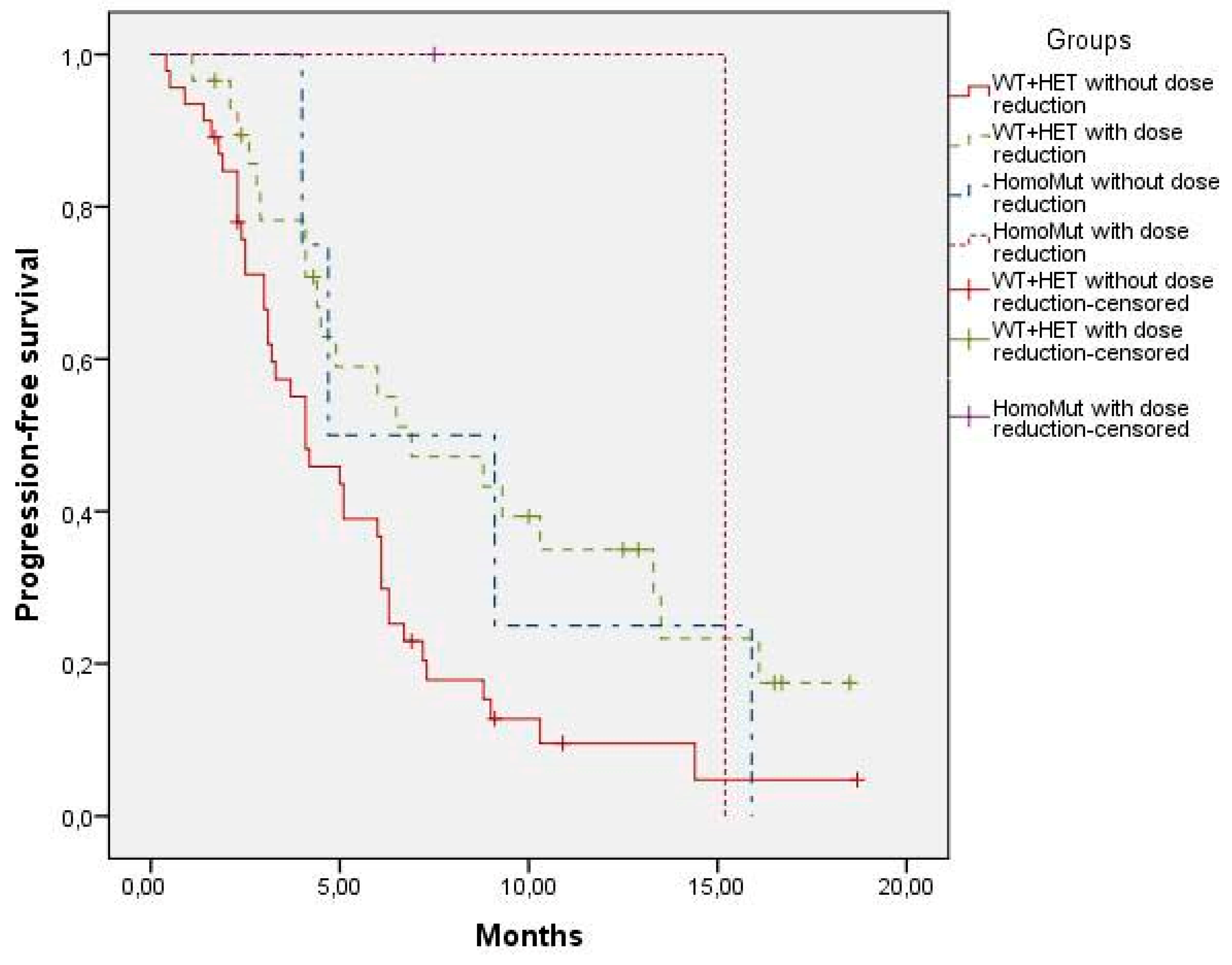
3.4. Relationship Between SG Effectiveness and Dose Reduction
4. Discussion
5. Conclusions
Author Contributions
Funding
Institutional Review Board Statement
Informed Consent Statement
Data Availability Statement
Acknowledgments
Conflicts of Interest
References
- Foulkes, W.D.; Smith, I.E.; Reis-Filho, J.S. Triple-negative breast cancer. N. Engl. J. Med. 2010, 363, 1938–1948. [Google Scholar] [CrossRef]
- Gennari, A.; André, F.; Barrios, C.H.; Cortés, J.; de Azambuja, E.; DeMichele, A.; Dent, R.; Fenlon, D.; Fenlon, J.; Hurvitz, S.A.; et al. ESMO Clinical Practice Guideline for the diagnosis, staging and treatment of patients with metastatic breast cancer. Ann. Oncol. 2021, 32, 1475–1495. [Google Scholar] [CrossRef]
- Rugo, H.S.; Tolaney, S.M.; Loirat, D.; Punie, K.; Bardia, A.; Hurvitz, S.A.; O’Shaughnessy, J.; Cortés, J.; Diéras, V.; Carey, L.A.; et al. Safety analyses from the phase 3 ASCENT trial of sacituzumab govitecan in metastatic triple-negative breast cancer. NPJ Breast Cancer 2022, 8, 98. [Google Scholar] [CrossRef]
- Zaman, S.; Jadid, H.; Denson, A.C.; Gray, J.E. Targeting Trop-2 in solid tumors: Future prospects. OncoTargets Ther. 2019, 12, 1781–1790. [Google Scholar] [CrossRef] [PubMed]
- Syed, Y.Y. Sacituzumab Govitecan: First Approval. Drugs 2020, 80, 1019–1025. [Google Scholar] [CrossRef]
- Bardia, A.; Hurvitz, S.A.; Tolaney, S.M.; Loirat, D.; Punie, K.; Oliveira, M.; Brufsky, A.; Sardesai, S.D.; Kalinsky, K.; Zelnak, A.B.; et al. Sacituzumab Govitecan in Metastatic Triple-Negative Breast Cancer. N. Engl. J. Med. 2021, 384, 1529–1541. [Google Scholar] [CrossRef]
- Goldenberg, D.M.; Cardillo, T.M.; Govindan, S.V.; Rossi, E.A.; Sharkey, R.M. Trop-2 is a novel target for solid cancer therapy with sacituzumab govitecan (IMMU-132), an antibody-drug conjugate (ADC). Oncotarget 2015, 6, 22496–22512. [Google Scholar] [CrossRef]
- Immunomedics, Inc. Trodelvy (Sacituzumab-Govitecan-HZIY) [Package Insert]. U.S. Food and Drug Administration Website. 2023. Available online: https://www.accessdata.fda.gov/drugsatfda_docs/label/2023/761115s035lbl.pdf (accessed on 8 June 2025).
- Hu, Z.Y.; Yu, Q.; Pei, Q.; Guo, C. Dose-dependent association between UGT1A1*28 genotype and irinotecan-induced neutropenia: Low doses also increase risk. Clin. Cancer Res. 2010, 16, 3832–3842. [Google Scholar] [CrossRef]
- Liu, X.; Cheng, D.; Kuang, Q.; Liu, G.; Xu, W. Association of UGT1A1*28 polymorphisms with irinotecan-induced toxicities in colorectal cancer: A meta-analysis in Caucasians. Pharmacogenomics J. 2014, 14, 120–129. [Google Scholar] [CrossRef]
- Les Laboratoires Servier Industrie. Onivyde Pegylated Liposomal (Irinotecan Hydrochloride Trihydrate) [Package Insert]. European Medicines Agency Website. 2024. Available online: https://www.ema.europa.eu/en/documents/product-information/onivyde-pegylated-liposomal-epar-product-information_en.pdf (accessed on 4 June 2025).
- Alaklabi, S.; Roy, A.M.; Zagami, P.; Chakraborty, A.; Held, N.; Elijah, J.; George, A.; Attwood, K.; Shaikh, S.S.; Chaudhary, L.N.; et al. Real-World Clinical Outcomes With Sacituzumab Govitecan in Metastatic Triple-Negative Breast Cancer. JCO Oncol. Pract. 2025, 21, 620–628. [Google Scholar] [CrossRef] [PubMed]
- Wong, M.H.; Jones, V.C.; Yu, W.; Bosserman, L.D.; Lavasani, S.M.; Patel, N.; Sedrak, M.S.; Stewart, D.B.; Waisman, J.R.; Yuan, Y.; et al. UGT1A1*28 polymorphism and the risk of toxicity and disease progression in patients with breast cancer receiving sacituzumab govitecan. Cancer Med. 2024, 13, e70096. [Google Scholar] [CrossRef] [PubMed]
- Loriot, Y.; Petrylak, D.P.; Rezazadeh Kalebasty, A.; Fléchon, A.; Jain, R.K.; Gupta, S.; Bupathi, M.; Beuzeboc, P.; Palmbos, P.; Balar, A.V.; et al. TROPHY-U-01, a phase II open-label study of sacituzumab govitecan in patients with metastatic urothelial carcinoma progressing after platinum-based chemotherapy and checkpoint inhibitors: Updated safety and efficacy outcomes. Ann. Oncol. 2024, 35, 392–401. [Google Scholar] [CrossRef]
- Heong, V.Y.M.; Marmé, F.; Rugo, H.S.; Tolaney, S.M.; Bardia, A.; Schmid, P.; Verret, W.; Valdez, T.; Wang, H.; Cortes, J.; et al. Safety outcomes by UGT1A1 status in the phase III TROPiCS- 02 study of sacituzumab govitecan (SG) in HR+/HER2e metastatic breast cancer (mBC). Ann. Oncol. 2023, 34, S1486–S1487. [Google Scholar] [CrossRef]
- Sultana, R.; Chen, S.; Lim, E.H.; Dent, R.; Chowbay, B. Efficacy and safety of sacituzumab govitecan Trop-2-targeted antibody-drug conjugate in solid tumors and UGT1A1*28 polymorphism: A systematic review and meta-analysis. BJC Rep. 2024, 2, 85. [Google Scholar] [CrossRef]
- Valsecchi, A.A.; Pisegna, S.; Antonuzzo, A.; Arpino, G.; Bianchini, G.; Biganzoli, L.; Colloca, G.F.; Criscitiello, C.; Danesi, R.; Fabi, A.; et al. Delphi consensus on the management of adverse events in patients with metastatic triple-negative breast cancer treated with sacituzumab govitecan. Oncol. 2025, 30, oyaf088. [Google Scholar] [CrossRef]
- Karas, S.; Innocenti, F. All You Need to Know About UGT1A1 Genetic Testing for Patients Treated With Irinotecan: A Practitioner-Friendly Guide. JCO Oncol. Pract. 2022, 18, 270–277. [Google Scholar] [CrossRef]
- Legido Perdices, E.M.; do Pazo Oubiña, F.; Prado Mel, E.; Miarons, M.; García, B.D.R.; Gutiérrez Nicolás, F. Influence of the UGT1A1 gene polymorphism on treatment with sacituzumab govitecan. Narrative review. Farm. Hosp. 2025, 49, T339–T345, (In English, Spanish). [Google Scholar] [CrossRef]



| WT + HET (N = 75) | HomoMut (N = 6) | p-Value | ||
|---|---|---|---|---|
| Average age, years [IQR] | 54.8 [31–78] | 53.8 [47–73] | 0.828 | |
| Race | Caucasian, N (%) | 74 (98.7) | 6 (100) | 0.776 |
| Asian (%), N (%) | 1 (1.3) | 0 (0) | ||
| BMI, kg/m2 [IQR] | 26.1 [15.9–35.6] | 27.8 [21.1–44.6] | 0.254 | |
| Patients who received neoadjuvant/adjuvant therapy, N (%) | 54 (72) | 4 (67) | 0.780 | |
| SG as ≥2 line of treatment for metastatic disease, N (%) | 72 (96) | 5 (83) | 0.733 | |
| Average treatment time with SG, months [IQR] | 5.9 [3.1–18.7] | 9.4 [4.0–15.9] | 0.082 | |
| Use of antiemetic prophylaxis | 3-drug combination (5-HT3 receptor antagonists + corticosteroids + neurokinin-1 (NK-1) receptor antagonists), N (%) | 68 (91) | 6 (100) | 0.433 |
| 2-drug combination (5-HT3 receptor antagonists + corticosteroids), N (%) | 7 (9) | 0 (0) | ||
| Use of atropine prior to SG administration, N (%) | 8 (11) | 0 (0) | 0.399 | |
| Primary prophylaxis with G-CSF, N (%) | 33 (44) | 2 (33) | 0.611 | |
| Secondary prophylaxis with G-CSF, N (%) | 19 (25) | 2 (33) | 0.667 | |
| Genotypes | WT + HET Without Dose Reduction (N = 46) | WT + HET with Dose Reduction (N = 29) | HomoMut Without Dose Reduction (N = 4) | HomoMut with Dose Reduction (N = 2) |
|---|---|---|---|---|
| WT + HET Without dose reduction (N = 46) | 4.1 versus 6.9 (0.015) | 4.1 versus 9.1 (0.225) | 4.1 versus 15.2 (0.121) | |
| WT + HET With dose reduction (N = 29) | 6.9 versus 4.1 (0.015) | 6,9 versus 9.1 (0.972) | 6,9 versus 15.2 (0.445) | |
| HomoMut Without dose reduction (N = 4) | 9.1 versus 4.1 (0.225) | 9.1 versus 6.9 (0.972) | 9.1 versus 15.2 (0.782) | |
| HomoMut With dose reduction (N = 2) | 15.2 versus 4.1 (0.121) | 15.2 versus 6.9 (0.445) | 15.2 versus 9.1 (0.782) |
Disclaimer/Publisher’s Note: The statements, opinions and data contained in all publications are solely those of the individual author(s) and contributor(s) and not of MDPI and/or the editor(s). MDPI and/or the editor(s) disclaim responsibility for any injury to people or property resulting from any ideas, methods, instructions or products referred to in the content. |
© 2026 by the authors. Licensee MDPI, Basel, Switzerland. This article is an open access article distributed under the terms and conditions of the Creative Commons Attribution (CC BY) license.
Share and Cite
do Pazo-Oubiña, F.; del Rosario García, B.; Miarons, M.; Legido Perdices, E.M.; Prado Mel, E.; Díaz, R.R.; Gutiérrez Nicolás, F.; on behalf of the Estudio Mama-SSG Working Group. Impact of UGT1A1*28 Allele on the Safety and Effectiveness of Sacituzumab Govitecan in Metastatic Triple-Negative Breast Cancer: Real-World Evidence. J. Clin. Med. 2026, 15, 574. https://doi.org/10.3390/jcm15020574
do Pazo-Oubiña F, del Rosario García B, Miarons M, Legido Perdices EM, Prado Mel E, Díaz RR, Gutiérrez Nicolás F, on behalf of the Estudio Mama-SSG Working Group. Impact of UGT1A1*28 Allele on the Safety and Effectiveness of Sacituzumab Govitecan in Metastatic Triple-Negative Breast Cancer: Real-World Evidence. Journal of Clinical Medicine. 2026; 15(2):574. https://doi.org/10.3390/jcm15020574
Chicago/Turabian Styledo Pazo-Oubiña, Fernando, Betel del Rosario García, Marta Miarons, Eva M. Legido Perdices, Elena Prado Mel, Ruth Ramos Díaz, Fernando Gutiérrez Nicolás, and on behalf of the Estudio Mama-SSG Working Group. 2026. "Impact of UGT1A1*28 Allele on the Safety and Effectiveness of Sacituzumab Govitecan in Metastatic Triple-Negative Breast Cancer: Real-World Evidence" Journal of Clinical Medicine 15, no. 2: 574. https://doi.org/10.3390/jcm15020574
APA Styledo Pazo-Oubiña, F., del Rosario García, B., Miarons, M., Legido Perdices, E. M., Prado Mel, E., Díaz, R. R., Gutiérrez Nicolás, F., & on behalf of the Estudio Mama-SSG Working Group. (2026). Impact of UGT1A1*28 Allele on the Safety and Effectiveness of Sacituzumab Govitecan in Metastatic Triple-Negative Breast Cancer: Real-World Evidence. Journal of Clinical Medicine, 15(2), 574. https://doi.org/10.3390/jcm15020574