Evaluation of the Influence of Er:YAG Laser Parameters on the Effectiveness of Growth Inhibition of Candida Biofilms: An In Vitro Study

 , , and
Abstract
1. Introduction
1.1. Background
1.2. Er:YAG Laser and Antimicrobial Applications
1.3. Rationale and Aim of the Study
2. Materials and Methods
2.1. Study Design
- Diameter of the growth inhibition zone (GIZ) in Phase 1
- CFU counts following irradiation of mature biofilms in Phase 2
- Persistence of inhibition zones over a 96 h incubation period
- Species-specific differences in fluence–response relationships
2.2. Microorganisms
2.3. Growth Conditions
2.4. Experimental Groups
- Control group: Biofilms not exposed to laser irradiation
- Experimental groups: Biofilms exposed to Er:YAG laser irradiation at defined fluence settings
2.5. Evaluation of the Er:YAG Laser Effect on Growth Inhibition of Single-Species Candida Biofilms
2.6. Evaluation of the Er:YAG Laser Effect on Elimination of Mature Single-Species Candida Biofilms
- Upper left: 0.8 J/cm2 (0.60 W)
- Upper right: 1.0 J/cm2 (0.75 W)
- Lower left: 1.5 J/cm2 (1.15 W)
- Lower right: 2.0 J/cm2 (1.50 W)
2.7. Statistical Analysis
3. Results
3.1. Growth Inhibition of Candida Biofilms (Phase 1)
3.1.1. Candida albicans ATCC 10231
3.1.2. Candida parapsilosis ATCC 22019
3.1.3. Candida krusei ATCC 6258
3.1.4. Candida glabrata ATCC 90030
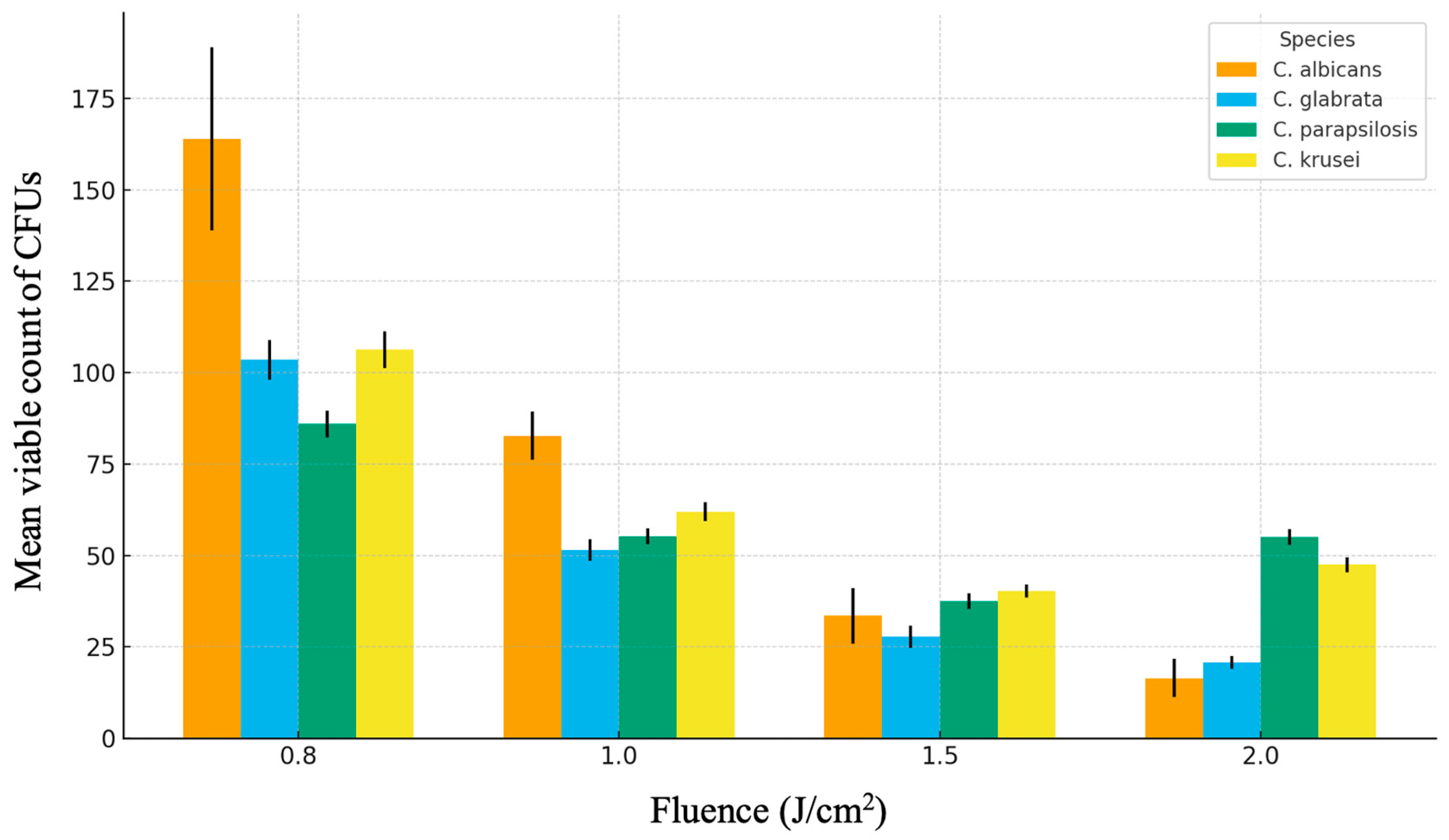
3.2. Reduction of Viable Cells in Mature Biofilms (Phase 2)
3.2.1. Candida albicans ATCC 10231
3.2.2. Candida glabrata ATCC 90030
3.2.3. Candida parapsilosis ATCC 22019
3.2.4. Candida krusei ATCC 6258
3.3. Summary of Results
Summary of Mature Biofilm Response
4. Discussion
4.1. Interpretation of the Primary Findings
4.2. Species-Specific Susceptibility Patterns
4.3. Effects on Mature Biofilms and Dose–Response Considerations
4.4. Disinfection Versus Eradication
4.5. Translational Implications and Caution
4.6. Limitations
4.7. Future Directions
5. Conclusions
Author Contributions
Funding
Institutional Review Board Statement
Informed Consent Statement
Data Availability Statement
Conflicts of Interest
References
- Perić, M.; Miličić, B.; Kuzmanović Pfićer, J.; Živković, R.; Arsić Arsenijević, V. A systematic review of denture stomatitis: Predisposing factors, clinical features, etiology, and global Candida spp. distribution. J. Fungi 2024, 10, 328. [Google Scholar] [CrossRef] [PubMed]
- Patel, M. Oral cavity and Candida albicans: Colonisation to the development of infection. Pathogens 2022, 11, 335. [Google Scholar] [CrossRef] [PubMed]
- Rodrigues, C.F.; Rodrigues, M.E.; Henriques, M. Candida sp. infections in patients with diabetes mellitus. J. Clin. Med. 2019, 8, 76. [Google Scholar] [CrossRef] [PubMed]
- Taff, H.T.; Mitchell, K.F.; Edwards, J.A.; Andes, D.R. Mechanisms of Candida biofilm drug resistance. Future Microbiol. 2013, 8, 1325–1337. [Google Scholar] [CrossRef]
- Taylor, M.; Brizuela, M.; Raja, A. Oral candidiasis. In StatPearls; StatPearls Publishing: Treasure Island, FL, USA, 2025. Available online: https://www.ncbi.nlm.nih.gov/books/NBK545282/ (accessed on 4 July 2023).
- Buyukhatipoglu, I.; Secilmis, A. The use of erbium:yttrium–aluminum–garnet laser in cavity preparation and surface treatment: Three-year follow-up. Eur. J. Dent. 2015, 9, 284–287. [Google Scholar] [CrossRef]
- Almoharib, H. Erbium-doped yttrium aluminium garnet (Er:YAG) lasers in the treatment of peri-implantitis. Cureus 2025, 17, e78279. [Google Scholar] [CrossRef]
- Li, L.; Deng, J.; Ren, S. Clinical efficacy of Er:YAG lasers in the treatment of peri-implantitis: A systematic review and meta-analysis. Ann. Palliat. Med. 2021, 10, 9002–9014. [Google Scholar] [CrossRef]
- Badran, Z.; Bories, C.; Struillou, X.; Saffarzadeh, A.; Verner, C.; Soueidan, A. Er:YAG laser in the clinical management of severe peri-implantitis: A case report. J. Oral Implantol. 2011, 37, 212–217. [Google Scholar] [CrossRef]
- Dembicka-Mączka, D.; Kępa, M.; Fiegler-Rudol, J.; Grzech-Leśniak, Z.; Matys, J.; Grzech-Leśniak, K.; Wiench, R. Evaluation of the disinfection efficacy of Er:YAG laser light on single-species Candida biofilms: An in vitro study. Dent. J. 2025, 13, 88. [Google Scholar] [CrossRef]
- Sennhenn-Kirchner, S.; Schwarz, P.; Schliephake, H.; Konietschke, F.; Brunner, E.; Zepelin, M.B.-V. Decontamination efficacy of erbium:yttrium–aluminium–garnet and diode laser light on oral Candida albicans isolates of a five-day in vitro biofilm model. Lasers Med. Sci. 2009, 24, 313–320. [Google Scholar] [CrossRef]
- Meire, M.A.; Coenye, T.; Nelis, H.J.; De Moor, R.J.G. In vitro inactivation of endodontic pathogens with Nd:YAG and Er:YAG lasers. Lasers Med. Sci. 2012, 27, 695–701. [Google Scholar] [CrossRef] [PubMed]
- Grzech-Leśniak, K.; Nowicka, J.; Pajączkowska, M.; Matys, J.; Szymonowicz, M.; Kuropka, P.; Rybak, Z.; Dobrzyński, M.; Dominiak, M. Effects of Nd:YAG laser irradiation on the growth of Candida albicans and Streptococcus mutans: An in vitro study. Lasers Med. Sci. 2019, 34, 129–137. [Google Scholar] [CrossRef] [PubMed]
- Polak, D.; Shani-Kdoshim, S.; Alias, M.; Shapira, L.; Stabholz, A. In vitro efficacy of biofilm removal from titanium surfaces using Er:YAG laser: Comparison of treatment protocols and ablation parameters. J. Periodontol. 2022, 93, 100–109. [Google Scholar] [CrossRef]
- Kriechbaumer, L.K.; Happak, W.; Distelmaier, K.; Thalhammer, G.; Kaiser, G.; Kugler, S.; Tan, Y.; Leonhard, M.; Zatorska, B.; Presterl, E.; et al. Disinfection of contaminated metal implants with an Er:YAG laser. J. Orthop. Res. 2020, 38, 2464–2473. [Google Scholar] [CrossRef] [PubMed]
- Dembicka-Mączka, D.; Gryka-Deszczyńska, M.; Sitkiewicz, J.; Makara, A.; Fiegler-Rudol, J.; Wiench, R. Evaluation of the disinfection efficacy of Er:YAG laser light on single-species Candida biofilms: A systematic review. Microorganisms 2025, 13, 942. [Google Scholar] [CrossRef]
- Golob Deeb, J.; Smith, J.; Belvin, B.R.; Lewis, J.; Grzech-Leśniak, K. Er:YAG laser irradiation reduces microbial viability when used in combination with sodium hypochlorite, chlorhexidine, and hydrogen peroxide. Microorganisms 2019, 7, 612. [Google Scholar] [CrossRef]
- Reddy, N.; Golob Deeb, J.; Kitten, T.; Carrico, C.K.; Grzech-Leśniak, K. In vitro effect of laser irradiation and chemical reagents on reducing root caries bacteria. Int. J. Mol. Sci. 2022, 23, 15732. [Google Scholar] [CrossRef]
- Eick, S.; Meier, I.; Spoerlé, F.; Bender, P.; Aoki, A.; Izumi, Y.; Salvi, G.E.; Sculean, A. In vitro activity of Er:YAG laser compared with other treatment modalities on biofilm ablation from implant and tooth surfaces. PLoS ONE 2017, 12, e0171086. [Google Scholar] [CrossRef]
- Meire, M.A.; Coenye, T.; Nelis, H.J.; De Moor, R.J.G. Evaluation of Nd:YAG and Er:YAG irradiation, antibacterial photodynamic therapy, and sodium hypochlorite treatment on Enterococcus faecalis biofilms. Int. Endod. J. 2012, 45, 482–491. [Google Scholar] [CrossRef]
- Zaitsev, A.E.; Asanov, O.N. Erbium:yttrium aluminium garnet laser therapy versus sharp debridement in chronic lower extremity ulcers: A randomized controlled trial. Int. Wound J. 2025, 22, e70688. [Google Scholar] [CrossRef]
- Gaspar, A.; Calderon, A.; Mora, J.V.; Silva, J.; Bojanini, J.F.; Araujo, M.J.; Geada, L.L.; Ivanova, E.; Helvacioglu, Y.; Coello, P.P.; et al. Impact of non-ablative erbium laser therapy on recurrent vaginal candidiasis. Lasers Surg. Med. 2025, 57, 187–194. [Google Scholar] [CrossRef]
- Kasić, S.; Knezović, M.; Beader, N.; Gabrić, D.; Malčić, A.I.; Baraba, A. Efficacy of Three Different Lasers on Eradication of Enterococcus faecalis and Candida albicans Biofilms in Root Canal System. Photomed Laser Surg. 2017, 35, 372–377. [Google Scholar] [CrossRef] [PubMed]
- Saffarpour, A.; Fekrazad, R.; Heibati, M.N.; Bahador, A.; Saffarpour, A.; Rokn, A.; Iranparvar, A.; KharaziFard, M. Bactericidal effect of Er:YAG laser and photodynamic therapy on Aggregatibacter actinomycetemcomitans biofilm on implant surfaces. Int. J. Oral Maxillofac. Implants 2016, 31, e71–e78. [Google Scholar] [CrossRef] [PubMed]
- Gonçalves, F.; Zanetti, A.L.; Zanetti, R.V.; Martelli, F.S.; Avila-Campos, M.J.; Tomazinho, L.F.; Granjeiro, J.M. Effectiveness of diode and Nd:YAG lasers in implant disinfection. Photomed. Laser Surg. 2010, 28, 273–280. [Google Scholar] [CrossRef] [PubMed]
- Strever, J.M.; Lee, J.; Ealick, W.; Peacock, M.; Shelby, D.; Susin, C.; Mettenberg, D.; El-Awady, A.; Rueggeberg, F.; Cutler, C.W. Er,Cr:YSGG laser ablates single-species biofilms on titanium disks without detectable surface damage. J. Periodontol. 2017, 88, 484–492. [Google Scholar] [CrossRef]
- Vaddamanu, S.K.; Vyas, R.; Kavita, K.; Sushma, R.; Rani, R.P.; Dixit, A.; Badiyani, B.K. In vitro comparison of dental laser and other treatment modalities on biofilm ablation from implant and tooth surfaces. J. Pharm. Bioallied Sci. 2022, 14, S530–S533. [Google Scholar] [CrossRef]
- Arneiro, R.A.; Nakano, R.D.; Antunes, L.A.; Ferreira, G.B.; Fontes, K.; Antunes, L.S. Efficacy of antimicrobial photodynamic therapy for root canals infected with Enterococcus faecalis. J. Oral Sci. 2014, 56, 277–285. [Google Scholar] [CrossRef]
- Roi, C.I.; Roi, A.; Nicoară, A.; Nica, D.; Rusu, L.C.; Soancă, A.; Motofelea, A.C.; Riviș, M. Impact of Treatment on Systemic Immune-Inflammatory Index and Other Inflammatory Markers in Odontogenic Cervicofacial Phlegmon Cases: A Retrospective Study. Biomedicines 2023, 11, 1710. [Google Scholar] [CrossRef]


| Fluence [J/cm2] | Power [W] | Power Density [W/cm2] | Pulse Energy [J] | Total E (W × t) [J] |
|---|---|---|---|---|
| 0.30 | 0.20 | 0.52 | 0.12 | 24.0 |
| 0.40 | 0.30 | 0.78 | 0.15 | 36.0 |
| 0.50 | 0.35 | 0.91 | 0.19 | 42.0 |
| 0.60 | 0.45 | 1.17 | 0.23 | 54.0 |
| 0.70 | 0.50 | 1.30 | 0.27 | 60.0 |
| 0.80 | 0.60 | 1.56 | 0.31 | 72.0 |
| 0.90 | 0.65 | 1.69 | 0.35 | 78.0 |
| 1.00 | 0.75 | 1.95 | 0.38 | 90.0 |
| 1.50 | 1.15 | 2.99 | 0.58 | 138.0 |
| 2.00 | 1.50 | 3.90 | 0.77 | 180.0 |
| 2.50 | 1.90 | 4.94 | 0.96 | 228.0 |
| 3.00 | 2.30 | 5.98 | 1.15 | 276.0 |
| 3.40 | 2.60 | 6.76 | 1.31 | 312.0 |
| Fluence [J/cm2] | Power [W] | Power Density [W/cm2] | Pulse Energy [J] | Total E (W × t) [J] |
|---|---|---|---|---|
| 0.80 | 0.60 | 1.56 | 0.31 | 72.0 |
| 1.00 | 0.75 | 1.95 | 0.38 | 90.0 |
| 1.50 | 1.15 | 2.99 | 0.58 | 138.0 |
| 2.00 | 1.50 | 3.90 | 0.77 | 180.0 |
| Fluence (J/cm2) | C. albicans | C. glabrata | C. parapsilosis | C. krusei |
|---|---|---|---|---|
| 0.3 | 5.5 ± 0.2 | 4.0 ± 0.1 | 5.1 ± 0.2 | 5.0 ± 0.2 |
| 0.4 | 5.5 ± 0.2 | 4.2 ± 0.1 | 5.3 ± 0.2 | 5.1 ± 0.2 |
| 0.5 | 5.6 ± 0.2 | 4.4 ± 0.1 | 5.5 ± 0.2 | 5.2 ± 0.2 |
| 0.6 | 6.5 ± 0.3 | 4.6 ± 0.1 | 6.1 ± 0.3 | 5.3 ± 0.2 |
| 0.7 | 6.6 ± 0.3 | 4.7 ± 0.1 | 6.4 ± 0.3 | 5.6 ± 0.2 |
| 0.8 | 6.7 ± 0.3 | 4.8 ± 0.1 | 6.7 ± 0.3 | 5.9 ± 0.2 |
| 0.9 | 6.8 ± 0.3 | 4.9 ± 0.1 | 6.9 ± 0.3 | 6.1 ± 0.2 |
| 1.0 | 6.8 ± 0.3 | 5.0 ± 0.1 | 7.0 ± 0.3 | 6.2 ± 0.2 |
| 1.5 | 6.9 ± 0.3 | 5.1 ± 0.1 | 7.3 ± 0.3 | 6.5 ± 0.2 |
| 2.0 | 7.1 ± 0.3 | 5.1 ± 0.1 | 7.4 ± 0.3 | 6.7 ± 0.2 |
| 2.5 | 7.2 ± 0.3 | 5.2 ± 0.1 | 7.6 ± 0.3 | 6.9 ± 0.2 |
| 3.0 | 7.3 ± 0.3 | 5.2 ± 0.1 | 7.7 ± 0.3 | 7.0 ± 0.2 |
| 3.4 | 7.4 ± 0.3 | 5.2 ± 0.1 | 7.7 ± 0.3 | 7.0 ± 0.2 |
| Species | Concentration | Mean | SD |
|---|---|---|---|
| C. albicans | 0.8 | 164 | 25.07322609 |
| 1 | 82.75 | 6.652067348 | |
| 1.5 | 33.5 | 7.549834435 | |
| 2 | 16.5 | 5.196152423 | |
| C. glabrata | 0.8 | 103.5 | 5.446711546 |
| 1 | 51.5 | 2.886751346 | |
| 1.5 | 27.75 | 2.986078811 | |
| 2 | 20.75 | 1.707825128 | |
| C. parapsilosis | 0.8 | 86 | 3.651483717 |
| 1 | 55.25 | 2.217355783 | |
| 1.5 | 37.5 | 2.081665999 | |
| 2 | 55 | 2.160246899 | |
| C. krusei | 0.8 | 106.25 | 5.057996968 |
| 1 | 62 | 2.581988897 | |
| 1.5 | 40.25 | 1.707825128 | |
| 2 | 47.5 | 2.081665999 |
Disclaimer/Publisher’s Note: The statements, opinions and data contained in all publications are solely those of the individual author(s) and contributor(s) and not of MDPI and/or the editor(s). MDPI and/or the editor(s) disclaim responsibility for any injury to people or property resulting from any ideas, methods, instructions or products referred to in the content. |
© 2025 by the authors. Licensee MDPI, Basel, Switzerland. This article is an open access article distributed under the terms and conditions of the Creative Commons Attribution (CC BY) license.
Share and Cite
Dembicka-Mączka, D.; Fiegler-Rudol, J.; Kępa, M.; Skaba, D.; Wiench, R. Evaluation of the Influence of Er:YAG Laser Parameters on the Effectiveness of Growth Inhibition of Candida Biofilms: An In Vitro Study. J. Clin. Med. 2026, 15, 18. https://doi.org/10.3390/jcm15010018
Dembicka-Mączka D, Fiegler-Rudol J, Kępa M, Skaba D, Wiench R. Evaluation of the Influence of Er:YAG Laser Parameters on the Effectiveness of Growth Inhibition of Candida Biofilms: An In Vitro Study. Journal of Clinical Medicine. 2026; 15(1):18. https://doi.org/10.3390/jcm15010018
Chicago/Turabian StyleDembicka-Mączka, Diana, Jakub Fiegler-Rudol, Małgorzata Kępa, Dariusz Skaba, and Rafał Wiench. 2026. "Evaluation of the Influence of Er:YAG Laser Parameters on the Effectiveness of Growth Inhibition of Candida Biofilms: An In Vitro Study" Journal of Clinical Medicine 15, no. 1: 18. https://doi.org/10.3390/jcm15010018
APA StyleDembicka-Mączka, D., Fiegler-Rudol, J., Kępa, M., Skaba, D., & Wiench, R. (2026). Evaluation of the Influence of Er:YAG Laser Parameters on the Effectiveness of Growth Inhibition of Candida Biofilms: An In Vitro Study. Journal of Clinical Medicine, 15(1), 18. https://doi.org/10.3390/jcm15010018